EP2244485A2 - Verfahren und System zur bewegungskompensierten Rahmenraten-Aufwärtsumsetzung und dekomprimierte Video-Bitströme - Google Patents
Verfahren und System zur bewegungskompensierten Rahmenraten-Aufwärtsumsetzung und dekomprimierte Video-Bitströme Download PDFInfo
- Publication number
- EP2244485A2 EP2244485A2 EP10003916A EP10003916A EP2244485A2 EP 2244485 A2 EP2244485 A2 EP 2244485A2 EP 10003916 A EP10003916 A EP 10003916A EP 10003916 A EP10003916 A EP 10003916A EP 2244485 A2 EP2244485 A2 EP 2244485A2
- Authority
- EP
- European Patent Office
- Prior art keywords
- video
- wireless
- operable
- received
- video frames
- Prior art date
- Legal status (The legal status is an assumption and is not a legal conclusion. Google has not performed a legal analysis and makes no representation as to the accuracy of the status listed.)
- Withdrawn
Links
Images








Classifications
-
- H—ELECTRICITY
- H04—ELECTRIC COMMUNICATION TECHNIQUE
- H04N—PICTORIAL COMMUNICATION, e.g. TELEVISION
- H04N19/00—Methods or arrangements for coding, decoding, compressing or decompressing digital video signals
- H04N19/50—Methods or arrangements for coding, decoding, compressing or decompressing digital video signals using predictive coding
- H04N19/597—Methods or arrangements for coding, decoding, compressing or decompressing digital video signals using predictive coding specially adapted for multi-view video sequence encoding
-
- H—ELECTRICITY
- H04—ELECTRIC COMMUNICATION TECHNIQUE
- H04N—PICTORIAL COMMUNICATION, e.g. TELEVISION
- H04N19/00—Methods or arrangements for coding, decoding, compressing or decompressing digital video signals
- H04N19/10—Methods or arrangements for coding, decoding, compressing or decompressing digital video signals using adaptive coding
- H04N19/102—Methods or arrangements for coding, decoding, compressing or decompressing digital video signals using adaptive coding characterised by the element, parameter or selection affected or controlled by the adaptive coding
- H04N19/132—Sampling, masking or truncation of coding units, e.g. adaptive resampling, frame skipping, frame interpolation or high-frequency transform coefficient masking
-
- H—ELECTRICITY
- H04—ELECTRIC COMMUNICATION TECHNIQUE
- H04N—PICTORIAL COMMUNICATION, e.g. TELEVISION
- H04N19/00—Methods or arrangements for coding, decoding, compressing or decompressing digital video signals
- H04N19/10—Methods or arrangements for coding, decoding, compressing or decompressing digital video signals using adaptive coding
- H04N19/134—Methods or arrangements for coding, decoding, compressing or decompressing digital video signals using adaptive coding characterised by the element, parameter or criterion affecting or controlling the adaptive coding
- H04N19/136—Incoming video signal characteristics or properties
- H04N19/137—Motion inside a coding unit, e.g. average field, frame or block difference
- H04N19/139—Analysis of motion vectors, e.g. their magnitude, direction, variance or reliability
-
- H—ELECTRICITY
- H04—ELECTRIC COMMUNICATION TECHNIQUE
- H04N—PICTORIAL COMMUNICATION, e.g. TELEVISION
- H04N19/00—Methods or arrangements for coding, decoding, compressing or decompressing digital video signals
- H04N19/10—Methods or arrangements for coding, decoding, compressing or decompressing digital video signals using adaptive coding
- H04N19/134—Methods or arrangements for coding, decoding, compressing or decompressing digital video signals using adaptive coding characterised by the element, parameter or criterion affecting or controlling the adaptive coding
- H04N19/142—Detection of scene cut or scene change
-
- H—ELECTRICITY
- H04—ELECTRIC COMMUNICATION TECHNIQUE
- H04N—PICTORIAL COMMUNICATION, e.g. TELEVISION
- H04N19/00—Methods or arrangements for coding, decoding, compressing or decompressing digital video signals
- H04N19/10—Methods or arrangements for coding, decoding, compressing or decompressing digital video signals using adaptive coding
- H04N19/169—Methods or arrangements for coding, decoding, compressing or decompressing digital video signals using adaptive coding characterised by the coding unit, i.e. the structural portion or semantic portion of the video signal being the object or the subject of the adaptive coding
- H04N19/17—Methods or arrangements for coding, decoding, compressing or decompressing digital video signals using adaptive coding characterised by the coding unit, i.e. the structural portion or semantic portion of the video signal being the object or the subject of the adaptive coding the unit being an image region, e.g. an object
- H04N19/172—Methods or arrangements for coding, decoding, compressing or decompressing digital video signals using adaptive coding characterised by the coding unit, i.e. the structural portion or semantic portion of the video signal being the object or the subject of the adaptive coding the unit being an image region, e.g. an object the region being a picture, frame or field
-
- H—ELECTRICITY
- H04—ELECTRIC COMMUNICATION TECHNIQUE
- H04N—PICTORIAL COMMUNICATION, e.g. TELEVISION
- H04N19/00—Methods or arrangements for coding, decoding, compressing or decompressing digital video signals
- H04N19/50—Methods or arrangements for coding, decoding, compressing or decompressing digital video signals using predictive coding
- H04N19/503—Methods or arrangements for coding, decoding, compressing or decompressing digital video signals using predictive coding involving temporal prediction
- H04N19/51—Motion estimation or motion compensation
- H04N19/513—Processing of motion vectors
- H04N19/521—Processing of motion vectors for estimating the reliability of the determined motion vectors or motion vector field, e.g. for smoothing the motion vector field or for correcting motion vectors
-
- H—ELECTRICITY
- H04—ELECTRIC COMMUNICATION TECHNIQUE
- H04N—PICTORIAL COMMUNICATION, e.g. TELEVISION
- H04N19/00—Methods or arrangements for coding, decoding, compressing or decompressing digital video signals
- H04N19/50—Methods or arrangements for coding, decoding, compressing or decompressing digital video signals using predictive coding
- H04N19/587—Methods or arrangements for coding, decoding, compressing or decompressing digital video signals using predictive coding involving temporal sub-sampling or interpolation, e.g. decimation or subsequent interpolation of pictures in a video sequence
-
- H—ELECTRICITY
- H04—ELECTRIC COMMUNICATION TECHNIQUE
- H04N—PICTORIAL COMMUNICATION, e.g. TELEVISION
- H04N19/00—Methods or arrangements for coding, decoding, compressing or decompressing digital video signals
- H04N19/60—Methods or arrangements for coding, decoding, compressing or decompressing digital video signals using transform coding
- H04N19/61—Methods or arrangements for coding, decoding, compressing or decompressing digital video signals using transform coding in combination with predictive coding
- H04N19/615—Methods or arrangements for coding, decoding, compressing or decompressing digital video signals using transform coding in combination with predictive coding using motion compensated temporal filtering [MCTF]
-
- H—ELECTRICITY
- H04—ELECTRIC COMMUNICATION TECHNIQUE
- H04N—PICTORIAL COMMUNICATION, e.g. TELEVISION
- H04N19/00—Methods or arrangements for coding, decoding, compressing or decompressing digital video signals
- H04N19/85—Methods or arrangements for coding, decoding, compressing or decompressing digital video signals using pre-processing or post-processing specially adapted for video compression
- H04N19/87—Methods or arrangements for coding, decoding, compressing or decompressing digital video signals using pre-processing or post-processing specially adapted for video compression involving scene cut or scene change detection in combination with video compression
-
- H—ELECTRICITY
- H04—ELECTRIC COMMUNICATION TECHNIQUE
- H04N—PICTORIAL COMMUNICATION, e.g. TELEVISION
- H04N19/00—Methods or arrangements for coding, decoding, compressing or decompressing digital video signals
- H04N19/40—Methods or arrangements for coding, decoding, compressing or decompressing digital video signals using video transcoding, i.e. partial or full decoding of a coded input stream followed by re-encoding of the decoded output stream
-
- H—ELECTRICITY
- H04—ELECTRIC COMMUNICATION TECHNIQUE
- H04N—PICTORIAL COMMUNICATION, e.g. TELEVISION
- H04N19/00—Methods or arrangements for coding, decoding, compressing or decompressing digital video signals
- H04N19/44—Decoders specially adapted therefor, e.g. video decoders which are asymmetric with respect to the encoder
-
- H—ELECTRICITY
- H04—ELECTRIC COMMUNICATION TECHNIQUE
- H04N—PICTORIAL COMMUNICATION, e.g. TELEVISION
- H04N19/00—Methods or arrangements for coding, decoding, compressing or decompressing digital video signals
- H04N19/85—Methods or arrangements for coding, decoding, compressing or decompressing digital video signals using pre-processing or post-processing specially adapted for video compression
- H04N19/86—Methods or arrangements for coding, decoding, compressing or decompressing digital video signals using pre-processing or post-processing specially adapted for video compression involving reduction of coding artifacts, e.g. of blockiness
Definitions
- Certain embodiments of the invention relate to digital video processing. More specifically, certain embodiments of the invention relate to a method and system for motion-compensated frame-rate up-conversion for both compressed and decompressed video bitstreams.
- a major revolution in video display technology includes flat screens based on either liquid crystal display (LCD) or plasma display panel (PDP) technology, which are rapidly replacing the cathode ray tube (CRT) technology that served as the primary display device for more than a half a century.
- LCD liquid crystal display
- PDP plasma display panel
- CRT cathode ray tube
- a significant consequence of the new video display technologies is that pictures may now be displayed at higher picture-rates with progressive scanning on a flat screen.
- the new video display technologies may also facilitate a faster transition from standard definition (SD) television (TV) to high-definition (HD) television.
- SD standard definition
- TV high-definition
- Formats with lower picture-rates may be utilized in legacy video compression systems for displaying legacy video on modern display screens.
- channel capacity may affect the display of low picture-rate pictures. For example, consider a 30 Hz video sequence that may be broadcast over a mobile network, and terminals, for example, mobile phones that may receive an encoded video sequence from a server.
- the encoder may remove two out of every three pictures to be transmitted, resulting in a sequence with a picture rate of about 10 Hz, for example.
- the available channel capacity may be different in diverse video services.
- the legacy systems may be different in different regions of the world, for example, NTSC, SECAM or PAL.
- a system and/or method is provided for motion-compensated frame-rate up-conversion for both compressed and decompressed video bitstreams, substantially as shown in and/or described in connection with at least one of the figures, as set forth more completely in the claims.
- a method for signal processing comprises: in a video receiver:
- said extracted coding information comprises one or more of block motion vectors, block coding modes, quantization levels, and/or quantized residual data.
- said coding information is generated by a video transmitter via entropy decoding on a compressed 3D video from a video feed from one of a cable TV network, an IP TV network, a satellite broadcasting network, a mobile communication network, a video camcorder, and/or a camera.
- said received plurality of video frames comprises a plurality of decoded video frames that are constructed, at said video transmitter, by decompressing said compressed 3D video from said video feed.
- the method further comprises:
- the method further comprises generating a plurality of interpolated video frames from said received plurality of decoded video frames based on said generated pixel motion vectors and said computed one or both of motion vector confidence and/or motion vector consistence.
- said received 3D video bitstreams comprise compressed 3D video.
- the method further comprises decompressing said received compressed 3D video into a plurality of decoded video frames.
- the method further comprises:
- the method further comprises generating a plurality of interpolated video frames from said plurality of decoded video frames based on said generated pixel motion vectors and said computed one or both of motion vector confidence and/or motion vector consistence.
- a system for processing signals comprises:
- said extracted coding information comprises one or more of block motion vectors, block coding modes, quantization levels, and/or quantized residual data.
- said coding information is generated by a video transmitter via entropy decoding on a compressed 3D video from a video feed from one of a cable TV network, an IP TV network, a satellite broadcasting network, a mobile communication network, a video camcorder, and/or a camera.
- said received plurality of video frames comprises a plurality of decoded video frames that are constructed, at said video transmitter, by decompressing said compressed 3D video from said video feed.
- said one or more circuits are operable to generate pixel motion vectors based on said extracted coding information for each of said received plurality of decoded video frames; and said one or more circuits are operable to compute one or both of motion vector confidence and/or motion vector consistence for corresponding said generated pixel motion vectors.
- said one or more circuits are operable to generate a plurality of interpolated video frames from said received plurality of decoded video frames based on said generated pixel motion vectors and said computed one or both of motion vector confidence and/or motion vector consistence.
- said received 3D video bitstreams comprise compressed 3D video.
- said one or more circuits are operable to decompress said received compressed 3D video into a plurality of decoded video frames.
- said one or more circuits are operable to generate pixel motion vectors based on said extracted coding information for each of said plurality of decoded video frames;
- said one or more circuits are operable to compute one or both of motion vector confidence and/or motion vector consistence for corresponding said generated pixel motion vectors.
- said one or more circuits are operable to generate a plurality of interpolated video frames from said plurality of decoded video frames based on said generated pixel motion vectors and said computed one or both of motion vector confidence and/or consistence.
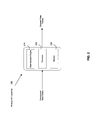
- FIG. 1 is a block diagram of an exemplary wireless HD System for transmitting video bitstreams from a wireless HD transmitter to a wireless HD receiver over a wireless HD transmission link, in accordance with an embodiment of the invention.
- FIG. 2 is a diagram illustrating an exemplary wireless HD transmitter that is operable to transmit decompressed video bitstreams over a wireless HD transmission link, in accordance with an embodiment of the invention.
- FIG. 3 is a diagram illustrating an exemplary decompression engine that is utilized for a video decompression process in a wireless transmitter, in accordance with an embodiment of the invention.
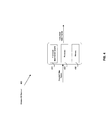
- FIG. 4 is a diagram illustrating an exemplary wireless HD receiver that is utilized to receive decompressed video bitstreams over a wireless HD transmission link, in accordance with an embodiment of the invention.
- FIG. 5 is a diagram illustrating an exemplary frame-rate up-conversion engine that is utilized by a wireless HD receiver for motion-compensated interpolation, in accordance with an embodiment of the invention.
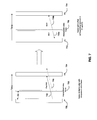
- FIG. 6 is a block diagram illustrating insertion of an exemplary interpolated video frame between two reference video frames, in accordance with an embodiment of the invention.
- FIG. 7 is a block diagram illustrating exemplary motion vectors of an interpolated video frame, in accordance with an embodiment of the invention.
- FIG. 8 is a diagram illustrating an exemplary wireless HD transmitter that is operable to transmit compressed video bitstreams over a wireless HD transmission link, in accordance with an embodiment of the invention.
- FIG. 9 is a diagram illustrating an exemplary wireless HD receiver that is utilized to receive compressed video bitstreams over a wireless HD transmission link, in accordance with an embodiment of the invention.
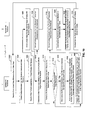
- FIG. 10 is a flow chart illustrating exemplary steps for motion-compensated frame-rate up-conversion with wireless HD for both compressed and decompressed video bitstreams, in accordance with an embodiment of the invention.
- FIG. 11 is a flow chart illustrating exemplary steps for video decompression, in accordance with an embodiment of the invention.
- FIG. 12 is a flow chart illustrating exemplary steps for motion-compensated frame-rate up-conversion that is performed by a wireless HD receiver for both compressed and decompressed video bitstreams, in accordance with an embodiment of the invention.
- Certain embodiments of the invention may be found in a system and/or method for motion-compensated frame-rate up-conversion for both compressed and decompressed video bitstreams.
- Various embodiments of the invention may comprise a video receiver such as a wireless high definition receiver, which may be operable to receive video bitstreams, for example three-dimensional (3D) video bitstreams, from a video transmitter such as a wireless high definition transmitter.
- the received 3D video bitstreams may comprise coding information in conjunction with a plurality of video frames for display.
- the coding information may be extracted and utilized for performing frame-rate up-conversion on the received plurality of video frames for display.
- the coding information such as, for example, block motion vectors, block coding modes, quantization levels, and/or quantized residual data, may be generated by the wireless high definition transmitter via entropy decoding a compressed 3D video from a video feed from, for example, an IP TV network and satellite broadcasting network.
- the received 3D video bitstreams may be uncompressed or compressed.
- the wireless high definition receiver may be operable to generate a plurality of interpolated video frames for the received decoded video frames by the wireless high definition receiver using the extracted corresponding coding information and associated measure such as, for example, one or both of motion vector confidence and/or consistence.
- the wireless high definition receiver may be operable to decompress the received compressed 3D video resulting in a plurality of decoded video frames. The decompression may occur prior to the frame-rate up-conversion.
- the wireless high definition receiver may be operable to perform frame-rate up-conversion as described early on the resulted plurality of decoded video frames.
- FIG. 1 is a block diagram of an exemplary wireless HD System for transmitting video bitstreams from a wireless HD transmitter to a wireless HD receiver over a wireless HD transmission link, in accordance with an embodiment of the invention.
- a wireless HD system 100 there is shown a wireless HD system 100.
- the wireless HD system 100 may comprise a video feed 110, a wireless HD transmitter 120, an antenna 122, a wireless HD transmission link 130, a wireless HD receiver 140, an antenna 142, and a display device 150.
- the video feed 110 may comprise a cable TV network 111, an IP TV network 112, a satellite broadcasting network 113, a mobile communication network 114, a camera 115, and/or a video camera 116, respectively.
- the wireless HD system 100 may be enabled to stream high definition audio and video over a wireless link such as the wireless HD transmission link 130.
- the wireless HD system 100 may be configured to support various industry standards such as, for example, Wireless High-definition Interface (WirelessHD) standard and/or Wireless High-definition Interface (WHDI) standard.
- the wireless HD system 100 may be configured to support various 3D services such as stereoscopic 3D program and stereoscopic 3D visual objects.
- the video feed 110 may comprise suitable logic, circuitry, and/or code that may be operable to provide compressed video bitstreams with lower frame-rates to the wireless HD transmitter 120.
- the compressed video bitstreams comprises 2D video bitstreams and/or 3D video bitstreams.
- the compressed video bitstreams may be formed by using various video compression algorithms such as specified in MPEG-2, MPEG-4, MPEG-4/AVC, VC1, VP6, and/or other video formats that may allow forward, backward, and bidirectional predictive coding.
- the received compressed video bitstreams may be provided by a direct video feed such as, for example, the camera 115 and/or the video camera 116.
- the received compressed video bitstreams may be provided by various indirect video feeds such as, for example, the cable TV network 111, the IP TV network 112, the satellite broadcasting network 113, and/or the mobile communication network 114, respectively.
- the antenna 122 may comprise suitable logic, circuitry and/or code that may be operable to transmit signals in radio frequency (RF) bands.
- the transmitted signals may comprise uncompressed video data and/or compressed video data to the wireless HD receiver 140.
- RF radio frequency
- FIG. 1 a single antenna 122 is illustrated in FIG. 1 , the invention may not be so limited. Accordingly, one or more antennas may be utilized for transmitting signals to the wireless HD receiver 140 in radio frequency (RF) bands from the wireless HD transmitter 120 without departing from the spirit and scope of various embodiments of the invention.
- the wireless HD transmitter 120 may comprise suitable logic, circuitry, and/or code that may be operable to communicate various data such as compressed video data and/or decompressed video data with the wireless HD receiver 140 over the wireless HD transmission link 130.
- the wireless HD transmitter 120 may be operable to communicate compressed and/or decompressed 2D video bitstreams and/or 3D video bitstreams with the wireless HD receiver 140 over the wireless HD transmission link 130.
- the wireless HD transmitter 120 may be configured to accept compressed video bitstreams with lower frame-rates from the video feed 110. The accepted compressed video bitstreams with lower frame-rates may be communicated with the wireless HD receiver 140 over the wireless HD transmission link 130.
- the wireless HD transmitter 120 may be operable to communicate with the wireless HD receiver 140 to determine a video format that the wireless HD receiver 140 may support.
- the determined video format may comprise, for example, uncompressed, MPEG-2, MPEG-4, VC1, and/or VP6.
- the wireless HD transmitter 120 may be configured to transmit the accepted compressed video bitstreams in the determined video format, whether uncompressed or compressed.
- the wireless HD transmitter 120 may be operable to transmit uncompressed video bitstreams to the wireless HD receiver 140, the wireless HD transmitter 120 may firstly be configured to decompress the accepted compressed video bitstreams from the video feed 110, then, transmit the decompressed video bitstreams to the wireless HD receiver 140 over the wireless HD transmission link 130.
- the wireless HD transmitter 120 may be operable to extract coding information via, for example, entropy decoding, from the accepted compressed video bitstreams from the video feed 110.
- the extracted coding information may comprise, for example, block motion vectors, block coding modes, quantization levels, and/or quantized residual data, associated with the accepted compressed video bitstreams.
- the extracted coding information may be formatted or re-formatted using the determined video format and may be transmitted together with the accepted compressed video bitstreams or the decompressed video bitstreams to the wireless HD receiver 140 over the wireless HD transmission link 130.
- the wireless HD transmission link 130 may comprise suitable logic, circuitry, and/or code that may be operable to support wireless high-definition (HD) signal transmission.
- the wireless HD transmission link 130 may be configured to communicate HD signals in adherence with, for example, the WirelessHD standard.
- the WirelessHD standard may be specified based on the 7 GHz of continuous bandwidth around the 60 GHz radio frequency.
- the WirelessHD may be utilized for uncompressed digital transmission of full HD video and a combination of audio and data signals.
- the WirlessHD may be essentially equivalent, in theory, to a high definition multimedia interface (HDMI).
- HDMI is a compact audio/video interface for transmitting uncompressed digital data.
- the wireless HD transmission link 130 may be configured to communicate both uncompressed video bitstreams and compressed video bitstreams between the wireless HD transmitter 120 and the wireless HD receiver 140.
- the wireless HD transmission link 130 may be configured to handle transmission data rates as high as, for example, 25 Gbit/s, thereby enabling scaling desired video bitstreams to higher resolutions, color depth, and/or range.
- the wireless HD transmission link 130 may be enabled to communicate 3D signals in adherence with, for example, 3DTV technology to support various 3D data services such as a 3D program on a large-scale basis.
- the antenna 142 may comprise suitable logic, circuitry and/or code that may be operable to receive signals in radio frequency (RF) bands.
- the antenna 142 may be operable to receive video signals comprising uncompressed or compressed video bitstreams from the wireless HD transmitter 120.
- RF radio frequency
- the single antenna 142 is illustrated in FIG. 1 , the invention may not be so limited. Accordingly, one or more antennas may be utilized for receiving signals in radio frequency (RF) bands by the wireless HD receiver 140 without departing from the spirit and scope of various embodiments of the invention.
- the wireless HD receiver 140 may comprise suitable logic, circuitry, interfaces and/or code that may be operable to receive, via the antenna 142, various data such as compressed video bitstreams and/or decompressed video bitstreams from the wireless HD transmitter 120 over the wireless HD transmission link 130.
- the wireless receiver 140 may be operable to receive compressed and/or decompressed 2D video bitstreams and/or 3D video bitstreams from the wireless HD transmitter 120 over the wireless HD transmission link 130.
- the wireless HD receiver 140 may be operable to communicate with the wireless HD receiver 140 to provide a supported video format.
- the video format may comprise, for example, uncompressed, MPEG-2, MPEG-4, VC1, and/or VP6.
- the wireless HD receiver 140 may be configured to receive uncompressed video bitstreams or compressed video bitstreams depending on a video format determined by the wireless HD transmitter 120.
- the wireless HD receiver 140 may be operable to extract coding information from the received uncompressed video bitstreams.
- the extracted coding information may comprise, for example, block motion vectors, block coding modes, quantization levels, and/or quantized residual data, associated with the original compressed video bitstreams of the received uncompressed video bitstreams.
- the extracted coding information may be utilized to perform frame-rate up-conversion at the wireless HD receiver 140. For each of uncompressed video frames of the received uncompressed video bitstreams, the wireless HD receiver 140 may be operable to interpolate one or more intermediate video frames during the frame-rate up-conversion.
- the wireless HD receiver 140 may be configured to communicate the interpolated video frames with the display device 150 via, for example, a HDMI interface and/or a Display Port (DP) interface, for display of the interpolated video frames to users.
- the wireless HD receiver 140 may be operable to extract coding information via entropy decoding from the received compressed video bitstreams.
- the wireless HD receiver 140 may be configured to decompress the received compressed video bitstreams for a sequence of decoded video frames.
- the wireless HD receiver 140 may be operable to utilize the sequence of the decoded video frames as reference video frames to perform frame-rate up-conversion with the consideration of the extracted coding information such as block motion vectors.
- the wireless HD receiver 140 may be operable to interpolate one or more intermediate video frames for each of the decoded video frames.
- the interpolated video frames may be communicated with the display device 150 via, for example, a HDMI and/or a Display port, for display of the interpolated video frames to users.
- the display device 150 may comprise suitable logic, circuitry, and/or code that may be operable to display video frames received from the wireless HD receiver 140 to users.
- the display device 150 may be configured to convey three-dimensional images to viewers.
- the display device 150 may be operable to communicate with the wireless HD receiver 140 using various interfaces such as a high definition multimedia interface (HDMI), Ethernet, and/or a Display port.
- HDMI high definition multimedia interface
- Ethernet Ethernet
- Display port a Display port
- the wireless HD system 100 is illustrated in FIG.1 , the invention is not so limited.
- the wireless HD transmitter 120 and the wireless HD receiver 140 may be operable to support 3DTV technology without departing from the spirit and scope of various embodiments of the invention.
- the wireless HD transmitter 120 and the wireless HD receiver 140 may be operable to support wireless or wired communication without departing from the spirit and scope of various embodiments of the invention.
- the supported wireless or wired communication may be HD or standard definition (SD) for both 2D and/or 3D data services.
- SD standard definition
- the wireless HD transmitter 120 may be operable to accept compressed video bitstreams from the video feed 110 via the antenna 122.
- the wireless HD transmitter 120 may be operable to extract coding information from the accepted video bitstreams.
- the extracted coding information may comprise, for example, block motion vectors, block coding modes, quantization levels, and/or quantized residual data, associated with the accepted compressed video bitstreams.
- the wireless HD transmitter 120 may be operable to communicate with a target receiver such as the wireless HD receiver 140 over the wireless HD transmission link 130 to determine a video format such as uncompressed, MPEG2, and/or MPEG4 utilized for video transmission to the wireless HD receiver 140.
- the extracted coding information and the accepted video bitstreams may be formatted or re-formatted using the determined video format to be transmitted together to the wireless HD receiver 140.
- the wireless HD receiver 140 may be operable to extract coding information from the received video bitstreams, whether uncompressed or compressed, to be utilized for performing frame-rate up-conversion. In instances where the received video bitstreams may be compressed, the wireless HD receiver 140 may be operable to perform video decompression to construct a sequence of decoded video frames prior to the frame-rate up-conversion.
- the wireless HD receiver 140 may be operable to interpolate one or more intermediate video frames for each of uncompressed vide frames or decoded video frames constructed during the frame-rate up-conversion. The interpolated video frames may be communicated with the display device 150 via HDMI, Ethernet, or Display Port, for display to users.
- FIG. 2 is a diagram illustrating an exemplary wireless HD transmitter that is operable to transmit decompressed video bitstreams over a wireless HD transmission link, in accordance with an embodiment of the invention.
- the wireless HD transmitter 200 may comprise a decompression engine 210, a processor 220, and a memory 230.
- the decompression engine 210 may comprise suitable logic, circuitry, interfaces and/or code that may be operable to decompress compressed video bitstreams accepted from the video feed 110 to generate/construct decoded video frames.
- the decompression engine 210 may be operable to perform various video decompressing techniques such as, for example, entropy decoding, inverse quantization, inverse transform, and motion compensated prediction.
- the decompression engine 210 may be operable to provide coding information such as, for example, block motion vectors, block coding modes, quantization levels, and quantized residual data.
- the coding information provided by the decompression engine 210 may be utilized by a target receiver such as the wireless HD receiver 140 to perform frame-rate up-conversion.
- the processor 220 may comprise suitable logic, circuitry, interfaces and/or code that may be operable to accept compressed video streams from the video feed 110.
- the accepted compressed video streams may comprise compressed 2D video bitstreams and/or compressed 3D video bitstreams.
- the processor 220 may be operable to communicate the accepted compressed video bitstreams with the decompression engine 210 for various video decoding and/or decompressing operations such as, for example, entropy decoding, inverse quantization, inverse transform, and motion compensated prediction.
- the decoded video frames together with the extracted coding information provided by the decompression engine 210 may be communicated to a target video receiver such as the wireless HD receiver 140.
- the processor 220 may be operable to communicate with the memory 230 to provide various video decoding algorithms to the decompression engine 210 for various decoding operations.
- the processor 220 may be configured to communicate with the wireless HD receiver 140 to determine a video format supported for corresponding video transmission. The determined video format may be utilized by the processor 220 to format the decoded video frames as well as the extracted coding information to be transmitted to the wireless HD receiver 140.
- the memory 230 may comprise suitable logic, circuitry, interfaces and/or code that may be operable to store information such as executable instructions and data that may be utilized by the processor 220 as well as the decompression engine 210.
- the executable instructions may comprise decoding algorithms that may be utilized by the decompression engine 210 for various video decoding operations.
- the data may comprise decoded video frames and extracted coding information such as block motion vectors, block coding modes, quantization levels, and quantized residual data.
- the memory 230 may comprise RAM, ROM, low latency nonvolatile memory such as flash memory and/or other suitable electronic data storage.
- the processor 220 may be operable to accept compressed video bitstreams with lower frame-rates from a video feed such as the IP TV network 112.
- the processor 220 may be operable to communicate the accepted compressed video bitstreams with the decompression engine 210 for various video decoding or decompressing operations such as, for example, entropy decoding, inverse quantization, inverse transform, and motion compensated prediction.
- the decompression engine 210 may be configured to provide decoded video frames and associated coding information such as block motion vectors, block coding modes, quantization levels, and quantized residual data to the processor 220.
- the decompression engine 210 may be operable to utilize various video decoding algorithms stored in the memory 230 for corresponding video processing operations.
- the processor 220 may be operable to combine the decoded video frames together with the extracted coding information in a determined format, which may be suitable for a target video receiver such as the wireless HD receiver 140.
- FIG. 3 is a diagram illustrating an exemplary decompression engine that is utilized for a video decompression process in a wireless transmitter, in accordance with an embodiment of the invention.
- the decompression engine 300 may comprise an entropy decoding unit 310, an inverse quantization unit 320, an inverse transform unit 330, a combiner 340, and a motion compensation prediction unit 350, respectively.
- the entropy decoding unit 310 may comprise suitable logic, circuitry, interfaces and/or code that may be operable to decode entropy-coded data.
- the entropy decoding unit 310 may be operable to transform binary bits of the entropy-coded data to symbols (quantized residual data), which may be fed or communicated to subsequent decoding modules such as the inverse quantization unit 320 and the inverse transform unit 330 to get decoded video frames.
- the transformation of the binary bits to symbols (quantized residual data) may be implemented in various ways. For example, in MPEG, an entropy decoding may be realized using a Variable-Length Decoding (VLD) followed by a Run-Length Decoding (RLD).
- VLD Variable-Length Decoding
- RLD Run-Length Decoding
- the entropy-coded data may be accepted compressed video bitstreams comprising compressed 2D video bitstreams and/or compressed 3D video bitstreams from the video feed 110.
- the entropy decoding unit 310 may be operable to extract coding information such as block motion vector from accepted compressed video bitstreams.
- the extracted coding information may comprise, for example, block motion vectors, block coding modes, quantization levels, and/or quantized residual data associated with the accepted compressed video bitstreams.
- the inverse quantization unit 320 may comprise suitable logic, circuitry, and/or code that may be operable to scale and/or re-scale the quantized residual data of a decoded video frame from the entropy decoding unit 310 to reconstruct a video frame with a limited set of colors that associate each color with its nearest representative.
- the inverse quantization unit 320 may be utilized to, for example, reduce perceived distortion in the reconstructed picture.
- the inverse transform unit 330 may comprise suitable logic, circuitry, interfaces and/or code that may be operable to combine standard basis patterns to form residual macroblocks for each inverse quantized video frame from the inverse quantization unit 320.
- the motion compensation prediction (MCP) unit 350 may comprise suitable logic, circuitry, and/or code that may be operable to provide a prediction for macroblocks in an uncompressed video frame to a video encoder such as a 2D video encoder for compressing 2D video bitstreams or a 3D video encoder for compressing 3D video bitstreams.
- Pixel intensities of the macroblocks in a current frame may be predicted based on a motion model, and pixel intensities of the macroblocks in previous/future reference frames. The difference between the predicted pixel intensities and the actual current pixel intensities may be considered as a prediction error.
- the prediction error may be communicated to the combiner 340 where it may be utilized for reconstructing corresponding uncompressed macroblocks in the current frame.
- the combiner 340 may comprise suitable logic, circuitry, interfaces and/or code that may be operable to combine a residual macroblock from the inverse transform unit 330 with corresponding prediction error information from the motion compensation prediction (MCP) unit 350 to create a reconstructed uncompressed macroblock.
- MCP motion compensation prediction
- the entropy decoding unit 310 may be operable to receive compressed video bitstreams from the video feed 110.
- the entropy decoder 310 may be operable to transform binary bits of the received compressed video bitstreams to video quantized residual data.
- the quantized residual data may be fed into the inverse quantization unit 320.
- the inverse quantization unit 320 may be operable to rescale the quantized residual data to reconstruct a video frame with a limited set of colors.
- the reconstructed video frame may be communicated to the inverse transform unit 330.
- the inverse transform unit 330 may be operable to inverse transform the reconstructed video frame to form a residual video frame comprising a plurality of residual macroblocks.
- a residual macroblock in the residual picture may be formed by comparing a macroblock in the reconstructed video frame with one or more standard basis patterns.
- the residual video frame may be combined at the combiner 340 with prediction errors from the motion compensation prediction (MCP) unit 350 to create a reconstructed decoded/uncompressed video frame.
- MCP motion compensation prediction
- FIG. 4 is a diagram illustrating an exemplary wireless HD receiver that is utilized to receive decompressed video bitstreams over a wireless HD transmission link, in accordance with an embodiment of the invention.
- the wireless HD receiver 400 may comprise a frame-rate up-conversion engine 410, a processor 420, and a memory 430.
- the frame-rate up-conversion engine 410 may comprise suitable logic, circuitry, interfaces and/or code that may be operable to up-convert frame rate to provide high picture quality results for a high quality video source comprising, for example, a Digital Betacam, camera video, and/or telecine transferred films.
- the frame-rate up-conversion engine 410 may be operable to perform frame-rate up-conversion by utilizing coding information extracted from uncompressed video bitstreams, whether uncompressed 2D video bitstreams or uncompressed 3D video bitstreams, received by the wireless HD receiver 400.
- the extracted coding information may comprise block motion vectors, block coding modes, quantization levels, and quantized residual data associated with original compressed video bitstreams of the received uncompressed video bitstreams.
- Various frame-rate up-conversion algorithms such as frame repetition and linear interpolation by temporal filtering may be utilized by the frame-rate up-conversion engine 410 to construct interpolated video frames with higher frame-rate for display on a modern screen such as the display device 150.
- the processor 420 may comprise suitable logic, circuitry, interfaces and/or code that may be operable to process decoded video frames received from the wireless HD transmitter 120.
- the processor 420 may be operable to communicate the received decoded or uncompressed video frames with the frame-rate up-conversion engine 410 to up-convert frame rate of the received decoded video frames.
- the processor 420 may be operable to perform video frame interpolation via the frame-rate up-conversion engine 410 and resulted interpolated video frames may be displayed on the display device 150.
- the memory 430 may comprise suitable logic, circuitry, interfaces and/or code that may enable storing of information such as executable instructions and data that may be utilized by the processor 420 as well as the frame-rate up-conversion engine 410.
- the executable instructions may comprise frame-rate up-conversion algorithms that may be utilized by the frame-rate up-conversion engine 410.
- the data may comprise decoded video frames and extracted coding information such as block motion vectors, block coding modes, quantization levels, and quantized residual data.
- the data may comprise interpolated video frames constructed by the frame-rate up-conversion engine 410 for display on the display device 150.
- the memory 430 may comprise RAM, ROM, low latency nonvolatile memory such as flash memory and/or other suitable electronic data storage.
- the processor 420 may be operable to receive decoded or uncompressed video bitstreams with lower frame-rates from the wireless HD transmitter 110 over the wireless HD transmission link 130.
- the received decoded video bitstreams may comprise decoded 2D video bitstreams and/or decoded 3D video bitstreams.
- the processor 420 may be operable to communicate the received decoded video bitstreams with the frame-rate up-conversion engine 410 to up-convert frame-rate of the received decoded video frames.
- the processor 420 and the frame-rate up-conversion engine 410 may be operable to utilize the memory 430 for a frame-rate up-conversion.
- the frame-rate up-conversion engine 410 may be operable to perform frame-rate up-conversion resulting interpolated video frames.
- the processor 420 may be operable to communicate with the display device 150 for display of the resulted interpolated video frames to users.
- FIG. 5 is a diagram illustrating an exemplary frame-rate up-conversion engine that is utilized by a wireless HD receiver for motion-compensated interpolation, in accordance with an embodiment of the invention.
- a digital noise reduction filter 510 there is shown a digital noise reduction filter 510, a pixel motion vector generator 520, a pixel motion vector evaluator 530, a frame-rate up-convertor 540, and a scene change detector 550.
- the digital noise reduction filter 510 may comprise suitable logic, circuitry, interfaces and/or code that may be operable to perform noise reduction on decoded video frames received from the wireless HD transmitter 110.
- the application of the noise reduction prior to other processing may be essential to achieve a better image quality.
- Various noise reduction techniques such as, for example, de-blocking, de-ringing, and/or other noise reduction filtering may be applied to the received decoded video frames (reference pictures) by the digital noise reduction filter 510 prior to performing a frame-rate up-conversion.
- the pixel motion vector generator 520 may comprise suitable logic, circuitry, and/or code that may be operable to generate pixel motion vectors.
- the pixel motion vectors may be generated from block motion vectors, which are extracted from decoded video frames received from the wireless HD transmitter 110.
- the pixel motion vector generator 520 may be operable to refine the extracted block motion vectors and decompose the refined block motion vectors into pixel motion vectors.
- the pixel motion vectors may be further scaled or re-scaled for constructing interpolated (or inserted) video frames.
- the pixel motion vector generator 520 may be configured to communicate the pixel motion vectors with the motion vector evaluator 530 and the frame-rate up-convertor 540.
- the motion vector evaluator 530 may comprise suitable logic, circuitry, interfaces and/or code that may be operable to evaluate one or both of motion vector confidence and/or motion vector consistence associated with pixel motion vectors generated by the pixel motion vector generator 520.
- Motion vector confidence of generated pixel motion vectors may be computed in various exemplary ways comprising using quantized residual data and associated quantization level of decoded video frames received from the wireless HD transmitter 110.
- the quantized residual data and associated quantization level may be extracted from the decoded video frames received. Smaller quantization levels with less residue data may result a higher motion vector confidence while larger quantization levels with more residue data may produce a lower motion vector confidence.
- the motion vector consistency may be generated by comparing adjacent block motion vectors and motion-compensated block boundary pixel differences. One or both of the motion vector confidence and/or the motion vector consistency may be utilized to generate a confidence-consistency measure for motion judder filtering, for example.
- the frame-rate up-convertor 540 may comprise suitable logic, circuitry, interfaces and/or code that may be operable to up-convert frame-rate of decoded video frames received from the wireless HD transmitter 110.
- the frame-rate up-convertor 540 may be operable to perform motion compensated frame-rate up-conversion using coding information provided by the wireless HD transmitter 110. Pixel motion vectors of the received decoded video frames and/or associated motion vector confidence-consistence may be utilized for the motion compensated frame-rate up-conversion.
- the frame-rate up-convertor 540 may be operable to interpolate the received decoded video frames using the pixel motion vectors together with the associated motion vector confidence-consistence measure.
- the frame-rate up-convertor 540 may be configured to interpolate reference frames using still pictures, for example, through frame repeating. A higher motion vector confidence may lead to a full motion vector dependent interpolation.
- the interpolated video frames may be communicated with the scene change detector 550.
- the scene change detector 550 may comprise suitable logic, circuitry, and/or code that may be operable to detect scene change in the received interpolated video frames.
- the scene change detector 550 may be operable to process the received interpolated video frames through, for example, a non-linear filtering process, to reduce artifacts in final interpolated video frames.
- the scene change detector 550 may take into account motion vector confidence-consistency measure to determine if and when motion compensated interpolation may be likely to fail.
- the scene change detector 550 may be operable to identify problematic regions within the interpolated video frames and conceal the identified problematic regions by various means such as a non-linear filtering for the final interpolated video frames.
- the wireless HD receiver 120 may be operable to receive decoded video frames from the wireless HD transmitter 110.
- the received decoded video frames may be communicated with the digital noise reduction filter 510 prior to other processing.
- the digital noise reduction filter 510 may be operable to perform noise reduction on the received decoded video frames using various noise reduction techniques such as, for example, de-blocking, de-ringing, and/or other noise reduction filtering.
- the filtered decoded video frames may be communicated with the pixel motion vector generator 520, the motion vector evaluator 530, the frame-rate up-convertor 540, and the scene change detector 550, respectively, for further processing.
- the pixel motion vector generator 520 may be operable to generate pixel motion vectors from coding information such as block motion vectors extracted from the filtered decoded video frames.
- the generated pixel motion vectors may be provided to the motion vector evaluator 530 and the frame-rate up-convertor 540, respectively.
- the motion vector evaluator 530 may be operable to evaluate one or both of motion vector confidence and/or motion vector consistence of the generated pixel motion vectors and provide a measure of the motion vector confidence-consistence to the scene change detector 550.
- the frame-rate up-convertor 540 may be operable to up-convert the frame-rate of the filtered decoded video frames using generated pixel motion vectors from the pixel motion vector generator 520.
- the resulted interpolated video frames from the frame-rate up-convertor 540 may be communicated with the scene change detector 550.
- the scene change detector 550 may be operable to detect scene change in the received interpolated video frames.
- the scene change detector 550 may be operable to process the received interpolated video frames to reduce artifacts in final interpolated video frames.
- the measure of associated one or both of motion vector confidence and/or motion vector consistency may be taken into account to identify problematic regions in the received interpolated video frames.
- the problematic regions may be concealed by various means such as a non-linear filtering.
- the final interpolated video frames may be communicated with the display device 150 for display.
- FIG. 6 is a block diagram illustrating insertion of an exemplary interpolated video frame between two reference video frames, in accordance with an embodiment of the invention.
- a plurality of decoded video frames for example, P1 602 and P2 604, and the location of an interpolated video frame 606.
- the interpolated video frame 606 may be inserted k time units from the decoded video frame P1 602.
- FIG. 7 is a block diagram illustrating exemplary motion vectors of an interpolated video frame, in accordance with an embodiment of the invention.
- a plurality of decoded video frames for example, P1 452 and P2 454 and an interpolated video frame 706.
- the interpolated video frame 706 may be inserted k time units from the decoded video frame P1 702.
- a motion vector 708 may point from an area in the previous video frame P1 702 to an area in the next video frame P2 704, in such a way that the motion vector 708 may capture the motion that occurred between the two original video frames P1 702 and P2 704.
- the motion vector 709 may be a shifted version of the motion vector 708.
- the motion vector 709 may be shifted to align with the interpolated video frame 706.
- the motion vector 709 may be split into two motion vectors, for example, the motion vectors MV1 709a and MV2 709b.
- the motion vectors MV1 709a and MV2 709b may be scaled for motion compensated interpolation.
- the directions of the two scaled motion vectors may be opposite to each other.
- the length of each of the scaled motion vectors may be proportional to a temporal difference between the interpolated video frame 706 and corresponding original video frame such as the video frame P1 702.
- FIG. 8 is a diagram illustrating an exemplary wireless HD transmitter that is operable to transmit compressed video bitstreams over a wireless HD transmission link, in accordance with an embodiment of the invention.
- the wireless HD transmitter 800 may comprise an entropy decoding unit 810, a processor 820, and a memory 830.
- the entropy decoding unit 810 may comprise suitable logic, circuitry, interfaces and/or code that may be operable to decode entropy-coded data.
- the entropy decoding unit may perform in the same way as the entropy decoding unit 310 as described with respect to FIG.3 .
- the entropy decoding unit 810 may be operable to provide coding information from compressed video bitstreams received from the video feed 110.
- the received video bitstreams may comprise compressed 2D video bitstreams and/or compressed 3D video bitstreams.
- the extracted coding information may comprise block motion vectors, block coding modes, quantization levels, and/or quantized residual data.
- a coding mode may comprise information such as, for example, an inter-block based coding or an intra-block based coding, and a block size.
- the extracted coding information may be communicated with the processor 820.
- the processor 820 may comprise suitable logic, circuitry, interfaces and/or code that may be operable to process compressed video bitstreams received from the video feed 110.
- the processor 820 may be operable to insert the extracted coding information such as block motion vectors, block coding modes, quantization levels, and/or quantized residual data, into the received compressed video bitstreams to communicate with a target video receiver such as the wireless HD receiver 140 via the wireless HD transmission link 130.
- the processor 820 may be operable to communicate with the memory 830 to provide various algorithms utilized by the entropy decoding unit 810.
- the processor 820 may be configured to communicate with the wireless HD receiver 140 to determine a video format supported for corresponding video transmission. The determined video format may be utilized by the processor 820 to communicate the compressed video bitstreams together with inserted coding information to the wireless HD receiver 140.
- the memory 830 may comprise suitable logic, circuitry, interfaces and/or code that may enable storing of information such as executable instructions and data that may be utilized by the processor 820 and the entropy decoding unit 810.
- the executable instructions may comprise video decoding algorithms that may be utilized by the entropy decoding unit 810 for various entropy decoding operations.
- the data may comprise received compressed video bitstreams and extracted coding information.
- the memory 830 may comprise RAM, ROM, low latency nonvolatile memory such as flash memory and/or other suitable electronic data storage.
- the processor 820 may be operable to receive compressed video bitstreams with lower frame-rates from a video feed such as the IP TV network 112.
- the processor 820 may be operable to communicate the received compressed video bitstreams with the entropy decoding unit 810 for entropy decoding.
- the entropy decoding unit 810 may be configured to provide coding information such as, for example, block motion vectors, block coding modes, quantization levels, and/or quantized residual data, to the processor 820.
- the processor 820 may be operable to insert the coding information into the received compressed video bitstreams to communicate with the wireless HD receiver 140 in a supported format.
- FIG. 9 is a diagram illustrating an exemplary wireless HD receiver that is utilized to receive compressed video bitstreams over a wireless HD transmission link, in accordance with an embodiment of the invention.
- the wireless HD receiver 900 may comprise a decompression engine 910, a frame-rate up-conversion engine 920, a processor 930, and a memory 940.
- the decompression engine 910 may comprise suitable logic, circuitry, interfaces and/or code that may be operable to decompress compressed video bitstreams, whether compressed 2D video bitstreams and/or compressed 3D video bitstreams, received from the wireless HD transmitter 120 to generate decoded video frames.
- the decompression engine 910 may be operable to perform various video decoding/decompression operations such as, for example, entropy decoding, inverse quantization, inverse transform, and motion compensated prediction.
- the decompression engine 910 may be operable to provide decoded video frames to the frame-rate up-conversion engine 920 for further video decoding processing.
- the frame-rate up-conversion engine 920 may comprise suitable logic, circuitry, and/or code that may be operable to up-convert frame rate to provide high picture quality results for a high quality video source comprising, for example, a Digital Betacam, camera video, and/or telecine transferred films.
- the frame-rate up-conversion engine 920 may be operable to extract coding information such as, for example, block motion vectors, block coding modes, quantization levels, and quantized residual data, from the received compressed video bitstreams from the wireless HD transmitter 120.
- the extracted coding information may be utilized to perform frame-rate up-conversion on the received compressed video bitstreams.
- Various frame-rate algorithms such as frame repetition and linear interpolation by temporal filtering may be utilized by the frame-rate up-conversion engine 920 to construct interpolated video frames with a high-picture-rate for display on the display device 150.
- the processor 930 may comprise suitable logic, circuitry, interfaces and/or code that may be operable to process compressed video bitstreams received from the wireless HD transmitter 120.
- the processor 930 may be operable to communicate the received compressed video bitstreams with the decompression engine 910 for corresponding decoded video frames of the received compressed video bitstreams.
- the decoded video frames may be served as reference video frames in the frame-rate up-conversion for final interpolated video frames.
- the processor 930 may be operable to communicate the final interpolated video frames with the display device 150 for display, for example.
- the memory 940 may comprise suitable logic, circuitry, interfaces and/or code that may enable storing of information such as executable instructions and data that may be utilized by the processor 930, the frame-rate up-conversion engine 920, and/or the decompression engine 910.
- the executable instructions may comprise various video process algorithms such as video decompression and frame-rate up-conversion that may be utilized by the decompression engine 910 and the frame-rate up-conversion engine 920, respectively.
- the data may comprise compressed video bitstreams received from the wireless HD receiver 120, coding information extracted from the received compressed video bitstreams, decoded video frames, and/or interpolated video frames.
- the extracted coding information may comprise block motion vectors, block coding modes, quantization levels, and quantized residual data, for example, to be utilized by the frame-rate up-conversion engine 920.
- the memory 940 may comprise RAM, ROM, low latency nonvolatile memory such as flash memory and/or other suitable electronic data storage.
- the processor 930 may be operable to receive compressed video bitstreams from the wireless HD transmitter 120.
- the processor 930 may be operable to communicate the received compressed video bitstreams with the decompression engine 910 for corresponding decoded video frames.
- the decoded video frames may be interpolated by the frame-rate up-conversion engine 920 resulting interpolated video frames.
- the frame-rate up-conversion engine 920 may be operable to utilize coding information extracted from the received compressed video bitstreams in the frame-rate up-conversion.
- the resulted interpolated video frames constructed by the frame-rate up-conversion engine 920 may be communicated with the processor 930 for display on the display device 150.
- FIG. 10 is a flow chart illustrating exemplary steps for motion-compensated frame-rate up-conversion with wireless HD for both compressed and decompressed video bitstreams, in accordance with an embodiment of the invention.
- the exemplary steps start with step 1002, where the wireless HD transmitter 120 may be operable to receive/accept compressed video bitstreams from the video feed 110.
- the received compressed video bitstreams may comprise compressed 2D video bitstreams and/or compressed 3D video bitstreams.
- the wireless HD transmitter 120 may be operable to extract coding information from the received compressed video bitstreams by performing entropy decoding.
- the extracted coding information may comprise, for example, block motion vectors, block coding modes, quantization levels, and/or quantized residual data.
- the wireless HD transmitter 120 may be operable to acquire information such as video formats that a target receiver such as the wireless HD receiver 140 may be able to support.
- the wireless HD receiver 140 may be configured to provide video format information to the wireless HD transmitter 120 for video communication.
- the wireless HD transmitter 120 may be operable to determine or select a video format to be utilized for video communicate with the wireless HD receiver 140.
- the wireless HD transmitter 120 may be operable to format or re-format the extracted coding information using the determined or selected video format.
- it may be determined if the wireless HD transmitter 120 may be configured to transmit uncompressed video bitstreams to the wireless HD receiver 140.
- the wireless HD transmitter 120 may be configured to transmit uncompressed video bitstreams to the wireless HD receiver 140, then in step 1016, the wireless HD transmitter 120 may be operable to decode or decompress the received compressed video bitstreams via the decompression engine 210 to generate corresponding decoded video frames.
- the wireless HD transmitter 120 may be operable to transmit uncompressed video bitstreams comprising the decoded video frames and the formatted or re-formatted extracted coding information to the wireless HD receiver 140.
- the wireless HD receiver 140 may be operable to receive the transmitted uncompressed video bitstreams.
- the wireless HD receiver 140 may be configured to extract coding information from the received uncompressed video streams.
- the wireless HD receiver 140 may be operable to perform frame-rate up-conversion on the received decoded video frames to construct final interpolated video frames using the extracted coding information.
- the wireless HD receiver 140 may be operable to communicate the constructed final interpolated video frames with the display device 150 for display. The exemplary process may return to the step 1002.
- step 1014 in instances where the wireless HD transmitter 120 may be configured to transmit compressed video bitstreams to the wireless HD receiver 140, then in step 1026, the wireless HD transmitter 120 may be configured to transmit the received compressed video bitstreams together with the formatted or re-formatted extracted coding information to the wireless HD receiver 140.
- step 1028 the wireless HD receiver 140 may be configured to extract coding information from received compressed video bitstreams from the wireless HD transmitter 120.
- step 1030 the wireless HD receiver 140 may be operable to decompress the received compressed video bitstreams from the wireless HD transmitter 120 to generate corresponding decoded video frames. The exemplary process continues in step 1022.
- FIG. 11 is a flow chart illustrating exemplary steps for video decompression, in accordance with an embodiment of the invention.
- the exemplary steps start with step 1110, where a decompression engine such as, for example, the decompression engine 210 on the wireless HD transmitter 200 and/or the decompression engine 910 on the wireless HD receiver 900, may be operable to receive compressed video bitstreams.
- the received compressed video bitstreams may comprise compressed 2D video bitstreams and/or compressed 3D video bitstreams.
- the compressed video bitstreams received by the decompression engine 210 may be received directly from the video feed 110. However, the compressed video bitstreams received by the decompression engine 910 may be communicated by the wireless HD transmitter 120 over the wireless HD transmission link 130.
- the decompression engine 210 or 910 may be operable to perform entropy decoding on a current compressed video frame of the received compressed video bitstreams to generate quantized residual data of the current compressed video frame.
- step 1122 it may be determined whether the decompression engine resides on the wireless HD transmitter 120. In instances where the decompression engine such as the decompression engine 210 resides on the wireless HD transmitter 120, then in step 1130, the decompression engine 210 may be operable to generate coding information for the current compressed video frame through entropy decoding. In step 1140, a current uncompressed video frame may be predicted by the decompression engine 210 or 910, via a motion compensation technique, by using the generated quantized residual data of the current compressed video frame and one or more previous decoded video frames of the received compressed video bitstreams.
- the decompression engine 210 or 910 may be operable to inverse quantize the current compressed video frame.
- the decompression engine 210 or 910 may be operable to generate a current decoded video frame by combining the current inverse quantized compressed video frame with the current predicted uncompressed video frame.
- it may be determined whether compressed video frames in the received compressed video bitstreams have been decoded. In instances where compressed video frames in the received compressed video bitstreams have not been decoded, then the exemplary process may continue for the next available compressed video frame of the received compressed video bitstreams and return to step 1120.
- step 1122 in instances where the decompression engine such as the decompression engine 910 resides on the wireless HD receiver 140, then the exemplary process may continue in step 1140.
- step 1170 in instances where the compressed video frames in the received compressed video bitstreams have been decoded, then the exemplary process may be end with step 1190.
- FIG. 12 is a flow chart illustrating exemplary steps for motion-compensated frame-rate up-conversion that is performed by a wireless HD receiver for both compressed and decompressed video bitstreams, in accordance with an embodiment of the invention.
- the exemplary steps start with step 1210, where a frame-rate up-conversion engine such as 410 and/or 920 at the wireless HD receiver 140 may be operable to receive decoded video frames and associated coding information comprising, for example, block motion vectors, coding mode, and/or quantized residua data.
- the received decoded video frames may comprise decoded 2D video frames and/or decoded 3D video frames.
- the frame-rate up-conversion engine such as 410 and/or 920, may be operable to perform digital noise reduction filtering on each of the received decoded video frames.
- the frame-rate up-conversion engine such as 410 and/or 920 may be operable to refine each of the block motion vectors using the corresponding filtered decoded video frame and/or associated one or more forward and/or backward filtered decoded video frames.
- a motion vector confidence-consistency measure may be determined for each of the refined block motion vectors.
- a pixel motion vector is generated for each of the filtered decoded video frames by, for example, decomposing corresponding refined block motion vector.
- the frame-rate up-conversion engine such as 410 and/or 920 may be operable to perform motion-compensated interpolation for each of the filtered decoded video frames using the corresponding generated pixel motion vector.
- interpolated decoded video frames for each of the filtered decoded video frames may be filtered and/or guarded by considering corresponding determined motion vector consistency-consistence measure.
- the filtered interpolated decoded video frames may be communicated with the display device 150 for display.
- the exemplary steps may return to step 1210.
- a video receiver such as the wireless HD receiver 140
- the received 3D video bitstreams may comprise coding information and a plurality of video frames for display on the display device 150.
- the wireless HD receiver 140 may be operable to extract the coding information from the received 3D video bitstreams.
- the wireless HD receiver 140 may be operable to perform frame-rate up-conversion via the frame-rate up-conversion engine 410 or 920 on the received plurality of video frames using the extracted coding information.
- the coding information may be generated by the wireless HD transmitter 120 via entropy decoding a compressed video from the video feed 110 from, for example, the cable TV network 111, the IP TV network 112, the satellite broadcasting network 113, the mobile communication network 114, the video camcorder 115, and/or the camera 116, respectively.
- the extracted coding information may comprise one or more of block motion vectors, block coding modes, quantization levels, and/or quantized residual data.
- the received 3D video bitstreams may comprise uncompressed 3D video or compressed 3D video.
- the plurality of video frames for display in the received 3D video bitstreams may comprise a plurality of decoded video frames as described with respect to, for example, FIG. 2 through FIG. 8 .
- the received plurality of decoded video frames may be generated by the wireless HD transmitter 120, which may be operable to utilize the decompression engine 210 to decompress the compressed 3D video from the video feed 110.
- the decompression engine 210 may be operable to perform various video decoding operations such as, for example, entropy decoding, inverse quantization, inverse transform, and/or motion compensated prediction.
- the digital noise filter 510 inside the wireless HD receiver 400 may be operable to perform digital noise reduction filtering on each of the received plurality of decoded video frames.
- the extracted coding information such as block motion vectors and the filtered decoded video frames may be utilized by the pixel motion vector generator 520 to generate pixel motion vectors for each of the received plurality of decoded video frames. Associated one or both of motion vector confidence and/or motion vector consistence for the generated pixel motion vectors may be computed at the motion vector evaluator 530 to provide a measure of generated pixel motion vectors.
- a plurality of interpolated video frames may be generated via the frame-rate convertor 540 from the received plurality of decoded video frames based on the generated pixel motion vectors and said computed one or both of motion vector confidence and/or motion vector consistence at the motion vector evaluator 530.
- the generated plurality of interpolated video frames may be processed, for example, via the scene detector 550. Artifacts such as motion judder may be concealed by performing noise reduction filtering using the computed one or both of motion vector confidence and/or motion vector consistence information.
- the received 3D video bitstreams at a video receiver such as the wireless HD receiver 900, may comprise a compressed 3D video such as MPEG-2, MPEG-4, AVC, VC1, and/or VP1.
- the wireless HD receiver 900 may be operable to perform video decoding on the received compressed 3D video via the decompressing engine 910.
- the decompression engine 910 may be operable to utilize various video decoding techniques comprising, for example, entropy decoding, inverse quantization, inverse transform, and/or motion compensated prediction.
- a plurality of decoded video frames constructed via the decompression engine 910 may be communicated to the digital noise reduction filter 510 for noise reduction processing of the resulted plurality of decoded video frames.
- the extracted coding information such as block motion vectors and the filtered resulted plurality of decoded video frames may be utilized by the pixel motion vector generator 520 to generate pixel motion vectors for each of the plurality of decoded video frames.
- Associated one or both of motion vector confidence and/or motion vector consistence for the generated pixel motion vectors may be computed at the motion vector evaluator 530 to provide measure on generated pixel motion vectors.
- a plurality of interpolated video frames may be generated via the frame-rate convertor 540 from the received plurality of decoded video frames based on the generated pixel motion vectors and the computed one or both of motion vector confidence and/or motion vector consistence at the motion vector evaluator 530.
- the generated plurality of interpolated video frames may be processed, for example, via the scene detector 550. Artifacts such as motion judder may be concealed by performing noise reduction filtering using the computed one or both of motion vector confident and/or motion vector consistence information.
- Another embodiment of the invention may provide a machine and/or computer readable storage and/or medium, having stored thereon, a machine code and/or a computer program having at least one code section executable by a machine and/or a computer, thereby causing the machine and/or computer to perform the steps as described herein for motion-compensated frame-rate up-conversion for both compressed and decompressed video bitstreams.
- the present invention may be realized in hardware, software, or a combination thereof.
- the present invention may be realized in a centralized fashion in at least one computer system, or in a distributed fashion where different elements may be spread across several interconnected computer systems. Any kind of computer system or other apparatus adapted for carrying out the methods described herein may be suited.
- a typical combination of hardware and software may be a general-purpose computer system with a computer program that, when being loaded and executed, may control the computer system such that it carries out the methods described herein.
- the present invention may be realized in hardware that comprises a portion of an integrated circuit that also performs other functions.
- the present invention may also be embedded in a computer program product, which comprises all the features enabling the implementation of the methods described herein, and which when loaded in a computer system is able to carry out these methods.
- Computer program in the present context means any expression, in any language, code or notation, of a set of instructions intended to cause a system having an information processing capability to perform a particular function either directly or after either or both of the following: a) conversion to another language, code or notation; b) reproduction in a different material form.
Landscapes
- Engineering & Computer Science (AREA)
- Multimedia (AREA)
- Signal Processing (AREA)
- Compression Or Coding Systems Of Tv Signals (AREA)
- Two-Way Televisions, Distribution Of Moving Picture Or The Like (AREA)
- Testing, Inspecting, Measuring Of Stereoscopic Televisions And Televisions (AREA)
Applications Claiming Priority (1)
| Application Number | Priority Date | Filing Date | Title |
|---|---|---|---|
| US12/427,440 US9185426B2 (en) | 2008-08-19 | 2009-04-21 | Method and system for motion-compensated frame-rate up-conversion for both compressed and decompressed video bitstreams |
Publications (2)
| Publication Number | Publication Date |
|---|---|
| EP2244485A2 true EP2244485A2 (de) | 2010-10-27 |
| EP2244485A3 EP2244485A3 (de) | 2013-08-21 |
Family
ID=42320901
Family Applications (1)
| Application Number | Title | Priority Date | Filing Date |
|---|---|---|---|
| EP10003916.3A Withdrawn EP2244485A3 (de) | 2009-04-21 | 2010-04-13 | Verfahren und System zur bewegungskompensierten Rahmenraten-Aufwärtsumsetzung und dekomprimierte Video-Bitströme |
Country Status (4)
| Country | Link |
|---|---|
| US (2) | US9185426B2 (de) |
| EP (1) | EP2244485A3 (de) |
| CN (1) | CN101873489A (de) |
| TW (1) | TWI535296B (de) |
Cited By (2)
| Publication number | Priority date | Publication date | Assignee | Title |
|---|---|---|---|---|
| CN102665027A (zh) * | 2012-04-20 | 2012-09-12 | 西北大学 | 一种矢量几何模型压缩方法 |
| GB2518603A (en) * | 2013-09-18 | 2015-04-01 | Imagination Tech Ltd | Generating an output frame for inclusion in a video sequence |
Families Citing this family (24)
| Publication number | Priority date | Publication date | Assignee | Title |
|---|---|---|---|---|
| US20100046623A1 (en) * | 2008-08-19 | 2010-02-25 | Chen Xuemin Sherman | Method and system for motion-compensated frame-rate up-conversion for both compressed and decompressed video bitstreams |
| US20110141230A1 (en) * | 2009-12-16 | 2011-06-16 | Samsung Electronics Co., Ltd. | 3d display device and method for correcting image thereof |
| US11711592B2 (en) | 2010-04-06 | 2023-07-25 | Comcast Cable Communications, Llc | Distribution of multiple signals of video content independently over a network |
| US10448083B2 (en) * | 2010-04-06 | 2019-10-15 | Comcast Cable Communications, Llc | Streaming and rendering of 3-dimensional video |
| FR2958824A1 (fr) | 2010-04-09 | 2011-10-14 | Thomson Licensing | Procede de traitement d'images stereoscopiques et dispositif correspondant |
| JP5532232B2 (ja) * | 2010-05-18 | 2014-06-25 | ソニー株式会社 | 映像信号処理装置、映像表示装置および映像表示システム |
| KR101685981B1 (ko) * | 2010-07-29 | 2016-12-13 | 엘지전자 주식회사 | 입체영상 디스플레이 시스템, 입체영상 디스플레이 장치 및 입체영상 디스플레이 방법 |
| WO2012020655A1 (ja) | 2010-08-10 | 2012-02-16 | 日産化学工業株式会社 | 炭素と炭素の多重結合を有する樹脂を含む接着剤組成物 |
| WO2016205800A1 (en) | 2015-06-19 | 2016-12-22 | Serious Simulations, Llc | Processes systems and methods for improving virtual and augmented reality applications |
| CN106205523B (zh) * | 2016-07-13 | 2018-09-04 | 深圳市华星光电技术有限公司 | 液晶显示装置残像的改善方法及装置 |
| CN111418165B (zh) * | 2017-11-29 | 2025-02-18 | 福特全球技术公司 | 用于车辆登记的单通道光通信 |
| US10977809B2 (en) | 2017-12-11 | 2021-04-13 | Dolby Laboratories Licensing Corporation | Detecting motion dragging artifacts for dynamic adjustment of frame rate conversion settings |
| CN109151436B (zh) * | 2018-09-30 | 2021-02-02 | Oppo广东移动通信有限公司 | 数据处理方法及装置、电子设备及存储介质 |
| US11115661B2 (en) * | 2019-03-17 | 2021-09-07 | International Business Machines Corporation | Low delay content disarm and reconstruction (CDR) of live streaming video |
| KR102799921B1 (ko) | 2019-09-14 | 2025-04-25 | 바이트댄스 아이엔씨 | 크로마 디블로킹 필터링을 위한 양자화 파라미터 |
| US11450030B2 (en) * | 2019-09-24 | 2022-09-20 | Apple Inc. | Three-dimensional mesh compression using a video encoder |
| WO2021072177A1 (en) | 2019-10-09 | 2021-04-15 | Bytedance Inc. | Cross-component adaptive loop filtering in video coding |
| KR20220073746A (ko) | 2019-10-14 | 2022-06-03 | 바이트댄스 아이엔씨 | 비디오 처리에서 크로마 양자화 파라미터 사용 |
| EP4055827A4 (de) | 2019-12-09 | 2023-01-18 | ByteDance Inc. | Verwendung von quantisierungsgruppen in der videocodierung |
| CN114902657B (zh) | 2019-12-31 | 2025-06-13 | 字节跳动有限公司 | 视频编解码中的自适应颜色变换 |
| WO2021136555A1 (en) | 2020-01-05 | 2021-07-08 | Beijing Bytedance Network Technology Co., Ltd. | Use of offsets with adaptive colour transform coding tool |
| CN114982237B (zh) | 2020-01-14 | 2026-08-04 | 抖音视界(北京)有限公司 | 视频编解码中量化参数的信令通知 |
| WO2021143896A1 (en) | 2020-01-18 | 2021-07-22 | Beijing Bytedance Network Technology Co., Ltd. | Adaptive colour transform in image/video coding |
| US12010456B2 (en) * | 2022-04-06 | 2024-06-11 | Mediatek Inc. | Method for performing frame interpolation based on single-directional motion and associated non-transitory machine-readable medium |
Family Cites Families (13)
| Publication number | Priority date | Publication date | Assignee | Title |
|---|---|---|---|---|
| KR100548665B1 (ko) * | 1998-01-19 | 2006-02-03 | 소니 가부시끼 가이샤 | 편집 시스템, 편집 제어 장치 및 편집 제어 방법 |
| WO2001008365A1 (en) * | 1999-07-08 | 2001-02-01 | Koninklijke Philips Electronics N.V. | Receiver with optimal quantization and soft viterbi decoding |
| JP2003116104A (ja) * | 2001-10-02 | 2003-04-18 | Sony Corp | 情報処理装置及び情報処理方法 |
| KR20050081730A (ko) * | 2004-02-16 | 2005-08-19 | 엘지전자 주식회사 | 움직임 보상 기반의 영상 신호 프레임율 변환 방법 |
| KR100550567B1 (ko) * | 2004-03-22 | 2006-02-10 | 엘지전자 주식회사 | 무선 네트워크망을 통해 통신하는 서버 시스템 및 그동작방법 |
| CN103826133B (zh) * | 2004-05-04 | 2017-11-24 | 高通股份有限公司 | 运动补偿帧速率上调方法和设备 |
| KR20070040397A (ko) | 2004-07-20 | 2007-04-16 | 퀄컴 인코포레이티드 | 다중의 기준 프레임 및 가변 블록 크기를 가진 프레임레이트 업 변환을 위한 방법 및 장치 |
| KR100747598B1 (ko) * | 2005-12-09 | 2007-08-08 | 한국전자통신연구원 | 디지털방송 기반의 3차원 입체영상 송수신 시스템 및 그방법 |
| GB2450121A (en) * | 2007-06-13 | 2008-12-17 | Sharp Kk | Frame rate conversion using either interpolation or frame repetition |
| WO2009023748A2 (en) * | 2007-08-13 | 2009-02-19 | Linx Technologies, Inc. | Transcoder apparatus and methods |
| US8243823B2 (en) * | 2007-08-29 | 2012-08-14 | Samsung Electronics Co., Ltd. | Method and system for wireless communication of uncompressed video information |
| US8605786B2 (en) | 2007-09-04 | 2013-12-10 | The Regents Of The University Of California | Hierarchical motion vector processing method, software and devices |
| US8121197B2 (en) * | 2007-11-13 | 2012-02-21 | Elemental Technologies, Inc. | Video encoding and decoding using parallel processors |
-
2009
- 2009-04-21 US US12/427,440 patent/US9185426B2/en active Active
-
2010
- 2010-04-13 EP EP10003916.3A patent/EP2244485A3/de not_active Withdrawn
- 2010-04-19 CN CN201010150205A patent/CN101873489A/zh active Pending
- 2010-04-21 TW TW099112456A patent/TWI535296B/zh not_active IP Right Cessation
-
2015
- 2015-11-09 US US14/936,286 patent/US9462296B2/en active Active
Non-Patent Citations (1)
| Title |
|---|
| CHI WAH TANG ET AL: "Comparison between block-based and pixel-based temporal interpolation for video coding", CIRCUITS AND SYSTEMS, 1998. ISCAS '98. PROCEEDINGS OF THE 1998 IEEE IN TERNATIONAL SYMPOSIUM ON MONTEREY, CA, USA 31 MAY-3 JUNE 1998, NEW YORK, NY, USA,IEEE, US, vol. 4, 31 May 1998 (1998-05-31), pages 122 - 125, XP010289512, ISBN: 978-0-7803-4455-6 * |
Cited By (5)
| Publication number | Priority date | Publication date | Assignee | Title |
|---|---|---|---|---|
| CN102665027A (zh) * | 2012-04-20 | 2012-09-12 | 西北大学 | 一种矢量几何模型压缩方法 |
| CN102665027B (zh) * | 2012-04-20 | 2014-05-14 | 西北大学 | 一种矢量几何模型压缩方法 |
| GB2518603A (en) * | 2013-09-18 | 2015-04-01 | Imagination Tech Ltd | Generating an output frame for inclusion in a video sequence |
| GB2518603B (en) * | 2013-09-18 | 2015-08-19 | Imagination Tech Ltd | Generating an output frame for inclusion in a video sequence |
| US10154230B2 (en) | 2013-09-18 | 2018-12-11 | Imagination Technologies Limited | Generating an output frame for inclusion in a video sequence |
Also Published As
| Publication number | Publication date |
|---|---|
| TW201132124A (en) | 2011-09-16 |
| US9462296B2 (en) | 2016-10-04 |
| US20100046615A1 (en) | 2010-02-25 |
| CN101873489A (zh) | 2010-10-27 |
| US9185426B2 (en) | 2015-11-10 |
| EP2244485A3 (de) | 2013-08-21 |
| US20160065991A1 (en) | 2016-03-03 |
| TWI535296B (zh) | 2016-05-21 |
Similar Documents
| Publication | Publication Date | Title |
|---|---|---|
| US9462296B2 (en) | Method and system for motion-compensated frame-rate up-conversion for both compressed and decompressed video bitstreams | |
| EP2157791A2 (de) | Verfahren und System zur bewegungskompensierten Rahmenraten-Aufwärtsumsetzung für komprimierte und dekomprimierte Video-Bitströme | |
| US20110032332A1 (en) | Method and system for multiple progressive 3d video format conversion | |
| US8416852B2 (en) | Video signal coding system and method of coding video signal for network transmission, video output apparatus, and signal conversion apparatus | |
| US9049445B2 (en) | Dual-layer backwards-compatible progressive video delivery | |
| US20090110075A1 (en) | Method and System for Motion Compensated Picture Rate Up-Conversion of Digital Video Using Picture Boundary Processing | |
| KR20120030581A (ko) | 효율적인 2d-3d 렌더링을 위한 비디오 디코더에서의 텍스쳐 압축 | |
| US20080317128A1 (en) | System and method for boundary motion vector correction in motion compensated frame rate | |
| US8704932B2 (en) | Method and system for noise reduction for 3D video content | |
| TW201332373A (zh) | 影像處理裝置及方法 | |
| US8483271B2 (en) | Method and system for 3D video pre-processing and post-processing | |
| US9521392B2 (en) | Method and system for frame rate conversion of 3D frames | |
| KR20160109617A (ko) | 디지털 비디오의 디코딩 장치 | |
| EP2312859A2 (de) | Verfahren und System zur Kommunikation dreidimensionaler Videos über eine drahtlose Kommunikationsverbindung | |
| US8767831B2 (en) | Method and system for motion compensated picture rate up-conversion using information extracted from a compressed video stream | |
| US9258517B2 (en) | Methods and apparatuses for adaptively filtering video signals | |
| US8848793B2 (en) | Method and system for video compression with integrated picture rate up-conversion | |
| HK1149661A (en) | Method and system for signal process | |
| HK1141377B (en) | A method and system for processing signal | |
| CN108574842A (zh) | 一种视频信息处理方法和处理系统 | |
| KR20140092189A (ko) | 고화질 영상 방송 | |
| HK1132117B (en) | A method and system for processing video data |
Legal Events
| Date | Code | Title | Description |
|---|---|---|---|
| PUAI | Public reference made under article 153(3) epc to a published international application that has entered the european phase |
Free format text: ORIGINAL CODE: 0009012 |
|
| 17P | Request for examination filed |
Effective date: 20100521 |
|
| AK | Designated contracting states |
Kind code of ref document: A2 Designated state(s): AT BE BG CH CY CZ DE DK EE ES FI FR GB GR HR HU IE IS IT LI LT LU LV MC MK MT NL NO PL PT RO SE SI SK SM TR |
|
| AX | Request for extension of the european patent |
Extension state: AL BA ME RS |
|
| PUAL | Search report despatched |
Free format text: ORIGINAL CODE: 0009013 |
|
| AK | Designated contracting states |
Kind code of ref document: A3 Designated state(s): AT BE BG CH CY CZ DE DK EE ES FI FR GB GR HR HU IE IS IT LI LT LU LV MC MK MT NL NO PL PT RO SE SI SK SM TR |
|
| AX | Request for extension of the european patent |
Extension state: AL BA ME RS |
|
| RIC1 | Information provided on ipc code assigned before grant |
Ipc: H04N 7/36 20060101ALI20130716BHEP Ipc: H04N 7/32 20060101ALI20130716BHEP Ipc: H04N 13/00 20060101AFI20130716BHEP Ipc: H04N 7/26 20060101ALI20130716BHEP Ipc: H04N 7/46 20060101ALI20130716BHEP |
|
| 17Q | First examination report despatched |
Effective date: 20130906 |
|
| RBV | Designated contracting states (corrected) |
Designated state(s): AT BE BG CH CY CZ DE DK EE ES FI FR GB GR HR HU IE IS IT LI LT LU LV MC MK MT NL NO PL PT RO SE SI SK SM TR |
|
| STAA | Information on the status of an ep patent application or granted ep patent |
Free format text: STATUS: THE APPLICATION IS DEEMED TO BE WITHDRAWN |
|
| 18D | Application deemed to be withdrawn |
Effective date: 20141101 |