EP2244056A1 - Crossover measuring device - Google Patents
Crossover measuring device Download PDFInfo
- Publication number
- EP2244056A1 EP2244056A1 EP09710420A EP09710420A EP2244056A1 EP 2244056 A1 EP2244056 A1 EP 2244056A1 EP 09710420 A EP09710420 A EP 09710420A EP 09710420 A EP09710420 A EP 09710420A EP 2244056 A1 EP2244056 A1 EP 2244056A1
- Authority
- EP
- European Patent Office
- Prior art keywords
- crossover
- line sensor
- pantograph
- section
- height
- Prior art date
- Legal status (The legal status is an assumption and is not a legal conclusion. Google has not performed a legal analysis and makes no representation as to the accuracy of the status listed.)
- Granted
Links
Images




Classifications
-
- B—PERFORMING OPERATIONS; TRANSPORTING
- B60—VEHICLES IN GENERAL
- B60M—POWER SUPPLY LINES, AND DEVICES ALONG RAILS, FOR ELECTRICALLY- PROPELLED VEHICLES
- B60M1/00—Power supply lines for contact with collector on vehicle
- B60M1/12—Trolley lines; Accessories therefor
- B60M1/28—Manufacturing or repairing trolley lines
-
- G—PHYSICS
- G01—MEASURING; TESTING
- G01B—MEASURING LENGTH, THICKNESS OR SIMILAR LINEAR DIMENSIONS; MEASURING ANGLES; MEASURING AREAS; MEASURING IRREGULARITIES OF SURFACES OR CONTOURS
- G01B11/00—Measuring arrangements characterised by the use of optical techniques
- G01B11/02—Measuring arrangements characterised by the use of optical techniques for measuring length, width or thickness
- G01B11/04—Measuring arrangements characterised by the use of optical techniques for measuring length, width or thickness specially adapted for measuring length or width of objects while moving
- G01B11/046—Measuring arrangements characterised by the use of optical techniques for measuring length, width or thickness specially adapted for measuring length or width of objects while moving for measuring width
-
- G—PHYSICS
- G01—MEASURING; TESTING
- G01B—MEASURING LENGTH, THICKNESS OR SIMILAR LINEAR DIMENSIONS; MEASURING ANGLES; MEASURING AREAS; MEASURING IRREGULARITIES OF SURFACES OR CONTOURS
- G01B11/00—Measuring arrangements characterised by the use of optical techniques
- G01B11/24—Measuring arrangements characterised by the use of optical techniques for measuring contours or curvatures
- G01B11/25—Measuring arrangements characterised by the use of optical techniques for measuring contours or curvatures by projecting a pattern, e.g. one or more lines, moiré fringes on the object
- G01B11/2518—Projection by scanning of the object
-
- G—PHYSICS
- G06—COMPUTING OR CALCULATING; COUNTING
- G06T—IMAGE DATA PROCESSING OR GENERATION, IN GENERAL
- G06T7/00—Image analysis
- G06T7/50—Depth or shape recovery
- G06T7/521—Depth or shape recovery from laser ranging, e.g. using interferometry; from the projection of structured light
Definitions
- This invention relates to a crossover measuring device, specifically to a device arranged to measure a position of a wiring by an image processing. More specifically, this invention relates to a crossover measuring device arranged to measure a position and a deviation of the crossover.
- trolley wire As an equipment of an electric railroad. At a portion at which rails cross, it is necessary to cross trolley wires. Lines which are different from a main line, and which cross each other are referred to as a crossover.
- the trolley wires installed above the main line and the crossover in a station yard cross each other at a branch point of the rail. Two catenaries are mechanically connected by a crossing clamp, or electrically connected by a connector, so that a special wiring structure is formed. It is necessary that the trolley wire (the main line and the crossover) are laid (set) within a regulation or set height from the rail surface, and within a regulation or set deviation in left and right directions from the center of the track.
- the boost (upward force) of the pantograph and so on the trolley wire moves close to a loading gauge or vehicle gauge with respect to the pantograph.
- the trolley wire and the pantograph may be damaged (hereinafter, referred to as entanglement). Accordingly, it is necessary to sufficiently monitor a portion at which the trolley wires cross.
- the pantograph is mainly used for monitoring the setting (laying) of the trolley wires, and arranged to monitor the heights and the contact points of the trolley wires.
- a measuring means of the pantograph a special measurement vehicle which is referred to as an inspection vehicle, a loading gauge inspection vehicle or so on. These vehicles are operated at a constant period in between commercial services.
- a plurality of sensors to measure the inclination of the vehicle body, the deviation of the rail and so on are attached to these measurement vehicles.
- One of these sensors is a measuring sensor of the pantograph.
- the pantograph measuring method includes a laser sensor method, an image processing method or so on. These methods have the following characteristics.
- the pantograph is mainly used for monitoring the setting of the trolley wire (hereinafter, referred to as the crossover, including the main line) to monitor the height and the contact point of the trolley wire.
- the measuring methods of the pantograph include the laser sensor method, the image processing method or so on. These methods can not measure the three dimensional position of the crossover if the pantograph and the crossover do not contact each other.
- the center of gravity of the object which does not contact the pantograph is determined, and thereby the three-dimensional position is measured.
- the distance and so on of the object is discerned by the stereo measurement. Therefore, the plurality of the cameras are needed.
- the patent document 2 discloses that one camera picks up the image of the portion near the pantograph, and thereby the height of the pantograph and the deviation of the trolley wire are measured.
- a crossover measuring device comprises: a crossover line sensor installed on a roof of a vehicle to look up a crossover; a pantograph line sensor installed on the roof of the vehicle to direct against a periphery of the pantograph; an illuminating member installed on the roof of the vehicle to illuminate the crossover; a line sensor image forming section to form line sensor images respectively by lining up, in time series, luminance signals obtained by the crossover line sensor and the pantograph line sensor, and to store as input images; a discrimination analysis binarizing section to form a binary line sensor image in which the crossover part is emphasized by a discrimination analysis binarization of the line sensor image formed by the line sensor image forming section; a noise removing section to remove the noise of the binary line sensor image to which the discrimination analysis binarization is performed by the discrimination analysis binarizing section; a crossover part edge detecting section to detect edges of the crossover part in the binary line sensor image from which the noise is removed by the noise removing section; a crossover part height calculating section
- a sodium lamp is used as the illuminating member; and a band pass filter arranged to transmit only a wavelength of the light emitted from the sodium lamp is mounted on the crossover line sensor.
- the sodium lamp is used as the illuminating means member.
- a band pass filter to transmit only the wave length of the light emitted from the sodium lamp is attached to the crossover line sensor. With this, it is possible to remove the ambient or disturbance light such as the outdoor light and the sunlight, to obtain the good image, and to improve the accuracy.
- a line sensor is used as an input means of an image, a normal white illumination (light) is used as an illumination.
- the line sensor is disposed on a roof of an inspection vehicle or examination vehicle) so as to look up in upward vertical direction.
- the line sensor is disposed so that a scanning line of the line sensor is perpendicular to the running direction of the inspection vehicle, and that the scanning line crosses the crossover (cf. FIG. 1 ).
- the luminance signals of the scanning line obtained from the line sensor are lined up in time series so as to form the line sensor image (the planer image).
- the images are stored as input images. A width of the crossover emerged by the luminance by the image processing is determined in the following manner.
- a discrimination analysis binarizing method is used for dealing with a deviation of the crossover and a difference of strengths of the reflected light.
- the discrimination analysis binarizing method is a method of determining the threshold value in accordance with the image. In a histogram in each image, there is "a block of the number of the pixels aggregated by a certain region of the luminance value" (hereinafter, referred to as a class).
- a relatively good threshold value is determined in any images so that dispersion ratio between the dispersion within the class and the dispersion between the classes as to the background and the pattern region at the binarization is maximized.
- the binary line sensor image is formed so that the crossover part becomes white, and that the background part becomes black (cf. FIG. 2 ).
- the binary line sensor image is formed from the line sensor image by the binarizing operation or binarization
- the binary line sensor image includes minute dotted noises by the hurt of the crossover part and the state of the background part. Therefore, the expansion operation and the contraction operation of the binarization are performed so as to remove these noises.
- both side edges of the crossover part represented by the white are sensed.
- these edge points are searched in one line from the left, it is possible to sense the point at which the color is varied from the black of the background to the white of the crossover, as the left side edge point of the trolley wire part, and to sense the point at which the color is varied from the white of the trolley wire part to the black of the background, as the right side edge point of the crossover part.
- This operation is performed at each line from the upward to the downward of the image so as to sense the edges of the crossover part regarding the one binary line sensor image (cf. FIG. 3 ).
- a distance between the edge points on the both sides on one scan line of the line sensor is calculated as a width on the image of the crossover part, by using the edge data on the both sides of the crossover part which are sensed from the binary line sensor image.
- a size of the set (laid) crossover is known in advance. This information is inputted from the outside.
- the image resolving power (resolution) [mm/pix] which is a degree of an actual size [mm] with respect to 1 pixel [pix] is calculated from a lens focal length, a sensor width and a number of pixels of the sensor.
- a height from the line sensor to the crossover is determined.
- a height from the rail to the line sensor is known in advance.
- a height from the rail to the crossover is determined by adding the height from the rail to the line sensor.
- a value of a center of the both side edge data of the crossover part which are sensed from the binary line sensor image is set to a center of gravity of the crossover (cf. FIG. 4 ).
- An amount of the deviation of the center of gravity from the center is determined from the position [pix] of the center of gravity and an installation position of the line sensor on the image, the lens focal length, the sensor width, the number of the pixels of the sensor, and the height of the crossover which is determined in (1.4).
- the present invention it is possible to determine "the height and the deviation" (hereinafter, referred to as a three-dimensional position) of the crossover which does not contact the pantograph, by one camera by non-contact. Moreover, it is possible to use in the high speed running, and to measure a section with a long distance by a short time period. Moreover, because of the structure of the device, the sensor is provided at a position away from the existing structures such as a point, an air section and an anchor. Accordingly, there is no need to consider the collision with the existing structures. Basically, it is possible to take the line sensor image in entire sections. It is possible to obtain the image data of the crossover and the existing structures on the ground near the crossover in the measurement section. Moreover, there is no difficultly of the handling by using the laser beam so as to consider the influence on the human body.
- a band pass filter to transmit only a wave length emitted from the sodium lamp light is installed on the camera lens of the line sensor.
- An important item for checking the setting or laying of the crossover is an entanglement of the pantograph.
- the crossover contacts and crosses a horn part of the pantograph. It is necessary that the crossover is set within the regulation value so as not to generate the entanglement. Accordingly, a line sensor and so on is installed to direct against the pantograph (cf. FIG. 7 ), so that the height of the pantograph is measured in addition to the three-dimensional position of the crossover. It is possible to estimate the three-dimensional position of the pantograph from the measured height of the pantograph and the design drawing of the pantograph. Furthermore, it is characteristic to monitor whether to position the position at which the pantograph and the crossover cross, within the regulation position, by knowing the relative position between the three-dimensional estimated position of the pantograph and the three-dimensional position of the crossover.
- FIGS. 1 to 6 show a first embodiment according to the present invention.
- FIG. 1 is a schematic view showing a crossover measuring device according to a basic concept of the present invention.
- FIG. 2A is an illustrative view showing a line sensor image (original image) of the crossover.
- FIG. 2B is an illustrative view showing a binary (binarized) line sensor image.
- FIG. 3 is an illustrative view showing an edge image of the crossover.
- FIG. 4 is an illustrative view showing the edge image in which the center of gravity is sensed.
- FIG. 5 is a flowchart of the crossover measurement according to the basic concept of the present invention.
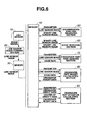
- FIG. 6 is a block diagram showing the crossover measuring device according to the basic concept of the present invention.
- the crossover line sensor 10 is installed on the roof of the vehicle 1 to look up the crossover 2. Moreover, a white light 4 to illuminate the crossover 2 is installed on the roof of the vehicle 1. On the roof of the vehicle 1, the pantograph 6 is installed in addition to the crossover line sensor 10 and the white light 4. The pantograph 6 contacts the main line (wire) 3.
- the crossover measuring device includes a crossover line sensor 10, a line sensor image forming section 20, memories 30 and 40, a discrimination analysis binarizing section 50, a noise removing section 60, a crossover part edge sensing section 70, a crossover part height calculating section 80 and a crossover part deviation calculating section 90.
- the operation proceeds in accordance with the flowchart shown in FIG. 5 .
- the line sensor image forming section 20 lines up, in time series, the image signals (luminance signals of the scanning line) of the crossover 2 which are obtained by the crossover line sensor 10 to form the line sensor image, and stores as the input image (step S1).
- the discrimination analysis binarizing section 50 determines a relatively good threshold value in accordance with the image by the discrimination analysis binarization, and emphasizes the crossover (step S2). For example, in the line sensor image (original image), shadings (light and dark) are generated in the crossover part, as shown in FIG. 2A . On the other hand, in the binary line sensor image, the crossover part is white, and the background part is black, as shown in FIG. 2B .
- the noise removing section 60 removes the noise of the binary line sensor image binarized by the discrimination analysis binarizing section 50 (step S3).
- the crossover part edge sensing section 70 senses the edges on the both sides of the crossover part which are represented by the white on the binary line sensor image from which the noise is removed by the noise removing section 60 (step S4). For example, as shown in FIG. 3 , a point at which the color varies from the black of the background to the white of the crossover part is sensed as a left side edge point A of the trolley wire part, and a point at which the color varies from the white of the crossover part to the black of the background is sensed as a right side edge point B of the crossover part.
- the crossover part height calculating section 80 calculates a distance between the edge points A and B on the both sides on one scanning line of the line sensor 10, as a width of the image of the crossover part.
- the crossover part height calculating section 80 calculates an image resolution (resolving power) [mm/pix] which is a degree of an actual size [mm] with respect to one pixel [pix], from the size data of the crossover, the lens focal length, the sensor width and the number of the pixels of the sensor which are known in advance, and determines the height from the line sensor 10 to the crossover 2 (step S5). Then, as shown in FIG.
- the crossover part deviation calculating section 90 sets a value of a center of the edge data on the both sides of the crossover part which are sensed from the binary line sensor image, to the position C of the center of gravity of the crossover.
- the crossover part deviation calculating section 90 determines an amount of the deviation of the position C of the center of gravity from the center, from the position [pix] of the center of gravity and the installation position of the line sensor on the image, the lens focal length, the sensor width, the number of the pixels of the sensor, and the height of the crossover 2 which is determined at step S5 (1.4) (step S6).
- the crossover measuring device includes a means (the line sensor image forming section 20) for forming the line sensor image by using the line sensor 10, and storing as the input image, a means (the discrimination analysis binarizing section 50) for emphasizing the crossover of the input line sensor image by the discrimination analysis binarization, a means (the noise removing section 60) for removing the noise of the binary line sensor image, a means (the crossover part edge sensing section 70) for sensing the edges of the crossover, a means (the crossover part height calculating section 80) for calculating the height of the crossover, and a means (the crossover part deviation calculating section 90) for calculating the deviation of the crossover. It is possible to calculate the deviation of the three-dimensional position of the crossover.
- the sodium lamp is used in place of the normal white lamp 4 used in the first embodiment.
- the band pass filter to transmit only the wave length emitted from the sodium lamp is installed on the camera lens of the line sensor 10.
- the other structures are identical to those of the first embodiment. Accordingly, this embodiment makes it possible to attain the effects identical to the first embodiment. Moreover, only the light of the sodium lamp reflected from the crossover is caught. It is possible to remove the ambient light including the outdoor light and the sunlight, to obtain the good image, and thereby to improve the accuracy.
- FIGS. 7 to 9 show a third embodiment of the present invention.
- FIG. 7 is a schematic view showing a crossover measuring device according to a third embodiment of the present invention.
- FIG. 8 is a flowchart showing a crossover measurement according to the third embodiment of the present invention.
- FIG. 9 is a block diagram showing the crossover measuring device according to the third embodiment of the present invention.
- the pantograph line sensor 11 is installed on the roof of the vehicle 1 to direct the periphery of the pantograph 6, in addition to the first embodiment.
- the illuminating lamp 5 to illuminate the pantograph 6 is installed on the roof of the vehicle 1.
- the other structures are identical to the first embodiment.
- the pantograph height and position calculating section 100 and the pantograph and crossover relative position calculating section 110 are added in addition to the first embodiment.
- the operation proceeds in accordance with the flowchart shown in FIG. 8 .
- the line sensor image forming section 20 lines up, in time series, the image signals (the luminance signals of the scanning line) of the crossover 2 which are obtained by the crossover line sensor image 10 to form the line sensor image, and lines up, in time series, the image signals (the luminance signals of the scanning line) of the pantograph 6 which are obtained by the pantograph line sensor 11 to form the line sensor image.
- the line sensor image forming section 20 stores these input images (step S1).
- Step S2 to Step S6 are identical to those of the first embodiment.
- the pantograph height and position calculating section 100 measures the height of the pantograph 6, based on the binary line sensor image which is obtained by the pantograph line sensor 11, which is formed as the line sensor image, and from which the noise is removed. Moreover, the pantograph height and position calculating section 100 calculates the three-dimensional position of the pantograph 6 from the measured height of the pantograph 6 and the design data of the pantograph 6 (step S7).
- pantograph and crossover relative position calculating section 110 determines the relative position between the pantograph and the crossover, based on the height of the crossover which is determined by the crossover part height calculating section 80, the deviation of the center of gravity from the center which is determined by the crossover part deviation calculating section 90, and the height and the position of the pantograph which are determined by the pantograph height and position calculating section 100 (step S8).
- the crossover measuring device makes it possible to attain the effects identical to the first embodiment.
- a means for taking the image of the pantograph 6, a means (the pantograph height and position calculating section 100) for calculating the height of the pantograph, and estimating the three-dimensional position of the pantograph from the design drawing of the pantograph, and a means (the pantograph and crossover relative position calculating section 110) for determining the relative position between the crossover 2 and the pantograph 6 are added to the crossover measuring device according to the first embodiment. It is possible to monitor whether to position a position at which the pantograph and the crossover cross, within the regulation position by knowing the relative position between the three-dimensional estimated position of the pantograph 6 and the three-dimensional position of the crossover 2.
- the crossover measuring device can be widely used as a device to measure the position of the wiring by the image processing, specifically, the height and the deviation of the crossover.
Landscapes
- Engineering & Computer Science (AREA)
- Physics & Mathematics (AREA)
- General Physics & Mathematics (AREA)
- Computer Vision & Pattern Recognition (AREA)
- Optics & Photonics (AREA)
- Theoretical Computer Science (AREA)
- Manufacturing & Machinery (AREA)
- Mechanical Engineering (AREA)
- Length Measuring Devices By Optical Means (AREA)
Abstract
Description
- This invention relates to a crossover measuring device, specifically to a device arranged to measure a position of a wiring by an image processing. More specifically, this invention relates to a crossover measuring device arranged to measure a position and a deviation of the crossover.
- There is a trolley wire as an equipment of an electric railroad. At a portion at which rails cross, it is necessary to cross trolley wires. Lines which are different from a main line, and which cross each other are referred to as a crossover. The trolley wires installed above the main line and the crossover in a station yard cross each other at a branch point of the rail. Two catenaries are mechanically connected by a crossing clamp, or electrically connected by a connector, so that a special wiring structure is formed. It is necessary that the trolley wire (the main line and the crossover) are laid (set) within a regulation or set height from the rail surface, and within a regulation or set deviation in left and right directions from the center of the track.
- However, when the difference in heights of both of the trolley wires crossing each other is varied by the temperature variation of the trolley wire, the boost (upward force) of the pantograph and so on, the trolley wire moves close to a loading gauge or vehicle gauge with respect to the pantograph. The trolley wire and the pantograph may be damaged (hereinafter, referred to as entanglement). Accordingly, it is necessary to sufficiently monitor a portion at which the trolley wires cross.
The pantograph is mainly used for monitoring the setting (laying) of the trolley wires, and arranged to monitor the heights and the contact points of the trolley wires. - There is, as a measuring means of the pantograph, a special measurement vehicle which is referred to as an inspection vehicle, a loading gauge inspection vehicle or so on. These vehicles are operated at a constant period in between commercial services. A plurality of sensors to measure the inclination of the vehicle body, the deviation of the rail and so on are attached to these measurement vehicles. One of these sensors is a measuring sensor of the pantograph. The pantograph measuring method includes a laser sensor method, an image processing method or so on. These methods have the following characteristics.
-
- 1) The laser sensor mainly uses the scan method. The laser is scanned to the pantograph by the mirror. The laser sensor is a sensor to measure the distance to the pantograph by the difference of the positions of the reflection waves, or the variation of the shape of the irradiated laser.
- 2) The image processing method includes a method to sense the pantograph by a model matching or a pattern matching.
- Patent Document 1: Japanese Patent Application Publication No.
2006-250775 - Patent Document 2: Japanese Patent Application Publication No.
2002-139305 - The pantograph is mainly used for monitoring the setting of the trolley wire (hereinafter, referred to as the crossover, including the main line) to monitor the height and the contact point of the trolley wire. The measuring methods of the pantograph include the laser sensor method, the image processing method or so on. These methods can not measure the three dimensional position of the crossover if the pantograph and the crossover do not contact each other.
- Moreover, in the patent document 1, the center of gravity of the object which does not contact the pantograph is determined, and thereby the three-dimensional position is measured. However, the distance and so on of the object is discerned by the stereo measurement. Therefore, the plurality of the cameras are needed.
Furthermore, thepatent document 2 discloses that one camera picks up the image of the portion near the pantograph, and thereby the height of the pantograph and the deviation of the trolley wire are measured. - It is an object of the present invention to provide a crossover measuring device to readily measure the height and the deviation of the crossover by the image processing by one camera.
- In the present invention, a crossover measuring device comprises: a crossover line sensor installed on a roof of a vehicle to look up a crossover; a pantograph line sensor installed on the roof of the vehicle to direct against a periphery of the pantograph; an illuminating member installed on the roof of the vehicle to illuminate the crossover; a line sensor image forming section to form line sensor images respectively by lining up, in time series, luminance signals obtained by the crossover line sensor and the pantograph line sensor, and to store as input images; a discrimination analysis binarizing section to form a binary line sensor image in which the crossover part is emphasized by a discrimination analysis binarization of the line sensor image formed by the line sensor image forming section; a noise removing section to remove the noise of the binary line sensor image to which the discrimination analysis binarization is performed by the discrimination analysis binarizing section; a crossover part edge detecting section to detect edges of the crossover part in the binary line sensor image from which the noise is removed by the noise removing section; a crossover part height calculating section to determine a width of the crossover part on the image from a distance of the edges of the crossover part which are sensed by the crossover part edge sensing section, and to determine a height of the crossover from a lens focal length, a number of pixels of the sensor of the crossover line sensor, and an image resolving power based on a size data of the crossover; a crossover part deviation calculating section to determine a value of a center of the edges of the crossover which are sensed by the crossover edge sensing section, as a center of gravity of the crossover, and to determine a deviation of the center of the gravity from a center, based on the center of the gravity of the crossover, the installation position of the crossover line sensor, the lens focal length, the sensor width, the number of the pixels of the sensor, and the height of the crossover which is determined by the crossover part height calculating section; a pantograph height and position calculating section to determine a height and a position of the pantograph based on the binary line sensor image from which the noise is removed by the noise removing section, and a design data of the pantograph; and a pantograph and crossover relative position calculating section to determine a relative position between the pantograph and the crossover, based on the height of the crossover which is determined by the crossover part height calculating section, the deviation of the center of the gravity from the center which is determined by the crossover part deviation calculating section, and the height and the position of the pantograph which are determined by the pantograph height and position calculating section.
- Moreover, in the crossover measuring device according to the present invention, a sodium lamp is used as the illuminating member; and a band pass filter arranged to transmit only a wavelength of the light emitted from the sodium lamp is mounted on the crossover line sensor.
-
-
FIG. 1 is a schematic view showing a crossover measuring device according to a basic concept of the present invention. -
FIG. 2A is an illustrative view showing a line sensor image (original image) of the crossover. -
FIG. 2B is an illustrative view showing a binary line sensor image. -
FIG. 3 is an illustrative view showing an edge image of the crossover. -
FIG. 4 is an illustrative view showing an edge image in which a center of gravity is sensed. -
FIG. 5 is a flowchart showing a crossover measurement according to the basic concept of the present invention. -
FIG. 6 is a block diagram showing the crossover measuring device according to the basic concept of the present invention. -
FIG. 7 is a schematic view showing a crossover measuring device according to a third embodiment of the present invention. -
FIG. 8 is a flowchart showing a crossover measurement according to the third embodiment of the present invention. -
FIG. 9 is a block diagram showing the crossover measuring device according to the third embodiment of the present invention. - Effects of the basic concept of the present invention are described below.
- (1) It is possible to determine a three-dimensional position of the crossover by one camera.
- (2) It is possible to perform the operation in the high speed running because of the non-contact method, and to measure a section or interval with a long distance by a short time period.
-
- (3) For the structure of the device, the sensor is installed away from the existing structures such as the point, the air section and the anchor. There is no need to consider the collision with the existing structure. It is possible to continuously measure even at a position at which the existing construction exists.
- (4) It is possible to measure by the discrimination analysis binarizing method, irrespective of the strong and the weak of the luminance of the image pickup by the deviation and so on of the crossover.
-
- (5) Basically, it is possible to pick up the line sensor image in the entire sections, and to obtain the image data of the crossover and the existing structures on the ground near the crossover in the measurement section.
- (6) There is no need to consider the influence on the human body, relative to the use of the laser beam. The handling is easy.
-
- (7) There is no need to receive the reflected light from the crossover by the regular reflection. Accordingly, there is no burden or botheration to accurately position the light source and the light receiving device.
- (8) The line sensor image in the measurement section is recorded. Accordingly, it is possible to check the problematical part of the crossover by checking the image of the problematical part.
- (9) It is possible to know whether to position the position at which the crossovers cross, within the regulation position, and to monitor the entanglement of the pantograph.
- Moreover, the sodium lamp is used as the illuminating means member. A band pass filter to transmit only the wave length of the light emitted from the sodium lamp is attached to the crossover line sensor. With this, it is possible to remove the ambient or disturbance light such as the outdoor light and the sunlight, to obtain the good image, and to improve the accuracy.
- In the present invention, a line sensor is used as an input means of an image, a normal white illumination (light) is used as an illumination. The line sensor is disposed on a roof of an inspection vehicle or examination vehicle) so as to look up in upward vertical direction. The line sensor is disposed so that a scanning line of the line sensor is perpendicular to the running direction of the inspection vehicle, and that the scanning line crosses the crossover (cf.
FIG. 1 ). The luminance signals of the scanning line obtained from the line sensor are lined up in time series so as to form the line sensor image (the planer image). The images are stored as input images. A width of the crossover emerged by the luminance by the image processing is determined in the following manner. - It is necessary to determine a threshold value so as to divide the crossover and a background part. When the threshold value is determined as a fixed value, there are problems that portions other than the crossover are emphasized and extracted by circumstance at an image pickup, or that the crossover itself is not extracted.
Accordingly, a discrimination analysis binarizing method is used for dealing with a deviation of the crossover and a difference of strengths of the reflected light. The discrimination analysis binarizing method is a method of determining the threshold value in accordance with the image. In a histogram in each image, there is "a block of the number of the pixels aggregated by a certain region of the luminance value" (hereinafter, referred to as a class). A relatively good threshold value is determined in any images so that dispersion ratio between the dispersion within the class and the dispersion between the classes as to the background and the pattern region at the binarization is maximized.
By using this method, the binary line sensor image is formed so that the crossover part becomes white, and that the background part becomes black (cf.FIG. 2 ). - When the binary line sensor image is formed from the line sensor image by the binarizing operation or binarization, there is a problem that the binary line sensor image includes minute dotted noises by the hurt of the crossover part and the state of the background part.
Therefore, the expansion operation and the contraction operation of the binarization are performed so as to remove these noises. - In the binary line sensor image from which the noises and the existing structures are removed, both side edges of the crossover part represented by the white are sensed. When these edge points are searched in one line from the left, it is possible to sense the point at which the color is varied from the black of the background to the white of the crossover, as the left side edge point of the trolley wire part, and to sense the point at which the color is varied from the white of the trolley wire part to the black of the background, as the right side edge point of the crossover part.
This operation is performed at each line from the upward to the downward of the image so as to sense the edges of the crossover part regarding the one binary line sensor image (cf.FIG. 3 ). - A distance between the edge points on the both sides on one scan line of the line sensor is calculated as a width on the image of the crossover part, by using the edge data on the both sides of the crossover part which are sensed from the binary line sensor image.
A size of the set (laid) crossover is known in advance. This information is inputted from the outside. The image resolving power (resolution) [mm/pix] which is a degree of an actual size [mm] with respect to 1 pixel [pix] is calculated from a lens focal length, a sensor width and a number of pixels of the sensor. A height from the line sensor to the crossover is determined.
Moreover, a height from the rail to the line sensor is known in advance. A height from the rail to the crossover is determined by adding the height from the rail to the line sensor. - A value of a center of the both side edge data of the crossover part which are sensed from the binary line sensor image is set to a center of gravity of the crossover (cf.
FIG. 4 ).
An amount of the deviation of the center of gravity from the center is determined from the position [pix] of the center of gravity and an installation position of the line sensor on the image, the lens focal length, the sensor width, the number of the pixels of the sensor, and the height of the crossover which is determined in (1.4).
Thus-determined edge data, data of the crossover part, the line sensor image used in the calculation, the corresponding line number and so on are recorded. - In the present invention, it is possible to determine "the height and the deviation" (hereinafter, referred to as a three-dimensional position) of the crossover which does not contact the pantograph, by one camera by non-contact. Moreover, it is possible to use in the high speed running, and to measure a section with a long distance by a short time period.
Moreover, because of the structure of the device, the sensor is provided at a position away from the existing structures such as a point, an air section and an anchor. Accordingly, there is no need to consider the collision with the existing structures. Basically, it is possible to take the line sensor image in entire sections. It is possible to obtain the image data of the crossover and the existing structures on the ground near the crossover in the measurement section.
Moreover, there is no difficultly of the handling by using the laser beam so as to consider the influence on the human body. - Furthermore, there is no burden to accurately position between the light source and the light receiving device.
Moreover, in any image pickup circumstance, it is possible to automatically calculate the relatively good threshold value. It is possible to improve the phenomenon that the trolley wire is not extracted due to the low luminance when the threshold value is constant. Moreover, the line sensor image is remained as the data. Accordingly, it is possible to check the problematical portion of the crossover by checking the image of the problematical portion. - This is a method of illuminating the crossover by using the sodium lamp in place of the normal white illumination.
Moreover, a band pass filter to transmit only a wave length emitted from the sodium lamp light is installed on the camera lens of the line sensor.
With this, it is possible to capture only the sodium lamp light reflected from the crossover, to remove the ambient light including the outdoor light and the sunlight, to obtain a good image, and to improve the accuracy. - An important item for checking the setting or laying of the crossover is an entanglement of the pantograph. The crossover contacts and crosses a horn part of the pantograph. It is necessary that the crossover is set within the regulation value so as not to generate the entanglement.
Accordingly, a line sensor and so on is installed to direct against the pantograph (cf.FIG. 7 ), so that the height of the pantograph is measured in addition to the three-dimensional position of the crossover. It is possible to estimate the three-dimensional position of the pantograph from the measured height of the pantograph and the design drawing of the pantograph.
Furthermore, it is characteristic to monitor whether to position the position at which the pantograph and the crossover cross, within the regulation position, by knowing the relative position between the three-dimensional estimated position of the pantograph and the three-dimensional position of the crossover. - Hereinafter, embodiments according to the present invention are illustrated in detail with reference to drawings.
FIGS. 1 to 6 show a first embodiment according to the present invention.FIG. 1 is a schematic view showing a crossover measuring device according to a basic concept of the present invention.FIG. 2A is an illustrative view showing a line sensor image (original image) of the crossover.FIG. 2B is an illustrative view showing a binary (binarized) line sensor image.FIG. 3 is an illustrative view showing an edge image of the crossover.FIG. 4 is an illustrative view showing the edge image in which the center of gravity is sensed.FIG. 5 is a flowchart of the crossover measurement according to the basic concept of the present invention.FIG. 6 is a block diagram showing the crossover measuring device according to the basic concept of the present invention. - As shown in
FIG. 1 , thecrossover line sensor 10 is installed on the roof of the vehicle 1 to look up thecrossover 2. Moreover, a white light 4 to illuminate thecrossover 2 is installed on the roof of the vehicle 1. On the roof of the vehicle 1, thepantograph 6 is installed in addition to thecrossover line sensor 10 and the white light 4. Thepantograph 6 contacts the main line (wire) 3. - As shown in
FIG. 6 , the crossover measuring device according to this embodiment includes acrossover line sensor 10, a line sensorimage forming section 20,memories analysis binarizing section 50, anoise removing section 60, a crossover partedge sensing section 70, a crossover partheight calculating section 80 and a crossover partdeviation calculating section 90. The operation proceeds in accordance with the flowchart shown inFIG. 5 .
First, the line sensorimage forming section 20 lines up, in time series, the image signals (luminance signals of the scanning line) of thecrossover 2 which are obtained by thecrossover line sensor 10 to form the line sensor image, and stores as the input image (step S1). - Next, when the discrimination
analysis binarizing section 50 binarizes the line sensor image formed by the line sensorimage forming section 20, the discriminationanalysis binarizing section 50 determines a relatively good threshold value in accordance with the image by the discrimination analysis binarization, and emphasizes the crossover (step S2). For example, in the line sensor image (original image), shadings (light and dark) are generated in the crossover part, as shown inFIG. 2A . On the other hand, in the binary line sensor image, the crossover part is white, and the background part is black, as shown inFIG. 2B .
Next, thenoise removing section 60 removes the noise of the binary line sensor image binarized by the discrimination analysis binarizing section 50 (step S3). - Moreover, the crossover part
edge sensing section 70 senses the edges on the both sides of the crossover part which are represented by the white on the binary line sensor image from which the noise is removed by the noise removing section 60 (step S4). For example, as shown inFIG. 3 , a point at which the color varies from the black of the background to the white of the crossover part is sensed as a left side edge point A of the trolley wire part, and a point at which the color varies from the white of the crossover part to the black of the background is sensed as a right side edge point B of the crossover part. - The crossover part
height calculating section 80 calculates a distance between the edge points A and B on the both sides on one scanning line of theline sensor 10, as a width of the image of the crossover part. The crossover partheight calculating section 80 calculates an image resolution (resolving power) [mm/pix] which is a degree of an actual size [mm] with respect to one pixel [pix], from the size data of the crossover, the lens focal length, the sensor width and the number of the pixels of the sensor which are known in advance, and determines the height from theline sensor 10 to the crossover 2 (step S5).
Then, as shown inFIG. 4 , the crossover partdeviation calculating section 90 sets a value of a center of the edge data on the both sides of the crossover part which are sensed from the binary line sensor image, to the position C of the center of gravity of the crossover. The crossover partdeviation calculating section 90 determines an amount of the deviation of the position C of the center of gravity from the center, from the position [pix] of the center of gravity and the installation position of the line sensor on the image, the lens focal length, the sensor width, the number of the pixels of the sensor, and the height of thecrossover 2 which is determined at step S5 (1.4) (step S6). - As illustrated above, the crossover measuring device according to this embodiment includes a means (the line sensor image forming section 20) for forming the line sensor image by using the
line sensor 10, and storing as the input image, a means (the discrimination analysis binarizing section 50) for emphasizing the crossover of the input line sensor image by the discrimination analysis binarization, a means (the noise removing section 60) for removing the noise of the binary line sensor image, a means (the crossover part edge sensing section 70) for sensing the edges of the crossover, a means (the crossover part height calculating section 80) for calculating the height of the crossover, and a means (the crossover part deviation calculating section 90) for calculating the deviation of the crossover. It is possible to calculate the deviation of the three-dimensional position of the crossover. - In the crossover measuring device according to this embodiment, the sodium lamp is used in place of the normal white lamp 4 used in the first embodiment. The band pass filter to transmit only the wave length emitted from the sodium lamp is installed on the camera lens of the
line sensor 10. The other structures are identical to those of the first embodiment.
Accordingly, this embodiment makes it possible to attain the effects identical to the first embodiment. Moreover, only the light of the sodium lamp reflected from the crossover is caught. It is possible to remove the ambient light including the outdoor light and the sunlight, to obtain the good image, and thereby to improve the accuracy. -
FIGS. 7 to 9 show a third embodiment of the present invention.FIG. 7 is a schematic view showing a crossover measuring device according to a third embodiment of the present invention.FIG. 8 is a flowchart showing a crossover measurement according to the third embodiment of the present invention.FIG. 9 is a block diagram showing the crossover measuring device according to the third embodiment of the present invention.
In this embodiment, as shown inFIG. 7 , thepantograph line sensor 11 is installed on the roof of the vehicle 1 to direct the periphery of thepantograph 6, in addition to the first embodiment. Moreover, the illuminatinglamp 5 to illuminate thepantograph 6 is installed on the roof of the vehicle 1. The other structures are identical to the first embodiment. - In the crossover measuring device according to this embodiment, as shown in
FIG. 9 , the pantograph height andposition calculating section 100 and the pantograph and crossover relativeposition calculating section 110 are added in addition to the first embodiment. The operation proceeds in accordance with the flowchart shown inFIG. 8 .
First, the line sensorimage forming section 20 lines up, in time series, the image signals (the luminance signals of the scanning line) of thecrossover 2 which are obtained by the crossoverline sensor image 10 to form the line sensor image, and lines up, in time series, the image signals (the luminance signals of the scanning line) of thepantograph 6 which are obtained by thepantograph line sensor 11 to form the line sensor image. The line sensorimage forming section 20 stores these input images (step S1).
Step S2 to Step S6 are identical to those of the first embodiment. - Next, the pantograph height and
position calculating section 100 measures the height of thepantograph 6, based on the binary line sensor image which is obtained by thepantograph line sensor 11, which is formed as the line sensor image, and from which the noise is removed. Moreover, the pantograph height andposition calculating section 100 calculates the three-dimensional position of thepantograph 6 from the measured height of thepantograph 6 and the design data of the pantograph 6 (step S7).
Moreover, the pantograph and crossover relativeposition calculating section 110 determines the relative position between the pantograph and the crossover, based on the height of the crossover which is determined by the crossover partheight calculating section 80, the deviation of the center of gravity from the center which is determined by the crossover partdeviation calculating section 90, and the height and the position of the pantograph which are determined by the pantograph height and position calculating section 100 (step S8). - In this way, the crossover measuring device according to this embodiment makes it possible to attain the effects identical to the first embodiment. In this embodiment, a means (the pantograph line sensor 11) for taking the image of the
pantograph 6, a means (the pantograph height and position calculating section 100) for calculating the height of the pantograph, and estimating the three-dimensional position of the pantograph from the design drawing of the pantograph, and a means (the pantograph and crossover relative position calculating section 110) for determining the relative position between thecrossover 2 and thepantograph 6 are added to the crossover measuring device according to the first embodiment. It is possible to monitor whether to position a position at which the pantograph and the crossover cross, within the regulation position by knowing the relative position between the three-dimensional estimated position of thepantograph 6 and the three-dimensional position of thecrossover 2. - The crossover measuring device according to the present invention can be widely used as a device to measure the position of the wiring by the image processing, specifically, the height and the deviation of the crossover.
Claims (2)
- A crossover measuring device comprising:a crossover line sensor installed on a roof of a vehicle to look up a crossover;a pantograph line sensor installed on the roof of the vehicle to direct against a periphery of the pantograph;an illuminating member installed on the roof of the vehicle to illuminate the crossover;a line sensor image forming section to form line sensor images respectively by lining up, in time series, luminance signals obtained by the crossover line sensor and the pantograph line sensor, and to store as input images;a discrimination analysis binarizing section to form a binary line sensor image in which the crossover part is emphasized by a discrimination analysis binarization of the line sensor image formed by the line sensor image forming section;a noise removing section to remove the noise of the binary line sensor image to which the discrimination analysis binarization is performed by the discrimination analysis binarizing section;a crossover part edge detecting section to detect edges of the crossover part in the binary line sensor image from which the noise is removed by the noise removing section;a crossover part height calculating section to determine a width of the crossover part on the image from a distance of the edges of the crossover part which are sensed by the crossover part edge sensing section, and to determine a height of the crossover from a lens focal length, a number of pixels of the sensor of the crossover line sensor, and an image resolving power based on a size data of the crossover;a crossover part deviation calculating section to determine a value of a center of the edges of the crossover which are sensed by the crossover edge sensing section, as a center of gravity of the crossover, and to determine a deviation of the center of the gravity from a center, based on the center of the gravity of the crossover, the installation position of the crossover line sensor, the lens focal length, the sensor width, the number of the pixels of the sensor, and the height of the crossover which is determined by the crossover part height calculating section;a pantograph height and position calculating section to determine a height and a position of the pantograph based on the binary line sensor image from which the noise is removed by the noise removing section, and a design data of the pantograph; anda pantograph and crossover relative position calculating section to determine a relative position between the pantograph and the crossover, based on the height of the crossover which is determined by the crossover part height calculating section, the deviation of the center of the gravity from the center which is determined by the crossover part deviation calculating section, and the height and the position of the pantograph which are determined by the pantograph height and position calculating section.
- The crossover measuring device as defined in claim 1, wherein a sodium lamp is used as the illuminating member; and a band pass filter arranged to transmit only a wavelength of the light emitted from the sodium lamp is mounted on the crossover line sensor.
Applications Claiming Priority (2)
| Application Number | Priority Date | Filing Date | Title |
|---|---|---|---|
| JP2008034028A JP5245445B2 (en) | 2008-02-15 | 2008-02-15 | Crossover measuring device |
| PCT/JP2009/051844 WO2009101881A1 (en) | 2008-02-15 | 2009-02-04 | Crossover measuring device |
Publications (3)
| Publication Number | Publication Date |
|---|---|
| EP2244056A1 true EP2244056A1 (en) | 2010-10-27 |
| EP2244056A4 EP2244056A4 (en) | 2014-02-19 |
| EP2244056B1 EP2244056B1 (en) | 2016-11-30 |
Family
ID=40956911
Family Applications (1)
| Application Number | Title | Priority Date | Filing Date |
|---|---|---|---|
| EP09710420.2A Active EP2244056B1 (en) | 2008-02-15 | 2009-02-04 | Crossover measuring device |
Country Status (4)
| Country | Link |
|---|---|
| EP (1) | EP2244056B1 (en) |
| JP (1) | JP5245445B2 (en) |
| RU (1) | RU2445571C1 (en) |
| WO (1) | WO2009101881A1 (en) |
Cited By (8)
| Publication number | Priority date | Publication date | Assignee | Title |
|---|---|---|---|---|
| CN102616154A (en) * | 2011-12-26 | 2012-08-01 | 中铁六局集团有限公司 | Construction method for modifying head span of existing line of railway |
| JP2015094612A (en) * | 2013-11-11 | 2015-05-18 | 株式会社明電舎 | Overhead wire inspection device by time series filter processing |
| JP2015094613A (en) * | 2013-11-11 | 2015-05-18 | 株式会社明電舎 | Overhead wire inspection device by time series filter processing |
| JP2015099118A (en) * | 2013-11-20 | 2015-05-28 | 株式会社明電舎 | Trolley wire wear measurement apparatus using image processing, and trolley wire wear measurement method |
| CN104748689A (en) * | 2015-04-21 | 2015-07-01 | 中国科学院长春光学精密机械与物理研究所 | Train catenary height non-contact measuring system based on parallel laser radars |
| EP2565612B1 (en) * | 2010-04-30 | 2017-01-11 | Meidensha Corporation | Contact force measurement method and contact force measurement device |
| FR3082792A1 (en) * | 2018-06-22 | 2019-12-27 | 4Nrj | MEASURING DEVICE FOR THE CATENARIES OF A SWITCH |
| CN112414325A (en) * | 2020-10-27 | 2021-02-26 | 哈尔滨市科佳通用机电股份有限公司 | A system and method for detecting centerline offset of pantograph |
Families Citing this family (9)
| Publication number | Priority date | Publication date | Assignee | Title |
|---|---|---|---|---|
| KR101128835B1 (en) | 2009-12-03 | 2012-03-23 | 한국철도기술연구원 | Measuring Apparatus for Height and stagger of trolley line using Line Scan Camera and Method thereof |
| JP5776378B2 (en) * | 2011-06-30 | 2015-09-09 | 株式会社明電舎 | Crossover measuring device by image processing |
| JP5811637B2 (en) * | 2011-06-30 | 2015-11-11 | 株式会社明電舎 | Trolley wire wear measuring device by image processing |
| JP5952759B2 (en) * | 2013-03-04 | 2016-07-13 | 公益財団法人鉄道総合技術研究所 | Overhead wire position measuring apparatus and method |
| KR101527079B1 (en) * | 2013-09-25 | 2015-06-10 | 한국철도공사 | Area Catenary contact force measurement device with camera and measurement method |
| KR101583707B1 (en) * | 2013-11-12 | 2016-01-08 | 한국철도기술연구원 | Accurate train location detection system using stagger information of the overhead contact lines |
| JP6488478B2 (en) * | 2015-04-30 | 2019-03-27 | 株式会社明電舎 | Overhead line inspection device |
| CN107743577B (en) * | 2015-06-15 | 2020-06-09 | 韩国铁道技术研究院 | Method and apparatus for detecting vibration information of electric railway vehicle |
| JP6696207B2 (en) * | 2016-02-18 | 2020-05-20 | 株式会社明電舎 | Overhead position measuring device and overhead line position measuring method |
Family Cites Families (11)
| Publication number | Priority date | Publication date | Assignee | Title |
|---|---|---|---|---|
| JPH05278502A (en) * | 1992-04-02 | 1993-10-26 | Hitachi Electron Eng Co Ltd | Trolley wire position measuring device |
| RU2003512C1 (en) * | 1993-11-09 | 1993-11-30 | Shumejko Vasilij A | Device for measuring contact wire position |
| JPH07329615A (en) * | 1994-06-03 | 1995-12-19 | Hitachi Electron Eng Co Ltd | Trolley wire cross section inspection device |
| JP3300883B2 (en) * | 1997-10-02 | 2002-07-08 | 財団法人鉄道総合技術研究所 | Method and apparatus for measuring trolley wire height |
| JP4078798B2 (en) | 2000-10-31 | 2008-04-23 | 株式会社明電舎 | Pantograph obstacle detection device |
| JP4085588B2 (en) * | 2001-03-22 | 2008-05-14 | 株式会社明電舎 | Pantograph measuring device |
| RU2229395C1 (en) * | 2002-12-30 | 2004-05-27 | Власов Евгений Иванович | Electric vehicle current collector |
| JP2004286500A (en) * | 2003-03-20 | 2004-10-14 | Railway Technical Res Inst | Method and apparatus for measuring pantograph state of railway vehicle |
| JP4440809B2 (en) | 2005-03-11 | 2010-03-24 | 株式会社明電舎 | Obstacle detection device around pantograph |
| JP4690749B2 (en) * | 2005-03-11 | 2011-06-01 | 株式会社明電舎 | Pantograph motion measuring device by image processing |
| JP4635657B2 (en) * | 2005-03-11 | 2011-02-23 | 株式会社明電舎 | Trolley wire wear measuring device by image processing |
-
2008
- 2008-02-15 JP JP2008034028A patent/JP5245445B2/en active Active
-
2009
- 2009-02-04 EP EP09710420.2A patent/EP2244056B1/en active Active
- 2009-02-04 RU RU2010135038/28A patent/RU2445571C1/en active
- 2009-02-04 WO PCT/JP2009/051844 patent/WO2009101881A1/en not_active Ceased
Cited By (10)
| Publication number | Priority date | Publication date | Assignee | Title |
|---|---|---|---|---|
| EP2565612B1 (en) * | 2010-04-30 | 2017-01-11 | Meidensha Corporation | Contact force measurement method and contact force measurement device |
| CN102616154A (en) * | 2011-12-26 | 2012-08-01 | 中铁六局集团有限公司 | Construction method for modifying head span of existing line of railway |
| JP2015094612A (en) * | 2013-11-11 | 2015-05-18 | 株式会社明電舎 | Overhead wire inspection device by time series filter processing |
| JP2015094613A (en) * | 2013-11-11 | 2015-05-18 | 株式会社明電舎 | Overhead wire inspection device by time series filter processing |
| JP2015099118A (en) * | 2013-11-20 | 2015-05-28 | 株式会社明電舎 | Trolley wire wear measurement apparatus using image processing, and trolley wire wear measurement method |
| CN104748689A (en) * | 2015-04-21 | 2015-07-01 | 中国科学院长春光学精密机械与物理研究所 | Train catenary height non-contact measuring system based on parallel laser radars |
| CN104748689B (en) * | 2015-04-21 | 2017-07-14 | 中国科学院长春光学精密机械与物理研究所 | Train contact net height contactless measuring system based on parallel laser radar |
| FR3082792A1 (en) * | 2018-06-22 | 2019-12-27 | 4Nrj | MEASURING DEVICE FOR THE CATENARIES OF A SWITCH |
| CN112414325A (en) * | 2020-10-27 | 2021-02-26 | 哈尔滨市科佳通用机电股份有限公司 | A system and method for detecting centerline offset of pantograph |
| CN112414325B (en) * | 2020-10-27 | 2021-07-20 | 哈尔滨市科佳通用机电股份有限公司 | Pantograph center line deviation detection system and method |
Also Published As
| Publication number | Publication date |
|---|---|
| JP2009192394A (en) | 2009-08-27 |
| WO2009101881A1 (en) | 2009-08-20 |
| EP2244056B1 (en) | 2016-11-30 |
| EP2244056A4 (en) | 2014-02-19 |
| JP5245445B2 (en) | 2013-07-24 |
| RU2445571C1 (en) | 2012-03-20 |
Similar Documents
| Publication | Publication Date | Title |
|---|---|---|
| EP2244056B1 (en) | Crossover measuring device | |
| JP4973108B2 (en) | Trolley wire wear measuring device | |
| CN100494882C (en) | Image processing-based wear measurement device for trolley wires | |
| CN107743577B (en) | Method and apparatus for detecting vibration information of electric railway vehicle | |
| TWI422797B (en) | By means of image processing of the collector wire wear and offset measurement device | |
| EP2966400B1 (en) | Overhead line position measuring device and method | |
| JP4816567B2 (en) | Trolley wire wear measuring device by image processing | |
| KR101658717B1 (en) | Pantograph measurement method, and pantograph measurement device | |
| JPH0879904A (en) | Abnormality detector for pantograph | |
| JP5952759B2 (en) | Overhead wire position measuring apparatus and method | |
| JP5223472B2 (en) | Wear measuring apparatus and wear measuring method | |
| JP5162874B2 (en) | Trolley wire wear measuring device | |
| JP3964077B2 (en) | Trolley wire support insulator height measuring device | |
| JP7196806B2 (en) | Contact wire inspection device and contact wire inspection method | |
| JP2005028903A (en) | Method and device for detection of pantograph obstacle | |
| JP4858316B2 (en) | Trolley wire wear measuring device by image processing | |
| JP5629478B2 (en) | Pantograph monitoring device | |
| JP4779770B2 (en) | Trolley wire wear measuring device by image processing | |
| JP6268382B2 (en) | Trolley wire wear measuring apparatus and trolley wire wear measuring method by image processing | |
| JP7655370B1 (en) | Contact wire inspection device and contact wire inspection method |
Legal Events
| Date | Code | Title | Description |
|---|---|---|---|
| PUAI | Public reference made under article 153(3) epc to a published international application that has entered the european phase |
Free format text: ORIGINAL CODE: 0009012 |
|
| 17P | Request for examination filed |
Effective date: 20100806 |
|
| AK | Designated contracting states |
Kind code of ref document: A1 Designated state(s): AT BE BG CH CY CZ DE DK EE ES FI FR GB GR HR HU IE IS IT LI LT LU LV MC MK MT NL NO PL PT RO SE SI SK TR |
|
| AX | Request for extension of the european patent |
Extension state: AL BA RS |
|
| DAX | Request for extension of the european patent (deleted) | ||
| REG | Reference to a national code |
Ref country code: DE Ref legal event code: R079 Ref document number: 602009042755 Country of ref document: DE Free format text: PREVIOUS MAIN CLASS: G01B0011000000 Ipc: G01B0011040000 |
|
| A4 | Supplementary search report drawn up and despatched |
Effective date: 20140122 |
|
| RIC1 | Information provided on ipc code assigned before grant |
Ipc: G06T 7/00 20060101ALI20140116BHEP Ipc: B60M 1/28 20060101ALI20140116BHEP Ipc: G01B 11/04 20060101AFI20140116BHEP |
|
| GRAP | Despatch of communication of intention to grant a patent |
Free format text: ORIGINAL CODE: EPIDOSNIGR1 |
|
| INTG | Intention to grant announced |
Effective date: 20160616 |
|
| GRAS | Grant fee paid |
Free format text: ORIGINAL CODE: EPIDOSNIGR3 |
|
| GRAA | (expected) grant |
Free format text: ORIGINAL CODE: 0009210 |
|
| AK | Designated contracting states |
Kind code of ref document: B1 Designated state(s): AT BE BG CH CY CZ DE DK EE ES FI FR GB GR HR HU IE IS IT LI LT LU LV MC MK MT NL NO PL PT RO SE SI SK TR |
|
| REG | Reference to a national code |
Ref country code: CH Ref legal event code: EP Ref country code: GB Ref legal event code: FG4D |
|
| REG | Reference to a national code |
Ref country code: AT Ref legal event code: REF Ref document number: 850223 Country of ref document: AT Kind code of ref document: T Effective date: 20161215 |
|
| REG | Reference to a national code |
Ref country code: IE Ref legal event code: FG4D |
|
| REG | Reference to a national code |
Ref country code: DE Ref legal event code: R096 Ref document number: 602009042755 Country of ref document: DE |
|
| REG | Reference to a national code |
Ref country code: FR Ref legal event code: PLFP Year of fee payment: 9 |
|
| PG25 | Lapsed in a contracting state [announced via postgrant information from national office to epo] |
Ref country code: LV Free format text: LAPSE BECAUSE OF FAILURE TO SUBMIT A TRANSLATION OF THE DESCRIPTION OR TO PAY THE FEE WITHIN THE PRESCRIBED TIME-LIMIT Effective date: 20161130 |
|
| REG | Reference to a national code |
Ref country code: LT Ref legal event code: MG4D |
|
| REG | Reference to a national code |
Ref country code: NL Ref legal event code: MP Effective date: 20161130 |
|
| REG | Reference to a national code |
Ref country code: AT Ref legal event code: MK05 Ref document number: 850223 Country of ref document: AT Kind code of ref document: T Effective date: 20161130 |
|
| PG25 | Lapsed in a contracting state [announced via postgrant information from national office to epo] |
Ref country code: GR Free format text: LAPSE BECAUSE OF FAILURE TO SUBMIT A TRANSLATION OF THE DESCRIPTION OR TO PAY THE FEE WITHIN THE PRESCRIBED TIME-LIMIT Effective date: 20170301 Ref country code: LT Free format text: LAPSE BECAUSE OF FAILURE TO SUBMIT A TRANSLATION OF THE DESCRIPTION OR TO PAY THE FEE WITHIN THE PRESCRIBED TIME-LIMIT Effective date: 20161130 Ref country code: SE Free format text: LAPSE BECAUSE OF FAILURE TO SUBMIT A TRANSLATION OF THE DESCRIPTION OR TO PAY THE FEE WITHIN THE PRESCRIBED TIME-LIMIT Effective date: 20161130 Ref country code: NO Free format text: LAPSE BECAUSE OF FAILURE TO SUBMIT A TRANSLATION OF THE DESCRIPTION OR TO PAY THE FEE WITHIN THE PRESCRIBED TIME-LIMIT Effective date: 20170228 |
|
| PG25 | Lapsed in a contracting state [announced via postgrant information from national office to epo] |
Ref country code: AT Free format text: LAPSE BECAUSE OF FAILURE TO SUBMIT A TRANSLATION OF THE DESCRIPTION OR TO PAY THE FEE WITHIN THE PRESCRIBED TIME-LIMIT Effective date: 20161130 Ref country code: HR Free format text: LAPSE BECAUSE OF FAILURE TO SUBMIT A TRANSLATION OF THE DESCRIPTION OR TO PAY THE FEE WITHIN THE PRESCRIBED TIME-LIMIT Effective date: 20161130 Ref country code: FI Free format text: LAPSE BECAUSE OF FAILURE TO SUBMIT A TRANSLATION OF THE DESCRIPTION OR TO PAY THE FEE WITHIN THE PRESCRIBED TIME-LIMIT Effective date: 20161130 Ref country code: BE Free format text: LAPSE BECAUSE OF NON-PAYMENT OF DUE FEES Effective date: 20170228 Ref country code: PT Free format text: LAPSE BECAUSE OF FAILURE TO SUBMIT A TRANSLATION OF THE DESCRIPTION OR TO PAY THE FEE WITHIN THE PRESCRIBED TIME-LIMIT Effective date: 20170330 Ref country code: PL Free format text: LAPSE BECAUSE OF FAILURE TO SUBMIT A TRANSLATION OF THE DESCRIPTION OR TO PAY THE FEE WITHIN THE PRESCRIBED TIME-LIMIT Effective date: 20161130 Ref country code: ES Free format text: LAPSE BECAUSE OF FAILURE TO SUBMIT A TRANSLATION OF THE DESCRIPTION OR TO PAY THE FEE WITHIN THE PRESCRIBED TIME-LIMIT Effective date: 20161130 |
|
| PG25 | Lapsed in a contracting state [announced via postgrant information from national office to epo] |
Ref country code: NL Free format text: LAPSE BECAUSE OF FAILURE TO SUBMIT A TRANSLATION OF THE DESCRIPTION OR TO PAY THE FEE WITHIN THE PRESCRIBED TIME-LIMIT Effective date: 20161130 |
|
| PG25 | Lapsed in a contracting state [announced via postgrant information from national office to epo] |
Ref country code: SK Free format text: LAPSE BECAUSE OF FAILURE TO SUBMIT A TRANSLATION OF THE DESCRIPTION OR TO PAY THE FEE WITHIN THE PRESCRIBED TIME-LIMIT Effective date: 20161130 Ref country code: EE Free format text: LAPSE BECAUSE OF FAILURE TO SUBMIT A TRANSLATION OF THE DESCRIPTION OR TO PAY THE FEE WITHIN THE PRESCRIBED TIME-LIMIT Effective date: 20161130 Ref country code: RO Free format text: LAPSE BECAUSE OF FAILURE TO SUBMIT A TRANSLATION OF THE DESCRIPTION OR TO PAY THE FEE WITHIN THE PRESCRIBED TIME-LIMIT Effective date: 20161130 Ref country code: CZ Free format text: LAPSE BECAUSE OF FAILURE TO SUBMIT A TRANSLATION OF THE DESCRIPTION OR TO PAY THE FEE WITHIN THE PRESCRIBED TIME-LIMIT Effective date: 20161130 Ref country code: DK Free format text: LAPSE BECAUSE OF FAILURE TO SUBMIT A TRANSLATION OF THE DESCRIPTION OR TO PAY THE FEE WITHIN THE PRESCRIBED TIME-LIMIT Effective date: 20161130 |
|
| PG25 | Lapsed in a contracting state [announced via postgrant information from national office to epo] |
Ref country code: BG Free format text: LAPSE BECAUSE OF FAILURE TO SUBMIT A TRANSLATION OF THE DESCRIPTION OR TO PAY THE FEE WITHIN THE PRESCRIBED TIME-LIMIT Effective date: 20170228 Ref country code: BE Free format text: LAPSE BECAUSE OF FAILURE TO SUBMIT A TRANSLATION OF THE DESCRIPTION OR TO PAY THE FEE WITHIN THE PRESCRIBED TIME-LIMIT Effective date: 20161130 Ref country code: IT Free format text: LAPSE BECAUSE OF FAILURE TO SUBMIT A TRANSLATION OF THE DESCRIPTION OR TO PAY THE FEE WITHIN THE PRESCRIBED TIME-LIMIT Effective date: 20161130 |
|
| REG | Reference to a national code |
Ref country code: DE Ref legal event code: R097 Ref document number: 602009042755 Country of ref document: DE |
|
| REG | Reference to a national code |
Ref country code: DE Ref legal event code: R119 Ref document number: 602009042755 Country of ref document: DE |
|
| PG25 | Lapsed in a contracting state [announced via postgrant information from national office to epo] |
Ref country code: MC Free format text: LAPSE BECAUSE OF FAILURE TO SUBMIT A TRANSLATION OF THE DESCRIPTION OR TO PAY THE FEE WITHIN THE PRESCRIBED TIME-LIMIT Effective date: 20161130 |
|
| REG | Reference to a national code |
Ref country code: CH Ref legal event code: PL |
|
| PLBE | No opposition filed within time limit |
Free format text: ORIGINAL CODE: 0009261 |
|
| STAA | Information on the status of an ep patent application or granted ep patent |
Free format text: STATUS: NO OPPOSITION FILED WITHIN TIME LIMIT |
|
| GBPC | Gb: european patent ceased through non-payment of renewal fee |
Effective date: 20170228 |
|
| PG25 | Lapsed in a contracting state [announced via postgrant information from national office to epo] |
Ref country code: LI Free format text: LAPSE BECAUSE OF NON-PAYMENT OF DUE FEES Effective date: 20170228 Ref country code: CH Free format text: LAPSE BECAUSE OF NON-PAYMENT OF DUE FEES Effective date: 20170228 |
|
| 26N | No opposition filed |
Effective date: 20170831 |
|
| REG | Reference to a national code |
Ref country code: IE Ref legal event code: MM4A |
|
| PG25 | Lapsed in a contracting state [announced via postgrant information from national office to epo] |
Ref country code: SI Free format text: LAPSE BECAUSE OF FAILURE TO SUBMIT A TRANSLATION OF THE DESCRIPTION OR TO PAY THE FEE WITHIN THE PRESCRIBED TIME-LIMIT Effective date: 20161130 |
|
| PG25 | Lapsed in a contracting state [announced via postgrant information from national office to epo] |
Ref country code: LU Free format text: LAPSE BECAUSE OF NON-PAYMENT OF DUE FEES Effective date: 20170204 |
|
| PG25 | Lapsed in a contracting state [announced via postgrant information from national office to epo] |
Ref country code: DE Free format text: LAPSE BECAUSE OF NON-PAYMENT OF DUE FEES Effective date: 20170901 |
|
| REG | Reference to a national code |
Ref country code: FR Ref legal event code: PLFP Year of fee payment: 10 |
|
| PG25 | Lapsed in a contracting state [announced via postgrant information from national office to epo] |
Ref country code: GB Free format text: LAPSE BECAUSE OF NON-PAYMENT OF DUE FEES Effective date: 20170228 Ref country code: IE Free format text: LAPSE BECAUSE OF NON-PAYMENT OF DUE FEES Effective date: 20170204 |
|
| PG25 | Lapsed in a contracting state [announced via postgrant information from national office to epo] |
Ref country code: MT Free format text: LAPSE BECAUSE OF NON-PAYMENT OF DUE FEES Effective date: 20170204 |
|
| PG25 | Lapsed in a contracting state [announced via postgrant information from national office to epo] |
Ref country code: HU Free format text: LAPSE BECAUSE OF FAILURE TO SUBMIT A TRANSLATION OF THE DESCRIPTION OR TO PAY THE FEE WITHIN THE PRESCRIBED TIME-LIMIT; INVALID AB INITIO Effective date: 20090204 |
|
| PG25 | Lapsed in a contracting state [announced via postgrant information from national office to epo] |
Ref country code: CY Free format text: LAPSE BECAUSE OF NON-PAYMENT OF DUE FEES Effective date: 20161130 |
|
| PG25 | Lapsed in a contracting state [announced via postgrant information from national office to epo] |
Ref country code: MK Free format text: LAPSE BECAUSE OF FAILURE TO SUBMIT A TRANSLATION OF THE DESCRIPTION OR TO PAY THE FEE WITHIN THE PRESCRIBED TIME-LIMIT Effective date: 20161130 |
|
| PG25 | Lapsed in a contracting state [announced via postgrant information from national office to epo] |
Ref country code: TR Free format text: LAPSE BECAUSE OF FAILURE TO SUBMIT A TRANSLATION OF THE DESCRIPTION OR TO PAY THE FEE WITHIN THE PRESCRIBED TIME-LIMIT Effective date: 20161130 |
|
| PG25 | Lapsed in a contracting state [announced via postgrant information from national office to epo] |
Ref country code: IS Free format text: LAPSE BECAUSE OF FAILURE TO SUBMIT A TRANSLATION OF THE DESCRIPTION OR TO PAY THE FEE WITHIN THE PRESCRIBED TIME-LIMIT Effective date: 20170330 |
|
| PGFP | Annual fee paid to national office [announced via postgrant information from national office to epo] |
Ref country code: FR Payment date: 20260218 Year of fee payment: 18 |