EP2243339B1 - Lichtblitzgenerator, absorptionsspektrometer mit einem solchen generator und verfahren zur erzeugung von lichtblitzen - Google Patents
Lichtblitzgenerator, absorptionsspektrometer mit einem solchen generator und verfahren zur erzeugung von lichtblitzen Download PDFInfo
- Publication number
- EP2243339B1 EP2243339B1 EP09706899A EP09706899A EP2243339B1 EP 2243339 B1 EP2243339 B1 EP 2243339B1 EP 09706899 A EP09706899 A EP 09706899A EP 09706899 A EP09706899 A EP 09706899A EP 2243339 B1 EP2243339 B1 EP 2243339B1
- Authority
- EP
- European Patent Office
- Prior art keywords
- discharge lamp
- intensity
- voltage
- light
- circuit
- Prior art date
- Legal status (The legal status is an assumption and is not a legal conclusion. Google has not performed a legal analysis and makes no representation as to the accuracy of the status listed.)
- Active
Links
- 238000000034 method Methods 0.000 title claims description 13
- 238000010521 absorption reaction Methods 0.000 title claims description 12
- 230000036278 prepulse Effects 0.000 claims abstract description 34
- 238000007599 discharging Methods 0.000 claims abstract description 5
- 230000015572 biosynthetic process Effects 0.000 claims description 6
- 230000001939 inductive effect Effects 0.000 claims description 6
- 230000000903 blocking effect Effects 0.000 claims 1
- 230000037452 priming Effects 0.000 abstract description 13
- 239000003990 capacitor Substances 0.000 description 11
- 210000002381 plasma Anatomy 0.000 description 11
- 230000002123 temporal effect Effects 0.000 description 9
- 238000000862 absorption spectrum Methods 0.000 description 8
- 238000005259 measurement Methods 0.000 description 8
- 230000003287 optical effect Effects 0.000 description 8
- 238000001228 spectrum Methods 0.000 description 7
- 230000000977 initiatory effect Effects 0.000 description 6
- 150000002500 ions Chemical class 0.000 description 6
- 230000003595 spectral effect Effects 0.000 description 5
- 230000001052 transient effect Effects 0.000 description 5
- 238000010894 electron beam technology Methods 0.000 description 4
- 230000004044 response Effects 0.000 description 4
- 238000007493 shaping process Methods 0.000 description 4
- 229910052724 xenon Inorganic materials 0.000 description 4
- FHNFHKCVQCLJFQ-UHFFFAOYSA-N xenon atom Chemical compound [Xe] FHNFHKCVQCLJFQ-UHFFFAOYSA-N 0.000 description 4
- 238000004458 analytical method Methods 0.000 description 3
- 230000008901 benefit Effects 0.000 description 3
- 239000013626 chemical specie Substances 0.000 description 3
- 230000005495 cold plasma Effects 0.000 description 3
- 238000001514 detection method Methods 0.000 description 3
- 238000000870 ultraviolet spectroscopy Methods 0.000 description 3
- 230000000694 effects Effects 0.000 description 2
- 238000004146 energy storage Methods 0.000 description 2
- 238000005086 pumping Methods 0.000 description 2
- 230000005855 radiation Effects 0.000 description 2
- 230000003542 behavioural effect Effects 0.000 description 1
- 230000008859 change Effects 0.000 description 1
- 238000010276 construction Methods 0.000 description 1
- 238000005202 decontamination Methods 0.000 description 1
- 230000003588 decontaminative effect Effects 0.000 description 1
- 230000007423 decrease Effects 0.000 description 1
- 238000013461 design Methods 0.000 description 1
- 230000006866 deterioration Effects 0.000 description 1
- 238000010304 firing Methods 0.000 description 1
- 229910052743 krypton Inorganic materials 0.000 description 1
- DNNSSWSSYDEUBZ-UHFFFAOYSA-N krypton atom Chemical compound [Kr] DNNSSWSSYDEUBZ-UHFFFAOYSA-N 0.000 description 1
- 239000007788 liquid Substances 0.000 description 1
- 238000012423 maintenance Methods 0.000 description 1
- 238000000691 measurement method Methods 0.000 description 1
- 238000013021 overheating Methods 0.000 description 1
- 239000003973 paint Substances 0.000 description 1
- 244000045947 parasite Species 0.000 description 1
- 229920000642 polymer Polymers 0.000 description 1
- 238000006116 polymerization reaction Methods 0.000 description 1
- 230000008569 process Effects 0.000 description 1
- 230000001681 protective effect Effects 0.000 description 1
- 238000003127 radioimmunoassay Methods 0.000 description 1
- 238000003608 radiolysis reaction Methods 0.000 description 1
- 239000004065 semiconductor Substances 0.000 description 1
- 230000011664 signaling Effects 0.000 description 1
- 230000007704 transition Effects 0.000 description 1
- 230000001960 triggered effect Effects 0.000 description 1
Images

Classifications
-
- H—ELECTRICITY
- H05—ELECTRIC TECHNIQUES NOT OTHERWISE PROVIDED FOR
- H05B—ELECTRIC HEATING; ELECTRIC LIGHT SOURCES NOT OTHERWISE PROVIDED FOR; CIRCUIT ARRANGEMENTS FOR ELECTRIC LIGHT SOURCES, IN GENERAL
- H05B41/00—Circuit arrangements or apparatus for igniting or operating discharge lamps
- H05B41/14—Circuit arrangements
- H05B41/30—Circuit arrangements in which the lamp is fed by pulses, e.g. flash lamp
-
- G—PHYSICS
- G01—MEASURING; TESTING
- G01J—MEASUREMENT OF INTENSITY, VELOCITY, SPECTRAL CONTENT, POLARISATION, PHASE OR PULSE CHARACTERISTICS OF INFRARED, VISIBLE OR ULTRAVIOLET LIGHT; COLORIMETRY; RADIATION PYROMETRY
- G01J3/00—Spectrometry; Spectrophotometry; Monochromators; Measuring colours
- G01J3/02—Details
- G01J3/10—Arrangements of light sources specially adapted for spectrometry or colorimetry
-
- H—ELECTRICITY
- H05—ELECTRIC TECHNIQUES NOT OTHERWISE PROVIDED FOR
- H05B—ELECTRIC HEATING; ELECTRIC LIGHT SOURCES NOT OTHERWISE PROVIDED FOR; CIRCUIT ARRANGEMENTS FOR ELECTRIC LIGHT SOURCES, IN GENERAL
- H05B41/00—Circuit arrangements or apparatus for igniting or operating discharge lamps
- H05B41/14—Circuit arrangements
- H05B41/30—Circuit arrangements in which the lamp is fed by pulses, e.g. flash lamp
- H05B41/32—Circuit arrangements in which the lamp is fed by pulses, e.g. flash lamp for single flash operation
Definitions
- the invention relates to a light flash generator, an absorption spectrometer comprising such a generator and a method for generating light flashes.
- the light flash generators usually comprise a discharge lamp, commonly called a flash lamp, capable of emitting light pulses at a repetition frequency of several tens of hertz.
- Xenon flash bulbs (bulbs or tubes) emit large amounts of spectral energy in short pulses.
- the power supply accumulates in a storage capacitor. When this energy is released and dissipated, it forms a highly excited xenon plasma in the discharge lamp.
- the released energy covers an extended spectral range from ultraviolet (UV) to infrared (IR), strongly resembling sunlight.
- the intense luminous pulse of radiant energy is used in many applications: movement stop, laser pumping, UV polymer polymerization, paint stripping, and especially as a stable spectral source for absorption or fluorescence measurements.
- Such a light flash generator can serve as an analysis light for optical absorption spectrophotometry measurements, the detector of which can be a streak-camera, for example, on one of the three experimental areas on which is distributed the electron beam produced by the accelerator "ELYSE” of the Laboratory of Physical Chemistry of the University Paris-Sud.
- Optical absorption spectrophotometry detection systems of the prior art are not effective for recording the transient absorption spectra of unstable chemical species produced by the passage of an electron beam in samples, as well as the evolution over time of these spectra at all wavelengths.
- Current light flash generators include a charged energy storage capacitor that is normally connected to the two main electrodes (called “anode” and “cathode”) of the discharge lamp.
- the charge voltage of the capacitor is generally lower than that which causes the ionization of xenon.
- the process that causes the initial ionization is called “triggering” or “booting” (or “triggering”). Priming creates a voltage gradient (Volts / mm) in the gas, of sufficient magnitude to cause ionization.
- flashlamps require a large number of priming (flash firing), which is a major factor in the deterioration of discharge lamps. The life of these flashlights is very short.
- a single initial priming pulse prior to any sequence of flashes, to cause a fine ionized flow between the anode and the cathode: this is the "Simmer" regime.
- the ionized flow is maintained by a very low current (a few tens of milliamperes). It is provided by a variable power supply (for any type of lamp) from 500 to 3000 volts under 60 milliamps. Only one boot is used for a large series of flashes.
- the "Simmer" mode allows to multiply the service life of a discharge lamp by a factor of 100 to 1000.
- the discharge lamp has a behavior close to cold plasmas. A stronger imposed current is slow to establish. With the rise of the current intensity, the gas in the discharge lamp tends to become a hot plasma with different electrokinetic properties.
- Dishington and Goncz proposed two behavioral models to understand these two types of functioning. They highlighted that the transition from one to the other of these operations is done by an unstable zone which is the cause of large fluctuations during the triggering of the main discharge.
- the delay between the initiation and the flash (or response time of the discharge lamp), commonly called “jitter”, is a delay of a random nature between the order and its effect. This delay between the initiation and the flash or “jitter” comes from a time uncertainty between the electric pulse and the light pulse. The transient state between the electric pulse and the light pulse is usually uncontrollable.
- the delay between the boot and the flash is counted, in the best case most often between 200 ns and 5 ⁇ s (microseconds), with gaps and depending on the type of discharge lamp. And in the case of using conventional switches, this delay is of the order of 100 to 200 ns and depends on the voltage to be switched.
- One of the objectives of the present invention is therefore to propose a light flash generator and a method for generating light flashes making it possible to obtain a repetition frequency of the light pulses of several tens or hundreds of hertz with a variable power that can be very high. , and a delay between priming and reproducible flash and very low (less than 10 nano-seconds).
- Another object of the present invention is also to provide an absorption spectrometer for recording absorption spectra with a temporal resolution of up to 3.7 picoseconds.
- the light flash generator comprises a pre-expansion circuit connected between the anode and the cathode of the discharge lamp, said pre-expansion circuit being able to generate an electric prepulse of intensity I4, under a voltage V4, in the discharge lamp, after the generation of the I2 end-of-intensity ionized flow and before the generation of one or more main light pulses in the discharge lamp, generating a light pre-pulse in the discharge lamp during a period t4 ', the duration t4' of the light prepulse being between the durations t2 'and t3, the voltage V4 being between voltages V2 and V3, and adapted to allow the formation of a preheated plasma between the anode and the cathode of the discharge lamp.
- Prepulse makes it possible to overcome temporal fluctuations or uncertainties between the main electric discharge and the main light pulse, that is to say between the order and its effect.
- the plasma being preheated because it is already expanded, it is ready to receive by switching the main discharge which will provide the main light pulse.
- the delay between the priming and the flash (or "jitter") of the set is reduced to a few nano-seconds whatever the discharge lamp used.
- the generated light pulses also have a very high reproducibility in time and energy and can be delivered at frequencies up to 50 Hz or even 100 Hz.
- This light flash generator generates all the necessary signals to obtain flashes of light for all models of gas lamps of various shapes and structures.
- the light flash generator generates light pulses having a stable and reproducible light plateau in duration, of specified energy.
- the frequency of recurrence, while taking into account the admissible energy of the tube used can vary from the single shot up to 125 hertz, or even up to 1 Khz.
- the light flash generator provides other benefits.
- the lifespan of the flashlamps is extended by a factor of 1000 compared to the flashlamps of the prior art, with the consequence of a longer spectral fidelity.
- the response time of the light flash generator is extremely accurate.
- the rise time of the light pulse is faster to reach the maximum intensity (about 1.5 microseconds).
- the light flash generator produces stable light pulses calibrated over time.
- the maximum intensity is doubled with respect to the maximum intensity obtained with light flash generators of the prior art.
- the invention also relates to an absorption spectrometer comprising a slit scanning camera.
- the absorption spectrometer comprises a light flash generator as defined above.
- Such an optical absorption spectrophotometer makes it possible to detect light variations with a temporal resolution of up to 3.7 picoseconds.
- the rise time of each flash is very short (at least less than 2 microseconds), which makes it possible not to saturate the photodetector before measuring the absorption. Under such conditions, it is then possible to record, with the slit-scan camera, the evolution of the absorption spectra in a medium, as a function of time, from the picosecond domain to the microsecond see the millisecond.
- the use of the light flash generator, according to the invention brings a considerable time saving in the collection of results, but also a saving on the operation of the various devices including those producing and accelerating the electrons, and finally the possibility of studying biological systems that do not support too much radiation.
- the figure 1 represents a light flash generator of the prior art, able to operate in "Simmer" mode.
- This light flash generator comprises a discharge lamp 1, able to receive electrical pulses generated by the various electrical circuits of the light flash generator and to generate light pulses.
- the discharge lamp 1 comprises three electrodes 2, 3, 4 including an anode 2, a cathode 3 and a priming electrode 4.
- the light flash generator of the figure 1 also includes a continuous supply circuit 6 of the discharge lamp, also called “Simmer" circuit.
- This continuous supply circuit 6 is able to supply continuously for a period t2, a voltage V2 between the anode 2 and the cathode 3 of the discharge lamp 1.
- the flashing light generator also comprises a discharge lamp ignition circuit 5 capable of supplying an electrical ignition pulse 5 'of intensity I1 of approximately 200 mA, and of voltage V1 of large amplitude (from FIG. order of 25 kV) on the ignition electrode 4 of the discharge lamp.
- the generation of the electrical initiation pulse 5 ' allows the passage of a fine ionized flow between the anode 2 and the cathode 3 of the discharge lamp 1 at an intensity I 2, a little before and a little after the light flashes, for a duration t2 '.
- the term "fine ionized flow” means a flow of ions of small section, at a low intensity I2.
- the continuous supply circuit 6 comprises a supply 20 capable of delivering a current of intensity of about 60 milliamps under a voltage V2 between 500 volts and 3000 volts.
- the intensity I2 between the anode 2 and the cathode 3 of the discharge lamp 1 is a few tens of milliamperes.
- the continuous supply circuit 6 may comprise a resistor 21 connected in series with the supply of the continuous supply circuit 20.
- the ignition circuit 5 Since the supply voltage V2 is already present on the anode 2 and the cathode 3 of the discharge lamp 1, the ignition circuit 5 is capable of producing a high voltage pulse V1 of 25 kV in a time of approximately 10 microseconds, on the ignition electrode 4 of the discharge lamp 1.
- the priming order which controls this high voltage pulse can be carried out manually on a power supply box itself, or remotely, in standard logic , associated with a galvanically isolated interface at 40 kV.
- the continuous supply circuit 6 comprises a separate power supply with specific charging characteristics, designed for the current to flow into the discharge lamp 1 in a weak but stable state of ionization.
- the continuous supply circuit 6 may comprise a protection diode 29 connected in series with the discharge lamp 1, and the resistor 21.
- the diode of protection 29 is able to prevent the return of electrical energy to the supply 20.
- the discharge lamp 1 In "Simmer" mode, the discharge lamp 1 only needs to be triggered once during a sequence of flashes.
- typical "Simmer" I2 current can range from a few tens of milliamperes to several amperes.
- the voltage V2 across the discharge lamp 1 may be between 500 volts and 3000 volts.
- the light flash generator of the figure 1 also comprises a main discharge circuit 7 connected between the anode 2 and the cathode 3 of the discharge lamp 1.
- This main discharge circuit 7 is able to store and discharge the electrical energy necessary to generate one or more electric discharges of intensity I3, at a voltage V3, in the discharge lamp 1, producing a main light pulse 26 or a series of main light pulses 26.
- a main light pulse 26 or a series of main light pulses 26 is generated during a duration t3, which is less than the duration t2 'of operation in "Simmer" mode.
- the intensity I3 and the voltage V3 they are greater than the intensity 12 and the voltage V2 respectively.
- the duration of a main light pulse 26 in a prior art flashgun generator is about 5 to 6 microseconds.
- the main discharge circuit 7 of the light flash generator comprises a main power supply 16 able to deliver electrical energy under the current of intensity I3 and the voltage V3.
- the intensity I3 and the voltage V3 are greater than the intensity 12 and the voltage V2 respectively.
- the main discharge circuit 7 of the flashing light generator also comprises a capacitor 17 'connected in parallel with the main power supply 16 and the discharge lamp 1.
- the capacitor 17' is able to store the electrical energy supplied by the power supply. main 16 and discharge in the discharge lamp 1.
- the change in the intensity of light energy over time follows the intensity delivered by the capacity 17 ', during the discharge of the latter.
- the main discharge circuit 7 of the light flash generator comprises a switching means 18 connected in series with the capacitor 17 'and the discharge lamp 1.
- the switching means 18 is able to block or turn off the stored electrical energy. in the capacity 17 '.
- the main discharge circuit 7 of the light flash generator comprises a protection diode 19 connected in series with the discharge lamp 1, the capacitor 17 'and the switching means 18.
- the protection diode 19 is able to prevent the return of the electrical energy to the capacity 17 '.
- the figure 2 represents a light flash generator, according to an exemplary embodiment of the invention.
- the light flash generator of the figure 2 includes the elements described above, with other features described below.
- the main discharge circuit 7 may comprise a capacitive and inductive type shaping circuit.
- the shaping circuit may be a high voltage shaping circuit. The use of high voltage shaping circuits makes it possible to create calibrated and highly reproducible light pulses.
- the switching means 18 of the main discharge circuit 7 is put under a voltage V3 of about 5 kV in the off state and an intensity I3 of about 10 kA in the on state. It is controlled in standalone logic via a galvanically isolated interface at approximately 15 kV continuously.
- the energy of the main discharge can be stored in a capacitor 17 'or a discharge line 17, and charged by the main power supply 16 separated. Then, the energy of the main discharge can be switched in the discharge lamp 1.
- the switching means 18 may be a thyristor, or preferably a semiconductor switch.
- the gas in the discharge lamp 1 becomes highly ionized, producing a flash when the energy dissipates. The gas is then forced to return to the "Simmer" state.
- the discharge lamp 1 has a behavior close to cold plasmas. A stronger imposed current is slow to establish.
- the delay between the boot and the flash or "jitter” is then important. It is most often between 200 ns and 5 ⁇ s, depending on the type of discharge lamp. And in the case of conventional switches, it is of the order of 100 to 200 ns.
- the light flash generator further comprises a pre-expansion circuit 8 connected between the anode 2 and the cathode 3 of the discharge lamp 1.
- the pre-expansion circuit 8 is able to generate an electrical prepulse generating a light prepulse 27 in the discharge lamp 1 under a voltage V4, a current of intensity I4 and for a time t4 '.
- the voltage V4 is between the voltages V2 and V3 and the intensity I4 is between the intensities I2 and I3.
- the pre-expansion circuit 8 is powered for a time t4 greater than the duration t4 '.
- the light prepulse 27 is generated after the generation of the ionized end-of-intensity flow I2 ("Simmer" current) and before the generation of one or more main light pulses 26 in the discharge lamp 1.
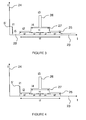
- the light prepulse 27 can also continue to be generated after the generation of the main light pulses 26 for a duration equivalent to the duration t4 ', as shown in FIG. figure 3 .
- the current of intensity I2 delivered by the continuous supply circuit 6 is blocked by the diode 29 and by the fact that the voltage V4 is greater than the voltage V2.
- the intensity current 14 is blocked by the diode 11 and in that the voltage V3 is greater than the voltage V4.
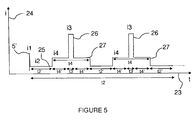
- the figure 4 represents the intensities of the different light pulses as a function of time (the scales are not respected).
- the abscissas 23 represent the time and the ordinates 24 represent the intensity of the light pulses.
- the duration t4 during which the pre-expansion circuit 8 is energized is between the duration t2 during which the continuous supply circuit 6 is energized, and the duration t3, during which a light pulse 26 or a series of main light pulses 26 is generated.
- the end ionized flow between the anode 2 and the cathode 3 of the discharge lamp 1 is generated one second before and one second after the light prepulse 27 of duration t4 '.
- the duration t3 of main light pulses 26, during which a main light pulse 26 or a series of main light pulses 26 is generated can be between 4 ⁇ s and 500 ⁇ s (expandable).
- Each flash or main light pulse 26 can have a fast rise time, less than 2 microseconds.
- the duration of a main light pulse 26 in a prior art flashgun generator is about 5 to 6 microseconds.
- the duration of a main light pulse 26 in a light flash generator according to the invention is about 4 ⁇ s to 500 ⁇ s.
- the number of main light pulses 26 can be programmed from 1 to 100,000 shots per sequence.
- the duration t4 ', during which the light prepulse 27 is generated, depends on the number of main light pulses 26.
- the position in time of the main light pulses 26 with respect to the light prepulse 27 is important.
- the "Simmer” mode is turned on about one second before the "pre-expansion” mode is put into operation.
- the “Simmer” mode remains active 1 s after the duration t4 ', that is to say after the mode in "pre-expansion”.
- the light prepulse 27 can vary between 70 ⁇ s and 80 ⁇ s before and after the duration t3.
- the pre-expansion circuit 8 is supplied by the current 14 to allow the formation of a preheated plasma between the anode 2 and the cathode 3 of the discharge lamp 1.
- the pre-expansion circuit 8 comprises a power supply 9 able to deliver the current of intensity of about 400 milliamps under a voltage V4 of between 250 volts and 1000 volts.
- the intensity 14 of the light prepulse 27 is between 50 amperes and 100 amperes, preferably equal to 80 amperes.
- the pre-expansion circuit 8 comprises a switching means 10 connected in series with the power supply 9 of the pre-expansion circuit and a protection diode 11 connected in series with the switching means 10 and the power supply 9 of the circuit. pre-expansion.
- the protection diode 11 is able to prevent the return of the electrical energy to the supply 9 of the pre-expansion circuit.
- the prepulsed light 27 generated by the pre-expansion circuit 8 helps to overcome temporal fluctuations and reduce the delay between the boot and the flash or series of flashes.
- the plasma is preheated because it is already expanded. It is then ready to receive by switching of the switching means 18 of the main discharge circuit 7, the main discharge which will provide the main light pulse 26.
- the discharge line 17 which is composed of a series of inductive and capacitive elements makes it possible to adjust the duration of the light pulse, to provide a voltage of between 3 KV and 6 KV, preferably 5 KV, and electrical energy. up to 5 kJ / s, at an intensity of about 2000 amperes
- the discharge line 17 makes it possible to obtain an increase in the intensity of the main light pulse 26 up to its maximum value, which is faster. After reaching its maximum value, the intensity of the main light pulse 26 also decreases more rapidly.
- the ideal square shape of the main light pulse 26 is represented on the figure 3 .
- the discharge line 17 provides a main light pulse duration of about 4 to 500 ⁇ s extensible.
- the delay between the priming and the flash (or "jitter") of the set is reduced to a few nano-seconds whatever the discharge lamp 1 used.
- the use of a light prepulse 27 makes it possible to reduce, or even eliminate, the uncertainty between the main electric discharge and the main light pulse 26. transient between them is controlled by the maintenance of an ionized current, between the anode 2 and the cathode 3 of the discharge lamp 1, of greater intensity than the ionized current in "Simmer" mode.
- the behavior of the plasma is close to that of a hot, more stable plasma.
- the light flash generator also comprises a standby circuit 12 connected between the anode 2 and the cathode 3 of the discharge lamp 1. It is capable of providing a standby voltage V5 and a standby current 15 to the discharge lamp 1 continuously. Voltage V5 and intensity I5 are lower than voltage V2 and intensity 12 respectively.
- the standby circuit 12 comprises a power supply 13 capable of enabling the standby circuit 12 to deliver the current of intensity I5 under the voltage V5.
- the standby voltage V5 and the standby intensity can reach up to 3000 volts and 15 milliamps respectively.
- the idle circuit 12 comprises a switching means 14 connected in series with the power supply of the idle circuit 13, and a protection diode 15 connected in series with the switching means 14 and the power supply of the idle circuit 13.
- the protection diode 15 is capable of preventing the return of electrical energy to the power supply of the standby circuit 13.
- the figure 3 represents the intensities of the different light signals as a function of time for a light flash generator having a standby circuit 12.
- the discharge lamp 1 is fed continuously. A very thin ion flow 28 is then generated between the anode 2 and the cathode 3 of the discharge lamp 1.
- the electrical energy necessary to maintain this very thin ion flow 28 is less important than that which is necessary to maintain the ion flow 25 in "Simmer" mode.
- the discharge lamp 1 is fed continuously by the standby circuit 12 before, after operation in "Simmer” mode and for the duration of the application.
- the operation in standby mode maintains a plasma with a behavior close to cold plasmas and contributes to increasing the longevity of the discharge lamp 1.
- the very thin ion flow 28 is initiated by the ignition circuit 5 of the discharge lamp 1 which provides an electrical ignition pulse 5 '.
- a single electrical initiation pulse 5 ' is sufficient for the entire duration of operation of the flash lamp.
- the light flash generator is provided with a means of synchronization by a programmable circuit which makes it possible to position in time, very precisely, the main light pulse 26 with respect to an external standard logic level order.
- the assembly is coordinated by the synchronization means which operates in standard logic and is realized by FPGA programmable circuits ("Field Programmable Gate Array”) or CPLD ("Complex Programmable Logic Device”).
- FPGA programmable circuits Field Programmable Gate Array
- CPLD Complex Programmable Logic Device
- the synchronization means makes it possible to obtain the remote initiation of the discharge lamp 1, the timing and the timing of the electrical signals delivering the pre-pulses and the main electrical discharges, the control of the remote voltages, their reading, their display.
- the synchronization means also makes it possible to obtain external synchronizations, the security of the assembly by detection of faults such as overloads and overheating.
- the light flash generator may include interfaces that provide external control of the various devices (slot scanning cameras, multichannel optical analyzer, shutter systems, for example).
- a light flash generator generating light pulses 26 of high power and each having a fast rise time, less than 2 microseconds.
- the generated light pulses 26 also have a very high reproducibility in time and energy and can be delivered at frequencies up to 50 Hz or even 100 Hz.
- the light flash generator generates all the signals necessary to obtain light flashes for all models of gas lamps of various shapes and structures.
- the light flash generator generates light pulses 26 having a stable and reproducible light plateau in duration, of specified energy.
- the number of light pulses 26 in a series of light pulses 26 depends on the parameters imposed by the user in his field of application which are: the number of light pulses per second, their duration, the repetition frequency, the energy, the power.
- the frequency of recurrence, while taking into account the admissible energy of the tube used can vary from the single shot up to 125 hertz, or even up to 1 Khz.
- the light flash generator provides other benefits.
- the lifespan of the flashlamps is extended by a factor of 1000 compared to the flashlamps of the prior art, with the consequence of a longer spectral fidelity.
- the response time of the light flash generator is extremely accurate.
- the rise time of the light pulse is faster to reach the maximum intensity (about 1.5 microseconds).
- the light flash generator produces stable light pulses calibrated over time.
- the light flash generator is designed according to the strict observance of the rules of construction of electromagnetic compatibility. It is able to operate in a disturbed environment (pulsed laser, accelerator) and it does not produce parasites.
- the discharge lamp used in the light flash generator may be a xenon discharge lamp, krypton or the like.
- the invention also relates to an optical absorption spectrophotometer comprising such a light flash generator.
- the light flash generator is intended to serve as an analysis light for optical absorption spectrophotometry measurements whose detector is a streak-camera.
- the optical absorption spectrophotometer can detect light variations with a temporal resolution of up to 3.7 picoseconds.
- the rise time of each flash is very short (at least less than 2 microseconds), which makes it possible not to saturate the photodetector before measuring the absorption. Under such conditions, it is then possible to record, with the slit-scan camera, the evolution of the absorption spectra in a medium, as a function of time, from the picosecond domain to the microsecond see the millisecond.
- the use of the light flash generator, according to the invention brings a considerable time saving in the collection of results, but also a saving on the operation of the various apparatus of which those producing is accelerating the electrons, and finally the possibility of studying biological systems that do not support too much radiation.
- the light flash generator can also be used in other fields such as pulsed radiolysis, the design of lasers (pumping of the precise amplifying medium), photography, stroboscopy, fixed or onboard signaling. , reprography, skin treatment, UVLASER pulsed decontamination, radioimmunoassay, fluorescence photometers, spectroradiometers, liquid or gas phase chromatographs, colorimeters and ultraviolet applications.
Landscapes
- Physics & Mathematics (AREA)
- Spectroscopy & Molecular Physics (AREA)
- General Physics & Mathematics (AREA)
- Discharge-Lamp Control Circuits And Pulse- Feed Circuits (AREA)
Claims (11)
- Lichtblitzgenerator, dadurch gekennzeichnet, dass er folgendes umfasst:- eine Hochdruckentladungslampe (1), die elektrische Impulse aufnehmen und Lichtimpulse erzeugen kann und drei Elektroden (2, 3, 4) umfasst, darunter eine Anode (2), eine Kathode (3) und eine Zündelektrode (4),- eine Schaltung (6) zur kontinuierlichen Versorgung der Entladungslampe, die eine Spannung V2 und einen Strom mit der Starke 12 zwischen der Anode (2) und der Kathode (3) während einer Dauer t2 erzeugen kann,- eine Zündschaltung (5) für die Entladungslampe (1), die einen elektrischen Zündimpuls (5') mit der Stärke I1 und der Spannung V1 an die Zündelektrode (4) der Entladungslampe liefern kann, die unter anderem etwas vor und etwas nach den Lichtblitzen eine feine ionisierte Strömung (25) mit der Stärke I2 zwischen der Anode (2) und der Kathode (3) während einer Dauer t2' erzeugt,- eine Vorexpansionsschaltung (8), die zwischen der Anode (2) und der Kathode (3) der Entladungslampe (1) verbunden ist, wobei die Vorexpansionsschaltung (8) geeignet ist, einen elektrischen Vorimpuls der Stärke I4 unter einer Spannung V4 in der Entladungslompe (1) nach der Erzeugung der feinen ionisierten Strömung (25) der Stärke I2 und vor der Erzeugung eines oder mehrerer Hauptlichtimpulse (26) in der Entladungslampe (1) zu erzeugen, wodurch ein Voflichtimpuls (27) in der Entladungslampe (1) während einer Dauer t4' erzeugt wird, wobei die Dauer t4' des Vorlichtimpulses (27) zwischen den Dauern t2' und t3 liegt, wobei die Stromstärke I4 zwischen den Stärken I2 und I3 liegt, wobei die Spannung V4 niedriger als die Spannung V3 und höher als die Spannung V2 ist, so dass der Strom 12 blockiert wird, und wobei sie derart gewählt wird, dass die Bildung eines vorerhitzten Plasmas zwischen der Anode (2) und der Kathode (3) der Entladungslampe (1) möglich ist,- eine Hauptentladungsschaltung (7), die zwischen der Anode (2) und der Kathode (3) der Entladungslampe (1) verbunden ist, wobei die Hauptentladungsschaltung (7) geeignet ist, die elektrische Energie, die für die Erzeugung einer oder mehrerer elektrische Entladungen der Stärke 13 notwendig ist, unter einer Spannung V3 in der Entladungslampe (1) zu speichern und zu entladen, wodurch ein Lichtimpuls oder eine Reihe von Hauptlichtimpulsen (26) während einer Dauer t3, die kürzer als die Dauer t2' ist, erzeugt wird, wobei die Stromstärke 13 größer als die Stromstärke 12 und die Spannung V3 höher als die Spannung V4 ist, um Strom I4 zu blockieren, wobei der elektrische Vorimpuls nach dem Ende der Hauptlichtimpulse (26) weiterhin in der Entladungslampe (1) erzeugt wird, und wobei die feine ionisierte Strömung (25) weiterhin in der Entladungslampe (1) nach dem Ende des elektrischen Vorimpulses erzeugt wird.
- Lichtblitzgenerator nach Anspruch 1, dadurch gekennzeichnet, die Vorexpansionsschaltung (8) folgendes umfasst:- eine variable Versorgung (9), die einen Strom mit einer Stärke von ungefähr 400 Milliampere unter einer Spannung zwischen 250 Volt und 1000 Volt liefern kann, wobei die Stromstärke I4 des Vorlichtimpulses (27) zwischen 50 Ampere und 100 Ampere beträgt, vorzugsweise gleich 80 Ampere ist,- ein Umschaltmittel (10), das in Serie mit der Versorgung (9) der Vorexpansionsschaltung montiert ist,- eine Schutzdiode (11), die in Serie mit dem Umschaltmittel (10) und der Versorgung (9) der Vorexpansionsschattung montiert ist, wobei die Schutzdiode (11) geeignet ist, die Rückkehr der elektrischen Energie zur Versorgung (9) der Vorexpansionsschaltung zu verhindern.
- Lichtblitzgenerator nach einem der Ansprüche 1 oder 2, dadurch gekennzeichnet, dass er eine Sicherheitsschaltung (12) umfasst, die zwischen der Anode (2) und der Kathode (3) der Entladungslampe (1) verbunden ist, wobei die Sicherheitsschaltung (12) geeignet ist, eine Sicherheitsspannung V5 und einen Sicherheitsstrom I5 an die Entladungslampe (1) kontinuierlich zu liefern, wenn der Strom I2 unterbrochen ist, wodurch eine sehr feine ionische Strömung (28) zwischen der Anode (2) und der Kathode (3) der Entladungslampe (1) erzeugt wird, wobei die Spannung V5 und die Stromstärke I5 geringer als die Spannung V2 bzw. die Stromstärke I2 sind.
- Lichtblitzgenerator nach Anspruch 3, dadurch gekennzeichnet, dass die Sicherheitsschattung (12) folgendes umfasst:- eine Versorgung (13), die es der Sicherheitsschaltung (12) ermöglichen kann, den Strom der Starke I5 unter des Spannung V5 zu liefern, wobei die Sicherheitsspannung V5 und die Sicherheitsstromstarke 15 bis zu 3000 Volt bzw. 15 Milliampere erreichen können,- ein Umschaltmittel (14), das in Serie mit der Versorgung der Sicherheitsschaltung (13) montiert ist,- eine Schutzdiode (15), die in Serie mit dem Umschaltmittel (14) und der Versorgung der Sicherheitsschaltung (13) montiert ist, wobei die Schutzdiode (15) geeignet ist, die Rückkehr der elektrischen Energie zur Versorgung der Sicherheitsschaltung (13) zu verhindern.
- Lichtblitzgenerator nach einem der Ansprüche 1 bis 4, dadurch gekennzeichnet, dass die Hauptentladungsschaltung (7) folgendes umfasst:- eine Hauptversorgung (16), die es der Hauptentladungsschaltung (7) ermöglichen kann, elektrische Energie unter dem Strom der Stärke I3 und der Spannung V3 zu liefern, wobei die Stromstärke 13 und die Spannung V3 ungefähr 10 kA bzw. 5 kV betragen,- eine Entladungsleitung (17), die parallel mit der Hauptversorgung (16) und der Entladungslampe (1) montiert ist, wobei die Entladungsleitung (17) aus einer Reihe von induktiven und kapazitiven Elementen zusammengesetzt ist und die von der Hauptversorgung (16) gelieferte elektrische Energie speichern und diese in die Entladungslampe (1) entladen kann,- ein Umschaltmittel (18), das in Serie it der Entladungsleitung (17) und der Entladungslampe (1) montiert ist, wobei das Umschaltmittel (18) geeignet ist, die in der Entladungsleitung (17) gespeicherte elektrische Energie zu blockieren oder durchzulassen,- eine Schutzdiode (19), die in Serie mit der Entladungslampe (1), der Entladungsleitung (17) und dem Umschaltmittel (18) montiert ist, wobei die Schutzdiode (19) geeignet ist, die Rückkehr der elektrischen Energie zur Entladungsleitung (17) zu verhindern.
- Lichtblitzgenerator nach einem der Ansprüche 1 bis 5, dadurch gekennzeichnet, dass die kontinuierliche Versorgungsschaltung (6) folgendes umfasst:- eine Versorgung (20), die einen Strom mit einer Stärke von ungefähr 60 Milliampere unter einer Spannung zwischen 500 Volt und 3000 Volt liefern kann, wobei die Stromstärke 12 zwischen der Anode (2) und der Kathode (3) der Entladungslampe (1) ungefähr einige Dutzend Milliampere beträgt,- einen Widerstand (21), der in Serie mit der Versorgung der kontinuierlichen Versorgungsschaltung (20) montiert ist.
- Lichtblitzgenerator nach einem der Ansprüche 1 bis 6, dadurch gekennzeichnet, dass er ein Synchronisiermittel, wie beispielsweise eine programmierbare Schaltung, umfasst.
- Lichtblitzgenerator nach einem der Ansprüche 1 bis 7, dadurch gekennzeichnet, dass die Hauptentladungsschaltung (7) induktive Elemente umfasst.
- Lichtblitzgenerator nach einem der Ansprüche 1 bis 8, dadurch gekennzeichnet, dass die Umschaltmittel (10, 14, 18) der verschiedenen Schaltungen (7, 8, 12) Umschalter im festen Zustand sind.
- Absorptionsspektrometer, umfassend eine Kamera mit Spaltabtastung, dadurch gekennzeichnet, dass es einen Lichtblitzgenerator, wie in einem der Ansprüche 1 bis 9 definiert, umfasst.
- Verfahren zur Erzeugung von Lichtblitzen durch einen Lichtblitzgenerator, umfassend eine Hochdruckentladungslampe (1), umfassend drei Elektroden (2, 3, 4), darunter eine Anode (2), eine Kathode (3) und eine Zündelektrode (4), wobei die. Entladungslampe (1) geeignet ist, elektrische Impulse zu empfangen und Lichtimpulse zu erzeugen, wobei das Verfahren dadurch gekennzeichnet ist, dass es folgendes umfasst:- einen Schritt, der darin besteht, Spannung V2 zwischen der Anode (2) und der Kathode (3) der Entladungslampe (1) während einer Dauer t2 zu liefern,- einen Schritt der Erzeugung eines elektrischen Zündimpulses (5') der Stärke I1 und der Spannung V1 auf der Zündelektrode (4) der Entladungslampe, der unter anderen etwas vor und etwas nach den Lichtimpulsen eine feine ionisierte Strömung (25) der Stärke 12 zwischen der Anode (2) und der Kathode (3) während einer Dauer t2' erzeugt,- einen Schritt der Speicherung der elektrischen Energie, die notwendig ist, um eine oder mehrere elektrische Entladungen der Stärke I3 unter einer Spannung V3 in der Entladungslampe (1) zu erzeugen,- einen Schritt der Erzeugung eines elektrischen Vorimpulses der Stärke 14 unter einer Spannung V4 in der Entladungslompe (1) nach der Erzeugung der feinen ionisierten Strömung (25) der Stärke I2 und vor der Erzeugung eines oder mehrerer Hauptlichtimpulse (26) in der Entladungslampe (1), wodurch ein Lichtvorimpuls (27) in der Entladungslampe (1) während einer Dauer t4' erzeugt wird, wobei die Dauer t4' des Vorlichtimpulses (27) zwischen den Dauern t2' und T3 liegt, wobei die Stromstärke 14 zwischen stromstärken I2 und I3 liegt, wobei die Spannung V4 niedriger als die Spannung V3 und höher als die Spannung V2 ist, um strom 12 zu blockieren, und wobei sie derart gewählt wird, sie die Bildung eines vorerhitzten Plasmas zwischen der Anode (2) und der Kathode (3) der Enttadungsiampe (1) ermöglicht,- einen Schritt der Entladung der notwendigen elektrischen Energie für die Erzeugung einer oder mehrerer elektrischer Entladungen in der Entladungslampe (1), wodurch ein Lichtimpuls oder eine Reihe von Hauptlichtimpulsen (26) während einer Dauer t3, die kürzer als die Dauer t2' ist, erzeugt wird, wobei die Stromstärke 13 größer als die Stromstärke I2 und die Spannung V3 höher als die Spannung V4 ist, um den Strom I4, zu blockieren, wobei der elektrische vorimpuls in der Entladungslampe (1) nach dem Ende der Hauptlichtimpulse (26) weiterhin erzeugt wird und die feine ionisierte Strömung (25) in der Entladungslampe (1) nach dem des elektrischen Vorimpulses weiterhin erzeugt wird.
Applications Claiming Priority (2)
| Application Number | Priority Date | Filing Date | Title |
|---|---|---|---|
| FR0850457A FR2926948B1 (fr) | 2008-01-24 | 2008-01-24 | Generateur de flashs lumineux, spectrometre d'absorption utilisant un tel generateur et procede de generation de flashs lumineux |
| PCT/FR2009/050082 WO2009095584A1 (fr) | 2008-01-24 | 2009-01-21 | Generateur de flashs lumineux, spectrometre d'absorption comprenant un tel generateur et procede de generation de flashs lumineux |
Publications (2)
| Publication Number | Publication Date |
|---|---|
| EP2243339A1 EP2243339A1 (de) | 2010-10-27 |
| EP2243339B1 true EP2243339B1 (de) | 2012-06-06 |
Family
ID=39521904
Family Applications (1)
| Application Number | Title | Priority Date | Filing Date |
|---|---|---|---|
| EP09706899A Active EP2243339B1 (de) | 2008-01-24 | 2009-01-21 | Lichtblitzgenerator, absorptionsspektrometer mit einem solchen generator und verfahren zur erzeugung von lichtblitzen |
Country Status (3)
| Country | Link |
|---|---|
| EP (1) | EP2243339B1 (de) |
| FR (1) | FR2926948B1 (de) |
| WO (1) | WO2009095584A1 (de) |
Families Citing this family (4)
| Publication number | Priority date | Publication date | Assignee | Title |
|---|---|---|---|---|
| FR2980665B1 (fr) * | 2011-09-23 | 2013-10-25 | Centre Nat Rech Scient | Appareil electrique d'amorcage d'une lampe flash, et systeme electrique de pompage optique comprenant un tel appareil d'amorcage |
| LT5957B (lt) * | 2011-12-16 | 2013-08-26 | Uab "Ekspla" | Pasikartojančio išlydžio impulsinės lempos maitinimo būdas |
| EP3219175B1 (de) * | 2014-11-14 | 2020-04-08 | Profoto AB | Blitzgenerator für eine blitzröhre |
| EP3624564A1 (de) * | 2018-09-13 | 2020-03-18 | Rovak GmbH | Verfahren und anordnung zur blitzlampensteuerung |
Family Cites Families (6)
| Publication number | Priority date | Publication date | Assignee | Title |
|---|---|---|---|---|
| US5144146A (en) * | 1990-07-06 | 1992-09-01 | Ultraviolet Energy Generators, Inc. | Method for destruction of toxic substances with ultraviolet radiation |
| JP2658900B2 (ja) * | 1994-09-30 | 1997-09-30 | 日本電気株式会社 | パルス電源装置 |
| JP4107532B2 (ja) * | 1999-01-12 | 2008-06-25 | ミヤチテクノス株式会社 | レーザ装置 |
| US20020149326A1 (en) * | 2001-03-01 | 2002-10-17 | Mikhail Inochkin | Flashlamp drive circuit |
| FR2852189B1 (fr) * | 2003-03-03 | 2005-08-05 | Eurofeedback Sa | Procede, generateur et tube a eclairs pour generer des uvc |
| FR2867347B1 (fr) * | 2003-03-03 | 2015-08-07 | Eurofeedback Sa | Tube a eclairs |
-
2008
- 2008-01-24 FR FR0850457A patent/FR2926948B1/fr not_active Expired - Fee Related
-
2009
- 2009-01-21 WO PCT/FR2009/050082 patent/WO2009095584A1/fr not_active Ceased
- 2009-01-21 EP EP09706899A patent/EP2243339B1/de active Active
Also Published As
| Publication number | Publication date |
|---|---|
| FR2926948A1 (fr) | 2009-07-31 |
| WO2009095584A1 (fr) | 2009-08-06 |
| FR2926948B1 (fr) | 2012-11-02 |
| EP2243339A1 (de) | 2010-10-27 |
Similar Documents
| Publication | Publication Date | Title |
|---|---|---|
| Manschwetus et al. | Two-photon double ionization of neon using an intense attosecond pulse train | |
| EP2243339B1 (de) | Lichtblitzgenerator, absorptionsspektrometer mit einem solchen generator und verfahren zur erzeugung von lichtblitzen | |
| FR2615324A1 (fr) | Canon a electrons a plasma ionique et procede pour pr oduire des electrons secondaires a partir d'un tel canon | |
| US5216482A (en) | Apparatus for emission spectrochemical analysis | |
| Pouncey et al. | Triggering of pressurized gas switches with a class I laser | |
| FR2504727A1 (fr) | Dispositif de traitement d'un echantillon par faisceau electronique impulsionnel | |
| FR2578378A1 (fr) | Dispositif a lampe a eclats | |
| Goltsov et al. | Is efficiency of gain generation in Li III 13.5-nm laser with 0.25-/spl mu/m subpicosecond pulses the same as with 1/spl mu/m? | |
| US20050218823A1 (en) | Camera flash apparatus using ultraviolet light for triggering of the flash tube | |
| Dussart et al. | Time-resolved spatial distribution of an ablative capillary discharge obtained with a pinhole camera | |
| Denk | Pulsing mercury arc lamps for uncaging and fast imaging | |
| Popov et al. | Spectroscopic study of a single vacuum-arc cathode spot | |
| EP3703105B1 (de) | Gerät zur erzeugung eines optimierten uv-spektrums | |
| Meshchanov et al. | An “Anomalous” Effect of Illumination on the Breakdown in a Long Discharge Tube in Xenon | |
| Itami et al. | An intense, broadband emission spectrum, thyratron‐gated nanosecond light source using a commercially available Xe short‐arc lamp | |
| Baryshnikov et al. | Small-sized nanosecond source of powerful wide-band VUV-UV radiation | |
| Schinca et al. | Ionic classification of Xe laser lines: A new approach through time resolved spectroscopy | |
| Rybka et al. | Emission characteristics of a pulsed discharge in xenon | |
| Avizonis et al. | Electrical and Spectrographic Study of a Double‐Pulsed Flashtube as applied to Laser Pumping | |
| Chan et al. | Operation of an electron beam initiated metallic plasma capillary discharge | |
| Chen et al. | An ultra compact back-lighted thyratron for nanosecond switching applications | |
| Miles et al. | Laser REMPI triggering of an air spark gap with nanosecond jitter | |
| Popov et al. | The spectroscopy of cathode spot of pulsed vacuum arc discharge in a wide range of current | |
| US20120195342A1 (en) | Configuration for Multiwavelength Emission with a CO2 Laser | |
| Okano | Guided discharge path by weakly ionized region between two plasmas produced by YAG laser in an atmospheric air gap with nonuniform DC electric field |
Legal Events
| Date | Code | Title | Description |
|---|---|---|---|
| PUAI | Public reference made under article 153(3) epc to a published international application that has entered the european phase |
Free format text: ORIGINAL CODE: 0009012 |
|
| 17P | Request for examination filed |
Effective date: 20100722 |
|
| AK | Designated contracting states |
Kind code of ref document: A1 Designated state(s): AT BE BG CH CY CZ DE DK EE ES FI FR GB GR HR HU IE IS IT LI LT LU LV MC MK MT NL NO PL PT RO SE SI SK TR |
|
| AX | Request for extension of the european patent |
Extension state: AL BA RS |
|
| DAX | Request for extension of the european patent (deleted) | ||
| GRAP | Despatch of communication of intention to grant a patent |
Free format text: ORIGINAL CODE: EPIDOSNIGR1 |
|
| GRAS | Grant fee paid |
Free format text: ORIGINAL CODE: EPIDOSNIGR3 |
|
| GRAA | (expected) grant |
Free format text: ORIGINAL CODE: 0009210 |
|
| AK | Designated contracting states |
Kind code of ref document: B1 Designated state(s): AT BE BG CH CY CZ DE DK EE ES FI FR GB GR HR HU IE IS IT LI LT LU LV MC MK MT NL NO PL PT RO SE SI SK TR |
|
| REG | Reference to a national code |
Ref country code: GB Ref legal event code: FG4D Free format text: NOT ENGLISH |
|
| REG | Reference to a national code |
Ref country code: AT Ref legal event code: REF Ref document number: 561545 Country of ref document: AT Kind code of ref document: T Effective date: 20120615 Ref country code: CH Ref legal event code: EP |
|
| REG | Reference to a national code |
Ref country code: IE Ref legal event code: FG4D Free format text: LANGUAGE OF EP DOCUMENT: FRENCH |
|
| REG | Reference to a national code |
Ref country code: DE Ref legal event code: R096 Ref document number: 602009007472 Country of ref document: DE Effective date: 20120802 |
|
| REG | Reference to a national code |
Ref country code: NL Ref legal event code: VDEP Effective date: 20120606 |
|
| PG25 | Lapsed in a contracting state [announced via postgrant information from national office to epo] |
Ref country code: SE Free format text: LAPSE BECAUSE OF FAILURE TO SUBMIT A TRANSLATION OF THE DESCRIPTION OR TO PAY THE FEE WITHIN THE PRESCRIBED TIME-LIMIT Effective date: 20120606 Ref country code: CY Free format text: LAPSE BECAUSE OF FAILURE TO SUBMIT A TRANSLATION OF THE DESCRIPTION OR TO PAY THE FEE WITHIN THE PRESCRIBED TIME-LIMIT Effective date: 20120606 Ref country code: NO Free format text: LAPSE BECAUSE OF FAILURE TO SUBMIT A TRANSLATION OF THE DESCRIPTION OR TO PAY THE FEE WITHIN THE PRESCRIBED TIME-LIMIT Effective date: 20120906 Ref country code: LT Free format text: LAPSE BECAUSE OF FAILURE TO SUBMIT A TRANSLATION OF THE DESCRIPTION OR TO PAY THE FEE WITHIN THE PRESCRIBED TIME-LIMIT Effective date: 20120606 Ref country code: FI Free format text: LAPSE BECAUSE OF FAILURE TO SUBMIT A TRANSLATION OF THE DESCRIPTION OR TO PAY THE FEE WITHIN THE PRESCRIBED TIME-LIMIT Effective date: 20120606 |
|
| REG | Reference to a national code |
Ref country code: AT Ref legal event code: MK05 Ref document number: 561545 Country of ref document: AT Kind code of ref document: T Effective date: 20120606 |
|
| REG | Reference to a national code |
Ref country code: LT Ref legal event code: MG4D Effective date: 20120606 |
|
| PG25 | Lapsed in a contracting state [announced via postgrant information from national office to epo] |
Ref country code: SI Free format text: LAPSE BECAUSE OF FAILURE TO SUBMIT A TRANSLATION OF THE DESCRIPTION OR TO PAY THE FEE WITHIN THE PRESCRIBED TIME-LIMIT Effective date: 20120606 Ref country code: HR Free format text: LAPSE BECAUSE OF FAILURE TO SUBMIT A TRANSLATION OF THE DESCRIPTION OR TO PAY THE FEE WITHIN THE PRESCRIBED TIME-LIMIT Effective date: 20120606 Ref country code: GR Free format text: LAPSE BECAUSE OF FAILURE TO SUBMIT A TRANSLATION OF THE DESCRIPTION OR TO PAY THE FEE WITHIN THE PRESCRIBED TIME-LIMIT Effective date: 20120907 Ref country code: LV Free format text: LAPSE BECAUSE OF FAILURE TO SUBMIT A TRANSLATION OF THE DESCRIPTION OR TO PAY THE FEE WITHIN THE PRESCRIBED TIME-LIMIT Effective date: 20120606 |
|
| PG25 | Lapsed in a contracting state [announced via postgrant information from national office to epo] |
Ref country code: SK Free format text: LAPSE BECAUSE OF FAILURE TO SUBMIT A TRANSLATION OF THE DESCRIPTION OR TO PAY THE FEE WITHIN THE PRESCRIBED TIME-LIMIT Effective date: 20120606 Ref country code: NL Free format text: LAPSE BECAUSE OF FAILURE TO SUBMIT A TRANSLATION OF THE DESCRIPTION OR TO PAY THE FEE WITHIN THE PRESCRIBED TIME-LIMIT Effective date: 20120606 Ref country code: IS Free format text: LAPSE BECAUSE OF FAILURE TO SUBMIT A TRANSLATION OF THE DESCRIPTION OR TO PAY THE FEE WITHIN THE PRESCRIBED TIME-LIMIT Effective date: 20121006 Ref country code: RO Free format text: LAPSE BECAUSE OF FAILURE TO SUBMIT A TRANSLATION OF THE DESCRIPTION OR TO PAY THE FEE WITHIN THE PRESCRIBED TIME-LIMIT Effective date: 20120606 Ref country code: CZ Free format text: LAPSE BECAUSE OF FAILURE TO SUBMIT A TRANSLATION OF THE DESCRIPTION OR TO PAY THE FEE WITHIN THE PRESCRIBED TIME-LIMIT Effective date: 20120606 Ref country code: AT Free format text: LAPSE BECAUSE OF FAILURE TO SUBMIT A TRANSLATION OF THE DESCRIPTION OR TO PAY THE FEE WITHIN THE PRESCRIBED TIME-LIMIT Effective date: 20120606 Ref country code: EE Free format text: LAPSE BECAUSE OF FAILURE TO SUBMIT A TRANSLATION OF THE DESCRIPTION OR TO PAY THE FEE WITHIN THE PRESCRIBED TIME-LIMIT Effective date: 20120606 |
|
| PG25 | Lapsed in a contracting state [announced via postgrant information from national office to epo] |
Ref country code: PL Free format text: LAPSE BECAUSE OF FAILURE TO SUBMIT A TRANSLATION OF THE DESCRIPTION OR TO PAY THE FEE WITHIN THE PRESCRIBED TIME-LIMIT Effective date: 20120606 Ref country code: PT Free format text: LAPSE BECAUSE OF FAILURE TO SUBMIT A TRANSLATION OF THE DESCRIPTION OR TO PAY THE FEE WITHIN THE PRESCRIBED TIME-LIMIT Effective date: 20121008 Ref country code: IT Free format text: LAPSE BECAUSE OF FAILURE TO SUBMIT A TRANSLATION OF THE DESCRIPTION OR TO PAY THE FEE WITHIN THE PRESCRIBED TIME-LIMIT Effective date: 20120606 |
|
| PLBE | No opposition filed within time limit |
Free format text: ORIGINAL CODE: 0009261 |
|
| STAA | Information on the status of an ep patent application or granted ep patent |
Free format text: STATUS: NO OPPOSITION FILED WITHIN TIME LIMIT |
|
| PG25 | Lapsed in a contracting state [announced via postgrant information from national office to epo] |
Ref country code: ES Free format text: LAPSE BECAUSE OF FAILURE TO SUBMIT A TRANSLATION OF THE DESCRIPTION OR TO PAY THE FEE WITHIN THE PRESCRIBED TIME-LIMIT Effective date: 20120917 Ref country code: DK Free format text: LAPSE BECAUSE OF FAILURE TO SUBMIT A TRANSLATION OF THE DESCRIPTION OR TO PAY THE FEE WITHIN THE PRESCRIBED TIME-LIMIT Effective date: 20120606 |
|
| 26N | No opposition filed |
Effective date: 20130307 |
|
| REG | Reference to a national code |
Ref country code: DE Ref legal event code: R097 Ref document number: 602009007472 Country of ref document: DE Effective date: 20130307 |
|
| BERE | Be: lapsed |
Owner name: UNIVERSITE PARIS-SUD Effective date: 20130131 |
|
| PG25 | Lapsed in a contracting state [announced via postgrant information from national office to epo] |
Ref country code: BG Free format text: LAPSE BECAUSE OF FAILURE TO SUBMIT A TRANSLATION OF THE DESCRIPTION OR TO PAY THE FEE WITHIN THE PRESCRIBED TIME-LIMIT Effective date: 20120906 |
|
| PG25 | Lapsed in a contracting state [announced via postgrant information from national office to epo] |
Ref country code: MC Free format text: LAPSE BECAUSE OF NON-PAYMENT OF DUE FEES Effective date: 20130131 |
|
| REG | Reference to a national code |
Ref country code: CH Ref legal event code: PL |
|
| REG | Reference to a national code |
Ref country code: IE Ref legal event code: MM4A |
|
| PG25 | Lapsed in a contracting state [announced via postgrant information from national office to epo] |
Ref country code: BE Free format text: LAPSE BECAUSE OF NON-PAYMENT OF DUE FEES Effective date: 20130131 Ref country code: LI Free format text: LAPSE BECAUSE OF NON-PAYMENT OF DUE FEES Effective date: 20130131 Ref country code: CH Free format text: LAPSE BECAUSE OF NON-PAYMENT OF DUE FEES Effective date: 20130131 |
|
| PG25 | Lapsed in a contracting state [announced via postgrant information from national office to epo] |
Ref country code: IE Free format text: LAPSE BECAUSE OF NON-PAYMENT OF DUE FEES Effective date: 20130121 |
|
| PG25 | Lapsed in a contracting state [announced via postgrant information from national office to epo] |
Ref country code: MT Free format text: LAPSE BECAUSE OF FAILURE TO SUBMIT A TRANSLATION OF THE DESCRIPTION OR TO PAY THE FEE WITHIN THE PRESCRIBED TIME-LIMIT Effective date: 20120606 |
|
| PG25 | Lapsed in a contracting state [announced via postgrant information from national office to epo] |
Ref country code: TR Free format text: LAPSE BECAUSE OF FAILURE TO SUBMIT A TRANSLATION OF THE DESCRIPTION OR TO PAY THE FEE WITHIN THE PRESCRIBED TIME-LIMIT Effective date: 20120606 |
|
| PG25 | Lapsed in a contracting state [announced via postgrant information from national office to epo] |
Ref country code: HU Free format text: LAPSE BECAUSE OF FAILURE TO SUBMIT A TRANSLATION OF THE DESCRIPTION OR TO PAY THE FEE WITHIN THE PRESCRIBED TIME-LIMIT; INVALID AB INITIO Effective date: 20090121 Ref country code: LU Free format text: LAPSE BECAUSE OF NON-PAYMENT OF DUE FEES Effective date: 20130121 Ref country code: MK Free format text: LAPSE BECAUSE OF FAILURE TO SUBMIT A TRANSLATION OF THE DESCRIPTION OR TO PAY THE FEE WITHIN THE PRESCRIBED TIME-LIMIT Effective date: 20120606 |
|
| REG | Reference to a national code |
Ref country code: FR Ref legal event code: PLFP Year of fee payment: 8 |
|
| REG | Reference to a national code |
Ref country code: FR Ref legal event code: PLFP Year of fee payment: 9 |
|
| REG | Reference to a national code |
Ref country code: FR Ref legal event code: PLFP Year of fee payment: 10 |
|
| REG | Reference to a national code |
Ref country code: DE Ref legal event code: R081 Ref document number: 602009007472 Country of ref document: DE Owner name: UNIVERSITE PARIS- SACLAY, FR Free format text: FORMER OWNER: UNIVERSITE PARIS SUD, ORSAY, FR |
|
| REG | Reference to a national code |
Ref country code: GB Ref legal event code: 732E Free format text: REGISTERED BETWEEN 20231123 AND 20231129 |
|
| PGFP | Annual fee paid to national office [announced via postgrant information from national office to epo] |
Ref country code: DE Payment date: 20250218 Year of fee payment: 17 |
|
| PGFP | Annual fee paid to national office [announced via postgrant information from national office to epo] |
Ref country code: FR Payment date: 20250127 Year of fee payment: 17 |
|
| PGFP | Annual fee paid to national office [announced via postgrant information from national office to epo] |
Ref country code: GB Payment date: 20250127 Year of fee payment: 17 |