EP2239870A1 - Radio communication method, radio communication system, base station, and mobile station - Google Patents
Radio communication method, radio communication system, base station, and mobile station Download PDFInfo
- Publication number
- EP2239870A1 EP2239870A1 EP09706724A EP09706724A EP2239870A1 EP 2239870 A1 EP2239870 A1 EP 2239870A1 EP 09706724 A EP09706724 A EP 09706724A EP 09706724 A EP09706724 A EP 09706724A EP 2239870 A1 EP2239870 A1 EP 2239870A1
- Authority
- EP
- European Patent Office
- Prior art keywords
- base station
- timing
- channel
- mobile station
- unit
- Prior art date
- Legal status (The legal status is an assumption and is not a legal conclusion. Google has not performed a legal analysis and makes no representation as to the accuracy of the status listed.)
- Withdrawn
Links
Images




Classifications
-
- H—ELECTRICITY
- H04—ELECTRIC COMMUNICATION TECHNIQUE
- H04W—WIRELESS COMMUNICATION NETWORKS
- H04W56/00—Synchronisation arrangements
- H04W56/003—Arrangements to increase tolerance to errors in transmission or reception timing
-
- H—ELECTRICITY
- H04—ELECTRIC COMMUNICATION TECHNIQUE
- H04L—TRANSMISSION OF DIGITAL INFORMATION, e.g. TELEGRAPHIC COMMUNICATION
- H04L27/00—Modulated-carrier systems
- H04L27/26—Systems using multi-frequency codes
- H04L27/2601—Multicarrier modulation systems
- H04L27/2614—Peak power aspects
-
- H—ELECTRICITY
- H04—ELECTRIC COMMUNICATION TECHNIQUE
- H04L—TRANSMISSION OF DIGITAL INFORMATION, e.g. TELEGRAPHIC COMMUNICATION
- H04L27/00—Modulated-carrier systems
- H04L27/26—Systems using multi-frequency codes
- H04L27/2601—Multicarrier modulation systems
- H04L27/2647—Arrangements specific to the receiver only
- H04L27/2655—Synchronisation arrangements
-
- H—ELECTRICITY
- H04—ELECTRIC COMMUNICATION TECHNIQUE
- H04L—TRANSMISSION OF DIGITAL INFORMATION, e.g. TELEGRAPHIC COMMUNICATION
- H04L27/00—Modulated-carrier systems
- H04L27/26—Systems using multi-frequency codes
- H04L27/2601—Multicarrier modulation systems
- H04L27/2647—Arrangements specific to the receiver only
- H04L27/2655—Synchronisation arrangements
- H04L27/2656—Frame synchronisation, e.g. packet synchronisation, time division duplex [TDD] switching point detection or subframe synchronisation
-
- H—ELECTRICITY
- H04—ELECTRIC COMMUNICATION TECHNIQUE
- H04L—TRANSMISSION OF DIGITAL INFORMATION, e.g. TELEGRAPHIC COMMUNICATION
- H04L27/00—Modulated-carrier systems
- H04L27/26—Systems using multi-frequency codes
- H04L27/2601—Multicarrier modulation systems
- H04L27/2647—Arrangements specific to the receiver only
- H04L27/2655—Synchronisation arrangements
- H04L27/2668—Details of algorithms
- H04L27/2673—Details of algorithms characterised by synchronisation parameters
- H04L27/2675—Pilot or known symbols
Definitions
- the present invention relates to a wireless communication method, a wireless communication system, a base station, and a mobile station, which conduct wireless communication using an OFDM (Orthogonal Frequency Division Multiplexing) modulation scheme.
- OFDM Orthogonal Frequency Division Multiplexing
- a mobile station represented by a mobile phone system
- a PHS Personal Handy phone System
- a PDA Personal Digital Assistant
- These mobile stations are capable of conducting communication such as making and receiving a call and transmitting and receiving data by accessing base stations installed with a predetermined distance from one another through a communication network accessed by the base stations.
- One of schemes used for such a wireless communication system to transmit a digital signal is an OFDM modulation scheme. Since an OFDM modulation scheme transmits transmission data by distributing them to a plurality of carriers, in which orthogonal frequencies are set, a band of each of the carriers becomes narrow, so that frequency use efficiency is very high.
- the OFDM modulation scheme is composed of an effective symbol corresponding to a signal period, during which IFFT (Inverse Fast Fourier Transformation) is performed at the time of transmission, and a guard interval 50 obtained by copying the waveform of a part of the latter half of the effective symbol as it is.
- IFFT Inverse Fast Fourier Transformation
- the guard interval 50 is 64 samples, which is 1/8 of the effective symbol length.
- the guard interval 50 is inserted into a former half of an OFDM symbol.
- the insertion of the guard interval 50 permits inter-symbol interference due to multipath, and thereby enhancing the resistance against multipath.
- BCCH Broadcast Control Channel
- CS Cell Station
- PS Personal Station
- TCH Traffic Channel
- the mobile station In order to establish such a communication channel, it is necessary to correct transmission timing of a mobile station to be synchronized with reference timing of a base station.
- the mobile station generates a channel for timing correction and transmits an OFDM symbol to the base station.
- the base station performs timing detection by using the received OFDM symbol and notifies the mobile station of a differential from reference timing of the base station.
- the mobile station corrects transmission timing to solve the differential from the reference timing.
- Patent Literature 1 JP-A-2000-68972
- Patent Literature 2 JP-A-2000-134176
- Patent Literature 3 JP-A-2000-315991
- Patent Literature 4 JP-A-2001-119368
- a guard interval is removed from the OFDM symbol to obtain an effective symbol, and then FFT (Fast Fourier Transformation) is preformed.
- FFT Fast Fourier Transformation
- IFFT is additionally performed to detect a correlation peak with a known ideal symbol, which has already been synchronized with the reference timing of the base station.
- the differential from the reference timing of the base station at the time of the detection of the correlation peak is transmitted to the mobile station by means of a timing correction burst ( FIG. 10 )
- timing detection it is possible to perform timing detection prior to removal of a guard interval. However, in the state that different communication channels are mixed, correlation values of timing detection are reduced, so that incorrect detection may be caused.
- the object of the present invention is to provide a wireless communication method, a wireless communication system, a base station, and a mobile station, which are capable of more successfully performing timing detection in a base station, in wireless communication using an OFDM modulation scheme, to more completely avoid impossibility of access between the mobile station and the base station.
- the representative configuration of the present invention relates to a wireless communication method of conducting wireless communication between a mobile station and a base station by using an OFDM modulation scheme, the method comprising: notifying a notification channel (Broadcast Control Channel; BCCH) from the base station to the mobile station; in the mobile station, generating a channel to be frame synchronized with the notification channel and transmitting an OFDM symbol to the base station; in the base station, as processes of the base station, removing a guard interval from the transmitted OFDM symbol to obtain an effective symbol; detecting a correlation peak between the effective symbol and a known ideal symbol; and only when the correlation peak is detected in a predetermined timing detection range shorter than a length of the effective symbol, transmitting a differential from reference timing of the base station at the time of the detection of the correlation peak to the mobile station by means of a timing correction burst, and in the mobile station, if the timing correction burst is not introduced from the base station even after expiration of predetermined time duration from the transmission of
- BCCH Broadcast Control Channel
- the base station has prepared a predetermined timing detection range and has not transmitted a timing correction burst if a correlation peak is presented at circumferential sides, namely, both sides of an effective symbol length.
- a timing correction burst is not received even after expiration of predetermined time duration from transmission of an initially generated channel, a new channel, in which transmission timing is shifted, is generated to retransmit an OFDM symbol.
- the timing correction burst is returned to the mobile station. Accordingly, transmission timing of the mobile station is corrected, and a communication channel is established, so that possibility of wireless communication access increases.
- any of two types of channels that are alternatively generated due to differentials by a predetermined shift amount in transmission timing may be generated.
- channels having two types of transmission timings may be alternatively generated. This is to expect that transmission timing of the mobile station is returned back to that previously shifted, and during repeated retransmission, timing detection is successfully accomplished. For example, in the event that the mobile station could not have received a timing correction burst from the base station since the mobile station has accidentally come into a so-called dead point, in which wireless communication cannot be established, the mobile station can receive the timing correction burst if it comes out of the dead point.
- a channel in which transmission timing is advanced or delayed by a predetermined shift amount, may be generated.
- transmission timing may be continuously shifted in one direction by advancing or delaying timing. This is to expect that during repeated performance of such a process, timing detection is successfully accomplished.
- a communication channel is not assigned from the base station despite that the mobile station has transmitted the communication channel assignment request to the base station as described above, it is preferable to transmit an OFDM symbol to the base station at the same timing as a previously generated channel to implement processes of the base station again.
- another representative configuration of the present invention relates to a wireless communication system comprising a mobile station and a base station, which conduct wireless communication by using an OFDM modulation scheme
- the base station comprises: a notification unit that notifies the mobile station of a notification channel; a guard interval removing unit that removes a guard interval from an OFDM symbol transmitted from the mobile station through a channel generated by the personal channel to obtain an effective symbol; a timing detection unit that detects a correlation peak between the effective symbol and a known ideal symbol; and a correlation peak determination unit that transmits a differential from reference timing of the base station at the time of the detection of the correlation peak to the mobile station by means of a timing correction burst only when the correlation peak is detected within a predetermined timing detection range shorter than a length of the effective symbol
- the mobile station comprises: a timing correction channel generating unit, which generates a channel to be frame synchronized with the notification channel and transmits an OFDM symbol to the base station, and which, if
- still another representative configuration of the present invention relates to a base station that conducts wireless communication with a mobile station by using an OFDM modulation scheme, the base station comprising: a notification unit that notifies the mobile station of a notification channel; a guard interval removing unit that removes a guard interval from an OFDM symbol transmitted from the mobile station through a channel generated by the personal channel to obtain an effective symbol; a timing detection unit that detects a correlation peak between the effective symbol and a known ideal symbol; and a correlation peak determination unit that transmits a differential from reference timing of the base station at the time of the detection of the correlation peak to the mobile station by means of a timing correction burst only when the correlation peak is detected within a predetermined timing detection range shorter than a length of the effective symbol.
- still another representative configuration of the present invention relates to a mobile station that conducts wireless communication with a base station by using an OFDM modulation scheme, the mobile station comprising: a timing correction channel generating unit, which generates a channel to be frame synchronized with a notification channel notified from the base station and transmits an OFDM symbol to the base station, and which, if a timing correction burst is not introduced from the base station even after expiration of predetermined time duration from the transmission, generates a new channel having transmission timing, in which transmission timing of a previously generated channel is shifted by a predetermined shift amount, and transmits an OFDM symbol to the base station; a shift storing unit that stores a sum of shift amounts of transmission timing in the timing correction channel generating unit; a transmission timing correcting unit which, if the timing correction burst is introduced from the base station within the predetermined time, corrects transmission timing by calculating a sum of shift amounts of transmission timing stored in the storing unit and solves a differential from reference
- timing detection in the base station is more successfully accomplished, so that impossibility of access between the mobile station and the base station can be more completely avoided.
- a mobile station When starting communication, a mobile station attempts to correct transmission timing to be synchronized with reference timing of a base station.
- a mobile station includes various electronic devices such as PHS terminals, mobile phones, and PDAs. However, for easy understanding, this embodiment describes a PHS terminal as an example of a mobile station.
- FIG. 1 is a system block diagram for explaining a wireless communication system 100 according to the present embodiment.
- the wireless communication system 100 comprises a PHS terminal 110 (110A, 110B), a base station 120, a communication network 130, and a management server 140. Wireless communication using an OFDM modulation scheme is conducted between the PHS terminal 110 and the base station 120.
- wireless communication with the base station 120 which lies in wireless communication coverage, is established according to the operation of the user's PHS terminal 110A, and the base station 120 requests communication access to the PHS terminal 110B to the management server 140 through the communication network 130.
- FIGS. 2 and 3 are views of detailed configurations of a PHS terminal and a base station in FIG. 1 , respectively.
- the PHS terminal 110 comprises: a terminal control unit 200 for controlling the terminal as a whole; a terminal memory 202; a display unit 204; an operation unit 206; a voice input unit 208; a voice output unit 210; and a wireless communication unit 212.
- the terminal control unit 200 manages and controls the PHS terminal 110 as a whole by means of a semiconductor integrated circuit including a central processing unit (CPU).
- the terminal control unit 200 also performs call function using the PHS terminal 110 or mail transferring function, by using a program of the terminal memory 202.
- the terminal memory 202 is configured by ROM, RAM, EEPROM, non-volatile RAM, flash memory, HDD, and so on.
- the terminal memory 202 stores programs processed in the terminal controller 200, and voice data, etc.
- the display unit 204 is configured by a liquid crystal display, EL (Electro Luminescence), PDP (Plasma Display Panel), and so on.
- the display unit 204 can display Web Browser or GUI (Graphical User Interface) of application, stored in the terminal memory 202 or provided from an application relay server (not illustrated) through the communication network 130.
- GUI Graphic User Interface
- the operation unit 206 is configured by switches such as a keyboard, a cross key, and a joystick for accepting user's operation input.
- the voice input unit 208 is configured by voice recognition means such as a microphone.
- the voice input unit 208 converts user's voice input during call into an electric signal, which can be processed in the PHS terminal 110.
- the voice output unit 210 is configured by a speaker.
- the voice output unit 210 converts call counterpart's voice signal received in the PHS terminal 110 into voice to output the voice.
- the unit 210 can output ringtones, operation sound of the operation unit 206, and alarm sound, etc.
- the wireless communication unit 212 conducts wireless communication with the base station 120 in a PHS telephone network.
- this embodiment employs an OFDM scheme, which is one of multiplexing schemes that effectively uses a frequency band by using a plurality of carriers on a unit time axis and making phases of signal waves to be modulated orthogonal between adjacent carriers to partially overlap bands of the carriers.
- OFDM scheme is one of multiplexing schemes that effectively uses a frequency band by using a plurality of carriers on a unit time axis and making phases of signal waves to be modulated orthogonal between adjacent carriers to partially overlap bands of the carriers.
- the timing correction channel generating unit 214 generates a channel to be frame synchronized with a notification channel notified from the base station 120, which will be described in detail later, and transmits an OFDM symbol to the base station 120.
- the unit 214 measures the time after the transmission by means of a timer 213. If a timing correction burst is not introduced from the base station 120 even after expiration of predetermined time duration, the unit 214 generates a new channel having transmission timing, in which transmission timing of a previously generated channel is shifted by a predetermined shift amount, and transmits an OFDM symbol to the base station 120.
- the terminal memory 202 stores an shift amount when the timing correction channel generating unit 214 shifts the transmission timing once, and in which forward or backward direction the transmission timing is shifted.
- the terminal memory 202 functions as a shift storing unit, which stores a sum of amounts of transmission timing shifting performed by the timing correction channel generating unit 214.
- the transmission timing correction unit 216 corrects transmission timing by calculating a sum of the shift amounts of transmission timing stored in the terminal memory 202 to solve a differential from reference timing of the base station 120.
- the communication channel assignment request unit 218 transmits a communication channel assignment request to the base station 120 at the corrected transmission timing.
- the OFDM modulation/demodulation unit 220 After a communication channel is established, the OFDM modulation/demodulation unit 220 performs modulation/demodulation.
- the OFDM modulation/demodulation unit 220 removes a guard interval from the received OFDM symbol to apply FFT, extracts an effective symbol to demodulate the effective symbol, encodes a signal to be transmitted, and applies IFFT to obtain an effective symbol. Furthermore, the unit 220 inserts a guard interval to generate an OFDM symbol, which will be transmitted from the wireless communication unit 212.
- the base station 120 comprises: a base station control unit 300 for controlling the base station 120 as a whole; and a wireless communication unit 312.
- the wireless communication unit 312 comprises: a notification unit 314 for notifying the PHS terminal 110 of a notification channel; and an OFDM modulation/demodulation unit 320.
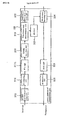
- FIG. 4 is a block diagram showing details of the OFDM modulation/demodulation unit in FIG. 3 .
- the components of the OFDM modulation/demodulation unit 320 will be described.
- the symbol synchronization unit 315 takes symbol synchronization with an OFDM symbol transmitted from the PHS terminal 110 through a channel generated by the PHS terminal 110.
- the guard interval removing unit 316 removes a guard interval from the OFDM symbol to obtain an effective symbol (refer to FIG. 9 ).
- the FFT unit 317 applies FFT to the effective symbol.
- the timing detection unit 318 detects a correlation peak between the effective symbol and a known ideal symbol.
- the correlation peak determination unit 319 transmits a differential (refer to FIG. 10 ) from reference timing of the base station 120 at the time of the detection of the correlation peak to the PHS terminal 110 by means of a timing correction burst only when the correlation peak detected in the timing detection unit 318 is in a predetermined timing detection range shorter than the effective symbol length.
- a differential from reference timing of the base station 120 is recorded in the memory 323 and transferred to the modulation-encoding unit 324 to generate a timing correction burst.
- the timing detection range is a range shifted from both ends of the effective symbol toward the inward direction.
- the effective symbol that has undergone this process is demodulated in the demodulation-decoding unit 322. Meanwhile, a signal to be transmitted is modulated encoded in the modulation and encoding unit 324.
- the IFFT unit 326 applies IFFT to the encoded signal to obtain an effective symbol.
- the guard interval insertion unit 328 inserts a guard interval into the effective symbol to obtain an OFDM symbol and transmit the same.
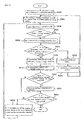
- FIG. 6 is a flow chart for explaining correction operation of transmission timing of the PHS terminal 110.
- P: relates to processes of the PHS terminal 110
- Base: relates to processes of the base station.
- a notification channel is notified from the base station 120 to the PHS terminal 110 (S400). Then, the PHS terminal 110 generates a channel to be frame synchronized with the notification channel and transmits an OFDM symbol to the base station 120 (S402).
- a guard interval is removed from the transmitted OFDM symbol by using the guard interval removing unit 316 to obtain an effective symbol.
- the FFT unit 317 applies an FFT process, a correlation peak between the effective symbol and a known ideal symbol is detected by using the timing detection unit 318 (S404).
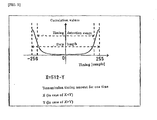
- the correlation peak determination unit 319 of the base station 120 determines whether the correlation peak is detected within a predetermined timing detection range ( FIG. 5 ) shorter than the effective symbol length (S406). In addition, only when the correction peak is detected within the terming detection range, a differential ( FIG. 10 ) from reference timing of the base station 120 at the time of the detection, of the correlation peak is transmitted to the PHS terminal 110 by means of a timing correction burst (S408).
- the correlation peak determination unit 319 does not transmit a timing correction burst.
- the time after the transmission of the OFDM symbol to the base station 120 is measured in the timer 213. And, whether or not the timing correction burst has been received within a predetermined time period is determined (S410). If the timing correction burst is not introduced from the base station 120 even after expiration of predetermined time duration, transmission timing of a previously generated channel is shifted by a predetermined shift amount (S412), which is added to the known summed shift amount recorded in the terminal memory 202 to produce a new sum of shift amounts (S414). As a result, a new channel having the shifted transmission timing is generated to transmit an OFDM symbol again to the base station 120 (S402) and implement processes of the base station 120 again.
- the timing correction burst is introduced from the base station 120 within a predetermined time period, a sum of the shift amounts of transmission timing to the present, which are stored in the terminal memory, is calculated to correct transmission timing to solve a differential from reference timing of the base station 120 (S416). And, a communication channel assignment request is transmitted to the base station 120 at the corrected transmission timing (S418).
- timing detection is performed after a guard interval is removed, and a correlation peak within an effective symbol length to which IFFT is applied increases, timing detection is successfully accomplished, and communication channel assignment is performed ( FIG. 12 ).
- a correlation peak at both sides of the effective symbol length increases.
- an incorrect correlation peak is detected, an error occurs in timing correction.
- a communication channel assignment request has not been received in the base station, and communication channel assignment has been failed ( FIG. 13 ).
- the base station 120 prepares a predetermined timing detection range as shown in FIG. 7 , and if a correlation peak is presented at circumferential sides, namely, both sides of an effective symbol length, the base station 120 does not transmit a timing correction burst. A timing correction burst was not given for a firstly generated timing correction channel.
- a new (second) channel in which transmission timing is shifted, is generated to retransmit an OFDM symbol (S412, S414, and S402 in FIG. 6 ).
- the timing correction burst is returned to the PHS terminal 110.
- transmission timing of the PHS terminal is corrected, and a communication channel is established, so that possibility of wireless communication access increases.
- any of two types of channels, which are alternatively generated due to differentials by a predetermined shift amount in transmission timing, may be generated.
- channels having two types of transmission timings may be alternatively generated.
- the PHS terminal 110 can receive the timing correction burst if it comes out of the dead point.
- a channel in which transmission timing is advanced or delayed by a predetermined shift amount, may be generated.
- transmission timing may be continuously shifted in one direction by advancing or delaying the transmission timing. This is to expect that during repeated performance of such a process, timing detection is successfully accomplished.
- the sum of the shift amounts of transmission timing which is calculated and stored in S414, is shorter than the length (512 samples) of the effective symbol. If the sum of the shift amounts of transmission timing is longer than the length of the effective symbol, timing detection is failed.
- an amount of one shift naturally has to be shorter than a length (512 samples) of an effective symbol. If two types of transmission timings are alternatively repeated and generated, a sum of shift amounts always satisfies the requirement. In addition, if transmission timing is continuously shifted in one direction, it is preferable to control the number of times of shifting to meet the requirement.
- FIG. 6 there is a case where even if the PHS terminal 110 transmits a communication channel assignment request to the base station 120 (S418), a communication channel is not assigned from the base station 120.
- the base station 120 could not have received the communication channel assignment request since the PHS terminal 110 has come to a dead point, or communication power is low.
- the base station 120 receives the communication channel assignment request in S420, the base station 120 necessarily assigns a communication channel to the PHS terminal 110 (S422). If not, however, the base station 120 does not perform communication channel assignment.
- the PHS terminal 110 prepares a limited time period in advance, and if a communication channel is not assigned within the limited time period (S424), an OFDM symbol is transmitted to the base station 120 at the same timing as a previously generated channel (second channel) (S426) to implement processes (steps following S404) of the base station 120 again.
- timing correction burst is obtained once by a previously generated channel, if an OFDM signal is transmitted at the same timing as the channel, it is highly likely that a timing correction burst can be immediately obtained without performing the process of shifting transmission timing ( FIG. 8 ).
- the present invention is applicable to a wireless communication system, a transmitting device, a receiving device, and a wireless communication method, which are capable of conducting wireless communication using adaptive modulation (high speed adaptive modulation).
Landscapes
- Engineering & Computer Science (AREA)
- Computer Networks & Wireless Communication (AREA)
- Signal Processing (AREA)
- Mobile Radio Communication Systems (AREA)
Abstract
One object of the present invention is to more completely avoid impossibility of access between a mobile station and a base station, in wireless communication using an OFDM (Orthogonal Frequency Division Multiplexing) modulation scheme.
A PHS terminal (110) generates a timing correction channel (first time) to be frame synchronized with a notification channel. A base station (120) transmits a timing correction burst to the PHS terminal (110) only when a correlation peak detected from a received OFDM symbol is within a predetermined timing detection range. If the timing correction burst is not introduced from the base station (120) even after expiration of predetermined time duration, the PHS terminal (110) generates a new timing correction channel (second time), in which transmission timing of a previously generated timing correction channel is shifted.
Description
- The present invention relates to a wireless communication method, a wireless communication system, a base station, and a mobile station, which conduct wireless communication using an OFDM (Orthogonal Frequency Division Multiplexing) modulation scheme.
- In recent years, as a mobile station represented by a mobile phone system, a PHS (Personal Handy phone System), and a PDA (Personal Digital Assistant) have been provided. These mobile stations are capable of conducting communication such as making and receiving a call and transmitting and receiving data by accessing base stations installed with a predetermined distance from one another through a communication network accessed by the base stations.
- One of schemes used for such a wireless communication system to transmit a digital signal is an OFDM modulation scheme. Since an OFDM modulation scheme transmits transmission data by distributing them to a plurality of carriers, in which orthogonal frequencies are set, a band of each of the carriers becomes narrow, so that frequency use efficiency is very high.
- In addition, as shown in
FIG. 9 , the OFDM modulation scheme is composed of an effective symbol corresponding to a signal period, during which IFFT (Inverse Fast Fourier Transformation) is performed at the time of transmission, and aguard interval 50 obtained by copying the waveform of a part of the latter half of the effective symbol as it is. For example, if the effective symbol length is 512 samples, theguard interval 50 is 64 samples, which is 1/8 of the effective symbol length. And, theguard interval 50 is inserted into a former half of an OFDM symbol. In the OFDM modulation scheme, the insertion of theguard interval 50 permits inter-symbol interference due to multipath, and thereby enhancing the resistance against multipath. - However, in a wireless communication system of PHS, communication is possible by performing transmitting and receiving a notification channel (BCCH: Broadcast Control Channel) between the base stations (CS: Cell Station) and the mobile stations (PS: Personal Station) arranged within a service zone and assigning a communication channel (TCH: Traffic Channel), at the time of an outgoing call, an incoming call, location registration, and others.
- In order to establish such a communication channel, it is necessary to correct transmission timing of a mobile station to be synchronized with reference timing of a base station. To generally explain the flow, firstly, the mobile station generates a channel for timing correction and transmits an OFDM symbol to the base station. The base station performs timing detection by using the received OFDM symbol and notifies the mobile station of a differential from reference timing of the base station. The mobile station corrects transmission timing to solve the differential from the reference timing.
- The mobile station sends a communication channel assignment request for making an outgoing call to the base station at the corrected transmission timing. Upon receiving this request, the base station transmits communication channel assignment information to the mobile station (for example,
Patent Literatures 1 to 4).
Patent Literature 1:JP-A-2000-68972
Patent Literature 2:JP-A-2000-134176
Patent Literature 3:JP-A-2000-315991
Patent Literature 4:JP-A-2001-119368 - In the base station, a guard interval is removed from the OFDM symbol to obtain an effective symbol, and then FFT (Fast Fourier Transformation) is preformed. When detecting timing, IFFT is additionally performed to detect a correlation peak with a known ideal symbol, which has already been synchronized with the reference timing of the base station. And, the differential from the reference timing of the base station at the time of the detection of the correlation peak is transmitted to the mobile station by means of a timing correction burst (
FIG. 10 ) - However, there is a case where if timing detection is performed after removal of a guard interval, a correlation peak at
timings 60 of both sides of the effective symbol length, to which IFFT is applied, increases (FIG. 11 ). In that case, the correlation peak is incorrectly detected, so that a correction amount of transmission timing in the mobile station becomes wrong. - As a precautionary measure, it is possible to perform timing detection prior to removal of a guard interval. However, in the state that different communication channels are mixed, correlation values of timing detection are reduced, so that incorrect detection may be caused.
- In consideration of this problem, the object of the present invention is to provide a wireless communication method, a wireless communication system, a base station, and a mobile station, which are capable of more successfully performing timing detection in a base station, in wireless communication using an OFDM modulation scheme, to more completely avoid impossibility of access between the mobile station and the base station.
- In order to solve the above-described problems, the representative configuration of the present invention relates to a wireless communication method of conducting wireless communication between a mobile station and a base station by using an OFDM modulation scheme, the method comprising: notifying a notification channel (Broadcast Control Channel; BCCH) from the base station to the mobile station; in the mobile station, generating a channel to be frame synchronized with the notification channel and transmitting an OFDM symbol to the base station; in the base station, as processes of the base station, removing a guard interval from the transmitted OFDM symbol to obtain an effective symbol; detecting a correlation peak between the effective symbol and a known ideal symbol; and only when the correlation peak is detected in a predetermined timing detection range shorter than a length of the effective symbol, transmitting a differential from reference timing of the base station at the time of the detection of the correlation peak to the mobile station by means of a timing correction burst, and in the mobile station, if the timing correction burst is not introduced from the base station even after expiration of predetermined time duration from the transmission of the OFDM symbol to the base station, generating a new channel having transmission timing obtained by shifting transmission timing of a previously generated channel by a predetermined shift amount and transmitting an OFDM symbol to the base station to implement processes of the base station again, and if the timing correction burst is introduced from the base station within the predetermined time, correcting transmission timing by calculating a sum of shift amounts of transmission timing to the present time and solving a differential from reference timing of the base station; and transmitting a communication channel assignment request to the base station at the corrected transmission timing.
- There has been a case where if timing detection is performed after a guard interval is removed, a correlation peak at both sides of an effective symbol length to which IFFT is applied increases. In this case, since an incorrect correlation peak is detected, timing detection has been failed. Thus, the base station has prepared a predetermined timing detection range and has not transmitted a timing correction burst if a correlation peak is presented at circumferential sides, namely, both sides of an effective symbol length.
- In the mobile station, if a timing correction burst is not received even after expiration of predetermined time duration from transmission of an initially generated channel, a new channel, in which transmission timing is shifted, is generated to retransmit an OFDM symbol. As a result, in the base station, if a correlation peak is detected within a predetermined timing detection range, the timing correction burst is returned to the mobile station. Accordingly, transmission timing of the mobile station is corrected, and a communication channel is established, so that possibility of wireless communication access increases.
- In the process of generating a new channel in the mobile station described above, any of two types of channels that are alternatively generated due to differentials by a predetermined shift amount in transmission timing may be generated.
- In other words, channels having two types of transmission timings may be alternatively generated. This is to expect that transmission timing of the mobile station is returned back to that previously shifted, and during repeated retransmission, timing detection is successfully accomplished. For example, in the event that the mobile station could not have received a timing correction burst from the base station since the mobile station has accidentally come into a so-called dead point, in which wireless communication cannot be established, the mobile station can receive the timing correction burst if it comes out of the dead point.
- In the process of generating a new channel in the mobile station described above, a channel, in which transmission timing is advanced or delayed by a predetermined shift amount, may be generated.
- In other words, transmission timing may be continuously shifted in one direction by advancing or delaying timing. This is to expect that during repeated performance of such a process, timing detection is successfully accomplished.
- It is preferable to make a sum of the shift amounts described above shorter than an effective symbol length. If the sum is longer than an effective symbol length, timing detection is failed. To this end, an amount of one shift is required to be shorter than an effective symbol length. If two types of transmission timings are alternatively generated, a sum of shift amounts always meets the above requirement. In addition, if transmission timing is continuously shifted in one direction, it is preferable to control the number of times of shifting to meet the requirement.
- If a communication channel is not assigned from the base station despite that the mobile station has transmitted the communication channel assignment request to the base station as described above, it is preferable to transmit an OFDM symbol to the base station at the same timing as a previously generated channel to implement processes of the base station again.
- As to the cause of the event that a communication channel is not assigned from the base station despite that the timing correction burst has been obtained, transmission timing has been corrected by using the burst, and the communication channel assignment request has been transmitted to the base station, it may be assumed that the mobile station has come into a dead point, or communication power is low. In this case, it is prudent to perform the transmission again at transmission timing of a previously generated channel, namely, the transmission timing when the timing correction burst is obtained. In the event that the mobile station has come into a dead point or other similar situations, if such a channel is generated to transmit an OFDM signal, it is highly likely that a timing correction burst can be immediately obtained without performing the process of shifting transmission timing.
- In order to solve the above-described problems, another representative configuration of the present invention relates to a wireless communication system comprising a mobile station and a base station, which conduct wireless communication by using an OFDM modulation scheme, wherein the base station comprises: a notification unit that notifies the mobile station of a notification channel; a guard interval removing unit that removes a guard interval from an OFDM symbol transmitted from the mobile station through a channel generated by the personal channel to obtain an effective symbol; a timing detection unit that detects a correlation peak between the effective symbol and a known ideal symbol; and a correlation peak determination unit that transmits a differential from reference timing of the base station at the time of the detection of the correlation peak to the mobile station by means of a timing correction burst only when the correlation peak is detected within a predetermined timing detection range shorter than a length of the effective symbol, and wherein the mobile station comprises: a timing correction channel generating unit, which generates a channel to be frame synchronized with the notification channel and transmits an OFDM symbol to the base station, and which, if the timing correction burst is not introduced from the base station even after expiration of predetermined time duration from the transmission, generates a new channel having transmission timing, in which transmission timing of a previously generated channel is shifted by a predetermined shift amount, and transmits an OFDM symbol to the base station; a shift storing unit that stores a sum of shift amounts of transmission timing in the timing correction channel generating unit; a transmission timing correcting unit which, if the timing correction burst is introduced from the base station within the predetermined time, corrects transmission timing by calculating a sum of shift amounts of transmission timing stored in the storing unit and solves a differential from reference timing of the base station; and a communication channel assignment request unit that transmits a communication channel assignment request to the base station at the corrected transmission timing.
- In order to solve the above-described problems, still another representative configuration of the present invention relates to a base station that conducts wireless communication with a mobile station by using an OFDM modulation scheme, the base station comprising: a notification unit that notifies the mobile station of a notification channel; a guard interval removing unit that removes a guard interval from an OFDM symbol transmitted from the mobile station through a channel generated by the personal channel to obtain an effective symbol; a timing detection unit that detects a correlation peak between the effective symbol and a known ideal symbol; and a correlation peak determination unit that transmits a differential from reference timing of the base station at the time of the detection of the correlation peak to the mobile station by means of a timing correction burst only when the correlation peak is detected within a predetermined timing detection range shorter than a length of the effective symbol.
- In order to solve the above-described problems, still another representative configuration of the present invention relates to a mobile station that conducts wireless communication with a base station by using an OFDM modulation scheme, the mobile station comprising: a timing correction channel generating unit, which generates a channel to be frame synchronized with a notification channel notified from the base station and transmits an OFDM symbol to the base station, and which, if a timing correction burst is not introduced from the base station even after expiration of predetermined time duration from the transmission, generates a new channel having transmission timing, in which transmission timing of a previously generated channel is shifted by a predetermined shift amount, and transmits an OFDM symbol to the base station; a shift storing unit that stores a sum of shift amounts of transmission timing in the timing correction channel generating unit; a transmission timing correcting unit which, if the timing correction burst is introduced from the base station within the predetermined time, corrects transmission timing by calculating a sum of shift amounts of transmission timing stored in the storing unit and solves a differential from reference timing of the base station; and a communication channel assignment request unit that transmits a communication channel assignment request to the base station at the corrected transmission timing.
- The components or the descriptions thereof, which correspond to the technical concept of the wireless communication method described above, are applicable to the corresponding wireless communication system, base station, and mobile station.
- According to the present invention, in wireless communication using an OFDM modulation scheme, timing detection in the base station is more successfully accomplished, so that impossibility of access between the mobile station and the base station can be more completely avoided.
-
- [
FIG. 1 ] A system block diagram for explaining a wireless communication system according to an embodiment of the present invention. - [
FIG. 2 ] A view showing detailed configuration of a PHS terminal in FIG. l. - [
FIG. 3 ] A view showing detailed configuration of a base station inFIG.1 . - [
FIG. 4 ] A block diagram showing details of an OFDM modulation/demodulation unit inFIG. 3 . - [
FIG. 5 ] A view showing a timing detection range set by a timing detection unit inFIG. 4 , - [
FIG. 6 ] A flow chart for explaining correction performance of transmission timing of the PHS terminal inFIG. 2 . - [
FIG. 7 ] A sequential view showing that assignment of a communication channel is successfully accomplished by generating a second timing correction channel inFIG. 6 . - [
FIG. 8 ] A sequential view showing that assignment of a communication channel is successfully accomplished by regenerating a previously generated timing correction channel in the case where a communication channel is not assigned. - [
FIG. 9 ] A view showing configuration of an OFDM symbol used in an OFDM modulation scheme. - [
FIG. 10 ] A view showing a case where a correlation peak is detected within a timing detection range by a timing detection unit inFIG.4 . - [
FIG. 11 ] A view showing a case where a correlation peak is detected beyond a timing detection range by a timing detection unit inFIG. 4 . - [
FIG. 12 ] A sequential view, in which communication channel assignment is successfully accomplished in a related art. - [
FIG. 13 ] A sequential view, in which communication channel assignment is failed in the related art. -
- 50
- Guard interval
- 100
- Wireless communication system
- 110A, 110B
- PHS terminal
- 120
- Base station
- 140
- Management server
- 200
- Terminal control unit
- 202
- Terminal memory
- 214
- Timing correction channel generating unit
- 216
- Transmission timing correction unit
- 218
- Communication channel assignment request unit
- 220
- OFDM modulation/demodulation unit
- 314
- Notification, unit
- 315
- Symbol synchronization unit
- 316
- Guard interval removing unit
- 317
- FFT unit
- 318
- Timing detection unit
- 319
- orrelation peak determination unit
- 320
- OFDM modulation/demodulation unit
- 322
- Demodulation-decoding unit
- 324
- Modulation-encoding unit
- 326
- IFFT unit
- 328
- Guard interval insertion unit
- Hereinafter a preferable embodiment of the present invention will be described in detail with reference to the accompanying drawings. In such an embodiment, dimensions, materials, and other particular numerical values, etc., are merely exemplary to facilitate understanding of the invention and should not be construed as limiting the present invention thereto unless otherwise expressly described herein. Meanwhile, in this specification and the drawings, components having substantially the same functions and configurations are denoted by the same reference numeral to omit repeated explanation, and components having no direct relation with the present invention are not illustrated.
- When starting communication, a mobile station attempts to correct transmission timing to be synchronized with reference timing of a base station. A mobile station includes various electronic devices such as PHS terminals, mobile phones, and PDAs. However, for easy understanding, this embodiment describes a PHS terminal as an example of a mobile station.
-
FIG. 1 is a system block diagram for explaining awireless communication system 100 according to the present embodiment. Thewireless communication system 100 comprises a PHS terminal 110 (110A, 110B), abase station 120, acommunication network 130, and amanagement server 140. Wireless communication using an OFDM modulation scheme is conducted between thePHS terminal 110 and thebase station 120. - In the
wireless communication system 100, when a user attempts to make a call to the other PHS terminal 110B by using thePHS terminal 110A, namely, when thePHS terminal 110A makes an outgoing call and when thePHS terminal 110B receives an incoming call, wireless communication with thebase station 120, which lies in wireless communication coverage, is established according to the operation of the user'sPHS terminal 110A, and thebase station 120 requests communication access to the PHS terminal 110B to themanagement server 140 through thecommunication network 130. - However, it is necessary to correct transmission timing of the PHS terminal to be synchronized with reference timing of the
base station 120 prior to establishment of wireless communication between thePHS terminal 110A and thebase station 120. -
FIGS. 2 and 3 are views of detailed configurations of a PHS terminal and a base station inFIG. 1 , respectively. As shown inFIG. 2 , thePHS terminal 110 comprises: aterminal control unit 200 for controlling the terminal as a whole; aterminal memory 202; adisplay unit 204; anoperation unit 206; avoice input unit 208; avoice output unit 210; and awireless communication unit 212. - The
terminal control unit 200 manages and controls thePHS terminal 110 as a whole by means of a semiconductor integrated circuit including a central processing unit (CPU). Theterminal control unit 200 also performs call function using thePHS terminal 110 or mail transferring function, by using a program of theterminal memory 202. - The
terminal memory 202 is configured by ROM, RAM, EEPROM, non-volatile RAM, flash memory, HDD, and so on. Theterminal memory 202 stores programs processed in theterminal controller 200, and voice data, etc. - The
display unit 204 is configured by a liquid crystal display, EL (Electro Luminescence), PDP (Plasma Display Panel), and so on. Thedisplay unit 204 can display Web Browser or GUI (Graphical User Interface) of application, stored in theterminal memory 202 or provided from an application relay server (not illustrated) through thecommunication network 130. - The
operation unit 206 is configured by switches such as a keyboard, a cross key, and a joystick for accepting user's operation input. - The
voice input unit 208 is configured by voice recognition means such as a microphone. Thevoice input unit 208 converts user's voice input during call into an electric signal, which can be processed in thePHS terminal 110. - The
voice output unit 210 is configured by a speaker. Thevoice output unit 210 converts call counterpart's voice signal received in thePHS terminal 110 into voice to output the voice. In addition, theunit 210 can output ringtones, operation sound of theoperation unit 206, and alarm sound, etc. - The
wireless communication unit 212 conducts wireless communication with thebase station 120 in a PHS telephone network. As a wireless communication scheme, this embodiment employs an OFDM scheme, which is one of multiplexing schemes that effectively uses a frequency band by using a plurality of carriers on a unit time axis and making phases of signal waves to be modulated orthogonal between adjacent carriers to partially overlap bands of the carriers. Hereinafter, the components of thewireless communication unit 212 of thePHS terminal 110 will be described. - The timing correction
channel generating unit 214 generates a channel to be frame synchronized with a notification channel notified from thebase station 120, which will be described in detail later, and transmits an OFDM symbol to thebase station 120. In addition, theunit 214 measures the time after the transmission by means of atimer 213. If a timing correction burst is not introduced from thebase station 120 even after expiration of predetermined time duration, theunit 214 generates a new channel having transmission timing, in which transmission timing of a previously generated channel is shifted by a predetermined shift amount, and transmits an OFDM symbol to thebase station 120. - The
terminal memory 202 stores an shift amount when the timing correctionchannel generating unit 214 shifts the transmission timing once, and in which forward or backward direction the transmission timing is shifted. In addition, theterminal memory 202 functions as a shift storing unit, which stores a sum of amounts of transmission timing shifting performed by the timing correctionchannel generating unit 214. - If the timing correction burst is introduced from the
base station 120 within a predetermined time period after the transmission of the channel, the transmissiontiming correction unit 216 corrects transmission timing by calculating a sum of the shift amounts of transmission timing stored in theterminal memory 202 to solve a differential from reference timing of thebase station 120. - The communication channel
assignment request unit 218 transmits a communication channel assignment request to thebase station 120 at the corrected transmission timing. - After a communication channel is established, the OFDM modulation/
demodulation unit 220 performs modulation/demodulation. The OFDM modulation/demodulation unit 220 removes a guard interval from the received OFDM symbol to apply FFT, extracts an effective symbol to demodulate the effective symbol, encodes a signal to be transmitted, and applies IFFT to obtain an effective symbol. Furthermore, theunit 220 inserts a guard interval to generate an OFDM symbol, which will be transmitted from thewireless communication unit 212. - As shown in
FIG. 3 , thebase station 120 comprises: a basestation control unit 300 for controlling thebase station 120 as a whole; and awireless communication unit 312. Thewireless communication unit 312 comprises: anotification unit 314 for notifying thePHS terminal 110 of a notification channel; and an OFDM modulation/demodulation unit 320. -
FIG. 4 is a block diagram showing details of the OFDM modulation/demodulation unit inFIG. 3 . Hereinafter, the components of the OFDM modulation/demodulation unit 320 will be described. - The
symbol synchronization unit 315 takes symbol synchronization with an OFDM symbol transmitted from thePHS terminal 110 through a channel generated by thePHS terminal 110. The guardinterval removing unit 316 removes a guard interval from the OFDM symbol to obtain an effective symbol (refer toFIG. 9 ). The FFT unit 317 applies FFT to the effective symbol. - The
timing detection unit 318 detects a correlation peak between the effective symbol and a known ideal symbol. The correlationpeak determination unit 319 transmits a differential (refer toFIG. 10 ) from reference timing of thebase station 120 at the time of the detection of the correlation peak to thePHS terminal 110 by means of a timing correction burst only when the correlation peak detected in thetiming detection unit 318 is in a predetermined timing detection range shorter than the effective symbol length. Specifically, a differential from reference timing of thebase station 120 is recorded in thememory 323 and transferred to the modulation-encodingunit 324 to generate a timing correction burst. - Meanwhile, the timing detection range is a range shifted from both ends of the effective symbol toward the inward direction.
- The effective symbol that has undergone this process is demodulated in the demodulation-
decoding unit 322. Meanwhile, a signal to be transmitted is modulated encoded in the modulation andencoding unit 324. TheIFFT unit 326 applies IFFT to the encoded signal to obtain an effective symbol. Thereafter, the guardinterval insertion unit 328 inserts a guard interval into the effective symbol to obtain an OFDM symbol and transmit the same. -
FIG. 6 is a flow chart for explaining correction operation of transmission timing of thePHS terminal 110. InFIG. 6 , "P:" relates to processes of thePHS terminal 110, and "Base:" relates to processes of the base station. - Firstly, a notification channel is notified from the
base station 120 to the PHS terminal 110 (S400). Then, thePHS terminal 110 generates a channel to be frame synchronized with the notification channel and transmits an OFDM symbol to the base station 120 (S402). - With regard to processes of the
base station 120, a guard interval is removed from the transmitted OFDM symbol by using the guardinterval removing unit 316 to obtain an effective symbol. After the FFT unit 317 applies an FFT process, a correlation peak between the effective symbol and a known ideal symbol is detected by using the timing detection unit 318 (S404). - The correlation
peak determination unit 319 of thebase station 120 determines whether the correlation peak is detected within a predetermined timing detection range (FIG. 5 ) shorter than the effective symbol length (S406). In addition, only when the correction peak is detected within the terming detection range, a differential (FIG. 10 ) from reference timing of thebase station 120 at the time of the detection, of the correlation peak is transmitted to thePHS terminal 110 by means of a timing correction burst (S408). - Meanwhile, if the correlation peak is detected beyond the timing detection range, namely, a correlation peak is detected at both sides of the effective symbol length (512 samples) as shown in
FIG. 5 , the correlationpeak determination unit 319 does not transmit a timing correction burst. - In the
PHS terminal 110, the time after the transmission of the OFDM symbol to thebase station 120 is measured in thetimer 213. And, whether or not the timing correction burst has been received within a predetermined time period is determined (S410). If the timing correction burst is not introduced from thebase station 120 even after expiration of predetermined time duration, transmission timing of a previously generated channel is shifted by a predetermined shift amount (S412), which is added to the known summed shift amount recorded in theterminal memory 202 to produce a new sum of shift amounts (S414). As a result, a new channel having the shifted transmission timing is generated to transmit an OFDM symbol again to the base station 120 (S402) and implement processes of thebase station 120 again. - Meanwhile, in the
PHS terminal 110, if the timing correction burst is introduced from thebase station 120 within a predetermined time period, a sum of the shift amounts of transmission timing to the present, which are stored in the terminal memory, is calculated to correct transmission timing to solve a differential from reference timing of the base station 120 (S416). And, a communication channel assignment request is transmitted to thebase station 120 at the corrected transmission timing (S418). - In the related art as well, if timing detection is performed after a guard interval is removed, and a correlation peak within an effective symbol length to which IFFT is applied increases, timing detection is successfully accomplished, and communication channel assignment is performed (
FIG. 12 ). However, there is a case where a correlation peak at both sides of the effective symbol length increases. In this case, since an incorrect correlation peak is detected, an error occurs in timing correction. As a result, a communication channel assignment request has not been received in the base station, and communication channel assignment has been failed (FIG. 13 ). - Thus, in this embodiment, according to the flow chart shown in
FIG. 6 , thebase station 120 prepares a predetermined timing detection range as shown inFIG. 7 , and if a correlation peak is presented at circumferential sides, namely, both sides of an effective symbol length, thebase station 120 does not transmit a timing correction burst. A timing correction burst was not given for a firstly generated timing correction channel. - As shown in
FIG. 7 , in thePHS terminal 110 of this embodiment, if the timing correction burst could not been received even after expiration of predetermined time duration from transmission of a firstly generated channel, a new (second) channel, in which transmission timing is shifted, is generated to retransmit an OFDM symbol (S412, S414, and S402 inFIG. 6 ). As a result of the second transmission, in thebase station 120, if a correlation peak is detected within a predetermined timing detection range, the timing correction burst is returned to thePHS terminal 110. As a result, transmission timing of the PHS terminal is corrected, and a communication channel is established, so that possibility of wireless communication access increases. - In the process of generating a new channel (S412) in the
PHS terminal 110 inFIG. 7 , any of two types of channels, which are alternatively generated due to differentials by a predetermined shift amount in transmission timing, may be generated. In other words, in S412, channels having two types of transmission timings may be alternatively generated. - This is to expect that the transmission timing of the
PHS terminal 110 is restored back to that previously shifted, and during repeated retransmission, timing detection is successfully accomplished. For example, in the event that thePHS terminal 110 could not have received a timing correction burst from thebase station 120 since thePHS terminal 110 has accidentally come into a so-called dead point, in which wireless communication cannot be established, thePHS terminal 110 can receive the timing correction burst if it comes out of the dead point. - In S412, a channel, in which transmission timing is advanced or delayed by a predetermined shift amount, may be generated. In other words, transmission timing may be continuously shifted in one direction by advancing or delaying the transmission timing. This is to expect that during repeated performance of such a process, timing detection is successfully accomplished.
- The sum of the shift amounts of transmission timing, which is calculated and stored in S414, is shorter than the length (512 samples) of the effective symbol. If the sum of the shift amounts of transmission timing is longer than the length of the effective symbol, timing detection is failed.
- In order to meet this requirement, an amount of one shift naturally has to be shorter than a length (512 samples) of an effective symbol. If two types of transmission timings are alternatively repeated and generated, a sum of shift amounts always satisfies the requirement. In addition, if transmission timing is continuously shifted in one direction, it is preferable to control the number of times of shifting to meet the requirement.
- Specifically, a shift amount may be determined as set forth below. That is, a length obtained by subtracting a timing detection range Y from the data length (512 samples) in
FIG. 5 is X (X=512-Y). A shorter one of X and Y is an amount of one shift. If X and Y are the same, any of them may be selected. Typically, selecting X = about 40 as an amount of one shift is preferable. In other words, the timing detection range Y = about 470 is preferable. - In
FIG. 6 , there is a case where even if thePHS terminal 110 transmits a communication channel assignment request to the base station 120 (S418), a communication channel is not assigned from thebase station 120. As to the cause, it may be assumed that thebase station 120 could not have received the communication channel assignment request since thePHS terminal 110 has come to a dead point, or communication power is low. When thebase station 120 receives the communication channel assignment request in S420, thebase station 120 necessarily assigns a communication channel to the PHS terminal 110 (S422). If not, however, thebase station 120 does not perform communication channel assignment. - In that case, in this embodiment, as shown in
FIG. 8 , thePHS terminal 110 prepares a limited time period in advance, and if a communication channel is not assigned within the limited time period (S424), an OFDM symbol is transmitted to thebase station 120 at the same timing as a previously generated channel (second channel) (S426) to implement processes (steps following S404) of thebase station 120 again. - Since a timing correction burst is obtained once by a previously generated channel, if an OFDM signal is transmitted at the same timing as the channel, it is highly likely that a timing correction burst can be immediately obtained without performing the process of shifting transmission timing (
FIG. 8 ). - While the preferable embodiment of the present invention has been described with reference to the accompanying drawings, it goes without saying that the present invention is not limited to the embodiment. It is apparent to one skilled in the art that various modifications and changes can be made within the scope set forth in the claims, and it should be understood that such modifications and changes fall under the technical scope of the present invention.
- While the present invention has been described in detail with reference to a particular embodiment, it is apparent to one skilled in the art that various modifications and changes can be made without departing from the spirit and the scope of the present invention.
The present application is based on Japanese Patent Application No.2008-016973 filed on January 28, 2008 - The present invention is applicable to a wireless communication system, a transmitting device, a receiving device, and a wireless communication method, which are capable of conducting wireless communication using adaptive modulation (high speed adaptive modulation).
Claims (8)
- A wireless communication method of conducting wireless communication between a mobile station and a base station by using an OFDM modulation scheme, the method comprising:notifying a notification channel from the base station to the mobile station;in the mobile station,
generating a channel to be frame synchronized with the notification channel and transmitting an OFDM symbol to the base station;in the base station, as processes of the base station,
removing a guard interval from the transmitted OFDM symbol to obtain an effective symbol;
detecting a correlation peak between the effective symbol and a known ideal symbol; and
only when the correlation peak is detected in a predetermined timing detection range shorter than a length of the effective symbol, transmitting a differential from reference timing of the base station at the time of the detection of the correlation peak to the mobile station by means of a timing correction burst, andin the mobile station,― if the timing correction burst is not introduced from the base station even after expiration of predetermined time duration from the transmission of the OFDM symbol to the base station, generating a new channel having transmission timing obtained by shifting transmission timing of a previously generated channel by a predetermined shift amount and transmitting an OFDM symbol to the base station to implement processes of the base station again;
if the timing correction burst is introduced from the base station within the predetermined time, correcting transmission timing by calculating a sum of shift amounts of transmission timing to the present time and solving a differential from reference timing of the base station; and
transmitting a communication channel assignment request to the base station at the corrected transmission timing. - The wireless communication method according to claim 1,
wherein in the process of generating a new channel in the mobile station, any one of two types of channels, which are alternatively generated due to differentials by the predetermined shift amount in transmission timing, is generated. - The wireless communication method according to claim 1,
wherein in the process of generating a new channel in the mobile station, a channel, in which transmission timing is advanced or delayed by the predetermined shift amount, is generated. - The wireless communication method according to any one of claims 1 to 3,
wherein the sum of the shift amounts is shorter than the length of the effective symbol. - The wireless communication method according to any one of claims 1 to 4,
wherein if a communication channel is not assigned from the base station despite that the mobile station transmits a communication channel assignment request to the base station, the mobile station transmits an OFDM symbol to the base station as the same timing as a previously generated channel to implement processes of the base station again. - A wireless communication system comprising a mobile station and a base station, which conduct wireless communication by using an OFDM modulation scheme,
wherein the base station comprises:a notification unit that notifies the mobile station of a notification channel;a guard interval removing unit that removes a guard interval from an OFDM symbol transmitted from the mobile station through a channel generated by the personal channel to obtain an effective symbol;a timing detection unit that detects a correlation peak between the effective symbol and a known ideal symbol; and
a correlation peak determination unit that transmits a differential from reference timing of the base station at the time of the detection of the correlation peak to the mobile station by means of a timing correction burst only when the correlation peak is detected within a predetermined timing detection range shorter than a length of the effective symbol, and
wherein the mobile station comprises:
a timing correction channel generating unit, which generates a channel to be frame synchronized with the notification channel and transmits an OFDM symbol to the base station, and which, if the timing correction burst is not introduced from the base station even after expiration of predetermined time duration from the transmission, generates a new channel having transmission timing, in which transmission timing of a previously generated channel is shifted by a predetermined shift amount, and transmits an OFDM symbol to the base station;
a shift storing unit that stores a sum of shift amounts of transmission timing in the timing correction channel generating unit;
a transmission timing correcting unit which, if the timing correction burst is introduced from the base station within the predetermined time, corrects transmission timing by calculating a sum of shift amounts of transmission timing stored in the storing unit and solves a differential from reference timing of the base station; and
a communication channel assignment request unit that transmits a communication channel assignment request to the base station at the corrected transmission timing. - A base station that conducts wireless communication with a mobile station by using an OFDM modulation scheme, the base station comprising:a notification unit that notifies the mobile station of a notification channel;a guard interval removing unit that removes a guard interval from an OFDM symbol transmitted from the mobile station through a channel generated by the personal channel to obtain an effective symbol;a timing detection unit that detects a correlation peak between the effective symbol and a known ideal symbol; anda correlation peak determination unit that transmits a differential from reference timing of the base station at the time of the detection of the correlation peak to the mobile station by means of a timing correction burst only when the correlation peak is detected within a predetermined timing detection range shorter than a length of the effective symbol.
- A mobile station that conducts wireless communication with a base station by using an OFDM modulation scheme, the mobile station comprising:a timing correction channel generating unit, which generates a channel to be frame synchronized with a notification channel notified from the base station and transmits an OFDM symbol to the base station, and which, if a timing correction burst is not introduced from the base station even after expiration of predetermined time duration from the transmission, generates a new channel having transmission timing, in which transmission timing of a previously generated channel is shifted by a predetermined shift amount, and transmits an OFDM symbol to the base station;a shift storing unit that stores a sum of shift amounts of transmission timing in the timing correction channel generating unit;a transmission timing correcting unit which, if the timing correction burst is introduced from the base station within the predetermined time, corrects transmission timing by calculating a sum of shift amounts of transmission timing stored in the storing unit and solves a differential from reference timing of the base station; anda communication channel assignment request unit that transmits a communication channel assignment request to the base station at the corrected transmission timing.
Applications Claiming Priority (2)
| Application Number | Priority Date | Filing Date | Title |
|---|---|---|---|
| JP2008016973A JP5031600B2 (en) | 2008-01-28 | 2008-01-28 | Wireless communication method, wireless communication system, base station, mobile station |
| PCT/JP2009/051283 WO2009096394A1 (en) | 2008-01-28 | 2009-01-27 | Radio communication method, radio communication system, base station, and mobile station |
Publications (1)
| Publication Number | Publication Date |
|---|---|
| EP2239870A1 true EP2239870A1 (en) | 2010-10-13 |
Family
ID=40912747
Family Applications (1)
| Application Number | Title | Priority Date | Filing Date |
|---|---|---|---|
| EP09706724A Withdrawn EP2239870A1 (en) | 2008-01-28 | 2009-01-27 | Radio communication method, radio communication system, base station, and mobile station |
Country Status (6)
| Country | Link |
|---|---|
| US (1) | US20110044311A1 (en) |
| EP (1) | EP2239870A1 (en) |
| JP (1) | JP5031600B2 (en) |
| KR (1) | KR101138927B1 (en) |
| CN (1) | CN101926113A (en) |
| WO (1) | WO2009096394A1 (en) |
Families Citing this family (1)
| Publication number | Priority date | Publication date | Assignee | Title |
|---|---|---|---|---|
| CN102594762B (en) * | 2011-11-22 | 2014-10-15 | 电子科技大学 | Frame synchronization method for burst mode OFDM system |
Family Cites Families (53)
| Publication number | Priority date | Publication date | Assignee | Title |
|---|---|---|---|---|
| JPH09266466A (en) * | 1996-03-28 | 1997-10-07 | Sumitomo Electric Ind Ltd | Digital transmission system |
| JPH11113049A (en) * | 1997-09-30 | 1999-04-23 | Matsushita Electric Ind Co Ltd | Wireless communication system |
| US6263031B1 (en) * | 1998-04-29 | 2001-07-17 | Hughes Electronics Corp. | Method and apparatus for signal burst classification |
| JP2000068972A (en) | 1998-08-17 | 2000-03-03 | Nippon Telegr & Teleph Corp <Ntt> | OFDM modulation / demodulation method and OFDM modulation / demodulation circuit |
| JP3397238B2 (en) * | 1998-10-01 | 2003-04-14 | 日本電気株式会社 | Mobile station and AFC control method in mobile station |
| JP3022854B1 (en) | 1998-10-23 | 2000-03-21 | 株式会社次世代デジタルテレビジョン放送システム研究所 | Delay profile analyzer and symbol synchronization method |
| US6539063B1 (en) * | 1999-02-18 | 2003-03-25 | Ibiquity Digital Corporation | System and method for recovering symbol timing offset and carrier frequency error in an OFDM digital audio broadcast system |
| JP2000252947A (en) * | 1999-02-26 | 2000-09-14 | Victor Co Of Japan Ltd | Ofdm multi-channel transmission sending/receiving system |
| EP1049302B1 (en) * | 1999-04-23 | 2006-06-28 | Sony Deutschland GmbH | Synchronization preamble in an OFDM system |
| JP3412558B2 (en) | 1999-04-30 | 2003-06-03 | 日本電気株式会社 | Clock frequency control method and receiving device used therefor |
| JP2001119368A (en) | 1999-05-31 | 2001-04-27 | Sony Corp | Receiving device, receiving method, and medium |
| AU740804B2 (en) * | 1999-07-19 | 2001-11-15 | Nippon Telegraph & Telephone Corporation | OFDM packet communication receiver system |
| WO2001024410A1 (en) * | 1999-09-29 | 2001-04-05 | Samsung Electronics Co., Ltd | System and method for compensating timing error using pilot symbol in ofdm/cdma communication system |
| US6967936B1 (en) * | 2000-02-11 | 2005-11-22 | Lucent Technologies Inc. | Uplink timing synchronization and access control for a multi-access wireless communication system |
| CA2361247C (en) * | 2000-11-06 | 2008-10-07 | Ntt Docomo, Inc. | Transmitter, transmitting method, receiver, and receiving method for mc-cdma communication system |
| DE60216055T3 (en) * | 2001-03-09 | 2010-10-28 | Qualcomm Inc., San Diego | METHOD FOR SYMBOL ACTUATION SYNCHRONIZATION IN COMMUNICATION SYSTEMS |
| JP3636145B2 (en) * | 2001-06-15 | 2005-04-06 | ソニー株式会社 | Demodulation timing generation circuit and demodulation device |
| JP3924565B2 (en) * | 2001-08-30 | 2007-06-06 | 株式会社エヌ・ティ・ティ・ドコモ | RADIO TRANSMISSION SYSTEM AND METHOD, AND TRANSMITTING STATION DEVICE AND RECEPTION STATION DEVICE USED IN THE RADIO TRANSMISSION SYSTEM |
| JP3989439B2 (en) * | 2001-11-28 | 2007-10-10 | 富士通株式会社 | Orthogonal frequency division multiplexing transmission method |
| JP4298320B2 (en) | 2002-11-08 | 2009-07-15 | 富士通株式会社 | Receiver for OFDM transmission system |
| DE60333117D1 (en) * | 2002-11-20 | 2010-08-05 | Ntt Docomo Inc | Communication system, communication method, transmission device, receiving device and control program |
| JP2004214961A (en) * | 2002-12-27 | 2004-07-29 | Sony Corp | OFDM demodulator |
| SE527445C2 (en) * | 2003-03-25 | 2006-03-07 | Telia Ab | Position-adjusted protection interval for OFDM communication |
| US20040228270A1 (en) * | 2003-05-13 | 2004-11-18 | Hou-Shin Chen | Method of processing an OFDM signal and OFDM receiver using the same |
| US7602696B2 (en) | 2003-06-27 | 2009-10-13 | Intel Corporation | Adaptive guard intervals in OFDM systems |
| CN101103583B (en) * | 2005-01-12 | 2011-11-30 | 松下电器产业株式会社 | Wireless communication method, base station device, and mobile station device |
| JP4671749B2 (en) * | 2005-04-26 | 2011-04-20 | 株式会社エヌ・ティ・ティ・ドコモ | Transceiver, mobile communication system, and transmission / reception method |
| EP1906568B1 (en) * | 2005-08-26 | 2015-04-01 | Panasonic Intellectual Property Corporation of America | Radio transmitting apparatus and radio transmitting method |
| JP2007159066A (en) * | 2005-12-08 | 2007-06-21 | Sanyo Electric Co Ltd | Radio communication apparatus and radio communication control method |
| US20070133695A1 (en) * | 2005-12-09 | 2007-06-14 | Kotzin Michael D | Method and system for channel assignment of OFDM channels |
| JP4382850B2 (en) * | 2005-12-15 | 2009-12-16 | 富士通株式会社 | Transmission processing method and base station in mobile communication system |
| WO2007074525A1 (en) * | 2005-12-27 | 2007-07-05 | Fujitsu Limited | Radio communication method, transmitter, and receiver |
| JP5108232B2 (en) * | 2006-01-20 | 2012-12-26 | 富士通株式会社 | Wireless communication system and wireless communication method |
| JP4837403B2 (en) | 2006-03-08 | 2011-12-14 | ルネサスエレクトロニクス株式会社 | Synchronization timing detection device, reception device, and synchronization timing detection method |
| US7809097B2 (en) | 2006-03-16 | 2010-10-05 | Renesas Electronics Corporation | Frame timing synchronization for orthogonal frequency division multiplexing (OFDM) |
| JP4732239B2 (en) * | 2006-05-29 | 2011-07-27 | 京セラ株式会社 | Radio base station and radio base station control method |
| JP4199269B2 (en) * | 2006-07-28 | 2008-12-17 | 株式会社東芝 | Transmission device, reception device, transmission method, and reception method |
| WO2008038543A1 (en) * | 2006-09-28 | 2008-04-03 | Kyocera Corporation | Communication control method for tdd/ofdma communication format, base station device, terminal device, and communication control system |
| US20080084845A1 (en) * | 2006-10-06 | 2008-04-10 | Motorola, Inc. | Wireless communication system frame structure having variable sized cyclic prefix |
| JP4388943B2 (en) * | 2006-10-23 | 2009-12-24 | Okiセミコンダクタ株式会社 | Correlator |
| JP2008109450A (en) * | 2006-10-26 | 2008-05-08 | Kyocera Corp | Frame synchronization method and receiver for OFDM communication system |
| CN102752094B (en) * | 2007-01-10 | 2015-12-02 | 联想创新有限公司(香港) | transmission of MBMS in OFDM communication system |
| JP5207756B2 (en) * | 2007-03-07 | 2013-06-12 | キヤノン株式会社 | COMMUNICATION SYSTEM, COMMUNICATION DEVICE, AND CONTROL METHOD THEREOF |
| WO2008140225A1 (en) * | 2007-05-09 | 2008-11-20 | Lg Electronics Inc. | Delay control in a mobile communication system |
| JP4892422B2 (en) * | 2007-06-27 | 2012-03-07 | 京セラ株式会社 | Wireless communication system, transmitter, receiver, and symbol synchronization method |
| JP2009010661A (en) * | 2007-06-27 | 2009-01-15 | Kyocera Corp | Communication apparatus and subchannel arrangement method |
| JP5187533B2 (en) * | 2007-09-28 | 2013-04-24 | 日本電気株式会社 | Wireless communication system, base station, mobile station, timing control determination method and program |
| US8369301B2 (en) * | 2007-10-17 | 2013-02-05 | Zte (Usa) Inc. | OFDM/OFDMA frame structure for communication systems |
| JP5031633B2 (en) * | 2008-01-28 | 2012-09-19 | 京セラ株式会社 | Wireless communication method, wireless communication system, base station |
| JP5031632B2 (en) * | 2008-03-26 | 2012-09-19 | 京セラ株式会社 | Wireless communication method, wireless communication system, base station, mobile station |
| WO2009122787A1 (en) * | 2008-03-31 | 2009-10-08 | 株式会社日立コミュニケーションテクノロジー | Timing adjustment method, receiving station, and transmitting station in wireless communication system, and wireless communication system |
| US8848624B2 (en) * | 2009-08-17 | 2014-09-30 | Broadcom Corporation | Multi-user uplink communications within multiple user, multiple access, and/or MIMO wireless communication systems |
| KR101328165B1 (en) * | 2009-12-21 | 2013-11-13 | 한국전자통신연구원 | Device and method for detection length of cyclic prefix |
-
2008
- 2008-01-28 JP JP2008016973A patent/JP5031600B2/en not_active Expired - Fee Related
-
2009
- 2009-01-27 EP EP09706724A patent/EP2239870A1/en not_active Withdrawn
- 2009-01-27 WO PCT/JP2009/051283 patent/WO2009096394A1/en not_active Ceased
- 2009-01-27 CN CN2009801032882A patent/CN101926113A/en active Pending
- 2009-01-27 US US12/864,866 patent/US20110044311A1/en not_active Abandoned
- 2009-01-27 KR KR1020107016618A patent/KR101138927B1/en not_active Expired - Fee Related
Non-Patent Citations (1)
| Title |
|---|
| See references of WO2009096394A1 * |
Also Published As
| Publication number | Publication date |
|---|---|
| WO2009096394A1 (en) | 2009-08-06 |
| JP2009177753A (en) | 2009-08-06 |
| KR101138927B1 (en) | 2012-04-25 |
| JP5031600B2 (en) | 2012-09-19 |
| KR20100105740A (en) | 2010-09-29 |
| CN101926113A (en) | 2010-12-22 |
| US20110044311A1 (en) | 2011-02-24 |
Similar Documents
| Publication | Publication Date | Title |
|---|---|---|
| CN110169189B (en) | Method and apparatus for performing contention-based random access in carrier frequency | |
| US8428022B2 (en) | Method and apparatus for transmitting positioning reference signals in a wireless communication network | |
| US10312962B2 (en) | Method and apparatus for frequency assignment in a frequency hopping mode of a wireless communication system | |
| US7643565B2 (en) | Portable terminal, communication system, and communication method | |
| RU2454817C2 (en) | Method to tune time of transfer and transfer of continuous bursts and mobile station for its realisation | |
| EP1932269B1 (en) | Apparatus, method and computer program product providing initial cell acquisition and pilot sequence detection | |
| EP2068571A1 (en) | Wireless communication apparatus | |
| US20110026481A1 (en) | Wireless communication method and wireless communication system | |
| US8340237B2 (en) | Wireless communication method, wireless communication system, base station and mobile station | |
| CN112636889A (en) | Side link information transmission method, device, user terminal and storage medium | |
| US8537946B2 (en) | Wireless communication method, wireless communication system and base station | |
| WO2006112179A1 (en) | Communication terminal, base station, and receiving method | |
| EP2239870A1 (en) | Radio communication method, radio communication system, base station, and mobile station | |
| CN102308505A (en) | Non-coherent detection method of the number of transmit antenna ports for OFDMA | |
| KR20090040119A (en) | How to perform the ranging process | |
| JP5282820B2 (en) | Wireless communication system, mobile station, and wireless communication method | |
| JP5111019B2 (en) | Offset correction method and communication apparatus using the same | |
| KR20090100172A (en) | Data transmission and reception system and method in communication system |
Legal Events
| Date | Code | Title | Description |
|---|---|---|---|
| PUAI | Public reference made under article 153(3) epc to a published international application that has entered the european phase |
Free format text: ORIGINAL CODE: 0009012 |
|
| 17P | Request for examination filed |
Effective date: 20100728 |
|
| AK | Designated contracting states |
Kind code of ref document: A1 Designated state(s): AT BE BG CH CY CZ DE DK EE ES FI FR GB GR HR HU IE IS IT LI LT LU LV MC MK MT NL NO PL PT RO SE SI SK TR |
|
| AX | Request for extension of the european patent |
Extension state: AL BA RS |
|
| DAX | Request for extension of the european patent (deleted) | ||
| STAA | Information on the status of an ep patent application or granted ep patent |
Free format text: STATUS: THE APPLICATION HAS BEEN WITHDRAWN |
|
| 18W | Application withdrawn |
Effective date: 20121122 |