EP2239436A2 - Reverse flow ceramic matrix composite combustor - Google Patents
Reverse flow ceramic matrix composite combustor Download PDFInfo
- Publication number
- EP2239436A2 EP2239436A2 EP10250677A EP10250677A EP2239436A2 EP 2239436 A2 EP2239436 A2 EP 2239436A2 EP 10250677 A EP10250677 A EP 10250677A EP 10250677 A EP10250677 A EP 10250677A EP 2239436 A2 EP2239436 A2 EP 2239436A2
- Authority
- EP
- European Patent Office
- Prior art keywords
- metallic
- combustor
- liner
- exit duct
- ceramic matrix
- Prior art date
- Legal status (The legal status is an assumption and is not a legal conclusion. Google has not performed a legal analysis and makes no representation as to the accuracy of the status listed.)
- Granted
Links
- 239000011153 ceramic matrix composite Substances 0.000 title claims abstract description 77
- 238000002485 combustion reaction Methods 0.000 claims abstract description 23
- 238000011144 upstream manufacturing Methods 0.000 claims abstract description 13
- 230000036316 preload Effects 0.000 claims description 16
- 238000001816 cooling Methods 0.000 claims description 15
- 230000006835 compression Effects 0.000 claims 1
- 238000007906 compression Methods 0.000 claims 1
- 239000000463 material Substances 0.000 description 19
- 239000003570 air Substances 0.000 description 16
- 239000007789 gas Substances 0.000 description 15
- 239000000919 ceramic Substances 0.000 description 11
- 239000000446 fuel Substances 0.000 description 7
- 239000002184 metal Substances 0.000 description 7
- 239000007769 metal material Substances 0.000 description 5
- 239000000567 combustion gas Substances 0.000 description 4
- 239000002131 composite material Substances 0.000 description 4
- 229910010293 ceramic material Inorganic materials 0.000 description 3
- 239000011159 matrix material Substances 0.000 description 3
- 229920002134 Carboxymethyl cellulose Polymers 0.000 description 2
- 235000010948 carboxy methyl cellulose Nutrition 0.000 description 2
- 229920006184 cellulose methylcellulose Polymers 0.000 description 2
- 238000012710 chemistry, manufacturing and control Methods 0.000 description 2
- 238000012986 modification Methods 0.000 description 2
- 230000004048 modification Effects 0.000 description 2
- 230000003014 reinforcing effect Effects 0.000 description 2
- 238000007789 sealing Methods 0.000 description 2
- 239000007787 solid Substances 0.000 description 2
- 238000003466 welding Methods 0.000 description 2
- 230000004308 accommodation Effects 0.000 description 1
- 239000012080 ambient air Substances 0.000 description 1
- 238000004891 communication Methods 0.000 description 1
- 238000005553 drilling Methods 0.000 description 1
- 239000000835 fiber Substances 0.000 description 1
- 239000000945 filler Substances 0.000 description 1
- 239000011521 glass Substances 0.000 description 1
- 238000010438 heat treatment Methods 0.000 description 1
- 238000003754 machining Methods 0.000 description 1
- 238000004519 manufacturing process Methods 0.000 description 1
- HBMJWWWQQXIZIP-UHFFFAOYSA-N silicon carbide Chemical compound [Si+]#[C-] HBMJWWWQQXIZIP-UHFFFAOYSA-N 0.000 description 1
- 229910010271 silicon carbide Inorganic materials 0.000 description 1
- 230000001052 transient effect Effects 0.000 description 1
Images



Classifications
-
- F—MECHANICAL ENGINEERING; LIGHTING; HEATING; WEAPONS; BLASTING
- F23—COMBUSTION APPARATUS; COMBUSTION PROCESSES
- F23R—GENERATING COMBUSTION PRODUCTS OF HIGH PRESSURE OR HIGH VELOCITY, e.g. GAS-TURBINE COMBUSTION CHAMBERS
- F23R3/00—Continuous combustion chambers using liquid or gaseous fuel
- F23R3/007—Continuous combustion chambers using liquid or gaseous fuel constructed mainly of ceramic components
-
- F—MECHANICAL ENGINEERING; LIGHTING; HEATING; WEAPONS; BLASTING
- F02—COMBUSTION ENGINES; HOT-GAS OR COMBUSTION-PRODUCT ENGINE PLANTS
- F02C—GAS-TURBINE PLANTS; AIR INTAKES FOR JET-PROPULSION PLANTS; CONTROLLING FUEL SUPPLY IN AIR-BREATHING JET-PROPULSION PLANTS
- F02C3/00—Gas-turbine plants characterised by the use of combustion products as the working fluid
- F02C3/14—Gas-turbine plants characterised by the use of combustion products as the working fluid characterised by the arrangement of the combustion chamber in the plant
- F02C3/145—Gas-turbine plants characterised by the use of combustion products as the working fluid characterised by the arrangement of the combustion chamber in the plant the combustion chamber being in the reverse flow-type
-
- F—MECHANICAL ENGINEERING; LIGHTING; HEATING; WEAPONS; BLASTING
- F23—COMBUSTION APPARATUS; COMBUSTION PROCESSES
- F23R—GENERATING COMBUSTION PRODUCTS OF HIGH PRESSURE OR HIGH VELOCITY, e.g. GAS-TURBINE COMBUSTION CHAMBERS
- F23R3/00—Continuous combustion chambers using liquid or gaseous fuel
- F23R3/002—Wall structures
-
- F—MECHANICAL ENGINEERING; LIGHTING; HEATING; WEAPONS; BLASTING
- F23—COMBUSTION APPARATUS; COMBUSTION PROCESSES
- F23R—GENERATING COMBUSTION PRODUCTS OF HIGH PRESSURE OR HIGH VELOCITY, e.g. GAS-TURBINE COMBUSTION CHAMBERS
- F23R3/00—Continuous combustion chambers using liquid or gaseous fuel
- F23R3/42—Continuous combustion chambers using liquid or gaseous fuel characterised by the arrangement or form of the flame tubes or combustion chambers
- F23R3/54—Reverse-flow combustion chambers
-
- F—MECHANICAL ENGINEERING; LIGHTING; HEATING; WEAPONS; BLASTING
- F05—INDEXING SCHEMES RELATING TO ENGINES OR PUMPS IN VARIOUS SUBCLASSES OF CLASSES F01-F04
- F05D—INDEXING SCHEME FOR ASPECTS RELATING TO NON-POSITIVE-DISPLACEMENT MACHINES OR ENGINES, GAS-TURBINES OR JET-PROPULSION PLANTS
- F05D2300/00—Materials; Properties thereof
- F05D2300/20—Oxide or non-oxide ceramics
- F05D2300/21—Oxide ceramics
-
- F—MECHANICAL ENGINEERING; LIGHTING; HEATING; WEAPONS; BLASTING
- F05—INDEXING SCHEMES RELATING TO ENGINES OR PUMPS IN VARIOUS SUBCLASSES OF CLASSES F01-F04
- F05D—INDEXING SCHEME FOR ASPECTS RELATING TO NON-POSITIVE-DISPLACEMENT MACHINES OR ENGINES, GAS-TURBINES OR JET-PROPULSION PLANTS
- F05D2300/00—Materials; Properties thereof
- F05D2300/60—Properties or characteristics given to material by treatment or manufacturing
- F05D2300/603—Composites; e.g. fibre-reinforced
-
- F—MECHANICAL ENGINEERING; LIGHTING; HEATING; WEAPONS; BLASTING
- F05—INDEXING SCHEMES RELATING TO ENGINES OR PUMPS IN VARIOUS SUBCLASSES OF CLASSES F01-F04
- F05D—INDEXING SCHEME FOR ASPECTS RELATING TO NON-POSITIVE-DISPLACEMENT MACHINES OR ENGINES, GAS-TURBINES OR JET-PROPULSION PLANTS
- F05D2300/00—Materials; Properties thereof
- F05D2300/60—Properties or characteristics given to material by treatment or manufacturing
- F05D2300/603—Composites; e.g. fibre-reinforced
- F05D2300/6033—Ceramic matrix composites [CMC]
-
- F—MECHANICAL ENGINEERING; LIGHTING; HEATING; WEAPONS; BLASTING
- F23—COMBUSTION APPARATUS; COMBUSTION PROCESSES
- F23R—GENERATING COMBUSTION PRODUCTS OF HIGH PRESSURE OR HIGH VELOCITY, e.g. GAS-TURBINE COMBUSTION CHAMBERS
- F23R2900/00—Special features of, or arrangements for continuous combustion chambers; Combustion processes therefor
- F23R2900/00018—Manufacturing combustion chamber liners or subparts
Definitions
- the invention relates generally to gas turbine engines, and more particularly, to a reverse flow combustor for a gas turbine engine.
- Reverse flow combustors for gas turbine engines are typically constructed out of metal, such as having metallic liner walls for example. Cost and weight requirements have resulted in thin sheet metal being used for combustor liners, however such thin sheet metal combustor liners require significant cooling in order to be able to withstand the high temperature environment to which they are exposed. However, as operating conditions advance, traditional metallic materials are no longer capable of adequately surviving the even higher temperature combustor environments expected.
- Ceramic based materials have long been known to offer superior temperature resistance properties relative to comparable metallic materials, however many challenges exist in adapting ceramic materials to gas turbine applications.
- Ceramic matrix composite (CMC) include woven ceramic fibre within a stiffening ceramic matrix filler, and are known for use in aerospace applications. While CMCs are able to withstand high temperature conditions with little if any cooling required, they are generally difficult to machine and can not easily be formed into the complex shapes often required for aerodynamic reasons in gas turbine engines, for example. Additionally, although strong at high temperatures, CMCs do not possess the thermal growth characteristics of metallic materials, and hence interfaces with adjacent metallic components are difficult to control without causing large thermal mismatch stresses, especially in conditions where temperature varies considerably. Therefore, there remains a need for an improved CMC combustor configuration.
- a gas turbine engine comprising an annular reverse-flow combustor with a combustor inner liner enclosing a combustion chamber and having a dome portion at an upstream end of the combustor and a downstream combustor exit defined between a small exit duct portion and a large exit duct portion, each of the dome portion, the small exit duct portion and the large exit duct portion being a separately formed hemi-toroidal shell composed of a ceramic matrix composite that is substantially free of airflow holes therethrough.
- annular reverse-flow combustor for a gas turbine engine, the combustor defining a combustion chamber therewithin, the combustor comprising: an inner liner substantially enclosing said combustion chamber and having at least three liner portions including a dome, a small exit duct and a large exit duct, each of the three liner portions being an independently formed hemi-toroidal shell; and wherein at least one of the three liner portions is made of a ceramic matrix composite and a remainder of the three liner portions are metallic, the at least one of the three liner portions made of the ceramic matrix composite having a compressive pre-load force applied thereto.
- annular reverse-flow combustor for a gas turbine engine, the combustor defining a combustion chamber therewithin, the combustor comprising: an inner liner having three liner portions substantially enclosing said combustion chamber, the three liner portions including a dome portion, a small exit duct portion and a large exit duct portion, each of the three liner portions being an independently formed hemi-toroidal shell composed of a ceramic matrix composite; radially inner and outer concentric metallic rings disposed between and interconnecting the dome portion with the small and large exit duct portions, wherein the outer metallic ring is disposed between an upstream end of the long exit duct portion and a radially outer end of the dome portion, and the inner metallic ring is disposed between an upstream end of the short exit duct portion and a radially inner end of the dome portion; and external metallic shells corresponding to and surrounding each of said three liner portions, and at least one spring element disposed between each of said metallic shells and a corresponding one
- Fig.1 illustrates a gas turbine engine 10 of a type preferably provided for use in subsonic flight, generally comprising in serial flow communication a fan 12 through which ambient air is propelled, a multistage compressor 14 for pressurizing the air, an annular reverse flow combustor 16 in which the compressed air is mixed with fuel and ignited for generating an annular stream of hot combustion gases, and a turbine section 18 for extracting energy from the combustion gases.
- axial and radial as used herein are intended to be defined relative to the main longitudinally extending engine axis 11. Further, when referring to the combustor 16 herein, the terms upstream and downstream and intended to be defined relative to the generally flow of hot combustion gasses in the combustor, i.e. from a fuel nozzle end of the combustor where fuel and air is injected for ignition to a combustor exit where the combustion gases exit towards the downstream first turbine stage.
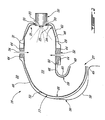
- the annular reverse flow combustor 16 comprises generally an inner combustor liner 17, directly exposed to and facing the combustion chamber 23 defined therewithin.
- the inner liner 17 of the combustor 16 is thus exposed to the highest temperatures, being directly exposed to the combustion chamber 23.
- the inner liner 17 is composed of at least one liner portion that is made of a ceramic matrix composite (CMC) material.
- CMC ceramic matrix composite
- the compressed air from the plenum 20 is, in at least this embodiment, only fed into the combustion chamber 23 via air holes defined in metallic ring portions 32,34 of the combustor liner, as will be described further below. Metered air flow can also be fed into the combustion chamber via the fuel nozzles 30.
- the inner liner 17 extends from an upstream end 21 of the combustor 16 (where a plurality of fuel nozzles 30, which communicate with the combustion chamber 23 to inject fuel therein, are located) to a downstream end (relative to gas flow in the combustion chamber) defining the combustor exit 27.
- the inner liner 17 is, in at least one embodiment, comprised of thee main liner portions, namely a dome portion 24 at the upstream end 21 of the combustor, and a long exit duct portion 26 and a short exit duct portion 28 which together form the combustor exit 27 at their respective downstream ends.
- Each of the dome portion 24, long exit duct portion 26 and short exit duct portion 28, that are made of the CMC material and which make up a substantial part of the inner liner 17, have a substantially hemi-toroidal shape and constitute an independently formed shell, as best seen in Fig. 3 .
- hemi-toroidal shell as used herein is understood to mean a shell formed from roughly one half of a surface generated by a closed plane curve rotated about a line that lies in the same plane but does not intersect it.
- each of these CMC shells is a hemi-toroid formed having a substantially U-shaped configuration which is open in an axial direction, i.e. the toroid shape defined would be formed by rotating an oval or oblong about an axially extending axis and divided roughly in half by a radially extending plane that is perpendicular to the axially extending axis.
- the long exit duct liner portion 26 and the short exit duct liner portion 28 have a radially outer end (i.e. those portions which abut the metallic rings 32, 34 shown in Fig. 2 ) of the U-shaped shell that projects rearwardly more than the radially inner ends thereof (the radially inner ends defining the combustor exit therebetween).
- the dome portion 24 as described herein includes a substantially radially extending section 25 defining apertures 33 therein for receiving the fuel nozzles 30, as well as radially inner and outer liner wall sections 29 and 31 respectively, which extend downstream from the radially extending dome section 25, in a generally axial direction, towards the respective small and long exit duct portions 28 and 26 of the combustor liner.
- two annular rings 32 and 34 respectively disposed on the radially inner and outer sides of the combustor liner 17, are located in the liner walls between the upstream dome portion 24 and the downstream small and large exit ducts 28,26.
- the radially inner and outer rings 32 and 34 thereby provide an interface between the dome portion 24 and the other two liner portions, and each include a circumferential surface facing the combustion chamber.
- the metallic rings 32, 34 are substantially solid, i.e. have a much greater radial thickness than the comparatively very thin shell metal outer shell 36.
- At least one of the three main liner portions, namely the dome portion 24, the small exit duct portion 28 and the large exit duct portion 26, is made of a ceramic material, and in one particular embodiment a CMC material.
- the ceramic material may be a monolithic ceramic (i.e. non-composite), or any ceramic based composite.
- the ceramic matrix composite (CMC) material referred to herein is understood to mean any ceramic based material having reinforcing fibres therein, whether these reinforcing fibres are made of ceramic, glass, or otherwise.
- the CMC material may be a glass-composite or an oxide-composite, nonetheless having a ceramic matrix base material.
- the CMC has flexible ceramic fibres (such as made of silicon carbide for example) which form a woven mesh and are embedded within a ceramic matrix base material.
- all three of the main liner portions i.e. dome portion 24, the small exit duct portion 28 and the large exit duct portion 26
- the concentric rings 32, 34 which join the three liner portions 24, 26, 28 are metallic.
- the metallic rings 32, 34 abut against the three CMC liner portions, forming a dissimilar material interface therebetween.
- the CMC liner portions 24, 26 and 28 are not fastened to the metallic rings 32, 34, but rather are maintained in compressed sealing contact therewith by a system used to generate a compressive pre-load force on the CMC liner portions, and therefore between the abutted CMC liner portions and the central metallic rings 32, 34 disposed therebetween, as will be described.
- a metallic outer shell 36 encloses the combustor liner 17 and is composed of three metallic shell sections 38, 40, 42 which respectively correspond to, and surround, each of the CMC liner portions 26, 28, 24.
- the metallic shell sections 38, 40, 42 are, in at least one embodiment, welded in place to the metallic rings 32 and 34 at weld points 44.
- the weld points 44 may in fact include annular welds about the circumference of the joint between the metallic shell sections and the metallic rings.
- the metallic shell sections are formed of a thin, lightweight sheet metal material.
- the metallic outer shell sections are radially spaced apart from the CMC liner portions, forming a substantially radial air gap 46 therebetween.
- the air gap 46 allows back side cooling of the outer surfaces of the CMC liner portions 26, 28, 24 by allowing cooling airflow from outside the combustor 16 to enter into the radial gap 46 where it will flow around the CMC liner portions cooling them, the cooling air eventually being ejected back into the main flow of combustion gases, either directly into the combustion chamber via holes formed in the metallic ring portions 32,34, or through openings 49 between the CMC liners and the corresponding outer metallic shell sections at the exit 27 of the combustor
- the air may be fed or pulled into the annular air gap 46 by any suitable means, such as by the pressure drop existing across the combustor, via holes in the outer metallic shell sections or inlet holes formed in the metallic rings 32, 34, for example.
- the CMC liner portions are therefore not required to have any special cooling features therein, such as machined cooling holes for example, which avoids the need to separately form cooling holes in the difficult to machine CMC material. As no cooling air appears on the hot side of the CMC shells, the emissions and gas temperature patterns of the combustor are also thus improved.
- the CMC liner 17 is supported within the surrounding outer metallic shell 36 by a number of spring elements 50. At least one of the spring elements 50 is disposed between each of the outer metallic shells and the corresponding inner CMC liner portion, i.e. within the radial gap 46, the spring elements 50 acting inwardly against the CMC liner portions.
- the spring elements 50 are substantially flexible and, in at least one embodiment, are annular metal springs having a substantially U-shaped cross-sectional shape.
- the metallic annular springs 50 need not be fully circumferential, and may be split rings. Regardless of their specific form, the spring elements 50 apply substantially axial-directed loads against the CMC liner portions such as to generate a compressive pre-load in the CMC liner portions. In the embodiment of Fig.
- the spring elements 50 apply axial loads against the CMC liner portions such as to force them against the central metallic rings 32,34, thereby locking compressive pre-loads into the CMC liner portions.
- the spring force of the spring elements 50 is chosen such as to apply a pre-load force sufficient to prevent unloading of the force between the shells, during heating and cooling transient cycles which are often imposed on the combustor by the gas turbine engine during operation thereof. Fastening (such as by welding) the outer metallic shells to the solid metallic rings 32, 34 traps the CMC liner portions under this compressive pre-load.
- the CMC liner portions 24, 26 and 28 are not fastened to the metallic rings 32, 34, but rather are abutted there against and maintained in sealed contact therewith by the spring elements 50 which generate the aforementioned compressive pre-load in the CMC liner portions, the compressive force in combination with the friction between the CMC liner portions and the metallic rings maintaining the CMC liner portions and the central metallic rings 32, 34 disposed in contact.
- addition seals may also be provided on either the metallic rings or the abutting edges of the CMC liner portions, to improve the seal therebetween.
- Such seals nonetheless allow for the floating of the two different materials relative to each other such as to de-couple the metal from the ceramic and thus permit the accommodation of thermal growth differential between the dissimilar materials.
- combustor 16 may include an axial and circumferential support respectively engaged to the dome metallic shell 42 and the long exit duct metallic shell 38, for example, and wherein each of these supports can allow for thermal growth in at least one of a radial and axial direction.
- a sliding-type sealing joint may be formed at the exit 27 of the combustor 16, whereby support flanges engage the combustor at its exit, such as to allow for thermal growth differential while maintaining a seal to limit losses of combustor gases.
- a combustor 116 in accordance with an alternate embodiment is depicted, the combustor 116 having an inner liner 117 which is only partially composed of a CMC material.
- the depicted inner liner 117 of the combustor 116 is made up of a CMC dome portion 124 (including the inner and outer liner wall sections 129 and 131 which are integral and are also made of the CMC material), which forms a hemi-toroidal shell, while the short and long exit duct portions 128 and 126 are both made of a metallic material (ex: sheet metal).
- the combustor 116 is a hybrid combustor, in that the CMC material is only used for a part of the combustor inner liner 117. It is to be understood that although the combustor liner 117 has a CMC dome portion 124 and metallic short and long exit duct portions 128,126, that the hybrid combustor 116 may alternately include a metallic dome portion and wherein at least one of the short and long exit ducts is made of the CMC material. The remaining features of the hybrid combustor 116 otherwise remain similar to the fully CMC combustor liner 17 described above. Namely, the CMC liner portion 124 is forced against the metallic rings 132 and 134 by spring elements 150 which generate the axially-directed (i.e.
- An outer metallic dome shell 142 also surrounds the CMC dome liner portion 124 and is spaced apart therefrom to form an annular air gap 146, and the ends of the metallic shell section 142 are fastened, such as by welding, to the metallic rings 132 and 134, thereby locking the compressive pre-load into the CMC liner portion 124.
Landscapes
- Engineering & Computer Science (AREA)
- Chemical & Material Sciences (AREA)
- Combustion & Propulsion (AREA)
- Mechanical Engineering (AREA)
- General Engineering & Computer Science (AREA)
- Ceramic Engineering (AREA)
- Turbine Rotor Nozzle Sealing (AREA)
Abstract
Description
- The invention relates generally to gas turbine engines, and more particularly, to a reverse flow combustor for a gas turbine engine.
- Reverse flow combustors for gas turbine engines are typically constructed out of metal, such as having metallic liner walls for example. Cost and weight requirements have resulted in thin sheet metal being used for combustor liners, however such thin sheet metal combustor liners require significant cooling in order to be able to withstand the high temperature environment to which they are exposed. However, as operating conditions advance, traditional metallic materials are no longer capable of adequately surviving the even higher temperature combustor environments expected.
- Ceramic based materials have long been known to offer superior temperature resistance properties relative to comparable metallic materials, however many challenges exist in adapting ceramic materials to gas turbine applications. Ceramic matrix composite (CMC) include woven ceramic fibre within a stiffening ceramic matrix filler, and are known for use in aerospace applications. While CMCs are able to withstand high temperature conditions with little if any cooling required, they are generally difficult to machine and can not easily be formed into the complex shapes often required for aerodynamic reasons in gas turbine engines, for example. Additionally, although strong at high temperatures, CMCs do not possess the thermal growth characteristics of metallic materials, and hence interfaces with adjacent metallic components are difficult to control without causing large thermal mismatch stresses, especially in conditions where temperature varies considerably. Therefore, there remains a need for an improved CMC combustor configuration.
- From one aspect is provided a gas turbine engine comprising an annular reverse-flow combustor with a combustor inner liner enclosing a combustion chamber and having a dome portion at an upstream end of the combustor and a downstream combustor exit defined between a small exit duct portion and a large exit duct portion, each of the dome portion, the small exit duct portion and the large exit duct portion being a separately formed hemi-toroidal shell composed of a ceramic matrix composite that is substantially free of airflow holes therethrough.
- From a further aspect is provided an annular reverse-flow combustor for a gas turbine engine, the combustor defining a combustion chamber therewithin, the combustor comprising: an inner liner substantially enclosing said combustion chamber and having at least three liner portions including a dome, a small exit duct and a large exit duct, each of the three liner portions being an independently formed hemi-toroidal shell; and wherein at least one of the three liner portions is made of a ceramic matrix composite and a remainder of the three liner portions are metallic, the at least one of the three liner portions made of the ceramic matrix composite having a compressive pre-load force applied thereto.
- There is also provided an annular reverse-flow combustor for a gas turbine engine, the combustor defining a combustion chamber therewithin, the combustor comprising: an inner liner having three liner portions substantially enclosing said combustion chamber, the three liner portions including a dome portion, a small exit duct portion and a large exit duct portion, each of the three liner portions being an independently formed hemi-toroidal shell composed of a ceramic matrix composite; radially inner and outer concentric metallic rings disposed between and interconnecting the dome portion with the small and large exit duct portions, wherein the outer metallic ring is disposed between an upstream end of the long exit duct portion and a radially outer end of the dome portion, and the inner metallic ring is disposed between an upstream end of the short exit duct portion and a radially inner end of the dome portion; and external metallic shells corresponding to and surrounding each of said three liner portions, and at least one spring element disposed between each of said metallic shells and a corresponding one of the three liner portions such as to produce a force against the three liner portions in a direction toward the inner and outer metallic rings, thereby generating a compressive pre-load in the liner portions composed of the ceramic matrix composite.
- Further details of these and other aspects will be apparent from the detailed description and figures included below.
- Reference is now made to the accompanying figures, in which:
-
Fig. 1 shows a schematic cross-section of a gas turbine engine; -
Fig. 2 shows a partial cross-section of one embodiment of the present annular reverse flow combustor; a -
Fig. 3 shows an exploded view of ceramic matrix composite liner portions of the combustor ofFig. 2 ; and -
Fig. 4 shows a partial cross-section of another embodiment of the present annular reverse flow combustor. -
Fig.1 illustrates agas turbine engine 10 of a type preferably provided for use in subsonic flight, generally comprising in serial flow communication afan 12 through which ambient air is propelled, amultistage compressor 14 for pressurizing the air, an annularreverse flow combustor 16 in which the compressed air is mixed with fuel and ignited for generating an annular stream of hot combustion gases, and aturbine section 18 for extracting energy from the combustion gases. - The terms axial and radial as used herein are intended to be defined relative to the main longitudinally extending
engine axis 11. Further, when referring to thecombustor 16 herein, the terms upstream and downstream and intended to be defined relative to the generally flow of hot combustion gasses in the combustor, i.e. from a fuel nozzle end of the combustor where fuel and air is injected for ignition to a combustor exit where the combustion gases exit towards the downstream first turbine stage. - Referring to
Fig. 2 , the annularreverse flow combustor 16 comprises generally aninner combustor liner 17, directly exposed to and facing thecombustion chamber 23 defined therewithin. Theinner liner 17 of thecombustor 16 is thus exposed to the highest temperatures, being directly exposed to thecombustion chamber 23. As such, and as will be described in further detail below, theinner liner 17 is composed of at least one liner portion that is made of a ceramic matrix composite (CMC) material. Such a CMC liner portion is much better able to withstand high temperatures with little or no cooling in comparison with standard metallic combustor liners. Anair plenum 20, which surrounds thecombustor 16, receives compressed air from thecompressor section 14 of the gas turbine engine 10 (seeFig. 1 ). This compressed air is fed into thecombustion chamber 23, however as will be described further below, the CMC liner portions of thecombustor 16 are substantially free of airflow passages (ex: cooling holes) extending therethrough. This greatly simplifies their production, as no additional machining steps (such as drilling of cooling holes) are required once the CMC liner portions are formed. As such, the compressed air from theplenum 20 is, in at least this embodiment, only fed into thecombustion chamber 23 via air holes defined inmetallic ring portions fuel nozzles 30. - The
inner liner 17 extends from anupstream end 21 of the combustor 16 (where a plurality offuel nozzles 30, which communicate with thecombustion chamber 23 to inject fuel therein, are located) to a downstream end (relative to gas flow in the combustion chamber) defining thecombustor exit 27. Theinner liner 17 is, in at least one embodiment, comprised of thee main liner portions, namely adome portion 24 at theupstream end 21 of the combustor, and a longexit duct portion 26 and a shortexit duct portion 28 which together form thecombustor exit 27 at their respective downstream ends. Each of thedome portion 24, longexit duct portion 26 and shortexit duct portion 28, that are made of the CMC material and which make up a substantial part of theinner liner 17, have a substantially hemi-toroidal shape and constitute an independently formed shell, as best seen inFig. 3 . - The term "hemi-toroidal" shell as used herein is understood to mean a shell formed from roughly one half of a surface generated by a closed plane curve rotated about a line that lies in the same plane but does not intersect it. In the case of the three CMC liner portions of the
combustor 16 as shown inFig. 3 , each of these CMC shells is a hemi-toroid formed having a substantially U-shaped configuration which is open in an axial direction, i.e. the toroid shape defined would be formed by rotating an oval or oblong about an axially extending axis and divided roughly in half by a radially extending plane that is perpendicular to the axially extending axis. As can be seen inFig. 3 , the long exitduct liner portion 26 and the short exitduct liner portion 28 have a radially outer end (i.e. those portions which abut themetallic rings Fig. 2 ) of the U-shaped shell that projects rearwardly more than the radially inner ends thereof (the radially inner ends defining the combustor exit therebetween). - Referring back to
Fig. 2 , thedome portion 24 as described herein includes a substantially radially extendingsection 25 definingapertures 33 therein for receiving thefuel nozzles 30, as well as radially inner and outerliner wall sections dome section 25, in a generally axial direction, towards the respective small and longexit duct portions annular rings combustor liner 17, are located in the liner walls between theupstream dome portion 24 and the downstream small andlarge exit ducts outer rings dome portion 24 and the other two liner portions, and each include a circumferential surface facing the combustion chamber. In the depicted embodiment, themetallic rings outer shell 36. - At least one of the three main liner portions, namely the
dome portion 24, the smallexit duct portion 28 and the largeexit duct portion 26, is made of a ceramic material, and in one particular embodiment a CMC material. The ceramic material may be a monolithic ceramic (i.e. non-composite), or any ceramic based composite. The ceramic matrix composite (CMC) material referred to herein is understood to mean any ceramic based material having reinforcing fibres therein, whether these reinforcing fibres are made of ceramic, glass, or otherwise. As such, the CMC material may be a glass-composite or an oxide-composite, nonetheless having a ceramic matrix base material. In a particular embodiment, the CMC has flexible ceramic fibres (such as made of silicon carbide for example) which form a woven mesh and are embedded within a ceramic matrix base material. - In one embodiment, such as that shown in
Figs. 2 and3 for example, all three of the main liner portions (i.e. dome portion 24, the smallexit duct portion 28 and the large exit duct portion 26) are composed of CMC material, and theconcentric rings liner portions metallic rings CMC liner portions metallic rings metallic rings - A metallic
outer shell 36 encloses thecombustor liner 17 and is composed of threemetallic shell sections CMC liner portions metallic shell sections metallic rings weld points 44. Theweld points 44 may in fact include annular welds about the circumference of the joint between the metallic shell sections and the metallic rings. In one possible embodiment, the metallic shell sections are formed of a thin, lightweight sheet metal material. - The metallic outer shell sections are radially spaced apart from the CMC liner portions, forming a substantially
radial air gap 46 therebetween. Theair gap 46 allows back side cooling of the outer surfaces of theCMC liner portions combustor 16 to enter into theradial gap 46 where it will flow around the CMC liner portions cooling them, the cooling air eventually being ejected back into the main flow of combustion gases, either directly into the combustion chamber via holes formed in themetallic ring portions openings 49 between the CMC liners and the corresponding outer metallic shell sections at theexit 27 of the combustor The air may be fed or pulled into theannular air gap 46 by any suitable means, such as by the pressure drop existing across the combustor, via holes in the outer metallic shell sections or inlet holes formed in themetallic rings - The
CMC liner 17 is supported within the surrounding outermetallic shell 36 by a number ofspring elements 50. At least one of thespring elements 50 is disposed between each of the outer metallic shells and the corresponding inner CMC liner portion, i.e. within theradial gap 46, thespring elements 50 acting inwardly against the CMC liner portions. Thespring elements 50 are substantially flexible and, in at least one embodiment, are annular metal springs having a substantially U-shaped cross-sectional shape. The metallicannular springs 50 need not be fully circumferential, and may be split rings. Regardless of their specific form, thespring elements 50 apply substantially axial-directed loads against the CMC liner portions such as to generate a compressive pre-load in the CMC liner portions. In the embodiment ofFig. 2 , thespring elements 50 apply axial loads against the CMC liner portions such as to force them against the centralmetallic rings spring elements 50 is chosen such as to apply a pre-load force sufficient to prevent unloading of the force between the shells, during heating and cooling transient cycles which are often imposed on the combustor by the gas turbine engine during operation thereof. Fastening (such as by welding) the outer metallic shells to the solidmetallic rings - As noted above, the
CMC liner portions metallic rings spring elements 50 which generate the aforementioned compressive pre-load in the CMC liner portions, the compressive force in combination with the friction between the CMC liner portions and the metallic rings maintaining the CMC liner portions and the centralmetallic rings - Although a number of possible configurations for mounting the
combustor 16 described above within theengine 10 are possible, these may include an axial and circumferential support respectively engaged to the domemetallic shell 42 and the long exit ductmetallic shell 38, for example, and wherein each of these supports can allow for thermal growth in at least one of a radial and axial direction. A sliding-type sealing joint may be formed at theexit 27 of thecombustor 16, whereby support flanges engage the combustor at its exit, such as to allow for thermal growth differential while maintaining a seal to limit losses of combustor gases. - Referring now to the embodiment of
Fig. 4 , acombustor 116 in accordance with an alternate embodiment is depicted, thecombustor 116 having aninner liner 117 which is only partially composed of a CMC material. Particularly, the depictedinner liner 117 of thecombustor 116 is made up of a CMC dome portion 124 (including the inner and outerliner wall sections exit duct portions combustor 116 is a hybrid combustor, in that the CMC material is only used for a part of the combustorinner liner 117. It is to be understood that although thecombustor liner 117 has aCMC dome portion 124 and metallic short and long exit duct portions 128,126, that thehybrid combustor 116 may alternately include a metallic dome portion and wherein at least one of the short and long exit ducts is made of the CMC material. The remaining features of thehybrid combustor 116 otherwise remain similar to the fullyCMC combustor liner 17 described above. Namely, theCMC liner portion 124 is forced against themetallic rings spring elements 150 which generate the axially-directed (i.e. towards the rings 132,134) force on the CMCdome liner portion 124 in order to generate the compressive pre-load therein. An outermetallic dome shell 142 also surrounds the CMCdome liner portion 124 and is spaced apart therefrom to form anannular air gap 146, and the ends of themetallic shell section 142 are fastened, such as by welding, to themetallic rings CMC liner portion 124. - The above description is meant to be exemplary only, and one skilled in the art will recognize that changes may be made to the embodiments described without department from the scope of the invention disclosed. Modifications which fall within the scope of the present invention will be apparent to those skilled in the art, in light of a review of this disclosure, and such modifications are intended to fall within the appended claims.
Claims (15)
- A gas turbine engine comprising an annular reverse-flow combustor (16) with a combustor inner liner (17) enclosing a combustion chamber (23) and having a dome portion (24) at an upstream end of the combustor and a downstream combustor exit (27) defined between a small exit duct portion (28) and a large exit duct portion (26), each of the dome portion (24), the small exit duct portion (28) and the large exit duct portion (26) being a separately formed hemi-toroidal shell composed of a ceramic matrix composite that is substantially free of airflow holes therethrough.
- The gas turbine engine as defined in claim 1, wherein two concentric rings (32,34) are disposed between the dome portion (24) and each of the large and small exit duct portions (26,28), and wherein airflow passages extend through the concentric rings (32,34) into the combustion chamber (23), said airflow passages providing air into the combustion chamber (23).
- The gas turbine engine as defined in claim 2, wherein the two concentric rings (32,34) are metallic, and wherein the ceramic matrix composite hemi-toroidal shells (24,26,28) of the inner liner (17) are forced against the metallic rings (32,34) without being fastened thereto, thereby providing floating joints between the metallic rings (32,34) and the ceramic matrix composite hemi-toroidal shells (24,26,28) which absorb thermal growth differential therebetween.
- The gas turbine as defined in claim 3, wherein a compressive pre-load force exerted on the ceramic matrix composite hemi-toroidal shells (24,26,28) forces them into contact with the metallic rings (32,34), the compressive pre-load force being generated by at least one spring element (50) acting against the ceramic matrix composite hemi-toroidal shells (24,26,28).
- The gas turbine engine as defined in claim 4, wherein the compressive pre-load force generated by the at least one spring element (50) is directed in a substantially axial direction.
- The gas turbine engine as defined in any preceding claim, further comprising external metallic shells (38,40,42) corresponding to and surrounding each of the ceramic matrix composite hemi-toroidal shells (24,26,28), the external metallic shells (38,40,42) being permanently fastened to (said) two concentric metallic rings (32,34) disposed between the dome portion (24) and each of the large and small exit duct portions (26,28).
- The gas turbine engine as defined in claim 6, wherein the external metallic shells (38,40,42) are spaced apart from respective ones of the ceramic matrix composite hemi-toroidal shells (24,26,28), such as to define an annular gap (46) therebetween.
- The gas turbine engine as defined in claim 7, wherein the inner liner (17) is substantially only cooled on an external surface thereof by cooling air provided within said annular gap (46).
- An annular reverse-flow combustor (116) for a gas turbine engine, the combustor (116) defining a combustion chamber therewithin, the combustor comprising:an inner liner (117) substantially enclosing said combustion chamber and having at least three liner portions including a dome (124), a small exit duct (128) and a large exit duct (126), each of the three liner portions being an independently formed hemi-toroidal shell; andwherein at least one (124) of the three liner portions (124,126,128) is made of a ceramic matrix composite and a remainder (126,128) of the three liner portions (124,126,128) are metallic, the at least one (124) of the three liner portions (124,126,128) made of the ceramic matrix composite having a compressive pre-load force applied thereto.
- The annular reverse-flow combustor as defined in claim 9, wherein radially inner and outer concentric metallic rings (132,134) are disposed between and interconnect the dome (124) with the small and large exit duct portions (126,128), the outer metallic ring (134) is disposed between an upstream end of the long exit duct (126) and a radially outer end of the dome (124), and the inner metallic ring (132) is disposed between an upstream end of the short exit duct (128) and a radially inner end of the dome (124).
- The annular reverse-flow combustor as defined in claim 10, wherein external metallic shells correspond to and surround each of said three liner portions, and at least one spring element (150) being disposed between each of said metallic shells and a corresponding one of the three liner portions such as to produce the compressive pre-load force against the at least one (124) of the three liner portions made of the ceramic matrix composite.
- The annular reverse-flow combustor as defined in any of claims 9 to 11, wherein the dome (124) is made of the ceramic matrix composite and the small and large exit ducts (126,128) are metallic.
- An annular reverse-flow combustor for a gas turbine engine, the combustor defining a combustion chamber (36) therewithin, the combustor comprising:an inner liner (17) having three liner portions (24,26,28) substantially enclosing said combustion chamber (36), the three liner portions including a dome portion (24), a small exit duct portion (28) and a large exit duct portion (26), each of the three liner portions (24,26,28) being an independently formed hemi-toroidal shell composed of a ceramic matrix composite;radially inner and outer concentric metallic rings (32,34) disposed between and interconnecting the dome portion (24) with the small and large exit duct portions (28,26), wherein the outer metallic ring (34) is disposed between an upstream end of the long exit duct portion (26) and a radially outer end of the dome portion (24), and the inner metallic ring (32) is disposed between an upstream end of the short exit duct portion (28) and a radially inner end of the dome portion (24); andexternal metallic shells (38,40,42) corresponding to and surrounding each of said three liner portions (24,26,28), and at least one spring element (50) disposed between each of said metallic shells (38,40,42) and a corresponding one of the three liner portions (24,26,28) such as to produce a force against the three liner portions (24,26,28) in a direction toward the inner and outer metallic rings (32,34), thereby generating a compressive pre-load in the liner portions (24,26,28) composed of the ceramic matrix composite.
- The annular reverse-flow combustor as defined in claim 13, wherein the spring elements (50) include annular metallic compression springs.
- The annular reverse-flow combustor as defined in claim 13 or 14, wherein the external metallic shells (38,40,42) are permanently fastened to the inner and outer metallic rings (32,34), said spring elements (50) maintaining the three liner portions (24,26,28) in contact with the inner and outer metallic rings (32,34) without being fastened thereto.
Applications Claiming Priority (1)
| Application Number | Priority Date | Filing Date | Title |
|---|---|---|---|
| US12/420,973 US8745989B2 (en) | 2009-04-09 | 2009-04-09 | Reverse flow ceramic matrix composite combustor |
Publications (3)
| Publication Number | Publication Date |
|---|---|
| EP2239436A2 true EP2239436A2 (en) | 2010-10-13 |
| EP2239436A3 EP2239436A3 (en) | 2013-06-12 |
| EP2239436B1 EP2239436B1 (en) | 2014-11-26 |
Family
ID=42212253
Family Applications (1)
| Application Number | Title | Priority Date | Filing Date |
|---|---|---|---|
| EP10250677.1A Not-in-force EP2239436B1 (en) | 2009-04-09 | 2010-03-31 | Reverse flow ceramic matrix composite combustor |
Country Status (3)
| Country | Link |
|---|---|
| US (2) | US8745989B2 (en) |
| EP (1) | EP2239436B1 (en) |
| CA (1) | CA2698058C (en) |
Cited By (3)
| Publication number | Priority date | Publication date | Assignee | Title |
|---|---|---|---|---|
| EP3211313A1 (en) * | 2016-02-25 | 2017-08-30 | General Electric Company | Combustor assembly |
| EP3211310A1 (en) * | 2016-02-25 | 2017-08-30 | General Electric Company | Combustor assembly |
| EP3211317A1 (en) * | 2016-02-25 | 2017-08-30 | General Electric Company | Combustor assembly |
Families Citing this family (52)
| Publication number | Priority date | Publication date | Assignee | Title |
|---|---|---|---|---|
| US8745989B2 (en) * | 2009-04-09 | 2014-06-10 | Pratt & Whitney Canada Corp. | Reverse flow ceramic matrix composite combustor |
| US8790067B2 (en) | 2011-04-27 | 2014-07-29 | United Technologies Corporation | Blade clearance control using high-CTE and low-CTE ring members |
| US10059431B2 (en) | 2011-06-09 | 2018-08-28 | United Technologies Corporation | Method and apparatus for attaching components having dissimilar rates of thermal expansion |
| US9290261B2 (en) | 2011-06-09 | 2016-03-22 | United Technologies Corporation | Method and assembly for attaching components |
| US8739547B2 (en) | 2011-06-23 | 2014-06-03 | United Technologies Corporation | Gas turbine engine joint having a metallic member, a CMC member, and a ceramic key |
| US8864492B2 (en) * | 2011-06-23 | 2014-10-21 | United Technologies Corporation | Reverse flow combustor duct attachment |
| US9335051B2 (en) | 2011-07-13 | 2016-05-10 | United Technologies Corporation | Ceramic matrix composite combustor vane ring assembly |
| US8920127B2 (en) | 2011-07-18 | 2014-12-30 | United Technologies Corporation | Turbine rotor non-metallic blade attachment |
| US10295191B2 (en) * | 2011-12-31 | 2019-05-21 | Rolls-Royce Corporation | Gas turbine engine and annular combustor with swirler |
| US9360215B2 (en) | 2012-04-02 | 2016-06-07 | United Technologies Corporation | Combustor having a beveled grommet |
| US20140238027A1 (en) * | 2012-12-21 | 2014-08-28 | United Technologies Corporation | Thermally compliant dual wall liner for a gas turbine engine |
| US20140190171A1 (en) * | 2013-01-10 | 2014-07-10 | Honeywell International Inc. | Combustors with hybrid walled liners |
| WO2015017084A1 (en) * | 2013-07-30 | 2015-02-05 | Clearsign Combustion Corporation | Combustor having a nonmetallic body with external electrodes |
| WO2015038293A1 (en) | 2013-09-11 | 2015-03-19 | United Technologies Corporation | Combustor liner |
| US10337736B2 (en) * | 2015-07-24 | 2019-07-02 | Pratt & Whitney Canada Corp. | Gas turbine engine combustor and method of forming same |
| GB2540769A (en) * | 2015-07-27 | 2017-02-01 | Rolls Royce Plc | Combustor for a gas turbine engine |
| US10648669B2 (en) | 2015-08-21 | 2020-05-12 | Rolls-Royce Corporation | Case and liner arrangement for a combustor |
| US20170059159A1 (en) | 2015-08-25 | 2017-03-02 | Rolls-Royce Corporation | Cmc combustor shell with integral chutes |
| US9810434B2 (en) * | 2016-01-21 | 2017-11-07 | Siemens Energy, Inc. | Transition duct system with arcuate ceramic liner for delivering hot-temperature gases in a combustion turbine engine |
| US10495309B2 (en) * | 2016-02-12 | 2019-12-03 | General Electric Company | Surface contouring of a flowpath wall of a gas turbine engine |
| US10428736B2 (en) * | 2016-02-25 | 2019-10-01 | General Electric Company | Combustor assembly |
| US10317085B2 (en) * | 2016-02-25 | 2019-06-11 | General Electric Company | Combustor assembly |
| EP3252378A1 (en) * | 2016-05-31 | 2017-12-06 | Siemens Aktiengesellschaft | Gas turbine annular combustor arrangement |
| US10337738B2 (en) * | 2016-06-22 | 2019-07-02 | General Electric Company | Combustor assembly for a turbine engine |
| US11022313B2 (en) | 2016-06-22 | 2021-06-01 | General Electric Company | Combustor assembly for a turbine engine |
| US10197279B2 (en) * | 2016-06-22 | 2019-02-05 | General Electric Company | Combustor assembly for a turbine engine |
| US10690345B2 (en) * | 2016-07-06 | 2020-06-23 | General Electric Company | Combustor assemblies for use in turbine engines and methods of assembling same |
| US10385774B2 (en) | 2016-09-19 | 2019-08-20 | United Technologies Corporation | Split compressor turbine engine |
| US10378770B2 (en) * | 2017-01-27 | 2019-08-13 | General Electric Company | Unitary flow path structure |
| US10371383B2 (en) | 2017-01-27 | 2019-08-06 | General Electric Company | Unitary flow path structure |
| US10393381B2 (en) * | 2017-01-27 | 2019-08-27 | General Electric Company | Unitary flow path structure |
| US10247019B2 (en) | 2017-02-23 | 2019-04-02 | General Electric Company | Methods and features for positioning a flow path inner boundary within a flow path assembly |
| US10385776B2 (en) | 2017-02-23 | 2019-08-20 | General Electric Company | Methods for assembling a unitary flow path structure |
| US10801730B2 (en) | 2017-04-12 | 2020-10-13 | Raytheon Technologies Corporation | Combustor panel mounting systems and methods |
| US10520197B2 (en) * | 2017-06-01 | 2019-12-31 | General Electric Company | Single cavity trapped vortex combustor with CMC inner and outer liners |
| US10738646B2 (en) | 2017-06-12 | 2020-08-11 | Raytheon Technologies Corporation | Geared turbine engine with gear driving low pressure compressor and fan at common speed, and failsafe overspeed protection and shear section |
| US10612555B2 (en) | 2017-06-16 | 2020-04-07 | United Technologies Corporation | Geared turbofan with overspeed protection |
| EP3434980B1 (en) | 2017-07-25 | 2021-03-17 | Ge Avio S.r.l. | Reverse flow combustor |
| US10976053B2 (en) | 2017-10-25 | 2021-04-13 | General Electric Company | Involute trapped vortex combustor assembly |
| US10976052B2 (en) | 2017-10-25 | 2021-04-13 | General Electric Company | Volute trapped vortex combustor assembly |
| US10801731B2 (en) | 2018-09-13 | 2020-10-13 | United Technologies Corporation | Attachment for high temperature CMC combustor panels |
| US11112119B2 (en) | 2018-10-25 | 2021-09-07 | General Electric Company | Combustor assembly for a turbo machine |
| US11181269B2 (en) | 2018-11-15 | 2021-11-23 | General Electric Company | Involute trapped vortex combustor assembly |
| US11054136B2 (en) * | 2018-11-30 | 2021-07-06 | Pratt & Whitney Canada Corp. | Interface for double-skin combustor liner |
| US11435078B2 (en) | 2018-12-20 | 2022-09-06 | Pratt & Whitney Canada Corp. | Stand-off device for double-skin combustor liner |
| US11933223B2 (en) * | 2019-04-18 | 2024-03-19 | Rtx Corporation | Integrated additive fuel injectors for attritable engines |
| US11215367B2 (en) | 2019-10-03 | 2022-01-04 | Raytheon Technologies Corporation | Mounting a ceramic component to a non-ceramic component in a gas turbine engine |
| FR3116862B1 (en) | 2020-11-30 | 2022-12-23 | Safran Ceram | COMBUSTION MODULE FOR A TURBOMACHINE |
| US11428160B2 (en) | 2020-12-31 | 2022-08-30 | General Electric Company | Gas turbine engine with interdigitated turbine and gear assembly |
| US11698192B2 (en) | 2021-04-06 | 2023-07-11 | Raytheon Technologies Corporation | CMC combustor panel attachment arrangement |
| CN113154457B (en) * | 2021-05-06 | 2022-01-07 | 中国航发湖南动力机械研究所 | Flame tube and elbow cooling structure of backflow combustion chamber |
| US11859819B2 (en) | 2021-10-15 | 2024-01-02 | General Electric Company | Ceramic composite combustor dome and liners |
Family Cites Families (38)
| Publication number | Priority date | Publication date | Assignee | Title |
|---|---|---|---|---|
| GB1059199A (en) * | 1965-10-20 | 1967-02-15 | Rolls Royce | Flame tube |
| US3859786A (en) * | 1972-05-25 | 1975-01-14 | Ford Motor Co | Combustor |
| US3844116A (en) * | 1972-09-06 | 1974-10-29 | Avco Corp | Duct wall and reverse flow combustor incorporating same |
| SE375583B (en) * | 1973-05-22 | 1975-04-21 | United Turbine Ab & Co | |
| US3952504A (en) * | 1973-12-14 | 1976-04-27 | Joseph Lucas (Industries) Limited | Flame tubes |
| US3934408A (en) * | 1974-04-01 | 1976-01-27 | General Motors Corporation | Ceramic combustion liner |
| US3981142A (en) * | 1974-04-01 | 1976-09-21 | General Motors Corporation | Ceramic combustion liner |
| US3911672A (en) * | 1974-04-05 | 1975-10-14 | Gen Motors Corp | Combustor with ceramic liner |
| US3880575A (en) * | 1974-04-15 | 1975-04-29 | Gen Motors Corp | Ceramic combustion liner |
| US3982392A (en) * | 1974-09-03 | 1976-09-28 | General Motors Corporation | Combustion apparatus |
| US3924403A (en) * | 1974-10-24 | 1975-12-09 | Gen Motors Corp | Combustion liner spring support used for hot wire igniter circuit |
| US4030875A (en) * | 1975-12-22 | 1977-06-21 | General Electric Company | Integrated ceramic-metal combustor |
| GB1570875A (en) * | 1977-03-16 | 1980-07-09 | Lucas Industries Ltd | Combustion equipment |
| US4380896A (en) * | 1980-09-22 | 1983-04-26 | The United States Of America As Represented By The Secretary Of The Army | Annular combustor having ceramic liner |
| US4787208A (en) * | 1982-03-08 | 1988-11-29 | Westinghouse Electric Corp. | Low-nox, rich-lean combustor |
| DE3519938A1 (en) * | 1985-06-04 | 1986-12-04 | MTU Motoren- und Turbinen-Union München GmbH, 8000 München | COMBUSTION CHAMBER |
| DE3615226A1 (en) * | 1986-05-06 | 1987-11-12 | Mtu Muenchen Gmbh | HOT GAS OVERHEATING PROTECTION DEVICE FOR GAS TURBINE ENGINES |
| DE3738439C1 (en) * | 1987-11-12 | 1989-03-09 | Mtu Muenchen Gmbh | Guide ring for a gas turbine |
| US5237813A (en) * | 1992-08-21 | 1993-08-24 | Allied-Signal Inc. | Annular combustor with outer transition liner cooling |
| US5687572A (en) * | 1992-11-02 | 1997-11-18 | Alliedsignal Inc. | Thin wall combustor with backside impingement cooling |
| US6182451B1 (en) * | 1994-09-14 | 2001-02-06 | Alliedsignal Inc. | Gas turbine combustor waving ceramic combustor cans and an annular metallic combustor |
| JP3478531B2 (en) * | 2000-04-21 | 2003-12-15 | 川崎重工業株式会社 | Gas turbine ceramic component support structure |
| US6397603B1 (en) * | 2000-05-05 | 2002-06-04 | The United States Of America As Represented By The Secretary Of The Air Force | Conbustor having a ceramic matrix composite liner |
| US6536201B2 (en) * | 2000-12-11 | 2003-03-25 | Pratt & Whitney Canada Corp. | Combustor turbine successive dual cooling |
| FR2825780B1 (en) * | 2001-06-06 | 2003-08-29 | Snecma Moteurs | COMBUSTION CHAMBER ARCHITECURE OF CERAMIC MATRIX MATERIAL |
| FR2829228B1 (en) * | 2001-08-28 | 2005-07-15 | Snecma Moteurs | ANNULAR COMBUSTION CHAMBER WITH DOUBLE HEADED HEAD |
| US6495207B1 (en) * | 2001-12-21 | 2002-12-17 | Pratt & Whitney Canada Corp. | Method of manufacturing a composite wall |
| US6925810B2 (en) * | 2002-11-08 | 2005-08-09 | Honeywell International, Inc. | Gas turbine engine transition liner assembly and repair |
| ITMI20031673A1 (en) * | 2003-08-28 | 2005-02-28 | Nuovo Pignone Spa | FIXING SYSTEM OF A FLAME TUBE OR "LINER". |
| FR2871844B1 (en) * | 2004-06-17 | 2006-09-29 | Snecma Moteurs Sa | SEALED ASSEMBLY OF A HIGH PRESSURE TURBINE DISPENSER ON ONE END OF A COMBUSTION CHAMBER IN A GAS TURBINE |
| FR2871846B1 (en) * | 2004-06-17 | 2006-09-29 | Snecma Moteurs Sa | GAS TURBINE COMBUSTION CHAMBER SUPPORTED IN A METALLIC CASING BY CMC BONDING FEATURES |
| FR2871847B1 (en) * | 2004-06-17 | 2006-09-29 | Snecma Moteurs Sa | MOUNTING A TURBINE DISPENSER ON A COMBUSTION CHAMBER WITH CMC WALLS IN A GAS TURBINE |
| FR2871845B1 (en) * | 2004-06-17 | 2009-06-26 | Snecma Moteurs Sa | GAS TURBINE COMBUSTION CHAMBER ASSEMBLY WITH INTEGRATED HIGH PRESSURE TURBINE DISPENSER |
| US7350358B2 (en) * | 2004-11-16 | 2008-04-01 | Pratt & Whitney Canada Corp. | Exit duct of annular reverse flow combustor and method of making the same |
| US7665307B2 (en) * | 2005-12-22 | 2010-02-23 | United Technologies Corporation | Dual wall combustor liner |
| US8745989B2 (en) * | 2009-04-09 | 2014-06-10 | Pratt & Whitney Canada Corp. | Reverse flow ceramic matrix composite combustor |
| US8864492B2 (en) * | 2011-06-23 | 2014-10-21 | United Technologies Corporation | Reverse flow combustor duct attachment |
| US8739547B2 (en) * | 2011-06-23 | 2014-06-03 | United Technologies Corporation | Gas turbine engine joint having a metallic member, a CMC member, and a ceramic key |
-
2009
- 2009-04-09 US US12/420,973 patent/US8745989B2/en active Active
-
2010
- 2010-03-26 CA CA2698058A patent/CA2698058C/en not_active Expired - Fee Related
- 2010-03-31 EP EP10250677.1A patent/EP2239436B1/en not_active Not-in-force
-
2014
- 2014-04-28 US US14/263,070 patent/US9423130B2/en active Active
Non-Patent Citations (1)
| Title |
|---|
| None |
Cited By (9)
| Publication number | Priority date | Publication date | Assignee | Title |
|---|---|---|---|---|
| EP3211313A1 (en) * | 2016-02-25 | 2017-08-30 | General Electric Company | Combustor assembly |
| EP3211310A1 (en) * | 2016-02-25 | 2017-08-30 | General Electric Company | Combustor assembly |
| EP3211317A1 (en) * | 2016-02-25 | 2017-08-30 | General Electric Company | Combustor assembly |
| JP2017150797A (en) * | 2016-02-25 | 2017-08-31 | ゼネラル・エレクトリック・カンパニイ | Combustor assembly |
| US10222065B2 (en) | 2016-02-25 | 2019-03-05 | General Electric Company | Combustor assembly for a gas turbine engine |
| US10228136B2 (en) | 2016-02-25 | 2019-03-12 | General Electric Company | Combustor assembly |
| US10429070B2 (en) | 2016-02-25 | 2019-10-01 | General Electric Company | Combustor assembly |
| JP2019178861A (en) * | 2016-02-25 | 2019-10-17 | ゼネラル・エレクトリック・カンパニイ | Combustor assembly |
| JP7305243B2 (en) | 2016-02-25 | 2023-07-10 | ゼネラル・エレクトリック・カンパニイ | combustor assembly |
Also Published As
| Publication number | Publication date |
|---|---|
| US20100257864A1 (en) | 2010-10-14 |
| US20140311152A1 (en) | 2014-10-23 |
| EP2239436B1 (en) | 2014-11-26 |
| US8745989B2 (en) | 2014-06-10 |
| US9423130B2 (en) | 2016-08-23 |
| CA2698058C (en) | 2017-06-06 |
| EP2239436A3 (en) | 2013-06-12 |
| CA2698058A1 (en) | 2010-10-09 |
Similar Documents
| Publication | Publication Date | Title |
|---|---|---|
| EP2239436B1 (en) | Reverse flow ceramic matrix composite combustor | |
| EP2546574B1 (en) | Ceramic matrix composite combustor vane ring assembly | |
| EP2538141B1 (en) | Reverse flow combustor | |
| US8534076B2 (en) | Combustor-turbine seal interface for gas turbine engine | |
| US11466855B2 (en) | Gas turbine engine combustor with ceramic matrix composite liner | |
| JP3984101B2 (en) | Mounting for turbomachine CMC combustion chamber with flexible coupling sleeve | |
| EP2538140A2 (en) | Reverse flow combustor duct attachment | |
| CN101122396A (en) | Radially Compliant Element Installation Method and Apparatus | |
| JP2002364850A (en) | Mounting of cmc(ceramic matrix composite) combustion chamber in turbo machine using dilution hole | |
| CN115949968B (en) | Combustor swirler to pseudo-dome attachment and interface with CMC dome | |
| US20120192571A1 (en) | Combustor liner support and seal assembly | |
| EP3270061B1 (en) | Combustor cassette liner mounting assembly | |
| CN107120690B (en) | burner assembly | |
| US20170022840A1 (en) | Seal segment for a gas turbine engine | |
| US10429070B2 (en) | Combustor assembly | |
| US11725817B2 (en) | Combustor assembly with moveable interface dilution opening | |
| JP4266754B2 (en) | Assembly cowl for gas turbine engine dual annular combustor and its fabrication method. | |
| CN115962486B (en) | Combustor swirler to CMC dome attachment | |
| US10222065B2 (en) | Combustor assembly for a gas turbine engine | |
| US12540732B2 (en) | Combustor of gas turbine |
Legal Events
| Date | Code | Title | Description |
|---|---|---|---|
| PUAI | Public reference made under article 153(3) epc to a published international application that has entered the european phase |
Free format text: ORIGINAL CODE: 0009012 |
|
| AK | Designated contracting states |
Kind code of ref document: A2 Designated state(s): AT BE BG CH CY CZ DE DK EE ES FI FR GB GR HR HU IE IS IT LI LT LU LV MC MK MT NL NO PL PT RO SE SI SK SM TR |
|
| AX | Request for extension of the european patent |
Extension state: AL BA ME RS |
|
| PUAL | Search report despatched |
Free format text: ORIGINAL CODE: 0009013 |
|
| RIC1 | Information provided on ipc code assigned before grant |
Ipc: F23R 3/00 20060101ALI20130429BHEP Ipc: F23R 3/54 20060101ALI20130429BHEP Ipc: F02K 3/06 20060101ALI20130429BHEP Ipc: F23R 3/52 20060101ALI20130429BHEP Ipc: F01D 25/00 20060101ALI20130429BHEP Ipc: F23R 3/06 20060101ALI20130429BHEP Ipc: F02C 3/14 20060101AFI20130429BHEP |
|
| AK | Designated contracting states |
Kind code of ref document: A3 Designated state(s): AT BE BG CH CY CZ DE DK EE ES FI FR GB GR HR HU IE IS IT LI LT LU LV MC MK MT NL NO PL PT RO SE SI SK SM TR |
|
| AX | Request for extension of the european patent |
Extension state: AL BA ME RS |
|
| RIC1 | Information provided on ipc code assigned before grant |
Ipc: F23R 3/00 20060101ALI20130508BHEP Ipc: F23R 3/06 20060101ALI20130508BHEP Ipc: F23R 3/54 20060101ALI20130508BHEP Ipc: F01D 25/00 20060101ALI20130508BHEP Ipc: F02C 3/14 20060101AFI20130508BHEP Ipc: F23R 3/52 20060101ALI20130508BHEP Ipc: F02K 3/06 20060101ALI20130508BHEP |
|
| 17P | Request for examination filed |
Effective date: 20131212 |
|
| RBV | Designated contracting states (corrected) |
Designated state(s): AT BE BG CH CY CZ DE DK EE ES FI FR GB GR HR HU IE IS IT LI LT LU LV MC MK MT NL NO PL PT RO SE SI SK SM TR |
|
| GRAP | Despatch of communication of intention to grant a patent |
Free format text: ORIGINAL CODE: EPIDOSNIGR1 |
|
| INTG | Intention to grant announced |
Effective date: 20140603 |
|
| GRAS | Grant fee paid |
Free format text: ORIGINAL CODE: EPIDOSNIGR3 |
|
| GRAA | (expected) grant |
Free format text: ORIGINAL CODE: 0009210 |
|
| AK | Designated contracting states |
Kind code of ref document: B1 Designated state(s): AT BE BG CH CY CZ DE DK EE ES FI FR GB GR HR HU IE IS IT LI LT LU LV MC MK MT NL NO PL PT RO SE SI SK SM TR |
|
| REG | Reference to a national code |
Ref country code: GB Ref legal event code: FG4D |
|
| REG | Reference to a national code |
Ref country code: CH Ref legal event code: EP |
|
| REG | Reference to a national code |
Ref country code: AT Ref legal event code: REF Ref document number: 698359 Country of ref document: AT Kind code of ref document: T Effective date: 20141215 |
|
| REG | Reference to a national code |
Ref country code: IE Ref legal event code: FG4D |
|
| REG | Reference to a national code |
Ref country code: DE Ref legal event code: R096 Ref document number: 602010020500 Country of ref document: DE Effective date: 20150108 |
|
| REG | Reference to a national code |
Ref country code: NL Ref legal event code: VDEP Effective date: 20141126 |
|
| REG | Reference to a national code |
Ref country code: AT Ref legal event code: MK05 Ref document number: 698359 Country of ref document: AT Kind code of ref document: T Effective date: 20141126 |
|
| REG | Reference to a national code |
Ref country code: LT Ref legal event code: MG4D |
|
| PG25 | Lapsed in a contracting state [announced via postgrant information from national office to epo] |
Ref country code: LT Free format text: LAPSE BECAUSE OF FAILURE TO SUBMIT A TRANSLATION OF THE DESCRIPTION OR TO PAY THE FEE WITHIN THE PRESCRIBED TIME-LIMIT Effective date: 20141126 Ref country code: IS Free format text: LAPSE BECAUSE OF FAILURE TO SUBMIT A TRANSLATION OF THE DESCRIPTION OR TO PAY THE FEE WITHIN THE PRESCRIBED TIME-LIMIT Effective date: 20150326 Ref country code: FI Free format text: LAPSE BECAUSE OF FAILURE TO SUBMIT A TRANSLATION OF THE DESCRIPTION OR TO PAY THE FEE WITHIN THE PRESCRIBED TIME-LIMIT Effective date: 20141126 Ref country code: NL Free format text: LAPSE BECAUSE OF FAILURE TO SUBMIT A TRANSLATION OF THE DESCRIPTION OR TO PAY THE FEE WITHIN THE PRESCRIBED TIME-LIMIT Effective date: 20141126 Ref country code: PT Free format text: LAPSE BECAUSE OF FAILURE TO SUBMIT A TRANSLATION OF THE DESCRIPTION OR TO PAY THE FEE WITHIN THE PRESCRIBED TIME-LIMIT Effective date: 20150326 Ref country code: ES Free format text: LAPSE BECAUSE OF FAILURE TO SUBMIT A TRANSLATION OF THE DESCRIPTION OR TO PAY THE FEE WITHIN THE PRESCRIBED TIME-LIMIT Effective date: 20141126 Ref country code: NO Free format text: LAPSE BECAUSE OF FAILURE TO SUBMIT A TRANSLATION OF THE DESCRIPTION OR TO PAY THE FEE WITHIN THE PRESCRIBED TIME-LIMIT Effective date: 20150226 |
|
| PG25 | Lapsed in a contracting state [announced via postgrant information from national office to epo] |
Ref country code: CY Free format text: LAPSE BECAUSE OF FAILURE TO SUBMIT A TRANSLATION OF THE DESCRIPTION OR TO PAY THE FEE WITHIN THE PRESCRIBED TIME-LIMIT Effective date: 20141126 Ref country code: AT Free format text: LAPSE BECAUSE OF FAILURE TO SUBMIT A TRANSLATION OF THE DESCRIPTION OR TO PAY THE FEE WITHIN THE PRESCRIBED TIME-LIMIT Effective date: 20141126 Ref country code: LV Free format text: LAPSE BECAUSE OF FAILURE TO SUBMIT A TRANSLATION OF THE DESCRIPTION OR TO PAY THE FEE WITHIN THE PRESCRIBED TIME-LIMIT Effective date: 20141126 Ref country code: GR Free format text: LAPSE BECAUSE OF FAILURE TO SUBMIT A TRANSLATION OF THE DESCRIPTION OR TO PAY THE FEE WITHIN THE PRESCRIBED TIME-LIMIT Effective date: 20150227 Ref country code: SE Free format text: LAPSE BECAUSE OF FAILURE TO SUBMIT A TRANSLATION OF THE DESCRIPTION OR TO PAY THE FEE WITHIN THE PRESCRIBED TIME-LIMIT Effective date: 20141126 Ref country code: HR Free format text: LAPSE BECAUSE OF FAILURE TO SUBMIT A TRANSLATION OF THE DESCRIPTION OR TO PAY THE FEE WITHIN THE PRESCRIBED TIME-LIMIT Effective date: 20141126 |
|
| PG25 | Lapsed in a contracting state [announced via postgrant information from national office to epo] |
Ref country code: CZ Free format text: LAPSE BECAUSE OF FAILURE TO SUBMIT A TRANSLATION OF THE DESCRIPTION OR TO PAY THE FEE WITHIN THE PRESCRIBED TIME-LIMIT Effective date: 20141126 Ref country code: RO Free format text: LAPSE BECAUSE OF FAILURE TO SUBMIT A TRANSLATION OF THE DESCRIPTION OR TO PAY THE FEE WITHIN THE PRESCRIBED TIME-LIMIT Effective date: 20141126 Ref country code: DK Free format text: LAPSE BECAUSE OF FAILURE TO SUBMIT A TRANSLATION OF THE DESCRIPTION OR TO PAY THE FEE WITHIN THE PRESCRIBED TIME-LIMIT Effective date: 20141126 Ref country code: EE Free format text: LAPSE BECAUSE OF FAILURE TO SUBMIT A TRANSLATION OF THE DESCRIPTION OR TO PAY THE FEE WITHIN THE PRESCRIBED TIME-LIMIT Effective date: 20141126 Ref country code: SK Free format text: LAPSE BECAUSE OF FAILURE TO SUBMIT A TRANSLATION OF THE DESCRIPTION OR TO PAY THE FEE WITHIN THE PRESCRIBED TIME-LIMIT Effective date: 20141126 |
|
| REG | Reference to a national code |
Ref country code: DE Ref legal event code: R097 Ref document number: 602010020500 Country of ref document: DE |
|
| PG25 | Lapsed in a contracting state [announced via postgrant information from national office to epo] |
Ref country code: PL Free format text: LAPSE BECAUSE OF FAILURE TO SUBMIT A TRANSLATION OF THE DESCRIPTION OR TO PAY THE FEE WITHIN THE PRESCRIBED TIME-LIMIT Effective date: 20141126 |
|
| PLBE | No opposition filed within time limit |
Free format text: ORIGINAL CODE: 0009261 |
|
| STAA | Information on the status of an ep patent application or granted ep patent |
Free format text: STATUS: NO OPPOSITION FILED WITHIN TIME LIMIT |
|
| PG25 | Lapsed in a contracting state [announced via postgrant information from national office to epo] |
Ref country code: LU Free format text: LAPSE BECAUSE OF FAILURE TO SUBMIT A TRANSLATION OF THE DESCRIPTION OR TO PAY THE FEE WITHIN THE PRESCRIBED TIME-LIMIT Effective date: 20150331 Ref country code: MC Free format text: LAPSE BECAUSE OF FAILURE TO SUBMIT A TRANSLATION OF THE DESCRIPTION OR TO PAY THE FEE WITHIN THE PRESCRIBED TIME-LIMIT Effective date: 20141126 |
|
| REG | Reference to a national code |
Ref country code: CH Ref legal event code: PL |
|
| 26N | No opposition filed |
Effective date: 20150827 |
|
| PG25 | Lapsed in a contracting state [announced via postgrant information from national office to epo] |
Ref country code: IT Free format text: LAPSE BECAUSE OF FAILURE TO SUBMIT A TRANSLATION OF THE DESCRIPTION OR TO PAY THE FEE WITHIN THE PRESCRIBED TIME-LIMIT Effective date: 20141126 |
|
| REG | Reference to a national code |
Ref country code: IE Ref legal event code: MM4A |
|
| PG25 | Lapsed in a contracting state [announced via postgrant information from national office to epo] |
Ref country code: CH Free format text: LAPSE BECAUSE OF NON-PAYMENT OF DUE FEES Effective date: 20150331 Ref country code: IE Free format text: LAPSE BECAUSE OF NON-PAYMENT OF DUE FEES Effective date: 20150331 Ref country code: LI Free format text: LAPSE BECAUSE OF NON-PAYMENT OF DUE FEES Effective date: 20150331 |
|
| REG | Reference to a national code |
Ref country code: FR Ref legal event code: PLFP Year of fee payment: 7 |
|
| PG25 | Lapsed in a contracting state [announced via postgrant information from national office to epo] |
Ref country code: SI Free format text: LAPSE BECAUSE OF FAILURE TO SUBMIT A TRANSLATION OF THE DESCRIPTION OR TO PAY THE FEE WITHIN THE PRESCRIBED TIME-LIMIT Effective date: 20141126 |
|
| PG25 | Lapsed in a contracting state [announced via postgrant information from national office to epo] |
Ref country code: MT Free format text: LAPSE BECAUSE OF FAILURE TO SUBMIT A TRANSLATION OF THE DESCRIPTION OR TO PAY THE FEE WITHIN THE PRESCRIBED TIME-LIMIT Effective date: 20141126 |
|
| REG | Reference to a national code |
Ref country code: FR Ref legal event code: PLFP Year of fee payment: 8 |
|
| PG25 | Lapsed in a contracting state [announced via postgrant information from national office to epo] |
Ref country code: SM Free format text: LAPSE BECAUSE OF FAILURE TO SUBMIT A TRANSLATION OF THE DESCRIPTION OR TO PAY THE FEE WITHIN THE PRESCRIBED TIME-LIMIT Effective date: 20141126 Ref country code: HU Free format text: LAPSE BECAUSE OF FAILURE TO SUBMIT A TRANSLATION OF THE DESCRIPTION OR TO PAY THE FEE WITHIN THE PRESCRIBED TIME-LIMIT; INVALID AB INITIO Effective date: 20100331 Ref country code: BG Free format text: LAPSE BECAUSE OF FAILURE TO SUBMIT A TRANSLATION OF THE DESCRIPTION OR TO PAY THE FEE WITHIN THE PRESCRIBED TIME-LIMIT Effective date: 20141126 |
|
| REG | Reference to a national code |
Ref country code: DE Ref legal event code: R082 Ref document number: 602010020500 Country of ref document: DE Representative=s name: SCHMITT-NILSON SCHRAUD WAIBEL WOHLFROM PATENTA, DE |
|
| PG25 | Lapsed in a contracting state [announced via postgrant information from national office to epo] |
Ref country code: TR Free format text: LAPSE BECAUSE OF FAILURE TO SUBMIT A TRANSLATION OF THE DESCRIPTION OR TO PAY THE FEE WITHIN THE PRESCRIBED TIME-LIMIT Effective date: 20141126 |
|
| PG25 | Lapsed in a contracting state [announced via postgrant information from national office to epo] |
Ref country code: BE Free format text: LAPSE BECAUSE OF FAILURE TO SUBMIT A TRANSLATION OF THE DESCRIPTION OR TO PAY THE FEE WITHIN THE PRESCRIBED TIME-LIMIT Effective date: 20141126 |
|
| REG | Reference to a national code |
Ref country code: FR Ref legal event code: PLFP Year of fee payment: 9 |
|
| PG25 | Lapsed in a contracting state [announced via postgrant information from national office to epo] |
Ref country code: MK Free format text: LAPSE BECAUSE OF FAILURE TO SUBMIT A TRANSLATION OF THE DESCRIPTION OR TO PAY THE FEE WITHIN THE PRESCRIBED TIME-LIMIT Effective date: 20141126 |
|
| PGFP | Annual fee paid to national office [announced via postgrant information from national office to epo] |
Ref country code: DE Payment date: 20190219 Year of fee payment: 10 Ref country code: GB Payment date: 20190222 Year of fee payment: 10 |
|
| PGFP | Annual fee paid to national office [announced via postgrant information from national office to epo] |
Ref country code: FR Payment date: 20190220 Year of fee payment: 10 |
|
| REG | Reference to a national code |
Ref country code: DE Ref legal event code: R119 Ref document number: 602010020500 Country of ref document: DE |
|
| PG25 | Lapsed in a contracting state [announced via postgrant information from national office to epo] |
Ref country code: DE Free format text: LAPSE BECAUSE OF NON-PAYMENT OF DUE FEES Effective date: 20201001 Ref country code: FR Free format text: LAPSE BECAUSE OF NON-PAYMENT OF DUE FEES Effective date: 20200331 |
|
| GBPC | Gb: european patent ceased through non-payment of renewal fee |
Effective date: 20200331 |
|
| PG25 | Lapsed in a contracting state [announced via postgrant information from national office to epo] |
Ref country code: GB Free format text: LAPSE BECAUSE OF NON-PAYMENT OF DUE FEES Effective date: 20200331 |