EP2233495A1 - Glycosylated glycopeptide antibiotic derivative - Google Patents
Glycosylated glycopeptide antibiotic derivative Download PDFInfo
- Publication number
- EP2233495A1 EP2233495A1 EP08863497A EP08863497A EP2233495A1 EP 2233495 A1 EP2233495 A1 EP 2233495A1 EP 08863497 A EP08863497 A EP 08863497A EP 08863497 A EP08863497 A EP 08863497A EP 2233495 A1 EP2233495 A1 EP 2233495A1
- Authority
- EP
- European Patent Office
- Prior art keywords
- optionally substituted
- compound
- solvate
- represented
- formula
- Prior art date
- Legal status (The legal status is an assumption and is not a legal conclusion. Google has not performed a legal analysis and makes no representation as to the accuracy of the status listed.)
- Withdrawn
Links
- MYPYJXKWCTUITO-LYRMYLQWSA-N vancomycin Chemical class O([C@@H]1[C@@H](O)[C@H](O)[C@@H](CO)O[C@H]1OC1=C2C=C3C=C1OC1=CC=C(C=C1Cl)[C@@H](O)[C@H](C(N[C@@H](CC(N)=O)C(=O)N[C@H]3C(=O)N[C@H]1C(=O)N[C@H](C(N[C@@H](C3=CC(O)=CC(O)=C3C=3C(O)=CC=C1C=3)C(O)=O)=O)[C@H](O)C1=CC=C(C(=C1)Cl)O2)=O)NC(=O)[C@@H](CC(C)C)NC)[C@H]1C[C@](C)(N)[C@H](O)[C@H](C)O1 MYPYJXKWCTUITO-LYRMYLQWSA-N 0.000 title claims abstract description 51
- 125000000217 alkyl group Chemical group 0.000 claims abstract description 162
- 235000000346 sugar Nutrition 0.000 claims abstract description 120
- 125000003118 aryl group Chemical group 0.000 claims abstract description 52
- 108010015899 Glycopeptides Proteins 0.000 claims abstract description 45
- 102000002068 Glycopeptides Human genes 0.000 claims abstract description 45
- 125000005346 substituted cycloalkyl group Chemical group 0.000 claims abstract description 40
- 150000002772 monosaccharides Chemical class 0.000 claims abstract description 34
- 125000000539 amino acid group Chemical group 0.000 claims abstract description 31
- DQJCDTNMLBYVAY-ZXXIYAEKSA-N (2S,5R,10R,13R)-16-{[(2R,3S,4R,5R)-3-{[(2S,3R,4R,5S,6R)-3-acetamido-4,5-dihydroxy-6-(hydroxymethyl)oxan-2-yl]oxy}-5-(ethylamino)-6-hydroxy-2-(hydroxymethyl)oxan-4-yl]oxy}-5-(4-aminobutyl)-10-carbamoyl-2,13-dimethyl-4,7,12,15-tetraoxo-3,6,11,14-tetraazaheptadecan-1-oic acid Chemical group NCCCC[C@H](C(=O)N[C@@H](C)C(O)=O)NC(=O)CC[C@H](C(N)=O)NC(=O)[C@@H](C)NC(=O)C(C)O[C@@H]1[C@@H](NCC)C(O)O[C@H](CO)[C@H]1O[C@H]1[C@H](NC(C)=O)[C@@H](O)[C@H](O)[C@@H](CO)O1 DQJCDTNMLBYVAY-ZXXIYAEKSA-N 0.000 claims abstract description 26
- 125000003342 alkenyl group Chemical group 0.000 claims abstract description 24
- 125000000738 acetamido group Chemical group [H]C([H])([H])C(=O)N([H])[*] 0.000 claims abstract description 12
- 230000003115 biocidal effect Effects 0.000 claims abstract description 5
- 125000000218 acetic acid group Chemical group C(C)(=O)* 0.000 claims abstract 2
- -1 glycopeptide compound Chemical class 0.000 claims description 282
- 150000001875 compounds Chemical class 0.000 claims description 224
- 150000003839 salts Chemical class 0.000 claims description 133
- 239000012453 solvate Substances 0.000 claims description 127
- 125000001424 substituent group Chemical group 0.000 claims description 115
- 229910052739 hydrogen Inorganic materials 0.000 claims description 82
- 239000001257 hydrogen Substances 0.000 claims description 80
- 125000002924 primary amino group Chemical group [H]N([H])* 0.000 claims description 51
- 125000003545 alkoxy group Chemical group 0.000 claims description 49
- 238000000034 method Methods 0.000 claims description 45
- 238000006243 chemical reaction Methods 0.000 claims description 35
- 229910052736 halogen Inorganic materials 0.000 claims description 34
- 150000002367 halogens Chemical class 0.000 claims description 34
- 125000004435 hydrogen atom Chemical group [H]* 0.000 claims description 32
- UFHFLCQGNIYNRP-UHFFFAOYSA-N Hydrogen Chemical compound [H][H] UFHFLCQGNIYNRP-UHFFFAOYSA-N 0.000 claims description 29
- 125000001072 heteroaryl group Chemical group 0.000 claims description 29
- 125000003282 alkyl amino group Chemical group 0.000 claims description 28
- 239000003910 polypeptide antibiotic agent Substances 0.000 claims description 26
- 125000005842 heteroatom Chemical group 0.000 claims description 24
- WQZGKKKJIJFFOK-VFUOTHLCSA-N beta-D-glucose Chemical compound OC[C@H]1O[C@@H](O)[C@H](O)[C@@H](O)[C@@H]1O WQZGKKKJIJFFOK-VFUOTHLCSA-N 0.000 claims description 23
- 125000005843 halogen group Chemical group 0.000 claims description 23
- 125000000623 heterocyclic group Chemical group 0.000 claims description 23
- 125000003107 substituted aryl group Chemical group 0.000 claims description 23
- WQZGKKKJIJFFOK-GASJEMHNSA-N Glucose Natural products OC[C@H]1OC(O)[C@H](O)[C@@H](O)[C@@H]1O WQZGKKKJIJFFOK-GASJEMHNSA-N 0.000 claims description 22
- 239000008103 glucose Substances 0.000 claims description 21
- 108700023372 Glycosyltransferases Proteins 0.000 claims description 19
- 102000051366 Glycosyltransferases Human genes 0.000 claims description 19
- 229930182830 galactose Natural products 0.000 claims description 19
- 150000002337 glycosamines Chemical group 0.000 claims description 19
- 150000002431 hydrogen Chemical class 0.000 claims description 19
- 239000002994 raw material Substances 0.000 claims description 19
- 230000008569 process Effects 0.000 claims description 18
- 238000007254 oxidation reaction Methods 0.000 claims description 17
- 125000003710 aryl alkyl group Chemical group 0.000 claims description 14
- 230000002829 reductive effect Effects 0.000 claims description 14
- 230000001279 glycosylating effect Effects 0.000 claims description 13
- 125000004659 aryl alkyl thio group Chemical group 0.000 claims description 12
- 125000004657 aryl sulfonyl amino group Chemical group 0.000 claims description 12
- 125000004104 aryloxy group Chemical group 0.000 claims description 12
- WQZGKKKJIJFFOK-PHYPRBDBSA-N alpha-D-galactose Chemical compound OC[C@H]1O[C@H](O)[C@H](O)[C@@H](O)[C@H]1O WQZGKKKJIJFFOK-PHYPRBDBSA-N 0.000 claims description 11
- 125000002102 aryl alkyloxo group Chemical group 0.000 claims description 11
- OVRNDRQMDRJTHS-CBQIKETKSA-N N-Acetyl-D-Galactosamine Chemical compound CC(=O)N[C@H]1[C@@H](O)O[C@H](CO)[C@H](O)[C@@H]1O OVRNDRQMDRJTHS-CBQIKETKSA-N 0.000 claims description 10
- MBLBDJOUHNCFQT-UHFFFAOYSA-N N-acetyl-D-galactosamine Natural products CC(=O)NC(C=O)C(O)C(O)C(O)CO MBLBDJOUHNCFQT-UHFFFAOYSA-N 0.000 claims description 10
- MSWZFWKMSRAUBD-UHFFFAOYSA-N beta-D-galactosamine Natural products NC1C(O)OC(CO)C(O)C1O MSWZFWKMSRAUBD-UHFFFAOYSA-N 0.000 claims description 10
- SHZGCJCMOBCMKK-UHFFFAOYSA-N D-mannomethylose Natural products CC1OC(O)C(O)C(O)C1O SHZGCJCMOBCMKK-UHFFFAOYSA-N 0.000 claims description 9
- 125000001691 aryl alkyl amino group Chemical group 0.000 claims description 9
- 125000004658 aryl carbonyl amino group Chemical group 0.000 claims description 9
- 125000005129 aryl carbonyl group Chemical group 0.000 claims description 9
- 108010015133 Galactose oxidase Proteins 0.000 claims description 8
- 125000005125 aryl alkyl amino carbonyl group Chemical group 0.000 claims description 8
- 125000005126 aryl alkyl carbonyl amino group Chemical group 0.000 claims description 8
- 125000004391 aryl sulfonyl group Chemical group 0.000 claims description 8
- 125000005110 aryl thio group Chemical group 0.000 claims description 8
- 125000005553 heteroaryloxy group Chemical group 0.000 claims description 8
- 125000005128 aryl amino alkyl group Chemical group 0.000 claims description 7
- 125000005100 aryl amino carbonyl group Chemical group 0.000 claims description 7
- 125000001769 aryl amino group Chemical group 0.000 claims description 7
- 125000005141 aryl amino sulfonyl group Chemical group 0.000 claims description 7
- 125000004446 heteroarylalkyl group Chemical group 0.000 claims description 7
- 125000005223 heteroarylcarbonyl group Chemical group 0.000 claims description 7
- 125000005368 heteroarylthio group Chemical group 0.000 claims description 7
- 125000000449 nitro group Chemical group [O-][N+](*)=O 0.000 claims description 7
- VRYALKFFQXWPIH-PBXRRBTRSA-N (3r,4s,5r)-3,4,5,6-tetrahydroxyhexanal Chemical compound OC[C@@H](O)[C@@H](O)[C@H](O)CC=O VRYALKFFQXWPIH-PBXRRBTRSA-N 0.000 claims description 6
- PMMURAAUARKVCB-DUVQVXGLSA-N 2-deoxy-D-galactopyranose Chemical compound OC[C@H]1OC(O)C[C@@H](O)[C@H]1O PMMURAAUARKVCB-DUVQVXGLSA-N 0.000 claims description 6
- 101100132433 Arabidopsis thaliana VIII-1 gene Proteins 0.000 claims description 6
- 125000004457 alkyl amino carbonyl group Chemical group 0.000 claims description 6
- 125000003806 alkyl carbonyl amino group Chemical group 0.000 claims description 6
- 125000004390 alkyl sulfonyl group Chemical group 0.000 claims description 6
- 125000002791 glucosyl group Chemical group C1([C@H](O)[C@@H](O)[C@H](O)[C@H](O1)CO)* 0.000 claims description 6
- 238000006268 reductive amination reaction Methods 0.000 claims description 6
- IJSNCWAAHIVVGJ-XVMARJQXSA-N (3s,4s,5s)-3-amino-4,5-dihydroxy-3-methylhexanal Chemical compound C[C@H](O)[C@@H](O)[C@@](C)(N)CC=O IJSNCWAAHIVVGJ-XVMARJQXSA-N 0.000 claims description 5
- MSWZFWKMSRAUBD-GASJEMHNSA-N 2-amino-2-deoxy-D-galactopyranose Chemical compound N[C@H]1C(O)O[C@H](CO)[C@H](O)[C@@H]1O MSWZFWKMSRAUBD-GASJEMHNSA-N 0.000 claims description 5
- MSWZFWKMSRAUBD-IVMDWMLBSA-N 2-amino-2-deoxy-D-glucopyranose Chemical compound N[C@H]1C(O)O[C@H](CO)[C@@H](O)[C@@H]1O MSWZFWKMSRAUBD-IVMDWMLBSA-N 0.000 claims description 5
- 229930091371 Fructose Natural products 0.000 claims description 5
- 239000005715 Fructose Substances 0.000 claims description 5
- RFSUNEUAIZKAJO-ARQDHWQXSA-N Fructose Chemical compound OC[C@H]1O[C@](O)(CO)[C@@H](O)[C@@H]1O RFSUNEUAIZKAJO-ARQDHWQXSA-N 0.000 claims description 5
- PNNNRSAQSRJVSB-SLPGGIOYSA-N Fucose Natural products C[C@H](O)[C@@H](O)[C@H](O)[C@H](O)C=O PNNNRSAQSRJVSB-SLPGGIOYSA-N 0.000 claims description 5
- IAJILQKETJEXLJ-UHFFFAOYSA-N Galacturonsaeure Natural products O=CC(O)C(O)C(O)C(O)C(O)=O IAJILQKETJEXLJ-UHFFFAOYSA-N 0.000 claims description 5
- SHZGCJCMOBCMKK-DHVFOXMCSA-N L-fucopyranose Chemical compound C[C@@H]1OC(O)[C@@H](O)[C@H](O)[C@@H]1O SHZGCJCMOBCMKK-DHVFOXMCSA-N 0.000 claims description 5
- OVRNDRQMDRJTHS-UHFFFAOYSA-N N-acelyl-D-glucosamine Natural products CC(=O)NC1C(O)OC(CO)C(O)C1O OVRNDRQMDRJTHS-UHFFFAOYSA-N 0.000 claims description 5
- OVRNDRQMDRJTHS-FMDGEEDCSA-N N-acetyl-beta-D-glucosamine Chemical compound CC(=O)N[C@H]1[C@H](O)O[C@H](CO)[C@@H](O)[C@@H]1O OVRNDRQMDRJTHS-FMDGEEDCSA-N 0.000 claims description 5
- MBLBDJOUHNCFQT-LXGUWJNJSA-N N-acetylglucosamine Natural products CC(=O)N[C@@H](C=O)[C@@H](O)[C@H](O)[C@H](O)CO MBLBDJOUHNCFQT-LXGUWJNJSA-N 0.000 claims description 5
- OIJZDPGKNVKVBL-UHFFFAOYSA-N Vancosamine Natural products CC1OC(O)CC(C)(N)C1O OIJZDPGKNVKVBL-UHFFFAOYSA-N 0.000 claims description 5
- IAJILQKETJEXLJ-QTBDOELSSA-N aldehydo-D-glucuronic acid Chemical compound O=C[C@H](O)[C@@H](O)[C@H](O)[C@H](O)C(O)=O IAJILQKETJEXLJ-QTBDOELSSA-N 0.000 claims description 5
- SQVRNKJHWKZAKO-UHFFFAOYSA-N beta-N-Acetyl-D-neuraminic acid Natural products CC(=O)NC1C(O)CC(O)(C(O)=O)OC1C(O)C(O)CO SQVRNKJHWKZAKO-UHFFFAOYSA-N 0.000 claims description 5
- 125000004093 cyano group Chemical group *C#N 0.000 claims description 5
- 125000006310 cycloalkyl amino group Chemical group 0.000 claims description 5
- 229960002442 glucosamine Drugs 0.000 claims description 5
- 229940097043 glucuronic acid Drugs 0.000 claims description 5
- 229950006780 n-acetylglucosamine Drugs 0.000 claims description 5
- SQVRNKJHWKZAKO-OQPLDHBCSA-N sialic acid Chemical compound CC(=O)N[C@@H]1[C@@H](O)C[C@@](O)(C(O)=O)OC1[C@H](O)[C@H](O)CO SQVRNKJHWKZAKO-OQPLDHBCSA-N 0.000 claims description 5
- 125000000547 substituted alkyl group Chemical group 0.000 claims description 5
- 150000008163 sugars Chemical class 0.000 claims description 5
- 101100459319 Arabidopsis thaliana VIII-2 gene Proteins 0.000 claims description 4
- WQZGKKKJIJFFOK-QTVWNMPRSA-N D-mannopyranose Chemical compound OC[C@H]1OC(O)[C@@H](O)[C@@H](O)[C@@H]1O WQZGKKKJIJFFOK-QTVWNMPRSA-N 0.000 claims description 4
- 108060003306 Galactosyltransferase Proteins 0.000 claims description 4
- 102000030902 Galactosyltransferase Human genes 0.000 claims description 4
- SHZGCJCMOBCMKK-JFNONXLTSA-N L-rhamnopyranose Chemical compound C[C@@H]1OC(O)[C@H](O)[C@H](O)[C@H]1O SHZGCJCMOBCMKK-JFNONXLTSA-N 0.000 claims description 4
- PNNNRSAQSRJVSB-UHFFFAOYSA-N L-rhamnose Natural products CC(O)C(O)C(O)C(O)C=O PNNNRSAQSRJVSB-UHFFFAOYSA-N 0.000 claims description 4
- 125000003172 aldehyde group Chemical group 0.000 claims description 4
- 125000006254 cycloalkyl carbonyl group Chemical group 0.000 claims description 4
- 125000005167 cycloalkylaminocarbonyl group Chemical group 0.000 claims description 4
- 125000005145 cycloalkylaminosulfonyl group Chemical group 0.000 claims description 4
- 125000005169 cycloalkylcarbonylamino group Chemical group 0.000 claims description 4
- 125000005144 cycloalkylsulfonyl group Chemical group 0.000 claims description 4
- 125000005366 cycloalkylthio group Chemical group 0.000 claims description 4
- 239000002904 solvent Substances 0.000 claims description 4
- 125000005338 substituted cycloalkoxy group Chemical group 0.000 claims description 4
- 125000005415 substituted alkoxy group Chemical group 0.000 claims 1
- 108010059993 Vancomycin Proteins 0.000 abstract description 23
- 229960003165 vancomycin Drugs 0.000 abstract description 22
- MYPYJXKWCTUITO-UHFFFAOYSA-N vancomycin Natural products O1C(C(=C2)Cl)=CC=C2C(O)C(C(NC(C2=CC(O)=CC(O)=C2C=2C(O)=CC=C3C=2)C(O)=O)=O)NC(=O)C3NC(=O)C2NC(=O)C(CC(N)=O)NC(=O)C(NC(=O)C(CC(C)C)NC)C(O)C(C=C3Cl)=CC=C3OC3=CC2=CC1=C3OC1OC(CO)C(O)C(O)C1OC1CC(C)(N)C(O)C(C)O1 MYPYJXKWCTUITO-UHFFFAOYSA-N 0.000 abstract description 22
- 241000894006 Bacteria Species 0.000 abstract description 10
- 230000000844 anti-bacterial effect Effects 0.000 abstract description 7
- 239000000460 chlorine Substances 0.000 description 244
- VEXZGXHMUGYJMC-UHFFFAOYSA-N Hydrochloric acid Chemical compound Cl VEXZGXHMUGYJMC-UHFFFAOYSA-N 0.000 description 52
- 238000004458 analytical method Methods 0.000 description 41
- 238000004949 mass spectrometry Methods 0.000 description 40
- 239000000203 mixture Substances 0.000 description 38
- 239000007787 solid Substances 0.000 description 38
- 239000000243 solution Substances 0.000 description 36
- XEKOWRVHYACXOJ-UHFFFAOYSA-N Ethyl acetate Chemical compound CCOC(C)=O XEKOWRVHYACXOJ-UHFFFAOYSA-N 0.000 description 30
- 125000002887 hydroxy group Chemical group [H]O* 0.000 description 27
- ZMXDDKWLCZADIW-UHFFFAOYSA-N N,N-Dimethylformamide Chemical compound CN(C)C=O ZMXDDKWLCZADIW-UHFFFAOYSA-N 0.000 description 26
- 239000004480 active ingredient Substances 0.000 description 25
- OKKJLVBELUTLKV-UHFFFAOYSA-N Methanol Chemical compound OC OKKJLVBELUTLKV-UHFFFAOYSA-N 0.000 description 24
- 239000000543 intermediate Substances 0.000 description 24
- RYNWTIXQTVFOEO-UHFFFAOYSA-N 2-chloro-4-nitro-n-(4-sulfamoylphenyl)benzamide Chemical compound C1=CC(S(=O)(=O)N)=CC=C1NC(=O)C1=CC=C([N+]([O-])=O)C=C1Cl RYNWTIXQTVFOEO-UHFFFAOYSA-N 0.000 description 22
- 238000004519 manufacturing process Methods 0.000 description 22
- 238000002360 preparation method Methods 0.000 description 21
- XLYOFNOQVPJJNP-UHFFFAOYSA-N water Substances O XLYOFNOQVPJJNP-UHFFFAOYSA-N 0.000 description 20
- FAPWRFPIFSIZLT-UHFFFAOYSA-M Sodium chloride Chemical compound [Na+].[Cl-] FAPWRFPIFSIZLT-UHFFFAOYSA-M 0.000 description 18
- 239000000872 buffer Substances 0.000 description 18
- IAZDPXIOMUYVGZ-UHFFFAOYSA-N Dimethylsulphoxide Chemical compound CS(C)=O IAZDPXIOMUYVGZ-UHFFFAOYSA-N 0.000 description 17
- WEVYAHXRMPXWCK-UHFFFAOYSA-N Acetonitrile Chemical compound CC#N WEVYAHXRMPXWCK-UHFFFAOYSA-N 0.000 description 15
- 0 Cc(cc1*)ccc1Oc1cc(C)cc(Oc2c(*)cc(C)cc2)c1 Chemical compound Cc(cc1*)ccc1Oc1cc(C)cc(Oc2c(*)cc(C)cc2)c1 0.000 description 15
- 125000004453 alkoxycarbonyl group Chemical group 0.000 description 15
- JGFZNNIVVJXRND-UHFFFAOYSA-N N,N-Diisopropylethylamine (DIPEA) Chemical compound CCN(C(C)C)C(C)C JGFZNNIVVJXRND-UHFFFAOYSA-N 0.000 description 14
- HQKMJHAJHXVSDF-UHFFFAOYSA-L magnesium stearate Chemical compound [Mg+2].CCCCCCCCCCCCCCCCCC([O-])=O.CCCCCCCCCCCCCCCCCC([O-])=O HQKMJHAJHXVSDF-UHFFFAOYSA-L 0.000 description 14
- ATHQCOUEZPBNLP-JWYJDYCQSA-N chloroorienticin B Chemical compound O([C@@H]1C2=CC=C(C(=C2)Cl)OC=2C=C3C=C(C=2O[C@H]2[C@@H]([C@@H](O)[C@H](O)[C@@H](CO)O2)O)OC2=CC=C(C=C2Cl)[C@@H](O)[C@H](C(N[C@@H](CC(N)=O)C(=O)N[C@H]3C(=O)N[C@H]2C(=O)N[C@@H]1C(N[C@@H](C1=CC(O)=CC(O)=C1C=1C(O)=CC=C2C=1)C(O)=O)=O)=O)NC(=O)[C@@H](CC(C)C)NC)[C@H]1C[C@](C)(N)[C@@H](O)[C@H](C)O1 ATHQCOUEZPBNLP-JWYJDYCQSA-N 0.000 description 13
- 108700026804 chloroorienticin B Proteins 0.000 description 13
- 125000001997 phenyl group Chemical group [H]C1=C([H])C([H])=C(*)C([H])=C1[H] 0.000 description 13
- 238000004440 column chromatography Methods 0.000 description 12
- 239000003826 tablet Substances 0.000 description 12
- TWCMVXMQHSVIOJ-UHFFFAOYSA-N Aglycone of yadanzioside D Natural products COC(=O)C12OCC34C(CC5C(=CC(O)C(O)C5(C)C3C(O)C1O)C)OC(=O)C(OC(=O)C)C24 TWCMVXMQHSVIOJ-UHFFFAOYSA-N 0.000 description 11
- PLMKQQMDOMTZGG-UHFFFAOYSA-N Astrantiagenin E-methylester Natural products CC12CCC(O)C(C)(CO)C1CCC1(C)C2CC=C2C3CC(C)(C)CCC3(C(=O)OC)CCC21C PLMKQQMDOMTZGG-UHFFFAOYSA-N 0.000 description 11
- PFOARMALXZGCHY-UHFFFAOYSA-N homoegonol Natural products C1=C(OC)C(OC)=CC=C1C1=CC2=CC(CCCO)=CC(OC)=C2O1 PFOARMALXZGCHY-UHFFFAOYSA-N 0.000 description 11
- 239000012046 mixed solvent Substances 0.000 description 11
- 239000000843 powder Substances 0.000 description 11
- 229910006069 SO3H Inorganic materials 0.000 description 10
- ZMANZCXQSJIPKH-UHFFFAOYSA-N Triethylamine Chemical class CCN(CC)CC ZMANZCXQSJIPKH-UHFFFAOYSA-N 0.000 description 10
- 125000000753 cycloalkyl group Chemical group 0.000 description 10
- 229910052757 nitrogen Inorganic materials 0.000 description 10
- 239000011541 reaction mixture Substances 0.000 description 10
- 125000006273 (C1-C3) alkyl group Chemical group 0.000 description 9
- 125000006615 aromatic heterocyclic group Chemical group 0.000 description 9
- 125000003917 carbamoyl group Chemical group [H]N([H])C(*)=O 0.000 description 9
- 238000001914 filtration Methods 0.000 description 9
- 238000012986 modification Methods 0.000 description 9
- 230000004048 modification Effects 0.000 description 9
- 239000002244 precipitate Substances 0.000 description 9
- 125000001453 quaternary ammonium group Chemical group 0.000 description 9
- BEOOHQFXGBMRKU-UHFFFAOYSA-N sodium cyanoborohydride Chemical compound [Na+].[B-]C#N BEOOHQFXGBMRKU-UHFFFAOYSA-N 0.000 description 9
- 229910052717 sulfur Inorganic materials 0.000 description 9
- DTQVDTLACAAQTR-UHFFFAOYSA-N trifluoroacetic acid Substances OC(=O)C(F)(F)F DTQVDTLACAAQTR-UHFFFAOYSA-N 0.000 description 9
- 229920002472 Starch Polymers 0.000 description 8
- WYURNTSHIVDZCO-UHFFFAOYSA-N Tetrahydrofuran Chemical compound C1CCOC1 WYURNTSHIVDZCO-UHFFFAOYSA-N 0.000 description 8
- RTZKZFJDLAIYFH-UHFFFAOYSA-N ether Substances CCOCC RTZKZFJDLAIYFH-UHFFFAOYSA-N 0.000 description 8
- 239000008107 starch Substances 0.000 description 8
- 235000019698 starch Nutrition 0.000 description 8
- 239000007864 aqueous solution Substances 0.000 description 7
- 239000002585 base Substances 0.000 description 7
- 229910052801 chlorine Inorganic materials 0.000 description 7
- 239000007788 liquid Substances 0.000 description 7
- 235000019359 magnesium stearate Nutrition 0.000 description 7
- 125000004433 nitrogen atom Chemical group N* 0.000 description 7
- 125000004076 pyridyl group Chemical group 0.000 description 7
- 239000011780 sodium chloride Substances 0.000 description 7
- LFQSCWFLJHTTHZ-UHFFFAOYSA-N Ethanol Chemical compound CCO LFQSCWFLJHTTHZ-UHFFFAOYSA-N 0.000 description 6
- 239000002262 Schiff base Substances 0.000 description 6
- 150000004753 Schiff bases Chemical class 0.000 description 6
- 239000002253 acid Substances 0.000 description 6
- 150000001299 aldehydes Chemical class 0.000 description 6
- 229940024606 amino acid Drugs 0.000 description 6
- 125000005161 aryl oxy carbonyl group Chemical group 0.000 description 6
- 239000002775 capsule Substances 0.000 description 6
- 125000004432 carbon atom Chemical group C* 0.000 description 6
- 229940126214 compound 3 Drugs 0.000 description 6
- 239000012153 distilled water Substances 0.000 description 6
- 125000004475 heteroaralkyl group Chemical group 0.000 description 6
- 208000015181 infectious disease Diseases 0.000 description 6
- 239000004615 ingredient Substances 0.000 description 6
- 125000004430 oxygen atom Chemical group O* 0.000 description 6
- 125000004434 sulfur atom Chemical group 0.000 description 6
- 238000003786 synthesis reaction Methods 0.000 description 6
- GLGNXYJARSMNGJ-VKTIVEEGSA-N (1s,2s,3r,4r)-3-[[5-chloro-2-[(1-ethyl-6-methoxy-2-oxo-4,5-dihydro-3h-1-benzazepin-7-yl)amino]pyrimidin-4-yl]amino]bicyclo[2.2.1]hept-5-ene-2-carboxamide Chemical compound CCN1C(=O)CCCC2=C(OC)C(NC=3N=C(C(=CN=3)Cl)N[C@H]3[C@H]([C@@]4([H])C[C@@]3(C=C4)[H])C(N)=O)=CC=C21 GLGNXYJARSMNGJ-VKTIVEEGSA-N 0.000 description 5
- IJGRMHOSHXDMSA-UHFFFAOYSA-N Atomic nitrogen Chemical compound N#N IJGRMHOSHXDMSA-UHFFFAOYSA-N 0.000 description 5
- 241000194033 Enterococcus Species 0.000 description 5
- 108010046068 N-Acetyllactosamine Synthase Proteins 0.000 description 5
- 125000002777 acetyl group Chemical group [H]C([H])([H])C(*)=O 0.000 description 5
- 125000005210 alkyl ammonium group Chemical group 0.000 description 5
- 239000003242 anti bacterial agent Substances 0.000 description 5
- 125000001797 benzyl group Chemical group [H]C1=C([H])C([H])=C(C([H])=C1[H])C([H])([H])* 0.000 description 5
- 230000015572 biosynthetic process Effects 0.000 description 5
- 238000007385 chemical modification Methods 0.000 description 5
- 239000003795 chemical substances by application Substances 0.000 description 5
- 229940125758 compound 15 Drugs 0.000 description 5
- 125000004663 dialkyl amino group Chemical group 0.000 description 5
- 230000000694 effects Effects 0.000 description 5
- 238000004128 high performance liquid chromatography Methods 0.000 description 5
- 239000000463 material Substances 0.000 description 5
- 125000002496 methyl group Chemical group [H]C([H])([H])* 0.000 description 5
- 125000002950 monocyclic group Chemical group 0.000 description 5
- 230000003647 oxidation Effects 0.000 description 5
- 108090000765 processed proteins & peptides Proteins 0.000 description 5
- 239000006188 syrup Substances 0.000 description 5
- 235000020357 syrup Nutrition 0.000 description 5
- 125000001544 thienyl group Chemical group 0.000 description 5
- 125000001637 1-naphthyl group Chemical group [H]C1=C([H])C([H])=C2C(*)=C([H])C([H])=C([H])C2=C1[H] 0.000 description 4
- QKNYBSVHEMOAJP-UHFFFAOYSA-N 2-amino-2-(hydroxymethyl)propane-1,3-diol;hydron;chloride Chemical compound Cl.OCC(N)(CO)CO QKNYBSVHEMOAJP-UHFFFAOYSA-N 0.000 description 4
- 125000001622 2-naphthyl group Chemical group [H]C1=C([H])C([H])=C2C([H])=C(*)C([H])=C([H])C2=C1[H] 0.000 description 4
- 102000016938 Catalase Human genes 0.000 description 4
- 108010053835 Catalase Proteins 0.000 description 4
- 102000004190 Enzymes Human genes 0.000 description 4
- 108090000790 Enzymes Proteins 0.000 description 4
- CSNNHWWHGAXBCP-UHFFFAOYSA-L Magnesium sulfate Chemical compound [Mg+2].[O-][S+2]([O-])([O-])[O-] CSNNHWWHGAXBCP-UHFFFAOYSA-L 0.000 description 4
- 108090000854 Oxidoreductases Proteins 0.000 description 4
- 102000004316 Oxidoreductases Human genes 0.000 description 4
- 229910018828 PO3H2 Inorganic materials 0.000 description 4
- 241000191940 Staphylococcus Species 0.000 description 4
- 241000191967 Staphylococcus aureus Species 0.000 description 4
- HSCJRCZFDFQWRP-UHFFFAOYSA-N Uridindiphosphoglukose Natural products OC1C(O)C(O)C(CO)OC1OP(O)(=O)OP(O)(=O)OCC1C(O)C(O)C(N2C(NC(=O)C=C2)=O)O1 HSCJRCZFDFQWRP-UHFFFAOYSA-N 0.000 description 4
- DPXJVFZANSGRMM-UHFFFAOYSA-N acetic acid;2,3,4,5,6-pentahydroxyhexanal;sodium Chemical compound [Na].CC(O)=O.OCC(O)C(O)C(O)C(O)C=O DPXJVFZANSGRMM-UHFFFAOYSA-N 0.000 description 4
- 239000000654 additive Substances 0.000 description 4
- 230000000996 additive effect Effects 0.000 description 4
- 125000002490 anilino group Chemical group [H]N(*)C1=C([H])C([H])=C([H])C([H])=C1[H] 0.000 description 4
- WPYMKLBDIGXBTP-UHFFFAOYSA-N benzoic acid Chemical compound OC(=O)C1=CC=CC=C1 WPYMKLBDIGXBTP-UHFFFAOYSA-N 0.000 description 4
- WQZGKKKJIJFFOK-FPRJBGLDSA-N beta-D-galactose Chemical compound OC[C@H]1O[C@@H](O)[C@H](O)[C@@H](O)[C@H]1O WQZGKKKJIJFFOK-FPRJBGLDSA-N 0.000 description 4
- 229910052794 bromium Inorganic materials 0.000 description 4
- 239000001768 carboxy methyl cellulose Substances 0.000 description 4
- 229940125904 compound 1 Drugs 0.000 description 4
- 238000001816 cooling Methods 0.000 description 4
- 125000000113 cyclohexyl group Chemical group [H]C1([H])C([H])([H])C([H])([H])C([H])(*)C([H])([H])C1([H])[H] 0.000 description 4
- 125000001511 cyclopentyl group Chemical group [H]C1([H])C([H])([H])C([H])([H])C([H])(*)C1([H])[H] 0.000 description 4
- 125000001559 cyclopropyl group Chemical group [H]C1([H])C([H])([H])C1([H])* 0.000 description 4
- 239000002274 desiccant Substances 0.000 description 4
- 239000003814 drug Substances 0.000 description 4
- 229940079593 drug Drugs 0.000 description 4
- 238000006911 enzymatic reaction Methods 0.000 description 4
- 125000001495 ethyl group Chemical group [H]C([H])([H])C([H])([H])* 0.000 description 4
- 239000000706 filtrate Substances 0.000 description 4
- 229910052731 fluorine Inorganic materials 0.000 description 4
- 125000003037 imidazol-2-yl group Chemical group [H]N1C([*])=NC([H])=C1[H] 0.000 description 4
- 125000001624 naphthyl group Chemical group 0.000 description 4
- 235000019812 sodium carboxymethyl cellulose Nutrition 0.000 description 4
- 229920001027 sodium carboxymethylcellulose Polymers 0.000 description 4
- 239000007858 starting material Substances 0.000 description 4
- 239000000126 substance Substances 0.000 description 4
- 125000000020 sulfo group Chemical group O=S(=O)([*])O[H] 0.000 description 4
- 239000000375 suspending agent Substances 0.000 description 4
- 239000000454 talc Substances 0.000 description 4
- 229910052623 talc Inorganic materials 0.000 description 4
- 235000012222 talc Nutrition 0.000 description 4
- 125000005208 trialkylammonium group Chemical group 0.000 description 4
- 125000002023 trifluoromethyl group Chemical group FC(F)(F)* 0.000 description 4
- AOSZTAHDEDLTLQ-AZKQZHLXSA-N (1S,2S,4R,8S,9S,11S,12R,13S,19S)-6-[(3-chlorophenyl)methyl]-12,19-difluoro-11-hydroxy-8-(2-hydroxyacetyl)-9,13-dimethyl-6-azapentacyclo[10.8.0.02,9.04,8.013,18]icosa-14,17-dien-16-one Chemical compound C([C@@H]1C[C@H]2[C@H]3[C@]([C@]4(C=CC(=O)C=C4[C@@H](F)C3)C)(F)[C@@H](O)C[C@@]2([C@@]1(C1)C(=O)CO)C)N1CC1=CC=CC(Cl)=C1 AOSZTAHDEDLTLQ-AZKQZHLXSA-N 0.000 description 3
- GHYOCDFICYLMRF-UTIIJYGPSA-N (2S,3R)-N-[(2S)-3-(cyclopenten-1-yl)-1-[(2R)-2-methyloxiran-2-yl]-1-oxopropan-2-yl]-3-hydroxy-3-(4-methoxyphenyl)-2-[[(2S)-2-[(2-morpholin-4-ylacetyl)amino]propanoyl]amino]propanamide Chemical compound C1(=CCCC1)C[C@@H](C(=O)[C@@]1(OC1)C)NC([C@H]([C@@H](C1=CC=C(C=C1)OC)O)NC([C@H](C)NC(CN1CCOCC1)=O)=O)=O GHYOCDFICYLMRF-UTIIJYGPSA-N 0.000 description 3
- QFLWZFQWSBQYPS-AWRAUJHKSA-N (3S)-3-[[(2S)-2-[[(2S)-2-[5-[(3aS,6aR)-2-oxo-1,3,3a,4,6,6a-hexahydrothieno[3,4-d]imidazol-4-yl]pentanoylamino]-3-methylbutanoyl]amino]-3-(4-hydroxyphenyl)propanoyl]amino]-4-[1-bis(4-chlorophenoxy)phosphorylbutylamino]-4-oxobutanoic acid Chemical compound CCCC(NC(=O)[C@H](CC(O)=O)NC(=O)[C@H](Cc1ccc(O)cc1)NC(=O)[C@@H](NC(=O)CCCCC1SC[C@@H]2NC(=O)N[C@H]12)C(C)C)P(=O)(Oc1ccc(Cl)cc1)Oc1ccc(Cl)cc1 QFLWZFQWSBQYPS-AWRAUJHKSA-N 0.000 description 3
- IWZSHWBGHQBIML-ZGGLMWTQSA-N (3S,8S,10R,13S,14S,17S)-17-isoquinolin-7-yl-N,N,10,13-tetramethyl-2,3,4,7,8,9,11,12,14,15,16,17-dodecahydro-1H-cyclopenta[a]phenanthren-3-amine Chemical compound CN(C)[C@H]1CC[C@]2(C)C3CC[C@@]4(C)[C@@H](CC[C@@H]4c4ccc5ccncc5c4)[C@@H]3CC=C2C1 IWZSHWBGHQBIML-ZGGLMWTQSA-N 0.000 description 3
- 125000004169 (C1-C6) alkyl group Chemical group 0.000 description 3
- UNILWMWFPHPYOR-KXEYIPSPSA-M 1-[6-[2-[3-[3-[3-[2-[2-[3-[[2-[2-[[(2r)-1-[[2-[[(2r)-1-[3-[2-[2-[3-[[2-(2-amino-2-oxoethoxy)acetyl]amino]propoxy]ethoxy]ethoxy]propylamino]-3-hydroxy-1-oxopropan-2-yl]amino]-2-oxoethyl]amino]-3-[(2r)-2,3-di(hexadecanoyloxy)propyl]sulfanyl-1-oxopropan-2-yl Chemical compound O=C1C(SCCC(=O)NCCCOCCOCCOCCCNC(=O)COCC(=O)N[C@@H](CSC[C@@H](COC(=O)CCCCCCCCCCCCCCC)OC(=O)CCCCCCCCCCCCCCC)C(=O)NCC(=O)N[C@H](CO)C(=O)NCCCOCCOCCOCCCNC(=O)COCC(N)=O)CC(=O)N1CCNC(=O)CCCCCN\1C2=CC=C(S([O-])(=O)=O)C=C2CC/1=C/C=C/C=C/C1=[N+](CC)C2=CC=C(S([O-])(=O)=O)C=C2C1 UNILWMWFPHPYOR-KXEYIPSPSA-M 0.000 description 3
- 125000002941 2-furyl group Chemical group O1C([*])=C([H])C([H])=C1[H] 0.000 description 3
- 125000004105 2-pyridyl group Chemical group N1=C([*])C([H])=C([H])C([H])=C1[H] 0.000 description 3
- 125000000389 2-pyrrolyl group Chemical group [H]N1C([*])=C([H])C([H])=C1[H] 0.000 description 3
- 125000000175 2-thienyl group Chemical group S1C([*])=C([H])C([H])=C1[H] 0.000 description 3
- 125000003682 3-furyl group Chemical group O1C([H])=C([*])C([H])=C1[H] 0.000 description 3
- 125000003349 3-pyridyl group Chemical group N1=C([H])C([*])=C([H])C([H])=C1[H] 0.000 description 3
- 125000001541 3-thienyl group Chemical group S1C([H])=C([*])C([H])=C1[H] 0.000 description 3
- 125000000339 4-pyridyl group Chemical group N1=C([H])C([H])=C([*])C([H])=C1[H] 0.000 description 3
- 102000002260 Alkaline Phosphatase Human genes 0.000 description 3
- 108020004774 Alkaline Phosphatase Proteins 0.000 description 3
- 125000000882 C2-C6 alkenyl group Chemical group 0.000 description 3
- OKTJSMMVPCPJKN-UHFFFAOYSA-N Carbon Chemical compound [C] OKTJSMMVPCPJKN-UHFFFAOYSA-N 0.000 description 3
- BVKZGUZCCUSVTD-UHFFFAOYSA-L Carbonate Chemical compound [O-]C([O-])=O BVKZGUZCCUSVTD-UHFFFAOYSA-L 0.000 description 3
- VOPWNXZWBYDODV-UHFFFAOYSA-N Chlorodifluoromethane Chemical compound FC(F)Cl VOPWNXZWBYDODV-UHFFFAOYSA-N 0.000 description 3
- 229940126657 Compound 17 Drugs 0.000 description 3
- YMWUJEATGCHHMB-UHFFFAOYSA-N Dichloromethane Chemical compound ClCCl YMWUJEATGCHHMB-UHFFFAOYSA-N 0.000 description 3
- 241000221931 Hypomyces rosellus Species 0.000 description 3
- DGAQECJNVWCQMB-PUAWFVPOSA-M Ilexoside XXIX Chemical compound C[C@@H]1CC[C@@]2(CC[C@@]3(C(=CC[C@H]4[C@]3(CC[C@@H]5[C@@]4(CC[C@@H](C5(C)C)OS(=O)(=O)[O-])C)C)[C@@H]2[C@]1(C)O)C)C(=O)O[C@H]6[C@@H]([C@H]([C@@H]([C@H](O6)CO)O)O)O.[Na+] DGAQECJNVWCQMB-PUAWFVPOSA-M 0.000 description 3
- OPFJDXRVMFKJJO-ZHHKINOHSA-N N-{[3-(2-benzamido-4-methyl-1,3-thiazol-5-yl)-pyrazol-5-yl]carbonyl}-G-dR-G-dD-dD-dD-NH2 Chemical compound S1C(C=2NN=C(C=2)C(=O)NCC(=O)N[C@H](CCCN=C(N)N)C(=O)NCC(=O)N[C@H](CC(O)=O)C(=O)N[C@H](CC(O)=O)C(=O)N[C@H](CC(O)=O)C(N)=O)=C(C)N=C1NC(=O)C1=CC=CC=C1 OPFJDXRVMFKJJO-ZHHKINOHSA-N 0.000 description 3
- DNIAPMSPPWPWGF-UHFFFAOYSA-N Propylene glycol Chemical compound CC(O)CO DNIAPMSPPWPWGF-UHFFFAOYSA-N 0.000 description 3
- 206010040047 Sepsis Diseases 0.000 description 3
- HEMHJVSKTPXQMS-UHFFFAOYSA-M Sodium hydroxide Chemical compound [OH-].[Na+] HEMHJVSKTPXQMS-UHFFFAOYSA-M 0.000 description 3
- LNUFLCYMSVYYNW-ZPJMAFJPSA-N [(2r,3r,4s,5r,6r)-2-[(2r,3r,4s,5r,6r)-6-[(2r,3r,4s,5r,6r)-6-[(2r,3r,4s,5r,6r)-6-[[(3s,5s,8r,9s,10s,13r,14s,17r)-10,13-dimethyl-17-[(2r)-6-methylheptan-2-yl]-2,3,4,5,6,7,8,9,11,12,14,15,16,17-tetradecahydro-1h-cyclopenta[a]phenanthren-3-yl]oxy]-4,5-disulfo Chemical compound O([C@@H]1[C@@H](COS(O)(=O)=O)O[C@@H]([C@@H]([C@H]1OS(O)(=O)=O)OS(O)(=O)=O)O[C@@H]1[C@@H](COS(O)(=O)=O)O[C@@H]([C@@H]([C@H]1OS(O)(=O)=O)OS(O)(=O)=O)O[C@@H]1[C@@H](COS(O)(=O)=O)O[C@H]([C@@H]([C@H]1OS(O)(=O)=O)OS(O)(=O)=O)O[C@@H]1C[C@@H]2CC[C@H]3[C@@H]4CC[C@@H]([C@]4(CC[C@@H]3[C@@]2(C)CC1)C)[C@H](C)CCCC(C)C)[C@H]1O[C@H](COS(O)(=O)=O)[C@@H](OS(O)(=O)=O)[C@H](OS(O)(=O)=O)[C@H]1OS(O)(=O)=O LNUFLCYMSVYYNW-ZPJMAFJPSA-N 0.000 description 3
- USAZACJQJDHAJH-KDEXOMDGSA-N [[(2r,3s,4r,5s)-5-(2,4-dioxo-1h-pyrimidin-6-yl)-3,4-dihydroxyoxolan-2-yl]methoxy-hydroxyphosphoryl] [(2r,3r,4s,5r,6r)-3,4,5-trihydroxy-6-(hydroxymethyl)oxan-2-yl] hydrogen phosphate Chemical compound O[C@@H]1[C@@H](O)[C@@H](O)[C@@H](CO)O[C@@H]1OP(O)(=O)OP(O)(=O)OC[C@@H]1[C@@H](O)[C@@H](O)[C@H](C=2NC(=O)NC(=O)C=2)O1 USAZACJQJDHAJH-KDEXOMDGSA-N 0.000 description 3
- 125000000304 alkynyl group Chemical group 0.000 description 3
- 150000001412 amines Chemical class 0.000 description 3
- 150000001413 amino acids Chemical class 0.000 description 3
- 125000003277 amino group Chemical group 0.000 description 3
- 239000011230 binding agent Substances 0.000 description 3
- 239000006227 byproduct Substances 0.000 description 3
- 210000004899 c-terminal region Anatomy 0.000 description 3
- 229910052799 carbon Inorganic materials 0.000 description 3
- CREMABGTGYGIQB-UHFFFAOYSA-N carbon carbon Chemical compound C.C CREMABGTGYGIQB-UHFFFAOYSA-N 0.000 description 3
- 239000011203 carbon fibre reinforced carbon Substances 0.000 description 3
- 125000003178 carboxy group Chemical group [H]OC(*)=O 0.000 description 3
- 229920002678 cellulose Polymers 0.000 description 3
- 239000001913 cellulose Substances 0.000 description 3
- 235000010980 cellulose Nutrition 0.000 description 3
- 229940125797 compound 12 Drugs 0.000 description 3
- 229940125782 compound 2 Drugs 0.000 description 3
- 229940126086 compound 21 Drugs 0.000 description 3
- 229940125898 compound 5 Drugs 0.000 description 3
- 238000007796 conventional method Methods 0.000 description 3
- 125000001995 cyclobutyl group Chemical group [H]C1([H])C([H])([H])C([H])(*)C1([H])[H] 0.000 description 3
- ZBCBWPMODOFKDW-UHFFFAOYSA-N diethanolamine Chemical class OCCNCCO ZBCBWPMODOFKDW-UHFFFAOYSA-N 0.000 description 3
- UAOMVDZJSHZZME-UHFFFAOYSA-N diisopropylamine Chemical compound CC(C)NC(C)C UAOMVDZJSHZZME-UHFFFAOYSA-N 0.000 description 3
- 125000002541 furyl group Chemical group 0.000 description 3
- 239000008187 granular material Substances 0.000 description 3
- 125000002795 guanidino group Chemical group C(N)(=N)N* 0.000 description 3
- 125000004029 hydroxymethyl group Chemical group [H]OC([H])([H])* 0.000 description 3
- 125000002636 imidazolinyl group Chemical group 0.000 description 3
- 125000002883 imidazolyl group Chemical group 0.000 description 3
- 125000001041 indolyl group Chemical group 0.000 description 3
- 229910052740 iodine Inorganic materials 0.000 description 3
- 125000001449 isopropyl group Chemical group [H]C([H])([H])C([H])(*)C([H])([H])[H] 0.000 description 3
- 239000000314 lubricant Substances 0.000 description 3
- 229910052751 metal Inorganic materials 0.000 description 3
- 239000002184 metal Substances 0.000 description 3
- 125000004170 methylsulfonyl group Chemical group [H]C([H])([H])S(*)(=O)=O 0.000 description 3
- 244000005700 microbiome Species 0.000 description 3
- 125000002757 morpholinyl group Chemical group 0.000 description 3
- 125000000018 nitroso group Chemical group N(=O)* 0.000 description 3
- 239000003960 organic solvent Substances 0.000 description 3
- 230000001590 oxidative effect Effects 0.000 description 3
- 125000004043 oxo group Chemical group O=* 0.000 description 3
- 238000007911 parenteral administration Methods 0.000 description 3
- 239000002304 perfume Substances 0.000 description 3
- 239000008194 pharmaceutical composition Substances 0.000 description 3
- 239000008213 purified water Substances 0.000 description 3
- 125000002755 pyrazolinyl group Chemical group 0.000 description 3
- 125000000246 pyrimidin-2-yl group Chemical group [H]C1=NC(*)=NC([H])=C1[H] 0.000 description 3
- 125000004527 pyrimidin-4-yl group Chemical group N1=CN=C(C=C1)* 0.000 description 3
- 125000004528 pyrimidin-5-yl group Chemical group N1=CN=CC(=C1)* 0.000 description 3
- 125000000168 pyrrolyl group Chemical group 0.000 description 3
- 230000035484 reaction time Effects 0.000 description 3
- GHMLBKRAJCXXBS-UHFFFAOYSA-N resorcinyl group Chemical group C1(O)=CC(O)=CC=C1 GHMLBKRAJCXXBS-UHFFFAOYSA-N 0.000 description 3
- 239000011734 sodium Substances 0.000 description 3
- 229910052708 sodium Inorganic materials 0.000 description 3
- 239000000725 suspension Substances 0.000 description 3
- 125000000999 tert-butyl group Chemical group [H]C([H])([H])C(*)(C([H])([H])[H])C([H])([H])[H] 0.000 description 3
- 238000012360 testing method Methods 0.000 description 3
- YLQBMQCUIZJEEH-UHFFFAOYSA-N tetrahydrofuran Natural products C=1C=COC=1 YLQBMQCUIZJEEH-UHFFFAOYSA-N 0.000 description 3
- SPOMEWBVWWDQBC-UHFFFAOYSA-K tripotassium;dihydrogen phosphate;hydrogen phosphate Chemical compound [K+].[K+].[K+].OP(O)([O-])=O.OP([O-])([O-])=O SPOMEWBVWWDQBC-UHFFFAOYSA-K 0.000 description 3
- 125000000391 vinyl group Chemical group [H]C([*])=C([H])[H] 0.000 description 3
- 229920002554 vinyl polymer Polymers 0.000 description 3
- SZUVGFMDDVSKSI-WIFOCOSTSA-N (1s,2s,3s,5r)-1-(carboxymethyl)-3,5-bis[(4-phenoxyphenyl)methyl-propylcarbamoyl]cyclopentane-1,2-dicarboxylic acid Chemical compound O=C([C@@H]1[C@@H]([C@](CC(O)=O)([C@H](C(=O)N(CCC)CC=2C=CC(OC=3C=CC=CC=3)=CC=2)C1)C(O)=O)C(O)=O)N(CCC)CC(C=C1)=CC=C1OC1=CC=CC=C1 SZUVGFMDDVSKSI-WIFOCOSTSA-N 0.000 description 2
- ITOFPJRDSCGOSA-KZLRUDJFSA-N (2s)-2-[[(4r)-4-[(3r,5r,8r,9s,10s,13r,14s,17r)-3-hydroxy-10,13-dimethyl-2,3,4,5,6,7,8,9,11,12,14,15,16,17-tetradecahydro-1h-cyclopenta[a]phenanthren-17-yl]pentanoyl]amino]-3-(1h-indol-3-yl)propanoic acid Chemical compound C([C@H]1CC2)[C@H](O)CC[C@]1(C)[C@@H](CC[C@]13C)[C@@H]2[C@@H]3CC[C@@H]1[C@H](C)CCC(=O)N[C@H](C(O)=O)CC1=CNC2=CC=CC=C12 ITOFPJRDSCGOSA-KZLRUDJFSA-N 0.000 description 2
- WWTBZEKOSBFBEM-SPWPXUSOSA-N (2s)-2-[[2-benzyl-3-[hydroxy-[(1r)-2-phenyl-1-(phenylmethoxycarbonylamino)ethyl]phosphoryl]propanoyl]amino]-3-(1h-indol-3-yl)propanoic acid Chemical compound N([C@@H](CC=1C2=CC=CC=C2NC=1)C(=O)O)C(=O)C(CP(O)(=O)[C@H](CC=1C=CC=CC=1)NC(=O)OCC=1C=CC=CC=1)CC1=CC=CC=C1 WWTBZEKOSBFBEM-SPWPXUSOSA-N 0.000 description 2
- LMDZBCPBFSXMTL-UHFFFAOYSA-N 1-Ethyl-3-(3-dimethylaminopropyl)carbodiimide Substances CCN=C=NCCCN(C)C LMDZBCPBFSXMTL-UHFFFAOYSA-N 0.000 description 2
- ONBQEOIKXPHGMB-VBSBHUPXSA-N 1-[2-[(2s,3r,4s,5r)-3,4-dihydroxy-5-(hydroxymethyl)oxolan-2-yl]oxy-4,6-dihydroxyphenyl]-3-(4-hydroxyphenyl)propan-1-one Chemical compound O[C@@H]1[C@H](O)[C@@H](CO)O[C@H]1OC1=CC(O)=CC(O)=C1C(=O)CCC1=CC=C(O)C=C1 ONBQEOIKXPHGMB-VBSBHUPXSA-N 0.000 description 2
- 125000004214 1-pyrrolidinyl group Chemical group [H]C1([H])N(*)C([H])([H])C([H])([H])C1([H])[H] 0.000 description 2
- 125000004206 2,2,2-trifluoroethyl group Chemical group [H]C([H])(*)C(F)(F)F 0.000 description 2
- ZYHQGITXIJDDKC-UHFFFAOYSA-N 2-[2-(2-aminophenyl)ethyl]aniline Chemical group NC1=CC=CC=C1CCC1=CC=CC=C1N ZYHQGITXIJDDKC-UHFFFAOYSA-N 0.000 description 2
- 125000004182 2-chlorophenyl group Chemical group [H]C1=C([H])C(Cl)=C(*)C([H])=C1[H] 0.000 description 2
- NEAQRZUHTPSBBM-UHFFFAOYSA-N 2-hydroxy-3,3-dimethyl-7-nitro-4h-isoquinolin-1-one Chemical compound C1=C([N+]([O-])=O)C=C2C(=O)N(O)C(C)(C)CC2=C1 NEAQRZUHTPSBBM-UHFFFAOYSA-N 0.000 description 2
- 125000004204 2-methoxyphenyl group Chemical group [H]C1=C([H])C(*)=C(OC([H])([H])[H])C([H])=C1[H] 0.000 description 2
- 125000003903 2-propenyl group Chemical group [H]C([*])([H])C([H])=C([H])[H] 0.000 description 2
- 125000004485 2-pyrrolidinyl group Chemical group [H]N1C([H])([H])C([H])([H])C([H])([H])C1([H])* 0.000 description 2
- LJGHYPLBDBRCRZ-UHFFFAOYSA-N 3-(3-aminophenyl)sulfonylaniline Chemical group NC1=CC=CC(S(=O)(=O)C=2C=C(N)C=CC=2)=C1 LJGHYPLBDBRCRZ-UHFFFAOYSA-N 0.000 description 2
- FPQQSJJWHUJYPU-UHFFFAOYSA-N 3-(dimethylamino)propyliminomethylidene-ethylazanium;chloride Chemical compound Cl.CCN=C=NCCCN(C)C FPQQSJJWHUJYPU-UHFFFAOYSA-N 0.000 description 2
- 125000004179 3-chlorophenyl group Chemical group [H]C1=C([H])C(*)=C([H])C(Cl)=C1[H] 0.000 description 2
- 125000004207 3-methoxyphenyl group Chemical group [H]C1=C([H])C(*)=C([H])C(OC([H])([H])[H])=C1[H] 0.000 description 2
- 125000004364 3-pyrrolinyl group Chemical group [H]C1=C([H])C([H])([H])N(*)C1([H])[H] 0.000 description 2
- 125000004172 4-methoxyphenyl group Chemical group [H]C1=C([H])C(OC([H])([H])[H])=C([H])C([H])=C1* 0.000 description 2
- XKRFYHLGVUSROY-UHFFFAOYSA-N Argon Chemical compound [Ar] XKRFYHLGVUSROY-UHFFFAOYSA-N 0.000 description 2
- CIWBSHSKHKDKBQ-JLAZNSOCSA-N Ascorbic acid Chemical compound OC[C@H](O)[C@H]1OC(=O)C(O)=C1O CIWBSHSKHKDKBQ-JLAZNSOCSA-N 0.000 description 2
- 208000035143 Bacterial infection Diseases 0.000 description 2
- 239000005711 Benzoic acid Substances 0.000 description 2
- BTBUEUYNUDRHOZ-UHFFFAOYSA-N Borate Chemical compound [O-]B([O-])[O-] BTBUEUYNUDRHOZ-UHFFFAOYSA-N 0.000 description 2
- WKBOTKDWSSQWDR-UHFFFAOYSA-N Bromine atom Chemical compound [Br] WKBOTKDWSSQWDR-UHFFFAOYSA-N 0.000 description 2
- VTYYLEPIZMXCLO-UHFFFAOYSA-L Calcium carbonate Chemical compound [Ca+2].[O-]C([O-])=O VTYYLEPIZMXCLO-UHFFFAOYSA-L 0.000 description 2
- ZAMOUSCENKQFHK-UHFFFAOYSA-N Chlorine atom Chemical compound [Cl] ZAMOUSCENKQFHK-UHFFFAOYSA-N 0.000 description 2
- PXGOKWXKJXAPGV-UHFFFAOYSA-N Fluorine Chemical compound FF PXGOKWXKJXAPGV-UHFFFAOYSA-N 0.000 description 2
- 108010010803 Gelatin Proteins 0.000 description 2
- NTYJJOPFIAHURM-UHFFFAOYSA-N Histamine Chemical compound NCCC1=CN=CN1 NTYJJOPFIAHURM-UHFFFAOYSA-N 0.000 description 2
- GUBGYTABKSRVRQ-QKKXKWKRSA-N Lactose Natural products OC[C@H]1O[C@@H](O[C@H]2[C@H](O)[C@@H](O)C(O)O[C@@H]2CO)[C@H](O)[C@@H](O)[C@H]1O GUBGYTABKSRVRQ-QKKXKWKRSA-N 0.000 description 2
- 102100035838 Lactosylceramide 4-alpha-galactosyltransferase Human genes 0.000 description 2
- 239000007987 MES buffer Substances 0.000 description 2
- 229910021380 Manganese Chloride Inorganic materials 0.000 description 2
- GLFNIEUTAYBVOC-UHFFFAOYSA-L Manganese chloride Chemical group Cl[Mn]Cl GLFNIEUTAYBVOC-UHFFFAOYSA-L 0.000 description 2
- RJQXTJLFIWVMTO-TYNCELHUSA-N Methicillin Chemical compound COC1=CC=CC(OC)=C1C(=O)N[C@@H]1C(=O)N2[C@@H](C(O)=O)C(C)(C)S[C@@H]21 RJQXTJLFIWVMTO-TYNCELHUSA-N 0.000 description 2
- 229920000168 Microcrystalline cellulose Polymers 0.000 description 2
- NBIIXXVUZAFLBC-UHFFFAOYSA-N Phosphoric acid Chemical group OP(O)(O)=O NBIIXXVUZAFLBC-UHFFFAOYSA-N 0.000 description 2
- 108010081391 Ristocetin Proteins 0.000 description 2
- HTRTVBVROSPQMZ-UHFFFAOYSA-N S(=O)(O)NN(NS(=O)(=O)O)S(=O)(=O)O Chemical compound S(=O)(O)NN(NS(=O)(=O)O)S(=O)(=O)O HTRTVBVROSPQMZ-UHFFFAOYSA-N 0.000 description 2
- VYPSYNLAJGMNEJ-UHFFFAOYSA-N Silicium dioxide Chemical compound O=[Si]=O VYPSYNLAJGMNEJ-UHFFFAOYSA-N 0.000 description 2
- CDBYLPFSWZWCQE-UHFFFAOYSA-L Sodium Carbonate Chemical compound [Na+].[Na+].[O-]C([O-])=O CDBYLPFSWZWCQE-UHFFFAOYSA-L 0.000 description 2
- PXIPVTKHYLBLMZ-UHFFFAOYSA-N Sodium azide Chemical compound [Na+].[N-]=[N+]=[N-] PXIPVTKHYLBLMZ-UHFFFAOYSA-N 0.000 description 2
- 235000021355 Stearic acid Nutrition 0.000 description 2
- QAOWNCQODCNURD-UHFFFAOYSA-N Sulfuric acid Chemical compound OS(O)(=O)=O QAOWNCQODCNURD-UHFFFAOYSA-N 0.000 description 2
- XCCTYIAWTASOJW-XVFCMESISA-N Uridine-5'-Diphosphate Chemical compound O[C@@H]1[C@H](O)[C@@H](COP(O)(=O)OP(O)(O)=O)O[C@H]1N1C(=O)NC(=O)C=C1 XCCTYIAWTASOJW-XVFCMESISA-N 0.000 description 2
- OGIWIXDYSIQBDS-UHFFFAOYSA-N [5-(4-chlorophenyl)thiophen-2-yl]methanamine;hydrochloride Chemical compound Cl.S1C(CN)=CC=C1C1=CC=C(Cl)C=C1 OGIWIXDYSIQBDS-UHFFFAOYSA-N 0.000 description 2
- 239000008351 acetate buffer Substances 0.000 description 2
- 125000002252 acyl group Chemical group 0.000 description 2
- 125000004442 acylamino group Chemical group 0.000 description 2
- 239000000443 aerosol Substances 0.000 description 2
- 125000003302 alkenyloxy group Chemical group 0.000 description 2
- 150000003973 alkyl amines Chemical class 0.000 description 2
- 125000005115 alkyl carbamoyl group Chemical group 0.000 description 2
- 125000004644 alkyl sulfinyl group Chemical group 0.000 description 2
- 125000004414 alkyl thio group Chemical group 0.000 description 2
- 125000005336 allyloxy group Chemical group 0.000 description 2
- HSFWRNGVRCDJHI-UHFFFAOYSA-N alpha-acetylene Natural products C#C HSFWRNGVRCDJHI-UHFFFAOYSA-N 0.000 description 2
- 125000004397 aminosulfonyl group Chemical group NS(=O)(=O)* 0.000 description 2
- RDOXTESZEPMUJZ-UHFFFAOYSA-N anisole Chemical compound COC1=CC=CC=C1 RDOXTESZEPMUJZ-UHFFFAOYSA-N 0.000 description 2
- 229940088710 antibiotic agent Drugs 0.000 description 2
- 125000000852 azido group Chemical group *N=[N+]=[N-] 0.000 description 2
- 208000022362 bacterial infectious disease Diseases 0.000 description 2
- 235000010233 benzoic acid Nutrition 0.000 description 2
- 125000003236 benzoyl group Chemical group [H]C1=C([H])C([H])=C(C([H])=C1[H])C(*)=O 0.000 description 2
- GDTBXPJZTBHREO-UHFFFAOYSA-N bromine Substances BrBr GDTBXPJZTBHREO-UHFFFAOYSA-N 0.000 description 2
- BGTFCAQCKWKTRL-YDEUACAXSA-N chembl1095986 Chemical compound C1[C@@H](N)[C@@H](O)[C@H](C)O[C@H]1O[C@@H]([C@H]1C(N[C@H](C2=CC(O)=CC(O[C@@H]3[C@H]([C@@H](O)[C@H](O)[C@@H](CO)O3)O)=C2C=2C(O)=CC=C(C=2)[C@@H](NC(=O)[C@@H]2NC(=O)[C@@H]3C=4C=C(C(=C(O)C=4)C)OC=4C(O)=CC=C(C=4)[C@@H](N)C(=O)N[C@@H](C(=O)N3)[C@H](O)C=3C=CC(O4)=CC=3)C(=O)N1)C(O)=O)=O)C(C=C1)=CC=C1OC1=C(O[C@@H]3[C@H]([C@H](O)[C@@H](O)[C@H](CO[C@@H]5[C@H]([C@@H](O)[C@H](O)[C@@H](C)O5)O)O3)O[C@@H]3[C@H]([C@@H](O)[C@H](O)[C@@H](CO)O3)O[C@@H]3[C@H]([C@H](O)[C@@H](CO)O3)O)C4=CC2=C1 BGTFCAQCKWKTRL-YDEUACAXSA-N 0.000 description 2
- DDTDNCYHLGRFBM-YZEKDTGTSA-N chembl2367892 Chemical compound CC(=O)N[C@H]1[C@@H](O)[C@H](O)[C@H](CO)O[C@H]1O[C@@H]([C@H]1C(N[C@@H](C2=CC(O)=CC(O[C@@H]3[C@H]([C@H](O)[C@H](O)[C@@H](CO)O3)O)=C2C=2C(O)=CC=C(C=2)[C@@H](NC(=O)[C@@H]2NC(=O)[C@@H]3C=4C=C(O)C=C(C=4)OC=4C(O)=CC=C(C=4)[C@@H](N)C(=O)N[C@H](CC=4C=C(Cl)C(O5)=CC=4)C(=O)N3)C(=O)N1)C(O)=O)=O)C(C=C1Cl)=CC=C1OC1=C(O[C@H]3[C@H]([C@@H](O)[C@H](O)[C@H](CO)O3)NC(C)=O)C5=CC2=C1 DDTDNCYHLGRFBM-YZEKDTGTSA-N 0.000 description 2
- 239000007979 citrate buffer Substances 0.000 description 2
- 229940126543 compound 14 Drugs 0.000 description 2
- 229940126142 compound 16 Drugs 0.000 description 2
- 229940125810 compound 20 Drugs 0.000 description 2
- 229940126208 compound 22 Drugs 0.000 description 2
- 125000004122 cyclic group Chemical group 0.000 description 2
- 125000000392 cycloalkenyl group Chemical group 0.000 description 2
- UKJLNMAFNRKWGR-UHFFFAOYSA-N cyclohexatrienamine Chemical group NC1=CC=C=C[CH]1 UKJLNMAFNRKWGR-UHFFFAOYSA-N 0.000 description 2
- 125000000298 cyclopropenyl group Chemical group [H]C1=C([H])C1([H])* 0.000 description 2
- UJLXYODCHAELLY-XLPZGREQSA-N dTDP Chemical compound O=C1NC(=O)C(C)=CN1[C@@H]1O[C@H](COP(O)(=O)OP(O)(O)=O)[C@@H](O)C1 UJLXYODCHAELLY-XLPZGREQSA-N 0.000 description 2
- 239000003085 diluting agent Substances 0.000 description 2
- 239000001177 diphosphate Substances 0.000 description 2
- 201000010099 disease Diseases 0.000 description 2
- 208000037265 diseases, disorders, signs and symptoms Diseases 0.000 description 2
- 238000009826 distribution Methods 0.000 description 2
- 239000003937 drug carrier Substances 0.000 description 2
- 239000000839 emulsion Substances 0.000 description 2
- 206010014665 endocarditis Diseases 0.000 description 2
- 230000002708 enhancing effect Effects 0.000 description 2
- 150000002148 esters Chemical class 0.000 description 2
- 125000003754 ethoxycarbonyl group Chemical group C(=O)(OCC)* 0.000 description 2
- 125000002534 ethynyl group Chemical group [H]C#C* 0.000 description 2
- 239000011737 fluorine Substances 0.000 description 2
- 238000009472 formulation Methods 0.000 description 2
- 125000002485 formyl group Chemical group [H]C(*)=O 0.000 description 2
- 229920000159 gelatin Polymers 0.000 description 2
- 239000008273 gelatin Substances 0.000 description 2
- 239000007903 gelatin capsule Substances 0.000 description 2
- 235000019322 gelatine Nutrition 0.000 description 2
- 235000011852 gelatine desserts Nutrition 0.000 description 2
- 125000005067 haloformyl group Chemical group 0.000 description 2
- 125000001183 hydrocarbyl group Chemical group 0.000 description 2
- 125000002349 hydroxyamino group Chemical group [H]ON([H])[*] 0.000 description 2
- 125000001841 imino group Chemical group [H]N=* 0.000 description 2
- 238000000338 in vitro Methods 0.000 description 2
- 238000010253 intravenous injection Methods 0.000 description 2
- 125000004594 isoindolinyl group Chemical group C1(NCC2=CC=CC=C12)* 0.000 description 2
- 125000004284 isoxazol-3-yl group Chemical group [H]C1=C([H])C(*)=NO1 0.000 description 2
- 125000004499 isoxazol-5-yl group Chemical group O1N=CC=C1* 0.000 description 2
- 125000000842 isoxazolyl group Chemical group 0.000 description 2
- 239000008101 lactose Substances 0.000 description 2
- 125000000040 m-tolyl group Chemical group [H]C1=C([H])C(*)=C([H])C(=C1[H])C([H])([H])[H] 0.000 description 2
- 239000011565 manganese chloride Substances 0.000 description 2
- 229910052987 metal hydride Inorganic materials 0.000 description 2
- 150000004681 metal hydrides Chemical class 0.000 description 2
- 125000001160 methoxycarbonyl group Chemical group [H]C([H])([H])OC(*)=O 0.000 description 2
- 125000000250 methylamino group Chemical group [H]N(*)C([H])([H])[H] 0.000 description 2
- 125000002816 methylsulfanyl group Chemical group [H]C([H])([H])S[*] 0.000 description 2
- 229960003085 meticillin Drugs 0.000 description 2
- 235000019813 microcrystalline cellulose Nutrition 0.000 description 2
- 239000008108 microcrystalline cellulose Substances 0.000 description 2
- 229940016286 microcrystalline cellulose Drugs 0.000 description 2
- 125000004573 morpholin-4-yl group Chemical group N1(CCOCC1)* 0.000 description 2
- 125000006574 non-aromatic ring group Chemical group 0.000 description 2
- 125000003261 o-tolyl group Chemical group [H]C1=C([H])C(*)=C(C([H])=C1[H])C([H])([H])[H] 0.000 description 2
- QIQXTHQIDYTFRH-UHFFFAOYSA-N octadecanoic acid Chemical compound CCCCCCCCCCCCCCCCCC(O)=O QIQXTHQIDYTFRH-UHFFFAOYSA-N 0.000 description 2
- OQCDKBAXFALNLD-UHFFFAOYSA-N octadecanoic acid Natural products CCCCCCCC(C)CCCCCCCCC(O)=O OQCDKBAXFALNLD-UHFFFAOYSA-N 0.000 description 2
- 125000001715 oxadiazolyl group Chemical group 0.000 description 2
- 125000004287 oxazol-2-yl group Chemical group [H]C1=C([H])N=C(*)O1 0.000 description 2
- 125000002971 oxazolyl group Chemical group 0.000 description 2
- 125000003854 p-chlorophenyl group Chemical group [H]C1=C([H])C(*)=C([H])C([H])=C1Cl 0.000 description 2
- 125000001037 p-tolyl group Chemical group [H]C1=C([H])C(=C([H])C([H])=C1*)C([H])([H])[H] 0.000 description 2
- 239000000546 pharmaceutical excipient Substances 0.000 description 2
- 125000000286 phenylethyl group Chemical group [H]C1=C([H])C([H])=C(C([H])=C1[H])C([H])([H])C([H])([H])* 0.000 description 2
- 125000003170 phenylsulfonyl group Chemical group C1(=CC=CC=C1)S(=O)(=O)* 0.000 description 2
- 239000008363 phosphate buffer Substances 0.000 description 2
- 125000004193 piperazinyl group Chemical group 0.000 description 2
- 125000005936 piperidyl group Chemical group 0.000 description 2
- 229920001282 polysaccharide Polymers 0.000 description 2
- 239000005017 polysaccharide Substances 0.000 description 2
- 150000004804 polysaccharides Chemical class 0.000 description 2
- 239000001267 polyvinylpyrrolidone Substances 0.000 description 2
- 229920000036 polyvinylpyrrolidone Polymers 0.000 description 2
- 235000013855 polyvinylpyrrolidone Nutrition 0.000 description 2
- 239000000047 product Substances 0.000 description 2
- 125000006239 protecting group Chemical group 0.000 description 2
- 125000003373 pyrazinyl group Chemical group 0.000 description 2
- 125000004289 pyrazol-3-yl group Chemical group [H]N1N=C(*)C([H])=C1[H] 0.000 description 2
- 125000002098 pyridazinyl group Chemical group 0.000 description 2
- 125000005400 pyridylcarbonyl group Chemical group N1=C(C=CC=C1)C(=O)* 0.000 description 2
- 125000005554 pyridyloxy group Chemical group 0.000 description 2
- 125000000714 pyrimidinyl group Chemical group 0.000 description 2
- 150000003335 secondary amines Chemical class 0.000 description 2
- 239000008117 stearic acid Substances 0.000 description 2
- 230000002194 synthesizing effect Effects 0.000 description 2
- 108010089019 telavancin Proteins 0.000 description 2
- 125000005931 tert-butyloxycarbonyl group Chemical group [H]C([H])([H])C(OC(*)=O)(C([H])([H])[H])C([H])([H])[H] 0.000 description 2
- 125000003718 tetrahydrofuranyl group Chemical group 0.000 description 2
- 125000001412 tetrahydropyranyl group Chemical group 0.000 description 2
- 125000000437 thiazol-2-yl group Chemical group [H]C1=C([H])N=C(*)S1 0.000 description 2
- 125000000335 thiazolyl group Chemical group 0.000 description 2
- 125000005300 thiocarboxy group Chemical group C(=S)(O)* 0.000 description 2
- 231100000419 toxicity Toxicity 0.000 description 2
- 230000001988 toxicity Effects 0.000 description 2
- VZCYOOQTPOCHFL-UHFFFAOYSA-N trans-butenedioic acid Natural products OC(=O)C=CC(O)=O VZCYOOQTPOCHFL-UHFFFAOYSA-N 0.000 description 2
- RIOQSEWOXXDEQQ-UHFFFAOYSA-N triphenylphosphine Chemical compound C1=CC=CC=C1P(C=1C=CC=CC=1)C1=CC=CC=C1 RIOQSEWOXXDEQQ-UHFFFAOYSA-N 0.000 description 2
- BEVDFPMXVNOQBI-AXNWEOKVSA-N (19R,22R,34S,37R,40R,52S)-64-[(2S,3R,4R,5S,6S)-3-amino-6-carboxy-4,5-dihydroxyoxan-2-yl]oxy-5,32-dichloro-2,26,31,49-tetrahydroxy-22-(methylamino)-21,35,38,54,56,59-hexaoxo-47-[(2R,3S,4S,5S,6R)-3,4,5-trihydroxy-6-(hydroxymethyl)oxan-2-yl]oxy-7,13,28-trioxa-20,36,39,53,55,58-hexazaundecacyclo[38.14.2.23,6.214,17.219,34.18,12.123,27.129,33.141,45.010,37.046,51]hexahexaconta-3,5,8,10,12(64),14(63),15,17(62),23(61),24,26,29(60),30,32,41,43,45(57),46(51),47,49,65-henicosaene-52-carboxylic acid Chemical compound CN[C@@H]1c2ccc(O)c(Oc3cc(O)c(Cl)c(c3)[C@@H]3NC(=O)[C@@H](Cc4ccc(Oc5cc6cc(Oc7ccc(cc7Cl)C(O)C7NC(=O)[C@H](NC(=O)[C@@H]6NC3=O)c3cccc(c3)-c3c(O[C@H]6O[C@H](CO)[C@@H](O)[C@H](O)[C@@H]6O)cc(O)cc3[C@H](NC7=O)C(O)=O)c5O[C@@H]3O[C@@H]([C@@H](O)[C@H](O)[C@H]3N)C(O)=O)cc4)NC1=O)c2 BEVDFPMXVNOQBI-AXNWEOKVSA-N 0.000 description 1
- KIUKXJAPPMFGSW-DNGZLQJQSA-N (2S,3S,4S,5R,6R)-6-[(2S,3R,4R,5S,6R)-3-Acetamido-2-[(2S,3S,4R,5R,6R)-6-[(2R,3R,4R,5S,6R)-3-acetamido-2,5-dihydroxy-6-(hydroxymethyl)oxan-4-yl]oxy-2-carboxy-4,5-dihydroxyoxan-3-yl]oxy-5-hydroxy-6-(hydroxymethyl)oxan-4-yl]oxy-3,4,5-trihydroxyoxane-2-carboxylic acid Chemical compound CC(=O)N[C@H]1[C@H](O)O[C@H](CO)[C@@H](O)[C@@H]1O[C@H]1[C@H](O)[C@@H](O)[C@H](O[C@H]2[C@@H]([C@@H](O[C@H]3[C@@H]([C@@H](O)[C@H](O)[C@H](O3)C(O)=O)O)[C@H](O)[C@@H](CO)O2)NC(C)=O)[C@@H](C(O)=O)O1 KIUKXJAPPMFGSW-DNGZLQJQSA-N 0.000 description 1
- OJZQOQNSUZLSMV-UHFFFAOYSA-N (3-aminophenyl)methanol Chemical compound NC1=CC=CC(CO)=C1 OJZQOQNSUZLSMV-UHFFFAOYSA-N 0.000 description 1
- 125000006656 (C2-C4) alkenyl group Chemical group 0.000 description 1
- 125000005913 (C3-C6) cycloalkyl group Chemical group 0.000 description 1
- 108010022379 (N-acetylneuraminyl)-galactosylglucosylceramide N-acetylgalactosaminyltransferase Proteins 0.000 description 1
- 125000003626 1,2,4-triazol-1-yl group Chemical group [*]N1N=C([H])N=C1[H] 0.000 description 1
- 125000001305 1,2,4-triazol-3-yl group Chemical group [H]N1N=C([*])N=C1[H] 0.000 description 1
- 125000001401 1,2,4-triazol-4-yl group Chemical group N=1N=C([H])N([*])C=1[H] 0.000 description 1
- 125000004509 1,3,4-oxadiazol-2-yl group Chemical group O1C(=NN=C1)* 0.000 description 1
- 108010017836 1,3-alpha-D-glucan synthase Proteins 0.000 description 1
- 125000005877 1,4-benzodioxanyl group Chemical group 0.000 description 1
- 125000004173 1-benzimidazolyl group Chemical group [H]C1=NC2=C([H])C([H])=C([H])C([H])=C2N1* 0.000 description 1
- 125000006017 1-propenyl group Chemical group 0.000 description 1
- 125000001462 1-pyrrolyl group Chemical group [*]N1C([H])=C([H])C([H])=C1[H] 0.000 description 1
- ZQEXIXXJFSQPNA-UHFFFAOYSA-N 1h-imidazole-5-carbaldehyde Chemical compound O=CC1=CNC=N1 ZQEXIXXJFSQPNA-UHFFFAOYSA-N 0.000 description 1
- JKMHFZQWWAIEOD-UHFFFAOYSA-N 2-[4-(2-hydroxyethyl)piperazin-1-yl]ethanesulfonic acid Chemical compound OCC[NH+]1CCN(CCS([O-])(=O)=O)CC1 JKMHFZQWWAIEOD-UHFFFAOYSA-N 0.000 description 1
- 125000004174 2-benzimidazolyl group Chemical group [H]N1C(*)=NC2=C([H])C([H])=C([H])C([H])=C12 0.000 description 1
- BSKHPKMHTQYZBB-UHFFFAOYSA-N 2-methylpyridine Chemical class CC1=CC=CC=N1 BSKHPKMHTQYZBB-UHFFFAOYSA-N 0.000 description 1
- 125000000094 2-phenylethyl group Chemical group [H]C1=C([H])C([H])=C(C([H])=C1[H])C([H])([H])C([H])([H])* 0.000 description 1
- OKPFIWIMBJNFSE-UHFFFAOYSA-N 3-(trifluoromethoxy)benzoic acid Chemical compound OC(=O)C1=CC=CC(OC(F)(F)F)=C1 OKPFIWIMBJNFSE-UHFFFAOYSA-N 0.000 description 1
- BMYNFMYTOJXKLE-UHFFFAOYSA-N 3-azaniumyl-2-hydroxypropanoate Chemical compound NCC(O)C(O)=O BMYNFMYTOJXKLE-UHFFFAOYSA-N 0.000 description 1
- 108010083651 3-galactosyl-N-acetylglucosaminide 4-alpha-L-fucosyltransferase Proteins 0.000 description 1
- 125000006201 3-phenylpropyl group Chemical group [H]C1=C([H])C([H])=C(C([H])=C1[H])C([H])([H])C([H])([H])C([H])([H])* 0.000 description 1
- 125000001397 3-pyrrolyl group Chemical group [H]N1C([H])=C([*])C([H])=C1[H] 0.000 description 1
- 125000004217 4-methoxybenzyl group Chemical group [H]C1=C([H])C(=C([H])C([H])=C1OC([H])([H])[H])C([H])([H])* 0.000 description 1
- KDDQRKBRJSGMQE-UHFFFAOYSA-N 4-thiazolyl Chemical group [C]1=CSC=N1 KDDQRKBRJSGMQE-UHFFFAOYSA-N 0.000 description 1
- 125000004539 5-benzimidazolyl group Chemical group N1=CNC2=C1C=CC(=C2)* 0.000 description 1
- CWDWFSXUQODZGW-UHFFFAOYSA-N 5-thiazolyl Chemical group [C]1=CN=CS1 CWDWFSXUQODZGW-UHFFFAOYSA-N 0.000 description 1
- ZCYVEMRRCGMTRW-UHFFFAOYSA-N 7553-56-2 Chemical compound [I] ZCYVEMRRCGMTRW-UHFFFAOYSA-N 0.000 description 1
- QTBSBXVTEAMEQO-UHFFFAOYSA-M Acetate Chemical compound CC([O-])=O QTBSBXVTEAMEQO-UHFFFAOYSA-M 0.000 description 1
- 101710098620 Alpha-1,2-fucosyltransferase Proteins 0.000 description 1
- 101710193556 Alpha-1,4-N-acetylglucosaminyltransferase Proteins 0.000 description 1
- GUBGYTABKSRVRQ-XLOQQCSPSA-N Alpha-Lactose Chemical compound O[C@@H]1[C@@H](O)[C@@H](O)[C@@H](CO)O[C@H]1O[C@@H]1[C@@H](CO)O[C@H](O)[C@H](O)[C@H]1O GUBGYTABKSRVRQ-XLOQQCSPSA-N 0.000 description 1
- 239000004184 Avoparcin Substances 0.000 description 1
- BVKZGUZCCUSVTD-UHFFFAOYSA-M Bicarbonate Chemical compound OC([O-])=O BVKZGUZCCUSVTD-UHFFFAOYSA-M 0.000 description 1
- KYOOOEJGGKXHBY-UHFFFAOYSA-O CC(C)CC(C(NC(C(C(C)=CC(Cl)=C(C)Oc(cc(C(C(NC(C([NH3+])=O)c(cc1)cc(-c(c(O)c2)c(C(C(O)=O)NC(CC3OC(CC4(C)N)OC(C)C4O)=O)cc2O)c1O)=O)[N](C1)(C(C(C2)N4)=O)[O]1=C2N)cc1Oc2ccc3cc2Cl)c1OC(C(C1O)O)OC(CO)C1OC(C(C(C1O)O)NC(C)=O)OC1C=O)O)C4=O)=O)NC Chemical compound CC(C)CC(C(NC(C(C(C)=CC(Cl)=C(C)Oc(cc(C(C(NC(C([NH3+])=O)c(cc1)cc(-c(c(O)c2)c(C(C(O)=O)NC(CC3OC(CC4(C)N)OC(C)C4O)=O)cc2O)c1O)=O)[N](C1)(C(C(C2)N4)=O)[O]1=C2N)cc1Oc2ccc3cc2Cl)c1OC(C(C1O)O)OC(CO)C1OC(C(C(C1O)O)NC(C)=O)OC1C=O)O)C4=O)=O)NC KYOOOEJGGKXHBY-UHFFFAOYSA-O 0.000 description 1
- GAVCMUBVVWQXBU-UHFFFAOYSA-O CC(C)CC(C(NC(C(c(cc1)cc(Cl)c1Oc(cc(C(C(NC(C([NH3+])=O)c(cc1)cc(-c(c(O)c2)c(C(C(O)=O)NC(CC3OC(CC4(C)N)OC(C)C4O)=O)cc2O)c1O)=O)[N](C1)(C1=C(CC1N2)N)C1=O)cc1Oc4ccc3cc4Cl)c1OC(C(C1O)O)OC(CO)C1OC(C(C1O)NC(C)=O)OC(CNCc3ccc(-c(cc4)ccc4Cl)[s]3)C1O)O)C2=O)=O)NC Chemical compound CC(C)CC(C(NC(C(c(cc1)cc(Cl)c1Oc(cc(C(C(NC(C([NH3+])=O)c(cc1)cc(-c(c(O)c2)c(C(C(O)=O)NC(CC3OC(CC4(C)N)OC(C)C4O)=O)cc2O)c1O)=O)[N](C1)(C1=C(CC1N2)N)C1=O)cc1Oc4ccc3cc4Cl)c1OC(C(C1O)O)OC(CO)C1OC(C(C1O)NC(C)=O)OC(CNCc3ccc(-c(cc4)ccc4Cl)[s]3)C1O)O)C2=O)=O)NC GAVCMUBVVWQXBU-UHFFFAOYSA-O 0.000 description 1
- NKIMLRULRBTEBW-OTBKLDFVSA-N CC(C)C[C@H](C(NC([C@@H](c(cc1)cc(Cl)c1Oc(cc([C@H](C(N[C@H](c(cc1)cc(-c(c(O)c2)c([C@H](C(O)=O)NC([C@H]([C@@H]3O[C@@H](C[C@]4(C)N)O[C@@H](C)[C@@H]4O)N4)=O)cc2O)c1O)C4=O)=O)NC([C@H](CC(N)=O)N1)=O)cc2Oc4ccc3cc4Cl)c2O[C@@H]([C@@H]([C@H]2O)O)OC[C@H]2O[C@@H]([C@@H]([C@H]2O)O)OC(CNCc3ccc(-c(cc4)ccc4F)[s]3)[C@@H]2O)O)C1=O)=O)NC Chemical compound CC(C)C[C@H](C(NC([C@@H](c(cc1)cc(Cl)c1Oc(cc([C@H](C(N[C@H](c(cc1)cc(-c(c(O)c2)c([C@H](C(O)=O)NC([C@H]([C@@H]3O[C@@H](C[C@]4(C)N)O[C@@H](C)[C@@H]4O)N4)=O)cc2O)c1O)C4=O)=O)NC([C@H](CC(N)=O)N1)=O)cc2Oc4ccc3cc4Cl)c2O[C@@H]([C@@H]([C@H]2O)O)OC[C@H]2O[C@@H]([C@@H]([C@H]2O)O)OC(CNCc3ccc(-c(cc4)ccc4F)[s]3)[C@@H]2O)O)C1=O)=O)NC NKIMLRULRBTEBW-OTBKLDFVSA-N 0.000 description 1
- OAWWFLVFHNCWPE-JNERCRKLSA-N CC(C)C[C@H](C(N[C@H]([C@@H](c(cc1Cl)ccc1Oc(cc([C@H](C(N[C@H](c(cc1)cc(-c(c(O)c2)c([C@H](C(C)=O)N(C([C@H](C3[C@@H](C[C@]4(C)N)O[C@@H](C)[C@@H]4O)N4)=O)O)cc2O)c1O)C4=O)=O)NC(C(CC(N)=O)N1)=O)cc2Oc4ccc3cc4Cl)c2O[C@@H]([C@@H]([C@H]2O)O)OC[C@H]2O[C@@H]([C@@H]([C@H]2O)O)OC(CNCc3cc(-c4ccccc4)n[o]3)[C@@H]2O)O)C1=O)=O)NC Chemical compound CC(C)C[C@H](C(N[C@H]([C@@H](c(cc1Cl)ccc1Oc(cc([C@H](C(N[C@H](c(cc1)cc(-c(c(O)c2)c([C@H](C(C)=O)N(C([C@H](C3[C@@H](C[C@]4(C)N)O[C@@H](C)[C@@H]4O)N4)=O)O)cc2O)c1O)C4=O)=O)NC(C(CC(N)=O)N1)=O)cc2Oc4ccc3cc4Cl)c2O[C@@H]([C@@H]([C@H]2O)O)OC[C@H]2O[C@@H]([C@@H]([C@H]2O)O)OC(CNCc3cc(-c4ccccc4)n[o]3)[C@@H]2O)O)C1=O)=O)NC OAWWFLVFHNCWPE-JNERCRKLSA-N 0.000 description 1
- TVBBNMRNWDWPOH-QNBZMHCMSA-N CC(C)C[C@H](C(N[C@H]([C@@H](c(cc1Cl)ccc1Oc(cc([C@H](C(N[C@H](c(cc1-c(c(O)c2)c([C@H](C(C)=O)N(C([C@H](C3[C@@H](C[C@]4(C)N)O[C@@H](C)[C@@H]4O)N4)=O)O)cc2O)ccc1O)C4=O)=O)NC([C@H](CCC(N)=O)N1)=O)cc2Oc4ccc3cc4Cl)c2O[C@@H]([C@@H]([C@H]2O)O)OC[C@H]2O[C@@H]([C@@H]([C@H]2O)O)OC(CNCc(cc3)ccc3OC(F)(F)F)[C@@H]2O)O)C1=O)=O)NC Chemical compound CC(C)C[C@H](C(N[C@H]([C@@H](c(cc1Cl)ccc1Oc(cc([C@H](C(N[C@H](c(cc1-c(c(O)c2)c([C@H](C(C)=O)N(C([C@H](C3[C@@H](C[C@]4(C)N)O[C@@H](C)[C@@H]4O)N4)=O)O)cc2O)ccc1O)C4=O)=O)NC([C@H](CCC(N)=O)N1)=O)cc2Oc4ccc3cc4Cl)c2O[C@@H]([C@@H]([C@H]2O)O)OC[C@H]2O[C@@H]([C@@H]([C@H]2O)O)OC(CNCc(cc3)ccc3OC(F)(F)F)[C@@H]2O)O)C1=O)=O)NC TVBBNMRNWDWPOH-QNBZMHCMSA-N 0.000 description 1
- ZUVPYUXEHOOBAU-UHFFFAOYSA-N CC1OCCC(C)(C)C1 Chemical compound CC1OCCC(C)(C)C1 ZUVPYUXEHOOBAU-UHFFFAOYSA-N 0.000 description 1
- SNFFHBJWQFQMBC-UHFFFAOYSA-M CCNCC([NH-])=O Chemical compound CCNCC([NH-])=O SNFFHBJWQFQMBC-UHFFFAOYSA-M 0.000 description 1
- QZQUERHEDNWVBK-UHFFFAOYSA-O CNCC(NC[NH+](C)C)=O Chemical compound CNCC(NC[NH+](C)C)=O QZQUERHEDNWVBK-UHFFFAOYSA-O 0.000 description 1
- DSFQCQANEOWWQG-SSDOTTSWSA-N C[C@H](CCCNC(N)=N)NCCI Chemical compound C[C@H](CCCNC(N)=N)NCCI DSFQCQANEOWWQG-SSDOTTSWSA-N 0.000 description 1
- FPQOQDFWCJXVKF-ULUSZKPHSA-N C[C@H]1CC(C)OCC1 Chemical compound C[C@H]1CC(C)OCC1 FPQOQDFWCJXVKF-ULUSZKPHSA-N 0.000 description 1
- 229930186147 Cephalosporin Natural products 0.000 description 1
- 102100040428 Chitobiosyldiphosphodolichol beta-mannosyltransferase Human genes 0.000 description 1
- KRKNYBCHXYNGOX-UHFFFAOYSA-K Citrate Chemical compound [O-]C(=O)CC(O)(CC([O-])=O)C([O-])=O KRKNYBCHXYNGOX-UHFFFAOYSA-K 0.000 description 1
- 229920002261 Corn starch Polymers 0.000 description 1
- DEFJQIDDEAULHB-QWWZWVQMSA-N D-alanyl-D-alanine Chemical compound C[C@@H]([NH3+])C(=O)N[C@H](C)C([O-])=O DEFJQIDDEAULHB-QWWZWVQMSA-N 0.000 description 1
- 239000004375 Dextrin Substances 0.000 description 1
- 229920001353 Dextrin Polymers 0.000 description 1
- FEWJPZIEWOKRBE-JCYAYHJZSA-N Dextrotartaric acid Chemical compound OC(=O)[C@H](O)[C@@H](O)C(O)=O FEWJPZIEWOKRBE-JCYAYHJZSA-N 0.000 description 1
- XBPCUCUWBYBCDP-UHFFFAOYSA-N Dicyclohexylamine Chemical class C1CCCCC1NC1CCCCC1 XBPCUCUWBYBCDP-UHFFFAOYSA-N 0.000 description 1
- 206010014568 Empyema Diseases 0.000 description 1
- 241000194032 Enterococcus faecalis Species 0.000 description 1
- 241000194031 Enterococcus faecium Species 0.000 description 1
- PIICEJLVQHRZGT-UHFFFAOYSA-N Ethylenediamine Chemical class NCCN PIICEJLVQHRZGT-UHFFFAOYSA-N 0.000 description 1
- 241000192125 Firmicutes Species 0.000 description 1
- VZCYOOQTPOCHFL-OWOJBTEDSA-N Fumaric acid Chemical compound OC(=O)\C=C\C(O)=O VZCYOOQTPOCHFL-OWOJBTEDSA-N 0.000 description 1
- 102100021700 Glycoprotein-N-acetylgalactosamine 3-beta-galactosyltransferase 1 Human genes 0.000 description 1
- 239000007995 HEPES buffer Substances 0.000 description 1
- 101000896564 Homo sapiens Glycoprotein-N-acetylgalactosamine 3-beta-galactosyltransferase 1 Proteins 0.000 description 1
- CKLJMWTZIZZHCS-REOHCLBHSA-N L-aspartic acid Chemical compound OC(=O)[C@@H](N)CC(O)=O CKLJMWTZIZZHCS-REOHCLBHSA-N 0.000 description 1
- WHUUTDBJXJRKMK-VKHMYHEASA-N L-glutamic acid Chemical compound OC(=O)[C@@H](N)CCC(O)=O WHUUTDBJXJRKMK-VKHMYHEASA-N 0.000 description 1
- KDXKERNSBIXSRK-YFKPBYRVSA-N L-lysine Chemical class NCCCC[C@H](N)C(O)=O KDXKERNSBIXSRK-YFKPBYRVSA-N 0.000 description 1
- JVTAAEKCZFNVCJ-UHFFFAOYSA-M Lactate Chemical compound CC(O)C([O-])=O JVTAAEKCZFNVCJ-UHFFFAOYSA-M 0.000 description 1
- 101710120668 Lactosylceramide 4-alpha-galactosyltransferase Proteins 0.000 description 1
- 235000010643 Leucaena leucocephala Nutrition 0.000 description 1
- 240000007472 Leucaena leucocephala Species 0.000 description 1
- 201000009906 Meningitis Diseases 0.000 description 1
- AFVFQIVMOAPDHO-UHFFFAOYSA-N Methanesulfonic acid Chemical compound CS(O)(=O)=O AFVFQIVMOAPDHO-UHFFFAOYSA-N 0.000 description 1
- 239000012359 Methanesulfonyl chloride Substances 0.000 description 1
- DEFJQIDDEAULHB-UHFFFAOYSA-N N-D-alanyl-D-alanine Natural products CC(N)C(=O)NC(C)C(O)=O DEFJQIDDEAULHB-UHFFFAOYSA-N 0.000 description 1
- 108010033644 N-acylsphingosine galactosyltransferase Proteins 0.000 description 1
- 108700005483 N-demethylvancomycin Proteins 0.000 description 1
- MBBZMMPHUWSWHV-BDVNFPICSA-N N-methylglucamine Chemical class CNC[C@H](O)[C@@H](O)[C@H](O)[C@H](O)CO MBBZMMPHUWSWHV-BDVNFPICSA-N 0.000 description 1
- 229910002651 NO3 Inorganic materials 0.000 description 1
- NHNBFGGVMKEFGY-UHFFFAOYSA-N Nitrate Chemical compound [O-][N+]([O-])=O NHNBFGGVMKEFGY-UHFFFAOYSA-N 0.000 description 1
- GRYLNZFGIOXLOG-UHFFFAOYSA-N Nitric acid Chemical compound O[N+]([O-])=O GRYLNZFGIOXLOG-UHFFFAOYSA-N 0.000 description 1
- ROTONRWJLXYJBD-UHFFFAOYSA-N OCC1OCCCC1 Chemical compound OCC1OCCCC1 ROTONRWJLXYJBD-UHFFFAOYSA-N 0.000 description 1
- 229930188236 Orienticin Natural products 0.000 description 1
- 229910019142 PO4 Inorganic materials 0.000 description 1
- KDLHZDBZIXYQEI-UHFFFAOYSA-N Palladium Chemical compound [Pd] KDLHZDBZIXYQEI-UHFFFAOYSA-N 0.000 description 1
- 229930182555 Penicillin Natural products 0.000 description 1
- JGSARLDLIJGVTE-MBNYWOFBSA-N Penicillin G Chemical compound N([C@H]1[C@H]2SC([C@@H](N2C1=O)C(O)=O)(C)C)C(=O)CC1=CC=CC=C1 JGSARLDLIJGVTE-MBNYWOFBSA-N 0.000 description 1
- 206010035664 Pneumonia Diseases 0.000 description 1
- 108010066816 Polypeptide N-acetylgalactosaminyltransferase Proteins 0.000 description 1
- XBDQKXXYIPTUBI-UHFFFAOYSA-M Propionate Chemical compound CCC([O-])=O XBDQKXXYIPTUBI-UHFFFAOYSA-M 0.000 description 1
- 101000604870 Saccharomyces cerevisiae (strain ATCC 204508 / S288c) Glycolipid 2-alpha-mannosyltransferase Proteins 0.000 description 1
- UIIMBOGNXHQVGW-UHFFFAOYSA-M Sodium bicarbonate Chemical class [Na+].OC([O-])=O UIIMBOGNXHQVGW-UHFFFAOYSA-M 0.000 description 1
- 241000194017 Streptococcus Species 0.000 description 1
- 229930006000 Sucrose Natural products 0.000 description 1
- CZMRCDWAGMRECN-UGDNZRGBSA-N Sucrose Chemical compound O[C@H]1[C@H](O)[C@@H](CO)O[C@@]1(CO)O[C@@H]1[C@H](O)[C@@H](O)[C@H](O)[C@@H](CO)O1 CZMRCDWAGMRECN-UGDNZRGBSA-N 0.000 description 1
- QAOWNCQODCNURD-UHFFFAOYSA-L Sulfate Chemical compound [O-]S([O-])(=O)=O QAOWNCQODCNURD-UHFFFAOYSA-L 0.000 description 1
- 108010053950 Teicoplanin Proteins 0.000 description 1
- 229920001615 Tragacanth Polymers 0.000 description 1
- GSEJCLTVZPLZKY-UHFFFAOYSA-N Triethanolamine Chemical class OCCN(CCO)CCO GSEJCLTVZPLZKY-UHFFFAOYSA-N 0.000 description 1
- 239000007983 Tris buffer Substances 0.000 description 1
- LFTYTUAZOPRMMI-NESSUJCYSA-N UDP-N-acetyl-alpha-D-galactosamine Chemical compound O1[C@H](CO)[C@H](O)[C@H](O)[C@@H](NC(=O)C)[C@H]1O[P@](O)(=O)O[P@](O)(=O)OC[C@@H]1[C@@H](O)[C@@H](O)[C@H](N2C(NC(=O)C=C2)=O)O1 LFTYTUAZOPRMMI-NESSUJCYSA-N 0.000 description 1
- HSCJRCZFDFQWRP-JZMIEXBBSA-N UDP-alpha-D-glucose Chemical compound O[C@@H]1[C@@H](O)[C@H](O)[C@@H](CO)O[C@@H]1OP(O)(=O)OP(O)(=O)OC[C@@H]1[C@@H](O)[C@@H](O)[C@H](N2C(NC(=O)C=C2)=O)O1 HSCJRCZFDFQWRP-JZMIEXBBSA-N 0.000 description 1
- 108010070808 UDP-galactose-lactosylceramide alpha 1-4-galactosyltransferase Proteins 0.000 description 1
- LFTYTUAZOPRMMI-UHFFFAOYSA-N UNPD164450 Natural products O1C(CO)C(O)C(O)C(NC(=O)C)C1OP(O)(=O)OP(O)(=O)OCC1C(O)C(O)C(N2C(NC(=O)C=C2)=O)O1 LFTYTUAZOPRMMI-UHFFFAOYSA-N 0.000 description 1
- HYKUKZLRCGZLFP-UHFFFAOYSA-N [5-(4-chlorophenyl)thiophen-3-yl]methanamine;hydrochloride Chemical compound Cl.NCC1=CSC(C=2C=CC(Cl)=CC=2)=C1 HYKUKZLRCGZLFP-UHFFFAOYSA-N 0.000 description 1
- DGYIJVNZSDYBOE-UHFFFAOYSA-N [CH2]C1=CC=NC=C1 Chemical group [CH2]C1=CC=NC=C1 DGYIJVNZSDYBOE-UHFFFAOYSA-N 0.000 description 1
- ZHRODENVJFUAFN-PNKCYDOPSA-N aad 216 Chemical compound CCC(=O)N[C@H]1C(O)O[C@H](C(O)=O)[C@@H](O)[C@@H]1O.N1C(=O)C(NC(C(NC)C=2C=C(O3)C(O)=CC=2)=O)C(O)C(C=C2Cl)=CC=C2OC(C=2O)=CC4=CC=2OC(C(=C2)Cl)=C(Cl)C=C2C(O)C(C(NC(C2=CC(O)=CC(O)=C2C=2C(O)=CC=C5C=2)C(O)=O)=O)NC(=O)C5NC(=O)C4NC(=O)C1C1=CC3=CC(O)=C1Cl ZHRODENVJFUAFN-PNKCYDOPSA-N 0.000 description 1
- FGDOJVYPUSOORV-BKPBQXSSSA-N ac1l3yzg Chemical compound O([C@@H]1[C@@H](O)[C@H](O)[C@@H](CO)O[C@H]1OC1=C2C=C3C=C1OC1=CC=C(C=C1Cl)[C@@H](O)[C@H](C(N[C@@H](CC(N)=O)C(=O)N[C@H]3C(=O)N[C@H]1C(=O)N[C@H](C(N[C@@H](C3=CC(O)=CC(O)=C3C=3C(O)=CC=C1C=3)C(O)=O)=O)[C@H](O)C1=CC=C(C(=C1)Cl)O2)=O)NC(=O)[C@H](N)C(C)CC)[C@H]1C[C@](C)(N)[C@H](O)[C@H](C)O1 FGDOJVYPUSOORV-BKPBQXSSSA-N 0.000 description 1
- 238000005903 acid hydrolysis reaction Methods 0.000 description 1
- 150000008043 acidic salts Chemical class 0.000 description 1
- 230000002378 acidificating effect Effects 0.000 description 1
- 125000000641 acridinyl group Chemical group C1(=CC=CC2=NC3=CC=CC=C3C=C12)* 0.000 description 1
- 108010020588 actaplanin Proteins 0.000 description 1
- BDNDRNLSLGGULA-UHFFFAOYSA-N actaplanin Chemical compound C=1C2=CC=C(O)C=1C1=C(OC3C(C(O)C(O)C(CO)O3)O)C=C(O)C=C1C(C(=O)OC)NC(=O)C1NC(=O)C2NC(=O)C2NC(=O)C(C=3C=C(C(=C(O)C=3)C)OC=3C(O)=CC=C(C=3)C(N)C(=O)N3)NC(=O)C3CC(C=C3)=CC=C3OC(C=3OC4C(C(O)C(O)C(CO)O4)O)=CC2=CC=3OC(C(=C2)Cl)=CC=C2C1OC1CC(N)C(O)C(C)O1 BDNDRNLSLGGULA-UHFFFAOYSA-N 0.000 description 1
- 229950002379 actaplanin Drugs 0.000 description 1
- FHIABUHDBXFQIT-JSNQUVIDSA-N actinoidin Chemical compound O1[C@@H](C)[C@H](OC)[C@@H](N)C[C@@H]1OC(C1C(NC(C2=CC(O)=CC(O[C@@H]3[C@H]([C@@H](O)[C@H](O)[C@@H](CO)O3)O)=C2C=2C(O)=CC=C(C=2)C(NC(=O)C2NC(=O)C(CC=3C=CC=CC=3)NC(=O)C(NC(=O)C(N)C=3C=CC(O)=CC=3)C(O)C=3C=CC(O4)=CC=3)C(=O)N1)C(O)=O)=O)C(C=C1Cl)=CC=C1OC1=C(O[C@H]3[C@@H]([C@@H](O)[C@H](O)[C@@H](CO)O3)O[C@@H]3O[C@@H](C)[C@H](O)[C@@H](N)C3)C4=CC2=C1 FHIABUHDBXFQIT-JSNQUVIDSA-N 0.000 description 1
- 108700031667 actinoidins Proteins 0.000 description 1
- 108010056243 alanylalanine Proteins 0.000 description 1
- 235000010443 alginic acid Nutrition 0.000 description 1
- 239000000783 alginic acid Substances 0.000 description 1
- 229920000615 alginic acid Polymers 0.000 description 1
- 229960001126 alginic acid Drugs 0.000 description 1
- 150000004781 alginic acids Chemical class 0.000 description 1
- 229910052783 alkali metal Inorganic materials 0.000 description 1
- 150000001447 alkali salts Chemical class 0.000 description 1
- 229910052784 alkaline earth metal Inorganic materials 0.000 description 1
- 125000002947 alkylene group Chemical group 0.000 description 1
- 108010042381 alpha 1,3-mannosyltransferase Proteins 0.000 description 1
- 108010039255 alpha 1,6-mannosyltransferase Proteins 0.000 description 1
- 230000002862 amidating effect Effects 0.000 description 1
- 125000003368 amide group Chemical group 0.000 description 1
- 150000001408 amides Chemical class 0.000 description 1
- 125000006295 amino methylene group Chemical group [H]N(*)C([H])([H])* 0.000 description 1
- 125000004202 aminomethyl group Chemical group [H]N([H])C([H])([H])* 0.000 description 1
- 150000003863 ammonium salts Chemical class 0.000 description 1
- 125000005428 anthryl group Chemical group [H]C1=C([H])C([H])=C2C([H])=C3C(*)=C([H])C([H])=C([H])C3=C([H])C2=C1[H] 0.000 description 1
- 229940124350 antibacterial drug Drugs 0.000 description 1
- 239000003125 aqueous solvent Substances 0.000 description 1
- 229950001376 ardacin Drugs 0.000 description 1
- 150000001483 arginine derivatives Chemical class 0.000 description 1
- 229910052786 argon Inorganic materials 0.000 description 1
- 125000002029 aromatic hydrocarbon group Chemical group 0.000 description 1
- 229910052785 arsenic Inorganic materials 0.000 description 1
- 206010003246 arthritis Diseases 0.000 description 1
- 229940072107 ascorbate Drugs 0.000 description 1
- 235000010323 ascorbic acid Nutrition 0.000 description 1
- 239000011668 ascorbic acid Substances 0.000 description 1
- 229940009098 aspartate Drugs 0.000 description 1
- 239000000305 astragalus gummifer gum Substances 0.000 description 1
- 239000012298 atmosphere Substances 0.000 description 1
- JWFVWARSGMYXRN-HTQQBIQNSA-N avoparcin Chemical compound O([C@H]1[C@H](C(N[C@H](C(=O)N[C@H]2C(=O)N[C@H]3C(=O)N[C@H](C(N[C@H](C4=CC(O)=CC(O)=C4C=4C(O)=CC=C3C=4)C(O)=O)=O)CC3=C(O[C@@H]4O[C@@H](C)[C@H](O)[C@H](N)C4)C=C(C(=C3)Cl)OC=3C=C2C=C(C=3O[C@H]2[C@@H]([C@@H](O)[C@H](O)[C@@H](CO)O2)O[C@@H]2O[C@@H](C)[C@H](O)[C@H](N)C2)OC2=CC=C1C=C2)C=1C=CC(O)=CC=1)=O)NC(=O)[C@@H](NC)C=1C=CC(O[C@H]2[C@@H]([C@H](O)[C@@H](O)[C@H](C)O2)O)=CC=1)[C@@H]1O[C@@H](CO)[C@H](O)[C@@H](O)[C@H]1O JWFVWARSGMYXRN-HTQQBIQNSA-N 0.000 description 1
- 108010053278 avoparcin Proteins 0.000 description 1
- 229950001335 avoparcin Drugs 0.000 description 1
- 235000019377 avoparcin Nutrition 0.000 description 1
- 125000002393 azetidinyl group Chemical group 0.000 description 1
- WKNFBFHAYANQHF-UHFFFAOYSA-N bahlmycin Natural products C=1C2=CC=C(O)C=1C1=C(O)C=C(O)C=C1C(C(O)=O)NC(=O)C1NC(=O)C2NC(=O)C2NC(=O)C(CC(N)=O)NC(=O)C(NC(=O)C(CC(C)C)NC)C(O)C(C=C3Cl)=CC=C3OC(C=3OC4C(C(O)C(O)C(CO)O4)O)=CC2=CC=3OC(C(=C2)Cl)=CC=C2C1OC1CC(C)(N)C(=O)C(C)O1 WKNFBFHAYANQHF-UHFFFAOYSA-N 0.000 description 1
- WKNFBFHAYANQHF-QITLWLKTSA-N balhimycin Chemical compound O([C@H]1C2=CC=C(C(=C2)Cl)OC=2C=C3C=C(C=2O[C@H]2[C@@H]([C@@H](O)[C@H](O)[C@@H](CO)O2)O)OC2=CC=C(C=C2Cl)[C@H](O)[C@@H](C(N[C@H](CC(N)=O)C(=O)N[C@H]3C(=O)N[C@H]2C(=O)N[C@@H]1C(N[C@@H](C1=CC(O)=CC(O)=C1C=1C(O)=CC=C2C=1)C(O)=O)=O)=O)NC(=O)[C@@H](CC(C)C)NC)[C@@H]1C[C@@](C)(N)C(=O)[C@H](C)O1 WKNFBFHAYANQHF-QITLWLKTSA-N 0.000 description 1
- 108700008956 balhimycin Proteins 0.000 description 1
- UPABQMWFWCMOFV-UHFFFAOYSA-N benethamine Chemical class C=1C=CC=CC=1CNCCC1=CC=CC=C1 UPABQMWFWCMOFV-UHFFFAOYSA-N 0.000 description 1
- 125000000043 benzamido group Chemical group [H]N([*])C(=O)C1=C([H])C([H])=C([H])C([H])=C1[H] 0.000 description 1
- SRSXLGNVWSONIS-UHFFFAOYSA-M benzenesulfonate Chemical compound [O-]S(=O)(=O)C1=CC=CC=C1 SRSXLGNVWSONIS-UHFFFAOYSA-M 0.000 description 1
- 229940077388 benzenesulfonate Drugs 0.000 description 1
- 125000003785 benzimidazolyl group Chemical group N1=C(NC2=C1C=CC=C2)* 0.000 description 1
- 125000004618 benzofuryl group Chemical group O1C(=CC2=C1C=CC=C2)* 0.000 description 1
- SIKJAQJRHWYJAI-UHFFFAOYSA-N benzopyrrole Natural products C1=CC=C2NC=CC2=C1 SIKJAQJRHWYJAI-UHFFFAOYSA-N 0.000 description 1
- 125000004196 benzothienyl group Chemical group S1C(=CC2=C1C=CC=C2)* 0.000 description 1
- 125000004541 benzoxazolyl group Chemical group O1C(=NC2=C1C=CC=C2)* 0.000 description 1
- QSRFYFHZPSGRQX-UHFFFAOYSA-N benzyl(tributyl)azanium Chemical class CCCC[N+](CCCC)(CCCC)CC1=CC=CC=C1 QSRFYFHZPSGRQX-UHFFFAOYSA-N 0.000 description 1
- VBQDSLGFSUGBBE-UHFFFAOYSA-N benzyl(triethyl)azanium Chemical class CC[N+](CC)(CC)CC1=CC=CC=C1 VBQDSLGFSUGBBE-UHFFFAOYSA-N 0.000 description 1
- YOUGRGFIHBUKRS-UHFFFAOYSA-N benzyl(trimethyl)azanium Chemical class C[N+](C)(C)CC1=CC=CC=C1 YOUGRGFIHBUKRS-UHFFFAOYSA-N 0.000 description 1
- 125000000440 benzylamino group Chemical group [H]N(*)C([H])([H])C1=C([H])C([H])=C([H])C([H])=C1[H] 0.000 description 1
- 125000000638 benzylaminocarbonyl group Chemical group C(C1=CC=CC=C1)NC(=O)* 0.000 description 1
- 125000000051 benzyloxy group Chemical group [H]C1=C([H])C([H])=C(C([H])=C1[H])C([H])([H])O* 0.000 description 1
- 108010064886 beta-D-galactoside alpha 2-6-sialyltransferase Proteins 0.000 description 1
- 125000001488 beta-D-galactosyl group Chemical group C1([C@H](O)[C@@H](O)[C@@H](O)[C@H](O1)CO)* 0.000 description 1
- 125000000188 beta-D-glucosyl group Chemical group C1([C@H](O)[C@@H](O)[C@H](O)[C@H](O1)CO)* 0.000 description 1
- 208000037815 bloodstream infection Diseases 0.000 description 1
- 206010006451 bronchitis Diseases 0.000 description 1
- 125000004369 butenyl group Chemical group C(=CCC)* 0.000 description 1
- 239000011575 calcium Substances 0.000 description 1
- 229910052791 calcium Inorganic materials 0.000 description 1
- 229910000019 calcium carbonate Inorganic materials 0.000 description 1
- 239000001506 calcium phosphate Substances 0.000 description 1
- 229910000389 calcium phosphate Inorganic materials 0.000 description 1
- 235000011010 calcium phosphates Nutrition 0.000 description 1
- 159000000007 calcium salts Chemical class 0.000 description 1
- 125000003739 carbamimidoyl group Chemical group C(N)(=N)* 0.000 description 1
- 125000000609 carbazolyl group Chemical group C1(=CC=CC=2C3=CC=CC=C3NC12)* 0.000 description 1
- HDFRDWFLWVCOGP-UHFFFAOYSA-N carbonothioic O,S-acid Chemical compound OC(S)=O HDFRDWFLWVCOGP-UHFFFAOYSA-N 0.000 description 1
- 150000001732 carboxylic acid derivatives Chemical group 0.000 description 1
- 239000000969 carrier Substances 0.000 description 1
- 239000003054 catalyst Substances 0.000 description 1
- 230000003197 catalytic effect Effects 0.000 description 1
- 238000010531 catalytic reduction reaction Methods 0.000 description 1
- 229940124587 cephalosporin Drugs 0.000 description 1
- 150000001780 cephalosporins Chemical class 0.000 description 1
- MYPYJXKWCTUITO-KIIOPKALSA-N chembl3301825 Chemical compound O([C@@H]1[C@@H](O)[C@H](O)[C@@H](CO)O[C@H]1OC1=C2C=C3C=C1OC1=CC=C(C=C1Cl)[C@@H](O)[C@H](C(N[C@@H](CC(N)=O)C(=O)N[C@H]3C(=O)N[C@H]1C(=O)N[C@H](C(N[C@H](C3=CC(O)=CC(O)=C3C=3C(O)=CC=C1C=3)C(O)=O)=O)[C@H](O)C1=CC=C(C(=C1)Cl)O2)=O)NC(=O)[C@@H](CC(C)C)NC)[C@H]1C[C@](C)(N)C(O)[C@H](C)O1 MYPYJXKWCTUITO-KIIOPKALSA-N 0.000 description 1
- 239000003153 chemical reaction reagent Substances 0.000 description 1
- 239000003638 chemical reducing agent Substances 0.000 description 1
- 108010004777 chitobiosyldiphosphodolichol beta-mannosyltransferase Proteins 0.000 description 1
- 125000001309 chloro group Chemical group Cl* 0.000 description 1
- XJHXLMVKYIVZTE-LOALFDMRSA-N chloroeremomycin Chemical compound O([C@@H]1C2=CC=C(C(=C2)Cl)OC=2C=C3C=C(C=2O[C@H]2[C@@H]([C@@H](O)[C@H](O)[C@@H](CO)O2)O[C@@H]2O[C@@H](C)[C@H](O)[C@@](C)(N)C2)OC2=CC=C(C=C2Cl)[C@@H](O)[C@H](C(N[C@@H](CC(N)=O)C(=O)N[C@H]3C(=O)N[C@H]2C(=O)N[C@@H]1C(N[C@@H](C1=CC(O)=CC(O)=C1C=1C(O)=CC=C2C=1)C(O)=O)=O)=O)NC(=O)[C@@H](CC(C)C)NC)[C@H]1C[C@](C)(N)[C@@H](O)[C@H](C)O1 XJHXLMVKYIVZTE-LOALFDMRSA-N 0.000 description 1
- 108700026803 chloroorienticin A Proteins 0.000 description 1
- 125000003016 chromanyl group Chemical group O1C(CCC2=CC=CC=C12)* 0.000 description 1
- 238000004587 chromatography analysis Methods 0.000 description 1
- 125000000259 cinnolinyl group Chemical group N1=NC(=CC2=CC=CC=C12)* 0.000 description 1
- 229940001468 citrate Drugs 0.000 description 1
- 229940110456 cocoa butter Drugs 0.000 description 1
- 235000019868 cocoa butter Nutrition 0.000 description 1
- 229940125773 compound 10 Drugs 0.000 description 1
- 229910052802 copper Inorganic materials 0.000 description 1
- 239000008120 corn starch Substances 0.000 description 1
- 235000020247 cow milk Nutrition 0.000 description 1
- 125000000582 cycloheptyl group Chemical group [H]C1([H])C([H])([H])C([H])([H])C([H])([H])C([H])(*)C([H])([H])C1([H])[H] 0.000 description 1
- 125000000640 cyclooctyl group Chemical group [H]C1([H])C([H])([H])C([H])([H])C([H])([H])C([H])(*)C([H])([H])C([H])([H])C1([H])[H] 0.000 description 1
- 229960002488 dalbavancin Drugs 0.000 description 1
- 108700009376 dalbavancin Proteins 0.000 description 1
- SJSZMXQSCZCGFO-UHFFFAOYSA-N decaplanin Chemical compound C=1C2=CC=C(O)C=1C1=C(O)C=C(O)C=C1C(C(O)=O)NC(=O)C1NC(=O)C2NC(=O)C2NC(=O)C(CC(N)=O)NC(=O)C(NC(=O)C(CC(C)C)NC)C(O)C(C=C3Cl)=CC=C3OC(C=3OC4C(C(O)C(O)C(CO)O4)OC4C(C(O)C(O)C(C)O4)O)=CC2=CC=3OC(C=C2)=CC=C2C1OC1CC(C)(N)C(O)C(C)O1 SJSZMXQSCZCGFO-UHFFFAOYSA-N 0.000 description 1
- 108010040131 decaplanin Proteins 0.000 description 1
- 238000011161 development Methods 0.000 description 1
- 235000019425 dextrin Nutrition 0.000 description 1
- 239000008121 dextrose Substances 0.000 description 1
- KTFWVPPPATXYEG-UHFFFAOYSA-N diaminomethylidenesulfamic acid Chemical group NC(=N)NS(O)(=O)=O KTFWVPPPATXYEG-UHFFFAOYSA-N 0.000 description 1
- 125000004987 dibenzofuryl group Chemical group C1(=CC=CC=2OC3=C(C21)C=CC=C3)* 0.000 description 1
- 125000006003 dichloroethyl group Chemical group 0.000 description 1
- 125000001028 difluoromethyl group Chemical group [H]C(F)(F)* 0.000 description 1
- 150000004683 dihydrates Chemical class 0.000 description 1
- 125000005043 dihydropyranyl group Chemical group O1C(CCC=C1)* 0.000 description 1
- 125000004925 dihydropyridyl group Chemical group N1(CC=CC=C1)* 0.000 description 1
- 229940043279 diisopropylamine Drugs 0.000 description 1
- 238000003113 dilution method Methods 0.000 description 1
- 125000002147 dimethylamino group Chemical group [H]C([H])([H])N(*)C([H])([H])[H] 0.000 description 1
- 229910001873 dinitrogen Inorganic materials 0.000 description 1
- 235000011180 diphosphates Nutrition 0.000 description 1
- 239000002552 dosage form Substances 0.000 description 1
- 239000003995 emulsifying agent Substances 0.000 description 1
- UECIPBUIMXSXEI-BNSVOVDNSA-N eremomycin Chemical compound O([C@@H]1C2=CC=C(C=C2)OC=2C=C3C=C(C=2O[C@H]2[C@@H]([C@@H](O)[C@H](O)[C@@H](CO)O2)O[C@@H]2O[C@@H](C)[C@H](O)[C@@](C)(N)C2)OC2=CC=C(C=C2Cl)[C@@H](O)[C@H](C(N[C@@H](CC(N)=O)C(=O)N[C@H]3C(=O)N[C@H]2C(=O)N[C@@H]1C(N[C@@H](C1=CC(O)=CC(O)=C1C=1C(O)=CC=C2C=1)C(O)=O)=O)=O)NC(=O)[C@@H](CC(C)C)NC)[C@H]1C[C@](C)(N)[C@@H](O)[C@H](C)O1 UECIPBUIMXSXEI-BNSVOVDNSA-N 0.000 description 1
- 108010013356 eremomycin Proteins 0.000 description 1
- UECIPBUIMXSXEI-UHFFFAOYSA-N eremomycin Natural products C=1C2=CC=C(O)C=1C1=C(O)C=C(O)C=C1C(C(O)=O)NC(=O)C1NC(=O)C2NC(=O)C2NC(=O)C(CC(N)=O)NC(=O)C(NC(=O)C(CC(C)C)NC)C(O)C(C=C3Cl)=CC=C3OC(C=3OC4C(C(O)C(O)C(CO)O4)OC4OC(C)C(O)C(C)(N)C4)=CC2=CC=3OC(C=C2)=CC=C2C1OC1CC(C)(N)C(O)C(C)O1 UECIPBUIMXSXEI-UHFFFAOYSA-N 0.000 description 1
- 150000002169 ethanolamines Chemical class 0.000 description 1
- 238000011049 filling Methods 0.000 description 1
- 125000003838 furazanyl group Chemical group 0.000 description 1
- 108010001671 galactoside 3-fucosyltransferase Proteins 0.000 description 1
- 230000008570 general process Effects 0.000 description 1
- 229930195712 glutamate Natural products 0.000 description 1
- 229930182470 glycoside Natural products 0.000 description 1
- 230000013595 glycosylation Effects 0.000 description 1
- 238000006206 glycosylation reaction Methods 0.000 description 1
- 230000009036 growth inhibition Effects 0.000 description 1
- 230000002440 hepatic effect Effects 0.000 description 1
- 239000002638 heterogeneous catalyst Substances 0.000 description 1
- 229960001340 histamine Drugs 0.000 description 1
- 239000002815 homogeneous catalyst Substances 0.000 description 1
- 229920002674 hyaluronan Polymers 0.000 description 1
- 229960003160 hyaluronic acid Drugs 0.000 description 1
- 125000000717 hydrazino group Chemical group [H]N([*])N([H])[H] 0.000 description 1
- XMBWDFGMSWQBCA-UHFFFAOYSA-N hydrogen iodide Chemical compound I XMBWDFGMSWQBCA-UHFFFAOYSA-N 0.000 description 1
- 229940071870 hydroiodic acid Drugs 0.000 description 1
- 125000002768 hydroxyalkyl group Chemical group 0.000 description 1
- 125000002632 imidazolidinyl group Chemical group 0.000 description 1
- 238000001727 in vivo Methods 0.000 description 1
- 125000006302 indol-3-yl methyl group Chemical group [H]N1C([H])=C(C2=C([H])C([H])=C([H])C([H])=C12)C([H])([H])* 0.000 description 1
- PZOUSPYUWWUPPK-UHFFFAOYSA-N indole Natural products CC1=CC=CC2=C1C=CN2 PZOUSPYUWWUPPK-UHFFFAOYSA-N 0.000 description 1
- RKJUIXBNRJVNHR-UHFFFAOYSA-N indolenine Natural products C1=CC=C2CC=NC2=C1 RKJUIXBNRJVNHR-UHFFFAOYSA-N 0.000 description 1
- 125000003387 indolinyl group Chemical group N1(CCC2=CC=CC=C12)* 0.000 description 1
- 125000006301 indolyl methyl group Chemical group 0.000 description 1
- 230000005764 inhibitory process Effects 0.000 description 1
- 238000001990 intravenous administration Methods 0.000 description 1
- 239000011630 iodine Substances 0.000 description 1
- SUMDYPCJJOFFON-UHFFFAOYSA-N isethionic acid Chemical compound OCCS(O)(=O)=O SUMDYPCJJOFFON-UHFFFAOYSA-N 0.000 description 1
- 125000000959 isobutyl group Chemical group [H]C([H])([H])C([H])(C([H])([H])[H])C([H])([H])* 0.000 description 1
- 125000004491 isohexyl group Chemical group C(CCC(C)C)* 0.000 description 1
- 125000000904 isoindolyl group Chemical group C=1(NC=C2C=CC=CC12)* 0.000 description 1
- 238000002955 isolation Methods 0.000 description 1
- 125000001972 isopentyl group Chemical group [H]C([H])([H])C([H])(C([H])([H])[H])C([H])([H])C([H])([H])* 0.000 description 1
- 150000002537 isoquinolines Chemical class 0.000 description 1
- 125000005956 isoquinolyl group Chemical group 0.000 description 1
- 125000001786 isothiazolyl group Chemical group 0.000 description 1
- ZLVXBBHTMQJRSX-VMGNSXQWSA-N jdtic Chemical compound C1([C@]2(C)CCN(C[C@@H]2C)C[C@H](C(C)C)NC(=O)[C@@H]2NCC3=CC(O)=CC=C3C2)=CC=CC(O)=C1 ZLVXBBHTMQJRSX-VMGNSXQWSA-N 0.000 description 1
- 239000011344 liquid material Substances 0.000 description 1
- 108010076528 macrolide glycosyltransferase Proteins 0.000 description 1
- 239000011777 magnesium Substances 0.000 description 1
- 229910052749 magnesium Inorganic materials 0.000 description 1
- ZLNQQNXFFQJAID-UHFFFAOYSA-L magnesium carbonate Chemical group [Mg+2].[O-]C([O-])=O ZLNQQNXFFQJAID-UHFFFAOYSA-L 0.000 description 1
- 239000001095 magnesium carbonate Substances 0.000 description 1
- 229910000021 magnesium carbonate Inorganic materials 0.000 description 1
- 235000014380 magnesium carbonate Nutrition 0.000 description 1
- 159000000003 magnesium salts Chemical class 0.000 description 1
- 229940049920 malate Drugs 0.000 description 1
- VZCYOOQTPOCHFL-UPHRSURJSA-N maleic acid Chemical compound OC(=O)\C=C/C(O)=O VZCYOOQTPOCHFL-UPHRSURJSA-N 0.000 description 1
- BJEPYKJPYRNKOW-UHFFFAOYSA-N malic acid Chemical compound OC(=O)C(O)CC(O)=O BJEPYKJPYRNKOW-UHFFFAOYSA-N 0.000 description 1
- 229910052748 manganese Inorganic materials 0.000 description 1
- 239000011572 manganese Substances 0.000 description 1
- 235000002867 manganese chloride Nutrition 0.000 description 1
- 238000005259 measurement Methods 0.000 description 1
- 238000002844 melting Methods 0.000 description 1
- 230000008018 melting Effects 0.000 description 1
- VCRYGHPVKURQMM-UHFFFAOYSA-N methane;platinum Chemical compound C.[Pt] VCRYGHPVKURQMM-UHFFFAOYSA-N 0.000 description 1
- RPNNPZHFJPXFQS-UHFFFAOYSA-N methane;rhodium Chemical compound C.[Rh] RPNNPZHFJPXFQS-UHFFFAOYSA-N 0.000 description 1
- QARBMVPHQWIHKH-UHFFFAOYSA-N methanesulfonyl chloride Chemical compound CS(Cl)(=O)=O QARBMVPHQWIHKH-UHFFFAOYSA-N 0.000 description 1
- UZKWTJUDCOPSNM-UHFFFAOYSA-N methoxybenzene Substances CCCCOC=C UZKWTJUDCOPSNM-UHFFFAOYSA-N 0.000 description 1
- 125000006533 methyl amino methyl group Chemical group [H]N(C([H])([H])[H])C([H])([H])* 0.000 description 1
- 229920000609 methyl cellulose Polymers 0.000 description 1
- 239000001923 methylcellulose Substances 0.000 description 1
- ZUZLIXGTXQBUDC-UHFFFAOYSA-N methyltrioctylammonium Chemical class CCCCCCCC[N+](C)(CCCCCCCC)CCCCCCCC ZUZLIXGTXQBUDC-UHFFFAOYSA-N 0.000 description 1
- 150000007522 mineralic acids Chemical class 0.000 description 1
- 238000002156 mixing Methods 0.000 description 1
- 150000004682 monohydrates Chemical class 0.000 description 1
- ACTNHJDHMQSOGL-UHFFFAOYSA-N n',n'-dibenzylethane-1,2-diamine Chemical class C=1C=CC=CC=1CN(CCN)CC1=CC=CC=C1 ACTNHJDHMQSOGL-UHFFFAOYSA-N 0.000 description 1
- 125000004108 n-butyl group Chemical group [H]C([H])([H])C([H])([H])C([H])([H])C([H])([H])* 0.000 description 1
- 125000003136 n-heptyl group Chemical group [H]C([H])([H])C([H])([H])C([H])([H])C([H])([H])C([H])([H])C([H])([H])C([H])([H])* 0.000 description 1
- 125000001280 n-hexyl group Chemical group C(CCCCC)* 0.000 description 1
- 125000000740 n-pentyl group Chemical group [H]C([H])([H])C([H])([H])C([H])([H])C([H])([H])C([H])([H])* 0.000 description 1
- 125000004123 n-propyl group Chemical group [H]C([H])([H])C([H])([H])C([H])([H])* 0.000 description 1
- 125000005184 naphthylamino group Chemical group C1(=CC=CC2=CC=CC=C12)N* 0.000 description 1
- 125000005185 naphthylcarbonyl group Chemical group C1(=CC=CC2=CC=CC=C12)C(=O)* 0.000 description 1
- 125000004923 naphthylmethyl group Chemical group C1(=CC=CC2=CC=CC=C12)C* 0.000 description 1
- 125000005146 naphthylsulfonyl group Chemical group C1(=CC=CC2=CC=CC=C12)S(=O)(=O)* 0.000 description 1
- 229940100662 nasal drops Drugs 0.000 description 1
- 125000001971 neopentyl group Chemical group [H]C([*])([H])C(C([H])([H])[H])(C([H])([H])[H])C([H])([H])[H] 0.000 description 1
- 231100000417 nephrotoxicity Toxicity 0.000 description 1
- 229910017604 nitric acid Inorganic materials 0.000 description 1
- 239000002773 nucleotide Substances 0.000 description 1
- 229920002113 octoxynol Polymers 0.000 description 1
- 239000003921 oil Substances 0.000 description 1
- 239000002674 ointment Substances 0.000 description 1
- 229920001542 oligosaccharide Polymers 0.000 description 1
- 150000002482 oligosaccharides Chemical class 0.000 description 1
- 150000007530 organic bases Chemical class 0.000 description 1
- VHFGEBVPHAGQPI-MYYQHNLBSA-N oritavancin Chemical compound O([C@@H]1C2=CC=C(C(=C2)Cl)OC=2C=C3C=C(C=2O[C@H]2[C@@H]([C@@H](O)[C@H](O)[C@@H](CO)O2)O[C@@H]2O[C@@H](C)[C@H](O)[C@@](C)(NCC=4C=CC(=CC=4)C=4C=CC(Cl)=CC=4)C2)OC2=CC=C(C=C2Cl)[C@@H](O)[C@H](C(N[C@@H](CC(N)=O)C(=O)N[C@H]3C(=O)N[C@H]2C(=O)N[C@@H]1C(N[C@H](C1=CC(O)=CC(O)=C1C=1C(O)=CC=C2C=1)C(O)=O)=O)=O)NC(=O)[C@@H](CC(C)C)NC)[C@H]1C[C@](C)(N)[C@@H](O)[C@H](C)O1 VHFGEBVPHAGQPI-MYYQHNLBSA-N 0.000 description 1
- 229960001607 oritavancin Drugs 0.000 description 1
- 108010006945 oritavancin Proteins 0.000 description 1
- 125000003566 oxetanyl group Chemical group 0.000 description 1
- 229910052760 oxygen Inorganic materials 0.000 description 1
- 235000010603 pastilles Nutrition 0.000 description 1
- 239000001814 pectin Substances 0.000 description 1
- 229920001277 pectin Polymers 0.000 description 1
- 235000010987 pectin Nutrition 0.000 description 1
- 229940049954 penicillin Drugs 0.000 description 1
- VLTRZXGMWDSKGL-UHFFFAOYSA-M perchlorate Inorganic materials [O-]Cl(=O)(=O)=O VLTRZXGMWDSKGL-UHFFFAOYSA-M 0.000 description 1
- VLTRZXGMWDSKGL-UHFFFAOYSA-N perchloric acid Chemical compound OCl(=O)(=O)=O VLTRZXGMWDSKGL-UHFFFAOYSA-N 0.000 description 1
- 206010034674 peritonitis Diseases 0.000 description 1
- 230000000144 pharmacologic effect Effects 0.000 description 1
- 125000004934 phenanthridinyl group Chemical group C1(=CC=CC2=NC=C3C=CC=CC3=C12)* 0.000 description 1
- 125000001791 phenazinyl group Chemical group C1(=CC=CC2=NC3=CC=CC=C3N=C12)* 0.000 description 1
- 125000001484 phenothiazinyl group Chemical group C1(=CC=CC=2SC3=CC=CC=C3NC12)* 0.000 description 1
- 125000004344 phenylpropyl group Chemical group 0.000 description 1
- 125000003356 phenylsulfanyl group Chemical group [*]SC1=C([H])C([H])=C([H])C([H])=C1[H] 0.000 description 1
- NBIIXXVUZAFLBC-UHFFFAOYSA-K phosphate Chemical compound [O-]P([O-])([O-])=O NBIIXXVUZAFLBC-UHFFFAOYSA-K 0.000 description 1
- 239000010452 phosphate Substances 0.000 description 1
- 125000004592 phthalazinyl group Chemical group C1(=NN=CC2=CC=CC=C12)* 0.000 description 1
- 239000000049 pigment Substances 0.000 description 1
- 239000006187 pill Substances 0.000 description 1
- 239000002798 polar solvent Substances 0.000 description 1
- 125000003367 polycyclic group Chemical group 0.000 description 1
- XAEFZNCEHLXOMS-UHFFFAOYSA-M potassium benzoate Chemical compound [K+].[O-]C(=O)C1=CC=CC=C1 XAEFZNCEHLXOMS-UHFFFAOYSA-M 0.000 description 1
- 239000003755 preservative agent Substances 0.000 description 1
- MFDFERRIHVXMIY-UHFFFAOYSA-N procaine Chemical class CCN(CC)CCOC(=O)C1=CC=C(N)C=C1 MFDFERRIHVXMIY-UHFFFAOYSA-N 0.000 description 1
- 239000000651 prodrug Substances 0.000 description 1
- 229940002612 prodrug Drugs 0.000 description 1
- 239000003380 propellant Substances 0.000 description 1
- 125000001042 pteridinyl group Chemical group N1=C(N=CC2=NC=CN=C12)* 0.000 description 1
- 238000000746 purification Methods 0.000 description 1
- 125000004307 pyrazin-2-yl group Chemical group [H]C1=C([H])N=C(*)C([H])=N1 0.000 description 1
- 125000003072 pyrazolidinyl group Chemical group 0.000 description 1
- 125000003226 pyrazolyl group Chemical group 0.000 description 1
- 125000002206 pyridazin-3-yl group Chemical group [H]C1=C([H])C([H])=C(*)N=N1 0.000 description 1
- 125000004940 pyridazin-4-yl group Chemical group N1=NC=C(C=C1)* 0.000 description 1
- 150000003222 pyridines Chemical class 0.000 description 1
- 125000005344 pyridylmethyl group Chemical group [H]C1=C([H])C([H])=C([H])C(=N1)C([H])([H])* 0.000 description 1
- 125000005030 pyridylthio group Chemical group N1=C(C=CC=C1)S* 0.000 description 1
- 125000000719 pyrrolidinyl group Chemical group 0.000 description 1
- 125000001422 pyrrolinyl group Chemical group 0.000 description 1
- 150000003242 quaternary ammonium salts Chemical class 0.000 description 1
- 125000002294 quinazolinyl group Chemical group N1=C(N=CC2=CC=CC=C12)* 0.000 description 1
- 150000003248 quinolines Chemical class 0.000 description 1
- 125000005493 quinolyl group Chemical group 0.000 description 1
- 125000001567 quinoxalinyl group Chemical group N1=C(C=NC2=CC=CC=C12)* 0.000 description 1
- 238000006722 reduction reaction Methods 0.000 description 1
- 238000011160 research Methods 0.000 description 1
- QBERHIJABFXGRZ-UHFFFAOYSA-M rhodium;triphenylphosphane;chloride Chemical compound [Cl-].[Rh].C1=CC=CC=C1P(C=1C=CC=CC=1)C1=CC=CC=C1.C1=CC=CC=C1P(C=1C=CC=CC=1)C1=CC=CC=C1.C1=CC=CC=C1P(C=1C=CC=CC=1)C1=CC=CC=C1 QBERHIJABFXGRZ-UHFFFAOYSA-M 0.000 description 1
- 229950004257 ristocetin Drugs 0.000 description 1
- 125000002914 sec-butyl group Chemical group [H]C([H])([H])C([H])([H])C([H])(*)C([H])([H])[H] 0.000 description 1
- 239000012056 semi-solid material Substances 0.000 description 1
- 239000000377 silicon dioxide Substances 0.000 description 1
- 235000012239 silicon dioxide Nutrition 0.000 description 1
- 239000012279 sodium borohydride Substances 0.000 description 1
- 229910000033 sodium borohydride Inorganic materials 0.000 description 1
- 229910000029 sodium carbonate Inorganic materials 0.000 description 1
- 239000001509 sodium citrate Substances 0.000 description 1
- NLJMYIDDQXHKNR-UHFFFAOYSA-K sodium citrate Chemical compound O.O.[Na+].[Na+].[Na+].[O-]C(=O)CC(O)(CC([O-])=O)C([O-])=O NLJMYIDDQXHKNR-UHFFFAOYSA-K 0.000 description 1
- 159000000000 sodium salts Chemical class 0.000 description 1
- 239000011343 solid material Substances 0.000 description 1
- 238000004611 spectroscopical analysis Methods 0.000 description 1
- 239000003381 stabilizer Substances 0.000 description 1
- 229910001220 stainless steel Inorganic materials 0.000 description 1
- 239000010935 stainless steel Substances 0.000 description 1
- 239000008223 sterile water Substances 0.000 description 1
- 125000005017 substituted alkenyl group Chemical group 0.000 description 1
- 239000005720 sucrose Substances 0.000 description 1
- 150000003871 sulfonates Chemical class 0.000 description 1
- 125000000542 sulfonic acid group Chemical group 0.000 description 1
- 239000000829 suppository Substances 0.000 description 1
- 239000004094 surface-active agent Substances 0.000 description 1
- 229960001608 teicoplanin Drugs 0.000 description 1
- ONUMZHGUFYIKPM-MXNFEBESSA-N telavancin Chemical compound O1[C@@H](C)[C@@H](O)[C@](NCCNCCCCCCCCCC)(C)C[C@@H]1O[C@H]1[C@H](OC=2C3=CC=4[C@H](C(N[C@H]5C(=O)N[C@H](C(N[C@@H](C6=CC(O)=C(CNCP(O)(O)=O)C(O)=C6C=6C(O)=CC=C5C=6)C(O)=O)=O)[C@H](O)C5=CC=C(C(=C5)Cl)O3)=O)NC(=O)[C@H](CC(N)=O)NC(=O)[C@H](NC(=O)[C@@H](CC(C)C)NC)[C@H](O)C3=CC=C(C(=C3)Cl)OC=2C=4)O[C@H](CO)[C@@H](O)[C@@H]1O ONUMZHGUFYIKPM-MXNFEBESSA-N 0.000 description 1
- 229960005240 telavancin Drugs 0.000 description 1
- GSSIWSIRBWAZHG-ACOPVEIWSA-N telavancin hydrochloride Chemical compound Cl.O1[C@@H](C)[C@@H](O)[C@](NCCNCCCCCCCCCC)(C)C[C@@H]1O[C@H]1[C@H](OC=2C3=CC=4[C@H](C(N[C@H]5C(=O)N[C@H](C(N[C@@H](C6=CC(O)=C(CNCP(O)(O)=O)C(O)=C6C=6C(O)=CC=C5C=6)C(O)=O)=O)[C@H](O)C5=CC=C(C(=C5)Cl)O3)=O)NC(=O)[C@H](CC(N)=O)NC(=O)[C@H](NC(=O)[C@@H](CC(C)C)NC)[C@H](O)C3=CC=C(C(=C3)Cl)OC=2C=4)O[C@H](CO)[C@@H](O)[C@@H]1O GSSIWSIRBWAZHG-ACOPVEIWSA-N 0.000 description 1
- 238000010998 test method Methods 0.000 description 1
- DZLFLBLQUQXARW-UHFFFAOYSA-N tetrabutylammonium Chemical class CCCC[N+](CCCC)(CCCC)CCCC DZLFLBLQUQXARW-UHFFFAOYSA-N 0.000 description 1
- CBXCPBUEXACCNR-UHFFFAOYSA-N tetraethylammonium Chemical class CC[N+](CC)(CC)CC CBXCPBUEXACCNR-UHFFFAOYSA-N 0.000 description 1
- 125000005942 tetrahydropyridyl group Chemical group 0.000 description 1
- QEMXHQIAXOOASZ-UHFFFAOYSA-N tetramethylammonium Chemical class C[N+](C)(C)C QEMXHQIAXOOASZ-UHFFFAOYSA-N 0.000 description 1
- 125000003831 tetrazolyl group Chemical group 0.000 description 1
- 230000001225 therapeutic effect Effects 0.000 description 1
- 125000001113 thiadiazolyl group Chemical group 0.000 description 1
- 125000005302 thiazolylmethyl group Chemical group [H]C1=C([H])N=C(S1)C([H])([H])* 0.000 description 1
- 125000005301 thienylmethyl group Chemical group [H]C1=C([H])C([H])=C(S1)C([H])([H])* 0.000 description 1
- 125000004001 thioalkyl group Chemical group 0.000 description 1
- JOXIMZWYDAKGHI-UHFFFAOYSA-N toluene-4-sulfonic acid Chemical compound CC1=CC=C(S(O)(=O)=O)C=C1 JOXIMZWYDAKGHI-UHFFFAOYSA-N 0.000 description 1
- 125000001425 triazolyl group Chemical group 0.000 description 1
- QORWJWZARLRLPR-UHFFFAOYSA-H tricalcium bis(phosphate) Chemical compound [Ca+2].[Ca+2].[Ca+2].[O-]P([O-])([O-])=O.[O-]P([O-])([O-])=O QORWJWZARLRLPR-UHFFFAOYSA-H 0.000 description 1
- 125000006000 trichloroethyl group Chemical group 0.000 description 1
- 125000003866 trichloromethyl group Chemical group ClC(Cl)(Cl)* 0.000 description 1
- 125000004205 trifluoroethyl group Chemical group [H]C([H])(*)C(F)(F)F 0.000 description 1
- 125000000876 trifluoromethoxy group Chemical group FC(F)(F)O* 0.000 description 1
- GETQZCLCWQTVFV-UHFFFAOYSA-N trimethylamine Chemical class CN(C)C GETQZCLCWQTVFV-UHFFFAOYSA-N 0.000 description 1
- LENZDBCJOHFCAS-UHFFFAOYSA-N tris Chemical compound OCC(N)(CO)CO LENZDBCJOHFCAS-UHFFFAOYSA-N 0.000 description 1
- 229960001572 vancomycin hydrochloride Drugs 0.000 description 1
- LCTORFDMHNKUSG-XTTLPDOESA-N vancomycin monohydrochloride Chemical compound Cl.O([C@@H]1[C@@H](O)[C@H](O)[C@@H](CO)O[C@H]1OC1=C2C=C3C=C1OC1=CC=C(C=C1Cl)[C@@H](O)[C@H](C(N[C@@H](CC(N)=O)C(=O)N[C@H]3C(=O)N[C@H]1C(=O)N[C@H](C(N[C@@H](C3=CC(O)=CC(O)=C3C=3C(O)=CC=C1C=3)C(O)=O)=O)[C@H](O)C1=CC=C(C(=C1)Cl)O2)=O)NC(=O)[C@@H](CC(C)C)NC)[C@H]1C[C@](C)(N)[C@H](O)[C@H](C)O1 LCTORFDMHNKUSG-XTTLPDOESA-N 0.000 description 1
- 239000011995 wilkinson's catalyst Substances 0.000 description 1
- KGPGQDLTDHGEGT-JCIKCJKQSA-N zeven Chemical compound C=1C([C@@H]2C(=O)N[C@H](C(N[C@H](C3=CC(O)=C4)C(=O)NCCCN(C)C)=O)[C@H](O)C5=CC=C(C(=C5)Cl)OC=5C=C6C=C(C=5O[C@H]5[C@@H]([C@@H](O)[C@H](O)[C@H](O5)C(O)=O)NC(=O)CCCCCCCCC(C)C)OC5=CC=C(C=C5)C[C@@H]5C(=O)N[C@H](C(N[C@H]6C(=O)N2)=O)C=2C(Cl)=C(O)C=C(C=2)OC=2C(O)=CC=C(C=2)[C@H](C(N5)=O)NC)=CC=C(O)C=1C3=C4O[C@H]1O[C@H](CO)[C@@H](O)[C@H](O)[C@@H]1O KGPGQDLTDHGEGT-JCIKCJKQSA-N 0.000 description 1
- 229910052725 zinc Inorganic materials 0.000 description 1
- JQBMTMBJMXRRCJ-UHFFFAOYSA-N zinc;dihydrate Chemical compound O.O.[Zn] JQBMTMBJMXRRCJ-UHFFFAOYSA-N 0.000 description 1
Classifications
-
- C—CHEMISTRY; METALLURGY
- C07—ORGANIC CHEMISTRY
- C07K—PEPTIDES
- C07K9/00—Peptides having up to 20 amino acids, containing saccharide radicals and having a fully defined sequence; Derivatives thereof
- C07K9/006—Peptides having up to 20 amino acids, containing saccharide radicals and having a fully defined sequence; Derivatives thereof the peptide sequence being part of a ring structure
- C07K9/008—Peptides having up to 20 amino acids, containing saccharide radicals and having a fully defined sequence; Derivatives thereof the peptide sequence being part of a ring structure directly attached to a hetero atom of the saccharide radical, e.g. actaplanin, avoparcin, ristomycin, vancomycin
-
- A—HUMAN NECESSITIES
- A61—MEDICAL OR VETERINARY SCIENCE; HYGIENE
- A61P—SPECIFIC THERAPEUTIC ACTIVITY OF CHEMICAL COMPOUNDS OR MEDICINAL PREPARATIONS
- A61P11/00—Drugs for disorders of the respiratory system
-
- A—HUMAN NECESSITIES
- A61—MEDICAL OR VETERINARY SCIENCE; HYGIENE
- A61P—SPECIFIC THERAPEUTIC ACTIVITY OF CHEMICAL COMPOUNDS OR MEDICINAL PREPARATIONS
- A61P17/00—Drugs for dermatological disorders
-
- A—HUMAN NECESSITIES
- A61—MEDICAL OR VETERINARY SCIENCE; HYGIENE
- A61P—SPECIFIC THERAPEUTIC ACTIVITY OF CHEMICAL COMPOUNDS OR MEDICINAL PREPARATIONS
- A61P19/00—Drugs for skeletal disorders
- A61P19/02—Drugs for skeletal disorders for joint disorders, e.g. arthritis, arthrosis
-
- A—HUMAN NECESSITIES
- A61—MEDICAL OR VETERINARY SCIENCE; HYGIENE
- A61P—SPECIFIC THERAPEUTIC ACTIVITY OF CHEMICAL COMPOUNDS OR MEDICINAL PREPARATIONS
- A61P31/00—Antiinfectives, i.e. antibiotics, antiseptics, chemotherapeutics
- A61P31/04—Antibacterial agents
-
- A—HUMAN NECESSITIES
- A61—MEDICAL OR VETERINARY SCIENCE; HYGIENE
- A61P—SPECIFIC THERAPEUTIC ACTIVITY OF CHEMICAL COMPOUNDS OR MEDICINAL PREPARATIONS
- A61P9/00—Drugs for disorders of the cardiovascular system
-
- A—HUMAN NECESSITIES
- A61—MEDICAL OR VETERINARY SCIENCE; HYGIENE
- A61K—PREPARATIONS FOR MEDICAL, DENTAL OR TOILETRY PURPOSES
- A61K38/00—Medicinal preparations containing peptides
Definitions
- the present invention relates to glycosylated glycopeptide antibiotic derivatives, a process for producing the same, and their intermediates thereof.
- a glycopeptide antibiotic is an antibiotic having a complicated polycyclic peptide structure which is produced by a variety of microorganisms, and is provided as an antibacterial agent effective for most of Gram-positive bacteria.
- MRSA methicillin-resistant Staphylococcus aureus
- a glycopeptide-based antibiotic such as vancomycin is typically effective for such microorganisms, and vancomycin has become the last resort drug for infection with MRSA and other resistant bacteria.
- particular microorganism such as vancomycin-resistant Enterococci (VRE) have begun to obtain resistance to vancomycin.
- Staphylococcus aureus (VRSA) which has acquired VRE resistance has been found out.
- Vancomycin has a structure represented by the following formula: , more specifically, the following formula: , and the aromatic ring of amino acid residues which are the second and sixth position from N-terminal is substituted with a chlorine atom.
- Vancomycin derivatives are generally also termed glycopeptide antibiotics and, more academically, a generic name of dalbaheptides derived from D-alanyl-D-alanine binding antibiotics with a heptapeptidic structure has been proposed.
- the dalbaheptide has a peptide chain consisting of seven amino acids including aromatic amino acids as a common fundamental skeleton.
- vancomycin, and other glycopeptide antibiotics having these common peptide chain as fundamental skeleton have been variously modified.
- chloroorienticin B having the following structure (Patent Literature 1: JP-A No. 1-240196 ) and derivatives thereof (Patent Literature 2: JP-A No. 2001-163898 ) are known.
- R 5 is hydrogen, glucosyl, or (4-epi-vancosaminyl)-O-glucosyl
- the following compounds are known.
- glycopeptide compounds in which the amino sugar of vancomycin is modified are also known (e.g., Patent Literature 18).
- Non-Patent Literature 11 Angewandte Chemie, International Edition (2003), 42(38), 4657-4660 ), a vancomycin derivative in which -CH 2 NH 2 is bound to galactose at the sugar chain terminal is described, but no compound in which the amino group is further chemically modified is described.
- Non-Patent Literature 18 recent trend of study regarding glycopeptide compounds has been reported (e.g., Non-Patent Literature 18)
- the present invention provides novel glycopeptide compounds having antibacterial activities.
- the present invention provides glycopeptide compounds which are preferably also effective for drug-resistant bacteria (e.g., VRSA, VRE), and are further preferably excellent in water solubility, distribution, safety or the like. Further, the present invention provides a method of glycosylating glycopeptide antibiotics utilizing glycosyltransferase and a process for producing glycopeptide compounds utilizing the same, as well as their intermediates therefor.
- the present inventors have intensively studied and, as a result, succeeded in further glycosylation by performing an enzymatic reaction on a sugar which binds to an aromatic ring of a fourth amino acid residue of a glycopeptide antibiotic such as chloroorienticin B, and the like.
- the present inventors have succeeded in introducing an amino side chain regioselectively by oxidizing hydroxymethylene at the further glycosylated sugar chain terminal into aldehyde by an enzymatic reaction, or the like, and chemically modifying the aldehyde group.
- glycopeptide compounds of the present invention have a partial structure including aromatic ring of the fourth amino acid residue of the glycopeptide antibiotic, and two or more connected sugars are bound to the aromatic ring via an ether bond.
- a sugar which is bound to an aglycone of a glycopeptide antibiotic is a ⁇ -D-glucosyl group and, more preferably, a sugar at the terminal is a ⁇ -D-galactosyl group.
- glycopeptide compounds of the present invention more preferably, -CH 2 OH or -COH is bound to the sugar at the terminal and, further preferably, an optionally substituted aminomethylene group formed by chemical modification of them is bound thereto. Therefore, according to the present invention, various glycopeptide compounds in which a side chain containing the glycosylated sugar on aromatic ring of the fourth amino acid residue of the glycopeptide antibiotics is bound via an ether bond are provided.
- the present invention specifically provides the following compounds.
- the present invention provides compounds represented by the following (2) to (32).
- the present invention provides a process for producing the compounds described in above (1) to (32), and (30'), shown in the following (33) to (38).
- (33) A process for producing the glycopeptide compound, a pharmaceutically acceptable salt thereof, or a solvate thereof as defined in above (6) including the following steps:
- the present invention also provides compounds shown by the following above (39) and (40), which are useful as an intermediate for producing the compounds as defined in any one of above (1) to (32), and (30').
- the present invention further provides following dehydrated material of a sugar at the side chain terminal.
- the glycopeptide antibiotic derivative of the present invention exhibits an antibacterial activity in an In Vitro and/or In Vivo test against various bacterium such as Staphylococcus including MRSA, Streptococcus, Pneumococcus, Enterococcus, and the like.
- Staphylococcus including MRSA, Streptococcus, Pneumococcus, Enterococcus, and the like.
- the compound of the present invention is also effective for vancomycin-resistant bacterium derived therefrom and, particularly, for vancomycin-resistant Enterococcus (VRE) and vancomycin-resistant Staphylococcus aureus (VRSA).
- the compound of the present invention is useful for treating or preventing various bacterial infections such as complicated skin and skin tissue infection, meningitis, sepsis, pneumonia, arthritis, peritonitis, bronchitis, empyema, endocarditis, catheter bloodstream infection and the like.
- various bacterial infections such as complicated skin and skin tissue infection, meningitis, sepsis, pneumonia, arthritis, peritonitis, bronchitis, empyema, endocarditis, catheter bloodstream infection and the like.
- the more preferable compound of present invention has high water solubility, is better in disposition, and/or is safe in toxicity (renal toxicity, hepatic toxicity, histamine freeing activity, hERG channel inhibition, antigenicity, etc.).
- glycopeptide antibiotic means an arbitrary glycopeptide compound having a peptide chain consisting of seven amino acids including an aromatic amino acid as a common fundamental skeleton, and a derivative thereof, represented by vancomycin and chloroorienticins.
- glycopeptide skeleton means a cyclic fundamental structure consisting of the peptide chain which is commonly possessed by glycopeptide antibiotics. Examples of the known glycopeptide antibiotics are disclosed in JP-A No. 61-251699 gazette, JP-A No. 7-258289 gazette, International Publication WO 96/30401 pamphlet, International Publication WO 00/39156 pamphlet, JP-A No.
- glycopeptide antibiotics include vancomycin, teicoplanin, ristomycin, ristocetin, actaplanin, actinoidin, ardacin, avoparcin, azureomycin, balhimycin, chloroorienticin A, chloroorienticin B, chloropolyspoin, decaplanin, N-demethylvancomycin, eremomycin, galacardin, helvecardin, izupeptin, kibdelin, mannopeptin, orienticin, parvodicin, synmonicin, oritavancin, telavancin (TD-6424), dalbavancin, and A-40926.
- the "glycopeptide skeleton" preferably has the following partial structure (II) as an aglycone part, (wherein the ring 2, the ring 4 and the ring 6 represent aromatic rings of the second, fourth and sixth amino acid residues of a glycopeptide antibiotic, respectively; X A and X B are each independently hydrogen or halogen; and * represents a binding position with a sugar residue). X A and X B are preferably both halogen, further preferably Cl.
- the glycopeptides skeleton has the following partial structure (II-0): (wherein the ring 4 represents an aromatic ring of the fourth amino acid residue of a glycopeptide antibiotic; and * represents a binding position with a sugar residue).
- the glycopeptide skeleton has the following partial structure (II-1): (wherein the rings 2, 4, 5, 6 and 7 represent aromatic rings at the second, fourth, fifth, sixth and seventh amino acid residues of a glycopeptide antibiotic, respectively; X A and X B are each independently hydrogen or halogen; and * represents a binding position with a sugar residue).
- the glycopeptide skeleton has the following partial structure (II-2): (wherein, respective symbols are as defined above).
- the aglycone part may be optionally substituted with a substituent which is well-known to a person skilled in the art or can be synthesized by a person skilled in the art.
- a C-terminal, an N-terminal, a resorcinol part or the like in a vancomycin derivative, a teicoplanin derivative, a chloroorienticin B derivative or the like may be optionally chemically modified.
- a sugar may be bound to a part other than carbon represented by *.
- the glycopeptide skeleton has the following partial structure (IV'): (wherein R F is hydrogen or a sugar residue;
- glycopeptide skeleton has the following partial structure (IV"): (wherein respective symbols are as defined above).
- the present compound has an aglycone represented by the partial structure.
- the compound is a glycopeptide compound in which, further, various sugar residues are bound to the aromatic ring of the fourth amino acid residue in the glycopeptide skeleton.
- the sugar residue is represented by the following structure: (wherein
- sugar residue (I) is preferably the following sugar residue (I-0): (wherein
- the sugar residue (I-0) is preferably the following sugar residue (I-1): (wherein respective symbols are as defined above).
- the sugar residue (I-1) is preferably the following sugar residue (I-2): (wherein respective symbols are as defined above).
- the sugar residue exemplified above is bound to carbon represented by * of the aglycone exemplified above.
- the present compound preferably has the following partial structure (III): (wherein respective symbols are as defined above).
- the partial structure (III) is preferably the following partial structure (III-0): (wherein respective symbols are as defined above).
- the partial structure (III-0) is preferably the following partial structure (III-1): (wherein respective symbols are as defined above).
- the partial structure (III-1) is preferably the following structure (III-2): (wherein respective symbols are as defined above).
- the compound (X-1) is preferably the following compound (X-2): (wherein respective symbols are as defined above), further preferably a compound (X-3): (wherein respective symbols are as defined above).
- the compound (XI-1) is preferably the following compound (XI-2): (wherein respective symbols are as defined above), further preferably a compound (XI-3): (wherein respective symbols are as defined above).
- the present compound further preferably includes a structure in which the sugar residue (I), (I-0), (I-1) or (I-2) is bound to the partial structure (II-0).
- the present compound further preferably includes a structure in which the sugar residue (I), (I-0), (I-1) or (I-2) is bound to the partial structure (II-1).
- the present compound further preferably includes a structure in which the sugar residue (I), (I-0), (I-1) or (I-2) is bound to the partial structure (II-2).
- the present compound further preferably includes a structure in which the sugar residue (I), (I-0), (I-1) or (I-2) is bound to the partial structure (IV').
- the present compound further preferably includes a structure in which the sugar residue (I), (I-0), (I-1) or (I-2) is bound to the partial structure (IV").
- the compounds (IV-0) and (X-1), the compounds (IV-1) and (X-2), the compounds (IV-2) and (X-3), the compounds (IX-1) and (XI-1), the compounds (IX-2) and (XI-2), as well as the compounds (IX-3) and (XI-3) may be each a composition consisting of the mixture.
- the "sugar residue” means a remaining part when one OH is removed from a monosaccharide, or a polysaccharide in which the same or different plural monosaccharides are connected in straight or branched manner.
- glucose, galactose, fructose, fucose, mannose, rhamnose, galactosamine, glucosamine, N-acetylgalactosamine, N-acetylglucosamine, vancosamine, epi-vancosamine, glucuronic acid, sialic acid, deoxyglucose, and deoxygalactose are preferably.
- glucose e.g., ⁇ -D-glucose
- glutathione As a monosaccharide constituting a root part of a sugar residue which binds to the aromatic ring of the fourth amino acid residue of a glycopeptide skeleton, glucose (e.g., ⁇ -D-glucose) is particularly preferable.
- a monosaccharide constituting the terminal part of a sugar residue which binds to the aromatic ring of the fourth amino acid residue of a glycopeptide skeleton galactose or N-acetylgalactosamine is more preferable. Particularly, galactose (e.g., ⁇ -D-galactose) is preferable.
- the "amino sugar residue” expresses the "sugar residue” having an amino group or a substituted amino group.
- the representative amino sugar residue include L-vancosaminyl, 3-desmethyl-vancosaminyl, 3-epi-vancosaminyl, 4-epi-vancosaminyl, 4-keto-vancosaminyl, acosaminyl, actinosaminyl, daunosaminyl, 3-epi-daunosaminyl, ristosaminyl, N-methyl-D-glucaminyl, N-acetyl-D-glucosamyl, or N-acyl-D-glucosamyl.
- Actinosaminyl, acosaminyl, 4-epi-vancosaminyl, 4-keto-vancosaminyl, ristosaminyl, or vancosaminyl is preferable.
- L-4-epi-vancosaminyl is preferable.
- lower alkyl which is used alone or in combination with other terms includes straight or branched monovalent hydrocarbon group, having 1 to 15, preferably 1 to 10 carbon atoms. Examples include methyl, ethyl, n-propyl, isopropyl, n-butyl, isobutyl, sec-butyl, t-butyl, n-pentyl, isopentyl, neo-pentyl, n-hexyl, isohexyl, n-heptyl, n-octyl and the like. More preferably, examples include C1-C6 alkyl. Further preferably, examples include C1-C3 alkyl.
- the "lower alkenyl” which is used alone or in combination with other terms includes straight or branched monovalent hydrocarbon group having 2 to 15, preferably 2 to 10 carbon atoms, and one or two or more double bonds.
- Examples include vinyl, allyl, 1-propenyl, 2-propenyl, crotonyl, isopentenyl, various butenyl isomers and the like.
- examples include C2-C6 alkenyl.
- a double bond exists between the 1-positional and the 2-positional carbon atoms.
- examples include C2-C4 alkenyl.
- examples of the "lower alkyloxy” include methyloxy, ethyloxy, n-propyloxy, isopropyloxy, n-butyloxy, isobutyloxy, s-butyloxy, t-butyloxy, n-pentyloxy, n-hexyloxy and the like.
- examples include C1-C6 alkyloxy.
- examples include C1-C3 alkyloxy.
- the "cycloalkyl” which is used alone or in combination with other terms includes cycloalkyl having 3 to 8 carbon atoms.
- Examples include cyclopropyl, cyclobutyl, cyclopentyl, cyclohexyl, cycloheptyl, and cyclooctyl.
- examples include C3-C6 cycloalkyl. These may be cross-linked via 1 to 3 carbon atoms between two carbon atoms which constitute ring and are not adjacent.
- cycloalkyl in R A1 cyclopropyl and cyclopentyl are particularly preferable.
- As cycloalkyl in the substituent group A cross-linked cyclohexyl is preferable.
- aryl which is used alone or in combination with other terms includes monocyclic or condensed cyclic aromatic hydrocarbon group having 6 to 14 carbon numbers.
- examples include phenyl, 1-naphthyl, 2-naphthyl, anthryl and the like.
- examples include phenyl, 1-naphthyl, and 2-naphtyl.
- examples include phenyl, and 2-naphthyl.
- heteroaryl which is used alone or in combination with other terms means, for example, monocyclic aromatic heterocyclic group and condensed aromatic heterocyclic group containing hetero atom selected from nitrogen atom, sulfur atom and oxygen atom in the ring.
- the monocyclic aromatic heterocyclic group means group optionally having bond at a replaceable optional position, which is derived from 5- to 8- membered aromatic ring optionally containing 1 to 4 of oxygen atom, sulfur atom and/or nitrogen atom in the ring.
- the condensed aromatic heterocyclic group means group optionally having bond at a replaceable optional position, in which 5- to 8-membered aromatic ring optionally containing 1 to 4 of oxygen atom, sulfur atom, and/or nitrogen atom in the ring is condensed with 1 to 4 of 5- to 8-membered aromatic carbocycles or other 5- to 8-membered aromatic heterocycles.
- heteroaryl examples include furyl (e.g., 2-furyl, 3-furyl), thienyl (e.g., 2-thienyl, 3-thienyl), pyrrolyl (e.g., 1-pyrrolyl, 2-pyrrolyl, 3-pyrrolyl), imidazolyl (e.g., 1-imidazolyl, 2-imidazolyl, 4-imidazolyl), pyrazolyl (e.g., 1-pyrazolyl, 3-pyrazolyl, 4-pyrazolyl), triazolyl (e.g., 1,2,4-triazol-1-yl, 1,2,4-triazol-3-yl, 1,2,4-triazol-4-yl), tetrazolyl (e.g., 1-tetrazolyl, 2-tetrazolyl, 5-tetrazolyl), oxazolyl (e.g., 2-oxazolyl, 4-oxazolyl, 5-oxazolyl), e
- a 5-or 6-membered ring e.g., thienyl, furyl, oxazolyl, isoxazolyl, thiazolyl, oxadiazolyl, pyridyl, pyrimidinyl, pyridazinyl, pyrazinyl, indolyl
- 5- or 6-membered ring e.g., thienyl, pyrrolyl, pyridyl
- the “heteroaryl” as a substituent of "optionally substituted lower alkyl” in R A2 5- or 6-membered ring (e.g., imidazolyl, pyridyl) is preferable.
- heterocycle means, for example, monocyclic non-aromatic heterocyclic group and condensed non-aromatic heterocyclic group containing hetero atom selected from nitrogen atom, sulfur atom and oxygen atom in the ring.
- the monocyclic non-aromatic heterocyclic group means group optionally having bond at a replaceable optional position, which is derived from 5-to 8-membered non-aromatic ring optionally containing 1 to 4 of oxygen atom, sulfur atom and/or nitrogen atom in the ring.
- the condensed non-aromatic heterocyclic group means group optionally having bond at a replaceable optional position, in which 5- to 8-membered non-aromatic ring optionally containing 1 to 4 of oxygen atom, sulfur atom and/or nitrogen atom in the ring is condensed with 1 to 4 of 5- to 8-membered aromatic carbocycle, 5- to 8-membered aromatic heterocycle, 5- to 8-membered non-aromatic carbocycle, or another 5- to 8-membered non-aromatic heterocycle.
- heterocycle examples include pyrrolidinyl (e.g., 1-pyrrolidinyl, 2-pyrrolidinyl, pyrrolinyl (e.g., 3-pyrrolinyl), imidazolidinyl (e.g., 2-imidazolidinyl), imidazolinyl (e.g., imidazolinyl), pyrazolidinyl (e.g., 1-pyrazolidinyl, 2-pyrazolidinyl), pyrazolinyl (e.g., pyrazolinyl), piperidyl (e.g., piperidino, 2-piperidyl), piperazinyl (e.g., 1-piperazinyl), indolinyl (e.g., 1-indolinyl), isoindolinyl (e.g., isoindolinyl), morpholinyl (e.g., morpholino, 3-morpholinyl), dihydro
- heterocycle in the substituent group A, 5- or 6-membered ring (e.g., piperidyl, piperazinyl, morpholinyl) is preferable.
- heterocycle as the substituent of "optionally substituted lower alkyl” in R A2 , 5- or 6-membered ring (e.g., morpholinyl) is preferable.
- Examples of the "aryloxy” used herein include phenyloxy, naphthyloxy, and the like. Preferably, examples include phenyloxy.
- Examples of the "arylsulfonylamino” used herein include phenylsulfonylamino, naphthylsulfonylamino and the like. Preferably, examples include naphthylsulfonylamino.
- Examples of the "arylcarbonylamino” used herein include benzoylamino, naphthylcarbonylamino and the like. Preferably, examples include benzoylamino.
- Examples of the "arylaminocarbonylamino” used herein include phenylaminocarbonylamino, naphthylaminocarbonylamino and the like. Preferably, examples include phenylaminocarbonylamino.
- Examples of the “heteroaryloxy” used herein include pyridyloxy, furyloxy, pyrrolyloxy, thienyloxy and the like. Preferably, examples include pyridyloxy.
- Examples of the "arylaminocarbonyl” used herein include phenylaminocarbonyl, naphthylaminocarbonyl and the like. Preferably, examples include phenylaminocarbonyl.
- Examples of the "arylcarbonyl” used herein include phenylcarbonyl, naphthylcarbonyl and the like. Preferably, examples include phenylcarbonyl.
- Examples of the "arylthio” used herein include phenylthio, naphthylthio and the like. Preferably, examples include phenylthio.
- Examples of the "arylamino” used herein include phenylamino, naphtylamino, phenylmethylamino and the like. Preferably, examples include phenylamino.
- arylaminoalkyl examples include phenylamino lower alkyl, naphthylamino lower alkyl, phenylmethylamino lower alkyl and the like. Preferably, examples include phenylamino lower alkyl.
- examples of the "arylsulfonyl” used herein include phenylsulfonyl, naphthylsulfonyl and the like. Preferably, examples include phenylsulfonyl.
- arylaminosulfonyl examples include phenylaminosulfonyl, naphthylaminosulfonyl and the like.
- examples include phenylaminosulfonyl.
- examples of the "heteroarylalkyl” used herein include pyridyl lower alkyl, furyl lower alkyl, pyrrolyl lower alkyl, thienyl lower alkyl and the like.
- examples include pyridyl lower alkyl, and thienyl lower alkyl.
- examples of the “heteroarylcarbonyl” used herein include pyridylcarbonyl, furylcarbonyl, pyrrolylcarbonyl, thienylcarbonyl and the like.
- examples include pyridylcarbonyl, and thienylcarbonyl.
- examples of the “heteroarylthio” used herein include pyridylthio and the like.
- the "aralkyl” which is used alone or in combination with other terms is the “lower alkyl” substituted with one or more of the “aryl”s, and these can replace at all possible positions.
- Examples include benzyl, phenylethyl (e.g., 2-phenylethyl etc.), phenylpropyl (e.g., 3-phenylpropyl etc.), naphthylmethyl (e.g., 1-naphthylmethyl, 2-naphthylmethyl etc.), anthrylmethyl (e.g., 9-anthrylmethyl etc.), biphenylmethyl (e.g., 4-biphenylmethyl etc.) and the like.
- examples include benzyl, and phenylethyl. More preferably, examples include benzyl.
- heterooaralkyl which is used alone or in combination with other term is the “lower alkyl” substituted with one or two or more of “heteroaryl”s at an optional position, and these can replace at all possible positions.
- Examples include oxazolylmethyl (e.g., 2-oxazolylmethyl, 4-oxazolylmethyl), thiazolylmethyl (e.g., 2-thiazolylmethyl, 4-thiazolylmethyl), oxazolylethyl (e.g., 5-oxazolyl-2-ethyl), thiazolylethyl (e.g., 5-thiazolyl-2-ethyl), benzoxazolylmethyl (e.g., benzoxazol-2-ylmethyl), benzothiazolylmethyl (e.g., benzothiazol-2-ylmethyl), indolylmethyl (e.g., indol-3-ylmethyl), imidazolylmethyl (e.g., 4-imidazolylmethyl), indazolylmethyl (e.g., 1-indazolylmethyl), benzotriazolylmethyl (e.g., 1-benzotriazolylmethyl), benzoquinolylmethyl (e.g.
- a substituent of the "optionally substituted lower alkyl” in R C is preferably “optionally substituted amino”.
- a substituent of the "optionally substituted amino” is preferably heteroaralkyl (e.g., pyridylethyl).
- Examples of the "aralkyloxy” used herein include phenyl C1-C3 alkyloxy, naphthyl C1-C3 alkyloxy and the like. Preferably, examples include benzyloxy.
- Examples of the “aralkylthio” used herein include phenyl C1-C3 alkylthio, naphthyl C1-C3 alkylthio and the like. Preferably, examples include benzylthio.
- Examples of the "aralkylamino” used herein include phenyl C1-C3 alkylamino, naphthyl C1-C3 alkylamino and the like. Preferably, examples include benzylamino.
- Examples of the "aralkylcarbonylamino” used herein include phenyl C1-C3 alkylcarbonylamino, naphthyl C1-C3 alkylcarbonylamino and the like. Preferably, examples include benzylcarbonylamino.
- Examples of the "aralkylaminocarbonyl” used herein include phenyl C1-C3 alkylaminocarbonyl, naphthyl C1-C3 alkylaminocarbonyl and the like. Preferably, examples include benzylaminocarbonyl.
- Examples of the "aralkylsulfinyl” used herein include phenyl C1-C3 alkylsulfinyl, naphthyl C1-C3 alkylsulfinyl and the like. Preferably, examples include benzylsulfinyl.
- Examples of the “heteroaralkylthio” used herein include pyridyl C1-C3 alkylthio, furyl C1-C3 alkylthio, pyrrolyl C1-C3 alkylthio, thienyl C1-C3 alkylthio and the like.
- examples include furylmethylthio.
- Examples of the "aryl lower alkenyl” used herein include phenyl C2-C4 alkenyl, naphthyl C2-C4 alkenyl and the like.
- examples include 2-phenylethenyl.
- halogen means fluorine, chlorine, bromine, and iodine.
- examples include fluorine, chlorine and bromine.
- a term "halo lower alkyl" which is used alone or in combination with other term includes the "lower alkyl” substituted with the "halogen” at 1 to 8 places, preferably 1 to 5 places. Examples include trifluoromethyl, trichloromethyl, difluoromethyl, trifluoroethyl, dichloroethyl, trichloroethyl and the like.
- examples include C1-C3 alkyl substituted with the "halogen" at 1 to 5 places. Particularly preferably, examples include trifluoromethyl.
- halo lower alkyloxy C1-C3 alkyloxy substituted with the "halogen” at 1 to 5 places is preferable. Particularly preferably, examples include trifluoromethyloxy.
- examples of the "di-lower alkylamino" used herein include dimethylamino, diethylamino, di-n-propylamino, diisopropylamino, ethylmethylamino, methyl n-propylamino, methylisopropylamino, ethyl n-propylamino, ethylisopropylamino and the like.
- examples include dimethylamino.
- R A1 is preferably various lipophilic groups. More preferable is optionally substituted lower alkyl, optionally substituted lower alkenyl, or optionally substituted cycloalkyl. Further preferable is optionally substituted lower alkyl or optionally substituted cycloalkyl. Particularly preferable is optionally substituted lower alkyl.
- a substituent of the "optionally substituted" group is one or more same or different substituents selected from the substituent group A.
- Substituent group A optionally substituted aryl, optionally substituted heteroaryl, optionally substituted heterocycle, optionally substituted aralkylthio, optionally substituted heteroaralkylthio, optionally substituted cycloalkyl, optionally substituted lower alkyloxy, optionally substituted aralkyloxy, optionally substituted aryloxy, optionally substituted arylsulfonylamino, and optionally substituted amino.
- a substituent of the "optionally substituted" group in the substituent group A is one or more same or different substituents selected from the substituent group B.
- Substituent group B optionally substituted arylaminocarbonylamino, optionally substituted arylaminocarbonyl, optionally substituted arylcarbonyl, optionally substituted arylcarbonylamino, optionally substituted arylcarbonylaminoalkyl, oxo, halogen, optionally substituted aryl, optionally substituted aryloxy, optionally substituted arylthio, optionally substituted arylamino, optionally substituted arylaminoalkyl, optionally substituted arylaminocarbonylalkyl, optionally substituted arylsulfonyl, optionally substituted lower alkyl, optionally substituted aralkyl, optionally substituted amino, optionally substituted aralkylcarbonylamino, optionally substituted aralkylamino, optionally substituted aralkylaminocarbonyl, optionally substituted aralkylsulfinyl, optionally substituted aryl
- a substituent of the "optionally substituted" in the substituent group B is one or more same or different substituents selected from the substituent group C.
- Substituent group C lower alky, lower alkyloxy, lower alkylsulfonyl, nitro, aralkyloxy, halogen, cyano, halo lower alkyl, halo lower alkyloxy, and di-lower alkylamino.
- R A1 includes the following groups.
- R B , R C and R D examples include substituents described in JP-A No. 2001-163898 . Specifically, the following are exemplified.
- R b is selected from the group consisting of the following (2-1) to (2-7):
- R C is selected from the group consisting of the group (3-1) to (3-4):
- R D is selected from the group consisting of the following (4-1) to (4-6):
- R F is hydrogen or sugar residue.
- Preferable is a sugar residue. More preferable is amino sugar residue. Further preferable is amino sugar residue represented by the following formula: (wherein R A2 is hydrogen or optionally substituted lower alkyl). Particularly preferable is amino sugar residue represented by the following formula: (wherein R A2 is as defined above).
- Examples of a substituent of optionally substituted lower alkyl in R A2 include hydroxy, carboxy, halogen (F, Cl, Br, I), halo lower alkyl (e.g., CF 3 , CH 2 CF 3 , CH 2 CCl 3 ), C1-C6 alkyl (e.g., methyl, ethyl, isopropyl, tert-butyl) optionally substituted with hydroxy , C2-C6 alkenyl (e.g., vinyl), C3-C6 alkynyl (e.g., ethynyl), cycloalkyl (e.g., cyclopropyl, cyclobutyl, cyclopentyl, cyclohexyl), cycloalkenyl (e.g., cyclopropenyl), alkoxy (e.g., methoxy, ethoxy, propoxy, butoxy), alkenyloxy (e.g.,
- Preferable is hydroxy, optionally substituted aryl, optionally substituted heteroaryl, or optionally substituted heterocycle. More preferable is hydroxy, pyridin-3-yl, imidazol-2-yl, morpholino, or 3-(3-trifluoromethyloxybenzoylamino) phenyl.
- a particularly preferable embodiment of R A2 is hydrogen.
- R B is hydroxy, -NHR 5 (R 5 is mono- or di-lower alkylamino lower alkyl, tri-lower alkylammonium lower alkyl, or an amino sugar residue), -NR 5 R 5 ' (R 5 and R 5 ' are both hydroxy lower alkyl), or -NHCH 2 CON - N + (Me) 3
- R C is hydrogen, mono- or di-substituted amino lower alkyl (examples of substituent: lower alkyl, mono-or di-lower alkylamino lower alkyl, tri-lower alkylammonium lower alkyl, hydroxy lower alkyl, hydroxy lower alkoxy lower alkyl, -CH 2 CON-N + (Me) 3 , lower alkyl optionally substituted with 1 to 6 of hydroxys, and lower alkyl substituted with carboxy, hydroxy, oxo, optionally substituted carb
- R B R C R D -NH(CH 2 ) 2 NH(CH 2 ) 2 OH H H -N[(CH 2 ) 2 OH] 2 H H -NHCH 2 CO 2 H H H -NH(CH 2 ) 2 CO 2 H H H -NH(CH 2 ) 2 SO 3 H H H -NH(CH 2 ) 2 PO 3 H 2 H H H H H H H H H H H H H H H
- R B R C R D OH -CH 2 NH(CH 2 ) 2 NMe 2 H OH -CH 2 NH(CH 2 ) 2 N + Me 3 H OH -CH 2 N[(CH 2 ) 2 OH] 2 H OH -CH 2 NHCH 2 CO 2 H H OH -CH 2 NH(CH 2 ) 2 CO 2 H H OH -CH 2 NH(CH 2 ) 2 SO 3 H H OH -CH 2 NHCH 2 PO 3 H 2 H OH H OH H OH H OH H OH H OH H OH H OH H OH H
- R B R C R D -NH(CH 2 ) 3 NMe 2 -CH 2 NH(CH 2 ) 2 N + Me 3 H -NH(CH 2 ) 3 NMe 2 -CH 2 N[(CH 2 ) 2 OH] 2 H -NH(CH 2 ) 3 NMe 2 H -NH(CH 2 ) 3 NMe 2 H -NH(CH 2 ) 3 NMe 2 H -NH(CH 2 ) 2 N + Me 3 -CH 2 NH(CH 2 ) 2 N + Me 3 H -NH(CH 2 ) 2 N + Me 3 H -CH 2 N[(CH 2 ) 2 OH] 2 H -NH(CH 2 ) 2 N + Me 3 H -NH(CH 2 ) 2 N + Me 3 H -NH(CH 2 ) 2 N + Me 3 H -N[(CH 2 ) 2 OH] 2 -CH 2 NH(CH 2 ) 2 N+Me 3 H
- R B R C R D -N[(CH 2 ) 2 OH] 2 -CH 2 N[(CH 2 ) 2 OH] 2 H -N[(CH 2 ) 2 OH] 2 H -N[(CH 2 ) 2 OH] 2 H -N[(CH 2 ) 2 OH] 2 H -NH(CH 2 ) 2 CO 2 H -CH 2 NH(CH 2 ) 2 N + Me 3 H -NH(CH 2 ) 2 CO 2 H -CH 2 N[(CH 2 ) 2 OH] 2 H -NH(CH 2 ) 2 CO 2 H H -NH(CH 2 ) 2 CO 2 H H -NH(CH 2 ) 2 CO 2 H H -CH 2 NH(CH 2 ) 2 N + Me 3 H -CH 2 N[(CH 2 ) 2 OH] 2 H
- R A1 which is composed of each combinations of R B , R C and RD.
- the present invention includes the aforementioned compounds, pharmaceutically acceptable salts thereof, and solvates thereof.
- Theoretically possible all tautomers, geometric isomers, and the like of the present compounds are within a scope of the present invention.
- “Pharmaceutically acceptable” means not harmful preventively or therapeutically.
- the pharmaceutically acceptable salt of the present compound include, as basic salt, alkali metal salts such as sodium salt, potassium salt and the like; alkaline earth metal salts such as calcium salt, magnesium salt and the like; ammonium salt; aliphatic amine salts such as trimethylamine salt, triethylamine salt, dicyclohexylamine salt, ethanolamine salt, diethanolamine salt, triethanolamine salt, procaine salt, meglumine salt, diethanolamine salt and ethylenediamine salt; aralkylamine salts such as N,N-dibenzylethylenediamine salt, benethamine salt and the like; heterocyclic aromatic amine salts such as pyridine salt, picoline salt, quinoline salt, isoquinoline salt and the like; quaternary ammonium salts such as tetramethylammonium salt, tetraethylammonium salt, benzyltrimethylammoni
- acidic salt examples include inorganic acid salts such as hydrochloride, sulfate, nitrate, phosphate, carbonate, bicarbonate, perchlorate and the like; organic acid salts such as acetate, propionate, lactate, maleate, fumarate, tartarate, malate, citrate, ascorbate and the like; sulfonates such as methanesulfonate, isethionate, benzenesulfonate, p-toluenesulfonate and the like; and acidic amino acid salts such as aspartate, glutamate and the like.
- a solvate, various solvates of the present compound are also within a scope of the present invention, and examples include monosolvate, disolvate, monohydrate, dihydrate and the like.
- a representative process of the present compound is described below, but it is not particularly limited to the production process.
- a starting material of the present invention can be prepared by variously chemically modifying an amino part (R A2 ) of an amino sugar which binds to the sixth amino acid residue of a glycopeptides skeleton of chloroorienticin B or the known derivative thereof, or a C-terminal part (R B ), a resorcinol part (R C ), or an N-terminal part, a methylamino part (R D ) of chloroorienticin B, vancomycin or the known derivative thereof.
- an aglycone obtained by once eliminating a sugar side chain which binds to the aromatic ring of the fourth amino acid residue of a glycopeptide skeleton can be also used as a raw material.
- chloroorienticin B, vancomycin or the known derivative thereof may be used without chemical modification.
- the chemical modification may be performed, for example, according to the method described in International Publication WO 2006/057303 pamphlet which constitutes a part of the present description. Specifically, the chemical modification is as follows.
- chloroorienticin B as a raw material, corresponding various aldehydes are reacted with an amino part of an amino sugar optionally in the presence of an acid or a base to form a Schiff base which is an intermediate, this may be subsequently reduced to be N-alkylated, thereby to form an objective secondary amine.
- a reaction of forming a Schiff base is performed at a temperature of about 0°C to about 100°C optionally in the presence of an acid or a base in a polar solvent such as dimethyl sulfoxide, dimethylformamide, methanol, acetonitrile or water, or a mixed solvent thereof, optionally under the inert atmosphere such as nitrogen or argon.
- a polar solvent such as dimethyl sulfoxide, dimethylformamide, methanol, acetonitrile or water, or a mixed solvent thereof, optionally under the inert atmosphere such as nitrogen or argon.
- the reaction is performed at a temperature of about 20°C to about 40°C for about 1 minute to 2 hours.
- alkylamine e.g., diisopropylethylamine
- the substituent when a raw material compound has a substituent which is an obstacle of the present reaction, the substituent may be protected by the method described in Protective Groups in Organic Synthesis, Theodora W Green (John Wiley & Sons ) or the like, and the protective group may be removed at a desired step.
- a Schiff base of an intermediate may be reduced or catalytic-reduced with metal hydride complex, preferably without isolation.
- metal borohydride such as sodium borohydride or sodium cyanoborohydride can be used.
- Catalytic reduction is performed using hydrogen, in the presence of homogeneous or heterogeneous catalyst such as Crabtree catalyst, Wilkinson catalyst, palladium charcoal, platinum charcoal or rhodium charcoal.
- the reducing reaction is performed at a temperature of about 0°C to about 100°C for about 1 minute to 24 hours.
- the reaction is performed at about 20°C to about 40°C in the solvent using excessive amount (e.g., 3 to 5 mole equivalent) of sodium cyanoborohydride.
- the reaction of forming Schiff base and the reducing reaction may be performed simultaneously, or it is also possible to obtain objective compound by performing the reaction of forming Schiff base in the presence of a reducing agent.
- the resorcinol part is alkylated by a conventional method.
- the methylamine part of the N-terminal part may be, example, N-alkylated by a conventional method.
- the raw material may be de-glycosylated by the known method such as acid hydrolysis and the like.
- the aglycone can be prepared by the method described in J. Med. Chem. (1965),8,18-22 , J. Chem. Soc., Chem. Commun. (1988),1306-1307 , Biochemistry (2001), 40(15)4745-4755 or the like.
- the present compound can be preferably synthesized by binding a monosaccharide to an OH part of an aromatic ring of the fourth amino acid residue of the glycopeptide skeleton of a starting material prepared by the aforementioned method, or a sugar residue which binds to it using glycosyltransferase or the like, elongating the sugar chain, oxidizing a hydroxymethyl group of the sugar residue at the terminal into an aldehyde group, reacting amine corresponding to R A1 in the presence of an acid or a base, if desired, to form a Schiff base which is an intermediated and, subsequently, N-alkylating the base by reduction, to form objective secondary amine.
- the synthesis is as follows.
- a method of elongating a sugar chain is shown below, regarding representative compounds.
- a method of oxidizing the primary hydroxy group into aldehyde may be by oxidation with organic regent, or oxidation with enzyme, and is preferably the following method of oxidation with oxidase.
- the objective hydroxy group can be selectively oxidized.
- the hydroxymethyl group is oxidized in the presence of oxidase optionally in buffer, to obtain the objective aldehyde intermediate.
- buffer phosphate buffer, borate buffer, citrate buffer, acetate buffer, carbonate buffer and the like are exemplified, and preferable is phosphate buffer.
- the reaction temperature may be adjusted to an optimal temperature of the oxidase. Usually, the temperature is 0 to 80°C, preferably 10 to 50°C, more preferably 20 to 40°C.
- the reaction time is usually 1 to 100 hours, preferably 2 to 96 hours, more preferably 2 to 30 hours.
- the pH of the buffer may be adjusted to an optimal pH of the oxidase. Preferable pH is 2.0 to 12.0, more preferably pH is 5.0 to 9.0, further preferably pH is 5.0 to 7.0.
- the objective compound is obtained by reacting the aldehyde intermediate obtained in 7), and amine R A1 NH 2 corresponding to objective R A1 , preferably by the same method as that of modification of the R A2 part in 1).
- the amine reagent (R A1 NH 2 ) is commercially available product, or can be synthesized according to the method described in International Publication WO 2006/057303 . According to the aforementioned method, the sugar residues (I-0), (I-1) and (I-2) are similarly formed.
- the compound (X-1), (X-2) or (X-3) is present, as a byproduct, in admixture with the product obtained in 8) in some cases, and the compounds (IV-0) and (X-1), and compounds (IV-1) and (X-2) or the compounds (IV-2) and (X-3) can be each separated and isolated via a optional purification step (e.g., chromatography).
- a purification step e.g., chromatography
- the compound (X-1), (X-2) or (X-3) can be also produced by the following method.
- the aldehyde compound (XI-1), (XI-2) or (XI-3) in which the sugar terminal is the dehydrated material is produced by adding a base to react the compound (IX-1), (IX-2) or (IX-3) in which the sugar terminal is aldehyde.
- the base include diisopropylethylamine, triethylamine, 4-dimehylaminopyridine and the like.
- the reaction temperature is 0°C to 80°C, preferably 10°C to 60°C, more preferably 15°C to 40°C.
- the reaction time is 1 to 100 hours, preferably 1 to 24 hours, more preferably 3 to 12 hours.
- the produced aldehyde compound (XI-1), (XI-2) or (XI-3) in which the sugar terminal is dehydrated material can be subjected to modification of the R A1 part by the same method as that of above 8), and the objective compound (X-1), (X-2) or (X-3) can be obtained.
- the present invention also includes a pharmaceutical composition containing the novel glycopeptide derivative of the present invention. Therefore, the glycopeptide compound in a form of a pharmaceutically acceptable salt can be preferably formulated for oral or parenteral administration for treating or preventing bacterial infection.
- the present compound can be also used as a conventional preparation, for example, as any dosage form of solid agents such as tablets, powders, granules, capsules; solutions; oily suspensions; or liquid agents such as syrups or elixirs.
- the present compound can be used as aqueous or oily suspension injectables, or nose drops.
- conventional excipients, binders, lubricants, aqueous solvents, oily solvents, emulsifiers, suspending agents, preservatives, stabilizers and the like can be optionally used.
- an antibacterial drug particularly, oral agents, intravenous injectables or the like are preferable.
- Preparations of the present invention are produced by combining (for example, mixing) a therapeutically effective amount of the present compound with a pharmaceutically acceptable carrier or diluent.
- a preparation of the present compound can be produced using well-known easily available ingredients by the known method.
- an active ingredients is mixed with a carrier, or diluted with a carrier, or is placed into a carrier in a form of capsules, sachets, papers or other containers.
- a carrier works as a diluent
- the carrier is a solid, semi-solid or liquid material which works as a medium, and they can be formulated into tablets, pills, powders, pastille, elixirs, suspending agents, emulsions, solutions, syrups, aerosols (solids in liquid medium), ointments, and contain an up to 10% active compound. It is preferable that the present compound is formulated into preparations prior to administration.
- a carrier is a solid, a liquid, or a mixture of a solid and a liquid.
- the present compound is dissolved in a 4% dextrose/0.5% sodium citrate aqueous solution.
- a solid preparation includes powders, tablets and capsules.
- a solid carrier is one or more substances which serve also as a material for formulation into perfumes, lubricants, solubilizers, suspending agents, binders, tablets, disintegrating agents, or capsules.
- Tablets for oral administration contain suitable excipients such as calcium carbonate, sodium carbonate, lactose, and calcium phosphate together with disintegrating agents such as corn starch, and alginic acid and/or binders such as gelatin and acacia, and lubricants such as magnesium stearate, stearic acid, and talc.
- suitable excipients such as calcium carbonate, sodium carbonate, lactose, and calcium phosphate together with disintegrating agents such as corn starch, and alginic acid and/or binders such as gelatin and acacia, and lubricants such as magnesium stearate, stearic acid, and talc.
- a carrier is a finely divided solid, which is mixed with a finely divided active ingredient.
- an active ingredient is mixed with a carrier having necessary binding property at a suitable ratio, and is solidified into a desired form and size.
- Powders and tablets contain about 1 to about 99% by weight of an active ingredient which is the novel compound of the present invention.
- a suitable solid carrier is magnesium carbonate, magnesium stearate, talc, sugar, lactose, pectin, dextrin, starch, gelatin, tragacanth gum, methylcellulose, sodium carboxymethylcellulose, low melting point wax, and cocoa butter.
- Liquid preparations include suspending agents, emulsions, syrups and elixirs.
- An active ingredient can be dissolved or suspended in a pharmaceutically acceptable carrier such as sterile water, a sterile organic solvent, or a mixture of both of them.
- An active ingredient can be often dissolved in a suitable organic solvent, for example, an aqueous propylene glycol solution.
- Other compositions can be also produced by scattering a finely divided active ingredient in aqueous starch, a sodium carboxymethylcellulose solution, or a suitable oil.
- a dose of the present compound is different depending on an administration method, an age, a weight and condition of a patient and a kind of a disease and, usually, in the case of oral administration, about 0.1 mg to 7000 mg, preferably about 0.5 mg to 2000 mg may be administered per adult a day, if necessary, by division. In addition, in the case of parenteral administration, about 0.1 mg to 1000 mg, preferably about 0.5 mg to 500 mg is administered per adult a day.
- Chloroorienticin B (compound 1) (100 mg, 0.069 mmol) was dissolved in 5 mL of 50 mM Tris-HCl buffer (pH 7.4) containing 25 mM MnCl 2 .
- the reaction mixture was purified by reverse phase column chromatography to obtain 90 mg (yield 81%) of compound 2 as a colorless solid.
- the compound 2 obtained in the first step (30 mg, 0.019 mmol) was dissolved in 3 mL of a 50 mM KH 2 PO 4 -K 2 HPO 4 buffer (pH 6.5).
- 3000 U of catalase (C30 manufactured by Sigma), and 300 U of Dactylium dendroides-derived galactose oxidase (15996 manufactured by MP Biomedicals) were sequentially added and the mixture was stirred at 30°C for 24 hours.
- the reaction mixture was purified by reverse phase column chromatography to obtain 25 mg (yield 83%) of compound 3 as a white powder.
- reaction solution was poured into diethyl ether, the produced precipitate was collected by filtration, and the resulting crude solid was washed with 5% aqueous sodium chloride solution to remove unreacted sodium cyanoborohydrate.
- the resulting crude solid was purified by reverse phase column chromatography to obtain 78 mg (yield 46%) of compound 4 as a colorless solid.
- chloroorienticin B compound 1
- Triethylamine (1.8 mL, 12.9 mmol) was added dropwise at room temperature, 3.93 g (12.9 mmol) of thiocarbonic acid (4,6-dimethyl-pyrimidin-2-yl)ester (4-methoxybenzyl) ester was added, and the mixture was stirred at room temperature for 45 hours.
- the reaction solution was concentrated under reduced pressure, and the remaining solution was poured into 1 L of cooled 5% aqueous sodium chloride solution.
- the compound 5 obtained in the first step (1 g, 0.62 mmol) was dissolved in a mixed solvent of 31 mL of dimethylformamide and 31 mL of methanol.
- 4-Formylimidazole (596 mg, 6.2 mmol), and 0.22 mL (1.24 mmol) of diisopropylethylamine were added sequentially, and the mixture was stirred at 70°C for 2 hours.
- 156 mg (2.5 mmol) of sodium cyanoborohydride was added, and the mixture was stirred at 70°C for 3 hours.
- Methanol in the reaction solution was distilled under reduced pressure, and the remaining solution was poured into cooled 10% aqueous sodium chloride solution.
- the crude solid of compound 6 obtained in the second step (869 mg, HPLC purity 73%, 0.375 mmol) was dissolved in 26 mL of dichloromethane, and the solution was cooled under ice-cooling. Anisole (1.4 mL) and 1.26 mL of trifluoroacetic acid were sequentially added dropwise, and the mixture was stirred for 2 hours under ice-cooling. The reaction solution was poured into ethyl acetate, the produced precipitate was collected by filtration, and the resulting crude solid was further washed with ethyl acetate. The washed solid was purified by reverse phase column chromatography to obtain 556 mg (yield 97%) of compound 7 as a colorless solid.
- the compound 7 obtained in the third step (556 mg, 0.363 mmol) was dissolved in 37 mL of 50 mM Tris-HCl buffer (pH 7.4) containing 10 mM MaCl 2 .
- reaction mixture was loaded on a column filled with Diaion HP-20, and the column was washed with distilled water, and eluted with 50% aqueous acetonitrile solution containing 0.1% trifluoroacetic acid. The eluate was concentrated under reduced pressure, and the remaining aqueous solution was lyophilized to obtain 541 mg (yield 88%) of compound 8 as a colorless solid.
- the compound 8 obtained by the fourth step (541 mg, 0.32 mmol) was dissolved in 95 mL of 50 mM KH 2 PO 4 -K 2 HPO 4 buffer (pH 6.5).
- 500 KU of catalase (C30 manufactured by Sigma), and 5 KU of Dactylium dendroides-derived galactose oxidase (15996 manufactured by MP Biomedicals) were sequentially added, and the mixture was stirred for 25°C for 48 hours.
- the reaction mixture was loaded on column filled with Diaion HP-20, and the column was washed with distilled water, and eluted with 30% aqueous acetonitrile solution containing 0.1% trifluoroacetic acid.
- the eluate was concentrated under reduced pressure, and the remaining aqueous solution was lyophilized to obtain 470 mg (yield 87%) of compound 9 as a colorless solid.
- 3-Trifluoromethoxybenzoic acid (compound 10) (3.58 g, 17.4 mmol), and 2.14 g (17.4 mmol) of 3-aminobenzyl alcohol were dissolved in 87 mL of dimethylformamide.
- N-ethyl-N'-(3-dimethylaminopropyl)carbodiimide hydrochloride (4 g, 20.9 mmol) was added, and the mixture was stirred at room temperature for 3 hours.
- reaction mixture was poured into distilled water, this was extracted with ethyl acetate, and the extract was washed sequentially with 2N hydrochloric acid, aqueous saturated sodium bicarbonate solution, and aqueous saturated sodium chloride solution, and dried with anhydrous magnesium sulfate. After the desiccant was filtered, the filtrate was distilled under reduced pressure to obtain 3.94 g (yield 73%) of compound 11 as a colorless solid.
- the compound 11 obtained in the sixth step (3.94 g, 12.7 mmol) was dissolved in 64 mL of tetrahydrofuran. Triethylamine (2.13 mL, 15.2 mmol), and 1.18 mL (15.2 mmol) of methanesulfonyl chloride were sequentially added dropwise, and the mixture was stirred at room temperature for 2 hours. The reaction mixture was poured into distilled water, and extracted with ethyl acetate, and the extract was washed with an aqueous saturated sodium chloride solution, and dried with anhydrous magnesium sulfate.
- the compound 12 obtained in the seventh step (4.1 g, 12.2 mmol) was dissolved in mixed solvent of 45 mL of tetrahydrofuran and 15 mL of purified water. Triphenylphosphine (3.85 g, 14.6 mmol) was added, and the mixture was stirred at room temperature for 5 hours.
- the aqueous solution was extracted with ethyl acetate, and the extract was dried with anhydrous magnesium sulfate. After the desiccant was filtered, the filtrate was distilled under reduced pressure to obtain 2.89 g (yield 76%) of compound 13 as a colorless solid.
- the compound 13 obtained in the eighth step (435 mg 1.4 mmol) was dissolved in mixed solvent of 20 mL of dimethylformamide and 60 mL of methanol.
- the compound 9 obtained in the fifth step (241 mg, 0.14 mmol) was added, and the mixture was stirred at room temperature for 3 hours.
- Sodium cyanoborohydride (45 mg, 0.72 mmol) was added, and the mixture was stirred at 70°C for 3 hours.
- the reaction solutions was poured into diethyl ether, the produced precipitate was collected by filtration, and the resulting crude solid was washed with 5% aqueous sodium chloride solution to remove unreacted sodium cyanoborohydride.
- the resulting crude solid was purified by reveres phase column chromatography to obtain 52 mg (yield 18%) of compound 14 as a colorless solid.
- a compound 3 (547 mg, 0.34 mmol) which can be synthesized by the same procedure as that of Example 13 was dissolved in mixed solvent of 3 mL of dimethyl sulfoxide and 1 mL of water, and the solution was allowed to stand for 48 hours, and purified by reverse phase column chromatography to obtain crude purified compound 15 and unreacted compound 3. Subsequently, the unreacted compound 3 was dissolved in 3 mL of water, 0.3 mL of diisopropylethylamine was added and this was allowed to stand for 8 hours, and purified by reverse phase column chromatography to obtain crude purified compound 15. The resulting crude purified compounds 15 were combined, and purified again by reverse phase column chromatography to obtain 189 mg (yield 35%) of compound 15 as a white powder.
- the compound 15 (248 mg, 0.156 mmol) was dissolved in mixed solvent of 7.2 mL of dimethyl sulfoxide and 7.2 mL of methanol, 273 mg (1.05 mmol) of (5-(4-chlorophenyl)thiophen-2-yl)methaneamine hydrochloride and diisopropylamine (1.05 mmol) were added, and mixture was stirred at room temperature for 1.5 hours. Then, 94 mg (1.50 mmol) of sodium cyanoborohydride was added, and the mixture was stirred at 70°C for 2 hours. The reaction solution poured into ethyl acetate at room temperature.
- Vancomycin hydrochloride 50 g, 33.7 mmol was dissolved in mixed solvent of 100 mL of acetonitrile and 750 mL of distilled water. Concentrated hydrochloric acid 250 mL was added, and the mixture was stirred at 45°C for 1 hour. The precipitated solid was purified by HP20SS reverse phase column chromatography to obtain 16.5 g (yield 37.5%) of compound 17 as a colorless solid.
- the compound 18 (300 mg, 0.204 mmol) was dissolved in 90 mL of 50 mM KH 2 PO 4 -K 2 HPO 4 buffer (pH 5.2). Catalase, and Dactylium dendroides-derived galactose oxidase were sequentially added, and the mixture was stirred at 30°C for 24 hours. The reaction mixture was purified by HP20SS reverse phase column chromatography to obtain 262 mg (yield 87%) of compound 19 as a white powder.
- the compound 19 (350 mg, 0.24 mmol) was dissolved in mixed solvent of 10 mL of dimethyl sulfoxide and 10 mL of methanol. To this solution were added 435 mg (1.7 mmol) of (5-(4-chlorophenyl) thiophen-3-yl) methaneamine hydrochloride, and 0.29 mL (1.7 mmol) of diisopropylethylamine, and the mixture was stirred at room temperature for 2 hours. Sodium cyanoborohydride (167 mg, 2.4 mmol) was added, and the mixture was stirred at 70°C for 1 hour.
- Some of the present compounds were measured for a minimum growth inhibition concentration (MIC) by a small amount of liquid dilution method using a cation-adjusted Muller Hinton liquid medium well-known to a person skilled in the art.
- MIC minimum growth inhibition concentration
- the present compounds exhibited the high antibacterial activity against various bacterium including vancomycin-resistant bacterium.
- compounds of Examples 1, 5, 6, 10, 11, 13, 30, 31, 43, 45, 50, 65, 69, 75, 82, 83, 85 and 88 had MIC: 2 to 4 ⁇ g/ml against E. faecalis SR7914 which is vancomycin-resistant Enterococcus (VRE VanA), and MIC: 1 to 4 ⁇ g/ml (vancomycin is >64 ⁇ g/ml) against E. faecium SR7940, and exhibited the remarkably higher activity than the existing drugs.
- active ingredient means the present compound, a tautomer thereof, a prodrug thereof, a pharmaceutically acceptable salt thereof, or a solvate thereof.
- a hard gelatin capsule is produced using the following ingredients : Dose (mg/capsule) Active ingredient 250 Starch (dry) 200 Magnesium stearate 10 Total 460 mg
- a tablet is produced using the following ingredients: Dose (mg/tablet) Active ingredient 250 Cellulose (microcrystalline) 400 Silicon dioxide (fumed) 10 Stearic acid 5 Total 665 mg Ingredients are mixed, and compressed into a tablet of a weight of 665 mg.
- An aerosol solution containing the following ingredients is produced: Weight Active ingredient 0.25 Ethanol 25.75 Propellant 22 (chlorodifluoromethane) 74.00 Total 100.00 An active ingredient and ethanol are mixed, this mixture is added to a part of a propellant 22, and this is cooled to -30°C, and then is transferred to a filling apparatus. Then, a required amount is supplied to a stainless steel container, and this is diluted with a remaining propellant. A valve unit is attached to a container.
- a tablet containing 60 mg of an active ingredient is produced as follows: Active ingredient 60 mg Starch 45 mg Microcrystalline cellulose 35 mg Polyvinylpyrrolidone (10% solution in water) 4 mg Sodium carboxymethylstarch 4.5 mg Magnesium stearate 0.5 mg Talc 1 mg Total 150 mg An active ingredient, starch and cellulose are applied to a sieve of No. 45 mesh U.S., and are mixed well. An aqueous solution containing polyvinylpyrrolidone is mixed with the resulting powder and, then, the mixture is passed through a No. 14 mesh U.S. sieve. The thus obtained granule is dried at 50°C, and passed through a No. 18 mesh U.S. sieve.
- a capsule containing 80 mg of an active ingredient is produced as follows: Active ingredient: 80 mg Starch 59 mg Microcrystalline cellulose 59 mg Magnesium stearate 2 mg Total 200 mg An active ingredient, starch, cellulose and magnesium stearate are mixed, and passed through a No. 45 mesh U.S. sieve, and each 200 mg is filled into hard gelatin capsule.
- a suppository containing 225 mg of an active ingredient is produced as follows: Active ingredient 225 mg Saturated fatty acid glyceride 2000 mg Total 2225 mg An active ingredient is passed through a No. 60 mesh U.S. sieve, and is suspended in saturated fatty acid glyceride which has been heated requisition-minimally and melted in advance. Then, this mixture is placed into a mold of apparently 2 g, and is cooled.
- a suspension containing 50 mg of an active ingredient is produced as follows: Active ingredient 50 mg Sodium carboxymethylcellulose 50 mg Syrup 1.25 ml Benzoic acid solution 0.10 ml Perfume q.v. Pigment q.v. Purified water ad. 5 ml An active ingredient is applied to a sieve of No. 45 mesh U.S., and is mixed with sodium carboxymethylcellulose and a syrup to obtain a smooth paste. A benzoic acid solution and a perfume are diluted with a part or water and the mixture is stirred. Then, water is added at a sufficient amount to a required volume.
- a preparation for intravenous injection is produced as follows: Active ingredient 100 mg Saturated fatty acid glyceride 1000 ml A solution of the ingredients is usually intravenously administered to a patient at a rate of 1 ml per 1 minute.
- the glycopeptide derivative of the present invention, a pharmaceutically acceptable salt thereof and a solvate thereof are useful in medical treatment and exhibit the pharmacological activity including the antibacterial activity.
- the compound of the present invention is useful in treating infection caused by, particularly, meticillin-resistant Staphylococcus aureus.
- this compound is useful for treating infection with Enterococcus including vancomycin-resistant Enterococcus (VRE).
- VRE vancomycin-resistant Enterococcus
- staphylococcus infection for example, staphylococcus endocarditis and staphylococcus sepsis.
Landscapes
- Health & Medical Sciences (AREA)
- Chemical & Material Sciences (AREA)
- Organic Chemistry (AREA)
- Medicinal Chemistry (AREA)
- Life Sciences & Earth Sciences (AREA)
- General Health & Medical Sciences (AREA)
- Chemical Kinetics & Catalysis (AREA)
- General Chemical & Material Sciences (AREA)
- Public Health (AREA)
- Nuclear Medicine, Radiotherapy & Molecular Imaging (AREA)
- Veterinary Medicine (AREA)
- Pharmacology & Pharmacy (AREA)
- Animal Behavior & Ethology (AREA)
- Bioinformatics & Cheminformatics (AREA)
- Engineering & Computer Science (AREA)
- Biochemistry (AREA)
- Proteomics, Peptides & Aminoacids (AREA)
- Molecular Biology (AREA)
- Genetics & Genomics (AREA)
- Biophysics (AREA)
- Immunology (AREA)
- Heart & Thoracic Surgery (AREA)
- Physical Education & Sports Medicine (AREA)
- Dermatology (AREA)
- Pulmonology (AREA)
- Orthopedic Medicine & Surgery (AREA)
- Oncology (AREA)
- Rheumatology (AREA)
- Cardiology (AREA)
- Communicable Diseases (AREA)
- Peptides Or Proteins (AREA)
- Medicines That Contain Protein Lipid Enzymes And Other Medicines (AREA)
- Compounds Of Unknown Constitution (AREA)
- Preparation Of Compounds By Using Micro-Organisms (AREA)
- Saccharide Compounds (AREA)
Abstract
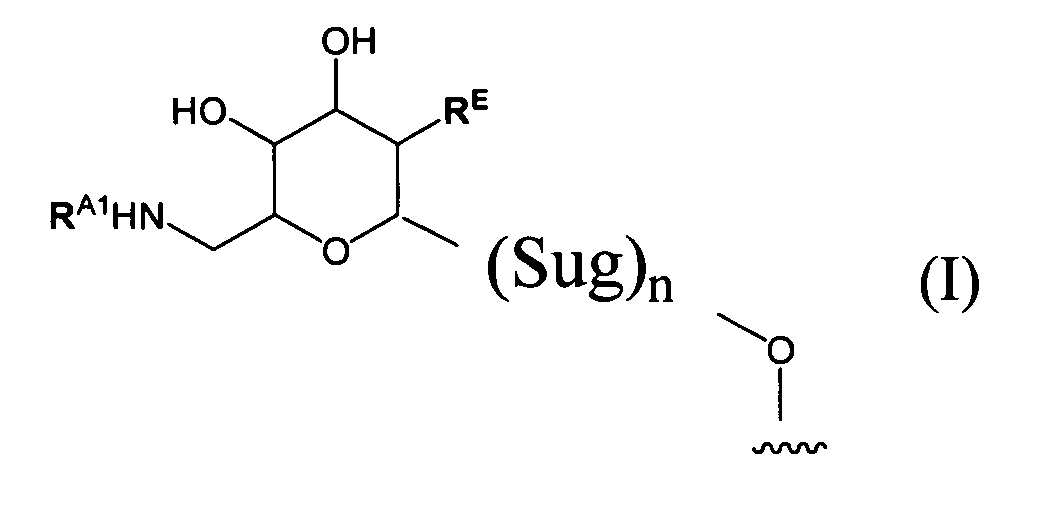
is bound to an aromatic ring of the fourth amino acid residue in the glycopeptide skeleton.
Description
- The present invention relates to glycosylated glycopeptide antibiotic derivatives, a process for producing the same, and their intermediates thereof.
- A glycopeptide antibiotic is an antibiotic having a complicated polycyclic peptide structure which is produced by a variety of microorganisms, and is provided as an antibacterial agent effective for most of Gram-positive bacteria. In recent years, penicillin and cephalosporin resistant bacteria have appeared, and infection with multidrug resistant bacteria and methicillin-resistant Staphylococcus aureus (MRSA) lead to important problems in the medical field. A glycopeptide-based antibiotic such as vancomycin is typically effective for such microorganisms, and vancomycin has become the last resort drug for infection with MRSA and other resistant bacteria. However, particular microorganism such as vancomycin-resistant Enterococci (VRE) have begun to obtain resistance to vancomycin. In addition, recently, Staphylococcus aureus (VRSA) which has acquired VRE resistance has been found out.
- Vancomycin has a structure represented by the following formula:


- Previously, vancomycin, and other glycopeptide antibiotics having these common peptide chain as fundamental skeleton have been variously modified. For example, chloroorienticin B having the following structure (Patent Literature 1:
JP-A No. 1-240196 JP-A No. 2001-163898 


As other glycopeptide antibiotics, for example, the following compounds are known.

However, development of antibacterial agents with novel structure in which antibacterial activity to drug-resistant bacteria, water solubility, distribution, safety and the like are further improved is desired.
On the other hand, as methods of chemically modifying glycopeptide antibiotics, methods using various glycosylase have been reported (e.g., Patent Literature 3, Non-Patent Literatures 1 to 5).
In addition, a glycopeptide compounds in which a sugar side chain consisting of 1 or 2 sugars, to which an aminomethylene-type substituent is bound, is bound to the aromatic ring part of the fourth amino acid residue of the glycopeptide antibiotic are known (e.g., Patent Literatures 4 to 17, Non-Patent Literatures 5 to 17).
Among them, in Non-Patent Literature 11 (Angewandte Chemie, International Edition (2003), 42(38), 4657-4660), a vancomycin derivative in which -CH2 NH2 is bound to galactose at the sugar chain terminal is described, but no compound in which the amino group is further chemically modified is described.
In addition, recent trend of study regarding glycopeptide compounds has been reported (e.g., Non-Patent Literature 18) -
- [Patent Literature 1]
JP-A No. 1-240196 - [Patent Literature 2]
JP-A No. 2001-163898 - [Patent Literature 3]
WO2006003456 - [Patent Literature 4]
US2005239689A1 - [Patent Literature 5]
US2003068669A1 - [Patent Literature 6]
US2004259228A1 - [Patent Literature 7]
US2005266523A1 - [Patent Literature 8]
WO2004019970 - [Patent Literature 9]
WO2001081373 - [Patent Literature 10]
WO2001081372 - [Patent Literature 11]
WO2000069893 - [Patent Literature 12]
WO2000059528 - [Patent Literature 13]
WO2000042067 - [Patent Literature 14]
WO2000004044 - [Patent Literature 15]
WO9303060 - [Patent Literature 16]
EP301785A1 - [Patent Literature 17]
EP273727A1 - [Patent Literature 18]
WO2006057303 - [Non-Patent Literature 1] Journal of the American Chemical Society (2005), 127(30), 10747-10752
- [Non-Patent Literature 2] Proceedings of the National Academy of Sciences of the United States of America (2004), 101(13), 4390-4395
- [Non-Patent Literature 3] Chemistry-An Asian Journal (2006), 1, 445-452
- [Non-Patent Literature 4] Current Opinion in Biotechnology 2005, 16:622-630
- [Non-Patent Literature 5] Nature Biotechnology (2003), 21(12), 1467-1469
- [Non-Patent Literature 6] ACS Chemical Biology (2006), 1(8), 499-504
- [Non-Patent Literature 7] Activity Research (2006), 72(1) 20-33
- [Non-Patent Literature 8] Bioorganic & Medical Chemistry Letters (2005), 15(16), 3801-3805
- [Non-Patent Literature 9] Organic Letters (2005), 7(8), 1513-1515
- [Non-Patent Literature 10] Chemistry & Biology (2005), 12(1), 131-140
- [Non-Patent Literature 11] Angewandte Chemie, International, Edition (2003), 42(38), 4657-4660
- [Non-Patent Literature 12] Journal of Medicinal Chemistry (2003), 46(13), 2755-2764
- [Non-Patent Literature 13] Tetrahedron (2002), 58(32), 6585-6594
- [Non-Patent Literature 14] Bioorganic & Medicinal Chemistry Letters (2002), 12(6), 849-852
- [Non-Patent Literature 15] Chemistry - - A European Journal (2001), 7(17), 3798-3823
- [Non-Patent Literature 16] Journal of the American Chemical Society (2000), 122(50), 12608-12609
- [Non-Patent Literature 17] Journal of Antibiotics (1998), 51(5), 525-527
- [Non-Patent Literature 18] Expert Opinion on Therapeutic Patents (2004) 14(2) 141-173
- The present invention provides novel glycopeptide compounds having antibacterial activities. The present invention provides glycopeptide compounds which are preferably also effective for drug-resistant bacteria (e.g., VRSA, VRE), and are further preferably excellent in water solubility, distribution, safety or the like. Further, the present invention provides a method of glycosylating glycopeptide antibiotics utilizing glycosyltransferase and a process for producing glycopeptide compounds utilizing the same, as well as their intermediates therefor.
- The present inventors have intensively studied and, as a result, succeeded in further glycosylation by performing an enzymatic reaction on a sugar which binds to an aromatic ring of a fourth amino acid residue of a glycopeptide antibiotic such as chloroorienticin B, and the like. The present inventors have succeeded in introducing an amino side chain regioselectively by oxidizing hydroxymethylene at the further glycosylated sugar chain terminal into aldehyde by an enzymatic reaction, or the like, and chemically modifying the aldehyde group.
The greatest characteristic of the glycopeptide compounds of the present invention is in that the compounds have a partial structure including aromatic ring of the fourth amino acid residue of the glycopeptide antibiotic, and two or more connected sugars are bound to the aromatic ring via an ether bond.
In the glycopeptide compound of the present invention, preferably, among two or more connected sugars, a sugar which is bound to an aglycone of a glycopeptide antibiotic is a β-D-glucosyl group and, more preferably, a sugar at the terminal is a β-D-galactosyl group.
In the glycopeptide compounds of the present invention, more preferably, -CH2OH or -COH is bound to the sugar at the terminal and, further preferably, an optionally substituted aminomethylene group formed by chemical modification of them is bound thereto.
Therefore, according to the present invention, various glycopeptide compounds in which a side chain containing the glycosylated sugar on aromatic ring of the fourth amino acid residue of the glycopeptide antibiotics is bound via an ether bond are provided.
The present invention specifically provides the following compounds. - (1) A glycopeptide compound, a pharmaceutically acceptable salt thereof, or a solvate thereof, which is characterized in that a sugar residue (I) represented by the formula:

- n is an integer of 1 to 5;
- Sugs are each independently a monosaccharide, (Sug)n is a divalent sugar residue formed by binding same or different 1 to 5 monosaccharides;
- RA1 is optionally substituted lower alkyl, optionally substituted lower alkenyl, or optionally substituted cycloalkyl; and
- RE is OH or NHAc (Ac is acetyl);
- More particularly, the present invention provides compounds represented by the following (2) to (32).
- (2) The glycopeptide compound, a pharmaceutically acceptable salt thereof, or a solvate thereof according to above (1), wherein the monosaccharide is selected from the group consisting of glucose, galactose, fructose, fucose, mannose, rhamnose, galactosamine, glucosamine, N-acetylgalactosamine, N-acetylglucosamine, vancosamine, epi-vancosamine, glucuronic acid, sialic acid, deoxyglucose, and deoxygalactose.
- (3) The glycopeptide compound, a pharmaceutically acceptable salt thereof, or a solvate thereof according to above (1), wherein the monosaccharide is glucose.
- (4) The glycopeptide compound, a pharmaceutically acceptable salt thereof, or a solvate thereof according to any one of above (1) to (3), wherein n is 1 or 2.
- (5) The glycopeptide compound, a pharmaceutically acceptable salt thereof, or a solvate thereof according to above (1), wherein the monosaccharide is glucose; and n is 1 or 2.
-
- (6) The glycopeptide compound, a pharmaceutically acceptable salt thereof, or a solvate thereof according to above (1), wherein the sugar residue (I) is a sugar residue (I-0) represented by the formula:


- m is an integer of 0 to 4; and
- RA1 and RE are each as defined in above (1).
- (7) The glycopeptide compound, a pharmaceutically acceptable salt thereof, or a solvate thereof according to above (1), wherein the sugar residue (I) is a sugar residue (I-1) represented by the formula:

- m is an integer of 0 to 4; and
- RA1 and RE are each as defined in above (1).
- (8) The glycopeptide compound, a pharmaceutically acceptable salt thereof, or a solvate thereof according to above (1), wherein the sugar residue (I) is a sugar residue (I-2) represented by the formula:

- m is an integer of 0 to 4; and
- RA1 and RE are each as defined in above (1).
-
- (9) The glycopeptide compound, a pharmaceutically acceptable salt thereof, or a solvate thereof according to any one of above (1) to (8), wherein the compound has a partial structure (II) represented by the formula:

- the ring 2, the ring 4 and the ring 6 represent aromatic rings of the second, fourth and sixth amino acid residues of a glycopeptide antibiotic, respectively;
- XA and XB each represent independently hydrogen or halogen; and * represents a binding position with a sugar residue.
- (10) The glycopeptide compound, a pharmaceutically acceptable salt thereof, or a solvate thereof according to above (1), wherein the compound has a partial structure (III) represented by the formula:

- the ring 2, the ring 4 and the ring 6 represent aromatic rings of the second, fourth and sixth amino acid residues of a glycopeptide antibiotic, respectively;
- XA and XB each represent independently hydrogen or halogen; and other symbols are each as defined in above (1).
- (11) The glycopeptide compound, a pharmaceutically acceptable salt thereof, or a solvate thereof according to above (10), wherein the partial structure (III) is a partial structure (III-0) represented by the formula:

- the ring 2, the ring 4 and the ring 6 represent aromatic rings of the second, fourth and sixth amino acid residues of a glycopeptide antibiotic;
- XA and XB each represent independently hydrogen or halogen; and m is an integer of 0 to 4; and RA1 and RE are each as defined in above (1).
- (12) The glycopeptide compound, a pharmaceutically acceptable salt thereof, or a solvate thereof according to above (10), wherein the partial structure (III) is a partial structure (III-1) represented by the formula:

- the ring 2, the ring 4 and the ring 6 represent aromatic rings of the second, fourth and sixth amino acid residue of a glycopeptides antibiotic, respectively;
- XA and XB each represents independently hydrogen or halogen;
- m is an integer of 0 to 4; and
- RA1 and RE are each as defined in above (1).
- (13) The glycopeptide compound, a pharmaceutically acceptable salt thereof, or a solvate thereof according to above (10), wherein the partial structure (III) is a partial structure (III-2) represented by the formula:

- the ring 2, the ring 4 and the ring 6 represent aromatic rings of the second, fourth and sixth amino acid residues of a glycopeptide antibiotic, respectively;
- XA and XB each represent independently hydrogen or halogen;
- m is an integer of 0 to 4; and
- RA1 and RE are each as defined in above (1).
- (14) The compound, a pharmaceutically acceptable salt thereof, or a solvate thereof according to any one of above (1) to (13), wherein the glycopeptide compound is a chloroorienticin B derivative or a vancomycin derivative.
-
- (15) The compound, a pharmaceutically acceptable salt thereof, or a solvate thereof according to above (1), wherein the compound is represented by the formula:

- RF is hydrogen or a sugar residue;
- RB is -OH, -NR5R5' (wherein R5 and R5' are each independently hydrogen, optionally substituted lower alkyl, optionally substituted lower alkyloxy, or optionally substituted amino or amino acid residue) or -OR6 (wherein R6 is optionally substituted lower alkyl (a hetero atom group may intervene in the lower alkyl part));
- RC is hydrogen or optionally substituted alkyl (a hetero atom group may intervene in the lower alkyl part);
- RD is hydrogen or lower alkyl; and
- (16) The compound, a pharmaceutically acceptable salt thereof, or a solvate thereof according to above (15), wherein the compound is represented by the formula:

- m is an integer of 0 to 4; and
- other symbols are each as defined in above (15).
- (17) The compound, a pharmaceutically acceptable salt thereof, or a solvate thereof according to above (16), wherein the compound is represented by the formula:

respective symbols are each as defined in above (16). - (18) The compound, a pharmaceutically acceptable salt thereof, or a solvate thereof according to above (16), wherein the compound is represented by the formula:

respective symbols are each as defined in above (16). -
- (19) The compound, a pharmaceutically acceptable salt thereof, or a solvate thereof according to above (1), wherein the compound is represented by the formula:


- RA2 is hydrogen or optionally substituted lower alkyl
- RB is -OH, -NR5R5' (wherein R5 and R5' are each independently hydrogen, optionally substituted lower alkyl, optionally substituted lower alkyloxy, optionally substituted amino or amino sugar residue) or a -OR6 (wherein R6 is optionally substituted lower alkyl (a hetero atom group may intervene in the lower alkyl part));
- RC is hydrogen or optionally substituted lower alkyl (a hetero atom group may intervene in the lower alkyl part);
- RD is hydrogen or lower alkyl;
- XA and XB are each independently hydrogen or halogen; and other symbols are each as defined in above (1).
- (20) The compound according to above (19), wherein the compound is represented by the formula:
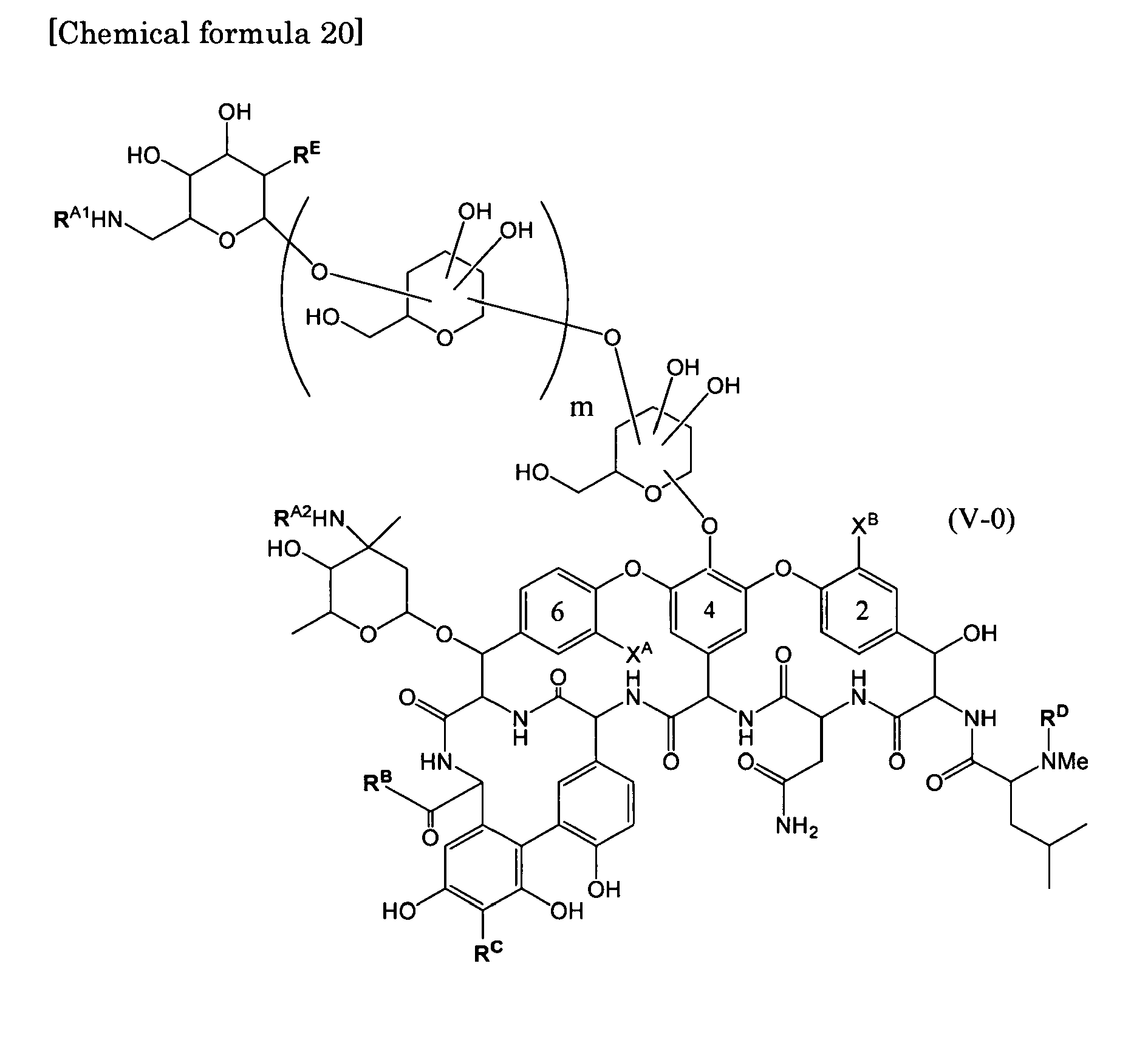
- m is an integer of 0 to 4; and
- other symbols are each as defined in above (19).
- (21) The compound according to above (20), wherein the compound is represented by the formula:


respective symbols are as defined in above (20). - (22) The compound, a pharmaceutically acceptable salt thereof, or a solvate thereof according to above (20), wherein the compound is represented by the formula:

-
- (23) The compound, a pharmaceutically acceptable salt thereof, or a solvate thereof according to above (1), wherein the compound is represented by the formula:


- RB is -OH, -NR5R5' (wherein R5 and R5' are each independently hydrogen, optionally substituted with lower alkyl, optionally substituted lower alkyloxy, or optionally substituted amino or amino sugar residue) or -OR6 (wherein R6 is optionally substituted lower alkyl (a hetero atom group may intervene in the lower alkyl part));
- RC is hydrogen or optionally substituted lower alkyl (a hetero atom group may intervene in the lower alkyl part);
- RD is hydrogen or lower alkyl; and
- XA and XB are each independently hydrogen or halogen; and
- (24) The compound, a pharmaceutically acceptable salt thereof, or a solvate thereof according to above (23), wherein the compound is represented by the formula:

- m is an integer of 0 to 4; and
- other symbols are each as defined in above (23).
- (25) The compound, a pharmaceutically acceptable salt thereof, or a solvate thereof according to above (24), wherein the compound is represented by the formula:

respective symbols are as defined in above (24). - (26) The compound, a pharmaceutically acceptable salt thereof, or a solvate thereof according to above (24), wherein the compound is represented by the formula:


respective symbols are each as defined in above (24). - (27) The compound, a pharmaceutically acceptable salt thereof, or a solvate thereof according to any one of above (6) to (8), (11) to (13), (16) to (18), (20) to (22), and (24) to (26), wherein m is 0 or 1.
- (28) The compound, a pharmaceutically acceptable salt thereof, or a solvate thereof according to any one of above (1) to (27),
wherein RE is OH. - (29) The compound, a pharmaceutically acceptable salt thereof, or a solvate thereof according to any one of above (1) to (28), wherein each substituents in optionally substituted lower alkyl, optionally substituted lower alkenyl, or optionally substituted cycloalkyl, of RA1 are selected from the following Substituent group A.
Substituent group A: optionally substituted aryl, optionally substituted heteroaryl, optionally substituted heterocycle, optionally substituted aralkylthio, optionally substituted heteroaralkylthio, optionally substituted cycloalkyl, optionally substituted lower alkyloxy, optionally substituted aralkyloxy, optionally substituted aryloxy, optionally substituted arylsulfonylamino, and optionally substituted amino - (30) The compound, a pharmaceutically acceptable salt thereof, or a solvate thereof according to above (29), wherein each substituents of "optionally substituted" groups in Substituent group A of above (29) are selected from the following Substituent group B.
Substituent group B: optionally substituted arylaminocarbonylamino, optionally substituted arylcarbonylamino, oxo, halogen, optionally substituted aryl, optionally substituted aryloxy, optionally substituted arylthio, optionally substituted arylsulfonyl, optionally substituted lower alkyl, optionally substituted aralkyl, optionally substituted amino, optionally substituted aralkylcarbonylamino, optionally substituted aralkylaminocarbonyl, optionally substituted aralkylsulfinyl, optionally substituted arylsulfonylamino, optionally substituted aralkylthio, halo lower alkyl, halo lower alkyloxy, optionally substituted heteroaryl, optionally substituted heteroaryloxy, and optionally substituted aryl lower alkenyl - (30') The compound, a pharmaceutically acceptable salt thereof, or a solvate thereof according to above (29), wherein each substituent of "optionally substituted" groups in Substituent group A of above (29) is selected from the following Substituent group B.
Substituent group B: optionally substituted arylaminocarbonylamino, optionally substituted arylaminocarbonyl, optionally substituted arylcarbonyl, optionally substituted arylcarbonylamino, optionally substituted arylcarbonylaminoalkyl, oxo, halogen, optionally substituted aryl, optionally substituted aryloxy, optionally substituted arylthio, optionally substituted arylamino, optionally substituted arylaminoalkyl, optionally substituted arylaminocarbonylalkyl, optionally substituted arylsulfonyl, optionally substituted lower alkyl, optionally substituted aralkyl, optionally substituted amino, optionally substituted aralkylcarbonylamino, optionally substituted aralkylamino, optionally substituted aralkylaminocarbonyl, optionally substituted aralkylsulfinyl, optionally substituted arylsulfonylamino, optionally substituted arylaminosulfonyl, optionally substituted aralkylthio, halo lower alkyl, lower alkyloxy, lower alkylamino, halo lower alkyloxy, optionally substituted heteroaryl, optionally substituted heteroarylalkyl, optionally substituted heteroarylcarbonyl, optionally substituted heteroaryloxy, optionally substituted heteroarylthio, optionally substituted aryl lower alkenyl, optionally substituted heteroaryl lower alkenyl, optionally substituted cycloalkyl, optionally substituted cycloalkyloxy, optionally substituted cycloalkylthio, optionally substituted cycloalkylaminocarbonyl, optionally substituted cycloalkyl lower alkenyl, optionally substituted cycloalkylsulfonyl, optionally substituted cycloalkylaminocarbonylamino, optionally substituted cycloalkylaminoalkyl, optionally substituted cycloalkyl lower alkylamino, optionally substituted cycloalkylamino, optionally substituted cycloalkyl lower alkyl, optionally substituted cycloalkylcarbonyl, optionally substituted cycloalkyl lower alkylcarbonylamino, optionally substituted cycloalkylcarbonylamino, optionally substituted cycloalkylcarbonylaminoalkyl, optionally substituted cycloalkyl lower alkylaminocarbonyl, optionally substituted cycloalkylsulfonylamino, optionally substituted cycloalkylaminocarbonylalkyl, and optionally substituted cycloalkylaminosulfonyl - (31) The compound, a pharmaceutically acceptable salt thereof, or a solvate thereof according to above (30) or (30'), wherein each substituents of "optionally substituted" groups in Substituent group B of above (30) or (30') are selected from the following Substituent group C.
Substituent group C: lower alkyl, lower alkyloxy, lower alkylsulfonyl, nitro, aralkyloxy, halogen, cyano, halo lower alkyl, halo lower alkyloxy, and di-lower alkylamino - (32) The compound, a pharmaceutically acceptable salt thereof, or a solvate thereof according to any one of above (15) to (31), and (30'),
- In addition, the present invention provides a process for producing the compounds described in above (1) to (32), and (30'), shown in the following (33) to (38). (33) A process for producing the glycopeptide compound, a pharmaceutically acceptable salt thereof, or a solvate thereof as defined in above (6) including the following steps:
- (step 1)
a step converting a sugar residue (VI) represented by the formula:

- RE is OH or NHAc; and
- m is an integer of 0 to 2;
wherein the aromatic ring of the fourth amino acid residue is substituted with the sugar residue (VI). - (step 2)
a step converting the hydroxymethylene part in the sugar at the end of the group (VII) into a group (VIII) represented by the formula:
respective symbols are as defined above;
by an oxidation reaction; and - (step 3)
a step converting the group (VIII) into a sugar residue (I-0) represented by the formula:
respective symbols are as defined above
by reductive amination reaction of the aldehyde group of the group (VIII) with a compound (A) represented by the formula RA1NH2. -
- (34) A process for producing the compound (IV-0), a pharmaceutically acceptable salt thereof or a solvate thereof as defined in above (16) represented by the formula:


respective symbols are as defined below,
including the following steps:- (step 1)
a step of reacting 1+m (m is an integer of 0 to 2) times of glycosylating reaction in the presence of glycosyltransferase and a sugar donor using a compound (VII-1) as a raw material represented by the formula:

respective symbols are as defined in above (15),
to obtain a compound (VIII-1), a salt thereof, or a solvate thereof represented by the formula:
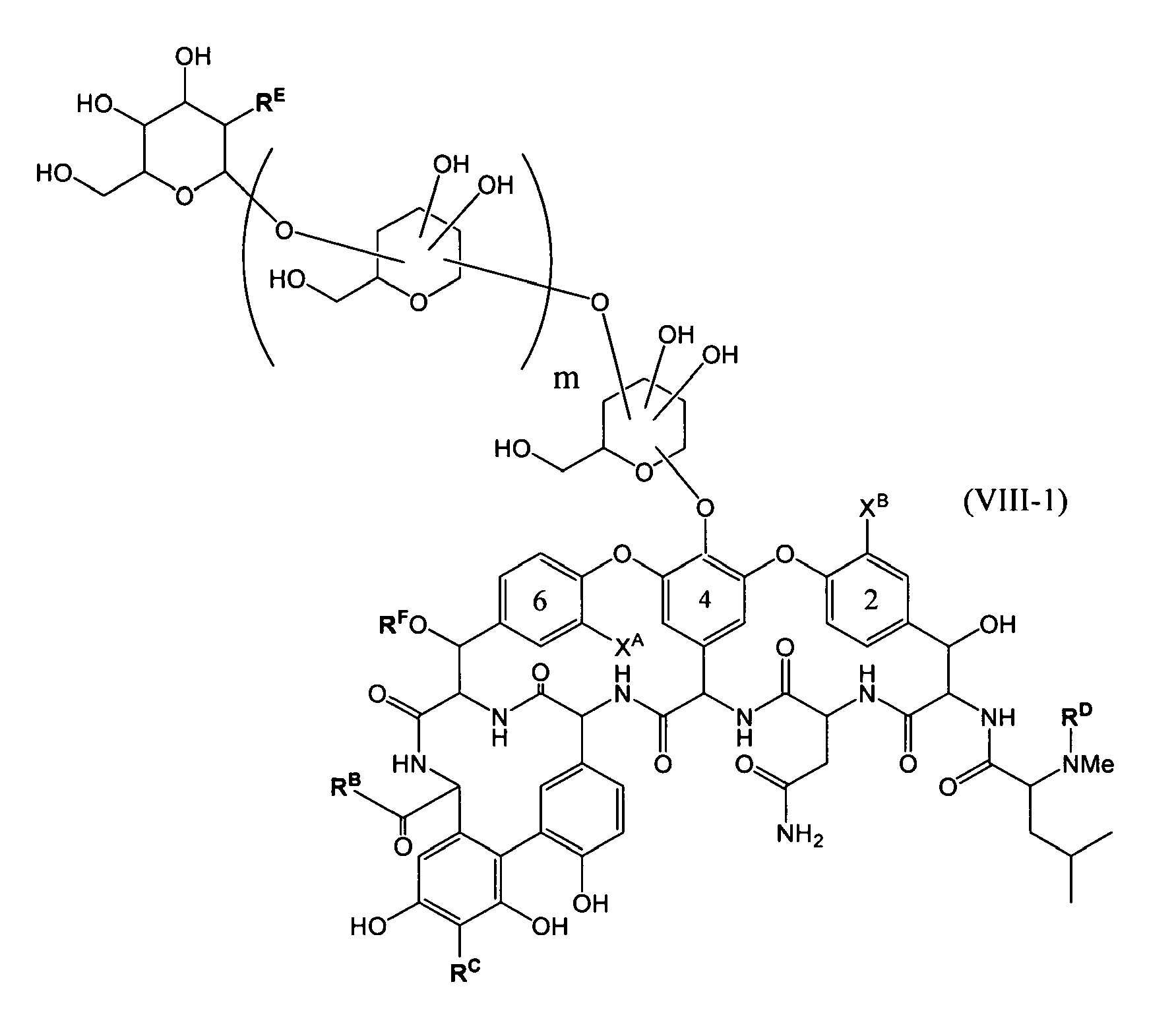
- RE is OH or NHAc; and
- other symbols are as defined above,
- (step 2)
a step of subjecting the compound (VIII-1), a salt thereof, or a solvate thereof to an oxidation reaction to obtain a compound (IX-1), a salt thereof, or a solvate thereof represented by the formula:

respective symbols are as defined above, and - (step 3)
a step of subjecting the compound (IX-1), a salt thereof, or a solvate thereof to a reductive animation reaction with a compound (A) represented by the formula: RA1NH2.
- (step 1)
-
- (35) A process for producing a compound (IV-1), a pharmaceutically acceptable salt, or a solvate thereof, as defined in above (17) represented by the formula:
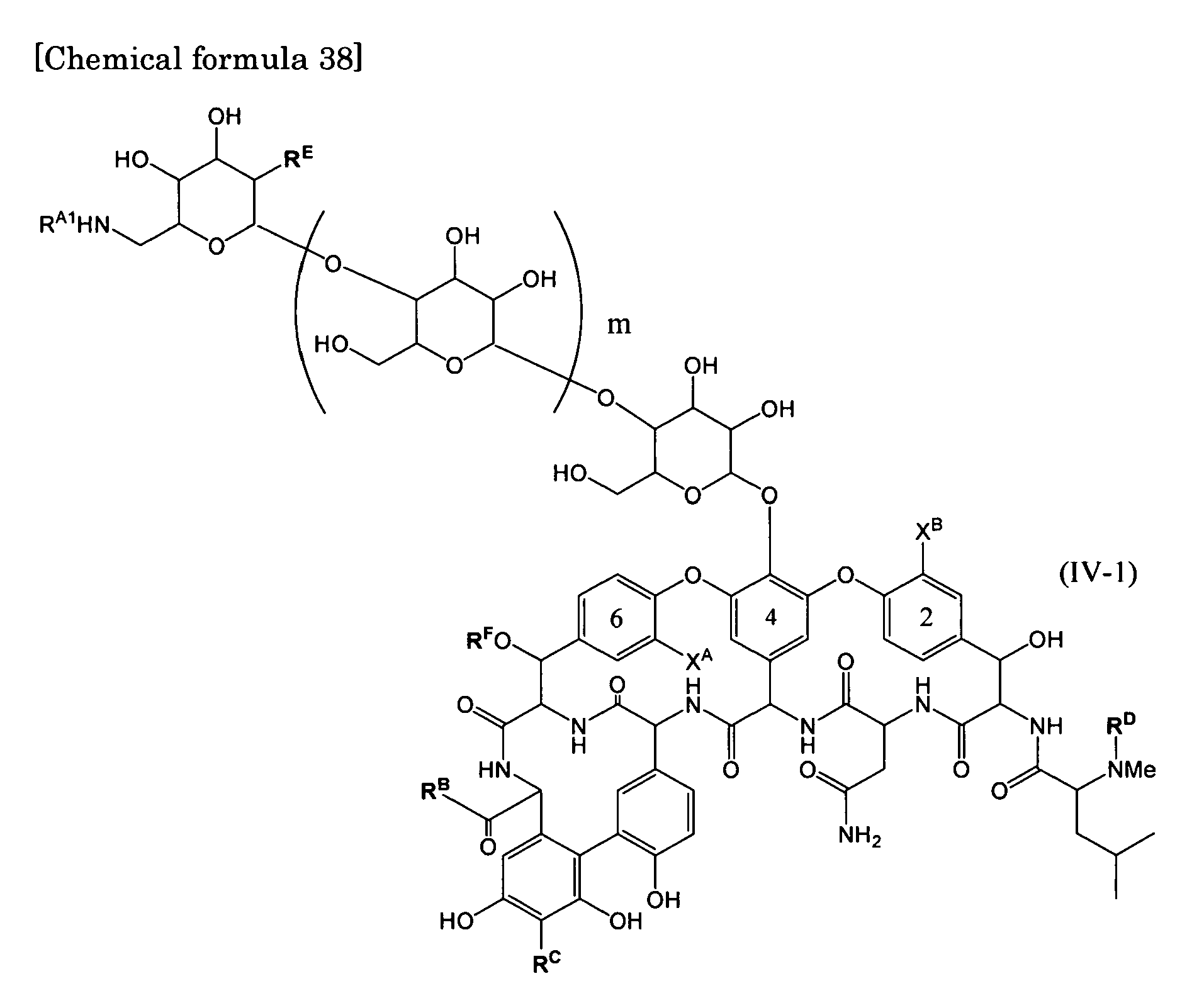
respective symbols are as defined below,
including the following steps:- (step 1)
a step of reacting 1+m (m is an integer of 0 to 2) times of glycosylating reaction in the presence of glycosyltransferase and a sugar donor using a compound (VII-1) as a raw material represented by the formula:

respective symbols are as defined in above (15),
to obtain a compound (VIII-2), a salt thereof, or a solvate thereof, represented by the formula:

RE is OH or NHAc; and other symbols are as defined above, - (step 2)
a step of subjecting the compound (VIII-2), a salt thereof, or a solvate thereof to an oxidation reaction to obtain a compound (IX-2), a salt thereof, or a solvate thereof represented by the formula:

respective symbols are as defined above; and - (step 3)
a step of subjecting the compound (IX-2), a salt thereof, or a solvate thereof to a reductive amination reaction with a compound (A) represented by the formula: RA1NH2.
- (step 1)
-
- (36) A process for producing a compound (IV-2), a pharmaceutically acceptable salt thereof, or a solvate thereof, as defined in above (18) represented by the formula:

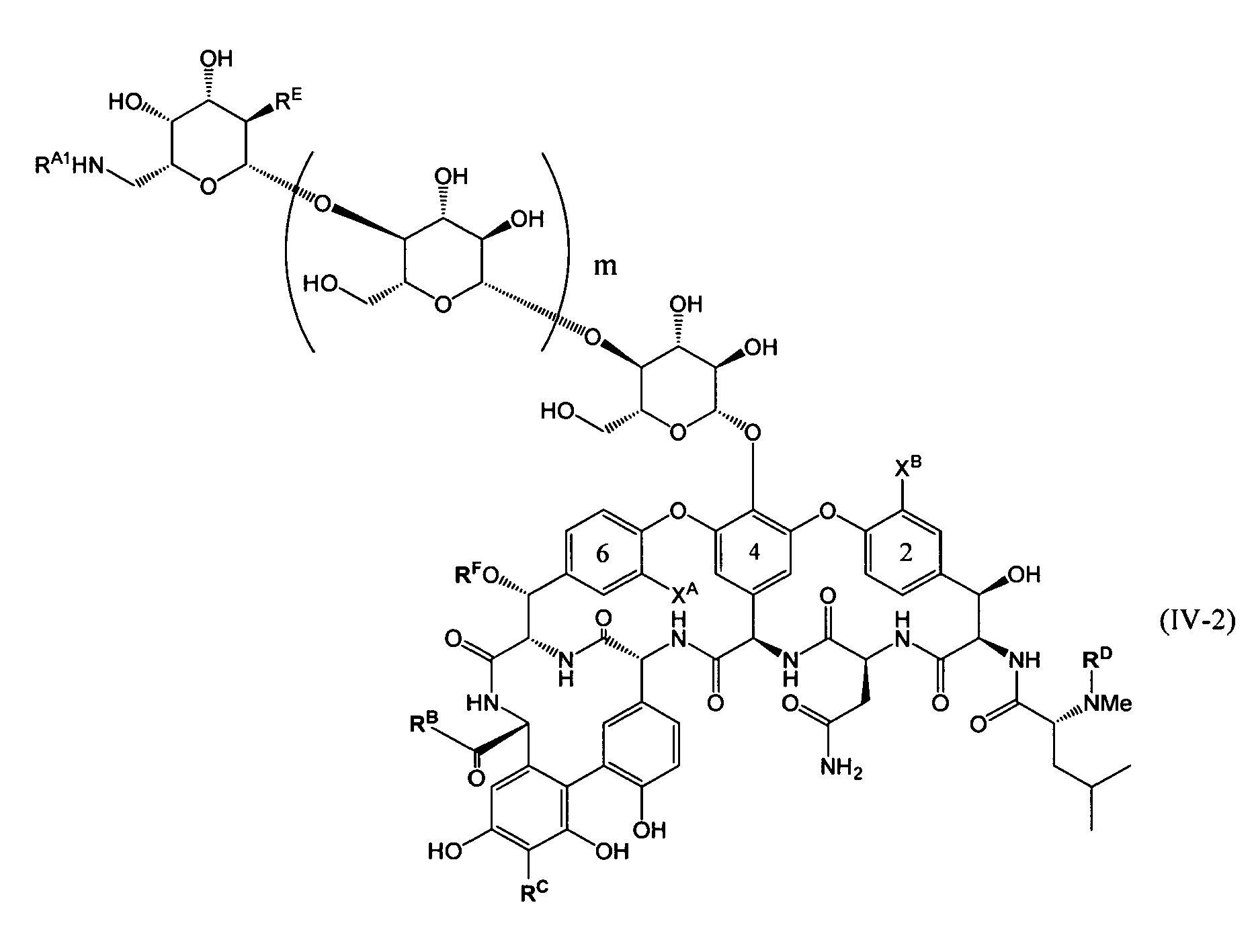
respective symbols are as defined below;
including the following steps:- (step 1)
a step of reacting 1+m (m is an integer of 0 to 2) times of glycosylating reaction in the presence of glycosyltransferase and a sugar donor using a compound (VII-2) as a raw material represented by the formula:

respective symbols are as defined in above (15),
to obtain a compound (VIII-3), a salt thereof, or a solvate thereof represented by the formula:

- RE is OH or NHAc; and
- other symbols are as defined above,
- (step 2)
a step of subjecting the compound (VIII-3), a salt thereof, or a solvate thereof to an oxidation reaction to obtain a compound (IX-3), a salt thereof, or a solvate thereof represented by the formula:

respective symbols are as defined above, and - (step 3)
a step of subjecting the compound (IX-3), a salt thereof, or a solvate thereof to a reductive amination reaction with a compound (A) represented by the formula: RA1NH2.
- (step 1)
-
- (37) The process according to any one of above (33) to (36), wherein
in the step 1, the glycosyltransferase is galactosyltransferase; a sugar of the sugar donor is the same or different 1 to 3 sugars selected from glucose, galactose, N-acetylgalactosamine, deoxyglucose, and deoxygalactose; and, in the step 2, the oxidation reaction is performed with galactose oxidase. - (38) The process according to any one of above (33) to (36), wherein in the step 1, the glycosyltransferase is galactosyltransferase; and,
after addition of glucose by an optional first glycosylating reaction, galactose is further added by a second glycosylating reaction; and,
in the step 2, the oxidation reaction is performed with galactose oxidase. - Further, the present invention also provides compounds shown by the following above (39) and (40), which are useful as an intermediate for producing the compounds as defined in any one of above (1) to (32), and (30').
- (39) The compound (VIII-1), a salt thereof, or a solvate thereof as defined in above (34).
- (40) The compound (IX-1), a salt thereof, or a solvate thereof as defined in (34).
- The present invention further provides following dehydrated material of a sugar at the side chain terminal.
- (41) A compound, a pharmaceutically acceptable salt thereof, or a solvate thereof represented by the formula:


respective symbols are each as defined in above (16). - (42) A compound, a pharmaceutically acceptable salt thereof, or a solvate thereof represented by the formula:


respective symbols are as defined above. - (43) A pharmaceutical composition containing the compound as defined in any one of above (1) to (32), (30'), and (39) to (42), or a pharmaceutically acceptable salt thereof, or a solvate thereof.
- The glycopeptide antibiotic derivative of the present invention, a pharmaceutically acceptable salt thereof, or a solvate thereof exhibits an antibacterial activity in an In Vitro and/or In Vivo test against various bacterium such as Staphylococcus including MRSA, Streptococcus, Pneumococcus, Enterococcus, and the like. Particularly, the compound of the present invention is also effective for vancomycin-resistant bacterium derived therefrom and, particularly, for vancomycin-resistant Enterococcus (VRE) and vancomycin-resistant Staphylococcus aureus (VRSA). Therefore, the compound of the present invention is useful for treating or preventing various bacterial infections such as complicated skin and skin tissue infection, meningitis, sepsis, pneumonia, arthritis, peritonitis, bronchitis, empyema, endocarditis, catheter bloodstream infection and the like. In addition, the more preferable compound of present invention has high water solubility, is better in disposition, and/or is safe in toxicity (renal toxicity, hepatic toxicity, histamine freeing activity, hERG channel inhibition, antigenicity, etc.).
- Herein, the "glycopeptide antibiotic" means an arbitrary glycopeptide compound having a peptide chain consisting of seven amino acids including an aromatic amino acid as a common fundamental skeleton, and a derivative thereof, represented by vancomycin and chloroorienticins. In addition, the "glycopeptide skeleton" means a cyclic fundamental structure consisting of the peptide chain which is commonly possessed by glycopeptide antibiotics. Examples of the known glycopeptide antibiotics are disclosed in
JP-A No. 61-251699 JP-A No. 7-258289 WO 96/30401 WO 00/39156 JP-A No. 2000-302687 WO 2004/44222 US Patent Nos. 4,639,433 ;4,643,987 ;4,497,802 ;4,698,327 ;5,591,714 ;5,840,684 ; and5,843,889 ;EP0802199 ;EP0801075 ;EP0667353 ;WO 97/28812 WO 97/38702 WO 98/52589 WO 98/52592 - More specific examples of the glycopeptide antibiotics include vancomycin, teicoplanin, ristomycin, ristocetin, actaplanin, actinoidin, ardacin, avoparcin, azureomycin, balhimycin, chloroorienticin A, chloroorienticin B, chloropolyspoin, decaplanin, N-demethylvancomycin, eremomycin, galacardin, helvecardin, izupeptin, kibdelin, mannopeptin, orienticin, parvodicin, synmonicin, oritavancin, telavancin (TD-6424), dalbavancin, and A-40926.
- In the present invention, the "glycopeptide skeleton" preferably has the following partial structure (II) as an aglycone part,

XA and XB are preferably both halogen, further preferably Cl. - Further preferably, the glycopeptides skeleton has the following partial structure (II-0):

- Further preferably, the glycopeptide skeleton has the following partial structure (II-1):


- Further preferably, the glycopeptide skeleton has the following partial structure (II-2):

The aglycone part may be optionally substituted with a substituent which is well-known to a person skilled in the art or can be synthesized by a person skilled in the art. For example, a C-terminal, an N-terminal, a resorcinol part or the like in a vancomycin derivative, a teicoplanin derivative, a chloroorienticin B derivative or the like may be optionally chemically modified. In addition, a sugar may be bound to a part other than carbon represented by *. - Further preferably, the glycopeptide skeleton has the following partial structure (IV'):
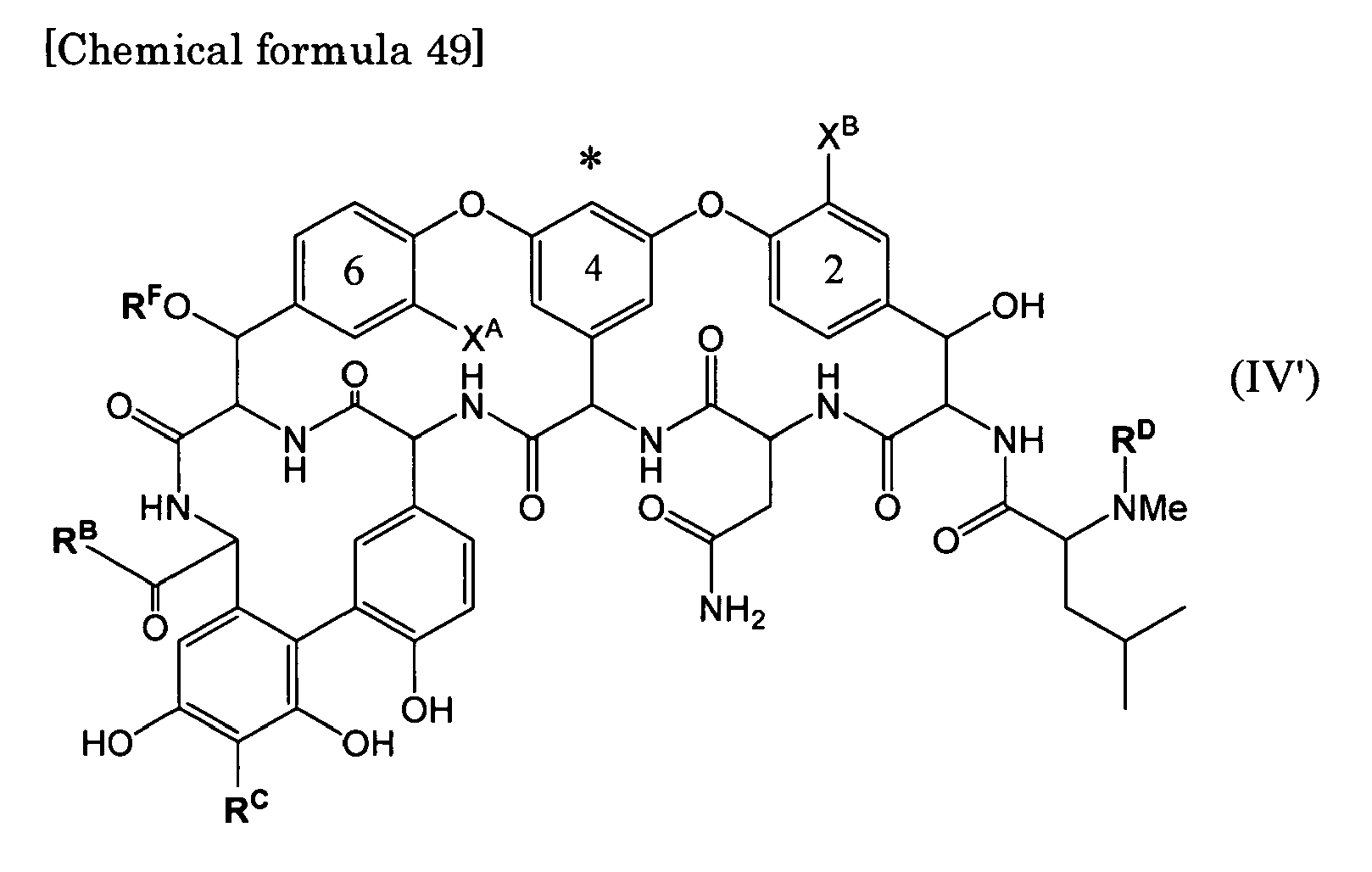
- RB is -OH, -NR5R5' (wherein R5 and R5' are each independently hydrogen, optionally substituted lower alkyl, optionally substituted lower alkyloxy, optionally substituted amino or amino sugar residue) or -OR6 (wherein OR6 is optionally substituted lower alkyl (a hetero atom group may intervene in the lower alkyl part));
- RC is hydrogen or optionally substituted lower alkyl (a hetero atom group may intervene in the lower alkyl part);
- RD is hydrogen or lower alkyl;
- other symbols are as defined above; and
- RF is preferably a sugar residue, more preferably a sugar residue represented by the formula:


- RA2 is preferably hydrogen; or lower alkyl optionally substituted with optionally substituted aryl, optionally substituted heteroaryl, or optionally substituted heterocycle or hydroxyl. As a substituent of the "optionally substituted aryl", the "optionally substituted heteroaryl", or the "optionally substituted heterocycle", arylcarbonylamino optionally substituted with halo lower alkyloxy is preferable. RA2 is more preferably hydrogen).
- RB is preferably -OH, or -NHR5 (wherein R5 is lower alkyl optionally substituted with hydroxyl or dialkylamino, lower alkyloxy optionally substituted with lower alkyloxy, or lower alkylamino). More preferably, RB is -OH.
- RC is preferably hydrogen, or lower alkyl optionally substituted with optionally substituted amino. As a substituent of the "optionally substituted amino", SO3H, hydroxy, or lower alky optionally substituted with tri-lower alkylammonium; or heteroaralkyl is preferable. RC is more preferably hydrogen.
- RD is preferably hydrogen.
- Further preferably, the glycopeptide skeleton has the following partial structure (IV"):

- The present compound has an aglycone represented by the partial structure. The compound is a glycopeptide compound in which, further, various sugar residues are bound to the aromatic ring of the fourth amino acid residue in the glycopeptide skeleton. The sugar residue is represented by the following structure:

- n is an integer of 1 to 5;
- Sugs are each independently a monosaccharide, (Sug)n is a divalent sugar residue formed by binding same or different 1 to 5 monosaccharides;
- RA1 is optionally substituted lower alkyl, optionally substituted lower alkenyl, or optionally substituted cycloalkyl; and
- RE is OH or NHAc (Ac is acetyl)).
- n is preferably 1 or 2.
- Sug is preferably glucose, galactose, fructose, fucose, mannose, rhamnose, galactosamine, glucosamine, N-acetylgalactosamine, N-acetylglucosamine, vancosamine, epi-vancosamine, glucuronic acid, sialic acid, deoxyglucose, or deoxygalactose. More preferable is glucose (e.g., β-D-glucose) or galactose (e.g., β-D-galactose).
- When n is 1, Sug is further preferably glucose (e.g., β-D-glucose).
- When n is 2, it is particularly preferable that two Sugs are glucose (e.g., β-D-glucose) at the same time.
- RA1 is preferably optionally substituted lower alkyl, or optionally substituted cycloalkyl, more preferably optionally substituted lower alkyl.
- RE is preferably OH.
- The sugar residue (I) is preferably the following sugar residue (I-0):
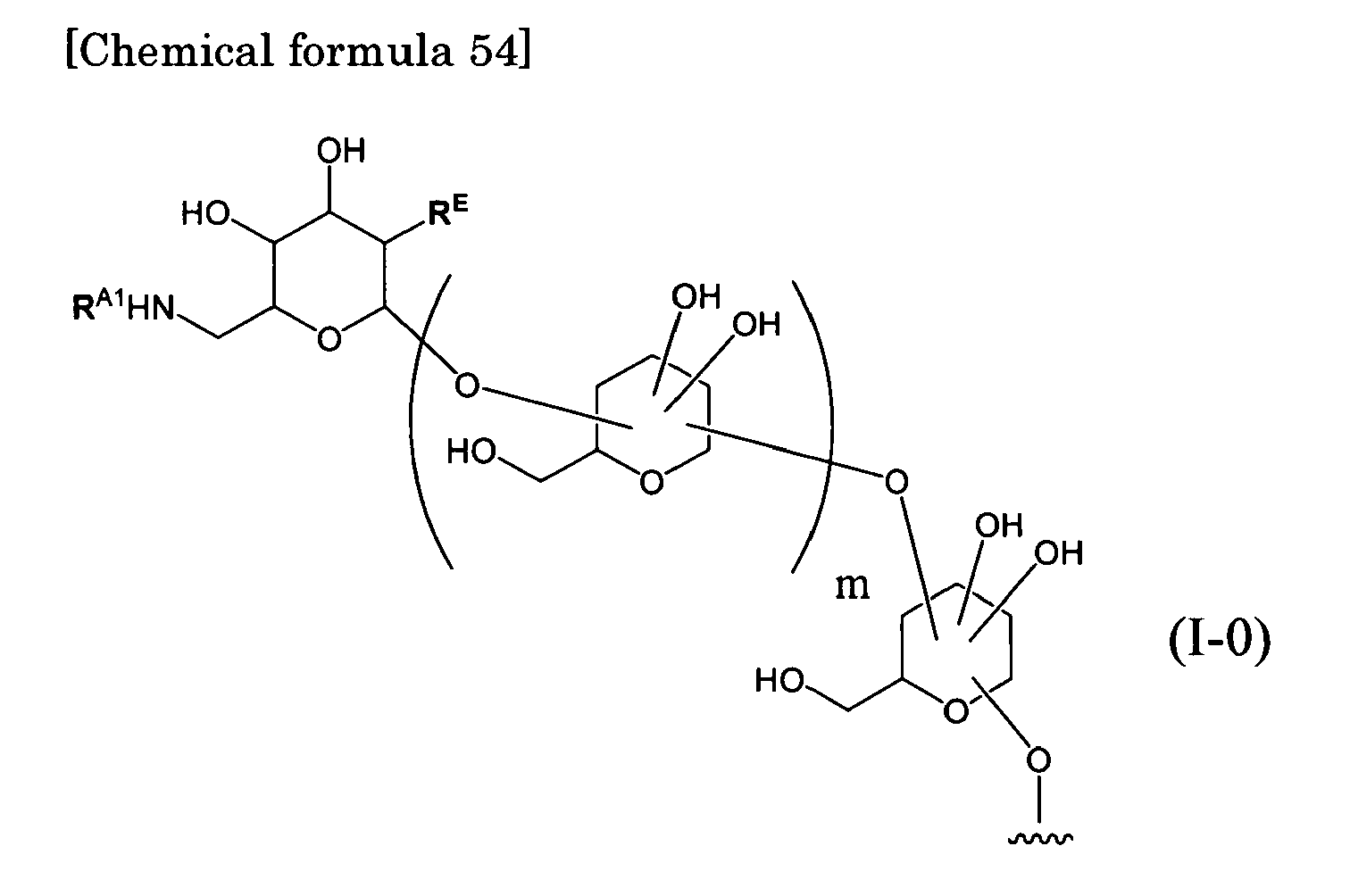
- m is an integer of 0 to 4; and
- RA1 and RE are each as defined above).
- In the formula (I-0), positions of two hydroxyl groups which bind to each monosaccharide other than the terminal sugar are not particularly limited, but each hydroxyl group is preferably bound to the 2-position and the 3-position of one monosaccharide. In addition, the binding manner of two adjacent monosaccharides is not particularly limited, but monosaccharides are preferably bound to the 1-position and the 4-position. In addition, the binding position of the sugar which binds to an aglycone part is also not particularly limited, but the sugar preferably forms a glycoside bond with an aglycone at the 1-position of the monosaccharide.
- m is preferably 0 or 1.
- The sugar residue (I-0) is preferably the following sugar residue (I-1):

- A monosaccharide adjacent to an aglycone is preferably glucose (e.g., β-D-glucose).
- A monosaccharide situated at the terminal is preferably a monosaccharide in which the 6-positional hydroxyl of galactose or N-acetylgalactosamine is substituted with optionally substituted amino. More preferable is a monosaccharide in which the 6-positional hydroxyl of galactose (e.g., β-D-galactose) is substituted with optionally substituted amino.
- A monosaccharide constituting other sugar residue is preferably glucose or galactose, more preferably glucose (e.g., β-D-glucose).
- The sugar residue (I-1) is preferably the following sugar residue (I-2):

In the glycopeptide compound of the present invention, the sugar residue exemplified above is bound to carbon represented by * of the aglycone exemplified above. - The present compound preferably has the following partial structure (III):

- The partial structure (III) is preferably the following partial structure (III-0):

- The partial structure (III-0) is preferably the following partial structure (III-1):

- The partial structure (III-1) is preferably the following structure (III-2):


- The compound (X-1) is preferably the following compound (X-2):


further preferably a compound (X-3):

- The compound (XI-1) is preferably the following compound (XI-2):


further preferably a compound (XI-3):

- The present compound further preferably includes a structure in which the sugar residue (I), (I-0), (I-1) or (I-2) is bound to the partial structure (II-0).
The present compound further preferably includes a structure in which the sugar residue (I), (I-0), (I-1) or (I-2) is bound to the partial structure (II-1).
The present compound further preferably includes a structure in which the sugar residue (I), (I-0), (I-1) or (I-2) is bound to the partial structure (II-2).
The present compound further preferably includes a structure in which the sugar residue (I), (I-0), (I-1) or (I-2) is bound to the partial structure (IV').
The present compound further preferably includes a structure in which the sugar residue (I), (I-0), (I-1) or (I-2) is bound to the partial structure (IV"). - In addition, the compounds (IV-0) and (X-1), the compounds (IV-1) and (X-2), the compounds (IV-2) and (X-3), the compounds (IX-1) and (XI-1), the compounds (IX-2) and (XI-2), as well as the compounds (IX-3) and (XI-3) may be each a composition consisting of the mixture.
- As used herein, the "sugar residue" means a remaining part when one OH is removed from a monosaccharide, or a polysaccharide in which the same or different plural monosaccharides are connected in straight or branched manner.
As used herein, as the "monosaccharide", glucose, galactose, fructose, fucose, mannose, rhamnose, galactosamine, glucosamine, N-acetylgalactosamine, N-acetylglucosamine, vancosamine, epi-vancosamine, glucuronic acid, sialic acid, deoxyglucose, and deoxygalactose are preferably. As a monosaccharide constituting a root part of a sugar residue which binds to the aromatic ring of the fourth amino acid residue of a glycopeptide skeleton, glucose (e.g., β-D-glucose) is particularly preferable. As a monosaccharide constituting the terminal part of a sugar residue which binds to the aromatic ring of the fourth amino acid residue of a glycopeptide skeleton, galactose or N-acetylgalactosamine is more preferable. Particularly, galactose (e.g., β-D-galactose) is preferable.
As used herein, the "amino sugar residue" expresses the "sugar residue" having an amino group or a substituted amino group. Examples of the representative amino sugar residue include L-vancosaminyl, 3-desmethyl-vancosaminyl, 3-epi-vancosaminyl, 4-epi-vancosaminyl, 4-keto-vancosaminyl, acosaminyl, actinosaminyl, daunosaminyl, 3-epi-daunosaminyl, ristosaminyl, N-methyl-D-glucaminyl, N-acetyl-D-glucosamyl, or N-acyl-D-glucosamyl. Actinosaminyl, acosaminyl, 4-epi-vancosaminyl, 4-keto-vancosaminyl, ristosaminyl, or vancosaminyl is preferable. Particularly, L-4-epi-vancosaminyl is preferable. - As used herein, the term "lower alkyl" which is used alone or in combination with other terms includes straight or branched monovalent hydrocarbon group, having 1 to 15, preferably 1 to 10 carbon atoms. Examples include methyl, ethyl, n-propyl, isopropyl, n-butyl, isobutyl, sec-butyl, t-butyl, n-pentyl, isopentyl, neo-pentyl, n-hexyl, isohexyl, n-heptyl, n-octyl and the like. More preferably, examples include C1-C6 alkyl. Further preferably, examples include C1-C3 alkyl.
- As used herein, the "lower alkenyl" which is used alone or in combination with other terms includes straight or branched monovalent hydrocarbon group having 2 to 15, preferably 2 to 10 carbon atoms, and one or two or more double bonds. Examples include vinyl, allyl, 1-propenyl, 2-propenyl, crotonyl, isopentenyl, various butenyl isomers and the like. Preferably, examples include C2-C6 alkenyl. Preferably, a double bond exists between the 1-positional and the 2-positional carbon atoms. Further preferably, examples include C2-C4 alkenyl.
- As used herein, examples of the "lower alkyloxy" include methyloxy, ethyloxy, n-propyloxy, isopropyloxy, n-butyloxy, isobutyloxy, s-butyloxy, t-butyloxy, n-pentyloxy, n-hexyloxy and the like. Preferably, examples include C1-C6 alkyloxy. Further preferably, examples include C1-C3 alkyloxy.
As used herein, the "cycloalkyl" which is used alone or in combination with other terms includes cycloalkyl having 3 to 8 carbon atoms. Examples include cyclopropyl, cyclobutyl, cyclopentyl, cyclohexyl, cycloheptyl, and cyclooctyl. Preferably, examples include C3-C6 cycloalkyl. These may be cross-linked via 1 to 3 carbon atoms between two carbon atoms which constitute ring and are not adjacent.
As cycloalkyl in RA1, cyclopropyl and cyclopentyl are particularly preferable.
As cycloalkyl in the substituent group A, cross-linked cyclohexyl is preferable. - As used herein, the "aryl" which is used alone or in combination with other terms includes monocyclic or condensed cyclic aromatic hydrocarbon group having 6 to 14 carbon numbers. Examples include phenyl, 1-naphthyl, 2-naphthyl, anthryl and the like. Preferably, examples include phenyl, 1-naphthyl, and 2-naphtyl. Further preferably, examples include phenyl, and 2-naphthyl.
- As used herein, the "heteroaryl" which is used alone or in combination with other terms means, for example, monocyclic aromatic heterocyclic group and condensed aromatic heterocyclic group containing hetero atom selected from nitrogen atom, sulfur atom and oxygen atom in the ring. The monocyclic aromatic heterocyclic group means group optionally having bond at a replaceable optional position, which is derived from 5- to 8- membered aromatic ring optionally containing 1 to 4 of oxygen atom, sulfur atom and/or nitrogen atom in the ring. The condensed aromatic heterocyclic group means group optionally having bond at a replaceable optional position, in which 5- to 8-membered aromatic ring optionally containing 1 to 4 of oxygen atom, sulfur atom, and/or nitrogen atom in the ring is condensed with 1 to 4 of 5- to 8-membered aromatic carbocycles or other 5- to 8-membered aromatic heterocycles.
- Examples of the specific "heteroaryl" include furyl (e.g., 2-furyl, 3-furyl), thienyl (e.g., 2-thienyl, 3-thienyl), pyrrolyl (e.g., 1-pyrrolyl, 2-pyrrolyl, 3-pyrrolyl), imidazolyl (e.g., 1-imidazolyl, 2-imidazolyl, 4-imidazolyl), pyrazolyl (e.g., 1-pyrazolyl, 3-pyrazolyl, 4-pyrazolyl), triazolyl (e.g., 1,2,4-triazol-1-yl, 1,2,4-triazol-3-yl, 1,2,4-triazol-4-yl), tetrazolyl (e.g., 1-tetrazolyl, 2-tetrazolyl, 5-tetrazolyl), oxazolyl (e.g., 2-oxazolyl, 4-oxazolyl, 5-oxazolyl), isoxazolyl (e.g., 3-isoxazolyl, 4-isoxazolyl, 5-isoxazolyl), thiazolyl (e.g., 2-thiazolyl, 4-thiazolyl, 5-thiazolyl), thiadiazolyl , isothiazolyl (e.g., 3-isothiazolyl, 4-isothiazolyl, 5-isothiazolyl), pyridyl (e.g., 2-pyridyl, 3-pyridyl, 4-pyridyl), pyridazinyl (e.g., 3-pyridazinyl, 4-pyridazinyl), pyrimidinyl (e.g., 2-pyrimidinyl, 4-pyrimidinyl, 5-pyrimidinyl), furazanyl (e.g., 3-furazanyl),pyrazinyl (e.g., 2-pyrazinyl), oxadiazolyl (e.g., 1,3,4-oxadiazol-2-yl), benzofuryl (e.g., 2-benzo[b]furyl, 3-benzo[b]furyl, 4-benzo[b]furyl, 5-benzo[b]furyl, 6-benzo[b]furyl, 7-benzo[b]furyl), benzothienyl (e.g., 2-benzo[b]thienyl, 3-benzo[b]thienyl, 4-benzo[b]thienyl, 6-benzo[b]thienyl, 7-benzo[b]thienyl), benzimidazolyl (e.g., 1-benzimidazolyl, 2-benzimidazolyl, 4-benzimidazolyl, 5-benzimidazolyl), dibenzofuryl, benzoxazolyl, quinoxalyl (e.g., 2-quinoxalinyl, 5-quinoxalinyl, 6-quinoxalinyl), cinnolinyl (e.g., 3-cinnolinyl, 4-cinnolinyl, 5-cinnolinyl, 6-cinnolinyl, 7-cinnolinyl, 8-cinnolinyl), quinazolyl (e.g., 2-quinazolinyl, 4-quinazolinyl, 5-quinazolinyl, 6-quinazolinyl, 7-quinazolinyl, 8-quinazolinyl), quinolyl (e.g., 2-quinolyl, 3-quinolyl, 4-quinolyl, 5-quinolyl, 6-quinolyl, 7-quinolyl, 8-quinolyl), phthalazinyl (e.g., 1-phthalazinyl, 5-phthalazinyl, 6-phthalazinyl), isoquinolyl (e.g., 1-isoquinolyl, 3-isoquinolyl, 4-isoquinolyl, 5-isoquinolyl, 6-isoquinolyl, 7-isoquinolyl, 8-isoquinolyl), puryl, pteridinyl (e.g., 2-pteridinyl, 4-pteridinyl, 6-pteridinyl, 7-pteridinyl), carbazolyl, phenanthridinyl, acridinyl (e.g., 1-acridinyl, 2-acridinyl, 3-acridinyl, 4-acridinyl, 9-acridinyl), indolyl (e.g., 1-indolyl, 2-indolyl, 3-indolyl, 4-indolyl, 5-indolyl, 6-indolyl, 7-indolyl), isoindolyl, phenazinyl (e.g., 1-phenazinyl, 2-phenazinyl) or phenothiazinyl (e.g., 1-phenothiazinyl, 2-phenothiazinyl, 3-phenothiazinyl, 4-phenothiazinyl).
As the "heteroaryl" in the substituent group A, a 5-or 6-membered ring (e.g., thienyl, furyl, oxazolyl, isoxazolyl, thiazolyl, oxadiazolyl, pyridyl, pyrimidinyl, pyridazinyl, pyrazinyl, indolyl) is preferable.
As the "heteroaryl" in the substituent group B, 5- or 6-membered ring (e.g., thienyl, pyrrolyl, pyridyl) is preferable.
As the "heteroaryl" as a substituent of "optionally substituted lower alkyl" in RA2, 5- or 6-membered ring (e.g., imidazolyl, pyridyl) is preferable. - As used herein, the "heterocycle" means, for example, monocyclic non-aromatic heterocyclic group and condensed non-aromatic heterocyclic group containing hetero atom selected from nitrogen atom, sulfur atom and oxygen atom in the ring. The monocyclic non-aromatic heterocyclic group means group optionally having bond at a replaceable optional position, which is derived from 5-to 8-membered non-aromatic ring optionally containing 1 to 4 of oxygen atom, sulfur atom and/or nitrogen atom in the ring. The condensed non-aromatic heterocyclic group means group optionally having bond at a replaceable optional position, in which 5- to 8-membered non-aromatic ring optionally containing 1 to 4 of oxygen atom, sulfur atom and/or nitrogen atom in the ring is condensed with 1 to 4 of 5- to 8-membered aromatic carbocycle, 5- to 8-membered aromatic heterocycle, 5- to 8-membered non-aromatic carbocycle, or another 5- to 8-membered non-aromatic heterocycle.
- Examples of the specific "heterocycle" include pyrrolidinyl (e.g., 1-pyrrolidinyl, 2-pyrrolidinyl, pyrrolinyl (e.g., 3-pyrrolinyl), imidazolidinyl (e.g., 2-imidazolidinyl), imidazolinyl (e.g., imidazolinyl), pyrazolidinyl (e.g., 1-pyrazolidinyl, 2-pyrazolidinyl), pyrazolinyl (e.g., pyrazolinyl), piperidyl (e.g., piperidino, 2-piperidyl), piperazinyl (e.g., 1-piperazinyl), indolinyl (e.g., 1-indolinyl), isoindolinyl (e.g., isoindolinyl), morpholinyl (e.g., morpholino, 3-morpholinyl), dihydropyridyl, tetrahydropyridyl, tetrahydroquinolyl, tetrahydrofuryl, dihydropyranyl, tetrahydropyranyl, 1,3-benzodioxolanyl, 1,4-benzodioxanyl, 1-benzoxolanyl, oxetanyl, azetidinyl, diazetidinyl, chromanyl and the like.
As the "heterocycle" in the substituent group A, 5- or 6-membered ring (e.g., piperidyl, piperazinyl, morpholinyl) is preferable.
As the "heterocycle" as the substituent of "optionally substituted lower alkyl" in RA2, 5- or 6-membered ring (e.g., morpholinyl) is preferable. - Examples of the "aryloxy" used herein include phenyloxy, naphthyloxy, and the like. Preferably, examples include phenyloxy.
Examples of the "arylsulfonylamino" used herein include phenylsulfonylamino, naphthylsulfonylamino and the like. Preferably, examples include naphthylsulfonylamino.
Examples of the "arylcarbonylamino" used herein include benzoylamino, naphthylcarbonylamino and the like. Preferably, examples include benzoylamino.
Examples of the "arylaminocarbonylamino" used herein include phenylaminocarbonylamino, naphthylaminocarbonylamino and the like. Preferably, examples include phenylaminocarbonylamino.
Examples of the "heteroaryloxy" used herein include pyridyloxy, furyloxy, pyrrolyloxy, thienyloxy and the like. Preferably, examples include pyridyloxy.
Examples of the "arylaminocarbonyl" used herein include phenylaminocarbonyl, naphthylaminocarbonyl and the like. Preferably, examples include phenylaminocarbonyl.
Examples of the "arylcarbonyl" used herein include phenylcarbonyl, naphthylcarbonyl and the like. Preferably, examples include phenylcarbonyl.
Examples of the "arylthio" used herein include phenylthio, naphthylthio and the like. Preferably, examples include phenylthio.
Examples of the "arylamino" used herein include phenylamino, naphtylamino, phenylmethylamino and the like. Preferably, examples include phenylamino.
Examples of the "arylaminoalkyl" used herein include phenylamino lower alkyl, naphthylamino lower alkyl, phenylmethylamino lower alkyl and the like. Preferably, examples include phenylamino lower alkyl.
Examples of the "arylsulfonyl" used herein include phenylsulfonyl, naphthylsulfonyl and the like. Preferably, examples include phenylsulfonyl.
Examples of the "arylaminosulfonyl" used herein include phenylaminosulfonyl, naphthylaminosulfonyl and the like. Preferably, examples include phenylaminosulfonyl.
Examples of the "heteroarylalkyl" used herein include pyridyl lower alkyl, furyl lower alkyl, pyrrolyl lower alkyl, thienyl lower alkyl and the like. Preferably, examples include pyridyl lower alkyl, and thienyl lower alkyl.
Examples of the "heteroarylcarbonyl" used herein include pyridylcarbonyl, furylcarbonyl, pyrrolylcarbonyl, thienylcarbonyl and the like. Preferably, examples include pyridylcarbonyl, and thienylcarbonyl.
Examples of the "heteroarylthio" used herein include pyridylthio and the like. - As used herein, the "aralkyl" which is used alone or in combination with other terms is the "lower alkyl" substituted with one or more of the "aryl"s, and these can replace at all possible positions. Examples include benzyl, phenylethyl (e.g., 2-phenylethyl etc.), phenylpropyl (e.g., 3-phenylpropyl etc.), naphthylmethyl (e.g., 1-naphthylmethyl, 2-naphthylmethyl etc.), anthrylmethyl (e.g., 9-anthrylmethyl etc.), biphenylmethyl (e.g., 4-biphenylmethyl etc.) and the like. Preferably, examples include benzyl, and phenylethyl. More preferably, examples include benzyl.
As used herein, the "heteroaralkyl" which is used alone or in combination with other term is the "lower alkyl" substituted with one or two or more of "heteroaryl"s at an optional position, and these can replace at all possible positions. Examples include oxazolylmethyl (e.g., 2-oxazolylmethyl, 4-oxazolylmethyl), thiazolylmethyl (e.g., 2-thiazolylmethyl, 4-thiazolylmethyl), oxazolylethyl (e.g., 5-oxazolyl-2-ethyl), thiazolylethyl (e.g., 5-thiazolyl-2-ethyl), benzoxazolylmethyl (e.g., benzoxazol-2-ylmethyl), benzothiazolylmethyl (e.g., benzothiazol-2-ylmethyl), indolylmethyl (e.g., indol-3-ylmethyl), imidazolylmethyl (e.g., 4-imidazolylmethyl), indazolylmethyl (e.g., 1-indazolylmethyl), benzotriazolylmethyl (e.g., 1-benzotriazolylmethyl), benzoquinolylmethyl (e.g., 2-benzoquinolylmethyl), benzimidazolylmethyl (e.g., benzimidazol-2-methyl), pyridylmethyl (e.g., 4-pyridylmethyl), furylmethyl (e.g., furan-2-ylmethyl), thienylmethyl (e.g., thiophen-2-ylmethyl) and the like.
A substituent of the "optionally substituted lower alkyl" in RC is preferably "optionally substituted amino". A substituent of the "optionally substituted amino" is preferably heteroaralkyl (e.g., pyridylethyl). - Examples of the "aralkyloxy" used herein include phenyl C1-C3 alkyloxy, naphthyl C1-C3 alkyloxy and the like. Preferably, examples include benzyloxy.
Examples of the "aralkylthio" used herein include phenyl C1-C3 alkylthio, naphthyl C1-C3 alkylthio and the like. Preferably, examples include benzylthio.
Examples of the "aralkylamino" used herein include phenyl C1-C3 alkylamino, naphthyl C1-C3 alkylamino and the like. Preferably, examples include benzylamino.
Examples of the "aralkylcarbonylamino" used herein include phenyl C1-C3 alkylcarbonylamino, naphthyl C1-C3 alkylcarbonylamino and the like. Preferably, examples include benzylcarbonylamino.
Examples of the "aralkylaminocarbonyl" used herein include phenyl C1-C3 alkylaminocarbonyl, naphthyl C1-C3 alkylaminocarbonyl and the like. Preferably, examples include benzylaminocarbonyl.
Examples of the "aralkylsulfinyl" used herein include phenyl C1-C3 alkylsulfinyl, naphthyl C1-C3 alkylsulfinyl and the like. Preferably, examples include benzylsulfinyl.
Examples of the "heteroaralkylthio" used herein include pyridyl C1-C3 alkylthio, furyl C1-C3 alkylthio, pyrrolyl C1-C3 alkylthio, thienyl C1-C3 alkylthio and the like. Preferably, examples include furylmethylthio.
Examples of the "aryl lower alkenyl" used herein include phenyl C2-C4 alkenyl, naphthyl C2-C4 alkenyl and the like. Preferably, examples include 2-phenylethenyl. - As used herein, the "halogen" means fluorine, chlorine, bromine, and iodine. Preferably, examples include fluorine, chlorine and bromine.
As used herein, a term "halo lower alkyl" which is used alone or in combination with other term includes the "lower alkyl" substituted with the "halogen" at 1 to 8 places, preferably 1 to 5 places. Examples include trifluoromethyl, trichloromethyl, difluoromethyl, trifluoroethyl, dichloroethyl, trichloroethyl and the like. Preferably, examples include C1-C3 alkyl substituted with the "halogen" at 1 to 5 places. Particularly preferably, examples include trifluoromethyl.
As used herein, as the "halo lower alkyloxy", C1-C3 alkyloxy substituted with the "halogen" at 1 to 5 places is preferable. Particularly preferably, examples include trifluoromethyloxy.
Examples of the "di-lower alkylamino" used herein include dimethylamino, diethylamino, di-n-propylamino, diisopropylamino, ethylmethylamino, methyl n-propylamino, methylisopropylamino, ethyl n-propylamino, ethylisopropylamino and the like. Preferably, examples include dimethylamino. - Examples of a substituent of the "optionally substituted lower alkyl", the "optionally substituted alkenyl", the "optionally substituted aryl", the "optionally substituted heteroaryl", the "optionally substituted cycloalkyl", the "optionally substituted heterocycle", the "optionally substituted aralkyl", the "optionally substituted aralkylthio", the "optionally substituted heteroaralkylthio", the "optionally substituted lower alkyloxy", the "optionally substituted aralkyloxy", the "optionally substituted aryloxy", the "optionally substituted arylsulfonylamino", the "optionally substituted arylaminocarbonylamino", the "optionally substituted arylcarbonyl amino", the "optionally substituted aralkylcarbonylamino, the "optionally substituted aralkylaminocarbonyl", the "optionally substituted aralkylsulfinyl", the "optionally substituted heteroaryloxy", the "optionally substituted arylaminocarbonyl", the "optionally substituted arylcarbonyl", the "optionally substituted arylthio", the "optionally substituted arylamino", the "optionally substituted arylaminoalkyl", the "optionally substituted arylsulfonyl", the "optionally substituted aralkylamino", the "optionally substituted arylaminosulfonyl", the "optionally substituted heteroarylalkyl", the "optionally substituted heteroarylcarbonyl", the "optionally substituted heteroarylthio", the "optionally substituted aryl lower alkenyl", and the "optionally substituted amino" include hydroxy, carboxy, halogen (F, Cl, Br, I), halo lower alkyl (e.g., CF3, CH2CF3, CH2CCl3), C1-C6 alkyl (e.g., methyl, ethyl, isopropyl, tert-butyl), C2-C6 alkenyl (e.g., vinyl), C3-C6 alkynyl (e.g., ethynyl), cycloalkyl (e.g., cyclopropyl, cyclobutyl, cyclopentyl, cyclohexyl), cycloalkenyl (e.g., cyclopropenyl), alkoxy (e.g., methoxy, ethoxy, propoxy, butoxy), alkenyloxy (e.g., vinyloxy, allyloxy etc.), alkoxycarbonyl (e.g., methoxycarbonyl, ethoxycarbonyl, tert-butoxycarbonyl etc.), nitro, nitroso, optionally substituted amino (e.g., amino, lower alkylamino (e.g., methylamino, ethylamino, dimethylamino), acylamino (e.g., acetylamino, benzoylamino), aralkylamino (e.g., benzylamino, tritylamino), hydroxyamino), azido, aryl (e.g., phenyl), aralkyl (e.g., benzyl), cyano, isocyano, isocyanato, thiocyanato, isothiocyanato, mercapto, lower alkylthio (e.g., methylthio), lower alkylsulfonyl (e.g., methanesulfonyl, ethanesulfonyl), optionally substituted carbamoyl (e.g., lower alkylcarbamoyl (e.g., methylcarbamoyl, ethylcarbamoyl, dimethylcarbamoyl)), sulfamoyl, acyl (e.g., formyl, acetyl), formyloxy, haloformyl, oxalo, thioformyl, thiocarboxy, dithiocarboxy, thiocarbamoyl, sulfino, sulfo, sulfoamino, hydrazine, azido, ureido, amidino, guanidino, phthalimido, oxo, optionally substituted aryl (e.g., phenyl, 2-chlorophenyl, 3-chlorophenyl, 4-chlorophenyl, 2-methylphenyl, 3-methylphenyl, 4-methylphenyl, 2-methoxyphenyl, 3-methoxyphenyl, 4-methoxyphenyl, 2-aminophenyl, 3-aminophenyl, 4-aminophenyl, 1-naphthyl, 2-naphthyl), optionally substituted heteroaryl (e.g., pyridin-2-yl, pyridin-3-yl, pyridin-4-yl, pyrimidin-2-yl, pyrimidin-4-yl, pyrimidin-5-yl, isoxazol-3-yl, isoxazol-5-yl, pyrrol-2-yl, pyrazol-3-yl, furan-2-yl, furan-3-yl, thiophen-2-yl, thiophen-3-yl, imidazol-2-yl, oxazol-2-yl, thiazol-2-yl and the like).
- Examples of a substituent of the "optionally substituted aryl", the "optionally substituted heteroaryl", the "optionally substituted cycloalkyl", the "optionally substituted heterocycle", the "optionally substituted aralkyl", the "optionally substituted aralkylthio", the "optionally substituted heteroaralkylthio", the "optionally substituted aralkyloxy", the "optionally substituted aryloxy", the "optionally substituted arylsulfonylamino", the "optionally substituted arylaminocarbonylamino", the "optionally substituted arylcarbonylamino", the "optionally substituted aralkylcarbonylamino", the "optionally substituted aralkylaminocarbonyl", the "optionally substituted aralkylsulfinyl", the "optionally substituted heteroaryloxy", the "optionally substituted arylaminocarbonyl", the "optionally substituted arylcarbonyl", the "optionally substituted arylthio", the "optionally substituted arylamino", the "optionally substituted arylaminoalkyl", the "optionally substituted arylsulfonyl", the "optionally substituted aralkylamino", the "optionally substituted arylaminosulfonyl", the "optionally substituted heteroarylalkyl", the "optionally substituted heteroarylcarbonyl", the "optionally substituted heteroarylthio", the "optionally substituted aryl lower alkenyl", and the "optionally substituted cycloalkyl" alone or in combination with other term include the above exemplified substituents. The aryl, the heteroaryl, the cycloalkyl, and the heterocycle may be substituted with these substituents at replaceable optional positions, and the number of substituents is 1 to 3.
- RA1 is preferably various lipophilic groups. More preferable is optionally substituted lower alkyl, optionally substituted lower alkenyl, or optionally substituted cycloalkyl. Further preferable is optionally substituted lower alkyl or optionally substituted cycloalkyl. Particularly preferable is optionally substituted lower alkyl. A substituent of the "optionally substituted" group is one or more same or different substituents selected from the substituent group A.
Substituent group A: optionally substituted aryl, optionally substituted heteroaryl, optionally substituted heterocycle, optionally substituted aralkylthio, optionally substituted heteroaralkylthio, optionally substituted cycloalkyl, optionally substituted lower alkyloxy, optionally substituted aralkyloxy, optionally substituted aryloxy, optionally substituted arylsulfonylamino, and optionally substituted amino.
A substituent of the "optionally substituted" group in the substituent group A is one or more same or different substituents selected from the substituent group B.
Substituent group B: optionally substituted arylaminocarbonylamino, optionally substituted arylaminocarbonyl, optionally substituted arylcarbonyl, optionally substituted arylcarbonylamino, optionally substituted arylcarbonylaminoalkyl, oxo, halogen, optionally substituted aryl, optionally substituted aryloxy, optionally substituted arylthio, optionally substituted arylamino, optionally substituted arylaminoalkyl, optionally substituted arylaminocarbonylalkyl, optionally substituted arylsulfonyl, optionally substituted lower alkyl, optionally substituted aralkyl, optionally substituted amino, optionally substituted aralkylcarbonylamino, optionally substituted aralkylamino, optionally substituted aralkylaminocarbonyl, optionally substituted aralkylsulfinyl, optionally substituted arylsulfonylamino, optionally substituted arylaminosulfonyl, optionally substituted aralkylthio, halo lower alkyl, lower alkyloxy, lower alkylamino, halo lower alkyloxy, optionally substituted heteroaryl, optionally substituted heteroarylalkyl, optionally substituted heteroarylcarbonyl, optionally substituted heteroaryloxy, optionally substituted heteroarylthio, optionally substituted aryl lower alkenyl, optionally substituted heteroaryl lower alkenyl, optionally substituted cycloalkyl, optionally substituted cycloalkyloxy, optionally substituted cycloalkylthio, optionally substituted cycloalkylaminocarbonyl, optionally substituted cycloalkyl lower alkenyl, optionally substituted cycloalkylsulfonyl, optionally substituted cycloalkylaminocarbonylamino, optionally substituted cycloalkylaminoalkyl, optionally substituted cycloalkyl lower alkylamino, optionally substituted cycloalkylamino, optionally substituted cycloalkyl lower alkyl, optionally substituted cycloalkylcarbonyl, optionally substituted cycloalkyl lower alkylcarbonylamino, optionally substituted cycloalkylcarbonylamino, optionally substituted cycloalkylcarbonylaminoalkyl, optionally substituted cycloalkyl lower alkylaminocarbonyl, optionally substituted cycloalkylsulfonylamino, optionally substituted cycloalkylaminocarbonylalkyl, and optionally substituted cycloalkylaminosulfonyl.
A substituent of the "optionally substituted" in the substituent group B is one or more same or different substituents selected from the substituent group C.
Substituent group C: lower alky, lower alkyloxy, lower alkylsulfonyl, nitro, aralkyloxy, halogen, cyano, halo lower alkyl, halo lower alkyloxy, and di-lower alkylamino. - A preferable embodiment of RA1 includes the following groups.
- (1-1) -CH2-(substituted)Ph-CONR-(substituted)Ph
- (1-2) -CH2-(substituted)Ph-NRCO-(substituted)Ph
- (1-3) -CH2-(substituted)Ph-CH2-CONR-(substituted)Ph
- (1-4) -CH2-(substituted)Ph-CH2-NRCO-(substituted)Ph
- (1-5) -CH2-(substituted)Ph-X-CONR-(substituted) Ph
- (1-6) -CH2-(substituted)Ph-X-NRCO-(substituted) Ph
- (1-7) -CH2-(substituted)Het-CONR-(substituted)Ph
- (1-8) -CH2-(substituted)Het-NRCO-(substituted)Ph
- (1-9) -CH2-(substituted)Ph-CONR-CH2-(substituted)Ph
- (1-10) -CH2-(substituted)Ph-NRCO-CH2-(substituted)Ph
- (1-11) -CH2-(substituted)Ph-CH2-CONR-CH2-(substituted)Ph
- (1-12) -CH2-(substituted)Ph-CH2-NRCO-CH2-(substituted)Ph
- (1-13) -CH2-(substituted)Ph-X-CONR-CH2-(substituted)Ph
- (1-14) -CH2-(substituted)Ph-X-NRCO-CH2-(substituted)Ph
- (1-15) -CH2-(substituted)Het-CONR-CH2-(substituted)Ph
- (1-16) -CH2-(substituted)Het-NRCO-CH2-(substituted)Ph
- (1-17) -(CH2)m-(substituted)Ph-CONR-(substituted)Ph
- (1-18) -(CH2)m-(substituted)Ph-NRCO-(substituted)Ph
- (1-19) -(CH2)m-(substituted)Ph-CH2-CONR-(substituted)Ph
- (1-20) -(CH2)m-(substituted)Ph-CH2-NRCO-(substituted)Ph
- (1-21) -(CH2)m-(substituted)Ph-X-CONR-(substituted)Ph
- (1-22) -(CH2)m-(substituted)Ph-X-NRCO-(substituted)Ph
- (1-23) -(CH2)m-(substituted)Het-CONR-(substituted)Ph
- (1-24) -(CH2)m-(substituted)Het-NRCO-(substituted)Ph
- (1-25) -(CH2)m-(substituted)Het-X-CONR-(substituted)Ph
- (1-26) -(CH2)m-(substituted)Het-X-NRCO-(substituted)Ph
- (1-27) -(CH2)m-S-CH2-(substituted)Ph
- (1-28) -(CH2)-(substituted)Het-(substituted)Ph
- (1-29) -(CH2)-CH[(substituted)Ph]2
- (1-30) -(substituted)cAlk-X-CH2-(substituted)Ph
- (1-31) -CH2-(substituted)cAlk
- (1-32) -(CH2)m-X-(CH2)m-H
- (1-33) -(CH2)m-X-(substituted)Ph
- (1-34) -CH2-(substituted)Ph
- (1-35) -CH2-(substituted)Het-CH2-(substituted)Ph
- (1-36) -CH2-(substituted)Ph-(substituted)Ph
- (1-37) -(CH2)m-S-CH2-(substituted)Het
- (1-38) -CH2-(substituted)Ph-X-(substituted)Ph
- (1-39) -(CH2)m-(substituted)Het-CH2-(substituted)Ph
- (1-40) -CH2-(substituted)Ph-X-(substituted)Het
- (1-41) -CH2-(substituted)Ph-(substituted)Het
- (1-42) -(CH2)m-(substituted)Het
- (1-43) -CH2-(substituted)Ph-SO-CH2-(substituted)Ph
- (1-44) -(substituted)cAlk-(substituted)Ph
- (1-45) -CH2-(substituted)Ph-S-CH2-(substituted)Ph
- (1-46) -CH2-(substituted)Het-(substituted)Het
- (1-47) -CH2-(substituted)Ph-CO-(substituted)Ph
- (1-48) -CH2-(substituted)Het-CO-(substituted)Ph
- (1-49) -CH2-(substituted)Het-CH=CH-(substituted)Ph
- (1-50) -CH2-(substituted)Het-X-CH2-(substituted)Ph
- (1-51) -CH2-(substituted)Het-CH2-X-(substituted)Ph
- (1-52) -CH2-(substituted)Het-SO2-(substituted)Ph
- (1-53) -CH2-(substituted)Het-X-(substituted)Ph
- (1-54) -CH2-CH=CH-(substituted)Het-(substituted)Ph
- Examples of chemical modification in RB, RC and RD include substituents described in
JP-A No. 2001-163898 - (2-1) Hydroxy:
- (2-2) Mono- or di-alkylamino optionally substituted (provided that (2-4) is excluded), wherein two alkyls may be bound to form a ring, the substituent is amino, monoalkylamino, dialkylamino, trialkylammonium, hydroxy, guanidino, carboxy, alkyloxycarbonyl, carbamoyl optionally substituted with by cyano, mono- or di-alkylcarbamoyl, mono- or di-arylcarbamoyl, aryl, alkylamide or arylamide, alkylurea or arylurea, -(C=O)N-N+(RX)3, -N+(RX)2(CH2)mCOORY, -N+(RX)2(CH2)mN+(RX)3, -SO2-ORY(wherein m is 1 to 3, RX is C1-C3 alkyl, and RY is hydrogen or C1-C3 alkyl), or -P=O(ORY)2 (wherein RY is hydrogen or C1-C3 alkyl), or a combination thereof, wherein alkyl in the substituent may be further substituted with amino optionally substituted with alkyloxycarbonyl or aryloxycarbonyl, and an aryl ring in the substituent can be further substituted with halogen, nitro, amino, hydroxy, carboxy, alkyloxycarbonyl, alkyl optionally substituted with amino, or optionally acylated hydroxyalkyl or thioalkyl, or a combination thereof;
- (2-3) Amino, or cycloalkylamino optionally substituted with hydroxy;
- (2-4) Di-substituted methylamino-NHCHR6R7, wherein R6 is selected from carboxy, alkyloxycarbonyl optionally having a substituent, carbamoyl, or monoalkylcarbamoyl optionally having a substituent, or cycloalkylcarbamoyl optionally having a substituent, wherein the substituent is amino, monoalkylamino, dialkylamino, trialkylammonium, carboxy, hydroxy, -(C=O)N-N+(RX)3, aryl optionally substituted with -(CH2)mCOORX (wherein m is 1 to 3, RX is C1-C3 alkyl), -N+(RX)2(CH2)mCOORY (wherein RY is hydrogen or C1-C3 alkyl), or -N+(RX)2(CH2)mN+(RX)3, or a combination thereof, R7 is indole or thioindole in which a nitrogen is optionally substituted with C1-C3 alkyl, or imidazolyl;
- (2-5) Tripeptide R-A1-A2-A3-; wherein A1, A2, and A3 are an arbitrary amino acid unit, respectively, R represents hydroxy, amino, or mono- or di-alkylamino optionally substituted, at the carboxy terminal of the tripeptide, the substituent is amino, monoalkylamino, dialkylamino, trialkylammonium, guanidino, or aryl;
- (2-6) Hydrazino optionally having a substituent, or hydroxamic acid, wherein the substituent is alkyl, or arylalkyl optionally substituted with alkyl; and (2-7) Alkoxy optionally having a substituent, wherein the substituent is arylcarbonyl optionally further substituted with nitro, hydroxamic acid, or alkyl;
- RC is selected from the group consisting of the group (3-1) to (3-4):
- (3-1) Hydrogen;
- (3-2) Alkyl, cycloalkyl, or aminomethyl optionally substituted with alkylene, which may each have a substituent, wherein the substituent is amino optionally substituted with alkyloxycarbonyl or aryloxycarbonyl, monoalkylamino, dialkylamino, trialkylammonium, aryl optionally substituted with cycloalkyl, pyridyl, hydroxy, guanidino, -O-(P=O)(OH)2, carboxy, SO3H, -N+(RX)2(CH2)mN+(RX)3, or -(C=O)-N--N+(RX)3 (wherein m is 1 to 3, RX is C1-C3 alkyl), or a combination thereof, wherein alkyl in the monoalkylamino or dialkylamino substituent may be further substituted with amino in some cases;
- (3-3) Alkynyl optionally having a substituent, wherein the substituent is amino optionally substituted with alkyloxycarbonyl or aryloxycarbonyl, or aryl; and
- (3-4) Halogen;
- RD is selected from the group consisting of the following (4-1) to (4-6):
- (4-1) Hydrogen;
- (4-2) Alkyl optionally substituted, wherein the substituent is alkyloxycarbonyl, amino, optionally alkylated aryl, arylcarbonyl, carbamoyl, mono- or di-alkylcarbamoyl or mono- or di-arylalkylcarbamoyl or a combination thereof, wherein alkyl or aryl in the substituent may be further substituted with amino optionally substituted with alkyloxycarbonyl or aryloxycarbonyl, or hydroxy;
- (4-3) Alkyloxycarbonyl optionally substituted, wherein the substituent is optionally alkylated aryl;
- (4-4) Arylamide or arylthioamide;
- (4-5) Optionally alkylated amino or amidino; and
- (4-6) Nitroso; provided that in (4-2) to (4-5), aryl ring can have hetero atom, and carbon-carbon single bond is interrupted with hetero atom in some cases.
- RF is hydrogen or sugar residue. Preferable is a sugar residue. More preferable is amino sugar residue. Further preferable is amino sugar residue represented by the following formula:


Particularly preferable is amino sugar residue represented by the following formula:
Examples of a substituent of optionally substituted lower alkyl in RA2 include hydroxy, carboxy, halogen (F, Cl, Br, I), halo lower alkyl (e.g., CF3, CH2CF3, CH2CCl3), C1-C6 alkyl (e.g., methyl, ethyl, isopropyl, tert-butyl) optionally substituted with hydroxy , C2-C6 alkenyl (e.g., vinyl), C3-C6 alkynyl (e.g., ethynyl), cycloalkyl (e.g., cyclopropyl, cyclobutyl, cyclopentyl, cyclohexyl), cycloalkenyl (e.g., cyclopropenyl), alkoxy (e.g., methoxy, ethoxy, propoxy, butoxy), alkenyloxy (e.g., vinyloxy, allyloxy etc.), alkoxycarbonyl (e.g., methoxycarbonyl, ethoxycarbonyl, tert-butoxycarbonyl etc.), nitro, nitroso, optionally substituted amino (e.g., amino, lower alkylamino (e.g., methylamino, ethylamino, dimethylamino), acylamino (e.g., acetylamino, benzoylamino), aralkylamino (e.g., benzylamino, tritylamino), hydroxyamino), azido, aryl (e.g., phenyl), aralkyl (e.g., benzyl), cyano, isocyano, isocyanato, thiocyanato, isothiocyanato, mercapto, lower alkylthio (e.g., methylthio), lower alkylsulfonyl (e.g., methanesulfonyl, ethanesulfonyl), optionally substituted carbamoyl (e.g., lower alkylcarbamoyl (e.g., methylcarbamoyl, ethylcarbamoyl, dimethylcarbamoyl)), sulfamoyl, acyl (e.g., formyl, acetyl), formyloxy, haloformyl, oxalo, thioformyl, thiocarboxy, dithiocarboxy, thiocarbamoyl, sulfino, sulfo, sulfoamino, hydrazine, azido, ureido, amidino, guanidino, phthalimido, oxo, optionally substituted aryl (e.g., phenyl, 2-chlorophenyl, 3-chlorophenyl, 4-chlorophenyl, 2-methylphenyl, 3-methylphenyl, 4-methylphenyl, 2-methoxyphenyl, 3-methoxyphenyl, 4-methoxyphenyl, 2-aminophenyl, 3-aminophenyl, 4-aminophenyl, 1-naphthyl, 2-naphthyl), optionally substituted heteroaryl (e.g., pyridin-2-yl, pyridin-3-yl, pyridin-4-yl, pyrimidin-2-yl, pyrimidin-4-yl, pyrimidin-5-yl, isoxazol-3-yl, isoxazol-5-yl, pyrrol-2-yl, pyrazol-3-yl, furan-2-yl, furan-3-yl, thiophen-2-yl, thiophen-3-yl, imidazol-2-yl, oxazol-2-yl, thiazol-2-yl), optionally substituted heterocycle (e.g., 1-pyrrolidinyl, 2-pyrrolidinyl, 3-pyrrolinyl, 2-imidazolidinyl, imidazolinyl, 1-pyrazolidinyl, 2-pyrazolidinyl, pyrazolinyl, piperidino, 2-piperidyl, 1-piperazinyl, morpholino, 3-morpholinyl, tetrahydrofuryl, tetrahydropyranyl) and the like. Preferable is hydroxy, optionally substituted aryl, optionally substituted heteroaryl, or optionally substituted heterocycle. More preferable is hydroxy, pyridin-3-yl, imidazol-2-yl, morpholino, or 3-(3-trifluoromethyloxybenzoylamino) phenyl.
A particularly preferable embodiment of RA2 is hydrogen. - Preferable compounds of the present invention can be classified into the following categories.
In a compound represented by the formula (IV-2):
- 1) A compound, a pharmaceutically acceptable salt thereof, or a solvate thereof in which RA1 is optionally substituted lower alkyl;
- 2) The compound, a pharmaceutically acceptable salt thereof, or a solvate thereof according to 1), wherein RA1 is lower alkyl optionally substituted with a substituent selected from the following substituent group A; Substituent group A: optionally substituted aryl, optionally substituted heteroaryl, optionally substituted heterocycle, optionally substituted aralkylthio, optionally substituted heteroaralkylthio, optionally substituted cycloalkyl, optionally substituted lower alkyloxy, optionally substituted aralkyloxy, optionally substituted aryloxy, optionally substituted arylsulfonylamino, and optionally substituted amino;
- 3) The compound, a pharmaceutically acceptable salt thereof, or a solvate thereof according to 2), wherein a substituent of the "optionally substituted" group in the substituent group A of 2) is selected from the following substituent group B;
Substituent group B: optionally substituted arylaminocarbonylamino, optionally substituted arylaminocarbonyl, optionally substituted arylcarbonyl, optionally substituted arylcarbonylamino, optionally substituted arylcarbonylaminoalkyl, oxo, halogen, optionally substituted aryl, optionally substituted aryloxy, optionally substituted arylthio, optionally substituted arylamino, optionally substituted arylaminoalkyl, optionally substituted arylaminocarbonylalkyl, optionally substituted arylsulfonyl, optionally substituted lower alkyl, optionally substituted aralkyl, optionally substituted amino, optionally substituted aralkylcarbonylamino, optionally substituted aralkylamino, optionally substituted aralkylaminocarbonyl, optionally substituted aralkylsulfinyl, optionally substituted arylsulfonylamino, optionally substituted arylaminosulfonyl, optionally substituted aralkylthio, halo lower alkyl, lower alkyloxy, lower alkylamino, halo lower alkyloxy, optionally substituted heteroaryl, optionally substituted heteroarylalkyl, optionally substituted heteroarylcarbonyl, optionally substituted heteroaryloxy, optionally substituted heteroarylthio, optionally substituted aryl lower alkenyl, optionally substituted heteroaryl lower alkenyl, optionally substituted cycloalkyl, optionally substituted cycloalkyloxy, optionally substituted cycloalkylthio, optionally substituted cycloalkylaminocarbonyl, optionally substituted cycloalkyl lower alkenyl, optionally substituted cycloalkylsulfonyl, optionally substituted cycloalkylaminocarbonylamino, optionally substituted cycloalkylaminoalkyl, optionally substituted cycloalkyl lower alkylamino, optionally substituted cycloalkylamino, optionally substituted cycloalkyl lower alkyl, optionally substituted cycloalkylcarbonyl, optionally substituted cycloalkyl lower alkylcarbonylamino, optionally substituted cycloalkylcarbonylamino, optionally substituted cycloalkylcarbonylaminoalkyl, optionally substituted cycloalkyl lower alkylaminocarbonyl, optionally substituted cycloalkylsulfonylamino, optionally substituted cycloalkylaminocarbonylalkyl, and optionally substituted cycloalkylaminosulfonyl; - 4) The compound, a pharmaceutically acceptable salt thereof, or a solvate thereof according to 3), wherein a substituent of the "optionally substituted" group in the substituent group B of 3) is selected from the following substituent group C;
Substituent group C: lower alkyl, lower alkyloxy, lower alkylsulfonyl, nitro, aralkyloxy, halogen, cyano, halo lower alkyl, halo lower alkyloxy, and di-lower alkylamino; - 5) A compound, a pharmaceutically acceptable salt thereof, or a solvate thereof in which RB is -OH, -NHR5, or -NR5R5' (wherein R5 and R5' are hydrogen, optionally substituted lower alkyl, -NH-R, -NH-COR, -NH-CONHR, -O-R (each R are independently hydrogen or optionally substituted lower alkyl), or amino sugar residue);
- 6) The compound, a pharmaceutically acceptable salt thereof, or a solvate thereof according to 5), wherein RB is -OH or -NHR5 (wherein R5 is lower alkyl optionally substituted with same or different 1 to 6 substituents selected from the following substituent group D, or lower alkyloxy optionally substituted with same or different 1 to 6 substituents selected from the following substituent D;
Substituent group D: amino, mono- or di-lower alkylamino, tri-lower alkylamino, amino lower alkylamino, hydroxy lower alkylamino, hydroxy, carboxy, lower alkoxycarbonyl, SO3H, PO3H2, optionally substituted carbamoyl, quaternary ammonium group, optionally substituted heterocyclic group, optionally substitute heterocyclic thio, guanidino, NHSO2NH2, and hydroxy lower alkoxy),; - 7) A compound, a pharmaceutically acceptable salt thereof, or a solvate thereof in which RC is hydrogen or optionally substituted lower alkyl;
- 8) The compound, a pharmaceutically acceptable salt thereof, or a solvate thereof according to 7), wherein RC is hydrogen, or lower alkyl optionally substituted with amino optionally substituted with a substituent selected from the following substituent group E;
Substituent group E: aralkyl optionally substituted -NH2, -SO3H, or -OH; heteroaralkyl optionally substituted -NH2, -SO3H, or -OH; or lower alkyl optionally substituted with -NH2, -SO3H, or -OH; - 9) A compound, a pharmaceutically acceptable salt thereof, or a solvate thereof in which RD is hydrogen, or lower alkyl optionally having a substituent;
- 10) The compound, a pharmaceutically acceptable salt thereof, or a solvate thereof according to 9), wherein RD is hydrogen;
- 11) A compound, a pharmaceutically acceptable salt thereof, or a solvate thereof in which RF is hydrogen or a sugar residue;
- 12) The compound, a pharmaceutically acceptable salt thereof, or a solvate thereof according to 11), wherein RF is an amino sugar residue represented by the formula:

- 13) The compound, a pharmaceutically acceptable salt thereof, or a solvate thereof according to 12), wherein RF is an amino sugar residue represented by the formula:

- 14) A compound, a pharmaceutically acceptable salt thereof, or a solvate thereof in which XA and XB are both Cl;
- 15) A compound, a pharmaceutically acceptable salt thereof, or a solvate thereof in which RE is -OH;
- 16) A compound, a pharmaceutically acceptable salt thereof, or a solvate thereof in which RE is -NHAc;
- 17) A compound, a pharmaceutically acceptable salt thereof, or a solvate thereof in which m is 0 or 1.
- As a combination of RB, RC and RD, the case where RB is hydroxy, -NHR5 (R5 is mono- or di-lower alkylamino lower alkyl, tri-lower alkylammonium lower alkyl, or an amino sugar residue), -NR5R5' (R5 and R5' are both hydroxy lower alkyl), or -NHCH2CON-N+(Me)3, RC is hydrogen, mono- or di-substituted amino lower alkyl (examples of substituent: lower alkyl, mono-or di-lower alkylamino lower alkyl, tri-lower alkylammonium lower alkyl, hydroxy lower alkyl, hydroxy lower alkoxy lower alkyl, -CH2CON-N+(Me)3, lower alkyl optionally substituted with 1 to 6 of hydroxys, and lower alkyl substituted with carboxy, hydroxy, oxo, optionally substituted carbamoyl, guanidino, sulfonic acid residue, phosphoric acid group, NHSO2NH2 and /or amino, optionally substituted with heterocyclic lower alkyl (substituent: amino lower alkyl), optionally substituted quaternary ammonium lower alkyl (substituent: carboxy, hydroxy, quaternary ammonium group)) and RD is hydrogen is exemplified. Specifically, the cases of Tables 1 to 8 are exemplified.
-
[Table 1] RB RC RD -NH(CH2)2NMe2 H H -NH(CH2)2N+Me3 H H -NH(CH2)3NMe2 H H -NH(CH2)3N+Me3 H H -NH(CH2)2NH(CH2)2NH2 H H -
[Table 2] RB RC RD -NH(CH2)2NH(CH2)2OH H H -N[(CH2)2OH]2 H H -NHCH2CO2H H H -NH(CH2)2CO2H H H -NH(CH2)2SO3H H H -NH(CH2)2PO3H2 H H 
H H 
H H 
H H 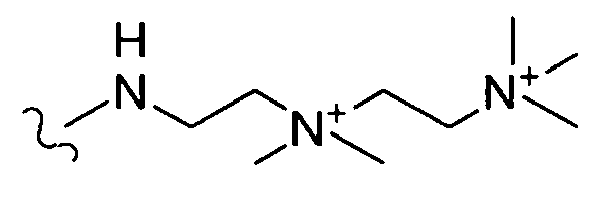
H H 
H H -
[Table 3] RB RC RD 
H H 
H H 
H H 
H H 
H H 
H H 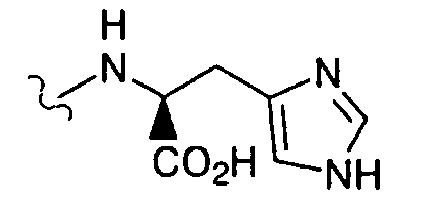
H H 
H H 
H H OH -CH2NHMe H OH -CH2NH(CH2)2NH2 H -
[Table 4] RB RC RD OH -CH2NH(CH2)2NMe2 H OH -CH2NH(CH2)2N+Me3 H OH -CH2N[(CH2)2OH]2 H OH -CH2NHCH2CO2H H OH -CH2NH(CH2)2CO2H H OH -CH2NH(CH2)2SO3H H OH -CH2NHCH2PO3H2 H OH 
H OH 
H OH 
H OH 
H -
[Table 5] RB RC RD OH 
H OH 
H OH 
H OH 
H OH 
H OH 
H OH 
H OH 
H OH 
H OH 
H OH 
H -
[Table 6] RB RC RD -NH(CH2)3NMe2 -CH2NH(CH2)2N+Me3 H -NH(CH2)3NMe2 -CH2N[(CH2)2OH]2 H -NH(CH2)3NMe2 
H -NH(CH2)3NMe2 
H -NH(CH2)3NMe2 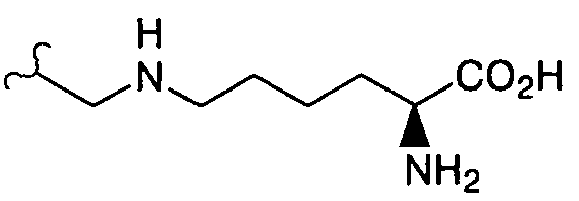
H -NH(CH2)2N+Me3 -CH2NH(CH2)2N+Me3 H -NH(CH2)2N+Me3 -CH2N[(CH2)2OH]2 H -NH(CH2)2N+Me3 
H -NH(CH2)2N+Me3 
H -NH(CH2)2N+Me3 
H -N[(CH2)2OH]2 -CH2NH(CH2)2N+Me3 H -
[Table 7] RB RC RD -N[(CH2)2OH]2 -CH2N[(CH2)2OH]2 H -N[(CH2)2OH]2 
H -N[(CH2)2OH]2 
H -N[(CH2)2OH]2 
H -NH(CH2)2CO2H -CH2NH(CH2)2N+Me3 H -NH(CH2)2CO2H -CH2N[(CH2)2OH]2 H -NH(CH2)2CO2H 
H -NH(CH2)2CO2H 
H -NH(CH2)2CO2H 
H 
-CH2NH(CH2)2N+Me3 H 
-CH2N[(CH2)2OH]2 H -
[Table 8] RB RC RD 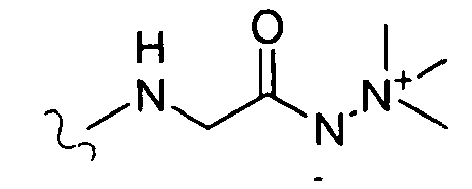

H 

H 
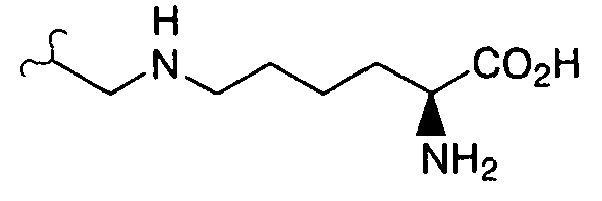
H 
-CH2NH(CH2)2N+Me3 H 
-CH2N[(CH2)2OH]2 H 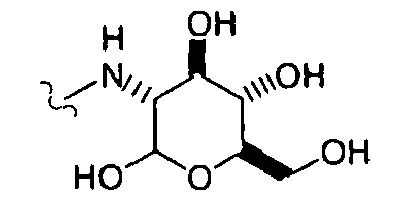

H 

H 

H OH H H - More specific present compounds are exemplified below. Table 9 and Table 10 below are examples of RA1 which is composed of each combinations of RB, RC and RD.

-

- The present invention includes the aforementioned compounds, pharmaceutically acceptable salts thereof, and solvates thereof. Theoretically possible all tautomers, geometric isomers, and the like of the present compounds are within a scope of the present invention.
- "Pharmaceutically acceptable" means not harmful preventively or therapeutically. Examples of the pharmaceutically acceptable salt of the present compound include, as basic salt, alkali metal salts such as sodium salt, potassium salt and the like; alkaline earth metal salts such as calcium salt, magnesium salt and the like; ammonium salt; aliphatic amine salts such as trimethylamine salt, triethylamine salt, dicyclohexylamine salt, ethanolamine salt, diethanolamine salt, triethanolamine salt, procaine salt, meglumine salt, diethanolamine salt and ethylenediamine salt; aralkylamine salts such as N,N-dibenzylethylenediamine salt, benethamine salt and the like; heterocyclic aromatic amine salts such as pyridine salt, picoline salt, quinoline salt, isoquinoline salt and the like; quaternary ammonium salts such as tetramethylammonium salt, tetraethylammonium salt, benzyltrimethylammonium salt, benzyltriethylammonium salt, benzyltributylammonium salt, methyltrioctylammonium salt, tetrabutylammonium salt and the like; and basic amino acid salts such as arginine salt, lysine salt and the like. Examples of acidic salt include inorganic acid salts such as hydrochloride, sulfate, nitrate, phosphate, carbonate, bicarbonate, perchlorate and the like; organic acid salts such as acetate, propionate, lactate, maleate, fumarate, tartarate, malate, citrate, ascorbate and the like; sulfonates such as methanesulfonate, isethionate, benzenesulfonate, p-toluenesulfonate and the like; and acidic amino acid salts such as aspartate, glutamate and the like.
In addition, a solvate, various solvates of the present compound are also within a scope of the present invention, and examples include monosolvate, disolvate, monohydrate, dihydrate and the like. - A representative process of the present compound is described below, but it is not particularly limited to the production process.
- A starting material of the present invention can be prepared by variously chemically modifying an amino part (RA2) of an amino sugar which binds to the sixth amino acid residue of a glycopeptides skeleton of chloroorienticin B or the known derivative thereof, or a C-terminal part (RB), a resorcinol part (RC), or an N-terminal part, a methylamino part (RD) of chloroorienticin B, vancomycin or the known derivative thereof. Alternatively, an aglycone obtained by once eliminating a sugar side chain which binds to the aromatic ring of the fourth amino acid residue of a glycopeptide skeleton can be also used as a raw material. Alternatively, as a starting material, chloroorienticin B, vancomycin or the known derivative thereof may be used without chemical modification.
- The chemical modification may be performed, for example, according to the method described in International Publication
WO 2006/057303 pamphlet which constitutes a part of the present description. Specifically, the chemical modification is as follows. - Representatively, using chloroorienticin B as a raw material, corresponding various aldehydes are reacted with an amino part of an amino sugar optionally in the presence of an acid or a base to form a Schiff base which is an intermediate, this may be subsequently reduced to be N-alkylated, thereby to form an objective secondary amine.
- More particularly, a reaction of forming a Schiff base is performed at a temperature of about 0°C to about 100°C optionally in the presence of an acid or a base in a polar solvent such as dimethyl sulfoxide, dimethylformamide, methanol, acetonitrile or water, or a mixed solvent thereof, optionally under the inert atmosphere such as nitrogen or argon. Preferably, the reaction is performed at a temperature of about 20°C to about 40°C for about 1 minute to 2 hours. As the base used, alkylamine (e.g., diisopropylethylamine) is exemplified. At this time, when a raw material compound has a substituent which is an obstacle of the present reaction, the substituent may be protected by the method described in Protective Groups in Organic Synthesis, Theodora W Green (John Wiley & Sons) or the like, and the protective group may be removed at a desired step.
- Then, a Schiff base of an intermediate may be reduced or catalytic-reduced with metal hydride complex, preferably without isolation. As the metal hydride complex, metal borohydride such as sodium borohydride or sodium cyanoborohydride can be used. Catalytic reduction is performed using hydrogen, in the presence of homogeneous or heterogeneous catalyst such as Crabtree catalyst, Wilkinson catalyst, palladium charcoal, platinum charcoal or rhodium charcoal. The reducing reaction is performed at a temperature of about 0°C to about 100°C for about 1 minute to 24 hours. Preferably, the reaction is performed at about 20°C to about 40°C in the solvent using excessive amount (e.g., 3 to 5 mole equivalent) of sodium cyanoborohydride.
The reaction of forming Schiff base and the reducing reaction may be performed simultaneously, or it is also possible to obtain objective compound by performing the reaction of forming Schiff base in the presence of a reducing agent. - Representatively, by amidating a carboxylic acid part which is the C-terminal, by a conventional method, using chloroorienticin B, vancomycin or the like as a raw material, the raw material can be converted into various amide derivatives which have RB=-NR5R5'.
- Representatively, using chloroorienticin B, vancomycin or the like as a raw material, the resorcinol part is alkylated by a conventional method.
- Representatively, using chloroorienticin B, vancomycin or the like as a raw material, the methylamine part of the N-terminal part may be, example, N-alkylated by a conventional method.
- Representatively, using chloroorienticin B, vancomycin or the like as a raw material, the raw material may be de-glycosylated by the known method such as acid hydrolysis and the like. Specifically, the aglycone can be prepared by the method described in J. Med. Chem. (1965),8,18-22, J. Chem. Soc., Chem. Commun. (1988),1306-1307, Biochemistry (2001), 40(15)4745-4755 or the like.
- The present compound can be preferably synthesized by binding a monosaccharide to an OH part of an aromatic ring of the fourth amino acid residue of the glycopeptide skeleton of a starting material prepared by the aforementioned method, or a sugar residue which binds to it using glycosyltransferase or the like, elongating the sugar chain, oxidizing a hydroxymethyl group of the sugar residue at the terminal into an aldehyde group, reacting amine corresponding to RA1 in the presence of an acid or a base, if desired, to form a Schiff base which is an intermediated and, subsequently, N-alkylating the base by reduction, to form objective secondary amine. Specifically, the synthesis is as follows.
- A method of elongating a sugar chain is shown below, regarding representative compounds.


- (wherein n1 is an integer of 0 to 5; n2 is an integer of 1 to 6;
- n' is n1+n2 (wherein n' is 6 or less);
- RB, RC, RD, RF, XA, XB, and Sug are as defined above; and
- NDP is nucleotide-diphosphate; provided that, when n1 is 0, (Sug)n1 represents H.)
-

A method of oxidizing the primary hydroxy group into aldehyde may be by oxidation with organic regent, or oxidation with enzyme, and is preferably the following method of oxidation with oxidase. According to the oxidation method, the objective hydroxy group can be selectively oxidized.
For the intermediate in which the sugar chain is elongated in above 6), the hydroxymethyl group is oxidized in the presence of oxidase optionally in buffer, to obtain the objective aldehyde intermediate.
As the buffer, phosphate buffer, borate buffer, citrate buffer, acetate buffer, carbonate buffer and the like are exemplified, and preferable is phosphate buffer.
As the oxidase, galactose oxidase and the like are exemplified.
Optionally, additive for improving the reaction efficiency to decompose byproduct (e.g., catalase and the like) may be present together.
The reaction temperature may be adjusted to an optimal temperature of the oxidase. Usually, the temperature is 0 to 80°C, preferably 10 to 50°C, more preferably 20 to 40°C.
The reaction time is usually 1 to 100 hours, preferably 2 to 96 hours, more preferably 2 to 30 hours.
The pH of the buffer may be adjusted to an optimal pH of the oxidase. Preferable pH is 2.0 to 12.0, more preferably pH is 5.0 to 9.0, further preferably pH is 5.0 to 7.0. -


The objective compound is obtained by reacting the aldehyde intermediate obtained in 7), and amine RA1NH2 corresponding to objective RA1, preferably by the same method as that of modification of the RA2 part in 1). The amine reagent (RA1NH2) is commercially available product, or can be synthesized according to the method described in International PublicationWO 2006/057303 .
According to the aforementioned method, the sugar residues (I-0), (I-1) and (I-2) are similarly formed.
In addition, the compound (X-1), (X-2) or (X-3) is present, as a byproduct, in admixture with the product obtained in 8) in some cases, and the compounds (IV-0) and (X-1), and compounds (IV-1) and (X-2) or the compounds (IV-2) and (X-3) can be each separated and isolated via a optional purification step (e.g., chromatography). - The compound (X-1), (X-2) or (X-3) can be also produced by the following method.
In the presence of water or organic solvent, or in the presence of mixed solvent thereof, the aldehyde compound (XI-1), (XI-2) or (XI-3) in which the sugar terminal is the dehydrated material is produced by adding a base to react the compound (IX-1), (IX-2) or (IX-3) in which the sugar terminal is aldehyde.
Examples of the base include diisopropylethylamine, triethylamine, 4-dimehylaminopyridine and the like.
The reaction temperature is 0°C to 80°C, preferably 10°C to 60°C, more preferably 15°C to 40°C.
The reaction time is 1 to 100 hours, preferably 1 to 24 hours, more preferably 3 to 12 hours.
The produced aldehyde compound (XI-1), (XI-2) or (XI-3) in which the sugar terminal is dehydrated material can be subjected to modification of the RA1 part by the same method as that of above 8), and the objective compound (X-1), (X-2) or (X-3) can be obtained. - The present invention also includes a pharmaceutical composition containing the novel glycopeptide derivative of the present invention. Therefore, the glycopeptide compound in a form of a pharmaceutically acceptable salt can be preferably formulated for oral or parenteral administration for treating or preventing bacterial infection.
- In the case of oral administration, the present compound can be also used as a conventional preparation, for example, as any dosage form of solid agents such as tablets, powders, granules, capsules; solutions; oily suspensions; or liquid agents such as syrups or elixirs. In the case of parenteral administration, the present compound can be used as aqueous or oily suspension injectables, or nose drops. Upon preparation thereof, conventional excipients, binders, lubricants, aqueous solvents, oily solvents, emulsifiers, suspending agents, preservatives, stabilizers and the like can be optionally used. As an antibacterial drug, particularly, oral agents, intravenous injectables or the like are preferable.
- Preparations of the present invention are produced by combining (for example, mixing) a therapeutically effective amount of the present compound with a pharmaceutically acceptable carrier or diluent. A preparation of the present compound can be produced using well-known easily available ingredients by the known method.
- Upon production of a pharmaceutically composition of the present invention, an active ingredients is mixed with a carrier, or diluted with a carrier, or is placed into a carrier in a form of capsules, sachets, papers or other containers. When a carrier works as a diluent, the carrier is a solid, semi-solid or liquid material which works as a medium, and they can be formulated into tablets, pills, powders, pastille, elixirs, suspending agents, emulsions, solutions, syrups, aerosols (solids in liquid medium), ointments, and contain an up to 10% active compound. It is preferable that the present compound is formulated into preparations prior to administration.
- A person skilled in the art can use any of known suitable carriers for this formulation into preparations. In such preparations, a carrier is a solid, a liquid, or a mixture of a solid and a liquid. For example, for intravenous injection, the present compound is dissolved in a 4% dextrose/0.5% sodium citrate aqueous solution. A solid preparation includes powders, tablets and capsules. A solid carrier is one or more substances which serve also as a material for formulation into perfumes, lubricants, solubilizers, suspending agents, binders, tablets, disintegrating agents, or capsules. Tablets for oral administration contain suitable excipients such as calcium carbonate, sodium carbonate, lactose, and calcium phosphate together with disintegrating agents such as corn starch, and alginic acid and/or binders such as gelatin and acacia, and lubricants such as magnesium stearate, stearic acid, and talc.
- In powders, a carrier is a finely divided solid, which is mixed with a finely divided active ingredient. In tablets, an active ingredient is mixed with a carrier having necessary binding property at a suitable ratio, and is solidified into a desired form and size. Powders and tablets contain about 1 to about 99% by weight of an active ingredient which is the novel compound of the present invention. A suitable solid carrier is magnesium carbonate, magnesium stearate, talc, sugar, lactose, pectin, dextrin, starch, gelatin, tragacanth gum, methylcellulose, sodium carboxymethylcellulose, low melting point wax, and cocoa butter.
- Liquid preparations include suspending agents, emulsions, syrups and elixirs. An active ingredient can be dissolved or suspended in a pharmaceutically acceptable carrier such as sterile water, a sterile organic solvent, or a mixture of both of them. An active ingredient can be often dissolved in a suitable organic solvent, for example, an aqueous propylene glycol solution. Other compositions can be also produced by scattering a finely divided active ingredient in aqueous starch, a sodium carboxymethylcellulose solution, or a suitable oil.
- A dose of the present compound is different depending on an administration method, an age, a weight and condition of a patient and a kind of a disease and, usually, in the case of oral administration, about 0.1 mg to 7000 mg, preferably about 0.5 mg to 2000 mg may be administered per adult a day, if necessary, by division. In addition, in the case of parenteral administration, about 0.1 mg to 1000 mg, preferably about 0.5 mg to 500 mg is administered per adult a day.
- The following Examples and Test Examples illustrate the present invention in more detail below, but the present invention is not limited by them.
In Examples, the following abbreviations are used. - Me: Methyl,
- Et: Ethyl,
- Ph: Phenyl,
- Ms: Methanesulfonyl,
- DMF: Dimethylformamide,
- DMSO: Dimethyl sulfoxide,
- THF: Tetrahydrofuran
- DIPEA: Diisopropylethylamine,
- TFA: Trifluoroacetic acid,
- EDCI: N-ethyl-N'-(3-dimethylaminopropyl)carbodiimide,
- GalT: β-1,4-galactosyltransferase
- The compounds described in Table 11 to Table 51 were produced.
[Table 11] Example Structure Mass Spectrometry Elementary analysis 1 
[M+l]+ :1939 Calculated value for C86H103C12F 3N14030· 13. 2H20· 4HCl
C: 44. 44%.
H: 5. 78%.
N: 8. 44%.
Cl: 9. 15%.
F:2. 45%
Measured value
C: 44. 35%.
H: 5. 59%.
N: 8. 53%.
Cl,: 9. 17%,
F2. 53%2 
[M+l]+ =1610 Calculated value for C72H85Cl2N9 029· 2.1HCl· 13. 8H20
C: 44. 65%.
H: 5. 97%.
N: 6. 51%.
Cl: 7. 51%
Measured value
C: 44. 60%.
H: 5. 77%.
N: 6. 68%.
Cl: 7. 48%3 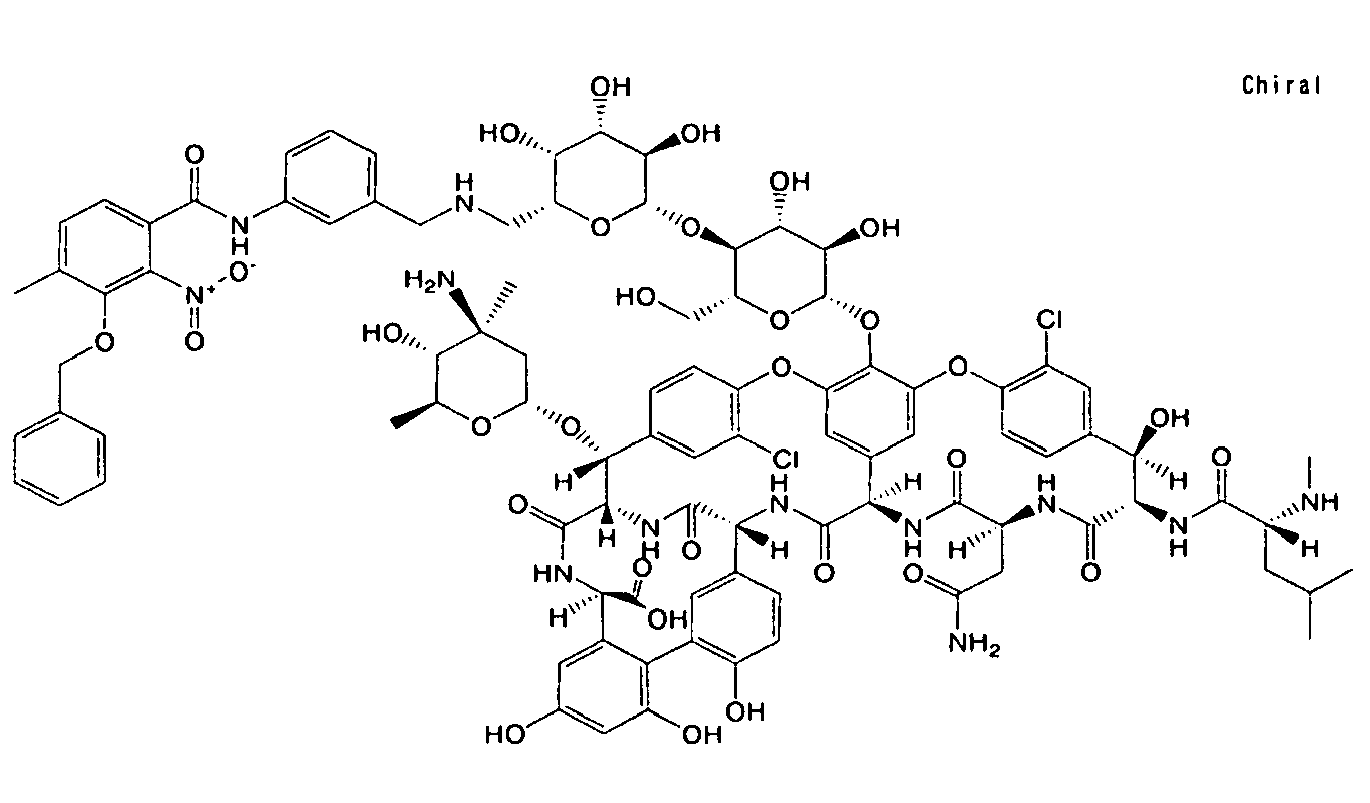
[M+l]+ =1983 Calculated value for C94H104Cl2N 12032 · 3. 5HCl · 14. 9H20
C: 47. 42%.
H: 5. 81%.
N: 7. 06%.
Cl,: 8. 19%
Measured value
C: 47. 33%.
H: 5. 57%.
N: 7. 31%,
Cl 8. 20% -
[Table 12] Example Structure Mass Spectrometry Elementary analysis 4 
[M+l]+ =1938 N: Calculated value for C94H105Cl2N 11030· 3. 3HCl · 14H20
C: 48. 83%.
H: 5. 94%.
N: 6. 66%.
Cl: 8. 13%
Measured value
C: 48. 59%.
H: 5. 74%.
N: 6. 90%.
Cl: 8. 09%5 
[M+l]+ =1886 Calculated value for C86H95Cl4N1 1029 · 3. 4HCl · 13. 6H20
C: 45. 39%.
H: 5. 65%.
N: 6. 77%.
Cl: 11. 53%
Measured value
C: 45. 33%.
H: 5. 24%.
N: 6. 84%.
Cl: 11. 45%6 
[M+l]+ =1902 Calculated value for C87H96Cl2F3 N11030 · 3HCl· 12. 9H20
C: 16. 54%.
H: 5. 60%.
N: 6. 86%.
Cl: 7. 89%.
F: 2. 54%
Measured value
C: 46. 45%,
H: 5. 24%.
N: 6. 96%.
Cl: 7. 85%.
F: 2. 48% -
[Table 13] Example Structure Mass Spectrometry Elementary analysis 7 
[M+l]+ =1929 Calculated value for C89H101Cl2F 3N12029 · 3. 4HCl · 15.9H20
C: 45. 66%.
H: 5. 86%.
N: 7. 18%.
Cl: 8. 18%.
F: 2. 43%
Measured value
C: 45. 69%.
H: 5. 72%.
N: 7. 27%,
Cl: 8. 21%.
F: 2. 26%8 
[M+l]+ =1903 Calculated value for C87H95Cl2F3 N10031 · 2. 4HCl · 16H20
C: 45. 82%.
H: 5. 72%.
N: 6. 14%,
Cl: 6. 84%,
F: 2. 50%
Measured value
C: 45. 85%,
H: 5. 64%.
N: 6. 00%.
Cl: 6. 91%.
F: 2. 48%9 
[M+l]+ =2064 Calculated value for C93H106Cl2F 3N11035 · 3. 4HCl · 18. 4H20
C: 44. 30%.
H: 5. 84%,
C: 6. 11%.
Cl: 7. 59%.
F: 2. 26%
Measured value
C: 44. 27%.
H: 5. 72%.
N: 6. 14%.
Cl: 7. 53%,
F: 2. 33% -
[Table 14] Example Structure Mass Spectrometry Elementary analysis 10 
[M+l]+ =1903 Calculated value for C86H95Cl2F3 N12030 · 12. 4H20 · 4. 1HCl
C: 45. 35%.
H: 5. 48%.
N: 7. 38%.
Cl: 9. 50%.
F: 2. 50%
Measured value
C: 45. 33%,
H: 5. 45%.
N: 7. 46%.
Cl: 9. 57%,
F: 2. 63%11 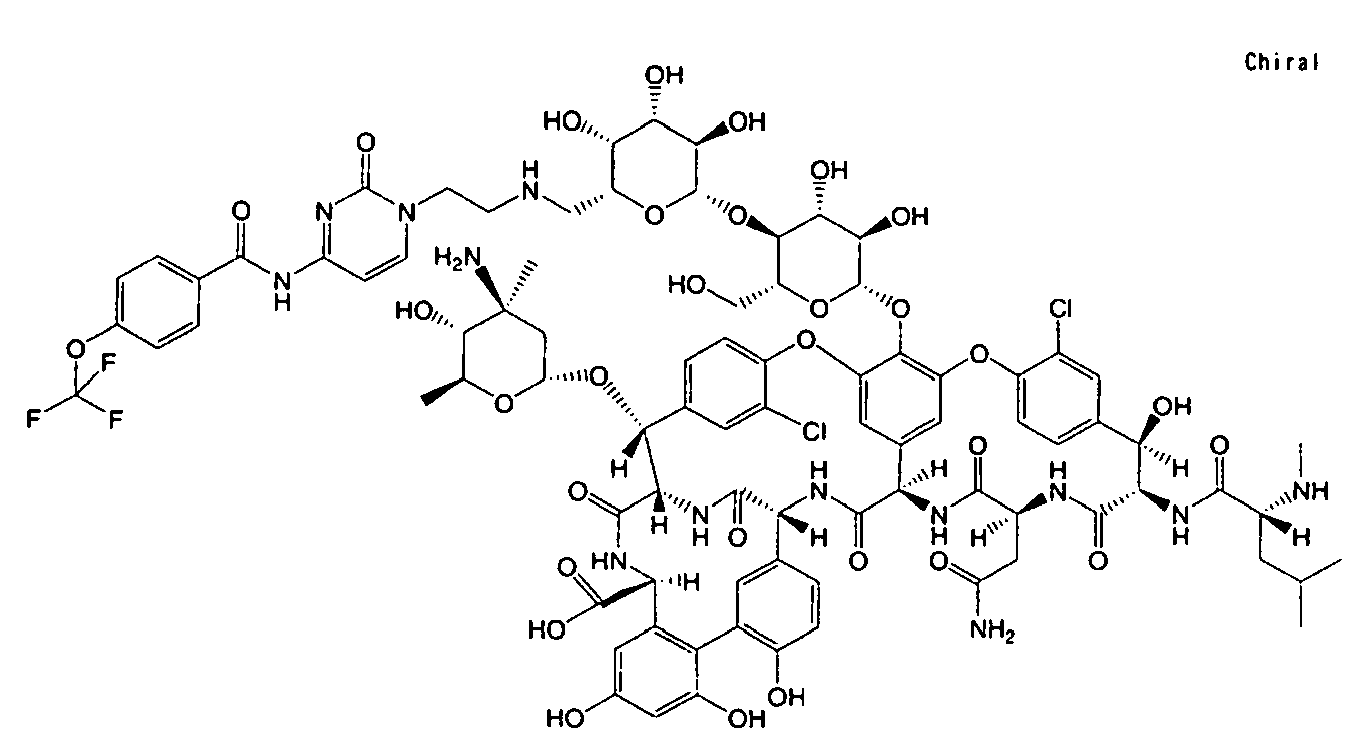
[M+l]+ =1934 Calculated value for C86H96Cl2F3 N13031 · 12. 8H20 · 3. 6HCl
C: 44. 96%.
H: 5. 49%.
N: 7. 93%.
Cl: 8. 64%.
F: 2. 48%
Measured value
C: 44. 78%.
H: 5. 33%.
N: 8. 33%.
Cl: 8. 67%.
F: 2. 82%12 
[M+l]+ =1827 Calculated value for C81H94Cl4N1 0028S · 11. 2H20 · 3. 2HCl
C: 45. 29%.
H: 5. 61%.
N: 6. 52%.
Cl: 11. 88%.
S: 1. 49%
Measured value
C: 43. 29%,
H: 5. 59%.
N: 6. 65%.
Cl: 11. 83%.
S: 1. 51% -
[Table 15] Example Structure Mass Spectrometry Elementary analysis 13 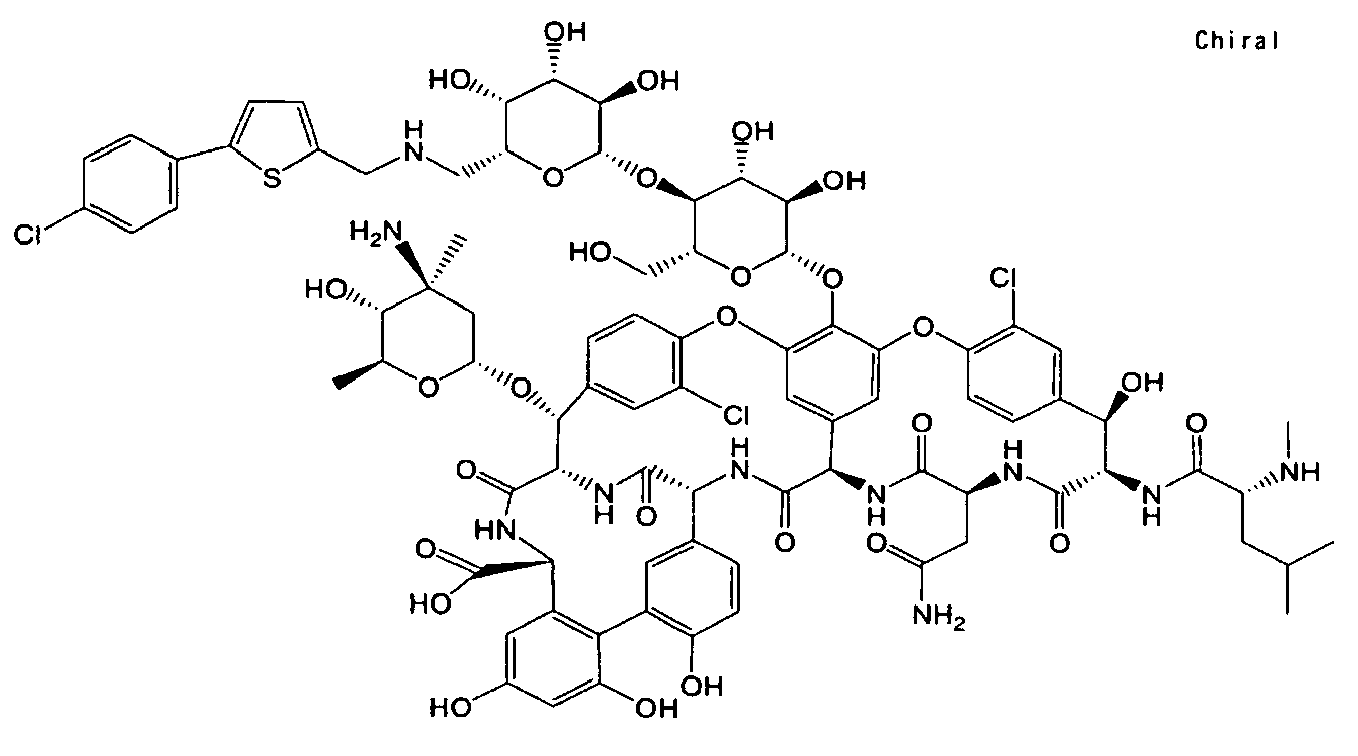
[M+l]+ =1815 Calculated value for C83H93Cl3N1 0028S · 11. 1H20 · 2. 8HCl
C: 47. 04%,
H: 5. 61%.
N: 6. 61%.
Cl: 9. 70%.
S: 1. 51%
Measured value
C: 46. 99%,
H: 5. 57%.
N: 6. 70%.
Cl: 9. 68%.
S: 1. 35%14 
[M+l]+ =1789 Calculated value for C86H98Cl2N1 0028
C: 48. 98%.
H: 5. 96%.
N: 6. 64%.
Cl: 8. 07%
Measured value
C: 48. 97%,
H: 5. 81%.
N: 6. 71%,
Cl: 8. 01%15 
[M+l]+ =1783 Calculated value for C84H100Cl2N 10029 · 10. 7H20 · 3. 3HCl
C: 48. 09%.
H: 5. 99%.
N: 6. 68%.
Cl: 8. 96%
Measured value
C: 48. 09%.
H: 6. 10%.
N: 6. 78%.
Cl: 8. 93% -
[Table 16] Example Structure Mass Spectrometry Elementary analysis 16 
[M+l]+ =1745 Calculated value for C82H102Cl2N 10028 · 12. 1H20 · 2. 8HCl
C: 47. 65%.
H: 6. 29%.
N: 6. 78%.
Cl: 8. 23%
Measured value
C: 47. 63%.
H: 6. 17%.
N: 6. 90%,
Cl: 8. 21%17 
[M+l]+ =1723 Calculated value for C19H100Cl2N 10029 · 11. 9H20 · 2. 8HCl
C: 46. 49%.
H: 6. 25%.
N: 6. 86%.
Cl: 8. 34%
Measured value
C: 46. 46%.
H: 6. 13%.
N: 6. 99%.
Cl: 8. 41%18 
[M+l]+ =1770 Calculated value for C83H101Cl2N 11028 · 11. 9H20 · 3. 4HCl
C: 47. 25%.
H: 6. 12%.
N: 7. 30%,
Cl: 9. 07%
Measured value
C: 47. 22%,
H: 6. 07%.
N: 7. 44%.
Cl: 9. 03% -
[Table 17] Example Structure Mass Spectrometry Elementary analysis 19 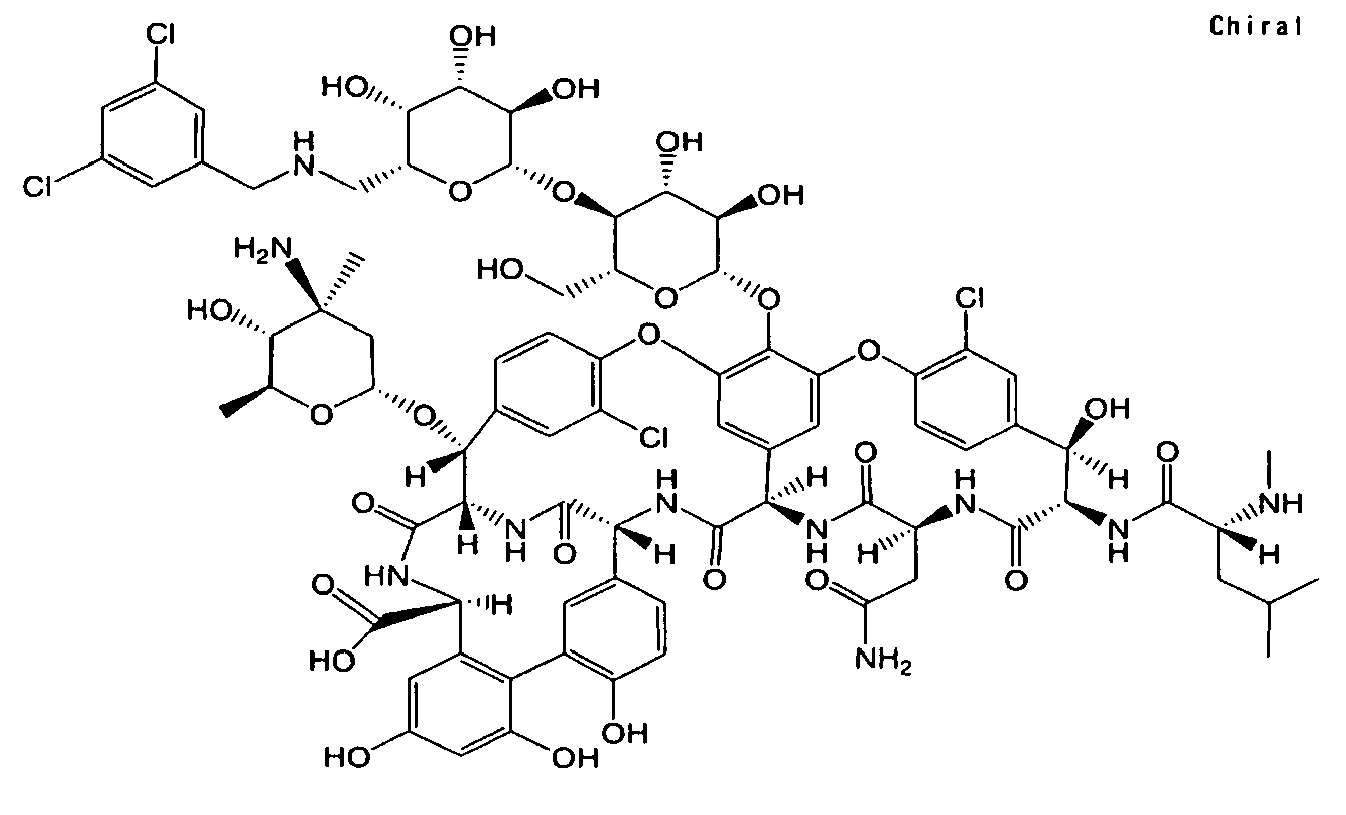
[M+l]+ =1767 Calculated value for C79H90Cl4N1 0028 · 9. 8H20 · 3. 9HCl
C: 45. 44%,
H: 5. 48%.
N: 6. 71%.
Cl: 13. 41%
Measured value
C: 45. 42%.
H: 5. 52%.
N: 6. 89%,
Cl: 13. 41%20 
[M+l]+ =1798 Calculated value for C84H101Cl2N 11029 · 12. 9H20 · 4. 2HCl
C: 46. 17%.
H: 6. 04%.
N: 7. 05%,
Cl: 10. 06%
Measured value
C: 46. 15%.
H: 5. 99%.
N: 7. 15%.
Cl: 10. 00%21 
[M+1]+ =1986 Calculated value for C92H108Cl2F 3N13029 · 10. 8H20 · 4HCl
C: 47. 46%.
H: 5. 78%.
Cl: 9. 14%.
F: 2. 45%
Measured value
C: 47. 46%.
H: 5. 75%.
N: 7. 87%.
Cl: 9. 18%.
F: 2. 37% -
[Table 18] Example Structure Mass Spectrometry Elementary analysis 22 
[M+l]+ =1975 Calculated value for C90H103Cl2F 3N12031 · 10. 9H20 · 3HCl
C: 47. 36%,
H: 5. 64%.
N: 7. 36%,
Cl: 7. 77%,
F: 2. 50%
Measured value
C: 47. 37%.
H: 5. 58%.
N: 7. 37%,
Cl: 7. 80%,
F: 2. 42%23 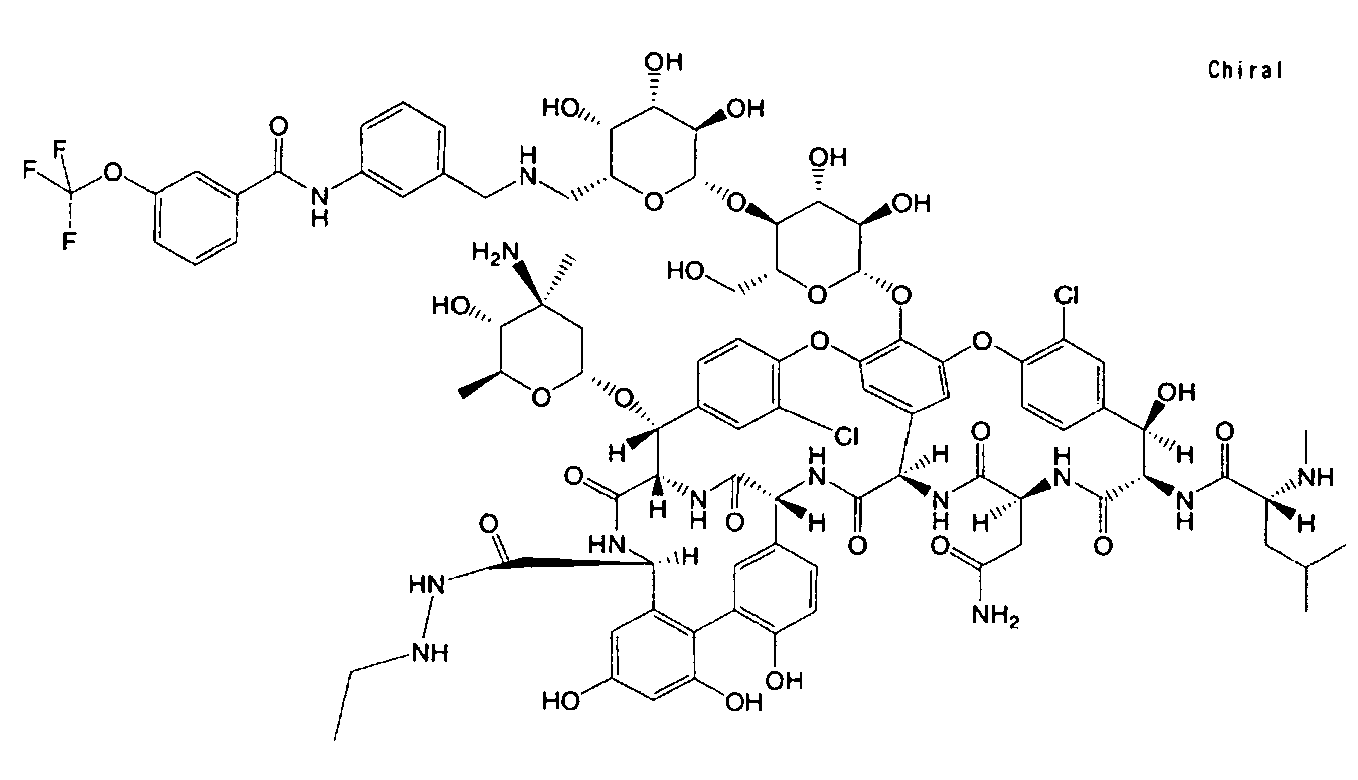
[M+1]+ =1944 Calculated value for C89H102Cl2F 3N13029 · 11. 7H20 · 3. 3HCl
C: 46. 95%.
H: 5. 70%.
N: 8. 00%,
Cl: 8. 25%.
F: 2. 50%
Measured value
C: 46. 93%.
H: 5. 54%.
N: 8. 03%.
Cl: 8. 31%.
F: 2. 45%24 
[M+l]+ =2019 Calculated value for C92H107Cl2F 3N12032 · 13. 9H20 · 3. 5HCl
C: 46. 06%.
H: 5. 81%.
N: 7. 01%.
Cl: 8. 13%.
F: 2. 38%
Measured value
C: 46. 04%.
H: 5. 73%.
N: 7. 14%,
Cl: 8. 08%. F:
2. 30% -
[Table 19] Example Structure Mass Spectrometry Elementary analysis 25 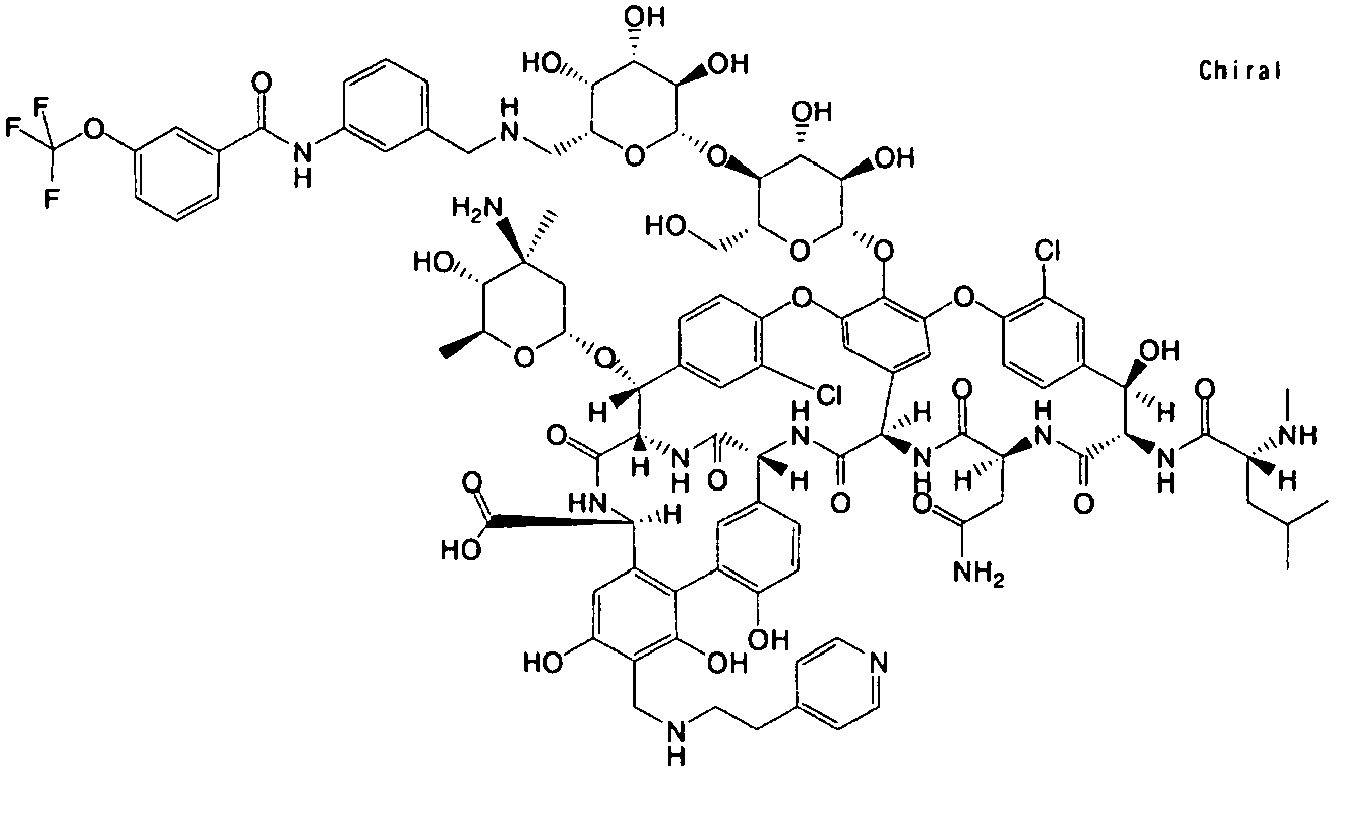
[M+l]+ =2036 Calculated value for C95H106Cl2F 3N13030 · 14. 4H20 · 4. 3HCl
C: 46. 5%.
H: 5. 71%.
N: 7. 42%.
Cl: 9. 10%.
F: 2. 32%
Measured value
C: 46. 44%.
H: 5. 55%.
N: 7. 48%,
Cl: 9. 06%.
F: 2. 26%26 
[M+l]+ =1989 Calculated value for C91H105Cl2F 3N12031 · 11. 9H20 · 2. 7HCl
C: 47. 45%.
H: 5. 75%.
N: 7. 30%,
Cl: 7. 23%
F: 2. 47%
Measured value
C: 47. 44%.
H: 5. 74%.
N: 7. 44%.
Cl: 7. 25%,
F: 2. 28%27 
M= C++Cl [C]+ =2017 Calculated value for C93H111Cl2F 3N13030 · Cl · 13. 9H20 · 3. 6HCl
C: 45. 85%.
H: 5. 89%.
N: 7.47%.
Cl: 9. 61%.
F: 2. 34%
Measured value
C: 45. 84%.
H: 5. 58%.
N: 7. 43%.
Cl: 9. 55%.
F: 2. 77% -
[Table 20] Example Structure Mass Spectrometry Elementary analysis 28 
[M+l]+ =2039 Calculated value for C90H103Cl2F 3N12033S · 13. 5H20 · 2. 7HCl
C: 45. 37%.
H: 5. 61%.
N: 7. 05%.
Cl: 6. 99%.
F: 2. 39%.
S: 1. 35%
Measured value
C: 45. 33%.
H: 5. 47%.
N: 7. 02%.
Cl: 6. 99%,
F: 2. 37%,
S: 1. 36%29 
[M+l]+ =2014 Calculated value for C90H100Cl2F 3N15031 · 13. 7H20 · 4. 2HCl
C: 44. 75%.
H: 5. 49%.
N: 8. 70%.
Cl: 9. 10%.
F: 2. 36%
Measured value
C: 44. 70%.
H: 5. 55%.
N: 8. 89%.
Cl: 9. 10%,
F: 2. 25%30 
[M+l]+ =1982 Calculated value for C91H100Cl2F 3N13030 · 13. 1H120 · 3. 7HCl C: 46. 42%.
H: 5. 56%.
N: 7. 73%.
Cl: 8. 58%,
F: 2. 42%
Measured value
C: 46. 41%.
H: 5. 58%.
N: 7. 81%.
Cl: 8. 54%.
F: 2. 29% -
[Table 21] Example Structure Mass Spectrometry Elementary analysis 31 
[M+l]+ =1993 Calculated value for C93H101Cl2F 3N12030· 12. 2H20· 3. 2HCl C: 47. 91%.
H: 5. 56%.
N: 7. 21%.
Cl: 7. 91%,
F: 2. 44%
Measured value
C: 47. 92%.
H: 5. 54%.
N: 7. 33%.
Cl: 7. 95%.
F: 2. 31%32 
[M+l]+ =2025 Calculated value for C92H101Cl2F 3N14031 · 13. 2H20 · 3. 5HCl
C: 46. 19%.
H: 5. 52%.
N: 8. 20%.
Cl: 8. 15%.
F: 2. 38%
Measured value
C: 46. 15%.
H: 5. 53%.
N: 8. 47%.
Cl: 8. 15%.
F: 2. 40%33 
[M+l]+ =2047 Calculated value for C92H107Cl2F 3N14032 · 12. 7H20 · 3. 7HCl
C: 45. 80%.
H: 5. 69%.
N: 8. 13%.
Cl: 8. 38%.
F: 2. 36%
Measured value
C: 45. 77%.
H: 5. 72%.
N: 8. 27%.
Cl: 8. 36%.
F: 2. 33% -
[Table 22] Example Structure Mass Spectrometry Elementary analysis 34 
[M+1]+ =2015 Calculated value for C93H107Cl2F 3N12031 · 11H20 · 3. 3HCl
C: 47. 83%,
H: 5. 71%.
N: 7. 20%.
Cl: 8. 05%.
F: 2. 44%
Measured value
C: 47. 83%.
H: 5. 84%.
N: 7. 24%,
Cl: 8. 04%.
F: 2. 29%35 
[M+l]+ =2052 Calculated value for C91H106Cl2F 3N13034 · 11. 8H20 · 2. 9HCl
C: 46. 08%.
H: 5. 63%.
N: 7. 68%,
Cl: 7. 32%.
F: 2. 40%
Measured value
C: 45. 91%.
H: 5. 58%.
N: 8. 58%.
C: 7. 30%.
F: 2. 50%36 
[M+1]+ =2020 Calculated value for C92H106Cl2F 3N11033 · 11.8H20 · 3.2HCl
C: 47. 00%.
H: 5. 69%.
N: 6. 55%.
Cl: 7 .84%.
F: 2. 42%
Measured value
C: 46. 99%.
H: 5. 63%.
N: 6. 62%.
Cl: 7. 84%.
F: 2. 28% -
[Table 23] Example Structure Mass Spectrometry Elementary analysis 37 
[M+1]+ =1849 Calculated value for C83H92Cl4N1 0028S· 19. 4H20· 4. 1HCl
C: 42. 41%,
H: 5. 78%.
N: 5. 96%.
Cl: 12. 22%.
S: 1. 36%
Measured value
C: 42. 38%.
H: 5. 35%.
N: 6. 15%.
Cl: 12. 24%.
S:1. 30%38 
[M+1]+ =1849 Calculated value for C83H92Cl4N1 0028S· 20. 9H20· 4. 4HCl
C: 41. 74%.
H: 5. 83%.
N: 5. 86%.
Cl: 12. 47%.
S:1. 34%
Measured value
C: 41. 68%.
H: 5. 26%.
N: 6. 04%.
Cl: 12. 36%.
S:1. 23%39 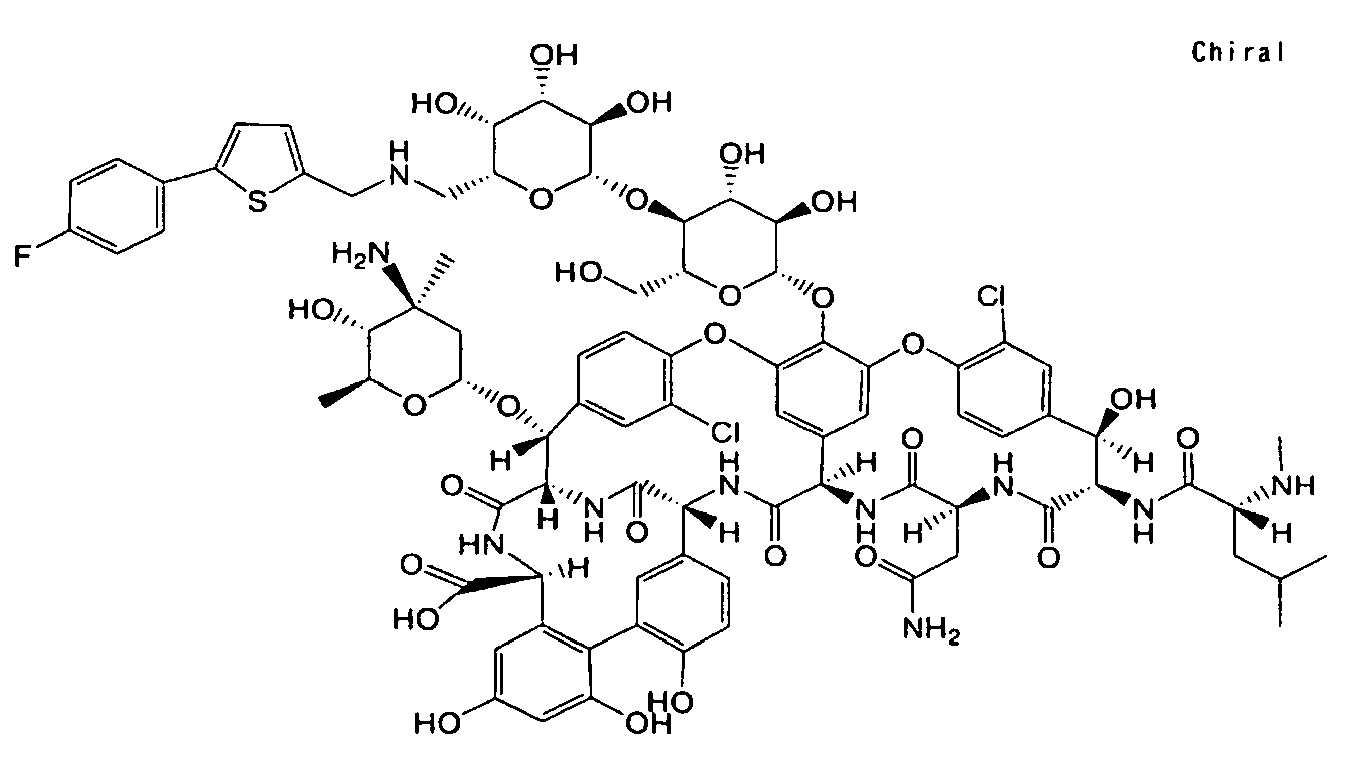
[M+1]+ =1799 Calculated value for C83H93Cl2FN 10028S· 14.1H20· 3. 6HCl
C: 45. 60%.
H: 5. 75%.
N: 6. 41%.
Cl: 9. 08%.
F:0. 87%.
S:1. 47%
Measured value
C: 45. 61%.
H: 5. 82%.
N: 6. 49%.
Cl: 9. 06%.
F:0. 94%.
S:1. 44% -
[Table 24] Example Structure Mass Spectrometry Elementary analysis 40 
[N+1]+ =1849 Calculated value for C84H93Cl2F3 N10028S· 20.4H20· 4.5HCl
C: 42. 35%,
H: 5. 85%.
N: 5. 88%.
Cl: 9. 67%,
F:2. 39%.
S:1. 35%
Measured value
C: 42. 31%.
H: 5. 58%.
N: 5. 99%.
Cl: 9. 63%.
F:2. 23%.
S:1. 26%41 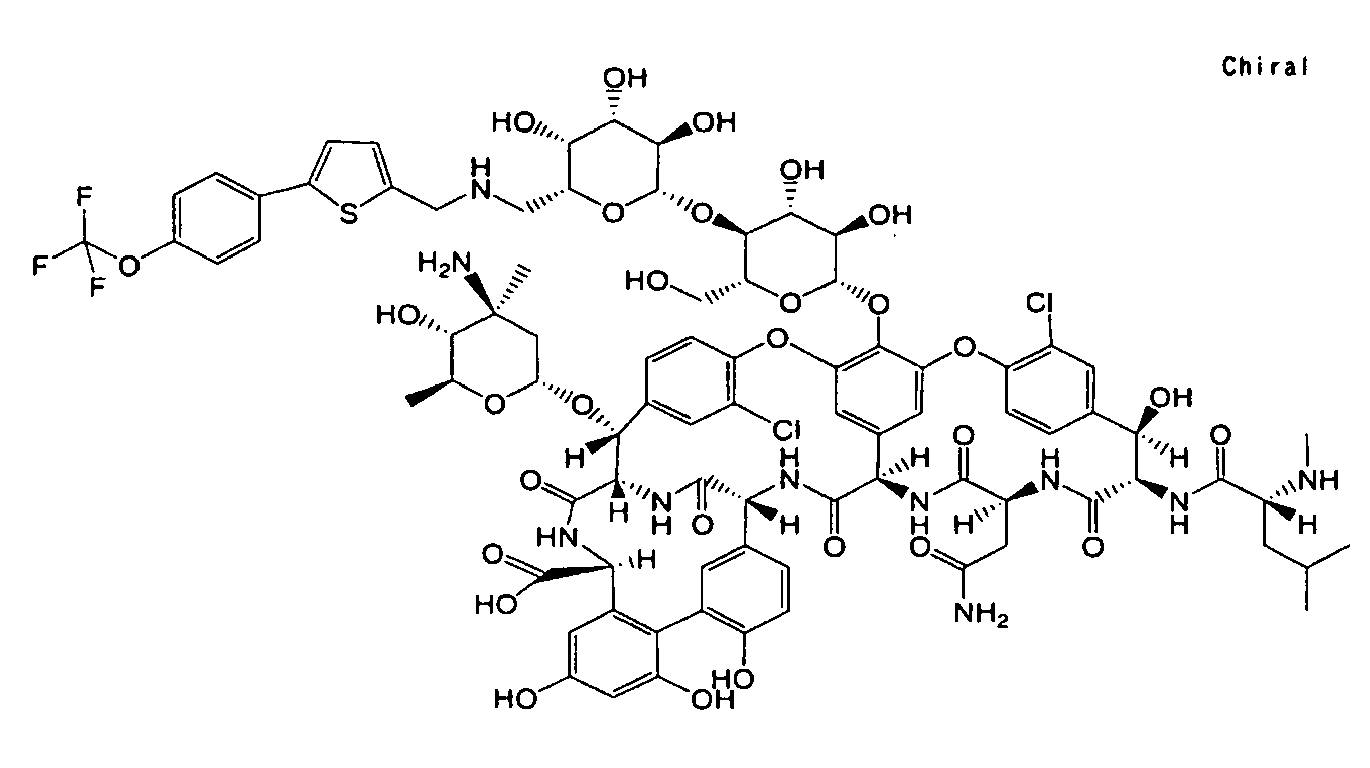
[H+1]+ =1865 Calculated value for C84H93Cl2F3 N10029S· 13.7H20· 4.2HCl
C: 44. 51%.
H: 5. 54%.
N: 6. 18%.
Cl: 9. 70%.
F:2. 51%.
S:1. 41%
Measured value
C: 44. 55%.
H: 5. 47%.
N: 6. 27%,
Cl: 9. 63%,
F:2. 23%,
S:1. 26%42 
[M+1]+ =1824 Calculated value for C85H99Cl2N1 1028S· 15.2H20· 5.1HCl
C: 44. 67%.
H: 5. 93%.
N: 6. 74%.
Cl: 11. 01%.
S:1. 40%
Measured value
C: 44. 58%.
H: 5. 43%.
N: 6. 90%.
Cl: 11. 00%.
S:1. 30% -
[Table 25] Example Structure Mass Spectrometry Elementary analysis 43 
[M+1]+ =1799 Calculated value for C83H93Cl2FN 10028S· 10.7H20· 3.1HCl
C: 47. 33%,
H: 5. 62%.
N: 6. 65%.
Cl : 8. 58%.
F: 0. 90%.
S:1. 52%
Measured value
C: 47. 26%.
H: 5. 12%.
N: 6. 63%.
Cl: 8. 58%.
F: 0. 96%.
S:1. 49%44 
[M+1]+ =1825 Calculated value for C85H98Cl2N1 0029S· 10H20· 3. 2HCl
C: 48. 08%.
H: 5. 75%.
N: 6. 60%.
Cl: 8. 68%.
S:1. 51%
Measured value
C: 48. 03%.
H: 5. 68%.
N: 6. 81%.
Cl: 8. 64%.
S:1. 42%45 
[M+1]+ =1810 Calculated value for C84H94Cl3N1 1028· 13.3H20· 2. 6HCl
C: 47. 00%.
H: 5. 79%.
N: 7. 18%.
Cl: 9. 25%
Measured value
C: 46. 95%.
H: 5. 54%.
N: 7. 31%.
Cl: 9. 23% -
[Table 26] Example Structure Mass Spectrometry Elementary analysis 46 
[M+1]+ =1809 Calculated value for C85H95Cl3N1 0028· 12. 4H20· 2. 6HCl
C: 47. 95%.
H: 5. 79%.
N: 6.58%.
Cl: 9.32%
Measured value
C: 47. 89%.
H: 5. 62%.
N: 6. 73%,
Cl: 9. 33%47 
[M+1]+ =2018 Calculated value for C91H108Cl2F 3N15030· 12. 7H20· 4. 3HCl
C: 45. 44%.
H: 5. 77%.
N: 8.73%.
Cl: 9.29%.
F: 2.37%
Measured value
C: 45. 42%,
H: 5. 55%.
N: 8. 77%,
Cl: 9. 32%,
F: 2.30%48 
[M+1]+ =1976 Calculated value for C88H102Cl2F 3N15030· 10.2H20· 3. 3HCl
C: 46. 32%.
H: 5. 55%.
Cl: 9. 21%.
F: 8. 23%.
Measured value
C: 46. 32%.
H: 5. 48%.
N: 9. 32%.
Cl :8 .22%.
F: 2. 40% -
[Table 27] Example Structure Mass Spectrometry Elementary analysis 49 
[M+1]+ =1749 Calculated value for C79H94Cl2N1 0029S· 14.0H20· 3. 1HCl
C: 44.84%.
H: 5.96%.
Cl: 8.55%.
S: 1.52%
Measured value
C: 44. 81%.
H: 5. 91%.
N: 6. 77%,
Cl: 8. 59%.
S: 1. 45%50 
[M+1]+ =1809 Calculated value for C85H95Cl2FN 10029· 12. 3H20· 3. 1HCl
C: 47. 59%.
H: 5. 77%.
N: 6.53%.
Cl: 8. 43%.
F: 0. 89%
Measured value
C: 47. 58%,
H: 5. 7%.
N: 6. 72%.
Cl: 8. 43%.
F: 0. 98%51 
[M+1]+ =2068 Calculated value for C91H106Cl2F 3N15031· 16. 2H20· 5. 6HCl
C: 44. 00%.
H: 5. 66%.
N: 8. 19%
Cl: 10. 50%.
F: 2. 22%
Measured value
C: 43. 97%.
H: 5. 67%.
N: 8. 32%.
Cl:10.45%.
F: 2. 13% -
[Table 28] Example Structure Mass Spectrometry Elementary analysis 52 
M= C++Cl- [C]+ =2048 Calculated value for C92H111Cl2F 3N15031· Cl · 15. 3H20 · 5. 2HCl
C: 43. 90%.
H: 5. 92%.
N: 8. 35%.
Cl: 10. 14%.
F: 2. 26%
Measured value
C: 43. 88%.
H: 5. 86%.
N:8. 42%.
Cl: 10. 11%.
F: 2. 16%53 
[M+1]+ =2051 Calculated value for C91H107Cl2F 3N14033· 16. 0H20· 4. 0HCl
C: 43. 95%.
H: 5. 80%.
N: 7. 89%.
Cl: 8. 55%
F: 2. 29%
Measured value
C: 43. 79%,
H: 5. 49%.
N:8. 52%.
C: 8. 61%.
F: 2. 10%54 
[M+1]+ =2071 Calculated value for C89H103Cl2F 3N14034S· 17.8H20· 2. 8HCl
C: 12. 83%.
H: 5. 71%.
N: 7. 86%.
Cl: 6. 82%.
F: 2.28%.
S: 1. 28%
Measured value
C: 42. 77%.
H: 5. 59%.
N:8. 45%.
Cl: 6. 75%.
F: 2. 24%.
S: 1. 23% -
[Table 29] Example Structure Mass Spectrometry Elementary analysis 55 
[M+1]+ =1783 Calculated value for C80H91Cl2F3 N10029· 16. 0H20· 2. 9HCl
C: 44. 11%.
H: 5. 83%.
N: 6. 43%.
Cl: 7. 97%,
F: 2. 62%
Measured value
C: 44. 08%.
H: 5. 66%.
N:6. 51%.
Cl: 7. 93%.
F: 2. 70%56 
[M+1]+ =1811 Calculated value for C85H104Cl2N 12028· 17. 8H20· 4. 5HCl
C: 44. 44%.
H: 6. 32%.
N: 7. 32%.
Cl: 10. 03%.
Measured value
C: 44. 43%,
H: 6. 23%.
N:7. 43%.
Cl: 9. 98%57 
[M+1]+ =1806 Calculated value for C82H101Cl2N 11029S· 15.0H20· 4.3HCl
C: 44. 07%
H: 6. 10%.
N: 6. 89%.
Cl: 9. 99%,
S: 1. 43%
Measured value
C: 44. 09%.
H: 6. 00%.
N:6. 99%.
Cl: 9. 96%.
S: 1. 32% -
[Table 30] Example Structure Mass Spectrometry Elementary analysis 58 
[M+1]+ =1792 Calculated value for C84H95Cl2N1 1029· 14. 1H20· 3. 3HCl
C: 46. 54%.
H: 5. 88%.
N: 7. 11%.
Cl: 8. 67%
Measured value
C: 46. 49%,
H: 5. 78%.
N:7. 23%.
Cl: 8. 65%59 
[M+1]+ =1761 Calculated value for C83H95Cl2N1 1028· 15. 1H20· 3. 4HCl
C: 46. 12%.
H: 6. 00%.
N: 7. 13%,
Cl: 8. 86%
Measured value
C: 46. 13%.
H: 6. 00%.
N:7. 28%.
Cl: 8. 86%60 
[M+1]+ =1825 Calculated value for C85H95Cl3N1 0029· 14. 0H20· 3. 4HCl
C: 46. 34%,
H: 5. 78%.
N: 6. 63%.
Cl: 10. 30%
Measured value
C: 46. 35%.
H: 5. 67%.
N:6. 45%.
Cl: 10. 29% -
[Table 31] Example Structure Mass Spectrometry Elementary analysis 61 
[M+1]+ 1766 Calculated value for C82H93Cl2N1 1029· 3.2HCl· 10. 9H20
C: 47. 34%.
H: 5. 72.
N: 7. 41%,
Cl: 8. 86%
Measured value
C: 47. 32%.
H: 5. 62%.
N: 7. 60%.
Cl: 8. 81%62 
[M+1]+ =1783 Calculated value for C80H91Cl2F3 N10029· 3. 1HCl· 10. 6H20
C: 46. 01%.
H: 5. 56%.
N: 6. 71%,
Cl: 8. 66%,
F: 2. 73%
Measured value
C: 45. 94%.
H: 5. 44%.
N: 6. 87%,
Cl: 8. 60%,
F: 3. 35%63 
[M+1]+ =1810 Calculated value for C86H105Cl2N 11028· 3. 8HCl· 12. 6H20
C: 47. 44%.
H: 6. 20%.
N: 7. 08%.
Cl: 9.44%
Measured value
C: 47. 39%.
H: 6. 03%.
N: 7. 21%.
Cl: 9. 34% -
[Table 32] Example Structure Mass Spectrometry Elementary analysis 64 
[M+1]+ =1743 Calculated value for C81H96Cl2N1 0029· 2. 8HCl· 10. 5H20
C: 47. 79%.
H: 5. 93%.
N: 6. 88%.
Cl: 8. 36%
Measured value
C: 47. 82%,
H: 5. 83%.
N: 6. 74%,
Cl: 8. 30%65 
[M+1]+ =1764 Calculated value for C83H95Cl2N1 1028· 3. 1HCl· 11. 2H20
C: 47.92%.
H: 5. 84%.
N: 7. 41%.
Cl: 8. 69%
Measured value
C: 47. 94%.
H: 5. 85%.
N: 7. 64%,
Cl: 8. 66%66 
[M+1]+ =1732 Calculated value for C79H95Cl2N1 1029· 2.6HCl· 11.8H20
C: 46. 49%.
H: 5. 99%.
N: 7. 55%,
Cl: 7. 99%
Measured value
C: 46. 48%.
H: 5. 93%.
N: 7. 60%.
Cl: 7. 99% -
[Table 33] Example Structure Mass Spectrometry Elementary analysis 67 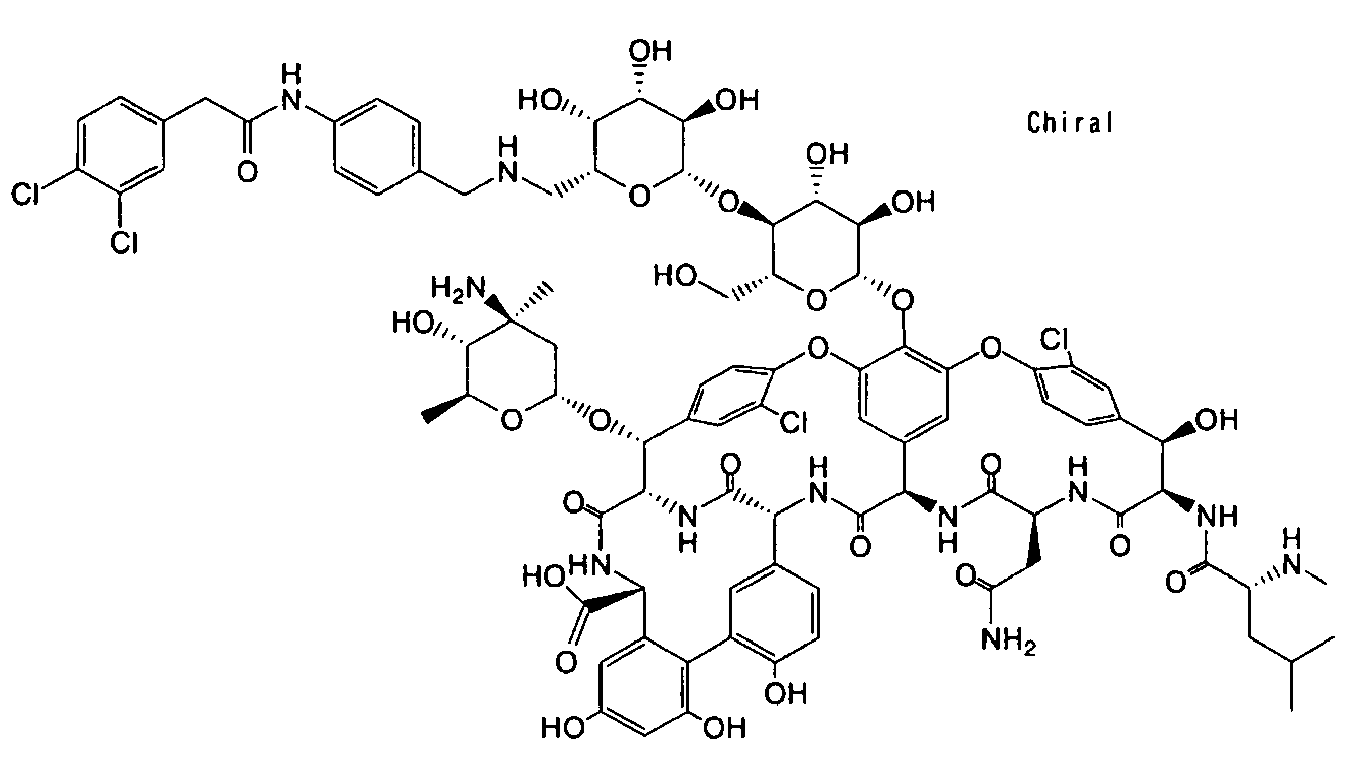
[M+1]+ =1900 Calculated value for C87H97Cl4N1 1029· 2. 8HCl· 12. 0H20
C: 47. 05%.
H: 5. 62%.
N: 6.94%.
Cl: 10. 86%
Measured value
C: 47. 03%.
H: 5. 57%.
N: 7. 22%.
Cl: 10. 79%68 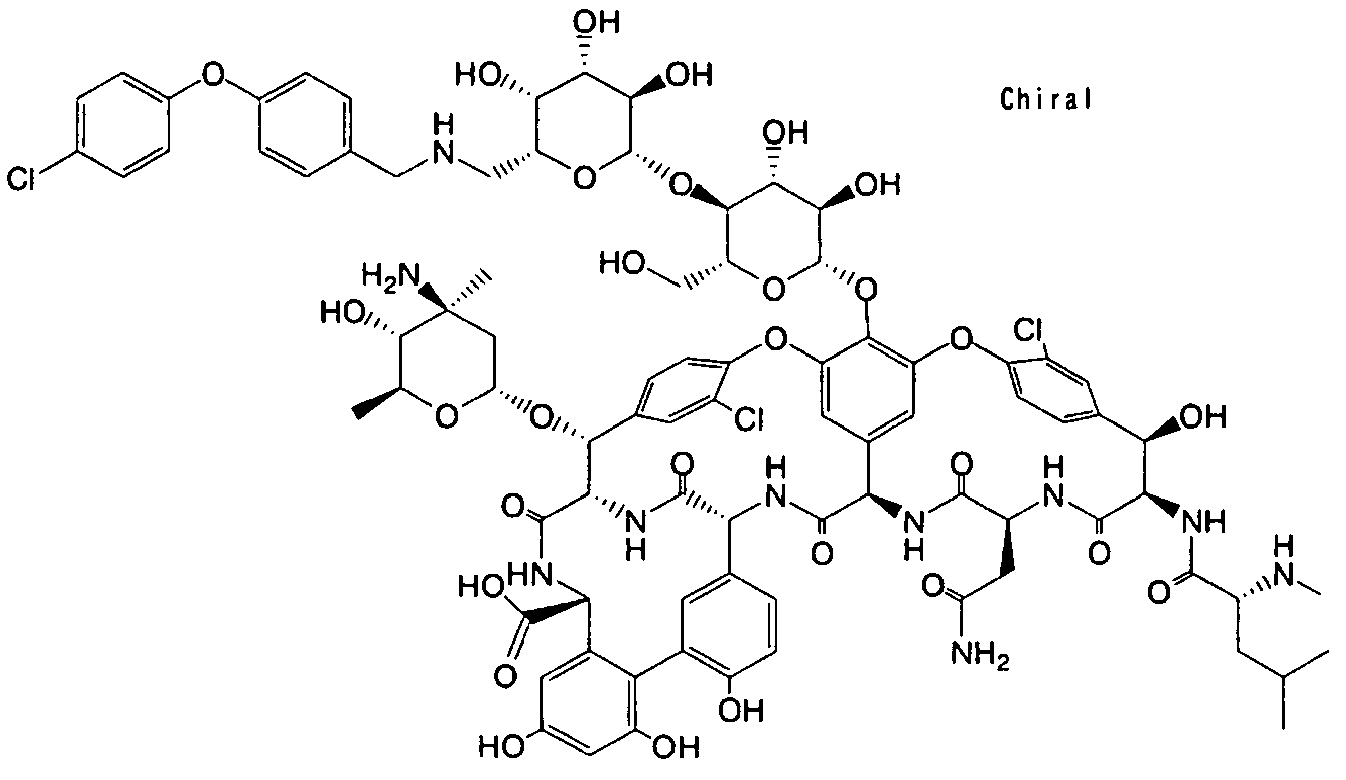
[M+1]+ =1825 Calculated value for C85H95Cl3N1 0029· 2. 7HCl· 12. 3H20
C: 47. 55%.
H: 5. 74%.
N: 6. 52%,
Cl: 9. 41%
Measured value
C: 47. 51%,
H: 5. 65%.
N: 6. 59%.
Cl: 9.44%69 
[M+1]+ =1900 Calculated value for C87H97Cl4N1 1029· 3. 1HCl· 11. 7H20
C: 46. 93%.
H: 5. 59%.
N: 6. 92%.
Cl: 11. 31%
Measured value
C: 46. 91%.
H: 5. 51%.
N: 6. 99%.
Cl: 11. 28% -
[Table 34] Example Structure Mass Spectrometry Elementary analysis 70 
[M+1]+ =1921 Calculated value for C87H97Cl2F3 N10030S· 3. 1HCl· 12. 2H20
C: 46. 33%.
H: 5. 56%.
N: 6. 21%.
F: 2. 53%.
S:1. 42%
Measured value
C: 46. 34%.
H: 5. 47%.
N: 6. 29%.
Cl: 7. 96%.
F: 2. 39%.
S:1. 38%71 
[M+1]+ =1752 Calculated value for C82H95Cl2N1 1028· 3. 2HCl· 11. 2H20
C: 47.53%.
H: 5. 87%.
N: 7. 44%.
Cl: 8. 90%
Measured value
C: 47. 50%,
H: 5. 95%.
N: 7. 56%.
Cl: 8. 84%72 
[H+1]+ =1927 Calculated value for C89H108Cl2N 12030S· 4. 4HCl· 11. 2H20
C: 46. 66%.
H: 5. 93%.
N: 7. 34%,
Cl: 9. 90%.
S:1. 40%
Measured value
C: 46. 61%.
H: 6. 00%.
N: 7. 59%.
Cl: 9. 98%.
S:2. 07% -
[Table 35] Example Structure Mass Spectrometry Elementary analysis 73 
[N+1]+ =1725 Calculated value for C81H94Cl2N1 0028· 3. 1HCl· 12. 8H20
C: 46. 99%.
H: 5. 97%.
N: 6. 77%.
Cl: 8. 73%
Measured value
C: 46. 97%.
H: 5. 90%.
N: 6. 88%.
Cl: 8. 79%74 
[H+1]+ =1905 Calculated value for C87H97Cl2F3 N10029· 3. 1HCl · 11. 3H20
C: 47. 00%.
H: 5. 56%.
N: 6. 30%.
Cl: 8. 13%.
F:2. 56%,
S:1. 44%
Measured value
C: 47. 05%,
H: 5. 49%.
N: 6. 33%.
Cl: 8. 06%.
F:2. 46%.
S:1. 37%75 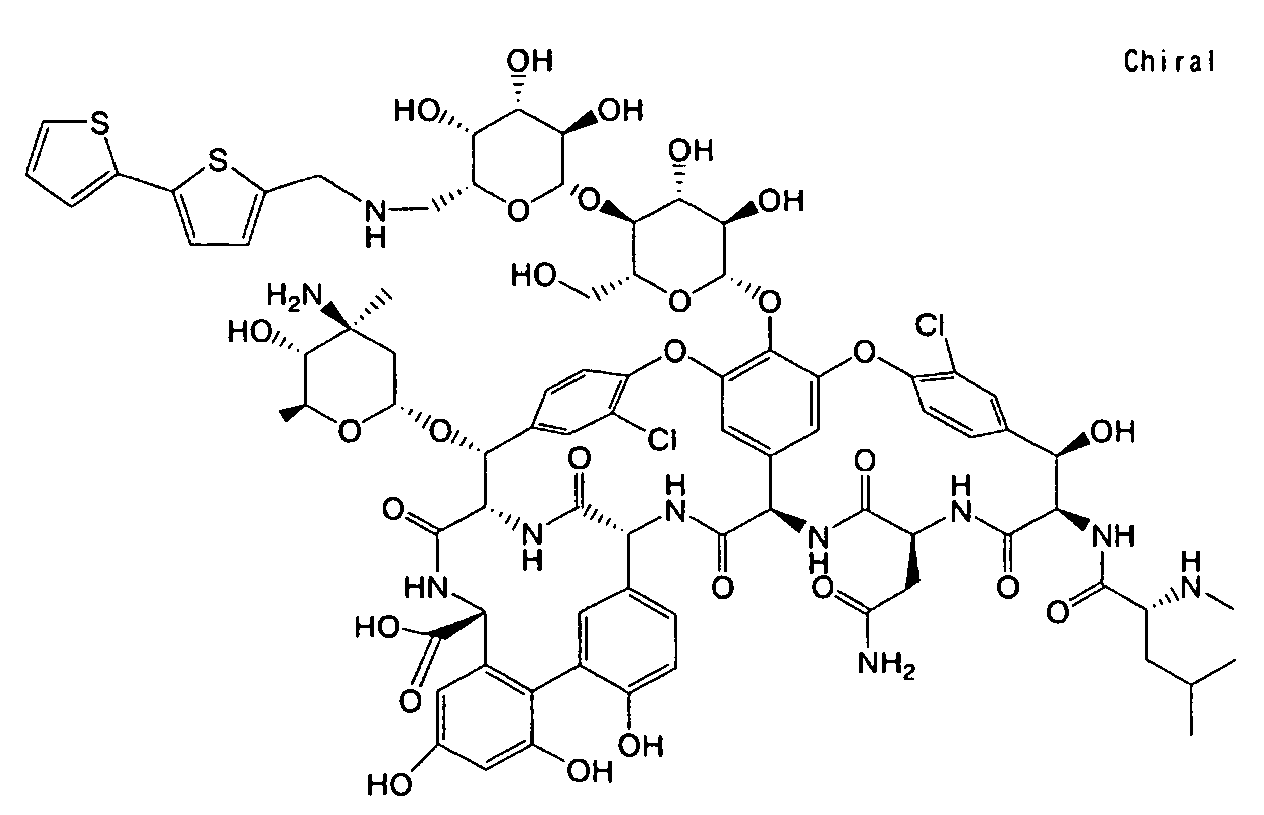
[M+1]+ =1787 Calculated value for C81H92Cl2N1 0028S2· 12. SH20· 2. 6HCl
C: 46. 02%.
H: 5. 73%.
N: 6. 63%,
Cl: 7. 71%,
S: 3. 03%
Measured value
C: 46. 02%.
H: 5. 58%.
N: 6. 76%,
Cl: 7. 71%.
S: 2. 94% -
[Table 36] Example Structure Mass Spectrometry Elementary analysis 76 
[M+1]+ =1788 Calculated value for C80H91C12N1 1028S2· 12. 1H20· 3. 1HCl
C: 45. 31%.
H: 5. 62%.
N: 7. 27%.
Cl: 8. 53%.
S: 3. 02%
Measured value
C: 45. 27%.
H: 5. 35%.
N: 7. 39%,
Cl: 8. 47%.
S: 3. 16%77 
[M+1]+ =1782 Calculated value for C82H93Cl2N1 1028S· 12. 9H20· 2. 8HCl
C: 46. 50%.
H: 5. 79%.
N: 7.27%.
Cl: 8.03%.
S: 1. 51%
Measured value
C: 46. 48%.
H: 5. 70%.
N: 7. 40%.
Cl: 8. 03.
S: 1. 48%78 
[M+1]+ =1782 Calculated value for C82H93C12N1 1028S· 14. 3H20· 3. 5HCl
C: 45. 41%,
H: 5. 81%.
N: 7. 10%.
Cl: 8. 99%.
S: 1. 48%
Measured value
C: 45. 33%.
H: 5. 60%.
N: 7. 19%.
Cl: 9. 01%.
S: 1. 43% -
[Table 37] Example Structure Mass Spectrometry Elementary analysis 79 
[M+l]+ =1806 Calculated value for C84H93C12N1 1028S· (H20)12. 4· (HCl)2. 3
C: 47. 70%.
H: 5. 72%.
N: 7. 29%.
Cl:7. 21%.
S: 1. 52%
Measured value
C: 47. 71%.
H: 5. 59%.
N: 7. 35%.
Cl: 7. 23%.
S: 1. 37%80 
[M+1]+ =1797 Calculated value for C83H91C13N1 0027S· (H20)10· (HCl)3. 2
C: 47. 56%.
H: 5. 49%.
N: 6. 68%.
Cl: 10. 49%.
S: 1. 53%
Measured value
C: 47. 55%.
H: 5. 40%.
N: 6. 81%.
Cl: 10. 51%.
S: 1. 39%81 
[M+1]+ =1817 Calculated value for C83H92C12F2 N10028S· (H20)12· (HCl)3. 2
C: 46. 33%.
H: 5. 58%.
N: 6. 51%.
Cl: 8.57%.
F: 1.77%.
S: 1. 49%
Measured value
C: 46. 30%.
H: 5. 43%.
N: 6. 62%.
Cl: 8. 50%.
F: 1. 74%.
S: 1. 42% -
[Table 38] Example Structure Mass Spectrometry Elementary analysis 82 
[M+1]+ =1817 Calculated value for C83H92C12F2 N10028S· (H20) 9. 9· (HCl) 3. 3
C: 47. 08%.
H: 5. 48%.
N: 6. 62%.
Cl: 8. 87%.
F: 1. 79%.
S: 1. 51%
Measured value
C: 47. 12%.
H: 5. 49%.
N: 6. 85%.
Cl: 8. 82%.
F: 1. 79%,
S: 1. 42%83 
[H+1]+ =1811 Calculated value for C84H96C12N1 0029S· (H20) 11. 2· (HCl) 3. 0
C: 47. 50%,
H: 5. 76%.
N: 6. 60%.
Cl: 8. 35%.
S: 1. 51%
Measured value
C: 47. 49%.
H: 5. 67%.
N: 6. 61%.
Cl: 8. 35%.
S: 1. 44%84 
[M+l]+ =18.59 Calculated value for C84H96C12N1 0030S2· (H20) 12. 4· (HCl) 3. 2
C: 45. 84%.
H: 5. 68%.
N: 6. 36%.
Cl: 8. 38%.
S: 2. 91%
Measured value
C: 45. 82%.
H: 5. 57%.
N: 6. 53%.
Cl: 8. 40%,
S: 2. 70% -
[Table 39] Example Structure Mass Spectrometry Elementary analysis 85 
[M+1]+ =1826 Calculated value for C83H93C12N1 1030S· (H20)11. 3· (HCl)2. 4
C: 47. 05%,
H: 5. 61%.
N: 7. 27%,
Cl: 7. 36%.
S: 1. 51%
Measured value
C: 47. 03%.
H: 5. 53%.
N: 7. 42%.
Cl: 7. 34%.
S: 1. 40%86 
[M+1]+ =1795 Calculated value for C84H96C12N1 0028S· (H20)12. 4· (HCl)2. 8
C: 47. 54%.
H: 5. 87%.
N: 6. 60%.
Cl: 8. 02%.
S: 1. 51%
Measured value
C: 47. 51%.
H: 5. 62%.
N: 6. 65%.
Cl: 7. 98%.
S: 1. 42%87 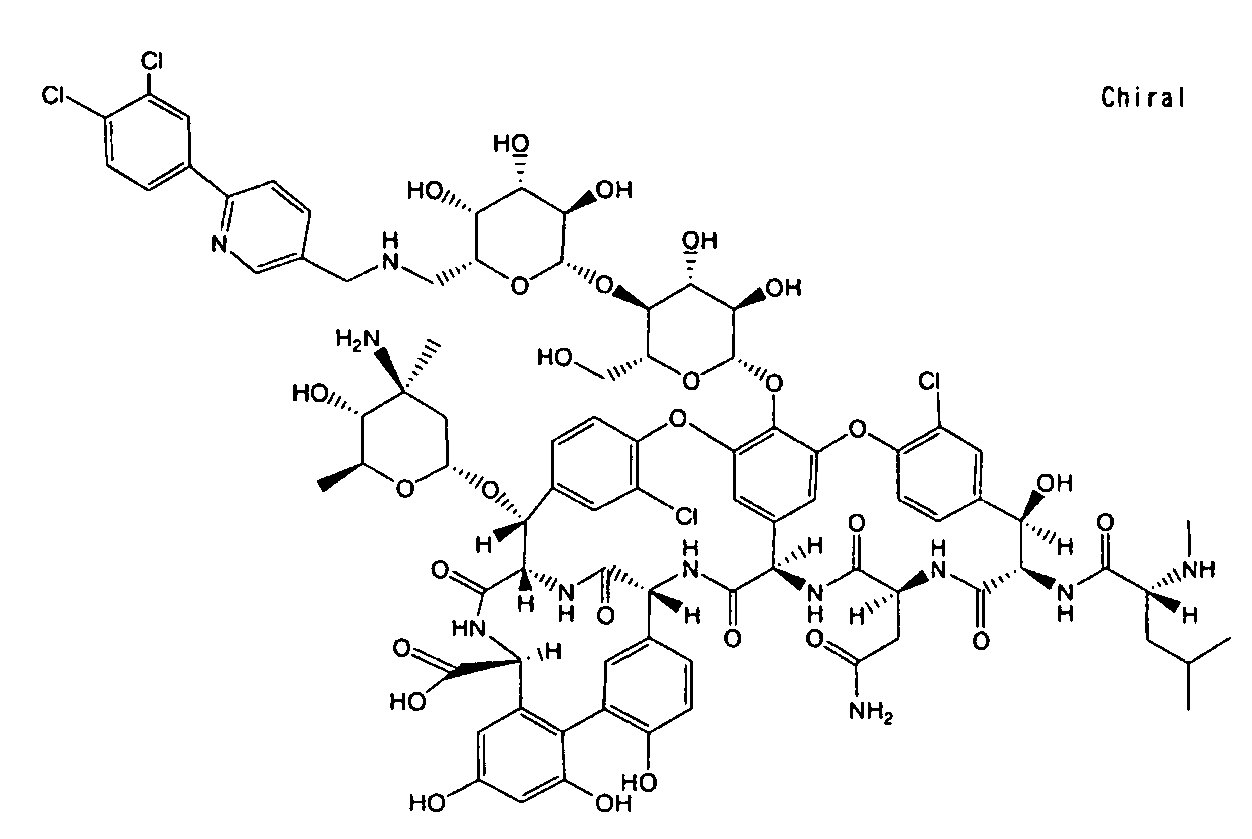
[M+1]+ =1844 Calculated value for C84H93C14N1 1028· (H20)17· (HCl)2. 9
C: 44. 67%.
H: 5. 80%.
N: 6. 82%.
Cl: 10. 83%
Measured value
C: 44. 69%.
H: 5. 87%.
N: 6. 89%.
Cl: 10. 82% -
[Table 40] Example Structure Mass Spectrometry Elementary analysis 88 
[M+1]+ =1812 Calculated value for C84H93C12F2 N11028· (H20)16. 5· (HCl)2. 6
C: 45. 74%.
H: 5. 88%.
N: 6. 99%.
Cl: 7. 39%.
F: 1. 72%
Measured value
C: 45. 73%.
H: 5. 82%.
N: 7. 05%.
Cl: 7. 36%.
F: 1. 62%89 
[M+1]+ =1860 Calculated value for C85H94C12F3 N11029· (H20)17. 4· (HCl)4
C: 43. 99%.
H: 5. 77%.
N: 6. 64%.
Cl: 9. 17%
F: 2. 46%
Measured value
C: 43. 96%.
H: 5. 69%.
N: 6. 80%.
Cl: 9. 16%.
F: 2. 38%90 
[M+1]+ =1804 Calculated value for C86H99C12N1 1028· (H20)15. 4· (HC1)4. 2
C: 46. 19%.
H: 6. 04%.
N: 6. 89%.
Cl: 9. 83%
Measured value
C: 46. 20%.
H: 5. 83%.
N: 6. 98%.
Cl: 9. 76% -
[Table 41] Example Structure Mass Spectrometry Elementary analysis 91 
[M+1]+ =1785 Calculated value for C81H91C12FN 12029· (H20)15· (HCl)2. 6
C: 45. 22%.
H: 5. 79%.
N: 7. 81%.
F: 0. 88%
Measured value
C: 45. 23%.
H: 5. 87%.
N: 7. 80%.
Cl: 7. 61%.
F: 0. 87%
Cl: 7. 58%.92 
[M+1]+ =1828 Calculated value for C84H93C13FN 11028· (H20)13. 3· (HCl)3
C: 46. 30%.
H: 5. 67%.
N: 7. 07%.
Cl: 9. 76%.
F: 0. 87%
Measured value
C: 46. 27%.
H: 5. 63%.
N: 7. 21%.
Cl: 9. 69%.
F: 0. 77%93 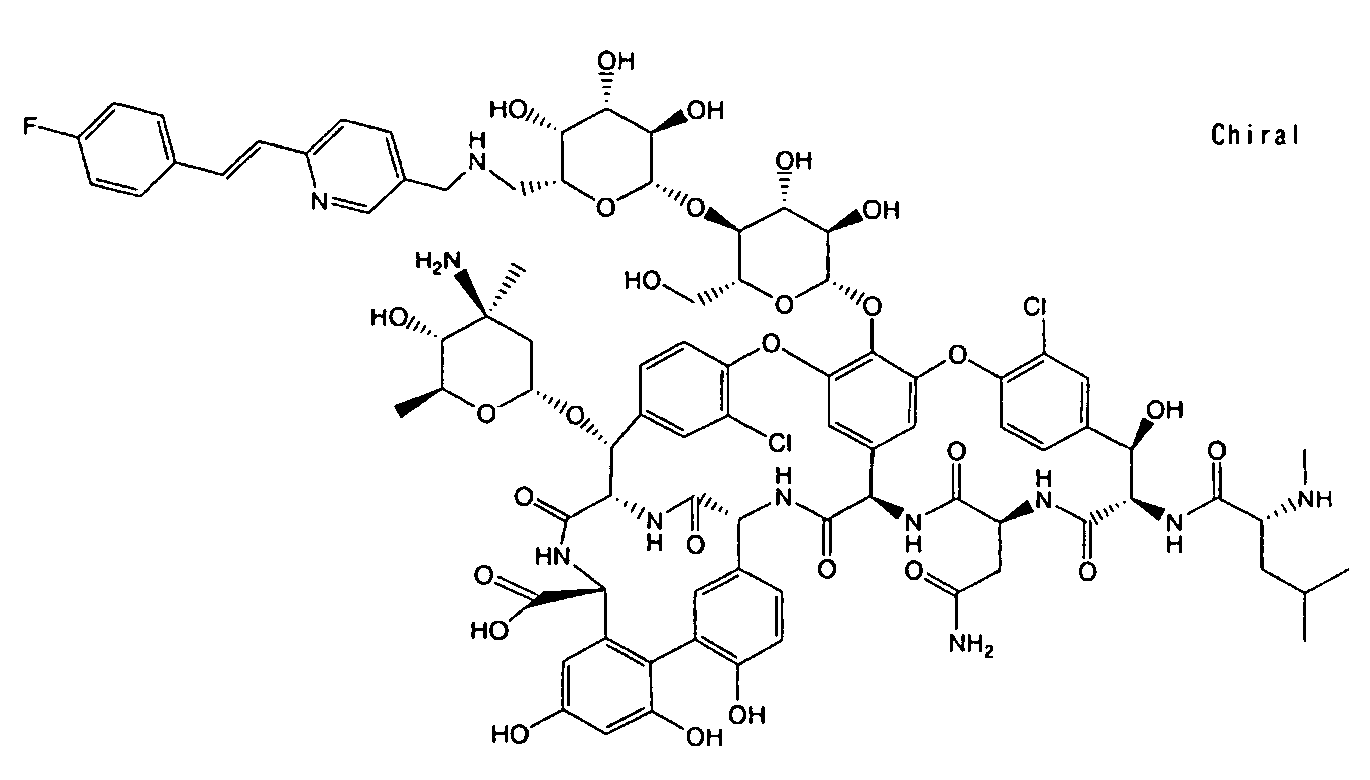
[M+1]+ =1820 Calculated value for C86H96C12FN 11028· (H20)14. 6· (HCl) 2. 7
C: 47. 31%.
H: 5. 91%.
N: 7. 06%.
Cl: 7. 63%.
F: 0. 87%
Measured value
C: 47. 26%.
H: 5. 83%.
N: 7. 17%.
Cl: 7. 69%.
F: 0. 77% -
[Table 42] Example Structure Mass Spectrometry Elementary analysis 94 
[M+1]+ =1842 Calculated value for C84H94C13N1 1028S· (H20)14. 4· (HCl)2. 6
C: 45. 89%.
H: 5. 75%.
N: 7. 01%,
Cl: 9. 03%.
S: 1. 46%
Measured value
C: 45. 84%.
H: 5.63%.
N: 7. 14%.
Cl: 9. 05%,
S: 1.51%95 
[M+1]+ =1874 Calculated value for C84H94Cl3N1 1030S· (H20)14. 5· (HCl)3. 2
C: 44. 76%.
H: 5. 64%.
N: 6. 84%.
Cl: 9. 75%.
S: 1. 42%
Measured value
C: 44. 69%.
H: 5. 51%.
N: 6. 97%.
Cl: 9. 69%.
S: 1. 43%96 
[M+1]+ =1860 Calculated value for C84H93Cl4N1 1029· (H20)13. 5· (HCl)3
C: 45. 55%.
H: 5. 60%.
N: 6. 96%.
Cl: 11.20%
Measured value
C: 45. 53%.
H:5. 50%.
N: 7. 15%.
Cl: 11. 14% -
[Table 43] Example Structure Mass Spectrometry Elementary analysis 97 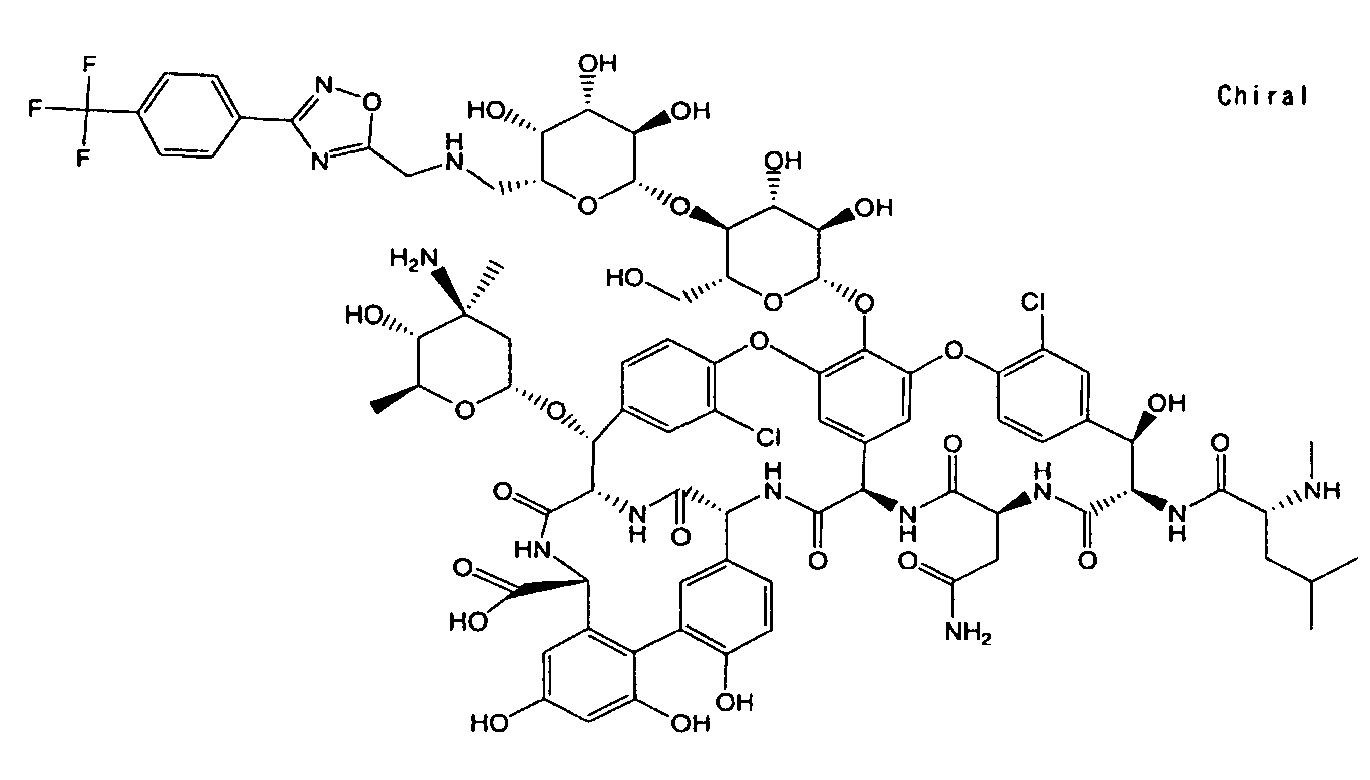
[M+1]+ =1835 Calculated value for C82H91C12F3 N12029· (H20)13. 7· (HCl)2. 9
C: 44. 99%.
H: 5. 59%.
N: 7. 68%.
Cl: 7.94%.
F: 2. 60%
Measured value
C: 45. 13%.
H:5. 69%.
N: 7.71%.
Cl: 7. 99%.
F: 2. 30%98 
[M+1]+ =1826 Calculated value for C84H94C13N1 1029· (H20)14. 3· (HCl)3. 7
C: 45. 43%.
H: 5.73%.
N: 6. 94%.
Cl: 10. 70%
Measured value
C: 45. 34%.
H: 5. 68%.
N: 7. 15%.
Cl: 10. 75%99 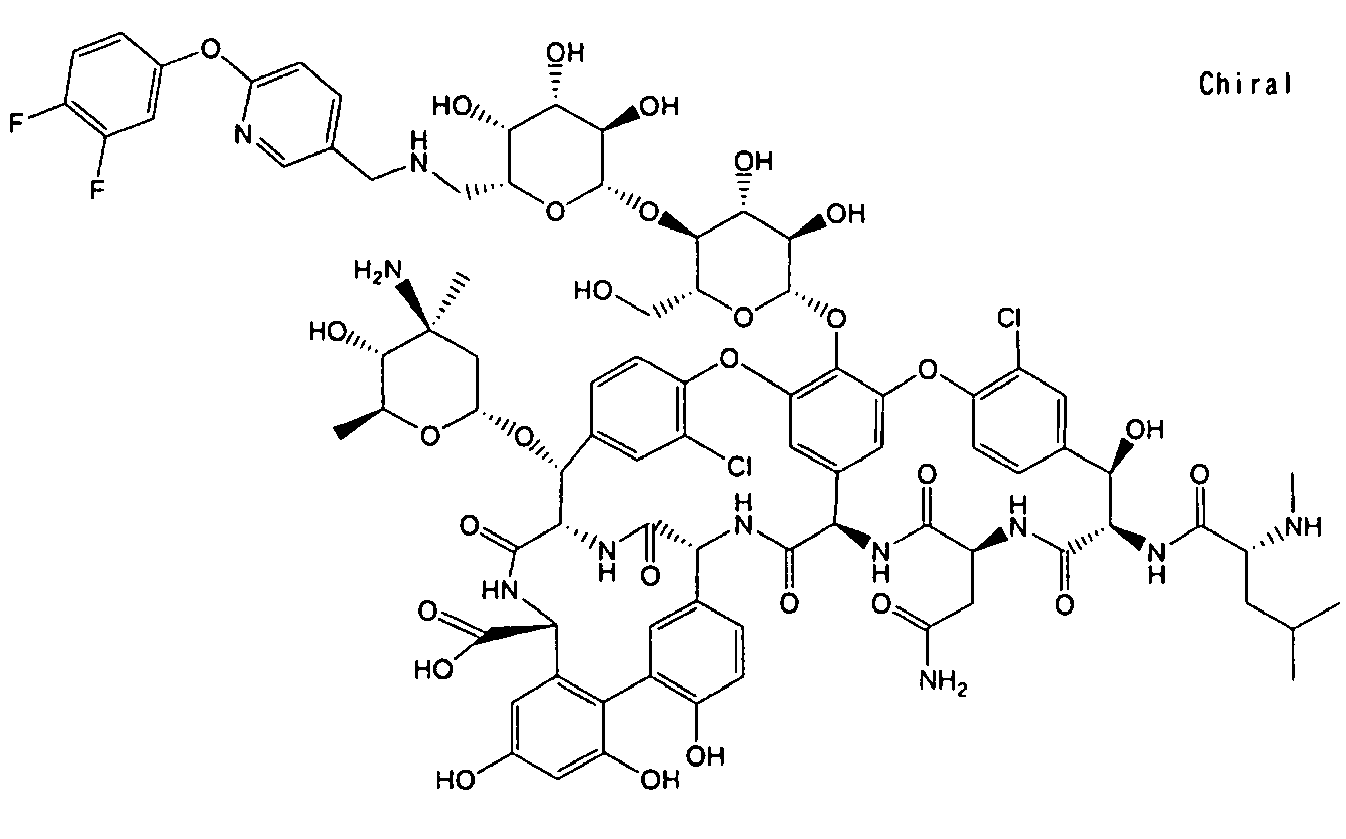
[M+1]+ =1828 Calculated value for C84H93C12F2 N11029· (H2)13. 5· (HCl)3. 3
C: 46. 00%.
H: 5. 67%.
N: 7.03%.
Cl: 8. 57%.
F: 1. 73%
Measured value
C: 45. 98%.
H: 5. 62%.
N: 7. 13%.
Cl: 8. 59%.
F: 1. 49% -
[Table 44] Example Structure Mass Spectrometry Elementary analysis 100 
[M+1]+ =1810 Calculated value for C84H94Cl3N1 1028· (H20)14· (HCl)3. 5
C: 46. 03%.
H: 5. 77%.
N: 7. 03%.
Cl: 10. 51%
Measured value
C: 45. 96%.
H: 5. 53%.
N: 7. 12%.
Cl: 10. 47%101 
[M+1]+ =1831 Calculated value for C87H96Cl2N1 0028S· 21. 7(H20)· 3. 5(HCl)
C: 44. 50%.
H: 6. 15%.
N: 5. 70%.
Cl: 8. 30%
S: 1. 30%
Measured value
C: 44. 44%.
H: 6. 13%.
N: 5. 96%.
Cl: 8. 29%.
S: 1. 36%102 
[M+1]+ =1799 Calculated value for C83H93Cl3N1 0029· 18. 4(H20)· 3. 4(HCl)
C: 44. 37%.
H: 5. 87%.
N: 5. 91%.
Cl: 10. 1%
Measured value
C: 44. 18%.
H: 5. 95%.
N: 6. 21%.
Cl: 10. 06% -
[Table 45] Example Structure Mass Spectrometry Elementary analysis 103 
[M+1]+ = 1811 Calculated value for C83H93Cl3N1 2028· 19. 0(H20)· 2. 8(HCl)
C: 44. 26%.
H: 5. 98%.
N: 7. 16%.
Cl: 9. 15%
Measured value
C: 44. 16%.
H: 5. 97%.
N: 7. 45%.
Cl: 9. 11%104 
[M+1]+ =1816 Calculated value for C82H92Cl31 1028S· 19. 6(H20)· 3. 4(HCl)
C: 42. 96%.
H: 6. 06%.
N: 6. 56%.
Cl: 9. 88%.
S: 1. 495
Measured value
C: 42. 91%.
H: 5. 91%.
N: 6. 71%.
Cl: 9.89%.
S:1. 40%105 
[M+1]+ =1800 -
[Table 46] Example Structure Mass Spectrometry Elementary analysis 106 
[M+1]+ =1811 107 
[M+1]+ =1815 Calculated value for C83H93C13N1 0028S· (H20)13. 1· (HCl)3. 0
C: 46. 10%.
H: 5. 70%.
N: 6. 48%.
Cl: 9 .84.
S: 1. 48%
Measured value
C: 46. 06%.
H: 5. 70%.
N: 6. 56%.
Cl: 9. 88%.
S: 1.41%108 
[M+1]+ =1811 Calculated value for C84H94Cl3N1 1028· (H20)15. 2· (HCl)3. 6
C: 45. 50%.
H: 5. 82%.
N: 6. 95%.
Cl: 10. 55%
Measured value
C: 45. 48%.
H: 5. 82%.
N: 7. 06%.
Cl: 10. 59% -
[Table 47] Example Structure Mass Spectrometry Elementary analysis 109 
[M+1]+: =1896 Calculated value for C85H99Cl2F3 N12030· (H20)13. 6· (HCl)2. 9
C: 45. 43%.
H: 5. 79%.
N: 7. 48%.
Cl: 7. 73%.
F: 2. 54%
Measured value
C: 45. 38%.
H: 5. 72%.
N: 7.92%.
Cl: 7. 76%.
F: 2.96% -
[Table 48] Example Structure Mass Spectrometry Elementary analysis 110 
[M+1]+ = 1847 Calculated value for C83H93Cl3 N10028S2· (H20)15. 4· (HCl)2. 6· (CH3CN)0. 7
C: 45. 05%.
H: 5. 76%.
N: 6. 66%.
Cl: 8. 82%.
S: 2. 85%
Measured value
C: 45. 08%.
H: 5. 54%.
N: 6. 80%.
Cl: 8. 80%.
S: 2. 57%111 
[M+1]+ = 1831 Calculated value for C83H93Cl3 N10029S· (H20)14. 1· (HCl)2. 7
C: 45.61%.
H: 5. 71%.
N: 6. 41%.
Cl: 9. 25%.
S: 1.47%
Measured value
C: 45. 61%.
H: 5. 52%.
N: 6. 52%.
Cl: 9. 18%.
S: 1. 26%112 
[M+1]+ = 1879 Calculated value for C83H93Cl3 N10030S2· (H20)15. 8· (HCl)2. 8
C: 43. 96%.
H: 5. 66%.
N: 6. 18%.
Cl:9. 07%.
S: 2. 83%
Measured value
C: 43. 95%.
H: 5. 37%.
N: 6. 14%.
Cl: 9. 09%.
S: 2. 61% -
[Table 49] Example Structure Mass Spectrometry Elementary analysis 113 
[M+1]+ = 1821 Calculated value for C86H98Cl2 N10028S· (H20)15. 5· (HCl)2. 9
C: 46. 79%.
H: 6. 02%.
N: 6. 34%.
Cl: 7. 87%.
S: 1. 45%
Measured value
C: 46. 74%.
H: 5. 75%.
N: 6. 27%.
Cl: 7. 80%.
S: 1. 37%114 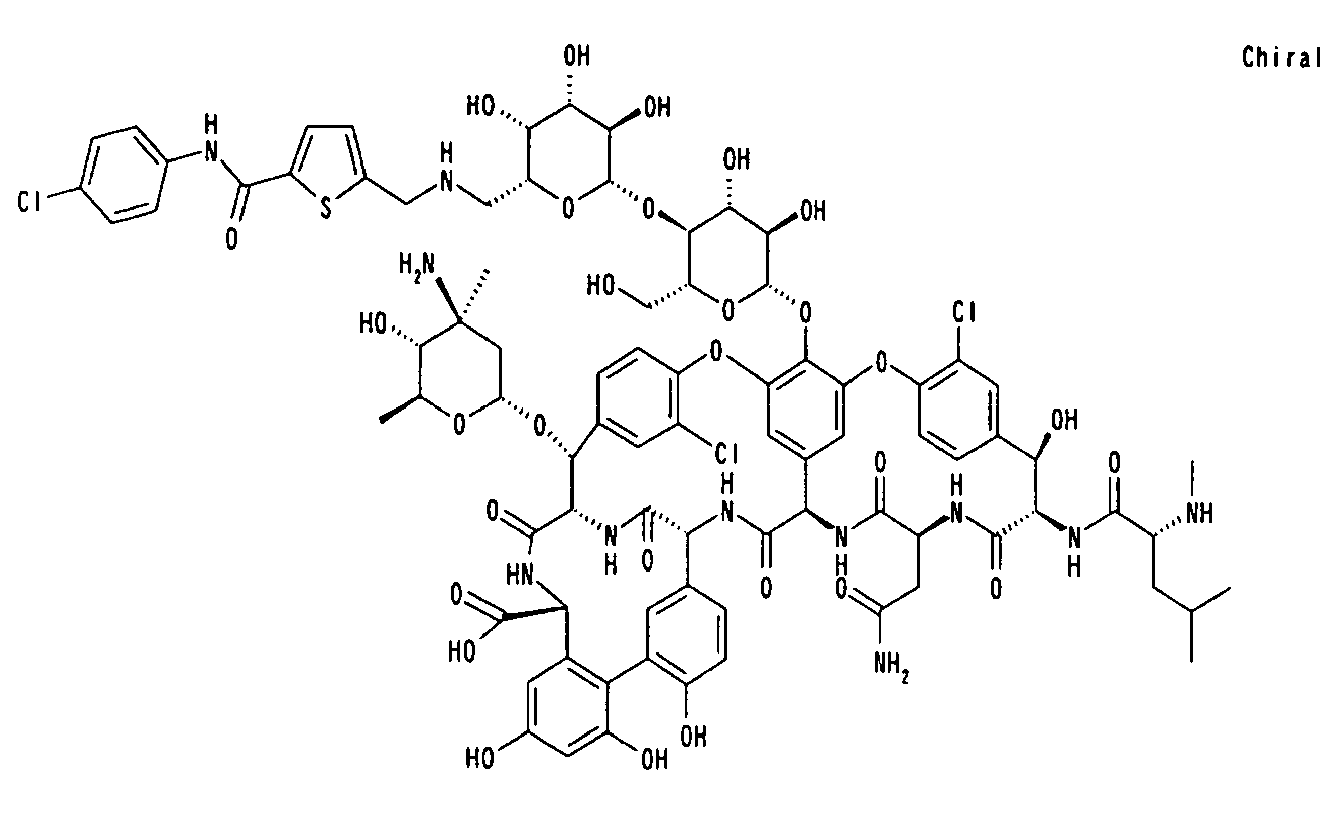
[M+1]+ = 1858 Calculated value for C84H94C13 N11029S· (H20)18. 3· (HCl)3. 3· (CH3CN)0. 6
C: 43. 83%.
H: 5. 86%.
N: 6. 96%.
Cl: 9. 57%.
S: 1. 37%
Measured value
C: 43. 76%.
H: 5. 59%.
N: 7. 03%.
Cl: 9. 59%.
S: 1. 32%115 
[M+1]+ = 1841 Calculated value for C85H95C13 N10028S· (H20)20. 1· (HCl)4. 8· (CH3CN)0. 6
C: 43. 05%.
H: 5. 94%.
N: 6. 17%.
Cl: 11. 50%.
S: 1. 33%
Measured value
C: 42. 76%.
H: 5. 64%.
N: 6. 33%.
Cl: 11. 49%.
S: 1. 31% -
[Table 50] Example Structure Mass Spectrometry Elementary analysis 116 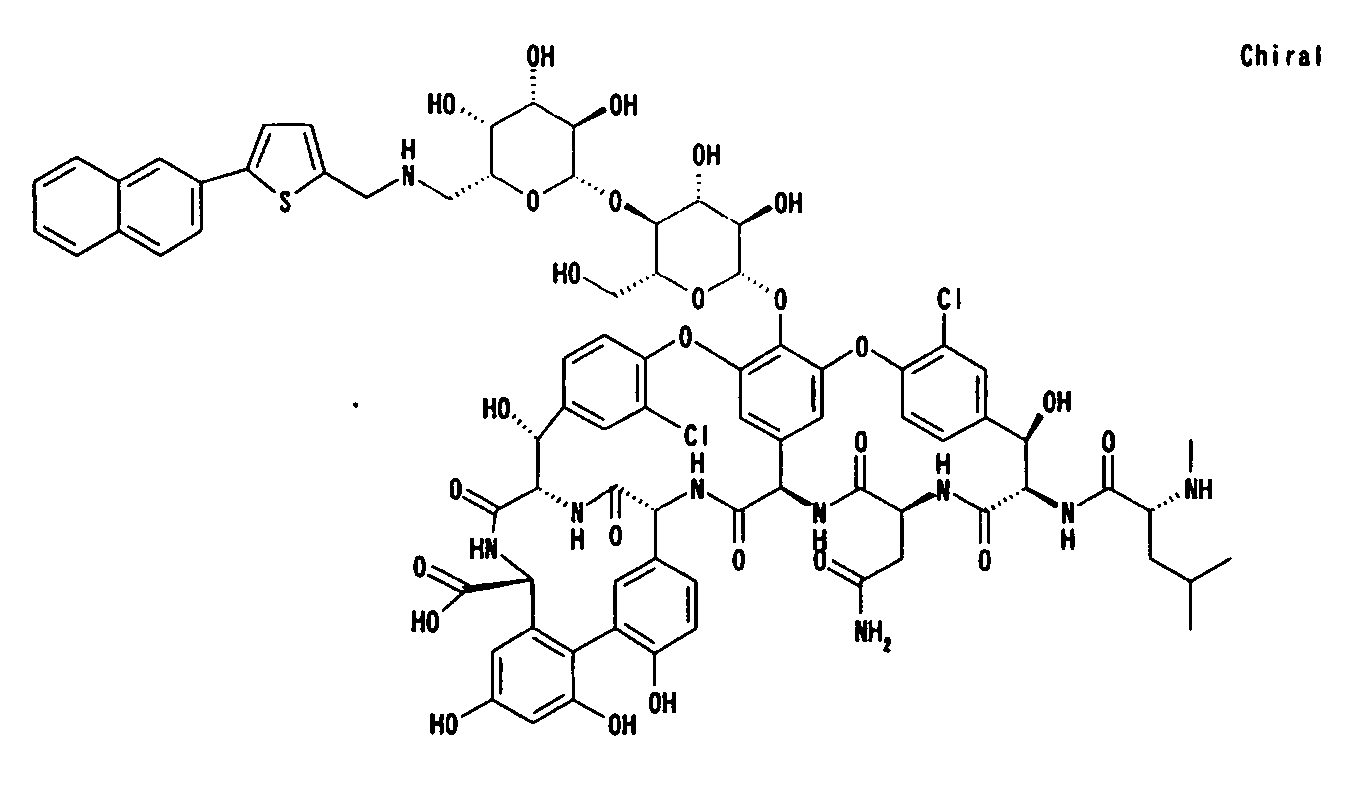
[M+1]+ = 1688 Calculated value for C80H83C12 N9026S· (H20)13. 6· (HCl)2. 1
C: 47. 78%,
H: 5. 63%.
N: 6. 27%.
Cl: 7. 23%,
S: 1. 59%
Measured value
C: 47. 77%,
H: 5. 58%,
N: 6. 39%,
Cl: 7. 18%,
S: 1. 53%117 
[M+1]+ = 1672 Calculated value for C76H80Cl3 N9026S· (H20)11. 6· (HCI) 1. 4
C: 47. 20%,
H: 5. 45%,
N: 6. 52%,
Cl: 8. 07%,
S: 1. 66%
Measured value
C: 47. 13%,
H: 5. 36%,
N: 6. 59%,
Cl: 8. 13%,
S: 1. 62%118 
[M+1]+ = 1673 Calculated value for C75H79Cl3 N10026S· (H20)11. 2· (HCl)1. 9 C: 46. 29%, H: 5. 35%, N: 7. 2%, Cl: 8. 93%, S: 1. 65% Measured value C: 46. 07%, H: 5. 20%, N: 7. 27%, Cl: 8. 84%, S: 1. 46% -
[Table 51] Example Structure Mess Spectrometry Elementary analysis 119 
[M+1]+ = 1668 Calculated value for C76H80C13 N11026-(H20)10. 2 (HCl)2. 6
C: 46. 85%,
H: 5. 33%.
N: 7. 91%.
Cl: 10. 19%
Measured value
C: 46. 81%.
H: 5. 33%,
N: 8. 27%,
Cl: 10. 16%120 
[M+1]+ = 1668 Calculated value for C76H80Cl3 N11026˙ (H20)13. 1˙ (HCl)1. 8
C: 46. 30%,
N: 7. 82%.
N: 7. 82%.
Cl: 8. 63%
Measured value
C: 46. 27%.
H: 5. 41%,
N: 7. 88%,
Cl: 8. 66%121 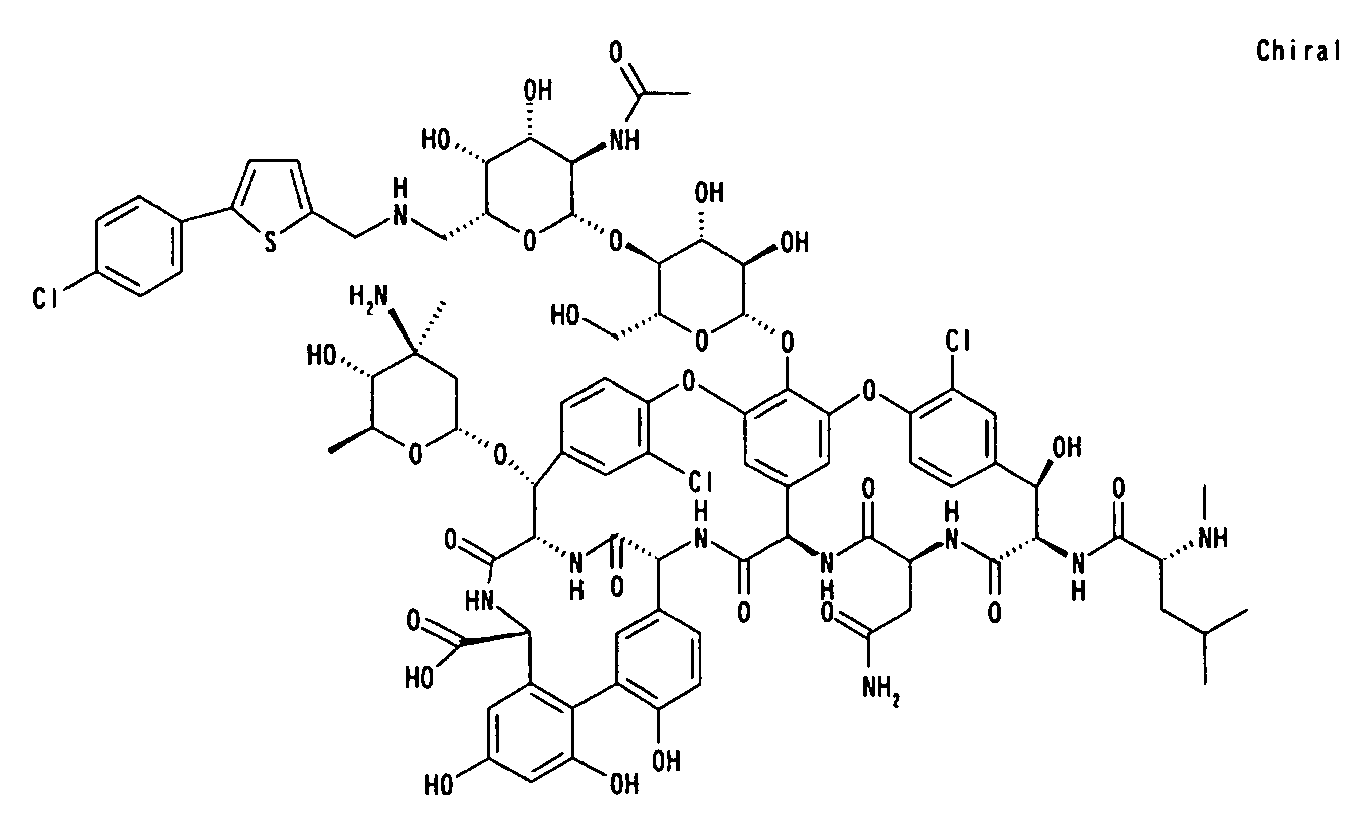
[M+1]+ = 1856 Calculated value for C85H96Cl3 N11028S· (H20)18. 7· (HCl) 3. 1
C: 44. 23%,
H: 5. 96%.
N: 6. 68%.
Cl: 9. 37%,
S: 1. 39%
Measured value
C: 44. 22%.
H: 5. 76%.
N: 6. 59%,
Cl: 9. 32%,
S: 1. 34%
Other Example compounds can be produced by the same methods as follows. -
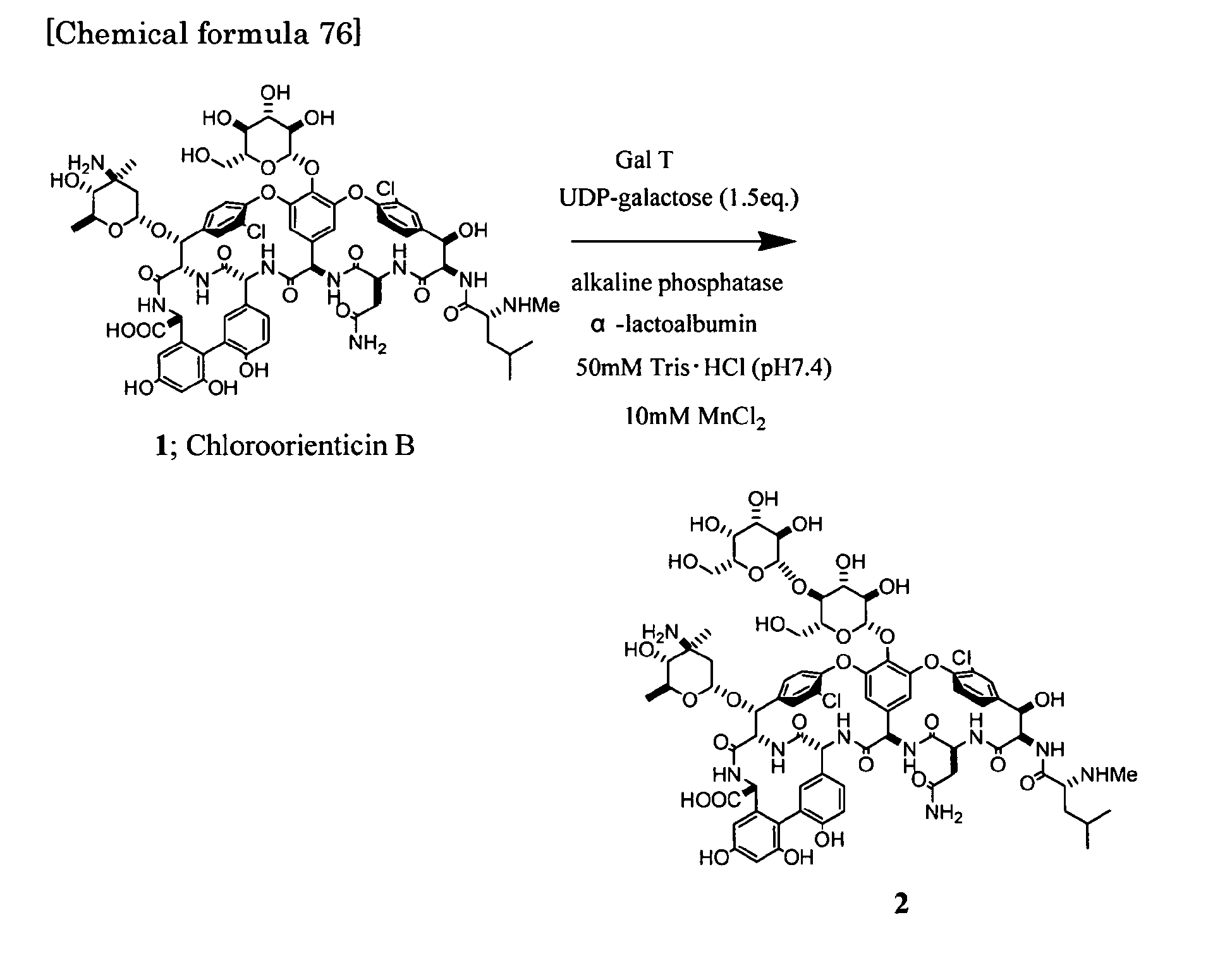
-

-

-

-


-

-

-

-

-

-


-


-

Subsequently, the unreacted compound 3 was dissolved in 3 mL of water, 0.3 mL of diisopropylethylamine was added and this was allowed to stand for 8 hours, and purified by reverse phase column chromatography to obtain crude purified compound 15. The resulting crude purified compounds 15 were combined, and purified again by reverse phase column chromatography to obtain 189 mg (yield 35%) of compound 15 as a white powder. -

-

-

-


-


-

-


- Some of the present compounds were measured for a minimum growth inhibition concentration (MIC) by a small amount of liquid dilution method using a cation-adjusted Muller Hinton liquid medium well-known to a person skilled in the art.
- The present compounds exhibited the high antibacterial activity against various bacterium including vancomycin-resistant bacterium. Particularly, compounds of Examples 1, 5, 6, 10, 11, 13, 30, 31, 43, 45, 50, 65, 69, 75, 82, 83, 85 and 88 had MIC: 2 to 4 µg/ml against E. faecalis SR7914 which is vancomycin-resistant Enterococcus (VRE VanA), and MIC: 1 to 4 µg/ml (vancomycin is >64 µg/ml) against E. faecium SR7940, and exhibited the remarkably higher activity than the existing drugs.
- Following Preparation Examples 1 to 8 are illustrative, and are not meant to limit the scope of the invention at all. The term "active ingredient" means the present compound, a tautomer thereof, a prodrug thereof, a pharmaceutically acceptable salt thereof, or a solvate thereof.
- A hard gelatin capsule is produced using the following ingredients :
Dose (mg/capsule) Active ingredient 250 Starch (dry) 200 Magnesium stearate 10 Total 460 mg - A tablet is produced using the following ingredients:
Dose (mg/tablet) Active ingredient 250 Cellulose (microcrystalline) 400 Silicon dioxide (fumed) 10 Stearic acid 5 Total 665 mg - An aerosol solution containing the following ingredients is produced:
Weight Active ingredient 0.25 Ethanol 25.75 Propellant 22 (chlorodifluoromethane) 74.00 Total 100.00 - A tablet containing 60 mg of an active ingredient is produced as follows:
Active ingredient 60 mg Starch 45 mg Microcrystalline cellulose 35 mg Polyvinylpyrrolidone (10% solution in water) 4 mg Sodium carboxymethylstarch 4.5 mg Magnesium stearate 0.5 mg Talc 1 mg Total 150 mg - A capsule containing 80 mg of an active ingredient is produced as follows:
Active ingredient: 80 mg Starch 59 mg Microcrystalline cellulose 59 mg Magnesium stearate 2 mg Total 200 mg - A suppository containing 225 mg of an active ingredient is produced as follows:
Active ingredient 225 mg Saturated fatty acid glyceride 2000 mg Total 2225 mg - A suspension containing 50 mg of an active ingredient is produced as follows:
Active ingredient 50 mg Sodium carboxymethylcellulose 50 mg Syrup 1.25 ml Benzoic acid solution 0.10 ml Perfume q.v. Pigment q.v. Purified water ad. 5 ml - A preparation for intravenous injection is produced as follows:
Active ingredient 100 mg Saturated fatty acid glyceride 1000 ml - The glycopeptide derivative of the present invention, a pharmaceutically acceptable salt thereof and a solvate thereof are useful in medical treatment and exhibit the pharmacological activity including the antibacterial activity. The compound of the present invention is useful in treating infection caused by, particularly, meticillin-resistant Staphylococcus aureus. In addition, this compound is useful for treating infection with Enterococcus including vancomycin-resistant Enterococcus (VRE). As an example of such a disease, there is serious staphylococcus infection, for example, staphylococcus endocarditis and staphylococcus sepsis.

respective symbols are each as defined in above (20).
Among the aforementioned groups, a particularly preferable embodiments of RA1 is (1-28).
RB is preferably -OH, -NHR5, or -NR5R5' (wherein R5 and R5' are hydrogen, optionally substituted lower alkyl, -NH-R, -NH-COR, -NH-CONHR, -O-R (each R is independently hydrogen or optionally substituted lower alkyl, respectively), or amino sugar residue). Preferably, one of R5 and R5' is hydrogen. More preferable is -OH or -NHR5 (wherein R5 is substituted lower alkyl, or optionally substituted lower alkyloxy).
As a substituent of the optionally substituted lower alkyl and the optionally substituted lower alkyloxy, hydrophilic substituent is preferable. For example, the same or different 1 to 10, preferably 1 to 6 substituents selected from amino, mono- or di-lower alkylamino, tri-lower alkylamine, amino lower alkylamino, hydroxyl lower alkylamino, hydroxy, carboxy, lower alkoxycarbonyl, SO3H, PO3H2, optionally substituted carbamoyl, quaternary ammonium group (e.g., tri-lower alkylamino (e.g., -N+(CH3)3)), optionally substituted heterocyclic group (heterocycle or heteroaryl), optionally substituted heterocyclic thio, guanidino, NHSO2NH2, and hydroxy lower alkoxy are exemplified. An N atom part in the heterocycle may be quaternarized to form a salt. As a substituent of the optionally substituted heterocycle, hydroxy, amino, carboxy, amino lower alkyl, and quaternary ammonium lower alkyl are exemplified. Alternatively, a lower alkyl group on the quaternary ammonium group may be further substituted with the substituted lower alkyl (substituent: carboxy, hydroxy, quaternary ammonium group). More preferable is optionally substituted lower amino, hydroxy, or lower alkoxy.
RC is preferably hydrogen or optionally substituted lower alkyl. A substituent of the optionally substituted lower alkyl is preferably the -NHR5, or substituents of optionally substituted lower alkyl in R5 are exemplified. More preferable is the -NHR5. Herein, R5 is preferably optionally substituted aralkyl, optionally substituted heteroaralkyl, or optionally substituted lower alkyl. A substituent of the optionally substituted aralkyl, the optionally substituted heteroaralkyl, or the optionally substituted lower alkyl is preferably -NH2, -SO3H, or -OH.
As a preferable combination of RB and RC, the case where RB is -OH, -NHR5 (R5 is mono- or di-lower alkylamino lower alkyl, tri-lower alkylammonium lower alkyl, or amino sugar residue), -NR5R5' (R5 and R5' are both hydroxy lower alkyl), or -NHCH2CON-N+(Me)3, and RC is hydrogen, mono- or di-substituted amino lower alkyl (examples of substituent: lower alkyl, mono- or di-lower alkylamino lower alkyl, tri-lower alkylammonium lower alkyl, hydroxy lower alkyl, hydroxy lower alkoxy lower alkyl, -CH2CON-N+(Me)3, lower alkyl substituted with 1 to 6 hydroxys, and lower alkyl substituted with carboxy, hydroxy, oxo, optionally substituted carbamoyl, guanidido, sulfonic acid group, phosphoric acid group, NHCO2NH2 and/or amino, optionally substituted heterocyclic lower alkyl (substituent: amino lower alkyl), optionally substituted quaternary ammonium lower alkyl (substituent: carboxy, hydroxy, quaternary ammonium group)) is exemplified. Specifically, cases in Table 6 to Table 8 described later are exemplified.
As a particularly preferable combination of RB and RC, RB is -OH, and RC is hydrogen.
Alternatively, an N-terminal part may be de-leucinated to convert it into -NH2, or it may be further acylated according to a method described in the literature (e.g., Expert Opin. Ther. Patents (2004) 14, pp.141-173),
As the buffer, buffers such as combination of a salt of an organic base such as Tris and the like, and an acid (e.g., Tris-HCl buffer, HEPES buffer, MES buffer etc); borate buffer; citrate buffer; acetate buffer; carbonate buffer and the like; are exemplified and preferable examples include Tris-HCl buffer, and MES buffer.
As the glycosyltransferase, β-1,4-galactosyltransferase, α-1,3-galactosyltransferase, β-1,3-galactosyltransferase, β-1,6-galactosyltransferase, α-2,6-sialyltransferase, α-1,4-galactosyltransferase, ceramidegalactosyltransferase, α-1,2-fucosyltransferase, α-1,3-fucosyltransferase, α-1,4-fucosyltransferase, α-1,6-fucosyltransferase, α-1,3-N-acetylgalactosaminyltransferase, α-1,6-N-acetylgalactosaminyltransferase, β-1,4-N-acetylgalactosaminyltransferase, polypeptide N-acetylgalactosaminyltransferase, β-1,4-N-acetylglucosaminyltransferase, β-1,2-N-acetylglucosaminyltransferase, β-1,3-N-acetylglucosaminyltransferase, β-1,6-N-acetylglucosaminyltransferase, α-1,4-N-acetylglucosaminyltransferase, β-1,4-mannosyltransferase, α-1,2-mannosyltransferase, α-1,3-mannosyltransferase, α-1,4-mannosyltransferase, α-1,6-mannosyltransferase, α-1,2-glucosyltransferase, α-1,3-glucosyltransferase, α-2,3-sialyltransferase, α-2,8-sialyltransferase, α-1,6-glucosaminyltransferase, α-1,6-xylosyltransferase, β-xylosyltransferase, (proteoglycan core structure synthesizing enzyme), β-1,3-glucuronosyltransferase, hyaluronic acid synthesizing enzyme, glycosyltransferase Gtf A to E described in J. Am. Chem. Soc. (2005), 127(30), 10747-10752, Proc. Natl. Acad. Sci. U.S.A. (2004), 101(13), 4390-4395, Chem. Asian. J. (2006)., 1, 445-452 or the like, macrolide glycosyltransferase described in International Publication
As the sugar donor, compounds (NDP-Sugar) in which various nucleotide diphosphates such as uridine- diphosphate (UDP), thymidine-diphosphate (TDP) and like, and monosaccharides such as galactose, glucose, fructose, fucose, galactosamine, glucosamine, N-acetylgalactosamine, N-acetylglucosamine, vancosamine, epi-vancosamine, glucuronic acid, sialic acid and like, or sugar chains in which 2 to 5 same or different monosaccharides are connected linearly or branched are bound, in addition to oligosaccharides, and polysaccharides such as sucrose, starch and the like can be used. Preferable examples include UDP-galactose, UDP-N-acetylgalactosamine, and UDP-glucose. When a part which is to be the terminal of a sugar chain of an objective compound is elongated, a sugar donor in which the terminal is galactose is particularly preferable.
Optionally, a salt of a metal (e.g., Mg, Mn, Ca, Co, Zn, Cu etc.) and an inorganic acid (e.g., hydrochloric acid, hydrobromic acid, hydroiodic acid, sulfuric acid, nitric acid etc.) may be added. The metal salt is preferably MnCl2 or the like.
Further, optionally, additive for enhancing reaction efficiency may be present together such as additive for enhancing the enzyme activity of lactoalbumin or the like; additive to decompose byproduct (e.g., alkaline phosphatase or the like); surfactant (e.g., Triton-X and the like);.
The reaction temperature may be in conformity with an optimal temperature of glycosyltransferase. The temperature is 0 to 80°C, preferably 10 to 50°C, more preferably 20 to 40°C.
The reaction time is usually 1 to 100 hours, preferably 2 to 60 hours, more preferably 3 to 48 hours.
The pH of the buffer may be adjusted to an optimal pH of glycosyltransferase. Preferable pH is 2.0 to 12.0, more preferable is pH is 5.0 to 9.0, further preferable pH is 5.0 to 6.0.
In the sugar residue (Sug)n', the sugar on the root side is preferably glucose (e.g., β-D-glucose). On the other hand, the sugar on the terminal side is preferably galactose or N-acetylgalactosamine, more preferably galactose (e.g., β-D-galactose).
The sugar residue (Sug)n' is preferably a sugar residue represented by the formula:


Claims (41)
- A glycopeptide compound, a pharmaceutically acceptable salt thereof, or a solvate thereof, which is characterized in that a sugar residue (I) represented by the formula:
 n is an integer of 1 to 5;Sugs are each independently a monosaccharide, (Sug)n is a divalent sugar residue formed by binding same or different 1 to 5 monosaccharides;RA1 is optionally substituted lower alkyl, optionally substituted lower alkenyl, or optionally substituted cycloalkyl; andRE is OH or NHAc (Ac is acetyl);is bound to an aromatic ring of the fourth amino acid residue in a glycopeptide skeleton.
 - The glycopeptide compound, a pharmaceutically acceptable salt thereof, or a solvate thereof according to claim 1, wherein the monosaccharide is selected from the group consisting of glucose, galactose, fructose, fucose, mannose, rhamnose, galactosamine, glucosamine, N-acetylgalactosamine, N-acetylglucosamine, vancosamine, epi-vancosamine, glucuronic acid, sialic acid, deoxyglucose, and deoxygalactose.
- The glycopeptide compound, a pharmaceutically acceptable salt thereof, or a solvate thereof according to claim 1, wherein the monosaccharide is glucose.
- The glycopeptide compound, a pharmaceutically acceptable salt thereof, or a solvate thereof according to any one of claims 1 to 3, wherein n is 1 or 2.
- The glycopeptide compound, a pharmaceutically acceptable salt thereof, or a solvate thereof according to claim 1, wherein the monosaccharide is glucose; and n is 1 or 2.
- The glycopeptide compound, a pharmaceutically acceptable salt thereof, or a solvate thereof according to claim 1, wherein the sugar residue (I) is a sugar residue (I-0) represented by the formula:

 m is an integer of 0 to 4; andRA1 and RE are each as defined in claim 1.
 - The glycopeptide compound, a pharmaceutically acceptable salt thereof, or a solvate thereof according to claim 1, wherein the sugar residue (I) is a sugar residue (I-1) represented by the formula:
 m is an integer of 0 to 4; andRA1 and RE are each as defined in claim 1.
 - The glycopeptide compound, a pharmaceutically acceptable salt thereof, or a solvate thereof according to claim 1, wherein the sugar residue (I) is a sugar residue (I-2) represented by the formula:

 m is an integer of 0 to 4; andRA1 and RE are each as defined in claim 1.
 - The glycopeptide compound, a pharmaceutically acceptable salt thereof, or a solvate thereof according to any one of claims 1 to 8, wherein the compound has a partial structure (II) represented by the formula:
 the ring 2, the ring 4 and the ring 6 represent aromatic rings of the second, fourth and sixth amino acid residues of a glycopeptide antibiotic, respectively;XA and XB each represent independently hydrogen or halogen; and* represents a binding position with a sugar residue.
 - The glycopeptide compound, a pharmaceutically acceptable salt thereof, or a solvate thereof according to claim 1, wherein the compound has a partial structure (III) represented by the formula;
 the ring 2, the ring 4 and the ring 6 represent aromatic rings of the second, fourth and sixth amino acid residues of a glycopeptide antibiotic, respectively;XA and XB each represent independently hydrogen or halogen; andother symbols are each as defined in claim 1.
 - The glycopeptide compound, a pharmaceutically acceptable salt thereof, or a solvate thereof according to claim 10, wherein the partial structure (III) is a partial structure (III-0) represented by the formula:
 the ring 2, the ring 4 and the ring 6 represent aromatic rings of the second, fourth and sixth amino acid residues of a glycopeptide antibiotic;XA and XB each represent independently hydrogen or halogen;m is an integer of 0 to 4; andRA1 and RE are each as defined in claim 1.
 - The glycopeptide compound, a pharmaceutically acceptable salt thereof, or a solvate thereof according to claim 10, wherein the partial structure (III) is a partial structure (III-1) represented by the formula:

 the ring 2, the ring 4 and the ring 6 represent aromatic rings of the second, fourth and sixth amino acid residue of a glycopeptides antibiotic, respectively;XA and XB each represents independently hydrogen or halogen;m is an integer of 0 to 4; andRA1 and RE are each as defined in claim 1.
 - The glycopeptide compound, a pharmaceutically acceptable salt thereof, or a solvate thereof according to claim 10, wherein the partial structure (III) is a partial structure (III-2) represented by the formula:

 the ring 2, the ring 4 and the ring 6 represent aromatic rings of the second, fourth and sixth amino acid residues of a glycopeptide antibiotic, respectively;XA and XB each represent independently hydrogen or halogen;m is an integer of 0 to 4; andRA1 and RE are each as defined in claim 1.
 - The compound, a pharmaceutically acceptable salt thereof, or a solvate thereof according to any one of claims 1 to 13, wherein the glycopeptide compound is a chloroorienticin B derivative or a vancomycin derivative.
- The compound, a pharmaceutically acceptable salt thereof, or a solvent thereof according to claim 1, wherein the compound is represented by the formula:
 RF is hydrogen or a sugar residue;RB is -OH, -NR5R5' (wherein R5 and R5' each are independently hydrogen, optionally substituted lower alkyl, optionally substituted lower alkyloxy, or optionally substituted amino or amino acid residue) or -OR6 (wherein R6 is optionally substituted lower alkyl (a hetero atom group may intervene in the lower alkyl part));RC is hydrogen or optionally substituted alkyl (a hetero atom group may intervene in the lower alkyl part);RD is hydrogen or lower alkyl; andother symbols are each as defined in claim 1.
 - The compound, a pharmaceutically acceptable salt thereof, or a solvate thereof according to claim 15, wherein the compound is represented by the formula:
 m is an integer of 0 to 4;other symbols are each as defined in claim 15.
 - The compound, a pharmaceutically acceptable salt thereof, or a solvate thereof according to claim 16, wherein the compound is represented by the formula:

respective symbols are each as defined in claim 16. - The compound, a pharmaceutically acceptable salt thereof, or a solvate thereof according to claim 16, wherein the compound is represented by the formula:


respective symbols are each as defined in claim 16. - The compound, a pharmaceutically acceptable salt thereof, or a solvate thereof according to claim 1, wherein the compound is represented by the formula:

 RA2 is hydrogen or optionally substituted lower alkyl;RB is -OH, -NR5R5' (wherein R5 and R5' each are independently hydrogen, optionally substituted lower alkyl, optionally substituted lower alkyloxy, optionally substituted amino or amino sugar residue) or -OR6 (wherein R6 is optionally substituted lower alkyl (a hetero atom group may intervene in the lower alkyl part));RC is hydrogen or optionally substituted lower alkyl (a hetero atom group may intervene in the lower alkyl part);RD is hydrogen or lower alkyl;XA and XB each are independently hydrogen or halogen; andother symbols are each as defined in claim 1.
 - The compound, a pharmaceutically acceptable salt thereof, or a solvate thereof according to claim 19, wherein the compound is represented by the formula:
 m is an integer of 0 to 4; andother symbols are each as defined in claim 19.
 - The compound, a pharmaceutically acceptable salt thereof, or a solvate thereof according to claim 20, wherein the compound is represented by the formula:

respective symbols are each as defined in claim 20. - The compound, a pharmaceutically acceptable salt thereof, or a solvate thereof according to claim 20, wherein the compound is represented by the formula:


respective symbols are each as defined in claim 20. - The compound, a pharmaceutically acceptable salt thereof, or a solvate thereof according to claim 1, wherein the compound is represented by the formula:

 RB is -OH, -NR5R5' (wherein R5 and R5' each are independently hydrogen, optionally substituted alkyl, optionally substituted alkyloxy, or optionally substituted amino or amino sugar residue) or -OR6 (wherein R6 is optionally substituted alkyl (a hetero atom group may intervene in the alkyl part));RC is hydrogen or optionally substituted alkyl (a hetero atom group may intervene in the alkyl part);RD is hydrogen or lower alkyl;XA and XB each are independently hydrogen or halogen; andother symbols are each as defined in claim 1.
 - The compound, a pharmaceutically acceptable salt thereof, or
a solvate thereof according to claim 23, wherein the compound is represented by the formula: m is an integer of 0 to 4; andother symbols are each as defined in claim 23.
 - The compound, a pharmaceutically acceptable salt thereof, or a solvate thereof according to claim 24, wherein the compound is represented by the formula:

respective symbols are each as defined in claim 24. - The compound, a pharmaceutically acceptable salt thereof, or a solvate thereof according to claim 24, wherein the compound is represented by the formula:


respective symbols are each as defined in claim 24. - The compound, a pharmaceutically acceptable salt thereof, or a solvate thereof according to any one of claims 6 to 8, 11 to 13, 16 to 18, 20 to 22, and 24 to 26, wherein m is 0 or 1.
- The compound, a pharmaceutically acceptable salt thereof, or a solvate thereof according to any one of claims 1 to 27, wherein RE is OH.
- The compound, a pharmaceutically acceptable salt thereof, or a solvate thereof according to any one of claims 1 to 28, wherein each substituents in optionally substituted lower alkyl, optionally substituted lower alkenyl, or optionally substituted cycloalkyl, of RA1 are selected from the following Substituent group A.
Substituent group A: optionally substituted aryl, optionally substituted heteroaryl, optionally substituted heterocycle, optionally substituted aralkylthio, optionally substituted heteroaralkylthio, optionally substituted cycloalkyl, optionally substituted lower alkyloxy, optionally substituted aralkyloxy, optionally substituted aryloxy, optionally substituted arylsulfonylamino, and optionally substituted amino - The compound, a pharmaceutically acceptable salt thereof, or a solvate thereof according to claim 29, wherein each substituents of "optionally substituted" groups in Substituent group A of claim 29 are selected from the following Substituent group B.
Substituent group B: optionally substituted arylaminocarbonylamino, optionally substituted arylaminocarbonyl, optionally substituted arylcarbonyl, optionally substituted arylcarbonylamino, optionally substituted arylcarbonylaminoalkyl, oxo, halogen, optionally substituted aryl, optionally substituted aryloxy, optionally substituted arylthio, optionally substituted arylamino, optionally substituted arylaminoalkyl, optionally substituted arylaminocarbonylalkyl, optionally substituted arylsulfonyl, optionally substituted lower alkyl, optionally substituted aralkyl, optionally substituted amino, optionally substituted aralkylcarbonylamino, optionally substituted aralkylamino, optionally substituted aralkylaminocarbonyl, optionally substituted aralkylsulfinyl, optionally substituted arylsulfonylamino, optionally substituted arylaminosulfonyl, optionally substituted aralkylthio, halo lower alkyl, lower alkyloxy, lower alkylamino, halo lower alkyloxy, optionally substituted heteroaryl, optionally substituted heteroarylalkyl, optionally substituted heteroarylcarbonyl, optionally substituted heteroaryloxy, optionally substituted heteroarylthio, optionally substituted aryl lower alkenyl, optionally substituted heteroaryl lower alkenyl, optionally substituted cycloalkyl, optionally substituted cycloalkyloxy, optionally substituted cycloalkylthio, optionally substituted cycloalkylaminocarbonyl, optionally substituted cycloalkyl lower alkenyl, optionally substituted cycloalkylsulfonyl, optionally substituted cycloalkylaminocarbonylamino, optionally substituted cycloalkylaminoalkyl, optionally substituted cycloalkyl lower alkylamino, optionally substituted cycloalkylamino, optionally substituted cycloalkyl lower alkyl, optionally substituted cycloalkylcarbonyl, optionally substituted cycloalkyl lower alkylcarbonylamino, optionally substituted cycloalkylcarbonylamino, optionally substituted cycloalkylcarbonylaminoalkyl, optionally substituted cycloalkyl lower alkylaminocarbonyl, optionally substituted cycloalkylsulfonylamino, optionally substituted cycloalkylaminocarbonylalkyl, and optionally substituted cycloalkylaminosulfonyl - The compound, a pharmaceutically acceptable salt thereof, or a solvate thereof according to claim 30, wherein each substituents of "optionally substituted" groups in Substituent group B of claim 30 are selected from the following Substituent group C.
Substituent group C: lower alkyl, lower alkyloxy, lower alkylsulfonyl, nitro, aralkyloxy, halogen, cyano, halo lower alkyl, halo lower alkyloxy, and di-lower alkylamino. - The compound, a pharmaceutically acceptable salt thereof, or a solvate thereof according to any one of claims 15 to 31, wherein RB is OH; RC is H; and RD is H.
- A process for producing the glycopeptide compound, a pharmaceutically acceptable salt thereof or a solvate thereof as defined in claim 6, comprising the following steps:(step 1)
a step converting a sugar residue (VI) represented by the formula:

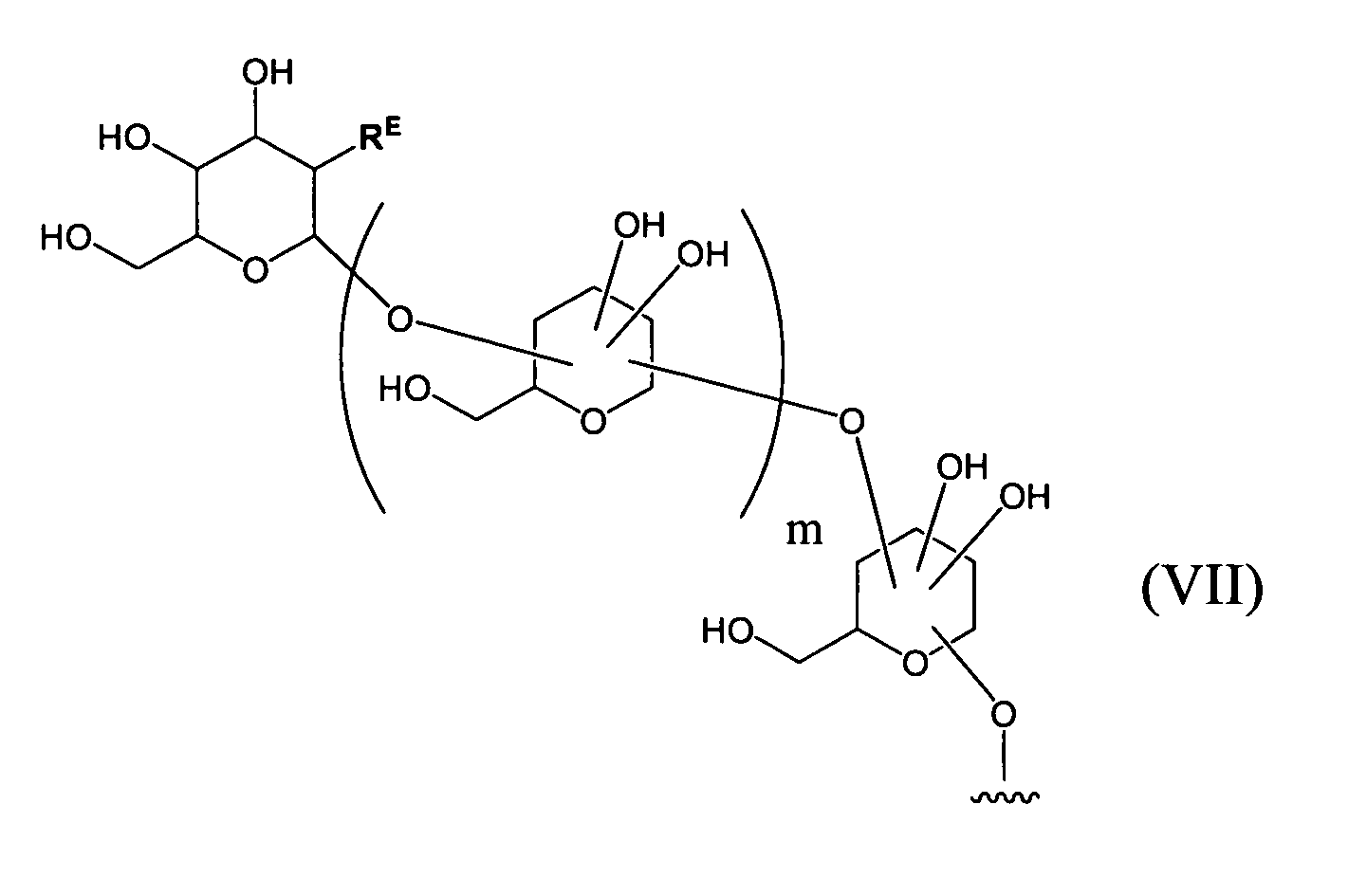 wherein RE is OH or NHAc; and m is an integer of 0 to 2;by performing 1+m (m is an integer of 0 to 2) times of glycosylating reaction in the presence of glycosyltransferase and a sugar donor using a glycopeptide compound, a salt thereof, or a solvate thereof as a raw material,wherein an aromatic ring of a fourth amino acid residue is substituted with the sugar residue (VI);(step 2)
a step converting the hydroxymethylene part in the sugar at the end of the group (VII) into a group (VIII) represented by the formula:

by an oxidation reaction; and(step 3)
a step converting the group (VIII) into a sugar residue (I-0) represented by the formula:
by reductive amination reaction of the aldehyde group of the group (VIII) with a compound (A) represented by the formula RA1NH2. - A process for producing the compound (IV-0), a pharmaceutically acceptable salt thereof or a solvate thereof as defined in claim 16 represented by the formula:

comprising the following steps:(step 1)
a step of reacting 1+m (m is an integer of 0 to 2) times of glycosylating reaction in the presence of glycosyltransferase and a sugar donor using a compound (VII-1) as a raw material, represented by the formula:
to obtain a compound (VIII-1), a salt thereof, or a solvate thereof represented by the formula:
 (step 2)
a step of subjecting the compound (VIII-1), a salt thereof, or a solvate thereof to an oxidation reaction to obtain a compound (IX-1), a salt thereof, or a solvate thereof represented by the formula:
 (step 3)
a step of subjecting the compound (IX-1), a salt thereof or a solvate thereof to a reductive animation reaction with a compound (A) represented by the formula: RA1NH2. - A process for producing the compound (IV-1), a pharmaceutically acceptable salt, or a solvate thereof as defined in claim 17 represented by the formula:


comprising the following steps:(step 1)
a step of reacting 1+m (m is an integer of 0 to 2) times of glycosylating reaction in the presence of glycosyltransferase and a sugar donor using a compound (VII-1) as a raw material represented by the formula:

to obtain a compound (VIII-2), a salt thereof, or a solvate thereof, represented by the formula:
 (step 2)
a step of subjecting the compound (VIII-2), a salt thereof, or a solvate thereof to an oxidation reaction to obtain a compound (IX-2), a salt thereof, or a solvate thereof represented by the formula:
 (step 3)
a step of subjecting the compound (IX-2), a salt thereof, or a solvate thereof to a reductive amination reaction with a compound (A) represented by the formula: RA1NH2. - A process for producing the compound (IV-2), a pharmaceutically acceptable salt thereof, or a solvate thereof, as defined in claim 18 represented by the formula:


comprising the following steps:(step 1)
a step of reacting 1+m (m is an integer of 0 to 2) times of glycosylating reaction in the presence of glycosyltransferase and a sugar donor using a compound (VII-2) as a raw material represented by the formula:

to obtain a compound (VIII-3), a salt thereof, or a solvate thereof represented by the formula:
 (step 2)
a step of subjecting the compound (VIII-3), a salt thereof, or a solvate thereof to an oxidation reaction to obtain a compound (IX-3), a salt thereof, or a solvate thereof represented by the formula:

and(step 3)
a step of subjecting the compound (IX-3), a salt thereof, or a solvate thereof to a reductive amination reaction with a compound (A) represented by the formula: RA1NH2. - The process according to any one of claims 33 to 36, wherein in the step 1, the glycosyltransferase is galactosyltransferase; a sugar of the sugar donor is the same or different 1 to 3 sugars selected from glucose, galactose, N-acetylgalactosamine, deoxyglucose, and deoxygalactose; and, in the step 2, the oxidation reaction is performed with galactose oxidase.
- The process according to any one of claims 33 to 36, wherein in the step 1, the glycosyltransferase is galactosyltransferase; and, after addition of glucose by an optional first glycosylating reaction, galactose is further added by a second glycosylating reaction; and, in the step 2, the oxidation reaction is performed with galactose oxidase.
- The compound (VIII-1), a salt thereof, or a solvate thereof as defined in claim 34.
- The compound (IX-1), a salt thereof, or a solvate thereof as defined in claim 34.
- The compound as defined in any one of claims 1 to 32, 39 and 40, or a pharmaceutically acceptable salt thereof, or a solvate thereof.
Applications Claiming Priority (2)
| Application Number | Priority Date | Filing Date | Title |
|---|---|---|---|
| JP2007333408 | 2007-12-26 | ||
| PCT/JP2008/073511 WO2009081958A1 (en) | 2007-12-26 | 2008-12-25 | Glycosylated glycopeptide antibiotic derivative |
Publications (2)
| Publication Number | Publication Date |
|---|---|
| EP2233495A1 true EP2233495A1 (en) | 2010-09-29 |
| EP2233495A4 EP2233495A4 (en) | 2011-03-30 |
Family
ID=40801258
Family Applications (1)
| Application Number | Title | Priority Date | Filing Date |
|---|---|---|---|
| EP08863497A Withdrawn EP2233495A4 (en) | 2007-12-26 | 2008-12-25 | Glycosylated glycopeptide antibiotic derivative |
Country Status (12)
| Country | Link |
|---|---|
| US (1) | US8481696B2 (en) |
| EP (1) | EP2233495A4 (en) |
| JP (1) | JP5517153B2 (en) |
| KR (1) | KR20100109934A (en) |
| CN (1) | CN101959900A (en) |
| AU (1) | AU2008342149A1 (en) |
| BR (1) | BRPI0821947A2 (en) |
| CA (1) | CA2710417A1 (en) |
| RU (1) | RU2481354C2 (en) |
| TW (1) | TW200930397A (en) |
| WO (1) | WO2009081958A1 (en) |
| ZA (1) | ZA201004933B (en) |
Cited By (15)
| Publication number | Priority date | Publication date | Assignee | Title |
|---|---|---|---|---|
| US8722743B2 (en) | 2010-04-19 | 2014-05-13 | Oryzon Genomics S.A. | Lysine specific demethylase-1 inhibitors and their use |
| US8859555B2 (en) | 2009-09-25 | 2014-10-14 | Oryzon Genomics S.A. | Lysine Specific Demethylase-1 inhibitors and their use |
| US8946296B2 (en) | 2009-10-09 | 2015-02-03 | Oryzon Genomics S.A. | Substituted heteroaryl- and aryl-cyclopropylamine acetamides and their use |
| US8993808B2 (en) | 2009-01-21 | 2015-03-31 | Oryzon Genomics, S.A. | Phenylcyclopropylamine derivatives and their medical use |
| US9006449B2 (en) | 2010-07-29 | 2015-04-14 | Oryzon Genomics, S.A. | Cyclopropylamine derivatives useful as LSD1 inhibitors |
| US9061966B2 (en) | 2010-10-08 | 2015-06-23 | Oryzon Genomics S.A. | Cyclopropylamine inhibitors of oxidases |
| US9181198B2 (en) | 2010-07-29 | 2015-11-10 | Oryzon Genomics S.A. | Arylcyclopropylamine based demethylase inhibitors of LSD1 and their medical use |
| US9186337B2 (en) | 2010-02-24 | 2015-11-17 | Oryzon Genomics S.A. | Lysine demethylase inhibitors for diseases and disorders associated with Hepadnaviridae |
| US9469597B2 (en) | 2011-10-20 | 2016-10-18 | Oryzon Genomics S.A. | (Hetero)aryl cyclopropylamine compounds as LSD1 inhibitors |
| US9487512B2 (en) | 2011-10-20 | 2016-11-08 | Oryzon Genomics S.A. | (Hetero)aryl cyclopropylamine compounds as LSD1 inhibitors |
| US9616058B2 (en) | 2010-02-24 | 2017-04-11 | Oryzon Genomics, S.A. | Potent selective LSD1 inhibitors and dual LSD1/MAO-B inhibitors for antiviral use |
| WO2017141049A1 (en) * | 2016-02-19 | 2017-08-24 | The Institute Of Cancer Research: Royal Cancer Hospital | Methylamine derivatives as lysysl oxidase inhibitors for the treatment of cancer |
| US9790196B2 (en) | 2010-11-30 | 2017-10-17 | Oryzon Genomics S.A. | Lysine demethylase inhibitors for diseases and disorders associated with Flaviviridae |
| US9908859B2 (en) | 2011-02-08 | 2018-03-06 | Oryzon Genomics, S.A. | Lysine demethylase inhibitors for myeloproliferative disorders |
| EP3763728A4 (en) * | 2018-03-06 | 2022-01-12 | Shanghai LaiYi Center For Biopharmaceutical R&D Co., Ltd. | Glycopeptide compounds having activity of resisting drug-resistant bacteria, and preparation method therefor and application thereof |
Families Citing this family (11)
| Publication number | Priority date | Publication date | Assignee | Title |
|---|---|---|---|---|
| TW257811B (en) | 1993-04-21 | 1995-09-21 | Chemiefaser Lenzing Ag | |
| JP2011057661A (en) * | 2009-08-14 | 2011-03-24 | Bayer Cropscience Ag | Pesticidal carboxamides |
| CA2826623A1 (en) * | 2010-02-03 | 2011-08-11 | Meh Associates, Inc | Multiple substituted fluoromethanes as selective and bioactive isosteres |
| CN105985412A (en) * | 2015-02-28 | 2016-10-05 | 爱斯医药科技(南京)有限公司 | Vancomycin derivative, preparation method and application thereof |
| EP3649142A4 (en) * | 2017-07-04 | 2021-09-01 | Intocell, Inc. | COMPOUNDS INCLUDING A CLIVABLE LOCATION AND THEIR USES |
| CN109053864B (en) * | 2018-07-10 | 2021-08-24 | 丽珠集团新北江制药股份有限公司 | Method for preparing oritavancin |
| CN109053865B (en) * | 2018-07-20 | 2021-04-13 | 丽珠集团新北江制药股份有限公司 | Method for preparing oritavancin by carboxyl protection |
| CN108948157B (en) * | 2018-07-31 | 2021-08-03 | 丽珠集团新北江制药股份有限公司 | Method for preparing telavancin |
| CN108948156B (en) * | 2018-07-31 | 2021-05-25 | 丽珠集团新北江制药股份有限公司 | Preparation method of telavancin |
| CN113429443B (en) * | 2021-07-08 | 2023-07-25 | 江南大学 | A kind of disialic acid-mannan oligosaccharide complex and its synthesis method |
| CN113502014B (en) * | 2021-09-13 | 2021-11-23 | 中国科学院宁波材料技术与工程研究所 | Antibacterial agent and preparation method and application thereof |
Family Cites Families (39)
| Publication number | Priority date | Publication date | Assignee | Title |
|---|---|---|---|---|
| US4497802A (en) | 1983-10-21 | 1985-02-05 | Eli Lilly And Company | N-Acyl glycopeptide derivatives |
| US4698327A (en) * | 1985-04-25 | 1987-10-06 | Eli Lilly And Company | Novel glycopeptide derivatives |
| IL78597A0 (en) | 1985-04-25 | 1986-08-31 | Lilly Co Eli | Novel glycopeptide derivatives |
| US4639433A (en) * | 1985-08-14 | 1987-01-27 | Eli Lilly And Company | Glycopeptide derivatives |
| US4643987A (en) * | 1985-08-14 | 1987-02-17 | Eli Lilly And Company | Modified glycopeptides |
| EP0273727A3 (en) | 1986-12-30 | 1990-01-17 | Smithkline Beecham Corporation | Glycosylated glycopeptides |
| US5071749A (en) | 1987-04-16 | 1991-12-10 | Shionogi & Co., Ltd. | Glycopetide antibiotic pa-45052-b |
| JPH01240196A (en) | 1987-04-16 | 1989-09-25 | Shionogi & Co Ltd | Novel glycopeptide-based antibiotic pa-45052 |
| US4882313A (en) | 1987-07-31 | 1989-11-21 | Smithkline Beckman Corporation | Carboxamide derivatives of glycopeptides |
| CA2031803C (en) * | 1989-12-13 | 2001-05-29 | Ramakrishnan Nagarajan | Improvements in or relating to glycopeptide deriveratives |
| CZ285703B6 (en) | 1991-07-29 | 1999-10-13 | Biosearch Italia S. P. A. | Amide derivatives of a-40926 antibiotic, process of their preparation and pharmaceutical composition containing thereof |
| US5840684A (en) | 1994-01-28 | 1998-11-24 | Eli Lilly And Company | Glycopeptide antibiotic derivatives |
| AU703106B2 (en) | 1994-01-28 | 1999-03-18 | Eli Lilly And Company | Glycopeptide antibiotic derivatives |
| IT1282586B1 (en) | 1996-02-08 | 1998-03-31 | Chemical And Biolog Ind | PHARMACEUTICAL COMPOSITIONS FOR THE BIOLOGICAL TREATMENT OF INFECTIONS DUE TO STRAINS OF ENTEROCOCCUS FAECIUM RESISTANT TO |
| JP4159110B2 (en) | 1996-04-12 | 2008-10-01 | イーライ・リリー・アンド・カンパニー | Glycopeptide compound |
| AU2441697A (en) | 1996-04-12 | 1997-11-07 | Eli Lilly And Company | Covalently-linked glycopeptide dimers |
| US5977063A (en) | 1997-05-20 | 1999-11-02 | Eli Lilly And Company | Alkylated hexapeptides |
| US5919771A (en) | 1997-05-20 | 1999-07-06 | Eli Lilly And Company | Urea and thiourea derivatives of glycopeptides |
| EP1095058A4 (en) * | 1998-07-14 | 2003-07-16 | Univ Princeton | GLYCOPEPTIDE ANTIBIOTICS, COMBINATORIAL LIBRARIES OF GLYCOPEPTIDE ANTIBIOTICS, AND METHODS OF MAKING SAME |
| US6392012B1 (en) | 1998-12-23 | 2002-05-21 | Advanced Medicine, Inc. | Glycopeptide derivatives and pharmaceutical compositions containing the same |
| EP1147129A4 (en) | 1999-01-12 | 2003-01-15 | Univ Princeton | SACCHARID COUPLED TO SUBSTANCES THAT BIND CELL SURFACE PEPTIDES OR PROTEINS. |
| AU2501700A (en) | 1999-01-12 | 2000-08-01 | Princeton University | Glycopeptide antibiotics containing a desmethylvancosamine residue, combinatorial libraries of same and methods of producing same |
| US6699836B2 (en) | 1999-04-02 | 2004-03-02 | The Trustees Of Princeton University | Vancomycin analogs |
| AU4054900A (en) | 1999-04-02 | 2000-10-23 | Advanced Medicine East, Inc. | Desleucyl glycopeptide antibiotics and methods of making same |
| JP2000302687A (en) | 1999-04-22 | 2000-10-31 | Sagami Chem Res Center | Antibacterial oligomer and antibacterial agent |
| AU5029700A (en) | 1999-05-19 | 2000-12-05 | Merck & Co., Inc. | Glycopeptide antibacterial compounds, compositions containing same and methods of using same |
| JP4381531B2 (en) | 1999-12-08 | 2009-12-09 | 塩野義製薬株式会社 | Glycopeptide derivative |
| WO2001081373A2 (en) | 2000-04-25 | 2001-11-01 | Merck & Co., Inc. | Glycopeptide antibacterial compounds and methods of using same |
| US7259141B2 (en) * | 2001-03-30 | 2007-08-21 | Wisconsin Alumni Research Foundation | Vancomycin analogs and methods thereof |
| US7348309B2 (en) * | 2001-03-30 | 2008-03-25 | Wisconsin Alumni Research Foundation | Glycorandomization and production of novel vancomycin analogs |
| WO2002079150A2 (en) * | 2001-03-30 | 2002-10-10 | Sloan-Kettering Institute For Cancer Research | Glycorandomization and the production of novel erythronolide and coumarin analogs |
| JP2003026725A (en) | 2001-07-13 | 2003-01-29 | Toyobo Co Ltd | Novel maltose-bonded protein ligand and its application |
| CA2497159A1 (en) | 2002-08-30 | 2004-03-11 | K.U. Leuven Research And Development | Glycopeptide antibiotic and semisynthetic derivatives thereof and their use as antiviral agents |
| US7273845B2 (en) | 2002-11-12 | 2007-09-25 | Enzon Pharmaceuticals, Inc. | Polymeric prodrugs of vancomycin |
| DE602004010915T2 (en) | 2003-07-22 | 2008-12-11 | Theravance, Inc., South San Francisco | USE OF AN ANTIMYCOTIC ECHINOCANDIN AGENT COMBINED WITH AN ANTIBACTERIAL GLYCOPEPTIDE AGENT |
| DK1516626T3 (en) * | 2003-09-17 | 2007-04-30 | Alpharma Aps | Teicoplanin composition with enhanced antibiotic activity |
| WO2006003456A2 (en) | 2004-07-07 | 2006-01-12 | Isis Innovation Limited | Glycosylation of antibiotics |
| TW200630382A (en) | 2004-11-29 | 2006-09-01 | Univ Nagoya Nat Univ Corp | Dimer derivatives of glycopeptide antibiotics |
| JP4330169B2 (en) | 2004-11-29 | 2009-09-16 | 国立大学法人名古屋大学 | Glycopeptide antibiotic monomer derivatives |
-
2008
- 2008-12-25 KR KR1020107016542A patent/KR20100109934A/en not_active Withdrawn
- 2008-12-25 TW TW097150637A patent/TW200930397A/en unknown
- 2008-12-25 BR BRPI0821947A patent/BRPI0821947A2/en not_active IP Right Cessation
- 2008-12-25 US US12/810,507 patent/US8481696B2/en not_active Expired - Fee Related
- 2008-12-25 AU AU2008342149A patent/AU2008342149A1/en not_active Abandoned
- 2008-12-25 JP JP2009547120A patent/JP5517153B2/en not_active Expired - Fee Related
- 2008-12-25 CN CN2008801276609A patent/CN101959900A/en active Pending
- 2008-12-25 CA CA2710417A patent/CA2710417A1/en not_active Abandoned
- 2008-12-25 RU RU2010130700/04A patent/RU2481354C2/en not_active IP Right Cessation
- 2008-12-25 WO PCT/JP2008/073511 patent/WO2009081958A1/en not_active Ceased
- 2008-12-25 EP EP08863497A patent/EP2233495A4/en not_active Withdrawn
-
2010
- 2010-07-13 ZA ZA2010/04933A patent/ZA201004933B/en unknown
Non-Patent Citations (2)
| Title |
|---|
| RITTER THOMAS K ET AL: "A programmable one-pot oligosaccharide synthesis for diversifying the sugar domains of natural products: a case study of vancomycin.", ANGEWANDTE CHEMIE (INTERNATIONAL ED. IN ENGLISH) 6 OCT 2003 LNKD- PUBMED:14533156, vol. 42, no. 38, 6 October 2003 (2003-10-06), pages 4657-4660, XP002620449, ISSN: 1433-7851 * |
| See also references of WO2009081958A1 * |
Cited By (27)
| Publication number | Priority date | Publication date | Assignee | Title |
|---|---|---|---|---|
| US8993808B2 (en) | 2009-01-21 | 2015-03-31 | Oryzon Genomics, S.A. | Phenylcyclopropylamine derivatives and their medical use |
| US8859555B2 (en) | 2009-09-25 | 2014-10-14 | Oryzon Genomics S.A. | Lysine Specific Demethylase-1 inhibitors and their use |
| US8946296B2 (en) | 2009-10-09 | 2015-02-03 | Oryzon Genomics S.A. | Substituted heteroaryl- and aryl-cyclopropylamine acetamides and their use |
| US9186337B2 (en) | 2010-02-24 | 2015-11-17 | Oryzon Genomics S.A. | Lysine demethylase inhibitors for diseases and disorders associated with Hepadnaviridae |
| US9616058B2 (en) | 2010-02-24 | 2017-04-11 | Oryzon Genomics, S.A. | Potent selective LSD1 inhibitors and dual LSD1/MAO-B inhibitors for antiviral use |
| US8722743B2 (en) | 2010-04-19 | 2014-05-13 | Oryzon Genomics S.A. | Lysine specific demethylase-1 inhibitors and their use |
| US9149447B2 (en) | 2010-04-19 | 2015-10-06 | Oryzon Genomics S.A. | Lysine specific demethylase-1 inhibitors and their use |
| US10202330B2 (en) | 2010-04-19 | 2019-02-12 | Oryzon Genomics, Sa | Lysine specific demethylase-1 inhibitors and their use |
| US9181198B2 (en) | 2010-07-29 | 2015-11-10 | Oryzon Genomics S.A. | Arylcyclopropylamine based demethylase inhibitors of LSD1 and their medical use |
| US10233178B2 (en) | 2010-07-29 | 2019-03-19 | Oryzon Genomics, S.A. | Arylcyclopropylamine based demethylase inhibitors of LSD1 and their medical use |
| US9006449B2 (en) | 2010-07-29 | 2015-04-14 | Oryzon Genomics, S.A. | Cyclopropylamine derivatives useful as LSD1 inhibitors |
| US9676701B2 (en) | 2010-07-29 | 2017-06-13 | Oryzon Genomics, S.A. | Cyclopropylamine derivatives useful as LSD1 inhibitors |
| US9708309B2 (en) | 2010-07-29 | 2017-07-18 | Oryzon Genomics, S.A. | Arylcyclopropylamine based demethylase inhibitors of LSD1 and their medical use |
| US9061966B2 (en) | 2010-10-08 | 2015-06-23 | Oryzon Genomics S.A. | Cyclopropylamine inhibitors of oxidases |
| US9790196B2 (en) | 2010-11-30 | 2017-10-17 | Oryzon Genomics S.A. | Lysine demethylase inhibitors for diseases and disorders associated with Flaviviridae |
| US9908859B2 (en) | 2011-02-08 | 2018-03-06 | Oryzon Genomics, S.A. | Lysine demethylase inhibitors for myeloproliferative disorders |
| US9670136B2 (en) | 2011-10-20 | 2017-06-06 | Oryzon Genomics S.A. | (Hetero)aryl cyclopropylamine compounds as LSD1 inhibitors |
| US9944601B2 (en) | 2011-10-20 | 2018-04-17 | Oryzon Genomics, S.A. | (Hetero)aryl cyclopropylamine compounds as LSD1 inhibitors |
| US9487512B2 (en) | 2011-10-20 | 2016-11-08 | Oryzon Genomics S.A. | (Hetero)aryl cyclopropylamine compounds as LSD1 inhibitors |
| US10214477B2 (en) | 2011-10-20 | 2019-02-26 | Oryzon Genomics S.A. | (Hetero)aryl cyclopropylamine compounds as LSD1 inhibitors |
| US9469597B2 (en) | 2011-10-20 | 2016-10-18 | Oryzon Genomics S.A. | (Hetero)aryl cyclopropylamine compounds as LSD1 inhibitors |
| US10329256B2 (en) | 2011-10-20 | 2019-06-25 | Oryzon Genomics, S.A. | (Hetero)aryl cyclopropylamine compounds as LSD1 inhibitors |
| WO2017141049A1 (en) * | 2016-02-19 | 2017-08-24 | The Institute Of Cancer Research: Royal Cancer Hospital | Methylamine derivatives as lysysl oxidase inhibitors for the treatment of cancer |
| US10807974B2 (en) | 2016-02-19 | 2020-10-20 | The Institute Of Cancer Research: Royal Cancer Hospital | Methylamine derivatives as lysysl oxidase inhibitors for the treatment of cancer |
| US10995088B2 (en) | 2016-02-19 | 2021-05-04 | The Institute Of Cancer Research: Royal Cancer Hospital | Methylamine derivatives as lysysl oxidase inhibitors for the treatment of cancer |
| US11608330B2 (en) | 2016-02-19 | 2023-03-21 | The Institute Of Cancer Research: Royal Cancer Hospital | Methylamine derivatives as lysysl oxidase inhibitors for the treatment of cancer |
| EP3763728A4 (en) * | 2018-03-06 | 2022-01-12 | Shanghai LaiYi Center For Biopharmaceutical R&D Co., Ltd. | Glycopeptide compounds having activity of resisting drug-resistant bacteria, and preparation method therefor and application thereof |
Also Published As
| Publication number | Publication date |
|---|---|
| US8481696B2 (en) | 2013-07-09 |
| CN101959900A (en) | 2011-01-26 |
| US20100286364A1 (en) | 2010-11-11 |
| JP5517153B2 (en) | 2014-06-11 |
| KR20100109934A (en) | 2010-10-11 |
| JPWO2009081958A1 (en) | 2011-05-06 |
| RU2010130700A (en) | 2012-02-10 |
| ZA201004933B (en) | 2011-09-28 |
| CA2710417A1 (en) | 2009-07-02 |
| BRPI0821947A2 (en) | 2015-09-22 |
| TW200930397A (en) | 2009-07-16 |
| RU2481354C2 (en) | 2013-05-10 |
| WO2009081958A1 (en) | 2009-07-02 |
| EP2233495A4 (en) | 2011-03-30 |
| AU2008342149A1 (en) | 2009-07-02 |
Similar Documents
| Publication | Publication Date | Title |
|---|---|---|
| US8481696B2 (en) | Glycosylated glycopeptide antibiotic derivatives | |
| JP4377953B2 (en) | Glycopeptide antibiotic monomer derivatives | |
| TWI305209B (en) | Glycopeptide phosphonate derivatives | |
| US6392012B1 (en) | Glycopeptide derivatives and pharmaceutical compositions containing the same | |
| NZ236393A (en) | N-alkylated glycopeptide derivatives prepared from antibiotics a82846 series and pa-42867-a; pharmaceutical compositions | |
| PL180961B1 (en) | Novel derivatives of glycopeptidic antibiotics, method of obtaining them and pharmaceutical agent | |
| CA1339808C (en) | Glycopeptide antibiotics | |
| JP5160827B2 (en) | Glycopeptide antibiotic derivatives | |
| JP4888863B2 (en) | Glycopeptide antibiotic dimer derivative | |
| US8933012B2 (en) | Glycopeptide antibiotic derivative | |
| JP5261191B2 (en) | Glycopeptide antibiotic derivatives | |
| CN101111513A (en) | Glycopeptide antibiotic monomer derivative | |
| HU200193B (en) | Process for production of new derivatives of de-/acethil-glycoseaminil/-di-/dehydro/-dezoxi-theicoplanin and medical compositions containing them |
Legal Events
| Date | Code | Title | Description |
|---|---|---|---|
| PUAI | Public reference made under article 153(3) epc to a published international application that has entered the european phase |
Free format text: ORIGINAL CODE: 0009012 |
|
| 17P | Request for examination filed |
Effective date: 20100713 |
|
| AK | Designated contracting states |
Kind code of ref document: A1 Designated state(s): AT BE BG CH CY CZ DE DK EE ES FI FR GB GR HR HU IE IS IT LI LT LU LV MC MT NL NO PL PT RO SE SI SK TR |
|
| AX | Request for extension of the european patent |
Extension state: AL BA MK RS |
|
| A4 | Supplementary search report drawn up and despatched |
Effective date: 20110224 |
|
| 17Q | First examination report despatched |
Effective date: 20130423 |
|
| STAA | Information on the status of an ep patent application or granted ep patent |
Free format text: STATUS: THE APPLICATION IS DEEMED TO BE WITHDRAWN |
|
| 18D | Application deemed to be withdrawn |
Effective date: 20130904 |