EP0801075A1 - Covalently linked dimers of glycopeptide antibiotics - Google Patents
Covalently linked dimers of glycopeptide antibiotics Download PDFInfo
- Publication number
- EP0801075A1 EP0801075A1 EP97302416A EP97302416A EP0801075A1 EP 0801075 A1 EP0801075 A1 EP 0801075A1 EP 97302416 A EP97302416 A EP 97302416A EP 97302416 A EP97302416 A EP 97302416A EP 0801075 A1 EP0801075 A1 EP 0801075A1
- Authority
- EP
- European Patent Office
- Prior art keywords
- glycopeptide
- dimers
- oxy
- phenylene
- conditions
- Prior art date
- Legal status (The legal status is an assumption and is not a legal conclusion. Google has not performed a legal analysis and makes no representation as to the accuracy of the status listed.)
- Granted
Links
- 239000000539 dimer Substances 0.000 title claims abstract description 25
- 239000003910 polypeptide antibiotic agent Substances 0.000 title description 3
- DQJCDTNMLBYVAY-ZXXIYAEKSA-N (2S,5R,10R,13R)-16-{[(2R,3S,4R,5R)-3-{[(2S,3R,4R,5S,6R)-3-acetamido-4,5-dihydroxy-6-(hydroxymethyl)oxan-2-yl]oxy}-5-(ethylamino)-6-hydroxy-2-(hydroxymethyl)oxan-4-yl]oxy}-5-(4-aminobutyl)-10-carbamoyl-2,13-dimethyl-4,7,12,15-tetraoxo-3,6,11,14-tetraazaheptadecan-1-oic acid Chemical class NCCCC[C@H](C(=O)N[C@@H](C)C(O)=O)NC(=O)CC[C@H](C(N)=O)NC(=O)[C@@H](C)NC(=O)C(C)O[C@@H]1[C@@H](NCC)C(O)O[C@H](CO)[C@H]1O[C@H]1[C@H](NC(C)=O)[C@@H](O)[C@H](O)[C@@H](CO)O1 DQJCDTNMLBYVAY-ZXXIYAEKSA-N 0.000 claims abstract description 25
- 108010059993 Vancomycin Proteins 0.000 claims abstract description 15
- MYPYJXKWCTUITO-LYRMYLQWSA-N vancomycin Chemical compound O([C@@H]1[C@@H](O)[C@H](O)[C@@H](CO)O[C@H]1OC1=C2C=C3C=C1OC1=CC=C(C=C1Cl)[C@@H](O)[C@H](C(N[C@@H](CC(N)=O)C(=O)N[C@H]3C(=O)N[C@H]1C(=O)N[C@H](C(N[C@@H](C3=CC(O)=CC(O)=C3C=3C(O)=CC=C1C=3)C(O)=O)=O)[C@H](O)C1=CC=C(C(=C1)Cl)O2)=O)NC(=O)[C@@H](CC(C)C)NC)[C@H]1C[C@](C)(N)[C@H](O)[C@H](C)O1 MYPYJXKWCTUITO-LYRMYLQWSA-N 0.000 claims abstract description 15
- 229960003165 vancomycin Drugs 0.000 claims abstract description 15
- MYPYJXKWCTUITO-UHFFFAOYSA-N vancomycin Natural products O1C(C(=C2)Cl)=CC=C2C(O)C(C(NC(C2=CC(O)=CC(O)=C2C=2C(O)=CC=C3C=2)C(O)=O)=O)NC(=O)C3NC(=O)C2NC(=O)C(CC(N)=O)NC(=O)C(NC(=O)C(CC(C)C)NC)C(O)C(C=C3Cl)=CC=C3OC3=CC2=CC1=C3OC1OC(CO)C(O)C(O)C1OC1CC(C)(N)C(O)C(C)O1 MYPYJXKWCTUITO-UHFFFAOYSA-N 0.000 claims abstract description 15
- 230000000844 anti-bacterial effect Effects 0.000 claims abstract description 11
- 150000001412 amines Chemical class 0.000 claims abstract description 9
- 150000002337 glycosamines Chemical class 0.000 claims description 5
- 208000035143 Bacterial infection Diseases 0.000 claims description 4
- 208000022362 bacterial infectious disease Diseases 0.000 claims description 4
- 238000002560 therapeutic procedure Methods 0.000 claims description 4
- MYPYJXKWCTUITO-KIIOPKALSA-N chembl3301825 Chemical compound O([C@@H]1[C@@H](O)[C@H](O)[C@@H](CO)O[C@H]1OC1=C2C=C3C=C1OC1=CC=C(C=C1Cl)[C@@H](O)[C@H](C(N[C@@H](CC(N)=O)C(=O)N[C@H]3C(=O)N[C@H]1C(=O)N[C@H](C(N[C@H](C3=CC(O)=CC(O)=C3C=3C(O)=CC=C1C=3)C(O)=O)=O)[C@H](O)C1=CC=C(C(=C1)Cl)O2)=O)NC(=O)[C@@H](CC(C)C)NC)[C@H]1C[C@](C)(N)C(O)[C@H](C)O1 MYPYJXKWCTUITO-KIIOPKALSA-N 0.000 claims 1
- 239000003814 drug Substances 0.000 claims 1
- 238000004519 manufacturing process Methods 0.000 claims 1
- 150000001875 compounds Chemical class 0.000 abstract description 15
- 229940088710 antibiotic agent Drugs 0.000 abstract description 5
- 241000192125 Firmicutes Species 0.000 abstract description 2
- 230000001580 bacterial effect Effects 0.000 abstract description 2
- 150000001720 carbohydrates Chemical class 0.000 abstract 1
- 238000004128 high performance liquid chromatography Methods 0.000 description 25
- OKKJLVBELUTLKV-UHFFFAOYSA-N Methanol Chemical compound OC OKKJLVBELUTLKV-UHFFFAOYSA-N 0.000 description 18
- 125000000325 methylidene group Chemical group [H]C([H])=* 0.000 description 18
- 239000011541 reaction mixture Substances 0.000 description 17
- -1 biphenylyl Chemical group 0.000 description 14
- 229910001868 water Inorganic materials 0.000 description 14
- ZMXDDKWLCZADIW-UHFFFAOYSA-N N,N-Dimethylformamide Chemical compound CN(C)C=O ZMXDDKWLCZADIW-UHFFFAOYSA-N 0.000 description 13
- WEVYAHXRMPXWCK-UHFFFAOYSA-N Acetonitrile Chemical compound CC#N WEVYAHXRMPXWCK-UHFFFAOYSA-N 0.000 description 12
- 108010015899 Glycopeptides Proteins 0.000 description 11
- 102000002068 Glycopeptides Human genes 0.000 description 11
- 238000006243 chemical reaction Methods 0.000 description 11
- 238000002360 preparation method Methods 0.000 description 11
- 239000000203 mixture Substances 0.000 description 10
- 238000004992 fast atom bombardment mass spectroscopy Methods 0.000 description 9
- IJGRMHOSHXDMSA-UHFFFAOYSA-N Atomic nitrogen Chemical compound N#N IJGRMHOSHXDMSA-UHFFFAOYSA-N 0.000 description 8
- 230000015572 biosynthetic process Effects 0.000 description 8
- 230000014759 maintenance of location Effects 0.000 description 8
- 125000001997 phenyl group Chemical group [H]C1=C([H])C([H])=C(*)C([H])=C1[H] 0.000 description 8
- 239000000843 powder Substances 0.000 description 8
- 238000003786 synthesis reaction Methods 0.000 description 8
- 125000002947 alkylene group Chemical group 0.000 description 7
- 238000004108 freeze drying Methods 0.000 description 7
- 238000000034 method Methods 0.000 description 7
- ZMANZCXQSJIPKH-UHFFFAOYSA-N Triethylamine Chemical compound CCN(CC)CC ZMANZCXQSJIPKH-UHFFFAOYSA-N 0.000 description 6
- BEOOHQFXGBMRKU-UHFFFAOYSA-N sodium cyanoborohydride Chemical compound [Na+].[B-]C#N BEOOHQFXGBMRKU-UHFFFAOYSA-N 0.000 description 6
- 239000000243 solution Substances 0.000 description 6
- 241000894006 Bacteria Species 0.000 description 5
- 229910052757 nitrogen Inorganic materials 0.000 description 5
- 239000000047 product Substances 0.000 description 5
- DTQVDTLACAAQTR-UHFFFAOYSA-N trifluoroacetic acid Substances OC(=O)C(F)(F)F DTQVDTLACAAQTR-UHFFFAOYSA-N 0.000 description 5
- XLYOFNOQVPJJNP-UHFFFAOYSA-N water Substances O XLYOFNOQVPJJNP-UHFFFAOYSA-N 0.000 description 5
- QTBSBXVTEAMEQO-UHFFFAOYSA-N Acetic acid Chemical compound CC(O)=O QTBSBXVTEAMEQO-UHFFFAOYSA-N 0.000 description 4
- 229910004373 HOAc Inorganic materials 0.000 description 4
- 239000002262 Schiff base Substances 0.000 description 4
- 150000004753 Schiff bases Chemical class 0.000 description 4
- 150000001408 amides Chemical class 0.000 description 4
- 125000005843 halogen group Chemical group 0.000 description 4
- 208000015181 infectious disease Diseases 0.000 description 4
- 125000001424 substituent group Chemical group 0.000 description 4
- 239000003643 water by type Substances 0.000 description 4
- IAZDPXIOMUYVGZ-UHFFFAOYSA-N Dimethylsulphoxide Chemical compound CS(C)=O IAZDPXIOMUYVGZ-UHFFFAOYSA-N 0.000 description 3
- UFHFLCQGNIYNRP-UHFFFAOYSA-N Hydrogen Chemical compound [H][H] UFHFLCQGNIYNRP-UHFFFAOYSA-N 0.000 description 3
- 239000003242 anti bacterial agent Substances 0.000 description 3
- IUNMPGNGSSIWFP-UHFFFAOYSA-N dimethylaminopropylamine Chemical compound CN(C)CCCN IUNMPGNGSSIWFP-UHFFFAOYSA-N 0.000 description 3
- 239000001257 hydrogen Substances 0.000 description 3
- 229910052739 hydrogen Inorganic materials 0.000 description 3
- 239000002798 polar solvent Substances 0.000 description 3
- 150000003839 salts Chemical class 0.000 description 3
- XKRFYHLGVUSROY-UHFFFAOYSA-N Argon Chemical compound [Ar] XKRFYHLGVUSROY-UHFFFAOYSA-N 0.000 description 2
- YMWUJEATGCHHMB-UHFFFAOYSA-N Dichloromethane Chemical compound ClCCl YMWUJEATGCHHMB-UHFFFAOYSA-N 0.000 description 2
- RJQXTJLFIWVMTO-TYNCELHUSA-N Methicillin Chemical compound COC1=CC=CC(OC)=C1C(=O)N[C@@H]1C(=O)N2[C@@H](C(O)=O)C(C)(C)S[C@@H]21 RJQXTJLFIWVMTO-TYNCELHUSA-N 0.000 description 2
- NBIIXXVUZAFLBC-UHFFFAOYSA-N Phosphoric acid Chemical compound OP(O)(O)=O NBIIXXVUZAFLBC-UHFFFAOYSA-N 0.000 description 2
- 108010053950 Teicoplanin Proteins 0.000 description 2
- 238000003556 assay Methods 0.000 description 2
- 238000002815 broth microdilution Methods 0.000 description 2
- DDTDNCYHLGRFBM-YZEKDTGTSA-N chembl2367892 Chemical compound CC(=O)N[C@H]1[C@@H](O)[C@H](O)[C@H](CO)O[C@H]1O[C@@H]([C@H]1C(N[C@@H](C2=CC(O)=CC(O[C@@H]3[C@H]([C@H](O)[C@H](O)[C@@H](CO)O3)O)=C2C=2C(O)=CC=C(C=2)[C@@H](NC(=O)[C@@H]2NC(=O)[C@@H]3C=4C=C(O)C=C(C=4)OC=4C(O)=CC=C(C=4)[C@@H](N)C(=O)N[C@H](CC=4C=C(Cl)C(O5)=CC=4)C(=O)N3)C(=O)N1)C(O)=O)=O)C(C=C1Cl)=CC=C1OC1=C(O[C@H]3[C@H]([C@@H](O)[C@H](O)[C@H](CO)O3)NC(C)=O)C5=CC2=C1 DDTDNCYHLGRFBM-YZEKDTGTSA-N 0.000 description 2
- 238000009833 condensation Methods 0.000 description 2
- 230000005494 condensation Effects 0.000 description 2
- 125000000753 cycloalkyl group Chemical group 0.000 description 2
- 238000010828 elution Methods 0.000 description 2
- 125000005647 linker group Chemical group 0.000 description 2
- 229960003085 meticillin Drugs 0.000 description 2
- 238000012986 modification Methods 0.000 description 2
- 230000004048 modification Effects 0.000 description 2
- 125000000449 nitro group Chemical group [O-][N+](*)=O 0.000 description 2
- 239000008194 pharmaceutical composition Substances 0.000 description 2
- QKFJKGMPGYROCL-UHFFFAOYSA-N phenyl isothiocyanate Chemical compound S=C=NC1=CC=CC=C1 QKFJKGMPGYROCL-UHFFFAOYSA-N 0.000 description 2
- 229920000642 polymer Polymers 0.000 description 2
- 238000002953 preparative HPLC Methods 0.000 description 2
- 239000002904 solvent Substances 0.000 description 2
- 229960001608 teicoplanin Drugs 0.000 description 2
- UMGDCJDMYOKAJW-UHFFFAOYSA-N thiourea Chemical compound NC(N)=S UMGDCJDMYOKAJW-UHFFFAOYSA-N 0.000 description 2
- ILJSQTXMGCGYMG-UHFFFAOYSA-N triacetic acid Chemical class CC(=O)CC(=O)CC(O)=O ILJSQTXMGCGYMG-UHFFFAOYSA-N 0.000 description 2
- 238000000825 ultraviolet detection Methods 0.000 description 2
- OVSKIKFHRZPJSS-UHFFFAOYSA-N 2,4-D Chemical compound OC(=O)COC1=CC=C(Cl)C=C1Cl OVSKIKFHRZPJSS-UHFFFAOYSA-N 0.000 description 1
- 229940105325 3-dimethylaminopropylamine Drugs 0.000 description 1
- ZSIVOFNVHLOMBY-UHFFFAOYSA-N 4-[6-(4-formylphenoxy)hexoxy]benzaldehyde Chemical compound C1=CC(C=O)=CC=C1OCCCCCCOC1=CC=C(C=O)C=C1 ZSIVOFNVHLOMBY-UHFFFAOYSA-N 0.000 description 1
- BLXNWXHHTVEXPA-UHFFFAOYSA-N 4-[8-(4-formylphenoxy)octoxy]benzaldehyde Chemical compound C1=CC(C=O)=CC=C1OCCCCCCCCOC1=CC=C(C=O)C=C1 BLXNWXHHTVEXPA-UHFFFAOYSA-N 0.000 description 1
- WFSYRCWVQZEUTJ-UHFFFAOYSA-N 4-[9-(4-formylphenoxy)nonoxy]benzaldehyde Chemical compound C1=CC(C=O)=CC=C1OCCCCCCCCCOC1=CC=C(C=O)C=C1 WFSYRCWVQZEUTJ-UHFFFAOYSA-N 0.000 description 1
- 239000004184 Avoparcin Substances 0.000 description 1
- 0 C*c1ccc(Cc2ccccc2)cc1 Chemical compound C*c1ccc(Cc2ccccc2)cc1 0.000 description 1
- YKZPMCPYHHNLLG-UHFFFAOYSA-N COc1ccc(CC2=CCCCCC2)cc1 Chemical compound COc1ccc(CC2=CCCCCC2)cc1 YKZPMCPYHHNLLG-UHFFFAOYSA-N 0.000 description 1
- OKTJSMMVPCPJKN-UHFFFAOYSA-N Carbon Chemical compound [C] OKTJSMMVPCPJKN-UHFFFAOYSA-N 0.000 description 1
- 241000194032 Enterococcus faecalis Species 0.000 description 1
- 241000194031 Enterococcus faecium Species 0.000 description 1
- 206010061598 Immunodeficiency Diseases 0.000 description 1
- 206010034133 Pathogen resistance Diseases 0.000 description 1
- NINIDFKCEFEMDL-UHFFFAOYSA-N Sulfur Chemical compound [S] NINIDFKCEFEMDL-UHFFFAOYSA-N 0.000 description 1
- XSQUKJJJFZCRTK-UHFFFAOYSA-N Urea Natural products NC(N)=O XSQUKJJJFZCRTK-UHFFFAOYSA-N 0.000 description 1
- 239000002253 acid Substances 0.000 description 1
- FHIABUHDBXFQIT-JSNQUVIDSA-N actinoidin Chemical compound O1[C@@H](C)[C@H](OC)[C@@H](N)C[C@@H]1OC(C1C(NC(C2=CC(O)=CC(O[C@@H]3[C@H]([C@@H](O)[C@H](O)[C@@H](CO)O3)O)=C2C=2C(O)=CC=C(C=2)C(NC(=O)C2NC(=O)C(CC=3C=CC=CC=3)NC(=O)C(NC(=O)C(N)C=3C=CC(O)=CC=3)C(O)C=3C=CC(O4)=CC=3)C(=O)N1)C(O)=O)=O)C(C=C1Cl)=CC=C1OC1=C(O[C@H]3[C@@H]([C@@H](O)[C@H](O)[C@@H](CO)O3)O[C@@H]3O[C@@H](C)[C@H](O)[C@@H](N)C3)C4=CC2=C1 FHIABUHDBXFQIT-JSNQUVIDSA-N 0.000 description 1
- 108700031667 actinoidins Proteins 0.000 description 1
- 125000003172 aldehyde group Chemical group 0.000 description 1
- 150000001299 aldehydes Chemical class 0.000 description 1
- 125000003545 alkoxy group Chemical group 0.000 description 1
- 125000000217 alkyl group Chemical group 0.000 description 1
- 239000007864 aqueous solution Substances 0.000 description 1
- 229910052786 argon Inorganic materials 0.000 description 1
- 239000012298 atmosphere Substances 0.000 description 1
- QVGXLLKOCUKJST-UHFFFAOYSA-N atomic oxygen Chemical compound [O] QVGXLLKOCUKJST-UHFFFAOYSA-N 0.000 description 1
- JWFVWARSGMYXRN-HTQQBIQNSA-N avoparcin Chemical compound O([C@H]1[C@H](C(N[C@H](C(=O)N[C@H]2C(=O)N[C@H]3C(=O)N[C@H](C(N[C@H](C4=CC(O)=CC(O)=C4C=4C(O)=CC=C3C=4)C(O)=O)=O)CC3=C(O[C@@H]4O[C@@H](C)[C@H](O)[C@H](N)C4)C=C(C(=C3)Cl)OC=3C=C2C=C(C=3O[C@H]2[C@@H]([C@@H](O)[C@H](O)[C@@H](CO)O2)O[C@@H]2O[C@@H](C)[C@H](O)[C@H](N)C2)OC2=CC=C1C=C2)C=1C=CC(O)=CC=1)=O)NC(=O)[C@@H](NC)C=1C=CC(O[C@H]2[C@@H]([C@H](O)[C@@H](O)[C@H](C)O2)O)=CC=1)[C@@H]1O[C@@H](CO)[C@H](O)[C@@H](O)[C@H]1O JWFVWARSGMYXRN-HTQQBIQNSA-N 0.000 description 1
- 108010053278 avoparcin Proteins 0.000 description 1
- 229950001335 avoparcin Drugs 0.000 description 1
- 235000019377 avoparcin Nutrition 0.000 description 1
- 125000001797 benzyl group Chemical group [H]C1=C([H])C([H])=C(C([H])=C1[H])C([H])([H])* 0.000 description 1
- 229910052799 carbon Inorganic materials 0.000 description 1
- 239000000969 carrier Substances 0.000 description 1
- 230000015556 catabolic process Effects 0.000 description 1
- 238000012512 characterization method Methods 0.000 description 1
- 239000003638 chemical reducing agent Substances 0.000 description 1
- 125000000068 chlorophenyl group Chemical group 0.000 description 1
- 230000001143 conditioned effect Effects 0.000 description 1
- 238000007796 conventional method Methods 0.000 description 1
- 239000012043 crude product Substances 0.000 description 1
- 125000004093 cyano group Chemical group *C#N 0.000 description 1
- 125000000392 cycloalkenyl group Chemical group 0.000 description 1
- 238000006731 degradation reaction Methods 0.000 description 1
- 201000010099 disease Diseases 0.000 description 1
- 208000037265 diseases, disorders, signs and symptoms Diseases 0.000 description 1
- 239000003937 drug carrier Substances 0.000 description 1
- 230000000694 effects Effects 0.000 description 1
- 229940032049 enterococcus faecalis Drugs 0.000 description 1
- MYPYJXKWCTUITO-UNZADAAQSA-N epivancomycin Chemical compound O([C@@H]1[C@@H](O)[C@H](O)[C@@H](CO)O[C@H]1OC1=C2C=C3C=C1OC1=CC=C(C=C1Cl)[C@@H](O)[C@H](C(N[C@@H](CC(N)=O)C(=O)N[C@H]3C(=O)N[C@H]1C(=O)N[C@H](C(N[C@@H](C3=CC(O)=CC(O)=C3C=3C(O)=CC=C1C=3)C(O)=O)=O)[C@H](O)C1=CC=C(C(=C1)Cl)O2)=O)NC(=O)[C@@H](CC(C)C)NC)[C@H]1C[C@](C)(N)[C@@H](O)[C@H](C)O1 MYPYJXKWCTUITO-UNZADAAQSA-N 0.000 description 1
- 108010013356 eremomycin Proteins 0.000 description 1
- 238000010265 fast atom bombardment Methods 0.000 description 1
- 239000012467 final product Substances 0.000 description 1
- 238000009472 formulation Methods 0.000 description 1
- 208000027136 gram-positive bacterial infections Diseases 0.000 description 1
- 125000004438 haloalkoxy group Chemical group 0.000 description 1
- 125000001188 haloalkyl group Chemical group 0.000 description 1
- 125000000623 heterocyclic group Chemical group 0.000 description 1
- 230000002401 inhibitory effect Effects 0.000 description 1
- 150000007529 inorganic bases Chemical class 0.000 description 1
- 229910052500 inorganic mineral Inorganic materials 0.000 description 1
- 238000007918 intramuscular administration Methods 0.000 description 1
- 238000001990 intravenous administration Methods 0.000 description 1
- 229920002521 macromolecule Polymers 0.000 description 1
- 229910052751 metal Inorganic materials 0.000 description 1
- 239000002184 metal Substances 0.000 description 1
- 239000011707 mineral Substances 0.000 description 1
- 150000007522 mineralic acids Chemical class 0.000 description 1
- 230000002969 morbid Effects 0.000 description 1
- 230000001459 mortal effect Effects 0.000 description 1
- 125000001624 naphthyl group Chemical group 0.000 description 1
- 125000004433 nitrogen atom Chemical group N* 0.000 description 1
- 150000007524 organic acids Chemical class 0.000 description 1
- 239000003960 organic solvent Substances 0.000 description 1
- 239000001301 oxygen Substances 0.000 description 1
- 229910052760 oxygen Inorganic materials 0.000 description 1
- 125000000843 phenylene group Chemical group C1(=C(C=CC=C1)*)* 0.000 description 1
- 229940117953 phenylisothiocyanate Drugs 0.000 description 1
- 230000002265 prevention Effects 0.000 description 1
- JUJWROOIHBZHMG-UHFFFAOYSA-N pyridine Substances C1=CC=NC=C1 JUJWROOIHBZHMG-UHFFFAOYSA-N 0.000 description 1
- UMJSCPRVCHMLSP-UHFFFAOYSA-N pyridine Natural products COC1=CC=CN=C1 UMJSCPRVCHMLSP-UHFFFAOYSA-N 0.000 description 1
- 239000012279 sodium borohydride Substances 0.000 description 1
- 229910000033 sodium borohydride Inorganic materials 0.000 description 1
- 241000894007 species Species 0.000 description 1
- 239000007858 starting material Substances 0.000 description 1
- 239000000126 substance Substances 0.000 description 1
- 239000011593 sulfur Substances 0.000 description 1
- 229910052717 sulfur Inorganic materials 0.000 description 1
- 230000002194 synthesizing effect Effects 0.000 description 1
Classifications
-
- C—CHEMISTRY; METALLURGY
- C07—ORGANIC CHEMISTRY
- C07K—PEPTIDES
- C07K9/00—Peptides having up to 20 amino acids, containing saccharide radicals and having a fully defined sequence; Derivatives thereof
- C07K9/006—Peptides having up to 20 amino acids, containing saccharide radicals and having a fully defined sequence; Derivatives thereof the peptide sequence being part of a ring structure
- C07K9/008—Peptides having up to 20 amino acids, containing saccharide radicals and having a fully defined sequence; Derivatives thereof the peptide sequence being part of a ring structure directly attached to a hetero atom of the saccharide radical, e.g. actaplanin, avoparcin, ristomycin, vancomycin
-
- A—HUMAN NECESSITIES
- A61—MEDICAL OR VETERINARY SCIENCE; HYGIENE
- A61K—PREPARATIONS FOR MEDICAL, DENTAL OR TOILETRY PURPOSES
- A61K38/00—Medicinal preparations containing peptides
Definitions
- the present invention is directed to glycopeptide dimers covalently linked to one another through an amine function of an amino sugar.
- the invention is further directed to antibacterial methods employing, and pharmaceutical formulations comprising, such glycopeptide dimers.
- Glycopeptides are a class of antibiotics; see, e.g., "Glycopeptide Antibiotics", edited by Nagarajan (Marcel Dekker, Inc., 1994). Two of them, vancomycin and teicoplanin, are sold as antibacterial products for the control of gram positive bacterial infections. Vancomycin, the earlier-discovered of the two, was used for several decades with no bacterial resistance emerging. However, in the late 1980s, resistance was detected ( Lancet I , 1988, 57-88). Such resistance has increased in the years since then; see “Nosocomial Enterococci resistant to Vancomycin -- United States, 1989-1993", MMWR Morbid Mortal Wkly. Rep. (Centers for Disease Control and Prevention). Resistance can be to either or both of these antibiotics, and/or also to methicillin. Resistant organisms have become common in nosocomial settings, presenting special risks for immunocompromised persons. Resistant bacteria present a daunting challenge to society.
- the present invention provides a new tool in the armamentorium for controlling resistant bacteria.
- glycopeptide dimers which are covalently linked through an amine function of an amino sugar.
- identity of the glycopeptide is not critical, except that it comprises a modifiable amine on a sugar.
- Preferred glycopeptides are those of the vancomycin type, also known as dalbaheptides ( J. Antibiotics, Dec., 1989, page 1892).
- glycopeptides include:
- the linking group which functions to covalently link the two glycopeptide units is similarly not critical.
- the present dimers are most conveniently prepared by the reaction of the glycopeptide and a bisaldehyde, followed by reduction. Therefore, the linking group is the chemical unit internal to the aldehyde groups of any bisaldehyde.
- the present invention is directed to specific dimer compounds defined by Formula I:
- each of G and G' is independently selected from the group consisting of deshydrovancomycin of the formula: and deshydroA82846B of the formula: wherein Y 1 is OH or and Y 2 is defined as follows:
- glycopeptide units, G and G' may be identical or different. Any "alkylene" of C 2 or higher can be straight chain or branched.
- Antibacterial activity is enhanced by employing preferred "L” groups.
- Preferences include the following, individually and in any combination:
- the dimers of the present invention are prepared by reacting a glycopeptide with a bisaldehyde to form an intermediate Schiff base, which is subsequently reduced to obtain the dimers.
- reaction of bisaldehyde with glycopeptide is carried out in accordance with prior art condensations of amine and aldehyde to form Schiff bases, and their subsequent reduction.
- the present condensation is typically conducted in a polar solvent, such as dimethylformamide or methanol, or a mixture of polar solvents.
- a polar solvent such as dimethylformamide or methanol, or a mixture of polar solvents.
- the reaction goes forward over a range of temperatures, such as from 25°C to 100°C, but is preferably conducted at temperatures of about 60°C to 70°C.
- the reaction is preferably conducted under an inert atmosphere, such as nitrogen or argon.
- the reaction requires two molecular proportions of glycopeptide and one molecular proportion of bisaldehyde.
- the Schiff base is subsequently reduced.
- the reduction is conducted in the same reaction mixture in a polar solvent, and employing a chemical reducing agent.
- Metal borohydrides such as sodium borohydride and sodium cyanoborohydride are preferred.
- the reaction goes forward over a range of temperatures, such as from about 25°C to about 100°C; preferably, the reaction is conducted at about 60°C to 70°C.
- the product, or mixture of products can be isolated and purified if desired in a conventional manner, such as by HPLC. Characterization of products is best accomplished by Fast Atom Bombardment Mass Spectroscopy (FAB ⁇ MS).
- FAB ⁇ MS Fast Atom Bombardment Mass Spectroscopy
- compounds of the present invention can be prepared in an alternate route.
- a dimer is prepared by the foregoing synthetic route, and further changes to the structure of the glycopeptide are made subsequently.
- This approach to synthesizing the present dimers is illustrated by Preparations 6-8 below.
- a dimer of the present invention is reacted with an amine to convert the acid of the glycopeptide to an amide
- Preparation 8 a dimer of the present invention is subjected to Edman degradation to obtain the corresponding desleucyl dimer.
- Other modifications of the glycopeptide portion of a dimer can likewise be made. Techniques for such modifications are known to those skilled in the art; see Glycopeptide Antibiotics , supra , and references cited therein. This volume is incorporated herein by reference.
- a compound of Formula I can be reacted with a mineral or organic acid or an inorganic base, in techniques well known to those skilled in the art.
- Pharmaceutically-acceptable salts are preferred.
- a dry 100 mL round bottom flask was charged with A82846B ⁇ tri-acetate salt (278 mg, 0.157 mmol.), and 1,9-bis-(4'-formylphenoxy)-n-nonane (103.7 mg, 0.282 mmol.) .
- Anhydrous DMF (15 mL) and anhydrous MeOH (15 mL) were added to the flask and the resulting mixture was stirred under N 2 and heated to 70°C. After 3.5 hours, sodium cyanoborohydride (68 mg, 1.08 mmol.) was added in one portion, and the reaction mixture was maintained at 70°C for one additional hour.
- a dry flask was charged with A82846B ⁇ tri-acetate salt (5.0 g, 0.003 mol.), and 1,8-bis(4'-formylphenoxy)-n-octane (1.93 g, 0.006 mol.).
- Anhydrous DMF 300 mL
- anhydrous MeOH 300 mL
- sodium cyanoborohydride 0.76 g, 0.012 mol.
- Example 50 1,3-phenylenebis[oxy-1,3-n-propylene-oxy-4,1-phenylene)methylene]A82846B/A82846B, (3-dimethylaminopropyl)amide
- Example 51 1,3-phenylenebis[oxy-1,3-n-propylene-oxy-4,1-phenylene)methylene]bis[A82846B, (3-dimethylaminopropyl)amide]
- 1,3-phenylene-bis-[(oxy-1,3-n-propyleneoxy-4,1-phenylene)methylene]-bis[A82846B] (165.8 mg, 0.0462 mmol) was dissolved in 15 mL H 2 O - pyridine (1:1 v/v) and treated with phenyl isothiocyanate (30 ⁇ l, 0.25 mmol). The resulting mixture was stirred at room temperature for 1.5 hours at which time HPLC analysis (conditions A) indicated complete consumption of the starting material. The reaction mixture was concentrated in vacuo to give the crude bisthiourea derivative as a white powder.
- the crude thiourea intermediate was suspended in 15 mL CH 2 Cl 2 , cooled to 0°C, then treated with trifluoroacetic acid (0.20 mL). After 1 hour the reaction mixture was warmed to room temperature and stirred an additional 1 hour. An additional 0.20 mL trifluoroacetic acid was added and the mixture was stirred at room temperature for 3 hours. The solvent was removed in vacuo and the crude product was purified by preparative HPLC (conditions B).
- the present glycopeptide dimers are useful for the treatment of bacterial infections. Therefore, in another embodiment, the present invention is directed to a method for controlling a bacterial infection in a host animal, typically a warm-blooded animal, which comprises administering to the host animal an effective, antibacterial amount of a glycopeptide dimer in which two glycopeptide units are covalently linked to one another through an amine function of an amino sugar.
- the dimers can be used to control and treat infections due to various bacteria, but especially gram-positive bacteria.
- the dimers are used to control and treat infections due to bacteria resistant to existing antibacterials. For example, certain bacteria are resistant to methicillin, and yet others are resistant to vancomycin and/or teicoplanin.
- the present dimers provide a technique for controlling and treating infections due to such resistant bacterial species.
- the dimers can be administered by any of the conventional techniques, including the oral route and parenteral routes such as intravenous and intramuscular.
- the amount of compound to be employed is not critical and will vary depending on the particular compound employed, the route of administration, the severity of the infection, the interval between dosings, and other factors known to those skilled in the art. In general, a dose of from about 0.5 to about 100 mg/kg will be effective; and in many situations, lesser doses of from about 0.5 to about 50 mg/kg will be effective.
- a compound of the present invention can be administered in a single dose, but in the known manner of antibacterial therapy, a compound of the present invention is typically administered repeatedly over a period of time, such as a matter of days or weeks, to ensure control of the bacterial infection.
- a dimer of the present invention is typically formulated for convenient delivery of the requisite dose. Therefore, in another embodiment, the present invention is directed to a pharmaceutical formulation comprising a dimer of Formula I, in combination with a pharmaceutically-acceptable carrier.
- a pharmaceutical formulation comprising a dimer of Formula I, in combination with a pharmaceutically-acceptable carrier.
- Such carriers are well known for both oral and parenteral routes of delivery.
- a formulation will comprise a dimer in a concentration of from about 0.1 to about 90% by weight, and often from about 1.0 to about 3%.
- TABLES 3 and 4 The antibacterial efficacy of the present dimers is illustrated by following TABLES 3 and 4.
- the minimal inhibitory concentrations (MICs) were determined using a standard broth micro-dilution assay.
- TABLE 4 presents a comparison of the activity of illustrative compounds against representative vancomycin-resistant and vancomycin-sensitive enterococci ( Enterococcus faecium and Enterococcus faecalis, mean geometric MIC (mcg/mL), as determined by the standard broth micro-dilution assay.
Landscapes
- Chemical & Material Sciences (AREA)
- Organic Chemistry (AREA)
- Molecular Biology (AREA)
- Proteomics, Peptides & Aminoacids (AREA)
- Biophysics (AREA)
- General Health & Medical Sciences (AREA)
- Genetics & Genomics (AREA)
- Medicinal Chemistry (AREA)
- Health & Medical Sciences (AREA)
- Biochemistry (AREA)
- Life Sciences & Earth Sciences (AREA)
- Peptides Or Proteins (AREA)
- Medicines That Contain Protein Lipid Enzymes And Other Medicines (AREA)
- Compounds Of Unknown Constitution (AREA)
- Pharmaceuticals Containing Other Organic And Inorganic Compounds (AREA)
- Medicines Containing Material From Animals Or Micro-Organisms (AREA)
Abstract
Description
- The present invention is directed to glycopeptide dimers covalently linked to one another through an amine function of an amino sugar. The invention is further directed to antibacterial methods employing, and pharmaceutical formulations comprising, such glycopeptide dimers.
- Glycopeptides are a class of antibiotics; see, e.g., "Glycopeptide Antibiotics", edited by Nagarajan (Marcel Dekker, Inc., 1994). Two of them, vancomycin and teicoplanin, are sold as antibacterial products for the control of gram positive bacterial infections. Vancomycin, the earlier-discovered of the two, was used for several decades with no bacterial resistance emerging. However, in the late 1980s, resistance was detected (Lancet I, 1988, 57-88). Such resistance has increased in the years since then; see "Nosocomial Enterococci resistant to Vancomycin -- United States, 1989-1993", MMWR Morbid Mortal Wkly. Rep. (Centers for Disease Control and Prevention). Resistance can be to either or both of these antibiotics, and/or also to methicillin. Resistant organisms have become common in nosocomial settings, presenting special risks for immunocompromised persons. Resistant bacteria present a formidable challenge to society.
- The present invention provides a new tool in the armamentorium for controlling resistant bacteria.
- The present invention is directed to glycopeptide dimers which are covalently linked through an amine function of an amino sugar. The identity of the glycopeptide is not critical, except that it comprises a modifiable amine on a sugar. Preferred glycopeptides are those of the vancomycin type, also known as dalbaheptides (J. Antibiotics, Dec., 1989, page 1892).
- Representative glycopeptides include:
- vancomycin,
- A82846A,
- A82846B,
- A82846C,
- PA-42867-A,
- PA-42867-C,
- PA-42867-D,
- A83850A,
- A83850B,
- actinoidin,
- avoparcin,
- galacardin,
- helevecardin, and
- M47767.
- The linking group which functions to covalently link the two glycopeptide units is similarly not critical. The present dimers are most conveniently prepared by the reaction of the glycopeptide and a bisaldehyde, followed by reduction. Therefore, the linking group is the chemical unit internal to the aldehyde groups of any bisaldehyde.
- In one embodiment, the present invention is directed to specific dimer compounds defined by Formula I:


- (1) each Y2 independently represents
- hydrogen,
- alkyl of C1-C10,
- cycloalkyl of C5-C6.
- cycloalkenyl of C5-C6,
- naphthyl,
- biphenylyl,
- radical of the formula -Y3-(Y4)0, 1, or 2, wherein Y3 is loweralkyl of C1-C6 optionally substituted by from one to three substituents, each of which is independently selected from the group consisting of halo, nitro, cyano, alkoxy, haloalkyl, and haloalkoxy; and Y4 is

- halo,
- nitro,
- loweralkyl of C1-C4,
- cycloalkyl of C5-C6,
- loweralkoxy of C1-C4,
- haloloweralkyl of C1-C4, or
- haloloweralkoxy of C1-C4 or
- (2) one Y2 is hydrogen and the other Y2 is (2-furanon-3-yl); or
- (3) both Y2s are taken together with the nitrogen and constitute a five- to seven-membered heterocyclic ring optionally containing in addition to the indicated nitrogen atom one additional hetero ring atom which is nitrogen, oxygen, or sulfur, and which heterocyclic radical can be unsubstituted or substituted with from one or two substituents, each of which is loweralkyl of C1-C2, loweralkoxy of C1-C2, phenyl, benzyl, or C1-C6-alkanoyl; and L is a divalent linking radical of the formula A:

(alkylene of C1-C4-X')q-alkylene of C1-C4, wherein q is 1-3,


- CH2,
- O,
- S,
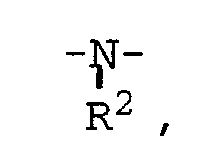


- B. -alkylene of C1-C8-R3-X"-R3-alkylene of C1-C8-wherein X" represents alkylene of C1-C4 or a phenylene of the formula

- In compounds of Formula I, the glycopeptide units, G and G', may be identical or different. Any "alkylene" of C2 or higher can be straight chain or branched.
- Certain compounds are preferred. Symmetrical compounds (G=G' and/or both R1 are identical), are preferred for their more efficient synthesis.
- Antibacterial activity is enhanced by employing preferred "L" groups. Preferences include the following, individually and in any combination:
- L = a linking radical of formula A
- L = a linking radical of formula B wherein the carbon attached to -CH2-G or to -CH2-G' is branched
- R1 = Q
- A = alkylene of C1-C16, especially straight-chain and especially C6-C12;
- A = (alkylene of C1-C4-X')q-alkylene of C1-C4, especially wherein X'=O; the alkylene is -(CH2)2-;
- and q=2;
- R = phenyl and substituted phenyl, especially chlorophenyl; and especially when R has this value on a phenyl ring within "A".
- Representative dimers of Formula I are set forth in following TABLE 1.


- The dimers of the present invention are prepared by reacting a glycopeptide with a bisaldehyde to form an intermediate Schiff base, which is subsequently reduced to obtain the dimers.
- Many bisaldehydes are known compounds. They can be prepared by techniques known to those skilled in the art, per various references;
- J. Org. Chem., 26, 474, (1961)
- J. Het. Chem., 27, 1007 (1990)
- J.A.C.S., 73, 1872 (1951)
- J.A.C.S., 109, 2260 (1987)
- J. Chem. Soc. Perkin I, 189 (1983)
- Syn. Comm., 18 (12), 1379 (1988)
- Chem. Letters, 587 (1995)
- Macromolecules, 6045 (1992);
- J. Chem. Soc. Chem. Comm. 1463 (1991)
- J. Polym. Sci. Part A. Polymer Chem. 31(12) 2899 (1993)
- J. Chem. Res. Synop. (8), 296 (1994)
- Farmco Ed. Sci. 15, 468 (1960)
- Makromol. Chem. 191 (4) 815 (1990)
- J. Polym. Sci. Part A. Polymer Chem. 29(3) 361 (1991)
- Makromol. Chem. 65, 54 (1963)
- The reaction of bisaldehyde with glycopeptide is carried out in accordance with prior art condensations of amine and aldehyde to form Schiff bases, and their subsequent reduction.
- Thus, the present condensation is typically conducted in a polar solvent, such as dimethylformamide or methanol, or a mixture of polar solvents. The reaction goes forward over a range of temperatures, such as from 25°C to 100°C, but is preferably conducted at temperatures of about 60°C to 70°C. The reaction is preferably conducted under an inert atmosphere, such as nitrogen or argon. The reaction requires two molecular proportions of glycopeptide and one molecular proportion of bisaldehyde.
- The reaction yields a Schiff base of the formula
G=CH-L-CH=G'.
The Schiff base is subsequently reduced. Preferably, the reduction is conducted in the same reaction mixture in a polar solvent, and employing a chemical reducing agent. Metal borohydrides, such as sodium borohydride and sodium cyanoborohydride are preferred. The reaction goes forward over a range of temperatures, such as from about 25°C to about 100°C; preferably, the reaction is conducted at about 60°C to 70°C. - The product, or mixture of products, can be isolated and purified if desired in a conventional manner, such as by HPLC. Characterization of products is best accomplished by Fast Atom Bombardment Mass Spectroscopy (FAB·MS).
- In addition to the foregoing synthetic route, compounds of the present invention can be prepared in an alternate route. In this alternate route, a dimer is prepared by the foregoing synthetic route, and further changes to the structure of the glycopeptide are made subsequently. This approach to synthesizing the present dimers is illustrated by Preparations 6-8 below. In Preparations 6-7, a dimer of the present invention is reacted with an amine to convert the acid of the glycopeptide to an amide

- When it is desired to employ a salt, a compound of Formula I can be reacted with a mineral or organic acid or an inorganic base, in techniques well known to those skilled in the art. Pharmaceutically-acceptable salts are preferred.
- The following examples report preparations of illustrative dimers.
- The HPLC procedures reported in these examples were as follows:
- Analytical ("Conditions A"): Reactions were monitored by analytical HPLC using a Waters µBondapak C18 column (3.9x300 mm) and UV detection at 280 nm. Elution was accomplished with a linear gradient of 5% CH3CN - 95% buffer to 80% CH3CN - 20% buffer over 30 minutes. The buffer used was 0.5% triethylamine in water, adjusted to pH 3 with H3PO4.
- Preparative ("Conditions B"): Crude reaction mixtures were purified by preparative HPLC using a Waters C18 Nova-Pak column (40x300 mm) and UV detection at 280 nm. Elution was accomplished with a linear gradient of 5% CH3CN - 95% buffer to 80% CH3CN - 20% buffer over 30 minutes. The buffer used was 0.5% triethylamine in water, adjusted to pH 3 with H3PO4. The desired fractions were subsequently desalted with a Waters C18 Sep-Pak (35 cc) followed by lyophilization. Alternatively, a buffer containing 0.1% TFA in H2O can be used, in which case the TFA salt is obtained directly after lyophilization.
- Compounds were desalted as follows. A Waters Sep-Pak cartridge was pre-wet with methanol (2-3 column volumes) then conditioned with water (2-3 column volumes). The sample, dissolved in a minimum volume of water, was loaded onto the Sep-Pak column which was then washed with water (2-3 column volumes) to remove the unwanted salts. The product was then eluted with an appropriate solvent system, typically 1:1 CH3CN/H2O, CH3CN, and/or methanol. The organic solvent component was removed in vacuo and the resulting aqueous solution lyophilized to give the final product.
-

- A dry 100 mL round bottom flask was charged with vancomycin·HC1 (250 mg, 0.168 mmol.), and 1,6-bis(4'-formylphenoxy)-n-hexane (101 mg, 0.310 mmol.). Anhydrous DMF (6 mL) was added to the flask and the resulting mixture was stirred under N2 and heated to 70°C. After 3.5 hours, sodium cyanoborohydride (80 mg, 1.3 mmol.) was added in one portion, and the reaction mixture was maintained at 70°C for one additional hour. The reaction mixture was cooled, and stored at 0°C overnight.
- The reaction mixture was then concentrated in vacuo to give a residue which was re-dissolved in 1:1 H20:CH3CN (5 mL) and HOAc (0.5 mL). The resulting solution was purified by preparatory HPLC (conditions B). The desired fractions, as determined by analytical HPLC (conditions A), were concentrated in vacuo to ∼ 1.5 mL, and desalted. After lyophilization, 1,6-hexanediylbis[(oxy-4,1-phenylene)methylene]bis[vancomycin] was obtained (24.3 mg, 0.008 mmol., 10.0 % yield) as a white powder.
HPLC (conditions A) retention time: 13.6 min.
FABMS shows peak of (M+6H) at 3195. -

- A dry 100 mL round bottom flask was charged with A82846B·tri-acetate salt (278 mg, 0.157 mmol.), and 1,9-bis-(4'-formylphenoxy)-n-nonane (103.7 mg, 0.282 mmol.) . Anhydrous DMF (15 mL) and anhydrous MeOH (15 mL) were added to the flask and the resulting mixture was stirred under N2 and heated to 70°C. After 3.5 hours, sodium cyanoborohydride (68 mg, 1.08 mmol.) was added in one portion, and the reaction mixture was maintained at 70°C for one additional hour.
- The reaction mixture was then concentrated in vacuo to give a residue which was re-dissolved in 1:1 H20:CH3CN (5 mL) and HOAc (0.5 mL). The resulting solution was purified by preparatory HPLC (conditions B). The desired fractions, as determined by analytical HPLC (conditions A), were concentrated in vacuo to ∼ 1.5 mL, and desalted. After lyophilization, 1,9-nonanediylbis[(oxy-4,1-phenylene)methylene]bis[epivancomycin] was obtained (25.7 mg, 0.007 mmol., 9.3 % yield) as a white powder.
HPLC (conditions A) retention time: 14.9 min.
FABMS shows peak of (M+5H)at 3522. -

- A dry round bottom flask was charged with vanconycin·HCl (75 mg, 0.052 mmol.), and N4-(4-(8-(p-formylphenoxy)-n-octyloxy)benzyl)A82846B (50 mg, 0.026 mmol.) (see Preparation 4). Anhydrous DMF (6 mL) was added to the flask and the resulting mixture was stirred under N2 and heated to 70°C. After 5 hours, sodium cyanoborohydride (59 mg, 0.93 mmol.) was added in one portion, and the reaction mixture was maintained at 70°C for one additional hour. The reaction mixture was cooled, and stored at 0°C overnight.
- The reaction mixture was then concentrated in vacuo to give a residue which was re-dissolved in 1:1 H20:CH3CN (5 mL) and HOAc (0.5 mL). The resulting solution was purified by preparatory HPLC (conditions B). The desired fractions, as determined by analytical HPLC (conditions A), were concentrated in vacuo to ∼ 1.5 mL, and desalted. After lyophilization, 1,8-octanediylbis[(oxy-4,1-phenylene)methylene][vancomycin][A82846B] was obtained (5.2 mg, 0.002 mmol., 7.6 % yield) as a white powder.
HPLC (conditions A) retention time: 14.5 min.
FABMS shows peak of (M+6H) at 3364. -

- A dry flask was charged with A82846B·tri-acetate salt (5.0 g, 0.003 mol.), and 1,8-bis(4'-formylphenoxy)-n-octane (1.93 g, 0.006 mol.). Anhydrous DMF (300 mL) and anhydrous MeOH (300 mL) were added to the flask and the resulting mixture was stirred under N2 and heated to 70°C. After 3.75 hours, sodium cyanoborohydride (0.76 g, 0.012 mol.) was added in one portion, and the reaction mixture was maintained at 70°C for one additional hour. The reaction was cooled and stored at 0°C overnight.
- The reaction mixture was then concentrated in vacuo to give a residue which was re-dissolved in 1:1 H20:CH3CN (200 mL) and HOAc (5 mL). The resulting solution was purified by preparatory HPLC (conditions B). The desired fractions, as determined by analytical HPLC (conditions A), were concentrated in vacuo to ∼ 1.5 mL, and desalted. After lyophilization, N4-(4-(8-(p-formylphenoxy)-n-octyloxy)benzyl)A82846B was obtained (387.4 mg, 0.2 mmol., 6.6 % yield) as a white powder.
HPLC (conditions A) retention time: 19.9 min.
FABMS shows peak of (M+3H)at 1932. - A dry flask was charged with N4-(4-(8-(p-formylphenoxy)-n-octyloxy)benzyl)A82846B (20.0 mg, 0.01 mmol), and A82846B (32.9 mg, 0.021 mmol). Anhydrous DMF (3 mL) and anhydrous MeOH (3 mL) were added to the flask and the resulting mixture was stirred under N2 and heated to 70°C. After 2 hours, sodium cyanoborohydride (5.0 mg, 0.079 mmol) was added in one portion, and the reaction mixture stirred an additional 0.25 hours.
- The reaction mixture was then concentrated in vacuo to give a residue which was redissolved in 1:1 H2O:CH3CN (5 mL). The resulting solution was purified by preparatory HPLC (conditions D). The desired fraction, as determined by analytical HPLC (conditions A), were concentrated in vacuo to ∼ 1.5 mL, and desalted. After lyophilization, 1,8-octanediylbis[(oxy-4,1-phenylene)methylene]bis[A828468] was obtained (3.0 mg, 0.001 mmol, 8.6 % yield) as a white powder.
HPLC (conditions A) retention time: 13.6 min.
FABMS shows peak of (M+5H) at 3508. - A dry round bottom flask was charged with 1,3-phenylene-bis-[(oxy-1,3-n-propyleneoxy-4,1-phenylene)methylene]--bis[A82846B] (50.0 mg, 0.014 mmol) and 1 mL DMSO. PyBOP (14.5 mg, 0.028 mmol) and 3-dimethylaminopropylamine (2.8 mg, 0.028 mmol) were added and the reaction was stirred at room temperature under nitrogen for one hour. The reaction mixture was then concentrated in vacuo to give a residue which was re-dissolved in 1:1 H2O:CH3CN (5 mL). The resulting solution was purified by preparatory HPLC (conditions B). The desired fractions, as determined by analytical HPLC (conditions A) were concentrated in vacuo to ∼ 1.5 mL, and desalted as in previous examples. After lyopholization 1,3-phenylenebis[oxy-1,3-n-propylene-oxy-4,1-phenylene)methylene]bis[A82846B,(3-dimethylaminopropyl)amide] (6.9 mg, 13.1% yield) and 1,3-phenylenebis[oxy-1,3-n-propylene-oxy-4,1-phenylene) -methylene]A82846B/A82846B,(3-dimethylaminopropyl)amide (6.6 mg, 12.8% yield) were obtained as white powders.
- 1,3-phenylenebis[oxy-1,3-n-propylene-oxy-4,1-phenylene)methylene]bis[A828468, (3-dimethylaminopropyl)-amide]
HPLC (conditions A) retention time: 13.2 min.
FABMS shows peak of (M+9H) at 3761. - 1,3-phenylenebis[oxy-1,3-n-propylene-oxy-4,l-phenylene)-methylene] A828468/A828468, (3-dimethylaminopropyl) amide HPLC (conditions A) retention time: 13.7 min.
FABMS shows peak of (M+6H) at 3674. - 1,3-phenylene-bis-[(oxy-1,3-n-propyleneoxy-4,1-phenylene)methylene]-bis[A82846B] (165.8 mg, 0.0462 mmol) was dissolved in 15 mL H2O - pyridine (1:1 v/v) and treated with phenyl isothiocyanate (30 µl, 0.25 mmol). The resulting mixture was stirred at room temperature for 1.5 hours at which time HPLC analysis (conditions A) indicated complete consumption of the starting material. The reaction mixture was concentrated in vacuo to give the crude bisthiourea derivative as a white powder.
- The crude thiourea intermediate was suspended in 15 mL CH2Cl2, cooled to 0°C, then treated with trifluoroacetic acid (0.20 mL). After 1 hour the reaction mixture was warmed to room temperature and stirred an additional 1 hour. An additional 0.20 mL trifluoroacetic acid was added and the mixture was stirred at room temperature for 3 hours. The solvent was removed in vacuo and the crude product was purified by preparative HPLC (conditions B). The desired fractions, as determined by analytical HPLC (conditions A) were concentrated in vacuo to ∼ 1.5 mL, and desalted as in previous examples to give 10.2 mg (7% yield) of 1,3-phenylene-bis-[(oxy-1,3-n-propyleneoxy-4,1-phenylene)methylene]-bis[desleucylA82846B] as a white powder.
FAB-MS: obtained 3333 (M+4)
HPLC retention time (conditions A): 15.1 min. - Details concerning the synthesis of all of the compounds of TABLE 1, as well as identifying characteristics, are presented in TABLE 2.


- The present glycopeptide dimers are useful for the treatment of bacterial infections. Therefore, in another embodiment, the present invention is directed to a method for controlling a bacterial infection in a host animal, typically a warm-blooded animal, which comprises administering to the host animal an effective, antibacterial amount of a glycopeptide dimer in which two glycopeptide units are covalently linked to one another through an amine function of an amino sugar. In this embodiment, the dimers can be used to control and treat infections due to various bacteria, but especially gram-positive bacteria. In a preferred embodiment, the dimers are used to control and treat infections due to bacteria resistant to existing antibacterials. For example, certain bacteria are resistant to methicillin, and yet others are resistant to vancomycin and/or teicoplanin. The present dimers provide a technique for controlling and treating infections due to such resistant bacterial species.
- In carrying out this embodiment of the invention, the dimers can be administered by any of the conventional techniques, including the oral route and parenteral routes such as intravenous and intramuscular. The amount of compound to be employed is not critical and will vary depending on the particular compound employed, the route of administration, the severity of the infection, the interval between dosings, and other factors known to those skilled in the art. In general, a dose of from about 0.5 to about 100 mg/kg will be effective; and in many situations, lesser doses of from about 0.5 to about 50 mg/kg will be effective. A compound of the present invention can be administered in a single dose, but in the known manner of antibacterial therapy, a compound of the present invention is typically administered repeatedly over a period of time, such as a matter of days or weeks, to ensure control of the bacterial infection.
- Also in accordance with known antibacterial therapy, a dimer of the present invention is typically formulated for convenient delivery of the requisite dose. Therefore, in another embodiment, the present invention is directed to a pharmaceutical formulation comprising a dimer of Formula I, in combination with a pharmaceutically-acceptable carrier. Such carriers are well known for both oral and parenteral routes of delivery. In general, a formulation will comprise a dimer in a concentration of from about 0.1 to about 90% by weight, and often from about 1.0 to about 3%.
- The antibacterial efficacy of the present dimers is illustrated by following TABLES 3 and 4. The minimal inhibitory concentrations (MICs) were determined using a standard broth micro-dilution assay. TABLE 4 presents a comparison of the activity of illustrative compounds against representative vancomycin-resistant and vancomycin-sensitive enterococci (Enterococcus faecium and Enterococcus faecalis, mean geometric MIC (mcg/mL), as determined by the standard broth micro-dilution assay.


Claims (5)
- A glycopeptide dimer in which two glycopeptide units are covalently linked to one another through an amine function of an amino sugar, for use in antibacterial therapy.
- A glycopeptide dimer in which two glycopeptide units are covalently linked to one another through an amine function of an amino sugar, for use in antibacterial therapy against vancomycin-resistant-enterococcus.
- Use of a glycopeptide dimer according to either of Claims 1 and 2 in the manufacture of a medicament for treating a bacterial infection in a host.
- Use according to Claim 3 in which both glycopeptide units of the dimer are A82846B.
- Use according to Claim 3 in which both glycopeptide units of the dimer are vancomycin.
Applications Claiming Priority (4)
| Application Number | Priority Date | Filing Date | Title |
|---|---|---|---|
| US1533096P | 1996-04-12 | 1996-04-12 | |
| US15330 | 1996-04-12 | ||
| US3173696P | 1996-11-25 | 1996-11-25 | |
| US31736 | 1996-11-25 |
Publications (2)
| Publication Number | Publication Date |
|---|---|
| EP0801075A1 true EP0801075A1 (en) | 1997-10-15 |
| EP0801075B1 EP0801075B1 (en) | 1999-07-07 |
Family
ID=26687247
Family Applications (1)
| Application Number | Title | Priority Date | Filing Date |
|---|---|---|---|
| EP97302416A Expired - Lifetime EP0801075B1 (en) | 1996-04-12 | 1997-04-08 | Covalently linked dimers of glycopeptide antibiotics |
Country Status (8)
| Country | Link |
|---|---|
| EP (1) | EP0801075B1 (en) |
| AT (1) | ATE181927T1 (en) |
| AU (1) | AU2441697A (en) |
| DE (1) | DE69700308T2 (en) |
| DK (1) | DK0801075T3 (en) |
| ES (1) | ES2136457T3 (en) |
| GR (1) | GR3031302T3 (en) |
| WO (1) | WO1997038702A1 (en) |
Cited By (14)
| Publication number | Priority date | Publication date | Assignee | Title |
|---|---|---|---|---|
| EP0881230A3 (en) * | 1997-05-20 | 1998-12-23 | Eli Lilly And Company | Urea and thiourea derivatives of antibiotic glycopeptides |
| EP0881229A3 (en) * | 1997-05-20 | 1998-12-23 | Eli Lilly And Company | Alkylated antibiotic hexapeptides |
| FR2778184A1 (en) * | 1998-02-20 | 1999-11-05 | Advanced Medicine Inc | NOVEL ANTIBACTERIAL MULTIPLE BINDING COMPOUNDS, PROCESS FOR THEIR PREPARATION AND PHARMACEUTICAL COMPOSITIONS CONTAINING SAME |
| EP0817797A4 (en) * | 1995-03-24 | 2000-12-06 | Lilly Co Eli | Glycopeptide antibiotic derivatives |
| US6392012B1 (en) | 1998-12-23 | 2002-05-21 | Advanced Medicine, Inc. | Glycopeptide derivatives and pharmaceutical compositions containing the same |
| US6518242B1 (en) | 1998-02-20 | 2003-02-11 | Theravance, Inc. | Derivatives of glycopeptide antibacterial agents |
| US6900175B2 (en) | 2002-11-18 | 2005-05-31 | Vicuron Pharmaceuticals Inc. | Methods of administering dalbavancin for treatment of bacterial infections |
| US7119061B2 (en) | 2002-11-18 | 2006-10-10 | Vicuron Pharmaceuticals, Inc. | Dalbavancin compositions for treatment of bacterial infections |
| WO2007035938A2 (en) | 2005-09-22 | 2007-03-29 | Medivas, Llc | BIS-(α-AMINO)-DIOL-DIESTER-CONTAINING POLY(ESTER AMIDE) AND POLY(ESTER URETHANE) COMPOSITIONS AND METHODS OF USE |
| WO2007038246A2 (en) | 2005-09-22 | 2007-04-05 | Medivas, Llc | Solid polymer delivery compositions and methods for use thereof |
| WO2009081958A1 (en) | 2007-12-26 | 2009-07-02 | Shionogi & Co., Ltd. | Glycosylated glycopeptide antibiotic derivative |
| WO2009123713A1 (en) | 2008-04-01 | 2009-10-08 | Cornell University | Organo-soluble chitosan salts and chitosan-derived biomaterials prepared thereof |
| EP2314599A1 (en) | 2004-11-29 | 2011-04-27 | National University Corporation Nagoya University | Glycopeptide antibiotic monomer derivatives |
| US8143212B2 (en) | 2002-11-18 | 2012-03-27 | Vicuron Pharmaceuticals Inc. | Dalbavancin compositions for treatment of bacterial infections |
Families Citing this family (1)
| Publication number | Priority date | Publication date | Assignee | Title |
|---|---|---|---|---|
| TW200630382A (en) * | 2004-11-29 | 2006-09-01 | Univ Nagoya Nat Univ Corp | Dimer derivatives of glycopeptide antibiotics |
-
1997
- 1997-04-07 AU AU24416/97A patent/AU2441697A/en not_active Abandoned
- 1997-04-07 WO PCT/US1997/005659 patent/WO1997038702A1/en not_active Ceased
- 1997-04-08 EP EP97302416A patent/EP0801075B1/en not_active Expired - Lifetime
- 1997-04-08 DE DE69700308T patent/DE69700308T2/en not_active Expired - Fee Related
- 1997-04-08 AT AT97302416T patent/ATE181927T1/en not_active IP Right Cessation
- 1997-04-08 ES ES97302416T patent/ES2136457T3/en not_active Expired - Lifetime
- 1997-04-08 DK DK97302416T patent/DK0801075T3/en active
-
1999
- 1999-09-22 GR GR990402402T patent/GR3031302T3/en unknown
Non-Patent Citations (3)
| Title |
|---|
| H LINSDELL ET AL.: "Dimerization of A82846B, vancomycin and ristocetin; influence on antibiotic complexation with cell wall model peptides", JOURNAL OF ANTIBIOTICS, vol. 49, no. 2, February 1996 (1996-02-01), TOKYO JP, pages 181 - 193, XP002037248 * |
| U GERHARD ET AL.: "The role of the sugar and chlorine substituents in the dimerization of vancomycin antibiotics", JOURNAL OF THE AMERICAN CHEMICAL SOCIETY, vol. 115, no. 1, 13 January 1993 (1993-01-13), DC US, pages 232 - 237, XP002037249 * |
| U N SUNDRAM ET AL.: "Novel vancomycin dimers with activity against vancomycin-resistant enterococci", JOURNAL OF THE AMERICAN CHEMICAL SOCIETY, vol. 118, no. 51, 25 December 1996 (1996-12-25), DC US, pages 13107 - 13108, XP002037250 * |
Cited By (25)
| Publication number | Priority date | Publication date | Assignee | Title |
|---|---|---|---|---|
| EP0817797A4 (en) * | 1995-03-24 | 2000-12-06 | Lilly Co Eli | Glycopeptide antibiotic derivatives |
| EP0881229A3 (en) * | 1997-05-20 | 1998-12-23 | Eli Lilly And Company | Alkylated antibiotic hexapeptides |
| US5977063A (en) * | 1997-05-20 | 1999-11-02 | Eli Lilly And Company | Alkylated hexapeptides |
| EP0881230A3 (en) * | 1997-05-20 | 1998-12-23 | Eli Lilly And Company | Urea and thiourea derivatives of antibiotic glycopeptides |
| US6518242B1 (en) | 1998-02-20 | 2003-02-11 | Theravance, Inc. | Derivatives of glycopeptide antibacterial agents |
| FR2778184A1 (en) * | 1998-02-20 | 1999-11-05 | Advanced Medicine Inc | NOVEL ANTIBACTERIAL MULTIPLE BINDING COMPOUNDS, PROCESS FOR THEIR PREPARATION AND PHARMACEUTICAL COMPOSITIONS CONTAINING SAME |
| US7067620B2 (en) | 1998-02-20 | 2006-06-27 | Theravance, Inc. | Antibacterial agents |
| US7101964B2 (en) | 1998-12-23 | 2006-09-05 | Theravance, Inc. | Intermediate for preparing glycopeptide derivatives |
| US7723470B2 (en) | 1998-12-23 | 2010-05-25 | Theravance, Inc. | Glycopeptide derivatives and pharmaceutical compositions containing the same |
| US6455669B1 (en) | 1998-12-23 | 2002-09-24 | Theravance, Inc. | Glycopeptide derivatives and pharmaceutical compositions containing the same |
| US6962970B2 (en) | 1998-12-23 | 2005-11-08 | Theravance, Inc. | Glycopeptide derivatives and pharmaceutical compositions containing the same |
| US6444786B1 (en) | 1998-12-23 | 2002-09-03 | Advanced Medicine, Inc. | Glycopeptide derivatives and pharmaceutical compositions containing the same |
| US6392012B1 (en) | 1998-12-23 | 2002-05-21 | Advanced Medicine, Inc. | Glycopeptide derivatives and pharmaceutical compositions containing the same |
| US7351791B2 (en) | 1998-12-23 | 2008-04-01 | Theravance, Inc. | Intermediate for preparing glycopeptide derivatives |
| US7119061B2 (en) | 2002-11-18 | 2006-10-10 | Vicuron Pharmaceuticals, Inc. | Dalbavancin compositions for treatment of bacterial infections |
| US7115564B2 (en) | 2002-11-18 | 2006-10-03 | Vicuron Pharmaceuticals, Inc. | Stable pharmaceutical compositions of dalbavancin and methods of administration |
| US6900175B2 (en) | 2002-11-18 | 2005-05-31 | Vicuron Pharmaceuticals Inc. | Methods of administering dalbavancin for treatment of bacterial infections |
| US8143212B2 (en) | 2002-11-18 | 2012-03-27 | Vicuron Pharmaceuticals Inc. | Dalbavancin compositions for treatment of bacterial infections |
| EP2314599A1 (en) | 2004-11-29 | 2011-04-27 | National University Corporation Nagoya University | Glycopeptide antibiotic monomer derivatives |
| US8778874B2 (en) | 2004-11-29 | 2014-07-15 | National University Corporation Nagoya University | Glycopeptide antibiotic monomer derivatives |
| WO2007035938A2 (en) | 2005-09-22 | 2007-03-29 | Medivas, Llc | BIS-(α-AMINO)-DIOL-DIESTER-CONTAINING POLY(ESTER AMIDE) AND POLY(ESTER URETHANE) COMPOSITIONS AND METHODS OF USE |
| WO2007038246A2 (en) | 2005-09-22 | 2007-04-05 | Medivas, Llc | Solid polymer delivery compositions and methods for use thereof |
| WO2009081958A1 (en) | 2007-12-26 | 2009-07-02 | Shionogi & Co., Ltd. | Glycosylated glycopeptide antibiotic derivative |
| US8481696B2 (en) | 2007-12-26 | 2013-07-09 | Shionogi & Co., Ltd. | Glycosylated glycopeptide antibiotic derivatives |
| WO2009123713A1 (en) | 2008-04-01 | 2009-10-08 | Cornell University | Organo-soluble chitosan salts and chitosan-derived biomaterials prepared thereof |
Also Published As
| Publication number | Publication date |
|---|---|
| WO1997038702A1 (en) | 1997-10-23 |
| DE69700308T2 (en) | 1999-11-18 |
| ATE181927T1 (en) | 1999-07-15 |
| DE69700308D1 (en) | 1999-08-12 |
| GR3031302T3 (en) | 1999-12-31 |
| AU2441697A (en) | 1997-11-07 |
| DK0801075T3 (en) | 1999-11-22 |
| EP0801075B1 (en) | 1999-07-07 |
| ES2136457T3 (en) | 1999-11-16 |
Similar Documents
| Publication | Publication Date | Title |
|---|---|---|
| EP0816378B1 (en) | Glycopeptide antibiotic amide derivatives | |
| KR100388867B1 (en) | Glycopeptide antibiotic derivatives | |
| EP0817797B1 (en) | Glycopeptide antibiotic derivatives | |
| EP0801075B1 (en) | Covalently linked dimers of glycopeptide antibiotics | |
| EP0802199B1 (en) | Covalently bound dimers of glycopeptide antibiotics | |
| EP0435503A1 (en) | Improvements in or relating to gylcopeptide derivatives | |
| EP0881229B1 (en) | Alkylated antibiotic hexapeptides | |
| US6670446B1 (en) | N1 modified glycopeptides | |
| WO2001081372A2 (en) | Vancomycin analogs | |
| EP0879825B1 (en) | Derivatives of antibiotic A82846B (Chloroorienticin A) | |
| EP0881230B1 (en) | Urea and thiourea derivatives of antibiotic glycopeptides | |
| US6037447A (en) | Glycopeptide compounds | |
| HK1007884B (en) | Glycopeptide antibiotic amide derivatives | |
| IE911798A1 (en) | Use of C63 derivatives of 34-de (acetylglucosaminyl)-34-deoxy-teicoplanin against bacteria resistant to glycopeptide antibiotics |
Legal Events
| Date | Code | Title | Description |
|---|---|---|---|
| PUAI | Public reference made under article 153(3) epc to a published international application that has entered the european phase |
Free format text: ORIGINAL CODE: 0009012 |
|
| 17P | Request for examination filed |
Effective date: 19970421 |
|
| AK | Designated contracting states |
Kind code of ref document: A1 Designated state(s): AT BE CH DE DK ES FI FR GB GR IE IT LI LU NL PT SE |
|
| AX | Request for extension of the european patent |
Free format text: RO PAYMENT 970421 |
|
| GRAG | Despatch of communication of intention to grant |
Free format text: ORIGINAL CODE: EPIDOS AGRA |
|
| 17Q | First examination report despatched |
Effective date: 19980721 |
|
| GRAG | Despatch of communication of intention to grant |
Free format text: ORIGINAL CODE: EPIDOS AGRA |
|
| GRAH | Despatch of communication of intention to grant a patent |
Free format text: ORIGINAL CODE: EPIDOS IGRA |
|
| GRAH | Despatch of communication of intention to grant a patent |
Free format text: ORIGINAL CODE: EPIDOS IGRA |
|
| GRAA | (expected) grant |
Free format text: ORIGINAL CODE: 0009210 |
|
| AK | Designated contracting states |
Kind code of ref document: B1 Designated state(s): AT BE CH DE DK ES FI FR GB GR IE IT LI LU NL PT SE |
|
| AX | Request for extension of the european patent |
Free format text: RO PAYMENT 19970421 |
|
| REF | Corresponds to: |
Ref document number: 181927 Country of ref document: AT Date of ref document: 19990715 Kind code of ref document: T |
|
| REG | Reference to a national code |
Ref country code: CH Ref legal event code: NV Representative=s name: E. BLUM & CO. PATENTANWAELTE Ref country code: CH Ref legal event code: EP |
|
| REF | Corresponds to: |
Ref document number: 69700308 Country of ref document: DE Date of ref document: 19990812 |
|
| ET | Fr: translation filed | ||
| REG | Reference to a national code |
Ref country code: IE Ref legal event code: FG4D |
|
| ITF | It: translation for a ep patent filed | ||
| REG | Reference to a national code |
Ref country code: ES Ref legal event code: FG2A Ref document number: 2136457 Country of ref document: ES Kind code of ref document: T3 |
|
| REG | Reference to a national code |
Ref country code: DK Ref legal event code: T3 |
|
| REG | Reference to a national code |
Ref country code: PT Ref legal event code: SC4A Free format text: AVAILABILITY OF NATIONAL TRANSLATION Effective date: 19990826 |
|
| PLBE | No opposition filed within time limit |
Free format text: ORIGINAL CODE: 0009261 |
|
| STAA | Information on the status of an ep patent application or granted ep patent |
Free format text: STATUS: NO OPPOSITION FILED WITHIN TIME LIMIT |
|
| 26N | No opposition filed | ||
| REG | Reference to a national code |
Ref country code: GB Ref legal event code: IF02 |
|
| REG | Reference to a national code |
Ref country code: CH Ref legal event code: PFA Owner name: ELI LILLY AND COMPANY Free format text: ELI LILLY AND COMPANY#LILLY CORPORATE CENTER#INDIANAPOLIS, INDIANA 46285 (US) -TRANSFER TO- ELI LILLY AND COMPANY#LILLY CORPORATE CENTER#INDIANAPOLIS, INDIANA 46285 (US) |
|
| PGFP | Annual fee paid to national office [announced via postgrant information from national office to epo] |
Ref country code: DK Payment date: 20090313 Year of fee payment: 13 |
|
| PGFP | Annual fee paid to national office [announced via postgrant information from national office to epo] |
Ref country code: GB Payment date: 20090312 Year of fee payment: 13 |
|
| PGFP | Annual fee paid to national office [announced via postgrant information from national office to epo] |
Ref country code: IE Payment date: 20090423 Year of fee payment: 13 Ref country code: ES Payment date: 20090420 Year of fee payment: 13 |
|
| PGFP | Annual fee paid to national office [announced via postgrant information from national office to epo] |
Ref country code: SE Payment date: 20090406 Year of fee payment: 13 Ref country code: PT Payment date: 20090402 Year of fee payment: 13 Ref country code: NL Payment date: 20090409 Year of fee payment: 13 Ref country code: LU Payment date: 20090420 Year of fee payment: 13 Ref country code: IT Payment date: 20090418 Year of fee payment: 13 Ref country code: FR Payment date: 20090406 Year of fee payment: 13 Ref country code: FI Payment date: 20090414 Year of fee payment: 13 Ref country code: DE Payment date: 20090430 Year of fee payment: 13 Ref country code: AT Payment date: 20090312 Year of fee payment: 13 |
|
| PGFP | Annual fee paid to national office [announced via postgrant information from national office to epo] |
Ref country code: BE Payment date: 20090525 Year of fee payment: 13 |
|
| PGFP | Annual fee paid to national office [announced via postgrant information from national office to epo] |
Ref country code: CH Payment date: 20090430 Year of fee payment: 13 |
|
| PGFP | Annual fee paid to national office [announced via postgrant information from national office to epo] |
Ref country code: GR Payment date: 20090415 Year of fee payment: 13 |
|
| BERE | Be: lapsed |
Owner name: *ELI LILLY AND CY Effective date: 20100430 |
|
| REG | Reference to a national code |
Ref country code: NL Ref legal event code: V1 Effective date: 20101101 |
|
| EUG | Se: european patent has lapsed | ||
| REG | Reference to a national code |
Ref country code: CH Ref legal event code: PL |
|
| REG | Reference to a national code |
Ref country code: DK Ref legal event code: EBP |
|
| GBPC | Gb: european patent ceased through non-payment of renewal fee |
Effective date: 20100408 |
|
| REG | Reference to a national code |
Ref country code: IE Ref legal event code: MM4A |
|
| REG | Reference to a national code |
Ref country code: FR Ref legal event code: ST Effective date: 20101230 |
|
| PG25 | Lapsed in a contracting state [announced via postgrant information from national office to epo] |
Ref country code: NL Free format text: LAPSE BECAUSE OF NON-PAYMENT OF DUE FEES Effective date: 20101101 Ref country code: IE Free format text: LAPSE BECAUSE OF NON-PAYMENT OF DUE FEES Effective date: 20100408 Ref country code: FR Free format text: LAPSE BECAUSE OF NON-PAYMENT OF DUE FEES Effective date: 20100430 Ref country code: FI Free format text: LAPSE BECAUSE OF NON-PAYMENT OF DUE FEES Effective date: 20100408 Ref country code: AT Free format text: LAPSE BECAUSE OF NON-PAYMENT OF DUE FEES Effective date: 20100408 |
|
| PG25 | Lapsed in a contracting state [announced via postgrant information from national office to epo] |
Ref country code: PT Free format text: LAPSE BECAUSE OF NON-PAYMENT OF DUE FEES Effective date: 20101008 Ref country code: LI Free format text: LAPSE BECAUSE OF NON-PAYMENT OF DUE FEES Effective date: 20100430 Ref country code: DE Free format text: LAPSE BECAUSE OF NON-PAYMENT OF DUE FEES Effective date: 20101103 Ref country code: CH Free format text: LAPSE BECAUSE OF NON-PAYMENT OF DUE FEES Effective date: 20100430 |
|
| PG25 | Lapsed in a contracting state [announced via postgrant information from national office to epo] |
Ref country code: IT Free format text: LAPSE BECAUSE OF NON-PAYMENT OF DUE FEES Effective date: 20100408 Ref country code: GR Free format text: LAPSE BECAUSE OF NON-PAYMENT OF DUE FEES Effective date: 20101103 Ref country code: GB Free format text: LAPSE BECAUSE OF NON-PAYMENT OF DUE FEES Effective date: 20100408 Ref country code: BE Free format text: LAPSE BECAUSE OF NON-PAYMENT OF DUE FEES Effective date: 20100430 |
|
| PG25 | Lapsed in a contracting state [announced via postgrant information from national office to epo] |
Ref country code: DK Free format text: LAPSE BECAUSE OF NON-PAYMENT OF DUE FEES Effective date: 20100503 |
|
| REG | Reference to a national code |
Ref country code: ES Ref legal event code: FD2A Effective date: 20110715 |
|
| PG25 | Lapsed in a contracting state [announced via postgrant information from national office to epo] |
Ref country code: ES Free format text: LAPSE BECAUSE OF NON-PAYMENT OF DUE FEES Effective date: 20110705 |
|
| PG25 | Lapsed in a contracting state [announced via postgrant information from national office to epo] |
Ref country code: ES Free format text: LAPSE BECAUSE OF NON-PAYMENT OF DUE FEES Effective date: 20100409 |
|
| PG25 | Lapsed in a contracting state [announced via postgrant information from national office to epo] |
Ref country code: SE Free format text: LAPSE BECAUSE OF NON-PAYMENT OF DUE FEES Effective date: 20100409 Ref country code: LU Free format text: LAPSE BECAUSE OF NON-PAYMENT OF DUE FEES Effective date: 20100408 |