EP2232811B1 - Verfahren und system zur vereitelung von "man in the middle" hacking techniken - Google Patents
Verfahren und system zur vereitelung von "man in the middle" hacking techniken Download PDFInfo
- Publication number
- EP2232811B1 EP2232811B1 EP09757431A EP09757431A EP2232811B1 EP 2232811 B1 EP2232811 B1 EP 2232811B1 EP 09757431 A EP09757431 A EP 09757431A EP 09757431 A EP09757431 A EP 09757431A EP 2232811 B1 EP2232811 B1 EP 2232811B1
- Authority
- EP
- European Patent Office
- Prior art keywords
- user
- secure
- web site
- ippw
- transaction
- Prior art date
- Legal status (The legal status is an assumption and is not a legal conclusion. Google has not performed a legal analysis and makes no representation as to the accuracy of the status listed.)
- Active
Links
Images


Classifications
-
- H—ELECTRICITY
- H04—ELECTRIC COMMUNICATION TECHNIQUE
- H04L—TRANSMISSION OF DIGITAL INFORMATION, e.g. TELEGRAPHIC COMMUNICATION
- H04L63/00—Network architectures or network communication protocols for network security
- H04L63/04—Network architectures or network communication protocols for network security for providing a confidential data exchange among entities communicating through data packet networks
- H04L63/0428—Network architectures or network communication protocols for network security for providing a confidential data exchange among entities communicating through data packet networks wherein the data content is protected, e.g. by encrypting or encapsulating the payload
-
- H—ELECTRICITY
- H04—ELECTRIC COMMUNICATION TECHNIQUE
- H04L—TRANSMISSION OF DIGITAL INFORMATION, e.g. TELEGRAPHIC COMMUNICATION
- H04L63/00—Network architectures or network communication protocols for network security
- H04L63/08—Network architectures or network communication protocols for network security for authentication of entities
- H04L63/083—Network architectures or network communication protocols for network security for authentication of entities using passwords
-
- H—ELECTRICITY
- H04—ELECTRIC COMMUNICATION TECHNIQUE
- H04L—TRANSMISSION OF DIGITAL INFORMATION, e.g. TELEGRAPHIC COMMUNICATION
- H04L63/00—Network architectures or network communication protocols for network security
- H04L63/14—Network architectures or network communication protocols for network security for detecting or protecting against malicious traffic
- H04L63/1441—Countermeasures against malicious traffic
- H04L63/1466—Active attacks involving interception, injection, modification, spoofing of data unit addresses, e.g. hijacking, packet injection or TCP sequence number attacks
Definitions
- the present invention relates generally to computer network security, and more particularly, to a method, article, and system for defeating the 'man in the middle' computer hacking technique.
- One of the most difficult computer security problems to deal with involves hackers using a 'man in the middle' scheme.
- a hacker In the 'man in the middle' scheme, a hacker is able to convince an unsuspecting user that the hacker's web site is a legitimate web site for carrying out a transaction, such as an online banking web site, etc.
- the hacker's illegitimate web site logs on to a real transaction web site (bank web site, etc.) and relays all of the information requested by the transaction web site that is used to authenticate the user to the site, back to the user that is being deceived.
- the request is forwarded to the unsuspecting user, by the 'man in the middle', and when the information is supplied, the hacker uses the information to gain access to the bank web site in place of the legitimate user.
- the hacker sends intercepted transactions that are requested by the legitimate user to the bank's web site, and the bank's transaction responses are also intercepted by the hacker and sent back to the user.
- the intercepted transactions are transparent to both the legitimate user and the authorized web site, resulting in a transaction that the user believes was carried out while directly being logged onto the bank's web site.
- the intercepted transaction will be successful from the standpoint of the legitimate user; however, the hacker has now also gained access to the userid and password of the legitimate user.
- the hacker is now free to logon to the bank web site as the legitimate user and withdraw money from the user's account.
- hackers there are several methods employed by hackers to place themselves between (man in the middle) legitimate users and their intended web sites.
- One method widely known as pfishing, involves the sending of emails to a user and convincing the user to select a uniform resource locator (URL) contained in the email.
- the URL contained in the phishing email subsequently sends the user to the hacker's web site, which appears as an exact duplicate of the intended web site.
- Additional methods utilized by hackers include a phony web site URL on a pop-up window, corrupting a user host file so that it changes a bank URL to the URL of the hacker's phony web site, and setting up a rogue WiFi access point, which collects and retains input of sensitive account information.
- DNSs exist to translate a URL, which is an alphanumeric alias for an Internet Protocol (IP) address, to the actual numeric IP address, so that a communication connection to the IP address may be enabled.
- IP Internet Protocol
- Keylogging is a technological process of monitoring computer activity by recording, transmitting, and examining the characters typed on a computer keyboard. Employers monitoring employee productivity, typically involving clerical tasks sometimes use the keylogging technique.
- Other, more nefarious implementations of keylogging programs involve espionage, such as those embodied in spyware programs. These programs attempt to gather confidential information, such as a text string including an account name and password, and particularly a text string of keyboard strokes following input of a particular web site address. For example, a mouse click on a web browser icon displays the configured home page.
- a keyboard is used to enter a secure banking web site universal resource locator (URL) in the address input box. Following that, an account number and password are keyed in to the respective input fields.
- a malicious spyware program records the keystrokes entered on the keyboard, and that sequence of keystrokes is sent to an unknown third party for possible fraudulent use.
- Keylogging programs generally work on the principle of detecting basic input/output system (BIOS) signals sent from what is assumed to be a standard keyboard layout (e.g., "QWERTY”, “DVORAK”, or other standard international keyboard layouts).
- BIOS basic input/output system
- Windows Vista and other popular operating systems and application software enable "re-mapping" of a computer keyboard. While this technique will thwart keyloggers, it is largely unused by the majority of computer users because the remapped keyboard departs from what is traditionally coordinated with the "muscle memory” of touch typists familiar with standard keyboard layouts.
- Patent application US 2003/188012 A1 discloses an access control method using an encrypted word to authenticate the data sent from a client to a server, wherein the word comprises the IP address of the client and a password.
- the server grants access if the IP address of the source matches the IP address in the encrypted word and if the password is valid.
- Patent application US 2004/044896 A1 discloses a method for generating user passwords by encrypting an alphanumeric string.
- the password may be generated using customized encoding by selecting LSFR (Local Shift Shift Register) configuration attributes.
- LSFR Local Shift Shift Register
- Embodiments of the present invention include a method, article, and system for constructing a secure Internet transaction, the method includes: receiving a user identification (userid) and user password on a client device for filling out a web site form generated by a secure web site; concatenating the user's Internet Protocol (IP) address with a separate password that is maintained on the secure web site that the user is authenticating to; encrypting the concatenated user IP and separate password to form an Internet Protocol password (IPPW); wherein the encrypting is carried out with a client device linear feedback shift register (LFSR) with a defined cycle count; building a transaction consisting of the IPPW, the defined cycle count, and the userid; transmitting the transaction and filled out web site form via a network towards the secure web site; wherein in response to receiving the transmitted transaction and filled out web site form, the secure website performs the following: retrieving a secure LFSR from a table utilizing the userid from the received web site form; decrypting the IPPW with the defined
- An article comprising one or more computer-readable storage media containing instructions that when executed by a computer enables a method for constructing a secure Internet transaction, wherein the method further includes: receiving a user identification (userid) and user password on a client device for filling out a web site form generated by a secure web site; concatenating the user's Internet Protocol (IP) address with a separate password that is maintained on the secure web site that the user is authenticating to; encrypting the concatenated user IP and separate password to form an Internet Protocol password (IPPW); wherein the encrypting is carried out with a client device linear feedback shift register (LFSR) with a defined cycle count; building a transaction consisting of the IPPW, the defined cycle count, and the userid; transmitting the transaction and filled out web site form via a network towards the secure web site; wherein in response to receiving the transmitted transaction and filled out web site form, the secure website performs the following: retrieving a secure LFSR from a table utilizing the userid from the received web
- a system for secure Internet transactions includes: one or more server devices in communication with one or more client devices through a network; the server devices and the client devices configured to execute electronic software; wherein the electronic software is resident on storage mediums in signal communication with the client and server devices; wherein the electronic software comprises a series of instructions configured for: receiving a user identification (userid) and user password on a client device from the one or more client devices for filling out a web site form generated by a secure web site found on a server from the one or more server devices; concatenating the user's Internet Protocol (IP) address with a separate password that is maintained on the secure web site that the user is authenticating to; encrypting the concatenated user IP and separate password to form an Internet Protocol password (IPPW); wherein the encrypting is carried out with a client device linear feedback shift register (LFSR) with a defined cycle count; building a transaction consisting of the IPPW, the defined cycle count, and the userid; transmitting the transaction and filled out web site form via the network
- IP Internet Protocol
- Embodiments of the invention provide a method, article, and system for constructing a secure Internet transaction that requires a value of an originating Internet Protocol (IP) address be encrypted and combined with an account password accompanying an Internet transaction for authentication at a secure transaction web site.
- IP Internet Protocol
- a host server authorization routine, at a secure web site is strengthened by requiring that the encrypted IP address in the transaction form input must correspond to the IP address of the computer sending the transaction.
- the transaction form input does come from the originating IP address of the transaction sender's computer.
- the encrypted IP address in the transaction form input from the original sender's computer would not match the easily-discoverable different IP address of the computer operated by the "man in the middle" hacker.
- a transaction carried out with embodiments of the invention, which has been intercepted by a man in the middle hacker will be discovered and the transaction will be aborted.
- Embodiments of the invention are equally effective in scenarios in which the interceptor manually forwards information to the destination transaction server, as well as automated hacking strategies requiring no human manual intervention.
- Embodiments of the invention may be configured to provide information of detected authorization infractions, such as man in the middle schemes, available to authorities, such as local and federal law enforcement officials.
- the detected authorization infractions may be transmitted to authorities in real time, in cooperation with Internet Service Providers (ISPs), and may serve to quickly identify situations in which a hacker attempts to access a secure web site with intercepted credentials, which in some instances may be against local and federal laws.
- ISPs Internet Service Providers
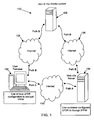
- FIG. 1 is a block diagram of an exemplary system 100 for defeating the man in the middle scheme according to embodiments of the invention.
- a user at terminal 102 accesses a web site form generated by an authorized web site server 104.
- the web site form is either transmitted directly to the user either via Internet direct path A 110, or is first intercepted by a man in the middle system 106, which lies in Internet path B 108.
- the man in the middle system 106 transmits an unaltered web site form to the user terminal 102. Therefore, the user at terminal 102 is unaware if the web site form has been intercepted or not, and is thus unaware of the man in the middle scheme.
- the user is protected from the man in the middle scheme as follows.
- the user fills in their user identification (userid) and password in the web site form at terminal 102, as they normally would do.
- the user terminal 102 is configured with a linear feedback shift register (LFSR) to encrypt the IP address and the password and that is included in a transaction.
- LFSR linear feedback shift register
- a shift register is a group of flip flops set up in a linear fashion, which have their inputs and outputs connected together in a manner that data points are shifted down the line when the circuit is activated.
- a LFSR is a shift register whose input bit is a linear function of its previous state. The only linear functions of single bits are XOR and inverse-XOR; thus it is a shift register whose input bit is driven by the exclusive-or (XOR) of some bits of the overall shift register value.
- the initial value of the LFSR is called the seed, and because the operation of the register is deterministic, the sequence of values produced by the register is completely determined by its current (or previous) state. Likewise, because the register has a finite number of possible states, it must eventually enter a repeating cycle. However, an LFSR with a well-chosen feedback function may produce a sequence of bits which appears random and which has a very long cycle.
- the completed web site form and transaction is then sent via the Internet for further processing.
- Internet path B 108 is used with the man in the middle server 106.
- the man in the middle server 106 intercepts and sends the form and transaction to the authorized web site server 104.
- the authorized web site server 104 uses a copy of the user's uniquely configured LFSR to decrypt the IP address and password of the intended user. In the event the IP address that has been decrypted does not match the IP address of the intended user, the authorized web site server 104 will not respond to the man in the middle server 106, thereby defeating the attempt of the man in the middle hacker.
- FIG. 2 is a flowchart illustrating the anti man in the middle measures according to embodiments of the invention.
- the process starts (block 200) with a user selecting a desired Internet site and accessing the site (block 202), and determining if the site requires authentication (decision block 204). In the event the user chooses authentication, or it is required by the web site (decision block 204 is Yes), the anti man in the middle measures of embodiments of the invention are invoked (block 206), or else (decision block 204 is No) the process ends (block 230). With the invocation of the anti man in the middle measures of the present invention, the user enters their user identification (userid) and password on the form generated by the website on the user's web browser (block 208).
- userid user identification
- password password
- the user's IP address is concatenated with a separate password that is maintained on the web site that the user is authenticating to, and encrypted with a uniquely configured LFSR that is resident on the client (user) computer.
- a random number generator is used to generate the cycle count, for the LFSR (block 210).
- a transaction is built consisting of the encrypted IP address concatenated with the separate password, and is referred to as an Internet Protocol password (IPPW).
- IPPW Internet Protocol password
- the cycle count that was used to encrypt the LFSR and the user's account id is added to the IPPW, and transmitted with the web site form via the Internet towards the desired web site (block 212).
- the form and transaction transmission is received at a web site (block 214), and in the event the web site is actually a man in the middle web site (decision block 216 is Yes), the form and transaction transmission is forwarded, by the man in the middle site, to the intended web site (block 218), and received at the intended real web site (block 220).
- the intended real web site looks up the LFSR in a table using the user account id from the form and transaction, and decrypts the IPPW, using the IPPW as the starting point in the LFSR.
- the number of cycles from the transaction is utilized to run the LFSR backwards to the desired register state (block 222).
- a determination is made if the first part of the decrypted IPPW is equal the IP address of the user (decision block 224).
- the man in the middle scheme is not in effect, the authentication request has come directly from the legitimate user, and the web site proceeds to request transaction data from the user (block 226), and the process ends (block 230).
- the man in the middle scheme is in effect, and the request is from a hacker acting as the man in the middle. In this instance the web site does not respond to the transaction request (block 228), and the process ends (block 230).
- FIG. 3 is a block diagram of an exemplary system for implementing anti man in the middle measures of embodiments of the invention.
- the system 300 includes remote devices in the form of multimedia devices 302, and desktop computer devices 304 configured with display capabilities 314 for implementing graphical user interface (GUI) aspects of the invention described herein.
- the multimedia devices 302 may be mobile communication and entertainment devices, such as cellular phones and mobile computing devices that are wirelessly connected to a network 308.
- the multimedia devices 302 have video displays 318 and audio outputs 316 for implanting the GUI described herein.
- the network 308 may be any type of known network including a fixed wire line network, cable and fiber optics, over the air broadcasts, satellite 320, local area network (LAN), wide area network (WAN), global network (e.g., Internet), intranet, etc. with data / Internet capabilities as represented by server 306. Communication aspects of the network are represented by cellular base station 310 and antenna 312.
- Software for carrying out features of embodiments of the invention may be resident on the individual multimedia devices 302 and desktop computers 304, or stored within the server 306 or cellular base station 310.
- the capabilities of the present invention can be implemented in software, firmware, hardware or some combination thereof.
- one or more aspects of the present invention can be included in an article of manufacture (e.g., one or more computer program products) having, for instance, computer usable media.
- the media has embodied therein, for instance, computer readable program code means for providing and facilitating the capabilities of the present invention.
- the article of manufacture can be included as a part of a computer system or sold separately.
- At least one program storage device readable by a machine, tangibly embodying at least one program of instructions executable by the machine to perform the capabilities of the present invention can be provided.
Landscapes
- Engineering & Computer Science (AREA)
- Computer Security & Cryptography (AREA)
- Computer Hardware Design (AREA)
- Computing Systems (AREA)
- General Engineering & Computer Science (AREA)
- Computer Networks & Wireless Communication (AREA)
- Signal Processing (AREA)
- Data Exchanges In Wide-Area Networks (AREA)
- Information Transfer Between Computers (AREA)
- Computer And Data Communications (AREA)
Claims (15)
- Verfahren zum Erstellen einer sicheren Internet-Transaktion, wobei das Verfahren Folgendes umfasst:Empfangen (206) einer Benutzerkennung, Benutzer-ID, und eines Benutzerpasswortes in einer Client-Einheit (102) zum Ausfüllen eines von einer sicheren Web-Site (104) erzeugten Web-Site-Formulars;Verketten der Internet Protocol- (IP-) Adresse des Benutzers mit einem gesonderten Passwort, das auf der sicheren Web-Site (104) verwaltet wird, bei der der Benutzer seine Identität nachweist;Verschlüsseln (210) der verketteten Benutzer-IP-Adresse und des gesonderten Passwortes zum Erstellen eines Internet-Protocol-Passwortes, IPPW;wobei die Verschlüsselung mit einem linear rückgekoppelten Schieberegister (linear feedback shift register), LFSR, der Client-Einheit mit einem definierten Zykluszählwert (cycle count) ausgeführt wird;Erstellen (212) einer Transaktion bestehend aus dem IPPW, dem definierten Zykluszählwert und der Benutzer-ID;Übertragen der Transaktion und des ausgefüllten Web-Site-Formulars über ein Netz an die sichere Web-Site (104);wobei die sichere Web-Site (104) auf den Empfang (220) der übertragenen Transaktion und des ausgefüllten Web-Site-Formulars hin Folgendes ausführt:Abrufen (222) eines sicheren LFSR aus einer Tabelle unter Verwendung der Benutzer-ID aus dem empfangenen Web-Site-Formular;Entschlüsseln des IPPW mit dem definierten Zykluszählwert unter Verwendung des IPPW als Anfangspunkt im sicheren LFSR;wobei die Anzahl von Zyklen aus dem definierten Zykluszählwert zum Rückversetzen des sicheren LFSR in einen vorgesehenen Registerzustand verwendet wird;Feststellen (224), ob der IP-Teil des entschlüsselten IPPW gleich der IP-Adresse des Benutzers ist; undwobei die sichere Web-Site fortfährt, Transaktionsdaten vom Benutzer anzufordern (226), wenn der IP-Teil des entschlüsselten IPPW gleich der IP-Adresse des Benutzers ist.
- Verfahren nach Anspruch 1, wobei die sichere Web-Site feststellt (228), dass eine Zugangsberechtigung nicht erteilt werden kann (authorization infraction) und nicht auf die Transaktion reagiert, wenn der IP-Teil des entschlüsselten IPPW nicht gleich der IP-Adresse des Benutzers ist.
- Verfahren nach Anspruch 2, wobei den Behörden gemeldet wird, wenn eine Zugangsberechtigung verweigert wurde.
- Verfahren nach Anspruch 1, wobei ein Zufallszahlengenerator zum Erzeugen des definierten Zykluszählwertes verwendet wird.
- Verfahren nach Anspruch 1, wobei eine grafische Benutzeroberfläche (graphical user interface), GUI, zum Ausfüllen des Web-Site-Formulars konfiguriert wird.
- Gegenstand, der ein oder mehrere computerlesbare Speichermedien umfasst, die Befehle enthalten, die bei Ausführung durch einen Computer ein Verfahren zum Erstellen einer sicheren Internet-Transaktion ermöglichen, wobei das Verfahren außerdem Folgendes umfasst:Empfangen (206) einer Benutzerkennung, Benutzer-ID, und eines Benutzerpasswortes in einer Client-Einheit (102) zum Ausfüllen eines von einer sicheren Web-Site (104) erzeugten Web-Site-Formulars;Verketten der Internet Protocol- (IP-) Adresse des Benutzers mit einem gesonderten Passwort, das auf der sicheren Web-Site (104) verwaltet wird, bei der der Benutzer seine Zugangsberechtigung nachweist;;Verschlüsseln (210) der verketteten Benutzer-IP-Adresse und des gesonderten Passwortes zum Erstellen eines Internet-Protocol-Passwortes, IPPW;wobei die Verschlüsselung mit einem linear rückgekoppelten Schieberegister, LFSR, der Client-Einheit mit einem definierten Zykluszählwert ausgeführt wird;Erstellen (212) einer Transaktion bestehend aus dem IPPW, dem definierten Zykluszählwert und der Benutzer-ID;Übertragen der Transaktion und des ausgefüllten Web-Site-Formulars über ein Netz an die sichere Web-Site (104);wobei die sichere Web-Site (104) auf den Empfang (220) der übertragenen Transaktion und des ausgefüllten Web-Site-Formulars hin Folgendes ausführt:Abrufen (222) eines sicheren LFSR aus einer Tabelle unter Verwendung der Benutzer-ID aus dem empfangenen Web-Site-Formular;Entschlüsseln des IPPW mit dem definierten Zykluszählwert unter Verwendung des IPPW als Anfangspunkt im sicheren LFSR;wobei die Anzahl von Zyklen aus dem definierten Zykluszählwert zum Rückversetzen des sicheren LFSR in einen vorgesehenen Registerzustand verwendet wird;Feststellen (224), ob der IP-Teil des entschlüsselten IPPW gleich der IP-Adresse des Benutzers ist; undwobei die sichere Web-Site fortfährt, Transaktionsdaten vom Benutzer anzufordern (226), wenn der IP-Teil des entschlüsselten IPPW gleich der IP-Adresse des Benutzers ist.
- Gegenstand nach Anspruch 6, wobei die sichere Web-Site feststellt (228), dass eine Zugangsberechtigung nicht erteilt werden kann und nicht auf die Transaktion reagiert, wenn der IP-Teil des entschlüsselten IPPW nicht gleich der IP-Adresse des Benutzers ist.
- Gegenstand nach Anspruch 7, wobei den Behörden gemeldet wird, wenn eine Zugangsberechtigung verweigert wurde.
- Gegenstand nach Anspruch 6, wobei ein Zufallszahlengenerator zum Erzeugen des definierten Zykluszählwertes verwendet wird.
- Gegenstand nach Anspruch 6, wobei eine grafische Benutzeroberfläche, GUI, zum Ausfüllen des Web-Site-Formulars konfiguriert wird.
- System für sichere Internet-Transaktionen, wobei das System Folgendes umfasst:eine oder mehrere Server-Einheiten, die über ein Netz Daten mit einer oder mehreren Client-Einheiten austauschen;wobei die Server-Einheiten und die Client-Einheiten so konfiguriert sind, dass sie elektronische Software ausführen;wobei die elektronische Software sich in Speichermedien befindet, die Signale mit den Client- und Server-Einheiten austauschen;wobei die elektronische Software eine Reihe von Befehlen umfasst, die für folgende Vorgänge konfiguriert sind:Empfangen (206) einer Benutzerkennung, Benutzer-ID, und eines Benutzerpasswortes in einer Client-Einheit (102) von der einen oder den mehreren Client-Einheiten zum Ausfüllen eines Web-Site-Formulars, das von einer sicheren Web-Site (104) erzeugt wurde, die auf einem Server (104) von der einen oder den mehreren Server-Einheiten zu finden ist;Verketten der Internet Protocol- (IP-) Adresse des Benutzers mit einem gesonderten Passwort, das auf der sicheren Web-Site verwaltet wird, bei der der Benutzer seine Identität nachweist;Verschlüsseln (210) der verketteten Benutzer-IP-Adresse und des gesonderten Passwortes zum Erstellen eines Internet Protocol-Passwortes, IPPW;wobei die Verschlüsselung mit einem linear rückgekoppelten Schieberegister, LFSR, der Client-Einheit mit einem definierten Zykluszählwert ausgeführt wird;Erstellen (212) einer Transaktion bestehend aus dem IPPW, dem definierten Zykluszählwert und der Benutzer-ID;Übertragen der Transaktion und des ausgefüllten Web-Site-Formulars über ein Netz an die sichere Web-Site;wobei die sichere Web-Site auf den Empfang (220) der übertragenen Transaktion und des ausgefüllten Web-Site-Formulars hin Folgendes ausführt:Abrufen eines sicheren LFSR aus einer Tabelle unter Verwendung der Benutzer-ID aus dem empfangenen Web-Site-Formular;Entschlüsseln des IPPW mit dem definierten Zykluszählwert unter Verwendung des IPPW als Anfangspunkt im sicheren LFSR;wobei die Anzahl von Zyklen aus dem definierten Zykluszählwert zum Rückversetzen des sicheren LFSR in einen vorgesehenen Registerzustand verwendet wird;Feststellen (224), ob der IP-Teil des entschlüsselten IPPW gleich der IP-Adresse des Benutzers ist; undwobei die sichere Web-Site fortfährt, Transaktionsdaten vom Benutzer anzufordern (226), wenn der IP-Teil des entschlüsselten IPPW gleich der IP-Adresse des Benutzers ist.
- System nach Anspruch 11, wobei für den Fall, dass der IP-Teil des entschlüsselten IPPW nicht gleich der IP-Adresse des Benutzers ist, die sichere Web-Site eine Verweigerung Berechtigungserteilung feststellt (228) und nicht auf die Transaktion reagiert.
- System nach Anspruch 12, wobei den Behörden gemeldet wird, wenn eine Zugangsberechtigung verweigert wurde.
- System nach Anspruch 11, wobei ein Zufallszahlengenerator zum Erzeugen des definierten Zykluszählwertes verwendet wird.
- System nach Anspruch 11, wobei eine grafische Benutzeroberfläche, GUI, zum Ausfüllen des Web-Site-Formulars konfiguriert wird.
Applications Claiming Priority (2)
| Application Number | Priority Date | Filing Date | Title |
|---|---|---|---|
| US12/132,203 US8055587B2 (en) | 2008-06-03 | 2008-06-03 | Man in the middle computer technique |
| PCT/EP2009/056500 WO2009147049A2 (en) | 2008-06-03 | 2009-05-28 | Method and system for defeating the man in the middle computer hacking technique |
Publications (2)
| Publication Number | Publication Date |
|---|---|
| EP2232811A2 EP2232811A2 (de) | 2010-09-29 |
| EP2232811B1 true EP2232811B1 (de) | 2011-12-07 |
Family
ID=41380876
Family Applications (1)
| Application Number | Title | Priority Date | Filing Date |
|---|---|---|---|
| EP09757431A Active EP2232811B1 (de) | 2008-06-03 | 2009-05-28 | Verfahren und system zur vereitelung von "man in the middle" hacking techniken |
Country Status (8)
| Country | Link |
|---|---|
| US (1) | US8055587B2 (de) |
| EP (1) | EP2232811B1 (de) |
| JP (1) | JP4921614B2 (de) |
| KR (1) | KR20110014177A (de) |
| CN (1) | CN102027728B (de) |
| AT (1) | ATE536591T1 (de) |
| CA (1) | CA2706582C (de) |
| WO (1) | WO2009147049A2 (de) |
Families Citing this family (4)
| Publication number | Priority date | Publication date | Assignee | Title |
|---|---|---|---|---|
| CN102377572B (zh) * | 2011-11-23 | 2014-01-29 | 广东南方信息安全产业基地有限公司 | 基于线性移位的双向认证方法 |
| US8800004B2 (en) | 2012-03-21 | 2014-08-05 | Gary Martin SHANNON | Computerized authorization system and method |
| US8954004B1 (en) | 2012-09-20 | 2015-02-10 | Trend Micro Incorporated | Systems and methods for accessing websites using smartphones |
| US10693893B2 (en) | 2018-01-16 | 2020-06-23 | International Business Machines Corporation | Detection of man-in-the-middle in HTTPS transactions independent of certificate trust chain |
Family Cites Families (52)
| Publication number | Priority date | Publication date | Assignee | Title |
|---|---|---|---|---|
| US5875296A (en) * | 1997-01-28 | 1999-02-23 | International Business Machines Corporation | Distributed file system web server user authentication with cookies |
| US6085224A (en) * | 1997-03-11 | 2000-07-04 | Intracept, Inc. | Method and system for responding to hidden data and programs in a datastream |
| US6112240A (en) * | 1997-09-03 | 2000-08-29 | International Business Machines Corporation | Web site client information tracker |
| US6092196A (en) * | 1997-11-25 | 2000-07-18 | Nortel Networks Limited | HTTP distributed remote user authentication system |
| US6304906B1 (en) * | 1998-08-06 | 2001-10-16 | Hewlett-Packard Company | Method and systems for allowing data service system to provide class-based services to its users |
| US6205480B1 (en) * | 1998-08-19 | 2001-03-20 | Computer Associates Think, Inc. | System and method for web server user authentication |
| US6374359B1 (en) * | 1998-11-19 | 2002-04-16 | International Business Machines Corporation | Dynamic use and validation of HTTP cookies for authentication |
| US6985953B1 (en) * | 1998-11-30 | 2006-01-10 | George Mason University | System and apparatus for storage and transfer of secure data on web |
| US6714926B1 (en) * | 1999-02-02 | 2004-03-30 | Amazon.Com, Inc. | Use of browser cookies to store structured data |
| US7155605B1 (en) * | 1999-03-31 | 2006-12-26 | Lenovo (Singapore) Pte. Ltd. | Data processing system and method for maintaining secure data blocks |
| US6751654B2 (en) * | 1999-03-31 | 2004-06-15 | International Business Machines Corporation | Simulating web cookies for non-cookie capable browsers |
| US6226752B1 (en) * | 1999-05-11 | 2001-05-01 | Sun Microsystems, Inc. | Method and apparatus for authenticating users |
| US7188181B1 (en) * | 1999-06-30 | 2007-03-06 | Sun Microsystems, Inc. | Universal session sharing |
| US6976077B1 (en) * | 1999-07-06 | 2005-12-13 | Microsoft Corporation | Automatic and transparent synchronization of server-side state information with a client application |
| US6789115B1 (en) * | 1999-07-09 | 2004-09-07 | Merrill Lynch & Company | System for collecting, analyzing, and reporting high volume multi-web server usage |
| US6851060B1 (en) * | 1999-07-15 | 2005-02-01 | International Business Machines Corporation | User control of web browser user data |
| US6970933B1 (en) * | 1999-07-15 | 2005-11-29 | F5 Networks, Inc. | Enabling application level persistence between a server and another resource over a network |
| US7287084B1 (en) * | 1999-07-15 | 2007-10-23 | F5 Networks, Inc. | Enabling encryption of application level persistence between a server and a client |
| US20010027439A1 (en) * | 1999-07-16 | 2001-10-04 | Holtzman Henry N. | Method and system for computerized form completion |
| US6651217B1 (en) * | 1999-09-01 | 2003-11-18 | Microsoft Corporation | System and method for populating forms with previously used data values |
| US6909785B1 (en) * | 1999-11-11 | 2005-06-21 | Qualcomm, Inc. | Method and apparatus for efficient irregular synchronization of a stream cipher |
| US6725269B1 (en) * | 1999-12-02 | 2004-04-20 | International Business Machines Corporation | System and method for maintaining multiple identities and reputations for internet interactions |
| JP2001274786A (ja) * | 2000-01-21 | 2001-10-05 | Victor Co Of Japan Ltd | コンテンツ情報伝送方法、コンテンツ情報記録方法、コンテンツ情報伝送装置、コンテンツ情報記録装置、伝送媒体、及び記録媒体 |
| US6751736B1 (en) * | 2000-03-14 | 2004-06-15 | International Business Machines Corporation | Method and apparatus for E-commerce by using optional fields for virtual bar codes |
| US7200863B2 (en) * | 2000-05-16 | 2007-04-03 | Hoshiko Llc | System and method for serving content over a wide area network |
| US6714930B1 (en) * | 2000-05-31 | 2004-03-30 | International Business Machines Corporation | Lightweight directory access protocol, (LDAP) trusted processing of unique identifiers |
| US6836845B1 (en) * | 2000-06-30 | 2004-12-28 | Palm Source, Inc. | Method and apparatus for generating queries for secure authentication and authorization of transactions |
| US7249369B2 (en) * | 2000-07-10 | 2007-07-24 | Oracle International Corporation | Post data processing |
| US7194764B2 (en) * | 2000-07-10 | 2007-03-20 | Oracle International Corporation | User authentication |
| US7124203B2 (en) * | 2000-07-10 | 2006-10-17 | Oracle International Corporation | Selective cache flushing in identity and access management systems |
| US6973580B1 (en) * | 2000-07-13 | 2005-12-06 | International Business Machines Corporation | System and method for alerting computer users of digital security intrusions |
| US7010605B1 (en) * | 2000-08-29 | 2006-03-07 | Microsoft Corporation | Method and apparatus for encoding and storing session data |
| JP2002091828A (ja) * | 2000-09-18 | 2002-03-29 | Sharp Corp | データ処理装置および記憶装置、並びに、それらを使用したデータ転送システム |
| US7085744B2 (en) * | 2000-12-08 | 2006-08-01 | International Business Machines Corporation | Method and system for conducting a transaction over a network |
| US7185364B2 (en) * | 2001-03-21 | 2007-02-27 | Oracle International Corporation | Access system interface |
| US7020705B2 (en) * | 2001-04-26 | 2006-03-28 | Intel Corporation | De-authenticating in security environments only providing authentication |
| US7231661B1 (en) * | 2001-06-21 | 2007-06-12 | Oracle International Corporation | Authorization services with external authentication |
| US7225256B2 (en) * | 2001-11-30 | 2007-05-29 | Oracle International Corporation | Impersonation in an access system |
| US6665634B2 (en) * | 2001-12-21 | 2003-12-16 | Hewlett-Packard Development Company, L.P. | Test system for testing dynamic information returned by a web server |
| ATE322790T1 (de) * | 2002-01-18 | 2006-04-15 | Stonesoft Corp | Ueberwachung des datenflusses zur verbesserung des netzwerksicherheitsschutzes |
| US7243368B2 (en) * | 2002-03-29 | 2007-07-10 | Hewlett-Packard Development Company, L.P. | Access control system and method for a networked computer system |
| US7100049B2 (en) * | 2002-05-10 | 2006-08-29 | Rsa Security Inc. | Method and apparatus for authentication of users and web sites |
| US7171564B2 (en) * | 2002-08-29 | 2007-01-30 | International Business Machines Corporation | Universal password generation method |
| US7334013B1 (en) * | 2002-12-20 | 2008-02-19 | Microsoft Corporation | Shared services management |
| US20040158746A1 (en) * | 2003-02-07 | 2004-08-12 | Limin Hu | Automatic log-in processing and password management system for multiple target web sites |
| US7281130B2 (en) * | 2003-07-30 | 2007-10-09 | Hewlett-Packard Development Company, L.P. | Storing authentication sequences for expedited login to secure applications |
| US7340496B2 (en) * | 2003-12-17 | 2008-03-04 | International Business Machines Corporation | System and method for determining the Nth state of linear feedback shift registers |
| US8935416B2 (en) * | 2006-04-21 | 2015-01-13 | Fortinet, Inc. | Method, apparatus, signals and medium for enforcing compliance with a policy on a client computer |
| FR2905488B1 (fr) * | 2006-09-04 | 2011-04-01 | Baracoda | Architecture d'acces a un flux de donnees au moyen d'un terminal utilisateur |
| US20080104672A1 (en) * | 2006-10-25 | 2008-05-01 | Iovation, Inc. | Detecting and preventing man-in-the-middle phishing attacks |
| US8745151B2 (en) * | 2006-11-09 | 2014-06-03 | Red Hat, Inc. | Web page protection against phishing |
| US8356345B2 (en) * | 2008-06-03 | 2013-01-15 | International Business Machines Corporation | Constructing a secure internet transaction |
-
2008
- 2008-06-03 US US12/132,203 patent/US8055587B2/en not_active Expired - Fee Related
-
2009
- 2009-05-28 KR KR1020107027123A patent/KR20110014177A/ko not_active Ceased
- 2009-05-28 AT AT09757431T patent/ATE536591T1/de active
- 2009-05-28 JP JP2011512071A patent/JP4921614B2/ja not_active Expired - Fee Related
- 2009-05-28 CA CA2706582A patent/CA2706582C/en active Active
- 2009-05-28 EP EP09757431A patent/EP2232811B1/de active Active
- 2009-05-28 CN CN2009801174366A patent/CN102027728B/zh active Active
- 2009-05-28 WO PCT/EP2009/056500 patent/WO2009147049A2/en not_active Ceased
Also Published As
| Publication number | Publication date |
|---|---|
| WO2009147049A3 (en) | 2010-02-25 |
| ATE536591T1 (de) | 2011-12-15 |
| US8055587B2 (en) | 2011-11-08 |
| JP4921614B2 (ja) | 2012-04-25 |
| CA2706582A1 (en) | 2009-12-10 |
| WO2009147049A2 (en) | 2009-12-10 |
| CN102027728A (zh) | 2011-04-20 |
| CA2706582C (en) | 2017-04-11 |
| EP2232811A2 (de) | 2010-09-29 |
| US20090299759A1 (en) | 2009-12-03 |
| JP2011525011A (ja) | 2011-09-08 |
| CN102027728B (zh) | 2013-10-02 |
| KR20110014177A (ko) | 2011-02-10 |
Similar Documents
| Publication | Publication Date | Title |
|---|---|---|
| US8356345B2 (en) | Constructing a secure internet transaction | |
| US10333924B2 (en) | Reliable selection of security countermeasures | |
| EP3213209B1 (de) | Systeme und verfahren zur erkennung und reaktion auf bösartige aktivitäten in computernetzwerken | |
| US20080148057A1 (en) | Security token | |
| US8925073B2 (en) | Method and system for preventing password theft through unauthorized keylogging | |
| US20090125993A1 (en) | Method for protecting against keylogging of user information via an alternative input device | |
| US20160036849A1 (en) | Method, Apparatus and System for Detecting and Disabling Computer Disruptive Technologies | |
| US20120198528A1 (en) | Methods and systems to detect attacks on internet transactions | |
| Dougan et al. | Man in the browser attacks | |
| US20100257359A1 (en) | Method of and apparatus for protecting private data entry within secure web sessions | |
| KR20080101333A (ko) | 가상키보드를 이용한 보안방법 | |
| US11258819B1 (en) | Security scoring based on multi domain telemetry data | |
| EP2232811B1 (de) | Verfahren und system zur vereitelung von "man in the middle" hacking techniken | |
| Routh et al. | Attacks and vulnerability analysis of e-mail as a password reset point | |
| Sukhram et al. | KeyStroke logs: Are strong passwords enough? | |
| KR101152610B1 (ko) | 가상 키보드 제공 방법 | |
| Luckett | Phishing resistant systems: A literature review | |
| US11882151B2 (en) | Systems and methods for preventing the fraudulent sending of data from a computer application to a malicious third party | |
| Kumari et al. | Analysis of Key loggers in Cybersecurity | |
| Solanki et al. | Implementation of an anti-phishing technique for secure login using usb (iatslu) |
Legal Events
| Date | Code | Title | Description |
|---|---|---|---|
| PUAI | Public reference made under article 153(3) epc to a published international application that has entered the european phase |
Free format text: ORIGINAL CODE: 0009012 |
|
| 17P | Request for examination filed |
Effective date: 20100730 |
|
| AK | Designated contracting states |
Kind code of ref document: A2 Designated state(s): AT BE BG CH CY CZ DE DK EE ES FI FR GB GR HR HU IE IS IT LI LT LU LV MC MK MT NL NO PL PT RO SE SI SK TR |
|
| AX | Request for extension of the european patent |
Extension state: AL BA RS |
|
| RIN1 | Information on inventor provided before grant (corrected) |
Inventor name: KELLEY, EDWARD, EMILE Inventor name: MOTIKA, FRANCO Inventor name: DELIA, WAYNE, MICHAEL |
|
| REG | Reference to a national code |
Ref country code: DE Ref legal event code: R079 Ref document number: 602009004095 Country of ref document: DE Free format text: PREVIOUS MAIN CLASS: H04L0029060000 Ipc: G06F0021000000 |
|
| GRAP | Despatch of communication of intention to grant a patent |
Free format text: ORIGINAL CODE: EPIDOSNIGR1 |
|
| DAX | Request for extension of the european patent (deleted) | ||
| RIC1 | Information provided on ipc code assigned before grant |
Ipc: H04L 29/06 20060101ALI20110810BHEP Ipc: G06F 21/00 20060101AFI20110810BHEP Ipc: H04L 9/32 20060101ALI20110810BHEP |
|
| RIN1 | Information on inventor provided before grant (corrected) |
Inventor name: MOTIKA, FRANCO Inventor name: KELLEY, EDWARD EMILE Inventor name: DELIA, WAYNE MICHAEL |
|
| RTI1 | Title (correction) |
Free format text: METHOD AND SYSTEM FOR DEFEATING THE MAN IN THE MIDDLE COMPUTER HACKING TECHNIQUE |
|
| GRAS | Grant fee paid |
Free format text: ORIGINAL CODE: EPIDOSNIGR3 |
|
| GRAA | (expected) grant |
Free format text: ORIGINAL CODE: 0009210 |
|
| AK | Designated contracting states |
Kind code of ref document: B1 Designated state(s): AT BE BG CH CY CZ DE DK EE ES FI FR GB GR HR HU IE IS IT LI LT LU LV MC MK MT NL NO PL PT RO SE SI SK TR |
|
| REG | Reference to a national code |
Ref country code: GB Ref legal event code: FG4D |
|
| REG | Reference to a national code |
Ref country code: CH Ref legal event code: EP Ref country code: CH Ref legal event code: NV Representative=s name: IBM RESEARCH GMBH ZURICH RESEARCH LABORATORY INTEL |
|
| REG | Reference to a national code |
Ref country code: IE Ref legal event code: FG4D |
|
| REG | Reference to a national code |
Ref country code: GB Ref legal event code: 746 Effective date: 20120103 |
|
| REG | Reference to a national code |
Ref country code: DE Ref legal event code: R096 Ref document number: 602009004095 Country of ref document: DE Effective date: 20120209 |
|
| REG | Reference to a national code |
Ref country code: DE Ref legal event code: R084 Ref document number: 602009004095 Country of ref document: DE Effective date: 20120110 |
|
| REG | Reference to a national code |
Ref country code: NL Ref legal event code: VDEP Effective date: 20111207 |
|
| PG25 | Lapsed in a contracting state [announced via postgrant information from national office to epo] |
Ref country code: NO Free format text: LAPSE BECAUSE OF FAILURE TO SUBMIT A TRANSLATION OF THE DESCRIPTION OR TO PAY THE FEE WITHIN THE PRESCRIBED TIME-LIMIT Effective date: 20120307 Ref country code: LT Free format text: LAPSE BECAUSE OF FAILURE TO SUBMIT A TRANSLATION OF THE DESCRIPTION OR TO PAY THE FEE WITHIN THE PRESCRIBED TIME-LIMIT Effective date: 20111207 |
|
| LTIE | Lt: invalidation of european patent or patent extension |
Effective date: 20111207 |
|
| PG25 | Lapsed in a contracting state [announced via postgrant information from national office to epo] |
Ref country code: SI Free format text: LAPSE BECAUSE OF FAILURE TO SUBMIT A TRANSLATION OF THE DESCRIPTION OR TO PAY THE FEE WITHIN THE PRESCRIBED TIME-LIMIT Effective date: 20111207 Ref country code: LV Free format text: LAPSE BECAUSE OF FAILURE TO SUBMIT A TRANSLATION OF THE DESCRIPTION OR TO PAY THE FEE WITHIN THE PRESCRIBED TIME-LIMIT Effective date: 20111207 Ref country code: NL Free format text: LAPSE BECAUSE OF FAILURE TO SUBMIT A TRANSLATION OF THE DESCRIPTION OR TO PAY THE FEE WITHIN THE PRESCRIBED TIME-LIMIT Effective date: 20111207 Ref country code: SE Free format text: LAPSE BECAUSE OF FAILURE TO SUBMIT A TRANSLATION OF THE DESCRIPTION OR TO PAY THE FEE WITHIN THE PRESCRIBED TIME-LIMIT Effective date: 20111207 Ref country code: HR Free format text: LAPSE BECAUSE OF FAILURE TO SUBMIT A TRANSLATION OF THE DESCRIPTION OR TO PAY THE FEE WITHIN THE PRESCRIBED TIME-LIMIT Effective date: 20111207 Ref country code: GR Free format text: LAPSE BECAUSE OF FAILURE TO SUBMIT A TRANSLATION OF THE DESCRIPTION OR TO PAY THE FEE WITHIN THE PRESCRIBED TIME-LIMIT Effective date: 20120308 |
|
| PG25 | Lapsed in a contracting state [announced via postgrant information from national office to epo] |
Ref country code: CY Free format text: LAPSE BECAUSE OF FAILURE TO SUBMIT A TRANSLATION OF THE DESCRIPTION OR TO PAY THE FEE WITHIN THE PRESCRIBED TIME-LIMIT Effective date: 20111207 Ref country code: BE Free format text: LAPSE BECAUSE OF FAILURE TO SUBMIT A TRANSLATION OF THE DESCRIPTION OR TO PAY THE FEE WITHIN THE PRESCRIBED TIME-LIMIT Effective date: 20111207 |
|
| PG25 | Lapsed in a contracting state [announced via postgrant information from national office to epo] |
Ref country code: EE Free format text: LAPSE BECAUSE OF FAILURE TO SUBMIT A TRANSLATION OF THE DESCRIPTION OR TO PAY THE FEE WITHIN THE PRESCRIBED TIME-LIMIT Effective date: 20111207 Ref country code: CZ Free format text: LAPSE BECAUSE OF FAILURE TO SUBMIT A TRANSLATION OF THE DESCRIPTION OR TO PAY THE FEE WITHIN THE PRESCRIBED TIME-LIMIT Effective date: 20111207 Ref country code: IS Free format text: LAPSE BECAUSE OF FAILURE TO SUBMIT A TRANSLATION OF THE DESCRIPTION OR TO PAY THE FEE WITHIN THE PRESCRIBED TIME-LIMIT Effective date: 20120407 Ref country code: BG Free format text: LAPSE BECAUSE OF FAILURE TO SUBMIT A TRANSLATION OF THE DESCRIPTION OR TO PAY THE FEE WITHIN THE PRESCRIBED TIME-LIMIT Effective date: 20120307 Ref country code: SK Free format text: LAPSE BECAUSE OF FAILURE TO SUBMIT A TRANSLATION OF THE DESCRIPTION OR TO PAY THE FEE WITHIN THE PRESCRIBED TIME-LIMIT Effective date: 20111207 |
|
| PG25 | Lapsed in a contracting state [announced via postgrant information from national office to epo] |
Ref country code: PL Free format text: LAPSE BECAUSE OF FAILURE TO SUBMIT A TRANSLATION OF THE DESCRIPTION OR TO PAY THE FEE WITHIN THE PRESCRIBED TIME-LIMIT Effective date: 20111207 Ref country code: PT Free format text: LAPSE BECAUSE OF FAILURE TO SUBMIT A TRANSLATION OF THE DESCRIPTION OR TO PAY THE FEE WITHIN THE PRESCRIBED TIME-LIMIT Effective date: 20120409 Ref country code: RO Free format text: LAPSE BECAUSE OF FAILURE TO SUBMIT A TRANSLATION OF THE DESCRIPTION OR TO PAY THE FEE WITHIN THE PRESCRIBED TIME-LIMIT Effective date: 20111207 |
|
| PGFP | Annual fee paid to national office [announced via postgrant information from national office to epo] |
Ref country code: FR Payment date: 20120607 Year of fee payment: 4 |
|
| REG | Reference to a national code |
Ref country code: AT Ref legal event code: MK05 Ref document number: 536591 Country of ref document: AT Kind code of ref document: T Effective date: 20111207 |
|
| PLBE | No opposition filed within time limit |
Free format text: ORIGINAL CODE: 0009261 |
|
| STAA | Information on the status of an ep patent application or granted ep patent |
Free format text: STATUS: NO OPPOSITION FILED WITHIN TIME LIMIT |
|
| PG25 | Lapsed in a contracting state [announced via postgrant information from national office to epo] |
Ref country code: DK Free format text: LAPSE BECAUSE OF FAILURE TO SUBMIT A TRANSLATION OF THE DESCRIPTION OR TO PAY THE FEE WITHIN THE PRESCRIBED TIME-LIMIT Effective date: 20111207 |
|
| 26N | No opposition filed |
Effective date: 20120910 |
|
| PG25 | Lapsed in a contracting state [announced via postgrant information from national office to epo] |
Ref country code: IT Free format text: LAPSE BECAUSE OF FAILURE TO SUBMIT A TRANSLATION OF THE DESCRIPTION OR TO PAY THE FEE WITHIN THE PRESCRIBED TIME-LIMIT Effective date: 20111207 |
|
| PG25 | Lapsed in a contracting state [announced via postgrant information from national office to epo] |
Ref country code: MC Free format text: LAPSE BECAUSE OF NON-PAYMENT OF DUE FEES Effective date: 20120531 |
|
| REG | Reference to a national code |
Ref country code: DE Ref legal event code: R097 Ref document number: 602009004095 Country of ref document: DE Effective date: 20120910 |
|
| PG25 | Lapsed in a contracting state [announced via postgrant information from national office to epo] |
Ref country code: AT Free format text: LAPSE BECAUSE OF FAILURE TO SUBMIT A TRANSLATION OF THE DESCRIPTION OR TO PAY THE FEE WITHIN THE PRESCRIBED TIME-LIMIT Effective date: 20111207 |
|
| REG | Reference to a national code |
Ref country code: IE Ref legal event code: MM4A |
|
| PG25 | Lapsed in a contracting state [announced via postgrant information from national office to epo] |
Ref country code: MK Free format text: LAPSE BECAUSE OF FAILURE TO SUBMIT A TRANSLATION OF THE DESCRIPTION OR TO PAY THE FEE WITHIN THE PRESCRIBED TIME-LIMIT Effective date: 20111207 |
|
| PG25 | Lapsed in a contracting state [announced via postgrant information from national office to epo] |
Ref country code: ES Free format text: LAPSE BECAUSE OF FAILURE TO SUBMIT A TRANSLATION OF THE DESCRIPTION OR TO PAY THE FEE WITHIN THE PRESCRIBED TIME-LIMIT Effective date: 20120318 Ref country code: IE Free format text: LAPSE BECAUSE OF NON-PAYMENT OF DUE FEES Effective date: 20120528 |
|
| PG25 | Lapsed in a contracting state [announced via postgrant information from national office to epo] |
Ref country code: FI Free format text: LAPSE BECAUSE OF FAILURE TO SUBMIT A TRANSLATION OF THE DESCRIPTION OR TO PAY THE FEE WITHIN THE PRESCRIBED TIME-LIMIT Effective date: 20111207 |
|
| PG25 | Lapsed in a contracting state [announced via postgrant information from national office to epo] |
Ref country code: MT Free format text: LAPSE BECAUSE OF FAILURE TO SUBMIT A TRANSLATION OF THE DESCRIPTION OR TO PAY THE FEE WITHIN THE PRESCRIBED TIME-LIMIT Effective date: 20111207 |
|
| REG | Reference to a national code |
Ref country code: CH Ref legal event code: PL |
|
| PG25 | Lapsed in a contracting state [announced via postgrant information from national office to epo] |
Ref country code: CH Free format text: LAPSE BECAUSE OF NON-PAYMENT OF DUE FEES Effective date: 20130531 Ref country code: LI Free format text: LAPSE BECAUSE OF NON-PAYMENT OF DUE FEES Effective date: 20130531 |
|
| REG | Reference to a national code |
Ref country code: FR Ref legal event code: ST Effective date: 20140131 |
|
| PG25 | Lapsed in a contracting state [announced via postgrant information from national office to epo] |
Ref country code: TR Free format text: LAPSE BECAUSE OF FAILURE TO SUBMIT A TRANSLATION OF THE DESCRIPTION OR TO PAY THE FEE WITHIN THE PRESCRIBED TIME-LIMIT Effective date: 20111207 |
|
| PG25 | Lapsed in a contracting state [announced via postgrant information from national office to epo] |
Ref country code: FR Free format text: LAPSE BECAUSE OF NON-PAYMENT OF DUE FEES Effective date: 20130531 Ref country code: LU Free format text: LAPSE BECAUSE OF NON-PAYMENT OF DUE FEES Effective date: 20120528 |
|
| PG25 | Lapsed in a contracting state [announced via postgrant information from national office to epo] |
Ref country code: HU Free format text: LAPSE BECAUSE OF FAILURE TO SUBMIT A TRANSLATION OF THE DESCRIPTION OR TO PAY THE FEE WITHIN THE PRESCRIBED TIME-LIMIT Effective date: 20090528 |
|
| REG | Reference to a national code |
Ref country code: DE Ref legal event code: R082 Ref document number: 602009004095 Country of ref document: DE Representative=s name: KUISMA, SIRPA, FI |
|
| P01 | Opt-out of the competence of the unified patent court (upc) registered |
Effective date: 20230423 |
|
| PGFP | Annual fee paid to national office [announced via postgrant information from national office to epo] |
Ref country code: DE Payment date: 20240523 Year of fee payment: 16 |
|
| PGFP | Annual fee paid to national office [announced via postgrant information from national office to epo] |
Ref country code: GB Payment date: 20250520 Year of fee payment: 17 |
|
| REG | Reference to a national code |
Ref country code: DE Ref legal event code: R119 Ref document number: 602009004095 Country of ref document: DE |