EP2230241B1 - Tetrahydro-imidazo[1,5-a]pyrazine derivatives, preparation methods and medical uses thereof - Google Patents
Tetrahydro-imidazo[1,5-a]pyrazine derivatives, preparation methods and medical uses thereof Download PDFInfo
- Publication number
- EP2230241B1 EP2230241B1 EP08868957.5A EP08868957A EP2230241B1 EP 2230241 B1 EP2230241 B1 EP 2230241B1 EP 08868957 A EP08868957 A EP 08868957A EP 2230241 B1 EP2230241 B1 EP 2230241B1
- Authority
- EP
- European Patent Office
- Prior art keywords
- imidazo
- trifluoromethyl
- alkyl
- trifluoro
- amino
- Prior art date
- Legal status (The legal status is an assumption and is not a legal conclusion. Google has not performed a legal analysis and makes no representation as to the accuracy of the status listed.)
- Not-in-force
Links
- DKZTWYRCJNDFRO-UHFFFAOYSA-N 1,2,3,5-tetrahydroimidazo[1,5-a]pyrazine Chemical class N1=CCN2CNCC2=C1 DKZTWYRCJNDFRO-UHFFFAOYSA-N 0.000 title claims description 23
- 238000002360 preparation method Methods 0.000 title claims description 21
- -1 cyano, hydroxyl Chemical group 0.000 claims description 171
- YMWUJEATGCHHMB-UHFFFAOYSA-N Dichloromethane Chemical compound ClCCl YMWUJEATGCHHMB-UHFFFAOYSA-N 0.000 claims description 154
- 150000001875 compounds Chemical class 0.000 claims description 143
- ZMANZCXQSJIPKH-UHFFFAOYSA-N Triethylamine Chemical compound CCN(CC)CC ZMANZCXQSJIPKH-UHFFFAOYSA-N 0.000 claims description 123
- VEXZGXHMUGYJMC-UHFFFAOYSA-N Hydrochloric acid Chemical compound Cl VEXZGXHMUGYJMC-UHFFFAOYSA-N 0.000 claims description 108
- 239000007858 starting material Substances 0.000 claims description 99
- 125000000217 alkyl group Chemical group 0.000 claims description 85
- 238000003756 stirring Methods 0.000 claims description 73
- LFQSCWFLJHTTHZ-UHFFFAOYSA-N Ethanol Chemical compound CCO LFQSCWFLJHTTHZ-UHFFFAOYSA-N 0.000 claims description 63
- OKKJLVBELUTLKV-UHFFFAOYSA-N Methanol Chemical compound OC OKKJLVBELUTLKV-UHFFFAOYSA-N 0.000 claims description 63
- 125000003118 aryl group Chemical group 0.000 claims description 54
- 125000002924 primary amino group Chemical group [H]N([H])* 0.000 claims description 50
- 125000001072 heteroaryl group Chemical group 0.000 claims description 48
- 125000000753 cycloalkyl group Chemical group 0.000 claims description 44
- 150000001732 carboxylic acid derivatives Chemical class 0.000 claims description 40
- 125000003545 alkoxy group Chemical group 0.000 claims description 36
- 229910052736 halogen Inorganic materials 0.000 claims description 35
- 125000005343 heterocyclic alkyl group Chemical group 0.000 claims description 33
- 239000002904 solvent Substances 0.000 claims description 33
- RAXXELZNTBOGNW-UHFFFAOYSA-N imidazole Natural products C1=CNC=N1 RAXXELZNTBOGNW-UHFFFAOYSA-N 0.000 claims description 30
- 125000005843 halogen group Chemical group 0.000 claims description 28
- 125000002887 hydroxy group Chemical group [H]O* 0.000 claims description 27
- 150000003839 salts Chemical class 0.000 claims description 26
- IERDPZTZIONHSM-UHFFFAOYSA-N O=C1OCCN1[ClH]P(=O)[ClH]N1C(OCC1)=O Chemical compound O=C1OCCN1[ClH]P(=O)[ClH]N1C(OCC1)=O IERDPZTZIONHSM-UHFFFAOYSA-N 0.000 claims description 25
- 229910052739 hydrogen Inorganic materials 0.000 claims description 25
- 239000001257 hydrogen Substances 0.000 claims description 25
- 102000016622 Dipeptidyl Peptidase 4 Human genes 0.000 claims description 23
- 101000930822 Giardia intestinalis Dipeptidyl-peptidase 4 Proteins 0.000 claims description 23
- 239000002253 acid Substances 0.000 claims description 21
- 125000004093 cyano group Chemical group *C#N 0.000 claims description 21
- 150000001733 carboxylic acid esters Chemical class 0.000 claims description 19
- WYURNTSHIVDZCO-UHFFFAOYSA-N Tetrahydrofuran Chemical compound C1CCOC1 WYURNTSHIVDZCO-UHFFFAOYSA-N 0.000 claims description 16
- 239000003153 chemical reaction reagent Substances 0.000 claims description 16
- 125000004435 hydrogen atom Chemical group [H]* 0.000 claims description 16
- 208000001072 type 2 diabetes mellitus Diseases 0.000 claims description 16
- DTQVDTLACAAQTR-UHFFFAOYSA-N Trifluoroacetic acid Chemical compound OC(=O)C(F)(F)F DTQVDTLACAAQTR-UHFFFAOYSA-N 0.000 claims description 15
- 238000009833 condensation Methods 0.000 claims description 15
- 230000005494 condensation Effects 0.000 claims description 15
- 125000002768 hydroxyalkyl group Chemical group 0.000 claims description 15
- 150000002460 imidazoles Chemical class 0.000 claims description 15
- 150000003216 pyrazines Chemical class 0.000 claims description 15
- DYHSDKLCOJIUFX-UHFFFAOYSA-N tert-butoxycarbonyl anhydride Chemical compound CC(C)(C)OC(=O)OC(=O)OC(C)(C)C DYHSDKLCOJIUFX-UHFFFAOYSA-N 0.000 claims description 14
- 125000002023 trifluoromethyl group Chemical group FC(F)(F)* 0.000 claims description 14
- QTBSBXVTEAMEQO-UHFFFAOYSA-N Acetic acid Chemical compound CC(O)=O QTBSBXVTEAMEQO-UHFFFAOYSA-N 0.000 claims description 12
- 239000012298 atmosphere Substances 0.000 claims description 12
- KRKNYBCHXYNGOX-UHFFFAOYSA-N citric acid Chemical compound OC(=O)CC(O)(C(O)=O)CC(O)=O KRKNYBCHXYNGOX-UHFFFAOYSA-N 0.000 claims description 12
- 125000000623 heterocyclic group Chemical group 0.000 claims description 12
- 239000000047 product Substances 0.000 claims description 12
- 125000002915 carbonyl group Chemical group [*:2]C([*:1])=O 0.000 claims description 11
- 239000005457 ice water Substances 0.000 claims description 11
- 230000002401 inhibitory effect Effects 0.000 claims description 10
- 239000008194 pharmaceutical composition Substances 0.000 claims description 10
- XHXFXVLFKHQFAL-UHFFFAOYSA-N phosphoryl trichloride Chemical compound ClP(Cl)(Cl)=O XHXFXVLFKHQFAL-UHFFFAOYSA-N 0.000 claims description 10
- 125000001424 substituent group Chemical group 0.000 claims description 10
- UFHFLCQGNIYNRP-UHFFFAOYSA-N Hydrogen Chemical compound [H][H] UFHFLCQGNIYNRP-UHFFFAOYSA-N 0.000 claims description 9
- 239000007859 condensation product Substances 0.000 claims description 9
- AFVFQIVMOAPDHO-UHFFFAOYSA-N Methanesulfonic acid Chemical compound CS(O)(=O)=O AFVFQIVMOAPDHO-UHFFFAOYSA-N 0.000 claims description 8
- KDLHZDBZIXYQEI-UHFFFAOYSA-N Palladium Chemical compound [Pd] KDLHZDBZIXYQEI-UHFFFAOYSA-N 0.000 claims description 8
- JVTAAEKCZFNVCJ-UHFFFAOYSA-N lactic acid Chemical compound CC(O)C(O)=O JVTAAEKCZFNVCJ-UHFFFAOYSA-N 0.000 claims description 8
- 238000000034 method Methods 0.000 claims description 8
- 125000001997 phenyl group Chemical group [H]C1=C([H])C([H])=C(*)C([H])=C1[H] 0.000 claims description 8
- 125000006239 protecting group Chemical group 0.000 claims description 8
- YLQBMQCUIZJEEH-UHFFFAOYSA-N tetrahydrofuran Natural products C=1C=COC=1 YLQBMQCUIZJEEH-UHFFFAOYSA-N 0.000 claims description 8
- UGFAIRIUMAVXCW-UHFFFAOYSA-N Carbon monoxide Chemical compound [O+]#[C-] UGFAIRIUMAVXCW-UHFFFAOYSA-N 0.000 claims description 7
- 229910002091 carbon monoxide Inorganic materials 0.000 claims description 7
- 206010022489 Insulin Resistance Diseases 0.000 claims description 6
- KYQCOXFCLRTKLS-UHFFFAOYSA-N Pyrazine Chemical compound C1=CN=CC=N1 KYQCOXFCLRTKLS-UHFFFAOYSA-N 0.000 claims description 6
- QAOWNCQODCNURD-UHFFFAOYSA-N Sulfuric acid Chemical compound OS(O)(=O)=O QAOWNCQODCNURD-UHFFFAOYSA-N 0.000 claims description 6
- 150000001408 amides Chemical class 0.000 claims description 6
- 150000002148 esters Chemical group 0.000 claims description 6
- 230000003301 hydrolyzing effect Effects 0.000 claims description 6
- 201000001421 hyperglycemia Diseases 0.000 claims description 6
- 229910052760 oxygen Inorganic materials 0.000 claims description 6
- KZNICNPSHKQLFF-UHFFFAOYSA-N succinimide Chemical class O=C1CCC(=O)N1 KZNICNPSHKQLFF-UHFFFAOYSA-N 0.000 claims description 6
- FOCAUTSVDIKZOP-UHFFFAOYSA-M chloroacetate Chemical compound [O-]C(=O)CCl FOCAUTSVDIKZOP-UHFFFAOYSA-M 0.000 claims description 5
- 229940089960 chloroacetate Drugs 0.000 claims description 5
- MQIKJSYMMJWAMP-UHFFFAOYSA-N dicobalt octacarbonyl Chemical group [Co+2].[Co+2].[O+]#[C-].[O+]#[C-].[O+]#[C-].[O+]#[C-].[O+]#[C-].[O+]#[C-].[O+]#[C-].[O+]#[C-] MQIKJSYMMJWAMP-UHFFFAOYSA-N 0.000 claims description 5
- 239000003814 drug Substances 0.000 claims description 5
- 238000002156 mixing Methods 0.000 claims description 5
- 238000010992 reflux Methods 0.000 claims description 5
- BJEPYKJPYRNKOW-REOHCLBHSA-N (S)-malic acid Chemical compound OC(=O)[C@@H](O)CC(O)=O BJEPYKJPYRNKOW-REOHCLBHSA-N 0.000 claims description 4
- FEWJPZIEWOKRBE-JCYAYHJZSA-N Dextrotartaric acid Chemical compound OC(=O)[C@H](O)[C@@H](O)C(O)=O FEWJPZIEWOKRBE-JCYAYHJZSA-N 0.000 claims description 4
- 208000008589 Obesity Diseases 0.000 claims description 4
- NBIIXXVUZAFLBC-UHFFFAOYSA-N Phosphoric acid Chemical compound OP(O)(O)=O NBIIXXVUZAFLBC-UHFFFAOYSA-N 0.000 claims description 4
- OFOBLEOULBTSOW-UHFFFAOYSA-N Propanedioic acid Natural products OC(=O)CC(O)=O OFOBLEOULBTSOW-UHFFFAOYSA-N 0.000 claims description 4
- FEWJPZIEWOKRBE-UHFFFAOYSA-N Tartaric acid Natural products [H+].[H+].[O-]C(=O)C(O)C(O)C([O-])=O FEWJPZIEWOKRBE-UHFFFAOYSA-N 0.000 claims description 4
- BJEPYKJPYRNKOW-UHFFFAOYSA-N alpha-hydroxysuccinic acid Natural products OC(=O)C(O)CC(O)=O BJEPYKJPYRNKOW-UHFFFAOYSA-N 0.000 claims description 4
- 125000004429 atom Chemical group 0.000 claims description 4
- 230000015572 biosynthetic process Effects 0.000 claims description 4
- RBHJBMIOOPYDBQ-UHFFFAOYSA-N carbon dioxide;propan-2-one Chemical compound O=C=O.CC(C)=O RBHJBMIOOPYDBQ-UHFFFAOYSA-N 0.000 claims description 4
- 239000004310 lactic acid Substances 0.000 claims description 4
- 235000014655 lactic acid Nutrition 0.000 claims description 4
- VZCYOOQTPOCHFL-UPHRSURJSA-N maleic acid Chemical compound OC(=O)\C=C/C(O)=O VZCYOOQTPOCHFL-UPHRSURJSA-N 0.000 claims description 4
- 239000011976 maleic acid Substances 0.000 claims description 4
- 239000001630 malic acid Substances 0.000 claims description 4
- 235000011090 malic acid Nutrition 0.000 claims description 4
- 229940098779 methanesulfonic acid Drugs 0.000 claims description 4
- KRKPYFLIYNGWTE-UHFFFAOYSA-N n,o-dimethylhydroxylamine Chemical compound CNOC KRKPYFLIYNGWTE-UHFFFAOYSA-N 0.000 claims description 4
- 235000020824 obesity Nutrition 0.000 claims description 4
- 125000004434 sulfur atom Chemical group 0.000 claims description 4
- 238000003786 synthesis reaction Methods 0.000 claims description 4
- 239000011975 tartaric acid Substances 0.000 claims description 4
- 235000002906 tartaric acid Nutrition 0.000 claims description 4
- DLYUQMMRRRQYAE-UHFFFAOYSA-N tetraphosphorus decaoxide Chemical compound O1P(O2)(=O)OP3(=O)OP1(=O)OP2(=O)O3 DLYUQMMRRRQYAE-UHFFFAOYSA-N 0.000 claims description 4
- VZCYOOQTPOCHFL-UHFFFAOYSA-N trans-butenedioic acid Natural products OC(=O)C=CC(O)=O VZCYOOQTPOCHFL-UHFFFAOYSA-N 0.000 claims description 4
- 239000007818 Grignard reagent Substances 0.000 claims description 3
- PCNDJXKNXGMECE-UHFFFAOYSA-N Phenazine Natural products C1=CC=CC2=NC3=CC=CC=C3N=C21 PCNDJXKNXGMECE-UHFFFAOYSA-N 0.000 claims description 3
- ABLZXFCXXLZCGV-UHFFFAOYSA-N Phosphorous acid Chemical compound OP(O)=O ABLZXFCXXLZCGV-UHFFFAOYSA-N 0.000 claims description 3
- 150000008065 acid anhydrides Chemical class 0.000 claims description 3
- 150000004649 carbonic acid derivatives Chemical class 0.000 claims description 3
- 239000003054 catalyst Substances 0.000 claims description 3
- 238000006482 condensation reaction Methods 0.000 claims description 3
- 239000003937 drug carrier Substances 0.000 claims description 3
- 150000004795 grignard reagents Chemical class 0.000 claims description 3
- 238000010438 heat treatment Methods 0.000 claims description 3
- 239000000546 pharmaceutical excipient Substances 0.000 claims description 3
- 150000001350 alkyl halides Chemical class 0.000 claims description 2
- 229910000147 aluminium phosphate Inorganic materials 0.000 claims description 2
- 230000003197 catalytic effect Effects 0.000 claims description 2
- 230000009467 reduction Effects 0.000 claims description 2
- 239000001117 sulphuric acid Substances 0.000 claims description 2
- 235000011149 sulphuric acid Nutrition 0.000 claims description 2
- 238000011287 therapeutic dose Methods 0.000 claims description 2
- 125000000468 ketone group Chemical group 0.000 claims 3
- 102000003779 Dipeptidyl-peptidases and tripeptidyl-peptidases Human genes 0.000 claims 1
- 108090000194 Dipeptidyl-peptidases and tripeptidyl-peptidases Proteins 0.000 claims 1
- XEKOWRVHYACXOJ-UHFFFAOYSA-N Ethyl acetate Chemical compound CCOC(C)=O XEKOWRVHYACXOJ-UHFFFAOYSA-N 0.000 description 243
- 239000011541 reaction mixture Substances 0.000 description 205
- 239000000243 solution Substances 0.000 description 102
- 238000000132 electrospray ionisation Methods 0.000 description 93
- 239000007787 solid Substances 0.000 description 93
- 238000004809 thin layer chromatography Methods 0.000 description 91
- 230000008034 disappearance Effects 0.000 description 90
- JUFGTLIAYPHGJM-GFCCVEGCSA-N 7-[(3r)-3-[(2-methylpropan-2-yl)oxycarbonylamino]-4-(2,4,5-trifluorophenyl)butanoyl]-3-(trifluoromethyl)-6,8-dihydro-5h-imidazo[1,5-a]pyrazine-1-carboxylic acid Chemical compound C([C@H](CC(=O)N1CC=2N(C(=NC=2C(O)=O)C(F)(F)F)CC1)NC(=O)OC(C)(C)C)C1=CC(F)=C(F)C=C1F JUFGTLIAYPHGJM-GFCCVEGCSA-N 0.000 description 79
- OKKJLVBELUTLKV-MZCSYVLQSA-N Deuterated methanol Chemical compound [2H]OC([2H])([2H])[2H] OKKJLVBELUTLKV-MZCSYVLQSA-N 0.000 description 78
- 238000010898 silica gel chromatography Methods 0.000 description 66
- 238000006243 chemical reaction Methods 0.000 description 49
- 238000005160 1H NMR spectroscopy Methods 0.000 description 46
- 239000003921 oil Substances 0.000 description 26
- 235000019198 oils Nutrition 0.000 description 26
- 0 CC(c1nc(C(Nc2ccccn2)=O)c(C2)[n]1CCN2C(C[C@](*)Cc(cc(c(F)c1)F)c1F)=*)(F)F Chemical compound CC(c1nc(C(Nc2ccccn2)=O)c(C2)[n]1CCN2C(C[C@](*)Cc(cc(c(F)c1)F)c1F)=*)(F)F 0.000 description 23
- KLDLRDSRCMJKGM-UHFFFAOYSA-N 3-[chloro-(2-oxo-1,3-oxazolidin-3-yl)phosphoryl]-1,3-oxazolidin-2-one Chemical compound C1COC(=O)N1P(=O)(Cl)N1CCOC1=O KLDLRDSRCMJKGM-UHFFFAOYSA-N 0.000 description 22
- ZMXDDKWLCZADIW-UHFFFAOYSA-N N,N-Dimethylformamide Chemical compound CN(C)C=O ZMXDDKWLCZADIW-UHFFFAOYSA-N 0.000 description 21
- HEDRZPFGACZZDS-MICDWDOJSA-N Trichloro(2H)methane Chemical compound [2H]C(Cl)(Cl)Cl HEDRZPFGACZZDS-MICDWDOJSA-N 0.000 description 21
- 239000000203 mixture Substances 0.000 description 21
- NOESYZHRGYRDHS-UHFFFAOYSA-N insulin Chemical compound N1C(=O)C(NC(=O)C(CCC(N)=O)NC(=O)C(CCC(O)=O)NC(=O)C(C(C)C)NC(=O)C(NC(=O)CN)C(C)CC)CSSCC(C(NC(CO)C(=O)NC(CC(C)C)C(=O)NC(CC=2C=CC(O)=CC=2)C(=O)NC(CCC(N)=O)C(=O)NC(CC(C)C)C(=O)NC(CCC(O)=O)C(=O)NC(CC(N)=O)C(=O)NC(CC=2C=CC(O)=CC=2)C(=O)NC(CSSCC(NC(=O)C(C(C)C)NC(=O)C(CC(C)C)NC(=O)C(CC=2C=CC(O)=CC=2)NC(=O)C(CC(C)C)NC(=O)C(C)NC(=O)C(CCC(O)=O)NC(=O)C(C(C)C)NC(=O)C(CC(C)C)NC(=O)C(CC=2NC=NC=2)NC(=O)C(CO)NC(=O)CNC2=O)C(=O)NCC(=O)NC(CCC(O)=O)C(=O)NC(CCCNC(N)=N)C(=O)NCC(=O)NC(CC=3C=CC=CC=3)C(=O)NC(CC=3C=CC=CC=3)C(=O)NC(CC=3C=CC(O)=CC=3)C(=O)NC(C(C)O)C(=O)N3C(CCC3)C(=O)NC(CCCCN)C(=O)NC(C)C(O)=O)C(=O)NC(CC(N)=O)C(O)=O)=O)NC(=O)C(C(C)CC)NC(=O)C(CO)NC(=O)C(C(C)O)NC(=O)C1CSSCC2NC(=O)C(CC(C)C)NC(=O)C(NC(=O)C(CCC(N)=O)NC(=O)C(CC(N)=O)NC(=O)C(NC(=O)C(N)CC=1C=CC=CC=1)C(C)C)CC1=CN=CN1 NOESYZHRGYRDHS-UHFFFAOYSA-N 0.000 description 17
- BWHMMNNQKKPAPP-UHFFFAOYSA-L potassium carbonate Chemical compound [K+].[K+].[O-]C([O-])=O BWHMMNNQKKPAPP-UHFFFAOYSA-L 0.000 description 16
- XLYOFNOQVPJJNP-UHFFFAOYSA-N water Substances O XLYOFNOQVPJJNP-UHFFFAOYSA-N 0.000 description 16
- IAZDPXIOMUYVGZ-UHFFFAOYSA-N Dimethylsulphoxide Chemical compound CS(C)=O IAZDPXIOMUYVGZ-UHFFFAOYSA-N 0.000 description 15
- HEMHJVSKTPXQMS-UHFFFAOYSA-M Sodium hydroxide Chemical compound [OH-].[Na+] HEMHJVSKTPXQMS-UHFFFAOYSA-M 0.000 description 15
- 239000012074 organic phase Substances 0.000 description 15
- 229910001868 water Inorganic materials 0.000 description 15
- VYPSYNLAJGMNEJ-UHFFFAOYSA-N Silicium dioxide Chemical compound O=[Si]=O VYPSYNLAJGMNEJ-UHFFFAOYSA-N 0.000 description 12
- VLKZOEOYAKHREP-UHFFFAOYSA-N n-Hexane Chemical compound CCCCCC VLKZOEOYAKHREP-UHFFFAOYSA-N 0.000 description 12
- DTHNMHAUYICORS-KTKZVXAJSA-N Glucagon-like peptide 1 Chemical compound C([C@@H](C(=O)N[C@@H]([C@@H](C)CC)C(=O)N[C@@H](C)C(=O)N[C@@H](CC=1C2=CC=CC=C2NC=1)C(=O)N[C@@H](CC(C)C)C(=O)N[C@@H](C(C)C)C(=O)N[C@@H](CCCCN)C(=O)NCC(=O)N[C@@H](CCCNC(N)=N)C(N)=O)NC(=O)[C@H](CCC(O)=O)NC(=O)[C@H](CCCCN)NC(=O)[C@H](C)NC(=O)[C@H](C)NC(=O)[C@H](CCC(N)=O)NC(=O)CNC(=O)[C@H](CCC(O)=O)NC(=O)[C@H](CC(C)C)NC(=O)[C@H](CC=1C=CC(O)=CC=1)NC(=O)[C@H](CO)NC(=O)[C@H](CO)NC(=O)[C@@H](NC(=O)[C@H](CC(O)=O)NC(=O)[C@H](CO)NC(=O)[C@@H](NC(=O)[C@H](CC=1C=CC=CC=1)NC(=O)[C@@H](NC(=O)CNC(=O)[C@H](CCC(O)=O)NC(=O)[C@H](C)NC(=O)[C@@H](N)CC=1N=CNC=1)[C@@H](C)O)[C@@H](C)O)C(C)C)C1=CC=CC=C1 DTHNMHAUYICORS-KTKZVXAJSA-N 0.000 description 11
- 239000000741 silica gel Substances 0.000 description 11
- 229910002027 silica gel Inorganic materials 0.000 description 11
- TUAXCHGULMWHIO-SECBINFHSA-N (3r)-3-[(2-methylpropan-2-yl)oxycarbonylamino]-4-(2,4,5-trifluorophenyl)butanoic acid Chemical compound CC(C)(C)OC(=O)N[C@@H](CC(O)=O)CC1=CC(F)=C(F)C=C1F TUAXCHGULMWHIO-SECBINFHSA-N 0.000 description 10
- CSNNHWWHGAXBCP-UHFFFAOYSA-L Magnesium sulfate Chemical compound [Mg+2].[O-][S+2]([O-])([O-])[O-] CSNNHWWHGAXBCP-UHFFFAOYSA-L 0.000 description 10
- RKQBXOBIBSTCRB-MRXNPFEDSA-N tert-butyl n-[(2r)-4-oxo-4-[1-(pyridin-2-ylcarbamoyl)-3-(trifluoromethyl)-6,8-dihydro-5h-imidazo[1,5-a]pyrazin-7-yl]-1-(2,4,5-trifluorophenyl)butan-2-yl]carbamate Chemical compound C([C@H](NC(=O)OC(C)(C)C)CC=1C(=CC(F)=C(F)C=1)F)C(=O)N(C1)CCN(C(=N2)C(F)(F)F)C1=C2C(=O)NC1=CC=CC=N1 RKQBXOBIBSTCRB-MRXNPFEDSA-N 0.000 description 10
- 101710198884 GATA-type zinc finger protein 1 Proteins 0.000 description 9
- 102400000322 Glucagon-like peptide 1 Human genes 0.000 description 9
- 239000000706 filtrate Substances 0.000 description 9
- 229940125396 insulin Drugs 0.000 description 9
- 239000000543 intermediate Substances 0.000 description 9
- NLKNQRATVPKPDG-UHFFFAOYSA-M potassium iodide Chemical compound [K+].[I-] NLKNQRATVPKPDG-UHFFFAOYSA-M 0.000 description 9
- 238000012360 testing method Methods 0.000 description 9
- 102000004877 Insulin Human genes 0.000 description 8
- 108090001061 Insulin Proteins 0.000 description 8
- YFVRJVGXBVKTIF-INDIWFAOSA-N methyl (8r)-7-[3-amino-4-(2,4,5-trifluorophenyl)butanoyl]-8-methyl-3-(trifluoromethyl)-6,8-dihydro-5h-imidazo[1,5-a]pyrazine-1-carboxylate;hydrochloride Chemical compound Cl.C1([C@H]2C)=C(C(=O)OC)N=C(C(F)(F)F)N1CCN2C(=O)CC(N)CC1=CC(F)=C(F)C=C1F YFVRJVGXBVKTIF-INDIWFAOSA-N 0.000 description 8
- UMMMPAORGGWXMT-CYBMUJFWSA-N methyl 7-[(3r)-3-[(2-methylpropan-2-yl)oxycarbonylamino]-4-(2,4,5-trifluorophenyl)butanoyl]-3-(trifluoromethyl)-6,8-dihydro-5h-imidazo[1,5-a]pyrazine-1-carboxylate Chemical compound C([C@H](CC(=O)N1CCN2C(=NC(=C2C1)C(=O)OC)C(F)(F)F)NC(=O)OC(C)(C)C)C1=CC(F)=C(F)C=C1F UMMMPAORGGWXMT-CYBMUJFWSA-N 0.000 description 8
- 229910000027 potassium carbonate Inorganic materials 0.000 description 8
- HPALAKNZSZLMCH-UHFFFAOYSA-M sodium;chloride;hydrate Chemical class O.[Na+].[Cl-] HPALAKNZSZLMCH-UHFFFAOYSA-M 0.000 description 8
- KXHWOUDLBWTSJR-UHFFFAOYSA-N 3-(trifluoromethyl)imidazo[1,5-a]pyrazine Chemical compound C1=NC=CN2C(C(F)(F)F)=NC=C21 KXHWOUDLBWTSJR-UHFFFAOYSA-N 0.000 description 7
- VWOYKROCGXYUOW-UHFFFAOYSA-N 7-[(2-methylpropan-2-yl)oxycarbonyl]-3-(trifluoromethyl)-6,8-dihydro-5h-imidazo[1,5-a]pyrazine-1-carboxylic acid Chemical compound C1N(C(=O)OC(C)(C)C)CCN2C(C(F)(F)F)=NC(C(O)=O)=C12 VWOYKROCGXYUOW-UHFFFAOYSA-N 0.000 description 7
- 238000005481 NMR spectroscopy Methods 0.000 description 7
- 150000002367 halogens Chemical class 0.000 description 7
- QYNHUURZQPVNIL-UHFFFAOYSA-N tert-butyl 1-[methoxy(methyl)carbamoyl]-3-(trifluoromethyl)-6,8-dihydro-5h-imidazo[1,5-a]pyrazine-7-carboxylate Chemical compound C1CN(C(=O)OC(C)(C)C)CC2=C(C(=O)N(C)OC)N=C(C(F)(F)F)N21 QYNHUURZQPVNIL-UHFFFAOYSA-N 0.000 description 7
- IQBPPSQPNODFOX-FFXKMJQXSA-N 7-[(3r)-3-amino-4-(2,4,5-trifluorophenyl)butanoyl]-n-pyridin-2-yl-3-(trifluoromethyl)-6,8-dihydro-5h-imidazo[1,5-a]pyrazine-1-carboxamide;dihydrochloride Chemical compound Cl.Cl.C([C@H](N)CC=1C(=CC(F)=C(F)C=1)F)C(=O)N(C1)CCN(C(=N2)C(F)(F)F)C1=C2C(=O)NC1=CC=CC=N1 IQBPPSQPNODFOX-FFXKMJQXSA-N 0.000 description 6
- NLXLAEXVIDQMFP-UHFFFAOYSA-N Ammonia chloride Chemical class [NH4+].[Cl-] NLXLAEXVIDQMFP-UHFFFAOYSA-N 0.000 description 6
- WQZGKKKJIJFFOK-GASJEMHNSA-N Glucose Natural products OC[C@H]1OC(O)[C@H](O)[C@@H](O)[C@@H]1O WQZGKKKJIJFFOK-GASJEMHNSA-N 0.000 description 6
- KFZMGEQAYNKOFK-UHFFFAOYSA-N Isopropanol Chemical compound CC(C)O KFZMGEQAYNKOFK-UHFFFAOYSA-N 0.000 description 6
- 239000007983 Tris buffer Substances 0.000 description 6
- 238000004587 chromatography analysis Methods 0.000 description 6
- 238000001816 cooling Methods 0.000 description 6
- WJPYOCIWVYDFDT-UHFFFAOYSA-N ethyl 3-oxo-4-(2,4,5-trifluorophenyl)butanoate Chemical compound CCOC(=O)CC(=O)CC1=CC(F)=C(F)C=C1F WJPYOCIWVYDFDT-UHFFFAOYSA-N 0.000 description 6
- 239000008103 glucose Substances 0.000 description 6
- LENZDBCJOHFCAS-UHFFFAOYSA-N tris Chemical compound OCC(N)(CO)CO LENZDBCJOHFCAS-UHFFFAOYSA-N 0.000 description 6
- QQLYZNCMELOPFL-UHFFFAOYSA-N 2,2-dimethyl-5-[2-(2,4,5-trifluorophenyl)acetyl]-1,3-dioxane-4,6-dione Chemical compound O=C1OC(C)(C)OC(=O)C1C(=O)CC1=CC(F)=C(F)C=C1F QQLYZNCMELOPFL-UHFFFAOYSA-N 0.000 description 5
- UPUZRBKQUFLGFZ-LJQANCHMSA-N 2-cyclohexyloxycarbonyloxyethyl 7-[(3r)-3-[(2-methylpropan-2-yl)oxycarbonylamino]-4-(2,4,5-trifluorophenyl)butanoyl]-3-(trifluoromethyl)-6,8-dihydro-5h-imidazo[1,5-a]pyrazine-1-carboxylate Chemical compound C([C@H](NC(=O)OC(C)(C)C)CC=1C(=CC(F)=C(F)C=1)F)C(=O)N(C1)CCN(C(=N2)C(F)(F)F)C1=C2C(=O)OCCOC(=O)OC1CCCCC1 UPUZRBKQUFLGFZ-LJQANCHMSA-N 0.000 description 5
- ADYSHVIHIHKYFT-MRXNPFEDSA-N 2-ethoxycarbonyloxyethyl 7-[(3r)-3-[(2-methylpropan-2-yl)oxycarbonylamino]-4-(2,4,5-trifluorophenyl)butanoyl]-3-(trifluoromethyl)-6,8-dihydro-5h-imidazo[1,5-a]pyrazine-1-carboxylate Chemical compound C([C@H](CC(=O)N1CCN2C(=NC(=C2C1)C(=O)OCCOC(=O)OCC)C(F)(F)F)NC(=O)OC(C)(C)C)C1=CC(F)=C(F)C=C1F ADYSHVIHIHKYFT-MRXNPFEDSA-N 0.000 description 5
- AEQKPGZWGAVZIB-UHFFFAOYSA-N 7-o-tert-butyl 1-o-methyl 3-(trifluoromethyl)-6,8-dihydro-5h-imidazo[1,5-a]pyrazine-1,7-dicarboxylate Chemical compound C1CN(C(=O)OC(C)(C)C)CC2=C(C(=O)OC)N=C(C(F)(F)F)N21 AEQKPGZWGAVZIB-UHFFFAOYSA-N 0.000 description 5
- VPMZWFINDLABNN-UHFFFAOYSA-N 7-o-tert-butyl 1-o-methyl 8-methyl-3-(trifluoromethyl)-6,8-dihydro-5h-imidazo[1,5-a]pyrazine-1,7-dicarboxylate Chemical compound C1CN(C(=O)OC(C)(C)C)C(C)C2=C(C(=O)OC)N=C(C(F)(F)F)N21 VPMZWFINDLABNN-UHFFFAOYSA-N 0.000 description 5
- HNJOUULUFVQCAA-UHFFFAOYSA-N 8-methyl-7-[(2-methylpropan-2-yl)oxycarbonyl]-3-(trifluoromethyl)-6,8-dihydro-5h-imidazo[1,5-a]pyrazine-1-carboxylic acid Chemical compound CC1N(C(=O)OC(C)(C)C)CCN2C(C(F)(F)F)=NC(C(O)=O)=C12 HNJOUULUFVQCAA-UHFFFAOYSA-N 0.000 description 5
- HUJOLEAVQSODNO-LJQANCHMSA-N benzyl 7-[(3r)-3-[(2-methylpropan-2-yl)oxycarbonylamino]-4-(2,4,5-trifluorophenyl)butanoyl]-3-(trifluoromethyl)-6,8-dihydro-5h-imidazo[1,5-a]pyrazine-1-carboxylate Chemical compound C([C@H](NC(=O)OC(C)(C)C)CC=1C(=CC(F)=C(F)C=1)F)C(=O)N(C1)CCN(C(=N2)C(F)(F)F)C1=C2C(=O)OCC1=CC=CC=C1 HUJOLEAVQSODNO-LJQANCHMSA-N 0.000 description 5
- YWKVYDFGWBFTQE-UHFFFAOYSA-N cyclopentyl-[3-(trifluoromethyl)-5,6,7,8-tetrahydroimidazo[1,5-a]pyrazin-1-yl]methanone Chemical compound C=12CNCCN2C(C(F)(F)F)=NC=1C(=O)C1CCCC1 YWKVYDFGWBFTQE-UHFFFAOYSA-N 0.000 description 5
- 206010012601 diabetes mellitus Diseases 0.000 description 5
- DRSJQTJVYUFHPJ-LLVKDONJSA-N ethyl (3r)-3-[(2-methylpropan-2-yl)oxycarbonylamino]-4-(2,4,5-trifluorophenyl)butanoate Chemical compound CCOC(=O)C[C@H](NC(=O)OC(C)(C)C)CC1=CC(F)=C(F)C=C1F DRSJQTJVYUFHPJ-LLVKDONJSA-N 0.000 description 5
- SFBGUVPIIJRHFD-UHFFFAOYSA-N ethyl 3-amino-4-(2,4,5-trifluorophenyl)but-2-enoate Chemical compound CCOC(=O)C=C(N)CC1=CC(F)=C(F)C=C1F SFBGUVPIIJRHFD-UHFFFAOYSA-N 0.000 description 5
- KNEXLILNJORYKN-CQSZACIVSA-N ethyl 7-[(3r)-3-[(2-methylpropan-2-yl)oxycarbonylamino]-4-(2,4,5-trifluorophenyl)butanoyl]-3-(trifluoromethyl)-6,8-dihydro-5h-imidazo[1,5-a]pyrazine-1-carboxylate Chemical compound C([C@H](CC(=O)N1CCN2C(=NC(=C2C1)C(=O)OCC)C(F)(F)F)NC(=O)OC(C)(C)C)C1=CC(F)=C(F)C=C1F KNEXLILNJORYKN-CQSZACIVSA-N 0.000 description 5
- 150000002576 ketones Chemical group 0.000 description 5
- JBYODPSWKDYZHT-PUODRLBUSA-N methyl (8r)-8-methyl-7-[3-[(2-methylpropan-2-yl)oxycarbonylamino]-4-(2,4,5-trifluorophenyl)butanoyl]-3-(trifluoromethyl)-6,8-dihydro-5h-imidazo[1,5-a]pyrazine-1-carboxylate Chemical compound C1([C@H]2C)=C(C(=O)OC)N=C(C(F)(F)F)N1CCN2C(=O)CC(NC(=O)OC(C)(C)C)CC1=CC(F)=C(F)C=C1F JBYODPSWKDYZHT-PUODRLBUSA-N 0.000 description 5
- UUSXMPNGXAHCBI-OAHLLOKOSA-N propan-2-yl 7-[(3r)-3-[(2-methylpropan-2-yl)oxycarbonylamino]-4-(2,4,5-trifluorophenyl)butanoyl]-3-(trifluoromethyl)-6,8-dihydro-5h-imidazo[1,5-a]pyrazine-1-carboxylate Chemical compound C([C@H](CC(=O)N1CCN2C(=NC(=C2C1)C(=O)OC(C)C)C(F)(F)F)NC(=O)OC(C)(C)C)C1=CC(F)=C(F)C=C1F UUSXMPNGXAHCBI-OAHLLOKOSA-N 0.000 description 5
- HQIBSDCOMQYSPF-UHFFFAOYSA-N pyrazin-2-ylmethanamine Chemical compound NCC1=CN=CC=N1 HQIBSDCOMQYSPF-UHFFFAOYSA-N 0.000 description 5
- MFFMDFFZMYYVKS-SECBINFHSA-N sitagliptin Chemical compound C([C@H](CC(=O)N1CC=2N(C(=NN=2)C(F)(F)F)CC1)N)C1=CC(F)=C(F)C=C1F MFFMDFFZMYYVKS-SECBINFHSA-N 0.000 description 5
- 229960004034 sitagliptin Drugs 0.000 description 5
- 239000000126 substance Substances 0.000 description 5
- BNGOFKDUUFMUNF-UHFFFAOYSA-N tert-butyl 1-(cyclopentanecarbonyl)-3-(trifluoromethyl)-6,8-dihydro-5h-imidazo[1,5-a]pyrazine-7-carboxylate Chemical compound C1N(C(=O)OC(C)(C)C)CCN(C(=N2)C(F)(F)F)C1=C2C(=O)C1CCCC1 BNGOFKDUUFMUNF-UHFFFAOYSA-N 0.000 description 5
- OZBHFMNVAXOAFM-UHFFFAOYSA-N tert-butyl 1-acetyl-3-(trifluoromethyl)-6,8-dihydro-5h-imidazo[1,5-a]pyrazine-7-carboxylate Chemical compound C1CN(C(=O)OC(C)(C)C)CC2=C(C(=O)C)N=C(C(F)(F)F)N21 OZBHFMNVAXOAFM-UHFFFAOYSA-N 0.000 description 5
- SVHZDIVYRFEIBI-UHFFFAOYSA-N tert-butyl 1-bromo-3-(trifluoromethyl)-6,8-dihydro-5h-imidazo[1,5-a]pyrazine-7-carboxylate Chemical compound C1N(C(=O)OC(C)(C)C)CCN2C(C(F)(F)F)=NC(Br)=C12 SVHZDIVYRFEIBI-UHFFFAOYSA-N 0.000 description 5
- OQUGNDVVOSOMMQ-UHFFFAOYSA-N tert-butyl 3-(trifluoromethyl)-6,8-dihydro-5h-imidazo[1,5-a]pyrazine-7-carboxylate Chemical compound C1N(C(=O)OC(C)(C)C)CCN2C(C(F)(F)F)=NC=C12 OQUGNDVVOSOMMQ-UHFFFAOYSA-N 0.000 description 5
- SQQVMGKXJJNQRA-LJQANCHMSA-N tert-butyl 4-[7-[(3r)-3-[(2-methylpropan-2-yl)oxycarbonylamino]-4-(2,4,5-trifluorophenyl)butanoyl]-3-(trifluoromethyl)-6,8-dihydro-5h-imidazo[1,5-a]pyrazine-1-carbonyl]piperazine-1-carboxylate Chemical compound C([C@H](NC(=O)OC(C)(C)C)CC=1C(=CC(F)=C(F)C=1)F)C(=O)N(C1)CCN(C(=N2)C(F)(F)F)C1=C2C(=O)N1CCN(C(=O)OC(C)(C)C)CC1 SQQVMGKXJJNQRA-LJQANCHMSA-N 0.000 description 5
- WLXCUKOFZPPPGN-OAHLLOKOSA-N tert-butyl 7-[(3r)-3-[(2-methylpropan-2-yl)oxycarbonylamino]-4-(2,4,5-trifluorophenyl)butanoyl]-3-(trifluoromethyl)-6,8-dihydro-5h-imidazo[1,5-a]pyrazine-1-carboxylate Chemical compound C([C@H](CC(=O)N1CC=2N(C(=NC=2C(=O)OC(C)(C)C)C(F)(F)F)CC1)NC(=O)OC(C)(C)C)C1=CC(F)=C(F)C=C1F WLXCUKOFZPPPGN-OAHLLOKOSA-N 0.000 description 5
- PIRIYIQGQPEWMB-MRXNPFEDSA-N tert-butyl n-[(2r)-4-[1-(1,1-dioxo-1,4-thiazinane-4-carbonyl)-3-(trifluoromethyl)-6,8-dihydro-5h-imidazo[1,5-a]pyrazin-7-yl]-4-oxo-1-(2,4,5-trifluorophenyl)butan-2-yl]carbamate Chemical compound C([C@H](NC(=O)OC(C)(C)C)CC=1C(=CC(F)=C(F)C=1)F)C(=O)N(C1)CCN(C(=N2)C(F)(F)F)C1=C2C(=O)N1CCS(=O)(=O)CC1 PIRIYIQGQPEWMB-MRXNPFEDSA-N 0.000 description 5
- AAQWISHLQSQSNE-OAHLLOKOSA-N tert-butyl n-[(2r)-4-[1-(2-methylsulfonylethylcarbamoyl)-3-(trifluoromethyl)-6,8-dihydro-5h-imidazo[1,5-a]pyrazin-7-yl]-4-oxo-1-(2,4,5-trifluorophenyl)butan-2-yl]carbamate Chemical compound C([C@H](CC(=O)N1CC=2N(C(=NC=2C(=O)NCCS(C)(=O)=O)C(F)(F)F)CC1)NC(=O)OC(C)(C)C)C1=CC(F)=C(F)C=C1F AAQWISHLQSQSNE-OAHLLOKOSA-N 0.000 description 5
- MROQLSAHANVWPX-GOSISDBHSA-N tert-butyl n-[(2r)-4-[1-(4-acetylpiperazine-1-carbonyl)-3-(trifluoromethyl)-6,8-dihydro-5h-imidazo[1,5-a]pyrazin-7-yl]-4-oxo-1-(2,4,5-trifluorophenyl)butan-2-yl]carbamate Chemical compound C1CN(C(=O)C)CCN1C(=O)C1=C2CN(C(=O)C[C@@H](CC=3C(=CC(F)=C(F)C=3)F)NC(=O)OC(C)(C)C)CCN2C(C(F)(F)F)=N1 MROQLSAHANVWPX-GOSISDBHSA-N 0.000 description 5
- GDERDYHCYAOVGT-QGZVFWFLSA-N tert-butyl n-[(2r)-4-[1-(4-carbamoylpiperidine-1-carbonyl)-3-(trifluoromethyl)-6,8-dihydro-5h-imidazo[1,5-a]pyrazin-7-yl]-4-oxo-1-(2,4,5-trifluorophenyl)butan-2-yl]carbamate Chemical compound C([C@H](NC(=O)OC(C)(C)C)CC=1C(=CC(F)=C(F)C=1)F)C(=O)N(C1)CCN(C(=N2)C(F)(F)F)C1=C2C(=O)N1CCC(C(N)=O)CC1 GDERDYHCYAOVGT-QGZVFWFLSA-N 0.000 description 5
- DMMMWIHQEQQJCA-QGZVFWFLSA-N tert-butyl n-[(2r)-4-[1-(4-methylpiperazine-1-carbonyl)-3-(trifluoromethyl)-6,8-dihydro-5h-imidazo[1,5-a]pyrazin-7-yl]-4-oxo-1-(2,4,5-trifluorophenyl)butan-2-yl]carbamate Chemical compound C1CN(C)CCN1C(=O)C1=C2CN(C(=O)C[C@@H](CC=3C(=CC(F)=C(F)C=3)F)NC(=O)OC(C)(C)C)CCN2C(C(F)(F)F)=N1 DMMMWIHQEQQJCA-QGZVFWFLSA-N 0.000 description 5
- VHGCRDUVYCDYMV-QGZVFWFLSA-N tert-butyl n-[(2r)-4-[1-(4-methylsulfonylpiperazine-1-carbonyl)-3-(trifluoromethyl)-6,8-dihydro-5h-imidazo[1,5-a]pyrazin-7-yl]-4-oxo-1-(2,4,5-trifluorophenyl)butan-2-yl]carbamate Chemical compound C([C@H](NC(=O)OC(C)(C)C)CC=1C(=CC(F)=C(F)C=1)F)C(=O)N(C1)CCN(C(=N2)C(F)(F)F)C1=C2C(=O)N1CCN(S(C)(=O)=O)CC1 VHGCRDUVYCDYMV-QGZVFWFLSA-N 0.000 description 5
- MXOKGJJMTTXWOG-MRXNPFEDSA-N tert-butyl n-[(2r)-4-[1-(butylcarbamoyl)-3-(trifluoromethyl)-6,8-dihydro-5h-imidazo[1,5-a]pyrazin-7-yl]-4-oxo-1-(2,4,5-trifluorophenyl)butan-2-yl]carbamate Chemical compound C([C@H](CC(=O)N1CCN2C(=NC(=C2C1)C(=O)NCCCC)C(F)(F)F)NC(=O)OC(C)(C)C)C1=CC(F)=C(F)C=C1F MXOKGJJMTTXWOG-MRXNPFEDSA-N 0.000 description 5
- BXEPRXOPDNXYNM-CQSZACIVSA-N tert-butyl n-[(2r)-4-[1-(cyanomethylcarbamoyl)-3-(trifluoromethyl)-6,8-dihydro-5h-imidazo[1,5-a]pyrazin-7-yl]-4-oxo-1-(2,4,5-trifluorophenyl)butan-2-yl]carbamate Chemical compound C([C@H](CC(=O)N1CC=2N(C(=NC=2C(=O)NCC#N)C(F)(F)F)CC1)NC(=O)OC(C)(C)C)C1=CC(F)=C(F)C=C1F BXEPRXOPDNXYNM-CQSZACIVSA-N 0.000 description 5
- STXLJWVUEOSWJJ-QGZVFWFLSA-N tert-butyl n-[(2r)-4-[1-(cyclopentanecarbonyl)-3-(trifluoromethyl)-6,8-dihydro-5h-imidazo[1,5-a]pyrazin-7-yl]-4-oxo-1-(2,4,5-trifluorophenyl)butan-2-yl]carbamate Chemical compound C([C@H](NC(=O)OC(C)(C)C)CC=1C(=CC(F)=C(F)C=1)F)C(=O)N(C1)CCN(C(=N2)C(F)(F)F)C1=C2C(=O)C1CCCC1 STXLJWVUEOSWJJ-QGZVFWFLSA-N 0.000 description 5
- VLQYJEXZBMRFJO-OAHLLOKOSA-N tert-butyl n-[(2r)-4-[1-(cyclopropylcarbamoyl)-3-(trifluoromethyl)-6,8-dihydro-5h-imidazo[1,5-a]pyrazin-7-yl]-4-oxo-1-(2,4,5-trifluorophenyl)butan-2-yl]carbamate Chemical compound C([C@H](NC(=O)OC(C)(C)C)CC=1C(=CC(F)=C(F)C=1)F)C(=O)N(C1)CCN(C(=N2)C(F)(F)F)C1=C2C(=O)NC1CC1 VLQYJEXZBMRFJO-OAHLLOKOSA-N 0.000 description 5
- VLFHEPXREZYUBP-CQSZACIVSA-N tert-butyl n-[(2r)-4-[1-(dimethylcarbamoyl)-3-(trifluoromethyl)-6,8-dihydro-5h-imidazo[1,5-a]pyrazin-7-yl]-4-oxo-1-(2,4,5-trifluorophenyl)butan-2-yl]carbamate Chemical compound C([C@H](CC(=O)N1CCN2C(=NC(=C2C1)C(=O)N(C)C)C(F)(F)F)NC(=O)OC(C)(C)C)C1=CC(F)=C(F)C=C1F VLFHEPXREZYUBP-CQSZACIVSA-N 0.000 description 5
- GXJKSVOUSLXVDQ-CQSZACIVSA-N tert-butyl n-[(2r)-4-[1-(ethylcarbamoyl)-3-(trifluoromethyl)-6,8-dihydro-5h-imidazo[1,5-a]pyrazin-7-yl]-4-oxo-1-(2,4,5-trifluorophenyl)butan-2-yl]carbamate Chemical compound C([C@H](CC(=O)N1CCN2C(=NC(=C2C1)C(=O)NCC)C(F)(F)F)NC(=O)OC(C)(C)C)C1=CC(F)=C(F)C=C1F GXJKSVOUSLXVDQ-CQSZACIVSA-N 0.000 description 5
- XZQJYRZBKATONC-CYBMUJFWSA-N tert-butyl n-[(2r)-4-[1-(methylcarbamoyl)-3-(trifluoromethyl)-6,8-dihydro-5h-imidazo[1,5-a]pyrazin-7-yl]-4-oxo-1-(2,4,5-trifluorophenyl)butan-2-yl]carbamate Chemical compound C([C@H](CC(=O)N1CCN2C(=NC(=C2C1)C(=O)NC)C(F)(F)F)NC(=O)OC(C)(C)C)C1=CC(F)=C(F)C=C1F XZQJYRZBKATONC-CYBMUJFWSA-N 0.000 description 5
- RBGLLASLTGVDHS-MRXNPFEDSA-N tert-butyl n-[(2r)-4-[1-(morpholine-4-carbonyl)-3-(trifluoromethyl)-6,8-dihydro-5h-imidazo[1,5-a]pyrazin-7-yl]-4-oxo-1-(2,4,5-trifluorophenyl)butan-2-yl]carbamate Chemical compound C([C@H](NC(=O)OC(C)(C)C)CC=1C(=CC(F)=C(F)C=1)F)C(=O)N(C1)CCN(C(=N2)C(F)(F)F)C1=C2C(=O)N1CCOCC1 RBGLLASLTGVDHS-MRXNPFEDSA-N 0.000 description 5
- WDVYIHZJVJWSFV-IAGOWNOFSA-N tert-butyl n-[(2r)-4-[1-[(2r)-2-(hydroxymethyl)pyrrolidine-1-carbonyl]-3-(trifluoromethyl)-6,8-dihydro-5h-imidazo[1,5-a]pyrazin-7-yl]-4-oxo-1-(2,4,5-trifluorophenyl)butan-2-yl]carbamate Chemical compound C([C@H](NC(=O)OC(C)(C)C)CC=1C(=CC(F)=C(F)C=1)F)C(=O)N(C1)CCN(C(=N2)C(F)(F)F)C1=C2C(=O)N1CCC[C@@H]1CO WDVYIHZJVJWSFV-IAGOWNOFSA-N 0.000 description 5
- WDVYIHZJVJWSFV-SJORKVTESA-N tert-butyl n-[(2r)-4-[1-[(2s)-2-(hydroxymethyl)pyrrolidine-1-carbonyl]-3-(trifluoromethyl)-6,8-dihydro-5h-imidazo[1,5-a]pyrazin-7-yl]-4-oxo-1-(2,4,5-trifluorophenyl)butan-2-yl]carbamate Chemical compound C([C@H](NC(=O)OC(C)(C)C)CC=1C(=CC(F)=C(F)C=1)F)C(=O)N(C1)CCN(C(=N2)C(F)(F)F)C1=C2C(=O)N1CCC[C@H]1CO WDVYIHZJVJWSFV-SJORKVTESA-N 0.000 description 5
- OGHSXLAFNXDRDL-HZPDHXFCSA-N tert-butyl n-[(2r)-4-[1-[(3r)-3-fluoropyrrolidine-1-carbonyl]-3-(trifluoromethyl)-6,8-dihydro-5h-imidazo[1,5-a]pyrazin-7-yl]-4-oxo-1-(2,4,5-trifluorophenyl)butan-2-yl]carbamate Chemical compound C([C@H](NC(=O)OC(C)(C)C)CC=1C(=CC(F)=C(F)C=1)F)C(=O)N(C1)CCN(C(=N2)C(F)(F)F)C1=C2C(=O)N1CC[C@@H](F)C1 OGHSXLAFNXDRDL-HZPDHXFCSA-N 0.000 description 5
- USVNZISJGNAFPK-HZPDHXFCSA-N tert-butyl n-[(2r)-4-[1-[(3r)-3-hydroxypyrrolidine-1-carbonyl]-3-(trifluoromethyl)-6,8-dihydro-5h-imidazo[1,5-a]pyrazin-7-yl]-4-oxo-1-(2,4,5-trifluorophenyl)butan-2-yl]carbamate Chemical compound C([C@H](NC(=O)OC(C)(C)C)CC=1C(=CC(F)=C(F)C=1)F)C(=O)N(C1)CCN(C(=N2)C(F)(F)F)C1=C2C(=O)N1CC[C@@H](O)C1 USVNZISJGNAFPK-HZPDHXFCSA-N 0.000 description 5
- UXVBTGDAIXTIRG-MRXNPFEDSA-N tert-butyl n-[(2r)-4-[1-[2-(dimethylamino)ethylcarbamoyl]-3-(trifluoromethyl)-6,8-dihydro-5h-imidazo[1,5-a]pyrazin-7-yl]-4-oxo-1-(2,4,5-trifluorophenyl)butan-2-yl]carbamate Chemical compound C([C@H](CC(=O)N1CCN2C(=NC(=C2C1)C(=O)NCCN(C)C)C(F)(F)F)NC(=O)OC(C)(C)C)C1=CC(F)=C(F)C=C1F UXVBTGDAIXTIRG-MRXNPFEDSA-N 0.000 description 5
- NDKRZAJYERPBKT-CQSZACIVSA-N tert-butyl n-[(2r)-4-[1-acetyl-3-(trifluoromethyl)-6,8-dihydro-5h-imidazo[1,5-a]pyrazin-7-yl]-4-oxo-1-(2,4,5-trifluorophenyl)butan-2-yl]carbamate Chemical compound C([C@H](CC(=O)N1CCN2C(=NC(=C2C1)C(=O)C)C(F)(F)F)NC(=O)OC(C)(C)C)C1=CC(F)=C(F)C=C1F NDKRZAJYERPBKT-CQSZACIVSA-N 0.000 description 5
- QZSJRDJALQNKGL-GFCCVEGCSA-N tert-butyl n-[(2r)-4-[1-carbamoyl-3-(trifluoromethyl)-6,8-dihydro-5h-imidazo[1,5-a]pyrazin-7-yl]-4-oxo-1-(2,4,5-trifluorophenyl)butan-2-yl]carbamate Chemical compound C([C@H](CC(=O)N1CC=2N(C(=NC=2C(N)=O)C(F)(F)F)CC1)NC(=O)OC(C)(C)C)C1=CC(F)=C(F)C=C1F QZSJRDJALQNKGL-GFCCVEGCSA-N 0.000 description 5
- FPKQDPYSVQIQKF-OAHLLOKOSA-N tert-butyl n-[(2r)-4-oxo-4-[1-(1,3-thiazolidine-3-carbonyl)-3-(trifluoromethyl)-6,8-dihydro-5h-imidazo[1,5-a]pyrazin-7-yl]-1-(2,4,5-trifluorophenyl)butan-2-yl]carbamate Chemical compound C([C@H](NC(=O)OC(C)(C)C)CC=1C(=CC(F)=C(F)C=1)F)C(=O)N(C1)CCN(C(=N2)C(F)(F)F)C1=C2C(=O)N1CCSC1 FPKQDPYSVQIQKF-OAHLLOKOSA-N 0.000 description 5
- YDSWSAQLBDLRDP-OAHLLOKOSA-N tert-butyl n-[(2r)-4-oxo-4-[1-(3-oxopiperazine-1-carbonyl)-3-(trifluoromethyl)-6,8-dihydro-5h-imidazo[1,5-a]pyrazin-7-yl]-1-(2,4,5-trifluorophenyl)butan-2-yl]carbamate Chemical compound C([C@H](NC(=O)OC(C)(C)C)CC=1C(=CC(F)=C(F)C=1)F)C(=O)N(C1)CCN(C(=N2)C(F)(F)F)C1=C2C(=O)N1CCNC(=O)C1 YDSWSAQLBDLRDP-OAHLLOKOSA-N 0.000 description 5
- CNMPLUDRTQKKOQ-OAHLLOKOSA-N tert-butyl n-[(2r)-4-oxo-4-[1-(propylcarbamoyl)-3-(trifluoromethyl)-6,8-dihydro-5h-imidazo[1,5-a]pyrazin-7-yl]-1-(2,4,5-trifluorophenyl)butan-2-yl]carbamate Chemical compound C([C@H](CC(=O)N1CCN2C(=NC(=C2C1)C(=O)NCCC)C(F)(F)F)NC(=O)OC(C)(C)C)C1=CC(F)=C(F)C=C1F CNMPLUDRTQKKOQ-OAHLLOKOSA-N 0.000 description 5
- LZRSWZVBWRKYCX-MRXNPFEDSA-N tert-butyl n-[(2r)-4-oxo-4-[1-(pyrrolidine-1-carbonyl)-3-(trifluoromethyl)-6,8-dihydro-5h-imidazo[1,5-a]pyrazin-7-yl]-1-(2,4,5-trifluorophenyl)butan-2-yl]carbamate Chemical compound C([C@H](NC(=O)OC(C)(C)C)CC=1C(=CC(F)=C(F)C=1)F)C(=O)N(C1)CCN(C(=N2)C(F)(F)F)C1=C2C(=O)N1CCCC1 LZRSWZVBWRKYCX-MRXNPFEDSA-N 0.000 description 5
- UXROSZYCQGTADR-FIWHBWSRSA-N tert-butyl n-[4-[1-[(3r)-3-[(2-methylpropan-2-yl)oxycarbonylamino]piperidine-1-carbonyl]-3-(trifluoromethyl)-6,8-dihydro-5h-imidazo[1,5-a]pyrazin-7-yl]-4-oxo-1-(2,4,5-trifluorophenyl)butan-2-yl]carbamate Chemical compound C=1C(F)=C(F)C=C(F)C=1CC(NC(=O)OC(C)(C)C)CC(=O)N(C1)CCN(C(=N2)C(F)(F)F)C1=C2C(=O)N1CCC[C@@H](NC(=O)OC(C)(C)C)C1 UXROSZYCQGTADR-FIWHBWSRSA-N 0.000 description 5
- WUOQXNWMYLFAHT-UHFFFAOYSA-N tert-butyl n-piperidin-3-ylcarbamate Chemical compound CC(C)(C)OC(=O)NC1CCCNC1 WUOQXNWMYLFAHT-UHFFFAOYSA-N 0.000 description 5
- SFTDWPHNFTZKTI-UHFFFAOYSA-N 1-[3-(trifluoromethyl)-5,6,7,8-tetrahydroimidazo[1,5-a]pyrazin-1-yl]ethanone Chemical compound C1CNCC2=C(C(=O)C)N=C(C(F)(F)F)N21 SFTDWPHNFTZKTI-UHFFFAOYSA-N 0.000 description 4
- LHAVKQIGCAXVMO-OMOCHNIRSA-N 1-propan-2-yloxycarbonyloxyethyl 7-[(3r)-3-[(2-methylpropan-2-yl)oxycarbonylamino]-4-(2,4,5-trifluorophenyl)butanoyl]-3-(trifluoromethyl)-6,8-dihydro-5h-imidazo[1,5-a]pyrazine-1-carboxylate Chemical compound C([C@H](CC(=O)N1CCN2C(=NC(=C2C1)C(=O)OC(C)OC(=O)OC(C)C)C(F)(F)F)NC(=O)OC(C)(C)C)C1=CC(F)=C(F)C=C1F LHAVKQIGCAXVMO-OMOCHNIRSA-N 0.000 description 4
- IGXWBGJHJZYPQS-SSDOTTSWSA-N D-Luciferin Chemical compound OC(=O)[C@H]1CSC(C=2SC3=CC=C(O)C=C3N=2)=N1 IGXWBGJHJZYPQS-SSDOTTSWSA-N 0.000 description 4
- CYCGRDQQIOGCKX-UHFFFAOYSA-N Dehydro-luciferin Natural products OC(=O)C1=CSC(C=2SC3=CC(O)=CC=C3N=2)=N1 CYCGRDQQIOGCKX-UHFFFAOYSA-N 0.000 description 4
- BJGNCJDXODQBOB-UHFFFAOYSA-N Fivefly Luciferin Natural products OC(=O)C1CSC(C=2SC3=CC(O)=CC=C3N=2)=N1 BJGNCJDXODQBOB-UHFFFAOYSA-N 0.000 description 4
- DDWFXDSYGUXRAY-UHFFFAOYSA-N Luciferin Natural products CCc1c(C)c(CC2NC(=O)C(=C2C=C)C)[nH]c1Cc3[nH]c4C(=C5/NC(CC(=O)O)C(C)C5CC(=O)O)CC(=O)c4c3C DDWFXDSYGUXRAY-UHFFFAOYSA-N 0.000 description 4
- PMZURENOXWZQFD-UHFFFAOYSA-L Sodium Sulfate Chemical compound [Na+].[Na+].[O-]S([O-])(=O)=O PMZURENOXWZQFD-UHFFFAOYSA-L 0.000 description 4
- DKGAVHZHDRPRBM-UHFFFAOYSA-N Tert-Butanol Chemical compound CC(C)(C)O DKGAVHZHDRPRBM-UHFFFAOYSA-N 0.000 description 4
- 150000007513 acids Chemical class 0.000 description 4
- 238000003556 assay Methods 0.000 description 4
- 229910052799 carbon Inorganic materials 0.000 description 4
- 238000001514 detection method Methods 0.000 description 4
- 201000010099 disease Diseases 0.000 description 4
- 208000037265 diseases, disorders, signs and symptoms Diseases 0.000 description 4
- 239000003112 inhibitor Substances 0.000 description 4
- YFVRJVGXBVKTIF-FOKYBFFNSA-N methyl (8r)-7-[(3r)-3-amino-4-(2,4,5-trifluorophenyl)butanoyl]-8-methyl-3-(trifluoromethyl)-6,8-dihydro-5h-imidazo[1,5-a]pyrazine-1-carboxylate;hydrochloride Chemical compound Cl.C([C@@H](N)CC(=O)N1CCN2C(=NC(=C2[C@H]1C)C(=O)OC)C(F)(F)F)C1=CC(F)=C(F)C=C1F YFVRJVGXBVKTIF-FOKYBFFNSA-N 0.000 description 4
- KRUOUMZUQOYCPH-CQSZACIVSA-N methyl 2-[[7-[(3r)-3-[(2-methylpropan-2-yl)oxycarbonylamino]-4-(2,4,5-trifluorophenyl)butanoyl]-3-(trifluoromethyl)-6,8-dihydro-5h-imidazo[1,5-a]pyrazine-1-carbonyl]amino]acetate Chemical compound C([C@H](CC(=O)N1CCN2C(=NC(=C2C1)C(=O)NCC(=O)OC)C(F)(F)F)NC(=O)OC(C)(C)C)C1=CC(F)=C(F)C=C1F KRUOUMZUQOYCPH-CQSZACIVSA-N 0.000 description 4
- RAABSHQKMKLKSX-UHFFFAOYSA-N methyl 8-methyl-3-(trifluoromethyl)-5,6,7,8-tetrahydroimidazo[1,5-a]pyrazine-1-carboxylate;hydrochloride Chemical compound Cl.C1CNC(C)C2=C(C(=O)OC)N=C(C(F)(F)F)N21 RAABSHQKMKLKSX-UHFFFAOYSA-N 0.000 description 4
- 239000002244 precipitate Substances 0.000 description 4
- 125000006413 ring segment Chemical group 0.000 description 4
- 239000000758 substrate Substances 0.000 description 4
- OGHSXLAFNXDRDL-JKSUJKDBSA-N tert-butyl n-[(2r)-4-[1-[(3s)-3-fluoropyrrolidine-1-carbonyl]-3-(trifluoromethyl)-6,8-dihydro-5h-imidazo[1,5-a]pyrazin-7-yl]-4-oxo-1-(2,4,5-trifluorophenyl)butan-2-yl]carbamate Chemical compound C([C@H](NC(=O)OC(C)(C)C)CC=1C(=CC(F)=C(F)C=1)F)C(=O)N(C1)CCN(C(=N2)C(F)(F)F)C1=C2C(=O)N1CC[C@H](F)C1 OGHSXLAFNXDRDL-JKSUJKDBSA-N 0.000 description 4
- IYWYLPRJXLIJTL-XFULWGLBSA-N (3r)-1-[1-(4-acetylpiperazine-1-carbonyl)-3-(trifluoromethyl)-6,8-dihydro-5h-imidazo[1,5-a]pyrazin-7-yl]-3-amino-4-(2,4,5-trifluorophenyl)butan-1-one;hydrochloride Chemical compound Cl.C1CN(C(=O)C)CCN1C(=O)C1=C2CN(C(=O)C[C@H](N)CC=3C(=CC(F)=C(F)C=3)F)CCN2C(C(F)(F)F)=N1 IYWYLPRJXLIJTL-XFULWGLBSA-N 0.000 description 3
- VYJVTECJKZNAKF-RFVHGSKJSA-N (3r)-1-[1-acetyl-3-(trifluoromethyl)-6,8-dihydro-5h-imidazo[1,5-a]pyrazin-7-yl]-3-amino-4-(2,4,5-trifluorophenyl)butan-1-one;hydrochloride Chemical compound Cl.C([C@@H](N)CC(=O)N1CCN2C(=NC(=C2C1)C(=O)C)C(F)(F)F)C1=CC(F)=C(F)C=C1F VYJVTECJKZNAKF-RFVHGSKJSA-N 0.000 description 3
- WHIOLTLUDKOQQQ-BTQNPOSSSA-N (3r)-3-amino-1-[1-(1,1-dioxo-1,4-thiazinane-4-carbonyl)-3-(trifluoromethyl)-6,8-dihydro-5h-imidazo[1,5-a]pyrazin-7-yl]-4-(2,4,5-trifluorophenyl)butan-1-one;hydrochloride Chemical compound Cl.C([C@H](N)CC=1C(=CC(F)=C(F)C=1)F)C(=O)N(C1)CCN(C(=N2)C(F)(F)F)C1=C2C(=O)N1CCS(=O)(=O)CC1 WHIOLTLUDKOQQQ-BTQNPOSSSA-N 0.000 description 3
- SQXRSQUDBVRSON-RNPIIYMOSA-N (3r)-3-amino-1-[1-(3-aminopiperidine-1-carbonyl)-3-(trifluoromethyl)-6,8-dihydro-5h-imidazo[1,5-a]pyrazin-7-yl]-4-(2,4,5-trifluorophenyl)butan-1-one;dihydrochloride Chemical compound Cl.Cl.C([C@H](N)CC=1C(=CC(F)=C(F)C=1)F)C(=O)N(C1)CCN(C(=N2)C(F)(F)F)C1=C2C(=O)N1CCCC(N)C1 SQXRSQUDBVRSON-RNPIIYMOSA-N 0.000 description 3
- HQUALJREOGRNHE-FMOMHUKBSA-N (3r)-3-amino-1-[1-(4-methylpiperazine-1-carbonyl)-3-(trifluoromethyl)-6,8-dihydro-5h-imidazo[1,5-a]pyrazin-7-yl]-4-(2,4,5-trifluorophenyl)butan-1-one;dihydrochloride Chemical compound Cl.Cl.C1CN(C)CCN1C(=O)C1=C2CN(C(=O)C[C@H](N)CC=3C(=CC(F)=C(F)C=3)F)CCN2C(C(F)(F)F)=N1 HQUALJREOGRNHE-FMOMHUKBSA-N 0.000 description 3
- PPRQOMYGXRUBGK-PFEQFJNWSA-N (3r)-3-amino-1-[1-(4-methylsulfonylpiperazine-1-carbonyl)-3-(trifluoromethyl)-6,8-dihydro-5h-imidazo[1,5-a]pyrazin-7-yl]-4-(2,4,5-trifluorophenyl)butan-1-one;hydrochloride Chemical compound Cl.C1CN(S(=O)(=O)C)CCN1C(=O)C1=C2CN(C(=O)C[C@H](N)CC=3C(=CC(F)=C(F)C=3)F)CCN2C(C(F)(F)F)=N1 PPRQOMYGXRUBGK-PFEQFJNWSA-N 0.000 description 3
- MKQUZNDMILJDKK-PFEQFJNWSA-N (3r)-3-amino-1-[1-(cyclopentanecarbonyl)-3-(trifluoromethyl)-6,8-dihydro-5h-imidazo[1,5-a]pyrazin-7-yl]-4-(2,4,5-trifluorophenyl)butan-1-one;hydrochloride Chemical compound Cl.C([C@H](N)CC=1C(=CC(F)=C(F)C=1)F)C(=O)N(C1)CCN(C(=N2)C(F)(F)F)C1=C2C(=O)C1CCCC1 MKQUZNDMILJDKK-PFEQFJNWSA-N 0.000 description 3
- UHVRXJITLVFJDE-BTQNPOSSSA-N (3r)-3-amino-1-[1-(morpholine-4-carbonyl)-3-(trifluoromethyl)-6,8-dihydro-5h-imidazo[1,5-a]pyrazin-7-yl]-4-(2,4,5-trifluorophenyl)butan-1-one;hydrochloride Chemical compound Cl.C([C@H](N)CC=1C(=CC(F)=C(F)C=1)F)C(=O)N(C1)CCN(C(=N2)C(F)(F)F)C1=C2C(=O)N1CCOCC1 UHVRXJITLVFJDE-BTQNPOSSSA-N 0.000 description 3
- LOQTZJYAOISKRM-FFXKMJQXSA-N (3r)-3-amino-1-[1-(piperazine-1-carbonyl)-3-(trifluoromethyl)-6,8-dihydro-5h-imidazo[1,5-a]pyrazin-7-yl]-4-(2,4,5-trifluorophenyl)butan-1-one;dihydrochloride Chemical compound Cl.Cl.C([C@H](N)CC=1C(=CC(F)=C(F)C=1)F)C(=O)N(C1)CCN(C(=N2)C(F)(F)F)C1=C2C(=O)N1CCNCC1 LOQTZJYAOISKRM-FFXKMJQXSA-N 0.000 description 3
- HOLZNNRVFRSWIP-BTQNPOSSSA-N (3r)-3-amino-1-[1-(pyrrolidine-1-carbonyl)-3-(trifluoromethyl)-6,8-dihydro-5h-imidazo[1,5-a]pyrazin-7-yl]-4-(2,4,5-trifluorophenyl)butan-1-one;hydrochloride Chemical compound Cl.C([C@H](N)CC=1C(=CC(F)=C(F)C=1)F)C(=O)N(C1)CCN(C(=N2)C(F)(F)F)C1=C2C(=O)N1CCCC1 HOLZNNRVFRSWIP-BTQNPOSSSA-N 0.000 description 3
- IFKLSRUJZFMHES-DFQHDRSWSA-N (3r)-3-amino-1-[1-[(2s)-2-(hydroxymethyl)pyrrolidine-1-carbonyl]-3-(trifluoromethyl)-6,8-dihydro-5h-imidazo[1,5-a]pyrazin-7-yl]-4-(2,4,5-trifluorophenyl)butan-1-one;hydrochloride Chemical compound Cl.C([C@H](N)CC=1C(=CC(F)=C(F)C=1)F)C(=O)N(C1)CCN(C(=N2)C(F)(F)F)C1=C2C(=O)N1CCC[C@H]1CO IFKLSRUJZFMHES-DFQHDRSWSA-N 0.000 description 3
- VHKRVCJRBIJEKS-OJERSXHUSA-N (3r)-3-amino-1-[1-[(3r)-3-hydroxypyrrolidine-1-carbonyl]-3-(trifluoromethyl)-6,8-dihydro-5h-imidazo[1,5-a]pyrazin-7-yl]-4-(2,4,5-trifluorophenyl)butan-1-one;hydrochloride Chemical compound Cl.C([C@H](N)CC=1C(=CC(F)=C(F)C=1)F)C(=O)N(C1)CCN(C(=N2)C(F)(F)F)C1=C2C(=O)N1CC[C@@H](O)C1 VHKRVCJRBIJEKS-OJERSXHUSA-N 0.000 description 3
- BQASXXZNQVJAJW-JHEYCYPBSA-N (3r)-3-amino-1-[1-[(3s)-3-fluoropyrrolidine-1-carbonyl]-3-(trifluoromethyl)-6,8-dihydro-5h-imidazo[1,5-a]pyrazin-7-yl]-4-(2,4,5-trifluorophenyl)butan-1-one;hydrochloride Chemical compound Cl.C([C@H](N)CC=1C(=CC(F)=C(F)C=1)F)C(=O)N(C1)CCN(C(=N2)C(F)(F)F)C1=C2C(=O)N1CC[C@H](F)C1 BQASXXZNQVJAJW-JHEYCYPBSA-N 0.000 description 3
- GJYWUNRDNZQAGP-PFEQFJNWSA-N 1-[7-[(3r)-3-amino-4-(2,4,5-trifluorophenyl)butanoyl]-3-(trifluoromethyl)-6,8-dihydro-5h-imidazo[1,5-a]pyrazine-1-carbonyl]piperidine-4-carboxamide;hydrochloride Chemical compound Cl.C([C@H](N)CC=1C(=CC(F)=C(F)C=1)F)C(=O)N(C1)CCN(C(=N2)C(F)(F)F)C1=C2C(=O)N1CCC(C(N)=O)CC1 GJYWUNRDNZQAGP-PFEQFJNWSA-N 0.000 description 3
- RNLKEBAORYEFSG-QQVJCTLCSA-N 1-propan-2-yloxycarbonyloxyethyl 7-[(3r)-3-amino-4-(2,4,5-trifluorophenyl)butanoyl]-3-(trifluoromethyl)-6,8-dihydro-5h-imidazo[1,5-a]pyrazine-1-carboxylate;hydrochloride Chemical compound Cl.C([C@@H](N)CC(=O)N1CCN2C(=NC(=C2C1)C(=O)OC(C)OC(=O)OC(C)C)C(F)(F)F)C1=CC(F)=C(F)C=C1F RNLKEBAORYEFSG-QQVJCTLCSA-N 0.000 description 3
- HBGNAXFJLRBUFU-UHFFFAOYSA-N 2,2,2-trifluoro-n-(pyrazin-2-ylmethyl)acetamide Chemical compound FC(F)(F)C(=O)NCC1=CN=CC=N1 HBGNAXFJLRBUFU-UHFFFAOYSA-N 0.000 description 3
- YSQLGGQUQDTBSL-UHFFFAOYSA-N 2-(2,4,5-trifluorophenyl)acetic acid Chemical compound OC(=O)CC1=CC(F)=C(F)C=C1F YSQLGGQUQDTBSL-UHFFFAOYSA-N 0.000 description 3
- AIRNFQCLBMAYRS-PKLMIRHRSA-N 2-cyclohexyloxycarbonyloxyethyl 7-[(3r)-3-amino-4-(2,4,5-trifluorophenyl)butanoyl]-3-(trifluoromethyl)-6,8-dihydro-5h-imidazo[1,5-a]pyrazine-1-carboxylate;hydrochloride Chemical compound Cl.C([C@H](N)CC=1C(=CC(F)=C(F)C=1)F)C(=O)N(C1)CCN(C(=N2)C(F)(F)F)C1=C2C(=O)OCCOC(=O)OC1CCCCC1 AIRNFQCLBMAYRS-PKLMIRHRSA-N 0.000 description 3
- KZPLULZVVRZSQY-BTQNPOSSSA-N 2-ethoxycarbonyloxyethyl 7-[(3r)-3-amino-4-(2,4,5-trifluorophenyl)butanoyl]-3-(trifluoromethyl)-6,8-dihydro-5h-imidazo[1,5-a]pyrazine-1-carboxylate;hydrochloride Chemical compound Cl.C([C@@H](N)CC(=O)N1CCN2C(=NC(=C2C1)C(=O)OCCOC(=O)OCC)C(F)(F)F)C1=CC(F)=C(F)C=C1F KZPLULZVVRZSQY-BTQNPOSSSA-N 0.000 description 3
- RMUCKQYMCXRUKE-UHFFFAOYSA-N 3-(trifluoromethyl)-5,6,7,8-tetrahydroimidazo[1,5-a]pyrazine Chemical compound C1NCCN2C(C(F)(F)F)=NC=C21 RMUCKQYMCXRUKE-UHFFFAOYSA-N 0.000 description 3
- TUAXCHGULMWHIO-UHFFFAOYSA-N 3-[(2-methylpropan-2-yl)oxycarbonylamino]-4-(2,4,5-trifluorophenyl)butanoic acid Chemical compound CC(C)(C)OC(=O)NC(CC(O)=O)CC1=CC(F)=C(F)C=C1F TUAXCHGULMWHIO-UHFFFAOYSA-N 0.000 description 3
- WMIHPGAVWLMLOX-UTONKHPSSA-N 4-[7-[(3r)-3-amino-4-(2,4,5-trifluorophenyl)butanoyl]-3-(trifluoromethyl)-6,8-dihydro-5h-imidazo[1,5-a]pyrazine-1-carbonyl]piperazin-2-one;hydrochloride Chemical compound Cl.C([C@H](N)CC=1C(=CC(F)=C(F)C=1)F)C(=O)N(C1)CCN(C(=N2)C(F)(F)F)C1=C2C(=O)N1CCNC(=O)C1 WMIHPGAVWLMLOX-UTONKHPSSA-N 0.000 description 3
- OPGOENSBEARODB-BTQNPOSSSA-N 7-[(3R)-3-amino-4-(2,4,5-trifluorophenyl)butanoyl]-N-butyl-3-(trifluoromethyl)-6,8-dihydro-5H-imidazo[1,5-a]pyrazine-1-carboxamide 2,2,2-trifluoroacetic acid Chemical compound OC(=O)C(F)(F)F.CCCCNC(=O)c1nc(n2CCN(Cc12)C(=O)C[C@H](N)Cc1cc(F)c(F)cc1F)C(F)(F)F OPGOENSBEARODB-BTQNPOSSSA-N 0.000 description 3
- CFVIDZODGRCVPV-RFVHGSKJSA-N 7-[(3R)-3-amino-4-(2,4,5-trifluorophenyl)butanoyl]-N-ethyl-3-(trifluoromethyl)-6,8-dihydro-5H-imidazo[1,5-a]pyrazine-1-carboxamide 2,2,2-trifluoroacetic acid Chemical compound OC(=O)C(F)(F)F.CCNC(=O)c1nc(n2CCN(Cc12)C(=O)C[C@H](N)Cc1cc(F)c(F)cc1F)C(F)(F)F CFVIDZODGRCVPV-RFVHGSKJSA-N 0.000 description 3
- XIWTUZWKKWTOMI-UTONKHPSSA-N 7-[(3R)-3-amino-4-(2,4,5-trifluorophenyl)butanoyl]-N-propyl-3-(trifluoromethyl)-6,8-dihydro-5H-imidazo[1,5-a]pyrazine-1-carboxamide 2,2,2-trifluoroacetic acid Chemical compound OC(=O)C(F)(F)F.CCCNC(=O)c1nc(n2CCN(Cc12)C(=O)C[C@H](N)Cc1cc(F)c(F)cc1F)C(F)(F)F XIWTUZWKKWTOMI-UTONKHPSSA-N 0.000 description 3
- FTTNEDGIKQYZRG-SBSPUUFOSA-N 7-[(3r)-3-amino-4-(2,4,5-trifluorophenyl)butanoyl]-3-(trifluoromethyl)-6,8-dihydro-5h-imidazo[1,5-a]pyrazine-1-carboxamide;hydrochloride Chemical compound Cl.C([C@H](CC(=O)N1CC=2N(C(=NC=2C(N)=O)C(F)(F)F)CC1)N)C1=CC(F)=C(F)C=C1F FTTNEDGIKQYZRG-SBSPUUFOSA-N 0.000 description 3
- TUTHFYMLWSAULP-SBSPUUFOSA-N 7-[(3r)-3-amino-4-(2,4,5-trifluorophenyl)butanoyl]-3-(trifluoromethyl)-6,8-dihydro-5h-imidazo[1,5-a]pyrazine-1-carboxylic acid;hydrochloride Chemical compound Cl.C([C@H](CC(=O)N1CC=2N(C(=NC=2C(O)=O)C(F)(F)F)CC1)N)C1=CC(F)=C(F)C=C1F TUTHFYMLWSAULP-SBSPUUFOSA-N 0.000 description 3
- GAQMUBZOZSVXDI-RFVHGSKJSA-N 7-[(3r)-3-amino-4-(2,4,5-trifluorophenyl)butanoyl]-n,n-dimethyl-3-(trifluoromethyl)-6,8-dihydro-5h-imidazo[1,5-a]pyrazine-1-carboxamide;hydrochloride Chemical compound Cl.C([C@@H](N)CC(=O)N1CCN2C(=NC(=C2C1)C(=O)N(C)C)C(F)(F)F)C1=CC(F)=C(F)C=C1F GAQMUBZOZSVXDI-RFVHGSKJSA-N 0.000 description 3
- ZWJILDFXHSMKOC-UTONKHPSSA-N 7-[(3r)-3-amino-4-(2,4,5-trifluorophenyl)butanoyl]-n-(2-methylsulfonylethyl)-3-(trifluoromethyl)-6,8-dihydro-5h-imidazo[1,5-a]pyrazine-1-carboxamide;hydrochloride Chemical compound Cl.C([C@@H](N)CC(=O)N1CCN2C(=NC(=C2C1)C(=O)NCCS(=O)(=O)C)C(F)(F)F)C1=CC(F)=C(F)C=C1F ZWJILDFXHSMKOC-UTONKHPSSA-N 0.000 description 3
- DMLXCZTZMDHKLE-PFEQFJNWSA-N 7-[(3r)-3-amino-4-(2,4,5-trifluorophenyl)butanoyl]-n-(4-fluorophenyl)-3-(trifluoromethyl)-6,8-dihydro-5h-imidazo[1,5-a]pyrazine-1-carboxamide;hydrochloride Chemical compound Cl.C([C@H](N)CC=1C(=CC(F)=C(F)C=1)F)C(=O)N(C1)CCN(C(=N2)C(F)(F)F)C1=C2C(=O)NC1=CC=C(F)C=C1 DMLXCZTZMDHKLE-PFEQFJNWSA-N 0.000 description 3
- RHXDPZZASSRBDH-RFVHGSKJSA-N 7-[(3r)-3-amino-4-(2,4,5-trifluorophenyl)butanoyl]-n-(cyanomethyl)-3-(trifluoromethyl)-6,8-dihydro-5h-imidazo[1,5-a]pyrazine-1-carboxamide;hydrochloride Chemical compound Cl.C([C@H](CC(=O)N1CC=2N(C(=NC=2C(=O)NCC#N)C(F)(F)F)CC1)N)C1=CC(F)=C(F)C=C1F RHXDPZZASSRBDH-RFVHGSKJSA-N 0.000 description 3
- FOPRYLMXQZHNTP-FFXKMJQXSA-N 7-[(3r)-3-amino-4-(2,4,5-trifluorophenyl)butanoyl]-n-[2-(dimethylamino)ethyl]-3-(trifluoromethyl)-6,8-dihydro-5h-imidazo[1,5-a]pyrazine-1-carboxamide;dihydrochloride Chemical compound Cl.Cl.C([C@@H](N)CC(=O)N1CCN2C(=NC(=C2C1)C(=O)NCCN(C)C)C(F)(F)F)C1=CC(F)=C(F)C=C1F FOPRYLMXQZHNTP-FFXKMJQXSA-N 0.000 description 3
- FRXROLDCTSKRCV-RFVHGSKJSA-N 7-[(3r)-3-amino-4-(2,4,5-trifluorophenyl)butanoyl]-n-cyclopropyl-3-(trifluoromethyl)-6,8-dihydro-5h-imidazo[1,5-a]pyrazine-1-carboxamide;hydrochloride Chemical compound Cl.C([C@H](N)CC=1C(=CC(F)=C(F)C=1)F)C(=O)N(C1)CCN(C(=N2)C(F)(F)F)C1=C2C(=O)NC1CC1 FRXROLDCTSKRCV-RFVHGSKJSA-N 0.000 description 3
- DMMWJGJSPLYDQQ-HNCPQSOCSA-N 7-[(3r)-3-amino-4-(2,4,5-trifluorophenyl)butanoyl]-n-methyl-3-(trifluoromethyl)-6,8-dihydro-5h-imidazo[1,5-a]pyrazine-1-carboxamide;hydrochloride Chemical compound Cl.C([C@@H](N)CC(=O)N1CCN2C(=NC(=C2C1)C(=O)NC)C(F)(F)F)C1=CC(F)=C(F)C=C1F DMMWJGJSPLYDQQ-HNCPQSOCSA-N 0.000 description 3
- WVDDGKGOMKODPV-UHFFFAOYSA-N Benzyl alcohol Chemical compound OCC1=CC=CC=C1 WVDDGKGOMKODPV-UHFFFAOYSA-N 0.000 description 3
- RGSFGYAAUTVSQA-UHFFFAOYSA-N Cyclopentane Chemical compound C1CCCC1 RGSFGYAAUTVSQA-UHFFFAOYSA-N 0.000 description 3
- IAZDPXIOMUYVGZ-WFGJKAKNSA-N Dimethyl sulfoxide Chemical compound [2H]C([2H])([2H])S(=O)C([2H])([2H])[2H] IAZDPXIOMUYVGZ-WFGJKAKNSA-N 0.000 description 3
- RWRDLPDLKQPQOW-UHFFFAOYSA-N Pyrrolidine Chemical compound C1CCNC1 RWRDLPDLKQPQOW-UHFFFAOYSA-N 0.000 description 3
- YXFVVABEGXRONW-UHFFFAOYSA-N Toluene Chemical compound CC1=CC=CC=C1 YXFVVABEGXRONW-UHFFFAOYSA-N 0.000 description 3
- 206010067584 Type 1 diabetes mellitus Diseases 0.000 description 3
- GXMHISPOZBUPFR-PKLMIRHRSA-N benzyl 7-[(3r)-3-amino-4-(2,4,5-trifluorophenyl)butanoyl]-3-(trifluoromethyl)-6,8-dihydro-5h-imidazo[1,5-a]pyrazine-1-carboxylate;hydrochloride Chemical compound Cl.C([C@H](N)CC=1C(=CC(F)=C(F)C=1)F)C(=O)N(C1)CCN(C(=N2)C(F)(F)F)C1=C2C(=O)OCC1=CC=CC=C1 GXMHISPOZBUPFR-PKLMIRHRSA-N 0.000 description 3
- 125000004432 carbon atom Chemical group C* 0.000 description 3
- 230000000694 effects Effects 0.000 description 3
- BROFZVQPTCQCCP-RFVHGSKJSA-N ethyl 7-[(3r)-3-amino-4-(2,4,5-trifluorophenyl)butanoyl]-3-(trifluoromethyl)-6,8-dihydro-5h-imidazo[1,5-a]pyrazine-1-carboxylate;hydrochloride Chemical compound Cl.C([C@@H](N)CC(=O)N1CCN2C(=NC(=C2C1)C(=O)OCC)C(F)(F)F)C1=CC(F)=C(F)C=C1F BROFZVQPTCQCCP-RFVHGSKJSA-N 0.000 description 3
- DMEGYFMYUHOHGS-UHFFFAOYSA-N heptamethylene Natural products C1CCCCCC1 DMEGYFMYUHOHGS-UHFFFAOYSA-N 0.000 description 3
- DIUZSRUIUOLMSO-HNCPQSOCSA-N methyl 7-[(3r)-3-amino-4-(2,4,5-trifluorophenyl)butanoyl]-3-(trifluoromethyl)-6,8-dihydro-5h-imidazo[1,5-a]pyrazine-1-carboxylate;hydrochloride Chemical compound Cl.C([C@@H](N)CC(=O)N1CCN2C(=NC(=C2C1)C(=O)OC)C(F)(F)F)C1=CC(F)=C(F)C=C1F DIUZSRUIUOLMSO-HNCPQSOCSA-N 0.000 description 3
- 239000013642 negative control Substances 0.000 description 3
- 229910052757 nitrogen Inorganic materials 0.000 description 3
- 239000012299 nitrogen atmosphere Substances 0.000 description 3
- QETYROGTENQPDQ-UTONKHPSSA-N propan-2-yl 7-[(3r)-3-amino-4-(2,4,5-trifluorophenyl)butanoyl]-3-(trifluoromethyl)-6,8-dihydro-5h-imidazo[1,5-a]pyrazine-1-carboxylate;hydrochloride Chemical compound Cl.C([C@@H](N)CC(=O)N1CCN2C(=NC(=C2C1)C(=O)OC(C)C)C(F)(F)F)C1=CC(F)=C(F)C=C1F QETYROGTENQPDQ-UTONKHPSSA-N 0.000 description 3
- DWOVACFJHHMUQL-UTONKHPSSA-N tert-butyl 7-[(3r)-3-amino-4-(2,4,5-trifluorophenyl)butanoyl]-3-(trifluoromethyl)-6,8-dihydro-5h-imidazo[1,5-a]pyrazine-1-carboxylate;hydrochloride Chemical compound Cl.C([C@@H](N)CC(=O)N1CCN2C(=NC(=C2C1)C(=O)OC(C)(C)C)C(F)(F)F)C1=CC(F)=C(F)C=C1F DWOVACFJHHMUQL-UTONKHPSSA-N 0.000 description 3
- QHLIRPXUJCGTRF-GFCCVEGCSA-N tert-butyl n-[(2r)-4-[1-bromo-3-(trifluoromethyl)-6,8-dihydro-5h-imidazo[1,5-a]pyrazin-7-yl]-4-oxo-1-(2,4,5-trifluorophenyl)butan-2-yl]carbamate Chemical compound C([C@H](CC(=O)N1CC=2N(C(=NC=2Br)C(F)(F)F)CC1)NC(=O)OC(C)(C)C)C1=CC(F)=C(F)C=C1F QHLIRPXUJCGTRF-GFCCVEGCSA-N 0.000 description 3
- ODFDRRZCTPVJAA-CYBMUJFWSA-N tert-butyl n-[(2r)-4-oxo-4-[3-(trifluoromethyl)-6,8-dihydro-5h-imidazo[1,5-a]pyrazin-7-yl]-1-(2,4,5-trifluorophenyl)butan-2-yl]carbamate Chemical compound C([C@H](CC(=O)N1CC=2N(C(=NC=2)C(F)(F)F)CC1)NC(=O)OC(C)(C)C)C1=CC(F)=C(F)C=C1F ODFDRRZCTPVJAA-CYBMUJFWSA-N 0.000 description 3
- WRDOUMDDCQOJNG-UTONKHPSSA-N (3r)-3-amino-1-[1-(1,3-thiazolidine-3-carbonyl)-3-(trifluoromethyl)-6,8-dihydro-5h-imidazo[1,5-a]pyrazin-7-yl]-4-(2,4,5-trifluorophenyl)butan-1-one;hydrochloride Chemical compound Cl.C([C@H](N)CC=1C(=CC(F)=C(F)C=1)F)C(=O)N(C1)CCN(C(=N2)C(F)(F)F)C1=C2C(=O)N1CCSC1 WRDOUMDDCQOJNG-UTONKHPSSA-N 0.000 description 2
- BQASXXZNQVJAJW-OJERSXHUSA-N (3r)-3-amino-1-[1-[(3r)-3-fluoropyrrolidine-1-carbonyl]-3-(trifluoromethyl)-6,8-dihydro-5h-imidazo[1,5-a]pyrazin-7-yl]-4-(2,4,5-trifluorophenyl)butan-1-one;hydrochloride Chemical compound Cl.C([C@H](N)CC=1C(=CC(F)=C(F)C=1)F)C(=O)N(C1)CCN(C(=N2)C(F)(F)F)C1=C2C(=O)N1CC[C@@H](F)C1 BQASXXZNQVJAJW-OJERSXHUSA-N 0.000 description 2
- ITYKBOIQLYMDTI-NUBCRITNSA-N (3r)-piperidin-3-amine;hydrochloride Chemical compound Cl.N[C@@H]1CCCNC1 ITYKBOIQLYMDTI-NUBCRITNSA-N 0.000 description 2
- ICSNLGPSRYBMBD-UHFFFAOYSA-N 2-aminopyridine Chemical compound NC1=CC=CC=N1 ICSNLGPSRYBMBD-UHFFFAOYSA-N 0.000 description 2
- FPQQSJJWHUJYPU-UHFFFAOYSA-N 3-(dimethylamino)propyliminomethylidene-ethylazanium;chloride Chemical compound Cl.CCN=C=NCCCN(C)C FPQQSJJWHUJYPU-UHFFFAOYSA-N 0.000 description 2
- CUYKNJBYIJFRCU-UHFFFAOYSA-N 3-aminopyridine Chemical compound NC1=CC=CN=C1 CUYKNJBYIJFRCU-UHFFFAOYSA-N 0.000 description 2
- VHYFNPMBLIVWCW-UHFFFAOYSA-N 4-Dimethylaminopyridine Chemical compound CN(C)C1=CC=NC=C1 VHYFNPMBLIVWCW-UHFFFAOYSA-N 0.000 description 2
- IJGRMHOSHXDMSA-UHFFFAOYSA-N Atomic nitrogen Chemical compound N#N IJGRMHOSHXDMSA-UHFFFAOYSA-N 0.000 description 2
- 102000004190 Enzymes Human genes 0.000 description 2
- 108090000790 Enzymes Proteins 0.000 description 2
- 206010020772 Hypertension Diseases 0.000 description 2
- YNAVUWVOSKDBBP-UHFFFAOYSA-N Morpholine Chemical compound C1COCCN1 YNAVUWVOSKDBBP-UHFFFAOYSA-N 0.000 description 2
- MZRVEZGGRBJDDB-UHFFFAOYSA-N N-Butyllithium Chemical compound [Li]CCCC MZRVEZGGRBJDDB-UHFFFAOYSA-N 0.000 description 2
- PCLIMKBDDGJMGD-UHFFFAOYSA-N N-bromosuccinimide Chemical compound BrN1C(=O)CCC1=O PCLIMKBDDGJMGD-UHFFFAOYSA-N 0.000 description 2
- UIIMBOGNXHQVGW-UHFFFAOYSA-M Sodium bicarbonate Chemical compound [Na+].OC([O-])=O UIIMBOGNXHQVGW-UHFFFAOYSA-M 0.000 description 2
- OKJPEAGHQZHRQV-UHFFFAOYSA-N Triiodomethane Natural products IC(I)I OKJPEAGHQZHRQV-UHFFFAOYSA-N 0.000 description 2
- ORILYTVJVMAKLC-UHFFFAOYSA-N adamantane Chemical compound C1C(C2)CC3CC1CC2C3 ORILYTVJVMAKLC-UHFFFAOYSA-N 0.000 description 2
- 210000000577 adipose tissue Anatomy 0.000 description 2
- 125000001309 chloro group Chemical group Cl* 0.000 description 2
- 239000012043 crude product Substances 0.000 description 2
- MGNZXYYWBUKAII-UHFFFAOYSA-N cyclohexa-1,3-diene Chemical compound C1CC=CC=C1 MGNZXYYWBUKAII-UHFFFAOYSA-N 0.000 description 2
- LPIQUOYDBNQMRZ-UHFFFAOYSA-N cyclopentene Chemical compound C1CC=CC1 LPIQUOYDBNQMRZ-UHFFFAOYSA-N 0.000 description 2
- 230000007547 defect Effects 0.000 description 2
- 229940079593 drug Drugs 0.000 description 2
- 125000001495 ethyl group Chemical group [H]C([H])([H])C([H])([H])* 0.000 description 2
- 125000001153 fluoro group Chemical group F* 0.000 description 2
- 125000005842 heteroatom Chemical group 0.000 description 2
- 230000000415 inactivating effect Effects 0.000 description 2
- 230000005764 inhibitory process Effects 0.000 description 2
- 230000003914 insulin secretion Effects 0.000 description 2
- INQOMBQAUSQDDS-UHFFFAOYSA-N iodomethane Chemical compound IC INQOMBQAUSQDDS-UHFFFAOYSA-N 0.000 description 2
- 125000000959 isobutyl group Chemical group [H]C([H])([H])C([H])(C([H])([H])[H])C([H])([H])* 0.000 description 2
- 125000001449 isopropyl group Chemical group [H]C([H])([H])C([H])(*)C([H])([H])[H] 0.000 description 2
- 230000037356 lipid metabolism Effects 0.000 description 2
- 150000002632 lipids Chemical class 0.000 description 2
- 239000000463 material Substances 0.000 description 2
- 230000004060 metabolic process Effects 0.000 description 2
- OKKJLVBELUTLKV-VMNATFBRSA-N methanol-d1 Chemical compound [2H]OC OKKJLVBELUTLKV-VMNATFBRSA-N 0.000 description 2
- NJPHRSWLQBJUQB-RFVHGSKJSA-N methyl 2-[[7-[(3r)-3-amino-4-(2,4,5-trifluorophenyl)butanoyl]-3-(trifluoromethyl)-6,8-dihydro-5h-imidazo[1,5-a]pyrazine-1-carbonyl]amino]acetate;hydrochloride Chemical compound Cl.C([C@@H](N)CC(=O)N1CCN2C(=NC(=C2C1)C(=O)NCC(=O)OC)C(F)(F)F)C1=CC(F)=C(F)C=C1F NJPHRSWLQBJUQB-RFVHGSKJSA-N 0.000 description 2
- 125000002496 methyl group Chemical group [H]C([H])([H])* 0.000 description 2
- 210000003205 muscle Anatomy 0.000 description 2
- 125000004108 n-butyl group Chemical group [H]C([H])([H])C([H])([H])C([H])([H])C([H])([H])* 0.000 description 2
- 230000008569 process Effects 0.000 description 2
- 125000001436 propyl group Chemical group [H]C([*])([H])C([H])([H])C([H])([H])[H] 0.000 description 2
- WGYKZJWCGVVSQN-UHFFFAOYSA-N propylamine Chemical compound CCCN WGYKZJWCGVVSQN-UHFFFAOYSA-N 0.000 description 2
- 230000028327 secretion Effects 0.000 description 2
- 239000011877 solvent mixture Substances 0.000 description 2
- 125000000999 tert-butyl group Chemical group [H]C([H])([H])C(*)(C([H])([H])[H])C([H])([H])[H] 0.000 description 2
- 230000001225 therapeutic effect Effects 0.000 description 2
- QAEDZJGFFMLHHQ-UHFFFAOYSA-N trifluoroacetic anhydride Chemical compound FC(F)(F)C(=O)OC(=O)C(F)(F)F QAEDZJGFFMLHHQ-UHFFFAOYSA-N 0.000 description 2
- 208000035408 type 1 diabetes mellitus 1 Diseases 0.000 description 2
- 210000002700 urine Anatomy 0.000 description 2
- PDJQCHVMABBNQW-MIXQCLKLSA-L (1z,5z)-cycloocta-1,5-diene;rhodium;dichloride Chemical compound [Cl-].[Cl-].[Rh].[Rh].C\1C\C=C/CC\C=C/1.C\1C\C=C/CC\C=C/1 PDJQCHVMABBNQW-MIXQCLKLSA-L 0.000 description 1
- IFKLSRUJZFMHES-DTPOWOMPSA-N (3r)-3-amino-1-[1-[(2r)-2-(hydroxymethyl)pyrrolidine-1-carbonyl]-3-(trifluoromethyl)-6,8-dihydro-5h-imidazo[1,5-a]pyrazin-7-yl]-4-(2,4,5-trifluorophenyl)butan-1-one;hydrochloride Chemical compound Cl.C([C@H](N)CC=1C(=CC(F)=C(F)C=1)F)C(=O)N(C1)CCN(C(=N2)C(F)(F)F)C1=C2C(=O)N1CCC[C@@H]1CO IFKLSRUJZFMHES-DTPOWOMPSA-N 0.000 description 1
- IFKLSRUJZFMHES-JRLNIEDVSA-N (3r)-3-amino-1-[1-[2-(hydroxymethyl)pyrrolidine-1-carbonyl]-3-(trifluoromethyl)-6,8-dihydro-5h-imidazo[1,5-a]pyrazin-7-yl]-4-(2,4,5-trifluorophenyl)butan-1-one;hydrochloride Chemical compound Cl.C([C@H](N)CC=1C(=CC(F)=C(F)C=1)F)C(=O)N(C1)CCN(C(=N2)C(F)(F)F)C1=C2C(=O)N1CCCC1CO IFKLSRUJZFMHES-JRLNIEDVSA-N 0.000 description 1
- LENYOXXELREKGZ-PGMHMLKASA-N (3r)-3-fluoropyrrolidine;hydrochloride Chemical compound Cl.F[C@@H]1CCNC1 LENYOXXELREKGZ-PGMHMLKASA-N 0.000 description 1
- JHHZLHWJQPUNKB-SCSAIBSYSA-N (3r)-pyrrolidin-3-ol Chemical compound O[C@@H]1CCNC1 JHHZLHWJQPUNKB-SCSAIBSYSA-N 0.000 description 1
- LENYOXXELREKGZ-WCCKRBBISA-N (3s)-3-fluoropyrrolidin-1-ium;chloride Chemical compound Cl.F[C@H]1CCNC1 LENYOXXELREKGZ-WCCKRBBISA-N 0.000 description 1
- OGYGFUAIIOPWQD-UHFFFAOYSA-N 1,3-thiazolidine Chemical compound C1CSCN1 OGYGFUAIIOPWQD-UHFFFAOYSA-N 0.000 description 1
- RYHBNJHYFVUHQT-UHFFFAOYSA-N 1,4-Dioxane Chemical compound C1COCCO1 RYHBNJHYFVUHQT-UHFFFAOYSA-N 0.000 description 1
- UOMTVKMKHZMFMQ-UHFFFAOYSA-N 1,4-thiazinane 1,1-dioxide;hydrochloride Chemical compound Cl.O=S1(=O)CCNCC1 UOMTVKMKHZMFMQ-UHFFFAOYSA-N 0.000 description 1
- ASOKPJOREAFHNY-UHFFFAOYSA-N 1-Hydroxybenzotriazole Chemical compound C1=CC=C2N(O)N=NC2=C1 ASOKPJOREAFHNY-UHFFFAOYSA-N 0.000 description 1
- PVOAHINGSUIXLS-UHFFFAOYSA-N 1-Methylpiperazine Chemical compound CN1CCNCC1 PVOAHINGSUIXLS-UHFFFAOYSA-N 0.000 description 1
- ONZWFHWHTYZZLM-UHFFFAOYSA-N 1-chloroethyl cyclohexyl carbonate Chemical compound CC(Cl)OC(=O)OC1CCCCC1 ONZWFHWHTYZZLM-UHFFFAOYSA-N 0.000 description 1
- YVRGKFXJZCTTRB-UHFFFAOYSA-N 1-chloroethyl ethyl carbonate Chemical compound CCOC(=O)OC(C)Cl YVRGKFXJZCTTRB-UHFFFAOYSA-N 0.000 description 1
- XPTPAIJDVFQPJT-UHFFFAOYSA-N 1-chloroethyl propan-2-yl carbonate Chemical compound CC(C)OC(=O)OC(C)Cl XPTPAIJDVFQPJT-UHFFFAOYSA-N 0.000 description 1
- ZZAKLGGGMWORRT-UHFFFAOYSA-N 1-methylsulfonylpiperazine Chemical compound CS(=O)(=O)N1CCNCC1 ZZAKLGGGMWORRT-UHFFFAOYSA-N 0.000 description 1
- WYMNYDJOXJJXCA-UHFFFAOYSA-N 1-piperazin-1-ylethanone;hydrochloride Chemical compound Cl.CC(=O)N1CCNCC1 WYMNYDJOXJJXCA-UHFFFAOYSA-N 0.000 description 1
- QMNFKXABAXYDKT-UHFFFAOYSA-N 2,2-dimethyl-1,3-dioxane-4,6-dione;2,2-dimethyl-5-[2-(2,4,5-trifluorophenyl)acetyl]-1,3-dioxane-4,6-dione Chemical compound CC1(C)OC(=O)CC(=O)O1.O=C1OC(C)(C)OC(=O)C1C(=O)CC1=CC(F)=C(F)C=C1F QMNFKXABAXYDKT-UHFFFAOYSA-N 0.000 description 1
- SDNXQWUJWNTDCC-UHFFFAOYSA-N 2-methylsulfonylethanamine Chemical compound CS(=O)(=O)CCN SDNXQWUJWNTDCC-UHFFFAOYSA-N 0.000 description 1
- JTNCEQNHURODLX-UHFFFAOYSA-N 2-phenylethanimidamide Chemical compound NC(=N)CC1=CC=CC=C1 JTNCEQNHURODLX-UHFFFAOYSA-N 0.000 description 1
- IQWIRLVRZUBCEN-QGZVFWFLSA-N 2-propan-2-yloxycarbonyloxyethyl 7-[(3r)-3-[(2-methylpropan-2-yl)oxycarbonylamino]-4-(2,4,5-trifluorophenyl)butanoyl]-3-(trifluoromethyl)-6,8-dihydro-5h-imidazo[1,5-a]pyrazine-1-carboxylate Chemical compound C([C@H](CC(=O)N1CCN2C(=NC(=C2C1)C(=O)OCCOC(=O)OC(C)C)C(F)(F)F)NC(=O)OC(C)(C)C)C1=CC(F)=C(F)C=C1F IQWIRLVRZUBCEN-QGZVFWFLSA-N 0.000 description 1
- HLBOAQSKBNNHMW-UHFFFAOYSA-N 3-(3-methoxyphenyl)pyridine Chemical compound COC1=CC=CC(C=2C=NC=CC=2)=C1 HLBOAQSKBNNHMW-UHFFFAOYSA-N 0.000 description 1
- DPBWFNDFMCCGGJ-UHFFFAOYSA-N 4-Piperidine carboxamide Chemical compound NC(=O)C1CCNCC1 DPBWFNDFMCCGGJ-UHFFFAOYSA-N 0.000 description 1
- KRZCOLNOCZKSDF-UHFFFAOYSA-N 4-fluoroaniline Chemical compound NC1=CC=C(F)C=C1 KRZCOLNOCZKSDF-UHFFFAOYSA-N 0.000 description 1
- DDUHZTYCFQRHIY-UHFFFAOYSA-N 7-chloro-3',4,6-trimethoxy-5'-methylspiro[1-benzofuran-2,4'-cyclohex-2-ene]-1',3-dione Chemical compound COC1=CC(=O)CC(C)C11C(=O)C(C(OC)=CC(OC)=C2Cl)=C2O1 DDUHZTYCFQRHIY-UHFFFAOYSA-N 0.000 description 1
- HBAQYPYDRFILMT-UHFFFAOYSA-N 8-[3-(1-cyclopropylpyrazol-4-yl)-1H-pyrazolo[4,3-d]pyrimidin-5-yl]-3-methyl-3,8-diazabicyclo[3.2.1]octan-2-one Chemical class C1(CC1)N1N=CC(=C1)C1=NNC2=C1N=C(N=C2)N1C2C(N(CC1CC2)C)=O HBAQYPYDRFILMT-UHFFFAOYSA-N 0.000 description 1
- 208000011732 Abnormal glucose homeostasis Diseases 0.000 description 1
- USFZMSVCRYTOJT-UHFFFAOYSA-N Ammonium acetate Chemical compound N.CC(O)=O USFZMSVCRYTOJT-UHFFFAOYSA-N 0.000 description 1
- 239000005695 Ammonium acetate Substances 0.000 description 1
- ATRRKUHOCOJYRX-UHFFFAOYSA-N Ammonium bicarbonate Chemical compound [NH4+].OC([O-])=O ATRRKUHOCOJYRX-UHFFFAOYSA-N 0.000 description 1
- 102000007592 Apolipoproteins Human genes 0.000 description 1
- 108010071619 Apolipoproteins Proteins 0.000 description 1
- DJGFTSZNPRHKSH-WTKPLQERSA-N C/C=C(/C=NC(C)=C1)\N1C(C(F)(F)F)=C Chemical compound C/C=C(/C=NC(C)=C1)\N1C(C(F)(F)F)=C DJGFTSZNPRHKSH-WTKPLQERSA-N 0.000 description 1
- JJZDVHFSKGCINP-BLNURASBSA-N C=C/C=N\C=C(\C#N)/N Chemical compound C=C/C=N\C=C(\C#N)/N JJZDVHFSKGCINP-BLNURASBSA-N 0.000 description 1
- VPLLVDNNGACBRO-UHFFSCBYSA-N CC(C)(C)OC(N[C@@H](CC(N(CC1)CC2N1C(C(F)(F)F)=NC2C(N1CCOCC1)=C)=O)Cc(cc(c(F)c1)F)c1F)=O Chemical compound CC(C)(C)OC(N[C@@H](CC(N(CC1)CC2N1C(C(F)(F)F)=NC2C(N1CCOCC1)=C)=O)Cc(cc(c(F)c1)F)c1F)=O VPLLVDNNGACBRO-UHFFSCBYSA-N 0.000 description 1
- YMIWFKHPUMUQBB-DWYFXJDOSA-N CC(C)(C)OCC(N[C@H](CC(C(C=C1F)F)C=C1F)CC(N(CCN1C(C(F)(F)F)=C)C/C1=C(\C)/N)=C)=O Chemical compound CC(C)(C)OCC(N[C@H](CC(C(C=C1F)F)C=C1F)CC(N(CCN1C(C(F)(F)F)=C)C/C1=C(\C)/N)=C)=O YMIWFKHPUMUQBB-DWYFXJDOSA-N 0.000 description 1
- SEJUHSJGKYVIDI-GFCCVEGCSA-N CC(C)OC(c1c(CN(CC2)C(C[C@@H](Cc(cc(c(F)c3)F)c3F)N)=O)[n]2c(C(F)(F)F)n1)=O Chemical compound CC(C)OC(c1c(CN(CC2)C(C[C@@H](Cc(cc(c(F)c3)F)c3F)N)=O)[n]2c(C(F)(F)F)n1)=O SEJUHSJGKYVIDI-GFCCVEGCSA-N 0.000 description 1
- DRSSLZQWKVCEMC-JTTAPVLCSA-N CC/C=C/C=N\C(\CNC(C(F)(F)F)O)=C/C Chemical compound CC/C=C/C=N\C(\CNC(C(F)(F)F)O)=C/C DRSSLZQWKVCEMC-JTTAPVLCSA-N 0.000 description 1
- OMPQDXFCPMCSFF-UHFFFAOYSA-N CC1NCc2cnc(C(C)(F)F)[n]2C1 Chemical compound CC1NCc2cnc(C(C)(F)F)[n]2C1 OMPQDXFCPMCSFF-UHFFFAOYSA-N 0.000 description 1
- KBXIHIWWUCOBOB-LJQANCHMSA-N CCCN(Cc1c(C(Nc2nc(CC)ccc2)=O)nc(C(F)(F)F)[nH]1)C(C[C@@H](Cc(c(F)c1)cc(F)c1F)NC(OC(C)(C)C)=O)=O Chemical compound CCCN(Cc1c(C(Nc2nc(CC)ccc2)=O)nc(C(F)(F)F)[nH]1)C(C[C@@H](Cc(c(F)c1)cc(F)c1F)NC(OC(C)(C)C)=O)=O KBXIHIWWUCOBOB-LJQANCHMSA-N 0.000 description 1
- MFVWWBDKYDKLJE-UHFFFAOYSA-N CCCNC(c1c(CN(CC2)C(CC(Cc(c(F)c3)cc(F)c3F)N)=O)[n]2c(C(F)(F)F)n1)=O Chemical compound CCCNC(c1c(CN(CC2)C(CC(Cc(c(F)c3)cc(F)c3F)N)=O)[n]2c(C(F)(F)F)n1)=O MFVWWBDKYDKLJE-UHFFFAOYSA-N 0.000 description 1
- SFBGUVPIIJRHFD-YVMONPNESA-N CCOC(/C=C(/Cc(c(F)c1)cc(F)c1F)\N)=O Chemical compound CCOC(/C=C(/Cc(c(F)c1)cc(F)c1F)\N)=O SFBGUVPIIJRHFD-YVMONPNESA-N 0.000 description 1
- PTWHBOUJCFJKRD-UHFFFAOYSA-N CN(C)CCNC(c1c(CN(CC2)C(CC(Cc(cc(c(F)c3)F)c3F)N)=O)[n]2c(C(F)(F)F)n1)=O Chemical compound CN(C)CCNC(c1c(CN(CC2)C(CC(Cc(cc(c(F)c3)F)c3F)N)=O)[n]2c(C(F)(F)F)n1)=O PTWHBOUJCFJKRD-UHFFFAOYSA-N 0.000 description 1
- PMPVIKIVABFJJI-UHFFFAOYSA-N Cyclobutane Chemical compound C1CCC1 PMPVIKIVABFJJI-UHFFFAOYSA-N 0.000 description 1
- XDTMQSROBMDMFD-UHFFFAOYSA-N Cyclohexane Chemical compound C1CCCCC1 XDTMQSROBMDMFD-UHFFFAOYSA-N 0.000 description 1
- HTJDQJBWANPRPF-UHFFFAOYSA-N Cyclopropylamine Chemical compound NC1CC1 HTJDQJBWANPRPF-UHFFFAOYSA-N 0.000 description 1
- HVVNJUAVDAZWCB-RXMQYKEDSA-N D-prolinol Chemical compound OC[C@H]1CCCN1 HVVNJUAVDAZWCB-RXMQYKEDSA-N 0.000 description 1
- 108010016626 Dipeptides Proteins 0.000 description 1
- 229940124213 Dipeptidyl peptidase 4 (DPP IV) inhibitor Drugs 0.000 description 1
- 102000007446 Glucagon-Like Peptide-1 Receptor Human genes 0.000 description 1
- 108010086246 Glucagon-Like Peptide-1 Receptor Proteins 0.000 description 1
- WIYYGIBHJIOEPP-UHFFFAOYSA-N I[IH]Cc1cnccn1 Chemical compound I[IH]Cc1cnccn1 WIYYGIBHJIOEPP-UHFFFAOYSA-N 0.000 description 1
- 102000003746 Insulin Receptor Human genes 0.000 description 1
- 108010001127 Insulin Receptor Proteins 0.000 description 1
- 102000004895 Lipoproteins Human genes 0.000 description 1
- 108090001030 Lipoproteins Proteins 0.000 description 1
- KWYHDKDOAIKMQN-UHFFFAOYSA-N N,N,N',N'-tetramethylethylenediamine Chemical compound CN(C)CCN(C)C KWYHDKDOAIKMQN-UHFFFAOYSA-N 0.000 description 1
- 206010028980 Neoplasm Diseases 0.000 description 1
- 108090000189 Neuropeptides Proteins 0.000 description 1
- 102000003797 Neuropeptides Human genes 0.000 description 1
- 235000019502 Orange oil Nutrition 0.000 description 1
- 208000018262 Peripheral vascular disease Diseases 0.000 description 1
- 239000007868 Raney catalyst Substances 0.000 description 1
- NPXOKRUENSOPAO-UHFFFAOYSA-N Raney nickel Chemical compound [Al].[Ni] NPXOKRUENSOPAO-UHFFFAOYSA-N 0.000 description 1
- 229910000564 Raney nickel Inorganic materials 0.000 description 1
- 208000017442 Retinal disease Diseases 0.000 description 1
- 206010038923 Retinopathy Diseases 0.000 description 1
- 229910020008 S(O) Inorganic materials 0.000 description 1
- 102000012479 Serine Proteases Human genes 0.000 description 1
- 108010022999 Serine Proteases Proteins 0.000 description 1
- 208000006011 Stroke Diseases 0.000 description 1
- 230000006044 T cell activation Effects 0.000 description 1
- HVVNJUAVDAZWCB-YFKPBYRVSA-N [(2s)-pyrrolidin-2-yl]methanol Chemical compound OC[C@@H]1CCCN1 HVVNJUAVDAZWCB-YFKPBYRVSA-N 0.000 description 1
- 230000009471 action Effects 0.000 description 1
- 230000004913 activation Effects 0.000 description 1
- 125000001931 aliphatic group Chemical group 0.000 description 1
- 230000004075 alteration Effects 0.000 description 1
- 235000019257 ammonium acetate Nutrition 0.000 description 1
- 229940043376 ammonium acetate Drugs 0.000 description 1
- 239000001099 ammonium carbonate Substances 0.000 description 1
- 235000012501 ammonium carbonate Nutrition 0.000 description 1
- 235000019270 ammonium chloride Nutrition 0.000 description 1
- 239000008346 aqueous phase Substances 0.000 description 1
- 230000009286 beneficial effect Effects 0.000 description 1
- 230000008901 benefit Effects 0.000 description 1
- 235000019445 benzyl alcohol Nutrition 0.000 description 1
- WQZGKKKJIJFFOK-VFUOTHLCSA-N beta-D-glucose Chemical compound OC[C@H]1O[C@@H](O)[C@H](O)[C@@H](O)[C@@H]1O WQZGKKKJIJFFOK-VFUOTHLCSA-N 0.000 description 1
- 125000005841 biaryl group Chemical group 0.000 description 1
- 125000002619 bicyclic group Chemical group 0.000 description 1
- 210000004369 blood Anatomy 0.000 description 1
- 239000008280 blood Substances 0.000 description 1
- 230000017531 blood circulation Effects 0.000 description 1
- 125000001246 bromo group Chemical group Br* 0.000 description 1
- 201000011510 cancer Diseases 0.000 description 1
- 125000003178 carboxy group Chemical group [H]OC(*)=O 0.000 description 1
- 230000015556 catabolic process Effects 0.000 description 1
- 210000004027 cell Anatomy 0.000 description 1
- FOCAUTSVDIKZOP-UHFFFAOYSA-N chloroacetic acid Chemical compound OC(=O)CCl FOCAUTSVDIKZOP-UHFFFAOYSA-N 0.000 description 1
- 229910017052 cobalt Inorganic materials 0.000 description 1
- 239000010941 cobalt Substances 0.000 description 1
- GUTLYIVDDKVIGB-UHFFFAOYSA-N cobalt atom Chemical compound [Co] GUTLYIVDDKVIGB-UHFFFAOYSA-N 0.000 description 1
- 238000004440 column chromatography Methods 0.000 description 1
- 208000029078 coronary artery disease Diseases 0.000 description 1
- 239000013078 crystal Substances 0.000 description 1
- GTGIXCPOLMWQTC-UHFFFAOYSA-N cyanomethylazanium;hydrogen sulfate Chemical compound NCC#N.OS(O)(=O)=O GTGIXCPOLMWQTC-UHFFFAOYSA-N 0.000 description 1
- PMSVVUSIPKHUMT-UHFFFAOYSA-N cyanopyrazine Chemical compound N#CC1=CN=CC=N1 PMSVVUSIPKHUMT-UHFFFAOYSA-N 0.000 description 1
- 125000004122 cyclic group Chemical group 0.000 description 1
- CHVJITGCYZJHLR-UHFFFAOYSA-N cyclohepta-1,3,5-triene Chemical compound C1C=CC=CC=C1 CHVJITGCYZJHLR-UHFFFAOYSA-N 0.000 description 1
- 125000001559 cyclopropyl group Chemical group [H]C1([H])C([H])([H])C1([H])* 0.000 description 1
- 238000006731 degradation reaction Methods 0.000 description 1
- 239000008367 deionised water Substances 0.000 description 1
- 229910021641 deionized water Inorganic materials 0.000 description 1
- 230000001419 dependent effect Effects 0.000 description 1
- HPNMFZURTQLUMO-UHFFFAOYSA-N diethylamine Chemical compound CCNCC HPNMFZURTQLUMO-UHFFFAOYSA-N 0.000 description 1
- XHFGWHUWQXTGAT-UHFFFAOYSA-N dimethylamine hydrochloride Natural products CNC(C)C XHFGWHUWQXTGAT-UHFFFAOYSA-N 0.000 description 1
- IQDGSYLLQPDQDV-UHFFFAOYSA-N dimethylazanium;chloride Chemical compound Cl.CNC IQDGSYLLQPDQDV-UHFFFAOYSA-N 0.000 description 1
- 230000003292 diminished effect Effects 0.000 description 1
- 239000003603 dipeptidyl peptidase IV inhibitor Substances 0.000 description 1
- 208000002173 dizziness Diseases 0.000 description 1
- 210000003038 endothelium Anatomy 0.000 description 1
- XWBDWHCCBGMXKG-UHFFFAOYSA-N ethanamine;hydron;chloride Chemical compound Cl.CCN XWBDWHCCBGMXKG-UHFFFAOYSA-N 0.000 description 1
- VEUUMBGHMNQHGO-UHFFFAOYSA-N ethyl chloroacetate Chemical compound CCOC(=O)CCl VEUUMBGHMNQHGO-UHFFFAOYSA-N 0.000 description 1
- 235000013305 food Nutrition 0.000 description 1
- 238000007710 freezing Methods 0.000 description 1
- 230000008014 freezing Effects 0.000 description 1
- 125000002541 furyl group Chemical group 0.000 description 1
- 230000009229 glucose formation Effects 0.000 description 1
- 230000014101 glucose homeostasis Effects 0.000 description 1
- 230000004153 glucose metabolism Effects 0.000 description 1
- 230000004190 glucose uptake Effects 0.000 description 1
- 125000001188 haloalkyl group Chemical group 0.000 description 1
- 230000000004 hemodynamic effect Effects 0.000 description 1
- 238000004128 high performance liquid chromatography Methods 0.000 description 1
- 108010040030 histidinoalanine Proteins 0.000 description 1
- 229940088597 hormone Drugs 0.000 description 1
- 239000005556 hormone Substances 0.000 description 1
- 238000005984 hydrogenation reaction Methods 0.000 description 1
- WVKIFIROCHIWAY-UHFFFAOYSA-N hydron;2-(methylamino)acetic acid;chloride Chemical compound Cl.CNCC(O)=O WVKIFIROCHIWAY-UHFFFAOYSA-N 0.000 description 1
- 125000002883 imidazolyl group Chemical group 0.000 description 1
- 230000009545 invasion Effects 0.000 description 1
- 125000002346 iodo group Chemical group I* 0.000 description 1
- 208000017169 kidney disease Diseases 0.000 description 1
- 230000004130 lipolysis Effects 0.000 description 1
- 210000004185 liver Anatomy 0.000 description 1
- 210000005228 liver tissue Anatomy 0.000 description 1
- 238000004020 luminiscence type Methods 0.000 description 1
- 210000004698 lymphocyte Anatomy 0.000 description 1
- NXPHGHWWQRMDIA-UHFFFAOYSA-M magnesium;carbanide;bromide Chemical compound [CH3-].[Mg+2].[Br-] NXPHGHWWQRMDIA-UHFFFAOYSA-M 0.000 description 1
- 238000004949 mass spectrometry Methods 0.000 description 1
- 208000030159 metabolic disease Diseases 0.000 description 1
- 230000002503 metabolic effect Effects 0.000 description 1
- YFVRJVGXBVKTIF-QLSWKGBWSA-N methyl (8s)-7-[(3r)-3-amino-4-(2,4,5-trifluorophenyl)butanoyl]-8-methyl-3-(trifluoromethyl)-6,8-dihydro-5h-imidazo[1,5-a]pyrazine-1-carboxylate;hydrochloride Chemical compound Cl.C([C@@H](N)CC(=O)N1CCN2C(=NC(=C2[C@@H]1C)C(=O)OC)C(F)(F)F)C1=CC(F)=C(F)C=C1F YFVRJVGXBVKTIF-QLSWKGBWSA-N 0.000 description 1
- QABLOFMHHSOFRJ-UHFFFAOYSA-N methyl 2-chloroacetate Chemical compound COC(=O)CCl QABLOFMHHSOFRJ-UHFFFAOYSA-N 0.000 description 1
- NQMRYBIKMRVZLB-UHFFFAOYSA-N methylamine hydrochloride Chemical compound [Cl-].[NH3+]C NQMRYBIKMRVZLB-UHFFFAOYSA-N 0.000 description 1
- 125000002950 monocyclic group Chemical group 0.000 description 1
- 125000002757 morpholinyl group Chemical group 0.000 description 1
- KVKFRMCSXWQSNT-UHFFFAOYSA-N n,n'-dimethylethane-1,2-diamine Chemical compound CNCCNC KVKFRMCSXWQSNT-UHFFFAOYSA-N 0.000 description 1
- 201000001119 neuropathy Diseases 0.000 description 1
- 230000007823 neuropathy Effects 0.000 description 1
- 239000010502 orange oil Substances 0.000 description 1
- 125000002524 organometallic group Chemical group 0.000 description 1
- 230000003647 oxidation Effects 0.000 description 1
- 238000007254 oxidation reaction Methods 0.000 description 1
- 125000004043 oxo group Chemical group O=* 0.000 description 1
- 125000001147 pentyl group Chemical group C(CCCC)* 0.000 description 1
- 208000033808 peripheral neuropathy Diseases 0.000 description 1
- 230000002085 persistent effect Effects 0.000 description 1
- 230000000144 pharmacologic effect Effects 0.000 description 1
- 239000012071 phase Substances 0.000 description 1
- 230000006461 physiological response Effects 0.000 description 1
- IWELDVXSEVIIGI-UHFFFAOYSA-N piperazin-2-one Chemical compound O=C1CNCCN1 IWELDVXSEVIIGI-UHFFFAOYSA-N 0.000 description 1
- 125000004193 piperazinyl group Chemical group 0.000 description 1
- 125000005936 piperidyl group Chemical group 0.000 description 1
- 229920001184 polypeptide Polymers 0.000 description 1
- 229910000343 potassium bisulfate Inorganic materials 0.000 description 1
- LPNYRYFBWFDTMA-UHFFFAOYSA-N potassium tert-butoxide Chemical compound [K+].CC(C)(C)[O-] LPNYRYFBWFDTMA-UHFFFAOYSA-N 0.000 description 1
- 230000002028 premature Effects 0.000 description 1
- 102000004196 processed proteins & peptides Human genes 0.000 description 1
- 108090000765 processed proteins & peptides Proteins 0.000 description 1
- 229940002612 prodrug Drugs 0.000 description 1
- 239000000651 prodrug Substances 0.000 description 1
- 125000001500 prolyl group Chemical group [H]N1C([H])(C(=O)[*])C([H])([H])C([H])([H])C1([H])[H] 0.000 description 1
- 102000004169 proteins and genes Human genes 0.000 description 1
- 108090000623 proteins and genes Proteins 0.000 description 1
- 125000003373 pyrazinyl group Chemical group 0.000 description 1
- 125000004076 pyridyl group Chemical group 0.000 description 1
- 125000000714 pyrimidinyl group Chemical group 0.000 description 1
- 125000000168 pyrrolyl group Chemical group 0.000 description 1
- 102000005962 receptors Human genes 0.000 description 1
- 108020003175 receptors Proteins 0.000 description 1
- 230000004043 responsiveness Effects 0.000 description 1
- 238000007789 sealing Methods 0.000 description 1
- 238000000926 separation method Methods 0.000 description 1
- 229910000030 sodium bicarbonate Inorganic materials 0.000 description 1
- 235000017557 sodium bicarbonate Nutrition 0.000 description 1
- WBQTXTBONIWRGK-UHFFFAOYSA-N sodium;propan-2-olate Chemical compound [Na+].CC(C)[O-] WBQTXTBONIWRGK-UHFFFAOYSA-N 0.000 description 1
- 239000012265 solid product Substances 0.000 description 1
- 230000004936 stimulating effect Effects 0.000 description 1
- 238000003860 storage Methods 0.000 description 1
- 229910052717 sulfur Inorganic materials 0.000 description 1
- 239000000725 suspension Substances 0.000 description 1
- 208000024891 symptom Diseases 0.000 description 1
- 238000001308 synthesis method Methods 0.000 description 1
- CWXPZXBSDSIRCS-UHFFFAOYSA-N tert-butyl piperazine-1-carboxylate Chemical compound CC(C)(C)OC(=O)N1CCNCC1 CWXPZXBSDSIRCS-UHFFFAOYSA-N 0.000 description 1
- CZDYPVPMEAXLPK-UHFFFAOYSA-N tetramethylsilane Chemical compound C[Si](C)(C)C CZDYPVPMEAXLPK-UHFFFAOYSA-N 0.000 description 1
- 125000001544 thienyl group Chemical group 0.000 description 1
- 125000004568 thiomorpholinyl group Chemical group 0.000 description 1
- 210000001519 tissue Anatomy 0.000 description 1
- 229910021642 ultra pure water Inorganic materials 0.000 description 1
- 239000012498 ultrapure water Substances 0.000 description 1
- 230000004580 weight loss Effects 0.000 description 1
Classifications
-
- C—CHEMISTRY; METALLURGY
- C07—ORGANIC CHEMISTRY
- C07D—HETEROCYCLIC COMPOUNDS
- C07D487/00—Heterocyclic compounds containing nitrogen atoms as the only ring hetero atoms in the condensed system, not provided for by groups C07D451/00 - C07D477/00
- C07D487/02—Heterocyclic compounds containing nitrogen atoms as the only ring hetero atoms in the condensed system, not provided for by groups C07D451/00 - C07D477/00 in which the condensed system contains two hetero rings
- C07D487/04—Ortho-condensed systems
-
- A—HUMAN NECESSITIES
- A61—MEDICAL OR VETERINARY SCIENCE; HYGIENE
- A61P—SPECIFIC THERAPEUTIC ACTIVITY OF CHEMICAL COMPOUNDS OR MEDICINAL PREPARATIONS
- A61P3/00—Drugs for disorders of the metabolism
- A61P3/04—Anorexiants; Antiobesity agents
-
- A—HUMAN NECESSITIES
- A61—MEDICAL OR VETERINARY SCIENCE; HYGIENE
- A61P—SPECIFIC THERAPEUTIC ACTIVITY OF CHEMICAL COMPOUNDS OR MEDICINAL PREPARATIONS
- A61P3/00—Drugs for disorders of the metabolism
- A61P3/08—Drugs for disorders of the metabolism for glucose homeostasis
- A61P3/10—Drugs for disorders of the metabolism for glucose homeostasis for hyperglycaemia, e.g. antidiabetics
-
- A—HUMAN NECESSITIES
- A61—MEDICAL OR VETERINARY SCIENCE; HYGIENE
- A61P—SPECIFIC THERAPEUTIC ACTIVITY OF CHEMICAL COMPOUNDS OR MEDICINAL PREPARATIONS
- A61P43/00—Drugs for specific purposes, not provided for in groups A61P1/00-A61P41/00
-
- A—HUMAN NECESSITIES
- A61—MEDICAL OR VETERINARY SCIENCE; HYGIENE
- A61P—SPECIFIC THERAPEUTIC ACTIVITY OF CHEMICAL COMPOUNDS OR MEDICINAL PREPARATIONS
- A61P5/00—Drugs for disorders of the endocrine system
- A61P5/48—Drugs for disorders of the endocrine system of the pancreatic hormones
Definitions
- the present invention relates to novel tetrahydro-imidazo[1,5- a ]pyrazine derivatives having formula ( I ), methods for their preparation, pharmaceutical compositions containing them and therapeutic uses thereof, particularly their pharmaceutical use as a dipeptidyl peptidase IV inhibitor.
- Diabetes refers to a disease process derived from multiple causative factors and characterized by elevated levels of plasma glucose or hyperglycemia along with sugar, lipid and protein metabolic disorder caused by insulin secretion and/or the action defects. Diabetes is an ancient disease, and due to the human body absolute or relative lack of insulin resulting in increased concentrations of glucose in the blood and dramatic glucose discharges in urine, along with more drink, more urine, more food, weight loss, dizziness, weakness and other symptoms.
- Persistent or uncontrolled hyperglycemia is associated with increased and premature morbidity and mortality. Often abnormal glucose homeostasis is associated directly or indirectly with alterations of the lipid, lipoprotein and apolipoprotein metabolism and other metabolic and hemodynamic diseases. Patients with type 2 diabetes mellitus are at especially increased risk of macrovascular and microvascular complications, such as coronary heart disease, stroke, peripheral vascular disease, hypertension, nephropathy, neuropathy, and retinopathy. Therefore, therapeutical control of glucose homeostasis, lipid metabolism and hypertension is critically important in the clinical treatment of diabetes mellitus.
- type 1 diabetes i.e., insulin-dependent diabetes mellitus (IDDM)
- IDDM insulin-dependent diabetes mellitus
- type 2 diabetes i.e., noninsulin-dependent diabetes mellitus (NIDDM)
- NIDDM noninsulin-dependent diabetes mellitus
- Insulin resistance is not primarily due to a diminished number of insulin receptors but to a post-insulin receptor binding defect that is not yet understood. This resistance to insulin responsiveness results in insufficient insulin-dependent activation of glucose uptake, oxidation and storage in muscle and inadequate repression of lipolysis in adipose tissue and of glucose production and secretion in the liver.
- DPP-IV Dipeptidyl peptidase-IV
- a serine protease which cleaves N-terminal dipeptides from a polypeptide containing a proline residue at the penultimate position.
- DPP-IV is responsible for preventing GLP-1 secretion. More particularly, DPP-IV cleaves the amino-terminal His-Ala dipeptide of GLP-1, inactivating GLP-1(7-36)NH 2 to obtain GLP-1(9-36)NH 2 ( Endocrinology, 1999, 140: 5356-5363 ). In physical circumstance, the half-life of the whole GLP-1 in blood circulation is short. The inactive metabolite of GLP-1 after degradation by DPP-IV can bind with GLP-1 receptor, antagonize active GLP-1, and shorten the physiological responses to GLP-1.
- DPP-IV inhibitor can protect endogenous or even exogenous GLP-1 from inactivating to significantly increase GLP-1 bioactivity (5- to 10- fold). Since GLP-1 is a major stimulator of pancreatic insulin secretion and has direct beneficial effects on glucose disposal, DPP-IV inhibition appears to represent an attractive approach for treating non-insulin-dependent diabetes mellitus (NIDDM) ( US6110949 ).
- NIDDM non-insulin-dependent diabetes mellitus
- DPP-IV inhibitors Although some DPP-IV inhibitors have been disclosed, there is no long effective drug at present. It may need some DPP-IV inhibitors whose characters will be improved.
- the purpose of the present invention is to provide a series of compounds which can inhibit DPP-IV activity and be used for the treatment of diabetes or similar disease, or used as palliative drugs.
- the present invention is directed to provide tetrahydro-imidazo[1,5- a ]pyrazine derivatives having formula ( I ) or pharmaceutically acceptable salts thereof.
- the pharmaceutically acceptable salts according to the present invention are those formed with the present compound and the acids selected from the group consisting of malic acid, lactic acid, maleic acid, hydrochloric acid, methanesulfonic acid, sulfuric acid, phosphoric acid, citric acid, tartaric acid, acetic acid and trifluoroacetic acid.
- Representative compounds of the present invention include, but are not limited to: Example No. Structure Name 1 ( R )-7-[3-Amino-4-(2,4,5-trifluoro-phenyl) -butyryl]-3-trifluoromethyl-5,6,7,8-tetrahydro-imidazo[1,5- a ]pyrazine-1-carboxylic acid methyl ester hydrochloride 2 ( R )-7-[3-Amino-4-(2,4,5-trifluoro-phenyl) -butyryl]-3-trifluoromethyl-5,6,7,8-tetrahydro-imidazo[1,5- a ]pyrazine-1-carboxylic acid (2-methanesulfonyl-ethyl)-amide hydrochloride 3 ( R )-3-Amino-1-[1-(morpholine-4-carbonyl)-3-trifluoromethyl-5,6-dihydro-8 H -imidazo[1,5-
- the present invention relates to the compounds having the following formula (IB) as intermediates in the synthesis of compounds having formula ( I ):
- Another aspect of the present invention is directed to the preparation process of intermediates having formula (IA), wherein the preparation process comprises the following steps of: adding dropwise acid anhydride to the starting material pyrazine 2-methylamine in an ice-water bath and then stirring at room tempreture to obtain amide product; mixing the amide product and phosphorus oxychloride at room temperature and then reacting with phosphorous pentoxide through heating to reflux to obtain the condensation product imidazole[1,5- a ]pyrazine derivative; reacting imidazole[1,5- a ]pyrazine derivative in the solvent of ethanol with a catalyst of Pd/C by hydrogen reduction to obtain the tetrahydro-imidazo[1,5- a ]pyrazine derivative substituted with R 1 and R 3 ; reacting tetrahydro-imidazo[1,5- a ]pyrazine derivative substituted with R 1 and R 3 in the solvent of dichloromethane with carboxylic acid by condensation reaction in the presence
- Another aspect of the present invention is directed to the preparation process of intermediates having formula (IB), wherein the preparation process comprises the following steps of: reducing imidazole[1,5- a ]pyrazine derivative substituted with R 1 in the solvent of ehanol at room temperature by hydrogen and then reacting with di- tert -butyl dicarbonate in the solvent of ethanol to protect amino to obtain amino protected imidazole[1,5- a ]pyrazine derivative substituted with R 1 ; reacting the resulting amino protected imidazole[1,5- a ]pyrazine derivative substituted with R 1 with halogenated succinimide in the solvent of ethanol at room temperature to obtain the halogenated compound; under a carbon monoxide atmosphere, reacting the resultinghalogenated compound with dicobalt octacarbonyl and chloroacetate in the solvent of methanol in an oil bath to obtain tetrahydro-imidazo[1,5- a ]pyrazine derivative substitute
- another aspect of the present invention is directed to the preparation process of compounds having formula ( I ), wherein the preparation process comprises the following steps of: reacting the compound having formula (IA)of claim 6 with dicobalt octacarbonyl and chloroacetate in the solvent of methanol in an oil bath under a carbon monoxide atmosphere and then hydrolyzing the resulting product in the presence of base at room temperature and acidifying it to obtain the carboxylic acid; reacting the resulting carboxylic acid with amino or ethanol in the presence of a condensation reagent at room temperature or with 1-halogenated carbonate and then deprotecting the amino protecting group in the presence of acid to obtain the compound having formula ( I ).
- Another aspect of the present invention is directed to the preparation process of compounds having formula ( I ), wherein the preparation process comprises the following steps of: reacting the compound having formula (IB)of claim 8 with carboxylic acid in the presence of a condensation reagent bis(2-oxo-3-oxazolidinyl)phosphonic chloride to obtain the condensation product and further deprotecting the amino protecting group in the presence of acid to obtain the compound having formula ( I ).
- the process of the said compounds having formula ( I ) also comprise the step of reacting the resulting compounds having formula ( I ) with acids to obtain the acid addition salts, wherein the salts are those formed with the said compounds and the acids selected from the group consisting of phosphonic acid, malic acid, lactic acid, maleic acid, hydrochloric acid, methane sulfonic acid, sulphuric acid, phosphonic acid, citric acid, tartaric acid, acetic acid and trifluoracetic acid, preferably hydrochloric acid.
- the present invention relates to a pharmaceutical composition
- a pharmaceutical composition comprising a compound or a pharmaceutically acceptable salt thereof according to the present invention in an effective therapeutic dose, as well as a pharmaceutically acceptable carrier or excipient.
- the present invention relates to a use of a compound, pharmaceutically acceptable salt thereof of any one of claims 1 to 5 or the pharmaceutical composition of claim 16 in the preparation of a medicament for the treatment of type 2 diabetes, hyperglycemia, obesity or insulin resistance.
- the present invention relates to a compound, pharmaceutically acceptable salt thereof of any one of claims 1 to 5 or the pharmaceutical composition of claim 16 for use in the treatment of type 2 diabetes, hyperglycemia, obesity or Insulin resistance.
- the present invention relates to the method of inhibiting the catalytic activity of dipeptidyl peptidase IV, characterized in that the dipeptidyl peptidase-IV is contacted with a compound or pharmaceutically acceptable salt thereof of any one of claims 1 to 5.
- Alkyl refers to a saturated aliphatic hydrocarbon group including C 1 -C 20 straight chain and branched chain groups.
- an alkyl group is an alkyl having 1 to 10 carbon atoms, e.g., methyl, ethyl, propyl, 2-propyl, n -butyl, iso -butyl, tert -butyl, pentyl, and the like. More preferably, it is a lower alkyl having 1 to 4 carbon atoms, e.g., methyl, ethyl, propyl, 2-propyl, n -butyl, iso -butyl or tert -butyl, and the like.
- the alkyl group may be substituted or unsubstituted.
- the substituent group(s) is preferably one or more independently selected from the group consisting of halogen, hydroxyl, amino, alkoxyl, alkyl, cyano, aryl, heterocyclic alkyl, heteroaryl, carbonyl, hydroxyalkyl, -SO 2 R 7 , -NR 4 R 5 , -C(O)NR 4 R 5 , -C(O)R 7 , -OC(O)OR 8 , carboxylic acid and carboxylic ester.
- Cycloalkyl refers to a 3 to 8 membered all-carbon monocyclic ring, an all-carbon 5-membered/6-membered or 6-membered/6-membered fused bicyclic ring or a multicyclic fused ring (a "fused" ring system means that each ring in the system shares an adjacent pair of carbon atoms with other ring in the system) group wherein one or more rings may contain one or more double bonds, but none of the rings has a completely conjugated ⁇ -electron system.
- cycloalkyl groups are cyclopropane, cyclobutane, cyclopentane, cyclopentene, cyclohexane, cyclohexadiene, adamantane, cycloheptane, cycloheptatriene, and the like.
- the cycloalkyl group may be substituted or unsubstituted.
- the substituent group(s) is preferably one or more independently selected from the group consisting of halogen, hydroxyl, amino, alkoxyl, alkyl, cyano, aryl, heterocyclic alkyl, heteroaryl, carbonyl, hydroxyalkyl, -SO 2 R 7 , -NR 4 R 5 , - C(O)NR 4 R 5 , -C(O)R 7 , carboxylic acid and carboxylic ester.
- Aryl refers to groups having at least one aromatic ring, i.e., having a conjugated ⁇ -electron system, and it includes all-carbon cyclic aryl, heteroaryl and biaryl group.
- the aryl group may be substituted or unsubstituted.
- the substituent group(s) is preferably one or more independently selected from the group consisting of halogen, hydroxyl, amino, alkoxyl, alkyl, cyano, aryl, heterocyclic alkyl, heteroaryl, carbonyl, hydroxyalkyl, -SO 2 R 7 , -NR 4 R 5 , -C(O)NR 4 R 5 , - C(O)R 7 , carboxylic acid and carboxylic ester.
- Heteroaryl refers to an aryl having 1 to 3 heteroatoms selected from the group consisting of N, O, and S as ring atoms, the remaining ring atoms being C. Said ring is 5- or 6- membered ring.
- the examples of heteroaryl groups include furyl, thienyl, pyridyl, pyrrolyl, N-alkyl pyrrolyl, pyrimidinyl, pyrazinyl, imidazolyl, and the like.
- the heteroaryl group may be substituted or unsubstituted.
- the substituent group(s) is preferably one or more independently selected from the group consisting of halogen, hydroxyl, amino, alkoxyl, alkyl, cyano, aryl, heterocyclic alkyl, heteroaryl, carbonyl, hydroxyalkyl, -SO 2 R 7 , -NR 4 R 5 , -C(O)NR 4 R 5 , -C(O)R 7 , carboxylic acid and carboxylic ester.
- Heterocyclic alkyl refers to a monocyclic or fused ring group having 5 to 9 ring atoms, wherein one or two ring heteroatoms are selected from the group consisting of N, O, and S(O)n (n is a integer from 0 to 2), the remaining ring atoms are C, in addition, the ring may also have one or more double bonds, but not have a completely conjugated ⁇ -electron system.
- the unsubstituted heterocyclic alkyl includes, but is not limited to pyrrolidyl, piperidyl, piperazinyl, morpholinyl, thiomorpholinyl, homopiperazinyl, and the like.
- the heterocyclic alkyl may be substituted or unsubstituted.
- the substituent is preferably one or more independently selected from the group consisting of halogen, hydroxyl, amino, alkoxyl, alkyl, cyano, aryl, heterocyclic alkyl, heteroaryl, carbonyl, hydroxyalkyl, -SO 2 R 7 , -NR 4 R 5 , -C(O)NR 4 R 5 , -C(O)R 7 , carboxylic acid and carboxylic ester.
- Hydrophilicity refers to an -OH group.
- Alkoxyl refers to both an -O-(alkyl) and an -O-(unsubstituted cycloalkyl) group. Representative examples include, but are not limited to, methoxy, ethoxy, propoxy, butoxy, cyclopropyloxy, cyclobutyloxy, cyclopentyloxy, cyclohexyloxy, and the like. The alkoxyl may be substituted or unsubstituted.
- the substituent is preferably one or more independently selected from the group consisting of halogen, hydroxyl, amino, alkoxyl, alkyl, cyano, aryl, heterocyclic alkyl, heteroaryl, carbonyl, hydroxyalkyl, -SO 2 R 7 , -NR 4 R 5 , -C(O)NR 4 R 5 , -C(O)R 7 , carboxylic acid and carboxylic ester.
- Halogen refers to fluoro, chloro, bromo or iodo, preferably fluoro or chloro.
- Trifluoromethyl refers to a -CF 3 group.
- Amino refers to a -NH 2 group.
- Hydrophillalkyl refers to alkyl group substituted with hydroxyl.
- a “pharmaceutical composition” refers to a mixture of one or more of the compounds described herein or physiologically/pharmaceutically acceptable salts or prodrugs thereof, with other chemical components such as physiologically/pharmaceutically acceptable carriers and excipients.
- the purpose of a pharmaceutical composition is to facilitate administration of a compound to an organism.
- the purified compounds having formula ( I ) are directly reacted with acids in the solvent of methanol, dichlormethane or ethyl acetate to obtain the acid addition salts.
- Nitrogen atmosphere refers to a reaction flask with a balloon filled with 1 L nitrogen.
- Hydrogen atmosphere refers to a reaction flask with a balloon filled with 1 L hydrogen.
- the mixture was extracted with ethyl acetate (200 mL ⁇ 3), and the combined organic phase was washed with 200 mL of saturated brine, dried over anhydrous magnesium sulfate, filtered and concentrated under reduced pressure to obtain a light yellow solid.
- the resulting solid was dissolved in 50 mL of ethyl acetate at 80 °C, then 50 mL of n-hexane and seed-crystal were added to the solution. The mixture was cooled to room temperature, half an hour later, 100 mL of n -hexane was added.
- 2,2,2-Trifluoro-N-pyrazin-2-ylmethyl-acetamide 1i (21.0 g, 100 mmol) was added into a reaction flask at room temperature, followed by addition of 100 mL of phosphorus oxychloride. After stirring at room temperature for 30 minutes, phosphorous pentoxide (17.8 g, 125 mmol) was added to the solution. The reaction mixture was heated to reflux for 5 hours and monitored by thin layer chromatography until the disappearance of the starting materials. Phosphorus oxychloride was removed, and the reaction system was quenched with deionized water. The mixture was adjusted to pH 5-6 with 20% sodium hydroxide solution in an ice-water bath.
- 3- tert -butoxycarbonylamino-4-(2,4,5-trifluoro-phenyl)-butyric acid 1k (8.6 g, 45 mmol) and 9.4 mL of triethylamine were dissolved in 300 mL of dichloromethane under stirring. After stirring at room temperature for 5 minutes, 3-trifluoromethyl-5,6,7,8-tetrahydro-imidazo[1,5- a ]pyrazine 1f (15.0 g, 45 mmol) and bis(2-oxo-3-oxazolidinyl)phosphonic chloride (17.1 g, 67.3 mmol) were added to the solution successively.
- reaction mixture was reacted at room temperature for 2 hours and monitored by thin layer chromatography until the disappearance of the starting materialsand then concentrated under reduced pressure.
- the resulting residue was purified by silica gel column chromatography to obtain the title compound ( R )-[3-oxo-1-(2,4,5-trifluoro-benzyl)-3-(3-trifluoromethyl-5,6-dihydro-8 H -imidazo[1,5- a ]pyrazin-7-yl)-propyl]-carbamic acid tert -butyl ester 1l (20.0 g, yield 88%) as a white solid.
- reaction mixture was reacted at room temperature overnight and monitored by thin layer chromatography until the disappearance of the starting materials.
- the reaction mixture was concentrated under reduced pressure.
- the resulting residue was purified by silica gel column chromatography to obtain the title compound ( R )-[3-[1-(cyanomethyl-carbamoyl)-3-trifluoromethyl-5,6-dihydro-8 H -imidazo[1,5- a ] pyrazin-7-yl]-3-oxo-1-(2,4,5-trifluoro-benzyl)-propyl]-carbamic acid tert -butyl ester 4a (150 mg, yield 94.4%) as a white solid.
- reaction mixture was reacted at room temperature overnight and monitored by thin layer chromatography until the disappearance of the starting materials.
- the reaction mixture was concentrated under reduced pressure.
- the resulting residue was purified by silica gel column chromatography to obtain the title compound ( R )-[3-oxo-3-[1-(pyrrolidine-1-carbonyl)-3-trifluoromethyl-5,6-dihydro-8 H -imidazo[1,5- a ]pyrazin-7-yl]-1-(2,4,5-trifluoro-benzyl)-propyl]-carbamic acid tert -butyl ester 12a (120 mg, yield 74%) as a white solid.
- reaction mixture was reacted at room temperature for 3 hours and monitored by thin layer chromatography until the disappearance of the starting materials.
- the reaction mixture was concentrated under reduced pressure to obtain the title compound ( R )-( ⁇ 7-[3-amino-4-(2,4,5-trifluoro-phenyl)-butyryl]-3-trifluoromethyl-5,6,7,8-tetrahydro-imidazo[1,5- a ]pyrazine-1-carbonyl ⁇ -amino)-acetic acid methyl ester hydrochloride 16 (80 mg, yield 99%) as a white solid.
- reaction mixture was reacted at room temperature for 3 hours and monitored by thin layer chromatography until the disappearance of the starting materials.
- the reaction mixture was concentrated under reduced pressure to obtain the title compound ( R )-7-[3-amino-4-(2,4,5-trifluoro-phenyl)-butyryl]-3-trifluoromethyl-5,6,7,8-tetrahydro-imidazo[1,5- a ]pyrazine-1-carboxylic acid amide hydrochloride 24 (150 mg, yield 95%) as a white solid.
- reaction mixture was reacted for 6 hours under a carbon monoxide atmosphere and monitored by thin layer chromatography until the disappearance of the starting materials. After cooling to room temperature, the reaction mixture was filtered through a pad of silica gel, rinsed with methanol. The filtrate was concentrated under reduced pressure. The resulting residue was purified by silica gel column chromatography to obtain the title compound 3-trifluoromethyl-5,6-dihydro-8 H -imidazo[1,5- a ]pyrazine-1,7-dicarboxylic acid 7- tert -butyl ester 1-methyl ester 27c (1.92 g, yield 67%) as a white solid. (Reference: J. Organomet. Chem, 1985, 293 ) MS m/z (ESI): 350.5 [M+1].
- reaction mixture was reacted at room temperature overnight and monitored by thin layer chromatography until the disappearance of the starting materials.
- the reaction mixture was concentrated under reduced pressure.
- the resulting residue was purified by silica gel column chromatography to obtain the title compound ( R )-[3-[1-(2-dimethylamino-ethylcarbamoyl)-3-trifluoromethyl-5,6-dihydro-8H-imidazo[1,5- a ]pyrazin-7-yl]-3-oxo-1-(2,4,5-trifluoro-benzyl)-propyl]-car bamic acid tert -butyl ester 29a (0.1 g) as a white solid.
- reaction mixture was reacted at room temperature for 4 hours and monitored by thin layer chromatography until the disappearance of the starting materials.
- the reaction mixture was concentrated under reduced pressure, and 5 mL of ethyl acetate was added to the residue and filtered.
- the resulting white solid was rinsed with ethyl acetate to obtain the title compound ( R )-7-[3-amino-4-(2,4,5-trifluoro-phenyl)-butyryl]-3-trifluoromethyl-5,6,7,8-tetrahydro-imidazo[1,5- a ]pyrazine-1-carboxylic acid (2-dimethylamino-ethyl)-amide dihydrochloride 29 (80 mg, yield 63%) as a white solid.
- reaction mixture was reacted at room temperature overnight and monitored by thin layer chromatography until the disappearance of the starting materials.
- the reaction mixture was concentrated under reduced pressure.
- the resulting residue was purified by silica gel column chomatagraphy to obtain the title compound ( R )-3-amino-1-[1-(( S )-2-hydroxymethyl-pyrrolidine-1-carbonyl)-3-trifluoromethyl-5,6-dihydro-8 H -imidazo[1,5- a ]pyrazin-7-yl ]-4-(2,4,5-trifluoro-phenyl)-butan-1-one hydrochloride 30 (120 mg, yield 84%) as a white solid.
- reaction tube was sealed up.
- the reaction mixture was reacted at 65 °C in an oil bath for 2 hours and monitored by thin layer chromatography until the disappearance of the starting materials. After cooling to room temperature, 40 mL of water was added to the reaction tube.
- the reaction mixture was extracted with ethyl acetate (25 mL ⁇ 3), and the combined organic phase was washed with water (20 mL ⁇ 2), dried over anhydrous magnesium sulfate, filtered and concentrated under reduced pressure.
- the reaction flask was placed in a dry ice-acetone bath and cooled to -78 °C, and then tetramethylethylenediamine (1.32 mL, 8087 mmol) was added to the flask n-Butyllithium (5.55 mL, 8.87 mmol) was added dropwise in 5 minutes. After reacting at -78 °C for 15 minutes, iodomethane (0.4 mL, 6.34 mmol) was added dropwise. The reaction mixture was reacted at -78 °C for 10 minutes, then was allowed to warm up to room temperature and reacted for 2 hours until thin lay chromatography showed the starting material disappeared.
- the compounds of the present invention were tested to determine the DPP-IV inhibitory activity according to the following methods. Inhibitory rate or the half maximal inhibitory concentrations IC 50 (the concentration of the test compound showing 50% inhibition of the enzyme activity) of each compound was determined by incubating fixed amounts of enzyme mixed substrate with several different concentrations of the test compounds.
- the assay was carried out in the order of the following steps of:
- the half maximal inhibitory concentration IC 50 value of the compounds of the present invention against DPP-IV ranged from 0.005 ⁇ M to 0.216 ⁇ M. Compared with IC 50 value of MK-0431 (0.023 ⁇ M), a majority of compounds of the present invention exhibited excellent inhibitory activity against DPP-IV.
Landscapes
- Health & Medical Sciences (AREA)
- Organic Chemistry (AREA)
- Chemical & Material Sciences (AREA)
- Diabetes (AREA)
- General Health & Medical Sciences (AREA)
- Bioinformatics & Cheminformatics (AREA)
- Medicinal Chemistry (AREA)
- Nuclear Medicine, Radiotherapy & Molecular Imaging (AREA)
- Chemical Kinetics & Catalysis (AREA)
- Pharmacology & Pharmacy (AREA)
- Life Sciences & Earth Sciences (AREA)
- Animal Behavior & Ethology (AREA)
- Engineering & Computer Science (AREA)
- Public Health (AREA)
- Veterinary Medicine (AREA)
- General Chemical & Material Sciences (AREA)
- Endocrinology (AREA)
- Hematology (AREA)
- Obesity (AREA)
- Emergency Medicine (AREA)
- Child & Adolescent Psychology (AREA)
- Pharmaceuticals Containing Other Organic And Inorganic Compounds (AREA)
- Nitrogen Condensed Heterocyclic Rings (AREA)
- Catalysts (AREA)
- Low-Molecular Organic Synthesis Reactions Using Catalysts (AREA)
Description
- The present invention relates to novel tetrahydro-imidazo[1,5-a]pyrazine derivatives having formula ( I ), methods for their preparation, pharmaceutical compositions containing them and therapeutic uses thereof, particularly their pharmaceutical use as a dipeptidyl peptidase IV inhibitor.
- Diabetes refers to a disease process derived from multiple causative factors and characterized by elevated levels of plasma glucose or hyperglycemia along with sugar, lipid and protein metabolic disorder caused by insulin secretion and/or the action defects. Diabetes is an ancient disease, and due to the human body absolute or relative lack of insulin resulting in increased concentrations of glucose in the blood and dramatic glucose discharges in urine, along with more drink, more urine, more food, weight loss, dizziness, weakness and other symptoms.
- Persistent or uncontrolled hyperglycemia is associated with increased and premature morbidity and mortality. Often abnormal glucose homeostasis is associated directly or indirectly with alterations of the lipid, lipoprotein and apolipoprotein metabolism and other metabolic and hemodynamic diseases. Patients with type 2 diabetes mellitus are at especially increased risk of macrovascular and microvascular complications, such as coronary heart disease, stroke, peripheral vascular disease, hypertension, nephropathy, neuropathy, and retinopathy. Therefore, therapeutical control of glucose homeostasis, lipid metabolism and hypertension is critically important in the clinical treatment of diabetes mellitus.
- There are two generally recognized forms of diabetes. In type 1 diabetes, i.e., insulin-dependent diabetes mellitus (IDDM), patients produce little or no insulin which is the hormone that regulates glucose utilization. In type 2 diabetes, i.e., noninsulin-dependent diabetes mellitus (NIDDM), patients often have plasma insulin levels that are the same or even elevated compared to nondiabetic subjects; however, these patients have developed a resistance to the insulin stimulating effect on glucose and lipid metabolism in the main insulin-sensitive tissues such as muscle, liver and adipose tissues, and the plasma insulin levels, while elevated, are insufficient to overcome the pronounced insulin resistance.
- Insulin resistance is not primarily due to a diminished number of insulin receptors but to a post-insulin receptor binding defect that is not yet understood. This resistance to insulin responsiveness results in insufficient insulin-dependent activation of glucose uptake, oxidation and storage in muscle and inadequate repression of lipolysis in adipose tissue and of glucose production and secretion in the liver.
- Dipeptidyl peptidase-IV (DPP-IV) is a serine protease which cleaves N-terminal dipeptides from a polypeptide containing a proline residue at the penultimate position. Although the biological role of DPP-IV in mammalian systems has not been completely established, it is believed to play an important role in neuropeptide metabolism, T-cell activation, adhesion and invasion of cancer cells to the endothelium and the entry of HIV into lymphoid cells (
WO98/19998 - Most recently, it was discovered that DPP-IV is responsible for preventing GLP-1 secretion. More particularly, DPP-IV cleaves the amino-terminal His-Ala dipeptide of GLP-1, inactivating GLP-1(7-36)NH2 to obtain GLP-1(9-36)NH2 (Endocrinology, 1999, 140: 5356-5363). In physical circumstance, the half-life of the whole GLP-1 in blood circulation is short. The inactive metabolite of GLP-1 after degradation by DPP-IV can bind with GLP-1 receptor, antagonize active GLP-1, and shorten the physiological responses to GLP-1. However, DPP-IV inhibitor can protect endogenous or even exogenous GLP-1 from inactivating to significantly increase GLP-1 bioactivity (5- to 10- fold). Since GLP-1 is a major stimulator of pancreatic insulin secretion and has direct beneficial effects on glucose disposal, DPP-IV inhibition appears to represent an attractive approach for treating non-insulin-dependent diabetes mellitus (NIDDM) (
US6110949 ). - Up to now, a few DPP-IV inhibitors have been disclosed (
US5462928 ,US5543396 ,WO9515309 WO2003004498 ,WO2003082817 ,WO2004032836 ,WO2004085661 ), wherein Sitagliptin (MK-0431, Merk) shows the good activity of inhibiton of DPP-IV and selectivity. Among them, Sitagliptin went on sale in 2006.
- Although some DPP-IV inhibitors have been disclosed, there is no long effective drug at present. It may need some DPP-IV inhibitors whose characters will be improved.
- The purpose of the present invention is to provide a series of compounds which can inhibit DPP-IV activity and be used for the treatment of diabetes or similar disease, or used as palliative drugs.
- In order to overcome the insufficiency of prior art, the present invention is directed to provide tetrahydro-imidazo[1,5-a]pyrazine derivatives having formula ( I ) or pharmaceutically acceptable salts thereof.
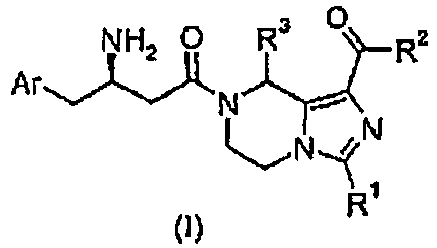
- Ar is phenyl, wherein the phenyl is unsubstituted or further substituted with 1 to 5 substituents independently selected from the group consisting of halogen, cyano, hydroxyl, alkyl or alkoxyl, wherein the alkyl or alkoxyl is each independently unsubstituted or substituted with one or more halogens;
- R1 is selected from the group consisting of hydrogen, alkyl, trifluoromethyl, cycloalkyl, aryl and heteroaryl, wherein the alkyl, cycloalkyl, aryl or heteroaryl is each optionally substituted with one or more groups selected from the group consisting of halogen, cyano, aryl, hydroxyl and amino, preferably trifluoromethyl;
- R2 is selected from the group consisting of hydroxyl, amino, alkyl, alkoxyl, cycloalkyl, heterocyclic alkyl, aryl, heteroaryl and -NR4R5, wherein the alkyl, alkoxyl, cycloalkyl, heterocyclic alkyl, aryl or heteroaryl is each optionally substituted with one or more groups selected from the group consisting of halogen, amino, cyano, hydroxyl, alkyl, cycloalkyl, alkoxyl, aryl, heteroaryl, -NR4R5, -OC(O)OR8, carboxylic acid and carboxylic ester ;
- R3 is selected from the group consisting of hydrogen and alkyl;
- R4 and R5 are each independently selected from the group consisting of hydrogen, alkyl, cycloalkyl, heterocyclic alkyl, aryl and heteroaryl, wherein the alkyl, cycloalkyl, heterocyclic alkyl, aryl or heteroaryl is each optionally substituted with one or more groups selected from the group consisting of halogen, hydroxyl, amino, alkoxyl, alkyl, cyano, aryl, cycloalkyl, heterocyclic alkyl, heterocyclic aryl, hydroxyalkyl, -SO2R7, -NR4R5, carboxylic acid and carboxylic ester;
- or, R4 and R5 are taken together with the attached atom to form a 4 to 8 membered heterocycle, wherein the 4 to 8 membered heterocycle contains one or more N, O, S atoms, and the 4 to 8 membered heterocycle is optionally substituted with one or more groups selected from the group consisting of halogen, hydroxyl, amino, alkoxyl, alkyl, cyano, aryl, heterocyclic alkyl, heteroaryl, carbonyl, hydroxyalkyl, -SO2R7, -NR4R5, -C(O)NR4R5, -C(O)R7, oxo, carboxylic acid and carboxylic ester;
- R7 is alkyl; and
- R8 is selected from the group consisting of alkyl and cycloalkyl.
- The pharmaceutically acceptable salts according to the present invention are those formed with the present compound and the acids selected from the group consisting of malic acid, lactic acid, maleic acid, hydrochloric acid, methanesulfonic acid, sulfuric acid, phosphoric acid, citric acid, tartaric acid, acetic acid and trifluoroacetic acid.
- Representative compounds of the present invention include, but are not limited to:
Example No. Structure Name 1 
(R)-7-[3-Amino-4-(2,4,5-trifluoro-phenyl) -butyryl]-3-trifluoromethyl-5,6,7,8-tetrahydro-imidazo[1,5-a]pyrazine-1-carboxylic acid methyl ester hydrochloride 2 
(R)-7-[3-Amino-4-(2,4,5-trifluoro-phenyl) -butyryl]-3-trifluoromethyl-5,6,7,8-tetrahydro-imidazo[1,5-a]pyrazine-1-carboxylic acid (2-methanesulfonyl-ethyl)-amide hydrochloride 3 
(R)-3-Amino-1-[1-(morpholine-4-carbonyl)-3-trifluoromethyl-5,6-dihydro-8H-imidazo[1,5-a]pyrazin-7-yl]-4-(2,4,5-trifluoro-phenyl)-butan-1-one hydrochloride 4 
(R)-7-[3-Amino-4-(2,4,5-trifluoro-phenyl) -butyryl]-3-trifluoromethyl-5,6,7,8-tetrahydro-imidazo[1,5-a]pyrazine-1-carboxylic acid cyanomethyl-amide hydrochloride 5 
(R)-3-Amino-1-[1-(4-methyl-piperazine-1 -carbonyl)-3-trifluoromethyl-5,6-dihydro8H-imidazo[1,5-a]pyrazin-7-yl]-4-(2,4,5-trifluoro-phenyl)-butan-1-one dihydrochloride 6 
(R)-3-Amino-1-[1-(1,1-dioxothiomorpholine-4-carbonyl)-3trifluoromethyl-5,6-dihydro-8H-imidazo [1,5-a]pyrazin-7-yl]-4-(2,4,5-trifluorophenyl)-butan-1-one hydrochloride 7 
(R)-1-{7-[3-Amino-4-(2,4,5-trifluorophenyl)-butyryl]-3-trifluoromethyl-5,6,7,8 -tetrahydro-imidazo[1,5-a]pyrazine-1carbonyl}-piperidine-4-carboxylic acid amide hydrochloride 8 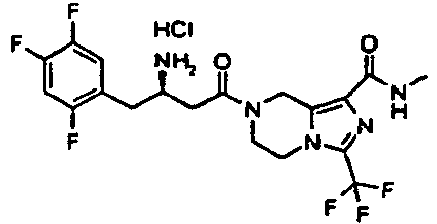
(R)-7-[3-Amino-4-(2,4,5-trifluoro-phenyl) -butyryl]-3-trifluoromethyl-5,6,7,8tetrahydro-imidazo[1,5-a]pyrazine-1-carboxylic acid methylamide hydrochloride 9 
(R)-7-[3-Amino-4-(2,4,5-trifluoro-phenyl) -butyryl]-3-trifluoromethyl-5,6,7,8-tetrahydro-imidazo[1,5-a]pyrazine-1-carboxylic acid dimethylamide hydrochloride 10 
(R)-7-[3-Amino-4-(2,4,5-trifluoro-phenyl) -butyryl]-3-trifluoromethyl-5,6,7,8-tetrahydro-imidazo[1,5-a]pyrazine-1-carboxylic acid hydrochloride 11 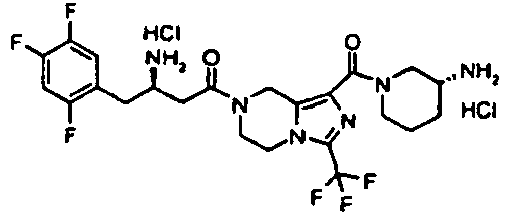
(R)-3-Amino-1-[1-(3-amino-piperidine-1-carbonyl)-3-trifluoromethyl-5,6-dihydro-8 H-imidazo[1,5-a]pyrazin-7-yl]-4-(2,4,5-trifluoro-phenyl)-butan-1-one dihydrochloride 12 
(R)-3-Amino-1-[1-(pyrrolidine-1-carbonyl )-3-trifluoromethyl-5,6-dihydro-8H-imidazo[1,5-a]pyrazin-7-yl]-4-(2,4,5-trifluoro-phenyl)-butan-1-one hydrochloride 13 
(R)-3-Amino-1-[1-(piperazine-1-carbonyl) -3-trifluoromethyl-5,6-dihydro-8H-imidazo[1,5-a]pyrazin-7-yl]-4-(2,4,5-trifluoro-phenyl)-butan-1-one dihydrochloride 14 
(R)-3-Amino-1-[1-((R)-3-hydroxy-pyrrolidine-1-carbonyl)-3-trifluoromethyl-5,6-dihydro-8H-imidazo[1,5-a]pyrazin-7-yl]-4-(2,4,5-trifluoro-phenyl)-butan-1-one hydrochloride 15 
(R)-7-[3-Amino-4-(2,4,5-trifluoro-phenyl) -butyryl]-3-trifluoromethyl-5,6,7,8-tetrahydro-imidazo[1,5-a]pyrazine-1-carboxylic acid cyclopropylamide hydrochloride 16 
(R)-({7-[3-Amino-4-(2,4,5-trifluorophenyl)-butyryl]-3-trifluoromethyl-5,6,7,8 -tetrahydro-imidazo[1,5-a]pyrazine-1-carbonyl}-amino)-acetic acid methyl ester hydrochloride 17 
(R)-1-[1-(4-Acetyl-piperazine-1-carbonyl) -3-trifluoromethyl-5,6-dihydro-8H-imidazo[1,5-a]pyrazin-7-yl]-3-amino-4-(2 ,4,5-trifluoro-phenyl)-butan-1-one hydrochloride 18 
(R)-3-Amino-1-[1-(2-hydroxymethyl-pyrrolidine-1-carbonyl)-3-trifluoromethyl-5,6-dihydro-8H-imidazo[1,5-a]pyrazin-7-yl]-4-(2,4,5-trifluoro-phenyl)-butan-1-one hydrochloride 19 
(R)-4-{7-[3-Amino-4-(2,4,5-trifluoro-phenyl)-butyryl]-3-trifluoromethyl-5,6,7,8 -tetrahydro-imidazo[1,5-a]pyrazine-1-carbonyl}-piperazin-2-one hydrochloride 20 
(R)-3-Amino-1-[1-(thiazolidine-3-carbonyl)-3-trifluoromethyl-5,6-dihydro-8 H-imidazo[1,5-a]pyrazin-7-yl]-4-(2,4,5-trifluoro-phenyl)-butan-1-one hydrochloride 21 
(R)-7-(3-Amino-4-(2,4,5-trifluoro-phenyl) -butyryl]-3-trifluoromethyl-5,6,7,8-tetrahydro-imidazo[1,5-a]pyrazine-1-carboxylic acid (pyridin-2-yl) amide dihydrochloride 22 
(R)-3-Amino-1-[1-(4-methanesulfonyl-piperazine-1-carbonyl)-3-trifluoromethyl-5,6-dihydro-8H-imidazo[1,5-a]pyrazin-7-yl]-4-(2,4,5-trifluoro-phenyl)-butan-1-one hydrochloride 23 
(R)-7-[3-Amino-4-(2,4,5-trifluoro-phenyl) -butyryl]-3-trifluoromethyl-5,6,7,8-tetrahydro-imidazo[1,5-a]pyrazine-1-carboxylic acid ethyl ester hydrochloride 24 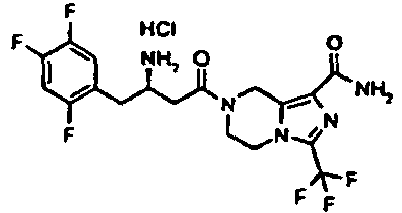
(R)-7-[3-Amino-4-(2,4,5-trifluoro-phenyl) -butyryl]-3-trifluoromethyl-5,6,7,8-tetrahydro-imidazo[1,5-a]pyrazine-1-carboxylic acid amide hydrochloride 25 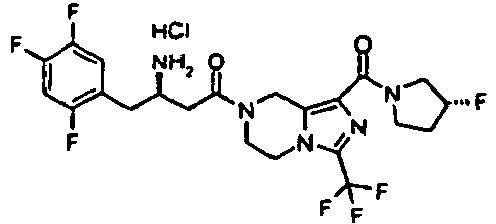
(R)-3-Amino-1-[1-((R)-3-fluoro-pyrrolidine-1-carbonyl)-3-trifluoromethyl-5,6-dihydro-8H-imidazo[1,5-a]pyrazin-7-yl]-4-(2,4,5-trifluoro-phenyl)-butan-I -one hydrochloride 26 
(R)-3-Amino-1-[1-((S)-3-fluoro-pyrrolidine-1-carbonyl)-3-trifluoromethyl-5,6-dihydro-8H-imidazo[1,5-a]pyrazin-7-yl]-4-(2,4,5-trifluoro-phenyl)-butan-1-one hydrochloride 27 
(R)-1-(1-Acetyl-3-trifluoromethyl-5,6-dihydro-8H-imidazo[1,5-a]pyrazin-7-yl)-3 -amino-4-(2,4,5-trifluoro-phenyl)-butan-1 -one hydrochloride 28 
(R)-3-Amino-1-(1-cyclopentanecarbonyl-3-trifluoromethyl-5,6-dihydro-8H-imidazo [1,5-a]pyrazin-7-yl)-4-(2,4,5-trifluoro-phenyl)-butan-1-one hydrochloride 29 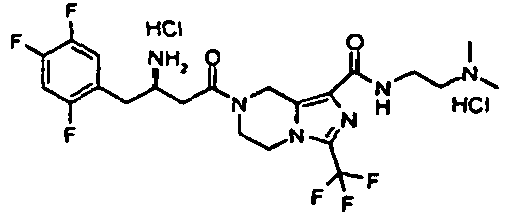
(R)-7-(3-Amino-4-(2,4,5-trifluoro-phenyl) -butyryl]-3-trifluoromethyl-5,6,7,8-tetrahy dro-imidazo[1,5-a]pyrazine-1-carboxylic acid (2-dimethylamino-ethyl)-amide dihydrochloride 30 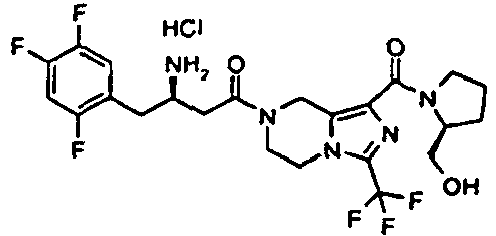
(R)-3-Amino-1-[1-((S)-2-hydroxymethyl-pyrrolidine-1-carbonyl)-3-trifluoromethyl-5,6-dihydro-8H-imidazo[1,5-a]pyrazin-7-yl]-4-(2,4,5-trifluoro-phenyl)-butan-1-one hydrochloride 31 
(R)-7-[3-Amino-4-(2,4,5-trifluoro-phenyl) -butyryl]-3-trifluoromethyl-5,6,7,8-tetrahydro-imidazo[1,5-a]pyrazine-1-carboxylic acid (pyridin-2-yl) amide dihydrochloride 32 
(R)-7-[3-Amino-4-(2,4,5-trifluoro-phenyl) -butyryl]-3-trifluoromethyl-5,6,7,8-tetrahydro-imidazo[1,5-a]pyrazine-1-carboxylic acid (4-fluoro-phenyl)-amide hydrochloride 33 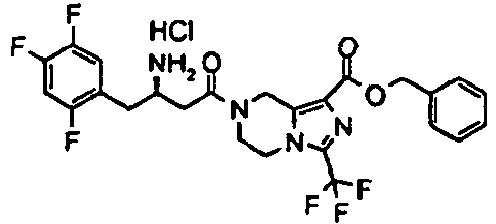
(R)-7-[3-Amino-4-(2,4,5-trifluoro-phenyl) -butyryl]-3-trifluoromethyl-5,6,7,8-tetrahydro-imidazo[1,5-a]pyrazine-1-carboxylic acid benzyl ester hydrochloride 34 
(R)-7-[3-Amino-4-(2,4,5-trifluoro-phenyl) -butyryl]-3-trifluoromethyl-5,6,7,8-tetrahydro-imidazo[1,5-a]pyrazine-1-carboxylic acid (1-ethoxycarbonyloxy)-ethyl ester hydrochloride 35 
(R)-7-[3-Amino-4-(2,4,5-trifluoro-phenyl) -butyryl]-3-trifluoromethyl-5,6,7,8-tetrahydro-imidazo[1,5-a]pyrazine-1-carboxylic acid isopropyl ester hydrochloride 36 
(R)-7-[3-Amino-4-(2,4,5-trifluoro-phenyl) -butyryl]-3-trifluoromethyl-5,6,7,8-tetrahydro-imidazo[1,5-a]pyrazine-1-carboxylic acid tert-butyl ester hydrochloride 37 
(R)-7-[3-Amino-4-(2,4,5-trifluoro-phenyl) -butyryl]-3-trifluoromethyl-5,6,7,8-tetrahydro-imidazo[1,5-a]pyrazine-1-carboxylic acid 1-isopropoxycarbonyloxy-ethyl ester hydrochloride 38 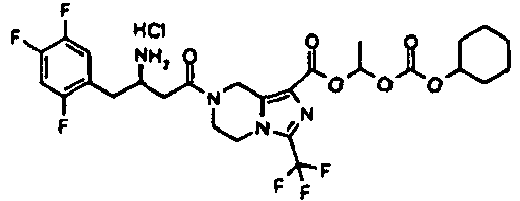
(R)-7-[3-Amino-4-(2,4,5-trifluoro-phenyl) -butyryl]-3-trifluoromethyl-5,6,7,8-tetrahydro-imidazo[1,5-a]pyrazine-1-carboxylic acid (1-cyclohexyloxycarbonyloxy)-ethyl ester hydrochloride 39 
(R)-7-[3-Amino-4-(2,4,5-trifluoro-phenyl) -butyryl]-8-methyl-3-trifluoromethyl-5,6, 7,8-tetrahydro-imidazo[1,5-a]pyrazine-1-carboxylic acid methyl ester hydrochloride 40 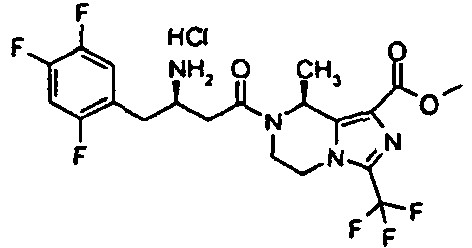
(R)-7-[3-Amino-4-(2,4,5-trifluoro-phenyl) -butyryl]-(S)-8-methyl-3-trifluoromethyl-5,6,7,8-tetrahydro-imidazo[1,5-a]pyrazine -1-carboxylic acid methyl ester hydrochloride 41 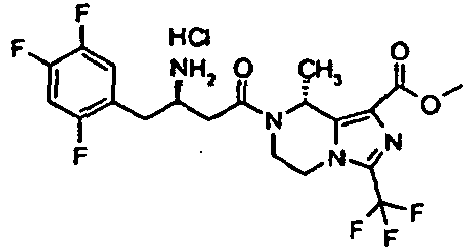
(R)-7-[3-Amino-4-(2,4,5-trifluoro-phenyl) -butyryl]-(R)-8-methyl-3-trifluoromethyl-5,6,7,8-tetrahydro-imidazo[1,5-a]pyrazine -1-carboxylic acid methyl ester hydrochloride 42 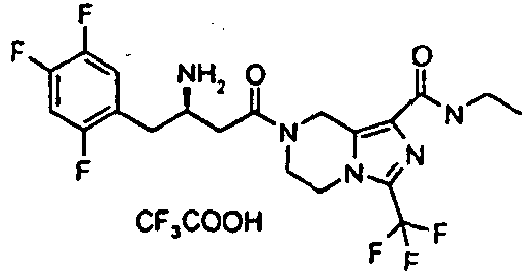
(R)-7-[3-Amino-4-(2,4,5-trifluoro-phenyl) -butyryl]-3-trifluoromethyl-5,6,7,8-tetrahydro-imidazo[1,5-a]pyrazine-1-carboxylic acid ethylamide trifluoroacetate 43 
(R)-7-[3-Amino-4-(2,4,5-trifluoro-phenyl) -butyryl]-3-trifluoromethyl-5,6,7,8-tetrahydro-imidazo[1,5-a]pyrazine-1-carboxylic acid butylamide trifluoroacetate 44 
(R)-7-[3-Amino-4-(2,4,5-trifluoro-phenyl) -butyryl]-3-trifluoromethyl-5,6,7,8-tetrahydro-imidazo[1,5-a]pyrazine-1-carboxylic acid propylamide trifluoroacetate - Further, the present invention relates to the following compounds having formula (IA) as intermediates in the synthesis of compounds having formula ( I ):

- Ar is phenyl, wherein the phenyl is unsubstituted or further substituted with 1 to 5 substituents independently selected from the group consisting of halogen, cyano, hydroxyl, alkyl or alkoxyl, wherein the alkyl or alkoxyl is each independently unsubstituted or substituted with one or more halogens;
- R1 is selected from the group consisting of hydrogen, alkyl, trifluoromethyl, cycloalkyl, aryl and heteroaryl, wherein the alkyl, cycloalkyl, aryl or heteroaryl is each optionally substituted with one or more groups selected from the group consisting of halogen, cyano, aryl, hydroxyl and amino, preferably trifluoromethyl;
- R3 is selected from the group consisting of hydrogen and alkyl; and
- X is halogen.
- Further, the present invention relates to the compounds having the following formula (IB) as intermediates in the synthesis of compounds having formula ( I ):

- Wherein:
- R1 is selected from the group consisting of hydrogen, alkyl, trifluoromethyl, cycloalkyl, aryl and heteroaryl, wherein the alkyl, cycloalkyl, aryl or heteroaryl is each optionally substituted with one or more groups selected from the group consisting of halogen, cyano, aryl, hydroxyl and amino, preferably trifluoromethyl;
- R2 is selected from the group consisting of hydroxyl, amino, alkyl, alkoxyl, cycloalkyl, heterocyclic alkyl, aryl, heteroaryl and -NR4R5, wherein the alkyl, alkoxyl, cycloalkyl, heterocyclic alkyl, aryl or heteroaryl is each optionally substituted with one or more groups selected from the group consisting of halogen, amino, cyano, hydroxyl, alkyl, cycloalkyl, alkoxyl, aryl, heteroaryl, - NR4R5, -OC(O)OR8, carboxylic acid and carboxylic ester;
- R3 is selected from the group consisting of hydrogen and alkyl;
- R4 and R5 are each independently selected from the group consisting of hydrogen, alkyl, cycloalkyl, heterocyclic alkyl, aryl and heteroaryl, wherein the alkyl, cycloalkyl, heterocyclic alkyl, aryl or heteroaryl is each optionally substituted with one or more groups selected from the group consisting of halogen, hydroxyl, amino, alkoxyl, alkyl, cyano, aryl, cycloalkyl, heterocyclic alkyl, heteroaryl, hydroxyalkyl, -SO2R7, -NR4R5, carboxylic acid and carboxylic ester;
- Or, R4 and R5 are taken together with the attached atom to form a 4 to 8 membered heterocycle, wherein the 4 to 8 membered heterocycle contains one or more N, O, S atoms, and the 4 to 8 membered heterocycle so formed is optionally substituted with one or more groups selected from the group consisting of halogen, hydroxyl, amino, alkoxyl, alkyl, cyano, aryl, heterocyclic alkyl, heteroaryl, carbonyl, hydroxyalkyl, -SO2R7, -NR4R5, -C(O)NR4R5, -C(O)R7, carboxylic acid and carboxylic ester;
- R7 is alkyl; and
- R8 is selected from the group consisting of alkyl and cycloalkyl.
- Another aspect of the present invention is directed to the preparation process of intermediates having formula (IA), wherein the preparation process comprises the following steps of:


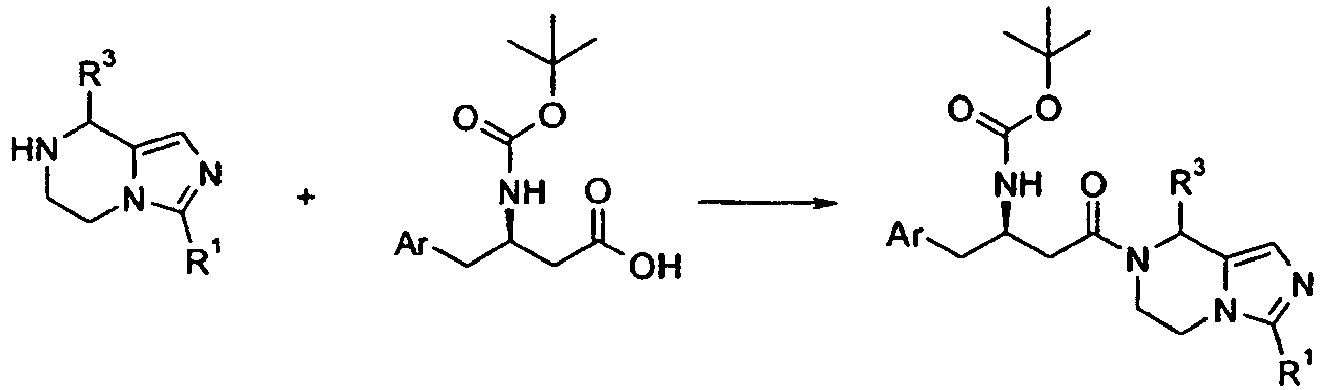

- Another aspect of the present invention is directed to the preparation process of intermediates having formula (IB), wherein the preparation process comprises the following steps of:


- Furthermore, another aspect of the present invention is directed to the preparation process of compounds having formula ( I ), wherein the preparation process comprises the following steps of:

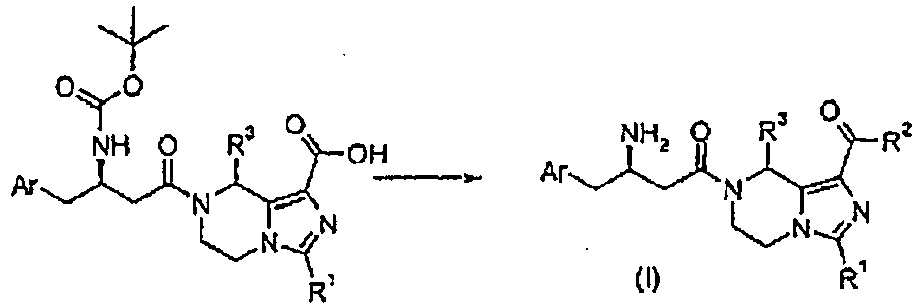
- Another aspect of the present invention is directed to the preparation process of compounds having formula ( I ), wherein the preparation process comprises the following steps of:
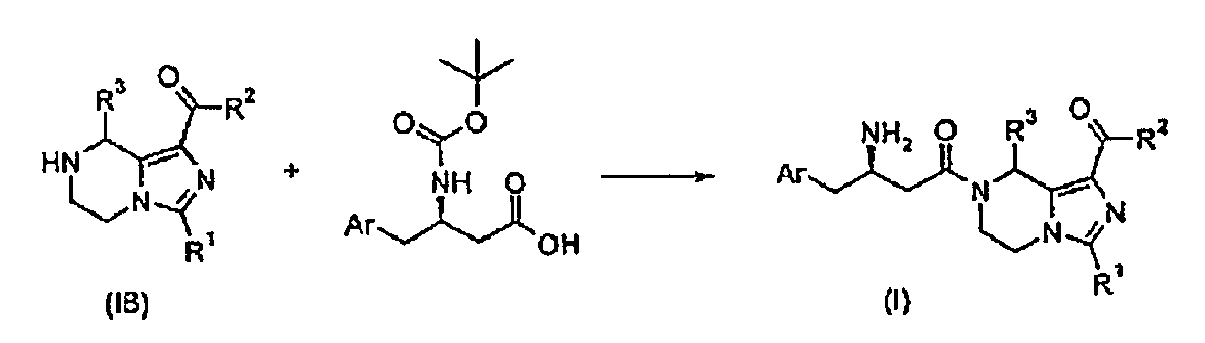
- Furthermore, the process of the said compounds having formula ( I ) also comprise the step of reacting the resulting compounds having formula ( I ) with acids to obtain the acid addition salts, wherein the salts are those formed with the said compounds and the acids selected from the group consisting of phosphonic acid, malic acid, lactic acid, maleic acid, hydrochloric acid, methane sulfonic acid, sulphuric acid, phosphonic acid, citric acid, tartaric acid, acetic acid and trifluoracetic acid, preferably hydrochloric acid.
- The present invention relates to a pharmaceutical composition comprising a compound or a pharmaceutically acceptable salt thereof according to the present invention in an effective therapeutic dose, as well as a pharmaceutically acceptable carrier or excipient.
- In another aspect, the present invention relates to a use of a compound, pharmaceutically acceptable salt thereof of any one of claims 1 to 5 or the pharmaceutical composition of claim 16 in the preparation of a medicament for the treatment of type 2 diabetes, hyperglycemia, obesity or insulin resistance.
- In another aspect, the present invention relates to a compound, pharmaceutically acceptable salt thereof of any one of claims 1 to 5 or the pharmaceutical composition of claim 16 for use in the treatment of type 2 diabetes, hyperglycemia, obesity or Insulin resistance.
- In another aspect, the present invention relates to the method of inhibiting the catalytic activity of dipeptidyl peptidase IV, characterized in that the dipeptidyl peptidase-IV is contacted with a compound or pharmaceutically acceptable salt thereof of any one of claims 1 to 5.
- Unless otherwise stated, the following terms used in the specification and claims have the meanings described below.
- "Alkyl" refers to a saturated aliphatic hydrocarbon group including C1-C20 straight chain and branched chain groups. Preferably an alkyl group is an alkyl having 1 to 10 carbon atoms, e.g., methyl, ethyl, propyl, 2-propyl, n-butyl, iso-butyl, tert-butyl, pentyl, and the like. More preferably, it is a lower alkyl having 1 to 4 carbon atoms, e.g., methyl, ethyl, propyl, 2-propyl, n-butyl, iso-butyl or tert-butyl, and the like. The alkyl group may be substituted or unsubstituted. When substituted, the substituent group(s) is preferably one or more independently selected from the group consisting of halogen, hydroxyl, amino, alkoxyl, alkyl, cyano, aryl, heterocyclic alkyl, heteroaryl, carbonyl, hydroxyalkyl, -SO2R7, -NR4R5, -C(O)NR4R5, -C(O)R7, -OC(O)OR8, carboxylic acid and carboxylic ester.
- "Cycloalkyl" refers to a 3 to 8 membered all-carbon monocyclic ring, an all-carbon 5-membered/6-membered or 6-membered/6-membered fused bicyclic ring or a multicyclic fused ring (a "fused" ring system means that each ring in the system shares an adjacent pair of carbon atoms with other ring in the system) group wherein one or more rings may contain one or more double bonds, but none of the rings has a completely conjugated π-electron system. Examples of cycloalkyl groups are cyclopropane, cyclobutane, cyclopentane, cyclopentene, cyclohexane, cyclohexadiene, adamantane, cycloheptane, cycloheptatriene, and the like. The cycloalkyl group may be substituted or unsubstituted. When substituted, the substituent group(s) is preferably one or more independently selected from the group consisting of halogen, hydroxyl, amino, alkoxyl, alkyl, cyano, aryl, heterocyclic alkyl, heteroaryl, carbonyl, hydroxyalkyl, -SO2R7, -NR4R5, - C(O)NR4R5, -C(O)R7, carboxylic acid and carboxylic ester.
- "Aryl" refers to groups having at least one aromatic ring, i.e., having a conjugated π-electron system, and it includes all-carbon cyclic aryl, heteroaryl and biaryl group. The aryl group may be substituted or unsubstituted. When substituted, the substituent group(s) is preferably one or more independently selected from the group consisting of halogen, hydroxyl, amino, alkoxyl, alkyl, cyano, aryl, heterocyclic alkyl, heteroaryl, carbonyl, hydroxyalkyl, -SO2R7, -NR4R5, -C(O)NR4R5, - C(O)R7, carboxylic acid and carboxylic ester.
- "Heteroaryl" refers to an aryl having 1 to 3 heteroatoms selected from the group consisting of N, O, and S as ring atoms, the remaining ring atoms being C. Said ring is 5- or 6- membered ring. The examples of heteroaryl groups include furyl, thienyl, pyridyl, pyrrolyl, N-alkyl pyrrolyl, pyrimidinyl, pyrazinyl, imidazolyl, and the like. The heteroaryl group may be substituted or unsubstituted. When substituted, the substituent group(s) is preferably one or more independently selected from the group consisting of halogen, hydroxyl, amino, alkoxyl, alkyl, cyano, aryl, heterocyclic alkyl, heteroaryl, carbonyl, hydroxyalkyl, -SO2R7, -NR4R5, -C(O)NR4R5, -C(O)R7, carboxylic acid and carboxylic ester.
- "Heterocyclic alkyl" refers to a monocyclic or fused ring group having 5 to 9 ring atoms, wherein one or two ring heteroatoms are selected from the group consisting of N, O, and S(O)n (n is a integer from 0 to 2), the remaining ring atoms are C, in addition, the ring may also have one or more double bonds, but not have a completely conjugated π-electron system. The unsubstituted heterocyclic alkyl includes, but is not limited to pyrrolidyl, piperidyl, piperazinyl, morpholinyl, thiomorpholinyl, homopiperazinyl, and the like. The heterocyclic alkyl may be substituted or unsubstituted. When substituted, the substituent is preferably one or more independently selected from the group consisting of halogen, hydroxyl, amino, alkoxyl, alkyl, cyano, aryl, heterocyclic alkyl, heteroaryl, carbonyl, hydroxyalkyl, -SO2R7, -NR4R5, -C(O)NR4R5, -C(O)R7, carboxylic acid and carboxylic ester.
- "Hydroxy" refers to an -OH group.
- "Alkoxyl" refers to both an -O-(alkyl) and an -O-(unsubstituted cycloalkyl) group. Representative examples include, but are not limited to, methoxy, ethoxy, propoxy, butoxy, cyclopropyloxy, cyclobutyloxy, cyclopentyloxy, cyclohexyloxy, and the like. The alkoxyl may be substituted or unsubstituted. When substituted, the substituent is preferably one or more independently selected from the group consisting of halogen, hydroxyl, amino, alkoxyl, alkyl, cyano, aryl, heterocyclic alkyl, heteroaryl, carbonyl, hydroxyalkyl, -SO2R7, -NR4R5, -C(O)NR4R5, -C(O)R7, carboxylic acid and carboxylic ester.
- "Halogen" refers to fluoro, chloro, bromo or iodo, preferably fluoro or chloro.
- "Trifluoromethyl" refers to a -CF3 group.
- "Amino" refers to a -NH2 group.
- "Cyano" refers to a -C=N group.
- "Carbonyl" refers to a C(=O) group.
- "Carboxylic acid" refers to a (alkyl) C(=O)OH group.
- "Carboxylic ester" refers to a (alkyl) C(=O)O (alkyl).
- "Hydroxylalkyl" refers to alkyl group substituted with hydroxyl.
- A "pharmaceutical composition" refers to a mixture of one or more of the compounds described herein or physiologically/pharmaceutically acceptable salts or prodrugs thereof, with other chemical components such as physiologically/pharmaceutically acceptable carriers and excipients. The purpose of a pharmaceutical composition is to facilitate administration of a compound to an organism.
- In order to complete the objective of the invention, the invention applies the following technical solution:
- A preparation process of compounds having formula ( I ) of the invention, comprising the following steps of:

- A preparation process of compounds having formula ( I ) of the invention, comprising the following steps of:

reacting the resulting carboxylic acid compound with haloalkyl in a dry ice-acetone bath to obtain the product substituted with alkyl; furthermore, esterifying the carboxyl of the product substituted with alkyl to obtain the intermediate having formula (IB); also reacting the resulting carboxylic acid compound with N-methoxyl methylamine in the presence of a condensation reagent bis(2-oxo-3-oxazolidinyl)phosphonic chloride in the solvent of dichloromethane; reacting the resulting condensation compound with Grignard reagent in the solvent of tetrahydrofuran to obtain tetrahydro-imidazo[1,5-a]pyrazine derivative substituted with ketone; deprotecting the amino protecting from tetrahydro-imidazo[1,5-a]pyrazine derivative substituted with ketone in the presence of acid to obtain the intermediate having formula (IB); reacting intermediate having formula (IB) with carboxylic acid in the presence of a condensation reagent bis(2-oxo-3-oxazolidinyl)phosphonic chloride to obtain the condensation product and further deprotecting the amino protecting group in the presence of an acid to obtain the compound having formula ( I ). - The purified compounds having formula ( I ) are directly reacted with acids in the solvent of methanol, dichlormethane or ethyl acetate to obtain the acid addition salts.
- The following examples serve to illustrate the invention, but the examples should not be considered as limiting the scope of the invention.
- The compound's structure was indentified by 1H NMR and MS. 1H NMR chemical shifts (δ) were given in ppm (10-6). 1H NMR is determined by a Bruker AVANCE-400 machine. The solvents were deuterated-methanol (CD3OD), deuterated-chloroform (CDCl3) and deuterated-dimethyl sulfoxide (DMSO-d6 ) with tetramethylsilane (TMS) as internal standard. Chemical shifts were given in ppm (10-6);
MS was determined by a FINNIGAN LCQAd (ESI) mass spectrometer (manufacturer: Therm, type: Finnigan LCQ advantage MAX);
IC50 was determined by a NovoStar ELIASA (BMG Co. German);
Thin-layer silica gel was Yantai Huanghai HSGF254 or Qingdao GF254 silica gel plate;
Column chromatography generally used Yantai Huanghai 200-300 mesh silica gel as carrier;
All examples were performed under nitrogen atmosphere if without special explanation. - Nitrogen atmosphere refers to a reaction flask with a balloon filled with 1 L nitrogen.
- Hydrogen atmosphere refers to a reaction flask with a balloon filled with 1 L hydrogen.
-


- 2,2-Dimethyl-5-[2-(2,4,5-trifluoro-phenyl)-acetyl]-[1,3]dioxane-4,6-dione 2,2-Dimethyl-[1,3]dioxane-4,6-dione (5.69 g, 39.5 mmol) was dissolved in 400 mL of dichloromethane under stirring, followed by addition of (2,4,5-trifluoro-phenyl)-acetic acid 1a (7.15 g, 37.6 mmol) and 4-dimethylaminopyridine (7.35 g, 60.2 mmol) in an ice-water bath. Then a suspension of 1-(3-dimethylaminopropyl)-3-ethylcarbodiimide hydrochloride (8.28 g, 43.2 mmol) in 250 mL of dichloromethane was added dropwise slowly. After stirring at room temperature for 36 hours, the reaction mixture was washed with the solution of 5% potassium bisulfate (250 mL×7) and saturated brine (250 mL×2), dried over anhydrous magnesium sulfate, filtered and concentrated under reduced pressure to obtain the title compound 2,2-dimethyl-5-[2-(2,4,5-trifluoro-phenyl)-acetyl]-[1,3]dioxane-4,6-dione 1b (11.4 g, yield 96%) as a white solid.
MS m/z (ESI): 315.5 [M-1] - 2,2-Dimethyl-5-[2-(2,4,5-trifluoro-phenyl)-acetyl]-[1,3]dioxane-4,6-dione 1b (15.72 g, 49.6 mmol) was dissolved in 280 mL of ethanol under stirring, then the reaction mixture was heated to 70 °C in an oil bath overnight. After cooling, the mixture was concentrated under reduced pressure. The resulting residue was purified by silica gel column chromatography to obtain the title compound 3-oxo-4-(2,4,5-trifluoro-phenyl)-butyric acid ethyl ester 1c (12 g, yield 88%) as a yellow oil.
MS m/z (ESI): 259 [M-1] - 3-Oxo-4-(2,4,5-trifluoro-phenyl)-butyric acid ethyl ester 1c (24.6 g, 94.5 mmol) was dissolved in 240 mL of methanol, and ammonium acetate (36.4 g, 473 mmol) was added to the solution. The reaction mixture was heated to reflux for 3 hours and monitored by thin layer chromatography until the disappearance of the starting materials. The reaction mixture was concentrated under reduced pressure, then 100 mL of water was added to the residue. The mixture was extracted with ethyl acetate (200 mL×3), and the combined organic phase was washed with 200 mL of saturated brine, dried over anhydrous magnesium sulfate, filtered and concentrated under reduced pressure to obtain a light yellow solid. The resulting solid was dissolved in 50 mL of ethyl acetate at 80 °C, then 50 mL of n-hexane and seed-crystal were added to the solution. The mixture was cooled to room temperature, half an hour later, 100 mL of n-hexane was added. The mixture was stored in refrigerator overnight and then filtered under reduced pressure to obtain the title compound 3-amino-4-(2,4,5-trifluoro-phenyl)-but-2-enoic acid ethyl ester 1d (19.5 g, yield 80%) as a white solid.
MS m/z (ESI): 260.1 [M+1] - 3-Amino-4-(2,4,5-trifluoro-phenyl)-but-2-enoic acid ethyl ester 1d (4.1 g, 15.8 mmol) was added into an autoclave, followed by addition of 70 mL of methanol, di-tert-butyl dicarbonate (3.8 g, 17.4 mmol), chloro(1, 5-cyclooctadiene)rhodium( I ) dimer (32 mg, 0.0632 mmol) and (R)-1-[(S)-2-(diphenyl phosphino)ferrocenyl]-ethyl-tert-butylphosphine (68 mg, 0.126 mmol). The reaction mixture was hydrogenated for 24 hours under 6.67 atmosphere at 30 °C. The mixture was filtered and the filtrate was concentrated under reduced pressure. Then 34 mL of methanol was added to the residue at 50 °C, followed by addition of 12 mL of water until all dissolved. After cooling to room temperature, the mixture was stored in the refrigeratory overnight and then filtered. The solid product was washed with the solvent mixture of methanol/water (v:v = 3:2), dried in vacuo to obtain the title compound (R)-3-tert-butoxycarbonylamino-4-(2,4,5-trifluoro-phenyl)-butyric acid ethyl ester 1e (4 g, yield 70%) as a light yellow solid.
MS m/z (ESI): 362.4 [M+1] - (R)-3-tert-Butoxycarbonylamino-4-(2,4,5-trifluoro-phenyl)-butyric acid ethyl ester 1e (10 g, 27.7 mmol) and sodium hydroxide (3.32 g, 83.1 mmol) were dissolved in the solvent mixture of 100 mL of methanol and 50 mL of water under stirring. The reaction mixture was reacted at 40-45 °C for 1-1.5 hours, then part of the solution was evaporated under reduced pressure. The residue was added with some water, then pH was adjusted to 2-3 with 1 N hydrochloric acid in an ice-water bath. The mixture was extracted with ethyl acetate (200 mL×3), and the combined organic phase was washed with 200 mL of saturated brine, dried over anhydrous sodium sulfate, filtered and concentrated under reduced pressure, and then recrystallized from ethyl acetate/n-hexane to obtain the title compound (R)-3-tert-butoxycarbonylamino-4-(2,4,5-trifluoro-phenyl)-butyric acid 1f (9.2 g) as a white solid, which was directly used in the next step.
MS m/z (ESI): 332.3 [M-1]
Reference: Tetrahedron Asymmetry, 2006, 17(2), 205-209 - Pyrazine-2-carbonitrile 1g (10.5 g, 100 mmol) was dissolved in 150 mL of 1,4-dioxane under stirring, then Raney nickel (1.0 g) was added into a 250 mL autoclave. The reaction mixture was hydrogenated for 8 hours under 40 atmosphere at 60 °C, filtered and concentrated under reduced pressure to obtain the title compound C-pyrazin-2-yl-methylamine 1h (10.7 g, yield 98%) as a brown oil.
MS m/z (ESI): 110 [M+1] - C-Pyrazin-2-yl-methylamine 1h (10.9 g, 100 mmol) was added into a reaction flask, then 20 mL of trifluoroacetic anhydride was added dropwise slowly within an hour at 0 °C in an ice-water bath. The reaction mixture was reacted at room temperature for 2 hours and monitored by thin layer chromatography until the disappearance of the starting materials. Then it was concentrated under reduced pressure. The resulting residue was purified by silica gel column chromatography to obtain the title compound 2,2,2-trifluoro-N-pyrazin-2-ylmethyl-acetamide 1i (21.0 g) as a brown oil.
MS m/z (ESI): 206.1 [M+1] - 2,2,2-Trifluoro-N-pyrazin-2-ylmethyl-acetamide 1i (21.0 g, 100 mmol) was added into a reaction flask at room temperature, followed by addition of 100 mL of phosphorus oxychloride. After stirring at room temperature for 30 minutes, phosphorous pentoxide (17.8 g, 125 mmol) was added to the solution. The reaction mixture was heated to reflux for 5 hours and monitored by thin layer chromatography until the disappearance of the starting materials. Phosphorus oxychloride was removed, and the reaction system was quenched with deionized water. The mixture was adjusted to pH 5-6 with 20% sodium hydroxide solution in an ice-water bath. The mixture was extracted with ethyl acetate (250 mL×4), and the combined organic phase was dried over anhydrous magnesium sulfate, filtered and concentrated under reduced pressure. The resulting residue was purified by silica gel column chromatography to obtain the title compound 3-trifluoromethyl-imidazo[1,5-a]pyrazine 1j (12.0 g, yield 65%) as a yellow solid.
MS m/z (ESI): 188.0 [M+1]
1H NMR (400 MHz, CDCl3): δ 9.15 (s, 1H), 8.06 (d, 1H), 7.92 (s, 1H), 7.81 (d, 1H) - 3-Trifluoromethyl-imidazo[1,5-a]pyrazine 1j (12.0 g, 64.2 mmol) was dissolved in 150 mL of anhydrous ethanol under stirring, then 10% Pd/C (500 mg) was added to the solution. The reaction mixture was stirred at room temperature under a hydrogen atmosphere overnight. The reaction solution was filtered through a pad of coarse silica gel and concentrated under reduced pressure to obtain the title compound 3-trifluoromethyl-5,6,7,8-tetrahydro-imidazo[1,5-a]pyrazine 1k (12.2 g, yield 99%) as a brown solid.
1H NMR (400 MHz, CDCl3): δ 6.84 (s, 1H), 4.10 (m, 4H), 3.26 (m, 2H), 1.81 (s, 1H) - Under a nitrogen atmosphere, 3-tert-butoxycarbonylamino-4-(2,4,5-trifluoro-phenyl)-butyric acid 1k (8.6 g, 45 mmol) and 9.4 mL of triethylamine were dissolved in 300 mL of dichloromethane under stirring. After stirring at room temperature for 5 minutes, 3-trifluoromethyl-5,6,7,8-tetrahydro-imidazo[1,5-a]pyrazine 1f (15.0 g, 45 mmol) and bis(2-oxo-3-oxazolidinyl)phosphonic chloride (17.1 g, 67.3 mmol) were added to the solution successively. The reaction mixture was reacted at room temperature for 2 hours and monitored by thin layer chromatography until the disappearance of the starting materialsand then concentrated under reduced pressure. The resulting residue was purified by silica gel column chromatography to obtain the title compound (R)-[3-oxo-1-(2,4,5-trifluoro-benzyl)-3-(3-trifluoromethyl-5,6-dihydro-8H-imidazo[1,5-a]pyrazin-7-yl)-propyl]-carbamic acid tert-butyl ester 1l (20.0 g, yield 88%) as a white solid.
1H NMR (400 MHz, CD3OD): δ 7.25 (m, 1H), 7.11 (m, 1H), 7.032 (s, 1H), 4.93 (m, 2H), 4.35 (m, 3H), 4.05 (m, 2H), 2.99 (m, 2H), 2.73 (m, 2H), 1.34 (s, 9H) - (R)-[3-Oxo-1-(2,4,5-trifluoro-benzyl)-3-(3-trifluoromethyl-5,6-dihydro-8H-imidazo[1,5-a]pyrazin-7-yl)-propyl]-carbamic acid tert-butyl ester 11 (20.0 g, 39.6 mmol) was dissolved in 300 mL of anhydrous ethanol under stirring, and 1-bromo-2,5-pyrolidinedione (14.1 g, 79.2 mmol) was then added to the solution at room temperature. After stirring for an hour, potassium carbonate (10.9 g, 79.2 mmol) and di-tert-butyl dicarbonate (8.6 g, 39.6 mmol) were added to the mixture, and the mixture was stirred for an hour and monitored by thin layer chromatography until the disappearance of the starting materials. The reaction mixture was filtered through a pad of coarse silica gel to remove potassium carbonate, and then concentrated under reduced pressure. The resulting residue was purified by silica gel column chromatography to obtain the title compound (R)-[3-oxo-1-(2,4,5-trifluoro-benzyl)-3-(1-bromo-3-trifluoromethyl-5,6-dihydro-8H-i midazo
[1,5-a]pyrazin-7-yl)-propyl]-carbamic acid tert-butyl ester 1m (20.0 g, yield 86%) as a white solid.
1H NMR (400 MHz, CDCl3): δ 7.063 (m, 1H), 6.88 (m, 1H), 4.72 (s, 1H), 4.56 (s, 1H), 4.13 (m, 3H), 3.88 (m, 2H), 2.94 (m, 2H), 2.62 (m, 2H), 1.36 (s, 9H) - Octacarbonyldicobalt (4.02 g, 11.76 mmol), ethyl chloroacetate (0.71 g, 5.88 mmol), potassium carbonate (1.62 g, 11.76 mmol) and 50 mL of methanol were added into the reaction flask. After stirring for 5 minutes, (R)-[3-oxo-1-(2,4,5-trifluoro-benzyl)-3-(1-bromo-3-trifluoromethyl-5,6-dihydro-8H-imidazo[1,5-a]pyrazin-7-yl)-propyl]-carbamic acid tert-butyl ester 1m (2.3 g, 3.92 mmol) was added. The reaction mixture was reacted at 60 °C in an oil bath, and the colour of the reaction mixture turned from puce to purple. 2 hours later, Electro-Spray Ionization (ESI) mass spectrometry showed the starting material disappeared. The reaction mixture was concentrated under reduced pressure. The resulting residue was purified by silica gel column chromatography to obtain the title compound (R)-7-[3-tert-butoxycarbonylamino-4-(2,4,5-trifluoro-phenyl)-butyryl]-3-trifluoromethyl-5,6,7,8-tetrahydro-imidazo[1,5-a]pyrazine-1-carboxylic acid methyl ester 1n (1.1 g, yield 50%) as a white solid.
MS m/z (ESI): 565.0 [M+1]
Reference: Journal of Organometallic Chemistry, 1985, 285(1-3), 293-303 - (R)-7-[3-tert-Butoxycarbonylamino-4-(2,4,5-trifluoro-phenyl)-butyryl]-3-trifluoromethyl-5,6,7,8-tetrahydro-imidazo[1,5-a]pyrazine-1-carboxylic acid methyl ester 1n (0.12 g, 2.12 mmol) was added to a solution of 2.2 N hydrochloric acid in 5 mL of ethyl acetate. The reaction mixture was reacted at room temperature for 5 hours and monitored by thin layer chromatography until the disappearance of the starting materials. The reaction mixture was concentrated under reduced pressure to obtain the title compound (R)-7-[3-amino-4-(2,4,5-trifluoro-phenyl)-butyryl]-3-trifluoromethyl-5,6,7,8-tetrahydro-imidazo[1,5-a]pyrazine-1-carboxylic acid methyl ester hydrochloride 1 (0.12 g, yield 94.3%) as a light yellow solid.
MS m/z (ESI): 465.2 [M+1]
1H NMR (400 MHz, CD3OD): δ 7.101-7.08 (m, 1H), 6.906-6.864 (m, 1H), 5.343-4.995 (m, 2H), 4.221-4.093 (m, 5H), 3.954 (s, 3H), 2.978-2.937 (m, 2H), 2.71-2.643 (m, 2H), 2.061 (s, 2H) -


- (R)-7-[3-tert-Butoxycarbonylamino-4-(2,4,5-trifluoro-phenyl)-butyryl]-3-trifluoromethyl-5,6,7,8-tetrahydro-imidazo[1,5-a]pyrazine-1-carboxylic acid methyl ester 1n (2.0 g, 3.5 mmol) was dissolved in 50 mL of methanol under stirring, and 4 N sodium hydroxide solution (30 mL) was added to the solution. The reaction mixture was reacted at room temperature for an hour until thin lay chromatography showed the starting material disappeared, and was adjusted to pH 3 with 2 N hydrochloric acid solution. The reaction mixture was extracted with ethyl acetate (50 mL×4), and the combined organic phase was dried over anhydrous magnesium sulfate, filtered, and concentrated under reduced pressure to obtain the title compound (R)-7-[3-tert-butoxycarbonylamino-4-(2,4,5-trifluoro-phenyl)-butyryl]-3-trifluoromethyl-5,6,7,8-tetrahydro-imidazo[1,5-a]pyrazine-1-carboxylic acid 2a (1.9 g) as a light yellow solid.
1H NMR (400 MHz, CD3OD): δ 7.29-7.226 (m, 1H), 7.121-7.082 (m, 1H), 5.151-5.028 (m, 2H), 4.409-4.064 (m, 5H), 2.984-2.769 (m, 4H), 1.417-1.255 (m, 9H) - (R)-7-[3-tert-Butoxycarbonylamino-4-(2,4,5-trifluoro-phenyl)-butyryl]-3-trifluoromethyl-5,6,7,8-tetrahydro-imidazo[1,5-a]pyrazine-1-carboxylic acid 2a (0.15 g, 0.27 mmol), 2-methanesulfonyl-ethylamine (65.5 mg, 0.41 mmol) and bis(2-oxo-3-oxazolidinyl)phosphonic chloride (0.104 g, 0.41 mmol) were dissolved in 5 mL of dichloromethane under stirring, and triethylamine (0.25 mL, 1.62 mmol) was then added to the solution. The reaction mixture was reacted at room temperature overnight and monitored by thin layer chromatography until the disappearance of the starting materials. The reaction mixture was concentrated under reduced pressure. The resulting residue was purified by silica gel column chromatography to obtain the title compound (R)-[3-[1-(2-methanesulfonyl-ethylcarbamoyl)-3-trifluoromethyl-5,6-dihydro-8H-imidazo[1,5-a]pyrazin-7-yl]-3-oxo-1-(2,4,5-trifluoro-benzyl)-propyl]-carbamic acid tert-butyl ester 2b (60 mg, yield 34%) as a white solid.
MS m/z (ESI): 678.2 [M+23]
Reference: Journal of Organic Chemistry, 2006, 71(3), 1220-1225 - (R)-[3-[1-(2-Methanesulfonyl-ethylcarbamoyl)-3-trifluoromethyl-5,6-dihydro-8H-imi dazo[1,5-a]pyrazin-7-yl]-3-oxo-1-(2,4,5-trifluoro-benzyl)-propyl]-carbamic acid tert-butyl ester 2b (0.06 g, 0.091 mmol) was dissolved in a little ethyl acetate. A solution of 3.1 N hydrochloric acid in 4 mL of ethyl acetate was then added to the solution. The reaction mixture was reacted at room temperature for 4 hours until thin lay chromatography showed the starting material disappeared, and was concentrated under reduced pressure to obtain the title compound (R)-7-[3-amino-4-(2,4,5-trifluoro-phenyl)-butyryl]-3-trifluoromethyl-5,6,7,8-tetrahydro-imidazo[1,5-a]pyrazine-1-carboxylic acid (2-methanesulfonyl-ethyl)-amide hydrochloride 2 (60 mg) as a white solid.
MS m/z (ESI): 556.3 [M+1].
1H NMR (400 MHz, CD3OD): δ7.44-7.35 (m, 1H), 7.30-7.21 (m, 1H), 5.15-5.02 (m, 2H), 4.53-4.45 (m, 2H), 4.34-4.27 (m, 2H), 4.05-3.94 (m, 4H), 3.89-3.62 (s, 4H), 3.12-3.07 (m, 2H), 3.03-2.82 (m, 2H). -
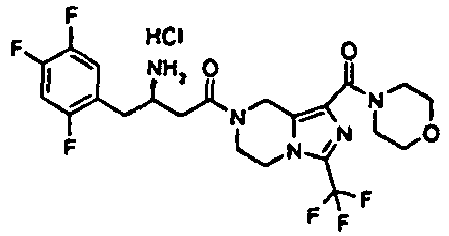

- (R)-7-[3-tert-Butoxycarbonylamino-4-(2,4,5-trifluoro-phenyl)-butyryl]-3-trifluoromethyl-5,6,7,8-tetrahydro-imidazo[1,5-a]pyrazine-1-carboxylic acid 2a (60 mg, 0.109 mmol), morpholine (19 mg, 0.218 mmol) and bis(2-oxo-3-oxazolidinyl)phosphonic chloride (53.5 mg, 0.218 mmol) were dissolved in 5 mL of dichloromethane under stirring, and triethylamine (0.1 mL, 0.65 mmol) was then added to the solution. The reaction mixture was reacted at room temperature overnight until thin lay chromatography showed the starting material disappeared, and was concentrated under reduced pressure. The resulting residue was purified by silica gel column chromatography to obtain the title compound (R)-[3-[1-(morpholine-4-carbonyl)-3-trifluoromethyl-5,6-dihydro-8H-imidazo[1,5-a] pyrazin-7-yl]-3-oxo-1-(2,4,5-trifluoro-benzyl)-propyl]-carbamic acid tert-butyl ester 3a (60 mg, yield 89%) as a white solid.
MS m/z (ESI): 620.0 [M+1]. - (R)-[3-[1-(Morpholine-4-carbonyl)-3-trifluoromethyl-5,6-dihydro-8H-imidazo [1,5-a]pyrazin-7-yl]-3-oxo-1-(2,4,5-trifluoro-benzyl)-propyl]-carbamic acid tert-butyl ester 3a (0.07 g, 0.11 mmol) was dissolved in a little ethyl acetate. A solution of 3.1N hydrochloric acid in 6 mL of ethyl acetate was then added to the solution. The reaction mixture was reacted at room temperature for 4 hours and monitored by thin layer chromatography until the disappearance of the starting materials. The reaction mixture was concentrated under reduced pressure to obtain the title compound (R)-3-amino-1-[1-(morpholine-4-carbonyl)-3-trifluoromethyl-5,6-dihydro-8H-imidazo [1,5-a]pyrazin-7-yl]-4-(2,4,5-trifluoro-phenyl)-butan-1-one hydrochloride 3 (70 mg) as a light yellow solid.
MS m/z (ESI): 520.2 [M+1].
1H NMR (400 MHz, CD3OD): δ7.42-7.37 (m, 1H), 7.26-7.22 (m, 1H), 5.15-5.05 (m, 2H), 4.53-4.44 (m, 2H), 4.34-4.26 (m, 2H), 4.02-3.94 (m, 4H), 3.89-3.84 (m, 1H), 3.76-3.61 (m, 4H), 3.11-3.06 (m, 2H), 3.05-2.83 (m, 2H). -


- (R)-7-[3-tert-Butoxycarbonylamino-4-(2,4,5-trifluoro-phenyl)-butyryl]-3-trifluoromethyl-5,6,7,8-tetrahydro-imidazo[1,5-a]pyrazine-1-carboxylic acid 2a (150 mg, 0.27 mmol), aminoacetonitrile sulfate (85 mg, 0.41 mmol), bis(2-oxo-3-oxazolidinyl) phosphonic chloride (0.206 g, 0.81 mmol) and triethylamine (0.37 mL, 2.7 mmol) were dissolved in 10 mL of dichloromethane under stirring. The reaction mixture was reacted at room temperature overnight and monitored by thin layer chromatography until the disappearance of the starting materials. The reaction mixture was concentrated under reduced pressure. The resulting residue was purified by silica gel column chromatography to obtain the title compound
(R)-[3-[1-(cyanomethyl-carbamoyl)-3-trifluoromethyl-5,6-dihydro-8H-imidazo[1,5-a] pyrazin-7-yl]-3-oxo-1-(2,4,5-trifluoro-benzyl)-propyl]-carbamic acid tert-butyl ester 4a (150 mg, yield 94.4%) as a white solid. - (R)-[3-[1-(Cyanomethyl-carbamoyl)-3-trifluoromethyl-5,6-dihydro-8H-imidazo [1,5-a]pyrazin-7-yl]-3-oxo-1-(2,4,5-trifluoro-benzyl)-propyl]-carbamic acid tert-butyl ester 4a (0.3 g, 0.25 mmol) was dissolved in 10 mL of dichloromethane, and 5 mL of trifluoroacetic acid was then added to the solution. The reaction mixture was reacted at room temperature for 1 hour until thin lay chromatography showed the starting material disappeared. The reaction mixture was concentrated under reduced pressure to obtain the title compound (R)-7-[3-amino-4-(2,4,5-trifluoro-phenyl)-butyryl]-3-trifluoromethyl-5,6,7,8-tetrahydro-imidazo[1,5-a]pyrazine-1-carboxylic acid cyanomethyl-amide hydrochloride 4 (130 mg) as a light yellow solid.
MS m/z (ESI): 489.2 [M+1]. -


- (R)-7-[3-tert-Butoxycarbonylamino-4-(2,4,5-trifluoro-phenyl)-butyryl]-3-trifluoromethyl-5,6,7,8-tetrahydro-imidazo[1,5-a]pyrazine-1-carboxylic acid 2a (150 mg, 0.27 mmol), 1-methylpiperazine (54 mg, 0.54 mmol) and bis(2-oxo-3-oxazolidinyl)phosphonic chloride (0.138 g, 0.54 mmol) were dissolved in 8 mL of dichloromethane under stirring, and triethylamine (0.25 mL, 1.62 mmol) was then added to the solution. The reaction mixture was reacted at room temperature overnight and monitored by thin layer chromatography until the disappearance of the starting materials. The reaction mixture was concentrated under reduced pressure. The resulting residue was purified by silica gel column chromatography to obtain the title compound (R)-[3-[1-(4-methyl-piperazine-1-carbonyl)-3-trifluoromethyl-5,6-dihydro-8H-imidazo[1,5-a]pyrazin-7-yl]-3-oxo-1-(2,4,5-trifluoro-benzyl)-propyl]-car bamic acid tert-butyl ester 5a (80 mg, yield 49%) as a white solid.
MS m/z (ESI): 633.2 [M+1]. - (R)-[3-[1-(4-Methyl-piperazine-1-carbonyl)-3-trifluoromethyl-5,6-dihydro-8H-imidazo[1,5-a]pyrazin-7-yl]-3-oxo-1-(2,4,5-trifluoro-benzyl)-propyl]-carbamic acid tert-butyl ester 5a (0.08 g, 0.126 mmol) was dissolved in a solution of 3.1 N hydrochloric acid in 6 mL of ethyl acetate. The reaction mixture was reacted at room temperature overnight and monitored by thin layer chromatography until the disappearance of the starting materials. The reaction mixture was concentrated under reduced pressure to obtain the title compound (R)-3-amino-1-[1-(4-methylpiperazine-1-carbonyl)-3-trifluoromethyl-5,6-dihydro-8H-imidazo[1,5-a]pyrazin-7-yl] -4-(2,4,5-trifluoro-phenyl)-butan-1-one dihydrochloride 5 (90 mg) as a white solid. MS m/z (ESI): 533.2 [M+1].
1H NMR (400 MHz, CD3OD): δ7.45-7.38 (m, 1H), 7.27-7.23 (m, 1H), 5.10-5.05 (m, 2H), 4.35-4.28 (m, 2H), 4.10-4.09 (m, 1H), 4.00-3.95 (m, 2H), 3.68-3.56 (m, 4H), 3.35-3.24 (m, 4H), 3.13 (m, 2H), 3.00-2.88 (m, 5H). -


- (R)-7-[3-tert-Butoxycarbonylamino-4-(2,4,5-trifluoro-phenyl)-butyryl]-3-trifluoromethyl-5,6,7,8-tetrahydro-imidazo[1,5-a]pyrazine-1-carboxylic acid 2a (150 mg, 0.27 mmol), thiomorpholine-1,1-dioxide hydrochloride (73 mg, 0.54 mmol), bis(2-oxo-3-oxazolidinyl)phosphonic chloride (0.138 g, 0.54 mmol) and triethylamine (0.25 mL, 1.62 mmol) were dissolved in 8 mL of dichloromethane under stirring, and 4 mL of N,N-dimethylformamide was then added to the solution. The reaction mixture was reacted at room temperature overnight and monitored by thin layer chromatography until the disappearance of the starting materials. The reaction mixture was concentrated under reduced pressure. The resulting residue was purified by silica gel column chromatography to obtain the title compound (R)-[3-[1-(1,1-dioxo-thiomorpholine-4-carbonyl)-3-trifluoromethyl-5,6-dihydro-8H-imidazo[1,5-a]pyrazin-7-yl]-3-oxo-1-(2,4,5-trifluoro-benzyl)-propyl]-carbamic acid tert-butyl ester 6a (170 mg, yield 94%) as a white solid.
MS m/z (ESI): 668.1 [M+1]. - (R)-[3-[1-(1,1-Dioxo-thiomorpholine-4-carbonyl)-3-trifluoromethyl-5,6-dihydro-8H-imidazo[1,5-a]pyrazin-7-yl]-3-oxo-1-(2,4,5-trifluoro-benzyl)-propyl]-carbamic acid tert-butyl ester 6a (0.15 g, 0.22 mmol) was dissolved in a solution of 3.1 N hydrochloric acid in 4 mL of ethyl acetate. The reaction mixture was reacted at room temperature overnight and monitored by thin layer chromatography until the disappearance of the starting materials. The reaction mixture was concentrated under reduced pressure to obtain the title compound (R)-3-amino-1-[1-(1,1-dioxo-thiomorpholine-4-carbonyl)-3-trifluoromethyl-5,6-dihydro-8H-imidazo[1,5-a]pyrazin-7-yl]-4-(2,4,5-trifluoro-phenyl)-butan-1-one hydrochloride 6 (140 mg) as a light yellow solid.
MS m/z (ESI): 568.2 [M+1].
1H NMR (400 MHz, CD3OD): δ7.45-7.39 (m, 1H), 7.29-7.20 (m, 1H), 5.10-5.04 (m, 2H), 4.35-4.28 (m, 2H), 4.16-4.09 (m, 2H), 4.02-3.93 (m, 5H), 3.27-3.13 (m, 4H), 3.18-3.04 (m, 2H), 2.99-2.85 (m, 2H). -
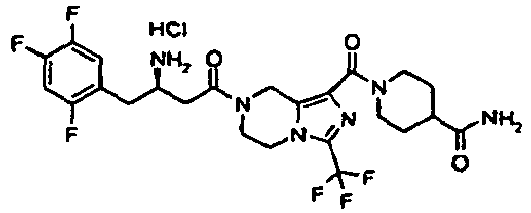

- (R)-7-[3-tert-Butoxycarbonylamino-4-(2,4,5-trifluoro-phenyl)-butyryl]-3-trifluoromethyl-5,6,7,8-tetrahydro-imidazo[1,5-a]pyrazine-1-carboxylic acid 2a (150 mg, 0.27 mmol), piperidine-4-carboxylic acid amide (70 mg, 0.54 mmol) and bis(2-oxo-3-oxazolidinyl)phosphonic chloride (0.138 g, 0.54 mmol) were dissolved in 8 mL of dichloromethane under stirring, and triethylamine (0.25 mL, 1.62 mmol) and 4 mL of N,N-dimethylformamide were then added to the solution successively. The reaction mixture was reacted at room temperature overnight and monitored by thin layer chromatography until the disappearance of the starting materials. The reaction mixture was concentrated under reduced pressure. The resulting residue was purified by silica gel column chromatography to obtain the title compound (R)-[3-[1-(4-carbamoyl-piperidine-1-carbonyl)-3-trifluoromethyl-5,6-dihydro-8H-imidazo[1,5-a]pyrazin-7-yl]-3-oxo-1-(2,4,5-trifluoro-benzyl)-propyl]-carbamic acid tert-butyl ester 7a (180 mg, yield 98%) as a white solid.
MS m/z (ESI): 660.9 [M+1]. - (R)-[3-[1-(4-Carbamoyl-piperidine-1-carbonyl)-3-trifluoromethyl-5,6-dihydro-8H -imidazo[1,5-a]pyrazin-7-yl]-3-oxo-1-(2,4,5-trifluoro-benzyl)-propyl]-carbamic acid tert-butyl ester 7a (0.18 g, 0.27 mmol) and 2 mL of ethyl acetate were added into the reaction flask. A solution of 2.3 N hydrochloric acid in 6 mL of ethyl acetate was then adde to the flask. The reaction mixture was reacted at room temperature for 3.5 hours and monitored by thin layer chromatography until the disappearance of the starting materials. The reaction mixture was concentrated under reduced pressure to obtain the title compound (R)-1-{7-[3-amino-4-(2,4,5-trifluoro-phenyl)-butyryl]-3-trifluoromethyl-5,6,7,8-tetrahydro-imidazo[1,5-a]pyrazine-1-carbonyl}-piperidine-4-c arboxylic acid amide hydrochloride 7 (0.12 g, yield 74%) as a white solid.
MS m/z (ESI): 561.2 [M+1].
1H NMR (400 MHz, CD3OD): δ7.42-7.31 (m, 1H), 7.28-7.16 (m, 1H), 5.17-4.97 (m, 2H), 4.43-4.24 (m, 2H), 4.20-4.03 (m, 1H), 4.03-3.89 (m, 2H), 3.30-3.18 (m, 2H), 3.17-3.06 (m, 2H), 3.03-2.72 (m, 4H), 2.65-2.53 (m, 1H), 2.15-2.03 (m, 2H), 1.93-1.83 (m, 2H), 1.77-1.60 (m, 2H). -
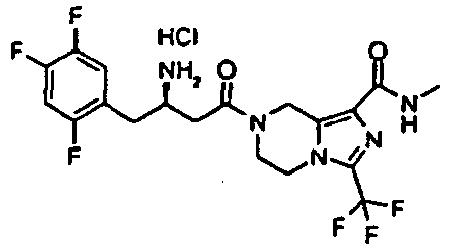

- (R)-7-[3-tert-Butoxycarbonylamino-4-(2,4,5-trifluoro-phenyl)-butyryl]-3-trifluoromethyl-5,6,7,8-tetrahydro-imidazo[1,5-a]pyrazine-1-carboxylic acid 2a (150 mg, 0.27 mmol), methylamine hydrochloride (36.5 mg, 0.54 mmol) and bis(2-oxo-3-oxazolidinyl)phosphonic chloride (0.138 g, 0.54 mmol) were dissolved in 8 mL of dichloromethane under stirring, and triethylamine (0.25 mL, 1.62 mmol) was then added to the solution. The reaction mixture was reacted at room temperature overnight and monitored by thin layer chromatography until the disappearance of the starting materials. The reaction mixture was concentrated under reduced pressure. The resulting residue was purified by silica gel column chromatography to obtain the title compound (R)- [3-(1-methylcarbamoyl-3-trifluoromethyl-5,6-dihydro-8H-imidazo [1,5-a]pyrazin-7-yl)-3-oxo-1-(2,4,5-trifluoro-benzyl)-propyl]-carbamic acid tert-butyl ester 8a (150 mg, yield 98.6%) as a white solid.
MS m/z (ESI): 563.9 [M+1]. - (R)-[3-(1-Methylcarbamoyl-3-trifluoromethyl-5,6-dihydro-8H-imidazo[1,5-a] pyrazin-7-yl)-3-oxo-1-(2,4,5-trifluoro-benzyl)-propyl]-carbamic acid tert-butyl ester 8a (0.15 g, 0.27 mmol) and 2 mL of ethyl acetate were added into the reaction flask. A solution of 2.3 N hydrochloric acid in 5 mL of ethyl acetate was then added to the flask. The reaction mixture was reacted at room temperature for 4 hours and monitored by thin layer chromatography until the disappearance of the starting materials. The reaction mixture was concentrated under reduced pressure to obtain the title compound (R)-7-[3-amino-4-(2,4,5-trifluoro-phenyl)-butyryl]-3-trifluoromethyl-5,6,7,8-tetrahydro-imidazo[1,5-a]pyrazine-1-carboxylic acid methylamide hydrochloride 8 (0.135 g, yield 90%) as a white solid.
MS m/z (ESI): 464.2 [M+1].
1H NMR (400 MHz, CD3OD): δ7.40-7.38 (m, 1H), 7.23 (m, 1H), 5.13-5.04 (m, 2H), 4.31-4.25 (m, 2H), 4.07 (m, 1H), 3.96 (m, 2H), 3.10 (m, 2H), 2.99-2.76 (m, 5H). -


- (R)-7-[3-tert-Butoxycarbonylamino-4-(2,4,5-trifluoro-phenyl)-butyryl]-3-trifluoromethyl-5,6,7,8-tetrahydro-imidazo[1,5-a]pyrazine-1-carboxylic acid 2a (150 mg, 0.27 mmol), dimethylamine hydrochloride (44 mg, 0.54 mmol) and bis(2-oxo-3-oxazolidinyl)phosphonic chloride (0.138 g, 0.54 mmol) were dissolved in 8 mL of dichloromethane under stirring, and triethylamine (0.25 mL, 1.62 mmol) was then added to the solution. The reaction mixture was reacted at room temperature overnight and monitored by thin layer chromatography until the disappearance of the starting materials. The reaction mixture was concentrated under reduced pressure. The resulting residue was purified by silica gel column chromatography to obtain the title compound (R)-[3-(1-dimethylcarbamoyl-3-trifluoromethyl-5,6-dihydro-8H-imidazo [1,5-a]pyrazin-7-yl)-3-oxo-1-(2,4,5-trifluoro-benzyl)-propyl]-carbamic acid tert-butyl ester 9a (120 mg, yield 77%) as a white solid.
MS m/z (ESI): 578.1 [M+1]. - (R)-[3-(1-Dimethylcarbamoyl-3-trifluoromethyl-5,6-dihydro-8H-imidazo[1,5-a] pyrazin-7-yl)-3-oxo-1-(2,4,5-trifluoro-benzyl)-propyl]-carbamic acid tert-butyl ester 9a (0.138 g, 0.245 mmol) and 2 mL of ethyl acetate were added into the reaction flask. A solution of 2.3 N hydrochloric acid in 4 mL of ethyl acetate was then added to the flask. The reaction mixture was reacted at room temperature for 3 hours and monitored by thin layer chromatography until the disappearance of the starting materials. The reaction mixture was concentrated under reduced pressure to obtain the title compound (R)-7-[3-amino-4-(2,4,5-trifluoro-phenyl)-butyryl]-3-trifluoromethyl-5,6,7,8-tetrahydro-imidazo[1,5-a]pyrazine-1-carboxylic acid dimethylamide hydrochloride 9 (0.12 g, yield 98%) as a white solid.
MS m/z (ESI): 478.2 [M+1]. -


- (R)-7-[3-tert-Butoxycarbonylamino-4-(2,4,5-trifluoro-phenyl)-butyryl]-3-trifluoromethyl-5,6,7,8-tetrahydro-imidazo[1,5-a]pyrazine-1-carboxylic acid 2a (218 mg, 0.4 mmol) was added into the reaction flask. A solution of hydrochloric acid in 5 mL of ethanol was then added to the flask. The reaction mixture was reacted at room temperature and monitored by thin layer chromatography until the disappearance of the starting materials. The reaction mixture was concentrated under reduced pressure to obtain the title compound (R)-7-[3-amino-4-(2,4,5-trifluoro-phenyl)-butyryl]-3-trifluoromethyl-5,6,7,8-tetrahydro-imidazo[1,5-a]pyrazine-1-carboxylic acid hydrochloride 10 (60 mg, yield 30.8%) as a white solid.
MS m/z (ESI): 451.2 [M+1].
1H NMR (400 MHz, CD3OD): δ 7.416-7.37 (m, 1H), 7.281-7.234 (m, 1H), 5.189-5.053 (m, 2H), 4.361-4.286 (m, 1H), 4.15-3.999 (m, 2H), 3.941-3.925 (m, 2H), 3.212-2.883 (m, 2H), 2.861-2.805 (m, 2H). -


- (R)-Piperidin-3-yl amine hydrochloride 11a (3 g, 22.1 mmol) and potassium carbonate (6.1 g, 44.2 mmol) were dissolved in 60 mL of methanol under stirring. After stirring for 30 minutes, di-tert-butyl dicarbonate (4.8 g, 22.1 mmol) was added to the mixture. The reaction mixture was reacted at room temperature overnight and monitored by thin layer chromatography until the disappearance of the starting materials. The reaction mixture was concentrated under reduced pressure. The resulting residue was purified by silica gel column chromatography to obtain the title compound piperidin-3-yl-carbamic acid tert-butyl ester 11b (1.3 g, yield 29%) as an oil.
MS m/z (ESI): 201.0 [M+1]. - (R)-7-[3-tert-Butoxycarbonylamino-4-(2,4,5-trifluoro-phenyl)-butyryl]-3-trifluoromethyl-5,6,7,8-tetrahydro-imidazo[1,5-a]pyrazine-1-carboxylic acid 2a (0.12 g, 0.218 mmol), piperidin-3-yl-carbamic acid tert-butyl ester 11b (0.173 g, 0.545 mmol) and triethylamine (0.275 g, 2.18 mmol) were dissolved in 12 mL of dichloromethane under stirring, and bis(2-oxo-3-oxazolidinyl)phosphinic chloride (0.138 g, 0.545 mmol) was then added to the mixture. The reaction mixture was reacted at room temperature overnight. The reaction mixture was concentrated under reduced pressure. The resulting residue was purified by silica gel column chromatography to obtain the title compound (R)-(1-{7-[3-tert-butoxycarbonylamino-4-(2,4,5-trifluoro-phenyl)-butyryl]-3-trifluoromethyl-5,6,7,8-tetrahydro-imidazo[1,5-a]pyrazine-1-carbonyl}-piperidin-3-yl) -carbamic acid tert-butyl ester 11c (0.1 g, yield 63%) as an oil.
MS m/z (ESI): 733.1 [M+1]. - (R)-(1-{7-[3-tert-Butoxycarbonylamino-4-(2,4,5-trifluoro-phenyl)-butyryl]-3-trifluoromethyl-5,6,7,8-tetrahydro-imidazo[1,5-a]pyrazine-1-carbonyl}-piperidin-3-yl) -carbamic acid tert-butyl ester 11c (0.1 g, 0.163 mmol) was added to a solution of 2.3 N hydrochloric acid in 10 mL of ethyl acetate. The reaction mixture was reacted at room temperature overnight and monitored by thin layer chromatography until the disappearance of the starting materials. The reaction mixture was concentrated under reduced pressure to obtain the title compound (R)-3-amino-1-[1-(3-amino-piperidine-1-carbonyl)-3-trifluoromethyl-5,6-dihydro-8H-imidazo[1,5-a]pyrazin-7-yl]-4-(2,4,5-trifluoro-phenyl)-butan-1-one dihydrochloride 11 (0.09 g, yield 98%) as a white solid.
MS m/z (ESI): 533.3 [M+1].
1H NMR (400 MHz, CD3OD): δ 7.415-7.396 (m, 1H), 7.26-7.2154 (m, 1H), 5.131-4.085 (m, 11H), 3.994-2.837 (m, 8H), 2.11-1.846 (m, 5H). -


- (R)-7-[3-tert-Butoxycarbonylamino-4-(2,4,5-trifluoro-phenyl)-butyryl]-3-trifluoromethyl-5,6,7,8-tetrahydro-imidazo[1,5-a]pyrazine-1-carboxylic acid 2a (150 mg, 0.27 mmol), pyrrolidine (38.4 mg, 0.54 mmol) and bis(2-oxo-3-oxazolidinyl)phosphonic chloride (0.138 g, 0.54 mmol) were dissolved in 8 mL of dichloromethane under stirring, and triethylamine (0.25 mL, 1.62 mmol) was then added to the solution. The reaction mixture was reacted at room temperature overnight and monitored by thin layer chromatography until the disappearance of the starting materials. The reaction mixture was concentrated under reduced pressure. The resulting residue was purified by silica gel column chromatography to obtain the title compound (R)-[3-oxo-3-[1-(pyrrolidine-1-carbonyl)-3-trifluoromethyl-5,6-dihydro-8H-imidazo[1,5-a]pyrazin-7-yl]-1-(2,4,5-trifluoro-benzyl)-propyl]-carbamic acid tert-butyl ester 12a (120 mg, yield 74%) as a white solid.
- (R)-[3-Oxo-3-[1-(pyrrolidine-1-carbonyl)-3-trifluoromethyl-5,6-dihydro-8H-imidazo[1,5-a]pyrazin-7-yl]-1-(2,4,5-trifluoro-benzyl)-propyl]-carbamic acid tert-butyl ester 12a (0.12 g, 0.199 mmol) and 2 mL of ethyl acetate were added into the reaction flask. A solution of 2.3 N hydrochloric acid in 4 mL of ethyl acetate was then added to the flask. The reaction mixture was reacted at room temperature for 3 hours and monitored by thin layer chromatography until the disappearance of the starting materials. The reaction mixture was concentrated under reduced pressure to obtain the title compound (R)-3-amino-1-[1-(pyrrolidine-1-carbonyl)-3-trifluoromethyl-5,6-dihydro-8H-imidazo[1,5-a]pyrazin-7-yl]-4-(2,4,5-trifluoro-phenyl )-butan-1-one hydrochloride 12 (0.10 g, yield 94%) as a white solid.
MS m/z (ESI): 504.2 [M+1]. -


- (R)-7-[3-tert-Butoxycarbonylamino-4-(2,4,5-trifluoro-phenyl)-butyryl]-3-trifluoromethyl-5,6,7,8-tetrahydro-imidazo[1,5-a]pyrazine-1-carboxylic acid 2a (150 mg, 0.27 mmol), tert-butyl piperazine-1-carboxylate (100.6 mg, 0.54 mmol), bis(2-oxo-3-oxazolidinyl)phosphonic chloride (0.138 g, 0.54 mmol) and triethylamine (0.25 mL, 1.62 mmol) were dissolved in 6 mL of dichloromethane under stirring. The reaction mixture was reacted at room temperature overnight and monitored by thin layer chromatography until the disappearance of the starting materials. The reaction mixture was concentrated under reduced pressure. The resulting residue was purified by silica gel column chromatography to obtain the title compound (R)-4-{7-[3-tert-butoxycarbonylamino-4-(2,4,5-trifluoro-phenyl)-butyryl]-3-trifluoromethyl-5,6,7,8-tetrahydro-imidazo[1,5-a]pyrazine-1-carbonyl}-piperazine-1-carboxylic acid tert-butyl ester 13a (200 mg, yield 99%) as a white solid.
MS m/z (ESI): 719.0 [M+1]. - (R)-4- {7-[3-tert-Butoxycarbonylamino-4-(2,4,5-trifluoro-phenyl)-butyryl]-3-trifluoromethyl-5,6,7,8-tetrahydro-imidazo[1,5-a]pyrazine-1-carbonyl}-piperazine-1-carboxylic acid tert-butyl ester 13a (0.12 g, 0.199 mmol) was added into the reaction flask. A solution of 2.3 N hydrochloric acid in 5 mL of methanol was then added to the flask. The reaction mixture was reacted at room temperature overnight, and then was concentrated under reduced pressure. The resulting residue was purified by silica gel column chromatography to obtain the title compound (R)-3-amino-1-[1-(piperazine-1-carbonyl)-3-trifluoromethyl-5,6-dihydro-8H-imidazo [1,5-a]pyrazin-7-yl]-4-(2,4,5-trifluoro-phenyl)-butan-1-one dihydrochloride 13 (0.10 g, yield 94%) as a white solid.
MS m/z (ESI): 504.2 [M+1].
1H NMR (400 MHz, CD3OD): δ7.45-7.40 (m, 1H), 7.26-7.23 (m, 1H), 5.10-5.04 (m, 2H), 4.71-4.46 (m, 2H), 4.42-4.24 (m, 2H), 4.18-4.06 (m, 2H), 4.06-3.89 (m, 3H), 3.78-3.55 (m, 4H), 3.24-3.06 (m, 2H), 3.06-2.80 (m, 2H). -


- (R)-7-[3-tert-Butoxycarbonylamino-4-(2,4,5-trifluoro-phenyl)-butyryl]-3-trifluoromethyl-5,6,7,8-tetrahydro-imidazo[1,5-a]pyrazine-1-carboxylic acid 2a (150 mg, 0.27 mmol), (R)-3-pyrrolidinol (47 mg, 0.54 mmol), bis(2-oxo-3-oxazolidinyl)phosphonic chloride (0.138 g, 0.54 mmol) and triethylamine (0.25 mL, 1.62 mmol) were dissolved in 6 mL of dichloromethane under stirring. The reaction mixture was reacted at room temperature overnight and monitored by thin layer chromatography until the disappearance of the starting materials. The reaction mixture was concentrated under reduced pressure. The resulting residue was purified by silica gel column chromatography to obtain the title compound (R)-[3-[1-((R)-3-hydroxy-pyrrolidine-1-carbonyl)-3-trifluoromethyl-5,6-dihydro-8H-imidazo[1,5-a]pyrazin-7-yl]-3-oxo-1-(2,4,5-trifluoro-benzyl)-propyl]-carbamic acid tert-butyl ester 14a (90 mg, yield 53%) as a white solid.
MS m/z (ESI): 620.0 [M+1]. - (R)-[3-[1-((R)-3-Hydroxy-pyrrolidine-1-carbonyl)-3-trifluoromethyl-5,6-dihydro-8H-imidazo[1,5-a]pyrazin-7-yl]-3-oxo-1-(2,4,5-trifluoro-benzyl)-propyl]-carbamic acid tert-butyl ester 14a (90 mg, 0.15 mmol) was added to a solution of 2.3 N hydrochloric acid in 10 mL of ethyl acetate. The reaction mixture was reacted at room temperature overnight and monitored by thin layer chromatography until the disappearance of the starting materials. The reaction mixture was concentrated under reduced pressure. The resulting residue was purified by silica gel column chromatography to obtain the title compound (R)-3-amino-1-[1-((R)-3-hydroxy-pyrrolidine-1-carbonyl)-3-trifluoromethyl-5,6-dihydro-8H-imidazo[1,5-a]pyrazin-7-yl ]-4-(2,4,5-trifluoro-phenyl)-butan-1one hydrochloride 14 (60 mg, yield 72%) as a white solid.
MS m/z (ESI): 520.3 [M+1].
1H NMR (400 MHz, CD3OD): δ 7.417-7.372 (m, 1H), 7.275-7.234 (m, 1H), 5.527-4.87 (m, 2H), 4.87-4.346 (m, 1H), 4.346-4.117 (m, 2H), 4.117-3.352 (m, 8H), 3.349-2.98 (m, 2H), 2.98-2.088 (m, 2H), 2.088-2.029 (m, 2H). -


- (R)-7-[3-tert-Butoxycarbonylamino-4-(2,4,5-trifluoro-phenyl)-butyryl]-3-trifluoromethyl-5,6,7,8-tetrahydro-imidazo[1,5-a]pyrazine-1-carboxylic acid 2a (0.2 g, 0.36 mmol), cyclopropylamine (0.05 g, 0.54 mmol) and bis(2-oxo-3-oxazolidinyl)phosphinic chloride (0.18 g, 0.72 mmol) were dissolved in 20 mL of dichloromethane under stirring, and triethylamine (0.36 g, 3.6 mmol) was added to the solution at room temperature. The reaction mixture was reacted at room temperature for 2 hours, and then concentrated under reduced pressure. The resulting residue was purified by silica gel column chromatography to obtain the title compound (R)-[3-(1-cyclopropylcarbamoyl-3-trifluoromethyl-5,6-dihydro-8H-imidazo[1,5-a]pyrazin-7-yl)-3-oxo-1-(2,4,5-trifluoro-benzyl)-propyl]-carbamic acid tert-butyl ester 15a (0.1 g, yield 45%) as an oil.
- (R)-[3-(1-Cyclopropylcarbamoyl-3-trifluoromethyl-5,6-dihydro-8H-imidazo [1,5-a]pyrazin-7-yl)-3-oxo-1-(2,4,5-trifluoro-benzyl)-propyl]-carbamic acid tert-butyl ester 15a (0.1 g, 0.16 mmol) was added to a solution of 2.2 N hydrochloric acid in 5 mL of ethyl acetate. The reaction mixture was reacted at room temperature overnight and monitored by thin layer chromatography until the disappearance of the starting materials. The reaction mixture was concentrated under reduced pressure to obtain the title compound (R)-7-[3-amino-4-(2,4,5-trifluoro-phenyl)-butyryl]-3-trifluoromethyl-5,6,7,8-tetrahydro-imidazo[1,5-a]pyrazine-1-carboxylic acid cyclopropylamide hydrochloride 15 (82 mg, yield 95%) as a light yellow solid.
MS m/z (ESI): 490.2 [M+1].
H NMR (400 MHz, CD3OD): δ 7.423-7.174 (m, 2H), 5.284-4.872 (m, 2H), 4.716-2.019 (m, 10H), 2.019 (s, 2H), 1.349-1.191 (m, 2H), 0.907-0.596 (m, 2H). -
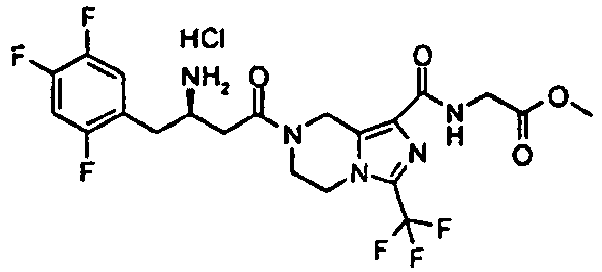

- (R)-7-[3-tert-Butoxycarbonylamino-4-(2,4,5-trifluoro-phenyl)-butyryl]-3-trifluoromethyl-5,6,7,8-tetrahydro-imidazo[1,5-a]pyrazine-1-carboxylic acid 2a (150 mg, 0.27 mmol) and methyl glycinate hydrochloride (512 mg, 0.408 mmol) were dissolved in 8 mL of dichloromethane under stirring, and triethylamine (0.25 mL, 1.62 mmol) was then added to the solution. After stirring for 5 minutes, bis(2-oxo-3-oxazolidinyl) phosphonic chloride (0.138 g, 0.54 mmol) was added. The reaction mixture was reacted at room temperature for 20 hours and monitored by thin layer chromatography until the disappearance of the starting materials. The reaction mixture was concentrated under reduced pressure. The resulting residue was purified by silica gel column chromatography to obtain the title compound (R)-({7-[3-tert-butoxycarbonylamino-4-(2,4,5-trifluorophenyl)-butyryl]-3-trifluoromethyl-5,6,7,8-tetrahydro-imidazo[1,5-a]pyrazine-1-carbonyl}-amino)-acetic acid methyl ester 16a (90 mg, yield 53.6%) as a light yellow oil.
- (R)-({7-[3-tert-Butoxycarbonylamino-4-(2,4,5-trifluoro-phenyl)-butyryl]-3-trifluoromethyl-5,6,7,8-tetrahydro-imidazo[1,5-a]pyrazine-1-carbonyl}-amino)-acetic acid methyl ester 16a (0.09 g, 0.145 mmol) and 2 mL of ethyl acetate were added into the reaction flask. A solution of 2.3 N hydrochloric acid in 4 mL of ethyl acetate was then added to the flask. The reaction mixture was reacted at room temperature for 3 hours and monitored by thin layer chromatography until the disappearance of the starting materials. The reaction mixture was concentrated under reduced pressure to obtain the title compound (R)-({7-[3-amino-4-(2,4,5-trifluoro-phenyl)-butyryl]-3-trifluoromethyl-5,6,7,8-tetrahydro-imidazo[1,5-a]pyrazine-1-carbonyl}-amino)-acetic acid methyl ester hydrochloride 16 (80 mg, yield 99%) as a white solid.
MS m/z (ESI): 522.2 [M+1].
1H NMR (400 MHz, CD3OD): δ7.47-7.30 (m, 1H), 7.30-7.14 (m, 1H), 5.23-5.00 (m, 2H), 4.39-4.20 (m, 2H), 4.18-4.06 (m, 3H), 4.17-4.07 (m, 3H), 4.01-3.89 (m, 2H), 3.84-3.24 (m, 3H), 3.20-2.76 (m, 4H). -


- (R)-7-[3-tert-Butoxycarbonylamino-4-(2,4,5-trifluoro-phenyl)-butyryl]-3-trifluoromethyl-5,6,7,8-tetrahydro-imidazo[1,5-a]pyrazine-1-carboxylic acid 2a (150 mg, 0.27 mmol), 1-piperazin-1-yl-ethanone hydrochloride (90 mg, 0.54 mmol) and bis(2-oxo-3-oxazolidinyl)phosphonic chloride (0.138 g, 0.54 mmol) were dissolved in 8 mL of dichloromethane under stirring, and triethylamine (0.25 mL, 1.62 mmol) was then added to the solution. The reaction mixture was reacted at room temperature overnight and monitored by thin layer chromatography until the disappearance of the starting materials. The reaction mixture was concentrated under reduced pressure. The resulting residue was purified by silica gel column chromatography to obtain the title compound (R)-[3-[1-(4-acetyl-piperazine-1-carbonyl)-3-trifluoromethyl-5,6-dihydro-8H-imidazo[1,5-a]pyrazin-7-yl]-3-oxo-1-(2,4,5-trifluoro-benzyl)-propyl]-carbamic acid tert-butyl ester 17a (80 mg, yield 45%) as a white solid.
MS m/z (ESI): 660.9 [M+1]. - (R)-[3-[1-(4-Acetyl-piperazine-1-carbonyl)-3-trifluoromethyl-5,6-dihydro-8H-imidazo[1,5-a]pyrazin-7-yl]-3-oxo-1-(2,4,5-trifluoro-benzyl)-propyl]-carbamic acid tert-butyl ester 17a (0.08 g, 0.12 mmol) and 2 mL of ethyl acetate were added into the reaction flask. A solution of 2.7 N hydrochloric acid in 2 mL of ethyl acetate was then added to the flask. The reaction mixture was reacted at room temperature overnight and monitored by thin layer chromatography until the disappearance of the starting materials. The reaction mixture was concentrated under reduced pressure to obtain the title compound (R)-1-[1-(4-acetyl-piperazine-1-carbonyl)-3-trifluoromethyl-5,6-dihydro-8H-imidazo[1,5-a]pyrazin-7-yl]-3-amino-4-(2,4,5-trifluoro-phenyl)-butan-1-one hydrochloride 17 (70 mg, yield 98%) as a white solid.
MS m/z (ESI): 561.2 [M+1].
1H NMR (400 MHz, CD3OD): δ7.50-7.36 (m, 1H), 7.33-7.15 (m, 1H), 5.23-4.97 (m, 2H), 4.60-4.06 (m, 5H), 4.06-3.88 (m, 2H), 3.88-3.48 (m, 6H), 3.24-2.71 (m, 4H), 2.26-2.12 (m, 3H). -


- (R)-7-[3-tert-Butoxycarbonylamino-4-(2,4,5-trifluoro-phenyl)-butyryl]-3-trifluoromethyl-5,6,7,8-tetrahydro-imidazo[1,5-a]pyrazine-1-carboxylic acid 2a (150 mg, 0.27 mmol), (R)-pyrrolidin-2-ylmethanol (54.6 mg, 0.54 mmol), bis(2-oxo-3-oxazolidinyl)phosphonic chloride (0.138 g, 0.54 mmol) and triethylamine (0.25 mL, 1.62 mmol) were dissolved in 8 mL of dichloromethane under stirring. The reaction mixture was reacted at room temperature overnight and monitored by thin layer chromatography until the disappearance of the starting materials. The reaction mixture was concentrated under reduced pressure. The resulting residue was purified by silica gel column chromatography to obtain the title compound (R)-[3-[1-((2R)-2-hydroxymethyl-pyrrolidine-1-carbonyl)-3-trifluoromethyl-5,6-dihydro-8H-imidazo[1,5-a]pyrazin-7-yl]-3-oxo-1-(2,4,5-trifluoro-benzyl)-propyl]-carbamic acid tert-butyl ester 18a (120 mg, yield 70%) as a colourness oil.
MS m/z (ESI): 633.9 [M+1]. - (R)-[3-[1-((2R)-2-Hydroxymethyl-pyrrolidine-1-carbonyl)-3-trifluoromethyl-5,6-dihydro-8H-imidazo[1,5-a]pyrazin-7-yl]-3-oxo-1-(2,4,5-trifluoro-benzyl)-propyl]-carbamic acid tert-butyl ester 18a (0.12 g, 0.19 mmol) and 2 mL of ethyl acetate were added into the reaction flask. A solution of 2.3 N hydrochloric acid in 4 mL of ethyl acetate was then added to the flask. The reaction mixture was reacted at room temperature for 3 hours and monitored by thin layer chromatography until the disappearance of the starting materials. The reaction mixture was concentrated under reduced pressure to obtain the title compound (R)-3-amino-1-[1-((2R)-2-hydroxymethyl-pyrrolidine-1-carbonyl)-3-trifluoromethyl-5 ,6-dihydro-8H-imidazo[1,5-a]pyrazin-7-yl]-4-(2,4,5-trifluoro-phenyl)-butan-1-one hydrochloride 18 (0.12 g, yield 88%) as a white solid.
MS m/z (ESI): 534.2 [M+1].
1H NMR (400 MHz, CD3OD): δ7.39-7.35 (m, 1H), 7.23-7.19 (m, 1H), 5.16-5.04 (m, 2H), 4.33-4.26 (m, 2H), 4.15-4.09 (m, 2H), 3.98 (m, 1H), 3.86-3.57 (m, 5H), 3.04 (m, 2H), 2.93-2.86 (m, 1H), 2.82-2.72 (m, 1H) -


- (R)-7-[3-tert-Butoxycarbonylamino-4-(2,4,5-trifluoro-phenyl)-butyryl]-3-trifluoromethyl-5,6,7,8-tetrahydro-imidazo[1,5-a]pyrazine-1-carboxylic acid 2a (150 mg, 0.27 mmol), piperazin-2-one (60 mg, 0.6 mmol), bis(2-oxo-3-oxazolidinyl)phosphonic chloride (0.138 g, 0.54 mmol), triethylamine (0.25 mL, 1.62 mmol) and 8 mL of dichloromethane were added into the reaction flask, and 10 mL of N,N-dimethylformamide was then added to the flask. The reaction mixture was reacted at room temperature overnight and monitored by thin layer chromatography until the disappearance of the starting materials. The reaction mixture was concentrated under reduced pressure. The resulting residue was purified by silica gel column chromatography to obtain the title compound (R)-[3-oxo-3-[1-(3-oxo-piperazine-1-carbonyl)-3-trifluoromethyl-5,6-dihydro-8H-imidazo[1,5-a]pyrazin-7-yl]-1-(2,4,5-trifluoro-benzyl)-propyl]-carbamic acid tert-butyl ester 19a (140 mg, yield 82%) as a colourness oil.
MS m/z (ESI): 632.7 [M+1]. - (R)-[3-Oxo-3-[1-(3-oxo-piperazine-1-carbonyl)-3-trifluoromethyl-5,6-dihydro-8H-imidazo[1,5-a]pyrazin-7-yl]-1-(2,4,5-trifluoro-benzyl)-propyl]-carbamic acid tert-butyl ester 19a (0.14 g, 0.22 mmol) and 2 mL of ethyl acetate were added into the reaction flask. A solution of 2.3 N hydrochloric acid in 4 mL of ethyl acetate was then added to the flask. The reaction mixture was reacted at room temperature overnight and monitored by thin layer chromatography until the disappearance of the starting materials. The reaction mixture was concentrated under reduced pressure to obtain the title compound (R)-4-{7-[3-amino-4-(2,4,5-trifluoro-phenyl)-butyryl]-3-trifluoromethyl-5,6,7,8-tetrahydro-imidazo[1,5-a]pyrazine-1-carbonyl}-piperazin-2-one hydrochloride 19 (0.12 g, yield 93%) as a white solid.
MS m/z (ESI): 533.2 [M+1].
1H NMR (400 MHz, CD3OD): δ 7.38 (m, 1H), 7.24-7.22 (m, 1H), 5.08-5.01 (m, 2H), 4.57 (m, 2H), 4.32-4.27 (m, 2H), 4.08 (m, 1H), 3.97-3.94 (m, 4H), 3.47 (m, 2H), 3.11 (m, 2H), 2.97-2.84 (m, 2H). -

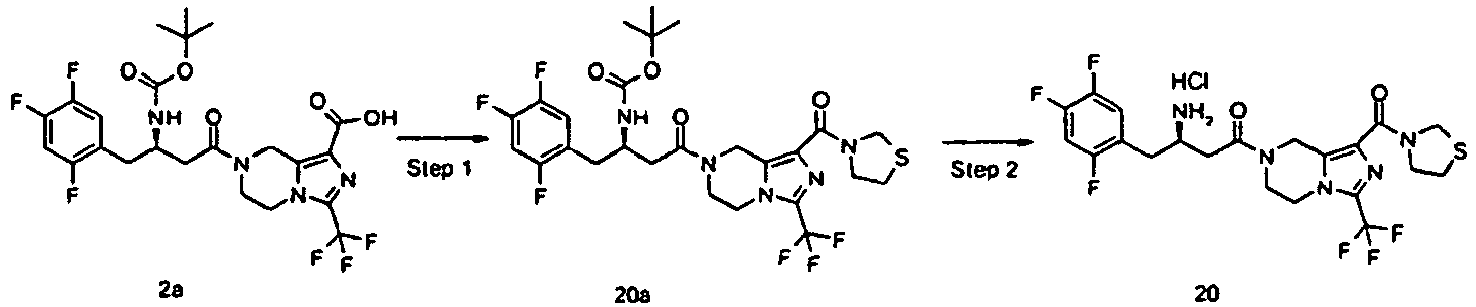
- (R)-7-[3-tert-Butoxycarbonylamino-4-(2,4,5-trifluoro-phenyl)-butyryl]-3-trifluoromethyl-5,6,7,8-tetrahydro-imidazo[1,5-a]pyrazine-1-carboxylic acid 2a (0.15 g, 0.27 mmol), thiazolidine (57 mg, 0.6 mmol), triethylamine (0.275 g, 2.72 mmol) and bis(2-oxo-3-oxazolidinyl)phosphinic chloride (0.138 g, 0.544 mmol) were dissolved in 10 mL of dichloromethane under stirring. The reaction mixture was stirred at room temperature for 2 hours and monitored by thin layer chromatography until the disappearance of the starting materials. The reaction mixture was concentrated under reduced pressure. The resulting residue was purified by silica gel column chromatography to obtain the title compound (R)-[3-oxo-3-[1-(thiazolidine-3-carbonyl)-3-trifluoromethyl-5,6-dihydro-8H-imidazo[1,5-a]pyrazin-7-yl]-1-(2,4,5-trifluoro-benzyl)-propyl]-carbamic acid tert-butyl ester 20a (0.15 g, yield 89%) as a white solid.
MS m/z (ESI): 644.1 [M+23]. - (R)-[3-Oxo-3-[1-(thiazolidine-3-carbonyl)-3-trifluoromethyl-5,6-dihydro-8H-imidazo[1,5-a]pyrazin-7-yl]-1-(2,4,5-trifluoro-benzyl)-propyl]-carbamic acid tert-butyl ester 20a (0.15 g, 0.24 mmol) was added to a solution of 2.2 N hydrochloric acid in 5 mL of ethyl acetate. The reaction mixture was reacted at room temperature for 4 hours and monitored by thin layer chromatography until the disappearance of the starting materials. The reaction mixture was concentrated under reduced pressure. The resulting residue was purified by silica gel column chromatography to obtain the title compound (R)-3-amino -1-[1-(thiazolidine-3-carbonyl)-3-trifluoromethyl-5,6-dihydro-8H-imidazo[1,5-a]pyrazin-7-yl]-4-(2,4,5-trifluoro-phenyl)-butan-1-one hydrochloride 20 (100 mg, yield 75%) as a light yellow solid.
MS m/z (ESI): 522.1 [M+1].
1H NMR (400 MHz, CD3OD): δ 7.447-7.358 (m, 1H), 7.3-7.204 (m, 1H), 5.217-5.05 (m, 2H), 4.752-4.461 (m, 2H), 4.37-4.284 (m, 2H), 4.284-4.086 (m, 2H), 4.086-3.952 (m, 2H), 3.719-3.607 (m, 1H), 3.211-2.827 (m, 4H), 2.827-2.784 (m, 2H). -


- (R)-7-[3-tert-Butoxycarbonylamino-4-(2,4,5-trifluoro-phenyl)-butyryl]-3-trifluoromethyl-5,6,7,8-tetrahydro-imidazo[1,5-a]pyrazine-1-carboxylic acid 2a (0.15 g, 0.272 mmol) was dissolved in 10 mL of dichloromethane under srirring, and 3-aminopyridine (38.4 mg, 0.41 mmol), triethylamine (0.275 g, 2.72 mmol) and bis(2-oxo-3-oxazolidinyl)phosphinic chloride (0.138 g, 0.544 mmol) were then added to the solution. The reaction mixture was reacted at room temperature overnight and monitored by thin layer chromatography until the disappearance of the starting materials. The reaction mixture was concentrated under reduced pressure. The resulting residue was purified by silica gel column chromatography to obtain the title compound (R)-[3-oxo-3-[1-(pyridin-2-ylcarbamoyl)-3-trifluoromethyl-5,6-dihydro-8H-imidazo[1,5-a]pyrazin-7-yl]-1-(2,4,5-trifluoro-benzyl)-propyl]-carbamic acid tert-butyl ester 21a (0.1 g, yield 58.8%) as a white solid.
MS m/z (ESI): 627.1 [M+1]. - (R)-[3-Oxo-3-[1-(pyridin-2-ylcarbamoyl)-3-trifluoromethyl-5,6-dihydro-8H-imidazo[1,5-a]pyrazin-7-yl]-1-(2,4,5-trifluoro-benzyl)-propyl]-carbamic acid tert-butyl ester 21a (0.1 g, 0.16 mmol) was added to a solution of 2.2 N hydrochloric acid in 10 mL of ethyl acetate. The reaction mixture was reacted at room temperature for 4 hours and monitored by thin layer chromatography until the disappearance of the starting materials. The reaction mixture was concentrated under reduced pressure. The resulting residue was purified by silica gel column chromatography to obtain the title compound (R)-7-[3- amino-4-(2,4,5-trifluoro-phenyl)-butyryl]-3-trifluoromethyl -5,6,7,8-tetrahydro-imidazo[1,5-a]pyrazine-1-carboxylic acid (pyridin-2-yl) amide dihydrochloride 21 (80 mg, yield 89%) as a white solid.
MS m/z (ESI): 527.2 [M+1].
1H NMR (400 MHz, CD3OD): δ 9.584 (s, 1H), 8.88-8.857 (m, 1H), 8.63-8.601 (m, 1H), 8.115-8.07 (m, 1H), 7.438-7.215 (m, 2H), 5.209-5.137 (m, 2H), 4.87-3.937 (m, 5H), 3.34-2.902 (m, 5H), 2.061 (m, 2H). -


- (R)-7-[3-tert-Butoxycarbonylamino-4-(2,4,5-trifluoro-phenyl)-butyryl]-3-trifluoromethyl-5,6,7,8-tetrahydro-imidazo[1,5-a]pyrazine-1-carboxylic acid 2a (0.15 g, 0.27 mmol), 1-methanesulfonyl-piperazine (0.109 g, 0.55 mmol) and triethylamine (0.38 mL, 2.7 mmol) were dissolved in 10 mL of dichloromethane under stirring, and bis(2-oxo-3-oxazolidinyl)phosphinic chloride(0.139 g, 0.55 mmol) was then added to the solution. The reaction mixture was reacted at room temperature overnight and monitored by thin layer chromatography until the disappearance of the starting materials. The reaction mixture was concentrated under reduced pressure. The resulting residue was purified by silica gel column chromatography to obtain the title compound (R)-[3-[1-(4-methanesulfonyl-piperazine-1-carbonyl)-3-trifluoromethyl-5,6-dihydro-8H-imidazo[1,5-a]pyrazin-7-yl]-3-oxo-1-(2,4,5-trifluoro-benzyl)-propyl]-carbamic acid tert-butyl ester 22a (0.2 g) as a white solid.
MS m/z (ESI): 696.9 [M+1]. - (R)-[3-[1-(4-Methanesulfonyl-piperazine-1-carbonyl)-3-trifluoromethyl-5,6-dihydro-8H-imidazo[1,5-a]pyrazin-7-yl]-3-oxo-1-(2,4,5-trifluoro-benzyl)-propyl]-carbamic acid tert-butyl ester 22a (0.19 g, 0.27 mmol) and 2 mL of ethyl acetate were added into the reaction flask. A solution of 2.7 N hydrochloric acid in 4 mL of ethyl acetate was then added to the flask. The reaction mixture was reacted at room temperature for 3 hours and monitored by thin layer chromatography until the disappearance of the starting materials. The reaction mixture was concentrated under reduced pressure to obtain the title compound (R)-3-amino-1-[1-(4-methanesulfonyl-piperazine-1-carbonyl)-3-trifluoromethyl-5,6-dihydro-8H-imidazo[1,5-a]pyrazin-7-yl] -4-(2,4,5-trifluoro-phenyl)-butan-1-one hydrochloride 22 (170 mg, yield 99%) as a white solid.
MS m/z (ESI): 597.2 [M+1].
H NMR (400 MHz, CD3OD): δ7.46-7.34 (m, 1H), 7.33-7.20 (m, 1H), 5.18-5.07 (s, 1H), 5.06-4.97 (s, 1H), 4.56-4.28 (m, 4H), 4.17-4.07 (m, 1H), 4.03-3.78 (m, 4H), 3.73-3.17 (m, 3H), 3.16-2.75 (m, 8H). -


- (R)-7-[3-tert-Butoxycarbonylamino-4-(2,4,5-trifluoro-phenyl)-butyryl]-3-trifluoromethyl-5,6,7,8-tetrahydro-imidazo[1,5-a]pyrazine-1-carboxylic acid 2a (0.16 g, 0.29 mmol) was dissolved in 10 mL of dichloromethane under stirring, and ethanol (0.05 mL, 0.87 mmol), triethylamine (0.202 mL, 1.45 mmol) and bis(2-oxo-3-oxazolidinyl)phosphinic chloride (0.148 g, 0.58 mmol) were then added to the solution. The reaction mixture was reacted at room temperature for 5 hours and monitored by thin layer chromatography until the disappearance of the starting materials. The reaction mixture was concentrated under reduced pressure. The resulting residue was purified by silica gel column chromatography to obtain the title compound (R)-7-[3-tert-butoxycarbonylamino-4-(2,4,5-trifluoro-phenyl)-butyryl]-3-trifluoromethyl-5,6,7,8-tetrahydro-imidazo[1,5-a]pyrazine-1-carboxylic acid ethyl ester 23a (0.1 g) as a colourless oil.
MS m/z (ESI): 579.0 [M+1]. - (R)-7-[3-tert-Butoxycarbonylamino-4-(2,4,5-trifluoro-phenyl)-butyryl]-3-trifluoromethyl-5,6,7,8-tetrahydro-imidazo[1,5-a]pyrazine-1-carboxylic acid ethyl ester 23a (0.09 g, 0.156 mmol) and 2 mL of ethyl acetate were added into the reaction flask. A solution of 2.7 N hydrochloric acid in 4 mL of ethyl acetate was then added to the flask. The reaction mixture was reacted at room temperature for 3 hours and monitored by thin layer chromatography until the disappearance of the starting materials. The reaction mixture was concentrated under reduced pressure to obtain the title compound (R)-7-[3-amino-4-(2,4,5-trifluoro-phenyl)-butyryl]-3-trifluoromethyl-5,6,7,8-tetrahydro-imidazo[1,5-a]pyrazine-1-carboxylic acid ethyl ester hydrochloride 23 (80 mg, yield 99%) as a white solid.
MS m/z (ESI): 479.1 [M+1].
H NMR (400 MHz, CD3OD): δ7.50-7.45 (m, 1H), 7.40-7.18 (m, 1H), 5.20-5.00 (m, 2H), 4.5-4.22 (m, 4H), 4.15-4.06 (m, 1H), 4.06-3.89 (m, 2H), 3.23-2.78 (m, 4H), 1.40-1.48 (m, 3H). -


- (R)-7-[3-tert-Butoxycarbonylamino-4-(2,4,5-trifluoro-phenyl)-butyryl]-3-trifluoromethyl-5,6,7,8-tetrahydro-imidazo[1,5-a]pyrazine-1-carboxylic acid 2a (0.15 g, 0.27 mmol), bis(2-oxo-3-oxazolidinyl)phosphinic chloride (0.206 g, 1.08 mmol) and triethylamine (0.25 mL, 1.62 mmol) were dissolved in 10 mL of tetrahydrofuran under stirring. After stirring for 10 minutes, ammonium carbonate (78 mg, 0.81 mmol) was added. The reaction mixture was reacted at room temperature overnight and monitored by thin layer chromatography until the disappearance of the starting materials. The reaction mixture was concentrated under reduced pressure. The resulting residue was purified by silica gel column chromatography to obtain the title compound (R)-[3-(1-carbamoyl-3-trifluoromethyl-5,6-dihydro-8H-imidazo[1,5-a] pyrazin-7-yl)-3-oxo-1-(2,4,5-trifluoro-benzyl)-propyl]-carbamic acid tert-butyl ester 24a (0.162 g) as a white solid.
MS m/z (ESI): 549.9 [M+1]. - (R)-[3-(1-Carbamoyl-3-trifluoromethyl-5,6-dihydro-8H-imidazo[1,5-a]pyrazin-7-yl)-3-oxo-1-(2,4,5-trifluoro-benzyl)-propyl]-carbamic acid tert-butyl ester 24a (0.16 g, 0.29 mmol) and 2 mL of ethyl acetate were added into the reaction flask. A solution of 2.7 N hydrochloric acid in 5 mL of ethyl acetate was then added to the flask. The reaction mixture was reacted at room temperature for 3 hours and monitored by thin layer chromatography until the disappearance of the starting materials. The reaction mixture was concentrated under reduced pressure to obtain the title compound (R)-7-[3-amino-4-(2,4,5-trifluoro-phenyl)-butyryl]-3-trifluoromethyl-5,6,7,8-tetrahydro-imidazo[1,5-a]pyrazine-1-carboxylic acid amide hydrochloride 24 (150 mg, yield 95%) as a white solid.
MS m/z (ESI): 450.2 [M+1].
H NMR (400 MHz, CD3OD): δ7.40-7.36 (m, 1H), 7.28-7.22 (m, 1H), 5.14-5.05 (m, 2H), 4.34-4.27 (m, 2H), 4.10-4.07 (m, 1H), 3.99-3.94 (m, 1H), 3.21-3.09 (m, 2H), 3.02-2.85 (m, 1H), 2.82-2.76 (m, 1H). -


- (R)-7-[3-tert-Butoxycarbonylamino-4-(2,4,5-trifluoro-phenyl)-butyryl]-3-trifluoromethyl-5,6,7,8-tetrahydro-imidazo[1,5-a]pyrazine-1-carboxylic acid 2a (0.15 g, 0.27 mmol), bis(2-oxo-3-oxazolidinyl)phosphinic chloride (0.140 g, 0.54 mmol), triethylamine (0.4 mL, 2.6 mmol) and (R)-3-fluoropyrrolidine hydrochloride (68 mg, 0.54 mmol) were dissolved in 10 mL of dichloromethane under stirring. The reaction mixture was reacted at room temperature overnight and monitored by thin layer chromatography until the disappearance of the starting materials. The reaction mixture was concentrated under reduced pressure. The resulting residue was purified by silica gel column chromatography to obtain the title compound (R)-[3-[1-((R)-3-fluoro-pyrrolidine-1-carbonyl)-3-trifluoromethyl-5,6-dihydro-8H-imidazo[1,5-a]pyrazin-7-yl]-3-oxo-1-(2,4,5-trifluoro-benzyl)-propyl]-carbamic acid tert-butyl ester 25a (0.162 g) as a white solid.
MS m/z (ESI): 622.0 [M+1]. - (R)-[3-[1-((R)-3-Fluoro-pyrrolidine-1-carbonyl)-3-trifluoromethyl-5,6-dihydro-8H-imidazo[1,5-a]pyrazin-7-yl]-3-oxo-1-(2,4,5-trifluoro-benzyl)-propyl]-carbamic acid tert-butyl ester 25a (0.15 g, 0.27 mmol) and 2 mL of ethyl acetate were added into the reaction flask. A solution of 2.7 N hydrochloric acid in 5 mL of ethyl acetate was then added to the flask. The reaction mixture was reacted at room temperature for 3 hours and monitored by thin layer chromatography until the disappearance of the starting materials. The reaction mixture was concentrated under reduced pressure to obtain the title compound (R)-3-amino-1-[1-((R)-3-fluoro-pyrrolidine-1-carbonyl)-3-trifluoromethyl-5,6-dihydro-8H-imidazo[1,5-a]pyrazin-7-yl]-4-(2,4,5-trifluoro-phenyl )-butan-1-one hydrochloride 25 (140 mg, yield 94%) as a white solid.
MS m/z (ESI): 522.2 [M+1].
1H NMR (400 MHz, CD3OD): δ7.42-7.37 (m, 1H), 7.26-7.22 (m, 1H), 5.47-5.29 (m, 1H), 5.18-5.10 (m, 2H), 4.56-4.48 (m, 1H), 4.37-4.28 (m, 2H), 4.16-3.89 (m, 5H), 3.74-3.68 (m, 1H), 3.16-3.11 (m, 2H), 3.07-2.77 (m, 2H), 2.39-2.03 (m, 2H). -


- (R)-7-[3-tert-Butoxycarbonylamino-4-(2,4,5-trifluoro-phenyl)-butyryl]-3-trifluoromethyl-5,6,7,8-tetrahydro-imidazo[1,5-a]pyrazine-1-carboxylic acid 2a (0.15 g, 0.27 mmol), bis(2-oxo-3-oxazolidinyl)phosphinic chloride (0.140 g, 0.54 mmol), triethylamine (0.4 mL, 2.6 mmol) and (S)-3-fluoropyrrolidine hydrochloride (68 mg, 0.54 mmol) were dissolved in 10 mL of dichloromethane under stirring. The reaction mixture was reacted at room temperature overnight and monitored by thin layer chromatography until the disappearance of the starting materials. The reaction mixture was concentrated under reduced pressure. The resulting residue was purified by silica gel column chromatography to obtain the title compound (R)-[3-[1-((S)-3-fluoro-pyrrolidine-1-carbonyl)-3-trifluoromethyl-5,6-dibydro-8H-imidazo[1,5-a]pyrazin-7-yl]-3-oxo-1-(2,4,5-trifluoro-benzyl)-propyl]-carbamic acid tert-butyl ester 26a (0.15 g, yield 89%) as a white solid.
MS m/z (ESI): 622.0 [M+1]. - (R)-[3-[1-((S)-3-Fluoro-pyrrolidine-1-carbonyl)-3-trifluoromethyl-5,6-dihydro-8H-imidazo[1,5-a]pyrazin-7-yl]-3-oxo-1-(2,4,5-trifluoro-benzyl)-propyl]-carbamic acid tert-butyl ester 26a (0.15 g, 0.24 mmol) and 2 mL of ethyl acetate were added into the reaction flask. A solution of 2.7 N hydrochloric acid in 5 mL of ethyl acetate was then added to the flask. The reaction mixture was reacted at room temperature for 3 hours and monitored by thin layer chromatography until the disappearance of the starting materials. The reaction mixture was concentrated under reduced pressure to obtain the title compound (R)-3-amino-1-[1-((S)-3-fluoro-pyrrolidine-1-carbonyl)-3-trifluoromethyl-5,6-dihydro-8H-imidazo[1,5-a]pyrazin-7-yl]-4-(2,4,5-trifluoro-phenyl )-butan-1-one hydrochloride 26 (140 mg, yield 94%) as a white solid.
MS m/z (ESI): 522.2 [M+1].
1H NMR (400 MHz, CD3OD): δ7.42-7.37 (m, 1H), 7.26-7.22 (m, 1H), 5.47-5.29 (m, 1H), 5.18-5.10 (m, 2H), 4.56-4.48 (m, 1H), 4.37-4.28 (m, 2H), 4.16-3.89 (m, 5H), 3.74-3.68 (m, 1 H), 3.16-3.11 (m, 2H), 3.07-2.77 (m, 2H), 2.39-2.03 (m, 2H). -


- 3-Trifluoromethyl-imidazo[1,5-a]pyrazine 1j(3.5 g, 18.7 mmol) was dissolved in 50 mL of ethanol, and 10% Pd/C (0.5 g) was then added to the solution under stirring. The reaction mixture was reacted overnight under a hydrogen atmosphere until the reaction was complete. The reaction mixture was flitered through a pad of Celite, and the filtrate was concentrated under reduced pressure. The resulting residue was washed with 100 mL of ethanol. A solution of di-tert-butyl dicarbonate (6.2 g, 28.1 mmol) in 100 mL of ethanol was then added dropwise to the reaction mixture under stirring. Upon completion of the addition, the reaction mixture was stirred for another 30 minutes until the reaction was complete. The reaction mixture was concentrated under reduced pressure. The resulting residue was purified by silica gel column chromatography to obtain the title compound 3-trifluoromethyl-5,6-dihydro-8H-imidazo[1,5-a]pyrazine-7-carboxylic acid tert-butyl ester 27a (3.7 g, yield 68%) as a white solid.
- In a 100 mL dried flask, the compound obtained from the previous step, 3-trifluoromethyl-5,6-dihydro-8H-imidazo[1,5-a]pyrazine-7-carboxylic acid tert-butyl ester 27a (300 mg, 1.04 mmol) was dissolved in 50 mL of ethanol under stirring, and N-bromosuccinimide (369 mg, 2.08 mmol) was then added to the solution. The reaction mixture was stirred at room temperature for an hour until the reaction was complete. The reaction mixture was concentrated under reduced pressure. The resulting residue was purified by silica gel column chromatography to obtain the title compound 1-bromo-3-trifluoromethyl-5,6-dihydro-8H-imidazo[1,5-a]pyrazine-7-carboxylic acid tert-butyl ester 27b (220 mg, yield 57.8%) as a white solid.
- Octacarbonyldicobalt (5.54 g, 16.2 mmol) and potassium carbonate (11.2 g, 81.1 mmol) was dissolved in 100 mL of methanol under stirring. The reaction mixture was stirred for 15 minutes at 60 °C, and 1-bromo-3-trifluoromethyl-5,6-dihydro -8H-imidazo[1,5-a]pyrazine-7-carboxylic acid tert-butyl ester 27b (3 g, 8.11 mmol) and methyl chloroacetate (5.25 g, 48.6 mmol) were then added to the solution. The reaction mixture was reacted for 6 hours under a carbon monoxide atmosphere and monitored by thin layer chromatography until the disappearance of the starting materials. After cooling to room temperature, the reaction mixture was filtered through a pad of silica gel, rinsed with methanol. The filtrate was concentrated under reduced pressure. The resulting residue was purified by silica gel column chromatography to obtain the title compound 3-trifluoromethyl-5,6-dihydro-8H-imidazo[1,5-a]pyrazine-1,7-dicarboxylic acid 7-tert-butyl ester 1-methyl ester 27c (1.92 g, yield 67%) as a white solid. (Reference: J. Organomet. Chem, 1985, 293)
MS m/z (ESI): 350.5 [M+1]. - 3-Trifluoromethyl-5,6-dihydro-8H-imidazo[1,5-a]pyrazine-1,7-dicarboxylic acid 7-tert-butyl ester 1-methyl ester 27c (1.92 g, 5.5 mmol) was dissolved in 50 mL of methanol under stirring, and 30 mL of 4 N sodium hydroxide was then added to the solution. The reaction mixture was reacted for 30 minutes at room temperature and monitored by thin layer chromatography until the disappearance of the starting materials. The mixture was adjusted to pH 4-5 with 2 N hydrochloric acid, and then extracted with ethyl acetate (100 mL×3). The combined organic phase was dried over anhydrous magnesium sulfate, filtered and concentrated under reduced pressure to obtain the title compound 3-trifluoromethyl-5,6-dihydro-8H-imidazo[1,5-a] pyrazine-1,7-dicarboxylic acid 7-tert-butyl ester 27d (2 g) as a white solid, which was directly used in the next step.
- 3-Trifluoromethyl-5,6-dihydro-8H-imidazo[1,5-a]pyrazine-1,7-dicarboxylic acid 7-tert-butyl ester 27d (1.84 g, 5.5 mmol) and N-methoxy methylamine (0.805 g, 8.25 mmol) were dissolved in 50 mL of dichloromethane under stirring, and triethylamine (3 mL, 22 mmol) and bis(2-oxo-3-oxazolidinyl)phosphinic chloride (2.1 g, 8.25 mmol) were then added to the solution. The reaction mixture was reacted overnight at room temperature and monitored by thin layer chromatography until the disappearance of the starting materials. The reaction mixture was concentrated under reduced pressure. The resulting residue was purified by silica gel column chromatography to obtain the title compound 1-(methoxy-methyl-carbamoyl)-3-trifluoromethyl-5,6-dihydro-8H-imidazo[1,5-a]pyrazine-7-carboxylic acid tert-butyl ester 27e (2.1 g) as a white solid.
MS m/z (ESI): 379.1 [M+1]. - 1-(Methoxy-methyl-carbamoyl)-3-trifluoromethyl-5,6-dihydro-8H-imidazo [1,5-a]pyrazine-7-carboxylic acid tert-butyl ester 27e (0.3 g, 0.79 mmol) was dissolved in 20 mL of tetrahydrofuran under stirring, and methylmagnesium bromide (1.13 mL, 1.58 mmol) was then added dropwise to the solution at 0 °C. The reaction mixture was reacted at 0 °C for 1.5 hours and monitored by thin layer chromatography until the disappearance of the starting materials. 50 mL of saturated ammonium chloride and 10 mL of saturated brine were added to the reaction mixture. The mixture was extracted with ethyl acetate (50 mL×3). The combined organic phase was dried with anhydrous magnesium sulfate, filtered and concentrated under reduced pressure. The resulting residue was purified by silica gel column chromatography to obtain the title compound 1-acetyl-3-trifluoromethyl-5,6-dihydro-8H-imidazo[1,5-a] pyrazine-7-carboxylic acid tert-butyl ester 27f (0.24 g, yield 90%) as a yellow oil.
MS m/z (ESI): 334.0 [M+1]. - 1-Acetyl-3-trifluoromethyl-5,6-dihydro-8H-imidazo[1,5-a]pyrazine-7-carboxylic acid tert-butyl ester 27f (0.24 g, 0.72 mmol) was dissolved in a little ethyl acetate. A solution of 2.7 N hydrochloric acid in 5 mL of ethyl acetate was then added. The reaction mixture was reacted at room temperature and monitored by thin layer chromatography until the disappearance of the starting materials. The reaction mixture was concentrated under reduced pressure to obtain the title compound 1-(3-trifluoromethyl-5,6,7,8-tetrahydro-imidazo[1,5-a]pyrazin-1-yl)-ethanone 27g, which was directly used in the next step.
- 1-(3-Trifluoromethyl-5,6,7,8-tetrahydro-imidazo[1,5-a]pyrazin-1-yl)-ethanone 27g (192 mg, 0.72 mmol) and (R)-3-tert-butoxycarbonylamino-4-(2,4,5-trifluoro-phenyl)-butyric acid 1f (0.24 g, 0.72 mmol) were dissolved in 20 mL of dichloromethane under stirring, and triethylamine (0.4 mL, 2.88 mmol) was then added to the solution. After stirring to mix well, bis(2-oxo-3-oxazolidinyl)phosphinic chloride (0.275 g, 1.08 mmol) was then added. The reaction mixture was reacted overnight at room temperature and monitored by thin layer chromatography until the disappearance of the starting materials. The reaction mixture was concentrated under reduced pressure. The resulting residue was purified by silica gel column chromatography to obtain the title compound (R)-[3-(1-acetyl-3-trifluoromethyl-5,6-dihydro-8H-imidazo[1,5-a] pyrazin-7-yl)-3-oxo-1-(2,4,5-trifluoro-benzyl)-propyl]-carbamic acid tert-butyl ester 27h (0.3 g) as a white solid.
MS m/z (ESI): 449.2 [M+1]. - (R)-[3-(1-Acetyl-3-trifluoromethyl-5,6-dihydro-8H-imidazo[1,5-a]pyrazin-7-yl)-3 -oxo-1-(2,4,5-trifluoro-benzyl)-propyl]-carbamic acid tert-butyl ester 27h (0.3 g, 0.55 mmol) was dissolved in 2 mL of ethyl acetate under stirring. A solution of 2.4 N hydrochloric acid in 5 mL of ethyl acetate was then added to the above solution. The reaction mixture was reacted at room temperature and monitored by thin layer chromatography until the disappearance of the starting materials. The reaction mixture was concentrated under reduced pressure. The resulting residue was purified by silica gel column chromatography to obtain the title compound (R)-1-(1-acetyl-3-trifluoromethyl-5,6-dihydro-8H-imidazo[1,5-a]pyrazin-7-yl)-3-amino-4-(2,4,5-trifluoro-phenyl)-butan-1-one hydrochloride 27 (0.15 g, yield 57%) as a white solid.
MS m/z (ESI): 548.9 [M+1].
H NMR (400 MHz, CD3OD): δ 7.37 (m, 1H), 7.26 (m, 1H), 5.09 (m, 1H), 5.02 (d, 1H), 4.87-3.92 (m, 5H), 3.1-2.78 (m, 4H), 2.57 (d, 2H), 2.04 (d, 1H). -


- 1-(Methoxy-methyl-carbamoyl)-3-trifluoromethyl-5,6-dihydro-8H-imidazo [1,5-a]pyrazine-7-carboxylic acid tert-butyl ester 27e (0.3 g, 0.79 mmol) was dissolved in 20 mL of tetrahydrofuran under stirring, and then cyclopentylmagnesium bromide (0.79 mL, 1.58 mmol) was added dropwise to the solution at 0 °C. The reaction mixture was stirred at 0 °C for 3 hours and monitored by thin layer chromatography until the disappearance of the starting materials. 50 mL of saturated ammonium chloride and 10 mL of saturated brine were added. The crude mixture was extracted with ethyl acetate (100 mL×3), and then the combined organic phase was dried with anhydrous magnesium sulfate, filtered and concentrated under reduced pressure. The resulting residue was purified by silica gel column chromatography to obtain the title compound 1-cyclopentanecarbonyl-3-trifluoromethyl-5,6-dihydro-8H-imidazo[1,5-a]pyrazine-7-carboxylic acid tert-butyl ester 28a (0.1 g, yield 30%) as a yellow oil.
MS m/z (ESI): 388.1 [M+1]. - 1-Cyclopentanecarbonyl-3-trifluoromethyl-5,6-dihydro-8H-imidazo[1,5-a] pyrazine-7-carboxylic acid tert-butyl ester 28a (0.1 g, 0.258 mmol) was dissolved in a little ethyl acetate under stirring. A solution of 2.7 N hydrochloric acid in 5 mL of ethyl acetate was then added. The reaction mixture was reacted at room temperature for 2 hours and monitored by thin layer chromatography until the disappearance of the starting materials. The reaction mixture was concentrated under reduced pressure to obtain the title compound cyclopentyl-(3-trifluoromethyl-5,6,7,8-tetrahydro-imidazo[1,5-a]pyrazin-1-yl)-methanone 28b, which was directly used in the next step.
MS m/z (ESI): 288.2 [M+1]. - Cyclopentyl-(3-trifluoromethyl-5,6,7,8-tetrahydro-imidazo[1,5-a]pyrazin-1-yl)-methanone 28b (83 mg, 0.258 mmol) and (R)-3-tert-butoxycarbonylamino-4-(2,4,5-trifluoro-phenyl)-butyric acid 1f (0.129 g, 0.388 mmol) were dissolved in 10 mL of dichloromethane under stirring, and triethylamine (0.143 mL, 1.03 mmol) was then added to the solution. After stirring to mix well, bis(2-oxo-3-oxazolidinyl)phosphinic chloride (0.099 g, 0.388 mmol) was added. The reaction mixture was reacted overnight at room temperature and monitored by thin layer chromatography until the disappearance of the starting materials. The reaction mixture was concentrated under reduced pressure. The resulting residue was purified by silica gel column chromatography to obtain the title compound (R)-[3-(1-cyclopentanecarbonyl-3-trifluoromethyl-5,6-dihydro-8H-imidazo[1,5-a] pyrazin-7-yl)-3-oxo-1-(2,4,5-trifluoro-benzyl)-propyl]-carbamic acid tert-butyl ester 28c (0.11 g, yield 72%) as an orange oil.
MS m/z (ESI): 602.9 [M+1]. - (R)-[3-(1-Cyclopentanecarbonyl-3-trifluoromethyl-5,6-dihydro-8H-imidazo [1,5-a]pyrazin-7-yl)-3-oxo-1-(2,4,5-trifluoro-benzyl)-propyl]-carbamic acid tert-butyl ester 28c (0.11 g, 0.183 mmol) was dissolved in 2 mL of ethyl acetate under stirring. A solution of 2.4 N hydrochloric acid in 5 mL of ethyl acetate was added to the above solution. The reaction mixture was stirred at room temperature and monitored by thin layer chromatography until the disappearance of the starting materials. The reaction mixture was concentrated under reduced pressure. The resulting residue was purified by silica gel column chromatography to obtain the title compound (R)-3-amino-1-(1-cyclopentanecarbonyl-3-trifluoromethyl-5,6-dihydro-8H-imidazo [1,5-a]pyrazin-7-yl)-4-(2,4,5-trifluoro-phenyl)-butan-1-one hydrochloride 28 (80 mg, yield 81 %) as a yellow solid.
MS m/z (ESI): 503.2 [M+1].
1H NMR (400 MHz, CD3OD): δ 7.41 (m, 1H), 7.25 (m, 1H), 5.10 (d, 1H), 4.87 (s, 1H), 4.37-3.91 (m, 6H), 3.14-2.82 (m, 4H), 2.03-1.72 (m, 8H). -


- (R)-7-[3-tert-Butoxycarbonylamino-4-(2,4,5-trifluoro-phenyl)-butyryl]-3-trifluoromethyl-5,6,7,8-tetrahydro-imidazo[1,5-a]pyrazine-1-carboxylic acid 2a (0.15 g, 0.27 mmol), bis(2-oxo-3-oxazolidinyl)phosphinic chloride (0.14 g, 0.54 mmol) and triethylamine (0.25 mL, 1.62 mmol) were dissolved in 10 mL of dichloromethane under stirring, and N,N'-dimethylethane-1,2-diamine (48 mg, 0.54 mmol) was then added to the solution. The reaction mixture was reacted at room temperature overnight and monitored by thin layer chromatography until the disappearance of the starting materials. The reaction mixture was concentrated under reduced pressure. The resulting residue was purified by silica gel column chromatography to obtain the title compound (R)-[3-[1-(2-dimethylamino-ethylcarbamoyl)-3-trifluoromethyl-5,6-dihydro-8H-imidazo[1,5-a]pyrazin-7-yl]-3-oxo-1-(2,4,5-trifluoro-benzyl)-propyl]-car bamic acid tert-butyl ester 29a (0.1 g) as a white solid.
- (R)-[3-[1-(2-Dimethylamino-ethylcarbamoyl)-3-trifluoromethyl-5,6-dihydro-8H-imidazo[1,5-a]pyrazin-7-yl]-3-oxo-1-(2,4,5-trifluoro-benzyl)-propyl]-carbamic acid tert-butyl ester 29a (0.10 g, 0.16 mmol) was dissolved in 2 mL of ethyl acetate under stirring. A solution of 2.4 N hydrochloric acid in 6 mL of ethyl acetate was then added to the above solution. The reaction mixture was reacted at room temperature for 4 hours and monitored by thin layer chromatography until the disappearance of the starting materials. The reaction mixture was concentrated under reduced pressure, and 5 mL of ethyl acetate was added to the residue and filtered. The resulting white solid was rinsed with ethyl acetate to obtain the title compound (R)-7-[3-amino-4-(2,4,5-trifluoro-phenyl)-butyryl]-3-trifluoromethyl-5,6,7,8-tetrahydro-imidazo[1,5-a]pyrazine-1-carboxylic acid (2-dimethylamino-ethyl)-amide dihydrochloride 29(80 mg, yield 63%) as a white solid.
1H NMR (400 MHz, CD3OD): δ7.46-7.39 (m, 1H), 7.29-7.23 (m, 1H), 5.18-5.09 (m, 2H), 4.37-4.27 (m, 2H), 4.15-4.09 (m, 1H), 4.00-3.95 (m, 1H), 3.77-3.75 (m, 2H), 3.39-3.35 (m, 2H), 3.13-3.12 (m, 2H), 3.02 (s, 3H), 3.01 (m, 4H), 2.98-2.88 (m, 1H). -


- (R)-7-[3-tert-Butoxycarbonylamino-4-(2,4,5-trifluoro-phenyl)-butyryl]-3-trifluoromethyl-5,6,7,8-tetrahydro-imidazo[1,5-a]pyrazine-1-carboxylic acid 2a (0.15 g, 0.27 mmol), (S)-pyrrolidin-2-ylmethanol (54.62 mg, 0.54 mmol) and triethylamine (0.25 mL, 1.62 mmol) were dissolved in 10 mL of dichloromethane under stirring, and bis(2-oxo-3-oxazolidinyl)phosphinic chloride(0.14 g, 0.54 mmol) was then added to the solution. The reaction mixture was stirred at room temperature overnight and monitored by thin layer chromatography until the disappearance of the starting materials. The reaction mixture was concentrated under reduced pressure. The resulting residue was purified by silica gel column chromatography to obtain the title compound (R)-[3-[1-((S)-2-hydroxymethyl-pyrrolidine-1-carbonyl)-3-trifluoromethyl-5,6-dihydro-8H-imidazo[1,5-a]pyrazin-7-yl]-3-oxo-1-(2,4,5-trifluoro-benzyl)-propyl]-carbamic acid tert-butyl ester 30a (0.2 g) as a white solid.
- (R)-[3-[1-((S)-2-Hydroxymethyl-pyrrolidine-1-carbonyl)-3-trifluoromethyl-5,6-dihydro-8H-imidazo[1,5-a]pyrazin-7-yl]-3-oxo-1-(2,4,5-trifluoro-benzyl)-propyl]-car bamic acid tert-butyl ester 30a (0.16 g, 0.25 mmol) and 2 mL of dichloromethane were added into the reaction flask. A solution of 2.7 N hydrochloric acid in 5 mL of methanol was then added to the flask. The reaction mixture was reacted at room temperature overnight and monitored by thin layer chromatography until the disappearance of the starting materials. The reaction mixture was concentrated under reduced pressure. The resulting residue was purified by silica gel column chomatagraphy to obtain the title compound (R)-3-amino-1-[1-((S)-2-hydroxymethyl-pyrrolidine-1-carbonyl)-3-trifluoromethyl-5,6-dihydro-8H-imidazo[1,5-a]pyrazin-7-yl ]-4-(2,4,5-trifluoro-phenyl)-butan-1-one hydrochloride 30 (120 mg, yield 84%) as a white solid.
1H NMR (400 MHz, CD3OD): δ7.34-7.30 (m, 1H), 7.19-7.12 (m, 1H), 5.10-4.92 (m, 2H), 4.27-4.25 (m, 2H), 4.21-4.18 (m, 1H), 4.06-3.98 (m, 2H), 3.91-3.90 (m, 1H), 3.84-3.80 (m, 1H), 3.72-3.48 (m, 3H), 3.03-2.99 (m, 2H), 2.93-2.73 (m, 2H), 2.01-1.85 (m, 4H). -


- (R)-7-[3-tert-Butoxycarbonylamino-4-(2,4,5-trifluoro-phenyl)-butyryl]-3-trifluoromethyl-5,6,7,8-tetrahydro-imidazo[1,5-a]pyrazine-1-carboxylic acid 2a (0.15 g, 0.27 mmol), 2-aminopyridine (51 g, 0.54 mmol) and triethylamine (0.25 mL, 1.62 mmol) were dissolved in 10 mL of dichloromethane under stirring. After stirring for 20 minutes, bis(2-oxo-3-oxazolidinyl)phosphinic chloride (0.14 g, 0.54 mmol) was added to the solution. The reaction mixture was stirred at room temperature overnight and monitored by thin layer chromatography until the disappearance of the starting materials. The reaction mixture was concentrated under reduced pressure. The resulting residue was purified by silica gel column chromatography to obtain the title compound (R)-[3-oxo-3-[1-(pyridin-2-ylcarbamoyl)-3-trifluoromethyl-5,6-dihydro-8H-imidazo[1,5-a]pyrazin-7-yl]-1-(2,4,5-trifluoro-benzyl)-propyl]-carbamic acid tert-butyl ester 31a (0.1 g, yield 59%) as a white solid.
MS m/z (ESI): 627.1 [M+1]. - (R)-[3-Oxo-3-[1-(pyridin-2-ylcarbamoyl)-3-trifluoromethyl-5,6-dihydro-8H-imidazo[1,5-a]pyrazin-7-yl]-1-(2,4,5-trifluoro-benzyl)-propyl]-carbamic acid tert-butyl ester 31a (0.10 g, 0.16 mmol) and 2 mL of dichloromethane were added into the reation flask. A solution of 2.7 N hydrochloric acid in 5 mL of methanol was added to the flask. The reaction mixture was reacted at room temperature overnight and monitored by thin layer chromatography until the disappearance of the starting materials. The reaction mixture was concentrated under reduced pressure. The resulting residue was purified by silica gel column chomatagraphy to obtain the title compound (R)-7-[3-amino-4-(2,4,5-trifluoro-phenyl)-butyryl]-3-trifluoromethyl-5,6,7,8-tetrahydro-imidazo[1,5-a]pyrazine-1-carboxylic acid (pyridin-2-yl) amide dihydrochloride 31(80 mg, yield 95.2%) as a white solid.
MS m/z (ESI): 527.1 [M+1].
1H NMR (400 MHz, CD3OD): δ8.48 (m, 2H), 8.08-8.05 (m, 1H), 7.65-7.63 (m, 1H), 7.45-7.41 (m, 1H), 7.27-7.26 (m, 1H), 5.24-5.17 (m, 2H), 4.43-4.34 (m, 2H), 4.14 (m, 1H), 4.05 (m, 1H), 3.96 (m, 1H), 3.21-3.03 (m, 2H), 2.96-2.72 (m, 2H). -


- (R)-7-[3-tert-Butoxycarbonylamino-4-(2,4,5-trifluoro-phenyl)-butyryl]-3-trifluoromethyl-5,6,7,8-tetrahydro-imidazo[1,5-a]pyrazine-1-carboxylic acid 2a (0.15 g, 0.27 mmol), bis(2-oxo-3-oxazolidinyl)phosphinic chloride (0.14 g, 0.54 mmol) and triethylamine (0.25 mL, 1.62 mmol) were dissolved in 10 mL of dichloromethane under stirring, and 4-fluoroaniline (0.06 g,0.54 mmol) was then added by one time to the solution. The reaction mixture was stirred at room temperature overnight and monitored by thin layer chromatography until the disappearance of the starting materials. The reaction mixture was concentrated under reduced pressure. The resulting residue was purified by silica gel column chomatagraphy to obtain the title compound (R)-4-(1-(4-fluoro-phenylcarbamoyl)-3-trifluoromethyl-5,6-dihydro-8H-imidazo[1,5-a]pyrazin-7-yl)-3-oxo-1-(2,4,5-trifluoro-benzyl)-carbamic acid tert-butyl ester 32a (0.12 g, yield 69%) as a white solid.
MS m/z (ESI): 643.9 [M+1]. - (R)-4-(1-(4-Fluoro-phenylcarbamoyl)-3-trifluoromethyl-5,6-dihydro-8H-imidazo [1,5-a]pyrazin-7-yl]-3-oxo-1-(2,4,5-trifluoro-benzyl)-carbamic acid tert-butyl ester 32a (0.12 g, 0.186 mmol) and 2 mL of ethyl acetate were added into the reaction flask. A solution of 2.7 N hydrochloric acid in 8 mL of ethyl acetate was then added to the flask. The reaction mixture was stirred at room temperature overnight and monitored by thin layer chromatography until the disappearance of the starting materials. The reaction mixture was concentrated under reduced pressure to obtain the title compound (R)-7-[3-amino-4-(2,4,5-trifluoro-phenyl)-butyryl]-3-trifluoromethyl-5,6,7,8-tetrahydro-imidazo[1,5-a]pyrazine-1-carboxylic acid (4-fluoro-phenyl)-amide hydrochloride 32 (110 mg, yield 100%) as a white solid.
MS m/z (ESI): 544.1 [M+1].
H NMR (400 MHz, DMSO): δ10.124 (d, I H), 8.190 (s, 2H), 7.849 (s, 1H), 7.552 (m, 1H), 7.157 (d, 2H), 5.023 (m, 2H), 4.231 (m, 2H), 3.897 (m, 3H), 3.014 (m, 4H), 2.0 (m, 2H). -


- (R)-7-[3-tert-Butoxycarbonylamino-4-(2,4,5-trifluoro-phenyl)-butyryl]-3-trifluoromethyl-5,6,7,8-tetrahydro-imidazo[1,5-a]pyrazine-1-carboxylic acid 2a (0.24 g, 0.44 mmol), 1-hydroxybenzotriazole (0.072 g, 0.53 mmol) and N-(3-dimethylaminopropyl)-N'-ethylcarbodiimide hydrochloride (0.102 g, 0.53 mmol) were dissolved in 10 mL of dichloromethane under stirring, and benzyl alcohol (0.1 mL, 0.88 mmol) was then added to the solution. The reaction mixture was reacted at room temperature overnight and monitored by thin layer chromatography until the disappearance of the starting materials. The reaction mixture was concentrated under reduced pressure. The resulting residue was purified by silica gel column chromatography to obtain the title compound (R)-7-[3-tert-butoxycarbonylamino-4-(2,4,5-trifluoro-phenyl)-butyryl]-3-trifluoromethyl-5,6,7,8-tetrahydro-imidazo[1,5-a]pyrazine-1-carboxylic acid benzyl ester 33a (0.056 g, yield 20%) as a white solid.
MS m/z (ESI): 640.9 [M+1]. - (R)-7-[3-tert-Butoxycarbonylamino-4-(2,4,5-trifluoro-phenyl)-butyryl]-3-trifluoromethyl-5,6,7,8-tetrahydro-imidazo[1,5-a]pyrazine-1-carboxylic acid benzyl ester 33a (0.056 g, 0.087 mmol) and a solution of 2.7 N hydrochloric acid in 2 mL of ethyl acetate were added into the reaction flask. The reaction mixture was stirred at room temperature for 2 hours and monitored by thin layer chromatography until the disappearance of the starting materials. The reaction mixture was concentrated under reduced pressure to obtain the title compound (R)-7-[3-amino-4-(2,4,5-trifluoro-phenyl)-butyryl]-3-trifluoromethyl-5,6,7,8-tetrahydro-imidazo[1,5-a]pyrazine-1-carboxylic acid benzyl ester hydrochloride 33 (0.043 g, yield 86%) as a white solid.
MS m/z (ESI): 541.2 [M+1].
1H NMR(400 MHz, CD3OD): 7.526-7.498 (m, 2H), 7.498-7.364 (m, 5H), 5.415 (s, 2H), 5.121-5.003 (m, 2H), 4.498-3.820 (m, 5H), 3.341-2.903 (m, 4H). -


- (R)-7-[3-tert-Butoxycarbonylamino-4-(2,4,5-trifluoro-phenyl)-butyryl]-3-trifluoromethyl-5,6,7,8-tetrahydro-imidazo[1,5-a]pyrazine-1-carboxylic acid 2a (0.275 g, 0.5 mmol) and 4 mL of N,N-dimethylformamide were added into the reaction tube, and then 1-chloroethyl ethyl carbonate (0.092 g, 0.6 mmol), potassium iodide (0.0415 g, 0.25 mmol) and potassium carbonate (0.083 g, 0.6 mmol) were added successively under stirring. Then the reaction tube was sealed up. The reaction mixture was reacted at 65 °C in an oil bath for 2 hours and monitored by thin layer chromatography until the disappearance of the starting materials. After cooling to room temperature, 40 mL of water was added to the reaction tube. The reaction mixture was extracted with ethyl acetate (25 mL×3), and the combined organic phase was washed with water (20 mL×2), dried over anhydrous magnesium sulfate, filtered and concentrated under reduced pressure. The resulting residue was purified by silica gel column chromatography to obtain the title compound, (R)-7-[3-tert-butoxycarbonylamino-4-(2,4,5-trifluoro-phenyl)-butyryl]-3-trifluoromethyl-5,6,7, 8-tetrahydro-imidazo[1,5-a]pyrazine-1-carboxylic acid (1-ethoxycarbonyloxy)-ethyl ester 34a (0.26 g, yield 78.1%) as a white solid.
MS m/z (ESI): 666.9 [M+1], 689.1 [M+23].
1H NMR (400 MHz, CDCl3): δ7.08 (m, 2H), 6.90 (m, 1H), 5.36 (m, 1H), 5.15 (m, 1H), 5.01 (m, 1H), 4.27-3.94 (m, 6H), 3.0 (m, 2H), 2.68 (m, 1H), 1.71 (d, 3H), 1.61 (s, 2H), 1.40 (s, 9H). - (R)-7-[3-tert-butoxycarbonylamino-4-(2,4,5-trifluoro-phenyl)-butyryl]-3-trifluoromethyl-5,6,7, 8- tetrahydro-imidazo[1,5-a]pyrazine-1-carboxylic acid (1-ethoxycarbonyloxy)-ethyl ester 34a (0.26 g, 0.39 mmol) and 5 mL of ethyl acetate were added into the reaction flask. A solution of 6.5 N hydrochloric acid in 3 mL of ethyl acetate was then added to the flask. The reaction mixture was stirred at room temperature for 6 hours and monitored by thin layer chromatography until the disappearance of the starting materials. The reaction mixture was concentrated under reduced pressure. The resulting residue was purified by silica gel column chromatography to obtain the title compound (R)-7-[3-amino-4-(2,4,5-trifluoro-phenyl)-butyryl]-3-trifluoromethyl-5,6,7,8-tetrahydro-imidazo[1,5-a]pyrazine-1-carboxylic acid (1-ethoxycarbonyloxy)-ethyl ester hydrochloride 34 (0.2 g, yield 85%) as a white solid.
MS m/z (ESI): 567.0 [M+1].
1H NMR (400 MHz, CD3OD): δ7.30 (m, 1H), 7.15 (m, 1H), 6.96 (m, 1H), 5.06 (m, 2H), 4.32 (t, 1H), 4.24 (m, 3H), 4.03 (m, 2H), 3.60 (m, 1H), 2.88 (d, 2H), 2.67 (m, 2H), 1.93 (s, 1H), 1.65 (t, 3H). -


- (R)-7-[3-tert-Butoxycarbonylamino-4-(2,4,5-trifluoro-phenyl)-butyryl]-3-trifluoromethyl-5,6,7,8-tetrahydro-imidazo[1,5-a]pyrazine-1-carboxylic acid 2a (0.3 g, 0.54 mmol) was added into a 50 mL reaction flask, followed by addition of 10 mL of dichloromethane, 2 mL of isopropanol and 0.3 mL of triethylamine. After stirring for 1 minutes, bis(2-oxo-3-oxazolidinyl)phosphinic chloride (0.277 g, 1.09 mmol) was added to the solution. The reaction mixture was stirred at room temperature for 2 hours, and then 10 mL of isopropanol and isopropoxysodium (0.177 g, 2.16 mmol) were added. The reaction mixture was stirred at room temperature for 1.5 hours and monitored by thin layer chromatography until the disappearance of the starting materials. 10 mL of saturated ammonium chloride was added to the reaction mixture, and white precipitates were formed. The precipitates were filtered through a pad of silica gel, and 50 mL of water was added to the filtrate. The filtrate was extracted with ethyl acetate (25 mL×5), and the combined organic phase was washed with 30 mL of saturated brine, dried over anhydrous sodium sulfate, filtered and concentrated under reduced pressure. The resulting residue was purified by silica gel column chromatography to obtain the title compound (R)-7-[3-tert-butoxycarbonylamino-4-(2,4,5-trifluoro-phenyl)-butyryl]-3-trifluoromethyl-5,6,7,8-tetrahydro-imidazo[1,5-a]pyrazine-1-carboxylic acid isopropyl ester 35a (0.185 g, yield 57.8%) as a white solid.
MS m/z (ESI): 593.0 [M+1].
1H NMR (400 MHz, CDCl3): δ7.146-7.082 (m, 1H), 6.929-6.883 (m, 1H), 5.405-5.010 (m, 3H), 4.219-3.937 (m, 5H), 3.022-2.307 (m, 4H), 1.484-1.242 (m, 15H). - (R)-7-[3-tert-Butoxycarbonylamino-4-(2,4,5-trifluoro-phenyl)-butyryl]-3-trifluoromethyl-5,6,7,8-tetrahydro-imidazo[1,5-a]pyrazine-1-carboxylic acid isopropyl ester 35a (0.17 g, 0.29 mmol) and 10 mL of ethyl acetate were added into the reaction flask. A solution of 5.5 N hydrochloric acid in 5 mL of ethyl acetate was then added to the reaction flask in an ice-water bath. Upon completion of the addition, the ice-water bath was removed. The reaction mixture was stirred at room temperature for 2 hours and monitored by thin layer chromatography until the disappearance of the starting materials. The reaction mixture was concentrated under reduced pressure, and washed with n-hexane (10 mL×2). The filtrate was concentrated under reduced pressure to obtain the title compound (R)-7-[3-amino-4-(2,4,5-trifluoro-phenyl)-butyryl]-3-trifluoromethyl-5,6,7,8-tetrahydro-imidazo[1,5-a]pyrazine-1-carboxylic acid isopropyl ester hydrochloride 35 (0.15 g, yield 97.8%) as a white solid.
MS m/z (ESI): 493.1 [M+1].
1H NMR(400 MHz, DMSO): δ7.631-7.482 (m, 2H), 5.159-4.308 (m, 3H), -


- (R)-7-[3-tert-Butoxycarbonylamino-4-(2,4,5-trifluoro-phenyl)-butyryl]-3-trifluoromethyl-5,6,7,8-tetrahydro-imidazo[1,5-a]pyrazine-1-carboxylic acid 2a (0.3 g, 0.54 mmol), 10 mL of dichloromethane and 5 mL of tert-butanol were added into a 100 mL reaction flask, followed by addition of 0.3 mL of triethylamine and bis(2-oxo-3-oxazolidinyl)phosphinic chloride (0.277 g, 1.09 mmol) under stirring. After stirring at room temperature for 2 hours, 10 mL of tert-butanol and potassium tert-butoxide (0.24 g, 2.16 mmol) were added to the solution. The reaction mixture was stirred at room temperature for another 2 hours and monitored by thin layer chromatography until the disappearance of the starting materials. 10 mL of statured ammonium chloride was added to the reaction mixture and white precipitates were formed. The precipitates were filtered through a pad of 100-200 mesh silica gel and 50 mL of water was added to the filtrate. Then the filtrate was extracted with ethyl acetate (25 mL×5). The combined organic phase was washed with 30 mL of saturated brine, dried over anhydrous sodium sulfate, filtered and concentrated under reduced pressure. The resulting residue was purified by silica gel column chromatography to obtain the title compound (R)-7-[3-tert-butoxycarbonylamino-4-(2,4,5-trifluoro-phenyl)-butyryl]-3-trifluoromethyl-5,6,7,8-tetrahydro-imidazo[1,5-a]pyrazine-1-carboxylic acid tert-butyl ester 36a (0.11 g, yield 33.6%) as a white solid.
MS m/z (ESI): 629.2 [M+23].
1H NMR(400 MHz, CH3OD): δ7.255-7.090 (m, 2H), 5.077-4.964 (m, 2H), 4.500-4.227 (m, 3H), 4.227-4.032 (m, 2H), 2.994-2.744 (m, 4H), 1.496-1.202 (m, 18H). - (R)-7-[3-tert-butoxycarbonylamino-4-(2,4,5-trifluoro-phenyl)-butyryl]-3-trifluoromethyl-5,6,7,8-tetrahydro-imidazo[1,5-a]pyrazine-1-carboxylic acid tert-butyl ester 36a (0.094 g, 0.15 mmol) and 10 mL of ethyl acetate were added into the reaction flask. A solution of 5.5 N hydrochloric acid in 3 mL of ethyl acetate was added to the reaction flask in a ice-water bath. Upon completion of the addition, the ice-water bath was removed. The reaction mixture was stirred at room temperature for 3 hours and monitored by thin layer chromatography until the disappearance of the starting materials. The reaction mixture was concentrated under reduced pressure, and washed with 20 mL of n-hexane. The filtrate was concentrated under reduced pressure to obtain the title compound (R)-7-[3-amino-4-(2,4,5-trifluoro-phenyl)-butyryl]-3-trifluoromethyl-5,6,7,8-tetrahydro-imidazo[1,5-a]pyrazine-1-carboxylic acid tert-butyl ester hydrochloride 36 (0.084 g, yield 100%) as a white solid.
MS m/z (ESI): 507.0 [M+1].
1H NMR(400 MHz, CH3OD): δ7.431-7.387 (m,1H), 7.246-7.198 (m, 1H), 5.108-4.981 (m, 2H), 4.354-3.926 (m, 5H), 3.174-3.095 (m, 2H), 2.996-2.896 (m, 2H), 1.276 (s, 9H). -
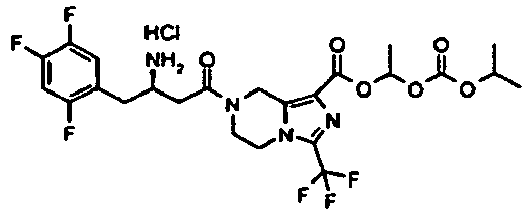

- (R)-7-[3-tert-Butoxycarbonylamino-4-(2,4,5-trifluoro-phenyl)-butyryl]-3-trifluoromethyl-5,6,7,8-tetrahydro-imidazo[1,5-a]pyrazine-1-carboxylic acid 2a (0.275 g, 0.5 mmol) and 4 mL of N,N-dimethylformamide were added into the reaction tube. After stirring until 2a was dissolved, 1-chloroethyl isopropyl carbonate (0.1 g, 0.6 mmol), potassium iodide (0.0415 g, 0.25 mmol) and potassium carbonate(0.083 g, 0.6 mmol) were then added to the solution successively. Upon completion of the addition, the reaction tube was sealed up. The reaction mixture was reacted at 65 °C for 2 hours in an oil bath and monitored by thin layer chromatography until the disappearance of the starting materials, and then the oil bath was removed. After cooling to room temperature, 40 mL of water was added to the reacton tube. The reaction mixture was extracted with ethyl acetate (25 mL×3). Thin layer chromatography showed there was no product in the aqueous phase, and the organic phase was collected, then washed with water (20 mL×2), then the combined organic phase was dried over anhydrous magnesium sulfate, filtered and concentrated under reduced pressure. The resulting residue was purified by silica gel column chromatography to obtain the title compound (R)-7-[3-tert-butoxycarbonylamino -4-(2,4,5-trifluoro-phenyl)-butyryl]-3-trifluoromethyl-5,6,7,8-tetrahydro-imidazo [1,5-a]pyrazine-1-carboxylic acid 1-isopropoxycarbonyloxy-ethyl ester 37a (0.29 g, yield 85.3%) as a yellow solid.
MS m/z (ESI): 698.0(M+18).
1H NMR (400 MHz, CDCl3): δ7.12 (m, 1H), 7.05 (m, 1H), 6.92 (m, 1H), 5.38 (d, 1H), 5.15 (d, 1H), 5.01 (s, 1H), 4.94 (m, 1H), 4.23-3.94 (m, 5H), 2.98 (m, 2H), 2.70 (m, 1H), 1.70 (d, 2H), 1.62 (s, 1H), 1.40 (s, 9H). - (R)-7-[3-tert-Butoxycarbonylamino-4-(2,4,5-trifluoro-phenyl)-butyryl]-3-trifluoromethyl-5,6,7,8-tetrahydro-imidazo[1,5-a]pyrazine-1-carboxylic acid 1-isopropoxycarbonyloxy-ethyl ester 37a (0.29 g, 0.43 mmol) and 5 mL of ethyl acetate were added into the reaction flask. A solution of 6.5 N hydrochloric acid in 3 mL of ethyl acetate was then added to the flask. The reaction mixture was stirred at room temperature for 4 hours and monitored by thin layer chromatography until the disappearance of the starting materials. The reaction mixture was concentrated under reduced pressure. The resulting residue was purified by silica gel column chromatography to obtain the title compound (R)-7-[3-amino-4-(2,4,5-trifluoro-phenyl)-butyryl]-3-trifluoromethyl-5,6,7,8-tetrahydro-imidazo[1,5-a]pyrazine-1-carboxylic acid 1-isopropoxycarbonyloxy-ethyl ester hydrochloride 37 (0.24 g, yield 91.2%) as a white solid.
MS m/z (ESI): 581.1 [M+1].
1H NMR (400 MHz, CD3OD): δ7.38 (m, 1H), 7.25 (m, 1H), 6.96 (m, 1H), 5.10 (m, 2H), 4.88 (m, 1H), 4.33 (m, 2H), 4.11 (m, 2H), 3.95 (m, 2H), 3.05 (m, 2H), 3.00 (m, 1H), 2.85 (m, 1H), 2.03 (m, 3H), 1.64 (m, 3H). -
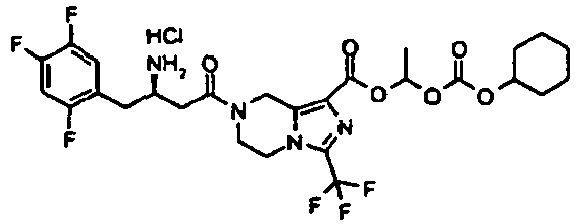

- (R)-7-[3-tert-Butoxycarbonylamino-4-(2,4,5-trifluoro-phenyl)-butyryl]-3-trifluoromethyl-5,6,7,8-tetrahydro-imidazo[1,5-a]pyrazine-1-carboxylic acid 2a (0.275 g, 0.5 mmol) and 4 mL of N,N-dimethylformamide were added to the reaction tube. After stirring until 2a was dissolved, 1-chloroethyl cyclohexyl carbonate (0.124 g, 0.6 mmol), potassium iodide (0.0415 g, 0.25 mmol) and potassium carbonate (0.083 g, 0.6 mmol) were then added to the solution successively. Upon completion of the addition, the reaction tube was sealed up. The reaction mixture was reacted at 65 °C in an oil bath for 2 hours and monitored by thin layer chromatography until the disappearance of the starting materials, and then the oil bath was removed. After cooling to room temperature, 40 mL of water was added to the reaction tube. The reaction mixture was extracted with ethyl acetate (30 mL×3). The combined organic phase was washed with 30 mL of water and 30 mL of saturated brine successively. The combimed organic phase was dried over anhydrous magnesium sulfate, filtered and concentrated under reduced pressure. The resulting residue was purified by silica gel column chromatography to obtain the title compound (R)-7-[3-tert-butoxycarbonylamino-4-(2,4,5-trifluoro-phenyl)-butyryl]-3-trifluoromethyl-5,6,7, 8-tetrahydro-imidazo[1,5-a]pyrazine-1-carboxylic acid (1-cyclohexyloxycarbonyloxy)-ethyl ester 38a (0.25 g, yield 69.4%) as a white solid.
MS m/z (ESI): 721.0 [M+1]. - (R)-7-[3- tert-butoxycarbonylamino-4-(2,4,5-trifluoro-phenyl)-butyryl]-3-trifluoromethyl-5,6,7,8-tetrahydro-imidazo[1,5-a]pyrazine-1-carboxylic acid (1-cyclohexyloxycarbonyloxy)-ethyl ester 38a (0.25 g, 0.347 mmol) and 5 mL of ethyl acetate were added into the reaction flask. A solution of 6.5 N hydrochloric acid in 3 mL of ethyl acetate was added to the flask under stirring. The reaction mixture was stirred at room temperature overnight and monitored by thin layer chromatography until the disappearance of the starting materials. The reaction mixture was concentrated under reduced pressure. The resulting residue was purified by silica gel column chromatography to obtain the title compound (R)-7-[3-amino-4-(2,4,5-trifluoro-phenyl)-butyryl]-3-trifluoromethyl-5,6,7,8-tetrahydro-imidazo[1,5-a]pyrazine-1-carboxylic acid (1-cyclohexyloxycarbonyloxy)-ethyl ester hydrochloride 38 (0.22g, yield 96.1%) as a white solid.
MS m/z (ESI): 621.1 [M+1].
1H NMR (400 MHz, CD3OD): δ7.30 (m, 1H), 7.16 (m, 1H), 6.95 (m, 1H), 5.10 (m, 1H), 4.64 (m, 1H), 4.29 (d, 2H), 4.02 (d, 2H), 3.61 (s, 1H), 2.87 (d, 2H), 2.70 (s, 1H), 2.65 (m, 1H), 1.93 (s, 3H), 1.74 (s, 2H), 1.64 (m, 3H), 1.47 (m, 3H), 1.31 (m, 3H). -


- 3-Trifluoromethyl-5,6-dihydro-8H-imidazo[1,5-a]pyrazine-1,7-dicarboxylic acid 7-tert-butyl ester 27d (0.85 g, 2.54 mmol) was dissolved in a mixture of 25 mL of anhydrous toluene and 8 mL of anhydrous tetrahydrofuran. The reaction flask was placed in a dry ice-acetone bath and cooled to -78 °C, and then tetramethylethylenediamine (1.32 mL, 8087 mmol) was added to the flask n-Butyllithium (5.55 mL, 8.87 mmol) was added dropwise in 5 minutes. After reacting at -78 °C for 15 minutes, iodomethane (0.4 mL, 6.34 mmol) was added dropwise. The reaction mixture was reacted at -78 °C for 10 minutes, then was allowed to warm up to room temperature and reacted for 2 hours until thin lay chromatography showed the starting material disappeared. 15 mL of saturated ammonium chloride and 20 mL of water were added to the reaction mixture successively. The mixture was adjusted to pH 3-4 with 2 N hydrochloric acid, and extracted with ethyl acetate (30 mL×3). The combined organic phase was dried over anhydrous sodium sulfate, filtered and concentrated under reduced pressure. The resulting residue was purified by silica gel column chromatography to obtain the title compound 8-methyl-3-trifluoromethyl-5,6-dihydro-8H-imidazo[1,5-a]pyrazine-1,7-dicarboxylic acid 7-tert-butyl ester 39a (0.215 g, yield 24.3%) as a white solid.
- 8-Methyl-3-trifluoromethyl-5,6-dihydro-8H-imidazo[1,5-a]pyrazine-1,7-dicarboxylic acid 7-tert-butyl ester 39a (0.349g, 1mmol) was dissolved in 15 mL of N,N-dimethylformamide, and sodium bicarbonate (0.84 g, 10 mmol) was added to the solution under stirring. Iodomethane (0.43 g, 3 mmol) was added dropwise. The reaction mixture was stirred at room temperature for 40 hours and monitored by thin layer chromatography until the disappearance of the starting materials. The reaction mixture was concentrated under reduced pressure. The resulting residue was purified by silica gel column chromatography to obtain the title compound 8-methyl-3-trifluoromethyl-5,6-dihydro-8H-imidazo[1,5-a]pyrazine-1,7-dicarboxylic acid 7-tert-butyl ester 1-methyl ester 39b (0.5 g, yield 100%) as a yellow oil.
MS m/z (ESI): 364.0 [M+1].
1H NMR (400 MHz, CDCl3): δ 5.85 (t, 1H), 4.24 (t, 2H), 4.04 (t, 2H), 3.93 (s, 3H), 1.56 (d, 3H), 1.51 (s, 9H). - 8-Methyl-3-trifluoromethyl-5,6-dihydro-8H-imidazo[1,5-a]pyrazine-1,7-dicarboxylic acid 7-tert-butyl ester 1-methyl ester 39b (0.35 g, 0.96 mmol) was added into the reaction flask. A solution of 2.3 N hydrochloric acid in 10 mL of ethyl acetate was then added to the flask. The reaction mixture was stirred at room temperature for 2 hours and monitored by thin layer chromatography until the disappearance of the starting materials. The reaction mixture was concentrated under reduced pressure to obtain the title compound 8-methyl-3-trifluoromethyl-5,6,7,8-tetrahydro-imidazo[1,5-a]pyrazine-1-carboxylic acid methyl ester hydrochloride 39c crude product (0.4 g) as a yellow oil.
1H NMR (400 MHz, CDCl3): δ 7.10 (m, 1H), 6.91 (m, 1H), 5.57 (m, 1H), 5.45 (m, 2H), 4.18 (m, 2H), 3.97 (s, 3H), 3.36 (t, 1H), 2.98 (m, 2H), 2.26 (m, 2H), 1.60 (d, 3H), 1.40 (s, 9H). - 8-Methyl-3-trifluoromethyl-5,6,7,8-tetrahydro-imidazo[1,5-a]pyrazine-1-carboxylic acid methyl ester hydrochloride 39c crude product (0.289 g, 0.96 mmol) and (R)-3-tert-butoxycarbonylamino-4-(2,4,5-trifluoro-phenyl)-butyric acid 1f (0.353 g, 1.06 mmol) were dissolved in 10 mL of dichloromethane, followed by addition of triethylamine (0.4 mL, 2.9 mmol) and bis(2-oxo-3-oxazolidinyl)phosphinic chloride (0.368 g, 1.45 mmol) under stirring. The reaction mixture was stirred at room temperature overnight and monitored by thin layer chromatography until the disappearance of the starting materials. The reaction mixture was concentrated under reduced pressure. The resulting residue was purified by silica gel column chromatography to obtain the title compound (R)-7-[3-tert-butoxycarbonylamino-4-(2,4,5-trifluoro-phenyl)-butyryl]-8-methyl-3-trifluoromethyl-5,6,7,8-tetrahydro-imidazo[1,5-a]pyrazine-1-carboxylic acid methyl ester 39d (0.43 g, yield 77.2%) as a yellow oil.
MS m/z (ESI): 579.1 [M+1]. - (R)-7-[3-tert-Butoxycarbonylamino-4-(2,4,5-trifluoro-phenyl)-butyryl]-8-methyl -3-trifluoromethyl-5,6,7,8-tetrahydro-imidazo[1,5-a]pyrazine-1-carboxylic acid methyl ester 39d (0.23 g, 0.4 mmol) was added into the reaction flask. A solution of 2.3 N hydrochloric acid in 5 mL of ethyl acetate was then added to the flask. The reaction mixture was stirred at room temperature for 2 hours and monitored by thin layer chromatography until the disappearance of the starting materials. The reaction mixture was concentrated under reduced pressure to obtain the title compound (R)-7-[3-amino-4-(2,4,5-trifluoro-phenyl)-butyryl]-8-methyl-3-trifluoromethyl-5,6,7,8 -tetrahydro-imidazo[1,5-a]pyrazine-1-carboxylic acid methyl ester hydrochloride 39 (0.205 g, yield 100%) as a white solid.
MS m/z (ESI): 479.1 [M+1].
1H NMR (400 MHz, CDCl3): δ 7.33 (m, 1H), 6.93 (m, 1H), 5.58 (m, 1H), 5.02 (m, 1H), 4.33 (m, 2H), 3.86 (s, 3H), 3.43 (t, 2H), 3.06 (m, 2H), 2.49 (m, 2H), 1.57 (d, 3H). -

- Chiral resolution of (R)-7-[3-amino-4-(2,4,5-trifluoro-phenyl)-butyryl]-8-methyl -3-trifluoromethyl-5,6,7,8-tetrahydro-imidazo[1,5-a]pyrazine-1-carboxylic acid methyl ester hydrochloride 39 (141 mg, 29.5 mmol) was performed by high performance liquid chromatography (HPLC). The enantiomers were separated by chiral column (separation condition: chiral column Chiralcel AD-H, mobile phase: n-hexane: isopropanol: diethylamine =70: 30: 0.1, flow rate: 1.0 mL/min). The corresponding compositions were collected, and the solvent was removed by rotary evaporator. The resulting residue was dried under vacuum at room temperature for 4 hours to obtain the title compound (R)-7-[3-amino-4-(2,4,5-trifluoro-phenyl)-butyryl]-(S)-8-methyl-3-trifluoromethyl-5,6 ,7,8-tetrahydro-imidazo[1,5-a]pyrazine-1-carboxylic acid methyl ester hydrochloride 40 (57 mg, 11.9 mmol) and (R)-7-[3-amino-4-(2,4,5-trifluoro-phenyl)-butyryl]-(R)-8-methyl-3-trifluoromethyl-5,6,7,8-tetrahydro-imidazo[1,5-a]pyrazine-1-carboxylic acid methyl ester hydrochloride 41 (50 mg, 10.5 mmol).
-


- (R)-7-[3-tert-Butoxycarbonylamino-4-(2,4,5-trifluoro-phenyl)-butyryl]-3-trifluoromethyl-5,6,7,8-tetrahydro-imidazo[1,5-a]pyrazine-1-carboxylic acid 2a (180 mg, 0.33 mmol) was dissolved in 10 mL of tetrahydrofuran, and ethylamine hydrochloride (269 mg, 3.3 mmol), bis(2-oxo-3-oxazolidinyl)phosphinic chloride(168 mg, 0.66 mmol) and triethylamine (367 mg, 3.63 mmol) were then added to the solution. The reaction mixture was stirred at room temperature for 4 hours until thin lay chromatography showed the starting material disappeared, and then filtered and concentrated under reduced pressure. The resulting residue was purified by silica gel column chromatography to obtain the title compound (R)-[3-(1-ethylcarbamoyl-3-trifluoromethyl-5,6-dihydro-8H-imidazo[1,5-a]pyrazin-7-yl)-3-oxo-1-(2,4,5-trifluoro-benzyl)-propyl]-carbamic acid tert-butyl ester 42a (190 mg, yield >100%) as a white solid.
MS m/z (ESI): 600.1 [M+23]. - (R)-[3-(1-Ethylcarbamoyl-3-trifluoromethyl-5,6-dihydro-8H-imidazo[1,5-a] pyrazin-7-yl)-3-oxo-1-(2,4,5-trifluoro-benzyl)-propyl]-carbamic acid tert-butyl ester 42a (190 mg, 0.33 mmol) was dissolved in 10 mL of dichloromethane, and trifluoroacetic acid (750 mg, 6.6 mmol) was added to the solution. The reaction mixture was stirred at room temperature for 2 hours and monitored by thin layer chromatography until the disappearance of the starting materials. The reaction mixture was concentrated under reduced pressure. The resulting residue was purified by silica gel column chromatography to obtain the title compound (R)-7-[3-amino-4-(2,4,5-trifluoro-phenyl)-butyryl]-3-trifluoromethyl-5,6,7,8-tetrahydro-imidazo[1,5-a]pyrazine-1-carboxylic acid ethylamide trifluoroacetate 42 (120 mg, yield 76.4%) as a white solid.
MS m/z (ESI): 478.1 [M+1].
1H NMR (400 MHz, CD3OD): δ 1.68-1.24 (m, 3H), 2.79-3.01 (m, 2H), 3.10 (s, 2H), 3.33-3.41 (m, 2H), 4.24-4.30 (d, 2H), 5.03-5.18 (m, 2H), 7.14-7.23 (m, 1H), 7.36-7.37 (d, 1H). -


- (R)-7-[3-tert-Butoxycarbonylamino-4-(2,4,5-trifluoro-phenyl)-butyryl]-3-trifluoromethyl-5,6,7,8-tetrahydro-imidazo[1,5-a]pyrazine-1-carboxylic acid 2a (180 mg, 0.33 mmol) was dissolved in 10 mL of dichloromethane, followed by addition of butylamine hydrochloride (193 mg, 2.64 mmol), bis(2-oxo-3-oxazolidinyl)phosphinic chloride(167 mg, 0.66 mmol) and triethylamine (100 mg, 0.99 mmol). The reaction mixture was stirred at room temperature overnight and monitored by thin layer chromatography until the disappearance of the starting materials. The reaction mixture was concentrated under reduced pressure. The resulting residue was purified by silica gel column chromatography to obtain the title compound (R)-[3-(1-butylcarbamoyl-3-trifluoromethyl-5,6-dihydro-8H-imidazo[1,5-a]pyrazin-7-yl)-3-oxo-1-(2,4,5-trifluoro-benzyl)-propyl]-carbamic acid tert-butyl ester 43a (120 mg, yield 60%) as a white solid.
MS m/z (ESI): 606.0 [M+1]. - (R)-[3-(1-Butylcarbamoyl-3-trifluoromethyl-5,6-dihydro-8H-imidazo[1,5-a] pyrazin-7-yl)-3-oxo-1-(2,4,5-trifluoro-benzyl)-propyl]-carbamic acid tert-butyl ester 43a (120 mg, 0.198 mmol) was dissolved in 10 mL of dichloromethane, and trifluoroacetic acid (452 mg, 3.97 mmol) was then added to the solution. The reaction mixture was stirred at room temperature for 2 hours and monitored by thin layer chromatography until the disappearance of the starting materials. The reaction mixture was concentrated under reduced pressure. The resulting residue was purified by silica gel column chromatography to obtain the title compound (R)-7-[3-amino-4-(2,4,5-trifluoro-phenyl)-butyryl]-3-trifluoromethyl-5,6,7,8-tetrahydro-imidazo[1,5-a]pyrazine-1-carboxylic acid butylamide trifluoroacetate 43 (70 mg, yield 70%) as a white solid.
MS m/z (ESI): 506.1 [M+1].
1H NMR (400 MHz, CD3OD): δ 0.93-0.99 (m, 3H), 1.34-1.41 (m, 2H), 1.59-1.62 (m, 2H), 2.80-2.98 (m, 3H), 3.07-3.15 (m, 2H), 3.37 (m, 1H), 3.90-3.91 (d, 2H), 4.06-4.07 (m, 1H), 4.27-4.34 (m, 2H), 5.03-5.15 (m, 2H), 7.20-7.37 (m, 2H). -


- (R)-7-[3-tert-Butoxycarbonylamino-4-(2,4,5-trifluoro-phenyl)-butyryl]-3-trifluoromethyl-5,6,7,8-tetrahydro-imidazo[1,5-a]pyrazine-1-carboxylic acid 2a (190 mg, 0.345 mmol) was dissolved in 10 mL of dichloromethane, and propylamine (163 mg, 2.76 mmol), bis(2-oxo-3-oxazolidinyl)phosphinic chloride (176 mg, 0.69 mmol) and triethylamine (105 mg, 1.04 mmol) were then added to the solution. The reaction mixture was stirred at room temperature overnight and monitored by thin layer chromatography until the disappearance of the starting materials. The reaction mixture was concentrated under reduced pressure. The resulting residue was purified by silica gel column chromatography to obtain the title compound (R)-[3-(1-propylcarbamoyl-3-trifluoromethyl-5,6-dihydro-8H-imidazo[1,5-a]pyrazin-7-yl)-3-oxo-1-(2,4,5-trifluoro-benzyl)-propyl]-carbamic acid tert-butyl ester 44a (70 mg, yield 34.3%) as a white solid.
MS m/z (ESI): 614.1 [M+23]. - (R)-[3-(1-Propylcarbamoyl-3-trifluoromethyl-5,6-dihydro-8H-imidazo [1,5-a]pyrazin-7-yl)-3-oxo-1-(2,4,5-trifluoro-benzyl)-propyl]-carbamic acid tert-butyl ester 44a (70 mg, 0.118 mmol) was dissolved in 10 mL of dichloromethane, and trifluoroacetic acid (270 mg, 2.37 mmol) was then added to the solution. The reaction mixture was stirred at room temperature for 1 hour and monitored by thin layer chromatography until the disappearance of the starting materials. The reaction mixture was concentrated under reduced pressure. The resulting residue was purified by silica gel column chromatography to obtain the title compound (R)-7-[3-amino-4-(2,4,5-trifluoro-phenyl)-butyryl]-3-trifluoromethyl-5,6,7,8-tetrahydro-imidazo[1,5-a]pyrazine-1-carboxylic acid propylamide trifluoroacetate 44 (25 mg, yield 43.1%) as a white solid.
MS m/z (ESI): 492.1 [M+1].
H NMR (400 MHz, CD3OD): δ 0.90-1.00 (m, 3H), 1.60-1.66 (m, 2H), 2.75-2.84 (m, 1H), 2.93-2.99 (m, 1H), 3.09 (s, 2H), 3.94-3.95 (d, 2H), 4.07 (m, 1H), 4.24-4.29 (m, 2H), 5.03-5.13 (m, 2H), 7.19-7.23 (t, 1H), 7.36-7.38 (d, 1H). - The compounds of the present invention were tested to determine the DPP-IV inhibitory activity according to the following methods. Inhibitory rate or the half maximal inhibitory concentrations IC50 (the concentration of the test compound showing 50% inhibition of the enzyme activity) of each compound was determined by incubating fixed amounts of enzyme mixed substrate with several different concentrations of the test compounds.
-
- a. 96-well white plate (BMG);
- b. Tris buffer: in order to prepare 100ml 2mM Tris Buffer, 0.0242 g Tris was dissolved in about 90 mL of distilled H2O firstly. Hydrochloric acid and sodium hydroxide were used to adjust the pH value to 8.00 and the solution was then diluted with dH2O to 100 mL in total volume;
- c. DPP-IV enzyme (CalBiochem Catalog no.317630), dissolved in Tris buffer to 2 mM;
- d. DPP-IV-Glo™ Subtrate (Promega Catalog no.G8350), dissolved in dH2O to 1mM;
- e. DPP-IV-Glo™ Buffer (Promega Catalog no. G8350);
- f. Luciferin Detection Reagent (Promega Catalog no. G8350);
- g. DMSO;
- h. dH2O
- The assay was carried out in the order of the following steps of:
- 1. DPP-IV-Glo. was thawed and equilibrated to room temperature before it was used.
- 2. The freezing luciferin detection reagent was equilibrated to room temperature before it was used.
- 3. DPP-IV-Glo. was mixed with ultrapure water by mixing briefly to form 1 mM substrate.
- 4. The luciferin detection reagent was placed in a brown flask with addition of DPP-IV-Glo., wherein the luciferin detection reagent should be dissolved in less than one minute.
- 5. The test compounds were dissolved in DMSO to 50 fold of the final concentration.
- 6. 2 µL of the test compound with a 50 fold concentration was added to each tube, and 2 µL of DMSO was added to negative control and blank control.
- 7. 46 µL of Tris buffer was added to each tube and 48 µL of Tris buffer was added in blank control.
- 8. 2 µL of DPP-IV enzyme was added to each negative control tube and test tube.
- 9. The test tubes were shaked and centriguged, and then the substances of the test tube were transferred to 96-well plates.
- 10. The substrate and DPP-IV-Glo. were mixed in a ration of 1: 49, and the mixture was shaked throughfully and incubated at room temperature for 30-60 minutes before it was used.
- 11. The 96-well plate was sealed by sealing film after 50 µL of the mixted solution of DPP-IV-Glo. and substrate were added to each well.
- 12. The substances of the 96 wells were mixing slowly by using a plate shaker at 300-500 rpm/30s, and then the plate was incubated at room temperature from 30 minutes to 3 hours.
- 13. The luminescence value was measured.
The definition of inhibitory rate: [1-(S-B)/(N-B)]*100%- S: sample
- B: blank control
- N: negative control
- After testing, the half maximal inhibitory concentration IC50 value of the compounds of the present invention against DPP-IV ranged from 0.005 µM to 0.216 µM. Compared with IC50 value of MK-0431 (0.023 µM), a majority of compounds of the present invention exhibited excellent inhibitory activity against DPP-IV.
| Example No. | IC50(µM) |
| MK-0431 | 0.023 |
| 1 | 0.012 |
| 2 | 0.008 |
| 3 | 0.089 |
| 4 | 0.022 |
| 5 | 0.027 |
| 6 | 0.031 |
| 7 | 0.025 |
| 8 | 0.008 |
| 9 | 0.075 |
| 10 | 0.021 |
| 11 | 0.216 |
| 12 | 0.059 |
| 13 | 0.041 |
| 14 | 0.047 |
| 15 | 0.025 |
| 23 | 0.031 |
| 34 | 0.031 |
| 36 | 0.221 |
| 37 | 0.033 |
| 38 | 0.184 |
| 39 | 0.016 |
| 40 | 0.314 |
| 41 | 0.005 |
| 42 | 0.018 |
| 43 | 0.063 |
| 44 | 0.052 |
Claims (20)
- A compound having Formula (I) or a pharmaceutically acceptable salt thereof:
 Ar is phenyl, wherein the phenyl is unsubstituted or further substituted with 1 to 5 substituents selected from the group consisting of halogen, cyano, hydroxyl, alkyl or alkoxyl, wherein the alkyl or alkoxyl is each unsubstituted or substituted with one or more halogens;R1 is selected from the group consisting of hydrogen, alkyl, trifluoromethyl, cycloalkyl, aryl and heteroaryl, wherein the alkyl, cycloalkyl, aryl or heteroaryl is each optionally substituted with one or more groups selected from the group consisting of halogen, cyano, aryl, hydroxyl and amino;R2 is selected from the group consisting of hydroxyl, amino, alkyl, alkoxyl, cycloalkyl, heterocyclic alkyl, aryl, heteroaryl and -NR4R5, wherein the alkyl, alkoxyl, cycloalkyl, heterocyclic alkyl, aryl or heteroaryl is each optionally substituted with one or more groups selected from the group consisting of halogen, amino, cyano, hydroxyl, alkyl, cycloalkyl, alkoxyl, aryl, heteroaryl, -NR4R5, -OC(O)OR8, carboxylic acid and carboxylic ester;R3 is selected from the group consisting of hydrogen and alkyl;R4 and R5 are each independently selected from the group consisting of hydrogen, alkyl, cycloalkyl, heterocyclic alkyl, aryl and heteroaryl, wherein the alkyl, cycloalkyl, heterocyclic alkyl, aryl or heteroaryl is each optionally substituted with one or more groups selected from the group consisting of halogen, hydroxyl, amino, alkoxyl, alkyl, cyano, aryl, cycloalkyl, heterocyclic alkyl, heterocyclic aryl, hydroxyalkyl, -SO2R7, -NR4R5, carboxylic acid and carboxylic ester;or, R4 and R5 are taken together with the attached atom to form a 4 to 8 membered heterocycle, wherein the 4 to 8 membered heterocycle contains one or more N, O, S atoms, and the 4 to 8 membered heterocycle each optionally substituted with one or more groups selected from the group consisting of halogen, hydroxyl, amino, alkoxyl, alkyl, cyano, aryl, heterocyclic alkyl, heteroaryl, carbonyl, hydroxyalkyl, -SO2R7, -NR4R5, -C(O)NR4R5, -C(O)R7, =O, carboxylic acid and carboxylic ester;R7 is alkyl; andR8 is selected from the group consisting of alkyl and cycloalkyl.
 - A compound or pharmaceutically acceptable salt thereof of claim 1, whereinR1 is trifluoromethyl.
- A compound or pharmaceutically acceptable salt thereof of claim 1 selected from the group consisting of:
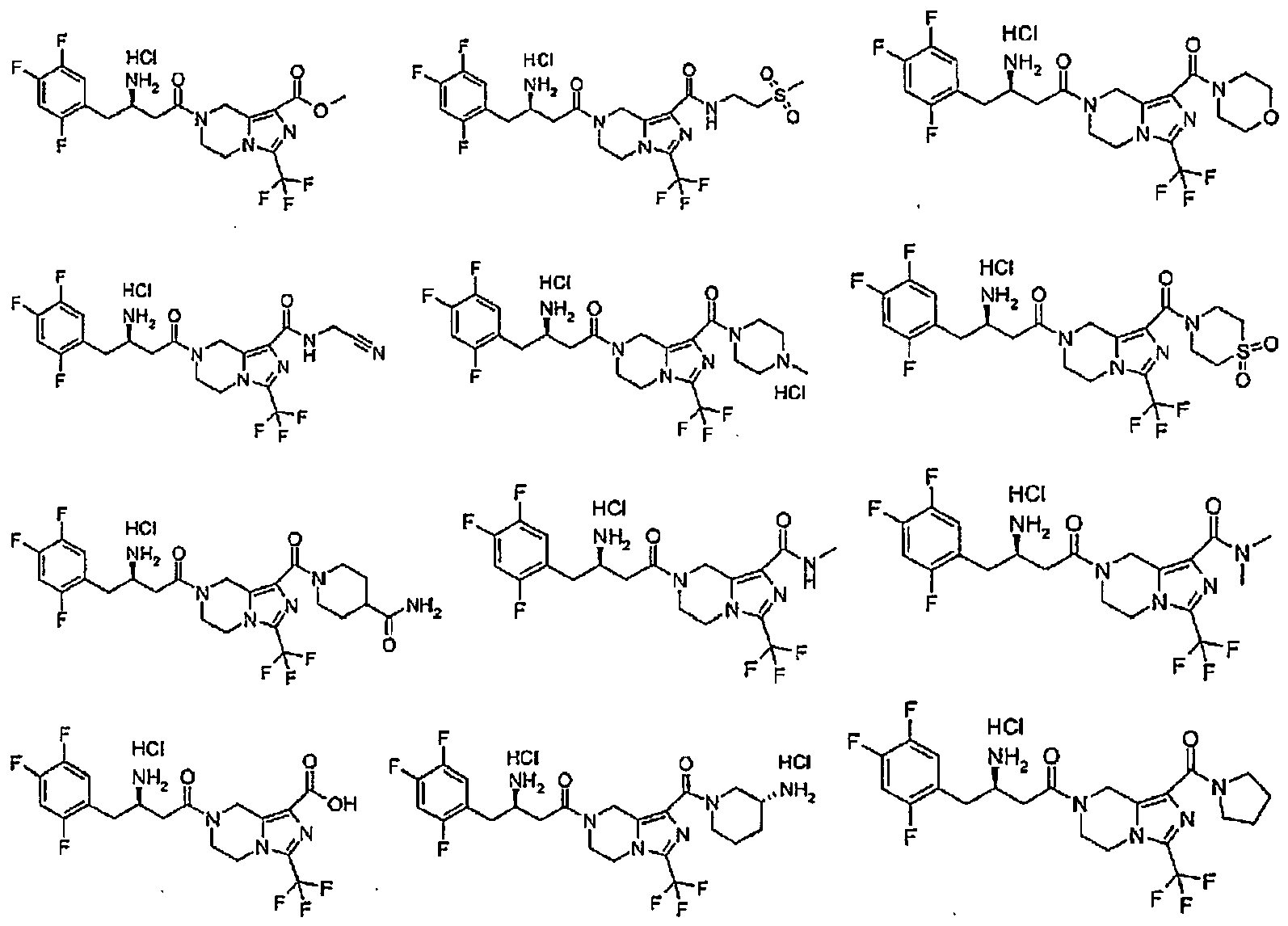


- A compound or pharmaceutically acceptable salt thereof of claim 1, wherein the salt is one formed with a compound of claim 1 and an acid selected from the group consisting of malic acid, lactic acid, maleic acid, hydrochloric acid, methanesulfonic acid, sulfuric acid, phosphoric acid, citric acid, tartaric acid, acetic acid and trifluoroacetic acid.
- A compound or pharmaceutically acceptable salt thereof of claim 4, wherein the salt is hydrochloride.
- A compound having formula (IA) as an intermediate in the synthesis of a compound having formula (I) of claim 1:
 Ar is phenyl, wherein the phenyl is unsubstituted or further substituted with 1 to 5 substituents independently selected from the group consisting of halogen, cyano, hydroxyl, alkyl or alkoxyl, wherein the alkyl or alkoxyl is each independently unsubstituted or substituted with one or more halogens;R1 is selected from the group consisting of hydrogen, alkyl, trifluoromethyl, cycloalkyl, aryl and heteroaryl, wherein the alkyl, cycloalkyl, aryl or heteroaryl is each optionally substituted with one or more groups selected from the group consisting of halogen, cyano, aryl, hydroxyl and amino;R3 is selected from the group consisting of hydrogen and alkyl; andX is halogen.
 - A compound or pharmaceutically acceptable salt thereof of claim 6, wherein R1 is trifluoromethyl.
- A compound having formula (IB) as an intermediate in the synthesis of a compound having formula (I) of claim 1:
 R1 is selected from the group consisting of hydrogen, alkyl, trifluoromethyl, cycloalkyl and heteroaryl, wherein the alkyl, cycloalkyl or heteroaryl is each optionally substituted with one or more groups selected from the group consisting of halogen, cyano, aryl, hydroxyl and amino;R2 is selected from the group consisting of hydroxyl, amino, alkyl, alkoxyl, cycloalkyl, heterocyclic alkyl, aryl, heteroaryl and -NR4R5, wherein the alkyl, alkoxyl, cycloalkyl, heterocyclic alkyl, aryl or heteroaryl is each optionally substituted with one or more groups selected from the group consisting of halogen, amino, cyano, hydroxyl, alkyl, cycloalkyl, alkoxyl, aryl, heteroaryl, -NR4R5, -OC(O)OR8, carboxylic acid and carboxylic ester;R3 is selected from the group consisting of hydrogen and alkyl;R4 and R5 are each independently selected from the group consisting of hydrogen, alkyl, cycloalkyl, heterocyclic alkyl, aryl and heteroaryl, wherein the alkyl, cycloalkyl, heterocyclic alkyl, aryl or heteroaryl is each optionally substituted with one or more groups selected from the group consisting of halogen, hydroxyl, amino, alkoxyl, alkyl, cyano, aryl, cycloalkyl, heterocyclic alkyl, heteroaryl, hydroxyalkyl, -SO2R7, -NR4R5, carboxylic acid and carboxylic ester;or, R4 and R5 are taken together with the attached atom to form a 4 to 8 membered heterocycle, wherein the 4 to 8 membered heterocycle contains one or more N, O, S atoms, and the 4 to 8 membered heterocycle is optionally substituted with one or more groups selected from the group consisting of halogen, hydroxyl, amino, alkoxyl, alkyl, cyano, aryl, heterocyclic alkyl, heteroaryl, carbonyl, hydroxyalkyl, -SO2R7, -NR4R5, -C(O)NR4R5, -C(O)R7, carboxylic acid and carboxylic ester;R7 is alkyl;andR8 is selected from the group consisting of alkyl and cycloalkyl.
 - A compound or pharmaceutically acceptable salt thereof of claim 8, wherein R1 is trifluoromethyl.
- A preparation process for a compound having formula (IA) of claim 6, comprising the following steps of:


- A preparation process for a compound having formula (IB) of claim 8, comprising the following steps of:

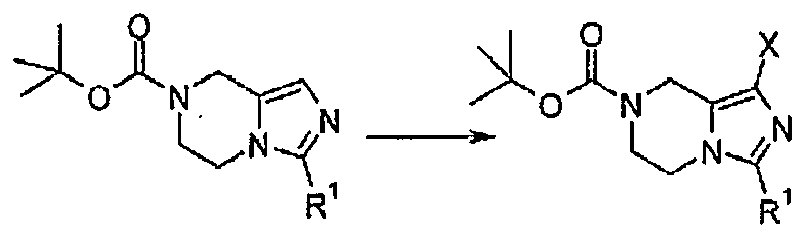

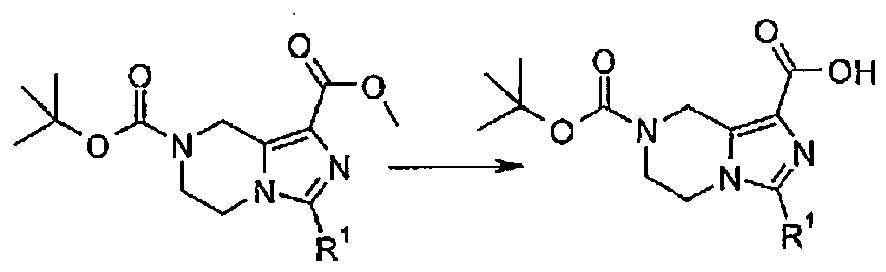


- A preparation process for a compound having formula (I) of claim 1, comprising the following steps of:


- A preparation process for a compound having formula (I) of claim 1, comprising the following steps of:

- The preparation process of claim 12 or 13, wherein the preparation process also comprises the step of reacting the resulting compounds having formula (I) with an acid to obtain the acid addition salt, wherein the acid is selected from the group consisting of malic acid, lactic acid, maleic acid, hydrochloric acid, methane sulfonic acid, sulphuric acid, phosphonic acid, citric acid, tartaric acid, acetic acid and trifluoroacetic acid
- The preparation process of claim 14, wherein the acid is hydrochloric acid.
- A pharmaceutical composition comprising a compound or salt thereof in an effective therapeutic dose of any one of claims 1 to 5 as well as a pharmaceutically acceptable carrier or excipient.
- A compound or pharmaceutically acceptable salt thereof of any one of claims 1 to 5, or the pharmaceutical composition of claim 16, for use in medicine.
- A use of a compound or pharmaceutically acceptable salt thereof of any one of claims 1 to 5, or the pharmaceutical composition of claim 16, in the preparation of a medicament for the treatment of type 2 diabetes, hyperglycemia, obesity or insulin resistance.
- A compound or pharmaceutically acceptable salt thereof of any one of claims 1 to 5, or the pharmaceutical composition of claim 16 for use in the treatment of type 2 diabetes, hyperglycemia, obesity or insulin resistance.
- A method of inhibiting the catalytic activity of dipeptidyl peptidase IVin vitro, characterized in that the dipeptidyl peptidase IV is contacted with a compound or pharmaceutically acceptable salt thereof of any one of claims 1 to 5.
Applications Claiming Priority (2)
| Application Number | Priority Date | Filing Date | Title |
|---|---|---|---|
| CNA2007103023359A CN101468988A (en) | 2007-12-26 | 2007-12-26 | Piperazine derivative, preparation thereof and use thereof in medicine |
| PCT/CN2008/001936 WO2009082881A1 (en) | 2007-12-26 | 2008-11-27 | Tetrahydro-imidazo[1,5-a]pyrazine derivatives, preparation methods and medical uses thereof |
Publications (3)
| Publication Number | Publication Date |
|---|---|
| EP2230241A1 EP2230241A1 (en) | 2010-09-22 |
| EP2230241A4 EP2230241A4 (en) | 2011-06-22 |
| EP2230241B1 true EP2230241B1 (en) | 2014-11-26 |
Family
ID=40823770
Family Applications (1)
| Application Number | Title | Priority Date | Filing Date |
|---|---|---|---|
| EP08868957.5A Not-in-force EP2230241B1 (en) | 2007-12-26 | 2008-11-27 | Tetrahydro-imidazo[1,5-a]pyrazine derivatives, preparation methods and medical uses thereof |
Country Status (15)
| Country | Link |
|---|---|
| US (2) | US8207161B2 (en) |
| EP (1) | EP2230241B1 (en) |
| JP (1) | JP5481008B2 (en) |
| KR (1) | KR101685103B1 (en) |
| CN (2) | CN101468988A (en) |
| AU (1) | AU2008342461B2 (en) |
| BR (1) | BRPI0821440A2 (en) |
| CA (1) | CA2706735C (en) |
| ES (1) | ES2529435T3 (en) |
| MX (1) | MX2010006438A (en) |
| PT (1) | PT2230241E (en) |
| RU (1) | RU2483070C2 (en) |
| UA (1) | UA101002C2 (en) |
| WO (1) | WO2009082881A1 (en) |
| ZA (1) | ZA201004154B (en) |
Families Citing this family (42)
| Publication number | Priority date | Publication date | Assignee | Title |
|---|---|---|---|---|
| ES2439255T3 (en) * | 2007-06-21 | 2014-01-22 | Cara Therapeutics, Inc. | Imidazoheterocycles substituted |
| CN101824036A (en) * | 2009-03-05 | 2010-09-08 | 上海恒瑞医药有限公司 | Salt of tetrahydroimidazo [1,5-a] pyrazine derivative, preparation method and pharmaceutical application thereof |
| CN101899048B (en) * | 2009-05-27 | 2013-04-17 | 上海恒瑞医药有限公司 | Salt of (R)-7-[3-amino-4-(2,4,5-trifluoro-phenyl)-butyryl]-3-trifluoromethyl-5,6,7,8-tetrahydro-imidazo[1,5-a]pyrazine-1- carboxylic acid methyl ester |
| CN101961336B (en) * | 2009-07-21 | 2012-05-30 | 江苏恒瑞医药股份有限公司 | Pharmaceutical composition for treating type 2 diabetes in mammals including human |
| WO2011107494A1 (en) | 2010-03-03 | 2011-09-09 | Sanofi | Novel aromatic glycoside derivatives, medicaments containing said compounds, and the use thereof |
| BRPI1015469A2 (en) * | 2010-03-08 | 2016-04-26 | Jiangsu Hengrui Medicine Co | pharmaceutical composition for treating type 2 diabetes |
| CN102199102B (en) * | 2010-03-25 | 2014-04-02 | 浙江九洲药业股份有限公司 | Sitagliptin intermediate and preparation method and application thereof |
| CN102471294B (en) * | 2010-04-12 | 2013-11-20 | 上海源力生物技术有限公司 | Chiral cyclic β-aminoaryl butyric acid derivatives, process for their preparation and process for preparing chiral β-aminoaryl butyric acid derivatives therewith |
| US8530413B2 (en) | 2010-06-21 | 2013-09-10 | Sanofi | Heterocyclically substituted methoxyphenyl derivatives with an oxo group, processes for preparation thereof and use thereof as medicaments |
| TW201215388A (en) | 2010-07-05 | 2012-04-16 | Sanofi Sa | (2-aryloxyacetylamino)phenylpropionic acid derivatives, processes for preparation thereof and use thereof as medicaments |
| TW201221505A (en) | 2010-07-05 | 2012-06-01 | Sanofi Sa | Aryloxyalkylene-substituted hydroxyphenylhexynoic acids, process for preparation thereof and use thereof as a medicament |
| TW201215387A (en) | 2010-07-05 | 2012-04-16 | Sanofi Aventis | Spirocyclically substituted 1,3-propane dioxide derivatives, processes for preparation thereof and use thereof as a medicament |
| CN102372716A (en) | 2010-08-09 | 2012-03-14 | 江苏恒瑞医药股份有限公司 | Phthalazone derivative, its preparation method and application in medicine thereof |
| TWI462925B (en) * | 2010-09-27 | 2014-12-01 | Jiangsu Hengrui Medicine Co | Pharmaceutical composition for the treatment of type 2 diabetes |
| WO2012088682A1 (en) * | 2010-12-29 | 2012-07-05 | Shanghai Fochon Pharmaceutical Co Ltd. | 2-(3-aminopiperidin-1-yl)-[1,2,4]triazolo[1,5-c]pyrimidine-5,7(3h,6h)-dione derivates as dipeptidyl peptidase iv(dpp-iv) inhibitors |
| TWI494313B (en) * | 2010-12-29 | 2015-08-01 | Jiangsu Hengrui Medicine Co | Pharmaceutical composition for the treatment of type 2 diabetes in mammals including human beings |
| EP2736909B1 (en) | 2011-07-27 | 2017-03-29 | Farma GRS, d.o.o. | Process for the preparation of sitagliptin and its pharmaceutically acceptable salts |
| WO2013037390A1 (en) | 2011-09-12 | 2013-03-21 | Sanofi | 6-(4-hydroxy-phenyl)-3-styryl-1h-pyrazolo[3,4-b]pyridine-4-carboxylic acid amide derivatives as kinase inhibitors |
| EP2760862B1 (en) | 2011-09-27 | 2015-10-21 | Sanofi | 6-(4-hydroxy-phenyl)-3-alkyl-1h-pyrazolo[3,4-b]pyridine-4-carboxylic acid amide derivatives as kinase inhibitors |
| CN103087067A (en) * | 2012-08-02 | 2013-05-08 | 盛世泰科生物医药技术(苏州)有限公司 | Compound serving as dipeptidyl enzyme inhibitor and composition thereof and applications of compound and composition |
| CN106892926B (en) * | 2012-10-16 | 2019-09-06 | 江苏盛迪医药有限公司 | A kind of intermediate of DPP-IV inhibitor, preparation method and the method that DPP-IV inhibitor is prepared by it |
| TWI500613B (en) | 2012-10-17 | 2015-09-21 | Cadila Healthcare Ltd | Novel heterocyclic compounds |
| EP2911655A1 (en) | 2012-10-24 | 2015-09-02 | INSERM (Institut National de la Santé et de la Recherche Médicale) | Tpl2 kinase inhibitors for preventing or treating diabetes and for promoting -cell survival |
| MX380546B (en) * | 2013-10-30 | 2025-03-12 | Shanghai hengrui pharmaceutical co ltd | PYRAZOLOPYRIMIDONE OR PYRROLOTRIAZONE DERIVATIVES, METHOD AND PREPARATION THEREOF AND PHARMACEUTICAL APPLICATIONS THEREOF. |
| CN103664962A (en) * | 2013-12-20 | 2014-03-26 | 南京华威医药科技开发有限公司 | Piperazine derivatives |
| US9718826B2 (en) * | 2013-12-23 | 2017-08-01 | Merck Patent Gmbh | Imidazopyrazinone derivatives |
| CN103910734B (en) * | 2014-03-28 | 2016-01-13 | 南京华威医药科技开发有限公司 | A kind of DPP-4 inhibitor with piperazine structure |
| US10426818B2 (en) | 2015-03-24 | 2019-10-01 | Inserm (Institut National De La Sante Et De La Recherche Medicale) | Method and pharmaceutical composition for use in the treatment of diabetes |
| KR101709127B1 (en) | 2015-06-16 | 2017-02-22 | 경동제약 주식회사 | Novel intermediates for preparing DPP-IV inhibitors, preparing method thereof and preparing method of DPP-IV inhibitors using the same |
| CN108658990B (en) * | 2017-03-31 | 2021-03-23 | 南京科技职业学院 | Novel imidazo [1,5-a ] pyrazine Bruton kinase inhibitors |
| CN111278827B (en) * | 2017-07-24 | 2022-12-23 | 艾科生物科技有限公司 | Mutant isocitrate dehydrogenase inhibitors, compositions and methods thereof |
| KR102815607B1 (en) * | 2018-03-29 | 2025-05-30 | 더 보드 오브 리젠츠 오브 더 유니버시티 오브 텍사스 시스템 | Imidazopiperazine inhibitor of transcription activating protein |
| US10899769B2 (en) | 2018-04-06 | 2021-01-26 | Board Of Regents, The University Of Texas System | Imidazopiperazinone inhibitors of transcription activating proteins |
| CN108383845B (en) * | 2018-04-26 | 2020-11-06 | 盛世泰科生物医药技术(苏州)有限公司 | Crystal form and amorphous form of Shengagliptin salt and its preparation method and use |
| CN113620957B (en) * | 2020-05-08 | 2022-04-19 | 盛世泰科生物医药技术(苏州)有限公司 | Preparation method of aminomethyl pyrazine compound |
| CN113773323B (en) * | 2020-06-10 | 2023-05-12 | 江苏恒瑞医药股份有限公司 | Preparation method of 3R-amino substituted butyramide derivative |
| JP7777131B2 (en) | 2020-10-02 | 2025-11-27 | ボード オブ レジェンツ,ザ ユニバーシティ オブ テキサス システム | Imidazopiperazine inhibitors of transcriptional activator proteins |
| CN116261454A (en) | 2020-10-02 | 2023-06-13 | 德州大学系统董事会 | imidazopiperazine inhibitors of transcriptional activators |
| CN114478536B (en) * | 2020-10-28 | 2024-12-13 | 上海森辉医药有限公司 | Preparation method of tetrahydropyrazine fused ring derivative |
| WO2022159955A1 (en) * | 2021-01-21 | 2022-07-28 | The Scripps Research Institute | Small molecule regulators of alveolar type 2 cell proliferation for the treatment of pulmonary diseases |
| WO2024015889A2 (en) * | 2022-07-14 | 2024-01-18 | The Scripps Research Institute | Small molecule regulators of alveolar type 2 cell proliferation for the treatment of pulmonary diseases |
| CN115583935A (en) * | 2022-11-03 | 2023-01-10 | 浙江工业大学 | Preparation method of 4- (2, 4, 5-trifluorophenyl) -3-oxybutyrate ester |
Family Cites Families (14)
| Publication number | Priority date | Publication date | Assignee | Title |
|---|---|---|---|---|
| US5462928A (en) * | 1990-04-14 | 1995-10-31 | New England Medical Center Hospitals, Inc. | Inhibitors of dipeptidyl-aminopeptidase type IV |
| IL111785A0 (en) | 1993-12-03 | 1995-01-24 | Ferring Bv | Dp-iv inhibitors and pharmaceutical compositions containing them |
| US5543396A (en) * | 1994-04-28 | 1996-08-06 | Georgia Tech Research Corp. | Proline phosphonate derivatives |
| TW492957B (en) | 1996-11-07 | 2002-07-01 | Novartis Ag | N-substituted 2-cyanopyrrolidnes |
| US6110949A (en) | 1999-06-24 | 2000-08-29 | Novartis Ag | N-(substituted glycyl)-4-cyanothiazolidines, pharmaceutical compositions containing them and their use in inhibiting dipeptidyl peptidase-IV |
| UA74912C2 (en) * | 2001-07-06 | 2006-02-15 | Merck & Co Inc | Beta-aminotetrahydroimidazo-(1,2-a)-pyrazines and tetratriazolo-(4,3-a)-pyrazines as inhibitors of dipeptylpeptidase for the treatment or prevention of diabetes |
| JP2005526811A (en) | 2002-03-25 | 2005-09-08 | メルク エンド カムパニー インコーポレーテッド | Β-amino heterocyclic dipeptidyl peptidase inhibitor for the treatment or prevention of diabetes |
| AU2003275404A1 (en) | 2002-10-07 | 2004-05-04 | Merck & Co., Inc. | Antidiabetic beta-amino heterocyclic dipeptidyl peptidase inhibitors |
| AU2003297219A1 (en) * | 2002-12-20 | 2004-07-22 | Merck & Co., Inc. | 3-amino-4-phenylbutanoic acid derivatives as dipeptidyl peptidase inhibitors for the treatment or prevention of diabetes |
| WO2004085661A2 (en) | 2003-03-24 | 2004-10-07 | Merck & Co., Inc | Process to chiral beta-amino acid derivatives |
| RU2009127842A (en) * | 2006-12-22 | 2011-01-27 | Актелион Фармасьютиклз Лтд (Ch) | Derivatives of 5,6,7,8-tetrahydroimidazo [1.5-a] pyrazine |
| ES2439255T3 (en) * | 2007-06-21 | 2014-01-22 | Cara Therapeutics, Inc. | Imidazoheterocycles substituted |
| CN101417999A (en) * | 2007-10-25 | 2009-04-29 | 上海恒瑞医药有限公司 | Piperazines derivates, preparation method thereof and application thereof in medicine |
| CN101524082A (en) * | 2009-04-28 | 2009-09-09 | 北京燕化永乐农药有限公司 | Pyraclostrobin and prochloraz pesticide mixture |
-
2007
- 2007-12-26 CN CNA2007103023359A patent/CN101468988A/en active Pending
-
2008
- 2008-11-27 CN CN2008800097616A patent/CN101641361B/en active Active
- 2008-11-27 KR KR1020107014988A patent/KR101685103B1/en not_active Expired - Fee Related
- 2008-11-27 JP JP2010539997A patent/JP5481008B2/en not_active Expired - Fee Related
- 2008-11-27 UA UAA201008000A patent/UA101002C2/en unknown
- 2008-11-27 US US12/743,795 patent/US8207161B2/en not_active Expired - Fee Related
- 2008-11-27 EP EP08868957.5A patent/EP2230241B1/en not_active Not-in-force
- 2008-11-27 WO PCT/CN2008/001936 patent/WO2009082881A1/en not_active Ceased
- 2008-11-27 ES ES08868957.5T patent/ES2529435T3/en active Active
- 2008-11-27 MX MX2010006438A patent/MX2010006438A/en active IP Right Grant
- 2008-11-27 BR BRPI0821440-9A patent/BRPI0821440A2/en not_active IP Right Cessation
- 2008-11-27 AU AU2008342461A patent/AU2008342461B2/en not_active Ceased
- 2008-11-27 PT PT88689575T patent/PT2230241E/en unknown
- 2008-11-27 RU RU2010125703/04A patent/RU2483070C2/en not_active IP Right Cessation
- 2008-11-27 CA CA2706735A patent/CA2706735C/en not_active Expired - Fee Related
-
2010
- 2010-06-10 ZA ZA2010/04154A patent/ZA201004154B/en unknown
-
2012
- 2012-05-03 US US13/463,532 patent/US8513411B2/en not_active Expired - Fee Related
Also Published As
| Publication number | Publication date |
|---|---|
| HK1134817A1 (en) | 2010-05-14 |
| EP2230241A4 (en) | 2011-06-22 |
| US8207161B2 (en) | 2012-06-26 |
| KR20110002003A (en) | 2011-01-06 |
| CN101641361B (en) | 2012-02-08 |
| AU2008342461A1 (en) | 2009-07-09 |
| EP2230241A1 (en) | 2010-09-22 |
| WO2009082881A1 (en) | 2009-07-09 |
| RU2483070C2 (en) | 2013-05-27 |
| US20120220766A1 (en) | 2012-08-30 |
| CN101468988A (en) | 2009-07-01 |
| JP5481008B2 (en) | 2014-04-23 |
| CA2706735C (en) | 2016-04-12 |
| BRPI0821440A2 (en) | 2015-06-16 |
| ZA201004154B (en) | 2011-08-31 |
| PT2230241E (en) | 2015-02-10 |
| JP2011508735A (en) | 2011-03-17 |
| MX2010006438A (en) | 2010-10-13 |
| UA101002C2 (en) | 2013-02-25 |
| RU2010125703A (en) | 2012-02-10 |
| AU2008342461B2 (en) | 2013-09-05 |
| US8513411B2 (en) | 2013-08-20 |
| ES2529435T3 (en) | 2015-02-20 |
| US20100273786A1 (en) | 2010-10-28 |
| CN101641361A (en) | 2010-02-03 |
| AU2008342461A2 (en) | 2010-09-09 |
| KR101685103B1 (en) | 2016-12-09 |
| CA2706735A1 (en) | 2009-07-09 |
Similar Documents
| Publication | Publication Date | Title |
|---|---|---|
| EP2230241B1 (en) | Tetrahydro-imidazo[1,5-a]pyrazine derivatives, preparation methods and medical uses thereof | |
| KR101731602B1 (en) | Tetrahydro-imidazo [1,5-A] pyrazine derivative salts, its preparation and use | |
| CN101641360A (en) | Piperazine derivatives, preparation method and medical application thereof | |
| JP2012519193A5 (en) | ||
| WO2021227641A1 (en) | METHOD FOR PREPARING CHIRAL 4-ARYL-β-AMINO ACID DERIVATIVE | |
| US20200354370A1 (en) | 6-Fluoro-2-Methylbenzo[d]thiazol-5-yl Compounds | |
| TWI439271B (en) | Tetrahydroimidazo [1,5-a] pyrazine derivatives, preparation process and pharmaceutical use thereof | |
| HK1134817B (en) | Tetrahydro-imidazo[1,5-a]pyrazine derivatives, preparation methods and medical uses thereof | |
| TWI522358B (en) | Tetrahydro-imidazo(1,5-a)pyrazine derivatives salts, preparation process and pharmaceutical use thereof | |
| HK1154574B (en) | Salts of tetrahydroimidazo [1,5-a] pyrazine derivatives, preparation methods and pharmaceutical use thereof |
Legal Events
| Date | Code | Title | Description |
|---|---|---|---|
| PUAI | Public reference made under article 153(3) epc to a published international application that has entered the european phase |
Free format text: ORIGINAL CODE: 0009012 |
|
| 17P | Request for examination filed |
Effective date: 20100702 |
|
| AK | Designated contracting states |
Kind code of ref document: A1 Designated state(s): AT BE BG CH CY CZ DE DK EE ES FI FR GB GR HR HU IE IS IT LI LT LU LV MC MT NL NO PL PT RO SE SI SK TR |
|
| AX | Request for extension of the european patent |
Extension state: AL BA MK RS |
|
| DAX | Request for extension of the european patent (deleted) | ||
| A4 | Supplementary search report drawn up and despatched |
Effective date: 20110519 |
|
| 17Q | First examination report despatched |
Effective date: 20130211 |
|
| GRAP | Despatch of communication of intention to grant a patent |
Free format text: ORIGINAL CODE: EPIDOSNIGR1 |
|
| INTG | Intention to grant announced |
Effective date: 20140612 |
|
| GRAS | Grant fee paid |
Free format text: ORIGINAL CODE: EPIDOSNIGR3 |
|
| GRAA | (expected) grant |
Free format text: ORIGINAL CODE: 0009210 |
|
| AK | Designated contracting states |
Kind code of ref document: B1 Designated state(s): AT BE BG CH CY CZ DE DK EE ES FI FR GB GR HR HU IE IS IT LI LT LU LV MC MT NL NO PL PT RO SE SI SK TR |
|
| REG | Reference to a national code |
Ref country code: GB Ref legal event code: FG4D |
|
| REG | Reference to a national code |
Ref country code: CH Ref legal event code: EP |
|
| REG | Reference to a national code |
Ref country code: AT Ref legal event code: REF Ref document number: 698116 Country of ref document: AT Kind code of ref document: T Effective date: 20141215 |
|
| REG | Reference to a national code |
Ref country code: IE Ref legal event code: FG4D |
|
| REG | Reference to a national code |
Ref country code: DE Ref legal event code: R096 Ref document number: 602008035614 Country of ref document: DE Effective date: 20150108 |
|
| REG | Reference to a national code |
Ref country code: PT Ref legal event code: SC4A Free format text: AVAILABILITY OF NATIONAL TRANSLATION Effective date: 20150203 |
|
| REG | Reference to a national code |
Ref country code: ES Ref legal event code: FG2A Ref document number: 2529435 Country of ref document: ES Kind code of ref document: T3 Effective date: 20150220 |
|
| REG | Reference to a national code |
Ref country code: CH Ref legal event code: NV Representative=s name: ISLER AND PEDRAZZINI AG, CH |
|
| REG | Reference to a national code |
Ref country code: NL Ref legal event code: T3 |
|
| REG | Reference to a national code |
Ref country code: SE Ref legal event code: TRGR |
|
| REG | Reference to a national code |
Ref country code: GR Ref legal event code: EP Ref document number: 20150400352 Country of ref document: GR Effective date: 20150318 |
|
| REG | Reference to a national code |
Ref country code: LT Ref legal event code: MG4D |
|
| PG25 | Lapsed in a contracting state [announced via postgrant information from national office to epo] |
Ref country code: IS Free format text: LAPSE BECAUSE OF FAILURE TO SUBMIT A TRANSLATION OF THE DESCRIPTION OR TO PAY THE FEE WITHIN THE PRESCRIBED TIME-LIMIT Effective date: 20150326 Ref country code: LT Free format text: LAPSE BECAUSE OF FAILURE TO SUBMIT A TRANSLATION OF THE DESCRIPTION OR TO PAY THE FEE WITHIN THE PRESCRIBED TIME-LIMIT Effective date: 20141126 Ref country code: FI Free format text: LAPSE BECAUSE OF FAILURE TO SUBMIT A TRANSLATION OF THE DESCRIPTION OR TO PAY THE FEE WITHIN THE PRESCRIBED TIME-LIMIT Effective date: 20141126 Ref country code: NO Free format text: LAPSE BECAUSE OF FAILURE TO SUBMIT A TRANSLATION OF THE DESCRIPTION OR TO PAY THE FEE WITHIN THE PRESCRIBED TIME-LIMIT Effective date: 20150226 |
|
| PG25 | Lapsed in a contracting state [announced via postgrant information from national office to epo] |
Ref country code: CY Free format text: LAPSE BECAUSE OF FAILURE TO SUBMIT A TRANSLATION OF THE DESCRIPTION OR TO PAY THE FEE WITHIN THE PRESCRIBED TIME-LIMIT Effective date: 20141126 Ref country code: LV Free format text: LAPSE BECAUSE OF FAILURE TO SUBMIT A TRANSLATION OF THE DESCRIPTION OR TO PAY THE FEE WITHIN THE PRESCRIBED TIME-LIMIT Effective date: 20141126 Ref country code: HR Free format text: LAPSE BECAUSE OF FAILURE TO SUBMIT A TRANSLATION OF THE DESCRIPTION OR TO PAY THE FEE WITHIN THE PRESCRIBED TIME-LIMIT Effective date: 20141126 |
|
| PG25 | Lapsed in a contracting state [announced via postgrant information from national office to epo] |
Ref country code: RO Free format text: LAPSE BECAUSE OF FAILURE TO SUBMIT A TRANSLATION OF THE DESCRIPTION OR TO PAY THE FEE WITHIN THE PRESCRIBED TIME-LIMIT Effective date: 20141126 Ref country code: SK Free format text: LAPSE BECAUSE OF FAILURE TO SUBMIT A TRANSLATION OF THE DESCRIPTION OR TO PAY THE FEE WITHIN THE PRESCRIBED TIME-LIMIT Effective date: 20141126 Ref country code: DK Free format text: LAPSE BECAUSE OF FAILURE TO SUBMIT A TRANSLATION OF THE DESCRIPTION OR TO PAY THE FEE WITHIN THE PRESCRIBED TIME-LIMIT Effective date: 20141126 Ref country code: EE Free format text: LAPSE BECAUSE OF FAILURE TO SUBMIT A TRANSLATION OF THE DESCRIPTION OR TO PAY THE FEE WITHIN THE PRESCRIBED TIME-LIMIT Effective date: 20141126 Ref country code: CZ Free format text: LAPSE BECAUSE OF FAILURE TO SUBMIT A TRANSLATION OF THE DESCRIPTION OR TO PAY THE FEE WITHIN THE PRESCRIBED TIME-LIMIT Effective date: 20141126 |
|
| REG | Reference to a national code |
Ref country code: IE Ref legal event code: MM4A |
|
| REG | Reference to a national code |
Ref country code: DE Ref legal event code: R097 Ref document number: 602008035614 Country of ref document: DE |
|
| PG25 | Lapsed in a contracting state [announced via postgrant information from national office to epo] |
Ref country code: PL Free format text: LAPSE BECAUSE OF FAILURE TO SUBMIT A TRANSLATION OF THE DESCRIPTION OR TO PAY THE FEE WITHIN THE PRESCRIBED TIME-LIMIT Effective date: 20141126 |
|
| PLBE | No opposition filed within time limit |
Free format text: ORIGINAL CODE: 0009261 |
|
| STAA | Information on the status of an ep patent application or granted ep patent |
Free format text: STATUS: NO OPPOSITION FILED WITHIN TIME LIMIT |
|
| PG25 | Lapsed in a contracting state [announced via postgrant information from national office to epo] |
Ref country code: IE Free format text: LAPSE BECAUSE OF NON-PAYMENT OF DUE FEES Effective date: 20141127 |
|
| 26N | No opposition filed |
Effective date: 20150827 |
|
| REG | Reference to a national code |
Ref country code: FR Ref legal event code: PLFP Year of fee payment: 8 |
|
| PG25 | Lapsed in a contracting state [announced via postgrant information from national office to epo] |
Ref country code: SI Free format text: LAPSE BECAUSE OF FAILURE TO SUBMIT A TRANSLATION OF THE DESCRIPTION OR TO PAY THE FEE WITHIN THE PRESCRIBED TIME-LIMIT Effective date: 20141126 |
|
| REG | Reference to a national code |
Ref country code: AT Ref legal event code: UEP Ref document number: 698116 Country of ref document: AT Kind code of ref document: T Effective date: 20141126 |
|
| PG25 | Lapsed in a contracting state [announced via postgrant information from national office to epo] |
Ref country code: BG Free format text: LAPSE BECAUSE OF FAILURE TO SUBMIT A TRANSLATION OF THE DESCRIPTION OR TO PAY THE FEE WITHIN THE PRESCRIBED TIME-LIMIT Effective date: 20141126 |
|
| PG25 | Lapsed in a contracting state [announced via postgrant information from national office to epo] |
Ref country code: LU Free format text: LAPSE BECAUSE OF NON-PAYMENT OF DUE FEES Effective date: 20141127 Ref country code: HU Free format text: LAPSE BECAUSE OF FAILURE TO SUBMIT A TRANSLATION OF THE DESCRIPTION OR TO PAY THE FEE WITHIN THE PRESCRIBED TIME-LIMIT; INVALID AB INITIO Effective date: 20081127 Ref country code: MT Free format text: LAPSE BECAUSE OF FAILURE TO SUBMIT A TRANSLATION OF THE DESCRIPTION OR TO PAY THE FEE WITHIN THE PRESCRIBED TIME-LIMIT Effective date: 20141126 |
|
| REG | Reference to a national code |
Ref country code: FR Ref legal event code: PLFP Year of fee payment: 9 |
|
| PGFP | Annual fee paid to national office [announced via postgrant information from national office to epo] |
Ref country code: CH Payment date: 20161115 Year of fee payment: 9 Ref country code: GB Payment date: 20161123 Year of fee payment: 9 Ref country code: MC Payment date: 20161109 Year of fee payment: 9 Ref country code: DE Payment date: 20161123 Year of fee payment: 9 Ref country code: FR Payment date: 20161111 Year of fee payment: 9 Ref country code: NL Payment date: 20161110 Year of fee payment: 9 |
|
| PGFP | Annual fee paid to national office [announced via postgrant information from national office to epo] |
Ref country code: PT Payment date: 20161121 Year of fee payment: 9 Ref country code: SE Payment date: 20161111 Year of fee payment: 9 Ref country code: IT Payment date: 20161122 Year of fee payment: 9 Ref country code: AT Payment date: 20161109 Year of fee payment: 9 Ref country code: ES Payment date: 20161028 Year of fee payment: 9 Ref country code: BE Payment date: 20161114 Year of fee payment: 9 Ref country code: GR Payment date: 20161118 Year of fee payment: 9 |
|
| PGFP | Annual fee paid to national office [announced via postgrant information from national office to epo] |
Ref country code: TR Payment date: 20161027 Year of fee payment: 9 |
|
| REG | Reference to a national code |
Ref country code: DE Ref legal event code: R119 Ref document number: 602008035614 Country of ref document: DE |
|
| PG25 | Lapsed in a contracting state [announced via postgrant information from national office to epo] |
Ref country code: MC Free format text: LAPSE BECAUSE OF NON-PAYMENT OF DUE FEES Effective date: 20171130 |
|
| REG | Reference to a national code |
Ref country code: SE Ref legal event code: EUG |
|
| REG | Reference to a national code |
Ref country code: NL Ref legal event code: MM Effective date: 20171201 |
|
| REG | Reference to a national code |
Ref country code: AT Ref legal event code: MM01 Ref document number: 698116 Country of ref document: AT Kind code of ref document: T Effective date: 20171127 |
|
| GBPC | Gb: european patent ceased through non-payment of renewal fee |
Effective date: 20171127 |
|
| PG25 | Lapsed in a contracting state [announced via postgrant information from national office to epo] |
Ref country code: PT Free format text: LAPSE BECAUSE OF NON-PAYMENT OF DUE FEES Effective date: 20180528 Ref country code: LI Free format text: LAPSE BECAUSE OF NON-PAYMENT OF DUE FEES Effective date: 20171130 Ref country code: CH Free format text: LAPSE BECAUSE OF NON-PAYMENT OF DUE FEES Effective date: 20171130 |
|
| PG25 | Lapsed in a contracting state [announced via postgrant information from national office to epo] |
Ref country code: SE Free format text: LAPSE BECAUSE OF NON-PAYMENT OF DUE FEES Effective date: 20171128 Ref country code: AT Free format text: LAPSE BECAUSE OF NON-PAYMENT OF DUE FEES Effective date: 20171127 Ref country code: GR Free format text: LAPSE BECAUSE OF NON-PAYMENT OF DUE FEES Effective date: 20180604 |
|
| REG | Reference to a national code |
Ref country code: FR Ref legal event code: ST Effective date: 20180731 Ref country code: BE Ref legal event code: FP Effective date: 20150224 Ref country code: BE Ref legal event code: MM Effective date: 20171130 |
|
| PG25 | Lapsed in a contracting state [announced via postgrant information from national office to epo] |
Ref country code: NL Free format text: LAPSE BECAUSE OF NON-PAYMENT OF DUE FEES Effective date: 20171201 Ref country code: FR Free format text: LAPSE BECAUSE OF NON-PAYMENT OF DUE FEES Effective date: 20171130 Ref country code: DE Free format text: LAPSE BECAUSE OF NON-PAYMENT OF DUE FEES Effective date: 20180602 Ref country code: IT Free format text: LAPSE BECAUSE OF NON-PAYMENT OF DUE FEES Effective date: 20171127 |
|
| PG25 | Lapsed in a contracting state [announced via postgrant information from national office to epo] |
Ref country code: GB Free format text: LAPSE BECAUSE OF NON-PAYMENT OF DUE FEES Effective date: 20171127 Ref country code: BE Free format text: LAPSE BECAUSE OF NON-PAYMENT OF DUE FEES Effective date: 20171130 |
|
| REG | Reference to a national code |
Ref country code: ES Ref legal event code: FD2A Effective date: 20190103 |
|
| PG25 | Lapsed in a contracting state [announced via postgrant information from national office to epo] |
Ref country code: ES Free format text: LAPSE BECAUSE OF NON-PAYMENT OF DUE FEES Effective date: 20171128 |
|
| PG25 | Lapsed in a contracting state [announced via postgrant information from national office to epo] |
Ref country code: TR Free format text: LAPSE BECAUSE OF NON-PAYMENT OF DUE FEES Effective date: 20171127 |