EP2228362B1 - 4-hydroxyphenylalkylamine derivative - Google Patents
4-hydroxyphenylalkylamine derivative Download PDFInfo
- Publication number
- EP2228362B1 EP2228362B1 EP08861159.5A EP08861159A EP2228362B1 EP 2228362 B1 EP2228362 B1 EP 2228362B1 EP 08861159 A EP08861159 A EP 08861159A EP 2228362 B1 EP2228362 B1 EP 2228362B1
- Authority
- EP
- European Patent Office
- Prior art keywords
- group
- carbon atoms
- hydrocarbon group
- saturated hydrocarbon
- divalent
- Prior art date
- Legal status (The legal status is an assumption and is not a legal conclusion. Google has not performed a legal analysis and makes no representation as to the accuracy of the status listed.)
- Not-in-force
Links
- 0 COc(c(*)c1)c(*)cc1N(*1CC1)*1**(*)*1 Chemical compound COc(c(*)c1)c(*)cc1N(*1CC1)*1**(*)*1 0.000 description 3
Classifications
-
- C—CHEMISTRY; METALLURGY
- C08—ORGANIC MACROMOLECULAR COMPOUNDS; THEIR PREPARATION OR CHEMICAL WORKING-UP; COMPOSITIONS BASED THEREON
- C08F—MACROMOLECULAR COMPOUNDS OBTAINED BY REACTIONS ONLY INVOLVING CARBON-TO-CARBON UNSATURATED BONDS
- C08F2/00—Processes of polymerisation
- C08F2/38—Polymerisation using regulators, e.g. chain terminating agents, e.g. telomerisation
- C08F2/40—Polymerisation using regulators, e.g. chain terminating agents, e.g. telomerisation using retarding agents
-
- C—CHEMISTRY; METALLURGY
- C07—ORGANIC CHEMISTRY
- C07B—GENERAL METHODS OF ORGANIC CHEMISTRY; APPARATUS THEREFOR
- C07B63/00—Purification; Separation; Stabilisation; Use of additives
- C07B63/04—Use of additives
-
- C—CHEMISTRY; METALLURGY
- C07—ORGANIC CHEMISTRY
- C07D—HETEROCYCLIC COMPOUNDS
- C07D295/00—Heterocyclic compounds containing polymethylene-imine rings with at least five ring members, 3-azabicyclo [3.2.2] nonane, piperazine, morpholine or thiomorpholine rings, having only hydrogen atoms directly attached to the ring carbon atoms
- C07D295/04—Heterocyclic compounds containing polymethylene-imine rings with at least five ring members, 3-azabicyclo [3.2.2] nonane, piperazine, morpholine or thiomorpholine rings, having only hydrogen atoms directly attached to the ring carbon atoms with substituted hydrocarbon radicals attached to ring nitrogen atoms
- C07D295/08—Heterocyclic compounds containing polymethylene-imine rings with at least five ring members, 3-azabicyclo [3.2.2] nonane, piperazine, morpholine or thiomorpholine rings, having only hydrogen atoms directly attached to the ring carbon atoms with substituted hydrocarbon radicals attached to ring nitrogen atoms substituted by singly bound oxygen or sulfur atoms
-
- C—CHEMISTRY; METALLURGY
- C07—ORGANIC CHEMISTRY
- C07D—HETEROCYCLIC COMPOUNDS
- C07D295/00—Heterocyclic compounds containing polymethylene-imine rings with at least five ring members, 3-azabicyclo [3.2.2] nonane, piperazine, morpholine or thiomorpholine rings, having only hydrogen atoms directly attached to the ring carbon atoms
- C07D295/04—Heterocyclic compounds containing polymethylene-imine rings with at least five ring members, 3-azabicyclo [3.2.2] nonane, piperazine, morpholine or thiomorpholine rings, having only hydrogen atoms directly attached to the ring carbon atoms with substituted hydrocarbon radicals attached to ring nitrogen atoms
- C07D295/08—Heterocyclic compounds containing polymethylene-imine rings with at least five ring members, 3-azabicyclo [3.2.2] nonane, piperazine, morpholine or thiomorpholine rings, having only hydrogen atoms directly attached to the ring carbon atoms with substituted hydrocarbon radicals attached to ring nitrogen atoms substituted by singly bound oxygen or sulfur atoms
- C07D295/096—Heterocyclic compounds containing polymethylene-imine rings with at least five ring members, 3-azabicyclo [3.2.2] nonane, piperazine, morpholine or thiomorpholine rings, having only hydrogen atoms directly attached to the ring carbon atoms with substituted hydrocarbon radicals attached to ring nitrogen atoms substituted by singly bound oxygen or sulfur atoms with the ring nitrogen atoms and the oxygen or sulfur atoms separated by carbocyclic rings or by carbon chains interrupted by carbocyclic rings
-
- C—CHEMISTRY; METALLURGY
- C07—ORGANIC CHEMISTRY
- C07F—ACYCLIC, CARBOCYCLIC OR HETEROCYCLIC COMPOUNDS CONTAINING ELEMENTS OTHER THAN CARBON, HYDROGEN, HALOGEN, OXYGEN, NITROGEN, SULFUR, SELENIUM OR TELLURIUM
- C07F7/00—Compounds containing elements of Groups 4 or 14 of the Periodic Table
- C07F7/02—Silicon compounds
- C07F7/08—Compounds having one or more C—Si linkages
- C07F7/18—Compounds having one or more C—Si linkages as well as one or more C—O—Si linkages
- C07F7/1804—Compounds having Si-O-C linkages
-
- C—CHEMISTRY; METALLURGY
- C09—DYES; PAINTS; POLISHES; NATURAL RESINS; ADHESIVES; COMPOSITIONS NOT OTHERWISE PROVIDED FOR; APPLICATIONS OF MATERIALS NOT OTHERWISE PROVIDED FOR
- C09K—MATERIALS FOR MISCELLANEOUS APPLICATIONS, NOT PROVIDED FOR ELSEWHERE
- C09K15/00—Anti-oxidant compositions; Compositions inhibiting chemical change
- C09K15/04—Anti-oxidant compositions; Compositions inhibiting chemical change containing organic compounds
- C09K15/20—Anti-oxidant compositions; Compositions inhibiting chemical change containing organic compounds containing nitrogen and oxygen
- C09K15/24—Anti-oxidant compositions; Compositions inhibiting chemical change containing organic compounds containing nitrogen and oxygen containing a phenol or quinone moiety
Definitions
- the present invention relates to the novel use of compounds as a polymerization inhibitor or the like.
- hindered phenol-based compounds are useful as a polymerization inhibitor, an antioxidant, a thermal stabilizer, or the like, and various derivatives thereof are proposed.
- a hindered phenol-based polymerization inhibitor is widely used as an inhibitor for controlling non-preferred polymerization reactions at the time of storing monomers for a long time or synthesizing and/or purifying monomers.
- SU 596 585 relates to 1-phenyl-4-(3', 5'-ditret-butyl-4'-oxybenzyl)-piperazine as an uncolouring thermostabiliser of impact proof polystyrene.
- SU 763 313 relates to compounds for inhibiting thermal polymerisation of styrene.
- SU 1 118 638 relates to ethylenediamine derivatives used as stabilisers for unsaturated hydrocarbons. Volodkin A.A. et al., Bulletin of the Academy of Sciences of the USSR, 7, 1967, 1592-1596 discloses the synthesis and UV spectra of substituted aminomethylenequinones.
- WO 03/014130 relates to compounds and their use as inhibitors for the polymerization of (meth)acryloxysilanes.
- the present invention was made under the aforementioned circumstances of the prior art, and an objective of the present invention is to provide novel compounds which can be utilized as a polymerization inhibitor, exhibiting effects which are equivalent to or greater than the effects obtained in the prior art.
- An objective of the present invention can be achieved by the use of a 4-hydroxyphenylalkylamine derivative represented by the following general formula (I): for inhibiting polymerization of an acryloxysilane or methacryloxysilane, wherein
- the aforementioned 4-hydroxyphenylalkylamine derivatives may be a compound represented by the following general formula (III): wherein
- the aforementioned compounds are used as a polymerization inhibitor of an acryloxysilane or methacryloxysilane.
- the present invention relates to a silane coupling agent containing the aforementioned compounds and an acryloxysilane or a methacryloxysilane; a polymerizable composition or a polymer containing the aforementioned silane coupling agent; and a molded product obtained from the aforementioned polymerizable composition and polymer.
- an acryloxysilane or methacryloxysilane can be produced in the presence of the aforementioned compound. More particularly, an acryloxysilane or methacryloxysilane can be produced by addition-reacting an acrylate or a methacrylate of an alcohol containing an aliphatic unsaturated bond with an organosilane containing a hydrogen atom binding to a silicon atom, in the presence of the aforementioned compound.
- the aforementioned organosilane containing a hydrogen atom binding to a silicon atom may be a methyldialkoxysilane.
- a step of purifying the acryloxysilane or methacryloxysilane by distillation in the presence of the aforementioned compound can be included.
- the compound used in the present invention can be utilized as a polymerization inhibitor exhibiting effects which are the same as or greater than the effects obtained by conventional ones, and can be blended in various polymerizable compositions.
- the compound used in the present invention can be suitably used as a polymerization inhibitor for a silicon-containing compound containing an acryloxy group or a methacryloxy group, and in particular, an acryloxysilane or methacryloxysilane.
- the compound used in the present invention can be blended as a polymerization inhibitor to a silane coupling agent containing an acryloxysilane or methacryloxysilane.
- a silane coupling agent containing an acryloxysilane or methacryloxysilane containing an acryloxysilane or methacryloxysilane.
- polymerization of the aforementioned silane coupling agent during storage can be inhibited, and for this reason, increase of viscosity caused by the aforementioned polymerization can be prevented, and superior handling properties can be maintained for a long time.
- a polymerizable composition or polymer containing the aforementioned silane coupling agent exhibits superior adhesiveness, superior oxidation resistance, superior thermal stability, and the like. Therefore, a molded product exhibiting various superior physical properties such as strength, weather resistance, thermal resistance, and the like can be produced.
- a silicon-containing compound containing an acryloxy group or methacryloxy group such as an acryloxysilane or methacryloxysilane
- non-preferred polymerization reactions during production or distillation thereof can be controlled. Therefore, a silicon-containing compound containing an acryloxy group or methacryloxy group, such as an acryloxysilane or methacryloxysilane, with high purity can be obtained in high yield.
- the compound used in the present invention can also have a structure represented by the following general formula (III) : wherein
- the aforementioned monovalent hydrocarbon group is a monovalent saturated hydrocarbon group having 1 to 20 carbon atoms, preferably having 2 to 10 carbon atoms, and more preferably having 3 or 4 carbon atoms.
- monovalent saturated hydrocarbon groups having 1 to 20 carbon atoms mention may be made of linear or branched alkyl groups such as a methyl group, an ethyl group, an n-propyl group, an isopropyl group, an n-butyl group, an isobutyl group, a sec-butyl group, a tert-butyl group, a pentyl group, a hexyl group, a heptyl group, an octyl group, a nonyl group, a decyl group, and the like; as well as, cycloalkyl groups such as a cyclopropyl group, a cyclobutyl group, a cyclopentyl group, a cyclohexyl group, a cycloheptyl group, a cyclooctyl group, and the like.
- monovalent hydrocarbon group one having steric hindrance is preferred.
- monovalent saturated hydrocarbon groups having steric hindrance such as an isopropyl group, an isobutyl group, a sec-butyl group, a tert-butyl group, and the like.
- a tert-butyl group is preferred.
- the alkyl group having 1 to 4 carbon atoms as the aforementioned R 3 and R 9 is a methyl group, an ethyl group, an n-propyl group, an isopropyl group, an n-butyl group, an isobutyl group, a sec-butyl group, or a tert-butyl group.
- a hydrogen atom is preferred.
- R 5 and R 6 may combine together to form a divalent saturated hydrocarbon group having 1 to 6 carbon atom, preferably having 1 to 4 carbon atoms, and more preferably having 1 or 2 carbon atoms.
- divalent saturated hydrocarbon groups having 1 to 6 carbon atoms mention may be made of linear or branched alkylene groups such as a methylene group, an ethylene group, a propylene group, an isopropylene (-CH 2 -CH(CH 3 )-) group, an n-butylene group, an isobutylene (-CH 2 -CH(CH 3 )-CH 2 -) group, a sec-butylene (-CH(CH 3 )-CH 2 -CH 2 -) group, a tert-butylene (-CH 2 -C(CH 3 ) 2 -) group, a pentylene group, a hexylene group, and the like.
- linear or branched alkylene groups such as a methylene group, an ethylene group, a propylene group, an isopropylene (-CH 2 -CH(CH 3 )-) group, an n-butylene group, an isobutylene (-CH 2
- R 5 and R 6 may combine together to form a divalent saturated hydrocarbon group having 1 to 6 carbon atoms.
- a methylene group or an ethylene group is more preferred, and in particular, an ethylene group is preferred.
- X is a divalent hydrocarbon group, wherein the divalent hydrocarbon group is a methylene or an ethylene group.
- monovalent organic groups mention may be made of, in addition to the aforementioned monovalent hydrocarbon groups, for example, monovalent functional groups such as a hydrogen atom, a halogen atom, a hydroxyl group, a C 1 -C 6 alkoxy group, an amino group, a C 1 -C 6 alkylamino group, a nitro group, a carbonyl group, an acyl group, a carboxyl group, a cyano group and the like; as well as monovalent substituted hydrocarbon groups such as halogenated C 1 -C 6 alkyl groups such as a chloromethyl group, a 3-chloropropyl group, a 3,3,3-trifluoropropyl group, and the like; hydroxy(C 1 -C 6 alkyl) groups such as a hydroxymethyl group, a hydroxyethyl group, and the like; (C 1 -C 6 alkoxy) (C 1 -C 6 alkyl) groups such
- n and m can be independently any integer ranging from 1 to 4, is preferably 1 or 2, and is more preferably 1.
- the compound used in the present invention can be produced by means of the following method.
- formaldehyde As the aforementioned aldehyde, formaldehyde, acetoaldehyde, propionaldehyde or butylaldehyde can be used. Formaldehyde is preferred. In the case of using formaldehyde, formaldehyde is, in particular, preferably used in the form of an aqueous solution.
- an alcohol having 1 to 4 carbon atoms such as methanol, ethanol, propyl alcohol, isopropyl alcohol, or the like, as well as, a mixture of the aforementioned alcohol and water can be used.
- Isopropyl alcohol or a mixture of isopropyl alcohol and water is preferred.
- the solvent for use in the aforementioned recrystallization is not particularly limited, and a ketone-based solvent such as acetone or the like, as well as, a mixture of the aforementioned ketone-based solvent and water can be used. Acetone or a mixture of acetone and water is preferred.
- the compound used in the present invention is used as a polymerization inhibitor of an acryloxysilane or methacryloxysilane.
- the aforementioned acryloxy moiety or methacryloxy moiety directly binds to a silicon atom of an organosilane having an alkoxy group or a halogen atom or binds thereto via an alkylene group or an oxyalkylene group.
- acryloxysilane or methacryloxysilane can be represented by, for example, the following general formula (VII) : wherein
- alkyl groups having 1 to 6 carbon atoms mention may be made of linear or branched alkyl groups such as a methyl group, an ethyl group, an n-propyl group, an isopropyl group, an n-butyl group, an isobutyl group, a sec-butyl group, a tert-butyl group, a pentyl group, a hexyl group and the like; cycloalkyl groups such as a cyclopropyl group, a cyclobutyl group, a cyclopentyl group, a cyclohexyl group, and the like.
- alkoxy groups having 1 to 6 carbon atoms mention may be made of a methoxy group, an ethoxy group, a propoxy group, an isopropoxy group, an n-butoxy group, a sec-butoxy group, a tert-butoxy group and the like.
- a methoxy group or an ethoxy group is preferred, and a methoxy group is more preferred.
- alkoxyalkoxy groups having 1 to 6 carbon atoms mention may be made of a methoxymethoxy group, an ethoxymethoxy group, a methoxyethoxy group, an ethoxyethoxy group and the like.
- alkoxyalkyl groups having 1 to 6 carbon atoms mention may be made of a methoxymethyl group, an ethoxymethyl group, a methoxyethyl group, an ethoxyethyl group and the like.
- aryl groups having 6 to 18 carbon atoms mention may be made of a phenyl group, a tolyl group, a xylyl group, a naphtyl group and the like.
- aralkyl groups having 7 to 20 carbon atoms mention may be made of a benzyl group, a 2-phenylethyl group, a 3-phenylpropyl group and the like.
- the aforementioned halogen atom is a fluorine atom, a chlorine atom, a bromine atom or an iodine atom, and a chlorine atom is preferred.
- alkylene groups having 1 to 6 carbon atoms mention may be made of linear or branched alkylene groups such as a methylene group, an ethylene group, a propylene group, an isopropylene (-CH 2 -CH(CH 3 )-) group, an n-butylene group, an isobutylene (-CH 2 -CH(CH 3 )-CH 2 -) group, a sec-butylene (-CH(CH 3 )-CH 2 -CH 2 -) group, a tert-butylene (-CH 2 -C(CH 3 ) 2 -) group, a pentylene group, a hexylene group, and the like.
- linear or branched alkylene groups such as a methylene group, an ethylene group, a propylene group, an isopropylene (-CH 2 -CH(CH 3 )-) group, an n-butylene group, an isobutylene (-CH 2 -
- the aforementioned a and b can be independently 0 or an integer ranging from 1 to 10, and 0 or an integer ranging from 1 to 4 is preferred. The case in which a is 0 and b is 3 or 4 is more preferred.
- acryloxysilane or methacryloxysilane without limitation, mention may be made of 3-acryloxypropyltrimethoxysilane, 3-acryloxypropyl-triethoxysilane, 3-methacryloxypropyltrimethoxysilane, 3-methacryloxyisobutyl-trimethoxysilane, 3-methacryloxypropyl-triethoxysilane, 3-acryloxypropyltrichlorosilane, 3-methacryloxypropyltrichlorosilane, 3-methacryloxyisobutyl-trichlorosilane, 3-methacryloxypropyl[tris( ⁇ -methoxy-ethoxy)]silane, 3-methacryloxypropyldimethylchlorosilane, 3-methacryloxypropylmethyldichlorosilane, 3-acryloxypropyldimethylchlorosilane, 3-acryloxypropylmethyldichlorosilane, 3-acryloxypropylmethyldich
- the preparation method for the aforementioned acryloxysilane or methacryloxysilane is not particularly limited, and any preparation methods known to a person skilled in the art can be used.
- the aforementioned acryloxysilane or methacryloxysilane can be obtained by a method in which an acrylate or methacrylate of an aliphatic unsaturated bond-containing alcohol and an organosilane containing a hydrogen atom binding to a silicon atom are subjected to an addition reaction, and subsequently, from the obtained mixture, the objective acryloxysilane or methacryloxysilane is isolated by purification under distillation; a method in which an alkali metal salt of acrylic acid or an alkali metal salt of methacrylic acid is reacted with a halogen-substituted organic group-containing organosilane in the presence of a basic catalyst, and subsequently, from the obtained mixture, the objective acryloxysilane or methacryloxysilane is isolated by purification under distillation; and the like.
- the aforementioned method for purification under distillation is not particularly limited. In order to prevent polymerization of the acryl group or methacryl group due to heat, a method for purification under distillation with good efficiency is preferred. As the aforementioned method for purification under distillation, molecular distillation may be mentioned.
- the conditions of molecular distillation are suitably determined in accordance with a distillation objective or quality of a product to be produced.
- the pressure conditions preferably range from 0.001 to 10.0 mmHg.
- the distillation temperature preferably ranges from 40 to 150°C, and in particular, preferably ranges from 80 to 120°C.
- the liquid to be distilled is converted into a filmy state with a thickness ranging from 0.05 to 5.0 mm, and evaporation is carried out for a heating period ranging from 0.1 to 5.0 seconds.
- the temperature of the first cooler of a distillation apparatus appropriately ranges from -5°C to 30°C, and the temperature of the second cooler is preferably-40°C or less.
- the compound used in the present invention is used together with an acryloxysilane or methacryloxysilane.
- the polymerization of acryloxysilane or methacryloxysilane in the aforementioned silane coupling agent can be controlled for a long time.
- increasing viscosity during storage of a silane coupling agent can be prevented, and usability can be maintained.
- the compound used in the present invention may be blended at the time of preparation or distillation production of an acryloxysilane or a methacryloxysilane.
- the compound used in the present invention can effectively prevent non-preferable polymerization reactions at the time of production or purification by distillation of an acryloxysilane or a methacryloxysilane, as a polymerization inhibitor.
- the compound used in the present invention is, in particular, effective as a polymerization inhibitor in a method in which an acrylate or methacrylate of an aliphatic unsaturated bond-containing alcohol and a silicon-containing compound containing a hydrogen atom binding to a silicon atom are subjected to an addition reaction, and subsequently, from the obtained mixture, a desirable silicon-containing compound containing an acryloxy group or methacryloxy group is isolated by purification under distillation.
- acrylate or methacrylate of the aliphatic unsaturated bond-containing alcohol mention may be made of allyl acrylate, allyl methacrylate, isobutenyl acrylate, isobutenyl methacrylate, hexenyl acrylate, hexenyl methacrylate, allyloxyethyl acrylate, allyloxyethyl methacrylate, styryl acrylate, styryl methacrylate and the like.
- an organosilane containing a hydrogen atom binding to a silicon atom may be mentioned.
- trialkoxysilanes such as trimethoxysilane, triethoxysilane, tri-tert-butoxysilane and the like; trichlorosilane; trialkoxyalkoxysilanes such as [tris( ⁇ -methoxyethoxy)]silane and the like; dimethylchlorosilane; methyldichlorosilane; methyldialkoxysilanes such as methyldimethoxysilane, methyldiethoxysilane and the like; phenyldialkoxysilanes such as phenyldimethoxysilane, phenyldiethoxysilane and the like; triacetoxysilane; methyldiacetoxysilane; and the like.
- the compound used in the present invention can be used as it is or in the state of dissolving or dispersing in a solvent such as water, alcohol, acetone, benzene, toluene, xylene or the like.
- a solvent such as water, alcohol, acetone, benzene, toluene, xylene or the like.
- Acetic acid acts as a catalyst of a hydrolysis reaction of the alkoxy group of the acryloxysilane or methacryloxysilane to accelerate the production of a water-soluble silanol compound.
- acetic acid has an action for delaying the production of a water-insoluble polymer due to a dehydration condensation reaction of the aforementioned silanol compound, and prolonging the life of the silane coupling agent.
- the polymerization inhibitor may be formed from only the compound used in the present invention, or alternatively may contain other components.
- the blending amount of the compound used in the present invention in the polymerization inhibitor is not particularly limited, and can range, for example, from 1 to 100% by weight, from 10 to 90% by weight, from 20 to 80% by weight, or from 30 to 70% by weight.
- a single compound represented by the aforementioned general formula (I) or (III) may be used, or alternatively, a mixture of two or more types of the compounds may be used.
- the polymerization inhibitor contains components other than the compound used in the present invention
- other polymerization inhibitor components other polymerization inhibitor components, antioxidant components, and thermal stabilizer components may be respectively contained.
- the blending amount of the other polymerization inhibitor components, the antioxidant components and the thermal stabilizer components is not particularly limited, and may range, for example, from 0.01 to 20% by weight, from 0.1 to 10% by weight, or from 1 to 5% by weight.
- polymerization inhibitor components mention may be made of, for example, in addition to quinone-based compounds such as hydroquinone, benzoquinone and the like, hindered phenols such as 2,6-di-t-butylphenol, 2,6-di-t-butyl-p-cresol, 2,6-di-t-butyl-4-dimethylaminomethylphenol and the like.
- quinone-based compounds such as hydroquinone, benzoquinone and the like
- hindered phenols such as 2,6-di-t-butylphenol, 2,6-di-t-butyl-p-cresol, 2,6-di-t-butyl-4-dimethylaminomethylphenol and the like.
- antioxidants mention may be made of, in addition to the aforementioned hindered phenols, for example, aromatic amine compounds such as phenyl- ⁇ -naphthylamine, 4,4'-dioctylphenylamine, N,N'-di- ⁇ -naphthyl-p-phenylenediamine, N,N'-diphenyl-p-phenylenediamine, N-phenyl-N'-cyclohexyl-p-phenylenediamine, N,N'-di-o-tolylethylenediamine and the like.
- aromatic amine compounds such as phenyl- ⁇ -naphthylamine, 4,4'-dioctylphenylamine, N,N'-di- ⁇ -naphthyl-p-phenylenediamine, N,N'-diphenyl-p-phenylenediamine, N-phenyl-N'-cyclohex
- thermal stabilizer components mention may be made of, in addition to the aforementioned hindered phenol, for example, organic acid salts such as stearate, maleate, salicylate, and the like; inorganic acid salts such as sulfate, carbonate, silicate, and the like; organotin compounds; epoxy compounds and the like.
- silane coupling agent containing the compound used in the present invention, as well as, the polymerization inhibitor formed from the compound used in the present invention can be preferably blended in a polymerizable compound or a polymer.
- the aforementioned polymerizable composition is not particularly limited, and any compositions can be used, as long as they have a property of producing a polymer by polymerization under appropriate conditions.
- the aforementioned polymerizable compositions typically mention may be made of a composition containing an organic monomer as a main component.
- the aforementioned polymerizable composition can contain an inorganic filler such as silica, alumina, glass, mica, talc, clay or the like, or an organic filler such as silicone fine powders or the like.
- the aforementioned polymerizable composition can be in the form of an adhesive, paint, sealant or the like.
- the aforementioned polymerizable composition may be a thermosetting resin.
- thermosetting resins mention may be made of, for example, an unsaturated polyester resin, a diallyl phthalate resin and the like.
- the aforementioned polymer may be a thermoplastic resin or an elastomer.
- thermoplastic resins mention may be made of, for example, acryl resin, methacryl resin, polyolefin, polystyrene, polyvinyl chloride and the like.
- elastomers mention may be made of, for example, polybutadiene, EPM, EPDM and the like.
- the aforementioned polymer may be an organosilicon polymer such as organopolysiloxane or the like.
- the aforementioned polymerizable composition or polymer can be formulated into various molded products by a known molding means.
- the molding means is not particularly limited.
- Various molding means such as injection molding, compression molding, injection compression molding, extrusion molding, blow molding, cast molding and the like, can be used.
Landscapes
- Chemical & Material Sciences (AREA)
- Organic Chemistry (AREA)
- Engineering & Computer Science (AREA)
- Materials Engineering (AREA)
- Health & Medical Sciences (AREA)
- Chemical Kinetics & Catalysis (AREA)
- Medicinal Chemistry (AREA)
- Polymers & Plastics (AREA)
- Organic Low-Molecular-Weight Compounds And Preparation Thereof (AREA)
- Polymerisation Methods In General (AREA)
Description
- The present application claims priority on the basis of Japanese Patent Application No.
2007-327635 - The present invention relates to the novel use of compounds as a polymerization inhibitor or the like.
- Heretofore, hindered phenol-based compounds are useful as a polymerization inhibitor, an antioxidant, a thermal stabilizer, or the like, and various derivatives thereof are proposed. In particular, for use as a polymerization inhibitor, a hindered phenol-based polymerization inhibitor is widely used as an inhibitor for controlling non-preferred polymerization reactions at the time of storing monomers for a long time or synthesizing and/or purifying monomers. As examples of the aforementioned hindered phenol-based polymerization inhibitors, mention may be made of, for example, 2,6-di-t-butyl-p-cresol, 2,6-di-t-butyl-4-dimethylaminomethylphenol, and the like, as described in Patent Documents 1 to 6 shown below.
US 3,139,341 relates to two component diazotype coatings and to a coupler used therewith.JP 46 043303 JP 47 009258 SU 596 585 SU 763 313 SU 1 118 638 WO 03/014130 -
- Patent Document 1: Japanese Unexamined Patent Application, First Publication No.
H05-186478 - Patent Document 2: Japanese Unexamined Patent Application, First Publication No.
H09-296007 - Patent Document 3:
US Patent No. 3043774 - Patent Document 4:
US Patent No. 3225099 - Patent Document 5:
US Patent No. 2962531 - Patent Document 6:
US Patent Application Publication No. 2003/65177 - Recently, many novel polymerizable monomers have been developed. Depending on synthesis conditions, polymerization inhibitors which are stronger than conventional ones have been desired. In addition, novel fats and oils, as well as resins have also been developed. Various antioxidants and thermal stabilizers therefor are also desired.
- The present invention was made under the aforementioned circumstances of the prior art, and an objective of the present invention is to provide novel compounds which can be utilized as a polymerization inhibitor, exhibiting effects which are equivalent to or greater than the effects obtained in the prior art.
- An objective of the present invention can be achieved by the use of a 4-hydroxyphenylalkylamine derivative represented by the following general formula (I):

- R1 and R2 independently represent a monovalent saturated hydrocarbon group having 1 to 20 carbon atoms;
- R3 represents a hydrogen atom or an alkyl group having 1 to 4 carbon atoms;
- X represents a divalent hydrocarbon group, wherein the divalent hydrocarbon group is a methylene or an ethylene group; and
- R4, R5 and R6 independently represent a monovalent saturated hydrocarbon group having 1 to 20 carbon atoms, wherein R5 and R6 may combine together to form a divalent saturated hydrocarbon group having 1 to 6 carbon atoms.
- The aforementioned 4-hydroxyphenylalkylamine derivatives may be a compound represented by the following general formula (III):
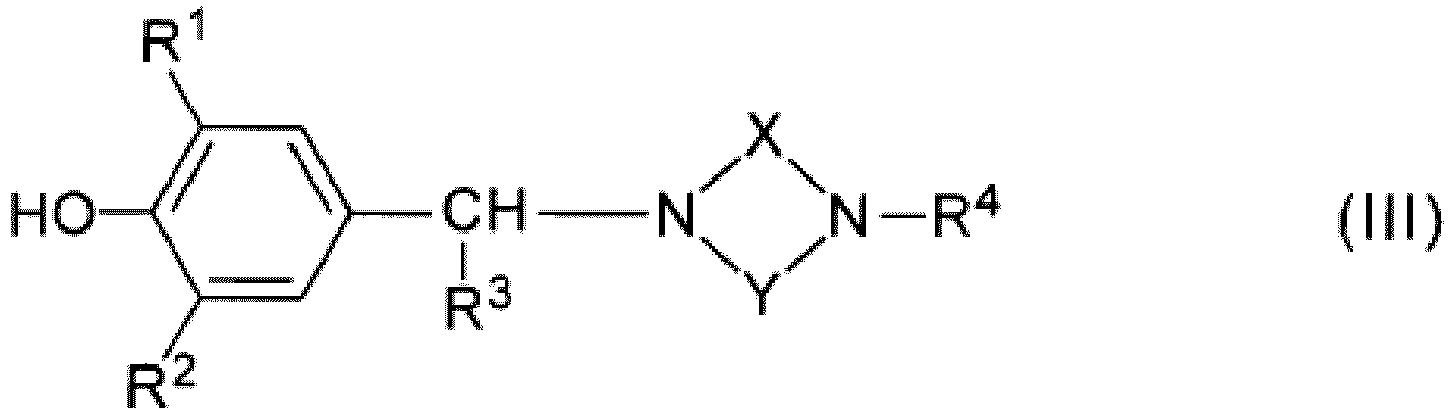
- R1, R2, R3 and R4, as well as X are the same as described above; and
- Y represents a divalent saturated hydrocarbon group having 1 to 6 carbon atoms.
- The aforementioned compounds are used as a polymerization inhibitor of an acryloxysilane or methacryloxysilane.
- In addition, the present invention relates to a silane coupling agent containing the aforementioned compounds and an acryloxysilane or a methacryloxysilane; a polymerizable composition or a polymer containing the aforementioned silane coupling agent; and a molded product obtained from the aforementioned polymerizable composition and polymer.
- In addition, in the present invention, an acryloxysilane or methacryloxysilane can be produced in the presence of the aforementioned compound. More particularly, an acryloxysilane or methacryloxysilane can be produced by addition-reacting an acrylate or a methacrylate of an alcohol containing an aliphatic unsaturated bond with an organosilane containing a hydrogen atom binding to a silicon atom, in the presence of the aforementioned compound. The aforementioned organosilane containing a hydrogen atom binding to a silicon atom may be a methyldialkoxysilane.
- In addition, in the method for producing an acryloxysilane or methacryloxysilane of the present invention, a step of purifying the acryloxysilane or methacryloxysilane by distillation in the presence of the aforementioned compound can be included.
- The compound used in the present invention can be utilized as a polymerization inhibitor exhibiting effects which are the same as or greater than the effects obtained by conventional ones, and can be blended in various polymerizable compositions. The compound used in the present invention can be suitably used as a polymerization inhibitor for a silicon-containing compound containing an acryloxy group or a methacryloxy group, and in particular, an acryloxysilane or methacryloxysilane.
- Therefore, the compound used in the present invention can be blended as a polymerization inhibitor to a silane coupling agent containing an acryloxysilane or methacryloxysilane. Thereby, polymerization of the aforementioned silane coupling agent during storage can be inhibited, and for this reason, increase of viscosity caused by the aforementioned polymerization can be prevented, and superior handling properties can be maintained for a long time. In addition, a polymerizable composition or polymer containing the aforementioned silane coupling agent exhibits superior adhesiveness, superior oxidation resistance, superior thermal stability, and the like. Therefore, a molded product exhibiting various superior physical properties such as strength, weather resistance, thermal resistance, and the like can be produced.
- In addition, in a method for producing a silicon-containing compound containing an acryloxy group or methacryloxy group, such as an acryloxysilane or methacryloxysilane, of the present invention, non-preferred polymerization reactions during production or distillation thereof can be controlled. Therefore, a silicon-containing compound containing an acryloxy group or methacryloxy group, such as an acryloxysilane or methacryloxysilane, with high purity can be obtained in high yield.
- The compound used in the present invention is represented by the following general formula (I):

- R1 and R2 independently represent a monovalent saturated hydrocarbon group having 1 to 20 carbon atoms;
- R3 represents a hydrogen atom or an alkyl group having 1 to 4 carbon atoms;
- X represents a divalent hydrocarbon group, wherein the divalent hydrocarbon group is a methylene or an ethylene group; and
- R4, R5 and R6 independently represent a monovalent saturated hydrocarnon group having 1 to 20 carbon atoms, wherein R5 and R6 may combine together to form a divalent saturated hydrocarbon group having 1 to 6 carbon atoms.
- In addition, the compound used in the present invention can also have a structure represented by the following general formula (III) :

- R1, R2, R3 and R4, as well as X are the same as described above; and
- Y represents a divalent saturated hydrocarbon group having 1 to 6 carbon atoms.
- The aforementioned monovalent hydrocarbon group is a monovalent saturated hydrocarbon group having 1 to 20 carbon atoms, preferably having 2 to 10 carbon atoms, and more preferably having 3 or 4 carbon atoms.
- As examples of monovalent saturated hydrocarbon groups having 1 to 20 carbon atoms, mention may be made of linear or branched alkyl groups such as a methyl group, an ethyl group, an n-propyl group, an isopropyl group, an n-butyl group, an isobutyl group, a sec-butyl group, a tert-butyl group, a pentyl group, a hexyl group, a heptyl group, an octyl group, a nonyl group, a decyl group, and the like; as well as, cycloalkyl groups such as a cyclopropyl group, a cyclobutyl group, a cyclopentyl group, a cyclohexyl group, a cycloheptyl group, a cyclooctyl group, and the like.
- As the aforementioned monovalent hydrocarbon group, one having steric hindrance is preferred. As the monovalent hydrocarbon groups having steric hindrance, for example, monovalent saturated hydrocarbon groups having steric hindrance such as an isopropyl group, an isobutyl group, a sec-butyl group, a tert-butyl group, and the like. In particular, a tert-butyl group is preferred.
- The alkyl group having 1 to 4 carbon atoms as the aforementioned R3 and R9 is a methyl group, an ethyl group, an n-propyl group, an isopropyl group, an n-butyl group, an isobutyl group, a sec-butyl group, or a tert-butyl group. As the aforementioned R3 and R9, a hydrogen atom is preferred.
- R5 and R6 may combine together to form a divalent saturated hydrocarbon group having 1 to 6 carbon atom, preferably having 1 to 4 carbon atoms, and more preferably having 1 or 2 carbon atoms.
- As examples of divalent saturated hydrocarbon groups having 1 to 6 carbon atoms, mention may be made of linear or branched alkylene groups such as a methylene group, an ethylene group, a propylene group, an isopropylene (-CH2-CH(CH3)-) group, an n-butylene group, an isobutylene (-CH2-CH(CH3)-CH2-) group, a sec-butylene (-CH(CH3)-CH2-CH2-) group, a tert-butylene (-CH2-C(CH3)2-) group, a pentylene group, a hexylene group, and the like.
- R5 and R6 may combine together to form a divalent saturated hydrocarbon group having 1 to 6 carbon atoms. A methylene group or an ethylene group is more preferred, and in particular, an ethylene group is preferred. X is a divalent hydrocarbon group, wherein the divalent hydrocarbon group is a methylene or an ethylene group.
- As examples of the aforementioned monovalent organic groups, mention may be made of, in addition to the aforementioned monovalent hydrocarbon groups, for example, monovalent functional groups such as a hydrogen atom, a halogen atom, a hydroxyl group, a C1-C6 alkoxy group, an amino group, a C1-C6 alkylamino group, a nitro group, a carbonyl group, an acyl group, a carboxyl group, a cyano group and the like; as well as monovalent substituted hydrocarbon groups such as halogenated C1-C6 alkyl groups such as a chloromethyl group, a 3-chloropropyl group, a 3,3,3-trifluoropropyl group, and the like; hydroxy(C1-C6 alkyl) groups such as a hydroxymethyl group, a hydroxyethyl group, and the like; (C1-C6 alkoxy) (C1-C6 alkyl) groups such as a methoxymethyl group, an ethoxymethyl group, a methoxyethyl group, an ethoxyethyl group, and the like; amino(C1-C6 alkyl) groups such as an aminomethyl group, an aminoethyl group and the like; and the like. The preferable monovalent organic group is a monovalent hydrocarbon group. An alkyl group is more preferred and an ethyl group and a methyl group are, in particular, preferred.
- The aforementioned n and m can be independently any integer ranging from 1 to 4, is preferably 1 or 2, and is more preferably 1.
- The compound used in the present invention can be produced by means of the following method.
- A phenol derivative represented by the following general formula (IV) :

and a primary amine represented by the following general formula (V) :

- As the aforementioned aldehyde, formaldehyde, acetoaldehyde, propionaldehyde or butylaldehyde can be used. Formaldehyde is preferred. In the case of using formaldehyde, formaldehyde is, in particular, preferably used in the form of an aqueous solution.
- As the aforementioned alcohol-based solvent, for example, an alcohol having 1 to 4 carbon atoms such as methanol, ethanol, propyl alcohol, isopropyl alcohol, or the like, as well as, a mixture of the aforementioned alcohol and water can be used. Isopropyl alcohol or a mixture of isopropyl alcohol and water is preferred.
- The solvent for use in the aforementioned recrystallization is not particularly limited, and a ketone-based solvent such as acetone or the like, as well as, a mixture of the aforementioned ketone-based solvent and water can be used. Acetone or a mixture of acetone and water is preferred.
- The compound used in the present invention is used as a polymerization inhibitor of an acryloxysilane or methacryloxysilane.
- The aforementioned acryloxysilane or methacryloxysilane respectively possesses an acryloxy moiety (CH2=CH-COO-) or a methacryloxy moiety (CH2=C(CH3)-COO-). The aforementioned acryloxy moiety or methacryloxy moiety directly binds to a silicon atom of an organosilane having an alkoxy group or a halogen atom or binds thereto via an alkylene group or an oxyalkylene group.
- The aforementioned acryloxysilane or methacryloxysilane can be represented by, for example, the following general formula (VII) :

- R10 represents a hydrogen atom or a methyl group;
- R11 represents an alkylene group having 1 to 6 carbon atoms;
- R12 represents an alkylene group having 1 to 6 carbon atoms;
- each of the Zs independently represents an alkyl group, an alkoxy group, an alkoxyalkoxy group, or an alkoxyalkyl group, having 1 to 6 carbon atoms, an aryl group having 6 to 18 carbon atoms, an aralkyl group having 7 to 20 carbon atoms, an acetoxy group, or a halogen atom;
- a represents 0 or an integer ranging from 1 to 10; and b represents 0 or an integer ranging from 1 to 10,
- with the proviso that a + b is 1 or more.
- As examples of the aforementioned alkyl groups having 1 to 6 carbon atoms, mention may be made of linear or branched alkyl groups such as a methyl group, an ethyl group, an n-propyl group, an isopropyl group, an n-butyl group, an isobutyl group, a sec-butyl group, a tert-butyl group, a pentyl group, a hexyl group and the like; cycloalkyl groups such as a cyclopropyl group, a cyclobutyl group, a cyclopentyl group, a cyclohexyl group, and the like.
- As examples of the aforementioned alkoxy groups having 1 to 6 carbon atoms, mention may be made of a methoxy group, an ethoxy group, a propoxy group, an isopropoxy group, an n-butoxy group, a sec-butoxy group, a tert-butoxy group and the like. A methoxy group or an ethoxy group is preferred, and a methoxy group is more preferred.
- As examples of the aforementioned alkoxyalkoxy groups having 1 to 6 carbon atoms, mention may be made of a methoxymethoxy group, an ethoxymethoxy group, a methoxyethoxy group, an ethoxyethoxy group and the like.
- As the aforementioned alkoxyalkyl groups having 1 to 6 carbon atoms, mention may be made of a methoxymethyl group, an ethoxymethyl group, a methoxyethyl group, an ethoxyethyl group and the like.
- As examples of the aforementioned aryl groups having 6 to 18 carbon atoms, mention may be made of a phenyl group, a tolyl group, a xylyl group, a naphtyl group and the like.
- As examples of aralkyl groups having 7 to 20 carbon atoms, mention may be made of a benzyl group, a 2-phenylethyl group, a 3-phenylpropyl group and the like.
- The aforementioned halogen atom is a fluorine atom, a chlorine atom, a bromine atom or an iodine atom, and a chlorine atom is preferred.
- As examples of the aforementioned alkylene groups having 1 to 6 carbon atoms, mention may be made of linear or branched alkylene groups such as a methylene group, an ethylene group, a propylene group, an isopropylene (-CH2-CH(CH3)-) group, an n-butylene group, an isobutylene (-CH2-CH(CH3)-CH2-) group, a sec-butylene (-CH(CH3)-CH2-CH2-) group, a tert-butylene (-CH2-C(CH3)2-) group, a pentylene group, a hexylene group, and the like.
- The aforementioned a and b can be independently 0 or an integer ranging from 1 to 10, and 0 or an integer ranging from 1 to 4 is preferred. The case in which a is 0 and b is 3 or 4 is more preferred.
- As examples of the aforementioned acryloxysilane or methacryloxysilane, without limitation, mention may be made of 3-acryloxypropyltrimethoxysilane, 3-acryloxypropyl-triethoxysilane, 3-methacryloxypropyltrimethoxysilane, 3-methacryloxyisobutyl-trimethoxysilane, 3-methacryloxypropyl-triethoxysilane, 3-acryloxypropyltrichlorosilane, 3-methacryloxypropyltrichlorosilane, 3-methacryloxyisobutyl-trichlorosilane, 3-methacryloxypropyl[tris(β-methoxy-ethoxy)]silane, 3-methacryloxypropyldimethylchlorosilane, 3-methacryloxypropylmethyldichlorosilane, 3-acryloxypropyldimethylchlorosilane, 3-acryloxypropylmethyldichlorosilane, 3-acryloxypropylmethyldimethoxysilane, 3-acryloxypropylmethyldiethoxysilane, 3-methacryloxypropylmethyl-dimethoxysilane, 3-methacryloxypropylmethyldiethoxysilane, 3-acryloxypropylphenyldimethoxysilane, 3-acryloxypropyl-phenyldiethoxysilane, 3-methacryloxypropylphenyl-dimethoxysilane, 3-methacryloxypropylphenyldiethoxysilane, 3-acryloxypropyltriacetoxysilane, 3-methacryloxypropyl-triacetoxysilane, and the like.
- The preparation method for the aforementioned acryloxysilane or methacryloxysilane is not particularly limited, and any preparation methods known to a person skilled in the art can be used.
- For example, the aforementioned acryloxysilane or methacryloxysilane can be obtained by a method in which an acrylate or methacrylate of an aliphatic unsaturated bond-containing alcohol and an organosilane containing a hydrogen atom binding to a silicon atom are subjected to an addition reaction, and subsequently, from the obtained mixture, the objective acryloxysilane or methacryloxysilane is isolated by purification under distillation; a method in which an alkali metal salt of acrylic acid or an alkali metal salt of methacrylic acid is reacted with a halogen-substituted organic group-containing organosilane in the presence of a basic catalyst, and subsequently, from the obtained mixture, the objective acryloxysilane or methacryloxysilane is isolated by purification under distillation; and the like.
- The aforementioned method for purification under distillation is not particularly limited. In order to prevent polymerization of the acryl group or methacryl group due to heat, a method for purification under distillation with good efficiency is preferred. As the aforementioned method for purification under distillation, molecular distillation may be mentioned. The conditions of molecular distillation are suitably determined in accordance with a distillation objective or quality of a product to be produced. The pressure conditions preferably range from 0.001 to 10.0 mmHg. The distillation temperature preferably ranges from 40 to 150°C, and in particular, preferably ranges from 80 to 120°C. The liquid to be distilled is converted into a filmy state with a thickness ranging from 0.05 to 5.0 mm, and evaporation is carried out for a heating period ranging from 0.1 to 5.0 seconds. When the evaporated components are trapped, the temperature of the first cooler of a distillation apparatus appropriately ranges from -5°C to 30°C, and the temperature of the second cooler is preferably-40°C or less.
- Therefore, the compound used in the present invention is used together with an acryloxysilane or methacryloxysilane. Thereby, the polymerization of acryloxysilane or methacryloxysilane in the aforementioned silane coupling agent can be controlled for a long time. Thereby, increasing viscosity during storage of a silane coupling agent can be prevented, and usability can be maintained.
- In addition, the compound used in the present invention may be blended at the time of preparation or distillation production of an acryloxysilane or a methacryloxysilane. The compound used in the present invention can effectively prevent non-preferable polymerization reactions at the time of production or purification by distillation of an acryloxysilane or a methacryloxysilane, as a polymerization inhibitor.
- The compound used in the present invention is, in particular, effective as a polymerization inhibitor in a method in which an acrylate or methacrylate of an aliphatic unsaturated bond-containing alcohol and a silicon-containing compound containing a hydrogen atom binding to a silicon atom are subjected to an addition reaction, and subsequently, from the obtained mixture, a desirable silicon-containing compound containing an acryloxy group or methacryloxy group is isolated by purification under distillation.
- As examples of the aforementioned acrylate or methacrylate of the aliphatic unsaturated bond-containing alcohol, mention may be made of allyl acrylate, allyl methacrylate, isobutenyl acrylate, isobutenyl methacrylate, hexenyl acrylate, hexenyl methacrylate, allyloxyethyl acrylate, allyloxyethyl methacrylate, styryl acrylate, styryl methacrylate and the like.
- As the aforementioned silicon-containing compound containing a hydrogen atom binding to a silicon atom, an organosilane containing a hydrogen atom binding to a silicon atom may be mentioned. As examples thereof, mention may be made of trialkoxysilanes such as trimethoxysilane, triethoxysilane, tri-tert-butoxysilane and the like; trichlorosilane; trialkoxyalkoxysilanes such as [tris(β-methoxyethoxy)]silane and the like; dimethylchlorosilane; methyldichlorosilane; methyldialkoxysilanes such as methyldimethoxysilane, methyldiethoxysilane and the like; phenyldialkoxysilanes such as phenyldimethoxysilane, phenyldiethoxysilane and the like; triacetoxysilane; methyldiacetoxysilane; and the like.
- The compound used in the present invention can be used as it is or in the state of dissolving or dispersing in a solvent such as water, alcohol, acetone, benzene, toluene, xylene or the like. The compound used in the present invention exhibits increased water-solubility under acidic conditions, as compared with a conventional hindered phenol-based polymerization inhibitor such as 2,6-di-tert-butyl-4-dimethylaminomethylphenol or the like. For this reason, the compound can be used by dissolving a mixture of, for example, acetic acid and water (acetic acid:water = 0.2:100). Acetic acid acts as a catalyst of a hydrolysis reaction of the alkoxy group of the acryloxysilane or methacryloxysilane to accelerate the production of a water-soluble silanol compound. In addition, acetic acid has an action for delaying the production of a water-insoluble polymer due to a dehydration condensation reaction of the aforementioned silanol compound, and prolonging the life of the silane coupling agent.
- The polymerization inhibitor may be formed from only the compound used in the present invention, or alternatively may contain other components. The blending amount of the compound used in the present invention in the polymerization inhibitor is not particularly limited, and can range, for example, from 1 to 100%
by weight, from 10 to 90% by weight, from 20 to 80% by weight, or from 30 to 70% by weight. As the compound used in the present invention, a single compound represented by the aforementioned general formula (I) or (III) may be used, or alternatively, a mixture of two or more types of the compounds may be used. - When the polymerization inhibitor contains components other than the compound used in the present invention, as the other components, other polymerization inhibitor components, antioxidant components, and thermal stabilizer components may be respectively contained. The blending amount of the other polymerization inhibitor components, the antioxidant components and the thermal stabilizer components is not particularly limited, and may range, for example, from 0.01 to 20% by weight, from 0.1 to 10% by weight, or from 1 to 5% by weight.
- As examples of other polymerization inhibitor components, mention may be made of, for example, in addition to quinone-based compounds such as hydroquinone, benzoquinone and the like, hindered phenols such as 2,6-di-t-butylphenol, 2,6-di-t-butyl-p-cresol, 2,6-di-t-butyl-4-dimethylaminomethylphenol and the like.
- As examples of antioxidants, mention may be made of, in addition to the aforementioned hindered phenols, for example, aromatic amine compounds such as phenyl-α-naphthylamine, 4,4'-dioctylphenylamine, N,N'-di-β-naphthyl-p-phenylenediamine, N,N'-diphenyl-p-phenylenediamine, N-phenyl-N'-cyclohexyl-p-phenylenediamine, N,N'-di-o-tolylethylenediamine and the like.
- As examples of thermal stabilizer components, mention may be made of, in addition to the aforementioned hindered phenol, for example, organic acid salts such as stearate, maleate, salicylate, and the like; inorganic acid salts such as sulfate, carbonate, silicate, and the like; organotin compounds; epoxy compounds and the like.
- The silane coupling agent containing the compound used in the present invention, as well as, the polymerization inhibitor formed from the compound used in the present invention can be preferably blended in a polymerizable compound or a polymer.
- The aforementioned polymerizable composition is not particularly limited, and any compositions can be used, as long as they have a property of producing a polymer by polymerization under appropriate conditions. As examples of the aforementioned polymerizable compositions, typically mention may be made of a composition containing an organic monomer as a main component.
- The aforementioned polymerizable composition can contain an inorganic filler such as silica, alumina, glass, mica, talc, clay or the like, or an organic filler such as silicone fine powders or the like. In addition, the aforementioned polymerizable composition can be in the form of an adhesive, paint, sealant or the like.
- The aforementioned polymerizable composition may be a thermosetting resin. As examples of the thermosetting resins, mention may be made of, for example, an unsaturated polyester resin, a diallyl phthalate resin and the like.
- The aforementioned polymer may be a thermoplastic resin or an elastomer. As examples of thermoplastic resins, mention may be made of, for example, acryl resin, methacryl resin, polyolefin, polystyrene, polyvinyl chloride and the like. As examples of elastomers, mention may be made of, for example, polybutadiene, EPM, EPDM and the like. The aforementioned polymer may be an organosilicon polymer such as organopolysiloxane or the like.
- The aforementioned polymerizable composition or polymer can be formulated into various molded products by a known molding means. The molding means is not particularly limited. Various molding means such as injection molding, compression molding, injection compression molding, extrusion molding, blow molding, cast molding and the like, can be used.
- In a three-necked flask with a volume of 300 ml, equipped with a nitrogen gas inlet tube, a reflex condenser, a thermometer, and a stirrer, 20.6 g (0.10 mol) of 2,6-di-t-butylphenol, 8.5 g (0.105 mol) of a 37% aqueous solution of formaldehyde, 10.2 g (0.10 mol) of N,N,N'-trimethylethylene-diamine, and 80 g of isopropyl alcohol were placed. The mixture was reacted for 2.5 hours under refluxing. The solvents and unreacted materials were removed under reduced pressure. The residue was purified by recrystallization in an acetone solvent. Thereby, a compound represented by the following formula:

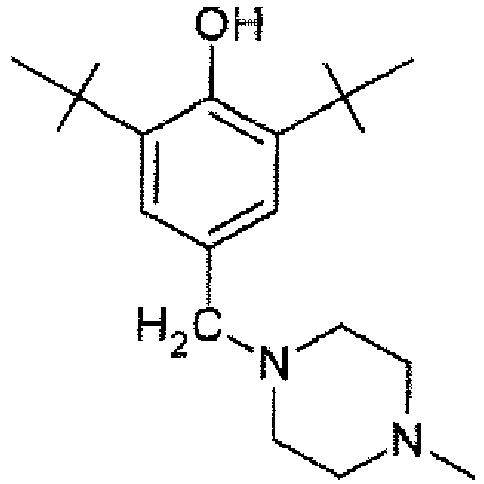
- In a three-necked flask with a volume of 300 ml, equipped with a nitrogen gas inlet tube, a reflex condenser, a thermometer, and a stirrer, 20.6 g (0.10 mol) of 2,6-di-t-butylphenol, 8.5 g (0.105 mol) of a 37% aqueous solution of formaldehyde, 10.0 g (0.10 mol) of N-methylpiperazine, and 80 g of isopropyl alcohol were placed. The mixture was reacted for 14 hours under refluxing. The solvents and unreacted materials were removed under reduced pressure. The residue was purified by recrystallization in an acetone-water (7:3) mixture solvent. Thereby, a compound represented by the following formula:
- In a vial made of glass with a volume of 20 ml, 5 g of 3-methacryloxypropyltrichlorosilane containing no polymerization inhibitor, and 0.005 g (1,000 ppm) of the compound obtained in Synthesis Example 1 as a polymerization inhibitor were added. Visual observation of the presence or absence of gelation at 150°C was carried out, and a period for occurrence of gelation was measured. The results are shown in Table 1.
- In a vial made of glass with a volume of 20 ml, 5 g of 3-methacryloxypropyltrichlorosilane containing no polymerization inhibitor, and 0.005 g (1,000 ppm) of 2,6-di-t-butyl-p-cresol as a polymerization inhibitor were added. Visual observation of the presence or absence of gelation in the vial at 150°C was carried out, and the period for occurrence of gelation was measured. The results are shown in Table 1.
Table 1 Polymerization inhibitor Period for occurrence of gelation Example 1 Compound obtained in Synthesis Example 1 Never gelled in 10 hours or more Comparative Example 1 2,6-di-t-butyl-p-cresol Gelled in 0.5 hours - From the results shown in Table 1, it can be seen that the compound obtained in Synthesis Example 1 exhibits increased effects of inhibiting polymerization, as compared with 2,6-di-t-butyl-p-cresol, which is known as a conventional polymerization inhibitor.
- In a vial made of glass with a volume of 20 ml, containing 5 g of 3-methacryloxypropyltrimethoxysilane containing no polymerization inhibitor, 0.005 g (1,000 ppm) of a compound obtained in Synthesis Example 2 (1-(3,5-di-t-butyl-4-hydroxybenzyl)-4-methylpiperazine) as a polymerization inhibitor was added. An acceleration test therefor was carried out for 28 hours at 180°C, and further carried out for 168 hours at 25°C. Visual observation of the degree of gelation was carried out. The results are shown in Table 2.
- In a vial made of glass with a volume of 20 ml, 5 g of 3-methacryloxypropyltrimethoxysilane containing no polymerization inhibitor, and 0.005 g (1,000 ppm) of 2,6-di-t-butyl-p-cresol as a polymerization inhibitor were added. An acceleration test therefor was carried out for 28 hours at 180°C, and further carried out for 168 hours at 25°C. Visual observation of the degree of gelation was carried out. The results are shown in Table 2.
- In a vial made of glass with a volume of 20 ml, 5 g of 3-methacryloxypropyltrimethoxysilane containing no polymerization inhibitor, and 0.005 g (1,000 ppm) of 2,6-di-t-butyl-4-dimethylaminomethylphenol as a polymerization inhibitor were added. An acceleration test therefor was carried out for 28 hours at 180°C, and further carried out for 168 hours at 25°C. Visual observation of the degree of gelation in the vial was carried out. The results are shown in Table 2.
Table 2 Polymerization inhibitor Period for occurrence of gelation Example 2 Compound obtained in Synthesis Example 2 No gelation Small increase in viscosity Comparative Example 2 2,6-di-t-butyl-p-cresol Slight gelation Large increase in viscosity Comparative Example 3 2,6-di-t-butyl-4-dimethylaminomethylphenol Slight gelation Large increase in viscosity - From the results shown in Table 2, it can be seen that the compound obtained in Synthesis Example 2 exhibits superior effects of inhibiting polymerization, as compared with 2,6-di-t-butyl-p-cresol and 2,6-di-t-butyl-4-dimethylaminomethylphenol, which are known as conventional polymerization inhibitors.
- In a three-necked flask with a volume of 100 ml, equipped with a nitrogen gas inlet tube, a reflex condenser, a thermometer, and a stirrer, 25.8 g (0.204 mol) of allyl methacrylate, 0.2 g (platinum content = 0.4 mmol) of a solution of a platinum-divinyltetramethylsiloxane complex, and 0.1 g of 1-(3,5-di-t-butyl-4-hydroxybenzyl)-4-methylpiperazine obtained in Synthesis Example 2 were placed. The mixture was heated to 80°C, and 21.2 g (0.2 mol) of methyldimethoxysilane was added dropwise thereto. Subsequently, the mixture was stirred for 0.5 hours at 80°C. In addition, 0.04 g of dibutylhydroxytoluene was added thereto. The reaction mixture was distilled under a reduced pressure of 1 mm Hg, and thereby, a fraction at 68 to 71°C was obtained. The obtained fraction was methacryloxypropylmethyldimethoxysilane, and the amount thereof was 35.2 g (yield: 74.8%).
- The same operations as described in Example 3 were carried out with the exception of using phenothiazine instead of 1-(3,5-dit-butyl-4-hydroxybenzyl)-4-methylpiperazine obtained in Synthesis Example 2. As a result, when 3 g of methyldimethoxysilane was added dropwise thereto, the solution in the flask gelled. Therefore, the desirable compound (methacryloxypropylmethyldimethoxysilane) could not be obtained.
- From the results described in Example 3 and Comparative Example 4, it can be seen that the compound obtained in Synthesis Example 2 exhibits superior effects of inhibiting polymerization, as compared with phenothiazine, which is known as a conventional polymerization inhibitor.
Claims (10)
- Use of a compound represented by the following general formula (I) :
 R1 and R2 independently represent a monovalent saturated hydrocarbon group having 1 to 20 carbon atoms;R3 represents a hydrogen atom or an alkyl group having 1 to 4 carbon atoms;X represents a divalent hydrocarbon group, wherein the divalent hydrocarbon group is a methylene or an ethylene group; andR4, R5 and R6 independently represent a monovalent saturated hydrocarbon group having 1 to 20 carbon atoms, wherein R5 and R6 may combine together to form a divalent saturated hydrocarbon group having 1 to 6 carbon atoms.
 - The use according to claim 1, wherein the compound is represented by the following general formula (III):
 R1, R2, R3 and R4, as well as X are the same as described above; andY represents a divalent saturated hydrocarbon group having 1 to 6 carbon atoms.
 - A silane coupling agent composition comprising:an acryloxysilane or a methacryloxysilane, anda polymerization inhibitor comprising a compound represented by the following general formula (I):
 R1 and R2 independently represent a monovalent saturated hydrocarbon group having 1 to 20 carbon atoms;R3 represents a hydrogen atom or an alkyl group having 1 to 4 carbon atoms;X represents a divalent hydrocarbon group, wherein the divalent hydrocarbon group is a methylene or an ethylene group; andR4, R5 and R6 independently represent a monovalent saturated hydrocarbon group having 1 to 20 carbon atoms, wherein R5 and R6 may combine together to form a divalent saturated hydrocarbon group having 1 to 6 carbon atoms.
 - The silane coupling agent composition according to claim 3, wherein the polymerization inhibitor compound is represented by the following general formula (III):
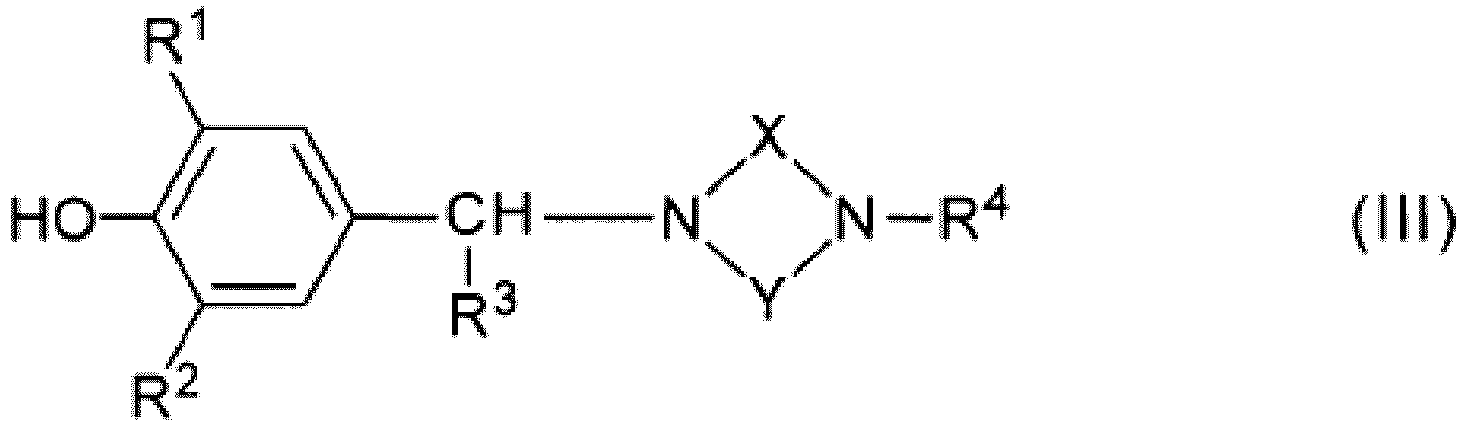 R1, R2, R3 and R4, as well as X are the same as described above; andY represents a divalent saturated hydrocarbon group having 1 to 6 carbon atoms.
 - A polymerizable composition or polymer comprising the silane coupling agent as recited in claim 3 or 4.
- A molded product obtained from the polymerizable composition or polymer as recited in claim 5.
- A method for producing an acryloxysilane or a methacryloxysilane comprising producing the same in the presence of a compound represented by the following general formula (I):
 R1 and R2 independently represent a monovalent saturated hydrocarbon group having 1 to 20 carbon atoms;R3 represents a hydrogen atom or an alkyl group having 1 to 4 carbon atoms;X represents a divalent hydrocarbon group, wherein the divalent hydrocarbon group is a methylene or an ethylene group; andR4, R5 and R6 independently represent a monovalent saturated hydrocarbon group having 1 to 20 carbon atoms, wherein R5 and R6 may combine together to form a divalent saturated hydrocarbon group having 1 to 6 carbon atoms.
 - The method according to claim 7, for producing an acryloxysilane or a methacryloxysilane, wherein an acrylate or methacrylate of an alcohol containing an aliphatic unsaturated bond is subjected to an addition-reaction with an organosilane containing a hydrogen atom binding to a silicon atom.
- The method for producing an acryloxysilane or a methacryloxysilane according to claim 8, wherein said organosilane containing a hydrogen atom binding to a silicon atom is a methyldialkoxysilane.
- A method for producing an acryloxysilane or a methacryloxysilane, comprising the step of purifying an acryloxysilane or a methacryloxysilane by distillation in the presence of a compound represented by the following general formula (I):
 R1 and R2 independently represent a monovalent saturated hydrocarbon group having 1 to 20 carbon atoms;R3 represents a hydrogen atom or an alkyl group having 1 to 4 carbon atoms;X represents a divalent hydrocarbon group, wherein the divalent hydrocarbon group is a methylene or an ethylene group; andR4, R5 and R6 independently represent a monovalent saturated hydrocarbon group having 1 to 20 carbon atoms, wherein R5 and R6 may combine together to form a divalent saturated hydrocarbon group having 1 to 6 carbon atoms.
Applications Claiming Priority (2)
| Application Number | Priority Date | Filing Date | Title |
|---|---|---|---|
| JP2007327635 | 2007-12-19 | ||
| PCT/JP2008/072813 WO2009078394A1 (en) | 2007-12-19 | 2008-12-16 | 4-hydroxyphenylalkylamine derivative |
Publications (3)
| Publication Number | Publication Date |
|---|---|
| EP2228362A1 EP2228362A1 (en) | 2010-09-15 |
| EP2228362A4 EP2228362A4 (en) | 2011-10-12 |
| EP2228362B1 true EP2228362B1 (en) | 2017-06-07 |
Family
ID=40795509
Family Applications (1)
| Application Number | Title | Priority Date | Filing Date |
|---|---|---|---|
| EP08861159.5A Not-in-force EP2228362B1 (en) | 2007-12-19 | 2008-12-16 | 4-hydroxyphenylalkylamine derivative |
Country Status (6)
| Country | Link |
|---|---|
| US (1) | US8624064B2 (en) |
| EP (1) | EP2228362B1 (en) |
| JP (1) | JP5159793B2 (en) |
| KR (1) | KR101214833B1 (en) |
| CN (1) | CN101903332B (en) |
| WO (1) | WO2009078394A1 (en) |
Families Citing this family (4)
| Publication number | Priority date | Publication date | Assignee | Title |
|---|---|---|---|---|
| EP3276414A1 (en) * | 2015-03-27 | 2018-01-31 | Toray Industries, Inc. | Photosensitive resin composition, photosensitive resin composition film, cured product, insulating film and multilayer wiring board |
| KR101717898B1 (en) | 2015-09-11 | 2017-03-20 | 홍성무 | Multi skills gridiron device for roaster which using direct fire power |
| JP6919867B2 (en) * | 2017-06-05 | 2021-08-18 | 昭和電工株式会社 | Radical polymerizable resin composition |
| JP2020094132A (en) * | 2018-12-13 | 2020-06-18 | ダウ・東レ株式会社 | Hydrolyzable silicon compound-containing composition, method for stabilizing electric conductivity thereof, application thereof and production method thereof |
Citations (2)
| Publication number | Priority date | Publication date | Assignee | Title |
|---|---|---|---|---|
| EP0520477A1 (en) * | 1991-06-27 | 1992-12-30 | OSi Specialties, Inc. | Inhibited acryloxysilanes and methacryloxysilanes |
| WO2003014130A1 (en) * | 2001-08-08 | 2003-02-20 | Crompton Corporation | High boiling inhibitors for distillable, polymerizable monomers |
Family Cites Families (22)
| Publication number | Priority date | Publication date | Assignee | Title |
|---|---|---|---|---|
| US2962531A (en) | 1955-09-23 | 1960-11-29 | Ethyl Corp | 3, 5-dialkyl-4-hydroxy benzylamines |
| US3043774A (en) | 1955-09-23 | 1962-07-10 | Ethyl Corp | Organic compositions |
| US3098841A (en) * | 1960-07-11 | 1963-07-23 | Shell Oil Co | Polynuclear polyamines |
| NL272342A (en) * | 1960-12-09 | |||
| US3218322A (en) * | 1962-06-07 | 1965-11-16 | Ethyl Corp | Piperazine derivatives |
| US3225099A (en) * | 1964-12-03 | 1965-12-21 | Ethyl Corp | N-methyl-n-phenyl-n-(3,5-di-tertiary-butyl-4-hydroxybenzyl)amine |
| US3368972A (en) * | 1965-01-06 | 1968-02-13 | Mobil Oil Corp | High molecular weight mannich bases as engine oil additives |
| US3944397A (en) * | 1974-03-07 | 1976-03-16 | E. I. Du Pont De Nemours And Company | Motor fuel composition containing mannich condensation products |
| SU596585A1 (en) * | 1976-08-02 | 1978-03-05 | Предприятие П/Я А-7253 | 1-phenyl-4-(3', 5'-ditret-butyl-4'-oxybenzyl)-piperazine as uncolouring thermostabilizer of impactproof polystyrene |
| SU763313A1 (en) | 1978-10-17 | 1980-09-15 | Волгоградский Политехнический Институт | Method of inhibiting thermal polymerization of styrene |
| WO1984000551A1 (en) * | 1982-07-26 | 1984-02-16 | Lowell O Cummings | Method for making phenol-formaldehyde-polyamine curing agents for epoxy resins |
| DE3235589A1 (en) | 1982-09-25 | 1984-03-29 | Hoechst Ag, 6230 Frankfurt | BENZYL ETHER FROM PHENOL-MANNICH-BASEN, METHOD FOR THE PRODUCTION THEREOF, THEIR USE AND PHARMACEUTICAL PREPARATIONS BASED ON THESE COMPOUNDS, INTERMEDIATE PRODUCTS AND METHOD FOR THE PRODUCTION THEREOF |
| SU1118638A1 (en) | 1982-11-16 | 1984-10-15 | Стерлитамакское Производственное Объединение "Каустик" | Ethylenediamine derivatives as stabilizer for unsaturated hydrocarbons or their chlorine derivatives |
| JPS6230134A (en) * | 1985-07-31 | 1987-02-09 | Mitsubishi Yuka Fine Chem Co Ltd | Stabilizer for synthetic resin |
| JPS63188689A (en) * | 1987-01-30 | 1988-08-04 | Toa Nenryo Kogyo Kk | Production of gamma-methacryloxypropylsilanes |
| US5039310A (en) * | 1988-12-06 | 1991-08-13 | Mobil Oil Corporation | Polyether substituted mannich bases as fuel and lubricant ashless dispersants |
| US5106975A (en) * | 1989-11-20 | 1992-04-21 | Ethyl Petroleum Additives, Inc. | Hexahydropyrimidine derivatives |
| JP3611668B2 (en) | 1996-04-26 | 2005-01-19 | 東レ・ダウコーニング・シリコーン株式会社 | Acrylic functional silane polymerization inhibitor |
| US6713651B1 (en) * | 1999-06-07 | 2004-03-30 | Theravance, Inc. | β2-adrenergic receptor agonists |
| US6451830B1 (en) * | 1999-09-23 | 2002-09-17 | G.D. Searle & Co. | Use of substituted N,N-disubstituted non-fused heterocyclo amino compounds for inhibiting cholesteryl ester transfer protein activity |
| JP2001122883A (en) | 1999-10-26 | 2001-05-08 | Ge Toshiba Silicones Co Ltd | Process for producing organosilyl unsaturated carboxylate |
| EP1403244B1 (en) * | 2002-09-26 | 2007-02-28 | Mitsubishi Gas Chemical Company, Inc. | Modified cyclic aliphatic polyamine |
-
2008
- 2008-12-16 KR KR1020107014672A patent/KR101214833B1/en not_active Expired - Fee Related
- 2008-12-16 CN CN200880121622.2A patent/CN101903332B/en not_active Expired - Fee Related
- 2008-12-16 EP EP08861159.5A patent/EP2228362B1/en not_active Not-in-force
- 2008-12-16 JP JP2009546264A patent/JP5159793B2/en not_active Expired - Fee Related
- 2008-12-16 WO PCT/JP2008/072813 patent/WO2009078394A1/en not_active Ceased
- 2008-12-16 US US12/808,855 patent/US8624064B2/en active Active
Patent Citations (2)
| Publication number | Priority date | Publication date | Assignee | Title |
|---|---|---|---|---|
| EP0520477A1 (en) * | 1991-06-27 | 1992-12-30 | OSi Specialties, Inc. | Inhibited acryloxysilanes and methacryloxysilanes |
| WO2003014130A1 (en) * | 2001-08-08 | 2003-02-20 | Crompton Corporation | High boiling inhibitors for distillable, polymerizable monomers |
Also Published As
| Publication number | Publication date |
|---|---|
| US8624064B2 (en) | 2014-01-07 |
| KR101214833B1 (en) | 2012-12-24 |
| WO2009078394A1 (en) | 2009-06-25 |
| CN101903332A (en) | 2010-12-01 |
| EP2228362A4 (en) | 2011-10-12 |
| JPWO2009078394A1 (en) | 2011-04-28 |
| US20100280188A1 (en) | 2010-11-04 |
| EP2228362A1 (en) | 2010-09-15 |
| KR20100091242A (en) | 2010-08-18 |
| CN101903332B (en) | 2015-01-14 |
| JP5159793B2 (en) | 2013-03-13 |
Similar Documents
| Publication | Publication Date | Title |
|---|---|---|
| EP0472438B1 (en) | Processes for the preparation of y-methacryloxypropylsilane compounds | |
| US8624064B2 (en) | 4-hydroxyphenylalkylamine derivative | |
| US6841694B2 (en) | Process for stabilizing unsaturated organosilicon compounds | |
| JP5540750B2 (en) | Cyclic silazane compound and method for producing the same | |
| US9441094B2 (en) | Easily preparable, reduced-VOC, environmentally friendly (meth)acrylamido-functional siloxane systems, process for preparation thereof and use | |
| EP1417209B1 (en) | High boiling inhibitors for distillable, polymerizable monomers | |
| JPWO2017033815A1 (en) | Sulfur-containing organosilicon compound and resin composition | |
| US8148565B2 (en) | Method of manufacturing an organic silicon compound that contains a methacryloxy group or an acryloxy group | |
| KR20150058025A (en) | Composition containing nitrogen-containing organoxysilane compound and method for making the same | |
| KR20180043278A (en) | Organosilicon compound, polymer compound, inorganic material and resin composition | |
| US5723643A (en) | Method for the preparation of acryloxy- or methacryloxy-functional organosilicon compounds | |
| JP5359185B2 (en) | Organosilicon compound having amino group and protected hydroxyl group and method for producing the same | |
| US6204403B1 (en) | Process for manufacturing acrylamidoalkylalkoxysilanes | |
| JP5699990B2 (en) | Method for producing organoxysilane compound having piperazinyl group and piperazine compound | |
| JP5247997B2 (en) | Method for producing methacryloxy group- or acryloxy group-containing organosilicon compound | |
| US8247590B2 (en) | Method for preventing polymerization of unsaturated organosilicon compounds | |
| US6475347B1 (en) | High boiling inhibitors for distillable, polymerizable monomers | |
| JPH05230143A (en) | Polymerization inhibitor for polymerizable organosilicon compound and method for preventing the polymerization | |
| JP2021507890A (en) | Silanes containing oxamide ester groups | |
| JP2015074628A (en) | Method of producing (meth)acrylamide alkyl alkoxysilane | |
| JP2011162496A (en) | Organic silicon compound having amino group protected with silyl group and method for producing the same | |
| CN121175320A (en) | Organooxysilane compound having carboxyl group protected with silyl group and method for producing same | |
| JP2005518450A (en) | Method for producing trihydrocarbyl silylated carboxylate monomer | |
| HK1032241A1 (en) | Silicone oligomers and curable compositions containing same | |
| HK1032241B (en) | Silicone oligomers and curable compositions containing same |
Legal Events
| Date | Code | Title | Description |
|---|---|---|---|
| PUAI | Public reference made under article 153(3) epc to a published international application that has entered the european phase |
Free format text: ORIGINAL CODE: 0009012 |
|
| 17P | Request for examination filed |
Effective date: 20100629 |
|
| AK | Designated contracting states |
Kind code of ref document: A1 Designated state(s): AT BE BG CH CY CZ DE DK EE ES FI FR GB GR HR HU IE IS IT LI LT LU LV MC MT NL NO PL PT RO SE SI SK TR |
|
| AX | Request for extension of the european patent |
Extension state: AL BA MK RS |
|
| RIN1 | Information on inventor provided before grant (corrected) |
Inventor name: SAIKI, TAKEAKI Inventor name: SUGIURA, YASUSHI Inventor name: TANIGUCHI, YOSHINORI Inventor name: WAKITA, KEIJI |
|
| DAX | Request for extension of the european patent (deleted) | ||
| A4 | Supplementary search report drawn up and despatched |
Effective date: 20110908 |
|
| RIC1 | Information provided on ipc code assigned before grant |
Ipc: C07D 295/096 20060101ALI20110902BHEP Ipc: C08F 2/40 20060101ALI20110902BHEP Ipc: C07D 295/08 20060101ALI20110902BHEP Ipc: C09K 15/24 20060101ALI20110902BHEP Ipc: C07C 215/50 20060101AFI20110902BHEP Ipc: C07F 7/20 20060101ALI20110902BHEP Ipc: C07B 63/04 20060101ALI20110902BHEP Ipc: C07F 7/18 20060101ALI20110902BHEP |
|
| RAP1 | Party data changed (applicant data changed or rights of an application transferred) |
Owner name: DOW CORNING TORAY CO., LTD. |
|
| 17Q | First examination report despatched |
Effective date: 20131107 |
|
| GRAP | Despatch of communication of intention to grant a patent |
Free format text: ORIGINAL CODE: EPIDOSNIGR1 |
|
| STAA | Information on the status of an ep patent application or granted ep patent |
Free format text: STATUS: GRANT OF PATENT IS INTENDED |
|
| INTG | Intention to grant announced |
Effective date: 20161223 |
|
| GRAS | Grant fee paid |
Free format text: ORIGINAL CODE: EPIDOSNIGR3 |
|
| GRAA | (expected) grant |
Free format text: ORIGINAL CODE: 0009210 |
|
| STAA | Information on the status of an ep patent application or granted ep patent |
Free format text: STATUS: THE PATENT HAS BEEN GRANTED |
|
| AK | Designated contracting states |
Kind code of ref document: B1 Designated state(s): AT BE BG CH CY CZ DE DK EE ES FI FR GB GR HR HU IE IS IT LI LT LU LV MC MT NL NO PL PT RO SE SI SK TR |
|
| REG | Reference to a national code |
Ref country code: GB Ref legal event code: FG4D |
|
| GRAA | (expected) grant |
Free format text: ORIGINAL CODE: 0009210 |
|
| REG | Reference to a national code |
Ref country code: CH Ref legal event code: EP Ref country code: AT Ref legal event code: REF Ref document number: 899119 Country of ref document: AT Kind code of ref document: T Effective date: 20170615 |
|
| REG | Reference to a national code |
Ref country code: IE Ref legal event code: FG4D |
|
| REG | Reference to a national code |
Ref country code: DE Ref legal event code: R096 Ref document number: 602008050617 Country of ref document: DE |
|
| REG | Reference to a national code |
Ref country code: NL Ref legal event code: MP Effective date: 20170607 |
|
| REG | Reference to a national code |
Ref country code: LT Ref legal event code: MG4D |
|
| PG25 | Lapsed in a contracting state [announced via postgrant information from national office to epo] |
Ref country code: NO Free format text: LAPSE BECAUSE OF FAILURE TO SUBMIT A TRANSLATION OF THE DESCRIPTION OR TO PAY THE FEE WITHIN THE PRESCRIBED TIME-LIMIT Effective date: 20170907 Ref country code: ES Free format text: LAPSE BECAUSE OF FAILURE TO SUBMIT A TRANSLATION OF THE DESCRIPTION OR TO PAY THE FEE WITHIN THE PRESCRIBED TIME-LIMIT Effective date: 20170607 Ref country code: GR Free format text: LAPSE BECAUSE OF FAILURE TO SUBMIT A TRANSLATION OF THE DESCRIPTION OR TO PAY THE FEE WITHIN THE PRESCRIBED TIME-LIMIT Effective date: 20170908 Ref country code: HR Free format text: LAPSE BECAUSE OF FAILURE TO SUBMIT A TRANSLATION OF THE DESCRIPTION OR TO PAY THE FEE WITHIN THE PRESCRIBED TIME-LIMIT Effective date: 20170607 Ref country code: LT Free format text: LAPSE BECAUSE OF FAILURE TO SUBMIT A TRANSLATION OF THE DESCRIPTION OR TO PAY THE FEE WITHIN THE PRESCRIBED TIME-LIMIT Effective date: 20170607 Ref country code: FI Free format text: LAPSE BECAUSE OF FAILURE TO SUBMIT A TRANSLATION OF THE DESCRIPTION OR TO PAY THE FEE WITHIN THE PRESCRIBED TIME-LIMIT Effective date: 20170607 |
|
| REG | Reference to a national code |
Ref country code: AT Ref legal event code: MK05 Ref document number: 899119 Country of ref document: AT Kind code of ref document: T Effective date: 20170607 |
|
| PG25 | Lapsed in a contracting state [announced via postgrant information from national office to epo] |
Ref country code: NL Free format text: LAPSE BECAUSE OF FAILURE TO SUBMIT A TRANSLATION OF THE DESCRIPTION OR TO PAY THE FEE WITHIN THE PRESCRIBED TIME-LIMIT Effective date: 20170607 Ref country code: LV Free format text: LAPSE BECAUSE OF FAILURE TO SUBMIT A TRANSLATION OF THE DESCRIPTION OR TO PAY THE FEE WITHIN THE PRESCRIBED TIME-LIMIT Effective date: 20170607 Ref country code: BG Free format text: LAPSE BECAUSE OF FAILURE TO SUBMIT A TRANSLATION OF THE DESCRIPTION OR TO PAY THE FEE WITHIN THE PRESCRIBED TIME-LIMIT Effective date: 20170907 Ref country code: SE Free format text: LAPSE BECAUSE OF FAILURE TO SUBMIT A TRANSLATION OF THE DESCRIPTION OR TO PAY THE FEE WITHIN THE PRESCRIBED TIME-LIMIT Effective date: 20170607 |
|
| PG25 | Lapsed in a contracting state [announced via postgrant information from national office to epo] |
Ref country code: SK Free format text: LAPSE BECAUSE OF FAILURE TO SUBMIT A TRANSLATION OF THE DESCRIPTION OR TO PAY THE FEE WITHIN THE PRESCRIBED TIME-LIMIT Effective date: 20170607 Ref country code: CZ Free format text: LAPSE BECAUSE OF FAILURE TO SUBMIT A TRANSLATION OF THE DESCRIPTION OR TO PAY THE FEE WITHIN THE PRESCRIBED TIME-LIMIT Effective date: 20170607 Ref country code: RO Free format text: LAPSE BECAUSE OF FAILURE TO SUBMIT A TRANSLATION OF THE DESCRIPTION OR TO PAY THE FEE WITHIN THE PRESCRIBED TIME-LIMIT Effective date: 20170607 Ref country code: EE Free format text: LAPSE BECAUSE OF FAILURE TO SUBMIT A TRANSLATION OF THE DESCRIPTION OR TO PAY THE FEE WITHIN THE PRESCRIBED TIME-LIMIT Effective date: 20170607 Ref country code: AT Free format text: LAPSE BECAUSE OF FAILURE TO SUBMIT A TRANSLATION OF THE DESCRIPTION OR TO PAY THE FEE WITHIN THE PRESCRIBED TIME-LIMIT Effective date: 20170607 |
|
| PG25 | Lapsed in a contracting state [announced via postgrant information from national office to epo] |
Ref country code: PL Free format text: LAPSE BECAUSE OF FAILURE TO SUBMIT A TRANSLATION OF THE DESCRIPTION OR TO PAY THE FEE WITHIN THE PRESCRIBED TIME-LIMIT Effective date: 20170607 Ref country code: IT Free format text: LAPSE BECAUSE OF FAILURE TO SUBMIT A TRANSLATION OF THE DESCRIPTION OR TO PAY THE FEE WITHIN THE PRESCRIBED TIME-LIMIT Effective date: 20170607 Ref country code: IS Free format text: LAPSE BECAUSE OF FAILURE TO SUBMIT A TRANSLATION OF THE DESCRIPTION OR TO PAY THE FEE WITHIN THE PRESCRIBED TIME-LIMIT Effective date: 20171007 |
|
| REG | Reference to a national code |
Ref country code: DE Ref legal event code: R097 Ref document number: 602008050617 Country of ref document: DE |
|
| PLBE | No opposition filed within time limit |
Free format text: ORIGINAL CODE: 0009261 |
|
| STAA | Information on the status of an ep patent application or granted ep patent |
Free format text: STATUS: NO OPPOSITION FILED WITHIN TIME LIMIT |
|
| PG25 | Lapsed in a contracting state [announced via postgrant information from national office to epo] |
Ref country code: DK Free format text: LAPSE BECAUSE OF FAILURE TO SUBMIT A TRANSLATION OF THE DESCRIPTION OR TO PAY THE FEE WITHIN THE PRESCRIBED TIME-LIMIT Effective date: 20170607 |
|
| 26N | No opposition filed |
Effective date: 20180308 |
|
| PG25 | Lapsed in a contracting state [announced via postgrant information from national office to epo] |
Ref country code: SI Free format text: LAPSE BECAUSE OF FAILURE TO SUBMIT A TRANSLATION OF THE DESCRIPTION OR TO PAY THE FEE WITHIN THE PRESCRIBED TIME-LIMIT Effective date: 20170607 |
|
| REG | Reference to a national code |
Ref country code: CH Ref legal event code: PL |
|
| GBPC | Gb: european patent ceased through non-payment of renewal fee |
Effective date: 20171216 |
|
| PG25 | Lapsed in a contracting state [announced via postgrant information from national office to epo] |
Ref country code: LU Free format text: LAPSE BECAUSE OF NON-PAYMENT OF DUE FEES Effective date: 20171216 Ref country code: MT Free format text: LAPSE BECAUSE OF NON-PAYMENT OF DUE FEES Effective date: 20171216 |
|
| REG | Reference to a national code |
Ref country code: FR Ref legal event code: ST Effective date: 20180831 |
|
| REG | Reference to a national code |
Ref country code: BE Ref legal event code: MM Effective date: 20171231 |
|
| PG25 | Lapsed in a contracting state [announced via postgrant information from national office to epo] |
Ref country code: IE Free format text: LAPSE BECAUSE OF NON-PAYMENT OF DUE FEES Effective date: 20171216 Ref country code: FR Free format text: LAPSE BECAUSE OF NON-PAYMENT OF DUE FEES Effective date: 20180102 |
|
| PG25 | Lapsed in a contracting state [announced via postgrant information from national office to epo] |
Ref country code: LI Free format text: LAPSE BECAUSE OF NON-PAYMENT OF DUE FEES Effective date: 20171231 Ref country code: BE Free format text: LAPSE BECAUSE OF NON-PAYMENT OF DUE FEES Effective date: 20171231 Ref country code: CH Free format text: LAPSE BECAUSE OF NON-PAYMENT OF DUE FEES Effective date: 20171231 Ref country code: GB Free format text: LAPSE BECAUSE OF NON-PAYMENT OF DUE FEES Effective date: 20171216 |
|
| PG25 | Lapsed in a contracting state [announced via postgrant information from national office to epo] |
Ref country code: MC Free format text: LAPSE BECAUSE OF FAILURE TO SUBMIT A TRANSLATION OF THE DESCRIPTION OR TO PAY THE FEE WITHIN THE PRESCRIBED TIME-LIMIT Effective date: 20170607 Ref country code: HU Free format text: LAPSE BECAUSE OF FAILURE TO SUBMIT A TRANSLATION OF THE DESCRIPTION OR TO PAY THE FEE WITHIN THE PRESCRIBED TIME-LIMIT; INVALID AB INITIO Effective date: 20081216 |
|
| PG25 | Lapsed in a contracting state [announced via postgrant information from national office to epo] |
Ref country code: CY Free format text: LAPSE BECAUSE OF NON-PAYMENT OF DUE FEES Effective date: 20170607 |
|
| PGFP | Annual fee paid to national office [announced via postgrant information from national office to epo] |
Ref country code: DE Payment date: 20191203 Year of fee payment: 12 |
|
| PG25 | Lapsed in a contracting state [announced via postgrant information from national office to epo] |
Ref country code: TR Free format text: LAPSE BECAUSE OF FAILURE TO SUBMIT A TRANSLATION OF THE DESCRIPTION OR TO PAY THE FEE WITHIN THE PRESCRIBED TIME-LIMIT Effective date: 20170607 |
|
| REG | Reference to a national code |
Ref country code: DE Ref legal event code: R082 Ref document number: 602008050617 Country of ref document: DE Representative=s name: FLEISCHER, ENGELS & PARTNER MBB, PATENTANWAELT, DE Ref country code: DE Ref legal event code: R081 Ref document number: 602008050617 Country of ref document: DE Owner name: DOW TORAY CO., LTD., JP Free format text: FORMER OWNER: DOW CORNING TORAY CO., LTD., TOKYO, JP |
|
| PG25 | Lapsed in a contracting state [announced via postgrant information from national office to epo] |
Ref country code: PT Free format text: LAPSE BECAUSE OF FAILURE TO SUBMIT A TRANSLATION OF THE DESCRIPTION OR TO PAY THE FEE WITHIN THE PRESCRIBED TIME-LIMIT Effective date: 20170607 |
|
| REG | Reference to a national code |
Ref country code: DE Ref legal event code: R119 Ref document number: 602008050617 Country of ref document: DE |
|
| PG25 | Lapsed in a contracting state [announced via postgrant information from national office to epo] |
Ref country code: DE Free format text: LAPSE BECAUSE OF NON-PAYMENT OF DUE FEES Effective date: 20210701 |