EP2226223A1 - Belt coupling for safety belt buckle - Google Patents
Belt coupling for safety belt buckle Download PDFInfo
- Publication number
- EP2226223A1 EP2226223A1 EP10155189A EP10155189A EP2226223A1 EP 2226223 A1 EP2226223 A1 EP 2226223A1 EP 10155189 A EP10155189 A EP 10155189A EP 10155189 A EP10155189 A EP 10155189A EP 2226223 A1 EP2226223 A1 EP 2226223A1
- Authority
- EP
- European Patent Office
- Prior art keywords
- belt
- protrusion
- belt coupling
- coupling
- buckle
- Prior art date
- Legal status (The legal status is an assumption and is not a legal conclusion. Google has not performed a legal analysis and makes no representation as to the accuracy of the status listed.)
- Withdrawn
Links
- 230000008878 coupling Effects 0.000 title claims abstract description 78
- 238000010168 coupling process Methods 0.000 title claims abstract description 78
- 238000005859 coupling reaction Methods 0.000 title claims abstract description 78
- 239000002184 metal Substances 0.000 claims description 4
- 238000010586 diagram Methods 0.000 description 10
- 238000000034 method Methods 0.000 description 6
- 238000010276 construction Methods 0.000 description 5
- 238000004519 manufacturing process Methods 0.000 description 4
- 230000003811 curling process Effects 0.000 description 3
- 238000009864 tensile test Methods 0.000 description 2
- 239000004677 Nylon Substances 0.000 description 1
- 210000001015 abdomen Anatomy 0.000 description 1
- 238000005452 bending Methods 0.000 description 1
- 210000000481 breast Anatomy 0.000 description 1
- 239000000470 constituent Substances 0.000 description 1
- 230000003247 decreasing effect Effects 0.000 description 1
- 230000000694 effects Effects 0.000 description 1
- 229920001778 nylon Polymers 0.000 description 1
- 229920000728 polyester Polymers 0.000 description 1
- 230000035939 shock Effects 0.000 description 1
- 229920002994 synthetic fiber Polymers 0.000 description 1
- 239000012209 synthetic fiber Substances 0.000 description 1
- 238000004804 winding Methods 0.000 description 1
Images

Classifications
-
- B—PERFORMING OPERATIONS; TRANSPORTING
- B60—VEHICLES IN GENERAL
- B60R—VEHICLES, VEHICLE FITTINGS, OR VEHICLE PARTS, NOT OTHERWISE PROVIDED FOR
- B60R22/00—Safety belts or body harnesses in vehicles
- B60R22/18—Anchoring devices
-
- A—HUMAN NECESSITIES
- A44—HABERDASHERY; JEWELLERY
- A44B—BUTTONS, PINS, BUCKLES, SLIDE FASTENERS, OR THE LIKE
- A44B11/00—Buckles; Similar fasteners for interconnecting straps or the like, e.g. for safety belts
- A44B11/25—Buckles; Similar fasteners for interconnecting straps or the like, e.g. for safety belts with two or more separable parts
- A44B11/2503—Safety buckles
- A44B11/2546—Details
- A44B11/2553—Attachment of buckle to strap
-
- B—PERFORMING OPERATIONS; TRANSPORTING
- B21—MECHANICAL METAL-WORKING WITHOUT ESSENTIALLY REMOVING MATERIAL; PUNCHING METAL
- B21D—WORKING OR PROCESSING OF SHEET METAL OR METAL TUBES, RODS OR PROFILES WITHOUT ESSENTIALLY REMOVING MATERIAL; PUNCHING METAL
- B21D7/00—Bending rods, profiles, or tubes
- B21D7/02—Bending rods, profiles, or tubes over a stationary forming member; by use of a swinging forming member or abutment
-
- B—PERFORMING OPERATIONS; TRANSPORTING
- B60—VEHICLES IN GENERAL
- B60R—VEHICLES, VEHICLE FITTINGS, OR VEHICLE PARTS, NOT OTHERWISE PROVIDED FOR
- B60R22/00—Safety belts or body harnesses in vehicles
- B60R22/02—Semi-passive restraint systems, e.g. systems applied or removed automatically but not both ; Manual restraint systems
- B60R22/023—Three-point seat belt systems comprising two side lower and one side upper anchoring devices
-
- B—PERFORMING OPERATIONS; TRANSPORTING
- B60—VEHICLES IN GENERAL
- B60R—VEHICLES, VEHICLE FITTINGS, OR VEHICLE PARTS, NOT OTHERWISE PROVIDED FOR
- B60R22/00—Safety belts or body harnesses in vehicles
- B60R22/18—Anchoring devices
- B60R2022/1806—Anchoring devices for buckles
-
- Y—GENERAL TAGGING OF NEW TECHNOLOGICAL DEVELOPMENTS; GENERAL TAGGING OF CROSS-SECTIONAL TECHNOLOGIES SPANNING OVER SEVERAL SECTIONS OF THE IPC; TECHNICAL SUBJECTS COVERED BY FORMER USPC CROSS-REFERENCE ART COLLECTIONS [XRACs] AND DIGESTS
- Y10—TECHNICAL SUBJECTS COVERED BY FORMER USPC
- Y10T—TECHNICAL SUBJECTS COVERED BY FORMER US CLASSIFICATION
- Y10T403/00—Joints and connections
- Y10T403/54—Flexible member is joint component
Definitions
- the present invention relates to a belt coupling for a safety belt buckle. More particularly, the present invention relates to a belt coupling for a safety belt buckle in which a structure of a protrusion of a belt coupling hole in which a belt is wound is improved.
- a safety belt for safely protecting a driver and passengers from an accident is installed in a land transport means such as a vehicle as well as other vehicles (including a sea vessel and a sky aircraft).
- a safety belt operates at the time of the occurrence of an accident such as front collision, side collision, overturn, etc., and performs a function of protecting a driver and a passenger to the maximum.
- the safety belt is one of basically mounted safety devices.
- a vehicle safety belt for example, a 3-point type safety belt is described as its typical example.
- FIG. 1 is a construction diagram for describing a conventional vehicle safety belt.
- the conventional 3-point type safety belt includes a band shape belt 100, a retractor 600, a slip guide 400, a buckle 300, a tongue 200, and an anchor 500.
- the band shape belt 100 wraps the upper body of a passenger.
- the retractor 600 has a structure of winding and keeping the belt 100 or being elastically rotated to withdraw the belt 100 or, upon shock energy forwarding, cut off the withdrawal.
- the slip guide 400 guides the belt 100.
- the buckle 300 is installed at one side of a seat.
- the tongue 200 is mounted and released from the buckle 300 and is installed in the belt 100 such that the belt 100 elastically contacts with the body of the passenger.
- the anchor 500 fixes the belt 100 to a car body.
- the belt 100 includes a shoulder belt 110 and a lap belt 120.
- the shoulder belt 110 restricts and supports a portion from the shoulder to the breast depending on a belt restriction position.
- the lap belt 120 restricts and supports the belly.
- the belt 100 is, at one end, rotatably and withdrawably wound, housed, and fixed to the retractor 600 fixed to the car body and, at the other end, is connected and fixed to the anchor 500 coupled and fixed to the car body.
- the belt 100 presently popularly used is of synthetic fiber of nylon, polyester, etc.
- the belt 100 is woven to have a band shape of a width of about 50 mm and a thickness of about 1.2 mm. Because having a high tensile strength, upon vehicle collision, the belt 100 restricts the passenger by a sufficient strength.
- the buckle 300 includes a buckle part 310 and a belt coupling 320.
- the buckle part 310 selectively fixes the tongue 200.
- the belt coupling 320 fixes the buckle part 310 and in addition, connects a belt 340 fixed to a seat of a vehicle with a fixer 330.
- FIG. 2 is a perspective diagram for describing a construction of a conventional belt coupling of a buckle.
- the conventional belt coupling 320 of the buckle 300 is constructed by bending a thin metal plate in a predetermined shape and in addition puncturing a plurality of holes.
- the belt coupling 320 has, in the inside, a buckle part (e.g., a buckle part including a stopper, a spring, a press button, etc.) and has, at the other end, a belt coupling hole 320a punctured for connecting the belt 340 fixed to the seat.
- the belt coupling hole 320a As the belt coupling hole 320a is punctured narrower than a width of the belt, the belt is wound and connected to pass through the belt coupling hole 320a in a twice-folded state.
- the belt coupling hole 320a As the belt coupling hole 320a is punctured in the belt coupling 320 of the thin plate shape, when a momentary pressure is repeatedly applied to the belt, the pressure is forwarded to an end surface of the belt coupling hole 320a as it is and damages the belt.
- the conventional belt coupling hole 320a is punctured in the belt coupling 320 of the thin plate shape, when a pressure is repeatedly applied to the belt, the belt coupling hole 320a is damaged.
- the belt is cut if the pressure is repeatedly applied.
- Korean Patent Publication No. 2003-0025396 published on March 29, 2003 discloses "BUCKLE BASE WITH IMPROVED STRUCTURE AND ITS MANUFACTURING METHOD" for improving a durability of a belt and a strength performance of a belt coupling (i.e., a buckle base) by integrally forming a first protrusion in a belt coupling hole (i.e., a long hole) and decreasing a surface pressure acted on the belt.
- a belt coupling hole i.e., a long hole
- construction is of a type in which a first protrusion protrudes from one side surface of a belt coupling hole (i.e., a long hole), a type in which a first protrusion and a second protrusion protrude from one side surface and the other side surface of a belt coupling hole (i.e., a long hole), respectively, and a type in which a first protrusion is of a cylindrical roll shape.
- Korean Patent Publication No. 2003-0025396 has the following problems.
- the type of protruding the first protrusion from one side surface of the belt coupling hole or the type of forming the first protrusion and the second protrusion at one side surface and the other side surface of the belt coupling hole is advantageous in dispersing a tensile pressure applied to the belt by more increasing an area (hereinafter, referred to as a "contact area") coming in contact with the belt compared to a belt coupling hole with no protrusion.
- a contact area an area coming in contact with the belt compared to a belt coupling hole with no protrusion.
- the type in which the first protrusion is of the cylindrical roll shape is advantageous in dispersing a tensile pressure because partially increasing a contact area.
- a front end of the protrusion is constructed to get in contact with one surface of a belt coupling through a curling process, there is a problem that, when a tensile pressure is applied to a belt, as its shape deformation is impossible, a distribution of the tensile pressure is not accomplished in orderly fashion.
- an aspect of exemplary embodiments of the present invention is to address at least the problems and/or disadvantages and to provide at least the advantages described below. Accordingly, an aspect of exemplary embodiments of the present invention is to provide a belt coupling for a safety belt buckle with an improved belt bushing for, by improving a structure of a protrusion, when a pressure is applied to a belt, smoothly dispersing the pressure and preventing a breakage of the belt.
- Another aspect of exemplary embodiments of the present invention is to provide a belt coupling for a safety belt buckle for corresponding to a higher tensile pressure by achieving a shape deformation of a protrusion by a pressure applied to a belt.
- a belt coupling for a safety belt buckle in which a protrusion is provided at a belt coupling hole in which a belt is wound.
- the protrusion is bent in a semicircular shape such that its front end is spaced a predetermined distance apart from one surface of the belt coupling and, in the inside, a shape deformation space is provided.
- FIG. 1 is a construction diagram for describing a conventional vehicle safety belt
- FIG. 2 is a perspective diagram for describing a construction of a belt coupling of a conventional buckle
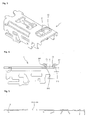
- FIG. 3 is a perspective diagram for describing a belt coupling for a safety belt buckle according to the present invention.
- FIG. 4 is a side diagram for describing a belt coupling for a safety belt buckle according to the present invention.
- FIG. 5 is a process diagram for describing a manufacturing process of a belt coupling for a safety belt buckle according to the present invention.
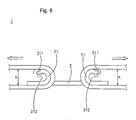
- FIG. 6 is a section of main parts taken for describing an operation state of a belt coupling for a safety belt buckle according to the present invention.
- FIG. 3 is a perspective diagram for describing a belt coupling for a safety belt buckle according to the present invention.
- FIG. 4 is a side diagram for describing the belt coupling for the safety belt buckle according to the present invention.
- the belt coupling 1 of the present invention has a protrusion 21 provided at a belt coupling hole 2 in which a belt is wound, and has a shape deformation space 212 provided at the protrusion 21.
- the belt coupling 1 is a constituent element of a buckle installed at one side of a seat and selectively fixing a tongue as above.
- the belt coupling 1 includes the belt coupling hole 2 for connecting the belt fixed to a seat of a vehicle, etc. by a fixer.
- a front end 211 of the protrusion 21 is bent in a semicircular shape such that the front end 211 is spaced a predetermined distance apart from one surface of the belt coupling 1, thereby providing a shape deformation space 212 in the inside.
- the shape deformation space 212 of the protrusion 21 is formed to have a semicircular shape, i.e., a semicircular shape whose portion is opened, in the inside of a bent portion.
- the protrusion 21 can be designed to have a height ('h' of FIG. 6 ) higher compared to the conventional art, thus being able to increase a contact area with the belt 3.
- FIG. 5 is a process diagram for describing a manufacturing process of a belt coupling for a safety belt buckle according to the present invention.
- the protrusion 21 is formed through a slotting process of puncturing the belt coupling hole 2, primary and secondary burring processes, and a curling process.
- FIG. 6 is a section of main parts taken for describing an operation state of a belt coupling for a safety belt buckle according to the present invention.
- the front end 211 of the protrusion 21 provided at the belt coupling hole 2 is spaced a predetermined distance apart from one surface of the belt coupling 1 and in addition the shape deformation space 212 is provided in the inside, when a tensile pressure is applied to the belt 3 wound in the belt coupling hole 2, the front end 211 of the protrusion 21 is deformed in a form of being bent in a shape deformation space 212 direction, that is, one surface direction of the belt coupling 1.
- the tensile test obtained the result in which the belt coupling hole 2 having the protrusion 21 of the present invention endures a tensile pressure up to 2,400kgf/cm 2 , and obtained the result in which, more than it, the belt coupling hole 2 is damaged and the belt 3 is stretched.
- the belt coupling 1 of the present invention can prevent a phenomenon in which the belt is broken by a pressure as in the conventional art.
- a belt coupling for a safety belt buckle has an effect of, when a pressure is applied to a belt, smoothly dispersing the pressure to the belt and a belt coupling hole, thus being able to prevent a breakage of the belt.
- the belt coupling has an advantage of being able to correspond to a higher tensile pressure by achieving a shape deformation of the protrusion using the pressure applied to the belt.
Landscapes
- Engineering & Computer Science (AREA)
- Mechanical Engineering (AREA)
- Automotive Seat Belt Assembly (AREA)
Abstract
A belt coupling (320) for a safety belt buckle (300) is provided. The belt coupling (320) has a protrusion (21) provided at a belt coupling (320) hole in which a belt (340) is wound. The protrusion (21) is bent in a semicircular shape such that its front end (211) is spaced a predetermined distance apart from one surface of the belt coupling (320) and, in the inside, a shape deformation space (212) is provided.
Description
- The present invention relates to a belt coupling for a safety belt buckle. More particularly, the present invention relates to a belt coupling for a safety belt buckle in which a structure of a protrusion of a belt coupling hole in which a belt is wound is improved.
- As well known in the art, a safety belt for safely protecting a driver and passengers from an accident is installed in a land transport means such as a vehicle as well as other vehicles (including a sea vessel and a sky aircraft). Such a safety belt operates at the time of the occurrence of an accident such as front collision, side collision, overturn, etc., and performs a function of protecting a driver and a passenger to the maximum. In the case of a vehicle, the safety belt is one of basically mounted safety devices.
- In order to describe a structure of a conventional safety belt, a vehicle safety belt, for example, a 3-point type safety belt is described as its typical example.
-
FIG. 1 is a construction diagram for describing a conventional vehicle safety belt. - Referring to
FIG. 1 , the conventional 3-point type safety belt includes aband shape belt 100, aretractor 600, aslip guide 400, abuckle 300, atongue 200, and ananchor 500. Theband shape belt 100 wraps the upper body of a passenger. Theretractor 600 has a structure of winding and keeping thebelt 100 or being elastically rotated to withdraw thebelt 100 or, upon shock energy forwarding, cut off the withdrawal. Theslip guide 400 guides thebelt 100. Thebuckle 300 is installed at one side of a seat. Thetongue 200 is mounted and released from thebuckle 300 and is installed in thebelt 100 such that thebelt 100 elastically contacts with the body of the passenger. Theanchor 500 fixes thebelt 100 to a car body. - The
belt 100 includes ashoulder belt 110 and alap belt 120. Theshoulder belt 110 restricts and supports a portion from the shoulder to the breast depending on a belt restriction position. The lap belt 120 restricts and supports the belly. Thebelt 100 is, at one end, rotatably and withdrawably wound, housed, and fixed to theretractor 600 fixed to the car body and, at the other end, is connected and fixed to theanchor 500 coupled and fixed to the car body. Thebelt 100 presently popularly used is of synthetic fiber of nylon, polyester, etc. Thebelt 100 is woven to have a band shape of a width of about 50 mm and a thickness of about 1.2 mm. Because having a high tensile strength, upon vehicle collision, thebelt 100 restricts the passenger by a sufficient strength. - On the other hand, the
buckle 300 includes abuckle part 310 and abelt coupling 320. Thebuckle part 310 selectively fixes thetongue 200. Thebelt coupling 320 fixes thebuckle part 310 and in addition, connects abelt 340 fixed to a seat of a vehicle with afixer 330.FIG. 2 is a perspective diagram for describing a construction of a conventional belt coupling of a buckle. - Referring to
FIG. 2 , theconventional belt coupling 320 of thebuckle 300 is constructed by bending a thin metal plate in a predetermined shape and in addition puncturing a plurality of holes. Thebelt coupling 320 has, in the inside, a buckle part (e.g., a buckle part including a stopper, a spring, a press button, etc.) and has, at the other end, abelt coupling hole 320a punctured for connecting thebelt 340 fixed to the seat. - As the
belt coupling hole 320a is punctured narrower than a width of the belt, the belt is wound and connected to pass through thebelt coupling hole 320a in a twice-folded state. As thebelt coupling hole 320a is punctured in thebelt coupling 320 of the thin plate shape, when a momentary pressure is repeatedly applied to the belt, the pressure is forwarded to an end surface of thebelt coupling hole 320a as it is and damages the belt. In other words, there is a problem that, as the conventionalbelt coupling hole 320a is punctured in thebelt coupling 320 of the thin plate shape, when a pressure is repeatedly applied to the belt, thebelt coupling hole 320a is damaged. There is a problem that, as an edge surface of thebelt coupling hole 320a coming in contact with the belt wound in thebelt coupling hole 320a acts as a blade, the belt is cut if the pressure is repeatedly applied. - In order to solve the problem, Korean Patent Publication No.
2003-0025396 published on March 29, 2003 2003-0025396 - However, Korean Patent Publication No.
2003-0025396 - First, the type of protruding the first protrusion from one side surface of the belt coupling hole or the type of forming the first protrusion and the second protrusion at one side surface and the other side surface of the belt coupling hole (i.e., the long hole) is advantageous in dispersing a tensile pressure applied to the belt by more increasing an area (hereinafter, referred to as a "contact area") coming in contact with the belt compared to a belt coupling hole with no protrusion. However, from a structural view, there is a limit in a thickness given to the first protrusion or the first, second protrusions. Thus, there is a limit in increasing the contact area and, when a pressure is applied to the belt, because a deformation of each protrusion does not occur and a distribution of a force is not made, there is a problem that all forces are concentrated on the belt and the belt is broken.
- Second, compared to the aforementioned types, the type in which the first protrusion is of the cylindrical roll shape is advantageous in dispersing a tensile pressure because partially increasing a contact area. However, because a front end of the protrusion is constructed to get in contact with one surface of a belt coupling through a curling process, there is a problem that, when a tensile pressure is applied to a belt, as its shape deformation is impossible, a distribution of the tensile pressure is not accomplished in orderly fashion.
- In actual, the aforementioned problems can be identified even in the tensile test result. When a force of 1,800kgf/cm2 was applied to the belt, the protrusions of the above types could obtain the result in which their shape deformations do not occur and the belt is broken.
- An aspect of exemplary embodiments of the present invention is to address at least the problems and/or disadvantages and to provide at least the advantages described below. Accordingly, an aspect of exemplary embodiments of the present invention is to provide a belt coupling for a safety belt buckle with an improved belt bushing for, by improving a structure of a protrusion, when a pressure is applied to a belt, smoothly dispersing the pressure and preventing a breakage of the belt.
- Another aspect of exemplary embodiments of the present invention is to provide a belt coupling for a safety belt buckle for corresponding to a higher tensile pressure by achieving a shape deformation of a protrusion by a pressure applied to a belt.
- To achieve these and other advantages and in accordance with the purpose of the present invention, there is provided a belt coupling for a safety belt buckle in which a protrusion is provided at a belt coupling hole in which a belt is wound. The protrusion is bent in a semicircular shape such that its front end is spaced a predetermined distance apart from one surface of the belt coupling and, in the inside, a shape deformation space is provided.
- The above and other objects, features and advantages of the present invention will become more apparent from the following detailed description when taken in conjunction with the accompanying drawings in which:
-
FIG. 1 is a construction diagram for describing a conventional vehicle safety belt; -
FIG. 2 is a perspective diagram for describing a construction of a belt coupling of a conventional buckle; -
FIG. 3 is a perspective diagram for describing a belt coupling for a safety belt buckle according to the present invention; -
FIG. 4 is a side diagram for describing a belt coupling for a safety belt buckle according to the present invention; -
FIG. 5 is a process diagram for describing a manufacturing process of a belt coupling for a safety belt buckle according to the present invention; and -
FIG. 6 is a section of main parts taken for describing an operation state of a belt coupling for a safety belt buckle according to the present invention. - Throughout the drawings, the same drawing reference numerals will be understood to refer to the same elements, features and structures.
- Exemplary embodiments of the present invention will now be described in detail with reference to the annexed drawings. In the following description, a detailed description of known functions and configurations incorporated herein has been omitted for conciseness.
-
FIG. 3 is a perspective diagram for describing a belt coupling for a safety belt buckle according to the present invention.FIG. 4 is a side diagram for describing the belt coupling for the safety belt buckle according to the present invention. - Referring to
FIGS. 3 and 4 , thebelt coupling 1 of the present invention has aprotrusion 21 provided at abelt coupling hole 2 in which a belt is wound, and has ashape deformation space 212 provided at theprotrusion 21. - Here, the
belt coupling 1 according to the present invention is a constituent element of a buckle installed at one side of a seat and selectively fixing a tongue as above. Thebelt coupling 1 includes thebelt coupling hole 2 for connecting the belt fixed to a seat of a vehicle, etc. by a fixer. - In the present invention, in providing the
protrusion 21 at thebelt coupling hole 2, afront end 211 of theprotrusion 21 is bent in a semicircular shape such that thefront end 211 is spaced a predetermined distance apart from one surface of thebelt coupling 1, thereby providing ashape deformation space 212 in the inside. - As in
FIG. 4 , as thefront end 211 of theprotrusion 21 is bent to have a semicircular shape, theshape deformation space 212 of theprotrusion 21 is formed to have a semicircular shape, i.e., a semicircular shape whose portion is opened, in the inside of a bent portion. - In addition, as the
front end 211 of theprotrusion 21 is bent in the semicircular shape, theprotrusion 21 can be designed to have a height ('h' ofFIG. 6 ) higher compared to the conventional art, thus being able to increase a contact area with the belt 3. - Through a plurality of burring processes and curling processes, the
protrusion 21 is bent to have the semicircular shape.FIG. 5 is a process diagram for describing a manufacturing process of a belt coupling for a safety belt buckle according to the present invention. - Referring to
FIG. 5 , in a process of manufacturing thebelt coupling 1, theprotrusion 21 is formed through a slotting process of puncturing thebelt coupling hole 2, primary and secondary burring processes, and a curling process. - An operation state of the above-constructed belt coupling for the safety belt buckle according to the present invention is described below.
-
FIG. 6 is a section of main parts taken for describing an operation state of a belt coupling for a safety belt buckle according to the present invention. - Referring to
FIG. 6 , in thebelt coupling 1 of the present invention, as thefront end 211 of theprotrusion 21 provided at thebelt coupling hole 2 is spaced a predetermined distance apart from one surface of thebelt coupling 1 and in addition theshape deformation space 212 is provided in the inside, when a tensile pressure is applied to the belt 3 wound in thebelt coupling hole 2, thefront end 211 of theprotrusion 21 is deformed in a form of being bent in ashape deformation space 212 direction, that is, one surface direction of thebelt coupling 1. Accordingly, because a pressure is properly distributed to the belt 3 and theprotrusion 21, a tensile value higher by about 500kgf/cm2 to 600kgf/cm2 compared to the conventional art can be obtained. In actual, the tensile test obtained the result in which thebelt coupling hole 2 having theprotrusion 21 of the present invention endures a tensile pressure up to 2,400kgf/cm2, and obtained the result in which, more than it, thebelt coupling hole 2 is damaged and the belt 3 is stretched. - Accordingly, by improving the structure of the protrusion, the
belt coupling 1 of the present invention can prevent a phenomenon in which the belt is broken by a pressure as in the conventional art. - As described above, by improving a structure of a protrusion, a belt coupling for a safety belt buckle according to the present invention has an effect of, when a pressure is applied to a belt, smoothly dispersing the pressure to the belt and a belt coupling hole, thus being able to prevent a breakage of the belt. In addition, the belt coupling has an advantage of being able to correspond to a higher tensile pressure by achieving a shape deformation of the protrusion using the pressure applied to the belt.
- While the invention has been shown and described with reference to a certain preferred embodiment thereof, it will be understood by those skilled in the art that various changes in form and details may be made therein without departing from the spirit and scope of the invention as defined by the appended claims.
Claims (6)
- A belt coupling (1) for a safety belt (100) buckle (300) in which a protrusion (21) is provided at a belt coupling hole (2) in which a belt (340) is wound,
wherein the protrusion (21) is bent in a semicircular shape such that its front end (211) is spaced a predetermined distance apart from one surface of the belt coupling (1) and, in the inside, a shape deformation space (212) is provided. - The belt coupling according to claim 1, wherein the front end (211) of the protrusion (21) faces said one surface of the belt coupling (1).
- The belt coupling according to claim 1 or 2, wherein the shape of the protrusion (21) is deformed when a tensile force is applied to said belt (340).
- The belt coupling according to any of claims 1, 2 or 3, wherein the protrusion (21) is deformed when a tensile force is applied to said belt (340) such that said front end (211) is directed towards said one surface of the belt coupling (1)
- The belt coupling according to any of the preceding claims, wherein said belt coupling (1) is formed from a metal plate and said predetermined distance is equal or larger than the thickness of said metal plate.
- The belt coupling according to claim 5, wherein the protrusion (21) has a height (h) which is at least three times the thickness of said metal plate.
Applications Claiming Priority (1)
| Application Number | Priority Date | Filing Date | Title |
|---|---|---|---|
| KR1020090018483A KR20100099910A (en) | 2009-03-04 | 2009-03-04 | Safety belt ving-sing structure |
Publications (1)
| Publication Number | Publication Date |
|---|---|
| EP2226223A1 true EP2226223A1 (en) | 2010-09-08 |
Family
ID=42226492
Family Applications (1)
| Application Number | Title | Priority Date | Filing Date |
|---|---|---|---|
| EP10155189A Withdrawn EP2226223A1 (en) | 2009-03-04 | 2010-03-02 | Belt coupling for safety belt buckle |
Country Status (4)
| Country | Link |
|---|---|
| US (1) | US20100226713A1 (en) |
| EP (1) | EP2226223A1 (en) |
| JP (1) | JP4886049B2 (en) |
| KR (1) | KR20100099910A (en) |
Families Citing this family (4)
| Publication number | Priority date | Publication date | Assignee | Title |
|---|---|---|---|---|
| AT12352U1 (en) * | 2010-12-01 | 2012-04-15 | Fasching Salzburg Gmbh | BELT BELT LOCKING FOR A PASSENGER RETENTION SYSTEM OF A VEHICLE |
| US20160311396A1 (en) * | 2015-04-24 | 2016-10-27 | GM Global Technology Operations LLC | Belt buckle anchor for thin seats |
| USD772105S1 (en) * | 2015-09-25 | 2016-11-22 | Standard Car Truck Company | Auto rack railroad car restraint clip |
| CN107891838A (en) * | 2017-11-24 | 2018-04-10 | 宜兴市奥华汽配有限公司 | A kind of automobile safety belt buckle structure |
Citations (3)
| Publication number | Priority date | Publication date | Assignee | Title |
|---|---|---|---|---|
| US20020000717A1 (en) * | 2000-06-30 | 2002-01-03 | Tadao Ito | Loop hanger for seat belt and method for manufacturing same |
| KR20030025396A (en) | 2001-09-20 | 2003-03-29 | 강진희 | Buckle base with an improved structure and method for manufacturing the same |
| DE102007025481A1 (en) * | 2007-05-31 | 2008-12-04 | Autoliv Development Ab | Frame part for a belt buckle of a safety belt |
Family Cites Families (5)
| Publication number | Priority date | Publication date | Assignee | Title |
|---|---|---|---|---|
| US2727289A (en) * | 1951-08-04 | 1955-12-20 | Paul W White | Buckles |
| US2981994A (en) * | 1957-04-11 | 1961-05-02 | Parva Products Co | One-piece lingerie buckle |
| US3981052A (en) * | 1975-07-23 | 1976-09-21 | The Firestone Tire & Rubber Company | Low friction guide loop |
| DE7814486U1 (en) * | 1978-05-12 | 1979-01-18 | Repa Feinstanzwerk Gmbh, 7071 Alfdorf | DEFLECTION FOR SAFETY BELTS |
| DE102005034804B3 (en) * | 2005-07-21 | 2006-10-12 | J & S Gmbh Automotive Technology | Production of top mountings for car safety belts comprises embossing metal blank to produce diagonal grooves, then punching and cold-forming to produce mounting hole and belt guide slot with rounded upper surface, across which grooves pass |
-
2009
- 2009-03-04 KR KR1020090018483A patent/KR20100099910A/en not_active Ceased
-
2010
- 2010-02-08 JP JP2010025652A patent/JP4886049B2/en not_active Expired - Fee Related
- 2010-03-01 US US12/714,740 patent/US20100226713A1/en not_active Abandoned
- 2010-03-02 EP EP10155189A patent/EP2226223A1/en not_active Withdrawn
Patent Citations (3)
| Publication number | Priority date | Publication date | Assignee | Title |
|---|---|---|---|---|
| US20020000717A1 (en) * | 2000-06-30 | 2002-01-03 | Tadao Ito | Loop hanger for seat belt and method for manufacturing same |
| KR20030025396A (en) | 2001-09-20 | 2003-03-29 | 강진희 | Buckle base with an improved structure and method for manufacturing the same |
| DE102007025481A1 (en) * | 2007-05-31 | 2008-12-04 | Autoliv Development Ab | Frame part for a belt buckle of a safety belt |
Also Published As
| Publication number | Publication date |
|---|---|
| JP4886049B2 (en) | 2012-02-29 |
| JP2010202182A (en) | 2010-09-16 |
| US20100226713A1 (en) | 2010-09-09 |
| KR20100099910A (en) | 2010-09-15 |
Similar Documents
| Publication | Publication Date | Title |
|---|---|---|
| EP1980458B1 (en) | Belt guide anchor and seat belt unit including the same | |
| US9988013B2 (en) | Grip tongue latch plate for seatbelt | |
| US8641096B1 (en) | Web mounted load limiting seatbelt anchor | |
| US9988012B2 (en) | Seat belt system | |
| EP2711251B1 (en) | Tongue and seatbelt device using same | |
| US8474106B2 (en) | Seat belt latch plate assembly | |
| EP2226223A1 (en) | Belt coupling for safety belt buckle | |
| EP2296945B1 (en) | Seatbelt anchor assembly | |
| US8851522B1 (en) | Seatbelt anchor assembly | |
| CN115195659A (en) | Seat belt assembly | |
| US6290259B1 (en) | Anti-roping turning loop | |
| JP6834531B2 (en) | Vehicle seat belt device | |
| US10703327B2 (en) | Seatbelt assembly | |
| EP1754638A1 (en) | Seat-belt guide anchor and seat belt apparatus having the same | |
| EP2818368B1 (en) | Tongue and seatbelt device using same | |
| KR20100035638A (en) | Frame section for a buckle of a safety belt | |
| CN108652141B (en) | Tongue piece for seat belt device | |
| US7458610B2 (en) | Roller D-ring for seat belt of vehicle and method for assembling the same | |
| EP3479719B1 (en) | Seat-belt tongue | |
| EP1884419A1 (en) | Tongue plate stopper and seatbelt device using the same | |
| US10988106B2 (en) | Seat belt safety apparatus for vehicle | |
| US20020149192A1 (en) | Webbing insertion member | |
| US20050236828A1 (en) | Webbing insertion member | |
| JP2003081054A (en) | Seat belt device | |
| WO2018139428A1 (en) | Seatbelt device for vehicle |
Legal Events
| Date | Code | Title | Description |
|---|---|---|---|
| PUAI | Public reference made under article 153(3) epc to a published international application that has entered the european phase |
Free format text: ORIGINAL CODE: 0009012 |
|
| 17P | Request for examination filed |
Effective date: 20100302 |
|
| AK | Designated contracting states |
Kind code of ref document: A1 Designated state(s): AT BE BG CH CY CZ DE DK EE ES FI FR GB GR HR HU IE IS IT LI LT LU LV MC MK MT NL NO PL PT RO SE SI SK SM TR |
|
| AX | Request for extension of the european patent |
Extension state: AL BA ME RS |
|
| STAA | Information on the status of an ep patent application or granted ep patent |
Free format text: STATUS: THE APPLICATION IS DEEMED TO BE WITHDRAWN |
|
| 18D | Application deemed to be withdrawn |
Effective date: 20100909 |