EP2226207A1 - Folding locator pin for glass panels - Google Patents
Folding locator pin for glass panels Download PDFInfo
- Publication number
- EP2226207A1 EP2226207A1 EP09166517A EP09166517A EP2226207A1 EP 2226207 A1 EP2226207 A1 EP 2226207A1 EP 09166517 A EP09166517 A EP 09166517A EP 09166517 A EP09166517 A EP 09166517A EP 2226207 A1 EP2226207 A1 EP 2226207A1
- Authority
- EP
- European Patent Office
- Prior art keywords
- pin
- glass panel
- shipping
- pin body
- glass
- Prior art date
- Legal status (The legal status is an assumption and is not a legal conclusion. Google has not performed a legal analysis and makes no representation as to the accuracy of the status listed.)
- Withdrawn
Links
- 239000011521 glass Substances 0.000 title claims abstract description 111
- 238000009434 installation Methods 0.000 claims abstract description 8
- 125000006850 spacer group Chemical group 0.000 claims description 12
- 239000000853 adhesive Substances 0.000 claims description 8
- 230000001070 adhesive effect Effects 0.000 claims description 8
- 238000000034 method Methods 0.000 claims description 3
- 239000002390 adhesive tape Substances 0.000 claims description 2
- 238000001746 injection moulding Methods 0.000 claims 2
- 238000004519 manufacturing process Methods 0.000 abstract description 3
- 238000012856 packing Methods 0.000 description 10
- JOYRKODLDBILNP-UHFFFAOYSA-N Ethyl urethane Chemical compound CCOC(N)=O JOYRKODLDBILNP-UHFFFAOYSA-N 0.000 description 6
- 239000012790 adhesive layer Substances 0.000 description 1
- 239000005391 art glass Substances 0.000 description 1
- 238000005452 bending Methods 0.000 description 1
- 239000003795 chemical substances by application Substances 0.000 description 1
- 230000007423 decrease Effects 0.000 description 1
- 238000010586 diagram Methods 0.000 description 1
- 230000009977 dual effect Effects 0.000 description 1
- 230000000694 effects Effects 0.000 description 1
- 230000008030 elimination Effects 0.000 description 1
- 238000003379 elimination reaction Methods 0.000 description 1
- 238000002347 injection Methods 0.000 description 1
- 239000007924 injection Substances 0.000 description 1
- 239000010410 layer Substances 0.000 description 1
- 230000014759 maintenance of location Effects 0.000 description 1
- 239000002991 molded plastic Substances 0.000 description 1
- 238000004806 packaging method and process Methods 0.000 description 1
- 230000002093 peripheral effect Effects 0.000 description 1
- 239000011241 protective layer Substances 0.000 description 1
- 238000007789 sealing Methods 0.000 description 1
Images



Classifications
-
- B—PERFORMING OPERATIONS; TRANSPORTING
- B60—VEHICLES IN GENERAL
- B60J—WINDOWS, WINDSCREENS, NON-FIXED ROOFS, DOORS, OR SIMILAR DEVICES FOR VEHICLES; REMOVABLE EXTERNAL PROTECTIVE COVERINGS SPECIALLY ADAPTED FOR VEHICLES
- B60J1/00—Windows; Windscreens; Accessories therefor
- B60J1/004—Mounting of windows
- B60J1/005—Mounting of windows using positioning means during mounting
Definitions
- the present invention relates in general to the handling and installation of glass panels such as automotive windshields, and, more specifically, to an alignment pin on a glass panel that mates with holes in a mounting frame to align the glass panel while it is bonded to the mounting frame.
- Locator pins are commonly used as an assembly aid on automotive glass (such as windshields and backlites) to correctly locate and temporarily hold the glass panel in the proper position until a bonding/sealing agent (e.g., urethane) applied around the periphery of the glass panel has cured. After the urethane cures, the locator pins have no further function.
- a bonding/sealing agent e.g., urethane
- the locator pins must be accurately positioned on the surface of the glass panel to correspond with mounting holes in the vehicle frame so that the glass panel is properly centered within the vehicle frame and held at a desired height from the frame to accommodate the desired width of urethane. To simplify the glass panel placement within the vehicle frame and mounting holes, a substantial pin length is desired.
- the height of the locator pins decreases the packing density of the glass panels during transportation from the glass manufacturer to the vehicle assembler. The reduction in packing density increases overall shipping costs as well as the expenditures for fabricating and transporting racks in which the glass panels are shipped. In order to avoid cost increases related to inefficient packaging, glass manufacturers sometimes open local facilities near the shipping destinations (e.g., the customer's assembly plants) in order to install the locator pins. It would be desirable to increase packing density while preserving the functionality of a locator pin.
- spacers are typically employed between adjacent glass panels in shipping racks to reduce damage during shipping.
- spacer thickness must be greatly increased in order to accommodate the pin length.
- the present invention provides a folding pin capable of dual use as a spacer between glass panels during shipment and a locator pin during assembly to a vehicle.
- a higher packing density is achieved which reduces shipping costs and lowers expenditures associated with the shipping racks themselves.
- a locator pin for aligning a glass panel during installation on a vehicle.
- the locator pin includes a base for affixing to the glass panel in a predetermined position prior to transporting it from a site where the glass panel is formed.
- a pin body has an elongated portion with a proximal end and a distal end defining a longitudinal axis.
- a hinge pivotally attaches the pin body to the base at the proximal end so that the pin body pivots between a shipping position wherein the longitudinal axis is substantially parallel to a surface of the glass panel and an alignment position wherein the longitudinal axis is substantially perpendicular to the surface of the glass panel.
- a glass product for installation in a frame having a plurality of mounting holes comprising: a glass panel adapted to be mounted to the frame; and a plurality of locator pins affixed to a surface of the glass panel at positions corresponding to the mounting holes, wherein each locator pin comprises: a base; a pin body having an elongated portion with a proximal end and a distal end defining a longitudinal axis; and a hinge for pivotally attaching the pin body to the base at the proximal end, the pin body pivoting between a shipping position wherein the longitudinal axis is substantially parallel to a surface of the glass panel and an alignment position wherein the longitudinal axis is substantially perpendicular to the surface of the glass panel.
- Each locator pin may further comprise an adhesive applied to an underside of the base affixing the base to the glass panel.
- Each pin body may further comprise a support surface generally perpendicular to the longitudinal axis for supporting the glass panel on the frame with the pin body in the alignment position with the distal end extending through a respective mounting hole during attachment of the glass panel to the frame.
- Each locator pin may comprise a bearing shoulder formed on at least one of the base or the hinge for contacting an adjacent glass panel when in the shipping position and when the glass panel is mounted in a shipping rack for stacking a plurality of glass panels.
- a glass panel 10 has an inner surface 11 to which are mounted locater pins 12-15 at the corners near the peripheral edge of surface 11.
- Panel 10 is adapted to be mounted to a vehicle frame 16 having a windshield aperture 17.
- a well 18 may be formed around the edge of aperture 17 and includes a plurality of mounting holes 20-23 for receiving locator pins 12-15, respectively.
- Glass panel 10 is maneuvered into position so that pins 12-15 are inserted into mounting holes 20-23.
- the locating pins hold glass panel 10 in place for rigid attachment by a urethane adhesive as shown in Figure 2 .
- locator pin 12 extends through mounting hole 20 in frame well 17 so that a support surface 25 of locator pin 12 supports glass panel 10 at a predetermined spacing to accommodate a urethane layer 26 applied in a conventional manner.
- Locator pin 12 may be attached to glass panel 10 by an adhesive tape 24, for example.
- a shipping rack for containing the glass panels and for loading onto and off of a transport vehicle such as a truck includes a pair of side rails 30 and 31.
- Rails 30 and 31 may include support spacers 32 at an appropriate spacing for separating glass panels 33 by a distance no less than the height of locator pins 34. Additional spacers 35 may also be provided between adjacent glass panels 33.
- glass panels 33 have a low packing density.
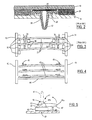
- Figure 4 shows a plurality of glass panels 40 having folding locator pins 41 according to the present invention.
- Panels 40 are loaded in a shipping rack having side rails 42 and 43 on opposite sides of a bottom panel 44.
- Figure 4 shows an increased packing density by virtue of the pins being re-oriented in a direction substantially parallel to glass panels 40 into a shipping position from which they can be folded upward after removal from the shipping rack for installation on a vehicle.
- some or all of the separate spacers can be eliminated by integrating a spacer function into folding locator pins 41 when they are in their folded positions.
- a locator pin 41 of the present invention is shown in greater detail in Figure 5 .
- a base portion 45 carries a hinge portion 46 to which a pin body 47 is pivotally mounted.
- An adhesive layer 48 affixes base 45 to glass panel 40 at a predetermined position 50.
- Locator pin 41 may be affixed to glass panel 40 in the proper location using an automatic placement machine, for example.
- Pin body 47 has a distal end 47a and a proximal end 47b mounted in hinge portion 46, whereby the pin body has a longitudinal axis extending between ends 47a and 47b. Pin body 47 pivots between a shipping position wherein the longitudinal axis is parallel to the surface of glass panel 40 and an alignment position (shown in phantom) wherein the longitudinal axis is substantially perpendicular to the surface of glass panel 40.
- a locking future 51 is integrated with hinge portion 46 for positively retaining pin body at least in the alignment position, and optionally in the shipping position. If locked in the shipping position, the retention force is sufficiently small to be overcome manually when switching the pin body into the alignment position.
- Locator pin 40 preferably provides a support surface 52 that can act as a bearing shoulder of a spacer in order to contact an adjacent glass panel when in the shipping position and affixed to a glass panel in a shipping rack with a stack of glass panels.
- Support surface 52 may also be used for supporting the glass panel on the vehicle frame when the pin body is in the alignment position and inserted into a corresponding mounting hole on the vehicle frame.
- Support surface 52 is generally parallel with the surface of glass 40 and thus is generally perpendicular to the longitudinal axis of the pin body when the pin body is in the alignment position.
- a frangible tab 53 may be provided for holding pin body 47 in the shipping position until broken by a force for shifting pin body 47 into the alignment position.
- Frangible tab 53 may connect pin body 47 to base 45, as shown, or may be incorporated into the hinge 46.
- FIG. 6-9 Another embodiment for the locator pin is shown in Figures 6-9 .
- a base 55 supports hinge posts 56 and 57 for receiving hinge pins 61 and 62 of a pin body 60.
- a crossbar 63 is formed integrally with hinge pins 61 and 62 and alignment pin 64. In the shipping position, pin 64 rests on a block 66 extending from base 55.
- Base 55 and pin body 60 may preferably be formed of injection molded plastic, and are preferably molded together insubstantially one operation. Consequently, base 55 and pin portion 60 are not freely moving upon the removal from the mold. Instead, there are at least portions of flashing between the two elements, such as flash 67 between hinge posts 56 and 57 and hinge pins 61 and 62, respectively, and flash 68 between block 66 and alignment pin 64.
- the flashing may preferably act as the frangible tabs for holding pin body 60 in the shipping position. The strength of the flashing is sufficiently low that a vehicle installer can manually break the flashing by pulling upward on pin 64.
- Crossbar 63 has a first tab 70 to form part of a locking feature for the alignment position.
- a post 71 on base 55 has a second tab 72 for interlocking with tab 70 as shown in Figure 9 to retain pin 64 in the alignment position.
- a pair of blocks 73 and 74 contact cross bar 63 to support it when in the alignment position.
- a support surface 75 of crossbar 63 around pin 64 and a top surface 76 of post 71 provide a support surface for contacting the vehicle frame and providing the desired standoff height.
- An adhesive applied to the underside of base 55 preferably comprises a double-sided tape 77 with a peelable protective layer 78 that protects the adhesive prior to application to a glass panel.
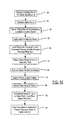
- FIG. 10 A preferred method of the invention for processing and shipping glass panels for assembly onto vehicles is shown in Figure 10 .
- step 80 a plurality of folding pins are fabricated according to vehicle specifications so that they fit the associated mounting holes and provide the desired standoff.
- a plurality of glass panels are fabricated in step 81. Folding pins are attached to predetermined locations on the glass panels in step 82. Such placement may be preferably performed using an automatic placing machine.
- the fabricated glass panels with attached folding pins are inserted into shipping racks in step 83.
- the racks are loaded into a transportation vehicle in step 84. Due to the increased packing density achieved by use of the folding pins, shipping efficiency is increased.
- the transportation vehicle delivers the glass panels to a vehicle assembly plant.
- the glass panels are removed from the racks in step 86 and the folding pins are deployed to their upright position in step 87.
- the vehicle assembler then mounts the glass panel to the frame in step 88 so that the pins enter the corresponding mounting holes.
- the glass panels e.g., windshields
- the glass panels are properly held in place during curing of a urethane adhesive that is typically used for vehicle assembly.
- the shipping racks which held the glass panels during shipping are consolidated for return to the glass fabrication plant in step 89. Since the racks hold the glass panels at a higher packing density, there is less rack volume used for any particular number of glass panels, which means that less floor space is used at the vehicle assembly plant for storing the consolidated racks.
- the shipping racks are then sent back to the glass plant in step 90. Thanks to the greater packing density, fewer shipments are required to return the shipping racks, resulting in further savings in transportation.
- FIGS 11-15 show yet another embodiment wherein the folding pin is formed as a single molded piece.
- a base 91 is molded to be substantially co-planar with a pin body 92 which is joined via a hinge section 93.
- Hinge section 93 is shaped by a contoured slot to allow bending upwards of pin body 92 so that it may be captured by a locking structure 94 extending from the top of base 91.
- Locking structure 94 has a pair of jaws 95 and 96 extending alongside a recess 97.
- Locking structure 94 provides both a bearing surface for stacking panels during shipping and a standoff surface for suspending the panel the desired distance above the vehicle frame while in the alignment position.
- An adhesive 98 such as a double-sided tape, is applied to the underside of base 91.
- the shipping racks or other containers utilized are simplified, thereby reducing the costs of manufacturing the racks.
- the reduced complexity of the racks can also enable greater interchangeability for use with different types of glass panels.
- the elimination of separate rack spacers eliminates the spacer cost and reduces labor at both the glass plant and the vehicle assembly plant.
Landscapes
- Engineering & Computer Science (AREA)
- Mechanical Engineering (AREA)
- Packaging Of Machine Parts And Wound Products (AREA)
- Packaging Frangible Articles (AREA)
- Automobile Manufacture Line, Endless Track Vehicle, Trailer (AREA)
- Automatic Assembly (AREA)
Abstract
A locator pin aligns a glass panel during installation on a vehicle. The locator pin includes a base for affixing to the glass panel in a predetermined position prior to transporting it from a site where the glass panel is formed. A pin body has an elongated portion with a proximal end and a distal end defining a longitudinal axis. A hinge pivotally attaches the pin body to the base at the proximal end so that the pin body pivots between a shipping position wherein the longitudinal axis is substantially parallel to a surface of the glass panel and an alignment position wherein the longitudinal axis is substantially perpendicular to the surface of the glass panel. The folding pin allows glass panels to be stacked closer together in shipping racks when they are transported from the glass fabrication facility to a place of installation.
Description
- Not Applicable.
- Not Applicable.
- The present invention relates in general to the handling and installation of glass panels such as automotive windshields, and, more specifically, to an alignment pin on a glass panel that mates with holes in a mounting frame to align the glass panel while it is bonded to the mounting frame.
- Locator pins are commonly used as an assembly aid on automotive glass (such as windshields and backlites) to correctly locate and temporarily hold the glass panel in the proper position until a bonding/sealing agent (e.g., urethane) applied around the periphery of the glass panel has cured. After the urethane cures, the locator pins have no further function.
- The locator pins must be accurately positioned on the surface of the glass panel to correspond with mounting holes in the vehicle frame so that the glass panel is properly centered within the vehicle frame and held at a desired height from the frame to accommodate the desired width of urethane. To simplify the glass panel placement within the vehicle frame and mounting holes, a substantial pin length is desired. However, the height of the locator pins decreases the packing density of the glass panels during transportation from the glass manufacturer to the vehicle assembler. The reduction in packing density increases overall shipping costs as well as the expenditures for fabricating and transporting racks in which the glass panels are shipped. In order to avoid cost increases related to inefficient packaging, glass manufacturers sometimes open local facilities near the shipping destinations (e.g., the customer's assembly plants) in order to install the locator pins. It would be desirable to increase packing density while preserving the functionality of a locator pin.
- With or without locator pins, spacers are typically employed between adjacent glass panels in shipping racks to reduce damage during shipping. When transporting glass panels with long locator pins, spacer thickness must be greatly increased in order to accommodate the pin length. Thus, it would also be desirable to reduce or eliminate the need for spacers.
- The present invention provides a folding pin capable of dual use as a spacer between glass panels during shipment and a locator pin during assembly to a vehicle. A higher packing density is achieved which reduces shipping costs and lowers expenditures associated with the shipping racks themselves.
- In one aspect of the invention, a locator pin is provided for aligning a glass panel during installation on a vehicle. The locator pin includes a base for affixing to the glass panel in a predetermined position prior to transporting it from a site where the glass panel is formed. A pin body has an elongated portion with a proximal end and a distal end defining a longitudinal axis. A hinge pivotally attaches the pin body to the base at the proximal end so that the pin body pivots between a shipping position wherein the longitudinal axis is substantially parallel to a surface of the glass panel and an alignment position wherein the longitudinal axis is substantially perpendicular to the surface of the glass panel.
- In another aspect of the invention there is provided a glass product for installation in a frame having a plurality of mounting holes, comprising: a glass panel adapted to be mounted to the frame; and a plurality of locator pins affixed to a surface of the glass panel at positions corresponding to the mounting holes, wherein each locator pin comprises: a base; a pin body having an elongated portion with a proximal end and a distal end defining a longitudinal axis; and a hinge for pivotally attaching the pin body to the base at the proximal end, the pin body pivoting between a shipping position wherein the longitudinal axis is substantially parallel to a surface of the glass panel and an alignment position wherein the longitudinal axis is substantially perpendicular to the surface of the glass panel.
- Each locator pin may further comprise an adhesive applied to an underside of the base affixing the base to the glass panel.
- Each pin body may further comprise a support surface generally perpendicular to the longitudinal axis for supporting the glass panel on the frame with the pin body in the alignment position with the distal end extending through a respective mounting hole during attachment of the glass panel to the frame.
- Each locator pin may comprise a bearing shoulder formed on at least one of the base or the hinge for contacting an adjacent glass panel when in the shipping position and when the glass panel is mounted in a shipping rack for stacking a plurality of glass panels.
-
-
Figure 1 is a perspective diagram showing the use of locator pins in assembling a windshield to a vehicle frame. -
Figure 2 is a cross-sectional view of a locator pin installed in a vehicle frame. -
Figure 3 is an end view of prior art glass products stacked in a shipping rack. -
Figure 4 is an end view of glass panels with the folding hinge of the present invention stacked in a shipping rack. -
Figure 5 is a side, plan view showing a folding pin mounted to a glass panel. -
Figure 6 is a top, exploded view showing a folding pin in greater detail. -
Figure 7 is a side, exploded view of the folding pin ofFigure 5 . -
Figure 8 is a side view of the folding pin in the shipping position. -
Figure 9 is a side view of the folding pin in the alignment position. -
Figure 10 is a flowchart showing one preferred embodiment of the invention. -
Figures 11-15 are top and side views of another embodiment of the folding pin. - Referring now to
Figure 1 , aglass panel 10 has aninner surface 11 to which are mounted locater pins 12-15 at the corners near the peripheral edge ofsurface 11.Panel 10 is adapted to be mounted to avehicle frame 16 having awindshield aperture 17. A well 18 may be formed around the edge ofaperture 17 and includes a plurality of mounting holes 20-23 for receiving locator pins 12-15, respectively.Glass panel 10 is maneuvered into position so that pins 12-15 are inserted into mounting holes 20-23. The locating pins holdglass panel 10 in place for rigid attachment by a urethane adhesive as shown inFigure 2 . Thus,locator pin 12 extends throughmounting hole 20 in frame well 17 so that asupport surface 25 oflocator pin 12 supportsglass panel 10 at a predetermined spacing to accommodate aurethane layer 26 applied in a conventional manner.Locator pin 12 may be attached toglass panel 10 by anadhesive tape 24, for example. - The effect of the locator pins on packing density during shipment of glass panels is shown in
Figure 3 . A shipping rack for containing the glass panels and for loading onto and off of a transport vehicle such as a truck includes a pair ofside rails Rails support spacers 32 at an appropriate spacing for separatingglass panels 33 by a distance no less than the height oflocator pins 34.Additional spacers 35 may also be provided betweenadjacent glass panels 33. As a consequence of the height oflocator pins 34,glass panels 33 have a low packing density. -
Figure 4 shows a plurality ofglass panels 40 havingfolding locator pins 41 according to the present invention.Panels 40 are loaded in a shipping rack havingside rails bottom panel 44.Figure 4 shows an increased packing density by virtue of the pins being re-oriented in a direction substantially parallel toglass panels 40 into a shipping position from which they can be folded upward after removal from the shipping rack for installation on a vehicle. Moreover, some or all of the separate spacers can be eliminated by integrating a spacer function into foldinglocator pins 41 when they are in their folded positions. - A
locator pin 41 of the present invention is shown in greater detail inFigure 5 . Abase portion 45 carries ahinge portion 46 to which apin body 47 is pivotally mounted. Anadhesive layer 48affixes base 45 toglass panel 40 at apredetermined position 50.Locator pin 41 may be affixed toglass panel 40 in the proper location using an automatic placement machine, for example. -
Pin body 47 has adistal end 47a and aproximal end 47b mounted inhinge portion 46, whereby the pin body has a longitudinal axis extending betweenends Pin body 47 pivots between a shipping position wherein the longitudinal axis is parallel to the surface ofglass panel 40 and an alignment position (shown in phantom) wherein the longitudinal axis is substantially perpendicular to the surface ofglass panel 40. - A
locking future 51 is integrated withhinge portion 46 for positively retaining pin body at least in the alignment position, and optionally in the shipping position. If locked in the shipping position, the retention force is sufficiently small to be overcome manually when switching the pin body into the alignment position. -
Locator pin 40 preferably provides asupport surface 52 that can act as a bearing shoulder of a spacer in order to contact an adjacent glass panel when in the shipping position and affixed to a glass panel in a shipping rack with a stack of glass panels.Support surface 52 may also be used for supporting the glass panel on the vehicle frame when the pin body is in the alignment position and inserted into a corresponding mounting hole on the vehicle frame.Support surface 52 is generally parallel with the surface ofglass 40 and thus is generally perpendicular to the longitudinal axis of the pin body when the pin body is in the alignment position. - A
frangible tab 53 may be provided for holdingpin body 47 in the shipping position until broken by a force for shiftingpin body 47 into the alignment position.Frangible tab 53 may connectpin body 47 tobase 45, as shown, or may be incorporated into thehinge 46. - Another embodiment for the locator pin is shown in
Figures 6-9 . Abase 55 supports hingeposts pin body 60. Acrossbar 63 is formed integrally with hinge pins 61 and 62 andalignment pin 64. In the shipping position, pin 64 rests on ablock 66 extending frombase 55. -
Base 55 andpin body 60 may preferably be formed of injection molded plastic, and are preferably molded together insubstantially one operation. Consequently,base 55 andpin portion 60 are not freely moving upon the removal from the mold. Instead, there are at least portions of flashing between the two elements, such asflash 67 between hinge posts 56 and 57 and hinge pins 61 and 62, respectively, andflash 68 betweenblock 66 andalignment pin 64. The flashing may preferably act as the frangible tabs for holdingpin body 60 in the shipping position. The strength of the flashing is sufficiently low that a vehicle installer can manually break the flashing by pulling upward onpin 64.Crossbar 63 has afirst tab 70 to form part of a locking feature for the alignment position. Apost 71 onbase 55 has asecond tab 72 for interlocking withtab 70 as shown inFigure 9 to retainpin 64 in the alignment position. A pair ofblocks contact cross bar 63 to support it when in the alignment position. Furthermore, asupport surface 75 ofcrossbar 63 aroundpin 64 and atop surface 76 ofpost 71 provide a support surface for contacting the vehicle frame and providing the desired standoff height. - An adhesive applied to the underside of
base 55 preferably comprises a double-sided tape 77 with a peelableprotective layer 78 that protects the adhesive prior to application to a glass panel. - A preferred method of the invention for processing and shipping glass panels for assembly onto vehicles is shown in
Figure 10 . Instep 80, a plurality of folding pins are fabricated according to vehicle specifications so that they fit the associated mounting holes and provide the desired standoff. A plurality of glass panels are fabricated instep 81. Folding pins are attached to predetermined locations on the glass panels instep 82. Such placement may be preferably performed using an automatic placing machine. - When ready for shipping, the fabricated glass panels with attached folding pins are inserted into shipping racks in
step 83. The racks are loaded into a transportation vehicle instep 84. Due to the increased packing density achieved by use of the folding pins, shipping efficiency is increased. Instep 85, the transportation vehicle delivers the glass panels to a vehicle assembly plant. - At the receiving end, the glass panels are removed from the racks in
step 86 and the folding pins are deployed to their upright position instep 87. The vehicle assembler then mounts the glass panel to the frame instep 88 so that the pins enter the corresponding mounting holes. Thus, the glass panels (e.g., windshields) are properly held in place during curing of a urethane adhesive that is typically used for vehicle assembly. - The shipping racks which held the glass panels during shipping are consolidated for return to the glass fabrication plant in
step 89. Since the racks hold the glass panels at a higher packing density, there is less rack volume used for any particular number of glass panels, which means that less floor space is used at the vehicle assembly plant for storing the consolidated racks. The shipping racks are then sent back to the glass plant instep 90. Thanks to the greater packing density, fewer shipments are required to return the shipping racks, resulting in further savings in transportation. -
Figures 11-15 show yet another embodiment wherein the folding pin is formed as a single molded piece. Abase 91 is molded to be substantially co-planar with apin body 92 which is joined via ahinge section 93.Hinge section 93 is shaped by a contoured slot to allow bending upwards ofpin body 92 so that it may be captured by a lockingstructure 94 extending from the top ofbase 91. Lockingstructure 94 has a pair ofjaws recess 97. When moving from the shipping position to the alignment position,pin body 92 pivots aroundhinge section 93. As itcontacts jaws recess 97 where it is securely held. Lockingstructure 94 provides both a bearing surface for stacking panels during shipping and a standoff surface for suspending the panel the desired distance above the vehicle frame while in the alignment position. An adhesive 98, such as a double-sided tape, is applied to the underside ofbase 91. - In addition to reduced transportation costs, the shipping racks or other containers utilized are simplified, thereby reducing the costs of manufacturing the racks. The reduced complexity of the racks can also enable greater interchangeability for use with different types of glass panels. The elimination of separate rack spacers eliminates the spacer cost and reduces labor at both the glass plant and the vehicle assembly plant.
Claims (15)
- A locator pin for aligning a glass panel during installation on a vehicle, comprising:a base for affixing to the glass panel at a predetermined spot on the glass panel prior to transporting it to a site where the glass panel will be installed on the vehicle;a pin body having an elongated portion with a proximal end and a distal end defining a longitudinal axis; anda hinge for pivotally attaching the pin body to the base at the proximal end, the pin body pivoting between a shipping position wherein the longitudinal axis is substantially parallel to a surface of the glass panel and an alignment position wherein the longitudinal axis is substantially perpendicular to the surface of the glass panel.
- The locator pin of claim 1 further comprising a locking feature for retaining the pin body in the alignment position after being rotated from the shipping position.
- The locator pin of claim 1 further comprising an adhesive applied to an underside of the base adapted to affix the base to the glass panel.
- The locator pin of claim 3 wherein the adhesive is comprised of a double-sided adhesive tape.
- The locator pin of claim 1 wherein the pin body further comprises a support surface generally perpendicular to the longitudinal axis for supporting the glass panel on a vehicle frame with the pin body in the alignment position during attachment of the glass panel to the vehicle.
- The locator pin of claim 1 comprising a bearing shoulder formed on at least one of the base or the hinge for contacting an adjacent glass panel when in the shipping position and affixed to a glass panel that is mounted in a shipping rack for stacking a plurality of glass panels.
- The locator pin of claim 1 further comprising a frangible tab for holding the pin body in the shipping position until broken by a force for shifting the pin body to the alignment position.
- The locator pin of claim 1 wherein the base and the pin body are integrally formed by injection molding.
- The locator pin of claim 8 wherein the frangible tab is comprised of a flash section joined to the hinge.
- A glass product for installation in a frame having a plurality of mounting holes, comprising:a glass panel adapted to be mounted to the frame; anda plurality of locator pins affixed to a surface of the glass panel at positions corresponding to the mounting holes, wherein each locator pin comprises:a base;a pin body having an elongated portion with a proximal end and a distal end defining a longitudinal axis; anda hinge for pivotally attaching the pin body to the base at the proximal end, the pin body pivoting between a shipping position wherein the longitudinal axis is substantially parallel to a surface of the glass panel and an alignment position wherein the longitudinal axis is substantially perpendicular to the surface of the glass panel.
- The glass product of claim 10 wherein each locator pin further comprises a locking feature for retaining the pin body in the alignment position after being rotated from the shipping position.
- The glass product of claim 10 wherein each locator pin further comprises a frangible tab for holding the pin body in the shipping position until broken by a force for shifting the pin body to the alignment position.
- The glass product of claim 10 wherein the base and the pin body of each locator pin are integrally formed by injection molding and the frangible tab is comprised of a flash section joined to the hinge.
- A method of processing and shipping glass panels for assembly onto vehicles, comprising the steps of:fabricating a plurality of glass panels for delivery to a destination:attaching folding pins at predetermined locations on at least some of the glass panels, wherein each folding pin comprises a base affixed to a respective glass panel, a pin body having an elongated portion with a proximal end and a distal end defining a longitudinal axis, and a hinge for pivotally attaching the pin body to the base at the proximal end, the pin body pivoting between a shipping position wherein the longitudinal axis is substantially parallel to a surface of the glass panel and an alignment position wherein the longitudinal axis is substantially perpendicular to the surface of the glass panel;inserting the glass panels having folding pins into shipping racks with each folding pin in its shipping position;delivering the shipping racks with glass panels to the destination;removing the glass panels from the shipping racks;moving the pin bodies of the folding pins from the shipping position to the alignment position; andmounting each glass panel to a respective frame of a respective vehicle so that each pin body extends through a mounting hole in the respective frame.
- The method of claim 14 wherein each folding pin provides a bearing shoulder formed on at least one of its base or its hinge for contacting an adjacent glass panel when in the shipping rack, so that the folding pin acts as a spacer between adjacent glass panels.
Applications Claiming Priority (1)
| Application Number | Priority Date | Filing Date | Title |
|---|---|---|---|
| US12/397,458 US7976094B2 (en) | 2009-03-04 | 2009-03-04 | Folding locator pin for glass panels |
Publications (1)
| Publication Number | Publication Date |
|---|---|
| EP2226207A1 true EP2226207A1 (en) | 2010-09-08 |
Family
ID=42111700
Family Applications (1)
| Application Number | Title | Priority Date | Filing Date |
|---|---|---|---|
| EP09166517A Withdrawn EP2226207A1 (en) | 2009-03-04 | 2009-07-27 | Folding locator pin for glass panels |
Country Status (5)
| Country | Link |
|---|---|
| US (1) | US7976094B2 (en) |
| EP (1) | EP2226207A1 (en) |
| JP (1) | JP2010202177A (en) |
| CN (1) | CN101823418A (en) |
| MX (1) | MX2009011711A (en) |
Cited By (4)
| Publication number | Priority date | Publication date | Assignee | Title |
|---|---|---|---|---|
| FR2992904A1 (en) * | 2012-07-05 | 2014-01-10 | Peugeot Citroen Automobiles Sa | Glass pane for car, has male positioning unit retractable so as to pass from deployed configuration to present projection depth to retracted configuration so as to present another projection depth lower than former projection depth |
| FR3040922A1 (en) * | 2015-09-11 | 2017-03-17 | Peugeot Citroen Automobiles Sa | GLAZING CAN BE FIXED ON A CASE OF A MOTOR VEHICLE |
| FR3045556A1 (en) * | 2015-12-21 | 2017-06-23 | Peugeot Citroen Automobiles Sa | PION OF INDEXING A GLAZING |
| GB2546835A (en) * | 2016-06-24 | 2017-08-02 | Bombardier Transp Gmbh | Method of assembling a window panel to a side wall structure of a rail vehicle body |
Families Citing this family (6)
| Publication number | Priority date | Publication date | Assignee | Title |
|---|---|---|---|---|
| US7330483B1 (en) * | 2002-12-19 | 2008-02-12 | At&T Corp. | Session initiation protocol (SIP) message incorporating a multi-purpose internet mail extension (MIME) media type for describing the content and format of information included in the SIP message |
| JP5925645B2 (en) * | 2012-09-12 | 2016-05-25 | 小島プレス工業株式会社 | Fastening material and method for manufacturing attachment member |
| US9457443B2 (en) * | 2014-02-20 | 2016-10-04 | Toyota Motor Engineering & Manufacturing North America, Inc. | Machine locating pin |
| DE102016212128A1 (en) | 2015-08-24 | 2017-03-02 | Ford Global Technologies, Llc | Vehicle components positioner |
| US11318817B2 (en) * | 2020-04-24 | 2022-05-03 | GM Global Technology Operations LLC | Articulating locating and retention member |
| DE102024131817A1 (en) | 2024-10-31 | 2026-04-30 | Bayerische Motoren Werke Aktiengesellschaft | Disc and method for mounting a disc |
Citations (5)
| Publication number | Priority date | Publication date | Assignee | Title |
|---|---|---|---|---|
| DE19649762A1 (en) * | 1996-11-30 | 1998-06-04 | Fritz Richard Gmbh & Co Kg | Method of connecting a glass sheet to a component and kit for performing the method |
| WO1999058355A1 (en) * | 1998-05-11 | 1999-11-18 | Forrester Company | Self-dispensing fastener for photocuring adhesive |
| FR2796764A1 (en) * | 1999-07-21 | 2001-01-26 | Renault | ELECTRICAL CONNECTION DEVICE IN PARTICULAR FOR GLAZING |
| DE102007015183A1 (en) * | 2006-06-27 | 2008-01-03 | Hino Motors, Ltd., Hino | Vehicle glass structure for mounting a windscreen glass in a driver's cab enables the glass to be fitted while preventing it from being broken |
| WO2009053463A1 (en) * | 2007-10-24 | 2009-04-30 | Pilkington Automotive Deutschland Gmbh | Centring pin |
Family Cites Families (21)
| Publication number | Priority date | Publication date | Assignee | Title |
|---|---|---|---|---|
| JPS6192915A (en) * | 1984-10-11 | 1986-05-10 | Nissan Motor Co Ltd | Construction for attaching window pane of automobile |
| JPS61249812A (en) * | 1985-04-27 | 1986-11-07 | Hori Glass Kk | Locating pin for vehicular window glass and method of locating vehicular window glass |
| JPH01204819A (en) * | 1988-02-09 | 1989-08-17 | Toyoda Gosei Co Ltd | Windowpane for automobile |
| JPH05286360A (en) * | 1992-04-13 | 1993-11-02 | Toyota Motor Corp | Wind glass mounting structure |
| US5323563A (en) * | 1992-07-31 | 1994-06-28 | Stageright Corporation | Retractable locators for deck panels of portable staging |
| US5475956A (en) * | 1992-09-25 | 1995-12-19 | Donnelly Corporation | Panel assembly |
| JP3116793B2 (en) * | 1995-11-24 | 2000-12-11 | 三菱自動車工業株式会社 | Window glass clip for temporary fixing |
| JPH1086660A (en) * | 1996-09-13 | 1998-04-07 | Fuji Heavy Ind Ltd | Positioning clip of window glass for vehicle |
| FR2771055B1 (en) * | 1997-11-18 | 1999-12-17 | Saint Gobain Vitrage | QUICKLY REMOVABLE GLAZING |
| JPH11180143A (en) * | 1997-12-24 | 1999-07-06 | Togo Seisakusyo Corp | Glass stopper |
| JP3942714B2 (en) * | 1997-12-25 | 2007-07-11 | 株式会社東郷製作所 | Glass stopper |
| JP2000108657A (en) * | 1998-10-05 | 2000-04-18 | Nippon Sheet Glass Co Ltd | Vehicle glass plate and vehicle glass window |
| US6099063A (en) | 1999-03-18 | 2000-08-08 | Navistar International Transportation Corp. | Device and method for positioning windshield glass |
| US7270236B2 (en) | 2003-01-27 | 2007-09-18 | Safelite Glass Corporation | Reusable windshield pallet |
| US6942280B2 (en) * | 2003-06-12 | 2005-09-13 | Guardian Industries Corp. | System for attaching colored insert to vehicle frame assembly |
| US7731028B2 (en) | 2003-09-02 | 2010-06-08 | Carroll Jr Arch W | Shipping package system for fragile panels |
| US6957849B2 (en) | 2004-01-02 | 2005-10-25 | Ford Global Technologies, Llc | Windshield stop for cowl vent grille attachment |
| JP4683858B2 (en) * | 2004-05-14 | 2011-05-18 | スリーエム イノベイティブ プロパティズ カンパニー | Article support |
| JP2007008275A (en) * | 2005-06-29 | 2007-01-18 | Toyota Motor Corp | Glass positioning jig and method for bonding windshield glass to vehicle body using the same |
| DE102005036908A1 (en) * | 2005-08-05 | 2007-02-08 | Audi Ag | Fixing unit for installation of a window pane in a vehicle bodywork opening, for adhesive bonding, has a fixing pin with relative movements against the pane to give it a positive fit |
| JP5247053B2 (en) * | 2006-03-31 | 2013-07-24 | 旭硝子株式会社 | Temporary clip for window glass for vehicles |
-
2009
- 2009-03-04 US US12/397,458 patent/US7976094B2/en not_active Expired - Fee Related
- 2009-07-27 EP EP09166517A patent/EP2226207A1/en not_active Withdrawn
- 2009-07-29 CN CN200910165528A patent/CN101823418A/en active Pending
- 2009-08-06 JP JP2009183141A patent/JP2010202177A/en active Pending
- 2009-10-29 MX MX2009011711A patent/MX2009011711A/en active IP Right Grant
Patent Citations (5)
| Publication number | Priority date | Publication date | Assignee | Title |
|---|---|---|---|---|
| DE19649762A1 (en) * | 1996-11-30 | 1998-06-04 | Fritz Richard Gmbh & Co Kg | Method of connecting a glass sheet to a component and kit for performing the method |
| WO1999058355A1 (en) * | 1998-05-11 | 1999-11-18 | Forrester Company | Self-dispensing fastener for photocuring adhesive |
| FR2796764A1 (en) * | 1999-07-21 | 2001-01-26 | Renault | ELECTRICAL CONNECTION DEVICE IN PARTICULAR FOR GLAZING |
| DE102007015183A1 (en) * | 2006-06-27 | 2008-01-03 | Hino Motors, Ltd., Hino | Vehicle glass structure for mounting a windscreen glass in a driver's cab enables the glass to be fitted while preventing it from being broken |
| WO2009053463A1 (en) * | 2007-10-24 | 2009-04-30 | Pilkington Automotive Deutschland Gmbh | Centring pin |
Cited By (7)
| Publication number | Priority date | Publication date | Assignee | Title |
|---|---|---|---|---|
| FR2992904A1 (en) * | 2012-07-05 | 2014-01-10 | Peugeot Citroen Automobiles Sa | Glass pane for car, has male positioning unit retractable so as to pass from deployed configuration to present projection depth to retracted configuration so as to present another projection depth lower than former projection depth |
| FR3040922A1 (en) * | 2015-09-11 | 2017-03-17 | Peugeot Citroen Automobiles Sa | GLAZING CAN BE FIXED ON A CASE OF A MOTOR VEHICLE |
| FR3045556A1 (en) * | 2015-12-21 | 2017-06-23 | Peugeot Citroen Automobiles Sa | PION OF INDEXING A GLAZING |
| WO2017109307A1 (en) * | 2015-12-21 | 2017-06-29 | Peugeot Citroen Automobiles Sa | Indexing pin for glazing |
| GB2546835A (en) * | 2016-06-24 | 2017-08-02 | Bombardier Transp Gmbh | Method of assembling a window panel to a side wall structure of a rail vehicle body |
| WO2017220449A1 (en) * | 2016-06-24 | 2017-12-28 | Bombardier Transportation Gmbh | Method of assembling a window panel to a side wall structure of a rail vehicle body |
| GB2546835B (en) * | 2016-06-24 | 2018-08-08 | Bombardier Transp Gmbh | Method of assembling a window panel to a side wall structure of a rail vehicle body |
Also Published As
| Publication number | Publication date |
|---|---|
| US20100225138A1 (en) | 2010-09-09 |
| MX2009011711A (en) | 2010-09-30 |
| JP2010202177A (en) | 2010-09-16 |
| CN101823418A (en) | 2010-09-08 |
| US7976094B2 (en) | 2011-07-12 |
Similar Documents
| Publication | Publication Date | Title |
|---|---|---|
| US7976094B2 (en) | Folding locator pin for glass panels | |
| US11214402B2 (en) | Modular deck system for use with movable platforms | |
| CN106660662B (en) | Transport box | |
| US9831365B2 (en) | Photovoltaic module carrier and methods of use | |
| CN104245524B (en) | container | |
| US20090090652A1 (en) | Plate-shaped member holding system, plate-shape member packing device, and method for holding a plate-shaped member | |
| US20110262264A1 (en) | Method of Using a Window Pallet | |
| TWI457262B (en) | Pallet for glass plate packing | |
| EP2634453A1 (en) | Belt for Transport and Dispension of Balancing Weights | |
| CN103237733A (en) | Auxiliary transport unit and method for use thereof | |
| CN118218940A (en) | Automatic assembly machine for camera frame and glass back cover | |
| CN102985328A (en) | Plate packaging structure and plate transporting method | |
| US3985231A (en) | Apparatus for transporting storing and dispensing frangible material | |
| CN102530353B (en) | Module for stacking thin panels | |
| KR200323636Y1 (en) | Carriage for transporting plate glass | |
| TWI644842B (en) | Rack, stopper and stopper mounting method | |
| CZ20032113A3 (en) | Transport means of long rails and a reinforcing or supporting frame | |
| KR102096960B1 (en) | Load device for vehicle | |
| CN217497027U (en) | Container for storing plate-like body | |
| KR101539239B1 (en) | Special packaging tool for glass | |
| CN212149804U (en) | An automatic locking rack and cargo conveying system | |
| CN212074874U (en) | Embedded glass transfer box of walking beam | |
| CN113682699B (en) | Article holding rack | |
| JP2011063283A (en) | Glass plate supporting body | |
| US11833633B2 (en) | Tray and magazine for handling profiles |
Legal Events
| Date | Code | Title | Description |
|---|---|---|---|
| PUAI | Public reference made under article 153(3) epc to a published international application that has entered the european phase |
Free format text: ORIGINAL CODE: 0009012 |
|
| AK | Designated contracting states |
Kind code of ref document: A1 Designated state(s): AT BE BG CH CY CZ DE DK EE ES FI FR GB GR HR HU IE IS IT LI LT LU LV MC MK MT NL NO PL PT RO SE SI SK SM TR |
|
| AX | Request for extension of the european patent |
Extension state: AL BA RS |
|
| STAA | Information on the status of an ep patent application or granted ep patent |
Free format text: STATUS: THE APPLICATION IS DEEMED TO BE WITHDRAWN |
|
| 18D | Application deemed to be withdrawn |
Effective date: 20110309 |