EP2225852B1 - System zur verwaltung und überwachung einer vernetzten anlage gemäss snmp-protokoll auf der basis von umschaltung zwischen snmp-managern - Google Patents
System zur verwaltung und überwachung einer vernetzten anlage gemäss snmp-protokoll auf der basis von umschaltung zwischen snmp-managern Download PDFInfo
- Publication number
- EP2225852B1 EP2225852B1 EP08868636A EP08868636A EP2225852B1 EP 2225852 B1 EP2225852 B1 EP 2225852B1 EP 08868636 A EP08868636 A EP 08868636A EP 08868636 A EP08868636 A EP 08868636A EP 2225852 B1 EP2225852 B1 EP 2225852B1
- Authority
- EP
- European Patent Office
- Prior art keywords
- equipment
- agent
- man1
- man5
- scsm
- Prior art date
- Legal status (The legal status is an assumption and is not a legal conclusion. Google has not performed a legal analysis and makes no representation as to the accuracy of the status listed.)
- Active
Links
Images

Classifications
-
- H—ELECTRICITY
- H04—ELECTRIC COMMUNICATION TECHNIQUE
- H04L—TRANSMISSION OF DIGITAL INFORMATION, e.g. TELEGRAPHIC COMMUNICATION
- H04L41/00—Arrangements for maintenance, administration or management of data switching networks, e.g. of packet switching networks
- H04L41/04—Network management architectures or arrangements
- H04L41/042—Network management architectures or arrangements comprising distributed management centres cooperatively managing the network
-
- H—ELECTRICITY
- H04—ELECTRIC COMMUNICATION TECHNIQUE
- H04L—TRANSMISSION OF DIGITAL INFORMATION, e.g. TELEGRAPHIC COMMUNICATION
- H04L41/00—Arrangements for maintenance, administration or management of data switching networks, e.g. of packet switching networks
- H04L41/02—Standardisation; Integration
- H04L41/0213—Standardised network management protocols, e.g. simple network management protocol [SNMP]
Definitions
- the present invention relates to the management of a network infrastructure, and more specifically a system for managing and supervising networked equipment according to the SNMP protocol.
- SNMP Simple Network Management Protocol
- IETF Internet Engineering Task Force
- SNMP provides for the monitoring and control of network equipment, for example to be informed of statistics on the state of equipment items (throughput, load, data related to the network interfaces, system performance, to cite some examples) or to modify their settings.
- the fundamental components of an SNMP environment are the managed systems, the management agents and the management system (manager), a remote application module adapted to take management decisions, for example under the direct control of a human operator.
- a managed system is represented by a network equipment item such as, for example, a simple network node, a network router, a peripheral device or any other device providing an SNMP management interface.
- the managed system hosts a management agent, which can be associated with a plurality of subagents. In the latter case, the management agent has the role of intermediary between the management system and the subagents, which execute the decisions.
- Each agent or subagent is arranged to carry out the management decisions in the context of a particular equipment item or in relation to a particular aspect of the managed equipment item.
- MIB Management Information Base
- the sorting of the MIB database is defined according to an SMI (Structure of Management Information) which defines how the information and its hierarchy (tree structure) to be inserted in the MIB database must be structured and therefore managed by an SNMP manager. Every modification to the MIB causes a corresponding change in the state of the equipment item represented, and vice versa, and both these functions are managed by an agent.
- SMI Structure of Management Information
- the access to the MIB represents the interface supplied to a manager module to manage the equipment item. Every MIB, although varying in its specific content, has the same general structure and the same general mechanisms of access by the manager (reading and writing of data). By virtue of the causal connection of the MIB, it is therefore possible for the manager to act on the state of an equipment item in a manner that is largely independent of the actual procedures that must be implemented by the agent to extract the state information represented in the MIB, or to carry out the state modifications following changes in the contents of the MIB.
- a manager communicates with the managed equipment mainly in two ways: sending SNMP requests and receiving SNMP notifications.
- an agent so as to send a particular message (trap) to the manager when a determined event occurs, for example when a network interface stops functioning (when there is a fault, the SNMP agent monitoring the equipment item sends to the manager a message identifying the problem).
- SNMP uses the UDP transmission protocol, in particular UDP port 161 is used for queries and responses, and UDP port 162 as the destination for "trap" messages generated by SNMP agents.
- All the network equipment items managed by SNMP belong to a community, with which there is associated an identifier for ensuring the security of SNMP queries.
- An SNMP agent responds only to the information request made by a manager belonging to the same community.
- SNMP uses a series of basic message types to conduct its particular operation, defined in separate PDUs (Protocol Data Units), used to query a MIB on an SNMP agent, to sequentially read a MIB, to read a MIB with a single request, to modify the value inside a read/write-accessible MIB, to identify the response by an SNMP agent to a query by a manager, and to enable an agent to send a message when a determined event occurs.
- PDUs Protocol Data Units
- predefined messages for example to indicate when an SNMP agent is reinitialized and the configuration has been changed, when an SNMP agent is reinitialized but without changes in configuration, when a connection with an agent is not functioning correctly, when the connection with the agent is restored, when an authentication with the agent has concluded badly, when problems related to the EGP (Exterior Gateway Protocol - used by routers) occur, or in the case of events predefined by the manufacturer of the network equipment item.
- EGP Endterior Gateway Protocol - used by routers
- the manager connected to one of the IP addresses of the audio matrices sends commands to a logical global matrix (MGL) formed by the juxtapositioning of the physical matrices leading to individual equipment items, forming a logical community of equipment.
- MML logical global matrix
- MIB Management Information Base
- the aim of the present invention is therefore to provide a satisfactory solution to the problem explained above, making the management of a network of equipment items that can be controlled via SNMP more robust, avoiding the drawbacks of the prior art.
- the present invention is based on the principle of making transparent to users of networks or structures of equipment items that can be controlled via SNMP and that belong to a logical community (for example an operator who remotely controls a logical global matrix in the case of an architecture of audio matrices that are physically distributed) the current connection (therefore in the example, the particular audio matrix to which it is connected), introducing redundancy in the management system, hence providing the possibility of various control channels for the managed equipment items.
- a processing module for controlling the switching between SNMP managers of a network infrastructure is used to dynamically select one of a plurality of SNMP managers available based on conditions relating to state and priority, and specifically checking whether the manager is connected to an active SNMP agent and whether the agent sees the equipment item controlled by it as switched on and does not detect failures or other possible anomalies which might compromise its operation.
- control module is arranged to select the one with a higher priority.
- control module is adapted to collect information on the state of all the agents of the network infrastructure, to check which network equipment items (for example, the audio matrices in a management system for distributed audio lines) are deactivated, which are found to be in a failure condition and which are in an isolation condition (equipment item that is functioning but incapable of communicating with the others).
- This information is gathered in an associated storage structure (for example, internal) on the module, through which the latter selects the "SNMP manager - SNMP agent - equipment" line that is appropriate for establishing communication with the MGL.
- there will be more than one line ready to communicate in which case the module is arranged to select the line configured as priority line.
- the module according to the invention is arranged to keep track of faults on the communication lines and, in the event of a fault on the line currently in use, to replace this line with one available according to priority. If there is no such line, and communication must be interrupted, the module is arranged to declare an equipment timeout to the higher hierarchical level management and supervision system layers (i.e. the layers that send to the module the commands to be distributed to the SNMP managers).
- the control module is adapted to accept any number of parameters to take into consideration for the purposes of choosing the manager.
- any number of parameters to take into consideration for the purposes of choosing the manager.
- "failure” and "isolation” conditions have been considered, but other different conditions can be contemplated specific to the equipment used, or some of those referred to can be eliminated, without thereby departing from the principles of the invention.
- control module is adapted to be used also in a system for managing and controlling a closed-circuit television installation, choosing a server to be connected to out of a plurality of available servers, on each of which an SNMP agent is active.
- the invention is applied to implementations in which the processing load is distributed over several objects (PCs, equipment, etc.) equipped with their own SNMP agents, and therefore the associated MIBs are aligned, but also in the case of equipment that has no SNMP interface available, provided that an SNMP proxy agent adapted to provide such an interface is introduced in such an architecture.
- objects PCs, equipment, etc.
- an SNMP proxy agent adapted to provide such an interface is introduced in such an architecture.
- Figure 1 shows an example of an interconnection arrangement of modules cooperating in the management of a system of Data Link audio matrices of a communication management network on board a naval unit, and which are arranged to remotely switch audio and PTT lines from Link-11 and Link-11/22 modems to HF and UHF radio vectors housed in various radio rooms in the naval unit.
- MGL indicates a logical global matrix formed by the juxtapositioning of physical matrices M1-M5 for routing radio communications, leading to individual radio equipment items.
- the matrix MGL therefore forms, in the present application, a logical community of managed systems.
- Each matrix M1-M5 has attached an "embedded" SNMP agent, and a management block MAN comprising a plurality of corresponding manager modules MAN1-MAN5 adapted to communicate with a respective agent of the matrices M1-M5 by means of a connection to the corresponding IP address.
- the manager modules MAN1-MAN5 receive management commands from an operator through a respective remote control mask MTLC1-MTLC5 and a respective chain of TCP/IP communication interface socket modules S1-S5 and Equipment modules E1-E5.
- the MIB database of every agent is updated following any variation in the state of the associated matrix (equipment item), and the change is also reflected on the MIB databases of the agents of the other matrices (equipment items) belonging to the same logical community.
- the objects are contained within the following container objects:
- the management block MAN also includes a control module SCSM for switching between managers MAN1-MAN5 and adapted to receive commands from an operator through a specific remote control mask MTLC SCSM , a specific socket module S SCSM and a specific equipment module E SCSM , and connected to the plurality of manager modules MAN1-MAN5.
- a control module SCSM for switching between managers MAN1-MAN5 and adapted to receive commands from an operator through a specific remote control mask MTLC SCSM , a specific socket module S SCSM and a specific equipment module E SCSM , and connected to the plurality of manager modules MAN1-MAN5.
- the SCSM module includes a first storage structure adapted to store an order of priority of the managers MAN1-MAN5, indicative of the priority of selection of these managers, for example defined on the basis of settings requested by the operator, who has a general view of the whole system, and who can consider useful that, all conditions being equal, a connection to a particular equipment item agent, placed in a certain room in the naval unit, is always made.
- the SCSM module also includes a second storage structure adapted to store information on the states of the agents of equipment items belonging to the logical community monitored (in the limiting case, the entire network infrastructure).
- the SCSM module is arranged to dynamically select one of a plurality of SNMP managers available based on conditions of state and priority of the agents and of the associated managers, respectively. Specifically, it is arranged to check whether the currently selected manager is connected to an active SNMP agent and whether this agent sees the equipment item controlled by it as switched on and does not detect failures or other possible anomalies which might compromise its operation, as well as to switch between managers in the event of a fault on the "SNMP manager - SNMP agent - equipment" line currently in use, choosing a new "manager-agent-equipment” line available according to priority, or to declare an interruption in communication.
- the SCSM module is arranged to select the one with the highest priority.
- the state conditions considered by the SCSM module in selecting the "manager-agent-equipment" line can be different, for example only the following are indicated: equipment deactivation, equipment failure, equipment isolation, occurrence of a pre-established equipment state, even if this does not compromise its operation; but other state conditions specific to the controlled equipment can be included.
- an operator who wants to control the logical matrix MGL uses the remote control mask named MTLC SCSM and inserts commands into an XML protocol, which are picked up and converted by the modules S SCSM and E SCSM respectively into a form that can be understood by an SNMP manager, and are sent to the SCSM module.
- the SCSM module through the information that it has obtained by means of interaction with the managers MAN1-MAN5 and based on the pre-established selection priority, selects the manager module to which all the commands are to be forwarded (for example MAN1). At this point, the preselected manager module deals with forwarding the abovementioned commands to the corresponding agent via the SNMP protocol. Similarly, the responses of the agent will always pass through the previously selected manager, following the abovementioned route backwards.
- the SCSM module When the SCSM module discovers problems in the SNMP communication between the manager MAN1 and the matrix M1 (for example, network problems or matrix switched off), or it notices critical failures in the operation of the matrix or isolation of the matrix, it dynamically selects another manager module, if available, and therefore defines another
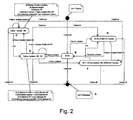
- Figure 2 shows a state diagram to represent by way of example the internal selection logic with which the SCSM module operates, still with reference to the specific case of a system of Data Link audio matrices.
- the SCSM module depending on whether it must execute a startup or runtime sequence, will be reconfigured according to the following tables:
- B D If the matrix chosen previously by SCSM enters a failure state, the higher-priority matrix is targeted at; otherwise SCSM does not change the matrix targeting.
- D D If the matrix chosen previously by SCSM enters a failure state, the higher-priority matrix is targeted at; otherwise SCSM does not change the matrix targeting.
- C D The OK matrix with higher priority is connected.
- B E SCSM does not change the targeting to the matrix.
- E B SCSM does not change the targeting to the matrix.
- E F If the matrix chosen previously by SCSM enters a failure state, the higher-priority matrix is targeted at; otherwise SCSM does not change the matrix targeting.
- F E SCSM does not change the targeting to the matrix.
- D F SCSM does not change the targeting to the matrix.
- the system according to the invention can be used on every type of equipment network infrastructure, for example a communications network installed on board naval units, the workload of the network being distributed over several equipment items, in order to make the switching of the circuits that enable HF- and UHF-radio communications more robust, and to manage a closed-circuit television system.
- equipment network infrastructure for example a communications network installed on board naval units, the workload of the network being distributed over several equipment items, in order to make the switching of the circuits that enable HF- and UHF-radio communications more robust, and to manage a closed-circuit television system.
Landscapes
- Engineering & Computer Science (AREA)
- Computer Networks & Wireless Communication (AREA)
- Signal Processing (AREA)
- Data Exchanges In Wide-Area Networks (AREA)
- Computer And Data Communications (AREA)
- Maintenance And Management Of Digital Transmission (AREA)
Claims (7)
- System zum Managen und Überwachen einer vernetzten Anlage gemäß einem SNMP-Protokoll, wobei das System umfasst:- eine Vielzahl von Managementagenten, von denen jedem eine entsprechende Anlagenkomponente (M1-M5) zugeordnet ist, die zu einer Gemeinsamkeit gehören und so angeordnet sind, dass sie Managemententscheidungen im Zusammenhang mit der zugeordneten Anlage (M1-M5) ausführen;- eine Vielzahl von MIB-Datenbasen, von denen jeder eine entsprechende gemanagte Anlagenkomponente (M1-M5) zugeordnet ist, wobei sie eine Reihe von Zustandsdaten für die Anlagenkomponente aufweist, wobei auf die MIB-Datenbasen mit dem Agenten zugegriffen werden kann, der mit der überwachten Anlagenkomponente arbeitet; und- eine Vielzahl von Managermodulen (MAN1-MAN5), die so aufgebaut sind, dass sie unter der Steuerung einer Bedienungsperson Managemententscheidungen treffen, wobei jedes so angeordnet ist, dass es auf eine MIB-Datenbasis einer entsprechenden gemanagten Anlagenkomponente (M1-M5) zugreifen kann, um Anfragen zu senden und/oder Mitteilungen zu empfangen,ein Modul (SCSM) zum Steuern der Umschaltung zwischen den Managern (MAN1-MAN5) der Anlagenkomponenten, die in einer logischen Gemeinsamkeit (MGL) vernetzt sind, um eine Arbeitsbelastung zu managen, die über mehrere Anlagenkomponenten (M1-M5) verteilt ist, und das so aufgebaut ist, dass es eine Manager-Agent Managementverbindung festlegt, um alle Anlagenkomponenten (M1-M5) der logischen Gemeinsamkeit (MGL) zu managen, wobei das Umschaltsteuermodul (SCSM) so eingerichtet ist, dass es Befehle von einer Bedienungsperson empfängt, und so aufgebaut ist, dass es einen Manager (MAN1-MAN5) aus der Vielzahl der bereitstehenden Manager dynamisch auswählt,
dadurch gekennzeichnet, dass die MIB-Datenbasen eines jeden Managementagenten für die Anlagenkomponenten (M1-M5) inhaltlich ausgerichtet sind, und dass das Umschaltsteuermodul (SCSM) so angeordnet ist, dass es in Abhängigkeit vom Zustand der überwachten Anlage (M1-M5) und des zugeordneten Agenten sowie aufgrund einer vorbestimmten Prioritätenfolge unter den Managern (MAN1-MAN5) einen Manager (MAN1-MAN5) aus der Vielzahl der Manager dynamisch auswählt, die bereitstehen. - System gemäß Anspruch 1, wobei das Umschaltsteuermodul (SCSM) eine erste Speicherstufe aufweist, die so aufgebaut ist, dass sie eine Prioritätenfolge der Manager (MAN1-MAN5) der Anlage der logischen Gemeinsamkeit (MGL) speichert, die die Auswahlprioritäten dieser Manager (MAN1-MAN5) angibt.
- System gemäß Anspruch 1, wobei das Umschaltsteuermodul (SCSM) so aufgebaut ist, dass es prüft, ob ein Manager (MAN1-MAN5) mit einem aktiven Agenten verbunden ist, und ob der Agent erkennt, dass die Anlagenkomponente (M1-M5), die von ihm überwacht wird, eingeschaltet ist, und dass keine Unregelmäßigkeiten im Betrieb festgestellt werden.
- System gemäß Anspruch 3, wobei das Umschaltsteuermodul (SCSM) so aufgebaut ist, dass es eine Zustandsinformation erlangt, die sich auf die Agenten und die Anlagenkomponenten (M1-M5) der logischen Gemeinsamkeit (MGL) bezieht, wobei diese Information Informationen über den Zustand einer Deaktivierung, einer Betriebsstörung und/oder einer Abtrennung aufweist, und dass es die Information in einer zweiten Speicherstufe steuert.
- System gemäß Anspruch 3 oder Anspruch 4, wobei das Umschaltsteuermodul (SCSM) so aufgebaut ist, dass es ein Timeout einer logischen Gemeinsamkeit (MGL) der Anlage (M1-M5) an ein Management- und Überwachungssystem mit einer höheren hierarchischen Ebene erklärt, wenn in der logischen Gemeinsamkeit (MGL) keine aktive Anlage (M1-M5) oder Agent bereitsteht.
- System zum Managen und Überwachen einer Vielzahl von Audiomatrizen (M1-M5), die so aufgebaut sind, dass sie eine logische, globale Matrix (MGL) für das Umschalten von Ton- und/oder PTT-Leitungen von einer Modemanlage auf HF-oder UHF-Funkvektoren bilden, die an Bord eines Flottenverbands verteilt sind, wobei an jede Audiomatrix (M1-M5) ein SNMP-Agent angeschlossen ist, der so aufgebaut ist, dass er mit einem entsprechenden Manager (MAN1-MAN5) über eine IP-Adresse kommuniziert, die der Matrix (M1-M5) zugeordnet ist, wobei das System ein System gemäß irgendeinem der Ansprüche 1 bis 5 ist.
- System zum Managen und Überwachen einer internen Fernsehanlage, wobei das System eine Vielzahl von dezentralen Übertragungsservern umfasst, die in einer logischen Gemeinsamkeit vernetzt sind, wobei an jeden Server ein SNMP-Agent angeschlossen ist, der so aufgebaut ist, dass er mit einem entsprechenden Manager über eine IP-Adresse kommuniziert, die dem Server zugeordnet ist, wobei das System ein System gemäß irgendeinem der Ansprüche 1 bis 5 ist.
Priority Applications (1)
| Application Number | Priority Date | Filing Date | Title |
|---|---|---|---|
| PL08868636T PL2225852T3 (pl) | 2007-12-24 | 2008-12-22 | System zarządzania i nadzorowania wyposażenia sieciowego zgodnie z protokołem SNMP na podstawie przełączania między menedżerami SNMP |
Applications Claiming Priority (2)
| Application Number | Priority Date | Filing Date | Title |
|---|---|---|---|
| IT000938A ITTO20070938A1 (it) | 2007-12-24 | 2007-12-24 | Sistema di gestione e supervisione di apparati collegati in una rete secondo il protocollo snmp, basato sulla commutazione tra manager snmp |
| PCT/IB2008/055490 WO2009083893A2 (en) | 2007-12-24 | 2008-12-22 | A system for managing and supervising networked equipment according to the snmp protocol, based on switching between snmp managers |
Publications (2)
| Publication Number | Publication Date |
|---|---|
| EP2225852A2 EP2225852A2 (de) | 2010-09-08 |
| EP2225852B1 true EP2225852B1 (de) | 2011-06-08 |
Family
ID=40315926
Family Applications (1)
| Application Number | Title | Priority Date | Filing Date |
|---|---|---|---|
| EP08868636A Active EP2225852B1 (de) | 2007-12-24 | 2008-12-22 | System zur verwaltung und überwachung einer vernetzten anlage gemäss snmp-protokoll auf der basis von umschaltung zwischen snmp-managern |
Country Status (8)
| Country | Link |
|---|---|
| EP (1) | EP2225852B1 (de) |
| AT (1) | ATE512520T1 (de) |
| DK (1) | DK2225852T3 (de) |
| ES (1) | ES2366992T3 (de) |
| IT (1) | ITTO20070938A1 (de) |
| PL (1) | PL2225852T3 (de) |
| PT (1) | PT2225852E (de) |
| WO (1) | WO2009083893A2 (de) |
Families Citing this family (2)
| Publication number | Priority date | Publication date | Assignee | Title |
|---|---|---|---|---|
| US8775615B2 (en) | 2012-03-08 | 2014-07-08 | International Business Machines Corporation | SNMP-based management of service oriented architecture environments |
| CN105873010B (zh) | 2015-01-19 | 2021-11-23 | 北京三星通信技术研究有限公司 | 支持用户设备接入无线网络的方法、网络设备及用户设备 |
Family Cites Families (3)
| Publication number | Priority date | Publication date | Assignee | Title |
|---|---|---|---|---|
| US7058067B1 (en) * | 1995-03-13 | 2006-06-06 | Cisco Technology, Inc. | Distributed interactive multimedia system architecture |
| US5758083A (en) * | 1995-10-30 | 1998-05-26 | Sun Microsystems, Inc. | Method and system for sharing information between network managers |
| DE602004011928T2 (de) * | 2004-08-02 | 2009-02-12 | Alcatel Lucent | Verfahren zur Steuerung einer gemeinsamen genutzten Ressource durch verschiedene Manager |
-
2007
- 2007-12-24 IT IT000938A patent/ITTO20070938A1/it unknown
-
2008
- 2008-12-22 ES ES08868636T patent/ES2366992T3/es active Active
- 2008-12-22 PL PL08868636T patent/PL2225852T3/pl unknown
- 2008-12-22 AT AT08868636T patent/ATE512520T1/de not_active IP Right Cessation
- 2008-12-22 PT PT08868636T patent/PT2225852E/pt unknown
- 2008-12-22 DK DK08868636.5T patent/DK2225852T3/da active
- 2008-12-22 WO PCT/IB2008/055490 patent/WO2009083893A2/en not_active Ceased
- 2008-12-22 EP EP08868636A patent/EP2225852B1/de active Active
Also Published As
| Publication number | Publication date |
|---|---|
| ITTO20070938A1 (it) | 2009-06-25 |
| DK2225852T3 (da) | 2011-10-03 |
| ATE512520T1 (de) | 2011-06-15 |
| EP2225852A2 (de) | 2010-09-08 |
| WO2009083893A3 (en) | 2009-08-27 |
| ES2366992T3 (es) | 2011-10-27 |
| WO2009083893A2 (en) | 2009-07-09 |
| PT2225852E (pt) | 2011-07-01 |
| PL2225852T3 (pl) | 2011-11-30 |
Similar Documents
| Publication | Publication Date | Title |
|---|---|---|
| US7587633B2 (en) | Fault tolerant routing in a network routing system based on a passive replication approach | |
| US8086721B2 (en) | Network resource management in a network device | |
| US20130010610A1 (en) | Network routing adaptation based on failure prediction | |
| US6996827B1 (en) | Method and system for setting expressions in network management notifications | |
| US7512841B2 (en) | Method and system for network fault analysis | |
| EP1150454B1 (de) | Verwaltung eines grossflächigen Netzwerkes mit verteilten selbstständigen Agenten | |
| US7782760B2 (en) | Carrier class resilience solution for switched Ethernet local area networks (LANs) | |
| US9413615B1 (en) | Trap filtering within a device management protocol | |
| US6931441B1 (en) | Method and apparatus for managing a network using link state information | |
| MacFaden et al. | Configuring networks and devices with simple network management protocol (snmp) | |
| EP2225852B1 (de) | System zur verwaltung und überwachung einer vernetzten anlage gemäss snmp-protokoll auf der basis von umschaltung zwischen snmp-managern | |
| Aweya | Designing Switch/Routers: Architectures and Applications | |
| US20080270593A1 (en) | Method and Devices for Distributing Management Information in a Management Network of a Communications System | |
| Schlaerth | A concept for tactical wide-area network hub management | |
| KR100608917B1 (ko) | 분산 포워딩 구조 라우터의 장애 정보 관리방법 | |
| Fujisaki et al. | A scalable fault-tolerant network management system built using distributed object technology | |
| Wang et al. | Database/domain approach to distributed systems management | |
| Liu et al. | Management of the LHCb readout network | |
| Song | A software-based approach to scalable fault-tolerant real-time ethernet for networked control systems | |
| Fried et al. | Implementing Integrated Monitoring Systems for Heterogeneous Networks | |
| Kazeem et al. | Design and Modelling of Strategic Information System | |
| Solanke et al. | Automatic Test Packet Generation by using Fault Localization | |
| Fried | Jung Tjong |
Legal Events
| Date | Code | Title | Description |
|---|---|---|---|
| PUAI | Public reference made under article 153(3) epc to a published international application that has entered the european phase |
Free format text: ORIGINAL CODE: 0009012 |
|
| 17P | Request for examination filed |
Effective date: 20100628 |
|
| AK | Designated contracting states |
Kind code of ref document: A2 Designated state(s): AT BE BG CH CY CZ DE DK EE ES FI FR GB GR HR HU IE IS IT LI LT LU LV MC MT NL NO PL PT RO SE SI SK TR |
|
| AX | Request for extension of the european patent |
Extension state: AL BA MK RS |
|
| GRAP | Despatch of communication of intention to grant a patent |
Free format text: ORIGINAL CODE: EPIDOSNIGR1 |
|
| DAX | Request for extension of the european patent (deleted) | ||
| GRAS | Grant fee paid |
Free format text: ORIGINAL CODE: EPIDOSNIGR3 |
|
| GRAA | (expected) grant |
Free format text: ORIGINAL CODE: 0009210 |
|
| AK | Designated contracting states |
Kind code of ref document: B1 Designated state(s): AT BE BG CH CY CZ DE DK EE ES FI FR GB GR HR HU IE IS IT LI LT LU LV MC MT NL NO PL PT RO SE SI SK TR |
|
| REG | Reference to a national code |
Ref country code: GB Ref legal event code: FG4D |
|
| REG | Reference to a national code |
Ref country code: CH Ref legal event code: EP |
|
| REG | Reference to a national code |
Ref country code: PT Ref legal event code: SC4A Free format text: AVAILABILITY OF NATIONAL TRANSLATION Effective date: 20110620 |
|
| REG | Reference to a national code |
Ref country code: IE Ref legal event code: FG4D |
|
| REG | Reference to a national code |
Ref country code: DE Ref legal event code: R096 Ref document number: 602008007513 Country of ref document: DE Effective date: 20110721 |
|
| REG | Reference to a national code |
Ref country code: SE Ref legal event code: TRGR |
|
| RAP2 | Party data changed (patent owner data changed or rights of a patent transferred) |
Owner name: SELEX ELSAG S.P.A. |
|
| REG | Reference to a national code |
Ref country code: NL Ref legal event code: T3 |
|
| REG | Reference to a national code |
Ref country code: DK Ref legal event code: T3 |
|
| REG | Reference to a national code |
Ref country code: GR Ref legal event code: EP Ref document number: 20110401839 Country of ref document: GR Effective date: 20110916 |
|
| REG | Reference to a national code |
Ref country code: ES Ref legal event code: FG2A Ref document number: 2366992 Country of ref document: ES Kind code of ref document: T3 Effective date: 20111027 |
|
| PG25 | Lapsed in a contracting state [announced via postgrant information from national office to epo] |
Ref country code: HR Free format text: LAPSE BECAUSE OF FAILURE TO SUBMIT A TRANSLATION OF THE DESCRIPTION OR TO PAY THE FEE WITHIN THE PRESCRIBED TIME-LIMIT Effective date: 20110608 Ref country code: LT Free format text: LAPSE BECAUSE OF FAILURE TO SUBMIT A TRANSLATION OF THE DESCRIPTION OR TO PAY THE FEE WITHIN THE PRESCRIBED TIME-LIMIT Effective date: 20110608 Ref country code: NO Free format text: LAPSE BECAUSE OF FAILURE TO SUBMIT A TRANSLATION OF THE DESCRIPTION OR TO PAY THE FEE WITHIN THE PRESCRIBED TIME-LIMIT Effective date: 20110908 |
|
| PG25 | Lapsed in a contracting state [announced via postgrant information from national office to epo] |
Ref country code: AT Free format text: LAPSE BECAUSE OF FAILURE TO SUBMIT A TRANSLATION OF THE DESCRIPTION OR TO PAY THE FEE WITHIN THE PRESCRIBED TIME-LIMIT Effective date: 20110608 Ref country code: LV Free format text: LAPSE BECAUSE OF FAILURE TO SUBMIT A TRANSLATION OF THE DESCRIPTION OR TO PAY THE FEE WITHIN THE PRESCRIBED TIME-LIMIT Effective date: 20110608 Ref country code: SI Free format text: LAPSE BECAUSE OF FAILURE TO SUBMIT A TRANSLATION OF THE DESCRIPTION OR TO PAY THE FEE WITHIN THE PRESCRIBED TIME-LIMIT Effective date: 20110608 Ref country code: CY Free format text: LAPSE BECAUSE OF FAILURE TO SUBMIT A TRANSLATION OF THE DESCRIPTION OR TO PAY THE FEE WITHIN THE PRESCRIBED TIME-LIMIT Effective date: 20110608 |
|
| REG | Reference to a national code |
Ref country code: PL Ref legal event code: T3 |
|
| PG25 | Lapsed in a contracting state [announced via postgrant information from national office to epo] |
Ref country code: BE Free format text: LAPSE BECAUSE OF FAILURE TO SUBMIT A TRANSLATION OF THE DESCRIPTION OR TO PAY THE FEE WITHIN THE PRESCRIBED TIME-LIMIT Effective date: 20110608 |
|
| PG25 | Lapsed in a contracting state [announced via postgrant information from national office to epo] |
Ref country code: CZ Free format text: LAPSE BECAUSE OF FAILURE TO SUBMIT A TRANSLATION OF THE DESCRIPTION OR TO PAY THE FEE WITHIN THE PRESCRIBED TIME-LIMIT Effective date: 20110608 Ref country code: IS Free format text: LAPSE BECAUSE OF FAILURE TO SUBMIT A TRANSLATION OF THE DESCRIPTION OR TO PAY THE FEE WITHIN THE PRESCRIBED TIME-LIMIT Effective date: 20111008 |
|
| PG25 | Lapsed in a contracting state [announced via postgrant information from national office to epo] |
Ref country code: SK Free format text: LAPSE BECAUSE OF FAILURE TO SUBMIT A TRANSLATION OF THE DESCRIPTION OR TO PAY THE FEE WITHIN THE PRESCRIBED TIME-LIMIT Effective date: 20110608 Ref country code: RO Free format text: LAPSE BECAUSE OF FAILURE TO SUBMIT A TRANSLATION OF THE DESCRIPTION OR TO PAY THE FEE WITHIN THE PRESCRIBED TIME-LIMIT Effective date: 20110608 |
|
| PLBE | No opposition filed within time limit |
Free format text: ORIGINAL CODE: 0009261 |
|
| STAA | Information on the status of an ep patent application or granted ep patent |
Free format text: STATUS: NO OPPOSITION FILED WITHIN TIME LIMIT |
|
| 26N | No opposition filed |
Effective date: 20120309 |
|
| PG25 | Lapsed in a contracting state [announced via postgrant information from national office to epo] |
Ref country code: IT Free format text: LAPSE BECAUSE OF FAILURE TO SUBMIT A TRANSLATION OF THE DESCRIPTION OR TO PAY THE FEE WITHIN THE PRESCRIBED TIME-LIMIT Effective date: 20110608 |
|
| REG | Reference to a national code |
Ref country code: DE Ref legal event code: R097 Ref document number: 602008007513 Country of ref document: DE Effective date: 20120309 |
|
| PG25 | Lapsed in a contracting state [announced via postgrant information from national office to epo] |
Ref country code: MC Free format text: LAPSE BECAUSE OF NON-PAYMENT OF DUE FEES Effective date: 20111231 |
|
| REG | Reference to a national code |
Ref country code: IE Ref legal event code: MM4A |
|
| REG | Reference to a national code |
Ref country code: DE Ref legal event code: R119 Ref document number: 602008007513 Country of ref document: DE Effective date: 20120703 |
|
| PG25 | Lapsed in a contracting state [announced via postgrant information from national office to epo] |
Ref country code: DE Free format text: LAPSE BECAUSE OF NON-PAYMENT OF DUE FEES Effective date: 20120703 Ref country code: IE Free format text: LAPSE BECAUSE OF NON-PAYMENT OF DUE FEES Effective date: 20111222 |
|
| PG25 | Lapsed in a contracting state [announced via postgrant information from national office to epo] |
Ref country code: MT Free format text: LAPSE BECAUSE OF FAILURE TO SUBMIT A TRANSLATION OF THE DESCRIPTION OR TO PAY THE FEE WITHIN THE PRESCRIBED TIME-LIMIT Effective date: 20110608 |
|
| PG25 | Lapsed in a contracting state [announced via postgrant information from national office to epo] |
Ref country code: LU Free format text: LAPSE BECAUSE OF NON-PAYMENT OF DUE FEES Effective date: 20111222 |
|
| PG25 | Lapsed in a contracting state [announced via postgrant information from national office to epo] |
Ref country code: BG Free format text: LAPSE BECAUSE OF FAILURE TO SUBMIT A TRANSLATION OF THE DESCRIPTION OR TO PAY THE FEE WITHIN THE PRESCRIBED TIME-LIMIT Effective date: 20110908 |
|
| REG | Reference to a national code |
Ref country code: CH Ref legal event code: PL |
|
| GBPC | Gb: european patent ceased through non-payment of renewal fee |
Effective date: 20121222 |
|
| PG25 | Lapsed in a contracting state [announced via postgrant information from national office to epo] |
Ref country code: TR Free format text: LAPSE BECAUSE OF FAILURE TO SUBMIT A TRANSLATION OF THE DESCRIPTION OR TO PAY THE FEE WITHIN THE PRESCRIBED TIME-LIMIT Effective date: 20110608 |
|
| PG25 | Lapsed in a contracting state [announced via postgrant information from national office to epo] |
Ref country code: CH Free format text: LAPSE BECAUSE OF NON-PAYMENT OF DUE FEES Effective date: 20121231 Ref country code: HU Free format text: LAPSE BECAUSE OF FAILURE TO SUBMIT A TRANSLATION OF THE DESCRIPTION OR TO PAY THE FEE WITHIN THE PRESCRIBED TIME-LIMIT Effective date: 20110608 Ref country code: LI Free format text: LAPSE BECAUSE OF NON-PAYMENT OF DUE FEES Effective date: 20121231 |
|
| PG25 | Lapsed in a contracting state [announced via postgrant information from national office to epo] |
Ref country code: GB Free format text: LAPSE BECAUSE OF NON-PAYMENT OF DUE FEES Effective date: 20121222 |
|
| REG | Reference to a national code |
Ref country code: FR Ref legal event code: PLFP Year of fee payment: 8 |
|
| REG | Reference to a national code |
Ref country code: FR Ref legal event code: PLFP Year of fee payment: 9 |
|
| REG | Reference to a national code |
Ref country code: FR Ref legal event code: PLFP Year of fee payment: 10 |
|
| REG | Reference to a national code |
Ref country code: EE Ref legal event code: HC1A Ref document number: E005784 Country of ref document: EE |
|
| PGFP | Annual fee paid to national office [announced via postgrant information from national office to epo] |
Ref country code: ES Payment date: 20250102 Year of fee payment: 17 |
|
| PGFP | Annual fee paid to national office [announced via postgrant information from national office to epo] |
Ref country code: PT Payment date: 20251210 Year of fee payment: 18 |
|
| PGFP | Annual fee paid to national office [announced via postgrant information from national office to epo] |
Ref country code: FI Payment date: 20251226 Year of fee payment: 18 Ref country code: DK Payment date: 20251226 Year of fee payment: 18 |
|
| PGFP | Annual fee paid to national office [announced via postgrant information from national office to epo] |
Ref country code: NL Payment date: 20251226 Year of fee payment: 18 Ref country code: FR Payment date: 20251226 Year of fee payment: 18 |
|
| PGFP | Annual fee paid to national office [announced via postgrant information from national office to epo] |
Ref country code: GR Payment date: 20251230 Year of fee payment: 18 |
|
| PGFP | Annual fee paid to national office [announced via postgrant information from national office to epo] |
Ref country code: SE Payment date: 20251227 Year of fee payment: 18 |
|
| PGFP | Annual fee paid to national office [announced via postgrant information from national office to epo] |
Ref country code: PL Payment date: 20251203 Year of fee payment: 18 |
|
| PGFP | Annual fee paid to national office [announced via postgrant information from national office to epo] |
Ref country code: EE Payment date: 20251204 Year of fee payment: 18 |