EP2224371A1 - Artificial vision system and method for knowledge-based selective visual analysis - Google Patents
Artificial vision system and method for knowledge-based selective visual analysis Download PDFInfo
- Publication number
- EP2224371A1 EP2224371A1 EP10151739A EP10151739A EP2224371A1 EP 2224371 A1 EP2224371 A1 EP 2224371A1 EP 10151739 A EP10151739 A EP 10151739A EP 10151739 A EP10151739 A EP 10151739A EP 2224371 A1 EP2224371 A1 EP 2224371A1
- Authority
- EP
- European Patent Office
- Prior art keywords
- visual
- node
- information
- sensory
- dependency
- Prior art date
- Legal status (The legal status is an assumption and is not a legal conclusion. Google has not performed a legal analysis and makes no representation as to the accuracy of the status listed.)
- Withdrawn
Links
Images





Classifications
-
- G—PHYSICS
- G06—COMPUTING OR CALCULATING; COUNTING
- G06V—IMAGE OR VIDEO RECOGNITION OR UNDERSTANDING
- G06V10/00—Arrangements for image or video recognition or understanding
- G06V10/94—Hardware or software architectures specially adapted for image or video understanding
- G06V10/95—Hardware or software architectures specially adapted for image or video understanding structured as a network, e.g. client-server architectures
-
- G—PHYSICS
- G06—COMPUTING OR CALCULATING; COUNTING
- G06V—IMAGE OR VIDEO RECOGNITION OR UNDERSTANDING
- G06V10/00—Arrangements for image or video recognition or understanding
- G06V10/40—Extraction of image or video features
- G06V10/42—Global feature extraction by analysis of the whole pattern, e.g. using frequency domain transformations or autocorrelation
- G06V10/422—Global feature extraction by analysis of the whole pattern, e.g. using frequency domain transformations or autocorrelation for representing the structure of the pattern or shape of an object therefor
- G06V10/426—Graphical representations
Definitions
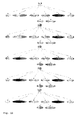
- Parsing the dependency graph can be formulated as a recursive problem. So the parsing algorithm is implemented as a recursive function, as can be seen in the pseudo-code below.
- the first important point is to detect such circular dependencies which can be easily done by marking visited nodes in the graph and check if the node is already marked before entering it.
- the second important question is what to do once a circular dependency is detected.
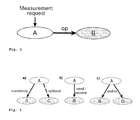
- the dependency types described above come into play. After detecting a circular dependency, it is progressed back (4) to the parent node (spatial modulation map) and checked if the dependency is mandatory or optional. If the dependency is optional, we are done, as the loop at this point can be simply cut without breaking the algorithm. This is because the information that is missing is not essential for the algorithm to run. However, if the dependency is mandatory, the system cannot resolve the dependencies of the current node.
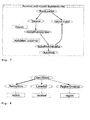
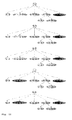
- the weights for the saliency have no further dependency, they can be sent right away. After doing so, all dependencies of the retinal location node are fulfilled and it requests its visual routine for data (see Fig. 10 c ). After triggering the visual routine of the retinal location node, the process continues at the spatial modulation map. As defined previously (see Fig. 4 ), the modulation map requires an object mask to be processed.
- the object mask is an OR node, because three alternative measurement processes exist (retinal size estimation, region growing and a level-set method). Only one of these visual routines needs to run.
- a spatial modulation map can be computed and sent subsequently. After sending the spatial modulation map, the visual routine of the colour node runs and eventually returns the colour (see bottom of Fig. 11 ).
- Receiving the distance requires sending the spatial modulation map (see Fig. 4 ).
- sending this map requires the retrieval of the map, but in this case, the data of the spatial modulation map is still valid. Thus there is no need for updating and the process can continue with just sending out the information. If this procedure is compared to the procedure in Fig. 10 , where sending the spatial modulation map triggered the whole object mask and retinal location branch, the computational effort is reduced dramatically. Finally, the distance is requested and received by the system as shown at the bottom of Fig. 12 .
- the system can estimate the costs of a certain action.
- the number of dependency nodes can be used as a cost function.
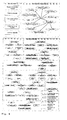
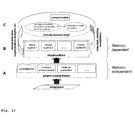
- the system with its main components is shown in Fig. 13 .
- visual input is acquired and analyzed/preprocessed by a series of non-task-specific pre-processing stages.
- the visual input may comprise more than a single image, as it is e.g. the case for stereo or multi-camera arrangements, and may also be grey-scale, color or using other visual domains, like infrared.
- the pre-processing stages may involve e.g. normalization, contrast enhancement, edge and feature extraction and similar processes, with the property that they do not require a knowledge about the scene and its objects, i.e., they are unspecific and general.
- the exact type of pre-processing operations is not relevant for this invention so that in the following we will not detail this further.
- the visual routines are steered from and deliver their results to a memory stage shown in Fig. 13 C.
- the sensory information from different visual routines is compiled and put in relation to already existing information about the visual scene.
- the memory stage comprises three main constituent parts:
- the concepts stored in conceptual memory are valid for a certain lifetime, spanning a continuum ranging from concepts that are assumed to be generally valid ("long-term”) and stable over time to concepts that represent a certain temporary measurement or hypothesis about sensory objects, and that is expected to change on a short timescale (“short-term”).
- links e.g. denote that the presence of certain visual properties or subparts (the wheels of the car) is a good indication for a more global pattern concept (the car).
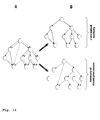
- Fig. 15 shows a more detailed sketch of a visual input along with the internal visual memories, stored in subnets for the conceptual memory and the memory of visual processes.
- the conceptual memory contains the concept of the car in a hierarchical graph, e.g. by specifying which parts like lights, wheels, windows, visual appearance, etc. a car should have.
- the memory of visual processes encodes how to measure e.g. the presence of these parts by accessing the corresponding visual routines, like specialized wheel detecting modules.
- Both the long- and the short-term memory of the system are updated dynamically during runtime.
- the updating includes parameter values stored in the nodes of the graphs as well as the creation, modification and destruction of graph structures.
- New graph structures appear e.g. when new sensory items are included into the short-term memory (for example if visual routines indicate an item pop-out because it is very salient, like a moving object against a stationary background), or when already detected sensory items are combined to form larger conceptual compounds (for example when two wheels have been detected and are then bound to a new conceptual node representing the sensory detection of a car).
- the control module can link the parameters to the processes necessary to measure them. Therefore, the goal to measure a parameter is equivalent to a visual task, like finding out whether a certain object is actually present in a scene or what is its location, colour, etc. In short, the control module makes use of the process memory in combination with the currently available conceptual memory to decide how to measure the required parameters.
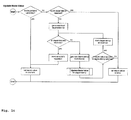
- the dependency information is used together with the current state of the already compiled sensory information to determine the processing order of visual subtasks.
- information about expected gain and costs are taken into consideration, so that the control module can decide e.g. if it wants to get approximate results with low or accurate results with higher processing costs.
- uncertainty information is available (attached to the process memory and the sensory measurements), probabilistic methods that work on graphical structures can be included here.
- Each node representing a sensory event keeps track of the validity of its results. This validity can be determined e.g. by a confidence of the measurement, the quality of the gained data or the time passed since its last measurement.
- the control module allows dependencies of the visual subtasks to be resolved automatically.
- This is shown as a program flow diagram in Fig. 16 and comprises the steps of iteratively traversing the graph depending on the information from the memory of visual processes, the expected gain and cost as well as the validity of the results.
- the conceptual memory especially the short-term sensory memory, is used to store what has already been inspected and to serve as parameters for the context-(i.e., conceptual memory)-dependent visual routines.
- the iterative graph traversal at some point arrives at nodes that are linked to visual routines (as shown in Fig. 15 bottom right), triggering a specific visual analysis.
- a visual routine delivers a result, its validity is checked by the attached memory node and communicated further to the predecessor node that called it. In this way, the necessary sensory processes are triggered and the dependencies of a visual task are solved.
Landscapes
- Engineering & Computer Science (AREA)
- Physics & Mathematics (AREA)
- General Physics & Mathematics (AREA)
- Multimedia (AREA)
- Theoretical Computer Science (AREA)
- Computer Vision & Pattern Recognition (AREA)
- Software Systems (AREA)
- Image Analysis (AREA)
Priority Applications (3)
| Application Number | Priority Date | Filing Date | Title |
|---|---|---|---|
| EP10151739A EP2224371A1 (en) | 2009-02-27 | 2010-01-27 | Artificial vision system and method for knowledge-based selective visual analysis |
| JP2010030845A JP5249969B2 (ja) | 2009-02-27 | 2010-02-16 | 知識ベースの選択的な視覚分析のための人工視覚システムおよび方法 |
| US12/711,292 US8433661B2 (en) | 2009-02-27 | 2010-02-24 | Artificial vision system and method for knowledge-based selective visual analysis |
Applications Claiming Priority (2)
| Application Number | Priority Date | Filing Date | Title |
|---|---|---|---|
| EP09153896 | 2009-02-27 | ||
| EP10151739A EP2224371A1 (en) | 2009-02-27 | 2010-01-27 | Artificial vision system and method for knowledge-based selective visual analysis |
Publications (1)
| Publication Number | Publication Date |
|---|---|
| EP2224371A1 true EP2224371A1 (en) | 2010-09-01 |
Family
ID=42102201
Family Applications (1)
| Application Number | Title | Priority Date | Filing Date |
|---|---|---|---|
| EP10151739A Withdrawn EP2224371A1 (en) | 2009-02-27 | 2010-01-27 | Artificial vision system and method for knowledge-based selective visual analysis |
Country Status (3)
| Country | Link |
|---|---|
| US (1) | US8433661B2 (enExample) |
| EP (1) | EP2224371A1 (enExample) |
| JP (1) | JP5249969B2 (enExample) |
Cited By (1)
| Publication number | Priority date | Publication date | Assignee | Title |
|---|---|---|---|---|
| CN112040002A (zh) * | 2020-09-07 | 2020-12-04 | 广东电网有限责任公司电力调度控制中心 | 一种基于配电云平台的数据融合方法、装置及设备 |
Families Citing this family (36)
| Publication number | Priority date | Publication date | Assignee | Title |
|---|---|---|---|---|
| WO2012129371A2 (en) | 2011-03-22 | 2012-09-27 | Nant Holdings Ip, Llc | Reasoning engines |
| US20130081050A1 (en) * | 2011-09-23 | 2013-03-28 | Elwha LLC, a limited liability company of the State of Delaware | Acquiring and transmitting tasks and subtasks to interface devices |
| US9710768B2 (en) | 2011-09-23 | 2017-07-18 | Elwha Llc | Acquiring and transmitting event related tasks and subtasks to interface devices |
| CN102857363B (zh) * | 2012-05-04 | 2016-04-20 | 运软网络科技(上海)有限公司 | 一种虚拟网络的自主管理系统和方法 |
| JP5668090B2 (ja) | 2013-01-09 | 2015-02-12 | キヤノン株式会社 | 医療診断支援装置及び医療診断支援方法 |
| US10713261B2 (en) | 2013-03-13 | 2020-07-14 | Google Llc | Generating insightful connections between graph entities |
| US10115248B2 (en) * | 2013-03-14 | 2018-10-30 | Ebay Inc. | Systems and methods to fit an image of an inventory part |
| US9235653B2 (en) * | 2013-06-26 | 2016-01-12 | Google Inc. | Discovering entity actions for an entity graph |
| WO2018147874A1 (en) * | 2017-02-10 | 2018-08-16 | Nissan North America, Inc. | Autonomous vehicle operational management including operating a partially observable markov decision process model instance |
| US11586960B2 (en) | 2017-05-09 | 2023-02-21 | Visa International Service Association | Autonomous learning platform for novel feature discovery |
| US11316865B2 (en) | 2017-08-10 | 2022-04-26 | Nuance Communications, Inc. | Ambient cooperative intelligence system and method |
| US10957427B2 (en) | 2017-08-10 | 2021-03-23 | Nuance Communications, Inc. | Automated clinical documentation system and method |
| US11702070B2 (en) | 2017-10-31 | 2023-07-18 | Nissan North America, Inc. | Autonomous vehicle operation with explicit occlusion reasoning |
| US11874120B2 (en) | 2017-12-22 | 2024-01-16 | Nissan North America, Inc. | Shared autonomous vehicle operational management |
| US11250382B2 (en) | 2018-03-05 | 2022-02-15 | Nuance Communications, Inc. | Automated clinical documentation system and method |
| EP3762921A4 (en) | 2018-03-05 | 2022-05-04 | Nuance Communications, Inc. | AUTOMATED CLINICAL DOCUMENTATION SYSTEM AND PROCESS |
| US11222716B2 (en) | 2018-03-05 | 2022-01-11 | Nuance Communications | System and method for review of automated clinical documentation from recorded audio |
| US11216480B2 (en) | 2019-06-14 | 2022-01-04 | Nuance Communications, Inc. | System and method for querying data points from graph data structures |
| US11227679B2 (en) | 2019-06-14 | 2022-01-18 | Nuance Communications, Inc. | Ambient clinical intelligence system and method |
| US11043207B2 (en) | 2019-06-14 | 2021-06-22 | Nuance Communications, Inc. | System and method for array data simulation and customized acoustic modeling for ambient ASR |
| US11531807B2 (en) | 2019-06-28 | 2022-12-20 | Nuance Communications, Inc. | System and method for customized text macros |
| US11670408B2 (en) | 2019-09-30 | 2023-06-06 | Nuance Communications, Inc. | System and method for review of automated clinical documentation |
| US11899454B2 (en) | 2019-11-26 | 2024-02-13 | Nissan North America, Inc. | Objective-based reasoning in autonomous vehicle decision-making |
| US11635758B2 (en) | 2019-11-26 | 2023-04-25 | Nissan North America, Inc. | Risk aware executor with action set recommendations |
| US11613269B2 (en) | 2019-12-23 | 2023-03-28 | Nissan North America, Inc. | Learning safety and human-centered constraints in autonomous vehicles |
| US11300957B2 (en) | 2019-12-26 | 2022-04-12 | Nissan North America, Inc. | Multiple objective explanation and control interface design |
| US11577746B2 (en) | 2020-01-31 | 2023-02-14 | Nissan North America, Inc. | Explainability of autonomous vehicle decision making |
| US11714971B2 (en) | 2020-01-31 | 2023-08-01 | Nissan North America, Inc. | Explainability of autonomous vehicle decision making |
| US11782438B2 (en) | 2020-03-17 | 2023-10-10 | Nissan North America, Inc. | Apparatus and method for post-processing a decision-making model of an autonomous vehicle using multivariate data |
| US12007784B2 (en) | 2020-03-26 | 2024-06-11 | Here Global B.V. | Method and apparatus for self localization |
| US20210334474A1 (en) * | 2020-04-28 | 2021-10-28 | Leela Al, Inc. | Natural Language System and Methods |
| US11222103B1 (en) | 2020-10-29 | 2022-01-11 | Nuance Communications, Inc. | Ambient cooperative intelligence system and method |
| US11478927B1 (en) * | 2021-04-01 | 2022-10-25 | Giant.Ai, Inc. | Hybrid computing architectures with specialized processors to encode/decode latent representations for controlling dynamic mechanical systems |
| US12236675B2 (en) | 2022-02-24 | 2025-02-25 | Leela AI, Inc. | Methods and systems for training and execution of improved learning systems for identification of components in time-based data streams |
| US11803478B1 (en) * | 2022-10-19 | 2023-10-31 | Inductive Automation, LLC | Controlled activation of interdependent bindings |
| CN120493082B (zh) * | 2025-07-21 | 2025-09-12 | 深圳适创腾扬科技有限公司 | 一种结合压铸流程优先级的压铸参数调优方法及相关装置 |
Citations (1)
| Publication number | Priority date | Publication date | Assignee | Title |
|---|---|---|---|---|
| US20070179918A1 (en) * | 2006-02-02 | 2007-08-02 | Bernd Heisele | Hierarchical system for object recognition in images |
Family Cites Families (2)
| Publication number | Priority date | Publication date | Assignee | Title |
|---|---|---|---|---|
| JPH08145738A (ja) * | 1994-11-18 | 1996-06-07 | Fujitsu Ltd | 能動的認識装置 |
| US20100083109A1 (en) * | 2008-09-29 | 2010-04-01 | Smart Technologies Ulc | Method for handling interactions with multiple users of an interactive input system, and interactive input system executing the method |
-
2010
- 2010-01-27 EP EP10151739A patent/EP2224371A1/en not_active Withdrawn
- 2010-02-16 JP JP2010030845A patent/JP5249969B2/ja active Active
- 2010-02-24 US US12/711,292 patent/US8433661B2/en not_active Expired - Fee Related
Patent Citations (1)
| Publication number | Priority date | Publication date | Assignee | Title |
|---|---|---|---|---|
| US20070179918A1 (en) * | 2006-02-02 | 2007-08-02 | Bernd Heisele | Hierarchical system for object recognition in images |
Non-Patent Citations (20)
| Title |
|---|
| A. BORJI ET AL.: "Learning object-based attention control", IN "MACHINE LEARNING MEETS HUMAN LEARNING", WORKSHOP NIPS'08, 12 December 2008 (2008-12-12), XP002579569, Retrieved from the Internet <URL:http://www.iai.uni-bonn.de/~borji/papers/NIPS-BORJI.pdf> [retrieved on 20100422] * |
| A. BORJI: "Interactive learning of task-driven visual attention control", PH.D. THESIS,SCHOOL OF COGNITIVE SCIENCES, INSTITUTE FOR RESEARCH IN FUNDAMENTAL SCIENCES (IPM), TEHERAN, IRAN, May 2009 (2009-05-01), XP002579570, Retrieved from the Internet <URL:http://ilab.usc.edu/~borji/papers/Dissertation-Borji-Final.pdf> [retrieved on 20100423] * |
| B. DRAPER: "Learning object recognition strategies", PH.D. THESIS, DEPARTMENT OF COMPUTER SCIENCE, UNIVERSITY OF MASSACHUSETTS, May 1993 (1993-05-01), XP002579571, Retrieved from the Internet <URL:http://www.cs.colostate.edu/~draper/publications/draper_thesis.pdf> [retrieved on 20100423] * |
| CLOUARD R.; ELMOATAZ A.; PORQUET C.; REVENU M.: "Borg: A Knowledge-Based System for Automatic Generation of Image Processing Programs", IEEE TRANSACTIONS ON PATTERN ANALYSIS AND MACHINE INTELLIGENCE, vol. 21, 1999, pages 2 |
| DANIEL WEILER; JULIAN EGGERT: "Multi-dimensional histogram-based image segmentation", PROCEEDINGS OF THE 14TH INTERNATIONAL CONFERENCE ON NEURAL INFORMATION PROCESSING, 2007, pages 963 - 972 |
| F. RÖHRBEIN ET AL.: "Bayesian Columnar Networks for Grounded Cognitive Systems", 30TH ANNUAL MEETING OF THE COGNITIVE SCIENCE SOCIETY, 23 June 2008 (2008-06-23), pages 1423 - 1428, XP002579572, Retrieved from the Internet <URL:http://csjarchive.cogsci.rpi.edu/Proceedings/2008/pdfs/p1423.pdf> [retrieved on 20100423] * |
| FLORIAN ROHRBEIN; JULIAN EGGERT; EDGAR K"OERNER: "Proceedings of the 8th International Conference on Cognitive Modeling", 2007, PSYCHOLOGY PRESS, TAYLOR & FRANCIS GROUP, article "Prototypical relations for cortex-inspired semantic representations", pages: 307 - 312 |
| JACK B. DENNIS, DATA FLOW SUPERCOMPUTERS. COMPUTER, vol. 13, no. 11, November 1980 (1980-11-01), pages 48 - 56 |
| JACK B. DENNIS: "Proceedings of the Colloque sur la Programmation", vol. 19, SPRINGER-VERLAG, article "First version of a data flow procedure language", pages: 362 - 376 |
| JEANNE FERRANTE; KARL J. OTTENSTEIN; JOE D. WARREN: "The program dependence graph and its use in optimization", ACM TRANSACTIONS ON PROGRAMMING LANGUAGE AND SYSTEMS, vol. 9, no. 3, July 1987 (1987-07-01), pages 319 - 349 |
| JULIAN EGGERT; SVEN REBHAN; EDGAR K"ORNER: "First steps towards an intentional vision system", PROCEEDINGS OF THE 5TH INTERNATIONAL CONFERENCE ON COMPUTER VISION SYSTEMS, 2007 |
| MILAN SONKA; VACLAV HLAVAC; ROGER BOYLE: "Image Processing, Analysis, and Machine Vision", 1998, THOMSON-ENGINEERING |
| NAVALPAKKAM V ET AL: "Modeling the influence of task on attention", VISION RESEARCH, PERGAMON PRESS, vol. 45, no. 2, 1 January 2005 (2005-01-01), OXFORD, GB, pages 205 - 231, XP004668621, ISSN: 0042-6989 * |
| PER ANDERSSON, MODELLING AND IMPLEMENTATION OF A VISION SYSTEM FOR EMBEDDED SYSTEMS, 2003 |
| ROBERT A. BALLANCE; ARTHUR B. MACCABE; KARL J. OTTENSTEIN: "The program dependence web: A representation supporting control-, data-, and demand-driven interpretation of imperative languages", PROCEEDINGS OF THE ACM SIGPLAN 90 CONFERENCE ON PROGRAMMING LANGUAGE DESIGN AND IMPLEMENTATION, vol. 25, 1990, pages 257 - 271 |
| ROBERT CARTWRIGHT; MATTHIAS FELLEISEN: "The semantics of program dependence", PROCEEDINGS OF THE ACM SIGPLAN 89 CONFERENCE ON PROGRAMMING LANGUAGE DESIGN AND IMPLEMENTATION, 1989, pages 13 - 27 |
| SHEKHAR C.; MOISAN S.; VINCENT R.; BURLINA P.; CHELLAPPA R.: "Knowledge-based control of vision systems", IMAGE AND VISION COMPUTING, vol. 17, 1999 |
| SRIDHARAN M.; DEARDEN R.; WYATT J.: "E-HiPPo: Extensions to Hierarchical POMDP-based Visual Planning on a Robot", 27TH PLANSIG WORKSHOP, 2008 |
| SRIDHARAN M.; WYATT J.; DEARDEN R.: "HiPPo: Hierarchical POMDPs for Planning Information Processing and Sensing Actions on a Robot", PROCEEDINGS OF THE INTERNATIONAL CONFERENCE ON AUTOMATED PLANNING AND SCHEDULING, 2008 |
| SVEN REBHAN; FLORIAN ROHRBEIN; JULIAN EGGERT; EDGAR KOERNER: "Proceeding of the 6th International Conference on Computer Vision Systems", vol. 5008, 2008, SPRINGER VERLAG, article "Attention modulation using short- and long-term knowledge", pages: 151 - 160 |
Cited By (2)
| Publication number | Priority date | Publication date | Assignee | Title |
|---|---|---|---|---|
| CN112040002A (zh) * | 2020-09-07 | 2020-12-04 | 广东电网有限责任公司电力调度控制中心 | 一种基于配电云平台的数据融合方法、装置及设备 |
| CN112040002B (zh) * | 2020-09-07 | 2023-04-18 | 广东电网有限责任公司电力调度控制中心 | 一种基于配电云平台的数据融合方法、装置及设备 |
Also Published As
| Publication number | Publication date |
|---|---|
| US20100223216A1 (en) | 2010-09-02 |
| US8433661B2 (en) | 2013-04-30 |
| JP5249969B2 (ja) | 2013-07-31 |
| JP2010262625A (ja) | 2010-11-18 |
Similar Documents
| Publication | Publication Date | Title |
|---|---|---|
| US8433661B2 (en) | Artificial vision system and method for knowledge-based selective visual analysis | |
| US11663474B1 (en) | Artificially intelligent systems, devices, and methods for learning and/or using a device's circumstances for autonomous device operation | |
| US10474934B1 (en) | Machine learning for computing enabled systems and/or devices | |
| CN113934205B (zh) | 用于控制引导机器人的方法、装置、设备以及存储介质 | |
| Chen et al. | Semantic visual simultaneous localization and mapping: A survey | |
| KR102664916B1 (ko) | 익스플레이너블 셀프-포커스드 어텐션을 이용하여 행동 예측을 수행하는 방법 및 장치 | |
| JP7192143B2 (ja) | オンライン学習を利用した物体追跡のための方法およびシステム | |
| Toschi et al. | Characterizing perception module performance and robustness in production-scale autonomous driving system | |
| Nieto et al. | Optimising computer vision based ADAS: vehicle detection case study | |
| Trojanek | Model-driven engineering approach to design and implementation of robot control system | |
| Benrachou et al. | Improving efficiency and generalisability of motion predictions with deep multi-agent learning and multi-head attention | |
| KR102324804B1 (ko) | 영상 내 객체의 컨텍스트 정보 생성을 통한 모니터링 시스템 | |
| CN114548237A (zh) | 一种人机交互的多模态数据融合方法、装置及设备 | |
| Fickenscher et al. | DSL-based acceleration of automotive environment perception and mapping algorithms for embedded CPUs, GPUs, and FPGAs | |
| CN117173676A (zh) | 一种驾驶员的变道意图识别方法、装置、设备及介质 | |
| de Souza Muñoz et al. | Pignaton de Freitas | |
| CN117730348A (zh) | 利用内省式自我监督原地学习可靠关键点 | |
| Rebhan et al. | Consistent modeling of functional dependencies along with world knowledge | |
| Sakabe et al. | An episode tracker for cognitive architectures | |
| Ali et al. | Memorability-based multimedia analytics for robotic interestingness prediction system using trimmed Q-learning algorithm | |
| Jyothi et al. | Real time smart object detection using machine learning | |
| CN120011898B (zh) | 无人机定位跟踪风险识别方法、存储介质及应用 | |
| Hicks et al. | Self Driving Robot Car | |
| Clement | Multimodal RGB-D Autonomous Agents Steered by Deep Neural Networks | |
| Fariha | Requirements engineering-driven collaborative software maintenance framework for embedded systems using continual learning |
Legal Events
| Date | Code | Title | Description |
|---|---|---|---|
| PUAI | Public reference made under article 153(3) epc to a published international application that has entered the european phase |
Free format text: ORIGINAL CODE: 0009012 |
|
| AK | Designated contracting states |
Kind code of ref document: A1 Designated state(s): AT BE BG CH CY CZ DE DK EE ES FI FR GB GR HR HU IE IS IT LI LT LU LV MC MK MT NL NO PL PT RO SE SI SK SM TR |
|
| AX | Request for extension of the european patent |
Extension state: AL BA RS |
|
| 17P | Request for examination filed |
Effective date: 20101001 |
|
| 17Q | First examination report despatched |
Effective date: 20120411 |
|
| STAA | Information on the status of an ep patent application or granted ep patent |
Free format text: STATUS: THE APPLICATION IS DEEMED TO BE WITHDRAWN |
|
| 18D | Application deemed to be withdrawn |
Effective date: 20160625 |