EP2222017B1 - Phy-basierender Abgleich eines Stromstärkeungleichgewichts für Magnete in einem drahtgebundenen Telekommunikationsnetz - Google Patents
Phy-basierender Abgleich eines Stromstärkeungleichgewichts für Magnete in einem drahtgebundenen Telekommunikationsnetz Download PDFInfo
- Publication number
- EP2222017B1 EP2222017B1 EP10166072A EP10166072A EP2222017B1 EP 2222017 B1 EP2222017 B1 EP 2222017B1 EP 10166072 A EP10166072 A EP 10166072A EP 10166072 A EP10166072 A EP 10166072A EP 2222017 B1 EP2222017 B1 EP 2222017B1
- Authority
- EP
- European Patent Office
- Prior art keywords
- current
- magnetic device
- pair
- differential signal
- conductors
- Prior art date
- Legal status (The legal status is an assumption and is not a legal conclusion. Google has not performed a legal analysis and makes no representation as to the accuracy of the status listed.)
- Expired - Lifetime
Links
Images






Classifications
-
- H—ELECTRICITY
- H04—ELECTRIC COMMUNICATION TECHNIQUE
- H04L—TRANSMISSION OF DIGITAL INFORMATION, e.g. TELEGRAPHIC COMMUNICATION
- H04L12/00—Data switching networks
- H04L12/02—Details
- H04L12/10—Current supply arrangements
Definitions
- the present invention relates generally to networking equipment which is powered by and/or powers other networking equipment over wired data telecommunications network connections.
- Inline Power also known as Power over Ethernet and PoE
- PSE power source equipment
- PD powered device
- the power may be injected by an endpoint PSE at one end of the link section or by a midspan PSE along a midspan of a link section that is distinctly separate from and between the media dependent interfaces (MDIs) to which the ends of the link section are electrically and physically coupled.
- MDIs media dependent interfaces
- PoE is defined in the IEEE (The Institute of Electrical and Electronics Engineers, Inc.) Standard Std 802.3af-2003 published 18 June 2003 and entitled "IEEE Standard for Information technology - Telecommunications and information exchange between systems - Local and metropolitan area networks - Specific requirements: Part 3 Carrier Sense Multiple Access with Collision Detection (CSMA/CD) Access Method and Physical Layer Specifications: Amendment: Data Terminal Equipment (DTE) Power via Media Dependent Interface (MDI)” (herein referred to as the "IEEE 802.3af standard”).
- the IEEE 802.3af standard is a globally applicable standard for combining the transmission and reception (collectively: “transceiving") of Ethernet packets with the transmission and reception of DC-based power over the same set of wires in a single Ethernet cable.
- Inline Power will power such PDs as Internet Protocol (IP) telephones, surveillance cameras, switching and hub equipment for the telecommunications network, biomedical sensor equipment used for identification purposes, other biomedical equipment, radio frequency identification (RFID) card and tag readers, security card readers, various types of sensors and data acquisition equipment, fire and life-safety equipment in buildings, and the like.
- IP Internet Protocol
- RFID radio frequency identification
- the power is direct current, floating 48 Volt power currently available at a range of power levels from about 4 watts to about 15 watts in accordance with the standard.
- IEEE 802.3af standard There are mechanisms within the IEEE 802.3af standard to allocate a requested amount of power. Other proprietary schemes also exist to provide a finer and more sophisticated allocation of power than that provided by the IEEE 802.3af standard while still providing basic compliance with the standard. As the standard evolves, additional power may also become available.
- Conventional 8-conductor type RG-45 connectors male or female, as appropriate
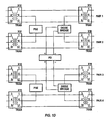
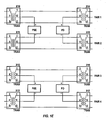
- FIGS. 1A, 1B and 1C are electrical schematic diagrams of three different variants of PoE as contemplated by the IEEE 802.3af standard.
- a data telecommunications network 10a comprises a switch or hub 12a with integral power sourcing equipment (PSE) 14a. Power from the PSE 14a is injected on the two data carrying Ethernet twisted pairs 16aa and 16ab via center-tapped transformers 18aa and 18ab. Non-data carrying Ethernet twisted pairs 16ac and load are unused in this variant. The power from data carrying Ethernet twisted pairs 16aa and 16ab is conducted from center-tapped transformers 20aa and 20ab to powered device (PD) 22a for use thereby as shown.
- PSE power sourcing equipment
- a data telecommunications network 10b comprises a switch or hub 12b with integral power sourcing equipment (PSE) 14b. Power from the PSE 14b is injected on the two non-data carrying Ethernet twisted pairs 16bc and 16bd. Data carrying Ethernet twisted pairs 16ba and 16bb are unused in this variant for power transfer. The power from non-data carrying Ethernet twisted pairs 16bc and 16bd is conducted to powered device (PD) 22b for use thereby as shown.
- PD powered device
- a data telecommunications network 10c comprises a switch or hub 12c without integral power sourcing equipment (PSE).
- Midspan power insertion equipment 24 simply passes the data signals on the two data carrying Ethernet twisted pairs 16ca-1 and 16cb-1 to corresponding data carrying Ethernet twisted pairs 16ca-2 and 16cb-2. Power from the PSE 14c located in the Midspan power insertion equipment 24 is injected on the two non- data carrying Ethernet twisted pairs 16cc-2 and 16cd-2 as shown. The power from non- data carrying Ethernet twisted pairs 16cc-2 and 16cd-2 is conducted to powered device (PD) 22c for use thereby as shown.
- powered end stations 26a, 26b and 26c are all the same so that they can achieve compatibility with each of the previously described variants.
- FIGS. 1D and 1E electrical schematic diagrams illustrate variants of the IEEE 802.3af standard in which 1000 Base T communication is enabled over a four pair Ethernet cable.
- Inline Power may be supplied over two pair or four pair.
- the PD accepts power from a pair of diode bridge circuits such as full wave diode bridge rectifier type circuits well known to those of ordinary skill in the art. Power may come from either one or both of the diode bridge circuits, depending upon whether Inline Power is delivered over Pair 1-2, Pair 3-4 or Pair 1-2 + Pair 3-4.
- a PD associated with Pair 1-2 is powered by Inline Power over Pair 1-2 and a PD associated with Pair 3-4 is similarly powered. The approach used will depend upon the PD to be powered.
- bidirectional full duplex communication may be carried out over each data pair, if desired.
- Inline Power is also available through techniques that are non-IEEE 802.3 standard compliant as is well known to those of ordinary skill in the art.
- WO-A1-96/23377 describes a multimedia system having a central power source and distribution subsystem.
- the power subsystem provides phantom power and third pair power via a computer network bus.
- US-A1-2004/0049321 discloses a system for power delivery over data communication cabling infrastructure.
- the system includes power/data combiners that combine a data communication signal with a low frequency power signal.
- US-A-5,148,144 describes a data communication network for delivering power and communications over the same cable bundle.
- imbalance in the current carried by the first and second conductors of the pair of conductors is detected and compensated with a bias current applied to counter the imbalance.
- Embodiments of the present invention described in the following detailed description are directed at current imbalance compensation for magnetics in a wired data telecommunications network.
- Other embodiments of the present invention, beyond those embodiments described in the detailed description, will readily suggest themselves to those of ordinary skill in the art having the benefit of this disclosure.
- Network segment 50 comprises a first pair of conductors 52 comprised of first conductor 54 and second conductor 56 and a second pair of conductors 53.
- a center-tapped transformer T1 and T2 On either side of the pair of conductors is a center-tapped transformer T1 and T2.
- the primary winding P of transformer T1 is coupled to a PHY and the secondary winding S is coupled via a coupler such as an RJ-45 connector to the first pair of conductors (wire side).
- a direct current (DC) signal such as an inline power signal is transmitted using common mode inline power transmission some current will traverse the first conductor 54 and other current will traverse the second conductor 56.
- DC direct current
- RA and RB can be influenced in a twisted pair network connection by cable length, variations in the cable material, bends in the cable, corrosion in the connectors at either end of the network segment, mismatches in the winding resistance within a magnetic device due to wire- diameter mismatch, and the like. Accordingly, RA and RB often differ somewhat. Where the cables are relatively long, the difference is often less important than where the cables are relatively short due to the swamping effect of the larger resistance of a longer cable.
- a difference in the inline power current within the two conductors of a twisted pair can lead to a phenomenon known as droop.
- a phenomenon known as droop Where there is a substantial current imbalance between the two sides on either side of the center tap in a central- tapped magnetic device such as one of transformers T1 and T2 then saturation in the magnetic device can cause the data signals which pass through the transformers to become distorted.
- the windings on either side of the center tap are normally wound in opposite directions, so that if equal DC currents flow towards the center tap from either side, the net DC current seen by the transformer core is zero. If the currents are not equal, the transformer core sees a nonzero current, and a sufficiently large current causes degradation of the transfer characteristic of the transformer, the phenomenon known as droop. When the droop is sufficiently large the distortion can affect the data throughput on the network segment leading to data errors.
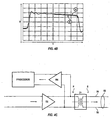
- FIGS. 4A and 4B illustrate the problem of droop.
- Curve A of FIG. 4A is an illustration of a data signal pulse not impacted by droop.
- Curve B of FIG. 4A is an illustration of a distorted data pulse where the distortion is caused by a transformer subjected to a 50mA current bias on one leg which forces a current imbalance in the transformer and causes a droop of over two 200mV divisions. (Note that the curves are offset by a DC offset of about 1.5 divisions for clarity).
- Curve A is relatively well behaved and stays within a range of well less than 200 mV (one division) during its on-time, whereas Curve B is relatively badly behaved varying over about three times as much in amplitude during its on-time.
- FIG. 4B illustrates the correction of the droop by compensating for it by applying another 50mA signal (causing a countering DC current) to the other leg of the transformer. Curve A of FIG. 4B is the essentially the same as Curve A of FIG. 4A .
- droop is measured, compensation current is applied, and the droop is thereby reduced.
- the droop may be measured by coupling a receiver to the transmitter output at the PHY. This is illustrated at FIG. 4C .
- Transmitter TX transmits a differential AC signal into the primary of transformer T1.
- An effective current imbalance in current carried by conductors 54 and 56 on the wire side of transformer T1 (forming a circuit element) may cause signal droop. That droop will be present on both the primary and the secondary of transformer T1.
- Receiver RX is coupled to receive and monitor the signal transmitted by transmitter TX as shown.
- a processor determines if there is droop by comparing the (possibly) distorted pulse (or characteristics thereof) to an expected or ideal pulse (or characteristics thereof). This may be done, for example, by measuring the peak amplitude or the amplitude at some point in the pulse, for example, near the end of the pulse where the droop usually tends to be more pronounced. This amplitude is compared to the expected or desired amplitude and a difference error signal related to the magnitude of the droop is generated.
- a feedback loop which applies a correcting DC current to an appropriate node of the circuit (as discussed below) in order to counter the unbalanced current flow on the wire side of the magnetic device and thereby bring the difference error signal to zero or nearly zero and so reduce the droop and correct the shape of the pulse.
- the measurement of the droop and/or effective current imbalance may take place on either the primary side or the secondary side of the magnetic device T1 and the correcting DC current may be induced on the primary side of the magnetic as with a third winding on the primary side of magnetic device T1 or by direct current injection or induced current injection on the secondary side (wire side) of magnetic device T1.
- FIG. 5 an embodiment 60 of the present invention is shown in schematic diagram form. Note that while this figure illustrates two pairs of conductors, the invention includes implementations operating on one or more pairs of conductors and is intended to include, for example, both two pair and four pair Ethernet embodiments such as 10 Base T, 100 Base T, 1000 Base T and higher.
- the embodiments of the present invention may easily be implemented at the PSE side (e.g., a network hub or switch), however, they may be implemented at either the PSE or the PD, or even in the middle of the cable run, if desired. If implemented on both sides, an auto-negotiation process to allow one side to act while the other allows it to act is necessary to avoid a situation where both sides are trying to compensate for unbalanced current at the same time (and possibly making the situation worse).
- PSE side e.g., a network hub or switch
- the PHY's IEEE 802.3 auto-negotiation process that happens ahead of any data transmission and after the far end device (e.g., a PD) has been inline-powered, allows both sides of the link to exchange extra information via the Next Page protocol of the IEEE 802.3 auto-negotiation process, or, using proprietary pulses in a similar manner. Such 'information' exchange allows both sides to agree whether one side will do the current correction, or both, or neither.
- the PHY i.e., element 62 shown in FIG. 5
- similar circuitry would be responsible for correcting an effective current imbalance on both pairs potentially using the data pulses, especially if it is determined that the inline power device is not capable of correcting current imbalance (i.e., no auto-negotiation reply is received indicating such a capability at the far end device).
- the single-sided effective current imbalance correction can take place in at least two ways: (1) the local PHY transmits on both its Transmit and Receive channels either data or a special droop detection pulse or pulses designed to be wide enough in width (time - e.g., 400 - 1000 nSec in one embodiment) to highlight the droop without appearing to be data pulses, and the effective current imbalance is measured leading to the proper correction through a conventional feedback circuit; or (2) the data pulses themselves are used for sensing the effective current imbalance allowing the local receiver to automatically cause the application of the proper correction, since it can detect both data errors and droop.
- data pulses have different frequency content and may not all be affected by droop in the same way, potentially making it harder to sense the droop on all data pulses, hence it maybe desirable at least in some circumstances to use out of band (non-data) droop detection pulses for this purposes.
- the circuitry may opt out of the correction process (this can be an appropriate choice where the cable between the two devices is long enough that any current imbalance present does not affect the data due to the swamping effect of the long cable resistance, or under certain conditions where the SNR (signal to noise ratio) is acceptable for data communications purposes.
- the two sides may negotiate to have their respective transmitter's imbalance corrected locally. This is done in the same way using the local PHY or similar circuitry by acting on transmitted data pulses or droop detection pulses, as discussed above, to correct for the imbalance.
- 10/100 devices will 'attach' the correction to the local transmitter, allowing it the flexibility of controlling the test signal and increasing the accuracy of the current sense since no cable attenuation is involved.
- the effective current imbalance correction can be either (1) continuously adaptive (i.e., it automatically corrects at any time an effective current imbalance is presented (such as due to changes in temperature, power load level, transmission speed, and the like); or (2) fixed (i.e., it corrects/calibrates once ahead of data transmission, after the PD is powered up, and possibly revisits the correction of a potential imbalance if the PSE or the PD communicates power requirement changes, if the link goes down, the cable has been unplugged, local receive errors are detected, software/firmware determines a need to re-correct, and the like).
- the correction for effective current imbalance can be active at all times, or enabled/disabled via software/firmware.
- the correction process may be set up to initiate when the PHY detects idle periods where no data transmission is taking place. During such idle periods it would initiate the sense and correct algorithm without taking the link down since it takes much more than a few 100's of nanoseconds to cause the link test to fail in these technologies (i.e., the PHY would transmit its test pulse, and switch back to the transmission of idles or whatever signals it needs to send out to indicate the presence of a link partner). Where the wire side-based sense and correct method is used, then the data may not be directly involved since the current sense circuitry automatically does the task without a need to interpret data pulse distortion.
- a device such as a PHY desiring to send (or receive) data over a pair of conductors (such as a twisted pair of conductors) typically does so through a transformer using differential signaling.
- a transformer using differential signaling This is illustrated in detail in the various embodiments discussed in conjunction with FIG. 1A - FIG. 1E .
- the transformers may be center-tapped transformers or a pair of inductors with a center node emulating a center-tapped transformer, hi any event, in accordance with the embodiment of FIG.
- the invention adds a third winding in addition to the primary and secondary windings of the transformer(s) and, in response to detected current imbalances, current sources and/or sinks coupled to such third windings induce current flow in the pair of conductors 76 which counters the imbalance and acts to reduce or eliminate signal droop due to transformer saturation and the like.
- PHY 62 has a transmit differential pair of conductors 64 and a receive differential pair of conductors 66.
- a first transformer or magnetic device 68 includes a PHY-side primary winding 70 which is usually center-tapped so that the center tap node may be biased to a fixed voltage such as ground.
- secondary winding 72 On the wire side of the magnetic device 68 is secondary winding 72 which is center-tapped so that inline PSE power circuitry 74 may couple common mode DC power to the differential pairs of conductors 76 and 78 via center taps 80 and 82, respectively, of magnetic device 68 secondary winding 72 and magnetic device 84 secondary winding 86.
- Current imbalance in pair 76 is detected in this embodiment by PHY-based monitoring of the outgoing pulses.
- the current sources and sinks used may be simple transistors or pairs of transistors such as MOSFETs configured as sources/sinks as well known to those of ordinary skill in the art and that they should appear as high impedance, i.e., " 1000 ohms up to 100 MHz and they supply only DC current needed to adjust the imbalance on the wire side.
- FIG. 7 another embodiment of the present invention is presented.
- current adjustment operates much like the embodiments of FIG. 5 or FIG. 6 , however, current imbalance is sensed directly on the secondary (wire) side rather than indirectly on the primary side by inspection of pulse distortion effects.
- the secondary winding is split as shown and each leg has a current sensor in it, here shown as a current sense resistor Rsense.
- the resistance of Rsense may be much less than the 3.3 ohms of the ballast resistor R shown in FIG. 3 , e.g., about 1 ohm in one embodiment of the present invention, so this arrangement washes less power than that of the prior art.
- the terminals of the current sensor are coupled (not shown) to a voltage monitoring circuit (which may be included in block 108) to sense the voltage drop across the sense resistor. This is indicative of current.
- a voltage monitoring circuit which may be included in block 108 to sense the voltage drop across the sense resistor. This is indicative of current.
- Other techniques for current measurement may alternatively be employed such as Hall Effect sensors, and the like, as will now be appreciated by those of ordinary skill in the art.
- An adjust signal on one or more lines 110 is generated at block 108 to control the current sinks and sources associated with the current compensation circuitry on the primary side of the magnetic devices. When the block 108 determines that current is balanced, it may hold the setting for the adjust signal until requested to adjust the balance again as discussed above.
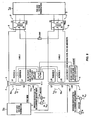
- FIG. 8 a version of the embodiment of FIG. 7 is presented using the simplified current sink/source approach first illustrated in FIG 6 . Note that third windings 111a and 111b are coupled in series with respective primary windings 70a and 70b.
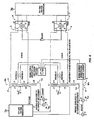
- FIG. 9 another embodiment of the present invention is presented.
- current compensation is provided by third windings 112, 114 on the wire side (secondary side) of the magnetic devices 68b, 84b.
- Current is sensed directly on the wire side as in FIGS. 7 and 8 , however the current sink/source arrangement provides current to third windings 112, 114 on the secondary (wire) side rather than a third winding on the primary side as in FIGS. 5 , 6 , 7 and 8 .
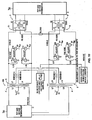
- FIG. 10 another embodiment of the present invention is illustrated.
- a third winding in a differential transformer is not provided, rather, current imbalance is sensed as in FIGS. 7 , 8 and 9 and compensating current is directly applied to the conductor pairs isolating the current sources/sinks from the conductor pairs with an appropriate inductor (e.g., 1mH) as shown.
- an appropriate inductor e.g. 1mH
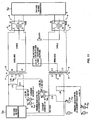
- FIG. 11 illustrates another embodiment of the present invention wherein compensating current is directly applied to the primary of T1 instead of via a third winding, hi this case a current source/sink is coupled to one or both ends of the primary as shown through an inductance. While two sets of current source/sinks are shown in this version, those of ordinary skill in the art will now appreciate that a number of different configurations could be employed. More specifically, the center tap of the primary of T 1 is shown strapped to Vdd (typically 3.3 VDC in most PHYs) although it can instead be set to any convenient fixed voltage such as ground. The PHY steers DC current in and out of L1 and L2 (which are parts of the primary winding of magnetic device T1) during data transmission.
- Vdd typically 3.3 VDC in most PHYs
- Inductors L13 and L14 provide high AC impedance and low DC impedance so that current sources/sinks may be used to push DC current though L1 or L2 from a current source referenced to a higher supply, 5VDC shown here, or pull current from L1 and L2 to ground (or a lower supply) via the L13 and L14 windings.
- current source 13 may be used to sink current to ground though the L14 inductor, that is flowing really though L2 that is biased to 3.3v at the center tap
- OR current source 16 may be used to force current from the 5v supply through L14 inductor and into L2 sinking the current into the 3.3v supply at the center tap of the primary of T 1.
- Other approaches may also be used and combinations may be used as well, if desired.
- L1 3. Note that current adjustment will typically occur at L13 OR L14 but not both. Similarly, current may be sinked into the 3.3 VDC supply or 0VDC supply, but not both.
- the current sources/sinks are used subject to the constraint that one uses either one side (L1 or L2) of the T1 primary winding to pull current in or out, but not both; or one may use either one side (e.g., L13) or the other (e.g., L14) but not both sides source/sink current to/from the primary winding of T1.
- the embodiment illustrated in the schematic diagram of FIG. 12 is a slight variation on the embodiment of FIG. 11 . In this version the two 50-ohm termination resistors R3 and R4 on the transmit side and R1 and R2 on the receive side are shown (although they would be present in all embodiments that operate with Ethernet).
- the current sources do the adjustment right across the typical Ethernet link on the primary side, the sources must look like a relatively high impedance (e.g., more than 1000 ohms) up to 100mhz and must be designed with low capacitance (i.e., no more than a few picofarads), and must keep the signal balanced since there is no isolation in this embodiment for the TX or the RX pairs.
- a current source in inside the PHY steers AC data current at higher speeds. Effectively another DC current source is added so that it is ON when needed and only applies DC current as an offset.
- the current sources are much higher impedance than the 100 ohm by at least a ratio of 10 to 1 and are low capacitance.
- FIG. 13 The embodiment illustrated in the schematic diagram of FIG. 13 is a slight variation on the embodiment of FIG. 12 .
- inductors L13 and L14 are added back (as from FIG. 11 ) on the transmit channel, and the same concepts as discussed with respect to FIG. 12 apply except that the transmit channel AC (data) signals are isolated with inductors L 13/L 14 giving the PHY designer the chance to design a current source that may be more capacitive and potentially correcting for a higher offset or error, i.e., one providing much higher DC current correction.
- the receive channel while it could be configured like the transmit channel, in this version the center- tap is split on the primary side as shown which avoids the need for a dedicated winding to do the job.
- Capacitors C2 and C3 to ground eliminate common mode noise, and the current adjustment takes place as discussed above.
- TDR time domain reflectometers
- FIG. 14 illustrates a variation 140 of the approach shown in FIG. 4C and utilizes a digital signal processor (DSP) 142 or equivalent circuitry on the transmit portion 144 of the PHY 146.
- the transmitter (transmit DAC (current-output digital analog converter)) 148 transmits a differential analog signal on lines 150a, 150b to the primary 152 of transmit transformer T1 154.
- Receiver 156 is coupled to receive the output of transmitter 148 on lines 150a, 150b via lines 158a, 158b.
- Receiver 156 outputs a digital version of the signal from transmitter 148 to an input 160 of DSP 142.
- the digital output on line 162 of DSP 142 constitutes a feedback signal. Test pulses can be initiated, for example, in transmitter 148.
- the receiver 156 senses this and in conjunction with DSP 142 causes a correction to the signal so that after a few pulses have been sent and sensed, the transmit portion 144 of the PHY 146 is able to send a predistorted signal that looks perfect or near perfect upon passing through transformer T1 (154).
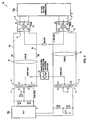
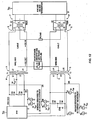
- FIG. 15 is an electrical schematic diagram which illustrates an example of a circuit for providing current sink/current source capability for the circuits described in more detail above. This is just one example and many other equivalent circuits may be used which are capable of sinking or sourcing current.
- a controller 120 is coupled to a current imbalance detector 122 which may be of a type adapted for direct measurement of current imbalance (wire side current sensors) or indirect measurement of effective current imbalance (droop detection) as described in more detail above.
- Controller 120 is coupled to a pair of voltage DACs (digital to analog converters with voltage outputs) 124 and 126. These pass a signal to conventional current sink circuit block 128 and current source circuit block 130, respectively, which are arranged to drive a bias current in either direction.
- node CTAP may alternatively be grounded or set to some other fixed voltage level.
- a current sink/source circuit may be located in various places in the circuit to achieve the corrective action described herein and various types of sensing may be used to cause it to act.
Landscapes
- Engineering & Computer Science (AREA)
- Computer Networks & Wireless Communication (AREA)
- Signal Processing (AREA)
- Dc Digital Transmission (AREA)
- Cable Transmission Systems, Equalization Of Radio And Reduction Of Echo (AREA)
- Soft Magnetic Materials (AREA)
- Interface Circuits In Exchanges (AREA)
Claims (12)
- Verfahren zum Kompensieren eines Ungleichgewichts im Stromfluss in einem Paar von Leitern (150), die elektrischen Gleichtaktstrom zwischen einer ersten Magnetvorrichtung (154) und einer zweiten Magnetvorrichtung tragen, wobei die erste Magnetvorrichtung (154) eine Primärwicklung (152) und eine Sekundärwicklung hat, und wobei die zweite Magnetvorrichtung eine Primärwicklung und eine Sekundärwicklung hat, wobei das Ungleichgewicht im Stromfluss in dem Paar von Leitern (150) eine Verzerrung eines Differenzsignals (158) hervorruft, das entlang des Paars von Leitern (150) gesendet wird, wobei das Verfahren dadurch gekennzeichnet ist, dass es die folgenden Schritte umfasst:Ermitteln des Ungleichgewichts im Stromfluss in dem Paar von Leitern (150);Anlegen einer Vorverzerrung an das Differenzsignal (158), bevor das Differenzsignal (158) an die Primärwicklung (152) der ersten Magnetvorrichtung (154) gesendet wird, wobei die Vorverzerrung eine Kompensierung für die Verzerrung bereitstellt, die durch das ermittelte Ungleichgewicht im Stromfluss in dem Paar von Leitern (150) an dem Differenzsignal (158) verursacht werden würde; undSenden des vorverzerrten Differenzsignals (158) an die Primärwicklung (152) der ersten Magnetvorrichtung (154).
- Verfahren nach Anspruch 1, wobei das Ermitteln des Ungleichgewichts im Stromfluss in dem Paar von Leitern umfasst:Empfangen, durch einen Empfänger (156), des an die Primärwicklung (152) der ersten Magnetvorrichtung (154) gesendeten Differenzsignals (158); undErmitteln, durch den Empfänger (156), des Ungleichgewichts im Stromfluss basierend auf dem empfangenen Differenzsignal (158).
- Verfahren nach Anspruch 2, wobei das Anlegen der Vorverzerrung an das Differenzsignal vor dem Senden des Differenzsignals (158) an die Primärwicklung (152) der ersten Magnetvorrichtung (154) umfasst:Empfangen, durch einen digitalen Signalprozessor (142), einer digitalen Version des Differenzsignals von dem Empfänger (156); undAnlegen, durch den digitalen Signalprozessor (142) und basierend auf der digitalen Version des Differenzsignals von dem Empfänger (156), der Vorverzerrung an das Differenzsignal vor dem Senden des Differenzsignals (158) an die Primärwicklung (152) der ersten Magnetvorrichtung (154).
- Verfahren nach einem der Ansprüche 1, 2 oder 3, wobei das Ermitteln des Ungleichgewichts im Stromfluss in dem Paar von Leitern (150) umfasst:Empfangen eines Testimpulses des an die Primärwicklung (152) der ersten Magnetvorrichtung (154) gesendeten Differenzsignals; undAbfühlen einer Verzerrung des Testimpulses, wenn ein Ungleichgewicht im Stromfluss in dem Paar von Leitern (150) besteht.
- Verfahren nach Anspruch 4, wobei das Abfühlen der Verzerrung des Testimpulses, wenn das Ungleichgewicht im Stromfluss in dem Paar von Leitern (150) besteht, umfasst:Vergleichen einer Eigenschaft des Testimpulses mit einer Eigenschaft eines idealen Impulses;Erzeugen eines Differenz-Fehlersignals aus der Differenz zwischen dem Testimpuls und dem idealen Impuls, basierend auf dem Vergleich der Eigenschaft des Testimpulses und der Eigenschaft des idealen Impulses; undKorrigieren des Testimpulses des Differenzsignals (162) basierend auf dem Differenz-Fehlersignal, um das ermittelte Ungleichgewicht im Stromfluss in dem Paar von Leitern zu kompensieren.
- Verfahren nach Anspruch 5, wobei das Vergleichen einer Eigenschaft des Testimpulses mit einer Eigenschaft eines idealen Impulses umfasst:Messen einer Spitzenamplitude des Testimpulses an einem Ende des Testimpulses; undVergleichen der Spitzenamplitude des Testimpulses am Ende des Testimpulses mit einer Spitzenamplitude des idealen Impulses an einem Ende des idealen Impulses.
- Vorrichtung mit:einer physikalischen Schicht (146) mit einer Sendeabschnitt-Schaltung (144) und einer Empfangsabschnitt-Schaltung, wobei die Sendeabschnitt-Schaltung dadurch gekennzeichnet ist, dass sie aufweist:eine Einrichtung zum Ermitteln eines Ungleichgewichts im Stromfluss in einem Paar von Leitern (150), die elektrischen Gleichtaktstrom zwischen einer ersten Magnetvorrichtung (154) und einer zweiten Magnetvorrichtung tragen, wobei die erste Magnetvorrichtung (154) eine Primärwicklung (152) und eine Sekundärwicklung hat, und wobei die zweite Magnetvorrichtung eine Primärwicklung und eine Sekundärwicklung hat, wobei das Ungleichgewicht im Stromfluss in dem Paar von Leitern (150) eine Verzerrung eines Differenzsignals (158) hervorruft, das entlang des Paars von Leitern (150) gesendet wird; undeine Einrichtung zum Anlegen einer Vorverzerrung an das Differenzsignal (158), bevor das Differenzsignal (158) an die Primärwicklung (152) der ersten Magnetvorrichtung (154) gesendet wird, wobei die Vorverzerrung eine Kompensierung für die Verzerrung bereitstellt, die durch das ermittelte Ungleichgewicht im Stromfluss in dem Paar von Leitern (150) an dem Differenzsignal (158) verursacht werden würde; undeine Einrichtung zum Senden des vorverzerrten Differenzsignals (158) an die Primärwicklung (152) der ersten Magnetvorrichtung (154).
- Vorrichtung nach Anspruch 7, wobei die Einrichtung zum Ermitteln einen Empfänger (156) aufweist, der, wenn er das Ungleichgewicht im Stromfluss in dem Paar von Leitern (150) ermittelt, so konfiguriert ist, dass er:das an die Primärwicklung (152) der ersten Magnetvorrichtung (154) gesendete Differenzsignal (158) empfängt; unddas Ungleichgewicht im Stromfluss basierend auf dem empfangenen Differenzsignal (158) ermittelt.
- Vorrichtung nach Anspruch 8, wobei die Einrichtung zum Anlegen einer Vorverzerrung an das Differenzsignal einen digitalen Signalprozessor (142) aufweist, der, wenn er die Vorverzerrung an das Differenzsignal (158) anlegt, bevor das Differenzsignal (158) an die Primärwicklung (152) der ersten Magnetvorrichtung (154) gesendet wird, so konfiguriert ist, dass er:eine digitale Version des Differenzsignals von dem Empfänger (156) empfängt; undbasierend auf der digitalen Version des Differenzsignals von dem Empfänger (156), die Vorverzerrung an das Differenzsignal (158) vor dem Senden des Differenzsignals (158) an die Primärwicklung (152) der ersten Magnetvorrichtung (154) anlegt.
- Vorrichtung nach einem der Ansprüche 7 bis 9, wobei die Einrichtung zum Ermitteln des Ungleichgewichts im Stromfluss in dem Paar von Leitern (150) so konfiguriert ist, dass sie:einen Testimpuls des an die Primärwicklung (152) der ersten Magnetvorrichtung (154) gesendeten Differenzsignals empfängt; undeine Verzerrung des Testimpulses abfühlt, wenn ein Ungleichgewicht im Stromfluss in dem Paar von Leitern (150) besteht.
- Vorrichtung nach Anspruch 10, wobei, wenn die Verzerrung des Testimpulses abgefühlt wird, wenn das Ungleichgewicht im Stromfluss in dem Paar von Leitern (150) besteht, die Sendeabschnitt-Schaltung so konfiguriert ist, dass sie:eine Eigenschaft des Testimpulses mit einer Eigenschaft eines idealen Impulses vergleicht;ein Differenz-Fehlersignal aus der Differenz zwischen dem Testimpuls und dem idealen Impuls, basierend auf dem Vergleich der Eigenschaft des Testimpulses und der Eigenschaft des idealen Impulses erzeugt; undden Testimpuls des Differenzsignals (162) basierend auf dem Differenz-Fehlersignal korrigiert, um das ermittelte Ungleichgewicht im Stromfluss in dem Paar von Leitern (150) zu kompensieren.
- Vorrichtung nach Anspruch 11, wobei beim Vergleichen einer Eigenschaft des Testimpulses mit einer Eigenschaft eines idealen Impulses die Sendeabschnitt-Schaltung so konfiguriert ist, dass sie:eine Spitzenamplitude des Testimpulses an einem Ende des Testimpulses misst; unddie Spitzenamplitude des Testimpulses am Ende des Testimpulses mit einer Spitzenamplitude des idealen Impulses an einem Ende des idealen Impulses vergleicht.
Applications Claiming Priority (2)
| Application Number | Priority Date | Filing Date | Title |
|---|---|---|---|
| US10/981,202 US7457252B2 (en) | 2004-11-03 | 2004-11-03 | Current imbalance compensation for magnetics in a wired data telecommunications network |
| EP05809915A EP1813055B1 (de) | 2004-11-03 | 2005-10-07 | Auf phy basierende stromungleichgewichtskompensation für magnettechnik in einem verdrahteten datentelekommunikationsnetz |
Related Parent Applications (1)
| Application Number | Title | Priority Date | Filing Date |
|---|---|---|---|
| EP05809915.1 Division | 2005-10-07 |
Publications (2)
| Publication Number | Publication Date |
|---|---|
| EP2222017A1 EP2222017A1 (de) | 2010-08-25 |
| EP2222017B1 true EP2222017B1 (de) | 2012-02-29 |
Family
ID=35811775
Family Applications (2)
| Application Number | Title | Priority Date | Filing Date |
|---|---|---|---|
| EP10166072A Expired - Lifetime EP2222017B1 (de) | 2004-11-03 | 2005-10-07 | Phy-basierender Abgleich eines Stromstärkeungleichgewichts für Magnete in einem drahtgebundenen Telekommunikationsnetz |
| EP05809915A Expired - Lifetime EP1813055B1 (de) | 2004-11-03 | 2005-10-07 | Auf phy basierende stromungleichgewichtskompensation für magnettechnik in einem verdrahteten datentelekommunikationsnetz |
Family Applications After (1)
| Application Number | Title | Priority Date | Filing Date |
|---|---|---|---|
| EP05809915A Expired - Lifetime EP1813055B1 (de) | 2004-11-03 | 2005-10-07 | Auf phy basierende stromungleichgewichtskompensation für magnettechnik in einem verdrahteten datentelekommunikationsnetz |
Country Status (5)
| Country | Link |
|---|---|
| US (2) | US7457252B2 (de) |
| EP (2) | EP2222017B1 (de) |
| AT (2) | ATE547856T1 (de) |
| DE (1) | DE602005022611D1 (de) |
| WO (1) | WO2006052360A1 (de) |
Families Citing this family (47)
| Publication number | Priority date | Publication date | Assignee | Title |
|---|---|---|---|---|
| GB0403932D0 (en) * | 2004-02-21 | 2004-03-24 | Koninkl Philips Electronics Nv | Improving image quality in a 3D image display device |
| US7793137B2 (en) * | 2004-10-07 | 2010-09-07 | Cisco Technology, Inc. | Redundant power and data in a wired data telecommunincations network |
| US7719992B1 (en) * | 2004-07-14 | 2010-05-18 | Cisco Tchnology, Ink. | System for proactive time domain reflectometry |
| US8831211B2 (en) * | 2004-11-19 | 2014-09-09 | Linear Technology Corporation | Common-mode data transmission for power over ethernet system |
| US7656956B2 (en) * | 2005-01-14 | 2010-02-02 | Motorola, Inc. | Data, power and supervisory signaling over twisted pairs |
| US7827418B2 (en) * | 2005-01-25 | 2010-11-02 | Linear Technology Corporation | Controlling power distribution among multiple wires in communication cable |
| US20060212724A1 (en) * | 2005-03-15 | 2006-09-21 | Dwelley David M | System and method for supporting operations of advanced power over ethernet system |
| US20060251188A1 (en) * | 2005-03-28 | 2006-11-09 | Akros Silicon, Inc. | Common-mode suppression circuit for emission reduction |
| US7685452B2 (en) * | 2005-03-28 | 2010-03-23 | Akros Silicon Inc. | Method for high voltage power feed on differential cable pairs from a network attached power sourcing device |
| WO2007121148A2 (en) * | 2006-04-11 | 2007-10-25 | Akros Silicon, Inc. | Network devices for separating power and data signals |
| US7560825B2 (en) * | 2006-04-11 | 2009-07-14 | Akros Silicon, Inc. | Network devices for separating power and data signals |
| US20080048779A1 (en) * | 2006-05-16 | 2008-02-28 | Crawley Philip J | Active emi suppression circuit |
| US8643218B2 (en) | 2006-06-02 | 2014-02-04 | Broadcom Corporation | Minimizing saturation caused by power transfer in a communication system transformer |
| US7697251B2 (en) * | 2006-09-06 | 2010-04-13 | Cisco Technology, Inc. | Powered communications interface with DC current imbalance compensation |
| US8576873B2 (en) * | 2006-11-30 | 2013-11-05 | Broadcom Corporation | System and method for controlling power delivered to a powered device based on channel impediments |
| US7664972B2 (en) | 2006-12-19 | 2010-02-16 | Broadcom Corporation | System and method for controlling power delivered to a powered device based on cable characteristics |
| EP1936875B1 (de) * | 2006-12-19 | 2016-03-09 | Broadcom Corporation | System und Verfahren zum Regeln der an eine stromgetriebene Vorrichtung zugeführten Leistung, basierend auf der Kabelcharakteristik |
| US7738387B2 (en) | 2007-01-17 | 2010-06-15 | Broadcom Corporation | System and method for diagnosing a cabling infrastructure using a PHY |
| US7921307B2 (en) | 2007-03-27 | 2011-04-05 | Cisco Technology, Inc. | Methods and apparatus providing advanced classification for power over Ethernet |
| US7777636B2 (en) * | 2007-03-29 | 2010-08-17 | Broadcom Corporation | System and method for continual cable thermal monitoring using cable characteristic considerations in power over Ethernet |
| US7737704B2 (en) * | 2007-06-12 | 2010-06-15 | Broadcom Corporation | System and method for using a PHY to locate a thermal signature in a cable plant for diagnostic, enhanced, and higher power applications |
| US8611235B2 (en) * | 2007-06-14 | 2013-12-17 | Cisco Technology, Inc. | Extended reach data network |
| US7696636B2 (en) | 2007-08-24 | 2010-04-13 | Broadcom Corporation | Midspan powering in a Power over Ethernet system |
| US7975153B2 (en) | 2007-09-25 | 2011-07-05 | Broadcom Corporation | Transmission impedance for four-pair midspan powering in a power over ethernet application |
| US7851938B2 (en) | 2007-09-25 | 2010-12-14 | Broadcom Corporation | Midspan powering without the use of data transformers in a power over Ethernet application |
| US7971075B2 (en) | 2007-09-25 | 2011-06-28 | Broadcom Corporation | Four-pair midspan powering with a splitter in a power over ethernet application |
| ES2321792B1 (es) * | 2007-10-03 | 2010-03-04 | Diseño De Sistemas En Silicio S.A. | Dispositivo de multiinyeccion de tension sobre multiples conductores. |
| US20090097401A1 (en) * | 2007-10-12 | 2009-04-16 | Wael William Diab | Method and system for configurable data rate thresholds for energy efficient ethernet |
| US7902694B2 (en) * | 2007-11-08 | 2011-03-08 | Cisco Technology, Inc. | Dynamic current limits |
| RU2447572C2 (ru) * | 2007-12-04 | 2012-04-10 | Мицубиси Электрик Корпорейшн | Устройство управления электродвигателя переменного тока |
| US8670335B2 (en) | 2008-04-02 | 2014-03-11 | Marvell World Trade Ltd. | Reduced power transmission |
| US9712459B1 (en) | 2010-01-27 | 2017-07-18 | Marvell International Ltd. | Low-to-high speed cut-through communication |
| US8787964B2 (en) * | 2010-06-23 | 2014-07-22 | MindTree Limited | Integrated radio frequency front-end circuit |
| US8823402B2 (en) * | 2011-11-23 | 2014-09-02 | Broadcom Corporation | Cable resistance determination in high-power PoE networks |
| US20140040641A1 (en) * | 2012-08-03 | 2014-02-06 | Broadcom Corporation | Cable Imbalance Diagnostics Between Channels That Include Wire Pairs for Power Over Ethernet Transmission |
| FR2998430B1 (fr) * | 2012-11-20 | 2016-01-08 | Thales Sa | Transmission de puissance electrique sur cable de transmission de donnees |
| US9014248B2 (en) * | 2013-01-31 | 2015-04-21 | Broadcom Corporation | BASE-T common mode testing in an Ethernet subsystem |
| US9385929B2 (en) | 2013-02-26 | 2016-07-05 | Cisco Technology, Inc. | Methods and devices for performing dynamic droop compensation |
| US9337905B2 (en) * | 2013-07-01 | 2016-05-10 | Texas Instruments Incorporated | Inductive structures with reduced emissions and interference |
| JP2015043508A (ja) * | 2013-08-26 | 2015-03-05 | オンキヨー株式会社 | 信号伝送回路 |
| US9819271B2 (en) * | 2013-09-30 | 2017-11-14 | O2Micro, Inc. | Power converters |
| CN104377677B (zh) * | 2014-11-07 | 2017-02-15 | 南京信息工程大学 | 一种末端跨接法有源以太网的电涌保护器 |
| US10135626B2 (en) * | 2015-04-14 | 2018-11-20 | Avago Technologies General Ip (Singapore) Pte. Ltd. | Power coupling circuits for single-pair ethernet with automotive applications |
| US10177713B1 (en) * | 2016-03-07 | 2019-01-08 | Ali Tasdighi Far | Ultra low power high-performance amplifier |
| US10601525B2 (en) | 2018-04-20 | 2020-03-24 | Arm Limited | Power distribution for functional circuit blocks |
| CN111092445B (zh) * | 2018-10-24 | 2021-10-26 | 华为技术有限公司 | 信号可靠性检测方法、PSE芯片、CPU芯片以及PoE设备 |
| US12355597B2 (en) * | 2021-03-30 | 2025-07-08 | Autonetworks Technologies, Ltd. | Communicator and communication device |
Family Cites Families (75)
| Publication number | Priority date | Publication date | Assignee | Title |
|---|---|---|---|---|
| US580860A (en) * | 1897-04-20 | Refill for cisterns | ||
| US3380801A (en) | 1966-07-08 | 1968-04-30 | Exxon Production Research Co | Separation of cobalt from nickel |
| US4835737A (en) | 1986-07-21 | 1989-05-30 | American Telephone And Telegraph Company, At&T Bell Laboratories | Method and apparatus for controlled removal and insertion of circuit modules |
| US5038320A (en) | 1987-03-13 | 1991-08-06 | International Business Machines Corp. | Computer system with automatic initialization of pluggable option cards |
| US5237511A (en) | 1990-10-29 | 1993-08-17 | Westronic, Inc. | Distribution automation smart remote terminal unit |
| US5122691A (en) | 1990-11-21 | 1992-06-16 | Balu Balakrishnan | Integrated backplane interconnection architecture |
| US5289359A (en) | 1991-02-13 | 1994-02-22 | Charles Industries, Limited | DC-DC power converter including sensing means for providing an output when the reserve power of the converter falls below a predetermined amount for a given input voltage |
| US5268592A (en) | 1991-02-26 | 1993-12-07 | International Business Machines Corporation | Sequential connector |
| US5148144A (en) | 1991-03-28 | 1992-09-15 | Echelon Systems Corporation | Data communication network providing power and message information |
| JP2905616B2 (ja) | 1991-05-20 | 1999-06-14 | シャープ株式会社 | 通信端末装置 |
| JPH0821015B2 (ja) | 1992-01-20 | 1996-03-04 | インターナショナル・ビジネス・マシーンズ・コーポレイション | コンピュータならびにそのシステム再構成化装置および方法 |
| CA2097449C (en) | 1992-06-05 | 1998-09-15 | Satosi Sakuragi | Telephone line power utility circuit |
| US5406260A (en) | 1992-12-18 | 1995-04-11 | Chrimar Systems, Inc. | Network security system for detecting removal of electronic equipment |
| GB9325594D0 (en) | 1993-12-14 | 1994-02-16 | Amp Great Britain | Multi-port modular jack assembly |
| US5608792A (en) | 1994-04-13 | 1997-03-04 | British Telecommunications Public Limited Company | Apparatus for drawing and processing electrical power from a communications line |
| US5613130A (en) | 1994-11-10 | 1997-03-18 | Vadem Corporation | Card voltage switching and protection |
| WO1996023377A1 (en) | 1995-01-27 | 1996-08-01 | Intecom, Incorporated | Multimedia system having central power source and distribution subsystem |
| US5726506A (en) | 1995-06-05 | 1998-03-10 | Alantec Corporation | Hot insertion power arrangement |
| JP3407838B2 (ja) | 1995-09-05 | 2003-05-19 | ソニー株式会社 | ビデオオンデマンドシステム |
| US5758102A (en) | 1996-01-11 | 1998-05-26 | International Business Machines Corporation | Soft switching circuit for use on backplane |
| US5726901A (en) | 1996-01-25 | 1998-03-10 | Dell Usa, L.P. | System for reporting computer energy consumption |
| US5639267A (en) | 1996-01-26 | 1997-06-17 | Maxconn Incorporated | Modular jack assembly |
| US5793987A (en) | 1996-04-18 | 1998-08-11 | Cisco Systems, Inc. | Hot plug port adapter with separate PCI local bus and auxiliary bus |
| US5742513A (en) | 1996-05-15 | 1998-04-21 | Abb Power T&D Company Inc. | Methods and systems for automatic testing of a relay |
| US5809256A (en) | 1996-06-11 | 1998-09-15 | Data General Corporation | Soft power switching for hot installation and removal of circuit boards in a computer system |
| US5790873A (en) | 1996-07-23 | 1998-08-04 | Standard Microsystems Corporation | Method and apparatus for power supply switching with logic integrity protection |
| US5775946A (en) | 1996-08-23 | 1998-07-07 | Amphenol Corporation | Shielded multi-port connector and method of assembly |
| US5796185A (en) | 1996-10-15 | 1998-08-18 | Sony Corporation | Circuit card present sense and protective power supply inhibit for airborne application of ATM switch unit |
| US5790391A (en) | 1996-11-29 | 1998-08-04 | General Signal Corporation | Standby power system |
| TW364679U (en) | 1996-12-26 | 1999-07-11 | Hon Hai Prec Ind Co Ltd | Plug slot connector terminal |
| US6009317A (en) * | 1997-01-17 | 1999-12-28 | Ericsson Inc. | Method and apparatus for compensating for imbalances between quadrature signals |
| US6068520A (en) | 1997-03-13 | 2000-05-30 | Berg Technology, Inc. | Low profile double deck connector with improved cross talk isolation |
| US5884086A (en) | 1997-04-15 | 1999-03-16 | International Business Machines Corporation | System and method for voltage switching to supply various voltages and power levels to a peripheral device |
| US5834925A (en) | 1997-05-08 | 1998-11-10 | Cisco Technology, Inc. | Current sharing power supplies with redundant operation |
| US5994998A (en) | 1997-05-29 | 1999-11-30 | 3Com Corporation | Power transfer apparatus for concurrently transmitting data and power over data wires |
| US5991885A (en) | 1997-06-11 | 1999-11-23 | Clarinet Systems, Inc. | Method and apparatus for detecting the presence of a remote device and providing power thereto |
| US6162089A (en) | 1997-12-30 | 2000-12-19 | The Whitaker Corporation | Stacked LAN connector |
| US6087861A (en) * | 1998-02-11 | 2000-07-11 | International Business Machines Corporation | Data network drivers including balanced current supplies and related methods |
| US6036547A (en) | 1998-03-05 | 2000-03-14 | Berg Technology, Inc. | Double deck gang jack exhibiting suppressed mutual crosstalk |
| US6134666A (en) | 1998-03-12 | 2000-10-17 | Cisco Technology, Inc. | Power supervisor for electronic modular system |
| US6115468A (en) | 1998-03-26 | 2000-09-05 | Cisco Technology, Inc. | Power feed for Ethernet telephones via Ethernet link |
| US6033266A (en) | 1998-08-31 | 2000-03-07 | The Whitaker Corporation | Modular connector with preload and beam length reduction features |
| US6643566B1 (en) | 1999-01-12 | 2003-11-04 | Powerdsine Ltd. | System for power delivery over data communication cabling infrastructure |
| US6099349A (en) | 1999-02-23 | 2000-08-08 | Amphenol Corporation | Dual multiport RJ connector arrangement |
| US6218930B1 (en) | 1999-03-10 | 2001-04-17 | Merlot Communications | Apparatus and method for remotely powering access equipment over a 10/100 switched ethernet network |
| US6233128B1 (en) | 1999-03-29 | 2001-05-15 | George A. Spencer | Data retention in a circuit breaker |
| US6310781B1 (en) | 1999-03-31 | 2001-10-30 | Cisco Technology, Inc. | Connection pin layout for connecting integrated magnetics modules to a printed circuit board |
| JP2001008452A (ja) * | 1999-06-21 | 2001-01-12 | Sony Corp | 電源装置 |
| US6762675B1 (en) | 1999-09-27 | 2004-07-13 | Cisco Technology, Inc. | Method and apparatus for remote powering of device connected to network |
| US6396392B1 (en) | 2000-05-23 | 2002-05-28 | Wire21, Inc. | High frequency network communications over various lines |
| US6701443B1 (en) | 2000-06-19 | 2004-03-02 | Cisco Technology, Inc. | Methods and apparatus for discovering a powerability condition of a computer network |
| US6541878B1 (en) | 2000-07-19 | 2003-04-01 | Cisco Technology, Inc. | Integrated RJ-45 magnetics with phantom power provision |
| US7340405B1 (en) | 2000-09-08 | 2008-03-04 | Sabre Inc. | Method and system for developing optimized schedules |
| EP1241776A4 (de) * | 2000-10-02 | 2007-09-26 | Omron Tateisi Electronics Co | Leistungsversorgung |
| US6448899B1 (en) | 2000-10-25 | 2002-09-10 | Nortel Networks Limited | Power indicating ethernet outlet and method therefor |
| US6804351B1 (en) | 2000-11-09 | 2004-10-12 | Cisco Technology, Inc. | Method and apparatus for detecting a compatible phantom powered device using common mode signaling |
| US6963321B2 (en) * | 2001-05-09 | 2005-11-08 | Clare Micronix Integrated Systems, Inc. | Method of providing pulse amplitude modulation for OLED display drivers |
| US6577258B2 (en) * | 2001-10-01 | 2003-06-10 | Nokia Corporation | Adaptive sigma-delta data converter for mobile terminals |
| US7089126B2 (en) | 2001-11-06 | 2006-08-08 | Intel Corporation | Diode discovery power level detection |
| US6958699B1 (en) | 2001-12-18 | 2005-10-25 | Cisco Technology, Inc. | Signal-disruption detection in powered networking systems |
| US7519000B2 (en) | 2002-01-30 | 2009-04-14 | Panduit Corp. | Systems and methods for managing a network |
| US6986071B2 (en) | 2002-02-01 | 2006-01-10 | Powerdsine, Ltd. | Detecting network power connection status using AC signals |
| CN100367574C (zh) | 2002-04-10 | 2008-02-06 | 袍尔得辛有限公司 | 有源局域网连接器 |
| US7005861B1 (en) * | 2002-06-07 | 2006-02-28 | Marvell International Ltd. | Cable tester |
| EP1554642A1 (de) | 2002-10-15 | 2005-07-20 | Powerdsine Ltd. | Gleichspannungsversorgungssystem |
| TW589796B (en) * | 2002-12-06 | 2004-06-01 | Airoha Tech Corp | An automatic adjustment system for source current and sink current mismatch |
| US8098681B2 (en) | 2003-01-29 | 2012-01-17 | Avaya Inc. | Method and apparatus for dynamic termination of unused wired connection |
| US7154381B2 (en) | 2003-05-23 | 2006-12-26 | Sonos, Inc. | System and method for operating a sensed power device over data wiring |
| US7849343B2 (en) | 2003-06-10 | 2010-12-07 | Microsemi Corp. - Analog Mixed Signal Group Ltd. | Pre-detection of powered devices |
| US7145439B2 (en) | 2003-10-16 | 2006-12-05 | Powerdsine, Ltd. | Powered device interface circuit |
| US7460889B2 (en) | 2003-10-16 | 2008-12-02 | Microsemi Corp.—Analog Mixed Signal Group Ltd. | High power classification for power over Ethernet |
| US7250726B2 (en) * | 2003-10-21 | 2007-07-31 | Microsemi Corporation | Systems and methods for a transformer configuration with a tree topology for current balancing in gas discharge lamps |
| US7356588B2 (en) | 2003-12-16 | 2008-04-08 | Linear Technology Corporation | Circuits and methods for detecting the presence of a powered device in a powered network |
| US7162377B2 (en) | 2003-12-22 | 2007-01-09 | Ixia | Testing and emulating a device's power characteristics |
| US8369218B2 (en) | 2004-04-28 | 2013-02-05 | Net Optics, Inc. | Zero-interrupt network tap |
-
2004
- 2004-11-03 US US10/981,202 patent/US7457252B2/en active Active
-
2005
- 2005-10-07 WO PCT/US2005/036392 patent/WO2006052360A1/en not_active Ceased
- 2005-10-07 DE DE602005022611T patent/DE602005022611D1/de not_active Expired - Lifetime
- 2005-10-07 AT AT10166072T patent/ATE547856T1/de active
- 2005-10-07 AT AT05809915T patent/ATE476029T1/de not_active IP Right Cessation
- 2005-10-07 EP EP10166072A patent/EP2222017B1/de not_active Expired - Lifetime
- 2005-10-07 EP EP05809915A patent/EP1813055B1/de not_active Expired - Lifetime
- 2005-12-07 US US11/297,230 patent/US7577104B2/en active Active
Also Published As
| Publication number | Publication date |
|---|---|
| US7457252B2 (en) | 2008-11-25 |
| US20060115007A1 (en) | 2006-06-01 |
| ATE547856T1 (de) | 2012-03-15 |
| WO2006052360A1 (en) | 2006-05-18 |
| EP1813055B1 (de) | 2010-07-28 |
| US20060119478A1 (en) | 2006-06-08 |
| EP1813055A1 (de) | 2007-08-01 |
| US7577104B2 (en) | 2009-08-18 |
| ATE476029T1 (de) | 2010-08-15 |
| EP2222017A1 (de) | 2010-08-25 |
| DE602005022611D1 (de) | 2010-09-09 |
Similar Documents
| Publication | Publication Date | Title |
|---|---|---|
| EP2222017B1 (de) | Phy-basierender Abgleich eines Stromstärkeungleichgewichts für Magnete in einem drahtgebundenen Telekommunikationsnetz | |
| US7471014B2 (en) | Method and apparatus distributing power to a load in a powered device | |
| US8042006B2 (en) | Automatic system for power and data redundancy in a wired data telecommunications network | |
| US8549331B2 (en) | Redundant power and data in a wired data telecommunications network | |
| EP2008191B1 (de) | Verfahren und vorrichtung für strom mit gemeinsamer ethernetleistung für vier leiterpaare unter verwendung einer feldmittenvorrichtung | |
| CN101124772B (zh) | 具有用于确定通信电缆电阻的机构的通过通信电缆供电的系统 | |
| CN101019088B (zh) | 用于串行加电的设备连接的功率管理 | |
| US7373532B2 (en) | Inline power controller | |
| US7849351B2 (en) | Power and data redundancy in a single wiring closet | |
| EP1856547B1 (de) | Detektionsalgorithmus zur bereitstellung von inline-strom entlang vier paaren eines ethernetkabels zu einer einfach betriebenen vorrichtung | |
| EP1859566B1 (de) | Steuerung der stromverteilung zwischen mehreren drähten in einem kommunikationskabel | |
| US8930726B2 (en) | Physical layer device auto-adjustment based on power over Ethernet magnetic heating | |
| US7697251B2 (en) | Powered communications interface with DC current imbalance compensation | |
| US9100070B2 (en) | Method and system for mitigating transformer saturation in a communication interface | |
| HK1191770A (en) | Cable imbalance diagnostics between channels that include wire pairs for power over ethernet transmission |
Legal Events
| Date | Code | Title | Description |
|---|---|---|---|
| PUAI | Public reference made under article 153(3) epc to a published international application that has entered the european phase |
Free format text: ORIGINAL CODE: 0009012 |
|
| AC | Divisional application: reference to earlier application |
Ref document number: 1813055 Country of ref document: EP Kind code of ref document: P |
|
| AK | Designated contracting states |
Kind code of ref document: A1 Designated state(s): AT BE BG CH CY CZ DE DK EE ES FI FR GB GR HU IE IS IT LI LT LU LV MC NL PL PT RO SE SI SK TR |
|
| 17P | Request for examination filed |
Effective date: 20110224 |
|
| 17Q | First examination report despatched |
Effective date: 20110324 |
|
| RIC1 | Information provided on ipc code assigned before grant |
Ipc: H04L 12/10 20060101AFI20110725BHEP |
|
| GRAP | Despatch of communication of intention to grant a patent |
Free format text: ORIGINAL CODE: EPIDOSNIGR1 |
|
| GRAS | Grant fee paid |
Free format text: ORIGINAL CODE: EPIDOSNIGR3 |
|
| GRAA | (expected) grant |
Free format text: ORIGINAL CODE: 0009210 |
|
| AC | Divisional application: reference to earlier application |
Ref document number: 1813055 Country of ref document: EP Kind code of ref document: P |
|
| AK | Designated contracting states |
Kind code of ref document: B1 Designated state(s): AT BE BG CH CY CZ DE DK EE ES FI FR GB GR HU IE IS IT LI LT LU LV MC NL PL PT RO SE SI SK TR |
|
| REG | Reference to a national code |
Ref country code: GB Ref legal event code: FG4D Ref country code: CH Ref legal event code: EP |
|
| REG | Reference to a national code |
Ref country code: AT Ref legal event code: REF Ref document number: 547856 Country of ref document: AT Kind code of ref document: T Effective date: 20120315 |
|
| REG | Reference to a national code |
Ref country code: IE Ref legal event code: FG4D |
|
| REG | Reference to a national code |
Ref country code: DE Ref legal event code: R096 Ref document number: 602005032978 Country of ref document: DE Effective date: 20120426 |
|
| REG | Reference to a national code |
Ref country code: NL Ref legal event code: VDEP Effective date: 20120229 |
|
| LTIE | Lt: invalidation of european patent or patent extension |
Effective date: 20120229 |
|
| PG25 | Lapsed in a contracting state [announced via postgrant information from national office to epo] |
Ref country code: NL Free format text: LAPSE BECAUSE OF FAILURE TO SUBMIT A TRANSLATION OF THE DESCRIPTION OR TO PAY THE FEE WITHIN THE PRESCRIBED TIME-LIMIT Effective date: 20120229 Ref country code: LT Free format text: LAPSE BECAUSE OF FAILURE TO SUBMIT A TRANSLATION OF THE DESCRIPTION OR TO PAY THE FEE WITHIN THE PRESCRIBED TIME-LIMIT Effective date: 20120229 Ref country code: IS Free format text: LAPSE BECAUSE OF FAILURE TO SUBMIT A TRANSLATION OF THE DESCRIPTION OR TO PAY THE FEE WITHIN THE PRESCRIBED TIME-LIMIT Effective date: 20120629 |
|
| PG25 | Lapsed in a contracting state [announced via postgrant information from national office to epo] |
Ref country code: PT Free format text: LAPSE BECAUSE OF FAILURE TO SUBMIT A TRANSLATION OF THE DESCRIPTION OR TO PAY THE FEE WITHIN THE PRESCRIBED TIME-LIMIT Effective date: 20120629 Ref country code: GR Free format text: LAPSE BECAUSE OF FAILURE TO SUBMIT A TRANSLATION OF THE DESCRIPTION OR TO PAY THE FEE WITHIN THE PRESCRIBED TIME-LIMIT Effective date: 20120530 Ref country code: FI Free format text: LAPSE BECAUSE OF FAILURE TO SUBMIT A TRANSLATION OF THE DESCRIPTION OR TO PAY THE FEE WITHIN THE PRESCRIBED TIME-LIMIT Effective date: 20120229 Ref country code: BE Free format text: LAPSE BECAUSE OF FAILURE TO SUBMIT A TRANSLATION OF THE DESCRIPTION OR TO PAY THE FEE WITHIN THE PRESCRIBED TIME-LIMIT Effective date: 20120229 Ref country code: LV Free format text: LAPSE BECAUSE OF FAILURE TO SUBMIT A TRANSLATION OF THE DESCRIPTION OR TO PAY THE FEE WITHIN THE PRESCRIBED TIME-LIMIT Effective date: 20120229 |
|
| REG | Reference to a national code |
Ref country code: AT Ref legal event code: MK05 Ref document number: 547856 Country of ref document: AT Kind code of ref document: T Effective date: 20120229 |
|
| PG25 | Lapsed in a contracting state [announced via postgrant information from national office to epo] |
Ref country code: CY Free format text: LAPSE BECAUSE OF FAILURE TO SUBMIT A TRANSLATION OF THE DESCRIPTION OR TO PAY THE FEE WITHIN THE PRESCRIBED TIME-LIMIT Effective date: 20120229 |
|
| PG25 | Lapsed in a contracting state [announced via postgrant information from national office to epo] |
Ref country code: EE Free format text: LAPSE BECAUSE OF FAILURE TO SUBMIT A TRANSLATION OF THE DESCRIPTION OR TO PAY THE FEE WITHIN THE PRESCRIBED TIME-LIMIT Effective date: 20120229 Ref country code: PL Free format text: LAPSE BECAUSE OF FAILURE TO SUBMIT A TRANSLATION OF THE DESCRIPTION OR TO PAY THE FEE WITHIN THE PRESCRIBED TIME-LIMIT Effective date: 20120229 Ref country code: CZ Free format text: LAPSE BECAUSE OF FAILURE TO SUBMIT A TRANSLATION OF THE DESCRIPTION OR TO PAY THE FEE WITHIN THE PRESCRIBED TIME-LIMIT Effective date: 20120229 Ref country code: DK Free format text: LAPSE BECAUSE OF FAILURE TO SUBMIT A TRANSLATION OF THE DESCRIPTION OR TO PAY THE FEE WITHIN THE PRESCRIBED TIME-LIMIT Effective date: 20120229 Ref country code: RO Free format text: LAPSE BECAUSE OF FAILURE TO SUBMIT A TRANSLATION OF THE DESCRIPTION OR TO PAY THE FEE WITHIN THE PRESCRIBED TIME-LIMIT Effective date: 20120229 Ref country code: SI Free format text: LAPSE BECAUSE OF FAILURE TO SUBMIT A TRANSLATION OF THE DESCRIPTION OR TO PAY THE FEE WITHIN THE PRESCRIBED TIME-LIMIT Effective date: 20120229 Ref country code: SE Free format text: LAPSE BECAUSE OF FAILURE TO SUBMIT A TRANSLATION OF THE DESCRIPTION OR TO PAY THE FEE WITHIN THE PRESCRIBED TIME-LIMIT Effective date: 20120229 |
|
| PG25 | Lapsed in a contracting state [announced via postgrant information from national office to epo] |
Ref country code: IT Free format text: LAPSE BECAUSE OF FAILURE TO SUBMIT A TRANSLATION OF THE DESCRIPTION OR TO PAY THE FEE WITHIN THE PRESCRIBED TIME-LIMIT Effective date: 20120229 Ref country code: SK Free format text: LAPSE BECAUSE OF FAILURE TO SUBMIT A TRANSLATION OF THE DESCRIPTION OR TO PAY THE FEE WITHIN THE PRESCRIBED TIME-LIMIT Effective date: 20120229 |
|
| PLBE | No opposition filed within time limit |
Free format text: ORIGINAL CODE: 0009261 |
|
| STAA | Information on the status of an ep patent application or granted ep patent |
Free format text: STATUS: NO OPPOSITION FILED WITHIN TIME LIMIT |
|
| PG25 | Lapsed in a contracting state [announced via postgrant information from national office to epo] |
Ref country code: AT Free format text: LAPSE BECAUSE OF FAILURE TO SUBMIT A TRANSLATION OF THE DESCRIPTION OR TO PAY THE FEE WITHIN THE PRESCRIBED TIME-LIMIT Effective date: 20120229 |
|
| 26N | No opposition filed |
Effective date: 20121130 |
|
| REG | Reference to a national code |
Ref country code: DE Ref legal event code: R097 Ref document number: 602005032978 Country of ref document: DE Effective date: 20121130 |
|
| PG25 | Lapsed in a contracting state [announced via postgrant information from national office to epo] |
Ref country code: ES Free format text: LAPSE BECAUSE OF FAILURE TO SUBMIT A TRANSLATION OF THE DESCRIPTION OR TO PAY THE FEE WITHIN THE PRESCRIBED TIME-LIMIT Effective date: 20120609 |
|
| PG25 | Lapsed in a contracting state [announced via postgrant information from national office to epo] |
Ref country code: MC Free format text: LAPSE BECAUSE OF NON-PAYMENT OF DUE FEES Effective date: 20121031 |
|
| REG | Reference to a national code |
Ref country code: CH Ref legal event code: PL |
|
| REG | Reference to a national code |
Ref country code: IE Ref legal event code: MM4A |
|
| PG25 | Lapsed in a contracting state [announced via postgrant information from national office to epo] |
Ref country code: LI Free format text: LAPSE BECAUSE OF NON-PAYMENT OF DUE FEES Effective date: 20121031 Ref country code: IE Free format text: LAPSE BECAUSE OF NON-PAYMENT OF DUE FEES Effective date: 20121007 Ref country code: CH Free format text: LAPSE BECAUSE OF NON-PAYMENT OF DUE FEES Effective date: 20121031 Ref country code: BG Free format text: LAPSE BECAUSE OF FAILURE TO SUBMIT A TRANSLATION OF THE DESCRIPTION OR TO PAY THE FEE WITHIN THE PRESCRIBED TIME-LIMIT Effective date: 20120529 |
|
| PG25 | Lapsed in a contracting state [announced via postgrant information from national office to epo] |
Ref country code: TR Free format text: LAPSE BECAUSE OF FAILURE TO SUBMIT A TRANSLATION OF THE DESCRIPTION OR TO PAY THE FEE WITHIN THE PRESCRIBED TIME-LIMIT Effective date: 20120229 |
|
| PG25 | Lapsed in a contracting state [announced via postgrant information from national office to epo] |
Ref country code: LU Free format text: LAPSE BECAUSE OF NON-PAYMENT OF DUE FEES Effective date: 20121007 |
|
| PG25 | Lapsed in a contracting state [announced via postgrant information from national office to epo] |
Ref country code: HU Free format text: LAPSE BECAUSE OF FAILURE TO SUBMIT A TRANSLATION OF THE DESCRIPTION OR TO PAY THE FEE WITHIN THE PRESCRIBED TIME-LIMIT Effective date: 20051007 |
|
| REG | Reference to a national code |
Ref country code: FR Ref legal event code: PLFP Year of fee payment: 11 |
|
| REG | Reference to a national code |
Ref country code: FR Ref legal event code: PLFP Year of fee payment: 12 |
|
| REG | Reference to a national code |
Ref country code: FR Ref legal event code: PLFP Year of fee payment: 13 |
|
| REG | Reference to a national code |
Ref country code: FR Ref legal event code: PLFP Year of fee payment: 14 |
|
| P01 | Opt-out of the competence of the unified patent court (upc) registered |
Effective date: 20230525 |
|
| PGFP | Annual fee paid to national office [announced via postgrant information from national office to epo] |
Ref country code: DE Payment date: 20241002 Year of fee payment: 20 |
|
| PGFP | Annual fee paid to national office [announced via postgrant information from national office to epo] |
Ref country code: GB Payment date: 20241021 Year of fee payment: 20 |
|
| PGFP | Annual fee paid to national office [announced via postgrant information from national office to epo] |
Ref country code: FR Payment date: 20241025 Year of fee payment: 20 |
|
| REG | Reference to a national code |
Ref country code: DE Ref legal event code: R071 Ref document number: 602005032978 Country of ref document: DE |
|
| REG | Reference to a national code |
Ref country code: GB Ref legal event code: PE20 Expiry date: 20251006 |