EP2221670A2 - Automatic developing apparatus and processing method for lithographic printing plate precursor - Google Patents
Automatic developing apparatus and processing method for lithographic printing plate precursor Download PDFInfo
- Publication number
- EP2221670A2 EP2221670A2 EP10001893A EP10001893A EP2221670A2 EP 2221670 A2 EP2221670 A2 EP 2221670A2 EP 10001893 A EP10001893 A EP 10001893A EP 10001893 A EP10001893 A EP 10001893A EP 2221670 A2 EP2221670 A2 EP 2221670A2
- Authority
- EP
- European Patent Office
- Prior art keywords
- lithographic printing
- printing plate
- developer
- plate precursor
- acid
- Prior art date
- Legal status (The legal status is an assumption and is not a legal conclusion. Google has not performed a legal analysis and makes no representation as to the accuracy of the status listed.)
- Withdrawn
Links
- 238000007639 printing Methods 0.000 title claims abstract description 145
- 239000002243 precursor Substances 0.000 title claims abstract description 98
- 238000003672 processing method Methods 0.000 title claims description 18
- 238000012545 processing Methods 0.000 claims abstract description 101
- 239000010410 layer Substances 0.000 claims abstract description 99
- 238000011161 development Methods 0.000 claims abstract description 79
- 238000003780 insertion Methods 0.000 claims abstract description 62
- 230000037431 insertion Effects 0.000 claims abstract description 62
- 238000010438 heat treatment Methods 0.000 claims abstract description 59
- 239000011241 protective layer Substances 0.000 claims abstract description 35
- -1 hydroxycarboxylate ion Chemical class 0.000 claims description 89
- 239000007788 liquid Substances 0.000 claims description 44
- 150000001875 compounds Chemical class 0.000 claims description 42
- 239000004094 surface-active agent Substances 0.000 claims description 15
- 229920003169 water-soluble polymer Polymers 0.000 claims description 15
- BVKZGUZCCUSVTD-UHFFFAOYSA-M Bicarbonate Chemical compound OC([O-])=O BVKZGUZCCUSVTD-UHFFFAOYSA-M 0.000 claims description 9
- BVKZGUZCCUSVTD-UHFFFAOYSA-L Carbonate Chemical compound [O-]C([O-])=O BVKZGUZCCUSVTD-UHFFFAOYSA-L 0.000 claims description 9
- 239000004793 Polystyrene Substances 0.000 description 132
- XLYOFNOQVPJJNP-UHFFFAOYSA-N water Substances O XLYOFNOQVPJJNP-UHFFFAOYSA-N 0.000 description 69
- 238000001035 drying Methods 0.000 description 33
- 238000000034 method Methods 0.000 description 32
- 239000002253 acid Substances 0.000 description 31
- 239000000243 solution Substances 0.000 description 29
- 229910052782 aluminium Inorganic materials 0.000 description 20
- 229920001577 copolymer Polymers 0.000 description 19
- 238000005406 washing Methods 0.000 description 19
- 239000003513 alkali Substances 0.000 description 18
- 239000003795 chemical substances by application Substances 0.000 description 16
- 238000000576 coating method Methods 0.000 description 16
- 238000010276 construction Methods 0.000 description 16
- 229920002451 polyvinyl alcohol Polymers 0.000 description 16
- XAGFODPZIPBFFR-UHFFFAOYSA-N aluminium Chemical compound [Al] XAGFODPZIPBFFR-UHFFFAOYSA-N 0.000 description 15
- 239000011248 coating agent Substances 0.000 description 15
- 235000014113 dietary fatty acids Nutrition 0.000 description 15
- 239000000975 dye Substances 0.000 description 15
- 239000000194 fatty acid Substances 0.000 description 15
- 229930195729 fatty acid Natural products 0.000 description 15
- 239000000203 mixture Substances 0.000 description 15
- 239000004372 Polyvinyl alcohol Substances 0.000 description 14
- 229920000591 gum Polymers 0.000 description 14
- 229920000642 polymer Polymers 0.000 description 14
- 235000019422 polyvinyl alcohol Nutrition 0.000 description 14
- 230000001235 sensitizing effect Effects 0.000 description 14
- 239000002699 waste material Substances 0.000 description 13
- KRKNYBCHXYNGOX-UHFFFAOYSA-N citric acid Chemical compound OC(=O)CC(O)(C(O)=O)CC(O)=O KRKNYBCHXYNGOX-UHFFFAOYSA-N 0.000 description 12
- 230000008569 process Effects 0.000 description 12
- 239000007864 aqueous solution Substances 0.000 description 11
- BVKZGUZCCUSVTD-UHFFFAOYSA-N carbonic acid Chemical compound OC(O)=O BVKZGUZCCUSVTD-UHFFFAOYSA-N 0.000 description 11
- 230000007423 decrease Effects 0.000 description 11
- 230000006870 function Effects 0.000 description 11
- 239000000049 pigment Substances 0.000 description 11
- 239000003505 polymerization initiator Substances 0.000 description 11
- RGHNJXZEOKUKBD-SQOUGZDYSA-N D-gluconic acid Chemical compound OC[C@@H](O)[C@@H](O)[C@H](O)[C@@H](O)C(O)=O RGHNJXZEOKUKBD-SQOUGZDYSA-N 0.000 description 10
- 229940117927 ethylene oxide Drugs 0.000 description 10
- 150000003839 salts Chemical class 0.000 description 10
- 238000005507 spraying Methods 0.000 description 10
- 230000032258 transport Effects 0.000 description 10
- IAYPIBMASNFSPL-UHFFFAOYSA-N Ethylene oxide Chemical group C1CO1 IAYPIBMASNFSPL-UHFFFAOYSA-N 0.000 description 9
- 230000000694 effects Effects 0.000 description 9
- 239000004065 semiconductor Substances 0.000 description 9
- 239000000126 substance Substances 0.000 description 9
- 239000004677 Nylon Substances 0.000 description 8
- 229910019142 PO4 Inorganic materials 0.000 description 8
- 229910052783 alkali metal Inorganic materials 0.000 description 8
- 239000000463 material Substances 0.000 description 8
- 229920001778 nylon Polymers 0.000 description 8
- 239000010452 phosphate Substances 0.000 description 8
- 238000006116 polymerization reaction Methods 0.000 description 8
- 159000000000 sodium salts Chemical class 0.000 description 8
- GRYLNZFGIOXLOG-UHFFFAOYSA-N Nitric acid Chemical compound O[N+]([O-])=O GRYLNZFGIOXLOG-UHFFFAOYSA-N 0.000 description 7
- NBIIXXVUZAFLBC-UHFFFAOYSA-N Phosphoric acid Chemical group OP(O)(O)=O NBIIXXVUZAFLBC-UHFFFAOYSA-N 0.000 description 7
- 229920003171 Poly (ethylene oxide) Polymers 0.000 description 7
- 239000011230 binding agent Substances 0.000 description 7
- 239000010408 film Substances 0.000 description 7
- 238000007654 immersion Methods 0.000 description 7
- 229910017604 nitric acid Inorganic materials 0.000 description 7
- 239000003960 organic solvent Substances 0.000 description 7
- 229920001707 polybutylene terephthalate Polymers 0.000 description 7
- 239000011347 resin Substances 0.000 description 7
- 229920005989 resin Polymers 0.000 description 7
- 238000011144 upstream manufacturing Methods 0.000 description 7
- 238000009834 vaporization Methods 0.000 description 7
- 230000008016 vaporization Effects 0.000 description 7
- ZWEHNKRNPOVVGH-UHFFFAOYSA-N 2-Butanone Chemical compound CCC(C)=O ZWEHNKRNPOVVGH-UHFFFAOYSA-N 0.000 description 6
- CURLTUGMZLYLDI-UHFFFAOYSA-N Carbon dioxide Chemical compound O=C=O CURLTUGMZLYLDI-UHFFFAOYSA-N 0.000 description 6
- DGAQECJNVWCQMB-PUAWFVPOSA-M Ilexoside XXIX Chemical compound C[C@@H]1CC[C@@]2(CC[C@@]3(C(=CC[C@H]4[C@]3(CC[C@@H]5[C@@]4(CC[C@@H](C5(C)C)OS(=O)(=O)[O-])C)C)[C@@H]2[C@]1(C)O)C)C(=O)O[C@H]6[C@@H]([C@H]([C@@H]([C@H](O6)CO)O)O)O.[Na+] DGAQECJNVWCQMB-PUAWFVPOSA-M 0.000 description 6
- 239000004743 Polypropylene Substances 0.000 description 6
- HEMHJVSKTPXQMS-UHFFFAOYSA-M Sodium hydroxide Chemical compound [OH-].[Na+] HEMHJVSKTPXQMS-UHFFFAOYSA-M 0.000 description 6
- 239000002518 antifoaming agent Substances 0.000 description 6
- 125000002843 carboxylic acid group Chemical group 0.000 description 6
- 239000002738 chelating agent Substances 0.000 description 6
- 230000000052 comparative effect Effects 0.000 description 6
- 238000011109 contamination Methods 0.000 description 6
- 238000013461 design Methods 0.000 description 6
- 150000007524 organic acids Chemical class 0.000 description 6
- 229920001155 polypropylene Polymers 0.000 description 6
- XAEFZNCEHLXOMS-UHFFFAOYSA-M potassium benzoate Chemical compound [K+].[O-]C(=O)C1=CC=CC=C1 XAEFZNCEHLXOMS-UHFFFAOYSA-M 0.000 description 6
- 238000007788 roughening Methods 0.000 description 6
- 229910052708 sodium Inorganic materials 0.000 description 6
- 239000011734 sodium Substances 0.000 description 6
- 239000007787 solid Substances 0.000 description 6
- 239000007921 spray Substances 0.000 description 6
- 125000001424 substituent group Chemical group 0.000 description 6
- ARXJGSRGQADJSQ-UHFFFAOYSA-N 1-methoxypropan-2-ol Chemical compound COCC(C)O ARXJGSRGQADJSQ-UHFFFAOYSA-N 0.000 description 5
- RGHNJXZEOKUKBD-UHFFFAOYSA-N D-gluconic acid Natural products OCC(O)C(O)C(O)C(O)C(O)=O RGHNJXZEOKUKBD-UHFFFAOYSA-N 0.000 description 5
- FEWJPZIEWOKRBE-JCYAYHJZSA-N Dextrotartaric acid Chemical compound OC(=O)[C@H](O)[C@@H](O)C(O)=O FEWJPZIEWOKRBE-JCYAYHJZSA-N 0.000 description 5
- LFQSCWFLJHTTHZ-UHFFFAOYSA-N Ethanol Chemical compound CCO LFQSCWFLJHTTHZ-UHFFFAOYSA-N 0.000 description 5
- PEDCQBHIVMGVHV-UHFFFAOYSA-N Glycerine Chemical compound OCC(O)CO PEDCQBHIVMGVHV-UHFFFAOYSA-N 0.000 description 5
- OFOBLEOULBTSOW-UHFFFAOYSA-N Propanedioic acid Natural products OC(=O)CC(O)=O OFOBLEOULBTSOW-UHFFFAOYSA-N 0.000 description 5
- FEWJPZIEWOKRBE-UHFFFAOYSA-N Tartaric acid Natural products [H+].[H+].[O-]C(=O)C(O)C(O)C([O-])=O FEWJPZIEWOKRBE-UHFFFAOYSA-N 0.000 description 5
- 238000010521 absorption reaction Methods 0.000 description 5
- 239000004599 antimicrobial Substances 0.000 description 5
- QVGXLLKOCUKJST-UHFFFAOYSA-N atomic oxygen Chemical compound [O] QVGXLLKOCUKJST-UHFFFAOYSA-N 0.000 description 5
- 230000008859 change Effects 0.000 description 5
- 238000004090 dissolution Methods 0.000 description 5
- 239000000174 gluconic acid Substances 0.000 description 5
- 235000012208 gluconic acid Nutrition 0.000 description 5
- 125000002887 hydroxy group Chemical group [H]O* 0.000 description 5
- 239000001301 oxygen Substances 0.000 description 5
- 229910052760 oxygen Inorganic materials 0.000 description 5
- ABLZXFCXXLZCGV-UHFFFAOYSA-N phosphonic acid group Chemical group P(O)(O)=O ABLZXFCXXLZCGV-UHFFFAOYSA-N 0.000 description 5
- 239000000047 product Substances 0.000 description 5
- 230000009467 reduction Effects 0.000 description 5
- 150000005846 sugar alcohols Polymers 0.000 description 5
- 239000011975 tartaric acid Substances 0.000 description 5
- 235000002906 tartaric acid Nutrition 0.000 description 5
- 229960001367 tartaric acid Drugs 0.000 description 5
- 244000215068 Acacia senegal Species 0.000 description 4
- OKTJSMMVPCPJKN-UHFFFAOYSA-N Carbon Chemical compound [C] OKTJSMMVPCPJKN-UHFFFAOYSA-N 0.000 description 4
- RTZKZFJDLAIYFH-UHFFFAOYSA-N Diethyl ether Chemical compound CCOCC RTZKZFJDLAIYFH-UHFFFAOYSA-N 0.000 description 4
- WSFSSNUMVMOOMR-UHFFFAOYSA-N Formaldehyde Chemical compound O=C WSFSSNUMVMOOMR-UHFFFAOYSA-N 0.000 description 4
- 244000068988 Glycine max Species 0.000 description 4
- 235000010469 Glycine max Nutrition 0.000 description 4
- 229920000084 Gum arabic Polymers 0.000 description 4
- 229920000881 Modified starch Polymers 0.000 description 4
- 239000004368 Modified starch Substances 0.000 description 4
- 229920002292 Nylon 6 Polymers 0.000 description 4
- ZLMJMSJWJFRBEC-UHFFFAOYSA-N Potassium Chemical compound [K] ZLMJMSJWJFRBEC-UHFFFAOYSA-N 0.000 description 4
- 229920002472 Starch Polymers 0.000 description 4
- 239000000205 acacia gum Substances 0.000 description 4
- 235000010489 acacia gum Nutrition 0.000 description 4
- 150000001340 alkali metals Chemical class 0.000 description 4
- 238000007743 anodising Methods 0.000 description 4
- 229920001400 block copolymer Polymers 0.000 description 4
- 239000003093 cationic surfactant Substances 0.000 description 4
- 238000006243 chemical reaction Methods 0.000 description 4
- 235000015165 citric acid Nutrition 0.000 description 4
- JHIVVAPYMSGYDF-UHFFFAOYSA-N cyclohexanone Chemical compound O=C1CCCCC1 JHIVVAPYMSGYDF-UHFFFAOYSA-N 0.000 description 4
- FPVGTPBMTFTMRT-UHFFFAOYSA-L disodium;2-amino-5-[(4-sulfonatophenyl)diazenyl]benzenesulfonate Chemical compound [Na+].[Na+].C1=C(S([O-])(=O)=O)C(N)=CC=C1N=NC1=CC=C(S([O-])(=O)=O)C=C1 FPVGTPBMTFTMRT-UHFFFAOYSA-L 0.000 description 4
- 239000006185 dispersion Substances 0.000 description 4
- 150000002148 esters Chemical class 0.000 description 4
- 238000005530 etching Methods 0.000 description 4
- LYCAIKOWRPUZTN-UHFFFAOYSA-N ethylene glycol Natural products OCCO LYCAIKOWRPUZTN-UHFFFAOYSA-N 0.000 description 4
- 235000019233 fast yellow AB Nutrition 0.000 description 4
- 150000004665 fatty acids Chemical class 0.000 description 4
- LNTHITQWFMADLM-UHFFFAOYSA-N gallic acid Chemical compound OC(=O)C1=CC(O)=C(O)C(O)=C1 LNTHITQWFMADLM-UHFFFAOYSA-N 0.000 description 4
- 150000004676 glycans Chemical class 0.000 description 4
- KWIUHFFTVRNATP-UHFFFAOYSA-N glycine betaine Chemical compound C[N+](C)(C)CC([O-])=O KWIUHFFTVRNATP-UHFFFAOYSA-N 0.000 description 4
- 229910017053 inorganic salt Inorganic materials 0.000 description 4
- 150000002500 ions Chemical class 0.000 description 4
- JVTAAEKCZFNVCJ-UHFFFAOYSA-N lactic acid Chemical compound CC(O)C(O)=O JVTAAEKCZFNVCJ-UHFFFAOYSA-N 0.000 description 4
- 239000010445 mica Substances 0.000 description 4
- 229910052618 mica group Inorganic materials 0.000 description 4
- 235000019426 modified starch Nutrition 0.000 description 4
- 239000002736 nonionic surfactant Substances 0.000 description 4
- 238000005192 partition Methods 0.000 description 4
- 229920001282 polysaccharide Polymers 0.000 description 4
- 239000005017 polysaccharide Substances 0.000 description 4
- 229920001296 polysiloxane Polymers 0.000 description 4
- 229910052700 potassium Inorganic materials 0.000 description 4
- 239000011591 potassium Substances 0.000 description 4
- YGSDEFSMJLZEOE-UHFFFAOYSA-N salicylic acid Chemical compound OC(=O)C1=CC=CC=C1O YGSDEFSMJLZEOE-UHFFFAOYSA-N 0.000 description 4
- 230000035945 sensitivity Effects 0.000 description 4
- 239000002904 solvent Substances 0.000 description 4
- 239000008107 starch Substances 0.000 description 4
- 235000019698 starch Nutrition 0.000 description 4
- 125000000542 sulfonic acid group Chemical group 0.000 description 4
- 238000012719 thermal polymerization Methods 0.000 description 4
- QAIPRVGONGVQAS-DUXPYHPUSA-N trans-caffeic acid Chemical compound OC(=O)\C=C\C1=CC=C(O)C(O)=C1 QAIPRVGONGVQAS-DUXPYHPUSA-N 0.000 description 4
- 239000000080 wetting agent Substances 0.000 description 4
- KJTLQQUUPVSXIM-ZCFIWIBFSA-N (R)-mevalonic acid Chemical compound OCC[C@](O)(C)CC(O)=O KJTLQQUUPVSXIM-ZCFIWIBFSA-N 0.000 description 3
- BJEPYKJPYRNKOW-REOHCLBHSA-N (S)-malic acid Chemical compound OC(=O)[C@@H](O)CC(O)=O BJEPYKJPYRNKOW-REOHCLBHSA-N 0.000 description 3
- NWUYHJFMYQTDRP-UHFFFAOYSA-N 1,2-bis(ethenyl)benzene;1-ethenyl-2-ethylbenzene;styrene Chemical compound C=CC1=CC=CC=C1.CCC1=CC=CC=C1C=C.C=CC1=CC=CC=C1C=C NWUYHJFMYQTDRP-UHFFFAOYSA-N 0.000 description 3
- GLDQAMYCGOIJDV-UHFFFAOYSA-N 2,3-dihydroxybenzoic acid Chemical compound OC(=O)C1=CC=CC(O)=C1O GLDQAMYCGOIJDV-UHFFFAOYSA-N 0.000 description 3
- QTBSBXVTEAMEQO-UHFFFAOYSA-N Acetic acid Chemical compound CC(O)=O QTBSBXVTEAMEQO-UHFFFAOYSA-N 0.000 description 3
- CSCPPACGZOOCGX-UHFFFAOYSA-N Acetone Chemical compound CC(C)=O CSCPPACGZOOCGX-UHFFFAOYSA-N 0.000 description 3
- 241000894006 Bacteria Species 0.000 description 3
- 229920002134 Carboxymethyl cellulose Polymers 0.000 description 3
- KJTLQQUUPVSXIM-UHFFFAOYSA-N DL-mevalonic acid Natural products OCCC(O)(C)CC(O)=O KJTLQQUUPVSXIM-UHFFFAOYSA-N 0.000 description 3
- 229920001353 Dextrin Polymers 0.000 description 3
- 239000004375 Dextrin Substances 0.000 description 3
- XEKOWRVHYACXOJ-UHFFFAOYSA-N Ethyl acetate Chemical compound CCOC(C)=O XEKOWRVHYACXOJ-UHFFFAOYSA-N 0.000 description 3
- YCKRFDGAMUMZLT-UHFFFAOYSA-N Fluorine atom Chemical compound [F] YCKRFDGAMUMZLT-UHFFFAOYSA-N 0.000 description 3
- JHWNWJKBPDFINM-UHFFFAOYSA-N Laurolactam Chemical compound O=C1CCCCCCCCCCCN1 JHWNWJKBPDFINM-UHFFFAOYSA-N 0.000 description 3
- OKKJLVBELUTLKV-UHFFFAOYSA-N Methanol Chemical compound OC OKKJLVBELUTLKV-UHFFFAOYSA-N 0.000 description 3
- 229920000299 Nylon 12 Polymers 0.000 description 3
- MUBZPKHOEPUJKR-UHFFFAOYSA-N Oxalic acid Chemical compound OC(=O)C(O)=O MUBZPKHOEPUJKR-UHFFFAOYSA-N 0.000 description 3
- 239000004698 Polyethylene Substances 0.000 description 3
- 239000002202 Polyethylene glycol Substances 0.000 description 3
- DNIAPMSPPWPWGF-UHFFFAOYSA-N Propylene glycol Chemical compound CC(O)CO DNIAPMSPPWPWGF-UHFFFAOYSA-N 0.000 description 3
- YXFVVABEGXRONW-UHFFFAOYSA-N Toluene Chemical compound CC1=CC=CC=C1 YXFVVABEGXRONW-UHFFFAOYSA-N 0.000 description 3
- ZMANZCXQSJIPKH-UHFFFAOYSA-N Triethylamine Chemical compound CCN(CC)CC ZMANZCXQSJIPKH-UHFFFAOYSA-N 0.000 description 3
- XTXRWKRVRITETP-UHFFFAOYSA-N Vinyl acetate Chemical compound CC(=O)OC=C XTXRWKRVRITETP-UHFFFAOYSA-N 0.000 description 3
- 235000010724 Wisteria floribunda Nutrition 0.000 description 3
- BJEPYKJPYRNKOW-UHFFFAOYSA-N alpha-hydroxysuccinic acid Natural products OC(=O)C(O)CC(O)=O BJEPYKJPYRNKOW-UHFFFAOYSA-N 0.000 description 3
- 150000001412 amines Chemical class 0.000 description 3
- 230000008901 benefit Effects 0.000 description 3
- 229960003237 betaine Drugs 0.000 description 3
- 230000000903 blocking effect Effects 0.000 description 3
- 229910052799 carbon Inorganic materials 0.000 description 3
- 239000001569 carbon dioxide Substances 0.000 description 3
- 229910002092 carbon dioxide Inorganic materials 0.000 description 3
- 239000001768 carboxy methyl cellulose Substances 0.000 description 3
- 235000010948 carboxy methyl cellulose Nutrition 0.000 description 3
- 150000001732 carboxylic acid derivatives Chemical class 0.000 description 3
- 239000008112 carboxymethyl-cellulose Substances 0.000 description 3
- 235000012730 carminic acid Nutrition 0.000 description 3
- 239000004106 carminic acid Substances 0.000 description 3
- DGQLVPJVXFOQEV-NGOCYOHBSA-N carminic acid Chemical compound OC1=C2C(=O)C=3C(C)=C(C(O)=O)C(O)=CC=3C(=O)C2=C(O)C(O)=C1[C@H]1O[C@H](CO)[C@@H](O)[C@H](O)[C@H]1O DGQLVPJVXFOQEV-NGOCYOHBSA-N 0.000 description 3
- 229940114118 carminic acid Drugs 0.000 description 3
- 229920002678 cellulose Polymers 0.000 description 3
- 235000010980 cellulose Nutrition 0.000 description 3
- 239000013078 crystal Substances 0.000 description 3
- 238000001514 detection method Methods 0.000 description 3
- 235000019425 dextrin Nutrition 0.000 description 3
- MTHSVFCYNBDYFN-UHFFFAOYSA-N diethylene glycol Chemical compound OCCOCCO MTHSVFCYNBDYFN-UHFFFAOYSA-N 0.000 description 3
- UAOMVDZJSHZZME-UHFFFAOYSA-N diisopropylamine Chemical compound CC(C)NC(C)C UAOMVDZJSHZZME-UHFFFAOYSA-N 0.000 description 3
- 239000000835 fiber Substances 0.000 description 3
- 238000001914 filtration Methods 0.000 description 3
- 229910052731 fluorine Inorganic materials 0.000 description 3
- 239000011737 fluorine Substances 0.000 description 3
- 230000000977 initiatory effect Effects 0.000 description 3
- 238000009434 installation Methods 0.000 description 3
- 239000003456 ion exchange resin Substances 0.000 description 3
- 229920003303 ion-exchange polymer Polymers 0.000 description 3
- 239000011976 maleic acid Substances 0.000 description 3
- 239000001630 malic acid Substances 0.000 description 3
- 235000011090 malic acid Nutrition 0.000 description 3
- 238000004519 manufacturing process Methods 0.000 description 3
- 150000007522 mineralic acids Chemical class 0.000 description 3
- 238000012986 modification Methods 0.000 description 3
- 230000004048 modification Effects 0.000 description 3
- 239000000178 monomer Substances 0.000 description 3
- AJDUTMFFZHIJEM-UHFFFAOYSA-N n-(9,10-dioxoanthracen-1-yl)-4-[4-[[4-[4-[(9,10-dioxoanthracen-1-yl)carbamoyl]phenyl]phenyl]diazenyl]phenyl]benzamide Chemical compound O=C1C2=CC=CC=C2C(=O)C2=C1C=CC=C2NC(=O)C(C=C1)=CC=C1C(C=C1)=CC=C1N=NC(C=C1)=CC=C1C(C=C1)=CC=C1C(=O)NC1=CC=CC2=C1C(=O)C1=CC=CC=C1C2=O AJDUTMFFZHIJEM-UHFFFAOYSA-N 0.000 description 3
- VLKZOEOYAKHREP-UHFFFAOYSA-N n-Hexane Chemical compound CCCCCC VLKZOEOYAKHREP-UHFFFAOYSA-N 0.000 description 3
- 229920000620 organic polymer Polymers 0.000 description 3
- FJKROLUGYXJWQN-UHFFFAOYSA-N papa-hydroxy-benzoic acid Natural products OC(=O)C1=CC=C(O)C=C1 FJKROLUGYXJWQN-UHFFFAOYSA-N 0.000 description 3
- 230000036961 partial effect Effects 0.000 description 3
- 125000002467 phosphate group Chemical group [H]OP(=O)(O[H])O[*] 0.000 description 3
- 229920000728 polyester Polymers 0.000 description 3
- 229920000573 polyethylene Polymers 0.000 description 3
- 229920001223 polyethylene glycol Polymers 0.000 description 3
- 229920001451 polypropylene glycol Polymers 0.000 description 3
- YQUVCSBJEUQKSH-UHFFFAOYSA-N protochatechuic acid Natural products OC(=O)C1=CC=C(O)C(O)=C1 YQUVCSBJEUQKSH-UHFFFAOYSA-N 0.000 description 3
- JXOHGGNKMLTUBP-HSUXUTPPSA-N shikimic acid Chemical compound O[C@@H]1CC(C(O)=O)=C[C@@H](O)[C@H]1O JXOHGGNKMLTUBP-HSUXUTPPSA-N 0.000 description 3
- JXOHGGNKMLTUBP-JKUQZMGJSA-N shikimic acid Natural products O[C@@H]1CC(C(O)=O)=C[C@H](O)[C@@H]1O JXOHGGNKMLTUBP-JKUQZMGJSA-N 0.000 description 3
- 229920002994 synthetic fiber Polymers 0.000 description 3
- VZCYOOQTPOCHFL-UHFFFAOYSA-N trans-butenedioic acid Natural products OC(=O)C=CC(O)=O VZCYOOQTPOCHFL-UHFFFAOYSA-N 0.000 description 3
- LDHQCZJRKDOVOX-UHFFFAOYSA-N trans-crotonic acid Natural products CC=CC(O)=O LDHQCZJRKDOVOX-UHFFFAOYSA-N 0.000 description 3
- 238000004804 winding Methods 0.000 description 3
- 239000001043 yellow dye Substances 0.000 description 3
- QQVDJLLNRSOCEL-UHFFFAOYSA-N (2-aminoethyl)phosphonic acid Chemical compound [NH3+]CCP(O)([O-])=O QQVDJLLNRSOCEL-UHFFFAOYSA-N 0.000 description 2
- AAWZDTNXLSGCEK-LNVDRNJUSA-N (3r,5r)-1,3,4,5-tetrahydroxycyclohexane-1-carboxylic acid Chemical compound O[C@@H]1CC(O)(C(O)=O)C[C@@H](O)C1O AAWZDTNXLSGCEK-LNVDRNJUSA-N 0.000 description 2
- ACEAELOMUCBPJP-UHFFFAOYSA-N (E)-3,4,5-trihydroxycinnamic acid Natural products OC(=O)C=CC1=CC(O)=C(O)C(O)=C1 ACEAELOMUCBPJP-UHFFFAOYSA-N 0.000 description 2
- OTOIIPJYVQJATP-BYPYZUCNSA-N (R)-pantoic acid Chemical compound OCC(C)(C)[C@@H](O)C(O)=O OTOIIPJYVQJATP-BYPYZUCNSA-N 0.000 description 2
- PTBDIHRZYDMNKB-UHFFFAOYSA-N 2,2-Bis(hydroxymethyl)propionic acid Chemical compound OCC(C)(CO)C(O)=O PTBDIHRZYDMNKB-UHFFFAOYSA-N 0.000 description 2
- BRRSNXCXLSVPFC-UHFFFAOYSA-N 2,3,4-Trihydroxybenzoic acid Chemical compound OC(=O)C1=CC=C(O)C(O)=C1O BRRSNXCXLSVPFC-UHFFFAOYSA-N 0.000 description 2
- HGEFWFBFQKWVMY-DUXPYHPUSA-N 2,4-dihydroxy-trans cinnamic acid Chemical compound OC(=O)\C=C\C1=CC=C(O)C=C1O HGEFWFBFQKWVMY-DUXPYHPUSA-N 0.000 description 2
- WXTMDXOMEHJXQO-UHFFFAOYSA-N 2,5-dihydroxybenzoic acid Chemical compound OC(=O)C1=CC(O)=CC=C1O WXTMDXOMEHJXQO-UHFFFAOYSA-N 0.000 description 2
- XNWFRZJHXBZDAG-UHFFFAOYSA-N 2-METHOXYETHANOL Chemical compound COCCO XNWFRZJHXBZDAG-UHFFFAOYSA-N 0.000 description 2
- XLLIQLLCWZCATF-UHFFFAOYSA-N 2-methoxyethyl acetate Chemical compound COCCOC(C)=O XLLIQLLCWZCATF-UHFFFAOYSA-N 0.000 description 2
- 229940100555 2-methyl-4-isothiazolin-3-one Drugs 0.000 description 2
- CNPVJWYWYZMPDS-UHFFFAOYSA-N 2-methyldecane Chemical compound CCCCCCCCC(C)C CNPVJWYWYZMPDS-UHFFFAOYSA-N 0.000 description 2
- SVTBMSDMJJWYQN-UHFFFAOYSA-N 2-methylpentane-2,4-diol Chemical compound CC(O)CC(C)(C)O SVTBMSDMJJWYQN-UHFFFAOYSA-N 0.000 description 2
- CJBDUOMQLFKVQC-UHFFFAOYSA-N 3-(2-hydroxyphenyl)propanoic acid Chemical compound OC(=O)CCC1=CC=CC=C1O CJBDUOMQLFKVQC-UHFFFAOYSA-N 0.000 description 2
- WHBMMWSBFZVSSR-UHFFFAOYSA-N 3-hydroxybutyric acid Chemical compound CC(O)CC(O)=O WHBMMWSBFZVSSR-UHFFFAOYSA-N 0.000 description 2
- BHJPEPMMKXNBKV-UHFFFAOYSA-N 4,4-dimethyl-1,3,2-dioxasilolane Chemical compound CC1(C)CO[SiH2]O1 BHJPEPMMKXNBKV-UHFFFAOYSA-N 0.000 description 2
- SJZRECIVHVDYJC-UHFFFAOYSA-N 4-hydroxybutyric acid Chemical compound OCCCC(O)=O SJZRECIVHVDYJC-UHFFFAOYSA-N 0.000 description 2
- JOOXCMJARBKPKM-UHFFFAOYSA-N 4-oxopentanoic acid Chemical compound CC(=O)CCC(O)=O JOOXCMJARBKPKM-UHFFFAOYSA-N 0.000 description 2
- 229910000980 Aluminium gallium arsenide Inorganic materials 0.000 description 2
- QGZKDVFQNNGYKY-UHFFFAOYSA-O Ammonium Chemical compound [NH4+] QGZKDVFQNNGYKY-UHFFFAOYSA-O 0.000 description 2
- LVDKZNITIUWNER-UHFFFAOYSA-N Bronopol Chemical compound OCC(Br)(CO)[N+]([O-])=O LVDKZNITIUWNER-UHFFFAOYSA-N 0.000 description 2
- AAWZDTNXLSGCEK-UHFFFAOYSA-N Cordycepinsaeure Natural products OC1CC(O)(C(O)=O)CC(O)C1O AAWZDTNXLSGCEK-UHFFFAOYSA-N 0.000 description 2
- FBPFZTCFMRRESA-FSIIMWSLSA-N D-Glucitol Natural products OC[C@H](O)[C@H](O)[C@@H](O)[C@H](O)CO FBPFZTCFMRRESA-FSIIMWSLSA-N 0.000 description 2
- FBPFZTCFMRRESA-JGWLITMVSA-N D-glucitol Chemical compound OC[C@H](O)[C@@H](O)[C@H](O)[C@H](O)CO FBPFZTCFMRRESA-JGWLITMVSA-N 0.000 description 2
- YMWUJEATGCHHMB-UHFFFAOYSA-N Dichloromethane Chemical compound ClCCl YMWUJEATGCHHMB-UHFFFAOYSA-N 0.000 description 2
- ROSDSFDQCJNGOL-UHFFFAOYSA-N Dimethylamine Chemical compound CNC ROSDSFDQCJNGOL-UHFFFAOYSA-N 0.000 description 2
- IMROMDMJAWUWLK-UHFFFAOYSA-N Ethenol Chemical group OC=C IMROMDMJAWUWLK-UHFFFAOYSA-N 0.000 description 2
- QUSNBJAOOMFDIB-UHFFFAOYSA-N Ethylamine Chemical compound CCN QUSNBJAOOMFDIB-UHFFFAOYSA-N 0.000 description 2
- DHMQDGOQFOQNFH-UHFFFAOYSA-N Glycine Chemical compound NCC(O)=O DHMQDGOQFOQNFH-UHFFFAOYSA-N 0.000 description 2
- AEMRFAOFKBGASW-UHFFFAOYSA-N Glycolic acid Chemical compound OCC(O)=O AEMRFAOFKBGASW-UHFFFAOYSA-N 0.000 description 2
- KFZMGEQAYNKOFK-UHFFFAOYSA-N Isopropanol Chemical compound CC(C)O KFZMGEQAYNKOFK-UHFFFAOYSA-N 0.000 description 2
- WHXSMMKQMYFTQS-UHFFFAOYSA-N Lithium Chemical compound [Li] WHXSMMKQMYFTQS-UHFFFAOYSA-N 0.000 description 2
- BAVYZALUXZFZLV-UHFFFAOYSA-N Methylamine Chemical compound NC BAVYZALUXZFZLV-UHFFFAOYSA-N 0.000 description 2
- IMNFDUFMRHMDMM-UHFFFAOYSA-N N-Heptane Chemical compound CCCCCCC IMNFDUFMRHMDMM-UHFFFAOYSA-N 0.000 description 2
- AMQJEAYHLZJPGS-UHFFFAOYSA-N N-Pentanol Chemical compound CCCCCO AMQJEAYHLZJPGS-UHFFFAOYSA-N 0.000 description 2
- ISWSIDIOOBJBQZ-UHFFFAOYSA-N Phenol Chemical compound OC1=CC=CC=C1 ISWSIDIOOBJBQZ-UHFFFAOYSA-N 0.000 description 2
- JUJWROOIHBZHMG-UHFFFAOYSA-N Pyridine Chemical compound C1=CC=NC=C1 JUJWROOIHBZHMG-UHFFFAOYSA-N 0.000 description 2
- AAWZDTNXLSGCEK-ZHQZDSKASA-N Quinic acid Natural products O[C@H]1CC(O)(C(O)=O)C[C@H](O)C1O AAWZDTNXLSGCEK-ZHQZDSKASA-N 0.000 description 2
- 240000004808 Saccharomyces cerevisiae Species 0.000 description 2
- CDBYLPFSWZWCQE-UHFFFAOYSA-L Sodium Carbonate Chemical compound [Na+].[Na+].[O-]C([O-])=O CDBYLPFSWZWCQE-UHFFFAOYSA-L 0.000 description 2
- UIIMBOGNXHQVGW-UHFFFAOYSA-M Sodium bicarbonate Chemical compound [Na+].OC([O-])=O UIIMBOGNXHQVGW-UHFFFAOYSA-M 0.000 description 2
- QAOWNCQODCNURD-UHFFFAOYSA-N Sulfuric acid Chemical compound OS(O)(=O)=O QAOWNCQODCNURD-UHFFFAOYSA-N 0.000 description 2
- JNGWKQJZIUZUPR-UHFFFAOYSA-N [3-(dodecanoylamino)propyl](hydroxy)dimethylammonium Chemical compound CCCCCCCCCCCC(=O)NCCC[N+](C)(C)[O-] JNGWKQJZIUZUPR-UHFFFAOYSA-N 0.000 description 2
- 238000009825 accumulation Methods 0.000 description 2
- DHKHKXVYLBGOIT-UHFFFAOYSA-N acetaldehyde Diethyl Acetal Natural products CCOC(C)OCC DHKHKXVYLBGOIT-UHFFFAOYSA-N 0.000 description 2
- 150000001241 acetals Chemical class 0.000 description 2
- 239000000980 acid dye Substances 0.000 description 2
- 239000000654 additive Substances 0.000 description 2
- 230000000996 additive effect Effects 0.000 description 2
- 125000001931 aliphatic group Chemical group 0.000 description 2
- 125000005037 alkyl phenyl group Chemical group 0.000 description 2
- HSFWRNGVRCDJHI-UHFFFAOYSA-N alpha-acetylene Natural products C#C HSFWRNGVRCDJHI-UHFFFAOYSA-N 0.000 description 2
- 229910000147 aluminium phosphate Inorganic materials 0.000 description 2
- 150000001413 amino acids Chemical class 0.000 description 2
- 239000002280 amphoteric surfactant Substances 0.000 description 2
- 239000003945 anionic surfactant Substances 0.000 description 2
- QUKGYYKBILRGFE-UHFFFAOYSA-N benzyl acetate Chemical compound CC(=O)OCC1=CC=CC=C1 QUKGYYKBILRGFE-UHFFFAOYSA-N 0.000 description 2
- UCMIRNVEIXFBKS-UHFFFAOYSA-N beta-alanine Chemical compound NCCC(O)=O UCMIRNVEIXFBKS-UHFFFAOYSA-N 0.000 description 2
- 239000000872 buffer Substances 0.000 description 2
- 235000004883 caffeic acid Nutrition 0.000 description 2
- 229940074360 caffeic acid Drugs 0.000 description 2
- 125000003178 carboxy group Chemical group [H]OC(*)=O 0.000 description 2
- 239000001913 cellulose Substances 0.000 description 2
- QAIPRVGONGVQAS-UHFFFAOYSA-N cis-caffeic acid Natural products OC(=O)C=CC1=CC=C(O)C(O)=C1 QAIPRVGONGVQAS-UHFFFAOYSA-N 0.000 description 2
- 230000003247 decreasing effect Effects 0.000 description 2
- 230000006866 deterioration Effects 0.000 description 2
- FLKPEMZONWLCSK-UHFFFAOYSA-N diethyl phthalate Chemical compound CCOC(=O)C1=CC=CC=C1C(=O)OCC FLKPEMZONWLCSK-UHFFFAOYSA-N 0.000 description 2
- UKMSUNONTOPOIO-UHFFFAOYSA-N docosanoic acid Chemical compound CCCCCCCCCCCCCCCCCCCCCC(O)=O UKMSUNONTOPOIO-UHFFFAOYSA-N 0.000 description 2
- 229920001971 elastomer Polymers 0.000 description 2
- 239000008151 electrolyte solution Substances 0.000 description 2
- 230000001804 emulsifying effect Effects 0.000 description 2
- 238000011156 evaluation Methods 0.000 description 2
- 230000003203 everyday effect Effects 0.000 description 2
- 239000012847 fine chemical Substances 0.000 description 2
- 125000000524 functional group Chemical group 0.000 description 2
- 229940074391 gallic acid Drugs 0.000 description 2
- 235000004515 gallic acid Nutrition 0.000 description 2
- 238000001879 gelation Methods 0.000 description 2
- 125000002791 glucosyl group Chemical group C1([C@H](O)[C@@H](O)[C@H](O)[C@H](O1)CO)* 0.000 description 2
- 235000011187 glycerol Nutrition 0.000 description 2
- QNVRIHYSUZMSGM-UHFFFAOYSA-N hexan-2-ol Chemical compound CCCCC(C)O QNVRIHYSUZMSGM-UHFFFAOYSA-N 0.000 description 2
- 230000007062 hydrolysis Effects 0.000 description 2
- 238000006460 hydrolysis reaction Methods 0.000 description 2
- 230000005660 hydrophilic surface Effects 0.000 description 2
- ROBFUDYVXSDBQM-UHFFFAOYSA-N hydroxymalonic acid Chemical compound OC(=O)C(O)C(O)=O ROBFUDYVXSDBQM-UHFFFAOYSA-N 0.000 description 2
- 230000006872 improvement Effects 0.000 description 2
- 239000003112 inhibitor Substances 0.000 description 2
- 239000004310 lactic acid Substances 0.000 description 2
- 235000014655 lactic acid Nutrition 0.000 description 2
- 229910052744 lithium Inorganic materials 0.000 description 2
- YIXJRHPUWRPCBB-UHFFFAOYSA-N magnesium nitrate Chemical compound [Mg+2].[O-][N+]([O-])=O.[O-][N+]([O-])=O YIXJRHPUWRPCBB-UHFFFAOYSA-N 0.000 description 2
- 230000007246 mechanism Effects 0.000 description 2
- 239000012528 membrane Substances 0.000 description 2
- QSHDDOUJBYECFT-UHFFFAOYSA-N mercury Chemical compound [Hg] QSHDDOUJBYECFT-UHFFFAOYSA-N 0.000 description 2
- 229910052753 mercury Inorganic materials 0.000 description 2
- 229910001507 metal halide Inorganic materials 0.000 description 2
- 150000005309 metal halides Chemical class 0.000 description 2
- LVHBHZANLOWSRM-UHFFFAOYSA-N methylenebutanedioic acid Natural products OC(=O)CC(=C)C(O)=O LVHBHZANLOWSRM-UHFFFAOYSA-N 0.000 description 2
- BEGLCMHJXHIJLR-UHFFFAOYSA-N methylisothiazolinone Chemical compound CN1SC=CC1=O BEGLCMHJXHIJLR-UHFFFAOYSA-N 0.000 description 2
- 238000006386 neutralization reaction Methods 0.000 description 2
- AMKYESDOVDKZKV-UHFFFAOYSA-N o-orsellinic acid Chemical compound CC1=CC(O)=CC(O)=C1C(O)=O AMKYESDOVDKZKV-UHFFFAOYSA-N 0.000 description 2
- WWZKQHOCKIZLMA-UHFFFAOYSA-N octanoic acid Chemical compound CCCCCCCC(O)=O WWZKQHOCKIZLMA-UHFFFAOYSA-N 0.000 description 2
- 150000002894 organic compounds Chemical class 0.000 description 2
- WLJVXDMOQOGPHL-UHFFFAOYSA-N phenylacetic acid Chemical compound OC(=O)CC1=CC=CC=C1 WLJVXDMOQOGPHL-UHFFFAOYSA-N 0.000 description 2
- NMHMNPHRMNGLLB-UHFFFAOYSA-N phloretic acid Chemical compound OC(=O)CCC1=CC=C(O)C=C1 NMHMNPHRMNGLLB-UHFFFAOYSA-N 0.000 description 2
- NBIIXXVUZAFLBC-UHFFFAOYSA-K phosphate Chemical compound [O-]P([O-])([O-])=O NBIIXXVUZAFLBC-UHFFFAOYSA-K 0.000 description 2
- 239000002798 polar solvent Substances 0.000 description 2
- 229920000139 polyethylene terephthalate Polymers 0.000 description 2
- 239000005020 polyethylene terephthalate Substances 0.000 description 2
- 229920000098 polyolefin Polymers 0.000 description 2
- 229920002635 polyurethane Polymers 0.000 description 2
- 239000004814 polyurethane Substances 0.000 description 2
- 229920000036 polyvinylpyrrolidone Polymers 0.000 description 2
- 239000001267 polyvinylpyrrolidone Substances 0.000 description 2
- 235000013855 polyvinylpyrrolidone Nutrition 0.000 description 2
- FGIUAXJPYTZDNR-UHFFFAOYSA-N potassium nitrate Chemical compound [K+].[O-][N+]([O-])=O FGIUAXJPYTZDNR-UHFFFAOYSA-N 0.000 description 2
- 239000002244 precipitate Substances 0.000 description 2
- 230000002265 prevention Effects 0.000 description 2
- 150000003242 quaternary ammonium salts Chemical class 0.000 description 2
- 150000003254 radicals Chemical class 0.000 description 2
- 230000002829 reductive effect Effects 0.000 description 2
- WBHHMMIMDMUBKC-XLNAKTSKSA-N ricinelaidic acid Chemical compound CCCCCC[C@@H](O)C\C=C\CCCCCCCC(O)=O WBHHMMIMDMUBKC-XLNAKTSKSA-N 0.000 description 2
- 229960004889 salicylic acid Drugs 0.000 description 2
- PCMORTLOPMLEFB-ONEGZZNKSA-N sinapic acid Chemical compound COC1=CC(\C=C\C(O)=O)=CC(OC)=C1O PCMORTLOPMLEFB-ONEGZZNKSA-N 0.000 description 2
- VWDWKYIASSYTQR-UHFFFAOYSA-N sodium nitrate Chemical compound [Na+].[O-][N+]([O-])=O VWDWKYIASSYTQR-UHFFFAOYSA-N 0.000 description 2
- GEHJYWRUCIMESM-UHFFFAOYSA-L sodium sulfite Chemical compound [Na+].[Na+].[O-]S([O-])=O GEHJYWRUCIMESM-UHFFFAOYSA-L 0.000 description 2
- 239000000600 sorbitol Substances 0.000 description 2
- JMSVCTWVEWCHDZ-UHFFFAOYSA-N syringic acid Chemical compound COC1=CC(C(O)=O)=CC(OC)=C1O JMSVCTWVEWCHDZ-UHFFFAOYSA-N 0.000 description 2
- WGTYBPLFGIVFAS-UHFFFAOYSA-M tetramethylammonium hydroxide Chemical compound [OH-].C[N+](C)(C)C WGTYBPLFGIVFAS-UHFFFAOYSA-M 0.000 description 2
- JOXIMZWYDAKGHI-UHFFFAOYSA-N toluene-4-sulfonic acid Chemical compound CC1=CC=C(S(O)(=O)=O)C=C1 JOXIMZWYDAKGHI-UHFFFAOYSA-N 0.000 description 2
- GETQZCLCWQTVFV-UHFFFAOYSA-N trimethylamine Chemical compound CN(C)C GETQZCLCWQTVFV-UHFFFAOYSA-N 0.000 description 2
- 229920002554 vinyl polymer Polymers 0.000 description 2
- 229910052724 xenon Inorganic materials 0.000 description 2
- FHNFHKCVQCLJFQ-UHFFFAOYSA-N xenon atom Chemical compound [Xe] FHNFHKCVQCLJFQ-UHFFFAOYSA-N 0.000 description 2
- PUPZLCDOIYMWBV-UHFFFAOYSA-N (+/-)-1,3-Butanediol Chemical compound CC(O)CCO PUPZLCDOIYMWBV-UHFFFAOYSA-N 0.000 description 1
- QBYIENPQHBMVBV-HFEGYEGKSA-N (2R)-2-hydroxy-2-phenylacetic acid Chemical compound O[C@@H](C(O)=O)c1ccccc1.O[C@@H](C(O)=O)c1ccccc1 QBYIENPQHBMVBV-HFEGYEGKSA-N 0.000 description 1
- JNYAEWCLZODPBN-JGWLITMVSA-N (2r,3r,4s)-2-[(1r)-1,2-dihydroxyethyl]oxolane-3,4-diol Chemical compound OC[C@@H](O)[C@H]1OC[C@H](O)[C@H]1O JNYAEWCLZODPBN-JGWLITMVSA-N 0.000 description 1
- JIRHAGAOHOYLNO-UHFFFAOYSA-N (3-cyclopentyloxy-4-methoxyphenyl)methanol Chemical compound COC1=CC=C(CO)C=C1OC1CCCC1 JIRHAGAOHOYLNO-UHFFFAOYSA-N 0.000 description 1
- KSEBMYQBYZTDHS-HWKANZROSA-M (E)-Ferulic acid Natural products COC1=CC(\C=C\C([O-])=O)=CC=C1O KSEBMYQBYZTDHS-HWKANZROSA-M 0.000 description 1
- LVRFTAZAXQPQHI-RXMQYKEDSA-N (R)-2-hydroxy-4-methylpentanoic acid Chemical compound CC(C)C[C@@H](O)C(O)=O LVRFTAZAXQPQHI-RXMQYKEDSA-N 0.000 description 1
- AFENDNXGAFYKQO-VKHMYHEASA-N (S)-2-hydroxybutyric acid Chemical compound CC[C@H](O)C(O)=O AFENDNXGAFYKQO-VKHMYHEASA-N 0.000 description 1
- OVQPFRKYCXCKNG-UHFFFAOYSA-N 1,1-dibromo-1-nitropropan-2-ol Chemical compound CC(O)C(Br)(Br)[N+]([O-])=O OVQPFRKYCXCKNG-UHFFFAOYSA-N 0.000 description 1
- WSLDOOZREJYCGB-UHFFFAOYSA-N 1,2-Dichloroethane Chemical compound ClCCCl WSLDOOZREJYCGB-UHFFFAOYSA-N 0.000 description 1
- HXKKHQJGJAFBHI-UHFFFAOYSA-N 1-aminopropan-2-ol Chemical compound CC(O)CN HXKKHQJGJAFBHI-UHFFFAOYSA-N 0.000 description 1
- JOLQKTGDSGKSKJ-UHFFFAOYSA-N 1-ethoxypropan-2-ol Chemical compound CCOCC(C)O JOLQKTGDSGKSKJ-UHFFFAOYSA-N 0.000 description 1
- WAPNOHKVXSQRPX-UHFFFAOYSA-N 1-phenylethanol Chemical compound CC(O)C1=CC=CC=C1 WAPNOHKVXSQRPX-UHFFFAOYSA-N 0.000 description 1
- FMNZAHDAULEOSO-UHFFFAOYSA-N 2,2-dibromo-2-nitroethanol Chemical compound OCC(Br)(Br)[N+]([O-])=O FMNZAHDAULEOSO-UHFFFAOYSA-N 0.000 description 1
- AEQDJSLRWYMAQI-UHFFFAOYSA-N 2,3,9,10-tetramethoxy-6,8,13,13a-tetrahydro-5H-isoquinolino[2,1-b]isoquinoline Chemical compound C1CN2CC(C(=C(OC)C=C3)OC)=C3CC2C2=C1C=C(OC)C(OC)=C2 AEQDJSLRWYMAQI-UHFFFAOYSA-N 0.000 description 1
- SIWFBKUKQZOOAO-UHFFFAOYSA-N 2,5-dichloro-4-[4-[(4-dodecylphenyl)diazenyl]-3-methyl-5-oxo-4h-pyrazol-1-yl]benzenesulfonic acid Chemical compound C1=CC(CCCCCCCCCCCC)=CC=C1N=NC1C(=O)N(C=2C(=CC(=C(Cl)C=2)S(O)(=O)=O)Cl)N=C1C SIWFBKUKQZOOAO-UHFFFAOYSA-N 0.000 description 1
- GZMAAYIALGURDQ-UHFFFAOYSA-N 2-(2-hexoxyethoxy)ethanol Chemical compound CCCCCCOCCOCCO GZMAAYIALGURDQ-UHFFFAOYSA-N 0.000 description 1
- XXXFZKQPYACQLD-UHFFFAOYSA-N 2-(2-hydroxyethoxy)ethyl acetate Chemical compound CC(=O)OCCOCCO XXXFZKQPYACQLD-UHFFFAOYSA-N 0.000 description 1
- SMZOUWXMTYCWNB-UHFFFAOYSA-N 2-(2-methoxy-5-methylphenyl)ethanamine Chemical compound COC1=CC=C(C)C=C1CCN SMZOUWXMTYCWNB-UHFFFAOYSA-N 0.000 description 1
- PAWQVTBBRAZDMG-UHFFFAOYSA-N 2-(3-bromo-2-fluorophenyl)acetic acid Chemical compound OC(=O)CC1=CC=CC(Br)=C1F PAWQVTBBRAZDMG-UHFFFAOYSA-N 0.000 description 1
- JAHNSTQSQJOJLO-UHFFFAOYSA-N 2-(3-fluorophenyl)-1h-imidazole Chemical compound FC1=CC=CC(C=2NC=CN=2)=C1 JAHNSTQSQJOJLO-UHFFFAOYSA-N 0.000 description 1
- HZAXFHJVJLSVMW-UHFFFAOYSA-N 2-Aminoethan-1-ol Chemical compound NCCO HZAXFHJVJLSVMW-UHFFFAOYSA-N 0.000 description 1
- NIXOWILDQLNWCW-UHFFFAOYSA-N 2-Propenoic acid Natural products OC(=O)C=C NIXOWILDQLNWCW-UHFFFAOYSA-N 0.000 description 1
- URDCARMUOSMFFI-UHFFFAOYSA-N 2-[2-[bis(carboxymethyl)amino]ethyl-(2-hydroxyethyl)amino]acetic acid Chemical compound OCCN(CC(O)=O)CCN(CC(O)=O)CC(O)=O URDCARMUOSMFFI-UHFFFAOYSA-N 0.000 description 1
- OJPDDQSCZGTACX-UHFFFAOYSA-N 2-[n-(2-hydroxyethyl)anilino]ethanol Chemical compound OCCN(CCO)C1=CC=CC=C1 OJPDDQSCZGTACX-UHFFFAOYSA-N 0.000 description 1
- MWGATWIBSKHFMR-UHFFFAOYSA-N 2-anilinoethanol Chemical compound OCCNC1=CC=CC=C1 MWGATWIBSKHFMR-UHFFFAOYSA-N 0.000 description 1
- POAOYUHQDCAZBD-UHFFFAOYSA-N 2-butoxyethanol Chemical compound CCCCOCCO POAOYUHQDCAZBD-UHFFFAOYSA-N 0.000 description 1
- ZNQVEEAIQZEUHB-UHFFFAOYSA-N 2-ethoxyethanol Chemical compound CCOCCO ZNQVEEAIQZEUHB-UHFFFAOYSA-N 0.000 description 1
- QCDWFXQBSFUVSP-UHFFFAOYSA-N 2-phenoxyethanol Chemical compound OCCOC1=CC=CC=C1 QCDWFXQBSFUVSP-UHFFFAOYSA-N 0.000 description 1
- CUZKCNWZBXLAJX-UHFFFAOYSA-N 2-phenylmethoxyethanol Chemical compound OCCOCC1=CC=CC=C1 CUZKCNWZBXLAJX-UHFFFAOYSA-N 0.000 description 1
- XYJLPCAKKYOLGU-UHFFFAOYSA-N 2-phosphonoethylphosphonic acid Chemical compound OP(O)(=O)CCP(O)(O)=O XYJLPCAKKYOLGU-UHFFFAOYSA-N 0.000 description 1
- 125000003903 2-propenyl group Chemical group [H]C([*])([H])C([H])=C([H])[H] 0.000 description 1
- PYSRRFNXTXNWCD-UHFFFAOYSA-N 3-(2-phenylethenyl)furan-2,5-dione Chemical compound O=C1OC(=O)C(C=CC=2C=CC=CC=2)=C1 PYSRRFNXTXNWCD-UHFFFAOYSA-N 0.000 description 1
- RIERSGULWXEJKL-UHFFFAOYSA-N 3-hydroxy-2-methylbenzoic acid Chemical compound CC1=C(O)C=CC=C1C(O)=O RIERSGULWXEJKL-UHFFFAOYSA-N 0.000 description 1
- CCTFMNIEFHGTDU-UHFFFAOYSA-N 3-methoxypropyl acetate Chemical compound COCCCOC(C)=O CCTFMNIEFHGTDU-UHFFFAOYSA-N 0.000 description 1
- GJMPSRSMBJLKKB-UHFFFAOYSA-N 3-methylphenylacetic acid Chemical compound CC1=CC=CC(CC(O)=O)=C1 GJMPSRSMBJLKKB-UHFFFAOYSA-N 0.000 description 1
- WHSXTWFYRGOBGO-UHFFFAOYSA-N 3-methylsalicylic acid Chemical compound CC1=CC=CC(C(O)=O)=C1O WHSXTWFYRGOBGO-UHFFFAOYSA-N 0.000 description 1
- BTXXTMOWISPQSJ-UHFFFAOYSA-N 4,4,4-trifluorobutan-2-one Chemical class CC(=O)CC(F)(F)F BTXXTMOWISPQSJ-UHFFFAOYSA-N 0.000 description 1
- LPEKGGXMPWTOCB-UHFFFAOYSA-N 8beta-(2,3-epoxy-2-methylbutyryloxy)-14-acetoxytithifolin Natural products COC(=O)C(C)O LPEKGGXMPWTOCB-UHFFFAOYSA-N 0.000 description 1
- 229920002126 Acrylic acid copolymer Polymers 0.000 description 1
- 229920000178 Acrylic resin Polymers 0.000 description 1
- 239000004925 Acrylic resin Substances 0.000 description 1
- NOWKCMXCCJGMRR-UHFFFAOYSA-N Aziridine Chemical compound C1CN1 NOWKCMXCCJGMRR-UHFFFAOYSA-N 0.000 description 1
- 235000021357 Behenic acid Nutrition 0.000 description 1
- DKPFZGUDAPQIHT-UHFFFAOYSA-N Butyl acetate Natural products CCCCOC(C)=O DKPFZGUDAPQIHT-UHFFFAOYSA-N 0.000 description 1
- MRABAEUHTLLEML-UHFFFAOYSA-N Butyl lactate Chemical compound CCCCOC(=O)C(C)O MRABAEUHTLLEML-UHFFFAOYSA-N 0.000 description 1
- ISBWNEKJSSLXOD-UHFFFAOYSA-N Butyl levulinate Chemical compound CCCCOC(=O)CCC(C)=O ISBWNEKJSSLXOD-UHFFFAOYSA-N 0.000 description 1
- OYPRJOBELJOOCE-UHFFFAOYSA-N Calcium Chemical compound [Ca] OYPRJOBELJOOCE-UHFFFAOYSA-N 0.000 description 1
- 239000005635 Caprylic acid (CAS 124-07-2) Substances 0.000 description 1
- XFTRTWQBIOMVPK-YFKPBYRVSA-N Citramalic acid Natural products OC(=O)[C@](O)(C)CC(O)=O XFTRTWQBIOMVPK-YFKPBYRVSA-N 0.000 description 1
- 229920000742 Cotton Polymers 0.000 description 1
- ODBLHEXUDAPZAU-ZAFYKAAXSA-N D-threo-isocitric acid Chemical compound OC(=O)[C@H](O)[C@@H](C(O)=O)CC(O)=O ODBLHEXUDAPZAU-ZAFYKAAXSA-N 0.000 description 1
- PQUCIEFHOVEZAU-UHFFFAOYSA-N Diammonium sulfite Chemical compound [NH4+].[NH4+].[O-]S([O-])=O PQUCIEFHOVEZAU-UHFFFAOYSA-N 0.000 description 1
- QXNVGIXVLWOKEQ-UHFFFAOYSA-N Disodium Chemical class [Na][Na] QXNVGIXVLWOKEQ-UHFFFAOYSA-N 0.000 description 1
- ORAWFNKFUWGRJG-UHFFFAOYSA-N Docosanamide Chemical compound CCCCCCCCCCCCCCCCCCCCCC(N)=O ORAWFNKFUWGRJG-UHFFFAOYSA-N 0.000 description 1
- 102000004190 Enzymes Human genes 0.000 description 1
- 108090000790 Enzymes Proteins 0.000 description 1
- VGGSQFUCUMXWEO-UHFFFAOYSA-N Ethene Chemical compound C=C VGGSQFUCUMXWEO-UHFFFAOYSA-N 0.000 description 1
- 239000005977 Ethylene Substances 0.000 description 1
- PIICEJLVQHRZGT-UHFFFAOYSA-N Ethylenediamine Chemical compound NCCN PIICEJLVQHRZGT-UHFFFAOYSA-N 0.000 description 1
- DBVJJBKOTRCVKF-UHFFFAOYSA-N Etidronic acid Chemical compound OP(=O)(O)C(O)(C)P(O)(O)=O DBVJJBKOTRCVKF-UHFFFAOYSA-N 0.000 description 1
- GYHNNYVSQQEPJS-UHFFFAOYSA-N Gallium Chemical compound [Ga] GYHNNYVSQQEPJS-UHFFFAOYSA-N 0.000 description 1
- 229910000530 Gallium indium arsenide Inorganic materials 0.000 description 1
- 108010010803 Gelatin Proteins 0.000 description 1
- 239000004471 Glycine Substances 0.000 description 1
- VEXZGXHMUGYJMC-UHFFFAOYSA-N Hydrochloric acid Chemical compound Cl VEXZGXHMUGYJMC-UHFFFAOYSA-N 0.000 description 1
- IMQLKJBTEOYOSI-GPIVLXJGSA-N Inositol-hexakisphosphate Chemical compound OP(O)(=O)O[C@H]1[C@H](OP(O)(O)=O)[C@@H](OP(O)(O)=O)[C@H](OP(O)(O)=O)[C@H](OP(O)(O)=O)[C@@H]1OP(O)(O)=O IMQLKJBTEOYOSI-GPIVLXJGSA-N 0.000 description 1
- ODBLHEXUDAPZAU-FONMRSAGSA-N Isocitric acid Natural products OC(=O)[C@@H](O)[C@H](C(O)=O)CC(O)=O ODBLHEXUDAPZAU-FONMRSAGSA-N 0.000 description 1
- 229910003334 KNbO3 Inorganic materials 0.000 description 1
- FYYHWMGAXLPEAU-UHFFFAOYSA-N Magnesium Chemical compound [Mg] FYYHWMGAXLPEAU-UHFFFAOYSA-N 0.000 description 1
- 240000003183 Manihot esculenta Species 0.000 description 1
- 235000016735 Manihot esculenta subsp esculenta Nutrition 0.000 description 1
- CERQOIWHTDAKMF-UHFFFAOYSA-N Methacrylic acid Chemical compound CC(=C)C(O)=O CERQOIWHTDAKMF-UHFFFAOYSA-N 0.000 description 1
- NTIZESTWPVYFNL-UHFFFAOYSA-N Methyl isobutyl ketone Chemical compound CC(C)CC(C)=O NTIZESTWPVYFNL-UHFFFAOYSA-N 0.000 description 1
- UIHCLUNTQKBZGK-UHFFFAOYSA-N Methyl isobutyl ketone Natural products CCC(C)C(C)=O UIHCLUNTQKBZGK-UHFFFAOYSA-N 0.000 description 1
- QPCDCPDFJACHGM-UHFFFAOYSA-N N,N-bis{2-[bis(carboxymethyl)amino]ethyl}glycine Chemical compound OC(=O)CN(CC(O)=O)CCN(CC(=O)O)CCN(CC(O)=O)CC(O)=O QPCDCPDFJACHGM-UHFFFAOYSA-N 0.000 description 1
- CTQNGGLPUBDAKN-UHFFFAOYSA-N O-Xylene Chemical compound CC1=CC=CC=C1C CTQNGGLPUBDAKN-UHFFFAOYSA-N 0.000 description 1
- 240000007594 Oryza sativa Species 0.000 description 1
- 235000007164 Oryza sativa Nutrition 0.000 description 1
- ZCQWOFVYLHDMMC-UHFFFAOYSA-N Oxazole Chemical compound C1=COC=N1 ZCQWOFVYLHDMMC-UHFFFAOYSA-N 0.000 description 1
- 239000002033 PVDF binder Substances 0.000 description 1
- SJEYSFABYSGQBG-UHFFFAOYSA-M Patent blue Chemical compound [Na+].C1=CC(N(CC)CC)=CC=C1C(C=1C(=CC(=CC=1)S([O-])(=O)=O)S([O-])(=O)=O)=C1C=CC(=[N+](CC)CC)C=C1 SJEYSFABYSGQBG-UHFFFAOYSA-M 0.000 description 1
- QLZHNIAADXEJJP-UHFFFAOYSA-N Phenylphosphonic acid Chemical compound OP(O)(=O)C1=CC=CC=C1 QLZHNIAADXEJJP-UHFFFAOYSA-N 0.000 description 1
- IMQLKJBTEOYOSI-UHFFFAOYSA-N Phytic acid Natural products OP(O)(=O)OC1C(OP(O)(O)=O)C(OP(O)(O)=O)C(OP(O)(O)=O)C(OP(O)(O)=O)C1OP(O)(O)=O IMQLKJBTEOYOSI-UHFFFAOYSA-N 0.000 description 1
- 239000004952 Polyamide Substances 0.000 description 1
- 239000004734 Polyphenylene sulfide Substances 0.000 description 1
- 229920001328 Polyvinylidene chloride Polymers 0.000 description 1
- XBDQKXXYIPTUBI-UHFFFAOYSA-M Propionate Chemical compound CCC([O-])=O XBDQKXXYIPTUBI-UHFFFAOYSA-M 0.000 description 1
- GOOHAUXETOMSMM-UHFFFAOYSA-N Propylene oxide Chemical group CC1CO1 GOOHAUXETOMSMM-UHFFFAOYSA-N 0.000 description 1
- IWYDHOAUDWTVEP-UHFFFAOYSA-N R-2-phenyl-2-hydroxyacetic acid Natural products OC(=O)C(O)C1=CC=CC=C1 IWYDHOAUDWTVEP-UHFFFAOYSA-N 0.000 description 1
- 240000004274 Sarcandra glabra Species 0.000 description 1
- 235000010842 Sarcandra glabra Nutrition 0.000 description 1
- XUIMIQQOPSSXEZ-UHFFFAOYSA-N Silicon Chemical compound [Si] XUIMIQQOPSSXEZ-UHFFFAOYSA-N 0.000 description 1
- 239000004115 Sodium Silicate Substances 0.000 description 1
- PMZURENOXWZQFD-UHFFFAOYSA-L Sodium Sulfate Chemical compound [Na+].[Na+].[O-]S([O-])(=O)=O PMZURENOXWZQFD-UHFFFAOYSA-L 0.000 description 1
- 239000004288 Sodium dehydroacetate Substances 0.000 description 1
- 229920002125 Sokalan® Polymers 0.000 description 1
- 244000061456 Solanum tuberosum Species 0.000 description 1
- 235000002595 Solanum tuberosum Nutrition 0.000 description 1
- 229920000147 Styrene maleic anhydride Polymers 0.000 description 1
- CZMRCDWAGMRECN-UGDNZRGBSA-N Sucrose Chemical compound O[C@H]1[C@H](O)[C@@H](CO)O[C@@]1(CO)O[C@@H]1[C@H](O)[C@@H](O)[C@H](O)[C@@H](CO)O1 CZMRCDWAGMRECN-UGDNZRGBSA-N 0.000 description 1
- 229930006000 Sucrose Natural products 0.000 description 1
- YSMRWXYRXBRSND-UHFFFAOYSA-N TOTP Chemical compound CC1=CC=CC=C1OP(=O)(OC=1C(=CC=CC=1)C)OC1=CC=CC=C1C YSMRWXYRXBRSND-UHFFFAOYSA-N 0.000 description 1
- UWHCKJMYHZGTIT-UHFFFAOYSA-N Tetraethylene glycol, Natural products OCCOCCOCCOCCO UWHCKJMYHZGTIT-UHFFFAOYSA-N 0.000 description 1
- GSEJCLTVZPLZKY-UHFFFAOYSA-N Triethanolamine Chemical compound OCCN(CCO)CCO GSEJCLTVZPLZKY-UHFFFAOYSA-N 0.000 description 1
- ZJCCRDAZUWHFQH-UHFFFAOYSA-N Trimethylolpropane Chemical compound CCC(CO)(CO)CO ZJCCRDAZUWHFQH-UHFFFAOYSA-N 0.000 description 1
- 235000021307 Triticum Nutrition 0.000 description 1
- 244000098338 Triticum aestivum Species 0.000 description 1
- 229910009372 YVO4 Inorganic materials 0.000 description 1
- 240000008042 Zea mays Species 0.000 description 1
- 235000005824 Zea mays ssp. parviglumis Nutrition 0.000 description 1
- 235000002017 Zea mays subsp mays Nutrition 0.000 description 1
- SMEGJBVQLJJKKX-HOTMZDKISA-N [(2R,3S,4S,5R,6R)-5-acetyloxy-3,4,6-trihydroxyoxan-2-yl]methyl acetate Chemical compound CC(=O)OC[C@@H]1[C@H]([C@@H]([C@H]([C@@H](O1)O)OC(=O)C)O)O SMEGJBVQLJJKKX-HOTMZDKISA-N 0.000 description 1
- YDONNITUKPKTIG-UHFFFAOYSA-N [Nitrilotris(methylene)]trisphosphonic acid Chemical compound OP(O)(=O)CN(CP(O)(O)=O)CP(O)(O)=O YDONNITUKPKTIG-UHFFFAOYSA-N 0.000 description 1
- RJDOZRNNYVAULJ-UHFFFAOYSA-L [O--].[O--].[O--].[O--].[O--].[O--].[O--].[O--].[O--].[O--].[F-].[F-].[Mg++].[Mg++].[Mg++].[Al+3].[Si+4].[Si+4].[Si+4].[K+] Chemical compound [O--].[O--].[O--].[O--].[O--].[O--].[O--].[O--].[O--].[O--].[F-].[F-].[Mg++].[Mg++].[Mg++].[Al+3].[Si+4].[Si+4].[Si+4].[K+] RJDOZRNNYVAULJ-UHFFFAOYSA-L 0.000 description 1
- 238000005299 abrasion Methods 0.000 description 1
- 238000002835 absorbance Methods 0.000 description 1
- 239000006096 absorbing agent Substances 0.000 description 1
- RFUZHZOLHOAGIX-UHFFFAOYSA-N acetic acid;2-chloroacetic acid Chemical compound CC(O)=O.OC(=O)CCl RFUZHZOLHOAGIX-UHFFFAOYSA-N 0.000 description 1
- MQRWBMAEBQOWAF-UHFFFAOYSA-N acetic acid;nickel Chemical compound [Ni].CC(O)=O.CC(O)=O MQRWBMAEBQOWAF-UHFFFAOYSA-N 0.000 description 1
- 229940081735 acetylcellulose Drugs 0.000 description 1
- 230000002378 acidificating effect Effects 0.000 description 1
- 150000007513 acids Chemical class 0.000 description 1
- 229920006322 acrylamide copolymer Polymers 0.000 description 1
- 230000006978 adaptation Effects 0.000 description 1
- 238000007259 addition reaction Methods 0.000 description 1
- 230000002411 adverse Effects 0.000 description 1
- 150000001338 aliphatic hydrocarbons Chemical class 0.000 description 1
- 229910000288 alkali metal carbonate Inorganic materials 0.000 description 1
- 150000008041 alkali metal carbonates Chemical class 0.000 description 1
- 150000005215 alkyl ethers Chemical class 0.000 description 1
- 125000000217 alkyl group Chemical group 0.000 description 1
- AWUCVROLDVIAJX-UHFFFAOYSA-N alpha-glycerophosphate Natural products OCC(O)COP(O)(O)=O AWUCVROLDVIAJX-UHFFFAOYSA-N 0.000 description 1
- XPNGNIFUDRPBFJ-UHFFFAOYSA-N alpha-methylbenzylalcohol Natural products CC1=CC=CC=C1CO XPNGNIFUDRPBFJ-UHFFFAOYSA-N 0.000 description 1
- WNROFYMDJYEPJX-UHFFFAOYSA-K aluminium hydroxide Chemical compound [OH-].[OH-].[OH-].[Al+3] WNROFYMDJYEPJX-UHFFFAOYSA-K 0.000 description 1
- 150000001408 amides Chemical class 0.000 description 1
- 125000003277 amino group Chemical group 0.000 description 1
- LFVGISIMTYGQHF-UHFFFAOYSA-N ammonium dihydrogen phosphate Chemical compound [NH4+].OP(O)([O-])=O LFVGISIMTYGQHF-UHFFFAOYSA-N 0.000 description 1
- 150000003863 ammonium salts Chemical class 0.000 description 1
- BFNBIHQBYMNNAN-UHFFFAOYSA-N ammonium sulfate Chemical compound N.N.OS(O)(=O)=O BFNBIHQBYMNNAN-UHFFFAOYSA-N 0.000 description 1
- 229910052921 ammonium sulfate Inorganic materials 0.000 description 1
- 235000011130 ammonium sulphate Nutrition 0.000 description 1
- 229940072049 amyl acetate Drugs 0.000 description 1
- PGMYKACGEOXYJE-UHFFFAOYSA-N anhydrous amyl acetate Natural products CCCCCOC(C)=O PGMYKACGEOXYJE-UHFFFAOYSA-N 0.000 description 1
- 125000000129 anionic group Chemical group 0.000 description 1
- 239000010407 anodic oxide Substances 0.000 description 1
- 150000001454 anthracenes Chemical class 0.000 description 1
- XKRFYHLGVUSROY-UHFFFAOYSA-N argon Substances [Ar] XKRFYHLGVUSROY-UHFFFAOYSA-N 0.000 description 1
- 229910052786 argon Inorganic materials 0.000 description 1
- 150000004945 aromatic hydrocarbons Chemical class 0.000 description 1
- 150000008365 aromatic ketones Chemical class 0.000 description 1
- NWCHELUCVWSRRS-UHFFFAOYSA-N atrolactic acid Chemical compound OC(=O)C(O)(C)C1=CC=CC=C1 NWCHELUCVWSRRS-UHFFFAOYSA-N 0.000 description 1
- 125000000852 azido group Chemical group *N=[N+]=[N-] 0.000 description 1
- 125000000751 azo group Chemical group [*]N=N[*] 0.000 description 1
- 235000015278 beef Nutrition 0.000 description 1
- 229940116226 behenic acid Drugs 0.000 description 1
- UKXSKSHDVLQNKG-UHFFFAOYSA-N benzilic acid Chemical compound C=1C=CC=CC=1C(O)(C(=O)O)C1=CC=CC=C1 UKXSKSHDVLQNKG-UHFFFAOYSA-N 0.000 description 1
- 229940087675 benzilic acid Drugs 0.000 description 1
- ZYGHJZDHTFUPRJ-UHFFFAOYSA-N benzo-alpha-pyrone Natural products C1=CC=C2OC(=O)C=CC2=C1 ZYGHJZDHTFUPRJ-UHFFFAOYSA-N 0.000 description 1
- 150000001562 benzopyrans Chemical class 0.000 description 1
- 125000003354 benzotriazolyl group Chemical class N1N=NC2=C1C=CC=C2* 0.000 description 1
- 229940007550 benzyl acetate Drugs 0.000 description 1
- 229940000635 beta-alanine Drugs 0.000 description 1
- UIAFKZKHHVMJGS-UHFFFAOYSA-N beta-resorcylic acid Natural products OC(=O)C1=CC=C(O)C=C1O UIAFKZKHHVMJGS-UHFFFAOYSA-N 0.000 description 1
- 230000008033 biological extinction Effects 0.000 description 1
- 238000005422 blasting Methods 0.000 description 1
- 150000001639 boron compounds Chemical class 0.000 description 1
- 230000001680 brushing effect Effects 0.000 description 1
- HQABUPZFAYXKJW-UHFFFAOYSA-N butan-1-amine Chemical compound CCCCN HQABUPZFAYXKJW-UHFFFAOYSA-N 0.000 description 1
- QQIRJGBXQREIFL-UHFFFAOYSA-N butanedioic acid;ethane-1,2-diamine Chemical compound NCCN.OC(=O)CCC(O)=O QQIRJGBXQREIFL-UHFFFAOYSA-N 0.000 description 1
- 239000001191 butyl (2R)-2-hydroxypropanoate Substances 0.000 description 1
- 229940043232 butyl acetate Drugs 0.000 description 1
- HJZGNWSIJASHMX-UHFFFAOYSA-N butyl acetate;ethane-1,2-diol Chemical compound OCCO.CCCCOC(C)=O HJZGNWSIJASHMX-UHFFFAOYSA-N 0.000 description 1
- 229940005460 butyl levulinate Drugs 0.000 description 1
- 239000011575 calcium Substances 0.000 description 1
- 229910052791 calcium Inorganic materials 0.000 description 1
- 150000001728 carbonyl compounds Chemical class 0.000 description 1
- 229920003064 carboxyethyl cellulose Polymers 0.000 description 1
- 229920003065 carboxyethylmethyl cellulose Polymers 0.000 description 1
- 239000004359 castor oil Substances 0.000 description 1
- 235000019438 castor oil Nutrition 0.000 description 1
- 230000015556 catabolic process Effects 0.000 description 1
- 125000002091 cationic group Chemical group 0.000 description 1
- 229920002301 cellulose acetate Polymers 0.000 description 1
- MSUOLNSQHLHDAS-UHFFFAOYSA-N cerebronic acid Chemical compound CCCCCCCCCCCCCCCCCCCCCCC(O)C(O)=O MSUOLNSQHLHDAS-UHFFFAOYSA-N 0.000 description 1
- MVPPADPHJFYWMZ-UHFFFAOYSA-N chlorobenzene Chemical compound ClC1=CC=CC=C1 MVPPADPHJFYWMZ-UHFFFAOYSA-N 0.000 description 1
- XFTRTWQBIOMVPK-UHFFFAOYSA-N citramalic acid Chemical compound OC(=O)C(O)(C)CC(O)=O XFTRTWQBIOMVPK-UHFFFAOYSA-N 0.000 description 1
- 229940011182 cobalt acetate Drugs 0.000 description 1
- QAHREYKOYSIQPH-UHFFFAOYSA-L cobalt(II) acetate Chemical compound [Co+2].CC([O-])=O.CC([O-])=O QAHREYKOYSIQPH-UHFFFAOYSA-L 0.000 description 1
- 239000003086 colorant Substances 0.000 description 1
- 238000004040 coloring Methods 0.000 description 1
- 239000013065 commercial product Substances 0.000 description 1
- 239000000356 contaminant Substances 0.000 description 1
- 235000005822 corn Nutrition 0.000 description 1
- 238000012937 correction Methods 0.000 description 1
- 235000001671 coumarin Nutrition 0.000 description 1
- 125000000332 coumarinyl group Chemical class O1C(=O)C(=CC2=CC=CC=C12)* 0.000 description 1
- LDHQCZJRKDOVOX-NSCUHMNNSA-N crotonic acid Chemical compound C\C=C\C(O)=O LDHQCZJRKDOVOX-NSCUHMNNSA-N 0.000 description 1
- 230000007547 defect Effects 0.000 description 1
- 238000006731 degradation reaction Methods 0.000 description 1
- 238000000151 deposition Methods 0.000 description 1
- ZBCBWPMODOFKDW-UHFFFAOYSA-N diethanolamine Chemical compound OCCNCCO ZBCBWPMODOFKDW-UHFFFAOYSA-N 0.000 description 1
- HPNMFZURTQLUMO-UHFFFAOYSA-N diethylamine Chemical compound CCNCC HPNMFZURTQLUMO-UHFFFAOYSA-N 0.000 description 1
- XXJWXESWEXIICW-UHFFFAOYSA-N diethylene glycol monoethyl ether Chemical compound CCOCCOCCO XXJWXESWEXIICW-UHFFFAOYSA-N 0.000 description 1
- 229940075557 diethylene glycol monoethyl ether Drugs 0.000 description 1
- 229940105990 diglycerin Drugs 0.000 description 1
- GPLRAVKSCUXZTP-UHFFFAOYSA-N diglycerol Chemical compound OCC(O)COCC(O)CO GPLRAVKSCUXZTP-UHFFFAOYSA-N 0.000 description 1
- DZAUWHJDUNRCTF-UHFFFAOYSA-N dihydrocaffeic acid Natural products OC(=O)CCC1=CC=C(O)C(O)=C1 DZAUWHJDUNRCTF-UHFFFAOYSA-N 0.000 description 1
- LVTYICIALWPMFW-UHFFFAOYSA-N diisopropanolamine Chemical compound CC(O)CNCC(C)O LVTYICIALWPMFW-UHFFFAOYSA-N 0.000 description 1
- 229940043276 diisopropanolamine Drugs 0.000 description 1
- 229940043279 diisopropylamine Drugs 0.000 description 1
- BJZIJOLEWHWTJO-UHFFFAOYSA-H dipotassium;hexafluorozirconium(2-) Chemical compound [F-].[F-].[F-].[F-].[F-].[F-].[K+].[K+].[Zr+4] BJZIJOLEWHWTJO-UHFFFAOYSA-H 0.000 description 1
- RXCBCUJUGULOGC-UHFFFAOYSA-H dipotassium;tetrafluorotitanium;difluoride Chemical compound [F-].[F-].[F-].[F-].[F-].[F-].[K+].[K+].[Ti+4] RXCBCUJUGULOGC-UHFFFAOYSA-H 0.000 description 1
- SZXQTJUDPRGNJN-UHFFFAOYSA-N dipropylene glycol Chemical compound OCCCOCCCO SZXQTJUDPRGNJN-UHFFFAOYSA-N 0.000 description 1
- FTZLWXQKVFFWLY-UHFFFAOYSA-L disodium;2,5-dichloro-4-[3-methyl-5-oxo-4-[(4-sulfonatophenyl)diazenyl]-4h-pyrazol-1-yl]benzenesulfonate Chemical compound [Na+].[Na+].CC1=NN(C=2C(=CC(=C(Cl)C=2)S([O-])(=O)=O)Cl)C(=O)C1N=NC1=CC=C(S([O-])(=O)=O)C=C1 FTZLWXQKVFFWLY-UHFFFAOYSA-L 0.000 description 1
- ZRYQXQUPWQNYSX-UHFFFAOYSA-L disodium;5-[(3-methyl-5-oxo-1-phenyl-4h-pyrazol-4-yl)diazenyl]-2-[4-[(3-methyl-5-oxo-1-phenyl-4h-pyrazol-4-yl)diazenyl]-2-sulfonatophenyl]benzenesulfonate Chemical compound [Na+].[Na+].CC1=NN(C=2C=CC=CC=2)C(=O)C1N=NC(C=C1S([O-])(=O)=O)=CC=C1C(C(=C1)S([O-])(=O)=O)=CC=C1N=NC(C1=O)C(C)=NN1C1=CC=CC=C1 ZRYQXQUPWQNYSX-UHFFFAOYSA-L 0.000 description 1
- VSSMQLIMSVAUDK-UHFFFAOYSA-L disodium;5-[(4-ethoxyphenyl)diazenyl]-2-[4-[(4-ethoxyphenyl)diazenyl]-2-sulfonatophenyl]sulfanylbenzenesulfonate Chemical compound [Na+].[Na+].C1=CC(OCC)=CC=C1N=NC(C=C1S([O-])(=O)=O)=CC=C1SC1=CC=C(N=NC=2C=CC(OCC)=CC=2)C=C1S([O-])(=O)=O VSSMQLIMSVAUDK-UHFFFAOYSA-L 0.000 description 1
- 239000002270 dispersing agent Substances 0.000 description 1
- 238000010494 dissociation reaction Methods 0.000 description 1
- 230000005593 dissociations Effects 0.000 description 1
- ODQWQRRAPPTVAG-GZTJUZNOSA-N doxepin Chemical compound C1OC2=CC=CC=C2C(=C/CCN(C)C)/C2=CC=CC=C21 ODQWQRRAPPTVAG-GZTJUZNOSA-N 0.000 description 1
- 230000009977 dual effect Effects 0.000 description 1
- 230000005489 elastic deformation Effects 0.000 description 1
- FYUWIEKAVLOHSE-UHFFFAOYSA-N ethenyl acetate;1-ethenylpyrrolidin-2-one Chemical compound CC(=O)OC=C.C=CN1CCCC1=O FYUWIEKAVLOHSE-UHFFFAOYSA-N 0.000 description 1
- 238000006266 etherification reaction Methods 0.000 description 1
- 150000002170 ethers Chemical class 0.000 description 1
- 229940093499 ethyl acetate Drugs 0.000 description 1
- 238000002474 experimental method Methods 0.000 description 1
- FPVGTPBMTFTMRT-NSKUCRDLSA-L fast yellow Chemical compound [Na+].[Na+].C1=C(S([O-])(=O)=O)C(N)=CC=C1\N=N\C1=CC=C(S([O-])(=O)=O)C=C1 FPVGTPBMTFTMRT-NSKUCRDLSA-L 0.000 description 1
- KSEBMYQBYZTDHS-HWKANZROSA-N ferulic acid Chemical compound COC1=CC(\C=C\C(O)=O)=CC=C1O KSEBMYQBYZTDHS-HWKANZROSA-N 0.000 description 1
- 235000001785 ferulic acid Nutrition 0.000 description 1
- 229940114124 ferulic acid Drugs 0.000 description 1
- KSEBMYQBYZTDHS-UHFFFAOYSA-N ferulic acid Natural products COC1=CC(C=CC(O)=O)=CC=C1O KSEBMYQBYZTDHS-UHFFFAOYSA-N 0.000 description 1
- 239000002657 fibrous material Substances 0.000 description 1
- 239000000706 filtrate Substances 0.000 description 1
- 229910052733 gallium Inorganic materials 0.000 description 1
- 239000007789 gas Substances 0.000 description 1
- 239000000499 gel Substances 0.000 description 1
- 239000008273 gelatin Substances 0.000 description 1
- 229920000159 gelatin Polymers 0.000 description 1
- 235000019322 gelatine Nutrition 0.000 description 1
- 235000011852 gelatine desserts Nutrition 0.000 description 1
- 229950006191 gluconic acid Drugs 0.000 description 1
- ZEMPKEQAKRGZGQ-XOQCFJPHSA-N glycerol triricinoleate Natural products CCCCCC[C@@H](O)CC=CCCCCCCCC(=O)OC[C@@H](COC(=O)CCCCCCCC=CC[C@@H](O)CCCCCC)OC(=O)CCCCCCCC=CC[C@H](O)CCCCCC ZEMPKEQAKRGZGQ-XOQCFJPHSA-N 0.000 description 1
- 150000002357 guanidines Chemical class 0.000 description 1
- 210000004209 hair Anatomy 0.000 description 1
- 150000008282 halocarbons Chemical class 0.000 description 1
- 239000008233 hard water Substances 0.000 description 1
- NGAZZOYFWWSOGK-UHFFFAOYSA-N heptan-3-one Chemical compound CCCCC(=O)CC NGAZZOYFWWSOGK-UHFFFAOYSA-N 0.000 description 1
- MNWFXJYAOYHMED-UHFFFAOYSA-M heptanoate Chemical compound CCCCCCC([O-])=O MNWFXJYAOYHMED-UHFFFAOYSA-M 0.000 description 1
- FUZZWVXGSFPDMH-UHFFFAOYSA-N hexanoic acid Chemical compound CCCCCC(O)=O FUZZWVXGSFPDMH-UHFFFAOYSA-N 0.000 description 1
- 229940051250 hexylene glycol Drugs 0.000 description 1
- WGCNASOHLSPBMP-UHFFFAOYSA-N hydroxyacetaldehyde Natural products OCC=O WGCNASOHLSPBMP-UHFFFAOYSA-N 0.000 description 1
- 229930005346 hydroxycinnamic acid Natural products 0.000 description 1
- 235000010359 hydroxycinnamic acids Nutrition 0.000 description 1
- 150000002460 imidazoles Chemical class 0.000 description 1
- 230000002401 inhibitory effect Effects 0.000 description 1
- 230000005764 inhibitory process Effects 0.000 description 1
- 239000003999 initiator Substances 0.000 description 1
- 239000011256 inorganic filler Substances 0.000 description 1
- 229910003475 inorganic filler Inorganic materials 0.000 description 1
- 239000010954 inorganic particle Substances 0.000 description 1
- LDHQCZJRKDOVOX-IHWYPQMZSA-N isocrotonic acid Chemical compound C\C=C/C(O)=O LDHQCZJRKDOVOX-IHWYPQMZSA-N 0.000 description 1
- JJWLVOIRVHMVIS-UHFFFAOYSA-N isopropylamine Chemical compound CC(C)N JJWLVOIRVHMVIS-UHFFFAOYSA-N 0.000 description 1
- MGIYRDNGCNKGJU-UHFFFAOYSA-N isothiazolinone Chemical class O=C1C=CSN1 MGIYRDNGCNKGJU-UHFFFAOYSA-N 0.000 description 1
- 239000003350 kerosene Substances 0.000 description 1
- 150000002576 ketones Chemical class 0.000 description 1
- 229960000448 lactic acid Drugs 0.000 description 1
- 229940040102 levulinic acid Drugs 0.000 description 1
- 239000011777 magnesium Substances 0.000 description 1
- 229910052749 magnesium Inorganic materials 0.000 description 1
- 238000012423 maintenance Methods 0.000 description 1
- VZCYOOQTPOCHFL-UPHRSURJSA-N maleic acid Chemical compound OC(=O)\C=C/C(O)=O VZCYOOQTPOCHFL-UPHRSURJSA-N 0.000 description 1
- 229940099690 malic acid Drugs 0.000 description 1
- 229960002510 mandelic acid Drugs 0.000 description 1
- MBKDYNNUVRNNRF-UHFFFAOYSA-N medronic acid Chemical compound OP(O)(=O)CP(O)(O)=O MBKDYNNUVRNNRF-UHFFFAOYSA-N 0.000 description 1
- DZVCFNFOPIZQKX-LTHRDKTGSA-M merocyanine Chemical compound [Na+].O=C1N(CCCC)C(=O)N(CCCC)C(=O)C1=C\C=C\C=C/1N(CCCS([O-])(=O)=O)C2=CC=CC=C2O\1 DZVCFNFOPIZQKX-LTHRDKTGSA-M 0.000 description 1
- 229910052751 metal Inorganic materials 0.000 description 1
- 239000002184 metal Substances 0.000 description 1
- 125000005641 methacryl group Chemical group 0.000 description 1
- 229920003145 methacrylic acid copolymer Polymers 0.000 description 1
- 239000000113 methacrylic resin Substances 0.000 description 1
- 229940057867 methyl lactate Drugs 0.000 description 1
- XJRBAMWJDBPFIM-UHFFFAOYSA-N methyl vinyl ether Chemical compound COC=C XJRBAMWJDBPFIM-UHFFFAOYSA-N 0.000 description 1
- 239000001923 methylcellulose Substances 0.000 description 1
- 235000010981 methylcellulose Nutrition 0.000 description 1
- YKYONYBAUNKHLG-UHFFFAOYSA-N n-Propyl acetate Natural products CCCOC(C)=O YKYONYBAUNKHLG-UHFFFAOYSA-N 0.000 description 1
- YOOYVODKUBZAPO-UHFFFAOYSA-N naphthalen-1-ylphosphonic acid Chemical compound C1=CC=C2C(P(O)(=O)O)=CC=CC2=C1 YOOYVODKUBZAPO-UHFFFAOYSA-N 0.000 description 1
- PSZYNBSKGUBXEH-UHFFFAOYSA-M naphthalene-1-sulfonate Chemical compound C1=CC=C2C(S(=O)(=O)[O-])=CC=CC2=C1 PSZYNBSKGUBXEH-UHFFFAOYSA-M 0.000 description 1
- 230000007935 neutral effect Effects 0.000 description 1
- 229940078494 nickel acetate Drugs 0.000 description 1
- LGQLOGILCSXPEA-UHFFFAOYSA-L nickel sulfate Chemical compound [Ni+2].[O-]S([O-])(=O)=O LGQLOGILCSXPEA-UHFFFAOYSA-L 0.000 description 1
- 229910000363 nickel(II) sulfate Inorganic materials 0.000 description 1
- 229960002446 octanoic acid Drugs 0.000 description 1
- 238000007645 offset printing Methods 0.000 description 1
- 150000002896 organic halogen compounds Chemical class 0.000 description 1
- 150000001451 organic peroxides Chemical class 0.000 description 1
- 230000010355 oscillation Effects 0.000 description 1
- 235000006408 oxalic acid Nutrition 0.000 description 1
- 150000004893 oxazines Chemical class 0.000 description 1
- 125000006353 oxyethylene group Chemical group 0.000 description 1
- 239000002245 particle Substances 0.000 description 1
- 230000035515 penetration Effects 0.000 description 1
- WXZMFSXDPGVJKK-UHFFFAOYSA-N pentaerythritol Chemical compound OCC(CO)(CO)CO WXZMFSXDPGVJKK-UHFFFAOYSA-N 0.000 description 1
- 229960003330 pentetic acid Drugs 0.000 description 1
- 230000002093 peripheral effect Effects 0.000 description 1
- 239000003208 petroleum Substances 0.000 description 1
- 229960005323 phenoxyethanol Drugs 0.000 description 1
- CMPQUABWPXYYSH-UHFFFAOYSA-N phenyl phosphate Chemical compound OP(O)(=O)OC1=CC=CC=C1 CMPQUABWPXYYSH-UHFFFAOYSA-N 0.000 description 1
- WVDDGKGOMKODPV-ZQBYOMGUSA-N phenyl(114C)methanol Chemical compound O[14CH2]C1=CC=CC=C1 WVDDGKGOMKODPV-ZQBYOMGUSA-N 0.000 description 1
- 229960003424 phenylacetic acid Drugs 0.000 description 1
- 239000003279 phenylacetic acid Substances 0.000 description 1
- MLCHBQKMVKNBOV-UHFFFAOYSA-N phenylphosphinic acid Chemical compound OP(=O)C1=CC=CC=C1 MLCHBQKMVKNBOV-UHFFFAOYSA-N 0.000 description 1
- ACVYVLVWPXVTIT-UHFFFAOYSA-N phosphinic acid Chemical compound O[PH2]=O ACVYVLVWPXVTIT-UHFFFAOYSA-N 0.000 description 1
- 150000003009 phosphonic acids Chemical class 0.000 description 1
- 229910052698 phosphorus Inorganic materials 0.000 description 1
- 239000011574 phosphorus Substances 0.000 description 1
- 230000000704 physical effect Effects 0.000 description 1
- 229940068041 phytic acid Drugs 0.000 description 1
- 235000002949 phytic acid Nutrition 0.000 description 1
- 239000000467 phytic acid Substances 0.000 description 1
- 239000004014 plasticizer Substances 0.000 description 1
- 229920002401 polyacrylamide Polymers 0.000 description 1
- 239000004584 polyacrylic acid Substances 0.000 description 1
- 229920002239 polyacrylonitrile Polymers 0.000 description 1
- 229920002647 polyamide Polymers 0.000 description 1
- 229920000768 polyamine Polymers 0.000 description 1
- 229920000193 polymethacrylate Polymers 0.000 description 1
- 229920000069 polyphenylene sulfide Polymers 0.000 description 1
- 229920002223 polystyrene Polymers 0.000 description 1
- 229920005749 polyurethane resin Polymers 0.000 description 1
- 229920002689 polyvinyl acetate Polymers 0.000 description 1
- 239000011118 polyvinyl acetate Substances 0.000 description 1
- 229920000915 polyvinyl chloride Polymers 0.000 description 1
- 239000004800 polyvinyl chloride Substances 0.000 description 1
- 239000005033 polyvinylidene chloride Substances 0.000 description 1
- 229920002981 polyvinylidene fluoride Polymers 0.000 description 1
- 239000004323 potassium nitrate Substances 0.000 description 1
- 235000010333 potassium nitrate Nutrition 0.000 description 1
- OTYBMLCTZGSZBG-UHFFFAOYSA-L potassium sulfate Chemical compound [K+].[K+].[O-]S([O-])(=O)=O OTYBMLCTZGSZBG-UHFFFAOYSA-L 0.000 description 1
- 229910052939 potassium sulfate Inorganic materials 0.000 description 1
- 235000011151 potassium sulphates Nutrition 0.000 description 1
- GHTWQCXOBQMUHR-UHFFFAOYSA-M potassium;2-[2-[bis(carboxymethyl)amino]ethyl-(carboxymethyl)amino]acetate Chemical compound [K+].OC(=O)CN(CC(O)=O)CCN(CC(O)=O)CC([O-])=O GHTWQCXOBQMUHR-UHFFFAOYSA-M 0.000 description 1
- 238000002360 preparation method Methods 0.000 description 1
- 238000004321 preservation Methods 0.000 description 1
- 238000003825 pressing Methods 0.000 description 1
- 230000002035 prolonged effect Effects 0.000 description 1
- BDERNNFJNOPAEC-UHFFFAOYSA-N propan-1-ol Chemical compound CCCO BDERNNFJNOPAEC-UHFFFAOYSA-N 0.000 description 1
- 229940090181 propyl acetate Drugs 0.000 description 1
- 230000001681 protective effect Effects 0.000 description 1
- UMJSCPRVCHMLSP-UHFFFAOYSA-N pyridine Natural products COC1=CC=CN=C1 UMJSCPRVCHMLSP-UHFFFAOYSA-N 0.000 description 1
- 150000003222 pyridines Chemical class 0.000 description 1
- 125000002943 quinolinyl group Chemical class N1=C(C=CC2=CC=CC=C12)* 0.000 description 1
- 230000005855 radiation Effects 0.000 description 1
- 239000007870 radical polymerization initiator Substances 0.000 description 1
- 238000009877 rendering Methods 0.000 description 1
- 230000027756 respiratory electron transport chain Effects 0.000 description 1
- 230000004044 response Effects 0.000 description 1
- 238000001223 reverse osmosis Methods 0.000 description 1
- 235000009566 rice Nutrition 0.000 description 1
- 229960003656 ricinoleic acid Drugs 0.000 description 1
- FEUQNCSVHBHROZ-UHFFFAOYSA-N ricinoleic acid Natural products CCCCCCC(O[Si](C)(C)C)CC=CCCCCCCCC(=O)OC FEUQNCSVHBHROZ-UHFFFAOYSA-N 0.000 description 1
- 238000007665 sagging Methods 0.000 description 1
- 238000007127 saponification reaction Methods 0.000 description 1
- 238000000790 scattering method Methods 0.000 description 1
- 229910052710 silicon Inorganic materials 0.000 description 1
- 239000010703 silicon Substances 0.000 description 1
- 229920002379 silicone rubber Polymers 0.000 description 1
- 239000004945 silicone rubber Substances 0.000 description 1
- PCMORTLOPMLEFB-UHFFFAOYSA-N sinapinic acid Natural products COC1=CC(C=CC(O)=O)=CC(OC)=C1O PCMORTLOPMLEFB-UHFFFAOYSA-N 0.000 description 1
- 150000003384 small molecules Chemical class 0.000 description 1
- AWUCVROLDVIAJX-GSVOUGTGSA-N sn-glycerol 3-phosphate Chemical compound OC[C@@H](O)COP(O)(O)=O AWUCVROLDVIAJX-GSVOUGTGSA-N 0.000 description 1
- 229910000030 sodium bicarbonate Inorganic materials 0.000 description 1
- 235000017557 sodium bicarbonate Nutrition 0.000 description 1
- WBHQBSYUUJJSRZ-UHFFFAOYSA-M sodium bisulfate Chemical compound [Na+].OS([O-])(=O)=O WBHQBSYUUJJSRZ-UHFFFAOYSA-M 0.000 description 1
- 229910000342 sodium bisulfate Inorganic materials 0.000 description 1
- 229910000029 sodium carbonate Inorganic materials 0.000 description 1
- 235000019259 sodium dehydroacetate Nutrition 0.000 description 1
- 229940079839 sodium dehydroacetate Drugs 0.000 description 1
- AJPJDKMHJJGVTQ-UHFFFAOYSA-M sodium dihydrogen phosphate Chemical group [Na+].OP(O)([O-])=O AJPJDKMHJJGVTQ-UHFFFAOYSA-M 0.000 description 1
- 239000000176 sodium gluconate Substances 0.000 description 1
- 235000012207 sodium gluconate Nutrition 0.000 description 1
- 229940005574 sodium gluconate Drugs 0.000 description 1
- 239000004317 sodium nitrate Substances 0.000 description 1
- 235000010344 sodium nitrate Nutrition 0.000 description 1
- NTHWMYGWWRZVTN-UHFFFAOYSA-N sodium silicate Chemical compound [Na+].[Na+].[O-][Si]([O-])=O NTHWMYGWWRZVTN-UHFFFAOYSA-N 0.000 description 1
- 229910052911 sodium silicate Inorganic materials 0.000 description 1
- 229910052938 sodium sulfate Inorganic materials 0.000 description 1
- 235000011152 sodium sulphate Nutrition 0.000 description 1
- 235000010265 sodium sulphite Nutrition 0.000 description 1
- 235000019832 sodium triphosphate Nutrition 0.000 description 1
- DSOWAKKSGYUMTF-GZOLSCHFSA-M sodium;(1e)-1-(6-methyl-2,4-dioxopyran-3-ylidene)ethanolate Chemical compound [Na+].C\C([O-])=C1/C(=O)OC(C)=CC1=O DSOWAKKSGYUMTF-GZOLSCHFSA-M 0.000 description 1
- ZAWGLAXBGYSUHN-UHFFFAOYSA-M sodium;2-[bis(carboxymethyl)amino]acetate Chemical compound [Na+].OC(=O)CN(CC(O)=O)CC([O-])=O ZAWGLAXBGYSUHN-UHFFFAOYSA-M 0.000 description 1
- AUPJTDWZPFFCCP-GMFCBQQYSA-M sodium;2-[methyl-[(z)-octadec-9-enyl]amino]ethanesulfonate Chemical compound [Na+].CCCCCCCC\C=C/CCCCCCCCN(C)CCS([O-])(=O)=O AUPJTDWZPFFCCP-GMFCBQQYSA-M 0.000 description 1
- 230000003381 solubilizing effect Effects 0.000 description 1
- 238000001179 sorption measurement Methods 0.000 description 1
- 230000006641 stabilisation Effects 0.000 description 1
- 238000011105 stabilization Methods 0.000 description 1
- 238000005728 strengthening Methods 0.000 description 1
- 238000006467 substitution reaction Methods 0.000 description 1
- 239000005720 sucrose Substances 0.000 description 1
- SEEPANYCNGTZFQ-UHFFFAOYSA-N sulfadiazine Chemical compound C1=CC(N)=CC=C1S(=O)(=O)NC1=NC=CC=N1 SEEPANYCNGTZFQ-UHFFFAOYSA-N 0.000 description 1
- 229940117986 sulfobetaine Drugs 0.000 description 1
- 150000003460 sulfonic acids Chemical class 0.000 description 1
- 238000004381 surface treatment Methods 0.000 description 1
- YIBXWXOYFGZLRU-UHFFFAOYSA-N syringic aldehyde Natural products CC12CCC(C3(CCC(=O)C(C)(C)C3CC=3)C)C=3C1(C)CCC2C1COC(C)(C)C(O)C(O)C1 YIBXWXOYFGZLRU-UHFFFAOYSA-N 0.000 description 1
- 239000003760 tallow Substances 0.000 description 1
- RYCLIXPGLDDLTM-UHFFFAOYSA-J tetrapotassium;phosphonato phosphate Chemical compound [K+].[K+].[K+].[K+].[O-]P([O-])(=O)OP([O-])([O-])=O RYCLIXPGLDDLTM-UHFFFAOYSA-J 0.000 description 1
- 239000004753 textile Substances 0.000 description 1
- 238000005979 thermal decomposition reaction Methods 0.000 description 1
- 229920002803 thermoplastic polyurethane Polymers 0.000 description 1
- 239000010409 thin film Substances 0.000 description 1
- ODBLHEXUDAPZAU-UHFFFAOYSA-N threo-D-isocitric acid Natural products OC(=O)C(O)C(C(O)=O)CC(O)=O ODBLHEXUDAPZAU-UHFFFAOYSA-N 0.000 description 1
- NGSWKAQJJWESNS-ZZXKWVIFSA-N trans-4-coumaric acid Chemical compound OC(=O)\C=C\C1=CC=C(O)C=C1 NGSWKAQJJWESNS-ZZXKWVIFSA-N 0.000 description 1
- QURCVMIEKCOAJU-UHFFFAOYSA-N trans-isoferulic acid Natural products COC1=CC=C(C=CC(O)=O)C=C1O QURCVMIEKCOAJU-UHFFFAOYSA-N 0.000 description 1
- 238000012546 transfer Methods 0.000 description 1
- 238000013519 translation Methods 0.000 description 1
- 150000003852 triazoles Chemical class 0.000 description 1
- 229940117957 triethanolamine hydrochloride Drugs 0.000 description 1
- DQWPFSLDHJDLRL-UHFFFAOYSA-N triethyl phosphate Chemical compound CCOP(=O)(OCC)OCC DQWPFSLDHJDLRL-UHFFFAOYSA-N 0.000 description 1
- ZIBGPFATKBEMQZ-UHFFFAOYSA-N triethylene glycol Chemical compound OCCOCCOCCO ZIBGPFATKBEMQZ-UHFFFAOYSA-N 0.000 description 1
- JLGLQAWTXXGVEM-UHFFFAOYSA-N triethylene glycol monomethyl ether Chemical compound COCCOCCOCCO JLGLQAWTXXGVEM-UHFFFAOYSA-N 0.000 description 1
- RKBCYCFRFCNLTO-UHFFFAOYSA-N triisopropylamine Chemical compound CC(C)N(C(C)C)C(C)C RKBCYCFRFCNLTO-UHFFFAOYSA-N 0.000 description 1
- 239000013638 trimer Substances 0.000 description 1
- QEHXDDFROMGLSP-VDBFCSKJSA-K trisodium;(2s)-2-[2-[[(1s)-1-carboxy-2-carboxylatoethyl]amino]ethylamino]butanedioate Chemical compound [Na+].[Na+].[Na+].OC(=O)C[C@@H](C([O-])=O)NCCN[C@H](C([O-])=O)CC([O-])=O QEHXDDFROMGLSP-VDBFCSKJSA-K 0.000 description 1
- UJMBCXLDXJUMFB-UHFFFAOYSA-K trisodium;5-oxo-1-(4-sulfonatophenyl)-4-[(4-sulfonatophenyl)diazenyl]-4h-pyrazole-3-carboxylate Chemical compound [Na+].[Na+].[Na+].[O-]C(=O)C1=NN(C=2C=CC(=CC=2)S([O-])(=O)=O)C(=O)C1N=NC1=CC=C(S([O-])(=O)=O)C=C1 UJMBCXLDXJUMFB-UHFFFAOYSA-K 0.000 description 1
- SOBHUZYZLFQYFK-UHFFFAOYSA-K trisodium;hydroxy-[[phosphonatomethyl(phosphonomethyl)amino]methyl]phosphinate Chemical compound [Na+].[Na+].[Na+].OP(O)(=O)CN(CP(O)([O-])=O)CP([O-])([O-])=O SOBHUZYZLFQYFK-UHFFFAOYSA-K 0.000 description 1
- 229960004418 trolamine Drugs 0.000 description 1
- WFKWXMTUELFFGS-UHFFFAOYSA-N tungsten Chemical compound [W] WFKWXMTUELFFGS-UHFFFAOYSA-N 0.000 description 1
- 229910052721 tungsten Inorganic materials 0.000 description 1
- 239000010937 tungsten Substances 0.000 description 1
- NQPDZGIKBAWPEJ-UHFFFAOYSA-N valeric acid Chemical compound CCCCC(O)=O NQPDZGIKBAWPEJ-UHFFFAOYSA-N 0.000 description 1
- WKOLLVMJNQIZCI-UHFFFAOYSA-N vanillic acid Chemical compound COC1=CC(C(O)=O)=CC=C1O WKOLLVMJNQIZCI-UHFFFAOYSA-N 0.000 description 1
- TUUBOHWZSQXCSW-UHFFFAOYSA-N vanillic acid Natural products COC1=CC(O)=CC(C(O)=O)=C1 TUUBOHWZSQXCSW-UHFFFAOYSA-N 0.000 description 1
- 210000002268 wool Anatomy 0.000 description 1
- 239000008096 xylene Substances 0.000 description 1
- 235000019235 yellow 2G Nutrition 0.000 description 1
- 229910000859 α-Fe Inorganic materials 0.000 description 1
Images


Classifications
-
- G—PHYSICS
- G03—PHOTOGRAPHY; CINEMATOGRAPHY; ANALOGOUS TECHNIQUES USING WAVES OTHER THAN OPTICAL WAVES; ELECTROGRAPHY; HOLOGRAPHY
- G03F—PHOTOMECHANICAL PRODUCTION OF TEXTURED OR PATTERNED SURFACES, e.g. FOR PRINTING, FOR PROCESSING OF SEMICONDUCTOR DEVICES; MATERIALS THEREFOR; ORIGINALS THEREFOR; APPARATUS SPECIALLY ADAPTED THEREFOR
- G03F7/00—Photomechanical, e.g. photolithographic, production of textured or patterned surfaces, e.g. printing surfaces; Materials therefor, e.g. comprising photoresists; Apparatus specially adapted therefor
- G03F7/26—Processing photosensitive materials; Apparatus therefor
- G03F7/30—Imagewise removal using liquid means
- G03F7/3042—Imagewise removal using liquid means from printing plates transported horizontally through the processing stations
- G03F7/3064—Imagewise removal using liquid means from printing plates transported horizontally through the processing stations characterised by the transport means or means for confining the different units, e.g. to avoid the overflow
Definitions
- the present invention relates to an automatic developing apparatus and a processing method for a lithographic printing plate precursor.
- a lithographic printing plate is composed of an oleophilic image area accepting ink and a hydrophilic non-image area accepting dampening water in the process of printing.
- Lithographic printing is a printing method which comprises rendering the oleophilic image area of the lithographic printing plate to an ink-receptive area and the hydrophilic non-image area thereof to a dampening water-receptive area (ink unreceptive area), thereby making a difference in adherence of ink on the surface of the lithographic printing plate, and depositing the ink only on the image area by utilizing the nature of water and printing ink to repel with each other, and then transferring the ink to a printing material, for example, paper.
- a printing material for example, paper.
- a lithographic printing plate precursor comprising a hydrophilic support having provided thereon an oleophilic photosensitive resin layer (also referred to as a photosensitive layer or an image-recording layer)
- PS plate lithographic printing plate precursor
- the lithographic printing plate is obtained by conducting plate making according to a method of exposing the lithographic printing plate precursor through an original, for example, a lith film, and then removing the unnecessary non-image area of the image-recording layer other than the image area by dissolving with an alkaline developer or an organic solvent thereby revealing the hydrophilic surface of support while leaving the image-recording layer in the portion for forming the image area.
- CTP computer-to-plate
- the development processing ordinarily comprises six steps of heating an imagewise exposed lithographic printing plate precursor in a pre-heating unit, removing a protective layer in a pre-water washing unit for removing the protective layer, developing the lithographic printing plate precursor with an alkali developer having pH of 10 or more, removing the alkali agent in a water washing bath, treating the lithographic printing plate with a gum solution mainly comprising a hydrophilic resin and drying the surface of lithographic printing plate (see JP-A-2002-91016 (the term "JP-A" as used herein means an "unexamined published Japanese patent application”)). Therefore, an automatic developing apparatus per se requires a large space and problems of the environment and running cost still remain, because the pre-water washing waste liquid, development waste liquid, water washing waste liquid and gum waste liquid are discharged.
- JP-T-2007-538279 mono-bath processing with a processing solution having pH of 3 to 9 and containing a water-soluble polymer compound is described in JP-T-2007-538279 (the term "JP-T" as used herein means a published Japanese translation of a PCT patent application).
- JP-A-11-65126 development processing with a developer having pH of 8.5 to 11.5 and containing an alkali metal carbonate and an alkali metal hydrogen carbonate is described in JP-A-11-65126 .
- An object of the present invention is to provide an automatic developing apparatus for a lithographic printing plate precursor and a processing method of a lithographic printing plate precursor each of which can prevent the contamination caused by the adhesion of developer onto the insertion roller for introducing the lithographic printing plate precursor into the developing unit and prepare a lithographic printing plate of high quality.
- the inventor has found that when a guide roller for controlling behavior of the lithographic printing plate precursor is disposed in order to inhibit the phenomenon of running wild of the lithographic printing plate precursor transported in the developer in the developing unit, the adhesion of spattered developer to the insertion roller disposed on the inlet side of developing unit can be effectively prevented.
- the automatic developing apparatus for a lithographic printing plate precursor is an automatic developing apparatus for a lithographic printing plate precursor in which a lithographic printing plate precursor comprising a support, an image-recording layer and a protective layer in this order is immersed in a developer of a development processing bath after image exposure and heating of the lithographic printing plate precursor to remove the image-recording layer in the non-image area and the protective layer at the same time and which is provided with an insertion roller for introducing the lithographic printing plate precursor into the developing processing bath, a submerged roller disposed in the developer and a guide roller which is arranged between the insertion roller and the submerged roller in the developer and supports the lithographic printing plate precursor transported.
- the processing method of a lithographic printing plate precursor according to the present invention is a processing method of a lithographic printing plate precursor in which a lithographic printing plate precursor comprising a support, an image-recording layer and a protective layer in this order is immersed in a developer of a development processing bath after image exposure and heating of the lithographic printing plate precursor to remove the image-recording layer in the non-image area and the protective layer at the same time and which comprises introducing the lithographic printing plate precursor into the development processing bath with an insertion roller, transporting the lithographic printing plate precursor in the developer through a submerged roller disposed in the developer and supporting the lithographic printing plate precursor transported with a guide roller arranged between the insertion roller and the submerged roller.
- the behavior of lithographic printing plate precursor can be controlled by the guide roller to inhibit the running wild of the lithographic printing plate precursor.
- the spatter of developer caused by the running wild of the lithographic printing plate precursor can be prevented and the adhesion of spattered developer to the insertion roller disposed on the inlet side of developing unit can be prevented.
- the guide roller makes possible smooth transportation of the lithographic printing plate precursor along the transporting pass in the developer. Therefore, according to the invention, a developing processing process of three-step processing configuration comprising pre-heating, development and drying can be adopted and the lithographic printing plate precursor heated in the pre-heating unit is directly transported into the developing unit.
- a guide member is provided in the developer and the guide member has a surface facing the guide roller and capable of supporting the lithographic printing plate precursor.
- the guide roller is preferably disposed so that D2/D1 satisfies from 0.25 to 0.75, wherein D1 represents a distance from an intersection point of liquid level of the developer in the development processing bath with the transporting pass of lithographic printing plate precursor to a point where the transporting pass comes into contact with the submerged roller and D2 represents a distance from the intersection point to a point where the transporting pass comes into contact with the guide roller.
- the guide roller When the guide roller is disposed at the position defined above, the control of the behavior of lithographic printing plate precursor is more steadily performed. Also, the occurrence of image unevenness in the lithographic printing plate precursor is more effectively prevented. The reason for this is that when the position of the guide roller is close to the insertion roller, dissolution of the uppermost layer, that is, the protective layer is inhibited to cause the unevenness and on the other hand, when the position of the guide roller is close to the submerged roller, dissolution of the image-recording layer is affected to be apt to cause the unevenness.
- the guide roller comprises a shaft member capable of passing the developer through the inside thereof and plural roller members arranged at intervals in the shaft direction of the shaft member and the shaft member has an aperture for ejecting the developer.
- the guide roller has both the function of supporting the lithographic printing plate precursor transported and the function of a spray pipe for the developer and increase in the design freedom, simplification and miniaturization of the automatic developing apparatus can be achieved.
- a spatter-preventing member is disposed between the insertion roller and the development processing bath so as to project from the edge of development processing bath to the vicinity of transporting pass.
- a heating unit for heating the lithographic printing plate precursor after the image exposure at 80 to 140°C is disposed.
- the developer contains at least one of a surfactant and a water-soluble polymer compound.
- the developer has pH of 8.5 to 10.8.
- the developer further contains a low molecular weight hydroxycarboxylate ion.
- the image-recording layer has a photopolymerizable property.
- an automatic developing apparatus for a lithographic printing plate precursor and a processing method of a lithographic printing plate precursor each of which can prevent the contamination caused by the adhesion of developer onto the insertion roller for introducing the lithographic printing plate precursor into the developing unit and prepare a lithographic printing plate of high quality can be provided.
- Fig.1 is a constructive view of an automatic developing apparatus for explaining one embodiment of the invention.
- Fig. 2 is a cross-sectional view showing a construction of a photosensitive lithographic printing plate precursor.
- the automatic developing apparatus is applied to development processing of a photosensitive lithographic printing plate precursor (hereinafter, also referred to as a PS plate) exposed imagewise by an exposure apparatus (not shown).
- the automatic developing apparatus 100 comprises a pre-heating unit 200 for heating a PS plate 10, a developing unit 300 for performing development processing and gum treatment at the same time and a drying unit 400.
- the PS plate 10 which is developed in the automatic developing apparatus 100 according to the present embodiment comprises an image-recording layer 4 having a photopolymerizable property provided on one surface of a support 2 of a thin plate using, for example, aluminum, through an adhesion layer 3 and a protective layer 5 provided on the image-recording layer 4 as shown in Fig. 2 .
- the PS plate 10 is exposed imagewise by bringing an original film having an original image formed into close contact with the photosensitive side thereof or directly exposed by laser scanning exposure based on digital data.
- the PS plate 10 is introduced into the automatic developing apparatus 100 in the direction indicated by arrow A in Fig. 1 . and transported in the automatic developing apparatus 100 along a transporting path 11 indicated by a dashed-dotted line in Fig. 1 .
- the side on which the PS plate 10 is introduced with respect to the transporting path is referred to as an upstream side and the opposite side is referred to as a downstream side.
- the PS plate 10 is subjected to a pre-heat treatment prior to the development processing.
- the PS plate 10 subjected to the pre-heat treatment in the pre-heating unit 200 is subjected to the development processing in the developing unit 300.
- a heating unit 204 is provided on the upstream side in the transporting direction of the PS plate 10 in a machine casing 202.
- plural skewer rollers 210 are arranged along the transporting path 11 in a heating chamber 208.
- a heater 214 is provided on the side of an inlet 212 for carrying in the PS plate 10 and a circulation fan 216 is provided on the downstream side of the heater 214.
- the heating unit 204 is constructed so as to keep the predefined temperature and predefined heating time when the PS plate 10 passes through the heating chamber 208, whereby the image-recording layer of the PS plate 10 is adequately cured to increase printing durability of the PS plate 10.
- a processing tank 306 is provided in which the PS plate 10 is transported to undergo development processing.
- a developing tank 308 is formed which functions as a development processing bath for housing and holding a processing solution (hereinafter, also referred to as a developer) for performing development processing and oil-desensitizing treatment at the same time.
- the developing tank 308 has a configuration of sagging downwards in the center of bottom so as to easily store the developer.
- an insertion slot 312 of slit type is formed on the upstream side of the processing tank 306.
- a pair of insertion rollers 304 is disposed in an insertion unit 302 in an insertion unit 302.
- the insertion roller is, for example, a solid roller having a surface made of rubber.
- the PS plate exposed imagewise by an exposure apparatus (not shown) and subjected to the pre-heat treatment in the heating unit 204 is transported along the direction indicated by arrow A through the insertion slot 312 and fed between a pair of insertion rollers 304.
- the PS plate is introduced into a developer in the processing tank 306 along the transporting path 11 by rotary drive of the pair of insertion rollers 304.
- the pair of insertion rollers 304 draws the PS plate 10 through the insertion slot 312 and feeds it into the developer at an angle ranging from about 15° to about 31° to the horizontal direction.
- the PS plate 10 is introduced through the insertion slot 312 in a state where the image-recording layer faces upward.
- the PS plate 10 is processed in the developing unit 300 in the state where the image-recording layer thereof faces upward.
- a pair of submerged rollers 316, a pair of brush rollers 322, a pair of brush rollers 326 and a pair of carrying-out rollers 318 are provided in order from the upstream side along the transporting path 11 of the PS plate 10.
- the pair of insertion rollers 304, pair of submerged rollers 316, pair of brush rollers 322, pair of brush rollers 326 and pair of carrying-out rollers 318 are placed adjacent to each other or at intervals across the transporting path 11 respectively to support the PS plate transported so as to hold it from both sides.
- the pair of carrying-out rollers 318 transports the PS plate 10 to the drying unit 400 adjacent to the downstream side of the developing unit 300.
- a guide member 342 is provided downward the transporting direction of the transporting path 11 between the pair of insertion rollers 304 and the pair of submerged rollers 316. Also, a guide roller 344 is disposed against the guide member 342 across the transporting path 11. Specific constructions of the guide member 342 and guide roller 344 are described hereinafter.
- the pair of submerged rollers 316 guides the PS plate transported obliquely downward from the pair of insertion rollers 304 to the pair of brush rollers 322 in the bottom of the developing tank 308.
- the pair of brush rollers 322 and the pair of brush rollers 326 are rotarily driven in the prescribed rotating direction and the prescribed rotating number and come into sliding contact with the surface of the PS plate 10 transported from the submerged rollers 316 to brush the surface of the PS plate 10.
- the non-image area of the image-recording layer 4 and the protective layer 5 of the PS plate 10 are removed.
- the pair of carrying-out rollers 318 which is constituted, for example, from rollers having rubber periphery, supports the PS plate 10 transported from the pair of brush rollers 326 to transport it from the developing tank 308 to the drying unit 400.
- a spray pipe 330 is provided under the brush roller 322 and the brush roller 326.
- the developer in the developing tank 308 aspirated by a pump (not shown) is supplied and the developer is ejected from the spray pipe 330 in the developing tank 308.
- the developer in the developing tank 308 is stirred so that uniform processing of the PS plate 10 becomes possible.
- a liquid temperature sensor 336 is provided on the downstream side of the pair of insertion rollers 304.
- the liquid temperature sensor 336 detects temperature of the developer in the vicinity of the area where the PS plate 10 subjected to the pre-heat treatment is introduced.
- the position in which the liquid temperature sensor 336 is located can be varied in the area where the temperature of developer is properly detected and is not particularly restricted.
- a liquid level meter 338 for detecting the liquid level of developer is provided on the upstream side of the pair of carrying-out rollers in the developing tank 308.
- the liquid level meter 338 contributes to prevent heating of the developing tank without the developer due to lack or depletion of the developer, to maintain constantly the liquid level of developer in the proper range and to stabilize the developing time.
- the position in which the liquid level meter 338 is located can be varied in the area where the liquid level of developer is properly detected and is not particularly restricted.
- the PS plate 10 is fed into the drying unit 400 while squeezing the developer attached on the surfaces of PS plate by the pair of carrying-out rollers 318.
- the PS plate 10 subjected to the development processing and oil-desensitizing treatment in the developing unit 300 is fed into the drying unit 400 with some residual developer, specifically with a thin film of the developer (gum solution), on the front and rear surfaces thereof.
- a partition board 332 is provided between the developing unit and the drying unit.
- the partition board 332 is located above the downstream side of the pair of carrying-out rollers 318 with respect to the transporting path 11.
- a pass-through slot 334 of slit type for passing the PS plate transported is formed in the partition board 332.
- the partition board 332 may have dual structure. In this case, it is possible that a groove-like air passage is formed on the drying unit 400 side of the pass-through slot 334 and the air in the drying unit 400 is actively introduced into the pass-through slot to prevent the air in the drying unit 400 from entering the developing unit 300 through the pass-through slot 334.
- a shielding cover 324 is located above the developing tank 308 so as to shield the developing tank 308.
- the shielding cover 324 prevents vaporization of water in the developer in the developing tank 308.
- a blade-like shielding member (not shown) formed, for example, by silicone rubber may be placed between the shielding cover 324 and the processing tank 306 or between the shielding cover 324 and the insertion roller 304 and carrying-out rollers 318. It is more preferable to do so because the vaporization of water in the developer due to contact of the developer in the developing tank 308 with outside air can be prevented.
- a mechanism for replenishing water corresponding to the amount of evaporated water may be provided.
- the water replenishment is ordinarily carried out by a method of accumulative replenishment of water based on accumulation of outage time at the start or a method of replenishment at regular time intervals during operating time.
- the replenishment may be conducted in response to the detection by the liquid level meter 338.
- the water replenishment may also be conducted according to a method of ejecting water to a drive gear unit of a brush or roller. Since the developer component or photosensitive layer component is apt to adhere onto the drive gear unit in the mono-bath processing, the replenishing water is poured over the drive gear unit to constantly clean it.
- Fig. 3 is a view showing a partial construction of a developing unit.
- a part on the upstream side of the developing tank 308 is specifically shown.
- L in Fig. 3 indicates a liquid level L of the developer.
- the guide member 342 is formed as an elongated member obliquely extended from neighborhood of an edge 306a on the side of insertion roller 304 of a wall separating a part housing the developer in the processing tank 306 to neighborhood of the upstream side of the submerged roller 316.
- the guide member 342 has a surface 342a nearly parallel to the transporting path 11 and is able to support the PS plate transported with the surface 342a.
- the PS plate 10 is transported along the transporting path 11 in the developer while one surface thereof is supported with the surface 342a of the guide member 342. In this case, another surface of the PS plate 10 which is supported with the guide member 342 is supported with the guide roller 344.
- the guide roller 344 Due to the installation of the guide roller 344 in the developing tank 308, when the PS plate 10 is transported in the developer, the behavior of PS plate 10 can be controlled by the guide roller to inhibit the running wild of the PS plate. Thus, the spatter of developer caused by the running wild of the PS plate can be prevented and the adhesion of spattered developer to the insertion roller 304 disposed on the inlet side of the developing unit 300 can be prevented. As a result, the occurrence of contamination on the insertion roller 304 can be inhibited to prepare a lithographic printing plate of high quality. Also, the guide roller 344 makes possible smooth transportation of the PS plate along the transporting pass 11 in the developer. Therefore, a developing processing process of three-step processing configuration comprising pre-heating, development and drying can be adopted and the PS plate heated in the pre-heating unit 200 is directly transported into the developing unit 300 as described in the automatic developing apparatus 100 shown in Fig. 1 .
- the guide roller 344 is disposed so that D2/D1 satisfies from 0.25 to 0.75, wherein D1 represents a distance from an intersection point of liquid level of the developer in the development processing bath with the transporting pass 11 of PS plate to a point where the transporting pass 11 comes into contact with the submerged roller 316 and D2 represents a distance from the intersection point to a point where the transporting pass 11 comes into contact with the guide roller 344.
- the guide roller 344 When the guide roller 344 is disposed at the position defined above, the control of the behavior of PS plate is more steadily performed. Also, the occurrence of image unevenness in the PS plate is more effectively prevented.
- the reason for this is that when the position of the guide roller 344 is close to the insertion roller 304, dissolution of the uppermost layer, that is, the protective layer 5 is inhibited to cause the unevenness and on the other hand, when the position of the guide roller is close to the submerged roller 316, dissolution of the image-recording layer 4 is affected to be apt to cause a so-called image unevenness, although the position of the guide roller 344 has a small effect in view of the prevention of the adhesion of developer to the insertion roller 304.
- Figs. 4A and 4B are views showing a construction of the guide member and guide roller.
- Fig. 4A shows a positional relation between the guide member and the guide roller and
- Fig. 4B shows a cross-section parallel to the transporting path in Fig. 4A .
- the guide member 342 is constructed from plural elongated members having a surface 342a for supporting the PS plate 10 which are disposed parallel to the direction of the transporting pass 11 and connected each other at intervals in a vertical direction to the direction of the transporting pass 11.
- the guide roller 344 comprises a shaft member 344S constructed, for example, by a hollow stainless and plural roller members 344R arranged at intervals in the shaft direction of the shaft member 334S.
- the guide roller 344 is not restricted to a so-called skewer roller as described above but may be a so-called solid roller in which the shaft direction of the shaft member 334S is totally used the roller member.
- the shaft member 344S of the guide roller 344 is able to pass the developer through the inside thereof.
- the guide roller 344 since the guide roller 344 has the function of supporting the PS plate transported and the function of a spray pipe for ejecting the developer, the design freedom of the automatic developing apparatus increases and simplification and miniaturization of the automatic developing apparatus can be achieved.
- a support roller 402 for supporting the PS plate 10 is disposed near the pass-through slot 334 and a transport roller pair 406 and a transport roller pair 408 are disposed in the center portion of the transporting direction of PS plate 10 and near a discharge slot 404, respectively.
- the PS plate 10 is transported in the drying unit 400 by the support roller 402 and the transport roller pairs 406 and 408.
- ducts 410 and 412 are provided to form pairs across the transporting pass 11 of PS plate 10, respectively.
- the ducts 410 and 412 are disposed so that the lengthwise directions thereof follow the width direction of PS plate 10 and each has a slit hole 414 for blasting dry air on the surface facing the transporting pass 11 of PS plate 10.
- an overflow aperture 51 which allows the developer to flow in is provided at a position substantially same as the liquid level of the developing tank 308.
- the automatic developing apparatus 100 may be separately provided with a first circulation pipeline C1 connecting to the overflow aperture 51, an external tank 50 which is capable of housing the developer and connected to the first circulation pipeline C1, a second circulation pipeline C2 for circulating the developer housing in the external tank 50 into developing tank 308, a supply pump 55 for circulating the developer along the second circulation pipeline C2, and a filter unit 54 for collecting aggregates contained in the circulating developer.
- the supply pump 55 may have construction in which it is controlled by a control device provided with control ROM and RAM with memory of developer replenishment conditions and the like inputted therein and a timekeeping unit, based on a plate detection sensor (not shown) and a timekeeping unit.
- the developer may be constantly circulated between the external tank 50 and the developing tank 308.
- the developer may be constantly circulated in an amount of 100 to 1,000 ml/minute.
- a water tank 71 for replenishment may be provided.
- the water pooled in the water tank 71 was supplied to the developing bath 308 through a replenishment pipeline C3 and a water-replenishing pump 72.
- the replenishment of water may be carried out in operation or in abeyance.
- water for replenishment water from which a so-called hard water component, for example, calcium or magnesium is eliminated by a water softening apparatus is preferable.
- a water softening apparatus of ion exchange resin type or a water softening apparatus of reverse osmosis membrane type can be used.
- Softener D'acqua M (trade name in Japan) produced by Inoxdep (agency: Komichi-Shobo Publishers), which is a water softening apparatus of ion exchange resin type, is preferable in view of performance, price and maintenance ability.
- an upper limit liquid level meter 52 and a lower limit liquid level meter 53 are provided in the external tank 50.
- the upper limit liquid level meter 52 detects the upper limit position of liquid level in order to prevent overflow of the developer held in the external tank 50.
- the lower limit liquid level meter 53 may also be used for correction of water vaporization same as the liquid level meter disposed in the developing tank 308.
- water can be newly replenished from the water tank 71 when the liquid level is undetectable at the detection of the lower level of the developer.
- the water replenishment may be performed to the developing tank 308 or directly to the external tank 50. An opportunity of the water replenishment is preferably at the time when the developer is circulated between the external tank 50 and the developing tank 308.
- any type of filter for example, membrane type, depth type, adsorption type, bag type or surface type can be used.
- a spool-shaped depth type filter is preferable because of cheapness and good versatility. Any material of the filter which is not corroded by the developer may be used and polypropylene, polyester, polyethylene or cotton is preferable.
- Filtration accuracy of the filter unit 54 is usably from 0.5 to 250 ⁇ m, preferably from 5 to 150 ⁇ m, and more preferably from 10 to 100 ⁇ m. The reason for this is that when it is too fine, exchange frequency of the filter increases to lead the increase in cost. When it is too coarse, the scum is not collected to cause scum on the printing plate. Also, only a mesh filter may be used for protecting the pump. A mesh size is ordinarily from 10 to 1, 000 ⁇ m, and preferably from 20 to 700 ⁇ m.
- the filter unit 54 may be provided only one or two or more. It is preferred to filtrate first by a coarse filter and then by a fine filter.
- a flowmeter (not shown) may be provided in the second circulation pipeline C2 so as to inform time for replacement of the filter unit 54 to the user.
- the PS plate 10 subjected to the development and oil-desensitizing treatment at the same time in the one bath is dried in the drying unit 400 provided subsequently.
- the completion of processing only one bath of the developing tank 308 makes it possible to save space as well as reduction in the cost of the apparatus.
- the developer since the developer is circulated using the external tank 50, the liquid level of developer can be constantly maintained at a certain level so that the development processing is stabilized.
- a conventional apparatus has a construction in which even a developer still having developing ability is partially discarded as waste liquid.
- the automatic developing apparatus 100 due to the circulation of developer the developing ability of developer can be 100% utilized so that lifetime of the developer can be controlled.
- the height of liquid level can be easily controlled by the overflow.
- the developer contains a water-soluble resin
- components of existing automatic developing apparatus are effectually utilized so that the large effect can be obtained by a small modification.
- the automatic developing apparatus 100 since the PS plate 10 subjected to the development and oil-desensitizing treatment at the same time in the developing tank 308 is dried in the drying unit 400, when the processing is completed, as well as reduction in the cost of the apparatus, it is possible to save space. Further, since the development and rubbing treatment are conducted in the developer, scatter of the developer by spatter is prevented so that the problem in that the developer spattered is dried to form scum is solved. Moreover, since the developer is circulated, the liquid level of developer can be constantly maintained at a certain level so that the development processing is stabilized.
- Fig. 5 is a view showing a modified embodiment in which the construction of developing tank is partially modified.
- a spatter-preventing member 307 is disposed at an edge 306a of the processing tank 306 holding the developer.
- the spatter-preventing member 307 is placed between the insertion roller 304 and the processing tank 306 and even when the developer in the processing tank 306 spatters, it prevents the developer from adhering to the insertion roller 304.
- the spatter-preventing member 307 is fixed on the edge 306a at one end and an opposite end has a shape curved to the transporting direction of transporting path 11.
- the opposite end also has repulsive force based on elastic deformation and due to the repulsive force at least a part thereof comes into sliding contact with one surface (downside surface in Fig. 5 ) of the PS plate transported along the transporting path 11.
- the spatter-preventing member 307 a film-like or a blade-like member which has a small thickness (dimension to the direction of the transporting path 11) and flexibility and places a small burden when it comes into sliding contact with the PS plate transported is preferable.
- spatter-preventing member 307 can prevent the developer from adhering to the insertion roller 304 even when the developer spatters caused by the behavior of PS plate.
- the change in the transporting pass 11 is unnecessary and the design freedom of the automatic developing apparatus 100 increases.
- the PS plate 10 Prior to the development processing by the automatic developing apparatus 100, the PS plate 10 is subjected to image exposure process by an exposure apparatus (not shown).
- the PS plate 10 In the exposure process by an exposure apparatus, the PS plate 10 is exposed through a transparent original having a line image, a halftone dot image or the like or exposed imagewise by scanning of laser beam based on digital data.
- Examples of light source preferably used for the exposure include a carbon arc lamp, a mercury lamp, a xenon lamp, a metal halide lamp, a strobo, an ultraviolet ray, an infrared ray and a laser beam.
- the laser beam is particularly preferable and includes, for example, a solid laser or a semiconductor laser emitting an infrared ray of 760 to 1,200 nm, an ultraviolet semiconductor laser emitting light of 250 to 420 nm, an argon ion laser or an FD-YAG laser, emitting visible light.
- the laser emitting an infrared ray or an ultraviolet ray is preferable in view of simplification of the plate making.
- the wavelength of ultraviolet exposure light source is preferably from 350 to 450 nm.
- a gas laser for example, Ar ion laser (364 nm, 351 nm, 10 mW to 1 W), Kr ion laser (356 nm, 351 nm, 10 mW to 1 W) and He-Cd laser (441 nm, 325 nm, 1 mW to 100 mW);
- a solid laser for example, a combination of Nd:YAG (YVO 4 ) with SHG crystalsxtwice (355 nm, 5 mW to 1 W) and a combination of Cr:LiSAF with SHG crystal (430 nm, 10 mW);
- a semiconductor laser system for example, a KNbO 3 ring resonator (430 nm, 30 mW) , a combination of a waveguide-type wavelength conversion element with an AlGaAs or InGaAs semiconductor (380 nm
- the exposure mechanism may be any of an internal drum system, an external drum system and a flat bed system.
- the light source among the light sources described above, those capable of conducting continuous oscillation can be preferably utilized.
- the PS plate 10 inserted through the insertion slot is introduced into the machine casing 202 and fed in the heating chamber 208.
- the PS plate 10 fed in the heating chamber 208 is transported while being heated by the heater 214, whereby the PS plate 10 is heated at the preset heating temperature and heating period. In this way, in the PS plate 10, polymerization degree of photopolymerizable compound contained in the image-recording layer 4 is enhanced to increase printing durability.
- the PS plate 10 is fed from the pre-heating unit 200 to the developing unit 300 by nipping an end thereof discharged from the outlet 218 of heating chamber 208 by the insertion rollers 304 of developing unit 300.
- the PS plate 10 inserted through the insertion slot 312 is nipped by the insertion rollers 304 according to the rotary drive thereof to be introduced into the developing unit 300.
- the PS plate 10 is then fed into the developer in the developing tank 308 and transported through the submerged rollers 316, the brush rollers 322, the brush rollers 326 and the carrying-out rollers 318 in order along the transporting path 11 in the developing tank 308 while being supported by the guide roller 344 in the developer.
- the PS plate 10 is immersed in the developer in the developing tank 308 and the unnecessary image-recording layer 4 in the non-image area and the protective layer 5 are removed from the support 2.
- the surface (surface on the image-recording layer 4 side) of the PS plate is brushed with the brush rollers 322 and 326 disposed in the developing tank 308 to accelerate the removal of the unnecessary image-recording layer 4 from the surface of PS plate 10.
- a gum component included in the processing solution is uniformly coated on the front and rear surfaces of the PS plate 10 simultaneously with the development processing.
- the rubbing treatment by the brush rollers 322 and 326 in the developing unit 300 is more effective in the case where the PS plate immersed in the developer is subjected to the rubbing treatment after the lapse of some period.
- the PS plate 10 is carried away from the developer at a discharge angle ranging from 7° to 31° to the horizontal direction by the carrying-out rollers 318 of the developing tank 308.
- the PS plate carried away from the developing tank 308 is fed into the drying unit 400 by the carrying-out rollers 318.
- the carrying-out rollers 318 also function as squeezing rollers to squeeze out the developer (processing solution) attached on the PS plate 10 from the front and rear surfaces of the PS plate 10 thereby forming a uniform thin layer of the gum component on the front and rear surfaces of the PS plate 10.
- the PS plate 10 is fed into the drying unit 400 through the pass-through slot 334 between the drying unit 300 and the drying unit 400.
- the pass-through slot 334 may be provided with a shutter.
- the shutter is activated in the timing of initiation of processing of the PS plate 10 or in the timing of carrying-out of the PS plate 10 from the developing unit 300 to open the pass-through slot 334.
- unnecessary entrance of dry air from the drying unit 400 to the developing unit 300 at the time when the PS plate 10 is not transported to cause adhesion of the gum component on the carrying-out rollers 318 can be prevented and also vaporization of water in the developer caused by the air entered through the pass-through slot 334 and discharge of the vapor from the pass-through slot 334 can be prevented.
- the carrying-out rollers 318 may be intermittently activated during stoppage of the operation.
- the carrying-out rollers 318 and the brush rollers 332 and 326 may be revolved for about one minute at intervals of 20 minutes.
- the setting time can be appropriately changed.
- the transporting rollers may be revolved for about 5 to 60 minutes to remove the developer component adhered.
- the elapsed time is preferably 2 seconds or more, more preferably 5 seconds or more, and still preferably 10 seconds or more. Since the development processing is ordinarily performed within 60 seconds, the elapsed time is inevitably shorter than 50 seconds.
- the image-recording layer 4 of PS plate 10 may come into contact with the developer using, for example, a spray tube (not shown).
- a spray tube not shown
- the development can be more effectively conducted.
- a period of time from the immersion into the developer to carrying out of the rubbing operation can be appropriately reduced.
- a method wherein the PS plate 10 is vibrated under the condition of contacting the PS plate with the developer can be appropriately used.
- the rubbing treatment by the brush rollers 322 and 326 is desirably performed t/2 seconds or longer after the immersion of the PS plate into the developer.
- the rubbing treatment (development) is preferably conducted in the middle or latter part of the developing tank 308.
- the rubbing treatment by the brush rollers 322 and 326 is preferably performed in the middle or latter part of the developing tank 308.
- the brush rollers 322 and 326 may be any member capable of rubbing the image-recording surface of the PS plate 10.
- a member capable of rotating around its rotation axis as the center thereof to rub the surface on the image-recording layer side is preferably used.
- JP-UM-A As the channel brush, brushes produced by spirally winding a long so-called channel brush (strip brush) around a surface of a roller body as described in JP-UM-A-62-167253 (the term "JP-UM-A” as used herein means an "unexamined Japanese published utility model application"), JP-UM-A-4-63447 , JP-UM-A-4-64128 and JP-A-6-186751 are used.
- brushes produced according to a method of planting a brush material in small holes formed in a shaft roller are used.
- the number of revolution of the brush roller is preferably as large as possible for improving the removability of the image-recording layer in the unexposed area of the PS plate 10.
- it is preferably from 30 to 1,000 rpm, and more preferably from 50 to 500 rpm.
- a number of the brush roller is at least one and plural brush rollers may also be used. In case where 2 or more brush rollers are used, at least one of them may be rotated in the direction opposite to the processing direction of the PS plate 10. Further, the development processing may be performed while the brush roller is rocked in the rotary axis direction. By rocking the brush roller in the rotary axis direction, the removal of non-image area of the PS plate 10 can be more effectively conducted and a lithographic printing plate having better quality can be prepared.
- natural fibers for example, horsehair or pig hair, artificial fibers, metal fibers and the like are known.
- artificial fibers are preferable.
- the artificial fiber usable include polyamides, for example, nylon 6, nylon 6.
- polyesters for example, polyethylene terephthalate or polybutylene terephthalate (PBT), polyacrylics, for example, polyacrylonitrile or alkyl poly(meth)acrylate, polyolefins, for example, polyethylene, polypropylene, polystyrene, polyvinyl chloride or polyvinylidene chloride, celluloses, for example, acetyl cellulose, polyurethanes, for example, polyurethane, polyphenylene sulfide and fluorine resins, for example, ethylene/tetrafluoroethylene copolymer or polyvinylidene fluoride.
- PBT polyethylene terephthalate or polybutylene terephthalate
- polyacrylics for example, polyacrylonitrile or alkyl poly(meth)acrylate
- polyolefins for example, polyethylene, polypropylene, polystyrene, polyvinyl chloride or polyvinylidene chloride
- nylon 6, nylon 6.6, nylon 6.10, nylon 6.12, nylon 12, polypropylene, polybutylene terephthalate and polyethylene terephthalate are preferable and nylon 6.6, nylon 6.10, nylon 6.12, nylon 12, polybutylene terephthalate (PBT) and polypropylene are more preferable.
- polyesters polybutylene terephthalate (PBT) is particularly preferable.
- polyolefins polypropylene is particularly preferable.
- a width of the bristle of the brush is not particularly restricted and is preferably from 0.01 to 1.0 mm, and more preferably from 0.05 to 0.5 mm.
- the rubbing property may become poor and when it is more than 1.0 mm, rubbing scratches may be formed on the surface of the plate.
- a length of the bristle of the brush is also not particularly restricted and is ordinarily in a range of 3 to 50 mm. When the length is shorter than 3 mm, the touch of the brush to the PS plate 10 may become uneven and the brush may often give rubbing scratches to the surface of the plate. When it is longer than 50 mm, it does not give any more advantage of development processing and it is economically disadvantageous. In case of the Moulton roller, since it has a sliding sleeve of a woven material, it is not necessary to define the width and the length of the bristle thereof.
- the automatic developing apparatus 100 since the PS plate 10 is subjected to the oil-desensitizing treatment simultaneously with the development in the developing tank 308 and dried in the drying unit 400, it is possible to save space as well as reduction in the cost of the apparatus. Also, since the pre-heating unit 200 is provided, it is possible to prepare a lithographic printing plate excellent in printing durability.
- Temperature of developer in ordinary development processing is in a range from 20 to 40°C, and preferably from 25 to 35°C. In case of exceeding the temperature range, when the temperature is 5°C higher, printing durability of the printing plate obtained is reduced and when it is 2°C higher, reduction in the thickness of image-recording layer arises. On the other hand, when the temperature is 2°C lower, due to insufficient development, remaining layer on the printing plate partially occurs and when it is 5°C lower, the remaining layer thoroughly occurs. As described above, the change in the developer temperature of only a few degrees has a large influence on the development result.
- the method of preparing a lithographic printing plate comprises after image exposure (exposure step) of the PS plate, processing (developing step) with an aqueous solution containing at least one of a water-soluble polymer compound and a surfactant, and if desired, a low molecular weight hydroxycarboxylate ion. After the developing step, a water washing step and a finishing step may be provide.
- a conventional processing process comprises removing a protective layer in a pre-water washing step, conducting alkali development, removing the alkali in a post-water washing step, conducting gum treatment in a gumming step and drying in a drying step.
- the processing process according to the invention is characterized by conducting the development and gumming at the same time using an aqueous solution containing at least one of a water-soluble polymer compound and a surfactant.
- the post-water washing step is not particularly necessary, and after conducting the development and gumming with one solution, the drying step can be performed.
- the removal of protective layer can also be conducted simultaneously with the development and gumming, the pre-water washing step is also unnecessary. It is preferred that after the development and gumming, the excess processing solution is removed using a squeeze roller or the like, followed by drying.
- the drying can be conducted using, for example, hot air, infrared ray or far-infrared ray.
- the development processing can be carried out using a conventional processor comprising a pre-heating unit, a pre-water washing unit for removing a protective layer, a development processing unit, a water washing unit and a gum treatment unit.
- a pre-heating unit for removing a protective layer
- a development processing unit for removing a protective layer
- a development processing unit for removing a protective layer
- a development processing unit for removing a protective layer
- a development processing unit for removing a protective layer
- a development processing unit for removing a protective layer
- a development processing unit for removing a protective layer
- a development processing unit for removing a protective layer
- a development processing unit for removing a protective layer
- a development processing unit for removing a protective layer
- a development processing unit for removing a protective layer
- a development processing unit for removing a protective layer
- a development processing unit for removing removing a protective layer
- a development processing unit for removing removing
- Water vaporized from the developing bath is replenished from a water replenishing tank to the developing bath utilizing a liquid level meter placed in the external tank.
- the water washing unit is used as it is or washing with water is not conducted and only the roller transportation is used therein. In the case of using only for the transportation, it is necessary to wipe the transporting rollers every day because they are contaminated with the developer.
- the gum treatment bath may be used as it is by holding a gum solution or a developer therein or gum treatment is not conducted and only the roller transportation is used therein. In the case of using only for the transportation, it is necessary to wipe the transporting rollers every day because they are contaminated with the developer.
- the PS plate according to the invention comprises a support, an undercoat layer, if desired, an image-recording layer and a protective layer. These are described in detail below.
- any support having a hydrophilic surface may be used, a dimensionally stable plate-like material is preferably used for the support.
- a support having an aluminum surface is particularly preferably used.
- An aluminum support is preferably subjected to a graining treatment, an anodizing treatment and further a surface hydrophilizing treatment, for example, with sodium silicate, potassium fluorozirconate or a phosphate. Ordinarily, the thickness of the support is approximately from 0.05 to 1 mm.
- an image-recording layer is coated and a protective layer is coated on the image-recording layer to prepare a PS plate.
- a protective layer is coated on the image-recording layer to prepare a PS plate.
- an organic or inorganic undercoat layer may be provided on the support, if desired.
- Substances for forming the organic undercoat layer are classified into a water-soluble resin and a water-soluble low molecular weight compound.
- the water-soluble resin includes, fro example, a polymer or copolymer having a phosphonic acid group, a phosphoric acid group, a sulfonic acid group, a carboxyl group or salt of such a functional group in its side chain.
- a polymer or copolymer having a phosphonic acid group, a phosphoric acid group, a sulfonic acid group, a carboxyl group or salt of such a functional group in its side chain Specific examples thereof include polyvinylphosphonic and a copolymer thereof, polyacrylic acid or a copolymer thereof, carboxymethyl cellulose, dextrin and gum arabic.
- a phosphorus compound having ethylenic double bond reactive group described in JP-A-2-304441 is preferably exemplified.
- a compound having a polymerizable group for example, a methacryl group or an allyl group and a support adsorbing group, for example, a sulfonic acid group, a phosphoric acid group or a phosphoester group is exemplified.
- a compound having a hydrophilicity-providing group, for example, an ethyleneoxide group in addition to the polymerizable group and the support adsorbing group is also exemplified as a preferable compound.
- the low molecular weight organic compound for use in the organic undercoat layer includes, for instance, a phosphonic acid having an amino group, for example, 2-aminoethylphosphonic acid, an organic phosphonic acid, for example, phenylphosphonic acid, naphthylphosphonic acid, alkylphosphonic acid, glycerophosphonic acid, polyvinylphosphonic acid, methylenediphosphonic acid or ethylenediphosphonic acid, each of which may have a substituent, an organic phosphoric acid, for example, phenylphosphoric acid, naphthylphosphoric acid, alkylphosphoric acid or glycerophosphoric acid, each of which may have a substituent, an organic phosphinic acid, for example, phenylphosphinic acid, naphthylphosphinic acid, alkylphosphinic acid or glycerophosphinic acid, each of which may have a substituent, an amino acid, for example, glycine or ⁇
- the coverage of the organic undercoat layer is suitably from 2 to 200 mg/m 2 , and preferably from 5 to 100 mg/m 2 .
- the coverage of the organic undercoat layer is less than 2 mg/m 2 , sufficient printing durability may not be obtained in some cases.
- the coverage thereof is more than 200 mg/m 2 , the same problem may also arise.
- Examples of the substance used in the inorganic undercoat layer include an inorganic salt, for example, cobalt acetate, nickel acetate or potassium fluorotitanate.
- a method of providing the inorganic undercoat layer is similar to that of the organic undercoat layer described above.
- a sol-gel treatment where a functional group capable of initiating an addition reaction upon a radical is covalently bonded on the surface of support as described in JP-A-7-159983 may be performed.
- the undercoat layer preferably contains a polymer or copolymer having any one of a phosphonic acid group, a phosphoric acid group and a sulfonic acid group in its side chain.
- the copolymer contains a polymerization component having such a group preferably from 10 to 90% by mole, and more preferably from 20 to 50% by mole.
- the copolymer preferably contains an ethylenically unsaturated bond in its side chain.
- the copolymer contains a polymerization component having the ethylenically unsaturated bond preferably from 10 to 90% by mole, and more preferably from 15 to 40% by mole.
- the image-recording layer of the lithographic printing plate precursor for use in the invention is preferably a photopolymerization type image-forming layer containing as the essential components, (i) a sensitizing agent, (ii) a polymerization initiator, (iii) an addition polymerizable compound having an ethylenically unsaturated double bond and (iv) a binder polymer.
- the sensitizing agent for use in the invention is a dye capable of transmitting the energy of laser beam absorbed to a polymerization initiator with energy transfer or electron transfer.
- An absorption wavelength of the sensitizing agent is not particularly restricted as long as the sensitizing agent has the above-described function.
- the sensitizing agent is appropriately selected depending on a wavelength of laser used for the exposure.
- a sensitizing agent having an absorption maximum in a wavelength range of 360 to 450 nm or an infrared absorbing agent is preferably used.
- Such sensitizing agents include, for example, merocyanine dyes, benzopyrans, coumarins, aromatic ketones and anthracenes.
- sensitizing agents described in Paragraph Nos. [0134] to [0177] of JP-A-2008-256742 are used.
- the amount of the sensitizing agent added is varied according to the structure thereof.
- the amount thereof is suitably an amount in that absorbance of the image-recording layer at a laser emitting wavelength is 0.6 or less, preferably in a range from 0.05 to 0.55, more preferably in a range from 0.1 to 0.3, and still more preferably in a range form 0.1 to 0.45.
- the polymerization initiator for use in the image-recording layer according to the invention is a photopolymerization initiator or thermal polymerization initiator which generates a radical with light energy or heat energy and a compound which initiates or accelerates polymerization of an ethylenically unsaturated compound.
- the polymerization initiator is appropriately selected to use, for example, from known radical polymerization initiators and compounds containing a bond having small bond dissociation energy.
- the polymerization initiators include, for example, organic halogen compounds, carbonyl compounds, organic peroxides, azo compounds, azido compounds, metallocene compounds, hexaarylbiimidazole compounds, organic boron compounds, disulfone compounds, oxime ester compounds and onium salt compounds.
- the addition polymerizable compound having an ethylenically unsaturated double bond for use in the invention can be appropriately selected from compounds having at least one, preferably two or more ethylenically unsaturated double bond groups.
- the compound has a chemical form, for example, a monomer, a prepolymer, specifically, a dimmer, a trimer or an oligomer, a copolymer thereof or a mixture thereof.
- Examples of the monomer include an ester between an unsaturated carboxylic acid (for example, acrylic acid, methacrylic acid, itaconic acid, crotonic acid, isocrotonic acid or maleic acid) and an aliphatic polyhydric alcohol compound and an amide between an unsaturated carboxylic acid and an aliphatic polyvalent amine compound.
- an unsaturated carboxylic acid for example, acrylic acid, methacrylic acid, itaconic acid, crotonic acid, isocrotonic acid or maleic acid
- an aliphatic polyhydric alcohol compound for example, acrylic acid, methacrylic acid, itaconic acid, crotonic acid, isocrotonic acid or maleic acid
- An amount of the addition polymerizable compound having an ethylenically unsaturated double bond used is preferably in a range of 5 to 90% by weight, more preferably in a range of 20 to 75% by weight, based on the total solid content of the image-recording layer.
- the binder polymer for use in the invention is not particularly restricted and from the standpoint of solubility in an aqueous week alkali solution and developing property, an organic polymer having an acid group is preferable and an organic polymer having a carboxylic acid is more preferable.
- organic polymer examples include addition polymers having a carboxylic acid group in their side chains, for example, polymers described in JP-A-59-44615 , JP-B-54-34327 (the term "JP-B” as used herein means an "examined Japanese patent publication"), JP-B-58-12577 , JP-B-54-25957 , JP-A-54-92723 , JP-A-59-53836 and JP-A-59-71048 , specifically, methacrylic acid copolymers, acrylic acid copolymers, itaconic acid copolymers, crotonic acid copolymers, maleic acid copolymers and partially esterified maleic acid copolymers.
- an acidic cellulose derivative having a carboxylic acid group in its side chain and a product obtained by adding a cyclic acid anhydride to an addition polymer having a hydroxy group are exemplified.
- polyurethane resins described in JP-B-7-120040 , JP-B-7-120041 , JP-B-7-120042 , JP-B-8-12424 , JP-A-63-287944 , JP-A-63-287947 , JP-A-1-271741 and JP-A-11-352691 are also useful as a binder polymer soluble or swellable in an aqueous weak alkali solution.
- an acrylic resin, a methacrylic resin or a urethane resin is preferably used.
- the image-recording layer may contain a dye or pigment capable of absorbing light having a wavelength of a laser emission wavelength for use in the image exposure ⁇ 50 nm.
- a dye or pigment is different from the sensitizing dye and does not have the function for transmitting energy to the polymerization initiator.
- the above-described dye or pigment is not particularly restricted as long as it is a dye or pigment which is capable of absorbing light having a wavelength range of a laser emission wavelength ⁇ 50 nm. It is preferably a dye or pigment having an absorption maximum in a wavelength range of a laser emission wavelength ⁇ 50 nm, more preferably a dye or pigment having an absorption maximum in a wavelength range of a laser emission wavelength ⁇ 20 nm, and still more preferably a dye or pigment having an absorption maximum at a wavelength same as a laser emission wavelength.
- yellow dye examples include yellow acid dyes.
- Specific examples of the yellow dye include acid dyes described in Senryo Binran (Dye Handbook) and a group of C.I. Acid Yellow. Particularly preferable examples thereof include C.I. Acid Yellow 17, C.I. Acid Yellow 19, C.I. Acid Yellow 23, C.I. Acid Yellow 38, C.I. Acid Yellow 42, C.I. Acid Yellow 61, C.I. Acid Yellow 72 and C.I. Acid Yellow 141.
- An amount of the dye or pigment added to the image-recording layer is preferably 0. 01% by weight or more, more preferably 0.05% by weight or more, based on the weight of the image-recording layer. Also, from the standpoint of maintaining the amount of light reaching the image-recording layer and keeping the sensitivity in a preferable range, the amount of the dye or pigment added is preferably 10% by weight or less, more preferably 5% by weight or less.
- an additive for instance, a small amount of a thermal polymerization inhibitor for the purpose of preventing the addition polymerizable compound having an ethylenically unsaturated double bond from undergoing undesirable thermal polymerization during the production or preservation of the composition (photopolymerization type photosensitive composition) for forming the image-recording layer, a higher fatty acid derivative, for example, behenic acid or behenic acid amide for the purpose of avoiding polymerization inhibition due to oxygen, a coloring agent for the purpose of coloring the image-recording layer, or inorganic filler or a plasticizer for the purpose of improving physical properties of the cured layer.
- An amount of the additive is preferably 10% by weight or less based on the total components of the photopolymerization type photosensitive composition.
- composition for forming the image-recording layer can be added a surfactant for improving surface quality of the coated layer.
- a surfactant for improving surface quality of the coated layer include a fluorine-based nonionic surfactant.
- the composition for image-recording layer is coated on the support described hereinbefore to form an image-recording layer.
- the photosensitive composition is dissolved in an organic solvent to prepare a coating solution.
- the solvent capable of being used specifically, coating solvents described in Paragraph No. [0213] of JP-A-2008-256742 are used.
- the solvents may be used individually or as a mixture thereof.
- the concentration of solid content in the coating solution is appropriately from 1 to 50% by weight.
- the coverage of the image-recording layer of the lithographic printing plate precursor according to the invention is preferably in a range of about 0.1 to about 10 g/m 2 , more preferably in a range of 0.3 to 5 g/m 2 , still more preferably in a range of 0.5 to 3 g/m 2 , in terms of weight after coating and drying.
- an oxygen blocking protective layer is preferably provided in order to avoid polymerization inhibiting function of oxygen.
- the coating amount of the protective layer is preferably in a range of 0.5 to 3.0 g/m 2 .
- the coating amount is less than 0.5 g/m 2 , the sensitivity may decrease in some cases, whereas when it exceeds 3.0 g/m 2 , the burden on processing process may increase in some cases.
- the coating amount is preferably in a range of 0.7 to 2.5 g/m 2 .
- a water-soluble resin particularly polyvinyl alcohol having good oxygen blocking property
- a modified polyvinyl alcohol is also used.
- an acid-modified polyvinyl alcohol is preferable because it can be easily removed by the development processing.
- a fine inorganic particle, particularly an inorganic stratiform compound, in particular, mica is introduced into the protective layer.
- the protective layer preferably contains a water-soluble polymer.
- the water-soluble polymer specifically includes, for example, polyvinyl alcohol, a partial ester, ether or acetal thereof and a copolymer thereof containing a substantial amount of an unsubstituted vinyl alcohol unit necessary for providing the water-solubility.
- the polyvinyl alcohol preferably has a hydrolysis degree of 71 to 100% and a polymerization degree of 300 to 2, 400.
- polyvinyl acetate chloroacetate or propionate, polyvinyl formal and polyvinyl acetal each hydrolyzed to an extent of 88 to less than 100% are exemplified.
- Other useful water-soluble polymers include, for example, polyvinyl pyrrolidone, gelatin and gum arabic. The water-soluble polymers may be used individually or in combination.
- polyvinyl alcohol having a hydrolysis degree of 95% or more.
- the acid-modified polyvinyl alcohol is not particularly restricted as long as it is a vinyl alcohol polymer containing an appropriate amount of an acid group.
- a vinyl alcohol polymer including appropriate amount of a sulfonic acid group or a carboxyl group is preferably used.
- the former is referred to as a sulfonic acid-modified polyvinyl alcohol and the latter is referred to as a carboxylic acid-modified polyvinyl alcohol.
- the acid-modified polyvinyl alcohol is preferably synthesized by a method wherein a monomer having an acid group is copolymerized with vinyl acetate and then the vinyl acetate is partially or wholly saponified to change to vinyl alcohol.
- a monomer having an acid group is copolymerized with vinyl acetate and then the vinyl acetate is partially or wholly saponified to change to vinyl alcohol.
- the coverage of the protective layer is preferably in a range of about 0.1 to about 15 g/m 2 , and more preferably in a range of about 1.0 to about 5.0 g/m 2 .
- the developer is a processing solution used in the developing step and is preferably an aqueous solution containing a carbonate ion, a hydrogen carbonate ion and a water-soluble polymer compound, but it is not particularly restricted as long as it does not deteriorate effects of the invention.
- the presence of carbonate ion and hydrogen carbonate ion generates a buffer function in the developer and prevents fluctuation of pH of the developer even when the developer is used for a long period of time. As a result, the deterioration of developing property resulting from the fluctuation of pH, the occurrence of development scum and the like are restrained.
- a carbonate and a hydrogen carbonate may be added to the developer or the carbonate ion and hydrogen carbonate ion may be generated by adding a carbonate or a hydrogen carbonate to a developer and then adjusting the pH.
- the carbonate or hydrogen carbonate used is not particularly restricted and it is preferably an alkali metal salt thereof.
- the alkali metal include lithium, sodium and potassium and sodium is particularly preferable.
- the alkali metals may be used individually or in combination of two or more thereof.
- the pH of the developer is not particularly restricted as long as it exhibits the buffer function and it is preferably in a range of 8.5 to 10.8.
- the pH is lower than 8.5, the developing property in the non-image area decreases.
- the pH is higher than 10.8, the developer is affected by carbon dioxide in the air to degrade the processing ability.
- the total amount of the carbonate and hydrogen carbonate is preferably from 1 to 20% by weight, more preferably from 3 to 15% by weight, particularly preferably from 4 to 12% by weight, based on the total weight of the aqueous alkali solution.
- the total amount is 1% by weight or more, the developing property and processing ability are not degraded.
- the total amount is 20% by weight or less, precipitates and crystals hardly generate and since gelation at neutralization of waste liquid of the developer hardly occur, treatment of the waste liquid can be carried out without trouble.
- an alkali agent for example, an organic alkali agent may be supplementarily used together.
- the organic alkali agent include monomethylamine, dimethylamine, trimethylamine, monoethylamine, diethylamine, triethylamine, monoisopropylamine, diisopropylamine, triisopropylamine, n-butylamine, monoethanolamine, diethanolamine, triethanolamine, monoisopropanolamine, diisopropanolamine, ethyleneimine, ethylenediamine, pyridine and tetramethylammonium hydroxide.
- the supplementary alkali agents may be used individually or in combination of two or more thereof.
- the water-soluble polymer compound for use in the invention includes, for example, soybean polysaccharide, modified starch, gum arabic, dextrin, a cellulose derivative (for example, carboxymethyl cellulose, carboxyethyl cellulose or methyl cellulose) or a modified product thereof, pllulan, polyvinyl alcohol or a derivative thereof, polyvinyl pyrrolidone, polyacrylamide, an acrylamide copolymer, a vinyl methyl ether/maleic anhydride copolymer, a vinyl acetate/maleic anhydride copolymer or a styrene/maleic anhydride copolymer is exemplified.
- An acid value of the water-soluble polymer compound is preferably from 0 to 3.0 meq/g.
- soybean polysaccharide those conventionally known can be used.
- Soyafive produced by Fuji Oil Co., Ltd.
- the soybean polysaccharide preferably used has viscosity in a range of 10 to 100 mPa/sec in a 10% by weight aqueous solution thereof.
- modified starch that represented by formula (III) shown below is preferable.
- a starch used for production of the modified starch any starch, for example, of corn, potato, tapioca, rice or wheat can be used.
- the modification of starch can be performed, for example, by a method wherein starch is decomposed, for example, with an acid or an enzyme to an extent that the number of glucose residue per molecule is from 5 to 30 and then oxypropylene is added thereto in an alkali.
- the etherification degree (substitution degree) is in a range of 0.05 to 1.2 per glucose unit, n represents an integer of 3 to 30, and m represents an integer of 1 to 3.
- water-soluble polymer compounds for example, soybean polysaccharide, modified starch, gum arabic, dextrin, carboxymethyl cellulose or polyvinyl alcohol is particularly preferable.
- the water-soluble polymer compounds may be used in combination of two or more.
- the content of the water-soluble polymer compound in the developer is preferably from 0.1 to 20% by weight, and more preferably from 0.5 to 10% by weight.
- the developer may contain a surfactant (for example, anionic, nonionic, cationic or amphoteric surfactant).
- a surfactant for example, anionic, nonionic, cationic or amphoteric surfactant.
- anionic surfactant examples include fatty acid salts, abietic acid salts, hydroxyalkanesulfonic acid salts, alkanesulfonic acid salts, dialkylsulfosuccinic acid salts, straight-chain alkylbenzenesulfonic acid salts, branched alkylbenzenesulfonic acid salts, alkylnaphthalenesulfonic acid salts, alkylphenoxy polyoxyethylene propylsulfonic acid salts, polyoxyethylene alkylsulfophenyl ether salts, N-methyl-N-oleyltaurine sodium salt, N-alkylsulfosuccinic acid monoamide disodium salts, petroleum sulfonic acid salts, sulfated castor oil, sulfated beef tallow oil, sulfate ester slats of fatty acid alkyl ester, alkyl sulfate ester salts, polyoxyethylene alkyl
- the cationic surfactant is not particularly limited and conventionally known cationic surfactants can be used.
- Examples of the cationic surfactant include alkylamine salts, quaternary ammonium salts, polyoxyethylene alkyl amine salts and polyethylene polyamine derivatives.
- nonionic surfactant examples include polyethylene glycol type higher alcohol ethylene oxide addacts, alkylphenol ethylene oxide addacts, fatty acid ethylene oxide addacts, polyhydric alcohol fatty acid ester ethylene oxide addacts, higher alkylamine ethylene oxide addacts, fatty acid amide ethylene oxide addacts, ethylene oxide addacts of fat, polypropylene glycol ethylene oxide addacts, dimethylsiloxane-ethylene oxide block copolymers, dimethylsiloxane-(propylene oxide-ethylene oxide) block copolymers, fatty acid esters of polyhydric alcohol type glycerol, fatty acid esters of pentaerythritol, fatty acid esters of sorbitol and sorbitan, fatty acid esters of sucrose, alkyl ethers of polyhydric alcohols and fatty acid amides of alkanolamines.
- ethylene oxide addacts of sorbitol and/or sorbitan fatty acid esters, polypropylene glycol ethylene oxide addacts, dimethylsiloxane-ethylene oxide block copolymers, dimethylsiloxane-(propylene oxide-ethylene oxide) block copolymers and fatty acid esters of polyhydric alcohols are more preferable.
- the HLB (hydrophile-lipophile balance) value thereof is preferably 6 or more, and more preferably 8 or more.
- an oxyethylene adduct of acetylene glycol type or acetylene alcohol type or a surfactant, for example, of fluorine-based or silicon-based can also be used.
- amphoteric surfactant is not particularly limited and includes amine oxide type, for example, alkyldimethylamine oxide, betaine type, for example, alkyl betaine and amino acid type, for example, sodium salt of alkylamino fatty acid.
- amine oxide type for example, alkyldimethylamine oxide
- betaine type for example, alkyl betaine
- amino acid type for example, sodium salt of alkylamino fatty acid.
- alkyldimethylamine oxide which may have a substituent alkyl carboxy betaine which may have a substituent and alkyl sulfo betaine which may have a substituent are preferably used.
- compounds described, for example, in Paragraph Nos. [0255] to [0278] of JP-A-2008-203359 and Paragraph Nos. [0028] to [0052] of JP-A-2008-276166 are used.
- the surfactants may be used individually or in combination of two or more thereof.
- the content of the surfactant in the developer is preferably from 0.01 to 10% by weight, and more preferably from 0.01 to 5% by weight.
- the developer according to the invention may contain a wetting agent, an antiseptic agent, a chelating agent, a defoaming agent, an organic acid, an organic solvent, an inorganic acid, an inorganic salt or the like in addition the components described above.
- wetting agent for example, ethylene glycol, propylene glycol, triethylene glycol, butylene glycol, hexylene glycol, diethylene glycol, dipropylene glycol, glycerin, trimethylol propane or diglycerin is preferably used.
- the wetting agents may be used individually or in combination of two or more thereof.
- the wetting agent is ordinarily used in an amount of 0.1 to 5% by weight based on the total weight of the developer.
- the antiseptic agent for example, phenol or a derivative thereof, formalin, an imidazole derivative, sodium dehydroacetate, a 4-isothiazolin-3-one derivative, benzisotiazolin-3-one, 2-methyl-4-isothiazolin-3-one, a benzotriazole derivative, an amidine guanidine derivative, a quaternary ammonium salt, a pyridine derivative, a quinoline derivative, a guanidine derivative, diazine, a triazole derivative, oxazole, an oxazine derivative or a nitrobromoalcohol-based compound, e.g., 2-bromo-2-nitropropane-1,3-diol, 1,1-dibromo-1-nitro-2-ethanol or 1,1-dibromo-1-nitro-2-propanol is preferably used.
- the amount of the antiseptic agent added is an amount stably exerts the effect to bacterium, molds, yeast or the like.
- the amount of the antiseptic agent may be varied depending on the kind of the bacterium, molds, yeast or the like, it is preferably in a range of 0.01 to 4% by weight based on the developer.
- a salt of an organic amine is also effectively used in place of the sodium salt or potassium salt in the chelating agent.
- the chelating agent is so selected that it is stably present in the developer and does not impair the printing property.
- the amount of the chelating agent added is preferably from 0.001 to 1.0% by weight based on the developer.
- the defoaming agent for example, a conventional silicone-based self-emulsifying type or emulsifying type defoaming agent, or a nonionic compound having HLB of 5 or less is used.
- the silicone defoaming agent is preferably used. Any of emulsifying dispersing type and solubilizing type can be used.
- the content of the defoaming agent is preferably from 0.001 to 1.0% by weight based on the developer.
- organic acid for example, citric acid, acetic acid, oxalic acid, malonic acid, salicylic acid, caprylic acid, tartaric acid, malic acid, gluconic acid, lactic acid, levulinic acid, p-toluenesulfonic acid, xylenesulfonic acid, phytic acid and an organic phosphonic acid are illustrated.
- the organic acid can also be used in the form of an alkali metal salt or an ammonium salt.
- the content of the organic acid is preferably from 0.01 to 0.5% by weight based on the developer.
- an organic acid which generates, in the developer, a low molecular weight hydroxycarboxylate ion is exemplified.
- the low molecular weight hydroxycarboxylate ion is an ion of a low molecular weight hydroxycarboxylic acid having a molecular weight of 500 or less.
- the low molecular weight hydroxycarboxylate ion may be generated by adding a low molecular weight hydroxycarboxylic acid to the developer and then adjusting pH of the developer or by adding a low molecular weight hydroxycarboxylate to the developer.
- the low molecular weight hydroxycarboxylic acid for forming a low molecular weight hydroxycarboxylate ion specifically includes, for example, gluconic acid, glycolic acid, lactic acid, tartronic acid, a hydroxybutyric acid (for example, 2-hydroxybutyric acid, 3-hydroxybutyric acid or ⁇ -hydroxybutyric acid), malic acid, tartaric acid, citramalic acid, citric acid, isocitric acid, leucic acid, mevalonic acid, pantoic acid, ricinoleic acid, ricinelaidic acid, cerebronic acid, quinic acid, shikimic acid, a monohydroxybenzoic acid (for example, salicylic acid, creosotic acid (also referred to as homosalicylic acid or hydroxyl(methyl)benzoic acid), vanillic acid or syringic acid), a dihydroxybenzoic acid (for example, pyrocatechuic acid, resorcylic acid, protocatechuic acid,
- a compound having one or more carboxylic acid groups and two or more hydroxy groups is also preferably used as the low molecular weight hydroxycarboxylic acid.
- a low molecular weight hydroxycarboxylic acid include gluconic acid, tartaric acid, mevalonic acid, pantoic acid, quinic acid, shikimic acid, a dihydroxybenzoic acid, a trihydroxybenzoic acid, umbellic acid, caffeic acid, dimethylolpropionic acid and carminic acid.
- gluconic acid, tartaric acid, mevalonic acid, shikimic acid, gallic acid, dimethylolpropionic acid or carminic acid is preferably used.
- a low molecular weight hydroxycarboxylic acid having four or more hydroxy groups is also preferably used. Specific examples of such a low molecular weight hydroxycarboxylic acid preferably include gluconic acid and carminic acid.
- the low molecular weight hydroxycarboxylate is not particularly restricted and it is preferably an alkali metal salt.
- the alkali metal include lithium, sodium and potassium and sodium is particularly preferable.
- the alkali metals may be used individually or in combination of two or more thereof.
- the amount of the low molecular weight hydroxycarboxylate ion is preferably from 0.05 to 5 mole/l, more preferably from 0.2 to 2 mole/l, most preferably from 0.25 to 0.75 mole/l, in the developer.
- the amount thereof is 0.05 mole/l or more, a sufficient effect for preventing fingerprint stain is obtained, whereas when the amount thereof is 5 mole/l or less, precipitates and crystals hardly generate and since gelation at neutralization of waste liquid of the developer hardly occurs, the waste liquid treatment can be carried out without trouble.
- organic solvent for example, an aliphatic hydrocarbon (e.g., hexane, heptane, Isopar E, Isopar H, Isopar G (produced by Esso Chemical Co., Ltd.), gasoline or kerosene), an aromatic hydrocarbon (e.g., toluene or xylene), a halogenated hydrocarbon (methylene dichloride, ethylene dichloride, trichlene or monochlorobenzene) or a polar solvent is exemplified.
- an aliphatic hydrocarbon e.g., hexane, heptane, Isopar E, Isopar H, Isopar G (produced by Esso Chemical Co., Ltd.
- gasoline or kerosene e.g., toluene or xylene
- a halogenated hydrocarbon methylene dichloride, ethylene dichloride, trichlene or monochlorobenzene
- the polar solvent examples include an alcohol (e.g., methanol, ethanol, propanol, isopropanol, benzyl alcohol, ethylene glycol monomethyl ether, 2-ethyoxyethanol, diethylene glycol monoethyl ether, diethylene glycol monohexyl ether, triethylene glycol monomethyl ether, propylene glycol monoethyl ether, propylene glycol monomethyl ether, polyethylene glycol monomethyl ether, polypropylene glycol, tetraethylene glycol, ethylene glycol monobutyl ether, ethylene glycol monobenzyl ether, ethylene glycol monophenyl ether, methyl phenyl carbinol, n-amyl alcohol or methylamyl alcohol), a ketone (e.g., acetone, methyl ethyl ketone, ethyl butyl ketone, methyl isobutyl ketone or cyclohexanone), an ester
- the organic solvent when it is insoluble in water, it may be employed by being solubilized in water using a surfactant or the like.
- the concentration of the organic solvent is desirably less than 40% by weight in view of safety and inflammability.
- the inorganic acid or inorganic salt for example, phosphoric acid, methaphosphoric acid, ammonium primary phosphate, ammonium secondary phosphate, sodium primary phosphate, sodium secondary phosphate, potassium primary phosphate, potassium secondary phosphate, sodium tripolyphosphate, potassium pyrophosphate, sodium hexamethaphosphate, magnesium nitrate, sodium nitrate, potassium nitrate, ammonium nitrate, sodium sulfate, potassium sulfate, ammonium sulfate, sodium sulfite, ammonium sulfite, sodium hydrogen sulfate or nickel sulfate is illustrated.
- the amount of the inorganic acid or inorganic salt added is preferably from 0.01 to 0.5% by weight based on the total weight of the developer.
- Temperature at the development is ordinarily 60°C or lower, and preferably from about 15 to about 40°C.
- the developer becomes fatigued in accordance with the processing amount, and hence the processing ability may be restored using a replenisher or a fresh developer.
- the entire surface of the PS plate may be heated between the exposure and the development.
- the heating the image-forming reaction in the image-recording layer is accelerated and advantages, for example, improvement in the sensitivity and printing durability and stabilization of the sensitivity may be achieved.
- the conditions of the heating can be appropriately determined in a range for providing such effects.
- the heating means include a conventional convection oven, an IR irradiation apparatus, an IR laser, a microwave apparatus or a Wisconsin oven.
- the heat treatment can be conducted by maintaining the PS plate at a plate surface temperature ranging from 70 to 150°C for a period of one second to 5 minutes, preferably at 80 to 140°C for 5 seconds to one minute, more preferably at 90 to 130°C for 10 to 30 seconds.
- the effects described above are efficiently achieved and an adverse affect, for example, change in shape of the PS plate due to the heat can be preferably avoided.
- heat treatment means used in the heat treatment step is connected with a plate setter used in the exposure step and a developing apparatus used in the development processing step and the PS plate is subjected to automatically continuous processing.
- a plate making line wherein the plate setter and the developing apparatus are connected with each other by transport means, for example, a conveyer is illustrated.
- the heat treatment means may be placed between the plate setter and the developing apparatus or the heat treatment means and the developing apparatus may constitute a unit apparatus.
- the plate making line is blinded by a filter, a cover or the like.
- the entire surface of lithographic printing plate after development may be exposed to active ray, for example, ultraviolet light to accelerate curing of the image area.
- active ray for example, ultraviolet light
- a light source for the entire surface exposure for example, a carbon arc lamp, a mercury lamp, a gallium lamp, a metal halide lamp, a xenon lamp, a tungsten lamp or various laser beams is exemplified.
- the amount of the entire surface exposure is preferably 10 mJ/cm 2 or more, and more preferably 100 mJ/cm 2 or more. Heating may be performed at the same time with the entire surface exposure. By performing the heating, further improvement in the printing durability is recognized.
- the heating means include a conventional convection oven, an IR irradiation apparatus, an IR laser, a microwave apparatus or a Wisconsin oven.
- the plate surface temperature at the heating is preferably from 30 to 150°C, more preferably from 35 to 130°C, and still more preferably from 40 to 120°C.
- a method described in JP-A-2000-89478 can be used.
- the lithographic printing plate after development can be heated under very strong conditions.
- the heat temperature is ordinarily in a range of 200 to 500°C. When the temperature is too low, a sufficient effect of strengthening the image may not be obtained, whereas when it is excessively high, problems of deterioration of the support and thermal decomposition of the image area may occur sometimes.
- the lithographic printing plate thus-obtained is mounted on an off-set printing machine to use for printing a large number of sheets.
- Alkali etching treatment of an aluminum plate was conducted by spraying an aqueous solution having sodium hydroxide concentration of 2.6% by weight, aluminum ion concentration of 6.5% by weight and temperature of 70°C to dissolve the aluminum plate in an amount of 10 g/m 2 , followed by washing with water by spraying.
- Desmut treatment of the aluminum plate was conducted by spraying an aqueous 1% by weight nitric acid solution (containing 0.5% by weight of aluminum ion) having temperature of 30°C, followed by washing with water by spraying.
- aqueous nitric acid solution for the desmut treatment a waste liquid from a process of electrochemical surface roughening treatment using alternating current in an aqueous nitric acid solution was used.
- Electrochemical surface roughening treatment of the aluminum plate was continuously conducted by applying 60 Hz alternating current voltage.
- the electrolytic solution used was an aqueous solution containing 10.5 g/liter of nitric acid (containing 5 g/liter of aluminum ion and 0.007% by weight of ammonium ion) and the solution temperature was 50°C.
- the electrochemical surface roughening treatment was conducted using a trapezoidal rectangular wave alternating current where time (TP) for reaching the current to its peak from zero was 0.8 msec and a duty ratio was 1:1, and using a carbon electrode as a counter electrode.
- a ferrite was used as an auxiliary anode.
- the electrolytic cell used was a radial cell type.
- the current density was 30 A/dm 2 at the peak current, and the electric quantity was 220 C/dm 2 in terms of the total electric quantity during the aluminum plate functioning as an anode.
- To the auxiliary anode 5% of the current from the electric source was divided. Subsequently, the plate was washed with water by spraying.
- Alkali etching treatment of the aluminum plate was conducted at 32°C by spraying an aqueous solution having a sodium hydroxide concentration of 26% by weight and an aluminum ion concentration of 6.5% by weight to dissolve the aluminum plate in an amount of 0.50 g/m 2 .
- the smut component mainly comprising aluminum hydroxide formed in the precedent step of electrochemical surface roughening treatment using alternating current was removed and an edge portion of the pit formed was dissolved to smoothen the edge portion. Subsequently, the plate was washed with water by spraying.
- Desmut treatment of the aluminum plate was conducted by spraying an aqueous nitric acid solution having temperature of 30°C, followed by washing with water by spraying.
- aqueous nitric acid solution for the desmut treatment a waste liquid from a process of electrochemical surface roughening treatment using alternating current in an aqueous nitric acid solution was used.
- Anodizing treatment of the aluminum plate was conducted using an anodizing treatment apparatus according to a two-stage feeding electrolytic treatment method (lengths of a first electrolytic unit and a second electrolytic unit: 6 m each; lengths of a first feeding unit and a second feeding unit: 3 m each; lengths of a first feeding electrode unit and a second feeding electrode unit: 2.4 m each).
- the electrolytic solution supplied to the first electrolytic unit and second electrolytic unit was an aqueous solution having sulfuric acid concentration of 50 g/liter (containing 0.5% by weight of aluminum ion) and the solution temperature was 20°C. Subsequently, the plate was washed with water by spraying. The amount of the final anodic oxide film was 2.7 g/m 2 .
- the aluminum plate was treated with an aqueous solution containing 4 g/liter of polyvinylphosphonic acid at 40°C for 10 seconds, washed with demineralized water at 20°C for 2 seconds and dried.
- a coating solution for image-recording layer having the composition shown below was coated on the support using a bar and dried by an oven at 100°C for 44 seconds to form an image-recording layer having a dry coating amount of 1.3 g/m 2 .
- a coating solution for protective layer having the composition shown below was coated on the image-recording layer using a bar and dried by an oven at 125°C for 70 seconds to form a protective layer having a dry coating amount of 1.25 g/m 2 , thereby preparing a PS plate.
- Binder Polymer PU-A shown below 0.45 g Polymerizable Compound (1) 0.52 g (PLEX 6661-O, produced by Degussa Japan) Sensitizing Dye (1) shown below 0.04 g Polymerization Initiator (1) shown below 0.08 g Co-Sensitizer (1) shown below 0.05 g Dispersion of ⁇ -phthalocyanine pigment 0.40 g [pigment: 15 parts by weight; dispersing agent (Polymer (1) shown below): 10 parts by weight; solvent (cyclohexanone/methoxypropyl acetate/1-methoxy-2-propanol 15 parts by weight/20 parts by weight/40 parts by weight)] Thermal polymerization inhibitor 0.006 g (N-nitrosophenylhydroxylamine aluminum salt) Fluorine-Based Surfactant (1) shown below 0.002 g 1-Methoxy-2-propanol 8.0 g Methyl ethyl ketone 8.0 g
- Binder Polymer PU-A
- a developer (pH: 9.8) having the composition shown below was prepared. The amount of the component of developer is indicated in grams.
- Softazoline LPB-R having chemical formula shown below (produced by Kawaken Fine Chemicals Co, Ltd.) (30% aqueous solution) 150 g
- Softazoline LAO having chemical formula shown below (produced by Kawaken Fine Chemicals Co, Ltd.) (30% aqueous solution) 40 g
- Silicone-based defoaming agent (TSA 739, produced by GE Toshiba Silicones Co., Ltd.) 1.5 g Sodium gluconate 15 g Sodium carbonate 10.6 g Sodium hydrogen carbonate 5.2 g Water 77
- the development processing was conducted by an automatic developing apparatus having structure shown in Fig. 1 .
- the automatic developing apparatus had two rotating brush rollers each having an outer diameter of 54 mm and being implanted with fiber of nylon 6. 12 (bristle diameter: 75 ⁇ m, bristle length: 8.5 mm) .
- the first brush roller was rotated at 150 rpm in the opposite direction to the transporting direction.
- the second brush roller rotated at 150 rpm in the same direction as the transporting direction.
- the PS plate was developed at transporting speed of 160 cm/min for 19 seconds.
- the temperature of development was 28°C.
- the pre-heating was conducted at a plate surface temperature of 100°C for 15 seconds.
- the capacity of the developing tank was set to 83 liters and the capacity of the external tank was set to 17 liters so that the total volume of the developer was 100 liters.
- the capacity of pump for liquid circulation between the external tank and the developing tank was set to 300 ml per minute.
- two spool-shaped filters of Micro-Wynd made of polypropylene, CUNO filter produced by 3M Co. were disposed. The first filter had filtration accuracy of 100 ⁇ m and the second filter had filtration accuracy of 10 ⁇ m.
- Figs. 6A, 6B and 6C are views showing the position of guide roller in each example.
- a distance from an intersection point of liquid level L of the developer with a transporting pass 11 of the PS plate to a point where the transporting pass 11 comes into contact with the submerged roller 316 is taken as D1 and a distance from the intersection point to a point where the transporting pass 11 comes into contact with the guide roller 344 is taken as D2.
- the guide roller 344 was disposed at almost same position as the liquid level L, that is, D2 is nearly 0.
- Example 2 Fig. 6B
- the development processing was performed under the respective conditions using 3,000 sheets of PS plates having a length of 1,030 mm, a width of 800 mm and a thickness of 0.3 mm.
- the PS plate was subjected to image exposure by Violet Semiconductor Laser Plate Setter Vx9600 (equipped with InGaN semiconductor laser; emission: 405 nm ⁇ 10 nm/output: 30 mW) produced by FFEI, Ltd.
- the image was drawn using an FM screen (TAFFETA 20, produced by Fuji Film Co., Ltd.) in a plate surface exposure amount of 0.05 mJ/cm 2 and at resolution of 2,438 dpi.
- Example 2 the occurrence of image unevenness could be kept within the acceptable level to obtain the good image.
- Example 2 the occurrence of image unevenness could be remarkably inhibited to obtain high image quality suitable for the high precision image.
Landscapes
- Physics & Mathematics (AREA)
- General Physics & Mathematics (AREA)
- Photosensitive Polymer And Photoresist Processing (AREA)
Abstract
Description
- The present invention relates to an automatic developing apparatus and a processing method for a lithographic printing plate precursor.
- In general, a lithographic printing plate is composed of an oleophilic image area accepting ink and a hydrophilic non-image area accepting dampening water in the process of printing. Lithographic printing is a printing method which comprises rendering the oleophilic image area of the lithographic printing plate to an ink-receptive area and the hydrophilic non-image area thereof to a dampening water-receptive area (ink unreceptive area), thereby making a difference in adherence of ink on the surface of the lithographic printing plate, and depositing the ink only on the image area by utilizing the nature of water and printing ink to repel with each other, and then transferring the ink to a printing material, for example, paper.
- In order to prepare the lithographic printing plate, a lithographic printing plate precursor (PS plate) comprising a hydrophilic support having provided thereon an oleophilic photosensitive resin layer (also referred to as a photosensitive layer or an image-recording layer) has heretofore been broadly used. Ordinarily, the lithographic printing plate is obtained by conducting plate making according to a method of exposing the lithographic printing plate precursor through an original, for example, a lith film, and then removing the unnecessary non-image area of the image-recording layer other than the image area by dissolving with an alkaline developer or an organic solvent thereby revealing the hydrophilic surface of support while leaving the image-recording layer in the portion for forming the image area.
- Thus, in the hitherto known plate making process of lithographic printing plate precursor, after exposure, the step of removing the unnecessary portion of the image-recording layer by dissolving, for example, with a developer is required. However, in view of the environment and safety, processing with a developer closer to a neutral range and reduction of an amount of waste liquid are problems to be solved. Particularly, since disposal of waste liquid discharged accompanying the wet treatment has become a great concern throughout the field of industry in view of the consideration for global environment in recent years, the demand for the resolution of the above-described problems has been increased more and more.
- On the other hand, digitalized technique of electronically processing, accumulating and outputting image information using a computer has been popularized in recent years, and various new image outputting systems responding to the digitalized technique have been put into practical use. Correspondingly, attention has been drawn to a computer-to-plate (CTP) technique of carrying digitalized image information on highly converging radiation, for example, laser light and conducting scanning exposure of a lithographic printing plate precursor with the light thereby directly preparing a lithographic printing plate without using a lith film. Thus, it is one of the important technical subjects to obtain a lithographic printing plate precursor adaptable to the technique described above.
- As described above, the decrease in alkali concentration of developer and the simplification of processing step have been further strongly required from both aspects of the consideration for global environment and the adaptation for space saving and low running cost.
- However, as described above, the development processing ordinarily comprises six steps of heating an imagewise exposed lithographic printing plate precursor in a pre-heating unit, removing a protective layer in a pre-water washing unit for removing the protective layer, developing the lithographic printing plate precursor with an alkali developer having pH of 10 or more, removing the alkali agent in a water washing bath, treating the lithographic printing plate with a gum solution mainly comprising a hydrophilic resin and drying the surface of lithographic printing plate (see
JP-A-2002-91016 - Thus a constitutional example has been proposed in
EP-A-1788442 wherein hitherto known development processing steps are simplified and comprises three steps of pre-heating, development and drying. The pre-heating in the three steps of pre-heating, development and drying is carried out in order to accelerate a curing reaction insufficient only by the exposure. It has the advantage that printing performance, for example, printing durability is improved. - Also, mono-bath processing with a processing solution having pH of 3 to 9 and containing a water-soluble polymer compound is described in
JP-T-2007-538279 - Further, development processing with a developer having pH of 8.5 to 11.5 and containing an alkali metal carbonate and an alkali metal hydrogen carbonate is described in
JP-A-11-65126 - By the way, when a lithographic printing plate precursor heated in a pre-heating unit is introduced into a developing tank of a developing unit while maintaining high temperature, a phenomenon occurs in that the lithographic printing plate precursor runs wild caused by the occurrence of wrinkle-like strains (so-called kinking) when the lithographic printing plate precursor is nipped with submerged rollers in the developing tank and as a result, a developer in a development processing bath spatters to adhere to an insertion roller disposed on an inlet side of the developing processing bath to tend to contaminate the insertion roller. In the hitherto known development processing steps, since the lithographic printing plate precursor pre-heated at around 100°C is cooled in a pre-water washing unit and then carried into the developing unit, such a problem does not occur. On the contrary, in the development processing process comprising three steps of pre-heating, development and drying, since the lithographic printing plate precursor is introduced into a developer around 28°C while maintaining the high temperature around 100°C, the phenomenon in that the lithographic printing plate precursor runs wild occurs. It has been found that the developer spattered adheres to the insertion roller to give rise to the contamination. Further, there is a problem in that accumulation of the contamination of insertion roller causes development defect because the accumulated contaminant on the insertion roller adheres onto the surface of lithographic printing plate precursor at the development processing.
- An object of the present invention is to provide an automatic developing apparatus for a lithographic printing plate precursor and a processing method of a lithographic printing plate precursor each of which can prevent the contamination caused by the adhesion of developer onto the insertion roller for introducing the lithographic printing plate precursor into the developing unit and prepare a lithographic printing plate of high quality.
- The inventor has found that when a guide roller for controlling behavior of the lithographic printing plate precursor is disposed in order to inhibit the phenomenon of running wild of the lithographic printing plate precursor transported in the developer in the developing unit, the adhesion of spattered developer to the insertion roller disposed on the inlet side of developing unit can be effectively prevented.
- Specifically, the automatic developing apparatus for a lithographic printing plate precursor according to the present invention is an automatic developing apparatus for a lithographic printing plate precursor in which a lithographic printing plate precursor comprising a support, an image-recording layer and a protective layer in this order is immersed in a developer of a development processing bath after image exposure and heating of the lithographic printing plate precursor to remove the image-recording layer in the non-image area and the protective layer at the same time and which is provided with an insertion roller for introducing the lithographic printing plate precursor into the developing processing bath, a submerged roller disposed in the developer and a guide roller which is arranged between the insertion roller and the submerged roller in the developer and supports the lithographic printing plate precursor transported.
- The processing method of a lithographic printing plate precursor according to the present invention is a processing method of a lithographic printing plate precursor in which a lithographic printing plate precursor comprising a support, an image-recording layer and a protective layer in this order is immersed in a developer of a development processing bath after image exposure and heating of the lithographic printing plate precursor to remove the image-recording layer in the non-image area and the protective layer at the same time and which comprises introducing the lithographic printing plate precursor into the development processing bath with an insertion roller, transporting the lithographic printing plate precursor in the developer through a submerged roller disposed in the developer and supporting the lithographic printing plate precursor transported with a guide roller arranged between the insertion roller and the submerged roller.
- According to the invention, due to the installation of a guide roller on the inlet side of developing tank, when the lithographic printing plate precursor is transported in the developer, the behavior of lithographic printing plate precursor can be controlled by the guide roller to inhibit the running wild of the lithographic printing plate precursor. Thus, the spatter of developer caused by the running wild of the lithographic printing plate precursor can be prevented and the adhesion of spattered developer to the insertion roller disposed on the inlet side of developing unit can be prevented. As a result, the occurrence of contamination on the insertion roller can be inhibited to prepare a lithographic printing plate of high quality. Also, the guide roller makes possible smooth transportation of the lithographic printing plate precursor along the transporting pass in the developer. Therefore, according to the invention, a developing processing process of three-step processing configuration comprising pre-heating, development and drying can be adopted and the lithographic printing plate precursor heated in the pre-heating unit is directly transported into the developing unit.
- It is preferred that a guide member is provided in the developer and the guide member has a surface facing the guide roller and capable of supporting the lithographic printing plate precursor.
- This makes it possible to support the lithographic printing plate precursor so as to hold it between the guide roller and the guide member, whereby the lithographic printing plate precursor can be smoothly transported along the transporting pass in the developer.
- The guide roller is preferably disposed so that D2/D1 satisfies from 0.25 to 0.75, wherein D1 represents a distance from an intersection point of liquid level of the developer in the development processing bath with the transporting pass of lithographic printing plate precursor to a point where the transporting pass comes into contact with the submerged roller and D2 represents a distance from the intersection point to a point where the transporting pass comes into contact with the guide roller.
- When the guide roller is disposed at the position defined above, the control of the behavior of lithographic printing plate precursor is more steadily performed. Also, the occurrence of image unevenness in the lithographic printing plate precursor is more effectively prevented. The reason for this is that when the position of the guide roller is close to the insertion roller, dissolution of the uppermost layer, that is, the protective layer is inhibited to cause the unevenness and on the other hand, when the position of the guide roller is close to the submerged roller, dissolution of the image-recording layer is affected to be apt to cause the unevenness.
- It is preferred that the guide roller comprises a shaft member capable of passing the developer through the inside thereof and plural roller members arranged at intervals in the shaft direction of the shaft member and the shaft member has an aperture for ejecting the developer.
- In this way, the guide roller has both the function of supporting the lithographic printing plate precursor transported and the function of a spray pipe for the developer and increase in the design freedom, simplification and miniaturization of the automatic developing apparatus can be achieved.
- It is preferred that a spatter-preventing member is disposed between the insertion roller and the development processing bath so as to project from the edge of development processing bath to the vicinity of transporting pass.
- In this way, even if the developer spatters caused by the behavior of lithographic printing plate precursor, adhesion of the developer to the insertion roller is prevented by the spatter-preventing member. In order to prevent the adhesion of developer to the insertion roller, it may be proposed to design the wall of the development processing bath on the insertion roller side to be high. This requires, however, large curvature of the transporting pass of lithographic printing plate precursor in order to keep away from the wall to result in decrease in the transferability. In the construction provided with the spatter-preventing member, a film or the like can be appropriately selected as a material of the spatter-preventing member. When the spatter-preventing member is disposed so as to come into sliding contact with the lithographic printing plate precursor transported, the change in the transporting pass is unnecessary and the design freedom of the automatic developing apparatus increases.
- It is preferred that a heating unit for heating the lithographic printing plate precursor after the image exposure at 80 to 140°C is disposed.
- It is preferred that the developer contains at least one of a surfactant and a water-soluble polymer compound.
- It is preferred that the developer has pH of 8.5 to 10.8.
- It is preferred that the developer further contains a low molecular weight hydroxycarboxylate ion.
- It is preferred that the removal of the non-image area of the image-recording layer and the protective layer and an oil-desensitizing treatment are performed at the same time.
- It is preferred that the image-recording layer has a photopolymerizable property.
- According to the present invention, an automatic developing apparatus for a lithographic printing plate precursor and a processing method of a lithographic printing plate precursor each of which can prevent the contamination caused by the adhesion of developer onto the insertion roller for introducing the lithographic printing plate precursor into the developing unit and prepare a lithographic printing plate of high quality can be provided.
-
-
Fig. 1 is a view showing a construction of an automatic developing apparatus for a lithographic printing plate precursor. -
Fig. 2 is a cross-sectional view showing a construction of a lithographic printing plate precursor. -
Fig. 3 is a view showing a partial construction of a developing unit. -
Figs. 4A and 4B are views showing a construction of a guide roller and a guide member. -
Fig. 5 is a view showing construction of a developing unit partially modified. -
Figs. 6A, 6B and 6C are views showing position of a guide roller in each example. - One embodiment of the invention will be described in detail below with reference to the drawings.
Fig.1 is a constructive view of an automatic developing apparatus for explaining one embodiment of the invention.Fig. 2 is a cross-sectional view showing a construction of a photosensitive lithographic printing plate precursor. - The automatic developing apparatus is applied to development processing of a photosensitive lithographic printing plate precursor (hereinafter, also referred to as a PS plate) exposed imagewise by an exposure apparatus (not shown). As shown in
Fig. 1 , the automatic developingapparatus 100 comprises apre-heating unit 200 for heating aPS plate 10, a developingunit 300 for performing development processing and gum treatment at the same time and adrying unit 400. - The
PS plate 10 which is developed in the automatic developingapparatus 100 according to the present embodiment comprises an image-recording layer 4 having a photopolymerizable property provided on one surface of asupport 2 of a thin plate using, for example, aluminum, through anadhesion layer 3 and aprotective layer 5 provided on the image-recording layer 4 as shown inFig. 2 . In advance, thePS plate 10 is exposed imagewise by bringing an original film having an original image formed into close contact with the photosensitive side thereof or directly exposed by laser scanning exposure based on digital data. ThePS plate 10 is introduced into the automatic developingapparatus 100 in the direction indicated by arrow A inFig. 1 . and transported in the automatic developingapparatus 100 along a transportingpath 11 indicated by a dashed-dotted line inFig. 1 . Hereinafter, the side on which thePS plate 10 is introduced with respect to the transporting path is referred to as an upstream side and the opposite side is referred to as a downstream side. - In the
pre-heating unit 200, thePS plate 10 is subjected to a pre-heat treatment prior to the development processing. ThePS plate 10 subjected to the pre-heat treatment in thepre-heating unit 200 is subjected to the development processing in the developingunit 300. - In the
pre-heating unit 200, aheating unit 204 is provided on the upstream side in the transporting direction of thePS plate 10 in amachine casing 202. In theheating unit 204,plural skewer rollers 210 are arranged along the transportingpath 11 in aheating chamber 208. In theheating chamber 208, aheater 214 is provided on the side of aninlet 212 for carrying in thePS plate 10 and acirculation fan 216 is provided on the downstream side of theheater 214. - The
heating unit 204 is constructed so as to keep the predefined temperature and predefined heating time when thePS plate 10 passes through theheating chamber 208, whereby the image-recording layer of thePS plate 10 is adequately cured to increase printing durability of thePS plate 10. - In the developing
unit 300, aprocessing tank 306 is provided in which thePS plate 10 is transported to undergo development processing. In theprocessing tank 306, a developingtank 308 is formed which functions as a development processing bath for housing and holding a processing solution (hereinafter, also referred to as a developer) for performing development processing and oil-desensitizing treatment at the same time. - The developing
tank 308 has a configuration of sagging downwards in the center of bottom so as to easily store the developer. - In an
outer panel 310 surrounding theprocessing tank 306, aninsertion slot 312 of slit type is formed on the upstream side of theprocessing tank 306. - In an insertion unit 302, a pair of
insertion rollers 304 is disposed. The insertion roller is, for example, a solid roller having a surface made of rubber. The PS plate exposed imagewise by an exposure apparatus (not shown) and subjected to the pre-heat treatment in theheating unit 204 is transported along the direction indicated by arrow A through theinsertion slot 312 and fed between a pair ofinsertion rollers 304. - The PS plate is introduced into a developer in the
processing tank 306 along the transportingpath 11 by rotary drive of the pair ofinsertion rollers 304. - On this occasion, it is preferable that the pair of
insertion rollers 304 draws thePS plate 10 through theinsertion slot 312 and feeds it into the developer at an angle ranging from about 15° to about 31° to the horizontal direction. In the developingunit 300 used for processing aPS plate 10 of single-side type, thePS plate 10 is introduced through theinsertion slot 312 in a state where the image-recording layer faces upward. Specifically, thePS plate 10 is processed in the developingunit 300 in the state where the image-recording layer thereof faces upward. - In the developing
tank 308, a pair of submergedrollers 316, a pair ofbrush rollers 322, a pair ofbrush rollers 326 and a pair of carrying-outrollers 318 are provided in order from the upstream side along the transportingpath 11 of thePS plate 10. The pair ofinsertion rollers 304, pair of submergedrollers 316, pair ofbrush rollers 322, pair ofbrush rollers 326 and pair of carrying-outrollers 318 are placed adjacent to each other or at intervals across the transportingpath 11 respectively to support the PS plate transported so as to hold it from both sides. - The pair of carrying-out
rollers 318 transports thePS plate 10 to thedrying unit 400 adjacent to the downstream side of the developingunit 300. - In the developing
tank 308 of the developingunit 300, aguide member 342 is provided downward the transporting direction of the transportingpath 11 between the pair ofinsertion rollers 304 and the pair of submergedrollers 316. Also, aguide roller 344 is disposed against theguide member 342 across the transportingpath 11. Specific constructions of theguide member 342 and guideroller 344 are described hereinafter. - The pair of submerged
rollers 316 guides the PS plate transported obliquely downward from the pair ofinsertion rollers 304 to the pair ofbrush rollers 322 in the bottom of the developingtank 308. - The pair of
brush rollers 322 and the pair ofbrush rollers 326 are rotarily driven in the prescribed rotating direction and the prescribed rotating number and come into sliding contact with the surface of thePS plate 10 transported from the submergedrollers 316 to brush the surface of thePS plate 10. By the brushing with the pair ofbrush rollers 322 and the pair ofbrush rollers 326, the non-image area of the image-recording layer 4 and theprotective layer 5 of thePS plate 10 are removed. - The pair of carrying-out
rollers 318, which is constituted, for example, from rollers having rubber periphery, supports thePS plate 10 transported from the pair ofbrush rollers 326 to transport it from the developingtank 308 to thedrying unit 400. - In the developing
tank 308, aspray pipe 330 is provided under thebrush roller 322 and thebrush roller 326. Into thespray pipe 330, the developer in the developingtank 308 aspirated by a pump (not shown) is supplied and the developer is ejected from thespray pipe 330 in the developingtank 308. Thus, the developer in the developingtank 308 is stirred so that uniform processing of thePS plate 10 becomes possible. - A
liquid temperature sensor 336 is provided on the downstream side of the pair ofinsertion rollers 304. Theliquid temperature sensor 336 detects temperature of the developer in the vicinity of the area where thePS plate 10 subjected to the pre-heat treatment is introduced. The position in which theliquid temperature sensor 336 is located can be varied in the area where the temperature of developer is properly detected and is not particularly restricted. - Also, a
liquid level meter 338 for detecting the liquid level of developer is provided on the upstream side of the pair of carrying-out rollers in the developingtank 308. Theliquid level meter 338 contributes to prevent heating of the developing tank without the developer due to lack or depletion of the developer, to maintain constantly the liquid level of developer in the proper range and to stabilize the developing time. The position in which theliquid level meter 338 is located can be varied in the area where the liquid level of developer is properly detected and is not particularly restricted. - The
PS plate 10 is fed into thedrying unit 400 while squeezing the developer attached on the surfaces of PS plate by the pair of carrying-outrollers 318. ThePS plate 10 subjected to the development processing and oil-desensitizing treatment in the developingunit 300 is fed into thedrying unit 400 with some residual developer, specifically with a thin film of the developer (gum solution), on the front and rear surfaces thereof. - Between the developing unit and the drying unit, a
partition board 332 is provided. Thepartition board 332 is located above the downstream side of the pair of carrying-outrollers 318 with respect to the transportingpath 11. In thepartition board 332, a pass-throughslot 334 of slit type for passing the PS plate transported is formed. Thepartition board 332 may have dual structure. In this case, it is possible that a groove-like air passage is formed on thedrying unit 400 side of the pass-throughslot 334 and the air in thedrying unit 400 is actively introduced into the pass-through slot to prevent the air in thedrying unit 400 from entering the developingunit 300 through the pass-throughslot 334. - A shielding
cover 324 is located above the developingtank 308 so as to shield the developingtank 308. The shieldingcover 324 prevents vaporization of water in the developer in the developingtank 308. A blade-like shielding member (not shown) formed, for example, by silicone rubber may be placed between the shieldingcover 324 and theprocessing tank 306 or between the shieldingcover 324 and theinsertion roller 304 and carrying-outrollers 318. It is more preferable to do so because the vaporization of water in the developer due to contact of the developer in the developingtank 308 with outside air can be prevented. - Also, in the developing
tank 308, a mechanism for replenishing water corresponding to the amount of evaporated water may be provided. The water replenishment is ordinarily carried out by a method of accumulative replenishment of water based on accumulation of outage time at the start or a method of replenishment at regular time intervals during operating time. The replenishment may be conducted in response to the detection by theliquid level meter 338. The water replenishment may also be conducted according to a method of ejecting water to a drive gear unit of a brush or roller. Since the developer component or photosensitive layer component is apt to adhere onto the drive gear unit in the mono-bath processing, the replenishing water is poured over the drive gear unit to constantly clean it. - Specific constructions of the
guide member 342 and guideroller 344 are described below. -
Fig. 3 is a view showing a partial construction of a developing unit. InFig. 3 , a part on the upstream side of the developingtank 308 is specifically shown. L inFig. 3 indicates a liquid level L of the developer. - The
guide member 342 is formed as an elongated member obliquely extended from neighborhood of anedge 306a on the side ofinsertion roller 304 of a wall separating a part housing the developer in theprocessing tank 306 to neighborhood of the upstream side of the submergedroller 316. Theguide member 342 has asurface 342a nearly parallel to the transportingpath 11 and is able to support the PS plate transported with thesurface 342a. ThePS plate 10 is transported along the transportingpath 11 in the developer while one surface thereof is supported with thesurface 342a of theguide member 342. In this case, another surface of thePS plate 10 which is supported with theguide member 342 is supported with theguide roller 344. - Due to the installation of the
guide roller 344 in the developingtank 308, when thePS plate 10 is transported in the developer, the behavior ofPS plate 10 can be controlled by the guide roller to inhibit the running wild of the PS plate. Thus, the spatter of developer caused by the running wild of the PS plate can be prevented and the adhesion of spattered developer to theinsertion roller 304 disposed on the inlet side of the developingunit 300 can be prevented. As a result, the occurrence of contamination on theinsertion roller 304 can be inhibited to prepare a lithographic printing plate of high quality. Also, theguide roller 344 makes possible smooth transportation of the PS plate along the transportingpass 11 in the developer. Therefore, a developing processing process of three-step processing configuration comprising pre-heating, development and drying can be adopted and the PS plate heated in thepre-heating unit 200 is directly transported into the developingunit 300 as described in the automatic developingapparatus 100 shown inFig. 1 . - As shown in
Fig. 3 , theguide roller 344 is disposed so that D2/D1 satisfies from 0.25 to 0.75, wherein D1 represents a distance from an intersection point of liquid level of the developer in the development processing bath with the transportingpass 11 of PS plate to a point where the transportingpass 11 comes into contact with the submergedroller 316 and D2 represents a distance from the intersection point to a point where the transportingpass 11 comes into contact with theguide roller 344. - When the
guide roller 344 is disposed at the position defined above, the control of the behavior of PS plate is more steadily performed. Also, the occurrence of image unevenness in the PS plate is more effectively prevented. The reason for this is that when the position of theguide roller 344 is close to theinsertion roller 304, dissolution of the uppermost layer, that is, theprotective layer 5 is inhibited to cause the unevenness and on the other hand, when the position of the guide roller is close to the submergedroller 316, dissolution of the image-recording layer 4 is affected to be apt to cause a so-called image unevenness, although the position of theguide roller 344 has a small effect in view of the prevention of the adhesion of developer to theinsertion roller 304. -
Figs. 4A and 4B are views showing a construction of the guide member and guide roller.Fig. 4A shows a positional relation between the guide member and the guide roller andFig. 4B shows a cross-section parallel to the transporting path inFig. 4A . - The
guide member 342 is constructed from plural elongated members having asurface 342a for supporting thePS plate 10 which are disposed parallel to the direction of the transportingpass 11 and connected each other at intervals in a vertical direction to the direction of the transportingpass 11. When thePS plate 10 is transported between eachsurface 342a ofplural guide members 342 and theguide roller 344, the developer moved by pressing with the PS plate actively runs in the clearances between the elongated members constructing theguide member 342 so that the spatter of developer outside of theprocessing tank 306 can be prevented. - The
guide roller 344 comprises ashaft member 344S constructed, for example, by a hollow stainless andplural roller members 344R arranged at intervals in the shaft direction of the shaft member 334S. Theguide roller 344 is not restricted to a so-called skewer roller as described above but may be a so-called solid roller in which the shaft direction of the shaft member 334S is totally used the roller member. - According to the construction, the
shaft member 344S of theguide roller 344 is able to pass the developer through the inside thereof. In this way, since theguide roller 344 has the function of supporting the PS plate transported and the function of a spray pipe for ejecting the developer, the design freedom of the automatic developing apparatus increases and simplification and miniaturization of the automatic developing apparatus can be achieved. - As shown in
Fig. 1 , in thedrying unit 400, asupport roller 402 for supporting thePS plate 10 is disposed near the pass-throughslot 334 and atransport roller pair 406 and atransport roller pair 408 are disposed in the center portion of the transporting direction ofPS plate 10 and near adischarge slot 404, respectively. ThePS plate 10 is transported in thedrying unit 400 by thesupport roller 402 and the transport roller pairs 406 and 408. - Between the
support roller 402 and thetransport roller pair 406 and between thetransport roller pair 406 and thetransport roller pair 408,ducts pass 11 ofPS plate 10, respectively. Theducts PS plate 10 and each has aslit hole 414 for blasting dry air on the surface facing the transportingpass 11 ofPS plate 10. - When dry air generated by a dry air generating means (not shown) is supplied from one end in the lengthwise direction of each of the
ducts slit hole 414 to the transportingpass 11 ofPS plate 10 to blast thePS plate 10. In this way, the coatings of developer (gum solution) formed on the front and rear surfaces ofPS plate 10 are dried to form a protection film. - In the developing
tank 308, anoverflow aperture 51 which allows the developer to flow in is provided at a position substantially same as the liquid level of the developingtank 308. The automatic developingapparatus 100 may be separately provided with a first circulation pipeline C1 connecting to theoverflow aperture 51, anexternal tank 50 which is capable of housing the developer and connected to the first circulation pipeline C1, a second circulation pipeline C2 for circulating the developer housing in theexternal tank 50 into developingtank 308, asupply pump 55 for circulating the developer along the second circulation pipeline C2, and afilter unit 54 for collecting aggregates contained in the circulating developer. Thesupply pump 55 may have construction in which it is controlled by a control device provided with control ROM and RAM with memory of developer replenishment conditions and the like inputted therein and a timekeeping unit, based on a plate detection sensor (not shown) and a timekeeping unit. - Further, the developer may be constantly circulated between the
external tank 50 and the developingtank 308. For example, the developer may be constantly circulated in an amount of 100 to 1,000 ml/minute. - In order to replenish the decrease of water contained in the developing
bath 308 due to vaporization, awater tank 71 for replenishment may be provided. The water pooled in thewater tank 71 was supplied to the developingbath 308 through a replenishment pipeline C3 and a water-replenishingpump 72. The replenishment of water may be carried out in operation or in abeyance. - As the water for replenishment, water from which a so-called hard water component, for example, calcium or magnesium is eliminated by a water softening apparatus is preferable. As the water softening apparatus, a water softening apparatus of ion exchange resin type or a water softening apparatus of reverse osmosis membrane type can be used. As the water softening apparatus, Softener D'acqua M (trade name in Japan) produced by Inoxdep (agency: Komichi-Shobo Publishers), which is a water softening apparatus of ion exchange resin type, is preferable in view of performance, price and maintenance ability.
- In the
external tank 50, an upper limitliquid level meter 52 and a lower limitliquid level meter 53 are provided. The upper limitliquid level meter 52 detects the upper limit position of liquid level in order to prevent overflow of the developer held in theexternal tank 50. The lower limitliquid level meter 53 may also be used for correction of water vaporization same as the liquid level meter disposed in the developingtank 308. In order to prevent lack or depletion of the developer held in the developingtank 308 and theexternal tank 50 due to vaporization or the like, water can be newly replenished from thewater tank 71 when the liquid level is undetectable at the detection of the lower level of the developer. The water replenishment may be performed to the developingtank 308 or directly to theexternal tank 50. An opportunity of the water replenishment is preferably at the time when the developer is circulated between theexternal tank 50 and the developingtank 308. - For the
filter unit 54 placed in the second circulation pipeline C2, any type of filter, for example, membrane type, depth type, adsorption type, bag type or surface type can be used. A spool-shaped depth type filter is preferable because of cheapness and good versatility. Any material of the filter which is not corroded by the developer may be used and polypropylene, polyester, polyethylene or cotton is preferable. - Filtration accuracy of the
filter unit 54 is usably from 0.5 to 250 µm, preferably from 5 to 150 µm, and more preferably from 10 to 100 µm. The reason for this is that when it is too fine, exchange frequency of the filter increases to lead the increase in cost. When it is too coarse, the scum is not collected to cause scum on the printing plate. Also, only a mesh filter may be used for protecting the pump. A mesh size is ordinarily from 10 to 1, 000 µm, and preferably from 20 to 700 µm. - The
filter unit 54 may be provided only one or two or more. It is preferred to filtrate first by a coarse filter and then by a fine filter. - Further, a flowmeter (not shown) may be provided in the second circulation pipeline C2 so as to inform time for replacement of the
filter unit 54 to the user. - As shown in the automatic developing
apparatus 100, after conducting processing with only one bath of the developingtank 308, thePS plate 10 subjected to the development and oil-desensitizing treatment at the same time in the one bath is dried in thedrying unit 400 provided subsequently. The completion of processing only one bath of the developingtank 308 makes it possible to save space as well as reduction in the cost of the apparatus. In addition, since the developer is circulated using theexternal tank 50, the liquid level of developer can be constantly maintained at a certain level so that the development processing is stabilized. - Moreover, a conventional apparatus has a construction in which even a developer still having developing ability is partially discarded as waste liquid. On the contrary, according to the automatic developing
apparatus 100, due to the circulation of developer the developing ability of developer can be 100% utilized so that lifetime of the developer can be controlled. In addition, the height of liquid level can be easily controlled by the overflow. - Furthermore, since the developer contains a water-soluble resin, components of existing automatic developing apparatus are effectually utilized so that the large effect can be obtained by a small modification.
- According to the automatic developing
apparatus 100, since thePS plate 10 subjected to the development and oil-desensitizing treatment at the same time in the developingtank 308 is dried in thedrying unit 400, when the processing is completed, as well as reduction in the cost of the apparatus, it is possible to save space. Further, since the development and rubbing treatment are conducted in the developer, scatter of the developer by spatter is prevented so that the problem in that the developer spattered is dried to form scum is solved. Moreover, since the developer is circulated, the liquid level of developer can be constantly maintained at a certain level so that the development processing is stabilized. - The constitution of the automatic developing
apparatus 100 should not be construed as being limited to that described above and it can be appropriately modified.Fig. 5 is a view showing a modified embodiment in which the construction of developing tank is partially modified. In the developingtank 308, a spatter-preventingmember 307 is disposed at anedge 306a of theprocessing tank 306 holding the developer. The spatter-preventingmember 307 is placed between theinsertion roller 304 and theprocessing tank 306 and even when the developer in theprocessing tank 306 spatters, it prevents the developer from adhering to theinsertion roller 304. The spatter-preventingmember 307 is fixed on theedge 306a at one end and an opposite end has a shape curved to the transporting direction of transportingpath 11. The opposite end also has repulsive force based on elastic deformation and due to the repulsive force at least a part thereof comes into sliding contact with one surface (downside surface inFig. 5 ) of the PS plate transported along the transportingpath 11. - As the spatter-preventing
member 307, a film-like or a blade-like member which has a small thickness (dimension to the direction of the transporting path 11) and flexibility and places a small burden when it comes into sliding contact with the PS plate transported is preferable. - The installation of spatter-preventing
member 307 can prevent the developer from adhering to theinsertion roller 304 even when the developer spatters caused by the behavior of PS plate. In order to prevent the adhesion of developer to theinsertion roller 304, it may be proposed to design the wall of theprocessing tank 306 on theinsertion roller 304 side to be high. This requires, however, large curvature of the transportingpass 11 of PS plate in order to keep away from the wall to result in decrease in the transferability. In the construction provided with the spatter-preventingmember 307, when the spatter-preventing member is disposed so as to come into sliding contact with the PS plate, the change in the transportingpass 11 is unnecessary and the design freedom of the automatic developingapparatus 100 increases. - Now, the procedure for conducting the development processing of the
PS plate 10 using the automatic developingapparatus 100 is described below. - Prior to the development processing by the automatic developing
apparatus 100, thePS plate 10 is subjected to image exposure process by an exposure apparatus (not shown). In the exposure process by an exposure apparatus, thePS plate 10 is exposed through a transparent original having a line image, a halftone dot image or the like or exposed imagewise by scanning of laser beam based on digital data. Examples of light source preferably used for the exposure include a carbon arc lamp, a mercury lamp, a xenon lamp, a metal halide lamp, a strobo, an ultraviolet ray, an infrared ray and a laser beam. The laser beam is particularly preferable and includes, for example, a solid laser or a semiconductor laser emitting an infrared ray of 760 to 1,200 nm, an ultraviolet semiconductor laser emitting light of 250 to 420 nm, an argon ion laser or an FD-YAG laser, emitting visible light. Among them, the laser emitting an infrared ray or an ultraviolet ray is preferable in view of simplification of the plate making. The wavelength of ultraviolet exposure light source is preferably from 350 to 450 nm. - As for the available laser light source emitting light having a wavelength of 350 to 450 nm, the followings can be used. A gas laser, for example, Ar ion laser (364 nm, 351 nm, 10 mW to 1 W), Kr ion laser (356 nm, 351 nm, 10 mW to 1 W) and He-Cd laser (441 nm, 325 nm, 1 mW to 100 mW); a solid laser, for example, a combination of Nd:YAG (YVO4) with SHG crystalsxtwice (355 nm, 5 mW to 1 W) and a combination of Cr:LiSAF with SHG crystal (430 nm, 10 mW); a semiconductor laser system, for example, a KNbO3 ring resonator (430 nm, 30 mW) , a combination of a waveguide-type wavelength conversion element with an AlGaAs or InGaAs semiconductor (380 nm to 450 nm, 5 mW to 100 mW), a combination of a waveguide-type wavelength conversion element with an AlGaInP or AlGaAs semiconductor (300 nm to 350 nm, 5 mW to 100 mW), and AlGaInN (350 nm to 450 nm, 5 mW to 30 mW); a pulse laser, for example, N2 laser (337 nm, pulse 0.1 to 10 mJ) and XeF (351 nm,
pulse 10 to 250 mJ) can be used. Among the light sources, the AlGaInN semiconductor laser (commercially available InGaN semiconductor laser, 400 to 410 nm, 5 to 30 mW) is particularly preferable in view of the wavelength characteristics and cost. - As for the exposure apparatus for the lithographic printing plate precursor of scanning exposure system, the exposure mechanism may be any of an internal drum system, an external drum system and a flat bed system. As the light source, among the light sources described above, those capable of conducting continuous oscillation can be preferably utilized.
- The
PS plate 10 inserted through the insertion slot is introduced into themachine casing 202 and fed in theheating chamber 208. ThePS plate 10 fed in theheating chamber 208 is transported while being heated by theheater 214, whereby thePS plate 10 is heated at the preset heating temperature and heating period. In this way, in thePS plate 10, polymerization degree of photopolymerizable compound contained in the image-recording layer 4 is enhanced to increase printing durability. - The
PS plate 10 is fed from thepre-heating unit 200 to the developingunit 300 by nipping an end thereof discharged from theoutlet 218 ofheating chamber 208 by theinsertion rollers 304 of developingunit 300. ThePS plate 10 inserted through theinsertion slot 312 is nipped by theinsertion rollers 304 according to the rotary drive thereof to be introduced into the developingunit 300. - The
PS plate 10 is then fed into the developer in the developingtank 308 and transported through the submergedrollers 316, thebrush rollers 322, thebrush rollers 326 and the carrying-outrollers 318 in order along the transportingpath 11 in the developingtank 308 while being supported by theguide roller 344 in the developer. - The
PS plate 10 is immersed in the developer in the developingtank 308 and the unnecessary image-recording layer 4 in the non-image area and theprotective layer 5 are removed from thesupport 2. In the developingunit 300, then the surface (surface on the image-recording layer 4 side) of the PS plate is brushed with thebrush rollers tank 308 to accelerate the removal of the unnecessary image-recording layer 4 from the surface ofPS plate 10. By the immersion in the processing solution (developer), a gum component included in the processing solution is uniformly coated on the front and rear surfaces of thePS plate 10 simultaneously with the development processing. The rubbing treatment by thebrush rollers unit 300 is more effective in the case where the PS plate immersed in the developer is subjected to the rubbing treatment after the lapse of some period. - The
PS plate 10 is carried away from the developer at a discharge angle ranging from 7° to 31° to the horizontal direction by the carrying-outrollers 318 of the developingtank 308. The PS plate carried away from the developingtank 308 is fed into thedrying unit 400 by the carrying-outrollers 318. The carrying-outrollers 318 also function as squeezing rollers to squeeze out the developer (processing solution) attached on thePS plate 10 from the front and rear surfaces of thePS plate 10 thereby forming a uniform thin layer of the gum component on the front and rear surfaces of thePS plate 10. - The
PS plate 10 is fed into thedrying unit 400 through the pass-throughslot 334 between the dryingunit 300 and thedrying unit 400. The pass-throughslot 334 may be provided with a shutter. Thus, the shutter is activated in the timing of initiation of processing of thePS plate 10 or in the timing of carrying-out of thePS plate 10 from the developingunit 300 to open the pass-throughslot 334. In this way, unnecessary entrance of dry air from the dryingunit 400 to the developingunit 300 at the time when thePS plate 10 is not transported to cause adhesion of the gum component on the carrying-outrollers 318 can be prevented and also vaporization of water in the developer caused by the air entered through the pass-throughslot 334 and discharge of the vapor from the pass-throughslot 334 can be prevented. Also, the carrying-outrollers 318 may be intermittently activated during stoppage of the operation. During the standby operation, the carrying-outrollers 318 and thebrush rollers - In the
drying unit 400, while thePS plate 10 is transported by thesupport roller 402 and the transport roller pairs 406 and 408, dry air is blasted on the front and rear surfaces ofplate 10 from theducts PS plate 10 and the PS plate is discharged through thedischarge slot 404. - In the development processing using the automatic developing
apparatus 100, first the developer penetrates into the image-recording layer 4 ofPS plate 10 and then removal of the image-recording layer 4 in the non-image area is simply conducted. Therefore, immersion of the PS plate in the developer prior to initiation of the rubbing operation makes removal of the image-recording layer 4 more effective. According to the experiments, the elapsed time is preferably 2 seconds or more, more preferably 5 seconds or more, and still preferably 10 seconds or more. Since the development processing is ordinarily performed within 60 seconds, the elapsed time is inevitably shorter than 50 seconds. - Prior to the immersion into the developer, the image-
recording layer 4 ofPS plate 10 may come into contact with the developer using, for example, a spray tube (not shown). In this case, since a period of time from the contact of the image-recording layer 4 with the developer to carrying out of the rubbing operation in the developer is extended, the development can be more effectively conducted. Further, by the prior contact with the developer, a period of time from the immersion into the developer to carrying out of the rubbing operation can be appropriately reduced. In order to accelerate penetration of the developer, a method wherein thePS plate 10 is vibrated under the condition of contacting the PS plate with the developer can be appropriately used. - When the period of time from the immersion of the
PS plate 10 into the developer to the leaving of the PS plate from the developer is taken as t seconds, the rubbing treatment by thebrush rollers tank 308. Needless to say, it is possible to conduct the rubbing treatment in the former part of the developingtank 308 if the period for immersion in the developer is extended by making the developingtank 308 longer or decreasing the transportation speed of the PS plate. However, in order to perform constantly the stable development processing, the rubbing treatment by thebrush rollers tank 308. - The
brush rollers PS plate 10. In particular, a member capable of rotating around its rotation axis as the center thereof to rub the surface on the image-recording layer side (for example, a known channel brush, twisted brush, planted brush, carpet brush or Moulton roller) is preferably used. - As the channel brush, brushes produced by spirally winding a long so-called channel brush (strip brush) around a surface of a roller body as described in
JP-UM-A-62-167253 JP-UM-A-4-63447 JP-UM-A-4-64128 JP-A-6-186751 - As the twisted brush, brushes produced by inserting a twisted brush into a spiral groove formed on the surface of a shaft thereby spirally winding it around the shaft as described in
JP-A-3-87832 - As the planted brush, brushes produced according to a method of planting a brush material in small holes formed in a shaft roller are used.
- As the carpet brush, brushes produced by winding a long and thin strip of textile woven with wool material around a peripheral surface of a shaft roller as described in
JP-A-2001-5193 JP-A-2001-66788 - As the Moulton roller, brushes produced by covering a roller body with a sliding sleeve of a woven fibrous material and firmly tightening the sleeve on the mounted side thereof as described in
JP-A-10-198044 - The number of revolution of the brush roller is preferably as large as possible for improving the removability of the image-recording layer in the unexposed area of the
PS plate 10. However, from the standpoint of the durability and the production cost of the automatic developingapparatus 100 and of prevention of scattering of the developer and damage of the exposed area of thePS plate 10, it is preferably from 30 to 1,000 rpm, and more preferably from 50 to 500 rpm. - A number of the brush roller is at least one and plural brush rollers may also be used. In case where 2 or more brush rollers are used, at least one of them may be rotated in the direction opposite to the processing direction of the
PS plate 10. Further, the development processing may be performed while the brush roller is rocked in the rotary axis direction. By rocking the brush roller in the rotary axis direction, the removal of non-image area of thePS plate 10 can be more effectively conducted and a lithographic printing plate having better quality can be prepared. - As a material of the brush for the brush roller, natural fibers, for example, horsehair or pig hair, artificial fibers, metal fibers and the like are known. In view of the chemical resistance thereof, artificial fibers are preferable. Examples of the artificial fiber usable include polyamides, for example, nylon 6, nylon 6. 6, nylon 6.10, nylon 6.12 or nylon 12, polyesters, for example, polyethylene terephthalate or polybutylene terephthalate (PBT), polyacrylics, for example, polyacrylonitrile or alkyl poly(meth)acrylate, polyolefins, for example, polyethylene, polypropylene, polystyrene, polyvinyl chloride or polyvinylidene chloride, celluloses, for example, acetyl cellulose, polyurethanes, for example, polyurethane, polyphenylene sulfide and fluorine resins, for example, ethylene/tetrafluoroethylene copolymer or polyvinylidene fluoride. In consideration of the elasticity, rigidity, abrasion resistance, heat resistance, chemical resistance, water absorbability and hygroscopic property thereof, nylon 6, nylon 6.6, nylon 6.10, nylon 6.12, nylon 12, polypropylene, polybutylene terephthalate and polyethylene terephthalate are preferable and nylon 6.6, nylon 6.10, nylon 6.12, nylon 12, polybutylene terephthalate (PBT) and polypropylene are more preferable. Of the polyesters, polybutylene terephthalate (PBT) is particularly preferable. Of the polyolefins, polypropylene is particularly preferable.
- A width of the bristle of the brush is not particularly restricted and is preferably from 0.01 to 1.0 mm, and more preferably from 0.05 to 0.5 mm. When the width of the bristle of the brush is less than 0.01 mm, the rubbing property may become poor and when it is more than 1.0 mm, rubbing scratches may be formed on the surface of the plate. A length of the bristle of the brush is also not particularly restricted and is ordinarily in a range of 3 to 50 mm. When the length is shorter than 3 mm, the touch of the brush to the
PS plate 10 may become uneven and the brush may often give rubbing scratches to the surface of the plate. When it is longer than 50 mm, it does not give any more advantage of development processing and it is economically disadvantageous. In case of the Moulton roller, since it has a sliding sleeve of a woven material, it is not necessary to define the width and the length of the bristle thereof. - According to the automatic developing
apparatus 100, since thePS plate 10 is subjected to the oil-desensitizing treatment simultaneously with the development in the developingtank 308 and dried in thedrying unit 400, it is possible to save space as well as reduction in the cost of the apparatus. Also, since thepre-heating unit 200 is provided, it is possible to prepare a lithographic printing plate excellent in printing durability. - Temperature of developer in ordinary development processing is in a range from 20 to 40°C, and preferably from 25 to 35°C. In case of exceeding the temperature range, when the temperature is 5°C higher, printing durability of the printing plate obtained is reduced and when it is 2°C higher, reduction in the thickness of image-recording layer arises. On the other hand, when the temperature is 2°C lower, due to insufficient development, remaining layer on the printing plate partially occurs and when it is 5°C lower, the remaining layer thoroughly occurs. As described above, the change in the developer temperature of only a few degrees has a large influence on the development result.
- In ordinary development processing of lithographic printing plate precursor, since pH of developer is 12 or higher, the pH of developer is severely decreases due to carbon dioxide present in air and degradation of the developer rapidly proceeds when the developer is allowed to stand. On the contrary, in the processing method of lithographic printing plate precursor according to the invention, since pH of the developer can be adjusted in a range of 8.5 to 10.8, the decrease in pH due to carbon dioxide is inhibited. Thus, the lifetime of developer can be prolonged. When the developing property of lithographic printing plate precursor decreases by adjusting the pH of developer in the range of 8.5 to 10.8, it is preferred to control an amount of the surfactant added in a range of 1 to 30% by weight in order to improve the developing property. In this way, the decrease in developing property resulting from the decrease in pH is complemented so that the developing property can be well maintained.
- Now, a method of preparing a lithographic printing plate using the PS plate is described in detail below. The method of preparing a lithographic printing plate comprises after image exposure (exposure step) of the PS plate, processing (developing step) with an aqueous solution containing at least one of a water-soluble polymer compound and a surfactant, and if desired, a low molecular weight hydroxycarboxylate ion. After the developing step, a water washing step and a finishing step may be provide.
- The developing step is described in detail below. A conventional processing process comprises removing a protective layer in a pre-water washing step, conducting alkali development, removing the alkali in a post-water washing step, conducting gum treatment in a gumming step and drying in a drying step. On the contrary, the processing process according to the invention is characterized by conducting the development and gumming at the same time using an aqueous solution containing at least one of a water-soluble polymer compound and a surfactant. Thus, the post-water washing step is not particularly necessary, and after conducting the development and gumming with one solution, the drying step can be performed. Moreover, since the removal of protective layer can also be conducted simultaneously with the development and gumming, the pre-water washing step is also unnecessary. It is preferred that after the development and gumming, the excess processing solution is removed using a squeeze roller or the like, followed by drying.
- After the developing step, it is preferred to provide a drying step continuously or discontinuously. The drying can be conducted using, for example, hot air, infrared ray or far-infrared ray.
- The development processing can be carried out using a conventional processor comprising a pre-heating unit, a pre-water washing unit for removing a protective layer, a development processing unit, a water washing unit and a gum treatment unit. In this case, in the pre-water washing unit washing with water is not conducted and only the roller transportation is used. The development processing unit is connected to an external tank for maintaining the developer level constantly to circulate the developer by a pump. It is preferred to provide a filter for removing insoluble matter generated in the developer in the circulation system.
- Water vaporized from the developing bath is replenished from a water replenishing tank to the developing bath utilizing a liquid level meter placed in the external tank.
- The water washing unit is used as it is or washing with water is not conducted and only the roller transportation is used therein. In the case of using only for the transportation, it is necessary to wipe the transporting rollers every day because they are contaminated with the developer.
- Further, the gum treatment bath may be used as it is by holding a gum solution or a developer therein or gum treatment is not conducted and only the roller transportation is used therein. In the case of using only for the transportation, it is necessary to wipe the transporting rollers every day because they are contaminated with the developer.
- The constitutions of the PS plate for use in the invention are described in order.
- The PS plate according to the invention comprises a support, an undercoat layer, if desired, an image-recording layer and a protective layer. These are described in detail below.
- First, the support of the PS plate for use in the invention is described below.
- Although any support having a hydrophilic surface may be used, a dimensionally stable plate-like material is preferably used for the support. A support having an aluminum surface is particularly preferably used. An aluminum support is preferably subjected to a graining treatment, an anodizing treatment and further a surface hydrophilizing treatment, for example, with sodium silicate, potassium fluorozirconate or a phosphate. Ordinarily, the thickness of the support is approximately from 0.05 to 1 mm.
- Specifically, supports described in Paragraph Nos. [0215] to [0227] of
JP-A-2008-256742 - On a support (in case of an aluminum support, the aluminum support appropriately subjected to the surface treatment as described above is preferable), for example, an image-recording layer is coated and a protective layer is coated on the image-recording layer to prepare a PS plate. In advance of the coating of image-recording layer, an organic or inorganic undercoat layer may be provided on the support, if desired.
- Substances for forming the organic undercoat layer are classified into a water-soluble resin and a water-soluble low molecular weight compound.
- The water-soluble resin includes, fro example, a polymer or copolymer having a phosphonic acid group, a phosphoric acid group, a sulfonic acid group, a carboxyl group or salt of such a functional group in its side chain. Specific examples thereof include polyvinylphosphonic and a copolymer thereof, polyacrylic acid or a copolymer thereof, carboxymethyl cellulose, dextrin and gum arabic. A phosphorus compound having ethylenic double bond reactive group described in
JP-A-2-304441 - The low molecular weight organic compound for use in the organic undercoat layer includes, for instance, a phosphonic acid having an amino group, for example, 2-aminoethylphosphonic acid, an organic phosphonic acid, for example, phenylphosphonic acid, naphthylphosphonic acid, alkylphosphonic acid, glycerophosphonic acid, polyvinylphosphonic acid, methylenediphosphonic acid or ethylenediphosphonic acid, each of which may have a substituent, an organic phosphoric acid, for example, phenylphosphoric acid, naphthylphosphoric acid, alkylphosphoric acid or glycerophosphoric acid, each of which may have a substituent, an organic phosphinic acid, for example, phenylphosphinic acid, naphthylphosphinic acid, alkylphosphinic acid or glycerophosphinic acid, each of which may have a substituent, an amino acid, for example, glycine or β-alanine, a hydrochloride of amine having a hydroxy group, for example, triethanolamine hydrochloride and a yellow dye. The organic compounds may be used as a mixture of two or more thereof.
- The coverage of the organic undercoat layer is suitably from 2 to 200 mg/m2, and preferably from 5 to 100 mg/m2. When the coverage of the organic undercoat layer is less than 2 mg/m2, sufficient printing durability may not be obtained in some cases. When the coverage thereof is more than 200 mg/m2, the same problem may also arise.
- Examples of the substance used in the inorganic undercoat layer include an inorganic salt, for example, cobalt acetate, nickel acetate or potassium fluorotitanate. A method of providing the inorganic undercoat layer is similar to that of the organic undercoat layer described above. A sol-gel treatment where a functional group capable of initiating an addition reaction upon a radical is covalently bonded on the surface of support as described in
JP-A-7-159983 - From the standpoint of increase in printing durability, the undercoat layer preferably contains a polymer or copolymer having any one of a phosphonic acid group, a phosphoric acid group and a sulfonic acid group in its side chain. In case of the copolymer, it contains a polymerization component having such a group preferably from 10 to 90% by mole, and more preferably from 20 to 50% by mole. Further, the copolymer preferably contains an ethylenically unsaturated bond in its side chain. The copolymer contains a polymerization component having the ethylenically unsaturated bond preferably from 10 to 90% by mole, and more preferably from 15 to 40% by mole.
- The image-recording layer of the lithographic printing plate precursor for use in the invention is preferably a photopolymerization type image-forming layer containing as the essential components, (i) a sensitizing agent, (ii) a polymerization initiator, (iii) an addition polymerizable compound having an ethylenically unsaturated double bond and (iv) a binder polymer.
- The sensitizing agent for use in the invention is a dye capable of transmitting the energy of laser beam absorbed to a polymerization initiator with energy transfer or electron transfer.
- An absorption wavelength of the sensitizing agent is not particularly restricted as long as the sensitizing agent has the above-described function. The sensitizing agent is appropriately selected depending on a wavelength of laser used for the exposure. In the invention, particularly, a sensitizing agent having an absorption maximum in a wavelength range of 360 to 450 nm or an infrared absorbing agent is preferably used.
- Such sensitizing agents include, for example, merocyanine dyes, benzopyrans, coumarins, aromatic ketones and anthracenes.
- Specifically, sensitizing agents described in Paragraph Nos. [0134] to [0177] of
JP-A-2008-256742 - Since the sensitizing agent has a different extinction coefficient depending on the structure thereof, the amount of the sensitizing agent added is varied according to the structure thereof. The amount thereof is suitably an amount in that absorbance of the image-recording layer at a laser emitting wavelength is 0.6 or less, preferably in a range from 0.05 to 0.55, more preferably in a range from 0.1 to 0.3, and still more preferably in a range form 0.1 to 0.45.
- The polymerization initiator for use in the image-recording layer according to the invention is a photopolymerization initiator or thermal polymerization initiator which generates a radical with light energy or heat energy and a compound which initiates or accelerates polymerization of an ethylenically unsaturated compound. The polymerization initiator is appropriately selected to use, for example, from known radical polymerization initiators and compounds containing a bond having small bond dissociation energy.
- The polymerization initiators include, for example, organic halogen compounds, carbonyl compounds, organic peroxides, azo compounds, azido compounds, metallocene compounds, hexaarylbiimidazole compounds, organic boron compounds, disulfone compounds, oxime ester compounds and onium salt compounds.
- Specifically, polymerization initiators described in Paragraph Nos. [0105] to [0133] of
JP-A-2008-256742 - The addition polymerizable compound having an ethylenically unsaturated double bond for use in the invention can be appropriately selected from compounds having at least one, preferably two or more ethylenically unsaturated double bond groups. The compound has a chemical form, for example, a monomer, a prepolymer, specifically, a dimmer, a trimer or an oligomer, a copolymer thereof or a mixture thereof. Examples of the monomer include an ester between an unsaturated carboxylic acid (for example, acrylic acid, methacrylic acid, itaconic acid, crotonic acid, isocrotonic acid or maleic acid) and an aliphatic polyhydric alcohol compound and an amide between an unsaturated carboxylic acid and an aliphatic polyvalent amine compound.
- Specifically, addition polymerizable compounds having an ethylenically unsaturated double bond described in Paragraph Nos. [0074] to [0085] of
JP-A-2008-256742 - An amount of the addition polymerizable compound having an ethylenically unsaturated double bond used is preferably in a range of 5 to 90% by weight, more preferably in a range of 20 to 75% by weight, based on the total solid content of the image-recording layer.
- The binder polymer for use in the invention is not particularly restricted and from the standpoint of solubility in an aqueous week alkali solution and developing property, an organic polymer having an acid group is preferable and an organic polymer having a carboxylic acid is more preferable. Examples of such an organic polymer include addition polymers having a carboxylic acid group in their side chains, for example, polymers described in
JP-A-59-44615 JP-B-54-34327 JP-B-58-12577 JP-B-54-25957 JP-A-54-92723 JP-A-59-53836 JP-A-59-71048 - Also, an acidic cellulose derivative having a carboxylic acid group in its side chain and a product obtained by adding a cyclic acid anhydride to an addition polymer having a hydroxy group are exemplified.
- Further, polyurethane resins described in
JP-B-7-120040 JP-B-7-120041 JP-B-7-120042 JP-B-8-12424 JP-A-63-287944 JP-A-63-287947 JP-A-1-271741 JP-A-11-352691 - As the binder polymer, an acrylic resin, a methacrylic resin or a urethane resin is preferably used.
- Into the image-recording layer for use in the invention, other components may be incorporated in addition to the essential components described above, if desired. For instance, the image-recording layer may contain a dye or pigment capable of absorbing light having a wavelength of a laser emission wavelength for use in the image exposure ± 50 nm. However, such a dye or pigment is different from the sensitizing dye and does not have the function for transmitting energy to the polymerization initiator.
- The above-described dye or pigment is not particularly restricted as long as it is a dye or pigment which is capable of absorbing light having a wavelength range of a laser emission wavelength ± 50 nm. It is preferably a dye or pigment having an absorption maximum in a wavelength range of a laser emission wavelength ± 50 nm, more preferably a dye or pigment having an absorption maximum in a wavelength range of a laser emission wavelength ± 20 nm, and still more preferably a dye or pigment having an absorption maximum at a wavelength same as a laser emission wavelength.
- Examples of the yellow dye include yellow acid dyes. Specific examples of the yellow dye include acid dyes described in Senryo Binran (Dye Handbook) and a group of C.I. Acid Yellow. Particularly preferable examples thereof include C.I. Acid Yellow 17, C.I. Acid Yellow 19, C.I. Acid Yellow 23, C.I. Acid Yellow 38, C.I. Acid Yellow 42, C.I. Acid Yellow 61, C.I.
Acid Yellow 72 and C.I. Acid Yellow 141. - An amount of the dye or pigment added to the image-recording layer is preferably 0. 01% by weight or more, more preferably 0.05% by weight or more, based on the weight of the image-recording layer. Also, from the standpoint of maintaining the amount of light reaching the image-recording layer and keeping the sensitivity in a preferable range, the amount of the dye or pigment added is preferably 10% by weight or less, more preferably 5% by weight or less.
- To the image-recording layer for use in the invention may be added an additive, for instance, a small amount of a thermal polymerization inhibitor for the purpose of preventing the addition polymerizable compound having an ethylenically unsaturated double bond from undergoing undesirable thermal polymerization during the production or preservation of the composition (photopolymerization type photosensitive composition) for forming the image-recording layer, a higher fatty acid derivative, for example, behenic acid or behenic acid amide for the purpose of avoiding polymerization inhibition due to oxygen, a coloring agent for the purpose of coloring the image-recording layer, or inorganic filler or a plasticizer for the purpose of improving physical properties of the cured layer. An amount of the additive is preferably 10% by weight or less based on the total components of the photopolymerization type photosensitive composition.
- To the composition for forming the image-recording layer can be added a surfactant for improving surface quality of the coated layer. Preferable examples of the surfactant include a fluorine-based nonionic surfactant.
- According to the invention, the composition for image-recording layer is coated on the support described hereinbefore to form an image-recording layer. In case of coating the composition for image-recording layer on the support, the photosensitive composition is dissolved in an organic solvent to prepare a coating solution. As the solvent capable of being used, specifically, coating solvents described in Paragraph No. [0213] of
JP-A-2008-256742 - The solvents may be used individually or as a mixture thereof. The concentration of solid content in the coating solution is appropriately from 1 to 50% by weight.
- The coverage of the image-recording layer of the lithographic printing plate precursor according to the invention is preferably in a range of about 0.1 to about 10 g/m2, more preferably in a range of 0.3 to 5 g/m2, still more preferably in a range of 0.5 to 3 g/m2, in terms of weight after coating and drying.
- On the image-recording layer, an oxygen blocking protective layer is preferably provided in order to avoid polymerization inhibiting function of oxygen.
- The coating amount of the protective layer is preferably in a range of 0.5 to 3.0 g/m2. When the coating amount is less than 0.5 g/m2, the sensitivity may decrease in some cases, whereas when it exceeds 3.0 g/m2, the burden on processing process may increase in some cases. The coating amount is preferably in a range of 0.7 to 2.5 g/m2.
- In the protective layer, a water-soluble resin, particularly polyvinyl alcohol having good oxygen blocking property, is preferably used. A modified polyvinyl alcohol is also used. Particularly, an acid-modified polyvinyl alcohol is preferable because it can be easily removed by the development processing. Further, for the purpose of increasing the oxygen blocking property and strength of coated layer, a fine inorganic particle, particularly an inorganic stratiform compound, in particular, mica is introduced into the protective layer.
- The protective layer preferably contains a water-soluble polymer. The water-soluble polymer specifically includes, for example, polyvinyl alcohol, a partial ester, ether or acetal thereof and a copolymer thereof containing a substantial amount of an unsubstituted vinyl alcohol unit necessary for providing the water-solubility. The polyvinyl alcohol preferably has a hydrolysis degree of 71 to 100% and a polymerization degree of 300 to 2, 400. Specifically, PVA-105, PVA-110, PVA-117, PVA-117H, PVA-120, PVA-124, PVA-124H, PVA-CS, PVA-CST, PVA-HC, PVA-203, PVA-204, PVA-205, PVA-210, PVA-217, PVA-220, PVA-224, PVA-217EE, PVA-217E, PVA-220E, PVA-224E, PVA-405, PVA-420, PVA-613 and L-8, produced by Kuraray Co., Ltd., are exemplified. Further, polyvinyl acetate chloroacetate or propionate, polyvinyl formal and polyvinyl acetal each hydrolyzed to an extent of 88 to less than 100% are exemplified. Other useful water-soluble polymers include, for example, polyvinyl pyrrolidone, gelatin and gum arabic. The water-soluble polymers may be used individually or in combination.
- In order to obtain the particularly preferable results according to the invention, it is desired to use polyvinyl alcohol having a hydrolysis degree of 95% or more.
- The acid-modified polyvinyl alcohol is not particularly restricted as long as it is a vinyl alcohol polymer containing an appropriate amount of an acid group. Particularly, a vinyl alcohol polymer including appropriate amount of a sulfonic acid group or a carboxyl group is preferably used. The former is referred to as a sulfonic acid-modified polyvinyl alcohol and the latter is referred to as a carboxylic acid-modified polyvinyl alcohol.
- The acid-modified polyvinyl alcohol is preferably synthesized by a method wherein a monomer having an acid group is copolymerized with vinyl acetate and then the vinyl acetate is partially or wholly saponified to change to vinyl alcohol. However, it is also possible to synthesize by connecting a compound having an acid group to a hydroxy group of polyvinyl alcohol.
- The coverage of the protective layer is preferably in a range of about 0.1 to about 15 g/m2, and more preferably in a range of about 1.0 to about 5.0 g/m2.
- The developer is a processing solution used in the developing step and is preferably an aqueous solution containing a carbonate ion, a hydrogen carbonate ion and a water-soluble polymer compound, but it is not particularly restricted as long as it does not deteriorate effects of the invention. The presence of carbonate ion and hydrogen carbonate ion generates a buffer function in the developer and prevents fluctuation of pH of the developer even when the developer is used for a long period of time. As a result, the deterioration of developing property resulting from the fluctuation of pH, the occurrence of development scum and the like are restrained. In order for the carbonate ion and hydrogen carbonate ion to be present in the developer, a carbonate and a hydrogen carbonate may be added to the developer or the carbonate ion and hydrogen carbonate ion may be generated by adding a carbonate or a hydrogen carbonate to a developer and then adjusting the pH. The carbonate or hydrogen carbonate used is not particularly restricted and it is preferably an alkali metal salt thereof. Examples of the alkali metal include lithium, sodium and potassium and sodium is particularly preferable. The alkali metals may be used individually or in combination of two or more thereof.
- The pH of the developer is not particularly restricted as long as it exhibits the buffer function and it is preferably in a range of 8.5 to 10.8. When the pH is lower than 8.5, the developing property in the non-image area decreases. On the other hand, when the pH is higher than 10.8, the developer is affected by carbon dioxide in the air to degrade the processing ability.
- The total amount of the carbonate and hydrogen carbonate is preferably from 1 to 20% by weight, more preferably from 3 to 15% by weight, particularly preferably from 4 to 12% by weight, based on the total weight of the aqueous alkali solution. When the total amount is 1% by weight or more, the developing property and processing ability are not degraded. When the total amount is 20% by weight or less, precipitates and crystals hardly generate and since gelation at neutralization of waste liquid of the developer hardly occur, treatment of the waste liquid can be carried out without trouble.
- For the purpose of finely adjusting the alkali concentration or aiding dissolution of the image-recording layer in the non-image area, an alkali agent, for example, an organic alkali agent may be supplementarily used together. Examples of the organic alkali agent include monomethylamine, dimethylamine, trimethylamine, monoethylamine, diethylamine, triethylamine, monoisopropylamine, diisopropylamine, triisopropylamine, n-butylamine, monoethanolamine, diethanolamine, triethanolamine, monoisopropanolamine, diisopropanolamine, ethyleneimine, ethylenediamine, pyridine and tetramethylammonium hydroxide. The supplementary alkali agents may be used individually or in combination of two or more thereof.
- The water-soluble polymer compound for use in the invention includes, for example, soybean polysaccharide, modified starch, gum arabic, dextrin, a cellulose derivative (for example, carboxymethyl cellulose, carboxyethyl cellulose or methyl cellulose) or a modified product thereof, pllulan, polyvinyl alcohol or a derivative thereof, polyvinyl pyrrolidone, polyacrylamide, an acrylamide copolymer, a vinyl methyl ether/maleic anhydride copolymer, a vinyl acetate/maleic anhydride copolymer or a styrene/maleic anhydride copolymer is exemplified. An acid value of the water-soluble polymer compound is preferably from 0 to 3.0 meq/g.
- As the soybean polysaccharide, those conventionally known can be used. For example, as a commercial product, Soyafive (produced by Fuji Oil Co., Ltd.) is available and various grade products can be used. The soybean polysaccharide preferably used has viscosity in a range of 10 to 100 mPa/sec in a 10% by weight aqueous solution thereof.
- As the modified starch, that represented by formula (III) shown below is preferable. As a starch used for production of the modified starch, any starch, for example, of corn, potato, tapioca, rice or wheat can be used. The modification of starch can be performed, for example, by a method wherein starch is decomposed, for example, with an acid or an enzyme to an extent that the number of glucose residue per molecule is from 5 to 30 and then oxypropylene is added thereto in an alkali.

- In formula (III), the etherification degree (substitution degree) is in a range of 0.05 to 1.2 per glucose unit, n represents an integer of 3 to 30, and m represents an integer of 1 to 3.
- Of the water-soluble polymer compounds, for example, soybean polysaccharide, modified starch, gum arabic, dextrin, carboxymethyl cellulose or polyvinyl alcohol is particularly preferable.
- The water-soluble polymer compounds may be used in combination of two or more. The content of the water-soluble polymer compound in the developer is preferably from 0.1 to 20% by weight, and more preferably from 0.5 to 10% by weight.
- The developer may contain a surfactant (for example, anionic, nonionic, cationic or amphoteric surfactant).
- Examples of the anionic surfactant include fatty acid salts, abietic acid salts, hydroxyalkanesulfonic acid salts, alkanesulfonic acid salts, dialkylsulfosuccinic acid salts, straight-chain alkylbenzenesulfonic acid salts, branched alkylbenzenesulfonic acid salts, alkylnaphthalenesulfonic acid salts, alkylphenoxy polyoxyethylene propylsulfonic acid salts, polyoxyethylene alkylsulfophenyl ether salts, N-methyl-N-oleyltaurine sodium salt, N-alkylsulfosuccinic acid monoamide disodium salts, petroleum sulfonic acid salts, sulfated castor oil, sulfated beef tallow oil, sulfate ester slats of fatty acid alkyl ester, alkyl sulfate ester salts, polyoxyethylene alkyl ether sulfate ester salts, fatty acid monoglyceride sulfate ester salts, polyoxyethylene alkyl phenyl ether sulfate ester salts, polyoxyethylene styryl phenyl ether sulfate ester salts, alkyl phosphate ester salts, polyoxyethylene alkyl ether phosphate ester salts, polyoxyethylene alkyl phenyl ether phosphate ester salts, partially saponified products of styrene-maleic anhydride copolymer, partially saponified products of olefin-maleic anhydride copolymer, naphthalene sulfonate formalin condensates. Of the compounds, dialkylsulfosuccinic acid salts, alkyl sulfate ester salts and alkylnaphthalenesulfonic acid salts are particularly preferably used.
- The cationic surfactant is not particularly limited and conventionally known cationic surfactants can be used. Examples of the cationic surfactant include alkylamine salts, quaternary ammonium salts, polyoxyethylene alkyl amine salts and polyethylene polyamine derivatives.
- Examples of the nonionic surfactant include polyethylene glycol type higher alcohol ethylene oxide addacts, alkylphenol ethylene oxide addacts, fatty acid ethylene oxide addacts, polyhydric alcohol fatty acid ester ethylene oxide addacts, higher alkylamine ethylene oxide addacts, fatty acid amide ethylene oxide addacts, ethylene oxide addacts of fat, polypropylene glycol ethylene oxide addacts, dimethylsiloxane-ethylene oxide block copolymers, dimethylsiloxane-(propylene oxide-ethylene oxide) block copolymers, fatty acid esters of polyhydric alcohol type glycerol, fatty acid esters of pentaerythritol, fatty acid esters of sorbitol and sorbitan, fatty acid esters of sucrose, alkyl ethers of polyhydric alcohols and fatty acid amides of alkanolamines.
- In the invention, ethylene oxide addacts of sorbitol and/or sorbitan fatty acid esters, polypropylene glycol ethylene oxide addacts, dimethylsiloxane-ethylene oxide block copolymers, dimethylsiloxane-(propylene oxide-ethylene oxide) block copolymers and fatty acid esters of polyhydric alcohols are more preferable.
- Further, from the standpoint of stable solubility in water or opacity, with respect to the nonionic surfactant, the HLB (hydrophile-lipophile balance) value thereof is preferably 6 or more, and more preferably 8 or more. Furthermore, an oxyethylene adduct of acetylene glycol type or acetylene alcohol type or a surfactant, for example, of fluorine-based or silicon-based can also be used.
- The amphoteric surfactant is not particularly limited and includes amine oxide type, for example, alkyldimethylamine oxide, betaine type, for example, alkyl betaine and amino acid type, for example, sodium salt of alkylamino fatty acid.
- Particularly, alkyldimethylamine oxide which may have a substituent, alkyl carboxy betaine which may have a substituent and alkyl sulfo betaine which may have a substituent are preferably used. Specifically, compounds described, for example, in Paragraph Nos. [0255] to [0278] of
JP-A-2008-203359 JP-A-2008-276166 - The surfactants may be used individually or in combination of two or more thereof. The content of the surfactant in the developer is preferably from 0.01 to 10% by weight, and more preferably from 0.01 to 5% by weight.
- The developer according to the invention may contain a wetting agent, an antiseptic agent, a chelating agent, a defoaming agent, an organic acid, an organic solvent, an inorganic acid, an inorganic salt or the like in addition the components described above.
- As the wetting agent, for example, ethylene glycol, propylene glycol, triethylene glycol, butylene glycol, hexylene glycol, diethylene glycol, dipropylene glycol, glycerin, trimethylol propane or diglycerin is preferably used. The wetting agents may be used individually or in combination of two or more thereof. The wetting agent is ordinarily used in an amount of 0.1 to 5% by weight based on the total weight of the developer.
- As the antiseptic agent, for example, phenol or a derivative thereof, formalin, an imidazole derivative, sodium dehydroacetate, a 4-isothiazolin-3-one derivative, benzisotiazolin-3-one, 2-methyl-4-isothiazolin-3-one, a benzotriazole derivative, an amidine guanidine derivative, a quaternary ammonium salt, a pyridine derivative, a quinoline derivative, a guanidine derivative, diazine, a triazole derivative, oxazole, an oxazine derivative or a nitrobromoalcohol-based compound, e.g., 2-bromo-2-nitropropane-1,3-diol, 1,1-dibromo-1-nitro-2-ethanol or 1,1-dibromo-1-nitro-2-propanol is preferably used. It is preferred to use two or more kinds of the antiseptic agents so as to exert the effect to various molds and bacteria. The amount of the antiseptic agent added is an amount stably exerts the effect to bacterium, molds, yeast or the like. Although the amount of the antiseptic agent may be varied depending on the kind of the bacterium, molds, yeast or the like, it is preferably in a range of 0.01 to 4% by weight based on the developer.
- As the chelating agent, for example, ethylenediaminetetraacetic acid, potassium salt thereof, sodium salt thereof; diethylenetriaminepentaacetic acid, potassium salt thereof, sodium salt thereof; triethylenetetraminehexaacetic acid, potassium salt thereof, sodium salt thereof; hydroxyethylethylenediaminetriacetic acid, potassium salt thereof, sodium salt thereof; nitrilotriacetic acid, sodium salt thereof; organic phosphonic acids, for example, 1-hydroxyethane-1,1-diphosphonic acid, potassium salt thereof, sodium salt thereof, aminotri(methylenephosphonic acid), potassium salt thereof, sodium salt thereof; and phosphonoalkanetricarboxylic acids are illustrated. A salt of an organic amine is also effectively used in place of the sodium salt or potassium salt in the chelating agent. The chelating agent is so selected that it is stably present in the developer and does not impair the printing property. The amount of the chelating agent added is preferably from 0.001 to 1.0% by weight based on the developer.
- As the defoaming agent, for example, a conventional silicone-based self-emulsifying type or emulsifying type defoaming agent, or a nonionic compound having HLB of 5 or less is used. The silicone defoaming agent is preferably used. Any of emulsifying dispersing type and solubilizing type can be used. The content of the defoaming agent is preferably from 0.001 to 1.0% by weight based on the developer.
- As the organic acid, for example, citric acid, acetic acid, oxalic acid, malonic acid, salicylic acid, caprylic acid, tartaric acid, malic acid, gluconic acid, lactic acid, levulinic acid, p-toluenesulfonic acid, xylenesulfonic acid, phytic acid and an organic phosphonic acid are illustrated. The organic acid can also be used in the form of an alkali metal salt or an ammonium salt. The content of the organic acid is preferably from 0.01 to 0.5% by weight based on the developer.
- As a preferable embodiment of the organic acid, an organic acid which generates, in the developer, a low molecular weight hydroxycarboxylate ion is exemplified. The low molecular weight hydroxycarboxylate ion is an ion of a low molecular weight hydroxycarboxylic acid having a molecular weight of 500 or less. In order for the low molecular weight hydroxycarboxylate ion to be present in the developer, the low molecular weight hydroxycarboxylate ion may be generated by adding a low molecular weight hydroxycarboxylic acid to the developer and then adjusting pH of the developer or by adding a low molecular weight hydroxycarboxylate to the developer. In case of using a low molecular weight hydroxycarboxylic acid having two or more carboxylic acid groups, it is sufficient that at least one of the carboxylic acid groups forms an ion in the developer.
- The low molecular weight hydroxycarboxylic acid for forming a low molecular weight hydroxycarboxylate ion specifically includes, for example, gluconic acid, glycolic acid, lactic acid, tartronic acid, a hydroxybutyric acid (for example, 2-hydroxybutyric acid, 3-hydroxybutyric acid or γ-hydroxybutyric acid), malic acid, tartaric acid, citramalic acid, citric acid, isocitric acid, leucic acid, mevalonic acid, pantoic acid, ricinoleic acid, ricinelaidic acid, cerebronic acid, quinic acid, shikimic acid, a monohydroxybenzoic acid (for example, salicylic acid, creosotic acid (also referred to as homosalicylic acid or hydroxyl(methyl)benzoic acid), vanillic acid or syringic acid), a dihydroxybenzoic acid (for example, pyrocatechuic acid, resorcylic acid, protocatechuic acid, gentistic acid or orsellinic acid), a trihydroxybenzoic acid (for example, gallic acid), a phenylacetic acid (for example, mandelic acid, benzilic acid or atrolactic acid), a hydroxycinnamic acid (for example, melilotic acid, phloretic acid, coumaric acid, umbellic acid, caffeic acid, ferulic acid or sinapic acid). Of the compounds, a low molecular weight hydroxycarboxylic acid having two or more carboxylic acid groups is preferable, citric acid, malic acid or tartaric acid is more preferable, and citric acid is most preferable.
- A compound having one or more carboxylic acid groups and two or more hydroxy groups is also preferably used as the low molecular weight hydroxycarboxylic acid. Specific examples of such a low molecular weight hydroxycarboxylic acid include gluconic acid, tartaric acid, mevalonic acid, pantoic acid, quinic acid, shikimic acid, a dihydroxybenzoic acid, a trihydroxybenzoic acid, umbellic acid, caffeic acid, dimethylolpropionic acid and carminic acid. Of the compounds, gluconic acid, tartaric acid, mevalonic acid, shikimic acid, gallic acid, dimethylolpropionic acid or carminic acid is preferably used. Further, a low molecular weight hydroxycarboxylic acid having four or more hydroxy groups is also preferably used. Specific examples of such a low molecular weight hydroxycarboxylic acid preferably include gluconic acid and carminic acid.
- The low molecular weight hydroxycarboxylate is not particularly restricted and it is preferably an alkali metal salt. Examples of the alkali metal include lithium, sodium and potassium and sodium is particularly preferable. The alkali metals may be used individually or in combination of two or more thereof.
- The amount of the low molecular weight hydroxycarboxylate ion is preferably from 0.05 to 5 mole/l, more preferably from 0.2 to 2 mole/l, most preferably from 0.25 to 0.75 mole/l, in the developer. When the amount thereof is 0.05 mole/l or more, a sufficient effect for preventing fingerprint stain is obtained, whereas when the amount thereof is 5 mole/l or less, precipitates and crystals hardly generate and since gelation at neutralization of waste liquid of the developer hardly occurs, the waste liquid treatment can be carried out without trouble.
- As the organic solvent, for example, an aliphatic hydrocarbon (e.g., hexane, heptane, Isopar E, Isopar H, Isopar G (produced by Esso Chemical Co., Ltd.), gasoline or kerosene), an aromatic hydrocarbon (e.g., toluene or xylene), a halogenated hydrocarbon (methylene dichloride, ethylene dichloride, trichlene or monochlorobenzene) or a polar solvent is exemplified.
- Examples of the polar solvent include an alcohol (e.g., methanol, ethanol, propanol, isopropanol, benzyl alcohol, ethylene glycol monomethyl ether, 2-ethyoxyethanol, diethylene glycol monoethyl ether, diethylene glycol monohexyl ether, triethylene glycol monomethyl ether, propylene glycol monoethyl ether, propylene glycol monomethyl ether, polyethylene glycol monomethyl ether, polypropylene glycol, tetraethylene glycol, ethylene glycol monobutyl ether, ethylene glycol monobenzyl ether, ethylene glycol monophenyl ether, methyl phenyl carbinol, n-amyl alcohol or methylamyl alcohol), a ketone (e.g., acetone, methyl ethyl ketone, ethyl butyl ketone, methyl isobutyl ketone or cyclohexanone), an ester (e.g., ethyl acetate, propyl acetate, butyl acetate, amyl acetate, benzyl acetate, methyl lactate, butyl lactate, ethylene glycol monobutyl acetate, polyethylene glycol monomethyl ether acetate, diethylene glycol acetate, diethyl phthalate or butyl levulinate) and others (e.g., triethyl phosphate, tricresyl phosphate, N-phenylethanolamine or N-phenyldiethanolamine).
- Further, when the organic solvent is insoluble in water, it may be employed by being solubilized in water using a surfactant or the like. In the case where the developer contains the organic solvent, the concentration of the organic solvent is desirably less than 40% by weight in view of safety and inflammability.
- As the inorganic acid or inorganic salt, for example, phosphoric acid, methaphosphoric acid, ammonium primary phosphate, ammonium secondary phosphate, sodium primary phosphate, sodium secondary phosphate, potassium primary phosphate, potassium secondary phosphate, sodium tripolyphosphate, potassium pyrophosphate, sodium hexamethaphosphate, magnesium nitrate, sodium nitrate, potassium nitrate, ammonium nitrate, sodium sulfate, potassium sulfate, ammonium sulfate, sodium sulfite, ammonium sulfite, sodium hydrogen sulfate or nickel sulfate is illustrated. The amount of the inorganic acid or inorganic salt added is preferably from 0.01 to 0.5% by weight based on the total weight of the developer.
- Temperature at the development is ordinarily 60°C or lower, and preferably from about 15 to about 40°C. In the case of conducting the development processing using an automatic developing apparatus, the developer becomes fatigued in accordance with the processing amount, and hence the processing ability may be restored using a replenisher or a fresh developer.
- In the processing method of PS plate according to the invention, the entire surface of the PS plate may be heated between the exposure and the development. By the heating, the image-forming reaction in the image-recording layer is accelerated and advantages, for example, improvement in the sensitivity and printing durability and stabilization of the sensitivity may be achieved.
- The conditions of the heating can be appropriately determined in a range for providing such effects. Examples of the heating means include a conventional convection oven, an IR irradiation apparatus, an IR laser, a microwave apparatus or a Wisconsin oven. For instance, the heat treatment can be conducted by maintaining the PS plate at a plate surface temperature ranging from 70 to 150°C for a period of one second to 5 minutes, preferably at 80 to 140°C for 5 seconds to one minute, more preferably at 90 to 130°C for 10 to 30 seconds. In the range described above, the effects described above are efficiently achieved and an adverse affect, for example, change in shape of the PS plate due to the heat can be preferably avoided.
- It is preferable that heat treatment means used in the heat treatment step is connected with a plate setter used in the exposure step and a developing apparatus used in the development processing step and the PS plate is subjected to automatically continuous processing. Specifically, a plate making line wherein the plate setter and the developing apparatus are connected with each other by transport means, for example, a conveyer is illustrated. Also, the heat treatment means may be placed between the plate setter and the developing apparatus or the heat treatment means and the developing apparatus may constitute a unit apparatus.
- In case where the PS plate used is apt to be influenced by surrounding light under a working environment, it is preferable that the plate making line is blinded by a filter, a cover or the like.
- The entire surface of lithographic printing plate after development may be exposed to active ray, for example, ultraviolet light to accelerate curing of the image area. As a light source for the entire surface exposure, for example, a carbon arc lamp, a mercury lamp, a gallium lamp, a metal halide lamp, a xenon lamp, a tungsten lamp or various laser beams is exemplified. In order to obtain sufficient printing durability, the amount of the entire surface exposure is preferably 10 mJ/cm2 or more, and more preferably 100 mJ/cm2 or more. Heating may be performed at the same time with the entire surface exposure. By performing the heating, further improvement in the printing durability is recognized. Examples of the heating means include a conventional convection oven, an IR irradiation apparatus, an IR laser, a microwave apparatus or a Wisconsin oven. The plate surface temperature at the heating is preferably from 30 to 150°C, more preferably from 35 to 130°C, and still more preferably from 40 to 120°C. Specifically, a method described in
JP-A-2000-89478 - Further, for the purpose of increasing printing durability, the lithographic printing plate after development can be heated under very strong conditions. The heat temperature is ordinarily in a range of 200 to 500°C. When the temperature is too low, a sufficient effect of strengthening the image may not be obtained, whereas when it is excessively high, problems of deterioration of the support and thermal decomposition of the image area may occur sometimes.
- The lithographic printing plate thus-obtained is mounted on an off-set printing machine to use for printing a large number of sheets.
- The present invention will be described in more detail with reference to the following examples, but the invention should not be construed as being limited thereto.
- Alkali etching treatment of an aluminum plate was conducted by spraying an aqueous solution having sodium hydroxide concentration of 2.6% by weight, aluminum ion concentration of 6.5% by weight and temperature of 70°C to dissolve the aluminum plate in an amount of 10 g/m2, followed by washing with water by spraying.
- Desmut treatment of the aluminum plate was conducted by spraying an aqueous 1% by weight nitric acid solution (containing 0.5% by weight of aluminum ion) having temperature of 30°C, followed by washing with water by spraying. As the aqueous nitric acid solution for the desmut treatment, a waste liquid from a process of electrochemical surface roughening treatment using alternating current in an aqueous nitric acid solution was used.
- Electrochemical surface roughening treatment of the aluminum plate was continuously conducted by applying 60 Hz alternating current voltage. The electrolytic solution used was an aqueous solution containing 10.5 g/liter of nitric acid (containing 5 g/liter of aluminum ion and 0.007% by weight of ammonium ion) and the solution temperature was 50°C. The electrochemical surface roughening treatment was conducted using a trapezoidal rectangular wave alternating current where time (TP) for reaching the current to its peak from zero was 0.8 msec and a duty ratio was 1:1, and using a carbon electrode as a counter electrode. A ferrite was used as an auxiliary anode. The electrolytic cell used was a radial cell type. The current density was 30 A/dm2 at the peak current, and the electric quantity was 220 C/dm2 in terms of the total electric quantity during the aluminum plate functioning as an anode. To the auxiliary anode, 5% of the current from the electric source was divided. Subsequently, the plate was washed with water by spraying.
- Alkali etching treatment of the aluminum plate was conducted at 32°C by spraying an aqueous solution having a sodium hydroxide concentration of 26% by weight and an aluminum ion concentration of 6.5% by weight to dissolve the aluminum plate in an amount of 0.50 g/m2. Thus, the smut component mainly comprising aluminum hydroxide formed in the precedent step of electrochemical surface roughening treatment using alternating current was removed and an edge portion of the pit formed was dissolved to smoothen the edge portion. Subsequently, the plate was washed with water by spraying.
- Desmut treatment of the aluminum plate was conducted by spraying an aqueous nitric acid solution having temperature of 30°C, followed by washing with water by spraying. As the aqueous nitric acid solution for the desmut treatment, a waste liquid from a process of electrochemical surface roughening treatment using alternating current in an aqueous nitric acid solution was used.
- Anodizing treatment of the aluminum plate was conducted using an anodizing treatment apparatus according to a two-stage feeding electrolytic treatment method (lengths of a first electrolytic unit and a second electrolytic unit: 6 m each; lengths of a first feeding unit and a second feeding unit: 3 m each; lengths of a first feeding electrode unit and a second feeding electrode unit: 2.4 m each). The electrolytic solution supplied to the first electrolytic unit and second electrolytic unit was an aqueous solution having sulfuric acid concentration of 50 g/liter (containing 0.5% by weight of aluminum ion) and the solution temperature was 20°C. Subsequently, the plate was washed with water by spraying. The amount of the final anodic oxide film was 2.7 g/m2.
- The aluminum plate was treated with an aqueous solution containing 4 g/liter of polyvinylphosphonic acid at 40°C for 10 seconds, washed with demineralized water at 20°C for 2 seconds and dried.
- A coating solution for image-recording layer having the composition shown below was coated on the support using a bar and dried by an oven at 100°C for 44 seconds to form an image-recording layer having a dry coating amount of 1.3 g/m2. A coating solution for protective layer having the composition shown below was coated on the image-recording layer using a bar and dried by an oven at 125°C for 70 seconds to form a protective layer having a dry coating amount of 1.25 g/m2, thereby preparing a PS plate.
-
Binder Polymer PU-A shown below 0.45 g Polymerizable Compound (1) 0.52 g (PLEX 6661-O, produced by Degussa Japan) Sensitizing Dye (1) shown below 0.04 g Polymerization Initiator (1) shown below 0.08 g Co-Sensitizer (1) shown below 0.05 g Dispersion of ε-phthalocyanine pigment 0.40 g [pigment: 15 parts by weight; dispersing agent (Polymer (1) shown below): 10 parts by weight; solvent (cyclohexanone/methoxypropyl acetate/1-methoxy-2-propanol = 15 parts by weight/20 parts by weight/40 parts by weight)] Thermal polymerization inhibitor 0.006 g (N-nitrosophenylhydroxylamine aluminum salt) Fluorine-Based Surfactant (1) shown below 0.002 g 1-Methoxy-2-propanol 8.0 g Methyl ethyl ketone 8.0 g -

- A mixture of the following isomers:

-

-

-

-

-

-
Dispersion of mica shown below 0.6 g Sulfonic acid-modified polyvinyl alcohol [Goseran CKS-50, produced by Nippon Synthetic Chemical Industry Co., Ltd. (saponification degree: 99% by mole; average polymerization degree: 300; modification degree: about 0.4% by mole)] 0.8 g Vinyl pyrrolidone/vinyl acetate (1/1) copolymer (molecular weight: 70,000) 0.001 g Surfactant (Emalex 710, produced by Nihon Emulsion Co., Ltd.) 0.002 g Water 13 g - In 368 g of water was added 32 g of synthetic mica (SOMASIF ME-100, produced by CO-OP Chemical Co., Ltd.; aspect ratio: 1,000 or more) and the mixture was dispersed using a homogenizer until the average particle diameter (measured by a laser scattering method) became 0.5 µm to obtain Dispersion of mica.
- A developer (pH: 9.8) having the composition shown below was prepared. The amount of the component of developer is indicated in grams.
Softazoline LPB-R having chemical formula shown below (produced by Kawaken Fine Chemicals Co, Ltd.) (30% aqueous solution) 150 g Softazoline LAO having chemical formula shown below (produced by Kawaken Fine Chemicals Co, Ltd.) (30% aqueous solution) 40 g Chelating agent: Octaquest E30 (produced by Innospec Specialty Chemicals Ltd.) (trisodium ethylenediaminesuccinate) 6.8 g 2-Bromo-2-nitropropane-1,3-diol 0.25 g 2-Methyl-4-isothiazolin-3-one 0.25 g Silicone-based defoaming agent (TSA 739, produced by GE Toshiba Silicones Co., Ltd.) 1.5 g Sodium gluconate 15 g Sodium carbonate 10.6 g Sodium hydrogen carbonate 5.2 g Water 770.4 g pH 9.8 -

-
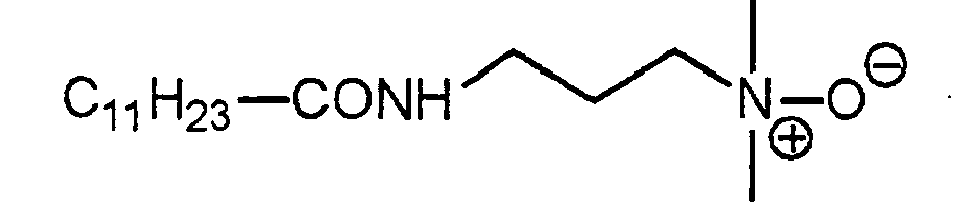
- The development processing was conducted by an automatic developing apparatus having structure shown in
Fig. 1 . The automatic developing apparatus had two rotating brush rollers each having an outer diameter of 54 mm and being implanted with fiber of nylon 6. 12 (bristle diameter: 75 µm, bristle length: 8.5 mm) . The first brush roller was rotated at 150 rpm in the opposite direction to the transporting direction. The second brush roller rotated at 150 rpm in the same direction as the transporting direction. The PS plate was developed at transporting speed of 160 cm/min for 19 seconds. The temperature of development was 28°C. The pre-heating was conducted at a plate surface temperature of 100°C for 15 seconds. - The capacity of the developing tank was set to 83 liters and the capacity of the external tank was set to 17 liters so that the total volume of the developer was 100 liters. The capacity of pump for liquid circulation between the external tank and the developing tank was set to 300 ml per minute. In the liquid circulation between the external tank and the developing tank, two spool-shaped filters of Micro-Wynd made of polypropylene, CUNO filter produced by 3M Co. were disposed. The first filter had filtration accuracy of 100 µm and the second filter had filtration accuracy of 10 µm.
- As for the replenishment of water to the developing tank, water decreased by vaporization was replenished with ion-exchanged water. As the water softening apparatus, Softener D'acqua M (trade name in Japan) produced by Inoxdep (agency: Komichi-Shobo Publishers) which was a water softening apparatus of ion exchange resin type was used.
- The guide roller was deposited at a deferent position with each of the examples.
Figs. 6A, 6B and 6C are views showing the position of guide roller in each example. InFigs. 6A, 6B and 6C , a distance from an intersection point of liquid level L of the developer with a transportingpass 11 of the PS plate to a point where the transportingpass 11 comes into contact with the submergedroller 316 is taken as D1 and a distance from the intersection point to a point where the transportingpass 11 comes into contact with theguide roller 344 is taken as D2. In Example 1 (Fig. 6A ), theguide roller 344 was disposed at almost same position as the liquid level L, that is, D2 is nearly 0. In Example 2 (Fig. 6B ), theguide roller 344 was disposed at the position where D2/D1 is 1/2 (=0.5). In Example 3 (Fig. 6C ), theguide roller 344 was disposed at the position where D2/D1 is 4/5 (= 0.8). - The development processing was performed under the respective conditions using 3,000 sheets of PS plates having a length of 1,030 mm, a width of 800 mm and a thickness of 0.3 mm.
- The PS plate was subjected to image exposure by Violet Semiconductor Laser Plate Setter Vx9600 (equipped with InGaN semiconductor laser; emission: 405 nm ± 10 nm/output: 30 mW) produced by FFEI, Ltd. The image was drawn using an FM screen (TAFFETA 20, produced by Fuji Film Co., Ltd.) in a plate surface exposure amount of 0.05 mJ/cm2 and at resolution of 2,438 dpi.
- Wetness of the insertion roller in the developing unit and image unevenness and presence or absence of remaining layer on a printing plate were evaluated using the PS plate.
- After the development processing of 3, 000 sheets of the PS plates, the occurrence of wetness of the insertion roller in the developing unit of automatic developing apparatus was visually observed. As for the evaluation of image unevenness, image unevenness on a printing plate obtained by exposure of the PS plate with halftone dots of FM screen (TAFFETA 20, produced by Fuji Film Co., Ltd.) having high precision image and development processing was visually observed. Also, the presence or absence of remaining layer on the printing plate was evaluated. A case where the occurrence of wetness of the insertion roller due to the adhesion of developer was not observed was evaluated as "absence". A case where the occurrence of wetness of the insertion roller due to the adhesion of developer was observed was evaluated as "presence". A case where the occurrence of image unevenness was not observed even in the high precision image was evaluated as "A" particularly preferable. A case where the occurrence of image unevenness was in a level causing no problem was evaluated as "B". A case where the occurrence of image unevenness was clearly observed was evaluated as "C". A case where the presence of remaining layer was not observed was evaluated as "absence". A case where the presence of remaining layer was observed was evaluated as "presence". The results of Examples 1 to 3 and Comparative Example 1 are shown in Table 1.
[Table 1] Position of
Guide RollerWetness of Insertion Roller Image Unevenness Remaining
LayerExample 1 D2 = nearly 0 Absence B Absence Example 2 D2/D1 = 1/2 Absence A Absence Example 3 D2/D1 = 4/5 Absence B Absence Comparative Example 1 No Guide Roller Presence B Presence - When the guide roller was not disposed as in Comparative Example 1, the wetness of the insertion roller due to the adhesion of developer occurred.
- On the contrary, when the guide roller was disposed as in Examples 1 to 3, the occurrence of wetness of the insertion roller was not observed.
- Also, in each of Examples 1 to 3 and Comparative Example 1, the occurrence of image unevenness could be kept within the acceptable level to obtain the good image. Particularly, in Example 2, the occurrence of image unevenness could be remarkably inhibited to obtain high image quality suitable for the high precision image.
- Further, in each of Examples 1 to 3, the remaining layer on the printing plate did not occur to obtain good result. On the contrary, in Comparative Example 1, the occurrence of remaining layer on the printing plate was recognized.
Claims (15)
- An automatic developing apparatus for a lithographic printing plate precursor in which a lithographic printing plate precursor comprising in the following order a support, an image-recording layer and a protective layer is immersed in a developer in a development processing bath after image exposure and heating of the lithographic printing plate precursor to remove the image-recording layer in a non-image area and the protective layer at the same time,
wherein the automatic developing apparatus comprises an insertion roller for introducing the lithographic printing plate precursor into the developing processing bath, a submerged roller disposed in the developer and a guide roller which is arranged between the insertion roller and the submerged roller in the developer and supports the lithographic printing plate precursor transported. - The automatic developing apparatus as claimed in claim 1, which further comprises a guide member provided in the developer, the guide member having a surface facing the guide roller and capable of supporting the lithographic printing plate precursor.
- The automatic developing apparatus as claimed in claim 1 or 2, wherein the guide roller is disposed so that D2/D1 satisfies from 0.25 to 0.75, wherein D1 represents a distance from an intersection point of liquid level of the developer in the development processing bath with a transporting pass of the lithographic printing plate precursor to a point where the transporting pass comes into contact with the submerged roller and D2 represents a distance from the intersection point to a point where the transporting pass comes into contact with the guide roller.
- The automatic developing apparatus as claimed in any one of claims 1 to 3, wherein the guide roller comprises a shaft member capable of passing the developer through an inside thereof and plural roller members arranged at intervals in a shaft direction of the shaft member and the shaft member has an aperture for ejecting the developer.
- The automatic developing apparatus as claimed in any one of claims 1 to 4, which further comprises a spatter-preventing member disposed between the insertion roller and the development processing bath so as to project from an edge of the development processing bath to a vicinity of the transporting pass.
- The automatic developing apparatus as claimed in any one of claims 1 to 5, which further comprises a heating unit for heating the lithographic printing plate precursor after the image exposure at 80 to 140°C.
- A processing method of a lithographic printing plate precursor in which a lithographic printing plate precursor comprising in the following order a support, an image-recording layer and a protective layer is immersed in a developer in a development processing bath after image exposure and heating of the lithographic printing plate precursor to remove the image-recording layer in a non-image area and the protective layer at the same time,
wherein the processing method comprises: introducing the lithographic printing plate precursor into the development processing bath by an insertion roller; and transporting the lithographic printing plate precursor in the developer through a submerged roller disposed in the developer while supporting the lithographic printing plate precursor transported with a guide roller arranged between the insertion roller and the submerged roller. - The processing method of a lithographic printing plate precursor as claimed in claim 7, wherein a guide member is provided in the developer, and the lithographic printing plate precursor transported is supported with a surface of the guide member facing the guide roller.
- The processing method of a lithographic printing plate precursor as claimed in claim 7 or 8, wherein the lithographic printing plate precursor transported is supported by the guide roller, which is disposed so that D2/D1 satisfies from 0.25 to 0.75, wherein D1 represents a distance from an intersection point of liquid level of the developer in the development processing bath with a transporting pass of the lithographic printing plate precursor to a point where the transporting pass comes into contact with the submerged roller and D2 represents a distance from the intersection point to a point where the transporting pass comes into contact with the guide roller.
- The processing method of a lithographic printing plate precursor as claimed in any one of claims 7 to 9, wherein the lithographic printing plate precursor is processed with the developer containing at least one of a surfactant and a water-soluble polymer compound.
- The processing method of a lithographic printing plate precursor as claimed in any one of claims 7 to 10, wherein the lithographic printing plate precursor is processed with the developer which has pH of 8.5 to 10.8.
- The processing method of a lithographic printing plate precursor as claimed in any one of claims 7 to 11, wherein the lithographic printing plate precursor is processed with the developer which contains a carbonate ion and a hydrogen carbonate ion.
- The processing method of a lithographic printing plate precursor as claimed in any one of claims 7 to 12, wherein the lithographic printing plate precursor is processed with the developer which contains a low molecular weight hydroxycarboxylate ion.
- The processing method of a lithographic printing plate precursor as claimed in any one of claims 7 to 13, wherein the removal of the non-image area of the image-recording layer and the protective layer and an oil-desensitizing treatment are performed at the same time.
- The processing method of a lithographic printing plate precursor as claimed in any one of claims 7 to 14, wherein the image-recording layer has a photopolymerizable property.
Applications Claiming Priority (1)
| Application Number | Priority Date | Filing Date | Title |
|---|---|---|---|
| JP2009041380A JP2010197620A (en) | 2009-02-24 | 2009-02-24 | Automatic developing apparatus and processing method for lithographic printing plate precursor |
Publications (2)
| Publication Number | Publication Date |
|---|---|
| EP2221670A2 true EP2221670A2 (en) | 2010-08-25 |
| EP2221670A3 EP2221670A3 (en) | 2012-05-09 |
Family
ID=42224058
Family Applications (1)
| Application Number | Title | Priority Date | Filing Date |
|---|---|---|---|
| EP10001893A Withdrawn EP2221670A3 (en) | 2009-02-24 | 2010-02-24 | Automatic developing apparatus and processing method for lithographic printing plate precursor |
Country Status (2)
| Country | Link |
|---|---|
| EP (1) | EP2221670A3 (en) |
| JP (1) | JP2010197620A (en) |
Cited By (2)
| Publication number | Priority date | Publication date | Assignee | Title |
|---|---|---|---|---|
| EP2755088A1 (en) | 2013-01-11 | 2014-07-16 | Agfa Graphics N.V. | Method of making a lithographic printing plate |
| EP4439179A4 (en) * | 2021-07-09 | 2024-12-11 | FUJIFILM Corporation | WATER ETCHING DEVICE AND WATER ETCHING METHOD |
Families Citing this family (1)
| Publication number | Priority date | Publication date | Assignee | Title |
|---|---|---|---|---|
| WO2020217944A1 (en) * | 2019-04-24 | 2020-10-29 | 富士フイルム株式会社 | Washout device |
Citations (33)
| Publication number | Priority date | Publication date | Assignee | Title |
|---|---|---|---|---|
| JPS5492723A (en) | 1977-12-30 | 1979-07-23 | Somar Mfg | Photosensitive material and use |
| JPS5425957B2 (en) | 1974-10-04 | 1979-08-31 | ||
| JPS5434327B1 (en) | 1970-12-28 | 1979-10-26 | ||
| JPS5812577B2 (en) | 1973-12-21 | 1983-03-09 | ヘキスト アクチエンゲゼルシヤフト | Photopolymerizable copying material |
| JPS5944615A (en) | 1982-09-07 | 1984-03-13 | Furuno Electric Co Ltd | Gyro device |
| JPS5953836A (en) | 1982-09-21 | 1984-03-28 | Fuji Photo Film Co Ltd | Photosensitive lithographic plate |
| JPS5971048A (en) | 1982-10-18 | 1984-04-21 | Mitsubishi Chem Ind Ltd | Photopolymerizable photosensitive composition |
| JPS62167253U (en) | 1986-04-14 | 1987-10-23 | ||
| JPS63287947A (en) | 1987-05-21 | 1988-11-25 | Fuji Photo Film Co Ltd | Photosensitive composition |
| JPS63287944A (en) | 1987-05-21 | 1988-11-25 | Fuji Photo Film Co Ltd | Photosensitive composition |
| JPH01271741A (en) | 1988-04-25 | 1989-10-30 | Fuji Photo Film Co Ltd | Photosensitive composition |
| JPH02304441A (en) | 1989-05-18 | 1990-12-18 | Fuji Photo Film Co Ltd | Photosensitive planographic printing plate |
| JPH0387832A (en) | 1989-08-31 | 1991-04-12 | Fuji Photo Film Co Ltd | Device for processing photosensitive material |
| JPH0463447A (en) | 1990-07-02 | 1992-02-28 | Sharp Corp | Electrode structure of printed circuit board |
| JPH0464128A (en) | 1990-07-02 | 1992-02-28 | Hitachi Ltd | Screen control command synthesis method |
| JPH06186751A (en) | 1992-12-22 | 1994-07-08 | Fuji Photo Film Co Ltd | Brush roller and planographic printing plate processor |
| JPH07159983A (en) | 1993-12-03 | 1995-06-23 | Fuji Photo Film Co Ltd | Photosensitive printing plate |
| JPH07120042B2 (en) | 1987-05-21 | 1995-12-20 | 富士写真フイルム株式会社 | Photosensitive composition |
| JPH07120040B2 (en) | 1987-05-21 | 1995-12-20 | 富士写真フイルム株式会社 | Photosensitive composition |
| JPH07120041B2 (en) | 1987-05-21 | 1995-12-20 | 富士写真フイルム株式会社 | Photosensitive composition |
| JPH0812424B2 (en) | 1987-11-19 | 1996-02-07 | 富士写真フイルム株式会社 | Photosensitive composition |
| JPH10198044A (en) | 1997-01-14 | 1998-07-31 | Mitsubishi Chem Corp | Developing device for photosensitive lithographic printing plate and Molton roller |
| JPH1165126A (en) | 1997-08-13 | 1999-03-05 | Mitsubishi Chem Corp | Method for developing photosensitive lithographic printing plate and developer used therefor |
| JPH11352691A (en) | 1998-04-09 | 1999-12-24 | Fuji Photo Film Co Ltd | Production of planographic printing plate, planographic original printing plate for laser scanning exposure and photopolymerizable composition |
| JP2000089478A (en) | 1998-09-14 | 2000-03-31 | Fuji Photo Film Co Ltd | Method for making photopolymerizable lithographic printing plate |
| JP2001005193A (en) | 1999-06-18 | 2001-01-12 | Fuji Photo Film Co Ltd | Automatic developing machine for photosensitive planographic printing plate |
| JP2001066788A (en) | 1999-08-30 | 2001-03-16 | Fuji Photo Film Co Ltd | Photosensitive material processing equipment |
| JP2002091016A (en) | 2000-09-12 | 2002-03-27 | Fuji Photo Film Co Ltd | Method for producing planographic printing plate |
| EP1788442A1 (en) | 2005-11-18 | 2007-05-23 | Agfa Graphics N.V. | Method of making a lithographic printing plate |
| JP2007538279A (en) | 2004-05-19 | 2007-12-27 | アグファ・ゲヴェルト・ナームロゼ・ベンノートチャップ | Method for producing photosensitive polymer printing plate |
| JP2008203359A (en) | 2007-02-16 | 2008-09-04 | Fujifilm Corp | Preparation method of lithographic printing plate |
| JP2008256742A (en) | 2007-03-30 | 2008-10-23 | Fujifilm Corp | Lithographic printing plate precursor and method of preparing lithographic printing plate |
| JP2008276166A (en) | 2006-09-29 | 2008-11-13 | Fujifilm Corp | Development processing solution for lithographic printing plate and plate making method of lithographic printing plate |
Family Cites Families (11)
| Publication number | Priority date | Publication date | Assignee | Title |
|---|---|---|---|---|
| JPH02226252A (en) * | 1989-02-28 | 1990-09-07 | Fuji Photo Film Co Ltd | Device for processing photosensitive planographic printing plate |
| JP2798320B2 (en) * | 1992-03-18 | 1998-09-17 | 富士写真フイルム株式会社 | Automatic developing machine for photosensitive lithographic printing plate |
| US5349413A (en) * | 1992-03-13 | 1994-09-20 | Fuji Photo Film Co., Ltd. | Sheet-like material processing apparatus |
| JPH10133389A (en) * | 1996-10-28 | 1998-05-22 | Konica Corp | Method for processing photosensitive planographic printing plate |
| IT1313206B1 (en) * | 1998-07-14 | 2002-06-17 | Toushin Keisoku Corp | MAGNETIC TREATMENT EQUIPMENT FOR FLUIDS AND PROCEDURE FOR ITS USE. |
| JP2000258919A (en) * | 1999-03-10 | 2000-09-22 | Fuji Photo Film Co Ltd | Processing device for photosensitive planographic printing original plate |
| EP1262829A1 (en) * | 2001-05-28 | 2002-12-04 | Fuji Photo Film Co., Ltd. | Photosensitive composition |
| JP2003107684A (en) * | 2001-09-28 | 2003-04-09 | Fuji Photo Film Co Ltd | Method for developing photosensitive planographic printing plate |
| JP2005321763A (en) * | 2004-04-06 | 2005-11-17 | Fuji Photo Film Co Ltd | Method for replenishing developer for automatic developing machine for photosensitive planographic printing plate |
| JP2006235227A (en) * | 2005-02-24 | 2006-09-07 | Fuji Photo Film Co Ltd | Processing method for photosensitive planographic printing plate and automatic development apparatus |
| JP2008256743A (en) * | 2007-03-30 | 2008-10-23 | Fujifilm Corp | Preparation method of lithographic printing plate |
-
2009
- 2009-02-24 JP JP2009041380A patent/JP2010197620A/en not_active Abandoned
-
2010
- 2010-02-24 EP EP10001893A patent/EP2221670A3/en not_active Withdrawn
Patent Citations (33)
| Publication number | Priority date | Publication date | Assignee | Title |
|---|---|---|---|---|
| JPS5434327B1 (en) | 1970-12-28 | 1979-10-26 | ||
| JPS5812577B2 (en) | 1973-12-21 | 1983-03-09 | ヘキスト アクチエンゲゼルシヤフト | Photopolymerizable copying material |
| JPS5425957B2 (en) | 1974-10-04 | 1979-08-31 | ||
| JPS5492723A (en) | 1977-12-30 | 1979-07-23 | Somar Mfg | Photosensitive material and use |
| JPS5944615A (en) | 1982-09-07 | 1984-03-13 | Furuno Electric Co Ltd | Gyro device |
| JPS5953836A (en) | 1982-09-21 | 1984-03-28 | Fuji Photo Film Co Ltd | Photosensitive lithographic plate |
| JPS5971048A (en) | 1982-10-18 | 1984-04-21 | Mitsubishi Chem Ind Ltd | Photopolymerizable photosensitive composition |
| JPS62167253U (en) | 1986-04-14 | 1987-10-23 | ||
| JPS63287947A (en) | 1987-05-21 | 1988-11-25 | Fuji Photo Film Co Ltd | Photosensitive composition |
| JPS63287944A (en) | 1987-05-21 | 1988-11-25 | Fuji Photo Film Co Ltd | Photosensitive composition |
| JPH07120041B2 (en) | 1987-05-21 | 1995-12-20 | 富士写真フイルム株式会社 | Photosensitive composition |
| JPH07120040B2 (en) | 1987-05-21 | 1995-12-20 | 富士写真フイルム株式会社 | Photosensitive composition |
| JPH07120042B2 (en) | 1987-05-21 | 1995-12-20 | 富士写真フイルム株式会社 | Photosensitive composition |
| JPH0812424B2 (en) | 1987-11-19 | 1996-02-07 | 富士写真フイルム株式会社 | Photosensitive composition |
| JPH01271741A (en) | 1988-04-25 | 1989-10-30 | Fuji Photo Film Co Ltd | Photosensitive composition |
| JPH02304441A (en) | 1989-05-18 | 1990-12-18 | Fuji Photo Film Co Ltd | Photosensitive planographic printing plate |
| JPH0387832A (en) | 1989-08-31 | 1991-04-12 | Fuji Photo Film Co Ltd | Device for processing photosensitive material |
| JPH0464128A (en) | 1990-07-02 | 1992-02-28 | Hitachi Ltd | Screen control command synthesis method |
| JPH0463447A (en) | 1990-07-02 | 1992-02-28 | Sharp Corp | Electrode structure of printed circuit board |
| JPH06186751A (en) | 1992-12-22 | 1994-07-08 | Fuji Photo Film Co Ltd | Brush roller and planographic printing plate processor |
| JPH07159983A (en) | 1993-12-03 | 1995-06-23 | Fuji Photo Film Co Ltd | Photosensitive printing plate |
| JPH10198044A (en) | 1997-01-14 | 1998-07-31 | Mitsubishi Chem Corp | Developing device for photosensitive lithographic printing plate and Molton roller |
| JPH1165126A (en) | 1997-08-13 | 1999-03-05 | Mitsubishi Chem Corp | Method for developing photosensitive lithographic printing plate and developer used therefor |
| JPH11352691A (en) | 1998-04-09 | 1999-12-24 | Fuji Photo Film Co Ltd | Production of planographic printing plate, planographic original printing plate for laser scanning exposure and photopolymerizable composition |
| JP2000089478A (en) | 1998-09-14 | 2000-03-31 | Fuji Photo Film Co Ltd | Method for making photopolymerizable lithographic printing plate |
| JP2001005193A (en) | 1999-06-18 | 2001-01-12 | Fuji Photo Film Co Ltd | Automatic developing machine for photosensitive planographic printing plate |
| JP2001066788A (en) | 1999-08-30 | 2001-03-16 | Fuji Photo Film Co Ltd | Photosensitive material processing equipment |
| JP2002091016A (en) | 2000-09-12 | 2002-03-27 | Fuji Photo Film Co Ltd | Method for producing planographic printing plate |
| JP2007538279A (en) | 2004-05-19 | 2007-12-27 | アグファ・ゲヴェルト・ナームロゼ・ベンノートチャップ | Method for producing photosensitive polymer printing plate |
| EP1788442A1 (en) | 2005-11-18 | 2007-05-23 | Agfa Graphics N.V. | Method of making a lithographic printing plate |
| JP2008276166A (en) | 2006-09-29 | 2008-11-13 | Fujifilm Corp | Development processing solution for lithographic printing plate and plate making method of lithographic printing plate |
| JP2008203359A (en) | 2007-02-16 | 2008-09-04 | Fujifilm Corp | Preparation method of lithographic printing plate |
| JP2008256742A (en) | 2007-03-30 | 2008-10-23 | Fujifilm Corp | Lithographic printing plate precursor and method of preparing lithographic printing plate |
Cited By (3)
| Publication number | Priority date | Publication date | Assignee | Title |
|---|---|---|---|---|
| EP2755088A1 (en) | 2013-01-11 | 2014-07-16 | Agfa Graphics N.V. | Method of making a lithographic printing plate |
| WO2014108385A1 (en) | 2013-01-11 | 2014-07-17 | Agfa Graphics Nv | Method of making a lithographic printing plate |
| EP4439179A4 (en) * | 2021-07-09 | 2024-12-11 | FUJIFILM Corporation | WATER ETCHING DEVICE AND WATER ETCHING METHOD |
Also Published As
| Publication number | Publication date |
|---|---|
| JP2010197620A (en) | 2010-09-09 |
| EP2221670A3 (en) | 2012-05-09 |
Similar Documents
| Publication | Publication Date | Title |
|---|---|---|
| JP5264427B2 (en) | Preparation method of lithographic printing plate | |
| EP2762975B1 (en) | Lithographic printing plate precursor and process for producing lithographic printing plate | |
| JP5346845B2 (en) | Method for preparing lithographic printing plate and developer for lithographic printing plate precursor | |
| EP2354852A1 (en) | Lithographic printing plate precursor and method of preparing lithographic printing plate | |
| WO2013125315A1 (en) | Method for concentrating plate-making process effluent, and method for recycling plate-making process effluent | |
| JP2010156945A (en) | Method for producing lithographic printing plate | |
| EP2221670A2 (en) | Automatic developing apparatus and processing method for lithographic printing plate precursor | |
| JP5228631B2 (en) | Lithographic printing plate developing treatment solution and method for preparing a lithographic printing plate | |
| JP4123930B2 (en) | Developer concentrate and developer replenisher concentrate | |
| EP2159640B1 (en) | Method of preparing lithographic printing plate | |
| JP5405141B2 (en) | Preparation method of lithographic printing plate | |
| JP2010054955A (en) | Automatic developing device for lithographic printing plate precursor, and method of processing lithographic printing plate precursor | |
| JP5248203B2 (en) | Lithographic printing plate developing treatment solution and method for preparing a lithographic printing plate | |
| JP5113701B2 (en) | Production method of lithographic printing plate precursor | |
| JP2010054956A (en) | Automatic developing device for lithographic printing plate precursor, and method of processing lithographic printing plate precursor | |
| JP2010054957A (en) | Automatic developing device for lithographic printing plate precursor, and method of processing lithographic printing plate precursor | |
| JP2010054958A (en) | Automatic developing device for lithographic printing plate precursor, and method of processing lithographic printing plate precursor | |
| JP5661136B2 (en) | Lithographic printing plate developing treatment solution and method for preparing a lithographic printing plate | |
| EP3045974B1 (en) | Method of preparing lithographic printing plate | |
| JP2009175339A (en) | Processing method for lithographic printing plate precursor and automatic developing machine for lithographic printing plate precursor | |
| JP7019031B2 (en) | A developing processing device for producing a lithographic printing plate and a method for producing a lithographic printing plate. | |
| JP2010139867A (en) | Automatic developing apparatus | |
| JP2010139868A (en) | Automatic developing apparatus | |
| JP5563141B2 (en) | Preparation method of lithographic printing plate | |
| WO2012120946A1 (en) | Apparatus for developing lithographic printing plate and method for developing lithographic printing plate |
Legal Events
| Date | Code | Title | Description |
|---|---|---|---|
| PUAI | Public reference made under article 153(3) epc to a published international application that has entered the european phase |
Free format text: ORIGINAL CODE: 0009012 |
|
| AK | Designated contracting states |
Kind code of ref document: A2 Designated state(s): AT BE BG CH CY CZ DE DK EE ES FI FR GB GR HR HU IE IS IT LI LT LU LV MC MK MT NL NO PL PT RO SE SI SK SM TR |
|
| AX | Request for extension of the european patent |
Extension state: AL BA RS |
|
| PUAL | Search report despatched |
Free format text: ORIGINAL CODE: 0009013 |
|
| AK | Designated contracting states |
Kind code of ref document: A3 Designated state(s): AT BE BG CH CY CZ DE DK EE ES FI FR GB GR HR HU IE IS IT LI LT LU LV MC MK MT NL NO PL PT RO SE SI SK SM TR |
|
| AX | Request for extension of the european patent |
Extension state: AL BA RS |
|
| RIC1 | Information provided on ipc code assigned before grant |
Ipc: G03F 7/30 20060101AFI20120330BHEP |
|
| STAA | Information on the status of an ep patent application or granted ep patent |
Free format text: STATUS: THE APPLICATION IS DEEMED TO BE WITHDRAWN |
|
| 18D | Application deemed to be withdrawn |
Effective date: 20121110 |