EP2220189B1 - Vor-ort-formierung von feststoffen für bohrungsabschlüsse und isolation von bohrungsbereichen - Google Patents
Vor-ort-formierung von feststoffen für bohrungsabschlüsse und isolation von bohrungsbereichen Download PDFInfo
- Publication number
- EP2220189B1 EP2220189B1 EP08866013.9A EP08866013A EP2220189B1 EP 2220189 B1 EP2220189 B1 EP 2220189B1 EP 08866013 A EP08866013 A EP 08866013A EP 2220189 B1 EP2220189 B1 EP 2220189B1
- Authority
- EP
- European Patent Office
- Prior art keywords
- sol
- particles
- surfactant
- wellbore
- hydrolyzed alkoxide
- Prior art date
- Legal status (The legal status is an assumption and is not a legal conclusion. Google has not performed a legal analysis and makes no representation as to the accuracy of the status listed.)
- Not-in-force
Links
Images



Classifications
-
- C—CHEMISTRY; METALLURGY
- C09—DYES; PAINTS; POLISHES; NATURAL RESINS; ADHESIVES; COMPOSITIONS NOT OTHERWISE PROVIDED FOR; APPLICATIONS OF MATERIALS NOT OTHERWISE PROVIDED FOR
- C09K—MATERIALS FOR MISCELLANEOUS APPLICATIONS, NOT PROVIDED FOR ELSEWHERE
- C09K8/00—Compositions for drilling of boreholes or wells; Compositions for treating boreholes or wells, e.g. for completion or for remedial operations
- C09K8/50—Compositions for plastering borehole walls, i.e. compositions for temporary consolidation of borehole walls
- C09K8/504—Compositions based on water or polar solvents
- C09K8/5045—Compositions based on water or polar solvents containing inorganic compounds
-
- C—CHEMISTRY; METALLURGY
- C09—DYES; PAINTS; POLISHES; NATURAL RESINS; ADHESIVES; COMPOSITIONS NOT OTHERWISE PROVIDED FOR; APPLICATIONS OF MATERIALS NOT OTHERWISE PROVIDED FOR
- C09K—MATERIALS FOR MISCELLANEOUS APPLICATIONS, NOT PROVIDED FOR ELSEWHERE
- C09K8/00—Compositions for drilling of boreholes or wells; Compositions for treating boreholes or wells, e.g. for completion or for remedial operations
- C09K8/50—Compositions for plastering borehole walls, i.e. compositions for temporary consolidation of borehole walls
- C09K8/504—Compositions based on water or polar solvents
- C09K8/506—Compositions based on water or polar solvents containing organic compounds
-
- C—CHEMISTRY; METALLURGY
- C09—DYES; PAINTS; POLISHES; NATURAL RESINS; ADHESIVES; COMPOSITIONS NOT OTHERWISE PROVIDED FOR; APPLICATIONS OF MATERIALS NOT OTHERWISE PROVIDED FOR
- C09K—MATERIALS FOR MISCELLANEOUS APPLICATIONS, NOT PROVIDED FOR ELSEWHERE
- C09K8/00—Compositions for drilling of boreholes or wells; Compositions for treating boreholes or wells, e.g. for completion or for remedial operations
- C09K8/50—Compositions for plastering borehole walls, i.e. compositions for temporary consolidation of borehole walls
- C09K8/516—Compositions for plastering borehole walls, i.e. compositions for temporary consolidation of borehole walls characterised by their form or by the form of their components, e.g. encapsulated material
-
- C—CHEMISTRY; METALLURGY
- C09—DYES; PAINTS; POLISHES; NATURAL RESINS; ADHESIVES; COMPOSITIONS NOT OTHERWISE PROVIDED FOR; APPLICATIONS OF MATERIALS NOT OTHERWISE PROVIDED FOR
- C09K—MATERIALS FOR MISCELLANEOUS APPLICATIONS, NOT PROVIDED FOR ELSEWHERE
- C09K8/00—Compositions for drilling of boreholes or wells; Compositions for treating boreholes or wells, e.g. for completion or for remedial operations
- C09K8/60—Compositions for stimulating production by acting on the underground formation
- C09K8/80—Compositions for reinforcing fractures, e.g. compositions of proppants used to keep the fractures open
Definitions
- the present invention relates to placement of solids in a wellbore or in a fracture.
- the present invention relates to placing a sol of hydrolyzed metallic alkoxides into a wellbore or in a fracture that gels and hardens in-situ.
- slurries are pumped under high pressure and at high velocity into the wellbore.
- the slurry which typically consists of gravel in water
- the slurry includes a proppant, typically sand, that is pumped into the formation to stimulate low-permeability reservoirs and to keep the fracture open.
- the solid immaterial in a slurry is hard, irregularly shaped and may flow at high velocity. Therefore, slurries tend to be highly abrasive, and the machinery that pumps and controls the slurries is subject to abrasive wear and reduced longevity.
- Abrasive wear occurs when the particles within the fluid impact on the exposed surfaces of the machinery and impart some of their kinetic energy into the exposed surface. If sufficiently high, the kinetic energy of the impacting particles creates significant tensile residual stress in the exposed surface, below the area of impact. Repeated impacts cause the accumulation of tensile stress in the bulk material that can leave the exposed surface brittle and lead to cracking, crack linkage and gross material loss.
- components that are exposed to abrasive flows are subject to various hard facing treatments to improve abrasion resistance.
- Such treatments often include either surface preparations that harden and smooth the base material ilself or bonding abrasion-resistant materials to the surface of the base material.
- Surface preparations can often make the base material more resistant to impact from particles with low kinetic energy, but these same preparations can leave the base material more brittle and thus susceptible to cracking as a result of impacts from high kinetic energy particles.
- Bonding of abrasion-resistant materials is typically performed using thermal spray techniques such as High Velocity Oxy-Fuel (HVOF) or Air Plasma Spray (APS).
- HVOF High Velocity Oxy-Fuel
- APS Air Plasma Spray
- a method of placing solids in a desired location within a subsurface formation accessed through a wellbore comprises pumping a sol of hydrolyzed alkoxide into the wellbore to the desired location within the subsurface formation; and initiating polymerization of the hydrolyzed alkoxide to cause gelation and hardening of the sol.
- the process by which monomers in an emulsion are polymerized is known as the sol-gel process.
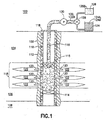
- Figure 1 illustrates a hydraulic fracturing operation, depicted generally as 100.
- a wellbore 102 is drilled through an overburden layer 104, through a productive formation 106, and further into the underlying formation 108.
- Casing 110 is placed into the wellbore 102 and the annulus between the wellbore 102 and the casing 110 is filled with cement 112.
- the fracture treatment zone 118. the section of the productive formation 106 that is to be fracture, is isolated from the underlying formation 108 by a lower packer 114 and from the overburden layer 104 ( Fig 2 ) by an upper packer 115.
- a tubing string 116 runs from the wellbore carp 118 through the upper packer 115, and ends within the fracture treatment zone 118.
- the casing 110 and the cement sheath 112 are perforated 120 by a perforating gun (not shown), permitting communication of hydrocarbons from the productive formation 106 into the wellbore 102.
- a fracturing fluid 124 is combined with a proppant 126 in a mixer 128 to form a slurry 132.
- Tie proppant 126 is typically silica sand or other particulate solid material.
- the slurry 132 is pumped through the tubing string 116 by the pump 130 and forced through the perforations 120 and on into the productive formation 106, forming cracks or fractures 122 in the productive formation 106.
- the proppant 126 in the slurry 132 is wedged into the fractures 122, holding the fractures 122 open after pumping steps. In this way, the fractures 122 filled with proppant 126 form a permeable conduit for the continued flow of hydrocarbons from the productive formation 106.
- FIG. 2 illustrates a plug 146.
- a plug 146 When a well is being completed, it is often desirable to isolate the productive formation 106.
- the productive formation 106 is separated from a water bearing formation 140 by an impermeable rock formation 142.
- a bridge plug 144 is placed in the wellbore 102 and concrete (not shown) is pumped from the surface through the tubing string 116 and permitted to harden into a plug 146.
- the plug 146 forms an impenetrable barrier between the hydrocarbons in the productive formation 106 and the water in the water bearing formation 140.
- both the fracturing fluid 132 used in hydraulic fracturing and the concrete (not shown) used in wellbore plug and completion operations contain a significant amount of solids which are often pumped at high pressure, the pump 130 and other equipment are subject to the constant scrubbing of highly abrasive slurries.
- the present disclosure shows pumping of colloids instead of slurries, and initiating polymerization in the emulsion to form the desired solids. It is also to be expected that pumping of such colloids will lead to improved pumping efficiency compared to the pumping of harsh slurry materials.
- a colloid is a homogeneous mixture of two or more phases: one or more dispersed phases and a continuous phase.
- the dispersed phases typically consist of small particles or droplets that are dispersed in the continuous phase. If both the continuous phase and the distributed phase are liquids, the colloid is called an emulsion. When the continuous phase is a liquid and the distributed phase is a solid, the colloid is called a sol.
- a gel is a colloid with a solid continuous phase and a liquid distributed phase.
- the sol-gel process involves the polymerization of inorganic matter in a sol into an inorganic network in a gel, as the name implies.
- a simple example is silicic acid (with a general formula of [SiO x (OH) 4-2X ] N ) in solution.
- Silicic acid is soluble and stable in water if the concentration of SiO 2 is less than about 100 ppm.
- Si(OH) 4 begins to polymerize into siloxane groups (-Si O -Si-) over time, forming a gel according to formula 1: 1 - SiOH + HOSi - ⁇ -Si-O-Si- + H 2 O
- alkoxides of metallic elements or silicon referred to collectively as alkoxides, and shown as MOR, where M is the base element and R is an organic substituent
- MOR alkoxides
- Examples include alkoxysilanes such as tetramethoxysilane (TMOS) and tetraethoxysilane (TEOS), aluminates, titanates and borates.
- TMOS tetramethoxysilane
- TEOS tetraethoxysilane
- the following examples use silicon as the base element. However, it should be understood that other base elements may be freely substituted, as is known in the art.
- the sol-gel process is characterized by three reactions: hydrolysis, water condensation and alcohol condensation. These reactions are shown below: 2 Si(OR) + H 2 O ⁇ Si(OH) + ROH (hydrolysis) 3 Si(OH) + Si(OH) ⁇ -Si-O-Si- + H 2 O (water condensation) 4 Si(OH) + Si(OR) ⁇ -Si-O-Si- + ROH (alcohol condensation)
- hydrolysis begins according to formula 2, creating hydroxyl monomers. With the appearance of hydroxyl monomers, condensation begins, formulas 3 and 4, first with the monomers combining and lengthening into dimers and trimers, and then aggregating to form larger particles. As the condensation and aggregation continues, the particles thus formed begin to link together, forming chains and larger networks which eventually extend through the entire liquid medium, forming a gel.
- the resulting gel's final structure is dictated by the initial concentration of alkoxide in solution, the pH of the solution, the presence of catalysts and other factors.
- the pH of the solution affects both the rate of polymerization, and the resulting gel structure.
- Figure 3 shows a typical pH rate profile for hydrolysis in an aqueous solution. The rate 150 is given as the logarithm of the observed reaction rate coefficient. At low pH 152 and high pH 156, the reaction rate is higher, as can be implied from formulas 3 and 4, where alcohol condensation is catalyzed by the H+ concentration found in acidic solutions 152, and water condensation is catalyzed by the OH- concentration found in basic solutions 156.
- Neutral solutions 154 tend to lead to the slowest hydrolyses and condensation, and thus to the slowest gelation of the subject sol.
- the pH of the sol also has significant impact on the structure of the gel produced.
- Figure 4 shows the development of particles in a typical sol-gel process.
- hydrolysis 160 is represented, with alkoxide monomers 162 joining to form dimers 164 and other higher order molecules, which in turn form cyclic molecules 166 and ultrafine particles 168 (i.e., much less than 1 nanometer).
- the pH of the sol mainly affects the mechanism by which the sol evolves (i.e., whether water condensation, formula 3, or alcohol condensation, formula 4, predominates).
- the pH of the sol has significant impact on condensation 170.
- the solubility of silica is low, so particle formation, ripening of smaller particles into larger particles, and aggregation of particles into chains and networks are limited. Therefore, in low pH conditions, the gels formed consist of closely packed small particles of about I nanometer.
- solubility is still low, but particle formation favors more highly condensed species combining with less condensed species and ripening begins, so particle size increases to 2-4 nanometers. Additionally, aggregation creates longer chains and larger networks.
- the highly condensed species aggressively combine with the less condensed species creating larger particles, and ripening creates fewer particles of larger size (i.e., up to 100 nanometers). While aggregation occurs, the fact that there arc fewer particles of larger size means that there is less tendency for the particles to aggregate, so the resulting gel is more loosely packed. As the sol becomes more basic ( 178 ), the sol may not gel at all.
- the sol-gel process is a time sensitive matter, and requires some level of mixing on-site.
- the initial sols of hydrolyzed alkoxides are stabilized so that mixing can be done off site, and gelation is inhibited until the desired moment.
- the continuous phase and the distributed phases have different charge affinities and the natural tendency is for the phases of a colloid to coalesce into separate, non-mixed phases.
- the two main methods of stabilizing a sol are through addition of a surfactant to The sol, and through encapsulation of the distributed phase with an interfacial polymer.
- a surfactant is an organic compound that is amphiphilic, having a hydrophobic (water-hating) tail and a hydrophilic (water-loving) head.
- Surfactants serve to reduce the interfacial tension between the phases of the sol. The effects of high concentrations of surfactant in a sol will be discussed below.
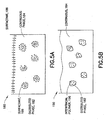
- Figure 5a shows a surfactant stabilized sol 180 of hydrolyzed alkoxide 182 (the distributed phase) and water 184 (the continuous phase) with a small concentration of surfactant 186 added.
- the hydrophilic heads of the surfactant 186 are attracted to the water 184 of the continuous phase, and the hydrophobic tails of the surfactant 186 are drawn together, away from the water 184.
- Typical surfactants 186 include alkyl sulfate salts like sodium dodecyl sulfate (SDS) or ammonium lauryl sulfate, sodium lauryl ether sulfate (SLES) and soaps or fatty acid salts.
- Sols 180 stabilized with amphipathic surfactants 186 are stable for a long time if the conditions of the sol 180 remain unchanged, but their effectiveness tends to be subject to factors such as the pH, temperature or pressure of the sol 180, and the concentration of the surfactant 186.
- the interfacial polymer 196 attaches to the surface of the alkoxide particles 182 and interlink to form a rigid barrier around the particle. This can be done as a separate process step, as is known in the art of microencapsulation and microemulsions. These encapsulated alkoxide particles 182 are very stable and remain stable after mixing into a sol.
- surfactants 186 tend to be sensitive to the conditions in the surfactant stabilized sol 180.
- the controlled manipulation of the subject sol 180 is useful in initiating gelation. For example, some surfactants 186 will swell or contract with changes in sol 180 pH, so the release of the particles 182 into the sol 180 can be initiated by pH adjustment.
- Other mechanisms which can serve to initiate gelation are changes in sol 180 temperature or pressure, or introduction of an electric current into the sol 180 to disrupt the surfactant's 186 tendency to micellate.
- particles 182 that are encapsulated with interfacial polymers 196 are less susceptible to minor changes in the conditions of the interfacial polymer stabilized sol 190, these mechanisms remain viable in some circumstances.
- Release of particles of hydrolyzed alkoxide from stabilizing material may be brought about by pumping a solution with a pH to bring about the release to the location in the subsurface formation where polymerization and gelation are to take place.
- interfacial polymer 196 encapsulation can be ruptured or broken by shear stress or cavitation in the sol 190, which mechanism is easily produced by subjecting the sol 190 to an ultrasound signal, or, as in the case of a fracture fluid in a formation, by the crushing force of the formation on the sol 190 when the overpressure from the fracturing operation is released.
- each of the embodiments described has its own advantages and disadvantages in a wellbore environment.
- Unstabilized sols are relatively easy to mix, and gelation occurs without any intervening action. However, they begin to gel as soon as the sol begins to hydrolyze, so time is a factor.
- Surfactant stabilized sols 180 can be premixed, so on-site preparation is simplified. On the other hand, stability may be affected by changes in chemistry in the wellbore and initiation of gelation may require additional equipment.
- interfacial polymer stabilized sols 190 may be prepared in advance and they are highly stable, but they require additional equipment to initiate gelation.
- the sol-gel process creates solid networks of particles through particle formation, aggregation and ripening.
- the networks thus formed are homogeneous and, depending on the conditions of the sol during condensation, composed of a wide variety of particle sizes and network structures.
- the gels are either impermeable to fluid flow or only slightly permeable. As such, the gels are more suitable for creating wellbore plugs. When fracturing fluid is desired, a more permeable network is necessary. In this case, gelation around a template and a flushing of the template material after gelation creates a more porous material. Further, by designing the structure of the templates, the porosity can be designed into the process.
- pumping a sol of hydrolyzed alkoxide into the wellbore to the desired location within the subsurface formation is carried out with a sol which contains a micellated first surfactant, the polymerization of the hydrolyzed alkoxides results in a hardened porous matrix surrounding the first surfactant; and the method also includes flushing the first surfactant from the resulting hardened porous matrix.
- the particles of the hydrolyzed alkoxide in the sol may be stabilized by a second surfactant or by an interfacial polymer.
- FIG. 6 shows the behavior of surfactants in solution as surfactant concentration increases 200.
- the surfactant exists as free molecules 202.
- the hydrophobic tails aggregate away from the solution, forming spherical agglomerations called spherical micelle 204.
- the spherical micelle 204 combine to form cylindrical and longer rod shaped micelle 206.
- Further concentration increases lead to aggregation of the cylindrical and rod shaped micelle 206 into hexagonal arrays 208 and lamellar sheets 210 of liquid crystal. This behavior of surfactant in solution 200 permits the creation of templates around which the sol-gel process occurs.
- Example surfactants include small organic surfactants such as sodium dodecyl sulfate (SDS) or cetyltrimethylammonium bromide (CTAB) or polymeric surfactants like polyethylene oxide-co-propylene oxide-co-ethylene oxide (PEO-PPO-PEO) which is commercially available in different grades with various molecular weights (supplied by BASF).
- SDS sodium dodecyl sulfate
- CTAB cetyltrimethylammonium bromide
- PEO-PPO-PEO polymeric surfactants like polyethylene oxide-co-propylene oxide-co-ethylene oxide (PEO-PPO-PEO) which is commercially available in different grades with various molecular weights (supplied by BASF).
- SDS sodium dodecyl sulfate
- CTAB cetyltrimethylammonium bromide
- PEO-PPO-PEO polyethylene oxide-co-propylene oxide-co-ethylene oxide
- BASF molecular weights
- the surfactant can be flushed out with a suitable solvent, leaving a porous gel network intact. While flushing may be done by pumping the solvent into the wellbore, a preferred embodiment involves selecting surfactants and hydrophobic polymers that are soluble in hydrocarbons, and using the hydrocarbons in the productive formation to flush the gel.
- Sol-gels are a useful alternative to slurries in wellbore operations where placement of solids in the wellbore is required, because a sol consists of smaller particles that are not as abrasive to wellbore equipment and flow with less friction. For this reason, the use of sol-gels will lend to longer equipment life and greater efficiency in wellbore operations.
- sol-gels can be used to create nonporous solids and highly permeable solids, depending on the conditions during gelation and the presence of other factors in the sol. Inorder to transport heavy proppant, we have to use high viscosity fluids and optimization of these fluids for high temperature application can be difficult. In this invention, proppants are replaced by sol-gel and hence, viscosity of the fluid to suspend the proppant is not required.
- an unstabilized sol that is highly to moderately acidic is suitable to form a densely packed gel rapidly and so is a substitute for concrete.
- the sol is formed on the surface by combining an alkoxide with water and adjusting the pH, and immediately pumping it into place to harden into a plug.
- Stabilized sols are also useful if the appropriate equipment to initiate gelation is on site.
- the uncontrolled gelation that occurs in unstabilized sols is not desirable.
- a stabilized sol mixed with appropriately large quantities of surfactant can be pumped into a productive formation as the fracturing fluid, and then, when the fracturing is complete, gelation can he initiated by breaking down the stabilizing material. In some cases, the crushing force of the productive formation on the fracturing sol will be sufficient to initiate gelation. Then, if the surfactant is chosen to be soluble in hydrocarbons, the productive flow from the formation will serve to flush the surfactant from the network.
Landscapes
- Chemical & Material Sciences (AREA)
- Life Sciences & Earth Sciences (AREA)
- General Life Sciences & Earth Sciences (AREA)
- Engineering & Computer Science (AREA)
- Materials Engineering (AREA)
- Organic Chemistry (AREA)
- Inorganic Chemistry (AREA)
- Colloid Chemistry (AREA)
- Manufacturing Of Micro-Capsules (AREA)
- Inorganic Compounds Of Heavy Metals (AREA)
Claims (13)
- Verfahren zum Positionieren von festen Körpern an einen gewünschten Ort innerhalb einer unterirdischen Formation, zu der ein Bohrloch Zugang verschafft, gekennzeichnet durch:Pumpen eines Sols von hydrolisiertem Alkoxid in das Bohrloch an den gewünschten Ort innerhalb der unterirdischen Formation; undAuslösen einer Polymerisation des hydrolisierten Alkoxids, um eine Gelbildung und ein Härten des Sols zu bewirken.
- Verfahren nach Anspruch 1, wobei das Sol des hydrolisierten Alkoxids einen pH-Wert von weniger als 2, einen pH-Wert im Bereich von 2 bis 7 oder einen pH-Wert von mehr als 7 aufweist.
- Verfahren nach Anspruch 1, wobei das Sol des hydrolisierten Alkoxids durch ein Stabilisierungsmaterial um die Teilchen des hydrolisierten Alkoxids stabilisiert wird und das Verfahren ferner umfasst:Lösen der Teilchen von dem Stabilisierungsmaterial, wodurch die Polymerisation des hydrolisierten Alkoxids und die Gelbildung des Sols ausgelöst werden.
- Verfahren nach Anspruch 1, wobei das Sol des hydrolisierten Alkoxids durch Hinzufügen eines Tensids zu dem Sol stabilisiert wird.
- Verfahren nach Anspruch 3, wobei das Sol des hydrolisierten Alkoxids durch Einkapseln der Teilchen des hydrolisierten Alkoxids mit einem Grenzflächenpolymer stabilisiert wird.
- Verfahren nach Anspruch 3, wobei:das Stabilisierungsmaterial auf Änderungen des pH-Werts der kontinuierlichen Phase des Sols anspricht; unddas Lösen der Teilchen des hydrolisierten Alkoxids von dem Stabilisierungsmaterial umfasst, eine Lösung an den gewünschten Ort innerhalb der unterirdischen Formation zu pumpen, wobei die Lösung einen pH-Wert aufweist, der gewählt ist, um die Teilchen zu lösen.
- Verfahren nach Anspruch 5, wobei:das Grenzflächenpolymer durch Druckänderungen im Sol aufgebrochen werden kann; unddas Aufbrechen des Verkapselungsstoffs umfasst, den Druck in dem Bohrloch zu ändern.
- Verfahren nach Anspruch 5, wobei:das Grenzflächenpolymer durch Kavitationseffekte in dem Sol aufgebrochen werden kann; unddas Aufbrechen des Verkapselungsstoffs umfasst, das Sol Ultraschall auszusetzen.
- Verfahren nach Anspruch 5, wobei:das Grenzflächenpolymer durch Scherbeanspruchung aufgebrochen werden kann; unddas Aufbrechen des Verkapselungsstoffs umfasst, das Sol Ultraschall auszusetzen.
- Verfahren nach Anspruch 4,
das enthält, einen elektrischen Strom in das Sol einzuleiten, um die Stabilisierung durch das Tensid zu unterbrechen. - Verfahren nach Anspruch 1, wobei das Pumpen eines Sols von hydrolisiertem Alkoxid in das Bohrloch an den gewünschten Ort innerhalb der unterirdischen Formation mit einem Sol ausgeführt wird, das ein mizelliertes erstes Tensid enthält, die Polymerisation des hydrolisierten Alkoxids eine gehärtete poröse Matrix ergibt, die das erste Tensid umgibt; und das Verfahren außerdem enthält, das erste Tensid aus der sich ergebenden gehärteten porösen Matrix zu spülen.
- Verfahren nach Anspruch 11, wobei die Teilchen des hydrolisierten Alkoxids in dem Sol durch ein zweites Tensid stabilisiert werden.
- Verfahren nach Anspruch 11, wobei die Teilchen des hydrolisierten Alkoxids in dem Sol durch ein Grenzflächenpolymer stabilisiert werden.
Applications Claiming Priority (2)
| Application Number | Priority Date | Filing Date | Title |
|---|---|---|---|
| US1496907P | 2007-12-19 | 2007-12-19 | |
| PCT/US2008/078221 WO2009085354A1 (en) | 2007-12-19 | 2008-09-30 | In-situ formation of solids for well completions and zonal isolation |
Publications (2)
| Publication Number | Publication Date |
|---|---|
| EP2220189A1 EP2220189A1 (de) | 2010-08-25 |
| EP2220189B1 true EP2220189B1 (de) | 2014-12-03 |
Family
ID=40404737
Family Applications (1)
| Application Number | Title | Priority Date | Filing Date |
|---|---|---|---|
| EP08866013.9A Not-in-force EP2220189B1 (de) | 2007-12-19 | 2008-09-30 | Vor-ort-formierung von feststoffen für bohrungsabschlüsse und isolation von bohrungsbereichen |
Country Status (5)
| Country | Link |
|---|---|
| US (1) | US7810562B2 (de) |
| EP (1) | EP2220189B1 (de) |
| CA (1) | CA2684670C (de) |
| RU (1) | RU2424419C1 (de) |
| WO (1) | WO2009085354A1 (de) |
Families Citing this family (27)
| Publication number | Priority date | Publication date | Assignee | Title |
|---|---|---|---|---|
| US20130126175A1 (en) | 2011-11-23 | 2013-05-23 | Saudi Arabian Oil Company | Synthetic Sweet Spots in Tight Formations by Injection of Nano Encapsulated Reactants |
| US8893790B2 (en) | 2012-05-23 | 2014-11-25 | Halliburton Energy Services, Inc. | Biomimetic adhesive compositions comprising a phenolic polymer and methods for use thereof |
| US10961832B2 (en) * | 2013-07-23 | 2021-03-30 | Schlumberger Technology Corporation | Methods of treatment of a subterranean formation with polymeric structures formed in situ |
| WO2015069148A1 (ru) * | 2013-11-11 | 2015-05-14 | Общество С Ограниченной Ответственностью "Нефтегазовый Центр Мфти" | Метод гидроразрыва пласта тремя жидкостями |
| RU2548271C1 (ru) * | 2014-07-30 | 2015-04-20 | Открытое акционерное общество "Татнефть" им. В.Д. Шашина | Способ эксплуатации нефтедобывающей скважины |
| US9828543B2 (en) | 2014-11-19 | 2017-11-28 | Saudi Arabian Oil Company | Compositions of and methods for using hydraulic fracturing fluid for petroleum production |
| US9834721B2 (en) | 2014-11-19 | 2017-12-05 | Saudi Arabian Oil Company | Compositions of and methods for using hydraulic fracturing fluid for petroleum production |
| CA2978402A1 (en) * | 2015-03-03 | 2016-09-09 | Schlumberger Canada Limited | Materials and their characterization in heterogeneous proppant placement |
| WO2016209208A1 (en) | 2015-06-23 | 2016-12-29 | Schlumberger Canada Limited | Mobile proppant recognition |
| CA2991780A1 (en) * | 2015-08-26 | 2017-03-02 | Halliburton Energy Services, Inc. | Sol-gel modified particulates for wellbore fluids |
| RU2608380C1 (ru) * | 2015-12-25 | 2017-01-18 | Шлюмберже Текнолоджи Б.В. | Способ гидроразрыва подземного пласта |
| CN107686721A (zh) * | 2016-08-03 | 2018-02-13 | 中国石油化工股份有限公司 | 一种超支化纳微米封堵材料及制备方法 |
| CA3044373C (en) | 2016-12-20 | 2021-03-09 | Halliburton Energy Services, Inc. | Formation of micro-proppant particulates in situ |
| US10920130B2 (en) | 2017-04-21 | 2021-02-16 | Halliburton Energy Services, Inc. | Downhole methods for forming resin coatings on fracture surfaces |
| GB2593614B (en) | 2019-02-22 | 2022-12-07 | Halliburton Energy Services Inc | An expanding metal sealant for use with multilateral completion systems |
| WO2021021203A1 (en) | 2019-07-31 | 2021-02-04 | Halliburton Energy Services, Inc. | Methods to monitor a metallic sealant deployed in a wellbore, methods to monitor fluid displacement, and downhole metallic sealant measurement systems |
| US10961804B1 (en) | 2019-10-16 | 2021-03-30 | Halliburton Energy Services, Inc. | Washout prevention element for expandable metal sealing elements |
| US11519239B2 (en) | 2019-10-29 | 2022-12-06 | Halliburton Energy Services, Inc. | Running lines through expandable metal sealing elements |
| US12480373B2 (en) | 2019-11-13 | 2025-11-25 | Halliburton Energy Services, Inc. | Actuating a downhole device with a reactive metal |
| US11761290B2 (en) | 2019-12-18 | 2023-09-19 | Halliburton Energy Services, Inc. | Reactive metal sealing elements for a liner hanger |
| US11499399B2 (en) | 2019-12-18 | 2022-11-15 | Halliburton Energy Services, Inc. | Pressure reducing metal elements for liner hangers |
| US11761293B2 (en) | 2020-12-14 | 2023-09-19 | Halliburton Energy Services, Inc. | Swellable packer assemblies, downhole packer systems, and methods to seal a wellbore |
| US11572749B2 (en) | 2020-12-16 | 2023-02-07 | Halliburton Energy Services, Inc. | Non-expanding liner hanger |
| US11578498B2 (en) | 2021-04-12 | 2023-02-14 | Halliburton Energy Services, Inc. | Expandable metal for anchoring posts |
| US11879304B2 (en) | 2021-05-17 | 2024-01-23 | Halliburton Energy Services, Inc. | Reactive metal for cement assurance |
| CN117186854A (zh) * | 2022-05-31 | 2023-12-08 | 中国石油天然气集团有限公司 | 水基钻井液用微纳米防塌封堵剂及其制备方法 |
| US12612843B2 (en) | 2023-12-26 | 2026-04-28 | Halliburton Energy Services, Inc. | Mechanical support for expandable liner hanger |
Family Cites Families (17)
| Publication number | Priority date | Publication date | Assignee | Title |
|---|---|---|---|---|
| US3747677A (en) * | 1971-10-26 | 1973-07-24 | Shell Oil Co | Plugging solution precipitation time control by epoxide reaction |
| US3965986A (en) | 1974-10-04 | 1976-06-29 | Texaco Inc. | Method for oil recovery improvement |
| US4732213A (en) | 1986-09-15 | 1988-03-22 | Conoco Inc. | Colloidal silica-based fluid diversion |
| US5168928A (en) | 1991-08-15 | 1992-12-08 | Halliburton Company | Preparation and use of gelable silicate solutions in oil field applications |
| US5836390A (en) * | 1995-11-07 | 1998-11-17 | The Regents Of The University Of California | Method for formation of subsurface barriers using viscous colloids |
| US7021376B2 (en) * | 1998-12-21 | 2006-04-04 | Geoffrey Stanley Bayliss | Method for placement of blocking gels or polymers at multiple specific depths of penetration into oil and gas, and water producing formations |
| US6431280B2 (en) * | 1998-12-21 | 2002-08-13 | Geoffrey Stanley Bayliss | Method for placement of blocking gels or polymers at specific depths of penetration into oil and gas, and water producing formations |
| US6209646B1 (en) * | 1999-04-21 | 2001-04-03 | Halliburton Energy Services, Inc. | Controlling the release of chemical additives in well treating fluids |
| US7354886B2 (en) * | 1999-07-29 | 2008-04-08 | Baker Hughes Incorporated | Pumpable multiple phase compositions for controlled release applications downhole |
| US6439309B1 (en) * | 2000-12-13 | 2002-08-27 | Bj Services Company | Compositions and methods for controlling particulate movement in wellbores and subterranean formations |
| AU2001226110B2 (en) | 2000-12-30 | 2006-04-27 | Commonwealth Scientific And Industrial Research Organisation | Novel compounds and method for generating a highly efficient membrane in water-based drilling fluids |
| US7013973B2 (en) | 2003-11-11 | 2006-03-21 | Schlumberger Technology Corporation | Method of completing poorly consolidated formations |
| US7608567B2 (en) * | 2005-05-12 | 2009-10-27 | Halliburton Energy Services, Inc. | Degradable surfactants and methods for use |
| DE102006018938A1 (de) * | 2006-04-24 | 2007-10-25 | Epg (Engineered Nanoproducts Germany) Ag | Öl-, heißwasser- und temperaturresistente Bindemittel, Verfahren zu deren Herstellung und deren Verwendung |
| US7458424B2 (en) | 2006-05-16 | 2008-12-02 | Schlumberger Technology Corporation | Tight formation water shut off method with silica gel |
| US7431089B1 (en) * | 2007-06-25 | 2008-10-07 | Schlumberger Technology Corporation | Methods and compositions for selectively dissolving sandstone formations |
| AU2009238422B2 (en) * | 2008-04-21 | 2013-12-12 | Championx Llc | Compositions and methods for diverting injected fluids to achieve improved hydrocarbon fluid recovery |
-
2008
- 2008-08-11 US US12/189,572 patent/US7810562B2/en active Active
- 2008-09-30 RU RU2009139757/03A patent/RU2424419C1/ru not_active IP Right Cessation
- 2008-09-30 WO PCT/US2008/078221 patent/WO2009085354A1/en not_active Ceased
- 2008-09-30 EP EP08866013.9A patent/EP2220189B1/de not_active Not-in-force
- 2008-09-30 CA CA2684670A patent/CA2684670C/en not_active Expired - Fee Related
Also Published As
| Publication number | Publication date |
|---|---|
| CA2684670C (en) | 2013-11-05 |
| RU2009139757A (ru) | 2011-05-10 |
| RU2424419C1 (ru) | 2011-07-20 |
| US20090159287A1 (en) | 2009-06-25 |
| EP2220189A1 (de) | 2010-08-25 |
| CA2684670A1 (en) | 2009-07-09 |
| WO2009085354A1 (en) | 2009-07-09 |
| US7810562B2 (en) | 2010-10-12 |
Similar Documents
| Publication | Publication Date | Title |
|---|---|---|
| EP2220189B1 (de) | Vor-ort-formierung von feststoffen für bohrungsabschlüsse und isolation von bohrungsbereichen | |
| US8141637B2 (en) | Manipulation of flow underground | |
| US20140290943A1 (en) | Stabilized Fluids In Well Treatment | |
| US9388335B2 (en) | Pickering emulsion treatment fluid | |
| US20140374095A1 (en) | Nanoparticle slurries and methods | |
| EA009172B1 (ru) | Способ вскрытия слабо затвердевших формаций | |
| AU2014384678B2 (en) | Crosslinker-coated proppant particulates for use in treatment fluids comprising gelling agents | |
| US20130000900A1 (en) | Down-hole placement of water-swellable polymers | |
| WO2014102386A1 (en) | Set on demand cement compositions for curing fluid loss | |
| US20150021022A1 (en) | Energized slurries and methods | |
| US20150027703A1 (en) | Solid state dispersion | |
| WO2007135617A1 (en) | Tight formation water shut off method with silica gel | |
| EP2135914A1 (de) | Verfahren zur unterirdischen Erzeugung von Thixotropie in Flüssigkeiten | |
| WO2012174255A1 (en) | Enhanced crude oil recovery using metal silicides | |
| US20210292638A1 (en) | Breaker System for Emulsified Fluid System | |
| CA3053107A1 (en) | Methods and treatment fluids for microfracture creation and microproppant delivery in subterranean formations | |
| MX2012003450A (es) | Fluido selectivo con agente de anclaje para control del agua. | |
| CN111406144A (zh) | 油气井压井方法 | |
| WO2007063317A1 (en) | Wellbore sealant compositions containing cationic latexes and methods of using them | |
| CN110144198B (zh) | 一种油基钻井液用凝胶堵漏剂及其制备方法 | |
| WO2018183357A1 (en) | Methods for delivering water reactive chemicals to subterranean reservoirs for enhanced crude oil recovery | |
| WO2018101919A1 (en) | Emulsion-based breaker for nanoparticle clay fluid | |
| WO2017164883A1 (en) | Remedial treatment of wells with voids behind casing | |
| WO2018044320A1 (en) | Inorganic clay particulate additive for consolidating treatments | |
| US9587473B2 (en) | Stabilizing unconsolidated formation for fines control |
Legal Events
| Date | Code | Title | Description |
|---|---|---|---|
| PUAI | Public reference made under article 153(3) epc to a published international application that has entered the european phase |
Free format text: ORIGINAL CODE: 0009012 |
|
| 17P | Request for examination filed |
Effective date: 20091021 |
|
| AK | Designated contracting states |
Kind code of ref document: A1 Designated state(s): AT BE BG CH CY CZ DE DK EE ES FI FR GB GR HR HU IE IS IT LI LT LU LV MC MT NL NO PL PT RO SE SI SK TR |
|
| AX | Request for extension of the european patent |
Extension state: AL BA MK RS |
|
| DAX | Request for extension of the european patent (deleted) | ||
| 17Q | First examination report despatched |
Effective date: 20101123 |
|
| GRAP | Despatch of communication of intention to grant a patent |
Free format text: ORIGINAL CODE: EPIDOSNIGR1 |
|
| INTG | Intention to grant announced |
Effective date: 20140515 |
|
| GRAS | Grant fee paid |
Free format text: ORIGINAL CODE: EPIDOSNIGR3 |
|
| GRAA | (expected) grant |
Free format text: ORIGINAL CODE: 0009210 |
|
| AK | Designated contracting states |
Kind code of ref document: B1 Designated state(s): AT BE BG CH CY CZ DE DK EE ES FI FR GB GR HR HU IE IS IT LI LT LU LV MC MT NL NO PL PT RO SE SI SK TR |
|
| REG | Reference to a national code |
Ref country code: GB Ref legal event code: FG4D |
|
| REG | Reference to a national code |
Ref country code: AT Ref legal event code: REF Ref document number: 699374 Country of ref document: AT Kind code of ref document: T Effective date: 20141215 Ref country code: CH Ref legal event code: EP |
|
| REG | Reference to a national code |
Ref country code: IE Ref legal event code: FG4D |
|
| REG | Reference to a national code |
Ref country code: DE Ref legal event code: R096 Ref document number: 602008035730 Country of ref document: DE Effective date: 20150115 |
|
| REG | Reference to a national code |
Ref country code: NL Ref legal event code: VDEP Effective date: 20141203 |
|
| REG | Reference to a national code |
Ref country code: AT Ref legal event code: MK05 Ref document number: 699374 Country of ref document: AT Kind code of ref document: T Effective date: 20141203 |
|
| PG25 | Lapsed in a contracting state [announced via postgrant information from national office to epo] |
Ref country code: ES Free format text: LAPSE BECAUSE OF FAILURE TO SUBMIT A TRANSLATION OF THE DESCRIPTION OR TO PAY THE FEE WITHIN THE PRESCRIBED TIME-LIMIT Effective date: 20141203 Ref country code: NO Free format text: LAPSE BECAUSE OF FAILURE TO SUBMIT A TRANSLATION OF THE DESCRIPTION OR TO PAY THE FEE WITHIN THE PRESCRIBED TIME-LIMIT Effective date: 20150303 Ref country code: FI Free format text: LAPSE BECAUSE OF FAILURE TO SUBMIT A TRANSLATION OF THE DESCRIPTION OR TO PAY THE FEE WITHIN THE PRESCRIBED TIME-LIMIT Effective date: 20141203 Ref country code: LT Free format text: LAPSE BECAUSE OF FAILURE TO SUBMIT A TRANSLATION OF THE DESCRIPTION OR TO PAY THE FEE WITHIN THE PRESCRIBED TIME-LIMIT Effective date: 20141203 Ref country code: NL Free format text: LAPSE BECAUSE OF FAILURE TO SUBMIT A TRANSLATION OF THE DESCRIPTION OR TO PAY THE FEE WITHIN THE PRESCRIBED TIME-LIMIT Effective date: 20141203 |
|
| REG | Reference to a national code |
Ref country code: LT Ref legal event code: MG4D |
|
| PG25 | Lapsed in a contracting state [announced via postgrant information from national office to epo] |
Ref country code: LV Free format text: LAPSE BECAUSE OF FAILURE TO SUBMIT A TRANSLATION OF THE DESCRIPTION OR TO PAY THE FEE WITHIN THE PRESCRIBED TIME-LIMIT Effective date: 20141203 Ref country code: SE Free format text: LAPSE BECAUSE OF FAILURE TO SUBMIT A TRANSLATION OF THE DESCRIPTION OR TO PAY THE FEE WITHIN THE PRESCRIBED TIME-LIMIT Effective date: 20141203 Ref country code: GR Free format text: LAPSE BECAUSE OF FAILURE TO SUBMIT A TRANSLATION OF THE DESCRIPTION OR TO PAY THE FEE WITHIN THE PRESCRIBED TIME-LIMIT Effective date: 20150304 Ref country code: HR Free format text: LAPSE BECAUSE OF FAILURE TO SUBMIT A TRANSLATION OF THE DESCRIPTION OR TO PAY THE FEE WITHIN THE PRESCRIBED TIME-LIMIT Effective date: 20141203 Ref country code: AT Free format text: LAPSE BECAUSE OF FAILURE TO SUBMIT A TRANSLATION OF THE DESCRIPTION OR TO PAY THE FEE WITHIN THE PRESCRIBED TIME-LIMIT Effective date: 20141203 Ref country code: CY Free format text: LAPSE BECAUSE OF FAILURE TO SUBMIT A TRANSLATION OF THE DESCRIPTION OR TO PAY THE FEE WITHIN THE PRESCRIBED TIME-LIMIT Effective date: 20141203 |
|
| PG25 | Lapsed in a contracting state [announced via postgrant information from national office to epo] |
Ref country code: PT Free format text: LAPSE BECAUSE OF FAILURE TO SUBMIT A TRANSLATION OF THE DESCRIPTION OR TO PAY THE FEE WITHIN THE PRESCRIBED TIME-LIMIT Effective date: 20150403 Ref country code: CZ Free format text: LAPSE BECAUSE OF FAILURE TO SUBMIT A TRANSLATION OF THE DESCRIPTION OR TO PAY THE FEE WITHIN THE PRESCRIBED TIME-LIMIT Effective date: 20141203 Ref country code: RO Free format text: LAPSE BECAUSE OF FAILURE TO SUBMIT A TRANSLATION OF THE DESCRIPTION OR TO PAY THE FEE WITHIN THE PRESCRIBED TIME-LIMIT Effective date: 20141203 Ref country code: SK Free format text: LAPSE BECAUSE OF FAILURE TO SUBMIT A TRANSLATION OF THE DESCRIPTION OR TO PAY THE FEE WITHIN THE PRESCRIBED TIME-LIMIT Effective date: 20141203 Ref country code: EE Free format text: LAPSE BECAUSE OF FAILURE TO SUBMIT A TRANSLATION OF THE DESCRIPTION OR TO PAY THE FEE WITHIN THE PRESCRIBED TIME-LIMIT Effective date: 20141203 |
|
| PG25 | Lapsed in a contracting state [announced via postgrant information from national office to epo] |
Ref country code: IS Free format text: LAPSE BECAUSE OF FAILURE TO SUBMIT A TRANSLATION OF THE DESCRIPTION OR TO PAY THE FEE WITHIN THE PRESCRIBED TIME-LIMIT Effective date: 20150403 Ref country code: PL Free format text: LAPSE BECAUSE OF FAILURE TO SUBMIT A TRANSLATION OF THE DESCRIPTION OR TO PAY THE FEE WITHIN THE PRESCRIBED TIME-LIMIT Effective date: 20141203 |
|
| REG | Reference to a national code |
Ref country code: DE Ref legal event code: R097 Ref document number: 602008035730 Country of ref document: DE |
|
| PLBE | No opposition filed within time limit |
Free format text: ORIGINAL CODE: 0009261 |
|
| STAA | Information on the status of an ep patent application or granted ep patent |
Free format text: STATUS: NO OPPOSITION FILED WITHIN TIME LIMIT |
|
| PG25 | Lapsed in a contracting state [announced via postgrant information from national office to epo] |
Ref country code: DK Free format text: LAPSE BECAUSE OF FAILURE TO SUBMIT A TRANSLATION OF THE DESCRIPTION OR TO PAY THE FEE WITHIN THE PRESCRIBED TIME-LIMIT Effective date: 20141203 |
|
| 26N | No opposition filed |
Effective date: 20150904 |
|
| PG25 | Lapsed in a contracting state [announced via postgrant information from national office to epo] |
Ref country code: IT Free format text: LAPSE BECAUSE OF FAILURE TO SUBMIT A TRANSLATION OF THE DESCRIPTION OR TO PAY THE FEE WITHIN THE PRESCRIBED TIME-LIMIT Effective date: 20141203 |
|
| PG25 | Lapsed in a contracting state [announced via postgrant information from national office to epo] |
Ref country code: SI Free format text: LAPSE BECAUSE OF FAILURE TO SUBMIT A TRANSLATION OF THE DESCRIPTION OR TO PAY THE FEE WITHIN THE PRESCRIBED TIME-LIMIT Effective date: 20141203 |
|
| REG | Reference to a national code |
Ref country code: DE Ref legal event code: R119 Ref document number: 602008035730 Country of ref document: DE |
|
| PG25 | Lapsed in a contracting state [announced via postgrant information from national office to epo] |
Ref country code: LU Free format text: LAPSE BECAUSE OF FAILURE TO SUBMIT A TRANSLATION OF THE DESCRIPTION OR TO PAY THE FEE WITHIN THE PRESCRIBED TIME-LIMIT Effective date: 20150930 Ref country code: MC Free format text: LAPSE BECAUSE OF FAILURE TO SUBMIT A TRANSLATION OF THE DESCRIPTION OR TO PAY THE FEE WITHIN THE PRESCRIBED TIME-LIMIT Effective date: 20141203 |
|
| REG | Reference to a national code |
Ref country code: CH Ref legal event code: PL |
|
| PG25 | Lapsed in a contracting state [announced via postgrant information from national office to epo] |
Ref country code: BE Free format text: LAPSE BECAUSE OF FAILURE TO SUBMIT A TRANSLATION OF THE DESCRIPTION OR TO PAY THE FEE WITHIN THE PRESCRIBED TIME-LIMIT Effective date: 20141203 |
|
| REG | Reference to a national code |
Ref country code: IE Ref legal event code: MM4A |
|
| REG | Reference to a national code |
Ref country code: FR Ref legal event code: ST Effective date: 20160531 |
|
| PG25 | Lapsed in a contracting state [announced via postgrant information from national office to epo] |
Ref country code: CH Free format text: LAPSE BECAUSE OF NON-PAYMENT OF DUE FEES Effective date: 20150930 Ref country code: IE Free format text: LAPSE BECAUSE OF NON-PAYMENT OF DUE FEES Effective date: 20150930 Ref country code: LI Free format text: LAPSE BECAUSE OF NON-PAYMENT OF DUE FEES Effective date: 20150930 Ref country code: DE Free format text: LAPSE BECAUSE OF NON-PAYMENT OF DUE FEES Effective date: 20160401 |
|
| PG25 | Lapsed in a contracting state [announced via postgrant information from national office to epo] |
Ref country code: FR Free format text: LAPSE BECAUSE OF NON-PAYMENT OF DUE FEES Effective date: 20150930 |
|
| PG25 | Lapsed in a contracting state [announced via postgrant information from national office to epo] |
Ref country code: MT Free format text: LAPSE BECAUSE OF FAILURE TO SUBMIT A TRANSLATION OF THE DESCRIPTION OR TO PAY THE FEE WITHIN THE PRESCRIBED TIME-LIMIT Effective date: 20141203 |
|
| PG25 | Lapsed in a contracting state [announced via postgrant information from national office to epo] |
Ref country code: BG Free format text: LAPSE BECAUSE OF FAILURE TO SUBMIT A TRANSLATION OF THE DESCRIPTION OR TO PAY THE FEE WITHIN THE PRESCRIBED TIME-LIMIT Effective date: 20141203 Ref country code: HU Free format text: LAPSE BECAUSE OF FAILURE TO SUBMIT A TRANSLATION OF THE DESCRIPTION OR TO PAY THE FEE WITHIN THE PRESCRIBED TIME-LIMIT; INVALID AB INITIO Effective date: 20080930 |
|
| PG25 | Lapsed in a contracting state [announced via postgrant information from national office to epo] |
Ref country code: TR Free format text: LAPSE BECAUSE OF FAILURE TO SUBMIT A TRANSLATION OF THE DESCRIPTION OR TO PAY THE FEE WITHIN THE PRESCRIBED TIME-LIMIT Effective date: 20141203 |
|
| PGFP | Annual fee paid to national office [announced via postgrant information from national office to epo] |
Ref country code: GB Payment date: 20180928 Year of fee payment: 11 |
|
| GBPC | Gb: european patent ceased through non-payment of renewal fee |
Effective date: 20190930 |
|
| PG25 | Lapsed in a contracting state [announced via postgrant information from national office to epo] |
Ref country code: GB Free format text: LAPSE BECAUSE OF NON-PAYMENT OF DUE FEES Effective date: 20190930 |