EP2219112A2 - Verfahren und System für den Betrieb in harter Echtzeit - Google Patents
Verfahren und System für den Betrieb in harter Echtzeit Download PDFInfo
- Publication number
- EP2219112A2 EP2219112A2 EP10151485A EP10151485A EP2219112A2 EP 2219112 A2 EP2219112 A2 EP 2219112A2 EP 10151485 A EP10151485 A EP 10151485A EP 10151485 A EP10151485 A EP 10151485A EP 2219112 A2 EP2219112 A2 EP 2219112A2
- Authority
- EP
- European Patent Office
- Prior art keywords
- tasks
- working mode
- slack
- task
- time
- Prior art date
- Legal status (The legal status is an assumption and is not a legal conclusion. Google has not performed a legal analysis and makes no representation as to the accuracy of the status listed.)
- Withdrawn
Links
Images



Classifications
-
- G—PHYSICS
- G06—COMPUTING OR CALCULATING; COUNTING
- G06F—ELECTRIC DIGITAL DATA PROCESSING
- G06F9/00—Arrangements for program control, e.g. control units
- G06F9/06—Arrangements for program control, e.g. control units using stored programs, i.e. using an internal store of processing equipment to receive or retain programs
- G06F9/46—Multiprogramming arrangements
- G06F9/48—Program initiating; Program switching, e.g. by interrupt
- G06F9/4806—Task transfer initiation or dispatching
- G06F9/4843—Task transfer initiation or dispatching by program, e.g. task dispatcher, supervisor, operating system
Definitions
- the present invention is related to a method for operating an electronic processor based system, more in particular a non-linear dynamic system with hard constraints, and devices suited therefore.
- Dynamic systems can be designed to be adaptive with the help of "knobs" which offer run-time trade-offs between system metrics of interest, such as performance, power consumption, and quality-of-service. These knobs need to be regularly controlled/tuned such that the system cost (e.g. energy consumption, revenue loss due to poor capacity) is minimized while meeting all the hard constraints, such as deadlines, assured minimum quality, and guaranteed lifetime.
- system cost e.g. energy consumption, revenue loss due to poor capacity
- the present invention relates to control of electronic systems with a processor where the constraints, not just the costs, are dependent on uncertainties, i.e., a wrong decision leads to unacceptable constraint violation.
- uncertainties are and important part of the system and typically they are computed purely at design-time.
- the switching overheads of changing knob settings also need to be explicitly accounted for (these can be seen as controllable uncertainties).
- Such systems exhibit what is called time-linkage, i.e., decisions of the present have a significant impact on the future performance. Achieving optimal constrained control of such adaptive systems with low overhead is an advantage of the present invention.
- the present invention provides a method of managing the operation of a hard real time electronic system, using a processor, by exploiting task information determined by a predictor, the method comprising:
- This method improves utilization at run time.
- an upper bound of the tasks can be determined by:
- the refinement of the upper bound allows a more accurate planning of resources.
- the dynamical procedure that outputs the improved working mode for the tasks is performed based on an amount of slack of the tasks.
- the amount of slack of the tasks can be determined depending on:
- Selection of a working mode can be done at run-time using an energy/execution-time look-up table of the electronic system determined at design-time.
- a look-up table is a convenient and simple tool and therefore makes the implementation easy.
- the look-up table preferably contains an extreme working mode which can be selected at run-time depending on timing, thermal and reliability constraints of the system using pre-defined models at design time.
- the extreme working mode can be used to relieve problems in the operation of the system when constraints might be breached.
- the overhead and constraints information of tasks can be determined by using optimized and adaptive application-, context-, and content-specific predictors. Also dynamically state-enhanced procedures can be used at different time instances which are selected based on a quality-complexity trade-off.
- the present invention also includes a non-transitory computer-readable storage medium with an executable program stored thereon, wherein the program instructs the operation of a hard real time system by exploiting task information determined by a predictor, the instructions being adapted so that:
- the present invention also provides a hard real time system having a processor and a controller of the operation of the system by exploiting task information determined by a predictor, the system comprising:
- the present invention also includes a controller for controlling the operation of a hard real time system by exploiting task information determined by a predictor, the system comprising:
- the controller can be adapted to carry out the re-optimization procedure that outputs the improved working mode or modes for the tasks, based on the amount of slack of the tasks.
- the amount of slack of the tasks can be determined depending on:
- the controller can be adapted to select a working mode at run-time using an energy/execution-time look-up table of the electronic system determined at design-time.
- the look-up table is preferably stored in memory that is accessible by the controller.
- the look-up table contains an extreme working mode; and the controller is adapted to select at run-time the extreme working mode depending on timing, thermal and reliability constraints of the system using pre-defined models at design time.
- the controller can be adapted to use dynamically state-enhanced procedures at different time instances which are selected based on a quality-complexity trade-off.
- a first aspect is to combine scenario-based design-time run-time split design methods based on trade-offs such as energy-performance trade-offs with look-ahead and/or predictive control methods at run-time.
- a trade-off relates to tuples involving a resource and a constraint whereby when improving either a resource or a constraint, the other of the tuple, a constraint or a resource respectively, does not necessarily improve.
- a trade-off leads therefore to a selection with pros and cons.
- An example is meeting a hard constraint such as a time to complete a task by using a large amount of power.
- the goal of using predictive control methods at run-time is two fold: (i) to refine the upper bounds and (ii) to estimate the expected values of dynamic aspects of the system.
- An upper bound relates to the maximum value that a particular operation may assume, e.g. the maximum time that an operation or a task may take to complete, or the maximum resources an operation or a task may consume.
- Upper bound information is used to select a working mode for the system for the tasks.
- the upper bound information is available at design time and is further refined by the system when new tasks are received using a model developed at design taking into account overhead and constraints information of tasks at run-time.
- Overhead and constraints information of tasks are determined by using optimized and adaptive application-, context-, and content-specific predictors for better accuracy at low overhead.
- Overhead is considered to be the extra energy and time that is needed to switch between different working modes of the processor.
- the extra energy and time needed to change the voltage and frequency of a processor is considered to be overhead.
- the overhead is considered to be the extra energy or time needed to obtain a particular goal, in this case it is the time and energy needed to switch between different working modes of the processor.
- Optimized and adaptive application-, context-, and content-specific predictors for better accuracy at low overhead means the use of specific predictors which are designed and optimized for specific applications. For example, a predictor which is exploiting the meta-data available in the content headers and the correlations of moving objects across frames could be used in a video application. This predictor will be able to make more accurate predictions, therefore consuming less time and energy than a generic predictor which is not designed or optimized specifically for this task or purpose.
- another aspect relates to scenario-based design-time run-time split design methods based on energy-performance trade-offs but specially adapted for control of dynamical nonlinear systems with hard constraints, e.g., a hard real time constraint, real-time throughput, strict latency, minimal life-time (reliability), maximal power (for heat), maximal energy budget (battery life).
- hard constraints e.g., a hard real time constraint, real-time throughput, strict latency, minimal life-time (reliability), maximal power (for heat), maximal energy budget (battery life).
- the selection of a new working mode for a set of tasks depends on one or more conditions which are determined by a proactive controller of the system.
- the pro-active controller decides if a new working mode for a set of tasks should be determined for a set of tasks depending on task information delivered by a predictor.
- the pro-active controller runs a dynamical re-optimization procedure that outputs an improved working mode for the tasks and one or more conditions for revising the working mode, depending on overhead and constraints information of at least one completed task and at least one to be completed task determined by the predictor.
- overhead of optimization can be considered as the excess of time or energy required to alter or calculate working modes for tasks.
- the procedure is dynamical because a customized dynamic procedure is used to reduce the overall time and energy for solving the optimization problem at run-time.
- the complex optimizations are solved using a dynamic horizon.
- the average run-time overhead of the optimization can significantly be reduced without noticeable sub-optimality.
- the optimization horizon is increased.
- the selection between the different methods of different horizon complexity is decided based on a quality-complexity trade-off.
- the optimization procedure involves uncertainties of the system, the working mode of the previously considered but yet to be executed tasks are revisited as some of the uncertainties get resolved.
- a dynamic receding horizon principle is used only when the resolved uncertainties makes it essential or enable energy gains.
- the information from the previous optimization is maximally reused as the changes are often incremental.
- the optimization procedure gives the working mode list as output but also the conditions for revising the decisions and indication to the methods for doing it effectively along with the data needed for them.
- This dynamical procedure re-optimization procedure outputs an improved, e.g. an optimized working mode list for the tasks based on the amount of slack of the tasks.
- slack assignment can be performed dynamically (e.g. more slack can be consumed in the first place than is normally done). More slack can be consumed in anticipation of the equivalent amount of slack being released by the time it is needed.
- a scheduler always ensures that a feasible schedule exists even when the expected slack is not released.
- the scheduler also identifies the right amount of slack required by the current task and extracts it from the right place, to limit the overhead.
- the scheduler takes controlled risk of allocating less time budget to a task than the task might actually utilize in worst-case while still guaranteeing the deadlines of both current and future tasks.
- an extreme working mode gas pedal
- Lifetime reliability of a system-in-package is a complex function of fabrication process variability, system activity and thermal environment.
- the extreme working mode is an extreme Pareto-optimal operational mode of the system in which one of the system metrics is much better than the other operating modes. This mode enhances the opportunities of consuming more slack of tasks and thus more gains.
- the pro-active controller can make use of this extreme working mode judiciously, using the extreme working model only, for example, in a crisis (e.g. when there is risk of a potential constraint violation) situation (either naturally occurring in under-designed systems or artificially created due to over slack consummation in the past) while simultaneously ensuring that such usage will not violate any other constraints.
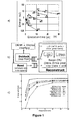
- the H.264/AVC 720p video decoder design is considered and it is composed of 3 IP modules as shown in Fig 1(b) .
- the Reconstruct module IP under the focus, depending upon macroblock (MB) properties ( ⁇ 20B) implements intra/inter frame prediction, motion compensation, and inverse transformations to finally reconstruct the macroblock ( ⁇ 400B) and sends to the Deblock module.
- the Deblock module sends the macroblock data directly to a display controller in case of B-frames ( ⁇ 80% of total) to avoid redundant accesses to external memory such as a DRAM.
- the reference frames (each of ⁇ 1.32MB) are stored in the memory such as a DRAM and sent to the display at an appropriate time.
- the Reconstruct module pre-fetches the required reference pixels into its local memory (LID) before starting to process the macroblock to avoid memory stalls during the processing. It comprises for example a clustered 8-issue VLIW processor with 32-bit SIMD datapath, similar to TI C64+, and the code is preferably heavily optimized to best utilize the instruction set architecture.
- the number of execution cycles (EC) required to perform a Reconstruct task varies across different macroblocks ranging from 250 to 5787. The theoretical worst-case macroblock needs up to 12000 but profiling on a large number of real video sequences shows that highest values are just below 5787.
- Reconstruct module All the three modules (Reconstruct module, Deblock module and Read module) run in macroblock-level pipeline and thus to perform Reconstruct on an entire frame (the task) there is approximately 41.67 msec available as a constraint, i.e., 11.57 ⁇ sec for one macroblock (sub-task), while decoding a 720p sequence at 24 fps.
- the best static design choice is to run the Reconstruct module at a speed, e.g. 500 Mhz (M1, the highest speed mode) always which ensures all constraints (discussed below) even under the worst-case situations.
- knob switching overhead which can range, for example from 2 ⁇ s to 20 ⁇ s and 0.1 ⁇ J to 10 ⁇ J depending on the specific circuit and technology implementation choices, is modeled to be the same across any pair of knob settings for brevity.
- Fig 1(c) shows the upper bounds on the possible gains, by optimal selection of these knob settings using an Oracle (i.e. a theoretical best case solution), compared to the static design time (DT) solution, as a function of switching overhead and output buffer size, under the strict timing constraints discussed below.
- memory costs e.g. in area, time, and energy
- knob tuning techniques are presented in the present invention which achieve near optimal gains with smaller output buffer size. Also softening the module-level constraints may require costly system-level fixes such as frame buffering to meet system-level quality requirements on display rate and/or jitter.
- a pro-active controller ( Fig. 1b , CTRL) is provided for control of the Reconstruct CPU of the Reconstruct module.
- the purpose of the pro-active controller in this embodiment of the invention is to select the right knob setting for each macroblock such that the overall energy consumption including the switching energy overhead and leakage energy is minimized while strictly respecting all the hard timing and resource constraints.
- the timing constraints include: (i) timing deadlines: one macroblock must be available at every macroblock period (11.57 ⁇ sec, in this case) for guaranteed consumption by the Deblock module (and similar constraints for the Read and Deblock modules ensure the predictable and correct operation of the whole system) (ii) output buffer overflow: processing can not start without having an entry in output buffer available (iii) input data availability.
- (ii) and (iii) are the easiest - the processor can be stalled until an entry in an output buffer is available and the input data is ready, i.e., corrective action can be taken even at the last moment.
- (i) is the most difficult constraint which is referred to as an uncertainty-dependent conflicting constraint - it is linked with the knob decision, conflicts with the cost objective, depends on the unknowns (macroblocks' ready times and actual execution cycles), and corrective action is not possible at the very last moment.
- the controller needs to be proactive to evaluate the consequences of the current decisions on the future in order to perform holistically optimal slack management and knob decisions, in other words, to create a desirable history for the future by incorporating the future implications into the present.
- EPS proactive energy performance scaling
- the proactive energy performance scaling is modeled as an optimization problem, incorporating all the features and strategies described in this section, using constraint programming in Gecode[8].
- the pro-active controller can implement these methods in conjunction with the Reconstruct module.
- the sections A to G below should be read in conjunction with Figs. 1b , 7 and 8 which show the Reconstruct module including a processor (Recon CPU), input and output buffers, controller (ctrl), local memory for the Recon module (LID and IMEM), the Read and Deblock modules, a memory (DRAM) and a display interface (all shown in Fig.
- the pro-active controller for future aware mode selection, slack claiming and redistribution, and to refine bounds or resource usage including knob usage constraints such as use of a thermal and reliability monitor and/or an inverse model (all shown in Fig. 7 ), an estimator for future load prediction thus forming a predictor (shown in Fig. 7 ), the output of the pro-active controller being sent to the Recon CPU ( Fig. 1b ) as knob settings.
- Fig. 8 shows a,n embodiment of the present invention, e.g. for a video coder which is similar to that of Fig. 7 .
- the predictor has specific elements such as an estimator, as well as units to deal with Next macroblock headers and macroblock scenario data.
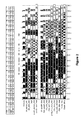
- a set of subtasks with the properties are shown in Table 1 - a small snippet of the Reconstruct module, as mentioned above, while decoding real video.
- the top rows of Fig 2 show the scheduling of these subtasks using the existing techniques previously discussed.
- the bottom rows are the schedules generated by using different combinations of the proposed features of the present invention.
- the arrows at the top and bottom show the release times and deadlines, respectively.
- the mode of the processor before time 0 is M1, the highest mode.
- the NoKnobs row shows the schedule without any knob tuning.
- the white spaces indicate the idle periods due to lack of ready subtasks and the 'S' rectangles indicate the time lost due to mode switching.
- SW# indicates the scheduling window size, i.e., number of subtasks considered together during the optimization. The counter intuitiveness is typical of nonlinear optimization in Oracle SW4/10.
- 1pLDAT[6] uses re-optimization at the end of every job (100 ⁇ sec) to reclaim and redistribute the slack released and, to keep the overhead small, it considers jobs only till the latest common deadline.
- subtasks are considered beyond a single deadline and reoptimization is performed dynamically and incrementally, i.e., only when the resolved uncertainties makes it essential or enable energy gains, so that the run-time overhead is small.
- the reoptimization procedure is carried out by the pro-active controller.
- the information from the previous optimization is maximally reused as the changes are often incremental.
- the optimization procedure not only gives the mode list as output but also the conditions for revising the decisions and indication to the methods for doing it effectively along with the data needed for them.
- SR_noUBR_SW4 bar in Fig 2 shows the resulting schedule with optimization horizon 4 and a receding horizon of 1, i.e., re-optimization is performed after completion of every subtask. Note the less switching and suppression of higher mode M1 for subtasks 12 & 13, compared to SR_noUBR_SW1.
- SR_noUBR_SW1 When upper bounds are loose, naive future look-ahead even with receding horizon may lead to a poorer result (c.f.r. subtask 9 & 10) as the optimizer is deceived by the uncertainties due to its inability to realize that more slack will be available as execution progresses. To circumvent this it is needed to either tighten the upper bounds or steal the slack from the future time slots (see future slack stealing section below) or both. This is discussed below.
- the System Scenarios methodology is reused presented in [7] which exploits the correlations between a subtask's properties (or input data) and its execution on deterministic/predictable architectures (such as the one in this example).
- the method basically clusters frequent subtasks which require similar execution cycles into a few frequently activated scenarios and the rest that is rarer into a backup scenario.
- each scenario is characterized for its upper bound execution cycles either using sophisticated worst case execution time estimation tools or designer identified corner-case simulation, thanks to deterministic architecture.
- the upper bound execution cycles info of each scenario is stored in a small look-up table (LUT) which is addressed using a customized hash function, called scenario detector, which is developed along with the clustering process.
- LUT small look-up table
- SR_UBR_SW1/4 shows the schedules with the refined upper bounds and optimal receding horizon (as discussed before) with a scheduling window of 1 and 4 subtasks respectively. Note that the refined upper bounds enabled lower mode for ST-1 in both cases and subtasks 11 - 18 in SW4 case.
- SR_UBR_SW1 is very similar to the one used in [7]; due to its local view it results in costlier modes more often than it improves (c.f.r. subtasks 5 - 7).
- Typical scheduling techniques are always conservative, i.e., assume upper bound execution cycles as the actual execution cycles (AEC) while performing the knob decisions. This ensures that timing deadlines are met without rescheduling even when all the subtasks optimized together turn out to be the worst-case. Thus the resulting modes are optimal for this rarely occurring case.
- the upper bounds are not very tight, such techniques are unable to find opportunities for switching due to insufficient available slack. In the light of the receding horizon, i.e., the possibility to revise decisions as uncertainties get resolved, more slack can be consumed in the first place than normally would be done.
- This technique is called future slack stealing (FSS), as more slack is consumed only in anticipation of the equivalent amount of slack being released by the time it is needed. This can be carried out by the pro-active controller.
- FSS future slack stealing
- a scheduler always ensures that a feasible schedule exists even when the expected slack is not released. But the resulting schedule would incur an energy penalty that is higher than the expected increase in the gains.
- Future slack stealing is a form of risk-taking and is the underlying concept of speculative speed reduction [5] and look-ahead dynamic voltage scaling [10].
- Speculative speed reduction (AGR) of [5] uses all future slack along with the already available slack to extend the current subtask at hand, which would be suboptimal more often than not. This was indicated in [5] and the authors proposed a scaling factor to control the aggressiveness.
- [6] recommends use of design time average execution cycles of tasks to compute a limiting mode for task stretching. Unfortunately none of these methods are suitable for highly dynamic systems. Therefore, estimates are used to guide the process of future slack stealing and its allocation/consumption in accordance with the present invention, e.g.
- Energy performance scaling includes all constraints (such as non-overlapping start and end times) of DS but uses "expected execution cycles” instead of upper bound execution cycles for computing duration of subtasks.
- schedule feasibility energy performance scaling includes an additional set of safety constraints: start time of any subtask is not stretched beyond LatestStart which ensures there is enough time, including room for switching overhead, to finish all the later subtasks using their highest modes before their deadlines even when the current and future subtasks need upper bound execution cycles.
- Optimal future slack stealing requires actual execution cycles of subtasks which is not known before hand. Real activity of subtasks is also needed for better estimation of subtask's energy consumption which are required in making the right knob decisions.
- predicted values are used for all relevant uncertainties (AEC, activity, arrival times and properties of future subtasks, etc).
- the scheduler is aware that these values are not 100% accurate and they are not safe enough. It still relies on upper bounds to guarantee all hard constraints.
- These estimates are used to optimize the knob settings for the expected reality, in contrast to the statistical optimization and optimizing for the worst-case or average case. This is carried out by the pro-active controller and/or the predictor. The better the accuracy of these predictions the better the gains.
- the present invention envisages a predictor which is specialized for video by exploiting the meta-data available in the content headers and the correlations of moving objects across frames (see Fig. 8 ).
- a simple predictor (sm4) is used: for each scenario (see section C. above) it maintains the actual execution cycles of 4 recent macroblocks and returns maximum of these as the estimated value. Prediction is only needed for those scenarios where the upper bounds are not too tight.
- the scheduler while utilizing estimates, the scheduler takes controlled risk of allocating less time budget to a subtask than the subtask might actually utilize in worst-case while still guaranteeing the deadlines of both current and future subtasks.
- the pro-controller speculatively runs the subtasks at slower modes (c.f.r. subtasks 1-3 in FSS_UBR_SW2/4 rows, compared to SR_UBR_SW4) which will be optimal when estimates are correct.
- FSS_UBR_SW4 shows what happens when the estimates are incorrect.
- the simple, same as previous, estimator in this experiment predicted very low actual execution cycles for subtasks 4 - 6 and as a result the scheduler switched to M3 for subtask-4.
- a highly customized dynamic procedure is used.
- the main idea is that the complex optimization with large horizon does not always need to be solved; even smaller values gives decent, sometimes even better (due to finite horizon deceptiveness typical of uncertain optimization), result, without negative future consequences, in some cases (for subtasks 1 - 15 in FSS_UBR_SW2 is good enough but SW4 is needed at subtask-16). If the system switches between methods of different complexities at the right moment in time, the average run-time overhead of the optimization can significantly be reduced without noticeable sub-optimality.
- Typical scheduling algorithms are today implemented as a static procedure, i.e., it performs same computation each time it is invoked, in other words it is stateless. The reason is that they are not meant for receding horizon optimization and assume that each time they might get entirely different subtasks to schedule.
- the procedures used are enhanced with state, to reduce their average complexity, by remembering and reusing the computations across repeated invocations of the same procedure (see section B. above).
- a complexity model is associated with the procedure which indicates when it would take more computations, e.g. at the initialization or when some of the data (like estimates) used in previous invocation changed significantly.
- a procedure is always "safe", i.e., it ensures that all the constraints of subtasks are met with the modes recommended by it.
- the quality of a given procedure is defined as the energy gains (of the system being controlled) achieved by applying this procedure. It is important to note that the quality of a procedure is dynamic, i.e., under certain conditions the quality is very high but poorer in other cases, and hence a quality model is maintained.
- the complexity and quality models (typically look-up tables based on generic scenarios concept) will be used at run-time to evaluate a given procedure for the dynamic scheduling instance at hand. Multiple such procedures are maintained, each with different quality-complexity tradeoffs.
- a dynamic procedure is the one which uses different state-enhanced procedures at different time instances which are selected based on the quality-complexity trade-offs for the given dynamic scheduling instance at hand, within the time available for the knob decision making.
- an implementation of the present invention includes a processor or central processing unit (CPU) which may be a microprocessor, an ASIC, a programmable field array such as an FPGA or similar processing engine.
- the processor may be embedded.
- the processor may include a controller or the controller may be a separate item in communication with the processor.
- the controller may be implemented as a software algorithm running on the processor or may be implemented as a microprocessor, a microcontroller, an ASIC, a programmable field array such as an FPGA or similar processing engine.
- the processor and the controller manage the operation of a hard real time electronic digital system, by exploiting task information determined by a predictor. Also a memory is provided such as a DRAM.
- the controller is adapted to select a current working mode for the set of tasks for executing the tasks from a set of working modes based on upper bound information of the tasks and a condition for revising a working mode of the system.
- the controller is adapted to run a dynamical procedure that outputs an improved working mode for the tasks from the set of working modes and one or more conditions for revising the working mode, depending on overhead and constraints information of at least one completed task and at least one to be completed task determined by the predictor.
- the output can be provided to the processor.
- the above procedure is part of a refinement procedure.
- the controller or the processor are adapted to implement the current working mode of the improved working mode of tasks on the system depending on the one or more conditions for revising the working mode.
- the system may include a predictor, and the controller and/or the predictor may be adapted to determine the upper bound of the tasks:
- the controller can be adapted to carry out the re-optimization procedure that outputs the improved working mode or modes for the tasks, based on the amount of slack of the tasks.
- the controller and/or the predictor can determine the amount of slack of the tasks depending on:
- the controller can be adapted to select a working mode at run-time using an energy/execution-time look-up table of the electronic system determined at design-time.
- the look-up table is preferably stored in memory that is accessible by the controller and/or the processor.
- the look-up table preferably contain an extreme working mode which the controller can select at run-time depending on timing, thermal and reliability constraints of the system using pre-defined models at design time.
- the controller and/or the predictor can be adapted to determine overhead and constraints information by using optimized and adaptive application-, context-, and content-specific predictors for better accuracy at low overhead.
- the controller can be adapted to use dynamically state-enhanced procedures at different time instances which are selected based on a quality-complexity trade-off.
- the present invention also includes a computer program product that when executed on a processing engine manages the operation of a hard real time electronic digital system, by exploiting task information determined by a predictor.
- the computer program product includes software that is adapted such that when a new task is received by the processor, then for a set of tasks to be run on the electronic system including a new task, a current working mode for the set of tasks is selected for executing the tasks from a set of working modes based on upper bound information of the tasks and a condition for revising a working mode of the system.
- the software can be adapted to run a dynamical procedure that outputs an improved working mode for the tasks from the set of working modes and one or more conditions for revising the working mode, depending on overhead and constraints information of at least one completed task and at least one to be completed task determined by the predictor.
- the output can be provided to the processor.
- the above procedure is part of a refinement procedure.
- the software can be adapted to implement the current working mode of the improved working mode of tasks on the system depending on the one or more conditions for revising the working mode.
- the system may include a predictor, and the software may be adapted to determine the upper bound of the tasks:
- the software can be adapted to carry out the re-optimization procedure that outputs the improved working mode or modes for the tasks, based on the amount of slack of the tasks.
- the software can determine the amount of slack of the tasks depending on:
- the software can be adapted to select a working mode at run-time using an energy/execution-time look-up table of the electronic system determined at design-time.
- the look-up table is preferably stored in memory that is accessible by the computer program product.
- the look-up table preferably contains an extreme working mode which the software can select at run-time depending on timing, thermal and reliability constraints of the system using pre-defined models at design time.
- the software can be adapted to determine overhead and constraints information by using optimized and adaptive application-, context-, and content-specific predictors for better accuracy at low overhead.
- the software can be adapted to use dynamically state-enhanced procedures at different time instances which are selected based on a quality-complexity trade-off.
- the computer program product may be stored on a non-transitory computer-readable storage medium with an executable program stored thereon, wherein the program instructs the operation of a hard real time system by exploiting task information determined by a predictor.
- the medium may be, for example, a magnetic disk such as a diskette, or a hard drive, an optical disk such as a CDROM or a DVD ROM, a magnetic tape, a solid state memory such as a USB memory stick or RAM, or any other suitable digital electronic memory or storage medium.
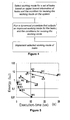
- Fig 3 shows the comparison between various fine-grain scheduling techniques for the Reconstruct module of Fig 1(b) .
- the energy consumption data is averaged over scheduling of large number of macroblocks: 2 sec of video in each of four different 720p video sequences (crew, crowd, jets, city). All the gains are shown as a factor with respect to NoKnobs case, which consumes an average power of 450 mw.
- the Oracle SW10 bar shows the theoretical gains which is the target to reach.
- the bars left of the Oracle are the existing techniques and to the right are the techniques of the proposed framework in accordance with embodiments of the present invention.
- DynProc switches between four procedures sm4FSS_UBR_SW2/4 and SR_UBR_SW1/4.
- the implemented procedures for * _SW2 are exact solutions where as for * _SW4 incorporate typical dynamic-voltage scaling-like heuristics such as trying to find a single common mode with a switching only at the beginning or two adjacent modes with an additional switching in between.
- * _SW4 incorporate typical dynamic-voltage scaling-like heuristics such as trying to find a single common mode with a switching only at the beginning or two adjacent modes with an additional switching in between.
- Each of these have been enhanced to reuse maximum computations across invocations and implemented with couple of predicates or gating conditions before major pieces of computations inside the procedure.
- DynProc results in more than 2x energy gains, i.e., it saves more than 200mw, where as it requires ⁇ 10 mw.
- the overhead of the proposed practical DynProc proactive scheduler is ⁇ 5%.
Landscapes
- Engineering & Computer Science (AREA)
- Software Systems (AREA)
- Theoretical Computer Science (AREA)
- Physics & Mathematics (AREA)
- General Engineering & Computer Science (AREA)
- General Physics & Mathematics (AREA)
- Power Sources (AREA)
- Hardware Redundancy (AREA)
Applications Claiming Priority (1)
| Application Number | Priority Date | Filing Date | Title |
|---|---|---|---|
| US14704509P | 2009-01-23 | 2009-01-23 |
Publications (2)
| Publication Number | Publication Date |
|---|---|
| EP2219112A2 true EP2219112A2 (de) | 2010-08-18 |
| EP2219112A3 EP2219112A3 (de) | 2012-08-15 |
Family
ID=42312721
Family Applications (1)
| Application Number | Title | Priority Date | Filing Date |
|---|---|---|---|
| EP10151485A Withdrawn EP2219112A3 (de) | 2009-01-23 | 2010-01-22 | Verfahren und System für den Betrieb in harter Echtzeit |
Country Status (2)
| Country | Link |
|---|---|
| US (1) | US8856791B2 (de) |
| EP (1) | EP2219112A3 (de) |
Cited By (2)
| Publication number | Priority date | Publication date | Assignee | Title |
|---|---|---|---|---|
| EP3035254A1 (de) * | 2014-12-18 | 2016-06-22 | Stichting IMEC Nederland | Verfahren zur Verwaltung des Betriebs eines elektronischen Systems mit garantierter Lebensdauer |
| FR3096482A1 (fr) * | 2019-06-21 | 2020-11-27 | Orange | Procédé pour contrôler l’admission d’au moins une tâche temps réel à être exécutée |
Families Citing this family (16)
| Publication number | Priority date | Publication date | Assignee | Title |
|---|---|---|---|---|
| KR101282139B1 (ko) | 2006-09-11 | 2013-07-04 | 삼성전자주식회사 | 별도 버튼을 이용하여 성능모드 변경이 가능한컴퓨터시스템 및 그 제어방법 |
| JP5448032B2 (ja) * | 2008-12-25 | 2014-03-19 | インターナショナル・ビジネス・マシーンズ・コーポレーション | リソース管理装置、リソース管理プログラム、およびリソース管理方法 |
| US9098331B2 (en) * | 2011-06-29 | 2015-08-04 | Telefonaktiebolaget L M Ericsson (Publ) | Joint scheduling of multiple processes on a shared processor |
| US9471373B2 (en) | 2011-09-24 | 2016-10-18 | Elwha Llc | Entitlement vector for library usage in managing resource allocation and scheduling based on usage and priority |
| US9298918B2 (en) | 2011-11-30 | 2016-03-29 | Elwha Llc | Taint injection and tracking |
| US8813085B2 (en) | 2011-07-19 | 2014-08-19 | Elwha Llc | Scheduling threads based on priority utilizing entitlement vectors, weight and usage level |
| US9575903B2 (en) | 2011-08-04 | 2017-02-21 | Elwha Llc | Security perimeter |
| US9098608B2 (en) | 2011-10-28 | 2015-08-04 | Elwha Llc | Processor configured to allocate resources using an entitlement vector |
| US8930714B2 (en) | 2011-07-19 | 2015-01-06 | Elwha Llc | Encrypted memory |
| US9443085B2 (en) | 2011-07-19 | 2016-09-13 | Elwha Llc | Intrusion detection using taint accumulation |
| US9558034B2 (en) | 2011-07-19 | 2017-01-31 | Elwha Llc | Entitlement vector for managing resource allocation |
| US8955111B2 (en) | 2011-09-24 | 2015-02-10 | Elwha Llc | Instruction set adapted for security risk monitoring |
| US9460290B2 (en) | 2011-07-19 | 2016-10-04 | Elwha Llc | Conditional security response using taint vector monitoring |
| US9170843B2 (en) * | 2011-09-24 | 2015-10-27 | Elwha Llc | Data handling apparatus adapted for scheduling operations according to resource allocation based on entitlement |
| US9798873B2 (en) | 2011-08-04 | 2017-10-24 | Elwha Llc | Processor operable to ensure code integrity |
| US9465657B2 (en) | 2011-07-19 | 2016-10-11 | Elwha Llc | Entitlement vector for library usage in managing resource allocation and scheduling based on usage and priority |
Family Cites Families (10)
| Publication number | Priority date | Publication date | Assignee | Title |
|---|---|---|---|---|
| WO2000050991A2 (en) | 1999-02-26 | 2000-08-31 | Liquimedia, Inc. | Method and apparatus for scheduling program code in a computer system |
| US7234126B2 (en) | 2000-08-23 | 2007-06-19 | Interuniversitair Microelektronica Centrum | Task concurrency management design method |
| EP1433054A2 (de) | 2000-12-29 | 2004-06-30 | Honeywell International, Inc. | Verfahren und gerät zum stehlen von spielraum mit dynamischen threads |
| US20060114836A1 (en) | 2004-08-20 | 2006-06-01 | Sofie Pollin | Method for operating a combined multimedia -telecom system |
| US8228952B2 (en) | 2003-08-22 | 2012-07-24 | Imec | Method for operating a telecom system |
| US8578312B2 (en) | 2004-03-30 | 2013-11-05 | Imec | Method and apparatus for designing and manufacturing electronic circuits subject to leakage problems caused by temperature variations and/or aging |
| GB0407070D0 (en) | 2004-03-30 | 2004-05-05 | Imec Inter Uni Micro Electr | A method for designing digital circuits, especially suited for deep submicron technologies |
| EP1607887A3 (de) | 2004-06-18 | 2012-01-25 | Imec | Energiebewusste konfigurierbare Treiberschaltunge für an einer Belastung angeschlossenen Leitung |
| WO2006114642A1 (en) * | 2005-04-28 | 2006-11-02 | The University Court Of The University Of Edinburgh | Reconfigurable instruction cell array |
| US8437369B2 (en) * | 2006-05-19 | 2013-05-07 | Integrated Device Technology, Inc. | Packets transfer device that intelligently accounts for variable egress channel widths when scheduling use of dispatch bus by egressing packet streams |
-
2010
- 2010-01-22 EP EP10151485A patent/EP2219112A3/de not_active Withdrawn
- 2010-01-22 US US12/692,391 patent/US8856791B2/en active Active
Non-Patent Citations (10)
Cited By (3)
| Publication number | Priority date | Publication date | Assignee | Title |
|---|---|---|---|---|
| EP3035254A1 (de) * | 2014-12-18 | 2016-06-22 | Stichting IMEC Nederland | Verfahren zur Verwaltung des Betriebs eines elektronischen Systems mit garantierter Lebensdauer |
| US20160179577A1 (en) * | 2014-12-18 | 2016-06-23 | Stichting Imec Nederland | Method of Managing the Operation of an Electronic System with a Guaranteed Lifetime |
| FR3096482A1 (fr) * | 2019-06-21 | 2020-11-27 | Orange | Procédé pour contrôler l’admission d’au moins une tâche temps réel à être exécutée |
Also Published As
| Publication number | Publication date |
|---|---|
| US8856791B2 (en) | 2014-10-07 |
| EP2219112A3 (de) | 2012-08-15 |
| US20100191349A1 (en) | 2010-07-29 |
Similar Documents
| Publication | Publication Date | Title |
|---|---|---|
| US8856791B2 (en) | Method and system for operating in hard real time | |
| Zhu et al. | Dirigent: Enforcing QoS for latency-critical tasks on shared multicore systems | |
| US20100332876A1 (en) | Reducing power consumption of computing devices by forecasting computing performance needs | |
| Raghunathan et al. | Adaptive power-fidelity in energy-aware wireless embedded systems | |
| Feliu et al. | Symbiotic job scheduling on the IBM POWER8 | |
| Bhatti et al. | An inter-task real time DVFS scheme for multiprocessor embedded systems | |
| She et al. | Precise scheduling of mixed-criticality tasks on varying-speed multiprocessors | |
| Kumar et al. | Predictive strategies for low-power rtos scheduling | |
| Kanoun et al. | Online energy-efficient task-graph scheduling for multicore platforms | |
| Shin et al. | Intra-task voltage scheduling on DVS-enabled hard real-time systems | |
| Park et al. | Predictable high-performance computing using feedback control and admission control | |
| Aminifar et al. | Analysis and design of real-time servers for control applications | |
| Valente et al. | Development of multi-level adaptive control and scheduling solutions for shop-floor automation in reconfigurable manufacturing systems | |
| Sinha et al. | PAStime: Progress-aware scheduling for time-critical computing | |
| Azhar et al. | SaC: Exploiting execution-time slack to save energy in heterogeneous multicore systems | |
| Azhar et al. | SLOOP: QoS-supervised loop execution to reduce energy on heterogeneous architectures | |
| Maity et al. | Thermal load-aware adaptive scheduling for heterogeneous platforms | |
| Digalwar et al. | LAMCS: A leakage aware DVFS based mixed task set scheduler for multi-core processors | |
| Chen et al. | Adaptive dynamic power management for hard real-time pipelined multiprocessor systems | |
| Borin et al. | Dynamic power management under the run scheduling algorithm: a slack filling approach | |
| Krishna | Global voltage scaling across multiple cores for real-time workloads | |
| Lee et al. | A design framework for real-time embedded systems with code size and energy constraints | |
| Baital et al. | Energy efficient dynamic scheduling of dependent tasks for multi‐core real‐time systems using delay techniques | |
| US8966300B2 (en) | DFVS-enabled multiprocessor | |
| Song et al. | Prediction-Guided Performance-Energy Trade-off with Continuous Run-Time Adaptation |
Legal Events
| Date | Code | Title | Description |
|---|---|---|---|
| PUAI | Public reference made under article 153(3) epc to a published international application that has entered the european phase |
Free format text: ORIGINAL CODE: 0009012 |
|
| AK | Designated contracting states |
Kind code of ref document: A2 Designated state(s): AT BE BG CH CY CZ DE DK EE ES FI FR GB GR HR HU IE IS IT LI LT LU LV MC MK MT NL NO PL PT RO SE SI SK SM TR |
|
| AX | Request for extension of the european patent |
Extension state: AL BA RS |
|
| PUAL | Search report despatched |
Free format text: ORIGINAL CODE: 0009013 |
|
| AK | Designated contracting states |
Kind code of ref document: A3 Designated state(s): AT BE BG CH CY CZ DE DK EE ES FI FR GB GR HR HU IE IS IT LI LT LU LV MC MK MT NL NO PL PT RO SE SI SK SM TR |
|
| AX | Request for extension of the european patent |
Extension state: AL BA RS |
|
| RIC1 | Information provided on ipc code assigned before grant |
Ipc: G06F 9/48 20060101AFI20120712BHEP Ipc: G06F 1/32 20060101ALN20120712BHEP |
|
| 17P | Request for examination filed |
Effective date: 20130215 |
|
| STAA | Information on the status of an ep patent application or granted ep patent |
Free format text: STATUS: THE APPLICATION IS DEEMED TO BE WITHDRAWN |
|
| 18D | Application deemed to be withdrawn |
Effective date: 20140801 |