EP2216361A1 - Method for manufacturing porous polymer molded article - Google Patents
Method for manufacturing porous polymer molded article Download PDFInfo
- Publication number
- EP2216361A1 EP2216361A1 EP08855358A EP08855358A EP2216361A1 EP 2216361 A1 EP2216361 A1 EP 2216361A1 EP 08855358 A EP08855358 A EP 08855358A EP 08855358 A EP08855358 A EP 08855358A EP 2216361 A1 EP2216361 A1 EP 2216361A1
- Authority
- EP
- European Patent Office
- Prior art keywords
- molded article
- polymer molded
- mask
- etching
- porous
- Prior art date
- Legal status (The legal status is an assumption and is not a legal conclusion. Google has not performed a legal analysis and makes no representation as to the accuracy of the status listed.)
- Withdrawn
Links
Images



Classifications
-
- B—PERFORMING OPERATIONS; TRANSPORTING
- B01—PHYSICAL OR CHEMICAL PROCESSES OR APPARATUS IN GENERAL
- B01D—SEPARATION
- B01D67/00—Processes specially adapted for manufacturing semi-permeable membranes for separation processes or apparatus
- B01D67/0002—Organic membrane manufacture
- B01D67/0023—Organic membrane manufacture by inducing porosity into non porous precursor membranes
- B01D67/0032—Organic membrane manufacture by inducing porosity into non porous precursor membranes by elimination of segments of the precursor, e.g. nucleation-track membranes, lithography or laser methods
- B01D67/0034—Organic membrane manufacture by inducing porosity into non porous precursor membranes by elimination of segments of the precursor, e.g. nucleation-track membranes, lithography or laser methods by micromachining techniques, e.g. using masking and etching steps, photolithography
-
- B—PERFORMING OPERATIONS; TRANSPORTING
- B01—PHYSICAL OR CHEMICAL PROCESSES OR APPARATUS IN GENERAL
- B01D—SEPARATION
- B01D67/00—Processes specially adapted for manufacturing semi-permeable membranes for separation processes or apparatus
- B01D67/0002—Organic membrane manufacture
- B01D67/0023—Organic membrane manufacture by inducing porosity into non porous precursor membranes
-
- B—PERFORMING OPERATIONS; TRANSPORTING
- B01—PHYSICAL OR CHEMICAL PROCESSES OR APPARATUS IN GENERAL
- B01D—SEPARATION
- B01D71/00—Semi-permeable membranes for separation processes or apparatus characterised by the material; Manufacturing processes specially adapted therefor
- B01D71/06—Organic material
- B01D71/48—Polyesters
- B01D71/481—Polyarylates
-
- B—PERFORMING OPERATIONS; TRANSPORTING
- B29—WORKING OF PLASTICS; WORKING OF SUBSTANCES IN A PLASTIC STATE IN GENERAL
- B29C—SHAPING OR JOINING OF PLASTICS; SHAPING OF MATERIAL IN A PLASTIC STATE, NOT OTHERWISE PROVIDED FOR; AFTER-TREATMENT OF THE SHAPED PRODUCTS, e.g. REPAIRING
- B29C67/00—Shaping techniques not covered by groups B29C39/00 - B29C65/00, B29C70/00 or B29C73/00
- B29C67/20—Shaping techniques not covered by groups B29C39/00 - B29C65/00, B29C70/00 or B29C73/00 for porous or cellular articles, e.g. of foam plastics, coarse-pored
-
- B—PERFORMING OPERATIONS; TRANSPORTING
- B01—PHYSICAL OR CHEMICAL PROCESSES OR APPARATUS IN GENERAL
- B01D—SEPARATION
- B01D2323/00—Details relating to membrane preparation
- B01D2323/42—Details of membrane preparation apparatus
-
- Y—GENERAL TAGGING OF NEW TECHNOLOGICAL DEVELOPMENTS; GENERAL TAGGING OF CROSS-SECTIONAL TECHNOLOGIES SPANNING OVER SEVERAL SECTIONS OF THE IPC; TECHNICAL SUBJECTS COVERED BY FORMER USPC CROSS-REFERENCE ART COLLECTIONS [XRACs] AND DIGESTS
- Y10—TECHNICAL SUBJECTS COVERED BY FORMER USPC
- Y10T—TECHNICAL SUBJECTS COVERED BY FORMER US CLASSIFICATION
- Y10T428/00—Stock material or miscellaneous articles
- Y10T428/24—Structurally defined web or sheet [e.g., overall dimension, etc.]
- Y10T428/24273—Structurally defined web or sheet [e.g., overall dimension, etc.] including aperture
Definitions
- the present invention relates to a method for manufacturing a porous polymer molded article.
- Organic polymer materials are molded into various shapes such as films, fibers, sheets and particles for use in a variety of fields, according to their characteristic mechanical properties such as elastic modulus and strength, chemical properties such as solvent solubility, hydrophilicity and hydrophobicity, and thermal properties such as heat resistance. Methods of forming pores in molded articles composed of organic polymer materials are also being studied.
- Patent documents 1-3 disclose the use of photoresists with different patterns as masks for etching of organic polymer molded articles such as polyimide films.
- Patent documents 4 and 5 disclose methods of forming pores in embossed sections of plastic films.
- Patent document 6 there is disclosed a method of forming through-holes in a plastic sheet having a surface provided with a metal foil with an opening, by irradiation with excimer laser light.
- Patent document 7 there is disclosed a method of forming micropores in a thin sheet material by fluid sound waves.
- Patent documents 1-3 make use of wet etching and are therefore associated with the problem of waste solvent treatment.
- Patent documents 4-7 tend to entail complex steps for pore formation.
- the invention provides a method for manufacturing a porous polymer molded article, comprising a step of laminating a first mask with a plurality of openings formed therein, and a second mask with a plurality of openings formed therein and having a mean opening diameter that is larger than the mean opening diameter of the first mask, in that order on a polymer molded article, and a step of forming through-holes in the polymer molded article by dry etching from the second mask side.
- the method for manufacturing a porous polymer molded article requires the use of two different masks with different mean opening diameters.
- By laminating the second mask on the first mask it is possible to attach the first mask to the polymer molded article firmly. This can help maintain flatness of the first mask and polymer molded article during dry etching, for more effective etching in the perpendicular direction. It also allows reliable formation of through-holes of the desired size in the porous polymer molded article, based on the opening diameters of the first mask. With this production method, therefore, it is possible to form through-holes in a polymer molded article by a simple process, without the complex steps of the prior art and without generating waste liquid as with wet etching.
- the polymer molded article is preferably a polymer molded article comprising polyglycolic acid.
- a polymer molded article will allow easier formation of through-holes by dry etching.
- polyglycolic acid is a biodegradable polymer, the obtained porous polymer molded article can be used as a culture substrate for viable cells.
- the dry etching in the method for manufacturing a porous polymer molded article according to the invention is preferably argon ion etching.
- Argon ion etching is highly suitable for etching in the perpendicular direction, and will therefore allow formation of a porous polymer molded article with through-holes having ordered etched shapes.
- the invention further provides a porous body obtainable by the method for manufacturing a porous polymer molded article as described above.
- a porous body comprises fine-sized through-holes.
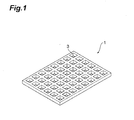
- Fig. 1 is a perspective view of an embodiment of a porous polymer molded article obtained by the manufacturing method of the invention.
- the method for manufacturing a porous polymer molded article according to the invention comprises a step of laminating a first mask with a plurality of openings formed therein, and a second mask with a plurality of openings formed therein and having a mean opening diameter that is larger than the mean opening diameter of the first mask, in that order on a polymer molded article, and a step of forming through-holes in the polymer molded article by dry etching from the second mask side.
- Fig. 1 is a perspective view of an embodiment of a porous polymer molded article obtained by the manufacturing method of the invention.
- the porous polymer molded article 1 shown in Fig. 1 is in the shape of a film, and a plurality of through-holes 3 are formed in the direction of its thickness. The through-holes 3 are independently and regularly arranged.
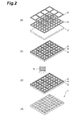
- the porous polymer molded article 1 shown in Fig. 1 can be formed by the process illustrated in Fig. 2.
- Fig. 2 is a process drawing showing a perspective view of an embodiment of the method for manufacturing a porous polymer molded article according to the invention. First, a polymer molded article 2, first mask 4 and second mask 6 are prepared ( Fig. 2(a) ).
- the first mask 4 and second mask 6 are laminated in that order on the polymer molded article 2 ( Fig. 2(b) ).
- the second mask 6 is then irradiated with reactive gas or the like from a dry etching apparatus 8 for dry etching of the polymer molded article 2, to form through-holes in the polymer molded article 2 ( Fig. 2(c) ).
- the first and second masks are removed to produce a porous polymer molded article 1 with through-holes 3 formed therein ( Fig. 2(d) ).
- the polymer molded article 2 is any polymer shaped into a film, sheet or board, depending on the purpose of use.
- the polymer molded article 2 is more preferably in the form of a film from the viewpoint of facilitating dry etching.
- the film thickness is preferably 0.1-500 ⁇ m, more preferably 1-200 ⁇ m and even more preferably 2-50 ⁇ m.
- a polymer film thickness of less than 0.1 ⁇ m will tend to be poorly manageable, while a thickness of greater than 500 ⁇ m will tend to lengthen the etching time and hamper formation of fine-sized through-holes.
- polymer molded article 2 examples include polymer molded articles composed of polyimide, polyamide, polyethylene terephthalate, polycarbonate or polyglycolic acid.
- the polymer molded article 2 is preferably a molded article composed of polyglycolic acid, from the viewpoint of excellent dry etching properties.
- Polyglycolic acid (hereunder, "PGA") contains a glycolic acid homopolymer composed entirely of repeating units of glycolic acid represented by -(O-CH 2 -CO)-, or a glycolic acid copolymer including the aforementioned glycolic acid repeating unit.
- the polyglycolic acid is a glycolic acid copolymer, the above repeating unit is included at preferably 50 wt% or greater, more preferably 75 wt% or greater, even more preferably 90 wt% or greater and most preferably 99 wt% or greater.
- the glycolic acid copolymer is obtained by copolymerizing glycolic acid monomer with a comonomer, for example, a cyclic monomer such as ethylene oxalate (1,4-dioxane-2,3-dione), a lactide, a lactone (for example, ⁇ -propiolactone, ⁇ -butyrolactone, ⁇ -pivalolactone, ⁇ -butyrolactone, ⁇ -valerolactone, ⁇ -methyl- ⁇ -valerolactone or ⁇ -caprolactone), a carbonate (for example, trimethylene carbonate), an ether (for example, 1,3-dioxane), an ether ester (for example, dioxanone) or an amide (for example, ⁇ -caprolactam); or a hydroxycarboxylic acid such as lactic acid, 3-hydroxypropanoic acid, 3-hydroxybutanoic acid, 4-hydroxybutanoic acid or 6-hydroxycaproic acid
- the mean opening diameter of the second mask 6 is larger than the mean opening diameter of the first mask 4.
- the mean opening diameter is obtained by calculating the area of the opening formed on the surface, and determining the circular diameter of the opening area.
- the mean opening diameter of the second mask 6 is preferably 5-100 times, more preferably 7-60 times and even more preferably 8-20 times the mean opening diameter of the first mask 4. If the mean opening diameter of the second mask 6 is less than 5 times or greater than 100 times the mean opening diameter of the first mask 4, the effect of the invention will not be as readily exhibited.
- the mean opening diameter of the first mask is preferably 0.1-1000 ⁇ m and more preferably 1-100 ⁇ m. If the mean opening diameter of the first mask is less than 0.1 ⁇ m it will be difficult to form the through-holes, and if it is greater than 100 ⁇ m the formed through-holes will be too large.
- the mean opening diameter of the second mask is preferably 200-5000 ⁇ m and more preferably 400-2500 ⁇ m. If the mean opening diameter of the second mask is less than 200 ⁇ m it may not be possible to obtain through-holes corresponding to the opening diameters of the first mask, and if it is greater than 5000 ⁇ m the adhesiveness between the first mask and polymer molded article will tend to be reduced.
- the "mesh number" may be indicated instead of the mean opening diameter.
- the mesh is the number of filaments of the mesh within 1 inch (2.54 ⁇ 10 4 ⁇ m), and a larger mesh number corresponds to a finer mesh.
- Fig. 3 shows a schematic view of a plain weave mesh 10.
- the distance between filaments is the aperture 12, and the aperture 12 can be calculated from the mesh number and the filament diameter 14, as represented by the following formula (1).
- the aperture 12 roughly corresponds to the mean opening diameter, and a suitable mesh number may be selected based on the aperture.
- Aperture ⁇ m 2.54 ⁇ 10 4 / mesh number ⁇ filament diameter ⁇ m
- the materials for the first and second mask preferably have large etching selection ratios with the polymer molded article, and they may be appropriately selected according to the type of polymer molded article.
- silica-based, fluorinated polymer-based, metal-based, polyester-based or polyamide-based masks may be used.
- the first and second masks are preferably made of the same material and more preferably the first and second masks are metal masks of SUS or the like.
- the thickness of the second mask is preferably larger than the thickness of the first mask.
- Dry etching is a method of etching materials with reactive gas, ions, radicals, a polishing agent or the like.
- the dry etching employed may be any of various known methods, such as plasma etching, ion etching or focused ion beam etching.
- Ion etching is a method of etching a solid surface using helium (He), argon (Ar), neon (Ne), or an inert gas comprising a combination of these.
- Reactive ion etching (RIE) is more preferred according to the invention, and argon ion etching using argon gas is even more preferred, because these allow perpendicular etching and can form through-holes with regular etching shapes.
- the etching time is preferably from 30 seconds to 36 hours, more preferably from 1 minute to 14 hours and even more preferably from 1 minute to 7 hours. An etching time of shorter than 30 seconds will not easily form through-holes, while an etching time of longer than 36 hours will not be very suitable for industrial production.
- the degree of vacuum during etching is preferably no greater than 50 mTorr and even more preferably no greater than 40 mTorr.
- a sample was prepared by laminating a 300 mesh SUS mesh (trade name: “Twill Weave Wire Mesh” by Taiyo Wire Cloth Co., Ltd.) as the first mask and a 60 mesh SUS mesh (trade name: “Plain Weave Wire Mesh” by Taiyo Wire Cloth Co., Ltd.) as the second mask in that order on a 4 ⁇ m-thick polyglycolic acid (hereunder, "PGA") film.
- the sample was set in the bell jar of an etching apparatus (trade name: "IE-10” by Aikoh Engineering Co., Ltd.).
- argon gas was injected in to adjust the degree of vacuum to about 40 mTorr (with adjustment of the argon gas injection rate for the set current value at a voltage of 1.5 kV), while the PGA film was etched for 15 minutes from above a 60 mesh SUS mesh, to fabricate a porous PGA film.
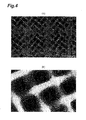
- Fig. 4 shows an SEM photograph of the obtained porous PGA film taken from the etching front side
- Fig. 5 shows an SEM photograph taken from the etching back side.
- a porous PGA film was fabricated by the same procedure as Example 1, except for using a 40 mesh SUS mesh (trade name: "Plain Weave Wire Mesh” by Taiyo Wire Cloth Co., Ltd.) instead of the 60 mesh SUS mesh as the second mask, and the PGA film was etched for 20 minutes.
- Fig. 6 shows an SEM photograph of the obtained porous PGA film taken from the etching front side
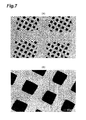
- Fig. 7 shows an SEM photograph taken from the etching back side.
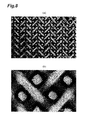
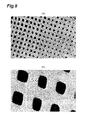
- a porous PGA film was fabricated by the same procedure as Example 1, except that no 60 mesh SUS mesh was used, and the PGA film was etched for 15 minutes.
- Fig. 8 shows an SEM photograph of the obtained porous PGA film taken from the etching front side
- Fig. 9 shows an SEM photograph taken from the etching back side.
- porous polymer molded article according to the invention can form fine-sized through-holes in a polymer molded article by a simple process, without complex steps such as employed in photoresist processes.
- a porous PGA film fabricated in the manner described above can also be used as a culture substrate for viable cells or a moisture permeable waterproof material.
Landscapes
- Chemical & Material Sciences (AREA)
- Chemical Kinetics & Catalysis (AREA)
- Engineering & Computer Science (AREA)
- Manufacturing & Machinery (AREA)
- Physics & Mathematics (AREA)
- Optics & Photonics (AREA)
- Mechanical Engineering (AREA)
- Manufacture Of Porous Articles, And Recovery And Treatment Of Waste Products (AREA)
- Treatments Of Macromolecular Shaped Articles (AREA)
- Laminated Bodies (AREA)
Abstract
Description
- The present invention relates to a method for manufacturing a porous polymer molded article.
- Organic polymer materials are molded into various shapes such as films, fibers, sheets and particles for use in a variety of fields, according to their characteristic mechanical properties such as elastic modulus and strength, chemical properties such as solvent solubility, hydrophilicity and hydrophobicity, and thermal properties such as heat resistance. Methods of forming pores in molded articles composed of organic polymer materials are also being studied.
- Patent documents 1-3, for example, disclose the use of photoresists with different patterns as masks for etching of organic polymer molded articles such as polyimide films. Also, Patent documents 4 and 5 disclose methods of forming pores in embossed sections of plastic films. In Patent document 6 there is disclosed a method of forming through-holes in a plastic sheet having a surface provided with a metal foil with an opening, by irradiation with excimer laser light. In Patent document 7 there is disclosed a method of forming micropores in a thin sheet material by fluid sound waves.
- [Patent document 1]
JP 09-296057 A - [Patent document 2]
JP 2001-305750 A - [Patent document 3]
JP 60-111243 A - [Patent document 4]
JP 62-267336 A - [Patent document 5]
JP 05-86216 A - [Patent document 6]
JP 05-15987 A - [Patent document 7]
JP 06-198598 A - The methods described in Patent documents 1-3 make use of wet etching and are therefore associated with the problem of waste solvent treatment. The methods described in Patent documents 4-7 tend to entail complex steps for pore formation.
- It is therefore an object of the present invention to provide a method for manufacturing a porous polymer molded article that allows formation of through-holes in polymer molded articles by a simple process, as well as porous bodies obtained by the method.
- The invention provides a method for manufacturing a porous polymer molded article, comprising a step of laminating a first mask with a plurality of openings formed therein, and a second mask with a plurality of openings formed therein and having a mean opening diameter that is larger than the mean opening diameter of the first mask, in that order on a polymer molded article, and a step of forming through-holes in the polymer molded article by dry etching from the second mask side.
- The method for manufacturing a porous polymer molded article requires the use of two different masks with different mean opening diameters. By laminating the second mask on the first mask, it is possible to attach the first mask to the polymer molded article firmly. This can help maintain flatness of the first mask and polymer molded article during dry etching, for more effective etching in the perpendicular direction. It also allows reliable formation of through-holes of the desired size in the porous polymer molded article, based on the opening diameters of the first mask. With this production method, therefore, it is possible to form through-holes in a polymer molded article by a simple process, without the complex steps of the prior art and without generating waste liquid as with wet etching.
- The polymer molded article is preferably a polymer molded article comprising polyglycolic acid. Such a polymer molded article will allow easier formation of through-holes by dry etching. Furthermore, because polyglycolic acid is a biodegradable polymer, the obtained porous polymer molded article can be used as a culture substrate for viable cells.
- The dry etching in the method for manufacturing a porous polymer molded article according to the invention is preferably argon ion etching. Argon ion etching is highly suitable for etching in the perpendicular direction, and will therefore allow formation of a porous polymer molded article with through-holes having ordered etched shapes.
- The invention further provides a porous body obtainable by the method for manufacturing a porous polymer molded article as described above. Such a porous body comprises fine-sized through-holes.
- According to the invention it is possible to provide a method for manufacturing a porous polymer molded article that allows formation of through-holes in polymer molded articles by a simple process, as well as porous bodies obtained by the method.
-
Fig. 1 is a perspective view of an embodiment of a porous polymer molded article obtained by the manufacturing method of the invention. -
Fig. 2 is a process drawing showing a perspective view of an embodiment of the method for manufacturing a porous polymer molded article according to the invention. -
Fig. 3 is a schematic view of a plain weave mesh. -
Fig. 4 is an SEM photograph of the porous PGA film obtained in Example 1, taken from the etching front side. -
Fig. 5 is an SEM photograph of the porous PGA film obtained in Example 1, taken from the etching back side. -
Fig. 6 is an SEM photograph of the porous PGA film obtained in Example 2, taken from the etching front side. -
Fig. 7 is an SEM photograph of the porous PGA film obtained in Example 2, taken from the etching back side. -
Fig. 8 is an SEM photograph of the porous PGA film obtained in Comparative Example 1, taken from the etching front side. -
Fig. 9 is an SEM photograph of the porous PGA film obtained in Comparative Example 1, taken from the etching back side. - 1: Porous polymer molded article, 2: polymer molded article, 3: through-hole, 4: first mask, 6: second mask, 8: dry etching apparatus, 10: plain weave mesh, 12: aperture, 14: filament diameter.
- Preferred embodiments of the invention will now be explained in detail, with reference to the accompanying drawings as necessary. Throughout the drawings, corresponding elements will be referred to by like reference numerals and will be explained only once. Unless otherwise specified, the vertical and horizontal positional relationships are based on the positional relationships in the drawings. Also, the dimensional proportions depicted in the drawings are not necessarily limitative.
- The method for manufacturing a porous polymer molded article according to the invention comprises a step of laminating a first mask with a plurality of openings formed therein, and a second mask with a plurality of openings formed therein and having a mean opening diameter that is larger than the mean opening diameter of the first mask, in that order on a polymer molded article, and a step of forming through-holes in the polymer molded article by dry etching from the second mask side.
-
Fig. 1 is a perspective view of an embodiment of a porous polymer molded article obtained by the manufacturing method of the invention. The porous polymer moldedarticle 1 shown inFig. 1 is in the shape of a film, and a plurality of through-holes 3 are formed in the direction of its thickness. The through-holes 3 are independently and regularly arranged. The porous polymer moldedarticle 1 shown inFig. 1 can be formed by the process illustrated inFig. 2. Fig. 2 is a process drawing showing a perspective view of an embodiment of the method for manufacturing a porous polymer molded article according to the invention. First, a polymer moldedarticle 2, first mask 4 and second mask 6 are prepared (Fig. 2(a) ). Next, the first mask 4 and second mask 6 are laminated in that order on the polymer molded article 2 (Fig. 2(b) ). The second mask 6 is then irradiated with reactive gas or the like from adry etching apparatus 8 for dry etching of the polymer moldedarticle 2, to form through-holes in the polymer molded article 2 (Fig. 2(c) ). Finally, the first and second masks are removed to produce a porous polymer moldedarticle 1 with through-holes 3 formed therein (Fig. 2(d) ). - The polymer molded
article 2 is any polymer shaped into a film, sheet or board, depending on the purpose of use. - The polymer molded
article 2 is more preferably in the form of a film from the viewpoint of facilitating dry etching. In this case, the film thickness is preferably 0.1-500 µm, more preferably 1-200 µm and even more preferably 2-50 µm. A polymer film thickness of less than 0.1 µm will tend to be poorly manageable, while a thickness of greater than 500 µm will tend to lengthen the etching time and hamper formation of fine-sized through-holes. - Examples for the polymer molded
article 2 include polymer molded articles composed of polyimide, polyamide, polyethylene terephthalate, polycarbonate or polyglycolic acid. The polymer moldedarticle 2 is preferably a molded article composed of polyglycolic acid, from the viewpoint of excellent dry etching properties. - Polyglycolic acid (hereunder, "PGA") contains a glycolic acid homopolymer composed entirely of repeating units of glycolic acid represented by -(O-CH2-CO)-, or a glycolic acid copolymer including the aforementioned glycolic acid repeating unit. When the polyglycolic acid is a glycolic acid copolymer, the above repeating unit is included at preferably 50 wt% or greater, more preferably 75 wt% or greater, even more preferably 90 wt% or greater and most preferably 99 wt% or greater.
- The glycolic acid copolymer is obtained by copolymerizing glycolic acid monomer with a comonomer, for example, a cyclic monomer such as ethylene oxalate (1,4-dioxane-2,3-dione), a lactide, a lactone (for example, β-propiolactone, β-butyrolactone, β-pivalolactone, γ-butyrolactone, δ-valerolactone, β-methyl-δ-valerolactone or ε-caprolactone), a carbonate (for example, trimethylene carbonate), an ether (for example, 1,3-dioxane), an ether ester (for example, dioxanone) or an amide (for example, ε-caprolactam); or a hydroxycarboxylic acid such as lactic acid, 3-hydroxypropanoic acid, 3-hydroxybutanoic acid, 4-hydroxybutanoic acid or 6-hydroxycaproic acid or an alkyl ester thereof; an aliphatic diol such as ethylene glycol or 1,4-butanediol; an aliphatic dicarboxylic acid such as succinic acid or adipic acid, or an alkyl ester thereof. The comonomer may be a single type or a combination of two or more types.
- A plurality of openings are formed in the first mask 4 and second mask 6. According to the invention, the mean opening diameter of the second mask 6 is larger than the mean opening diameter of the first mask 4. The mean opening diameter is obtained by calculating the area of the opening formed on the surface, and determining the circular diameter of the opening area. The mean opening diameter of the second mask 6 is preferably 5-100 times, more preferably 7-60 times and even more preferably 8-20 times the mean opening diameter of the first mask 4. If the mean opening diameter of the second mask 6 is less than 5 times or greater than 100 times the mean opening diameter of the first mask 4, the effect of the invention will not be as readily exhibited.
- As concrete values for the mean opening diameter, the mean opening diameter of the first mask is preferably 0.1-1000 µm and more preferably 1-100 µm. If the mean opening diameter of the first mask is less than 0.1 µm it will be difficult to form the through-holes, and if it is greater than 100 µm the formed through-holes will be too large.
- The mean opening diameter of the second mask is preferably 200-5000 µm and more preferably 400-2500 µm. If the mean opening diameter of the second mask is less than 200 µm it may not be possible to obtain through-holes corresponding to the opening diameters of the first mask, and if it is greater than 5000 µm the adhesiveness between the first mask and polymer molded article will tend to be reduced.
- When plain weave mesh nets are used for the first and second masks, the "mesh number" may be indicated instead of the mean opening diameter. The mesh is the number of filaments of the mesh within 1 inch (2.54 × 104 µm), and a larger mesh number corresponds to a finer mesh.
Fig. 3 shows a schematic view of aplain weave mesh 10. InFig. 3 , the distance between filaments is theaperture 12, and theaperture 12 can be calculated from the mesh number and thefilament diameter 14, as represented by the following formula (1). Theaperture 12 roughly corresponds to the mean opening diameter, and a suitable mesh number may be selected based on the aperture.
- The materials for the first and second mask preferably have large etching selection ratios with the polymer molded article, and they may be appropriately selected according to the type of polymer molded article. For example, silica-based, fluorinated polymer-based, metal-based, polyester-based or polyamide-based masks may be used. According to the invention, from the viewpoint of etching selectivity, the first and second masks are preferably made of the same material and more preferably the first and second masks are metal masks of SUS or the like.
- There are no particular restrictions on the thicknesses of the first and second masks, but since the second mask is used as a reinforcing material, the thickness of the second mask is preferably larger than the thickness of the first mask.
- Dry etching, according to the invention, is a method of etching materials with reactive gas, ions, radicals, a polishing agent or the like. The dry etching employed may be any of various known methods, such as plasma etching, ion etching or focused ion beam etching.
- Ion etching is a method of etching a solid surface using helium (He), argon (Ar), neon (Ne), or an inert gas comprising a combination of these. Reactive ion etching (RIE) is more preferred according to the invention, and argon ion etching using argon gas is even more preferred, because these allow perpendicular etching and can form through-holes with regular etching shapes.
- The etching time is preferably from 30 seconds to 36 hours, more preferably from 1 minute to 14 hours and even more preferably from 1 minute to 7 hours. An etching time of shorter than 30 seconds will not easily form through-holes, while an etching time of longer than 36 hours will not be very suitable for industrial production. The degree of vacuum during etching is preferably no greater than 50 mTorr and even more preferably no greater than 40 mTorr.
- Thus, according to the invention it is possible to obtain a porous body having fine-sized through-holes formed therein by a simple process employing the method for manufacturing a porous polymer molded article described above.
- The invention was explained above in detail based on embodiments thereof. However, the invention is not limited to these described embodiments. The invention may also be applied in a variety of modifications so long as the gist thereof is maintained.
- Preferred examples of the invention will now be explained in further detail. However, the invention is not limited to these examples.
- A sample was prepared by laminating a 300 mesh SUS mesh (trade name: "Twill Weave Wire Mesh" by Taiyo Wire Cloth Co., Ltd.) as the first mask and a 60 mesh SUS mesh (trade name: "Plain Weave Wire Mesh" by Taiyo Wire Cloth Co., Ltd.) as the second mask in that order on a 4 µm-thick polyglycolic acid (hereunder, "PGA") film. The sample was set in the bell jar of an etching apparatus (trade name: "IE-10" by Aikoh Engineering Co., Ltd.). After deaeration for 1 hour at approximately 6 mTorr, argon gas was injected in to adjust the degree of vacuum to about 40 mTorr (with adjustment of the argon gas injection rate for the set current value at a voltage of 1.5 kV), while the PGA film was etched for 15 minutes from above a 60 mesh SUS mesh, to fabricate a porous PGA film.
Fig. 4 shows an SEM photograph of the obtained porous PGA film taken from the etching front side, andFig. 5 shows an SEM photograph taken from the etching back side. - A porous PGA film was fabricated by the same procedure as Example 1, except for using a 40 mesh SUS mesh (trade name: "Plain Weave Wire Mesh" by Taiyo Wire Cloth Co., Ltd.) instead of the 60 mesh SUS mesh as the second mask, and the PGA film was etched for 20 minutes.
Fig. 6 shows an SEM photograph of the obtained porous PGA film taken from the etching front side, andFig. 7 shows an SEM photograph taken from the etching back side. - A porous PGA film was fabricated by the same procedure as Example 1, except that no 60 mesh SUS mesh was used, and the PGA film was etched for 15 minutes.
Fig. 8 shows an SEM photograph of the obtained porous PGA film taken from the etching front side, andFig. 9 shows an SEM photograph taken from the etching back side. - In
Figs. 4 to 9 , the image shown as (b) is a magnified view of the image shown as (a). - When
Figs. 4 to 9 are compared, it is seen that through-holes corresponding to the 300 mesh openings had been formed in the porous PGA films obtained in Examples 1 and 2. However, the porous PGA film obtained in Comparative Example 1 comprised sections where through-holes corresponding to the 300 mesh openings were formed and sections where they were not formed. - This demonstrated that the method for manufacturing a porous polymer molded article according to the invention can form fine-sized through-holes in a polymer molded article by a simple process, without complex steps such as employed in photoresist processes. A porous PGA film fabricated in the manner described above can also be used as a culture substrate for viable cells or a moisture permeable waterproof material.
- According to the invention it is possible to provide a method for manufacturing a porous polymer molded article that allows formation of through-holes in polymer molded articles by a simple process, as well as porous bodies obtained by the method.
Claims (4)
- A method for manufacturing a porous polymer molded article, comprising:a step of laminating a first mask with a plurality of openings formed therein, and a second mask with a plurality of openings formed therein and having a mean opening diameter that is larger than the mean opening diameter of the first mask, in that order on a polymer molded article, anda step of forming through-holes in the polymer molded article by dry etching from the second mask side.
- The method according to claim 1, wherein the polymer molded article is a polymer molded article composed of polyglycolic acid.
- The method according to claim 1 or 2, wherein the dry etching is argon ion etching.
- A porous body obtainable by the method for manufacturing a porous polymer molded article according to any one of claims 1 to 3.
Applications Claiming Priority (2)
| Application Number | Priority Date | Filing Date | Title |
|---|---|---|---|
| JP2007306249A JP5395349B2 (en) | 2007-11-27 | 2007-11-27 | Method for producing porous polymer molding |
| PCT/JP2008/068665 WO2009069393A1 (en) | 2007-11-27 | 2008-10-15 | Method for manufacturing porous polymer molded article |
Publications (2)
| Publication Number | Publication Date |
|---|---|
| EP2216361A1 true EP2216361A1 (en) | 2010-08-11 |
| EP2216361A4 EP2216361A4 (en) | 2013-10-02 |
Family
ID=40678296
Family Applications (1)
| Application Number | Title | Priority Date | Filing Date |
|---|---|---|---|
| EP08855358.1A Withdrawn EP2216361A4 (en) | 2007-11-27 | 2008-10-15 | Method for manufacturing porous polymer molded article |
Country Status (5)
| Country | Link |
|---|---|
| US (1) | US20110045235A1 (en) |
| EP (1) | EP2216361A4 (en) |
| JP (1) | JP5395349B2 (en) |
| CN (1) | CN101868494A (en) |
| WO (1) | WO2009069393A1 (en) |
Cited By (2)
| Publication number | Priority date | Publication date | Assignee | Title |
|---|---|---|---|---|
| EP2258752A4 (en) * | 2008-03-26 | 2012-06-13 | Kureha Corp | Method for producing polymer molded body |
| EP3199578A4 (en) * | 2014-09-24 | 2018-05-16 | Nitto Denko Corporation | Polymer film, waterproof sound-transmitting membrane, waterproof sound-transmitting member, electronic device, case for electronic device, waterproof sound-transmitting structure, waterproof ventilation membrane, waterproof ventilation member, waterproof ventilation structure, adsorption sheet, method for adsorbing work object to adsorption unit, method for manufacturing ceramic capacitor, optical film, optical member and composition |
Families Citing this family (4)
| Publication number | Priority date | Publication date | Assignee | Title |
|---|---|---|---|---|
| US20100181288A1 (en) * | 2009-01-21 | 2010-07-22 | Creatv Microtech, Inc. | Method of fabrication of micro- and nanofilters |
| JP2011001434A (en) * | 2009-06-17 | 2011-01-06 | Ube Industries Ltd | Method for manufacturing porous polyimide body, and porous polyimide body |
| JP4757339B2 (en) * | 2009-09-18 | 2011-08-24 | 長瀬産業株式会社 | Glass with irregularities formed on the surface, and method for producing the same |
| JP2017075261A (en) * | 2015-10-15 | 2017-04-20 | 株式会社クレハ | Structure, compact, manufacturing method of compact and manufacturing method of structure |
Family Cites Families (13)
| Publication number | Priority date | Publication date | Assignee | Title |
|---|---|---|---|---|
| JPS60111243A (en) | 1983-11-21 | 1985-06-17 | Nippon Telegr & Teleph Corp <Ntt> | Method for etching organic polymer film |
| JPS62267336A (en) | 1986-05-15 | 1987-11-20 | Tonen Sekiyukagaku Kk | Formation of fine pore on plastic film |
| JP2763776B2 (en) * | 1988-05-27 | 1998-06-11 | 日本原子力研究所 | Manufacturing method of microporous contact lens |
| JPH0360713A (en) * | 1989-07-31 | 1991-03-15 | Sumitomo Electric Ind Ltd | Porous carbon membrane and its production |
| JPH0412243A (en) * | 1990-05-02 | 1992-01-16 | Asahi Chem Ind Co Ltd | Filter with perpendicular hole and its manufacture |
| JPH0515987A (en) | 1991-02-13 | 1993-01-26 | Olympus Optical Co Ltd | Hole processing method by excimer laser light |
| JPH0586216A (en) | 1991-09-27 | 1993-04-06 | Tonen Chem Corp | Method for producing porous plastic film |
| EP0535581A1 (en) | 1991-09-30 | 1993-04-07 | Kimberly-Clark Corporation | Process for hydrosonically microaperturing thin sheet materials |
| RU94019986A (en) * | 1991-12-09 | 1996-04-27 | Миннесота Майнинг энд Мануфактуринг Компани (US) | Microstructural membrane and method for its manufacture |
| US5807406A (en) * | 1994-10-07 | 1998-09-15 | Baxter International Inc. | Porous microfabricated polymer membrane structures |
| JP2840731B2 (en) | 1996-05-01 | 1998-12-24 | 工業技術院長 | Method for forming uneven surface of polymer molded article |
| JP2001305750A (en) | 2000-04-18 | 2001-11-02 | Toray Eng Co Ltd | Method for etching polyimide film |
| JP4936214B2 (en) * | 2006-07-26 | 2012-05-23 | 凸版印刷株式会社 | Method for producing needle plate and method for producing needle |
-
2007
- 2007-11-27 JP JP2007306249A patent/JP5395349B2/en not_active Expired - Fee Related
-
2008
- 2008-10-15 EP EP08855358.1A patent/EP2216361A4/en not_active Withdrawn
- 2008-10-15 US US12/744,025 patent/US20110045235A1/en not_active Abandoned
- 2008-10-15 WO PCT/JP2008/068665 patent/WO2009069393A1/en not_active Ceased
- 2008-10-15 CN CN200880117181A patent/CN101868494A/en active Pending
Cited By (3)
| Publication number | Priority date | Publication date | Assignee | Title |
|---|---|---|---|---|
| EP2258752A4 (en) * | 2008-03-26 | 2012-06-13 | Kureha Corp | Method for producing polymer molded body |
| EP3199578A4 (en) * | 2014-09-24 | 2018-05-16 | Nitto Denko Corporation | Polymer film, waterproof sound-transmitting membrane, waterproof sound-transmitting member, electronic device, case for electronic device, waterproof sound-transmitting structure, waterproof ventilation membrane, waterproof ventilation member, waterproof ventilation structure, adsorption sheet, method for adsorbing work object to adsorption unit, method for manufacturing ceramic capacitor, optical film, optical member and composition |
| US10723850B2 (en) | 2014-09-24 | 2020-07-28 | Nitto Denko Corporation | Polymer film, waterproof sound-permeable membrane, waterproof sound-permeable member, electronic device, electronic device case, waterproof sound transmission structure, waterproof gas-permeable membrane, waterproof gas-permeable member, waterproof ventilation structure, suction sheet, method for holding workpiece by suction on suction unit, method for producing ceramic capacitor, optical film, optical member, and composition |
Also Published As
| Publication number | Publication date |
|---|---|
| JP2009127008A (en) | 2009-06-11 |
| US20110045235A1 (en) | 2011-02-24 |
| EP2216361A4 (en) | 2013-10-02 |
| WO2009069393A1 (en) | 2009-06-04 |
| JP5395349B2 (en) | 2014-01-22 |
| CN101868494A (en) | 2010-10-20 |
Similar Documents
| Publication | Publication Date | Title |
|---|---|---|
| US20110008578A1 (en) | Method for producing polymer molded body | |
| US20110045235A1 (en) | Method for manufacturing porous polymer molded article | |
| US6540953B1 (en) | Microporous membrane and method for providing the same | |
| US9505192B2 (en) | Nanoporous membranes and methods for making the same | |
| US20160009049A1 (en) | Nanoporous membranes and methods for making the same | |
| KR20190018411A (en) | Selective interface relaxation of graphene defects | |
| KR20130090759A (en) | Separation membrane element | |
| KR20190043535A (en) | Span-bonded nonwoven fabric and method for producing the same | |
| CN100457806C (en) | Porous membrane containing poly-m-phenylene isophthalamide and method for producing the same | |
| TW201235079A (en) | Separation membrane element | |
| JP2628788B2 (en) | Method for producing microporous membrane and fusing resistant microporous membrane produced by the method | |
| US10835872B2 (en) | Macroporous or mesoporous polymer films in hollow fiber geometry | |
| KR102456816B1 (en) | Integral asymmetric, isoporous block copolymer membrane with planar sheet geometry | |
| JP2010521291A (en) | Device and method for producing a particulate filter having regularly spaced micropores | |
| JP2010065151A (en) | Porous membrane having three dimensional network structure | |
| JPH03273038A (en) | Porous polyetheretherketone film and its preparation | |
| JP5835769B2 (en) | Hydrophilic porous membrane and method for producing the same, medical anti-adhesion membrane and cell growth substrate | |
| WO2017049236A1 (en) | Nanoporous membranes and methods for making the same | |
| JP5926696B2 (en) | Method for producing porous film | |
| JPS6186239A (en) | Manufacture of porous thermoplastic film | |
| JP2010242005A (en) | Method for producing polytetrafluoroethylene porous sheet | |
| JPH04252237A (en) | Porous high molecular membrane and production thereof | |
| JP2017075261A (en) | Structure, compact, manufacturing method of compact and manufacturing method of structure | |
| JP2610677B2 (en) | Method for producing porous separation membrane | |
| JPH03267131A (en) | Porous polyether sulfone membrane and its production |
Legal Events
| Date | Code | Title | Description |
|---|---|---|---|
| PUAI | Public reference made under article 153(3) epc to a published international application that has entered the european phase |
Free format text: ORIGINAL CODE: 0009012 |
|
| 17P | Request for examination filed |
Effective date: 20100531 |
|
| AK | Designated contracting states |
Kind code of ref document: A1 Designated state(s): AT BE BG CH CY CZ DE DK EE ES FI FR GB GR HR HU IE IS IT LI LT LU LV MC MT NL NO PL PT RO SE SI SK TR |
|
| AX | Request for extension of the european patent |
Extension state: AL BA MK RS |
|
| DAX | Request for extension of the european patent (deleted) | ||
| A4 | Supplementary search report drawn up and despatched |
Effective date: 20130904 |
|
| RIC1 | Information provided on ipc code assigned before grant |
Ipc: C08J 9/00 20060101AFI20130829BHEP Ipc: B29C 67/20 20060101ALI20130829BHEP Ipc: B01D 67/00 20060101ALI20130829BHEP |
|
| STAA | Information on the status of an ep patent application or granted ep patent |
Free format text: STATUS: THE APPLICATION IS DEEMED TO BE WITHDRAWN |
|
| 18D | Application deemed to be withdrawn |
Effective date: 20140401 |