EP2213640A1 - Benzochrysene derivative and organic electroluminescent device using the same - Google Patents
Benzochrysene derivative and organic electroluminescent device using the same Download PDFInfo
- Publication number
- EP2213640A1 EP2213640A1 EP08849720A EP08849720A EP2213640A1 EP 2213640 A1 EP2213640 A1 EP 2213640A1 EP 08849720 A EP08849720 A EP 08849720A EP 08849720 A EP08849720 A EP 08849720A EP 2213640 A1 EP2213640 A1 EP 2213640A1
- Authority
- EP
- European Patent Office
- Prior art keywords
- group
- substituted
- carbon atoms
- unsubstituted
- compound
- Prior art date
- Legal status (The legal status is an assumption and is not a legal conclusion. Google has not performed a legal analysis and makes no representation as to the accuracy of the status listed.)
- Granted
Links
- UIYJIJQDKUUJNP-UHFFFAOYSA-N c(cc1c2ccc3)ccc1[o]c2c3-c1cccc(-c2c(cccc3)c3c(-c3cc(-c4c(cccc5)c5c(c(cccc5)c5c5ccccc55)c5c4)ccc3)c3c2cccc3)c1 Chemical compound c(cc1c2ccc3)ccc1[o]c2c3-c1cccc(-c2c(cccc3)c3c(-c3cc(-c4c(cccc5)c5c(c(cccc5)c5c5ccccc55)c5c4)ccc3)c3c2cccc3)c1 UIYJIJQDKUUJNP-UHFFFAOYSA-N 0.000 description 1
Images
Classifications
-
- H—ELECTRICITY
- H10—SEMICONDUCTOR DEVICES; ELECTRIC SOLID-STATE DEVICES NOT OTHERWISE PROVIDED FOR
- H10K—ORGANIC ELECTRIC SOLID-STATE DEVICES
- H10K85/00—Organic materials used in the body or electrodes of devices covered by this subclass
- H10K85/60—Organic compounds having low molecular weight
- H10K85/615—Polycyclic condensed aromatic hydrocarbons, e.g. anthracene
- H10K85/626—Polycyclic condensed aromatic hydrocarbons, e.g. anthracene containing more than one polycyclic condensed aromatic rings, e.g. bis-anthracene
-
- C—CHEMISTRY; METALLURGY
- C07—ORGANIC CHEMISTRY
- C07C—ACYCLIC OR CARBOCYCLIC COMPOUNDS
- C07C13/00—Cyclic hydrocarbons containing rings other than, or in addition to, six-membered aromatic rings
- C07C13/28—Polycyclic hydrocarbons or acyclic hydrocarbon derivatives thereof
- C07C13/32—Polycyclic hydrocarbons or acyclic hydrocarbon derivatives thereof with condensed rings
- C07C13/54—Polycyclic hydrocarbons or acyclic hydrocarbon derivatives thereof with condensed rings with three condensed rings
- C07C13/547—Polycyclic hydrocarbons or acyclic hydrocarbon derivatives thereof with condensed rings with three condensed rings at least one ring not being six-membered, the other rings being at the most six-membered
- C07C13/567—Polycyclic hydrocarbons or acyclic hydrocarbon derivatives thereof with condensed rings with three condensed rings at least one ring not being six-membered, the other rings being at the most six-membered with a fluorene or hydrogenated fluorene ring system
-
- C—CHEMISTRY; METALLURGY
- C07—ORGANIC CHEMISTRY
- C07C—ACYCLIC OR CARBOCYCLIC COMPOUNDS
- C07C13/00—Cyclic hydrocarbons containing rings other than, or in addition to, six-membered aromatic rings
- C07C13/28—Polycyclic hydrocarbons or acyclic hydrocarbon derivatives thereof
- C07C13/32—Polycyclic hydrocarbons or acyclic hydrocarbon derivatives thereof with condensed rings
- C07C13/72—Spiro hydrocarbons
-
- C—CHEMISTRY; METALLURGY
- C07—ORGANIC CHEMISTRY
- C07C—ACYCLIC OR CARBOCYCLIC COMPOUNDS
- C07C15/00—Cyclic hydrocarbons containing only six-membered aromatic rings as cyclic parts
- C07C15/20—Polycyclic condensed hydrocarbons
-
- C—CHEMISTRY; METALLURGY
- C07—ORGANIC CHEMISTRY
- C07C—ACYCLIC OR CARBOCYCLIC COMPOUNDS
- C07C321/00—Thiols, sulfides, hydropolysulfides or polysulfides
- C07C321/24—Thiols, sulfides, hydropolysulfides, or polysulfides having thio groups bound to carbon atoms of six-membered aromatic rings
- C07C321/28—Sulfides, hydropolysulfides, or polysulfides having thio groups bound to carbon atoms of six-membered aromatic rings
- C07C321/30—Sulfides having the sulfur atom of at least one thio group bound to two carbon atoms of six-membered aromatic rings
-
- C—CHEMISTRY; METALLURGY
- C07—ORGANIC CHEMISTRY
- C07C—ACYCLIC OR CARBOCYCLIC COMPOUNDS
- C07C43/00—Ethers; Compounds having groups, groups or groups
- C07C43/02—Ethers
- C07C43/20—Ethers having an ether-oxygen atom bound to a carbon atom of a six-membered aromatic ring
-
- C—CHEMISTRY; METALLURGY
- C07—ORGANIC CHEMISTRY
- C07C—ACYCLIC OR CARBOCYCLIC COMPOUNDS
- C07C43/00—Ethers; Compounds having groups, groups or groups
- C07C43/02—Ethers
- C07C43/235—Ethers having an ether-oxygen atom bound to a carbon atom of a six-membered aromatic ring and to a carbon atom of a ring other than a six-membered aromatic ring
-
- C—CHEMISTRY; METALLURGY
- C07—ORGANIC CHEMISTRY
- C07F—ACYCLIC, CARBOCYCLIC OR HETEROCYCLIC COMPOUNDS CONTAINING ELEMENTS OTHER THAN CARBON, HYDROGEN, HALOGEN, OXYGEN, NITROGEN, SULFUR, SELENIUM OR TELLURIUM
- C07F7/00—Compounds containing elements of Groups 4 or 14 of the Periodic Table
- C07F7/02—Silicon compounds
- C07F7/08—Compounds having one or more C—Si linkages
- C07F7/0803—Compounds with Si-C or Si-Si linkages
- C07F7/0805—Compounds with Si-C or Si-Si linkages comprising only Si, C or H atoms
-
- C—CHEMISTRY; METALLURGY
- C09—DYES; PAINTS; POLISHES; NATURAL RESINS; ADHESIVES; COMPOSITIONS NOT OTHERWISE PROVIDED FOR; APPLICATIONS OF MATERIALS NOT OTHERWISE PROVIDED FOR
- C09K—MATERIALS FOR MISCELLANEOUS APPLICATIONS, NOT PROVIDED FOR ELSEWHERE
- C09K11/00—Luminescent materials, e.g. electroluminescent or chemiluminescent
- C09K11/06—Luminescent materials, e.g. electroluminescent or chemiluminescent containing organic luminescent materials
-
- H—ELECTRICITY
- H05—ELECTRIC TECHNIQUES NOT OTHERWISE PROVIDED FOR
- H05B—ELECTRIC HEATING; ELECTRIC LIGHT SOURCES NOT OTHERWISE PROVIDED FOR; CIRCUIT ARRANGEMENTS FOR ELECTRIC LIGHT SOURCES, IN GENERAL
- H05B33/00—Electroluminescent light sources
- H05B33/12—Light sources with substantially two-dimensional [2D] radiating surfaces
- H05B33/14—Light sources with substantially two-dimensional [2D] radiating surfaces characterised by the chemical or physical composition or the arrangement of the electroluminescent material, or by the simultaneous addition of the electroluminescent material in or onto the light source
-
- H—ELECTRICITY
- H05—ELECTRIC TECHNIQUES NOT OTHERWISE PROVIDED FOR
- H05B—ELECTRIC HEATING; ELECTRIC LIGHT SOURCES NOT OTHERWISE PROVIDED FOR; CIRCUIT ARRANGEMENTS FOR ELECTRIC LIGHT SOURCES, IN GENERAL
- H05B33/00—Electroluminescent light sources
- H05B33/12—Light sources with substantially two-dimensional [2D] radiating surfaces
- H05B33/20—Light sources with substantially two-dimensional [2D] radiating surfaces characterised by the chemical or physical composition or the arrangement of the material in which the electroluminescent material is embedded
-
- H—ELECTRICITY
- H10—SEMICONDUCTOR DEVICES; ELECTRIC SOLID-STATE DEVICES NOT OTHERWISE PROVIDED FOR
- H10K—ORGANIC ELECTRIC SOLID-STATE DEVICES
- H10K50/00—Organic light-emitting devices
- H10K50/10—OLEDs or polymer light-emitting diodes [PLED]
- H10K50/11—OLEDs or polymer light-emitting diodes [PLED] characterised by the electroluminescent [EL] layers
-
- H—ELECTRICITY
- H10—SEMICONDUCTOR DEVICES; ELECTRIC SOLID-STATE DEVICES NOT OTHERWISE PROVIDED FOR
- H10K—ORGANIC ELECTRIC SOLID-STATE DEVICES
- H10K85/00—Organic materials used in the body or electrodes of devices covered by this subclass
- H10K85/60—Organic compounds having low molecular weight
- H10K85/615—Polycyclic condensed aromatic hydrocarbons, e.g. anthracene
- H10K85/623—Polycyclic condensed aromatic hydrocarbons, e.g. anthracene containing five rings, e.g. pentacene
-
- H—ELECTRICITY
- H10—SEMICONDUCTOR DEVICES; ELECTRIC SOLID-STATE DEVICES NOT OTHERWISE PROVIDED FOR
- H10K—ORGANIC ELECTRIC SOLID-STATE DEVICES
- H10K85/00—Organic materials used in the body or electrodes of devices covered by this subclass
- H10K85/60—Organic compounds having low molecular weight
- H10K85/649—Aromatic compounds comprising a hetero atom
- H10K85/653—Aromatic compounds comprising a hetero atom comprising only oxygen as heteroatom
-
- H—ELECTRICITY
- H10—SEMICONDUCTOR DEVICES; ELECTRIC SOLID-STATE DEVICES NOT OTHERWISE PROVIDED FOR
- H10K—ORGANIC ELECTRIC SOLID-STATE DEVICES
- H10K85/00—Organic materials used in the body or electrodes of devices covered by this subclass
- H10K85/60—Organic compounds having low molecular weight
- H10K85/649—Aromatic compounds comprising a hetero atom
- H10K85/655—Aromatic compounds comprising a hetero atom comprising only sulfur as heteroatom
-
- H—ELECTRICITY
- H10—SEMICONDUCTOR DEVICES; ELECTRIC SOLID-STATE DEVICES NOT OTHERWISE PROVIDED FOR
- H10K—ORGANIC ELECTRIC SOLID-STATE DEVICES
- H10K85/00—Organic materials used in the body or electrodes of devices covered by this subclass
- H10K85/60—Organic compounds having low molecular weight
- H10K85/649—Aromatic compounds comprising a hetero atom
- H10K85/657—Polycyclic condensed heteroaromatic hydrocarbons
- H10K85/6572—Polycyclic condensed heteroaromatic hydrocarbons comprising only nitrogen in the heteroaromatic polycondensed ring system, e.g. phenanthroline or carbazole
-
- H—ELECTRICITY
- H10—SEMICONDUCTOR DEVICES; ELECTRIC SOLID-STATE DEVICES NOT OTHERWISE PROVIDED FOR
- H10K—ORGANIC ELECTRIC SOLID-STATE DEVICES
- H10K85/00—Organic materials used in the body or electrodes of devices covered by this subclass
- H10K85/60—Organic compounds having low molecular weight
- H10K85/649—Aromatic compounds comprising a hetero atom
- H10K85/657—Polycyclic condensed heteroaromatic hydrocarbons
- H10K85/6574—Polycyclic condensed heteroaromatic hydrocarbons comprising only oxygen in the heteroaromatic polycondensed ring system, e.g. cumarine dyes
-
- C—CHEMISTRY; METALLURGY
- C07—ORGANIC CHEMISTRY
- C07C—ACYCLIC OR CARBOCYCLIC COMPOUNDS
- C07C2603/00—Systems containing at least three condensed rings
- C07C2603/02—Ortho- or ortho- and peri-condensed systems
- C07C2603/04—Ortho- or ortho- and peri-condensed systems containing three rings
- C07C2603/22—Ortho- or ortho- and peri-condensed systems containing three rings containing only six-membered rings
- C07C2603/24—Anthracenes; Hydrogenated anthracenes
-
- C—CHEMISTRY; METALLURGY
- C07—ORGANIC CHEMISTRY
- C07C—ACYCLIC OR CARBOCYCLIC COMPOUNDS
- C07C2603/00—Systems containing at least three condensed rings
- C07C2603/02—Ortho- or ortho- and peri-condensed systems
- C07C2603/04—Ortho- or ortho- and peri-condensed systems containing three rings
- C07C2603/22—Ortho- or ortho- and peri-condensed systems containing three rings containing only six-membered rings
- C07C2603/26—Phenanthrenes; Hydrogenated phenanthrenes
-
- C—CHEMISTRY; METALLURGY
- C07—ORGANIC CHEMISTRY
- C07C—ACYCLIC OR CARBOCYCLIC COMPOUNDS
- C07C2603/00—Systems containing at least three condensed rings
- C07C2603/02—Ortho- or ortho- and peri-condensed systems
- C07C2603/40—Ortho- or ortho- and peri-condensed systems containing four condensed rings
- C07C2603/42—Ortho- or ortho- and peri-condensed systems containing four condensed rings containing only six-membered rings
- C07C2603/50—Pyrenes; Hydrogenated pyrenes
-
- C—CHEMISTRY; METALLURGY
- C07—ORGANIC CHEMISTRY
- C07C—ACYCLIC OR CARBOCYCLIC COMPOUNDS
- C07C2603/00—Systems containing at least three condensed rings
- C07C2603/02—Ortho- or ortho- and peri-condensed systems
- C07C2603/52—Ortho- or ortho- and peri-condensed systems containing five condensed rings
-
- C—CHEMISTRY; METALLURGY
- C09—DYES; PAINTS; POLISHES; NATURAL RESINS; ADHESIVES; COMPOSITIONS NOT OTHERWISE PROVIDED FOR; APPLICATIONS OF MATERIALS NOT OTHERWISE PROVIDED FOR
- C09K—MATERIALS FOR MISCELLANEOUS APPLICATIONS, NOT PROVIDED FOR ELSEWHERE
- C09K2211/00—Chemical nature of organic luminescent or tenebrescent compounds
- C09K2211/10—Non-macromolecular compounds
- C09K2211/1003—Carbocyclic compounds
- C09K2211/1011—Condensed systems
-
- C—CHEMISTRY; METALLURGY
- C09—DYES; PAINTS; POLISHES; NATURAL RESINS; ADHESIVES; COMPOSITIONS NOT OTHERWISE PROVIDED FOR; APPLICATIONS OF MATERIALS NOT OTHERWISE PROVIDED FOR
- C09K—MATERIALS FOR MISCELLANEOUS APPLICATIONS, NOT PROVIDED FOR ELSEWHERE
- C09K2211/00—Chemical nature of organic luminescent or tenebrescent compounds
- C09K2211/10—Non-macromolecular compounds
- C09K2211/1003—Carbocyclic compounds
- C09K2211/1014—Carbocyclic compounds bridged by heteroatoms, e.g. N, P, Si or B
-
- C—CHEMISTRY; METALLURGY
- C09—DYES; PAINTS; POLISHES; NATURAL RESINS; ADHESIVES; COMPOSITIONS NOT OTHERWISE PROVIDED FOR; APPLICATIONS OF MATERIALS NOT OTHERWISE PROVIDED FOR
- C09K—MATERIALS FOR MISCELLANEOUS APPLICATIONS, NOT PROVIDED FOR ELSEWHERE
- C09K2211/00—Chemical nature of organic luminescent or tenebrescent compounds
- C09K2211/10—Non-macromolecular compounds
- C09K2211/1018—Heterocyclic compounds
- C09K2211/1025—Heterocyclic compounds characterised by ligands
- C09K2211/1029—Heterocyclic compounds characterised by ligands containing one nitrogen atom as the heteroatom
-
- C—CHEMISTRY; METALLURGY
- C09—DYES; PAINTS; POLISHES; NATURAL RESINS; ADHESIVES; COMPOSITIONS NOT OTHERWISE PROVIDED FOR; APPLICATIONS OF MATERIALS NOT OTHERWISE PROVIDED FOR
- C09K—MATERIALS FOR MISCELLANEOUS APPLICATIONS, NOT PROVIDED FOR ELSEWHERE
- C09K2211/00—Chemical nature of organic luminescent or tenebrescent compounds
- C09K2211/10—Non-macromolecular compounds
- C09K2211/1018—Heterocyclic compounds
- C09K2211/1025—Heterocyclic compounds characterised by ligands
- C09K2211/1088—Heterocyclic compounds characterised by ligands containing oxygen as the only heteroatom
-
- C—CHEMISTRY; METALLURGY
- C09—DYES; PAINTS; POLISHES; NATURAL RESINS; ADHESIVES; COMPOSITIONS NOT OTHERWISE PROVIDED FOR; APPLICATIONS OF MATERIALS NOT OTHERWISE PROVIDED FOR
- C09K—MATERIALS FOR MISCELLANEOUS APPLICATIONS, NOT PROVIDED FOR ELSEWHERE
- C09K2211/00—Chemical nature of organic luminescent or tenebrescent compounds
- C09K2211/10—Non-macromolecular compounds
- C09K2211/1018—Heterocyclic compounds
- C09K2211/1025—Heterocyclic compounds characterised by ligands
- C09K2211/1092—Heterocyclic compounds characterised by ligands containing sulfur as the only heteroatom
Definitions
- the invention relates to a novel fused aromatic ring derivative (benzochrysene derivative) which is useful as a material for an organic electroluminescence device, and an organic electroluminescence device using the same.
- An organic electroluminescence device (hereinafter the term “electroluminescence” is often abbreviated as "EL”) is a self-emission device utilizing the principle that a fluorescent compound which is an emitting material emits light by the recombination energy of holes injected from an anode and electrons injected from a cathode when an electric field is impressed.
- An organic EL device has made a remarkable progress.
- an organic EL device has characteristics such as low voltage driving, high luminance, variety in emission wavelength, high response and capability of fabricating a thin and lightweight emitting device, its application to a wide range of fields is expected.
- Emission materials used in an organic EL device have conventionally been studied actively since they influence largely the color of light emitted by a device or on emission life.
- a chelate complex such as tris(8-quinolinolato)aluminum complex, a coumarin derivative, a tetraphenylbutadiene derivative, a bisstyrylarylene derivative and an oxadiazole derivative are known.
- emission materials emission in a visible range from blue to red can be obtained.
- a phosphorescent compound as an emission material for utilizing triplet energy for emission has been studied.
- an organic EL device using an iridium complex as an emission material exhibits a high luminous efficiency.
- An organic EL device using polyphenylene vinylene (PPV) as a conjugated polymer is known. In this device, PPV is applied and formed into a single film and this device is confirmed to emit light.
- PPV polyphenylene vinylene
- An object of the invention is to provide an organic material which is suitable for use as a material of an organic EL device.
- the following fused aromatic ring derivative or the like can be provided.
- the organic EL device using the fused aromatic ring derivative of the invention has a long lifetime and a high efficiency, and is capable of being driven at a low voltage.
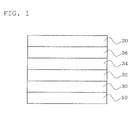
- FIG. 1 is a schematic cross-sectional view of the organic EL device according to one embodiment of the invention.
- the fused aromatic ring derivative of the invention is a compound shown by the following formula (1): wherein R a and R b are independently a hydrogen atom or a substituent; p is an integer of 1 to 13 and q is an integer of 1 to 8, p is preferably an integer of 1 to 2 and q is preferably an integer of 1 to 2; when p is two or more, plural R a s may be the same or different; when q is two or more, plural R b s may be the same or different; L 1 is a single bond or a substituted or unsubstituted divalent linking group; and Ar 1 is a substituted or unsubstituted aryl group having 6 to 50 ring carbon atoms or a substituted or unsubstituted heteroaryl group having 5 to 50 ring carbon atoms.
- R a and R b are independently a hydrogen atom or a substituent
- p is an integer of 1 to 13 and q is an integer of 1 to 8
- p
- L 1 may be bonded to any of the 14 bonding positions of the benzochrysene skeleton, and any of the 10 bonding positions of the anthracene skeleton.
- R a may be bonded to any of the 14 bonding positions of the benzochrysene skeleton, and R b may be bonded to any of the 10 bonding positions of the anthracene skeleton.
- R a and R b are not bonded to the same bonding positions of L 1
- R b is not bonded to the same bonding position of Ar 1 .
- the fused aromatic ring derivative of the invention is preferably a compound shown by the following formula (2): wherein R a , R b , p, q, L 1 and Ar 1 are the same as those in the formula (1).
- R a and R b examples include an alkyl group (one having preferably 1 to 20, more preferably 1 to 12 and particularly preferably 1 to 8 carbon atoms, the specific examples of which include methyl, ethyl, isopropyl, t-butyl, n-octyl, n-decyl, n-hexadecyl, cyclopropyl, cyclopentyl and cyclohexyl), an alkenyl group (one having preferably 2 to 20, more preferably 2 to 12 and particularly preferably 2 to 8 carbon atoms, the specific examples of which include vinyl, allyl, 2-butenyl and 3-pentenyl), an alkynyl group (one having preferably 2 to 20, more preferably 2 to 12 and particularly preferably 2 to 8 carbon atoms, the specific examples of which include propynyl and 3-pentynyl), a substituted or unsubstituted aryl group (one having preferably 6
- an alkyl group, alkenyl group, aryl group, arylamino group, carbazolyl group, carbazolylaryl group, dibenzofuranylaryl group and dibenzothiophenylaryl group are preferable.
- R a and R b all be hydrogen atoms.
- Examples of the substituted or unsubstituted aryl group having 6 to 50 ring carbon atoms shown by Ar 1 include, a phenyl group, 1-naphthyl group, 2-naphthyl group, 1-anthryl group, 2-anthryl group, 9-anthryl group, 1-phenanthryl group, 2-phenanthryl group, 3-phenanthryl group, 4-phenanthryl group, 9-phenanthryl group, 1-naphthacenyl group, 2-naphthacenyl group, 9-naphthacenyl group, 1-pyrenyl group, 2-pyrenyl group, 4-pyrenyl group, 2-biphenylyl group, 3-biphenylyl group, 4-biphenylyl group, p-terphenyl-4-yl group, p-terphenyl-3-yl group, p-terphenyl-2-yl group, m-terphenyl-4-yl group, m
- the substituted or unsubstituted aryl group having 6 to 50 ring carbon atoms is preferably a substituted or unsubstituted aryl group having 10 to 20 ring carbon atoms, more preferably a substituted or unsubstituted fused aromatic ring group having 10 to 20 ring carbon atoms, more preferably a substituted or unsubstituted naphthyl group.
- Examples of the substituted or unsubstituted fused aromatic ring group having 10 to 20 ring carbon atoms include a naphthyl group, phenanthryl group, anthryl group, pyrenyl group, chrysenyl group, naphthacenyl group.
- Examples of the substituted or unsubstituted heteroaryl group shown by Ar 1 having 5 to 50 (preferably 5 to 20) ring carbon atoms include a furan ring, thiophene ring, benzofuran ring, benzothiophene ring, benzofuran ring and dibenzothiophene ring.
- Preferred examples include a monovalent group derived from a benzothiophene ring, a dibenzofuran ring and a dibenzothiophene ring.
- Ar 1 is preferably a substituent shown by the following formula (3): wherein R c is a hydrogen atom or a substituent, Ar 2 is a substituted or unsubstituted aryl group having 6 to 50 ring carbon atoms, r is an integer of 1 to 4, and when r is two or more, plural R c s may be the same or different, and adjacent R c s may form a saturated or unsaturated ring.
- the substituent shown by R c is the same as the substituents of R a and R b
- the substituted or unsubstituted aryl group having 6 to 50 ring carbon atoms shown by Ar 2 is the same as the substituted or unsubstituted aryl group having 6 to 50 ring carbon atoms shown by Ar 1 .
- Examples of the substituted or unsubstituted divalent linking group shown by L 1 include a substituted or unsubstituted arylene group having 6 to 50 (preferably 6 to 20, more preferably 6 to 14) ring carbon atoms.
- the specific examples include divalent groups obtained by removing one hydrogen atom from the aryl groups shown below: a phenyl group, 1-naphthyl group, 2-naphthyl group, 1-anthryl group, 2-anthryl group, 9-anthryl group, 1-phenanthryl group, 2-phenanthryl group, 3-phenanthryl group, 4-phenanthryl group, 9-phenanthryl group, 1-naphthacenyl group, 2-naphthacenyl group, 9-naphthacenyl group, 1-pyrenyl group, 2-pyrenyl group, 4-pyrenyl group, 2-biphenylyl group, 3-biphenylyl group, 4-biphenylyl group,
- L 1 is preferably a single bond or a linking group shown by the following formula (4): wherein R d is a hydrogen atom or a substituent, s is an integer of 1 to 4, and when s is two or more, plural R d s may be the same or different, and adjacent R d s may form a saturated or unsaturated ring.
- Examples of L 1 include the following compounds.
- fused aromatic ring derivative of the invention can be synthesized by the methods described below.
- the benzo[g]chrysene is the following compound.
- the fused aromatic ring derivative of the invention can be preferably used as a material for an organic EL device, in particular, as the emitting material thereof.
- the organic EL device of the invention comprises an anode, a cathode and one or more organic thin layers comprising an emitting layer between the anode and the cathode, and at least one of the organic thin layers comprise the above-mentioned compound of the invention.
- This organic EL device comprises an anode 10, a cathode 20, and a hole-injecting layer 30, a hole-transporting layer 32, an emitting layer 34 and an electron-injecting layer 36 between the anode and the cathode.
- the hole-injecting layer 30, the hole-transporting layer 32, the emitting layer 34 and the electron-injecting layer 36 correspond to the plurality of organic thin film layers. At least one of these organic thin film layers 30, 32, 34 and 36 comprises the compound of the invention.
- the compound of the invention may be used in any of the above-mentioned organic thin film layers, it is preferred that the compound of the invention be used in the emitting layer. In each of the organic thin film layers, the compound of the invention may be used either singly or in mixture with other compounds.
- the emitting layer contain the compound of the invention as a host material and contain at least one of a fluorescent dopant and a phosphorescent dopant. In the invention, it is preferred that the emitting layer consist essentially of the compound of the invention and the above-mentioned dopant.
- the content of the compound of the invention in the organic thin film layers is preferably 30 to 100 mol%.
- the organic EL device is normally formed on a substrate.
- the substrate supports the organic EL device. It is preferable to use a smooth substrate. If light is outcoupled through the substrate, it is preferred that the substrate be a transparent substrate with a transmission to visible rays with a wavelength of 400 to 700 nm of 50% or more.
- a glass plate, a synthetic resin plate or the like are preferably used as such tranparent substrate.
- the glass plate include plates of soda-lime glass, barium/strontium-containing glass, lead glass, aluminosilicate glass, borosilicate glass, barium borosilicate glass, quartz, or the like.
- the synthetic resin plates include plates of a polycarbonate resin, an acrylic resin, a polyethylene terephthalate resin, a polyether sulfide resin, a polysulfone resin, or the like.
- the anode injects holes to the hole-injecting layer, the hole-transporting layer or the emitting layer and has a work function of 4.5 eV or more.
- the anode material include indium tin oxide (ITO), a mixture of indium oxide and zinc oxide, a mixture of ITO and cerium oxide (ITCO), a mixture of the mixture of indium oxide, and zinc oxide and cerium oxide (IZCO), a mixture of indium oxide and cerium oxide (ICO), a mixture of zinc oxide and aluminum oxide (AZO), tin oxide (NESA), gold, silver, platinum and copper.
- ITO indium tin oxide
- ITCO ITO and cerium oxide
- IZCO a mixture of the mixture of indium oxide, and zinc oxide and cerium oxide
- ICO zinc oxide and aluminum oxide
- AZO zinc oxide and aluminum oxide
- tin oxide NESA
- gold, silver, platinum and copper can be formed from these electrode materials by a vapor deposition method, a sputtering method or
- the transmittance of the anode to the emission is preferably more than 10%.
- the sheet resistance of the anode is preferably several hundred ⁇ / ⁇ or less.
- the film thickness of the anode which varies dependin g upon the material thereof, is usually from 10 nm to 1 ⁇ m, preferably from 10 to 200 nm.
- the emitting layer has the following functions.
- the emitting layer As the method of forming the emitting layer, a known method such as deposition, spin coating, or an LB method may be applied. It is preferable that the emitting layer be a molecular deposition film.
- the molecular deposition film is a film formed by deposition of a material compound in a gas phase, or by solidification of a material compound in the form of a solution or in a liquid phase.
- the molecular deposition film can be usually distinguished from a thin film (molecular accumulation film) formed using the LB method by the difference in aggregation structure or higher order structure or the difference in function due to the difference in structure.
- the emitting layer may also be formed by dissolving a binder such as a resin and a material compound in a solvent to obtain a solution, and forming a thin film from the solution by spin coating or the like.
- the emitting layer contain the compound of the invention as a host material.
- the emitting layer may contain, in addition to the compound of the invention, host materials given below.
- R 021 to R 030 are independently a hydrogen atom, an alkyl group, a cycloalkyl group, a substituted or unsubstituted aryl group, an alkoxy group, an aryloxy group, an alkylamino group, an alkenyl group, an arylamino group or a substituted or unsubstituted heterocyclic group, a and b are independently an integer of 1 to 5, and when they are two or more, R 021 s or R 022 s may be the same or different, R 021 s or R 022 s may be bonded to form a ring, R 023 and R 024 , R 025 and R 026 , R 027 and R 028 , and R 029 and R 030 may be bonded to each other to form a ring, and L 003 is a single bond, -O-, -S-, -N(R)
- R 031 to R 040 are independently a hydrogen atom, an alkyl group, a cycloalkyl group, an aryl group, an alkoxy group, an aryloxy group, an alkylamino group, an arylamino group or a substituted or unsubstituted heterocyclic group
- c, d, e and f are independently an integer of 1 to 5, and when they are two or more, R 131 s, R 032 s, R 036 s or R 037 s may be the same or different, R 031 s, R 032 s, R 033 s or R 037 may be bonded to form a ring, and R 033 and R 034 , and R 038 and R 039 may be bonded to each other to form a ring, and L 004 is a single bond, -O-, -S-, -N(R)- (R is an alkyl
- Spirofluorene derivative represented by the following formula (vii): wherein A 005 to A 008 are independently a substituted or unsubstituted biphenyl or a substituted or unsubstituted naphthyl group.
- a 011 to A 013 are independently a substituted or unsubstituted arylene group having 6 to 50 (preferably 6 to 20, more preferably 6 to 14) ring carbon atoms
- a 014 to A 016 are independently a hydrogen atom or a substituted or unsubstituted aryl group having 6 to 50 (preferably 6 to 20, more preferably 6 to 14) ring carbon atoms
- R 041 to R 143 are independently a hydrogen atom, alkyl group having 1 to 6 carbon atoms, cycloalkyl group having 3 to 6 carbon atoms, alkoxy group having 1 to 6 carbon atoms, aryloxy group having 5 to 18 carbon atoms, aralkyloxy group having 7 to 18 carbon atoms, arylamino group having 5 to 16 carbon atoms, nitro group, cyano group, ester group having 1 to 6 carbon atoms, or a halogen atom, provided that at
- R 051 and R 052 are a hydrogen atom, a substituted or unsubstituted alkyl group, a substituted or unsubstituted aralkyl group, a substituted or unsubstituted aryl group, a substituted or unsubstituted heterocyclic group, substituted amino group, cyano group, or a halogen atom
- n is an integer of 1 to 10
- R 051 s or R 052 s bonded to different fluorene groups may be the same or different
- R 051 and R 052 bonded to a single fluorene group may be the same or different
- R 053 and R 054 are independently a hydrogen atom, a substituted or unsubstituted alkyl group, a substituted or unsubstituted aralkyl group, a substituted or unsubstituted
- the emitting layer contain the compound of the invention as a host and contain at least one of a phosphorescent dopant and a fluorescent dopant.
- An emitting layer containing these dopants may be stacked on an emitting layer containing the compound of the invention.
- a phosphorescent dopant is a compound that can emit light from triplet excitons.
- the dopant is not limited so long as it can emit light from triplet excitons, but it is preferably a metal complex containing at least one metal selected from the group of Ir, Ru, Pd, Pt, Os and Re.
- a porphyrin metal complex or an ortho-metalated metal complex is preferable.
- the phosphorescent compounds can be used individually or as a combination of two or more kinds.
- a porphyrin platinum complex As a porphyrin metal complex, a porphyrin platinum complex is preferable.
- ligands forming an ortho-metalated metal complex Preferable ligands include compounds having a phenylpyridine skeleton, a bipyridyl skeleton or a phenanthroline skeleton, 2-phenylpyridine, 7,8-benzoquinoline, 2-(2-thienyl)pyridine, 2-(1-naphthyl)pyridine and 2-phenylquinoline derivatives. These ligands may have a substituent, if necessary.
- Ligands to which fluorides e.g.
- a trifluoromethyl group being introduced as a substituent are particularly preferable as a blue dopant.
- auxiliary ligand preferred are ligands other than the above-mentioned ligands, such as acetylacetonate and picric acid may be contained.
- Such metal complex are, not limited to, tris(2-phenylpyridine)iridium, tris(2-phenylpyridine)ruthenium, tris(2-phenylpyridine)palladium, bis(2-phenylpyridine)platinum, tris(2-phenylpyridine)osmium, tris(2-phenylpyridine)rhenium, octaethylplatinumporphyrin, octaphenylplatinumporphyrin, octaethylpalladiumporphyrin, octaphenylpalladiumporphyrin and the like.
- An adequate complex can be selected according to required light color, device performance and host materials used.
- the content of a phosphorescent dopant in an emitting layer is not limited and can be properly selected according to purposes; for example, it is 0.1 to 70 mass %, preferably 1 to 30 mass %.
- emission may be weak and the advantages thereof may not be sufficiently obtained.
- concentration quenching may significantly proceed, thereby degrading the device performance.
- the fluorescent dopant it is preferable to select a compound from amine-based compounds, aromatic compounds, chelate complexes such as tris(8-quinolilate)aluminum complexes, coumarin derivatives, tetraphenylbutadiene derivatives, bisstyrylarylene derivatives, oxadiazole derivatives or the like, taking into consideration required emission colors.
- styrylamine compounds, styryldiamine compounds, arylamine compounds and aryldiamine compounds are further preferable.
- Fused polycyclic aromatic compounds which are not an amine compound are also preferable.
- These fluorescent dopants may be used singly or in combination of two or more.
- the content of a fluorescent dopant in the emitting layer is not particularly limited and can be appropriately selected according to purposes; for example, it is 0.01 to 100 mass %, preferably 0.1 to 30 mass %.
- styrylamine compound and the styryldiamine compound those shown by the following formula (A) are preferable.
- Ar 101 is a group with a valence of p corresponding to a phenyl group, a naphthyl group, a biphenyl group, a terphenyl group, a stilbenyl group or a distyrylaryl group
- Ar 102 and Ar 103 are independently an aromatic hydrocarbon group having 6 to 20 (preferably 6 to 14) carbon atoms
- Ar 101 , Ar 102 and Ar 103 may be substituted, one of Ar 101 to Ar 103 is substituted by a styryl group, further preferably, at least one of Ar 102 and Ar 103 is substituted by a styryl group
- p is an integer of 1 to 4, preferably an integer of 1 to 2.
- aromatic hydrocarbon group having 6 to 20 (preferably 6 to 14) carbon atoms a phenyl group, a naphthyl group, an anthranyl group, a phenanthryl group, a terphenyl group or the like can be given.
- arylamine compound and the aryldiamine compound those shown by the following formula (B) are preferable.
- a 111 is a substituted or unsubstituted aromatic group with a valence of q having 5 to 40 (preferably 6 to 20, more preferably 6 to 14) ring carbon atoms
- Ar 112 and Ar 113 are independently a substituted or unsubstituted aryl group having 5 to 40 (preferably 6 to 20, more preferably 6 to 14) ring carbon atoms
- q is an integer of 1 to 4, preferably an integer of 1 to 2.
- Examples of the aryl group having 5 to 40 ring carbon atoms include a phenyl group, a naphthyl group, an anthranyl group, a phenanthryl group, a pyrenyl group, a coronenyl group, a biphenyl group, a terphenyl group, a pyrrolyl group, a furanyl group, a thiophenyl group, a benzothiophenyl group, an oxadiazolyl group, a diphenylanthranyl group, an indolyl group, a carbazolyl group, a pyridyl group, a benzoquinolyl group, a fluoranthenyl group, an acenaphthofluoranthenyl group, a stilbene group, a perylenyl group, a chrysenyl group, a picenyl group, a triphenylenyl group,
- Ar 111 q-value groups corresponding to the above-mentioned aryl groups are preferable.
- Ar 111 is a divalent group, groups shown by the following formulas (C) and (D) are preferable. A group shown by the formula (D) is more preferable.
- Preferred substituents for the above-mentioned aryl group include an alkyl group having 1 to 6 carbon atoms (ethyl, methyl, i-propyl, n-propyl, s-butyl, t-butyl, pentyl, hexyl, cyclopentyl, cyclohexyl, or the like); an alkoxy group having 1 to 6 carbon atoms (ethoxy, methoxy, i-propoxy, n-propoxy, s-buthoxy, t-buthoxy, penthoxy, hexyloxy, cyclopentoxy, cyclohexyloxy, or the like); an aryl group having 5 to 40 (preferably 6 to 20, more preferably 6 to 14) ring carbon atoms; an amino group substituted with an aryl group having 5 to 40 (preferably 6 to 20, more preferably 6 to 14) ring carbon atoms; an ester group with an aryl group having 5 to 40 (preferably
- the emitting layer may contain hole-transporting materials, electron-transporting materials and polymer binders, if necessary.
- the thickness of an emitting layer is preferably from 5 to 50 (preferably 5 to 20) nm, more preferably from 7 to 50 nm and most preferably from 10 to 50 (preferably 10 to 30, more preferably 10 to 20) nm. When it is less than 5 nm, the formation of an emitting layer and the adjustment of chromaticity may become difficult. When it exceeds 50 nm, the driving voltage may increase.
- the hole-transporting layer and the hole-injecting layer are layers which help the injection of holes into the emitting layer so as to transport holes to an emitting region, and have a large hole mobility and normally have such a small ionization energy as 5.5 eV or less.
- the material for the hole-injecting layer and the hole-transporting layer a material which transports holes to the emitting layer at a lower electrical field is preferable, and the hole mobility thereof is preferably 10 -4 cm 2 /V ⁇ second or more when an electric field of, e.g., 10 4 to 10 6 V/cm is applied.
- the material can be arbitrarily selected from materials which have been widely used as a hole-transporting material of photoconductive materials and known materials used in a hole-injecting layer and a hole-transporting layer of organic EL devices.
- an aromatic amine derivative shown by the following formula can be used, for example.
- Ar 211 to Ar 213 , Ar 221 to Ar 223 and Ar 203 to Ar 208 are independently a substituted or unsubstituted aromatic hydrocarbon group having 6 to 50 (preferably 6 to 20, more preferably 6 to 14) ring carbon atoms or a substituted or unsubstituted aromatic heterocyclic group having 5 to 50 (preferably 5 to 20) ring atoms
- a to c and p to r are independently an integer of 0 to 3
- Ar 203 and Ar 204 , Ar 205 and Ar 206 , or Ar 207 and Ar 208 may be bonded to each other to form a saturated or unsaturated ring.
- Examples of the substituted or unsubstituted aromatic hydrocarbon groups having 6 to 50 ring carbon atoms include a phenyl group, 1-naphthyl group, 2-naphthyl group, 1-anthryl group, 2-anthryl group, 9-anthryl group, 1-phenanthryl group, 2-phenanthryl group, 3-phenanthryl group, 4-phenanthryl group, 9-phenanthryl group, 1-naphthacenyl group, 2-naphthacenyl group, 9-naphthacenyl group, and 1-pyrenyl group, 2-pyrenyl group, 4-pyrenyl group, 2-biphenylyl group, 3-biphenylyl group, 4-biphenylyl group, p-terphenyl-4-yl group, p-terphenyl-3-yl group, p-terphenyl-2-yl group, m-terphenyl-4-yl group, m-terpheny
- Examples of the substituted or unsubstituted aromatic heterocyclic group having 5 to 50 ring atoms include a 1-pyrrolyl group, 2-pyrrolyl group, 3-pyrrolyl group, pyrazinyl group, 2-pyridinyl group, 3-pyridinyl group, 4-pyridinyl group, 1-indolyl group, 2-indolyl group, 3-indolyl group, 4-indolyl group, 5-indolyl group, 6-indolyl group, 7-indolyl group, 1-isoindolyl group, 2-isoindolyl group, 3-isoindolyl group, 4-isoindolyl group, 5-isoindolyl group, 6-isoindolyl group, 7-isoindolyl group, 2-furyl group, 3-furyl group, 2-benzofuranyl group, 3-benzofuranyl group, 4-benzofuranyl group, 5-benzofuranyl group,
- Ar 231 to Ar 234 are independently a substituted or unsubstituted aromatic hydrocarbon group having 6 to 50 (preferably 6 to 20, more preferably 6 to 14) ring carbon atoms, or a substituted or unsubstituted aromatic heterocyclic group having 5 to 50 (preferably 5 to 20) ring atoms
- L is a linking group, which is a single bond, a substituted or unsubstituted aromatic hydrocarbon group having 6 to 50 (preferably 6 to 20, more preferably 6 to 14) ring carbon atoms or a substituted or unsubstituted aromatic heterocyclic group having 5 to 50 (preferably 5 to 20) ring atoms
- x is an integer of 0 to 5
- Ar 232 and Ar 233 may be bonded to each other to form a saturated or unsaturated ring.
- substituted or unsubstituted aromatic hydrocarbon group having 6 to 50 ring carbon atoms and substituted or unsubstituted aromatic heterocyclic group having 5 to 50 ring atoms the same as those exemplified above for the aromatic amine derivative can be given.
- a triazole derivative, an oxadiazole derivative, an imidazole derivative, a polyarylalkane derivative, a pyrazoline derivative, a pyrazolone derivative, a phenylenediamine derivative, an arylamine derivative, an amino-substituted chalkone derivative, an oxazole derivative, a styrylanthracene derivative, a fluorenone derivative, a hydrazone derivative, a stilbene derivative, a silazane derivative, an aniline-based copolymer, and conductive high-molecular oligomers (in particular, a thiophene oligomer) can be given.
- the material for the hole-injecting layer and the hole-transporting layer although the above-mentioned materials can be used, it is preferable to use a porphyrin compound, an aromatic tertiary amine compound and a styrylamine compound. It is particularly preferable to use an aromatic tertiary amine compound.
- NPD 4,4'-bis(N-(1-naphthyl)-N-phenylamino)biphenyl
- MTDATA 4,4',4"-tris(N-(3-methylphenyl)-N-phenylamino)triphenylamine
- R 201 to R 206 are independently a substituted or unsubstituted alkyl group, a substituted or unsubstituted aryl group, a substituted or unsubstituted aralkyl group, a substituted or unsubstituted heterocyclic group, and R 201 and R 202 , R 203 and R 204 , R 205 and R 206 , R 201 and R 206 , R 202 and R 203 , or R 204 and R 205 may form a fused ring.
- R 211 to R 216 are substituents; preferably they are independently an electron-attracting group such as a cyano group, a nitro group, a sulfonyl group, a carbonyl group, a trifluoromethyl group and a halogen.
- an inorganic compound such as p-type Si and p-type SiC can also be used as a material for the hole-injecting layer and the hole-transporting layer.
- the hole-injecting layer and the hole-transporting layer can be formed from the above-mentioned compounds by a known method such as vapor vacuum deposition, spin coating, casting or LB technique.
- the film thickness of the hole-injecting layer and the hole-transporting layer is not particularly limited, and is usually from 5 nm to 5 ⁇ m.
- the hole-injecting layer and the hole-transporting layer may be a single layer made of one or two or more of the above-mentioned materials, or may be of a structure in which hole-injecting layers and hole-transporting layers made of different compounds are stacked.
- the organic semiconductor layer is a layer for helping the injection of holes or electrons into the emitting layer, and is preferably a layer having an electric conductivity of 10 -10 S/cm or more.
- electroconductive oligomers such as thiophene-containing oligomers or arylamine-containing oligomers and electroconductive dendrimers such as arylamine-containing dendrimers may be used.
- the electron-injecting layer and the electron-transporting layer are layers which assist injection of electrons into the emitting layer and transport electrons to the emitting region, and exhibit a high electron mobility.
- the adhesion-improving layer is a kind of the electron-injecting layer which is made of a material exhibiting particularly good adhesion to the cathode.
- the thickness of the electron-transporting layer is arbitrarily selected in the range of 5 nm to 5 ⁇ m. When the electron-transporting layer has a thick thickness, it is preferable that the electron mobility be 10 -5 cm 2 /Vs or more at an applied electric field of 10 4 to 10 6 V/cm in order to prevent an increase in voltage.
- the material used in the electron-injecting layer and the electron-transporting layer is preferably a metal complex of 8-hydroxyquinoline or a derivative thereof, or an oxadiazole derivative.
- the metal complex of 8-hydroxyquinoline or derivative thereof include metal chelate oxynoid compounds containing a chelate of oxine (generally, 8-quinolinol or 8-hydroxyquinoline), e.g. tris(8-quinolinolato)aluminum.
- an electron-transporting compound shown by the following formula can be given.
- Ar 301 , Ar 302 , Ar 303 , Ar 305 , Ar 306 and Ar 309 are independently a substituted or unsubstituted aryl group
- Ar 304 , Ar 307 and Ar 308 are independently a substituted or unsubstituted arylene group.
- aryl group a phenyl group, a biphenyl group, an anthranyl group, a perylenyl group, and a pyrenyl group can be given.
- arylene group a phenylene group, a naphthylene group, a biphenylene group, an anthranylene group, a perylenylene group, a pyrenylene group, and the like can be given.
- substituent an alkyl group having 1 to 10 carbon atoms, an alkoxy group having 1 to 10 carbon atoms, a cyano group, and the like can be given.
- the electron-transporting compound is preferably one from which a thin film can be formed.
- the compounds represented by the following formulas (E) to (J) may be used.
- Ar 311 to Ar 313 are independently a nitrogen atom or a carbon atom
- Ar 311 is a substituted or unsubstituted aryl group having 6 to 60 (preferably 6 to 20, more preferably 6 to 14) ring carbon atoms or a substituted or unsubstituted heteroaryl group having 3 to 60 (preferably 3 to 20, more preferably 3 to 14) ring carbon atoms
- Ar 311' is an arylene group having 6 to 60 (preferably 6 to 20, more preferably 6 to 14) ring carbon atoms or a substituted or unsubstituted heteroarylene group having 3 to 60 (preferably 3 to 20, more preferably 3 to 14) ring carbon atoms
- Ar 312 is a hydrogen atom, a substituted or unsubstituted aryl group having 6 to 60 (preferably 6 to 20, more preferably 6 to 14) ring carbon atoms, a substituted or unsubstitute
- HAr-L 314 -Ar 321 -Ar 322 Nitrogen-containing heterocyclic derivatives shown by the formula (G): wherein HAr is a nitrogen-containing heterocyclic ring having 3 to 40 (preferably 3 to 30, more preferably 3 to 24) carbon atoms, which may have a substituent, L 314 is a single bond, an arylene group having 6 to 60 (preferably 6 to 20, more preferably 6 to 14) carbon atoms, which may have a substituent, an heteroarylene group having 3 to 60 (preferably 3 to 20, more preferably 3 to 14) carbon atoms, which may have a substituent, or a fluorenylene group which may have a substituent, Ar 321 is a divalent aromatic hydrocarbon group having 6 to 60 (preferably 6 to 20, more preferably 6 to 14) carbon atoms, which may have a substituent, and Ar 322 is a an aryl group having 6 to 60 (preferably 6 to 20, more preferably 6 to 14) carbon atoms, which may have a
- R 321 to R 328 and Z 322 are independently a hydrogen atom, a saturated or unsaturated hydrocarbon group, an aromatic hydrocarbon group, a heterocyclic group, a substituted amino group, a substituted boryl group, an alkoxy group, or an aryloxy group
- X 302 , Y 302 , and Z 321 are independently a saturated or unsaturated hydrocarbon group, an aromatic hydrocarbon group, a heterocyclic group, a substituted amino group, an alkoxy group, or an aryloxy group
- Z 321 and Z 322 may be bonded to form a fused ring
- n is an integer of 1 to 3, provided that when n or (3-n) is two or more, R 321 to R 328 , X 302 , Y 302 , Z 322 and Z 321 may be the same or different, provided that compounds where n is 1, X 302 , Y 302 , and R 322 are independently a hydrogen atom, a saturated or uns
- rings A 301 and A 302 are independently a 6-membered aryl ring structure which may have a substituent and they are fused to each other.
- the metal complexes have the strong nature of an n-type semiconductor and large ability of injecting electrons. Further, the energy generated at the time of forming a complex is small so that a metal is then strongly bonded to ligands in the complex formed and the fluorescent quantum efficiency becomes large as the emitting material.
- substituents for the rings A 301 and A 302 forming the ligand of the formula (K) include halogen atoms such as chlorine, bromine, iodine, and fluorine, substituted or unsubstituted alkyl groups such as a methyl group, ethyl group, propyl group, butyl group, sec-butyl group, tert-butyl group, pentyl group, hexyl group, heptyl group, octyl group, stearyl group, and trichloromethyl group, substituted or unsubstituted aryl groups such as a phenyl group, naphthyl group, biphenyl group, anthranyl group, phenanthryl group, fluorenyl group, pyrenyl group, 3-methylphenyl group, 3-methoxyphenyl group, 3-fluorophenyl group, 3-trichloromethylphenyl group, 3-trifluor
- a preferred embodiment of the organic EL device is a device containing a reducing dopant in an electron-transferring region or in an interfacial region between a cathode and an organic layer.
- the reducing dopant is defined as a substance which can reduce an electron-transferring compound. Accordingly, various substances which have given reducing properties can be used.
- At least one substance can be preferably used which is selected from the group consisting of alkali metals, alkaline earth metals, rare earth metals, alkali metal oxides, alkali metal halides, alkaline earth metal oxides, alkaline earth metal halides, rare earth metal oxides, rare earth metal halides, alkali metal carbonates, alkaline earth metal carbonates, rare earth metal carbonates, alkali metal organic complexes, alkaline earth metal organic complexes, and rare earth metal organic complexes.
- the preferred reducing dopants include at least one alkali metal selected from the group consisting of Na (work function: 2.36 eV), K (work function: 2.28 eV), Rb (work function: 2.16 eV) and Cs (work function: 1.95 eV), and at least one alkaline earth metal selected from the group consisting of Ca (work function: 2.9 eV), Sr (work function: 2.0 to 2.5 eV), and Ba (work function: 2.52 eV). Metals having a work function of 2.9 eV or less are particularly preferred.
- a more preferable reducing dopant is at least one alkali metal selected from the group consisting of K, Rb and Cs. Even more preferable is Rb or Cs.
- Cs are particularly high in reducing ability.
- the addition of a relatively small amount thereof to an electron-injecting zone improves the luminance of the organic EL device and make the lifetime thereof long.
- a reducing agent having a work function of 2.9 eV or less combinations of two or more alkali metals are preferable, particularly combinations including Cs, such as Cs and Na, Cs and K, Cs and Rb, or Cs, Na and K are preferable.
- the combination containing Cs makes it possible to exhibit the reducing ability efficiently.
- the luminance of the organic EL device can be improved and the lifetime thereof can be made long by the addition thereof to its electron-injecting zone.
- An electron-injecting layer made of an insulator or a semiconductor may further be provided between a cathode and an organic layer.
- a current leakage can be effectively prevented and electron-injecting properties can be improved.
- the electron-injecting layer is an insulating thin film, more uniformed thin film can be formed whereby pixel defects such as a dark spot are decreased.
- At least one metal compound selected from the group consisting of alkali metal calcogenides, alkaline earth metal calcogenides, halides of alkali metals and halides of alkaline earth metals can be preferably used.
- the electron-injecting layer is formed of the alkali metal calcogenide or the like, the injection of electrons can be preferably further improved.
- alkali metal calcogenides include Li 2 O, K 2 O, Na 2 S, Na 2 Se and Na 2 O and preferable alkaline earth metal calcogenides include CaO, BaO, SrO, BeO, BaS and CaSe.
- Preferable halides of alkali metals include LiF, NaF, KF, CsF, LiCI, KCI and NaCl.
- Preferable halides of alkaline earth metals include fluorides such as CaF 2 , BaF 2 , SrF 2 , MgF 2 and BeF 2 and the other halides corresponding to the fluorides.
- Semiconductors forming an electron-injecting layer include one or combinations of two or more of oxides, nitrides, and oxidized nitrides containing at least one element of Ba, Ca, Sr, Yb, Al, Ga, In, Li, Na, Cd, Mg, Si, Ta, Sb and Zn.
- An inorganic compound forming an electron-injecting layer is preferably a microcrystalline or amorphous insulating thin film.
- an electrode substance made of a metal, an alloy or an electroconductive compound, or a mixture thereof which has a small work function (for example, 4 eV or less).
- the electrode substance include sodium, sodium-potassium alloy, magnesium, lithium, cesium, magnesium/silver alloy, aluminum/aluminum oxide, Al/Li 2 O, Al/LiO, Al/LiF, aluminum/lithium alloy, indium, and rare earth metals.
- the cathode is formed from these electrode materials by vapor deposition, sputtering or the like. In the case where emission from the emitting layer is outcoupled through the cathode, it is preferred to make the transmittance of the cathode to the emission larger than 10%.
- the sheet resistance of the cathode is preferably several hundreds ⁇ / ⁇ or less, and the film thickness thereof is usually from 10 nm to 1 ⁇ m, preferably from 50 to 200 nm.
- the organic EL device pixel defects based on leakage or a short circuit are easily generated since an electric field is applied to the super thin film.
- an insulating thin layer between the pair of electrodes.
- the material used in the insulating layer include aluminum oxide, lithium fluoride, lithium oxide, cesium fluoride, cesium oxide, magnesium oxide, magnesium fluoride, calcium oxide, calcium fluoride, aluminum nitride, titanium oxide, silicon oxide, germanium oxide, silicon nitride, boron nitride, molybdenum oxide, ruthenium oxide, and vanadium oxide.
- a mixture or laminate thereof may be used.
- the method for fabricating the organic EL device it can be fabricated by forming necessary layers sequentially from the anode using the materials and the method as mentioned above, and finally forming the cathode.
- the organic EL device can be fabricated in the order reverse to the above, i.e., the order from the cathode to the anode.
- anode/hole-injecting layer/emitting layer/electron-injecting layer/cathode has a structure wherein the following are successively formed on a transparent substrate: anode/hole-injecting layer/emitting layer/electron-injecting layer/cathode.
- a thin film formed of an anode material is formed on a transparent substrate by vapor deposition or sputtering to form an anode.
- a hole-injecting layer is formed on this anode.
- the hole-injecting layer can be formed by vacuum deposition, spin coating, casting, LB technique, or some other method. Vacuum deposition is preferred since a homogenous film is easily obtained and pinholes are not easily generated.
- conditions for the deposition vary depending upon a compound used (a material for the hole-injecting layer), a desired structure of the hole-injecting layer, and others. In general, the conditions are preferably selected from the following: deposition source temperature of 50 to 450°C, vacuum degree of 10 -7 to 10 -3 Torr, vapor deposition rate of 0.01 to 50 nm/second, and substrate temperature of -50 to 300°C.
- an emitting layer is formed on the hole-injecting layer.
- the emitting layer can also be formed by making a luminescent material into a thin film by vacuum vapor deposition, sputtering, spin coating, casting or some other method. Vacuum vapor deposition is preferred since a homogenous film is easily obtained and pinholes are not easily generated.
- conditions for the deposition which vary depending on a compound used, can be generally selected from conditions similar to those for the hole-injecting layer.
- an electron-injecting layer is formed on the emitting layer.
- the layer is preferably formed by vacuum vapor deposition because a homogenous film is required. Conditions for the deposition can be selected from conditions similar to those for the hole-injecting layer and the emitting layer.
- a cathode is stacked thereon to obtain an organic EL device.
- the cathode can be formed by vapor deposition or sputtering. However, vapor vacuum deposition is preferred in order to protect underlying organic layers from being damaged when the cathode film is formed. For the organic EL device fabrication described above, it is preferred that the formation from the anode to the cathode is continuously carried out, using only one vacuuming operation.
- the method for forming each of the layers in the organic EL device is not particularly limited.
- An organic thin film layer containing the compound of the invention can be formed by a known method such as vacuum vapor deposition, molecular beam epitaxy (MBE), or an applying coating method using a solution in which the compound is dissolved in a solvent, such as dipping, spin coating, casting, bar coating, or roll coating.
- MBE molecular beam epitaxy
- Benzo[g]chrysene was synthesized according to the following synthesis scheme.
- Crystals were synthesized in the same manner as in Example 2, except that 10-[4-(1-naphthyl)phenyl]anthracene-9-boronic acid which had been synthesized by a known method was used instead of the 10-(2-naphthyl)anthracene-9-boronic acid. As a result of mass spectrometry, the resulting crystals were confirmed to be the compound 3.
- Crystals were synthesized in the same manner as in Example 2, except that 10-[3-(2-naphthyl)phenyl]anthracene-9-boronic acid which had been synthesized by a known method was used instead of the 10-(2-naphthyl)anthracene-9-boronic acid. As a result of mass spectrometry, the resulting crystals were confirmed to be the compound 4.
- Crystals were synthesized in the same manner as in Example 2, except that 1 0-(2-naphthyl)anthracene-9-boronic acid was used instead of 10-(2-naphthyl)anthracene-9-boronic acid, and 10-(3-bromophenyl)benzo[g]chrysene which had been prepared in Synthesis Example 4 was used instead of 10-bromobenzo[g]chrysene. As a result of mass spectrometry, the resulting crystals were confirmed to be the compound 5.
- Crystals were synthesized in the same manner as in Example 2, except that 10-[4-(1-naphthyl)phenyl]anthracene-9-boronic acid was used instead of 10-(2-naphthyl)anthracene-9-boronic acid, and 10-(3-bromophenyl)benzo[g]chrysene which had been prepared in Synthesis Example 4 was used instead of 10-bromobenzo[g]chrysene. As a result of mass spectrometry, the resulting crystals were confirmed to be the compound 6.
- Crystals were synthesized in the same manner as in Example 2, except that 10-[3-(2-naphthyl)phenyl]anthracene-9-boronic acid was used instead of 10-(2-naphthyl)anthracene-9-boronic acid, and 10-(3-bromophenyl)benzo[g]chrysene which had been prepared in Synthesis Example 4 was used instead of 10-bromobenzo[g]chrysene. As a result of mass spectrometry, the resulting crystals were confirmed to be the compound 7.
- Crystals were synthesized in the same manner as in Example 2, except that 10-[3-(2-naphthyl)phenyl]anthracene-9-boronic acid was used instead of 10-(2-naphthyl)anthracene-9-boronic acid, and 10-(4-bromophenyl)benzo[g]chrysene which had been prepared in a similar way to Synthesis Example 4 was used instead of 10-bromobenzo[g]chryserie. As a result of mass spectrometry, the resulting crystals were confirmed to be the compound 8.
- Crystals were synthesized in the same manner as in Example 2, except that 10-[3-(1-naphthyl)phenyl]anthracene-9-boronic acid was used instead of 1 0-(2-naphthyl)anthracene-9-boronic acid, and 10-(4-bromophenyl)benzo[g]chrysene which had been prepared in a similar way to Synthesis Example 4 was used instead of 10-bromobenzo[g]chrysene. As a result of mass spectrometry, the resulting crystals were confirmed to be the compound 9.
- Crystals were synthesized in the same manner as in Example 2, except that 10-[3-(dibenzofuran-2-yl)phenyl]anthracene-9-boronic acid was used instead of 10-(2-naphthyl)anthracene-9-boronic acid, and 10-(4-bromophenyl)benzo[g]chrysene which had been prepared in a similar way to Synthesis Example 4 was used instead of 10-bromobenzo[g]chrysene. As a result of mass spectrometry, the resulting crystals were confirmed to be the compound 10.
- a glass substrate of 25 mm by 75 mm by 1.1 mm thick with an ITO transparent electrode (anode)(GEOMATEC CO., LTD.) was subjected to ultrasonic cleaning with isopropyl alcohol for 5 minutes, and cleaned with ultraviolet rays and ozone for 30 minutes.
- the cleaned glass substrate with transparent electrode lines was mounted in a substrate holder of a vacuum vapor deposition apparatus.
- a 60 nm-thick film of the compound A-1 (A-1 film) was formed on the surface where the transparent electrode lines were formed so as to cover the transparent electrode.
- a 20 nm-thick film of the compound A-2 was formed (A-2 film).
- a 40 nm-thick film was formed from the compound 1 prepared in Example 1 and arylamine derivative D-1 in a weight ratio of 40:2 as a blue emitting layer.
- compound Alq was deposited to form an electron-transporting layer in a thickness of 20 nm.
- LiF was formed into a 1 nm-thick film.
- Metal Al was deposited on the LiF film to form a metallic cathode having a film thickness of 150 nm, whereby an organic EL emitting device was fabricated.
- a glass substrate of 25 mm by 75 mm by 1.1 mm thick with an ITO transparent electrode (anode)(GEOMATEC CO., LTD.) was subjected to ultrasonic cleaning with isopropyl alcohol for 5 minutes, and cleaned with ultraviolet rays and ozone for 30 minutes.
- the cleaned glass substrate with transparent electrode lines was mounted in a substrate holder of a vacuum vapor deposition apparatus.
- the compound A-1 was formed into a 60 nm-thick film on the surface where the transparent electrode lines were formed so as to cover the transparent electrode.
- the compound A-2 was formed into a 20 nm-thick film.
- the compound 11 prepared in Example 11 and D-2 having the structure shown below were formed into a 40 nm-thick film in a weight ratio of 40:2 as a blue emitting layer.
- Alq having the structure shown below was deposited to form an electron-transporting layer in a thickness of 20 nm.
- LiF was formed into a 1 nm-thick film.
- Metal Al was deposited on the LiF film to form a metallic cathode having a thickness of 150 nm, whereby an organic EL emitting device was fabricated.
- the fused aromatic ring derivative of the invention is preferable as a material for an organic EL device, in particular, as an emitting material.
- the organic EL device of the invention can be suitably used as a light source such as a planar emitting body and backlight of a display, a display part of a portable phone, a PDA, a car navigator, or an instrument panel of an automobile, an illuminator, and the like.
- a light source such as a planar emitting body and backlight of a display, a display part of a portable phone, a PDA, a car navigator, or an instrument panel of an automobile, an illuminator, and the like.
Landscapes
- Chemical & Material Sciences (AREA)
- Organic Chemistry (AREA)
- Engineering & Computer Science (AREA)
- Materials Engineering (AREA)
- Physics & Mathematics (AREA)
- Spectroscopy & Molecular Physics (AREA)
- Optics & Photonics (AREA)
- Electroluminescent Light Sources (AREA)
- Organic Low-Molecular-Weight Compounds And Preparation Thereof (AREA)
- Heterocyclic Carbon Compounds Containing A Hetero Ring Having Oxygen Or Sulfur (AREA)
Abstract

Description
- The invention relates to a novel fused aromatic ring derivative (benzochrysene derivative) which is useful as a material for an organic electroluminescence device, and an organic electroluminescence device using the same.
- An organic electroluminescence device (hereinafter the term "electroluminescence" is often abbreviated as "EL") is a self-emission device utilizing the principle that a fluorescent compound which is an emitting material emits light by the recombination energy of holes injected from an anode and electrons injected from a cathode when an electric field is impressed.
An organic EL device has made a remarkable progress. In addition, since an organic EL device has characteristics such as low voltage driving, high luminance, variety in emission wavelength, high response and capability of fabricating a thin and lightweight emitting device, its application to a wide range of fields is expected. - Emission materials used in an organic EL device have conventionally been studied actively since they influence largely the color of light emitted by a device or on emission life.
As the emission material, a chelate complex such as tris(8-quinolinolato)aluminum complex, a coumarin derivative, a tetraphenylbutadiene derivative, a bisstyrylarylene derivative and an oxadiazole derivative are known. By using such emission materials, emission in a visible range from blue to red can be obtained. - Use of a phosphorescent compound as an emission material for utilizing triplet energy for emission has been studied. For example, it is known that an organic EL device using an iridium complex as an emission material exhibits a high luminous efficiency.
An organic EL device using polyphenylene vinylene (PPV) as a conjugated polymer is known. In this device, PPV is applied and formed into a single film and this device is confirmed to emit light. -
Patent Document 1 discloses an organic EL device using a layer containing 9,10-di-(2-naphthyl)anthracene derivative as an organic layer. - Patent Document 1:
U.S. Patent No. 5935721 - An object of the invention is to provide an organic material which is suitable for use as a material of an organic EL device.
- The inventor noticed a benzochrysene derivative as a material for an organic EL device and made intensive studies. As a result, the inventor has found that a benzochrysene derivative having a specific structure is effective for prolonging the lifetime, increasing the efficiency and lowering the voltage of an organic EL device. The invention has been made on this finding.
- According to the invention, the following fused aromatic ring derivative or the like can be provided.
- 1. A fused aromatic ring derivative shown by the following formula (1):

p is an integer of 1 to 13 and q is an integer of 1 to 8,
when p is two or more, plural Ras may be the same or different,
when q is two or more, plural Rbs may be the same or different,
L1 is a single bond or a substituted or unsubstituted divalent linking group, and
Ar1 is a substituted or unsubstituted aryl group having 6 to 50 carbon atoms that form a ring (hereinafter referred to as "ring carbon atoms") or a substituted or unsubstituted heteroaryl group having 5 to 50 ring carbon atoms. - 2. The fused aromatic ring derivative according to 1 shown by the following formula (2):

formula 1. - 3. The fused aromatic ring derivative according to 1 or 2, wherein L1 is a single bond and Ar1 is a substituted or unsubstituted aryl group having 6 to 50 ring carbon atoms.
- 4. The fused aromatic ring derivative according to 3, wherein Ar1 is a substituted or unsubstituted fused aromatic ring group having 10 to 20 ring carbon atoms.
- 5. The fused aromatic ring derivative according to 1 or 2, wherein L1 is a single bond and Ar1 is a substituent shown by the following formula (3):

Ar2 is a substituted or unsubstituted aryl group having 6 to 50 ring carbon atoms, r is an integer of 1 to 4, and
when r is two or more, plural Rcs may be the same or different, and adjacent Rcs may form a ring. - 6. The fused aromatic ring derivative according to 1 or 2, wherein L1 is a linking group shown by the following formula (4) and Ar1 is a substituent shown by the following formula (3):

Ar2 is a substituted or unsubstituted aryl group having 6 to 50 ring carbon atoms,
r is an integer of 1 to 4, and
when r is two or more, plural Rcs may be the same or different, and adjacent Rcs may form a ring,
s is an integer of 1 to 4, and
when s is two or more, plural Rds may be the same or different. - 7. The fused aromatic ring derivative according to 5 or 6, wherein Ar2 is a substituted or unsubstituted fused aromatic ring group having 10 to 20 ring carbon atoms.
- 8. The fused aromatic ring derivative according to 1 or 2, wherein L1 is a linking group shown by the following formula (4) and Ar1 is a substituted or unsubstituted fused aromatic ring group having 10 to 20 ring carbon atoms:

s is an integer of 1 to 4, and
when s is two or more, plural Rds may be the same or different, and adjacent Rds may form a ring. - 9. The fused aromatic ring derivative according to 8, wherein Ar1 is a substituted or unsubstituted naphthyl group.
- 10. A material for an electroluminescence device comprising the fused aromatic ring derivative according to any one of 1 to 9.
- 11. The material for an electroluminescence device according to 10 which is an emitting material.
- 12. An organic electroluminescence device comprising:
- an anode, a cathode, and
- one or more organic thin film layers comprising an emitting layer being between the anode and the cathode,
- wherein at least one of the organic thin film layers comprises the fused aromatic ring derivative according to any one of 1 to 9.
- 13. The organic electroluminescence device according to 12, wherein the emitting layer comprises the fused aromatic ring derivative.
- 14. The organic electroluminescence device according to 13, wherein the fused aromatic ring derivative is a host material.
- 15. The organic electroluminescence device according to any one of 12 to 14, wherein the emitting layer further comprises one of a fluorescent dopant and a phosphorescent dopant.
- 16. The organic electroluminescence device according to 15, wherein the fluorescent dopant is an arylamine compound.
- 17. The organic electroluminescence device according to 15, wherein the fluorescent dopant is a styrylamine compound.
- According to the invention, it is possible to provide a fused aromatic ring derivative suitable as a material for an organic EL device.
The organic EL device using the fused aromatic ring derivative of the invention has a long lifetime and a high efficiency, and is capable of being driven at a low voltage. -
FIG. 1 is a schematic cross-sectional view of the organic EL device according to one embodiment of the invention. - The fused aromatic ring derivative of the invention will be described below in detail.
The fused aromatic ring derivative of the invention is a compound shown by the following formula (1):
p is an integer of 1 to 13 and q is an integer of 1 to 8, p is preferably an integer of 1 to 2 and q is preferably an integer of 1 to 2;
when p is two or more, plural Ras may be the same or different;
when q is two or more, plural Rbs may be the same or different;
L1 is a single bond or a substituted or unsubstituted divalent linking group; and
Ar1 is a substituted or unsubstituted aryl group having 6 to 50 ring carbon atoms or a substituted or unsubstituted heteroaryl group having 5 to 50 ring carbon atoms. - In the formula (1), L1 may be bonded to any of the 14 bonding positions of the benzochrysene skeleton, and any of the 10 bonding positions of the anthracene skeleton.
Ra may be bonded to any of the 14 bonding positions of the benzochrysene skeleton, and Rb may be bonded to any of the 10 bonding positions of the anthracene skeleton. However, Ra and Rb are not bonded to the same bonding positions of L1, and Rb is not bonded to the same bonding position of Ar1.
In the formula (1), when the above-mentioned groups which are indicated by "substituted or unsubstituted" are substituted, the same groups as those shown by Ra and Rb described later can be given as the substituent. The same can be applied to the formulas (2) to (4). - The fused aromatic ring derivative of the invention is preferably a compound shown by the following formula (2):

- Examples of the substituents shown by Ra and Rb include an alkyl group (one having preferably 1 to 20, more preferably 1 to 12 and particularly preferably 1 to 8 carbon atoms, the specific examples of which include methyl, ethyl, isopropyl, t-butyl, n-octyl, n-decyl, n-hexadecyl, cyclopropyl, cyclopentyl and cyclohexyl), an alkenyl group (one having preferably 2 to 20, more preferably 2 to 12 and particularly preferably 2 to 8 carbon atoms, the specific examples of which include vinyl, allyl, 2-butenyl and 3-pentenyl), an alkynyl group (one having preferably 2 to 20, more preferably 2 to 12 and particularly preferably 2 to 8 carbon atoms, the specific examples of which include propynyl and 3-pentynyl), a substituted or unsubstituted aryl group (one having preferably 6 to 20, particularly preferably 6 to 14 carbon atoms, the specific examples of which include phenyl, naphthyl, phenanthryl, and fluorenyl, provided that anthracene ring is not included, substituents of the aryl group include an aryl group (one having preferably 6 to 20, particularly preferably 6 to 14 carbon atoms, the specific examples of which include phenyl, naphthyl, phenanthryl and anthryl) and a heterocyclic group (one having preferably 1 to 30 and more preferably 1 to 12 carbon atoms, the specific examples of which include imidazolyl, pyridyl, quinolyl, furyl, thienyl, piperidyl, morpholino, benzoxazolyl, benzimidazoyl, benzothiazolyl, carbazolyl, benzofuranyl, dibenzofuranyl, benzothiophenyl and dibenzothiophenyl)), a substituted or unsubstituted amino group (one having preferably 0 to 20, more preferably 0 to 12 and particularly preferably 0 to 6 carbon atoms, the specific examples of which include amino, methylamino, dimethylamino, diethylamino, diphenylamino and dibenzylamino), an alkoxy group (one having preferably 1 to 20, more preferably 1 to 12 and particularly preferably 1 to 8 carbon atoms, the specific examples of which include methoxy, ethoxy and buthoxy), an aryloxy group (one having preferably 6 to 20, more preferably 6 to 16 and particularly preferably 6 to 12 carbon atoms, the specific examples of which include phenyloxy and 2-naphthyloxy), an acyl group (one having preferably 1 to 20, more preferably 1 to 16 and particularly preferably 1 to 12 carbon atoms, the specific examples of which include acetyl, benzoyl, formyl and pivaloyl), an alkoxycarbonyl group (one having preferably 2 to 20, more preferably 2 to 16 and particularly preferably 2 to 12 carbon atoms, the specific examples of which include methoxycarbonyl and ethoxycarbonyl), an aryloxycarbonyl group (one having preferably 7 to 20, more preferably 7 to 16 and particularly preferably 7 to 10 carbon atoms, the specific examples of which include phenyloxycarbonyl), an acyloxy group (one having preferably 2 to 20, more preferably 2 to 16 and particularly preferably 2 to 10 carbon atoms, the specific examples of which include acetoxy and benzoyloxy), an acylamino group (one having preferably 2 to 20, more preferably 2 to 16 and particularly preferably 2 to 10 carbon atoms, the specific examples of which include acetylamino and benzoylamino), an alkoxycarbonylamino group (one having preferably 2 to 20, more preferably 2 to 16 and particularly preferably 2 to 12 carbon atoms, the specific examples of which include methoxycarbonylamino), an aryloxycarbonylamino group (one having preferably 7 to 20, more preferably 7 to 16 and particularly preferably 7 to 12 carbon atoms, the specific examples of which include phenyloxycarbonylamino), a substituted or unsubstituted sulfonylamino group (one having preferably 1 to 20, more preferably 1 to 16 and particularly preferably 1 to 12 carbon atoms, the specific examples of which include methanesulfonylamino and benzenesulfonylamino), a substituted or unsubstituted sulfamoyl group (one having preferably 0 to 20, more preferably 0 to 16 and particularly preferably 0 to 12 carbon atoms, the specific examples of which include sulfamoyl, methylsulfamoyl, dimethylsulfamoyl and phenylsulfamoyl), a substituted or unsubstituted carbamoyl group (one having preferably 1 to 20, more preferably 1 to 16 and particularly preferably 1 to 12 carbon atoms, the specific examples of which include carbamoyl, methylcarbamoyl, diethylcarbamoyl and phenylcarbamoyl), an alkylthio group (one having preferably 1 to 20, more preferably 1 to 16 and particularly preferably 1 to 12 carbon atoms, the specific examples of which include methylthio and ethylthio), an arylthio group (one having preferably 6 to 20, more preferably 6 to 16 and particularly preferably 6 to 12 carbon atoms, the specific examples of which include phenylthio), a substituted or unsubstituted sulfonyl group (one having preferably 1 to 20, more preferably 1 to 16 and particularly preferably 1 to 12 carbon atoms, the specific examples of which include mesyl and tosyl), a substituted or unsubstituted sulfinyl group (one having preferably 1 to 20, more preferably 1 to 16 and particularly preferably 1 to 12 carbon atoms, the specific examples of which include methanesulfinyl and benezenesulfinyl), a substituted or unsubstituted ureido group (one having preferably 1 to 20, more preferably 1 to 16 and particularly preferably 1 to 12 carbon atoms, the specific examples of which include ureido, methylureido and phenylureido), a substituted or unsubstituted phosphoric amide group (one having preferably 1 to 20, more preferably 1 to 16 and particularly preferably 1 to 12 carbon atoms, the specific examples of which include diethylphosphoric amide and phenyl phosphoric amide), a hydroxyl group, a mercapto group, a halogen atom (for example, a fluorine atom, a chlorine atom, a bromine atom and an iodine atom), a cyano group, a sulfo group, a carboxy group, a nitro group, a hydroxamic acid group, a sulfino group, a hydrazino group, an imino group, a heterocyclic group (one having preferably 1 to 30 and more preferably 1 to 12 carbon atoms and containing, as the hetero atom, a nitrogen atom, an oxygen atom and a sulfur atom, for example, the specific examples of which include imidazolyl, pyridyl, quinolyl, furyl, thienyl, piperidyl, morpholino, benzoxazolyl, benzimidazoyl, benzothiazolyl, carbazolyl, benzofuranyl, dibenzofuranyl, benzothiophenyl and dibenzothiophenyl), and a silyl group (one having preferably 3 to 40, more preferably 3 to 30 and particularly preferably 3 to 24 carbon atoms, the examples of which include trimethylsilyl and triphenylsilyl). These substituents may be further substituted. If there are two or more substituents, these substituents may be the same or different. If possible, they may be combined each other to form a ring.
- Of these, an alkyl group, alkenyl group, aryl group, arylamino group, carbazolyl group, carbazolylaryl group, dibenzofuranylaryl group and dibenzothiophenylaryl group are preferable. In the invention, it is particularly preferable that Ra and Rb all be hydrogen atoms.
- Examples of the substituted or unsubstituted aryl group having 6 to 50 ring carbon atoms shown by Ar1 include, a phenyl group, 1-naphthyl group, 2-naphthyl group, 1-anthryl group, 2-anthryl group, 9-anthryl group, 1-phenanthryl group, 2-phenanthryl group, 3-phenanthryl group, 4-phenanthryl group, 9-phenanthryl group, 1-naphthacenyl group, 2-naphthacenyl group, 9-naphthacenyl group, 1-pyrenyl group, 2-pyrenyl group, 4-pyrenyl group, 2-biphenylyl group, 3-biphenylyl group, 4-biphenylyl group, p-terphenyl-4-yl group, p-terphenyl-3-yl group, p-terphenyl-2-yl group, m-terphenyl-4-yl group, m-terphenyl-3-yl group, m-terphenyl-2-yl group, o-tolyl group, m-tolyl group, p-tolyl group, p-t-butylphenyl group, p-(2-phenylpropyl)phenyl group, 3-methyl-2-naphthyl group, 4-methyl-1-naphthyl group, 4-methyl-1-anthryl group, 4'-methylbiphenylyl group, 4"-t-butyl-p-terphenyl-4-yl group, phenyl-1-napthyl group, phenyl-2-naphthyl group, naphthyl-1-naphthyl group, and naphthyl-2-napthyl group.
- The substituted or unsubstituted aryl group having 6 to 50 ring carbon atoms is preferably a substituted or unsubstituted aryl group having 10 to 20 ring carbon atoms, more preferably a substituted or unsubstituted fused aromatic ring group having 10 to 20 ring carbon atoms, more preferably a substituted or unsubstituted naphthyl group.
- Examples of the substituted or unsubstituted fused aromatic ring group having 10 to 20 ring carbon atoms include a naphthyl group, phenanthryl group, anthryl group, pyrenyl group, chrysenyl group, naphthacenyl group.
- Examples of the substituted or unsubstituted heteroaryl group shown by Ar1 having 5 to 50 (preferably 5 to 20) ring carbon atoms include a furan ring, thiophene ring, benzofuran ring, benzothiophene ring, benzofuran ring and dibenzothiophene ring. Preferred examples include a monovalent group derived from a benzothiophene ring, a dibenzofuran ring and a dibenzothiophene ring.
- Ar1 is preferably a substituent shown by the following formula (3):

Ar2 is a substituted or unsubstituted aryl group having 6 to 50 ring carbon atoms,
r is an integer of 1 to 4, and
when r is two or more, plural Rcs may be the same or different, and adjacent Rcs may form a saturated or unsaturated ring. - In the formula (3), the substituent shown by Rc is the same as the substituents of Ra and Rb, and the substituted or unsubstituted aryl group having 6 to 50 ring carbon atoms shown by Ar2 is the same as the substituted or unsubstituted aryl group having 6 to 50 ring carbon atoms shown by Ar1.
- Examples of the substituted or unsubstituted divalent linking group shown by L1 include a substituted or unsubstituted arylene group having 6 to 50 (preferably 6 to 20, more preferably 6 to 14) ring carbon atoms. The specific examples include divalent groups obtained by removing one hydrogen atom from the aryl groups shown below: a phenyl group, 1-naphthyl group, 2-naphthyl group, 1-anthryl group, 2-anthryl group, 9-anthryl group, 1-phenanthryl group, 2-phenanthryl group, 3-phenanthryl group, 4-phenanthryl group, 9-phenanthryl group, 1-naphthacenyl group, 2-naphthacenyl group, 9-naphthacenyl group, 1-pyrenyl group, 2-pyrenyl group, 4-pyrenyl group, 2-biphenylyl group, 3-biphenylyl group, 4-biphenylyl group, p-terphenyl-4-yl group, p-terphenyl-3-yl group, p-terphenyl-2-yl group, m-terphenyl-4-yl group, m-terphenyl-3-yl group, m-terphenyl-2-yl group, o-tolyl group, m-tolyl group, p-tolyl group, p-t-butylphenyl group, p-(2-phenylpropyl)phenyl group, 3-methyl-2-naphthyl group, 4-methyl-1-naphthyl group, 4-methyl-1-anthryl group, 4'-methylbiphenylyl group, 4"-t-butyl-p-terphenyl-4-yl group, phenyl-1-napthyl group, phenyl-2-naphthyl group, naphthyl-1-naphthyl group and naphthyl-2-napthyl group.
- L1 is preferably a single bond or a linking group shown by the following formula (4):

s is an integer of 1 to 4, and
when s is two or more, plural Rds may be the same or different, and adjacent Rds may form a saturated or unsaturated ring. - In the formula (4), the substituent shown by Rd is the same as the substituents shown by Ra, Rb and Rc.
- Examples of L1 include the following compounds.


- In the fused aromatic ring derivatives shown by the formulas (1) and (2), preferable examples of combinations of Ar1 and L1 include:
- (i) L1 is a single bond and Ar1 is a substituted or unsubstituted aryl group having 6 to 50 ring carbon atoms,
- (ii) L1 is a single bond and Ar1 is a substituent shown by the formula (3),
- (iii) L1 is a bonding group shown by the formula (4), and Ar1 is a substituent shown by the formula (3), and
- (iv) L1 is a bonding group shown by the formula (4), and Ar1 is a substituted or unsubstituted fused aromatic ring group having 10 to 20 ring carbon atoms.
- Specific examples of the fused aromatic ring derivative of the invention are given below.


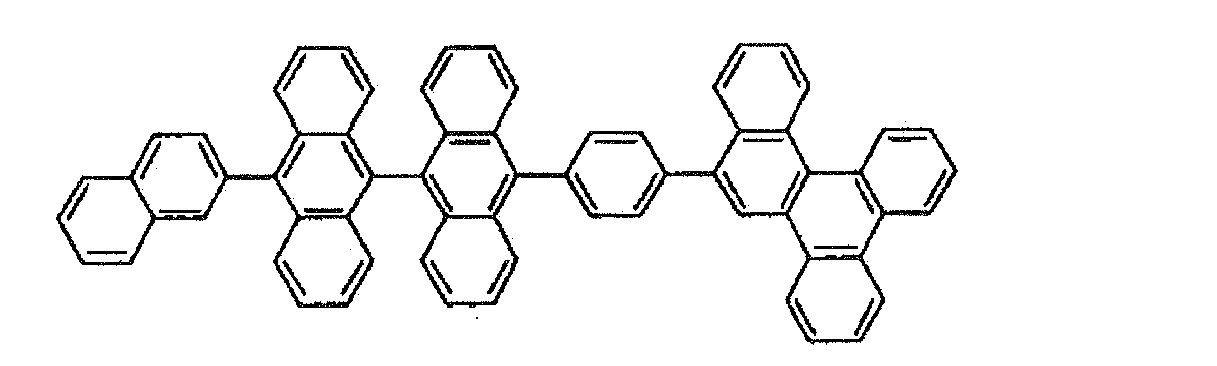


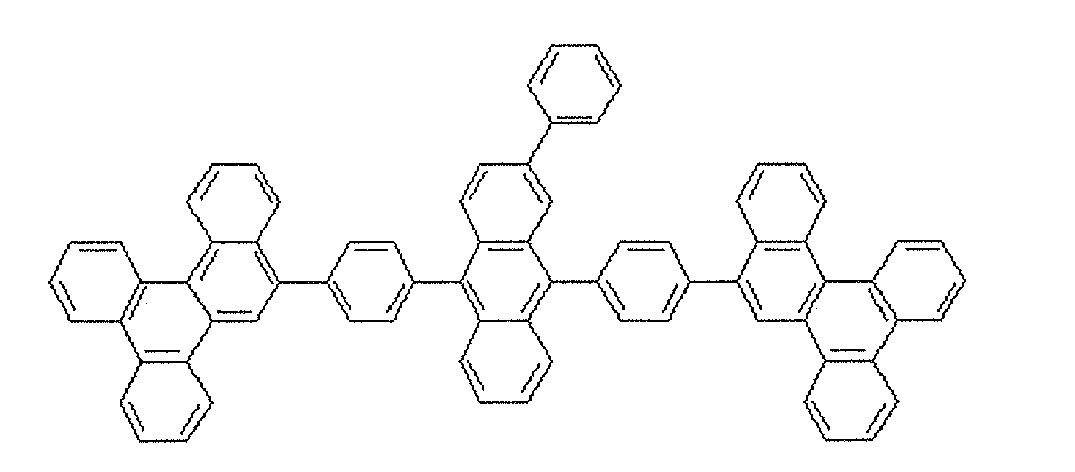
- The fused aromatic ring derivative of the invention can be synthesized by the methods described below.
- (1) Synthesizing benzo[g]chrysene with reference to the following documents, and halogenating the benzo[g]chrysene to prepare a halogenated benzo[g]chrysene, followed by reacting with a boronic acid having an anthracene ring.
- (2) Synthesizing benzo[g]chrysene with reference to the following documents, and hydroborating the benzo[g]chrysene to prepare a benzo[g]chrysene boronic acid, followed by reacting with a halide having an anthracene ring.
- [Synthesis 2001, No. 6, 841-844]
- [J. Org. Chem. 2005, 70, 3511-3517]
- [Journal of the American Chemical Society, 96:14, July 10, 1974, 4617-4622]
- [Journal of the American Chemical Society, Jan, 1942, Vo. 64, 69-72]
- The benzo[g]chrysene is the following compound.

- The fused aromatic ring derivative of the invention can be preferably used as a material for an organic EL device, in particular, as the emitting material thereof.
- The organic EL device of the invention comprises an anode, a cathode and one or more organic thin layers comprising an emitting layer between the anode and the cathode, and at least one of the organic thin layers comprise the above-mentioned compound of the invention.
- Representative configurations of the organic EL device of the invention can be given below.
- (1) Anode/emitting layer/cathode
- (2) Anode/hole-injecting layer/emitting layer/cathode
- (3) Anode/emitting layer/electron-injecting layer/cathode
- (4) Anode/hole-injecting layer/emitting layer/electron-injecting layer/cathode
- (5) Anode/organic semiconductor layer/emitting layer/cathode
- (6) Anode/organic semiconductor layer/electron-barrier layer/emitting layer/cathode
- (7) Anode/organic semiconductor layer/emitting layer/adhesion-improving layer/cathode
- (8) Anode/hole-injecting layer/hole-transporting layer/emitting layer/electron-injecting layer/cathode
- (9) Anode/insulating layer/emitting layer/insulating layer/cathode
- (10) Anode/inorganic semiconductor layer/insulating layer/emitting layer/insulating layer/cathode
- (11) Anode/organic semiconductor layer/insulating layer/emitting layer/insulating layer/cathode
- (12) Anode/insulating layer/hole-injecting layer/hole-transporting layer/emitting layer/insulating layer/cathode
- (13) Anode/insulating layer/hole-injecting layer/hole-transporting layer/emitting layer/electron-injecting layer/cathode
The representative examples of the configuration of the organic EL device of the invention are, however, not limited to the above. Of these, the configuration (8) is preferable. - The configuration (8) is shown in
FIG. 1 . This organic EL device comprises ananode 10, acathode 20, and a hole-injectinglayer 30, a hole-transportinglayer 32, an emittinglayer 34 and an electron-injectinglayer 36 between the anode and the cathode. The hole-injectinglayer 30, the hole-transportinglayer 32, the emittinglayer 34 and the electron-injectinglayer 36 correspond to the plurality of organic thin film layers. At least one of these organic thin film layers 30, 32, 34 and 36 comprises the compound of the invention. - In the organic EL device of the invention, although the compound of the invention may be used in any of the above-mentioned organic thin film layers, it is preferred that the compound of the invention be used in the emitting layer. In each of the organic thin film layers, the compound of the invention may be used either singly or in mixture with other compounds. In the device of the invention, it is preferred that the emitting layer contain the compound of the invention as a host material and contain at least one of a fluorescent dopant and a phosphorescent dopant.
In the invention, it is preferred that the emitting layer consist essentially of the compound of the invention and the above-mentioned dopant.
The content of the compound of the invention in the organic thin film layers is preferably 30 to 100 mol%. - Each member of the organic EL device will be explained below.
The organic EL device is normally formed on a substrate. The substrate supports the organic EL device. It is preferable to use a smooth substrate. If light is outcoupled through the substrate, it is preferred that the substrate be a transparent substrate with a transmission to visible rays with a wavelength of 400 to 700 nm of 50% or more.
As such tranparent substrate, a glass plate, a synthetic resin plate or the like are preferably used. Examples of the glass plate include plates of soda-lime glass, barium/strontium-containing glass, lead glass, aluminosilicate glass, borosilicate glass, barium borosilicate glass, quartz, or the like. Examples of the synthetic resin plates include plates of a polycarbonate resin, an acrylic resin, a polyethylene terephthalate resin, a polyether sulfide resin, a polysulfone resin, or the like. - It is effective that the anode injects holes to the hole-injecting layer, the hole-transporting layer or the emitting layer and has a work function of 4.5 eV or more. Specific examples of the anode material include indium tin oxide (ITO), a mixture of indium oxide and zinc oxide, a mixture of ITO and cerium oxide (ITCO), a mixture of the mixture of
indium oxide, and zinc oxide and cerium oxide (IZCO), a mixture of indium oxide and cerium oxide (ICO), a mixture of zinc oxide and aluminum oxide (AZO), tin oxide (NESA), gold, silver, platinum and copper.
The anode can be formed from these electrode materials by a vapor deposition method, a sputtering method or the like.
In the case where emission from the emitting layer is outcoupled through the anode, the transmittance of the anode to the emission is preferably more than 10%. The sheet resistance of the anode is preferably several hundred Ω/□ or less. The film thickness of the anode, which varies dependin g upon the material thereof, is usually from 10 nm to 1 µm, preferably from 10 to 200 nm. - The emitting layer has the following functions.
- (i) Injection function: function of allowing injection of holes from the anode or hole-injecting layer and injection of electrons from the cathode or electron-injecting layer upon application of an electric field
- (ii) Transporting function: function of moving injected carriers (electrons and holes) due to the force of an electric field
- (iii) Emission function: function of recombining electons and holes to emit light
- As the method of forming the emitting layer, a known method such as deposition, spin coating, or an LB method may be applied. It is preferable that the emitting layer be a molecular deposition film. The molecular deposition film is a film formed by deposition of a material compound in a gas phase, or by solidification of a material compound in the form of a solution or in a liquid phase. The molecular deposition film can be usually distinguished from a thin film (molecular accumulation film) formed using the LB method by the difference in aggregation structure or higher order structure or the difference in function due to the difference in structure.
The emitting layer may also be formed by dissolving a binder such as a resin and a material compound in a solvent to obtain a solution, and forming a thin film from the solution by spin coating or the like. - As mentioned above, it is preferred that the emitting layer contain the compound of the invention as a host material. The emitting layer may contain, in addition to the compound of the invention, host materials given below.
- Specific examples of the host material which can be used in the emitting layer include compounds shown by the following formulas (i) to (ix):
- Asymmetrical anthracene represented by the following formula (i):

Ar002 is a substituted or unsubstituted aromatic group having 6 to 50 (preferably 6 to 20, more preferably 6 to 14) ring carbon atoms,
X001 to X003 are independently a substituted or unsubstituted aromatic group having 6 to 50 (preferably 6 to 20, more preferably 6 to 14) ring carbon atoms, a substituted or unsubstituted aromatic heterocyclic group having 5 to 50 (preferably 5 to 20) atoms that form a ring (hereinafter referred to as "ring atoms"), a substituted or unsubstituted alkyl group having 1 to 50 (preferably 1 to 20, more preferably 1 to 12, and particularly preferably 1 to 8) carbon atoms, a substituted or unsubstituted alkoxy group having 1 to 50 (preferably 1 to 20, more preferably 1 to 12, and particularly preferably 1 to 8) carbon atoms, a substituted or unsubstituted aralkyl group having 6 to 50 (preferably 6 to 20, more preferably 6 to 14) carbon atoms, a substituted or unsubstituted aryloxy group having 5 to 50 (preferably 5 to 20) ring atoms, a substituted or unsubstituted arylthio group having 5 to 50 (preferably 5 to 20) ring atoms, a substituted or unsubstituted alkoxycarbonyl group having 1 to 50 (preferably 1 to 20, more preferably 1 to 12, and particularly preferably 1 to 8) carbon atoms, a carboxyl group, a halogen atom, a cyano group, a nitro group and a hydroxy group,
a, b and c are each an integer of 0 to 4.
n is an integer of 1 to 3, and when n is two or more, groups in the plural repeating units ([]) may be the same or different.
In the formula (i), when the above-mentioned groups which are indicated by "substituted or unsubstituted" are substituted, the same groups as those shown by Ra and Rb in the formula (1) can be given as the substituent. The same can be applied to the following compounds. - Asymmetrical monoanthracene derivatives represented by the following formula (ii):

m and n are each an integer of 1 to 4,
provided that in the case where m=n=1 and Ar003 and Ar004 are symmetrically bonded to the benzene rings, Ar003 and Ar004 are not the same, and in the case where m or n is an integer of 2 to 4, m is different from n,
R001 to R010 are independently are a hydrogen atom, a substituted or unsubstituted aromatic ring group having 6 to 50 (preferably 6 to 20, more preferably 6 to 14) ring carbon atoms, a substituted or unsubstituted aromatic heterocyclic group having 5 to 50 (preferably 5 to 20) ring atoms, a substituted or unsubstituted alkyl group having 1 to 50 (preferably 1 to 20, more preferably 1 to 12 and particularly preferably 1 to 8) carbon atoms, a substituted or unsubstituted cycloalkyl group, a substituted or unsubstituted alkoxy group having 1 to 50 (preferably 1 to 20, more preferably 1 to 12, and particularly preferably 1 to 8) carbon atoms, a substituted or unsubstituted aralkyl group having 6 to 50 (preferably 6 to 20, more preferably 6 to 14) carbon atoms, a substituted or unsubstituted aryloxy group having 5 to 50 (preferably 5 to 20) ring atoms, a substituted or unsubstituted arylthio group having 5 to 50 (preferably 5 to 20) ring atoms, a substituted or unsubstituted alkoxycarbonyl group having 1 to 50 (preferably 1 to 20, more preferably 1 to 12, and particularly preferably 1 to 8) carbon atoms, a substituted or unsubstituted silyl group, a carboxyl group, a halogen atom, a cyano group, a nitro group or a hydroxyl group. - Asymmetrical pyrene derivatives shown by the following formula (iii):

L001 and L002 are independently a substituted or unsubstituted phenylene group, a substituted or unsubstituted naphthalenylene group, a substituted or unsubstituted fluolenylene group, or a substituted or unsubstituted dibenzosilolylene group,
m is an integer of 0 to 2, n is an integer of 1 to 4, s is an integer of 0 to 2, and t is an integer of 0 to 4,
L001 or Ar005 bonds at any one position of 1 to 5 of the pyrene, and L002 or Ar006 bonds at any one position of 6 to 10 of the pyrene; provided that when n+t is an even number, Ar005, Ar006, L001 and L002 satisfy the following (1) and (2): - (1) Ar005≠Ar006 and/or L001≠L002 where ≠ means these substituents are groups having different structures from each other,
- (2) when Ar005=Ar006 and L001=L002,
- (2-1) m≠s and/or n≠t, or
- (2-2) when m=s and n=t,
- (2-2-1) when L001 and L002 or pyrene are independently bonded to different bonding positions of Ar005 and Ar006, or (2-2-2) when L001 and L002 or pyrene are bonded to the same position of Ar005 and Ar006, the positions of the substitution of L001 and L002 or Ar005 and Ar006 at pyrene are neither the 1st position and the 6th position, nor the 2nd position and the 7th position.
- Asymmetrical anthracene shown by the following formula (iv):

Ar007 and Ar008 are independently a hydrogen atom or a substituted or unsubstituted aromatic ring group having 6 to 50 (preferably 6 to 20, more preferably 6 to 14) ring carbon atoms,
R011 to R020 are independently are a hydrogen atom, a substituted or unsubstituted aromatic ring group having 6 to 50 (preferably 6 to 20, more preferably 6 to 14) ring carbon atoms, a substituted or unsubstituted aromatic heterocyclic group having 5 to 50 (preferably 5 to 20) ring atoms, a substituted or unsubstituted alkyl group having 1 to 50 (preferably 1 to 20, more preferably 1 to 12 and particularly preferably 1 to 8) carbon atoms, a substituted or unsubstituted cycloalkyl group, a substituted or unsubstituted alkoxy group having 1 to 50 (preferably 1 to 20, more preferably 1 to 12, and particularly preferably 1 to 8) carbon atoms, a substituted or unsubstituted aralkyl group having 6 to 50 (preferably 6 to 20, more preferably 6 to 14) carbon atoms, a substituted or unsubstituted aryloxy group having 5 to 50 (preferably 5 to 20) ring atoms, a substituted or unsubstituted arylthio group having 5 to 50 (preferably 5 to 20) ring atoms, a substituted or unsubstituted alkoxycarbonyl group having 1 to 50 (preferably 1 to 20, more preferably 1 to 12, and particularly preferably 1 to 8) carbon atoms, a substituted or unsubstituted silyl group, a carboxyl group, a halogen atom, a cyano group, a nitro group or a hydroxyl group, and
there may be a plurality of Ar007 Ar008, R019 and R020, respectively, and adjacent groups thereof may form a saturated or unsaturated ring structure,
provided that groups do not symmetrically bond to 9 and 10 positions of the central anthracene with respect to X-Y axis. - Anthracene derivative represented by the following formula (v):

a and b are independently an integer of 1 to 5, and when they are two or more, R021s or R022s may be the same or different, R021s or R022s may be bonded to form a ring, R023 and R024, R025 and R026, R027 and R028, and R029 and R030 may be bonded to each other to form a ring, and
L003 is a single bond, -O-, -S-, -N(R)- (R is an alkyl group or a substituted or unsubstituted aryl group), an alkylene group or an arylene group. - Anthracene derivative shown by the following formula (vi):

c, d, e and f are independently an integer of 1 to 5, and when they are two or more, R131s, R032s, R036s or R037s may be the same or different, R031s, R032s, R033s or R037 may be bonded to form a ring, and R033 and R034, and R038 and R039 may be bonded to each other to form a ring, and
L004 is a single bond, -O-, -S-, -N(R)- (R is an alkyl group or a substituted or unsubstituted aryl group), an alkylene group or an arylene group. - Spirofluorene derivative represented by the following formula (vii):
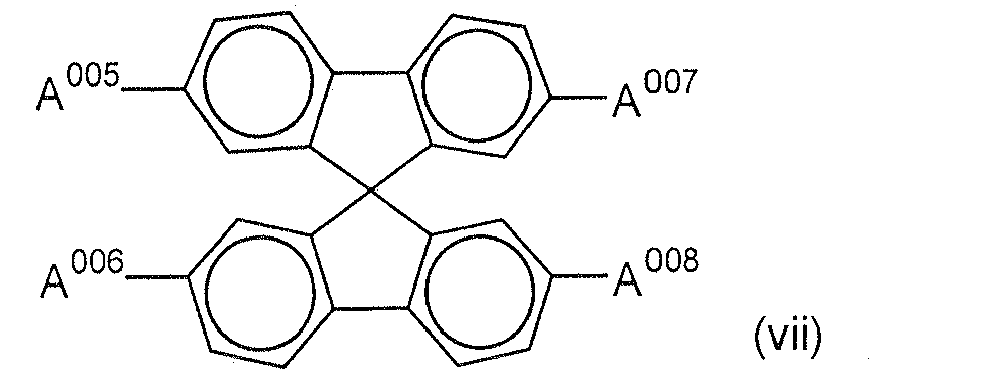
- Fused ring-containing compounds shown by the following formula (viii):

A014 to A016 are independently a hydrogen atom or a substituted or unsubstituted aryl group having 6 to 50 (preferably 6 to 20, more preferably 6 to 14) ring carbon atoms, and
R041 to R143 are independently a hydrogen atom, alkyl group having 1 to 6 carbon atoms, cycloalkyl group having 3 to 6 carbon atoms, alkoxy group having 1 to 6 carbon atoms, aryloxy group having 5 to 18 carbon atoms, aralkyloxy group having 7 to 18 carbon atoms, arylamino group having 5 to 16 carbon atoms, nitro group, cyano group, ester group having 1 to 6 carbon atoms, or a halogen atom, provided that at least one of A011 to A016 is a group having a fused aromatic ring with three or more rings. - Fluorene compounds shown by the following formula (ix):

n is an integer of 1 to 10, and when n is two or more, R051s or R052s bonded to different fluorene groups may be the same or different, and R051 and R052 bonded to a single fluorene group may be the same or different,
R053 and R054 are independently a hydrogen atom, a substituted or unsubstituted alkyl group, a substituted or unsubstituted aralkyl group, a substituted or unsubstituted aryl group or a substituted or unsubstituted heterocyclic group, when n is two or more, R053s or R054s bonded to different fluorene groups may be the same or different, and R053 and R054 bonded to a single fluorene group may be the same or different, and
Ar011 and Ar012 are a substituted or unsubstituted fused polycyclic aromatic group with a total number of benzene rings of three or more or a fused polycyclic heterocyclic group which is bonded to the fluorene group through substituted or unsubstituted carbon and has a total number of benzene rings and heterocyclic rings of three or more, provided that Ar011 and Ar012 may be the same or different. - In the organic EL device of the invention, it is preferred that the emitting layer contain the compound of the invention as a host and contain at least one of a phosphorescent dopant and a fluorescent dopant. An emitting layer containing these dopants may be stacked on an emitting layer containing the compound of the invention.
- A phosphorescent dopant is a compound that can emit light from triplet excitons. The dopant is not limited so long as it can emit light from triplet excitons, but it is preferably a metal complex containing at least one metal selected from the group of Ir, Ru, Pd, Pt, Os and Re. A porphyrin metal complex or an ortho-metalated metal complex is preferable. The phosphorescent compounds can be used individually or as a combination of two or more kinds.
- As a porphyrin metal complex, a porphyrin platinum complex is preferable.
There are various ligands forming an ortho-metalated metal complex. Preferable ligands include compounds having a phenylpyridine skeleton, a bipyridyl skeleton or a phenanthroline skeleton, 2-phenylpyridine, 7,8-benzoquinoline, 2-(2-thienyl)pyridine, 2-(1-naphthyl)pyridine and 2-phenylquinoline derivatives. These ligands may have a substituent, if necessary. Ligands to which fluorides, e.g. a trifluoromethyl group, being introduced as a substituent are particularly preferable as a blue dopant. As an auxiliary ligand, preferred are ligands other than the above-mentioned ligands, such as acetylacetonate and picric acid may be contained. - Specific examples of such metal complex are, not limited to, tris(2-phenylpyridine)iridium, tris(2-phenylpyridine)ruthenium, tris(2-phenylpyridine)palladium, bis(2-phenylpyridine)platinum, tris(2-phenylpyridine)osmium, tris(2-phenylpyridine)rhenium, octaethylplatinumporphyrin, octaphenylplatinumporphyrin, octaethylpalladiumporphyrin, octaphenylpalladiumporphyrin and the like. An adequate complex can be selected according to required light color, device performance and host materials used.
- The content of a phosphorescent dopant in an emitting layer is not limited and can be properly selected according to purposes; for example, it is 0.1 to 70 mass %, preferably 1 to 30 mass %. When the content of a phosphorescent compound is less than 0.1 mass %, emission may be weak and the advantages thereof may not be sufficiently obtained. When the content exceeds 70 mass %, the phenomenon called concentration quenching may significantly proceed, thereby degrading the device performance.
- As for the fluorescent dopant, it is preferable to select a compound from amine-based compounds, aromatic compounds, chelate complexes such as tris(8-quinolilate)aluminum complexes, coumarin derivatives, tetraphenylbutadiene derivatives, bisstyrylarylene derivatives, oxadiazole derivatives or the like, taking into consideration required emission colors. Of these, styrylamine compounds, styryldiamine compounds, arylamine compounds and aryldiamine compounds are further preferable. Fused polycyclic aromatic compounds which are not an amine compound are also preferable. These fluorescent dopants may be used singly or in combination of two or more.
- The content of a fluorescent dopant in the emitting layer is not particularly limited and can be appropriately selected according to purposes; for example, it is 0.01 to 100 mass %, preferably 0.1 to 30 mass %.
- As the styrylamine compound and the styryldiamine compound, those shown by the following formula (A) are preferable.

- wherein Ar101 is a group with a valence of p corresponding to a phenyl group, a naphthyl group, a biphenyl group, a terphenyl group, a stilbenyl group or a distyrylaryl group, Ar102 and Ar103 are independently an aromatic hydrocarbon group having 6 to 20 (preferably 6 to 14) carbon atoms, Ar101, Ar102 and Ar103 may be substituted, one of Ar101 to Ar103 is substituted by a styryl group, further preferably, at least one of Ar102 and Ar103 is substituted by a styryl group, and p is an integer of 1 to 4, preferably an integer of 1 to 2.
Here, as the aromatic hydrocarbon group having 6 to 20 (preferably 6 to 14) carbon atoms, a phenyl group, a naphthyl group, an anthranyl group, a phenanthryl group, a terphenyl group or the like can be given. - As the arylamine compound and the aryldiamine compound, those shown by the following formula (B) are preferable.

- wherein A111 is a substituted or unsubstituted aromatic group with a valence of q having 5 to 40 (preferably 6 to 20, more preferably 6 to 14) ring carbon atoms, Ar112 and Ar113 are independently a substituted or unsubstituted aryl group having 5 to 40 (preferably 6 to 20, more preferably 6 to 14) ring carbon atoms, and q is an integer of 1 to 4, preferably an integer of 1 to 2.
Examples of the aryl group having 5 to 40 ring carbon atoms include a phenyl group, a naphthyl group, an anthranyl group, a phenanthryl group, a pyrenyl group, a coronenyl group, a biphenyl group, a terphenyl group, a pyrrolyl group, a furanyl group, a thiophenyl group, a benzothiophenyl group, an oxadiazolyl group, a diphenylanthranyl group, an indolyl group, a carbazolyl group, a pyridyl group, a benzoquinolyl group, a fluoranthenyl group, an acenaphthofluoranthenyl group, a stilbene group, a perylenyl group, a chrysenyl group, a picenyl group, a triphenylenyl group, a rubicenyl group, a benzanthracenyl group, a phenylanthranyl group and a bisanthracenyl group. Preferred are a naphthyl group, an anthranyl group, chrysenyl group and a pyrenyl group.
As the Ar111, q-value groups corresponding to the above-mentioned aryl groups are preferable. When Ar111 is a divalent group, groups shown by the following formulas (C) and (D) are preferable. A group shown by the formula (D) is more preferable. -

- Preferred substituents for the above-mentioned aryl group include an alkyl group having 1 to 6 carbon atoms (ethyl, methyl, i-propyl, n-propyl, s-butyl, t-butyl, pentyl, hexyl, cyclopentyl, cyclohexyl, or the like); an alkoxy group having 1 to 6 carbon atoms (ethoxy, methoxy, i-propoxy, n-propoxy, s-buthoxy, t-buthoxy, penthoxy, hexyloxy, cyclopentoxy, cyclohexyloxy, or the like); an aryl group having 5 to 40 (preferably 6 to 20, more preferably 6 to 14) ring carbon atoms; an amino group substituted with an aryl group having 5 to 40 (preferably 6 to 20, more preferably 6 to 14) ring carbon atoms; an ester group with an aryl group having 5 to 40 (preferably 6 to 20, more preferably 6 to 14) ring carbon atoms; an ester group with an alkyl group having 1 to 6 carbon atoms; a cyano group; a nitro group; and a halogen atom.
- The emitting layer may contain hole-transporting materials, electron-transporting materials and polymer binders, if necessary.
The thickness of an emitting layer is preferably from 5 to 50 (preferably 5 to 20) nm, more preferably from 7 to 50 nm and most preferably from 10 to 50 (preferably 10 to 30, more preferably 10 to 20) nm. When it is less than 5 nm, the formation of an emitting layer and the adjustment of chromaticity may become difficult. When it exceeds 50 nm, the driving voltage may increase. - The hole-transporting layer and the hole-injecting layer are layers which help the injection of holes into the emitting layer so as to transport holes to an emitting region, and have a large hole mobility and normally have such a small ionization energy as 5.5 eV or less. As the material for the hole-injecting layer and the hole-transporting layer, a material which transports holes to the emitting layer at a lower electrical field is preferable, and the hole mobility thereof is preferably 10-4 cm2/V·second or more when an electric field of, e.g., 104 to 106 V/cm is applied.
There are no particular restrictions on the material for the hole-injecting layer and the hole-transporting layer. The material can be arbitrarily selected from materials which have been widely used as a hole-transporting material of photoconductive materials and known materials used in a hole-injecting layer and a hole-transporting layer of organic EL devices. - In the hole-injecting layer and the hole-transporting layer, an aromatic amine derivative shown by the following formula can be used, for example.

- Examples of the substituted or unsubstituted aromatic hydrocarbon groups having 6 to 50 ring carbon atoms include a phenyl group, 1-naphthyl group, 2-naphthyl group, 1-anthryl group, 2-anthryl group, 9-anthryl group, 1-phenanthryl group, 2-phenanthryl group, 3-phenanthryl group, 4-phenanthryl group, 9-phenanthryl group, 1-naphthacenyl group, 2-naphthacenyl group, 9-naphthacenyl group, and 1-pyrenyl group, 2-pyrenyl group, 4-pyrenyl group, 2-biphenylyl group, 3-biphenylyl group, 4-biphenylyl group, p-terphenyl-4-yl group, p-terphenyl-3-yl group, p-terphenyl-2-yl group, m-terphenyl-4-yl group, m-terphenyl-3-yl group, m-terphenyl-2-yl group, o-tolyl group, m-tolyl group, p-tolyl group, p-t-butylphenyl group, p-(2-phenylpropyl)phenyl group, 3-methyl-2-naphthyl group, 4-methyl-1-naphthyl group, 4-methyl-1-anthryl group, 4'-methylbiphenylyl group, and 4"-t-butyl-p-terphenyl-4-yl group.
- Examples of the substituted or unsubstituted aromatic heterocyclic group having 5 to 50 ring atoms include a 1-pyrrolyl group, 2-pyrrolyl group, 3-pyrrolyl group, pyrazinyl group, 2-pyridinyl group, 3-pyridinyl group, 4-pyridinyl group, 1-indolyl group, 2-indolyl group, 3-indolyl group, 4-indolyl group, 5-indolyl group, 6-indolyl group, 7-indolyl group, 1-isoindolyl group, 2-isoindolyl group, 3-isoindolyl group, 4-isoindolyl group, 5-isoindolyl group, 6-isoindolyl group, 7-isoindolyl group, 2-furyl group, 3-furyl group, 2-benzofuranyl group, 3-benzofuranyl group, 4-benzofuranyl group, 5-benzofuranyl group, 6-benzofuranyl group, 7-benzofuranyl group, 1-isobenzofuranyl group, 3-isobenzofuranyl group, 4-isobenzofuranyl group, 5-isobenzofuranyl group, 6-isobenzofuranyl group, 7-isobenzofuranyl group, quinolyl group, 3-quinolyl group, 4-quinolyl group, 5-quinolyl group, 6-quinolyl group, 7-quinolyl group, 8-quinolyl group, 1-isoquinolyl group, 3-isoquinolyl group, 4-isoquinolyl group, 5-isoquinolyl group, 6-isoquinolyl group, 7-isoquinolyl group, 8-isoquinolyl group, 2-quinoxalinyl group, 5-quinoxalinyl group, 6-quinoxalinyl group, 1-carbazolyl group, 2-carbazolyl group, 3-carbazolyl group, 4-carbazolyl group, 9-carbazolyl group, 1-phenanthridinyl group, 2-phenanthridinyl group, 3-phenanthridinyl group, 4-phenanthridinyl group, 6-phenanthridinyl group, 7-phenanthridinyl group, 8-phenanthridinyl group, 9-phenanthridinyl group, 10-phenanthridinyl group, 1-acridinyl group, 2-acridinyl group, 3-acridinyl group, 4-acridinyl group, 9-acridinyl group, 1,7-phenanthrolin-2-yl group, 1,7-phenanthrolin-3-yl group, 1,7-phenanthrolin-4-yl group, 1,7-phenanthrolin-5-yl group, 1,7-phenanthrolin-6-yl group, 1,7-phenanthrolin-8-yl group, 1,7 -phenanthrolin-9-yl group, 1,7-phenanthrolin-10-yl group, 1,8-phenanthrolin-2-yl group, 1,8-phenanthrolin-3-yl group, 1,8-phenanthrolin-4-yl group, 1,8-phenanthrolin-5-yt group, 1,8-phenanthrolin-6-yl group, 1,8-phenanthrolin-7-yl group, 1,8-phenanthrolin-9-yl group, 1,8-phenanthrolin-10-yl group, 1,9-phenanthrolin-2-yl group, 1,9-phenanthrolin-3-yl group, 1,9-phenanthrolin-4-yl group, 1,9-phenanthrolin-5-yl group, 1,9-phenanthrolin-6-yl group, 1,9-phenanthrolin-7-yl group, 1,9-phenanthrolin-8-yl group, 1,9-phenanthrolin-10-yl group, 1,10-phenanthrolin-2-yl group, 1,10-phenanthrolin-3-yl group, 1,10-phenanthrolin-4-yl group, 1,10-phenanthrolin-5-yl group, 2,9-phenanthrolin-1-yl group, 2,9-phenanthrolin-3-yl group, 2,9-phenanthrolin-4-yl group, 2,9-phenanthrolin-5-yl group, 2,9-phenanthrolin-6-yl group, 2,9-phehanthrolin-7-yl group, 2,9-phenanthrolin-8-yl group, 2,9-phenanthrolin-10-yl group, 2,8-phenanthrolin-1-yl group, 2,8-phenanthrolin-3-yl group, 2,8-phenanthrolin-4-yl group, 2,8-phenanthrolin-5-yl group, 2,8-phenanthrolin-6-yl group, 2,8-phenanthrolin-7-yl group, 2,8-phenanthrolin-9-yl group, 2,8-phenanthrolin-10-yl group, 2,7-phenanthrolin-1-yl group, 2,7-phenanthrolin-3-yl group, 2,7-phenanthrolin-4-yl group, 2,7-phenanthrolin-5-yl group, 2,7-phenanthrolin-6-yl group, 2,7-phenanthrolin-8-yl group, 2,7-phenanthrolin-9-yl group, 2,7-phenanthrolin-10-yl group, 1-phenazinyl group, 2-phenazinyl group, 1-phenothiadinyl group, 2-phenothiadinyl group, 3-phenothiadinyl group, 4-phenothiadinyl group, 10-phenothiadinyl group, 1-phenoxadinyl group, 2-phenoxadinyl group, 3-phenoxadinyl group, 4-phenoxadinyl group, 10-phenoxadinyl group, 2-oxazolyl group, 4-oxazolyl group, 5-oxazolyl group, 2-oxadiazolyl group, 5-oxadiazolyl group, 3-furazanyl group, 2-thienyl group, 3-thienyl group, 2-methylpyrrol-1-yl group, 2-methylpyrrol-3-yl group, 2-methylpyrrol-4-yl group, 2-methylpyrrol-5-yl group, 3-methylpyrrol-1-yl group, 3-methylpyrrol-2-yl group, 3-methylpyrrol-4-yl group, 3-methylpyrrol-5-yl group, 2-t-butylpyrrol-4-yl group, 3-(2-phenylpropyl)pyrrol-1-yl group, 2-methyl-1-indolyl group, 4-methyl-1-indolyl group, 2-methyl-3-indolyl group, 4-methyl-3-indolyl group, 2-t-butyl-1-indolyl group, 4-t-butyl-1-indolyl group, 2-t-butyl-3-indolyl group, and 4-t-butyl-3-indolyl group.
- Further, the compound shown by the following formula can be used in the hole-injecting layer and the hole-transporting layer.

As specific examples of the substituted or unsubstituted aromatic hydrocarbon group having 6 to 50 ring carbon atoms and substituted or unsubstituted aromatic heterocyclic group having 5 to 50 ring atoms, the same as those exemplified above for the aromatic amine derivative can be given. - As specific examples of the material for the hole-injecting layer and the hole-transporting layer, a triazole derivative, an oxadiazole derivative, an imidazole derivative, a polyarylalkane derivative, a pyrazoline derivative, a pyrazolone derivative, a phenylenediamine derivative, an arylamine derivative, an amino-substituted chalkone derivative, an oxazole derivative, a styrylanthracene derivative, a fluorenone derivative, a hydrazone derivative, a stilbene derivative, a silazane derivative, an aniline-based copolymer, and conductive high-molecular oligomers (in particular, a thiophene oligomer) can be given.
- As the material for the hole-injecting layer and the hole-transporting layer, although the above-mentioned materials can be used, it is preferable to use a porphyrin compound, an aromatic tertiary amine compound and a styrylamine compound. It is particularly preferable to use an aromatic tertiary amine compound.
- It is preferable to use a compound having two fused aromatic rings in the molecule thereof, for example, 4,4'-bis(N-(1-naphthyl)-N-phenylamino)biphenyl (abbreviated by NPD, hereinafter), and 4,4',4"-tris(N-(3-methylphenyl)-N-phenylamino)triphenylamine (abbreviated by MTDATA, hereinafter) wherein three triphenylamine units are linked in a star-burst form.
- In addition to the above, a nitrogen-containing heterocyclic derivative shown by the following formula can also be used.

- Further, the following compound can also be used.

- Further, an inorganic compound such as p-type Si and p-type SiC can also be used as a material for the hole-injecting layer and the hole-transporting layer.
The hole-injecting layer and the hole-transporting layer can be formed from the above-mentioned compounds by a known method such as vapor vacuum deposition, spin coating, casting or LB technique. The film thickness of the hole-injecting layer and the hole-transporting layer is not particularly limited, and is usually from 5 nm to 5 µm. The hole-injecting layer and the hole-transporting layer may be a single layer made of one or two or more of the above-mentioned materials, or may be of a structure in which hole-injecting layers and hole-transporting layers made of different compounds are stacked. - The organic semiconductor layer is a layer for helping the injection of holes or electrons into the emitting layer, and is preferably a layer having an electric conductivity of 10-10 S/cm or more. As the material of such an organic semiconductor layer, electroconductive oligomers such as thiophene-containing oligomers or arylamine-containing oligomers and electroconductive dendrimers such as arylamine-containing dendrimers may be used.
- The electron-injecting layer and the electron-transporting layer are layers which assist injection of electrons into the emitting layer and transport electrons to the emitting region, and exhibit a high electron mobility. The adhesion-improving layer is a kind of the electron-injecting layer which is made of a material exhibiting particularly good adhesion to the cathode.
The thickness of the electron-transporting layer is arbitrarily selected in the range of 5 nm to 5 µm. When the electron-transporting layer has a thick thickness, it is preferable that the electron mobility be 10-5 cm2/Vs or more at an applied electric field of 104 to 106 V/cm in order to prevent an increase in voltage. - The material used in the electron-injecting layer and the electron-transporting layer is preferably a metal complex of 8-hydroxyquinoline or a derivative thereof, or an oxadiazole derivative. Specific examples of the metal complex of 8-hydroxyquinoline or derivative thereof include metal chelate oxynoid compounds containing a chelate of oxine (generally, 8-quinolinol or 8-hydroxyquinoline), e.g. tris(8-quinolinolato)aluminum.
- As examples of the oxadiazole derivative, an electron-transporting compound shown by the following formula can be given.
-


- As examples of the aryl group, a phenyl group, a biphenyl group, an anthranyl group, a perylenyl group, and a pyrenyl group can be given. As examples of the arylene group, a phenylene group, a naphthylene group, a biphenylene group, an anthranylene group, a perylenylene group, a pyrenylene group, and the like can be given. As the substituent, an alkyl group having 1 to 10 carbon atoms, an alkoxy group having 1 to 10 carbon atoms, a cyano group, and the like can be given. The electron-transporting compound is preferably one from which a thin film can be formed.
- The following compounds can be given as specific examples of the electron-transporting compound.



- Furthermore, as materials used for the electron-injecting layer and electron-transporting layer, the compounds represented by the following formulas (E) to (J) may be used.


- Nitrogen-containing heterocyclic derivatives shown by the formulas (E) and (F):
wherein Ar311 to Ar313 are independently a nitrogen atom or a carbon atom,
Ar311 is a substituted or unsubstituted aryl group having 6 to 60 (preferably 6 to 20, more preferably 6 to 14) ring carbon atoms or a substituted or unsubstituted heteroaryl group having 3 to 60 (preferably 3 to 20, more preferably 3 to 14) ring carbon atoms, Ar311' is an arylene group having 6 to 60 (preferably 6 to 20, more preferably 6 to 14) ring carbon atoms or a substituted or unsubstituted heteroarylene group having 3 to 60 (preferably 3 to 20, more preferably 3 to 14) ring carbon atoms, and Ar312 is a hydrogen atom, a substituted or unsubstituted aryl group having 6 to 60 (preferably 6 to 20, more preferably 6 to 14) ring carbon atoms, a substituted or unsubstituted heteroaryl group having 3 to 60 (preferably 3 to 20, more preferably 3 to 14) ring carbon atoms, a substituted or unsubstituted alkyl group having 1 to 20 (preferably 1 to 12, more preferably 1 to 8) carbon atoms, or a substituted or unsubstituted alkoxy group having 1 to 20 (preferably 1 to 12, more preferably 1 to 8) carbon atoms, provided that one of Ar311 and Ar312 is a substituted or unsubstituted fused ring group having 10 to 60 (preferably 10 to 30, more preferably 10 to 20) ring carbon atoms or a substituted or unsubstituted monohetero fused ring group having 3 to 60 (preferably 3 to 20, more preferably 3 to 14) ring carbon atoms,
L311, L312 and L313 are independently a single bond, a substituted or unsubstituted arylene group having 6 to 60 (preferably 6 to 20, more preferably 6 to 14) ring carbon atoms, a substituted or unsubstituted heteroarylene group having 3 to 60 (preferably 3 to 20, more preferably 3 to 14) ring carbon atoms, or a substituted or unsubstituted fluorenylene group,
R and R311 are independently a hydrogen atom, a substituted or unsubstituted aryl group having 6 to 60 (preferably 6 to 20, more preferably 6 to 14) ring carbon atoms, a substituted or unsubstituted heteroaryl group having 3 to 60 (preferably 3 to 20, more preferably 3 to 14) ring carbon atoms, a substituted or unsubstituted alkyl group having 1 to 20 (preferably 1 to 12, more preferably 1 to 8) carbon atoms, or a substituted or unsubstituted alkoxy group having 1 to 20 (preferably 1 to 12, more preferably 1 to 8) carbon atoms,
n is an integer of 0 to 5, and
when n is two or more, plural Rs may be the same or different, and adjacent Rs may be bonded to each other to form a carbocyclic aliphatic ring or a carbocyclic aromatic ring. -
HAr-L314-Ar321-Ar322 (G)
Nitrogen-containing heterocyclic derivatives shown by the formula (G):
wherein HAr is a nitrogen-containing heterocyclic ring having 3 to 40 (preferably 3 to 30, more preferably 3 to 24) carbon atoms, which may have a substituent, L314 is a single bond, an arylene group having 6 to 60 (preferably 6 to 20, more preferably 6 to 14) carbon atoms, which may have a substituent, an heteroarylene group having 3 to 60 (preferably 3 to 20, more preferably 3 to 14) carbon atoms, which may have a substituent, or a fluorenylene group which may have a substituent, Ar321 is a divalent aromatic hydrocarbon group having 6 to 60 (preferably 6 to 20, more preferably 6 to 14) carbon atoms, which may have a substituent, and Ar322 is a an aryl group having 6 to 60 (preferably 6 to 20, more preferably 6 to 14) carbon atoms, which may have a substituent or a heteroaryl group having 3 to 60 (preferably 3 to 20, more preferably 3 to 14) carbon atoms, which may have a substituent. -

- Silacyclopentadiene derivatives shown by the formula (H) wherein X301 and Y301 are independently a saturated or unsaturated hydrocarbon group having 1 to 6 carbon atoms, an alkoxy group, an alkenyloxy group, an alkynyloxy group, a hydroxyl group, a substituted or unsubstituted aryl group, or a substituted or unsubstituted hetero ring, or X and Y are bonded to form a saturated or unsaturated ring, and R301 to R304 are independently hydrogen, halogen, an alkyl group, an alkoxy group, an aryloxy group, a perfluoroalkyl group, a perfluoroalkoxy group, an amino group, an alkylcarbonyl group, an arylcarbonyl group, an alkoxycarbonyl group, an aryloxycarbonyl group, an azo group, an alkylcarbonyloxy group, an arylcarbonyloxy group, an alkoxycarbonyloxy group, an aryloxycarbonyloxy group, a sulfinyl group, a sulfonyl group, a sulfanyl group, a silyl group, a carbamoyl group, an aryl group, a heterocyclic group, an alkenyl group, an alkynyl group, a nitro group, a formyl group, a nitroso group, a formyloxy group, an isocyano group, a cyanate group, an isocyanate group, a thiocyanate group, an isothiocyanate group, or a cyano group. These groups may be substituted and adjacent groups may form a substituted or unsubstituted fused ring.
-

- Borane derivatives shown by the formula (I) wherein R321 to R328 and Z322 are independently a hydrogen atom, a saturated or unsaturated hydrocarbon group, an aromatic hydrocarbon group, a heterocyclic group, a substituted amino group, a substituted boryl group, an alkoxy group, or an aryloxy group, X302, Y302, and Z321 are independently a saturated or unsaturated hydrocarbon group, an aromatic hydrocarbon group, a heterocyclic group, a substituted amino group, an alkoxy group, or an aryloxy group, Z321 and Z322 may be bonded to form a fused ring, and n is an integer of 1 to 3, provided that when n or (3-n) is two or more, R321 to R328, X302, Y302, Z322 and Z321 may be the same or different, provided that compounds where n is 1, X302, Y302, and R322 are methyl groups, and R328 is a hydrogen atom or a substituted boryl group, and compounds where n is 3 and Z321 is a methyl group are excluded.
-

- Gallium complexes shown by the formula (J) wherein Q301 and Q302 are independently ligands represented by the following formula (K) and L315 is a halogen atom, a substituted or unsubstituted alkyl group, a substituted or unsubstituted cycloalkyl group, a substituted or unsubstituted aryl group, a substituted or unsubstituted heterocyclic group, -OR (R is a hydrogen atom, a substituted or unsubstituted alkyl group, a substituted or unsubstituted cycloalkyl group, a substituted or unsubstituted aryl group, or a substituted or unsubstituted heterocyclic group) or a ligand represented by -O-Ga-Q303(Q304) wherein Q303 and Q304 are the same as Q301 and Q302 .
-

- The metal complexes have the strong nature of an n-type semiconductor and large ability of injecting electrons. Further, the energy generated at the time of forming a complex is small so that a metal is then strongly bonded to ligands in the complex formed and the fluorescent quantum efficiency becomes large as the emitting material.
Specific examples of the substituents for the rings A301 and A302 forming the ligand of the formula (K) include halogen atoms such as chlorine, bromine, iodine, and fluorine, substituted or unsubstituted alkyl groups such as a methyl group, ethyl group, propyl group, butyl group, sec-butyl group, tert-butyl group, pentyl group, hexyl group, heptyl group, octyl group, stearyl group, and trichloromethyl group, substituted or unsubstituted aryl groups such as a phenyl group, naphthyl group, biphenyl group, anthranyl group, phenanthryl group, fluorenyl group, pyrenyl group, 3-methylphenyl group, 3-methoxyphenyl group, 3-fluorophenyl group, 3-trichloromethylphenyl group, 3-trifluoromethylphenyl group, and 3-nitrophenyl group, substituted or unsubstituted alkoxy groups such as a methoxy group, n-butoxy group, tert-butoxy group, trichloromethoxy group, trifluoroethoxy group, pentafluoropropoxy group, 2,2,3,3-tetrafluoropropoxy group, 1,1,1,3,3,3-hexafluoro-2-propoxy group, and 6-(perfluoroethyl)hexyloxy group, substituted or unsubstituted aryloxy groups such as a phenoxy group, p-nitrophenoxy group, p-tert-butylphenoxy group, 3-fluorophenoxy group, pentafluorophenoxy group, and 3-trifluoromethylphenoxy group, substituted or unsubstituted alkylthio groups such as a methylthio group, ethylthio group, tert-butylthio group, hexylthio group, octylthio group, and trifluoromethylthio group, substituted or unsubstituted arylthio groups such as a phenylthio group, p-nitrophenylthio group, p-tert-butylphenylthio group, 3-fluorophenylthio group, pentafluorophenylthio group, and 3-trifluoromethylphenylthio group, a cyano group, a nitro group, an amino group, mono- or di-substituted amino groups such as a methylamino group, dimethylamino group, ethylamino group, diethylamino group, dipropylamino group, dibutylamino group, and diphenylamino group, acylamino groups such as a bis(acetoxymethyl)amino group, bis(acetoxyethyl)amino group, bis(acetoxypropyl)amino group, and bis(acetoxybutyl)amino group, a hydroxyl group, a siloxy group, an acyl group, substituted or unsubstituted carbamoyl groups such as a carbamoyl group, methylcarbamoyl group, dimethylcarbamoyl group, ethylcarbamoyl group, diethylcarbamoyl group, propylcarbamoyl group, butylcarbamoyl group, and phenylcarbamoyl group, a carboxylic acid group, a sulfonic acid group, an imide group, cycloalkyl groups such as a cyclopentane group and cyclohexyl group, heterocyclic groups such as a pyridinyl group, pyrazinyl group, pyrimidinyl group, pyridazinyl group, triazinyl group, indolinyl group, quinolinyl group, acridinyl group, pyrrolidinyl group, dioxanyl group, piperidinyl group, morpholinyl group, piperazinyl group, carbazolyl group, furanyl group, thiophenyl group, oxazolyl group, oxadiazolyl group, benzoxazolyl group, thiazolyl group, thiadiazolyl group, benzothiazolyl group, triazolyl group, imidazolyl group, and benzimidazolyl group. The above substituents may be bonded to form a further six-membered aryl ring or heterocyclic ring. - A preferred embodiment of the organic EL device is a device containing a reducing dopant in an electron-transferring region or in an interfacial region between a cathode and an organic layer. The reducing dopant is defined as a substance which can reduce an electron-transferring compound. Accordingly, various substances which have given reducing properties can be used. For example, at least one substance can be preferably used which is selected from the group consisting of alkali metals, alkaline earth metals, rare earth metals, alkali metal oxides, alkali metal halides, alkaline earth metal oxides, alkaline earth metal halides, rare earth metal oxides, rare earth metal halides, alkali metal carbonates, alkaline earth metal carbonates, rare earth metal carbonates, alkali metal organic complexes, alkaline earth metal organic complexes, and rare earth metal organic complexes.
- More specific examples of the preferred reducing dopants include at least one alkali metal selected from the group consisting of Na (work function: 2.36 eV), K (work function: 2.28 eV), Rb (work function: 2.16 eV) and Cs (work function: 1.95 eV), and at least one alkaline earth metal selected from the group consisting of Ca (work function: 2.9 eV), Sr (work function: 2.0 to 2.5 eV), and Ba (work function: 2.52 eV). Metals having a work function of 2.9 eV or less are particularly preferred. Among these, a more preferable reducing dopant is at least one alkali metal selected from the group consisting of K, Rb and Cs. Even more preferable is Rb or Cs. Most preferable is Cs. These alkali metals are particularly high in reducing ability. Thus, the addition of a relatively small amount thereof to an electron-injecting zone improves the luminance of the organic EL device and make the lifetime thereof long. As a reducing agent having a work function of 2.9 eV or less, combinations of two or more alkali metals are preferable, particularly combinations including Cs, such as Cs and Na, Cs and K, Cs and Rb, or Cs, Na and K are preferable. The combination containing Cs makes it possible to exhibit the reducing ability efficiently. The luminance of the organic EL device can be improved and the lifetime thereof can be made long by the addition thereof to its electron-injecting zone.
- An electron-injecting layer made of an insulator or a semiconductor may further be provided between a cathode and an organic layer. By forming the electron-injecting layer, a current leakage can be effectively prevented and electron-injecting properties can be improved. If the electron-injecting layer is an insulating thin film, more uniformed thin film can be formed whereby pixel defects such as a dark spot are decreased.
- As the insulator, at least one metal compound selected from the group consisting of alkali metal calcogenides, alkaline earth metal calcogenides, halides of alkali metals and halides of alkaline earth metals can be preferably used. When the electron-injecting layer is formed of the alkali metal calcogenide or the like, the injection of electrons can be preferably further improved. Specifically preferable alkali metal calcogenides include Li2O, K2O, Na2S, Na2Se and Na2O and preferable alkaline earth metal calcogenides include CaO, BaO, SrO, BeO, BaS and CaSe. Preferable halides of alkali metals include LiF, NaF, KF, CsF, LiCI, KCI and NaCl. Preferable halides of alkaline earth metals include fluorides such as CaF2, BaF2, SrF2, MgF2 and BeF2 and the other halides corresponding to the fluorides.
- Semiconductors forming an electron-injecting layer include one or combinations of two or more of oxides, nitrides, and oxidized nitrides containing at least one element of Ba, Ca, Sr, Yb, Al, Ga, In, Li, Na, Cd, Mg, Si, Ta, Sb and Zn. An inorganic compound forming an electron-injecting layer is preferably a microcrystalline or amorphous insulating thin film.
- For the cathode, the following may be used: an electrode substance made of a metal, an alloy or an electroconductive compound, or a mixture thereof which has a small work function (for example, 4 eV or less). Specific examples of the electrode substance include sodium, sodium-potassium alloy, magnesium, lithium, cesium, magnesium/silver alloy, aluminum/aluminum oxide, Al/Li2O, Al/LiO, Al/LiF, aluminum/lithium alloy, indium, and rare earth metals.
- The cathode is formed from these electrode materials by vapor deposition, sputtering or the like.
In the case where emission from the emitting layer is outcoupled through the cathode, it is preferred to make the transmittance of the cathode to the emission larger than 10%. The sheet resistance of the cathode is preferably several hundreds Ω/□ or less, and the film thickness thereof is usually from 10 nm to 1 µm, preferably from 50 to 200 nm. - Generally, in the organic EL device, pixel defects based on leakage or a short circuit are easily generated since an electric field is applied to the super thin film. In order to prevent this, it is preferred to insert an insulating thin layer between the pair of electrodes.
Examples of the material used in the insulating layer include aluminum oxide, lithium fluoride, lithium oxide, cesium fluoride, cesium oxide, magnesium oxide, magnesium fluoride, calcium oxide, calcium fluoride, aluminum nitride, titanium oxide, silicon oxide, germanium oxide, silicon nitride, boron nitride, molybdenum oxide, ruthenium oxide, and vanadium oxide. A mixture or laminate thereof may be used. - As for the method for fabricating the organic EL device, it can be fabricated by forming necessary layers sequentially from the anode using the materials and the method as mentioned above, and finally forming the cathode. The organic EL device can be fabricated in the order reverse to the above, i.e., the order from the cathode to the anode.
- An example of the fabrication of the organic EL device will be described below which has a structure wherein the following are successively formed on a transparent substrate: anode/hole-injecting layer/emitting layer/electron-injecting layer/cathode.
At first, a thin film formed of an anode material is formed on a transparent substrate by vapor deposition or sputtering to form an anode.
Next, a hole-injecting layer is formed on this anode. As described above, the hole-injecting layer can be formed by vacuum deposition, spin coating, casting, LB technique, or some other method. Vacuum deposition is preferred since a homogenous film is easily obtained and pinholes are not easily generated. In the case where the hole-injecting layer is formed by vacuum deposition, conditions for the deposition vary depending upon a compound used (a material for the hole-injecting layer), a desired structure of the hole-injecting layer, and others. In general, the conditions are preferably selected from the following: deposition source temperature of 50 to 450°C, vacuum degree of 10-7 to 10-3 Torr, vapor deposition rate of 0.01 to 50 nm/second, and substrate temperature of -50 to 300°C. - Next, an emitting layer is formed on the hole-injecting layer. The emitting layer can also be formed by making a luminescent material into a thin film by vacuum vapor deposition, sputtering, spin coating, casting or some other method. Vacuum vapor deposition is preferred since a homogenous film is easily obtained and pinholes are not easily generated. In the case where the emitting layer is formed by vacuum vapor deposition, conditions for the deposition, which vary depending on a compound used, can be generally selected from conditions similar to those for the hole-injecting layer.
- Next, an electron-injecting layer is formed on the emitting layer. Like the hole-injecting layer and the emitting layer, the layer is preferably formed by vacuum vapor deposition because a homogenous film is required. Conditions for the deposition can be selected from conditions similar to those for the hole-injecting layer and the emitting layer.
Lastly, a cathode is stacked thereon to obtain an organic EL device. The cathode can be formed by vapor deposition or sputtering. However, vapor vacuum deposition is preferred in order to protect underlying organic layers from being damaged when the cathode film is formed.
For the organic EL device fabrication described above, it is preferred that the formation from the anode to the cathode is continuously carried out, using only one vacuuming operation. - The method for forming each of the layers in the organic EL device is not particularly limited. An organic thin film layer containing the compound of the invention can be formed by a known method such as vacuum vapor deposition, molecular beam epitaxy (MBE), or an applying coating method using a solution in which the compound is dissolved in a solvent, such as dipping, spin coating, casting, bar coating, or roll coating.
- The invention will be described by Examples.
- Benzo[g]chrysene was synthesized according to the following synthesis scheme.

- Under an argon atmosphere, 25.7 g of 9-bromophenanthrene, 16.5 g of 2-formylphenylboronic acid and 2.31 g of tetraxis(triphenylphosphine)palladium(0) were placed in a flask. 340 mL of dimethyl ether (DME) and 170 mL of a 2M aqueous sodium carbonate solution were added to this flask, and the resultant was refluxed with stirring while heating for 8 hours. After cooling to room temperature, an aqueous phase was removed. An organic phase which had been separated was washed with water and saturated brine, and then dried with magnesium sulfate. After the magnesium sulfate was filtered out, the organic phase was concentrated. The resulting residue was purified by means of silica gel column chromatography, whereby 25.0 g (yield: 89%) of 9-(2-formylphenyl)phenanthrene was obtained.
- Under an argon atmosphere, 25.0 g of the resulting 9-(2-formylphenyl)phenanthrene, 33.4 g of (methoxymethyl)triphenylphosphonium chloride and 300 mL of tetrahydrofuran (THF) were placed in a flask. During stirring at room temperature, 11.9 g of potassium t-butoxide was added to the flask. After further stirring at room temperature for 2 hours, 200 mL of water was added. The reaction solution was extracted with diethyl ether. An aqueous phase was removed and an organic phase which had been separated was washed with water and saturated brine, and then dried with magnesium sulfate. After the magnesium sulfate was filtered out, the organic phase was concentrated. The resulting residue was purified by means of silica gel column chromatography, whereby 24.0 g (yield: 87%) of 9-(2-formylphenyl)phenanthrene was obtained.
- 24.0 g of the resulting 9-(2-formylphenyl)phenanthrene and 100 mL of dichloromethane were placed in a flask. During stirring at room temperature, 6 drops of methanesulfonic acid were added to the flask by means of a Pasteur pipette. Stirring was conducted at room temperature for further 8 hours. After the completion of the reaction, 100 mL of a 10% aqueous solution of potassium carbonate was added. An aqueous phase was removed and an organic phase which had been separated was washed with water and saturated brine, and then dried with magnesium sulfate. After the magnesium sulfate was filtered out, the organic phase was concentrated. The resulting residue was purified by means of silica gel column
chromatography, whereby 5.21 g (yield: 25%) of benzo[g]chrysene was obtained. - 5.21 g of the benzo[g]chrysene which had been prepared in Synthesis Example 1 and 50 mL of N,N-dimethylformamide were placed in a flask. 10 mL of a N,N-dimethylformamide solution in which 4.00 g of N-bromosuccinimido was dissolved was added. The resultant was heated with stirring at 80°C for 8 hours. After cooling to room temperature, the reaction solution was poured to 200 mL of water. Deposited solids were separated by filtration, and washed with water and with methanol. The solids thus obtained were purified by means of silica gel column chromatography, whereby 5.87 g (yield: 88%) of 10-bromobenzo[g]chrysene was obtained.
- Under an argon atmosphere, 5.87g of 10-bromobenzo[g]chrysene which had been prepared in Synthesis Example 2 was placed in a flask and 100 mL of dehydrated ether was added to this flask. The reaction solution was cooled to -40°C and 11 ml of 1.6M n- butyllithium hexane solution was added. After heating to 0°C, the resultant was stirred for 1 hour. The reaction solution was cooled to -60°C and 10 mL of dehydrated ether solution in which 7.72g of triisopropyl borate was dissolved was added. The reaction solution was stirred for 5 hours with heating to room temperature. 50 mL of 10% aqueous solution of hydrochloric acid was added and stirring was conducted for 1 hour. An aqueous phase was removed and an organic phase which had been separated was washed with water and saturated brine, and then dried with magnesium sulfate. After the magnesium sulfate was filtered out, the organic phase was concentrated. The resulting solids were washed with hexane, whereby 3.18 g (yield: 60%) of benzo[g]chrysene-10-boronic acid was obtained.
-
Compound 1 was synthesized according to the following synthesis scheme.
- Under an argon atmosphere, 3.34g of 9,10-dibromoanthracene, 7.73g of the benzo[g]chrysene-10-boronic acid which had been prepared in Synthesis Example 3, 0.462g of tetraxis(triphenylphosphine)palladium(0), 80 mL of toluene and 40 mL of a 2M aqueous solution of sodium carbonate were placed in a flask. The resultant was refluxed with stirring for 8 hours. After cooling to room temperature, the reaction solution was extracted with toluene. An aqueous phase was removed, and an organic phase which had been separated was washed with water and then with saturated brine, and dried with magnesium sulfate. After the magnesium sulfate was filtered out, the organic phase was concentrated. The resulting residue was purified by a silica gel column chromatography, whereby 4.38g of pale yellow crystals were obtained. As a result of mass spectrometry, the resulting crystals were confirmed to be the above-mentioned
compound 1. - Compound 2 was synthesized according to the following synthesis scheme.

- Under an argon atmosphere, 3.57g of the 10-bromobenzo[g]chrysene which had been prepared in Synthesis Example 2, 4.18g of 10-(2-naphthyl)anthracene-9-boronic acid which had been synthesized by a known method, 0.231g of tetraxis(triphenylphosphine)palladium(0), 40 mL of toluene and 20 mL of a 2M aqueous solution of sodium carbonate were placed in a flask. The resultant was refluxed with stirring for 8 hours. After cooling to room temperature, the reaction solution was extracted with toluene. An aqueous phase was removed, and an organic phase which had been separated was washed with water and then with saturated brine, and dried with magnesium sulfate. After the magnesium sulfate was filtered out, the organic phase was concentrated. The resulting residue was purified by a silica gel column chromatography, whereby 4.06g of light yellow crystals were obtained. As a result of mass spectrometry, the resulting crystals were confirmed to be the above-mentioned compound 2.
- Compound 3 was synthesized according to the following synthesis scheme.

- Crystals were synthesized in the same manner as in Example 2, except that 10-[4-(1-naphthyl)phenyl]anthracene-9-boronic acid which had been synthesized by a known method was used instead of the 10-(2-naphthyl)anthracene-9-boronic acid. As a result of mass spectrometry, the resulting crystals were confirmed to be the compound 3.
- Compound 4 was synthesized according to the following synthesis scheme.

- Crystals were synthesized in the same manner as in Example 2, except that 10-[3-(2-naphthyl)phenyl]anthracene-9-boronic acid which had been synthesized by a known method was used instead of the 10-(2-naphthyl)anthracene-9-boronic acid. As a result of mass spectrometry, the resulting crystals were confirmed to be the compound 4.
- 10-(3-bromophenyl)benzo[g]chrysene was synthesized according to the following synthesis scheme.

- Under an argon atmosphere, 3.86g of the benzo[g]chrysene-10-boronic acid which had been prepared in Synthesis Example 3, 2.83g of 3-bromoiodobenzene, 0.231g of tetraxis(triphenylphosphine)palladium(0), 40 mL of toluene and 20 mL of a 2M aqueous solution of sodium carbonate were placed in a flask. The resultant was refluxed with stirring for 8 hours. After cooling to room temperature, the reaction solution was extracted with toluene. An aqueous phase was removed, and an organic phase which had been separated was washed with water and then with saturated brine, and dried with magnesium sulfate. After the magnesium sulfate was filtered out, the organic phase was concentrated. The resulting residue was purified by a silica gel column chromatography, whereby 4.12g (yield: 95%) of 10-(3-bromophenyl)benzo[g]chrysene was obtained.
- Compound 5 was synthesized according to the following synthesis scheme.
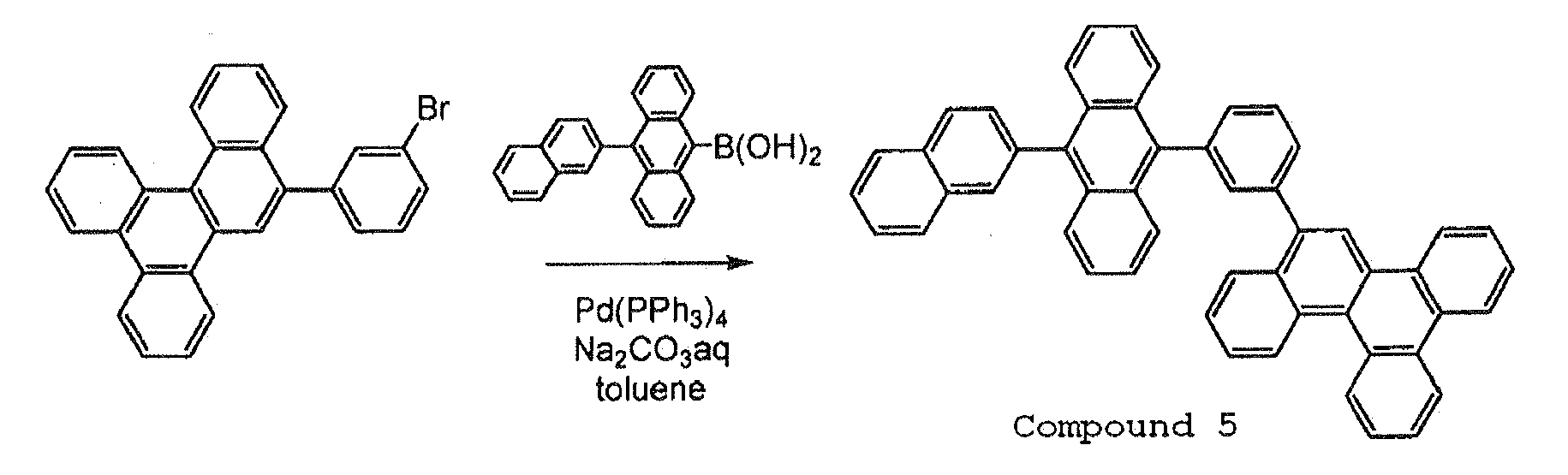
- Crystals were synthesized in the same manner as in Example 2, except that 1 0-(2-naphthyl)anthracene-9-boronic acid was used instead of 10-(2-naphthyl)anthracene-9-boronic acid, and 10-(3-bromophenyl)benzo[g]chrysene which had been prepared in Synthesis Example 4 was used instead of 10-bromobenzo[g]chrysene. As a result of mass spectrometry, the resulting crystals were confirmed to be the compound 5.
- Compound 6 was synthesized according to the following synthesis scheme.

- Crystals were synthesized in the same manner as in Example 2, except that 10-[4-(1-naphthyl)phenyl]anthracene-9-boronic acid was used instead of 10-(2-naphthyl)anthracene-9-boronic acid, and 10-(3-bromophenyl)benzo[g]chrysene which had been prepared in Synthesis Example 4 was used instead of 10-bromobenzo[g]chrysene. As a result of mass spectrometry, the resulting crystals were confirmed to be the compound 6.
- Compound 7 was synthesized according to the following synthesis scheme.

- Crystals were synthesized in the same manner as in Example 2, except that 10-[3-(2-naphthyl)phenyl]anthracene-9-boronic acid was used instead of 10-(2-naphthyl)anthracene-9-boronic acid, and 10-(3-bromophenyl)benzo[g]chrysene which had been prepared in Synthesis Example 4 was used instead of 10-bromobenzo[g]chrysene. As a result of mass spectrometry, the resulting crystals were confirmed to be the compound 7.
- Compound 8 was synthesized according to the following synthesis scheme.

- Crystals were synthesized in the same manner as in Example 2, except that 10-[3-(2-naphthyl)phenyl]anthracene-9-boronic acid was used instead of 10-(2-naphthyl)anthracene-9-boronic acid, and 10-(4-bromophenyl)benzo[g]chrysene which had been prepared in a similar way to Synthesis Example 4 was used instead of 10-bromobenzo[g]chryserie. As a result of mass spectrometry, the resulting crystals were confirmed to be the compound 8.
- Compound 9 was synthesized according to the following synthesis scheme.

- Crystals were synthesized in the same manner as in Example 2, except that 10-[3-(1-naphthyl)phenyl]anthracene-9-boronic acid was used instead of 1 0-(2-naphthyl)anthracene-9-boronic acid, and 10-(4-bromophenyl)benzo[g]chrysene which had been prepared in a similar way to Synthesis Example 4 was used instead of 10-bromobenzo[g]chrysene. As a result of mass spectrometry, the resulting crystals were confirmed to be the compound 9.
-
Compound 10 was synthesized according to the following synthesis scheme.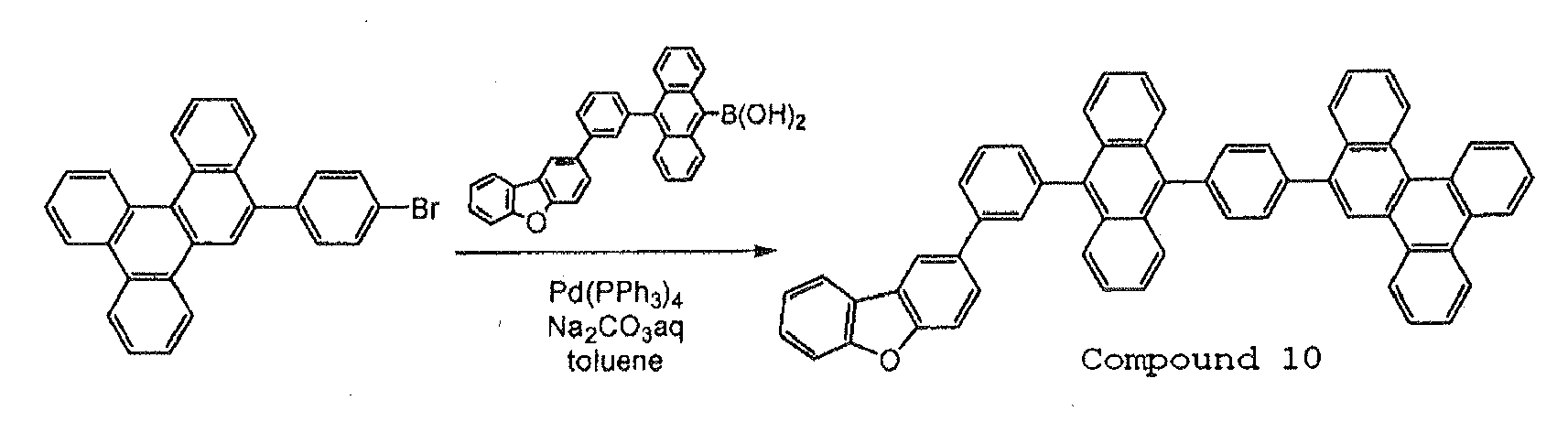
- Crystals were synthesized in the same manner as in Example 2, except that 10-[3-(dibenzofuran-2-yl)phenyl]anthracene-9-boronic acid was used instead of 10-(2-naphthyl)anthracene-9-boronic acid, and 10-(4-bromophenyl)benzo[g]chrysene which had been prepared in a similar way to Synthesis Example 4 was used instead of 10-bromobenzo[g]chrysene. As a result of mass spectrometry, the resulting crystals were confirmed to be the
compound 10. - Compound 11 was synthesized according to the following synthesis scheme.
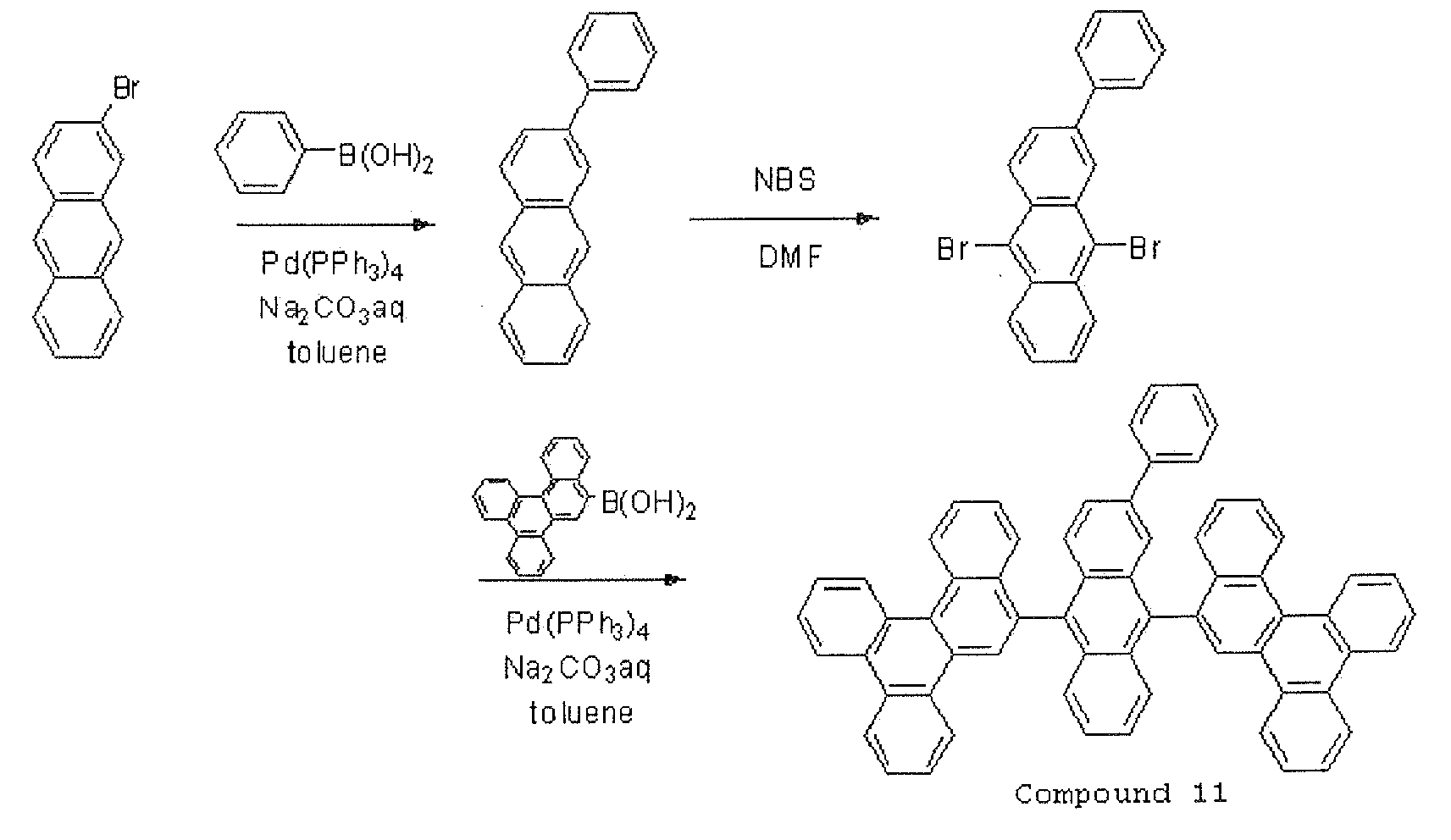
- Under an argon atmosphere, 14.5g of phenylboronic acid, 25.7g of 2-bromoanthracene, 4.62g of tetraxis(triphenylphosphine)palladium(0), 400 mL of toluene and 200 mL of a 2M aqueous solution of sodium carbonate were mixed. The resultant was refluxed with stirring for 8 hours. After cooling to room temperature, deposited crystals were separated by filtration. By repetition of recrystallization and washing of the obtained solids using toluene-hexane, 19.1g (yield: 75%) of 2-phenylanthracene was obtained.
- 19.1g g of 2-phenylanthracene was dissolved in 200 mL of N,N-dimethylformamide with heating, and 20 mL of N,N-dimethylformamide solution in which 29.4g of N-bromosuccinimide was dissolved was added. The resultant was heated with stirring at 60°C for 6 hours. After cooling to room temperature, the reaction solution was poured into 1 L of water. The solids thus obtained were washed with methanol, water and methanol in this order. By repetition of recrystallization and washing using toluene-hexane, 24.8g (yield: 80%) of 9,10-dibromo-2-phenylanthracene was obtained.
- Under an argon atmosphere, 2.06g of 9,10-dibromo-2-phenylanthracene, 2.98g of benzo[g]chrysene-10-boronic acid, 0.231 g of tetraxis(triphenylphosphine)palladium(0), 40 mL of toluene and 20 mL of a 2M aqueous solution of sodium carbonate were mixed. The resultant was refluxed with stirring for 8 hours. After cooling to room temperature, deposited crystals were separated by filtration. The solids thus obtained were washed with methanol, water and methanol. Then 3.02g of yellow crystals were obtained by recrystallization using toluene. As a result of mass spectrometry, it was confirmed that the resulting crystals were the compound 11 and had an m/e value of 806 with respect to a molecular weight of 806.30.
- Compound 12 was synthesized according to the following synthesis scheme.

- Under an argon atmosphere, 8.64g of 10-(4-bromophenyl)benzo[g]chrysene which had been prepared in a similar way to Synthesis Example 4 was placed in a flask, and 400 mL of dehydrated ether was added. The reaction solution was cooled to -40°C and 14 mL of 1.6M n-butyllithium hexane solution was added. After heating to 0°C, the resultant was stirred for 1 hour. The reaction solution was cooled to -60°C and 20 mL of dehydrated ether solution in which 9.41g of triisopropyl borate was dissolved was dripped. The reaction solution was stirred for 5 hours with heating to room temperature. 100 mL of 10% aqueous solution of hydrochloric acid was added and stirring was conducted for 1 hour. An aqueous phase was removed and an organic phase which had been separated was washed with water and saturated brine, and then dried with magnesium sulfate. After the magnesium sulfate was filtered out, the organic phase was concentrated. The resulting solids were washed with hexane, whereby 4.78g (yield: 60%) of 4-[benzo[g]chrysene-10-yl]phenylboronic acid was obtained.
- Synthesis was conducted in the same manner as the compound 11, except that 4-[benzo[g]chrysene-10-yl]phenylboronic acid was used instead of benzo[g]chrysene-10-boronic acid. As a result of mass spectrometry, it was confirmed that the resulting crystals were the compound 12 and had an m/e value of 958 with respect to a molecular weight of 958.36.
- Compound 13 was synthesized according to the following synthesis scheme.
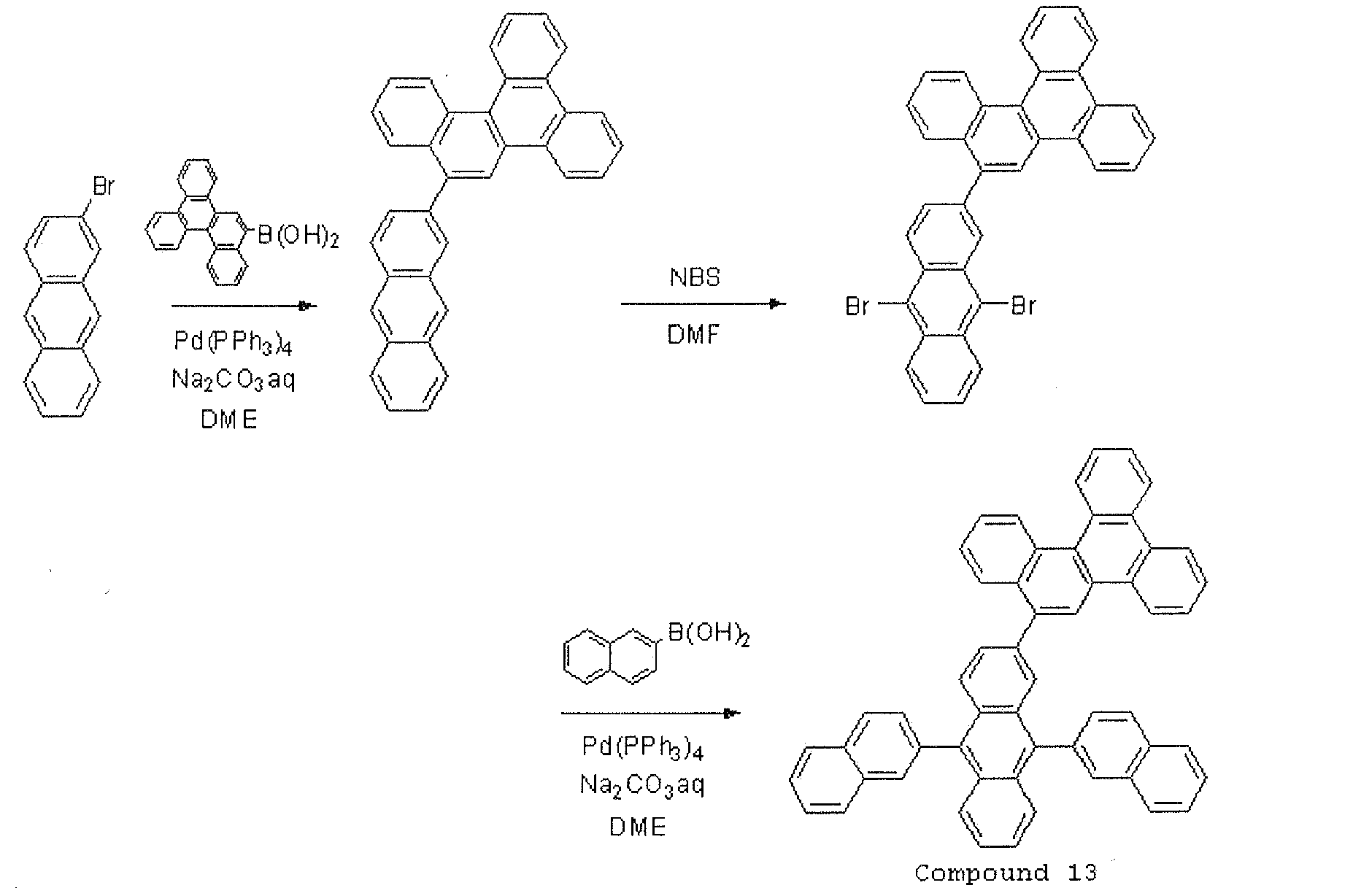
- Under an argon atmosphere, 7.08g of benzo[g]chrysene-10-boronic acid, 5.14g of 2-bromoanthracene, 0.462g of tetraxis(triphenylphosphine)palladium(0), 30 mL of 1,2-dimethoxyethane and 15 mL of a 2M aqueous solution of sodium carbonate were mixed. The resultant was refluxed with stirring for 8 hours. After cooling to room temperature, deposited crystals were separated by filtration. By repetition of recrystallization and washing of the obtained solids using toluene-hexane, 6.81g (yield: 75%) of 10-(2-anthryl)benzo[g]chrysene was obtained.
- 6.81g of 10-(2-anthryl)benzo[g]chrysene was dissolved in 100 mL of N,N-dimethylformamide with heating, and 10 mL of N,N-dimethylformamide solution in which 5.87g of N-bromosuccinimide was dissolved was added. The resultant was heated with stirring at 60°C for 6 hours. After cooling to room temperature, the reaction solution was poured into 1 L of water. The solids thus obtained were washed with methanol, water and methanol in this order. By repetition of recrystallization and washing using toluene-hexane, 7.35g (yield: 80%) of 10-(9,10-dibromoanthracene-2-yl)benzo[g]chrysene was obtained.
- Under an argon atmosphere, 6.12g of 10-(9,10-dibromoanthracene-2-yl)benzo[g]chrysene, 3.78g of 2-naphthaleneboronic acid, 0.462g of tetraxis(triphenylphosphine)palladium(0), 40 mL of 1,2-dimethoxyethane and 20 mL of a 2M aqueous solution of sodium carbonate were mixed, and the resultant was refluxed with stirring for 8 hours. After cooling to room temperature, deposited crystals were separated by filtration. The solids thus obtained were washed with methanol, water and methanol. Then 4.59g of yellow crystals were obtained by recrystallization using toluene. As a result of mass spectrometry, it was confirmed that the resulting crystals were the compound 13 and had an m/e value of 706 with respect to a molecular weight of 706.27.
- A glass substrate of 25 mm by 75 mm by 1.1 mm thick with an ITO transparent electrode (anode)(GEOMATEC CO., LTD.) was subjected to ultrasonic cleaning with isopropyl alcohol for 5 minutes, and cleaned with ultraviolet rays and ozone for 30 minutes. The cleaned glass substrate with transparent electrode lines was mounted in a substrate holder of a vacuum vapor deposition apparatus. First, a 60 nm-thick film of the compound A-1 (A-1 film) was formed on the surface where the transparent electrode lines were formed so as to cover the transparent electrode. Subsequently, on the A-1 film, a 20 nm-thick film of the compound A-2 was formed (A-2 film).
- Subsequently, on the A-2 film, a 40 nm-thick film was formed from the
compound 1 prepared in Example 1 and arylamine derivative D-1 in a weight ratio of 40:2 as a blue emitting layer.
On the blue emitting layer, compound Alq was deposited to form an electron-transporting layer in a thickness of 20 nm. Then, LiF was formed into a 1 nm-thick film. Metal Al was deposited on the LiF film to form a metallic cathode having a film thickness of 150 nm, whereby an organic EL emitting device was fabricated. -

- For the fabricated organic EL device, an driving voltage at a current density of 10 mA/cm2 and the half life of emission at the initial luminance of 1000 nit, room temperature and DC constant current driving were measured. A certain voltage was applied to the device to measure current value. At the same time, the luminance and CIE 1931 chromaticity were measured with a luminance meter (Spectroradiometer CS-1000 manufactured by MINOLTA Co., Ltd.)and evaluated. The results are shown in Table 1.
- An organic EL device was fabricated and evaluated in the same manner as in Example 14, except that the compound 2 was used instead of the
compound 1. The results are shown in Table 1. - An organic EL device was fabricated and evaluated in the same manner as in Example 14, except that the compound 3 was used instead of the
compound 1. The results are shown in Table 1. - An organic EL device was fabricated and evaluated in the same manner as in Example 14, except that the compound 4 was used instead of the
compound 1. The results are shown in Table 1. - An organic EL device was fabricated and evaluated in the same manner as in Example 14, except that the compound 5 was used instead of the
compound 1. The results are shown in Table 1. - An organic EL device was fabricated and evaluated in the same manner as in Example 14, except that the compound 6 was used instead of the
compound 1. The results are shown in Table 1. - An organic EL device was fabricated and evaluated in the same manner as in Example 14, except that the compound 7 was used instead of the
compound 1. The results are shown in Table 1. - An organic EL device was fabricated and evaluated in the same manner as in Example 14, except that the compound 8 was used instead of the
compound 1. The results are shown in Table 1. - An organic EL device was fabricated and evaluated in the same manner as in Example 14, except that the compound 9 was used instead of the
compound 1. The results are shown in Table 1. - An organic EL device was fabricated and evaluated in the same manner as in Example 14, except that the
compound 10 was used instead of thecompound 1. The results are shown in Table 1. - An organic EL device was fabricated and evaluated in the same manner as in Example 14, except that Compound B was used instead of the
compound 1. The results are shown in Table 1.
-
Table 1 Host Dopant Driving voltage (V) luminous efficiency (cd/A) light color Half life (hr) Example 14 Compound 1Compound D-1 6.5 6.5 blue 6000 Example 15 Compound 2 Compound D-1 6.6 6.5 blue 7000 Example 16 Compound 3 Compound D-1 6.5 6.7 blue 7000 Example 17 Compound 4 Compound D-1 6.7 6.7 blue 8000 Example 18 Compound 5 Compound D-1 6.7 6.7 blue 8000 Example 19 Compound 6 Compound D-1 6.5 6.9 blue 7000 Example 20 Compound 7 Compound D-1 6.6 7.2 blue 7000 Example 21 Compound 8 Compound D-1 6.5 6.9 blue 7000 Example 22 Compound 9 Compound D-1 6.7 6.9 blue 7000 Example 23 Compound 10Compound D-1 6.7 7.0 blue 6000 Com. Ex. 1 Compound B Compound D-1 7.0 6.0 blue 4000 - A glass substrate of 25 mm by 75 mm by 1.1 mm thick with an ITO transparent electrode (anode)(GEOMATEC CO., LTD.) was subjected to ultrasonic cleaning with isopropyl alcohol for 5 minutes, and cleaned with ultraviolet rays and ozone for 30 minutes. The cleaned glass substrate with transparent electrode lines was mounted in a substrate holder of a vacuum vapor deposition apparatus. First, the compound A-1 was formed into a 60 nm-thick film on the surface where the transparent electrode lines were formed so as to cover the transparent electrode. Subsequently, on the A-1 film, the compound A-2 was formed into a 20 nm-thick film.
Subsequently, on the A-2 film, the compound 11 prepared in Example 11 and D-2 having the structure shown below were formed into a 40 nm-thick film in a weight ratio of 40:2 as a blue emitting layer.
On this layer, Alq having the structure shown below was deposited to form an electron-transporting layer in a thickness of 20 nm. Then, LiF was formed into a 1 nm-thick film. Metal Al was deposited on the LiF film to form a metallic cathode having a thickness of 150 nm, whereby an organic EL emitting device was fabricated.
- For the fabricated organic EL device, an driving voltage at a current density of 10 mA/cm2 and the half life of emission at the initial luminance of 1000 nit, room temperature and DC constant current driving were measured. A certain voltage was applied to the device to measure current value. At the same time, luminance and CIE 1931 chromaticity were measured with a luminance meter (Spectroradiometer CS-1000 manufactured by MINOLTA Co., Ltd.)and evaluated. The results are shown in Table 2.
- An organic EL device was fabricated and evaluated in the same manner as in Example 24, except that the compound 12 was used instead of the compound 11. The results are shown in Table 2.
- An organic EL device was fabricated and evaluated in the same manner as in Example 24, except that the compound 13 was used instead of the compound 11. The results are shown in Table 2.
- An organic EL device was fabricated and evaluated in the same manner as in Example 24, except that D-3 was used instead of D-2. The results are shown in Table 2.

- An organic EL device was fabricated and evaluated in the same manner as in Example 25, except that D-3 was used instead of D-2. The results are shown in Table 2.
- An organic EL device was fabricated and evaluated in the same manner as in Example 26, except that D-3 was used instead of D-2. The results are shown in Table 2.
- An organic EL device was fabricated and evaluated in the same manner as in Example 24, except that Compound B was used instead of the compound 11. The results are shown in Table 2.
-
Table 2 Host Dopant Voltage (V) Luminous efficiency (cd/A) light color Life (hr) Example 24 Compound 11 Compound D-2 6.5 22 green 30000 Example 25 Compound 12 Compound D-2 6.6 22 green 30000 Example 26 Compound 13 Compound D-2 6.5 22 green 30000 Example 27 Compound 11 Compound D-3 6.7 21 green 50000 Example 28 Compound 12 Compound D-3 6.7 21 green 50000 Example 29 Compound 13 Compound D-3 6.7 21 green 50000 Com. Ex. 2 Compound B Compound D-2 7.0 17 green 10000 - The fused aromatic ring derivative of the invention is preferable as a material for an organic EL device, in particular, as an emitting material.
The organic EL device of the invention can be suitably used as a light source such as a planar emitting body and backlight of a display, a display part of a portable phone, a PDA, a car navigator, or an instrument panel of an automobile, an illuminator, and the like.
The documents described in the specification are incorporated herein by reference in its entirety.
Claims (17)
- A fused aromatic ring derivative shown by the following formula (1):

p is an integer of 1 to 13 and q is an integer of 1 to 8,
when p is two or more, plural Ras may be the same or different,
when q is two or more, plural Rbs may be the same or different,
L1 is a single bond or a substituted or unsubstituted divalent linking group, and
Ar1 is a substituted or unsubstituted aryl group having 6 to 50 ring carbon atoms or a substituted or unsubstituted heteroaryl group having 5 to 50 ring carbon atoms. - The fused aromatic ring derivative according to claim 1 shown by the following formula (2):

- The fused aromatic ring derivative according to claim 1 or 2, wherein L1 is a single bond and Ar1 is a substituted or unsubstituted aryl group having 6 to 50 ring carbon atoms.
- The fused aromatic ring derivative according to claim 3, wherein Ar1 is a substituted or unsubstituted fused aromatic ring group having 10 to 20 ring carbon atoms.
- The fused aromatic ring derivative according to claim 1 or 2, wherein L1 is a single bond and Ar1 is a substituent shown by the following formula (3):

Ar2 is a substituted or unsubstituted aryl group having 6 to 50 ring carbon atoms,
r is an integer of 1 to 4, and
when r is two or more, plural Rcs may be the same or different, and adjacent Rcs may form a ring. - The fused aromatic ring derivative according to claim 1 or 2, wherein L1 is a linking group shown by the following formula (4) and Ar1 is a substituent shown by the following formula (3):

Ar2 is a substituted or unsubstituted aryl group having 6 to 50 ring carbon atoms,
r is an integer of 1 to 4, and
when r is two or more, plural Rcs may be the same or different, and adjacent Rcs may form a ring,
s is an integer of 1 to 4, and
when s is two or more, plural Rds may be the same or different. - The fused aromatic ring derivative according to claim 5 or 6, wherein Ar2 is a substituted or unsubstituted fused aromatic ring group having 10 to 20 ring carbon atoms.
- The fused aromatic ring derivative according to claim 1 or 2, wherein L1 is a linking group shown by the following formula (4) and Ar1 is a substituted or unsubstituted fused aromatic ring group having 10 to 20 ring carbon atoms:

s is an integer of 1 to 4, and
when s is two or more, plural Rds may be the same or different, and adjacent Rds may form a ring. - The fused aromatic ring derivative according to claim 8, wherein Ar1 is a substituted or unsubstituted naphthyl group.
- A material for an electroluminescence device comprising the fused aromatic ring derivative according to any one of claims 1 to 9.
- The material for an electroluminescence device according to claim 10 which is an emitting material.
- An organic electroluminescence device comprising:an anode, a cathode, andone or more organic thin film layers comprising an emitting layer being between the anode and the cathode,wherein at least one of the organic thin film layers comprises the fused aromatic ring derivative according to any one of claims 1 to 9.
- The organic electroluminescence device according to claim 12, wherein the emitting layer comprises the fused aromatic ring derivative.
- The organic electroluminescence device according to claim 13, wherein the fused aromatic ring derivative is a host material.
- The organic electroluminescence device according to any one of claims 12 to 14, wherein the emitting layer further comprises one of a fluorescent dopant and a phosphorescent dopant.
- The organic electroluminescence device according to claim 15, wherein the fluorescent dopant is an arylamine compound.
- The organic electroluminescence device according to claim 15, wherein the fluorescent dopant is a styrylamine compound.
Applications Claiming Priority (2)
| Application Number | Priority Date | Filing Date | Title |
|---|---|---|---|
| JP2007297780 | 2007-11-16 | ||
| PCT/JP2008/070461 WO2009063846A1 (en) | 2007-11-16 | 2008-11-11 | Benzochrysene derivative and organic electroluminescent device using the same |
Publications (3)
| Publication Number | Publication Date |
|---|---|
| EP2213640A1 true EP2213640A1 (en) | 2010-08-04 |
| EP2213640A4 EP2213640A4 (en) | 2012-03-07 |
| EP2213640B1 EP2213640B1 (en) | 2016-10-05 |
Family
ID=40638695
Family Applications (1)
| Application Number | Title | Priority Date | Filing Date |
|---|---|---|---|
| EP08849720.1A Active EP2213640B1 (en) | 2007-11-16 | 2008-11-11 | Benzochrysene derivative and organic electroluminescent device using the same |
Country Status (6)
| Country | Link |
|---|---|
| US (1) | US8253129B2 (en) |
| EP (1) | EP2213640B1 (en) |
| JP (1) | JP5539728B2 (en) |
| KR (1) | KR101419101B1 (en) |
| TW (1) | TW200932707A (en) |
| WO (1) | WO2009063846A1 (en) |
Cited By (3)
| Publication number | Priority date | Publication date | Assignee | Title |
|---|---|---|---|---|
| EP2163550A4 (en) * | 2007-05-21 | 2010-11-10 | Idemitsu Kosan Co | ANTHRACENE DERIVATIVE AND ORGANIC ELECTROLUMINESCENT DEVICE USING THE SAME |
| EP2524913A4 (en) * | 2010-01-15 | 2013-06-12 | Idemitsu Kosan Co | HETEROCYCLIC NITROGENIC CYCLIC DERIVATIVE AND ORGANIC ELECTROLUMINESCENT ELEMENT COMPRISING SAME |
| CN104477011A (en) * | 2014-11-27 | 2015-04-01 | 印凯 | Secondary pollution removing system |
Families Citing this family (17)
| Publication number | Priority date | Publication date | Assignee | Title |
|---|---|---|---|---|
| CN101861292A (en) * | 2007-11-19 | 2010-10-13 | 出光兴产株式会社 | Monobenzo derivative, material for organic electroluminescent element containing same, and organic electroluminescent element using same |
| JP5490095B2 (en) * | 2008-04-11 | 2014-05-14 | ボード・オブ・リージェンツ・オブ・ザ・ユニバーシティ・オブ・テキサス・システム | Method and apparatus for amplifying electrochemiluminescence by nanoparticles |
| WO2009137002A2 (en) * | 2008-05-08 | 2009-11-12 | Board Of Regents Of The University Of Texas System | Luminescent nanostructured materials for use in electrogenerated chemiluminescence |
| JP5532705B2 (en) * | 2008-07-01 | 2014-06-25 | 東レ株式会社 | Light emitting element |
| WO2010010924A1 (en) * | 2008-07-25 | 2010-01-28 | 出光興産株式会社 | Anthracene derivative, and organic electroluminescence element comprising same |
| WO2010137285A1 (en) | 2009-05-29 | 2010-12-02 | 出光興産株式会社 | Anthracene derivative and organic electroluminescent element using the same |
| KR101358494B1 (en) | 2009-12-16 | 2014-02-05 | 이데미쓰 고산 가부시키가이샤 | Aromatic amine derivative, and organic electroluminescent element comprising same |
| KR20120100709A (en) | 2010-01-15 | 2012-09-12 | 이데미쓰 고산 가부시키가이샤 | Organic electroluminescent element |
| JP5804797B2 (en) * | 2011-06-28 | 2015-11-04 | キヤノン株式会社 | Benzotriphenylenofuran compound and organic light emitting device having the same |
| JP6306849B2 (en) * | 2013-09-25 | 2018-04-04 | 出光興産株式会社 | ORGANIC ELECTROLUMINESCENT ELEMENT AND ELECTRONIC DEVICE |
| US9922818B2 (en) * | 2014-06-16 | 2018-03-20 | Versum Materials Us, Llc | Alkyl-alkoxysilacyclic compounds |
| KR102201097B1 (en) * | 2015-01-20 | 2021-01-11 | 에스에프씨주식회사 | Novel organic compounds for organic light-emitting diode and organic light-emitting diode including the same |
| KR102352281B1 (en) | 2015-04-07 | 2022-01-18 | 삼성디스플레이 주식회사 | Compound and Organic light emitting device comprising same |
| US11730053B2 (en) | 2015-05-06 | 2023-08-15 | Samsung Display Co., Ltd. | Organic light-emitting device |
| US12082500B2 (en) | 2015-12-21 | 2024-09-03 | Samsung Display Co., Ltd. | Condensed cyclic compound and organic light-emitting device including the same |
| US10109803B1 (en) | 2017-08-14 | 2018-10-23 | Idemitsu Kosan Co., Ltd. | Organic electroluminescence device and electronic device |
| CN114591136B (en) * | 2022-03-21 | 2024-03-26 | 西安瑞联新材料股份有限公司 | Synthesis method of 2-phenyl anthracene |
Family Cites Families (8)
| Publication number | Priority date | Publication date | Assignee | Title |
|---|---|---|---|---|
| US5935721A (en) | 1998-03-20 | 1999-08-10 | Eastman Kodak Company | Organic electroluminescent elements for stable electroluminescent |
| JP2001335516A (en) * | 1999-11-08 | 2001-12-04 | Idemitsu Kosan Co Ltd | Organic electroluminescence device |
| JP2002231450A (en) | 2001-01-30 | 2002-08-16 | Idemitsu Kosan Co Ltd | Fluorescence conversion film, resin composition for fluorescence conversion film, and organic electroluminescence display device |
| JP4070676B2 (en) * | 2003-07-25 | 2008-04-02 | 三井化学株式会社 | Asymmetric substituted anthracene compound and organic electroluminescent device containing the asymmetric substituted anthracene compound |
| WO2006003842A1 (en) * | 2004-07-02 | 2006-01-12 | Chisso Corporation | Luminescent material and organic electroluminescent device utilizing the same |
| JP2006052324A (en) * | 2004-08-12 | 2006-02-23 | Sony Corp | Organic material, organic electroluminescent element, and display device |
| WO2007097178A1 (en) * | 2006-02-23 | 2007-08-30 | Idemitsu Kosan Co., Ltd. | Material for organic electroluminescent device, method for producing same and organic electroluminescent device |
| KR20090111915A (en) | 2008-04-23 | 2009-10-28 | (주)그라쎌 | Novel organic light emitting compound and organic light emitting device employing the same as light emitting material |
-
2008
- 2008-11-11 JP JP2009541132A patent/JP5539728B2/en active Active
- 2008-11-11 KR KR1020107010624A patent/KR101419101B1/en active Active
- 2008-11-11 EP EP08849720.1A patent/EP2213640B1/en active Active
- 2008-11-11 US US12/743,178 patent/US8253129B2/en active Active
- 2008-11-11 WO PCT/JP2008/070461 patent/WO2009063846A1/en not_active Ceased
- 2008-11-14 TW TW097144135A patent/TW200932707A/en unknown
Cited By (5)
| Publication number | Priority date | Publication date | Assignee | Title |
|---|---|---|---|---|
| EP2163550A4 (en) * | 2007-05-21 | 2010-11-10 | Idemitsu Kosan Co | ANTHRACENE DERIVATIVE AND ORGANIC ELECTROLUMINESCENT DEVICE USING THE SAME |
| US8512875B2 (en) | 2007-05-21 | 2013-08-20 | Idemitsu Kosan Co., Ltd. | Anthracene derivative and organic electroluminescence device using the same |
| US9461251B2 (en) | 2007-05-21 | 2016-10-04 | Idemitsu Kosan Co., Ltd. | Anthracene derivative and organic electroluminescence device using the same |
| EP2524913A4 (en) * | 2010-01-15 | 2013-06-12 | Idemitsu Kosan Co | HETEROCYCLIC NITROGENIC CYCLIC DERIVATIVE AND ORGANIC ELECTROLUMINESCENT ELEMENT COMPRISING SAME |
| CN104477011A (en) * | 2014-11-27 | 2015-04-01 | 印凯 | Secondary pollution removing system |
Also Published As
| Publication number | Publication date |
|---|---|
| WO2009063846A1 (en) | 2009-05-22 |
| JPWO2009063846A1 (en) | 2011-03-31 |
| KR101419101B1 (en) | 2014-07-11 |
| EP2213640A4 (en) | 2012-03-07 |
| US20100295029A1 (en) | 2010-11-25 |
| EP2213640B1 (en) | 2016-10-05 |
| KR20100088613A (en) | 2010-08-09 |
| JP5539728B2 (en) | 2014-07-02 |
| TW200932707A (en) | 2009-08-01 |
| US8253129B2 (en) | 2012-08-28 |
Similar Documents
| Publication | Publication Date | Title |
|---|---|---|
| EP2218706B1 (en) | Benzophenanthrene derivative and organic electroluminescent device employing the same | |
| EP2213640B1 (en) | Benzochrysene derivative and organic electroluminescent device using the same | |
| EP2216313B1 (en) | Benzochrysene derivative and organic electroluminescent device using the same | |
| US8623520B2 (en) | Fused aromatic derivative and organic electroluminescence device using the same | |
| US8221907B2 (en) | Chrysene derivative and organic electroluminescent device using the same | |
| EP2213639B1 (en) | Monobenzochrysene derivatives and their use in materials for organic electroluminescent devices | |
| US8501329B2 (en) | Benzanthracene compound and organic electroluminescent device using the same | |
| EP2177516A1 (en) | Aromatic amine derivative and organic electroluminescent device using the same | |
| JPWO2009154207A1 (en) | Anthracene derivative and organic electroluminescence device using the same | |
| US8563969B2 (en) | Benzanthracene compound and organic electroluminescence device using the same | |
| WO2009133917A1 (en) | Anthracene derivative and organic electroluminescent element using the same | |
| WO2009142230A1 (en) | Anthracene derivative and organic electroluminescent device using the same |
Legal Events
| Date | Code | Title | Description |
|---|---|---|---|
| PUAI | Public reference made under article 153(3) epc to a published international application that has entered the european phase |
Free format text: ORIGINAL CODE: 0009012 |
|
| 17P | Request for examination filed |
Effective date: 20100514 |
|
| AK | Designated contracting states |
Kind code of ref document: A1 Designated state(s): AT BE BG CH CY CZ DE DK EE ES FI FR GB GR HR HU IE IS IT LI LT LU LV MC MT NL NO PL PT RO SE SI SK TR |
|
| AX | Request for extension of the european patent |
Extension state: AL BA MK RS |
|
| DAX | Request for extension of the european patent (deleted) | ||
| A4 | Supplementary search report drawn up and despatched |
Effective date: 20120208 |
|
| RIC1 | Information provided on ipc code assigned before grant |
Ipc: H01L 51/50 20060101ALI20120203BHEP Ipc: C09K 11/06 20060101ALI20120203BHEP Ipc: C07C 15/20 20060101AFI20120203BHEP |
|
| 17Q | First examination report despatched |
Effective date: 20120928 |
|
| GRAP | Despatch of communication of intention to grant a patent |
Free format text: ORIGINAL CODE: EPIDOSNIGR1 |
|
| RIC1 | Information provided on ipc code assigned before grant |
Ipc: C07C 43/235 20060101ALI20160412BHEP Ipc: C07C 321/30 20060101ALI20160412BHEP Ipc: H01L 51/00 20060101ALI20160412BHEP Ipc: H05B 33/14 20060101ALI20160412BHEP Ipc: C09K 11/06 20060101ALI20160412BHEP Ipc: C07C 43/20 20060101ALI20160412BHEP Ipc: C07C 15/20 20060101AFI20160412BHEP Ipc: H01L 51/50 20060101ALI20160412BHEP Ipc: C07F 7/08 20060101ALI20160412BHEP |
|
| INTG | Intention to grant announced |
Effective date: 20160511 |
|
| GRAS | Grant fee paid |
Free format text: ORIGINAL CODE: EPIDOSNIGR3 |
|
| GRAA | (expected) grant |
Free format text: ORIGINAL CODE: 0009210 |
|
| AK | Designated contracting states |
Kind code of ref document: B1 Designated state(s): AT BE BG CH CY CZ DE DK EE ES FI FR GB GR HR HU IE IS IT LI LT LU LV MC MT NL NO PL PT RO SE SI SK TR |
|
| REG | Reference to a national code |
Ref country code: GB Ref legal event code: FG4D |
|
| REG | Reference to a national code |
Ref country code: CH Ref legal event code: EP |
|
| REG | Reference to a national code |
Ref country code: AT Ref legal event code: REF Ref document number: 834479 Country of ref document: AT Kind code of ref document: T Effective date: 20161015 |
|
| REG | Reference to a national code |
Ref country code: IE Ref legal event code: FG4D |
|
| REG | Reference to a national code |
Ref country code: DE Ref legal event code: R096 Ref document number: 602008046716 Country of ref document: DE |
|
| REG | Reference to a national code |
Ref country code: FR Ref legal event code: PLFP Year of fee payment: 9 |
|
| REG | Reference to a national code |
Ref country code: NL Ref legal event code: MP Effective date: 20161005 |
|
| REG | Reference to a national code |
Ref country code: LT Ref legal event code: MG4D |
|
| PG25 | Lapsed in a contracting state [announced via postgrant information from national office to epo] |
Ref country code: LV Free format text: LAPSE BECAUSE OF FAILURE TO SUBMIT A TRANSLATION OF THE DESCRIPTION OR TO PAY THE FEE WITHIN THE PRESCRIBED TIME-LIMIT Effective date: 20161005 Ref country code: BE Free format text: LAPSE BECAUSE OF NON-PAYMENT OF DUE FEES Effective date: 20161130 |
|
| REG | Reference to a national code |
Ref country code: AT Ref legal event code: MK05 Ref document number: 834479 Country of ref document: AT Kind code of ref document: T Effective date: 20161005 |
|
| PG25 | Lapsed in a contracting state [announced via postgrant information from national office to epo] |
Ref country code: NO Free format text: LAPSE BECAUSE OF FAILURE TO SUBMIT A TRANSLATION OF THE DESCRIPTION OR TO PAY THE FEE WITHIN THE PRESCRIBED TIME-LIMIT Effective date: 20170105 Ref country code: SE Free format text: LAPSE BECAUSE OF FAILURE TO SUBMIT A TRANSLATION OF THE DESCRIPTION OR TO PAY THE FEE WITHIN THE PRESCRIBED TIME-LIMIT Effective date: 20161005 Ref country code: GR Free format text: LAPSE BECAUSE OF FAILURE TO SUBMIT A TRANSLATION OF THE DESCRIPTION OR TO PAY THE FEE WITHIN THE PRESCRIBED TIME-LIMIT Effective date: 20170106 Ref country code: LT Free format text: LAPSE BECAUSE OF FAILURE TO SUBMIT A TRANSLATION OF THE DESCRIPTION OR TO PAY THE FEE WITHIN THE PRESCRIBED TIME-LIMIT Effective date: 20161005 |
|
| PG25 | Lapsed in a contracting state [announced via postgrant information from national office to epo] |
Ref country code: PL Free format text: LAPSE BECAUSE OF FAILURE TO SUBMIT A TRANSLATION OF THE DESCRIPTION OR TO PAY THE FEE WITHIN THE PRESCRIBED TIME-LIMIT Effective date: 20161005 Ref country code: NL Free format text: LAPSE BECAUSE OF FAILURE TO SUBMIT A TRANSLATION OF THE DESCRIPTION OR TO PAY THE FEE WITHIN THE PRESCRIBED TIME-LIMIT Effective date: 20161005 Ref country code: IS Free format text: LAPSE BECAUSE OF FAILURE TO SUBMIT A TRANSLATION OF THE DESCRIPTION OR TO PAY THE FEE WITHIN THE PRESCRIBED TIME-LIMIT Effective date: 20170205 Ref country code: PT Free format text: LAPSE BECAUSE OF FAILURE TO SUBMIT A TRANSLATION OF THE DESCRIPTION OR TO PAY THE FEE WITHIN THE PRESCRIBED TIME-LIMIT Effective date: 20170206 Ref country code: HR Free format text: LAPSE BECAUSE OF FAILURE TO SUBMIT A TRANSLATION OF THE DESCRIPTION OR TO PAY THE FEE WITHIN THE PRESCRIBED TIME-LIMIT Effective date: 20161005 Ref country code: ES Free format text: LAPSE BECAUSE OF FAILURE TO SUBMIT A TRANSLATION OF THE DESCRIPTION OR TO PAY THE FEE WITHIN THE PRESCRIBED TIME-LIMIT Effective date: 20161005 Ref country code: AT Free format text: LAPSE BECAUSE OF FAILURE TO SUBMIT A TRANSLATION OF THE DESCRIPTION OR TO PAY THE FEE WITHIN THE PRESCRIBED TIME-LIMIT Effective date: 20161005 Ref country code: FI Free format text: LAPSE BECAUSE OF FAILURE TO SUBMIT A TRANSLATION OF THE DESCRIPTION OR TO PAY THE FEE WITHIN THE PRESCRIBED TIME-LIMIT Effective date: 20161005 Ref country code: BE Free format text: LAPSE BECAUSE OF FAILURE TO SUBMIT A TRANSLATION OF THE DESCRIPTION OR TO PAY THE FEE WITHIN THE PRESCRIBED TIME-LIMIT Effective date: 20161005 |
|
| REG | Reference to a national code |
Ref country code: CH Ref legal event code: PL |
|
| REG | Reference to a national code |
Ref country code: DE Ref legal event code: R097 Ref document number: 602008046716 Country of ref document: DE |
|
| PG25 | Lapsed in a contracting state [announced via postgrant information from national office to epo] |
Ref country code: LI Free format text: LAPSE BECAUSE OF NON-PAYMENT OF DUE FEES Effective date: 20161130 Ref country code: EE Free format text: LAPSE BECAUSE OF FAILURE TO SUBMIT A TRANSLATION OF THE DESCRIPTION OR TO PAY THE FEE WITHIN THE PRESCRIBED TIME-LIMIT Effective date: 20161005 Ref country code: RO Free format text: LAPSE BECAUSE OF FAILURE TO SUBMIT A TRANSLATION OF THE DESCRIPTION OR TO PAY THE FEE WITHIN THE PRESCRIBED TIME-LIMIT Effective date: 20161005 Ref country code: SK Free format text: LAPSE BECAUSE OF FAILURE TO SUBMIT A TRANSLATION OF THE DESCRIPTION OR TO PAY THE FEE WITHIN THE PRESCRIBED TIME-LIMIT Effective date: 20161005 Ref country code: CZ Free format text: LAPSE BECAUSE OF FAILURE TO SUBMIT A TRANSLATION OF THE DESCRIPTION OR TO PAY THE FEE WITHIN THE PRESCRIBED TIME-LIMIT Effective date: 20161005 Ref country code: DK Free format text: LAPSE BECAUSE OF FAILURE TO SUBMIT A TRANSLATION OF THE DESCRIPTION OR TO PAY THE FEE WITHIN THE PRESCRIBED TIME-LIMIT Effective date: 20161005 Ref country code: CH Free format text: LAPSE BECAUSE OF NON-PAYMENT OF DUE FEES Effective date: 20161130 Ref country code: MC Free format text: LAPSE BECAUSE OF FAILURE TO SUBMIT A TRANSLATION OF THE DESCRIPTION OR TO PAY THE FEE WITHIN THE PRESCRIBED TIME-LIMIT Effective date: 20161005 |
|
| PLBE | No opposition filed within time limit |
Free format text: ORIGINAL CODE: 0009261 |
|
| STAA | Information on the status of an ep patent application or granted ep patent |
Free format text: STATUS: NO OPPOSITION FILED WITHIN TIME LIMIT |
|
| REG | Reference to a national code |
Ref country code: IE Ref legal event code: MM4A |
|
| PG25 | Lapsed in a contracting state [announced via postgrant information from national office to epo] |
Ref country code: BG Free format text: LAPSE BECAUSE OF FAILURE TO SUBMIT A TRANSLATION OF THE DESCRIPTION OR TO PAY THE FEE WITHIN THE PRESCRIBED TIME-LIMIT Effective date: 20170105 Ref country code: IT Free format text: LAPSE BECAUSE OF FAILURE TO SUBMIT A TRANSLATION OF THE DESCRIPTION OR TO PAY THE FEE WITHIN THE PRESCRIBED TIME-LIMIT Effective date: 20161005 |
|
| 26N | No opposition filed |
Effective date: 20170706 |
|
| PG25 | Lapsed in a contracting state [announced via postgrant information from national office to epo] |
Ref country code: LU Free format text: LAPSE BECAUSE OF NON-PAYMENT OF DUE FEES Effective date: 20161130 |
|
| REG | Reference to a national code |
Ref country code: FR Ref legal event code: PLFP Year of fee payment: 10 |
|
| PG25 | Lapsed in a contracting state [announced via postgrant information from national office to epo] |
Ref country code: IE Free format text: LAPSE BECAUSE OF NON-PAYMENT OF DUE FEES Effective date: 20161111 Ref country code: SI Free format text: LAPSE BECAUSE OF FAILURE TO SUBMIT A TRANSLATION OF THE DESCRIPTION OR TO PAY THE FEE WITHIN THE PRESCRIBED TIME-LIMIT Effective date: 20161005 |
|
| PG25 | Lapsed in a contracting state [announced via postgrant information from national office to epo] |
Ref country code: HU Free format text: LAPSE BECAUSE OF FAILURE TO SUBMIT A TRANSLATION OF THE DESCRIPTION OR TO PAY THE FEE WITHIN THE PRESCRIBED TIME-LIMIT; INVALID AB INITIO Effective date: 20081111 Ref country code: CY Free format text: LAPSE BECAUSE OF FAILURE TO SUBMIT A TRANSLATION OF THE DESCRIPTION OR TO PAY THE FEE WITHIN THE PRESCRIBED TIME-LIMIT Effective date: 20161005 |
|
| PG25 | Lapsed in a contracting state [announced via postgrant information from national office to epo] |
Ref country code: TR Free format text: LAPSE BECAUSE OF FAILURE TO SUBMIT A TRANSLATION OF THE DESCRIPTION OR TO PAY THE FEE WITHIN THE PRESCRIBED TIME-LIMIT Effective date: 20161005 |
|
| PG25 | Lapsed in a contracting state [announced via postgrant information from national office to epo] |
Ref country code: MT Free format text: LAPSE BECAUSE OF NON-PAYMENT OF DUE FEES Effective date: 20161111 |
|
| REG | Reference to a national code |
Ref country code: FR Ref legal event code: PLFP Year of fee payment: 11 |
|
| P01 | Opt-out of the competence of the unified patent court (upc) registered |
Effective date: 20230522 |
|
| PGFP | Annual fee paid to national office [announced via postgrant information from national office to epo] |
Ref country code: FR Payment date: 20250930 Year of fee payment: 18 |
|
| PGFP | Annual fee paid to national office [announced via postgrant information from national office to epo] |
Ref country code: DE Payment date: 20250930 Year of fee payment: 18 |
|
| PGFP | Annual fee paid to national office [announced via postgrant information from national office to epo] |
Ref country code: GB Payment date: 20251001 Year of fee payment: 18 |