EP2211166A2 - Datenqualitäts- und Zusatzdatenüberprüfung für Ramansensoren - Google Patents
Datenqualitäts- und Zusatzdatenüberprüfung für Ramansensoren Download PDFInfo
- Publication number
- EP2211166A2 EP2211166A2 EP10150902A EP10150902A EP2211166A2 EP 2211166 A2 EP2211166 A2 EP 2211166A2 EP 10150902 A EP10150902 A EP 10150902A EP 10150902 A EP10150902 A EP 10150902A EP 2211166 A2 EP2211166 A2 EP 2211166A2
- Authority
- EP
- European Patent Office
- Prior art keywords
- data
- raman
- spectral data
- checks
- iccd
- Prior art date
- Legal status (The legal status is an assumption and is not a legal conclusion. Google has not performed a legal analysis and makes no representation as to the accuracy of the status listed.)
- Withdrawn
Links
- 238000001069 Raman spectroscopy Methods 0.000 title claims abstract description 89
- 230000003595 spectral effect Effects 0.000 claims abstract description 87
- 238000000034 method Methods 0.000 claims abstract description 62
- 238000001237 Raman spectrum Methods 0.000 claims abstract description 22
- 238000001228 spectrum Methods 0.000 claims description 64
- 230000008569 process Effects 0.000 claims description 25
- 238000012545 processing Methods 0.000 claims description 24
- 229920006395 saturated elastomer Polymers 0.000 claims description 12
- 238000012544 monitoring process Methods 0.000 claims description 9
- 230000004044 response Effects 0.000 claims description 6
- 238000012360 testing method Methods 0.000 description 44
- 238000001514 detection method Methods 0.000 description 15
- 239000000126 substance Substances 0.000 description 14
- 239000003795 chemical substances by application Substances 0.000 description 13
- 239000003124 biologic agent Substances 0.000 description 10
- 238000005516 engineering process Methods 0.000 description 10
- 239000013043 chemical agent Substances 0.000 description 9
- 230000009471 action Effects 0.000 description 7
- 230000003287 optical effect Effects 0.000 description 7
- BJQHLKABXJIVAM-UHFFFAOYSA-N bis(2-ethylhexyl) phthalate Chemical compound CCCCC(CC)COC(=O)C1=CC=CC=C1C(=O)OCC(CC)CCCC BJQHLKABXJIVAM-UHFFFAOYSA-N 0.000 description 4
- 238000004891 communication Methods 0.000 description 4
- 238000013480 data collection Methods 0.000 description 4
- 230000036541 health Effects 0.000 description 4
- 238000004458 analytical method Methods 0.000 description 3
- 238000013459 approach Methods 0.000 description 3
- 239000000356 contaminant Substances 0.000 description 3
- 238000011109 contamination Methods 0.000 description 3
- 238000005259 measurement Methods 0.000 description 3
- 230000008901 benefit Effects 0.000 description 2
- 238000007796 conventional method Methods 0.000 description 2
- 238000007405 data analysis Methods 0.000 description 2
- 230000000694 effects Effects 0.000 description 2
- 230000000737 periodic effect Effects 0.000 description 2
- 239000000523 sample Substances 0.000 description 2
- 244000025254 Cannabis sativa Species 0.000 description 1
- 241001465754 Metazoa Species 0.000 description 1
- 238000007664 blowing Methods 0.000 description 1
- 230000001427 coherent effect Effects 0.000 description 1
- 230000000295 complement effect Effects 0.000 description 1
- 238000013500 data storage Methods 0.000 description 1
- 230000033310 detection of chemical stimulus Effects 0.000 description 1
- 238000010586 diagram Methods 0.000 description 1
- 238000011156 evaluation Methods 0.000 description 1
- 230000006870 function Effects 0.000 description 1
- 208000015181 infectious disease Diseases 0.000 description 1
- 238000012423 maintenance Methods 0.000 description 1
- 230000007257 malfunction Effects 0.000 description 1
- 238000007726 management method Methods 0.000 description 1
- 239000000463 material Substances 0.000 description 1
- 244000005700 microbiome Species 0.000 description 1
- 244000052769 pathogen Species 0.000 description 1
- 230000001717 pathogenic effect Effects 0.000 description 1
- 230000005855 radiation Effects 0.000 description 1
- 238000011897 real-time detection Methods 0.000 description 1
- 239000011435 rock Substances 0.000 description 1
- 238000005070 sampling Methods 0.000 description 1
- 239000007787 solid Substances 0.000 description 1
- 238000004611 spectroscopical analysis Methods 0.000 description 1
- 238000010183 spectrum analysis Methods 0.000 description 1
- 230000007480 spreading Effects 0.000 description 1
- 230000009897 systematic effect Effects 0.000 description 1
Images


Classifications
-
- G—PHYSICS
- G01—MEASURING; TESTING
- G01N—INVESTIGATING OR ANALYSING MATERIALS BY DETERMINING THEIR CHEMICAL OR PHYSICAL PROPERTIES
- G01N21/00—Investigating or analysing materials by the use of optical means, i.e. using sub-millimetre waves, infrared, visible or ultraviolet light
- G01N21/62—Systems in which the material investigated is excited whereby it emits light or causes a change in wavelength of the incident light
- G01N21/63—Systems in which the material investigated is excited whereby it emits light or causes a change in wavelength of the incident light optically excited
- G01N21/65—Raman scattering
-
- G—PHYSICS
- G01—MEASURING; TESTING
- G01J—MEASUREMENT OF INTENSITY, VELOCITY, SPECTRAL CONTENT, POLARISATION, PHASE OR PULSE CHARACTERISTICS OF INFRARED, VISIBLE OR ULTRAVIOLET LIGHT; COLORIMETRY; RADIATION PYROMETRY
- G01J3/00—Spectrometry; Spectrophotometry; Monochromators; Measuring colours
- G01J3/02—Details
-
- G—PHYSICS
- G01—MEASURING; TESTING
- G01J—MEASUREMENT OF INTENSITY, VELOCITY, SPECTRAL CONTENT, POLARISATION, PHASE OR PULSE CHARACTERISTICS OF INFRARED, VISIBLE OR ULTRAVIOLET LIGHT; COLORIMETRY; RADIATION PYROMETRY
- G01J3/00—Spectrometry; Spectrophotometry; Monochromators; Measuring colours
- G01J3/02—Details
- G01J3/027—Control of working procedures of a spectrometer; Failure detection; Bandwidth calculation
-
- G—PHYSICS
- G01—MEASURING; TESTING
- G01J—MEASUREMENT OF INTENSITY, VELOCITY, SPECTRAL CONTENT, POLARISATION, PHASE OR PULSE CHARACTERISTICS OF INFRARED, VISIBLE OR ULTRAVIOLET LIGHT; COLORIMETRY; RADIATION PYROMETRY
- G01J3/00—Spectrometry; Spectrophotometry; Monochromators; Measuring colours
- G01J3/02—Details
- G01J3/0286—Constructional arrangements for compensating for fluctuations caused by temperature, humidity or pressure, or using cooling or temperature stabilization of parts of the device; Controlling the atmosphere inside a spectrometer, e.g. vacuum
-
- G—PHYSICS
- G01—MEASURING; TESTING
- G01J—MEASUREMENT OF INTENSITY, VELOCITY, SPECTRAL CONTENT, POLARISATION, PHASE OR PULSE CHARACTERISTICS OF INFRARED, VISIBLE OR ULTRAVIOLET LIGHT; COLORIMETRY; RADIATION PYROMETRY
- G01J3/00—Spectrometry; Spectrophotometry; Monochromators; Measuring colours
- G01J3/28—Investigating the spectrum
- G01J3/44—Raman spectrometry; Scattering spectrometry ; Fluorescence spectrometry
-
- G—PHYSICS
- G01—MEASURING; TESTING
- G01N—INVESTIGATING OR ANALYSING MATERIALS BY DETERMINING THEIR CHEMICAL OR PHYSICAL PROPERTIES
- G01N2201/00—Features of devices classified in G01N21/00
- G01N2201/12—Circuits of general importance; Signal processing
-
- G—PHYSICS
- G01—MEASURING; TESTING
- G01N—INVESTIGATING OR ANALYSING MATERIALS BY DETERMINING THEIR CHEMICAL OR PHYSICAL PROPERTIES
- G01N2201/00—Features of devices classified in G01N21/00
- G01N2201/12—Circuits of general importance; Signal processing
- G01N2201/121—Correction signals
- G01N2201/1211—Correction signals for temperature
-
- G—PHYSICS
- G01—MEASURING; TESTING
- G01N—INVESTIGATING OR ANALYSING MATERIALS BY DETERMINING THEIR CHEMICAL OR PHYSICAL PROPERTIES
- G01N2201/00—Features of devices classified in G01N21/00
- G01N2201/12—Circuits of general importance; Signal processing
- G01N2201/127—Calibration; base line adjustment; drift compensation
- G01N2201/12707—Pre-test of apparatus, e.g. dark test, sensor test
Definitions
- Embodiments of the present invention relate to Raman spectrometry sensors, and more specifically to systems and methods for performing automated periodic evaluations of sensor equipment and collected spectral data.
- standoff surface detection refers to a category of technologies that permit detection of substances without actually having to physically come in contact with the substance of concern.
- the goal of these detection systems is to provide the capability to detect, identify, locate, quantify, warn, and report chemical or biological threats and thereby give military forces or civilian personnel sufficient early warning to avoid (further) contamination.
- LISA Laser Interrogation of Surface Agents
- ITT Wired, DE
- LISA uses a laser and associated sensor attached to a reconnaissance vehicle that looks for chemical agents on the ground (or any surface) using a technique known as Raman Scattering (or Raman Effect), which is an optical property that can be exploited to identify known chemical agents.
- Raman Scattering or Raman Effect
- Current ITT LISA systems have standoff ranges from 0.4 to 3 m and can provide detection on each single laser shot or pulse, at 25 pulses per second. This allows personnel manning the vehicle with the ability to perform on-the-move, real-time measurements of chemical agents on the ground.
- the LISA technology also provides detection teams the ability to create or generate a map with chemical agent contours that build up as detection is taking place.
- Standoff biological agent detection is significantly more difficult than chemical detection. Specifically, it is difficult to discriminate and measure biological agents from naturally occurring background materials. Moreover, real-time detection and measurement of biological agents in the environment can be daunting because of the number of potential agents to be identified, the complex nature of the agents themselves, the countless number of similar microorganisms that are a constant presence in the environment, and the minute quantities of pathogen that can initiate infection. Potential biological agents can also disguise themselves in benign entities.
- Raman spectroscopy is an evolving complex art and those skilled in the art appreciate that a Raman sensor along with its supporting equipment is a complex and sensitive apparatus even under the best of circumstances, such as under controlled laboratory conditions. Keeping such an apparatus operating properly in the field presents an even greater challenge. There is thus a need to provide improved Raman spectroscopy equipment and methods of operation thereof in order to effectively bring standoff surface detection to practical use, and particularly for extended field use.
- Embodiments of the present invention provide systems and methods for operating, particularly in the field, a Raman spectroscopy device for stand off detection of chemical and biological agents.
- the device includes a laser, a spectrograph, an intensified charge coupled device (ICCD), and an autofocus subsystem (including telescope collection optics), as well as a related processor and memory.
- ADCs ancillary data checks
- a series of data quality checks is performed to enhance confidence in the just collected data.
- spectral data that pass the data quality checks are further processed. However, all spectral data are preferably stored in a log file. When the log file reaches a predetermined capacity, the log file is closed, and a new round of ancillary data checks is performed to again monitor the status of the Raman spectroscopy device.
- the invention relates to a method for operating a Raman sensor, comprising performing a plurality of ancillary data checks that monitor operating conditions of system components of the Raman sensor; acquiring Raman spectral data; performing a plurality of data quality checks related to the Raman spectral data acquired during said acquiring step; determining, based on results of the data quality checks, whether to further process the Raman spectral data acquired during said acquiring step and, if so, storing the Raman spectral data acquired during said acquiring step for further processing; and repeating successively, a predetermined number of times, said step of acquiring Raman spectral data and said step of performing a plurality of data quality checks related to the Raman spectral data, and then again performing said step of performing a plurality of ancillary data checks.
- Said step of performing a plurality of ancillary data checks can comprise monitoring a state of each of an intensified charge couple device (ICCD), a laser, and an autofocus subsystem.
- the method further can comprise monitoring a temperature of one or more components of the Raman sensor.
- Said step of performing a plurality of data quality checks can comprise monitoring a linear focus actuator to maintain proper focus of the optics which collect the Raman spectrum.
- Said step of performing a plurality of data quality checks can comprise monitoring laser energy.
- Said step of performing a plurality of data quality checks can comprise determining whether the Raman spectral data is saturated or is of insufficient amplitude.
- the method can further comprise halting further Raman spectral data acquisition upon a failure of one of the plurality of ancillary data checks.
- the method can further comprise storing in a log file a series of acquired Raman spectral data and closing the log file.
- the method can further comprise performing said closing step after said predetermined number of times.
- the method can further compriseing, after said closing step, acquiring a predetermined number of dark spectral data and revising a previously calculated dark spectral data median.
- the method can further comprise adjusting a gain for an intensified charge coupled device (ICCD) in response to one of the plurality of data quality checks.
- ICCD intensified charge coupled device
- the invention also relates to a method of operating a Raman spectroscopy device, the device comprising a laser, a spectrograph, an intensified charge coupled device (ICCD), and an autofocus subsystem, the method comprising: performing a plurality of ancillary data checks that monitor operating conditions of at least the laser, the ICCD, and the autofocus subsystem; acquiring Raman spectral data by pulsing the laser and collecting resulting Raman spectra with the ICCD via the spectrograph; performing a plurality of data quality checks related to the Raman spectral data acquired during said acquiring step; determining, based on results of the data quality checks, whether to further process the Raman spectral data acquired during said acquiring step and, if so, storing the Raman spectral data acquired during said acquiring step for further processing; and repeating successively, a predetermined number of times, said step of acquiring Raman spectral data and said step of performing a plurality of data quality checks related to the Raman spectral
- the method can further comprise, repeating said step of performing a plurality of ancillary data checks after said repeating successively.
- the method can further comprise repeating said step of performing a plurality of ancillary data checks after a log file of acquired Raman spectral data is closed and stored.
- the method can further comprise halting further Raman spectral data acquisition if one of the plurality of ancillary data checks indicates a failure.
- the method can further comprise storing Raman spectral data that has passed the plurality of data quality checks for agent identification processing.
- the method can further comprise adjusting a gain of the ICCD in response to at least one of the plurality of data quality checks.
- the method can further comprise acquiring an initial set of dark spectra without a corresponding laser pulse, said dark spectra being used for the further processing, and periodically updating said initial set of dark spectra with acquisitions of additional dark spectra.
- the invention also relate to a Raman spectroscopy system, comprising: a laser that is configured to pulse at a predetermined frequency; an autofocus subsystem that controls focus of a telescope that is directed, optically, at the same spot illuminated by the laser; a spectrograph and an intensified charge coupled device (ICCD) that are configured to receive Raman spectra resulting from the laser pulse via the telescope; and a processor and associated memory, the memory being configured to store the individual Raman spectra as individual records of Raman spectral data as captured by the ICCD, the processor being configured to execute a plurality of ancillary data checks that monitor operating conditions of at least the laser, the ICCD, and the autofocus subsystem, and to execute a plurality of data quality checks related to the usefulness of the Raman spectral data, wherein the processor is further configured to determine, based on results of the data quality checks, whether to store Raman spectral data for further processing and whether to repeat execution of the plurality of ancillary data checks.
- the system can further comprise a heat exchanger.
- the system can further comprise a rangefinder subsystem that operates in conjunction with the autofocus subsystem.
- the processor can further be configured to cause a capture of a series of dark spectra.
- the processor can further be configured to cause a capture of updated dark spectra.
- the processor can be configured to determine whether a given Raman spectrum is saturated, corrupted, or is of insufficient amplitude.
- the processor can be configured to initiate a routine to adjust a gain of the ICCD when it is determined that the given Raman spectra is saturated or is of insufficient amplitude.
- a series of ADCs is performed.
- These checks include, among other checks, monitoring of, for example, the ICCD's gain and array temperature, the laser's energy, gas pressure, and pulse count, and temperature, the device's overall temperature and humidity level, the autofocus' linear focus actuator status, and even general altitude and atmospheric data.
- the system may be placed back into a standby mode to prevent acquiring possible degraded or faulty data and to allow for possible servicing of the equipment.
- Other failed ADCs might result only in a warning to an operator of the system.
- the system After completion of the first series of ADCs, the system acquires ten dark spectra, i.e., spectra without a corresponding laser pulse. A median of these ten spectra is then computed. This median represents current noise or background and is subtracted from subsequent laser induced spectra such that only the laser induced spectra is used for detection purposes.
- DQCs data quality checks
- DQCs for a given Raman spectrum When DQCs for a given Raman spectrum have all passed, that data may be designated along with other similarly qualified data for further processing, namely Raman spectrum pattern matching against a stored library of Raman spectra. All data (in the form of individual records), however, qualified or not, is preferably stored in a log file and the data records preferably include the results of the DQCs for respective data acquisitions.
- a log file Once a log file is filled to a predetermined capacity (e.g., 3000 records), the log file is closed and stored and a new log file is opened. During this period, a second series of ADCs is performed, thereby again checking overall system status.
- the Raman spectroscopy system is automatically and periodically being checked, thereby increasing confidence in the spectral data being collected and ensuring the system is in proper functioning order.
- embodiments of the present invention provide an integrated Raman spectroscopy system, or simply "Raman sensor,” with automated, periodic, data quality checks (DQCs) and ancillary data checks (ADCs) that provide feedback about, respectively, the nature and propriety of the Raman spectral data collected and the status of various subsystems and components of the Raman sensor.
- the DQCs and ADCs are preferably interposed at several different points in the course of Raman spectral data collection and processing to ensure that collected Raman spectra data is sufficiently reliable to process, and to further ensure that the Raman sensor, as a whole, is operating within nominal ranges, thereby providing increased confidence in the ultimate results of processed data and, in the end, confidence in an identification of an unknown substance or agent being analyzed.
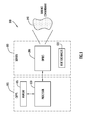
- an overall Raman spectroscopy system 100 is depicted that includes a control, acquisition, processing and power system (CAPPS) 105 and a sensor 110.
- CAPPS 105 comprises, at a high level, memory 115, and processor 130.
- a power supply system is not shown.
- Sensor 110 comprises, at a high level, an optics module 200, which is described more fully below, and a heat exchanger module 120.
- Memory 115 may comprise non-volatile read only memory (ROM) for storing processing instructions (discussed more fully later herein), global variables, initialization variables and routines, and a library of Raman signatures, among other things.
- Memory 115 may also comprise volatile random access memory (RAM) for storing the foregoing data, or other data (e.g., detected/collected Raman spectral data), sensor status readings, and user input/settings, among other things, including, alternatively, the data described as being stored in ROM.
- Memory 115 may still further comprise disk drives, flash memory, or any other suitable data storage technology.
- Heat exchanger 120 is employed to heat or cool the sensor 110 and to maintain a steady temperature for the system and its components as analysis of collected spectral data can be detrimentally influenced by mechanical, electrical and optical components whose performance changes with high or drifting temperature.
- the CAPPS 105 is cooled only by fans internal to the CAPPS unit blowing through filters.
- the heat exchanger is needed because the sensor is preferably a sealed unit to protect it from external dirt and vapors (e.g. vehicle exhaust).
- Processor 130 is a conventional processor suitable to run software routines for, among other things, providing overall system control, including management of inputs and outputs via a user interface (not shown), as well as control of and signals received from the various components of sensor 110.
- Processor 130 is preferably also capable of performing the requisite digital signal processing on collected spectral data and comparing the same to the library of Raman signatures stored in memory 115 to identify unknown substances.
- Processor 130 and memory 115 are in communication with one another, as shown, via conventional techniques, e.g., using a control/signal/data bus.
- Optics module 200 (which is described in detail with reference to Figure 2 ), is in communication with processor 130 and is arranged to irradiate, using a laser, an unknown substance, such as surface contaminant 140, collect resulting Raman spectral data, and pass the collected data to processor 130 for detailed analysis.
- CAPPS 105 and sensor 110 are preferably encased in separate enclosures.
- the system 100 is further preferably configured to operate in the field, either as a jeep/truck mounted unit, or even as a man portable device. In either case, not only does the heat exchanger 120 need to compensate for heat generated internally to the sensor (such as by optics module 200), but the heat exchanger 120 must also compensate for a potentially wide range of ambient field conditions, ranging from, e.g., desert heat to winter ice and snow temperature conditions.
- optics module 200 of sensor 110 is more fully described.
- Laser 210 that generates a coherent light beam.
- Laser 210 may produce a beam of light in the ultraviolet (UV) spectrum and be substantially monochromatic (i.e., a single wavelength or limited to a narrow range of wavelengths).
- An excimer or frequency-shifted Nd:YAG or Nd:YLF laser may be suitable for this purpose.
- Laser 210 preferably produces light energy resulting in returned optical energy that consists of enough Raman scattered optical energy (spectrum) to allow analysis using known spectroscopy techniques.
- etalon 215 Associated with laser 210 is an etalon 215, which is used, as is well-known in the art, to increase the coherence length of the laser light.
- ADCs ancillary data checks
- etalon 215 is only needed for specific lasers such as the excimer. Not all lasers would need it. There are a host of techniques to make a laser have a narrow linewidth. Even the excimer could be made spectrally narrow through other known methods.
- a spectrograph 222 and an intensified charge-coupled device (ICCD) 220 that serves as a pixilated detector.
- the spectrograph 222 comprises a diffraction grating to disperse scattered radiation (resulting from laser irradiation) onto the ICCD 220.
- the ICCD 220 may be integrated with the spectrograph 222 as a single unit.
- a suitable ICCD that may be used in the instant system is model no. DK720A-25H-186 available from Andor Technology (Belfast, Northern Ireland).
- optics module 200 preferably also comprises an Autofocus subsystem 230 and Rangefinding subsystem 235.
- the ability to focus collection optics, such as a telescope 232, that passes light to the spectrograph/ICCD 222/220) allows for the collection of Raman spectra from safer distances, i.e., "standoff" distances. While the adjustment of the standoff distance is not required, the measurement process is enhanced by providing this adjustability since the sensor has a limited depth of field for a given standoff range. Focusing may be accomplished by moving, via suitable actuators (motors, gears, etc.), e.g., an optical element of the telescope 232. Such systems are well known in the art. Focusing may also preferably be performed manually, although automated focusing is preferable.
- Rangefinding subsystem 235 provides information regarding the range or distance of an object or unknown substance of interest. This information may be helpful for an Autofocus process in order to optimize the telescope focus and hence the amount of collected Raman light.
- Controller/registers module 240 is preferably in electrical communication with each of the components in the optics module 200. Controller/registers module 240 may pass commands initiated from processor 130 to one or more components, and may further pass information from any one of the components back to processor 130. Controller/registers module 240 may also buffer information that is received from outputs of associated respective components, thereby realizing a more distributed overall system. Controller/registers module 240 may further be used, in accordance with embodiments of the present invention, to pass performance and status data regarding the several components so that such data can be used for data quality checks (DQCs) and ancillary data checks (ADCs) in the processor 130. Of course, controller/registers module 240 could be incorporated directly into processor 130 (in conjunction with memory 115) such that the several components of the optics module 200 are directly connected to the processor 130 without any intervening devices.
- DQCs data quality checks
- ADCs ancillary data checks
- Step 301 represents a standby mode that is provided for when the system is first powered up, and after which the system may have completed a series of built-in-tests. For example, component temperatures, system health and status, ICCD noise levels, laser energy, and system calibration may be checked, among other things.
- the standby mode of step 301 is also a point in the sequence of process 300 at which messages may be presented to a user via a display or user interface (not shown). In essence, standby mode 301 is a system "idling" mode awaiting input from a user.
- sequence 300 proceeds to step 305, where the operate mode is initialized.
- step 310 a plurality of system checks are performed to determine the "health and status" of the overall Raman sensor 100.
- system checks are formally referred to as ancillary data checks (ADCs).
- ADCs ancillary data checks
- ICCD 220 It is desirable to know that ICCD 220 is operating properly so that data received from the device can be confidently relied upon. In this regard, at least some of the following checks are preferably made with respect to the ICCD 220.
- process 300 may return to the standby mode of step 301 such that the system can be appropriately serviced, or reconfigured in response to a particular test or check that has failed. Assuming the ADCs have not caused a halting of spectral data acquisition, then process 300 proceeds to step 315 at which an initial set of ten (10) dark spectra is taken. That is, a series of spectra is taken during which there is no corresponding laser pulse.
- a median value of all of these spectra is then calculated, and this median value is used in subsequent spectral analysis by subtracting away the median value from a given spectral data acquisition, and thereby remove noise and background effects.
- the number of dark spectra taken is an exemplary number and that it may be desirable to include more or fewer initial dark spectral data collections.
- KS kinetic series
- a KS is a group of instructions that can be loaded into the ICCD to be performed in series.
- This functionality is provided by the Andor ICCD used in an actual implementation of the present invention, and permits a more autonomous operation of the ICCD, i.e., an operating mode that does not require constant externally provided instructions.
- the advantage of this operational method as opposed to a conventional method in which the ICCD is given instructions prior to each frame it records, is that this KS mode allows the ICCD to acquire frames faster--at 25 per second. This higher data rate results in higher detection probabilities.
- ICCD 220 is ready, laser 210 is pulsed and a Raman spectrum is acquired, at step 325, using the spectrograph 222 and ICCD 220, as is well-known in the art.
- the spectral data thus acquired is then subjected to a data quality check (DQC) at step 330 to confirm the usefulness of the data.
- DQC data quality check
- AIC agent identification computer
- DQCs Data Quality Checks
- DQCs are preferably performed in accordance with an embodiment of the present invention.
- step 330 if one or more tests associated with the DQCs have failed, then it is determined whether, at step 335, failure was a result of saturation or low amplitude. If so, the gain of the ICCD is preferably adjusted (in the appropriate direction) to compensate for the problem. A gain adjustment loop is described later herein with reference to Figure 4 .
- the collected spectral data is added to a block of spectral data that comprises up to 50 individual Raman spectral data sets associated with laser pulses to be processed together by processor 130 in CAPPS 105 processing the block of spectral data, including, among other things, accessing a library of agent Raman signatures that are stored in memory.
- processor 130 in CAPPS 105 processing the block of spectral data, including, among other things, accessing a library of agent Raman signatures that are stored in memory.
- agent Raman signatures that are stored in memory.
- the block size of 50 disclosed herein is somewhat arbitrary, but in an actual implementation, the number turns out to be a good comprise for digital signal processing in a batch manner.
- step 335 it was determined that the DQCs failed for a reason other than low signal level or saturation, or after step 340 (adding the spectral data for a given laser pulse to the block of 50), process 300 continues to step 345.
- a total of 3000 signal spectra e.g., data records for respective laser pulses
- a block of 3000 signal spectra is a convenient number for a log file that can be stored separately along with its associated DQC and ADC results data. Once again, this particular number is somewhat arbitrary and those skilled in the art will appreciate that any log file size may be implemented, depending, for example, on the nature of the computing equipment and memory available. If there is still room for additional data in the block of 3000 signal spectra, then process 300 loops back to step 325 for a next laser pulse and spectra acquisition.
- a log file with the 3000 spectra is separately stored along with its associated DQC and ADC results data, step 347.
- several, e.g., three, new dark spectra are collected at step 350 and, in an actual implementation of the present invention, the oldest three of the original ten dark spectra are removed and the three newly-collected dark spectra are added in a first in, first out (FIFO) manner.
- FIFO first in, first out
- step 355 the KS loop previously initialized is closed, and a new set of ADCs is performed, as indicated by step 360. If there is a failure in an ADC warranting shut down or halting of further data acquisition, then process 300 is passed to step 365 and, ostensibly, back to standby mode 301. If the ADCs of step 360 all pass, then process 300 loops back to step 320 to initialize a new KS loop, i.e., to again begin spectral data collection in connection with laser pulses.
- the storing of a log file comprising 3000 signal spectra is a convenient time during process 300 to reaffirm that the overall Raman system 100 is operating properly.
- the laser pulses at 25 Hz and, thus, the ADCs of step 360 are performed about every 120 seconds, or two minutes. In the field, this ADC frequency has been deemed suitable to maintain confidence in the spectral data being collected.
- the gain of the ICCD 220 is preferably adjusted in the appropriate direction. This is accomplished via process 400 depicted in Figure 4 .
- a single scan mode is initialized. This is an Andor-provided ICCD mode, different from a kinetic series (KS) mode, wherein the gain of the ICCD can be adjusted.
- KS kinetic series
- the gain may be adjusted while still in KS mode, such that step 401 can be eliminated. In either case, the current or present gain of the ICCD is modified up or down as the case may be at step 405.
- a NewGainSetPoint is set by incrementing or decrementing a CurrentGainSetpoint, in view of whether there was low signal or saturation.
- step 410 to capture the ICCD's Micro-Channel Plate Voltage (MCVP), which is indicative of the actual current gain of the ICCD.
- MCP Micro-Channel Plate Voltage
- step 410 is used to capture the actual gain of the ICCD immediately prior to a next pulse of the laser and subsequent collection of a Raman spectrum (step 415).
- the thus captured value for the ICCD's MCVP is converted to a digital gain value using a simple relation, and this digital value is written to a pulse header, i.e., a header of a data record for the spectral data collected for that laser pulse. Additionally, the AIC may utilize the digital gain value in its processing.
- Process 400 then continues with step 420, which tests the quality of the collected spectral data and determines whether it should be stored for further processing. If not, process 400 skips to step 430. If the collected data passes the DQCs, then at step 425, the data is stored in the block of 50 spectra data records, as previously described, for processing by an AIC or corresponding routine or algorithm. Also, as before, it is determined whether this latest spectral data record was the last of 3000 records for a log file and, if so, process 400 passes control back to step 350 in Figure 3 for dark spectra acquisition and median update.
- process 400 moves to step 435 wherein it is determined whether the current gain (derived from the reading the ICCD's MCVP) equals the new desired gain set point. If not, process 400 loops back to step 405 where the gain is again adjusted.
- process 400 is complete and the methodology continues with step 320 of Figure 3 , where a new kinetic series loop is initialized.
- embodiments of the present invention described herein provide a systematic approach to ensuring that Raman spectral data (or virtually any optical data) is properly collected and has value.
- embodiments of the present invention are designed to reject data that is likely of little value as a result of system operating conditions.
- Embodiments of the present invention also systematically and regularly monitor several system components in an effort to ensure that collected data does not include inaccuracies attributable to equipment malfunctions, as well as to monitor system trends that may be presented to a user of the system through one more warnings or alerts.
Landscapes
- Physics & Mathematics (AREA)
- Spectroscopy & Molecular Physics (AREA)
- General Physics & Mathematics (AREA)
- Health & Medical Sciences (AREA)
- Nuclear Medicine, Radiotherapy & Molecular Imaging (AREA)
- Life Sciences & Earth Sciences (AREA)
- Chemical & Material Sciences (AREA)
- Analytical Chemistry (AREA)
- Biochemistry (AREA)
- General Health & Medical Sciences (AREA)
- Immunology (AREA)
- Pathology (AREA)
- Investigating, Analyzing Materials By Fluorescence Or Luminescence (AREA)
- Spectrometry And Color Measurement (AREA)
Applications Claiming Priority (1)
| Application Number | Priority Date | Filing Date | Title |
|---|---|---|---|
| US12/359,589 US8306780B2 (en) | 2009-01-26 | 2009-01-26 | Data quality and ancillary data checking for Raman sensor |
Publications (2)
| Publication Number | Publication Date |
|---|---|
| EP2211166A2 true EP2211166A2 (de) | 2010-07-28 |
| EP2211166A3 EP2211166A3 (de) | 2011-04-06 |
Family
ID=42173792
Family Applications (1)
| Application Number | Title | Priority Date | Filing Date |
|---|---|---|---|
| EP10150902A Withdrawn EP2211166A3 (de) | 2009-01-26 | 2010-01-15 | Datenqualitäts- und Zusatzdatenüberprüfung für Ramansensoren |
Country Status (4)
| Country | Link |
|---|---|
| US (1) | US8306780B2 (de) |
| EP (1) | EP2211166A3 (de) |
| AU (1) | AU2010200109B2 (de) |
| CA (1) | CA2690256C (de) |
Cited By (1)
| Publication number | Priority date | Publication date | Assignee | Title |
|---|---|---|---|---|
| CN103968946A (zh) * | 2014-05-19 | 2014-08-06 | 中国人民解放军第二军医大学 | 一种表面增强拉曼二维相关光谱的采集方法 |
Families Citing this family (9)
| Publication number | Priority date | Publication date | Assignee | Title |
|---|---|---|---|---|
| EP2277060B1 (de) * | 2008-05-02 | 2013-01-09 | Marko Borosak | Pulslaserstrahldetektor mit verbesserter sonnen- und temperaturkompensation |
| DE102016005974B4 (de) | 2016-05-13 | 2018-06-14 | Hochschule für Technik und Wirtschaft Dresden | Verfahren und Vorrichtung zur Einstellung des Laserfokus eines Anregungslasers in Blut durchflossenen Gefäßen für optische Messungen zur Bestimmung des Geschlechtes von Vogeleiern |
| CN108064340B (zh) * | 2017-10-31 | 2020-06-16 | 深圳达闼科技控股有限公司 | 焦点偏离的判断方法、装置、存储介质及电子设备 |
| FR3074320A1 (fr) * | 2017-11-30 | 2019-05-31 | Airbus Operations | Systeme et procede de detection automatisee de bruit de fuite dans un aeronef |
| US10809199B2 (en) * | 2018-08-07 | 2020-10-20 | Synaptive Medical (Barbados) Inc. | Dynamic raman signal acquisition system, method and apparatus |
| KR20210057506A (ko) * | 2019-11-12 | 2021-05-21 | 삼성전자주식회사 | 피부 장벽 기능 추정 장치 및 방법 |
| EP4067888A1 (de) * | 2021-03-31 | 2022-10-05 | FEI Company | Mehrfache bildsegmentierung und/oder mehrfache dynamische spektrale erfassung für material und mineralklassifizierung |
| CN113405659B (zh) * | 2021-05-14 | 2022-08-19 | 中国科学院西安光学精密机械研究所 | 用于临近空间的紫外光谱仪控制系统、方法及紫外光谱仪 |
| EP4411349A1 (de) * | 2023-02-03 | 2024-08-07 | Merck Patent GmbH | Reduktion von streulichtrauschen in optischen raman-sondensensoren |
Citations (2)
| Publication number | Priority date | Publication date | Assignee | Title |
|---|---|---|---|---|
| US20030068638A1 (en) * | 2001-08-03 | 2003-04-10 | William Cork | Nanoparticle imaging system and method |
| US20050239117A1 (en) * | 2004-04-21 | 2005-10-27 | Takeo Tanaami | Biochip measuring method and biochip measuring apparatus |
Family Cites Families (8)
| Publication number | Priority date | Publication date | Assignee | Title |
|---|---|---|---|---|
| US6608677B1 (en) * | 1998-11-09 | 2003-08-19 | Brookhaven Science Associates Llc | Mini-lidar sensor for the remote stand-off sensing of chemical/biological substances and method for sensing same |
| US7158225B2 (en) * | 2004-01-23 | 2007-01-02 | Kaiser Optical Systems | Multi-channel, self-calibrating fiber-coupled raman spectrometers including diagnostic and safety features |
| US7254501B1 (en) * | 2004-12-10 | 2007-08-07 | Ahura Corporation | Spectrum searching method that uses non-chemical qualities of the measurement |
| WO2007101092A2 (en) | 2006-02-23 | 2007-09-07 | Itt Manufacturing Enterprises, Inc. | Spectrograph calibration using known light source and raman scattering |
| US7583378B2 (en) * | 2006-02-23 | 2009-09-01 | Itt Manufacturing Enterprises, Inc. | Spectrograph calibration using known light source and Raman scattering |
| US7796251B2 (en) * | 2006-03-22 | 2010-09-14 | Itt Manufacturing Enterprises, Inc. | Method, apparatus and system for rapid and sensitive standoff detection of surface contaminants |
| US8164747B2 (en) * | 2006-12-14 | 2012-04-24 | ASD, Inc | Apparatus, system and method for optical spectroscopic measurements |
| US7760352B2 (en) * | 2008-03-18 | 2010-07-20 | Itt Manufacturing Enterprises, Inc. | Dual pulse single event Raman spectroscopy |
-
2009
- 2009-01-26 US US12/359,589 patent/US8306780B2/en active Active
-
2010
- 2010-01-13 AU AU2010200109A patent/AU2010200109B2/en not_active Ceased
- 2010-01-14 CA CA2690256A patent/CA2690256C/en active Active
- 2010-01-15 EP EP10150902A patent/EP2211166A3/de not_active Withdrawn
Patent Citations (2)
| Publication number | Priority date | Publication date | Assignee | Title |
|---|---|---|---|---|
| US20030068638A1 (en) * | 2001-08-03 | 2003-04-10 | William Cork | Nanoparticle imaging system and method |
| US20050239117A1 (en) * | 2004-04-21 | 2005-10-27 | Takeo Tanaami | Biochip measuring method and biochip measuring apparatus |
Non-Patent Citations (1)
| Title |
|---|
| JIANHUA ZHAO ET AL: "Integrated real-time Raman system for clinical in vivo skin analysis", SKIN RESEARCH AND TECHNOLOGY, vol. 14, no. 4, 1 November 2008 (2008-11-01), pages 484 - 492, XP055081188, ISSN: 0909-752X, DOI: 10.1111/j.1600-0846.2008.00321.x * |
Cited By (1)
| Publication number | Priority date | Publication date | Assignee | Title |
|---|---|---|---|---|
| CN103968946A (zh) * | 2014-05-19 | 2014-08-06 | 中国人民解放军第二军医大学 | 一种表面增强拉曼二维相关光谱的采集方法 |
Also Published As
| Publication number | Publication date |
|---|---|
| CA2690256C (en) | 2013-10-22 |
| CA2690256A1 (en) | 2010-07-26 |
| EP2211166A3 (de) | 2011-04-06 |
| US8306780B2 (en) | 2012-11-06 |
| AU2010200109B2 (en) | 2011-06-02 |
| AU2010200109A1 (en) | 2010-08-12 |
| US20100191506A1 (en) | 2010-07-29 |
Similar Documents
| Publication | Publication Date | Title |
|---|---|---|
| AU2010200109B2 (en) | Data quality and ancillary data checking for raman sensor | |
| AU2008230034B2 (en) | Systems and methods for remote unmanned raman spectroscopy | |
| US6796709B2 (en) | Turbine blade (bucket) health monitoring and prognosis using infrared camera | |
| US7233643B2 (en) | Measurement apparatus and method for determining the material composition of a sample by combined X-ray fluorescence analysis and laser-induced breakdown spectroscopy | |
| EP3695209B1 (de) | Mobiles inhaltsstoffanalysesystem sowie verfahren zur probenrichtigen messung und nutzerführung mit diesem | |
| US11879826B2 (en) | Flow cytometer communication system for smart flow cytometers with self monitoring | |
| US20190242864A1 (en) | Water quality sensing | |
| Cebula et al. | Characterization of the Nimbus-7 SBUV radiometer for the long-term monitoring of stratospheric ozone | |
| AU2009200825A1 (en) | Dual pulse single event raman spectroscopy | |
| CN118692710B (zh) | 压水堆无中子辐射源硼酸浓度检测仪 | |
| CN113777333B (zh) | 自动分析仪及其反应杯污染的判定方法和存储介质 | |
| JP5604120B2 (ja) | ラマンセンサに対するデータ品質および補助的データのチェック | |
| Elash et al. | The Aerosol Limb Imager: acousto-optic imaging of limb-scattered sunlight for stratospheric aerosol profiling | |
| JPH09184900A (ja) | パルスx線照射装置 | |
| Farsund et al. | Required spectral resolution for bioaerosol detection algorithms using standoff laser-induced fluorescence measurements | |
| AT517486B1 (de) | Verfahren zur Bestimmung der Dichte von Flüssigkeiten | |
| CN116008385A (zh) | 一种tvoc监测设备校准方法 | |
| Lien et al. | Risk mitigation in spaceborne lasers | |
| US10324035B2 (en) | Nondestructive optical testing systems and related methods for predicting material failure | |
| CN113155683B (zh) | 一种云粒子散射函数的探测系统、方法和装置 | |
| Fraczek et al. | Optical air temperature and density measurement system for aircraft using elastic and Raman backscattering of laser light | |
| Bristow et al. | Application of the X‐shooter physical model to flexure analysis | |
| Heaps | One micron laser technology advancements at GSFC | |
| Reinhold | Laser-induced Damage Testing of Optics for the ALADIN Laser |
Legal Events
| Date | Code | Title | Description |
|---|---|---|---|
| PUAI | Public reference made under article 153(3) epc to a published international application that has entered the european phase |
Free format text: ORIGINAL CODE: 0009012 |
|
| AK | Designated contracting states |
Kind code of ref document: A2 Designated state(s): AT BE BG CH CY CZ DE DK EE ES FI FR GB GR HR HU IE IS IT LI LT LU LV MC MK MT NL NO PL PT RO SE SI SK SM TR |
|
| PUAL | Search report despatched |
Free format text: ORIGINAL CODE: 0009013 |
|
| AK | Designated contracting states |
Kind code of ref document: A3 Designated state(s): AT BE BG CH CY CZ DE DK EE ES FI FR GB GR HR HU IE IS IT LI LT LU LV MC MK MT NL NO PL PT RO SE SI SK SM TR |
|
| 17P | Request for examination filed |
Effective date: 20110506 |
|
| RAP1 | Party data changed (applicant data changed or rights of an application transferred) |
Owner name: EXELIS INC. |
|
| 17Q | First examination report despatched |
Effective date: 20140211 |
|
| RAP1 | Party data changed (applicant data changed or rights of an application transferred) |
Owner name: EXELIS INC. |
|
| RAP1 | Party data changed (applicant data changed or rights of an application transferred) |
Owner name: EAGLE TECHNOLOGY, LLC |
|
| RIC1 | Information provided on ipc code assigned before grant |
Ipc: G01J 3/44 20060101ALI20190228BHEP Ipc: G01J 3/02 20060101AFI20190228BHEP Ipc: G01N 21/65 20060101ALI20190228BHEP |
|
| GRAJ | Information related to disapproval of communication of intention to grant by the applicant or resumption of examination proceedings by the epo deleted |
Free format text: ORIGINAL CODE: EPIDOSDIGR1 |
|
| GRAP | Despatch of communication of intention to grant a patent |
Free format text: ORIGINAL CODE: EPIDOSNIGR1 |
|
| GRAJ | Information related to disapproval of communication of intention to grant by the applicant or resumption of examination proceedings by the epo deleted |
Free format text: ORIGINAL CODE: EPIDOSDIGR1 |
|
| GRAP | Despatch of communication of intention to grant a patent |
Free format text: ORIGINAL CODE: EPIDOSNIGR1 |
|
| GRAJ | Information related to disapproval of communication of intention to grant by the applicant or resumption of examination proceedings by the epo deleted |
Free format text: ORIGINAL CODE: EPIDOSDIGR1 |
|
| GRAP | Despatch of communication of intention to grant a patent |
Free format text: ORIGINAL CODE: EPIDOSNIGR1 |
|
| INTG | Intention to grant announced |
Effective date: 20191111 |
|
| INTC | Intention to grant announced (deleted) | ||
| GRAP | Despatch of communication of intention to grant a patent |
Free format text: ORIGINAL CODE: EPIDOSNIGR1 |
|
| INTG | Intention to grant announced |
Effective date: 20200103 |
|
| STAA | Information on the status of an ep patent application or granted ep patent |
Free format text: STATUS: THE APPLICATION IS DEEMED TO BE WITHDRAWN |
|
| 18D | Application deemed to be withdrawn |
Effective date: 20200603 |