EP2209291A1 - Merkmalsinteraktionserkennung bei Anrufen mit Signalisierungspfaden mit mehreren Abzweigungen - Google Patents
Merkmalsinteraktionserkennung bei Anrufen mit Signalisierungspfaden mit mehreren Abzweigungen Download PDFInfo
- Publication number
- EP2209291A1 EP2209291A1 EP09171158A EP09171158A EP2209291A1 EP 2209291 A1 EP2209291 A1 EP 2209291A1 EP 09171158 A EP09171158 A EP 09171158A EP 09171158 A EP09171158 A EP 09171158A EP 2209291 A1 EP2209291 A1 EP 2209291A1
- Authority
- EP
- European Patent Office
- Prior art keywords
- feature
- call
- leg
- task
- illustrative embodiment
- Prior art date
- Legal status (The legal status is an assumption and is not a legal conclusion. Google has not performed a legal analysis and makes no representation as to the accuracy of the status listed.)
- Ceased
Links
Images





Classifications
-
- H—ELECTRICITY
- H04—ELECTRIC COMMUNICATION TECHNIQUE
- H04M—TELEPHONIC COMMUNICATION
- H04M3/00—Automatic or semi-automatic exchanges
- H04M3/42—Systems providing special services or facilities to subscribers
- H04M3/42136—Administration or customisation of services
- H04M3/4217—Managing service interactions
-
- H—ELECTRICITY
- H04—ELECTRIC COMMUNICATION TECHNIQUE
- H04L—TRANSMISSION OF DIGITAL INFORMATION, e.g. TELEGRAPHIC COMMUNICATION
- H04L65/00—Network arrangements, protocols or services for supporting real-time applications in data packet communication
- H04L65/1066—Session management
- H04L65/1096—Supplementary features, e.g. call forwarding or call holding
-
- H—ELECTRICITY
- H04—ELECTRIC COMMUNICATION TECHNIQUE
- H04M—TELEPHONIC COMMUNICATION
- H04M3/00—Automatic or semi-automatic exchanges
- H04M3/42—Systems providing special services or facilities to subscribers
-
- H—ELECTRICITY
- H04—ELECTRIC COMMUNICATION TECHNIQUE
- H04M—TELEPHONIC COMMUNICATION
- H04M3/00—Automatic or semi-automatic exchanges
- H04M3/42—Systems providing special services or facilities to subscribers
- H04M3/50—Centralised arrangements for answering calls; Centralised arrangements for recording messages for absent or busy subscribers ; Centralised arrangements for recording messages
- H04M3/51—Centralised call answering arrangements requiring operator intervention, e.g. call or contact centers for telemarketing
-
- H—ELECTRICITY
- H04—ELECTRIC COMMUNICATION TECHNIQUE
- H04M—TELEPHONIC COMMUNICATION
- H04M3/00—Automatic or semi-automatic exchanges
- H04M3/42—Systems providing special services or facilities to subscribers
- H04M3/428—Arrangements for placing incoming calls on hold
-
- H—ELECTRICITY
- H04—ELECTRIC COMMUNICATION TECHNIQUE
- H04M—TELEPHONIC COMMUNICATION
- H04M3/00—Automatic or semi-automatic exchanges
- H04M3/42—Systems providing special services or facilities to subscribers
- H04M3/56—Arrangements for connecting several subscribers to a common circuit, i.e. affording conference facilities
-
- H—ELECTRICITY
- H04—ELECTRIC COMMUNICATION TECHNIQUE
- H04M—TELEPHONIC COMMUNICATION
- H04M3/00—Automatic or semi-automatic exchanges
- H04M3/42—Systems providing special services or facilities to subscribers
- H04M3/58—Arrangements for transferring received calls from one subscriber to another; Arrangements affording interim conversations between either the calling or the called party and a third party
Definitions
- the present invention relates to telecommunications in general, and, more particularly, to detecting feature interactions during calls with multiple-leg signaling paths.
- the present invention provides a technique for detecting feature interactions during a call that has a signaling path comprising two or more legs.
- feature state information is maintained for each of the legs of the call and is propagated along the signaling path.
- the illustrative embodiment is capable of detecting interactions between features in different legs of a call, as well as interactions between features in the same leg of a call.
- the illustrative embodiment is capable of accommodating a variety of feature resolution techniques.
- a Back-to-Back User Agent stores and propagates the feature state information, and performs address mapping for two specially-defined headers in addition to the usual Session Initiation Protocol (SIP) headers.
- the illustrative embodiment is capable of working with transparent Back-to-Back User Agents (B2BUAs), monitoring Back-to-Back User Agents (B2BUAs), and session border controllers (SBCs).
- the illustrative embodiment comprises: determining whether a first feature for a first leg of a call and a second feature for a second leg of said call interact.
- Figure 1 depicts a flowchart corresponding to a method of detecting and resolving feature interactions for multi-party and bridged-appearance calls, in accordance with the first illustrative embodiment of the present invention.
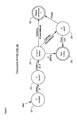
- Figure 2 depicts a finite-state machine for detecting and resolving feature interactions during a call, in accordance with the second illustrative embodiment of the present invention.
- Figure 3 depicts a flowchart for a method corresponding to finite-state machine 200, as shown in Figure 2 , in accordance with the second illustrative embodiment of the present invention.
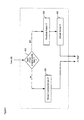
- Figure 4 depicts a flowchart of a first technique for performing task 350, as shown in Figure 3 , in accordance with the second illustrative embodiment of the present invention.
- Figure 5 depicts a flowchart of a second technique for performing task 350, in accordance with the second illustrative embodiment of the present invention.
- Figure 6 depicts a flowchart of a third technique for performing task 350, in accordance with the second illustrative embodiment of the present invention.
- Figure 7 depicts a flowchart for a first method of detecting and resolving feature interactions for calls with multiple-leg signaling paths, in accordance with the third illustrative embodiment of the present invention.
- Figure 8 depicts a flowchart for a second method of detecting and resolving feature interactions for calls with multiple-leg signaling paths, in accordance with the third illustrative embodiment of the present invention.
- FIG. 9 depicts an illustrative signaling path comprising a transparent Back-to-Back User Agent (B2BUA), in accordance with the fourth illustrative embodiment of the present invention.
- B2BUA Back-to-Back User Agent
- call is defined as an interactive communication involving one or more telecommunications terminal users.
- a call might be a conventional voice telephone call, a Voice over Internet Protocol (VoIP) call, a Session Initiation Protocol (SIP) session, an instant messaging (IM) session, a video conference, etc .
- VoIP Voice over Internet Protocol
- SIP Session Initiation Protocol
- IM instant messaging
- five basic rules are employed for detecting feature interactions, each with one variant for multi-party calls and one variant for calls with bridged appearances.
- Some of these rules deal with treatments , which are announcement or tones that are triggered by the network to handle certain conditions during a call ( e . g ., when a call is screened, when a call is blocked, etc .).
- treatments which are announcement or tones that are triggered by the network to handle certain conditions during a call ( e . g ., when a call is screened, when a call is blocked, etc .).
- treatments which are announcement or tones that are triggered by the network to handle certain conditions during a call ( e . g ., when a call is screened, when a call is blocked, etc .).
- treatments which are announcement or tones that are triggered by the network to handle certain conditions during a call (e . g ., when a call is screened, when a call is blocked, etc .).
- CFU Call forwarding
- the first case can be represented as: BA ⁇ : TP : B ; A , B ⁇ A , B ⁇ C where "B-C" indicates that B is on a bridged appearance with C
- the second case can be represented as: BA ⁇ : TP : B ; B , A ⁇ B ⁇ C , A
- the following rules can detect interaction of two features for calls in which a bridged appearance is already present. In other words, these rules detect when there is an interaction between two features that are applied after the activation of a BA feature.
- Rule 1b for calls with one or more BAs same as Rule 1a
- Rule 2b for calls with one or more BAs same as Rule 2a
- Figure 1 depicts a flowchart of a method for detecting and resolving feature interactions for multi-party and bridged-appearance calls, in accordance with the first illustrative embodiment of the present invention. It will be clear to those skilled in the art, after reading this disclosure, which tasks depicted in Figure 1 can be performed simultaneously or in a different order than that depicted.
- feature f1 is initialized to a first feature for a call C that has more than two endpoints, or one or more bridged appearances, or both.
- feature f2 is initialized to a second feature for call C.
- Task 130 determines whether features f1 and f2 match any of rules 1a-5a and rules 1b-5b.
- rules 1a-5a and rules 1b-5b there are a variety of ways well-known in the art for performing such a determination, such as a rule-matching engine of an expert system, a logic program, a constraint-satisfaction system, a na ⁇ ve brute-force search, etc ., and it will be clear to those skilled in the art, after reading this disclosure, how to make and use embodiments of the present invention that are capable of performing task 130.
- task 130 determines that no rules match features f1 and f2 , then execution proceeds to task 140, otherwise execution continues at task 150.
- task 150 one, but not both, of features f1 and f2 are activated, in well-known fashion.
- task 150 might select one of the two features for activation ( i . e ., in which task 150 performs feature interaction resolution).
- task 150 might deterministically select the feature that was invoked first, while in some other embodiments of the present invention, task 150 might deterministically select the feature that was invoked last, while in still some other embodiments, some other method of resolution - such as those described below and with respect to the second illustrative embodiment and Figures 2 through 6 - might be performed.
- some other method of resolution - such as those described below and with respect to the second illustrative embodiment and Figures 2 through 6 - might be performed.
- the method of Figure 1 can be implemented in conjunction with a variety of telephony platforms and protocols (e . g ., Voice over Internet Protocol [VoIP] telephony based on the Session Initiation Protocol [SIP], conventional circuit-switched telephony via the Public Switched Telephone Network [PSTN], etc .), and it will be clear to those skilled in the art, after reading this disclosure, how to make and use embodiments of the present invention based on this method for such platforms and protocols.
- VoIP Voice over Internet Protocol
- SIP Session Initiation Protocol
- PSTN Public Switched Telephone Network
- the second illustrative embodiment of the present invention enables the detection and resolution of feature interactions during a call ( i . e ., mid-call feature interaction detection and resolution).
- the techniques of the second illustrative embodiment can be combined with those of the first illustrative embodiment in order to provide mid-call feature interaction detection and resolution for multi-party calls and calls with bridged appearances.
- FIG. 2 depicts finite-state machine (FSM) 200 for detecting and resolving feature interactions during a call, in accordance with the second illustrative embodiment of the present invention.
- finite-state machine (FSM) 200 comprises states 201 through 206, where state 201 is the starting state and states 205 and 206 are final states.
- Each arc (or directed edge) in finite-state machine (FSM) 200 indicates a legal transition from a first state to a second state, where the label on the arc provides a description of the transition.
- start state 201 feature f1 is activated.
- start state 201 might be entered before call setup, while in some other embodiments, start state 201 might be entered during call setup, while in still some other embodiments start state 201 might be entered after call setup during the call.
- finite-state machine (FSM) 200 leaves start state 201 and enters state 202.
- finite-state machine (FSM) 200 leaves state 202 and enters state 203.
- State 203 transitions to one of states 204, 205, and 206, depending on whether feature f1 or feature f2 has higher priority.
- Feature priorities and resolution techniques for selecting one of features f1 and f2 are described in detail below and with respect to Figures 3 through 6 ). If feature f1 has priority over feature f2 , then state 203 transitions to state 206. If feature f2 has priority over feature f1 and feature f2 is conditional, then state 203 transitions to state 204. If feature f2 has priority over feature f1 and feature f2 is unconditional, then state 203 transitions to state 205.
- state 204 a check for whether feature f2 is used is performed. If it is used, then state 204 transitions to state 205, otherwise state 204 transitions to state 206.
- FIG. 3 depicts a flowchart for a method corresponding to finite-state machine (FSM) 200, in accordance with the second illustrative embodiment of the present invention. It will be clear to those skilled in the art, after reading this disclosure, which tasks depicted in Figure 3 can be performed simultaneously or in a different order than that depicted.
- FSM finite-state machine
- a first signal is received that indicates that a feature f1 is activated, in well-known fashion.
- this first signal might be received by a switch, while in some other embodiments this first signal might be received by a private branch exchange (PBX), while in still some other embodiments this first signal might be received from some other data-processing system.
- PBX private branch exchange
- feature f1 might be activated at task 310 prior to the placing of a particular call, while in some other embodiments, feature f1 might be activated during a particular call. In any case, it will be clear to those skilled in the art, after reading this disclosure, how to make and use embodiments of the present invention that are capable of performing task 310.
- a second signal is received during a call, where the second signal indicates that a feature f2 is invoked during the call.
- Task 330 determines, during the call, whether features f1 and f2 interact.
- feature interaction might be determined via the set of rules of the first illustrative embodiment, while in some other embodiments, feature interaction detection might be performed via some alternative technique. In any case, it will be clear to those skilled in the art, after reading this disclosure, how to make and use embodiments of the present invention that are capable of performing task 330.
- Task 340 branches based on the determination of task 330. If it is determined at task 330 that features f1 and f2 do not interact, then execution proceeds to task 350, otherwise execution continues at task 360.
- feature f2 is activated, in well-known fashion. After task 350, execution of the method of Figure 3 terminates.
- the feature interaction is resolved.
- the feature interaction might be resolved.
- one of the techniques described below and with respect to Figures 4 through 6 might be employed in order to resolve the feature interaction
- some other technique might be employed to resolve the feature interaction.
- Figure 4 depicts a flowchart of a first technique for performing task 350, in accordance with the second illustrative embodiment of the present invention.
- the feature activated earlier i . e ., feature f1
- the feature activated earlier is invariantly given preference, without any other consideration ( e . g ., the nature of features f1 and f2 , how much time has elapsed between the activation of feature f1 and the invocation of feature f2 , etc .).
- activation of feature f2 is refused.
- the refusal might be accompanied by some type of notification or explanation of why feature f2 was not activated, while in some other embodiments, activation might be refused without any accompanying action.
- Figure 5 depicts a flowchart of a second technique for performing task 350, in accordance with the second illustrative embodiment of the present invention.
- the feature activated later i . e ., feature f2
- Figure 5 depicts a flowchart of a second technique for performing task 350, in accordance with the second illustrative embodiment of the present invention.
- the feature activated later i . e ., feature f2
- FIG. 5 depicts a flowchart of a second technique for performing task 350, in accordance with the second illustrative embodiment of the present invention.
- the feature activated later i . e ., feature f2
- feature f1 is deactivated, in well-known fashion.
- feature f2 is activated, in well-known fashion.
- tasks 510 and 520 might be accompanied by some type of notification or explanation of these actions, while in some other embodiments, there might not be any notification or explanation.
- Figure 6 depicts a flowchart of a third technique for performing task 350, in accordance with the second illustrative embodiment of the present invention.
- feature precedence is determined via priorities that are assigned to features. It will be clear to those skilled in the art, after reading this disclosure, which tasks depicted in Figure 6 can be performed simultaneously or in a different order than that depicted.
- Task 610 checks whether feature f2 has a higher priority than feature f1. If not, execution proceeds to task 620, otherwise, execution continues at task 630.
- activation of feature f2 is refused.
- the refusal might be accompanied by some type of notification or explanation of why feature f2 was not activated, while in some other embodiments, activation might be refused without any accompanying action.
- feature f1 is deactivated, in well-known fashion.
- feature f2 is activated, in well-known fashion.
- tasks 630 and 640 might be accompanied by some type of notification or explanation of these actions, while in some other embodiments, there might not be any notification or explanation.
- FIG. 3 through 6 can be implemented in conjunction with a variety of telephony platforms and protocols (e . g ., Voice over Internet Protocol [VoIP] telephony based on the Session Initiation Protocol [SIP], conventional circuit-switched telephony via the Public Switched Telephone Network [PSTN], etc .), and it will be clear to those skilled in the art, after reading this disclosure, how to make and use embodiments of the present invention based on this method for such platforms and protocols.
- VoIP Voice over Internet Protocol
- SIP Session Initiation Protocol
- PSTN Public Switched Telephone Network
- the third illustrative embodiment of the present invention enables detection and resolution of feature interactions for calls with multiple-leg signaling paths.
- the techniques of the third illustrative embodiment can be combined with those of the first and second illustrative embodiments in order to provide mid-call feature interaction detection and resolution for multiple-leg calls that have more than two endpoints and/or bridged appearances.
- Figure 7 depicts a flowchart for a first method of detecting and resolving feature interactions for calls with multiple-leg signaling paths, in accordance with the third illustrative embodiment of the present invention. It will be clear to those skilled in the art, after reading this disclosure, which tasks depicted in Figure 7 can be performed simultaneously or in a different order than that depicted.
- a signal is received that indicates that a feature is invoked for a leg L of a call that has a multiple-leg signaling path, in well-known fashion.
- feature state information for leg L is updated accordingly and stored at the appropriate node(s) in the network.
- the feature state information might be stored at one or more Back-to-Back User Agents (B2BUAs), as is described below and with respect to the fourth illustrative embodiment, while in some other embodiments, the feature state information might be stored at some other type of node, such as a switch, server, private branch exchange (PBX), etc .
- B2BUAs Back-to-Back User Agents
- PBX private branch exchange
- the updated feature state information is propagated along the signaling path of the call, in well-known fashion.
- address mapping is performed across legs of the signaling path, as necessary.
- signaling elements along the signaling path may remove the addresses of signaling elements along portions of the path that would otherwise be carried in the signaling information.
- Such signaling elements can also change the address information for other signaling elements and endpoints that would otherwise be carried in the signaling information.
- mappings and transformations are used to conceal the details of the internal signaling topology from external signaling elements and endpoints, and to permit changes to signaling paths that are invisible to one or more endpoints.
- the address mapping at task 740 provides feature interaction detection rules with a consistent view of the endpoints that are actually in the call.
- Task 750 checks whether the invoked feature interacts with either (i) a feature for a different leg of the call signaling path, or (ii) another feature for leg L. If so, then execution proceeds to task 760, otherwise execution continues at task 770.
- the feature interaction is resolved.
- the feature interaction might be resolved.
- one of the techniques described above and with respect to Figures 4 through 6 might be employed in order to resolve the feature interaction, while in some other embodiments of the present invention, some other technique might be employed to resolve the feature interaction.
- Figure 8 depicts a flowchart for a second method of detecting and resolving feature interactions for calls with multiple-leg signaling paths, in accordance with the third illustrative embodiment of the present invention. It will be clear to those skilled in the art, after reading this disclosure, which tasks depicted in Figure 8 can be performed simultaneously or in a different order than that depicted.
- a signal is received that indicates that either a new leg is to be added to a call, or that a new leg has already been added to a call.
- feature state information for the new leg is propagated along the signaling path of the call, in well-known fashion.
- address mapping is performed across legs of the signaling path, as necessary.
- signaling elements along the signaling path may remove the addresses of signaling elements along portions of the path that would otherwise be carried in the signaling information.
- Such signaling elements can also change the address information for other signaling elements and endpoints that would otherwise be carried in the signaling information.
- mappings and transformations are used to conceal the details of the internal signaling topology from external signaling elements and endpoints, and to permit changes to signaling paths that are invisible to one or more endpoints.
- the address mapping at task 830 provides feature interaction detection rules with a consistent view of the endpoints that are actually in the call.
- Task 840 checks whether any features of the new leg interact with any features of any existing legs of the call. If so, then execution proceeds to task 850, otherwise execution continues at task 860.
- the feature interaction is resolved.
- the feature interaction might be resolved.
- one of the techniques described above and with respect to Figures 4 through 6 might be employed in order to resolve the feature interaction, while in some other embodiments of the present invention, some other technique might be employed to resolve the feature interaction.
- Figure 7 and 8 can be implemented in conjunction with a variety of telephony platforms and protocols (e . g ., Voice over Internet Protocol [VoIP] telephony based on the Session Initiation Protocol [SIP], conventional circuit-switched telephony via the Public Switched Telephone Network [PSTN], etc .), and it will be clear to those skilled in the art, after reading this disclosure, how to make and use embodiments of the present invention based on this method for such platforms and protocols.
- VoIP Voice over Internet Protocol
- SIP Session Initiation Protocol
- PSTN Public Switched Telephone Network
- the fourth illustrative embodiment provides an implementation for Voice over Internet Protocol (VoIP) calls that is capable of performing the tasks associated with the first, second, and third illustrative embodiments described above.
- VoIP Voice over Internet Protocol
- the fourth illustrative embodiment can handle mid-call feature interaction detection and resolution, calls with multiple-leg signaling paths, multi-party calls, and calls with bridged appearances.
- the approach of the fourth illustrative embodiment is distributed in nature, which facilitates its application to Voice over Internet Protocol (VoIP) telephony and the Session Initiation Protocol (SIP).
- VoIP Voice over Internet Protocol
- SIP Session Initiation Protocol
- Each feature that gets activated includes its Triggering Party and Connection Type into the SIP message. If there is already one or more entries in the message, these are checked against the description of the current feature. Thus the algorithm is executed wherever necessary and a central feature manager is not required. This makes the approach highly scalable.
- the standard SIP headers do not provide sufficient detail, and therefore additional headers carrying the required information have been defined and can be included with the SIP messages.
- Two private headers have been defined to carry the required information for this approach: P-ConType and P-Forwarded-To.
- the P-ConType header contains the descriptions of features that have been active on the current session, and the P-Forwarded-To header contains the ID for an invited party when an INVITE request is redirected to another party.
- the current SIP message is checked for the P-ConType header. If no such a header is found, then no other feature has previously been active and hence a feature interaction cannot have occurred. In such cases, a new P-ConType header is inserted into the message describing the current feature. For example, for a forwarding feature the header is:
- the header contains the ID field, the triggering party and the connection type.
- the ID identifies the feature described in the header.
- the TP contains the triggering party, and the remaining four fields correspond to the four fields of the connection type.
- Back-to-Back User Agents store and maintain feature state and signaling information for call legs, and propagate this information along the signaling path.
- a Back-to-Back User Agent acts as a user agent to both ends of a Session Initiation Protocol (SIP) call, and is responsible for handling all SIP signaling between both ends of the call, from call establishment to termination.
- SIP Session Initiation Protocol
- B2BUA acts as a User Agent server on one side, and as a User Agent client on the other (back-to-back) side.
- a Back-to-Back User Agent might also provide additional functions such as call management (e . g ., billing, automatic call disconnection, call transfer, etc .), network interworking (perhaps with protocol adaptation), hiding of network internals ( e . g ., private addresses, network topology, etc .), codec translation between two call legs, and so forth.
- a Back-to-Back User Agent might be a transparent B2BUA, or a monitoring B2BUA, or might function as a session controller controller (SBC).
- SBC session controller controller
- a transparent B2BUA might carry the P-ConType header forward as specified and be able to send back the disabling of a feature due to an interaction. This happens without altering any information in the headers.
- a transparent B2BUA modifies information in some headers, which could impact the feature interaction approach. For example, by changing the identity of the endpoints through changes in the From / To / RequestURI, the mapping between those headers and the information contained in the P-ConType header is broken. Furthermore, the P-ConType header might still reveal the 'previous' identity of the parties. Therefore the B2BUA needs to perform the same address mapping on the values in the P-ConType header as in the altered SIP headers. This mapping should happen for both upstream and downstream messages.
- FIG. 9 depicts illustrative Session Initiation Protocol (SIP) signaling path 900 for the second case, in accordance with the fourth illustrative embodiment of the present invention.
- signaling path 900 comprises user agents 901-1 and 901-2, servers 902-1 and 902-2, and transparent Back-to-Back User Agent (B2BUA) 903, interconnected as shown, and comprises two call legs 904-1 and 904-2.
- B2BUA Back-to-Back User Agent
- User agents 901-1 and 901-2 are Session Initiation Protocol (SIP) endpoints, as is well-known in the art.
- SIP Session Initiation Protocol
- Servers 902-1 and 902-2 are Session Initiation Protocol (SIP) servers, as is well-known in the art.
- SIP Session Initiation Protocol
- transparent Back-to-Back User Agent (B2BUA) 103 performs address mapping on the P-ConType header as well as the other Session Initiation Protocol (SIP) headers.
- the Session Initiation Protocol (SIP) messages among user agents 101-1 and 101-2, servers 102-1 and 102-2, and transparent Back-to-Back User Agent (B2BUA) 103 are depicted below signaling path 900, in well-known fashion.
- the mapping occurs at each B2BUA.
- the behavior of chained B2BUAs can be viewed as a sequence of the single-B2BUA case.
- Monitoring of a session can either be invisible (e . g . through a feature such as Lawful Intercept, etc .) or visible ( e . g ., through a feature such as Session Recording, etc .). Invisible monitoring should not be detectable by other endpoints in the call, and thus the signaling from the monitoring endpoint needs to be hidden from the other endpoints.
- B2BUAs can be employed to provide this functionality; however, there are privacy issues that might be compromised by the P-ConType header.
- features such as Lawful Intercept or Supervisor Monitoring should have priority over any feature interaction issues. In other words, the monitoring should stay invisible even though this means that some interactions due to the monitoring might not be handled.
- An example of such a scenario is when the monitoring party is on a screening list of one of the parties on the monitored call.
- P-ConType headers from features for the monitoring party are not to be sent to other parties the call, and the call setup should never be repeated due to a feature interaction (disabling one of the features), as this can be detected at the other endpoints and reveal the monitoring. Instead, such an interaction is resolved by giving priority to the features of the monitoring party.
- monitoring should be disabled.
- An example of such a scenario is when monitoring is active on a call, and a party who has a feature disallowing monitoring of calls (e . g ., a Chief Executive Officer, etc .) joins the call.
- feature interaction resolution can be performed as described in the previous illustrative embodiments, with the added proviso that for a call leg with a B2BUA as the originating or terminating point, feature interactions within the call leg are resolved at the B2BUA.
- SBCs Session Border Controllers
- a primary function of a session border controller is to hide domain routing and endpoint identities from external endpoints and signaling elements. Naturally, this function conflicts with the feature interaction detection approach of the fourth illustrative embodiment: in particular, a session border controller (SBC) will not forward information in the P-ConType header, as doing so might reveal identities and features used by those identities.
- SBC session border controller
- feature interaction analysis within one domain is still possible by isolating the feature interaction logic within each domain. While this will resolve interactions between services used within one domain, it will not capture interactions involving services from different domains.
- the session border controller could map feature interaction feedback in a way that does not disclose the internal topology or signaling. For example, there might be a list of hidden features that are filtered out of the P-ConType header to prevent visibility outside the domain. As another example, only public endpoints might be made visible outside the domain. Naturally, there is a tradeoff, as any such approach will have some impact on the ability to handle some interactions in exchange for the benefit of increased privacy. As will be appreciated by those skilled in the art, the particular policy that is employed ( e .
- the salient tasks of the fourth illustrative embodiment are performed by one or more Back-to-Back User Agents (B2BUAs)
- B2BUAs Back-to-Back User Agents
- some or all of these tasks might be performed by one or more other data-processing systems (e . g ., a switch, a server, a private branch exchange [PBX], etc .), and it will be clear to those skilled in the art, after reading this disclosure, how to make and use such embodiments of the present invention.
- VoIP Voice over Internet Protocol
- SIP Session Initiation Protocol
Landscapes
- Engineering & Computer Science (AREA)
- Signal Processing (AREA)
- Business, Economics & Management (AREA)
- General Business, Economics & Management (AREA)
- Multimedia (AREA)
- Computer Networks & Wireless Communication (AREA)
- Marketing (AREA)
- Telephonic Communication Services (AREA)
Applications Claiming Priority (2)
| Application Number | Priority Date | Filing Date | Title |
|---|---|---|---|
| US14570609P | 2009-01-19 | 2009-01-19 | |
| US12/392,461 US8155021B2 (en) | 2009-01-19 | 2009-02-25 | Feature interaction detection during calls with multiple-leg signaling paths |
Publications (1)
| Publication Number | Publication Date |
|---|---|
| EP2209291A1 true EP2209291A1 (de) | 2010-07-21 |
Family
ID=42174339
Family Applications (1)
| Application Number | Title | Priority Date | Filing Date |
|---|---|---|---|
| EP09171158A Ceased EP2209291A1 (de) | 2009-01-19 | 2009-09-24 | Merkmalsinteraktionserkennung bei Anrufen mit Signalisierungspfaden mit mehreren Abzweigungen |
Country Status (5)
| Country | Link |
|---|---|
| US (1) | US8155021B2 (de) |
| EP (1) | EP2209291A1 (de) |
| JP (1) | JP5767776B2 (de) |
| KR (1) | KR101464775B1 (de) |
| CN (1) | CN101783838B (de) |
Cited By (1)
| Publication number | Priority date | Publication date | Assignee | Title |
|---|---|---|---|---|
| GB2524731A (en) * | 2014-03-31 | 2015-10-07 | Evolved Intelligence Ltd | Method and apparatus for detecting whether a fixed-line/landline telephone number has an active call forwarding condition |
Families Citing this family (1)
| Publication number | Priority date | Publication date | Assignee | Title |
|---|---|---|---|---|
| WO2014142830A1 (en) | 2013-03-13 | 2014-09-18 | Unify Gmbh & Co. Kg | Method, device, and system for communicating a changeability attribute |
Citations (1)
| Publication number | Priority date | Publication date | Assignee | Title |
|---|---|---|---|---|
| US20060218268A1 (en) * | 2005-03-28 | 2006-09-28 | Andre Beck | Method and apparatus for extending service mediation to intelligent voice-over-IP endpoint terminals |
Family Cites Families (19)
| Publication number | Priority date | Publication date | Assignee | Title |
|---|---|---|---|---|
| JPH0454797A (ja) * | 1990-06-22 | 1992-02-21 | Nec Corp | 発着サービス分離方式 |
| JP2916414B2 (ja) * | 1996-07-15 | 1999-07-05 | 株式会社エイ・ティ・アール環境適応通信研究所 | 通信サービス処理装置 |
| US20080220775A1 (en) | 1997-07-30 | 2008-09-11 | Steven Tischer | Apparatus, method, and computer-readable medium for securely providing communications between devices and networks |
| GB2353916B (en) | 1999-08-23 | 2003-12-24 | Mitel Corp | Adaptive rule-based mechanism and method for feature interaction resolution |
| US20030059015A1 (en) * | 2001-09-21 | 2003-03-27 | Mello Eber | Call server allowing calls with multiple participants and multiple services independently of the number of participants |
| JP4349766B2 (ja) * | 2001-12-07 | 2009-10-21 | 株式会社日立製作所 | アドレス変換装置 |
| US8126722B2 (en) | 2001-12-20 | 2012-02-28 | Verizon Business Global Llc | Application infrastructure platform (AIP) |
| US7050563B2 (en) * | 2002-02-27 | 2006-05-23 | Dammrose J Mark | Call path reduction via correlation of call legs in a hairpin loop scenario |
| US7076766B2 (en) | 2002-06-03 | 2006-07-11 | Steve Wirts | Software application development methods and framework |
| GB0224187D0 (en) | 2002-10-17 | 2002-11-27 | Mitel Knowledge Corp | Interactive conflict resolution for personalised policy-based services |
| US6888808B2 (en) * | 2003-09-15 | 2005-05-03 | Cisco Technology, Inc. | System and method for providing transparency in delivering private network features |
| US7411975B1 (en) * | 2004-08-26 | 2008-08-12 | Juniper Networks, Inc. | Multimedia over internet protocol border controller for network-based virtual private networks |
| TWI267293B (en) * | 2005-03-09 | 2006-11-21 | Plustek Inc | Multimedia conference system and method which enables communication between private network and Internet |
| US7870265B2 (en) | 2005-06-30 | 2011-01-11 | Oracle International Corporation | System and method for managing communications sessions in a network |
| US7804818B1 (en) * | 2005-09-30 | 2010-09-28 | At&T Intellectual Property Ii, L.P. | Method for maintaining signaling history in a Voice-over-Internet-Protocol (VoIP) network |
| US7542768B2 (en) * | 2006-03-23 | 2009-06-02 | Alcatel-Lucent Usa Inc. | Dynamic ring start delay based on multiple factors |
| US8134956B2 (en) * | 2008-01-24 | 2012-03-13 | At&T Intellectual Property I, L.P. | System and method of providing registration alert in an IMS system |
| US7720976B2 (en) * | 2008-03-31 | 2010-05-18 | Alcatel-Lucent Usa Inc. | Peer-to-peer communication between different types of internet hosts |
| US8179802B2 (en) * | 2008-07-09 | 2012-05-15 | At&T Intellectual Property I, L.P. | Method and apparatus for managing audio contention in networks |
-
2009
- 2009-02-25 US US12/392,461 patent/US8155021B2/en active Active
- 2009-09-24 EP EP09171158A patent/EP2209291A1/de not_active Ceased
- 2009-09-30 KR KR1020090093551A patent/KR101464775B1/ko active Active
- 2009-11-05 CN CN200910208843.XA patent/CN101783838B/zh active Active
- 2009-12-07 JP JP2009277451A patent/JP5767776B2/ja not_active Expired - Fee Related
Patent Citations (1)
| Publication number | Priority date | Publication date | Assignee | Title |
|---|---|---|---|---|
| US20060218268A1 (en) * | 2005-03-28 | 2006-09-28 | Andre Beck | Method and apparatus for extending service mediation to intelligent voice-over-IP endpoint terminals |
Non-Patent Citations (13)
| Title |
|---|
| ALCATEL-LUCENT: "Pseudo-CR on H.248 Ix Profile (Transition Gateway) - 5.17.1.17 Topology Hiding Function", 3GPP DRAFT; C4-082645, 3RD GENERATION PARTNERSHIP PROJECT (3GPP), MOBILE COMPETENCE CENTRE ; 650, ROUTE DES LUCIOLES ; F-06921 SOPHIA-ANTIPOLIS CEDEX ; FRANCE, no. Phoenix; 20081013, 13 October 2008 (2008-10-13), XP050313423 * |
| BECK A ET AL: "EXTENDING SERVICE MEDIATION TO INTELLIGENT VOIP ENDPOINTS", BELL LABS TECHNICAL JOURNAL, WILEY, CA, US LNKD- DOI:10.1002/BLTJ.20075, vol. 10, no. 1, 21 March 2005 (2005-03-21), pages 11 - 15, XP001540855, ISSN: 1089-7089 * |
| BECK A ET AL: "EXTENDING SERVICE MEDIATION TO INTELLIGENT VOIP ENDPOINTS", BELL LABS TECHNICAL JOURNAL, WILEY, CA, US, vol. 10, no. 1, 21 March 2005 (2005-03-21), pages 11 - 15, XP001540855, ISSN: 1089-7089, DOI: 10.1002/BLTJ.20075 * |
| CHARLES SHEN ET AL: "A VoIP Privacy Mechanism and its Application in VoIP Peering for Voice Service Provider Topology and Identity Hiding", ARXIV.ORG, CORNELL UNIVERSITY LIBRARY, 201 OLIN LIBRARY CORNELL UNIVERSITY ITHACA, NY 14853, 8 July 2008 (2008-07-08), XP080425805 * |
| GOUYA A ET AL: "Service Broker for Managing Feature Interactions in IP Multimedia Subsystem", NETWORKING, 2007. ICN '07. SIXTH INTERNATIONAL CONFERENCE ON, IEEE, PI, 22 April 2007 (2007-04-22), pages 54, XP031214505, ISBN: 978-0-7695-2805-2 * |
| JOHN BUFORD ET AL: "Feature Interactions in P2P Overlay Networks", CONSUMER COMMUNICATIONS AND NETWORKING CONFERENCE, 2008. CCNC 2008. 5TH IEEE, IEEE CCP, PISCATAWAY, NJ, USA, 1 January 2008 (2008-01-01), pages 304 - 305, XP031211883, ISBN: 978-1-4244-1456-7 * |
| KOLBERG ET AL: "Managing feature interactions between distributed SIP call control services", COMPUTER NETW, ELSEVIER, AMSTERDAM, NL, vol. 51, no. 2, 10 November 2006 (2006-11-10), pages 536 - 557, XP005758516, ISSN: 1389-1286, DOI: 10.1016/J.COMNET.2006.08.006 * |
| KOLBERG ET AL: "Managing feature interactions between distributed SIP call control services", COMPUTER NETWORKS, ELSEVIER SCIENCE PUBLISHERS B.V., AMSTERDAM, NL LNKD- DOI:10.1016/J.COMNET.2006.08.006, vol. 51, no. 2, 10 November 2006 (2006-11-10), pages 536 - 557, XP005758516, ISSN: 1389-1286 * |
| KOLBERG M ET AL: "Managing Distributed Feature Interactions in Enterprise SIP Application Servers", COMMUNICATIONS, 2009. ICC '09. IEEE INTERNATIONAL CONFERENCE ON, IEEE, PISCATAWAY, NJ, USA, 14 June 2009 (2009-06-14), pages 1 - 6, XP031506136, ISBN: 978-1-4244-3435-0 * |
| MARJOU FRANCE TELECOM I ELZ PRACTICE ERICSSON P MUSGRAVE COUNTERPATH X: "Best Current Practices for a Session Initiation Protocol (SIP) Transparent Back-To-Back User-Agent (B2BUA); draft-marjou-sipping-b2bua-01.txt", BEST CURRENT PRACTICES FOR A SESSION INITIATION PROTOCOL (SIP) TRANSPARENT BACK-TO-BACK USER-AGENT (B2BUA); DRAFT-MARJOU-SIPPING-B2BUA-01.TXT, INTERNET ENGINEERING TASK FORCE, IETF; STANDARDWORKINGDRAFT, INTERNET SOCIETY (ISOC) 4, RUE DES FALAISES CH, no. 1, 9 July 2007 (2007-07-09), XP015051976 * |
| MARJOU FRANCE TELECOM I ELZ PRACTICE ERICSSON P MUSGRAVE COUNTERPATH X: "Best Current Practices for a Session Initiation Protocol (SIP) Transparent Back-To-Back User-Agent (B2BUA); draft-marjou-sipping-b2bua-01.txt", IETF STANDARD-WORKING-DRAFT, INTERNET ENGINEERING TASK FORCE, IETF, CH, no. 1, 9 July 2007 (2007-07-09), XP015051976, ISSN: 0000-0004 * |
| PANASONIC: "Solutions for location privacy support in local breakout scenarios", 3GPP DRAFT; S2-075209, 3RD GENERATION PARTNERSHIP PROJECT (3GPP), MOBILE COMPETENCE CENTRE ; 650, ROUTE DES LUCIOLES ; F-06921 SOPHIA-ANTIPOLIS CEDEX ; FRANCE, vol. SA WG2, no. Ljubljana; 20071102, 2 November 2007 (2007-11-02), XP050261924 * |
| WEI-KUO CHIANG ET AL: "Handling feature interactions for multi-party services in 3GPP IP multimedia subsystem", IP MULTIMEDIA SUBSYSTEM ARCHITECTURE AND APPLICATIONS, 2007 INTERNATIONAL CONFERENCE ON, IEEE, PISCATAWAY, NJ, USA, 6 December 2007 (2007-12-06), pages 1 - 5, XP031283340, ISBN: 978-1-4244-2671-3 * |
Cited By (2)
| Publication number | Priority date | Publication date | Assignee | Title |
|---|---|---|---|---|
| GB2524731A (en) * | 2014-03-31 | 2015-10-07 | Evolved Intelligence Ltd | Method and apparatus for detecting whether a fixed-line/landline telephone number has an active call forwarding condition |
| GB2524731B (en) * | 2014-03-31 | 2021-01-13 | Mobileum Uk Ltd | Method and apparatus for detecting whether a fixed-line/landline telephone number has an active call forwarding condition |
Also Published As
| Publication number | Publication date |
|---|---|
| KR101464775B1 (ko) | 2014-11-24 |
| JP5767776B2 (ja) | 2015-08-19 |
| JP2010166557A (ja) | 2010-07-29 |
| KR20100084964A (ko) | 2010-07-28 |
| US20100182996A1 (en) | 2010-07-22 |
| CN101783838A (zh) | 2010-07-21 |
| US8155021B2 (en) | 2012-04-10 |
| CN101783838B (zh) | 2014-11-12 |
Similar Documents
| Publication | Publication Date | Title |
|---|---|---|
| EP2629477A1 (de) | Globaler Sitzungsidentifikator | |
| CN102474369B (zh) | 在web使能的和呼叫有关的特征之间的交互作用检测 | |
| Bond et al. | An open architecture for next-generation telecommunication services | |
| US8234368B1 (en) | System, method, and computer program for reporting a communication flow to a lawful intercept framework | |
| KR101481285B1 (ko) | 핫-데스킹을 인에이블링하기 위한 시스템 및 방법 | |
| US8300558B2 (en) | Feature interaction detection in multi-party calls and calls with bridged appearances | |
| KR20090046724A (ko) | 호출 관리 방법 | |
| US8155021B2 (en) | Feature interaction detection during calls with multiple-leg signaling paths | |
| Kolberg et al. | Managing feature interactions between distributed SIP call control services | |
| US8917844B2 (en) | Mid-call detection and resolution of feature interactions | |
| EP2876858A1 (de) | Anrufweiterleitung mit netzwerküberspannenden Back-to-Back-Benutzeragenten | |
| US9876912B2 (en) | Parallel forking with AoR chaining | |
| Kolberg et al. | Detecting Feature Interactions between SIP Call Control Services. | |
| Kolberg et al. | Managing distributed feature interactions in enterprise SIP application servers | |
| Chentouf et al. | Mapping SIP onto a feature interaction management language | |
| Kryvinska et al. | A scenario-based framework for perceiving crossbreed service interactions | |
| Reiff-Marganiec et al. | Detecting Feature Interactions between | |
| Wang et al. | Online Detection of Feature Interactions of CPL Services. |
Legal Events
| Date | Code | Title | Description |
|---|---|---|---|
| PUAI | Public reference made under article 153(3) epc to a published international application that has entered the european phase |
Free format text: ORIGINAL CODE: 0009012 |
|
| AK | Designated contracting states |
Kind code of ref document: A1 Designated state(s): AT BE BG CH CY CZ DE DK EE ES FI FR GB GR HR HU IE IS IT LI LT LU LV MC MK MT NL NO PL PT RO SE SI SK SM TR |
|
| 17P | Request for examination filed |
Effective date: 20110120 |
|
| STAA | Information on the status of an ep patent application or granted ep patent |
Free format text: STATUS: EXAMINATION IS IN PROGRESS |
|
| 17Q | First examination report despatched |
Effective date: 20170119 |
|
| RIN1 | Information on inventor provided before grant (corrected) |
Inventor name: KOLBERG, MARIO Inventor name: DHARA, KRISHNA KISHORE Inventor name: KRISHNASWAMY, VENKATESH Inventor name: BUFORD, JOHN Inventor name: WU, XIAOTAO |
|
| STAA | Information on the status of an ep patent application or granted ep patent |
Free format text: STATUS: THE APPLICATION HAS BEEN REFUSED |
|
| 18R | Application refused |
Effective date: 20200521 |