EP2208557A1 - Noble metal nanostructure and electrochemical reactor - Google Patents
Noble metal nanostructure and electrochemical reactor Download PDFInfo
- Publication number
- EP2208557A1 EP2208557A1 EP08832196A EP08832196A EP2208557A1 EP 2208557 A1 EP2208557 A1 EP 2208557A1 EP 08832196 A EP08832196 A EP 08832196A EP 08832196 A EP08832196 A EP 08832196A EP 2208557 A1 EP2208557 A1 EP 2208557A1
- Authority
- EP
- European Patent Office
- Prior art keywords
- noble metal
- microstructured
- reaction
- metal nanostructure
- nitrate
- Prior art date
- Legal status (The legal status is an assumption and is not a legal conclusion. Google has not performed a legal analysis and makes no representation as to the accuracy of the status listed.)
- Granted
Links
Images







Classifications
-
- C—CHEMISTRY; METALLURGY
- C25—ELECTROLYTIC OR ELECTROPHORETIC PROCESSES; APPARATUS THEREFOR
- C25B—ELECTROLYTIC OR ELECTROPHORETIC PROCESSES FOR THE PRODUCTION OF COMPOUNDS OR NON-METALS; APPARATUS THEREFOR
- C25B11/00—Electrodes; Manufacture thereof not otherwise provided for
- C25B11/02—Electrodes; Manufacture thereof not otherwise provided for characterised by shape or form
-
- B—PERFORMING OPERATIONS; TRANSPORTING
- B01—PHYSICAL OR CHEMICAL PROCESSES OR APPARATUS IN GENERAL
- B01D—SEPARATION
- B01D53/00—Separation of gases or vapours; Recovering vapours of volatile solvents from gases; Chemical or biological purification of waste gases, e.g. engine exhaust gases, smoke, fumes, flue gases, aerosols
- B01D53/32—Separation of gases or vapours; Recovering vapours of volatile solvents from gases; Chemical or biological purification of waste gases, e.g. engine exhaust gases, smoke, fumes, flue gases, aerosols by electrical effects other than those provided for in group B01D61/00
- B01D53/326—Separation of gases or vapours; Recovering vapours of volatile solvents from gases; Chemical or biological purification of waste gases, e.g. engine exhaust gases, smoke, fumes, flue gases, aerosols by electrical effects other than those provided for in group B01D61/00 in electrochemical cells
-
- B—PERFORMING OPERATIONS; TRANSPORTING
- B01—PHYSICAL OR CHEMICAL PROCESSES OR APPARATUS IN GENERAL
- B01D—SEPARATION
- B01D53/00—Separation of gases or vapours; Recovering vapours of volatile solvents from gases; Chemical or biological purification of waste gases, e.g. engine exhaust gases, smoke, fumes, flue gases, aerosols
- B01D53/34—Chemical or biological purification of waste gases
- B01D53/92—Chemical or biological purification of waste gases of engine exhaust gases
- B01D53/94—Chemical or biological purification of waste gases of engine exhaust gases by catalytic processes
- B01D53/9404—Removing only nitrogen compounds
- B01D53/9409—Nitrogen oxides
- B01D53/9413—Processes characterised by a specific catalyst
-
- B—PERFORMING OPERATIONS; TRANSPORTING
- B01—PHYSICAL OR CHEMICAL PROCESSES OR APPARATUS IN GENERAL
- B01D—SEPARATION
- B01D53/00—Separation of gases or vapours; Recovering vapours of volatile solvents from gases; Chemical or biological purification of waste gases, e.g. engine exhaust gases, smoke, fumes, flue gases, aerosols
- B01D53/34—Chemical or biological purification of waste gases
- B01D53/92—Chemical or biological purification of waste gases of engine exhaust gases
- B01D53/94—Chemical or biological purification of waste gases of engine exhaust gases by catalytic processes
- B01D53/9404—Removing only nitrogen compounds
- B01D53/9409—Nitrogen oxides
- B01D53/9431—Processes characterised by a specific device
-
- B—PERFORMING OPERATIONS; TRANSPORTING
- B01—PHYSICAL OR CHEMICAL PROCESSES OR APPARATUS IN GENERAL
- B01J—CHEMICAL OR PHYSICAL PROCESSES, e.g. CATALYSIS OR COLLOID CHEMISTRY; THEIR RELEVANT APPARATUS
- B01J23/00—Catalysts comprising metals or metal oxides or hydroxides, not provided for in group B01J21/00
- B01J23/38—Catalysts comprising metals or metal oxides or hydroxides, not provided for in group B01J21/00 of noble metals
- B01J23/40—Catalysts comprising metals or metal oxides or hydroxides, not provided for in group B01J21/00 of noble metals of the platinum group metals
-
- B—PERFORMING OPERATIONS; TRANSPORTING
- B01—PHYSICAL OR CHEMICAL PROCESSES OR APPARATUS IN GENERAL
- B01J—CHEMICAL OR PHYSICAL PROCESSES, e.g. CATALYSIS OR COLLOID CHEMISTRY; THEIR RELEVANT APPARATUS
- B01J23/00—Catalysts comprising metals or metal oxides or hydroxides, not provided for in group B01J21/00
- B01J23/38—Catalysts comprising metals or metal oxides or hydroxides, not provided for in group B01J21/00 of noble metals
- B01J23/40—Catalysts comprising metals or metal oxides or hydroxides, not provided for in group B01J21/00 of noble metals of the platinum group metals
- B01J23/42—Platinum
-
- B—PERFORMING OPERATIONS; TRANSPORTING
- B01—PHYSICAL OR CHEMICAL PROCESSES OR APPARATUS IN GENERAL
- B01J—CHEMICAL OR PHYSICAL PROCESSES, e.g. CATALYSIS OR COLLOID CHEMISTRY; THEIR RELEVANT APPARATUS
- B01J23/00—Catalysts comprising metals or metal oxides or hydroxides, not provided for in group B01J21/00
- B01J23/38—Catalysts comprising metals or metal oxides or hydroxides, not provided for in group B01J21/00 of noble metals
- B01J23/40—Catalysts comprising metals or metal oxides or hydroxides, not provided for in group B01J21/00 of noble metals of the platinum group metals
- B01J23/44—Palladium
-
- B—PERFORMING OPERATIONS; TRANSPORTING
- B01—PHYSICAL OR CHEMICAL PROCESSES OR APPARATUS IN GENERAL
- B01J—CHEMICAL OR PHYSICAL PROCESSES, e.g. CATALYSIS OR COLLOID CHEMISTRY; THEIR RELEVANT APPARATUS
- B01J23/00—Catalysts comprising metals or metal oxides or hydroxides, not provided for in group B01J21/00
- B01J23/38—Catalysts comprising metals or metal oxides or hydroxides, not provided for in group B01J21/00 of noble metals
- B01J23/48—Silver or gold
- B01J23/50—Silver
-
- B—PERFORMING OPERATIONS; TRANSPORTING
- B01—PHYSICAL OR CHEMICAL PROCESSES OR APPARATUS IN GENERAL
- B01J—CHEMICAL OR PHYSICAL PROCESSES, e.g. CATALYSIS OR COLLOID CHEMISTRY; THEIR RELEVANT APPARATUS
- B01J23/00—Catalysts comprising metals or metal oxides or hydroxides, not provided for in group B01J21/00
- B01J23/38—Catalysts comprising metals or metal oxides or hydroxides, not provided for in group B01J21/00 of noble metals
- B01J23/48—Silver or gold
- B01J23/52—Gold
-
- B—PERFORMING OPERATIONS; TRANSPORTING
- B01—PHYSICAL OR CHEMICAL PROCESSES OR APPARATUS IN GENERAL
- B01J—CHEMICAL OR PHYSICAL PROCESSES, e.g. CATALYSIS OR COLLOID CHEMISTRY; THEIR RELEVANT APPARATUS
- B01J23/00—Catalysts comprising metals or metal oxides or hydroxides, not provided for in group B01J21/00
- B01J23/70—Catalysts comprising metals or metal oxides or hydroxides, not provided for in group B01J21/00 of the iron group metals or copper
- B01J23/89—Catalysts comprising metals or metal oxides or hydroxides, not provided for in group B01J21/00 of the iron group metals or copper combined with noble metals
- B01J23/892—Nickel and noble metals
-
- B—PERFORMING OPERATIONS; TRANSPORTING
- B01—PHYSICAL OR CHEMICAL PROCESSES OR APPARATUS IN GENERAL
- B01J—CHEMICAL OR PHYSICAL PROCESSES, e.g. CATALYSIS OR COLLOID CHEMISTRY; THEIR RELEVANT APPARATUS
- B01J23/00—Catalysts comprising metals or metal oxides or hydroxides, not provided for in group B01J21/00
- B01J23/70—Catalysts comprising metals or metal oxides or hydroxides, not provided for in group B01J21/00 of the iron group metals or copper
- B01J23/89—Catalysts comprising metals or metal oxides or hydroxides, not provided for in group B01J21/00 of the iron group metals or copper combined with noble metals
- B01J23/8933—Catalysts comprising metals or metal oxides or hydroxides, not provided for in group B01J21/00 of the iron group metals or copper combined with noble metals also combined with metals, or metal oxides or hydroxides provided for in groups B01J23/02 - B01J23/36
- B01J23/894—Catalysts comprising metals or metal oxides or hydroxides, not provided for in group B01J21/00 of the iron group metals or copper combined with noble metals also combined with metals, or metal oxides or hydroxides provided for in groups B01J23/02 - B01J23/36 with rare earths or actinides
-
- B—PERFORMING OPERATIONS; TRANSPORTING
- B01—PHYSICAL OR CHEMICAL PROCESSES OR APPARATUS IN GENERAL
- B01J—CHEMICAL OR PHYSICAL PROCESSES, e.g. CATALYSIS OR COLLOID CHEMISTRY; THEIR RELEVANT APPARATUS
- B01J35/00—Catalysts, in general, characterised by their form or physical properties
- B01J35/40—Catalysts, in general, characterised by their form or physical properties characterised by dimensions, e.g. grain size
- B01J35/45—Nanoparticles
-
- B—PERFORMING OPERATIONS; TRANSPORTING
- B01—PHYSICAL OR CHEMICAL PROCESSES OR APPARATUS IN GENERAL
- B01J—CHEMICAL OR PHYSICAL PROCESSES, e.g. CATALYSIS OR COLLOID CHEMISTRY; THEIR RELEVANT APPARATUS
- B01J35/00—Catalysts, in general, characterised by their form or physical properties
- B01J35/50—Catalysts, in general, characterised by their form or physical properties characterised by their shape or configuration
- B01J35/58—Fabrics or filaments
-
- B—PERFORMING OPERATIONS; TRANSPORTING
- B01—PHYSICAL OR CHEMICAL PROCESSES OR APPARATUS IN GENERAL
- B01J—CHEMICAL OR PHYSICAL PROCESSES, e.g. CATALYSIS OR COLLOID CHEMISTRY; THEIR RELEVANT APPARATUS
- B01J37/00—Processes, in general, for preparing catalysts; Processes, in general, for activation of catalysts
- B01J37/34—Irradiation by, or application of, electric, magnetic or wave energy, e.g. ultrasonic waves ; Ionic sputtering; Flame or plasma spraying; Particle radiation
- B01J37/348—Electrochemical processes, e.g. electrochemical deposition or anodisation
-
- B—PERFORMING OPERATIONS; TRANSPORTING
- B22—CASTING; POWDER METALLURGY
- B22F—WORKING METALLIC POWDER; MANUFACTURE OF ARTICLES FROM METALLIC POWDER; MAKING METALLIC POWDER; APPARATUS OR DEVICES SPECIALLY ADAPTED FOR METALLIC POWDER
- B22F1/00—Metallic powder; Treatment of metallic powder, e.g. to facilitate working or to improve properties
- B22F1/05—Metallic powder characterised by the size or surface area of the particles
- B22F1/054—Nanosized particles
-
- B—PERFORMING OPERATIONS; TRANSPORTING
- B22—CASTING; POWDER METALLURGY
- B22F—WORKING METALLIC POWDER; MANUFACTURE OF ARTICLES FROM METALLIC POWDER; MAKING METALLIC POWDER; APPARATUS OR DEVICES SPECIALLY ADAPTED FOR METALLIC POWDER
- B22F1/00—Metallic powder; Treatment of metallic powder, e.g. to facilitate working or to improve properties
- B22F1/05—Metallic powder characterised by the size or surface area of the particles
- B22F1/054—Nanosized particles
- B22F1/0547—Nanofibres or nanotubes
-
- B—PERFORMING OPERATIONS; TRANSPORTING
- B22—CASTING; POWDER METALLURGY
- B22F—WORKING METALLIC POWDER; MANUFACTURE OF ARTICLES FROM METALLIC POWDER; MAKING METALLIC POWDER; APPARATUS OR DEVICES SPECIALLY ADAPTED FOR METALLIC POWDER
- B22F1/00—Metallic powder; Treatment of metallic powder, e.g. to facilitate working or to improve properties
- B22F1/05—Metallic powder characterised by the size or surface area of the particles
- B22F1/054—Nanosized particles
- B22F1/056—Submicron particles having a size above 100 nm up to 300 nm
-
- B—PERFORMING OPERATIONS; TRANSPORTING
- B22—CASTING; POWDER METALLURGY
- B22F—WORKING METALLIC POWDER; MANUFACTURE OF ARTICLES FROM METALLIC POWDER; MAKING METALLIC POWDER; APPARATUS OR DEVICES SPECIALLY ADAPTED FOR METALLIC POWDER
- B22F1/00—Metallic powder; Treatment of metallic powder, e.g. to facilitate working or to improve properties
- B22F1/07—Metallic powder characterised by particles having a nanoscale microstructure
-
- B—PERFORMING OPERATIONS; TRANSPORTING
- B22—CASTING; POWDER METALLURGY
- B22F—WORKING METALLIC POWDER; MANUFACTURE OF ARTICLES FROM METALLIC POWDER; MAKING METALLIC POWDER; APPARATUS OR DEVICES SPECIALLY ADAPTED FOR METALLIC POWDER
- B22F7/00—Manufacture of composite layers, workpieces, or articles, comprising metallic powder, by sintering the powder, with or without compacting wherein at least one part is obtained by sintering or compression
- B22F7/02—Manufacture of composite layers, workpieces, or articles, comprising metallic powder, by sintering the powder, with or without compacting wherein at least one part is obtained by sintering or compression of composite layers
- B22F7/04—Manufacture of composite layers, workpieces, or articles, comprising metallic powder, by sintering the powder, with or without compacting wherein at least one part is obtained by sintering or compression of composite layers with one or more layers not made from powder, e.g. made from solid metal
-
- B—PERFORMING OPERATIONS; TRANSPORTING
- B22—CASTING; POWDER METALLURGY
- B22F—WORKING METALLIC POWDER; MANUFACTURE OF ARTICLES FROM METALLIC POWDER; MAKING METALLIC POWDER; APPARATUS OR DEVICES SPECIALLY ADAPTED FOR METALLIC POWDER
- B22F9/00—Making metallic powder or suspensions thereof
- B22F9/02—Making metallic powder or suspensions thereof using physical processes
- B22F9/14—Making metallic powder or suspensions thereof using physical processes using electric discharge
-
- B—PERFORMING OPERATIONS; TRANSPORTING
- B82—NANOTECHNOLOGY
- B82Y—SPECIFIC USES OR APPLICATIONS OF NANOSTRUCTURES; MEASUREMENT OR ANALYSIS OF NANOSTRUCTURES; MANUFACTURE OR TREATMENT OF NANOSTRUCTURES
- B82Y30/00—Nanotechnology for materials or surface science, e.g. nanocomposites
-
- C—CHEMISTRY; METALLURGY
- C25—ELECTROLYTIC OR ELECTROPHORETIC PROCESSES; APPARATUS THEREFOR
- C25D—PROCESSES FOR THE ELECTROLYTIC OR ELECTROPHORETIC PRODUCTION OF COATINGS; ELECTROFORMING; APPARATUS THEREFOR
- C25D1/00—Electroforming
- C25D1/006—Nanostructures, e.g. using aluminium anodic oxidation templates [AAO]
-
- C—CHEMISTRY; METALLURGY
- C25—ELECTROLYTIC OR ELECTROPHORETIC PROCESSES; APPARATUS THEREFOR
- C25D—PROCESSES FOR THE ELECTROLYTIC OR ELECTROPHORETIC PRODUCTION OF COATINGS; ELECTROFORMING; APPARATUS THEREFOR
- C25D17/00—Constructional parts, or assemblies thereof, of cells for electrolytic coating
-
- C—CHEMISTRY; METALLURGY
- C25—ELECTROLYTIC OR ELECTROPHORETIC PROCESSES; APPARATUS THEREFOR
- C25D—PROCESSES FOR THE ELECTROLYTIC OR ELECTROPHORETIC PRODUCTION OF COATINGS; ELECTROFORMING; APPARATUS THEREFOR
- C25D3/00—Electroplating: Baths therefor
-
- C—CHEMISTRY; METALLURGY
- C25—ELECTROLYTIC OR ELECTROPHORETIC PROCESSES; APPARATUS THEREFOR
- C25D—PROCESSES FOR THE ELECTROLYTIC OR ELECTROPHORETIC PRODUCTION OF COATINGS; ELECTROFORMING; APPARATUS THEREFOR
- C25D3/00—Electroplating: Baths therefor
- C25D3/66—Electroplating: Baths therefor from melts
-
- C—CHEMISTRY; METALLURGY
- C25—ELECTROLYTIC OR ELECTROPHORETIC PROCESSES; APPARATUS THEREFOR
- C25D—PROCESSES FOR THE ELECTROLYTIC OR ELECTROPHORETIC PRODUCTION OF COATINGS; ELECTROFORMING; APPARATUS THEREFOR
- C25D3/00—Electroplating: Baths therefor
- C25D3/66—Electroplating: Baths therefor from melts
- C25D3/665—Electroplating: Baths therefor from melts from ionic liquids
-
- C—CHEMISTRY; METALLURGY
- C25—ELECTROLYTIC OR ELECTROPHORETIC PROCESSES; APPARATUS THEREFOR
- C25D—PROCESSES FOR THE ELECTROLYTIC OR ELECTROPHORETIC PRODUCTION OF COATINGS; ELECTROFORMING; APPARATUS THEREFOR
- C25D5/00—Electroplating characterised by the process; Pretreatment or after-treatment of workpieces
- C25D5/18—Electroplating using modulated, pulsed or reversing current
-
- C—CHEMISTRY; METALLURGY
- C25—ELECTROLYTIC OR ELECTROPHORETIC PROCESSES; APPARATUS THEREFOR
- C25D—PROCESSES FOR THE ELECTROLYTIC OR ELECTROPHORETIC PRODUCTION OF COATINGS; ELECTROFORMING; APPARATUS THEREFOR
- C25D7/00—Electroplating characterised by the article coated
- C25D7/006—Nanoparticles
-
- B—PERFORMING OPERATIONS; TRANSPORTING
- B01—PHYSICAL OR CHEMICAL PROCESSES OR APPARATUS IN GENERAL
- B01D—SEPARATION
- B01D2255/00—Catalysts
- B01D2255/10—Noble metals or compounds thereof
- B01D2255/102—Platinum group metals
- B01D2255/1021—Platinum
-
- B—PERFORMING OPERATIONS; TRANSPORTING
- B01—PHYSICAL OR CHEMICAL PROCESSES OR APPARATUS IN GENERAL
- B01D—SEPARATION
- B01D2255/00—Catalysts
- B01D2255/10—Noble metals or compounds thereof
- B01D2255/102—Platinum group metals
- B01D2255/1023—Palladium
-
- B—PERFORMING OPERATIONS; TRANSPORTING
- B01—PHYSICAL OR CHEMICAL PROCESSES OR APPARATUS IN GENERAL
- B01D—SEPARATION
- B01D2255/00—Catalysts
- B01D2255/10—Noble metals or compounds thereof
- B01D2255/104—Silver
-
- B—PERFORMING OPERATIONS; TRANSPORTING
- B01—PHYSICAL OR CHEMICAL PROCESSES OR APPARATUS IN GENERAL
- B01D—SEPARATION
- B01D2255/00—Catalysts
- B01D2255/10—Noble metals or compounds thereof
- B01D2255/106—Gold
-
- B—PERFORMING OPERATIONS; TRANSPORTING
- B01—PHYSICAL OR CHEMICAL PROCESSES OR APPARATUS IN GENERAL
- B01D—SEPARATION
- B01D2255/00—Catalysts
- B01D2255/90—Physical characteristics of catalysts
- B01D2255/91—NOx-storage component incorporated in the catalyst
-
- B—PERFORMING OPERATIONS; TRANSPORTING
- B01—PHYSICAL OR CHEMICAL PROCESSES OR APPARATUS IN GENERAL
- B01D—SEPARATION
- B01D2255/00—Catalysts
- B01D2255/90—Physical characteristics of catalysts
- B01D2255/92—Dimensions
- B01D2255/9202—Linear dimensions
-
- B—PERFORMING OPERATIONS; TRANSPORTING
- B01—PHYSICAL OR CHEMICAL PROCESSES OR APPARATUS IN GENERAL
- B01D—SEPARATION
- B01D2257/00—Components to be removed
- B01D2257/40—Nitrogen compounds
- B01D2257/404—Nitrogen oxides other than dinitrogen oxide
-
- B—PERFORMING OPERATIONS; TRANSPORTING
- B22—CASTING; POWDER METALLURGY
- B22F—WORKING METALLIC POWDER; MANUFACTURE OF ARTICLES FROM METALLIC POWDER; MAKING METALLIC POWDER; APPARATUS OR DEVICES SPECIALLY ADAPTED FOR METALLIC POWDER
- B22F2999/00—Aspects linked to processes or compositions used in powder metallurgy
-
- C—CHEMISTRY; METALLURGY
- C22—METALLURGY; FERROUS OR NON-FERROUS ALLOYS; TREATMENT OF ALLOYS OR NON-FERROUS METALS
- C22C—ALLOYS
- C22C2202/00—Physical properties
- C22C2202/02—Magnetic
-
- F—MECHANICAL ENGINEERING; LIGHTING; HEATING; WEAPONS; BLASTING
- F01—MACHINES OR ENGINES IN GENERAL; ENGINE PLANTS IN GENERAL; STEAM ENGINES
- F01N—GAS-FLOW SILENCERS OR EXHAUST APPARATUS FOR MACHINES OR ENGINES IN GENERAL; GAS-FLOW SILENCERS OR EXHAUST APPARATUS FOR INTERNAL-COMBUSTION ENGINES
- F01N2330/00—Structure of catalyst support or particle filter
-
- F—MECHANICAL ENGINEERING; LIGHTING; HEATING; WEAPONS; BLASTING
- F01—MACHINES OR ENGINES IN GENERAL; ENGINE PLANTS IN GENERAL; STEAM ENGINES
- F01N—GAS-FLOW SILENCERS OR EXHAUST APPARATUS FOR MACHINES OR ENGINES IN GENERAL; GAS-FLOW SILENCERS OR EXHAUST APPARATUS FOR INTERNAL-COMBUSTION ENGINES
- F01N2330/00—Structure of catalyst support or particle filter
- F01N2330/12—Metallic wire mesh fabric or knitting
Definitions
- the present invention relates to microstructured noble metal nanostructures and to a process of producing same and to members thereof. More particularly, the present invention relates to a technology that, through the dissolution and reprecipitation of metal by an electrochemical reaction using a solid electrolyte and a molten salt, produces self-supporting, nanostructured, multidimensional, microstructured noble metal nanostructures of nanometer size.
- the present invention further relates to noble metal nanostructures obtained with this technology, for example, fine wire-shaped noble metal nanostructures having a wire diameter of nanometer size and novel self-supporting, microstructured noble metal nanostructures comprising particles that have been modified, either at the surface or as a whole, into a concave-and-convex shape, a protruded shape, or the like.
- the present invention provides a technology for producing microstructured noble metal nanostructures that makes it possible to obtain, without the use of a template, microstructured noble metal nanostructures of nanometer size that are formed in a self-supporting state and that have a multidimensional structure.
- the present invention also provides members of the microstructured noble metal nanostructures.
- noble metal microparticles of nanometer size are used as starting materials in a wide range of fields, for example, as electrode materials in various solid polymer fuel cells, solid oxide fuel cells, primary batteries, secondary batteries, capacitors (condensers), and so forth; for various catalysts for combustion assistance and exhaust gas purification; and for antimicrobials and cosmetics.
- Spherical noble metal particles of nanometer size have heretofore been synthesized by, for example, processes in which spherical particles are synthesized using a liquid-phase procedure in which a liquid raw material, e.g., of platinum chloride, is employed as the starting material; processes that employ physical crushing; processes in which the noble metal and a second substance are mixed to form deposition using phase separation; and processes in which the noble metal is ion-implanted in a parent material and the parent material is etched to deposit the noble material at the surface (refer to Patent Reference 1).
- a liquid raw material e.g., of platinum chloride
- the heretofore most effective processes for synthesizing fine wire-shaped noble metal structures of nanometer size are those that obtain a mesoporous structure that use, for example, a block copolymer material (refer to Nonpatent Reference 1), and a fine wire-shaped noble metal structure formed by using a noble metal starting material in liquid form as a porous template of nanometer size formed in anodically oxidized alumina (refer to Nonpatent Reference 2).
- noble metal particles e.g., platinum particles, of nanometer size are used in some instances in order to increase specific surface area of the noble metal with the goal of boosting reaction efficiency of the electrode or catalyst.
- the noble metal particles e.g., platinum particles, of nanometer size that are used as such electrode or catalyst materials can exhibit high activities.
- the, for example, platinum particles of nanometer size undergo particle growth as the operating time increases, resulting in an unavoidable performance deterioration.
- a regeneration technology particle re-microfine-sizing
- Patent Reference 1 Japanese Patent 3,635,325
- the present inventors sought to reliably solve the problems described above for the prior art and to develop a technology that could synthesize a self-supporting, multidimensional, microstructured noble metal nanostructure of nanometer size and that could do so without using a template.
- the present inventors succeeded in developing a novel technology that utilizes an electrochemical reaction and thereby achieved the present invention.
- the present invention was pursued in order to solve the problems described above for the prior art and an object of the present invention is to provide a multidimensional noble metal structure of nanometer size, i.e., to provide a self-supporting microstructured noble metal nanostructure having a multidimensional structure of nanometer size, to provide a technology for forming this noble metal nanostructure, and to provide inter alia, devices, e.g., electrodes, and catalysts that utilize this self-supporting, microstructured noble metal nanostructure.
- the present invention which is directed to solving the problems identified above, comprises the following technical means.
- the present invention encompasses a microstructured noble metal nanostructure having a multidimensional structure of nanometer size comprising primary particles, wherein the microstructured noble metal nanostructure has the form of particles with diameters of 1 to 15 nm; the multidimensional structure has a fine wire shape having a wire diameter of 5 to 200 nm, or a protruded structure or convex-and-concave structure having a surface roughness of 5 to 200 nm, or a spherical structure having a diameter of 5 to 200 nm; and these structures are formed in a self-supporting state that does not require a template.
- the present invention also encompasses a process of producing the aforementioned microstructured noble metal nanostructure, wherein a microstructured noble metal nanostructure having a multidimensional structure is produced by passing electric current through an element to be reacted constituted by an electrode comprising a noble metal parent material to be microstructured which is preliminarily arranged, a counterelectrode, and an oxygen ion-conductive solid electrolyte layer, to thereby microstructure the surface or entire body of the noble metal parent material by reaction thereof at a reaction site in the element to be reacted.
- the microstructured noble metal nanostructure having a multidimensional structure is produced by passing electric current through an element to be reacted that has two or more electrodes, at least one thereof comprising a noble metal parent material to be microstructured residing in contact with a reaction site, and that is constructed to be capable of electrical continuity through a conductor disposed between or among the electrodes, to thereby microstructure the surface or entire body of the noble metal parent material by reaction thereof at the reaction site in the element to be reacted.
- electric current is passed through an element to be reacted that has two or more electrodes, at least one thereof comprising a noble metal parent material to be microstructured residing in contact with a reaction site, and that is constructed to be capable of electrical continuity through a conductor disposed between or among the electrodes, to thereby microstructure the noble metal parent material by reaction thereof at the reaction site in the element to be reacted and produce a microstructured noble metal nanostructure having a multidimensional structure at the surface of a different material disposed in proximity to the noble metal parent material electrode or at both locations.
- a molten salt is used as the reaction site or a molten salt and an oxygen ion conductor are used as the reaction site; the shape of the microstructure is controlled by changing the conditions of current passage for reaction; and the reaction is promoted by efficiently guiding the molten salt to the reaction site using a molten salt attractant material.
- the present invention further encompasses an element for carrying out an electrochemical reaction on a target to be treated, wherein the element is constituted by an ion conductor and two or more electrodes that are opposite each other with the ion conductor therebetween, the electrodes being composed of electrodes that use the aforementioned microstructured noble metal nanostructure having a multidimensional structure comprising primary particles, and an interface between the microstructured noble metal nanostructure and an oxygen ion conductor or a molten salt and the oxygen ion conductor forms a reaction site.
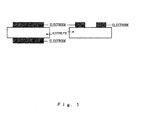
- An example of a basic embodiment of the electrochemical element of the present invention is an electrochemical element comprising an electrode that uses a noble metal parent material (also referred to below as the metal parent material) for forming a multidimensional structure of nanometer size, a counterelectrode therefor, and a solid electrolyte layer that exhibits oxygen ion conductivity, as shown in Figures 1a and 1b.
- a noble metal parent material also referred to below as the metal parent material
- this solid electrolyte layer desirably exhibits a high oxygen ion conductivity and is satisfactorily resistant to the molten salt at the melting point temperature of the molten salt that is used as a reaction site for nanostructuring the metal parent material.
- the molten salt that functions with respect to the electrode and solid electrolyte layer as a reaction site for nanostructuring the electrode is disposed proximal to the electrode comprising the metal parent material so as to cover this electrode.
- the molten salt is preferably a nitrate salt wherein sodium nitrate, potassium nitrate, calcium nitrate, barium nitrate, silver nitrate, lead nitrate, ammonium nitrate, nickel nitrate, and cobalt nitrate are particularly suitable.
- a molten salt attractant material that attracts the molten salt e.g., a nitrate salt
- this molten salt attractant material can be exemplified by Ni, NiO, BaCO 3 , and so forth.
- a molten salt e.g., a molten nitrate salt
- a strong metal dissolving reaction site is then formed in the molten salt by the application of an electric field to the two electrodes disposed with the conductive material interposed therebetween. It is thought that when a metal parent material that is to be microstructured is present here, this metal dissolves, although the strength of the metal dissolving reaction site varies with the field.
- the amount of metal parent material dissolution at the electrode present within the molten salt e.g., a molten nitrate salt
- the rate and amount of dissolution and redeposition can be freely varied by changing, for example, the temperature and the frequency modulation of the alternating current electric field, and microstructured noble metal bodies having multidimensional structures with different shapes can be obtained based on differences in the deposition process.
- Figure 2 shows in schematic form the situation during the electrochemical reaction for an example of the structure of an electrochemical cell for the multidimensional structuring of metal in accordance with an embodiment of the present invention.
- This redeposition may occur not only on the surface of or within the noble metal parent material, but this deposition may also occur on a different material that is disposed in proximity to the reaction site.
- this deposition may also occur on a different material that is disposed in proximity to the reaction site.
- the microstructured noble metal nanostructure according to the present invention is a microstructure of nanometer size that has a multidimensional structure comprising primary particles and is characterized in that 1) it has the form of particles with diameters of about 1 to 15 nm; 2) the multidimensional structure has a) a fine wire shape having a wire diameter of nanometer size of about 5 to 200 nm, or b) a protruded structure or convex-and-concave structure having a surface roughness of about 5 to 200 nm, or c) a spherical structure having a diameter of nanometer size of about 5 to 200 nm; and 3) these structures are formed in a self-supporting state that does not require a template.
- the references to diameters of about 1 to 15 nm and to a nanometer size of about 5 to 200 nm are defined as meaning that the majorities thereof are within these ranges and not as meaning that minorities thereof outside this range are completely absent.
- the electrochemical element of the present invention has at least one noble metal electrode that can increase the degradation capacity for a target to be treated through an increase in porosity and reaction surface area of reaction electrode brought about by application of an electric field for operating the electrochemical element, and that the molten salt constituting the reaction site also functions as a nitrogen oxide adsorptive substance.
- the nitrogen oxide adsorptive substance is disposed within or adjacent to the microstructured noble metal electrode; that the nitrogen oxide adsorptive substance contains at least one kind selected from Na, K, Ba, Rb, Cs, and Ca and the content thereof is 5 to 50 mol% with respect to the total nitrogen oxide adsorptive substance; and that the treatment target is an exhaust gas from an internal combustion engine and the operating temperature region is not more than 400°C.
- the present invention can provide catalyst materials and electrode materials comprising the aforementioned microstructured noble metal nanostructure and can also produce and provide a nitrogen oxide conversion reactor (electrochemical reactor) that contains the previously described electrochemical element as a structural component.
- a microstructure having a multidimensional structure refers to a three dimensional microstructure of nanometer size that does not have a region buried in the interior of a template.
- a microstructured noble metal nanostructure can be synthesized in the present invention by the application of an alternating current electric field to the electrodes. Since dissolution and redeposition of the metal constituting the electrode occurs repetitively in conformity to the alternating current electric field when an alternating current electric field is applied to the electrodes, the microstructured noble metal nanostructure of nanometer size accrues the exceptional functional effect of enabling particles of nanometer size to be regenerated (particle re-microfine-sizing). Multidimensional structures of nanometer size can be synthesized in various shapes by changing the frequency modulation of the alternating current electric field that is applied to the electrodes, the temperature, the nitrogen oxide concentration, the amount of oxygen release, and the rate and extent of dissolution and deposition.
- the present invention exhibits the following effects.
- Figure 1 shows an example of an electrochemical element according to the present invention for multidimensionally structuring an electrode
- Gadolinia-stabilized ceria also referred to below as "ceria”
- ceria Gadolinia-stabilized ceria
- It had a disk shape with a diameter of 20 mm and a thickness of 0.5 mm.
- a mixture of platinum and NiO was disposed by screen printing on both sides of the substrate.
- the mixing ratio between the platinum and NiO was adjusted to provide a platinum : NiO volume ratio of 70 : 30.
- This mixture had been screen printed and then heated at 1400°C to form an electrochemical cell.
- Platinum lead wires were attached to the thus formed electrochemical cell and these were immersed in a saturated aqueous solution of potassium nitrate and then dried at 100°C and inserted within a quartz tube. While holding them at a temperature of 350°C in a tubular oven, alternating current field with a modulated frequency of 0.3 Hz by a sine wave was applied for 3 hours at ⁇ 3.5 V in an atmosphere of 1000 ppm NO, 2% oxygen, and He for the balance, wherein a gas flow rate was adjusted to 50 mL/minute.
- Ceria that had been sintered and densified was used as the oxygen ion-conductive phase substrate that would form the base of an electrochemical cell for the multidimensional structuring of metal. It had a disk shape with a diameter of 20 mm and a thickness of 0.5 mm.
- a mixture of platinum and ceria was disposed by screen printing on both sides of the substrate.
- the mixing ratio between the platinum and ceria was adjusted to provide a platinum : ceria volume ratio of 50 : 50.
- This mixture had been screen printed and then heated at 1400°C to form an electrochemical cell.
- Platinum lead wires were attached to the thus formed electrochemical cell and these were immersed in a saturated aqueous solution of potassium nitrate and then dried at 100°C and inserted within a quartz tube. While holding them at a temperature of 350°C in a tubular oven, alternating current field with a modulated frequency of 0.3 Hz by a sine wave was applied for 3 hours at ⁇ 3.5 V in an atmosphere of 1000 ppm NO, 2% oxygen, and He for the balance, wherein a gas flow rate was adjusted to 50 mL/minute.
- Gadolinia-stabilized ceria that had been sintered and densified was used as the oxygen ion-conductive phase substrate that would form the base of an electrochemical cell for the multidimensional structuring of metal. It had a disk shape with a diameter of 20 mm and a thickness of 0.5 mm.
- platinum was disposed by screen printing on both sides of the substrate.
- the platinum had been screen printed, and then heated at 1400°C to form an electrochemical cell.
- This cell was immersed in an aqueous solution of nickel nitrate and a negative charge was applied to the platinum electrodes to plate it with nickel.
- Platinum lead wires were attached to the thus formed electrochemical cell and these were immersed in a saturated aqueous solution of potassium nitrate and then dried at 100°C and inserted within a quartz tube. While holding them at a temperature of 350°C in a tubular oven, alternating current field with a modulated frequency of 0.3 Hz by a sine wave was applied for 3 hours at ⁇ 3.5 V in an atmosphere of 1000 ppm NO, 2% oxygen, and He for the balance, wherein a gas flow rate adjusted to 50 mL/minute.
- the platinum was found to have undergone a structural modification into a fine wire-shaped platinum having a line shape of about 10 nm as shown in Figure 5 .
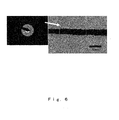
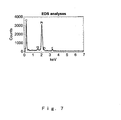
- Example 3 The platinum structured in accordance with Example 3 was observed using a transmission microscope. As shown in Figure 6 , the results from the diffraction pattern and transmission image showed that a fine wire specimen had been formed by the random orientation of crystalline particles having diameters of approximately several nanometers. In addition, as shown in Figure 7 , elemental analysis by EDS showed it to also be Pt.
- Platinum lead wires were attached to an electrochemical cell that had been formed using the same procedure as in Example 3. These were immersed in a saturated aqueous solution of potassium nitrate and then dried at 100°C and inserted within a quartz tube. While holding them at a temperature of 350°C in a tubular oven, alternating current field with a modulated frequency of 0.3 Hz by a sine wave was applied for 3 hours at ⁇ 3.5 V in an atmosphere of 1000 ppm NO, 2% oxygen, and He for the balance, wherein a gas flow rate adjusted to 50 mL/minute.
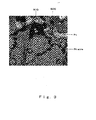
- the platinum was found to have been changed into a platinum structure having a concave-and-convex structure as shown in Figure 8 .
- Ceria that had been sintered and densified was used as the oxygen ion-conductive phase substrate that would form the base of an electrochemical cell for the multidimensional structuring of metal. It had a disk shape with a diameter of 20 mm and a thickness of 0.5 mm.
- a mixture of Au and NiO was disposed by screen printing on both sides of the substrate.
- the mixing ratio between the Au and NiO was adjusted to provide an Au : NiO volume ratio of 70 : 30.
- the mixture was heated at 1150°C to form an electrochemical cell.
- Platinum lead wires were attached to the thus formed electrochemical cell and these were immersed in a saturated aqueous solution of potassium nitrate and then dried at 100°C and inserted within a quartz tube. While holding them at a temperature of 350°C in a tubular oven, alternating current field with a modulated frequency of 0.3 Hz by a sine wave was applied for 6 hours at ⁇ 3.5 V in an atmosphere of 1000 ppm NO, 1% oxygen, and He for the balance, wherein a gas flow rate adjusted to 50 mL/minute.
- This example specifically describes decomposition testing using nitrogen oxide for the treatment target and using an electrochemical reactor having a multidimensionally-structurable noble metal electrode.
- a powder was prepared by mixing Pt, NiO, and Gd-containing ceria powders at a volume ratio of 70 : 10 : 20. This powder was converted into a paste using polyethylene glycol, and this paste was printed by screen printing on both sides of the aforementioned substrate. This was baked for 1 hour at 1400°C. Platinum wire was connected to both of the electrodes of the specimen, and this was then immersed in a saturated aqueous solution of potassium nitrate, which functions as a molten salt for microstructuring purposes and as a nitrogen oxide adsorbent, and subsequently dried to provide an element.
- One procedure for treating nitrogen oxide using the thus formed electrochemical reactor of the present invention is as follows.
- the electrochemical reactor was disposed in the target gas to be treated at a temperature of 300°C; platinum wires were fixed as lead wires to the electrodes, and connected through a current amplifier to a function generator; and an alternating current voltage of ⁇ 3.5 V was applied to the electrochemical reactor at a modulated frequency of 0.3 Hz.
- a model combustion exhaust gas of 1000 ppm nitrogen monoxide, 10% oxygen, and helium for the balance was introduced at a flow rate of 50 mL/minute.
- the nitrogen oxide concentration in the target gas to be treated was measured using a chemiluminescent-type NOx meter and the nitrogen and oxygen concentrations were measured by gas chromatography.
- the nitrogen oxide decomposition rate was determined from the decline in nitrogen oxide, and the power consumption and current density versus the decomposition rate were measured.
- the temperature dependence of NO decomposition is shown in Figure 10 . While the current value underwent almost no change, the decomposition rate increased with elapsed time and the decomposition performance stabilized after a certain period of time had elapsed. This was related to the progression of platinum electrode microstructuring, and it was found that the reaction efficiency improved substantially as microstructuring progressed and that the increase in the amount of decomposition stabilized in association with the completion of electrode microstructuring at about 1 hour.
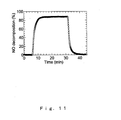
- the same electrochemical reactor was disposed in a target gas to be treated at a temperature of 250°C; platinum wires were fixed as lead wires to the electrodes, and connected through a current amplifier to a function generator; and an alternating current voltage of ⁇ 7.0 V was applied to the electrochemical reactor at a modulated frequency of 0.3 Hz.
- a model combustion exhaust gas of 1000 ppm nitrogen monoxide, 20% oxygen, and helium for the balance was introduced at a flow rate of 50 mL/minute.
- the nitrogen oxide concentration in the target gas to be treated was measured using a chemiluminescent-type NOx meter and the nitrogen and oxygen concentrations were measured by gas chromatography.
- the nitrogen oxide decomposition rate was determined from the decline in nitrogen oxide, and the power consumption and current density versus the decomposition rate were measured.
- a powder was prepared by mixing Au, NiO, and Gd-containing ceria powders at a volume ratio of 70 : 10 : 20. This powder was converted into a paste using polyethylene glycol, and this paste was printed by screen printing on both sides of the aforementioned substrate. This was baked for 1 hour at 1400°C. Platinum wire was connected to both of the electrodes of the specimen, and this was then immersed in a saturated aqueous solution of potassium nitrate, which functions as a molten salt for microstructuring purposes and as a nitrogen oxide adsorbent, and subsequently dried to provide an element.
- One procedure for treating nitrogen oxide using the thus formed electrochemical reactor of the present invention is as follows.
- the electrochemical reactor was disposed in the target gas to be treated at a temperature of 350°C; platinum wires were fixed as lead wires to the electrodes, and connected through a current amplifier to a function generator; and an alternating current voltage of ⁇ 3.5 V was applied to the electrochemical reactor at a modulated frequency of 0.3 Hz.
- a model combustion exhaust gas of 1000 ppm nitrogen monoxide, 1% oxygen, and helium for the balance was introduced at a flow rate of 50 mL/minute.
- the nitrogen oxide concentration in the target gas to be treated was measured using a chemiluminescent-type NOx meter and the nitrogen and oxygen concentrations were measured by gas chromatography.
- the nitrogen oxide decomposition rate was determined from the decline in nitrogen oxide, and the power consumption and current density versus the decomposition rate were measured.
- This example specifically describes a macrostructuring process for microstructured noble metal using a multidimensionally-structurable noble metal electrode.
- platinum paste was printed by screen printing as the electrode on one side of the aforementioned substrate; this was baked for 1 hour at 1400°C and then connected a platinum wire to the electrode.
- a mirror polish was executed on the surface of the substrate on the side opposite the side on which the platinum electrode had been formed, and, with this side up, the substrate was placed on a hot stage that had been heated to 400°C. While in this configuration, potassium nitrate, which functions as a reaction site for microstructuring, was applied so as to provide a liquid droplet in the molten state, and the platinum wire for microstructuring was brought into a probe-like point contact with this region.
- a platinum nanostructure was then formed on the substrate surface by moving the platinum wire on the substrate while applying a voltage of 3 V to the printed-on electrode and the point-contacted platinum wire. After cleaning the resulting substrate, the substrate was observed with an electron microscope, as a result, the outlines of nonspecifically-shaped macrostructures composed of platinum nanoparticles were obtained, as shown in Figure 13 .
- the present invention relates to a technology for the multidimensional structuring of noble metals using an electrochemical reaction, and the present invention makes possible the synthesis and acquisition of self-supporting, microstructured noble metal nanostructures of nanometer size in the form of metal particles, wire-shaped structures, or concave-and-convex structures.
- Noble metal electrodes having a high specific surface area, wiring, highly active catalysts, and so forth, can be fabricated and provided through the use of these microstructured noble metal nanostructures.
- Electrochemical reactors capable of high-efficiency nitrogen oxide decomposition, high-performance fuel cells, and high-sensitivity sensors can be provided through the use of electrodes comprising this nanostructure.
- the present invention is useful because it can provide, without using a template, self-supporting, microstructured noble metal structures of nanometer size.
Landscapes
- Chemical & Material Sciences (AREA)
- Engineering & Computer Science (AREA)
- Chemical Kinetics & Catalysis (AREA)
- Materials Engineering (AREA)
- Organic Chemistry (AREA)
- Nanotechnology (AREA)
- Electrochemistry (AREA)
- Metallurgy (AREA)
- Inorganic Chemistry (AREA)
- Crystallography & Structural Chemistry (AREA)
- Oil, Petroleum & Natural Gas (AREA)
- Analytical Chemistry (AREA)
- General Chemical & Material Sciences (AREA)
- Health & Medical Sciences (AREA)
- Physics & Mathematics (AREA)
- Biomedical Technology (AREA)
- Environmental & Geological Engineering (AREA)
- Combustion & Propulsion (AREA)
- Composite Materials (AREA)
- Plasma & Fusion (AREA)
- Mechanical Engineering (AREA)
- Manufacturing & Machinery (AREA)
- Toxicology (AREA)
- Condensed Matter Physics & Semiconductors (AREA)
- General Physics & Mathematics (AREA)
- Catalysts (AREA)
- Inert Electrodes (AREA)
- Physical Or Chemical Processes And Apparatus (AREA)
- Powder Metallurgy (AREA)
- Electroplating Methods And Accessories (AREA)
- Non-Insulated Conductors (AREA)
- Battery Electrode And Active Subsutance (AREA)
- Fuel Cell (AREA)
Abstract
Description
- The present invention relates to microstructured noble metal nanostructures and to a process of producing same and to members thereof. More particularly, the present invention relates to a technology that, through the dissolution and reprecipitation of metal by an electrochemical reaction using a solid electrolyte and a molten salt, produces self-supporting, nanostructured, multidimensional, microstructured noble metal nanostructures of nanometer size. The present invention further relates to noble metal nanostructures obtained with this technology, for example, fine wire-shaped noble metal nanostructures having a wire diameter of nanometer size and novel self-supporting, microstructured noble metal nanostructures comprising particles that have been modified, either at the surface or as a whole, into a concave-and-convex shape, a protruded shape, or the like. The present invention provides a technology for producing microstructured noble metal nanostructures that makes it possible to obtain, without the use of a template, microstructured noble metal nanostructures of nanometer size that are formed in a self-supporting state and that have a multidimensional structure. The present invention also provides members of the microstructured noble metal nanostructures.
- Due to their high specific surface area and high activity, noble metal microparticles of nanometer size are used as starting materials in a wide range of fields, for example, as electrode materials in various solid polymer fuel cells, solid oxide fuel cells, primary batteries, secondary batteries, capacitors (condensers), and so forth; for various catalysts for combustion assistance and exhaust gas purification; and for antimicrobials and cosmetics.
- Spherical noble metal particles of nanometer size have heretofore been synthesized by, for example, processes in which spherical particles are synthesized using a liquid-phase procedure in which a liquid raw material, e.g., of platinum chloride, is employed as the starting material; processes that employ physical crushing; processes in which the noble metal and a second substance are mixed to form deposition using phase separation; and processes in which the noble metal is ion-implanted in a parent material and the parent material is etched to deposit the noble material at the surface (refer to Patent Reference 1).
- These prior technologies make possible the relatively facile synthesis of simple spherical particles of nanometer size, but it is quite difficult with these prior technologies to form microstructured noble metal nanostructures of nanometer size that have a multidimensional structure.
- The heretofore most effective processes for synthesizing fine wire-shaped noble metal structures of nanometer size are those that obtain a mesoporous structure that use, for example, a block copolymer material (refer to Nonpatent Reference 1), and a fine wire-shaped noble metal structure formed by using a noble metal starting material in liquid form as a porous template of nanometer size formed in anodically oxidized alumina (refer to Nonpatent Reference 2).
- However, while the processes that produce a noble metal structure through the use of a template as described above do offer the possibility of obtaining multidimensional structures of relatively uniform size, the active surface of the noble metal is inevitably buried in the interior of the template, which has led to the problem that such structures cannot be effectively utilized.
- In addition, since the multidimensional structures cannot be maintained when the template is removed in the processes using the template described above, it is quite difficult to obtain a noble metal structure in a self-supported state (i.e., in a free configuration with the template removed) that enables the full utilization of the high specific surface areas of multidimensional structures. As a consequence, the development of a technology that can produce a novel noble metal nanostructure of nanometer size has been strongly desired.
- In the development of devices, e.g., fuel cells, that utilize noble metals, noble metal particles, e.g., platinum particles, of nanometer size are used in some instances in order to increase specific surface area of the noble metal with the goal of boosting reaction efficiency of the electrode or catalyst.
- The noble metal particles, e.g., platinum particles, of nanometer size that are used as such electrode or catalyst materials can exhibit high activities. However, in the case of devices fabricated using such noble metal particles, e.g., platinum particles, the, for example, platinum particles of nanometer size undergo particle growth as the operating time increases, resulting in an unavoidable performance deterioration. As a consequence, there is also a strong desire in the pertinent technical fields for the development of a regeneration technology (particle re-microfine-sizing) that would solve this problem of performance deterioration.
- Patent Reference 1: Japanese Patent
3,635,325 - Nonpatent Reference 1: Microporous and Mesoporous Materials, Volume 48 (2001), pp. 171-179.
- Nonpatent Reference 2: Jpn. J. Appl. Phys., Volume 36 (1997), pp. 7791-7795.
- Given such circumstances and considering the prior art described above, the present inventors sought to reliably solve the problems described above for the prior art and to develop a technology that could synthesize a self-supporting, multidimensional, microstructured noble metal nanostructure of nanometer size and that could do so without using a template. As a result of extensive and intensive investigations, the present inventors succeeded in developing a novel technology that utilizes an electrochemical reaction and thereby achieved the present invention.
- The present invention was pursued in order to solve the problems described above for the prior art and an object of the present invention is to provide a multidimensional noble metal structure of nanometer size, i.e., to provide a self-supporting microstructured noble metal nanostructure having a multidimensional structure of nanometer size, to provide a technology for forming this noble metal nanostructure, and to provide inter alia, devices, e.g., electrodes, and catalysts that utilize this self-supporting, microstructured noble metal nanostructure.
- The present invention, which is directed to solving the problems identified above, comprises the following technical means.
- (1) A microstructured noble metal nanostructure having a multidimensional structure of nanometer size comprising primary particles, wherein 1) the microstructured noble metal nanostructure has the form of particles with diameters of 1 to 15 nm, 2) the multidimensional structure has a fine wire shape having a wire diameter of 5 to 200 nm, or a protruded structure or convex-and-concave structure having a surface roughness of 5 to 200 nm, or a spherical structure having a diameter of 5 to 200 nm, and 3) these structures are formed in a self-supporting state that does not require a template.
- (2) The microstructured noble metal nanostructure according to (1) above, wherein the noble metal is platinum, gold, palladium, or silver.
- (3) A process of producing a microstructured noble metal nanostructure, which is a process of producing the microstructured noble metal nanostructure according to (1) above, comprising passing electric current through a preliminarily arranged reaction element constituted by an electrode comprising a noble metal parent material to be microstructured, a counterelectrode, and an oxygen ion-conductive solid electrolyte layer, to produce a microstructured noble metal nanostructure having a multidimensional structure, and thereby microstructuring the surface or entire body of the noble metal parent material by reaction thereof at a reaction site in the element to be reacted.
- (4) The process of producing a microstructured noble metal nanostructure according to (3) above, wherein a microstructured noble metal nanostructure having a multidimensional structure is produced by passing electric current through a reaction element that has two or more electrodes, at least one thereof comprising a noble metal parent material to be microstructured residing in contact with a reaction site, and that is constructed to be capable of electrical continuity through a conductor disposed between or among the electrodes, to thereby microstructure the surface or entire body of the noble metal parent material by reaction thereof at the reaction site in the element to be reacted.
- (5) The process of producing a microstructured noble metal nanostructure according to (3) or (4) above, wherein electric current is passed through a reaction element that has two or more electrodes, at least one thereof comprising a noble metal parent material to be microstructured residing in contact with a reaction site, and that is constructed to be capable of electrical continuity through a conductor disposed between or among the electrodes, to thereby microstructure the noble metal parent material by reaction thereof at the reaction site in the element to be treated and produce a microstructured noble metal nanostructure having a multidimensional structure at the noble metal parent material or at the surface of a different material disposed in proximity to the noble metal parent material electrode or at both locations.
- (6) The process of producing a microstructured noble metal nanostructure according to (3), (4) or (5) above, wherein a molten salt is used as the reaction site, or a molten salt and ionically conductive liquid are used as the reaction site.
- (7) The process of producing a microstructured noble metal nanostructure according to (3), (4) or (5) above, wherein the shape of the microstructure is controlled by changing the conditions of current passage for reaction.
- (8) The process of producing a microstructured noble metal nanostructure according to (3), (4) or (5) above, wherein the reaction is promoted by efficiently guiding the molten salt to the reaction site using a molten salt attractant material.
- (9) An electrochemical element that is an element to be reacted for carrying out an electrochemical reaction on a target to be treated, comprising an ion conductor and two or more electrodes that are opposite each other with the ion conductor therebetween, the electrodes being composed of electrodes that use the microstructured noble metal nanostructure according to (1) or (2) above having a multidimensional structure comprising primary particles, and an interface between the microstructured noble metal nanostructure and an oxygen ion conductor or a molten salt and the oxygen ion conductor formed as a reaction site.
- (10) The electrochemical element according to (9) above, which has at least one noble metal electrode that can increase the degradation capacity for a treatment target through an increase in reaction electrode porosity and reaction surface area brought about by application of an electric field for operating the electrochemical element.
- (11) The electrochemical element according to (9) or (10) above, wherein the molten salt that constitutes or forms the reaction site also functions as a nitrogen oxide adsorptive substance.
- (12) The electrochemical element according to (10) or (11) above, wherein the molten salt comprises a nitrate salt and contains at least one kind selected from potassium nitrate, sodium nitrate, calcium nitrate, barium nitrate, silver nitrate, lead nitrate, ammonium nitrate, nickel nitrate, cobalt nitrate, sodium carbonate, potassium chlorate, and sodium peroxide.
- (13) The electrochemical element according to (9) or (10) above, wherein the nitrogen oxide adsorptive substance is disposed within or adjacent to the microstructured noble metal nanostructure electrode.
- (14) The electrochemical element according to (11) or (13) above, wherein the nitrogen oxide adsorptive substance contains at least one kind selected from Na, K, Ba, Rb, Cs, and Ca and the content thereof is 5 to 50 mol% with respect to the total nitrogen oxide adsorptive substance.
- (15) The electrochemical element according to (9), (10), (11), (12), (13) or (14) above, wherein the target to be treated is an exhaust gas from an internal combustion engine and the operating temperature region is below 400°C.
- (16) An electrode material, comprising the microstructured noble metal nanostructure having a multidimensional structure of nanometer size defined in (1) or (2) above.
- (17) A catalyst material, comprising the microstructured noble metal nanostructure having a multidimensional structure of nanometer size defined in (1) or (2) above.
- (18) A nitrogen oxide conversion reactor, comprising an electrochemical reactor in which the electrochemical element defined in (9), (10), (11), (12), (13), (14) or (15) above is disposed.
- The present invention is described in more detail in the following. The present invention encompasses a microstructured noble metal nanostructure having a multidimensional structure of nanometer size comprising primary particles, wherein the microstructured noble metal nanostructure has the form of particles with diameters of 1 to 15 nm; the multidimensional structure has a fine wire shape having a wire diameter of 5 to 200 nm, or a protruded structure or convex-and-concave structure having a surface roughness of 5 to 200 nm, or a spherical structure having a diameter of 5 to 200 nm; and these structures are formed in a self-supporting state that does not require a template.
- The present invention also encompasses a process of producing the aforementioned microstructured noble metal nanostructure, wherein a microstructured noble metal nanostructure having a multidimensional structure is produced by passing electric current through an element to be reacted constituted by an electrode comprising a noble metal parent material to be microstructured which is preliminarily arranged, a counterelectrode, and an oxygen ion-conductive solid electrolyte layer, to thereby microstructure the surface or entire body of the noble metal parent material by reaction thereof at a reaction site in the element to be reacted.
- In a preferred embodiment of the present invention, the microstructured noble metal nanostructure having a multidimensional structure is produced by passing electric current through an element to be reacted that has two or more electrodes, at least one thereof comprising a noble metal parent material to be microstructured residing in contact with a reaction site, and that is constructed to be capable of electrical continuity through a conductor disposed between or among the electrodes, to thereby microstructure the surface or entire body of the noble metal parent material by reaction thereof at the reaction site in the element to be reacted.
- In another preferred embodiment of the present invention, electric current is passed through an element to be reacted that has two or more electrodes, at least one thereof comprising a noble metal parent material to be microstructured residing in contact with a reaction site, and that is constructed to be capable of electrical continuity through a conductor disposed between or among the electrodes, to thereby microstructure the noble metal parent material by reaction thereof at the reaction site in the element to be reacted and produce a microstructured noble metal nanostructure having a multidimensional structure at the surface of a different material disposed in proximity to the noble metal parent material electrode or at both locations.
- In preferred embodiments of the process according to the present invention, a molten salt is used as the reaction site or a molten salt and an oxygen ion conductor are used as the reaction site; the shape of the microstructure is controlled by changing the conditions of current passage for reaction; and the reaction is promoted by efficiently guiding the molten salt to the reaction site using a molten salt attractant material.
- The present invention further encompasses an element for carrying out an electrochemical reaction on a target to be treated, wherein the element is constituted by an ion conductor and two or more electrodes that are opposite each other with the ion conductor therebetween, the electrodes being composed of electrodes that use the aforementioned microstructured noble metal nanostructure having a multidimensional structure comprising primary particles, and an interface between the microstructured noble metal nanostructure and an oxygen ion conductor or a molten salt and the oxygen ion conductor forms a reaction site.
- An example of a basic embodiment of the electrochemical element of the present invention is an electrochemical element comprising an electrode that uses a noble metal parent material (also referred to below as the metal parent material) for forming a multidimensional structure of nanometer size, a counterelectrode therefor, and a solid electrolyte layer that exhibits oxygen ion conductivity, as shown in Figures 1a and 1b.
- For example, platinum, gold, palladium, or silver is used as the noble metal in the electrode. While there are no particular limitations on the solid electrolyte layer that exhibits oxygen ion conductivity, this solid electrolyte layer desirably exhibits a high oxygen ion conductivity and is satisfactorily resistant to the molten salt at the melting point temperature of the molten salt that is used as a reaction site for nanostructuring the metal parent material.
- The molten salt that functions with respect to the electrode and solid electrolyte layer as a reaction site for nanostructuring the electrode is disposed proximal to the electrode comprising the metal parent material so as to cover this electrode. The molten salt is preferably a nitrate salt wherein sodium nitrate, potassium nitrate, calcium nitrate, barium nitrate, silver nitrate, lead nitrate, ammonium nitrate, nickel nitrate, and cobalt nitrate are particularly suitable.
- Sodium carbonate, potassium chlorate, sodium peroxide, and so forth, is preferably added to the aforementioned molten salt as a reaction promoter. In this case, a molten salt attractant material that attracts the molten salt, e.g., a nitrate salt, is desirably uniformly disposed, by admixture, plating, or so forth, at or in the electrode that uses the metal parent material; this molten salt attractant material can be exemplified by Ni, NiO, BaCO3, and so forth.
- With regard to the mechanism of the reaction that nanostructures the metal parent material, when a molten salt, e.g., a molten nitrate salt, is present in an electrode-proximal position, a strong metal dissolving reaction site is then formed in the molten salt by the application of an electric field to the two electrodes disposed with the conductive material interposed therebetween. It is thought that when a metal parent material that is to be microstructured is present here, this metal dissolves, although the strength of the metal dissolving reaction site varies with the field.
- When an alternating current electric field is applied to the electrodes, the amount of metal parent material dissolution at the electrode present within the molten salt, e.g., a molten nitrate salt, undergoes a repetitive variation in conformity to the variation in the strength of the dissolving ambient that accompanies the variation in the alternating current field, and it is thought that as a consequence dissolution and deposition occur continuously and particles of nanometer size are synthesized as a result.
- As a consequence, for example, the rate and amount of dissolution and redeposition can be freely varied by changing, for example, the temperature and the frequency modulation of the alternating current electric field, and microstructured noble metal bodies having multidimensional structures with different shapes can be obtained based on differences in the deposition process.
-
Figure 2 shows in schematic form the situation during the electrochemical reaction for an example of the structure of an electrochemical cell for the multidimensional structuring of metal in accordance with an embodiment of the present invention. By applying an electric field to the two electrodes inFigure 2 , the noble metal is dissolved and redeposited in the presence of the molten salt functioning as the reaction site to form a microstructured noble metal body. - This redeposition may occur not only on the surface of or within the noble metal parent material, but this deposition may also occur on a different material that is disposed in proximity to the reaction site. As a consequence, by controlling location and method of the deposition through the application of technologies such as drawing or stamping with the noble metal parent material in the reaction site, not only can the noble metal parent material itself be microstructured, but it becomes possible to form a macrostructure of microstructured noble metal at a freely selected location on the different material.
- The microstructured noble metal nanostructure according to the present invention is a microstructure of nanometer size that has a multidimensional structure comprising primary particles and is characterized in that 1) it has the form of particles with diameters of about 1 to 15 nm; 2) the multidimensional structure has a) a fine wire shape having a wire diameter of nanometer size of about 5 to 200 nm, or b) a protruded structure or convex-and-concave structure having a surface roughness of about 5 to 200 nm, or c) a spherical structure having a diameter of nanometer size of about 5 to 200 nm; and 3) these structures are formed in a self-supporting state that does not require a template. Here, the references to diameters of about 1 to 15 nm and to a nanometer size of about 5 to 200 nm are defined as meaning that the majorities thereof are within these ranges and not as meaning that minorities thereof outside this range are completely absent.
- It is preferred for the electrochemical element of the present invention that it has at least one noble metal electrode that can increase the degradation capacity for a target to be treated through an increase in porosity and reaction surface area of reaction electrode brought about by application of an electric field for operating the electrochemical element, and that the molten salt constituting the reaction site also functions as a nitrogen oxide adsorptive substance.
- It is also preferred for the electrochemical element of the present invention that the nitrogen oxide adsorptive substance is disposed within or adjacent to the microstructured noble metal electrode; that the nitrogen oxide adsorptive substance contains at least one kind selected from Na, K, Ba, Rb, Cs, and Ca and the content thereof is 5 to 50 mol% with respect to the total nitrogen oxide adsorptive substance; and that the treatment target is an exhaust gas from an internal combustion engine and the operating temperature region is not more than 400°C.
- The present invention can provide catalyst materials and electrode materials comprising the aforementioned microstructured noble metal nanostructure and can also produce and provide a nitrogen oxide conversion reactor (electrochemical reactor) that contains the previously described electrochemical element as a structural component. In the context of the present invention, a microstructure having a multidimensional structure refers to a three dimensional microstructure of nanometer size that does not have a region buried in the interior of a template.
- By utilizing the aforementioned electrochemical reactor as the reaction site for a microstructured noble metal nanostructure, a microstructured noble metal nanostructure can be synthesized in the present invention by the application of an alternating current electric field to the electrodes. Since dissolution and redeposition of the metal constituting the electrode occurs repetitively in conformity to the alternating current electric field when an alternating current electric field is applied to the electrodes, the microstructured noble metal nanostructure of nanometer size accrues the exceptional functional effect of enabling particles of nanometer size to be regenerated (particle re-microfine-sizing). Multidimensional structures of nanometer size can be synthesized in various shapes by changing the frequency modulation of the alternating current electric field that is applied to the electrodes, the temperature, the nitrogen oxide concentration, the amount of oxygen release, and the rate and extent of dissolution and deposition.
- The present invention exhibits the following effects.
- (1) A self-supporting, microstructured noble metal nanostructure having a multidimensional structure can be provided.
- (2) Noble metal microparticles of nanometer size can be provided.
- (3) A noble metal electrode that has a high specific surface area can be provided.
- (4) It is possible to convert the bulk noble metal to a three dimensional nanostructure.
- (5) It is possible to regenerate a degraded-performance electrode in an electrochemical cell.
- (6) By forming a high specific surface area electrode, an electrochemical reactor can be provided that makes nitrogen oxide decomposition highly efficient.
- (7) Highly active catalysts based on noble metal that has been given a higher specific surface area can be provided.
- (8) It is possible to provide a highly dispersed disposition of the NOx adsorbents to be used in catalysts.
- (9) It is possible to provide a multidimensionally structured electrode for fabricating high-capacity fuel cells.
- (10) By effecting the wire-shaped structuring of an electrode, it is possible to form electrodes for sensors that will exhibit even higher sensitivities.
-
Figure 1 shows an example of an electrochemical element according to the present invention for multidimensionally structuring an electrode; -
Figure 2 shows an example of the reaction mechanism in a structural example of a model electrochemical cell during the multidimensional structuring of a metal; -
Figure 3 shows an example of a platinum electrode that has been microstructured by an electrochemical reaction; -
Figure 4 shows an example of a platinum and electrolyte composite that has been microstructured into a network form by an electrochemical reaction; -
Figure 5 shows an example of a platinum electrode that has a wire-shaped structure and that has been microstructured by an electrochemical reaction; -
Figure 6 shows the transmission electron microscopic image and the diffraction pattern of a fine wire-shaped platinum nanostructure comprised of platinum nanoparticles; -
Figure 7 shows the results of energy-dispersive x-ray spectroscopic analysis of a fine wire-shaped platinum nanostructure comprised of platinum nanoparticles; -
Figure 8 shows an example of a platinum electrode whose surface has been microstructured into a concave-and-convex structure by an electrochemical reaction; -
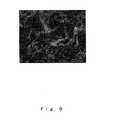
Figure 9 shows an example of an Au electrode that has a wire-shaped structure and that has been microstructured by an electrochemical reaction; -
Figure 10 shows the change in NO decomposition accompanying platinum electrode microstructuring in an electrochemical element at an operating temperature of 300°C; -
Figure 11 shows the temperature dependence and property variation for NO decomposition accompanying platinum electrode microstructuring in an electrochemical element at an operating temperature of 250°C; -
Figure 12 shows the change in the average current value and the temperature dependence of NO decomposition accompanying gold electrode microstructuring for an electrochemical element at an operating temperature of 350°C, wherein the white circles show the timewise change in the NO decomposition rate and the black squares show the timewise change in the quantity of current required for NO decomposition flowing through the electrochemical element; and -
Figure 13 shows a macrostructure built up from microstructured platinum nanoparticles formed by drawing on a substrate. - The present invention is specifically described in the following on the basis of examples, but the present invention is in no way limited by the following examples.
- An electrochemical cell was fabricated in this example. Gadolinia-stabilized ceria (also referred to below as "ceria") that had been sintered and densified was used as the oxygen ion-conductive phase substrate that would form the base of an electrochemical cell for the multidimensional structuring of metal. It had a disk shape with a diameter of 20 mm and a thickness of 0.5 mm.
- For the electrodes, a mixture of platinum and NiO was disposed by screen printing on both sides of the substrate. The mixing ratio between the platinum and NiO was adjusted to provide a platinum : NiO volume ratio of 70 : 30. This mixture had been screen printed and then heated at 1400°C to form an electrochemical cell.
- Platinum lead wires were attached to the thus formed electrochemical cell and these were immersed in a saturated aqueous solution of potassium nitrate and then dried at 100°C and inserted within a quartz tube. While holding them at a temperature of 350°C in a tubular oven, alternating current field with a modulated frequency of 0.3 Hz by a sine wave was applied for 3 hours at ± 3.5 V in an atmosphere of 1000 ppm NO, 2% oxygen, and He for the balance, wherein a gas flow rate was adjusted to 50 mL/minute.
- As a result, fine wire-shaped platinum (Pt wire) was found to be formed at the platinum electrode as shown in
Figure 3 . - Ceria that had been sintered and densified was used as the oxygen ion-conductive phase substrate that would form the base of an electrochemical cell for the multidimensional structuring of metal. It had a disk shape with a diameter of 20 mm and a thickness of 0.5 mm.
- For the electrodes, a mixture of platinum and ceria was disposed by screen printing on both sides of the substrate. The mixing ratio between the platinum and ceria was adjusted to provide a platinum : ceria volume ratio of 50 : 50. This mixture had been screen printed and then heated at 1400°C to form an electrochemical cell.
- Platinum lead wires were attached to the thus formed electrochemical cell and these were immersed in a saturated aqueous solution of potassium nitrate and then dried at 100°C and inserted within a quartz tube. While holding them at a temperature of 350°C in a tubular oven, alternating current field with a modulated frequency of 0.3 Hz by a sine wave was applied for 3 hours at ± 3.5 V in an atmosphere of 1000 ppm NO, 2% oxygen, and He for the balance, wherein a gas flow rate was adjusted to 50 mL/minute.
- As a result, fine wire-shaped platinum having a line shape of about 10 nm was found to be formed in the ceria/platinum matrix as shown in
Figure 4 . - Gadolinia-stabilized ceria that had been sintered and densified was used as the oxygen ion-conductive phase substrate that would form the base of an electrochemical cell for the multidimensional structuring of metal. It had a disk shape with a diameter of 20 mm and a thickness of 0.5 mm.
- For the electrodes, platinum was disposed by screen printing on both sides of the substrate. The platinum had been screen printed, and then heated at 1400°C to form an electrochemical cell.
- This cell was immersed in an aqueous solution of nickel nitrate and a negative charge was applied to the platinum electrodes to plate it with nickel.
- Platinum lead wires were attached to the thus formed electrochemical cell and these were immersed in a saturated aqueous solution of potassium nitrate and then dried at 100°C and inserted within a quartz tube. While holding them at a temperature of 350°C in a tubular oven, alternating current field with a modulated frequency of 0.3 Hz by a sine wave was applied for 3 hours at ± 3.5 V in an atmosphere of 1000 ppm NO, 2% oxygen, and He for the balance, wherein a gas flow rate adjusted to 50 mL/minute.
- As a result, the platinum was found to have undergone a structural modification into a fine wire-shaped platinum having a line shape of about 10 nm as shown in
Figure 5 . - The platinum structured in accordance with Example 3 was observed using a transmission microscope. As shown in
Figure 6 , the results from the diffraction pattern and transmission image showed that a fine wire specimen had been formed by the random orientation of crystalline particles having diameters of approximately several nanometers. In addition, as shown inFigure 7 , elemental analysis by EDS showed it to also be Pt. - Platinum lead wires were attached to an electrochemical cell that had been formed using the same procedure as in Example 3. These were immersed in a saturated aqueous solution of potassium nitrate and then dried at 100°C and inserted within a quartz tube. While holding them at a temperature of 350°C in a tubular oven, alternating current field with a modulated frequency of 0.3 Hz by a sine wave was applied for 3 hours at ± 3.5 V in an atmosphere of 1000 ppm NO, 2% oxygen, and He for the balance, wherein a gas flow rate adjusted to 50 mL/minute.
- As a result, the platinum was found to have been changed into a platinum structure having a concave-and-convex structure as shown in
Figure 8 . - Ceria that had been sintered and densified was used as the oxygen ion-conductive phase substrate that would form the base of an electrochemical cell for the multidimensional structuring of metal. It had a disk shape with a diameter of 20 mm and a thickness of 0.5 mm.
- For the electrodes, a mixture of Au and NiO was disposed by screen printing on both sides of the substrate. The mixing ratio between the Au and NiO was adjusted to provide an Au : NiO volume ratio of 70 : 30. After the screen printing, the mixture was heated at 1150°C to form an electrochemical cell.
- Platinum lead wires were attached to the thus formed electrochemical cell and these were immersed in a saturated aqueous solution of potassium nitrate and then dried at 100°C and inserted within a quartz tube. While holding them at a temperature of 350°C in a tubular oven, alternating current field with a modulated frequency of 0.3 Hz by a sine wave was applied for 6 hours at ± 3.5 V in an atmosphere of 1000 ppm NO, 1% oxygen, and He for the balance, wherein a gas flow rate adjusted to 50 mL/minute.
- As a result, fine wire-shaped Au was found to be formed at the Au electrode as shown in
Figure 9 . - This example specifically describes decomposition testing using nitrogen oxide for the treatment target and using an electrochemical reactor having a multidimensionally-structurable noble metal electrode.
- Sintered and densified gadolinia (Gd2O3)-containing ceria (10 mol% Gd), an oxygen ion-conductive solid electrolyte, was used as the substrate that would form the base of the electrochemical reactor. It had a disk shape with a diameter of 20 mm and a thickness of 0.5 mm.
- For the electrodes, a powder was prepared by mixing Pt, NiO, and Gd-containing ceria powders at a volume ratio of 70 : 10 : 20. This powder was converted into a paste using polyethylene glycol, and this paste was printed by screen printing on both sides of the aforementioned substrate. This was baked for 1 hour at 1400°C. Platinum wire was connected to both of the electrodes of the specimen, and this was then immersed in a saturated aqueous solution of potassium nitrate, which functions as a molten salt for microstructuring purposes and as a nitrogen oxide adsorbent, and subsequently dried to provide an element.
- One procedure for treating nitrogen oxide using the thus formed electrochemical reactor of the present invention is as follows. The electrochemical reactor was disposed in the target gas to be treated at a temperature of 300°C; platinum wires were fixed as lead wires to the electrodes, and connected through a current amplifier to a function generator; and an alternating current voltage of ± 3.5 V was applied to the electrochemical reactor at a modulated frequency of 0.3 Hz.
- For the target gas to be treated, a model combustion exhaust gas of 1000 ppm nitrogen monoxide, 10% oxygen, and helium for the balance was introduced at a flow rate of 50 mL/minute. Before and after introduction into the chemical reaction system, the nitrogen oxide concentration in the target gas to be treated was measured using a chemiluminescent-type NOx meter and the nitrogen and oxygen concentrations were measured by gas chromatography. The nitrogen oxide decomposition rate was determined from the decline in nitrogen oxide, and the power consumption and current density versus the decomposition rate were measured.
- The temperature dependence of NO decomposition is shown in
Figure 10 . While the current value underwent almost no change, the decomposition rate increased with elapsed time and the decomposition performance stabilized after a certain period of time had elapsed. This was related to the progression of platinum electrode microstructuring, and it was found that the reaction efficiency improved substantially as microstructuring progressed and that the increase in the amount of decomposition stabilized in association with the completion of electrode microstructuring at about 1 hour. - After the measurement according to Example 7, the same electrochemical reactor was disposed in a target gas to be treated at a temperature of 250°C; platinum wires were fixed as lead wires to the electrodes, and connected through a current amplifier to a function generator; and an alternating current voltage of ± 7.0 V was applied to the electrochemical reactor at a modulated frequency of 0.3 Hz.
- For the target gas to be treated, a model combustion exhaust gas of 1000 ppm nitrogen monoxide, 20% oxygen, and helium for the balance was introduced at a flow rate of 50 mL/minute. Before and after introduction into the chemical reaction system, the nitrogen oxide concentration in the target gas to be treated was measured using a chemiluminescent-type NOx meter and the nitrogen and oxygen concentrations were measured by gas chromatography. The nitrogen oxide decomposition rate was determined from the decline in nitrogen oxide, and the power consumption and current density versus the decomposition rate were measured.
- The temperature dependence of NO decomposition accompanying platinum electrode microstructuring in the electrochemical element at an operating temperature of 250°C is shown in
Figure 11 . The decomposition curve reached the saturation point in a shorter time in the electrochemical reactor in which the electrodes had been microstructured in advance. Due to the microstructuring of these reaction electrodes, 90% of the nitrogen oxide was decomposed at the lower temperature of 250°C, which showed that a substantial lowering of the operating temperature had been made possible. - Sintered and densified gadolinia (Gd2O3)-containing ceria (10 mol% Gd), an oxygen ion-conductive solid electrolyte, was used as the substrate that would form the base of the electrochemical reactor. It had a disk shape with a diameter of 20 mm and a thickness of 0.5 mm.
- For the electrodes, a powder was prepared by mixing Au, NiO, and Gd-containing ceria powders at a volume ratio of 70 : 10 : 20. This powder was converted into a paste using polyethylene glycol, and this paste was printed by screen printing on both sides of the aforementioned substrate. This was baked for 1 hour at 1400°C. Platinum wire was connected to both of the electrodes of the specimen, and this was then immersed in a saturated aqueous solution of potassium nitrate, which functions as a molten salt for microstructuring purposes and as a nitrogen oxide adsorbent, and subsequently dried to provide an element.
- One procedure for treating nitrogen oxide using the thus formed electrochemical reactor of the present invention is as follows. The electrochemical reactor was disposed in the target gas to be treated at a temperature of 350°C; platinum wires were fixed as lead wires to the electrodes, and connected through a current amplifier to a function generator; and an alternating current voltage of ± 3.5 V was applied to the electrochemical reactor at a modulated frequency of 0.3 Hz.
- For the target gas to be treated, a model combustion exhaust gas of 1000 ppm nitrogen monoxide, 1% oxygen, and helium for the balance was introduced at a flow rate of 50 mL/minute. Before and after introduction into the chemical reaction system, the nitrogen oxide concentration in the target gas to be treated was measured using a chemiluminescent-type NOx meter and the nitrogen and oxygen concentrations were measured by gas chromatography. The nitrogen oxide decomposition rate was determined from the decline in nitrogen oxide, and the power consumption and current density versus the decomposition rate were measured.
- The change in the average current value and the temperature dependence of NO decomposition accompanying gold electrode microstructuring for an electrochemical element at an operating temperature of 350°C are shown in
Figure 12 . The increase in the NO decomposition rate versus elapsed time was larger than the increase in the current value. This indicated an increase in the decomposition efficiency and showed that the decomposition efficiency underwent an increase in association with the progression of gold electrode microstructuring. - This example specifically describes a macrostructuring process for microstructured noble metal using a multidimensionally-structurable noble metal electrode.
- Sintered and densified gadolinia (Gd2O3)-containing ceria (10 mol% Gd), an oxygen ion-conductive solid electrolyte, was used as the substrate that would form the base for macrostructuring the microstructured noble metal. It had a disk shape with a diameter of 20 mm and a thickness of 0.5 mm.
- To provide the counterelectrode to the electrode for structuring, platinum paste was printed by screen printing as the electrode on one side of the aforementioned substrate; this was baked for 1 hour at 1400°C and then connected a platinum wire to the electrode. A mirror polish was executed on the surface of the substrate on the side opposite the side on which the platinum electrode had been formed, and, with this side up, the substrate was placed on a hot stage that had been heated to 400°C. While in this configuration, potassium nitrate, which functions as a reaction site for microstructuring, was applied so as to provide a liquid droplet in the molten state, and the platinum wire for microstructuring was brought into a probe-like point contact with this region.
- A platinum nanostructure was then formed on the substrate surface by moving the platinum wire on the substrate while applying a voltage of 3 V to the printed-on electrode and the point-contacted platinum wire. After cleaning the resulting substrate, the substrate was observed with an electron microscope, as a result, the outlines of nonspecifically-shaped macrostructures composed of platinum nanoparticles were obtained, as shown in
Figure 13 . - As described hereinabove, the present invention relates to a technology for the multidimensional structuring of noble metals using an electrochemical reaction, and the present invention makes possible the synthesis and acquisition of self-supporting, microstructured noble metal nanostructures of nanometer size in the form of metal particles, wire-shaped structures, or concave-and-convex structures. Noble metal electrodes having a high specific surface area, wiring, highly active catalysts, and so forth, can be fabricated and provided through the use of these microstructured noble metal nanostructures. Electrochemical reactors capable of high-efficiency nitrogen oxide decomposition, high-performance fuel cells, and high-sensitivity sensors can be provided through the use of electrodes comprising this nanostructure. The present invention is useful because it can provide, without using a template, self-supporting, microstructured noble metal structures of nanometer size.
Claims (18)
- A microstructured noble metal nanostructure having a multidimensional structure of nanometer size comprising primary particles, wherein 1) the microstructured noble metal nanostructure has the form of particles with diameters of 1 to 15 nm, 2) the multidimensional structure has a fine wire shape having a wire diameter of 5 to 200 nm, or a protruded structure or convex-and-concave structure having a surface roughness of 5 to 200 nm, or a spherical structure having a diameter of 5 to 200 nm, and 3) these structures are formed in a self-supporting state that does not require a template.
- The microstructured noble metal nanostructure according to claim 1, wherein the noble metal is platinum, gold, palladium, or silver.
- A process of producing a microstructured noble metal nanostructure, which is a process of producing the microstructured noble metal nanostructure according to claim 1, comprising passing electric current through a preliminarily arranged reaction element constituted by an electrode comprising a noble metal parent material to be microstructured, a counterelectrode, and an oxygen ion-conductive solid electrolyte layer, to produce a microstructured noble metal nanostructure having a multidimensional structure, and thereby microstructuring the surface or entire body of the noble metal parent material by reaction thereof at a reaction site in the element to be reacted.
- The process of producing a microstructured noble metal nanostructure according to claim 3, wherein a microstructured noble metal nanostructure having a multidimensional structure is produced by passing electric current through a reaction element that has two or more electrodes, at least one thereof comprising a noble metal parent material to be microstructured residing in contact with a reaction site, and that is constructed to be capable of electrical continuity through a conductor disposed between or among the electrodes, to thereby microstructure the surface or entire body of the noble metal parent material by reaction thereof at the reaction site in the element to be reacted.
- The process of producing a microstructured noble metal nanostructure according to claim 3 or 4, wherein electric current is passed through a reaction element that has two or more electrodes, at least one thereof comprising a noble metal parent material to be microstructured residing in contact with a reaction site, and that is constructed to be capable of electrical continuity through a conductor disposed between or among the electrodes, to thereby microstructure the noble metal parent material by reaction thereof at the reaction site in the element to be treated and produce a microstructured noble metal nanostructure having a multidimensional structure at the noble metal parent material or at the surface of a different material disposed in proximity to the noble metal parent material electrode or at both locations.
- The process of producing a microstructured noble metal nanostructure according to claim 3, 4 or 5, wherein a molten salt is used as the reaction site, or a molten salt and ionically conductive liquid are used as the reaction site.
- The process of producing a microstructured noble metal nanostructure according to claim 3, 4 or 5, wherein the shape of the microstructure is controlled by changing the conditions of current passage for reaction.
- The process of producing a microstructured noble metal nanostructure according to claim 3, 4 or 5, wherein the reaction is promoted by efficiently guiding the molten salt to the reaction site using a molten salt attractant material.
- An electrochemical element that is an element to be reacted for carrying out an electrochemical reaction on a target to be treated, comprising an ion conductor and two or more electrodes that are opposite each other with the ion conductor therebetween, the electrodes being composed of electrodes that use the microstructured noble metal nanostructure according to claim 1 or 2 having a multidimensional structure comprising primary particles, and an interface between the microstructured noble metal nanostructure and an oxygen ion conductor or a molten salt and the oxygen ion conductor formed as a reaction site.
- The electrochemical element according to claim 9, which has at least one noble metal electrode that can increase the degradation capacity for a treatment target through an increase in reaction electrode porosity and reaction surface area brought about by application of an electric field for operating the electrochemical element.
- The electrochemical element according to claim 9 or 10, wherein the molten salt that constitutes or forms the reaction site also functions as a nitrogen oxide adsorptive substance.
- The electrochemical element according to claim 10 or 11, wherein the molten salt comprises a nitrate salt and contains at least one kind selected from potassium nitrate, sodium nitrate, calcium nitrate, barium nitrate, silver nitrate, lead nitrate, ammonium nitrate, nickel nitrate, cobalt nitrate, sodium carbonate, potassium chlorate, and sodium peroxide.
- The electrochemical element according to claim 9 or 10, wherein the nitrogen oxide adsorptive substance is disposed within or adjacent to the microstructured noble metal nanostructure electrode.
- The electrochemical element according to claim 11 or 13, wherein the nitrogen oxide adsorptive substance contains at least one kind selected from Na, K, Ba, Rb, Cs, and Ca and the content thereof is 5 to 50 mol% with respect to the total nitrogen oxide adsorptive substance.
- The electrochemical element according to claim 9, 10, 11, 12, 13 or 14, wherein the target to be treated is an exhaust gas from an internal combustion engine and the operating temperature region is below 400°C.
- An electrode material, comprising the microstructured noble metal nanostructure having a multidimensional structure of nanometer size defined in claim 1 or 2.
- A catalyst material, comprising the microstructured noble metal nanostructure having a multidimensional structure of nanometer size defined in claim 1 or 2.
- A nitrogen oxide conversion reactor, comprising an electrochemical reactor in which the electrochemical element defined in claim 9, 10, 11, 12, 13, 14 or 15 is disposed.
Applications Claiming Priority (3)
| Application Number | Priority Date | Filing Date | Title |
|---|---|---|---|
| JP2007246277 | 2007-09-21 | ||
| JP2008068531A JP5544456B2 (en) | 2007-09-21 | 2008-03-17 | Noble metal nanostructure and electrochemical reactor |
| PCT/JP2008/066564 WO2009038023A1 (en) | 2007-09-21 | 2008-09-12 | Noble metal nanostructure and electrochemical reactor |
Publications (3)
| Publication Number | Publication Date |
|---|---|
| EP2208557A1 true EP2208557A1 (en) | 2010-07-21 |
| EP2208557A4 EP2208557A4 (en) | 2013-02-20 |
| EP2208557B1 EP2208557B1 (en) | 2016-04-27 |
Family
ID=40467839
Family Applications (1)
| Application Number | Title | Priority Date | Filing Date |
|---|---|---|---|
| EP08832196.3A Not-in-force EP2208557B1 (en) | 2007-09-21 | 2008-09-12 | Noble metal nanostructure and electrochemical reactor |
Country Status (4)
| Country | Link |
|---|---|
| EP (1) | EP2208557B1 (en) |
| JP (1) | JP5544456B2 (en) |
| DK (1) | DK2208557T3 (en) |
| WO (1) | WO2009038023A1 (en) |
Cited By (4)
| Publication number | Priority date | Publication date | Assignee | Title |
|---|---|---|---|---|
| CN103534390A (en) * | 2011-05-18 | 2014-01-22 | 株式会社丰田中央研究所 | Insulating-layer-covered aluminum conductor, and insulating layer and method for forming the insulating layer |
| EP2681154A4 (en) * | 2011-03-01 | 2015-08-12 | Joachim Dr Karthäuser | Methods to produce metallized carbon nano particles |
| CN106191945A (en) * | 2016-07-01 | 2016-12-07 | 北京工业大学 | A kind of pulse electrodeposition prepares the method for titania nanotube immobilized platinum nickel bimetal combination electrode |
| US9983165B2 (en) | 2013-03-06 | 2018-05-29 | Japan Fine Ceramics Center | Nitrogen oxide decomposition material and use thereof |
Families Citing this family (7)
| Publication number | Priority date | Publication date | Assignee | Title |
|---|---|---|---|---|
| JP2011001603A (en) * | 2009-06-18 | 2011-01-06 | Fuji Electric Holdings Co Ltd | Metal particle, carbon, electrode for fuel cell, cell of fuel cell, fuel cell stack, inorganic oxide, catalyst, and method of fractionating metal particle |
| CN101717972B (en) * | 2009-11-26 | 2011-11-23 | 济南大学 | A kind of electrochemical preparation method of nanoporous palladium |
| JP5377247B2 (en) * | 2009-11-27 | 2013-12-25 | 京セラ株式会社 | NOx purification member and NOx purification device |
| JP5681916B2 (en) * | 2010-11-01 | 2015-03-11 | イーメックス株式会社 | Method for producing polyelectrolyte composite |
| JP5766028B2 (en) * | 2011-04-13 | 2015-08-19 | 相部 紀夫 | Radiocesium adsorption method |
| JP6957020B2 (en) * | 2017-12-21 | 2021-11-02 | 石福金属興業株式会社 | Platinum powder manufacturing method and paste using platinum powder |
| JP7602908B2 (en) * | 2020-12-23 | 2024-12-19 | 三井金属鉱業株式会社 | Solid electrolyte assembly and method for producing same |
Family Cites Families (10)
| Publication number | Priority date | Publication date | Assignee | Title |
|---|---|---|---|---|
| DE19651492B4 (en) * | 1996-12-11 | 2006-04-06 | Eads Deutschland Gmbh | Device for removing NOx from the exhaust gas of internal combustion engines |
| US5879827A (en) * | 1997-10-10 | 1999-03-09 | Minnesota Mining And Manufacturing Company | Catalyst for membrane electrode assembly and method of making |
| JP3842177B2 (en) * | 2002-07-03 | 2006-11-08 | 独立行政法人科学技術振興機構 | Noble metal nanotube and method for producing the same |
| JP2006028606A (en) * | 2004-07-20 | 2006-02-02 | Junichi Nishino | Meshlike silver tree and its production method |
| JP4487067B2 (en) * | 2004-07-30 | 2010-06-23 | 国立大学法人 宮崎大学 | Platinum nanoparticles and method for producing the same |
| JP4728093B2 (en) * | 2005-03-02 | 2011-07-20 | 独立行政法人科学技術振興機構 | Single-crystal noble metal ultra-thin film nanoparticles formed by using an adsorption micelle film formed at a solid / liquid interface as a reaction field, and a method for producing the same |
| JP4749025B2 (en) * | 2005-04-19 | 2011-08-17 | 学校法人同志社 | Method for collecting fine particles in molten salt |
| FR2885913B1 (en) * | 2005-05-18 | 2007-08-10 | Centre Nat Rech Scient | COMPOSITE ELEMENT COMPRISING A CONDUCTIVE SUBSTRATE AND A NANOSTRUCTURED METAL COATING. |
| JP5181413B2 (en) * | 2005-09-13 | 2013-04-10 | 日立電線株式会社 | Electrode for electrochemical device, solid electrolyte / electrode assembly and method for producing the same |
| JP2007123043A (en) * | 2005-10-27 | 2007-05-17 | Canon Inc | Catalyst layer for polymer electrolyte fuel cell, production method thereof, and polymer electrolyte fuel cell |
-
2008
- 2008-03-17 JP JP2008068531A patent/JP5544456B2/en active Active
- 2008-09-12 WO PCT/JP2008/066564 patent/WO2009038023A1/en not_active Ceased
- 2008-09-12 EP EP08832196.3A patent/EP2208557B1/en not_active Not-in-force
- 2008-09-12 DK DK08832196.3T patent/DK2208557T3/en active
Cited By (4)
| Publication number | Priority date | Publication date | Assignee | Title |
|---|---|---|---|---|
| EP2681154A4 (en) * | 2011-03-01 | 2015-08-12 | Joachim Dr Karthäuser | Methods to produce metallized carbon nano particles |
| CN103534390A (en) * | 2011-05-18 | 2014-01-22 | 株式会社丰田中央研究所 | Insulating-layer-covered aluminum conductor, and insulating layer and method for forming the insulating layer |
| US9983165B2 (en) | 2013-03-06 | 2018-05-29 | Japan Fine Ceramics Center | Nitrogen oxide decomposition material and use thereof |
| CN106191945A (en) * | 2016-07-01 | 2016-12-07 | 北京工业大学 | A kind of pulse electrodeposition prepares the method for titania nanotube immobilized platinum nickel bimetal combination electrode |
Also Published As
| Publication number | Publication date |
|---|---|
| JP5544456B2 (en) | 2014-07-09 |
| EP2208557A4 (en) | 2013-02-20 |
| DK2208557T3 (en) | 2016-05-17 |
| WO2009038023A1 (en) | 2009-03-26 |
| JP2009090448A (en) | 2009-04-30 |
| EP2208557B1 (en) | 2016-04-27 |
Similar Documents
| Publication | Publication Date | Title |
|---|---|---|
| EP2208557B1 (en) | Noble metal nanostructure and electrochemical reactor | |
| Jinxi et al. | Tailoring of ZnFe2O4-ZrO2-based nanoarchitectures catalyst for supercapacitor electrode material and methanol oxidation reaction | |
| Yetim | Hydrothermal synthesis of Co3O4 with different morphology: Investigation of magnetic and electrochemical properties | |
| Truong et al. | Morphological and crystalline evolution of nanostructured MnO2 and its application in lithium–air batteries | |
| Sangsefidi et al. | Synthesis, characterization and investigation of the electrochemical hydrogen storage properties of CuO–CeO2 nanocomposites synthesized by green method | |
| Yu et al. | Shape-controlled synthesis of 3D hierarchical MnO2 nanostructures for electrochemical supercapacitors | |
| Guo et al. | General design of hollow porous CoFe 2 O 4 nanocubes from metal–organic frameworks with extraordinary lithium storage | |
| US11248303B2 (en) | Electrochemical device comprising thin porous metal sheet | |
| Liu et al. | Shape-controlled fabrication and enhanced gas sensing properties of uniform sphere-like ZnFe2O4 hierarchical architectures | |
| Zhang et al. | Cu3V2O8 hollow spheres in photocatalysis and primary lithium batteries | |
| Zhang et al. | Simple one-pot preparation of Pd-on-Cu nanocrystals supported on reduced graphene oxide for enhanced ethanol electrooxidation | |
| Song et al. | Preparation of porous hollow CoOx nanocubes via chemical etching prussian blue analogue for glucose sensing | |
| Pal et al. | Morphology-mediated tailoring of the performance of porous nanostructured Mn 2 O 3 as an anode material | |
| Zheng et al. | Facile synthesis of Pd nanochains with enhanced electrocatalytic performance for formic acid oxidation | |
| Rana et al. | Pd–Pt alloys nanowires as support-less electrocatalyst with high synergistic enhancement in efficiency for methanol oxidation in acidic medium | |
| Guo et al. | Facile fabrication of 3D porous nickel networks for electro-oxidation of methanol and ethanol in alkaline medium | |
| Das et al. | Design of diverse nanostructures by hydrothermal and microemulsion routes for electrochemical water splitting | |
| Mohammed et al. | Synthesis of mesoporous nickel ferrite nanoparticles by use of citrate framework methodology and application for electrooxidation of glucose in alkaline media | |
| Alp et al. | Mesoporous nanocrystalline ZnO microspheres by ethylene glycol mediated thermal decomposition | |
| Ren et al. | Mesoporous microcapsules with noble metal or noble metal oxide shells and their application in electrocatalysis | |
| Mehdizadeh et al. | Eco-friendly sonochemistry preparation and electrochemical hydrogen storage of LaCoO3/CoO/La2O3 nanocomposites | |
| Yavari et al. | Stoichiometry influence of oxide support on the catalytic efficiency of nano-palladium towards CH3OH electrooxidation | |
| Khaksar et al. | Diverse carbonous nanocomposites of Ce2Y2O7 for boosting hydrogen storage capacity; Synthesis, characterization and electrochemical studies | |
| Kumaran et al. | The morphology-dependent electrocatalytic activities of spinel-cobalt oxide nanomaterials for direct hydrazine fuel cell application | |
| Cao et al. | Oxygen-vacancy-containing Nb 2 O 5 nanorods with modified semiconductor character for boosting selective nitrate-to-ammonia electroreduction |
Legal Events
| Date | Code | Title | Description |
|---|---|---|---|
| PUAI | Public reference made under article 153(3) epc to a published international application that has entered the european phase |
Free format text: ORIGINAL CODE: 0009012 |
|
| 17P | Request for examination filed |
Effective date: 20100421 |
|
| AK | Designated contracting states |
Kind code of ref document: A1 Designated state(s): AT BE BG CH CY CZ DE DK EE ES FI FR GB GR HR HU IE IS IT LI LT LU LV MC MT NL NO PL PT RO SE SI SK TR |
|
| AX | Request for extension of the european patent |
Extension state: AL BA MK RS |
|
| DAX | Request for extension of the european patent (deleted) | ||
| A4 | Supplementary search report drawn up and despatched |
Effective date: 20130121 |
|
| 17Q | First examination report despatched |
Effective date: 20140324 |
|
| RIC1 | Information provided on ipc code assigned before grant |
Ipc: B01J 35/02 20060101ALI20141212BHEP Ipc: C25D 7/00 20060101ALI20141212BHEP Ipc: B22F 9/14 20060101ALI20141212BHEP Ipc: B22F 1/00 20060101AFI20141212BHEP Ipc: B22F 7/04 20060101ALI20141212BHEP Ipc: C25D 3/66 20060101ALI20141212BHEP Ipc: B82B 1/00 20060101ALI20141212BHEP Ipc: B01J 23/44 20060101ALI20141212BHEP Ipc: C25B 11/02 20060101ALI20141212BHEP Ipc: B01D 53/32 20060101ALI20141212BHEP Ipc: B82Y 30/00 20110101ALI20141212BHEP Ipc: F01N 3/08 20060101ALI20141212BHEP Ipc: C25C 5/04 20060101ALI20141212BHEP Ipc: C25D 5/18 20060101ALI20141212BHEP Ipc: C25D 17/00 20060101ALI20141212BHEP Ipc: B01J 37/34 20060101ALI20141212BHEP Ipc: B01J 23/42 20060101ALI20141212BHEP Ipc: B01J 35/00 20060101ALI20141212BHEP Ipc: C25D 1/00 20060101ALI20141212BHEP Ipc: B01D 53/14 20060101ALI20141212BHEP |
|
| RIC1 | Information provided on ipc code assigned before grant |
Ipc: B22F 1/00 20060101AFI20150702BHEP Ipc: B01J 35/00 20060101ALI20150702BHEP Ipc: B22F 9/14 20060101ALI20150702BHEP Ipc: B01D 53/14 20060101ALI20150702BHEP Ipc: C25D 3/66 20060101ALI20150702BHEP Ipc: B01J 23/44 20060101ALI20150702BHEP Ipc: B01J 35/02 20060101ALI20150702BHEP Ipc: C25D 5/18 20060101ALI20150702BHEP Ipc: B01J 23/42 20060101ALI20150702BHEP Ipc: B22F 7/04 20060101ALI20150702BHEP Ipc: B82B 1/00 20060101ALI20150702BHEP Ipc: C25C 5/04 20060101ALI20150702BHEP Ipc: B01J 37/34 20060101ALI20150702BHEP Ipc: C25D 1/00 20060101ALI20150702BHEP Ipc: B01D 53/32 20060101ALI20150702BHEP Ipc: B82Y 30/00 20110101ALI20150702BHEP Ipc: F01N 3/08 20060101ALI20150702BHEP Ipc: C25B 11/02 20060101ALI20150702BHEP |
|
| GRAP | Despatch of communication of intention to grant a patent |
Free format text: ORIGINAL CODE: EPIDOSNIGR1 |
|
| INTG | Intention to grant announced |
Effective date: 20151208 |
|
| RIN1 | Information on inventor provided before grant (corrected) |
Inventor name: HAMAMOTO, KOICHI Inventor name: AWANO, MASANOBU Inventor name: FUJISHIRO, YOSHINOBU |
|
| RIN1 | Information on inventor provided before grant (corrected) |
Inventor name: FUJISHIRO, YOSHINOBU Inventor name: HAMAMOTO, KOICHI Inventor name: AWANO, MASANOBU |
|
| GRAS | Grant fee paid |
Free format text: ORIGINAL CODE: EPIDOSNIGR3 |
|
| GRAA | (expected) grant |
Free format text: ORIGINAL CODE: 0009210 |
|
| AK | Designated contracting states |
Kind code of ref document: B1 Designated state(s): AT BE BG CH CY CZ DE DK EE ES FI FR GB GR HR HU IE IS IT LI LT LU LV MC MT NL NO PL PT RO SE SI SK TR |
|
| REG | Reference to a national code |
Ref country code: GB Ref legal event code: FG4D |
|
| REG | Reference to a national code |
Ref country code: CH Ref legal event code: EP |
|
| REG | Reference to a national code |
Ref country code: AT Ref legal event code: REF Ref document number: 794157 Country of ref document: AT Kind code of ref document: T Effective date: 20160515 |
|
| REG | Reference to a national code |
Ref country code: DK Ref legal event code: T3 Effective date: 20160512 |
|
| REG | Reference to a national code |
Ref country code: IE Ref legal event code: FG4D |
|
| REG | Reference to a national code |
Ref country code: DE Ref legal event code: R096 Ref document number: 602008043898 Country of ref document: DE |
|
| REG | Reference to a national code |
Ref country code: FR Ref legal event code: PLFP Year of fee payment: 9 |
|
| REG | Reference to a national code |
Ref country code: LT Ref legal event code: MG4D |
|
| REG | Reference to a national code |
Ref country code: NL Ref legal event code: MP Effective date: 20160427 |
|
| REG | Reference to a national code |
Ref country code: AT Ref legal event code: MK05 Ref document number: 794157 Country of ref document: AT Kind code of ref document: T Effective date: 20160427 |
|
| PG25 | Lapsed in a contracting state [announced via postgrant information from national office to epo] |
Ref country code: NL Free format text: LAPSE BECAUSE OF FAILURE TO SUBMIT A TRANSLATION OF THE DESCRIPTION OR TO PAY THE FEE WITHIN THE PRESCRIBED TIME-LIMIT Effective date: 20160427 |
|
| PG25 | Lapsed in a contracting state [announced via postgrant information from national office to epo] |
Ref country code: PL Free format text: LAPSE BECAUSE OF FAILURE TO SUBMIT A TRANSLATION OF THE DESCRIPTION OR TO PAY THE FEE WITHIN THE PRESCRIBED TIME-LIMIT Effective date: 20160427 Ref country code: FI Free format text: LAPSE BECAUSE OF FAILURE TO SUBMIT A TRANSLATION OF THE DESCRIPTION OR TO PAY THE FEE WITHIN THE PRESCRIBED TIME-LIMIT Effective date: 20160427 Ref country code: NO Free format text: LAPSE BECAUSE OF FAILURE TO SUBMIT A TRANSLATION OF THE DESCRIPTION OR TO PAY THE FEE WITHIN THE PRESCRIBED TIME-LIMIT Effective date: 20160727 Ref country code: LT Free format text: LAPSE BECAUSE OF FAILURE TO SUBMIT A TRANSLATION OF THE DESCRIPTION OR TO PAY THE FEE WITHIN THE PRESCRIBED TIME-LIMIT Effective date: 20160427 |
|
| PG25 | Lapsed in a contracting state [announced via postgrant information from national office to epo] |
Ref country code: AT Free format text: LAPSE BECAUSE OF FAILURE TO SUBMIT A TRANSLATION OF THE DESCRIPTION OR TO PAY THE FEE WITHIN THE PRESCRIBED TIME-LIMIT Effective date: 20160427 Ref country code: PT Free format text: LAPSE BECAUSE OF FAILURE TO SUBMIT A TRANSLATION OF THE DESCRIPTION OR TO PAY THE FEE WITHIN THE PRESCRIBED TIME-LIMIT Effective date: 20160829 Ref country code: LV Free format text: LAPSE BECAUSE OF FAILURE TO SUBMIT A TRANSLATION OF THE DESCRIPTION OR TO PAY THE FEE WITHIN THE PRESCRIBED TIME-LIMIT Effective date: 20160427 Ref country code: HR Free format text: LAPSE BECAUSE OF FAILURE TO SUBMIT A TRANSLATION OF THE DESCRIPTION OR TO PAY THE FEE WITHIN THE PRESCRIBED TIME-LIMIT Effective date: 20160427 Ref country code: GR Free format text: LAPSE BECAUSE OF FAILURE TO SUBMIT A TRANSLATION OF THE DESCRIPTION OR TO PAY THE FEE WITHIN THE PRESCRIBED TIME-LIMIT Effective date: 20160728 Ref country code: ES Free format text: LAPSE BECAUSE OF FAILURE TO SUBMIT A TRANSLATION OF THE DESCRIPTION OR TO PAY THE FEE WITHIN THE PRESCRIBED TIME-LIMIT Effective date: 20160427 Ref country code: SE Free format text: LAPSE BECAUSE OF FAILURE TO SUBMIT A TRANSLATION OF THE DESCRIPTION OR TO PAY THE FEE WITHIN THE PRESCRIBED TIME-LIMIT Effective date: 20160427 |
|
| PG25 | Lapsed in a contracting state [announced via postgrant information from national office to epo] |
Ref country code: IT Free format text: LAPSE BECAUSE OF FAILURE TO SUBMIT A TRANSLATION OF THE DESCRIPTION OR TO PAY THE FEE WITHIN THE PRESCRIBED TIME-LIMIT Effective date: 20160427 Ref country code: BE Free format text: LAPSE BECAUSE OF FAILURE TO SUBMIT A TRANSLATION OF THE DESCRIPTION OR TO PAY THE FEE WITHIN THE PRESCRIBED TIME-LIMIT Effective date: 20160427 |
|
| REG | Reference to a national code |
Ref country code: DE Ref legal event code: R097 Ref document number: 602008043898 Country of ref document: DE |
|
| PG25 | Lapsed in a contracting state [announced via postgrant information from national office to epo] |
Ref country code: RO Free format text: LAPSE BECAUSE OF FAILURE TO SUBMIT A TRANSLATION OF THE DESCRIPTION OR TO PAY THE FEE WITHIN THE PRESCRIBED TIME-LIMIT Effective date: 20160427 Ref country code: EE Free format text: LAPSE BECAUSE OF FAILURE TO SUBMIT A TRANSLATION OF THE DESCRIPTION OR TO PAY THE FEE WITHIN THE PRESCRIBED TIME-LIMIT Effective date: 20160427 Ref country code: CZ Free format text: LAPSE BECAUSE OF FAILURE TO SUBMIT A TRANSLATION OF THE DESCRIPTION OR TO PAY THE FEE WITHIN THE PRESCRIBED TIME-LIMIT Effective date: 20160427 Ref country code: SK Free format text: LAPSE BECAUSE OF FAILURE TO SUBMIT A TRANSLATION OF THE DESCRIPTION OR TO PAY THE FEE WITHIN THE PRESCRIBED TIME-LIMIT Effective date: 20160427 |
|
| PLBE | No opposition filed within time limit |
Free format text: ORIGINAL CODE: 0009261 |
|
| STAA | Information on the status of an ep patent application or granted ep patent |
Free format text: STATUS: NO OPPOSITION FILED WITHIN TIME LIMIT |
|
| 26N | No opposition filed |
Effective date: 20170130 |
|
| PG25 | Lapsed in a contracting state [announced via postgrant information from national office to epo] |
Ref country code: MC Free format text: LAPSE BECAUSE OF FAILURE TO SUBMIT A TRANSLATION OF THE DESCRIPTION OR TO PAY THE FEE WITHIN THE PRESCRIBED TIME-LIMIT Effective date: 20160427 |
|
| REG | Reference to a national code |
Ref country code: CH Ref legal event code: PL |
|
| GBPC | Gb: european patent ceased through non-payment of renewal fee |
Effective date: 20160912 |
|
| PG25 | Lapsed in a contracting state [announced via postgrant information from national office to epo] |
Ref country code: SI Free format text: LAPSE BECAUSE OF FAILURE TO SUBMIT A TRANSLATION OF THE DESCRIPTION OR TO PAY THE FEE WITHIN THE PRESCRIBED TIME-LIMIT Effective date: 20160427 |
|
| REG | Reference to a national code |
Ref country code: IE Ref legal event code: MM4A |
|
| PG25 | Lapsed in a contracting state [announced via postgrant information from national office to epo] |
Ref country code: CH Free format text: LAPSE BECAUSE OF NON-PAYMENT OF DUE FEES Effective date: 20160930 Ref country code: GB Free format text: LAPSE BECAUSE OF NON-PAYMENT OF DUE FEES Effective date: 20160912 Ref country code: IE Free format text: LAPSE BECAUSE OF NON-PAYMENT OF DUE FEES Effective date: 20160912 Ref country code: LI Free format text: LAPSE BECAUSE OF NON-PAYMENT OF DUE FEES Effective date: 20160930 |
|
| REG | Reference to a national code |
Ref country code: FR Ref legal event code: PLFP Year of fee payment: 10 |
|
| PG25 | Lapsed in a contracting state [announced via postgrant information from national office to epo] |
Ref country code: LU Free format text: LAPSE BECAUSE OF NON-PAYMENT OF DUE FEES Effective date: 20160912 |
|
| PG25 | Lapsed in a contracting state [announced via postgrant information from national office to epo] |
Ref country code: HU Free format text: LAPSE BECAUSE OF FAILURE TO SUBMIT A TRANSLATION OF THE DESCRIPTION OR TO PAY THE FEE WITHIN THE PRESCRIBED TIME-LIMIT; INVALID AB INITIO Effective date: 20080912 Ref country code: CY Free format text: LAPSE BECAUSE OF FAILURE TO SUBMIT A TRANSLATION OF THE DESCRIPTION OR TO PAY THE FEE WITHIN THE PRESCRIBED TIME-LIMIT Effective date: 20160427 |
|
| PG25 | Lapsed in a contracting state [announced via postgrant information from national office to epo] |
Ref country code: IS Free format text: LAPSE BECAUSE OF FAILURE TO SUBMIT A TRANSLATION OF THE DESCRIPTION OR TO PAY THE FEE WITHIN THE PRESCRIBED TIME-LIMIT Effective date: 20160427 Ref country code: TR Free format text: LAPSE BECAUSE OF FAILURE TO SUBMIT A TRANSLATION OF THE DESCRIPTION OR TO PAY THE FEE WITHIN THE PRESCRIBED TIME-LIMIT Effective date: 20160427 Ref country code: MT Free format text: LAPSE BECAUSE OF NON-PAYMENT OF DUE FEES Effective date: 20160930 |
|
| REG | Reference to a national code |
Ref country code: FR Ref legal event code: PLFP Year of fee payment: 11 |
|
| PG25 | Lapsed in a contracting state [announced via postgrant information from national office to epo] |
Ref country code: BG Free format text: LAPSE BECAUSE OF FAILURE TO SUBMIT A TRANSLATION OF THE DESCRIPTION OR TO PAY THE FEE WITHIN THE PRESCRIBED TIME-LIMIT Effective date: 20160427 |
|
| PGFP | Annual fee paid to national office [announced via postgrant information from national office to epo] |
Ref country code: DK Payment date: 20190723 Year of fee payment: 12 Ref country code: FR Payment date: 20190723 Year of fee payment: 12 Ref country code: DE Payment date: 20190722 Year of fee payment: 12 |
|
| REG | Reference to a national code |
Ref country code: DE Ref legal event code: R119 Ref document number: 602008043898 Country of ref document: DE |
|
| REG | Reference to a national code |
Ref country code: DK Ref legal event code: EBP Effective date: 20200930 |
|
| PG25 | Lapsed in a contracting state [announced via postgrant information from national office to epo] |
Ref country code: DE Free format text: LAPSE BECAUSE OF NON-PAYMENT OF DUE FEES Effective date: 20210401 Ref country code: FR Free format text: LAPSE BECAUSE OF NON-PAYMENT OF DUE FEES Effective date: 20200930 |
|
| PG25 | Lapsed in a contracting state [announced via postgrant information from national office to epo] |
Ref country code: DK Free format text: LAPSE BECAUSE OF NON-PAYMENT OF DUE FEES Effective date: 20200930 |