EP2208519A1 - Agent for separating optical isomers - Google Patents
Agent for separating optical isomers Download PDFInfo
- Publication number
- EP2208519A1 EP2208519A1 EP10003366A EP10003366A EP2208519A1 EP 2208519 A1 EP2208519 A1 EP 2208519A1 EP 10003366 A EP10003366 A EP 10003366A EP 10003366 A EP10003366 A EP 10003366A EP 2208519 A1 EP2208519 A1 EP 2208519A1
- Authority
- EP
- European Patent Office
- Prior art keywords
- group
- enantiomeric isomers
- separating agent
- polysaccharide
- general formula
- Prior art date
- Legal status (The legal status is an assumption and is not a legal conclusion. Google has not performed a legal analysis and makes no representation as to the accuracy of the status listed.)
- Granted
Links
- 230000003287 optical effect Effects 0.000 title description 11
- 229920001282 polysaccharide Polymers 0.000 claims abstract description 65
- 239000005017 polysaccharide Substances 0.000 claims abstract description 65
- 239000003795 chemical substances by application Substances 0.000 claims abstract description 44
- 229920000856 Amylose Polymers 0.000 claims abstract description 19
- 229920002678 cellulose Polymers 0.000 claims abstract description 16
- 239000001913 cellulose Substances 0.000 claims abstract description 16
- 125000004435 hydrogen atom Chemical group [H]* 0.000 claims abstract description 16
- 125000002887 hydroxy group Chemical group [H]O* 0.000 claims abstract description 11
- 125000003118 aryl group Chemical group 0.000 claims abstract description 7
- 125000001931 aliphatic group Chemical group 0.000 claims abstract description 6
- 125000004122 cyclic group Chemical group 0.000 claims abstract description 6
- 239000004480 active ingredient Substances 0.000 claims abstract description 5
- 150000004676 glycans Chemical class 0.000 claims abstract 9
- 230000005526 G1 to G0 transition Effects 0.000 claims description 14
- 238000000034 method Methods 0.000 claims description 14
- 238000004811 liquid chromatography Methods 0.000 claims description 8
- 125000000217 alkyl group Chemical group 0.000 claims description 7
- 238000004587 chromatography analysis Methods 0.000 claims description 7
- 125000004429 atom Chemical group 0.000 claims description 6
- 229910052736 halogen Inorganic materials 0.000 claims description 6
- 150000002367 halogens Chemical class 0.000 claims description 6
- 239000001257 hydrogen Substances 0.000 claims description 6
- 229910052739 hydrogen Inorganic materials 0.000 claims description 6
- 125000003545 alkoxy group Chemical group 0.000 claims description 3
- 125000004414 alkyl thio group Chemical group 0.000 claims description 3
- 125000003277 amino group Chemical group 0.000 claims description 3
- 125000000449 nitro group Chemical group [O-][N+](*)=O 0.000 claims description 3
- 125000004469 siloxy group Chemical group [SiH3]O* 0.000 claims description 3
- 238000000926 separation method Methods 0.000 abstract description 15
- 230000001747 exhibiting effect Effects 0.000 abstract description 3
- 150000004804 polysaccharides Chemical class 0.000 description 51
- IAZDPXIOMUYVGZ-UHFFFAOYSA-N Dimethylsulphoxide Chemical compound CS(C)=O IAZDPXIOMUYVGZ-UHFFFAOYSA-N 0.000 description 22
- 230000015572 biosynthetic process Effects 0.000 description 13
- 238000003786 synthesis reaction Methods 0.000 description 12
- VYPSYNLAJGMNEJ-UHFFFAOYSA-N Silicium dioxide Chemical compound O=[Si]=O VYPSYNLAJGMNEJ-UHFFFAOYSA-N 0.000 description 11
- 239000000126 substance Substances 0.000 description 10
- SXXVLHPKDPFUBT-UHFFFAOYSA-N 4-chlorobenzoyl isocyanate Chemical compound ClC1=CC=C(C(=O)N=C=O)C=C1 SXXVLHPKDPFUBT-UHFFFAOYSA-N 0.000 description 9
- MLWXSSVGXIJYIR-UHFFFAOYSA-N 4-methylbenzoyl isocyanate Chemical compound CC1=CC=C(C(=O)N=C=O)C=C1 MLWXSSVGXIJYIR-UHFFFAOYSA-N 0.000 description 9
- 239000000741 silica gel Substances 0.000 description 9
- 229910002027 silica gel Inorganic materials 0.000 description 9
- -1 aliphatic isocyanic acid derivative Chemical class 0.000 description 8
- LURYMYITPCOQAU-UHFFFAOYSA-N benzoyl isocyanate Chemical compound O=C=NC(=O)C1=CC=CC=C1 LURYMYITPCOQAU-UHFFFAOYSA-N 0.000 description 8
- 150000001875 compounds Chemical class 0.000 description 8
- CTSLXHKWHWQRSH-UHFFFAOYSA-N oxalyl chloride Chemical compound ClC(=O)C(Cl)=O CTSLXHKWHWQRSH-UHFFFAOYSA-N 0.000 description 8
- PUMHTBSLBWOGMB-UHFFFAOYSA-N 3,5-dimethylbenzoyl isocyanate Chemical compound CC1=CC(C)=CC(C(=O)N=C=O)=C1 PUMHTBSLBWOGMB-UHFFFAOYSA-N 0.000 description 7
- 239000007983 Tris buffer Substances 0.000 description 7
- 239000012299 nitrogen atmosphere Substances 0.000 description 7
- 230000004304 visual acuity Effects 0.000 description 6
- 150000002772 monosaccharides Chemical group 0.000 description 5
- ZJIOBDJEKDUUCI-UHFFFAOYSA-N 3,5-dimethylbenzoyl chloride Chemical compound CC1=CC(C)=CC(C(Cl)=O)=C1 ZJIOBDJEKDUUCI-UHFFFAOYSA-N 0.000 description 4
- 229920001503 Glucan Polymers 0.000 description 4
- WYURNTSHIVDZCO-UHFFFAOYSA-N Tetrahydrofuran Chemical compound C1CCOC1 WYURNTSHIVDZCO-UHFFFAOYSA-N 0.000 description 4
- 238000004458 analytical method Methods 0.000 description 4
- 238000004821 distillation Methods 0.000 description 4
- 238000004128 high performance liquid chromatography Methods 0.000 description 4
- 0 CC*(CC(*(C)C)[N+](*)[O-])[N+](C)[O-] Chemical compound CC*(CC(*(C)C)[N+](*)[O-])[N+](C)[O-] 0.000 description 3
- RTZKZFJDLAIYFH-UHFFFAOYSA-N Diethyl ether Chemical compound CCOCC RTZKZFJDLAIYFH-UHFFFAOYSA-N 0.000 description 3
- 229940079593 drug Drugs 0.000 description 3
- 239000003814 drug Substances 0.000 description 3
- 239000000945 filler Substances 0.000 description 3
- 230000014759 maintenance of location Effects 0.000 description 3
- 125000001570 methylene group Chemical group [H]C([H])([*:1])[*:2] 0.000 description 3
- 239000002245 particle Substances 0.000 description 3
- 125000001997 phenyl group Chemical group [H]C1=C([H])C([H])=C(*)C([H])=C1[H] 0.000 description 3
- 238000011160 research Methods 0.000 description 3
- 238000004381 surface treatment Methods 0.000 description 3
- 229920001221 xylan Polymers 0.000 description 3
- ZPZDIFSPRVHGIF-UHFFFAOYSA-N 3-aminopropylsilicon Chemical compound NCCC[Si] ZPZDIFSPRVHGIF-UHFFFAOYSA-N 0.000 description 2
- KXDAEFPNCMNJSK-UHFFFAOYSA-N Benzamide Chemical compound NC(=O)C1=CC=CC=C1 KXDAEFPNCMNJSK-UHFFFAOYSA-N 0.000 description 2
- 229920002498 Beta-glucan Polymers 0.000 description 2
- KXDHJXZQYSOELW-UHFFFAOYSA-N Carbamic acid Chemical group NC(O)=O KXDHJXZQYSOELW-UHFFFAOYSA-N 0.000 description 2
- 229920002101 Chitin Polymers 0.000 description 2
- 229920001661 Chitosan Polymers 0.000 description 2
- 229920002558 Curdlan Polymers 0.000 description 2
- 239000001879 Curdlan Substances 0.000 description 2
- 229920002670 Fructan Polymers 0.000 description 2
- 229920001202 Inulin Polymers 0.000 description 2
- CPLXHLVBOLITMK-UHFFFAOYSA-N Magnesium oxide Chemical compound [Mg]=O CPLXHLVBOLITMK-UHFFFAOYSA-N 0.000 description 2
- UHBGYFCCKRAEHA-UHFFFAOYSA-N P-toluamide Chemical compound CC1=CC=C(C(N)=O)C=C1 UHBGYFCCKRAEHA-UHFFFAOYSA-N 0.000 description 2
- JUJWROOIHBZHMG-UHFFFAOYSA-N Pyridine Chemical compound C1=CC=NC=C1 JUJWROOIHBZHMG-UHFFFAOYSA-N 0.000 description 2
- 150000007933 aliphatic carboxylic acids Chemical class 0.000 description 2
- WPYMKLBDIGXBTP-UHFFFAOYSA-N benzoic acid Chemical class OC(=O)C1=CC=CC=C1 WPYMKLBDIGXBTP-UHFFFAOYSA-N 0.000 description 2
- WQZGKKKJIJFFOK-VFUOTHLCSA-N beta-D-glucose Chemical compound OC[C@H]1O[C@@H](O)[C@H](O)[C@@H](O)[C@@H]1O WQZGKKKJIJFFOK-VFUOTHLCSA-N 0.000 description 2
- WQZGKKKJIJFFOK-RWOPYEJCSA-N beta-D-mannose Chemical compound OC[C@H]1O[C@@H](O)[C@@H](O)[C@@H](O)[C@@H]1O WQZGKKKJIJFFOK-RWOPYEJCSA-N 0.000 description 2
- 238000009835 boiling Methods 0.000 description 2
- BPWWWVLMVGZZGI-UHFFFAOYSA-N carbamoyl 3,5-dimethylbenzoate Chemical compound C(N)(OC(C1=CC(=CC(=C1)C)C)=O)=O BPWWWVLMVGZZGI-UHFFFAOYSA-N 0.000 description 2
- PCTIHBOWPFCGRN-UHFFFAOYSA-N carbamoyl 4-chlorobenzoate Chemical compound NC(=O)OC(=O)C1=CC=C(Cl)C=C1 PCTIHBOWPFCGRN-UHFFFAOYSA-N 0.000 description 2
- 235000019316 curdlan Nutrition 0.000 description 2
- 229940078035 curdlan Drugs 0.000 description 2
- 238000009826 distribution Methods 0.000 description 2
- 238000001962 electrophoresis Methods 0.000 description 2
- JYJIGFIDKWBXDU-MNNPPOADSA-N inulin Chemical compound O[C@H]1[C@H](O)[C@@H](CO)O[C@@]1(CO)OC[C@]1(OC[C@]2(OC[C@]3(OC[C@]4(OC[C@]5(OC[C@]6(OC[C@]7(OC[C@]8(OC[C@]9(OC[C@]%10(OC[C@]%11(OC[C@]%12(OC[C@]%13(OC[C@]%14(OC[C@]%15(OC[C@]%16(OC[C@]%17(OC[C@]%18(OC[C@]%19(OC[C@]%20(OC[C@]%21(OC[C@]%22(OC[C@]%23(OC[C@]%24(OC[C@]%25(OC[C@]%26(OC[C@]%27(OC[C@]%28(OC[C@]%29(OC[C@]%30(OC[C@]%31(OC[C@]%32(OC[C@]%33(OC[C@]%34(OC[C@]%35(OC[C@]%36(O[C@@H]%37[C@@H]([C@@H](O)[C@H](O)[C@@H](CO)O%37)O)[C@H]([C@H](O)[C@@H](CO)O%36)O)[C@H]([C@H](O)[C@@H](CO)O%35)O)[C@H]([C@H](O)[C@@H](CO)O%34)O)[C@H]([C@H](O)[C@@H](CO)O%33)O)[C@H]([C@H](O)[C@@H](CO)O%32)O)[C@H]([C@H](O)[C@@H](CO)O%31)O)[C@H]([C@H](O)[C@@H](CO)O%30)O)[C@H]([C@H](O)[C@@H](CO)O%29)O)[C@H]([C@H](O)[C@@H](CO)O%28)O)[C@H]([C@H](O)[C@@H](CO)O%27)O)[C@H]([C@H](O)[C@@H](CO)O%26)O)[C@H]([C@H](O)[C@@H](CO)O%25)O)[C@H]([C@H](O)[C@@H](CO)O%24)O)[C@H]([C@H](O)[C@@H](CO)O%23)O)[C@H]([C@H](O)[C@@H](CO)O%22)O)[C@H]([C@H](O)[C@@H](CO)O%21)O)[C@H]([C@H](O)[C@@H](CO)O%20)O)[C@H]([C@H](O)[C@@H](CO)O%19)O)[C@H]([C@H](O)[C@@H](CO)O%18)O)[C@H]([C@H](O)[C@@H](CO)O%17)O)[C@H]([C@H](O)[C@@H](CO)O%16)O)[C@H]([C@H](O)[C@@H](CO)O%15)O)[C@H]([C@H](O)[C@@H](CO)O%14)O)[C@H]([C@H](O)[C@@H](CO)O%13)O)[C@H]([C@H](O)[C@@H](CO)O%12)O)[C@H]([C@H](O)[C@@H](CO)O%11)O)[C@H]([C@H](O)[C@@H](CO)O%10)O)[C@H]([C@H](O)[C@@H](CO)O9)O)[C@H]([C@H](O)[C@@H](CO)O8)O)[C@H]([C@H](O)[C@@H](CO)O7)O)[C@H]([C@H](O)[C@@H](CO)O6)O)[C@H]([C@H](O)[C@@H](CO)O5)O)[C@H]([C@H](O)[C@@H](CO)O4)O)[C@H]([C@H](O)[C@@H](CO)O3)O)[C@H]([C@H](O)[C@@H](CO)O2)O)[C@@H](O)[C@H](O)[C@@H](CO)O1 JYJIGFIDKWBXDU-MNNPPOADSA-N 0.000 description 2
- 229940029339 inulin Drugs 0.000 description 2
- 239000012948 isocyanate Substances 0.000 description 2
- 239000000463 material Substances 0.000 description 2
- 238000002844 melting Methods 0.000 description 2
- 230000008018 melting Effects 0.000 description 2
- 230000000704 physical effect Effects 0.000 description 2
- 238000006116 polymerization reaction Methods 0.000 description 2
- 238000002360 preparation method Methods 0.000 description 2
- 239000012798 spherical particle Substances 0.000 description 2
- YLQBMQCUIZJEEH-UHFFFAOYSA-N tetrahydrofuran Natural products C=1C=COC=1 YLQBMQCUIZJEEH-UHFFFAOYSA-N 0.000 description 2
- 238000004809 thin layer chromatography Methods 0.000 description 2
- FYSNRJHAOHDILO-UHFFFAOYSA-N thionyl chloride Chemical compound ClS(Cl)=O FYSNRJHAOHDILO-UHFFFAOYSA-N 0.000 description 2
- WDQLRUYAYXDIFW-RWKIJVEZSA-N (2r,3r,4s,5r,6r)-4-[(2s,3r,4s,5r,6r)-3,5-dihydroxy-4-[(2r,3r,4s,5s,6r)-3,4,5-trihydroxy-6-(hydroxymethyl)oxan-2-yl]oxy-6-[[(2r,3r,4s,5s,6r)-3,4,5-trihydroxy-6-(hydroxymethyl)oxan-2-yl]oxymethyl]oxan-2-yl]oxy-6-(hydroxymethyl)oxane-2,3,5-triol Chemical compound O[C@@H]1[C@@H](CO)O[C@@H](O)[C@H](O)[C@H]1O[C@H]1[C@H](O)[C@@H](O[C@H]2[C@@H]([C@@H](O)[C@H](O)[C@@H](CO)O2)O)[C@H](O)[C@@H](CO[C@H]2[C@@H]([C@@H](O)[C@H](O)[C@@H](CO)O2)O)O1 WDQLRUYAYXDIFW-RWKIJVEZSA-N 0.000 description 1
- WYTZZXDRDKSJID-UHFFFAOYSA-N (3-aminopropyl)triethoxysilane Chemical compound CCO[Si](OCC)(OCC)CCCN WYTZZXDRDKSJID-UHFFFAOYSA-N 0.000 description 1
- MJTFENDZXOFBLA-UHFFFAOYSA-N 1,2,3-tritert-butylbenzene Chemical compound CC(C)(C)C1=CC=CC(C(C)(C)C)=C1C(C)(C)C MJTFENDZXOFBLA-UHFFFAOYSA-N 0.000 description 1
- NGNBDVOYPDDBFK-UHFFFAOYSA-N 2-[2,4-di(pentan-2-yl)phenoxy]acetyl chloride Chemical compound CCCC(C)C1=CC=C(OCC(Cl)=O)C(C(C)CCC)=C1 NGNBDVOYPDDBFK-UHFFFAOYSA-N 0.000 description 1
- ZGPFNDFPSMUWJJ-UHFFFAOYSA-N 3,5-dimethylbenzamide Chemical compound CC1=CC(C)=CC(C(N)=O)=C1 ZGPFNDFPSMUWJJ-UHFFFAOYSA-N 0.000 description 1
- UMVOQQDNEYOJOK-UHFFFAOYSA-N 3,5-dimethylbenzoic acid Chemical compound CC1=CC(C)=CC(C(O)=O)=C1 UMVOQQDNEYOJOK-UHFFFAOYSA-N 0.000 description 1
- BLNVISNJTIRAHF-UHFFFAOYSA-N 4-chlorobenzamide Chemical compound NC(=O)C1=CC=C(Cl)C=C1 BLNVISNJTIRAHF-UHFFFAOYSA-N 0.000 description 1
- 229920000936 Agarose Polymers 0.000 description 1
- 239000005995 Aluminium silicate Substances 0.000 description 1
- ATRRKUHOCOJYRX-UHFFFAOYSA-N Ammonium bicarbonate Chemical compound [NH4+].OC([O-])=O ATRRKUHOCOJYRX-UHFFFAOYSA-N 0.000 description 1
- 229920000945 Amylopectin Polymers 0.000 description 1
- KGGRQKDGRGUWAT-UHFFFAOYSA-N CC(NC(c1ccccc1)=O)=O Chemical compound CC(NC(c1ccccc1)=O)=O KGGRQKDGRGUWAT-UHFFFAOYSA-N 0.000 description 1
- 229920002307 Dextran Polymers 0.000 description 1
- 229920000057 Mannan Polymers 0.000 description 1
- BPQQTUXANYXVAA-UHFFFAOYSA-N Orthosilicate Chemical compound [O-][Si]([O-])([O-])[O-] BPQQTUXANYXVAA-UHFFFAOYSA-N 0.000 description 1
- 108010064983 Ovomucin Proteins 0.000 description 1
- 239000004793 Polystyrene Substances 0.000 description 1
- 229920001218 Pullulan Polymers 0.000 description 1
- 239000004373 Pullulan Substances 0.000 description 1
- 229920002305 Schizophyllan Polymers 0.000 description 1
- 229920002472 Starch Polymers 0.000 description 1
- GWEVSGVZZGPLCZ-UHFFFAOYSA-N Titan oxide Chemical compound O=[Ti]=O GWEVSGVZZGPLCZ-UHFFFAOYSA-N 0.000 description 1
- 238000010521 absorption reaction Methods 0.000 description 1
- 239000002253 acid Substances 0.000 description 1
- 150000008065 acid anhydrides Chemical class 0.000 description 1
- 239000013543 active substance Substances 0.000 description 1
- 239000003905 agrochemical Substances 0.000 description 1
- 239000000783 alginic acid Substances 0.000 description 1
- 229920000615 alginic acid Polymers 0.000 description 1
- 235000010443 alginic acid Nutrition 0.000 description 1
- 229960001126 alginic acid Drugs 0.000 description 1
- 150000004781 alginic acids Chemical class 0.000 description 1
- PNEYBMLMFCGWSK-UHFFFAOYSA-N aluminium oxide Inorganic materials [O-2].[O-2].[O-2].[Al+3].[Al+3] PNEYBMLMFCGWSK-UHFFFAOYSA-N 0.000 description 1
- 235000012211 aluminium silicate Nutrition 0.000 description 1
- 239000001099 ammonium carbonate Substances 0.000 description 1
- 235000012501 ammonium carbonate Nutrition 0.000 description 1
- 230000006399 behavior Effects 0.000 description 1
- ATUSPVFZCXETRH-UHFFFAOYSA-N carbamoyl 4-methylbenzoate Chemical compound Cc1ccc(cc1)C(=O)OC(N)=O ATUSPVFZCXETRH-UHFFFAOYSA-N 0.000 description 1
- CAKNZLNLUKXNCC-UHFFFAOYSA-N carbamoyl benzoate Chemical compound NC(=O)OC(=O)C1=CC=CC=C1 CAKNZLNLUKXNCC-UHFFFAOYSA-N 0.000 description 1
- 125000002915 carbonyl group Chemical group [*:2]C([*:1])=O 0.000 description 1
- 238000006243 chemical reaction Methods 0.000 description 1
- 230000000694 effects Effects 0.000 description 1
- 238000010828 elution Methods 0.000 description 1
- 150000002148 esters Chemical class 0.000 description 1
- 230000029142 excretion Effects 0.000 description 1
- 238000011049 filling Methods 0.000 description 1
- 235000013305 food Nutrition 0.000 description 1
- 239000003205 fragrance Substances 0.000 description 1
- 125000000524 functional group Chemical group 0.000 description 1
- 150000002243 furanoses Chemical group 0.000 description 1
- 238000004817 gas chromatography Methods 0.000 description 1
- 239000011521 glass Substances 0.000 description 1
- 125000005843 halogen group Chemical group 0.000 description 1
- 238000010438 heat treatment Methods 0.000 description 1
- 229910052588 hydroxylapatite Inorganic materials 0.000 description 1
- 230000003993 interaction Effects 0.000 description 1
- 150000002513 isocyanates Chemical class 0.000 description 1
- NLYAJNPCOHFWQQ-UHFFFAOYSA-N kaolin Chemical compound O.O.O=[Al]O[Si](=O)O[Si](=O)O[Al]=O NLYAJNPCOHFWQQ-UHFFFAOYSA-N 0.000 description 1
- AIHDCSAXVMAMJH-GFBKWZILSA-N levan Chemical compound O[C@H]1[C@H](O)[C@@H](CO)O[C@@]1(CO)OC[C@@H]1[C@@H](O)[C@H](O)[C@](CO)(CO[C@@H]2[C@H]([C@H](O)[C@@](O)(CO)O2)O)O1 AIHDCSAXVMAMJH-GFBKWZILSA-N 0.000 description 1
- 239000004973 liquid crystal related substance Substances 0.000 description 1
- 239000000395 magnesium oxide Substances 0.000 description 1
- 238000004519 manufacturing process Methods 0.000 description 1
- 239000012528 membrane Substances 0.000 description 1
- 230000004060 metabolic process Effects 0.000 description 1
- 125000002496 methyl group Chemical group [H]C([H])([H])* 0.000 description 1
- 230000004048 modification Effects 0.000 description 1
- 238000012986 modification Methods 0.000 description 1
- 239000004570 mortar (masonry) Substances 0.000 description 1
- XYJRXVWERLGGKC-UHFFFAOYSA-D pentacalcium;hydroxide;triphosphate Chemical compound [OH-].[Ca+2].[Ca+2].[Ca+2].[Ca+2].[Ca+2].[O-]P([O-])([O-])=O.[O-]P([O-])([O-])=O.[O-]P([O-])([O-])=O XYJRXVWERLGGKC-UHFFFAOYSA-D 0.000 description 1
- BSCCSDNZEIHXOK-UHFFFAOYSA-N phenyl carbamate Chemical class NC(=O)OC1=CC=CC=C1 BSCCSDNZEIHXOK-UHFFFAOYSA-N 0.000 description 1
- 230000001766 physiological effect Effects 0.000 description 1
- 229920005640 poly alpha-1,3-glucan Polymers 0.000 description 1
- 229920002401 polyacrylamide Polymers 0.000 description 1
- 229920000058 polyacrylate Polymers 0.000 description 1
- 229920000642 polymer Polymers 0.000 description 1
- 229920000193 polymethacrylate Polymers 0.000 description 1
- 229920002223 polystyrene Polymers 0.000 description 1
- 239000011148 porous material Substances 0.000 description 1
- 238000004237 preparative chromatography Methods 0.000 description 1
- 238000004262 preparative liquid chromatography Methods 0.000 description 1
- 108090000623 proteins and genes Proteins 0.000 description 1
- 102000004169 proteins and genes Human genes 0.000 description 1
- 235000019423 pullulan Nutrition 0.000 description 1
- 238000010298 pulverizing process Methods 0.000 description 1
- 150000003214 pyranose derivatives Chemical group 0.000 description 1
- UMJSCPRVCHMLSP-UHFFFAOYSA-N pyridine Natural products COC1=CC=CN=C1 UMJSCPRVCHMLSP-UHFFFAOYSA-N 0.000 description 1
- 238000007348 radical reaction Methods 0.000 description 1
- 230000001105 regulatory effect Effects 0.000 description 1
- SCPYDCQAZCOKTP-UHFFFAOYSA-N silanol Chemical compound [SiH3]O SCPYDCQAZCOKTP-UHFFFAOYSA-N 0.000 description 1
- 229910000180 silicate apatite Inorganic materials 0.000 description 1
- 239000000377 silicon dioxide Substances 0.000 description 1
- 239000002002 slurry Substances 0.000 description 1
- 239000000243 solution Substances 0.000 description 1
- 239000002904 solvent Substances 0.000 description 1
- 238000001179 sorption measurement Methods 0.000 description 1
- 239000008107 starch Substances 0.000 description 1
- 235000019698 starch Nutrition 0.000 description 1
- OGIDPMRJRNCKJF-UHFFFAOYSA-N titanium oxide Inorganic materials [Ti]=O OGIDPMRJRNCKJF-UHFFFAOYSA-N 0.000 description 1
- 230000001988 toxicity Effects 0.000 description 1
- 231100000419 toxicity Toxicity 0.000 description 1
- 125000002221 trityl group Chemical group [H]C1=C([H])C([H])=C([H])C([H])=C1C([*])(C1=C(C(=C(C(=C1[H])[H])[H])[H])[H])C1=C([H])C([H])=C([H])C([H])=C1[H] 0.000 description 1
Classifications
-
- B—PERFORMING OPERATIONS; TRANSPORTING
- B01—PHYSICAL OR CHEMICAL PROCESSES OR APPARATUS IN GENERAL
- B01J—CHEMICAL OR PHYSICAL PROCESSES, e.g. CATALYSIS OR COLLOID CHEMISTRY; THEIR RELEVANT APPARATUS
- B01J20/00—Solid sorbent compositions or filter aid compositions; Sorbents for chromatography; Processes for preparing, regenerating or reactivating thereof
- B01J20/281—Sorbents specially adapted for preparative, analytical or investigative chromatography
- B01J20/29—Chiral phases
-
- B—PERFORMING OPERATIONS; TRANSPORTING
- B01—PHYSICAL OR CHEMICAL PROCESSES OR APPARATUS IN GENERAL
- B01J—CHEMICAL OR PHYSICAL PROCESSES, e.g. CATALYSIS OR COLLOID CHEMISTRY; THEIR RELEVANT APPARATUS
- B01J20/00—Solid sorbent compositions or filter aid compositions; Sorbents for chromatography; Processes for preparing, regenerating or reactivating thereof
- B01J20/22—Solid sorbent compositions or filter aid compositions; Sorbents for chromatography; Processes for preparing, regenerating or reactivating thereof comprising organic material
- B01J20/24—Naturally occurring macromolecular compounds, e.g. humic acids or their derivatives
-
- B—PERFORMING OPERATIONS; TRANSPORTING
- B01—PHYSICAL OR CHEMICAL PROCESSES OR APPARATUS IN GENERAL
- B01J—CHEMICAL OR PHYSICAL PROCESSES, e.g. CATALYSIS OR COLLOID CHEMISTRY; THEIR RELEVANT APPARATUS
- B01J20/00—Solid sorbent compositions or filter aid compositions; Sorbents for chromatography; Processes for preparing, regenerating or reactivating thereof
- B01J20/22—Solid sorbent compositions or filter aid compositions; Sorbents for chromatography; Processes for preparing, regenerating or reactivating thereof comprising organic material
- B01J20/26—Synthetic macromolecular compounds
- B01J20/262—Synthetic macromolecular compounds obtained otherwise than by reactions only involving carbon to carbon unsaturated bonds, e.g. obtained by polycondensation
-
- B—PERFORMING OPERATIONS; TRANSPORTING
- B01—PHYSICAL OR CHEMICAL PROCESSES OR APPARATUS IN GENERAL
- B01J—CHEMICAL OR PHYSICAL PROCESSES, e.g. CATALYSIS OR COLLOID CHEMISTRY; THEIR RELEVANT APPARATUS
- B01J20/00—Solid sorbent compositions or filter aid compositions; Sorbents for chromatography; Processes for preparing, regenerating or reactivating thereof
- B01J20/22—Solid sorbent compositions or filter aid compositions; Sorbents for chromatography; Processes for preparing, regenerating or reactivating thereof comprising organic material
- B01J20/26—Synthetic macromolecular compounds
- B01J20/265—Synthetic macromolecular compounds modified or post-treated polymers
-
- B—PERFORMING OPERATIONS; TRANSPORTING
- B01—PHYSICAL OR CHEMICAL PROCESSES OR APPARATUS IN GENERAL
- B01J—CHEMICAL OR PHYSICAL PROCESSES, e.g. CATALYSIS OR COLLOID CHEMISTRY; THEIR RELEVANT APPARATUS
- B01J20/00—Solid sorbent compositions or filter aid compositions; Sorbents for chromatography; Processes for preparing, regenerating or reactivating thereof
- B01J20/281—Sorbents specially adapted for preparative, analytical or investigative chromatography
- B01J20/282—Porous sorbents
- B01J20/285—Porous sorbents based on polymers
-
- B—PERFORMING OPERATIONS; TRANSPORTING
- B01—PHYSICAL OR CHEMICAL PROCESSES OR APPARATUS IN GENERAL
- B01J—CHEMICAL OR PHYSICAL PROCESSES, e.g. CATALYSIS OR COLLOID CHEMISTRY; THEIR RELEVANT APPARATUS
- B01J20/00—Solid sorbent compositions or filter aid compositions; Sorbents for chromatography; Processes for preparing, regenerating or reactivating thereof
- B01J20/281—Sorbents specially adapted for preparative, analytical or investigative chromatography
- B01J20/286—Phases chemically bonded to a substrate, e.g. to silica or to polymers
-
- G—PHYSICS
- G01—MEASURING; TESTING
- G01N—INVESTIGATING OR ANALYSING MATERIALS BY DETERMINING THEIR CHEMICAL OR PHYSICAL PROPERTIES
- G01N30/00—Investigating or analysing materials by separation into components using adsorption, absorption or similar phenomena or using ion-exchange, e.g. chromatography or field flow fractionation
- G01N30/02—Column chromatography
- G01N30/88—Integrated analysis systems specially adapted therefor, not covered by a single one of the groups G01N30/04 - G01N30/86
-
- B—PERFORMING OPERATIONS; TRANSPORTING
- B01—PHYSICAL OR CHEMICAL PROCESSES OR APPARATUS IN GENERAL
- B01D—SEPARATION
- B01D15/00—Separating processes involving the treatment of liquids with solid sorbents; Apparatus therefor
- B01D15/08—Selective adsorption, e.g. chromatography
- B01D15/26—Selective adsorption, e.g. chromatography characterised by the separation mechanism
- B01D15/38—Selective adsorption, e.g. chromatography characterised by the separation mechanism involving specific interaction not covered by one or more of groups B01D15/265 and B01D15/30 - B01D15/36, e.g. affinity, ligand exchange or chiral chromatography
- B01D15/3833—Chiral chromatography
Definitions
- the present invention relates to a separating agent for enantiomeric isomers which is suitable for separation of enantiomeric isomers through a method of separating compounds, in particular, a chromatography method.
- Enantiomeric isomers having a relationship of a real image and a mirror image have exactly the same physical and chemical properties such as physical properties including a boiling point, a melting point, and solubility.
- physical properties including a boiling point, a melting point, and solubility.
- enantiomeric isomers have differences in interaction with a living body, that is, in physiological activities such as taste and smell.
- cases where enantiomeric isomers have significant differences in medicinal efficacy and toxicity are expected at high probability.
- the enantiomeric isomers have exactly the same physical and chemical properties such as physical properties including a boiling point, a melting point, and solubility, and thus have a crucial problem in that the enantiomeric isomers cannot be analyzed by classical and usual separation means.
- researches on techniques for simple and highly accurate analysis of a wide variety of enantiomeric isomers have been conducted energetically.
- an optical resolution method by high-performance liquid chromatography in particular, an optical resolution method by using an enantiomeric isomer separation column for HPLC has been developed.
- an asymmetry identifying agent itself is used or a chiral stationary phase having an asymmetry identifying agent carried on an appropriate carrier is used.
- the asymmetry identifying agent include: optically active triphenylmethyl polymethacrylate (see JP-A-57-150432 ); cellulose and amylose derivatives ( Y. Okamoto, M. Kawashima, and K. Hatada, J. Am. Chem. Soc. , 106, 5337, 1984 ); and ovomucoid which is a protein ( JP-A-63-307829 ).
- a cellulose derivative or an amylose derivative, in particular, a phenyl carbamate derivative has been known to serve as a chiral stationary phase to exhibit high optical resolving power.
- a substance having a hydrogen atom of a phenyl group substituted by an alkyl group or a halogen group has been known to exhibit high optical resolving power.
- a substance having a methylene group between the carbamate group and the phenyl group is known to exhibit significantly reduced optical resolving power
- a substance having a hydrogen atom of the methylene group substituted by a methyl group is known to exhibit high optical resolving power.
- a substance having an excessively bulky group introduced into the portion of the methylene group is found to actually exhibit reduced optical resolving power.
- the inventors of the present invention have pursued researches based on the above findings, and have found that a polysaccharide derivative having an even larger ⁇ value can be obtained by introducing a carbonyl group between the carbamate group and the phenyl group, thereby completing the present invention.
- the present invention provides a separating agent for enantiomeric isomers including, as an active ingredient, a polysaccharide derivative having at least part of hydrogen atoms of hydroxyl groups of a polysaccharide substituted by at least one of atomic groups represented by the following general formulae (I) and (II): (in the formulae, R represents a substituted or unsubstituted aromatic group, or a linear, branched, or cyclic aliphatic group).
- the present invention relates to a use of the above-described polysaccharide derivative as a separating agent for enantiomeric isomers.
- the present invention relates to a method of separating enantiomeric isomers by bringing the above-described polysaccharide derivative into contact with the enantiomeric isomers.
- a polysaccharide derivative used in a separating agent for enantiomeric isomers of the present invention has at least part of hydrogen atoms of hydroxyl groups of a polysaccharide substituted by at least one of atomic groups represented by the general formulae (I) and (II).
- the polysaccharide may be any of a synthetic polysaccharide, a natural polysaccharide, or a modified natural polysaccharide as long as the polysaccharide is optically active.
- the polysaccharide preferably has a highly regulated bonding pattern.
- polysaccharide examples include: ⁇ -1,4-glucan (cellulose); ⁇ -1,4-glucan (amylose or amylopectin); ⁇ -1,6-glucan (dextran); ⁇ -1,6-glucan (pustulan); ⁇ -1,3-glucan (such as curdlan or schizophyllan); ⁇ -1,3-glucan; ⁇ -1,2-glucan (Crown Gall polysaccharide); ⁇ -1,4-galactan; ⁇ -1,4-mannan; ⁇ -1,6-mannan; ⁇ -1,2-fructan (inulin); ⁇ -2,6-fructan (levan); ⁇ -1,4-xylan; ⁇ -1,3-xylan; ⁇ -1,4-chitosan; ⁇ -1,4-N-acetylchitosan (chitin); pullulan; agarose; alginic acid; and starch containing amylose.
- cellulose, amylose, ⁇ -1,4-xylan, ⁇ -1, 4-chitosan, chitin, ⁇ -1,4-mannan, inulin, curdlan, and the like are preferable because they are easily available high purity polysaccharides.
- Cellulose and amylose are particularly preferable.
- a number-average degree of polymerization of the polysaccharide (average number of pyranose rings or furanose rings in a molecule) is 5 or more, and preferably 10 or more.
- the number-average degree of polymerization thereof has no upper limit, but is desirably 1,000 or less from a viewpoint of easy handling.
- the atomic groups which substitute at least part of hydrogen atoms of hydroxyl groups of a polysaccharide are represented by the general formulae (I) and (II), and examples thereof include atomic groups described below.
- the polysaccharide derivative may be: a polysaccharide derivative having atomic groups identical to each other bonded to a polysaccharide; or a polysaccharide derivative having different atomic groups bonded to a polysaccharide.
- a distribution of atomic groups in the polysaccharide derivative may be even or uneven.
- the number of the atomic groups bonded to a monosaccharide unit of the polysaccharide derivative may be the same for all monosaccharide units or different therefor.
- Positions of the atomic groups bonded to the monosaccharide unit of the polysaccharide derivative may be at positions of specific hydroxyl groups in the monosaccharide unit, or the atomic groups may be bonded to the monosaccharide unit without specific regularity.
- the polysaccharide derivative used in the present invention can be obtained by reacting a polysaccharide, and a compound having a functional group which may react with hydroxyl groups of the polysaccharide (a compound which may form an atomic group represented by the general formula (I) or (II)).
- Examples of such a compound include: an aromatic or aliphatic carboxylic acid derivative such as an aromatic or aliphatic carboxylic acid, acid chloride, acid anhydride, or acid ester; and an aromatic or aliphatic isocyanic acid derivative.
- an aromatic or aliphatic carboxylic acid derivative such as an aromatic or aliphatic carboxylic acid, acid chloride, acid anhydride, or acid ester
- an aromatic or aliphatic isocyanic acid derivative such as an aromatic or aliphatic carboxylic acid, acid chloride, acid anhydride, or acid ester.
- the separating agent for enantiomeric isomers of the present invention may include: a polysaccharide derivative carried on a carrier; a polysaccharide derivative itself pulverized; or a polysaccharide derivative itself formed into spherical particles.
- a polysaccharide derivative carried indicates that a polysaccharide derivative is fixed on a carrier.
- Examples of a carrying method that can be used include: physical adsorption between a polysaccharide derivative and a carrier; chemical bonding between a polysaccharide derivative and a carrier; chemical bonding between polysaccharide derivatives; chemical bonding of a third component; photoirradiation to a polysaccharide derivative; and a radical reaction.
- Examples of a carrier include a porous organic carrier and a porous inorganic carrier.
- Appropriate examples of the porous organic carrier include polymer substances such as polystyrene, polyacrylamide, and polyacrylate.
- Appropriate examples of the porous inorganic carrier include silica, alumina, magnesia, glass, kaolin, titanium oxide, a silicate, and hydroxyapatite.
- a particularly preferable carrier is silica gel, and silica gel has a particle size of 0.1 ⁇ m to 10 ⁇ m, preferably 1 ⁇ m to 300 um, more preferably 1 ⁇ m to 100 ⁇ m.
- Silica gel has an average pore size of 10 ⁇ to 100 mm, and preferably 50 ⁇ to 50,000 ⁇ .
- Silica gel is preferably subjected to surface treatment for eliminating an effect of remaining silanol on its surface, but needs not be subjected to surface treatment at all.
- An amount of the polysaccharide derivative carried on a carrier is preferably 1 to 100 parts by mass, more preferably 5 to 60 parts by mass, and particularly preferably 10 to 40 parts by mass with respect to 100 parts by mass of the separating agent for enantiomeric isomers.
- the obtained pulverized or spherical polysaccharide derivative is desirably classified by using a mortar or the like to have a similar particle size.
- the separating agent for enantiomeric isomers of the present invention can be used as a stationary phase for chromatography.
- the separating agent for enantiomeric isomers of the present invention can be used for gas chromatography, liquid chromatography, thin-layer chromatography, electrophoresis, and the like.
- the separating agent for enantiomeric isomers of the present invention is preferably used for (continuous) liquid chromatography, thin-layer chromatography, and electrophoresis.
- the separating agent for enantiomeric isomers of the present invention may be not only used as a separating agent for chromatography, but also applied as a host/guest separating agent, and for membrane separation and liquid crystal materials.
- the separating agent for enantiomeric isomers of the present invention a stationary phase for chromatography using the same, and a stationary phase for continuous liquid chromatography using the same are suitable for enantiomeric isomers analysis technique involving optical separation of a wide range of chiral compounds at high separation factors in analysis of drugs, food products, agricultural chemicals, and fragrance materials.
- the separating agent for enantiomeric isomers of the present invention has excellent optical resolving power.
- a retention factor (k') and a separation factor ( ⁇ ) in the examples are defined by the following equations.
- Benzamide and oxalyl chloride were stirred in dimethylsulfoxide (DMSO) in a nitrogen atmosphere at 60°C for 6 hours, to thereby synthesize benzoyl isocyanate.
- DMSO dimethylsulfoxide
- the obtained benzoyl isocyanate was purified through distillation under reduced pressure (61°C/4 mmHg).
- 4-Chlorobenzamide and oxalyl Chloride were stirred in dimethylsulfoxide (DMSO) in a nitrogen atmosphere at 60°C for 6 hours, to thereby synthesize 4-chlorobenzoyl isocyanate.
- DMSO dimethylsulfoxide
- the obtained 4-chlorobenzoyl isocyanate was purified through distillation under reduced pressure (93°C/6 mmHg).
- Thionyl chloride was gradually added to 3,5-dimethylbenzoic acid in a nitrogen atmosphere while the whole was cooled in an ice bath. After the addition was completed, the whole was heated to 80°C for a reaction, to thereby synthesize 3,5-dimethylbenzoyl chloride.
- 3,5-Dimethylbenzoyl chloride and oxalyl chloride were stirred in dimethylsulfoxide (DMSO) in a nitrogen atmosphere at 60°C for 6 hours, to thereby synthesize 3,5-dimethylbenzoyl isocyanate.
- DMSO dimethylsulfoxide
- the obtained 3,5-dimethylbenzoyl isocyanate was purified through distillation under reduced pressure (104°C/8 mmHg).
- Porous silica gel (particle size of 7 ⁇ m) was reacted with 3-aminopropyl triethoxysilane for aminopropylsilane (APS) treatment.
- the filler obtained in the above section (c) was pressed and filled into a stainless column of 0.2 cm ⁇ x 25 cmL through a slurry filling method, to thereby prepare an enantiomeric isomer separation column.
Landscapes
- Chemical & Material Sciences (AREA)
- Analytical Chemistry (AREA)
- Organic Chemistry (AREA)
- Chemical Kinetics & Catalysis (AREA)
- General Health & Medical Sciences (AREA)
- Health & Medical Sciences (AREA)
- Life Sciences & Earth Sciences (AREA)
- Biochemistry (AREA)
- Physics & Mathematics (AREA)
- General Physics & Mathematics (AREA)
- Immunology (AREA)
- Pathology (AREA)
- Organic Low-Molecular-Weight Compounds And Preparation Thereof (AREA)
- Solid-Sorbent Or Filter-Aiding Compositions (AREA)
- Steroid Compounds (AREA)
- Polysaccharides And Polysaccharide Derivatives (AREA)
Abstract
(in the formulae, R represents a substituted or unsubstituted aromatic group, or a linear, branched, or cyclic aliphatic group).
Description
- The present invention relates to a separating agent for enantiomeric isomers which is suitable for separation of enantiomeric isomers through a method of separating compounds, in particular, a chromatography method.
- Enantiomeric isomers having a relationship of a real image and a mirror image have exactly the same physical and chemical properties such as physical properties including a boiling point, a melting point, and solubility. However, there are many cases where enantiomeric isomers have differences in interaction with a living body, that is, in physiological activities such as taste and smell. In particular, in a pharmaceutical field, cases where enantiomeric isomers have significant differences in medicinal efficacy and toxicity are expected at high probability. Thus, "Drug Approval and Licensing Procedures in Japan" of Ministry of Health, Labour and Welfare includes the description "in a case where the drug is a racemic modification, it is desirable that the absorption, distribution, metabolism, and excretion behaviors of each isomer be studied in advance".
- As described above, the enantiomeric isomers have exactly the same physical and chemical properties such as physical properties including a boiling point, a melting point, and solubility, and thus have a crucial problem in that the enantiomeric isomers cannot be analyzed by classical and usual separation means. Thus, researches on techniques for simple and highly accurate analysis of a wide variety of enantiomeric isomers have been conducted energetically.
- As an analysis technique satisfying such need, an optical resolution method by high-performance liquid chromatography (HPLC), in particular, an optical resolution method by using an enantiomeric isomer separation column for HPLC has been developed. In the "enantiomeric isomer separation column" as used herein, an asymmetry identifying agent itself is used or a chiral stationary phase having an asymmetry identifying agent carried on an appropriate carrier is used. Examples of the asymmetry identifying agent include: optically active triphenylmethyl polymethacrylate (see
JP-A-57-150432 JP-A-63-307829 - Of numerous chiral stationary phases for HPLC, an optical resolution column having cellulose and amylose derivatives carried on silica gel is known to exhibit high asymmetry identifying power for a very wide variety of compounds.
- Studies on preparative liquid chromatography of optically active substances at an industrial level, in which a chiral stationary phase for HPLC and a simulated moving bed method are combined, have progressed (Pharm Tech Japan 12, 43). Further, a chiral stationary phase capable of efficiently separating compounds to be separated, that is, a chiral stationary phase having an even larger separation factor (α value) is required not only for simple and complete separation but also for improvement in productivity of preparative chromatography. Thus, researches on finding a polysaccharide derivative having a large α value and exhibiting high asymmetry identifying power have been conducted energetically.
- It is an object of the present invention to provide a separating agent for enantiomeric isomers which is suitable for a chiral stationary phase used in chromatography or the like and which contains, as an active ingredient, a polysaccharide derivative having a large α value and exhibiting high asymmetry identifying power.
- Conventionally, a cellulose derivative or an amylose derivative, in particular, a phenyl carbamate derivative has been known to serve as a chiral stationary phase to exhibit high optical resolving power. Of those, a substance having a hydrogen atom of a phenyl group substituted by an alkyl group or a halogen group has been known to exhibit high optical resolving power.
- A substance having a methylene group between the carbamate group and the phenyl group is known to exhibit significantly reduced optical resolving power, and a substance having a hydrogen atom of the methylene group substituted by a methyl group is known to exhibit high optical resolving power. Further, a substance having an excessively bulky group introduced into the portion of the methylene group is found to actually exhibit reduced optical resolving power.
- The inventors of the present invention have pursued researches based on the above findings, and have found that a polysaccharide derivative having an even larger α value can be obtained by introducing a carbonyl group between the carbamate group and the phenyl group, thereby completing the present invention.
- As means for achieving the object, the present invention provides a separating agent for enantiomeric isomers including, as an active ingredient, a polysaccharide derivative having at least part of hydrogen atoms of hydroxyl groups of a polysaccharide substituted by at least one of atomic groups represented by the following general formulae (I) and (II):


- The present invention relates to a use of the above-described polysaccharide derivative as a separating agent for enantiomeric isomers.
- The present invention relates to a method of separating enantiomeric isomers by bringing the above-described polysaccharide derivative into contact with the enantiomeric isomers.
- A polysaccharide derivative used in a separating agent for enantiomeric isomers of the present invention has at least part of hydrogen atoms of hydroxyl groups of a polysaccharide substituted by at least one of atomic groups represented by the general formulae (I) and (II).
- The polysaccharide may be any of a synthetic polysaccharide, a natural polysaccharide, or a modified natural polysaccharide as long as the polysaccharide is optically active. However, the polysaccharide preferably has a highly regulated bonding pattern.
- Examples of the polysaccharide include: β-1,4-glucan (cellulose); α-1,4-glucan (amylose or amylopectin); α-1,6-glucan (dextran); β-1,6-glucan (pustulan); β-1,3-glucan (such as curdlan or schizophyllan); α-1,3-glucan; β-1,2-glucan (Crown Gall polysaccharide); β-1,4-galactan; β-1,4-mannan; α-1,6-mannan; β-1,2-fructan (inulin); β-2,6-fructan (levan); β-1,4-xylan; β-1,3-xylan; β-1,4-chitosan; α-1,4-N-acetylchitosan (chitin); pullulan; agarose; alginic acid; and starch containing amylose.
- Of those, cellulose, amylose, β-1,4-xylan, β-1, 4-chitosan, chitin, β-1,4-mannan, inulin, curdlan, and the like are preferable because they are easily available high purity polysaccharides. Cellulose and amylose are particularly preferable.
- A number-average degree of polymerization of the polysaccharide (average number of pyranose rings or furanose rings in a molecule) is 5 or more, and preferably 10 or more. The number-average degree of polymerization thereof has no upper limit, but is desirably 1,000 or less from a viewpoint of easy handling.
- The atomic groups which substitute at least part of hydrogen atoms of hydroxyl groups of a polysaccharide are represented by the general formulae (I) and (II), and examples thereof include atomic groups described below.
- (1) An atomic group in which R in each of the general formulae (I) and (II) represents an atomic group represented by the following general formula (III):

R1 to R5 in the general formula (III) each preferably represent an atom or group selected from hydrogen, a halogen, and an alkyl group. - (2) An atomic group in which the atomic group represented by the general formula (I) is selected from atomic groups represented by the following formulae (IV), (V), (VI), and (VII).
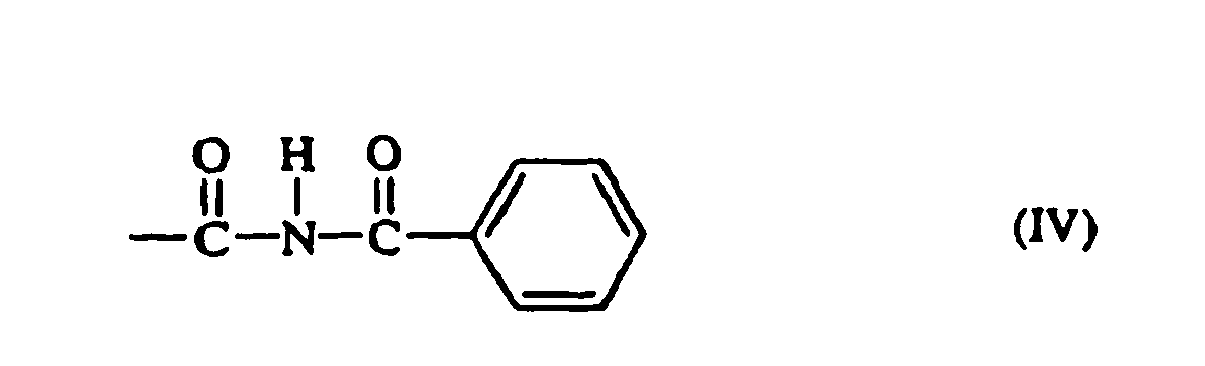


- (3) An atomic group in which R in each of the general formulae (I) and (II) is selected from atomic groups represented by the following formulae (VIII) , (IX) , and (X) .


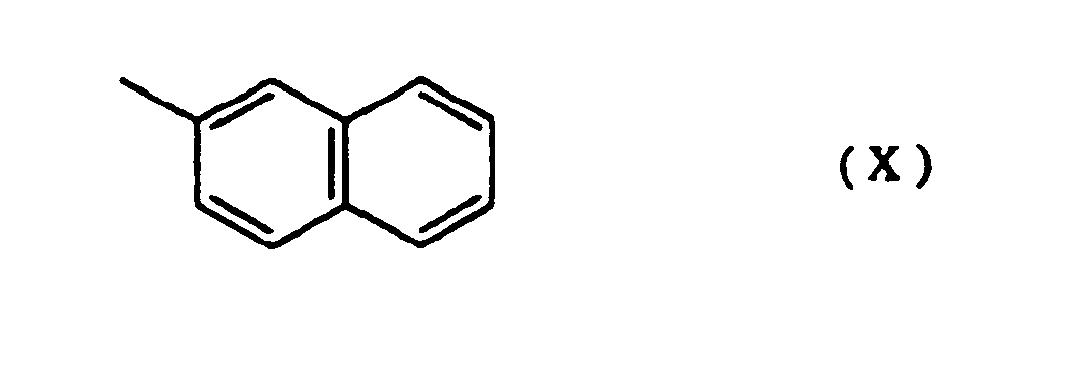
- The polysaccharide derivative may be: a polysaccharide derivative having atomic groups identical to each other bonded to a polysaccharide; or a polysaccharide derivative having different atomic groups bonded to a polysaccharide. A distribution of atomic groups in the polysaccharide derivative may be even or uneven. The number of the atomic groups bonded to a monosaccharide unit of the polysaccharide derivative may be the same for all monosaccharide units or different therefor. Positions of the atomic groups bonded to the monosaccharide unit of the polysaccharide derivative may be at positions of specific hydroxyl groups in the monosaccharide unit, or the atomic groups may be bonded to the monosaccharide unit without specific regularity.
- The polysaccharide derivative used in the present invention can be obtained by reacting a polysaccharide, and a compound having a functional group which may react with hydroxyl groups of the polysaccharide (a compound which may form an atomic group represented by the general formula (I) or (II)).
- Examples of such a compound include: an aromatic or aliphatic carboxylic acid derivative such as an aromatic or aliphatic carboxylic acid, acid chloride, acid anhydride, or acid ester; and an aromatic or aliphatic isocyanic acid derivative.
- The separating agent for enantiomeric isomers of the present invention may include: a polysaccharide derivative carried on a carrier; a polysaccharide derivative itself pulverized; or a polysaccharide derivative itself formed into spherical particles. The phrase "a polysaccharide derivative carried" as used herein indicates that a polysaccharide derivative is fixed on a carrier. Examples of a carrying method that can be used include: physical adsorption between a polysaccharide derivative and a carrier; chemical bonding between a polysaccharide derivative and a carrier; chemical bonding between polysaccharide derivatives; chemical bonding of a third component; photoirradiation to a polysaccharide derivative; and a radical reaction.
- Examples of a carrier include a porous organic carrier and a porous inorganic carrier. Preferred is a porous inorganic carrier. Appropriate examples of the porous organic carrier include polymer substances such as polystyrene, polyacrylamide, and polyacrylate. Appropriate examples of the porous inorganic carrier include silica, alumina, magnesia, glass, kaolin, titanium oxide, a silicate, and hydroxyapatite.
- A particularly preferable carrier is silica gel, and silica gel has a particle size of 0.1 µm to 10 µm, preferably 1 µm to 300 um, more preferably 1 µm to 100 µm. Silica gel has an average pore size of 10 Å to 100 mm, and preferably 50 Å to 50,000 Å. Silica gel is preferably subjected to surface treatment for eliminating an effect of remaining silanol on its surface, but needs not be subjected to surface treatment at all.
- An amount of the polysaccharide derivative carried on a carrier is preferably 1 to 100 parts by mass, more preferably 5 to 60 parts by mass, and particularly preferably 10 to 40 parts by mass with respect to 100 parts by mass of the separating agent for enantiomeric isomers.
- For pulverization or formation of spherical particles of the polysaccharide derivative itself, the obtained pulverized or spherical polysaccharide derivative is desirably classified by using a mortar or the like to have a similar particle size.
- The separating agent for enantiomeric isomers of the present invention can be used as a stationary phase for chromatography. The separating agent for enantiomeric isomers of the present invention can be used for gas chromatography, liquid chromatography, thin-layer chromatography, electrophoresis, and the like. In particular, the separating agent for enantiomeric isomers of the present invention is preferably used for (continuous) liquid chromatography, thin-layer chromatography, and electrophoresis. The separating agent for enantiomeric isomers of the present invention may be not only used as a separating agent for chromatography, but also applied as a host/guest separating agent, and for membrane separation and liquid crystal materials.
- The separating agent for enantiomeric isomers of the present invention, a stationary phase for chromatography using the same, and a stationary phase for continuous liquid chromatography using the same are suitable for enantiomeric isomers analysis technique involving optical separation of a wide range of chiral compounds at high separation factors in analysis of drugs, food products, agricultural chemicals, and fragrance materials.
- The separating agent for enantiomeric isomers of the present invention has excellent optical resolving power.
- The present invention further comprises the following embodiments:
- 1. A separating agent for enantiomeric isomers comprising, as an active ingredient, a polysaccharide derivative having at least part of hydrogen atoms of hydroxyl groups of a polysaccharide substituted by at least one of atomic groups represented by the following general formulae (I) and (II):


- 2. The separating agent for enantiomeric isomers according to the first embodiment, wherein the polysaccharide comprises cellulose or amylose.
- 3. The separating agent for enantiomeric isomers according to embodiments 1 or 2, wherein R in each of the general formulae (I) and (II) represents an atomic group represented by the following general formula (III):

- 4. The separating agent for enantiomeric isomers according to embodiment 3, wherein R1 to R5 the general formula (III) each represent an atom or group selected from hydrogen, a halogen, and an alkyl group.
- 5. The separating agent for enantiomeric isomers according to embodiments 1 or 2, wherein the atomic group represented by the general formula (I) comprises an atomic group represented by the following formula (IV):

- 6. The separating agent for enantiomeric isomers according to embodiments 1 or 2, wherein the atomic group represented by the general formula (I) comprises an atomic group represented by the following formula (V):
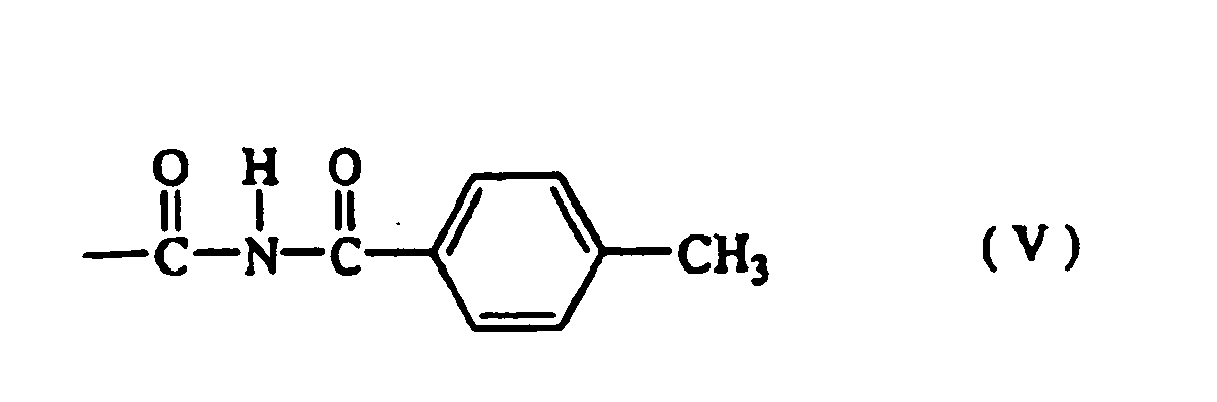
- 7. The separating agent for enantiomeric isomers according to embodiments 1 or 2, wherein the atomic group represented by the general formula (I) comprises an atomic group represented by the following formula (VI):

- 8. The separating agent for enantiomeric isomers according to embodiments 1 or 2, wherein the atomic group represented by the general formula (I) comprises an atomic group represented by the following formula (VII):

- 9. The separating agent for enantiomeric isomers according to embodiments 1 or 2, wherein R in each of the general formulae (I) and (II) represents an atomic group represented by the following formula (VIII):

- 10. The separating agent for enantiomeric isomers according to embodiments 1 or 2, wherein R in each of the general formulae (I) and (II) represents an atomic group represented by the following formula (IX):

- 11. The separating agent for enantiomeric isomers according to embodiments 1 or 2, wherein R in each of the general formulae (I) and (II) represents an atomic group represented by the following formula (X):

- 12. The separating agent for enantiomeric isomers according to any one of embodiments 1 to 11, which is used as a stationary phase for chromatography.
- 13. The separating agent for enantiomeric isomers according to any one of embodiments 1 to 11, which is used as a stationary phase for continuous liquid chromatography.
- 14. Use of the polysaccharide derivative according to embodiment 1 as a separating agent for enantiomeric isomers.
- 15. A method of separating enantiomeric isomers by bringing the polysaccharide derivative according to embodiment 1 into contact with the enantiomeric isomers.
- The present invention will be described in more detail by way of examples, but the present invention is not limited to the examples. Note that, a retention factor (k') and a separation factor (α) in the examples are defined by the following equations.
-

(Dead time represents an elution time of Tri-tert-butylbenzene.)
Separation factor (α)
- Benzamide and oxalyl chloride were stirred in dimethylsulfoxide (DMSO) in a nitrogen atmosphere at 60°C for 6 hours, to thereby synthesize benzoyl isocyanate. The obtained benzoyl isocyanate was purified through distillation under reduced pressure (61°C/4 mmHg).
- p-Toluamide and oxalyl chloride were stirred in dimethylsulfoxide (DMSO) in a nitrogen atmosphere at 60°C for 6 hours, to thereby synthesize 4-methylbenzoyl isocyanate. The obtained 4-methylbenzoyl isocyanate was purified through distillation under reduced pressure (86°C/4 mmHg).
- 4-Chlorobenzamide and oxalyl Chloride were stirred in dimethylsulfoxide (DMSO) in a nitrogen atmosphere at 60°C for 6 hours, to thereby synthesize 4-chlorobenzoyl isocyanate. The obtained 4-chlorobenzoyl isocyanate was purified through distillation under reduced pressure (93°C/6 mmHg).
- Thionyl chloride was gradually added to 3,5-dimethylbenzoic acid in a nitrogen atmosphere while the whole was cooled in an ice bath. After the addition was completed, the whole was heated to 80°C for a reaction, to thereby synthesize 3,5-dimethylbenzoyl chloride.
- 3,5-Dimethylbenzoyl Chloride and ammonium carbonate were stirred in diethyl ether in a nitrogen atmosphere at room temperature
- 3,5-Dimethylbenzoyl chloride and oxalyl chloride were stirred in dimethylsulfoxide (DMSO) in a nitrogen atmosphere at 60°C for 6 hours, to thereby synthesize 3,5-dimethylbenzoyl isocyanate. The obtained 3,5-dimethylbenzoyl isocyanate was purified through distillation under reduced pressure (104°C/8 mmHg).
- In a nitrogen atmosphere, 20 ml of pyridine or dimethylsulfoxide was added to 1 g of a polysaccharide (cellulose or amylose), and each of the corresponding isocyanates (1) to (3) and (6) was added thereto in an amount of 1.5 equivalents to that of hydroxyl groups of the polysaccharide, and stirred under heating to thereby obtain each of polysaccharide benzoyl carbamate derivatives (7) to (13) shown in Table 1.
Table 1 Ex. Type of isocyanate Polysaccharide (g) Polysaccharide benzoyl carbamate derivative Type Yield (g) Yield (%) C (%) H (%) N (%) Analytical value Calculated value Analytical value Calculated value Analytical value Calculated value 1 4-Methyl-benzoyl isocyanate (2) Cellulose (0.40) Cellulose tris(4-methyl-benzoyl carbamate)(7) 1.37 86 58.61 61.39 5.18 4.80 5.98 6.51 2 4-Chloro-benzoyl isocyanate (3) Cellulose (0.30) Cellulose tris(4-chloro-benzoyl carbamate)(8) 1.09 83 48.09 50.97 3.41 3.14 6.12 5.94 3 3.5-Dimethyl benzoyl isocyanate (6) Cellulose (0.10) Cellulose tris(3,5-di-methylbenzoyl carbamate)(9) 0.31 74 62.84 62.87 5.54 5.42 4.22 6.11 4 Benzoyl isocyanate (1) Amylose (0.13) Amylose tris(benzoyl carbamate)(10) 0.39 79 57.09 59.70 4.46 4.14 6.78 6.96 5 4-Methyl-benzoyl isocyanate (2) Amylose (0.40) Amylose tris(4-methyl-carbamate) (11) 1.42 90 59.23 61.39 5.11 4.80 6.32 6.51 6 4-Chloro-benzoyl isocyanate (3) Amylose (0.30) Amylose tris(4-chloro-benzoyl carbamate)(12) 1.14 87 48.65 50.97 3.29 3.14 6.18 5.94 7 3,5-Dimethyl benzoyl isocyanate (6) Amylose (0.10) Amylose tris(3,5-di-methylbenzoyl carbamate) (13) 0.30 73 62.60 62.87 5.50 5.42 4.26 6.11 - Porous silica gel (particle size of 7 µm) was reacted with 3-aminopropyl triethoxysilane for aminopropylsilane (APS) treatment.
- 0.225 g of each of the polysaccharide benzoyl carbamate derivatives (7) to (13) obtained in the above section (a) was dissolved in tetrahydrofuran (THF) or dimethylsulfoxide (DMSO), and 0.9 g of silica gel obtained in the above section (b) was evenly coated with the resulting solution. Then, the solvent was distilled off under reduced pressure, to thereby obtain a filler for enantiomeric isomers having the target polysaccharide derivative carried on silica gel.
- The filler obtained in the above section (c) was pressed and filled into a stainless column of 0.2 cmΦ x 25 cmL through a slurry filling method, to thereby prepare an enantiomeric isomer separation column.
- The enantiomeric isomer separation columns prepared in Examples were each evaluated for asymmetry identifying power (retention factor k' value and Separation factor α value) by using the following ten compounds by means of liquid chromatography. Table 2 shows the results.


Claims (11)
- A separating agent for enantiomeric isomers comprising, as an active ingredient, a polysaccharide derivative having at least part of hydrogen atoms of hydroxyl groups of a polysaccharide substituted by a group represented by the following general formula (II):

- The separating agent for enantiomeric isomers according to claim 1, wherein the polysaccharide comprises cellulose or amylose.
- The separating agent for enantiomeric isomers according to claim 1 or 2, wherein R in the general formula (II) represents a group represented by the following general formula (III):

- The separating agent for enantiomeric isomers according to claim 3, wherein R1 to R5 in the general formula (III) each represent an atom or group selected from hydrogen, a halogen, and an alkyl group.
- The separating agent for enantiomeric isomers according to claim 1 or 2, wherein R in the general formula (II) represents a group represented by the following formula (VIII):

- The separating agent for enantiomeric isomers according to claim 1 or 2, wherein R in the general formula (II) represents a group represented by the following formula (IX):

- The separating agent for enantiomeric isomers according to claim 1 or 2, wherein R in the general formula (II) represents a group represented by the following formula (X):

- Use of the separating agent for enantiomeric isomers of any one of claims 1 to 7 as a stationary phase for chromatography.
- Use of the separating agent for enantiomeric isomers of any one of claims 1 to 7 as a stationary phase for continuous liquid chromatography.
- Use of a polysaccharide derivative having at least part of hydrogen atoms of hydroxyl groups of a polysaccharide substituted by a group represented by the following general formula (II):

- A method of separating enantiomeric isomers, which comprises the step of bringing a polysaccharide derivative having at least part of hydrogen atoms of hydroxyl groups of a polysaccharide substituted by a group represented by the following general formula (II):

Applications Claiming Priority (2)
| Application Number | Priority Date | Filing Date | Title |
|---|---|---|---|
| JP2003119710 | 2003-04-24 | ||
| EP04728920A EP1618949B1 (en) | 2003-04-24 | 2004-04-22 | Agent for separating optical isomers |
Related Parent Applications (2)
| Application Number | Title | Priority Date | Filing Date |
|---|---|---|---|
| EP04728920A Division EP1618949B1 (en) | 2003-04-24 | 2004-04-22 | Agent for separating optical isomers |
| EP04728920.2 Division | 2004-04-22 |
Publications (2)
| Publication Number | Publication Date |
|---|---|
| EP2208519A1 true EP2208519A1 (en) | 2010-07-21 |
| EP2208519B1 EP2208519B1 (en) | 2012-08-29 |
Family
ID=33308106
Family Applications (2)
| Application Number | Title | Priority Date | Filing Date |
|---|---|---|---|
| EP04728920A Expired - Lifetime EP1618949B1 (en) | 2003-04-24 | 2004-04-22 | Agent for separating optical isomers |
| EP10003366A Expired - Lifetime EP2208519B1 (en) | 2003-04-24 | 2004-04-22 | Agent for separating optical isomers |
Family Applications Before (1)
| Application Number | Title | Priority Date | Filing Date |
|---|---|---|---|
| EP04728920A Expired - Lifetime EP1618949B1 (en) | 2003-04-24 | 2004-04-22 | Agent for separating optical isomers |
Country Status (8)
| Country | Link |
|---|---|
| US (1) | US7683167B2 (en) |
| EP (2) | EP1618949B1 (en) |
| JP (1) | JP4340264B2 (en) |
| KR (1) | KR101011780B1 (en) |
| CN (1) | CN100364661C (en) |
| AT (1) | ATE471207T1 (en) |
| DE (1) | DE602004027720D1 (en) |
| WO (1) | WO2004094342A2 (en) |
Families Citing this family (5)
| Publication number | Priority date | Publication date | Assignee | Title |
|---|---|---|---|---|
| EP1887354B1 (en) * | 2005-05-09 | 2015-04-01 | National University Corporation Nagoya University | Process for producing a bead for optical-isomer resolution |
| US8859757B2 (en) * | 2010-06-18 | 2014-10-14 | Daicel Corporation | Separating agent for optical isomers |
| CN103649746B (en) * | 2011-07-01 | 2016-05-18 | 株式会社大赛璐 | Spot detection external member, spot detection method and transfer sheet |
| JP6469958B2 (en) * | 2014-03-17 | 2019-02-13 | 株式会社島津製作所 | Method for separating triacylglycerol |
| JP6409528B2 (en) * | 2014-11-27 | 2018-10-24 | Jnc株式会社 | Porous cellulose particles having an ion exchange group containing amino groups and a hydrophobic group containing butyl groups, a chromatography carrier containing the same, and a method for purifying virus-like particles of hepatitis B virus |
Citations (5)
| Publication number | Priority date | Publication date | Assignee | Title |
|---|---|---|---|---|
| JPS57150432A (en) | 1981-03-11 | 1982-09-17 | Daicel Chem Ind Ltd | Adsorbent deposited with optically active high polymer used in separation |
| JPS63307829A (en) | 1986-04-02 | 1988-12-15 | Eisai Co Ltd | Resolving agent for optical isomer |
| EP0747341A1 (en) * | 1994-02-25 | 1996-12-11 | Daicel Chemical Industries, Ltd. | Process for producing optically active mevalonolactone compound |
| US5965026A (en) * | 1995-12-21 | 1999-10-12 | Daicel Chemical Industries, Ltd. | Packing material for high-performance liquid chromatography |
| JP2003277401A (en) * | 2002-03-27 | 2003-10-02 | Guroobu Kk | Polysaccharide amino acid carbamate derivative |
Family Cites Families (3)
| Publication number | Priority date | Publication date | Assignee | Title |
|---|---|---|---|---|
| JP2001124752A (en) | 1999-10-26 | 2001-05-11 | Daicel Chem Ind Ltd | Method for producing optically active oxybutynin |
| JP2002148247A (en) * | 2000-11-09 | 2002-05-22 | Nagoya Industrial Science Research Inst | Separating agent for optical isomer and method for producing the same |
| JP4618932B2 (en) * | 2001-05-28 | 2011-01-26 | 株式会社同仁化学研究所 | Composition for measuring chlorine concentration |
-
2004
- 2004-04-22 EP EP04728920A patent/EP1618949B1/en not_active Expired - Lifetime
- 2004-04-22 EP EP10003366A patent/EP2208519B1/en not_active Expired - Lifetime
- 2004-04-22 AT AT04728920T patent/ATE471207T1/en not_active IP Right Cessation
- 2004-04-22 KR KR1020057013457A patent/KR101011780B1/en not_active Expired - Fee Related
- 2004-04-22 CN CNB2004800062017A patent/CN100364661C/en not_active Expired - Fee Related
- 2004-04-22 JP JP2005505777A patent/JP4340264B2/en not_active Expired - Fee Related
- 2004-04-22 US US10/552,939 patent/US7683167B2/en not_active Expired - Fee Related
- 2004-04-22 DE DE602004027720T patent/DE602004027720D1/en not_active Expired - Lifetime
- 2004-04-22 WO PCT/JP2004/005760 patent/WO2004094342A2/en not_active Ceased
Patent Citations (5)
| Publication number | Priority date | Publication date | Assignee | Title |
|---|---|---|---|---|
| JPS57150432A (en) | 1981-03-11 | 1982-09-17 | Daicel Chem Ind Ltd | Adsorbent deposited with optically active high polymer used in separation |
| JPS63307829A (en) | 1986-04-02 | 1988-12-15 | Eisai Co Ltd | Resolving agent for optical isomer |
| EP0747341A1 (en) * | 1994-02-25 | 1996-12-11 | Daicel Chemical Industries, Ltd. | Process for producing optically active mevalonolactone compound |
| US5965026A (en) * | 1995-12-21 | 1999-10-12 | Daicel Chemical Industries, Ltd. | Packing material for high-performance liquid chromatography |
| JP2003277401A (en) * | 2002-03-27 | 2003-10-02 | Guroobu Kk | Polysaccharide amino acid carbamate derivative |
Non-Patent Citations (2)
| Title |
|---|
| SENSO A ET AL: "Preparation of mixed 10-undecenoyl/phenylaminocarbonyl or benzoyl derivatives of chitosan", CARBOHYDRATE RESEARCH, ELSEVIER SCIENTIFIC PUBLISHING COMPANY. AMSTERDAM, NL, vol. 328, no. 4, 6 October 2000 (2000-10-06), pages 617 - 622, XP004218905, ISSN: 0008-6215 * |
| Y. OKAMOTO; M. KAWASHIMA; K. HATADA, J. AM. CHEM. SOC., vol. 106, 1984, pages 5337 |
Also Published As
| Publication number | Publication date |
|---|---|
| KR101011780B1 (en) | 2011-02-07 |
| WO2004094342A3 (en) | 2005-03-03 |
| EP1618949B1 (en) | 2010-06-16 |
| EP1618949A4 (en) | 2007-08-29 |
| WO2004094342A8 (en) | 2005-05-12 |
| EP2208519B1 (en) | 2012-08-29 |
| DE602004027720D1 (en) | 2010-07-29 |
| EP1618949A2 (en) | 2006-01-25 |
| KR20070066816A (en) | 2007-06-27 |
| CN1758958A (en) | 2006-04-12 |
| CN100364661C (en) | 2008-01-30 |
| ATE471207T1 (en) | 2010-07-15 |
| US7683167B2 (en) | 2010-03-23 |
| JPWO2004094342A1 (en) | 2006-07-13 |
| JP4340264B2 (en) | 2009-10-07 |
| WO2004094342A2 (en) | 2004-11-04 |
| US20070039890A1 (en) | 2007-02-22 |
Similar Documents
| Publication | Publication Date | Title |
|---|---|---|
| US20070215549A1 (en) | Separating agent for enantiomeric isomers | |
| US20090008329A1 (en) | Separating agent for enantiomeric isomers | |
| EP1818675B1 (en) | Separating agent for optical isomer and separation column for optical isomers | |
| EP1618949B1 (en) | Agent for separating optical isomers | |
| JP4515812B2 (en) | Separating agent for optical isomers | |
| US6736967B2 (en) | Separating agent for enantiomeric isomers | |
| JP2001163806A (en) | Optical isomer separating agent | |
| JP3635002B2 (en) | Filler for separation of optical isomers for liquid chromatography | |
| EP1405668B1 (en) | Novel separation agent for separating optical isomer and method for preparation thereof | |
| EP1389606B1 (en) | Separatory agent for enantiomeric isomers comprising a polysaccharide with an indanyl group | |
| JP4034123B2 (en) | Separating agent for optical isomers | |
| EP1637542A1 (en) | Separatory agent for optical isomer | |
| JP4430881B2 (en) | Method for producing filler for separation of optical isomers for liquid chromatography | |
| JPWO2002088049A1 (en) | Separating agent for optical isomers |
Legal Events
| Date | Code | Title | Description |
|---|---|---|---|
| PUAI | Public reference made under article 153(3) epc to a published international application that has entered the european phase |
Free format text: ORIGINAL CODE: 0009012 |
|
| AC | Divisional application: reference to earlier application |
Ref document number: 1618949 Country of ref document: EP Kind code of ref document: P |
|
| AK | Designated contracting states |
Kind code of ref document: A1 Designated state(s): AT BE BG CH CY CZ DE DK EE ES FI FR GB GR HU IE IT LI LU MC NL PL PT RO SE SI SK TR |
|
| RIN1 | Information on inventor provided before grant (corrected) |
Inventor name: OKAMOTO, YOSHIO Inventor name: YAMAMOTO, CHIYO |
|
| 17P | Request for examination filed |
Effective date: 20101019 |
|
| 17Q | First examination report despatched |
Effective date: 20110519 |
|
| REG | Reference to a national code |
Ref country code: DE Ref legal event code: R079 Ref document number: 602004039178 Country of ref document: DE Free format text: PREVIOUS MAIN CLASS: B01D0015080000 Ipc: B01J0020285000 |
|
| GRAP | Despatch of communication of intention to grant a patent |
Free format text: ORIGINAL CODE: EPIDOSNIGR1 |
|
| RIC1 | Information provided on ipc code assigned before grant |
Ipc: B01D 15/38 20060101ALI20120224BHEP Ipc: B01J 20/285 20060101AFI20120224BHEP |
|
| GRAS | Grant fee paid |
Free format text: ORIGINAL CODE: EPIDOSNIGR3 |
|
| GRAA | (expected) grant |
Free format text: ORIGINAL CODE: 0009210 |
|
| AC | Divisional application: reference to earlier application |
Ref document number: 1618949 Country of ref document: EP Kind code of ref document: P |
|
| AK | Designated contracting states |
Kind code of ref document: B1 Designated state(s): AT BE BG CH CY CZ DE DK EE ES FI FR GB GR HU IE IT LI LU MC NL PL PT RO SE SI SK TR |
|
| REG | Reference to a national code |
Ref country code: GB Ref legal event code: FG4D |
|
| REG | Reference to a national code |
Ref country code: CH Ref legal event code: NV Representative=s name: MICHELI & CIE SA Ref country code: CH Ref legal event code: EP Ref country code: CH Ref legal event code: PFA Owner name: DAICEL CORPORATION Free format text: DAICEL CHEMICAL INDUSTRIES, LTD.#MAINICHI INTECIO 3-4-5, UMEDA#KITA-KU, OSAKA-SHI OSAKA 530-0001 (JP) -TRANSFER TO- DAICEL CORPORATION#3-4-5 UMEDA KITA-KU, OSAKA-SHI#OSAKA 530-0001 (JP) |
|
| REG | Reference to a national code |
Ref country code: AT Ref legal event code: REF Ref document number: 572763 Country of ref document: AT Kind code of ref document: T Effective date: 20120915 |
|
| REG | Reference to a national code |
Ref country code: IE Ref legal event code: FG4D |
|
| REG | Reference to a national code |
Ref country code: DE Ref legal event code: R096 Ref document number: 602004039178 Country of ref document: DE Effective date: 20121025 |
|
| REG | Reference to a national code |
Ref country code: AT Ref legal event code: MK05 Ref document number: 572763 Country of ref document: AT Kind code of ref document: T Effective date: 20120829 |
|
| REG | Reference to a national code |
Ref country code: NL Ref legal event code: VDEP Effective date: 20120829 |
|
| PG25 | Lapsed in a contracting state [announced via postgrant information from national office to epo] |
Ref country code: AT Free format text: LAPSE BECAUSE OF FAILURE TO SUBMIT A TRANSLATION OF THE DESCRIPTION OR TO PAY THE FEE WITHIN THE PRESCRIBED TIME-LIMIT Effective date: 20120829 Ref country code: FI Free format text: LAPSE BECAUSE OF FAILURE TO SUBMIT A TRANSLATION OF THE DESCRIPTION OR TO PAY THE FEE WITHIN THE PRESCRIBED TIME-LIMIT Effective date: 20120829 Ref country code: CY Free format text: LAPSE BECAUSE OF FAILURE TO SUBMIT A TRANSLATION OF THE DESCRIPTION OR TO PAY THE FEE WITHIN THE PRESCRIBED TIME-LIMIT Effective date: 20120829 |
|
| PG25 | Lapsed in a contracting state [announced via postgrant information from national office to epo] |
Ref country code: GR Free format text: LAPSE BECAUSE OF FAILURE TO SUBMIT A TRANSLATION OF THE DESCRIPTION OR TO PAY THE FEE WITHIN THE PRESCRIBED TIME-LIMIT Effective date: 20121130 Ref country code: PT Free format text: LAPSE BECAUSE OF FAILURE TO SUBMIT A TRANSLATION OF THE DESCRIPTION OR TO PAY THE FEE WITHIN THE PRESCRIBED TIME-LIMIT Effective date: 20121231 Ref country code: SI Free format text: LAPSE BECAUSE OF FAILURE TO SUBMIT A TRANSLATION OF THE DESCRIPTION OR TO PAY THE FEE WITHIN THE PRESCRIBED TIME-LIMIT Effective date: 20120829 Ref country code: SE Free format text: LAPSE BECAUSE OF FAILURE TO SUBMIT A TRANSLATION OF THE DESCRIPTION OR TO PAY THE FEE WITHIN THE PRESCRIBED TIME-LIMIT Effective date: 20120829 Ref country code: BE Free format text: LAPSE BECAUSE OF FAILURE TO SUBMIT A TRANSLATION OF THE DESCRIPTION OR TO PAY THE FEE WITHIN THE PRESCRIBED TIME-LIMIT Effective date: 20120829 |
|
| PG25 | Lapsed in a contracting state [announced via postgrant information from national office to epo] |
Ref country code: NL Free format text: LAPSE BECAUSE OF FAILURE TO SUBMIT A TRANSLATION OF THE DESCRIPTION OR TO PAY THE FEE WITHIN THE PRESCRIBED TIME-LIMIT Effective date: 20120829 Ref country code: RO Free format text: LAPSE BECAUSE OF FAILURE TO SUBMIT A TRANSLATION OF THE DESCRIPTION OR TO PAY THE FEE WITHIN THE PRESCRIBED TIME-LIMIT Effective date: 20120829 Ref country code: EE Free format text: LAPSE BECAUSE OF FAILURE TO SUBMIT A TRANSLATION OF THE DESCRIPTION OR TO PAY THE FEE WITHIN THE PRESCRIBED TIME-LIMIT Effective date: 20120829 Ref country code: DK Free format text: LAPSE BECAUSE OF FAILURE TO SUBMIT A TRANSLATION OF THE DESCRIPTION OR TO PAY THE FEE WITHIN THE PRESCRIBED TIME-LIMIT Effective date: 20120829 Ref country code: CZ Free format text: LAPSE BECAUSE OF FAILURE TO SUBMIT A TRANSLATION OF THE DESCRIPTION OR TO PAY THE FEE WITHIN THE PRESCRIBED TIME-LIMIT Effective date: 20120829 Ref country code: ES Free format text: LAPSE BECAUSE OF FAILURE TO SUBMIT A TRANSLATION OF THE DESCRIPTION OR TO PAY THE FEE WITHIN THE PRESCRIBED TIME-LIMIT Effective date: 20121210 |
|
| PG25 | Lapsed in a contracting state [announced via postgrant information from national office to epo] |
Ref country code: IT Free format text: LAPSE BECAUSE OF FAILURE TO SUBMIT A TRANSLATION OF THE DESCRIPTION OR TO PAY THE FEE WITHIN THE PRESCRIBED TIME-LIMIT Effective date: 20120829 Ref country code: SK Free format text: LAPSE BECAUSE OF FAILURE TO SUBMIT A TRANSLATION OF THE DESCRIPTION OR TO PAY THE FEE WITHIN THE PRESCRIBED TIME-LIMIT Effective date: 20120829 Ref country code: PL Free format text: LAPSE BECAUSE OF FAILURE TO SUBMIT A TRANSLATION OF THE DESCRIPTION OR TO PAY THE FEE WITHIN THE PRESCRIBED TIME-LIMIT Effective date: 20120829 |
|
| PLBE | No opposition filed within time limit |
Free format text: ORIGINAL CODE: 0009261 |
|
| STAA | Information on the status of an ep patent application or granted ep patent |
Free format text: STATUS: NO OPPOSITION FILED WITHIN TIME LIMIT |
|
| PG25 | Lapsed in a contracting state [announced via postgrant information from national office to epo] |
Ref country code: BG Free format text: LAPSE BECAUSE OF FAILURE TO SUBMIT A TRANSLATION OF THE DESCRIPTION OR TO PAY THE FEE WITHIN THE PRESCRIBED TIME-LIMIT Effective date: 20121129 |
|
| 26N | No opposition filed |
Effective date: 20130530 |
|
| REG | Reference to a national code |
Ref country code: DE Ref legal event code: R097 Ref document number: 602004039178 Country of ref document: DE Effective date: 20130530 |
|
| PG25 | Lapsed in a contracting state [announced via postgrant information from national office to epo] |
Ref country code: MC Free format text: LAPSE BECAUSE OF FAILURE TO SUBMIT A TRANSLATION OF THE DESCRIPTION OR TO PAY THE FEE WITHIN THE PRESCRIBED TIME-LIMIT Effective date: 20120829 |
|
| REG | Reference to a national code |
Ref country code: IE Ref legal event code: MM4A |
|
| PG25 | Lapsed in a contracting state [announced via postgrant information from national office to epo] |
Ref country code: IE Free format text: LAPSE BECAUSE OF NON-PAYMENT OF DUE FEES Effective date: 20130422 |
|
| PG25 | Lapsed in a contracting state [announced via postgrant information from national office to epo] |
Ref country code: TR Free format text: LAPSE BECAUSE OF FAILURE TO SUBMIT A TRANSLATION OF THE DESCRIPTION OR TO PAY THE FEE WITHIN THE PRESCRIBED TIME-LIMIT Effective date: 20120829 |
|
| PG25 | Lapsed in a contracting state [announced via postgrant information from national office to epo] |
Ref country code: LU Free format text: LAPSE BECAUSE OF NON-PAYMENT OF DUE FEES Effective date: 20130422 Ref country code: HU Free format text: LAPSE BECAUSE OF FAILURE TO SUBMIT A TRANSLATION OF THE DESCRIPTION OR TO PAY THE FEE WITHIN THE PRESCRIBED TIME-LIMIT; INVALID AB INITIO Effective date: 20040422 |
|
| REG | Reference to a national code |
Ref country code: FR Ref legal event code: PLFP Year of fee payment: 13 |
|
| PGFP | Annual fee paid to national office [announced via postgrant information from national office to epo] |
Ref country code: FR Payment date: 20160309 Year of fee payment: 13 |
|
| PGFP | Annual fee paid to national office [announced via postgrant information from national office to epo] |
Ref country code: CH Payment date: 20160411 Year of fee payment: 13 Ref country code: DE Payment date: 20160419 Year of fee payment: 13 Ref country code: GB Payment date: 20160420 Year of fee payment: 13 |
|
| REG | Reference to a national code |
Ref country code: DE Ref legal event code: R119 Ref document number: 602004039178 Country of ref document: DE |
|
| REG | Reference to a national code |
Ref country code: CH Ref legal event code: PL |
|
| GBPC | Gb: european patent ceased through non-payment of renewal fee |
Effective date: 20170422 |
|
| REG | Reference to a national code |
Ref country code: FR Ref legal event code: ST Effective date: 20171229 |
|
| PG25 | Lapsed in a contracting state [announced via postgrant information from national office to epo] |
Ref country code: DE Free format text: LAPSE BECAUSE OF NON-PAYMENT OF DUE FEES Effective date: 20171103 Ref country code: FR Free format text: LAPSE BECAUSE OF NON-PAYMENT OF DUE FEES Effective date: 20170502 |
|
| PG25 | Lapsed in a contracting state [announced via postgrant information from national office to epo] |
Ref country code: CH Free format text: LAPSE BECAUSE OF NON-PAYMENT OF DUE FEES Effective date: 20170430 Ref country code: LI Free format text: LAPSE BECAUSE OF NON-PAYMENT OF DUE FEES Effective date: 20170430 Ref country code: GB Free format text: LAPSE BECAUSE OF NON-PAYMENT OF DUE FEES Effective date: 20170422 |