EP2207940B1 - Flüssigkeit enthaltende mehrwandige polymerflächengebilde und herstellungsverfahren - Google Patents
Flüssigkeit enthaltende mehrwandige polymerflächengebilde und herstellungsverfahren Download PDFInfo
- Publication number
- EP2207940B1 EP2207940B1 EP07864392.1A EP07864392A EP2207940B1 EP 2207940 B1 EP2207940 B1 EP 2207940B1 EP 07864392 A EP07864392 A EP 07864392A EP 2207940 B1 EP2207940 B1 EP 2207940B1
- Authority
- EP
- European Patent Office
- Prior art keywords
- sheet
- multiwall sheet
- liquid
- light transmission
- visible light
- Prior art date
- Legal status (The legal status is an assumption and is not a legal conclusion. Google has not performed a legal analysis and makes no representation as to the accuracy of the status listed.)
- Not-in-force
Links
Images

Classifications
-
- A—HUMAN NECESSITIES
- A01—AGRICULTURE; FORESTRY; ANIMAL HUSBANDRY; HUNTING; TRAPPING; FISHING
- A01G—HORTICULTURE; CULTIVATION OF VEGETABLES, FLOWERS, RICE, FRUIT, VINES, HOPS OR SEAWEED; FORESTRY; WATERING
- A01G9/00—Cultivation in receptacles, forcing-frames or greenhouses; Edging for beds, lawn or the like
- A01G9/14—Greenhouses
- A01G9/1469—Greenhouses with double or multiple walls
-
- A—HUMAN NECESSITIES
- A01—AGRICULTURE; FORESTRY; ANIMAL HUSBANDRY; HUNTING; TRAPPING; FISHING
- A01G—HORTICULTURE; CULTIVATION OF VEGETABLES, FLOWERS, RICE, FRUIT, VINES, HOPS OR SEAWEED; FORESTRY; WATERING
- A01G9/00—Cultivation in receptacles, forcing-frames or greenhouses; Edging for beds, lawn or the like
- A01G9/14—Greenhouses
- A01G9/1438—Covering materials therefor; Materials for protective coverings used for soil and plants, e.g. films, canopies, tunnels or cloches
-
- E—FIXED CONSTRUCTIONS
- E04—BUILDING
- E04C—STRUCTURAL ELEMENTS; BUILDING MATERIALS
- E04C2/00—Building elements of relatively thin form for the construction of parts of buildings, e.g. sheet materials, slabs, or panels
- E04C2/54—Slab-like translucent elements
- E04C2/543—Hollow multi-walled panels with integrated webs
-
- Y—GENERAL TAGGING OF NEW TECHNOLOGICAL DEVELOPMENTS; GENERAL TAGGING OF CROSS-SECTIONAL TECHNOLOGIES SPANNING OVER SEVERAL SECTIONS OF THE IPC; TECHNICAL SUBJECTS COVERED BY FORMER USPC CROSS-REFERENCE ART COLLECTIONS [XRACs] AND DIGESTS
- Y02—TECHNOLOGIES OR APPLICATIONS FOR MITIGATION OR ADAPTATION AGAINST CLIMATE CHANGE
- Y02A—TECHNOLOGIES FOR ADAPTATION TO CLIMATE CHANGE
- Y02A40/00—Adaptation technologies in agriculture, forestry, livestock or agroalimentary production
- Y02A40/10—Adaptation technologies in agriculture, forestry, livestock or agroalimentary production in agriculture
- Y02A40/25—Greenhouse technology, e.g. cooling systems therefor
Definitions
- the present disclosure relates generally to polymer sheets, and more specifically to multiwall polymer sheets comprising liquid.
- polymer sheeting exhibits excellent impact resistance compared to glass. This in turn reduces maintenance costs in applications wherein occasional breakage caused by vandalism, hail, contraction/expansion, and so forth, is encountered.
- Another benefit of polymer sheeting is a significant reduction in weight compared to glass. This makes polymer sheeting easier to install than glass and reduces the load-bearing requirements of the structure on which they are installed.
- WO 84/01687 discloses a double-walled panel of transparent synthetic material with ribs that intersect the walls of the double-walled panel.
- the double-walled panel is used in greenhouses, for example.
- polymer sheeting has many advantages over glass, there is a continuous demand for enhanced optical properties, e.g., visible light transfer similar to glass and blocking of direct solar light.
- a natural lit structure comprises a building structure and a roof comprising a multiwall sheet.
- a multiwall sheet comprises: greater than or equal to three polymer walls (e.g., comprising a first outer layer, a second outer layer, and an inner layer), a transverse layer, and a liquid.
- the liquid is located in cells formed by the transverse layer intersecting the walls.
- the multiwall sheet has a first visible light transmission and a first direct solar transmission.
- a second multiwall sheet has the same materials and the same design as the multiwall sheet with no liquid, and has a second visible light transmission and a second direct solar transmission. The first visible light transmission is greater than the second visible light transmission.
- a multiwall sheet comprises: three polymer walls (e.g., comprising a first outer layer, a second outer layer, and an inner layer), a transverse layer, and a liquid.
- the liquid is located in cells formed by the transverse layer intersecting the walls.
- the polymer walls comprise a polymer selected from the group consisting of polycarbonate, poly (methyl methacrylate), polyalkenes, polyetherimides, styrene, and combinations comprising at least one of the foregoing polymers.
- the multiwall sheet has a visible light transmission at a wavelength of about 400 nm to about 700 nm of greater than or equal to 87% as measured in accordance with ISO 9050.
- a multiwall sheet comprises: greater than or equal to three polymer walls (e.g., comprising a first outer layer, a second outer layer, and an inner layer), a transverse layer, and a liquid.
- the liquid is located in cells formed by the transverse layer intersecting the walls.
- the multiwall sheet has a visible light transmission at a wavelength of about 400 nm to about 700 nm of greater than or equal to 85% as measured in accordance with ISO 9050.
- a multiwall sheet comprises: greater than or equal to three polymer walls; a transverse layer.
- the transverse layer intersects the walls to form cells, and a liquid is located in the cells.
- the transverse layer has a geometry selected from the group consisting of a cross geometry, a sinusoidal geometry, and combinations comprising at least one of the foregoing geometries.
- the multiwall sheet has a first visible light transmission and a first direct solar transmission.
- a second multiwall sheet has the same materials and the same design as the multiwall sheet with no liquid, and has a second visible light transmission and a second direct solar transmission. The first visible light transmission is greater than the second visible light transmission.
- a multiwall sheet comprises: greater than or equal to three polymer walls, a transverse layer.
- the transverse layer intersects the walls to form cells, and a liquid is located in the cells.
- the walls have a thickness of less than or equal to about 1 mm.
- the multiwall sheet has a thickness of less than or equal to about 55 mm and has a first visible light transmission and a first direct solar transmission.
- a second multiwall sheet has the same materials and the same design as the multiwall sheet except comprises no liquid, and has a second visible light transmission and a second direct solar transmission. The first visible light transmission is greater than the second visible light transmission.
- a method for producing a multiwall sheet comprises: forming at least three walls and a transverse layer therebetween and increasing visible light transmission through the multiwall sheet.
- the transverse layer intersects the walls to form cells.
- polymeric sheeting that can offer improved light control, i.e., enhanced visible light (e.g., wavelength of 400 nanometers (nm) to 700 nm) transmission.
- enhanced visible light e.g., wavelength of 400 nanometers (nm) to 700 nm
- control of the type of light that transmits through the multiwall sheet and the light that is prevented from passing through the multiwall sheet can greatly affect the effectiveness of the sheet.
- a natural lit structure e.g., a greenhouse, pool enclosure, sun-room, etc.
- admittance of visible light while rejecting direct solar light can substantially enhance crop growth; e.g., a 1% increase in visible light transmission can enhance crop growth by 1%.
- Direct solar transmission can damage crops.
- the present multiwall sheet increases visible light transmission.
- This multiwall sheet comprises liquid between the walls. With the liquid in the walls, this sheet has a greater than or equal to 5% increase in visible light transmission (measured in accordance with NEN-EN-410-65 which is equivalent to ISO 9050) and a direct solar light transmission of less than or equal to 68% (measured in accordance with NEN-EN-410, which is equivalent to ISO 9050).
- ISO 9050 refers to ISO 9050, second edition, August 15, 2003 (reference number ISO 9050:2003(E)) with a perpendicular measurement. The visible light testing used illuminant D65.
- a greenhouse can comprise a building structure and a roof comprising the multiwall sheet.
- a multiwall sheet comprises: greater than or equal to three polymer walls (e.g., comprising a first outer layer, a second outer layer, and an inner layer, wherein the polymer walls can be disposed substantially parallel to one another (e.g., they can be disposed such that they do not intersect)), a transverse layer, and a liquid.
- the liquid is located in cells formed by the transverse layer intersecting the walls.
- the multiwall sheet has a first visible light transmission and a first direct solar transmission.
- a second multiwall sheet has the same materials and the same design as the multiwall sheet with no liquid, and has a second visible light transmission.
- the first visible light transmission is greater than the second visible light transmission and the first direct solar transmission is about 63% to about 70% as determined in accordance with ISO 9050.
- the first visible light transmission, at a wavelength of about 400 nm to about 700 nm, is greater than or equal to 85% as measured in accordance with ISO 9050, and the first direct solar light transmission is about 65% to about 68% as measured in accordance with ISO 9050.
- a multiwall sheet comprises: three polymer walls (e.g., comprising a first outer layer, a second outer layer, and an inner layer), a transverse layer, and a liquid.
- the liquid is located in cells formed by the transverse layer intersecting the walls.
- the polymer walls comprise a polymer selected from the group consisting of polycarbonate, poly (methyl methacrylate), polyalkenes, polyetherimides, styrene, and combinations comprising at least one of the foregoing polymers.
- the multiwall sheet has a visible light transmission at a wavelength of about 400 nm to about 700 nm of greater than or equal to 87% as measured in accordance with ISO 9050, and a direct solar light transmission of about 63% to about 70% as determined in accordance with ISO 9050.
- a multiwall sheet comprises: greater than or equal to three polymer walls (e.g., comprising a first outer layer, a second outer layer, and an inner layer), a transverse layer, and a liquid.
- the liquid is located in cells formed by the transverse layer intersecting the walls.
- the multiwall sheet has a visible light transmission at a wavelength of about 400 nm to about 700 nm of greater than or equal to 85% as measured in accordance with ISO 9050, and a direct solar light transmission of about 65% as to about 68% as measured in accordance with ISO 9050.
- a multiwall sheet comprises: greater than or equal to three polymer walls; a transverse layer.
- the transverse layer intersects the walls to form cells, and a liquid is located in the cells.
- the transverse layer has a geometry selected from the group consisting of a cross geometry, a sinusoidal geometry, and combinations comprising at least one of the foregoing geometries.
- the multiwall sheet has a first visible light transmission and a first direct solar transmission.
- a second multiwall sheet has the same materials and the same design as the multiwall sheet with no liquid, and has a second visible light transmission and a second direct solar transmission.
- the first visible light transmission is greater than the second visible light transmission and the first direct solar transmission is about 63% to about 70% as determined in accordance with ISO 9050.
- a multiwall sheet comprises: greater than or equal to three polymer walls, a transverse layer.
- the transverse layer intersects the walls to form cells, and a liquid is located in the cells.
- the walls have a thickness of less than or equal to about 1 mm.
- the multiwall sheet has a thickness of less than or equal to about 55 mm and has a first visible light transmission and a first direct solar transmission.
- a second multiwall sheet has the same materials and the same design as the multiwall sheet except comprises no liquid, and has a second visible light transmission.
- the first visible light transmission is greater than the second visible light transmission and the first direct solar transmission is about 63% to about 70% as determined in accordance with ISO 9050.
- the multiwall sheet can have a visible light transmission, as measured in accordance with ISO 9050, that is greater than or equal to 86%, or, more specifically, greater than or equal to 87%.
- the multiwall sheet can also have a direct solar light transmission, as measured in accordance with ISO 9050, that is about 65% to about 68%.
- the liquid can be water, glycerin, polydimethylsiloxane oil, as well as combinations comprising at least one of the foregoing liquids, such as demineralized water.
- the multiwall sheet can have an overall thickness of less than or equal to 55 mm (e.g., from the outside of the first outside layer to the outside of the second outside layer).
- the multiwall sheet can also comprise a first manifold located at an end of the sheet in fluid communication with the cells.
- the polymer of the polymer walls can be polyalkylenes, polycarbonates, acrylics, polyacetals, styrenes, poly(meth)acrylates, polyetherimide, polyurethanes, polyphenylene sulfides, polyvinyl chlorides, polysulfones, polyetherketones, polyether etherketones, polyether ketone ketones, and combinations comprising at least one of the foregoing.
- the polymer can be acrylonitrile-butadiene-styrene/nylon, polycarbonate/acrylonitrile-butadiene-styrene, acrylonitrile butadiene styrene/polyvinyl chloride, polyphenylene ether/polystyrene, polyphenylene ether/nylon, polysulfone/acrylonitrile-butadiene-styrene, polycarbonate/thermoplastic urethane, polycarbonate/polyethylene terephthalate, polycarbonate/polybutylene terephthalate, thermoplastic elastomer alloys, nylon/elastomers, polyester/elastomers, polyethylene terephthalate/polybutylene terephthalate, acetal/elastomer, styrene-maleic anhydride/acrylonitrile-butadiene-styrene, polyether, as well as combinations comprising at least one of the for the for
- the number of layers of the multiwall sheet is dependent upon customer requirements such as structural integrity, overall thickness, light transmission properties, and insulative properties.
- the thickness of the sheets can be up to about 55 millimeters (mm) or even thicker, or more specifically about 1 mm to about to about 45 mm, or, even more specifically, about 3 mm to about 35 mm, or, even more specifically, about 3 mm to about 25 mm, and yet more specifically, about 5 to about 15 mm.
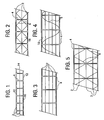
- the multiwall sheets have greater than or equal to 3 layers (e.g., main layers) (e.g., see Figures 1 - 5 , walls 2), or, even more specifically, about 3 layers to about 10 layers, and, yet more specifically, about 4 layers to about 8 layers.
- the layers can each have a thickness of less than or equal to about 1 mm, or, more specifically, about 0.2 mm to about 0.8 mm, or, even more specifically, about 0.3 mm to about 0.6 mm.
- the sheet has a sufficient number of transverse layers to attain the desired structural integrity.
- the dividers can have various geometries such as perpendicular (e.g., see Figures 1 and 3 ) a cross (e.g., X) geometry (e.g., see Figures 2 and 5 , X dividers 6), a sinusoidal geometry (e.g., see Figure 4 , sinusoidal divider 8), as well as any other geometry and combinations comprising at least one of these geometries.
- the transverse layers can each have a thickness of less than or equal to about 1 mm, or, more specifically, about 0.2 mm to about 0.8 mm, or, even more specifically, about 0.25 mm to about 0.6 mm.
- a method for producing a multiwall sheet comprises: forming at least three walls and a transverse layer therebetween and increasing visible light transmission through the multiwall sheet while attaining a direct solar transmission of less than or equal to about 68%.
- the method can comprise increasing the visible light transmission by greater than or equal to about 10%, or, more specifically, increasing the visible light transmission by greater than or equal to about 13%.
- the forming can comprising forming the walls and transverse layer, individually, to have a thickness of about less than or equal to about 1 mm, or, more specifically, about 0.2 mm to about 0.8 mm, or, even more specifically, about 0.25 mm to about 0.6 mm.
- the transverse layers can also have a geometry such as cross, sinusoidal, and combinations comprising at least one of these geometries.
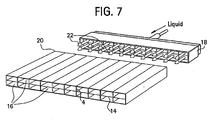
- a partial cross-sectional view of an exemplary multiwall has main layers 2 comprising a first outside layer (e.g., a top layer) 10 and a second outside layer (e.g., bottom layer) 12 that are connected by transverse layers (e.g., ribs) 4.
- the top layer 10 and the bottom layer 12, as well as inner layer(s) 14, are generally parallel with respect to each other.
- the transverse layer(s) 8 are generally disposed between, and normal to, the top layer 10 and the bottom layer 12.
- the multiwall sheet comprises multiple cells 16 that are defined by adjacent transverse layers 4 and layers 2, with each sheet 2 comprising a plurality of the cells 16. A portion or all of these cells 16 can be filled with a liquid.
- the liquid can be disposed into the sheets after the sheet has been positioned in a desired location.
- Introduction of the liquid to the cells 16 can be accomplished with manifold(s) and air release(s).
- the manifold 18 can be oriented in fluid communication with the cells 16 at one end 20 of the sheet, and an air release (not shown) can be located at the other end of the sheet. As the liquid is introduced to the sheet (illustrated by arrows 22) through the manifold 18, air escapes the opposite end of the sheet.
- the manifold can be removed and the sheet can be sealed on both ends to retain the liquid.
- the manifold can be retained and the liquid can be introduced and removed from the sheet as desired, e.g., depending upon the season, weather conditions, condition of the liquid (e.g., desire to filter and/or clean the liquid), need to repair and/or replace a particular sheet or portion thereof, and so forth.
- the liquid e.g., water
- the liquid can flow through channels between the walls, e.g., entering via one side and leaving the sheet via the other side, and/or even entering and leaving the sheet via the same side of the sheet (such as the bottom).
- the liquid is introduced to specific areas of the sheet while not disposed in others, depending upon the sheets orientation to the sun, and/or specific requirements of the various portions of the sheet.
- the liquid introduced to the sheet can be any liquid that has the desired transmission properties (e.g., transparent to visible light (for example, has a transmission of greater than or equal to 95%), and desirably, less transparent (or opaque) to direct solar light), and does not react with the layer material(s).
- Possible liquids include water (e.g., demineralized water, water having a neutral pH (e.g., pH of about 6.5 to about 7.5), as well as combinations comprising at least one of these properties), glycerin, polydimethylsiloxane oil, transparent gels, and so forth, as well as combinations comprising at least one of the foregoing.
- additive(s) can be mixed with the liquid, such as anti-freeze additives (e.g., to prevent freezing in the winter), antimicrobial agents, and so forth, as well as combinations comprising at least one of the foregoing.
- the amount of liquid employed in the sheet is dependent upon the desired properties, e.g., as noted above, some of the areas of the sheet can be filled while others can be free of liquid. To enhance the visible light transmission, desirably, all of the cells are filled with the liquid.
- the sheet comprises a polymeric layer material.
- exemplary polymeric layer materials comprise thermoplastics including polyalkylenes (e.g., polyethylene, polypropylene, polyalkylene terephthalates (such as polyethylene terephthalate, polybutylene terephthalate)), polycarbonates, acrylics, polyacetals, styrenes (e.g., impact-modified polystyrene, acrylonitrile-butadiene-styrene, styrene-acrylonitrile), poly(meth)acrylates (e.g., polybutyl acrylate, polymethyl methacrylate), polyetherimide, polyurethanes, polyphenylene sulfides, polyvinyl chlorides, polysulfones, polyetherketones, polyether etherketones, polyether ketone ketones, and so forth, as well as combinations comprising at least one of the foregoing.
- polyalkylenes e.g.,
- thermoplastic blends comprise acrylonitrile-butadiene-styrene/nylon, polycarbonate/acrylonitrile-butadiene-styrene, acrylonitrile butadiene styrene/polyvinyl chloride, polyphenylene ether/polystyrene, polyphenylene ether/nylon, polysulfone/acrylonitrile-butadiene-styrene, polycarbonate/thermoplastic urethane, polycarbonate/polyethylene terephthalate, polycarbonate/polybutylene terephthalate, thermoplastic elastomer alloys, nylon/elastomers, polyester/elastomers, polyethylene terephthalate/polybutylene terephthalate, acetal/elastomer, styrene-maleic anhydride/acrylonitrile-butadiene-styrene, polyether etherketone/polyethersulfone, poly
- Additives can be employed to modify the performance, properties, or processing of the polymeric material.
- exemplary additives comprise antioxidants, such as, organophosphites, for example, tris(nonyl-phenyl)phosphite, tris(2,4-di-t-butylphenyl)phosphite, bis(2,4-di-t-butylphenyl)pentaerythritol diphosphite or distearyl pentaerythritol diphosphite, alkylated monophenols, polyphenols and alkylated reaction products of polyphenols with dienes, such as, for example, tetrakis[methylene(3,5-di-tert-butyl-4-hydroxyhydrocinnamate)] methane, 3,5-di-tert-butyl-4-hydroxyhydrocinnamate octadecyl, 2,4-di-tert-butylphenyl phos
- the specific polymer chosen will be capable of providing sufficient light transmission.
- the polymeric material can be chosen to exhibit sufficient impact resistance such that the sheet is capable of resisting breakage (e.g., cracking, fracture, and the like) caused by impact (e.g., hail, birds, stones and so forth). Therefore, polymers exhibiting an impact strength greater than or equal to about 7.5 foot-pounds per square inch, ft-lb/in 2 (4.00 joules per square centimeter, J/cm 2 ), or more specifically, greater than about 10.0 ft-lb/in 2 (5.34 J/cm 2 ) or even more specifically, greater than or equal to about 12.5 ft-lb/in 2 (6.67 J/cm 2 ) are desirable, as tested per ASTM D-256-93 (Izod Notched Impact Test).
- breakage e.g., cracking, fracture, and the like
- impact e.g., hail, birds, stones and so forth. Therefore, polymers exhibiting an impact strength greater than or equal to about 7.5 foot-pounds per square inch, f
- the polymer has ample stiffness to allow for the production of a sheet that can be employed in applications wherein the sheet is generally supported and/or clamped on two or more sides of the sheet (e.g., clamped on all four sides), such as in greenhouse applications comprising tubular frame construction.
- a molded test bar of the polymer(s) can comprise a Young's modulus (e.g., modulus of elasticity) that is greater than or equal to about 200,000 pounds per square inch, psi (14,061 kilograms per centimeter squared (kg/cm 2 )), or more specifically, greater than or equal to about 250,000 psi (17,577 kg/cm 2 ), or even more specifically, greater than or equal to about 300,000 psi (21,092 kg/cm 2 ).
- a Young's modulus e.g., modulus of elasticity
- the light transmission of various multiwall sheets with and without liquid were tested.
- the sheets all had an overall thickness of 16 millimeters (mm).
- the sheets that were tested had 2 layers (Sample 1), 3 layers as is illustrated in Figure Figure 1 (Sample 2), 3 layers with X dividers as is illustrated in Figure 2 (Sample 3), and 6 layers with sinusoidal dividers as is illustrated in Figure 4 (Sample 4).
- the distance between the transverse layers was 20 mm for Samples 2 and 4, and 16 mm for Samples 1 and 3.
- the light transmission for the visible light was tested in accordance with ISO 9050, while the light transmission for the solar light (i.e., direct solar light) was also tested in accordance with ISO 9050.
- the light transmission was determined using a Transvision measuring system in accordance with the Transvision measuring system Manual and description, January 2004 (commercially available from A & F Innovations B.V., Netherlands). For the filled tests, all of the cells were filled with demineralized water. Table Sample Light Transmission Unfilled Light Transmission Filled Direct Solar Transmission Unfilled Direct Solar Transmission Filled 1 77% 85% 73% 68% 2 75% 88% 70% 67% 3 67% 87% 63% 66% 4 56% 85% 53% 66%
- the filled samples had increased visible light transmission compared to the unfilled samples. It is also noted that, for the same thickness multiwall sheet (all samples had a thickness of 16 mm), the more layers, the greater the improvement of the filled samples. For example, Sample 2 (3 layers), had an unfilled light transmission of 75% with a filled transmission of 88% (i.e., an increase of 13%), while Sample 4 (6 layers), had an unfilled light transmission of 56% with a filled transmission of 86% (i.e., an increase of 30%).
- the refractive index (R.I.) of the liquid does not affect the transmission, but the number of sheets does affect the visible light transmission.
- polycarbonate multiwall sheets, Sample 5 with water (R.I. of 1.33) and Sample 6 with glycerin (R.I. of 1.47 (water free - specific gravity of 1.26)) were tested for light transmission. Similar light transmissions were obtained. The improvement in light transmission for Sample 5 was 12.8% and for Sample 6 was 12.9%, as measured in accordance with ASTM D1033 (year 1977) using a BYK-Gardner, haze-gard dual spectrophotometer (Illuminant C with perpendicular measurement).
- visible light transmissions e.g., transmissions at a wavelength of 400 nanometers (nm) to 700 nm
- a direct solar transmission e.g., transmissions at a wavelength of 300 nm to 2,500 nm
- a direct solar transmission e.g., transmissions at a wavelength of 300 nm to 2,500 nm
- the visible light transmission can be increased by greater than or equal to 10%, and even greater than or equal to 13%, and more, compared to a multiwall sheet that is identical except that the cells do not have liquid. Since a 1% increase in light transmission equates to a 1% increase in crop growth in a green house, every percent increase in visible light transmission is very significant.
- the present multiwall sheets inhibit the transfer of direct solar light (i.e., heat), these sheets enable enhanced control of the climate below the filled sheet (e.g., in the greenhouse interior). Furthermore, since the liquid can be used to store energy (generated by the heat), additional savings can be realized. For example, the liquid can be used in wintertime to heat the greenhouse.
- the present multilayer sheeting is specifically discussed with relation to naturally lit structures (e.g., greenhouses, sunrooms, and pool enclosures), the polymeric sheeting can be envisioned as being employed in any application wherein a polymer sheet is desired having a multiwall design.
- Exemplary applications comprise sunroofs, canopies, shelters, windows, lighting fixtures, sun-tanning beds, stadium roofing, and so forth.
- Ranges disclosed herein are inclusive and combinable (e.g., ranges of "up to about 25 wt%, or, more specifically, about 5 wt% to about 20 wt%", is inclusive of the endpoints and all inner values of the ranges of "about 5 wt% to about 25 wt%,” etc.).
- “Combination” is inclusive of blends, mixtures, derivatives, alloys, reaction products, and so forth.
- first,” “second,” and so forth, herein do not denote any order, quantity, or importance, but rather are used to distinguish one element from another, and the terms “a” and “an” herein do not denote a limitation of quantity, but rather denote the presence of at least one of the referenced item.
Landscapes
- Life Sciences & Earth Sciences (AREA)
- Engineering & Computer Science (AREA)
- Environmental Sciences (AREA)
- Architecture (AREA)
- Civil Engineering (AREA)
- Structural Engineering (AREA)
- Chemical & Material Sciences (AREA)
- Materials Engineering (AREA)
- Soil Sciences (AREA)
- Laminated Bodies (AREA)
Claims (15)
- Mehrwandige Platte, die Folgendes aufweist:drei oder mehr sich einander nicht kreuzende Polymerwände (2);eine Querschicht (4), wobei die Querschicht (4) die Wände (2) kreuzt, um Zellen (16) zu bilden, dadurch gekennzeichnet, dass in den Zellen (16) eine Flüssigkeit angeordnet ist;wobei die mehrwandige Platte eine erste Transmission für sichtbares Licht und eine erste Direktsolartransmission aufweist, wobei die erste Transmission für sichtbares Licht größer als die Transmission für sichtbares Licht derselben Platte ist, wenn sie keine Flüssigkeit aufweist; undwobei die erste Direktsolartransmission, bestimmt gemäß ISO 9050, ungefähr 63% bis ungefähr 70 % beträgt.
- Die mehrwandige Platte gemäß Anspruch 1, wobei die erste Transmission für sichtbares Licht bei einer Wellenlänge von ungefähr 400 nm bis ungefähr 700 nm, gemessen gemäß ISO 9050, größer oder gleich 85% ist.
- Die mehrwandige Platte gemäß irgendeinem der Ansprüche 1 bis 2, wobei die erste Transmission für sichtbares Licht größer oder gleich 86% ist.
- Die mehrwandige Platte gemäß irgendeinem der Ansprüche 1 bis 3, wobei die erste Direktsolartransmission ungefähr 66% bis ungefähr 68% beträgt.
- Die mehrwandige Platte gemäß irgendeinem der Ansprüche 1 bis 4, wobei die Flüssigkeit aus der Gruppe ausgewählt ist, die aus Folgendem besteht: Wasser, Glycerin, Polydimethylsiloxanöl, und Kombinationen, die zumindest eines der Vorgenannten aufweisen.
- Die mehrwandige Platte gemäß irgendeinem der Ansprüche 1 bis 5, wobei die Flüssigkeit ein entmineralisiertes Wasser ist.
- Die mehrwandige Platte gemäß irgendeinem der Ansprüche 1 bis 6, wobei die Polymerwände (2) ein Polymer aufweisen, das aus der Gruppe gewählt ist, die aus Folgendem besteht: Polyalkylene, Polycarbonate, Acryle, Polyacetale, Styrene, Poly(meth)acrylate, Polyetherimide, Polyurethane, Polyphenylensulfide, Polyvinylchloride, Polysulfone, Polyetherketone, Polyether-Etherketone, Polyether-Ketonketone, und Kombinationen, die zumindest eines der Vorgenannten aufweisen.
- Die mehrwandige Platte gemäß irgendeinem der Ansprüche 1 bis 7, wobei das Polymer aus der Gruppe gewählt ist, die aus Folgendem besteht: Acrylonitril-Butadien-Styren/Nylon, Polycarbonat/Acrylonitril-Butadien-Styren, Acrylonitril-Butadien-Styren/Polyvinylchlorid, Polyphenylenether/Polystyren, Polyphenylenether/Nylon, Polysulfon/Acrylonitril-Butadien-Styren, Polycarbonat/thermoplastische Urethane, Polycarbonat/Polyethylen-Terephthalat, Polycarbonat/Polybutylen-Terephthalat, thermoplastische Elastomergemische, Nylon/Elastomere, Polyester/Elastomere, Polyethylen-Terephthalat/Polybutylen-Terephthalat, Acetal/Elastomere, Styren-Malein-Anhydrid/Acrylonitril-Butadien-Styren, Polyether, und Kombinationen besteht, die zumindest eines der Vorgenannten aufweisen.
- Die mehrwandige Platte gemäß irgendeinem der Ansprüche 1 bis 8, aufweisend eine Gesamtdicke von weniger als oder gleich 55 mm.
- Die mehrwandige Platte gemäß irgendeinem der Ansprüche 1 bis 9, wobei die Querschicht (4) eine Geometrie aufweist, die aus der Gruppe gewählt ist, die aus Folgendem besteht: eine Kreuzgeometrie, eine sinusförmige Geometrie, und Kombinationen, die zumindest eines der Vorgenannten aufweisen.
- Die mehrwandige Platte gemäß irgendeinem der Ansprüche 1 bis 6, wobei die Polymerwände (2) ein Polymer aufweisen, das aus der Gruppe gewählt ist, die aus Folgendem besteht: Polycarbonate, Poly(Methylmethacrylate), Polyalkene, Polyetherimide, Styrene, und Kombinationen, die zumindest eines der Vorgenannten aufweisen.
- Die mehrwandige Platte gemäß Anspruch 2, wobei die Flüssigkeit in einem vorgewählten Teil der Zellen (16) angeordnet ist.
- Eine Struktur für natürliche Beleuchtung, die Folgendes aufweist:eine Gebäudestruktur; undein Dach, das die mehrwandige Platte gemäß irgendeinem der Ansprüche 1 bis 12 aufweist.
- Die Struktur gemäß Anspruch 13, wobei die Struktur aus der Gruppe ausgewählt ist, die aus Folgendem besteht: Gewächshaus, Wintergarten und Poolumhausung.
- Ein Verfahren zur Herstellung einer mehrwandigen Platte, das Folgendes aufweist:Bilden von drei oder mehr sich einander nicht kreuzenden Polymerwänden (2) und einer Querschicht (4) zwischen diesen, wobei die Querschicht (4) die Wände (2) kreuzt, um Zellen (16) zu bilden; dadurch gekennzeichnet, dass das Verfahren ferner ein Anordnen von Flüssigkeit in den Zellen (16) aufweist, um die Transmission für sichtbares Licht durch die mehrwandige Platte zu erhöhen;wobei die mehrwandige Platte eine Direktsolartransmission, bestimmt gemäß ISO 9050, von ungefähr 63% bis ungefähr 70% aufweist.
Applications Claiming Priority (2)
| Application Number | Priority Date | Filing Date | Title |
|---|---|---|---|
| US11/558,057 US7614186B2 (en) | 2006-11-09 | 2006-11-09 | Multiwall polymer sheet with cells having liquid affecting solar and light transmission |
| PCT/US2007/084679 WO2009064293A1 (en) | 2006-11-09 | 2007-11-14 | Multiwall polymer sheet comprising liquid, and methods for making and articles using the same |
Publications (2)
| Publication Number | Publication Date |
|---|---|
| EP2207940A1 EP2207940A1 (de) | 2010-07-21 |
| EP2207940B1 true EP2207940B1 (de) | 2014-02-12 |
Family
ID=39367833
Family Applications (1)
| Application Number | Title | Priority Date | Filing Date |
|---|---|---|---|
| EP07864392.1A Not-in-force EP2207940B1 (de) | 2006-11-09 | 2007-11-14 | Flüssigkeit enthaltende mehrwandige polymerflächengebilde und herstellungsverfahren |
Country Status (5)
| Country | Link |
|---|---|
| US (1) | US7614186B2 (de) |
| EP (1) | EP2207940B1 (de) |
| CN (1) | CN101868582A (de) |
| TW (1) | TW200923188A (de) |
| WO (1) | WO2009064293A1 (de) |
Families Citing this family (10)
| Publication number | Priority date | Publication date | Assignee | Title |
|---|---|---|---|---|
| US20090320401A1 (en) * | 2008-06-26 | 2009-12-31 | Yen-Hsiang Chen | Double-Walled Panel For Building |
| GB2464331A (en) * | 2008-07-03 | 2010-04-21 | David John Anderson | Glazing |
| US8889248B2 (en) * | 2008-10-31 | 2014-11-18 | Sabic Global Technologies B.V. | Multiwall sheet, an article, a method of making a multiwall sheet |
| US20110271952A1 (en) * | 2010-05-05 | 2011-11-10 | Yau Lee Innovative Technology Limited | System for reclaiming solar energy in buildings |
| KR101121089B1 (ko) | 2011-01-25 | 2012-03-16 | 주식회사 성신에이엘에스 | 투광 복층 패널 |
| US20140123578A1 (en) * | 2011-03-01 | 2014-05-08 | President And Fellows Of Harvard College | Thermal management of transparent media |
| CN105210722A (zh) * | 2014-06-06 | 2016-01-06 | 常州市禾香塑业有限公司 | 一种便于通风的大棚塑料薄膜 |
| US10584490B2 (en) * | 2016-05-12 | 2020-03-10 | Rajeev Moudgil | Light transmitting plastic panel providing variable daylight |
| WO2018122733A1 (en) * | 2016-12-30 | 2018-07-05 | Sabic Global Technologies B.V. | Multiwall sheet and methods of using the same |
| USD945651S1 (en) * | 2020-02-17 | 2022-03-08 | Dae Han Steel Co., Ltd | Roofing panel |
Family Cites Families (26)
| Publication number | Priority date | Publication date | Assignee | Title |
|---|---|---|---|---|
| DE1006619B (de) | 1954-05-25 | 1957-04-18 | Union Carbide & Carbon Corp | Verfahren zur Herstellung modifizierter Polysiloxane |
| FR1485237A (fr) * | 1965-07-06 | 1967-06-16 | Roehm & Haas Gmbh | Plaque de recouvrement ou plaque murale transparente en matière thermoplastique et outil d'injection pour leur fabrication |
| GB1227417A (de) | 1967-04-06 | 1971-04-07 | ||
| US3981294A (en) * | 1973-11-16 | 1976-09-21 | The Boeing Company | All glass composite building panels |
| US4053210A (en) * | 1974-01-03 | 1977-10-11 | Michaelis Maximilian Gustav Al | Translucent building blocks |
| US3953110A (en) * | 1974-05-20 | 1976-04-27 | Day Charoudi | Transparent thermal insulating system |
| IL47274A (en) * | 1974-05-22 | 1978-07-31 | Commissariat Energie Atomique | Method and installation for the air-conditioning of greenhouses and frames |
| US4147002A (en) | 1977-02-14 | 1979-04-03 | H. H. Robertson Company | Light valve system and greenhouse utilizing the same |
| US4148296A (en) | 1977-11-28 | 1979-04-10 | Philip Parlato | Solar heating apparatus and mounting therefor |
| US4380994A (en) * | 1979-06-28 | 1983-04-26 | Seemann Robert A | All season window |
| US4288953A (en) * | 1980-05-15 | 1981-09-15 | Carl Whiteford | Thermal and optical multi-mode window |
| NO152427C (no) | 1982-11-04 | 1985-09-25 | Vefi As | Kanalplate med endelukking |
| US4527544A (en) * | 1983-08-08 | 1985-07-09 | Kimberly Hills, Ltd. | High insulating solar block structures |
| US4521077A (en) | 1983-08-16 | 1985-06-04 | The United States Of America As Represented By The Administrator Of The National Aeronautics & Space Administration | Light transmitting window assembly |
| AT381537B (de) * | 1984-01-30 | 1986-10-27 | Gen Electric Plastics Structur | Hohlkammerplatte aus lichtdurchlaessigem kunststoff |
| US4736563A (en) * | 1986-12-30 | 1988-04-12 | Bilhorn J David | Greenhouse clip |
| GB2239666A (en) | 1990-01-06 | 1991-07-10 | William Bell Gosney | Control of thermal or radiation transmission characteristics |
| US5580620A (en) * | 1994-09-02 | 1996-12-03 | 21St Century Ltd. | Multiple void layer synthetic resin panels |
| US5787652A (en) | 1996-08-20 | 1998-08-04 | Tai; Liang-Ching | Window insulating assembly for vehicles |
| US6179948B1 (en) * | 1998-01-13 | 2001-01-30 | 3M Innovative Properties Company | Optical film and process for manufacture thereof |
| FR2782810B1 (fr) | 1998-08-31 | 2003-05-30 | Armines Ass Pour La Rech Et Le | Vitrage a pouvoir absorbant variable |
| GB0018396D0 (en) * | 2000-07-27 | 2000-09-13 | Ultraframe Uk Ltd | Extruded platics multi-wall panel for roofing and/or glazing |
| US6718703B2 (en) | 2000-10-03 | 2004-04-13 | Lukley Holdings Pty Ltd. | Roofing tile assembly |
| EP1334151A1 (de) * | 2000-11-14 | 2003-08-13 | Solutia Inc. | Infrarotabsorbierende polyvinylbutyral-zusammensetzung, folien daraus und diese zusammensetzung enthaltendes laminat |
| US6931796B2 (en) * | 2003-02-13 | 2005-08-23 | General Electric | Extruded transparent/translucent sheet for roof structures |
| GB2400383B (en) * | 2003-04-09 | 2006-10-04 | Kingspan Res & Dev Ltd | A panel |
-
2006
- 2006-11-09 US US11/558,057 patent/US7614186B2/en active Active
-
2007
- 2007-11-14 EP EP07864392.1A patent/EP2207940B1/de not_active Not-in-force
- 2007-11-14 WO PCT/US2007/084679 patent/WO2009064293A1/en not_active Ceased
- 2007-11-14 CN CN200780101554A patent/CN101868582A/zh active Pending
- 2007-11-16 TW TW096143486A patent/TW200923188A/zh unknown
Also Published As
| Publication number | Publication date |
|---|---|
| TW200923188A (en) | 2009-06-01 |
| US7614186B2 (en) | 2009-11-10 |
| US20080110108A1 (en) | 2008-05-15 |
| CN101868582A (zh) | 2010-10-20 |
| WO2009064293A1 (en) | 2009-05-22 |
| EP2207940A1 (de) | 2010-07-21 |
Similar Documents
| Publication | Publication Date | Title |
|---|---|---|
| EP2207940A1 (de) | Flüssigkeit enthaltende mehrwandige polymerflächengebilde und herstellungsverfahren sowie diese verwendende artikel | |
| US20050048231A1 (en) | Glazing panels | |
| EP2748384A1 (de) | Mehrwandige folie sowie verfahren zu ihrer herstellung und verwendung | |
| CN104863304A (zh) | 集成房屋构件模块及构件材料 | |
| EP2122079B1 (de) | Mehrwandige polymerplatte | |
| GB2061354A (en) | Double-walled cellular plate | |
| EP2764175B1 (de) | Mehrwandige hohlkammerplatten mit einer endkappe und methode zur herstellung | |
| CN209949994U (zh) | 双层保温膜日光温棚 | |
| US20080038519A1 (en) | Polymer Sheeting | |
| DE19736768A1 (de) | Lichtdurchlässiges Bauelement | |
| DE102008027309A1 (de) | Solarkollektor | |
| KR101941849B1 (ko) | 폴리카보네이트 온실용 멀티 프레임과 다중 공기층을 갖는 온실 구조 | |
| WO2009041973A1 (en) | Polymer sheeting | |
| US8043688B2 (en) | Multiwall sheet, an article, a method of making a multiwall sheet | |
| EP3266950B1 (de) | Profilbauglasbahn mit wärmedämmenden eigenschaften, diese enthaltende profilbauglasanordnung und verwendung eines wärmedämmenden materials | |
| US20250065603A1 (en) | Multimaterial sheet | |
| AT407974B (de) | Transparente wärmedämmung mit wabenlamellen | |
| US20180355613A1 (en) | Lightweight multiwall sheet with high stiffness and method of making it | |
| DE3433202A1 (de) | Transparente waermedaemmplatte | |
| CN2356477Y (zh) | 组合式双膜太阳能温室型材 |
Legal Events
| Date | Code | Title | Description |
|---|---|---|---|
| PUAI | Public reference made under article 153(3) epc to a published international application that has entered the european phase |
Free format text: ORIGINAL CODE: 0009012 |
|
| 17P | Request for examination filed |
Effective date: 20100416 |
|
| AK | Designated contracting states |
Kind code of ref document: A1 Designated state(s): AT BE BG CH CY CZ DE DK EE ES FI FR GB GR HU IE IS IT LI LT LU LV MC MT NL PL PT RO SE SI SK TR |
|
| AX | Request for extension of the european patent |
Extension state: AL BA HR MK RS |
|
| DAX | Request for extension of the european patent (deleted) | ||
| 17Q | First examination report despatched |
Effective date: 20111209 |
|
| GRAP | Despatch of communication of intention to grant a patent |
Free format text: ORIGINAL CODE: EPIDOSNIGR1 |
|
| INTG | Intention to grant announced |
Effective date: 20130826 |
|
| GRAS | Grant fee paid |
Free format text: ORIGINAL CODE: EPIDOSNIGR3 |
|
| GRAA | (expected) grant |
Free format text: ORIGINAL CODE: 0009210 |
|
| AK | Designated contracting states |
Kind code of ref document: B1 Designated state(s): AT BE BG CH CY CZ DE DK EE ES FI FR GB GR HU IE IS IT LI LT LU LV MC MT NL PL PT RO SE SI SK TR |
|
| REG | Reference to a national code |
Ref country code: GB Ref legal event code: FG4D |
|
| REG | Reference to a national code |
Ref country code: CH Ref legal event code: EP |
|
| REG | Reference to a national code |
Ref country code: AT Ref legal event code: REF Ref document number: 652246 Country of ref document: AT Kind code of ref document: T Effective date: 20140215 |
|
| REG | Reference to a national code |
Ref country code: DE Ref legal event code: R096 Ref document number: 602007035110 Country of ref document: DE Effective date: 20140320 |
|
| REG | Reference to a national code |
Ref country code: IE Ref legal event code: FG4D |
|
| REG | Reference to a national code |
Ref country code: NL Ref legal event code: VDEP Effective date: 20140212 |
|
| REG | Reference to a national code |
Ref country code: AT Ref legal event code: MK05 Ref document number: 652246 Country of ref document: AT Kind code of ref document: T Effective date: 20140212 |
|
| REG | Reference to a national code |
Ref country code: LT Ref legal event code: MG4D |
|
| PG25 | Lapsed in a contracting state [announced via postgrant information from national office to epo] |
Ref country code: IS Free format text: LAPSE BECAUSE OF FAILURE TO SUBMIT A TRANSLATION OF THE DESCRIPTION OR TO PAY THE FEE WITHIN THE PRESCRIBED TIME-LIMIT Effective date: 20140612 Ref country code: LT Free format text: LAPSE BECAUSE OF FAILURE TO SUBMIT A TRANSLATION OF THE DESCRIPTION OR TO PAY THE FEE WITHIN THE PRESCRIBED TIME-LIMIT Effective date: 20140212 |
|
| PG25 | Lapsed in a contracting state [announced via postgrant information from national office to epo] |
Ref country code: CY Free format text: LAPSE BECAUSE OF FAILURE TO SUBMIT A TRANSLATION OF THE DESCRIPTION OR TO PAY THE FEE WITHIN THE PRESCRIBED TIME-LIMIT Effective date: 20140212 Ref country code: PT Free format text: LAPSE BECAUSE OF FAILURE TO SUBMIT A TRANSLATION OF THE DESCRIPTION OR TO PAY THE FEE WITHIN THE PRESCRIBED TIME-LIMIT Effective date: 20140612 Ref country code: FI Free format text: LAPSE BECAUSE OF FAILURE TO SUBMIT A TRANSLATION OF THE DESCRIPTION OR TO PAY THE FEE WITHIN THE PRESCRIBED TIME-LIMIT Effective date: 20140212 Ref country code: AT Free format text: LAPSE BECAUSE OF FAILURE TO SUBMIT A TRANSLATION OF THE DESCRIPTION OR TO PAY THE FEE WITHIN THE PRESCRIBED TIME-LIMIT Effective date: 20140212 Ref country code: NL Free format text: LAPSE BECAUSE OF FAILURE TO SUBMIT A TRANSLATION OF THE DESCRIPTION OR TO PAY THE FEE WITHIN THE PRESCRIBED TIME-LIMIT Effective date: 20140212 Ref country code: SE Free format text: LAPSE BECAUSE OF FAILURE TO SUBMIT A TRANSLATION OF THE DESCRIPTION OR TO PAY THE FEE WITHIN THE PRESCRIBED TIME-LIMIT Effective date: 20140212 Ref country code: ES Free format text: LAPSE BECAUSE OF FAILURE TO SUBMIT A TRANSLATION OF THE DESCRIPTION OR TO PAY THE FEE WITHIN THE PRESCRIBED TIME-LIMIT Effective date: 20140212 |
|
| PG25 | Lapsed in a contracting state [announced via postgrant information from national office to epo] |
Ref country code: LV Free format text: LAPSE BECAUSE OF FAILURE TO SUBMIT A TRANSLATION OF THE DESCRIPTION OR TO PAY THE FEE WITHIN THE PRESCRIBED TIME-LIMIT Effective date: 20140212 Ref country code: BE Free format text: LAPSE BECAUSE OF FAILURE TO SUBMIT A TRANSLATION OF THE DESCRIPTION OR TO PAY THE FEE WITHIN THE PRESCRIBED TIME-LIMIT Effective date: 20140212 |
|
| PG25 | Lapsed in a contracting state [announced via postgrant information from national office to epo] |
Ref country code: DK Free format text: LAPSE BECAUSE OF FAILURE TO SUBMIT A TRANSLATION OF THE DESCRIPTION OR TO PAY THE FEE WITHIN THE PRESCRIBED TIME-LIMIT Effective date: 20140212 Ref country code: RO Free format text: LAPSE BECAUSE OF FAILURE TO SUBMIT A TRANSLATION OF THE DESCRIPTION OR TO PAY THE FEE WITHIN THE PRESCRIBED TIME-LIMIT Effective date: 20140212 Ref country code: EE Free format text: LAPSE BECAUSE OF FAILURE TO SUBMIT A TRANSLATION OF THE DESCRIPTION OR TO PAY THE FEE WITHIN THE PRESCRIBED TIME-LIMIT Effective date: 20140212 Ref country code: CZ Free format text: LAPSE BECAUSE OF FAILURE TO SUBMIT A TRANSLATION OF THE DESCRIPTION OR TO PAY THE FEE WITHIN THE PRESCRIBED TIME-LIMIT Effective date: 20140212 |
|
| REG | Reference to a national code |
Ref country code: DE Ref legal event code: R097 Ref document number: 602007035110 Country of ref document: DE |
|
| PG25 | Lapsed in a contracting state [announced via postgrant information from national office to epo] |
Ref country code: PL Free format text: LAPSE BECAUSE OF FAILURE TO SUBMIT A TRANSLATION OF THE DESCRIPTION OR TO PAY THE FEE WITHIN THE PRESCRIBED TIME-LIMIT Effective date: 20140212 Ref country code: SK Free format text: LAPSE BECAUSE OF FAILURE TO SUBMIT A TRANSLATION OF THE DESCRIPTION OR TO PAY THE FEE WITHIN THE PRESCRIBED TIME-LIMIT Effective date: 20140212 |
|
| PLBE | No opposition filed within time limit |
Free format text: ORIGINAL CODE: 0009261 |
|
| STAA | Information on the status of an ep patent application or granted ep patent |
Free format text: STATUS: NO OPPOSITION FILED WITHIN TIME LIMIT |
|
| 26N | No opposition filed |
Effective date: 20141113 |
|
| REG | Reference to a national code |
Ref country code: DE Ref legal event code: R097 Ref document number: 602007035110 Country of ref document: DE Effective date: 20141113 |
|
| PG25 | Lapsed in a contracting state [announced via postgrant information from national office to epo] |
Ref country code: IT Free format text: LAPSE BECAUSE OF FAILURE TO SUBMIT A TRANSLATION OF THE DESCRIPTION OR TO PAY THE FEE WITHIN THE PRESCRIBED TIME-LIMIT Effective date: 20140212 |
|
| PG25 | Lapsed in a contracting state [announced via postgrant information from national office to epo] |
Ref country code: SI Free format text: LAPSE BECAUSE OF FAILURE TO SUBMIT A TRANSLATION OF THE DESCRIPTION OR TO PAY THE FEE WITHIN THE PRESCRIBED TIME-LIMIT Effective date: 20140212 |
|
| PG25 | Lapsed in a contracting state [announced via postgrant information from national office to epo] |
Ref country code: LU Free format text: LAPSE BECAUSE OF FAILURE TO SUBMIT A TRANSLATION OF THE DESCRIPTION OR TO PAY THE FEE WITHIN THE PRESCRIBED TIME-LIMIT Effective date: 20141114 Ref country code: MC Free format text: LAPSE BECAUSE OF FAILURE TO SUBMIT A TRANSLATION OF THE DESCRIPTION OR TO PAY THE FEE WITHIN THE PRESCRIBED TIME-LIMIT Effective date: 20140212 |
|
| REG | Reference to a national code |
Ref country code: CH Ref legal event code: PL |
|
| PG25 | Lapsed in a contracting state [announced via postgrant information from national office to epo] |
Ref country code: LI Free format text: LAPSE BECAUSE OF NON-PAYMENT OF DUE FEES Effective date: 20141130 Ref country code: CH Free format text: LAPSE BECAUSE OF NON-PAYMENT OF DUE FEES Effective date: 20141130 |
|
| REG | Reference to a national code |
Ref country code: IE Ref legal event code: MM4A |
|
| REG | Reference to a national code |
Ref country code: FR Ref legal event code: PLFP Year of fee payment: 9 |
|
| PG25 | Lapsed in a contracting state [announced via postgrant information from national office to epo] |
Ref country code: IE Free format text: LAPSE BECAUSE OF NON-PAYMENT OF DUE FEES Effective date: 20141114 |
|
| REG | Reference to a national code |
Ref country code: DE Ref legal event code: R081 Ref document number: 602007035110 Country of ref document: DE Owner name: SABIC GLOBAL TECHNOLOGIES B.V., NL Free format text: FORMER OWNER: SABIC INNOVATIVE PLASTICS IP B.V., BERGEN OP ZOOM, NL |
|
| REG | Reference to a national code |
Ref country code: FR Ref legal event code: CD Owner name: SABIC INNOVATIVE PLASTICS IP B.V., NL Effective date: 20160224 |
|
| PG25 | Lapsed in a contracting state [announced via postgrant information from national office to epo] |
Ref country code: BG Free format text: LAPSE BECAUSE OF FAILURE TO SUBMIT A TRANSLATION OF THE DESCRIPTION OR TO PAY THE FEE WITHIN THE PRESCRIBED TIME-LIMIT Effective date: 20140212 |
|
| PG25 | Lapsed in a contracting state [announced via postgrant information from national office to epo] |
Ref country code: GR Free format text: LAPSE BECAUSE OF FAILURE TO SUBMIT A TRANSLATION OF THE DESCRIPTION OR TO PAY THE FEE WITHIN THE PRESCRIBED TIME-LIMIT Effective date: 20140513 |
|
| PG25 | Lapsed in a contracting state [announced via postgrant information from national office to epo] |
Ref country code: MT Free format text: LAPSE BECAUSE OF FAILURE TO SUBMIT A TRANSLATION OF THE DESCRIPTION OR TO PAY THE FEE WITHIN THE PRESCRIBED TIME-LIMIT Effective date: 20140212 Ref country code: HU Free format text: LAPSE BECAUSE OF FAILURE TO SUBMIT A TRANSLATION OF THE DESCRIPTION OR TO PAY THE FEE WITHIN THE PRESCRIBED TIME-LIMIT; INVALID AB INITIO Effective date: 20071114 Ref country code: TR Free format text: LAPSE BECAUSE OF FAILURE TO SUBMIT A TRANSLATION OF THE DESCRIPTION OR TO PAY THE FEE WITHIN THE PRESCRIBED TIME-LIMIT Effective date: 20140212 |
|
| REG | Reference to a national code |
Ref country code: FR Ref legal event code: PLFP Year of fee payment: 10 |
|
| PGFP | Annual fee paid to national office [announced via postgrant information from national office to epo] |
Ref country code: GB Payment date: 20161109 Year of fee payment: 10 |
|
| REG | Reference to a national code |
Ref country code: FR Ref legal event code: PLFP Year of fee payment: 11 |
|
| GBPC | Gb: european patent ceased through non-payment of renewal fee |
Effective date: 20171114 |
|
| REG | Reference to a national code |
Ref country code: FR Ref legal event code: PLFP Year of fee payment: 12 |
|
| PG25 | Lapsed in a contracting state [announced via postgrant information from national office to epo] |
Ref country code: GB Free format text: LAPSE BECAUSE OF NON-PAYMENT OF DUE FEES Effective date: 20171114 |
|
| PGFP | Annual fee paid to national office [announced via postgrant information from national office to epo] |
Ref country code: DE Payment date: 20181030 Year of fee payment: 12 |
|
| PGFP | Annual fee paid to national office [announced via postgrant information from national office to epo] |
Ref country code: FR Payment date: 20181011 Year of fee payment: 12 |
|
| REG | Reference to a national code |
Ref country code: DE Ref legal event code: R119 Ref document number: 602007035110 Country of ref document: DE |
|
| PG25 | Lapsed in a contracting state [announced via postgrant information from national office to epo] |
Ref country code: FR Free format text: LAPSE BECAUSE OF NON-PAYMENT OF DUE FEES Effective date: 20191130 Ref country code: DE Free format text: LAPSE BECAUSE OF NON-PAYMENT OF DUE FEES Effective date: 20200603 |