EP2206430A1 - Antifungal composition - Google Patents
Antifungal composition Download PDFInfo
- Publication number
- EP2206430A1 EP2206430A1 EP08842266A EP08842266A EP2206430A1 EP 2206430 A1 EP2206430 A1 EP 2206430A1 EP 08842266 A EP08842266 A EP 08842266A EP 08842266 A EP08842266 A EP 08842266A EP 2206430 A1 EP2206430 A1 EP 2206430A1
- Authority
- EP
- European Patent Office
- Prior art keywords
- carbon atoms
- group
- component
- alkyl group
- antifungal composition
- Prior art date
- Legal status (The legal status is an assumption and is not a legal conclusion. Google has not performed a legal analysis and makes no representation as to the accuracy of the status listed.)
- Withdrawn
Links
- 239000012871 anti-fungal composition Substances 0.000 title claims abstract description 27
- 150000001412 amines Chemical class 0.000 claims abstract description 10
- 150000001875 compounds Chemical class 0.000 claims abstract description 10
- 150000003242 quaternary ammonium salts Chemical class 0.000 claims abstract description 9
- 239000003352 sequestering agent Substances 0.000 claims abstract description 4
- 125000004432 carbon atom Chemical group C* 0.000 claims description 76
- 125000000217 alkyl group Chemical group 0.000 claims description 37
- 125000002768 hydroxyalkyl group Chemical group 0.000 claims description 22
- -1 halide ion Chemical class 0.000 claims description 18
- 125000004435 hydrogen atom Chemical group [H]* 0.000 claims description 13
- 125000002947 alkylene group Chemical group 0.000 claims description 8
- 125000001797 benzyl group Chemical group [H]C1=C([H])C([H])=C(C([H])=C1[H])C([H])([H])* 0.000 claims description 8
- 150000002500 ions Chemical class 0.000 claims description 7
- 125000003342 alkenyl group Chemical group 0.000 claims description 6
- 150000008051 alkyl sulfates Chemical class 0.000 claims description 3
- 235000014113 dietary fatty acids Nutrition 0.000 claims description 3
- 239000000194 fatty acid Substances 0.000 claims description 3
- 229930195729 fatty acid Natural products 0.000 claims description 3
- 150000004665 fatty acids Chemical class 0.000 claims description 3
- KCXVZYZYPLLWCC-UHFFFAOYSA-N EDTA Chemical compound OC(=O)CN(CC(O)=O)CCN(CC(O)=O)CC(O)=O KCXVZYZYPLLWCC-UHFFFAOYSA-N 0.000 description 17
- FAPWRFPIFSIZLT-UHFFFAOYSA-M Sodium chloride Chemical compound [Na+].[Cl-] FAPWRFPIFSIZLT-UHFFFAOYSA-M 0.000 description 15
- 239000011780 sodium chloride Substances 0.000 description 15
- 230000000052 comparative effect Effects 0.000 description 14
- 239000004744 fabric Substances 0.000 description 13
- 239000002738 chelating agent Substances 0.000 description 11
- 230000000694 effects Effects 0.000 description 10
- 238000000034 method Methods 0.000 description 10
- 241000894006 Bacteria Species 0.000 description 9
- KRKNYBCHXYNGOX-UHFFFAOYSA-N citric acid Chemical compound OC(=O)CC(O)(C(O)=O)CC(O)=O KRKNYBCHXYNGOX-UHFFFAOYSA-N 0.000 description 9
- VEXZGXHMUGYJMC-UHFFFAOYSA-N Hydrochloric acid Chemical compound Cl VEXZGXHMUGYJMC-UHFFFAOYSA-N 0.000 description 8
- RUPBZQFQVRMKDG-UHFFFAOYSA-M Didecyldimethylammonium chloride Chemical compound [Cl-].CCCCCCCCCC[N+](C)(C)CCCCCCCCCC RUPBZQFQVRMKDG-UHFFFAOYSA-M 0.000 description 7
- 229910001424 calcium ion Inorganic materials 0.000 description 7
- 229960004670 didecyldimethylammonium chloride Drugs 0.000 description 7
- 230000035755 proliferation Effects 0.000 description 7
- 238000012360 testing method Methods 0.000 description 7
- LENZDBCJOHFCAS-UHFFFAOYSA-N tris Chemical compound OCC(N)(CO)CO LENZDBCJOHFCAS-UHFFFAOYSA-N 0.000 description 7
- BHPQYMZQTOCNFJ-UHFFFAOYSA-N Calcium cation Chemical compound [Ca+2] BHPQYMZQTOCNFJ-UHFFFAOYSA-N 0.000 description 6
- KWYUFKZDYYNOTN-UHFFFAOYSA-M Potassium hydroxide Chemical compound [OH-].[K+] KWYUFKZDYYNOTN-UHFFFAOYSA-M 0.000 description 6
- HEMHJVSKTPXQMS-UHFFFAOYSA-M Sodium hydroxide Chemical compound [OH-].[Na+] HEMHJVSKTPXQMS-UHFFFAOYSA-M 0.000 description 6
- 230000002538 fungal effect Effects 0.000 description 5
- 125000004029 hydroxymethyl group Chemical group [H]OC([H])([H])* 0.000 description 5
- 125000002496 methyl group Chemical group [H]C([H])([H])* 0.000 description 5
- 150000003839 salts Chemical group 0.000 description 5
- 239000000243 solution Substances 0.000 description 5
- DHMQDGOQFOQNFH-UHFFFAOYSA-N Glycine Chemical compound NCC(O)=O DHMQDGOQFOQNFH-UHFFFAOYSA-N 0.000 description 4
- 239000002253 acid Substances 0.000 description 4
- 230000000843 anti-fungal effect Effects 0.000 description 4
- 125000001495 ethyl group Chemical group [H]C([H])([H])C([H])([H])* 0.000 description 4
- 235000010482 polyoxyethylene sorbitan monooleate Nutrition 0.000 description 4
- 229920000053 polysorbate 80 Polymers 0.000 description 4
- XPVIQPQOGTVMSU-UHFFFAOYSA-N (4-acetamidophenyl)arsenic Chemical compound CC(=O)NC1=CC=C([As])C=C1 XPVIQPQOGTVMSU-UHFFFAOYSA-N 0.000 description 3
- 125000000954 2-hydroxyethyl group Chemical group [H]C([*])([H])C([H])([H])O[H] 0.000 description 3
- UXVMQQNJUSDDNG-UHFFFAOYSA-L Calcium chloride Chemical compound [Cl-].[Cl-].[Ca+2] UXVMQQNJUSDDNG-UHFFFAOYSA-L 0.000 description 3
- 239000007983 Tris buffer Substances 0.000 description 3
- 229920013640 amorphous poly alpha olefin Polymers 0.000 description 3
- 239000003242 anti bacterial agent Substances 0.000 description 3
- 239000001110 calcium chloride Substances 0.000 description 3
- 229910001628 calcium chloride Inorganic materials 0.000 description 3
- 210000004027 cell Anatomy 0.000 description 3
- 210000000170 cell membrane Anatomy 0.000 description 3
- 210000003855 cell nucleus Anatomy 0.000 description 3
- SYELZBGXAIXKHU-UHFFFAOYSA-N dodecyldimethylamine N-oxide Chemical compound CCCCCCCCCCCC[N+](C)(C)[O-] SYELZBGXAIXKHU-UHFFFAOYSA-N 0.000 description 3
- 125000000959 isobutyl group Chemical group [H]C([H])([H])C([H])(C([H])([H])[H])C([H])([H])* 0.000 description 3
- 125000001972 isopentyl group Chemical group [H]C([H])([H])C([H])(C([H])([H])[H])C([H])([H])C([H])([H])* 0.000 description 3
- 125000001449 isopropyl group Chemical group [H]C([H])([H])C([H])(*)C([H])([H])[H] 0.000 description 3
- 239000000203 mixture Substances 0.000 description 3
- 125000004108 n-butyl group Chemical group [H]C([H])([H])C([H])([H])C([H])([H])C([H])([H])* 0.000 description 3
- 125000000740 n-pentyl group Chemical group [H]C([H])([H])C([H])([H])C([H])([H])C([H])([H])C([H])([H])* 0.000 description 3
- 125000004123 n-propyl group Chemical group [H]C([H])([H])C([H])([H])C([H])([H])* 0.000 description 3
- 125000000999 tert-butyl group Chemical group [H]C([H])([H])C(*)(C([H])([H])[H])C([H])([H])[H] 0.000 description 3
- YIJOZSCZCHDKAT-UHFFFAOYSA-N 1-aminopentane-1,3,5-triol Chemical compound NC(O)CC(O)CCO YIJOZSCZCHDKAT-UHFFFAOYSA-N 0.000 description 2
- IOAOAKDONABGPZ-UHFFFAOYSA-N 2-amino-2-ethylpropane-1,3-diol Chemical compound CCC(N)(CO)CO IOAOAKDONABGPZ-UHFFFAOYSA-N 0.000 description 2
- 229940058020 2-amino-2-methyl-1-propanol Drugs 0.000 description 2
- UXFQFBNBSPQBJW-UHFFFAOYSA-N 2-amino-2-methylpropane-1,3-diol Chemical compound OCC(N)(C)CO UXFQFBNBSPQBJW-UHFFFAOYSA-N 0.000 description 2
- KJJPLEZQSCZCKE-UHFFFAOYSA-N 2-aminopropane-1,3-diol Chemical compound OCC(N)CO KJJPLEZQSCZCKE-UHFFFAOYSA-N 0.000 description 2
- 241000233866 Fungi Species 0.000 description 2
- NBIIXXVUZAFLBC-UHFFFAOYSA-N Phosphoric acid Chemical compound OP(O)(O)=O NBIIXXVUZAFLBC-UHFFFAOYSA-N 0.000 description 2
- 241000589516 Pseudomonas Species 0.000 description 2
- QAOWNCQODCNURD-UHFFFAOYSA-N Sulfuric acid Chemical compound OS(O)(=O)=O QAOWNCQODCNURD-UHFFFAOYSA-N 0.000 description 2
- 150000007513 acids Chemical class 0.000 description 2
- CBTVGIZVANVGBH-UHFFFAOYSA-N aminomethyl propanol Chemical compound CC(C)(N)CO CBTVGIZVANVGBH-UHFFFAOYSA-N 0.000 description 2
- 230000000844 anti-bacterial effect Effects 0.000 description 2
- 239000007864 aqueous solution Substances 0.000 description 2
- 239000000872 buffer Substances 0.000 description 2
- 229940079593 drug Drugs 0.000 description 2
- 239000003814 drug Substances 0.000 description 2
- 229960002449 glycine Drugs 0.000 description 2
- 235000013905 glycine and its sodium salt Nutrition 0.000 description 2
- 125000001570 methylene group Chemical group [H]C([H])([*:1])[*:2] 0.000 description 2
- 229910052757 nitrogen Inorganic materials 0.000 description 2
- 125000004433 nitrogen atom Chemical group N* 0.000 description 2
- 108090000623 proteins and genes Proteins 0.000 description 2
- 150000003856 quaternary ammonium compounds Chemical class 0.000 description 2
- 239000000523 sample Substances 0.000 description 2
- 230000035945 sensitivity Effects 0.000 description 2
- 239000000725 suspension Substances 0.000 description 2
- 230000000007 visual effect Effects 0.000 description 2
- ZORQXIQZAOLNGE-UHFFFAOYSA-N 1,1-difluorocyclohexane Chemical compound FC1(F)CCCCC1 ZORQXIQZAOLNGE-UHFFFAOYSA-N 0.000 description 1
- VZSRBBMJRBPUNF-UHFFFAOYSA-N 2-(2,3-dihydro-1H-inden-2-ylamino)-N-[3-oxo-3-(2,4,6,7-tetrahydrotriazolo[4,5-c]pyridin-5-yl)propyl]pyrimidine-5-carboxamide Chemical compound C1C(CC2=CC=CC=C12)NC1=NC=C(C=N1)C(=O)NCCC(N1CC2=C(CC1)NN=N2)=O VZSRBBMJRBPUNF-UHFFFAOYSA-N 0.000 description 1
- ZVJANWOVRRASPU-UHFFFAOYSA-N 2-(decylamino)-2-(hydroxymethyl)propane-1,3-diol Chemical compound CCCCCCCCCCNC(CO)(CO)CO ZVJANWOVRRASPU-UHFFFAOYSA-N 0.000 description 1
- PVGZLDDDSDAXPH-UHFFFAOYSA-N 2-(decylamino)propane-1,3-diol Chemical compound CCCCCCCCCCNC(CO)CO PVGZLDDDSDAXPH-UHFFFAOYSA-N 0.000 description 1
- PAMMITWIWFSAOP-UHFFFAOYSA-N 2-(ethylamino)-2-(hydroxymethyl)propane-1,3-diol Chemical compound CCNC(CO)(CO)CO PAMMITWIWFSAOP-UHFFFAOYSA-N 0.000 description 1
- GWMADSUQNXLNCF-UHFFFAOYSA-N 2-(ethylamino)propane-1,3-diol Chemical compound CCNC(CO)CO GWMADSUQNXLNCF-UHFFFAOYSA-N 0.000 description 1
- HZAXFHJVJLSVMW-UHFFFAOYSA-N 2-Aminoethan-1-ol Chemical compound NCCO HZAXFHJVJLSVMW-UHFFFAOYSA-N 0.000 description 1
- QOXOZONBQWIKDA-UHFFFAOYSA-N 3-hydroxypropyl Chemical group [CH2]CCO QOXOZONBQWIKDA-UHFFFAOYSA-N 0.000 description 1
- HACQKMWYOKGLET-UHFFFAOYSA-N 4-amino-4-(3-hydroxypropyl)heptane-1,7-diol Chemical compound OCCCC(N)(CCCO)CCCO HACQKMWYOKGLET-UHFFFAOYSA-N 0.000 description 1
- SXIFAEWFOJETOA-UHFFFAOYSA-N 4-hydroxy-butyl Chemical group [CH2]CCCO SXIFAEWFOJETOA-UHFFFAOYSA-N 0.000 description 1
- 241000228212 Aspergillus Species 0.000 description 1
- 0 C*C(*)(*)NC Chemical compound C*C(*)(*)NC 0.000 description 1
- 229920000742 Cotton Polymers 0.000 description 1
- DBVJJBKOTRCVKF-UHFFFAOYSA-N Etidronic acid Chemical compound OP(=O)(O)C(O)(C)P(O)(O)=O DBVJJBKOTRCVKF-UHFFFAOYSA-N 0.000 description 1
- 241000206602 Eukaryota Species 0.000 description 1
- WQZGKKKJIJFFOK-GASJEMHNSA-N Glucose Natural products OC[C@H]1OC(O)[C@H](O)[C@@H](O)[C@@H]1O WQZGKKKJIJFFOK-GASJEMHNSA-N 0.000 description 1
- LENZDBCJOHFCAS-UHFFFAOYSA-O Htris Chemical compound OCC([NH3+])(CO)CO LENZDBCJOHFCAS-UHFFFAOYSA-O 0.000 description 1
- UEEJHVSXFDXPFK-UHFFFAOYSA-N N-dimethylaminoethanol Chemical compound CN(C)CCO UEEJHVSXFDXPFK-UHFFFAOYSA-N 0.000 description 1
- OPKOKAMJFNKNAS-UHFFFAOYSA-N N-methylethanolamine Chemical compound CNCCO OPKOKAMJFNKNAS-UHFFFAOYSA-N 0.000 description 1
- GRYLNZFGIOXLOG-UHFFFAOYSA-N Nitric acid Chemical compound O[N+]([O-])=O GRYLNZFGIOXLOG-UHFFFAOYSA-N 0.000 description 1
- 229910019142 PO4 Inorganic materials 0.000 description 1
- ABLZXFCXXLZCGV-UHFFFAOYSA-N Phosphorous acid Chemical compound OP(O)=O ABLZXFCXXLZCGV-UHFFFAOYSA-N 0.000 description 1
- 229920003171 Poly (ethylene oxide) Polymers 0.000 description 1
- 241000589517 Pseudomonas aeruginosa Species 0.000 description 1
- 235000002595 Solanum tuberosum Nutrition 0.000 description 1
- 244000061456 Solanum tuberosum Species 0.000 description 1
- GSEJCLTVZPLZKY-UHFFFAOYSA-N Triethanolamine Chemical compound OCCN(CCO)CCO GSEJCLTVZPLZKY-UHFFFAOYSA-N 0.000 description 1
- JNGWKQJZIUZUPR-UHFFFAOYSA-N [3-(dodecanoylamino)propyl](hydroxy)dimethylammonium Chemical compound CCCCCCCCCCCC(=O)NCCC[N+](C)(C)[O-] JNGWKQJZIUZUPR-UHFFFAOYSA-N 0.000 description 1
- 229910000147 aluminium phosphate Inorganic materials 0.000 description 1
- 229940121375 antifungal agent Drugs 0.000 description 1
- 239000003429 antifungal agent Substances 0.000 description 1
- 229940027983 antiseptic and disinfectant quaternary ammonium compound Drugs 0.000 description 1
- XEXFVRMLYUDDJY-UHFFFAOYSA-N azane;hydrate;hydrochloride Chemical compound [NH4+].[NH4+].[OH-].[Cl-] XEXFVRMLYUDDJY-UHFFFAOYSA-N 0.000 description 1
- 239000011575 calcium Substances 0.000 description 1
- AXCZMVOFGPJBDE-UHFFFAOYSA-L calcium dihydroxide Chemical compound [OH-].[OH-].[Ca+2] AXCZMVOFGPJBDE-UHFFFAOYSA-L 0.000 description 1
- 239000000920 calcium hydroxide Substances 0.000 description 1
- 229910001861 calcium hydroxide Inorganic materials 0.000 description 1
- 238000011088 calibration curve Methods 0.000 description 1
- BVKZGUZCCUSVTD-UHFFFAOYSA-N carbonic acid Chemical compound OC(O)=O BVKZGUZCCUSVTD-UHFFFAOYSA-N 0.000 description 1
- 150000001732 carboxylic acid derivatives Chemical class 0.000 description 1
- 125000002091 cationic group Chemical group 0.000 description 1
- 230000003915 cell function Effects 0.000 description 1
- 210000002421 cell wall Anatomy 0.000 description 1
- 150000004697 chelate complex Chemical class 0.000 description 1
- 239000003795 chemical substances by application Substances 0.000 description 1
- 229920001577 copolymer Polymers 0.000 description 1
- 239000002537 cosmetic Substances 0.000 description 1
- 125000004122 cyclic group Chemical group 0.000 description 1
- 125000000113 cyclohexyl group Chemical group [H]C1([H])C([H])([H])C([H])([H])C([H])(*)C([H])([H])C1([H])[H] 0.000 description 1
- 125000001511 cyclopentyl group Chemical group [H]C1([H])C([H])([H])C([H])([H])C([H])(*)C1([H])[H] 0.000 description 1
- 210000000805 cytoplasm Anatomy 0.000 description 1
- 229960002887 deanol Drugs 0.000 description 1
- 239000008121 dextrose Substances 0.000 description 1
- ZBCBWPMODOFKDW-UHFFFAOYSA-N diethanolamine Chemical compound OCCNCCO ZBCBWPMODOFKDW-UHFFFAOYSA-N 0.000 description 1
- 239000012972 dimethylethanolamine Substances 0.000 description 1
- 239000006185 dispersion Substances 0.000 description 1
- 125000000816 ethylene group Chemical group [H]C([H])([*:1])C([H])([H])[*:2] 0.000 description 1
- 238000011156 evaluation Methods 0.000 description 1
- 239000003205 fragrance Substances 0.000 description 1
- GTTBQSNGUYHPNK-UHFFFAOYSA-N hydroxymethylphosphonic acid Chemical compound OCP(O)(O)=O GTTBQSNGUYHPNK-UHFFFAOYSA-N 0.000 description 1
- 239000003112 inhibitor Substances 0.000 description 1
- 230000002401 inhibitory effect Effects 0.000 description 1
- 125000004491 isohexyl group Chemical group C(CCC(C)C)* 0.000 description 1
- VTHJTEIRLNZDEV-UHFFFAOYSA-L magnesium dihydroxide Chemical compound [OH-].[OH-].[Mg+2] VTHJTEIRLNZDEV-UHFFFAOYSA-L 0.000 description 1
- 239000000347 magnesium hydroxide Substances 0.000 description 1
- 229910001862 magnesium hydroxide Inorganic materials 0.000 description 1
- 238000005259 measurement Methods 0.000 description 1
- 239000002609 medium Substances 0.000 description 1
- 230000002503 metabolic effect Effects 0.000 description 1
- 229910021645 metal ion Inorganic materials 0.000 description 1
- 238000002156 mixing Methods 0.000 description 1
- 238000012986 modification Methods 0.000 description 1
- 230000004048 modification Effects 0.000 description 1
- 125000001280 n-hexyl group Chemical group C(CCCCC)* 0.000 description 1
- 229910017604 nitric acid Inorganic materials 0.000 description 1
- MGFYIUFZLHCRTH-UHFFFAOYSA-N nitrilotriacetic acid Chemical compound OC(=O)CN(CC(O)=O)CC(O)=O MGFYIUFZLHCRTH-UHFFFAOYSA-N 0.000 description 1
- 230000003287 optical effect Effects 0.000 description 1
- 239000002304 perfume Substances 0.000 description 1
- NBIIXXVUZAFLBC-UHFFFAOYSA-K phosphate Chemical compound [O-]P([O-])([O-])=O NBIIXXVUZAFLBC-UHFFFAOYSA-K 0.000 description 1
- 239000010452 phosphate Substances 0.000 description 1
- 229920000642 polymer Polymers 0.000 description 1
- 229920000137 polyphosphoric acid Polymers 0.000 description 1
- 229920000136 polysorbate Polymers 0.000 description 1
- 239000001965 potato dextrose agar Substances 0.000 description 1
- 238000002360 preparation method Methods 0.000 description 1
- 238000004321 preservation Methods 0.000 description 1
- 125000004805 propylene group Chemical group [H]C([H])([H])C([H])([*:1])C([H])([H])[*:2] 0.000 description 1
- 239000012488 sample solution Substances 0.000 description 1
- 238000005063 solubilization Methods 0.000 description 1
- 230000007928 solubilization Effects 0.000 description 1
- 239000002904 solvent Substances 0.000 description 1
- 239000001593 sorbitan monooleate Substances 0.000 description 1
- 235000011069 sorbitan monooleate Nutrition 0.000 description 1
- 229940035049 sorbitan monooleate Drugs 0.000 description 1
- 238000005507 spraying Methods 0.000 description 1
- 238000010561 standard procedure Methods 0.000 description 1
- 230000001954 sterilising effect Effects 0.000 description 1
- 239000004094 surface-active agent Substances 0.000 description 1
- 125000000383 tetramethylene group Chemical group [H]C([H])([*:1])C([H])([H])C([H])([H])C([H])([H])[*:2] 0.000 description 1
- UNXRWKVEANCORM-UHFFFAOYSA-N triphosphoric acid Chemical compound OP(O)(=O)OP(O)(=O)OP(O)(O)=O UNXRWKVEANCORM-UHFFFAOYSA-N 0.000 description 1
- XLYOFNOQVPJJNP-UHFFFAOYSA-N water Substances O XLYOFNOQVPJJNP-UHFFFAOYSA-N 0.000 description 1
Classifications
-
- A—HUMAN NECESSITIES
- A01—AGRICULTURE; FORESTRY; ANIMAL HUSBANDRY; HUNTING; TRAPPING; FISHING
- A01N—PRESERVATION OF BODIES OF HUMANS OR ANIMALS OR PLANTS OR PARTS THEREOF; BIOCIDES, e.g. AS DISINFECTANTS, AS PESTICIDES OR AS HERBICIDES; PEST REPELLANTS OR ATTRACTANTS; PLANT GROWTH REGULATORS
- A01N33/00—Biocides, pest repellants or attractants, or plant growth regulators containing organic nitrogen compounds
- A01N33/02—Amines; Quaternary ammonium compounds
- A01N33/12—Quaternary ammonium compounds
-
- A—HUMAN NECESSITIES
- A01—AGRICULTURE; FORESTRY; ANIMAL HUSBANDRY; HUNTING; TRAPPING; FISHING
- A01N—PRESERVATION OF BODIES OF HUMANS OR ANIMALS OR PLANTS OR PARTS THEREOF; BIOCIDES, e.g. AS DISINFECTANTS, AS PESTICIDES OR AS HERBICIDES; PEST REPELLANTS OR ATTRACTANTS; PLANT GROWTH REGULATORS
- A01N33/00—Biocides, pest repellants or attractants, or plant growth regulators containing organic nitrogen compounds
- A01N33/16—Biocides, pest repellants or attractants, or plant growth regulators containing organic nitrogen compounds containing nitrogen-to-oxygen bonds
- A01N33/24—Biocides, pest repellants or attractants, or plant growth regulators containing organic nitrogen compounds containing nitrogen-to-oxygen bonds only one oxygen atom attached to the nitrogen atom
Definitions
- the present invention relates to an antifungal composition (inhibitor of fungal growth or mycotic growth) used against fungi.
- Japanese climate is hot and humid, which is suitable for fungi such as mold to proliferate in living spaces.
- airtight houses such as an apartment have been increased, and laundry has tended to be hung inside a house not only in the rainy season but also habitually.
- mold proliferation there is an emerging problem of mold proliferation on a cloth, a curtain, a couch, a wallpaper, a corner of a floor, a wall behind a furniture, and the like. Therefore, there is a demand for a method of safely controlling mold proliferation.
- quaternary ammonium salts and amine oxides have been many known applications of quaternary ammonium salts and amine oxides as an antibacterial agent.
- One of the antibacterial agents is JP-B3571554 .
- EDTA has been found that it enhances an antibacterial power of a cationic antibacterial agent ("Boufu/Sakkin zai no kagaku ( Jon J. Kabara, COSMETIC AND DRUG PRESERVATION PRINCIPLES AND PRACTICE”), translated by Koichi Yoshimura et. al., Fragrance Journal Ltd., p.268 ), and that it prevents a Pseudomonas bacterium from being resistant to a quaternary ammonium salt ( D. R. MacGregor and P. R.
- the present invention relates to an antifungal composition, containing component (a) and component (b) at a mass ratio (a) / (b) of 0.01 to 10:
- the present invention also relates to use of a composition containing components (a) and (b) at a mass ratio (a)/(b) of 0.01 to 10 as an antifungal agent.
- Quaternary ammonium salts and amine oxides have conventionally shown effects on bacteria. However, effects thereof on fungal molds are unsatisfactory. JP-B3571554 does not describe effects on fungal molds. D. R. MacGregor and P. R. Ellicker, Can. J. Microbiol., 4: 499-503, 1958 , and S. G. Wilkinson, "Sensitivity to ethylenediaminetetraacetic acid, in Resistance of Pseudomonas aexuginosa", M. R. W. Brown, ed., Wiley, London, 1975 do not describe effects of EDTA on fungal molds to prevent being resistant to a quaternary ammonium salt.
- Molds are, differentially bacteria, eukaryotes having a cell nucleus in a cell, that cell nucleus contains genes. Considering the difference in cell structures, eukaryotic molds probably have more complicated metabolic system of drugs than that of prokaryotic bacteria and exhibit different characteristics to effects of EDTA and agents of destroying or denaturing a cell membrane, or inhibiting cell functions from that of prokaryotic bacteria. Thus, the reason of often failing to achieve similar effects on molds to that on bacteria when sterilizing and antibacterial techniques against bacteria are simply applied for molds without modification would be attributed to the difference in cell structures.
- the present invention provides an antifungal composition that is safe and has high effects to control proliferation of molds, and provides a method of preventing molds.
- an antifungal composition that is safe, can be safely used in general households, and has high effects to control proliferation of molds.
- Use of the composition of the present invention to a subject will prevent proliferation of molds.
- There have been little studies for controlling fungal molds and almost no finding like the present invention that a combination use of a specific quaternary ammonium salt and a specific sequestering agent at a specific mass ratio provides increased effects for controlling molds.
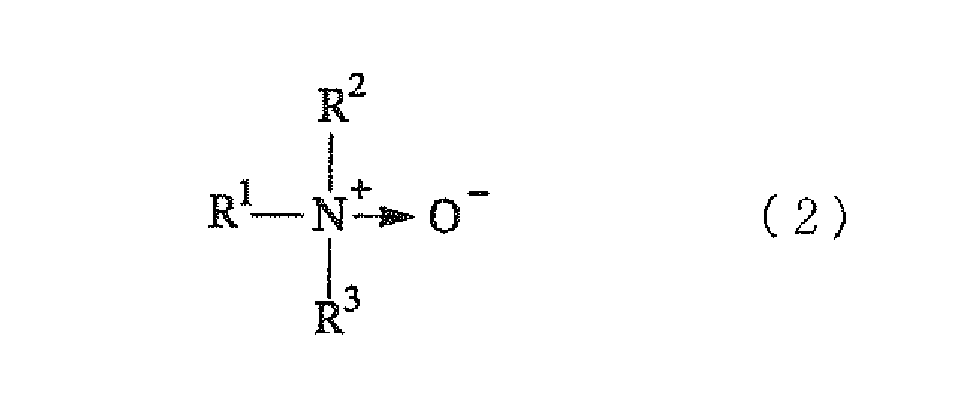
- R 1 represents an alkyl group having 1 to 22 carbon atoms or an alkenyl group having 3 to 22 carbon atoms, preferably an alkyl group having 1 to 18 carbon atoms, more preferably an alkyl group having 1 to 12 carbon atoms, and even more preferably an alkyl group having 4 to 12 carbon atoms.
- R 2 represents an alkyl group having 1 to 22 carbon atoms, an alkenyl group having 3 to 22 carbon atoms, a hydroxyalkyl group having 1 to 3 carbon atoms or a benzyl group, preferably an alkyl group having 1 to 18 carbon atoms or a benzyl group, and more preferably an alkyl group having 1 to 12 carbon atoms.
- R 3 and R 4 each represent an alkyl group having 1 to 3 carbon atoms, a hydroxyalkyl group having 1 to 3 carbon atoms, or a benzyl group, and preferably an alkyl group having 1 to 3 carbon atoms.
- R 5 represents an alkylene group having 1 to 5 carbon atoms, and preferably an alkylene group having 1 to 3 carbon atoms.
- Y represents -CONR 6 -, -NR 6 CO-, -COO-, or - OCO-, in which R 6 represents a hydrogen atom or an alkyl group having 1 to 3 carbon atoms.
- X - represents a halide ion, an ion of fatty acid having 1 to 14 carbon atoms, or an ion of alkylsulfate having 1 to 3 carbon atoms.
- component (a) contains quaternary ammonium salts represented by formula (1) or amine oxides represented by formula (2).
- Amine oxides represented by formula (3) are more preferable.
- component (b) examples include aminoacetic acid chelating agents such as ethylenediaminetetraacetic acid, nitrilotriacetic acid, and hydroxyethyliminodiauetic acid; phosphonic acid chelating agents such as 1-hydroxyethylidene-1,1-diphosphonic acid, 1-hydroxy-1,1-diphosphonic acid, ethanehydroxy-1,1,2-triphosphonic acid, ethane-1,2-dicarboxy-1,2-diphosphonic acid, and methanehydroxyphosphonic acid; carboxylic acid polymer chelating agents such as acrylic acid-maleic acid copolymer; and polyphosphoric acid chelating agents such as tripolyphosphoric acid. These chelating agents may be of a salt form. Among them, particularly preferred are aminoacetic acid chelating agents.
- component (b) has a calcium-chelating constant of 4 to 12, preferably 5 to 12, and more preferably 6 to 12.
- the "calcium-chelating constant" refers a value determined by the following method.
- a solution of 0.1 mol/L NH 4 Cl-NH 4 OH (pH 10) is prepared as a buffer.
- the buffer is used for preparing all sample solutions.
- an ion meter, Orion 920A, and a Ca 2+ ion electrode are used.
- a relationship between calcium chloride concentration and potential of the electrode is determined to generate a calibration curve.
- a solution of 5.36*10 -2 mol/L calcium chloride and a solution of 5.36*10 -4 mol/L sample chelating agent are prepared.
- To 100 ml of the solution of the sample chelating agent is added 1 ml of the solution of calcium chloride, and stirred for five minutes.
- a concentration of remaining Ca 2+ is measured using the Ca 2+ ion electrode.
- a calcium-chelating constant (Ca-chelating constant) is determined according to the following formula on the assumption that the chelating agent and Ca 2+ form a chelate complex at a ratio of 1:1.
- Ca - chelating constant log 10 ⁇ M Total - M M L Total - M Total - M
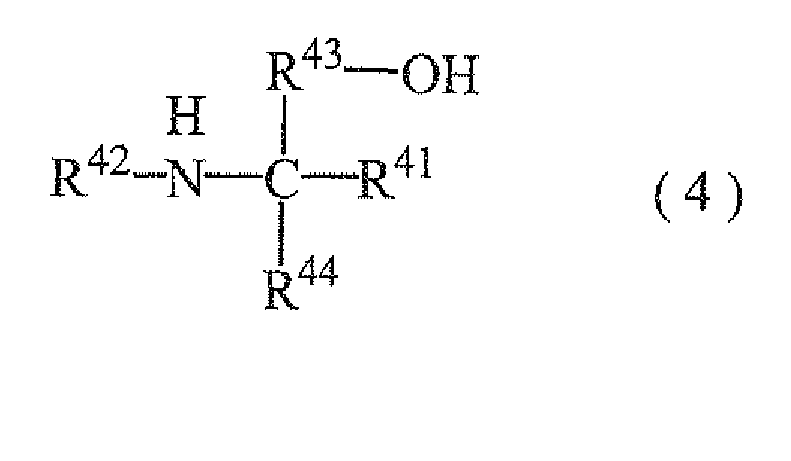
- the antifungal composition of the present invention preferably further contains a compound represented by formula (4) as component (c).
- R 41 represents a hydrogen atom, an alkyl group having 1 to 5 carbon atoms, or a hydroxyalkyl group having 1 to 5 carbon atoms
- R 42 represents a hydrogen atom, an alkyl group having 1 to 12 carbon atoms, or a hydroxyalkyl group having 1 to 5 carbon atoms
- R 43 represents an alkylene group having 1 to 5 carbon atoms
- R 44 represents an alkyl group having 1 to 5 carbon atoms or a hydroxyalkyl group having 1 to 5 carbon atoms.
- R 41 represents a hydrogen atom, an alkyl group having 1 to 5 carbon atoms or a hydroxyalkyl group having 1 to 5 carbon atoms, in which an alkyl group and a hydroxyalkyl group may be linear or branched.
- alkyl group having 1 to 5 carbon atoms include methyl, ethyl, n-propyl, isopropyl, n-butyl, isobutyl, t-butyl, n-pentyl, and isopentyl.
- Examples of the hydroxyalkyl group having 1 to 5 carbon atoms include hydroxymethyl, 2-hydroxyethyl, 2-hydroxypropyl, 3-hydroxypropyl, 2-hydroxybutyl, 3-hydroxybutyl, and 4-hydroxybutyl.
- R 41 is preferably a hydrogen atom, a methyl group, an ethyl group, a hydroxymethyl group, or a 2-hydroxyethyl group, and more preferably a hydrogen atom, a hydroxymethyl group, or a 2-hydroxyethyl group.
- R 42 represents a hydrogen atom, an alkyl group having 1 to 12, preferably 1 to 6 carbon atoms, or a hydroxyalkyl group having 1 to 5 carbon atoms, in which an alkyl group and a hydroxyalkyl group may be linear, branched, or cyclic.
- alkyl group having 1 to 12 carbon atoms examples include methyl group, ethyl group, n-propyl group, isopropyl group, n-butyl group, isobutyl group, t-butyl group, n-pentyl group, isopentyl group, n-hexyl group, isohexyl group, n-decyl group, isodecyl group, cyclopentyl group, and cyclohexyl group.
- Examples of the hydroxyalkyl group having 1 to 5 carbon atoms include those described for R 41 above.
- R 42 is preferably a hydrogen atom, an alkyl group having 1 to 3 carbon atoms, or a hydroxyethyl group, and more preferably a hydrogen atom.
- R 43 represents an alkylene group having 1 to 5 carbon atoms.
- Examples of the alkylene group having 1 to 5 carbon atoms include methylene group, ethylene group, propylene group, and butylene group. Preferred is a methylene group.
- R 44 represents an alkyl group having 1 to 5 carbon atoms or a hydroxyalkyl group having 1 to 5 carbon atoms. Examples of the alkyl group having 1 to 5 carbon atoms include methyl group, ethyl group, n-propyl group, isopropyl group, n-butyl group, isobutyl group, t-butyl group, n-pentyl group, and isopentyl group. Preferred is a methyl group. Examples of the hydroxyalkyl group having 1 to 5 carbon atoms include hydroxymethyl group, hydroxyethyl group, hydroxypropyl group, and hydroxybutyl group. Preferred is a hydroxymethyl group.
- amino compound represented by formula (4) or a salt thereof include tris(hydroxymethyl)aminomethane, 2-amino-2-methyl-1-propanol, 2-amino-1,3-propanediol, 2-amino-2-methyl-1,3-propanediol, 2-amino-2-ethyl-1,3-propanediol, 2-amino-2-hydroxymethyl-1,3-propanediol, 2-amino-2-hydroxyethyl-1,3-propanediol, 4-amino-4-hydroxypropyl-1,7-heptanediol, 2-(N-ethyl)amino-1,3-propanediol, 2-(N-ethyl)amino-2-hydroxymethyl-1,3-propanediol, 2-(N-decyl)amino-1,3-propanediol, 2-(N-decyl)amino-2-methyl-1
- pH can be controlled by adding a base.
- the base that can be used include sodium hydroxide, potassium hydroxide, magnesium hydroxide, calcium hydroxide, monoethanolamine, diethanolamine, triethanolamine, methylethanolamine, and dimethylethanolamine.
- sodium hydroxide and potassium hydroxide preferred are sodium hydroxide and potassium hydroxide.
- the amino compound represented by formula (4) can be produced by a standard method.
- a mass ratio of component (a) to component (b), (a)/(b) is 0.01 to 10, preferably 0.01 to 8, and more preferably 0.1 to 8.
- the antifungal composition of the present invention preferably contains component (a) in an amount of 0.01 to 5% by mass, more preferably 0.01 to 1% by mass, and even more preferably 0.01 to 0.5% by mass.
- the antifungal composition of the present invention also preferably contains component (b) in an amount of 0.01 to 1% by mass, more preferably 0.01 to 0.5% by mass, and even more preferably 0.01 to 0.3% by mass.
- a content of component (c) is preferably 0 to 10% by mass, more preferably 0.1 to 9% by mass, and even more preferably 0.1 to 5% by mass.
- a mass ratio of component (c) to component (a), (c)/(a) is preferably 0.02 to 1000, more preferably 0.03 to 900, and even more preferably 0.1 to 500.
- the antifungal composition of the present invention can further contain a surfactant, an extract, a perfume, and a solvent.
- the rest part of the composition is generally water.
- the antifungal composition of the present invention preferably has a pH of 6 to 10, and more preferably 7 to 9 at 20°C.
- the antifungal composition of the present invention can exhibit good mold-proof and antifungal effects through contacting with a subject (cloth, curtain, carpet, couch, tail, wall, wallpaper, floor, subfloor, tatami) (a target surface).
- the subject is preferably dried after contacted.
- a method of contacting the antifungal composition of the present invention to a target surface is not specifically limited. Examples of the method include spraying the antifungal composition on the subject, applying the antifungal composition to the subject, immersing the subject in a treatment bath containing the antifungal composition. In any method, the subject is preferably dried after contacted.
- the present invention relates to a method of preventing proliferation of molds with the antifungal composition of the present invention.
- Aspergillus. niger was cultured in a potato dextrose agar medium. Spores and mycelia thereof were dispersed in a sterile aqueous solution of 0.05% Tween (Rheodol TW-0120). The dispersion was adjusted to have an optical density of 0.1 at 600 nm.
- a rating of visual examination was 5-point scale from 0 to 4 according to growth of mold as shown in Table 1.
- Mold test fabrics were prepared in the same way as in Example 1, except that antifungal compositions prepared below were applied in each amount of 150 ⁇ l. Appearance of mycelia and spores of the mold was visually examined in the same way as in Example 1. Results are shown in Table 3. Table 3 Rating (state of mold) Comparative example K 4 Example L 1 Example M 0 Example N 0
Landscapes
- Life Sciences & Earth Sciences (AREA)
- Agronomy & Crop Science (AREA)
- Pest Control & Pesticides (AREA)
- Plant Pathology (AREA)
- Health & Medical Sciences (AREA)
- Engineering & Computer Science (AREA)
- Dentistry (AREA)
- General Health & Medical Sciences (AREA)
- Wood Science & Technology (AREA)
- Zoology (AREA)
- Environmental Sciences (AREA)
- Agricultural Chemicals And Associated Chemicals (AREA)
Abstract
Description
- The present invention relates to an antifungal composition (inhibitor of fungal growth or mycotic growth) used against fungi.
- Japanese climate is hot and humid, which is suitable for fungi such as mold to proliferate in living spaces. In recent years, airtight houses such as an apartment have been increased, and laundry has tended to be hung inside a house not only in the rainy season but also habitually. In such circumstances, there is an emerging problem of mold proliferation on a cloth, a curtain, a couch, a wallpaper, a corner of a floor, a wall behind a furniture, and the like. Therefore, there is a demand for a method of safely controlling mold proliferation.
- There have been many known applications of quaternary ammonium salts and amine oxides as an antibacterial agent. One of the antibacterial agents is
JP-B3571554 - The present invention relates to an antifungal composition, containing component (a) and component (b) at a mass ratio (a) / (b) of 0.01 to 10:
- component (a): at least one compound selected from quaternary ammonium salts represented by formula (1), amine oxides represented by formula (2), and amine oxides represented by formula (3):


component (b): a sequestering agent having a calcium-chelating constant of 4 to 12. - The present invention also relates to use of a composition containing components (a) and (b) at a mass ratio (a)/(b) of 0.01 to 10 as an antifungal agent.
- Quaternary ammonium salts and amine oxides have conventionally shown effects on bacteria. However, effects thereof on fungal molds are unsatisfactory.
JP-B3571554 - The present invention provides an antifungal composition that is safe and has high effects to control proliferation of molds, and provides a method of preventing molds.
- According to the present invention, provided is an antifungal composition that is safe, can be safely used in general households, and has high effects to control proliferation of molds. Use of the composition of the present invention to a subject will prevent proliferation of molds. There have been little studies for controlling fungal molds and almost no finding like the present invention that a combination use of a specific quaternary ammonium salt and a specific sequestering agent at a specific mass ratio provides increased effects for controlling molds.
- In formulae (1) to (3), R1 represents an alkyl group having 1 to 22 carbon atoms or an alkenyl group having 3 to 22 carbon atoms, preferably an alkyl group having 1 to 18 carbon atoms, more preferably an alkyl group having 1 to 12 carbon atoms, and even more preferably an alkyl group having 4 to 12 carbon atoms. R2 represents an alkyl group having 1 to 22 carbon atoms, an alkenyl group having 3 to 22 carbon atoms, a hydroxyalkyl group having 1 to 3 carbon atoms or a benzyl group, preferably an alkyl group having 1 to 18 carbon atoms or a benzyl group, and more preferably an alkyl group having 1 to 12 carbon atoms. R3 and R4 each represent an alkyl group having 1 to 3 carbon atoms, a hydroxyalkyl group having 1 to 3 carbon atoms, or a benzyl group, and preferably an alkyl group having 1 to 3 carbon atoms. R5 represents an alkylene group having 1 to 5 carbon atoms, and preferably an alkylene group having 1 to 3 carbon atoms. Y represents -CONR6-, -NR6CO-, -COO-, or - OCO-, in which R6 represents a hydrogen atom or an alkyl group having 1 to 3 carbon atoms. X- represents a halide ion, an ion of fatty acid having 1 to 14 carbon atoms, or an ion of alkylsulfate having 1 to 3 carbon atoms.
- From the viewpoint of increasing antifungal properties, it is preferable that component (a) contains quaternary ammonium salts represented by formula (1) or amine oxides represented by formula (2). Amine oxides represented by formula (3) are more preferable. Even more preferred is at least one compound selected from quaternary ammonium compounds (a1) that are compounds of formula (1) in which one or two groups bonding to the nitrogen atom are alkyl groups each having 1 to 12 carbon atoms and the other groups are selected from alkyl groups each having 1 to 3 carbon atoms, hydroxyalkyl groups each having 1 to 3 carbon atoms, and a benzyl group, and amine oxide compounds (a2) represented by formulae (2) and (3) in which one group bonding to the nitrogen atom is an alkyl group having 10 to 14 carbon atoms or an alkanoylaminopropyl group having 10 to 14 carbon atoms and the other groups are groups each selected from an alkyl group having 1 to 3 carbon atoms and a hydroxylalkyl group having 1 to 3 carbon atoms. In component (a), two or more compounds may be used together.
- Examples of component (b) include aminoacetic acid chelating agents such as ethylenediaminetetraacetic acid, nitrilotriacetic acid, and hydroxyethyliminodiauetic acid; phosphonic acid chelating agents such as 1-hydroxyethylidene-1,1-diphosphonic acid, 1-hydroxy-1,1-diphosphonic acid, ethanehydroxy-1,1,2-triphosphonic acid, ethane-1,2-dicarboxy-1,2-diphosphonic acid, and methanehydroxyphosphonic acid; carboxylic acid polymer chelating agents such as acrylic acid-maleic acid copolymer; and polyphosphoric acid chelating agents such as tripolyphosphoric acid. These chelating agents may be of a salt form. Among them, particularly preferred are aminoacetic acid chelating agents.
- From the viewpoint of increasing antifungal properties, component (b) has a calcium-chelating constant of 4 to 12, preferably 5 to 12, and more preferably 6 to 12.
- As used herein, the "calcium-chelating constant" refers a value determined by the following method.
- A solution of 0.1 mol/L NH4Cl-NH4OH (pH 10) is prepared as a buffer. The buffer is used for preparing all sample solutions. To measure a concentration of Ca2+, an ion meter, Orion 920A, and a Ca2+ ion electrode are used. First, a relationship between calcium chloride concentration and potential of the electrode is determined to generate a calibration curve. Next, a solution of 5.36*10-2 mol/L calcium chloride and a solution of 5.36*10-4 mol/L sample chelating agent are prepared. To 100 ml of the solution of the sample chelating agent is added 1 ml of the solution of calcium chloride, and stirred for five minutes. A concentration of remaining Ca2+ is measured using the Ca2+ ion electrode. A calcium-chelating constant (Ca-chelating constant) is determined according to the following formula on the assumption that the chelating agent and Ca2+ form a chelate complex at a ratio of 1:1.
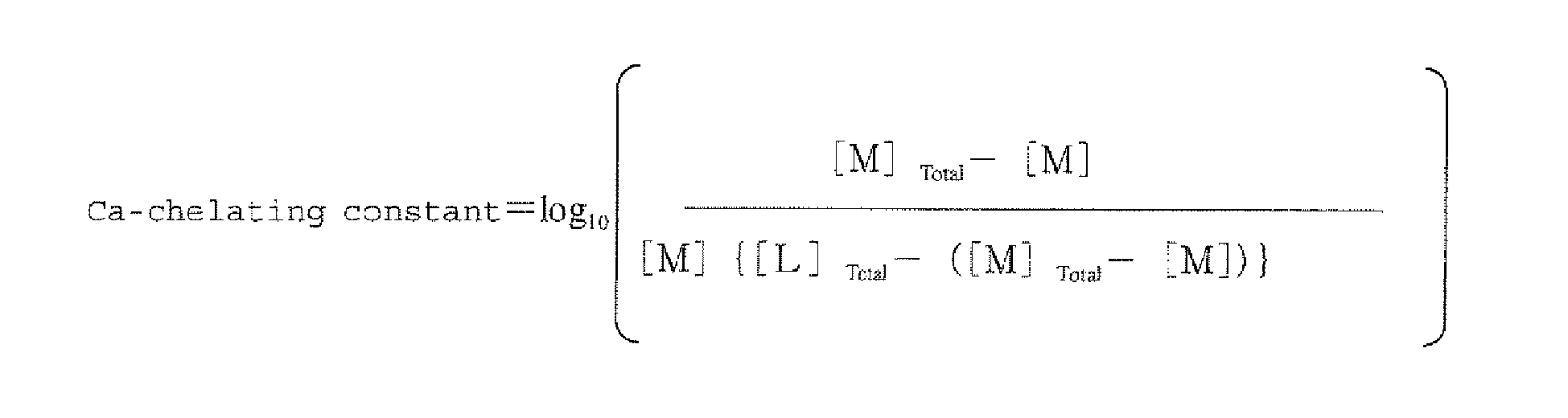
- [M]total: initial Ca2+ concentration
- [L]titak: initial chelating agent concentration
- [M]: remaining Ca2+ concentration
- The antifungal composition of the present invention preferably further contains a compound represented by formula (4) as component (c).

- In formula (4), R41 represents a hydrogen atom, an alkyl group having 1 to 5 carbon atoms or a hydroxyalkyl group having 1 to 5 carbon atoms, in which an alkyl group and a hydroxyalkyl group may be linear or branched. Examples of the alkyl group having 1 to 5 carbon atoms include methyl, ethyl, n-propyl, isopropyl, n-butyl, isobutyl, t-butyl, n-pentyl, and isopentyl. Examples of the hydroxyalkyl group having 1 to 5 carbon atoms include hydroxymethyl, 2-hydroxyethyl, 2-hydroxypropyl, 3-hydroxypropyl, 2-hydroxybutyl, 3-hydroxybutyl, and 4-hydroxybutyl.
- From the viewpoint of availability, R41 is preferably a hydrogen atom, a methyl group, an ethyl group, a hydroxymethyl group, or a 2-hydroxyethyl group, and more preferably a hydrogen atom, a hydroxymethyl group, or a 2-hydroxyethyl group.
- R42 represents a hydrogen atom, an alkyl group having 1 to 12, preferably 1 to 6 carbon atoms, or a hydroxyalkyl group having 1 to 5 carbon atoms, in which an alkyl group and a hydroxyalkyl group may be linear, branched, or cyclic. Examples of the alkyl group having 1 to 12 carbon atoms include methyl group, ethyl group, n-propyl group, isopropyl group, n-butyl group, isobutyl group, t-butyl group, n-pentyl group, isopentyl group, n-hexyl group, isohexyl group, n-decyl group, isodecyl group, cyclopentyl group, and cyclohexyl group. Examples of the hydroxyalkyl group having 1 to 5 carbon atoms include those described for R41 above.
- From the viewpoint of availability, R42 is preferably a hydrogen atom, an alkyl group having 1 to 3 carbon atoms, or a hydroxyethyl group, and more preferably a hydrogen atom.
- R43 represents an alkylene group having 1 to 5 carbon atoms. Examples of the alkylene group having 1 to 5 carbon atoms include methylene group, ethylene group, propylene group, and butylene group. Preferred is a methylene group. R44 represents an alkyl group having 1 to 5 carbon atoms or a hydroxyalkyl group having 1 to 5 carbon atoms. Examples of the alkyl group having 1 to 5 carbon atoms include methyl group, ethyl group, n-propyl group, isopropyl group, n-butyl group, isobutyl group, t-butyl group, n-pentyl group, and isopentyl group. Preferred is a methyl group. Examples of the hydroxyalkyl group having 1 to 5 carbon atoms include hydroxymethyl group, hydroxyethyl group, hydroxypropyl group, and hydroxybutyl group. Preferred is a hydroxymethyl group.
- Specific examples of the amino compound represented by formula (4) or a salt thereof include tris(hydroxymethyl)aminomethane, 2-amino-2-methyl-1-propanol, 2-amino-1,3-propanediol, 2-amino-2-methyl-1,3-propanediol, 2-amino-2-ethyl-1,3-propanediol, 2-amino-2-hydroxymethyl-1,3-propanediol, 2-amino-2-hydroxyethyl-1,3-propanediol, 4-amino-4-hydroxypropyl-1,7-heptanediol, 2-(N-ethyl)amino-1,3-propanediol, 2-(N-ethyl)amino-2-hydroxymethyl-1,3-propanediol, 2-(N-decyl)amino-1,3-propanediol, 2-(N-decyl)amino-2- hydroxymethyl-1,3-propanediol, and salts thereof with acids such as hydrochloric acid, sulfuric acid, nitric acid, phosphoric acid and carbonic acid.
- From the viewpoint of stability in blending, among them, one or more compounds selected from tris (hydroxymethyl)aminomethane, 2-amino-2-methyl-1-propanol, 2-amino-1,3-propanediol, 2-amino-2-methyl-1,3-propanediol, 2-amino-2-ethyl-1,3-propanediol, 2-amino-2-hydroxymethyl-1,3-propanediol, 2-amino-2-hydroxyethyl-1,3-propanediol, and salts thereof with acids such as hydrochloric acid are particularly preferably used.
- When the amino compound represented by formula (4) is used in a form of salt with hydrochloric acid or the like, pH can be controlled by adding a base. Examples of the base that can be used include sodium hydroxide, potassium hydroxide, magnesium hydroxide, calcium hydroxide, monoethanolamine, diethanolamine, triethanolamine, methylethanolamine, and dimethylethanolamine. Among these bases, preferred are sodium hydroxide and potassium hydroxide.
- The amino compound represented by formula (4) can be produced by a standard method.
- In the antifungal composition of the present invention, a mass ratio of component (a) to component (b), (a)/(b) is 0.01 to 10, preferably 0.01 to 8, and more preferably 0.1 to 8.
- With satisfying the mass ratio, the antifungal composition of the present invention preferably contains component (a) in an amount of 0.01 to 5% by mass, more preferably 0.01 to 1% by mass, and even more preferably 0.01 to 0.5% by mass.
- The antifungal composition of the present invention also preferably contains component (b) in an amount of 0.01 to 1% by mass, more preferably 0.01 to 0.5% by mass, and even more preferably 0.01 to 0.3% by mass.
- In the antifungal composition of the present invention, a content of component (c) is preferably 0 to 10% by mass, more preferably 0.1 to 9% by mass, and even more preferably 0.1 to 5% by mass. A mass ratio of component (c) to component (a), (c)/(a) is preferably 0.02 to 1000, more preferably 0.03 to 900, and even more preferably 0.1 to 500.
- The antifungal composition of the present invention can further contain a surfactant, an extract, a perfume, and a solvent. The rest part of the composition is generally water.
- The antifungal composition of the present invention preferably has a pH of 6 to 10, and more preferably 7 to 9 at 20°C.
- The antifungal composition of the present invention can exhibit good mold-proof and antifungal effects through contacting with a subject (cloth, curtain, carpet, couch, tail, wall, wallpaper, floor, subfloor, tatami) (a target surface). The subject is preferably dried after contacted. A method of contacting the antifungal composition of the present invention to a target surface is not specifically limited. Examples of the method include spraying the antifungal composition on the subject, applying the antifungal composition to the subject, immersing the subject in a treatment bath containing the antifungal composition. In any method, the subject is preferably dried after contacted. The present invention relates to a method of preventing proliferation of molds with the antifungal composition of the present invention.
- The following Examples demonstrate the present invention. Examples are intended to illustrate the present invention and not to limit the present invention.
- Aspergillus. niger was cultured in a potato dextrose agar medium. Spores and mycelia thereof were dispersed in a sterile aqueous solution of 0.05% Tween (Rheodol TW-0120). The dispersion was adjusted to have an optical density of 0.1 at 600 nm.
- To a knitted cotton fabric (1.5 cm by 1.5 cm) previously sterilized (autoclave: 2 atm (202650 Pa), 125°C/15min) were applied 200 µl of a sterilized aqueous solution of 2.4% potato dextrose, 100 µl of the mold suspension, and 200 µl of an antifungal composition prepared as below (these were dropped on the fabric with an auto-pipetter in a quantified amount so as to spread across the fabric as wide as possible) to give a mold test fabric. The mold test fabric was placed on a Petri dish and stored for 4 days in a unit desiccator (As One Corporation) at 25°C and 100%RH. The stored fabric was visually examined for a state of mycelia and spores of mold growing. In preparation of the antifungal composition, saline used was adjusted to pH 7.7 with 10% hydrochloric acid.
- A rating of visual examination was 5-point scale from 0 to 4 according to growth of mold as shown in Table 1.
- 0 and 1 on the scale refer that proliferation of the mold is prevented and the antifungal composition exhibits significant antifungal effects. Results are shown in Table 2.
Table 1 Rating State of mold 0 None(not growing) 1 Growing on edges of test fabric (a growing area is about 1/5) 2 Growing on edges of test fabric (a growing area is about 1/4) 3 Growing excluding a center part of test fabric (a growing area is about 1/2) 4 Growing across the test fabric Table 2 Rating (state of mold) Comparative example A 4 Example B 0 Example C 0 Example D 0 Example E 0 Comparative example F 2 Comparative example G 4 Comparative example H 2 Comparative example I 4 Comparative example J 2 -
- saline 100%
-
- didecyldimethylammonium chloride 0.1%
- EDTA* 0.05%
- saline 99.85%
- *EDTA: ethylenediaminetetraacetic acid (calcium-chelating constant = 12) (the same is applied below)
-
- didecyldimethylammonium chloride 0.1%
- Dequest 2010CS* 0.05%
- saline 99.85%
- *Dequest 2010CS: phosphate chelating agent (Solutia Japan Ltd., calcium-chelating constant = 5 to 6)
-
- lauryldimethylamine oxide* 0.25%
- EDTA 0.05%
- saline 99.70%
- *lauryldimethylamine oxide: Amphitol 20N (Kao Corporation)
-
- APAO* 0.25%
- EDTA 0.05%
- saline 99.70%
- *APAO: laurylamidopropyldimethylamine oxide (the same is applied below)
-
- didecyldimethylammonium chloride 0.1%
- saline 99.90%
-
- citric acid 0.1%
- saline 99.90%
-
- APAO 0.15%
- saline 99.85%
-
- EDTA 0.05%
- saline 99.95%
-
- didecyldimethylammonium chloride 0.10%
- citric acid* 0.10%
- saline 99.80%
- *citric acid (calcium-chelating constant = 3)
- Mold test fabrics were prepared in the same way as in Example 1, except that antifungal compositions prepared below were applied in each amount of 150µl. Appearance of mycelia and spores of the mold was visually examined in the same way as in Example 1. Results are shown in Table 3.
Table 3 Rating
(state of mold)Comparative
example K4 Example L 1 Example M 0 Example N 0 -
- saline 100%
-
- Tween 80* 0.05%
- didecyldimethylammonium chloride 0.1%
- EDTA 0.05%
- saline 99.80%
- *Tween 80: polyoxyethylene (average addition mole number: 20) sorbitan monooleate (the same is applied below)
-
- Tween 80 0.05%
- didecyldimethylammonium chloride 0.1%
- EDTA 0.05%
- Tris* 0.4%
- saline 99.40%
- *Tris: 2-amino-2-hydroxymethylpropane-1,3-diol (the same is applied below)
-
- Tween 80 0.05%
- didecyldimethylammonium chloride 0.1%
- EDTA 0.05%
- Tris 2.0%
- saline 97.80%
Claims (3)
- An antifungal composition, comprising component (a) and component (b) at a mass ratio (a) / (b) of 0.01 to 10:component (a): at least one compound selected from the group consisting of quaternary ammonium salts represented by formula (1), amine oxides represented by formula (2), and amine oxides represented by formula (3);

 component (b): a sequestering agent having a calcium-chelating constant of 4 to 12.
 - The antifungal composition according to claim 1, further comprising a compound represented by formula (4) as component (c):
- The antifungal composition according to claim 1 or 2, comprising 0.01 to 5% by mass of component (a), 0.01 to 1% by mass of component (b) and 0 to 10% by mass of component (c).
Applications Claiming Priority (2)
| Application Number | Priority Date | Filing Date | Title |
|---|---|---|---|
| JP2007278602A JP5225651B2 (en) | 2007-10-26 | 2007-10-26 | Anti-fungal composition |
| PCT/JP2008/069703 WO2009054540A1 (en) | 2007-10-26 | 2008-10-23 | Antifungal composition |
Publications (2)
| Publication Number | Publication Date |
|---|---|
| EP2206430A1 true EP2206430A1 (en) | 2010-07-14 |
| EP2206430A4 EP2206430A4 (en) | 2012-08-22 |
Family
ID=40579640
Family Applications (1)
| Application Number | Title | Priority Date | Filing Date |
|---|---|---|---|
| EP08842266A Withdrawn EP2206430A4 (en) | 2007-10-26 | 2008-10-23 | Antifungal composition |
Country Status (4)
| Country | Link |
|---|---|
| US (1) | US20100227931A1 (en) |
| EP (1) | EP2206430A4 (en) |
| JP (1) | JP5225651B2 (en) |
| WO (1) | WO2009054540A1 (en) |
Cited By (1)
| Publication number | Priority date | Publication date | Assignee | Title |
|---|---|---|---|---|
| CN102827706A (en) * | 2011-06-14 | 2012-12-19 | 株式会社尼欧斯 | Liquid detergent composition for controlling mildew |
Families Citing this family (13)
| Publication number | Priority date | Publication date | Assignee | Title |
|---|---|---|---|---|
| US9485917B2 (en) | 2006-12-15 | 2016-11-08 | Ecovative Design, LLC | Method for producing grown materials and products made thereby |
| US9879219B2 (en) * | 2011-03-07 | 2018-01-30 | Ecovative Design, LLC | Method of producing a chitinous polymer derived from fungal mycelium |
| US11277979B2 (en) | 2013-07-31 | 2022-03-22 | Ecovative Design Llc | Mycological biopolymers grown in void space tooling |
| US20150101509A1 (en) | 2013-10-14 | 2015-04-16 | Gavin R. McIntyre | Method of Manufacturing a Stiff Engineered Composite |
| JP6254885B2 (en) * | 2014-03-28 | 2017-12-27 | 大日本除蟲菊株式会社 | Anti-mold and mold remover |
| US10537070B2 (en) | 2015-04-15 | 2020-01-21 | Ecovative Design Llc | Process for the production of mycelial composite surfaces in a roll-to-roll format |
| JP7161489B2 (en) | 2017-03-31 | 2022-10-26 | エコベイティブ デザイン リミテッド ライアビリティ カンパニー | SOLUTION-BASED POST-PROCESSING METHOD OF FUNGI BIOPOLYMER MATERIAL AND FUNGUS-DERIVED PRODUCTS PRODUCED BY THE SAME |
| US11266085B2 (en) | 2017-11-14 | 2022-03-08 | Ecovative Design Llc | Increased homogeneity of mycological biopolymer grown into void space |
| US11920126B2 (en) | 2018-03-28 | 2024-03-05 | Ecovative Design Llc | Bio-manufacturing process |
| US11293005B2 (en) | 2018-05-07 | 2022-04-05 | Ecovative Design Llc | Process for making mineralized mycelium scaffolding and product made thereby |
| JP2021523676A (en) | 2018-05-24 | 2021-09-09 | エコベイティブ デザイン エルエルシー | Processes and equipment for producing mycelial biomaterials |
| EP3860370A4 (en) | 2018-10-02 | 2022-10-12 | Ecovative Design LLC | BIOREACTOR PARADIGM USED FOR THE PRODUCTION OF SECONDARY EXTRAPARTICULAR HYPHAL MATRICES |
| US12433315B2 (en) | 2021-05-04 | 2025-10-07 | Ecovative Llc | Aerial mycelia and methods of making same |
Family Cites Families (18)
| Publication number | Priority date | Publication date | Assignee | Title |
|---|---|---|---|---|
| US3296145A (en) * | 1965-10-21 | 1967-01-03 | Millmaster Onyx Corp | Quaternary ammonium-tertiary amine oxide compositions |
| DE3639885A1 (en) | 1986-11-21 | 1988-06-01 | Benckiser Gmbh Joh A | CLEANER WITH DISINFECTING EFFECT |
| WO1995017817A1 (en) * | 1993-12-28 | 1995-07-06 | Kao Corporation | Enhancer composition for agricultural chemicals and agricultural chemical composition |
| GB9410472D0 (en) * | 1994-05-25 | 1994-07-13 | Rhone Poulenc Chemicals | Biocidal composition |
| CA2222546A1 (en) * | 1995-06-26 | 1997-01-16 | James J. Fong | Aqueous anti-microbial compositions containing organotin compounds |
| GB9600140D0 (en) * | 1996-01-05 | 1996-03-06 | Reckitt & Colmann Prod Ltd | Improvements in or relating to organic compositions |
| JP4030633B2 (en) * | 1997-12-02 | 2008-01-09 | ピジョン株式会社 | Method for reducing the amount of antibacterial and fungicidal adsorption |
| JP3571554B2 (en) * | 1998-11-10 | 2004-09-29 | 大日精化工業株式会社 | Deodorant / antibacterial agent composition, deodorant / antibacterial resin composition and deodorant / antibacterial resin molded product |
| ATE289902T1 (en) * | 1999-05-24 | 2005-03-15 | Lonza Ag | AZOLE/AMINE OXIDE WOOD PRESERVATIVES AND FUNGICIDES |
| AU6866400A (en) * | 1999-09-03 | 2001-04-10 | Settsu Oil Mill., Ltd. | Bleacher composition |
| AU2001246423A1 (en) * | 2000-03-09 | 2001-09-17 | Martin, Alexander | Bactericidal compositions comprising a quaternary ammonium salt |
| JP2002143277A (en) * | 2000-08-11 | 2002-05-21 | Ophtecs Corp | Anti-Acanthamoeba disinfection and preservative for contact lenses |
| JP4255656B2 (en) * | 2001-09-17 | 2009-04-15 | 株式会社メニコン | Ophthalmic solution and contact lens solution |
| JP3824071B2 (en) * | 2001-12-25 | 2006-09-20 | 信越化学工業株式会社 | Room temperature curable organopolysiloxane composition |
| US7619017B2 (en) * | 2003-05-19 | 2009-11-17 | Wacker Chemical Corporation | Polymer emulsions resistant to biodeterioration |
| US20060079415A1 (en) * | 2004-10-13 | 2006-04-13 | Cheryl Kozubal | Conditioning shampoos with detergent soluble silicones |
| US20070258996A1 (en) * | 2005-12-23 | 2007-11-08 | The Sterilex Corporation | Antimicrobial compositions |
| JP5112932B2 (en) * | 2008-04-02 | 2013-01-09 | 花王株式会社 | Deodorant filter |
-
2007
- 2007-10-26 JP JP2007278602A patent/JP5225651B2/en active Active
-
2008
- 2008-10-23 US US12/739,710 patent/US20100227931A1/en not_active Abandoned
- 2008-10-23 EP EP08842266A patent/EP2206430A4/en not_active Withdrawn
- 2008-10-23 WO PCT/JP2008/069703 patent/WO2009054540A1/en not_active Ceased
Cited By (1)
| Publication number | Priority date | Publication date | Assignee | Title |
|---|---|---|---|---|
| CN102827706A (en) * | 2011-06-14 | 2012-12-19 | 株式会社尼欧斯 | Liquid detergent composition for controlling mildew |
Also Published As
| Publication number | Publication date |
|---|---|
| WO2009054540A1 (en) | 2009-04-30 |
| JP2009107933A (en) | 2009-05-21 |
| US20100227931A1 (en) | 2010-09-09 |
| EP2206430A4 (en) | 2012-08-22 |
| JP5225651B2 (en) | 2013-07-03 |
Similar Documents
| Publication | Publication Date | Title |
|---|---|---|
| US20100227931A1 (en) | Antifungal composition | |
| JP5735005B2 (en) | Liquid deodorant composition for textile products | |
| US8933122B2 (en) | Use of cationic surfactants as sporicidal agents | |
| EP3003040A1 (en) | Microbicidal composition comprising 2-methyl-4-isothiazolin-3-one and an amineoxide | |
| EP0634098B1 (en) | Hydrogen peroxide composition | |
| JP6595185B2 (en) | Alcohol-based disinfectant | |
| US20130096202A1 (en) | Disinfecting and sterilising solutions | |
| CN114983842A (en) | Compound anticorrosive composition and preparation method and application thereof | |
| JP4781664B2 (en) | Antibacterial agent | |
| JP2017008443A (en) | Antivirus composition for fiber product | |
| JP5297768B2 (en) | Sweat odor generation inhibitor composition | |
| US20040242702A1 (en) | Glutaraldehyde composition | |
| JP3780174B2 (en) | Bactericidal disinfectant composition, hair cleaning composition and dish cleaning composition | |
| JPH0358324B2 (en) | ||
| JP2006249124A (en) | Disinfectant cleaning composition | |
| SE455259B (en) | USE OF CERTAIN AMINOALKANPHOSPHONIC ACIDS FOR COMBATING Fungal DISEASES OF VEGETABLES | |
| JP4498794B2 (en) | Antibacterial and antifungal agent for wet fiber or paper products | |
| JP2000038302A (en) | Pest control agent | |
| CN116869871A (en) | Anti-dandruff shampoo and preparation method thereof | |
| CN116616292B (en) | Bactericide and bactericidal wet tissue | |
| EP3003035A2 (en) | Microbicidal composition comprising an isothiazolone and an amineoxide | |
| JP2013001771A (en) | Liquid mold control detergent composition | |
| JP2015168659A (en) | liquid deodorant disinfectant composition | |
| CN112790197B (en) | Novel leather mildew-proof nursing agent and preparation method and application thereof | |
| JP2007106727A (en) | Cosmetic raw material composition and method for preserving cosmetic raw material composition |
Legal Events
| Date | Code | Title | Description |
|---|---|---|---|
| PUAI | Public reference made under article 153(3) epc to a published international application that has entered the european phase |
Free format text: ORIGINAL CODE: 0009012 |
|
| 17P | Request for examination filed |
Effective date: 20100423 |
|
| AK | Designated contracting states |
Kind code of ref document: A1 Designated state(s): AT BE BG CH CY CZ DE DK EE ES FI FR GB GR HR HU IE IS IT LI LT LU LV MC MT NL NO PL PT RO SE SI SK TR |
|
| AX | Request for extension of the european patent |
Extension state: AL BA MK RS |
|
| DAX | Request for extension of the european patent (deleted) | ||
| A4 | Supplementary search report drawn up and despatched |
Effective date: 20120725 |
|
| RIC1 | Information provided on ipc code assigned before grant |
Ipc: A01N 33/12 20060101AFI20120719BHEP Ipc: A01P 3/00 20060101ALI20120719BHEP Ipc: A01N 33/24 20060101ALI20120719BHEP Ipc: A01N 33/08 20060101ALI20120719BHEP Ipc: A01N 37/44 20060101ALI20120719BHEP |
|
| 17Q | First examination report despatched |
Effective date: 20150928 |
|
| STAA | Information on the status of an ep patent application or granted ep patent |
Free format text: STATUS: THE APPLICATION IS DEEMED TO BE WITHDRAWN |
|
| 18D | Application deemed to be withdrawn |
Effective date: 20160209 |