EP2204341A1 - Crochet coulissant - Google Patents
Crochet coulissant Download PDFInfo
- Publication number
- EP2204341A1 EP2204341A1 EP10150103A EP10150103A EP2204341A1 EP 2204341 A1 EP2204341 A1 EP 2204341A1 EP 10150103 A EP10150103 A EP 10150103A EP 10150103 A EP10150103 A EP 10150103A EP 2204341 A1 EP2204341 A1 EP 2204341A1
- Authority
- EP
- European Patent Office
- Prior art keywords
- rollers
- roller
- hole
- retaining plate
- sliding hook
- Prior art date
- Legal status (The legal status is an assumption and is not a legal conclusion. Google has not performed a legal analysis and makes no representation as to the accuracy of the status listed.)
- Granted
Links
- 238000005096 rolling process Methods 0.000 claims abstract description 6
- 238000010079 rubber tapping Methods 0.000 claims description 5
- 238000010276 construction Methods 0.000 description 2
- 238000005553 drilling Methods 0.000 description 2
- 230000005484 gravity Effects 0.000 description 2
- 239000000463 material Substances 0.000 description 2
- 238000000034 method Methods 0.000 description 2
- 239000000725 suspension Substances 0.000 description 2
- 238000004873 anchoring Methods 0.000 description 1
- 239000010868 animal carcass Substances 0.000 description 1
- 238000006073 displacement reaction Methods 0.000 description 1
- 230000000694 effects Effects 0.000 description 1
- 235000013372 meat Nutrition 0.000 description 1
- 230000000717 retained effect Effects 0.000 description 1
- 238000003307 slaughter Methods 0.000 description 1
Images

Classifications
-
- B—PERFORMING OPERATIONS; TRANSPORTING
- B65—CONVEYING; PACKING; STORING; HANDLING THIN OR FILAMENTARY MATERIAL
- B65G—TRANSPORT OR STORAGE DEVICES, e.g. CONVEYORS FOR LOADING OR TIPPING, SHOP CONVEYOR SYSTEMS OR PNEUMATIC TUBE CONVEYORS
- B65G9/00—Apparatus for assisting manual handling having suspended load-carriers movable by hand or gravity
- B65G9/002—Load-carriers, rollers therefor
-
- A—HUMAN NECESSITIES
- A22—BUTCHERING; MEAT TREATMENT; PROCESSING POULTRY OR FISH
- A22B—SLAUGHTERING
- A22B7/00—Slaughterhouse arrangements
- A22B7/001—Conveying arrangements
- A22B7/002—Devices for hanging animal carcasses while being conveyed or stored, e.g. gambrels, hooks
-
- B—PERFORMING OPERATIONS; TRANSPORTING
- B65—CONVEYING; PACKING; STORING; HANDLING THIN OR FILAMENTARY MATERIAL
- B65G—TRANSPORT OR STORAGE DEVICES, e.g. CONVEYORS FOR LOADING OR TIPPING, SHOP CONVEYOR SYSTEMS OR PNEUMATIC TUBE CONVEYORS
- B65G17/00—Conveyors having an endless traction element, e.g. a chain, transmitting movement to a continuous or substantially-continuous load-carrying surface or to a series of individual load-carriers; Endless-chain conveyors in which the chains form the load-carrying surface
- B65G17/20—Conveyors having an endless traction element, e.g. a chain, transmitting movement to a continuous or substantially-continuous load-carrying surface or to a series of individual load-carriers; Endless-chain conveyors in which the chains form the load-carrying surface comprising load-carriers suspended from overhead traction chains
-
- B—PERFORMING OPERATIONS; TRANSPORTING
- B65—CONVEYING; PACKING; STORING; HANDLING THIN OR FILAMENTARY MATERIAL
- B65G—TRANSPORT OR STORAGE DEVICES, e.g. CONVEYORS FOR LOADING OR TIPPING, SHOP CONVEYOR SYSTEMS OR PNEUMATIC TUBE CONVEYORS
- B65G17/00—Conveyors having an endless traction element, e.g. a chain, transmitting movement to a continuous or substantially-continuous load-carrying surface or to a series of individual load-carriers; Endless-chain conveyors in which the chains form the load-carrying surface
- B65G17/30—Details; Auxiliary devices
- B65G17/48—Controlling attitudes of load-carriers during movement
- B65G17/485—Controlling attitudes of load-carriers during movement the load carriers being suspended
Definitions
- the present invention relates to a sliding hook able to circulate while being suspended from an overhead conveyor for transporting goods.
- Such hooks are used in many industries and especially in slaughterhouses where meat carcasses must be transported between the slaughter room, carcass processing rooms and finally a shipping room where the carcasses are loaded. in a truck. Such hooks are also used in the curing industry.
- hooks equipped with a single wheel and hooks equipped with two wheels and which can run on the rails of an overhead conveyor to transport loads.
- the former are intended to circulate generally on straight rails while the latter can run on rails with curved portions.
- the present invention aims to provide a solution to repair easily and cheaply the hooks of this second category.
- a sliding hook 10 presented on the Figs. 1a and 1b is thus provided with two wheels 20a and 20b mounted free to rotate about a shaft joining them, and between which is disposed, being held by the shaft, a retaining plate 30 of a stirrup 40 on which is suspended a hook 50, of which only the fastener is shown, for suspending a load.
- the rails of an overhead conveyor C turned vis-à-vis and on which can move the sliding hook are references R1 and R2.
- These rails R have an angled section comprising a rolling wall T on which the rollers 20a and 20b can roll to move a load suspended from the hook 50 and which is extended by a guide wall G, facing downwards and facing the retaining plate 30.
- the distance separating the two guiding walls G is sufficient for the retaining plate to slide freely. So that the sliding hook can be guided laterally during its journey, two directional rollers 60a and 60b respectively take place in two passages 31a and 31b provided in the lateral edges of the retaining plate 30.
- Each roller 60 is rotatably mounted around a pin P anchoring in the retaining plate and whose axis is perpendicular to that of the two rollers 20.
- said pin is housed, on the one hand, in a hole through the wall of the retaining plate situated on one edge of the roller and, on the other hand, in a blind hole made in the wall of the retaining plate located on the other side of the roller. It is rotatably mounted around said pin. It will be noted that the wall in which the through-hole is formed forms a recess with the narrower portion of the retaining plate which supports the stirrup 40.
- the drilling diameter of the holes is slightly smaller than that of the pin so that its mounting, tight, can be achieved by hammering to prevent it comes out by gravity under the effect of vibration during movement of the sliding hook.
- a matting of the material symbolized by the arrow M, can be achieved at the outlet of the hole, for example using a jet and a hammer.
- rollers highly stressed and are made of a material softer than the rails to not wear them, wear or break.
- the invention provides a solution to easily and quickly replace a roller in such a sliding hook.
- a sliding hook of the type comprising at least two casters mounted free to rotate on either side of a retaining plate for supporting a suspension hook of a load, the retaining plate being provided two directional rollers mounted free to rotate on its side edges, the rollers being intended to roll on the raceway constitutive rails rails of an overhead conveyor, the rollers being intended to cooperate with guide walls arranged vis-à- screw, in extension of said rolling walls; according to the invention, each roller is mounted around a pin housed freely in a hole, the pin being held in place by a retaining means.
- the replacement of a roller is achieved by removing the retaining means and removing the trunnion which can exit by gravity of the hole.
- This operation is fast and easy to perform.
- the retaining means is of the removable type.
- each roller is arranged in a passageway framed by two walls, the corresponding pin being housed, on the one hand, in a first through hole, passing through the wall of the retaining plate located on a edge of the roller and, secondly, in a second hole, blind and coaxial with the first and which is made in the other wall of the retaining plate located on the other side of the roller.
- the retaining means consists of a screw cooperating with a tapping formed in the opening portion of the first hole.
- the length of the tapping is preferably substantially equal to that of the screw.
- the locking of the screw is obtained by screwing the screw completely. Its unscrewing during the operation of the sliding hook thus becomes impossible.
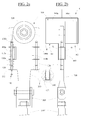
- the sliding hook 100 presented on the Figs. 2a and 2b is intended for use in industry, for carrying loads while circulating in a suspended manner under an overhead conveyor C.
- the sliding hook 100 consists of a retaining plate 200 on which are fixed wheels 300 mounted free to rotate, two in number on the Fig. 2b
- the two rollers 300a and 300b are mounted on either side of the retaining plate 200 on a common shaft passing through said retaining plate to roll on rails R1 and R2 constituting the overhead conveyor C.
- the two rollers 300a and 300b are mounted on either side of the retaining plate 200. presence of these two wheels joined by a common shaft provides the sliding hook the ability to circulate on curved portions of an overhead conveyor.
- the rails R have an angled section comprising a rolling wall T on which the rollers 300 can roll to move a load suspended on the holding plate and which is extended by a guide wall G, facing the The distance separating the two guide walls G is sufficient so that the retaining plate can slide freely.
- This consists of a plate having a T-shaped section comprising a relatively large upper part supporting the rollers and rollers and a lower, narrower part on which is fixed a hinged stirrup 500. in which a hook 550 of suspension of a load is freely rotatably mounted. Only the hooking head of this hook is shown.
- the directional rollers 400a and 400b are intended to allow lateral guiding of the sliding hook 100 during its movement on the rails R. They cooperate for this purpose with the guide walls G turned vis-à-vis so that the sliding hook 100 can follow the trajectory imposed by the conveyor.
- the rollers 400a and 400b are respectively mounted in two passages 110a 110b, made on the Fig. 2a in the form of recesses, provided on the lateral edges of the upper part of the retaining plate 200. It will be noted that the diameter of the rollers is greater than the thickness of the retaining plate 200 so that only the rollers can cooperate with the two guide walls G during the displacement of the sliding hook 100. Moreover, the axis of the rollers is located in a median plane of the retaining plate 200 to make the construction of said hook symmetrical.
- Each roller 400 is held free to rotate in its recess by means of a pin 120 whose axis is perpendicular to that of the shaft joining the two rollers 300a and 300b.
- the presence of two rollers placed on either side of the rollers 300 makes it possible to laterally guide the sliding hook indifferently in one or the other direction of circulation of the latter in the conveyor.
- Each pin 120 is housed, on the one hand, in a first hole 130a opening through the wall of the retaining plate situated on one edge of the roller and, on the other hand, in a second hole 130b, blind and coaxial with the first and which is made in the wall of the retaining plate located on the other side of the roller.
- This is rotatably mounted around the trunnion.
- the wall in which the through-hole is formed forms a recess with the narrower lower part of the retaining plate which supports the stirrup 500.
- These two walls frame a recess 110 as it appears on the Fig. 2b .
- the drilling diameter of the holes 130 is slightly greater than that of the journal so that its assembly and disassembly can be carried out freely.
- a retaining means 140 cooperates with the pin 120 to hold it in place.
- the retaining means is preferably of the removable type. It is constituted on the Fig. 2a , a screw 140 cooperating with a tapping 132 made in the opening portion of the first hole 130a facing outwards.
- the length of the tapping is preferably substantially equal to that of the screw so that the operator can correctly block the screw by screwing it completely as it appears in the detailed view of the Fig. 2a .
- the construction of the sliding hook of the invention facilitates the replacement of the directional rollers which constitute it.
- the replacement is done without any particular difficulty and in less than a minute.
- a broken trunnion can be replaced as easily.
- the solution, object of the invention is particularly economical.
Landscapes
- Engineering & Computer Science (AREA)
- Mechanical Engineering (AREA)
- Life Sciences & Earth Sciences (AREA)
- Food Science & Technology (AREA)
- Chain Conveyers (AREA)
- Supports Or Holders For Household Use (AREA)
- Finger-Pressure Massage (AREA)
- Massaging Devices (AREA)
- Transplanting Machines (AREA)
Abstract
Description
- La présente invention concerne un crochet coulissant apte à circuler en étant suspendu à un convoyeur aérien pour transporter des marchandises.
- On utilise de tels crochets dans de nombreuses industries et en particulier dans des abattoirs où l'on doit transporter des carcasses de viande entre la salle d'abattage, des salles de traitement des carcasses et enfin une salle d'expédition où les carcasses sont chargées dans un camion. On utilise également de tels crochets dans l'industrie de la salaison.
- Il existe en particulier des crochets équipés d'une seule roulette et des crochets équipés de deux roulettes et qui peuvent circuler sur les rails d'un convoyeur aérien pour transporter des charges. Les premiers sont destinés à circuler généralement sur des rails droits alors que les seconds peuvent circuler sur des rails comportant des portions courbes.
- La présente invention vise à apporter une solution pour réparer facilement et à moindre coût les crochets de cette seconde catégorie. Un tel crochet coulissant 10 présenté sur les
Figs. 1a et 1b est ainsi pourvu de deux roulettes 20a et 20b montées libres à rotation autour d'un arbre les réunissant, et entre lesquelles est disposée, en étant tenue par l'arbre, une plaque de retenue 30 d'un étrier 40 sur lequel est suspendu un crochet 50, dont seule l'attache est représentée, pour y suspendre une charge. Sur laFig. 1b , les rails d'un convoyeur aérien C, tournés en vis-à-vis et sur lesquels peut circuler le crochet coulissant portent les références R1 et R2. Ces rails R présentent une section en équerre comprenant une paroi de roulement T sur lesquels les roulettes 20a et 20b peuvent rouler pour déplacer une charge suspendue au crochet 50 et qui est prolongée par une paroi de guidage G, tournée vers le bas et faisant face à la plaque de retenue 30. La distance séparant les deux parois de guidage G est suffisante pour que la plaque de retenue puisse coulisser librement. Afin que le crochet coulissant puisse être guidé latéralement pendant son trajet, deux galets directionnels 60a et 60b prennent respectivement place dans deux passages 31a et 31b prévus dans les bords latéraux de la plaque de retenue 30. Chaque galet 60 est monté libre à rotation autour d'une goupille P prenant ancrage dans la plaque de retenue et dont l'axe est perpendiculaire à celui des deux roulettes 20. Ainsi, les deux galets qui demeurent pratiquement en contact avec la paroi de guidage G guident, du fait de leur éloignement, le crochet coulissant pendant son déplacement sur les rails R. - De façon plus précise, ladite goupille est logée, d'une part, dans un trou traversant la paroi de la plaque de retenue située d'un bord du galet et, d'autre part, dans un trou borgne réalisé dans la paroi de la plaque de retenue située de l'autre côté du galet. Celui-ci est monté libre à rotation autour de ladite goupille. On remarquera que la paroi dans laquelle est réalisé le trou débouchant forme un décrochement avec la partie plus étroite de la plaque de retenue qui supporte l'étrier 40.
- Le diamètre de perçage des trous est légèrement inférieur à celui de la goupille pour que son montage, serré, puisse être réalisé au marteau afin d'éviter qu'elle ne ressorte par gravité sous l'effet des vibrations pendant le déplacement du crochet coulissant. Pour plus de sécurité, un matage de la matière, symbolisé par la flèche M, peut être réalisé au débouché du trou, par exemple à l'aide d'un jet et d'un marteau.
- Il arrive que ces galets, fortement sollicités et qui sont fabriqués dans un matériau plus tendre que les rails pour ne pas les user, s'usent ou finissent par casser.
- Quand un galet est fracturé ou détérioré, il faut le remplacer. Une solution consiste à contre percer un trou dans la paroi où le trou de logement de la goupille est borgne, puis, à l'aide d'un chasse-goupille, faire sortir ladite goupille. On procède ensuite au remplacement du galet par un montage du même type que celui qui vient d'être décrit.
- Quand la goupille est fracturée, il est très difficile d'extraire la partie retenue dans le trou borgne. Il faut alors remplacer en entier le galet coulissant.
- Aussi, l'invention propose une solution pour remplacer facilement et rapidement un galet dans un tel crochet coulissant.
- A cet effet, est proposé un crochet coulissant du type comprenant au moins deux roulettes montées libres à rotation de part et d'autre d'une plaque de retenue destinée à supporter un crochet de suspension d'une charge, la plaque de retenue étant pourvue de deux galets directionnels montés libres à rotation sur ses bords latéraux, les roulettes étant destinées à rouler sur des parois de roulement constitutives de rails d'un convoyeur aérien, les galets étant destinés à coopérer avec des parois de guidage disposées en vis-à-vis, en prolongement desdites parois de roulement ; selon l'invention, chaque galet est monté autour d'un tourillon logé librement dans un trou, le tourillon étant maintenu en place par un moyen de retenue.
- Le remplacement d'un galet est réalisé en enlevant le moyen de retenue et en retirant le tourillon qui peut ainsi sortir par gravité du trou.
- Cette opération est rapide et simple à réaliser.
- Selon une caractéristique additionnelle de l'invention, le moyen de retenue est du type amovible.
- Le démontage du moyen de retenue est ainsi rendu aisé.
- Selon une caractéristique additionnelle de l'invention, chaque galet est disposé dans un passage encadré par deux parois, le tourillon correspondant étant logé, d'une part, dans un premier trou débouchant, traversant la paroi de la plaque de retenue située d'un bord du galet et, d'autre part, dans un second trou, borgne et coaxial au premier et qui est réalisé dans l'autre paroi de la plaque de retenue située de l'autre côté du galet.
- En enfilant le tourillon du côté du trou débouchant, on monte de manière libre à rotation le galet correspondant dans le passage.
- Selon une caractéristique additionnelle de l'invention, le moyen de retenue est constitué d'une vis coopérant avec un taraudage réalisé dans la partie débouchante du premier trou.
- Le vissage de la vis permet de maintenir en place le tourillon correspondant et son dévissage permet de le retirer.
- Selon une caractéristique additionnelle de l'invention, la longueur du taraudage est de préférence sensiblement égale à celle de la vis.
- Le blocage de la vis est obtenu en vissant complètement la vis. Son dévissage pendant le fonctionnement du crochet coulissant devient ainsi impossible.
- Les caractéristiques de l'invention mentionnées ci-dessus, ainsi que d'autres, apparaîtront plus clairement à la lecture de la description suivante d'un exemple de réalisation, ladite description étant faite en relation avec les dessins joints, parmi lesquels:
- la
Fig. 1a représente une vue de face d'un crochet coulissant connu de l'état de la technique, - la
Fig. 1b représente une vue latérale d'un crochet coulissant connu de l'état de la technique, - la
Fig. 2a représente une vue de face d'un crochet coulissant selon l'invention, et, - la
Fig. 2b représente une vue latérale d'un crochet coulissant selon l'invention. - Le crochet coulissant 100 présenté sur les
Figs. 2a et 2b est destiné à être utilisé dans l'industrie, pour transporter des charges en circulant de manière suspendue sous un convoyeur aérien C. - Parmi les applications envisagées, on peut citer le transport des carcasses d'animaux dans les abattoirs, le transport de jambon dans les usines de salaison.
- Le crochet coulissant 100 se compose d'une plaque de retenue 200 sur laquelle sont fixées des roulettes 300 montées libres à rotation, au nombre de deux sur la
Fig. 2b , de galets directionnels 400. Les deux roulettes 300a et 300b sont montées de part et d'autre de la plaque de retenue 200 sur un arbre commun traversant ladite plaque de retenue pour rouler sur des rails R1 et R2 constitutifs du convoyeur aérien C. La présence de ces deux roulettes réunies par un arbre commun procure au crochet coulissant la faculté de pouvoir circuler sur des portions courbes d'un convoyeur aérien. - De manière plus précise, les rails R présentent une section en équerre comprenant une paroi de roulement T sur lesquels les roulettes 300 peuvent rouler pour déplacer une charge suspendue à la plaque de retenue et qui est prolongée par une paroi de guidage G, tournée vers le bas et faisant face à la plaque de retenue 200. La distance séparant les deux parois de guidage G est suffisante pour que la plaque de retenue puisse coulisser librement. Celle-ci est constituée d'une plaque présentant une section en T comprenant une partie haute, relativement large, supportant les roulettes et les galets et une partie basse, plus étroite, sur laquelle est fixé un étrier articulé 500 dans lequel est monté libre à rotation un crochet 550 de suspension d'une charge. Seule la tête d'accrochage de ce crochet est représentée.
- Les galets directionnels 400a et 400b sont destinés à permettre le guidage latéral du crochet coulissant 100 pendant son déplacement sur les rails R. Ils coopèrent à cet effet avec les parois de guidage G tournées en vis-à-vis pour que le crochet coulissant 100 puisse suivre la trajectoire imposée par le convoyeur.
- Les galets 400a et 400b sont respectivement montés dans deux passages 110a 110b, réalisés sur la
Fig. 2a sous la forme de renfoncements, prévus sur les bords latéraux de la partie haute de la plaque de retenue 200. On remarquera que le diamètre des galets est plus important que l'épaisseur de la plaque de retenue 200 pour que seuls les galets puissent coopérer avec les deux parois de guidage G pendant le déplacement du crochet coulissant 100. Par ailleurs, l'axe des galets est situé dans un plan médian de la plaque de retenue 200 pour rendre symétrique la construction dudit crochet. - Chaque galet 400 est retenu de manière libre à rotation dans son renfoncement par l'intermédiaire d'un tourillon 120 dont l'axe est perpendiculaire à celui de l'arbre réunissant les deux roulettes 300a et 300b. La présence de deux galets placés de part et d'autre des roulettes 300 permet de guider latéralement le crochet coulissant indifféremment dans l'un ou l'autre sens de circulation de celui-ci dans le convoyeur.
- Chaque tourillon 120 est logé, d'une part, dans un premier trou 130a débouchant traversant la paroi de la plaque de retenue située d'un bord du galet et, d'autre part, dans un second trou 130b, borgne et coaxial au premier et qui est réalisé dans la paroi de la plaque de retenue située de l'autre côté du galet. Celui-ci est monté libre à rotation autour du tourillon. On remarquera que la paroi dans laquelle est réalisé le trou débouchant forme un décrochement avec la partie basse plus étroite de la plaque de retenue qui supporte l'étrier 500. Ces deux parois encadrent un renfoncement 110 comme cela apparaît sur la
Fig. 2b . - Le diamètre de perçage des trous 130 est légèrement supérieur à celui du tourillon pour que son montage et son démontage puissent être réalisés librement. Un moyen de retenue 140 coopère avec le tourillon 120 pour le tenir en place. Le moyen de retenue est de préférence du type amovible. Il est constitué sur la
Fig. 2a , d'une vis 140 coopérant avec un taraudage 132 réalisé dans la partie débouchante du premier trou 130a tournée vers l'extérieur. Ainsi, on peut rapidement monter un galet 400 en logeant à la main le tourillon 120 successivement dans les trous 130a et 130b, puis en vissant la vis 140. L'opération de démontage d'un galet pour son remplacement est aussi simple et rapide. - La longueur du taraudage est de préférence sensiblement égale à celle de la vis pour que l'opérateur puisse bloquer correctement la vis en la vissant complètement comme cela apparaît sur la vue en détail de la
Fig. 2a . - La construction du crochet coulissant de l'invention facilite le remplacement des galets directionnels qui le constituent. Le remplacement est réalisé sans difficulté particulière et en moins d'une minute.
- Un tourillon cassé peut être remplacé aussi facilement.
- La solution, objet de l'invention est particulièrement économique.
Claims (5)
- Crochet coulissant (100) du type comprenant au moins deux roulettes (300a, 300b) montées libres à rotation de part et d'autre d'une plaque de retenue (200) destinée à supporter un crochet (550) de suspension d'une charge, la plaque de retenue (200) étant pourvue de deux galets directionnels (400a, 400b) montés libres à rotation sur ses bords latéraux, les roulettes (300) étant destinées à rouler sur des parois de roulement (T) constitutives de rails (R) d'un convoyeur aérien (C), les galets (400) étant destinés à coopérer avec des parois de guidage (G) disposées en vis-à-vis, en prolongement desdites parois de roulement (T), caractérisé en ce que chaque galet (400) est monté autour d'un tourillon (120) logé librement dans un trou (130), le tourillon (120) étant maintenu en place par un moyen de retenue (140).
- Crochet coulissant (100) selon la revendication 1, caractérisé en ce que le moyen de retenue (140) est du type amovible.
- Crochet coulissant (100) selon la revendication 1 ou 2, caractérisé en ce que chaque galet (400) est disposé dans un passage (110) encadré par deux parois, le tourillon (120) correspondant étant logé, d'une part, dans un premier trou (130a) débouchant, traversant la paroi de la plaque de retenue située d'un bord du galet et, d'autre part, dans un second trou (130b), borgne et coaxial au premier et qui est réalisé dans l'autre paroi de la plaque de retenue située de l'autre côté du galet.
- Crochet coulissant (100) selon la revendication 3, caractérisé en ce que le moyen de retenue est constitué d'une vis (140) coopérant avec un taraudage (132) réalisé dans la partie débouchante du premier trou (130).
- Crochet coulissant (100) selon la revendication 4, caractérisé en ce que la longueur du taraudage (132) est de préférence sensiblement égale à celle de la vis.
Applications Claiming Priority (1)
| Application Number | Priority Date | Filing Date | Title |
|---|---|---|---|
| FR0950008A FR2940793B1 (fr) | 2009-01-05 | 2009-01-05 | Crochet coulissant |
Publications (2)
| Publication Number | Publication Date |
|---|---|
| EP2204341A1 true EP2204341A1 (fr) | 2010-07-07 |
| EP2204341B1 EP2204341B1 (fr) | 2012-05-09 |
Family
ID=40897314
Family Applications (1)
| Application Number | Title | Priority Date | Filing Date |
|---|---|---|---|
| EP10150103A Not-in-force EP2204341B1 (fr) | 2009-01-05 | 2010-01-05 | Crochet coulissant |
Country Status (3)
| Country | Link |
|---|---|
| EP (1) | EP2204341B1 (fr) |
| AT (1) | ATE556963T1 (fr) |
| FR (1) | FR2940793B1 (fr) |
Citations (4)
| Publication number | Priority date | Publication date | Assignee | Title |
|---|---|---|---|---|
| US2633088A (en) * | 1949-10-20 | 1953-03-31 | King Donald Mayer | Trolley conveyer |
| US3086482A (en) * | 1960-11-25 | 1963-04-23 | Walker Mfg Co | Trolley |
| GB928359A (en) * | 1961-05-16 | 1963-06-12 | Richard George Christopher Jen | Conveyor |
| DE1238848B (de) * | 1964-07-07 | 1967-04-13 | Fisher & Ludlow Ltd | Kreisfoerderer |
-
2009
- 2009-01-05 FR FR0950008A patent/FR2940793B1/fr not_active Expired - Fee Related
-
2010
- 2010-01-05 AT AT10150103T patent/ATE556963T1/de active
- 2010-01-05 EP EP10150103A patent/EP2204341B1/fr not_active Not-in-force
Patent Citations (4)
| Publication number | Priority date | Publication date | Assignee | Title |
|---|---|---|---|---|
| US2633088A (en) * | 1949-10-20 | 1953-03-31 | King Donald Mayer | Trolley conveyer |
| US3086482A (en) * | 1960-11-25 | 1963-04-23 | Walker Mfg Co | Trolley |
| GB928359A (en) * | 1961-05-16 | 1963-06-12 | Richard George Christopher Jen | Conveyor |
| DE1238848B (de) * | 1964-07-07 | 1967-04-13 | Fisher & Ludlow Ltd | Kreisfoerderer |
Also Published As
| Publication number | Publication date |
|---|---|
| FR2940793B1 (fr) | 2011-02-25 |
| ATE556963T1 (de) | 2012-05-15 |
| EP2204341B1 (fr) | 2012-05-09 |
| FR2940793A1 (fr) | 2010-07-09 |
Similar Documents
| Publication | Publication Date | Title |
|---|---|---|
| US11332318B2 (en) | Infeed and outfeed assemblies for a conveyor | |
| EP2878855B1 (fr) | Dispositif d'attache à émerillon ouvrable perfectionné | |
| US8322522B2 (en) | Nested end link and multi-link conveyor chain | |
| US20040173117A1 (en) | Trolley with tractor drive for use in curved enclosed tracks and system including the same | |
| JP2015518807A (ja) | ローラ方式コンベヤ | |
| US20160107839A1 (en) | Apparatus For Transporting Substantially Non-Rigid Shaped Bodies | |
| US20140200058A1 (en) | Leaf removal apparatus | |
| CA2513948C (fr) | Transporteur a courroie courbe | |
| AU2014227507A1 (en) | Flail assembly with vanes | |
| FR2983743A1 (fr) | Machine de tri postal pour objets plats avec volet de separation | |
| EP2204341B1 (fr) | Crochet coulissant | |
| JP6362829B2 (ja) | 傾倒式キャリアローラスタンド | |
| EP2833928B1 (fr) | Systeme de sterilisation par bombardement d'electrons a encombrement reduit | |
| US7681384B2 (en) | Apparatus for processing crop materials in a forage harvester | |
| KR100946107B1 (ko) | 파이프 콘베이어의 과적물 검출장치 | |
| FR2861630A1 (fr) | Appareil pour le tranchage de materiau en plaques et dispositif de collecte associe | |
| US6860382B2 (en) | Tail shaft adjusting system | |
| KR20080105222A (ko) | 벨트 컨베이어 시스템 | |
| FR2919570A1 (fr) | Element de vehicule comprenant au moins une ossature de cabine de vehicule et vehicule comprenant un tel element de vehicule. | |
| JP2007186873A (ja) | 粉塵防止型蝶番 | |
| FR3038236A1 (fr) | Tete de montant d'agres de gymnastique | |
| JP5523745B2 (ja) | ベルトコンベヤ | |
| JPH09136711A (ja) | ローラーコンベア | |
| KR101615339B1 (ko) | 수평 루퍼의 스윙 암 롤장치 | |
| FR3070683B1 (fr) | Dispositif de maintien d'un devidoir |
Legal Events
| Date | Code | Title | Description |
|---|---|---|---|
| PUAI | Public reference made under article 153(3) epc to a published international application that has entered the european phase |
Free format text: ORIGINAL CODE: 0009012 |
|
| AK | Designated contracting states |
Kind code of ref document: A1 Designated state(s): AT BE BG CH CY CZ DE DK EE ES FI FR GB GR HR HU IE IS IT LI LT LU LV MC MK MT NL NO PL PT RO SE SI SK SM TR |
|
| 17P | Request for examination filed |
Effective date: 20110104 |
|
| GRAP | Despatch of communication of intention to grant a patent |
Free format text: ORIGINAL CODE: EPIDOSNIGR1 |
|
| GRAS | Grant fee paid |
Free format text: ORIGINAL CODE: EPIDOSNIGR3 |
|
| GRAA | (expected) grant |
Free format text: ORIGINAL CODE: 0009210 |
|
| AK | Designated contracting states |
Kind code of ref document: B1 Designated state(s): AT BE BG CH CY CZ DE DK EE ES FI FR GB GR HR HU IE IS IT LI LT LU LV MC MK MT NL NO PL PT RO SE SI SK SM TR |
|
| REG | Reference to a national code |
Ref country code: GB Ref legal event code: FG4D Free format text: NOT ENGLISH |
|
| REG | Reference to a national code |
Ref country code: AT Ref legal event code: REF Ref document number: 556963 Country of ref document: AT Kind code of ref document: T Effective date: 20120515 Ref country code: CH Ref legal event code: EP |
|
| REG | Reference to a national code |
Ref country code: IE Ref legal event code: FG4D Free format text: LANGUAGE OF EP DOCUMENT: FRENCH |
|
| REG | Reference to a national code |
Ref country code: DE Ref legal event code: R096 Ref document number: 602010001305 Country of ref document: DE Effective date: 20120712 |
|
| REG | Reference to a national code |
Ref country code: NL Ref legal event code: VDEP Effective date: 20120509 |
|
| REG | Reference to a national code |
Ref country code: LT Ref legal event code: MG4D Effective date: 20120509 |
|
| PG25 | Lapsed in a contracting state [announced via postgrant information from national office to epo] |
Ref country code: LT Free format text: LAPSE BECAUSE OF FAILURE TO SUBMIT A TRANSLATION OF THE DESCRIPTION OR TO PAY THE FEE WITHIN THE PRESCRIBED TIME-LIMIT Effective date: 20120509 Ref country code: NO Free format text: LAPSE BECAUSE OF FAILURE TO SUBMIT A TRANSLATION OF THE DESCRIPTION OR TO PAY THE FEE WITHIN THE PRESCRIBED TIME-LIMIT Effective date: 20120809 Ref country code: FI Free format text: LAPSE BECAUSE OF FAILURE TO SUBMIT A TRANSLATION OF THE DESCRIPTION OR TO PAY THE FEE WITHIN THE PRESCRIBED TIME-LIMIT Effective date: 20120509 Ref country code: SE Free format text: LAPSE BECAUSE OF FAILURE TO SUBMIT A TRANSLATION OF THE DESCRIPTION OR TO PAY THE FEE WITHIN THE PRESCRIBED TIME-LIMIT Effective date: 20120509 Ref country code: IS Free format text: LAPSE BECAUSE OF FAILURE TO SUBMIT A TRANSLATION OF THE DESCRIPTION OR TO PAY THE FEE WITHIN THE PRESCRIBED TIME-LIMIT Effective date: 20120909 Ref country code: PL Free format text: LAPSE BECAUSE OF FAILURE TO SUBMIT A TRANSLATION OF THE DESCRIPTION OR TO PAY THE FEE WITHIN THE PRESCRIBED TIME-LIMIT Effective date: 20120509 Ref country code: CY Free format text: LAPSE BECAUSE OF FAILURE TO SUBMIT A TRANSLATION OF THE DESCRIPTION OR TO PAY THE FEE WITHIN THE PRESCRIBED TIME-LIMIT Effective date: 20120509 |
|
| REG | Reference to a national code |
Ref country code: AT Ref legal event code: MK05 Ref document number: 556963 Country of ref document: AT Kind code of ref document: T Effective date: 20120509 |
|
| PG25 | Lapsed in a contracting state [announced via postgrant information from national office to epo] |
Ref country code: GR Free format text: LAPSE BECAUSE OF FAILURE TO SUBMIT A TRANSLATION OF THE DESCRIPTION OR TO PAY THE FEE WITHIN THE PRESCRIBED TIME-LIMIT Effective date: 20120810 Ref country code: LV Free format text: LAPSE BECAUSE OF FAILURE TO SUBMIT A TRANSLATION OF THE DESCRIPTION OR TO PAY THE FEE WITHIN THE PRESCRIBED TIME-LIMIT Effective date: 20120509 Ref country code: HR Free format text: LAPSE BECAUSE OF FAILURE TO SUBMIT A TRANSLATION OF THE DESCRIPTION OR TO PAY THE FEE WITHIN THE PRESCRIBED TIME-LIMIT Effective date: 20120509 Ref country code: PT Free format text: LAPSE BECAUSE OF FAILURE TO SUBMIT A TRANSLATION OF THE DESCRIPTION OR TO PAY THE FEE WITHIN THE PRESCRIBED TIME-LIMIT Effective date: 20120910 Ref country code: SI Free format text: LAPSE BECAUSE OF FAILURE TO SUBMIT A TRANSLATION OF THE DESCRIPTION OR TO PAY THE FEE WITHIN THE PRESCRIBED TIME-LIMIT Effective date: 20120509 |
|
| PG25 | Lapsed in a contracting state [announced via postgrant information from national office to epo] |
Ref country code: EE Free format text: LAPSE BECAUSE OF FAILURE TO SUBMIT A TRANSLATION OF THE DESCRIPTION OR TO PAY THE FEE WITHIN THE PRESCRIBED TIME-LIMIT Effective date: 20120509 Ref country code: NL Free format text: LAPSE BECAUSE OF FAILURE TO SUBMIT A TRANSLATION OF THE DESCRIPTION OR TO PAY THE FEE WITHIN THE PRESCRIBED TIME-LIMIT Effective date: 20120509 Ref country code: CZ Free format text: LAPSE BECAUSE OF FAILURE TO SUBMIT A TRANSLATION OF THE DESCRIPTION OR TO PAY THE FEE WITHIN THE PRESCRIBED TIME-LIMIT Effective date: 20120509 Ref country code: AT Free format text: LAPSE BECAUSE OF FAILURE TO SUBMIT A TRANSLATION OF THE DESCRIPTION OR TO PAY THE FEE WITHIN THE PRESCRIBED TIME-LIMIT Effective date: 20120509 Ref country code: DK Free format text: LAPSE BECAUSE OF FAILURE TO SUBMIT A TRANSLATION OF THE DESCRIPTION OR TO PAY THE FEE WITHIN THE PRESCRIBED TIME-LIMIT Effective date: 20120509 Ref country code: SK Free format text: LAPSE BECAUSE OF FAILURE TO SUBMIT A TRANSLATION OF THE DESCRIPTION OR TO PAY THE FEE WITHIN THE PRESCRIBED TIME-LIMIT Effective date: 20120509 Ref country code: RO Free format text: LAPSE BECAUSE OF FAILURE TO SUBMIT A TRANSLATION OF THE DESCRIPTION OR TO PAY THE FEE WITHIN THE PRESCRIBED TIME-LIMIT Effective date: 20120509 |
|
| PG25 | Lapsed in a contracting state [announced via postgrant information from national office to epo] |
Ref country code: IT Free format text: LAPSE BECAUSE OF FAILURE TO SUBMIT A TRANSLATION OF THE DESCRIPTION OR TO PAY THE FEE WITHIN THE PRESCRIBED TIME-LIMIT Effective date: 20120509 |
|
| PLBE | No opposition filed within time limit |
Free format text: ORIGINAL CODE: 0009261 |
|
| STAA | Information on the status of an ep patent application or granted ep patent |
Free format text: STATUS: NO OPPOSITION FILED WITHIN TIME LIMIT |
|
| 26N | No opposition filed |
Effective date: 20130212 |
|
| PG25 | Lapsed in a contracting state [announced via postgrant information from national office to epo] |
Ref country code: ES Free format text: LAPSE BECAUSE OF FAILURE TO SUBMIT A TRANSLATION OF THE DESCRIPTION OR TO PAY THE FEE WITHIN THE PRESCRIBED TIME-LIMIT Effective date: 20120820 |
|
| REG | Reference to a national code |
Ref country code: DE Ref legal event code: R097 Ref document number: 602010001305 Country of ref document: DE Effective date: 20130212 |
|
| PG25 | Lapsed in a contracting state [announced via postgrant information from national office to epo] |
Ref country code: BG Free format text: LAPSE BECAUSE OF FAILURE TO SUBMIT A TRANSLATION OF THE DESCRIPTION OR TO PAY THE FEE WITHIN THE PRESCRIBED TIME-LIMIT Effective date: 20120809 |
|
| PG25 | Lapsed in a contracting state [announced via postgrant information from national office to epo] |
Ref country code: MC Free format text: LAPSE BECAUSE OF NON-PAYMENT OF DUE FEES Effective date: 20130131 |
|
| REG | Reference to a national code |
Ref country code: IE Ref legal event code: MM4A |
|
| PG25 | Lapsed in a contracting state [announced via postgrant information from national office to epo] |
Ref country code: DE Free format text: LAPSE BECAUSE OF NON-PAYMENT OF DUE FEES Effective date: 20130801 |
|
| REG | Reference to a national code |
Ref country code: DE Ref legal event code: R119 Ref document number: 602010001305 Country of ref document: DE Effective date: 20130801 |
|
| PG25 | Lapsed in a contracting state [announced via postgrant information from national office to epo] |
Ref country code: IE Free format text: LAPSE BECAUSE OF NON-PAYMENT OF DUE FEES Effective date: 20130105 |
|
| PG25 | Lapsed in a contracting state [announced via postgrant information from national office to epo] |
Ref country code: MT Free format text: LAPSE BECAUSE OF FAILURE TO SUBMIT A TRANSLATION OF THE DESCRIPTION OR TO PAY THE FEE WITHIN THE PRESCRIBED TIME-LIMIT Effective date: 20120509 |
|
| REG | Reference to a national code |
Ref country code: CH Ref legal event code: PL |
|
| GBPC | Gb: european patent ceased through non-payment of renewal fee |
Effective date: 20140105 |
|
| PG25 | Lapsed in a contracting state [announced via postgrant information from national office to epo] |
Ref country code: CH Free format text: LAPSE BECAUSE OF NON-PAYMENT OF DUE FEES Effective date: 20140131 Ref country code: LI Free format text: LAPSE BECAUSE OF NON-PAYMENT OF DUE FEES Effective date: 20140131 |
|
| PG25 | Lapsed in a contracting state [announced via postgrant information from national office to epo] |
Ref country code: GB Free format text: LAPSE BECAUSE OF NON-PAYMENT OF DUE FEES Effective date: 20140105 |
|
| PG25 | Lapsed in a contracting state [announced via postgrant information from national office to epo] |
Ref country code: SM Free format text: LAPSE BECAUSE OF FAILURE TO SUBMIT A TRANSLATION OF THE DESCRIPTION OR TO PAY THE FEE WITHIN THE PRESCRIBED TIME-LIMIT Effective date: 20120509 |
|
| PG25 | Lapsed in a contracting state [announced via postgrant information from national office to epo] |
Ref country code: TR Free format text: LAPSE BECAUSE OF FAILURE TO SUBMIT A TRANSLATION OF THE DESCRIPTION OR TO PAY THE FEE WITHIN THE PRESCRIBED TIME-LIMIT Effective date: 20120509 |
|
| PG25 | Lapsed in a contracting state [announced via postgrant information from national office to epo] |
Ref country code: HU Free format text: LAPSE BECAUSE OF FAILURE TO SUBMIT A TRANSLATION OF THE DESCRIPTION OR TO PAY THE FEE WITHIN THE PRESCRIBED TIME-LIMIT; INVALID AB INITIO Effective date: 20100105 Ref country code: MK Free format text: LAPSE BECAUSE OF FAILURE TO SUBMIT A TRANSLATION OF THE DESCRIPTION OR TO PAY THE FEE WITHIN THE PRESCRIBED TIME-LIMIT Effective date: 20120509 Ref country code: LU Free format text: LAPSE BECAUSE OF NON-PAYMENT OF DUE FEES Effective date: 20130105 |
|
| REG | Reference to a national code |
Ref country code: FR Ref legal event code: PLFP Year of fee payment: 7 |
|
| REG | Reference to a national code |
Ref country code: FR Ref legal event code: PLFP Year of fee payment: 8 |
|
| REG | Reference to a national code |
Ref country code: FR Ref legal event code: PLFP Year of fee payment: 9 |
|
| PGFP | Annual fee paid to national office [announced via postgrant information from national office to epo] |
Ref country code: FR Payment date: 20180131 Year of fee payment: 9 Ref country code: BE Payment date: 20180312 Year of fee payment: 9 |
|
| REG | Reference to a national code |
Ref country code: BE Ref legal event code: MM Effective date: 20190131 |
|
| PG25 | Lapsed in a contracting state [announced via postgrant information from national office to epo] |
Ref country code: FR Free format text: LAPSE BECAUSE OF NON-PAYMENT OF DUE FEES Effective date: 20190131 |
|
| PG25 | Lapsed in a contracting state [announced via postgrant information from national office to epo] |
Ref country code: BE Free format text: LAPSE BECAUSE OF NON-PAYMENT OF DUE FEES Effective date: 20190131 |