EP2195649B1 - Printable oxygen sensing composition and a substrate or pouch coated with the composition - Google Patents
Printable oxygen sensing composition and a substrate or pouch coated with the composition Download PDFInfo
- Publication number
- EP2195649B1 EP2195649B1 EP08806344.1A EP08806344A EP2195649B1 EP 2195649 B1 EP2195649 B1 EP 2195649B1 EP 08806344 A EP08806344 A EP 08806344A EP 2195649 B1 EP2195649 B1 EP 2195649B1
- Authority
- EP
- European Patent Office
- Prior art keywords
- group
- composition according
- formula
- phenanthroline
- phosphonic
- Prior art date
- Legal status (The legal status is an assumption and is not a legal conclusion. Google has not performed a legal analysis and makes no representation as to the accuracy of the status listed.)
- Active
Links
- 0 CC*1ccc(-c2ccccc2)c(cc2)c1c1c2c(-c2ccccc2)cc*1*1*2ccc(-c3ccccc3)c(cc3)c2c2c3c(-c3ccccc3)cc*12 Chemical compound CC*1ccc(-c2ccccc2)c(cc2)c1c1c2c(-c2ccccc2)cc*1*1*2ccc(-c3ccccc3)c(cc3)c2c2c3c(-c3ccccc3)cc*12 0.000 description 3
Classifications
-
- G—PHYSICS
- G01—MEASURING; TESTING
- G01N—INVESTIGATING OR ANALYSING MATERIALS BY DETERMINING THEIR CHEMICAL OR PHYSICAL PROPERTIES
- G01N31/00—Investigating or analysing non-biological materials by the use of the chemical methods specified in the subgroup; Apparatus specially adapted for such methods
- G01N31/22—Investigating or analysing non-biological materials by the use of the chemical methods specified in the subgroup; Apparatus specially adapted for such methods using chemical indicators
- G01N31/223—Investigating or analysing non-biological materials by the use of the chemical methods specified in the subgroup; Apparatus specially adapted for such methods using chemical indicators for investigating presence of specific gases or aerosols
- G01N31/225—Investigating or analysing non-biological materials by the use of the chemical methods specified in the subgroup; Apparatus specially adapted for such methods using chemical indicators for investigating presence of specific gases or aerosols for oxygen, e.g. including dissolved oxygen
-
- C—CHEMISTRY; METALLURGY
- C08—ORGANIC MACROMOLECULAR COMPOUNDS; THEIR PREPARATION OR CHEMICAL WORKING-UP; COMPOSITIONS BASED THEREON
- C08F—MACROMOLECULAR COMPOUNDS OBTAINED BY REACTIONS ONLY INVOLVING CARBON-TO-CARBON UNSATURATED BONDS
- C08F220/00—Copolymers of compounds having one or more unsaturated aliphatic radicals, each having only one carbon-to-carbon double bond, and only one being terminated by only one carboxyl radical or a salt, anhydride ester, amide, imide or nitrile thereof
- C08F220/02—Monocarboxylic acids having less than ten carbon atoms; Derivatives thereof
- C08F220/04—Acids; Metal salts or ammonium salts thereof
- C08F220/06—Acrylic acid; Methacrylic acid; Metal salts or ammonium salts thereof
-
- C—CHEMISTRY; METALLURGY
- C07—ORGANIC CHEMISTRY
- C07D—HETEROCYCLIC COMPOUNDS
- C07D471/00—Heterocyclic compounds containing nitrogen atoms as the only ring hetero atoms in the condensed system, at least one ring being a six-membered ring with one nitrogen atom, not provided for by groups C07D451/00 - C07D463/00
- C07D471/02—Heterocyclic compounds containing nitrogen atoms as the only ring hetero atoms in the condensed system, at least one ring being a six-membered ring with one nitrogen atom, not provided for by groups C07D451/00 - C07D463/00 in which the condensed system contains two hetero rings
- C07D471/04—Ortho-condensed systems
-
- C—CHEMISTRY; METALLURGY
- C08—ORGANIC MACROMOLECULAR COMPOUNDS; THEIR PREPARATION OR CHEMICAL WORKING-UP; COMPOSITIONS BASED THEREON
- C08F—MACROMOLECULAR COMPOUNDS OBTAINED BY REACTIONS ONLY INVOLVING CARBON-TO-CARBON UNSATURATED BONDS
- C08F230/00—Copolymers of compounds having one or more unsaturated aliphatic radicals, each having only one carbon-to-carbon double bond, and containing phosphorus, selenium, tellurium or a metal
- C08F230/02—Copolymers of compounds having one or more unsaturated aliphatic radicals, each having only one carbon-to-carbon double bond, and containing phosphorus, selenium, tellurium or a metal containing phosphorus
-
- C—CHEMISTRY; METALLURGY
- C08—ORGANIC MACROMOLECULAR COMPOUNDS; THEIR PREPARATION OR CHEMICAL WORKING-UP; COMPOSITIONS BASED THEREON
- C08L—COMPOSITIONS OF MACROMOLECULAR COMPOUNDS
- C08L33/00—Compositions of homopolymers or copolymers of compounds having one or more unsaturated aliphatic radicals, each having only one carbon-to-carbon double bond, and only one being terminated by only one carboxyl radical, or of salts, anhydrides, esters, amides, imides or nitriles thereof; Compositions of derivatives of such polymers
- C08L33/02—Homopolymers or copolymers of acids; Metal or ammonium salts thereof
-
- C—CHEMISTRY; METALLURGY
- C08—ORGANIC MACROMOLECULAR COMPOUNDS; THEIR PREPARATION OR CHEMICAL WORKING-UP; COMPOSITIONS BASED THEREON
- C08L—COMPOSITIONS OF MACROMOLECULAR COMPOUNDS
- C08L33/00—Compositions of homopolymers or copolymers of compounds having one or more unsaturated aliphatic radicals, each having only one carbon-to-carbon double bond, and only one being terminated by only one carboxyl radical, or of salts, anhydrides, esters, amides, imides or nitriles thereof; Compositions of derivatives of such polymers
- C08L33/04—Homopolymers or copolymers of esters
-
- C—CHEMISTRY; METALLURGY
- C08—ORGANIC MACROMOLECULAR COMPOUNDS; THEIR PREPARATION OR CHEMICAL WORKING-UP; COMPOSITIONS BASED THEREON
- C08L—COMPOSITIONS OF MACROMOLECULAR COMPOUNDS
- C08L33/00—Compositions of homopolymers or copolymers of compounds having one or more unsaturated aliphatic radicals, each having only one carbon-to-carbon double bond, and only one being terminated by only one carboxyl radical, or of salts, anhydrides, esters, amides, imides or nitriles thereof; Compositions of derivatives of such polymers
- C08L33/04—Homopolymers or copolymers of esters
- C08L33/06—Homopolymers or copolymers of esters of esters containing only carbon, hydrogen and oxygen, which oxygen atoms are present only as part of the carboxyl radical
- C08L33/08—Homopolymers or copolymers of acrylic acid esters
-
- C—CHEMISTRY; METALLURGY
- C08—ORGANIC MACROMOLECULAR COMPOUNDS; THEIR PREPARATION OR CHEMICAL WORKING-UP; COMPOSITIONS BASED THEREON
- C08L—COMPOSITIONS OF MACROMOLECULAR COMPOUNDS
- C08L33/00—Compositions of homopolymers or copolymers of compounds having one or more unsaturated aliphatic radicals, each having only one carbon-to-carbon double bond, and only one being terminated by only one carboxyl radical, or of salts, anhydrides, esters, amides, imides or nitriles thereof; Compositions of derivatives of such polymers
- C08L33/04—Homopolymers or copolymers of esters
- C08L33/06—Homopolymers or copolymers of esters of esters containing only carbon, hydrogen and oxygen, which oxygen atoms are present only as part of the carboxyl radical
- C08L33/10—Homopolymers or copolymers of methacrylic acid esters
-
- C—CHEMISTRY; METALLURGY
- C08—ORGANIC MACROMOLECULAR COMPOUNDS; THEIR PREPARATION OR CHEMICAL WORKING-UP; COMPOSITIONS BASED THEREON
- C08L—COMPOSITIONS OF MACROMOLECULAR COMPOUNDS
- C08L33/00—Compositions of homopolymers or copolymers of compounds having one or more unsaturated aliphatic radicals, each having only one carbon-to-carbon double bond, and only one being terminated by only one carboxyl radical, or of salts, anhydrides, esters, amides, imides or nitriles thereof; Compositions of derivatives of such polymers
- C08L33/04—Homopolymers or copolymers of esters
- C08L33/14—Homopolymers or copolymers of esters of esters containing halogen, nitrogen, sulfur, or oxygen atoms in addition to the carboxy oxygen
-
- C—CHEMISTRY; METALLURGY
- C08—ORGANIC MACROMOLECULAR COMPOUNDS; THEIR PREPARATION OR CHEMICAL WORKING-UP; COMPOSITIONS BASED THEREON
- C08L—COMPOSITIONS OF MACROMOLECULAR COMPOUNDS
- C08L43/00—Compositions of homopolymers or copolymers of compounds having one or more unsaturated aliphatic radicals, each having only one carbon-to-carbon double bond, and containing boron, silicon, phosphorus, selenium, tellurium or a metal; Compositions of derivatives of such polymers
- C08L43/02—Homopolymers or copolymers of monomers containing phosphorus
-
- C—CHEMISTRY; METALLURGY
- C09—DYES; PAINTS; POLISHES; NATURAL RESINS; ADHESIVES; COMPOSITIONS NOT OTHERWISE PROVIDED FOR; APPLICATIONS OF MATERIALS NOT OTHERWISE PROVIDED FOR
- C09D—COATING COMPOSITIONS, e.g. PAINTS, VARNISHES OR LACQUERS; FILLING PASTES; CHEMICAL PAINT OR INK REMOVERS; INKS; CORRECTING FLUIDS; WOODSTAINS; PASTES OR SOLIDS FOR COLOURING OR PRINTING; USE OF MATERIALS THEREFOR
- C09D11/00—Inks
- C09D11/02—Printing inks
- C09D11/10—Printing inks based on artificial resins
-
- C—CHEMISTRY; METALLURGY
- C09—DYES; PAINTS; POLISHES; NATURAL RESINS; ADHESIVES; COMPOSITIONS NOT OTHERWISE PROVIDED FOR; APPLICATIONS OF MATERIALS NOT OTHERWISE PROVIDED FOR
- C09D—COATING COMPOSITIONS, e.g. PAINTS, VARNISHES OR LACQUERS; FILLING PASTES; CHEMICAL PAINT OR INK REMOVERS; INKS; CORRECTING FLUIDS; WOODSTAINS; PASTES OR SOLIDS FOR COLOURING OR PRINTING; USE OF MATERIALS THEREFOR
- C09D133/00—Coating compositions based on homopolymers or copolymers of compounds having one or more unsaturated aliphatic radicals, each having only one carbon-to-carbon double bond, and at least one being terminated by only one carboxyl radical, or of salts, anhydrides, esters, amides, imides, or nitriles thereof; Coating compositions based on derivatives of such polymers
- C09D133/02—Homopolymers or copolymers of acids; Metal or ammonium salts thereof
-
- C—CHEMISTRY; METALLURGY
- C09—DYES; PAINTS; POLISHES; NATURAL RESINS; ADHESIVES; COMPOSITIONS NOT OTHERWISE PROVIDED FOR; APPLICATIONS OF MATERIALS NOT OTHERWISE PROVIDED FOR
- C09D—COATING COMPOSITIONS, e.g. PAINTS, VARNISHES OR LACQUERS; FILLING PASTES; CHEMICAL PAINT OR INK REMOVERS; INKS; CORRECTING FLUIDS; WOODSTAINS; PASTES OR SOLIDS FOR COLOURING OR PRINTING; USE OF MATERIALS THEREFOR
- C09D133/00—Coating compositions based on homopolymers or copolymers of compounds having one or more unsaturated aliphatic radicals, each having only one carbon-to-carbon double bond, and at least one being terminated by only one carboxyl radical, or of salts, anhydrides, esters, amides, imides, or nitriles thereof; Coating compositions based on derivatives of such polymers
- C09D133/04—Homopolymers or copolymers of esters
-
- C—CHEMISTRY; METALLURGY
- C09—DYES; PAINTS; POLISHES; NATURAL RESINS; ADHESIVES; COMPOSITIONS NOT OTHERWISE PROVIDED FOR; APPLICATIONS OF MATERIALS NOT OTHERWISE PROVIDED FOR
- C09D—COATING COMPOSITIONS, e.g. PAINTS, VARNISHES OR LACQUERS; FILLING PASTES; CHEMICAL PAINT OR INK REMOVERS; INKS; CORRECTING FLUIDS; WOODSTAINS; PASTES OR SOLIDS FOR COLOURING OR PRINTING; USE OF MATERIALS THEREFOR
- C09D133/00—Coating compositions based on homopolymers or copolymers of compounds having one or more unsaturated aliphatic radicals, each having only one carbon-to-carbon double bond, and at least one being terminated by only one carboxyl radical, or of salts, anhydrides, esters, amides, imides, or nitriles thereof; Coating compositions based on derivatives of such polymers
- C09D133/04—Homopolymers or copolymers of esters
- C09D133/06—Homopolymers or copolymers of esters of esters containing only carbon, hydrogen and oxygen, the oxygen atom being present only as part of the carboxyl radical
- C09D133/08—Homopolymers or copolymers of acrylic acid esters
-
- C—CHEMISTRY; METALLURGY
- C09—DYES; PAINTS; POLISHES; NATURAL RESINS; ADHESIVES; COMPOSITIONS NOT OTHERWISE PROVIDED FOR; APPLICATIONS OF MATERIALS NOT OTHERWISE PROVIDED FOR
- C09D—COATING COMPOSITIONS, e.g. PAINTS, VARNISHES OR LACQUERS; FILLING PASTES; CHEMICAL PAINT OR INK REMOVERS; INKS; CORRECTING FLUIDS; WOODSTAINS; PASTES OR SOLIDS FOR COLOURING OR PRINTING; USE OF MATERIALS THEREFOR
- C09D133/00—Coating compositions based on homopolymers or copolymers of compounds having one or more unsaturated aliphatic radicals, each having only one carbon-to-carbon double bond, and at least one being terminated by only one carboxyl radical, or of salts, anhydrides, esters, amides, imides, or nitriles thereof; Coating compositions based on derivatives of such polymers
- C09D133/04—Homopolymers or copolymers of esters
- C09D133/06—Homopolymers or copolymers of esters of esters containing only carbon, hydrogen and oxygen, the oxygen atom being present only as part of the carboxyl radical
- C09D133/10—Homopolymers or copolymers of methacrylic acid esters
-
- G—PHYSICS
- G01—MEASURING; TESTING
- G01N—INVESTIGATING OR ANALYSING MATERIALS BY DETERMINING THEIR CHEMICAL OR PHYSICAL PROPERTIES
- G01N21/00—Investigating or analysing materials by the use of optical means, i.e. using sub-millimetre waves, infrared, visible or ultraviolet light
- G01N21/75—Systems in which material is subjected to a chemical reaction, the progress or the result of the reaction being investigated
- G01N21/77—Systems in which material is subjected to a chemical reaction, the progress or the result of the reaction being investigated by observing the effect on a chemical indicator
- G01N2021/7769—Measurement method of reaction-produced change in sensor
- G01N2021/7786—Fluorescence
-
- Y—GENERAL TAGGING OF NEW TECHNOLOGICAL DEVELOPMENTS; GENERAL TAGGING OF CROSS-SECTIONAL TECHNOLOGIES SPANNING OVER SEVERAL SECTIONS OF THE IPC; TECHNICAL SUBJECTS COVERED BY FORMER USPC CROSS-REFERENCE ART COLLECTIONS [XRACs] AND DIGESTS
- Y10—TECHNICAL SUBJECTS COVERED BY FORMER USPC
- Y10T—TECHNICAL SUBJECTS COVERED BY FORMER US CLASSIFICATION
- Y10T428/00—Stock material or miscellaneous articles
- Y10T428/13—Hollow or container type article [e.g., tube, vase, etc.]
- Y10T428/1334—Nonself-supporting tubular film or bag [e.g., pouch, envelope, packet, etc.]
-
- Y—GENERAL TAGGING OF NEW TECHNOLOGICAL DEVELOPMENTS; GENERAL TAGGING OF CROSS-SECTIONAL TECHNOLOGIES SPANNING OVER SEVERAL SECTIONS OF THE IPC; TECHNICAL SUBJECTS COVERED BY FORMER USPC CROSS-REFERENCE ART COLLECTIONS [XRACs] AND DIGESTS
- Y10—TECHNICAL SUBJECTS COVERED BY FORMER USPC
- Y10T—TECHNICAL SUBJECTS COVERED BY FORMER US CLASSIFICATION
- Y10T428/00—Stock material or miscellaneous articles
- Y10T428/24—Structurally defined web or sheet [e.g., overall dimension, etc.]
- Y10T428/24802—Discontinuous or differential coating, impregnation or bond [e.g., artwork, printing, retouched photograph, etc.]
Definitions
- plastics film There is no restriction on the nature of the substrate on which the composition of the present invention is printed. Examples include paper, cardboard, cellophane and various plastics films. Any plastic materials commonly used in the industry, especially for food wrapping, may be used as the plastics film. Examples of such materials include synthetic and semi-synthetic organic polymers, such as cellulose acetate, cellulose acetate butyrate (CAB), cellophane, polyvinyl chloride (PVC), polyvinyl fluoride, polyvinylidene chloride (PVDC), polyethylene, polypropylene (PP), polyamides, polyesters, polyphenylene oxide, polyethylene terephthalate (PET), polybutylene terephthalate (PBT), polymethyl methacrylate, poly(methyl pentene (TPX), polyvinyl acetal, polystyrene, acrylonitrile-butadiene-styrene (ABS), acrylonitrile-styrene-acrylate (ASA), polycarbon
- Oxygen sensitive coatings measurements were recorded using the OxySense 4000 measuring system with probe.
- the probe tip contains a blue LED light source with a wavelength of 400nm.
- the manufacturer's instructions for calibration of the equipment and verification of the accuracy of readings were followed. After calibration, readings were taken in air, and in a zero oxygen environment (placing an ink film in a transparent plastic bag purged under a positive pressure of nitrogen).
- Viscosity measurement 23 seconds with Zahn cup 2.
Landscapes
- Chemical & Material Sciences (AREA)
- Organic Chemistry (AREA)
- Health & Medical Sciences (AREA)
- Life Sciences & Earth Sciences (AREA)
- Chemical Kinetics & Catalysis (AREA)
- Medicinal Chemistry (AREA)
- Polymers & Plastics (AREA)
- Engineering & Computer Science (AREA)
- Materials Engineering (AREA)
- Wood Science & Technology (AREA)
- Physics & Mathematics (AREA)
- Immunology (AREA)
- Biophysics (AREA)
- Molecular Biology (AREA)
- Emergency Medicine (AREA)
- Analytical Chemistry (AREA)
- Biochemistry (AREA)
- General Health & Medical Sciences (AREA)
- General Physics & Mathematics (AREA)
- Dispersion Chemistry (AREA)
- Pathology (AREA)
- Inks, Pencil-Leads, Or Crayons (AREA)
- Investigating Or Analyzing Non-Biological Materials By The Use Of Chemical Means (AREA)
- Addition Polymer Or Copolymer, Post-Treatments, Or Chemical Modifications (AREA)
- Heterocyclic Carbon Compounds Containing A Hetero Ring Having Oxygen Or Sulfur (AREA)
- Ink Jet Recording Methods And Recording Media Thereof (AREA)
- Investigating, Analyzing Materials By Fluorescence Or Luminescence (AREA)
- Laminated Bodies (AREA)
Description
- The present invention relates to an oxygen sensing composition capable of being printed by a variety of printing techniques.
- The development of measurement systems to detect oxygen content is of immense importance in a wide variety of applications. Oxygen can severely reduce the life of a product, causing significant spoilage. Foods, beverages, pharmaceuticals and a variety of other products when exposed to oxygen may, over time, experience diminishing shelf life.
- Currently methods exist whereby low oxygen levels can be maintained. Manufacturers of packaged products have developed packaging materials and systems to achieve this, e.g. packaging materials may contain an oxygen scavenger within a low oxygen modified atmosphere package (MAP) or a vacuum package (VP). The oxygen content within the package can be measured by analysis of the headspace within the package and a number of methods are currently available, e.g. invasive and non-invasive headspace analyzers. Mocon Inc and Dansensor Inc. have developed invasive headspace analyzers. Unfortunately, these necessarily require a probe device to penetrate the package whose oxygen content is to be determined, thus destroying the integrity of the package, and adding to increased costs and waste. Moreover, patently not every package can be tested in this way, and the device can only be applied to samples, from which inferences may be made as to the oxygen content of the untested packages.
- There has, therefore, been a concerted effort by manufacturers of packaged products and manufacturers of gas analyzers to develop non-invasive headspace analyzers. Although a great deal of prior art exists, not all of the problems have been solved, giving rise to stiff competition. In general, the approach adopted has been to develop a printable oxygen sensing coating comprising a metal complex immobilized in a polymer matrix, this coating being printed onto a substrate. The printed coating may then be irradiated, e.g. with a blue LED, and the resulting fluorescence will give an indication of the amount of oxygen detected by the coating. There are two common ways of using this to determine oxygen content. One relies on the intensity of the measured fluorescence and the other measures the decay time of the fluorescence. The latter is considered more accurate as intensity can vary depending on the type of packaging used.
-
US 2006/0257094 A1 describes an optical sensing film with a gas analyzer to confirm the integrity of the package in a non-invasive and non-destructive manner. The gas sensor is produced from a solution which is printable or coatable, the oxygen sensing component of the solution being tris(4,7-diphenyl-1-10-phenanthroline)-ruthenium (II) chloride immobilized in a porous hybrid sol gel. The dye is entrapped within the porous matrix giving the sensor its desired properties.US 6,689,438 B2 describes an oxygen detection system for a solid article; the preferred oxygen indicator being a palladium complex, immobilized in cellulose acetate butyrate (CAB), polystyrene (PS) or poly(methyl methacrylate) (PMMA) giving a film thickness of 15 - 20 µm. In some cases the oxygen sensitivity was further increased by addition of plasticizers, or tributyl phosphate.US 5,030,420 describes a method and apparatus for determining the presence of oxygen in a gaseous or liquid environment, wherein the luminescence oxygen sensitive material, tris (4,7-diphenyl-1,10-phenanthroline)-ruthenium (II) perchlorate is immobilized in a silicon rubber. The immobilization of the ruthenium dye into the carrier matrix from a suitable organic solution is achieved either by diffusion, mixing before final polymerization, and ionic or covalent binding. The carrier matrix is selected from Plexiglas, polyvinyl chloride, silicone rubber, natural rubber, polycarbonate, Teflon, polystyrene, polyvinylidene fluoride, poly(tetrafluoroethylene propylene) and anion and cation exchange resins. The polymer is protected further from the environment by over coating it with an oxygen permeable solvent resistant polymer such as Teflon.US 2006/0228804 A1 discloses a modified ruthenium complex luminescence dye for oxygen sensing, the dye being modified by the attachment of long chain hydrophobic groups to the ligands of the ruthenium dye via covalent bonding, thus allowing the dye to be soluble in non-polar solvents e.g. toluene and allow it to be immobilized in non-polar polymers e.g. polystyrene. - The international patent application
WO2004099270 A1 discloses polymer compounds for improving the dispersibility of a coloring material or a solid material in ink or toner compositions. The polymer compounds include acrylic, methacrylic, vinyl and styrene polymers modified with sulfonic acid, sulfonate, phosphonic acid or phosphonate groups. -
DE3025264 A1 discloses a printable oxygen indicator which comprises a reducing agent, a dyestuff causing a color change when it is reduced with the reducing agent, a thickening agent and a solvent. - The thickening agents employed are water-soluble polymeric substances such as carboxymethyl cellulose, sodium alginate, polyvinyl alcohol or dextrin.
of the prior art materials has been wholly successful. Thus, for example, the sol-gel based coatings are liable to shrinkage and collapse of the porous structure, resulting in poor oxygen permeation; while those based on carboxylic polymers do not give sufficient accuracy. - We have now surprisingly found that the incorporation of sulphonic acid or phosphonic acid (or equivalent salt or ester) groups in the polymer used as support for the oxygen sensing compound can enable these disadvantages to be overcome. As a result, we have developed an ink which can produce printable oxygen-sensing elements.
- Oxysense® has commercialized a non-invasive optical sensor for oxygen detection based on fluorescence lifetime/decay of a ruthenium dye complex.
WO 01/63264 A1 - Thus, the present invention consists in an ink composition as defined in claim 1.
- The invention also provides, in another aspect, a low oxygen modified atmosphere or vacuum packaged material having on the inside of the package an oxygen sensor, characterised in that the oxygen sensor is an ink composition according to the present invention.
- The oxygen sensitive dye used in the present invention is capable of fluorescing in a manner proportional to the oxygen content of the atmosphere surrounding it. Thus, for example, the intensity of fluorescence may be proportional to oxygen content, or, and more preferably, the decay of fluorescence may be proportional to oxygen content, as in the prior art. Examples of such dyes include: ruthenium(II), osmium(II), iridium(III), rhodium(III) and chromium ions with ligands, especially α-diimine ligands, such as 2,2'-bipyridine, 1,10-phenanthroline, 4,7-diphenyl-1-10-phenanthroline, 4,7-disulphonated-diphenyl-1,10-phenanthroline, 5-bromo-1,10-phenanthroline, 5-chloro-1,10-phenanthroline and other diimine ligands. Examples of these complexes include tris(2,2'-bipyridine)ruthenium(II) salts, tris(1,10-phenanthroline)ruthenium(II) salts and tris(4,7-diphenyl-1-10-phenanthroline)ruthenium (II) salts, especially the chloride described above. Other possible systems include similar palladium(II) and platinum(II) complexes with α-diimine ligands Of these dyes, we prefer the tris(4,7-diphenyl-1-10-phenanthroline)ruthenium (II) salts, especially the chloride.
- One or more of these dyes is then immobilised in a polymer matrix having pendant sulphonic or phosphonic groups (the term "sulphonic groups" being used herein to mean sulphonic acid groups or ester or salt groups derived from such sulphonic acid groups and the term "phosphonic groups" being used correspondingly to mean phosphonic acid groups or ester or salt groups derived from such phosphonic acid groups). The polymer used in the present invention may be prepared by copolymerising a first ethylenically unsaturated compound, e.g. an acrylic monomer or oligomer, with a second ethylenically unsaturated compound, this one containing one or more sulphonic or phosphonic groups. Provided the acrylic monomer or oligomer and the sulphonic or phosphonic group-containing compound are copolymerisable, there is no particular restriction on them.
- Examples of suitable acrylic monomers include: acrylic acid; methacrylic acid; alkyl (preferably C1 - C6 alkyl) acrylates, such as methyl acrylate, ethyl acrylate, propyl acrylate, isopropyl acrylate, butyl acrylate, isobutyl acrylate, sec-butyl acrylate, t-butyl acrylate, pentyl acrylate, isopentyl acrylate, hexyl acrylate and isohexyl acrylate; alkyl (preferably C1 - C6 alkyl) methacrylates, such as methyl methacrylate, ethyl methacrylate, propyl methacrylate, isopropyl methacrylate, butyl methacrylate, isobutyl methacrylate, sec-butyl methacrylate, t-butyl methacrylate, pentyl methacrylate, isopentyl methacrylate, hexyl methacrylate and isohexyl methacrylate; aryl and aralkyl acrylates and methacrylates, such as phenyl acrylate, phenyl methacrylate, benzyl acrylate, benzyl methacrylate, naphthyl acrylate, and naphthyl methacrylate. Of these, we particularly prefer the alkyl acrylates, and especially butyl acrylate. Other monomers which may be used as the first ethylenically unsaturated compound include styrene, vinyltoluene, t-butylstyrene, methylstyrene and vinyl acetate. Oligomers which may be used as the first ethylenically unsaturated compound include polyethylene glycol (meth)acrylates, polypropylene glycol (meth)acrylates, polyester oligomer acrylates and poly ε-caprolactone (meth)acrylates. Polymers such as polyurethanes, polyesters, and polyethers may also be copolymerised with a sulphonic or phosphonic group containing compound.
- Examples of suitable sulphonic or phosphonic group containing compounds include those of formula (I):

- R1 represents a hydrogen atom or a C1 - C6 alkyl group;
- X1 represents an oxygen atom, a group of formula NH- or an alkylene group;
- R2 represents an alkylene group, an arylene group, a group -A-B- (where one of A and B is an alkylene group and the other of A and B is an arylene group, an oxyalkylene group or an alkyleneoxy group;
- X2 represents an oxygen atom or an alkylene group; and
- Z represents a group of formula (II) or (III):
- Examples of suitable sulphonic group containing compounds include: acrylic group containing compounds, e.g. compounds of formula (V):

- R1 is as defined above;
- X3 represents an oxygen atom or a group of formula NH-; and
- R4 represents an alkylene group, an arylene group, an oxyalkylene group or an alkyleneoxy group;
- and salts and esters thereof.
- Examples of suitable phosphonic group containing compounds include acrylic group-containing compounds, e.g. compounds of formula (VI):

- Where R1 or R3 represents an alkyl group, this preferably has from 1 to 6 carbon atoms, and may be a straight or branched chain group. Examples include the methyl, ethyl, propyl, isopropyl, butyl, isobutyl, sec-butyl, t-butyl, pentyl, isopentyl, 2-methylbutyl, neopentyl, 1-ethylpropyl, hexyl, 4-methylpentyl, 3-methylpentyl, 2-methylpentyl, 1-methylpentyl, 3,3-dimethylbutyl, 2,2-dimethylbutyl, 1,1-dimethylbutyl, 1,2-dimethylbutyl, 1,3-dimethylbutyl, 2,3-dimethylbutyl and 2-ethylbutyl groups, of which the ethyl and methyl, especially the methyl, groups are most preferred.
- Where R2, X1, X2, A or B represents an alkylene group, this is a bivalent saturated aliphatic hydrocarbon group, preferably having from 1 to 3 carbon atoms, and examples include the methylene, ethylene, propylene, trimethylene, tetramethylene, ethylethylene, pentamethylene and hexamethylene groups, of which the methylene, ethylene and trimethylene groups are preferred.
- Where R2, A or B represents an arylene group, this is a bivalent aromatic carbocyclic group which may substituted or unsubstituted. Examples include the phenylene, α-naphthylene and β-naphthylene groups and substituted analogues thereof.
- Where R2 represents an alkyleneoxy or oxyalkylene group, this preferably has from 1 to 6 carbon atoms, and may be a straight or branched chain group. It is a bivalent group attached at one end via an oxygen atom (the "oxy") and at the other through a carbon atom (of the "alkylene" part). Examples include the methyleneoxy, oxymethylene, ethyleneoxy, oxyethylene, propyleneoxy, oxypropylene, trimethyleneoxy, oxytrimethylene, tetramethyleneoxy, oxytetramethylene, pentyleneoxy, oxypentylene, hexyleneoxy and oxyhexylene groups, of which we prefer those groups having from 1 to 4 carbon atoms.
- Preferred compounds of formula (I) are those in which R1 represents a hydrogen atom or a methyl group and R2 represents an alkylene group having from 2 to 4 carbon atoms, more especially those in which X represents a group of formula NH-. Of these, the most preferred compound is 2-acrylamido-2-methyl-1-propanesulphonic acid and salts thereof. Examples of suitable salts include the Li+, Na+, K+, Mg++, Ca++, Al+++, NH4+, monoalkylammonium, dialkylammonium, trialkylammonium and quaternary ammonium salts (and the aryl and aralkyl analogues thereof).
- Alternatively, a pre-formed polymer containing pendant reactive groups, such as carboxylic acid groups, may be reacted with a compound containing a sulphonic or phosphonic acid, salt or ester group. In this case, the sulphonic or phosphonic compound has the formula (VII):
HO-X1-R2-X2-Z (VII)
or (VIII):
H2N-X1-R2-X2-Z (VIII)
in which R1, R2, X1, X2 and Z are as defined above. - Examples of acrylic sulphonic acid and phosphonic acid monomers for free radical polymerization reactions include 2-acrylamido-2-methyl-1-propanesulphonic acid, 3-sulphopropyl acrylate potassium salt, 3-sulphopropyl methacrylate potassium salt, ethylene glycol methacrylate phosphate, and bis[2-(methacryloyloxy)ethyl] phosphate. Examples of sulphonic acid and phosphonic acid monomers for ester and amide bond formation include 3-hydroxy-1-propanesulphonic acid, 3-amino-1-propanesulphonic acid, 2-hydroxyethyl phosphonic acid, and 3-aminopropylphosphonic acid.
- The proportion of units derived from the sulphonic or phosphonic group containing compound may vary over a wide range. We prefer that these units should comprise less than 50% by weight of the sulphonic or phosphonic group-containing polymer, for example from 5 to 20, more preferably from 7 to 15% by weight of that polymer.
- The polymers may be prepared by techniques well known to those skilled in the art.
- Although we do not wish to be limited by any theory, we believe that the initial complex comprising the oxygen-sensitive dye undergoes an ion exchange with the sulphonic groups of the polymer, thus bonding the dye and polymer, e.g. as follows:

- In addition to the materials described above, the composition may contain other components to render the composition printable. Such other components may include, for example, resins, solvents (e.g. isopropanol), release agents (e.g. polydimethylsiloxane) and binders [such as polyvinyl butyral (PVB), nitrocellulose, polyurethanes (PU), polyesters, cellulose acetyl propionate (CAP), polyacrylates, polyamides and polyvinyl alcohol].
- The compositions may be printed using many conventional printing techniques, including the gravure, flexo, inkjet, letterpress, screen and offset printing techniques. The compositions of the present invention will, of course, be formulated in accordance with the specific requirements of the printing technique used, as is well known in the art.
- There is no restriction on the nature of the substrate on which the composition of the present invention is printed. Examples include paper, cardboard, cellophane and various plastics films. Any plastic materials commonly used in the industry, especially for food wrapping, may be used as the plastics film. Examples of such materials include synthetic and semi-synthetic organic polymers, such as cellulose acetate, cellulose acetate butyrate (CAB), cellophane, polyvinyl chloride (PVC), polyvinyl fluoride, polyvinylidene chloride (PVDC), polyethylene, polypropylene (PP), polyamides, polyesters, polyphenylene oxide, polyethylene terephthalate (PET), polybutylene terephthalate (PBT), polymethyl methacrylate, poly(methyl pentene (TPX), polyvinyl acetal, polystyrene, acrylonitrile-butadiene-styrene (ABS), acrylonitrile-styrene-acrylate (ASA), polycarbonate, polystyrene, polyether sulphone, polyether ketones, polyimides, and copolymers and/or mixtures thereof. If desired, films made from any of these polymers may be coated with coating materials well known in the art, and/or may be laminated to a film or films made of the same or different polymers. Further examples of such plastic materials may be found in standard reference texts, such as "Plastic Films", 3rd Edition, by J. H. Briston, published by Longman Group in 1989.
- The composition of the present invention is formulated as an ink with a suitable solvent or mixture of solvents. The nature of the solvent will vary, depending principally on the nature of the printing process in which it is to be used. For example, if the ink is to be printed by a flexo gravure or inkjet process, suitable inks would include: ethyl, isopropyl and n-propyl alcohols; ethyl, isopropyl and n-propyl acetates; aliphatic and aromatic hydrocarbon solvents; glycol ethers; and water. However, if the ink is to be used in a litho or letterpress process, suitable solvents might include petroleum distillates and fatty acid esters.
- The exact amounts of the individual components of the ink may vary over a wide range, depending on the printing process to be employed and other factors, such as are well known to those skilled in the art. By way of example, the polymer may comprise from 20 to 35% by weight, the dye around 0.1 to 1% and additional polymers [e.g. poly (dimethylsiloxane)-graft-polyacrylates (PDMS) to increase the oxygen transmission rate and to aid film forming] from 10 to 25% of the total ink, the solvent and other additives (if any) being the balance. After drying, the thickness of the ink layer is preferably from 2 to 8µm.
- The ink composition may also include plasticizers to increase the oxygen transmission rate, examples of plasticizers can include citroflex, dibutyl sebacate and sulphonamide plasticizers.
- The present invention is further illustrated by the following non-limiting Examples.
- 4.16 g, (0.05 equivalents, 0.020 mol) of 2-acrylamido-2-methyl-1-propanesulphonic acid was dissolved in 62 g of 2-propanol while stirring under reflux under a positive pressure of nitrogen. 51.47 g (1 equivalent, 0.402 mol) of n-butyl acrylate was added portion wise under reflux, followed by 0.6 g of 1,1'-azobis-(cyclohexanecarbonitrile), and the reaction was allowed to reflux for 8 hours. The solvent was then removed under reduced pressure to give a clear viscous oil. Analysis by gel permeation chromatography (GPC) confirmed the average molecular weight to be 113200.
- 1.532 g of polybutylacrylate- co - 2-acrylamido-2-methyl propane sulphonic acid (prepared as described in Example 1) was placed in a 50 ml jar containing a stirring bead. 4.8 g of isopropanol was added, and the mixture was stirred until the contents dissolved. 0.5 g of polydimethylsiloxane then was added, and the mixture was stirred until the contents dissolved to give a clear solution. 100 µl of 1N aqueous potassium Hydroxide was added, followed by 13.6 mg tris(4,7-diphenyl-1-10-phenanthroline) ruthenium (II) chloride. Stirring was continued for a further 4 hours to allow for the ion exchange process.
- The ink solution of Example 2 was coated onto the corona-treated side of orientated polypropylene (OPP) with a K-bar number 2 with a wet film deposit thickness of 12 µm. The film was gently dried with a standard hair dryer for 30 seconds.
- Oxygen sensitive coatings measurements were recorded using the OxySense 4000 measuring system with probe. The probe tip contains a blue LED light source with a wavelength of 400nm. The manufacturer's instructions for calibration of the equipment and verification of the accuracy of readings were followed. After calibration, readings were taken in air, and in a zero oxygen environment (placing an ink film in a transparent plastic bag purged under a positive pressure of nitrogen).
- Ink prepared as described in Example 2.
- Oxygen measurement in air: 20.7%.
- Oxygen measurement in nitrogen: 0.1%.
- 15.22 g of polybutylacrylate- co - 2-acrylamido-2-methyl propane sulphonic acid (prepared as described in Example 1) was placed in a 50 ml jar. 38 g of isopropanol was added, and the mixture was placed on a ball jar mill model 12VS roller until the contents dissolved. 5 g of polydimethylsiloxane was added and further rolling was continued until the contents dissolved to give a clear solution. 300 µl of 1N aqueous potassium hydroxide was added, followed by 101 mg of tris(4,7-diphenyl-1-10-phenanthroline) ruthenium (II) chloride. After a further 4 hours on the ball jar mill model 12VS roller, the ink solution was ready for coating.
- Viscosity measurement: 24.5 seconds with Zahn cup 2.
- Ink measurements were taken as described in Example 2, and the ink was coated on to OPP with K-bar number 2, also as described in Example 2.
-
- Carried out as in Example 3
- Ink prepared as described in Example 4.
- Oxygen measurement in air: 20.6%.
- Oxygen measurement in nitrogen: 0.0%.
- 15.22 g of polybutylacrylate- co - 2-acrylamido-2-methyl propane sulphonic acid (prepared as described in Example 1) was placed in 50 ml jar. 38 g of isopropanol was added and the mixture was placed on a ball jar mill model 12VS roller until the contents dissolved. 5 g of polydimethylsiloxane was added, and further rolling was continued until the contents dissolved to give a clear solution. 1.08 g of tetramethylammonium hydroxide in 0.5 g water was added, followed by 101 mg of tris(4,7-diphenyl-1-10-phenanthroline) ruthenium (II) chloride. After a further 4 hours on the ball jar mill model 12VS roller, the ink solution was ready for coating.
- Viscosity measurement: 23.5 seconds with Zahn cup 2.
- Ink measurements were taken as described in Example 2, and the ink was coated on to OPP with K-bar number 2, also as described in Example 2.
-
- Carried out as in Example 3
- Ink prepared as described in Example 6.
- Oxygen measurement in air: 21.4%.
- Oxygen measurement in nitrogen: 0.1%.
- Pouches were prepared from laminates comprising an outer layer of PET (Camclear) laminated with an interior layer of low density polyethylene (LDPE). The LDPE interior layer was coated with the oxygen sensitive ink (Pouch 1a. 2 - 3 µm thickness; Pouch 1b. 8 - 10 µm thickness. Each pouch was sealed using a MultiVac system (Model A 300/16) under an atmosphere of nitrogen and the interior oxygen content was measured. To confirm the accuracy and consistency of the oxygen measurements the interior of the pouch also contained an Oxydot®. Several readings were taken with the OxySense® measurement system; generally readings were consistent and similar to the Oxydot.
- Pouch 1a. Oxygen sensor 2 - 3 µm thickness. Oxygen content: 0.1%.
- Pouch 1a. Oxydot. Oxygen content: -0.1 %.
- Pouch 1b. Oxygen sensor 8 -10 µm thickness. Oxygen content: 0.0%.
- Pouch 1b. Oxydot. Oxygen content: -0.1%.
- 6.14 g (0.05 equivalents, 0.029 mol) of ethylene glycol methacrylate phosphate was dissolved in 200 ml of methanol while stirring under reflux under a positive pressure of nitrogen. 75 g (lequivalent, 0585 mol) of n-butyl acrylate was added portion wise under reflux, followed by 0.6 g of 1, 1'-azobis-(cyclohexanecarbonate), and the reaction was allowed to reflux for 8 hours. The solvent was then removed under reduced pressure to give clear viscous oil.
- 4.1 g of polybutylacrylate-co-ethylene glycol methacrylate phosphate (prepared as described in Example 9) was placed in a 50 ml jar together with 10.2 g of R2013. 32.6 g of ethyl acetate and 1.5 g of ethanol were added and the mixture was placed on a ball jar mill model 12VS roller until the contents dissolved. 0.245 g of Cabosil TS610 and 0.435 g of cellulose acetate proprionate and 0.124 g of tris(4,7-diphenyl-1-10-phenanthroline) ruthenium (II) chloride. After a further 4 hours on the ball jar mill model 12VS roller, the ink solution was ready for coating.
- Viscosity measurement: 23 seconds with Zahn cup 2.
- Ink measurements were taken as described in Example 2, and the ink was coated on to OPP using a Saueressig gravure proofer (C.P. 90/60).
-
- Carried out as Example 3.
- Ink prepared as described in Example 10.
- Oxygen measurement in air: 20.3%.
- Oxygen measurement in nitrogen containing 2% oxygen: 2.03%


and salts and esters thereof.
Claims (14)
- An ink composition comprising:an oxygen sensitive dye capable of fluorescing in a manner proportional to oxygen content; anda polymer matrix for the dye, characterised in that the polymer matrix comprises units having pendant sulphonic acid or phosphonic acid groups or salts or esters of such groups;wherein the polymer matrix comprises:(a) a copolymer of an acrylic monomer or oligomer and an ethylenically unsaturated compound containing one or more sulphonic or phosphonic groups; or(b) a reaction product of a polymer containing pendant reactive groups with a sulphonic-group-containing compound or phosphonic-group-containing compound of formula (VII) or (VIII):in which:
HO-X1-R2-X2-Z (VII)
or
H2N-X1-R2-X2-Z (VIII)
R1 represents a hydrogen atom or a C1 - C6 alkyl group;X1 represents an oxygen atom, a group of formula -NH- or an alkylene group;R2 represents an alkylene group, an arylene group, a group -A-B- (where one of A and B is an alkylene group and the other of A and B is an arylene group, an oxyalkylene group or an alkyleneoxy group);X2 represents an oxygen atom or an alkylene group; andZ represents a group of formula (II) or (III):
-SO3H (II)
or in which R3 represents a hydroxy group, an alkyl group, an arylalkyl group, an alkoxy group or a group of formula (IV):
or is a salt or ester thereof.. - A composition according to Claim 1, in which the dye comprises ruthenium(II), osmium(II), iridium(III), rhodium(III) and chromium ions with a ligand.
- A composition according to Claim 2, in which the ligand is an α-diimine ligand selected from 2,2'-bipyridine, 1,10-phenanthroline, 4, 7-diphenyl-1,10-phenanthroline, 4,7-disulphonated-diphenyl-1,10-phenanthroline, 5-bromo-1,10-phenanthroline, and 5-chloro-1,10-phenanthroline.
- A composition according to Claim 2 or 3, in which the dye is a tris(2,2'-bipyridine)ruthenium(II) salt, a tris(1,10-phenanthroline)ruthenium(II) salt or a tris(4,7-diphenyl-1,10-phenanthroline)ruthenium (II) salt, and is preferably a tris(4,7-diphenyl-1,10-phenanthroline)ruthenium (II) salt, preferably the chloride.
- A composition according to any one of Claims 1 to 4, in which the acrylic monomer is acrylic acid; methacrylic acid; a C1 - C6 alkyl acrylate, a C1 - C6 alkyl methacrylate, or an aryl or aralkyl acrylate or methacrylate.
- A composition according to any one of Claims 1 to 5, in which the ethylenically unsaturated compound containing a sulphonic or phosphonic group has the formula (I):
 R1 represents a hydrogen atom or a C1 - C6 alkyl group;X1 represents an oxygen atom, a group of formula -NH- or an alkylene group;R2 represents an alkylene group, an arylene group, a group -A-B- (where one of A and B is an alkylene group and the other of A and B is an arylene group, an oxyalkylene group or an alkyleneoxy group);X2 represents an oxygen atom or an alkylene group; andZ represents a group of formula (II) or (III):
-SO3H (II)
or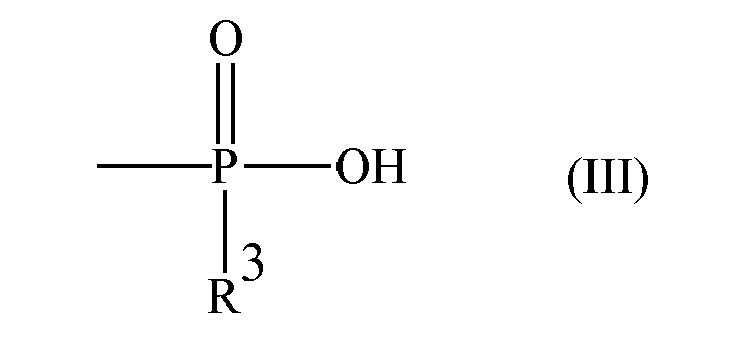 in which R3 represents a hydroxy group, an alkyl group, an arylalkyl group, an alkoxy group or a group of formula (IV):
 or is a salt or ester thereof.
 - A composition according to Claim 6, in which the ethylenically unsaturated compound contains a sulphonic group and has the formula (V):
 R1 is as defined in Claim 6;X3 represents an oxygen atom or a group of formula -NH-; andR4 represents an alkylene group, an arylene group, an oxyalkylene group or an alkyleneoxy group;or is a salt or ester thereof.
 - A composition according to Claim 6, in which the ethylenically unsaturated compound contains a phosphonic group and has the formula (VI):

- A composition according to Claim 6, in which the ethylenically unsaturated compound containing a sulphonic or phosphonic group is 2-acrylamido-2-methyl-1-propanesulphonic acid, 3-sulphopropyl acrylate potassium salt, 3-sulphopropyl methacrylate potassium salt, ethylene glycol methacrylate phosphate, or bis[2-(methacryloyloxy)ethyl] phosphate.
- A composition according to Claim 1, in which the sulphonic-group-containing compound or phosphonic-group-containing compound is 3-hydroxy-1-propanesulphonic acid, 3-amino-1-propanesulphonic acid, 2-hydroxyethyl phosphonic acid, or 3-aminopropylphosphonic acid.
- A composition according to any one of Claims 1 to 10, additionally comprising a solvent.
- A composition according to anyone of Claims 1 to 10, formulated for flexo, gravure or ink jet printing, or formulated for litho or letterpress printing.
- A substrate printed or coated with a composition according to any one of Claims 1 to 12.
- A sealed pouch printed or coated with a composition according to any one of Claims 1 to 12.
Applications Claiming Priority (2)
| Application Number | Priority Date | Filing Date | Title |
|---|---|---|---|
| GB0718509A GB2452977A (en) | 2007-09-21 | 2007-09-21 | Ink composition |
| PCT/GB2008/003189 WO2009037477A1 (en) | 2007-09-21 | 2008-09-18 | Printable oxygen sensing composition |
Publications (2)
| Publication Number | Publication Date |
|---|---|
| EP2195649A1 EP2195649A1 (en) | 2010-06-16 |
| EP2195649B1 true EP2195649B1 (en) | 2015-11-18 |
Family
ID=38670340
Family Applications (1)
| Application Number | Title | Priority Date | Filing Date |
|---|---|---|---|
| EP08806344.1A Active EP2195649B1 (en) | 2007-09-21 | 2008-09-18 | Printable oxygen sensing composition and a substrate or pouch coated with the composition |
Country Status (8)
| Country | Link |
|---|---|
| US (2) | US9459241B2 (en) |
| EP (1) | EP2195649B1 (en) |
| JP (2) | JP5711534B2 (en) |
| KR (1) | KR20100075522A (en) |
| CN (1) | CN101821613B (en) |
| GB (1) | GB2452977A (en) |
| MY (1) | MY161074A (en) |
| WO (1) | WO2009037477A1 (en) |
Families Citing this family (11)
| Publication number | Priority date | Publication date | Assignee | Title |
|---|---|---|---|---|
| GB2452977A (en) | 2007-09-21 | 2009-03-25 | Sun Chemical Ltd | Ink composition |
| GB0910464D0 (en) | 2009-06-17 | 2009-07-29 | Insigniapack Ltd | Indicator, application thereof and related products |
| JP5796792B2 (en) * | 2011-08-04 | 2015-10-21 | エルジー・ケム・リミテッド | Polymer compound containing dye, curable resin composition, photosensitive material, and electronic device |
| US9241872B2 (en) | 2013-06-28 | 2016-01-26 | Eastman Kodak Company | Timed sequence indicators |
| US10436761B2 (en) | 2015-05-05 | 2019-10-08 | Honeywell International Inc. | Gas identification by measuring stain development at multiple specific wavelength regions with narrow band optical sensors |
| RU2665003C1 (en) * | 2017-07-13 | 2018-08-24 | Федеральное государственное бюджетное учреждение науки Институт неорганической химии им. А.В. Николаева Сибирского отделения Российской академии наук | Method for producing a luminescent oxygen-sensitive material |
| AT520591B1 (en) * | 2017-10-30 | 2020-10-15 | Technische Farben Ges B R | Sensor ink, method for producing a fluorescence sensor with the sensor ink and sensor |
| US11525063B2 (en) | 2018-02-28 | 2022-12-13 | The Board Of Trustees Of Western Michigan University | Fluorescent oxygen sensing ink |
| WO2019168529A1 (en) * | 2018-02-28 | 2019-09-06 | The Board Of Trustees Of Western Michigan University | Fluorescent oxygen sensing ink |
| JP6732150B1 (en) * | 2019-03-06 | 2020-07-29 | 東京インキ株式会社 | Gravure printing ink composition for styrene film for thermal lamination |
| JP6732151B1 (en) * | 2019-03-06 | 2020-07-29 | 東京インキ株式会社 | Non-laminating printing ink composition, non-laminating packaging printed material and non-laminating packaging printed material manufacturing method |
Family Cites Families (26)
| Publication number | Priority date | Publication date | Assignee | Title |
|---|---|---|---|---|
| JPS568547A (en) * | 1979-07-03 | 1981-01-28 | Mitsubishi Gas Chem Co Inc | Printable detecting agent |
| US5030420A (en) * | 1982-12-23 | 1991-07-09 | University Of Virginia Alumni Patents Foundation | Apparatus for oxygen determination |
| CA1261717A (en) * | 1982-12-23 | 1989-09-26 | John R. Bacon | Method and apparatus for oxygen determination |
| JPS62148580A (en) * | 1985-12-24 | 1987-07-02 | Toagosei Chem Ind Co Ltd | Fluorescent ink |
| JPH01280242A (en) | 1988-05-06 | 1989-11-10 | Rikagaku Kenkyusho | Oxygen concentration measuring device and oxygen concentration measuring method |
| CA2153134A1 (en) * | 1994-07-11 | 1996-01-12 | Judith D. Auslander | Fluorescent pigmented ink composition having use in a bubble jet ink jet printer |
| DE69725851T2 (en) * | 1996-07-22 | 2004-09-02 | Novartis Ag | LIGHT SENSITIVE COMPOSITIONS FOR OXYGEN OPTODES |
| US6306661B1 (en) * | 1998-02-05 | 2001-10-23 | Joseph R. Lakowicz | Water soluble luminescence oxygen sensor and method |
| US6022908A (en) * | 1998-04-22 | 2000-02-08 | Hewlett-Packard Company | Printing liquids for improved print quality |
| JP2000154343A (en) * | 1998-11-20 | 2000-06-06 | Mitsubishi Chemicals Corp | Recording liquid and ink jet recording method |
| MXPA02002387A (en) | 1999-09-02 | 2002-08-20 | Procter & Gamble | Improved methods, compositions, and articles for odor control. |
| NL1014464C2 (en) | 2000-02-22 | 2001-08-24 | Tno | Optical sensor for measuring oxygen. |
| US6689438B2 (en) * | 2001-06-06 | 2004-02-10 | Cryovac, Inc. | Oxygen detection system for a solid article |
| US6673500B1 (en) * | 2002-08-20 | 2004-01-06 | Xerox Corporation | Document security processes |
| US6675500B1 (en) | 2002-10-29 | 2004-01-13 | Vania Cadamuro | Shock-absorbing sole for footwear, especially but not exclusively sporting footwear |
| US7368153B2 (en) * | 2002-12-06 | 2008-05-06 | Cryovac, Inc. | Oxygen detection system for a rigid container |
| CN100475520C (en) * | 2002-12-06 | 2009-04-08 | 克里奥瓦克公司 | Oxygen Detection System for Rigid Containers |
| JP2006518783A (en) * | 2003-02-07 | 2006-08-17 | サーフェース スペシャリティーズ、エス.エイ. | Aqueous polymer dispersion and method |
| IE20030144A1 (en) * | 2003-02-28 | 2004-09-08 | Univ Dublin City | Improved optical sensors |
| JP4455143B2 (en) * | 2003-05-08 | 2010-04-21 | キヤノン株式会社 | Block polymer, recording material, image recording method and image recording apparatus |
| JP4400911B2 (en) * | 2003-07-31 | 2010-01-20 | 日本化薬株式会社 | Europium compound and ink composition containing the same |
| CN1587347A (en) | 2004-08-05 | 2005-03-02 | 复旦大学 | Electrochemical luminous composite material capable of resisting biological pollution and its preparing method and use |
| EP1781805B1 (en) * | 2004-08-11 | 2009-12-09 | Basf Se | Enzyme-based time temperature indicator |
| US20060228804A1 (en) * | 2005-04-08 | 2006-10-12 | Rosemount Analytical Inc. | Modified ruthenium complex luminescence dye for oxygen sensing |
| ITVA20060006A1 (en) * | 2006-02-01 | 2007-08-02 | Lamberti Spa | NON-WOVEN FABRIC CATCH-COLORS AND METHOD FOR ITS PRODUCTION |
| GB2452977A (en) | 2007-09-21 | 2009-03-25 | Sun Chemical Ltd | Ink composition |
-
2007
- 2007-09-21 GB GB0718509A patent/GB2452977A/en not_active Withdrawn
-
2008
- 2008-09-18 CN CN2008801081456A patent/CN101821613B/en active Active
- 2008-09-18 MY MYPI2010001248A patent/MY161074A/en unknown
- 2008-09-18 WO PCT/GB2008/003189 patent/WO2009037477A1/en not_active Ceased
- 2008-09-18 KR KR1020107008707A patent/KR20100075522A/en not_active Ceased
- 2008-09-18 JP JP2010525433A patent/JP5711534B2/en active Active
- 2008-09-18 US US12/679,386 patent/US9459241B2/en active Active
- 2008-09-18 EP EP08806344.1A patent/EP2195649B1/en active Active
-
2014
- 2014-10-07 JP JP2014206286A patent/JP2015061761A/en active Pending
-
2016
- 2016-09-01 US US15/254,402 patent/US10247712B2/en active Active
Also Published As
| Publication number | Publication date |
|---|---|
| WO2009037477A1 (en) | 2009-03-26 |
| US20100221468A1 (en) | 2010-09-02 |
| KR20100075522A (en) | 2010-07-02 |
| GB2452977A (en) | 2009-03-25 |
| US20170016865A1 (en) | 2017-01-19 |
| JP2015061761A (en) | 2015-04-02 |
| US9459241B2 (en) | 2016-10-04 |
| CN101821613A (en) | 2010-09-01 |
| US10247712B2 (en) | 2019-04-02 |
| MY161074A (en) | 2017-04-14 |
| CN101821613B (en) | 2013-04-10 |
| GB0718509D0 (en) | 2007-10-31 |
| JP2010540689A (en) | 2010-12-24 |
| WO2009037477A8 (en) | 2009-06-04 |
| EP2195649A1 (en) | 2010-06-16 |
| JP5711534B2 (en) | 2015-05-07 |
Similar Documents
| Publication | Publication Date | Title |
|---|---|---|
| US10247712B2 (en) | Printable oxygen sensing composition | |
| US20060257094A1 (en) | Optical co2 and combined o2/co2 sensors | |
| CA1129323A (en) | Diagnostic agent for the detection of components in liquids | |
| JP4187643B2 (en) | Multi-layer oxygen detection system for solid articles | |
| JP5143573B2 (en) | Ink composition and oxygen indicator | |
| RU2006129355A (en) | TEST SYSTEM FOR DETERMINING THE CONCENTRATION OF ANALYZED SUBSTANCE IN PHYSIOLOGICAL LIQUID | |
| JP2866201B2 (en) | Method for activating polyanion fluorescent dyes in low dielectric media with quaternary onium compounds | |
| US7456023B2 (en) | Reagent for luminescence optical determination of an analyte | |
| EP1722223A1 (en) | Metal oxide membrane with a gas-selective compound | |
| AU2002345539A1 (en) | Multi-layered oxygen detection system for a solid article | |
| Fan et al. | Semiquantitative naked-eye detection of Cu (ii) with a standard colorimetric card via a hydrogel-coated paper sensor | |
| Safaryan et al. | Reversible sol–gel–sol medium for enzymatic optical biosensors | |
| CN110108683A (en) | A kind of preparation method of the ratio the oxygen sensing film for dissolved oxygen content detection | |
| JPS59133449A (en) | Testing means for measuring ionic strength or specific gravity of aqueous sample by using strong organic acid salt of high molecular electrolyte | |
| LU81861A1 (en) | COMPOSITION, TEST DEVICE AND METHOD FOR DETERMINING THE ION CONCENTRATION OR THE SPECIFIC WEIGHT OF A LIQUID SAMPLE | |
| EP1790982A1 (en) | Multilayer analysis element for analyzing liquid sample | |
| Reshetnyak et al. | Influence of tetraalkylammonium halides on analytical properties of universal acid-base indicator paper | |
| EP0114315A2 (en) | Novel strong organic acid polyelectrolyte salts, test means, test device and method for determining the ionic strength or specific gravity of a liquid sample | |
| JPH0324984B2 (en) | ||
| CN1637154B (en) | Method for discriminating change of probe-bearing substrate, and detection apparatus | |
| CN114222912A (en) | Colorimetric Sensors for pH Measurement | |
| CN108753186A (en) | A kind of formaldehyde examination film patch and its application method | |
| CN111157502B (en) | A method of fluorescence titration to detect the interaction between temperature-sensitive sugar-containing random polymers and lectins | |
| JP3848347B2 (en) | Method for discriminating changes in probe fixing substrate, probe fixing substrate and detection apparatus | |
| JPS59133207A (en) | Novel high polymer electrolyte salt of strong organic acid for use for determining ion strength or gravity of liquid sample |
Legal Events
| Date | Code | Title | Description |
|---|---|---|---|
| PUAI | Public reference made under article 153(3) epc to a published international application that has entered the european phase |
Free format text: ORIGINAL CODE: 0009012 |
|
| 17P | Request for examination filed |
Effective date: 20100420 |
|
| AK | Designated contracting states |
Kind code of ref document: A1 Designated state(s): AT BE BG CH CY CZ DE DK EE ES FI FR GB GR HR HU IE IS IT LI LT LU LV MC MT NL NO PL PT RO SE SI SK TR |
|
| AX | Request for extension of the european patent |
Extension state: AL BA MK RS |
|
| DAX | Request for extension of the european patent (deleted) | ||
| 17Q | First examination report despatched |
Effective date: 20120228 |
|
| RIN1 | Information on inventor provided before grant (corrected) |
Inventor name: KHAN, SARFARAZ, AKHTAR Inventor name: LINES, ROBERT Inventor name: LEONARD, MICHAEL, WILLIAM |
|
| GRAP | Despatch of communication of intention to grant a patent |
Free format text: ORIGINAL CODE: EPIDOSNIGR1 |
|
| RIC1 | Information provided on ipc code assigned before grant |
Ipc: C07D 471/04 20060101ALI20150310BHEP Ipc: G01N 21/77 20060101ALI20150310BHEP Ipc: G01N 31/22 20060101AFI20150310BHEP |
|
| INTG | Intention to grant announced |
Effective date: 20150416 |
|
| GRAR | Information related to intention to grant a patent recorded |
Free format text: ORIGINAL CODE: EPIDOSNIGR71 |
|
| GRAS | Grant fee paid |
Free format text: ORIGINAL CODE: EPIDOSNIGR3 |
|
| GRAA | (expected) grant |
Free format text: ORIGINAL CODE: 0009210 |
|
| AK | Designated contracting states |
Kind code of ref document: B1 Designated state(s): AT BE BG CH CY CZ DE DK EE ES FI FR GB GR HR HU IE IS IT LI LT LU LV MC MT NL NO PL PT RO SE SI SK TR |
|
| INTG | Intention to grant announced |
Effective date: 20151013 |
|
| REG | Reference to a national code |
Ref country code: GB Ref legal event code: FG4D |
|
| REG | Reference to a national code |
Ref country code: CH Ref legal event code: EP |
|
| REG | Reference to a national code |
Ref country code: AT Ref legal event code: REF Ref document number: 761811 Country of ref document: AT Kind code of ref document: T Effective date: 20151215 |
|
| REG | Reference to a national code |
Ref country code: IE Ref legal event code: FG4D |
|
| REG | Reference to a national code |
Ref country code: DE Ref legal event code: R096 Ref document number: 602008041288 Country of ref document: DE |
|
| REG | Reference to a national code |
Ref country code: NL Ref legal event code: MP Effective date: 20160218 |
|
| REG | Reference to a national code |
Ref country code: LT Ref legal event code: MG4D |
|
| REG | Reference to a national code |
Ref country code: AT Ref legal event code: MK05 Ref document number: 761811 Country of ref document: AT Kind code of ref document: T Effective date: 20151118 |
|
| PG25 | Lapsed in a contracting state [announced via postgrant information from national office to epo] |
Ref country code: LT Free format text: LAPSE BECAUSE OF FAILURE TO SUBMIT A TRANSLATION OF THE DESCRIPTION OR TO PAY THE FEE WITHIN THE PRESCRIBED TIME-LIMIT Effective date: 20151118 Ref country code: HR Free format text: LAPSE BECAUSE OF FAILURE TO SUBMIT A TRANSLATION OF THE DESCRIPTION OR TO PAY THE FEE WITHIN THE PRESCRIBED TIME-LIMIT Effective date: 20151118 Ref country code: ES Free format text: LAPSE BECAUSE OF FAILURE TO SUBMIT A TRANSLATION OF THE DESCRIPTION OR TO PAY THE FEE WITHIN THE PRESCRIBED TIME-LIMIT Effective date: 20151118 Ref country code: IS Free format text: LAPSE BECAUSE OF FAILURE TO SUBMIT A TRANSLATION OF THE DESCRIPTION OR TO PAY THE FEE WITHIN THE PRESCRIBED TIME-LIMIT Effective date: 20160318 Ref country code: IT Free format text: LAPSE BECAUSE OF FAILURE TO SUBMIT A TRANSLATION OF THE DESCRIPTION OR TO PAY THE FEE WITHIN THE PRESCRIBED TIME-LIMIT Effective date: 20151118 Ref country code: NL Free format text: LAPSE BECAUSE OF FAILURE TO SUBMIT A TRANSLATION OF THE DESCRIPTION OR TO PAY THE FEE WITHIN THE PRESCRIBED TIME-LIMIT Effective date: 20151118 Ref country code: NO Free format text: LAPSE BECAUSE OF FAILURE TO SUBMIT A TRANSLATION OF THE DESCRIPTION OR TO PAY THE FEE WITHIN THE PRESCRIBED TIME-LIMIT Effective date: 20160218 |
|
| PG25 | Lapsed in a contracting state [announced via postgrant information from national office to epo] |
Ref country code: LV Free format text: LAPSE BECAUSE OF FAILURE TO SUBMIT A TRANSLATION OF THE DESCRIPTION OR TO PAY THE FEE WITHIN THE PRESCRIBED TIME-LIMIT Effective date: 20151118 Ref country code: PT Free format text: LAPSE BECAUSE OF FAILURE TO SUBMIT A TRANSLATION OF THE DESCRIPTION OR TO PAY THE FEE WITHIN THE PRESCRIBED TIME-LIMIT Effective date: 20160318 Ref country code: SE Free format text: LAPSE BECAUSE OF FAILURE TO SUBMIT A TRANSLATION OF THE DESCRIPTION OR TO PAY THE FEE WITHIN THE PRESCRIBED TIME-LIMIT Effective date: 20151118 Ref country code: AT Free format text: LAPSE BECAUSE OF FAILURE TO SUBMIT A TRANSLATION OF THE DESCRIPTION OR TO PAY THE FEE WITHIN THE PRESCRIBED TIME-LIMIT Effective date: 20151118 Ref country code: FI Free format text: LAPSE BECAUSE OF FAILURE TO SUBMIT A TRANSLATION OF THE DESCRIPTION OR TO PAY THE FEE WITHIN THE PRESCRIBED TIME-LIMIT Effective date: 20151118 Ref country code: GR Free format text: LAPSE BECAUSE OF FAILURE TO SUBMIT A TRANSLATION OF THE DESCRIPTION OR TO PAY THE FEE WITHIN THE PRESCRIBED TIME-LIMIT Effective date: 20160219 Ref country code: PL Free format text: LAPSE BECAUSE OF FAILURE TO SUBMIT A TRANSLATION OF THE DESCRIPTION OR TO PAY THE FEE WITHIN THE PRESCRIBED TIME-LIMIT Effective date: 20151118 |
|
| PG25 | Lapsed in a contracting state [announced via postgrant information from national office to epo] |
Ref country code: CZ Free format text: LAPSE BECAUSE OF FAILURE TO SUBMIT A TRANSLATION OF THE DESCRIPTION OR TO PAY THE FEE WITHIN THE PRESCRIBED TIME-LIMIT Effective date: 20151118 |
|
| REG | Reference to a national code |
Ref country code: DE Ref legal event code: R097 Ref document number: 602008041288 Country of ref document: DE |
|
| PG25 | Lapsed in a contracting state [announced via postgrant information from national office to epo] |
Ref country code: SK Free format text: LAPSE BECAUSE OF FAILURE TO SUBMIT A TRANSLATION OF THE DESCRIPTION OR TO PAY THE FEE WITHIN THE PRESCRIBED TIME-LIMIT Effective date: 20151118 Ref country code: RO Free format text: LAPSE BECAUSE OF FAILURE TO SUBMIT A TRANSLATION OF THE DESCRIPTION OR TO PAY THE FEE WITHIN THE PRESCRIBED TIME-LIMIT Effective date: 20151118 Ref country code: EE Free format text: LAPSE BECAUSE OF FAILURE TO SUBMIT A TRANSLATION OF THE DESCRIPTION OR TO PAY THE FEE WITHIN THE PRESCRIBED TIME-LIMIT Effective date: 20151118 Ref country code: DK Free format text: LAPSE BECAUSE OF FAILURE TO SUBMIT A TRANSLATION OF THE DESCRIPTION OR TO PAY THE FEE WITHIN THE PRESCRIBED TIME-LIMIT Effective date: 20151118 |
|
| PLBE | No opposition filed within time limit |
Free format text: ORIGINAL CODE: 0009261 |
|
| STAA | Information on the status of an ep patent application or granted ep patent |
Free format text: STATUS: NO OPPOSITION FILED WITHIN TIME LIMIT |
|
| REG | Reference to a national code |
Ref country code: FR Ref legal event code: PLFP Year of fee payment: 9 |
|
| 26N | No opposition filed |
Effective date: 20160819 |
|
| PG25 | Lapsed in a contracting state [announced via postgrant information from national office to epo] |
Ref country code: SI Free format text: LAPSE BECAUSE OF FAILURE TO SUBMIT A TRANSLATION OF THE DESCRIPTION OR TO PAY THE FEE WITHIN THE PRESCRIBED TIME-LIMIT Effective date: 20151118 |
|
| PG25 | Lapsed in a contracting state [announced via postgrant information from national office to epo] |
Ref country code: BE Free format text: LAPSE BECAUSE OF FAILURE TO SUBMIT A TRANSLATION OF THE DESCRIPTION OR TO PAY THE FEE WITHIN THE PRESCRIBED TIME-LIMIT Effective date: 20151118 |
|
| PG25 | Lapsed in a contracting state [announced via postgrant information from national office to epo] |
Ref country code: MC Free format text: LAPSE BECAUSE OF FAILURE TO SUBMIT A TRANSLATION OF THE DESCRIPTION OR TO PAY THE FEE WITHIN THE PRESCRIBED TIME-LIMIT Effective date: 20151118 |
|
| REG | Reference to a national code |
Ref country code: CH Ref legal event code: PL |
|
| REG | Reference to a national code |
Ref country code: IE Ref legal event code: MM4A |
|
| PG25 | Lapsed in a contracting state [announced via postgrant information from national office to epo] |
Ref country code: LI Free format text: LAPSE BECAUSE OF NON-PAYMENT OF DUE FEES Effective date: 20160930 Ref country code: CH Free format text: LAPSE BECAUSE OF NON-PAYMENT OF DUE FEES Effective date: 20160930 Ref country code: IE Free format text: LAPSE BECAUSE OF NON-PAYMENT OF DUE FEES Effective date: 20160918 |
|
| PG25 | Lapsed in a contracting state [announced via postgrant information from national office to epo] |
Ref country code: LU Free format text: LAPSE BECAUSE OF NON-PAYMENT OF DUE FEES Effective date: 20160918 |
|
| REG | Reference to a national code |
Ref country code: FR Ref legal event code: PLFP Year of fee payment: 10 |
|
| PG25 | Lapsed in a contracting state [announced via postgrant information from national office to epo] |
Ref country code: CY Free format text: LAPSE BECAUSE OF FAILURE TO SUBMIT A TRANSLATION OF THE DESCRIPTION OR TO PAY THE FEE WITHIN THE PRESCRIBED TIME-LIMIT Effective date: 20151118 Ref country code: HU Free format text: LAPSE BECAUSE OF FAILURE TO SUBMIT A TRANSLATION OF THE DESCRIPTION OR TO PAY THE FEE WITHIN THE PRESCRIBED TIME-LIMIT; INVALID AB INITIO Effective date: 20080918 |
|
| PG25 | Lapsed in a contracting state [announced via postgrant information from national office to epo] |
Ref country code: TR Free format text: LAPSE BECAUSE OF FAILURE TO SUBMIT A TRANSLATION OF THE DESCRIPTION OR TO PAY THE FEE WITHIN THE PRESCRIBED TIME-LIMIT Effective date: 20151118 Ref country code: MT Free format text: LAPSE BECAUSE OF NON-PAYMENT OF DUE FEES Effective date: 20160930 |
|
| PG25 | Lapsed in a contracting state [announced via postgrant information from national office to epo] |
Ref country code: BG Free format text: LAPSE BECAUSE OF FAILURE TO SUBMIT A TRANSLATION OF THE DESCRIPTION OR TO PAY THE FEE WITHIN THE PRESCRIBED TIME-LIMIT Effective date: 20151118 |
|
| REG | Reference to a national code |
Ref country code: FR Ref legal event code: PLFP Year of fee payment: 11 |
|
| P01 | Opt-out of the competence of the unified patent court (upc) registered |
Effective date: 20230520 |
|
| PGFP | Annual fee paid to national office [announced via postgrant information from national office to epo] |
Ref country code: DE Payment date: 20250820 Year of fee payment: 18 |
|
| PGFP | Annual fee paid to national office [announced via postgrant information from national office to epo] |
Ref country code: GB Payment date: 20250822 Year of fee payment: 18 |
|
| PGFP | Annual fee paid to national office [announced via postgrant information from national office to epo] |
Ref country code: FR Payment date: 20250820 Year of fee payment: 18 |