EP2191827A1 - Antifungal composition - Google Patents
Antifungal composition Download PDFInfo
- Publication number
- EP2191827A1 EP2191827A1 EP08829224A EP08829224A EP2191827A1 EP 2191827 A1 EP2191827 A1 EP 2191827A1 EP 08829224 A EP08829224 A EP 08829224A EP 08829224 A EP08829224 A EP 08829224A EP 2191827 A1 EP2191827 A1 EP 2191827A1
- Authority
- EP
- European Patent Office
- Prior art keywords
- pharmaceutical composition
- compounds selected
- cell layer
- glycol
- general formula
- Prior art date
- Legal status (The legal status is an assumption and is not a legal conclusion. Google has not performed a legal analysis and makes no representation as to the accuracy of the status listed.)
- Granted
Links
Classifications
-
- A—HUMAN NECESSITIES
- A61—MEDICAL OR VETERINARY SCIENCE; HYGIENE
- A61K—PREPARATIONS FOR MEDICAL, DENTAL OR TOILETRY PURPOSES
- A61K31/00—Medicinal preparations containing organic active ingredients
- A61K31/33—Heterocyclic compounds
- A61K31/395—Heterocyclic compounds having nitrogen as a ring hetero atom, e.g. guanethidine or rifamycins
- A61K31/41—Heterocyclic compounds having nitrogen as a ring hetero atom, e.g. guanethidine or rifamycins having five-membered rings with two or more ring hetero atoms, at least one of which being nitrogen, e.g. tetrazole
- A61K31/4164—1,3-Diazoles
- A61K31/4178—1,3-Diazoles not condensed 1,3-diazoles and containing further heterocyclic rings, e.g. pilocarpine, nitrofurantoin
-
- A—HUMAN NECESSITIES
- A61—MEDICAL OR VETERINARY SCIENCE; HYGIENE
- A61K—PREPARATIONS FOR MEDICAL, DENTAL OR TOILETRY PURPOSES
- A61K47/00—Medicinal preparations characterised by the non-active ingredients used, e.g. carriers or inert additives; Targeting or modifying agents chemically bound to the active ingredient
- A61K47/06—Organic compounds, e.g. natural or synthetic hydrocarbons, polyolefins, mineral oil, petrolatum or ozokerite
- A61K47/08—Organic compounds, e.g. natural or synthetic hydrocarbons, polyolefins, mineral oil, petrolatum or ozokerite containing oxygen, e.g. ethers, acetals, ketones, quinones, aldehydes, peroxides
- A61K47/10—Alcohols; Phenols; Salts thereof, e.g. glycerol; Polyethylene glycols [PEG]; Poloxamers; PEG/POE alkyl ethers
-
- A—HUMAN NECESSITIES
- A61—MEDICAL OR VETERINARY SCIENCE; HYGIENE
- A61K—PREPARATIONS FOR MEDICAL, DENTAL OR TOILETRY PURPOSES
- A61K47/00—Medicinal preparations characterised by the non-active ingredients used, e.g. carriers or inert additives; Targeting or modifying agents chemically bound to the active ingredient
- A61K47/06—Organic compounds, e.g. natural or synthetic hydrocarbons, polyolefins, mineral oil, petrolatum or ozokerite
- A61K47/08—Organic compounds, e.g. natural or synthetic hydrocarbons, polyolefins, mineral oil, petrolatum or ozokerite containing oxygen, e.g. ethers, acetals, ketones, quinones, aldehydes, peroxides
- A61K47/12—Carboxylic acids; Salts or anhydrides thereof
-
- A—HUMAN NECESSITIES
- A61—MEDICAL OR VETERINARY SCIENCE; HYGIENE
- A61K—PREPARATIONS FOR MEDICAL, DENTAL OR TOILETRY PURPOSES
- A61K47/00—Medicinal preparations characterised by the non-active ingredients used, e.g. carriers or inert additives; Targeting or modifying agents chemically bound to the active ingredient
- A61K47/06—Organic compounds, e.g. natural or synthetic hydrocarbons, polyolefins, mineral oil, petrolatum or ozokerite
- A61K47/08—Organic compounds, e.g. natural or synthetic hydrocarbons, polyolefins, mineral oil, petrolatum or ozokerite containing oxygen, e.g. ethers, acetals, ketones, quinones, aldehydes, peroxides
- A61K47/14—Esters of carboxylic acids, e.g. fatty acid monoglycerides, medium-chain triglycerides, parabens or PEG fatty acid esters
-
- A—HUMAN NECESSITIES
- A61—MEDICAL OR VETERINARY SCIENCE; HYGIENE
- A61K—PREPARATIONS FOR MEDICAL, DENTAL OR TOILETRY PURPOSES
- A61K47/00—Medicinal preparations characterised by the non-active ingredients used, e.g. carriers or inert additives; Targeting or modifying agents chemically bound to the active ingredient
- A61K47/06—Organic compounds, e.g. natural or synthetic hydrocarbons, polyolefins, mineral oil, petrolatum or ozokerite
- A61K47/22—Heterocyclic compounds, e.g. ascorbic acid, tocopherol or pyrrolidones
-
- A—HUMAN NECESSITIES
- A61—MEDICAL OR VETERINARY SCIENCE; HYGIENE
- A61K—PREPARATIONS FOR MEDICAL, DENTAL OR TOILETRY PURPOSES
- A61K47/00—Medicinal preparations characterised by the non-active ingredients used, e.g. carriers or inert additives; Targeting or modifying agents chemically bound to the active ingredient
- A61K47/06—Organic compounds, e.g. natural or synthetic hydrocarbons, polyolefins, mineral oil, petrolatum or ozokerite
- A61K47/26—Carbohydrates, e.g. sugar alcohols, amino sugars, nucleic acids, mono-, di- or oligo-saccharides; Derivatives thereof, e.g. polysorbates, sorbitan fatty acid esters or glycyrrhizin
-
- A—HUMAN NECESSITIES
- A61—MEDICAL OR VETERINARY SCIENCE; HYGIENE
- A61K—PREPARATIONS FOR MEDICAL, DENTAL OR TOILETRY PURPOSES
- A61K47/00—Medicinal preparations characterised by the non-active ingredients used, e.g. carriers or inert additives; Targeting or modifying agents chemically bound to the active ingredient
- A61K47/30—Macromolecular organic or inorganic compounds, e.g. inorganic polyphosphates
- A61K47/32—Macromolecular compounds obtained by reactions only involving carbon-to-carbon unsaturated bonds, e.g. carbomers, poly(meth)acrylates, or polyvinyl pyrrolidone
-
- A—HUMAN NECESSITIES
- A61—MEDICAL OR VETERINARY SCIENCE; HYGIENE
- A61K—PREPARATIONS FOR MEDICAL, DENTAL OR TOILETRY PURPOSES
- A61K47/00—Medicinal preparations characterised by the non-active ingredients used, e.g. carriers or inert additives; Targeting or modifying agents chemically bound to the active ingredient
- A61K47/30—Macromolecular organic or inorganic compounds, e.g. inorganic polyphosphates
- A61K47/34—Macromolecular compounds obtained otherwise than by reactions only involving carbon-to-carbon unsaturated bonds, e.g. polyesters, polyamino acids, polysiloxanes, polyphosphazines, copolymers of polyalkylene glycol or poloxamers
-
- A—HUMAN NECESSITIES
- A61—MEDICAL OR VETERINARY SCIENCE; HYGIENE
- A61K—PREPARATIONS FOR MEDICAL, DENTAL OR TOILETRY PURPOSES
- A61K9/00—Medicinal preparations characterised by special physical form
- A61K9/0012—Galenical forms characterised by the site of application
- A61K9/0014—Skin, i.e. galenical aspects of topical compositions
-
- A—HUMAN NECESSITIES
- A61—MEDICAL OR VETERINARY SCIENCE; HYGIENE
- A61P—SPECIFIC THERAPEUTIC ACTIVITY OF CHEMICAL COMPOUNDS OR MEDICINAL PREPARATIONS
- A61P17/00—Drugs for dermatological disorders
- A61P17/08—Antiseborrheics
-
- A—HUMAN NECESSITIES
- A61—MEDICAL OR VETERINARY SCIENCE; HYGIENE
- A61P—SPECIFIC THERAPEUTIC ACTIVITY OF CHEMICAL COMPOUNDS OR MEDICINAL PREPARATIONS
- A61P31/00—Antiinfectives, i.e. antibiotics, antiseptics, chemotherapeutics
- A61P31/10—Antimycotics
Definitions
- the present invention relates to a pharmaceutical composition, and more specifically, to a pharmaceutical composition for antifungal use.
- mycoses In Japan having a hot and humid climatic property, measures against mycoses caused by pathogenic fungi are a particularly important pharmaceutical theme. Reoccurrence of such a disease is repeatedly caused by remaining living microbes even if the disease appears to have been perfectly cured. For example, summer is a season in which the disease easily reoccurs, and thus, repetitive treatments are required. Therefore, an antifungal agent having an excellent medicinal effect has been demanded. Further, simultaneously, mycoses include those which develop on hand and foot portions such as tinea pedis and tinea unguium, those which develop on the body skin such as tinea, and those which develop on the scalp such as seborrheic dermatitis, and there is also a demand for development of a versatile dosage form which can be applied to the respective portions.
- an antifungal agent having an excellent antifungal effect for example, luliconazole, one of compounds represented by the general formula (1), has attracted attention as a medicament that allows a treatment period to be shortened (for example, see JP 09-100279 A and JP 02-275877 A ).
- Such compounds are also useful for onychomycosis, and a formulation thereof for onychomycosis, which is a hydrogel-like formulation, is also already known (for example, see WO 03/105841 ).
- the compounds represented by the general formula (1) can be said to be excellent in antifungal property as well.
- the compounds represented by the general formula (1) are poorly-soluble in an aqueous medium in terms of solubility, and must be formulated by using a solubilizing agent.
- a solubilizing agent As a result, the control of a variation in the bioavailability of medicaments to be caused by such a solubilizing agent has been the single and greatest problem in a formulation study.
- the addition of such a cellulose-based thickener also has an action of enhancing a horny cell layer storage (hereinafter, also referred to as a storage or a retention of a medicament in the horny cell layer).
- a variation in the compounding amount of such a thickener for viscosity adjustment has also caused a change in the pharmacodynamic property and a change in the bioavailability of a formulation.
- a medicine is always required to retain bioequivalence, and it can be said that the development of a system capable of compensating such a change in the pharmacodynamic property and of maintaining bioequivalence has been demanded for the formulation design of the compounds represented by the general formula (1).
- any pharmaceutical composition for antifungal use containing: 1) one or more compounds selected from compounds represented by the general formula (1) below and physiologically acceptable salts thereof; 2) one or more compounds selected from polypropylene glycol, diesters of dibasic acids, triacetin, 2-ethyl-1,3-hexanediol, lauromacrogol, and polyoxyethylene-polyoxypropylene glycol; and 3) one or more compounds selected from glucono- ⁇ -lactone, propylene glycol, glycerin, and lactic acid. Further, there has been no finding that a change in the bioavailability of the compounds represented by the general formula (1) due to a variation in the formulation components can be compensated by adopting such a composition.
- ingredients such as polypropylene glycol, diesters of dibasic acids, triacetin, 2-ethyl-1,3-hexanediol, lauromacrogol, polyoxyethylene-polyoxypropylene glycol, glucono- ⁇ -lactone, propylene glycol, glycerin, or lactic acid into a pharmaceutical composition for antifungal use for the purpose of serving as an absorption accelerant, a pH stabilizer, or the like (for example, see JP 2004-529935 A , JP 2003-252798 A , JP 2004-529923 A , WO 96/011710 , and WO 01/003742 ).
- the present invention has been made under such circumstances, and is characterized by providing a system for compensating a change in the bioavailability of compounds represented by the general formula (1) due to a variation in the formulation components.
- the inventors of the present invention have intensively studied to search a system for compensating a change in the bioavailability of the compounds represented by the general formula (1) due to a variation in the formulation components.
- the inventors have found that the horny cell layer storability of the compounds represented by the general formula (1) can be controlled by formulating a combination of a ingredient for inhibiting the absorption of the compounds of the general formula (1) to the horny cell layer, i.e., one or more compounds selected from polypropylene glycol, diesters of dibasic acid, triacetin, 2-ethyl-1,3-hexanediol, lauromacrogol, and polyoxyethylene-polyoxypropylene glycol, and a ingredient for promoting the absorption of the compounds of the general formula (1) to the horny cell layer, i.e., one or more compounds selected from glucono- ⁇ -lactone, propylene glycol, glycerin, and lactic acid, and
- a pharmaceutical composition for antifungal use comprising: 1) one or more compounds selected from compounds represented by the general formula (1) and physiologically acceptable salts thereof; 2) one or more compounds selected from polypropylene glycol, diesters of dibasic acids, triacetin, 2-ethyl-1,3-hexanediol, lauromacrogol, and polyoxyethylene-polyoxypropylene glycol; and 3) one or more compounds selected from glucono- ⁇ -lactone, propylene glycol, glycerin, and lactic acid.
- composition according to the item ⁇ 1> or ⁇ 2> comprising triacetin as one or more compounds selected from polypropylene glycol, diesters of dibasic acids, triacetin, 2-ethyl-1,3-hexanediol, lauromacrogol, and polyoxyethylene-polyoxypropylene glycol.
- glucono- ⁇ -lactone as one or more compounds selected from glucono- ⁇ -lactone, propylene glycol, glycerin, and lactic acid.
- composition according to any one of the item ⁇ 1> to ⁇ 4>, wherein the pharmaceutical composition for antifungal use is in the form of a single-phase solution.
- composition according to any one of the item ⁇ 1> to ⁇ 5> further comprising ethanol and/or water.
- ⁇ 7> The pharmaceutical composition according to any one of the item ⁇ 1> to ⁇ 6>, wherein the target disease is seborrheic dermatitis.
- a method for adjusting the storability in the horny cell layer of compounds represented by the general formula (1) and/or salts thereof in the pharmaceutical composition according to any one of the item ⁇ 1> to ⁇ 7> which comprises decreasing the total content of one or more compounds selected from polypropylene glycol, diesters of dibasic acids, triacetin, 2-ethyl-1,3-hexanediol, lauromacrogol, and polyoxyethylene-polyoxypropylene glycol with respect to the total amount of the pharmaceutical composition, and/or increasing the total content of one or more compounds selected from glucono- ⁇ -lactone, propylene glycol, glycerin, and lactic acid with respect to the total amount of the pharmaceutical composition, in the case where the storability in the horny cell layer should be increased; or increasing the total content of one or more compounds selected from polypropylene glycol, diesters of dibasic acids, triacetin, 2-ethyl-1,3-hexaned
- a system for compensating a change in the bioavailability of compounds represented by the general formula (1) due to a variation in the formulation components may be provided.
- the pharmaceutical composition of the present invention is one for antifungal use, and characterized by containing a compound represented by the general formula (1) and/or a salt thereof.
- X in the compounds represented by the general formula (1) represents a halogen
- preferred examples of the halogen include chlorine, bromine, iodine, and fluorine. Of those, chlorine is particularly preferred.
- preferred specific examples of the compounds represented by the general formula (1) include (R)-(-)-(E)-[4-(2,4-dichlorophenyl)-1,3-dithiolane-2-ylidene]-1-imidazolylacetonitrile (luliconazole), (R)-(+)-(E)-[4-(2-chlorophenyl)-1,3-dithiolane-2-ylidene]-1-im idazolylacetonitrile, and (E)-[4-(2-chlorophenyl)-1,3-dithiolane-2-ylidene]-1-imidazolyl acetonitrile (lanoconazole).
- luliconazole is preferred because it ensures the effect of the present invention to be particularly large.
- physiologically acceptable salts thereof as described above are not particularly limited as long as the salts are physiologically acceptable, and favorable examples of the salts include: mineral acid salts such as a hydrochloride, a nitrate, a sulfate, and a phosphate; organic acid salts such as a citrate, an oxalate, a lactate, and an acetate; and sulfate-containing salts such as a mesylate and a tosylate.
- a hydrochloride is more preferred in terms of safety and solubility.
- One compound of compounds represented by the general formula (1) and/or physiologically acceptable salts thereof may be used alone, or two or more compounds thereof may also be used in combination.
- the preferred total content of the compounds represented by the general formula (1) and/or physiologically acceptable salts thereof in the pharmaceutical composition for antifungal use of the present invention is preferably 0.01 to 20 w/v% and more preferably 0.1 to 10 w/v% with respect to the total amount of the pharmaceutical composition.
- the amount of such compounds may be determined on the basis of solubility and formulation property thereof.
- the pharmaceutical composition of the present invention contains, as an essential ingredient, one or more compounds selected from triacetin, polypropylene glycol, diesters of dibasic acids, 2-ethyl-1,3-hexanediol, lauromacrogol, and polyoxyethylene-polyoxypropylene glycol, in addition to the compound represented by the general formula (1) and/or the salt thereof.
- the polypropylene glycol the polymerization degree thereof is preferably 1000 or more, and more preferably 1500 or more, and the upper limit value of the polymerization degree is preferably 10,000, and more preferably 5000.
- dibasic acids constituting the diesters of dibasic acids include tartaric acid, adipic acid, sebacic acid and succinic acid, and adipic acid or sebacic acid is particularly preferred.
- ester moieties thereof preferred is a hydrocarbon group having 1 to 4 carbon atoms, and specifically, favorable examples of the ester moieties include a methyl ester, an ethyl ester, a propyl ester, an isopropyl ester, a butyl ester, a sec-butyl ester and a tert-butyl ester, and preferred examples thereof include an ethyl ester and an isopropyl ester.
- the polypropylene glycol, diesters of dibasic acids, triacetin, 2-ethyl-1,3-hexanediol, lauromacrogol, and polyoxyethylene-polyoxypropylene glycol have actions as solvents that stably dissolve the general formula (1), and as inhibitors of the horny cell layer storability of the compounds represented by the general formula (1).
- each of such ingredients is incorporated at preferably 0.01 to 60 w/v% and more preferably 0.1 to 50 w/v% with respect to the total amount of the pharmaceutical composition.
- the content is preferably set up to be a content that can be either decreased or increased. Any of such ingredients also has a subsidiary effect of improving the preservation stability of the compounds represented by the general formula (1) even under a harsh condition of preservation at 60°C for 1 week.
- the pharmaceutical composition of the present invention is characterized by containing one or more compounds selected from glucono- ⁇ -lactone, propylene glycol, glycerin, and lactic acid, in addition to the compound represented by the general formula (1) and/or the salt thereof.
- Such ingredients are solvents that stably dissolve the general formula (1) in many cases, and each have an action as an accelerator of the transdermal absorption of the compounds represented by the general formula (1).
- each of such ingredients is incorporated at preferably 0.01 to 60 w/v% and more preferably 0.1 to 50 w/v% with respect to the total amount of the pharmaceutical composition.
- the content is preferably set up to be a content that can be either decreased or increased. Any of such ingredients also has a subsidiary effect for improving the preservation stability of the compounds represented by the general formula (1) even under a harsh condition of preservation at 60°C for 1 week.
- the pharmaceutical composition of the present invention is one for antifungal use, and contains the above-mentioned essential ingredients.
- the pharmaceutical composition of the present invention can be applied for any formulation with an dosage form known in an antifungal formulation, which formulation can contain the above-mentioned essential ingredients, however, is preferably applied for a skin agent for external use in view of an effect of "capable of controlling the absorbability to the horny cell layer".
- the pharmaceutical composition of the present invention is preferably formulated into the form of a single-phase solution without containing any flammable solvent such as methyl ethyl ketone, acetone, and ethyl acetate other than ethanol because many of the essential ingredients to be incorporated in the pharmaceutical composition of the present invention have a solvent property or an action of promoting dissolution, superior in an action of inhibiting the absorption and an action of promoting the absorption to the horny cell layer.
- a cellulose-based thickener such as hydroxypropylcellulose, carboxymethylcellulose, hydroxypropylmethylcellulose, and hydroxyethylcellulose has effects of increasing a viscosity, inhibiting dripping, and enhancing usability, and also has an effect of enhancing the absorbability of a medicament to the horny cell layer. Therefore, in the viscosity adjustment of a system, in some cases, the fine adjustment of the content of such an ingredient causes a variation in horny cell layer storability, so that the maintenance of the bioequivalence becomes difficult.
- the bioequivalence can be maintained by applying the pharmaceutical composition of the present invention to a system containing such an ingredient, and adjusting the amount ratio of the above-mentioned two essential ingredients involved in the absorbability to the horny cell layer. Accordingly, it is particularly preferred that the pharmaceutical composition of the present invention be applied for such a dosage form.
- the term "single-phase solution” as used herein refers to a dissolved liquid substance in which no white turbidity is observed and neither liquid crystal nor microcrystal is observed under a polarized light.
- such a viscous solution form can be administered without being spread from a site to be administered even if , for example, being administered to the hair line and the like, and hence is preferably applied as a formulation to be administered to such a site, i.e. , in a medicine for antifungal use, a treatment drug for seborrheic dermatitis such as a therapeutic drug for seborrheic dermatitis and a preventive drug for seborrheic dermatitis.
- a treatment drug for seborrheic dermatitis such as a therapeutic drug for seborrheic dermatitis and a preventive drug for seborrheic dermatitis.
- the formulation can be performed without incorporating a solvent such as acetone and methyl ethyl ketone other than ethanol because many of the ingredients for promoting the absorption to the horny cell layer and the ingredients for inhibiting the absorption to the horny cell layer as essential ingredients have an excellent solvent effect or an action for promoting dissolution. Therefore, for a treatment drug for seborrheic dermatitis such as a therapeutic drug for seborrheic dermatitis and a preventive drug for seborrheic dermatitis to be administered to a site close to eyes, the probability that a volatile ingredient derived from a solvent irritates eyes is reduced, resulting in an advantageous property.
- a solvent such as acetone and methyl ethyl ketone other than ethanol
- the pharmaceutical composition of the present invention may contain, apart from the above ingredients, an arbitrary ingredient generally used for formulation.
- an arbitrary ingredient include: oils and waxes such as macadamia nut oil, avocado oil, corn oil, olive oil, rapeseed oil, sesame oil, castor oil, safflower oil, cottonseed oil, jojoba oil, coconut oil, palm oil, liquid lanolin, hydrogenated coconut oil, hydrogenated oil, Japan wax, hydrogenated castor oil, beeswax, candelilla wax, carnauba wax, ibota wax, lanolin, reduced lanolin, hard lanolin, and jojoba wax; hydrocarbons such as liquid paraffin, squalane, pristane, ozokerite, paraffin, ceresin, vaseline, and microcrystalline wax; higher fatty acids such as oleic acid, isostearic acid, lauric acid, myristic acid, palmitic acid, stearic acid, behenic acid, and
- ingredients which are preferably contained in the pharmaceutical composition of the present invention include thickeners such as hydroxypropylcellulose, hydroxypropylmethylcellulose, carboxymethylcellulose, ethylcellulose, and xanthane gum. This is because such ingredients act as variation factors of the bioavailability as well as variation factors of physical properties of the formulation, and as a result, the effect of the pharmaceutical composition of the present invention may be thoroughly exhibited.
- the pharmaceutical composition of the present invention can be produced by treating those ingredients in accordance with a conventional method.
- Amethod for adjusting the bioequivalence of the pharmaceutical composition of the present invention is characterized in that, in terms of the absorbability to the horny cell layer, the pharmaceutical composition is allowed to retain a constant absorption property to the horny cell layer at all times, by taking a balance of the amount of the ingredient for promoting the absorption selected from glucono- ⁇ -lactone, propylene glycol, glycerin, and lactic acid and the amount of the ingredient for inhibiting the absorption selected from polypropylene glycols, diesters of dibasic acids, triacetin, 2-ethyl-1,3-hexanediol, lauromacrogol, and polyoxyethylene-polyoxypropylene glycol.
- maintaining bioequivalence refers to keeping the absorption property of the compounds represented by the general formula (1) to the horny cell layer constant.
- the content of this ingredient is adjusted in order to adjust the irregularity from lot to lot of the thickener ingredient, and modulate a viscosity.
- the degree of this decrease or increase is preferably calculated and determined from a calibration curve which has been preliminarily drawn on a two-dimensional coordinate by using the mass ratio of the ingredient for promoting the absorption to the horny cell layer and the ingredient for inhibiting transdermal absorption as one axis, and the degree of the absorption to the horny cell layer as the other axis, for example.
- a corrected value may be converted to a mathematical formula by, for example, a multiple regression analysis, and the mathematical formula may also be utilized.
- the bioequivalence can be maintained without being affected by the irregularity from lot to lot of a formulation ingredient by adjusting the mixing ratio of the ingredient for promoting the absorption to the horny cell layer and the ingredient for inhibiting the absorption to the horny cell layer.
- Skin agents 1 to 5 for external use each of which is the pharmaceutical composition of the present invention, were prepared in accordance with the following prescription. That is, luliconazole was dissolved by adding an appropriate amount of ethanol, and to the resulting solution, triacetin and glucono- ⁇ -lactone were added and uniformly dispersed. After that, hydroxypropylcellulose was gradually added, and water was further added to obtain homogenous skin agents for external use.
- any of those agents had a viscosity of 100 to 800 mPa ⁇ s (viscometer: RE80R manufactured by Toki Sangyo Co., Ltd., and conditions for viscosity measurement: cone angle; 0.8°, cone radius; 2.4 cm, rotation frequency; 10 rpm, and temperature; 25°C), was not so dripping, and thus was suited as a formulation for seborrheic dermatitis to be administered to the hair line and the like. Further, those agents were free of ingredients strongly exhibiting solvent characteristics like methyl ethyl ketone (MEK) and acetone, did not provide any strong temporary irritation feeling, and could be suitably used for tinea pedis and the like as well.
- MEK methyl ethyl ketone
- the skin agent for external use was applied at room temperature, and the whole was left out at room temperature for 2 hours. After that, the skin agent for external use was wiped out from the applied site, and further, the applied site was subjected to 5 times of tape stripping with a cellophane tape. Thereafter, the plantar part was excised, and the horny cell layer was peeled off, formed into a piece having a certain size, and evaporated to dryness under reduced pressure for 24 hours. To the obtained dried product, methanol was added, luliconazole as a measurement target was extracted in an ultrasonicator, and filtered through a filter.
- Skin agent 6 for external use as the pharmaceutical composition of the present invention was prepared in accordance with the following prescription.
- the concentration of luliconazole in the horny cell layer at 2 hours after the application of the agent was 4.532 ⁇ g/cm 2
- the concentration in Comparative Example 1 in which propylene glycol in the preparation was replaced by ethanol was 0.221 ⁇ g/cm 2 .
- the S-E isomer measured by HPLC after harsh preservation (60° C, 1 week) was 1.65% in Skin agent 6 for external use, which was higher compared with 1.45% in Comparative Example 1.
- Propylene glycol is found to be usable as an ingredient for promoting the absorption to the horny cell layer.
- Skin agent 7 for external use as the pharmaceutical composition of the present invention was prepared in accordance with the following prescription.
- the concentration of luliconazole in the horny cell layer at 2 hours after the application of the agent was 0.584 ⁇ g/cm 2
- the concentration in Comparative Example 2 in which 2-ethyl-1,3-hexanediol in the preparation was replaced by ethanol was 0.950 ⁇ g/cm 2 .
- the S-E isomer measured by HPLC after harsh preservation (60°C, 1 week) was 1.06% in Skin agent 7 for external use, which was higher compared with 0.38% in Comparative Example 2.
- 2-ethyl-1,3-hexanediol is found to be usable as an ingredient for inhibiting the absorption to the horny cell layer.
- Skin agent 8 for external use as the pharmaceutical composition of the present invention was prepared in accordance with the following prescription.
- the concentration of luliconazole in the horny cell layer at 2 hours after the application of the agent was 0.736 ⁇ g/cm 2
- the concentration in Comparative Example 3 in which concentrated glycerin (100% glycerin) in the preparation was replaced by ethanol was 0.345 ⁇ g/cm 2 .
- the S-E isomer measured by HPLC after harsh preservation (60°C, 1 week) was 0.79% in Skin agent 8 for external use, which was higher compared with 0.47% in Comparative Example 3. Concentrated glycerin is found to be usable as an ingredient for promoting the absorption to the horny cell layer.
- Skin agent 9 for external use as the pharmaceutical composition of the present invention was prepared in accordance with the following prescription.
- the concentration of luliconazole in the horny cell layer at 2 hours after the application of the agent was 2.018 ⁇ g/cm 2
- the concentration in Comparative Example 1 in which lactic acid in the preparation was replaced by ethanol was 0.221 ⁇ g/cm 2 .
- the S-E isomer measured by HPLC after harsh preservation (60°C, 1 week) was 0.14% in Skin agent 9 for external use, which was lower compared with 1.45% in Comparative Example 1. Lactic acid is found to be usable as an ingredient for promoting the absorption to the horny cell layer.
- Skin agent 10 for external use as the pharmaceutical composition of the present invention was prepared in accordance with the following prescription.
- the concentration of luliconazole in the horny cell layer at 2 hours after the application of the agent was 0.358 ⁇ g/cm 2
- the concentration in Comparative Example 2 in which polyoxyethylene(20)-polyoxypropylene(20) glycol in the preparation was replaced by ethanol was 0. 950 ⁇ g/cm 2 .
- the S-E isomer measured by HPLC after harsh preservation (60° C, 1 week) was 1.26% in Skin agent 10 for external use, which was higher compared with 0.38% in Comparative Example 2.
- Polyoxyethylene(20)-polyoxypropylene(20) glycol is found to be usable as an ingredient for inhibiting the absorption to the horny cell layer.
- Skin agent 11 for external use as the pharmaceutical composition of the present invention was prepared in accordance with the following prescription.
- the concentration of luliconazole in the horny cell layer at 2 hours after the application of the agent was 0.148 ⁇ g/cm 2
- the concentration in Comparative Example 1 in which lauromacrogol in the preparation was replaced by ethanol was 0.221 ⁇ g/cm 2 .
- the S-E isomer measured by HPLC after harsh preservation (60°C, 1 week) was 0.19% in Skin agent 11 for external use, which was lower compared with 1.45% in Comparative Example 1. Lauromacrogol is found to be usable as an ingredient for inhibiting the absorption to the horny cell layer.
- Skin agent 12 for external use as the pharmaceutical composition of the present invention was prepared in accordance with the following prescription.
- the concentration of luliconazole in the horny cell layer at 2 hours after the application of the agent was 0.199 ⁇ g/cm 2
- the concentration in Comparative Example 1 in which polypropylene glycol 2000 in the preparation was replaced by ethanol was 0.221 ⁇ g/cm 2 .
- the S-E isomer measured by HPLC after harsh preservation (60°C, 1 week) was 0.78% in Skin agent 12 for external use, which was lower compared with 1.45% in Comparative Example 1.
- Polypropylene glycol 2000 is found to be usable as an ingredient for inhibiting the absorption to the horny cell layer.
- Skin agent 13 for external use as the pharmaceutical composition of the present invention was prepared in accordance with the following prescription.
- the concentration of luliconazole in the horny cell layer at 2 hours after the application of the agent was 0.306 ⁇ g/cm 2
- the concentration in Comparative Example 2 in which diethyl sebacate in the preparation was replaced by ethanol was 0.950 ⁇ g/cm 2 .
- the S-E isomer measured by HPLC after harsh preservation (60° C, 1 week) was 0.14% in Skin agent 13 for external use, which was lower compared with 0.38% in Comparative Example 2. Diethyl sebacate is found to be usable as an ingredient for inhibiting the absorption to the horny cell layer.
- the present invention is applicable to a pharmaceutical composition such as a skin agent for external use for seborrheic dermatitis.
Landscapes
- Health & Medical Sciences (AREA)
- Chemical & Material Sciences (AREA)
- Life Sciences & Earth Sciences (AREA)
- General Health & Medical Sciences (AREA)
- Veterinary Medicine (AREA)
- Public Health (AREA)
- Medicinal Chemistry (AREA)
- Animal Behavior & Ethology (AREA)
- Pharmacology & Pharmacy (AREA)
- Epidemiology (AREA)
- General Chemical & Material Sciences (AREA)
- Chemical Kinetics & Catalysis (AREA)
- Engineering & Computer Science (AREA)
- Oil, Petroleum & Natural Gas (AREA)
- Inorganic Chemistry (AREA)
- Dermatology (AREA)
- Biochemistry (AREA)
- Molecular Biology (AREA)
- Proteomics, Peptides & Aminoacids (AREA)
- Nuclear Medicine, Radiotherapy & Molecular Imaging (AREA)
- Organic Chemistry (AREA)
- Oncology (AREA)
- Bioinformatics & Cheminformatics (AREA)
- Communicable Diseases (AREA)
- Medicinal Preparation (AREA)
- Pharmaceuticals Containing Other Organic And Inorganic Compounds (AREA)
- Plural Heterocyclic Compounds (AREA)
Abstract
Description
- The present invention relates to a pharmaceutical composition, and more specifically, to a pharmaceutical composition for antifungal use.
- In Japan having a hot and humid climatic property, measures against mycoses caused by pathogenic fungi are a particularly important pharmaceutical theme. Reoccurrence of such a disease is repeatedly caused by remaining living microbes even if the disease appears to have been perfectly cured. For example, summer is a season in which the disease easily reoccurs, and thus, repetitive treatments are required. Therefore, an antifungal agent having an excellent medicinal effect has been demanded. Further, simultaneously, mycoses include those which develop on hand and foot portions such as tinea pedis and tinea unguium, those which develop on the body skin such as tinea, and those which develop on the scalp such as seborrheic dermatitis, and there is also a demand for development of a versatile dosage form which can be applied to the respective portions.
- As an antifungal agent having an excellent antifungal effect, for example, luliconazole, one of compounds represented by the general formula (1), has attracted attention as a medicament that allows a treatment period to be shortened (for example, see
JP 09-100279 A JP 02-275877 A WO 03/105841 - Meanwhile, there has not been known any pharmaceutical composition for antifungal use containing: 1) one or more compounds selected from compounds represented by the general formula (1) below and physiologically acceptable salts thereof; 2) one or more compounds selected from polypropylene glycol, diesters of dibasic acids, triacetin, 2-ethyl-1,3-hexanediol, lauromacrogol, and polyoxyethylene-polyoxypropylene glycol; and 3) one or more compounds selected from glucono-δ-lactone, propylene glycol, glycerin, and lactic acid. Further, there has been no finding that a change in the bioavailability of the compounds represented by the general formula (1) due to a variation in the formulation components can be compensated by adopting such a composition.
- It should be noted that, there are already known techniques of incorporating ingredients such as polypropylene glycol, diesters of dibasic acids, triacetin, 2-ethyl-1,3-hexanediol, lauromacrogol, polyoxyethylene-polyoxypropylene glycol, glucono-δ-lactone, propylene glycol, glycerin, or lactic acid into a pharmaceutical composition for antifungal use for the purpose of serving as an absorption accelerant, a pH stabilizer, or the like (for example, see
JP 2004-529935 A JP 2003-252798 A JP 2004-529923 A WO 96/011710 WO 01/003742 -

-

- The present invention has been made under such circumstances, and is characterized by providing a system for compensating a change in the bioavailability of compounds represented by the general formula (1) due to a variation in the formulation components.
- In view of such circumstances, the inventors of the present invention have intensively studied to search a system for compensating a change in the bioavailability of the compounds represented by the general formula (1) due to a variation in the formulation components. As a result, the inventors have found that the horny cell layer storability of the compounds represented by the general formula (1) can be controlled by formulating a combination of a ingredient for inhibiting the absorption of the compounds of the general formula (1) to the horny cell layer, i.e., one or more compounds selected from polypropylene glycol, diesters of dibasic acid, triacetin, 2-ethyl-1,3-hexanediol, lauromacrogol, and polyoxyethylene-polyoxypropylene glycol, and a ingredient for promoting the absorption of the compounds of the general formula (1) to the horny cell layer, i.e., one or more compounds selected from glucono-δ-lactone, propylene glycol, glycerin, and lactic acid, and changing the combination of those two ingredients. Thus, the present invention has been completed. That is, the present invention is as follows.
- <1> A pharmaceutical composition for antifungal use, comprising: 1) one or more compounds selected from compounds represented by the general formula (1) and physiologically acceptable salts thereof; 2) one or more compounds selected from polypropylene glycol, diesters of dibasic acids, triacetin, 2-ethyl-1,3-hexanediol, lauromacrogol, and polyoxyethylene-polyoxypropylene glycol; and 3) one or more compounds selected from glucono-δ-lactone, propylene glycol, glycerin, and lactic acid.
- <2> The pharmaceutical composition according to the item <1>, wherein the compound represented by the general formula (1) is luliconazole.
- <3> The pharmaceutical composition according to the item <1> or <2>, comprising triacetin as one or more compounds selected from polypropylene glycol, diesters of dibasic acids, triacetin, 2-ethyl-1,3-hexanediol, lauromacrogol, and polyoxyethylene-polyoxypropylene glycol.
- <4> The pharmaceutical composition according to any one of the item <1> to <3>, comprising glucono-δ-lactone as one or more compounds selected from glucono-δ-lactone, propylene glycol, glycerin, and lactic acid.
- <5> The pharmaceutical composition according to any one of the item <1> to <4>, wherein the pharmaceutical composition for antifungal use is in the form of a single-phase solution.
- <6> The pharmaceutical composition according to any one of the item <1> to <5>, further comprising ethanol and/or water.
- <7> The pharmaceutical composition according to any one of the item <1> to <6>, wherein the target disease is seborrheic dermatitis.
- <8> A method for adjusting the storability in the horny cell layer of compounds represented by the general formula (1) and/or salts thereof in the pharmaceutical composition according to any one of the item <1> to <7>, which comprises decreasing the total content of one or more compounds selected from polypropylene glycol, diesters of dibasic acids, triacetin, 2-ethyl-1,3-hexanediol, lauromacrogol, and polyoxyethylene-polyoxypropylene glycol with respect to the total amount of the pharmaceutical composition, and/or increasing the total content of one or more compounds selected from glucono-δ-lactone, propylene glycol, glycerin, and lactic acid with respect to the total amount of the pharmaceutical composition, in the case where the storability in the horny cell layer should be increased; or increasing the total content of one or more compounds selected from polypropylene glycol, diesters of dibasic acids, triacetin, 2-ethyl-1,3-hexanediol, lauromacrogol, and polyoxyethylene-polyoxypropylene glycol with respect to the total amount of the pharmaceutical composition, and/or decreasing the total content of one or more compounds selected from glucono-δ-lactone, propylene glycol, glycerin, and lactic acid with respect to the total amount of the pharmaceutical composition, in the case where the storability in the horny cell layer should be decreased.
- According to the present invention, there may be provided a system for compensating a change in the bioavailability of compounds represented by the general formula (1) due to a variation in the formulation components.
- The pharmaceutical composition of the present invention is one for antifungal use, and characterized by containing a compound represented by the general formula (1) and/or a salt thereof.
When X in the compounds represented by the general formula (1) represents a halogen, preferred examples of the halogen include chlorine, bromine, iodine, and fluorine. Of those, chlorine is particularly preferred.
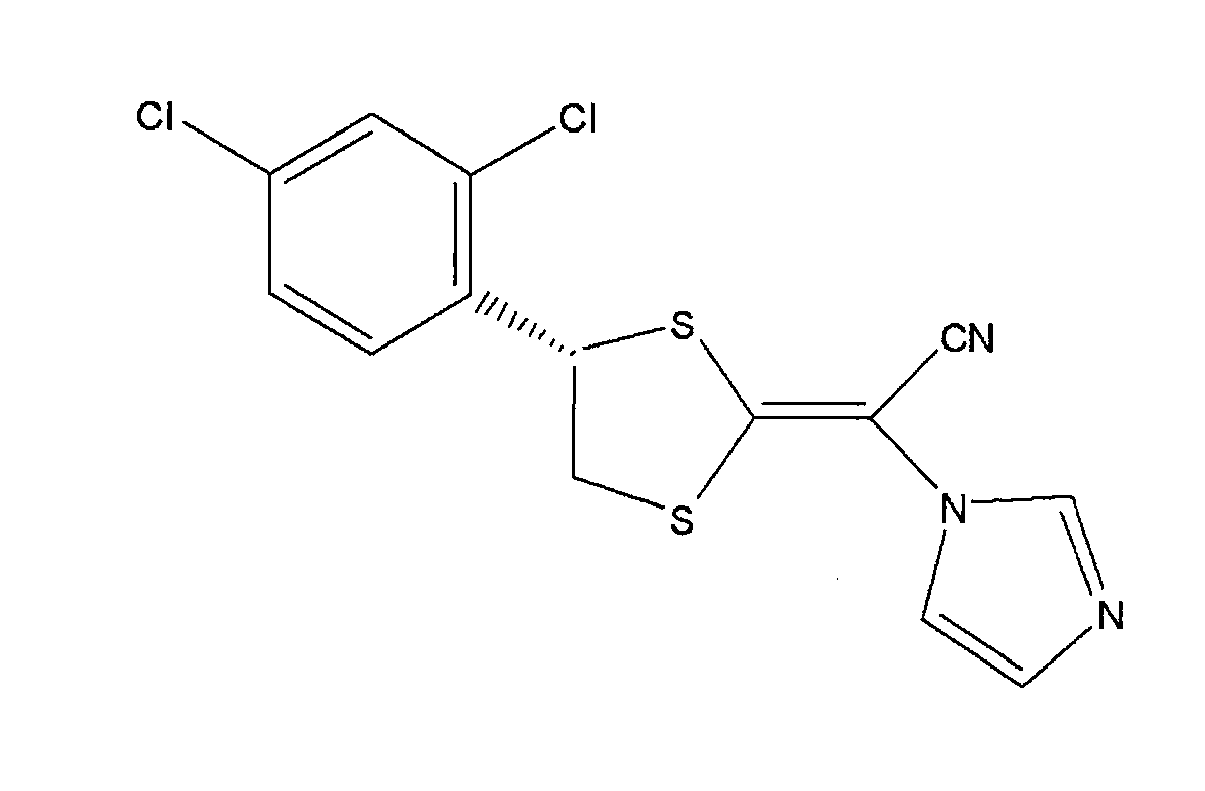
In addition, preferred specific examples of the compounds represented by the general formula (1) include
(R)-(-)-(E)-[4-(2,4-dichlorophenyl)-1,3-dithiolane-2-ylidene]-1-imidazolylacetonitrile (luliconazole),
(R)-(+)-(E)-[4-(2-chlorophenyl)-1,3-dithiolane-2-ylidene]-1-im
idazolylacetonitrile, and
(E)-[4-(2-chlorophenyl)-1,3-dithiolane-2-ylidene]-1-imidazolyl
acetonitrile (lanoconazole). Those compounds are known compounds
and their production methods and antifungal properties have already been known (for example, seeJP 62-93227 A - Further, the "physiologically acceptable salts thereof" as described above are not particularly limited as long as the salts are physiologically acceptable, and favorable examples of the salts include: mineral acid salts such as a hydrochloride, a nitrate, a sulfate, and a phosphate; organic acid salts such as a citrate, an oxalate, a lactate, and an acetate; and sulfate-containing salts such as a mesylate and a tosylate. A hydrochloride is more preferred in terms of safety and solubility. One compound of compounds represented by the general formula (1) and/or physiologically acceptable salts thereof may be used alone, or two or more compounds thereof may also be used in combination. The preferred total content of the compounds represented by the general formula (1) and/or physiologically acceptable salts thereof in the pharmaceutical composition for antifungal use of the present invention is preferably 0.01 to 20 w/v% and more preferably 0.1 to 10 w/v% with respect to the total amount of the pharmaceutical composition. The amount of such compounds may be determined on the basis of solubility and formulation property thereof.
- The pharmaceutical composition of the present invention contains, as an essential ingredient, one or more compounds selected from triacetin, polypropylene glycol, diesters of dibasic acids, 2-ethyl-1,3-hexanediol, lauromacrogol, and polyoxyethylene-polyoxypropylene glycol, in addition to the compound represented by the general formula (1) and/or the salt thereof. As for the polypropylene glycol, the polymerization degree thereof is preferably 1000 or more, and more preferably 1500 or more, and the upper limit value of the polymerization degree is preferably 10,000, and more preferably 5000. Preferred examples of dibasic acids constituting the diesters of dibasic acids include tartaric acid, adipic acid, sebacic acid and succinic acid, and adipic acid or sebacic acid is particularly preferred. As the ester moieties thereof, preferred is a hydrocarbon group having 1 to 4 carbon atoms, and specifically, favorable examples of the ester moieties include a methyl ester, an ethyl ester, a propyl ester, an isopropyl ester, a butyl ester, a sec-butyl ester and a tert-butyl ester, and preferred examples thereof include an ethyl ester and an isopropyl ester. Specifically, preferred are diisopropyl adipate and diethyl sebacate. In the pharmaceutical composition of the present invention, the polypropylene glycol, diesters of dibasic acids, triacetin, 2-ethyl-1,3-hexanediol, lauromacrogol, and polyoxyethylene-polyoxypropylene glycol have actions as solvents that stably dissolve the general formula (1), and as inhibitors of the horny cell layer storability of the compounds represented by the general formula (1). In order to exert such actions, each of such ingredients is incorporated at preferably 0.01 to 60 w/v% and more preferably 0.1 to 50 w/v% with respect to the total amount of the pharmaceutical composition. In particular, the content is preferably set up to be a content that can be either decreased or increased. Any of such ingredients also has a subsidiary effect of improving the preservation stability of the compounds represented by the general formula (1) even under a harsh condition of preservation at 60°C for 1 week.
- The pharmaceutical composition of the present invention is characterized by containing one or more compounds selected from glucono-δ-lactone, propylene glycol, glycerin, and lactic acid, in addition to the compound represented by the general formula (1) and/or the salt thereof. Such ingredients are solvents that stably dissolve the general formula (1) in many cases, and each have an action as an accelerator of the transdermal absorption of the compounds represented by the general formula (1). In order to exert such actions, each of such ingredients is incorporated at preferably 0.01 to 60 w/v% and more preferably 0.1 to 50 w/v% with respect to the total amount of the pharmaceutical composition. In particular, the content is preferably set up to be a content that can be either decreased or increased. Any of such ingredients also has a subsidiary effect for improving the preservation stability of the compounds represented by the general formula (1) even under a harsh condition of preservation at 60°C for 1 week.
- The pharmaceutical composition of the present invention is one for antifungal use, and contains the above-mentioned essential ingredients. Without any particular limitation, the pharmaceutical composition of the present invention can be applied for any formulation with an dosage form known in an antifungal formulation, which formulation can contain the above-mentioned essential ingredients, however, is preferably applied for a skin agent for external use in view of an effect of "capable of controlling the absorbability to the horny cell layer". The pharmaceutical composition of the present invention is preferably formulated into the form of a single-phase solution without containing any flammable solvent such as methyl ethyl ketone, acetone, and ethyl acetate other than ethanol because many of the essential ingredients to be incorporated in the pharmaceutical composition of the present invention have a solvent property or an action of promoting dissolution, superior in an action of inhibiting the absorption and an action of promoting the absorption to the horny cell layer. A cellulose-based thickener such as hydroxypropylcellulose, carboxymethylcellulose, hydroxypropylmethylcellulose, and hydroxyethylcellulose has effects of increasing a viscosity, inhibiting dripping, and enhancing usability, and also has an effect of enhancing the absorbability of a medicament to the horny cell layer. Therefore, in the viscosity adjustment of a system, in some cases, the fine adjustment of the content of such an ingredient causes a variation in horny cell layer storability, so that the maintenance of the bioequivalence becomes difficult. Thus, the bioequivalence can be maintained by applying the pharmaceutical composition of the present invention to a system containing such an ingredient, and adjusting the amount ratio of the above-mentioned two essential ingredients involved in the absorbability to the horny cell layer. Accordingly, it is particularly preferred that the pharmaceutical composition of the present invention be applied for such a dosage form. It should be noted that the term "single-phase solution" as used herein refers to a dissolved liquid substance in which no white turbidity is observed and neither liquid crystal nor microcrystal is observed under a polarized light. In addition, such a viscous solution form can be administered without being spread from a site to be administered even if , for example, being administered to the hair line and the like, and hence is preferably applied as a formulation to be administered to such a site, i.e. , in a medicine for antifungal use, a treatment drug for seborrheic dermatitis such as a therapeutic drug for seborrheic dermatitis and a preventive drug for seborrheic dermatitis.
- Further, in the above-mentioned composition, the formulation can be performed without incorporating a solvent such as acetone and methyl ethyl ketone other than ethanol because many of the ingredients for promoting the absorption to the horny cell layer and the ingredients for inhibiting the absorption to the horny cell layer as essential ingredients have an excellent solvent effect or an action for promoting dissolution. Therefore, for a treatment drug for seborrheic dermatitis such as a therapeutic drug for seborrheic dermatitis and a preventive drug for seborrheic dermatitis to be administered to a site close to eyes, the probability that a volatile ingredient derived from a solvent irritates eyes is reduced, resulting in an advantageous property.
- The pharmaceutical composition of the present invention may contain, apart from the above ingredients, an arbitrary ingredient generally used for formulation. Favorable examples of such an arbitrary ingredient include: oils and waxes such as macadamia nut oil, avocado oil, corn oil, olive oil, rapeseed oil, sesame oil, castor oil, safflower oil, cottonseed oil, jojoba oil, coconut oil, palm oil, liquid lanolin, hydrogenated coconut oil, hydrogenated oil, Japan wax, hydrogenated castor oil, beeswax, candelilla wax, carnauba wax, ibota wax, lanolin, reduced lanolin, hard lanolin, and jojoba wax; hydrocarbons such as liquid paraffin, squalane, pristane, ozokerite, paraffin, ceresin, vaseline, and microcrystalline wax; higher fatty acids such as oleic acid, isostearic acid, lauric acid, myristic acid, palmitic acid, stearic acid, behenic acid, and undecylenic acid; higher alcohols such as cetyl alcohol,stearyl alcohol,isostearyl alcohol,behenyl alcohol, octyldodecanol, myristyl alcohol, and cetostearyl alcohol; synthetic ester oils such as cetyl isooctanoate, isopropyl myristate, hexyldecyl isostearate, cetyl lactate, diisostearyl malate, ethylene glycol di-2-ethyl hexanoate, neopentyl glycol dicaprate, glyceryl di-2-heptyl undecanoate, glyceryl tri-2-ethylhexanoate, trimethylolpropane tri-2-ethylhexanoate, trimethylolpropane triisostearate, and pentaerythrityl tetra-2-ethylhexanoate; chain polysiloxanes such as dimethylpolysiloxane, methylphenylpolysiloxane, and diphenylpolysiloxane; cyclic polysiloxanes such as octamethylcyclotetrasiloxane, decamethylcyclopentasiloxane, and dodecamethylcyclohexanesiloxane; oil solutions such as silicone oils including modified polysiloxanes such as amino-modified polysiloxane, polyether-modified polysiloxane, alkyl-modified polysiloxane, and fluorine-modified polysiloxane; anionic surfactants such as fatty acid soaps (such as sodium laurate and sodium palmitate), potassium lauryl sulfate, and triethanolamine alkylether sulfate; cationic surfactants such as stearyl trimethyl ammonium chloride, benzalkonium chloride, and laurylamine oxide; amphoteric surfactants such as imidazoline-based amphoteric surfactants (such as a 2-cocoyl-2-imidazoliniumhydroxide-1-carboxyethyloxy-2-sodium salt), betaine-based surfactants (such as alkyl betaine, amide betaine, and sulfo betaine), and acylmethyl taurine; nonionic surfactants such as sorbitan fatty acid esters (such as sorbitan monostearate and sorbitan sesquioleate), glycerin fatty acids (such as glyceryl monostearate), propyleneglycol fatty acid esters (such as propyleneglycol monostearate), hydrogenated castor oil derivatives, glycerol alkyl ether, POE sorbitan fatty acid esters (such as POE sorbitan monooleate and polyoxyethylene sorbitan monostearate), POE sorbit fatty acid esters (such as POE-sorbit monolaurate), POE glycerol fatty acid esters (such as POE-glyceryl monoisostearate), POE fatty acid esters (such as polyethyleneglycol monooleate and POE distearate), POE alkyl ethers (such as POE2-octyldodecyl ether), POE alkyl phenyl ethers (such as POE nonylphenyl ether), POE/POP alkyl ethers (such as POE/POP2-decyltetradecyl ether), types of tetronic (registered trademark), POE castor oil/hydrogenated castor oil derivatives (such as POE castor oil and POE hydrogenated castor oil), sucrose fatty acid ester, and alkyl glycoside; polyhydric alcohols such as polyethylene glycol, 1,3-butylene glycol, erythritol, sorbitol, xylitol,maltitol,dipropylene glycol,diglycerin,isoprene glycol, 1,2-pentanediol, 2,4-hexanediol, 1,2-hexanediol, and 1,2-octanediol; moisturizing ingredients such as sodium pyrrolidone carboxylate, and sodium lactate; thickeners such as hydroxypropylcellulose, hydroxypropylmethylcellulose, a carboxyvinyl polymer which may be alkyl-modified and/or a salt thereof, carboxymethylcellulose, ethylcellulose, and xanthane gum; pH adjusters such as a buffer salt; and solvents such as benzyl alcohol and ethylene glycol salicylate. Of those ingredients, preferred examples of the ingredients which are preferably contained in the pharmaceutical composition of the present invention include thickeners such as hydroxypropylcellulose, hydroxypropylmethylcellulose, carboxymethylcellulose, ethylcellulose, and xanthane gum. This is because such ingredients act as variation factors of the bioavailability as well as variation factors of physical properties of the formulation, and as a result, the effect of the pharmaceutical composition of the present invention may be thoroughly exhibited. The pharmaceutical composition of the present invention can be produced by treating those ingredients in accordance with a conventional method.
- Amethod for adjusting the bioequivalence of the pharmaceutical composition of the present invention is characterized in that, in terms of the absorbability to the horny cell layer, the pharmaceutical composition is allowed to retain a constant absorption property to the horny cell layer at all times, by taking a balance of the amount of the ingredient for promoting the absorption selected from glucono-δ-lactone, propylene glycol, glycerin, and lactic acid and the amount of the ingredient for inhibiting the absorption selected from polypropylene glycols, diesters of dibasic acids, triacetin, 2-ethyl-1,3-hexanediol, lauromacrogol, and polyoxyethylene-polyoxypropylene glycol. It should be noted that the phrase "maintaining bioequivalence" as used herein refers to keeping the absorption property of the compounds represented by the general formula (1) to the horny cell layer constant. The content of this ingredient is adjusted in order to adjust the irregularity from lot to lot of the thickener ingredient, and modulate a viscosity. As a result, when the absorbability of a medicament to the horny cell layer is reduced, and thus, the absorbability to the horny cell layer must be increased, there is performed an operation for increasing the total content of the ingredient for promoting the absorption to the horny cell layer with respect to the total amount of the pharmaceutical composition, and/or an operation for decreasing the total content of the ingredient for inhibiting the absorption to the horny cell layer with respect to the total amount of the pharmaceutical composition. The degree of this decrease or increase is preferably calculated and determined from a calibration curve which has been preliminarily drawn on a two-dimensional coordinate by using the mass ratio of the ingredient for promoting the absorption to the horny cell layer and the ingredient for inhibiting transdermal absorption as one axis, and the degree of the absorption to the horny cell layer as the other axis, for example. As a matter of course, such a corrected value may be converted to a mathematical formula by, for example, a multiple regression analysis, and the mathematical formula may also be utilized.
- In contrast to the above, when there is a need for decreasing the absorbability to the horny cell layer, there is performed an operation for decreasing the total content of the ingredient for promoting the absorption to the horny cell layer with respect to the total amount of the pharmaceutical composition, and/or an operation for increasing the total content of the ingredient for inhibiting the absorption to the horny cell layer with respect to the total amount the pharmaceutical composition.
- As described above, the bioequivalence can be maintained without being affected by the irregularity from lot to lot of a formulation ingredient by adjusting the mixing ratio of the ingredient for promoting the absorption to the horny cell layer and the ingredient for inhibiting the absorption to the horny cell layer.
- Hereinafter, the present invention is described in more detail by way of examples. However, it goes without saying that the present invention is not limited to only such examples.
- Skin agents 1 to 5 for external use, each of which is the pharmaceutical composition of the present invention, were prepared in accordance with the following prescription. That is, luliconazole was dissolved by adding an appropriate amount of ethanol, and to the resulting solution, triacetin and glucono-δ-lactone were added and uniformly dispersed. After that, hydroxypropylcellulose was gradually added, and water was further added to obtain homogenous skin agents for external use. Any of those agents had a viscosity of 100 to 800 mPa·s (viscometer: RE80R manufactured by Toki Sangyo Co., Ltd., and conditions for viscosity measurement: cone angle; 0.8°, cone radius; 2.4 cm, rotation frequency; 10 rpm, and temperature; 25°C), was not so dripping, and thus was suited as a formulation for seborrheic dermatitis to be administered to the hair line and the like. Further, those agents were free of ingredients strongly exhibiting solvent characteristics like methyl ethyl ketone (MEK) and acetone, did not provide any strong temporary irritation feeling, and could be suitably used for tinea pedis and the like as well.
-
Table 1 Ingredient w/v% Luliconazole 1 Hydroxypropylcellulose 1.5 Water 20 Triacetin (TA)* Glucono-δ-lactone (GL)* Ethanol Appropriate amount Total 100 mL *See Table 2 -
Table 2 Sample GL (w/v%) TA (w/v%) Viscosity
(mPa·s)Skin agent 1 for external use 3.2 0 639.6 Skin agent 2 for external use 3.2 12 648.8 Skin agent 3 for external use 1.6 12 603.0 Skin agent 4 for external use 1.6 24 656.6 Skin agent 5 for external use 0 24 652.0 - To a plantar part of an isolated guinea pig hind leg, the skin agent for external use was applied at room temperature, and the whole was left out at room temperature for 2 hours. After that, the skin agent for external use was wiped out from the applied site, and further, the applied site was subjected to 5 times of tape stripping with a cellophane tape. Thereafter, the plantar part was excised, and the horny cell layer was peeled off, formed into a piece having a certain size, and evaporated to dryness under reduced pressure for 24 hours. To the obtained dried product, methanol was added, luliconazole as a measurement target was extracted in an ultrasonicator, and filtered through a filter. After that, the concentration of luliconazole in the horny cell layer at two hours after administration was measured with LC-MS/MS (manufactured by Micromass) under the following analysis condition. Table 3 shows the results. The results reveal that any absorption property can be designed by incorporating a combination of the ingredient for inhibiting the absorption to the horny cell layer and the ingredient for promoting the absorption to the horny cell layer, and varying the amount ratio thereof.
- <HPLC condition>
Column: Wakosil II5C18HG, 4.6x250 mm, 5 µm (Wako Pure Chemical Industries, Ltd.) Mobile phase: 5 mmol/L formic acid aqueous solution : methanol (20:80, v/v) Flow rate: 1.0 mL/min Split ratio ca.: 2:8 (MS/MS:drain) Injection volume: 2 µL Column temperature: 45°C Sample temperature: 5°C - Ionization method: ESI, positive ion mode
Compound: MS1 (m/z), MS2 (m/z)
Measurement ion: luliconazole 354 150 -
Table 3 Sample Concentration of luliconazole in horny
cell layer (µg/cm2)Skin agent 1 for external use 1.591 Skin agent 2 for external use 0.910 Skin agent 3 for external use 0.598 Skin agent 4 for external use 0.295 Skin agent 5 for external use 0.327 - Each of Skin agents 1 to 5 for external use was evaluated for the time-dependent stability of luliconazole under a harsh preservation condition (60°C, 1 week). The quantitative determination of the S-E isomer which was converted from luliconazole by changing the steric structure thereof was performed by HPLC (LC-20AD manufactured by Shimadzu Corporation, HPLC condition:
column; CHIRALCEL OD-RH 4.6×150 mm, column temperature; 35°C, mobile phase; a mixed solution of methanol/1.8% potassium
hexafluorophosphate aqueous solution (83:17, v/v), flow rate; 0.56 mL/min., and detection; 295 nm). Further, the quantitative determination of Z isomers and other analogous substances was performed by HPLC (Agilent 1100 manufactured by Agilent Technologies, HPLC condition: column; Inertsil ODS-2 4.6x150 mm, column
temperature; 40° C, mobile phase; 0.13% sodium 1-undecane-sulfonate mixed solution (water/acetonitrile/acetic acid (100) (54:45:1, v/v/v)), flow rate; 1.0 mL/min., and detection; 295 nm). Tables 4 and 5 show the results. The tables reveal that any sample stably exists. That is, in a system of glucono-δ-lactone, triacetin, and hydroxypropylcellulose/ethanol, it can be said that luliconazole stably exists even in preservation under a harsh condition, irrespective of the amount ratio of glucono-δ-lactone and triacetin. -
Table 4 Immediately after production (weight%) Sample S-E isomer Z isomer Total content of other analogous substances Skin agent 1 for external use 0.12 0.02 0.00 Skin agent 2 for external use 0.13 0.02 0.00 Skin agent 3 for external use 0.13 0.02 0.00 Skin agent 4 for external use 0.14 0.02 0.00 Skin agent 5 for external use 0.13 0.02 0.00 -
Table 5 After preservation for 1 week (weight%) Sample S-E isomer Z isomer Total content of other analogous substances Skin agent 1 for external use 0.14 0.03 0.02 Skin agent 2 for external use 0.14 0.04 0.02 Skin agent 3 for external use 0.13 0.04 0.02 Skin agent 4 for external use 0.14 0.03 0.00 Skin agent 5 for external use 0.37 0.05 0.00 - In the same manner as in Example 1, Skin agent 6 for external use as the pharmaceutical composition of the present invention was prepared in accordance with the following prescription. The concentration of luliconazole in the horny cell layer at 2 hours after the application of the agent was 4.532 µg/cm2, and the concentration in Comparative Example 1 in which propylene glycol in the preparation was replaced by ethanol was 0.221 µg/cm2. The S-E isomer measured by HPLC after harsh preservation (60° C, 1 week) was 1.65% in Skin agent 6 for external use, which was higher compared with 1.45% in Comparative Example 1. Propylene glycol is found to be usable as an ingredient for promoting the absorption to the horny cell layer.
-
Table 6 Ingredient w/v% Luliconazole 1 Propylene glycol 50 Ethanol Appropriate amount Total 100 mL - In the same manner as in Example 1, Skin agent 7 for external use as the pharmaceutical composition of the present invention was prepared in accordance with the following prescription. The concentration of luliconazole in the horny cell layer at 2 hours after the application of the agent was 0.584 µg/cm2, and the concentration in Comparative Example 2 in which 2-ethyl-1,3-hexanediol in the preparation was replaced by ethanol was 0.950 µg/cm2. The S-E isomer measured by HPLC after harsh preservation (60°C, 1 week) was 1.06% in Skin agent 7 for external use, which was higher compared with 0.38% in Comparative Example 2. 2-ethyl-1,3-hexanediol is found to be usable as an ingredient for inhibiting the absorption to the horny cell layer.
-
Table 7 Ingredient w/v% Luliconazole 1 Hydroxypropylcellulose 1.5 Water 20 2-ethyl-1,3-hexanediol 5 Ethanol Appropriate amount Total 100 mL - In the same manner as in Example 1, Skin agent 8 for external use as the pharmaceutical composition of the present invention was prepared in accordance with the following prescription. The concentration of luliconazole in the horny cell layer at 2 hours after the application of the agent was 0.736 µg/cm2, and the concentration in Comparative Example 3 in which concentrated glycerin (100% glycerin) in the preparation was replaced by ethanol was 0.345 µg/cm2. The S-E isomer measured by HPLC after harsh preservation (60°C, 1 week) was 0.79% in Skin agent 8 for external use, which was higher compared with 0.47% in Comparative Example 3. Concentrated glycerin is found to be usable as an ingredient for promoting the absorption to the horny cell layer.
-
Table 8 Ingredient w/v% Luliconazole 1 Water 10 Concentrated glycerin 32 Ethanol Appropriate amount Total 100 mL - In the same manner as in Example 1, Skin agent 9 for external use as the pharmaceutical composition of the present invention was prepared in accordance with the following prescription. The concentration of luliconazole in the horny cell layer at 2 hours after the application of the agent was 2.018 µg/cm2, and the concentration in Comparative Example 1 in which lactic acid in the preparation was replaced by ethanol was 0.221 µg/cm2. The S-E isomer measured by HPLC after harsh preservation (60°C, 1 week) was 0.14% in Skin agent 9 for external use, which was lower compared with 1.45% in Comparative Example 1. Lactic acid is found to be usable as an ingredient for promoting the absorption to the horny cell layer.
-
Table 9 Ingredient w/v% Luliconazole 1 Lactic acid 8 Ethanol Appropriate amount Total 100 mL - In the same manner as in Example 1, Skin agent 10 for external use as the pharmaceutical composition of the present invention was prepared in accordance with the following prescription. The concentration of luliconazole in the horny cell layer at 2 hours after the application of the agent was 0.358 µg/cm2, and the concentration in Comparative Example 2 in which polyoxyethylene(20)-polyoxypropylene(20) glycol in the preparation was replaced by ethanol was 0. 950 µg/cm2. The S-E isomer measured by HPLC after harsh preservation (60° C, 1 week) was 1.26% in Skin agent 10 for external use, which was higher compared with 0.38% in Comparative Example 2. Polyoxyethylene(20)-polyoxypropylene(20) glycol is found to be usable as an ingredient for inhibiting the absorption to the horny cell layer.
-
Table 10 Ingredient w/v% Luliconazole 1 Hydroxypropylcellulose 1.5 Water 20 POE (20) POP (20) glycol 12 Ethanol Appropriate amount Total 100 mL - In the same manner as in Example 1, Skin agent 11 for external use as the pharmaceutical composition of the present invention was prepared in accordance with the following prescription. The concentration of luliconazole in the horny cell layer at 2 hours after the application of the agent was 0.148 µg/cm2, and the concentration in Comparative Example 1 in which lauromacrogol in the preparation was replaced by ethanol was 0.221 µg/cm2. The S-E isomer measured by HPLC after harsh preservation (60°C, 1 week) was 0.19% in Skin agent 11 for external use, which was lower compared with 1.45% in Comparative Example 1. Lauromacrogol is found to be usable as an ingredient for inhibiting the absorption to the horny cell layer.
-
Table 11 Ingredient w/v% Luliconazole 1 Lauromacrogol 12 Ethanol Appropriate amount Total 100 mL - In the same manner as in Example 1, Skin agent 12 for external use as the pharmaceutical composition of the present invention was prepared in accordance with the following prescription. The concentration of luliconazole in the horny cell layer at 2 hours after the application of the agent was 0.199 µg/cm2, and the concentration in Comparative Example 1 in which polypropylene glycol 2000 in the preparation was replaced by ethanol was 0.221 µg/cm2. The S-E isomer measured by HPLC after harsh preservation (60°C, 1 week) was 0.78% in Skin agent 12 for external use, which was lower compared with 1.45% in Comparative Example 1. Polypropylene glycol 2000 is found to be usable as an ingredient for inhibiting the absorption to the horny cell layer.
-
Table 12 Ingredient w/v% Luliconazole 1 Polypropylene glycol 2000 20 Ethanol Appropriate amount Total 100 mL - In the same manner as in Example 1, Skin agent 13 for external use as the pharmaceutical composition of the present invention was prepared in accordance with the following prescription. The concentration of luliconazole in the horny cell layer at 2 hours after the application of the agent was 0.306 µg/cm2, and the concentration in Comparative Example 2 in which diethyl sebacate in the preparation was replaced by ethanol was 0.950 µg/cm2. The S-E isomer measured by HPLC after harsh preservation (60° C, 1 week) was 0.14% in Skin agent 13 for external use, which was lower compared with 0.38% in Comparative Example 2. Diethyl sebacate is found to be usable as an ingredient for inhibiting the absorption to the horny cell layer.
-
Table 13 Ingredient w/v% Luliconazole 1 Hydroxypropylcellulose 1.5 Water 20 Diethyl sebacate 20 Ethanol Appropriate amount Total 100 mL - The present invention is applicable to a pharmaceutical composition such as a skin agent for external use for seborrheic dermatitis.
Claims (8)
- A pharmaceutical composition for antifungal use, comprising: 1) one or more compounds selected from compounds represented by the general formula (1) below and physiologically acceptable salts thereof; 2) one or more compounds selected from polypropylene glycol, diesters of dibasic acids, triacetin, 2-ethyl-1,3-hexanediol, lauromacrogol, and polyoxyethylene-polyoxypropylene glycol; and 3) one or more compounds selected from glucono-δ-lactone, propylene glycol, glycerin, and lactic acid.

- The pharmaceutical composition according to claim 1, wherein the compound represented by the general formula (1) is luliconazole.
- The pharmaceutical composition according to claim 1 or 2, comprising triacetin as one or more compounds selected from
polypropylene glycol, diesters of dibasic acids, triacetin, 2-ethyl-1,3-hexanediol, lauromacrogol, and polyoxyethylene-polyoxypropylene glycol. - The pharmaceutical composition according to any one of claims 1 to 3, comprising glucono-δ-lactone as one or more compounds selected from glucono-δ-lactone, propylene glycol, glycerin, and lactic acid.
- The pharmaceutical composition according to any one of claims 1 to 4, wherein the pharmaceutical composition for antifungal use is in the form of a single-phase solution.
- The pharmaceutical composition according to any one of claims 1 to 5, further comprising ethanol and/or water.
- The pharmaceutical composition according to any one of claims 1 to 6, wherein the target disease is seborrheic dermatitis.
- A method for adjusting the storability in the horny cell layer of compounds represented by the general formula (1) and/or salts thereof in the pharmaceutical composition according to any one of claims 1 to 7, which comprises decreasing the total content of one or more compounds selected from polypropylene glycol, diesters of dibasic acids, triacetin, 2-ethyl-1, 3-hexanediol, lauromacrogol, and polyoxyethylene-polyoxypropylene glycol with respect to the total amount of the pharmaceutical composition, and/or increasing the total content of one or more compounds selected from glucono-δ-lactone, propylene glycol, glycerin, and lactic acid with respect to the total amount of the pharmaceutical composition, in the case where the storability in the horny cell layer should be increased; or increasing the total content of one or more compounds selected from polypropylene glycol, diesters of dibasic acids, triacetin, 2-ethyl-1,3-hexanediol, lauromacrogol, and polyoxyethylene-polyoxypropylene glycol with respect to the total amount of the pharmaceutical composition, and/or decreasing the total content of one or more compounds selected from glucono-δ-lactone, propylene glycol, glycerin, and lactic acid with respect to the total amount of the pharmaceutical composition, in the case where the storability in the horny cell layer should be decreased.
Applications Claiming Priority (2)
| Application Number | Priority Date | Filing Date | Title |
|---|---|---|---|
| JP2007229618 | 2007-09-05 | ||
| PCT/JP2008/066057 WO2009031643A1 (en) | 2007-09-05 | 2008-09-05 | Antifungal composition |
Publications (3)
| Publication Number | Publication Date |
|---|---|
| EP2191827A1 true EP2191827A1 (en) | 2010-06-02 |
| EP2191827A4 EP2191827A4 (en) | 2010-09-15 |
| EP2191827B1 EP2191827B1 (en) | 2013-10-30 |
Family
ID=40428955
Family Applications (1)
| Application Number | Title | Priority Date | Filing Date |
|---|---|---|---|
| EP08829224.8A Active EP2191827B1 (en) | 2007-09-05 | 2008-09-05 | Antifungal composition |
Country Status (6)
| Country | Link |
|---|---|
| US (2) | US20100173965A1 (en) |
| EP (1) | EP2191827B1 (en) |
| JP (1) | JP5345937B2 (en) |
| KR (1) | KR20100075476A (en) |
| CN (1) | CN101808638B (en) |
| WO (1) | WO2009031643A1 (en) |
Cited By (9)
| Publication number | Priority date | Publication date | Assignee | Title |
|---|---|---|---|---|
| WO2010117089A3 (en) * | 2009-04-09 | 2010-12-09 | Pola Pharma Inc. | Antimycotic pharmaceutical composition |
| WO2011155640A1 (en) * | 2010-06-11 | 2011-12-15 | Pola Pharma Inc. | Antimycotic pharmaceutical composition |
| US8268876B2 (en) | 2006-03-08 | 2012-09-18 | Nihon Nohyaku Co., Ltd. | Pharmaceutical composition for external use |
| US8349882B2 (en) | 2006-03-08 | 2013-01-08 | Nihon Nohyaku Co., Ltd. | Pharmaceutical composition for external use |
| US8513296B2 (en) | 2007-09-05 | 2013-08-20 | Pola Pharma Inc. | Pharmaceutical composition |
| US8952044B2 (en) | 2009-08-25 | 2015-02-10 | Pola Pharma Inc. | Antimycotic pharmaceutical composition |
| US9050271B2 (en) | 2009-04-09 | 2015-06-09 | Pola Pharma Inc. | Antimycotic pharmaceutical composition |
| US9480678B2 (en) | 2007-09-05 | 2016-11-01 | Pola Pharma Inc. | Antifungal pharmaceutical composition |
| US9968591B2 (en) | 2007-09-05 | 2018-05-15 | Pola Pharma Inc. | Antifungal composition |
Families Citing this family (23)
| Publication number | Priority date | Publication date | Assignee | Title |
|---|---|---|---|---|
| JP3171614B2 (en) | 1991-09-02 | 2001-05-28 | 大阪瓦斯株式会社 | Absorption refrigerator |
| JP3163411B2 (en) | 1995-03-14 | 2001-05-08 | 矢崎総業株式会社 | Absorption chiller / heater and liquid refrigerant controller |
| WO2007102243A1 (en) * | 2006-03-08 | 2007-09-13 | Nihon Nohyaku Co., Ltd. | External pharmaceutical composition |
| US8193232B2 (en) * | 2009-02-13 | 2012-06-05 | Topica Pharmaceuticals, Inc. | Anti-fungal formulation |
| IN2015DN02376A (en) | 2012-09-14 | 2015-09-04 | Pola Pharma Inc | |
| JP5460797B1 (en) * | 2012-09-14 | 2014-04-02 | 株式会社ポーラファルマ | Amide derivatives and their use as stability indicators |
| RU2621615C2 (en) | 2012-09-14 | 2017-06-06 | Пола Фарма Инк. | Pharmaceutical composition comprising luliconazole |
| US9068958B1 (en) | 2012-09-14 | 2015-06-30 | Pola Pharma Inc. | Use of surface free energy for differential evaluation of crystal, crystal evaluated on basis of surface free energy as index, and pharmaceutical composition prepared by containing the crystal |
| JP5589130B1 (en) | 2012-09-14 | 2014-09-10 | 株式会社ポーラファルマ | Crystal and pharmaceutical preparation containing the crystal |
| JP6067399B2 (en) * | 2013-02-08 | 2017-01-25 | 株式会社ポーラファルマ | Pharmaceutical composition |
| JP5589110B1 (en) | 2013-03-08 | 2014-09-10 | 株式会社ポーラファルマ | Crystal having crystal habit and pharmaceutical composition containing the crystal as an active ingredient |
| JP5680161B1 (en) | 2013-09-06 | 2015-03-04 | 株式会社ポーラファルマ | Crystal having crystal habit and pharmaceutical composition containing the crystal as an active ingredient |
| JP5587488B1 (en) * | 2013-12-12 | 2014-09-10 | 株式会社ポーラファルマ | Evaluation method and index substance of preparation containing luliconazole |
| JP5926756B2 (en) * | 2014-03-26 | 2016-05-25 | 株式会社ポーラファルマ | Evaluation method and index substance of preparation containing luliconazole |
| JP5623671B1 (en) * | 2014-07-23 | 2014-11-12 | 株式会社ポーラファルマ | Evaluation method and index substance of preparation containing luliconazole |
| JP2015113343A (en) * | 2014-09-24 | 2015-06-22 | 株式会社ポーラファルマ | Evaluation method and index material of preparation containing luliconazole |
| EP3258908A4 (en) | 2015-02-20 | 2018-08-22 | Pedicis Research LLC | Compositions and methods for treatment of skin infections |
| JP2017181387A (en) * | 2016-03-31 | 2017-10-05 | 株式会社ポーラファルマ | Method for evaluating film formed by pharmaceutical composition |
| PH12018502095B1 (en) * | 2016-03-31 | 2024-02-02 | Nihon Nohyaku Co Ltd | Amorphizing agent, amorphous composition comprising amorphizing agent and utilization thereof |
| CA3013809C (en) | 2016-04-06 | 2024-01-02 | Gedea Biotech Ab | Glucono delta-lactone for treatment of vaginal fungal infections |
| CN108934161A (en) * | 2017-03-29 | 2018-12-04 | 日本农药株式会社 | For treating the medical composition of infectious disease |
| US10898470B1 (en) | 2019-08-13 | 2021-01-26 | Sato Pharmaceutical Co., Ltd. | Pharmaceutical composition containing antifungal agent as active ingredient |
| JP7654207B2 (en) * | 2022-03-29 | 2025-04-01 | 福地製薬株式会社 | Mouthwash |
Family Cites Families (80)
| Publication number | Priority date | Publication date | Assignee | Title |
|---|---|---|---|---|
| US4267169A (en) * | 1978-07-22 | 1981-05-12 | Toko Yakuhin Kogyo Kabushiki Kaisha | Novel preparation of clotrimazole |
| JPS5815909A (en) | 1981-07-22 | 1983-01-29 | Toko Yakuhin Kogyo Kk | Antimycotic agent for external use |
| US4636520A (en) * | 1984-07-16 | 1987-01-13 | Fujisawa Pharmaceutical Co., Ltd. | Antifungal composition employing pyrrolnitrin in combination with an imidazole compound |
| JPH0236572B2 (en) | 1984-11-13 | 1990-08-17 | Hokuriku Pharmaceutical | SUTEROIDOO177MONOESUTERUGANJUKURIIMUZAI |
| JPS6293227A (en) | 1985-10-19 | 1987-04-28 | Nippon Nohyaku Co Ltd | antifungal agent |
| US4764381A (en) * | 1985-12-06 | 1988-08-16 | Key Pharmaceuticals, Inc. | Percutaneous penetration enhancer of oleic acid and 2-ethyl-1, 3-hexanediol |
| JPH0774144B2 (en) | 1986-03-12 | 1995-08-09 | 久光製薬株式会社 | Skin composition containing urea |
| US5686489A (en) | 1986-12-23 | 1997-11-11 | Tristrata Technology, Inc. | Alpha hydroxyacid esters for skin aging |
| JPH01246219A (en) | 1988-03-25 | 1989-10-02 | Nippon Nohyaku Co Ltd | Antimycotic cream composition for external use |
| JPH01242525A (en) | 1988-03-25 | 1989-09-27 | Nippon Nohyaku Co Ltd | Antifungal topical agent |
| JP3030780B2 (en) | 1988-12-29 | 2000-04-10 | 日本農薬株式会社 | Optically active ketene dithioacetal derivative and method for producing the same |
| JPH02264723A (en) | 1989-04-06 | 1990-10-29 | Taisho Pharmaceut Co Ltd | antifungal agent |
| AU630469B2 (en) | 1989-05-26 | 1992-10-29 | Abbott Laboratories | Injectable clarithromycin composition |
| US5061700A (en) * | 1989-11-16 | 1991-10-29 | Gordon Jay Dow | Glyceryl acetate ointment vehicles |
| IL97012A0 (en) | 1990-01-30 | 1992-03-29 | Gist Brocades Nv | Topical preparations for treating human nails |
| US5340836A (en) * | 1991-02-19 | 1994-08-23 | Mark S. Reinhard | Composition and method for treatment of vaginal yeast infections |
| FR2673537B1 (en) * | 1991-03-08 | 1993-06-11 | Oreal | USE OF HYDROPHILIC PENETRATION AGENTS IN DERMATOLOGICAL COMPOSITIONS FOR THE TREATMENT OF ONYCHOMYCOSES, AND CORRESPONDING COMPOSITIONS. |
| JP2555555B2 (en) | 1991-07-03 | 1996-11-20 | 武田薬品工業株式会社 | Antifungal topical formulation |
| JPH06199701A (en) * | 1992-12-29 | 1994-07-19 | Lion Corp | Anti-inflammatory analgesic agent for external use |
| JPH06211651A (en) | 1993-01-12 | 1994-08-02 | Hisamitsu Pharmaceut Co Inc | Composition for treating nail trichophytosis |
| JPH0774144A (en) | 1993-06-29 | 1995-03-17 | Sony Corp | Plasma device cleaning method |
| HU217869B (en) * | 1993-07-01 | 2000-04-28 | Yamanouchi Europe B.V. | Stable aqueous retinoid formulations for topical application |
| DE4337945A1 (en) * | 1993-11-06 | 1995-05-11 | Labtec Gmbh | Plasters for the treatment of nail mycoses |
| JP2860748B2 (en) | 1993-12-24 | 1999-02-24 | エスエス製薬株式会社 | Stable hydrocortisone butyrate-containing cream |
| JP3803393B2 (en) | 1994-01-12 | 2006-08-02 | 久光製薬株式会社 | Nail ringworm treatment composition |
| JP3629283B2 (en) | 1994-02-15 | 2005-03-16 | ポーラ化成工業株式会社 | Skin preparation |
| JP3081766B2 (en) * | 1994-05-06 | 2000-08-28 | 東興薬品工業株式会社 | Keratin storage type antifungal external composition |
| GB9420355D0 (en) * | 1994-10-10 | 1994-11-23 | Univ Nottingham | Preparation of protein microspheres, films and coatings |
| WO1996011710A1 (en) * | 1994-10-13 | 1996-04-25 | Hisamitsu Pharmaceutical Co., Inc. | External preparation for nail ringworm |
| SE9403541L (en) * | 1994-10-14 | 1996-04-15 | Sven Moberg | Antimicrobial composition |
| SE9502244D0 (en) * | 1995-06-20 | 1995-06-20 | Bioglan Ab | A composition and a process for the preparation thereof |
| GB2317615B (en) | 1995-07-08 | 1998-09-02 | Nihon Nohyaku Co Ltd | Antifungal agent compound therefor process for producing the same |
| US6008256A (en) * | 1995-08-28 | 1999-12-28 | Showa Yakuhin Kako Co., Ltd. | Composition for local anesthesia |
| US5993787A (en) * | 1996-09-13 | 1999-11-30 | Johnson & Johnson Consumer Products, Inc. | Composition base for topical therapeutic and cosmetic preparations |
| JP4253047B2 (en) | 1996-09-27 | 2009-04-08 | 杏林製薬株式会社 | Film-forming antifungal composition |
| JP4227677B2 (en) | 1996-12-10 | 2009-02-18 | 杏林製薬株式会社 | Film-forming antifungal composition |
| JPH10226686A (en) | 1996-12-10 | 1998-08-25 | Nippon Nohyaku Co Ltd | (R)-(E)-(4-substituted phenyl-1,3-dithiolan-2-ylidene) -1-imidazoleacetonitrile derivatives which are optically active substances, antifungal agents and methods for producing them |
| AU7936198A (en) | 1998-07-01 | 2000-01-24 | Lead Chemical Co., Ltd. | Ketotifen preparation for percutaneous absorption |
| US5962536A (en) * | 1998-07-31 | 1999-10-05 | Komer; Gene | Injectable propofol formulations |
| JP5170486B2 (en) * | 1998-09-10 | 2013-03-27 | バイオイコール ア−ゲー | Topically applicable product |
| US20040208906A1 (en) * | 1999-07-12 | 2004-10-21 | Daiichi Suntory Pharma Co., Ltd. | Pharmaceutical composition for topical administration |
| JP2001064206A (en) | 1999-08-30 | 2001-03-13 | Isp Japan Kk | Percutaneous absorption-promoting composition |
| US6541517B1 (en) * | 1999-09-03 | 2003-04-01 | Donald M. Murphy | Treatment of skin disorders |
| US7074392B1 (en) | 2000-03-27 | 2006-07-11 | Taro Pharmaceutical Industries Limited | Controllled delivery system of antifungal and keratolytic agents for local treatment of fungal infections |
| US6428654B1 (en) * | 2000-04-05 | 2002-08-06 | Hercules Incorporated | Fungicidal method |
| JP2002114680A (en) | 2000-07-31 | 2002-04-16 | Nippon Nohyaku Co Ltd | Antifungal agent |
| JP2002193755A (en) * | 2000-12-28 | 2002-07-10 | Sansho Seiyaku Co Ltd | Anti-dandruff and Kayumi cosmetics for hair and hair wash |
| JP2002284702A (en) | 2001-01-19 | 2002-10-03 | Teika Seiyaku Kk | Topical antifungal preparations |
| KR100423666B1 (en) | 2001-02-07 | 2004-03-18 | 보령제약 주식회사 | Composition of Antifungal Topical preparations |
| US6585963B1 (en) * | 2001-02-15 | 2003-07-01 | Watson Pharmaceuticals, Inc. | Nail compositions and methods of administering same |
| US20030017207A1 (en) * | 2001-05-01 | 2003-01-23 | Lin Shun Y. | Compositions and methods for treating vulvovaginitis and vaginosis |
| JP2002363070A (en) | 2001-06-06 | 2002-12-18 | Yuutoku Yakuhin Kogyo Kk | Transdermal patch |
| DK1423100T3 (en) * | 2001-09-04 | 2007-05-29 | Trommsdorff Arzneimittel | Patches containing sertaconazole for the treatment of nail dysfunction and disorders |
| JP2003252798A (en) * | 2002-02-28 | 2003-09-10 | Shiseido Co Ltd | Antibacterial gel preparation |
| JPWO2003105841A1 (en) * | 2002-06-18 | 2005-10-13 | ポーラ化成工業株式会社 | Antifungal pharmaceutical composition |
| US6846837B2 (en) * | 2002-06-21 | 2005-01-25 | Howard I. Maibach | Topical administration of basic antifungal compositions to treat fungal infections of the nails |
| JP4387639B2 (en) * | 2002-07-16 | 2009-12-16 | 久光製薬株式会社 | Transdermal absorption preparation |
| MXPA05002065A (en) | 2002-09-05 | 2005-06-08 | Galderma Sa | Solution for ungual application. |
| ES2532906T5 (en) * | 2002-10-25 | 2022-03-23 | Foamix Pharmaceuticals Ltd | Cosmetic and pharmaceutical foam |
| EP1635770B1 (en) | 2003-03-21 | 2009-05-27 | Nexmed Holdings, Inc. | Antifungal nail coat and method of use |
| ES2535045T3 (en) | 2003-04-10 | 2015-05-04 | Vanderbilt Royalty Sub L.P. | Uses and compositions for capsaicin administration |
| WO2005000287A1 (en) * | 2003-06-25 | 2005-01-06 | Hisamitsu Pharmaceutical Co., Inc. | External preparation for athlete's foot treatment |
| JP2005104924A (en) | 2003-09-30 | 2005-04-21 | Kobayashi Pharmaceut Co Ltd | External pharmaceutical composition |
| JP4431369B2 (en) | 2003-11-21 | 2010-03-10 | 久光製薬株式会社 | Antifungal aerosol topical preparation |
| JP4429035B2 (en) | 2004-02-27 | 2010-03-10 | 久光製薬株式会社 | Cream preparation for external use with enhanced keratin retention |
| JP3783104B2 (en) | 2004-03-31 | 2006-06-07 | 小林製薬株式会社 | Antifungal composition for external use |
| US7928144B2 (en) | 2004-06-15 | 2011-04-19 | Hisamitsu Pharmaceutical Co., Inc. | Antiinflammatory and analgesic preparation for external use |
| JP4690672B2 (en) | 2004-07-20 | 2011-06-01 | 岩城製薬株式会社 | Emulsion skin external preparation |
| JP3800232B2 (en) | 2004-09-30 | 2006-07-26 | 小林製薬株式会社 | Antifungal composition for external use |
| JP2006306734A (en) | 2005-04-26 | 2006-11-09 | Tsumura & Co | Urea formulation external preparation |
| EP1970076A4 (en) * | 2005-12-28 | 2012-12-12 | Teikoku Seiyaku Kk | PHARMACEUTICAL COMPOSITION FOR UNIGEAL APPLICATION |
| RU2419429C2 (en) * | 2006-03-08 | 2011-05-27 | Нихон Нохияку Ко.,Лтд. | Pharmaceutical composition for external application |
| CA2645070C (en) | 2006-03-08 | 2014-02-04 | Nihon Nohyaku Co., Ltd. | Pharmaceutical composition for external use |
| WO2007102243A1 (en) * | 2006-03-08 | 2007-09-13 | Nihon Nohyaku Co., Ltd. | External pharmaceutical composition |
| WO2008075207A2 (en) | 2006-04-04 | 2008-06-26 | Foamix Ltd. | Anti-infection augmentation foamable compositions and kit and uses thereof |
| PL2191825T3 (en) * | 2007-08-27 | 2016-11-30 | Agent for fungal dermatitis | |
| EP2191827B1 (en) | 2007-09-05 | 2013-10-30 | Pola Pharma Inc. | Antifungal composition |
| JP5529539B2 (en) * | 2007-09-05 | 2014-06-25 | 株式会社ポーラファルマ | Pharmaceutical composition |
| CN101808639B (en) * | 2007-09-05 | 2012-12-05 | 宝丽制药股份有限公司 | Antifungal pharmaceutical composition |
| US8193232B2 (en) * | 2009-02-13 | 2012-06-05 | Topica Pharmaceuticals, Inc. | Anti-fungal formulation |
-
2008
- 2008-09-05 EP EP08829224.8A patent/EP2191827B1/en active Active
- 2008-09-05 CN CN2008801059147A patent/CN101808638B/en active Active
- 2008-09-05 KR KR1020107007257A patent/KR20100075476A/en not_active Abandoned
- 2008-09-05 US US12/676,345 patent/US20100173965A1/en not_active Abandoned
- 2008-09-05 JP JP2009531291A patent/JP5345937B2/en active Active
- 2008-09-05 WO PCT/JP2008/066057 patent/WO2009031643A1/en not_active Ceased
-
2014
- 2014-11-12 US US14/539,530 patent/US9968591B2/en active Active
Cited By (11)
| Publication number | Priority date | Publication date | Assignee | Title |
|---|---|---|---|---|
| US8268876B2 (en) | 2006-03-08 | 2012-09-18 | Nihon Nohyaku Co., Ltd. | Pharmaceutical composition for external use |
| US8349882B2 (en) | 2006-03-08 | 2013-01-08 | Nihon Nohyaku Co., Ltd. | Pharmaceutical composition for external use |
| US8513296B2 (en) | 2007-09-05 | 2013-08-20 | Pola Pharma Inc. | Pharmaceutical composition |
| US9480678B2 (en) | 2007-09-05 | 2016-11-01 | Pola Pharma Inc. | Antifungal pharmaceutical composition |
| US9968591B2 (en) | 2007-09-05 | 2018-05-15 | Pola Pharma Inc. | Antifungal composition |
| WO2010117089A3 (en) * | 2009-04-09 | 2010-12-09 | Pola Pharma Inc. | Antimycotic pharmaceutical composition |
| US9050271B2 (en) | 2009-04-09 | 2015-06-09 | Pola Pharma Inc. | Antimycotic pharmaceutical composition |
| US10130610B2 (en) | 2009-04-09 | 2018-11-20 | Pola Pharma Inc. | Antimycotic pharmaceutical composition |
| US8952044B2 (en) | 2009-08-25 | 2015-02-10 | Pola Pharma Inc. | Antimycotic pharmaceutical composition |
| WO2011155640A1 (en) * | 2010-06-11 | 2011-12-15 | Pola Pharma Inc. | Antimycotic pharmaceutical composition |
| US8962669B2 (en) | 2010-06-11 | 2015-02-24 | Pola Pharma Inc. | Antimycotic pharmaceutical composition |
Also Published As
| Publication number | Publication date |
|---|---|
| US20150073028A1 (en) | 2015-03-12 |
| WO2009031643A1 (en) | 2009-03-12 |
| CN101808638B (en) | 2012-07-25 |
| KR20100075476A (en) | 2010-07-02 |
| CN101808638A (en) | 2010-08-18 |
| EP2191827A4 (en) | 2010-09-15 |
| JPWO2009031643A1 (en) | 2010-12-16 |
| US9968591B2 (en) | 2018-05-15 |
| JP5345937B2 (en) | 2013-11-20 |
| EP2191827B1 (en) | 2013-10-30 |
| US20100173965A1 (en) | 2010-07-08 |
Similar Documents
| Publication | Publication Date | Title |
|---|---|---|
| US9968591B2 (en) | Antifungal composition | |
| KR101409792B1 (en) | Antimycotic pharmaceutical composition | |
| CN102387785B (en) | Antifungal medicine composition | |
| CN101808639B (en) | Antifungal pharmaceutical composition | |
| JP5635075B2 (en) | Antifungal pharmaceutical composition | |
| EP2191826A1 (en) | Pharmaceutical composition | |
| WO2012011566A1 (en) | Tacrolimus-containing oil-in-water type creamy composition | |
| US10258595B2 (en) | Pharmaceutical formulation for histone deacetylase inhibitors | |
| JP2025164936A (en) | Medicines containing sofpironium bromide | |
| CN118714997A (en) | Topical formulations of ruxolitinib and organic amine pH adjusters for the treatment of skin diseases | |
| EP4268825A1 (en) | Pharmaceutical composition for transdermal administration containing epinastine or salt thereof and containing sulfur-based antioxidant | |
| JP4060347B2 (en) | Oil-in-water emulsion lotion containing 22-oxa-1α, 25-dihydroxyvitamin D3 | |
| WO2007086582A1 (en) | OIL-IN-WATER TYPE EMULSION LOTION CONTAINING 22-OXA-1α,25-DIHYDROXYVITAMIN D3 AND METHOD OF TREATING SKIN DISEASE BY USING THE SAME | |
| TWI544924B (en) | Transdermal preparation | |
| JP6625208B2 (en) | Transdermal formulation | |
| HK40082408A (en) | Drug containing sofpironium bromide | |
| HK40082408B (en) | Drug containing sofpironium bromide | |
| JP5674786B2 (en) | Oil-in-water cream composition containing tacrolimus | |
| WO2024135819A1 (en) | Skin external preparation containing heparinoid and at least one selected from group consisting of loxoprofen, salt thereof and hydrates of same |
Legal Events
| Date | Code | Title | Description |
|---|---|---|---|
| PUAI | Public reference made under article 153(3) epc to a published international application that has entered the european phase |
Free format text: ORIGINAL CODE: 0009012 |
|
| 17P | Request for examination filed |
Effective date: 20100317 |
|
| AK | Designated contracting states |
Kind code of ref document: A1 Designated state(s): AT BE BG CH CY CZ DE DK EE ES FI FR GB GR HR HU IE IS IT LI LT LU LV MC MT NL NO PL PT RO SE SI SK TR |
|
| AX | Request for extension of the european patent |
Extension state: AL BA MK RS |
|
| A4 | Supplementary search report drawn up and despatched |
Effective date: 20100812 |
|
| DAX | Request for extension of the european patent (deleted) | ||
| 17Q | First examination report despatched |
Effective date: 20120221 |
|
| GRAP | Despatch of communication of intention to grant a patent |
Free format text: ORIGINAL CODE: EPIDOSNIGR1 |
|
| RIC1 | Information provided on ipc code assigned before grant |
Ipc: A61K 9/00 20060101ALI20130411BHEP Ipc: A61K 47/10 20060101ALI20130411BHEP Ipc: A61K 47/26 20060101ALI20130411BHEP Ipc: A61K 31/4178 20060101AFI20130411BHEP Ipc: A61K 47/32 20060101ALI20130411BHEP Ipc: A61K 47/34 20060101ALI20130411BHEP Ipc: A61K 47/14 20060101ALI20130411BHEP Ipc: A61K 47/12 20060101ALI20130411BHEP |
|
| INTG | Intention to grant announced |
Effective date: 20130510 |
|
| GRAS | Grant fee paid |
Free format text: ORIGINAL CODE: EPIDOSNIGR3 |
|
| GRAA | (expected) grant |
Free format text: ORIGINAL CODE: 0009210 |
|
| AK | Designated contracting states |
Kind code of ref document: B1 Designated state(s): AT BE BG CH CY CZ DE DK EE ES FI FR GB GR HR HU IE IS IT LI LT LU LV MC MT NL NO PL PT RO SE SI SK TR |
|
| REG | Reference to a national code |
Ref country code: GB Ref legal event code: FG4D |
|
| REG | Reference to a national code |
Ref country code: CH Ref legal event code: EP |
|
| REG | Reference to a national code |
Ref country code: AT Ref legal event code: REF Ref document number: 638244 Country of ref document: AT Kind code of ref document: T Effective date: 20131115 |
|
| REG | Reference to a national code |
Ref country code: IE Ref legal event code: FG4D |
|
| REG | Reference to a national code |
Ref country code: DE Ref legal event code: R096 Ref document number: 602008028454 Country of ref document: DE Effective date: 20131224 |
|
| REG | Reference to a national code |
Ref country code: NL Ref legal event code: VDEP Effective date: 20131030 |
|
| REG | Reference to a national code |
Ref country code: AT Ref legal event code: MK05 Ref document number: 638244 Country of ref document: AT Kind code of ref document: T Effective date: 20131030 |
|
| REG | Reference to a national code |
Ref country code: LT Ref legal event code: MG4D |
|
| PG25 | Lapsed in a contracting state [announced via postgrant information from national office to epo] |
Ref country code: BE Free format text: LAPSE BECAUSE OF FAILURE TO SUBMIT A TRANSLATION OF THE DESCRIPTION OR TO PAY THE FEE WITHIN THE PRESCRIBED TIME-LIMIT Effective date: 20131030 Ref country code: NL Free format text: LAPSE BECAUSE OF FAILURE TO SUBMIT A TRANSLATION OF THE DESCRIPTION OR TO PAY THE FEE WITHIN THE PRESCRIBED TIME-LIMIT Effective date: 20131030 Ref country code: NO Free format text: LAPSE BECAUSE OF FAILURE TO SUBMIT A TRANSLATION OF THE DESCRIPTION OR TO PAY THE FEE WITHIN THE PRESCRIBED TIME-LIMIT Effective date: 20140130 Ref country code: LT Free format text: LAPSE BECAUSE OF FAILURE TO SUBMIT A TRANSLATION OF THE DESCRIPTION OR TO PAY THE FEE WITHIN THE PRESCRIBED TIME-LIMIT Effective date: 20131030 Ref country code: IS Free format text: LAPSE BECAUSE OF FAILURE TO SUBMIT A TRANSLATION OF THE DESCRIPTION OR TO PAY THE FEE WITHIN THE PRESCRIBED TIME-LIMIT Effective date: 20140228 Ref country code: SE Free format text: LAPSE BECAUSE OF FAILURE TO SUBMIT A TRANSLATION OF THE DESCRIPTION OR TO PAY THE FEE WITHIN THE PRESCRIBED TIME-LIMIT Effective date: 20131030 Ref country code: HR Free format text: LAPSE BECAUSE OF FAILURE TO SUBMIT A TRANSLATION OF THE DESCRIPTION OR TO PAY THE FEE WITHIN THE PRESCRIBED TIME-LIMIT Effective date: 20131030 Ref country code: FI Free format text: LAPSE BECAUSE OF FAILURE TO SUBMIT A TRANSLATION OF THE DESCRIPTION OR TO PAY THE FEE WITHIN THE PRESCRIBED TIME-LIMIT Effective date: 20131030 |
|
| PG25 | Lapsed in a contracting state [announced via postgrant information from national office to epo] |
Ref country code: AT Free format text: LAPSE BECAUSE OF FAILURE TO SUBMIT A TRANSLATION OF THE DESCRIPTION OR TO PAY THE FEE WITHIN THE PRESCRIBED TIME-LIMIT Effective date: 20131030 Ref country code: CY Free format text: LAPSE BECAUSE OF FAILURE TO SUBMIT A TRANSLATION OF THE DESCRIPTION OR TO PAY THE FEE WITHIN THE PRESCRIBED TIME-LIMIT Effective date: 20131030 Ref country code: ES Free format text: LAPSE BECAUSE OF FAILURE TO SUBMIT A TRANSLATION OF THE DESCRIPTION OR TO PAY THE FEE WITHIN THE PRESCRIBED TIME-LIMIT Effective date: 20131030 Ref country code: LV Free format text: LAPSE BECAUSE OF FAILURE TO SUBMIT A TRANSLATION OF THE DESCRIPTION OR TO PAY THE FEE WITHIN THE PRESCRIBED TIME-LIMIT Effective date: 20131030 |
|
| PG25 | Lapsed in a contracting state [announced via postgrant information from national office to epo] |
Ref country code: PT Free format text: LAPSE BECAUSE OF FAILURE TO SUBMIT A TRANSLATION OF THE DESCRIPTION OR TO PAY THE FEE WITHIN THE PRESCRIBED TIME-LIMIT Effective date: 20140228 |
|
| PG25 | Lapsed in a contracting state [announced via postgrant information from national office to epo] |
Ref country code: EE Free format text: LAPSE BECAUSE OF FAILURE TO SUBMIT A TRANSLATION OF THE DESCRIPTION OR TO PAY THE FEE WITHIN THE PRESCRIBED TIME-LIMIT Effective date: 20131030 |
|
| REG | Reference to a national code |
Ref country code: DE Ref legal event code: R097 Ref document number: 602008028454 Country of ref document: DE |
|
| PG25 | Lapsed in a contracting state [announced via postgrant information from national office to epo] |
Ref country code: SK Free format text: LAPSE BECAUSE OF FAILURE TO SUBMIT A TRANSLATION OF THE DESCRIPTION OR TO PAY THE FEE WITHIN THE PRESCRIBED TIME-LIMIT Effective date: 20131030 Ref country code: IT Free format text: LAPSE BECAUSE OF FAILURE TO SUBMIT A TRANSLATION OF THE DESCRIPTION OR TO PAY THE FEE WITHIN THE PRESCRIBED TIME-LIMIT Effective date: 20131030 Ref country code: PL Free format text: LAPSE BECAUSE OF FAILURE TO SUBMIT A TRANSLATION OF THE DESCRIPTION OR TO PAY THE FEE WITHIN THE PRESCRIBED TIME-LIMIT Effective date: 20131030 Ref country code: RO Free format text: LAPSE BECAUSE OF FAILURE TO SUBMIT A TRANSLATION OF THE DESCRIPTION OR TO PAY THE FEE WITHIN THE PRESCRIBED TIME-LIMIT Effective date: 20131030 Ref country code: CZ Free format text: LAPSE BECAUSE OF FAILURE TO SUBMIT A TRANSLATION OF THE DESCRIPTION OR TO PAY THE FEE WITHIN THE PRESCRIBED TIME-LIMIT Effective date: 20131030 |
|
| PLBE | No opposition filed within time limit |
Free format text: ORIGINAL CODE: 0009261 |
|
| STAA | Information on the status of an ep patent application or granted ep patent |
Free format text: STATUS: NO OPPOSITION FILED WITHIN TIME LIMIT |
|
| PG25 | Lapsed in a contracting state [announced via postgrant information from national office to epo] |
Ref country code: DK Free format text: LAPSE BECAUSE OF FAILURE TO SUBMIT A TRANSLATION OF THE DESCRIPTION OR TO PAY THE FEE WITHIN THE PRESCRIBED TIME-LIMIT Effective date: 20131030 |
|
| 26N | No opposition filed |
Effective date: 20140731 |
|
| REG | Reference to a national code |
Ref country code: DE Ref legal event code: R097 Ref document number: 602008028454 Country of ref document: DE Effective date: 20140731 |
|
| PG25 | Lapsed in a contracting state [announced via postgrant information from national office to epo] |
Ref country code: SI Free format text: LAPSE BECAUSE OF FAILURE TO SUBMIT A TRANSLATION OF THE DESCRIPTION OR TO PAY THE FEE WITHIN THE PRESCRIBED TIME-LIMIT Effective date: 20131030 |
|
| PG25 | Lapsed in a contracting state [announced via postgrant information from national office to epo] |
Ref country code: MC Free format text: LAPSE BECAUSE OF FAILURE TO SUBMIT A TRANSLATION OF THE DESCRIPTION OR TO PAY THE FEE WITHIN THE PRESCRIBED TIME-LIMIT Effective date: 20131030 Ref country code: LU Free format text: LAPSE BECAUSE OF FAILURE TO SUBMIT A TRANSLATION OF THE DESCRIPTION OR TO PAY THE FEE WITHIN THE PRESCRIBED TIME-LIMIT Effective date: 20140905 |
|
| REG | Reference to a national code |
Ref country code: CH Ref legal event code: PL |
|
| REG | Reference to a national code |
Ref country code: IE Ref legal event code: MM4A |
|
| PG25 | Lapsed in a contracting state [announced via postgrant information from national office to epo] |
Ref country code: LI Free format text: LAPSE BECAUSE OF NON-PAYMENT OF DUE FEES Effective date: 20140930 Ref country code: CH Free format text: LAPSE BECAUSE OF NON-PAYMENT OF DUE FEES Effective date: 20140930 |
|
| PG25 | Lapsed in a contracting state [announced via postgrant information from national office to epo] |
Ref country code: IE Free format text: LAPSE BECAUSE OF NON-PAYMENT OF DUE FEES Effective date: 20140905 |
|
| PG25 | Lapsed in a contracting state [announced via postgrant information from national office to epo] |
Ref country code: BG Free format text: LAPSE BECAUSE OF FAILURE TO SUBMIT A TRANSLATION OF THE DESCRIPTION OR TO PAY THE FEE WITHIN THE PRESCRIBED TIME-LIMIT Effective date: 20131030 |
|
| PG25 | Lapsed in a contracting state [announced via postgrant information from national office to epo] |
Ref country code: MT Free format text: LAPSE BECAUSE OF FAILURE TO SUBMIT A TRANSLATION OF THE DESCRIPTION OR TO PAY THE FEE WITHIN THE PRESCRIBED TIME-LIMIT Effective date: 20131030 Ref country code: GR Free format text: LAPSE BECAUSE OF FAILURE TO SUBMIT A TRANSLATION OF THE DESCRIPTION OR TO PAY THE FEE WITHIN THE PRESCRIBED TIME-LIMIT Effective date: 20140131 |
|
| PG25 | Lapsed in a contracting state [announced via postgrant information from national office to epo] |
Ref country code: HU Free format text: LAPSE BECAUSE OF FAILURE TO SUBMIT A TRANSLATION OF THE DESCRIPTION OR TO PAY THE FEE WITHIN THE PRESCRIBED TIME-LIMIT; INVALID AB INITIO Effective date: 20080905 Ref country code: TR Free format text: LAPSE BECAUSE OF FAILURE TO SUBMIT A TRANSLATION OF THE DESCRIPTION OR TO PAY THE FEE WITHIN THE PRESCRIBED TIME-LIMIT Effective date: 20131030 |
|
| REG | Reference to a national code |
Ref country code: FR Ref legal event code: PLFP Year of fee payment: 9 |
|
| REG | Reference to a national code |
Ref country code: FR Ref legal event code: PLFP Year of fee payment: 10 |
|
| REG | Reference to a national code |
Ref country code: FR Ref legal event code: PLFP Year of fee payment: 11 |
|
| PGFP | Annual fee paid to national office [announced via postgrant information from national office to epo] |
Ref country code: DE Payment date: 20250919 Year of fee payment: 18 |
|
| PGFP | Annual fee paid to national office [announced via postgrant information from national office to epo] |
Ref country code: GB Payment date: 20250923 Year of fee payment: 18 |
|
| PGFP | Annual fee paid to national office [announced via postgrant information from national office to epo] |
Ref country code: FR Payment date: 20250924 Year of fee payment: 18 |