EP2190216B1 - Binaural hearing instrument - Google Patents
Binaural hearing instrument Download PDFInfo
- Publication number
- EP2190216B1 EP2190216B1 EP08105833A EP08105833A EP2190216B1 EP 2190216 B1 EP2190216 B1 EP 2190216B1 EP 08105833 A EP08105833 A EP 08105833A EP 08105833 A EP08105833 A EP 08105833A EP 2190216 B1 EP2190216 B1 EP 2190216B1
- Authority
- EP
- European Patent Office
- Prior art keywords
- unit
- data processing
- processing algorithm
- software code
- data
- Prior art date
- Legal status (The legal status is an assumption and is not a legal conclusion. Google has not performed a legal analysis and makes no representation as to the accuracy of the status listed.)
- Not-in-force
Links
Images
Classifications
-
- H—ELECTRICITY
- H04—ELECTRIC COMMUNICATION TECHNIQUE
- H04R—LOUDSPEAKERS, MICROPHONES, GRAMOPHONE PICK-UPS OR LIKE ACOUSTIC ELECTROMECHANICAL TRANSDUCERS; ELECTRIC HEARING AIDS; PUBLIC ADDRESS SYSTEMS
- H04R25/00—Electric hearing aids
- H04R25/55—Electric hearing aids using an external connection, either wireless or wired
- H04R25/552—Binaural
-
- H—ELECTRICITY
- H04—ELECTRIC COMMUNICATION TECHNIQUE
- H04R—LOUDSPEAKERS, MICROPHONES, GRAMOPHONE PICK-UPS OR LIKE ACOUSTIC ELECTROMECHANICAL TRANSDUCERS; ELECTRIC HEARING AIDS; PUBLIC ADDRESS SYSTEMS
- H04R25/00—Electric hearing aids
- H04R25/55—Electric hearing aids using an external connection, either wireless or wired
- H04R25/554—Electric hearing aids using an external connection, either wireless or wired using a wireless connection, e.g. between microphone and amplifier or using Tcoils
Definitions
- the present invention relates to hearing instruments and specifically to a binaural hearing instrument set comprising processing circuitry, memory circuitry and communication circuitry.
- Binaural hearing instruments are sets of two individual hearing instruments, configured to be arranged at a left ear and a right ear of a user. Such a hearing instrument set or pair can communicate wirelessly together while in use for exchanging data which provides it the ability to, e.g., synchronize states and algorithms. Typically, in present day binaural hearing instruments, each hearing instrument in a pair executes the same algorithms simultaneously.
- a binaural hearing instrument set according to claim 1 that comprises a first unit and a second unit.
- Each of the units comprises processing circuitry, communication circuitry and memory circuitry.
- the processing circuitry and the memory circuitry are configured to execute at least a first data processing algorithm.
- the first data processing algorithm is configured such that it comprises software code that is configured to execute either in a server mode or a client mode.
- the first unit comprises the software code of the first data processing algorithm that is configured to execute in the server mode
- the second unit comprises the software code of the first data processing algorithm that is configured to execute in the client mode
- the communication circuitry is configured to provide a communication channel between the software code that is configured to execute in the server mode in the first unit and the software code that is configured to execute in the client mode in the second unit.
- the processing circuitry and the memory circuitry are configured to execute a second data processing algorithm in addition to the first data processing algorithm.
- the second data processing algorithm is configured such that it comprises software code that is configured to execute either in a server mode or a client mode.
- the first unit comprises the software code of the second data processing algorithm that is executed in the client mode
- the second unit comprises the software code of the second algorithm that is executed in the server mode.
- a binaural hearing instrument set is configured such that an algorithm is run in either server mode or client mode.
- the algorithm running in server mode in the first unit e.g. a unit configured to be worn at a left ear of a user
- client mode in the second unit e.g. a unit configured to be worn at a right ear
- the algorithm running in server mode runs a computation which typically uses a lot of resources and communicates with the other unit running in the client mode.
- the client mode algorithm needs fewer resources not having to implement the algorithm in the same way as in the server mode.
- the client algorithm in the second unit uses fewer resources, it can thus run another algorithm in server mode that communicates with a corresponding other algorithm running in client mode in the first unit.
- This is advantageous in that it enables optimization of the usage of combined processing resources in the two units making up a binaural hearing instrument set.
- the resource usage may be optimized by configuring the hearing instrument set such that each unit executes each algorithm in either server mode or client mode.
- Embodiments include those where the software code of the first data processing algorithm of the first unit that is executed in the server mode is configured to execute a major part of the first data processing algorithm, and the software code of the first data processing algorithm of the second unit that is executed in the client mode is configured to execute a minor part of the first data processing algorithm.
- the algorithm running in server mode may run the actual computations which typically use a lot of resources, while the client mode algorithm does not execute much of the actual computations.
- Embodiments include those where the software code of the first data processing algorithm of the first unit that is executed in the server mode is configured such that it has a server code size, and the software code of the first data processing algorithm of the second unit that is executed in the client mode is configured such that it has a client code size that is smaller than the server code size.
- Such embodiments facilitate optimization of memory usage, since the algorithm running in server mode typically comprises a larger number of software instructions than the client version of the algorithm.
- Embodiments include those where the software code of the first data processing algorithm of the first unit that is executed in the server mode is configured to utilize a first amount of memory during execution, and the software code of the first data processing algorithm of the second unit that is executed in the client mode is configured to utilize a second amount of memory during execution, the second amount of memory being smaller than the first amount of memory. Such embodiments may further facilitate optimization of memory usage, since the algorithm running in server mode typically makes use of larger memory storage than the client version of the algorithm.
- Embodiments include those where the software code of the first data processing algorithm of the first unit that is executed in the server mode is configured to process data pertaining to the first unit and the second unit, and configured to receive data from the second unit and transmit processed data to the second unit, and the software code of the first data processing algorithm of the second unit that is executed in the client mode is configured to transmit data to the first unit and receive processed data from the first unit.
- the first unit and the second unit comprising respective audio input transducers and respective audio output transducers
- the software code of the first data processing algorithm of the first unit may be configured to receive audio input data from the input transducer in the first unit, process the audio data from the input transducer in the first unit and output processed audio data to the audio output transducer in the first unit.
- the software code of the first data processing algorithm of the first unit may in those embodiments be configured to receive audio data from the second unit, process the received audio data and transmit processed audio data to the second unit
- the software code of the first data processing algorithm of the second unit may in those embodiments be configured receive audio input data from the input transducer in the second unit, transmit the audio data from the input transducer in the second unit, receive processed audio data from the first unit, and output the processed audio data to the audio output transducer in the second unit.
- the algorithm running in server mode in the first unit performs a major part of the necessary computations. It also receives essentially unprocessed data from input transducers in the second unit and sends results after processing back to the second unit, where the data is output via output transducers.
- the client part of the algorithm in the second unit simply receives the results from the server in the first unit and uses them directly, i.e. essentially without processing the data further, by outputting the data via output transducers.
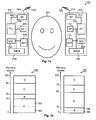
- FIG. 1a shows a binaural hearing instrument set, HI-set, 100 as summarized above, schematically illustrated in the form of a block diagram.
- the HI-set 100 is arranged close to the ears of a human user 101.
- the HI-set comprises a first unit 102 arranged on the left side of the user 101 (as perceived from the point of view of the user 101) and a second unit 152 arranged on the right side of the user 101.
- the HI-set 100 may be of any type known in the art.
- the HI-set may be any of the types BTE (behind the ear), ITE (in the ear), RITE (receiver in the ear), ITC (in the canal), MIC (mini canal) and CIC (completely in the canal).
- BTE behind the ear
- ITE in the ear
- RITE receiveriver in the ear
- ITC in the canal
- MIC mini canal
- CIC completely in the canal
- the block structure of the first and second units 102 and 152 is essentially identical, although alternative embodiments may include those where either of the units comprises additional circuitry. For the purpose of the present description, however, such differences are of no relevance.
- the HI-set units 102, 152 comprise a respective processing unit 104, 154, a memory unit 106, 156, an audio input transducer 108, 158, an audio output transducer 110, 160 and radio frequency communication circuitry including a radio transceiver 112, 162 coupled to an antenna 114, 164. Electric power is provided to the circuitry by means of a battery 116, 166. Needless to say, the HI-set units 102, 152 are strictly limited in terms of physical parameters due to the fact that they are to be arranged in or close to the ears of the user 101.
- limitations regarding size and weight of the circuitry, not least the battery 116, 166, are important factors when constructing a hearing instrument such as the presently described HI-set 100. These limitations have implications on performance requirements on the processing unit 104, 154 as well as the memory unit 106, 156. In other words, as discussed above, it is desirable to optimize the usage of processing and memory resources in order to be able to provide a small and light weight HI-set 100.
- Sound is picked up and converted to electric signals by the audio input transducer 108, 158.
- the electric signals from the audio input transducer 108, 158 are processed by the processing unit 104, 154 and output through the audio out put transducer 110, 160 in which the processed signals are converted from electric signals into sound.
- the processing unit 104, 154 processes digital data representing the sound. Conversion from analog signals into the digital data is typically performed by the processing unit 104, 154 in cooperation with the audio input transducer 108, 158.
- the processing of the data takes place by means of software instructions stored in the memory unit 106, 156 and executed by the processing unit 104, 154.
- the software instructions are arranged such that they define one or more algorithms. Each algorithm is suitably configured to process data in order to fulfill a desired effect.
- the algorithms differ in complexity and their demands on processing power also vary, depending on the situation. Moreover, the algorithms allocate different amounts of temporary memory and the total amount of memory in the memory unit 106, 156 limits the number of algorithms that may execute concurrently.
- Some algorithms are configured to utilize data representing sound that is received by both the input transducer 108 in the first unit 102 and the input transducer in the second unit 152. Examples of such algorithms are those that provide enhanced directional information and enhanced noise suppression.
- a communication channel 120 is indicated in figure 1 and the skilled person will implement data communication via this channel 120 in a suitable manner, for example by using a short range radio communication protocol such as Bluetooth.
- Each memory unit 106, 156 contains 100 blocks of memory (in arbitrary units) as indicated in the diagrams.
- the situation illustrated by figure 1 b is one in which four different algorithms algorithm A, algorithm B, algorithm C and algorithm D have allocated a respective part of the memory 106 in the first unit 102 and the memory 156 in the second unit 152.
- Each algorithm A-D performs a different data processing task and the results of the processing of each algorithm A-D is required in both the first unit 102 and the second unit 152.
- Each algorithm A-D is split into a respective server part and a client part.
- the server part of algorithm A allocates 40 blocks of the memory 106 of the first unit 102 and the client part of algorithm A allocates 10 blocks of the memory 156 of the second unit 152.
- a respective code part 180 and 184 illustrate an amount of memory, within the total allocated memory of algorithm A, which is used for storing the software code that implement the server part and the client part, respectively.
- a respective scratch memory part 182 and 186 illustrates an amount of memory, within the total allocated memory of algorithm A, which is used by algorithm A as scratch memory during processing, respectively.
- the server part of algorithm B allocates 50 blocks of the memory 156 of the second unit 152 and the client part of algorithm B allocates 10 blocks of the memory 106 of the first unit 102.
- the server part of algorithm C allocates 30 blocks of the memory 106 of the first unit 102 and the client part of algorithm C allocates 15 blocks of the memory 156 of the second unit 152.
- the server part of algorithm D allocates 25 blocks of the memory 156 of the second unit 152 and the client part of algorithm B allocates 20 blocks of the memory 106 of the first unit 102.
- Figure 1b illustrates clearly an advantage of the configuration of a hearing instrument set as described above. That is, the present configuration requires only 100 blocks of memory in each unit 102, 152, whereas in prior art devices algorithms A-D would need memory space corresponding to the server part of each algorithm, which would add up to a total 145 blocks of memory in each unit 102, 152.
- a binaural hearing instrument set in which algorithms are split into a server part and a thin-client part.
- the respective server part of the algorithm is located in a first hearing instrument unit, while the thin-client part is located in a second unit in the binaural hearing instrument set.
- the server part implements the actual algorithm and uses as much code-space memory as required.
- the server part receives input data from the thin-client part and sends results back to the thin-client part.
- the thin-client part transmits needed input data to the server part and receives results from the server which are used with essentially no further processing. Thereby, it uses less code-space memory as well as less temporary memory than the server part.
Landscapes
- Engineering & Computer Science (AREA)
- Computer Networks & Wireless Communication (AREA)
- Health & Medical Sciences (AREA)
- General Health & Medical Sciences (AREA)
- Neurosurgery (AREA)
- Otolaryngology (AREA)
- Physics & Mathematics (AREA)
- Acoustics & Sound (AREA)
- Signal Processing (AREA)
- Stereophonic System (AREA)
- Headphones And Earphones (AREA)
- Stereophonic Arrangements (AREA)
Priority Applications (9)
| Application Number | Priority Date | Filing Date | Title |
|---|---|---|---|
| DK08105833.1T DK2190216T3 (da) | 2008-11-20 | 2008-11-20 | Binauralt høreinstrument |
| AT08105833T ATE521198T1 (de) | 2008-11-20 | 2008-11-20 | Binaurales hörinstrument |
| EP08105833A EP2190216B1 (en) | 2008-11-20 | 2008-11-20 | Binaural hearing instrument |
| DK09175668.4T DK2190219T3 (da) | 2008-11-20 | 2009-11-11 | Binauralt høreinstrument |
| EP09175668A EP2190219B1 (en) | 2008-11-20 | 2009-11-11 | Binaural hearing instrument |
| AT09175668T ATE522093T1 (de) | 2008-11-20 | 2009-11-11 | Binaurales hörinstrument |
| AU2009238254A AU2009238254A1 (en) | 2008-11-20 | 2009-11-13 | Binaural hearing instrument |
| US12/622,112 US8270644B2 (en) | 2008-11-20 | 2009-11-19 | Binaural hearing instrument |
| CN200910223665.8A CN101742391B (zh) | 2008-11-20 | 2009-11-20 | 双耳助听器 |
Applications Claiming Priority (1)
| Application Number | Priority Date | Filing Date | Title |
|---|---|---|---|
| EP08105833A EP2190216B1 (en) | 2008-11-20 | 2008-11-20 | Binaural hearing instrument |
Publications (2)
| Publication Number | Publication Date |
|---|---|
| EP2190216A1 EP2190216A1 (en) | 2010-05-26 |
| EP2190216B1 true EP2190216B1 (en) | 2011-08-17 |
Family
ID=40207245
Family Applications (2)
| Application Number | Title | Priority Date | Filing Date |
|---|---|---|---|
| EP08105833A Not-in-force EP2190216B1 (en) | 2008-11-20 | 2008-11-20 | Binaural hearing instrument |
| EP09175668A Active EP2190219B1 (en) | 2008-11-20 | 2009-11-11 | Binaural hearing instrument |
Family Applications After (1)
| Application Number | Title | Priority Date | Filing Date |
|---|---|---|---|
| EP09175668A Active EP2190219B1 (en) | 2008-11-20 | 2009-11-11 | Binaural hearing instrument |
Country Status (6)
| Country | Link |
|---|---|
| US (1) | US8270644B2 (da) |
| EP (2) | EP2190216B1 (da) |
| CN (1) | CN101742391B (da) |
| AT (2) | ATE521198T1 (da) |
| AU (1) | AU2009238254A1 (da) |
| DK (2) | DK2190216T3 (da) |
Families Citing this family (5)
| Publication number | Priority date | Publication date | Assignee | Title |
|---|---|---|---|---|
| JP2009509185A (ja) * | 2005-09-15 | 2009-03-05 | コーニンクレッカ フィリップス エレクトロニクス エヌ ヴィ | 同期音声データ処理のための音声データ処理装置及び方法 |
| US9420385B2 (en) * | 2009-12-21 | 2016-08-16 | Starkey Laboratories, Inc. | Low power intermittent messaging for hearing assistance devices |
| EP3125578B1 (en) * | 2010-11-17 | 2020-01-29 | Oticon A/s | Wireless binaural hearing system |
| US10321252B2 (en) * | 2012-02-13 | 2019-06-11 | Axd Technologies, Llc | Transaural synthesis method for sound spatialization |
| US10510446B2 (en) * | 2014-11-20 | 2019-12-17 | Widex A/S | Hearing aid user account management |
Family Cites Families (14)
| Publication number | Priority date | Publication date | Assignee | Title |
|---|---|---|---|---|
| JP2935266B2 (ja) * | 1987-05-11 | 1999-08-16 | ジャンポルスキー、アーサー | 逆説的補聴器 |
| DE69233156T2 (de) * | 1991-01-17 | 2004-07-08 | Adelman, Roger A. | Verbessertes hörgerät |
| US5721783A (en) * | 1995-06-07 | 1998-02-24 | Anderson; James C. | Hearing aid with wireless remote processor |
| US5991419A (en) | 1997-04-29 | 1999-11-23 | Beltone Electronics Corporation | Bilateral signal processing prosthesis |
| AU733433B2 (en) * | 1998-02-18 | 2001-05-17 | Widex A/S | A binaural digital hearing aid system |
| DK0941014T3 (da) | 1998-03-03 | 2006-05-22 | Siemens Audiologische Technik | Höreapparatsystem med to höreapparater |
| JP4939722B2 (ja) | 2000-07-14 | 2012-05-30 | ジーエヌ リザウンド エー/エス | 同期式ステレオ聴覚システム |
| JP2003199076A (ja) | 2001-12-27 | 2003-07-11 | Nippon Telegr & Teleph Corp <Ntt> | コンテンツ配信向けユーザアシスタントサービス提供方法及びシステム |
| DE10228632B3 (de) * | 2002-06-26 | 2004-01-15 | Siemens Audiologische Technik Gmbh | Richtungshören bei binauraler Hörgeräteversorgung |
| US8027495B2 (en) * | 2003-03-07 | 2011-09-27 | Phonak Ag | Binaural hearing device and method for controlling a hearing device system |
| US7529565B2 (en) * | 2004-04-08 | 2009-05-05 | Starkey Laboratories, Inc. | Wireless communication protocol |
| DE102005036851B3 (de) * | 2005-08-04 | 2006-11-23 | Siemens Audiologische Technik Gmbh | Verfahren zum Synchronisieren von Signaltönen und entsprechende Hörgeräte |
| DE102007015223B4 (de) * | 2007-03-29 | 2013-08-22 | Siemens Audiologische Technik Gmbh | Verfahren und Einrichtung zur Wiedergabe synthetisch erzeugter Signale durch ein binaurales Hörsystem |
| US8477975B2 (en) * | 2007-12-20 | 2013-07-02 | Phonak Ag | Hearing system with joint task scheduling |
-
2008
- 2008-11-20 DK DK08105833.1T patent/DK2190216T3/da active
- 2008-11-20 EP EP08105833A patent/EP2190216B1/en not_active Not-in-force
- 2008-11-20 AT AT08105833T patent/ATE521198T1/de not_active IP Right Cessation
-
2009
- 2009-11-11 EP EP09175668A patent/EP2190219B1/en active Active
- 2009-11-11 AT AT09175668T patent/ATE522093T1/de not_active IP Right Cessation
- 2009-11-11 DK DK09175668.4T patent/DK2190219T3/da active
- 2009-11-13 AU AU2009238254A patent/AU2009238254A1/en not_active Abandoned
- 2009-11-19 US US12/622,112 patent/US8270644B2/en active Active
- 2009-11-20 CN CN200910223665.8A patent/CN101742391B/zh not_active Expired - Fee Related
Also Published As
| Publication number | Publication date |
|---|---|
| DK2190216T3 (da) | 2011-11-14 |
| CN101742391B (zh) | 2015-02-18 |
| EP2190219A1 (en) | 2010-05-26 |
| CN101742391A (zh) | 2010-06-16 |
| DK2190219T3 (da) | 2011-11-21 |
| EP2190216A1 (en) | 2010-05-26 |
| ATE522093T1 (de) | 2011-09-15 |
| US8270644B2 (en) | 2012-09-18 |
| EP2190219B1 (en) | 2011-08-24 |
| AU2009238254A1 (en) | 2010-06-03 |
| US20100124347A1 (en) | 2010-05-20 |
| ATE521198T1 (de) | 2011-09-15 |
Similar Documents
| Publication | Publication Date | Title |
|---|---|---|
| CN100477816C (zh) | 运行助听器系统的方法及助听器系统 | |
| EP2076065B1 (en) | Hearing device and method for a wireless receiving and/or sending of data | |
| US9883298B2 (en) | Method and apparatus for communication between hearing assistance devices in a bluetooth network | |
| US9516430B2 (en) | Binaural hearing assistance system comprising binaural noise reduction | |
| US8126153B2 (en) | Hearing system with partial band signal exchange and corresponding method | |
| EP2190216B1 (en) | Binaural hearing instrument | |
| US10667065B2 (en) | Hearing instrument having an antenna system | |
| EP3319339A1 (en) | Binaural hearing system and method | |
| WO2010111244A2 (en) | Method and apparatus for implementing hearing aid with array of processors | |
| EP3008923B1 (en) | A method of operating a binaural hearing aid system and a binaural hearing aid system | |
| US20210211816A1 (en) | Modularization of components of an ear-wearable device | |
| CN115811691B (zh) | 用于运行听力设备的方法和听力设备 | |
| CN113347543B (zh) | 具有两个听力设备的双耳听力系统及运行听力系统的方法 | |
| US11576002B2 (en) | Sensor hub in connector plug or cable for a hearing assistance device | |
| US8275161B2 (en) | Hearing device employing signal processing based on design-related parameters and corresponding method | |
| US12272880B2 (en) | Hearing device with beam-steerable antenna arrangement | |
| EP4492825A1 (en) | Hearing aid and cochlear implant wireless system | |
| EP3703390B1 (en) | Distributing software among hearing devices |
Legal Events
| Date | Code | Title | Description |
|---|---|---|---|
| PUAI | Public reference made under article 153(3) epc to a published international application that has entered the european phase |
Free format text: ORIGINAL CODE: 0009012 |
|
| AK | Designated contracting states |
Kind code of ref document: A1 Designated state(s): AT BE BG CH CY CZ DE DK EE ES FI FR GB GR HR HU IE IS IT LI LT LU LV MC MT NL NO PL PT RO SE SI SK TR |
|
| AX | Request for extension of the european patent |
Extension state: AL BA MK RS |
|
| 17P | Request for examination filed |
Effective date: 20101126 |
|
| AKX | Designation fees paid |
Designated state(s): AT BE BG CH CY CZ DE DK EE ES FI FR GB GR HR HU IE IS IT LI LT LU LV MC MT NL NO PL PT RO SE SI SK TR |
|
| GRAP | Despatch of communication of intention to grant a patent |
Free format text: ORIGINAL CODE: EPIDOSNIGR1 |
|
| GRAS | Grant fee paid |
Free format text: ORIGINAL CODE: EPIDOSNIGR3 |
|
| GRAA | (expected) grant |
Free format text: ORIGINAL CODE: 0009210 |
|
| AK | Designated contracting states |
Kind code of ref document: B1 Designated state(s): AT BE BG CH CY CZ DE DK EE ES FI FR GB GR HR HU IE IS IT LI LT LU LV MC MT NL NO PL PT RO SE SI SK TR |
|
| REG | Reference to a national code |
Ref country code: GB Ref legal event code: FG4D |
|
| REG | Reference to a national code |
Ref country code: CH Ref legal event code: EP |
|
| REG | Reference to a national code |
Ref country code: IE Ref legal event code: FG4D |
|
| REG | Reference to a national code |
Ref country code: CH Ref legal event code: NV Representative=s name: FIAMMENGHI-FIAMMENGHI |
|
| REG | Reference to a national code |
Ref country code: DE Ref legal event code: R096 Ref document number: 602008008873 Country of ref document: DE Effective date: 20111020 |
|
| REG | Reference to a national code |
Ref country code: DK Ref legal event code: T3 |
|
| REG | Reference to a national code |
Ref country code: NL Ref legal event code: VDEP Effective date: 20110817 |
|
| LTIE | Lt: invalidation of european patent or patent extension |
Effective date: 20110817 |
|
| PG25 | Lapsed in a contracting state [announced via postgrant information from national office to epo] |
Ref country code: IS Free format text: LAPSE BECAUSE OF FAILURE TO SUBMIT A TRANSLATION OF THE DESCRIPTION OR TO PAY THE FEE WITHIN THE PRESCRIBED TIME-LIMIT Effective date: 20111217 Ref country code: NO Free format text: LAPSE BECAUSE OF FAILURE TO SUBMIT A TRANSLATION OF THE DESCRIPTION OR TO PAY THE FEE WITHIN THE PRESCRIBED TIME-LIMIT Effective date: 20111117 Ref country code: NL Free format text: LAPSE BECAUSE OF FAILURE TO SUBMIT A TRANSLATION OF THE DESCRIPTION OR TO PAY THE FEE WITHIN THE PRESCRIBED TIME-LIMIT Effective date: 20110817 Ref country code: LT Free format text: LAPSE BECAUSE OF FAILURE TO SUBMIT A TRANSLATION OF THE DESCRIPTION OR TO PAY THE FEE WITHIN THE PRESCRIBED TIME-LIMIT Effective date: 20110817 Ref country code: FI Free format text: LAPSE BECAUSE OF FAILURE TO SUBMIT A TRANSLATION OF THE DESCRIPTION OR TO PAY THE FEE WITHIN THE PRESCRIBED TIME-LIMIT Effective date: 20110817 Ref country code: PT Free format text: LAPSE BECAUSE OF FAILURE TO SUBMIT A TRANSLATION OF THE DESCRIPTION OR TO PAY THE FEE WITHIN THE PRESCRIBED TIME-LIMIT Effective date: 20111219 Ref country code: SE Free format text: LAPSE BECAUSE OF FAILURE TO SUBMIT A TRANSLATION OF THE DESCRIPTION OR TO PAY THE FEE WITHIN THE PRESCRIBED TIME-LIMIT Effective date: 20110817 |
|
| REG | Reference to a national code |
Ref country code: AT Ref legal event code: MK05 Ref document number: 521198 Country of ref document: AT Kind code of ref document: T Effective date: 20110817 |
|
| PG25 | Lapsed in a contracting state [announced via postgrant information from national office to epo] |
Ref country code: LV Free format text: LAPSE BECAUSE OF FAILURE TO SUBMIT A TRANSLATION OF THE DESCRIPTION OR TO PAY THE FEE WITHIN THE PRESCRIBED TIME-LIMIT Effective date: 20110817 Ref country code: GR Free format text: LAPSE BECAUSE OF FAILURE TO SUBMIT A TRANSLATION OF THE DESCRIPTION OR TO PAY THE FEE WITHIN THE PRESCRIBED TIME-LIMIT Effective date: 20111118 Ref country code: SI Free format text: LAPSE BECAUSE OF FAILURE TO SUBMIT A TRANSLATION OF THE DESCRIPTION OR TO PAY THE FEE WITHIN THE PRESCRIBED TIME-LIMIT Effective date: 20110817 Ref country code: CY Free format text: LAPSE BECAUSE OF FAILURE TO SUBMIT A TRANSLATION OF THE DESCRIPTION OR TO PAY THE FEE WITHIN THE PRESCRIBED TIME-LIMIT Effective date: 20110817 Ref country code: PL Free format text: LAPSE BECAUSE OF FAILURE TO SUBMIT A TRANSLATION OF THE DESCRIPTION OR TO PAY THE FEE WITHIN THE PRESCRIBED TIME-LIMIT Effective date: 20110817 Ref country code: AT Free format text: LAPSE BECAUSE OF FAILURE TO SUBMIT A TRANSLATION OF THE DESCRIPTION OR TO PAY THE FEE WITHIN THE PRESCRIBED TIME-LIMIT Effective date: 20110817 |
|
| PG25 | Lapsed in a contracting state [announced via postgrant information from national office to epo] |
Ref country code: BE Free format text: LAPSE BECAUSE OF FAILURE TO SUBMIT A TRANSLATION OF THE DESCRIPTION OR TO PAY THE FEE WITHIN THE PRESCRIBED TIME-LIMIT Effective date: 20110817 |
|
| PG25 | Lapsed in a contracting state [announced via postgrant information from national office to epo] |
Ref country code: CZ Free format text: LAPSE BECAUSE OF FAILURE TO SUBMIT A TRANSLATION OF THE DESCRIPTION OR TO PAY THE FEE WITHIN THE PRESCRIBED TIME-LIMIT Effective date: 20110817 Ref country code: SK Free format text: LAPSE BECAUSE OF FAILURE TO SUBMIT A TRANSLATION OF THE DESCRIPTION OR TO PAY THE FEE WITHIN THE PRESCRIBED TIME-LIMIT Effective date: 20110817 |
|
| PG25 | Lapsed in a contracting state [announced via postgrant information from national office to epo] |
Ref country code: RO Free format text: LAPSE BECAUSE OF FAILURE TO SUBMIT A TRANSLATION OF THE DESCRIPTION OR TO PAY THE FEE WITHIN THE PRESCRIBED TIME-LIMIT Effective date: 20110817 Ref country code: EE Free format text: LAPSE BECAUSE OF FAILURE TO SUBMIT A TRANSLATION OF THE DESCRIPTION OR TO PAY THE FEE WITHIN THE PRESCRIBED TIME-LIMIT Effective date: 20110817 Ref country code: IT Free format text: LAPSE BECAUSE OF FAILURE TO SUBMIT A TRANSLATION OF THE DESCRIPTION OR TO PAY THE FEE WITHIN THE PRESCRIBED TIME-LIMIT Effective date: 20110817 |
|
| PLBE | No opposition filed within time limit |
Free format text: ORIGINAL CODE: 0009261 |
|
| STAA | Information on the status of an ep patent application or granted ep patent |
Free format text: STATUS: NO OPPOSITION FILED WITHIN TIME LIMIT |
|
| PG25 | Lapsed in a contracting state [announced via postgrant information from national office to epo] |
Ref country code: MC Free format text: LAPSE BECAUSE OF NON-PAYMENT OF DUE FEES Effective date: 20111130 |
|
| 26N | No opposition filed |
Effective date: 20120521 |
|
| PG25 | Lapsed in a contracting state [announced via postgrant information from national office to epo] |
Ref country code: HR Free format text: LAPSE BECAUSE OF FAILURE TO SUBMIT A TRANSLATION OF THE DESCRIPTION OR TO PAY THE FEE WITHIN THE PRESCRIBED TIME-LIMIT Effective date: 20120321 |
|
| REG | Reference to a national code |
Ref country code: IE Ref legal event code: MM4A |
|
| REG | Reference to a national code |
Ref country code: DE Ref legal event code: R097 Ref document number: 602008008873 Country of ref document: DE Effective date: 20120521 |
|
| PG25 | Lapsed in a contracting state [announced via postgrant information from national office to epo] |
Ref country code: IE Free format text: LAPSE BECAUSE OF NON-PAYMENT OF DUE FEES Effective date: 20111120 |
|
| PG25 | Lapsed in a contracting state [announced via postgrant information from national office to epo] |
Ref country code: MT Free format text: LAPSE BECAUSE OF FAILURE TO SUBMIT A TRANSLATION OF THE DESCRIPTION OR TO PAY THE FEE WITHIN THE PRESCRIBED TIME-LIMIT Effective date: 20110817 |
|
| PG25 | Lapsed in a contracting state [announced via postgrant information from national office to epo] |
Ref country code: LU Free format text: LAPSE BECAUSE OF NON-PAYMENT OF DUE FEES Effective date: 20111120 |
|
| PG25 | Lapsed in a contracting state [announced via postgrant information from national office to epo] |
Ref country code: BG Free format text: LAPSE BECAUSE OF FAILURE TO SUBMIT A TRANSLATION OF THE DESCRIPTION OR TO PAY THE FEE WITHIN THE PRESCRIBED TIME-LIMIT Effective date: 20111117 |
|
| PG25 | Lapsed in a contracting state [announced via postgrant information from national office to epo] |
Ref country code: TR Free format text: LAPSE BECAUSE OF FAILURE TO SUBMIT A TRANSLATION OF THE DESCRIPTION OR TO PAY THE FEE WITHIN THE PRESCRIBED TIME-LIMIT Effective date: 20110817 |
|
| PG25 | Lapsed in a contracting state [announced via postgrant information from national office to epo] |
Ref country code: ES Free format text: LAPSE BECAUSE OF FAILURE TO SUBMIT A TRANSLATION OF THE DESCRIPTION OR TO PAY THE FEE WITHIN THE PRESCRIBED TIME-LIMIT Effective date: 20111128 Ref country code: HU Free format text: LAPSE BECAUSE OF FAILURE TO SUBMIT A TRANSLATION OF THE DESCRIPTION OR TO PAY THE FEE WITHIN THE PRESCRIBED TIME-LIMIT Effective date: 20110817 |
|
| PG25 | Lapsed in a contracting state [announced via postgrant information from national office to epo] |
Ref country code: HR Free format text: LAPSE BECAUSE OF FAILURE TO SUBMIT A TRANSLATION OF THE DESCRIPTION OR TO PAY THE FEE WITHIN THE PRESCRIBED TIME-LIMIT Effective date: 20110817 |
|
| REG | Reference to a national code |
Ref country code: FR Ref legal event code: PLFP Year of fee payment: 8 |
|
| REG | Reference to a national code |
Ref country code: FR Ref legal event code: PLFP Year of fee payment: 9 |
|
| REG | Reference to a national code |
Ref country code: FR Ref legal event code: PLFP Year of fee payment: 10 |
|
| PGFP | Annual fee paid to national office [announced via postgrant information from national office to epo] |
Ref country code: FR Payment date: 20171120 Year of fee payment: 10 Ref country code: DK Payment date: 20171120 Year of fee payment: 10 Ref country code: DE Payment date: 20171122 Year of fee payment: 10 |
|
| PGFP | Annual fee paid to national office [announced via postgrant information from national office to epo] |
Ref country code: CH Payment date: 20171124 Year of fee payment: 10 Ref country code: GB Payment date: 20171120 Year of fee payment: 10 |
|
| REG | Reference to a national code |
Ref country code: DE Ref legal event code: R119 Ref document number: 602008008873 Country of ref document: DE |
|
| REG | Reference to a national code |
Ref country code: DK Ref legal event code: EBP Effective date: 20181130 |
|
| REG | Reference to a national code |
Ref country code: CH Ref legal event code: PL |
|
| GBPC | Gb: european patent ceased through non-payment of renewal fee |
Effective date: 20181120 |
|
| PG25 | Lapsed in a contracting state [announced via postgrant information from national office to epo] |
Ref country code: LI Free format text: LAPSE BECAUSE OF NON-PAYMENT OF DUE FEES Effective date: 20181130 Ref country code: CH Free format text: LAPSE BECAUSE OF NON-PAYMENT OF DUE FEES Effective date: 20181130 |
|
| PG25 | Lapsed in a contracting state [announced via postgrant information from national office to epo] |
Ref country code: FR Free format text: LAPSE BECAUSE OF NON-PAYMENT OF DUE FEES Effective date: 20181130 Ref country code: DE Free format text: LAPSE BECAUSE OF NON-PAYMENT OF DUE FEES Effective date: 20190601 Ref country code: DK Free format text: LAPSE BECAUSE OF NON-PAYMENT OF DUE FEES Effective date: 20181130 |
|
| PG25 | Lapsed in a contracting state [announced via postgrant information from national office to epo] |
Ref country code: GB Free format text: LAPSE BECAUSE OF NON-PAYMENT OF DUE FEES Effective date: 20181120 |