EP2189517A1 - Synergistic liquid composition and use of the same for removing substances strongly bound to surfaces - Google Patents
Synergistic liquid composition and use of the same for removing substances strongly bound to surfaces Download PDFInfo
- Publication number
- EP2189517A1 EP2189517A1 EP09176873A EP09176873A EP2189517A1 EP 2189517 A1 EP2189517 A1 EP 2189517A1 EP 09176873 A EP09176873 A EP 09176873A EP 09176873 A EP09176873 A EP 09176873A EP 2189517 A1 EP2189517 A1 EP 2189517A1
- Authority
- EP
- European Patent Office
- Prior art keywords
- liquid composition
- mass
- surfactant
- component
- composition
- Prior art date
- Legal status (The legal status is an assumption and is not a legal conclusion. Google has not performed a legal analysis and makes no representation as to the accuracy of the status listed.)
- Withdrawn
Links
- 239000000203 mixture Substances 0.000 title claims abstract description 102
- 239000007788 liquid Substances 0.000 title claims abstract description 63
- 230000002195 synergetic effect Effects 0.000 title claims abstract description 22
- 239000000126 substance Substances 0.000 title description 4
- 239000004094 surface-active agent Substances 0.000 claims abstract description 38
- 239000000975 dye Substances 0.000 claims abstract description 36
- -1 alkylene glycol ether Chemical compound 0.000 claims abstract description 26
- XLYOFNOQVPJJNP-UHFFFAOYSA-N water Substances O XLYOFNOQVPJJNP-UHFFFAOYSA-N 0.000 claims abstract description 18
- 230000000694 effects Effects 0.000 claims abstract description 12
- 238000004140 cleaning Methods 0.000 claims abstract description 7
- 239000010426 asphalt Substances 0.000 claims abstract description 6
- 239000000295 fuel oil Substances 0.000 claims abstract description 5
- 235000019738 Limestone Nutrition 0.000 claims abstract description 3
- 239000000919 ceramic Substances 0.000 claims abstract description 3
- 239000004567 concrete Substances 0.000 claims abstract description 3
- 239000010438 granite Substances 0.000 claims abstract description 3
- 239000006028 limestone Substances 0.000 claims abstract description 3
- 239000004575 stone Substances 0.000 claims abstract description 3
- OAYXUHPQHDHDDZ-UHFFFAOYSA-N 2-(2-butoxyethoxy)ethanol Chemical compound CCCCOCCOCCO OAYXUHPQHDHDDZ-UHFFFAOYSA-N 0.000 claims description 24
- UIIMBOGNXHQVGW-UHFFFAOYSA-M Sodium bicarbonate Chemical compound [Na+].OC([O-])=O UIIMBOGNXHQVGW-UHFFFAOYSA-M 0.000 claims description 21
- 229910000030 sodium bicarbonate Inorganic materials 0.000 claims description 11
- 235000017557 sodium bicarbonate Nutrition 0.000 claims description 6
- 229920004890 Triton X-100 Polymers 0.000 claims description 5
- POAOYUHQDCAZBD-UHFFFAOYSA-N 2-butoxyethanol Chemical compound CCCCOCCO POAOYUHQDCAZBD-UHFFFAOYSA-N 0.000 claims description 3
- ATRRKUHOCOJYRX-UHFFFAOYSA-N Ammonium bicarbonate Chemical compound [NH4+].OC([O-])=O ATRRKUHOCOJYRX-UHFFFAOYSA-N 0.000 claims description 3
- 229910052783 alkali metal Inorganic materials 0.000 claims description 3
- 235000012538 ammonium bicarbonate Nutrition 0.000 claims description 3
- 125000000129 anionic group Chemical group 0.000 claims description 3
- 239000002736 nonionic surfactant Substances 0.000 claims description 3
- YEYKMVJDLWJFOA-UHFFFAOYSA-N 2-propoxyethanol Chemical compound CCCOCCO YEYKMVJDLWJFOA-UHFFFAOYSA-N 0.000 claims description 2
- 229910000013 Ammonium bicarbonate Inorganic materials 0.000 claims description 2
- 150000001340 alkali metals Chemical class 0.000 claims description 2
- 239000001099 ammonium carbonate Substances 0.000 claims description 2
- 239000003945 anionic surfactant Substances 0.000 claims description 2
- 229910000288 alkali metal carbonate Inorganic materials 0.000 claims 1
- 239000004530 micro-emulsion Substances 0.000 description 7
- 239000008399 tap water Substances 0.000 description 7
- 235000020679 tap water Nutrition 0.000 description 7
- YXFVVABEGXRONW-UHFFFAOYSA-N Toluene Chemical compound CC1=CC=CC=C1 YXFVVABEGXRONW-UHFFFAOYSA-N 0.000 description 6
- LYCAIKOWRPUZTN-UHFFFAOYSA-N ethylene glycol Natural products OCCO LYCAIKOWRPUZTN-UHFFFAOYSA-N 0.000 description 6
- WGCNASOHLSPBMP-UHFFFAOYSA-N hydroxyacetaldehyde Natural products OCC=O WGCNASOHLSPBMP-UHFFFAOYSA-N 0.000 description 6
- 238000002156 mixing Methods 0.000 description 6
- 239000000693 micelle Substances 0.000 description 4
- 239000000243 solution Substances 0.000 description 4
- 150000001875 compounds Chemical class 0.000 description 3
- 239000003344 environmental pollutant Substances 0.000 description 3
- 150000002430 hydrocarbons Chemical class 0.000 description 3
- 231100000719 pollutant Toxicity 0.000 description 3
- 239000000843 powder Substances 0.000 description 3
- 239000002904 solvent Substances 0.000 description 3
- LRHPLDYGYMQRHN-UHFFFAOYSA-N N-Butanol Chemical compound CCCCO LRHPLDYGYMQRHN-UHFFFAOYSA-N 0.000 description 2
- AMQJEAYHLZJPGS-UHFFFAOYSA-N N-Pentanol Chemical compound CCCCCO AMQJEAYHLZJPGS-UHFFFAOYSA-N 0.000 description 2
- VYPSYNLAJGMNEJ-UHFFFAOYSA-N Silicium dioxide Chemical compound O=[Si]=O VYPSYNLAJGMNEJ-UHFFFAOYSA-N 0.000 description 2
- NIXOWILDQLNWCW-UHFFFAOYSA-N acrylic acid group Chemical group C(C=C)(=O)O NIXOWILDQLNWCW-UHFFFAOYSA-N 0.000 description 2
- 150000001338 aliphatic hydrocarbons Chemical class 0.000 description 2
- 150000004945 aromatic hydrocarbons Chemical class 0.000 description 2
- 238000011109 contamination Methods 0.000 description 2
- 239000000839 emulsion Substances 0.000 description 2
- 238000005516 engineering process Methods 0.000 description 2
- 230000007613 environmental effect Effects 0.000 description 2
- 238000002474 experimental method Methods 0.000 description 2
- 238000000605 extraction Methods 0.000 description 2
- 239000003960 organic solvent Substances 0.000 description 2
- 239000000725 suspension Substances 0.000 description 2
- DNIAPMSPPWPWGF-GSVOUGTGSA-N (R)-(-)-Propylene glycol Chemical compound C[C@@H](O)CO DNIAPMSPPWPWGF-GSVOUGTGSA-N 0.000 description 1
- HNSDLXPSAYFUHK-UHFFFAOYSA-N 1,4-bis(2-ethylhexyl) sulfosuccinate Chemical compound CCCCC(CC)COC(=O)CC(S(O)(=O)=O)C(=O)OCC(CC)CCCC HNSDLXPSAYFUHK-UHFFFAOYSA-N 0.000 description 1
- COBPKKZHLDDMTB-UHFFFAOYSA-N 2-[2-(2-butoxyethoxy)ethoxy]ethanol Chemical compound CCCCOCCOCCOCCO COBPKKZHLDDMTB-UHFFFAOYSA-N 0.000 description 1
- 241001473319 Eupatorium capillifolium Species 0.000 description 1
- DGAQECJNVWCQMB-PUAWFVPOSA-M Ilexoside XXIX Chemical compound C[C@@H]1CC[C@@]2(CC[C@@]3(C(=CC[C@H]4[C@]3(CC[C@@H]5[C@@]4(CC[C@@H](C5(C)C)OS(=O)(=O)[O-])C)C)[C@@H]2[C@]1(C)O)C)C(=O)O[C@H]6[C@@H]([C@H]([C@@H]([C@H](O6)CO)O)O)O.[Na+] DGAQECJNVWCQMB-PUAWFVPOSA-M 0.000 description 1
- 239000000654 additive Substances 0.000 description 1
- 230000000996 additive effect Effects 0.000 description 1
- 150000001298 alcohols Chemical class 0.000 description 1
- PNEYBMLMFCGWSK-UHFFFAOYSA-N aluminium oxide Inorganic materials [O-2].[O-2].[O-2].[Al+3].[Al+3] PNEYBMLMFCGWSK-UHFFFAOYSA-N 0.000 description 1
- 239000007864 aqueous solution Substances 0.000 description 1
- 125000003118 aryl group Chemical group 0.000 description 1
- 230000015572 biosynthetic process Effects 0.000 description 1
- 238000007664 blowing Methods 0.000 description 1
- 239000004566 building material Substances 0.000 description 1
- 125000000484 butyl group Chemical group [H]C([*])([H])C([H])([H])C([H])([H])C([H])([H])[H] 0.000 description 1
- 125000004432 carbon atom Chemical group C* 0.000 description 1
- 125000002091 cationic group Chemical group 0.000 description 1
- 238000012512 characterization method Methods 0.000 description 1
- 238000006243 chemical reaction Methods 0.000 description 1
- 229910052681 coesite Inorganic materials 0.000 description 1
- 239000000084 colloidal system Substances 0.000 description 1
- 229910052593 corundum Inorganic materials 0.000 description 1
- 229910052906 cristobalite Inorganic materials 0.000 description 1
- 230000001627 detrimental effect Effects 0.000 description 1
- SMVRDGHCVNAOIN-UHFFFAOYSA-L disodium;1-dodecoxydodecane;sulfate Chemical compound [Na+].[Na+].[O-]S([O-])(=O)=O.CCCCCCCCCCCCOCCCCCCCCCCCC SMVRDGHCVNAOIN-UHFFFAOYSA-L 0.000 description 1
- 238000004090 dissolution Methods 0.000 description 1
- 238000001035 drying Methods 0.000 description 1
- 238000002296 dynamic light scattering Methods 0.000 description 1
- 239000000284 extract Substances 0.000 description 1
- 239000011521 glass Substances 0.000 description 1
- 229930195733 hydrocarbon Natural products 0.000 description 1
- 229910052500 inorganic mineral Inorganic materials 0.000 description 1
- 230000003993 interaction Effects 0.000 description 1
- 125000000959 isobutyl group Chemical group [H]C([H])([H])C([H])(C([H])([H])[H])C([H])([H])* 0.000 description 1
- 125000004491 isohexyl group Chemical group C(CCC(C)C)* 0.000 description 1
- 125000001972 isopentyl group Chemical group [H]C([H])([H])C([H])(C([H])([H])[H])C([H])([H])C([H])([H])* 0.000 description 1
- 125000001449 isopropyl group Chemical group [H]C([H])([H])C([H])(*)C([H])([H])[H] 0.000 description 1
- 150000002576 ketones Chemical class 0.000 description 1
- 238000000034 method Methods 0.000 description 1
- 239000011707 mineral Substances 0.000 description 1
- 235000010755 mineral Nutrition 0.000 description 1
- 125000004108 n-butyl group Chemical group [H]C([H])([H])C([H])([H])C([H])([H])C([H])([H])* 0.000 description 1
- 125000001280 n-hexyl group Chemical group C(CCCCC)* 0.000 description 1
- 125000000740 n-pentyl group Chemical group [H]C([H])([H])C([H])([H])C([H])([H])C([H])([H])C([H])([H])* 0.000 description 1
- 239000002105 nanoparticle Substances 0.000 description 1
- 230000003287 optical effect Effects 0.000 description 1
- JLFNLZLINWHATN-UHFFFAOYSA-N pentaethylene glycol Chemical compound OCCOCCOCCOCCOCCO JLFNLZLINWHATN-UHFFFAOYSA-N 0.000 description 1
- 239000003208 petroleum Substances 0.000 description 1
- 239000011505 plaster Substances 0.000 description 1
- 229920000642 polymer Polymers 0.000 description 1
- 229910000028 potassium bicarbonate Inorganic materials 0.000 description 1
- 235000015497 potassium bicarbonate Nutrition 0.000 description 1
- 239000011736 potassium bicarbonate Substances 0.000 description 1
- TYJJADVDDVDEDZ-UHFFFAOYSA-M potassium hydrogencarbonate Chemical compound [K+].OC([O-])=O TYJJADVDDVDEDZ-UHFFFAOYSA-M 0.000 description 1
- 229940086066 potassium hydrogencarbonate Drugs 0.000 description 1
- 238000002360 preparation method Methods 0.000 description 1
- 125000001436 propyl group Chemical group [H]C([*])([H])C([H])([H])C([H])([H])[H] 0.000 description 1
- 230000001105 regulatory effect Effects 0.000 description 1
- 229930195734 saturated hydrocarbon Natural products 0.000 description 1
- 125000002914 sec-butyl group Chemical group [H]C([H])([H])C([H])([H])C([H])(*)C([H])([H])[H] 0.000 description 1
- 239000000377 silicon dioxide Substances 0.000 description 1
- 229910052709 silver Inorganic materials 0.000 description 1
- 239000004332 silver Substances 0.000 description 1
- 150000003384 small molecules Chemical class 0.000 description 1
- 159000000000 sodium salts Chemical class 0.000 description 1
- 239000007787 solid Substances 0.000 description 1
- 238000000956 solid--liquid extraction Methods 0.000 description 1
- 239000011877 solvent mixture Substances 0.000 description 1
- 238000003756 stirring Methods 0.000 description 1
- 229910052682 stishovite Inorganic materials 0.000 description 1
- UWHCKJMYHZGTIT-UHFFFAOYSA-N tetraethylene glycol Chemical compound OCCOCCOCCOCCO UWHCKJMYHZGTIT-UHFFFAOYSA-N 0.000 description 1
- 229910052905 tridymite Inorganic materials 0.000 description 1
- ZIBGPFATKBEMQZ-UHFFFAOYSA-N triethylene glycol Chemical compound OCCOCCOCCO ZIBGPFATKBEMQZ-UHFFFAOYSA-N 0.000 description 1
- 238000005406 washing Methods 0.000 description 1
- 229910001845 yogo sapphire Inorganic materials 0.000 description 1
Images




Classifications
-
- C—CHEMISTRY; METALLURGY
- C11—ANIMAL OR VEGETABLE OILS, FATS, FATTY SUBSTANCES OR WAXES; FATTY ACIDS THEREFROM; DETERGENTS; CANDLES
- C11D—DETERGENT COMPOSITIONS; USE OF SINGLE SUBSTANCES AS DETERGENTS; SOAP OR SOAP-MAKING; RESIN SOAPS; RECOVERY OF GLYCEROL
- C11D3/00—Other compounding ingredients of detergent compositions covered in group C11D1/00
- C11D3/16—Organic compounds
- C11D3/20—Organic compounds containing oxygen
- C11D3/2068—Ethers
-
- C—CHEMISTRY; METALLURGY
- C11—ANIMAL OR VEGETABLE OILS, FATS, FATTY SUBSTANCES OR WAXES; FATTY ACIDS THEREFROM; DETERGENTS; CANDLES
- C11D—DETERGENT COMPOSITIONS; USE OF SINGLE SUBSTANCES AS DETERGENTS; SOAP OR SOAP-MAKING; RESIN SOAPS; RECOVERY OF GLYCEROL
- C11D1/00—Detergent compositions based essentially on surface-active compounds; Use of these compounds as a detergent
- C11D1/02—Anionic compounds
-
- C—CHEMISTRY; METALLURGY
- C11—ANIMAL OR VEGETABLE OILS, FATS, FATTY SUBSTANCES OR WAXES; FATTY ACIDS THEREFROM; DETERGENTS; CANDLES
- C11D—DETERGENT COMPOSITIONS; USE OF SINGLE SUBSTANCES AS DETERGENTS; SOAP OR SOAP-MAKING; RESIN SOAPS; RECOVERY OF GLYCEROL
- C11D1/00—Detergent compositions based essentially on surface-active compounds; Use of these compounds as a detergent
- C11D1/66—Non-ionic compounds
-
- C—CHEMISTRY; METALLURGY
- C11—ANIMAL OR VEGETABLE OILS, FATS, FATTY SUBSTANCES OR WAXES; FATTY ACIDS THEREFROM; DETERGENTS; CANDLES
- C11D—DETERGENT COMPOSITIONS; USE OF SINGLE SUBSTANCES AS DETERGENTS; SOAP OR SOAP-MAKING; RESIN SOAPS; RECOVERY OF GLYCEROL
- C11D1/00—Detergent compositions based essentially on surface-active compounds; Use of these compounds as a detergent
- C11D1/66—Non-ionic compounds
- C11D1/83—Mixtures of non-ionic with anionic compounds
-
- C—CHEMISTRY; METALLURGY
- C11—ANIMAL OR VEGETABLE OILS, FATS, FATTY SUBSTANCES OR WAXES; FATTY ACIDS THEREFROM; DETERGENTS; CANDLES
- C11D—DETERGENT COMPOSITIONS; USE OF SINGLE SUBSTANCES AS DETERGENTS; SOAP OR SOAP-MAKING; RESIN SOAPS; RECOVERY OF GLYCEROL
- C11D3/00—Other compounding ingredients of detergent compositions covered in group C11D1/00
- C11D3/02—Inorganic compounds ; Elemental compounds
- C11D3/04—Water-soluble compounds
- C11D3/10—Carbonates ; Bicarbonates
-
- C—CHEMISTRY; METALLURGY
- C11—ANIMAL OR VEGETABLE OILS, FATS, FATTY SUBSTANCES OR WAXES; FATTY ACIDS THEREFROM; DETERGENTS; CANDLES
- C11D—DETERGENT COMPOSITIONS; USE OF SINGLE SUBSTANCES AS DETERGENTS; SOAP OR SOAP-MAKING; RESIN SOAPS; RECOVERY OF GLYCEROL
- C11D1/00—Detergent compositions based essentially on surface-active compounds; Use of these compounds as a detergent
- C11D1/02—Anionic compounds
- C11D1/12—Sulfonic acids or sulfuric acid esters; Salts thereof
- C11D1/123—Sulfonic acids or sulfuric acid esters; Salts thereof derived from carboxylic acids, e.g. sulfosuccinates
-
- C—CHEMISTRY; METALLURGY
- C11—ANIMAL OR VEGETABLE OILS, FATS, FATTY SUBSTANCES OR WAXES; FATTY ACIDS THEREFROM; DETERGENTS; CANDLES
- C11D—DETERGENT COMPOSITIONS; USE OF SINGLE SUBSTANCES AS DETERGENTS; SOAP OR SOAP-MAKING; RESIN SOAPS; RECOVERY OF GLYCEROL
- C11D1/00—Detergent compositions based essentially on surface-active compounds; Use of these compounds as a detergent
- C11D1/02—Anionic compounds
- C11D1/12—Sulfonic acids or sulfuric acid esters; Salts thereof
- C11D1/22—Sulfonic acids or sulfuric acid esters; Salts thereof derived from aromatic compounds
-
- C—CHEMISTRY; METALLURGY
- C11—ANIMAL OR VEGETABLE OILS, FATS, FATTY SUBSTANCES OR WAXES; FATTY ACIDS THEREFROM; DETERGENTS; CANDLES
- C11D—DETERGENT COMPOSITIONS; USE OF SINGLE SUBSTANCES AS DETERGENTS; SOAP OR SOAP-MAKING; RESIN SOAPS; RECOVERY OF GLYCEROL
- C11D1/00—Detergent compositions based essentially on surface-active compounds; Use of these compounds as a detergent
- C11D1/02—Anionic compounds
- C11D1/12—Sulfonic acids or sulfuric acid esters; Salts thereof
- C11D1/29—Sulfates of polyoxyalkylene ethers
-
- C—CHEMISTRY; METALLURGY
- C11—ANIMAL OR VEGETABLE OILS, FATS, FATTY SUBSTANCES OR WAXES; FATTY ACIDS THEREFROM; DETERGENTS; CANDLES
- C11D—DETERGENT COMPOSITIONS; USE OF SINGLE SUBSTANCES AS DETERGENTS; SOAP OR SOAP-MAKING; RESIN SOAPS; RECOVERY OF GLYCEROL
- C11D1/00—Detergent compositions based essentially on surface-active compounds; Use of these compounds as a detergent
- C11D1/66—Non-ionic compounds
- C11D1/662—Carbohydrates or derivatives
-
- C—CHEMISTRY; METALLURGY
- C11—ANIMAL OR VEGETABLE OILS, FATS, FATTY SUBSTANCES OR WAXES; FATTY ACIDS THEREFROM; DETERGENTS; CANDLES
- C11D—DETERGENT COMPOSITIONS; USE OF SINGLE SUBSTANCES AS DETERGENTS; SOAP OR SOAP-MAKING; RESIN SOAPS; RECOVERY OF GLYCEROL
- C11D1/00—Detergent compositions based essentially on surface-active compounds; Use of these compounds as a detergent
- C11D1/66—Non-ionic compounds
- C11D1/72—Ethers of polyoxyalkylene glycols
-
- C—CHEMISTRY; METALLURGY
- C11—ANIMAL OR VEGETABLE OILS, FATS, FATTY SUBSTANCES OR WAXES; FATTY ACIDS THEREFROM; DETERGENTS; CANDLES
- C11D—DETERGENT COMPOSITIONS; USE OF SINGLE SUBSTANCES AS DETERGENTS; SOAP OR SOAP-MAKING; RESIN SOAPS; RECOVERY OF GLYCEROL
- C11D2111/00—Cleaning compositions characterised by the objects to be cleaned; Cleaning compositions characterised by non-standard cleaning or washing processes
- C11D2111/10—Objects to be cleaned
- C11D2111/14—Hard surfaces
- C11D2111/24—Mineral surfaces, e.g. stones, frescoes, plasters, walls or concretes
Definitions
- the present invention relates to a liquid composition having synergistic dissolving effect and use of the same to remove pollutants strongly bound to surfaces.
- micellar-structure aqueous solutions of surface active agents may be applied to clean different surfaces.
- surface active agents surfactants
- solubility of substances otherwise immiscible with water or only sparingly miscible with water increases if the same are added to micellar solutions, since the oleophilic components get solubilized in the core of the micelles.
- the surfactant concentration is considerably higher than cmc (critical micellization concentration) and the micellar system contains an additional auxiliary surfactant (for example an aliphatic alcohol of medium chain length such as n-butanol, n-pentanol and so forth), then further addition of the organic component leads to conversion of the swollen micellar system into an oil-in-water (o/w) type microemulsion.
- an additional auxiliary surfactant for example an aliphatic alcohol of medium chain length such as n-butanol, n-pentanol and so forth
- Combined concentration of the surfactant and the auxiliary surfactant (co-surfactant) at the observed point of microemulsion formation is called the critical microemulsion concentration [1-5].
- microemulsions being molecularly heterogeneous systems with nanostructured discontinuities, form spontaneously from a polar liquid (generally water), an immiscible apolar liquid and some type of surfactant (anionic, cationic or non-ionic), without an input of energy.
- a polar liquid generally water
- an immiscible apolar liquid generally water
- some type of surfactant anionic, cationic or non-ionic
- Inverse micelles may form in the presence or absence of water, but in the latter case the cmc is not well defined and the systems are highly polydisperse.
- water i.e. changing the H 2 O/surfactant molar ratio, the size and shape of the forming micelles can be affected and regulated fairly arbitrarily [6,7].
- microemulsions are excellent cleaning supplies and can be suitable to dissolve even surface bound (sun-dried) dyestuff in some cases.
- microemulsions imply considerable environmental load since they contain aromatic or aliphatic hydrocarbons in an amount up to 10-20% which contaminate the environment during application, thus, their use is limited.
- the object of the invention was attained by providing a liquid composition having synergistic dissolving effect, which comprises
- the liquid composition of the invention can be used for cleaning surfaces contaminated with dyestuff, heavy oil and/or bitumen.
- the invention is directed to a liquid composition having synergistic dissolving effect, comprising
- the invention is directed to the use of the liquid composition according to the invention for cleaning various surfaces contaminated with dyestuff, heavy oil and/or bitumen.
- Component a) of the liquid composition of the invention is an alkylene glycol alkyl ether of unlimited water miscibility of general formula (C 3 -C 6 -alkyl)-(O-CH 2 -CH 2 ) n -OH, where the value of n is 1 to 5, or a mixture thereof.
- the C 3 -C 6 -alkyl group in the above formula is a linear or a branched saturated hydrocarbon group containing 3 to 6, preferably 4 or 5, most preferably 4 carbon atoms.
- the C 3 -C 6 -alkyl specifically includes propyl, isopropyl, n-butyl, sec-butyl, terc-butyl, isobutyl, n-pentyl, isopentyl, n-hexyl, isohexyl groups, and the like.
- the hydrocarbon chain is preferably non-branched (normal).
- the alkylene glycol part of the above component a) can be mono-, di-, tri-, tetra- or pentaglycol.
- the amount of component a) ranges from 40 to 80 % of the total mass of the composition.
- Component b) of the composition of the invention can be anionic or non-ionic surfactant, or a mixture thereof.
- surfactant preferably Ufasan TEA (Brennteg Hungária Kereskedelmi Kft), 3EO (sodium lauryl ether sulfate, Biesterfeld Kft), Triton X100 (ICI Chemicals and Polymers Group), AOT (sodium salt of bis-(2-ethylhexyl) sulfosuccinate; Fluka), DAM (dialkyl ammonium-metasulfate; Stepan Company, Grenoble, France), Lutensol*GD70 (BASF), UFABLEND (Unger Fabrikker A.S.), or the mixture of two or more of the above surfactants can be applied.
- Mixtures of Ufasan TEA and 3EO or Ufasan TEA and Triton X100 are the most preferred.
- liquid compositions of the invention show synergistic dissolving capacity in the range of mass ratios of component a) to component b) between 4:1 and 80:1.
- the liquid composition of the invention comprises water as component c) in an amount as required to 100%.
- the liquid compositions of the invention may optionally comprise an alkali metal hydrogen carbonate such as sodium or potassium hydrogen carbonate or ammonium hydrogen carbonate as component d) in an amount up to 1.0 % of the total mass of the composition.
- an alkali metal hydrogen carbonate such as sodium or potassium hydrogen carbonate or ammonium hydrogen carbonate as component d) in an amount up to 1.0 % of the total mass of the composition.
- Sodium hydrogen carbonate is preferred.
- the liquid compositions of the invention can be produced by mixing component a) alkylene glycol ether and component c) water; optionally adding component d) to the resulting alkylene glycol/water mixture during continous, vigorous mixing, and homogenizing it; finally, adding component b) surfactant and mixing the system until complete dissolution is achieved.
- the so-obtained clear liquid has a pale yellow tone.
- alkylene glycol ethers used as component a) of the liquid compositions of the invention are known commercial compounds (produced by BASF for example), or can be produced by analogy with the known compounds, using methods known from the prior art.
- the surfactants used as component b) of the liquid compositions of the invention are known commercial products as well.
- the alkali metal and ammonium hydrogen carbonates, used optionally as component d), are similarly known compounds.
- liquid compositions of the invention are not fully homogeneous on a molecular level - although seem to be clear solutions -, but the systems contain nano-sized discontinuities the structure of which is not fully clarified up to date.
- the liquid compositions of the invention contain so-called clusters of the size of 10-12 nm, proven by us in dynamic light scattering experiments. While we do not wish to limit the present invention by theories, we suppose that the above cluster structure contributes to the synergistic effect and largely promotes loosening and dissolving of the dry dye coat layers, oily and tarry contaminations.
- liquid compositions (or complex mixtures) of the invention are well applicable to public buildings, street sculptures, privately owned objects (cars, doors and windows of buildings), transportation vehicles (bus, train, ship), infrastructure appliances of the transportation, that are coated with dye or oily contaminations.
- the invention is directed to the use of the above liquid composition for cleaning surfaces contaminated with dyestuff, heavy oil and/or bitumen.
- the liquid composition of the invention is preferably used for cleaning graffiti dye contaminated surfaces.
- the surface to be cleaned can be smooth or porous, such as porous ceramic and/or plastered wall, or it can be granite, limestone, cast stone or concrete surface either.
- the combined dissolving effect of the components of the liquid composition of the invention - below demonstrated by examples - is synergistic, i.e., it is greater than the sum of the separate dissolving effects of the components.
- the composition does not contain aromatic or aliphatic hydrocarbons thus, the environmental load effect thereof is minimal and after use it can be removed by washing with water or blowing with steam and can be collected.
- a further non-negligible advantage is that the concentration of the expensive surfactant component in the liquid composition of the invention is much smaller than in the known products used for similar purpose.
- Liquid compositions of the invention are prepared as shown below: Composition 1 Component Amount (% by mass) butyl diglycol 45.0 UFABLEND 4.0 NaHCO 3 0.5 tap water 50.5 Composition 2 Component Amount (% by mass) butyl diglycol 45.0 UFABLEND 8.0 NaHCO 3 0.5 tap water 46.5 Composition 3 Component Amount (% by mass) butyl diglycol 45.0 Ufasan TEA 6.0 NaHCO 3 1.0 tap water 48.0 Composition 4 Component Amount (% by mass) butyl diglycol 45.0 Ufasan TEA 1.0 3EO 5.0 NaHCO 3 1.0 tap water 48.0 Composition 5 Component Amount (% by mass) butyl diglycol 45.0 Ufasan TEA 3.0 Triton X100 3.0 NaHCO 3 0.5 tap water 48.5
- composition 1 as extraction liquid
- the calculation is:
- the measured dye concentration (c pract ) is 88.6 mg/L.
- compositions 2 to 5 of the invention We determined also the dye dissolving capacity for compositions 2 to 5 of the invention according to the above. The results are summarized below. Sample (c pract -c add )/c add Composition 1 2.002 Composition 2 2.196 Composition 3 2.411 Composition 4 2.038 Composition 5 2.271
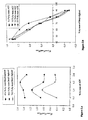
- compositions 1 to 5 had proven to be the most effective liquid compositions of the invention. Among them, the strongest synergistic effect has been found for composition 3, where the relative excess dissolving capacity (c pract -c add )/c add was equal to 2.411. The relative excess dissolving capacity of compositions 1 to 5 of the invention and their synergistic effect is represented graphically in Figure 1 .
- the surfactants applied to prepare the liquid compositions of the invention are: AOT, DAM, Lutensol*GD70, UFABLEND.
- the liquid compositions contained one, two or three of the above surfactants (surfactant mixtures) and the amount and ratio of them were varied as well within the separate series. The results are summarized shortly below.
- the synergistic effect is the strongest at lower (45 % by mass) butyl diglycol content. Synergistic effect is not observed in the presence of 80 or higher % by mass of butyl diglycol ( Figure 2.a ). The amount of the surfactant does not influence significantly the extent of the synergistic effect ( Figure 2.b )
Landscapes
- Chemical & Material Sciences (AREA)
- Life Sciences & Earth Sciences (AREA)
- Engineering & Computer Science (AREA)
- Chemical Kinetics & Catalysis (AREA)
- Oil, Petroleum & Natural Gas (AREA)
- Wood Science & Technology (AREA)
- Organic Chemistry (AREA)
- Health & Medical Sciences (AREA)
- Emergency Medicine (AREA)
- Inorganic Chemistry (AREA)
- Detergent Compositions (AREA)
Abstract
The invention relates to a liquid composition having synergistic dissolving effect, comprising
a) at least one alkylene glycol ether of the general formula (C3-C6-alkyl)-(O-CH2-CH2)n-OH, where the value of n is 1 to 5,
b) at least one surfactant and
c) water,
where the mass ratio of component a) to component b) ranges from 4:1 1 to 80:1.
a) at least one alkylene glycol ether of the general formula (C3-C6-alkyl)-(O-CH2-CH2)n-OH, where the value of n is 1 to 5,
b) at least one surfactant and
c) water,
where the mass ratio of component a) to component b) ranges from 4:1 1 to 80:1.
The liquid composition of the invention is useful for cleaning smooth or porous surfaces, for example ceramic, plastered wall, granite, lime stone, cast stone or concrete, contaminated with dyestuff, heavy oil and/or bitumen.
Description
- The present invention relates to a liquid composition having synergistic dissolving effect and use of the same to remove pollutants strongly bound to surfaces.
- It is known that various organic solvents (alcohols, ketones, aromatic liquids), either alone or as solvent mixtures, may be applied to different surfaces to remove strongly bound pollutants, such as dyestuff, oily substances, bitumen and so forth. The different organic solvents per se have extremely good dissolving effect, however, their serious detrimental effect on health and environment is a disadvantage.
- It is likewise known that micellar-structure aqueous solutions of surface active agents (surfactants) may be applied to clean different surfaces. The solubility of substances otherwise immiscible with water or only sparingly miscible with water (hydrocarbons for example) increases if the same are added to micellar solutions, since the oleophilic components get solubilized in the core of the micelles. If the surfactant concentration is considerably higher than cmc (critical micellization concentration) and the micellar system contains an additional auxiliary surfactant (for example an aliphatic alcohol of medium chain length such as n-butanol, n-pentanol and so forth), then further addition of the organic component leads to conversion of the swollen micellar system into an oil-in-water (o/w) type microemulsion.
- Combined concentration of the surfactant and the auxiliary surfactant (co-surfactant) at the observed point of microemulsion formation is called the critical microemulsion concentration [1-5].
- Thus, microemulsions, being molecularly heterogeneous systems with nanostructured discontinuities, form spontaneously from a polar liquid (generally water), an immiscible apolar liquid and some type of surfactant (anionic, cationic or non-ionic), without an input of energy.
- In addition to the above mentioned "normal micellar" o/w type emulsions, "reverese micellar" w/o type colloidal systems exist as well. Inverse micelles may form in the presence or absence of water, but in the latter case the cmc is not well defined and the systems are highly polydisperse. By adding water, i.e. changing the H2O/surfactant molar ratio, the size and shape of the forming micelles can be affected and regulated fairly arbitrarily [6,7].
- It has so far been proven in practice that aqueous micellar solutions are unable to remove bound dyestuff from surfaces, but at the best, these are applicable only to clean oily or greasy surfaces. Microemulsions are excellent cleaning supplies and can be suitable to dissolve even surface bound (sun-dried) dyestuff in some cases. However, microemulsions imply considerable environmental load since they contain aromatic or aliphatic hydrocarbons in an amount up to 10-20% which contaminate the environment during application, thus, their use is limited.
- Because of the drawbacks of microemulsions, it was desirable to provide a novel liquid composition which is environmentally sound in its constitution and possesses good dissolving capacity at the same time.
- The object of the invention was attained by providing a liquid composition having synergistic dissolving effect, which comprises
- a) at least one alkylene glycol ether of general formula (C3-C6-alkyl)-(O-CH2-CH2)n-OH, where the value of n is 1 to 5,
- b) at least one surfactant and
- c) water,
- The liquid composition of the invention can be used for cleaning surfaces contaminated with dyestuff, heavy oil and/or bitumen.
- In
-
Figure 1 the relative excess dissolving capacity or rather the synergistic dissolving effect of five liquid compositions of the invention (compositions Nos. 1 to 5) are compared graphically. -
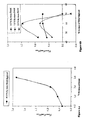
Figures 2.a-b show the dye dissolving capacity of the liquid compositions of the invention as a function of the AOT and butyl diglycol contents, respectively. -
Figures 3.a-b show the dye dissolving capacity of the liquid compositions of the invention as a function of the DAM and butyl diglycol contents, respectively, at the same concentration (0.5 % by mass) of AOT. -
Figures 4.a-b show the dye dissolving capacity of the liquid compositions of the invention as a function of the DAM and butyl diglycol contents, respectively, at the same concentration (1.0 % by mass) of AOT. -
Figures 5.a-b show the dye dissolving capacity of the liquid compositions of the invention as a function of the DAM and butyl diglycol contents, respectively, at the same concentration (1.5 % by mass) of AOT. -
Figures 6.a-b show the dye dissolving capacity of the liquid compositions of the invention as a function of the Lutensol*GD70 and butyl diglycol contents, respectively. -
Figures 7.a-b show the dye dissolving capacity of the liquid compositions of the invention as a function of the UFABLEND and butyl diglycol contents, respectively. - In one aspect, the invention is directed to a liquid composition having synergistic dissolving effect, comprising
- a) at least one alkylene glycol ether of general formula (C3-C6-alkyl)-(O-CH2-CH2)n-OH, where the value of n is 1 to 5,
- b) at least one surfactant and
- c) water,
- In a further aspect the invention is directed to the use of the liquid composition according to the invention for cleaning various surfaces contaminated with dyestuff, heavy oil and/or bitumen.
- Component a) of the liquid composition of the invention is an alkylene glycol alkyl ether of unlimited water miscibility of general formula (C3-C6-alkyl)-(O-CH2-CH2)n-OH, where the value of n is 1 to 5, or a mixture thereof.
- The C3-C6-alkyl group in the above formula is a linear or a branched saturated hydrocarbon group containing 3 to 6, preferably 4 or 5, most preferably 4 carbon atoms. The C3-C6-alkyl specifically includes propyl, isopropyl, n-butyl, sec-butyl, terc-butyl, isobutyl, n-pentyl, isopentyl, n-hexyl, isohexyl groups, and the like. The hydrocarbon chain is preferably non-branched (normal). The alkylene glycol part of the above component a) can be mono-, di-, tri-, tetra- or pentaglycol. More particularly, examples like propyl glycol, propyl diglycol, propyl triglycol, butyl glycol, butyl diglycol, butyl triglycol, butyl tetraglycol, butyl pentaglycol, butyl hexaglycol, pentyl diglycol, hexyl glycol, hexyl diglycol, hexyl triglycol and so forth, can be mentioned.
- The amount of component a) ranges from 40 to 80 % of the total mass of the composition.
- Component b) of the composition of the invention can be anionic or non-ionic surfactant, or a mixture thereof. As surfactant, preferably Ufasan TEA (Brennteg Hungária Kereskedelmi Kft), 3EO (sodium lauryl ether sulfate, Biesterfeld Kft), Triton X100 (ICI Chemicals and Polymers Group), AOT (sodium salt of bis-(2-ethylhexyl) sulfosuccinate; Fluka), DAM (dialkyl ammonium-metasulfate; Stepan Company, Grenoble, France), Lutensol*GD70 (BASF), UFABLEND (Unger Fabrikker A.S.), or the mixture of two or more of the above surfactants can be applied. Mixtures of Ufasan TEA and 3EO or Ufasan TEA and Triton X100 are the most preferred. The amount of component b) ranges from 1 to 10 % of the total mass of the composition.
- The liquid compositions of the invention show synergistic dissolving capacity in the range of mass ratios of component a) to component b) between 4:1 and 80:1.
- The liquid composition of the invention comprises water as component c) in an amount as required to 100%.
- The liquid compositions of the invention may optionally comprise an alkali metal hydrogen carbonate such as sodium or potassium hydrogen carbonate or ammonium hydrogen carbonate as component d) in an amount up to 1.0 % of the total mass of the composition. Sodium hydrogen carbonate is preferred. After application of the liquid composition to the surface to be cleaned CO2 is liberated from component d) which promotes loosening of the pollutant layer.
- The liquid compositions of the invention can be produced by mixing component a) alkylene glycol ether and component c) water; optionally adding component d) to the resulting alkylene glycol/water mixture during continous, vigorous mixing, and homogenizing it; finally, adding component b) surfactant and mixing the system until complete dissolution is achieved. The so-obtained clear liquid has a pale yellow tone.
- The alkylene glycol ethers used as component a) of the liquid compositions of the invention are known commercial compounds (produced by BASF for example), or can be produced by analogy with the known compounds, using methods known from the prior art.
- The surfactants used as component b) of the liquid compositions of the invention are known commercial products as well. The alkali metal and ammonium hydrogen carbonates, used optionally as component d), are similarly known compounds.
- The liquid compositions of the invention are not fully homogeneous on a molecular level - although seem to be clear solutions -, but the systems contain nano-sized discontinuities the structure of which is not fully clarified up to date. Namely, the liquid compositions of the invention contain so-called clusters of the size of 10-12 nm, proven by us in dynamic light scattering experiments. While we do not wish to limit the present invention by theories, we suppose that the above cluster structure contributes to the synergistic effect and largely promotes loosening and dissolving of the dry dye coat layers, oily and tarry contaminations.
- We have found that the liquid compositions (or complex mixtures) of the invention are well applicable to public buildings, street sculptures, privately owned objects (cars, doors and windows of buildings), transportation vehicles (bus, train, ship), infrastructure appliances of the transportation, that are coated with dye or oily contaminations.
- According to this, in a further aspect the invention is directed to the use of the above liquid composition for cleaning surfaces contaminated with dyestuff, heavy oil and/or bitumen. The liquid composition of the invention is preferably used for cleaning graffiti dye contaminated surfaces. The surface to be cleaned can be smooth or porous, such as porous ceramic and/or plastered wall, or it can be granite, limestone, cast stone or concrete surface either.
- Surprisingly, the combined dissolving effect of the components of the liquid composition of the invention - below demonstrated by examples - is synergistic, i.e., it is greater than the sum of the separate dissolving effects of the components. In addition to the above, the composition does not contain aromatic or aliphatic hydrocarbons thus, the environmental load effect thereof is minimal and after use it can be removed by washing with water or blowing with steam and can be collected. A further non-negligible advantage is that the concentration of the expensive surfactant component in the liquid composition of the invention is much smaller than in the known products used for similar purpose.
- The following examples are provided so that the invention might be more fully understood. These examples are illustrative only and should not be construed as limiting the invention in any way.
- Liquid compositions of the invention are prepared as shown below:
Composition 1 Component Amount (% by mass) butyl diglycol 45.0 UFABLEND 4.0 NaHCO3 0.5 tap water 50.5 Composition 2Component Amount (% by mass) butyl diglycol 45.0 UFABLEND 8.0 NaHCO3 0.5 tap water 46.5 Composition 3Component Amount (% by mass) butyl diglycol 45.0 Ufasan TEA 6.0 NaHCO3 1.0 tap water 48.0 Composition 4Component Amount (% by mass) butyl diglycol 45.0 Ufasan TEA 1.0 3EO 5.0 NaHCO3 1.0 tap water 48.0 Composition 5Component Amount (% by mass) butyl diglycol 45.0 Ufasan TEA 3.0 Triton X100 3.0 NaHCO3 0.5 tap water 48.5 - We prepared the liquid compositions by mixing given amounts of butyl glycol and tap water; adding sodium hydrogen carbonate to the obtained butyl diglycol/water mixture while vigorous mixing, and homogenizing; finally, adding the given type and amount of surfactant, and mixing till it is completely dissolved as seen with the unaided eye. A clear liquid of pale yellow tone is obtained.
- We have evaluated the dissolving capacity of the liquid compositions on the surface of grains of a building material mix. We have prepared a coloured powder mix, designed to model the dye-sprayed plaster. A 0.1 % by mass solution of 30 g of acrylic dye in toluene was poured to 50 g of a powder mix (25 g Al2O3 + 25 g SiO2) and left to stay for one hour while frequently stirring. The dense, coloured (red or blue, for example) suspension was filtered, washed with a few mL of toluene and dried at room temperature. After drying an appropriate coloured powder mix was obtained ready for quantitative characterization of the dissolving effect of the liquid compositions of the invention, as described below.
- We have dissolved dyes from the acrylic dye contaminated mineral mixes using the liquid compositions of the invention and their components (alkylene glycol ethers and surfactants) alone as solvent under identical conditions. We added 10.0 mL each of the solvents to 0.5 g of solid in a glass sample holder with screwed cup and performed the solid-liquid extraction by shaking the suspension in a shaker for 30 minutes at a speed of 150 1/min. Next, the systems were left to settle for 1 day and then we measured the concentration of the dissolved dye in the extracts photometrically, against the pure solvents.
- We determined the concentration of the dye in the individual samples (cpract) from the measured optical data with the help of calibration. Based on the composition we calculated the values of the additive concentration of dye (cadd) using equation (1) below,

where - Cag (m)
- is the concentration of dye extracted with alkylene glycol mixture of m components (m= 1,2,3...) and Φag (m) is its volume fraction
- cs (n)
- is the concentration of dye extracted with surfactant mixture of n components (n= 1,2,3...) and Φs (n) is its volume fraction
- cw
- is the concentration of dye extracted with tap water and Φw is its volume fraction
- The extraction experiments proved that - in case of the dyes examined by us - the dissolving capacity of the liquid compositions of the invention is higher than the sum of the separate dissolving capacities of the components (synergistic effect).
- We represented the difference between the theoretical and the practical dissolving capacities by calculating and plotting the ratio (cpracc-cadd)/cadd. The latter data show, how many times more dye is dissolved by the liquid composition of the invention as compared to the theoretically expectable value (
Figures 1 to 7 ). - In case of composition 1 as extraction liquid, for example, the calculation is:
- The amount of butyl diglycol in composition 1 is 45.0 % by mass.
- In case of additivity the dye concentration (cadd) calculated using equation (1) is 29.5 mg/L.
- The measured dye concentration (cpract) is 88.6 mg/L.

so that composition 1 of the invention dissolved two times more dye than expected. - We determined also the dye dissolving capacity for
compositions 2 to 5 of the invention according to the above. The results are summarized below.Sample (cpract-cadd)/cadd Composition 1 2.002 Composition 22.196 Composition 32.411 Composition 42.038 Composition 52.271 - Compositions 1 to 5 had proven to be the most effective liquid compositions of the invention. Among them, the strongest synergistic effect has been found for
composition 3, where the relative excess dissolving capacity (cpract-cadd)/cadd was equal to 2.411. The relative excess dissolving capacity of compositions 1 to 5 of the invention and their synergistic effect is represented graphically inFigure 1 . - Next, we examined how the change in the concentration of the individual components influences the dissolving capacity of the liquid compositions at constant values of the other parameters.
- The surfactants applied to prepare the liquid compositions of the invention are: AOT, DAM, Lutensol*GD70, UFABLEND.
- The liquid compositions contained one, two or three of the above surfactants (surfactant mixtures) and the amount and ratio of them were varied as well within the separate series. The results are summarized shortly below.
- If the liquid composition contains only AOT surfactant the synergistic effect is the strongest at lower (45 % by mass) butyl diglycol content. Synergistic effect is not observed in the presence of 80 or higher % by mass of butyl diglycol (
Figure 2.a ). The amount of the surfactant does not influence significantly the extent of the synergistic effect (Figure 2.b ) - The situation is similar if another surfactant (DAM) is present besides AOT: stronger synergistic effect can be achieved with less (45 % by mass) butyl diglycol. Synergistic effect is not observed in the presence of more than 70 % by mass of butyl diglycol (
Figures 3.a ,4.a ,5.a ). The amount of DAM surfactant does not affect the dye dissolving capacity significantly at an AOT content of 1.5 % by mass. The strongest synergistic effect is obtained with 1.0 % by mass of DAM content at 0.5 % by mass of AOT concentration, and with 3.0 % by mass of DAM content at 1.0 % by mass of AOT concentration of (Figures 3.b ,4.b ,5.b ). - Similarly, in the case of nonionic surfactant Lutensol*GD70 the dye dissolving capacity of the liquid composition containing less (45 % by mass) butyl diglycol is strongest. Synergistic effect is not observed in the presence of more than 70 % by mass of butyl diglycol (
Figure 6.a ). Increase in the surfactant concentration slightly increases the synergistic effect (Figure 6.b ). - In the presence of UFABLEND surfactant the increase in the surfactant concentration enhances the synergistic effect at 45 % by mass, and weakens at 60 % by mass of butyl diglycol (
Figures 7.a-b ). -
- [1] Johann Sjöblom: Encyclopedic Handbook of Emulsion Technology, Marcel Dekker Inc., 2001
- [2] D. Fennel Evans, Håkan Wennerström: The colloidal domain where physics, chemistry, biology and technology meet; 1994
- [3] P. A. Winsor: Solvent Properties of Amphiphilic Compounds; Butterworth; London; 1954
- [4] R. C. Nelson: Further studies on phase relationships in chemical flooding in "Surface Phenomena in Enhanced Oil Recovery"; Ed.: D. O. Shah; Plenum; New York; 1981
- [5] M. Porras, Coll. and Surf. A: Phys. chem. Eng. Asp., 270-271 (2005) 189-194
- [6] B. P. Binks et al, Coll. Surf., 61 (1991) 291-315
- [7] J. J. Silver et al: Interactions of small molecules with reverse micelles; 1999
- [8] D. Langevin: Low interfacial tensions in microemulsions system; 1992
- [9] T. Tadros et al, Adv. in Coli. and Int. Sci., 108 -109 (2004) 303-318
- [10] L. Del Gaudio et al, Society of Petroleum Engineers, SPE International Symposium on Oilfield Chemistry, Houston, Texas, USA, 2007, 28 February - 2 March.
- [11] W. Liu et al, J. of Coll. and Int. Sci., 303 (2006) 557-563
- [12] C. Solans et al, Current Opinion in Coll. & Int. Sci., 10 (2005) 102 -110
- [13] I. Solé et al , Coll. and Surf. A: Phys. chem. Eng. Asp., 288 (2006) 138-143
- [14] K. Bouchemal et al, Int. J. of Pharm., 280 (2004) 241-251
- [15] Sajjadi, Chem. Eng. Sci., 61 (2006) 3009 - 3017
- [16] S. Sajjadi et al, Coll. and Surf. A: Phys.Chem. Eng. Asp., 240 (2004) 149-155
- [17] S. Sajjadi, Coll. and Surf. A: Phys. chem. Eng. Asp., 299 (2007) 73-78
- [18] P. Izquierdo et al, J. of Coll. and Int. Sci., 285 (2005) 388-394
- [19] N. Usón et al, Coll. and Surf. A: Phys.chem. Eng. Asp., 250 (2004) 415-421
- [20] M. Kahlweit és R. Strey, J. Phys. Chem., 90 (1986) 5239-5244
Claims (15)
- A liquid composition having synergistic dissolving effect, comprisinga) at least one alkylene glycol ether of the general formula (C3-C6-alkyl)-(O-CH2-CH2)n-OH, where the value of n is 1 to 5,b) at least one surfactant andc) water,where the mass ratio of component a) to component b) ranges from 4:1 to 80:1.
- The liquid composition of claim 1 wherein the amount of component a) ranges from 40 to 80 % by mass and the amount of component b) ranges from 1 to 10 % by mass of the total composition.
- The liquid composition of claims 1 or 2, comprising alkali metal or ammonium hydrogen carbonate as further component d).
- The liquid composition of claim 3 wherein the amount of component d) ranges from 0.5 to 1.0 % by mass of the total composition.
- The liquid composition of claims 3 or 4 comprising sodium hydrogen carbonate as alkali metal hydrogen carbonate.
- The liquid composition of any one of claims 1 to 5 comprising anionic and/or non-ionic surfactant as surfactant.
- The liquid composition of claim 6 wherein the surfactant is Ufasan TEA, 3EO, Triton X100, AOT, DAM, Lutensol*GD70, UFABLEND, or a mixture of two or more of the above surfactants.
- The liquid composition of any one of claims 1 to 7, comprising butyl glycol, butyl diglycol, butyl pentaglycol, propyl glycol, propyl diglycol, propyl triglycol or the mixture thereof as component a).
- The liquid composition of any one of claims 1 to 8, comprising 45.0 % by mass of butyl diglycol, 6 % by mass of surfactant, 0.5 - 1.0 % by mass of sodium hydrogen carbonate and 48.0 - 48.5 % by mass of water.
- The liquid composition of claim 9 comprising Ufasan TEA, a mixture of Ufasan TEA and Triton X100 or a mixture of Ufasan TEA and 3EO as surfactant.
- The liquid composition of any one of claims 1 to 8 comprising 45.0 % by mass of butyl diglycol, 4-8 % by mass of surfactant, 0.5 % by mass of sodium hydrogen carbonate and 46.5 - 50.5 % by mass of water.
- The liquid composition of claim 11 comprising UFABLEND as surfactant.
- The use of the liquid composition of any one of claims 1 to 12 for cleaning surfaces contaminated with dyestuff, heavy oil and/or bitumen.
- The use of claim 13 wherein the surface is contaminated with graffiti dyes.
- The use of claims 13 or 14 wherein the surface is at least one selected from the group consisting of porous ceramic, plastered wall, granite, lime stone, cast stone and concrete surfaces.
Applications Claiming Priority (1)
| Application Number | Priority Date | Filing Date | Title |
|---|---|---|---|
| HU0800717A HUP0800717A2 (en) | 2008-11-25 | 2008-11-25 | Synergic liquid product and for using refuse disposal |
Publications (1)
| Publication Number | Publication Date |
|---|---|
| EP2189517A1 true EP2189517A1 (en) | 2010-05-26 |
Family
ID=89988636
Family Applications (1)
| Application Number | Title | Priority Date | Filing Date |
|---|---|---|---|
| EP09176873A Withdrawn EP2189517A1 (en) | 2008-11-25 | 2009-11-24 | Synergistic liquid composition and use of the same for removing substances strongly bound to surfaces |
Country Status (2)
| Country | Link |
|---|---|
| EP (1) | EP2189517A1 (en) |
| HU (1) | HUP0800717A2 (en) |
Cited By (7)
| Publication number | Priority date | Publication date | Assignee | Title |
|---|---|---|---|---|
| JP2016216540A (en) * | 2015-05-15 | 2016-12-22 | 花王株式会社 | Soaking detergent composition for tableware and cleaning method |
| EP3118298A1 (en) * | 2015-07-13 | 2017-01-18 | The Procter and Gamble Company | Hard surface cleaners comprising a solvent |
| EP3572490A1 (en) | 2018-05-24 | 2019-11-27 | The Procter & Gamble Company | Spray container comprising a detergent composition |
| US11434453B2 (en) | 2018-05-24 | 2022-09-06 | The Procter & Gamble Company | Spray container comprising a detergent composition |
| US11441102B2 (en) | 2018-05-24 | 2022-09-13 | The Procter & Gamble Company | Spray container comprising a detergent composition |
| US11459526B2 (en) | 2018-05-24 | 2022-10-04 | The Procter & Gamble Company | Spray container comprising a detergent composition |
| US11485933B2 (en) | 2018-05-24 | 2022-11-01 | The Procter & Gamble Company | Fine mist hard surface cleaning spray |
Citations (10)
| Publication number | Priority date | Publication date | Assignee | Title |
|---|---|---|---|---|
| US4808235A (en) * | 1987-01-20 | 1989-02-28 | The Dow Chemical Company | Cleaning gas turbine compressors |
| EP0506087A2 (en) * | 1991-03-28 | 1992-09-30 | UNION CARBIDE CHEMICALS AND PLASTICS COMPANY INC. (a New York corporation) | Cleaning compositions and methods for using same |
| WO1999025798A1 (en) * | 1997-11-13 | 1999-05-27 | Henkel Corporation | Composition and process for cleaning and deoxidizing aluminum |
| WO2000040680A2 (en) * | 1999-01-06 | 2000-07-13 | Union Carbide Chemicals & Plastics Technology Corporation | Aqueous cleaning compositions |
| WO2001021719A1 (en) * | 1999-09-22 | 2001-03-29 | Cognis Corporation | Graffiti remover, paint stripper, degreaser |
| WO2002048299A1 (en) * | 2000-12-15 | 2002-06-20 | Reckitt Benckiser Inc. | Alkaline cleaning and sanitizing composition effective for soap scum removal |
| US6617298B1 (en) * | 2002-12-31 | 2003-09-09 | Dennis S. Morrow | Degreasing compositions |
| US20060063689A1 (en) * | 2004-09-20 | 2006-03-23 | Netherton Jason J | Concrete cleaning and preparation composition |
| WO2007076337A2 (en) * | 2005-12-20 | 2007-07-05 | Novozymes Biologicals, Inc. | Surfactants systems for surface cleaning |
| EP1849856A1 (en) * | 2004-12-21 | 2007-10-31 | Kao Corporation | Cleaner composition |
-
2008
- 2008-11-25 HU HU0800717A patent/HUP0800717A2/en unknown
-
2009
- 2009-11-24 EP EP09176873A patent/EP2189517A1/en not_active Withdrawn
Patent Citations (11)
| Publication number | Priority date | Publication date | Assignee | Title |
|---|---|---|---|---|
| US4808235A (en) * | 1987-01-20 | 1989-02-28 | The Dow Chemical Company | Cleaning gas turbine compressors |
| EP0506087A2 (en) * | 1991-03-28 | 1992-09-30 | UNION CARBIDE CHEMICALS AND PLASTICS COMPANY INC. (a New York corporation) | Cleaning compositions and methods for using same |
| WO1999025798A1 (en) * | 1997-11-13 | 1999-05-27 | Henkel Corporation | Composition and process for cleaning and deoxidizing aluminum |
| US6432899B1 (en) * | 1997-11-13 | 2002-08-13 | Henkel Corporation | Composition and process for cleaning and deoxidizing aluminum |
| WO2000040680A2 (en) * | 1999-01-06 | 2000-07-13 | Union Carbide Chemicals & Plastics Technology Corporation | Aqueous cleaning compositions |
| WO2001021719A1 (en) * | 1999-09-22 | 2001-03-29 | Cognis Corporation | Graffiti remover, paint stripper, degreaser |
| WO2002048299A1 (en) * | 2000-12-15 | 2002-06-20 | Reckitt Benckiser Inc. | Alkaline cleaning and sanitizing composition effective for soap scum removal |
| US6617298B1 (en) * | 2002-12-31 | 2003-09-09 | Dennis S. Morrow | Degreasing compositions |
| US20060063689A1 (en) * | 2004-09-20 | 2006-03-23 | Netherton Jason J | Concrete cleaning and preparation composition |
| EP1849856A1 (en) * | 2004-12-21 | 2007-10-31 | Kao Corporation | Cleaner composition |
| WO2007076337A2 (en) * | 2005-12-20 | 2007-07-05 | Novozymes Biologicals, Inc. | Surfactants systems for surface cleaning |
Non-Patent Citations (20)
| Title |
|---|
| "Del Gaudio l et al", SOCIETY OF PETROLEUM ENGINEERS,, 28 February 2007 (2007-02-28) - 2 March 2007 (2007-03-02), HOUSTON, TEXAS, USA |
| B. P. BINKS ET AL., COLL. SURF., vol. 61, 1991, pages 291 - 315 |
| C. SOLANS ET AL., CURRENT OPINION IN COLL. & INT. SCI., vol. 10, 2005, pages 102 - 110 |
| D. FENNEL EVANS, HÅKAN WENNERSTROM: THE COLLOIDAL DOMAIN WHERE PHYSICS, CHEMISTRY, BIOLOGY AND TECHNOLOGY MEET, 1994 |
| D. LANGEVIN, LOW INTERFACIAL TENSIONS IN MICROEMULSIONS SYSTEM, 1992 |
| I. SOLE ET AL., COLL. AND SURF. A: PHYS. CHEM. ENG. ASP., vol. 288, 2006, pages 138 - 143 |
| J. J. SILVER ET AL., INTERACTIONS OF SMALL MOLECULES WITH REVERSE MICELLES, 1999 |
| JOHANN SJOBLOM: "Encyclopedic Handbook of Emulsion Technology", 2001, MARCEL DEKKER INC. |
| K. BOUCHEMAL ET AL., INT. J. OF PHARM., vol. 280, 2004, pages 241 - 251 |
| M. KAHLWEIT; R. STREY, J. PHYS. CHEM., vol. 90, 1986, pages 5239 - 5244 |
| M. PORRAS: "Coll. and Surf. A", PHYS. CHEM. ENG. ASP., vol. 270, no. 271, 2005, pages 189 - 194 |
| N. USON ET AL.: "Coll. and Surf.", A: PHYS.CHEM. ENG. ASP., vol. 250, 2004, pages 415 - 421 |
| P. A. WINSOR, SOLVENT PROPERTIES OF AMPHIPHILIC COMPOUNDS, 1954 |
| P. IZQUIERDO ET AL., J. OF COLL. AND INT. SCI., vol. 285, 2005, pages 388 - 394 |
| R. C. NELSON: "Further studies on phase relationships in chemical flooding", 1981, article "Surface Phenomena in Enhanced Oil Recovery" |
| S. SAJJADI ET AL.: "Coll. and Surf.", A: PHYS.CHEM. ENG. ASP., vol. 240, 2004, pages 149 - 155 |
| S. SAJJADI: "Coll. and Surf.", A: PHYS. CHEM. ENG. ASP., vol. 299, 2007, pages 73 - 78 |
| SAJJADI, CHEM. ENG. SCI., vol. 61, 2006, pages 3009 - 3017 |
| T. TADROS ET AL., ADV. IN COLI. AND INT. SCI., vol. 108, no. 109, 2004, pages 303 - 318 |
| W. LIU ET AL., J. OF COLL. AND INT. SCI., vol. 303, 2006, pages 557 - 563 |
Cited By (10)
| Publication number | Priority date | Publication date | Assignee | Title |
|---|---|---|---|---|
| JP2016216540A (en) * | 2015-05-15 | 2016-12-22 | 花王株式会社 | Soaking detergent composition for tableware and cleaning method |
| EP3118298A1 (en) * | 2015-07-13 | 2017-01-18 | The Procter and Gamble Company | Hard surface cleaners comprising a solvent |
| EP3572490A1 (en) | 2018-05-24 | 2019-11-27 | The Procter & Gamble Company | Spray container comprising a detergent composition |
| US11434453B2 (en) | 2018-05-24 | 2022-09-06 | The Procter & Gamble Company | Spray container comprising a detergent composition |
| US11441102B2 (en) | 2018-05-24 | 2022-09-13 | The Procter & Gamble Company | Spray container comprising a detergent composition |
| US11459526B2 (en) | 2018-05-24 | 2022-10-04 | The Procter & Gamble Company | Spray container comprising a detergent composition |
| US11485933B2 (en) | 2018-05-24 | 2022-11-01 | The Procter & Gamble Company | Fine mist hard surface cleaning spray |
| US11560531B2 (en) | 2018-05-24 | 2023-01-24 | The Procter & Gamble Company | Spray container comprising a detergent composition |
| US11939554B2 (en) | 2018-05-24 | 2024-03-26 | The Procter & Gamble Company | Spray container comprising a detergent composition |
| US11946020B2 (en) | 2018-05-24 | 2024-04-02 | The Procter & Gamble Company | Fine mist hard surface cleaning spray |
Also Published As
| Publication number | Publication date |
|---|---|
| HU0800717D0 (en) | 2009-10-28 |
| HUP0800717A2 (en) | 2010-09-28 |
Similar Documents
| Publication | Publication Date | Title |
|---|---|---|
| EP2189517A1 (en) | Synergistic liquid composition and use of the same for removing substances strongly bound to surfaces | |
| US7902123B2 (en) | Microemulsion cleaning composition | |
| JP2002506925A5 (en) | ||
| Sagir et al. | Surfactants for enhanced oil recovery applications | |
| EP1814652B1 (en) | Surfactant system method | |
| CN103492525B (en) | Compositions and methods for cleaning a wellbore prior to cementing | |
| Srivastava et al. | Effects of silica nanoparticles and polymers on foam stability with sodium dodecylbenzene sulfonate in water–liquid paraffin oil emulsions at high temperatures | |
| NO339836B1 (en) | Viscoelastic fluid | |
| PL166502B1 (en) | Drilling sludge PL PL PL | |
| WO1997047715A1 (en) | Thickened liquid cleaning composition containing an abrasive | |
| JP4831609B2 (en) | Cleaning composition | |
| WO1997032967A1 (en) | Liquid crystal detergent compositions | |
| CN107057875A (en) | Cleaning agent for cleaning ceramic tile back side attachment | |
| EP0084411B1 (en) | Composition and method for cleaning hydrocarbon oil from hard surfaces | |
| EP0620271A1 (en) | Microemulsion cleaning composition comprising a glycol mono-alkyl ether | |
| EP0906411B1 (en) | Liquid crystal compositions | |
| US5741770A (en) | Liquid crystal composition | |
| US5543073A (en) | Microemulsion cleaning composition | |
| US5958856A (en) | Liquid crystal compositions containing a polyethylene abrasive | |
| WO2003089559A1 (en) | Blue colored liquid crystal compositions | |
| Slavchov | Theory of adsorption of ethoxylates at the water| oil and water| air interfaces. 1. Monolayers of single-component and Poisson distributed alkylphenol ethoxylates | |
| CN109181890B (en) | Wiping-free car washing liquid and preparation method thereof | |
| EP1230335A1 (en) | Surfactant emulsions and structured surfactant systems | |
| US5759290A (en) | Liquid crystal compositions | |
| JP2007161737A (en) | Detergent composition |
Legal Events
| Date | Code | Title | Description |
|---|---|---|---|
| PUAI | Public reference made under article 153(3) epc to a published international application that has entered the european phase |
Free format text: ORIGINAL CODE: 0009012 |
|
| AK | Designated contracting states |
Kind code of ref document: A1 Designated state(s): AT BE BG CH CY CZ DE DK EE ES FI FR GB GR HR HU IE IS IT LI LT LU LV MC MK MT NL NO PL PT RO SE SI SK SM TR |
|
| AX | Request for extension of the european patent |
Extension state: BA RS |
|
| STAA | Information on the status of an ep patent application or granted ep patent |
Free format text: STATUS: THE APPLICATION IS DEEMED TO BE WITHDRAWN |
|
| 18D | Application deemed to be withdrawn |
Effective date: 20101130 |