EP2189516A1 - Lubricant and oil-free chain - Google Patents
Lubricant and oil-free chain Download PDFInfo
- Publication number
- EP2189516A1 EP2189516A1 EP08791497A EP08791497A EP2189516A1 EP 2189516 A1 EP2189516 A1 EP 2189516A1 EP 08791497 A EP08791497 A EP 08791497A EP 08791497 A EP08791497 A EP 08791497A EP 2189516 A1 EP2189516 A1 EP 2189516A1
- Authority
- EP
- European Patent Office
- Prior art keywords
- oil
- bushings
- lubricant
- impregnated
- gpc
- Prior art date
- Legal status (The legal status is an assumption and is not a legal conclusion. Google has not performed a legal analysis and makes no representation as to the accuracy of the status listed.)
- Granted
Links
Images
Classifications
-
- F—MECHANICAL ENGINEERING; LIGHTING; HEATING; WEAPONS; BLASTING
- F16—ENGINEERING ELEMENTS AND UNITS; GENERAL MEASURES FOR PRODUCING AND MAINTAINING EFFECTIVE FUNCTIONING OF MACHINES OR INSTALLATIONS; THERMAL INSULATION IN GENERAL
- F16G—BELTS, CABLES, OR ROPES, PREDOMINANTLY USED FOR DRIVING PURPOSES; CHAINS; FITTINGS PREDOMINANTLY USED THEREFOR
- F16G13/00—Chains
- F16G13/02—Driving-chains
- F16G13/06—Driving-chains with links connected by parallel driving-pins with or without rollers so-called open links
-
- C—CHEMISTRY; METALLURGY
- C10—PETROLEUM, GAS OR COKE INDUSTRIES; TECHNICAL GASES CONTAINING CARBON MONOXIDE; FUELS; LUBRICANTS; PEAT
- C10M—LUBRICATING COMPOSITIONS; USE OF CHEMICAL SUBSTANCES EITHER ALONE OR AS LUBRICATING INGREDIENTS IN A LUBRICATING COMPOSITION
- C10M171/00—Lubricating compositions characterised by purely physical criteria, e.g. containing as base-material, thickener or additive, ingredients which are characterised exclusively by their numerically specified physical properties, i.e. containing ingredients which are physically well-defined but for which the chemical nature is either unspecified or only very vaguely indicated
- C10M171/02—Specified values of viscosity or viscosity index
-
- C—CHEMISTRY; METALLURGY
- C10—PETROLEUM, GAS OR COKE INDUSTRIES; TECHNICAL GASES CONTAINING CARBON MONOXIDE; FUELS; LUBRICANTS; PEAT
- C10M—LUBRICATING COMPOSITIONS; USE OF CHEMICAL SUBSTANCES EITHER ALONE OR AS LUBRICATING INGREDIENTS IN A LUBRICATING COMPOSITION
- C10M171/00—Lubricating compositions characterised by purely physical criteria, e.g. containing as base-material, thickener or additive, ingredients which are characterised exclusively by their numerically specified physical properties, i.e. containing ingredients which are physically well-defined but for which the chemical nature is either unspecified or only very vaguely indicated
- C10M171/04—Specified molecular weight or molecular weight distribution
-
- C—CHEMISTRY; METALLURGY
- C10—PETROLEUM, GAS OR COKE INDUSTRIES; TECHNICAL GASES CONTAINING CARBON MONOXIDE; FUELS; LUBRICANTS; PEAT
- C10M—LUBRICATING COMPOSITIONS; USE OF CHEMICAL SUBSTANCES EITHER ALONE OR AS LUBRICATING INGREDIENTS IN A LUBRICATING COMPOSITION
- C10M2203/00—Organic non-macromolecular hydrocarbon compounds and hydrocarbon fractions as ingredients in lubricant compositions
- C10M2203/10—Petroleum or coal fractions, e.g. tars, solvents, bitumen
- C10M2203/1006—Petroleum or coal fractions, e.g. tars, solvents, bitumen used as base material
-
- C—CHEMISTRY; METALLURGY
- C10—PETROLEUM, GAS OR COKE INDUSTRIES; TECHNICAL GASES CONTAINING CARBON MONOXIDE; FUELS; LUBRICANTS; PEAT
- C10M—LUBRICATING COMPOSITIONS; USE OF CHEMICAL SUBSTANCES EITHER ALONE OR AS LUBRICATING INGREDIENTS IN A LUBRICATING COMPOSITION
- C10M2203/00—Organic non-macromolecular hydrocarbon compounds and hydrocarbon fractions as ingredients in lubricant compositions
- C10M2203/10—Petroleum or coal fractions, e.g. tars, solvents, bitumen
- C10M2203/102—Aliphatic fractions
- C10M2203/1025—Aliphatic fractions used as base material
-
- C—CHEMISTRY; METALLURGY
- C10—PETROLEUM, GAS OR COKE INDUSTRIES; TECHNICAL GASES CONTAINING CARBON MONOXIDE; FUELS; LUBRICANTS; PEAT
- C10M—LUBRICATING COMPOSITIONS; USE OF CHEMICAL SUBSTANCES EITHER ALONE OR AS LUBRICATING INGREDIENTS IN A LUBRICATING COMPOSITION
- C10M2205/00—Organic macromolecular hydrocarbon compounds or fractions, whether or not modified by oxidation as ingredients in lubricant compositions
- C10M2205/02—Organic macromolecular hydrocarbon compounds or fractions, whether or not modified by oxidation as ingredients in lubricant compositions containing acyclic monomers
- C10M2205/028—Organic macromolecular hydrocarbon compounds or fractions, whether or not modified by oxidation as ingredients in lubricant compositions containing acyclic monomers containing aliphatic monomers having more than four carbon atoms
- C10M2205/0285—Organic macromolecular hydrocarbon compounds or fractions, whether or not modified by oxidation as ingredients in lubricant compositions containing acyclic monomers containing aliphatic monomers having more than four carbon atoms used as base material
-
- C—CHEMISTRY; METALLURGY
- C10—PETROLEUM, GAS OR COKE INDUSTRIES; TECHNICAL GASES CONTAINING CARBON MONOXIDE; FUELS; LUBRICANTS; PEAT
- C10M—LUBRICATING COMPOSITIONS; USE OF CHEMICAL SUBSTANCES EITHER ALONE OR AS LUBRICATING INGREDIENTS IN A LUBRICATING COMPOSITION
- C10M2207/00—Organic non-macromolecular hydrocarbon compounds containing hydrogen, carbon and oxygen as ingredients in lubricant compositions
- C10M2207/04—Ethers; Acetals; Ortho-esters; Ortho-carbonates
- C10M2207/0406—Ethers; Acetals; Ortho-esters; Ortho-carbonates used as base material
-
- C—CHEMISTRY; METALLURGY
- C10—PETROLEUM, GAS OR COKE INDUSTRIES; TECHNICAL GASES CONTAINING CARBON MONOXIDE; FUELS; LUBRICANTS; PEAT
- C10N—INDEXING SCHEME ASSOCIATED WITH SUBCLASS C10M RELATING TO LUBRICATING COMPOSITIONS
- C10N2020/00—Specified physical or chemical properties or characteristics, i.e. function, of component of lubricating compositions
- C10N2020/01—Physico-chemical properties
- C10N2020/02—Viscosity; Viscosity index
-
- C—CHEMISTRY; METALLURGY
- C10—PETROLEUM, GAS OR COKE INDUSTRIES; TECHNICAL GASES CONTAINING CARBON MONOXIDE; FUELS; LUBRICANTS; PEAT
- C10N—INDEXING SCHEME ASSOCIATED WITH SUBCLASS C10M RELATING TO LUBRICATING COMPOSITIONS
- C10N2020/00—Specified physical or chemical properties or characteristics, i.e. function, of component of lubricating compositions
- C10N2020/01—Physico-chemical properties
- C10N2020/04—Molecular weight; Molecular weight distribution
-
- C—CHEMISTRY; METALLURGY
- C10—PETROLEUM, GAS OR COKE INDUSTRIES; TECHNICAL GASES CONTAINING CARBON MONOXIDE; FUELS; LUBRICANTS; PEAT
- C10N—INDEXING SCHEME ASSOCIATED WITH SUBCLASS C10M RELATING TO LUBRICATING COMPOSITIONS
- C10N2030/00—Specified physical or chemical properties which is improved by the additive characterising the lubricating composition, e.g. multifunctional additives
- C10N2030/02—Pour-point; Viscosity index
-
- C—CHEMISTRY; METALLURGY
- C10—PETROLEUM, GAS OR COKE INDUSTRIES; TECHNICAL GASES CONTAINING CARBON MONOXIDE; FUELS; LUBRICANTS; PEAT
- C10N—INDEXING SCHEME ASSOCIATED WITH SUBCLASS C10M RELATING TO LUBRICATING COMPOSITIONS
- C10N2030/00—Specified physical or chemical properties which is improved by the additive characterising the lubricating composition, e.g. multifunctional additives
- C10N2030/06—Oiliness; Film-strength; Anti-wear; Resistance to extreme pressure
-
- C—CHEMISTRY; METALLURGY
- C10—PETROLEUM, GAS OR COKE INDUSTRIES; TECHNICAL GASES CONTAINING CARBON MONOXIDE; FUELS; LUBRICANTS; PEAT
- C10N—INDEXING SCHEME ASSOCIATED WITH SUBCLASS C10M RELATING TO LUBRICATING COMPOSITIONS
- C10N2040/00—Specified use or application for which the lubricating composition is intended
- C10N2040/38—Conveyors or chain belts
-
- C—CHEMISTRY; METALLURGY
- C10—PETROLEUM, GAS OR COKE INDUSTRIES; TECHNICAL GASES CONTAINING CARBON MONOXIDE; FUELS; LUBRICANTS; PEAT
- C10N—INDEXING SCHEME ASSOCIATED WITH SUBCLASS C10M RELATING TO LUBRICATING COMPOSITIONS
- C10N2050/00—Form in which the lubricant is applied to the material being lubricated
- C10N2050/14—Composite materials or sliding materials in which lubricants are integrally molded
Definitions
- a bushing chain is constructed so that a pair of outer link plates connected to each other using two pins in both ends and a pair of inner link plates provided with two bushings in both ends, the two pins on the adjacent sides of two pairs of outer link plates being fitted in the two bushings, are connected alternately.
- rollers fitted on the bushings are further provided.
- the lubricant since the number average molecular weight is 800 or more and 2300 or less, in the case that the lubricant is impregnated in the bushings, the lubricant satisfactorily flows out from the pores of the oil-impregnated bushings and does not flow out excessively from the sliding portions of the bushings, and oil film breakage is suppressed from occurring during operation.
- the molecular weight of a lubricant becomes larger, the oil film strength thereof increases, but the kinematic viscosity thereof also becomes larger, whereby the impregnation of the lubricant into the pores of a sintered body becomes slow.
- the oil-free chains according to Examples 1 to 5 wherein Mn is 800 or more and 2300 or less and Mw/Mn is 1.0 or more and 1.2 or less are more improved significantly in the abrasion elongation-resistant time than the oil-free chains according to Comparative Examples 1 to 6 that are not satisfying these requirements, and it is found that the abrasion elongation-resistant lives thereof are improved.
- Example D An oil-free chain according to Example D was produced by the same process as that of Example A except that 50 wt% of the above-mentioned "Diana Process PW380" mixed with 50 wt% of "Process P300” (mineral oil produced by JAPAN ENERGY CORPORATION) was used as the lubricant impregnated in the bushings.
- Example E An oil-free chain according to Example E was produced by the same process as that of Example A except that 85 wt% of alkyl diphenyl ether produced by Matsumura Oil Research Corporation mixed with 15 wt% of PAO was used as the lubricant impregnated in the bushings.
Landscapes
- Chemical & Material Sciences (AREA)
- Chemical Kinetics & Catalysis (AREA)
- General Chemical & Material Sciences (AREA)
- Oil, Petroleum & Natural Gas (AREA)
- Organic Chemistry (AREA)
- Engineering & Computer Science (AREA)
- General Engineering & Computer Science (AREA)
- Mechanical Engineering (AREA)
- Lubricants (AREA)
- Sliding-Contact Bearings (AREA)
Abstract
An oil-free chain 1 is constructed by alternately connecting a pair of outer link plates 4 and 4 connected using pins and a pair of inner link plates 2 and 2 connected using oil-impregnated bushings 3 and 3 into which the adjacent pins 5 and 5 of the outer link plates 4 and 4 adjacent to the inner link plates 2 and 2 are fitted. The oil-impregnated bushings 3 are impregnated with a lubricant having a kinematic viscosity in the range of ISO-VG grade 46 to 460, the weight % of an ingredient having the highest content among the elution ingredients obtained by the GPC method is 95 wt% or more, the number average molecular weight is 800 or more and 2300 or less, and the ratio of the weight average molecular weight to the above-mentioned number average molecular weight is 1.0 or more and1.2 or less.
Description
- The present invention relates to a lubricant impregnated in bushings comprising of a metal sintered body and to an oil-free chain being used for power transmission mechanisms, transport mechanisms, etc. and constructed so that the bushings make sliding contact with pins in a state that the lubricant impregnated in the bushings oozes out without additional lubrication.
- Conventionally, chains such as bushing chains and roller chains are used for power transmission mechanisms and transport mechanisms. A bushing chain is constructed so that a pair of outer link plates connected to each other using two pins in both ends and a pair of inner link plates provided with two bushings in both ends, the two pins on the adjacent sides of two pairs of outer link plates being fitted in the two bushings, are connected alternately. In the case of a roller chain, rollers fitted on the bushings are further provided.
- An oil-free chain is known which is constructed so that oil-impregnated bushings comprising of a sintered body impregnated with a lubricant are used as the bushings of the chain constructed as described above and so that the oil-impregnated bushings make sliding contact with pins in a state that the lubricant impregnated in the oil-impregnated bushings oozes out without additional lubrication.
-
Patent document 1 discloses an invention relating to an oil composition for sintered oil-impregnated bearings, produced by blending 0.01 to 3.0 wt% of carboxylate ester and/or organic zinc sulfonate serving as a rust inhibitor with base oil.
InPatent document 1, in the case that poly-α-olefin (PAO) or a hydride thereof is used as the base oil, it is assumed that the average molecular weight of the PAO is in the range of 200 to 1600, preferably 400 to 800. - In addition,
Patent document 2 discloses an invention relating to an oil composition for oil-impregnated bearings, comprising base oil containing polyolefin and polyol ester, wherein the weight ratio of polyolefin to polyol ester in the above-mentioned base oil is in the range of 20/80 to 80/20. - [Patent document 1] Japanese Patent Application Laid-open Publication No.
Hei 11-140478 - [Patent document 2] Japanese Patent Application Laid-open Publication No.
Hei 9-125086 - The sintered oil-impregnated bearings according to
Patent document 1 are applied to the capstan bearings and motor bearings of portable radio-cassette recorders, etc. The sintered oil-impregnated bearings according toPatent document 2 are applied to various motor bearings of automobile electrical equipment (such as fan motors), for example.
Unlike the bearings of shafts rotating at high speed, such as motor shafts, generally speaking, the bearings (bushings) of a chain make sliding contact with pins (or shafts) at low speed and high surface pressure, and the pins perform a oscillating movement. - Furthermore, from the point of view of fluidity, it is assumed to be preferable that the kinematic viscosity of the oil composition for the oil-impregnated bearings at 40°C in
Patent document 1 is in the range of 5 to 100 mm2/s and that the above-mentioned kinematic viscosity inPatent document 2 is 100 cSt or less.
In an oil-free chain, a lubricant is sucked out from the pores of oil-impregnated bushings by the sliding motion (pumping action) of the pins fitted in the oil-impregnated bushings and oozes out due to expansion caused by frictional heat, whereby lubricity and abrasion resistance are attained. However, a lubricant that is easily impregnated in the bushings and easily discharged from the bushings has a small molecular weight, that is, a low polymerization degree, and tends to flow easily. Hence, the film strength becomes weak and the lubricant flows away. As a result, there is a problem of being unable to obtain satisfactory lubricity and abrasion resistance.
In other words, even if an oil-free chain is constructed by impregnating the lubricant according toPatent document - In consideration of the above-mentioned circumstances, the present invention is intended to provide a lubricant satisfactorily flowing out from the pores of bushings, suppressing oil film breakage at the sliding portions of the bushings and having high oil film strength during operation, and further ensuring that the bushings have a satisfactorily long abrasion resistant life in the case that the bushings are impregnated with the lubricant by constructing the lubricant so that the lubricant has a kinematic viscosity in the range of ISO-VG grade 46 to 460, the weight % of an ingredient having the highest content among the elution ingredients obtained under the GPC (gel permeation chromatography) measurement conditions described later is 95 wt% or more, the number average molecular weight (Mn) is 800 or more and 2300 or less, and the ratio (dispersion ratio) of the weight average molecular weight (Mw) to Mn is 1.0 or more and 1.2 or less.
- Furthermore, the present invention is intended to provide a lubricant satisfactorily flowing out from the pores of bushings, suppressing oil film breakage at the sliding portions of the bushings and having high oil film strength during operation, and further ensuring that the bushings have a satisfactorily long abrasion resistant life in the case that the bushings are impregnated with the lubricant by constructing the lubricant so that the lubricant has a kinematic viscosity in the range of ISO-VG grade 46 to 460, the weight % of an ingredient having the highest content among the elution ingredients obtained under the GPC measurement conditions described later is less than 95 wt%, Mn is 800 or more and 2300 or less, and the dispersion ratio is 1.0 or more and 2.0 or less.
- Moreover, the present invention is intended to provide an oil-free chain having a satisfactorily long abrasion elongation-resistant life, since by impregnating the above-mentioned lubricant in the bushings, the lubricant satisfactorily flows out from the pores of the oil-impregnated bushings during operation, oil film breakage at the sliding portions of the bushings is suppressed from occurring, and the oil film strength is high.
- A lubricant according to a first aspect of the present invention is a lubricant impregnated in bushings comprising of a metal sintered body, wherein said lubricant has a kinematic viscosity provided by an ISO viscosity grade number in the range of VG 46 to 460, the weight % of an ingredient having the highest content among the elution ingredients obtained under the following GPC (gel permeation chromatography) measurement conditions is 95 wt% or more, and the number average molecular weight is 800 or more and 2300 or less, and the ratio of the weight average molecular weight obtained under the following GPC measurement conditions to the above-mentioned number average molecular weight is 1.0 or more and 1.2 or less.
- Measuring instrument: GPC system manufactured by SHIMADZU CORPORATION
- Column: GPC KF-803 (SHODEX) 300 mm × 8 mm (inside diameter), three pieces
- Guard column: GPC-800P 10 mm × 4.6 mm (inside diameter) Column temperature: 40°C
- Mobile phase: tetrahydrofuran (GC grade)
- Flow rate: 0.7 ml/min
- Pressure: 2.9 × 10⁻² Pa
- Detector: differential refractive index detector
- Standard substance: TSK standard polystyrene manufactured by TOSOH CORPORATION
- In the present invention, since the number average molecular weight is 800 or more and 2300 or less, in the case that the lubricant is impregnated in the bushings, the lubricant satisfactorily flows out from the pores of the oil-impregnated bushings and does not flow out excessively from the sliding portions of the bushings, and oil film breakage is suppressed from occurring during operation.
Generally speaking, as the molecular weight of a lubricant becomes larger, the oil film strength thereof increases, but the kinematic viscosity thereof also becomes larger, whereby the impregnation of the lubricant into the pores of a sintered body becomes slow. However, since the lubricant according to the present invention has a kinematic viscosity in the range of ISO-VG grade 46 to 460 and the molecular weight and kinematic viscosity thereof are appropriate, the lubricant is satisfactorily impregnated in the bushings comprising of a sintered body.
In addition, since the molecular weight distribution of the lubricant is narrow, the oil film phase has uniformity. Moreover, since the number average molecular weight satisfies the above-mentioned requirements, the oil film strength is high and has less non-uniformity.
Consequently, the lubricity between the oil-impregnated bushings and the sliding faces of the shafts is maintained satisfactorily for a long time, and the oil-impregnated bushings have a satisfactorily long abrasion-resistant life. - A lubricant according to a second aspect of the present invention is a lubricant impregnated in bushings comprising of a metal sintered body, wherein said lubricant has a kinematic viscosity provided by an ISO viscosity grade number in the range of VG 46 to 460, the weight % of an ingredient having the highest content among the elution ingredients obtained under the following GPC (gel permeation chromatography) measurement conditions is less than 95 wt%, the number average molecular weight is 800 or more and 2300 or less, and the ratio of the weight average molecular weight obtained under the following GPC measurement conditions to the above-mentioned number average molecular weight is 1.0 or more and 2.0 or less.
-
- Measuring instrument: GPC system manufactured by SHIMADZU CORPORATION
- Column: GPC KF-803 (SHODEX) 300 mm × 8 mm (inside diameter), three pieces
- Guard column: GPC-800P 10 mm × 4.6 mm (inside diameter) Column temperature: 40°C
- Mobile phase: tetrahydrofuran (GC grade)
- Flow rate: 0.7 ml/min
- Pressure: 2.9 × 10⁻² Pa
- Detector: differential refractive index detector
- Standard substance: TSK standard polystyrene manufactured by TOSOH CORPORATION
- In the present invention, since the number average molecular weight is 800 or more and 2300 or less, in the case that the lubricant is impregnated in the bushings, the lubricant satisfactorily flows out from the pores of the oil-impregnated bushings and does not flow out excessively from the sliding portions of the bushings, and oil film breakage is suppressed from occurring during operation.
Generally speaking, as the molecular weight of a lubricant becomes larger, the oil film strength thereof increases, but the kinematic viscosity thereof also becomes larger, whereby the impregnation of the lubricant into the pores of a sintered body becomes slow. However, since the lubricant according to the present-invention has a kinematic viscosity in the range of ISO-VG grade 46 to 460 and the molecular weight and kinematic viscosity thereof are appropriate, the lubricant is satisfactorily impregnated in the bushings comprising of a sintered body.
In addition, the weight % of the elution ingredient having the highest content is less than 95 wt%, and the number of the elution ingredients is 2 or more. However, since the dispersion ratio is 1.0 or more and 2.0 or less and the molecular weight distribution is narrow, the oil film phase has uniformity.
Moreover, since the number average molecular weight satisfies the above-mentioned requirements, the oil film strength is high and has less non-uniformity.
Consequently, the lubricity between the oil-impregnated bushings and the sliding faces of the shafts is maintained satisfactorily for a long time, and the oil-impregnated bushings have a satisfactorily long abrasion-resistant life. - An oil-free chain according to a third aspect of the present invention is constructed by alternately connecting a pair of outer link plates connected by two pins and a pair of inner link plates connected by two oil-impregnated bushings into which the adjacent pins of said outer link plates adjacent to said inner link plates are fitted, wherein said oil-impregnated bushings are impregnated with said lubricant according to the first or second aspect of the present invention.
- In the present invention, the lubricant satisfactorily flows out from the pores of the oil-impregnated bushings, the lubricant is suppressed from excessively flowing out from the sliding portions of the bushings, and oil film breakage at the sliding portions is suppressed from occurring during operation. In addition, the oil film phase has uniformity, and the oil film strength is high and has less non-uniformity, whereby the lubricity on the sliding faces is maintained satisfactorily. Consequently, the oil-free chain has a satisfactorily long abrasion elongation-resistant life.
- The lubricant according to the first aspect of the present invention has a kinematic viscosity in the range of ISO-VG grade 46 to 460, the weight % of an ingredient having the highest content among the elution ingredients obtained under the GPC measurement conditions described above is 95 wt% or more, the number average molecular weight is 800 or more and 2300 or less, and Mw/Mn is 1.0 or more and 1.2 or less. Hence, in the case that the lubricant is impregnated in the bushings, the lubricant satisfactorily flows out from the pores of the oil-impregnated bushings, oil film breakage at the sliding portions is suppressed from occurring, the oil film phase has uniformity, and the oil film strength is high and has less non-uniformity during operation.
Consequently, the lubricity between the oil-impregnated bushings and the sliding faces of the shafts is maintained satisfactorily for a long time, and the oil-impregnated bushings serving as bearings have a satisfactorily long abrasion-resistant life. - The lubricant according to the second aspect of the present invention has a kinematic viscosity in the range of ISO-VG grade 46 to 460, the weight % of an ingredient having the highest content among the elution ingredients obtained under the GPC measurement conditions described above is less than 95 wt%, Mn is 800 or more and 2300 or less, and Mw/Mn is 1.0 or more and 2.0 or less. Hence, in the case that the lubricant is impregnated in the bushings, the lubricant satisfactorily flows out from the pores of the oil-impregnated bushings, oil film breakage at the sliding portions is suppressed from occurring, the oil film phase has uniformity, and the oil film strength is high and has less non-uniformity during operation.
Consequently, the lubricity between the oil-impregnated bushings and the sliding faces of the shafts is maintained satisfactorily for a long time, and the oil-impregnated bushings serving as bearings have a satisfactorily long abrasion-resistant life. - In the oil-free chain according to the third aspect of the present invention, the lubricant satisfactorily flows out from the pores of the oil-impregnated bushings, oil film breakage at the sliding portions is suppressed from occurring, the oil film phase has uniformity, and the oil film strength is high during operation, whereby the lubricity at the sliding portions is maintained satisfactorily. Consequently, the oil-free chain has a satisfactorily long abrasion elongation-resistant life.
- [
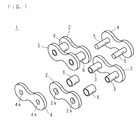
FIG. 1 ] A partly perspective view showing an oil-free chain of a roller chain type according to Example 1 of the present invention. -
- 1: oil-free chain
- 2: inner link plate
- 2a: hole
- 3: oil-impregnated bushing
- 4: outer link plate
- 4a: hole
- 5: pin
- 6: roller
- The present invention will be described below specifically on the basis of the drawing showing the embodiment thereof.
A lubricant according to the present invention is a lubricant impregnated in bushings comprising of a metal sintered body. The lubricant has a kinematic viscosity in the range of ISO-VG grade 46 to 460, the weight % of a first ingredient (an ingredient having the highest content) among the elution ingredients obtained under the GPC measurement conditions described above is 95 wt% or more, the number average molecular weight is 800 or more and 2300 or less, and the ratio of the weight average molecular weight obtained under the GPC measurement conditions described above to the above-mentioned number average molecular weight is 1.0 or more and 1.2 or less. - Furthermore, another lubricant according to the present invention is a lubricant impregnated in bushings comprising of a metal sintered body. The lubricant has a kinematic viscosity in the range of ISO-VG grade 46 to 460, the weight % of a first ingredient among the elution ingredients obtained under the GPC measurement conditions described above is less than 95 wt%, the number average molecular weight is 800 or more and 2300 or less, and the ratio of the weight average molecular weight obtained under the above-mentioned GPC measurement conditions described above to the above-mentioned number average molecular weight is 1.0 or more and 2.0 or less.
- Mineral oil, synthetic oil, animal/plant oil, etc. can be used as the base oil of the lubricant according to the present invention.
According to the classification by the composition, paraffinic hydrocarbons (%CP in the ring analysis (n-d-M method) is 50 or more) such as liquid paraffin, are taken as examples of mineral oil. According to the classification by purification method, bright stock obtained by subjecting a vacuum residue fraction to solvent deasphalting is taken as an example of mineral oil. According to the classification by use, process oil is taken as an example of mineral oil. - Examples of synthetic oil include PAO, polyphenyl ether, phosphate ester, silicone oil, halocarbon oil, polyalkylene glycol, diester and polyol ester.
- One or two or more kinds of additives such as an oiliness agent, a rust inhibitor, an antioxidant, an extreme pressure agent and an anti-foaming agent can be combined and added as necessary to provide additional functions to the lubricant according to the present invention. It is preferable that these additives are contained more than 0 wt% and 10 wt% or less in the entire lubricant.
- Long chain fatty acids such as stearic acid and oleic acid, and the salts thereof can be used as the above-mentioned oiliness agent.
Examples of the above-mentioned rust inhibitor include carboxylic acid, carboxylate, sulfonate and phosphate ester. - Examples of the above-mentioned antioxidant include DBPC (2, 6-di-t-butylparacresol), phenyl-α-naphthylamine, zinc diallyldithiophosphate and benzotriazole.
Examples of the above-mentioned extreme pressure agent include dialkyl polysulfide, alkyl phosphate ester and zinc alkylthiophosphate.
Examples of the above-mentioned anti-foaming agent include dimethylpolysiloxane. - The type of the oil-free chain according to the present invention includes a bushing chain and a roller chain.
- The present invention will be described in detail below with examples and comparative examples, but is not limited to these examples.
- First, Examples and Comparative Examples in the case that the number of elution ingredients among the elution ingredients obtained under the GPC measurement conditions described above is one will be described below. Herein, the phrase "in the case that the number of elution ingredients is one" means that the weight % of an ingredient having the highest content among the elution ingredients obtained under the above-mentioned measurement conditions is 95 wt% or more.
-
FIG. 1 is a partly perspective view showing an oil-free chain 1 of a roller chain type according to Example 1 of the present invention.
Theinner link plate 2 and theouter link plate 4 of the oil-free chain 1 each have inward circular dents in both side fringes at the center portion of an elliptical flat member. Theinner link plate 2 and theouter link plate 4 have a nearly figure eight shape and are provided with holes 2a and 2a and holes 4a and 4a respectively formed near both poles of the elliptical flat members. The plate width and the diameter of the holes of theinner link plate 2 are larger than those of theouter link plate 4. Each one end of cylindrical oil-impregnatedbushings inner link plate 2, and each another end of the oil-impregnatedbushings inner link plate 2, whereby theinner link plates bushings bushings - Each one end of cylindrical pins 5 and 5 is tightly fitted in each of the two holes 4a and 4a of one
outer link plate 4.
The diameter of the pins 5 and 5 is smaller than the inside diameter of the oil-impregnatedbushings inner link plates outer link plate 4, whereby theouter link plates - Furthermore, one of the pins 5 and 5 fitted in one
outer link plate 4 is inserted into one of the oil-impregnatedbushings inner link plates outer link plate 4 as described above, whereby theouter link plates inner link plates free chain 1 is constructed. - The bushings before they are impregnated with the lubricant so as to produce the oil-impregnated
bushings 3 are made of an iron-based sintered metal and have a plurality of pores.
"Diana Process PW380" (mineral oil produced by Idemitsu Kosan Co. Ltd.) was used as the lubricant impregnated in the bushings. This "Diana Process PW380" contains paraffinic hydrocarbons by 73% (%CP in the ring analysis (n-d-M) method) and naphthenic hydrocarbons by 27% (%CN in the above-mentioned ring analysis method). - The bushings were impregnated with the above-mentioned lubricant to produce the oil-impregnated
bushings 3. After vacuuming, the bushings were immersed in the above-mentioned lubricant, outer air was introduced, and the bushings were impregnated with the lubricant. The temperature of the processing is approximately 100°C.
The obtained oil-impregnatedbushings 3 were used to produce the oil-free chain 1. - An oil-free chain according to Example 2 was produced by the same process as that of Example 1 except that "Plastol 2105" (mineral oil produced by Mobile Sekiyu K.K.) was used as the lubricant impregnated in the bushings.
- An oil-free chain according to Example 3 was produced by the same process as that of Example 1 except that "Dina Fresia P430" (mineral oil produced by Idemitsu Kosan Co. Ltd.) was used as the lubricant impregnated in the bushings.
- An oil-free chain according to Example 4 was produced by the same process as that of Example 1 except that "Diana Process PW380" (mineral oil produced by Idemitsu Kosan Co. Ltd.) different from the lubricant according to Example 1 in lot number was used as the lubricant impregnated in the bushings.
- An oil-free chain according to Example 5 was produced by the same process as that of Example 1 except that "DURASYN 174" (synthetic PAO oil produced by BP Castrol K.K.) was used as the lubricant impregnated in the bushings.
- An oil-free chain according to Comparative Example 1 was produced by the same process as that of Example 1 except that "Process P300" (mineral oil produced by JAPAN ENERGY CORPORATION) was used as the lubricant impregnated in the bushings.
- An oil-free chain according to Comparative Example 2 was produced by the same process as that of Example 1 except that "Process P500" (mineral oil produced by JAPAN ENERGY CORPORATION) was used as the lubricant impregnated in the bushings.
- An oil-free chain according to Comparative Example 3 was produced by the same process as that of Example 1 except that "Process EPT750" (mineral oil produced by JAPAN ENERGY CORPORATION) was used as the lubricant impregnated in the bushings.
- An oil-free chain according to Comparative Example 4 was produced by the same process as that of Example 1 except that 25 wt% of "Diana Process PW380" according to Example 4 mixed with 75 wt% of "Process P300" (mineral oil produced by JAPAN ENERGY CORPORATION) was used as the lubricant impregnated in the bushings.
- An oil-free chain according to Comparative Example 5 was produced by the same process as that of Example 1 except that "DURASYN 180" (synthetic PAO oil produced by BP Castrol K.K.) was used as the lubricant impregnated in the bushings.
- An oil-free chain according to Comparative Example 6 was produced by the same process as that of Example 1 except that 50 wt% of the above-mentioned "DURASYN 174" mixed with 50 wt% of the above-mentioned "DURASYN 180" was used as the lubricant impregnated in the bushings.
- Mn and Mw of the lubricants according to Example 1 to 5 and Comparative Examples 1 to 6 were obtained under the GPC measurement conditions described above. Table 1 given below shows the calculation results of Mw/Mn. Table 1 also shows the kinematic viscosity at 40°C and the number of elution ingredients obtained under the above-mentioned measurement conditions.
-

- The following performance evaluation tests were conducted to evaluate the abrasion elongation-resistant lives of the oil-free chains according to Examples 1 to 5 and Comparative Examples 1 to 6.
Each oil-free chain (corresponding to Nominal No. 50 of JIS B1801-1895) was endlessly wound between two sprockets (the number of teeth: 16T) at an ambient temperature of 60°C. In a state that a load (a surface pressure of 4.00 kN/cm2 and a slipping velocity of 8.0 m/min) was applied from the center of one of the sprockets to a direction opposite to the direction toward the other sprocket, the sprockets were rotated at 500 rpm, and the operating time until the abrasion elongation amount of the oil-free chain reached 0.5% was measured.
Table 1 given above shows the results of the measurement.
Table 1 also shows whether the workability during impregnation is good or not. In the case that the workability is good, "o" is entered, and in the case that the workability is bad, "×" is entered. - According to Table 1, the oil-free chains according to Examples 1 to 5 wherein Mn is 800 or more and 2300 or less and Mw/Mn is 1.0 or more and 1.2 or less are more improved significantly in the abrasion elongation-resistant time than the oil-free chains according to Comparative Examples 1 to 6 that are not satisfying these requirements, and it is found that the abrasion elongation-resistant lives thereof are improved.
- In the case of the oil-free chains according to Comparative Examples 5 and 6, the kinematic viscosities are large, and defoaming during impregnation is not done properly. Hence, the impregnation process must be carried out while the degree of vacuum is adjusted up and down, thereby causing a problem in which the oil-free chains are low in workability in comparison with the other oil-free chains.
In the case that the kinematic viscosities of the lubricants at 40°C are in the range of ISO-VG grade 46 to 460, the workability during impregnation is good. In addition, the differences in kinematic viscosity among the lubricants do not affect the abrasion-resistant elongation lives of the oil-free chains. No significant difference occurs in abrasion elongation-resistant life between Examples 3 and 4 in spite of the considerable difference in kinematic viscosity therebetween. - Next, Examples and Comparative Examples in the case that the number of elution ingredients among the elution ingredients obtained under the GPC measurement conditions described above is two or more will be described below. Herein, the phrase "in the case that the number of elution ingredients is two or more" means that the weight % of an ingredient having the highest content among the elution ingredients obtained under the above-mentioned measurement conditions is less than 95 wt%.
- An oil-free chain according to Example A has the same configuration as the oil-
free chain 1 according to Example 1 shown inFIG. 1 .
As the lubricant impregnated in the oil-free chain, 75 wt% of "DURASYN 170" (a synthetic PAO oil produced by BP Castrol K.K.) mixed with 25 wt% of the above-mentioned "Diana Process PW380" was used.
The bushings were impregnated with the above-mentioned lubricant to produce the oil-impregnatedbushings 3. After vacuuming; the bushings were immersed in the above-mentioned lubricant, outer air was introduced, and the bushings were impregnated with the lubricant. The temperature of the processing is approximately 100°C.
The obtained oil-impregnatedbushings 3 were used to produce the oil-free chain. - An oil-free chain according to Example B was produced by the same process as that of Example A except that 50 wt% of the above-mentioned "DURASYN 170" blended with 50 wt% of the above-mentioned "Diana Process-PW380" was used as the lubricant impregnated in the bushings.
- An oil-free chain according to Example C was produced by the same process as that of Example A except that 25 wt% of the above-mentioned "DURASYN 170" blended with 75 wt% of the above-mentioned "Diana Process PW380" was used as the lubricant impregnated in the bushings.
- An oil-free chain according to Example D was produced by the same process as that of Example A except that 50 wt% of the above-mentioned "Diana Process PW380" mixed with 50 wt% of "Process P300" (mineral oil produced by JAPAN ENERGY CORPORATION) was used as the lubricant impregnated in the bushings.
- An oil-free chain according to Example E was produced by the same process as that of Example A except that 85 wt% of alkyl diphenyl ether produced by Matsumura Oil Research Corporation mixed with 15 wt% of PAO was used as the lubricant impregnated in the bushings.
- An oil-free chain according to Example F was produced by the same process as that of Example A except that 70 wt% of alkyl diphenyl ether produced by Matsumura Oil Research Corporation mixed with 30 wt% of PAO was used as the lubricant impregnated in the bushings.
- An oil-free chain according to Example G was produced by the same process as that of Example A except that 50 wt% of the above-mentioned "DURASYN 170" mixed with 50 wt% of the above-mentioned "DURASYN 180" was used as the lubricant impregnated in the bushings.
- An oil-free chain according to Example H was produced by the same process as that of Example A except that "Bonnoc AX 150" (PAO oil produced by NIPPON OIL CORPORATION) was used as the lubricant impregnated in the bushings.
- An oil-free chain according to Example I was produced by the same process as that of Example A except that 25 wt% of the above-mentioned "DURASYN 170" mixed with 75 wt% of "DURASYN 174" (synthetic PAO oil produced by BP Castrol K.K.) was used as the lubricant impregnated in the bushings.
- An oil-free chain according to Example J was produced by the same process as that of Example A except that "DURASYN 170" was used as the lubricant impregnated in the bushings.
- An oil-free chain according to Example K was produced by the same process as that of Example A except that "DURASYN 168" (a synthetic PAO oil produced by BP Castrol K.K.) was used as the lubricant impregnated in the bushings.
- An oil-free chain according to Comparative Example A was produced by the same process as that of Example A except that 85 wt% of the above-mentioned "Bonnoc AX 150" mixed with 15 wt% of "Daphne Quench B" (quenching oil produced by Idemitsu Kosan Co. Ltd.) was used as the lubricant impregnated in the bushings.
- Mn and Mw of the lubricants according to Examples A to K and Comparative Example A were obtained under the GPC measurement conditions described above. Table 2 given below shows the calculation results of Mw/Mn. Table 2 also shows the kinematic viscosity at 40°C and the number of elution ingredients obtained under the GPC measurement conditions.
-

- The performance evaluation test described above was conducted to evaluate the abrasion elongation-resistant lives of the oil-free chains according to Examples A to K and Comparative Example A. Table 2 shows the results of the test. Table 2 also shows whether the workability during impregnation is good or not.
- According to Table 2, the oil-free chains according to Examples A to K wherein Mn is 800 or more and 2300 or less and Mw/Mn is 1.0 or more and 2.0 or less are more improved significantly in abrasion elongation-resistant time than the oil-free chain according to Comparative Example A that is not satisfying these requirements, and it is found that the abrasion elongation-resistant lives thereof are improved.
Furthermore, in the case that the kinematic viscosities of the lubricants at 40°C are in the range of ISO-VG grade 46 to 460, it is found that the workability during impregnation is good and that the abrasion-resistant elongation lives of the oil-free chains are sufficiently long. - The present invention is applicable to oil-free chains of a bushing chain type, a roller chain type, etc. for use in power transmission mechanisms, transport mechanisms, etc.
Claims (3)
- A lubricant impregnated in bushings comprising of a metal sintered body, wherein
said lubricant has a kinematic viscosity provided by an ISO viscosity grade number in the range of VG 46 to 460,
the weight % of an ingredient having the highest content among the elution ingredients obtained under the following GPC (gel permeation chromatography) measurement conditions is 95 wt% or more, and the number average molecular weight is 800 or more and 2300 or less, and
the ratio of the weight average molecular weight obtained under the following GPC measurement conditions to said number average molecular weight is 1.0 or more and 1.2 or less.
[GPC measurement conditions]
Measuring instrument: GPC system manufactured by Shimadzu Corporation
Column: GPC KF-803 (SHODEX) 300 mm × 8 mm (inside diameter), three pieces
Guard column: GPC-800P 10 mm × 4.6 mm (inside diameter) Column temperature: 40°C
Mobile phase: tetrahydrofuran (GC grade)
Flow rate: 0.7 ml/min
Pressure: 2.9 × 10⁻² Pa
Detector: differential refractive index detector
Standard reference material: TSK standard polystyrene manufactured by Tosoh Corporation - A lubricant impregnated in bushings comprising of a metal sintered body, wherein
said lubricant has a kinematic viscosity provided by an ISO viscosity grade number in the range of VG 46 to 460,
the weight % of an ingredient having the highest content among the elution ingredients obtained under the following GPC (gel permeation chromatography) measurement conditions is less than 95 wt%, and the number average molecular weight is 800 or more and 2300 or less, and
the ratio of the weight average molecular weight obtained under the following GPC measurement conditions to said number average molecular weight is 1.0 or more and 2.0 or less.
[GPC measurement conditions]
Measuring instrument: GPC system manufactured by Shimadzu Corporation
Column: GPC KF-803 (SHODEX) 300 mm × 8 mm (inside diameter), three pieces
Guard column: GPC-800P 10 mm × 4.6 mm (inside diameter) Column temperature: 40°C
Mobile phase: tetrahydrofuran (GC grade)
Flow rate: 0.7 ml/min
Pressure: 2.9 × 10⁻² Pa
Detector: differential refractive index detector
Standard reference material: TSK standard polystyrene manufactured by Tosoh Corporation - An oil-free chain constructed by alternately connecting a pair of outer link plates connected by two pins and a pair of inner link plates connected by two oil-impregnated
bushings into which the adjacent pins of said outer link plates adjacent to said inner link plates are fitted, wherein
said oil-impregnated bushings are impregnated with said lubricant according to claim 1 or 2.
Applications Claiming Priority (2)
| Application Number | Priority Date | Filing Date | Title |
|---|---|---|---|
| JP2007237969A JP4480748B2 (en) | 2007-09-13 | 2007-09-13 | Lubricating oil and oil-free chain |
| PCT/JP2008/063245 WO2009034784A1 (en) | 2007-09-13 | 2008-07-24 | Lubricant and oil-free chain |
Publications (3)
| Publication Number | Publication Date |
|---|---|
| EP2189516A1 true EP2189516A1 (en) | 2010-05-26 |
| EP2189516A4 EP2189516A4 (en) | 2011-05-18 |
| EP2189516B1 EP2189516B1 (en) | 2017-05-03 |
Family
ID=40451796
Family Applications (1)
| Application Number | Title | Priority Date | Filing Date |
|---|---|---|---|
| EP08791497.4A Not-in-force EP2189516B1 (en) | 2007-09-13 | 2008-07-24 | Use of a lubricant for an oil-free chain |
Country Status (8)
| Country | Link |
|---|---|
| US (1) | US8795112B2 (en) |
| EP (1) | EP2189516B1 (en) |
| JP (1) | JP4480748B2 (en) |
| KR (1) | KR101516031B1 (en) |
| CN (1) | CN101802153A (en) |
| CA (1) | CA2699466C (en) |
| TW (1) | TWI448548B (en) |
| WO (1) | WO2009034784A1 (en) |
Families Citing this family (3)
| Publication number | Priority date | Publication date | Assignee | Title |
|---|---|---|---|---|
| JP5036521B2 (en) * | 2007-12-12 | 2012-09-26 | 株式会社椿本チエイン | Lubricant composition for chain and chain |
| USD763541S1 (en) * | 2015-03-11 | 2016-08-16 | Arthur Dogswell, L.L.C. | Animal chew |
| JP7464394B2 (en) * | 2020-01-24 | 2024-04-09 | トヨタ自動車株式会社 | Metallic materials |
Family Cites Families (22)
| Publication number | Priority date | Publication date | Assignee | Title |
|---|---|---|---|---|
| JPH01149048U (en) | 1988-04-06 | 1989-10-16 | ||
| JP2872540B2 (en) * | 1993-08-19 | 1999-03-17 | 新日鐵化学株式会社 | Sintered oil-impregnated bearing oil composition |
| JP2832800B2 (en) | 1993-10-22 | 1998-12-09 | 日立建機株式会社 | Plain bearing assembly |
| JP3925952B2 (en) | 1995-10-31 | 2007-06-06 | 出光興産株式会社 | Oil-impregnated bearing oil composition |
| US6331509B1 (en) * | 1997-01-31 | 2001-12-18 | Elisha Technologies Co Llc | Corrosion resistant lubricants, greases, and gels |
| JP4008992B2 (en) * | 1997-11-13 | 2007-11-14 | 新日鐵化学株式会社 | Sintered oil-impregnated bearing oil composition |
| JP3280312B2 (en) * | 1998-06-12 | 2002-05-13 | 株式会社椿本チエイン | Chain with excellent lubrication oil retention |
| DE20116978U1 (en) * | 2001-10-16 | 2003-02-27 | Joh. Winklhofer & Söhne GmbH und Co KG, 81369 München | articulated chain |
| US8318993B2 (en) | 2002-03-05 | 2012-11-27 | Exxonmobil Research And Engineering Company | Lubricant blend composition |
| US20030236177A1 (en) * | 2002-03-05 | 2003-12-25 | Wu Margaret May-Som | Novel lubricant blend composition |
| DE20206947U1 (en) * | 2002-05-02 | 2003-02-06 | Joh. Winklhofer & Söhne GmbH und Co KG, 81369 München | Link chain with nitrided link pin |
| JP4514416B2 (en) * | 2003-06-02 | 2010-07-28 | 株式会社小松製作所 | Slide bearing and work machine coupling device using the same |
| JP2005325335A (en) * | 2004-04-15 | 2005-11-24 | Sanyo Chem Ind Ltd | Lubricant for coil production for fastener |
| JP4395424B2 (en) * | 2004-09-06 | 2010-01-06 | 株式会社日立ビルシステム | Roller chain lubricant composition for passenger conveyor drive |
| EP1661921B1 (en) * | 2004-11-26 | 2019-07-17 | Mitsui Chemicals, Inc. | Synthetic lubricating oil and lubricating oil composition thereof |
| JP2006176760A (en) * | 2004-11-26 | 2006-07-06 | Mitsui Chemicals Inc | Synthetic lubricating oil and lubricating oil composition |
| JP2007056213A (en) | 2005-08-26 | 2007-03-08 | Fujifilm Corp | Composition for sintered oil-containing bearing oil, bearing device and sliding member using the same |
| JP4999311B2 (en) * | 2005-11-01 | 2012-08-15 | 出光興産株式会社 | Lubricating oil composition |
| WO2007122969A1 (en) * | 2006-04-20 | 2007-11-01 | Nok Kluber Co., Ltd. | Lubricant composition for oil retaining bearing |
| JP4946868B2 (en) * | 2006-05-16 | 2012-06-06 | Nokクリューバー株式会社 | Lubricating oil composition |
| JP2008081558A (en) * | 2006-09-26 | 2008-04-10 | Toyo Mach & Metal Co Ltd | Grease composition |
| JP4455608B2 (en) * | 2007-03-20 | 2010-04-21 | 株式会社椿本チエイン | Cylindrical roller chain |
-
2007
- 2007-09-13 JP JP2007237969A patent/JP4480748B2/en active Active
-
2008
- 2008-07-24 CN CN200880108282A patent/CN101802153A/en active Pending
- 2008-07-24 US US12/677,921 patent/US8795112B2/en not_active Expired - Fee Related
- 2008-07-24 CA CA2699466A patent/CA2699466C/en not_active Expired - Fee Related
- 2008-07-24 WO PCT/JP2008/063245 patent/WO2009034784A1/en not_active Ceased
- 2008-07-24 KR KR1020107006311A patent/KR101516031B1/en not_active Expired - Fee Related
- 2008-07-24 EP EP08791497.4A patent/EP2189516B1/en not_active Not-in-force
- 2008-07-29 TW TW097128604A patent/TWI448548B/en not_active IP Right Cessation
Also Published As
| Publication number | Publication date |
|---|---|
| KR101516031B1 (en) | 2015-05-04 |
| CA2699466C (en) | 2015-09-15 |
| US8795112B2 (en) | 2014-08-05 |
| JP4480748B2 (en) | 2010-06-16 |
| TW200923069A (en) | 2009-06-01 |
| TWI448548B (en) | 2014-08-11 |
| US20100292039A1 (en) | 2010-11-18 |
| WO2009034784A1 (en) | 2009-03-19 |
| CA2699466A1 (en) | 2009-03-19 |
| EP2189516B1 (en) | 2017-05-03 |
| KR20100061810A (en) | 2010-06-09 |
| CN101802153A (en) | 2010-08-11 |
| EP2189516A4 (en) | 2011-05-18 |
| JP2009067895A (en) | 2009-04-02 |
Similar Documents
| Publication | Publication Date | Title |
|---|---|---|
| CN101896587B (en) | Lubricant composition for chain and chain | |
| KR100900748B1 (en) | Lubricant | |
| JP4946868B2 (en) | Lubricating oil composition | |
| EP2014751B1 (en) | Lubricant composition for oil retaining bearing | |
| EP3722805B1 (en) | Method for inspecting lubricating oil composition and method for producing lubricating oil composition | |
| CN111684055A (en) | Grease composition | |
| EP2189516B1 (en) | Use of a lubricant for an oil-free chain | |
| KR20040075914A (en) | Operating medium for carbon dioxide-cooling systems and air-conditioning systems | |
| JP3918520B2 (en) | Lubricating composition for oil-impregnated bearings | |
| JP4613530B2 (en) | Lubricating grease composition | |
| JP5390849B2 (en) | A urea grease composition for gear lubrication made of polyamide or polyacetal resin. | |
| EP3165590A1 (en) | Lubricant composition and lubricant composition-sealed bearing | |
| JP2013035946A (en) | Grease and sealed bearing | |
| EP3633015B1 (en) | Grease composition and sliding member coated therewith | |
| JP2016147991A (en) | chain | |
| JP2008001734A (en) | Lubricating oil composition | |
| US11718808B2 (en) | Lubricant composition | |
| CN104081072A (en) | Lubricated machine element and method for lubrication | |
| JP2005308053A (en) | Low speed guide device and lubrication method thereof. | |
| CN118813318A (en) | Lubricant composition | |
| JPH11201169A (en) | Rolling bearing | |
| JP2020106133A (en) | Slide member for high temperature | |
| JP6408850B2 (en) | Lubricating oil composition |
Legal Events
| Date | Code | Title | Description |
|---|---|---|---|
| PUAI | Public reference made under article 153(3) epc to a published international application that has entered the european phase |
Free format text: ORIGINAL CODE: 0009012 |
|
| 17P | Request for examination filed |
Effective date: 20100308 |
|
| AK | Designated contracting states |
Kind code of ref document: A1 Designated state(s): AT BE BG CH CY CZ DE DK EE ES FI FR GB GR HR HU IE IS IT LI LT LU LV MC MT NL NO PL PT RO SE SI SK TR |
|
| AX | Request for extension of the european patent |
Extension state: AL BA MK RS |
|
| DAX | Request for extension of the european patent (deleted) | ||
| A4 | Supplementary search report drawn up and despatched |
Effective date: 20110419 |
|
| 17Q | First examination report despatched |
Effective date: 20120919 |
|
| GRAP | Despatch of communication of intention to grant a patent |
Free format text: ORIGINAL CODE: EPIDOSNIGR1 |
|
| STAA | Information on the status of an ep patent application or granted ep patent |
Free format text: STATUS: GRANT OF PATENT IS INTENDED |
|
| INTG | Intention to grant announced |
Effective date: 20161128 |
|
| GRAS | Grant fee paid |
Free format text: ORIGINAL CODE: EPIDOSNIGR3 |
|
| GRAA | (expected) grant |
Free format text: ORIGINAL CODE: 0009210 |
|
| STAA | Information on the status of an ep patent application or granted ep patent |
Free format text: STATUS: THE PATENT HAS BEEN GRANTED |
|
| AK | Designated contracting states |
Kind code of ref document: B1 Designated state(s): AT BE BG CH CY CZ DE DK EE ES FI FR GB GR HR HU IE IS IT LI LT LU LV MC MT NL NO PL PT RO SE SI SK TR |
|
| REG | Reference to a national code |
Ref country code: GB Ref legal event code: FG4D |
|
| REG | Reference to a national code |
Ref country code: AT Ref legal event code: REF Ref document number: 889987 Country of ref document: AT Kind code of ref document: T Effective date: 20170515 Ref country code: CH Ref legal event code: EP |
|
| REG | Reference to a national code |
Ref country code: IE Ref legal event code: FG4D |
|
| REG | Reference to a national code |
Ref country code: DE Ref legal event code: R096 Ref document number: 602008050099 Country of ref document: DE |
|
| REG | Reference to a national code |
Ref country code: FR Ref legal event code: PLFP Year of fee payment: 10 |
|
| REG | Reference to a national code |
Ref country code: NL Ref legal event code: MP Effective date: 20170503 |
|
| REG | Reference to a national code |
Ref country code: AT Ref legal event code: MK05 Ref document number: 889987 Country of ref document: AT Kind code of ref document: T Effective date: 20170503 |
|
| REG | Reference to a national code |
Ref country code: LT Ref legal event code: MG4D |
|
| PG25 | Lapsed in a contracting state [announced via postgrant information from national office to epo] |
Ref country code: NO Free format text: LAPSE BECAUSE OF FAILURE TO SUBMIT A TRANSLATION OF THE DESCRIPTION OR TO PAY THE FEE WITHIN THE PRESCRIBED TIME-LIMIT Effective date: 20170803 Ref country code: HR Free format text: LAPSE BECAUSE OF FAILURE TO SUBMIT A TRANSLATION OF THE DESCRIPTION OR TO PAY THE FEE WITHIN THE PRESCRIBED TIME-LIMIT Effective date: 20170503 Ref country code: LT Free format text: LAPSE BECAUSE OF FAILURE TO SUBMIT A TRANSLATION OF THE DESCRIPTION OR TO PAY THE FEE WITHIN THE PRESCRIBED TIME-LIMIT Effective date: 20170503 Ref country code: GR Free format text: LAPSE BECAUSE OF FAILURE TO SUBMIT A TRANSLATION OF THE DESCRIPTION OR TO PAY THE FEE WITHIN THE PRESCRIBED TIME-LIMIT Effective date: 20170804 Ref country code: FI Free format text: LAPSE BECAUSE OF FAILURE TO SUBMIT A TRANSLATION OF THE DESCRIPTION OR TO PAY THE FEE WITHIN THE PRESCRIBED TIME-LIMIT Effective date: 20170503 Ref country code: AT Free format text: LAPSE BECAUSE OF FAILURE TO SUBMIT A TRANSLATION OF THE DESCRIPTION OR TO PAY THE FEE WITHIN THE PRESCRIBED TIME-LIMIT Effective date: 20170503 Ref country code: ES Free format text: LAPSE BECAUSE OF FAILURE TO SUBMIT A TRANSLATION OF THE DESCRIPTION OR TO PAY THE FEE WITHIN THE PRESCRIBED TIME-LIMIT Effective date: 20170503 |
|
| PGFP | Annual fee paid to national office [announced via postgrant information from national office to epo] |
Ref country code: DE Payment date: 20170731 Year of fee payment: 10 Ref country code: IT Payment date: 20170829 Year of fee payment: 10 Ref country code: GB Payment date: 20170724 Year of fee payment: 10 Ref country code: FR Payment date: 20170720 Year of fee payment: 10 |
|
| PG25 | Lapsed in a contracting state [announced via postgrant information from national office to epo] |
Ref country code: SE Free format text: LAPSE BECAUSE OF FAILURE TO SUBMIT A TRANSLATION OF THE DESCRIPTION OR TO PAY THE FEE WITHIN THE PRESCRIBED TIME-LIMIT Effective date: 20170503 Ref country code: IS Free format text: LAPSE BECAUSE OF FAILURE TO SUBMIT A TRANSLATION OF THE DESCRIPTION OR TO PAY THE FEE WITHIN THE PRESCRIBED TIME-LIMIT Effective date: 20170903 Ref country code: LV Free format text: LAPSE BECAUSE OF FAILURE TO SUBMIT A TRANSLATION OF THE DESCRIPTION OR TO PAY THE FEE WITHIN THE PRESCRIBED TIME-LIMIT Effective date: 20170503 Ref country code: BG Free format text: LAPSE BECAUSE OF FAILURE TO SUBMIT A TRANSLATION OF THE DESCRIPTION OR TO PAY THE FEE WITHIN THE PRESCRIBED TIME-LIMIT Effective date: 20170803 Ref country code: NL Free format text: LAPSE BECAUSE OF FAILURE TO SUBMIT A TRANSLATION OF THE DESCRIPTION OR TO PAY THE FEE WITHIN THE PRESCRIBED TIME-LIMIT Effective date: 20170503 Ref country code: PL Free format text: LAPSE BECAUSE OF FAILURE TO SUBMIT A TRANSLATION OF THE DESCRIPTION OR TO PAY THE FEE WITHIN THE PRESCRIBED TIME-LIMIT Effective date: 20170503 |
|
| PG25 | Lapsed in a contracting state [announced via postgrant information from national office to epo] |
Ref country code: RO Free format text: LAPSE BECAUSE OF FAILURE TO SUBMIT A TRANSLATION OF THE DESCRIPTION OR TO PAY THE FEE WITHIN THE PRESCRIBED TIME-LIMIT Effective date: 20170503 Ref country code: EE Free format text: LAPSE BECAUSE OF FAILURE TO SUBMIT A TRANSLATION OF THE DESCRIPTION OR TO PAY THE FEE WITHIN THE PRESCRIBED TIME-LIMIT Effective date: 20170503 Ref country code: CZ Free format text: LAPSE BECAUSE OF FAILURE TO SUBMIT A TRANSLATION OF THE DESCRIPTION OR TO PAY THE FEE WITHIN THE PRESCRIBED TIME-LIMIT Effective date: 20170503 Ref country code: SK Free format text: LAPSE BECAUSE OF FAILURE TO SUBMIT A TRANSLATION OF THE DESCRIPTION OR TO PAY THE FEE WITHIN THE PRESCRIBED TIME-LIMIT Effective date: 20170503 Ref country code: DK Free format text: LAPSE BECAUSE OF FAILURE TO SUBMIT A TRANSLATION OF THE DESCRIPTION OR TO PAY THE FEE WITHIN THE PRESCRIBED TIME-LIMIT Effective date: 20170503 |
|
| REG | Reference to a national code |
Ref country code: DE Ref legal event code: R097 Ref document number: 602008050099 Country of ref document: DE |
|
| REG | Reference to a national code |
Ref country code: CH Ref legal event code: PL |
|
| PLBE | No opposition filed within time limit |
Free format text: ORIGINAL CODE: 0009261 |
|
| STAA | Information on the status of an ep patent application or granted ep patent |
Free format text: STATUS: NO OPPOSITION FILED WITHIN TIME LIMIT |
|
| 26N | No opposition filed |
Effective date: 20180206 |
|
| REG | Reference to a national code |
Ref country code: IE Ref legal event code: MM4A |
|
| PG25 | Lapsed in a contracting state [announced via postgrant information from national office to epo] |
Ref country code: IE Free format text: LAPSE BECAUSE OF NON-PAYMENT OF DUE FEES Effective date: 20170724 Ref country code: CH Free format text: LAPSE BECAUSE OF NON-PAYMENT OF DUE FEES Effective date: 20170731 Ref country code: LI Free format text: LAPSE BECAUSE OF NON-PAYMENT OF DUE FEES Effective date: 20170731 |
|
| PG25 | Lapsed in a contracting state [announced via postgrant information from national office to epo] |
Ref country code: SI Free format text: LAPSE BECAUSE OF FAILURE TO SUBMIT A TRANSLATION OF THE DESCRIPTION OR TO PAY THE FEE WITHIN THE PRESCRIBED TIME-LIMIT Effective date: 20170503 |
|
| REG | Reference to a national code |
Ref country code: BE Ref legal event code: MM Effective date: 20170731 |
|
| PG25 | Lapsed in a contracting state [announced via postgrant information from national office to epo] |
Ref country code: LU Free format text: LAPSE BECAUSE OF NON-PAYMENT OF DUE FEES Effective date: 20170724 |
|
| PG25 | Lapsed in a contracting state [announced via postgrant information from national office to epo] |
Ref country code: BE Free format text: LAPSE BECAUSE OF NON-PAYMENT OF DUE FEES Effective date: 20170731 |
|
| PG25 | Lapsed in a contracting state [announced via postgrant information from national office to epo] |
Ref country code: MT Free format text: LAPSE BECAUSE OF NON-PAYMENT OF DUE FEES Effective date: 20170724 |
|
| REG | Reference to a national code |
Ref country code: DE Ref legal event code: R119 Ref document number: 602008050099 Country of ref document: DE |
|
| GBPC | Gb: european patent ceased through non-payment of renewal fee |
Effective date: 20180724 |
|
| PG25 | Lapsed in a contracting state [announced via postgrant information from national office to epo] |
Ref country code: FR Free format text: LAPSE BECAUSE OF NON-PAYMENT OF DUE FEES Effective date: 20180731 Ref country code: GB Free format text: LAPSE BECAUSE OF NON-PAYMENT OF DUE FEES Effective date: 20180724 Ref country code: DE Free format text: LAPSE BECAUSE OF NON-PAYMENT OF DUE FEES Effective date: 20190201 |
|
| PG25 | Lapsed in a contracting state [announced via postgrant information from national office to epo] |
Ref country code: MC Free format text: LAPSE BECAUSE OF FAILURE TO SUBMIT A TRANSLATION OF THE DESCRIPTION OR TO PAY THE FEE WITHIN THE PRESCRIBED TIME-LIMIT Effective date: 20170503 Ref country code: HU Free format text: LAPSE BECAUSE OF FAILURE TO SUBMIT A TRANSLATION OF THE DESCRIPTION OR TO PAY THE FEE WITHIN THE PRESCRIBED TIME-LIMIT; INVALID AB INITIO Effective date: 20080724 |
|
| PG25 | Lapsed in a contracting state [announced via postgrant information from national office to epo] |
Ref country code: IT Free format text: LAPSE BECAUSE OF NON-PAYMENT OF DUE FEES Effective date: 20180724 |
|
| PG25 | Lapsed in a contracting state [announced via postgrant information from national office to epo] |
Ref country code: CY Free format text: LAPSE BECAUSE OF NON-PAYMENT OF DUE FEES Effective date: 20170503 |
|
| PG25 | Lapsed in a contracting state [announced via postgrant information from national office to epo] |
Ref country code: TR Free format text: LAPSE BECAUSE OF FAILURE TO SUBMIT A TRANSLATION OF THE DESCRIPTION OR TO PAY THE FEE WITHIN THE PRESCRIBED TIME-LIMIT Effective date: 20170503 |
|
| PG25 | Lapsed in a contracting state [announced via postgrant information from national office to epo] |
Ref country code: PT Free format text: LAPSE BECAUSE OF FAILURE TO SUBMIT A TRANSLATION OF THE DESCRIPTION OR TO PAY THE FEE WITHIN THE PRESCRIBED TIME-LIMIT Effective date: 20170503 |