EP2184335A1 - A process of catalytic conversion - Google Patents
A process of catalytic conversion Download PDFInfo
- Publication number
- EP2184335A1 EP2184335A1 EP08783625A EP08783625A EP2184335A1 EP 2184335 A1 EP2184335 A1 EP 2184335A1 EP 08783625 A EP08783625 A EP 08783625A EP 08783625 A EP08783625 A EP 08783625A EP 2184335 A1 EP2184335 A1 EP 2184335A1
- Authority
- EP
- European Patent Office
- Prior art keywords
- feedstock
- weight
- catalyst
- crackability
- process according
- Prior art date
- Legal status (The legal status is an assumption and is not a legal conclusion. Google has not performed a legal analysis and makes no representation as to the accuracy of the status listed.)
- Granted
Links
Images


Classifications
-
- B—PERFORMING OPERATIONS; TRANSPORTING
- B01—PHYSICAL OR CHEMICAL PROCESSES OR APPARATUS IN GENERAL
- B01J—CHEMICAL OR PHYSICAL PROCESSES, e.g. CATALYSIS OR COLLOID CHEMISTRY; THEIR RELEVANT APPARATUS
- B01J29/00—Catalysts comprising molecular sieves
- B01J29/04—Catalysts comprising molecular sieves having base-exchange properties, e.g. crystalline zeolites
- B01J29/06—Crystalline aluminosilicate zeolites; Isomorphous compounds thereof
- B01J29/08—Crystalline aluminosilicate zeolites; Isomorphous compounds thereof of the faujasite type, e.g. type X or Y
- B01J29/084—Y-type faujasite
-
- B—PERFORMING OPERATIONS; TRANSPORTING
- B01—PHYSICAL OR CHEMICAL PROCESSES OR APPARATUS IN GENERAL
- B01J—CHEMICAL OR PHYSICAL PROCESSES, e.g. CATALYSIS OR COLLOID CHEMISTRY; THEIR RELEVANT APPARATUS
- B01J29/00—Catalysts comprising molecular sieves
- B01J29/04—Catalysts comprising molecular sieves having base-exchange properties, e.g. crystalline zeolites
- B01J29/06—Crystalline aluminosilicate zeolites; Isomorphous compounds thereof
- B01J29/40—Crystalline aluminosilicate zeolites; Isomorphous compounds thereof of the pentasil type, e.g. types ZSM-5, ZSM-8 or ZSM-11, as exemplified by patent documents US3702886, GB1334243 and US3709979, respectively
- B01J29/42—Crystalline aluminosilicate zeolites; Isomorphous compounds thereof of the pentasil type, e.g. types ZSM-5, ZSM-8 or ZSM-11, as exemplified by patent documents US3702886, GB1334243 and US3709979, respectively containing iron group metals, noble metals or copper
- B01J29/46—Iron group metals or copper
-
- B—PERFORMING OPERATIONS; TRANSPORTING
- B01—PHYSICAL OR CHEMICAL PROCESSES OR APPARATUS IN GENERAL
- B01J—CHEMICAL OR PHYSICAL PROCESSES, e.g. CATALYSIS OR COLLOID CHEMISTRY; THEIR RELEVANT APPARATUS
- B01J29/00—Catalysts comprising molecular sieves
- B01J29/04—Catalysts comprising molecular sieves having base-exchange properties, e.g. crystalline zeolites
- B01J29/06—Crystalline aluminosilicate zeolites; Isomorphous compounds thereof
- B01J29/80—Mixtures of different zeolites
-
- B—PERFORMING OPERATIONS; TRANSPORTING
- B01—PHYSICAL OR CHEMICAL PROCESSES OR APPARATUS IN GENERAL
- B01J—CHEMICAL OR PHYSICAL PROCESSES, e.g. CATALYSIS OR COLLOID CHEMISTRY; THEIR RELEVANT APPARATUS
- B01J29/00—Catalysts comprising molecular sieves
- B01J29/90—Regeneration or reactivation
-
- C—CHEMISTRY; METALLURGY
- C10—PETROLEUM, GAS OR COKE INDUSTRIES; TECHNICAL GASES CONTAINING CARBON MONOXIDE; FUELS; LUBRICANTS; PEAT
- C10G—CRACKING HYDROCARBON OILS; PRODUCTION OF LIQUID HYDROCARBON MIXTURES, e.g. BY DESTRUCTIVE HYDROGENATION, OLIGOMERISATION, POLYMERISATION; RECOVERY OF HYDROCARBON OILS FROM OIL-SHALE, OIL-SAND, OR GASES; REFINING MIXTURES MAINLY CONSISTING OF HYDROCARBONS; REFORMING OF NAPHTHA; MINERAL WAXES
- C10G11/00—Catalytic cracking, in the absence of hydrogen, of hydrocarbon oils
- C10G11/02—Catalytic cracking, in the absence of hydrogen, of hydrocarbon oils characterised by the catalyst used
- C10G11/04—Oxides
- C10G11/05—Crystalline alumino-silicates, e.g. molecular sieves
-
- C—CHEMISTRY; METALLURGY
- C10—PETROLEUM, GAS OR COKE INDUSTRIES; TECHNICAL GASES CONTAINING CARBON MONOXIDE; FUELS; LUBRICANTS; PEAT
- C10G—CRACKING HYDROCARBON OILS; PRODUCTION OF LIQUID HYDROCARBON MIXTURES, e.g. BY DESTRUCTIVE HYDROGENATION, OLIGOMERISATION, POLYMERISATION; RECOVERY OF HYDROCARBON OILS FROM OIL-SHALE, OIL-SAND, OR GASES; REFINING MIXTURES MAINLY CONSISTING OF HYDROCARBONS; REFORMING OF NAPHTHA; MINERAL WAXES
- C10G11/00—Catalytic cracking, in the absence of hydrogen, of hydrocarbon oils
- C10G11/14—Catalytic cracking, in the absence of hydrogen, of hydrocarbon oils with preheated moving solid catalysts
- C10G11/18—Catalytic cracking, in the absence of hydrogen, of hydrocarbon oils with preheated moving solid catalysts according to the "fluidised-bed" technique
-
- B—PERFORMING OPERATIONS; TRANSPORTING
- B01—PHYSICAL OR CHEMICAL PROCESSES OR APPARATUS IN GENERAL
- B01J—CHEMICAL OR PHYSICAL PROCESSES, e.g. CATALYSIS OR COLLOID CHEMISTRY; THEIR RELEVANT APPARATUS
- B01J2229/00—Aspects of molecular sieve catalysts not covered by B01J29/00
- B01J2229/30—After treatment, characterised by the means used
- B01J2229/42—Addition of matrix or binder particles
-
- B—PERFORMING OPERATIONS; TRANSPORTING
- B01—PHYSICAL OR CHEMICAL PROCESSES OR APPARATUS IN GENERAL
- B01J—CHEMICAL OR PHYSICAL PROCESSES, e.g. CATALYSIS OR COLLOID CHEMISTRY; THEIR RELEVANT APPARATUS
- B01J37/00—Processes, in general, for preparing catalysts; Processes, in general, for activation of catalysts
- B01J37/0009—Use of binding agents; Moulding; Pressing; Powdering; Granulating; Addition of materials ameliorating the mechanical properties of the product catalyst
- B01J37/0027—Powdering
- B01J37/0045—Drying a slurry, e.g. spray drying
-
- B—PERFORMING OPERATIONS; TRANSPORTING
- B01—PHYSICAL OR CHEMICAL PROCESSES OR APPARATUS IN GENERAL
- B01J—CHEMICAL OR PHYSICAL PROCESSES, e.g. CATALYSIS OR COLLOID CHEMISTRY; THEIR RELEVANT APPARATUS
- B01J38/00—Regeneration or reactivation of catalysts, in general
- B01J38/04—Gas or vapour treating; Treating by using liquids vaporisable upon contacting spent catalyst
- B01J38/12—Treating with free oxygen-containing gas
- B01J38/30—Treating with free oxygen-containing gas in gaseous suspension, e.g. fluidised bed
-
- C—CHEMISTRY; METALLURGY
- C10—PETROLEUM, GAS OR COKE INDUSTRIES; TECHNICAL GASES CONTAINING CARBON MONOXIDE; FUELS; LUBRICANTS; PEAT
- C10G—CRACKING HYDROCARBON OILS; PRODUCTION OF LIQUID HYDROCARBON MIXTURES, e.g. BY DESTRUCTIVE HYDROGENATION, OLIGOMERISATION, POLYMERISATION; RECOVERY OF HYDROCARBON OILS FROM OIL-SHALE, OIL-SAND, OR GASES; REFINING MIXTURES MAINLY CONSISTING OF HYDROCARBONS; REFORMING OF NAPHTHA; MINERAL WAXES
- C10G2300/00—Aspects relating to hydrocarbon processing covered by groups C10G1/00 - C10G99/00
- C10G2300/10—Feedstock materials
- C10G2300/1037—Hydrocarbon fractions
- C10G2300/104—Light gasoline having a boiling range of about 20 - 100 °C
-
- C—CHEMISTRY; METALLURGY
- C10—PETROLEUM, GAS OR COKE INDUSTRIES; TECHNICAL GASES CONTAINING CARBON MONOXIDE; FUELS; LUBRICANTS; PEAT
- C10G—CRACKING HYDROCARBON OILS; PRODUCTION OF LIQUID HYDROCARBON MIXTURES, e.g. BY DESTRUCTIVE HYDROGENATION, OLIGOMERISATION, POLYMERISATION; RECOVERY OF HYDROCARBON OILS FROM OIL-SHALE, OIL-SAND, OR GASES; REFINING MIXTURES MAINLY CONSISTING OF HYDROCARBONS; REFORMING OF NAPHTHA; MINERAL WAXES
- C10G2300/00—Aspects relating to hydrocarbon processing covered by groups C10G1/00 - C10G99/00
- C10G2300/10—Feedstock materials
- C10G2300/1037—Hydrocarbon fractions
- C10G2300/1044—Heavy gasoline or naphtha having a boiling range of about 100 - 180 °C
-
- C—CHEMISTRY; METALLURGY
- C10—PETROLEUM, GAS OR COKE INDUSTRIES; TECHNICAL GASES CONTAINING CARBON MONOXIDE; FUELS; LUBRICANTS; PEAT
- C10G—CRACKING HYDROCARBON OILS; PRODUCTION OF LIQUID HYDROCARBON MIXTURES, e.g. BY DESTRUCTIVE HYDROGENATION, OLIGOMERISATION, POLYMERISATION; RECOVERY OF HYDROCARBON OILS FROM OIL-SHALE, OIL-SAND, OR GASES; REFINING MIXTURES MAINLY CONSISTING OF HYDROCARBONS; REFORMING OF NAPHTHA; MINERAL WAXES
- C10G2300/00—Aspects relating to hydrocarbon processing covered by groups C10G1/00 - C10G99/00
- C10G2300/10—Feedstock materials
- C10G2300/1037—Hydrocarbon fractions
- C10G2300/1048—Middle distillates
- C10G2300/1055—Diesel having a boiling range of about 230 - 330 °C
-
- C—CHEMISTRY; METALLURGY
- C10—PETROLEUM, GAS OR COKE INDUSTRIES; TECHNICAL GASES CONTAINING CARBON MONOXIDE; FUELS; LUBRICANTS; PEAT
- C10G—CRACKING HYDROCARBON OILS; PRODUCTION OF LIQUID HYDROCARBON MIXTURES, e.g. BY DESTRUCTIVE HYDROGENATION, OLIGOMERISATION, POLYMERISATION; RECOVERY OF HYDROCARBON OILS FROM OIL-SHALE, OIL-SAND, OR GASES; REFINING MIXTURES MAINLY CONSISTING OF HYDROCARBONS; REFORMING OF NAPHTHA; MINERAL WAXES
- C10G2300/00—Aspects relating to hydrocarbon processing covered by groups C10G1/00 - C10G99/00
- C10G2300/10—Feedstock materials
- C10G2300/107—Atmospheric residues having a boiling point of at least about 538 °C
-
- C—CHEMISTRY; METALLURGY
- C10—PETROLEUM, GAS OR COKE INDUSTRIES; TECHNICAL GASES CONTAINING CARBON MONOXIDE; FUELS; LUBRICANTS; PEAT
- C10G—CRACKING HYDROCARBON OILS; PRODUCTION OF LIQUID HYDROCARBON MIXTURES, e.g. BY DESTRUCTIVE HYDROGENATION, OLIGOMERISATION, POLYMERISATION; RECOVERY OF HYDROCARBON OILS FROM OIL-SHALE, OIL-SAND, OR GASES; REFINING MIXTURES MAINLY CONSISTING OF HYDROCARBONS; REFORMING OF NAPHTHA; MINERAL WAXES
- C10G2300/00—Aspects relating to hydrocarbon processing covered by groups C10G1/00 - C10G99/00
- C10G2300/10—Feedstock materials
- C10G2300/1074—Vacuum distillates
-
- C—CHEMISTRY; METALLURGY
- C10—PETROLEUM, GAS OR COKE INDUSTRIES; TECHNICAL GASES CONTAINING CARBON MONOXIDE; FUELS; LUBRICANTS; PEAT
- C10G—CRACKING HYDROCARBON OILS; PRODUCTION OF LIQUID HYDROCARBON MIXTURES, e.g. BY DESTRUCTIVE HYDROGENATION, OLIGOMERISATION, POLYMERISATION; RECOVERY OF HYDROCARBON OILS FROM OIL-SHALE, OIL-SAND, OR GASES; REFINING MIXTURES MAINLY CONSISTING OF HYDROCARBONS; REFORMING OF NAPHTHA; MINERAL WAXES
- C10G2300/00—Aspects relating to hydrocarbon processing covered by groups C10G1/00 - C10G99/00
- C10G2300/10—Feedstock materials
- C10G2300/1077—Vacuum residues
-
- C—CHEMISTRY; METALLURGY
- C10—PETROLEUM, GAS OR COKE INDUSTRIES; TECHNICAL GASES CONTAINING CARBON MONOXIDE; FUELS; LUBRICANTS; PEAT
- C10G—CRACKING HYDROCARBON OILS; PRODUCTION OF LIQUID HYDROCARBON MIXTURES, e.g. BY DESTRUCTIVE HYDROGENATION, OLIGOMERISATION, POLYMERISATION; RECOVERY OF HYDROCARBON OILS FROM OIL-SHALE, OIL-SAND, OR GASES; REFINING MIXTURES MAINLY CONSISTING OF HYDROCARBONS; REFORMING OF NAPHTHA; MINERAL WAXES
- C10G2300/00—Aspects relating to hydrocarbon processing covered by groups C10G1/00 - C10G99/00
- C10G2300/20—Characteristics of the feedstock or the products
- C10G2300/30—Physical properties of feedstocks or products
- C10G2300/301—Boiling range
-
- C—CHEMISTRY; METALLURGY
- C10—PETROLEUM, GAS OR COKE INDUSTRIES; TECHNICAL GASES CONTAINING CARBON MONOXIDE; FUELS; LUBRICANTS; PEAT
- C10G—CRACKING HYDROCARBON OILS; PRODUCTION OF LIQUID HYDROCARBON MIXTURES, e.g. BY DESTRUCTIVE HYDROGENATION, OLIGOMERISATION, POLYMERISATION; RECOVERY OF HYDROCARBON OILS FROM OIL-SHALE, OIL-SAND, OR GASES; REFINING MIXTURES MAINLY CONSISTING OF HYDROCARBONS; REFORMING OF NAPHTHA; MINERAL WAXES
- C10G2300/00—Aspects relating to hydrocarbon processing covered by groups C10G1/00 - C10G99/00
- C10G2300/40—Characteristics of the process deviating from typical ways of processing
- C10G2300/4006—Temperature
-
- C—CHEMISTRY; METALLURGY
- C10—PETROLEUM, GAS OR COKE INDUSTRIES; TECHNICAL GASES CONTAINING CARBON MONOXIDE; FUELS; LUBRICANTS; PEAT
- C10G—CRACKING HYDROCARBON OILS; PRODUCTION OF LIQUID HYDROCARBON MIXTURES, e.g. BY DESTRUCTIVE HYDROGENATION, OLIGOMERISATION, POLYMERISATION; RECOVERY OF HYDROCARBON OILS FROM OIL-SHALE, OIL-SAND, OR GASES; REFINING MIXTURES MAINLY CONSISTING OF HYDROCARBONS; REFORMING OF NAPHTHA; MINERAL WAXES
- C10G2300/00—Aspects relating to hydrocarbon processing covered by groups C10G1/00 - C10G99/00
- C10G2300/40—Characteristics of the process deviating from typical ways of processing
- C10G2300/4018—Spatial velocity, e.g. LHSV, WHSV
-
- C—CHEMISTRY; METALLURGY
- C10—PETROLEUM, GAS OR COKE INDUSTRIES; TECHNICAL GASES CONTAINING CARBON MONOXIDE; FUELS; LUBRICANTS; PEAT
- C10G—CRACKING HYDROCARBON OILS; PRODUCTION OF LIQUID HYDROCARBON MIXTURES, e.g. BY DESTRUCTIVE HYDROGENATION, OLIGOMERISATION, POLYMERISATION; RECOVERY OF HYDROCARBON OILS FROM OIL-SHALE, OIL-SAND, OR GASES; REFINING MIXTURES MAINLY CONSISTING OF HYDROCARBONS; REFORMING OF NAPHTHA; MINERAL WAXES
- C10G2300/00—Aspects relating to hydrocarbon processing covered by groups C10G1/00 - C10G99/00
- C10G2300/40—Characteristics of the process deviating from typical ways of processing
- C10G2300/4025—Yield
-
- C—CHEMISTRY; METALLURGY
- C10—PETROLEUM, GAS OR COKE INDUSTRIES; TECHNICAL GASES CONTAINING CARBON MONOXIDE; FUELS; LUBRICANTS; PEAT
- C10G—CRACKING HYDROCARBON OILS; PRODUCTION OF LIQUID HYDROCARBON MIXTURES, e.g. BY DESTRUCTIVE HYDROGENATION, OLIGOMERISATION, POLYMERISATION; RECOVERY OF HYDROCARBON OILS FROM OIL-SHALE, OIL-SAND, OR GASES; REFINING MIXTURES MAINLY CONSISTING OF HYDROCARBONS; REFORMING OF NAPHTHA; MINERAL WAXES
- C10G2300/00—Aspects relating to hydrocarbon processing covered by groups C10G1/00 - C10G99/00
- C10G2300/40—Characteristics of the process deviating from typical ways of processing
- C10G2300/4093—Catalyst stripping
-
- C—CHEMISTRY; METALLURGY
- C10—PETROLEUM, GAS OR COKE INDUSTRIES; TECHNICAL GASES CONTAINING CARBON MONOXIDE; FUELS; LUBRICANTS; PEAT
- C10G—CRACKING HYDROCARBON OILS; PRODUCTION OF LIQUID HYDROCARBON MIXTURES, e.g. BY DESTRUCTIVE HYDROGENATION, OLIGOMERISATION, POLYMERISATION; RECOVERY OF HYDROCARBON OILS FROM OIL-SHALE, OIL-SAND, OR GASES; REFINING MIXTURES MAINLY CONSISTING OF HYDROCARBONS; REFORMING OF NAPHTHA; MINERAL WAXES
- C10G2400/00—Products obtained by processes covered by groups C10G9/00 - C10G69/14
- C10G2400/02—Gasoline
-
- C—CHEMISTRY; METALLURGY
- C10—PETROLEUM, GAS OR COKE INDUSTRIES; TECHNICAL GASES CONTAINING CARBON MONOXIDE; FUELS; LUBRICANTS; PEAT
- C10G—CRACKING HYDROCARBON OILS; PRODUCTION OF LIQUID HYDROCARBON MIXTURES, e.g. BY DESTRUCTIVE HYDROGENATION, OLIGOMERISATION, POLYMERISATION; RECOVERY OF HYDROCARBON OILS FROM OIL-SHALE, OIL-SAND, OR GASES; REFINING MIXTURES MAINLY CONSISTING OF HYDROCARBONS; REFORMING OF NAPHTHA; MINERAL WAXES
- C10G2400/00—Products obtained by processes covered by groups C10G9/00 - C10G69/14
- C10G2400/06—Gasoil
-
- C—CHEMISTRY; METALLURGY
- C10—PETROLEUM, GAS OR COKE INDUSTRIES; TECHNICAL GASES CONTAINING CARBON MONOXIDE; FUELS; LUBRICANTS; PEAT
- C10G—CRACKING HYDROCARBON OILS; PRODUCTION OF LIQUID HYDROCARBON MIXTURES, e.g. BY DESTRUCTIVE HYDROGENATION, OLIGOMERISATION, POLYMERISATION; RECOVERY OF HYDROCARBON OILS FROM OIL-SHALE, OIL-SAND, OR GASES; REFINING MIXTURES MAINLY CONSISTING OF HYDROCARBONS; REFORMING OF NAPHTHA; MINERAL WAXES
- C10G2400/00—Products obtained by processes covered by groups C10G9/00 - C10G69/14
- C10G2400/20—C2-C4 olefins
Definitions
- This invention relates to a catalytic conversion process. More particularly, the invention relates to a catalytic conversion process for converting heavy feedstocks into high octane gasoline and an enhanced yield of propylene, wherein the yields of dry gas and coke decrease significantly, thereby petroleum oil resources are utilized efficiently.
- Light olefins such as propylene are important organic chemical feedstocks.
- Commercial propylene is used to produce polypropylene, acrylonitrile and other chemicals.
- the propylene requirement is increasing year by year with a sharply increasing demand for polypropylene derivates.
- FCC Fluid catalytic cracking
- Light oil such as naphtha can be used as the feedstock in steam cracking to produce ethylene and propylene, and the yield of propylene is only about 15% by weight.
- the feedstock of FCC process is heavy oil such as vacuum gas oil (VGO).
- VGO vacuum gas oil
- FCC The role of FCC is increasingly concerned since FCC has advantage of wide adaptability of feedstock and flexible operation. Almost 50% amount of propylene is from FCC in U.S.A. The catalytic cracking technology with enhanced propylene yield is being improved quickly.
- U.S. Patent No. 4,980,053 discloses a process to produce gaseous olefins by catalytic conversion of hydrocarbons.
- Various fractions of petroleum, including residual oils and crude oils are catalytically converted in fluidized or moving bed reactors with solid, acidic catalysts at a temperature of 500°C to 650°C, and a pressure of 0.15MPa to 0.3MPa, with a weight hourly space velocity of 0.2 hr -1 to 20 hr -1 and catalyst to oil ratio of 2 to 12.
- Catalyst is continuously recycled between the reactor and the regenerator.
- the total yield of propylene and butene is about 40% by weight of the feedstock, and propylene yield is about 26.34% by weight of the feedstock.
- WO00/31215A1 discloses a process for catalytic cracking to produce light olefin, which uses the catalyst comprising ZSM-5 and/or ZSM-11 as active component and much of inert substance as matrix.
- the yield of the propylene is less than 20% by weight of VGO.
- U.S. Patent No. 4,422,925 discloses a fluid catalytic cracking process in which a plurality cracking performance of hydrocarbon feedstocks including at least one gaseous paraffinic hydrocarbon feedstock and at least one liquid hydrocarbon feedstock are subjected to different cracking reaction conditions in several reaction zones in the present of regenerated catalyst to produce enhanced yield of light olefins.
- gasoline octane number technologies include catalytic reforming, alkylation, isomerization, adding an gasoline octane number enhancing additive, and the like.
- catalytic reforming is the heavy fraction of gasoline having high octane number, however, the octane number of light fraction gasoline is lower, in particular, the reforming catalyst cost is higher and the quality of feedstock is strictly required.
- Alkylation and isomerization technology can produce high octane number and good sensitivity gasoline which is a desirable high octane number clean gasoline component, there is, however, corrosion and environmental protection problem with the used catalyst.
- the octane number enhancing additive such as MTBE and ETBE can increase gasoline octane number and improve automobile performace, but the cost is higher.
- Catalytic cracking gasoline is a main source of automobile gasoline pool.
- the octane number of catalytic cracking gasoline is affected by lower octane number heavy gasoline fraction.
- the quality of FCC diesel is worse than straight-run diesel oil.
- FCC diesel oil is rich in mono ring aromatic hydrocarbons, which can be catalytically converted to high octane gasoline component and propylene product.
- An object of the present invention is to provide a catalytic conversion process; in particular, for converting heavy feedstocks into high octane gasoline and an enhanced yield of propylene, wherein the yields of dry gas and coke decrease significantly, thereby petroleum oil resources are utilized efficiently.
- a catalytic conversion process comprises catalytic cracking reaction of a hydrocarbon feedstock contacting with a medium pore size zeolite enriched catalyst in a reactor, characterized in that reaction temperature, weight hourly space velocity (WHSV) and catalyst/ feedstock ratio by weight (C/O) are sufficient to achieve a yield of fluid catalytic cracking gas oil (FGO) between 12% and 60% by weight of said feedstock, wherein said WHSV is between 25h -1 and 100 h -1 , said reaction temperature is between 450°C and 600°C, and said C/O is between 1 and 30.
- reaction temperature weight hourly space velocity
- C/O catalyst/ feedstock ratio by weight
- reaction temperature is between 450°C and 600°C, and preferably between 460°C and 580°C, and even more preferably between 480°C and 540°C.
- WHSV is between 30h -1 and 80h -1 , and preferably between 40h -1 and 60h -1 .
- C/O is between 1 and 30, and preferably between 2 and 25, and even more preferably between 3 and 14.
- reaction pressure is between 0.10MPa and 1.00MPa.
- said feedstock is selected from or includes petroleum hydrocarbons and/or other mineral oils
- the petroleum hydrocarbon is one selected from the group consisting of vacuum gas oil (VGO), atmospheric gas oil (AGO), coker gas oil (CGO), deasphalted oil (DAO), vacuum residue (VR) and atmospheric residue (AR) or mixtures thereof
- the other mineral oil is one selected from the group consisting of coal liquefied oil, tar sand oil and shale oil or mixtures thereof.
- said catalyst comprises zeolite, inorganic oxide and optional clay, which account for the following percent of the total weight of the catalyst respectively: zeolite 1 ⁇ 50% by weight, inorganic oxide 5 ⁇ 99% by weight, and clay 0 ⁇ 70% by weight.
- Said zeolite is selected from medium pore size zeolite and optional large pore size zeolite.
- Said medium pore size zeolite accounts for 51 ⁇ 100% of the total weight of the zeolite, and preferably for 70 ⁇ 100% of the total weight of the zeolite.
- Said large pore size zeolite accounts for 0 ⁇ 49% of the total weight of the zeolite, and preferably for 0 ⁇ 30% of the total weight of the zeolite.
- Said medium pore size zeolite is selected from ZSM series zeolites and/or ZRP zeolites and said large pore size zeolite is selected from Y series zeolites.
- said reactor is selected from a riser, an iso-linear speed fluidized bed, an iso-diameter fluidized bed, a descending transfer line and a ascending transfer line or a combination thereof, or a combination of same reactors (two or more reactors), wherein said combination includes cascade or/and parallel.
- Said riser is a conventional iso-diameter riser or various diverse diameter risers.
- said feedstock is charged into reactor from one position, or from two or more positions whose height are same or different.
- said process comprises:
- the initial boiling point of said FGO is not less than 260°C, and hydrogen content of said FGO is not less than 10.5% by weight.
- the initial boiling point of said FGO is not less than 330°C, and hydrogen content of said FGO is not less than 10.8% by weight.
- said hard crackability feedstock is one selected from or includes slurry, diesel, gasoline, hydrocarbons with 4 ⁇ 8 carbon atoms, or mixture thereof.
- said easy crackability feedstock is selected from or includes petroleum hydrocarbons and/or other mineral oils, wherein the petroleum hydrocarbon is one selected from the group consisting of VGO, AGO, CGO, DAO, VR and AR or mixtures thereof, and the other mineral oil is one selected from the group consisting of coal liquefied oil, tar sand oil and shale oil or mixtures thereof.
- said catalyst comprises zeolite, inorganic oxide and optional clay, which account for the following percent of the total weight of the catalyst respectively: zeolite 1 ⁇ 50% by weight, inorganic oxide 5 ⁇ 99% by weight, and clay 0 ⁇ 70% by weight.
- Said zeolite is selected from medium pore size zeolite and optional large pore size zeolite.
- Said medium pore size zeolite accounts for 51 ⁇ 100% of the total weight of the zeolite and said large pore size zeolite accounts for 0 ⁇ 49% of the total weight of the zeolite.
- Said medium pore size zeolite is selected from ZSM series zeolites and/or ZRP zeolites and said large pore size zeolite is selected from Y series zeolites.
- said reactor is selected from a riser, an iso-linear speed fluidized bed, an iso-diameter fluidized bed, a descending transfer line and a ascending transfer line or a combination thereof, or a combination of same reactors (two or more reactors), wherein said combination includes cascade or/and parallel.
- Said riser is a conventional iso-diameter riser or various diverse diameter risers.
- reaction conditions of hard crackability feedstock are: reaction temperature between 600°C and 750°C, WHSV between 100h -1 and 800h -1 , C/O between 30 and 150, reaction pressure between 0.10MPa and 1.00MPa and steam/hard crackability feedstock ratio by weight between 0.05 and 1.00.
- reaction conditions of easy crackability feedstock are: reaction temperature between 450°C and 600°C, WHSV between 5h -1 and 100h -1 , C/O between 1 and 30, reaction pressure between 0.10MPa and 1.00MPa and steam/easy crackability feedstock ratio by weight between 0.05 and 1.00.
- reaction conditions of easy crackability feedstock are: reaction temperature between 460°C and 580°C; WHSV between 10h -1 and 90h -1 , preferably between 20h -1 and 60h -1 , and even more preferably between 30h -1 and 50h -1 ; C/O between 3 and 14.
- reaction products and catalyst are separated, wherein catalyst is stripped, regenerated by burning off the coke, and then returns to reactor, the separated products include propylene, high octane number gasoline and FGO.
- the initial boiling point of FGO is not less than 260°C, and hydrogen content of FGO is not less than 10.5% by weight.
- the initial boiling point of FGO is not less than 330°C, and hydrogen content of FGO is not less than 10.8% by weight.
- said hard crackability feedstock is one selected from or includes slurry, diesel, gasoline and hydrocarbons with 4 ⁇ 8 carbon atoms or mixture thereof.
- Said easy crackability feedstock is selected from or includes petroleum hydrocarbons and/or other mineral oils, wherein the petroleum hydrocarbon is one selected from the group consisting of VGO, AGO, CGO, DAO, VR and AR or mixtures thereof, and the other mineral oil is one selected from the group consisting of coal liquefied oil, tar sand oil and shale oil or mixtures thereof.
- Said gasoline is one selected from or includes gasoline obtained from this process, catalytic cracking gasoline, straight-run gasoline, coker gasoline, pyrolysis gasoline, thermal cracking gasoline and hydrogasoline or mixture thereof, wherein catalytic cracking gasoline, straight-run gasoline, coker gasoline, pyrolysis gasoline, thermal cracking gasoline and hydrogasoline are those that are not obtained from the process of the present invention.
- Said diesel is one selected from or includes diesel obtained in this process, catalytic cracking diesel, straight-run diesel, coker diesel, pyrolysis diesel, thermal cracking diesel and hydrodiesel or mixture thereof, wherein catalytic cracking diesel, straight-run diesel, coker diesel, pyrolysis diesel, thermal cracking diesel and hydrodiesel are those that are not obtained from the process of the present invention.
- Said hydrocarbon with 4-8 carbon atoms is one selected from or includes those obtained from this process, or those that may be obtained from conventional catalytic cracking process, coking process, pyrolysis process, thermal cracking process, hydrotreating process and the like.
- said catalyst comprises zeolite, inorganic oxide and optional clay, which account for the following percent of the total weight of the catalyst respectively: zeolite 1 ⁇ 50% by weight, inorganic oxide 5 ⁇ 99% by weight, and clay 0 ⁇ 70% by weight.
- Said zeolite is selected from medium pore size zeolite and optional large pore size zeolite. Said medium pore size zeolite accounts for 51 ⁇ 100% of the total weight of the zeolite and said large pore size zeolite accounts for 0 ⁇ 49% of the total weight of the zeolite.
- the medium pore size zeolite is selected from ZSM series zeolites and/or ZRP zeolites, or ZSM and ZRP zeolites modified with nonmetal elements such as phosphor and/or transition metal elements such as iron, cobalt and nickel. See US Pat. No. 5,232,675 for more detailed description of ZRP zeolites.
- the ZSM series zeolite is one selected from the group consisting of ZSM-5, ZSM-11, ZSM-12, ZSM-23, ZSM-35, ZSM-38, ZSM-48, and other zeolites with similar structure, or mixture thereof. See US Pat. No. 3,702,886 for more detailed description of ZSM-5 zeolties.
- the large pore size zeolite is one selected from Y series zeolites, which include: rare-earth Y (REY), rare-earth HY (REHY), ultrastable Y and high silica Y obtained by different processes or mixtures thereof.
- the inorganic oxide as a binder is selected from silica (SiO 2 ) and/or alumina (Al 2 O 3 ).
- the clay as a matrix i.e. support
- the catalytic cracking catalyst in each reactor may be identical or different.
- product vapors in step (3) can be separated to obtain a fraction of distillation range 180 ⁇ 260°C.
- the fraction can return to step (1) or/and step (2) as hard crackability feedstock or/and easy crackability feedstock.
- Said fraction of distillation range 180 ⁇ 260°C may be either obtained from this process, or from conventional catalytic cracking process, coking process, pyrolysis process, thermal cracking process, hydrotreating process and the like, or includes any other fraction rich in mono-ring aromatics.
- said reactor is selected from a riser, an iso-linear speed fluidized bed, an iso-diameter fluidized bed, a descending transfer line and a ascending transfer line or a combination thereof, or a combination of same reactors (two or more reactors), wherein said combination includes cascade or/and parallel.
- Said riser is a conventional iso-diameter riser or various diverse diameter risers.
- the velocity of the gas in the fluidized bed is between 0.1m/s and 2.0 m/s (catalyst is neglected).
- the velocity of the gas in the riser is between 2m/s and 30 m/s (catalyst is neglected).
- One best embodiment of the present invention is conducted in a diverse diameter riser reactor. More detailed description of this reactor is referred to Chinese Patent Application CN1237477A ,
- a part of medium can be fed, which is selected from or/and includes hot/cooled regenerated catalyst, regenerated catalyst, semi-regenerated catalyst, spent catalyst, fresh catalyst and the like.
- the cooled regenerated catalyst and the cooled semi-regenerated catalyst are obtained by cooling catalyst through catalyst cooler after the spent catalyst is regenerated in two-stage and one-stage regeneration respectively.
- the regenerated catalyst refers to a catalyst that has a residual carbon content of below 0.1% by weight, more preferably below 0.05% by weight.
- the semi-regenerated catalyst refers to a catalyst that has a residual carbon content of from 0.1% to 0.9% by weight, more preferably from 0.15% to 0.7% by weight.
- the spent catalyst refers to a catalyst that has a residual carbon content of above 0.9% by weight, more preferably from 0.9% to 1.2% by weight.
- the process for separating products such as propylene from the reaction product is the same as those well known to the ordinary skilled in the art.
- the fraction of distillation range 180 ⁇ 260°C, more preferably 190 ⁇ 250°C can be separated in an existing FCC fractionation column or an individual fractionation column.
- the extraction solvent of FGO is one selected from or includes dimethyl sulfoxide, furfural, dimethylformamide, monoethanolamine, ethylene glycol and 1,2-propanediol or mixture thereof.
- the extraction solvent can be recycled.
- the extraction temperature is 100°C, and the solvent/feedstock ratio is between 0.5 and 5.0 by volume.
- the extracted heavy aromatics are desired products, and the FGO raffinate oil (i.e. non-aromatic hydrocarbons) can be used as one of the FCC feedstocks.
- the hydrotreating of FGO is conducted in the presence of hydrogen gas by contacting with a catalyst at the following conditions: hydrogen partial pressure 3.0MPa ⁇ 20.0 MPa, reaction temperature 300 ⁇ 450°C, hydrogen/oil ratio 300-2000 by volume, and volume hourly space velocity 0.1 ⁇ 3.0h -1 .
- the hydrotreated FGO can be used as the feedstock of FCC.
- the embodiment(s) of the present invention can integrate the fluid catalytic cracking process with the FGO hydrotreating process or/and the solvent extraction process of the aromatics of FGO to obtain a high octane gasoline and an improved yield of light olefins, particularly propylene, from heavy feedstocks having a relative low hydrogen content.
- the present invention has several important advantages over the prior art in that:
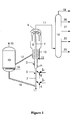
- the process of the present invention can be carried out according to the scheme shown in FIG. 1 .
- a prelift medium is introduced via a line 1 into the bottom of a riser reactor 2.
- the regenerated catalyst from a standpipe 16 is lifted by the prelift medium and moves upward.
- a portion of the feedstock from a line 3, along with the atomized steam from a line 4 is injected into the bottom of the reaction zone I of the riser reactor 2, and mixed with the existing stream in the riser reactor. Said feedstock cracks on the hot catalyst, and it moves upward.
- Another portion of feedstock from a line 5, along with the atomized steam from a line 6, is injected into the middle upper part of the reaction zone I of the riser reactor 2, and mixed with the existing stream in the riser reactor.
- the feedstock cracks on the lower catalyst having a deposited coke thereon, and it moves upward into the reaction zone II to continue to react.
- the reaction product vapors exit the cyclone and flow into a plenum chamber 9. Fine catalyst particles go back to the disengager via a dipleg.
- the spent catalyst in the disengager flows into a stripping section 10 and contacts with a steam from a line 11.
- the reaction product vapors stripped out of the spent catalyst enter the plenum chamber 9, via the cyclone.
- the stripped spent catalyst flows into a regenerator 13 via a standpipe 12.
- a main air enters the regenerator via a conduit 14 to burn off the coke deposited on the spent catalyst and regenerate the deactivated spent catalyst. Flue gas flows into turbine via a line 15. The regenerated catalyst is recycled
- Reaction product vapors in the plenum chamber 9 are transported via a transfer line 17 and introduced into a sequent separation system 18.
- the separated LPG product is removed via a line 20; the separated gasoline product is removed via a line 21; the separated dry gas product is removed via a line 19; the separated diesel product is removed via a line 22; and the separated FGO product is removed via a line 23.
- the boiling ranges of various fractions can be adjusted according to the requirements of refinery.
- the process of the present invention can be carried out according to the scheme shown in FIG. 2 .
- a prelift medium is introduced via a line 1 into the bottom of a riser reactor 2.
- the regenerated catalyst from a standpipe 16 is lifted by the prelift medium and moves upward.
- a hard crackability feedstock from a line 3, along with the atomized steam from a line 4, is injected into the bottom of the reaction zone I of the riser reactor 2, and mixed with the existing stream in the riser reactor. Said hard crackability feedstock cracks on the hot catalyst, and it moves upward.
- An easy crackability feedstock from a line 5, along with the atomized steam from a line 6, is injected into the middle upper part of the reaction zone I of the riser reactor 2, and mixed with the existing stream in the riser reactor.
- the easy crackability feedstock cracks on the lower catalyst having a deposited coke thereon, and it moves upward into the reaction zone II to continue to react.
- the reaction product vapors exit the cyclone and flow into a plenum chamber 9. Fine catalyst particles go back to the disengager via a dipleg.
- the spent catalyst in the disengager flows into a stripping section 10 and contacts with a steam from a line 11.
- the reaction product vapors stripped out of the spent catalyst enter the plenum chamber 9, via the cyclone.
- the stripped spent catalyst flows into a regenerator 13 via a standpipe 12.
- a main air enters the regenerator via a conduit 14 to burn off the coke deposited on the spent catalyst and regenerate the deactivated spent catalyst.
- Flue gas flows into turbine via a line 15.
- the regenerated catalyst is recycled into the riser reactor via the standpipe 16.
- Reaction product vapors in the plenum chamber 9 are transported via a transfer line 17 and introduced into a sequent separation system 18.
- the separated propylene product is removed via a line 219; the separated propane product is removed via a line 228; the C4 olefin is removed via a line 220 and a portion thereof is recycled back to the riser reactor 2; the catalytic cracked dry gas is removed via a line 221; the boiling range 180 ⁇ 260°C fraction is recycled back to the riser reactor 2 via a line 222; the boiling range 260 ⁇ 330°C diesel fraction may be removed via a line 229, or may be removed along with the FGO into an extraction unit 224; the FGO is introduced via a line 223 into the extraction unit 224, wherein the separated heavy aromatics product is removed via a line 226 and the RFGO is recycled back to the riser reactor 2 via a line 225; the high octane number gasoline product (C5 ⁇ 180°C) is removed via a line 227.
- the process of the present invention can be carried out according to the scheme shown in FIG. 3 .
- a prelift medium is introduced via a line 1 into the bottom of a riser reactor 2.
- the regenerated catalyst from a standpipe 16 is lifted by the prelift medium and moves upward.
- a hard crackability feedstock from a line 3, along with the atomized steam from a line 4, is injected into the bottom of the reaction zone I of the riser reactor 2, and mixed with the existing stream in the riser reactor. Said hard crackability feedstock cracks on the hot catalyst, and it moves upward.
- An easy crackability feedstock from a line 5, along with the atomized steam from a line 6, is injected into the middle upper part of the reaction zone I of the riser reactor 2, and mixed with the existing stream in the riser reactor.
- the easy crackability feedstock cracks on the lower catalyst having a deposited coke thereon, and it moves upward into the reaction zone II to continue to react.
- the reaction product vapors exit the cyclone and flow into a plenum chamber 9. Fine catalyst particles go back to the disengager via a dipleg.
- the spent catalyst in the disengager flows into a stripping section 10 and contacts with a steam from a line 11.
- the reaction product vapors stripped out of the spent catalyst enter the plenum chamber 9, via the cyclone.
- the stripped spent catalyst flows into a regenerator 13 via a standpipe 12.
- a main air enters the regenerator via a conduit 14 to burn off the coke deposited on the spent catalyst and regenerate the deactivated spent catalyst.
- Flue gas flows into turbine via a line 15.
- the regenerated catalyst is recycled into the riser reactor via the standpipe 16.
- Reaction product vapors in the plenum chamber 9 are transported via a transfer line 17 and introduced into a sequent separation system 18.
- the separated propylene is removed via a line 319; the separated propane is removed via a line 328; the C4 olefin is removed via a line 320 or may be recycled back to the bottom of the reaction zone I of the riser reactor 2; the catalytic cracked dry gas is removed via a line 321; the catalytic cracked gasoline is remove via a line 327; the boiling range 180 ⁇ 260°C fraction is recycled back to the bottom of the reaction zone I of the riser reactor 2 via a line 322; the boiling range above 260°C fraction is introduced via a line 323 into a hydrotreating unit 324, wherein the separated light component is removed via a line 325 and the HFGO is recycled back to the middle upper part of the reaction zone I of the riser reactor 2 via line 326.
- the boiling ranges of various fractions can be adjusted according to the requirements of refinery.
- Catalyst used in the examples was prepared as follows:
- Feedstock A was directly used as the feedstock of catalytic cracking and the experiment was conducted in a pilot riser reactor plant.
- Feedstock A was injected into the reaction zone I , wherein the catalytic cracking reaction was conducted.
- the reaction temperature was 530°C
- the WHSV was 30h -1
- the C/O was 10
- the weight ratio of steam/the feedstock was 0.15.
- Reaction product vapors and the coked spent catalyst were separated in the disengager, and then the products were separated, wherein propylene, the gasoline and the FGO were withdrawn. Operating conditions and product slate were listed in table 2.
- the experiment of the present example was carried out according to the scheme shown in FIG 2 .
- Feedstock A was directly used as the feedstock of catalytic cracking and the experiment was conducted in a pilot riser reactor plant.
- Easy crackability feedstock was injected into the middle-upper portion of reaction zone I, wherein the reaction temperature was 580°C, the WHSV was 60h -1 , the catalytic cracking catalyst/the easy crackability feedstock (m/m) was 10, the weight ratio of steam/the easy crackability feedstock was 0.15.
- Hard crackability feedstock was charged in the bottom of the reaction zone I, wherein the reaction temperature was 640°C, the WHSV was 180h -1 , the catalytic cracking catalyst/the hard crackability feedstock (m/m) was 60, and the weight ratio of steam/the hard crackability feedstock was 0.20.
- reaction zone II the reaction temperature was 540°C, the WHSV was 30h -1 , and the weight ratio of steam/the easy crackability feedstock was 0.15.
- Reaction product vapors and the spent catalyst were separated in the disengager, and then the products were separated, wherein propylene and the gasoline were withdrawn and a portion of C4 olefin and 180 ⁇ 260°C fractions were returned to the riser reactor.
- the FGO (the yield was 28.45% by weight and the hydrogen content was 11.01% by weight) was extracted with furfural, wherein the extraction temperature was 100°C, the solvent/FGO ratio was 3.0 (v/v), and then non-aromatic hydrocarbons and heavy aromatics were separated.
- the RFGO (that is said non-aromatic hydrocarbons) was mixed with the easy crackability feedstock and returned to the riser reactor. Operating conditions and product slate were listed in table 3.
- the experiment of the present example was carried out in the same plant as that in Example 2.
- Feedstock B was directly used as the feedstock of catalytic cracking and the experiment was conducted in a pilot riser reactor plant.
- Easy crackability feedstock was injected into the middle-upper portion of reaction zone I , wherein the reaction temperature was 580°C, the WHSV was 60h -1 , the catalytic cracking catalyst/the easy crackability feedstock (m/m) was 10, and the weight ratio of steam/the easy crackability feedstock was 0.15.
- Hard crackability feedstock was charged in the bottom of the reaction zone I , wherein the reaction temperature was 640°C, the WHSV was 180h -1 , the catalytic cracking catalyst/the hard crackability feedstock (m/m) was 60, and the weight ratio of steam/the hard crackability feedstock was 0.20.
- a portion of the stripped spent catalyst was introduced from the stripping section into the bottom of the reaction zone II, so as to decrease the temperature and the WHSV in the reaction zone II.
- the reaction temperature was 530°C
- the WHSV was 20h -1
- the weight ratio of steam/the easy crackability feedstock was 0.15.
- Reaction product vapors and the spent catalyst were separated in the disengager, and then the products were separated, wherein propylene and the gasoline were withdrawn and a portion of C4 olefin and 190 ⁇ 250°C fraction were returned to the riser reactor.
- the FGO (the yield was 32.83% by weight and the hydrogen content was 10.98% by weight) was extracted with furfural, wherein the extraction temperature was 100°C, the solvent/FGO ratio was 3.0 (v/v), and then non-aromatic hydrocarbons and heavy aromatics were separated.
- the RFGO that is said non-aromatic hydrocarbons
- Operating conditions and product slate were listed in table 3.
- the experiment of the present example was carried out according to the scheme shown in FIG 3 .
- Feedstock A was directly used as the feedstock of catalytic cracking and the experiment was conducted in a pilot riser reactor plant.
- Easy crackability feedstock was injected into the middle-upper portion of reaction zone I, wherein the reaction temperature was 580°C, the WHSV was 60h -1 , the catalytic cracking catalyst/the easy crackability feedstock (m/m) was 10, and the weight ratio of steam/the easy crackability feedstock was 0.15.
- Hard crackability feedstock was charged in the bottom of the reaction zone I, wherein the reaction temperature was 640°C, the WHSV was 180h -1 , the catalytic cracking catalyst/the hard crackability feedstock (m/m) was 60, and the weight ratio of steam/the hard crackability feedstock was 0.20.
- reaction zone II the reaction temperature was 540°C, the WHSV was 30h -1 , and the weight ratio of steam/the easy crackability feedstock was 0.15.
- Reaction product vapors and the spent catalyst were separated in the disengager, and then the products were separated, wherein propylene and the gasoline were withdrawn and a portion of C4 olefin and 180 ⁇ 260°C fractions were returned to the riser reactor.
- the FGO (the initial boiling point is above 260 °C and the yield was 28.46% by weight and the hydrogen content was 11.01% by weight) was hydrotreated, wherein the reaction temperature was 350°C, the hydrogen partial pressure was 18.0MPa, the hydrogen/oil ratio was 1500 by volume, and the volume hourly space velocity was 1.5h -1 .
- the resulting HFGO was returned to the above-mentioned pilot riser reactor. Operating conditions and product slate were listed in table 4.
- the experiment of the present example was carried out in the same plant as that in Example 4.
- Feedstock B was directly used as the feedstock of catalytic cracking and the experiment was conducted in a pilot riser reactor plant.
- Easy crackability feedstock was injected into the middle-upper portion of reaction zone I, wherein the reaction temperature was 580°C, the WHSV was 60h -1 , the catalytic cracking catalyst/the easy crackability feedstock (m/m) was 10, and the weight ratio of steam/the easy crackability feedstock was 0.15.
- Hard crackability feedstock was charged in the bottom of the reaction zone I, wherein the reaction temperature was 640°C, the WHSV was 180h -1 , the catalytic cracking catalyst/the hard crackability feedstock (m/m) was 60, and the weight ratio of steam/the hard crackability feedstock was 0.20.
- a portion of the stripped spent catalyst was introduced from the stripping section into the bottom of the reaction zone II, so as to decrease the temperature and the WHSV in the reaction zone II.
- the reaction temperature was 530°C
- the WHSV was 20h -1
- the weight ratio of steam/the easy crackability feedstock was 0.15.
- Reaction product vapors and the spent catalyst were separated in the disengager, and then the products were separated, wherein propylene and the gasoline were withdrawn and a portion of C4 olefin and 180 ⁇ 260°C fractions were returned to the riser reactor.
- the FGO (the initial boiling point is above 260 °C and the yield was 32.56% by weight and the hydrogen content was 10.97% by weight) was hydrotreated, wherein the reaction temperature was 450°C, the hydrogen partial pressure was 10.0MPa, the hydrogen/oil ratio was 500 by volume, and the volume hourly space velocity was 0.5h -1 .
- the HFGO was returned to the above-mentioned pilot riser reactor. Operating conditions and product slate were listed in table 4.
- Feedstock A B Catalytic cracking unit Operation condition Riser outlet temperature, °C 530 520 Riser reaction zone II Reaction temperature, °C 540 530 WHSV, h -1 30 20 Steam/feedstock ratio, m/m 0.15 0.15 Riser reaction zone I Reaction temperature, °C 640/580 640/580 C/O, m/m 60/10 60/10 WHSV, h -1 180/60 180/60 Steam/feedstock ratio, m/m 0.20/0.15 0.20/0.15 Solvent extraction unit Temperature, °C 100 100 Solvent/FGO, v/v 3.0 3.0 Product distribution, m% Dry gas 3.86 3.46 LPG 50.23 48.16 Propylene 29.02 28.01 Gasoline 33.71 35.20 Heavy aromatics 5.15 6.01 Coke 7.05 7.17 Total 100.00 100.00 Gasoline octane number RON 96.0 97.1 MON 84.0 85.0 Table 4 Example 4 Example 5 No.
- Feedstock A B Catalytic cracking unit Operation condition Riser outlet temperature, °C 530 520 Riser reaction zone II Reaction temperature, °C 540 530 WHSV, h -1 30 20 Steam/feedstock ratio, m/m 0.15 0.15 Riser reaction zone I Reaction temperature, °C 640/580 640/580 C/O, m/m 60/10 60/10 WHSV, h -1 180/60 180/60 Steam/feedstock ratio, m/m 0.20/0.15 0.20/0.15 Hydrotreating unit Hydrogen partial pressure, Mpa 18.0 10.0 Reaction temperature, °C 350 450 Hydrogen/feedstock ratio, v/v 1500 500 Volume hourly space velocity, h -1 1.5 0.5 Product distribution, m% Dry gas 3.32 3.16 LPG 51.23 48.12 Propylene 30.02 27.55 Gasoline 31.12 33.05 Diesel 8.33 9.47 Coke 6.0 6.2 Total 100.00 100.00
Landscapes
- Chemical & Material Sciences (AREA)
- Engineering & Computer Science (AREA)
- Organic Chemistry (AREA)
- Chemical Kinetics & Catalysis (AREA)
- Crystallography & Structural Chemistry (AREA)
- Materials Engineering (AREA)
- Oil, Petroleum & Natural Gas (AREA)
- General Chemical & Material Sciences (AREA)
- Production Of Liquid Hydrocarbon Mixture For Refining Petroleum (AREA)
- Catalysts (AREA)
Abstract
Description
- This invention relates to a catalytic conversion process. More particularly, the invention relates to a catalytic conversion process for converting heavy feedstocks into high octane gasoline and an enhanced yield of propylene, wherein the yields of dry gas and coke decrease significantly, thereby petroleum oil resources are utilized efficiently.
- Light olefins such as propylene are important organic chemical feedstocks. Commercial propylene is used to produce polypropylene, acrylonitrile and other chemicals. The propylene requirement is increasing year by year with a sharply increasing demand for polypropylene derivates. Worldwide annual propylene requirement amount increased from 15.2 million tons of twenty years ago to 51.2 million tons in 2000 and average annual increasing rate was 6.3%. It is estimated that there will be 86 million tons of propylene requirement in 2010 and average annual increasing rate will be 5.6% during that period.
- Steam cracking and fluid catalytic cracking (FCC) are the main processes to produce propylene. Light oil such as naphtha can be used as the feedstock in steam cracking to produce ethylene and propylene, and the yield of propylene is only about 15% by weight. However, the feedstock of FCC process is heavy oil such as vacuum gas oil (VGO). Currently, 61% amount of propylene is from a byproduct of steam cracking process which produces ethylene, and 34% amount of propylene is produced by FCC, and about 5% amount of propylene is produced by propane dehydrogenation and ethylene-butene metathesis process.
- Petrochemical industry will face to the shortage of light feedstock, deficiency of the processing capacity, high cost and other restrictive factors if ethylene and propylene are produced by the conventional petrochemical process such as steam cracking.
- The role of FCC is increasingly concerned since FCC has advantage of wide adaptability of feedstock and flexible operation. Almost 50% amount of propylene is from FCC in U.S.A. The catalytic cracking technology with enhanced propylene yield is being improved quickly.
-
U.S. Patent No. 4,980,053 discloses a process to produce gaseous olefins by catalytic conversion of hydrocarbons. Various fractions of petroleum, including residual oils and crude oils, are catalytically converted in fluidized or moving bed reactors with solid, acidic catalysts at a temperature of 500°C to 650°C, and a pressure of 0.15MPa to 0.3MPa, with a weight hourly space velocity of 0.2 hr-1 to 20 hr-1 and catalyst to oil ratio of 2 to 12. Catalyst is continuously recycled between the reactor and the regenerator. The total yield of propylene and butene is about 40% by weight of the feedstock, and propylene yield is about 26.34% by weight of the feedstock. -
WO00/31215A1 -
U.S. Patent No. 4,422,925 discloses a fluid catalytic cracking process in which a plurality cracking performance of hydrocarbon feedstocks including at least one gaseous paraffinic hydrocarbon feedstock and at least one liquid hydrocarbon feedstock are subjected to different cracking reaction conditions in several reaction zones in the present of regenerated catalyst to produce enhanced yield of light olefins. - Preserved amount of gasoline automobile has progressed rapidly due to economic development and the requirement of high quality gasoline is increasing. Presently improving gasoline octane number technologies include catalytic reforming, alkylation, isomerization, adding an gasoline octane number enhancing additive, and the like. The advantage of catalytic reforming is the heavy fraction of gasoline having high octane number, however, the octane number of light fraction gasoline is lower, in particular, the reforming catalyst cost is higher and the quality of feedstock is strictly required. Alkylation and isomerization technology can produce high octane number and good sensitivity gasoline which is a desirable high octane number clean gasoline component, there is, however, corrosion and environmental protection problem with the used catalyst. The octane number enhancing additive such as MTBE and ETBE can increase gasoline octane number and improve automobile performace, but the cost is higher. Catalytic cracking gasoline is a main source of automobile gasoline pool. The octane number of catalytic cracking gasoline is affected by lower octane number heavy gasoline fraction. Generally, the quality of FCC diesel is worse than straight-run diesel oil. FCC diesel oil is rich in mono ring aromatic hydrocarbons, which can be catalytically converted to high octane gasoline component and propylene product.
- The prior arts are insufficient in paraffin molecules catalytic conversion, therefore the dry gas is increasing sharply when the propylene yield grows. Because of underutilization of the gasoline potential content of diesel oil which can produce high octane gasoline and light olefins, there still have room to improve for the quality and yield of gasoline. Therefore, it is desirable to develop a process for catalytic cracking of heavy feedstocks to produce an enhanced yield of high octane number gasoline and an enhanced yield of propylene to meet the market requirements of light olefin and gasoline.
- An object of the present invention is to provide a catalytic conversion process; in particular, for converting heavy feedstocks into high octane gasoline and an enhanced yield of propylene, wherein the yields of dry gas and coke decrease significantly, thereby petroleum oil resources are utilized efficiently.
- In an embodiment of the present invention, a catalytic conversion process provided by the present invention comprises catalytic cracking reaction of a hydrocarbon feedstock contacting with a medium pore size zeolite enriched catalyst in a reactor, characterized in that reaction temperature, weight hourly space velocity (WHSV) and catalyst/ feedstock ratio by weight (C/O) are sufficient to achieve a yield of fluid catalytic cracking gas oil (FGO) between 12% and 60% by weight of said feedstock, wherein said WHSV is between 25h-1 and 100 h-1, said reaction temperature is between 450°C and 600°C, and said C/O is between 1 and 30.
- In the more preferred embodiment, reaction temperature is between 450°C and 600°C, and preferably between 460°C and 580°C, and even more preferably between 480°C and 540°C.
- In the more preferred embodiment, WHSV is between 30h-1 and 80h-1, and preferably between 40h-1 and 60h-1.
- In the more preferred embodiment, C/O is between 1 and 30, and preferably between 2 and 25, and even more preferably between 3 and 14.
- In the more preferred embodiment, reaction pressure is between 0.10MPa and 1.00MPa.
- In the more preferred embodiment, said feedstock is selected from or includes petroleum hydrocarbons and/or other mineral oils, wherein the petroleum hydrocarbon is one selected from the group consisting of vacuum gas oil (VGO), atmospheric gas oil (AGO), coker gas oil (CGO), deasphalted oil (DAO), vacuum residue (VR) and atmospheric residue (AR) or mixtures thereof, and the other mineral oil is one selected from the group consisting of coal liquefied oil, tar sand oil and shale oil or mixtures thereof.
- In the more preferred embodiment, said catalyst comprises zeolite, inorganic oxide and optional clay, which account for the following percent of the total weight of the catalyst respectively: zeolite 1∼50% by weight,
inorganic oxide 5∼99% by weight, and clay 0∼70% by weight. Said zeolite is selected from medium pore size zeolite and optional large pore size zeolite. Said medium pore size zeolite accounts for 51∼100% of the total weight of the zeolite, and preferably for 70∼100% of the total weight of the zeolite. Said large pore size zeolite accounts for 0∼49% of the total weight of the zeolite, and preferably for 0∼30% of the total weight of the zeolite. Said medium pore size zeolite is selected from ZSM series zeolites and/or ZRP zeolites and said large pore size zeolite is selected from Y series zeolites. - In the more preferred embodiment, said reactor is selected from a riser, an iso-linear speed fluidized bed, an iso-diameter fluidized bed, a descending transfer line and a ascending transfer line or a combination thereof, or a combination of same reactors (two or more reactors), wherein said combination includes cascade or/and parallel. Said riser is a conventional iso-diameter riser or various diverse diameter risers.
- In the more preferred embodiment, said feedstock is charged into reactor from one position, or from two or more positions whose height are same or different.
- In the more preferred embodiment, said process comprises:
- (1) Reaction products and catalyst are separated, wherein catalyst is stripped, regenerated by burning off the coke, and then returns to the reactor.
- (2) The separated products include propylene, high octane gasoline and FGO.
- In the more preferred embodiment, the initial boiling point of said FGO is not less than 260°C, and hydrogen content of said FGO is not less than 10.5% by weight.
- In the more preferred embodiment, the initial boiling point of said FGO is not less than 330°C, and hydrogen content of said FGO is not less than 10.8% by weight.
- Another embodiment provides:
- A catalytic conversion process, wherein feedstocks are reacted by contacting with a medium pore size zeolite enriched catalyst in a reactor, which comprises:
- (1) Said feedstocks include hard crackability feedstock and easy crackability feedstock, which are injected into the reactor from one position, or from two or more positions whose height are same or different,
- (2) Hard crackability feedstock reacts in the reactor not later than easy crackability feedstock,
- (3) Reaction temperature, WHSV and C/O sufficient to achieve a yield of FGO between 12% and 60% by weight of easy crackability feedstock,
- (4) Said WHSV of easy crackability feedstock is 5∼100h-1.
- In the more preferred embodiment, said hard crackability feedstock is one selected from or includes slurry, diesel, gasoline, hydrocarbons with 4∼8 carbon atoms, or mixture thereof.
- In the more preferred embodiment, said easy crackability feedstock is selected from or includes petroleum hydrocarbons and/or other mineral oils, wherein the petroleum hydrocarbon is one selected from the group consisting of VGO, AGO, CGO, DAO, VR and AR or mixtures thereof, and the other mineral oil is one selected from the group consisting of coal liquefied oil, tar sand oil and shale oil or mixtures thereof.
- In the more preferred embodiment, said catalyst comprises zeolite, inorganic oxide and optional clay, which account for the following percent of the total weight of the catalyst respectively: zeolite 1∼50% by weight,
inorganic oxide 5∼99% by weight, and clay 0∼70% by weight. Said zeolite is selected from medium pore size zeolite and optional large pore size zeolite. Said medium pore size zeolite accounts for 51∼100% of the total weight of the zeolite and said large pore size zeolite accounts for 0∼49% of the total weight of the zeolite. Said medium pore size zeolite is selected from ZSM series zeolites and/or ZRP zeolites and said large pore size zeolite is selected from Y series zeolites. - In the more preferred embodiment, said reactor is selected from a riser, an iso-linear speed fluidized bed, an iso-diameter fluidized bed, a descending transfer line and a ascending transfer line or a combination thereof, or a combination of same reactors (two or more reactors), wherein said combination includes cascade or/and parallel. Said riser is a conventional iso-diameter riser or various diverse diameter risers.
- In the more preferred embodiment, reaction conditions of hard crackability feedstock are: reaction temperature between 600°C and 750°C, WHSV between 100h-1 and 800h-1, C/O between 30 and 150, reaction pressure between 0.10MPa and 1.00MPa and steam/hard crackability feedstock ratio by weight between 0.05 and 1.00.
- In the more preferred embodiment, reaction conditions of easy crackability feedstock are: reaction temperature between 450°C and 600°C, WHSV between 5h-1 and 100h-1, C/O between 1 and 30, reaction pressure between 0.10MPa and 1.00MPa and steam/easy crackability feedstock ratio by weight between 0.05 and 1.00.
- In the more preferred embodiment, the reaction conditions of easy crackability feedstock are: reaction temperature between 460°C and 580°C; WHSV between 10h-1 and 90h-1, preferably between 20h-1 and 60h-1, and even more preferably between 30h-1 and 50h-1; C/O between 3 and 14.
- In the more preferred embodiment, it comprises: reaction products and catalyst are separated, wherein catalyst is stripped, regenerated by burning off the coke, and then returns to reactor, the separated products include propylene, high octane number gasoline and FGO.
- In the more preferred embodiment, the initial boiling point of FGO is not less than 260°C, and hydrogen content of FGO is not less than 10.5% by weight.
- In the more preferred embodiment, the initial boiling point of FGO is not less than 330°C, and hydrogen content of FGO is not less than 10.8% by weight.
- The third embodiment provides:
- A process for producing propylene and high octane number gasoline, which comprises:
- (1) A feedstock comprising hard crackability feedstock is contacted with a medium pore size zeolite enriched catalyst and cracked in a reactor under the conditions of a reaction temperature between 600°C and 750°C , a WHSV between 100h-1 and 800 h-1, a reaction pressure between 0.10MPa and 1.00MPa, a C/O between 30 and 150 and a steam/hard crackability feedstock ratio between 0.05 and 1.00 by weight,
- (2) A reaction stream containing hard crackability feedstock, along with easy crackability feedstock, is further cracked under the conditions of a reaction temperature between 450°C and 600°C , a WHSV between 5h-1 and 100 h-1, a reaction pressure between 0.10MPa and 1.00MPa, a C/O between 1.0 and 30.0 and a steam/easy crackability feedstock ratio between 0.05 and 1.00 by weight,
- (3) Spent catalyst and product vapors are separated by cyclone separator. Optionally, spent catalyst is charged into stripping section and stripped. The stripped spent catalyst is regenerated by burning off the coke and returns to reactor. The product vapors are separated to obtain a product comprising propylene, high octane number gasoline and FGO,
- (4) Said FGO is hydrotreated or/and is extracted with aromatic hydrocarbons to obtain hydrotreated FGO (HFGO) or/and a raffinate of FGO (RFGO). Said HFGO or/and RFGO return to step (1) or/and step (2) as hard crackability feedstock or/and easy crackability feedstock.
- In the more preferred embodiment, said hard crackability feedstock is one selected from or includes slurry, diesel, gasoline and hydrocarbons with 4∼8 carbon atoms or mixture thereof. Said easy crackability feedstock is selected from or includes petroleum hydrocarbons and/or other mineral oils, wherein the petroleum hydrocarbon is one selected from the group consisting of VGO, AGO, CGO, DAO, VR and AR or mixtures thereof, and the other mineral oil is one selected from the group consisting of coal liquefied oil, tar sand oil and shale oil or mixtures thereof. Said gasoline is one selected from or includes gasoline obtained from this process, catalytic cracking gasoline, straight-run gasoline, coker gasoline, pyrolysis gasoline, thermal cracking gasoline and hydrogasoline or mixture thereof, wherein catalytic cracking gasoline, straight-run gasoline, coker gasoline, pyrolysis gasoline, thermal cracking gasoline and hydrogasoline are those that are not obtained from the process of the present invention. Said diesel is one selected from or includes diesel obtained in this process, catalytic cracking diesel, straight-run diesel, coker diesel, pyrolysis diesel, thermal cracking diesel and hydrodiesel or mixture thereof, wherein catalytic cracking diesel, straight-run diesel, coker diesel, pyrolysis diesel, thermal cracking diesel and hydrodiesel are those that are not obtained from the process of the present invention. Said hydrocarbon with 4-8 carbon atoms is one selected from or includes those obtained from this process, or those that may be obtained from conventional catalytic cracking process, coking process, pyrolysis process, thermal cracking process, hydrotreating process and the like.
- In the more preferred embodiment, said catalyst comprises zeolite, inorganic oxide and optional clay, which account for the following percent of the total weight of the catalyst respectively: zeolite 1∼50% by weight,
inorganic oxide 5∼99% by weight, and clay 0∼70% by weight. Said zeolite is selected from medium pore size zeolite and optional large pore size zeolite. Said medium pore size zeolite accounts for 51∼100% of the total weight of the zeolite and said large pore size zeolite accounts for 0∼49% of the total weight of the zeolite. The medium pore size zeolite is selected from ZSM series zeolites and/or ZRP zeolites, or ZSM and ZRP zeolites modified with nonmetal elements such as phosphor and/or transition metal elements such as iron, cobalt and nickel. SeeUS Pat. No. 5,232,675 for more detailed description of ZRP zeolites. The ZSM series zeolite is one selected from the group consisting of ZSM-5, ZSM-11, ZSM-12, ZSM-23, ZSM-35, ZSM-38, ZSM-48, and other zeolites with similar structure, or mixture thereof. SeeUS Pat. No. 3,702,886 for more detailed description of ZSM-5 zeolties. The large pore size zeolite is one selected from Y series zeolites, which include: rare-earth Y (REY), rare-earth HY (REHY), ultrastable Y and high silica Y obtained by different processes or mixtures thereof. The inorganic oxide as a binder is selected from silica (SiO2) and/or alumina (Al2O3). The clay as a matrix (i.e. support) is selected from kaolin and/or halloysite. The catalytic cracking catalyst in each reactor may be identical or different. - In the more preferred embodiment, product vapors in step (3) can be separated to obtain a fraction of distillation range 180∼260°C. The fraction can return to step (1) or/and step (2) as hard crackability feedstock or/and easy crackability feedstock.
- Said fraction of distillation range 180∼260°C may be either obtained from this process, or from conventional catalytic cracking process, coking process, pyrolysis process, thermal cracking process, hydrotreating process and the like, or includes any other fraction rich in mono-ring aromatics.
- In the more preferred embodiment, said reactor is selected from a riser, an iso-linear speed fluidized bed, an iso-diameter fluidized bed, a descending transfer line and a ascending transfer line or a combination thereof, or a combination of same reactors (two or more reactors), wherein said combination includes cascade or/and parallel. Said riser is a conventional iso-diameter riser or various diverse diameter risers. The velocity of the gas in the fluidized bed is between 0.1m/s and 2.0 m/s (catalyst is neglected). The velocity of the gas in the riser is between 2m/s and 30 m/s (catalyst is neglected).
- One best embodiment of the present invention is conducted in a diverse diameter riser reactor. More detailed description of this reactor is referred to Chinese Patent Application
CN1237477A , - In order to increase the catalyst/feedstock ratio in a downstream zone of the reactor and the catalyst activity, a part of medium can be fed, which is selected from or/and includes hot/cooled regenerated catalyst, regenerated catalyst, semi-regenerated catalyst, spent catalyst, fresh catalyst and the like. The cooled regenerated catalyst and the cooled semi-regenerated catalyst are obtained by cooling catalyst through catalyst cooler after the spent catalyst is regenerated in two-stage and one-stage regeneration respectively. The regenerated catalyst refers to a catalyst that has a residual carbon content of below 0.1% by weight, more preferably below 0.05% by weight. The semi-regenerated catalyst refers to a catalyst that has a residual carbon content of from 0.1% to 0.9% by weight, more preferably from 0.15% to 0.7% by weight. The spent catalyst refers to a catalyst that has a residual carbon content of above 0.9% by weight, more preferably from 0.9% to 1.2% by weight.
- The process for separating products such as propylene from the reaction product is the same as those well known to the ordinary skilled in the art. The fraction of distillation range 180∼260°C, more preferably 190∼250°C can be separated in an existing FCC fractionation column or an individual fractionation column. For the FGO fraction having an initial boiling point of above 250°C or above 260°C or above 330°C, it can be conveyed to an extractor to obtain heavy aromatic products and non-aromatic products (i.e. raffinate oil), or a hydrotreater to obtain the hydrotreated FGO, or it also can be used as the feedstock of FCC.
- The extraction solvent of FGO is one selected from or includes dimethyl sulfoxide, furfural, dimethylformamide, monoethanolamine, ethylene glycol and 1,2-propanediol or mixture thereof. The extraction solvent can be recycled. The extraction temperature is 100°C, and the solvent/feedstock ratio is between 0.5 and 5.0 by volume. The extracted heavy aromatics are desired products, and the FGO raffinate oil (i.e. non-aromatic hydrocarbons) can be used as one of the FCC feedstocks.
- The hydrotreating of FGO is conducted in the presence of hydrogen gas by contacting with a catalyst at the following conditions: hydrogen partial pressure 3.0MPa ∼ 20.0 MPa, reaction temperature 300∼450°C, hydrogen/oil ratio 300-2000 by volume, and volume hourly space velocity 0.1∼3.0h-1. The hydrotreated FGO can be used as the feedstock of FCC.
- The embodiment(s) of the present invention can integrate the fluid catalytic cracking process with the FGO hydrotreating process or/and the solvent extraction process of the aromatics of FGO to obtain a high octane gasoline and an improved yield of light olefins, particularly propylene, from heavy feedstocks having a relative low hydrogen content. The present invention has several important advantages over the prior art in that:
- 1. The propylene yield and the propylene selectivity in LGP are improved greatly, and the propylene yield is as high as 27% by weight.
- 2. The gasoline yield increases obviously, and the gasoline octane number is improved significantly.
- 3. The yields of dry gas and coke decrease while the propylene yield increases markedly.
- 4. The light oil yield increases and the slurry yield decreases significantly; therefore, the process of the present invention can utilize petroleum oil resources efficiently.
- 5. The run period of hydrotreating units increases considerably.
-
-
FIG. 1 is a schematic representation for the first embodiment of the process of the present invention. -
FIG. 2 is a schematic representation for the second embodiment of the process of the present invention. -
FIG. 3 is a schematic representation for the third embodiment of the process of the present invention. - The accompanying drawing, which is hereby incorporated in this specification, illustrates several embodiments of the invention and together with the description serve to explain but not limit the scope of the present invention. Thus, it will be apparent to one skilled in the art that certain modifications may be made to the invention as described without departing from the scope of the claims set out below.
- According to the first specific embodiment of the present invention, the process of the present invention can be carried out according to the scheme shown in
FIG. 1 . - A prelift medium is introduced via a line 1 into the bottom of a
riser reactor 2. The regenerated catalyst from astandpipe 16 is lifted by the prelift medium and moves upward. A portion of the feedstock from aline 3, along with the atomized steam from aline 4, is injected into the bottom of the reaction zone I of theriser reactor 2, and mixed with the existing stream in the riser reactor. Said feedstock cracks on the hot catalyst, and it moves upward. Another portion of feedstock from aline 5, along with the atomized steam from aline 6, is injected into the middle upper part of the reaction zone I of theriser reactor 2, and mixed with the existing stream in the riser reactor. The feedstock cracks on the lower catalyst having a deposited coke thereon, and it moves upward into the reaction zone II to continue to react. The resulting reaction product vapors and the deactivated spent catalyst, through aline 7, enter a cyclone separator of adisengager 8, wherein the spent catalyst and the reaction product vapors are separated. The reaction product vapors exit the cyclone and flow into aplenum chamber 9. Fine catalyst particles go back to the disengager via a dipleg. The spent catalyst in the disengager flows into a strippingsection 10 and contacts with a steam from aline 11. The reaction product vapors stripped out of the spent catalyst enter theplenum chamber 9, via the cyclone. The stripped spent catalyst flows into aregenerator 13 via astandpipe 12. A main air enters the regenerator via aconduit 14 to burn off the coke deposited on the spent catalyst and regenerate the deactivated spent catalyst. Flue gas flows into turbine via aline 15. The regenerated catalyst is recycled into the riser reactor via thestandpipe 16. - Reaction product vapors in the
plenum chamber 9 are transported via atransfer line 17 and introduced into asequent separation system 18. The separated LPG product is removed via aline 20; the separated gasoline product is removed via aline 21; the separated dry gas product is removed via aline 19; the separated diesel product is removed via aline 22; and the separated FGO product is removed via aline 23. The boiling ranges of various fractions can be adjusted according to the requirements of refinery. - According to the second specific embodiment of the present invention, the process of the present invention can be carried out according to the scheme shown in
FIG. 2 . - A prelift medium is introduced via a line 1 into the bottom of a
riser reactor 2. The regenerated catalyst from astandpipe 16 is lifted by the prelift medium and moves upward. A hard crackability feedstock from aline 3, along with the atomized steam from aline 4, is injected into the bottom of the reaction zone I of theriser reactor 2, and mixed with the existing stream in the riser reactor. Said hard crackability feedstock cracks on the hot catalyst, and it moves upward. An easy crackability feedstock from aline 5, along with the atomized steam from aline 6, is injected into the middle upper part of the reaction zone I of theriser reactor 2, and mixed with the existing stream in the riser reactor. The easy crackability feedstock cracks on the lower catalyst having a deposited coke thereon, and it moves upward into the reaction zone II to continue to react. The resulting reaction product vapors and the deactivated spent catalyst, through aline 7, enter a cyclone separator of adisengager 8, wherein the spent catalyst and the reaction product vapors are separated. The reaction product vapors exit the cyclone and flow into aplenum chamber 9. Fine catalyst particles go back to the disengager via a dipleg. The spent catalyst in the disengager flows into a strippingsection 10 and contacts with a steam from aline 11. The reaction product vapors stripped out of the spent catalyst enter theplenum chamber 9, via the cyclone. The stripped spent catalyst flows into aregenerator 13 via astandpipe 12. A main air enters the regenerator via aconduit 14 to burn off the coke deposited on the spent catalyst and regenerate the deactivated spent catalyst. Flue gas flows into turbine via aline 15. The regenerated catalyst is recycled into the riser reactor via thestandpipe 16. - Reaction product vapors in the
plenum chamber 9 are transported via atransfer line 17 and introduced into asequent separation system 18. The separated propylene product is removed via aline 219; the separated propane product is removed via aline 228; the C4 olefin is removed via aline 220 and a portion thereof is recycled back to theriser reactor 2; the catalytic cracked dry gas is removed via aline 221; the boiling range 180∼260°C fraction is recycled back to theriser reactor 2 via aline 222; the boiling range 260∼330°C diesel fraction may be removed via aline 229, or may be removed along with the FGO into anextraction unit 224; the FGO is introduced via aline 223 into theextraction unit 224, wherein the separated heavy aromatics product is removed via aline 226 and the RFGO is recycled back to theriser reactor 2 via aline 225; the high octane number gasoline product (C5∼180°C) is removed via aline 227. The boiling ranges of various fractions can be adjusted according to the requirements of refinery. - According to the third specific embodiment of the present invention, the process of the present invention can be carried out according to the scheme shown in
FIG. 3 . - A prelift medium is introduced via a line 1 into the bottom of a
riser reactor 2. The regenerated catalyst from astandpipe 16 is lifted by the prelift medium and moves upward. A hard crackability feedstock from aline 3, along with the atomized steam from aline 4, is injected into the bottom of the reaction zone I of theriser reactor 2, and mixed with the existing stream in the riser reactor. Said hard crackability feedstock cracks on the hot catalyst, and it moves upward. An easy crackability feedstock from aline 5, along with the atomized steam from aline 6, is injected into the middle upper part of the reaction zone I of theriser reactor 2, and mixed with the existing stream in the riser reactor. The easy crackability feedstock cracks on the lower catalyst having a deposited coke thereon, and it moves upward into the reaction zone II to continue to react. The resulting reaction product vapors and the deactivated spent catalyst, through aline 7, enter a cyclone separator of adisengager 8, wherein the spent catalyst and the reaction product vapors are separated. The reaction product vapors exit the cyclone and flow into aplenum chamber 9. Fine catalyst particles go back to the disengager via a dipleg. The spent catalyst in the disengager flows into a strippingsection 10 and contacts with a steam from aline 11. The reaction product vapors stripped out of the spent catalyst enter theplenum chamber 9, via the cyclone. The stripped spent catalyst flows into aregenerator 13 via astandpipe 12. A main air enters the regenerator via aconduit 14 to burn off the coke deposited on the spent catalyst and regenerate the deactivated spent catalyst. Flue gas flows into turbine via aline 15. The regenerated catalyst is recycled into the riser reactor via thestandpipe 16. - Reaction product vapors in the
plenum chamber 9 are transported via atransfer line 17 and introduced into asequent separation system 18. The separated propylene is removed via aline 319; the separated propane is removed via aline 328; the C4 olefin is removed via aline 320 or may be recycled back to the bottom of the reaction zone I of theriser reactor 2; the catalytic cracked dry gas is removed via aline 321; the catalytic cracked gasoline is remove via aline 327; the boiling range 180∼260°C fraction is recycled back to the bottom of the reaction zone I of theriser reactor 2 via aline 322; the boiling range above 260°C fraction is introduced via aline 323 into ahydrotreating unit 324, wherein the separated light component is removed via aline 325 and the HFGO is recycled back to the middle upper part of the reaction zone I of theriser reactor 2 vialine 326. The boiling ranges of various fractions can be adjusted according to the requirements of refinery. - The following examples are used to demonstrate the effect of the present invention and are not intended to limit the scope of the invention to the detailed examples shown herein. The properties of the feedstocks are listed in table 1.
- Catalyst used in the examples was prepared as follows:
- 1) 20g NH4Cl was dissolved in 1000g water, and 100g (dry basis) crystallized product ZRP-1 zeolite (an MFI-structured zeolite produced in Qilu Petrochemical Co. with a SiO2/Al2O3 molar ratio of 30, a content of rare earth RE2O3=2.0% by weight) was added to this solution, after exchanging at 90°C for 0.5h, filtering to yield a filter cake. 4.0g of H3PO4 (with a concentration of 85wt%) and 4.5g of Fe(NO3)3 were dissolved in 90g water to obtain a solution. The filter cake was impregnated with the obtained solution and dried. The resultant solid was calcined at 550 °C for 2 hours to yield an MFI-structured medium pore sized zeolite containing phosphor and iron. The anhydrous chemical formula of the catalyst was
0.1Na2O·5.1Al2O3·2.4P2O5·1.5Fe2O3·3.8RE2O3·88.1SiO2.
- 2) 75.4kg halloysite clay (an industrial product of Suzhou Porcelain Clay Co. with a solid content of 71.6% by weight) was slurried with 250kg deionized water, whereto 54.8kg pseudo-boehmite (an industrial product of Shandong Alumina Plant with a solid content of 63% by weight) was added. The PH value was adjusted at 2-4 with hydrochloric acid. The slurry was uniformly stirred and laid aside for aging at 60∼70°C for 1 hour. The temperature was decreased to below 60°C while maintaining the PH value at 2-4, and then 41.5kg alumina sol (a product of Qilu Petrochemical Co. with an Al2O3 content of 21.7% by weight) was added. After stirring for 40 min, a mixed slurry was obtained.
- 3) 22.5kg (dry basis, prepared in step 1) MFI-structured medium pore sized zeolite containing phosphor and iron and 2.0kg (dry basis) DASY zeolite (an ultrastable zeolite-Y product of Qilu Petrochemical Co. with a unit cell size of 2.445∼2.448nm) were added into the mixed slurry (prepared in step 2) and uniformly stirred to yield a slurry. The obtained slurry was shaped by spray drying, and the product was washed off the free Na+ with ammonium dihydrogen phosphate solution (phosphor content 1% by weight). After drying, a sample of the catalytic cracking catalyst was obtained. The composition of the catalyst was 18 by weight of MFI-structured medium pore sized zeolite containing phosphor and iron, 2% by weight of DASY zeolite, 28% by weight of pseudo-boehmite, 7% by weight of alumina sol, and balanced kaolin.
- The experiment of the present example was carried out according to the scheme shown in
FIG 1 . Feedstock A was directly used as the feedstock of catalytic cracking and the experiment was conducted in a pilot riser reactor plant. Feedstock A was injected into the reaction zone I , wherein the catalytic cracking reaction was conducted. The reaction temperature was 530°C, the WHSV was 30h-1, the C/O was 10, and the weight ratio of steam/the feedstock was 0.15. Reaction product vapors and the coked spent catalyst were separated in the disengager, and then the products were separated, wherein propylene, the gasoline and the FGO were withdrawn. Operating conditions and product slate were listed in table 2. - It can be seen from Table 2 that the yield of propylene attains as high as 18.29% by weight and those of dry gas and coke are only 2.36% and 3.95% by weight respectively, and the FGO yield is 30.12% by weight whose hydrogen content is 11.08% by weight.
- The experiment of the present example was carried out according to the scheme shown in
FIG 2 . Feedstock A was directly used as the feedstock of catalytic cracking and the experiment was conducted in a pilot riser reactor plant. Easy crackability feedstock was injected into the middle-upper portion of reaction zone I, wherein the reaction temperature was 580°C, the WHSV was 60h-1, the catalytic cracking catalyst/the easy crackability feedstock (m/m) was 10, the weight ratio of steam/the easy crackability feedstock was 0.15. Hard crackability feedstock was charged in the bottom of the reaction zone I, wherein the reaction temperature was 640°C, the WHSV was 180h-1, the catalytic cracking catalyst/the hard crackability feedstock (m/m) was 60, and the weight ratio of steam/the hard crackability feedstock was 0.20. In reaction zone II, the reaction temperature was 540°C, the WHSV was 30h-1, and the weight ratio of steam/the easy crackability feedstock was 0.15. Reaction product vapors and the spent catalyst were separated in the disengager, and then the products were separated, wherein propylene and the gasoline were withdrawn and a portion of C4 olefin and 180∼260°C fractions were returned to the riser reactor. The FGO (the yield was 28.45% by weight and the hydrogen content was 11.01% by weight) was extracted with furfural, wherein the extraction temperature was 100°C, the solvent/FGO ratio was 3.0 (v/v), and then non-aromatic hydrocarbons and heavy aromatics were separated. The RFGO (that is said non-aromatic hydrocarbons) was mixed with the easy crackability feedstock and returned to the riser reactor. Operating conditions and product slate were listed in table 3. - It can be seen from Table 3 that the yield of propylene attains as high as 29.02% by weight; the gasoline yield is 33.71% by weight, and its research octane number (RON) and motor octane number (MON) are as high as 96.0 and 84.0 respectively.
- The experiment of the present example was carried out in the same plant as that in Example 2. Feedstock B was directly used as the feedstock of catalytic cracking and the experiment was conducted in a pilot riser reactor plant. Easy crackability feedstock was injected into the middle-upper portion of reaction zone I , wherein the reaction temperature was 580°C, the WHSV was 60h-1, the catalytic cracking catalyst/the easy crackability feedstock (m/m) was 10, and the weight ratio of steam/the easy crackability feedstock was 0.15. Hard crackability feedstock was charged in the bottom of the reaction zone I , wherein the reaction temperature was 640°C, the WHSV was 180h-1, the catalytic cracking catalyst/the hard crackability feedstock (m/m) was 60, and the weight ratio of steam/the hard crackability feedstock was 0.20. In addition, a portion of the stripped spent catalyst was introduced from the stripping section into the bottom of the reaction zone II, so as to decrease the temperature and the WHSV in the reaction zone II. In the reaction zone II, the reaction temperature was 530°C, the WHSV was 20h-1, and the weight ratio of steam/the easy crackability feedstock was 0.15. Reaction product vapors and the spent catalyst were separated in the disengager, and then the products were separated, wherein propylene and the gasoline were withdrawn and a portion of C4 olefin and 190∼250°C fraction were returned to the riser reactor. The FGO (the yield was 32.83% by weight and the hydrogen content was 10.98% by weight) was extracted with furfural, wherein the extraction temperature was 100°C, the solvent/FGO ratio was 3.0 (v/v), and then non-aromatic hydrocarbons and heavy aromatics were separated. The RFGO (that is said non-aromatic hydrocarbons) was mixed with the feedstock and returned to the riser reactor. Operating conditions and product slate were listed in table 3.
- It can be seen from Table 3 that the yield of propylene attains as high as 28.41% by weight; the gasoline yield is as high as 35.20% by weight, and its research octane number (RON) and motor octane number (MON) are as high as 97.1 and 85.0 respectively.
- The experiment of the present example was carried out according to the scheme shown in
FIG 3 . Feedstock A was directly used as the feedstock of catalytic cracking and the experiment was conducted in a pilot riser reactor plant. Easy crackability feedstock was injected into the middle-upper portion of reaction zone I, wherein the reaction temperature was 580°C, the WHSV was 60h-1, the catalytic cracking catalyst/the easy crackability feedstock (m/m) was 10, and the weight ratio of steam/the easy crackability feedstock was 0.15. Hard crackability feedstock was charged in the bottom of the reaction zone I, wherein the reaction temperature was 640°C, the WHSV was 180h-1, the catalytic cracking catalyst/the hard crackability feedstock (m/m) was 60, and the weight ratio of steam/the hard crackability feedstock was 0.20. In reaction zone II, the reaction temperature was 540°C, the WHSV was 30h-1, and the weight ratio of steam/the easy crackability feedstock was 0.15. Reaction product vapors and the spent catalyst were separated in the disengager, and then the products were separated, wherein propylene and the gasoline were withdrawn and a portion of C4 olefin and 180∼260°C fractions were returned to the riser reactor. The FGO (the initial boiling point is above 260 °C and the yield was 28.46% by weight and the hydrogen content was 11.01% by weight) was hydrotreated, wherein the reaction temperature was 350°C, the hydrogen partial pressure was 18.0MPa, the hydrogen/oil ratio was 1500 by volume, and the volume hourly space velocity was 1.5h-1. The resulting HFGO was returned to the above-mentioned pilot riser reactor. Operating conditions and product slate were listed in table 4. - It can be seen from Table 4 that the yield of propylene attains as high as 30.02% by weight; the dry gas yield is only 3.32% by weight, and the liquid yield is 90.68% by weight.
- The experiment of the present example was carried out in the same plant as that in Example 4. Feedstock B was directly used as the feedstock of catalytic cracking and the experiment was conducted in a pilot riser reactor plant. Easy crackability feedstock was injected into the middle-upper portion of reaction zone I, wherein the reaction temperature was 580°C, the WHSV was 60h-1, the catalytic cracking catalyst/the easy crackability feedstock (m/m) was 10, and the weight ratio of steam/the easy crackability feedstock was 0.15. Hard crackability feedstock was charged in the bottom of the reaction zone I, wherein the reaction temperature was 640°C, the WHSV was 180h-1, the catalytic cracking catalyst/the hard crackability feedstock (m/m) was 60, and the weight ratio of steam/the hard crackability feedstock was 0.20. In addition, a portion of the stripped spent catalyst was introduced from the stripping section into the bottom of the reaction zone II, so as to decrease the temperature and the WHSV in the reaction zone II. In the reaction zone II, the reaction temperature was 530°C, the WHSV was 20h-1, and the weight ratio of steam/the easy crackability feedstock was 0.15. Reaction product vapors and the spent catalyst were separated in the disengager, and then the products were separated, wherein propylene and the gasoline were withdrawn and a portion of C4 olefin and 180∼260°C fractions were returned to the riser reactor. The FGO (the initial boiling point is above 260 °C and the yield was 32.56% by weight and the hydrogen content was 10.97% by weight) was hydrotreated, wherein the reaction temperature was 450°C, the hydrogen partial pressure was 10.0MPa, the hydrogen/oil ratio was 500 by volume, and the volume hourly space velocity was 0.5h-1. The HFGO was returned to the above-mentioned pilot riser reactor. Operating conditions and product slate were listed in table 4.
- It can be seen from Table 4 that the yield of propylene attains as high as 27.55% by weight; the dry gas yield is only 3.16% by weight, and the liquid yield is 90.64% by weight.
Table 1 Examples 1,2,4 Examples 3,5 No. Feedstock A B Property of feedstock Density (20°C), g/cm3 0.8886 0.9134 Sulfur content, ppm 4700 5800 Nitrogen content, ppm 1600 2900 Aromatics m% 26.3 32.6 C, m% 86.46 86.23 H, m% 12.86 12.69 Boiling range (ASTM D-1160), °C IBP 312 327 10 % 361 363 30 % 412 409 50% 452 450 70 % 478 482 90 % 506 504 95% 532 526 EP 546 542 Table 2 Example 1 No. Feedstock A Operation condition Reaction temperature, °C 530 WHSV, h-1 30 Steam/feedstock ratio, m/m 0.15 C/O, m/ m 10 Product distribution, m% Dry gas 2.36 LPG 39.68 Propylene 18.29 Gasoline 21.53 Diesel 2.36 FGO 30.12 Hydrogen content, m% 11.08 Boiling range, °C IBP 263 EP 554 Coke 3.95 Total 100.00 Table 3 Example 2 Example 3 No. Feedstock A B Catalytic cracking unit Operation condition Riser outlet temperature, °C 530 520 Riser reaction zone II Reaction temperature, °C 540 530 WHSV, h-1 30 20 Steam/feedstock ratio, m/m 0.15 0.15 Riser reaction zone I Reaction temperature, °C 640/580 640/580 C/O, m/m 60/10 60/10 WHSV, h-1 180/60 180/60 Steam/feedstock ratio, m/m 0.20/0.15 0.20/0.15 Solvent extraction unit Temperature, °C 100 100 Solvent/FGO, v/v 3.0 3.0 Product distribution, m% Dry gas 3.86 3.46 LPG 50.23 48.16 Propylene 29.02 28.01 Gasoline 33.71 35.20 Heavy aromatics 5.15 6.01 Coke 7.05 7.17 Total 100.00 100.00 Gasoline octane number RON 96.0 97.1 MON 84.0 85.0 Table 4 Example 4 Example 5 No. Feedstock A B Catalytic cracking unit Operation condition Riser outlet temperature, °C 530 520 Riser reaction zone II Reaction temperature, °C 540 530 WHSV, h-1 30 20 Steam/feedstock ratio, m/m 0.15 0.15 Riser reaction zone I Reaction temperature, °C 640/580 640/580 C/O, m/m 60/10 60/10 WHSV, h-1 180/60 180/60 Steam/feedstock ratio, m/m 0.20/0.15 0.20/0.15 Hydrotreating unit Hydrogen partial pressure, Mpa 18.0 10.0 Reaction temperature, °C 350 450 Hydrogen/feedstock ratio, v/v 1500 500 Volume hourly space velocity, h-1 1.5 0.5 Product distribution, m% Dry gas 3.32 3.16 LPG 51.23 48.12 Propylene 30.02 27.55 Gasoline 31.12 33.05 Diesel 8.33 9.47 Coke 6.0 6.2 Total 100.00 100.00
Claims (34)
- A catalytic conversion process, which comprises catalytic cracking reaction of a hydrocarbon feedstock contacting with a medium pore size zeolite enriched catalyst in a reactor, characterized in that reaction temperature, weight hourly space velocity and catalyst/ feedstock ratio by weight are sufficient to achieve a yield of fluid catalytic cracking gas oil between 12% and 60% by weight of said feedstock, wherein said weight hourly space velocity is between 25h-1 and 100 h-1, said reaction temperature is between 450°C and 600°C, and said catalyst/ feedstock ratio by weight is between 1 and 30.
- The process according to claim 1, characterized in that said feedstock is selected from or includes petroleum hydrocarbons and/or other mineral oils, wherein the petroleum hydrocarbon is one selected from the group consisting of vacuum gas oil, atmospheric gas oil, coker gas oil, deasphalted oil, vacuum residue and atmospheric residue or mixtures thereof, and said other mineral oil is one selected from the group consisting of coal liquefied oil, tar sand oil and shale oil or mixtures thereof.
- The process according to claim 1, characterized in that said catalyst comprises zeolite, inorganic oxide and optional clay, which account for the following percent of the total weight of the catalyst respectively: zeolite 1∼50% by weight, inorganic oxide 5∼99% by weight, and clay 0∼70% by weight, wherein said zeolite is selected from medium pore size zeolite and optional large pore size zeolite, said medium pore size zeolite accounts for 51∼100% of the total weight of the zeolite and said large pore size zeolite accounts for 0∼49% of the total weight of the zeolite, said medium pore size zeolite is selected from ZSM series zeolites and/or ZRP zeolites , and said large pore size zeolite is selected from Y series zeolites.
- The process according to claim 1, characterized in that said reactor is selected from a riser, an iso-linear speed fluidized bed, an iso-diameter fluidized bed, a descending transfer line and a ascending transfer line or a combination thereof, or a combination of two or more same reactors, wherein said combination includes cascade or/and parallel, wherein said riser is a conventional iso-diameter riser or various diverse diameter risers.
- The process according to claim 1, characterized in that said feedstock is charged into the reactor from one position, or from two or more positions whose height are same or different.
- The process according to claim 1, characterized in that the reaction temperature is 460∼580°C, the weight hourly space velocity is 30∼80h-1, and the catalyst/ feedstock ratio by weight is 2-15.
- The process according to claim 1, characterized in that the reaction temperature is 480∼540°C.
- The process according to claim 1, characterized in that the weight hourly space velocity is 40∼60h-1.
- The process according to claim 1, characterized in that the catalyst/feedstock ratio by weight is 3∼14.
- The process according to claim 1, characterized in that the reaction is carried out under a pressure of 0.1∼1.0 MPa.
- The process according to claim 1, characterized in that it further comprises reaction products and catalyst are separated, wherein catalyst is stripped, regenerated by burning off the coke, and then returns to reactor; and the separated products include propylene, high octane gasoline and fluid catalytic cracking gas oil.
- The process according to claim 1, characterized in that initial boiling point of fluid catalytic cracking gas oil is not less than 260°C, and hydrogen content of fluid catalytic cracking gas oil is not less than 10.5% by weight.
- The process according to claim 1, characterized in that initial boiling point of fluid catalytic cracking gas oil is not less than 330°C, and hydrogen content of fluid catalytic cracking gas oil is not less than 10.8% by weight.
- A catalytic conversion process, wherein feedstocks are reacted by contacting with a medium pore size zeolite enriched catalyst in a reactor, characterized in that it comprises:(1) Said feedstocks include hard crackability feedstock and easy crackability feedstock, which are injected into the reactor from one position, or from two or more positions whose height are same or different,(2) Hard crackability feedstock reacts in the reactor not later than easy crackability feedstock,(3) Reaction temperature, weight hourly space velocity and catalyst/feedstock ratio by weight are sufficient to achieve a yield of fluid catalytic cracking gas oil between 12% and 60% by weight of easy crackability feedstock,(4) Said weight hourly space velocity of easy crackability feedstock is 5∼100h-1.
- The process according to claim 14, characterized in that said hard crackability feedstock is one selected from or includes slurry, diesel, gasoline, hydrocarbons with 4-8 carbon atoms or mixture thereof.
- The process according to claim 14, characterized in that said easy crackability feedstock is selected from or includes petroleum hydrocarbons and/or other mineral oils, wherein the petroleum hydrocarbon is one selected from the group consisting of vacuum gas oil, atmospheric gas oil, coker gas oil, deasphalted oil, vacuum residue and atmospheric residue, or mixtures thereof, and the other mineral oil is one selected from the group consisting of coal liquefied oil, tar sand oil and shale oil, or mixtures thereof.
- The process according to claim 14, characterized in that said catalyst comprises zeolite, inorganic oxide and optional clay, which account for the following percent of the total weight of the catalyst respectively: zeolite 1∼50% by weight, inorganic oxide 5∼99% by weight, and clay 0∼70% by weight, wherein said zeolite is selected from medium pore size zeolite and optional large pore size zeolite, said medium pore size zeolite accounts for 51∼100% of the total weight of the zeolite and said large pore size zeolite accounts for 0∼49% of the total weight of the zeolite, said medium pore size zeolite is selected from ZSM series zeolites and/or ZRP zeolites and said large pore size zeolite is selected from Y series zeolites.
- The process according to claim 14, characterized in that said reactor is selected from a riser, an iso-linear speed fluidized bed, an iso-diameter fluidized bed, a descending transfer line and a ascending transfer line or a combination thereof, or a combination of two or more same reactors, wherein said combination includes cascade or/and parallel, wherein said riser is a conventional iso-diameter riser or various diverse diameter risers.
- The process according to claim 14, characterized in that reaction conditions of hard crackability feedstock are: reaction temperature between 600°C and 750°C, weight hourly space velocity between 100h-1 and 800h-1, catalyst/ feedstock ratio by weight between 30 and 150, reaction pressure between 0.10MPa and 1.00MPa and steam/hard crackability feedstock ratio by weight between 0.05 and 1.00.
- The process according to claim 14, characterized in that reaction conditions of easy crackability feedstock are: reaction temperature between 450°C and 600°C, weight hourly space velocity between 5h-1 and 100h-1, catalyst/ feedstock ratio by weight between 1 and 30, reaction pressure between 0.10MPa and 1.00MPa and steam/hard crackability feedstock ratio by weight between 0.05 and 1.00.
- The process according to claim 14, characterized in that reaction temperature of easy crackability feedstock is between 460°C and 560°C.
- The process according to claim 14, characterized in that weight hourly space velocity of easy crackability feedstock is between 10h-1 and 90h-1.
- The process according to claim 14, characterized in that catalyst/feedstock ratio by weight is between 1 and 14.
- The process according to claim 14, characterized in that it further comprises:(1) Reaction products and catalyst are separated, wherein catalyst is stripped, regenerated by burning off the coke, and then returns to reactor; and(2) The separated products include propylene, high octane number gasoline and fluid catalytic cracking gas oil.
- The process according to claim 14, characterized in that initial boiling point of fluid catalytic cracking gas oil is not less than 260°C, and hydrogen content of fluid catalytic cracking gas oil is not less than 10.5% by weight.
- The process according to claim 14, characterized in that initial boiling point of fluid catalytic cracking gas oil is not less than 330°C, and hydrogen content of fluid catalytic cracking gas oil is not less than 10.8% by weight.
- A catalytic conversion process for producing propylene and high octane gasoline, characterized in that it comprises:(1) A feedstock comprising hard crackability feedstock is contacted with a medium pore size zeolite enriched catalyst and cracked in a reactor under the conditions of a reaction temperature between 600°C and 750°C , a weight hourly space velocity between 100h-1 and 800 h-1, a reaction pressure between 0.10MPa and 1.00MPa, a catalyst/ hard crackability feedstock ratio by weight between 30 and 150 and a steam/hard crackability feedstock ratio between 0.05 and 1.00 by weight,(2) A reaction stream containing hard crackability feedstock, along with easy crackability feedstock, is further cracked under the conditions of a reaction temperature between 450°C and 600°C, a weight hourly space velocity between 5h-1 and 100 h-1, a reaction pressure between 0.10MPa and 1.00MPa, a catalyst/ easy crackability feedstock ratio by weight between 1.0 and 30.0 and a steam/easy crackability feedstock ratio between 0.05 and 1.00 by weight,(3) Spent catalyst and product vapors are separated by cyclone separator; optionally spent catalyst is charged into stripping section and stripped, the stripped spent catalyst is regenerated by burning off the coke and returns to the reactor; the product vapors are separated to obtain a product comprising propylene, high octane gasoline and fluid catalytic cracking gas oil.(4) Said fluid catalytic cracking gas oil is hydrotreated or/and is extracted with aromatic hydrocarbons to obtain a hydrotreated fluid catalytic cracking gas oil or/and a raffinate of fluid catalytic cracking gas oil, said hydrotreated fluid catalytic cracking gas oil or/and said raffinate of fluid catalytic cracking gas oil return to step (1) or/and step (2) as hard crackability feedstock or/and easy crackability feedstock.
- The process according to claim 27, characterized in that said hard crackability feedstock is one selected from or includes slurry, diesel, gasoline, hydrocarbons with 4-8 carbon atoms or mixture thereof; said easy crackability feedstock is selected from or includes petroleum hydrocarbons and/or other mineral oils, wherein the petroleum hydrocarbon is one selected from the group consisting of vacuum gas oil, atmospheric gas oil, coker gas oil, deasphalted oil, vacuum residue and atmospheric residue, or mixtures thereof, and the other mineral oil is one selected from the group consisting of coal liquefied oil, tar sand oil and shale oil, or mixtures thereof.
- The process according to claim 27, characterized in that said catalyst comprises zeolite, inorganic oxide and optional clay, which account for the following percent of the total weight of the catalyst respectively: zeolite 1∼50% by weight, inorganic oxide 5∼99% by weight, and clay 0∼70% by weight, wherein said zeolite is selected from medium pore size zeolite and optional large pore size zeolite, said medium pore size zeolite accounts for 51∼100% of the total weight of the zeolite and said large pore size zeolite accounts for 0∼49% of the total weight of the zeolite, said medium pore size zeolite is selected from ZSM series zeolites and/or ZRP zeolites and said large pore size zeolite is selected from Y series zeolites.
- The process according to claim 27, characterized in that initial boiling point of fluid catalytic cracking gas oil is not less than 260°C, and hydrogen content of fluid catalytic cracking gas oil is not less than 10.5% by weight.
- The process according to claim 27, characterized in that initial boiling point of fluid catalytic cracking gas oil is not less than 330°C, and hydrogen content of fluid catalytic cracking gas oil is not less than 10.8% by weight.
- The process according to claim 27, characterized in that said product vapors in step (3) can be separated to obtain a fraction of distillation range 180∼250°C, the fraction returns to step (1) or/and step (2) as hard crackability feedstock or/and easy crackability feedstock.
- The process according to claim 29, characterized in that said medium pore size zeolite accounts for 70∼100% of the total weight of the zeolite.
- The process according to claim 27, characterized in that said reactor is selected from a riser, an iso-linear speed fluidized bed, an iso-diameter fluidized bed, a descending transfer line and a ascending transfer line or a combination thereof, or a combination of two or more same reactors, wherein said combination includes cascade or/and parallel, wherein said riser is a conventional iso-diameter riser or various diverse diameter risers.
Applications Claiming Priority (3)
| Application Number | Priority Date | Filing Date | Title |
|---|---|---|---|
| CN200710120112A CN101362959B (en) | 2007-08-09 | 2007-08-09 | Catalytic conversion method for preparing propone and high-octane number gasoline |
| CN2008101018539A CN101531923B (en) | 2008-03-13 | 2008-03-13 | Catalytic conversion method for preparing propylene and high-octane gasoline |
| PCT/CN2008/001439 WO2009018722A1 (en) | 2007-08-09 | 2008-08-07 | A process of catalytic conversion |
Publications (3)
| Publication Number | Publication Date |
|---|---|
| EP2184335A1 true EP2184335A1 (en) | 2010-05-12 |
| EP2184335A4 EP2184335A4 (en) | 2016-01-27 |
| EP2184335B1 EP2184335B1 (en) | 2021-03-31 |
Family
ID=40340944
Family Applications (1)
| Application Number | Title | Priority Date | Filing Date |
|---|---|---|---|
| EP08783625.0A Active EP2184335B1 (en) | 2007-08-09 | 2008-08-07 | A process of catalytic conversion |
Country Status (9)
| Country | Link |
|---|---|
| US (1) | US8696887B2 (en) |
| EP (1) | EP2184335B1 (en) |
| JP (2) | JP5936819B2 (en) |
| KR (1) | KR101546466B1 (en) |
| CN (1) | CN101932672B (en) |
| DK (1) | DK2184335T3 (en) |
| RU (1) | RU2464298C2 (en) |
| TW (1) | TWI383039B (en) |
| WO (1) | WO2009018722A1 (en) |
Cited By (5)
| Publication number | Priority date | Publication date | Assignee | Title |
|---|---|---|---|---|
| WO2010067379A2 (en) | 2008-12-10 | 2010-06-17 | Reliance Industries Limited | A fluid catalytic cracking (fcc) process for manufacturing propylene and ethylene in increased yield |
| GB2474119A (en) * | 2009-09-28 | 2011-04-06 | China Petroleum & Chemical | A catalytic conversion process for producing more diesel and propylene |
| CN102464547A (en) * | 2010-11-15 | 2012-05-23 | 上海河图石化工程有限公司 | Combined process for preparing propylene from liquefied gas and preparing gasoline from dry gas |
| EP3243567A4 (en) * | 2015-01-06 | 2018-01-17 | Qunzhu Li | Cold regenerated catalyst circulation method and device therefor |
| US10173206B2 (en) | 2012-12-21 | 2019-01-08 | Albemarle Europe Sprl | Modified Y-zeolite/ZSM-5 catalyst for increased propylene production |
Families Citing this family (26)
| Publication number | Priority date | Publication date | Assignee | Title |
|---|---|---|---|---|
| RU2529021C2 (en) * | 2009-03-31 | 2014-09-27 | Чайна Петролеум & Кемикал Корпорейшн | Method of catalyst regeneration |
| CN102134510B (en) * | 2010-01-21 | 2014-03-12 | 中国石油化工股份有限公司 | Catalytic conversion method for production of propylene and high-octane-value gasoline by crude oil |
| TWI486434B (en) * | 2010-09-24 | 2015-06-01 | China Petrochemical Technology Co Ltd | A Catalytic Conversion Method for Producing Diesel Oil and Propylene |
| CN102453519B (en) * | 2010-10-21 | 2015-07-01 | 中国石油化工股份有限公司 | Catalytic conversion method for improving product distribution |
| CN102453520B (en) * | 2010-10-21 | 2014-12-31 | 中国石油化工股份有限公司 | Catalytic conversion method capable of improving product distribution |
| CN103007988B (en) * | 2011-09-22 | 2014-08-20 | 中国石油化工股份有限公司 | Cracking assistant for improving low-carbon olefin concentration |
| CN103007993B (en) * | 2011-09-22 | 2015-04-29 | 中国石油化工股份有限公司 | Cracking assistant for improving low-carbon olefin concentration |
| CN103007989B (en) * | 2011-09-22 | 2014-10-29 | 中国石油化工股份有限公司 | Cracking assistant for improving low-carbon olefin concentration |
| CN103007987B (en) * | 2011-09-22 | 2015-04-29 | 中国石油化工股份有限公司 | Cracking assistant for improving low-carbon olefin concentration |
| US10166519B2 (en) * | 2012-07-31 | 2019-01-01 | Uop Llc | Methods and fuel processing apparatuses for upgrading a pyrolysis oil stream and a hydrocarbon stream |
| US9663729B2 (en) * | 2012-07-31 | 2017-05-30 | Uop Llc | Methods and fuel processing apparatuses for upgrading a pyrolysis oil stream and a hydrocarbon stream |
| CN103805256B (en) * | 2012-11-07 | 2015-09-30 | 中国石油化工股份有限公司 | A kind of catalytic diesel oil reactive distillation process |
| WO2015119598A1 (en) * | 2014-02-05 | 2015-08-13 | Uop Llc | Methods and fuel processing apparatuses for upgrading a pyrolysis oil stream and a hydrocarbon stream |
| WO2016017794A1 (en) * | 2014-08-01 | 2016-02-04 | 千代田化工建設株式会社 | Composite catalyst, method for producing composite catalyst, method for producing lower olefin and method for regenerating composite catalyst |
| US10731086B2 (en) * | 2017-01-27 | 2020-08-04 | Technip Process Technology, Inc. | Riser separation system |
| CN108300508A (en) * | 2018-04-17 | 2018-07-20 | 中国石油大学(华东) | Heavy oil millisecond is classified gas phase catalysis and cracks producing light olefins coupling device |
| CN110724550B (en) | 2018-07-16 | 2021-04-06 | 中国石油化工股份有限公司 | Method and system for catalytic cracking by adopting fast fluidized bed |
| CN110724553B (en) * | 2018-07-16 | 2021-04-06 | 中国石油化工股份有限公司 | A method and system for catalytic cracking using a dilute phase conveying bed and a fast fluidized bed |
| CN111040813B (en) * | 2018-10-15 | 2021-10-08 | 中国石油化工股份有限公司 | A kind of production method and system of propylene and high-octane gasoline |
| CN111718754B (en) * | 2019-03-22 | 2021-11-16 | 中国石油化工股份有限公司 | Method and system for producing gasoline and propylene |
| US11066605B2 (en) | 2019-11-12 | 2021-07-20 | Saudi Arabian Oil Company | Systems and methods for catalytic upgrading of vacuum residue to distillate fractions and olefins |
| US11066606B2 (en) * | 2019-11-12 | 2021-07-20 | Saudi Arabian Oil Company | Systems and methods for catalytic upgrading of vacuum residue to distillate fractions and olefins with steam |
| JP2023548223A (en) * | 2020-11-04 | 2023-11-15 | サビック グローバル テクノロジーズ ベスローテン フェンノートシャップ | Method for producing olefins and aromatics by hydropyrolysis and coke management |
| CN115992002B (en) * | 2021-10-20 | 2024-07-09 | 中国石油化工股份有限公司 | A method for preparing low-carbon olefins and high-octane gasoline |
| KR102839873B1 (en) * | 2022-10-14 | 2025-07-30 | 한국화학연구원 | Nano-size and meso-pore combined MFI catalyst for the selective production of light olefin from diesel and/or kerocene through catalytic cracking reaction, manufacturing method thereof |
| CN119524742A (en) * | 2023-08-31 | 2025-02-28 | 中国石油化工股份有限公司 | A catalytic cracking method for increasing the production of light olefins |
Family Cites Families (22)
| Publication number | Priority date | Publication date | Assignee | Title |
|---|---|---|---|---|
| US3702886A (en) | 1969-10-10 | 1972-11-14 | Mobil Oil Corp | Crystalline zeolite zsm-5 and method of preparing the same |
| US4422925A (en) | 1981-12-28 | 1983-12-27 | Texaco Inc. | Catalytic cracking |
| CN1004878B (en) | 1987-08-08 | 1989-07-26 | 中国石油化工总公司 | Hydrocarbon catalytic conversion method for preparing low-carbon olefin |
| CN1026225C (en) | 1991-02-28 | 1994-10-19 | 中国石油化工总公司石油化工科学研究院 | Preparation method for rare earth Y molecular sieve |
| CN1031646C (en) * | 1992-10-22 | 1996-04-24 | 中国石油化工总公司 | Method for Catalytic Conversion of Petroleum Hydrocarbons |
| CN1034586C (en) * | 1993-11-05 | 1997-04-16 | 中国石油化工总公司 | Catalytic conversion method of low-carbon olefines high-output |
| JP2895732B2 (en) * | 1994-01-31 | 1999-05-24 | チャイナ ペトロケミカル コーポレーション | High olefin concentration LPG and method for producing high quality gasoline |
| US6045690A (en) * | 1996-11-15 | 2000-04-04 | Nippon Oil Co., Ltd. | Process for fluid catalytic cracking of heavy fraction oils |
| US5846402A (en) * | 1997-05-14 | 1998-12-08 | Indian Oil Corporation, Ltd. | Process for catalytic cracking of petroleum based feed stocks |
| CN1056595C (en) * | 1997-10-20 | 2000-09-20 | 中国石油化工总公司 | Process for direct-conversion preparation olefines from multiple fed hydrocarbon |
| CA2319263A1 (en) | 1998-11-24 | 2000-06-02 | Arthur W. Chester | Catalytic cracking for olefin production |
| CN1078094C (en) | 1999-04-23 | 2002-01-23 | 中国石油化工集团公司 | Lift pipe reactor for fluidized catalytic conversion |
| CN1081222C (en) * | 1999-06-23 | 2002-03-20 | 中国石油化工集团公司 | Catalytic conversion process for reducing content of olefin in liquefied gas and gasoline |
| JP4361234B2 (en) * | 1999-06-23 | 2009-11-11 | 中國石油化工集團公司 | Catalytic cracking method to simultaneously increase the yield of diesel oil and the yield of liquefied gas |
| CN1179022C (en) * | 2001-05-30 | 2004-12-08 | 中国石油化工股份有限公司 | Catalytic upgrading method of light petroleum hydrocarbons accompanied by catalyst low temperature regeneration |
| KR101147469B1 (en) * | 2004-03-08 | 2012-05-21 | 리서치 인스티튜트 오브 페트롤리움 프로세싱 시노펙 | A process of production of lower olefins and aromatics |
| CN1323136C (en) * | 2004-07-14 | 2007-06-27 | 中国石油化工股份有限公司 | Process for conversion of hydrocarbon oil |
| CA2563262C (en) * | 2004-03-31 | 2012-07-10 | China Petroleum & Chemical Corporation | A zeolite-containing hydrocarbon-converting catalyst, the preparation process thereof, and a process for converting hydrocarbon oils with the catalyst |
| TWI277648B (en) * | 2004-07-29 | 2007-04-01 | China Petrochemical Technology | A cracking catalyst for hydrocarbons and its preparation |
| CN100415853C (en) * | 2005-07-07 | 2008-09-03 | 洛阳石化设备研究所 | Hydrocarbon raw material catalytic cracking conversion reactor |
| TWI265174B (en) * | 2005-11-16 | 2006-11-01 | Chinese Petroleum Corp | Method of catalytically recycles plastics for producing fuel and petrochemicals |
| CN101134913B (en) * | 2006-08-31 | 2011-05-18 | 中国石油化工股份有限公司 | Hydrocarbons catalytic conversion method |
-
2008
- 2008-08-07 EP EP08783625.0A patent/EP2184335B1/en active Active
- 2008-08-07 US US12/672,666 patent/US8696887B2/en active Active
- 2008-08-07 JP JP2010519326A patent/JP5936819B2/en active Active
- 2008-08-07 TW TW097130151A patent/TWI383039B/en active
- 2008-08-07 KR KR1020107005146A patent/KR101546466B1/en active Active
- 2008-08-07 WO PCT/CN2008/001439 patent/WO2009018722A1/en not_active Ceased
- 2008-08-07 CN CN200880102537.1A patent/CN101932672B/en active Active
- 2008-08-07 DK DK08783625.0T patent/DK2184335T3/en active
- 2008-08-07 RU RU2010107891/04A patent/RU2464298C2/en active
-
2014
- 2014-10-01 JP JP2014202981A patent/JP2015025134A/en active Pending
Cited By (10)
| Publication number | Priority date | Publication date | Assignee | Title |
|---|---|---|---|---|
| WO2010067379A2 (en) | 2008-12-10 | 2010-06-17 | Reliance Industries Limited | A fluid catalytic cracking (fcc) process for manufacturing propylene and ethylene in increased yield |
| EP2364343A4 (en) * | 2008-12-10 | 2013-11-20 | Reliance Ind Ltd | FLUID CATALYTIC CRACKING METHOD FOR THE PRODUCTION OF PROPYLENE AND ETHYLENE WITH IMPROVED YIELD |
| GB2474119A (en) * | 2009-09-28 | 2011-04-06 | China Petroleum & Chemical | A catalytic conversion process for producing more diesel and propylene |
| GB2474119B (en) * | 2009-09-28 | 2013-08-14 | China Petroleum & Chemical | A catalytic conversion process for producing more diesel and propylene |
| US8529754B2 (en) | 2009-09-28 | 2013-09-10 | China Petroleum & Chemical Corporation | Catalytic conversion process for producing more diesel and propylene |
| CN102464547A (en) * | 2010-11-15 | 2012-05-23 | 上海河图石化工程有限公司 | Combined process for preparing propylene from liquefied gas and preparing gasoline from dry gas |
| CN102464547B (en) * | 2010-11-15 | 2014-12-10 | 上海河图工程股份有限公司 | Combined process for preparing propylene from liquefied gas and preparing petroleum from dry gas |
| US10173206B2 (en) | 2012-12-21 | 2019-01-08 | Albemarle Europe Sprl | Modified Y-zeolite/ZSM-5 catalyst for increased propylene production |
| US10953391B2 (en) | 2012-12-21 | 2021-03-23 | Albemarle Europe Sprl | Modified Y-zeolite/ZSM-5 catalyst for increased propylene production |
| EP3243567A4 (en) * | 2015-01-06 | 2018-01-17 | Qunzhu Li | Cold regenerated catalyst circulation method and device therefor |
Also Published As
| Publication number | Publication date |
|---|---|
| KR20100075834A (en) | 2010-07-05 |
| JP5936819B2 (en) | 2016-06-22 |
| JP2015025134A (en) | 2015-02-05 |
| RU2010107891A (en) | 2011-09-10 |
| KR101546466B1 (en) | 2015-08-24 |
| TW201006918A (en) | 2010-02-16 |
| TWI383039B (en) | 2013-01-21 |
| US20100213102A1 (en) | 2010-08-26 |
| WO2009018722A1 (en) | 2009-02-12 |
| CN101932672A (en) | 2010-12-29 |
| JP2010535865A (en) | 2010-11-25 |
| EP2184335A4 (en) | 2016-01-27 |
| US8696887B2 (en) | 2014-04-15 |
| EP2184335B1 (en) | 2021-03-31 |
| RU2464298C2 (en) | 2012-10-20 |
| DK2184335T3 (en) | 2021-06-07 |
| CN101932672B (en) | 2015-01-21 |
Similar Documents
| Publication | Publication Date | Title |
|---|---|---|
| EP2184335B1 (en) | A process of catalytic conversion | |
| US8597500B2 (en) | Process for converting inferior feedstock to high quality fuel oil | |
| US9771529B2 (en) | Process for producing light olefins and aromatics | |
| KR101796132B1 (en) | A catalytic conversion process for producing more diesel and propylene | |
| CN101760228B (en) | Catalytic conversion method for preparing propylene and high octane gasoline | |
| CN101760227B (en) | Catalytic conversion method for preparing propylene and high octane gasoline | |
| CN101362959A (en) | A catalytic conversion method for producing propylene and high-octane gasoline | |
| CN102344831B (en) | Petroleum hydrocarbon catalytic conversion method | |
| CN101531923A (en) | Catalytic conversion method for preparing propylene and high-octane gasoline | |
| CN101362670B (en) | Catalytic conversion method of propylene preparation | |
| CN101362963B (en) | Catalytic conversion method for preparing propylene and simultaneously preparing aromatic hydrocarbons | |
| CN102031147B (en) | Catalytic conversion method for producing diesel and propylene in high yield | |
| CN101935266B (en) | Catalytic conversion method for preparing propylene and high-octane value gasoline | |
| CN104342204A (en) | Catalytic conversion method for producing high-octane gasoline | |
| CN102031138A (en) | Catalytic conversion method for productive diesel and propylene | |
| CN111718752B (en) | Catalytic cracking method and system for producing more propylene | |
| CN102051227B (en) | Catalytic conversion method for producing diesel and propylene in high yield | |
| CN102021030A (en) | Catalytic conversion method | |
| CN102108308B (en) | Catalyst conversion method for producing high-octane gasoline by using crude oil | |
| CN102134509A (en) | Catalytic conversion method for preparing propylene and high-octane gasoline with crude oil | |
| CN102134510B (en) | Catalytic conversion method for production of propylene and high-octane-value gasoline by crude oil | |
| CN102051226A (en) | Catalytic conversion method for diesel oil and propylene with high yield | |
| CN102108309A (en) | Catalytic conversion method for producing high-octane petrol from crude oil |
Legal Events
| Date | Code | Title | Description |
|---|---|---|---|
| PUAI | Public reference made under article 153(3) epc to a published international application that has entered the european phase |
Free format text: ORIGINAL CODE: 0009012 |
|
| 17P | Request for examination filed |
Effective date: 20100309 |
|
| AK | Designated contracting states |
Kind code of ref document: A1 Designated state(s): AT BE BG CH CY CZ DE DK EE ES FI FR GB GR HR HU IE IS IT LI LT LU LV MC MT NL NO PL PT RO SE SI SK TR |
|
| AX | Request for extension of the european patent |
Extension state: AL BA MK RS |
|
| DAX | Request for extension of the european patent (deleted) | ||
| RA4 | Supplementary search report drawn up and despatched (corrected) |
Effective date: 20160108 |
|
| RIC1 | Information provided on ipc code assigned before grant |
Ipc: C10G 11/18 20060101ALI20151223BHEP Ipc: B01J 29/08 20060101ALN20151223BHEP Ipc: B01J 38/30 20060101ALN20151223BHEP Ipc: B01J 29/90 20060101ALN20151223BHEP Ipc: C10G 11/00 20060101AFI20151223BHEP Ipc: B01J 29/80 20060101ALN20151223BHEP Ipc: B01J 37/00 20060101ALN20151223BHEP Ipc: B01J 29/40 20060101ALN20151223BHEP Ipc: B01J 29/46 20060101ALN20151223BHEP Ipc: C10G 11/02 20060101ALI20151223BHEP Ipc: C10G 11/05 20060101ALI20151223BHEP |
|
| STAA | Information on the status of an ep patent application or granted ep patent |
Free format text: STATUS: EXAMINATION IS IN PROGRESS |
|
| 17Q | First examination report despatched |
Effective date: 20180403 |
|
| 17Q | First examination report despatched |
Effective date: 20180412 |
|
| GRAP | Despatch of communication of intention to grant a patent |
Free format text: ORIGINAL CODE: EPIDOSNIGR1 |
|
| STAA | Information on the status of an ep patent application or granted ep patent |
Free format text: STATUS: GRANT OF PATENT IS INTENDED |
|
| INTG | Intention to grant announced |
Effective date: 20201021 |
|
| GRAS | Grant fee paid |
Free format text: ORIGINAL CODE: EPIDOSNIGR3 |
|
| GRAA | (expected) grant |
Free format text: ORIGINAL CODE: 0009210 |
|
| STAA | Information on the status of an ep patent application or granted ep patent |
Free format text: STATUS: THE PATENT HAS BEEN GRANTED |
|
| AK | Designated contracting states |
Kind code of ref document: B1 Designated state(s): AT BE BG CH CY CZ DE DK EE ES FI FR GB GR HR HU IE IS IT LI LT LU LV MC MT NL NO PL PT RO SE SI SK TR |
|
| REG | Reference to a national code |
Ref country code: GB Ref legal event code: FG4D Ref country code: CH Ref legal event code: EP |
|
| REG | Reference to a national code |
Ref country code: AT Ref legal event code: REF Ref document number: 1376927 Country of ref document: AT Kind code of ref document: T Effective date: 20210415 Ref country code: DE Ref legal event code: R096 Ref document number: 602008063825 Country of ref document: DE |
|
| REG | Reference to a national code |
Ref country code: IE Ref legal event code: FG4D |
|
| REG | Reference to a national code |
Ref country code: NL Ref legal event code: FP |
|
| REG | Reference to a national code |
Ref country code: DK Ref legal event code: T3 Effective date: 20210531 |
|
| REG | Reference to a national code |
Ref country code: LT Ref legal event code: MG9D |
|
| PG25 | Lapsed in a contracting state [announced via postgrant information from national office to epo] |
Ref country code: FI Free format text: LAPSE BECAUSE OF FAILURE TO SUBMIT A TRANSLATION OF THE DESCRIPTION OR TO PAY THE FEE WITHIN THE PRESCRIBED TIME-LIMIT Effective date: 20210331 Ref country code: HR Free format text: LAPSE BECAUSE OF FAILURE TO SUBMIT A TRANSLATION OF THE DESCRIPTION OR TO PAY THE FEE WITHIN THE PRESCRIBED TIME-LIMIT Effective date: 20210331 Ref country code: BG Free format text: LAPSE BECAUSE OF FAILURE TO SUBMIT A TRANSLATION OF THE DESCRIPTION OR TO PAY THE FEE WITHIN THE PRESCRIBED TIME-LIMIT Effective date: 20210630 |
|
| REG | Reference to a national code |
Ref country code: NO Ref legal event code: T2 Effective date: 20210331 |
|
| PG25 | Lapsed in a contracting state [announced via postgrant information from national office to epo] |
Ref country code: LV Free format text: LAPSE BECAUSE OF FAILURE TO SUBMIT A TRANSLATION OF THE DESCRIPTION OR TO PAY THE FEE WITHIN THE PRESCRIBED TIME-LIMIT Effective date: 20210331 Ref country code: SE Free format text: LAPSE BECAUSE OF FAILURE TO SUBMIT A TRANSLATION OF THE DESCRIPTION OR TO PAY THE FEE WITHIN THE PRESCRIBED TIME-LIMIT Effective date: 20210331 |
|
| REG | Reference to a national code |
Ref country code: AT Ref legal event code: MK05 Ref document number: 1376927 Country of ref document: AT Kind code of ref document: T Effective date: 20210331 |
|
| PG25 | Lapsed in a contracting state [announced via postgrant information from national office to epo] |
Ref country code: CZ Free format text: LAPSE BECAUSE OF FAILURE TO SUBMIT A TRANSLATION OF THE DESCRIPTION OR TO PAY THE FEE WITHIN THE PRESCRIBED TIME-LIMIT Effective date: 20210331 Ref country code: EE Free format text: LAPSE BECAUSE OF FAILURE TO SUBMIT A TRANSLATION OF THE DESCRIPTION OR TO PAY THE FEE WITHIN THE PRESCRIBED TIME-LIMIT Effective date: 20210331 Ref country code: LT Free format text: LAPSE BECAUSE OF FAILURE TO SUBMIT A TRANSLATION OF THE DESCRIPTION OR TO PAY THE FEE WITHIN THE PRESCRIBED TIME-LIMIT Effective date: 20210331 Ref country code: AT Free format text: LAPSE BECAUSE OF FAILURE TO SUBMIT A TRANSLATION OF THE DESCRIPTION OR TO PAY THE FEE WITHIN THE PRESCRIBED TIME-LIMIT Effective date: 20210331 |
|
| PG25 | Lapsed in a contracting state [announced via postgrant information from national office to epo] |
Ref country code: IS Free format text: LAPSE BECAUSE OF FAILURE TO SUBMIT A TRANSLATION OF THE DESCRIPTION OR TO PAY THE FEE WITHIN THE PRESCRIBED TIME-LIMIT Effective date: 20210731 Ref country code: RO Free format text: LAPSE BECAUSE OF FAILURE TO SUBMIT A TRANSLATION OF THE DESCRIPTION OR TO PAY THE FEE WITHIN THE PRESCRIBED TIME-LIMIT Effective date: 20210331 Ref country code: PL Free format text: LAPSE BECAUSE OF FAILURE TO SUBMIT A TRANSLATION OF THE DESCRIPTION OR TO PAY THE FEE WITHIN THE PRESCRIBED TIME-LIMIT Effective date: 20210331 Ref country code: PT Free format text: LAPSE BECAUSE OF FAILURE TO SUBMIT A TRANSLATION OF THE DESCRIPTION OR TO PAY THE FEE WITHIN THE PRESCRIBED TIME-LIMIT Effective date: 20210802 Ref country code: SK Free format text: LAPSE BECAUSE OF FAILURE TO SUBMIT A TRANSLATION OF THE DESCRIPTION OR TO PAY THE FEE WITHIN THE PRESCRIBED TIME-LIMIT Effective date: 20210331 Ref country code: ES Free format text: LAPSE BECAUSE OF FAILURE TO SUBMIT A TRANSLATION OF THE DESCRIPTION OR TO PAY THE FEE WITHIN THE PRESCRIBED TIME-LIMIT Effective date: 20210331 |
|
| REG | Reference to a national code |
Ref country code: DE Ref legal event code: R097 Ref document number: 602008063825 Country of ref document: DE |
|
| PLBE | No opposition filed within time limit |
Free format text: ORIGINAL CODE: 0009261 |
|
| STAA | Information on the status of an ep patent application or granted ep patent |
Free format text: STATUS: NO OPPOSITION FILED WITHIN TIME LIMIT |
|
| REG | Reference to a national code |
Ref country code: DE Ref legal event code: R119 Ref document number: 602008063825 Country of ref document: DE |
|
| 26N | No opposition filed |
Effective date: 20220104 |
|
| REG | Reference to a national code |
Ref country code: CH Ref legal event code: PL |
|
| PG25 | Lapsed in a contracting state [announced via postgrant information from national office to epo] |
Ref country code: MC Free format text: LAPSE BECAUSE OF FAILURE TO SUBMIT A TRANSLATION OF THE DESCRIPTION OR TO PAY THE FEE WITHIN THE PRESCRIBED TIME-LIMIT Effective date: 20210331 |
|
| REG | Reference to a national code |
Ref country code: BE Ref legal event code: MM Effective date: 20210831 |
|
| PG25 | Lapsed in a contracting state [announced via postgrant information from national office to epo] |
Ref country code: LI Free format text: LAPSE BECAUSE OF NON-PAYMENT OF DUE FEES Effective date: 20210831 Ref country code: CH Free format text: LAPSE BECAUSE OF NON-PAYMENT OF DUE FEES Effective date: 20210831 |
|
| PG25 | Lapsed in a contracting state [announced via postgrant information from national office to epo] |
Ref country code: IS Free format text: LAPSE BECAUSE OF FAILURE TO SUBMIT A TRANSLATION OF THE DESCRIPTION OR TO PAY THE FEE WITHIN THE PRESCRIBED TIME-LIMIT Effective date: 20210731 Ref country code: LU Free format text: LAPSE BECAUSE OF NON-PAYMENT OF DUE FEES Effective date: 20210807 |
|
| PG25 | Lapsed in a contracting state [announced via postgrant information from national office to epo] |
Ref country code: IT Free format text: LAPSE BECAUSE OF FAILURE TO SUBMIT A TRANSLATION OF THE DESCRIPTION OR TO PAY THE FEE WITHIN THE PRESCRIBED TIME-LIMIT Effective date: 20210331 Ref country code: IE Free format text: LAPSE BECAUSE OF NON-PAYMENT OF DUE FEES Effective date: 20210807 Ref country code: DE Free format text: LAPSE BECAUSE OF NON-PAYMENT OF DUE FEES Effective date: 20220301 Ref country code: BE Free format text: LAPSE BECAUSE OF NON-PAYMENT OF DUE FEES Effective date: 20210831 |
|
| PG25 | Lapsed in a contracting state [announced via postgrant information from national office to epo] |
Ref country code: HU Free format text: LAPSE BECAUSE OF FAILURE TO SUBMIT A TRANSLATION OF THE DESCRIPTION OR TO PAY THE FEE WITHIN THE PRESCRIBED TIME-LIMIT; INVALID AB INITIO Effective date: 20080807 Ref country code: CY Free format text: LAPSE BECAUSE OF FAILURE TO SUBMIT A TRANSLATION OF THE DESCRIPTION OR TO PAY THE FEE WITHIN THE PRESCRIBED TIME-LIMIT Effective date: 20210331 |
|
| P01 | Opt-out of the competence of the unified patent court (upc) registered |
Effective date: 20230502 |
|
| PG25 | Lapsed in a contracting state [announced via postgrant information from national office to epo] |
Ref country code: GR Free format text: LAPSE BECAUSE OF FAILURE TO SUBMIT A TRANSLATION OF THE DESCRIPTION OR TO PAY THE FEE WITHIN THE PRESCRIBED TIME-LIMIT Effective date: 20210331 |
|
| PG25 | Lapsed in a contracting state [announced via postgrant information from national office to epo] |
Ref country code: TR Free format text: LAPSE BECAUSE OF FAILURE TO SUBMIT A TRANSLATION OF THE DESCRIPTION OR TO PAY THE FEE WITHIN THE PRESCRIBED TIME-LIMIT Effective date: 20210331 |
|
| PG25 | Lapsed in a contracting state [announced via postgrant information from national office to epo] |
Ref country code: MT Free format text: LAPSE BECAUSE OF FAILURE TO SUBMIT A TRANSLATION OF THE DESCRIPTION OR TO PAY THE FEE WITHIN THE PRESCRIBED TIME-LIMIT Effective date: 20210331 |
|
| PGFP | Annual fee paid to national office [announced via postgrant information from national office to epo] |
Ref country code: DK Payment date: 20250814 Year of fee payment: 18 |
|
| PGFP | Annual fee paid to national office [announced via postgrant information from national office to epo] |
Ref country code: NO Payment date: 20250808 Year of fee payment: 18 |
|
| PGFP | Annual fee paid to national office [announced via postgrant information from national office to epo] |
Ref country code: GB Payment date: 20260622 Year of fee payment: 19 |
|
| PGFP | Annual fee paid to national office [announced via postgrant information from national office to epo] |
Ref country code: NL Payment date: 20260615 Year of fee payment: 19 |
|
| PGFP | Annual fee paid to national office [announced via postgrant information from national office to epo] |
Ref country code: FR Payment date: 20260608 Year of fee payment: 19 |