EP2180332A1 - Motorcycle - Google Patents
Motorcycle Download PDFInfo
- Publication number
- EP2180332A1 EP2180332A1 EP20090013372 EP09013372A EP2180332A1 EP 2180332 A1 EP2180332 A1 EP 2180332A1 EP 20090013372 EP20090013372 EP 20090013372 EP 09013372 A EP09013372 A EP 09013372A EP 2180332 A1 EP2180332 A1 EP 2180332A1
- Authority
- EP
- European Patent Office
- Prior art keywords
- motorcycle
- lower cover
- theft device
- seat
- cover
- Prior art date
- Legal status (The legal status is an assumption and is not a legal conclusion. Google has not performed a legal analysis and makes no representation as to the accuracy of the status listed.)
- Granted
Links
Images







Classifications
-
- B—PERFORMING OPERATIONS; TRANSPORTING
- B60—VEHICLES IN GENERAL
- B60R—VEHICLES, VEHICLE FITTINGS, OR VEHICLE PARTS, NOT OTHERWISE PROVIDED FOR
- B60R25/00—Fittings or systems for preventing or indicating unauthorised use or theft of vehicles
- B60R25/10—Fittings or systems for preventing or indicating unauthorised use or theft of vehicles actuating a signalling device
- B60R25/102—Fittings or systems for preventing or indicating unauthorised use or theft of vehicles actuating a signalling device a signal being sent to a remote location, e.g. a radio signal being transmitted to a police station, a security company or the owner
-
- G—PHYSICS
- G01—MEASURING; TESTING
- G01S—RADIO DIRECTION-FINDING; RADIO NAVIGATION; DETERMINING DISTANCE OR VELOCITY BY USE OF RADIO WAVES; LOCATING OR PRESENCE-DETECTING BY USE OF THE REFLECTION OR RERADIATION OF RADIO WAVES; ANALOGOUS ARRANGEMENTS USING OTHER WAVES
- G01S19/00—Satellite radio beacon positioning systems; Determining position, velocity or attitude using signals transmitted by such systems
- G01S19/01—Satellite radio beacon positioning systems transmitting time-stamped messages, e.g. GPS [Global Positioning System], GLONASS [Global Orbiting Navigation Satellite System] or GALILEO
- G01S19/13—Receivers
- G01S19/14—Receivers specially adapted for specific applications
- G01S19/16—Anti-theft; Abduction
-
- H—ELECTRICITY
- H01—ELECTRIC ELEMENTS
- H01Q—ANTENNAS, i.e. RADIO AERIALS
- H01Q1/00—Details of, or arrangements associated with, antennas
- H01Q1/27—Adaptation for use in or on movable bodies
- H01Q1/32—Adaptation for use in or on road or rail vehicles
- H01Q1/325—Adaptation for use in or on road or rail vehicles characterised by the location of the antenna on the vehicle
- H01Q1/3291—Adaptation for use in or on road or rail vehicles characterised by the location of the antenna on the vehicle mounted in or on other locations inside the vehicle or vehicle body
-
- B—PERFORMING OPERATIONS; TRANSPORTING
- B60—VEHICLES IN GENERAL
- B60R—VEHICLES, VEHICLE FITTINGS, OR VEHICLE PARTS, NOT OTHERWISE PROVIDED FOR
- B60R2325/00—Indexing scheme relating to vehicle anti-theft devices
- B60R2325/30—Vehicles applying the vehicle anti-theft devices
- B60R2325/306—Motorcycles
Definitions
- the present invention relates to a motorcycle, in particular a motorcycle equipped with an anti-theft device.
- An anti-theft device includes a Global Positioning System (GPS) receiver.
- GPS Global Positioning System
- the anti-theft device receives GPS signals and can determine the present location of the motorcycle equipped with the anti-theft device.
- the motorcycle disclosed by JP 2002-362448 A includes an anti-theft device.
- the anti-theft device is stored at the bottom or a side of a storage box provided under the seat.
- An anti-theft device is desirably provided in a position that is not easily accessible, so that the device is not easily removed if the vehicle is stolen.
- the anti-theft device is provided at the bottom or a side of a storage box that is provided under the seat. The storage box is opened/closed by the seat that can be locked. In this way, easy access to the anti-theft device is prohibited.
- some motorcycles have a large vertical moving range for the rear wheel for the purpose of traveling off-road.
- the rear wheel and a body cover that covers an area under the seat are provided a great distance apart from each other in the vertical direction.
- the seat height is raised, the riding comfort for the rider is degraded.
- GPS Global Positioning System
- a motorcycle comprising: a rear wheel rotatably supported by a rear arm configured to swing in vertical direction; a frame having right and left side frames extending upward to a back of the motorcycle above the rear wheel; a seat provided above the right and left side frames; a unit including an antenna configured to receive a Global Positioning System (GPS) signal and provided between the right and left side frames, wherein the unit has a greater area when seen in a top view than when seen in a side view; and a lower cover positioned under the unit and fixed to the right and left side frames.
- GPS Global Positioning System
- a motorcycle including a GPS unit provided so that easy access to the unit is prohibited while keeping the riding comfort for the rider from being degraded can be provided.
- the anti-theft device is preferably provided between a pair of right and left side frames when seen in a top view, it is difficult to access the anti-theft device from the right and left sides.
- the anti-theft device has preferably a greater area when seen in a top view than when seen in a side view, the height of the space used to store the anti-theft device can be reduced.
- the lower cover fixed to the right and left side frames is preferably provided under the anti-theft device, it is difficult to access the anti-theft device from below.
- an engine is positioned in front of the rear wheel and is fixed to the frame, a rear end of the rear arm supports the rear wheel, and a front end of the rear arm is rotatably supported by the frame or the engine.
- a rear cover is positioned behind the seat, and, preferably, the rear cover has a front part which is positioned under the seat.
- the seat is fixed by at least one bolt to the frame.
- the rear cover is fixed to the frame by at least one bolt.
- the lower cover comprises side walls that cover the unit from the right and left of the motorcycle, and, preferably, the side walls and the side frames overlap each other when seen in a side view.
- the lower cover comprises at least one attachment part connected to upper ends of the side walls to extend to the right and left direction of the motorcycle and provided above the side frames.
- the lower cover comprises a rear wall that covers the unit from behind the motorcycle in a front-back direction of the motorcycle.
- a coupling frame extends in a crosswise direction of the motorcycle and connects the right and left side frames and, preferably, a lower end of the unit is positioned behind and/or above a lower end of the coupling frame when seen in a side view.
- a first coupling frame extends in a crosswise direction of the motorcycle and connects the right and left side frames
- a second coupling frame is positioned behind the first coupling frame to connect the right and left side frames
- the unit is preferably provided in a region surrounded by the right and left side frames
- the first coupling frame and the second coupling frame when seen in a top view
- the lower cover is preferably fixed to upper parts of the first coupling frame and the second coupling frame.
- At least one bolt used to fix the lower cover and the first coupling frame is inserted from an upper side of the lower cover.
- At least one bolt used to fix the lower cover and the second coupling frame is inserted from an upper side of the lower cover.
- a lower end of the lower cover is positioned under a lower end of the rear cover when seen in a side view.
- the unit comprises a radio communication device configured to transmit present positional information received by the antenna to a management center.
- the motorcycle is an off-road type vehicle.
- Fig. 15 is a plan view of a structure of the rear part of the motorcycle according to the
- Fig. 16 is a plan view of a structure of the rear part of the motorcycle according to the
- Fig. 17 is a plan view of how an anti-theft device according to the preferred embodiment is attached.
- Fig. 18 is a side sectional view of how the anti-theft device according to the preferred embodiment is attached.
- Fig. 19 is a front sectional view of how the anti-theft device according to the preferred embodiment is attached.
- Fig. 20 is a front sectional view of how the lower cover according to the preferred embodiment is attached.
- an anti-theft device may be provided at a side or the bottom of the storage box. Since the storage box has a sufficiently large size in the vertical direction, the anti-theft device can be provided apart from the upper end of the storage box.
- the seat is provided on the storage box and the seat can be locked. In a motorcycle provided with a storage box large enough in the vertical direction under the seat, the device can be provided in a location that is not easily accessible.
- Some motorcycles have a wide moving range for the rear wheel in the vertical direction in order to travel off-road.
- the rear wheel and a body cover used to cover an area under the seat are provided largely apart from each other in the vertical direction so that a large vertical moving range can be secured for the rear wheel. Therefore, the space between the seat and the body cover is small in the vertical direction.
- an anti-theft device is provided in a location that can be reached easily from the outside. The anti-theft device can be accessed manually or using a tool between the seat and the body cover.
- the anti-theft device may be provided under a fuel tank or a head light.
- the anti-theft device receives signals transmitted from a GPS satellite. If the anti-theft device is provided under the fuel tank or the head light, signals transmitted from the GPS satellite can be shielded by the fuel tank or the head light, which can lower the receiving sensitivity to GPS signals. If the anti-theft device can be provided successfully in a hardly accessible location, the reduction in the receiving sensitivity to GPS signals prevents the anti-theft device from functioning effectively.
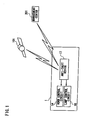
- Fig. 1 is a view of an anti-theft system according to a preferred embodiment as a whole.
- the anti-theft system includes an anti-theft device 17 provided in a motorcycle 1, a Global Positioning System (GPS) satellite 101, and a management center 201.
- GPS Global Positioning System
- the anti-theft device 17 of the motorcycle 1 includes a GPS receiving function, receives signals transmitted from the GPS satellite 101 and can calculate the present location of the anti-theft device 17. Since the anti-theft device 17 is provided in the motorcycle 1, it can calculate the present teaching of the motorcycle 1.
- a "unit”, respectively a GPS unit, according to the present invention corresponds to the anti-theft device 17 according to the present preferred embodiment.
- the anti-theft device 17 has a radio communication function and can transmit the present positional information of the motorcycle 1 to the management center 201 by radio communication.
- GSM Global System for Mobile Communication
- the management center 201 obtains positional information transmitted from the anti-theft device 17 provided in the motorcycle 1 and discovers the stolen vehicle.
- the anti-theft device 17 is connected to a horn control circuit 54 arranged to set off a horn and a flasher lamp control circuit 55 arranged to turn on a flasher lamp.
- the management center 201 transmits an alarm command to the anti-theft device 17 if necessary upon obtaining information about the theft of the motorcycle 1.
- the anti-theft device 17 can control the horn control circuit 54 and set off the horn in response to the alarm command.
- the anti-theft device 17 can control the flasher lamp control circuit 55 and flash the flasher lamp in response to the alarm command.
- directions such as front, back, right or left direction refer to these directions with respect to the advancing direction of the vehicle unless otherwise specified. More specifically, in the following description, the forward direction viewed from a rider on the seat is the forward direction of the motorcycle 1 and the right or left direction viewed from a rider on the seat is the right or left direction of the motorcycle 1.
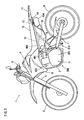
- Fig. 2 is an entire side view of the motorcycle 1 according to the present preferred embodiment.
- the motorcycle 1 is an off-road type vehicle.
- the motorcycle 1 includes a cradle type main frame 2 in the center of the vehicle.
- the main frame 2 is provided with an engine 3.
- the main frame 2 surrounds the upper, lower, front and back parts of the engine 3 when seen in a side view.
- a head pipe is provided in front of the main frame 2.
- a steering shaft is rotatably inserted through the head pipe.
- a handle 5 is attached at the upper end of the steering shaft.
- a front fork 4 is provided on the right and left of the steering shaft. The front fork 4 rotates together with the steering shaft.
- a front wheel 6 is rotatably attached to the lower end of the front fork 4.
- a rear arm 7 is rotatably attached in the vertical direction at the rear part of the main frame 2.
- a rear wheel 8 is rotatably attached to the rear end of the rear arm 7.
- the rear arm 7 and a frame 200 including the main frame 2 are connected by a rear cushion member 210.
- the rear arm 7 is attached rotatably around the output shaft of the rear part of the crankcase of the engine 3.
- the front part of the rear arm 7 may be supported only by the frame 200.
- the front part of the rear arm 7 may be supported only by the engine 3.
- a fuel tank 9 is provided above the main frame 2.
- a seat 10 is provided behind the fuel tank 9.
- a rear cover 11 is provided behind the seat 10.
- the rear cover 11 is provided above the rear wheel 8.
- the upper surface of the seat 10 and the upper surface of the rear cover 11 form a continuous surface.
- a pair of right and left side frames 15 is attached to the upper part of the main frame 2.
- the side frames 15 are extended upward to the back of the vehicle.
- the side frames 15 extend backward beyond the rear end of the seat 10.
- the seat 10 and the rear cover 11 are supported by the side frames 15.
- a pair of right and left support frames 16 is attached to the main frame 2 under the attachment position of the side frames 15.
- the support frames 16 extend upward to the back of the vehicle.
- the rear ends of the support frames 16 are connected to the side frames 15 to support the side frames 15.
- the main frame 2, the side frames 15, and the support frames 16 are metal frames.
- the frame 200 of the motorcycle 1 has coupling frames 18 and 19 (that will be described later) in addition to the main frame 2, the side frames 15, and the support frames 16.
- the engine 3 includes a crankcase 301 and a cylinder 302 positioned above the crankcase 301.
- An intake path 401 is connected to the rear part of the cylinder 302.
- the intake path 401 extends backward from the rear part of the cylinder 302.
- An air cleaner 402 is connected to the rear part of the intake path 401.
- An exhaust path 403 is connected to the front part of the cylinder 302.
- the exhaust path 403 extends forward from the front part of the cylinder 302 and then backward along the side of the cylinder 302.
- the other end of the exhaust path 403 is connected with a muffler 404.
- the muffler 404 partly overlaps the side cover 13 when seen in a side view.
- the muffler 404 is positioned on the left of the right side cover 13.
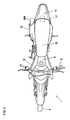
- Fig. 3 is a plan view of the motorcycle 1. As shown in Fig. 3 , the seat 10 extends from the vicinity of the center of the body to the back and a rear cover 11 is provided behind the seat 10. The rear cover 11 is provided to cover the rear wheel 8 from above. As will be described in detail, an anti-theft device 17 according to the present preferred embodiment is provided under the rear cover 11.
- a pair of right and left front covers 12 is provided on the left and right of the fuel tank 9.
- the front covers 12 extend downward from the lower part of the fuel tank 9.
- a pair of right and left side covers 13 is attached on the left and right of the seat 10. The side covers 13 extend downward from the lower part of the seat 10.
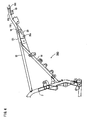
- Fig. 4 is a side view of the frame 200.
- the frame 200 has the main frame 2 and the side frames 15 connected to the main frame 2 and support frames 16.
- the side frames 15 each include a first frame portion 151 that extends linearly under the seat 10.
- the first frame portion 151 extends upward to the back of the vehicle.
- the side frames 15 each include a second frame portion 152 that continues from the rear end of the first frame portion 151.
- the second frame portion 152 is inclined upward at a greater angle than the first frame portion 151.
- the side frames 15 each include a third frame portion 153 that continues from the rear end of the second frame 152.
- the third frame portion 153 is inclined upward at a smaller angle than the second frame portion 152.
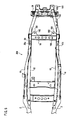
- Fig. 5 is a plan view of the frame 200.
- the first frame portions 151 on the right and left are provided approximately parallel to the front-back direction of the vehicle.
- the second frame portions 152 and the third frame portions 153 on the right and left extend to the center of the vehicle with respect to the crosswise direction of the vehicle.
- the coupling frame 18 used to couple the right and left first frame portions 151 is provided near the rear ends of the right and left first frame portions 151.
- a lower cover 14 used to store the anti-theft device 17 is fixed to the coupling frame 18.
- the coupling frame 18 has projections 181 that project backward.
- Bolt holes 182 are formed at the projections 181.
- the lower cover 14 is fixed through the bolt holes 182.
- the coupling frame 18 has bolt holes 183 used to fix the seat 10. While the seat 10 is attached to the frame 200, bolts are inserted from the bolt holes 183, so that the seat 10 is fixed.
- Coupling frames 19 and 191 used to couple the right and left third frame portions 153 are attached under the right and left third frame portions 153.
- the coupling frame 191 is attached as it is held between the coupling frame 19 and the side frames 15.
- the lower cover 14 used to store the anti-theft device 17 is fixed to the coupling frame 191.
- Fig. 6 is a side view of the rear part of the motorcycle 1.
- Fig. 7 is a plan view of the rear part of the motorcycle 1.
- the rear part of the seat 10 is provided to cover the upper part of the front part of the rear cover 11. Therefore, the rear cover 11 cannot be removed without removing the seat 10.
- the bottom of the lower cover 14 is partly exposed from the lower part of the rear cover 11.
- the lower side of the anti-theft device 17 is covered with the lower cover 14 and the upper side of the anti-theft device 17 is covered with the rear part of the seat 10 and the front part of the rear cover 11.
- Fig. 8 is a side view of the seat 10.
- Fig. 9 is a bottom view of the seat 10.
- the bottom surface of the seat 10 has projections 10a on its front-end side.
- the projections 10a are attached to attachment parts (not shown) provided near the rear part of the fuel tank 9.
- a plurality of support parts 10b is provided at the bottom surface of the seat 10. The plurality of support parts 10b can receive the load of the seat 10 as they are in contact with the side frames 15.
- Bolt holes 10c are provided at the bottom of the seat 10 on the rear end side. When the seat 10 is attached, the bolt holes 10c are provided opposed to the bolt holes 183 of the coupling frame 18. In this state, the bolts are tightened so that the seat 10 is fixed.
- Fig. 10 is a side view of the rear cover 11.
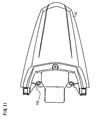
- Fig. 11 is a plan view of the rear cover 11.
- Bolt holes 112 are formed under the front-end part of the rear cover 11.
- Bolts 41 ( Fig. 17 ) are mounted as the bolt holes 112 are registered to the bolt holes 182 formed at the coupling frame 18. In this way, the rear cover 11 is fixed to the coupling frame 18.
- Fig. 12 is a side view of the lower cover 14.
- Fig. 13 is a plan view of the lower cover 14.
- the lower cover 14 is a cover made of resin.
- a box type case portion 141 opened to the upper side is formed on the rear part side of the lower cover 14.
- the bottom surface of the case portion 141 is formed to have an approximately flat shape and therefore the anti-theft device 17 can be attached easily thereto.
- Side walls 141 a on the right and left sides of the case portion 141 serve as the side walls of the lower cover 14.
- the right and left side walls 141 a make it difficult to access the anti-theft device 17 from the right and left sides.
- the rear wall 141 b of the case portion 141 serves as the rear wall of the lower cover 14.
- the rear wall 141b makes it difficult to access the anti-theft device 17 from behind.
- the side walls 141 a on the right and left sides of the case portion 141 have their upper ends bent outwardly to form attachment parts 142.
- the right and left attachment parts 142 are provided to cover the right and left second frame portions 152.
- right and left bolt holes 143 are formed at the rear end of the lower cover 14.
- Bolts 42 used to connect the lower cover 14 and the coupling frame 191 are inserted into the bolt holes 143.
- the coupling frame 191 is used to couple the right and left side frames 15.
- the lower cover 14 has right and left bolt holes 144 more on the front side than the center in the front-back direction.
- Bolts 41 used to connect the lower cover 14 and the rear cover 11 to the coupling frame 18 are inserted into the bolt holes 144.
- the coupling frame 18 is used to couple the right and left side frames 15.
- the lower cover 14 has a bridge portion 147 more on the front side than the position of the right and left bolt holes 144.
- the bridge portion 147 is positioned above the coupling frame 18, as the lower cover 14 is attached to the side flames 15.
- the bridge part 147 has right and left openings 145.
- the coupling frame 18 is exposed to the above through the right and left openings 145.
- the bolt holes 183 formed at the coupling frame 18 are positioned at the exposed parts viewed through the openings 145.
- a guide plate 146 is formed near the front end of the lower cover 14.
- the guide plate 146 is approximately L-shaped when seen in a top view. The wiring direction of the cable attached to the anti-theft device 17 is guided by the guide plate 146.
- a pair of right and left insert plates 148 is attached at the bottom of the case portion 141.
- the insert plates 148 extend approximately perpendicularly to the bottom surface of the case portion 141.
- the insert plates 148 are used to fix the anti-theft device 17.
- the lower cover 14 arranged in this way is provided above the right and left side frames 15 and the rear side of the lower cover 14 is fixed to the coupling plate 191 by the bolts 42 (see Fig. 17 ).
- the front side of the lower cover 14 is fixed to the coupling frame 18 together with the rear cover 11 by the bolts 41.
- Fig. 14 is a side view of the rear part of the motorcycle 1.
- the seat 10 and the rear cover 11 are partly cut to show the internal structure of the rear cover 11 for descriptive purposes.
- the rear ends of the third frame portions 153 extend backward in the space in the rear cover 11.
- the lower cover 14 is provided in a position overlapping the second frame portion 152 when seen in a side view.
- the anti-theft device 17 is stored in the lower cover 14. Therefore, the anti-theft device 17 is provided in a position overlapping the second frame portion 152 when seen in a side view.
- Fig. 15 is a plan view of the rear part of the motorcycle 1.
- the seat 10 and the rear cover 11 are partly cut to show the internal structure under the seat 10 and the rear seat 11 for descriptive purposes.
- the anti-theft device 17 is provided above the lower cover 14.
- the anti-theft device 17 is provided in a position overlapping the rear end of the seat 10 when seen in a top view.
- Fig. 16 is a plan view of the rear part of the motorcycle 1.
- Fig. 17 is a plan view showing the attachment part of the anti-theft device 17 being enlarged.
- the anti-theft device 17 having an approximately rectangular parallelepiped shape is provided approximately in the center in the crosswise direction of the vehicle.
- the anti-theft device 17 has an approximately rectangular parallelepiped shape and its upper surface and bottom surface are provided at an inclination angle about equal to the inclination angle of the first frame 151 with respect to a horizontal plane.
- the area (face surface) of the right and left side surfaces of the anti-theft device 17 is smaller than the area (face surface) of the upper surface or the bottom surface.
- the area of the front and back side surfaces of the anti-theft device 17 is smaller than the area of the upper surface or the bottom surface.
- the anti-theft device 17 has a box shape whose length in the vertical direction is smaller than the length in the crosswise direction and the length in the front-back direction.
- the anti-theft device 17 is connected with a cable 21 through a connector 22.
- the cable 21 includes a power supply line or a signal line.
- the cable 21 is guided to the guide plate 146 formed at the lower cover 14 and bent in an L-shape and then extends forward under the seat 10.
- a rubber protection cover 31 is provided to the anti-theft device 17.
- the protection cover 31 is formed circularly and wound circularly around the anti-theft device 17 in the crosswise direction.
- a rear belt 32 is formed to the rear side of the protection cover 31. The protection cover 31 covers around the anti-theft device 17 in the crosswise direction and the rear belt 32 covers the rear side of the anti-theft device 17.
- projections 34 are formed at the right and left of the protection cover 31.
- the projections 34 each have an insert hole 35 penetrating through in the vertical direction.
- the insert plates 148 formed at the lower cover 14 are inserted into the insert holes 35.
- the insertion of the insert plates 148 into the insert holes 35 allows the anti-theft device 17 to be fixed to the lower cover 14 as the device is wrapped with the protection cover 31.
- the protection cover 31 serves both to protect the anti-theft device 17 and to fix the anti-theft device 17 to the lower cover 14.
- the coupling frame 18 has the bolt holes 183 into which bolts 46 are inserted. The insertion of the bolts 46 into the bolt holes 10c of the seat 10 fixes the seat 10.
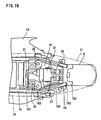
- Fig. 18 is a side sectional view of the seat 10, the rear cover 11, the lower cover 14, and the anti-theft device 17. As shown in Fig. 18 , the anti-theft device 17 is covered with the seat 10 and the rear cover 11 from above and with the lower cover 14 from below.
- the front end of the rear cover 11 comes under the seat 10 and is covered with the seat 10.
- the rear cover 11 is fixed to the coupling frame 18 by the bolts 41 and the seat 10 is fixed to the coupling frame 18 by the bolts 46. Therefore, in order to access the anti-theft device 17, the bolts 46 used to fix the seat 10 must be removed first and then the seat 10 must be removed from the vehicle. Then, in order to access the anti-theft device 17, the bolts 41 used to fix the rear cover 11 must be removed and the rear cover 11 must be removed from the coupling frame 18. In this way, the anti-theft device 17 cannot be accessed without carrying out the two-stage bolt removing operation.
- the bolts 41 are Torx ® bolts.
- the head shape of the bolt 41 is special and the bolt 41 cannot be removed using an ordinary driver. This makes access to the anti-theft device more difficult.
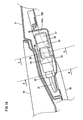
- Fig. 19 is a front sectional view showing how the seat 10, the rear cover 11, the lower cover 14, and the anti-theft device 17 are attached.
- Fig. 19 is a sectional view taken along A-A in Fig. 18 .
- the lower side of the anti-theft device 17 is covered with the lower cover 14.
- the lower cover 14 is a member made of resin and right and left attachment parts 142 are provided to wound around the upper parts of the right and left side frames 15. This makes it very difficult to remove the lower cover 14 from the lower side (the region between the rear cover 11 and the rear wheel 8).
- the lower cover 14 is provided above the coupling frame 18 and the coupling frame 191, so that it is substantially impossible to remove the lower cover 14 from the lower side.
- the lower cover 14 has its rear end side fixed by the bolts 42 and its front end side fixed by the bolts 41.
- the bolts 42 and 41 are both inserted from the upper side of the lower cover 14. Therefore, it is substantially impossible to remove the bolts 42 or 41 from the lower side (the region between the rear cover 11 and the rear wheel 8) of the lower cover 14.
- the anti-theft device 17 is provided as it is held between the right and left side frames 15.
- the side frames 15 and the right and left side walls 141 a of the lower cover 14 prevent access to the anti-theft device 17 from the right and left of the anti-theft device 17. Therefore, it is difficult to access the anti-theft device 17 with respect to the widthwise direction of the vehicle.
- the anti-theft device 17 has its upper surface positioned above the upper surface of the side frames 15 as shown in Figs. 18 and 19 . Therefore, the GPS antenna 171 provided in the anti-theft device 17 does not suffer from interference because of the side frames and the receiving sensitivity to GPS signals is not degraded.
- the GPS antenna 171 is provided near the upper surface of the anti-theft device 17 as shown in Fig. 19 .
- the upper surface of the anti-theft device 17 is positioned above the side frames 15 and therefore good receiving sensitivity is achieved.
- Fig. 20 is a front sectional view showing how the seat 10, the rear cover 11, the side cover 13, the lower cover 14, the coupling frame 18, and the connector 22 are arranged.
- Fig. 20 is a sectional view taken along B-B in Fig. 18 .
- Bolts 41 are inserted in the right and left bolt holes 112 formed at the rear cover 11, in right and left bolt holes 144 formed at the lower cover 14 and bolt holes 182 formed at the right and left projections 181 of the coupling frame 18.
- the lower cover 14 and the rear cover 11 are fixed to the coupling frame 18 by the right and left bolts 41.
- the motorcycle 1 includes the seat 10 positioned above the side frames 15 and the rear cover 11 positioned behind the seat 10 and having its front end positioned under the seat 10.
- the anti-theft device 17 includes the antenna 171 used to receive GPS signals and is provided under the rear cover 11. In order to access the anti-theft device 17 from above, both the seat 10 and the rear cover 11 must be removed. It is therefore difficult to make easy access to the anti-theft device 17 from above.
- the anti-theft device 17 is provided between the pair of side frames 15 when seen in a top view.
- the side frames 15 are metal frames and can make it difficult to access the anti-theft device 17 from the right and left.
- the lower cover 14 fixed to the side frames 15 is provided under the anti-theft device 17. This also makes it difficult to access the anti-theft device 17 from below.
- the anti-theft device 17 is covered with a double-cover arrangement including the seat 10 and the rear cover 11 from above, held between the side frames 15 from the right and left, and covered with the lower cover 14 from below. This makes it extremely difficult to falsely access the anti-theft device 17.
- the anti-theft device 17 is provided to have a greater area when seen in a top view than in a side view and the height of the space to store the anti-theft device 17 can be lowered.
- the seat height can be prevented from being raised.
- the area when seen in a top view is large, and therefore the GPS antenna can be provided easily on the upper surface side. In this way, the receiving sensitivity to GPS signals can be kept high.
- the anti-theft device in the motorcycle equipped with the anti-theft device having the GPS, the anti-theft device can be mounted so that the riding comfort for the rider is not degraded and easy access to the device is prohibited.
- the bolts used to fix the seat 10 and the frame must be removed in order to remove the seat 10. This makes it more difficult to access the anti-theft device 17.
- the rear cover 11 is fixed to the coupling frame 18 by the bolts. This can make it even more difficult to access the anti-theft device 17.
- the lower cover 14 has side walls that cover the right and left sides of the anti-theft device 17.
- the side wall and the side frame 15 are arranged to overlap each other, which makes it more difficult to access the anti-theft device 17 from the right and left of the vehicle.
- the side frames 15 and the anti-theft device are provided to overlap when seen in a side view, so that one of the side frames 15 touches the ground or like when the motorcycle tumbles to the right or left, and the anti-theft device 17 can be protected.
- the lower cover 14 has attachment parts 142 formed at the upper ends of the side walls 141a, bent to the right and left direction of the vehicle and provided on the upper side of the side frames 15. It is substantially impossible to remove the lower cover 14 from the lower side. Therefore, the anti-theft device can be provided above the lower cover in the motorcycle so that easy access to the device is prohibited.
- the lower cover 14 has the rear wall 141b that covers the anti-theft device 17 from behind in the front-back direction of the vehicle. This makes it difficult to access the anti-theft device 17 from the rear side of the vehicle. In this way, the anti-theft device that is provided above the lower cover can be provided in the motorcycle so that easy access to the device is prohibited.
- the coupling frame 18 is arranged to extend in the crosswise direction of the vehicle and connect the right and left side frames 15.
- the lower end of the anti-theft device 17 is positioned behind and above the lower end of the coupling frame 18.
- the anti-theft device 17 is provided above the rear wheel 8 and the upper end of the moving range of the rear wheel 8 is determined by the coupling frame 18. Therefore, when the anti-theft device 17 is provided above the rear wheel 8, the motorcycle can be prevented from being increased in size. Stated differently, the anti-theft device 17 can be provided under the seat without reducing the vertical moving range of the rear wheel 8 and degrading the riding comfort for the rider.
- the coupling frame 18 and the coupling frame 191 are arranged to extend in the crosswise direction of the vehicle and couple the right and left side frames 15.
- the anti-theft device 17 is provided in the region surrounded by the side frames 15, the coupling frame 18, and the coupling frame 191, and the lower cover 14 is fixed at the upper parts of the coupling frame 18 and the coupling frame 191.
- the anti-theft device is provided in a position covered by the side frames 15, the coupling frame 18 and the coupling frame 191, which can make it very difficult to access the anti-theft device. It is difficult to remove the lower cover 14 from below and this makes it very difficult to access the anti-theft device 17.
- the bolts used to fix the lower cover 14 and the coupling frames 18 and 191 are inserted from the upper side of the lower cover 14. Unless the seat 10 and the rear cover 11 are removed, the bolts used to fix the lower cover 14 cannot be removed. This makes it even more difficult to access the anti-theft device 17.
- the lower end of the lower cover 14 is positioned under the lower end of the rear cover 11 when seen in a side view.
- the rear cover 11 has a compact shape and can prevent the motorcycle from being increased in size.
- the anti-theft device 17 can be provided under the seat, while the vertical moving range of the rear wheel 8 is not reduced, and the seat height can be prevented from being raised, so that the riding comfort for the rider can be prevented from being degraded.
- the anti-theft device 17 includes a radio communication device used to transmit the present positional information received by the GPS antenna 171 to the management center.
- the GPS positional information is thus transmitted to the management center 201, so that stolen vehicles can be tracked down without delay.
- the arrangement of the frames is not limited to that of the present preferred embodiment.
- the main frame and the side frames may be formed separately and then fixed by welding or bolts.
- the material of the frames is not limited to the pipe material but they may be cast frames.
- the shapes of the lower cover and the rear cover are not limited to those of the present preferred embodiment.
- the rear cover needs only be positioned above the anti-theft device, and for example the rear cover may extend forward to cover a part of a harness connected to the anti-theft device.
- the lower cover needs only be positioned under the anti-theft device and for example the front end of the lower cover may be more on the rear side than the front end of the coupling frame 18.
- the method of fixing the anti-theft device is not limited to that of the present preferred embodiment.
- the anti-theft device may be fixed for example to the rear cover or both the rear cover and the lower cover.
- the anti-theft device may be fixed by bolts or the like.
- a motorcycle 1 including a seat 10 positioned above side frames 15 and a rear cover 11 positioned behind the seat 10 and having a front end part positioned under the seat 10.
- An anti-theft device 17 includes a GPS antenna 171 and is provided under the rear cover 11.
- the anti-theft device 17 is provided between the right and left side frames 15 when seen in a top view.
- the anti-theft device 17 is provided to have a greater area when viewed in a top view than in a side view, and a lower cover 14 fixed to the side frames 15 is provided under the device.
Landscapes
- Engineering & Computer Science (AREA)
- Remote Sensing (AREA)
- Radar, Positioning & Navigation (AREA)
- Computer Networks & Wireless Communication (AREA)
- Physics & Mathematics (AREA)
- General Physics & Mathematics (AREA)
- Mechanical Engineering (AREA)
- Lock And Its Accessories (AREA)
- Motorcycle And Bicycle Frame (AREA)
- Automatic Cycles, And Cycles In General (AREA)
Abstract
Description
- The present invention relates to a motorcycle, in particular a motorcycle equipped with an anti-theft device.
- Motorcycles equipped with anti-theft devices have been known. An anti-theft device includes a Global Positioning System (GPS) receiver. The anti-theft device receives GPS signals and can determine the present location of the motorcycle equipped with the anti-theft device.
- The motorcycle disclosed by
JP 2002-362448 A JP 2002-362448 A - An anti-theft device is desirably provided in a position that is not easily accessible, so that the device is not easily removed if the vehicle is stolen. In the motorcycle disclosed by
JP 2002-362448 A - As disclosed by
JP 2008-222078 A - It is an objective of the present invention to provide a motorcycle in which components of a Global Positioning System (GPS) can be prevented from easy access while at the same time the riding comfort of the rider can be maintained.
- According to the present invention, said objective is solved by a motorcycle, comprising: a rear wheel rotatably supported by a rear arm configured to swing in vertical direction; a frame having right and left side frames extending upward to a back of the motorcycle above the rear wheel; a seat provided above the right and left side frames; a unit including an antenna configured to receive a Global Positioning System (GPS) signal and provided between the right and left side frames, wherein the unit has a greater area when seen in a top view than when seen in a side view; and a lower cover positioned under the unit and fixed to the right and left side frames.
- In this way, a motorcycle including a GPS unit provided so that easy access to the unit is prohibited while keeping the riding comfort for the rider from being degraded can be provided.
- As the anti-theft device is preferably provided between a pair of right and left side frames when seen in a top view, it is difficult to access the anti-theft device from the right and left sides.
- As the anti-theft device has preferably a greater area when seen in a top view than when seen in a side view, the height of the space used to store the anti-theft device can be reduced.
- As the lower cover fixed to the right and left side frames is preferably provided under the anti-theft device, it is difficult to access the anti-theft device from below.
- Preferably, an engine is positioned in front of the rear wheel and is fixed to the frame, a rear end of the rear arm supports the rear wheel, and a front end of the rear arm is rotatably supported by the frame or the engine.
- Further, preferably at least a part of a rear cover is positioned behind the seat, and, preferably, the rear cover has a front part which is positioned under the seat.
- Still further, preferably the seat is fixed by at least one bolt to the frame.
- Yet further still, preferably the rear cover is fixed to the frame by at least one bolt.
- According to a preferred embodiment, the lower cover comprises side walls that cover the unit from the right and left of the motorcycle, and, preferably, the side walls and the side frames overlap each other when seen in a side view.
- Preferably, the lower cover comprises at least one attachment part connected to upper ends of the side walls to extend to the right and left direction of the motorcycle and provided above the side frames.
- Further, preferably the lower cover comprises a rear wall that covers the unit from behind the motorcycle in a front-back direction of the motorcycle.
- Still further, preferably a coupling frame extends in a crosswise direction of the motorcycle and connects the right and left side frames and, preferably, a lower end of the unit is positioned behind and/or above a lower end of the coupling frame when seen in a side view.
- According to another preferred embodiment, a first coupling frame extends in a crosswise direction of the motorcycle and connects the right and left side frames, a second coupling frame is positioned behind the first coupling frame to connect the right and left side frames, the unit is preferably provided in a region surrounded by the right and left side frames, the first coupling frame and the second coupling frame when seen in a top view, and the lower cover is preferably fixed to upper parts of the first coupling frame and the second coupling frame.
- Preferably, at least one bolt used to fix the lower cover and the first coupling frame is inserted from an upper side of the lower cover.
- Further, preferably at least one bolt used to fix the lower cover and the second coupling frame is inserted from an upper side of the lower cover.
- Still further, a lower end of the lower cover is positioned under a lower end of the rear cover when seen in a side view.
- Preferably, the unit comprises a radio communication device configured to transmit present positional information received by the antenna to a management center.
- Further, preferably the motorcycle is an off-road type vehicle.
- In the following, the present invention is explained in greater detail by means of embodiments thereof in conjunction with the accompanying drawings, wherein:
-
Fig. 1 is a view showing an anti-theft system as a whole according to a preferred embodiment. -
Fig. 2 is an entire side view of a motorcycle according to the preferred embodiment. -
Fig. 3 is an entire top view of the motorcycle according to the preferred embodiment. -
Fig. 4 is a side view of a rear part of a frame according to the preferred embodiment. -
Fig. 5 is a plan view of the rear part of the frame according to the preferred embodiment. -
Fig. 6 is a side view of a rear part of the motorcycle according to the preferred embodiment. -
Fig. 7 is a plan view of the rear part of the motorcycle according to the preferred embodiment. -
Fig. 8 is a side view of a seat according to the preferred embodiment. -
Fig. 9 is a bottom view of the seat according to the preferred embodiment. -
Fig. 10 is a side view of a rear cover according to the preferred embodiment. -
Fig. 11 is a plan view of the rear cover according to the preferred embodiment. -
Fig. 12 is a side view of a lower cover according to the preferred embodiment. -
Fig. 13 is a plan view of the lower cover according to the preferred embodiment. -
Fig. 14 is a side view of a structure of the rear part of the motorcycle according to the -
Fig. 15 is a plan view of a structure of the rear part of the motorcycle according to the -
Fig. 16 is a plan view of a structure of the rear part of the motorcycle according to the -
Fig. 17 is a plan view of how an anti-theft device according to the preferred embodiment is attached. -
Fig. 18 is a side sectional view of how the anti-theft device according to the preferred embodiment is attached. -
Fig. 19 is a front sectional view of how the anti-theft device according to the preferred embodiment is attached. -
Fig. 20 is a front sectional view of how the lower cover according to the preferred embodiment is attached. - In a motorcycle provided with a storage box large enough in the vertical direction under the seat, an anti-theft device may be provided at a side or the bottom of the storage box. Since the storage box has a sufficiently large size in the vertical direction, the anti-theft device can be provided apart from the upper end of the storage box. The seat is provided on the storage box and the seat can be locked. In a motorcycle provided with a storage box large enough in the vertical direction under the seat, the device can be provided in a location that is not easily accessible.
- Some motorcycles have a wide moving range for the rear wheel in the vertical direction in order to travel off-road. In this kind of motorcycle, the rear wheel and a body cover used to cover an area under the seat are provided largely apart from each other in the vertical direction so that a large vertical moving range can be secured for the rear wheel. Therefore, the space between the seat and the body cover is small in the vertical direction. When the size of the space in the vertical direction between the seat and the body cover under the seat is small, an anti-theft device is provided in a location that can be reached easily from the outside. The anti-theft device can be accessed manually or using a tool between the seat and the body cover.
- Storing arrangements for an anti-theft device that hardly allow access to the device in a motorcycle that has only a small space in the vertical direction between the seat and the body cover under the seat were studied.
- It was considered what would happen when the seat height was raised and the space between the seat and body cover under the seat was expanded in the vertical direction. If the seat height is raised, however, the riding comfort for the rider is degraded. It would be difficult to provide an anti-theft device in a space under the seat and above the rear wheel so that the device cannot be accessed easily while keeping the seat height from being raised and the riding comfort from being degraded.
- Then, the possibility of providing an anti-theft device in a location other than under the seat was considered. The anti-theft device may be provided under a fuel tank or a head light. The anti-theft device receives signals transmitted from a GPS satellite. If the anti-theft device is provided under the fuel tank or the head light, signals transmitted from the GPS satellite can be shielded by the fuel tank or the head light, which can lower the receiving sensitivity to GPS signals. If the anti-theft device can be provided successfully in a hardly accessible location, the reduction in the receiving sensitivity to GPS signals prevents the anti-theft device from functioning effectively.
- In view of the above-described problems, it is desirable to find an arrangement for providing an anti-theft device in a motorcycle so that the device is hardly accessible while keeping the vehicle size from increasing and the riding comfort for the rider from being degraded.
-
Fig. 1 is a view of an anti-theft system according to a preferred embodiment as a whole. The anti-theft system includes ananti-theft device 17 provided in amotorcycle 1, a Global Positioning System (GPS)satellite 101, and amanagement center 201. - How the anti-theft system operates will be described. The
anti-theft device 17 of themotorcycle 1 includes a GPS receiving function, receives signals transmitted from theGPS satellite 101 and can calculate the present location of theanti-theft device 17. Since theanti-theft device 17 is provided in themotorcycle 1, it can calculate the present teaching of themotorcycle 1. A "unit", respectively a GPS unit, according to the present invention corresponds to theanti-theft device 17 according to the present preferred embodiment. - The
anti-theft device 17 has a radio communication function and can transmit the present positional information of themotorcycle 1 to themanagement center 201 by radio communication. According to the present preferred embodiment, GSM (Global System for Mobile Communication) is used as the radio communication. - When the
motorcycle 1 is stolen, the rider of themotorcycle 1 immediately reports the fact to themanagement center 201 by telephone or the like. Themanagement center 201 obtains positional information transmitted from theanti-theft device 17 provided in themotorcycle 1 and discovers the stolen vehicle. - The
anti-theft device 17 is connected to ahorn control circuit 54 arranged to set off a horn and a flasherlamp control circuit 55 arranged to turn on a flasher lamp. - The
management center 201 transmits an alarm command to theanti-theft device 17 if necessary upon obtaining information about the theft of themotorcycle 1. Theanti-theft device 17 can control thehorn control circuit 54 and set off the horn in response to the alarm command. Alternatively, theanti-theft device 17 can control the flasherlamp control circuit 55 and flash the flasher lamp in response to the alarm command. - Now, the structure of the
motorcycle 1 according to the present preferred embodiment will be described. In the following description, directions such as front, back, right or left direction refer to these directions with respect to the advancing direction of the vehicle unless otherwise specified. More specifically, in the following description, the forward direction viewed from a rider on the seat is the forward direction of themotorcycle 1 and the right or left direction viewed from a rider on the seat is the right or left direction of themotorcycle 1. -
Fig. 2 is an entire side view of themotorcycle 1 according to the present preferred embodiment. Themotorcycle 1 is an off-road type vehicle. Themotorcycle 1 includes a cradle typemain frame 2 in the center of the vehicle. Themain frame 2 is provided with anengine 3. Themain frame 2 surrounds the upper, lower, front and back parts of theengine 3 when seen in a side view. - A head pipe is provided in front of the
main frame 2. A steering shaft is rotatably inserted through the head pipe. Ahandle 5 is attached at the upper end of the steering shaft. A front fork 4 is provided on the right and left of the steering shaft. The front fork 4 rotates together with the steering shaft. A front wheel 6 is rotatably attached to the lower end of the front fork 4. Arear arm 7 is rotatably attached in the vertical direction at the rear part of themain frame 2. Arear wheel 8 is rotatably attached to the rear end of therear arm 7. Therear arm 7 and aframe 200 including themain frame 2 are connected by arear cushion member 210. Therear arm 7 is attached rotatably around the output shaft of the rear part of the crankcase of theengine 3. The front part of therear arm 7 may be supported only by theframe 200. The front part of therear arm 7 may be supported only by theengine 3. - A
fuel tank 9 is provided above themain frame 2. Aseat 10 is provided behind thefuel tank 9. Arear cover 11 is provided behind theseat 10. Therear cover 11 is provided above therear wheel 8. The upper surface of theseat 10 and the upper surface of therear cover 11 form a continuous surface. - A pair of right and left side frames 15 is attached to the upper part of the
main frame 2. The side frames 15 are extended upward to the back of the vehicle. The side frames 15 extend backward beyond the rear end of theseat 10. Theseat 10 and therear cover 11 are supported by the side frames 15. - A pair of right and left support frames 16 is attached to the
main frame 2 under the attachment position of the side frames 15. The support frames 16 extend upward to the back of the vehicle. The rear ends of the support frames 16 are connected to the side frames 15 to support the side frames 15. Themain frame 2, the side frames 15, and the support frames 16 are metal frames. Theframe 200 of themotorcycle 1 has coupling frames 18 and 19 (that will be described later) in addition to themain frame 2, the side frames 15, and the support frames 16. - The
engine 3 includes acrankcase 301 and acylinder 302 positioned above thecrankcase 301. Anintake path 401 is connected to the rear part of thecylinder 302. Theintake path 401 extends backward from the rear part of thecylinder 302. Anair cleaner 402 is connected to the rear part of theintake path 401. Anexhaust path 403 is connected to the front part of thecylinder 302. Theexhaust path 403 extends forward from the front part of thecylinder 302 and then backward along the side of thecylinder 302. The other end of theexhaust path 403 is connected with amuffler 404. Themuffler 404 partly overlaps theside cover 13 when seen in a side view. Themuffler 404 is positioned on the left of theright side cover 13. -
Fig. 3 is a plan view of themotorcycle 1. As shown inFig. 3 , theseat 10 extends from the vicinity of the center of the body to the back and arear cover 11 is provided behind theseat 10. Therear cover 11 is provided to cover therear wheel 8 from above. As will be described in detail, ananti-theft device 17 according to the present preferred embodiment is provided under therear cover 11. - Referring back to
Fig. 2 , a pair of right and left front covers 12 is provided on the left and right of thefuel tank 9. The front covers 12 extend downward from the lower part of thefuel tank 9. A pair of right and left side covers 13 is attached on the left and right of theseat 10. The side covers 13 extend downward from the lower part of theseat 10. -
Fig. 4 is a side view of theframe 200. As described above, theframe 200 has themain frame 2 and the side frames 15 connected to themain frame 2 and support frames 16. - The side frames 15 each include a
first frame portion 151 that extends linearly under theseat 10. Thefirst frame portion 151 extends upward to the back of the vehicle. The side frames 15 each include asecond frame portion 152 that continues from the rear end of thefirst frame portion 151. Thesecond frame portion 152 is inclined upward at a greater angle than thefirst frame portion 151. The side frames 15 each include athird frame portion 153 that continues from the rear end of thesecond frame 152. Thethird frame portion 153 is inclined upward at a smaller angle than thesecond frame portion 152. -
Fig. 5 is a plan view of theframe 200. Thefirst frame portions 151 on the right and left are provided approximately parallel to the front-back direction of the vehicle. Thesecond frame portions 152 and thethird frame portions 153 on the right and left extend to the center of the vehicle with respect to the crosswise direction of the vehicle. - The
coupling frame 18 used to couple the right and leftfirst frame portions 151 is provided near the rear ends of the right and leftfirst frame portions 151. As will be described, alower cover 14 used to store theanti-theft device 17 is fixed to thecoupling frame 18. Thecoupling frame 18 hasprojections 181 that project backward. Bolt holes 182 are formed at theprojections 181. Thelower cover 14 is fixed through the bolt holes 182. - The
coupling frame 18 hasbolt holes 183 used to fix theseat 10. While theseat 10 is attached to theframe 200, bolts are inserted from the bolt holes 183, so that theseat 10 is fixed. - Coupling frames 19 and 191 used to couple the right and left
third frame portions 153 are attached under the right and leftthird frame portions 153. Thecoupling frame 191 is attached as it is held between thecoupling frame 19 and the side frames 15. Thelower cover 14 used to store theanti-theft device 17 is fixed to thecoupling frame 191. -
Fig. 6 is a side view of the rear part of themotorcycle 1.Fig. 7 is a plan view of the rear part of themotorcycle 1. As shown inFigs. 6 and 7 , the rear part of theseat 10 is provided to cover the upper part of the front part of therear cover 11. Therefore, therear cover 11 cannot be removed without removing theseat 10. - As shown in
Fig.6 , the bottom of thelower cover 14 is partly exposed from the lower part of therear cover 11. The lower side of theanti-theft device 17 is covered with thelower cover 14 and the upper side of theanti-theft device 17 is covered with the rear part of theseat 10 and the front part of therear cover 11. -
Fig. 8 is a side view of theseat 10.Fig. 9 is a bottom view of theseat 10. The bottom surface of theseat 10 hasprojections 10a on its front-end side. Theprojections 10a are attached to attachment parts (not shown) provided near the rear part of thefuel tank 9. A plurality ofsupport parts 10b is provided at the bottom surface of theseat 10. The plurality ofsupport parts 10b can receive the load of theseat 10 as they are in contact with the side frames 15. - Bolt holes 10c are provided at the bottom of the
seat 10 on the rear end side. When theseat 10 is attached, the bolt holes 10c are provided opposed to the bolt holes 183 of thecoupling frame 18. In this state, the bolts are tightened so that theseat 10 is fixed. -
Fig. 10 is a side view of therear cover 11.Fig. 11 is a plan view of therear cover 11. As shown inFig. 11 , bolt holes 112 are formed under the front-end part of therear cover 11. Bolts 41 (Fig. 17 ) are mounted as the bolt holes 112 are registered to the bolt holes 182 formed at thecoupling frame 18. In this way, therear cover 11 is fixed to thecoupling frame 18. -
Fig. 12 is a side view of thelower cover 14.Fig. 13 is a plan view of thelower cover 14. Thelower cover 14 is a cover made of resin. As shown inFig. 12 , a boxtype case portion 141 opened to the upper side is formed on the rear part side of thelower cover 14. The bottom surface of thecase portion 141 is formed to have an approximately flat shape and therefore theanti-theft device 17 can be attached easily thereto.Side walls 141 a on the right and left sides of thecase portion 141 serve as the side walls of thelower cover 14. The right and leftside walls 141 a make it difficult to access theanti-theft device 17 from the right and left sides. Therear wall 141 b of thecase portion 141 serves as the rear wall of thelower cover 14. Therear wall 141b makes it difficult to access theanti-theft device 17 from behind. - The
side walls 141 a on the right and left sides of thecase portion 141 have their upper ends bent outwardly to formattachment parts 142. The right and leftattachment parts 142 are provided to cover the right and leftsecond frame portions 152. - As shown in
Fig. 13 , right and left bolt holes 143 are formed at the rear end of thelower cover 14. Bolts 42 used to connect thelower cover 14 and thecoupling frame 191 are inserted into the bolt holes 143. As described above, thecoupling frame 191 is used to couple the right and left side frames 15. - The
lower cover 14 has right and left bolt holes 144 more on the front side than the center in the front-back direction.Bolts 41 used to connect thelower cover 14 and therear cover 11 to thecoupling frame 18 are inserted into the bolt holes 144. As described above, thecoupling frame 18 is used to couple the right and left side frames 15. - The
lower cover 14 has abridge portion 147 more on the front side than the position of the right and left bolt holes 144. Thebridge portion 147 is positioned above thecoupling frame 18, as thelower cover 14 is attached to theside flames 15. Thebridge part 147 has right and leftopenings 145. Thecoupling frame 18 is exposed to the above through the right and leftopenings 145. The bolt holes 183 formed at thecoupling frame 18 are positioned at the exposed parts viewed through theopenings 145. - A
guide plate 146 is formed near the front end of thelower cover 14. Theguide plate 146 is approximately L-shaped when seen in a top view. The wiring direction of the cable attached to theanti-theft device 17 is guided by theguide plate 146. - A pair of right and left
insert plates 148 is attached at the bottom of thecase portion 141. Theinsert plates 148 extend approximately perpendicularly to the bottom surface of thecase portion 141. Theinsert plates 148 are used to fix theanti-theft device 17. - The
lower cover 14 arranged in this way is provided above the right and left side frames 15 and the rear side of thelower cover 14 is fixed to thecoupling plate 191 by the bolts 42 (seeFig. 17 ). The front side of thelower cover 14 is fixed to thecoupling frame 18 together with therear cover 11 by thebolts 41. -
Fig. 14 is a side view of the rear part of themotorcycle 1. InFig. 14 , theseat 10 and therear cover 11 are partly cut to show the internal structure of therear cover 11 for descriptive purposes. The rear ends of thethird frame portions 153 extend backward in the space in therear cover 11. - The
lower cover 14 is provided in a position overlapping thesecond frame portion 152 when seen in a side view. As described above, theanti-theft device 17 is stored in thelower cover 14. Therefore, theanti-theft device 17 is provided in a position overlapping thesecond frame portion 152 when seen in a side view. -
Fig. 15 is a plan view of the rear part of themotorcycle 1. Infig. 15 , theseat 10 and therear cover 11 are partly cut to show the internal structure under theseat 10 and therear seat 11 for descriptive purposes. - The
anti-theft device 17 is provided above thelower cover 14. Theanti-theft device 17 is provided in a position overlapping the rear end of theseat 10 when seen in a top view. -
Fig. 16 is a plan view of the rear part of themotorcycle 1.Fig. 17 is a plan view showing the attachment part of theanti-theft device 17 being enlarged. Theanti-theft device 17 having an approximately rectangular parallelepiped shape is provided approximately in the center in the crosswise direction of the vehicle. - The
anti-theft device 17 has an approximately rectangular parallelepiped shape and its upper surface and bottom surface are provided at an inclination angle about equal to the inclination angle of thefirst frame 151 with respect to a horizontal plane. The area (face surface) of the right and left side surfaces of theanti-theft device 17 is smaller than the area (face surface) of the upper surface or the bottom surface. The area of the front and back side surfaces of theanti-theft device 17 is smaller than the area of the upper surface or the bottom surface. Theanti-theft device 17 has a box shape whose length in the vertical direction is smaller than the length in the crosswise direction and the length in the front-back direction. - The
anti-theft device 17 is connected with acable 21 through aconnector 22. Thecable 21 includes a power supply line or a signal line. Thecable 21 is guided to theguide plate 146 formed at thelower cover 14 and bent in an L-shape and then extends forward under theseat 10. - A
rubber protection cover 31 is provided to theanti-theft device 17. Theprotection cover 31 is formed circularly and wound circularly around theanti-theft device 17 in the crosswise direction. Arear belt 32 is formed to the rear side of theprotection cover 31. Theprotection cover 31 covers around theanti-theft device 17 in the crosswise direction and therear belt 32 covers the rear side of theanti-theft device 17. - As shown in
Fig. 17 ,projections 34 are formed at the right and left of theprotection cover 31. Theprojections 34 each have aninsert hole 35 penetrating through in the vertical direction. Theinsert plates 148 formed at thelower cover 14 are inserted into the insert holes 35. The insertion of theinsert plates 148 into the insert holes 35 allows theanti-theft device 17 to be fixed to thelower cover 14 as the device is wrapped with theprotection cover 31. In this way, theprotection cover 31 serves both to protect theanti-theft device 17 and to fix theanti-theft device 17 to thelower cover 14. - The
coupling frame 18 has the bolt holes 183 into whichbolts 46 are inserted. The insertion of thebolts 46 into the bolt holes 10c of theseat 10 fixes theseat 10. -
Fig. 18 is a side sectional view of theseat 10, therear cover 11, thelower cover 14, and theanti-theft device 17. As shown inFig. 18 , theanti-theft device 17 is covered with theseat 10 and therear cover 11 from above and with thelower cover 14 from below. - The front end of the
rear cover 11 comes under theseat 10 and is covered with theseat 10. As described above, therear cover 11 is fixed to thecoupling frame 18 by thebolts 41 and theseat 10 is fixed to thecoupling frame 18 by thebolts 46. Therefore, in order to access theanti-theft device 17, thebolts 46 used to fix theseat 10 must be removed first and then theseat 10 must be removed from the vehicle. Then, in order to access theanti-theft device 17, thebolts 41 used to fix therear cover 11 must be removed and therear cover 11 must be removed from thecoupling frame 18. In this way, theanti-theft device 17 cannot be accessed without carrying out the two-stage bolt removing operation. - According to the present preferred embodiment, the
bolts 41 are Torx® bolts. The head shape of thebolt 41 is special and thebolt 41 cannot be removed using an ordinary driver. This makes access to the anti-theft device more difficult. -
Fig. 19 is a front sectional view showing how theseat 10, therear cover 11, thelower cover 14, and theanti-theft device 17 are attached.Fig. 19 is a sectional view taken along A-A inFig. 18 . - The lower side of the
anti-theft device 17 is covered with thelower cover 14. Thelower cover 14 is a member made of resin and right and leftattachment parts 142 are provided to wound around the upper parts of the right and left side frames 15. This makes it very difficult to remove thelower cover 14 from the lower side (the region between therear cover 11 and the rear wheel 8). Thelower cover 14 is provided above thecoupling frame 18 and thecoupling frame 191, so that it is substantially impossible to remove thelower cover 14 from the lower side. - The
lower cover 14 has its rear end side fixed by the bolts 42 and its front end side fixed by thebolts 41. Thebolts 42 and 41 are both inserted from the upper side of thelower cover 14. Therefore, it is substantially impossible to remove thebolts 42 or 41 from the lower side (the region between therear cover 11 and the rear wheel 8) of thelower cover 14. - The
anti-theft device 17 is provided as it is held between the right and left side frames 15. The side frames 15 and the right and leftside walls 141 a of thelower cover 14 prevent access to theanti-theft device 17 from the right and left of theanti-theft device 17. Therefore, it is difficult to access theanti-theft device 17 with respect to the widthwise direction of the vehicle. - The
anti-theft device 17 has its upper surface positioned above the upper surface of the side frames 15 as shown inFigs. 18 and19 . Therefore, theGPS antenna 171 provided in theanti-theft device 17 does not suffer from interference because of the side frames and the receiving sensitivity to GPS signals is not degraded. - According to the present preferred embodiment, the
GPS antenna 171 is provided near the upper surface of theanti-theft device 17 as shown inFig. 19 . The upper surface of theanti-theft device 17 is positioned above the side frames 15 and therefore good receiving sensitivity is achieved. -
Fig. 20 is a front sectional view showing how theseat 10, therear cover 11, theside cover 13, thelower cover 14, thecoupling frame 18, and theconnector 22 are arranged.Fig. 20 is a sectional view taken along B-B inFig. 18 . -
Bolts 41 are inserted in the right and left bolt holes 112 formed at therear cover 11, in right and left bolt holes 144 formed at thelower cover 14 and bolt holes 182 formed at the right and leftprojections 181 of thecoupling frame 18. Thelower cover 14 and therear cover 11 are fixed to thecoupling frame 18 by the right and leftbolts 41. - As in the foregoing, the
motorcycle 1 according to the present preferred embodiment includes theseat 10 positioned above the side frames 15 and therear cover 11 positioned behind theseat 10 and having its front end positioned under theseat 10. Theanti-theft device 17 includes theantenna 171 used to receive GPS signals and is provided under therear cover 11. In order to access theanti-theft device 17 from above, both theseat 10 and therear cover 11 must be removed. It is therefore difficult to make easy access to theanti-theft device 17 from above. - The
anti-theft device 17 is provided between the pair of side frames 15 when seen in a top view. The side frames 15 are metal frames and can make it difficult to access theanti-theft device 17 from the right and left. - The
lower cover 14 fixed to the side frames 15 is provided under theanti-theft device 17. This also makes it difficult to access theanti-theft device 17 from below. In this way, theanti-theft device 17 is covered with a double-cover arrangement including theseat 10 and therear cover 11 from above, held between the side frames 15 from the right and left, and covered with thelower cover 14 from below. This makes it extremely difficult to falsely access theanti-theft device 17. - The
anti-theft device 17 is provided to have a greater area when seen in a top view than in a side view and the height of the space to store theanti-theft device 17 can be lowered. When a sufficient vertical moving range is secured for the rear wheel, the seat height can be prevented from being raised. Furthermore, the area when seen in a top view is large, and therefore the GPS antenna can be provided easily on the upper surface side. In this way, the receiving sensitivity to GPS signals can be kept high. - As in the foregoing, in the motorcycle equipped with the anti-theft device having the GPS, the anti-theft device can be mounted so that the riding comfort for the rider is not degraded and easy access to the device is prohibited.
- According to the present preferred embodiment, the bolts used to fix the
seat 10 and the frame must be removed in order to remove theseat 10. This makes it more difficult to access theanti-theft device 17. - According to the present preferred embodiment, the
rear cover 11 is fixed to thecoupling frame 18 by the bolts. This can make it even more difficult to access theanti-theft device 17. - According to the present preferred embodiment, the
lower cover 14 has side walls that cover the right and left sides of theanti-theft device 17. When seen in a side view, the side wall and theside frame 15 are arranged to overlap each other, which makes it more difficult to access theanti-theft device 17 from the right and left of the vehicle. The side frames 15 and the anti-theft device are provided to overlap when seen in a side view, so that one of the side frames 15 touches the ground or like when the motorcycle tumbles to the right or left, and theanti-theft device 17 can be protected. - According to the present preferred embodiment, the
lower cover 14 hasattachment parts 142 formed at the upper ends of theside walls 141a, bent to the right and left direction of the vehicle and provided on the upper side of the side frames 15. It is substantially impossible to remove thelower cover 14 from the lower side. Therefore, the anti-theft device can be provided above the lower cover in the motorcycle so that easy access to the device is prohibited. - Furthermore, the
lower cover 14 has therear wall 141b that covers theanti-theft device 17 from behind in the front-back direction of the vehicle. This makes it difficult to access theanti-theft device 17 from the rear side of the vehicle. In this way, the anti-theft device that is provided above the lower cover can be provided in the motorcycle so that easy access to the device is prohibited. - According to the present preferred embodiment, the
coupling frame 18 is arranged to extend in the crosswise direction of the vehicle and connect the right and left side frames 15. The lower end of theanti-theft device 17 is positioned behind and above the lower end of thecoupling frame 18. Theanti-theft device 17 is provided above therear wheel 8 and the upper end of the moving range of therear wheel 8 is determined by thecoupling frame 18. Therefore, when theanti-theft device 17 is provided above therear wheel 8, the motorcycle can be prevented from being increased in size. Stated differently, theanti-theft device 17 can be provided under the seat without reducing the vertical moving range of therear wheel 8 and degrading the riding comfort for the rider. - According to the present preferred embodiment, the
coupling frame 18 and thecoupling frame 191 are arranged to extend in the crosswise direction of the vehicle and couple the right and left side frames 15. When seen in a top view, theanti-theft device 17 is provided in the region surrounded by the side frames 15, thecoupling frame 18, and thecoupling frame 191, and thelower cover 14 is fixed at the upper parts of thecoupling frame 18 and thecoupling frame 191. The anti-theft device is provided in a position covered by the side frames 15, thecoupling frame 18 and thecoupling frame 191, which can make it very difficult to access the anti-theft device. It is difficult to remove thelower cover 14 from below and this makes it very difficult to access theanti-theft device 17. - According to the present preferred embodiment, the bolts used to fix the
lower cover 14 and the coupling frames 18 and 191 are inserted from the upper side of thelower cover 14. Unless theseat 10 and therear cover 11 are removed, the bolts used to fix thelower cover 14 cannot be removed. This makes it even more difficult to access theanti-theft device 17. - According to the present preferred embodiment, the lower end of the
lower cover 14 is positioned under the lower end of therear cover 11 when seen in a side view. Therear cover 11 has a compact shape and can prevent the motorcycle from being increased in size. Stated differently, theanti-theft device 17 can be provided under the seat, while the vertical moving range of therear wheel 8 is not reduced, and the seat height can be prevented from being raised, so that the riding comfort for the rider can be prevented from being degraded. - According to the present preferred embodiment, the
anti-theft device 17 includes a radio communication device used to transmit the present positional information received by theGPS antenna 171 to the management center. The GPS positional information is thus transmitted to themanagement center 201, so that stolen vehicles can be tracked down without delay. - The arrangement of the frames is not limited to that of the present preferred embodiment. For example, the main frame and the side frames may be formed separately and then fixed by welding or bolts. The material of the frames is not limited to the pipe material but they may be cast frames.
- The shapes of the lower cover and the rear cover are not limited to those of the present preferred embodiment. The rear cover needs only be positioned above the anti-theft device, and for example the rear cover may extend forward to cover a part of a harness connected to the anti-theft device. The lower cover needs only be positioned under the anti-theft device and for example the front end of the lower cover may be more on the rear side than the front end of the
coupling frame 18. - The method of fixing the anti-theft device is not limited to that of the present preferred embodiment. The anti-theft device may be fixed for example to the rear cover or both the rear cover and the lower cover. The anti-theft device may be fixed by bolts or the like.
- Among others, the description above discloses an embodiment of a
motorcycle 1 including aseat 10 positioned above side frames 15 and arear cover 11 positioned behind theseat 10 and having a front end part positioned under theseat 10. Ananti-theft device 17 includes aGPS antenna 171 and is provided under therear cover 11. Theanti-theft device 17 is provided between the right and left side frames 15 when seen in a top view. Theanti-theft device 17 is provided to have a greater area when viewed in a top view than in a side view, and alower cover 14 fixed to the side frames 15 is provided under the device.
Claims (15)
- Motorcycle, comprising:a rear wheel (8) rotatably supported by a rear arm (7) configured to swing in vertical direction;a frame (200) having right and left side frames (15) extending upward to a back of the motorcycle (1) above the rear wheel (8);a seat (10) provided above the right and left side frames (15);a unit (17) including an antenna configured to receive a Global Positioning System (GPS) signal and provided between the right and left side frames (15), wherein the unit (17) has a greater area when seen in a top view than when seen in a side view; anda lower cover (14) positioned under the unit (17) and fixed to the right and left side frames (15).
- Motorcycle according to claim 1, wherein an engine (3) is positioned in front of the rear wheel (8) and is fixed to the frame (200), a rear end of the rear arm (7) supports the rear wheel (8), and a front end of the rear arm (7) is rotatably supported by the frame (200) or the engine (3).
- Motorcycle according to claim 1 or 2, wherein at least a part of a rear cover (11) is positioned behind the seat (10), and, preferably, the rear cover (11) has a front part which is positioned under the seat (10).
- Motorcycle according to at least one of claims 1 to 3, wherein the seat (10) is fixed by at least one bolt to the frame (200).
- Motorcycle according to claim 3 or 4, wherein the rear cover (11) is fixed to the frame (200) by at least one bolt.
- Motorcycle according to at least one of claims 1 to 5, wherein the lower cover (14) comprises side walls (141a) that cover the unit (17) from the right and left of the motorcycle (1), and, preferably, the side walls (141a) and the side frames (15) overlap each other when seen in a side view.
- Motorcycle according to claim 6, wherein the lower cover (14) comprises at least one attachment part (142) connected to upper ends of the side walls (141 a) to extend to the right and left direction of the motorcycle (1) and provided above the side frames (15).
- Motorcycle according to at least one of claims 1 to 7, wherein the lower cover (14) comprises a rear wall (141 b) that covers the unit (17) from behind the motorcycle (1) in a front-back direction of the motorcycle (1).
- Motorcycle according to at least one of claims 1 to 8, wherein a coupling frame (18) extends in a crosswise direction of the motorcycle (1) and connects the right and left side frames (15), and, preferably, a lower end of the unit (17) is positioned behind and/or above a lower end of the coupling frame (18) when seen in a side view.
- Motorcycle according to at least one of claims 1 to 8, wherein a first coupling frame (18) extends in a crosswise direction of the motorcycle (1) and connects the right and left side frames (15),a second coupling frame (191) is positioned behind the first coupling frame (18) to connect the right and left side frames (15),the unit (17) is preferably provided in a region surrounded by the right and left side frames (15), the first coupling frame (18) and the second coupling frame (191) when seen in a top view, andthe lower cover (14) is preferably fixed to upper parts of the first coupling frame (18) and the second coupling frame (191).
- Motorcycle according to claim 10, wherein at least one bolt (41) used to fix the lower cover (14) and the first coupling frame (18) is inserted from an upper side of the lower cover (14).
- Motorcycle according to claim 10 or 11, wherein at least one bolt (42) used to fix the lower cover (14) and the second coupling frame (191) is inserted from an upper side of the lower cover (14).
- Motorcycle according to at least one of claims 3 to 12, wherein a lower end of the lower cover (14) is positioned under a lower end of the rear cover (11) when seen in a side view.
- Motorcycle according to at least one of claims 1 to 13, wherein the unit (17) comprises a radio communication device configured to transmit present positional information received by the antenna to a management center (201).
- Motorcycle according to at least one of claims 1 to 14, wherein the motorcycle (1) is an off-road type vehicle.
Applications Claiming Priority (2)
| Application Number | Priority Date | Filing Date | Title |
|---|---|---|---|
| JP2008274890 | 2008-10-24 | ||
| JP2009195669A JP2010120625A (en) | 2008-10-24 | 2009-08-26 | Motorcycle |
Publications (2)
| Publication Number | Publication Date |
|---|---|
| EP2180332A1 true EP2180332A1 (en) | 2010-04-28 |
| EP2180332B1 EP2180332B1 (en) | 2017-01-18 |
Family
ID=41351504
Family Applications (1)
| Application Number | Title | Priority Date | Filing Date |
|---|---|---|---|
| EP09013372.9A Active EP2180332B1 (en) | 2008-10-24 | 2009-10-22 | Motorcycle |
Country Status (3)
| Country | Link |
|---|---|
| EP (1) | EP2180332B1 (en) |
| JP (1) | JP2010120625A (en) |
| BR (1) | BRPI0904200B1 (en) |
Families Citing this family (10)
| Publication number | Priority date | Publication date | Assignee | Title |
|---|---|---|---|---|
| JP5469945B2 (en) * | 2009-07-17 | 2014-04-16 | 本田技研工業株式会社 | Motorcycle |
| JP5427735B2 (en) * | 2010-08-31 | 2014-02-26 | 本田技研工業株式会社 | Saddle riding |
| JP5467981B2 (en) * | 2010-09-28 | 2014-04-09 | 本田技研工業株式会社 | Motorcycle |
| JP5712091B2 (en) * | 2011-09-04 | 2015-05-07 | 本田技研工業株式会社 | Motorcycle |
| JP5536751B2 (en) * | 2011-12-20 | 2014-07-02 | 本田技研工業株式会社 | Anti-theft device arrangement structure for motorcycles |
| TWD163300S (en) * | 2013-11-07 | 2014-10-01 | 山葉發動機股份有限公司 | Electric motorcycle |
| USD735086S1 (en) * | 2014-02-07 | 2015-07-28 | Dynacraft Bsc, Inc. | Electric dirt bike |
| USD735087S1 (en) * | 2014-08-29 | 2015-07-28 | Yamaha Hatsudoki Kabushiki Kaisha | Motorcycle |
| JP6512495B2 (en) * | 2015-04-03 | 2019-05-22 | 本田技研工業株式会社 | Side cover structure for a motorcycle |
| JP6783880B2 (en) * | 2018-04-19 | 2020-11-11 | 本田技研工業株式会社 | Saddle-type vehicle |
Citations (6)
| Publication number | Priority date | Publication date | Assignee | Title |
|---|---|---|---|---|
| JP2001027647A (en) * | 1999-07-13 | 2001-01-30 | Denso Corp | Motorcycle accident notification system |
| EP1081035A2 (en) * | 1999-09-06 | 2001-03-07 | Honda Giken Kogyo Kabushiki Kaisha | Motorcycle with navigation system carried thereon |
| EP1225107A2 (en) * | 2001-01-17 | 2002-07-24 | Honda Giken Kogyo Kabushiki Kaisha | Remote reporting system for a vehicle |
| EP1247706A2 (en) * | 2001-04-02 | 2002-10-09 | Honda Giken Kogyo Kabushiki Kaisha | Anti-theft device installation structure for motorcycle |
| US20040203564A1 (en) * | 2002-08-26 | 2004-10-14 | Chi-Chang Ho | Motorcycle communication and burglary-prevention system |
| US20080223642A1 (en) * | 2007-03-13 | 2008-09-18 | Yamaha Hatsudoki Kabushiki Kaisha | Motorcycle |
-
2009
- 2009-08-26 JP JP2009195669A patent/JP2010120625A/en not_active Withdrawn
- 2009-10-21 BR BRPI0904200-8A patent/BRPI0904200B1/en active IP Right Grant
- 2009-10-22 EP EP09013372.9A patent/EP2180332B1/en active Active
Patent Citations (8)
| Publication number | Priority date | Publication date | Assignee | Title |
|---|---|---|---|---|
| JP2001027647A (en) * | 1999-07-13 | 2001-01-30 | Denso Corp | Motorcycle accident notification system |
| EP1081035A2 (en) * | 1999-09-06 | 2001-03-07 | Honda Giken Kogyo Kabushiki Kaisha | Motorcycle with navigation system carried thereon |
| EP1225107A2 (en) * | 2001-01-17 | 2002-07-24 | Honda Giken Kogyo Kabushiki Kaisha | Remote reporting system for a vehicle |
| EP1247706A2 (en) * | 2001-04-02 | 2002-10-09 | Honda Giken Kogyo Kabushiki Kaisha | Anti-theft device installation structure for motorcycle |
| JP2002362448A (en) | 2001-04-02 | 2002-12-18 | Honda Motor Co Ltd | Motorcycle theft prevention device installation structure |
| US20040203564A1 (en) * | 2002-08-26 | 2004-10-14 | Chi-Chang Ho | Motorcycle communication and burglary-prevention system |
| US20080223642A1 (en) * | 2007-03-13 | 2008-09-18 | Yamaha Hatsudoki Kabushiki Kaisha | Motorcycle |
| JP2008222078A (en) | 2007-03-13 | 2008-09-25 | Yamaha Motor Co Ltd | Motorcycle |
Also Published As
| Publication number | Publication date |
|---|---|
| EP2180332B1 (en) | 2017-01-18 |
| BRPI0904200A2 (en) | 2010-09-14 |
| BRPI0904200B1 (en) | 2019-02-26 |
| JP2010120625A (en) | 2010-06-03 |
Similar Documents
| Publication | Publication Date | Title |
|---|---|---|
| EP2180332B1 (en) | Motorcycle | |
| EP2180545B1 (en) | Straddle-type vehicle | |
| EP2180333B1 (en) | Motorcycle | |
| WO2012029687A1 (en) | Saddled vehicle | |
| JP5638136B2 (en) | Waterproof structure for electronic devices | |
| JP5656924B2 (en) | Anti-theft device for motorcycles | |
| JP5486966B2 (en) | Saddle riding | |
| JP5145198B2 (en) | Anti-theft device for motorcycles | |
| EP2447137A1 (en) | Mounting structure of antitheft device for saddle-type vehicle | |
| JP2010116103A (en) | Motorcycle | |
| US8648701B2 (en) | Saddle riding vehicle | |
| JP5470104B2 (en) | Saddle riding | |
| JP5192995B2 (en) | Anti-theft device for motorcycles | |
| JP5656923B2 (en) | Anti-theft device for motorcycles | |
| BRPI1002709A2 (en) | motorcycle | |
| JP2010105630A (en) | Motorcycle | |
| JP2011173472A (en) | Saddle riding type vehicle | |
| JP5597601B2 (en) | Saddle riding | |
| JP7770443B2 (en) | Saddle-type vehicle | |
| JP5656818B2 (en) | Saddle riding vehicle | |
| JP6115055B2 (en) | Motorcycle | |
| JP5468879B2 (en) | Motorcycle antenna arrangement structure | |
| JP2018090175A (en) | Saddle-riding type vehicle and method of installing tracking device to saddle-riding type vehicle | |
| JP2025127789A (en) | Saddle-type vehicle | |
| BRPI1101117A2 (en) | riding vehicle |
Legal Events
| Date | Code | Title | Description |
|---|---|---|---|
| PUAI | Public reference made under article 153(3) epc to a published international application that has entered the european phase |
Free format text: ORIGINAL CODE: 0009012 |
|
| AK | Designated contracting states |
Kind code of ref document: A1 Designated state(s): AT BE BG CH CY CZ DE DK EE ES FI FR GB GR HR HU IE IS IT LI LT LU LV MC MK MT NL NO PL PT RO SE SI SK SM TR |
|
| AX | Request for extension of the european patent |
Extension state: AL BA RS |
|
| 17P | Request for examination filed |
Effective date: 20101012 |
|
| 17Q | First examination report despatched |
Effective date: 20110621 |
|
| REG | Reference to a national code |
Ref country code: DE Ref legal event code: R079 Ref document number: 602009043797 Country of ref document: DE Free format text: PREVIOUS MAIN CLASS: G01S0001000000 Ipc: B60R0025102000 |
|
| RIC1 | Information provided on ipc code assigned before grant |
Ipc: G01S 19/16 20100101ALI20160824BHEP Ipc: H01Q 1/32 20060101ALI20160824BHEP Ipc: B60R 25/102 20130101AFI20160824BHEP |
|
| GRAP | Despatch of communication of intention to grant a patent |
Free format text: ORIGINAL CODE: EPIDOSNIGR1 |
|
| INTG | Intention to grant announced |
Effective date: 20161005 |
|
| GRAS | Grant fee paid |
Free format text: ORIGINAL CODE: EPIDOSNIGR3 |
|
| STAA | Information on the status of an ep patent application or granted ep patent |
Free format text: STATUS: GRANT OF PATENT IS INTENDED |
|
| GRAA | (expected) grant |
Free format text: ORIGINAL CODE: 0009210 |
|
| STAA | Information on the status of an ep patent application or granted ep patent |
Free format text: STATUS: THE PATENT HAS BEEN GRANTED |
|
| AK | Designated contracting states |
Kind code of ref document: B1 Designated state(s): AT BE BG CH CY CZ DE DK EE ES FI FR GB GR HR HU IE IS IT LI LT LU LV MC MK MT NL NO PL PT RO SE SI SK SM TR |
|
| REG | Reference to a national code |
Ref country code: GB Ref legal event code: FG4D |
|
| REG | Reference to a national code |
Ref country code: CH Ref legal event code: EP |
|
| REG | Reference to a national code |
Ref country code: AT Ref legal event code: REF Ref document number: 862707 Country of ref document: AT Kind code of ref document: T Effective date: 20170215 |
|
| REG | Reference to a national code |
Ref country code: IE Ref legal event code: FG4D |
|
| REG | Reference to a national code |
Ref country code: DE Ref legal event code: R096 Ref document number: 602009043797 Country of ref document: DE |
|
| REG | Reference to a national code |
Ref country code: NL Ref legal event code: MP Effective date: 20170118 |
|
| REG | Reference to a national code |
Ref country code: LT Ref legal event code: MG4D |
|
| REG | Reference to a national code |
Ref country code: AT Ref legal event code: MK05 Ref document number: 862707 Country of ref document: AT Kind code of ref document: T Effective date: 20170118 |
|
| PG25 | Lapsed in a contracting state [announced via postgrant information from national office to epo] |
Ref country code: NL Free format text: LAPSE BECAUSE OF FAILURE TO SUBMIT A TRANSLATION OF THE DESCRIPTION OR TO PAY THE FEE WITHIN THE PRESCRIBED TIME-LIMIT Effective date: 20170118 |
|
| PG25 | Lapsed in a contracting state [announced via postgrant information from national office to epo] |
Ref country code: HR Free format text: LAPSE BECAUSE OF FAILURE TO SUBMIT A TRANSLATION OF THE DESCRIPTION OR TO PAY THE FEE WITHIN THE PRESCRIBED TIME-LIMIT Effective date: 20170118 Ref country code: FI Free format text: LAPSE BECAUSE OF FAILURE TO SUBMIT A TRANSLATION OF THE DESCRIPTION OR TO PAY THE FEE WITHIN THE PRESCRIBED TIME-LIMIT Effective date: 20170118 Ref country code: LT Free format text: LAPSE BECAUSE OF FAILURE TO SUBMIT A TRANSLATION OF THE DESCRIPTION OR TO PAY THE FEE WITHIN THE PRESCRIBED TIME-LIMIT Effective date: 20170118 Ref country code: NO Free format text: LAPSE BECAUSE OF FAILURE TO SUBMIT A TRANSLATION OF THE DESCRIPTION OR TO PAY THE FEE WITHIN THE PRESCRIBED TIME-LIMIT Effective date: 20170418 Ref country code: IS Free format text: LAPSE BECAUSE OF FAILURE TO SUBMIT A TRANSLATION OF THE DESCRIPTION OR TO PAY THE FEE WITHIN THE PRESCRIBED TIME-LIMIT Effective date: 20170518 Ref country code: GR Free format text: LAPSE BECAUSE OF FAILURE TO SUBMIT A TRANSLATION OF THE DESCRIPTION OR TO PAY THE FEE WITHIN THE PRESCRIBED TIME-LIMIT Effective date: 20170419 |
|
| PG25 | Lapsed in a contracting state [announced via postgrant information from national office to epo] |
Ref country code: BG Free format text: LAPSE BECAUSE OF FAILURE TO SUBMIT A TRANSLATION OF THE DESCRIPTION OR TO PAY THE FEE WITHIN THE PRESCRIBED TIME-LIMIT Effective date: 20170418 Ref country code: SE Free format text: LAPSE BECAUSE OF FAILURE TO SUBMIT A TRANSLATION OF THE DESCRIPTION OR TO PAY THE FEE WITHIN THE PRESCRIBED TIME-LIMIT Effective date: 20170118 Ref country code: LV Free format text: LAPSE BECAUSE OF FAILURE TO SUBMIT A TRANSLATION OF THE DESCRIPTION OR TO PAY THE FEE WITHIN THE PRESCRIBED TIME-LIMIT Effective date: 20170118 Ref country code: ES Free format text: LAPSE BECAUSE OF FAILURE TO SUBMIT A TRANSLATION OF THE DESCRIPTION OR TO PAY THE FEE WITHIN THE PRESCRIBED TIME-LIMIT Effective date: 20170118 Ref country code: PT Free format text: LAPSE BECAUSE OF FAILURE TO SUBMIT A TRANSLATION OF THE DESCRIPTION OR TO PAY THE FEE WITHIN THE PRESCRIBED TIME-LIMIT Effective date: 20170518 Ref country code: AT Free format text: LAPSE BECAUSE OF FAILURE TO SUBMIT A TRANSLATION OF THE DESCRIPTION OR TO PAY THE FEE WITHIN THE PRESCRIBED TIME-LIMIT Effective date: 20170118 Ref country code: PL Free format text: LAPSE BECAUSE OF FAILURE TO SUBMIT A TRANSLATION OF THE DESCRIPTION OR TO PAY THE FEE WITHIN THE PRESCRIBED TIME-LIMIT Effective date: 20170118 |
|
| REG | Reference to a national code |
Ref country code: DE Ref legal event code: R097 Ref document number: 602009043797 Country of ref document: DE |
|
| REG | Reference to a national code |
Ref country code: FR Ref legal event code: PLFP Year of fee payment: 9 |
|
| PG25 | Lapsed in a contracting state [announced via postgrant information from national office to epo] |
Ref country code: RO Free format text: LAPSE BECAUSE OF FAILURE TO SUBMIT A TRANSLATION OF THE DESCRIPTION OR TO PAY THE FEE WITHIN THE PRESCRIBED TIME-LIMIT Effective date: 20170118 Ref country code: SK Free format text: LAPSE BECAUSE OF FAILURE TO SUBMIT A TRANSLATION OF THE DESCRIPTION OR TO PAY THE FEE WITHIN THE PRESCRIBED TIME-LIMIT Effective date: 20170118 Ref country code: EE Free format text: LAPSE BECAUSE OF FAILURE TO SUBMIT A TRANSLATION OF THE DESCRIPTION OR TO PAY THE FEE WITHIN THE PRESCRIBED TIME-LIMIT Effective date: 20170118 Ref country code: CZ Free format text: LAPSE BECAUSE OF FAILURE TO SUBMIT A TRANSLATION OF THE DESCRIPTION OR TO PAY THE FEE WITHIN THE PRESCRIBED TIME-LIMIT Effective date: 20170118 |
|
| PLBE | No opposition filed within time limit |
Free format text: ORIGINAL CODE: 0009261 |
|
| STAA | Information on the status of an ep patent application or granted ep patent |
Free format text: STATUS: NO OPPOSITION FILED WITHIN TIME LIMIT |
|
| PG25 | Lapsed in a contracting state [announced via postgrant information from national office to epo] |
Ref country code: SM Free format text: LAPSE BECAUSE OF FAILURE TO SUBMIT A TRANSLATION OF THE DESCRIPTION OR TO PAY THE FEE WITHIN THE PRESCRIBED TIME-LIMIT Effective date: 20170118 Ref country code: DK Free format text: LAPSE BECAUSE OF FAILURE TO SUBMIT A TRANSLATION OF THE DESCRIPTION OR TO PAY THE FEE WITHIN THE PRESCRIBED TIME-LIMIT Effective date: 20170118 |
|
| 26N | No opposition filed |
Effective date: 20171019 |
|
| PG25 | Lapsed in a contracting state [announced via postgrant information from national office to epo] |
Ref country code: SI Free format text: LAPSE BECAUSE OF FAILURE TO SUBMIT A TRANSLATION OF THE DESCRIPTION OR TO PAY THE FEE WITHIN THE PRESCRIBED TIME-LIMIT Effective date: 20170118 |
|
| PG25 | Lapsed in a contracting state [announced via postgrant information from national office to epo] |
Ref country code: MC Free format text: LAPSE BECAUSE OF FAILURE TO SUBMIT A TRANSLATION OF THE DESCRIPTION OR TO PAY THE FEE WITHIN THE PRESCRIBED TIME-LIMIT Effective date: 20170118 |
|
| REG | Reference to a national code |
Ref country code: CH Ref legal event code: PL |
|
| GBPC | Gb: european patent ceased through non-payment of renewal fee |
Effective date: 20171022 |
|
| REG | Reference to a national code |
Ref country code: IE Ref legal event code: MM4A |
|
| PG25 | Lapsed in a contracting state [announced via postgrant information from national office to epo] |
Ref country code: LU Free format text: LAPSE BECAUSE OF NON-PAYMENT OF DUE FEES Effective date: 20171022 Ref country code: LI Free format text: LAPSE BECAUSE OF NON-PAYMENT OF DUE FEES Effective date: 20171031 Ref country code: GB Free format text: LAPSE BECAUSE OF NON-PAYMENT OF DUE FEES Effective date: 20171022 Ref country code: CH Free format text: LAPSE BECAUSE OF NON-PAYMENT OF DUE FEES Effective date: 20171031 |
|
| REG | Reference to a national code |
Ref country code: BE Ref legal event code: MM Effective date: 20171031 |
|
| PG25 | Lapsed in a contracting state [announced via postgrant information from national office to epo] |
Ref country code: BE Free format text: LAPSE BECAUSE OF NON-PAYMENT OF DUE FEES Effective date: 20171031 |
|
| PG25 | Lapsed in a contracting state [announced via postgrant information from national office to epo] |
Ref country code: MT Free format text: LAPSE BECAUSE OF NON-PAYMENT OF DUE FEES Effective date: 20171022 |
|
| REG | Reference to a national code |
Ref country code: FR Ref legal event code: PLFP Year of fee payment: 10 |
|
| PG25 | Lapsed in a contracting state [announced via postgrant information from national office to epo] |
Ref country code: IE Free format text: LAPSE BECAUSE OF NON-PAYMENT OF DUE FEES Effective date: 20171022 |
|
| PG25 | Lapsed in a contracting state [announced via postgrant information from national office to epo] |
Ref country code: HU Free format text: LAPSE BECAUSE OF FAILURE TO SUBMIT A TRANSLATION OF THE DESCRIPTION OR TO PAY THE FEE WITHIN THE PRESCRIBED TIME-LIMIT; INVALID AB INITIO Effective date: 20091022 |
|
| PG25 | Lapsed in a contracting state [announced via postgrant information from national office to epo] |
Ref country code: CY Free format text: LAPSE BECAUSE OF NON-PAYMENT OF DUE FEES Effective date: 20170118 |
|
| PG25 | Lapsed in a contracting state [announced via postgrant information from national office to epo] |
Ref country code: MK Free format text: LAPSE BECAUSE OF FAILURE TO SUBMIT A TRANSLATION OF THE DESCRIPTION OR TO PAY THE FEE WITHIN THE PRESCRIBED TIME-LIMIT Effective date: 20170118 |
|
| PG25 | Lapsed in a contracting state [announced via postgrant information from national office to epo] |
Ref country code: TR Free format text: LAPSE BECAUSE OF FAILURE TO SUBMIT A TRANSLATION OF THE DESCRIPTION OR TO PAY THE FEE WITHIN THE PRESCRIBED TIME-LIMIT Effective date: 20170118 |
|
| P01 | Opt-out of the competence of the unified patent court (upc) registered |
Effective date: 20230527 |
|
| PGFP | Annual fee paid to national office [announced via postgrant information from national office to epo] |
Ref country code: DE Payment date: 20251021 Year of fee payment: 17 |
|
| PGFP | Annual fee paid to national office [announced via postgrant information from national office to epo] |
Ref country code: IT Payment date: 20251024 Year of fee payment: 17 |
|
| PGFP | Annual fee paid to national office [announced via postgrant information from national office to epo] |
Ref country code: FR Payment date: 20251029 Year of fee payment: 17 |