EP2180111A1 - Thermally insulated building brick - Google Patents
Thermally insulated building brick Download PDFInfo
- Publication number
- EP2180111A1 EP2180111A1 EP20080253411 EP08253411A EP2180111A1 EP 2180111 A1 EP2180111 A1 EP 2180111A1 EP 20080253411 EP20080253411 EP 20080253411 EP 08253411 A EP08253411 A EP 08253411A EP 2180111 A1 EP2180111 A1 EP 2180111A1
- Authority
- EP
- European Patent Office
- Prior art keywords
- thermally insulated
- building brick
- insulating
- silica
- brick
- Prior art date
- Legal status (The legal status is an assumption and is not a legal conclusion. Google has not performed a legal analysis and makes no representation as to the accuracy of the status listed.)
- Ceased
Links
- 239000011469 building brick Substances 0.000 title claims abstract description 39
- VYPSYNLAJGMNEJ-UHFFFAOYSA-N Silicium dioxide Chemical compound O=[Si]=O VYPSYNLAJGMNEJ-UHFFFAOYSA-N 0.000 claims abstract description 90
- 239000011449 brick Substances 0.000 claims abstract description 47
- 239000000377 silicon dioxide Substances 0.000 claims abstract description 41
- 239000012212 insulator Substances 0.000 claims abstract description 36
- 229910052500 inorganic mineral Inorganic materials 0.000 claims abstract description 12
- 239000011707 mineral Substances 0.000 claims abstract description 12
- 239000011490 mineral wool Substances 0.000 claims description 34
- 239000004964 aerogel Substances 0.000 claims description 19
- 239000000463 material Substances 0.000 claims description 15
- 238000000034 method Methods 0.000 claims description 13
- 239000002245 particle Substances 0.000 claims description 11
- 210000002268 wool Anatomy 0.000 claims description 11
- 239000011230 binding agent Substances 0.000 claims description 10
- 229910021485 fumed silica Inorganic materials 0.000 claims description 6
- 239000004575 stone Substances 0.000 claims description 6
- 239000011491 glass wool Substances 0.000 claims description 5
- 239000000203 mixture Substances 0.000 claims description 4
- 238000002156 mixing Methods 0.000 claims description 3
- 238000005086 pumping Methods 0.000 claims description 3
- 239000011455 calcium-silicate brick Substances 0.000 claims description 2
- 235000019353 potassium silicate Nutrition 0.000 claims description 2
- NTHWMYGWWRZVTN-UHFFFAOYSA-N sodium silicate Chemical compound [Na+].[Na+].[O-][Si]([O-])=O NTHWMYGWWRZVTN-UHFFFAOYSA-N 0.000 claims description 2
- 238000009413 insulation Methods 0.000 abstract description 35
- 238000004519 manufacturing process Methods 0.000 abstract description 12
- 239000011810 insulating material Substances 0.000 description 15
- 239000000499 gel Substances 0.000 description 9
- 239000000495 cryogel Substances 0.000 description 7
- 230000009286 beneficial effect Effects 0.000 description 4
- 239000002131 composite material Substances 0.000 description 4
- 239000007788 liquid Substances 0.000 description 4
- 239000011159 matrix material Substances 0.000 description 4
- 239000011148 porous material Substances 0.000 description 4
- 239000011162 core material Substances 0.000 description 3
- 230000000694 effects Effects 0.000 description 3
- 239000008187 granular material Substances 0.000 description 3
- 239000000155 melt Substances 0.000 description 3
- 230000003014 reinforcing effect Effects 0.000 description 3
- 239000000853 adhesive Substances 0.000 description 2
- 230000001070 adhesive effect Effects 0.000 description 2
- 230000000739 chaotic effect Effects 0.000 description 2
- 239000004927 clay Substances 0.000 description 2
- 238000001035 drying Methods 0.000 description 2
- 230000002349 favourable effect Effects 0.000 description 2
- 230000009969 flowable effect Effects 0.000 description 2
- 239000011888 foil Substances 0.000 description 2
- 238000004108 freeze drying Methods 0.000 description 2
- 239000011521 glass Substances 0.000 description 2
- 239000011464 hollow brick Substances 0.000 description 2
- 238000009434 installation Methods 0.000 description 2
- 239000012774 insulation material Substances 0.000 description 2
- 238000002844 melting Methods 0.000 description 2
- 230000008018 melting Effects 0.000 description 2
- 239000010451 perlite Substances 0.000 description 2
- 235000019362 perlite Nutrition 0.000 description 2
- 239000002994 raw material Substances 0.000 description 2
- ODINCKMPIJJUCX-UHFFFAOYSA-N Calcium oxide Chemical compound [Ca]=O ODINCKMPIJJUCX-UHFFFAOYSA-N 0.000 description 1
- 239000004965 Silica aerogel Substances 0.000 description 1
- 239000002250 absorbent Substances 0.000 description 1
- 239000005030 aluminium foil Substances 0.000 description 1
- 238000004873 anchoring Methods 0.000 description 1
- 239000007767 bonding agent Substances 0.000 description 1
- 239000004566 building material Substances 0.000 description 1
- 239000000571 coke Substances 0.000 description 1
- 230000006835 compression Effects 0.000 description 1
- 238000007906 compression Methods 0.000 description 1
- 239000004567 concrete Substances 0.000 description 1
- 238000009833 condensation Methods 0.000 description 1
- 230000005494 condensation Effects 0.000 description 1
- 238000005336 cracking Methods 0.000 description 1
- 230000001627 detrimental effect Effects 0.000 description 1
- 239000000428 dust Substances 0.000 description 1
- 239000008393 encapsulating agent Substances 0.000 description 1
- 230000008020 evaporation Effects 0.000 description 1
- 238000001704 evaporation Methods 0.000 description 1
- 230000004907 flux Effects 0.000 description 1
- 239000011381 foam concrete Substances 0.000 description 1
- 239000003292 glue Substances 0.000 description 1
- 238000011065 in-situ storage Methods 0.000 description 1
- 239000012528 membrane Substances 0.000 description 1
- 239000002184 metal Substances 0.000 description 1
- 229910052751 metal Inorganic materials 0.000 description 1
- 230000000149 penetrating effect Effects 0.000 description 1
- 230000000704 physical effect Effects 0.000 description 1
- 239000004576 sand Substances 0.000 description 1
- 239000000565 sealant Substances 0.000 description 1
- 238000000352 supercritical drying Methods 0.000 description 1
- 230000002195 synergetic effect Effects 0.000 description 1
- 239000002699 waste material Substances 0.000 description 1
- 239000011240 wet gel Substances 0.000 description 1
Images

Classifications
-
- E—FIXED CONSTRUCTIONS
- E04—BUILDING
- E04C—STRUCTURAL ELEMENTS; BUILDING MATERIALS
- E04C1/00—Building elements of block or other shape for the construction of parts of buildings
- E04C1/40—Building elements of block or other shape for the construction of parts of buildings built-up from parts of different materials, e.g. composed of layers of different materials or stones with filling material or with insulating inserts
- E04C1/41—Building elements of block or other shape for the construction of parts of buildings built-up from parts of different materials, e.g. composed of layers of different materials or stones with filling material or with insulating inserts composed of insulating material and load-bearing concrete, stone or stone-like material
-
- C—CHEMISTRY; METALLURGY
- C04—CEMENTS; CONCRETE; ARTIFICIAL STONE; CERAMICS; REFRACTORIES
- C04B—LIME, MAGNESIA; SLAG; CEMENTS; COMPOSITIONS THEREOF, e.g. MORTARS, CONCRETE OR LIKE BUILDING MATERIALS; ARTIFICIAL STONE; CERAMICS; REFRACTORIES; TREATMENT OF NATURAL STONE
- C04B28/00—Compositions of mortars, concrete or artificial stone, containing inorganic binders or the reaction product of an inorganic and an organic binder, e.g. polycarboxylate cements
- C04B28/24—Compositions of mortars, concrete or artificial stone, containing inorganic binders or the reaction product of an inorganic and an organic binder, e.g. polycarboxylate cements containing alkyl, ammonium or metal silicates; containing silica sols
- C04B28/26—Silicates of the alkali metals
-
- B—PERFORMING OPERATIONS; TRANSPORTING
- B29—WORKING OF PLASTICS; WORKING OF SUBSTANCES IN A PLASTIC STATE IN GENERAL
- B29K—INDEXING SCHEME ASSOCIATED WITH SUBCLASSES B29B, B29C OR B29D, RELATING TO MOULDING MATERIALS OR TO MATERIALS FOR MOULDS, REINFORCEMENTS, FILLERS OR PREFORMED PARTS, e.g. INSERTS
- B29K2995/00—Properties of moulding materials, reinforcements, fillers, preformed parts or moulds
- B29K2995/0012—Properties of moulding materials, reinforcements, fillers, preformed parts or moulds having particular thermal properties
- B29K2995/0015—Insulating
-
- B—PERFORMING OPERATIONS; TRANSPORTING
- B29—WORKING OF PLASTICS; WORKING OF SUBSTANCES IN A PLASTIC STATE IN GENERAL
- B29L—INDEXING SCHEME ASSOCIATED WITH SUBCLASS B29C, RELATING TO PARTICULAR ARTICLES
- B29L2031/00—Other particular articles
- B29L2031/10—Building elements, e.g. bricks, blocks, tiles, panels, posts, beams
- B29L2031/102—Bricks
-
- C—CHEMISTRY; METALLURGY
- C04—CEMENTS; CONCRETE; ARTIFICIAL STONE; CERAMICS; REFRACTORIES
- C04B—LIME, MAGNESIA; SLAG; CEMENTS; COMPOSITIONS THEREOF, e.g. MORTARS, CONCRETE OR LIKE BUILDING MATERIALS; ARTIFICIAL STONE; CERAMICS; REFRACTORIES; TREATMENT OF NATURAL STONE
- C04B2111/00—Mortars, concrete or artificial stone or mixtures to prepare them, characterised by specific function, property or use
- C04B2111/00474—Uses not provided for elsewhere in C04B2111/00
- C04B2111/00612—Uses not provided for elsewhere in C04B2111/00 as one or more layers of a layered structure
-
- C—CHEMISTRY; METALLURGY
- C04—CEMENTS; CONCRETE; ARTIFICIAL STONE; CERAMICS; REFRACTORIES
- C04B—LIME, MAGNESIA; SLAG; CEMENTS; COMPOSITIONS THEREOF, e.g. MORTARS, CONCRETE OR LIKE BUILDING MATERIALS; ARTIFICIAL STONE; CERAMICS; REFRACTORIES; TREATMENT OF NATURAL STONE
- C04B2111/00—Mortars, concrete or artificial stone or mixtures to prepare them, characterised by specific function, property or use
- C04B2111/20—Resistance against chemical, physical or biological attack
- C04B2111/28—Fire resistance, i.e. materials resistant to accidental fires or high temperatures
-
- C—CHEMISTRY; METALLURGY
- C04—CEMENTS; CONCRETE; ARTIFICIAL STONE; CERAMICS; REFRACTORIES
- C04B—LIME, MAGNESIA; SLAG; CEMENTS; COMPOSITIONS THEREOF, e.g. MORTARS, CONCRETE OR LIKE BUILDING MATERIALS; ARTIFICIAL STONE; CERAMICS; REFRACTORIES; TREATMENT OF NATURAL STONE
- C04B2111/00—Mortars, concrete or artificial stone or mixtures to prepare them, characterised by specific function, property or use
- C04B2111/52—Sound-insulating materials
-
- C—CHEMISTRY; METALLURGY
- C08—ORGANIC MACROMOLECULAR COMPOUNDS; THEIR PREPARATION OR CHEMICAL WORKING-UP; COMPOSITIONS BASED THEREON
- C08G—MACROMOLECULAR COMPOUNDS OBTAINED OTHERWISE THAN BY REACTIONS ONLY INVOLVING UNSATURATED CARBON-TO-CARBON BONDS
- C08G2110/00—Foam properties
- C08G2110/0091—Aerogels; Xerogels
-
- E—FIXED CONSTRUCTIONS
- E04—BUILDING
- E04B—GENERAL BUILDING CONSTRUCTIONS; WALLS, e.g. PARTITIONS; ROOFS; FLOORS; CEILINGS; INSULATION OR OTHER PROTECTION OF BUILDINGS
- E04B2/00—Walls, e.g. partitions, for buildings; Wall construction with regard to insulation; Connections specially adapted to walls
- E04B2/02—Walls, e.g. partitions, for buildings; Wall construction with regard to insulation; Connections specially adapted to walls built-up from layers of building elements
- E04B2002/0256—Special features of building elements
- E04B2002/0289—Building elements with holes filled with insulating material
- E04B2002/0293—Building elements with holes filled with insulating material solid material
-
- Y—GENERAL TAGGING OF NEW TECHNOLOGICAL DEVELOPMENTS; GENERAL TAGGING OF CROSS-SECTIONAL TECHNOLOGIES SPANNING OVER SEVERAL SECTIONS OF THE IPC; TECHNICAL SUBJECTS COVERED BY FORMER USPC CROSS-REFERENCE ART COLLECTIONS [XRACs] AND DIGESTS
- Y02—TECHNOLOGIES OR APPLICATIONS FOR MITIGATION OR ADAPTATION AGAINST CLIMATE CHANGE
- Y02W—CLIMATE CHANGE MITIGATION TECHNOLOGIES RELATED TO WASTEWATER TREATMENT OR WASTE MANAGEMENT
- Y02W30/00—Technologies for solid waste management
- Y02W30/50—Reuse, recycling or recovery technologies
- Y02W30/91—Use of waste materials as fillers for mortars or concrete
Definitions
- the invention relates to a thermally insulated building brick, which brick comprises a structural body with at least one cavity with inner cavity surfaces and a thermally insulating filling arranged in the cavity.
- thermally insulated building bricks available on the market.
- Unipor Coriso which is a brick filled with mineral granulate
- MZ8 mineral wool filled brick
- Other examples include bricks with a filling of perlite (e.g. Poroton-T8/ -T9 from Wienerberger).
- Patent literature does also include different concepts for thermally insulated building bricks.
- One example can be found in GB patent no. 461,314 , which relates to a brick filled with a thermally insulating filling, such as glass wool.
- This is a traditional building brick filled with traditional insulation materials at the time of filing of this patent more than 80 years ago, and this brick does not meet the demands for modern building bricks in terms of insulation properties.
- a more modern example is the building brick according to EP 1 752 593 A2 .
- This building brick has a substantially cubic body comprising a plurality of cavities divided by walls and filled with insulating filling.
- This prior art building brick does provide state of the art insulation properties, but cannot meet future demands on insulation properties.
- the vacuum insulation panel comprises a micro-porous core material e.g. a silica-aerogel, possibly with reinforcing fibres, such as inorganic fibres e.g. mineral wool fibres.
- the core material is arranged in a wrapping, evacuated and provided with an air-tight metal casing, such as an aluminium foil. It is mentioned, but not otherwise supported that the panels can be mounted in cavities of a hollow brick.
- the resulting brick has a high insulation value, but it is, however, an expensive solution and not suited for mass production. Further the vacuum insulation panel is fragile and subject to damage during mounting in the relatively narrow cavities of a hollow brick.
- An object of the invention is hence to provide an alternative building brick having high thermal insulation value.
- the insulating filling comprises mineral fibres and at least one silica-based thermal insulator selected from the group consisting of aerogel, fumed silica and precipitated silica, said insulating filling being arranged to be in direct contact with the inner cavity surfaces.
- direct contact should be understood that no voids or additional material, e.g. a foil or membrane, separates the insulating material from the inner cavity surfaces of the brick, meaning that substantially the whole area of all the inner cavity surfaces is covered by insulating material.
- the insulating material contains at least one silica-based thermal insulator selected from the group consisting of aerogel, fumed silica and precipitated silica, which are materials with very high insulation value as will be discussed below, and further in that the insulating material has direct contact with the inner cavity surfaces.
- silica-based thermal insulator selected from the group consisting of aerogel, fumed silica and precipitated silica, which are materials with very high insulation value as will be discussed below, and further in that the insulating material has direct contact with the inner cavity surfaces.
- any possible thermal bridges at the boundary between inner cavity surface and insulating material are eliminated. If there are any voids left without insulating material at the inner cavity surface, such voids will have a detrimental effect on the insulation value of the brick. Similarly a possible extra layer separating the insulating material and the inner cavity surfaces as seen in the prior art may also have a negative effect on the insulation value of the brick. Further thermal bridges may not only reduce the insulating properties of the brick, but
- Aerogels are known to have extraordinary insulating properties (9-22 mW/m ⁇ K), but at a high cost. Fumed silica and precipitated silica have lower insulating properties (approximately 22-23 mW/m*K), but at a lower price.
- aerogel should be understood as any of the dried gel products, commonly known as aerogels, xerogels and cryogels. These products are known to have excellent insulating properties, owing to their very high surface areas, high porosity and relatively large pore volume. They are manufactured by gelling a flowable sol-gel solution and then removing the liquid from the gel in a manner that does not destroy the pores of the gel.
- aerogels, xerogels or cryogels can be made.
- wet gel is dried at above the critical point of the liquid, there is no capillary pressure and therefore relatively little shrinkage as the liquid is removed.
- the product of such a process is very highly porous and is known as an aerogel.
- the gel is dried by evaporation under subcritical conditions, the resulting product is a xerogel composite.
- shrinkage is unhindered in the production of a xerogel, the material usually retains a very high porosity and a large surface area in combination with a very small pore size.
- aerogel should also be interpreted as aerogel, xerogel or cryogel products, which additionally comprise a matrix of fibres, the matrix serving to reinforce the material, thereby providing high-strength products.
- These materials are known as aerogel, xerogel and cryogel matrix composites and are commonly produced in the form of mats, which are typically manufactured by impregnating the reinforcing fibres with a flowable sol-gel solution, gelling and then removing the liquid from the gel in a manner that does not destroy the pores of the gel.
- Supercritical drying, subcritical drying and freeze-drying result respectively in aerogel, xerogel and cryogel matrix composites.
- Aerogels may have a thermal conductivity ( ⁇ -value) of e.g. 9-22 mW/m ⁇ K, whereas mineral wool may have a thermal conductivity ( ⁇ -value) of e.g. 30-40 mW/m ⁇ K, so with addition of aerogels to bricks it is possible to achieve better insulation properties of the building bricks.
- perlite will have a thermal conductivity ( ⁇ -value) of 45-60 mW/m ⁇ K.
- the ratio of mineral fibres to silica-based thermal insulator in the insulating filling may be chosen for the particular use of the brick and the demands for insulation and/or physical properties etc.
- the insulating filling comprises an amount of silica-based thermal insulator in the interval of 10-95 weight-% in relation to total weight of the insulating filling, which provides a suitable balance of cost and insulation properties. With a high ratio of silica-based thermal insulator the insulation properties will be better, but cost will rise, whereas a low ratio will provide less favourable insulation properties, but at a lower cost.
- the insulating filling With a high amount of silica-based thermal insulator the insulating filling will have relatively low strength, so for practical reasons the amount of silica-based thermal insulator will often be limited to below 80 weight-%, and in some applications even below 70 weight-%. On the other hand the insulation properties of the filling will often indicate that the amount of silica-based thermal insulator should be above 10 weight-%, often above 30 weight-%, and for some applications above 60 weight-% depending on the demands.
- the insulating filling may be provided as loose fill material, such as in particulate or granulate form, which may have some advantages, such as easy filling by pouring or pumping, which may easily be automated. Further having insulating material as loose fill material may have an advantage in low amount of waste, e.g. as potential trim-loss is avoided.
- the insulating element may be sized to the corresponding cavity of the brick to provide a loose fit, which will enable easy fitting of the element in the cavity. According to an embodiment, however, the size of the insulating element is adapted for a tight fit in the corresponding cavity. This is a particularly simple and cost effective way of anchoring the element in the cavity of the brick. A further advantage is that the insulation and fire properties of the brick are not influenced by any additional adhesive or binder for bonding the insulating element to the brick.
- the insulating element can be adapted to be flexible or compressible enough to be squeezed into the cavities and expand to fill the entire cavity. The insulating element will hence be held in place in the cavity by friction between the insulating element and the inner cavity surfaces, even while the bricks have to be cut to size on site.
- the insulating filling may be a silica-based thermal insulator composite with mineral fibres e.g. for reinforcing purposes.
- the insulating filling may comprise mineral wool, such as glass wool, stone wool or slag wool. Mineral wool is in itself insulating, and further mineral wool has distinct acoustic insulation properties.
- an insulating filling comprising a combination of mineral wool and a silica-based thermal insulator, the resulting insulating filling will have improved acoustic properties as the acoustic properties of mineral wool and silica-based thermal insulators differ, so a synergistic effect is achieved in that both high and low frequencies are absorbed in the insulating material.
- the intrinsic compressibility of mineral wool may in some embodiments be beneficial, e.g. to provide easy fitting in the cavities, and further expansion for the insulating filling to fill the entire cavity.
- Glass wool is often produced in a process in which raw materials for glass production and/or recycled glass are melted in e.g. an electric furnace. Melting takes place at temperatures around 700 °C, and the melt is led to a spinner cup with a plurality of small holes in the periphery, whereby fibres are drawn from the melt exiting the holes.
- the fibres are collected as wool having a relatively laminar build-up of fibres.
- a binder is normally used to bind the fibres of the wool.
- Stone wool is often produced in a process in which raw materials are melted in a cupola furnace using coke as the energy source.
- the melt having a temperature of around 1,400 °C, is led to a system of spinner wheels, and droplets of melt are thrown off the surface of the spinner wheels and dragging fibres as a tail.
- the fibres are collected as wool having chaotic orientation of the fibres.
- a binder is normally used to bind the fibres of the wool. Due to the chaotic orientation of the fibres stone wool is resilient by nature and is able to withstand compression. After collection the wool is often compressed and the binder is cured in a curing oven at elevated temperatures.
- the silica-based thermal insulator may be provided in any shape or form, such as is monolithic, i.e. composed of one piece, or silica-based thermal insulator particles with a diameter which is smaller than the diameter of the particles that are joined by a suitable binder and/or compressed to form a larger particle.
- the silica-based thermal insulator is on particulate form, preferably with a weight average particle diameter in the interval of 1 to 10 mm, such as 5 mm.
- Particles are very versatile, and such particles may be added to mineral wool, e.g. during production of the mineral wool. Alternatively the particles may be added to insulating filling in situ. The size of particles will depend on the use to which the material is put. In order to achieve a high level of stability, the particles should not be too large, as this would provide a coarse granulate.
- a binder may be added to the insulating filling if considered advantageous.
- the binder may be organic or inorganic.
- An example of an inorganic binder is water glass, which has good fire properties.
- the brick may comprise a single cavity, but according to an embodiment the brick comprises a plurality of cavities, and all cavities are filled with insulating filling.
- a high strength brick with high insulation value is provided.
- the brick should be as massive as possible, whereas to provide good insulation value the brick should be filled with as much insulation material as possible.
- the concentration of silica-based thermal insulator is higher at a centre portion of the insulating filling, whereby the somewhat more delicate and high-cost silica-based thermal insulator is protected by the mineral fibres, both with respect to damages from handling and installation, and fire properties.
- silica-based thermal insulator will start melting or shrinking at temperatures well below 1,000 °C, and thereby loose some of the insulation properties, whereas mineral fibres will stand higher temperatures.
- Stone fibres are the type of mineral fibres which has the best fire resistance and hence capable of withstanding the highest temperatures, such as 1,000 °C. Therefore stone fibres are a preferred type of mineral fibres when fire properties are important. Potential dust problems during production and handling due to silica-based thermal insulator particles may further be minimized.
- the concentration of mineral wool is higher at a centre portion of the insulating filling, which in some applications may provide a beneficial effect on acoustic properties of the brick.
- the two insulating materials making up the insulating filling may be arranged in any suitable way, but according to an embodiment the insulating element is made up of layers.
- the insulating element may be produced in a simple and efficient way, as the individual materials may be produced separately and joined at any convenient point in time, such as shortly before installation of the insulation in the brick.
- the insulating element is a substantially homogeneous blend of mineral wool and silica-based thermal insulator.
- This embodiment has the advantage that the insulating element is an integral product containing both mineral wool and silica-based thermal insulator as a mixture, so that the element can be produced in large dimensions and sized for the application.
- production is simplified, in that no special elements for special applications is needed, and further the need and requirement for stocks is reduced.
- a homogeneous blend of mineral wool and silica-based thermal insulator the risk of incorrect mounting of different layers is eliminated.
- the mineral wool may have any suitable density, which will often be a compromise between insulation properties, cost, and ease of handling.
- the mineral wool may have a density in the interval of 8 to 150 kg/m 3 .
- the low limit of 8 kg/m 3 is a very light mineral wool, which will result in a low cost because the amount of material in the mineral wool is low, and further such wool is very compressible and hence the cost of transport of such light and compressible wool is low.
- the high limit of 150 kg/m 3 is a very strong mineral wool, which will contribute to the strength of the resulting brick, and workability is easy.
- a density in the interval of 25-75 kg/m 3 will be suitable, and will provide mineral wool with favourable insulation properties and balanced cost and mechanical properties.
- a density of around 55 kg/m 3 is considered the most promising, as this value is close to the optimum with regard to thermal conductivity, while also relatively light and compressible.
- the brick could be any kind of building brick made of any kind of material, e.g. burnt clay, concrete, cellular concrete etc.
- the structural body is made of mainly lime (CaO) and sand (SiO 2 ), resulting in a so-called sand-lime brick.
- the production method of these bricks will provide the advantage that curing of the bricks may take place in an autoclave at relatively low temperatures of around 200°C. Thereby it is possible to arrange the insulating filling in the cavity of the brick before curing of the brick, which may facilitate cost efficient production.
- the invention also relates to a method for providing an insulated building brick, said method comprising the steps of providing a structural body having at least one cavity with inner cavity surfaces, providing an insulating filling comprising mineral fibres and at least one silica-based thermal insulator selected from the group consisting of aerogel, fumed silica and precipitated silica, and arranging the insulating filling in the cavity in direct contact with the inner cavity surfaces.
- the insulating filling is a loose fill material, and the step of arranging the insulating filling takes place by pumping the filling into the cavity. This method is particularly suited for mass production at low cost.
- the insulating filling is provided by mixing the silica-based thermal insulator with mineral wool.
- the insulating filling will be an integral product, which will facilitate mounting of the insulating filling in the cavities of the brick, whereby production cost will be low.
- the mixing may take place at production of the mineral wool, or at any later time.
- the brick could have any suitable dimension as would be understood by the skilled person.
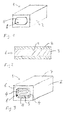
- the prior art insulated brick 1 shown in Figs. 1 and 2 comprises a structural body 2 with a cavity 8 having an inner cavity surface 11. In the cavity an insulating filling 3 is arranged.
- the structural body 2 of this prior art insulated brick is a traditional building brick made of burnt clay.
- the insulating material of the insulating filling 3 in this prior art is for example glass wool.
- Fig. 3 illustrates an embodiment of the invention, namely an insulated brick 1 comprising a structural body 2 with a cavity 8 having an inner inner cavity surface 11.
- the cavity 8 is a through hole penetrating the structural body from one end face 6 to the other, so the structural body is hollow with a shell.
- Cavities could for example be a recess or a blind hole of any suitable size. It is likewise conceivable, and often preferred, to have the cavities directed from a main face, e.g. top face 7 or bottom face, or to have cavities in one or both end faces and one or more main faces.
- the cavity 8 is filled with an insulating filling 3 comprising mineral wool 5 and silica-based thermal insulator 4.
- the insulating filling 3 is in direct contact with the inner cavity surface 8.
- the insulating filling 3 may be provided as an insulating element 9 comprising a central strip of mineral wool 5 and side strips of silica-based thermal insulator 4 as shown in Fig. 4 .
- the insulating material may be provided as an insulating element 9 comprising a central strip of silica-based thermal insulator 4, surrounded by a layer of mineral wool 5, as can be seen in Fig. 5 .
- the layer of mineral wool 5 may be bonded to the central strip of silica-based thermal insulator 4 by any suitable glue or adhesive, stiching etc. if this is considered advantageous for easy handling of the insulating element 9.
- Fig. 6 is a top view of an alternative insulated building brick 1 according to the invention.
- the brick 1 comprises a structural body 2 with a number of cavities 8 in the form of through-holes.
- the holes are filled with a core 3 of insulating material.
- the holes are mutually off-set, so the effect of thermal bridges formed by walls 10 of the structural body 2 will be minimized in that the distance travelled by the heat flux will be as long as possible.
- the walls 10 dividing the cavities 8 should be as thin as possible to minimize thermal bridges.
- the insulating filling 3 may be flush with the face of the structural body 2. Alternatively the insulating filling 3 may extend beyond the face of the structural body 2 (not shown). Thereby the insulating filing 3 may provide a beneficial insulating effect on any joints between adjacent bricks 1. Resiliency of the insulating filing 3 will normally allow the filling to adapt to pressure, whereby the risk of voids without any insulating filling at the openings of the cavities is eliminated or minimized.
- the insulating filling 3 may be sealed with a suitable sealant to provide an end cap at the openings of the cavities 8. This may be beneficial in some embodiments, especially if a relatively loose filling material is used, as the risk of loose filling material leaving the cavity will be eliminated.
Landscapes
- Chemical & Material Sciences (AREA)
- Engineering & Computer Science (AREA)
- Ceramic Engineering (AREA)
- Structural Engineering (AREA)
- Architecture (AREA)
- Chemical Kinetics & Catalysis (AREA)
- Inorganic Chemistry (AREA)
- Materials Engineering (AREA)
- Organic Chemistry (AREA)
- Civil Engineering (AREA)
- Building Environments (AREA)
Abstract
A thermally insulated building brick (1) and a method for production thereof, wherein the brick (1) comprises a structural body (2) with at least one cavity (8) with inner cavity surfaces (11) and an insulating filling (3) arranged in the cavity (8). To provide a brick (1) with high insulation value the insulating filling (3) comprises mineral fibres (5) and a silica-based thermal insulator (4), said insulating filling (3) being arranged to be in direct contact with the inner cavity surfaces (11).
Description
- The invention relates to a thermally insulated building brick, which brick comprises a structural body with at least one cavity with inner cavity surfaces and a thermally insulating filling arranged in the cavity.
- Although new building materials and building methods have been introduced in the past decades, traditional building bricks are still used and valued. A disadvantage of ordinary building bricks is however that the thermal insulating value is mediocre, which with increasing cost of energy and focus on environment is a major disadvantage. Different attempts have been made to improve the insulation value of building bricks.
- At present there are several types of thermally insulated building bricks available on the market. One of these bricks is the Unipor Coriso, which is a brick filled with mineral granulate, and an example of a mineral wool filled brick is known under the trade name MZ8 from Mein Ziegelhaus. Other examples include bricks with a filling of perlite (e.g. Poroton-T8/ -T9 from Wienerberger).
- Patent literature does also include different concepts for thermally insulated building bricks. One example can be found in
GB patent no. 461,314 - A more modern example is the building brick according to
EP 1 752 593 A2 -
DE 20 2007 013 074 U1 discloses vacuum insulation panels having very high insulation value. The vacuum insulation panel comprises a micro-porous core material e.g. a silica-aerogel, possibly with reinforcing fibres, such as inorganic fibres e.g. mineral wool fibres. The core material is arranged in a wrapping, evacuated and provided with an air-tight metal casing, such as an aluminium foil. It is mentioned, but not otherwise supported that the panels can be mounted in cavities of a hollow brick. The resulting brick has a high insulation value, but it is, however, an expensive solution and not suited for mass production. Further the vacuum insulation panel is fragile and subject to damage during mounting in the relatively narrow cavities of a hollow brick. The wrapping and foil could for example easily be scratched, whereby the vacuum would be lost and the insulation properties reduced. Such likely damages to the insulation panel will destroy or reduce the insulation properties of the brick. Conventionally such vacuum insulation panels are filled with aerogel for the aerogel to function as an air-absorbent, which will, however, reduce the insulation value of the panel over time. - An object of the invention is hence to provide an alternative building brick having high thermal insulation value.
- This object is achieved with a building brick according to the introduction, wherein the insulating filling comprises mineral fibres and at least one silica-based thermal insulator selected from the group consisting of aerogel, fumed silica and precipitated silica, said insulating filling being arranged to be in direct contact with the inner cavity surfaces. By direct contact should be understood that no voids or additional material, e.g. a foil or membrane, separates the insulating material from the inner cavity surfaces of the brick, meaning that substantially the whole area of all the inner cavity surfaces is covered by insulating material.
- Hereby a brick with high insulation value is achieved, in that the insulating material contains at least one silica-based thermal insulator selected from the group consisting of aerogel, fumed silica and precipitated silica, which are materials with very high insulation value as will be discussed below, and further in that the insulating material has direct contact with the inner cavity surfaces. Thereby any possible thermal bridges at the boundary between inner cavity surface and insulating material are eliminated. If there are any voids left without insulating material at the inner cavity surface, such voids will have a detrimental effect on the insulation value of the brick. Similarly a possible extra layer separating the insulating material and the inner cavity surfaces as seen in the prior art may also have a negative effect on the insulation value of the brick. Further thermal bridges may not only reduce the insulating properties of the brick, but also give rise to problems with condensation etc.
- Aerogels are known to have extraordinary insulating properties (9-22 mW/m·K), but at a high cost. Fumed silica and precipitated silica have lower insulating properties (approximately 22-23 mW/m*K), but at a lower price.
- In the present context aerogel should be understood as any of the dried gel products, commonly known as aerogels, xerogels and cryogels. These products are known to have excellent insulating properties, owing to their very high surface areas, high porosity and relatively large pore volume. They are manufactured by gelling a flowable sol-gel solution and then removing the liquid from the gel in a manner that does not destroy the pores of the gel.
- Depending on the drying conditions, aerogels, xerogels or cryogels can be made. Where the wet gel is dried at above the critical point of the liquid, there is no capillary pressure and therefore relatively little shrinkage as the liquid is removed. The product of such a process is very highly porous and is known as an aerogel. On the other hand, if the gel is dried by evaporation under subcritical conditions, the resulting product is a xerogel composite. Although shrinkage is unhindered in the production of a xerogel, the material usually retains a very high porosity and a large surface area in combination with a very small pore size.
- When the gel is dried in a freeze-drying process, a cryogel is obtained. These conventional aerogel, xerogel and cryogel products, although good insulators, are fragile, susceptible to cracking and require a long processing time.
- The term aerogel should also be interpreted as aerogel, xerogel or cryogel products, which additionally comprise a matrix of fibres, the matrix serving to reinforce the material, thereby providing high-strength products. These materials are known as aerogel, xerogel and cryogel matrix composites and are commonly produced in the form of mats, which are typically manufactured by impregnating the reinforcing fibres with a flowable sol-gel solution, gelling and then removing the liquid from the gel in a manner that does not destroy the pores of the gel. Supercritical drying, subcritical drying and freeze-drying result respectively in aerogel, xerogel and cryogel matrix composites.
- Aerogels may have a thermal conductivity (λ-value) of e.g. 9-22 mW/m·K, whereas mineral wool may have a thermal conductivity (λ-value) of e.g. 30-40 mW/m·K, so with addition of aerogels to bricks it is possible to achieve better insulation properties of the building bricks. For comparison perlite will have a thermal conductivity (λ-value) of 45-60 mW/m·K.
- The ratio of mineral fibres to silica-based thermal insulator in the insulating filling may be chosen for the particular use of the brick and the demands for insulation and/or physical properties etc. However it is preferred that the insulating filling comprises an amount of silica-based thermal insulator in the interval of 10-95 weight-% in relation to total weight of the insulating filling, which provides a suitable balance of cost and insulation properties. With a high ratio of silica-based thermal insulator the insulation properties will be better, but cost will rise, whereas a low ratio will provide less favourable insulation properties, but at a lower cost. With a high amount of silica-based thermal insulator the insulating filling will have relatively low strength, so for practical reasons the amount of silica-based thermal insulator will often be limited to below 80 weight-%, and in some applications even below 70 weight-%. On the other hand the insulation properties of the filling will often indicate that the amount of silica-based thermal insulator should be above 10 weight-%, often above 30 weight-%, and for some applications above 60 weight-% depending on the demands.
- The insulating filling may be provided as loose fill material, such as in particulate or granulate form, which may have some advantages, such as easy filling by pouring or pumping, which may easily be automated. Further having insulating material as loose fill material may have an advantage in low amount of waste, e.g. as potential trim-loss is avoided. However it is presently preferred to provide the insulating filling in the form of a substantially consolidated insulating element. By consolidated should be understood non-loose, whereas the term should not in this context be used for interpreting of the insulating element as dense or un-flexible. By providing the insulating filling in the form of an element is achieved that no loose insulating material will fall out of the cavities, and further no additional bonding or encapsulating agent is needed to avoid insulating material falling out of the cavities of the brick.
- The insulating element may be sized to the corresponding cavity of the brick to provide a loose fit, which will enable easy fitting of the element in the cavity. According to an embodiment, however, the size of the insulating element is adapted for a tight fit in the corresponding cavity. This is a particularly simple and cost effective way of anchoring the element in the cavity of the brick. A further advantage is that the insulation and fire properties of the brick are not influenced by any additional adhesive or binder for bonding the insulating element to the brick. The insulating element can be adapted to be flexible or compressible enough to be squeezed into the cavities and expand to fill the entire cavity. The insulating element will hence be held in place in the cavity by friction between the insulating element and the inner cavity surfaces, even while the bricks have to be cut to size on site.
- The insulating filling may be a silica-based thermal insulator composite with mineral fibres e.g. for reinforcing purposes. Alternatively or supplementary the insulating filling may comprise mineral wool, such as glass wool, stone wool or slag wool. Mineral wool is in itself insulating, and further mineral wool has distinct acoustic insulation properties. By having an insulating filling comprising a combination of mineral wool and a silica-based thermal insulator, the resulting insulating filling will have improved acoustic properties as the acoustic properties of mineral wool and silica-based thermal insulators differ, so a synergistic effect is achieved in that both high and low frequencies are absorbed in the insulating material. Further the intrinsic compressibility of mineral wool may in some embodiments be beneficial, e.g. to provide easy fitting in the cavities, and further expansion for the insulating filling to fill the entire cavity.
- Glass wool is often produced in a process in which raw materials for glass production and/or recycled glass are melted in e.g. an electric furnace. Melting takes place at temperatures around 700 °C, and the melt is led to a spinner cup with a plurality of small holes in the periphery, whereby fibres are drawn from the melt exiting the holes. The fibres are collected as wool having a relatively laminar build-up of fibres. A binder is normally used to bind the fibres of the wool.
- Stone wool is often produced in a process in which raw materials are melted in a cupola furnace using coke as the energy source. The melt, having a temperature of around 1,400 °C, is led to a system of spinner wheels, and droplets of melt are thrown off the surface of the spinner wheels and dragging fibres as a tail. The fibres are collected as wool having chaotic orientation of the fibres. A binder is normally used to bind the fibres of the wool. Due to the chaotic orientation of the fibres stone wool is resilient by nature and is able to withstand compression. After collection the wool is often compressed and the binder is cured in a curing oven at elevated temperatures.
- The silica-based thermal insulator may be provided in any shape or form, such as is monolithic, i.e. composed of one piece, or silica-based thermal insulator particles with a diameter which is smaller than the diameter of the particles that are joined by a suitable binder and/or compressed to form a larger particle. According to an embodiment, however, the silica-based thermal insulator is on particulate form, preferably with a weight average particle diameter in the interval of 1 to 10 mm, such as 5 mm. Particles are very versatile, and such particles may be added to mineral wool, e.g. during production of the mineral wool. Alternatively the particles may be added to insulating filling in situ. The size of particles will depend on the use to which the material is put. In order to achieve a high level of stability, the particles should not be too large, as this would provide a coarse granulate.
- A binder may be added to the insulating filling if considered advantageous. The binder may be organic or inorganic. An example of an inorganic binder is water glass, which has good fire properties.
- The brick may comprise a single cavity, but according to an embodiment the brick comprises a plurality of cavities, and all cavities are filled with insulating filling. Hereby a high strength brick with high insulation value is provided. To provide high strength the brick should be as massive as possible, whereas to provide good insulation value the brick should be filled with as much insulation material as possible.
- According to an embodiment the concentration of silica-based thermal insulator is higher at a centre portion of the insulating filling, whereby the somewhat more delicate and high-cost silica-based thermal insulator is protected by the mineral fibres, both with respect to damages from handling and installation, and fire properties. Typically silica-based thermal insulator will start melting or shrinking at temperatures well below 1,000 °C, and thereby loose some of the insulation properties, whereas mineral fibres will stand higher temperatures. Stone fibres are the type of mineral fibres which has the best fire resistance and hence capable of withstanding the highest temperatures, such as 1,000 °C. Therefore stone fibres are a preferred type of mineral fibres when fire properties are important. Potential dust problems during production and handling due to silica-based thermal insulator particles may further be minimized.
- In an alternative embodiment, the concentration of mineral wool is higher at a centre portion of the insulating filling, which in some applications may provide a beneficial effect on acoustic properties of the brick.
- The two insulating materials making up the insulating filling may be arranged in any suitable way, but according to an embodiment the insulating element is made up of layers. Hereby the insulating element may be produced in a simple and efficient way, as the individual materials may be produced separately and joined at any convenient point in time, such as shortly before installation of the insulation in the brick.
- According to an alternative embodiment the insulating element is a substantially homogeneous blend of mineral wool and silica-based thermal insulator. This embodiment has the advantage that the insulating element is an integral product containing both mineral wool and silica-based thermal insulator as a mixture, so that the element can be produced in large dimensions and sized for the application. Hereby production is simplified, in that no special elements for special applications is needed, and further the need and requirement for stocks is reduced. Further with a homogeneous blend of mineral wool and silica-based thermal insulator the risk of incorrect mounting of different layers is eliminated.
- The mineral wool may have any suitable density, which will often be a compromise between insulation properties, cost, and ease of handling. According to an embodiment the mineral wool may have a density in the interval of 8 to 150 kg/m3. The low limit of 8 kg/m3 is a very light mineral wool, which will result in a low cost because the amount of material in the mineral wool is low, and further such wool is very compressible and hence the cost of transport of such light and compressible wool is low. On the other hand the high limit of 150 kg/m3 is a very strong mineral wool, which will contribute to the strength of the resulting brick, and workability is easy. In most practical circumstances a density in the interval of 25-75 kg/m3 will be suitable, and will provide mineral wool with favourable insulation properties and balanced cost and mechanical properties. A density of around 55 kg/m3 is considered the most promising, as this value is close to the optimum with regard to thermal conductivity, while also relatively light and compressible.
- The brick could be any kind of building brick made of any kind of material, e.g. burnt clay, concrete, cellular concrete etc. According to an embodiment the structural body is made of mainly lime (CaO) and sand (SiO2), resulting in a so-called sand-lime brick. The production method of these bricks will provide the advantage that curing of the bricks may take place in an autoclave at relatively low temperatures of around 200°C. Thereby it is possible to arrange the insulating filling in the cavity of the brick before curing of the brick, which may facilitate cost efficient production.
- The invention also relates to a method for providing an insulated building brick, said method comprising the steps of providing a structural body having at least one cavity with inner cavity surfaces, providing an insulating filling comprising mineral fibres and at least one silica-based thermal insulator selected from the group consisting of aerogel, fumed silica and precipitated silica, and arranging the insulating filling in the cavity in direct contact with the inner cavity surfaces.
- With this method a brick having high insulation value can be produced effectively.
- According to an embodiment the insulating filling is a loose fill material, and the step of arranging the insulating filling takes place by pumping the filling into the cavity. This method is particularly suited for mass production at low cost.
- According to an alternative embodiment the insulating filling is provided by mixing the silica-based thermal insulator with mineral wool. Hereby the insulating filling will be an integral product, which will facilitate mounting of the insulating filling in the cavities of the brick, whereby production cost will be low. The mixing may take place at production of the mineral wool, or at any later time.
- The brick could have any suitable dimension as would be understood by the skilled person.
- The invention will be described in more detail in the following by way of example and with reference to the schematic drawings in which
-
Figure 1 is a perspective view of a prior art insulated building brick, -
Figure 2 is a longitudinal section of the building brick inFig. 1 , -
Figure 3 depicts an insulated building brick according to the invention, -
Figure 4 is a perspective view of an insulating element according to the invention, -
Figure 5 is a perspective view of an alternative insulating element, and -
Fig. 6 is a top view of an alternative building brick. - The prior art insulated
brick 1 shown inFigs. 1 and 2 comprises astructural body 2 with acavity 8 having an inner cavity surface 11. In the cavity an insulating filling 3 is arranged. Thestructural body 2 of this prior art insulated brick is a traditional building brick made of burnt clay. The insulating material of the insulating filling 3 in this prior art is for example glass wool. -
Fig. 3 illustrates an embodiment of the invention, namely aninsulated brick 1 comprising astructural body 2 with acavity 8 having an inner inner cavity surface 11. In the present example thecavity 8 is a through hole penetrating the structural body from oneend face 6 to the other, so the structural body is hollow with a shell. This is a very simple example to illustrate the principle of the invention, and the skilled person would immediately realize the possibility of other embodiments. Cavities could for example be a recess or a blind hole of any suitable size. It is likewise conceivable, and often preferred, to have the cavities directed from a main face, e.g.top face 7 or bottom face, or to have cavities in one or both end faces and one or more main faces. - The
cavity 8 is filled with an insulating filling 3 comprisingmineral wool 5 and silica-basedthermal insulator 4. The insulating filling 3 is in direct contact with theinner cavity surface 8. The insulating filling 3 may be provided as an insulatingelement 9 comprising a central strip ofmineral wool 5 and side strips of silica-basedthermal insulator 4 as shown inFig. 4 . - Alternatively the insulating material may be provided as an insulating
element 9 comprising a central strip of silica-basedthermal insulator 4, surrounded by a layer ofmineral wool 5, as can be seen inFig. 5 . The layer ofmineral wool 5 may be bonded to the central strip of silica-basedthermal insulator 4 by any suitable glue or adhesive, stiching etc. if this is considered advantageous for easy handling of the insulatingelement 9. -
Fig. 6 is a top view of an alternativeinsulated building brick 1 according to the invention. Thebrick 1 comprises astructural body 2 with a number ofcavities 8 in the form of through-holes. The holes are filled with acore 3 of insulating material. As can be seen the holes are mutually off-set, so the effect of thermal bridges formed bywalls 10 of thestructural body 2 will be minimized in that the distance travelled by the heat flux will be as long as possible. Thewalls 10 dividing thecavities 8 should be as thin as possible to minimize thermal bridges. - The insulating filling 3 may be flush with the face of the
structural body 2. Alternatively the insulating filling 3 may extend beyond the face of the structural body 2 (not shown). Thereby the insulatingfiling 3 may provide a beneficial insulating effect on any joints betweenadjacent bricks 1. Resiliency of the insulatingfiling 3 will normally allow the filling to adapt to pressure, whereby the risk of voids without any insulating filling at the openings of the cavities is eliminated or minimized. - Alternatively the insulating filling 3 may be sealed with a suitable sealant to provide an end cap at the openings of the
cavities 8. This may be beneficial in some embodiments, especially if a relatively loose filling material is used, as the risk of loose filling material leaving the cavity will be eliminated.
Claims (17)
- A thermally insulated building brick (1), which brick comprises a structural body (2) with at least one cavity (8) with inner cavity surfaces (11) and a thermally insulating filling (3) arranged in the cavity, characterized in that the insulating filling (3) comprises mineral fibres and at least one silica-based thermal insulator (4) selected from the group consisting of aerogel, fumed silica and precipitated silica, said insulating filling being arranged to be in direct contact with the inner cavity surfaces (11).
- A thermally insulated building brick (1) according to claim 1, wherein the insulating filling (3) comprises an amount of silica-based thermal insulator in the interval of 10-95 weight-%.
- A thermally insulated building brick (1) according to claim 1 or 2, wherein the insulating filling (3) is provided in the form of a substantially consolidated insulating element (9).
- A thermally insulated building brick (1) according to claim 3, wherein the size of the insulating element (9) is adapted for a tight fit in the cavity (8).
- A thermally insulated building brick (1) according to any one of the claims above, wherein the insulating filling (3) comprises mineral wool, such as glass wool, stone wool or slag wool.
- A thermally insulated building brick (1) according to any one of the claims above, wherein the silica-based thermal insulator is in particulate form, preferably with an average particle diameter in the interval of 1 to 10 mm, such as 5 mm.
- A thermally insulated building brick (1) according to any one of the claims above, wherein the insulating filling (3) further comprises a binder, preferably an inorganic binder, such as water glass.
- A thermally insulated building brick (1) according to any one of the claims above, wherein the brick (1) comprises a plurality of cavities (8), and all cavities are filled with insulating filling (3).
- A thermally insulated building brick (1) according to any one of the claims above, wherein the concentration of silica-based thermal insulator is higher at a centre portion of the insulating filling (3).
- A thermally insulated building brick (1) according to claim 5, wherein the concentration of mineral wool is higher at a centre portion of the insulating element.
- A thermally insulated building brick (1) according to claim 3, wherein the insulating element (9) is made up of layers.
- A thermally insulated building brick (1) according to claim 3, wherein the insulating element (3) is a substantially homogeneous blend of mineral wool and silica-based thermal insulator.
- A thermally insulated building brick (1) according to claim 5 or 12, said mineral wool having a density in the interval of 8 to 150 kg/m3.
- A thermally insulated building brick (1) according to any one of the claims above, wherein the structural body (2) is a sand-lime brick.
- Method for providing a thermally insulated building brick (1), said method comprising the steps of:providing a structural body (2) having at least one cavity (8) with inner cavity surfaces (11),providing an insulating filling (3) comprising mineral fibres and at least one silica-based thermal insulator selected from the group consisting of aerogel, fumed silica and precipitated silica,arranging the insulating filling (3) in the cavity (8) in direct contact with the inner cavity surfaces (11).
- Method according to claim 15, wherein the insulating filling (3) is a loose fill material, and the step of arranging the insulating filling takes place by pumping the filling into the cavity (8).
- Method according to claim 15 or 16, wherein the insulating filling (3) is provided by mixing the silica-based thermal insulator with mineral wool.
Priority Applications (1)
| Application Number | Priority Date | Filing Date | Title |
|---|---|---|---|
| EP20080253411 EP2180111A1 (en) | 2008-10-21 | 2008-10-21 | Thermally insulated building brick |
Applications Claiming Priority (1)
| Application Number | Priority Date | Filing Date | Title |
|---|---|---|---|
| EP20080253411 EP2180111A1 (en) | 2008-10-21 | 2008-10-21 | Thermally insulated building brick |
Publications (1)
| Publication Number | Publication Date |
|---|---|
| EP2180111A1 true EP2180111A1 (en) | 2010-04-28 |
Family
ID=40427287
Family Applications (1)
| Application Number | Title | Priority Date | Filing Date |
|---|---|---|---|
| EP20080253411 Ceased EP2180111A1 (en) | 2008-10-21 | 2008-10-21 | Thermally insulated building brick |
Country Status (1)
| Country | Link |
|---|---|
| EP (1) | EP2180111A1 (en) |
Cited By (8)
| Publication number | Priority date | Publication date | Assignee | Title |
|---|---|---|---|---|
| CN102345342A (en) * | 2011-06-28 | 2012-02-08 | 程松林 | Concrete condensing column composite side fascia and manufacture method thereof |
| CN102359224A (en) * | 2011-10-24 | 2012-02-22 | 程松林 | Concrete close-column and gypsum composite external wall panel without cold bridge |
| CN102363990A (en) * | 2011-06-28 | 2012-02-29 | 程松林 | Concrete close column compound inner wall plate and manufacturing method thereof |
| CN102363989A (en) * | 2011-06-28 | 2012-02-29 | 程松林 | Concrete close column compound outer wall plate and manufacturing method thereof |
| CN102363993A (en) * | 2011-06-28 | 2012-02-29 | 程松林 | Concrete ribbed composite inner wallboard and manufacturing method thereof |
| EP2660406A1 (en) | 2012-05-03 | 2013-11-06 | Saint-Gobain Weber | Thermally insulating building block |
| CN103722813A (en) * | 2013-07-23 | 2014-04-16 | 太仓派欧技术咨询服务有限公司 | High-efficiency heat-insulated glass cotton felt structure |
| CN111438817A (en) * | 2020-04-07 | 2020-07-24 | 上海久山医疗科技有限公司 | Fireproof sound-insulation wallboard |
Citations (11)
| Publication number | Priority date | Publication date | Assignee | Title |
|---|---|---|---|---|
| GB461314A (en) | 1935-08-06 | 1937-02-08 | Henry Warburton | Improvements in, and relating to, bricks |
| DE3100642A1 (en) * | 1980-01-17 | 1981-12-17 | Wienerberger Baustoffindustrie AG, 1100 Wien | Hollow block |
| DE4022506A1 (en) * | 1990-07-14 | 1992-01-16 | Hoermansdoerfer Gerd | Thermal insulation layer between two walls - made of compacted particles of plastic or silicon di:oxide contg. clouding agent which has good infrared absorption or dispersing properties |
| WO1996015998A1 (en) * | 1994-11-23 | 1996-05-30 | Hoechst Aktiengesellschaft | Composite material containing aerogel, process for manufacturing said material and the use thereof |
| DE19702240A1 (en) * | 1997-01-24 | 1998-07-30 | Hoechst Ag | Multilayer composite materials which have at least one airgel-containing layer and at least one further layer, processes for their production and their use |
| US20060163763A1 (en) * | 2005-01-26 | 2006-07-27 | Fellinger Thomas J | Method of insulating using spray-on dry fibrous insulation |
| EP1752593A2 (en) | 2005-07-21 | 2007-02-14 | Deutsche Rockwool Mineralwoll GmbH & Co. OHG | Method for making building blocks and building block obtained thereby |
| DE202007013688U1 (en) * | 2007-05-03 | 2008-01-31 | Kratel, Günter, Dr. | Thermal insulation composite systems with hydrophobic, microporous thermal insulation core |
| DE202007013074U1 (en) | 2007-09-18 | 2008-02-14 | Kratel, Günter, Dr. | Masonry with integrated vacuum insulation based on microporous thermal insulation |
| EP1988228A2 (en) * | 2007-05-03 | 2008-11-05 | Matthias Rimmele | Building blocks and building systems with hydrophobic, microporous heat insulation |
| EP2000607A2 (en) * | 2007-06-06 | 2008-12-10 | Ing.Michael Kogler Dip.- | Moulded block |
-
2008
- 2008-10-21 EP EP20080253411 patent/EP2180111A1/en not_active Ceased
Patent Citations (11)
| Publication number | Priority date | Publication date | Assignee | Title |
|---|---|---|---|---|
| GB461314A (en) | 1935-08-06 | 1937-02-08 | Henry Warburton | Improvements in, and relating to, bricks |
| DE3100642A1 (en) * | 1980-01-17 | 1981-12-17 | Wienerberger Baustoffindustrie AG, 1100 Wien | Hollow block |
| DE4022506A1 (en) * | 1990-07-14 | 1992-01-16 | Hoermansdoerfer Gerd | Thermal insulation layer between two walls - made of compacted particles of plastic or silicon di:oxide contg. clouding agent which has good infrared absorption or dispersing properties |
| WO1996015998A1 (en) * | 1994-11-23 | 1996-05-30 | Hoechst Aktiengesellschaft | Composite material containing aerogel, process for manufacturing said material and the use thereof |
| DE19702240A1 (en) * | 1997-01-24 | 1998-07-30 | Hoechst Ag | Multilayer composite materials which have at least one airgel-containing layer and at least one further layer, processes for their production and their use |
| US20060163763A1 (en) * | 2005-01-26 | 2006-07-27 | Fellinger Thomas J | Method of insulating using spray-on dry fibrous insulation |
| EP1752593A2 (en) | 2005-07-21 | 2007-02-14 | Deutsche Rockwool Mineralwoll GmbH & Co. OHG | Method for making building blocks and building block obtained thereby |
| DE202007013688U1 (en) * | 2007-05-03 | 2008-01-31 | Kratel, Günter, Dr. | Thermal insulation composite systems with hydrophobic, microporous thermal insulation core |
| EP1988228A2 (en) * | 2007-05-03 | 2008-11-05 | Matthias Rimmele | Building blocks and building systems with hydrophobic, microporous heat insulation |
| EP2000607A2 (en) * | 2007-06-06 | 2008-12-10 | Ing.Michael Kogler Dip.- | Moulded block |
| DE202007013074U1 (en) | 2007-09-18 | 2008-02-14 | Kratel, Günter, Dr. | Masonry with integrated vacuum insulation based on microporous thermal insulation |
Cited By (8)
| Publication number | Priority date | Publication date | Assignee | Title |
|---|---|---|---|---|
| CN102345342A (en) * | 2011-06-28 | 2012-02-08 | 程松林 | Concrete condensing column composite side fascia and manufacture method thereof |
| CN102363990A (en) * | 2011-06-28 | 2012-02-29 | 程松林 | Concrete close column compound inner wall plate and manufacturing method thereof |
| CN102363989A (en) * | 2011-06-28 | 2012-02-29 | 程松林 | Concrete close column compound outer wall plate and manufacturing method thereof |
| CN102363993A (en) * | 2011-06-28 | 2012-02-29 | 程松林 | Concrete ribbed composite inner wallboard and manufacturing method thereof |
| CN102359224A (en) * | 2011-10-24 | 2012-02-22 | 程松林 | Concrete close-column and gypsum composite external wall panel without cold bridge |
| EP2660406A1 (en) | 2012-05-03 | 2013-11-06 | Saint-Gobain Weber | Thermally insulating building block |
| CN103722813A (en) * | 2013-07-23 | 2014-04-16 | 太仓派欧技术咨询服务有限公司 | High-efficiency heat-insulated glass cotton felt structure |
| CN111438817A (en) * | 2020-04-07 | 2020-07-24 | 上海久山医疗科技有限公司 | Fireproof sound-insulation wallboard |
Similar Documents
| Publication | Publication Date | Title |
|---|---|---|
| EP2397616A2 (en) | Composite thermal insulation material | |
| KR101303378B1 (en) | Expanded perlite insulation, vacuum insulation panel using it and its manufacturing method | |
| CA2741007C (en) | Thermally insulated building brick | |
| CN204826264U (en) | Compound with filling fire prevention insulation board of aerogel | |
| EP2850254A1 (en) | Insulating composite product comprising mineral wool and material with superior insulating properties | |
| CN101736875A (en) | Heat-insulating decorative board and manufacturing method thereof | |
| CN204662947U (en) | A kind of composite self-insulation non-dismantling formwork | |
| CN107724549A (en) | A kind of compound lattice storehouse type warming plate of scale type steel fabric sheet and walling system | |
| CN207177071U (en) | Assembling structural thermal insulation integrated plate | |
| CN110670744B (en) | Supporting and connecting system of assembled disassembly-free composite aerogel self-insulation formwork | |
| CN205712703U (en) | Unilateral composite thermal self-insulation building block | |
| KR101863704B1 (en) | A composite water-proof structure | |
| CN103774765A (en) | Explosion venting plate and manufacturing method thereof | |
| CN207392503U (en) | A kind of construction wall heat-insulation system | |
| CN101319545A (en) | Heat preservation building blocks for construction | |
| CN202627233U (en) | Thermal insulation composite board for external wall | |
| CN202023291U (en) | Heat-insulation composite wall brick | |
| CN205134579U (en) | Exterior sheathing cast in situ concrete composite insulation board | |
| CN201087503Y (en) | Exterior wall air-entrained compound heat-preserving building blocks | |
| CN201059033Y (en) | Heat-insulating exterior wall cladding | |
| CN104879929A (en) | a solar system | |
| CN2325443Y (en) | Composite silicate poly-benzene granular thermal insulation board | |
| CN209512500U (en) | A kind of kiln car gusset formations | |
| CN220014187U (en) | High-performance heat-insulating wallboard | |
| CN213956003U (en) | Mullite-cordierite casting sagger |
Legal Events
| Date | Code | Title | Description |
|---|---|---|---|
| PUAI | Public reference made under article 153(3) epc to a published international application that has entered the european phase |
Free format text: ORIGINAL CODE: 0009012 |
|
| AK | Designated contracting states |
Kind code of ref document: A1 Designated state(s): AT BE BG CH CY CZ DE DK EE ES FI FR GB GR HR HU IE IS IT LI LT LU LV MC MT NL NO PL PT RO SE SI SK TR |
|
| AX | Request for extension of the european patent |
Extension state: AL BA MK RS |
|
| STAA | Information on the status of an ep patent application or granted ep patent |
Free format text: STATUS: THE APPLICATION HAS BEEN REFUSED |
|
| 18R | Application refused |
Effective date: 20100520 |