EP2172844A1 - Memory protection method, information processing apparatus, program, and computer-readable storage medium - Google Patents
Memory protection method, information processing apparatus, program, and computer-readable storage medium Download PDFInfo
- Publication number
- EP2172844A1 EP2172844A1 EP09171895A EP09171895A EP2172844A1 EP 2172844 A1 EP2172844 A1 EP 2172844A1 EP 09171895 A EP09171895 A EP 09171895A EP 09171895 A EP09171895 A EP 09171895A EP 2172844 A1 EP2172844 A1 EP 2172844A1
- Authority
- EP
- European Patent Office
- Prior art keywords
- areas
- program
- processing
- procedure
- access
- Prior art date
- Legal status (The legal status is an assumption and is not a legal conclusion. Google has not performed a legal analysis and makes no representation as to the accuracy of the status listed.)
- Withdrawn
Links
Images




Classifications
-
- G—PHYSICS
- G06—COMPUTING OR CALCULATING; COUNTING
- G06F—ELECTRIC DIGITAL DATA PROCESSING
- G06F12/00—Accessing, addressing or allocating within memory systems or architectures
- G06F12/14—Protection against unauthorised use of memory or access to memory
- G06F12/1416—Protection against unauthorised use of memory or access to memory by checking the object accessibility, e.g. type of access defined by the memory independently of subject rights
- G06F12/1425—Protection against unauthorised use of memory or access to memory by checking the object accessibility, e.g. type of access defined by the memory independently of subject rights the protection being physical, e.g. cell, word, block
- G06F12/1441—Protection against unauthorised use of memory or access to memory by checking the object accessibility, e.g. type of access defined by the memory independently of subject rights the protection being physical, e.g. cell, word, block for a range
Definitions
- the present invention relates to a memory protection method which protects a memory from an unauthorized access by a program, an information processing apparatus, a program, and a computer-readable storage medium.
- a program can (directly) access all memory areas. For this reason, an overhead is suppressed to be small, but a memory cannot be protected from an unauthorized access caused by a bug of the program.
- a virtual address space unique to each program is used.
- a program which runs on a virtual address space cannot access memory areas which are not associated with that space.
- an operating system (OS) intermediates message exchange between the programs on the different virtual address spaces.
- OS operating system
- a technique which changes an associated memory area from a virtual address space to permit an access to a memory area, an access to which is not permitted originally, is known (Japanese Patent Laid-Open No. 2005-209178 ).
- the present invention enables to provide a technique, which suppresses an unauthorized access between divided areas on a memory, and reduces a decrease in execution speed of procedures across the areas.
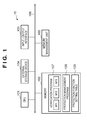
- Fig. 1 is a block diagram showing an example of the arrangement of an information processing apparatus 10;
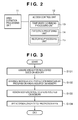
- Fig. 2 is a block diagram showing an example of the functional arrangement implemented by a CPU 101;
- Fig. 3 is a first flowchart showing an example of the operation in the information processing apparatus 10;
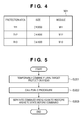
- Fig. 4 is a view showing an example of a protection function setting table 109
- Fig. 5 is a second flowchart showing an example of the operation in the information processing apparatus 10.
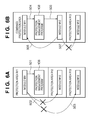
- Figs. 6A and 6B are diagrams illustrating the relationships between a plurality of protection areas assured on a memory and accesses to these areas;
- Fig. 7 is a block diagram showing an example of the arrangement of an information processing apparatus 10;
- Fig. 8 is a block diagram showing an example of the functional arrangement implemented by a CPU 101;
- Fig. 9 is a flowchart showing an example of the operation in the information processing apparatus 10.
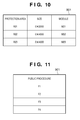
- Fig. 10 is a first view showing an example of a protection function setting table 109;
- Fig. 11 is a second view showing an example of the protection function setting table 109;
- Fig. 12 is a block diagram showing an example of the arrangement of an information processing apparatus 10;
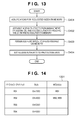
- Fig. 13 is a first flowchart showing an example of the operation in the information processing apparatus 10.
- Fig. 14 is a first view showing an example of a protection function setting table 109
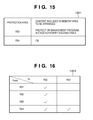
- Fig. 15 is a second view showing an example of the protection function setting table 109;
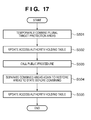
- Fig. 16 is a third view showing an example of the protection function setting table 109;
- Fig. 17 is a second flowchart showing an example of the operation in the information processing apparatus 10.
- Figs. 18A and 18B are views showing examples of an access authority holding table 113 included in the protection function setting table 109.
- Fig. 1 is a block diagram showing an example of the arrangement of an information processing apparatus 10.
- a CPU (Central Processing Unit) 101 controls the overall information processing apparatus 10.
- a memory 102 includes a ROM (Read Only Memory) which stores programs and parameters that do not require any changes, and a RAM (Random Access Memory) which temporarily stores programs and data that are supplied from an external apparatus and the like.
- ROM Read Only Memory
- RAM Random Access Memory
- An external storage device 104 includes a hard disk and memory card. Note that the external storage device 104 may include a flexible disk (FD), an optical disk such as a CD (Compact Disk), magnetic and optical cards, and an IC card, which are detachable from the information processing apparatus.
- FD flexible disk
- CD Compact Disk
- IC card integrated circuit card
- An input/output interface 105 inputs data into the information processing apparatus and outputs data to outside the apparatus.
- the input/output interface 105 is implemented by, for example, a user interface which interfaces between the information processing apparatus 10 and the user, a communication interface used to connect an external environment (e.g., a network), and the like.
- a system bus 106 connects the aforementioned units to be able to exchange data.
- a verification program 107 indicates a program which may include bugs that may cause unauthorized accesses.
- the verification program 107 includes three modules, that is, modules M11, M12, and M13. Assume that execution of the verification program 107 is started from the module M11 in this embodiment. Also, assume that the verification program 107 requires one task in this embodiment. That is, the verification program 107 does not require two or more tasks. It is noted that "task” may be called “thread” depending on environment in which the verification program 107 is used, for example in the UNIX OS environment.
- Procedure calls between modules arranged on different areas on the memory are implemented by calling procedure calling processing with a protection area temporary combining function (to be simply referred to as procedure calling processing with a combining function hereinafter) in a protection management program 108. That is, assume that the verification program 107 describes procedures for calling this processing.
- the protection management program 108 (memory protection program) includes procedures for implementing area definition processing and procedure calling processing with a combining function.
- a protection function setting table 109 which specifies predetermined setting information includes, for example, area definition information.
- a memory management unit 103 functions as a memory management device which checks the authenticity of an access to the memory 102.
- the memory management unit 103 includes, for example, an MMU (Memory Management Unit) or an MPU (Memory Protection Unit). Note that the memory management unit 103 may be incorporated in the CPU 101.
- the memory management unit 103 operates in a privileged mode of the CPU 101. For example, when an access is made to an area on the memory, the access to which is not permitted, upon execution of the verification program 107, the memory management unit 103 detects that access processing as an unauthorized access. When an unauthorized access is detected, the memory management unit 103 generates an exception to the CPU 101. At this time, the memory management unit 103 holds information associated with the unauthorized access.
- an address where the unauthorized access was made, and information indicating whether the unauthorized access is a read or write access are held.
- the CPU 101 Upon generation of the exception, the CPU 101 reads out these pieces of information, and specifies a location where the unauthorized access was made.
- the CPU 101 implements an area definition processing unit 11 and access control unit 12 as functional components.
- the area definition processing unit 11 assures areas on the memory 102. The areas are assured with reference to the protection function setting table 109, and an undivided address space on the memory is divided into a plurality of areas to be assured. Each of these divided areas will also be referred to as a protection area hereinafter. Note that the area definition processing unit 11 arranges a module, assigns an address space, and sets an access authority with respect to each protection area.
- the access control unit 12 has a function of controlling execution of processing across divided protection areas, and includes a temporary combining processing unit 13, execution processing unit 14, and restoring processing unit 15.
- the temporary combining processing unit 13 temporarily combines areas divided by the area definition processing unit 11. With this combining processing, for example, since an access source area and access destination area are temporarily combined, public procedures across the protection areas, which are called during this combining processing can directly access both the areas.
- the execution processing unit 14 controls to call and execute public procedures executed across the combined areas.
- the restoring processing unit 15 restores the areas combined by the temporary combining processing unit 13 to a state before the combining processing after completion of the public procedures.
- the CPU 101 always operates in a privileged mode. Then, an overhead required to set the memory management unit 103 is reduced. Note that the CPU 101 may operate in the privileged mode only when the memory management unit 103 is to be set. Also, the CPU 101 may always operate in a non-privileged mode as long as an access to the memory management unit 103 is made in the non-privileged mode.
- the CPU 101 executes area definition processing according to the protection management program 108 before execution of the verification program 107.
- This processing is executed by calling the protection management program 108 in, for example, an initialization process of the information processing apparatus 10.
- the area definition processing may be executed after execution of the verification program 107 is requested. That is, the execution timing of the area definition processing is not particularly limited as long as that processing is executed before memory access processing of the verification program 107.
- Fig. 3 is a flowchart showing an example of the area definition processing. This processing is implemented when the CPU 101 reads out and executes the protection management program 108 stored (or mapped) in the memory 102.
- the CPU 101 controls the area definition processing unit 11 to assure areas corresponding to requested sizes on the memory 102 with reference to the protection function setting table 109 shown in Fig. 4 (S101). Note that each area to be assured may include a register mapped on the memory, if necessary.
- the protection function setting table 109 specifies the sizes of protection areas and modules to be arranged as area definition information 301, as shown in Fig. 4 . In case of Fig. 4 , protection areas R11, R12, and R13 are defined, and the size of each protection area is rounded up in a minimum unit recognized as a different area by the memory management unit 103. For example, a case will be examined below wherein a memory area specified by physical addresses 0x0000 to 0x9fff is available.
- the CPU 101 controls the area definition processing unit 11 to arrange the modules and protection management program on the areas assured in step S101 (S102).
- the module M11 is arranged on the protection area R11
- the module M12 is arranged on the protection area R12
- the module M13 is arranged on the protection area R13.
- Programs are arranged by copying the contents stored in the memory to the corresponding areas. In this case, even when the program itself is changed as a result of execution of the program, it can be restored to an initial state by copying the program again.
- memory areas that store the respective modules may be assured by the process in step S101, and these areas may be directly used in the processes in step S103 and subsequent step.
- the protection management program 108 required to call procedures between the protection areas and the module M11 are arranged on the single protection area R11. This to allow the module M11, which is executed first in the verification program 107, to call the protection management program 108. Note that only processing (program) required to call procedures between the protection areas may be separated, and may be arranged on the protection area R11. Also, another protection area where no module is arranged may be prepared, and the protection management program 108 may be arranged there. In this case, accesses from the module that requires procedure calls between the protection areas may be permitted with respect to the area where the protection management program 108 is arranged.
- the CPU 101 controls the area definition processing unit 11 to assign address spaces to the areas assured in step S101 (S103).
- the address spaces are assigned by setting the memory management unit 103.
- the address spaces to be assigned are those used when the CPU 101 executes various kinds of control.
- each address space to be assigned is matched with a physical address space in this embodiment. In such case, when a bug is found in the verification program 107, an address used by the CPU 101 can be directly used, thus allowing easy debugging.
- an MPU without any address conversion function may be used as the memory management unit 103.
- When a virtual address space is defined, even when the module to be arranged on the protection area cannot be arranged on a continuous physical address space, it can be handled as a continuous protection area on the virtual address space.
- the physical address space and virtual address space may be defined as different spaces, as a matter of course.
- the CPU 101 controls the area definition processing unit 11 to set an access authority to the protection area (S104).
- the access authority is set for the area where the module, which is executed first at the beginning of the verification program 107, is arranged (in this case, the module M11).
- the access authority can be set by setting it in the memory management unit 103. That is, the CPU 101 sets the memory management unit 103 to permit read and write accesses to an address range from 0x0000 to 0x1fff assigned to the protection area R11 (where the module M11 is arranged).
- the memory management unit 103 checks the authenticity of an access by the verification program 107 based on an address provided by the CPU 101. Then, the memory management unit 103 can detect an access to an address failing outside the above range as an unauthorized access.
- the area definition processing ends. After the end of the area definition processing, for example, when the size of each protection area is required to be increased by dynamic memory assignment, the protection area can be re-defined by changing the setting in the memory management unit 103.
- Fig. 5 is a flowchart showing an example of the procedure calling processing with the combining function. This processing is implemented when the CPU 101 reads out and executes the protection management program 108 stored (or mapped) in the memory 102.
- the procedure calling processing with the combining function is executed after the aforementioned area definition processing shown in Fig. 3 .
- the procedure calling processing with the combining function is started, for example, when the verification program 107 is executed to call procedures for executing the protection management program 108 (more specifically, the procedure calling processing with the combining function).
- the CPU 101 controls the temporary combining processing unit 13 to temporarily combine a plurality of target protection areas (S201). That is, the CPU 101 temporarily combines the protection area where the module M11 (a module as an origin of execution) and the protection management program 108 are arranged, and the protection area where the module including public procedures is arranged. More specifically, the CPU 101 changes the setting in the memory management unit 103 to set the same access authority as that set for the protection area where the protection management program 108 and the like are arranged to the protection area where the module including public procedures is arranged. As a consequence, the two protection areas are combined, and the module M11 and protection management program 108 are permitted to access the protection area where the module including public procedures is arranged.
- the CPU 101 controls the execution processing unit 14 to call public procedures (S202). After completion of processing based on the public procedures, the CPU 101 controls the restoring processing unit 15 to separate the areas combined in step S201 again, that is, to restore the areas before the combining processing (S203). Note that this processing is implemented by changing the setting in the memory management unit 103 as in step S201 described above. Hence, an access to the protection area as an access destination of the public procedures is inhibited again.
- Figs. 6A and 6B are diagrams illustrating the relationships between the plurality of protection areas assured on the memory and accesses to these areas.
- the protection areas are in a state shown in Fig. 6A before execution of the procedure calling processing with the combining function.
- an access 501 from the module M11 arranged on the protection area R11 to the protection management program 108 stored in the same protection area is permitted.
- an access 502 from the module M11 to the module M12 arranged on the protection area R12 and an access 503 from the module M11 to the module M13 arranged on the protection area R13 are inhibited. That is, the accesses 502 and 503 are detected as unauthorized accesses.
- the protection areas are in a state shown in Fig. 6B .
- the CPU 101 combines the protection areas R11 and R12 according to the protection management program 108.
- a public procedure call made in this state corresponds to an access 505.
- An access between the modules arranged on the protection areas R11 and R12 is permitted. Therefore, an access 506 is detected as an authorized access.
- an access 507 from the module M12 to the non-combined protection area R13 is detected as an unauthorized access.
- the protection areas R11 and R12 are separated again. As a result, the protection areas are restored to the state shown in Fig. 6A .
- an unauthorized access between divided areas on the memory can be suppressed, and a decrease in execution speed of procedures across the areas can be reduced. Also, since the definition information associated with the protection areas is separated as the protection function setting table 109 from the verification program 107, the actual sizes of the protection areas and memory areas to be arranged can be flexibly set.
- This embodiment will explain a case wherein processing is executed for a program including no description. For example, a program after the verification process corresponds to such program.
- Fig. 7 is a block diagram showing an example of the arrangement of an information processing apparatus 10 according to this embodiment. Note that the same reference numerals denote components having the same functions as in Fig. 1 , and a repetitive description thereof will be avoided.
- a program 110 does not describe any procedure for calling procedure calling processing with a combining function of a protection management program 108. Modules M21, M22, and M23 configure the program 110.
- the protection management program 108 includes procedures for executing procedure call conversion processing.
- FIG. 8 An example of the functional arrangement implemented by a CPU 101 according to this embodiment will be described below with reference to Fig. 8 .
- the functional arrangement is implemented by the CPU 101 mainly when the CPU 101 reads out and executes the protection management program 108 stored (or mapped) in the memory 102.
- the CPU 101 implements a conversion processing unit 16 as a new functional component in addition to those in the first embodiment.
- a conversion processing unit 16 denote components having the same functions as in Fig. 2 used to describe the first embodiment.
- the conversion processing unit 16 converts the process content of the program 110. More specifically, the conversion processing unit 16 detects procedures defined as public procedures from the program 110, and converts these procedures to those which call the procedure calling processing with the combining function of the protection management program 108.
- Fig. 9 is a flowchart showing an example of the procedure call conversion processing.
- the procedure call conversion processing is executed before execution of area definition processing.
- the CPU 101 controls the conversion processing unit 16 to detect procedure calls between protection areas in the program 110 based on a protection function setting table 109 (S301).
- the protection function setting table 109 according to the second embodiment defines sizes of protection areas, and modules to be arranged as area definition information 801, as shown in Fig. 10 . In this case, all procedure calls to different modules are detected as those between the protection areas.
- the CPU 101 selects procedures defined as public procedures from the detected procedure calls between the protection areas with reference to the protection function setting table 109 (S302).
- the protection function setting table 109 includes public procedure definition information 901 shown in Fig. 11 in addition to the aforementioned area definition information.
- the public procedure definition information 901 holds a list of names of public procedures those accesses from external modules are permitted in respective modules. For example, if a procedure F1 is detected in step S301, this procedure F1 is selected as a procedure to be converted in step S302. On the other hand, if a procedure F5 is detected in step S301, the procedure F5 is not selected in step S302 since it is not included in the public procedure definition information 901. That is, upon execution of the program 110, a call to the procedure F5 is detected as an unauthorized access. In this way, the procedure call conversion processing has a merit of detecting some unauthorized accesses without executing the program 110.
- the CPU 101 converts the public procedure calls between the protection areas selected in step S302 into procedures for executing the procedure calling processing with the combining function (S303).
- Each procedure call is converted at a location where the public procedure is called in source codes of the program 110.
- a procedure name referred to by the procedure call is replaced by a reference name of a procedure that implements the procedure calling processing with the combining function included in the protection management program 108.
- an external reference procedure name symbol name
- an object code generated by the compile process is replaced by the reference name of the procedure that implements the procedure calling processing with the combining function before the link process. In this way as well, the procedure call can be converted. Then, the procedure call conversion processing ends.
- the procedures that implement the procedure calling processing with the combining function included in the protection management program 108 can also be generated using the public procedure definition information 901. All the procedure calls in the procedure calling processing with the combining function have the same structure. That is, the procedure calls have the structure in which public procedures are called between a procedure which implements area combining processing and that which implements separation processing required to restore the combined areas. As described above, the protection area combining processing is implemented in step S201, and the protection area separation processing is implemented in step S203. Thus, only one procedure having this structure is prepared as a template, and public procedures called by this template are changed to those defined in the public procedure definition information 901. The procedure calling processing with the combining function can be generated by generating this for each public procedure.
- procedure call conversion processing and procedure calling processing with the combining function may be executed by an information processing apparatus different from that shown in Fig. 7 .
- the information processing apparatus which executes the procedure call conversion processing and procedure calling processing with the combining function need not have any memory management device.
- the program has a backward compatibility. That is, upon application of the processing according to this embodiment, the description of the program need not be newly changed. Also, modules to be arranged on the protection areas can be changed without changing the program.
- This embodiment will explain a verification program which executes a program by two or more tasks.
- a memory management unit 103 holds access authority settings for respective tasks and can determine a task that made an access, the same access management as in the above embodiments can be implemented. However, in general, it is required to dynamically change the settings of a memory management device by software. Hence, in this embodiment, accesses for respective tasks are managed using multitasking provided by an operating system (OS).
- OS operating system
- Fig. 12 is a block diagram showing an example of the arrangement of an information processing apparatus 10 according to this embodiment. Note that the same reference numerals denote components having the same functions as in the aforementioned components, and a description thereof will not be repeated.
- a program 111 on a memory 102 includes modules M31, M32, and M33, and each of these modules requires one task.
- the tasks are provided by an OS 112.
- a task T1 is assigned to execution of the module M31
- a task T2 is assigned to execution of the module M32
- a task T3 is assigned to execution of the module M33.
- an access authority holding table 113 which holds combined states of protection areas for respective tasks is stored.
- Fig. 13 is a flowchart showing an example of area definition processing. This processing is implemented when the CPU 101 reads out and executes a protection management program 108 stored (or mapped) in the memory 102. Note that only a process different from Fig. 3 will be explained. A difference lies in a process in step S402. As for other processes, steps S401, S403, and S404 are respectively the same as steps S101, S103, and S104 shown in Fig. 3 .
- step S402 the CPU 101 controls an area definition processing unit 11 to arrange the modules, protection management program, OS, and access authority holding table on areas assured in step S401. That is, in addition to the process in step S102, the OS and access authority holding table are arranged on the protection areas.
- Fig. 14 shows an example of area definition information 1201.
- areas where the protection management program 108, OS 112, and access authority holding table 113 are to be arranged are decided using arrangement definition information included in the protection function setting table 109.
- Fig. 15 shows an example of arrangement definition information 1301. According to the arrangement definition information 1301 shown in Fig. 15 , the protection management program 108 and access authority holding table 113 are arranged on the protection area R33, and the OS 112 is arranged on the protection area R34.
- Access authorities for the protection areas R33 and R34 are set based on access authority definition information 1401 included in the protection function setting table 109.
- Fig. 16 shows an example of the access authority definition information 1401. Each check symbol in the access authority definition information 1401 shown in Fig. 16 indicates that an access is permitted. For example, the access authority definition information 1401 indicates that accesses to the protection area R33 from all the protection areas are permitted.
- An unauthorized access cannot be detected from an area for which accesses from all the areas are permitted like the protection area R33.
- accesses to the protection area R33 can be made at high speed.
- the protection area R33 is assured on a ROM, there is no danger to rewrite a content by unauthorized accesses.
- Fig. 17 is a flowchart showing an example of procedure calling processing with a combining function according to the third embodiment.
- This processing is implemented when the CPU 101 reads out and executes the protection management program 108 stored (or mapped) in the memory 102.
- the procedure calling processing with the combining function is executed after the aforementioned area definition processing shown in Fig. 13 .
- the procedure calling processing with the combining function is started, for example, when the program 111 is executed, and procedures that execute the protection management program 108 (procedure calling processing with the combining function) are called. Note that only processes different from Fig. 5 in the first embodiment will be explained. Differences lie in processes of steps S502 and S504. As for other processes, steps S501, S503, and S505 are respectively the same as steps S201, S202, and S203 shown in Fig. 5 .
- step S502 the CPU 101 updates the access authority holding table 113 based on the result in step S501 (S502).
- the CPU 101 calls public procedures (S503).
- the CPU 101 separates the areas combined in step S501 again to restore them to a state before combination (S504).
- the CPU 101 updates the access authority holding table 113 again based on the result in step S504 (S505).
- context switching is inhibited after the start of the process in step S501 until completion of the process in step S502.
- context switching is inhibited after the start of the process in step S504 until completion of the process in step S505.
- Context switching can be inhibited using a function of the OS.
- Figs. 18A and 18B show the access authority holding table 113 which holds the combined states of the protection areas for respective tasks. Each check symbol in the access authority holding table 113 indicates that an access is permitted. Note that an embodiment of changing the access authority holding table 113 when the task T2 executes the procedure calling processing with the combining function to the protection area R31 will be explained.
- the access authority holding table 113 shown in Fig. 18A is in a state before execution of the procedure calling processing with the combining function. If an access from the task T2 to the protection area R31 is permitted in step S501 shown in Fig. 17 , the access authority holding table 113 is changed from the state shown in Fig. 18A to that shown in Fig. 18B in step S502. After that, if an access from the task T2 to the protection area R31 is inhibited in step S504, the access authority holding table 113 is changed from the state shown in Fig. 18B to that shown in Fig. 18A in step S505.
- step S503 Operations executed when public procedures are called in step S503, and the OS 112 executes context switching during execution of the public procedures to transit execution from the task T2 to the task T3 will be described below.
- the access authority holding table 113 is in the state shown in Fig. 18B before context switching.
- Fig. 18B an access to the protection area R31 by the task T1 and that to the protection area R31 by the task T2, which is executed after context switching, are permitted. If the settings in the memory management unit 103 are not changed by context switching, the task T2 after switching can access the protection area R31 without executing any procedure calling processing with the combining function. Therefore, even when a module executed by the task T2 includes a bug that causes an unauthorized access, it cannot be detected.
- the OS 112 changes the settings in the memory management unit 103 based on the access authority holding table 113 in context switching to inhibit an access to the protection area R31. Then, after switching, when the task T2 accesses the protection area R31 without executing the procedure calling processing with the combining function to the protection area R31, that access is detected as an unauthorized access. With this control, even when the module executed by the task T2 includes a bug that causes an unauthorized access, it can be detected.
- the information processing apparatus which executes a program that requires a plurality of tasks can execute the same processing as in the aforementioned embodiments.
- a memory area that stores the OS can also be protected.
- programs and data for example, a common library
- other than the OS can be arranged on the protection areas where no modules are arranged, and can be protected, needless to say.
- an unauthorized access between divided areas on the memory can be suppressed, and a decrease in execution speed of procedures across these areas can be reduced.
- aspects of the present invention can also be realized by a computer of a system or apparatus (or devices such as a CPU or MPU) that reads out and executes a program recorded on a memory device to perform the functions of the above-described embodiment(s), and by a method, the steps of which are performed by a computer of a system or apparatus by, for example, reading out and executing a program recorded on a memory device to perform the functions of the above-described embodiment(s).
- the program is provided to the computer for example via a network or from a recording medium of various types serving as the memory device (e.g., computer-readable storage medium).
Landscapes
- Engineering & Computer Science (AREA)
- Theoretical Computer Science (AREA)
- Computer Security & Cryptography (AREA)
- Physics & Mathematics (AREA)
- General Engineering & Computer Science (AREA)
- General Physics & Mathematics (AREA)
- Storage Device Security (AREA)
Applications Claiming Priority (1)
| Application Number | Priority Date | Filing Date | Title |
|---|---|---|---|
| JP2008256636A JP5225003B2 (ja) | 2008-10-01 | 2008-10-01 | メモリ保護方法、情報処理装置、メモリ保護プログラム及びメモリ保護プログラムを記録した記録媒体 |
Publications (1)
| Publication Number | Publication Date |
|---|---|
| EP2172844A1 true EP2172844A1 (en) | 2010-04-07 |
Family
ID=41510734
Family Applications (1)
| Application Number | Title | Priority Date | Filing Date |
|---|---|---|---|
| EP09171895A Withdrawn EP2172844A1 (en) | 2008-10-01 | 2009-09-30 | Memory protection method, information processing apparatus, program, and computer-readable storage medium |
Country Status (4)
| Country | Link |
|---|---|
| US (1) | US20100082929A1 (enExample) |
| EP (1) | EP2172844A1 (enExample) |
| JP (1) | JP5225003B2 (enExample) |
| CN (1) | CN101714124B (enExample) |
Cited By (1)
| Publication number | Priority date | Publication date | Assignee | Title |
|---|---|---|---|---|
| US11416421B2 (en) | 2016-07-19 | 2022-08-16 | Cypress Semiconductor Corporation | Context-based protection system |
Families Citing this family (10)
| Publication number | Priority date | Publication date | Assignee | Title |
|---|---|---|---|---|
| CN101799858A (zh) * | 2010-04-08 | 2010-08-11 | 华为终端有限公司 | Flash数据保护方法及装置 |
| US8601579B2 (en) * | 2011-06-03 | 2013-12-03 | Apple Inc. | System and method for preserving references in sandboxes |
| JP6214142B2 (ja) * | 2012-10-09 | 2017-10-18 | キヤノン株式会社 | 情報処理装置、情報処理方法およびプログラム |
| CN103699434B (zh) * | 2013-12-17 | 2018-05-08 | 天津国芯科技有限公司 | 一种适用于多应用之间安全访问的mpu及其多应用之间安全访问的方法 |
| DE102015223335A1 (de) * | 2015-11-25 | 2017-06-01 | Robert Bosch Gmbh | Verfahren zum Betreiben eines Mikrocontrollers |
| US10613882B2 (en) | 2016-10-14 | 2020-04-07 | Seagate Technology Llc | Active drive API |
| GB2570474B (en) * | 2018-01-26 | 2020-04-15 | Advanced Risc Mach Ltd | Region fusing |
| US10809924B2 (en) * | 2018-04-12 | 2020-10-20 | Webroot Inc. | Executable memory protection |
| CN109992532A (zh) * | 2019-04-10 | 2019-07-09 | 北京智芯微电子科技有限公司 | 存储空间的访问权限管理方法及存储权限管理单元 |
| US11681797B2 (en) * | 2019-08-28 | 2023-06-20 | Micron Technology, Inc. | Row activation prevention using fuses |
Citations (6)
| Publication number | Priority date | Publication date | Assignee | Title |
|---|---|---|---|---|
| EP1067447A2 (en) * | 1999-06-16 | 2001-01-10 | Kabushiki Kaisha Toshiba | Storage medium and contents protection method using the storage medium |
| EP1069491A2 (en) * | 1999-07-09 | 2001-01-17 | Kabushiki Kaisha Toshiba | Contents management method, contents management apparatus, and recording medium |
| US20010034838A1 (en) * | 2000-01-14 | 2001-10-25 | Motoshi Ito | Control program, device including the control program, method for creating the control program, and method for operating the control program |
| US20050028012A1 (en) * | 2003-07-31 | 2005-02-03 | Fujitsu Limited | Network node machine and information network system |
| US20050144408A1 (en) * | 2003-12-24 | 2005-06-30 | Kenji Ejima | Memory protection unit, memory protection method, and computer-readable record medium in which memory protection program is recorded |
| JP2005209178A (ja) | 2003-12-24 | 2005-08-04 | Matsushita Electric Ind Co Ltd | メモリ保護装置、メモリ保護方法及びメモリ保護プログラム |
Family Cites Families (12)
| Publication number | Priority date | Publication date | Assignee | Title |
|---|---|---|---|---|
| US4677546A (en) * | 1984-08-17 | 1987-06-30 | Signetics | Guarded regions for controlling memory access |
| JPH01201751A (ja) * | 1988-02-05 | 1989-08-14 | Matsushita Electric Ind Co Ltd | メモリー保護装置 |
| US5557771A (en) * | 1990-12-01 | 1996-09-17 | Hitachi, Ltd. | Data processing system and storage device and auxiliary memory bits for controlling data protection in the storage device |
| JP3454854B2 (ja) * | 1992-01-16 | 2003-10-06 | 株式会社東芝 | メモリ管理装置及び方法 |
| JPH07200317A (ja) * | 1993-12-28 | 1995-08-04 | Toshiba Corp | 操作権管理装置 |
| CN2249922Y (zh) * | 1995-07-24 | 1997-03-19 | 刘存亮 | 微型计算机软硬盘保护装置 |
| WO2001065366A1 (en) * | 2000-03-02 | 2001-09-07 | Alarity Corporation | System and method for process protection |
| US7373646B1 (en) * | 2003-04-04 | 2008-05-13 | Nortel Network Limited | Method and apparatus for sharing stack space between multiple processes in a network device |
| US20070271433A1 (en) * | 2004-06-15 | 2007-11-22 | Sony Corporation | Information Management Device and Information Management Method |
| US8898246B2 (en) * | 2004-07-29 | 2014-11-25 | Hewlett-Packard Development Company, L.P. | Communication among partitioned devices |
| JP2006318841A (ja) * | 2005-05-16 | 2006-11-24 | Funai Electric Co Ltd | 液晶用バックライト |
| DE102006035662A1 (de) * | 2006-07-31 | 2008-02-14 | Infineon Technologies Ag | Datenverarbeitungseinrichtung und Verfahren zum Überwachen des korrekten Betriebs einer Datenverarbeitungseinrichtung |
-
2008
- 2008-10-01 JP JP2008256636A patent/JP5225003B2/ja not_active Expired - Fee Related
-
2009
- 2009-09-01 US US12/552,166 patent/US20100082929A1/en not_active Abandoned
- 2009-09-30 EP EP09171895A patent/EP2172844A1/en not_active Withdrawn
- 2009-09-30 CN CN2009102044111A patent/CN101714124B/zh not_active Expired - Fee Related
Patent Citations (6)
| Publication number | Priority date | Publication date | Assignee | Title |
|---|---|---|---|---|
| EP1067447A2 (en) * | 1999-06-16 | 2001-01-10 | Kabushiki Kaisha Toshiba | Storage medium and contents protection method using the storage medium |
| EP1069491A2 (en) * | 1999-07-09 | 2001-01-17 | Kabushiki Kaisha Toshiba | Contents management method, contents management apparatus, and recording medium |
| US20010034838A1 (en) * | 2000-01-14 | 2001-10-25 | Motoshi Ito | Control program, device including the control program, method for creating the control program, and method for operating the control program |
| US20050028012A1 (en) * | 2003-07-31 | 2005-02-03 | Fujitsu Limited | Network node machine and information network system |
| US20050144408A1 (en) * | 2003-12-24 | 2005-06-30 | Kenji Ejima | Memory protection unit, memory protection method, and computer-readable record medium in which memory protection program is recorded |
| JP2005209178A (ja) | 2003-12-24 | 2005-08-04 | Matsushita Electric Ind Co Ltd | メモリ保護装置、メモリ保護方法及びメモリ保護プログラム |
Cited By (1)
| Publication number | Priority date | Publication date | Assignee | Title |
|---|---|---|---|---|
| US11416421B2 (en) | 2016-07-19 | 2022-08-16 | Cypress Semiconductor Corporation | Context-based protection system |
Also Published As
| Publication number | Publication date |
|---|---|
| CN101714124B (zh) | 2012-08-15 |
| JP5225003B2 (ja) | 2013-07-03 |
| CN101714124A (zh) | 2010-05-26 |
| JP2010086410A (ja) | 2010-04-15 |
| US20100082929A1 (en) | 2010-04-01 |
Similar Documents
| Publication | Publication Date | Title |
|---|---|---|
| US20100082929A1 (en) | Memory protection method, information processing apparatus, and computer-readable storage medium that stores memory protection program | |
| JP5582971B2 (ja) | メモリ保護方法および情報処理装置 | |
| JP4519738B2 (ja) | メモリアクセス制御装置 | |
| JP5044387B2 (ja) | 情報処理装置及びそのスタックポインタ更新方法 | |
| US7890812B2 (en) | Computer system which controls closing of bus | |
| JP4939382B2 (ja) | 情報処理装置及びそのプログラム実行制御方法 | |
| EP3242199B1 (en) | Flash memory controller and control method for flash memory controller | |
| JP4939387B2 (ja) | データ処理装置及びアドレス空間保護方法 | |
| CN117692416B (zh) | 网络报文处理方法、装置、计算机设备和存储介质 | |
| US20250147895A1 (en) | Program processing device and program processing method | |
| CN117272412B (zh) | 中断控制寄存器保护方法、装置、计算机设备及存储介质 | |
| EP3087477B1 (en) | Integrated-circuit radio | |
| EP3242237B1 (en) | Sub-area-based method and device for protecting information of mcu chip | |
| US8464016B2 (en) | Method and device for switching over in a memory for a control device | |
| JP5289688B2 (ja) | プロセッサシステム及びプロセッサシステムを動作させるオペレーティングシステムプログラムの処理方法 | |
| JP2005209178A (ja) | メモリ保護装置、メモリ保護方法及びメモリ保護プログラム | |
| JP2009211245A (ja) | フラッシュメモリ制御システムおよび制御方法 | |
| JP2011150457A (ja) | 情報処理装置およびメモリアクセス制御方法 | |
| JP2008140124A (ja) | データ処理装置 | |
| CN120578438A (zh) | 一种基于Loongarch架构的用户空间程序Inlinehook方法及介质 | |
| JP6438381B2 (ja) | 電子制御装置 | |
| JP4527419B2 (ja) | プログラムトレース方法およびトレース処理システム | |
| JP5331709B2 (ja) | 試験装置 | |
| JPH1021110A (ja) | エミュレータ | |
| JP2006120176A (ja) | 命令変更方式及び命令変更方法及び命令変更プログラム及び命令変更プログラムを記録した記録媒体 |
Legal Events
| Date | Code | Title | Description |
|---|---|---|---|
| PUAI | Public reference made under article 153(3) epc to a published international application that has entered the european phase |
Free format text: ORIGINAL CODE: 0009012 |
|
| AK | Designated contracting states |
Kind code of ref document: A1 Designated state(s): AT BE BG CH CY CZ DE DK EE ES FI FR GB GR HR HU IE IS IT LI LT LU LV MC MK MT NL NO PL PT RO SE SI SK SM TR |
|
| AX | Request for extension of the european patent |
Extension state: AL BA RS |
|
| 17P | Request for examination filed |
Effective date: 20101007 |
|
| 17Q | First examination report despatched |
Effective date: 20140618 |
|
| STAA | Information on the status of an ep patent application or granted ep patent |
Free format text: STATUS: THE APPLICATION HAS BEEN WITHDRAWN |
|
| 18W | Application withdrawn |
Effective date: 20180911 |