EP2171706B1 - Verfahren zum markieren von materialien - Google Patents
Verfahren zum markieren von materialien Download PDFInfo
- Publication number
- EP2171706B1 EP2171706B1 EP08766874.5A EP08766874A EP2171706B1 EP 2171706 B1 EP2171706 B1 EP 2171706B1 EP 08766874 A EP08766874 A EP 08766874A EP 2171706 B1 EP2171706 B1 EP 2171706B1
- Authority
- EP
- European Patent Office
- Prior art keywords
- seeds
- polymer
- microparticle
- cross
- marking
- Prior art date
- Legal status (The legal status is an assumption and is not a legal conclusion. Google has not performed a legal analysis and makes no representation as to the accuracy of the status listed.)
- Not-in-force
Links
- 238000000034 method Methods 0.000 title claims description 25
- 239000000463 material Substances 0.000 title description 28
- 239000011859 microparticle Substances 0.000 claims description 82
- 229920000642 polymer Polymers 0.000 claims description 51
- 108010029541 Laccase Proteins 0.000 claims description 36
- 239000003550 marker Substances 0.000 claims description 36
- 102000004190 Enzymes Human genes 0.000 claims description 29
- 108090000790 Enzymes Proteins 0.000 claims description 29
- 238000004132 cross linking Methods 0.000 claims description 18
- 102000004169 proteins and genes Human genes 0.000 claims description 14
- 108090000623 proteins and genes Proteins 0.000 claims description 14
- 235000014633 carbohydrates Nutrition 0.000 claims description 13
- 239000004971 Cross linker Substances 0.000 claims description 12
- 229920002472 Starch Polymers 0.000 claims description 11
- 239000008107 starch Substances 0.000 claims description 11
- 235000019698 starch Nutrition 0.000 claims description 11
- 230000008859 change Effects 0.000 claims description 10
- 229920006037 cross link polymer Polymers 0.000 claims description 10
- 150000003839 salts Chemical class 0.000 claims description 8
- WNLRTRBMVRJNCN-UHFFFAOYSA-N adipic acid Chemical compound OC(=O)CCCCC(O)=O WNLRTRBMVRJNCN-UHFFFAOYSA-N 0.000 claims description 6
- 229920002678 cellulose Polymers 0.000 claims description 6
- 239000001913 cellulose Substances 0.000 claims description 6
- 230000000593 degrading effect Effects 0.000 claims description 6
- 230000009881 electrostatic interaction Effects 0.000 claims description 6
- 239000001814 pectin Substances 0.000 claims description 5
- 229920001277 pectin Polymers 0.000 claims description 5
- 235000010987 pectin Nutrition 0.000 claims description 5
- IVIDDMGBRCPGLJ-UHFFFAOYSA-N 2,3-bis(oxiran-2-ylmethoxy)propan-1-ol Chemical compound C1OC1COC(CO)COCC1CO1 IVIDDMGBRCPGLJ-UHFFFAOYSA-N 0.000 claims description 4
- 239000001828 Gelatine Substances 0.000 claims description 4
- 229920000159 gelatin Polymers 0.000 claims description 4
- 235000019322 gelatine Nutrition 0.000 claims description 4
- 239000007793 ph indicator Substances 0.000 claims description 4
- 230000001960 triggered effect Effects 0.000 claims description 4
- HPILSDOMLLYBQF-UHFFFAOYSA-N 2-[1-(oxiran-2-ylmethoxy)butoxymethyl]oxirane Chemical compound C1OC1COC(CCC)OCC1CO1 HPILSDOMLLYBQF-UHFFFAOYSA-N 0.000 claims description 3
- 108010031396 Catechol oxidase Proteins 0.000 claims description 3
- 102000030523 Catechol oxidase Human genes 0.000 claims description 3
- BRLQWZUYTZBJKN-UHFFFAOYSA-N Epichlorohydrin Chemical compound ClCC1CO1 BRLQWZUYTZBJKN-UHFFFAOYSA-N 0.000 claims description 3
- 102000003820 Lipoxygenases Human genes 0.000 claims description 3
- 108090000128 Lipoxygenases Proteins 0.000 claims description 3
- 108700020962 Peroxidase Proteins 0.000 claims description 3
- 102000003992 Peroxidases Human genes 0.000 claims description 3
- 102000006010 Protein Disulfide-Isomerase Human genes 0.000 claims description 3
- 108010003894 Protein-Lysine 6-Oxidase Proteins 0.000 claims description 3
- 102000004669 Protein-Lysine 6-Oxidase Human genes 0.000 claims description 3
- 108060008539 Transglutaminase Proteins 0.000 claims description 3
- 239000001361 adipic acid Substances 0.000 claims description 3
- 235000011037 adipic acid Nutrition 0.000 claims description 3
- AFOSIXZFDONLBT-UHFFFAOYSA-N divinyl sulfone Chemical compound C=CS(=O)(=O)C=C AFOSIXZFDONLBT-UHFFFAOYSA-N 0.000 claims description 3
- 108020003519 protein disulfide isomerase Proteins 0.000 claims description 3
- UGTZMIPZNRIWHX-UHFFFAOYSA-K sodium trimetaphosphate Chemical compound [Na+].[Na+].[Na+].[O-]P1(=O)OP([O-])(=O)OP([O-])(=O)O1 UGTZMIPZNRIWHX-UHFFFAOYSA-K 0.000 claims description 3
- 108010001535 sulfhydryl oxidase Proteins 0.000 claims description 3
- 102000003601 transglutaminase Human genes 0.000 claims description 3
- 238000010382 chemical cross-linking Methods 0.000 claims description 2
- 239000003431 cross linking reagent Substances 0.000 claims description 2
- 125000000837 carbohydrate group Chemical group 0.000 claims 2
- 239000007863 gel particle Substances 0.000 description 31
- ORZHVTYKPFFVMG-UHFFFAOYSA-N xylenol orange Chemical compound OC(=O)CN(CC(O)=O)CC1=C(O)C(C)=CC(C2(C3=CC=CC=C3S(=O)(=O)O2)C=2C=C(CN(CC(O)=O)CC(O)=O)C(O)=C(C)C=2)=C1 ORZHVTYKPFFVMG-UHFFFAOYSA-N 0.000 description 31
- 240000004922 Vigna radiata Species 0.000 description 27
- 235000010721 Vigna radiata var radiata Nutrition 0.000 description 27
- 235000011469 Vigna radiata var sublobata Nutrition 0.000 description 27
- 239000002245 particle Substances 0.000 description 27
- 239000004382 Amylase Substances 0.000 description 24
- 108010065511 Amylases Proteins 0.000 description 24
- 102000013142 Amylases Human genes 0.000 description 24
- 235000019418 amylase Nutrition 0.000 description 24
- 150000001875 compounds Chemical class 0.000 description 23
- 229940088598 enzyme Drugs 0.000 description 23
- 239000000499 gel Substances 0.000 description 22
- 239000000243 solution Substances 0.000 description 21
- KJFMBFZCATUALV-UHFFFAOYSA-N phenolphthalein Chemical compound C1=CC(O)=CC=C1C1(C=2C=CC(O)=CC=2)C2=CC=CC=C2C(=O)O1 KJFMBFZCATUALV-UHFFFAOYSA-N 0.000 description 20
- 238000000576 coating method Methods 0.000 description 18
- OHDRQQURAXLVGJ-HLVWOLMTSA-N azane;(2e)-3-ethyl-2-[(e)-(3-ethyl-6-sulfo-1,3-benzothiazol-2-ylidene)hydrazinylidene]-1,3-benzothiazole-6-sulfonic acid Chemical compound [NH4+].[NH4+].S/1C2=CC(S([O-])(=O)=O)=CC=C2N(CC)C\1=N/N=C1/SC2=CC(S([O-])(=O)=O)=CC=C2N1CC OHDRQQURAXLVGJ-HLVWOLMTSA-N 0.000 description 17
- 244000211187 Lepidium sativum Species 0.000 description 16
- 235000007849 Lepidium sativum Nutrition 0.000 description 16
- 239000011248 coating agent Substances 0.000 description 15
- 239000011159 matrix material Substances 0.000 description 13
- 239000007983 Tris buffer Substances 0.000 description 12
- 239000000975 dye Substances 0.000 description 12
- 235000018102 proteins Nutrition 0.000 description 12
- 239000012085 test solution Substances 0.000 description 12
- 229920000856 Amylose Polymers 0.000 description 11
- 235000021537 Beetroot Nutrition 0.000 description 11
- 150000001720 carbohydrates Chemical group 0.000 description 11
- 239000000872 buffer Substances 0.000 description 10
- 238000012360 testing method Methods 0.000 description 10
- LFQSCWFLJHTTHZ-UHFFFAOYSA-N Ethanol Chemical compound CCO LFQSCWFLJHTTHZ-UHFFFAOYSA-N 0.000 description 9
- HEMHJVSKTPXQMS-UHFFFAOYSA-M Sodium hydroxide Chemical compound [OH-].[Na+] HEMHJVSKTPXQMS-UHFFFAOYSA-M 0.000 description 9
- 230000008033 biological extinction Effects 0.000 description 9
- 238000001514 detection method Methods 0.000 description 9
- 238000002474 experimental method Methods 0.000 description 9
- 239000000126 substance Substances 0.000 description 9
- FAPWRFPIFSIZLT-UHFFFAOYSA-M Sodium chloride Chemical compound [Na+].[Cl-] FAPWRFPIFSIZLT-UHFFFAOYSA-M 0.000 description 8
- 230000003287 optical effect Effects 0.000 description 8
- 238000003756 stirring Methods 0.000 description 8
- 238000006243 chemical reaction Methods 0.000 description 7
- 238000011534 incubation Methods 0.000 description 7
- 238000005259 measurement Methods 0.000 description 7
- 239000000203 mixture Substances 0.000 description 7
- 229920002134 Carboxymethyl cellulose Polymers 0.000 description 6
- OWMVSZAMULFTJU-UHFFFAOYSA-N bis-tris Chemical compound OCCN(CCO)C(CO)(CO)CO OWMVSZAMULFTJU-UHFFFAOYSA-N 0.000 description 6
- 125000002091 cationic group Chemical group 0.000 description 6
- 238000011161 development Methods 0.000 description 6
- 230000018109 developmental process Effects 0.000 description 6
- 230000000694 effects Effects 0.000 description 6
- 241000196324 Embryophyta Species 0.000 description 5
- 230000008901 benefit Effects 0.000 description 5
- 230000015572 biosynthetic process Effects 0.000 description 5
- 239000001768 carboxy methyl cellulose Substances 0.000 description 5
- 235000010948 carboxy methyl cellulose Nutrition 0.000 description 5
- 239000008112 carboxymethyl-cellulose Substances 0.000 description 5
- 238000005119 centrifugation Methods 0.000 description 5
- 230000035784 germination Effects 0.000 description 5
- XLYOFNOQVPJJNP-UHFFFAOYSA-N water Substances O XLYOFNOQVPJJNP-UHFFFAOYSA-N 0.000 description 5
- 235000016068 Berberis vulgaris Nutrition 0.000 description 4
- 241000335053 Beta vulgaris Species 0.000 description 4
- 244000025254 Cannabis sativa Species 0.000 description 4
- CDBYLPFSWZWCQE-UHFFFAOYSA-L Sodium Carbonate Chemical compound [Na+].[Na+].[O-]C([O-])=O CDBYLPFSWZWCQE-UHFFFAOYSA-L 0.000 description 4
- 235000010980 cellulose Nutrition 0.000 description 4
- 230000003993 interaction Effects 0.000 description 4
- 238000005453 pelletization Methods 0.000 description 4
- 239000000047 product Substances 0.000 description 4
- 239000000376 reactant Substances 0.000 description 4
- 239000011780 sodium chloride Substances 0.000 description 4
- 239000000758 substrate Substances 0.000 description 4
- 239000006228 supernatant Substances 0.000 description 4
- MCSXGCZMEPXKIW-UHFFFAOYSA-N 3-hydroxy-4-[(4-methyl-2-nitrophenyl)diazenyl]-N-(3-nitrophenyl)naphthalene-2-carboxamide Chemical compound Cc1ccc(N=Nc2c(O)c(cc3ccccc23)C(=O)Nc2cccc(c2)[N+]([O-])=O)c(c1)[N+]([O-])=O MCSXGCZMEPXKIW-UHFFFAOYSA-N 0.000 description 3
- CSCPPACGZOOCGX-UHFFFAOYSA-N Acetone Chemical compound CC(C)=O CSCPPACGZOOCGX-UHFFFAOYSA-N 0.000 description 3
- 244000046052 Phaseolus vulgaris Species 0.000 description 3
- 235000010627 Phaseolus vulgaris Nutrition 0.000 description 3
- -1 for instance Chemical class 0.000 description 3
- 238000001879 gelation Methods 0.000 description 3
- 238000010348 incorporation Methods 0.000 description 3
- 239000004615 ingredient Substances 0.000 description 3
- 238000011068 loading method Methods 0.000 description 3
- 238000004519 manufacturing process Methods 0.000 description 3
- 230000004048 modification Effects 0.000 description 3
- 238000012986 modification Methods 0.000 description 3
- 239000008188 pellet Substances 0.000 description 3
- 229920001282 polysaccharide Polymers 0.000 description 3
- 230000008569 process Effects 0.000 description 3
- 239000011541 reaction mixture Substances 0.000 description 3
- 238000007039 two-step reaction Methods 0.000 description 3
- 238000002371 ultraviolet--visible spectrum Methods 0.000 description 3
- 238000009827 uniform distribution Methods 0.000 description 3
- 229920000945 Amylopectin Polymers 0.000 description 2
- 239000007989 BIS-Tris Propane buffer Substances 0.000 description 2
- 229920002101 Chitin Polymers 0.000 description 2
- 229920001661 Chitosan Polymers 0.000 description 2
- 241001465754 Metazoa Species 0.000 description 2
- 108091005804 Peptidases Proteins 0.000 description 2
- 239000002253 acid Substances 0.000 description 2
- 230000009471 action Effects 0.000 description 2
- 238000004458 analytical method Methods 0.000 description 2
- HHKZCCWKTZRCCL-UHFFFAOYSA-N bis-tris propane Chemical compound OCC(CO)(CO)NCCCNC(CO)(CO)CO HHKZCCWKTZRCCL-UHFFFAOYSA-N 0.000 description 2
- 230000015556 catabolic process Effects 0.000 description 2
- 230000000536 complexating effect Effects 0.000 description 2
- 238000001816 cooling Methods 0.000 description 2
- 238000005520 cutting process Methods 0.000 description 2
- 238000006731 degradation reaction Methods 0.000 description 2
- 230000001627 detrimental effect Effects 0.000 description 2
- 230000002255 enzymatic effect Effects 0.000 description 2
- 235000013305 food Nutrition 0.000 description 2
- 125000000524 functional group Chemical group 0.000 description 2
- 150000004676 glycans Chemical class 0.000 description 2
- 238000000227 grinding Methods 0.000 description 2
- 230000007062 hydrolysis Effects 0.000 description 2
- 238000006460 hydrolysis reaction Methods 0.000 description 2
- 230000007246 mechanism Effects 0.000 description 2
- 238000002156 mixing Methods 0.000 description 2
- VIKNJXKGJWUCNN-XGXHKTLJSA-N norethisterone Chemical compound O=C1CC[C@@H]2[C@H]3CC[C@](C)([C@](CC4)(O)C#C)[C@@H]4[C@@H]3CCC2=C1 VIKNJXKGJWUCNN-XGXHKTLJSA-N 0.000 description 2
- 150000007523 nucleic acids Chemical class 0.000 description 2
- 102000039446 nucleic acids Human genes 0.000 description 2
- 108020004707 nucleic acids Proteins 0.000 description 2
- 235000015097 nutrients Nutrition 0.000 description 2
- 230000003647 oxidation Effects 0.000 description 2
- 238000007254 oxidation reaction Methods 0.000 description 2
- 238000004806 packaging method and process Methods 0.000 description 2
- 239000005017 polysaccharide Substances 0.000 description 2
- 239000000843 powder Substances 0.000 description 2
- 238000002360 preparation method Methods 0.000 description 2
- 229910000029 sodium carbonate Inorganic materials 0.000 description 2
- 238000006467 substitution reaction Methods 0.000 description 2
- 239000000725 suspension Substances 0.000 description 2
- 231100000331 toxic Toxicity 0.000 description 2
- 230000002588 toxic effect Effects 0.000 description 2
- 150000003739 xylenols Chemical class 0.000 description 2
- BJEPYKJPYRNKOW-REOHCLBHSA-N (S)-malic acid Chemical compound OC(=O)[C@@H](O)CC(O)=O BJEPYKJPYRNKOW-REOHCLBHSA-N 0.000 description 1
- OWEGMIWEEQEYGQ-UHFFFAOYSA-N 100676-05-9 Natural products OC1C(O)C(O)C(CO)OC1OCC1C(O)C(O)C(O)C(OC2C(OC(O)C(O)C2O)CO)O1 OWEGMIWEEQEYGQ-UHFFFAOYSA-N 0.000 description 1
- QTBSBXVTEAMEQO-UHFFFAOYSA-M Acetate Chemical compound CC([O-])=O QTBSBXVTEAMEQO-UHFFFAOYSA-M 0.000 description 1
- 102000007469 Actins Human genes 0.000 description 1
- 108010085238 Actins Proteins 0.000 description 1
- 229920000936 Agarose Polymers 0.000 description 1
- 108010088751 Albumins Proteins 0.000 description 1
- 102000009027 Albumins Human genes 0.000 description 1
- GUBGYTABKSRVRQ-XLOQQCSPSA-N Alpha-Lactose Chemical compound O[C@@H]1[C@@H](O)[C@@H](O)[C@@H](CO)O[C@H]1O[C@@H]1[C@@H](CO)O[C@H](O)[C@H](O)[C@H]1O GUBGYTABKSRVRQ-XLOQQCSPSA-N 0.000 description 1
- 102100032487 Beta-mannosidase Human genes 0.000 description 1
- 102000011632 Caseins Human genes 0.000 description 1
- 108010076119 Caseins Proteins 0.000 description 1
- 108010059892 Cellulase Proteins 0.000 description 1
- 229910052684 Cerium Inorganic materials 0.000 description 1
- 244000303965 Cyamopsis psoralioides Species 0.000 description 1
- WQZGKKKJIJFFOK-QTVWNMPRSA-N D-mannopyranose Chemical compound OC[C@H]1OC(O)[C@@H](O)[C@@H](O)[C@@H]1O WQZGKKKJIJFFOK-QTVWNMPRSA-N 0.000 description 1
- 239000004375 Dextrin Substances 0.000 description 1
- 229920001353 Dextrin Polymers 0.000 description 1
- 101710121765 Endo-1,4-beta-xylanase Proteins 0.000 description 1
- 229930091371 Fructose Natural products 0.000 description 1
- 239000005715 Fructose Substances 0.000 description 1
- RFSUNEUAIZKAJO-ARQDHWQXSA-N Fructose Chemical compound OC[C@H]1O[C@](O)(CO)[C@@H](O)[C@@H]1O RFSUNEUAIZKAJO-ARQDHWQXSA-N 0.000 description 1
- 102000006395 Globulins Human genes 0.000 description 1
- 108010044091 Globulins Proteins 0.000 description 1
- WQZGKKKJIJFFOK-GASJEMHNSA-N Glucose Natural products OC[C@H]1OC(O)[C@H](O)[C@@H](O)[C@@H]1O WQZGKKKJIJFFOK-GASJEMHNSA-N 0.000 description 1
- SXRSQZLOMIGNAQ-UHFFFAOYSA-N Glutaraldehyde Chemical compound O=CCCCC=O SXRSQZLOMIGNAQ-UHFFFAOYSA-N 0.000 description 1
- 102000001554 Hemoglobins Human genes 0.000 description 1
- 108010054147 Hemoglobins Proteins 0.000 description 1
- 229910001477 LaPO4 Inorganic materials 0.000 description 1
- GUBGYTABKSRVRQ-QKKXKWKRSA-N Lactose Natural products OC[C@H]1O[C@@H](O[C@H]2[C@H](O)[C@@H](O)C(O)O[C@@H]2CO)[C@H](O)[C@@H](O)[C@H]1O GUBGYTABKSRVRQ-QKKXKWKRSA-N 0.000 description 1
- 229920002774 Maltodextrin Polymers 0.000 description 1
- 239000005913 Maltodextrin Substances 0.000 description 1
- GUBGYTABKSRVRQ-PICCSMPSSA-N Maltose Natural products O[C@@H]1[C@@H](O)[C@H](O)[C@@H](CO)O[C@@H]1O[C@@H]1[C@@H](CO)OC(O)[C@H](O)[C@H]1O GUBGYTABKSRVRQ-PICCSMPSSA-N 0.000 description 1
- 239000012901 Milli-Q water Substances 0.000 description 1
- 102000036675 Myoglobin Human genes 0.000 description 1
- 108010062374 Myoglobin Proteins 0.000 description 1
- 102000003505 Myosin Human genes 0.000 description 1
- 108060008487 Myosin Proteins 0.000 description 1
- 229930182559 Natural dye Natural products 0.000 description 1
- 108010058846 Ovalbumin Proteins 0.000 description 1
- 102000035195 Peptidases Human genes 0.000 description 1
- 108010059820 Polygalacturonase Proteins 0.000 description 1
- 239000004111 Potassium silicate Substances 0.000 description 1
- 239000004365 Protease Substances 0.000 description 1
- 238000001237 Raman spectrum Methods 0.000 description 1
- 102100037486 Reverse transcriptase/ribonuclease H Human genes 0.000 description 1
- 241000711981 Sais Species 0.000 description 1
- 229920005654 Sephadex Polymers 0.000 description 1
- 239000012507 Sephadex™ Substances 0.000 description 1
- 229930006000 Sucrose Natural products 0.000 description 1
- CZMRCDWAGMRECN-UGDNZRGBSA-N Sucrose Chemical compound O[C@H]1[C@H](O)[C@@H](CO)O[C@@]1(CO)O[C@@H]1[C@H](O)[C@@H](O)[C@H](O)[C@@H](CO)O1 CZMRCDWAGMRECN-UGDNZRGBSA-N 0.000 description 1
- 229910009372 YVO4 Inorganic materials 0.000 description 1
- 238000010521 absorption reaction Methods 0.000 description 1
- 125000002777 acetyl group Chemical group [H]C([H])([H])C(*)=O 0.000 description 1
- 150000007513 acids Chemical class 0.000 description 1
- 230000003213 activating effect Effects 0.000 description 1
- 230000004913 activation Effects 0.000 description 1
- 108090000637 alpha-Amylases Proteins 0.000 description 1
- WQZGKKKJIJFFOK-PHYPRBDBSA-N alpha-D-galactose Chemical compound OC[C@H]1O[C@H](O)[C@H](O)[C@@H](O)[C@H]1O WQZGKKKJIJFFOK-PHYPRBDBSA-N 0.000 description 1
- BJEPYKJPYRNKOW-UHFFFAOYSA-N alpha-hydroxysuccinic acid Natural products OC(=O)C(O)CC(O)=O BJEPYKJPYRNKOW-UHFFFAOYSA-N 0.000 description 1
- 239000000427 antigen Substances 0.000 description 1
- 102000036639 antigens Human genes 0.000 description 1
- 108091007433 antigens Proteins 0.000 description 1
- PYMYPHUHKUWMLA-WDCZJNDASA-N arabinose Chemical compound OC[C@@H](O)[C@@H](O)[C@H](O)C=O PYMYPHUHKUWMLA-WDCZJNDASA-N 0.000 description 1
- PYMYPHUHKUWMLA-UHFFFAOYSA-N arabinose Natural products OCC(O)C(O)C(O)C=O PYMYPHUHKUWMLA-UHFFFAOYSA-N 0.000 description 1
- 238000003556 assay Methods 0.000 description 1
- 230000009286 beneficial effect Effects 0.000 description 1
- SRBFZHDQGSBBOR-UHFFFAOYSA-N beta-D-Pyranose-Lyxose Natural products OC1COC(O)C(O)C1O SRBFZHDQGSBBOR-UHFFFAOYSA-N 0.000 description 1
- WQZGKKKJIJFFOK-VFUOTHLCSA-N beta-D-glucose Chemical compound OC[C@H]1O[C@@H](O)[C@H](O)[C@@H](O)[C@@H]1O WQZGKKKJIJFFOK-VFUOTHLCSA-N 0.000 description 1
- 108010055059 beta-Mannosidase Proteins 0.000 description 1
- GUBGYTABKSRVRQ-QUYVBRFLSA-N beta-maltose Chemical compound OC[C@H]1O[C@H](O[C@H]2[C@H](O)[C@@H](O)[C@H](O)O[C@@H]2CO)[C@H](O)[C@@H](O)[C@@H]1O GUBGYTABKSRVRQ-QUYVBRFLSA-N 0.000 description 1
- 125000003178 carboxy group Chemical group [H]OC(*)=O 0.000 description 1
- 150000001735 carboxylic acids Chemical class 0.000 description 1
- 125000002057 carboxymethyl group Chemical group [H]OC(=O)C([H])([H])[*] 0.000 description 1
- 239000005018 casein Substances 0.000 description 1
- BECPQYXYKAMYBN-UHFFFAOYSA-N casein, tech. Chemical compound NCCCCC(C(O)=O)N=C(O)C(CC(O)=O)N=C(O)C(CCC(O)=N)N=C(O)C(CC(C)C)N=C(O)C(CCC(O)=O)N=C(O)C(CC(O)=O)N=C(O)C(CCC(O)=O)N=C(O)C(C(C)O)N=C(O)C(CCC(O)=N)N=C(O)C(CCC(O)=N)N=C(O)C(CCC(O)=N)N=C(O)C(CCC(O)=O)N=C(O)C(CCC(O)=O)N=C(O)C(COP(O)(O)=O)N=C(O)C(CCC(O)=N)N=C(O)C(N)CC1=CC=CC=C1 BECPQYXYKAMYBN-UHFFFAOYSA-N 0.000 description 1
- 235000021240 caseins Nutrition 0.000 description 1
- 229920006319 cationized starch Polymers 0.000 description 1
- 229940106157 cellulase Drugs 0.000 description 1
- ZMIGMASIKSOYAM-UHFFFAOYSA-N cerium Chemical compound [Ce][Ce][Ce][Ce][Ce][Ce][Ce][Ce][Ce][Ce][Ce][Ce][Ce][Ce][Ce][Ce][Ce][Ce][Ce][Ce][Ce][Ce][Ce][Ce][Ce][Ce][Ce][Ce][Ce][Ce][Ce][Ce][Ce][Ce][Ce][Ce][Ce][Ce] ZMIGMASIKSOYAM-UHFFFAOYSA-N 0.000 description 1
- 239000003153 chemical reaction reagent Substances 0.000 description 1
- 235000019504 cigarettes Nutrition 0.000 description 1
- 239000004927 clay Substances 0.000 description 1
- 239000003086 colorant Substances 0.000 description 1
- 230000009918 complex formation Effects 0.000 description 1
- 238000010668 complexation reaction Methods 0.000 description 1
- 239000002361 compost Substances 0.000 description 1
- 229920001577 copolymer Polymers 0.000 description 1
- 239000002537 cosmetic Substances 0.000 description 1
- 238000000354 decomposition reaction Methods 0.000 description 1
- 230000008021 deposition Effects 0.000 description 1
- 235000019425 dextrin Nutrition 0.000 description 1
- 230000007613 environmental effect Effects 0.000 description 1
- 108010093305 exopolygalacturonase Proteins 0.000 description 1
- 239000002360 explosive Substances 0.000 description 1
- 239000000835 fiber Substances 0.000 description 1
- 239000000945 filler Substances 0.000 description 1
- 238000002189 fluorescence spectrum Methods 0.000 description 1
- 238000004108 freeze drying Methods 0.000 description 1
- 239000000417 fungicide Substances 0.000 description 1
- 229930182830 galactose Natural products 0.000 description 1
- 239000008103 glucose Substances 0.000 description 1
- 238000003306 harvesting Methods 0.000 description 1
- 229940059442 hemicellulase Drugs 0.000 description 1
- 108010002430 hemicellulase Proteins 0.000 description 1
- BTIJJDXEELBZFS-QDUVMHSLSA-K hemin Chemical compound CC1=C(CCC(O)=O)C(C=C2C(CCC(O)=O)=C(C)\C(N2[Fe](Cl)N23)=C\4)=N\C1=C/C2=C(C)C(C=C)=C3\C=C/1C(C)=C(C=C)C/4=N\1 BTIJJDXEELBZFS-QDUVMHSLSA-K 0.000 description 1
- 229940025294 hemin Drugs 0.000 description 1
- 230000002209 hydrophobic effect Effects 0.000 description 1
- 125000001165 hydrophobic group Chemical group 0.000 description 1
- 230000002706 hydrostatic effect Effects 0.000 description 1
- 239000012784 inorganic fiber Substances 0.000 description 1
- 229910010272 inorganic material Inorganic materials 0.000 description 1
- 239000011147 inorganic material Substances 0.000 description 1
- 239000002917 insecticide Substances 0.000 description 1
- 150000002500 ions Chemical class 0.000 description 1
- 239000008101 lactose Substances 0.000 description 1
- 229910052747 lanthanoid Inorganic materials 0.000 description 1
- 150000002602 lanthanoids Chemical class 0.000 description 1
- 239000001630 malic acid Substances 0.000 description 1
- 235000011090 malic acid Nutrition 0.000 description 1
- 229940035034 maltodextrin Drugs 0.000 description 1
- 238000003801 milling Methods 0.000 description 1
- 239000011490 mineral wool Substances 0.000 description 1
- 239000000978 natural dye Substances 0.000 description 1
- 230000007935 neutral effect Effects 0.000 description 1
- 235000006286 nutrient intake Nutrition 0.000 description 1
- 229940092253 ovalbumin Drugs 0.000 description 1
- 239000003973 paint Substances 0.000 description 1
- 239000003415 peat Substances 0.000 description 1
- 239000000575 pesticide Substances 0.000 description 1
- 239000000825 pharmaceutical preparation Substances 0.000 description 1
- 229940127557 pharmaceutical product Drugs 0.000 description 1
- 150000003014 phosphoric acid esters Chemical class 0.000 description 1
- 230000026731 phosphorylation Effects 0.000 description 1
- 238000006366 phosphorylation reaction Methods 0.000 description 1
- 230000010399 physical interaction Effects 0.000 description 1
- 238000004161 plant tissue culture Methods 0.000 description 1
- 239000002897 polymer film coating Substances 0.000 description 1
- 229910052913 potassium silicate Inorganic materials 0.000 description 1
- NNHHDJVEYQHLHG-UHFFFAOYSA-N potassium silicate Chemical compound [K+].[K+].[O-][Si]([O-])=O NNHHDJVEYQHLHG-UHFFFAOYSA-N 0.000 description 1
- 235000019353 potassium silicate Nutrition 0.000 description 1
- 229920001592 potato starch Polymers 0.000 description 1
- 238000004382 potting Methods 0.000 description 1
- 238000003825 pressing Methods 0.000 description 1
- 108090000765 processed proteins & peptides Proteins 0.000 description 1
- 102000004196 processed proteins & peptides Human genes 0.000 description 1
- 230000002035 prolonged effect Effects 0.000 description 1
- 230000001902 propagating effect Effects 0.000 description 1
- 235000019833 protease Nutrition 0.000 description 1
- 235000019419 proteases Nutrition 0.000 description 1
- 229910052761 rare earth metal Inorganic materials 0.000 description 1
- 239000002994 raw material Substances 0.000 description 1
- 239000012088 reference solution Substances 0.000 description 1
- 239000002904 solvent Substances 0.000 description 1
- 238000001228 spectrum Methods 0.000 description 1
- 230000002269 spontaneous effect Effects 0.000 description 1
- 239000005720 sucrose Substances 0.000 description 1
- 235000000346 sugar Nutrition 0.000 description 1
- 150000008163 sugars Chemical class 0.000 description 1
- PUVAFTRIIUSGLK-UHFFFAOYSA-M trimethyl(oxiran-2-ylmethyl)azanium;chloride Chemical compound [Cl-].C[N+](C)(C)CC1CO1 PUVAFTRIIUSGLK-UHFFFAOYSA-M 0.000 description 1
- 235000013311 vegetables Nutrition 0.000 description 1
- 229920003169 water-soluble polymer Polymers 0.000 description 1
- PAPBSGBWRJIAAV-UHFFFAOYSA-N ε-Caprolactone Chemical compound O=C1CCCCCO1 PAPBSGBWRJIAAV-UHFFFAOYSA-N 0.000 description 1
Images





Classifications
-
- G—PHYSICS
- G09—EDUCATION; CRYPTOGRAPHY; DISPLAY; ADVERTISING; SEALS
- G09F—DISPLAYING; ADVERTISING; SIGNS; LABELS OR NAME-PLATES; SEALS
- G09F3/00—Labels, tag tickets, or similar identification or indication means; Seals; Postage or like stamps
-
- Y—GENERAL TAGGING OF NEW TECHNOLOGICAL DEVELOPMENTS; GENERAL TAGGING OF CROSS-SECTIONAL TECHNOLOGIES SPANNING OVER SEVERAL SECTIONS OF THE IPC; TECHNICAL SUBJECTS COVERED BY FORMER USPC CROSS-REFERENCE ART COLLECTIONS [XRACs] AND DIGESTS
- Y10—TECHNICAL SUBJECTS COVERED BY FORMER USPC
- Y10T—TECHNICAL SUBJECTS COVERED BY FORMER US CLASSIFICATION
- Y10T436/00—Chemistry: analytical and immunological testing
- Y10T436/25—Chemistry: analytical and immunological testing including sample preparation
Definitions
- the invention relates to the field of marking materials with microparticles.
- Marking of materials is an important feature for identifying the origin of the articles. Traditionally, such marking is accomplished through the packaging of the materials, on which packaging information can be supplied on the producer, content and other features of the packaged materials. However, once the articles are unpacked, said information is lost. This is especially cumbersome if the user of the articles later has a need to identify the origin of the material. Such a need can occur when the articles are malfunctioning. Another use of marking is to prove fraud or forgery. Examples of articles for which marking would be advantageous are clothing, shoes, cigarettes, watches, bank notes, paints, explosives, pharmaceutical products, food products, cosmetic products, animals and agricultural products such as (pot)plants, cuttings, tissue culture materials and seeds.
- microparticles for marking materials.
- Most of these systems use coloured or otherwise labelled microparticles which can provide a code, either by the manner of deposition of the microparticles on the material (thus offering systems which function like a bar-code) or by the intrinsic properties of the microparticles themselves.
- WO-A-90/14441 describes a method for tagging a material by treating the material with a nucleic acid taggant so that the nucleic acid attaches to said material in an amount sufficient for subsequent detection. For detection the taggant may be recovered from the tagged material.
- Marking of materials is especially important in agriculture in the case of seeds. Once the seeds have been sown, it is practically impossible for a seed supplier to identify if a seed originates from the supplier's company. In this case, the microparticles of the prior art as discussed above are not or less useful, since they are toxic for the seed or the developing seedling, and/or they are dissolved in the earth in which the seeds are sown, and/or they are easy to copy, and/or are already in use for other purposes, other seed lots, other companies etc. and therefore are not discriminative.
- the invention thus comprises a method for marking seeds comprising applying to the seeds a microparticle comprising a cross-linked polymer and a marker component selected from a group consisting of a dye, an enzyme incapable of degrading the polymer of the microparticle, a pH indicator, and any combination of the above, wherein the release of said marker component from said microparticle is triggered by contact of the microparticle with an external stimulus and wherein said polymer is a carbohydrate or a protein, or a combination thereof.
- the external stimulus is an enzyme, which is able to degrade the polymer, or alternatively the release of the marker component from said microparticle is induced by change of electrostatic interaction, caused by e.g. a change in the pH or a change in the salt concentration.
- microparticle wherein the polymer of said microparticle is chosen form the group consisting of starch or a derivative of starch, cellulose or a derivative of cellulose, pectin or a derivative of pectin, and gelatine or a derivative of gelatine.
- microparticle wherein the cross linker is chosen from the group consisting of divinyl sulphone, epichlorohydrin, a di-epoxide such as glycerol diglycidyl ether or butanedioldiglycidyl ether, sodium trimetaphosphate and adipic acid, or derivatives thereof.
- the cross linker is chosen from the group consisting of divinyl sulphone, epichlorohydrin, a di-epoxide such as glycerol diglycidyl ether or butanedioldiglycidyl ether, sodium trimetaphosphate and adipic acid, or derivatives thereof.
- microparticle wherein the polymer is cross-linked by means of a cross-linking enzyme chosen from the group consisting of peroxidases, laccases, polyphenol oxidases, transglutaminases, protein disulfide isomerases, sulfhydryl oxidases, lysyl oxidases and lipoxygenases.
- a cross-linking enzyme chosen from the group consisting of peroxidases, laccases, polyphenol oxidases, transglutaminases, protein disulfide isomerases, sulfhydryl oxidases, lysyl oxidases and lipoxygenases.
- the marking component is preferably a dye or an enzyme, more preferably laccase. Also described is a method for the identification of an object comprising the steps of:
- the invention comprises the use of a microparticle comprising a charged cross-linked polymer and a marker component wherein the release of said marker component from said microparticle is triggered by contact of the microparticle with an external stimulus and wherein said polymer is a carbohydrate or a protein, for marking seeds.
- the invention is directed to a kit for marking seeds or for the identification of seeds, comprising
- the invention is directed to a kit for marking seeds or for the identification of seeds, comprising
- the microparticles according to the present invention comprise a cross-linked carbohydrate and/or protein, made of oligomeric and polymeric carbohydrates and/or proteins which can be used as a substrate for any external stimulus, such as an enzyme.
- Carbohydrates which can thus be used are carbohydrates such as, for instance, glucose, fructose, sucrose, maltose, arabinose, mannose, galactose, lactose and oligomers and polymers of these sugars, cellulose, dextrins such as maltodextrin, agarose, amylose, amylopectin and gums, e.g. guar.
- Proteins which can be used include albumin, ovalbumin, casein, myosin, actin, globulin, hemin, hemoglobin, myoglobin and small peptides.
- oligomeric carbohydrates from DP2 on or polymeric carbohydrates from DP10 on are used. More specifically, polymeric carbohydrates of >DP50 and even more specifically of >DP75 are used. These can be naturally occurring polymers such as starch (amylose, amylopectin), cellulose and gums or derivates hereof which can be formed by phosphorylation or oxidation. Other polymers can also be used (e.g. caprolactone), which can be added for a better compatibility with e.g. the material to be marked. In the case of proteins, proteins obtained from hydrolysates of vegetable or animal material can also be used. Also suitable mixtures of carbohydrates (e.g. copolymers) or mixtures of proteins can be used.
- cross linked polymers lies in the intrinsic stability of the vehicles formed through the introduction of cross links in the matrix.
- the crosslinks are ether- and/or ester-links, where for the ester-links phosphate-esters are preferable.
- a further important advantage is that cross-linking provides a three-dimensional lattice of the cross-linked polymer, in which a component, which is to serve as marker, can be "filled in”.
- the choice of components i.e. the choice of polymer(s) and cross-linker(s) influences the three-dimensional structure of the vehicle and thus would allow for the manufacture of specific vehicles suited for molecules of a certain size and/or certain charge.
- the polymer matrix from which the microparticle is built may be constructed from readily available and water soluble polymers such as polysaccharides and (hydrolysed) proteins and in doing so a flexible matrix may be formed and positive and/or negative charge through e.g. carboxylic acids and/or cationic groups will generate a custom made vehicle for the marking component. This cannot be accomplished using polysaccharides such as chitin and/or chitosan. Also the above mentioned polymers are much cheaper than the hitherto used chitin and chitosan.
- a charge is a most important feature of a polymer for the present invention. It will greatly facilitate the formation of a complex between the marking component (which is often a charged molecule) and the polymer lattice.
- the polymers are charged. Such a charge can be provided by the polymer itself, but - if the polymer does not have a positive or negative charge - the charge can be introduced as a result of modification of the polymer or by the cross-linker used for cross-linking the polymer.
- cross linkers that can be used, are chemical cross-linking agents such as divinyl sulphone, epichlorohydrin, a di-epoxide such as glycerol diglycidyl ether or butanedioldiglycidyl ether, sodium trimetaphosphate and adipic acid or derivatives thereof, or glutaraldehyde and the like.
- Cross-linking can also be established by enzymatic action, e.g. by using enzymes from the group consisting of laccases (which e.g.
- Modification of the polymers can be accomplished by oxidation, substitution with cationic functional groups or carboxymethyl groups and/or esterifying with e.g. acetyl groups. Although in the latter case no charge is added, it is used to make the polymer more hydrophobic to allow complexing of the polymer with marking components that have little or no charge.
- the polymers will be modified before cross-linking and gelation. Only if cross-linking by ether-forming has been done it is possible to modify the polymer after cross-linking and gelation. The person skilled in the art will know how to modify the polymers specified in the invention to provide them with the mentioned groups.
- the charge of the cross-linked polymer can be negative or positive depending on the type of polymer, the type of modification and the type of cross-linking.
- the polymers are of considerable size, i.e. 30 kD or more. This allows for the ready formation of a gel upon cross-linking and it allows for the formation of a lattice which is capable of taking up the marking component.
- microparticles of the inventions are made by cross-linking readily available carbohydrate polymers and/or proteins.
- the cross-linked polymers form a gel, as shown in the Examples, which ensures a long stability of the microparticles and an easy further employment of the microparticles for marking articles and materials.
- This method allows for the formation of suitable microparticles according to the invention.
- polymer base also mixtures of proteins and carbohydrates can be used in this process.
- microparticles are formed that are stable and can be used in the various applications according to the invention.
- the Examples below show that the microparticles will not gelate again when solved, even not when heated or boiled, and they do not spontaneous fall apart which would cause untidy release of any marking component.
- the size of the microparticles depends on the breaking and grinding process. Breaking is preferably done by pressing the gel through a sieve of a desired mesh size. If necessary, finer particles can be formed by additional grinding the sieved particles.
- the size of the vehicles preferably can range from 0.5 ⁇ m to 100 ⁇ m and the optimal size will depend on the specific application for which they are used. It is generally thought that small microparticles are preferable for applications where marking should be invisible (such as on bank notes), where larger microparticles can be used where visibility or size is not limiting, such as in seed coating.
- the marking component can be of any size and weight, as long as the microparticles can accommodate stable complexing with said compound, but it will preferably have a weight of less than 50 kD, more preferably less than 30 kD and most preferably less than 10 kD. In the case that enzymes, or other proteins, are used as marking component the size and weight can easily be more than 50 kD.
- the marking component which is available in the microparticle will not be released from said microparticle unless an external stimulus changes the property of the vehicle.
- This has the advantage that the marking component is not spilled to the environment or onto the article, which is marked with the microparticles.
- the stimulus can be of any origin, as long as it is able to open up the vehicle or reduce the complexation of the marking ingredient with the microparticle lattice so that the marking component will be released from the microparticle.
- there are two kinds of stimuli that can be employed namely through electrostatic interaction between the microparticle and the marking ingredient or through hydrolysis of the polymers.
- Electrostatic interaction effects can be accomplished through changes in pH, salt concentration or other general mechanisms. Generally this will result in the exchange of the marking component with the free ions of the solution.
- Hydrolysis of the polymer chains can be accomplished via the action of acids or bases or, preferably, enzymes.
- the invention encompasses microparticles in which the external stimulus which is able to trigger the vehicle to decompose is an enzyme which is able to degrade the polymer.
- an enzyme which is able to degrade the polymer.
- a large number of enzymes which can convert the above mentioned polymers whereupon the embedded active component is released, are known, such as amylase, hemicellulase, xylanase, glucanase, pullulanase, arabinodase, cellulase, pectinase, mannanase or peptidase or protease.
- the advantage of the fact that the marking components are complexed with the microparticles of the invention is not only a release only by an external stimulus but also the side-effect that the marking compound is preserved by the microparticle and will not be degraded by environmental influences (except, of course, if the external stimulus is present). Furthermore, most of the polymers that can be used for the production of the microparticles are not toxic, and even are foodgrade ingredients.
- marking components can be provided by mixing microparticles loaded with different components or by providing a loading solution with two or more marking components solved therein for loading the microparticles (i.e. performing step (i) of the method described above).
- the advantage of the present invention is that the marking substance will only be released from the microparticle when the external stimulus is applied. Thus, the microparticles on the marked materials will be practically inert until the loaded marking substance will be released.
- a coating comprising microparticles with a marking substance can very well be used to be applied onto materials, even on surfaces which often come into contact with foods or onto vulnerable systems, such as (the cut stems of) cut flowers, plant roots, cuttings used as propagating material, plant tissue culture materials, nutrient supporting and plant supporting media of rock wool or other material, etc. Coating this type of materials does not hinder the functions (e.g. water or nutrient intake) of the materials, but still provides the desired marking. Coatings according to the invention are used to coat seeds. Seeds are often provided with coatings to provide fungicides, insecticides, pesticides, nutrients and other compounds for the sprouting seedlings, the young plants and/or developing crop.
- microparticles loaded with the marker components according to the present invention can be easily applied to the seeds, either as part of and in the process of normal coating, or as a separate coating. Alternatively, the microparticles could be included in seed pellets, or in the coatings applied to pelleted seeds.
- a pellet is a generic term used for a small particle or grain, typically one created by compressing an original material.
- pelletizing means encapsulating the seed into a sphere of clay filler, which greatly improves the handling characteristics of the seed as well as providing a vehicle for seed treatment chemicals.
- Pelletization mixtures typically comprise various types of organic or inorganic fibers, clays and inert inorganic materials, and contain also particles with internal open porosity.
- microparticles of the present invention can be included into the pelletizing mixture top be applied onto the coats.
- seed pellets are often coated with a polymer film coating to apply beneficial compounds to the seed, the microparticles of the present invention can also be applied to the coating.
- the coating of the seeds does not need to envelop the seeds totally, it would be sufficient if several microparticles would adhere to the seed, such that each seed is marked and would be prone to being identified by assaying for the marker. It is a prerequisite that the microparticles shall not be detrimental to the seed, nor shall be detrimental to the developing seedling. Also residual microparticles should not be harmful for the environment or when they would end up in edible substances (such as roots, tubers or other parts of the plant). These goals can easily be reached according to the present invention.
- the marker substances are optical markers, such as natural dyes, chromophores or fluorescent or phosphorescent compounds, compounds with specific NIR absorption or fluorescence spectrum, compounds with a specific Raman spectrum, enzymatic markers, such as laccase, or any other enzymes, that are incapable of degrading the polymer of the microparticle, pH indicators, or any combination of the above.
- the marker substances are for example are identified by a specific chemical reaction or physical interaction with other compounds that are added in an identification assay or are identified specifically with sensors or sensor systems. For instance enzymes, such as laccase can be used as marker substance in the microparticles. After the appropriate stimulus (e.g.
- the microparticle is degraded, whereby the enzyme is released.
- the marker enzyme is present, which can be detected by adding a second component.
- the second component would be ABTS, which is a model substrate for this enzyme.
- the ABTS will be oxidized by the laccase and change colour from colourless to green.
- seeds marking a seed marked with the microparticles of the invention will be added to a solution containing the stimulus for degradation of the microparticle, e.g. an enzyme. Then, the reactant which is able to react with the marker is added to the solution and the (colour) reaction is observed.
- the person skilled in the art will be able to use specific reactions fitting the above scheme in the current invention.
- Examples 7 and 8 described general technical background and refer to the marking of mung beans.
- the Xylenol orange concentration in the resulting clear supernatant was determined by measuring the extinction at 480.2 nm. By using a reference solution, it was determined that 1 extinction unit at 480.2 nm corresponds to 0.0625 mg of Xylenol orange. It was found that no substantial influence of the pH on the extinction of Xylenol orange was observed at this wavelength (isosbestic point).
- the UV/Vis spectrum van Xylenol orange was determined in respectively the following buffers (all 50 mM): malic acid pH 3.0; acetate pH 5.0; MES pH 6.0, BisTRIS propane pH 7.0; and, BisTRIS propane pH 9.
- the spectra were recorded at the various pH values, using Xylenol orange in a final concentration of 0.03 mg/ml.
- the UV/Vis spectrum of Xylenol orange at different pH values is depicted in Figure 3 . It is an interesting molecule because of its four negative charges (4 carboxyl groups).
- Xylenol orange will have different colours at different pH values. This makes it an interesting compound with respect to optical markers.
- the structural formula of Xylenol orange is depicted below.
- the conductivity of the used CMC was measured and found to be 7.2 mS/cm; corresponding to the ionic strength 0.1 M NaCl.
- a 2 % solution of gelatinized starch was used for further experiments.
- Seeds from grass, beetroot or mung beans were moisturized with a 5 % solution of carboxymethyl cellulose (CMC). Dry gel particles WVD86-88 were added, thereby aiming at a uniform distribution of the marker loaded gel particles over the seeds. This was achieved by shaking the seeds during addition of a household sieve. Subsequently, the coated seeds were dried by means of a blow-drier. Coating of mung beans with phenolphthalein-containing WDV124 gel particles went as follows:
- a small number of coated WDV86-88 seeds were added to 0.5 ml of 50 mM sodium carbonate pH 10.
- a small number of WD-124 coated mung beans were added to 0.5 ml of 50x diluted Thermamyl 120 Amylase (Sigma A3404) in 5 mM TRIS/HCl pH 8.
- Thermamyl is a commercially available Amylase that is able to decompose starch-based particles (resulting in the release of the incorporated active compound).
- Control experiments were carried out by adding coated mung beans to the same buffer, thereby omitting the Thermamyl. The presence of phenolphthalein was illustrated by the solution turning pink.
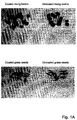
- Figure 5 illustrates (i) the difference between coated and uncoated mung beans, and (ii) the difference in release of Xylenol orange by the presence or absence of Amylase.
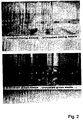
- Detection of the active compound, Laccase requires two steps: decomposition of the matrix by Amylase; followed by a colour reaction catalyzed by Laccase, thereby having ABTS to turn from colourless to green ( Figure 6 ).
- the use of exclusively Amylase or ABTS does not result in a colour development, i.e. detection of the active compound: both compounds are required.
- Figure 7 shows the colour development upon the release of the active compound from WDV124 on mung beans. This concept indicates that a two-step reaction was required for colour development. ABTS or Amylase exclusively, will not lead to a clear homogenous colour (only ABTS led to local spot of the blue/green colour: i.e. intact BioSwitch particles in which ABTS was absorbed and allowed to react with bound Laccase locally).
- Figure 8 indicates that prolonged incubation with ABTS, resulted in a further development of the colour. This indicates that a relative long time was required for the development of an intense colour. Whereas the experiments described above were carried out with lyophilized BioSwitch particles, the experiments were repeated with air-dried particles ( Figure 9 ).
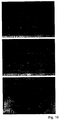
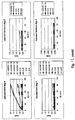
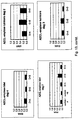
- Cress seeds/sprouts were analysed at: day 1; 2 and 3 (germination started from day 1). Analyses of the BioSwitch incorporated compounds, were essentially carried out as described earlier. For the field test, the analyses were down-scaled to allow measurements using 96-wells microplates.
- Figure 11 shows the results obtained with Laccase coated seeds.
- Figure 12 shows the results obtained with Xylenol orange coated seeds.
- Figure 13 shows the results obtained with AZCL-Amylose coated seeds.
- the concept comprises a BioSwitch matrix, a marker compound and a release mechanism coupled to detection of the compound.
- a marker compound e.g. an enzyme, a substrate of an enzyme, or a fluorescent of coloured compound can be used.
- the release and detection could be performed in a two-step reaction, which minimizes the threat of false imitations.
- the concept enables marking of individual seeds. As indicated by an initial field test, detection of the marker compound could be performed after coated seeds had germinated subsoiled for a certain period.
- the concept allows the use of various markers. This allows end-user to apply different combinations of markers to specifically label seeds e.g. from a certain land aerial, a certain seed type or a certain harvest. Furthermore, different labels can be used by different users to mark their own seeds
Landscapes
- Physics & Mathematics (AREA)
- General Physics & Mathematics (AREA)
- Engineering & Computer Science (AREA)
- Theoretical Computer Science (AREA)
- Pretreatment Of Seeds And Plants (AREA)
- Paints Or Removers (AREA)
- Enzymes And Modification Thereof (AREA)
Claims (11)
- Verfahren zum Markieren von Saatgut umfassend- Aufbringen eines Mikropartikels auf das Saatgut umfassend ein quervernetztes Polymer und eine Markierungskomponente ausgewählt aus einer Gruppe bestehend aus einem Farbstoff, einem Enzym, welches nicht in der Lage ist, das Polymer des Mikropartikels abzubauen, einem pH Indikator, und irgendeiner Kombination der vorgenannten Substanzen, wobei die Freisetzung der Markierungskomponente von dem Mikropartikel durch Kontakt des Mikropartikels mit einem externen Stimulus ausgelöst wird, und wobei das Polymer ein Kohlenhydrat oder ein Protein ist.
- Verfahren nach Anspruch 1, wobei der externe Stimulus ein Enzym ist, welches in der Lage ist, das Polymer abzubauen.
- Verfahren nach Anspruch 1, wobei die Freisetzung der Markierungskomponente durch Veränderung elektrostatischer Wechselwirkung induziert wird, verursacht durch z.B. eine Veränderung des pH-Werts, eine Veränderung der Temperatur oder eine Veränderung der Salzkonzentration.
- Verfahren nach einem der Ansprüche 1- 3, wobei das Polymer ausgewählt ist aus der Gruppe bestehend aus Stärke oder einem Derivat von Stärke, Zellulose oder einem Derivat von Zellulose, Pektin oder einem Derivat von Pektin, und Gelatine oder einem Derivat von Gelatine.
- Verfahren nach einem der Ansprüche 1- 4 , wobei der Vernetzer ausgewählt ist aus der Gruppe bestehend aus Divinylsulfon, Epichlorhydrin, ein Diepoxid wie Glycerindiglycidylether oder Butandioldiglycidylether, Natriumtrimetaphosphat und Adipinsäure, oder Derivate davon.
- Verfahren nach einem der Ansprüche 1-5, wobei das Polymer quervernetzt ist mittels eines quervernetzenden Enzyms ausgewählt aus der Gruppe bestehend aus Peroxidasen, Laccasen, Polyphenoloxidasen, Transglutaminasen, Proteindisulfidisomerasen, Sulfhydryloxidasen, Lysyloxidasen und Lipoxygenasen, oder durch ein chemisches Vernetzungsmittel.
- Verfahren nach Anspruch 1, wobei das Enzym Laccase ist.
- Verfahren nach einem der Ansprüche 1-7, wobei das Polymer geladen ist.
- Verfahren zur Identifizierung von Saatgut umfassend die Schritte von:a. Markieren des Saatguts mit einem Verfahren nach einem der Ansprüche 1-8;b. Identifizieren des Saatguts durch Aufbringen eines geeigneten externen Stimulus, um die Markierungskomponente von dem Mikropartikel freizusetzen; undc. Testen auf die Markierungskomponente.
- Verwendung eines Mikropartikels umfassend ein quervernetztes Polymer und eine Markierungskomponente, die ein Farbstoff, ein Enzym, welches nicht in der Lage ist, das Polymer des Mikropartikels abzubauen, ein pH Indikator, und irgendeine Kombination der vorgenannten Substanzen ist, wobei die Freisetzung der Markierungskomponente von dem Mikropartikel durch Kontakt des Mikropartikels mit einem externen Stimulus ausgelöst wird, und wobei das Polymer ein Kohlenhydrat oder ein Protein zur Markierung von Saatgut ist.
- Kit zur Markierung von Saatgut gemäß dem Verfahren nach einem der Ansprüche 1-8 oder für die Identifizierung eines Objekts nach Anspruch 9, umfassend- Mikropartikel markiert gemäß einem Verfahren nach einem der Ansprüche 1-8 und- ein Enzym zum Abbauen des Polymers, oder ein Salz zum Freisetzen der Markierungskomponente.
Priority Applications (1)
| Application Number | Priority Date | Filing Date | Title |
|---|---|---|---|
| EP08766874.5A EP2171706B1 (de) | 2007-07-06 | 2008-07-04 | Verfahren zum markieren von materialien |
Applications Claiming Priority (3)
| Application Number | Priority Date | Filing Date | Title |
|---|---|---|---|
| EP07112000A EP2012293A1 (de) | 2007-07-06 | 2007-07-06 | Markierungsverfahren für Materialien |
| PCT/NL2008/050453 WO2009008716A1 (en) | 2007-07-06 | 2008-07-04 | Method for marking materials |
| EP08766874.5A EP2171706B1 (de) | 2007-07-06 | 2008-07-04 | Verfahren zum markieren von materialien |
Publications (2)
| Publication Number | Publication Date |
|---|---|
| EP2171706A1 EP2171706A1 (de) | 2010-04-07 |
| EP2171706B1 true EP2171706B1 (de) | 2016-10-26 |
Family
ID=38596023
Family Applications (2)
| Application Number | Title | Priority Date | Filing Date |
|---|---|---|---|
| EP07112000A Withdrawn EP2012293A1 (de) | 2007-07-06 | 2007-07-06 | Markierungsverfahren für Materialien |
| EP08766874.5A Not-in-force EP2171706B1 (de) | 2007-07-06 | 2008-07-04 | Verfahren zum markieren von materialien |
Family Applications Before (1)
| Application Number | Title | Priority Date | Filing Date |
|---|---|---|---|
| EP07112000A Withdrawn EP2012293A1 (de) | 2007-07-06 | 2007-07-06 | Markierungsverfahren für Materialien |
Country Status (4)
| Country | Link |
|---|---|
| US (1) | US8431375B2 (de) |
| EP (2) | EP2012293A1 (de) |
| CN (1) | CN101874262B (de) |
| WO (1) | WO2009008716A1 (de) |
Families Citing this family (7)
| Publication number | Priority date | Publication date | Assignee | Title |
|---|---|---|---|---|
| CN104916223A (zh) * | 2015-06-25 | 2015-09-16 | 李峰 | 一种变色防伪结构及其防伪方法 |
| CN106888616A (zh) * | 2015-12-21 | 2017-06-27 | 玉溪中烟种子有限责任公司 | 一种烟草显色防伪丸化种子及其加工和检验方法 |
| WO2018132694A1 (en) * | 2017-01-12 | 2018-07-19 | Apdn (B.V.I.) Inc. | Traceable nucleic acid marked fertilizer |
| JP1641857S (de) | 2019-05-10 | 2019-09-24 | ||
| USD894095S1 (en) | 2019-07-12 | 2020-08-25 | Bridgestone Corporation | Tire tread |
| CN112940319A (zh) * | 2021-03-17 | 2021-06-11 | 西南大学 | 一种耐高温明胶膜的新型制备方法及产品 |
| CN113875979B (zh) * | 2021-09-27 | 2023-03-17 | 中国农业大学 | 一种食品级油水双相负载乳液凝胶运载体系的制备方法 |
Family Cites Families (6)
| Publication number | Priority date | Publication date | Assignee | Title |
|---|---|---|---|---|
| GB8517779D0 (en) * | 1985-07-15 | 1985-08-21 | Ici Plc | Anthraquinone derivatives |
| ATE142274T1 (de) * | 1989-05-22 | 1996-09-15 | Hoffmann La Roche | Verfahren zur markierung und zum nachweis von stoffen mit nukleinsäuren |
| WO2000064492A1 (en) * | 1999-04-27 | 2000-11-02 | University Of Pittsburgh Of The Commonwealth System Of Higher Education | Apparatus for optically monitoring concentration of a bioanalyte in blood and related methods |
| EP1238038A4 (de) * | 1999-10-18 | 2007-05-23 | Foster Miller Inc | Umweltfreundliche enteisungs- und auftauzusammensetzungen |
| US20060037222A1 (en) * | 2001-11-30 | 2006-02-23 | Dan Hunt | Taggants for products and method of taggant identification |
| US8771649B2 (en) * | 2003-05-30 | 2014-07-08 | Nederlandse Organisatie Voor Toegepast-Natuurwetenschappelijk Onderzoek Tno | Inducible release vehicles |
-
2007
- 2007-07-06 EP EP07112000A patent/EP2012293A1/de not_active Withdrawn
-
2008
- 2008-07-04 CN CN200880105742.3A patent/CN101874262B/zh not_active Expired - Fee Related
- 2008-07-04 WO PCT/NL2008/050453 patent/WO2009008716A1/en not_active Ceased
- 2008-07-04 US US12/667,963 patent/US8431375B2/en not_active Expired - Fee Related
- 2008-07-04 EP EP08766874.5A patent/EP2171706B1/de not_active Not-in-force
Also Published As
| Publication number | Publication date |
|---|---|
| WO2009008716A1 (en) | 2009-01-15 |
| US8431375B2 (en) | 2013-04-30 |
| EP2012293A1 (de) | 2009-01-07 |
| CN101874262A (zh) | 2010-10-27 |
| EP2171706A1 (de) | 2010-04-07 |
| US20110129865A1 (en) | 2011-06-02 |
| CN101874262B (zh) | 2014-08-13 |
Similar Documents
| Publication | Publication Date | Title |
|---|---|---|
| US8431375B2 (en) | Method for marking materials | |
| US8771650B2 (en) | Inducible release vehicles | |
| JP6735006B2 (ja) | 播種ユニットおよびその使用 | |
| Dingley et al. | Application of superabsorbent natural polymers in agriculture | |
| US20100087369A1 (en) | Composition comprising oligogalacturonans and polycationic saccharides | |
| Pavithran et al. | Enhancing sustainability in agriculture: natural polymer-based controlled release systems for effective pest management and environmental protection | |
| Mandal et al. | A Review on Sustainable Slow‐Release N, P, K Fertilizer Hydrogels for Smart Agriculture | |
| Sarkar et al. | Agriculture: Polymers in crop production mulch and fertilizer | |
| Mendonca Cidreira et al. | Controlled‐release nitrogen fertilizers: A review on bio‐based and smart coating materials | |
| US20240397956A1 (en) | Use of a structural polypeptide for plant coating | |
| Kaur et al. | Fabrication of chitosan–alginate nanospheres for controlled release of cartap hydrochloride | |
| Yang et al. | Poly (γ-glutamic acid) nanocoating to enhance the viability of Pseudomonas stutzeri NRCB010 through cell surface engineering | |
| Zhao et al. | Cu2+-induced “off–on–off” switching luminescence of cellulose-based luminescent hydrogels | |
| CN117958256A (zh) | 一种基于β-CD/ZIF-8@ST的高粘附性及响应释放纳米农药体系及其制备方法 | |
| Marshall et al. | Controlled Delivery of Pesticides through Synthetic Biodegradable Polymer Compositions | |
| Xu et al. | Advances of nano-photofertilizers in plant research | |
| WO2011097664A2 (de) | Testanordnung | |
| Caballero et al. | Sustainable biopolymer-based spheres for controlled release of nematodes: From development to their effects under seasonal climate variations | |
| Malik et al. | Biopolymer‐Based Biomatrices–Organic Strategies to Combat Micronutrient Deficit for Dynamic Agronomy | |
| Dhiman et al. | Enzyme-Responsive Phosphate-Crosslinked Microgels with Enhanced Foliar Adhesion and Insecticide Stability: An Approach for Sustained Insecticide Delivery and Increased Plant Growth | |
| Balsberg-Påhlsson | Growth, radicle and root hair development of Deschampsia flexuosa (L.) Trin. seedlings in relation to soil acidity | |
| JP3674214B2 (ja) | 造粒コーティング種子およびその製造方法 | |
| Fahmy et al. | Review of State-of-the-Art on nanofillers polymer composites for sustainable agriculture | |
| Panescu | Polymer Scaffolds for the Stabilization and Controlled Release of Agricultural Actives | |
| US20250250212A1 (en) | Sustainable superabsorbent hydrogels |
Legal Events
| Date | Code | Title | Description |
|---|---|---|---|
| PUAI | Public reference made under article 153(3) epc to a published international application that has entered the european phase |
Free format text: ORIGINAL CODE: 0009012 |
|
| 17P | Request for examination filed |
Effective date: 20100108 |
|
| AK | Designated contracting states |
Kind code of ref document: A1 Designated state(s): AT BE BG CH CY CZ DE DK EE ES FI FR GB GR HR HU IE IS IT LI LT LU LV MC MT NL NO PL PT RO SE SI SK TR |
|
| AX | Request for extension of the european patent |
Extension state: AL BA MK RS |
|
| DAX | Request for extension of the european patent (deleted) | ||
| 17Q | First examination report despatched |
Effective date: 20111117 |
|
| RAP1 | Party data changed (applicant data changed or rights of an application transferred) |
Owner name: NEDERLANDSE ORGANISATIE VOOR TOEGEPAST- NATUURWETE |
|
| GRAP | Despatch of communication of intention to grant a patent |
Free format text: ORIGINAL CODE: EPIDOSNIGR1 |
|
| INTG | Intention to grant announced |
Effective date: 20160512 |
|
| GRAS | Grant fee paid |
Free format text: ORIGINAL CODE: EPIDOSNIGR3 |
|
| GRAA | (expected) grant |
Free format text: ORIGINAL CODE: 0009210 |
|
| AK | Designated contracting states |
Kind code of ref document: B1 Designated state(s): AT BE BG CH CY CZ DE DK EE ES FI FR GB GR HR HU IE IS IT LI LT LU LV MC MT NL NO PL PT RO SE SI SK TR |
|
| REG | Reference to a national code |
Ref country code: GB Ref legal event code: FG4D |
|
| REG | Reference to a national code |
Ref country code: CH Ref legal event code: EP |
|
| REG | Reference to a national code |
Ref country code: AT Ref legal event code: REF Ref document number: 840521 Country of ref document: AT Kind code of ref document: T Effective date: 20161115 |
|
| REG | Reference to a national code |
Ref country code: IE Ref legal event code: FG4D |
|
| REG | Reference to a national code |
Ref country code: DE Ref legal event code: R096 Ref document number: 602008047043 Country of ref document: DE |
|
| REG | Reference to a national code |
Ref country code: LT Ref legal event code: MG4D |
|
| PG25 | Lapsed in a contracting state [announced via postgrant information from national office to epo] |
Ref country code: LV Free format text: LAPSE BECAUSE OF FAILURE TO SUBMIT A TRANSLATION OF THE DESCRIPTION OR TO PAY THE FEE WITHIN THE PRESCRIBED TIME-LIMIT Effective date: 20161026 |
|
| REG | Reference to a national code |
Ref country code: NL Ref legal event code: MP Effective date: 20161026 |
|
| REG | Reference to a national code |
Ref country code: AT Ref legal event code: MK05 Ref document number: 840521 Country of ref document: AT Kind code of ref document: T Effective date: 20161026 |
|
| PG25 | Lapsed in a contracting state [announced via postgrant information from national office to epo] |
Ref country code: GR Free format text: LAPSE BECAUSE OF FAILURE TO SUBMIT A TRANSLATION OF THE DESCRIPTION OR TO PAY THE FEE WITHIN THE PRESCRIBED TIME-LIMIT Effective date: 20170127 Ref country code: SE Free format text: LAPSE BECAUSE OF FAILURE TO SUBMIT A TRANSLATION OF THE DESCRIPTION OR TO PAY THE FEE WITHIN THE PRESCRIBED TIME-LIMIT Effective date: 20161026 Ref country code: LT Free format text: LAPSE BECAUSE OF FAILURE TO SUBMIT A TRANSLATION OF THE DESCRIPTION OR TO PAY THE FEE WITHIN THE PRESCRIBED TIME-LIMIT Effective date: 20161026 Ref country code: NO Free format text: LAPSE BECAUSE OF FAILURE TO SUBMIT A TRANSLATION OF THE DESCRIPTION OR TO PAY THE FEE WITHIN THE PRESCRIBED TIME-LIMIT Effective date: 20170126 |
|
| PG25 | Lapsed in a contracting state [announced via postgrant information from national office to epo] |
Ref country code: PT Free format text: LAPSE BECAUSE OF FAILURE TO SUBMIT A TRANSLATION OF THE DESCRIPTION OR TO PAY THE FEE WITHIN THE PRESCRIBED TIME-LIMIT Effective date: 20170227 Ref country code: IS Free format text: LAPSE BECAUSE OF FAILURE TO SUBMIT A TRANSLATION OF THE DESCRIPTION OR TO PAY THE FEE WITHIN THE PRESCRIBED TIME-LIMIT Effective date: 20170226 Ref country code: AT Free format text: LAPSE BECAUSE OF FAILURE TO SUBMIT A TRANSLATION OF THE DESCRIPTION OR TO PAY THE FEE WITHIN THE PRESCRIBED TIME-LIMIT Effective date: 20161026 Ref country code: PL Free format text: LAPSE BECAUSE OF FAILURE TO SUBMIT A TRANSLATION OF THE DESCRIPTION OR TO PAY THE FEE WITHIN THE PRESCRIBED TIME-LIMIT Effective date: 20161026 Ref country code: HR Free format text: LAPSE BECAUSE OF FAILURE TO SUBMIT A TRANSLATION OF THE DESCRIPTION OR TO PAY THE FEE WITHIN THE PRESCRIBED TIME-LIMIT Effective date: 20161026 Ref country code: NL Free format text: LAPSE BECAUSE OF FAILURE TO SUBMIT A TRANSLATION OF THE DESCRIPTION OR TO PAY THE FEE WITHIN THE PRESCRIBED TIME-LIMIT Effective date: 20161026 Ref country code: FI Free format text: LAPSE BECAUSE OF FAILURE TO SUBMIT A TRANSLATION OF THE DESCRIPTION OR TO PAY THE FEE WITHIN THE PRESCRIBED TIME-LIMIT Effective date: 20161026 Ref country code: BE Free format text: LAPSE BECAUSE OF FAILURE TO SUBMIT A TRANSLATION OF THE DESCRIPTION OR TO PAY THE FEE WITHIN THE PRESCRIBED TIME-LIMIT Effective date: 20161026 Ref country code: ES Free format text: LAPSE BECAUSE OF FAILURE TO SUBMIT A TRANSLATION OF THE DESCRIPTION OR TO PAY THE FEE WITHIN THE PRESCRIBED TIME-LIMIT Effective date: 20161026 |
|
| REG | Reference to a national code |
Ref country code: DE Ref legal event code: R097 Ref document number: 602008047043 Country of ref document: DE |
|
| PG25 | Lapsed in a contracting state [announced via postgrant information from national office to epo] |
Ref country code: SK Free format text: LAPSE BECAUSE OF FAILURE TO SUBMIT A TRANSLATION OF THE DESCRIPTION OR TO PAY THE FEE WITHIN THE PRESCRIBED TIME-LIMIT Effective date: 20161026 Ref country code: EE Free format text: LAPSE BECAUSE OF FAILURE TO SUBMIT A TRANSLATION OF THE DESCRIPTION OR TO PAY THE FEE WITHIN THE PRESCRIBED TIME-LIMIT Effective date: 20161026 Ref country code: DK Free format text: LAPSE BECAUSE OF FAILURE TO SUBMIT A TRANSLATION OF THE DESCRIPTION OR TO PAY THE FEE WITHIN THE PRESCRIBED TIME-LIMIT Effective date: 20161026 Ref country code: CZ Free format text: LAPSE BECAUSE OF FAILURE TO SUBMIT A TRANSLATION OF THE DESCRIPTION OR TO PAY THE FEE WITHIN THE PRESCRIBED TIME-LIMIT Effective date: 20161026 Ref country code: RO Free format text: LAPSE BECAUSE OF FAILURE TO SUBMIT A TRANSLATION OF THE DESCRIPTION OR TO PAY THE FEE WITHIN THE PRESCRIBED TIME-LIMIT Effective date: 20161026 |
|
| PG25 | Lapsed in a contracting state [announced via postgrant information from national office to epo] |
Ref country code: IT Free format text: LAPSE BECAUSE OF FAILURE TO SUBMIT A TRANSLATION OF THE DESCRIPTION OR TO PAY THE FEE WITHIN THE PRESCRIBED TIME-LIMIT Effective date: 20161026 Ref country code: BG Free format text: LAPSE BECAUSE OF FAILURE TO SUBMIT A TRANSLATION OF THE DESCRIPTION OR TO PAY THE FEE WITHIN THE PRESCRIBED TIME-LIMIT Effective date: 20170126 |
|
| PLBE | No opposition filed within time limit |
Free format text: ORIGINAL CODE: 0009261 |
|
| STAA | Information on the status of an ep patent application or granted ep patent |
Free format text: STATUS: NO OPPOSITION FILED WITHIN TIME LIMIT |
|
| 26N | No opposition filed |
Effective date: 20170727 |
|
| PG25 | Lapsed in a contracting state [announced via postgrant information from national office to epo] |
Ref country code: SI Free format text: LAPSE BECAUSE OF FAILURE TO SUBMIT A TRANSLATION OF THE DESCRIPTION OR TO PAY THE FEE WITHIN THE PRESCRIBED TIME-LIMIT Effective date: 20161026 |
|
| REG | Reference to a national code |
Ref country code: DE Ref legal event code: R119 Ref document number: 602008047043 Country of ref document: DE |
|
| REG | Reference to a national code |
Ref country code: CH Ref legal event code: PL |
|
| GBPC | Gb: european patent ceased through non-payment of renewal fee |
Effective date: 20170704 |
|
| REG | Reference to a national code |
Ref country code: IE Ref legal event code: MM4A |
|
| REG | Reference to a national code |
Ref country code: FR Ref legal event code: ST Effective date: 20180330 |
|
| PG25 | Lapsed in a contracting state [announced via postgrant information from national office to epo] |
Ref country code: GB Free format text: LAPSE BECAUSE OF NON-PAYMENT OF DUE FEES Effective date: 20170704 Ref country code: LI Free format text: LAPSE BECAUSE OF NON-PAYMENT OF DUE FEES Effective date: 20170731 Ref country code: CH Free format text: LAPSE BECAUSE OF NON-PAYMENT OF DUE FEES Effective date: 20170731 Ref country code: DE Free format text: LAPSE BECAUSE OF NON-PAYMENT OF DUE FEES Effective date: 20180201 Ref country code: IE Free format text: LAPSE BECAUSE OF NON-PAYMENT OF DUE FEES Effective date: 20170704 |
|
| PG25 | Lapsed in a contracting state [announced via postgrant information from national office to epo] |
Ref country code: FR Free format text: LAPSE BECAUSE OF NON-PAYMENT OF DUE FEES Effective date: 20170731 |
|
| PG25 | Lapsed in a contracting state [announced via postgrant information from national office to epo] |
Ref country code: LU Free format text: LAPSE BECAUSE OF NON-PAYMENT OF DUE FEES Effective date: 20170704 |
|
| PG25 | Lapsed in a contracting state [announced via postgrant information from national office to epo] |
Ref country code: MT Free format text: LAPSE BECAUSE OF NON-PAYMENT OF DUE FEES Effective date: 20170704 |
|
| PG25 | Lapsed in a contracting state [announced via postgrant information from national office to epo] |
Ref country code: MC Free format text: LAPSE BECAUSE OF FAILURE TO SUBMIT A TRANSLATION OF THE DESCRIPTION OR TO PAY THE FEE WITHIN THE PRESCRIBED TIME-LIMIT Effective date: 20161026 Ref country code: HU Free format text: LAPSE BECAUSE OF FAILURE TO SUBMIT A TRANSLATION OF THE DESCRIPTION OR TO PAY THE FEE WITHIN THE PRESCRIBED TIME-LIMIT; INVALID AB INITIO Effective date: 20080704 |
|
| PG25 | Lapsed in a contracting state [announced via postgrant information from national office to epo] |
Ref country code: CY Free format text: LAPSE BECAUSE OF NON-PAYMENT OF DUE FEES Effective date: 20161026 |
|
| PG25 | Lapsed in a contracting state [announced via postgrant information from national office to epo] |
Ref country code: TR Free format text: LAPSE BECAUSE OF FAILURE TO SUBMIT A TRANSLATION OF THE DESCRIPTION OR TO PAY THE FEE WITHIN THE PRESCRIBED TIME-LIMIT Effective date: 20161026 |