EP2169402A1 - Reagent for diluting blood sample and method for measuring mean corpuscular volume by using the same - Google Patents
Reagent for diluting blood sample and method for measuring mean corpuscular volume by using the same Download PDFInfo
- Publication number
- EP2169402A1 EP2169402A1 EP09171304A EP09171304A EP2169402A1 EP 2169402 A1 EP2169402 A1 EP 2169402A1 EP 09171304 A EP09171304 A EP 09171304A EP 09171304 A EP09171304 A EP 09171304A EP 2169402 A1 EP2169402 A1 EP 2169402A1
- Authority
- EP
- European Patent Office
- Prior art keywords
- reagent
- temperature
- sample
- measurement
- blood sample
- Prior art date
- Legal status (The legal status is an assumption and is not a legal conclusion. Google has not performed a legal analysis and makes no representation as to the accuracy of the status listed.)
- Granted
Links
Images



Classifications
-
- G—PHYSICS
- G01—MEASURING; TESTING
- G01N—INVESTIGATING OR ANALYSING MATERIALS BY DETERMINING THEIR CHEMICAL OR PHYSICAL PROPERTIES
- G01N1/00—Sampling; Preparing specimens for investigation
- G01N1/28—Preparing specimens for investigation including physical details of (bio-)chemical methods covered elsewhere, e.g. G01N33/50, C12Q
- G01N1/38—Diluting, dispersing or mixing samples
-
- G—PHYSICS
- G01—MEASURING; TESTING
- G01N—INVESTIGATING OR ANALYSING MATERIALS BY DETERMINING THEIR CHEMICAL OR PHYSICAL PROPERTIES
- G01N15/00—Investigating characteristics of particles; Investigating permeability, pore-volume or surface-area of porous materials
- G01N15/10—Investigating individual particles
- G01N15/1031—Investigating individual particles by measuring electrical or magnetic effects
- G01N15/12—Investigating individual particles by measuring electrical or magnetic effects by observing changes in resistance or impedance across apertures when traversed by individual particles, e.g. by using the Coulter principle
- G01N15/131—Details
-
- G—PHYSICS
- G01—MEASURING; TESTING
- G01N—INVESTIGATING OR ANALYSING MATERIALS BY DETERMINING THEIR CHEMICAL OR PHYSICAL PROPERTIES
- G01N15/00—Investigating characteristics of particles; Investigating permeability, pore-volume or surface-area of porous materials
- G01N15/10—Investigating individual particles
- G01N15/1031—Investigating individual particles by measuring electrical or magnetic effects
- G01N15/12—Investigating individual particles by measuring electrical or magnetic effects by observing changes in resistance or impedance across apertures when traversed by individual particles, e.g. by using the Coulter principle
- G01N15/131—Details
- G01N2015/133—Flow forming
-
- Y—GENERAL TAGGING OF NEW TECHNOLOGICAL DEVELOPMENTS; GENERAL TAGGING OF CROSS-SECTIONAL TECHNOLOGIES SPANNING OVER SEVERAL SECTIONS OF THE IPC; TECHNICAL SUBJECTS COVERED BY FORMER USPC CROSS-REFERENCE ART COLLECTIONS [XRACs] AND DIGESTS
- Y10—TECHNICAL SUBJECTS COVERED BY FORMER USPC
- Y10T—TECHNICAL SUBJECTS COVERED BY FORMER US CLASSIFICATION
- Y10T436/00—Chemistry: analytical and immunological testing
- Y10T436/10—Composition for standardization, calibration, simulation, stabilization, preparation or preservation; processes of use in preparation for chemical testing
-
- Y—GENERAL TAGGING OF NEW TECHNOLOGICAL DEVELOPMENTS; GENERAL TAGGING OF CROSS-SECTIONAL TECHNOLOGIES SPANNING OVER SEVERAL SECTIONS OF THE IPC; TECHNICAL SUBJECTS COVERED BY FORMER USPC CROSS-REFERENCE ART COLLECTIONS [XRACs] AND DIGESTS
- Y10—TECHNICAL SUBJECTS COVERED BY FORMER USPC
- Y10T—TECHNICAL SUBJECTS COVERED BY FORMER US CLASSIFICATION
- Y10T436/00—Chemistry: analytical and immunological testing
- Y10T436/10—Composition for standardization, calibration, simulation, stabilization, preparation or preservation; processes of use in preparation for chemical testing
- Y10T436/101666—Particle count or volume standard or control [e.g., platelet count standards, etc.]
Definitions
- the present invention relates to a reagent for diluting a blood sample and a method for measuring mean corpuscular volume (also referred to hereinafter as MCV) by using the same.
- An automated hematological analyzer is an apparatus in which the analysis of blood samples is automated.
- One of the items measured by this automated hematological analyzer, is the MCV (mean corpuscular volume) of a blood sample.
- the MCV is obtained as the hematocrit divided by the red blood cell (also referred to thereinafter as RBC) count.
- the hematocrit is the percentage of red blood cells per unit volume of whole blood. Accordingly, MCV is a value indicative of the mean volume of red blood cells.
- MCV is expressed in femtoliter (fL) or 10 -15 L units.
- a sheath flow DC detection method is known as a method of determining RBC count and hematocrit by an automated hematological analyzer.
- the number and size of blood cells are measured by detecting a change in impedance generated upon passage of blood cells through a fine pore arranged in a flow cell.
- the blood sample should be diluted with a physiologically isotonic diluent.
- physiological diluents for diluting whole blood there are physiological saline, Ringer solution, Rocke solution, and Tyrode solution.
- a blood sample-diluting reagent described in US6,225,124 is known as a blood sample-diluting reagent for preventing a change with time in the MCV of a blood sample.
- the blood sample-diluting reagent described in US6,225,124 contains at least one nonionic surfactant and a substance for regulating the osmotic pressure of the reagent in the range of about 150 to 400 mOsm/kg.
- the MCV is changed depending on the measurement temperature. More specifically, the MCV is significantly reduced as the temperature increases from low temperature. More particularly, the MCV has a flexion point at a certain temperature. Accordingly, when the temperature at the flexion point is exceeded, the MCV gradually increases as the temperature increases.
- the measurement temperature is often 20°C or more.
- the measurement temperature may become less than 20°C, depending on the environment under which the automated hematological analyzer is installed or on the performance of a heater in the automated hematological analyzer. Accordingly, when the flexion point is 20°C or more, the correction, of measurement results from the automated hematological analyzer to take account of the measurement temperature requires complicated correction. As a result, in measurement of MCV of blood samples with the automated hematological analyzer, there has been a problem that errors in measurement results are caused by measurement temperature.
- An object of the present invention is to provide a blood sample-diluting reagent which reduces measurement errors attributable to measurement temperature in measurement of MCV of blood samples with an automated hematological analyzer. More specifically, an object of the present invention is to provide a blood sample-diluting reagent having a flexion-point temperature of 20°C or less at which MCV is changed by measurement temperature.
- the invention provides reagents for diluting a blood sample, comprising: water, a polyoxyethylene alkyl ether having a hydroxyl value of 52 to 60, and an osmo-regulator for regulating the osmotic pressure of the reagent in the range of 150 to 400 mOsm/kg.
- the polyoxyethylene alkyl ether is polyoxyethylene oleyl ether.
- the concentration of the polyoxyethylene alkyl ether is 0.0005 to 0.5% by weight.
- the polyoxyethylene alkyl ether is a mixture of at least two polyoxyethylene alkyl ethers different in the average number of oxyethylene units.
- the osmotic pressure of the reagent is 230 to 350 mOsm/kg.
- the osmo-regulator is sodium chloride.
- the pH of the reagent is 6 to 8.5.
- the reagents according to the invention further comprise one or more of the following: a buffer, a pH adjuster, an oxidant inhibitor and an antiseptic agent.
- Another object of the present invention is to provide a method for measuring MCV of blood samples with an automated hematological analyzer with reduction in measurement errors attributable to measurement temperature by using the blood sample-diluting reagent described above.
- the invention provides methods for measuring the mean corpuscular volume of a blood sample, comprising steps of: diluting a blood sample with a reagent for diluting a blood sample, comprising water, polyoxyethylene alkyl ether having a hydroxyl value of 52 to 60 and an osmo-regulator for regulating the osmotic pressure of the reagent in the range of 150 to 400 mOsm/kg; supplying the diluted sample obtained by the diluting step to a flow cell having a fine pore; measuring blood cells contained in the diluted sample passing through the fine pore; and calculating the mean corpuscular volume of the blood sample based on the measurement result of blood cells obtained in the blood cell measuring step.
- the methods of the invention further comprise a step of measuring the temperature of the diluted sample and the calculating step comprises calculating the mean corpuscular volume of the blood sample based on the measurement result of the blood cells and the temperature of the diluted sample.
- the temperature of the diluted sample is the temperature of the diluted sample before supplying to the flow cell.
- the temperature of the diluted sample is the temperature of the diluted sample after passage through the flow cell.
- the temperature of the diluted sample is the temperature of the diluted sample in the flow cell.
- the temperature of the diluted sample supplied to the flow cell is not less than 20°C.
- the methods of the invention further comprise a step of measuring ambient temperature and the calculating step comprises calculating the mean corpuscular volume of the blood sample based on the measurement result of the blood cells and the ambient temperature.
- the reagent for diluting a blood sample in the embodiments of the invention contains water, polyoxyethylene alkyl ether having a hydroxyl value of 52 to 60, and an osmo-regulator, and has an osmotic pressure of 150 to 400 mOsm/kg.
- the hydroxyl value is a numerical value indicative of the degree of hydroxyl value contained in an esterified product. More specifically, the hydroxyl value is indicated in terms of the amount (mg) of potassium hydroxide required for neutralizing acetic acid in an amount necessary for acetylation of free hydroxyl groups contained in 1 g esterified product.
- the reagent for diluting a blood sample in these embodiment contains polyoxyethylene alkyl ether having a hydroxyl value of 52 to 60.
- the reagent preferably contains polyoxyethylene alkyl ether having a hydroxyl value of 53 to 58.
- the flexion-point temperature at which MCV is changed by measurement temperature can thereby be 20°C or less.
- the hydroxyl value of the polyoxyethylene alkyl ether decreases as the average number of oxyethylene units therein increases. On the other hand, the hydroxyl value increases as the average number of oxyethylene units decreases.
- the hydroxyl value of polyoxyethylene (20) oleyl ether having 20 oxyethylene units on average is about 50.
- the hydroxyl value of polyoxyethylene (19) oleyl ether having 19 oxyethylene units on average is about 55.
- the hydroxyl value of polyoxyethylene (18) oleyl ether having 18 oxyethylene units on average is about 57.
- the hydroxyl value of polyoxyethylene (16) oleyl ether having 16 oxyethylene units on average is about 60.
- the hydroxyl value of the polyoxyethylene alkyl ether can also be regulated by mixing a plurality of polyoxyethylene alkyl ethers different in the average number of oxyethylene units.
- polyoxyethylene (20) oleyl ether and polyoxyethylene (16) oleyl ether can be mixed at a ratio of 1 : 3 thereby adjusting the hydroxyl value to about 54.
- the reagent for diluting a blood sample in these embodiments may contain at least 2 polyoxyethylene alkyl ethers different in the average number of oxyethylene units.
- the hydroxyl value of the polyoxyethylene alkyl ether contained in the reagent for diluting a blood sample can be measured by a method known in the art.
- the polyoxyethylene alkyl ether contained in the reagent for diluting a blood sample is reacted with acetic anhydride in pyridine to form acetic acid.
- the formed acetic acid can be titrated with potassium hydroxide, with phenolphthalein as an indicator, to determine the hydroxyl value.
- An automated apparatus for measuring a hydroxyl value is commercially available. This apparatus can be used to measure the hydroxyl value of the polyoxyethylene alkyl ether contained in the reagent for diluting a blood sample.
- the average number of oxyethylene units in the polyoxyethylene alkyl ether used in these embodiments is preferably 16 or more.
- the concentration of the polyoxyethylene alkyl ether contained in the reagent for diluting a blood sample is 0.0005 to 0.5% by weight, preferably 0.001 to 0.1% by weight, more preferably 0.005 to 0.05% by weight.
- the osmotic pressure of the reagent for diluting a blood sample is regulated in the range of 150 to 400 mOsm/kg, preferably 230 to 350 mOsm/kg.
- An osmo-regulator for adjusting the osmotic pressure of the reagent for diluting a blood sample to the above-defined osmotic pressure includes, for example, sodium chloride and potassium chloride and the like.
- the reagent for diluting a blood sample can optionally contain a buffer.
- the buffer includes a phosphate buffer, borate buffer, Tris buffer and imidazole buffer. Particularly, the borate buffer is preferable.
- the pH of the reagent for diluting a blood sample is regulated in the range of 6 to 8.5.
- the pH adjuster for adjustment to the above pH includes, for example, hydrochloric acid and sodium hydroxide and the like.
- the reagent for diluting a blood sample can contain an oxidant inhibitor.
- the oxidant inhibitor includes EDTA and butyl methyl phenol and the like. Particularly, EDTA is preferable.
- the reagent for diluting a blood sample can contain antiseptic agent.
- the antiseptic agent includes sodium 2-pyridylthio-1-oxide and P-phenethyl alcohol. Particularly, sodium 2-pyridylthio-1-oxide is preferable.
- FIG. 1 is a front view showing a skeleton framework of an automated hematological analyzer 1 in measuring MCV with the reagent for diluting a blood sample according to a particular embodiment of the present invention.
- the automated hematological analyzer 1 in this embodiment is composed of a measurement unit 2 and a data processing unit 3.
- the measurement unit 2 and the data processing unit 3 are connected by a data transmission cable 3a so as to be data-communicable with each other.
- the processing unit 3 is composed of an input section 36, a display device 37 and a data processing device 38.
- the predetermined measurement of components contained in a blood sample is conducted by the measurement unit 2.
- the data processing unit 3 executes analytical processing of measurement data obtained in the measurement unit 2.
- the measurement unit 2 and the data processing unit 3 can be connected directly to each other with the data transmission cable 3a.
- the measurement unit 2 and the data processing unit 3 can be connected via a communication network.
- the communication network includes a leased line using a phone line, wireless LAN, LAN, and Internet and the like.
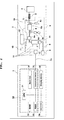
- FIG. 2 is a block diagram showing a skeleton framework of the automated hematological analyzer 1 according to a particular embodiment of the invention.
- the measurement unit 2 includes a diluent container 4, a heater 5, a sample supply section 6, a DC measurement section 7, a waste chamber 8, a flow path 9, a temperature sensor 10, a temperature sensor 11, a control unit 12 and a communication unit 13.
- the reagent for diluting a blood sample (also referred to hereinafter as merely “diluent”) is held in the diluent container 4.
- the sample supply section 6 includes a mixing chamber 6a, a sampling valve 6b, a pipette 6c, a syringe 6d, a motor 6e, and the like.
- the diluent container 4, the sampling valve 6b, the pipette 6c, the syringe 6d, the mixing chamber 6a, the DC measurement section 7 and the waste chamber 8 are connected to one another via the flow path 9.
- the movement of a liquid in the flow path 9 is controlled both by the operation of the syringe 6d with the motor 6e and by the sampling valve 6b. More specifically:
- the measurement unit 2 has the heater 5 on the flow path 9 for connecting the diluent container 4 to the sampling valve 6b.
- the heater 5 in the measurement unit 2 is arranged on the flow path 9 for connecting the diluent container 4 to the sampling valve 6b, but this arrangement is not limiting.
- the heater 5 may be arranged such that the temperature of the diluted sample in the DC measurement section 7 reaches 20°C or more.
- the heater 5 may be arranged at another place of the flow path 9.
- the heater 5 may be arranged so as to directly heat the diluent container 4 or the mixing chamber 6a.
- the temperature sensor 11 is for measuring the temperature of the diluted sample in the DC measurement section 7.
- the temperature sensor 11 is arranged preferably near to the DC measurement section 7. This is to more accurately measure the temperature of the diluted sample in the DC measurement section 7.
- the temperature sensor 11 of the measurement unit 2 in this embodiment is arranged so as to measure the temperature of the diluted sample after passage through the DC measurement section 7.
- the temperature sensor 11 may be arranged so as to measure the temperature of the diluted sample before introduction into the DC measurement section 7.
- the temperature sensor 11 may be arranged so as to measure the temperature of the diluted sample in a flow cell 71 described later in the DC measurement section 7.
- the temperature sensor 10 is for measuring the surrounding temperature of the automated hematological analyzer 1. Accordingly, the temperature sensor 10 is disposed preferably where it is hardly influenced by heat generated by the heater 5, the heater 6e and the like. In this example, the temperature sensor 10 of the measurement unit 2 is disposed inside of the measurement unit 2. However, the temperature sensor 10 may be disposed outside of the measurement unit 2.
- the DC measurement section 7 has the flow cell 71 to which the diluted sample is to be transferred from the mixing chamber 6a.
- FIG. 3 is a diagram showing a skeleton framework of the flow cell 71 of the DC measurement section 7.
- the flow cell 71 has a sample nozzle 72 for supplying the diluted sample to the flow cell, an aperture 73 having a fine pore, a recovery tube 74 for recovering the diluted sample having passed through the aperture 73, a minus electrode 77 and a plus electrode 78.
- the sample nozzle 72 is disposed before the aperture 73, and both of them have a common center.
- the diluted sample When the diluted sample is extruded from the sample nozzle 73, the diluted sample is sheathed with a front sheath liquid 75 and passes through the central portion of the aperture 73.
- the diluted sample after passage through the aperture 73, is sheathed with a back sheath liquid 76 and sent into the recovery tube 74.
- DC current flows between the minus electrode 77 and the plus electrode 78.
- a pulse signal of the DC current changes due to a change in electric resistance caused upon passage of blood cells in the diluted sample through the aperture 73. That is, in the DC measurement section 7, blood cells contained in the diluted sample can be measured as a change in the pulse signal.
- the data processing unit calculates red blood cell (RBC) count and hematocrit (HCT) by a sheath flow DC detection method and a corpuscular pulse high value detection method. More specifically, RBC is calculated based on the number of pulses in the pulse signal, and HCT is calculated based on the height of pulses in the pulse signal.
- RBC red blood cell
- HCT hematocrit
- the communication unit 13 is an interface such as, for example, an RS-232C interface, USB interface and Ethernet (registered trademark).
- the communication unit 13 is constituted so as to be capable of sending and receiving data to/from the data processing unit 3.
- the communication unit 13 is connected via a circuit to the control unit 12 and constituted to so as to be capable of sending and receiving data to/from the control unit 12.
- the control unit 12 is composed of CPU, ROM, RAM and the like.
- the control unit 12 is connected via the circuit 14 to the respective parts of the measurement unit 2 and constituted to regulate their operation as well as to send and receive data.
- the control unit 12 controls the operation of the motor 6e for the sample supply section 6, thereby controlling the operation of a liquid in the flow path 9.
- the control unit 12 transmits data received from the temperature sensor 11, temperature sensor 10, and DC measurement section 7, to the communication unit 13.
- the control unit 12 also transmits information received from the data processing unit 3 by the communication unit 13, to the respective parts of the measurement unit 2.
- the data processing unit 3 is in particular embodiments composed of a computer including an input section 36 such as a keyboard, a mouse and the like, a display device 37, and a data processing unit 38.
- the data processing unit 38 is composed of CPU 31, ROM 32, RAM 33, hard disk 34, and communication interface 35.
- An application program is installed on the hard disk 34 of the data processing unit 3. This application program includes an operating system and a program for analytical processing of measurement data received from the measurement unit 2.
- CPU 31 in the data processing unit 3 is constituted to execute this application program, thereby analyzing measurement data to calculate red blood cell count (RBC), hematocrit value (HCT) and mean corpuscular volume (MCV).
- RBC red blood cell count
- HCT hematocrit value
- MCV mean corpuscular volume
- the communication interface 35 is an interface such as, for example, an RS-232C interface, USB interface and Ethernet (registered trademark).
- the communication interface 35 is constituted so as to be capable of sending and receiving data to/from the measurement unit 2.
- FIG. 4 is a flowchart showing the sample analysis processing in the automated hematological analyzer 1 shown in FIGS. 1 and 2 according to a particular embodiment of the invention.
- the sample analysis processing in the automated hematological analyzer 1 will be described with reference to FIG. 4 .
- step S1 When the automated hematological analyzer 1 is first started, the application program and the like are initialized. Thereafter, in step S1, whether or not the start of measurement has been instructed by the user is judged with CPU 31 in the data processing unit 3. This judgment is repeated until the start of measurement is instructed. When the start of measurement has been instructed, a signal of the start of measurement is transmitted in step S2 from the data processing unit 3 to the measurement unit 2.
- step S21 whether the signal of the start of measurement has been received or not is judged with the control unit 8 in the measurement unit 2. This judgment is repeated until the signal of the start of measurement is received.
- the measurement unit 2 receives the signal of the start of measurement, a blood sample is suctioned via pipette 6c from a blood collection tube, in step S22.
- a diluted sample is prepared in the sample supply section 6. Specifically, a predetermined amount (for example, 2.0 mL) of a diluent, and a predetermined amount (for example, 4 ⁇ L) of the blood sample suctioned via the pipette 6c from the blood collection tube 20, are supplied to, and stirred in, the mixing chamber 6a. The diluent is heated with heater 5 in the flow path 9 from the diluent container 4 to the mixing chamber 6a. By so doing, a predetermined amount (for example, 2.0 mL) of a heated diluted sample is prepared.
- a predetermined amount for example, 2.0 mL
- step S24 a portion (for example, 1 mL) of the diluted sample in the mixing chamber 6a, together with a sheath liquid (a diluent), is transferred to the DC measurement section 7. Blood cells contained in the diluted sample thereby pass through the aperture 73 in the flow cell 71 in the DC measurement section 7. A pulse signal showing a change, generated upon passage of the blood cells through the aperture 73, in the electric resistance of DC current flowing between the minus electrode 77 and plus electrode 78 is measured.
- step S25 the temperature of the diluted sample (measurement temperature) having passed through the DC measuring section 7 is measured with the temperature sensor 11.
- the heater 5 has been set up such that the measurement temperature reaches 23°C or more by heating the diluent used in preparation of the diluted sample.
- step S26 measurement data containing the pulse signal and the measurement temperature, measured in the respective detection sections, are transmitted from the measurement unit 2 to the data processing unit 3.
- step S3 whether the measurement data transmitted from the measurement unit 2 have been received or not is judged with the data processing unit 3. This judgment is repeated until the data are received.
- red blood cell count (RBC) and hematocrit value (HCT) are calculated in step S4 with CPU 31, based on the pulse signal measured in step S24.
- the corrected MCV obtained by the equation (2) above is MCV with reduction in errors attributable to measurement temperature.
- step S7 the calculation results of red blood cell count (RBC), hematocrit value (HCT), mean corpuscular volume (MCV) and corrected MCV calculated as described above are outputted on the display device 37.
- RBC red blood cell count
- HCT hematocrit value
- MCV mean corpuscular volume
- step S8 Thereafter, whether or not shutdown has been instructed by the user is judged in step S8.
- the process proceeds to step S1.
- step S26 the operation of sample analysis processing by the data processing unit 3 in the automated hematological analyzer 1 is terminated.
- the measurement data are transmitted in step S26 to the data processing unit 3, and then, whether or not shutdown has been instructed by the user is judged in step S27.
- step S21 the operation of sample analysis processing by the measurement unit 2 in the automated hematological analyzer 1 is terminated.
- the temperature of the diluent (measurement temperature) measured with the temperature sensor 11 is used to calculate a correction value of MCV.
- the present invention is not limited thereto, and the surrounding temperature (ambient temperature) of the automated hematological analyzer 1, measured with the temperature sensor 10, can be used to calculate a correction value of MCV. Further, both the measurement temperature and the ambient temperature can be used to calculate a correction value of MCV.
- CELLPACK manufactured by Sysmex Corporation
- Polyoxyethylene oleyl ethers different in hydroxyl value were added to a concentration of 0.015% by weight to the CELLPACK to which sodium chloride had been added, to prepare reagents A to E respectively.
- Each of 3 normal fresh blood samples was diluted 500-fold with each of reagents A to E to prepare a measurement sample.
- This prepared measurement sample was measured for its MCV at a varying measurement temperature with an automated hematological analyzer XE-21 00 (manufactured by Sysmex Corporation).
- the automated hematological analyzer XE-21 00 is not provided with a heater for regulating the temperature of a measurement sample. Hence, the measurement temperature was regulated by changing the surrounding temperature (ambient temperature) of the apparatus.
- the mean value of measured MCV in the 3 normal fresh blood samples was used as the measured value.
- FIG. 5 shows the relationship between measurement temperatures and measured values of MCV, where each of the reagents A to E is used as the reagent for diluting a blood sample.
- the flexion-point temperature is higher than 20°C.
- the reagent C, D or E is used as the reagent for diluting a blood sample, on the other hand, the flexion-point temperature is 20°C or less.
- CELLPACK II
- the automated hematological analyzer XE-2100C is an apparatus consisting of the automated hematological analyzer XE-21 00 provided with a heater for heating the reagent for diluting a blood sample. More specifically, the automated hematological analyzer XE-2100C, similar to the automated hematological analyzer 1 shown in FIG. 2 , is provided with a heater in a flow path with which a diluent container for holding the reagent for diluting blood sample is connected to a sampling valve.
- the mean value of measured MCV in the 3 normal fresh blood samples was used as the measured value.
- the measured value of MCV can be monotonically increased by using the blood sample-diluting reagent having a hydroxyl value of 54 while regulating the measurement temperature at 23°C or more. Accordingly, it was revealed that the simple primary expression represented by the equation (2) can be used to accurately correct the measured value of MCV.
Landscapes
- Chemical & Material Sciences (AREA)
- General Health & Medical Sciences (AREA)
- Life Sciences & Earth Sciences (AREA)
- Health & Medical Sciences (AREA)
- Analytical Chemistry (AREA)
- Biochemistry (AREA)
- Physics & Mathematics (AREA)
- General Physics & Mathematics (AREA)
- Immunology (AREA)
- Pathology (AREA)
- Dispersion Chemistry (AREA)
- Investigating Or Analysing Biological Materials (AREA)
- Automatic Analysis And Handling Materials Therefor (AREA)
Abstract
The reagent offers improved thermal characteristics and allows simple correction of the MCV for changes in ambient temperature in flow cytometers, Coulter counters etc.
Description
- The present invention relates to a reagent for diluting a blood sample and a method for measuring mean corpuscular volume (also referred to hereinafter as MCV) by using the same.
- An automated hematological analyzer is an apparatus in which the analysis of blood samples is automated. One of the items measured by this automated hematological analyzer, is the MCV (mean corpuscular volume) of a blood sample. The MCV is obtained as the hematocrit divided by the red blood cell (also referred to thereinafter as RBC) count. The hematocrit is the percentage of red blood cells per unit volume of whole blood. Accordingly, MCV is a value indicative of the mean volume of red blood cells. MCV is expressed in femtoliter (fL) or 10-15 L units.
- A sheath flow DC detection method is known as a method of determining RBC count and hematocrit by an automated hematological analyzer. In the sheath flow DC detection method, the number and size of blood cells are measured by detecting a change in impedance generated upon passage of blood cells through a fine pore arranged in a flow cell. When a blood sample is analyzed with this automated hematological analyzer, the blood sample should be diluted with a physiologically isotonic diluent. As general diluents for diluting whole blood, there are physiological saline, Ringer solution, Rocke solution, and Tyrode solution.
- A blood sample-diluting reagent described in
US6,225,124 is known as a blood sample-diluting reagent for preventing a change with time in the MCV of a blood sample. The blood sample-diluting reagent described inUS6,225,124 contains at least one nonionic surfactant and a substance for regulating the osmotic pressure of the reagent in the range of about 150 to 400 mOsm/kg. - However, when the blood sample-diluting reagent described in
US6,225,124 is used to measure the MCV of a blood sample, the MCV is changed depending on the measurement temperature. More specifically, the MCV is significantly reduced as the temperature increases from low temperature. More particularly, the MCV has a flexion point at a certain temperature. Accordingly, when the temperature at the flexion point is exceeded, the MCV gradually increases as the temperature increases. - Generally in measurement of the MCV of a blood sample with an automated hematological analyzer, the measurement temperature is often 20°C or more. However, the measurement temperature may become less than 20°C, depending on the environment under which the automated hematological analyzer is installed or on the performance of a heater in the automated hematological analyzer. Accordingly, when the flexion point is 20°C or more, the correction, of measurement results from the automated hematological analyzer to take account of the measurement temperature requires complicated correction. As a result, in measurement of MCV of blood samples with the automated hematological analyzer, there has been a problem that errors in measurement results are caused by measurement temperature.
- The scope of the present invention is defined solely by the appended claims, and is not affected to any degree by the statements within this summary.
- An object of the present invention is to provide a blood sample-diluting reagent which reduces measurement errors attributable to measurement temperature in measurement of MCV of blood samples with an automated hematological analyzer. More specifically, an object of the present invention is to provide a blood sample-diluting reagent having a flexion-point temperature of 20°C or less at which MCV is changed by measurement temperature.
- More particularly, the invention provides reagents for diluting a blood sample, comprising: water, a polyoxyethylene alkyl ether having a hydroxyl value of 52 to 60, and an osmo-regulator for regulating the osmotic pressure of the reagent in the range of 150 to 400 mOsm/kg.
- In particular embodiments of the reagents of the invention, the polyoxyethylene alkyl ether is polyoxyethylene oleyl ether.
- In particular embodiments of the reagents of the invention, the concentration of the polyoxyethylene alkyl ether is 0.0005 to 0.5% by weight.
- In particular embodiments of the reagents of the invention, the polyoxyethylene alkyl ether is a mixture of at least two polyoxyethylene alkyl ethers different in the average number of oxyethylene units.
- In particular embodiments of the reagents of the invention, the osmotic pressure of the reagent is 230 to 350 mOsm/kg.
- In particular embodiments of the reagents of the invention, the osmo-regulator is sodium chloride.
- In particular embodiments of the reagents of the invention, the pH of the reagent is 6 to 8.5.
- In particular embodiments, the reagents according to the invention further comprise one or more of the following: a buffer, a pH adjuster, an oxidant inhibitor and an antiseptic agent.
- Another object of the present invention is to provide a method for measuring MCV of blood samples with an automated hematological analyzer with reduction in measurement errors attributable to measurement temperature by using the blood sample-diluting reagent described above.
- More particularly, the invention provides methods for measuring the mean corpuscular volume of a blood sample, comprising steps of: diluting a blood sample with a reagent for diluting a blood sample, comprising water, polyoxyethylene alkyl ether having a hydroxyl value of 52 to 60 and an osmo-regulator for regulating the osmotic pressure of the reagent in the range of 150 to 400 mOsm/kg; supplying the diluted sample obtained by the diluting step to a flow cell having a fine pore; measuring blood cells contained in the diluted sample passing through the fine pore; and calculating the mean corpuscular volume of the blood sample based on the measurement result of blood cells obtained in the blood cell measuring step.
- In particular embodiments, the methods of the invention further comprise a step of measuring the temperature of the diluted sample and the calculating step comprises calculating the mean corpuscular volume of the blood sample based on the measurement result of the blood cells and the temperature of the diluted sample.
- In particular embodiments of the methods of the invention, the temperature of the diluted sample is the temperature of the diluted sample before supplying to the flow cell.
- In particular embodiments of the methods of the invention, the temperature of the diluted sample is the temperature of the diluted sample after passage through the flow cell.
- In particular embodiments of the methods of the invention, the temperature of the diluted sample is the temperature of the diluted sample in the flow cell.
- In particular embodiments of the methods of the invention, the temperature of the diluted sample supplied to the flow cell is not less than 20°C.
- In particular embodiments the methods of the invention further comprise a step of measuring ambient temperature and the calculating step comprises calculating the mean corpuscular volume of the blood sample based on the measurement result of the blood cells and the ambient temperature.
- When the reagent for diluting a blood sample according to the present invention is used, complicated correction is not necessary for making correction, by measurement temperature, of measurement results in measurement of MCV of blood samples with an automated hematological analyzer. Accordingly, measurement results of MCV with reduction in errors generated by measurement temperature can be obtained.
-
-
FIG. 1 is a front view showing a skeleton framework of an automatedhematological analyzer 1. -
FIG. 2 is a block diagram showing a skeleton framework of the automatedhematological analyzer 1. -
FIG. 3 is a diagram showing a skeleton framework of aflow cell 71. -
FIG. 4 is a flowchart showing sample analysis processing in the automatedhematological analyzer 1. -
FIG. 5 is a graph showing the relationship between measurement temperatures and measured values of MCV, where reagents A to E, with differing hydroxyl values (OHV), are used as reagents for diluting a blood sample. -
FIG. 6 is a graph showing measurement results (■) of MCV measured at ambient temperature, measurement results (8) of MCV measured at a measurement temperature regulated at 23°C or more, and correction values (○) of MCV measured at a measurement temperature regulated at 23°C or more and corrected at the measurement temperature. - The reagent for diluting a blood sample in the embodiments of the invention contains water, polyoxyethylene alkyl ether having a hydroxyl value of 52 to 60, and an osmo-regulator, and has an osmotic pressure of 150 to 400 mOsm/kg.
- In these embodiments, the hydroxyl value is a numerical value indicative of the degree of hydroxyl value contained in an esterified product. More specifically, the hydroxyl value is indicated in terms of the amount (mg) of potassium hydroxide required for neutralizing acetic acid in an amount necessary for acetylation of free hydroxyl groups contained in 1 g esterified product.
- The reagent for diluting a blood sample in these embodiment contains polyoxyethylene alkyl ether having a hydroxyl value of 52 to 60. The reagent preferably contains polyoxyethylene alkyl ether having a hydroxyl value of 53 to 58. The flexion-point temperature at which MCV is changed by measurement temperature can thereby be 20°C or less.
- The hydroxyl value of the polyoxyethylene alkyl ether decreases as the average number of oxyethylene units therein increases. On the other hand, the hydroxyl value increases as the average number of oxyethylene units decreases. For example, the hydroxyl value of polyoxyethylene (20) oleyl ether having 20 oxyethylene units on average is about 50. The hydroxyl value of polyoxyethylene (19) oleyl ether having 19 oxyethylene units on average is about 55. The hydroxyl value of polyoxyethylene (18) oleyl ether having 18 oxyethylene units on average is about 57. The hydroxyl value of polyoxyethylene (16) oleyl ether having 16 oxyethylene units on average is about 60.
- The hydroxyl value of the polyoxyethylene alkyl ether can also be regulated by mixing a plurality of polyoxyethylene alkyl ethers different in the average number of oxyethylene units. For example, polyoxyethylene (20) oleyl ether and polyoxyethylene (16) oleyl ether can be mixed at a ratio of 1 : 3 thereby adjusting the hydroxyl value to about 54. That is, the reagent for diluting a blood sample in these embodiments may contain at least 2 polyoxyethylene alkyl ethers different in the average number of oxyethylene units.
- The hydroxyl value of the polyoxyethylene alkyl ether contained in the reagent for diluting a blood sample can be measured by a method known in the art. For example, the polyoxyethylene alkyl ether contained in the reagent for diluting a blood sample is reacted with acetic anhydride in pyridine to form acetic acid. Then, the formed acetic acid can be titrated with potassium hydroxide, with phenolphthalein as an indicator, to determine the hydroxyl value. An automated apparatus for measuring a hydroxyl value is commercially available. This apparatus can be used to measure the hydroxyl value of the polyoxyethylene alkyl ether contained in the reagent for diluting a blood sample. The average number of oxyethylene units in the polyoxyethylene alkyl ether used in these embodiments is preferably 16 or more.
- The concentration of the polyoxyethylene alkyl ether contained in the reagent for diluting a blood sample is 0.0005 to 0.5% by weight, preferably 0.001 to 0.1% by weight, more preferably 0.005 to 0.05% by weight.
- In these embodiments, the osmotic pressure of the reagent for diluting a blood sample is regulated in the range of 150 to 400 mOsm/kg, preferably 230 to 350 mOsm/kg. By regulating the osmotic pressure of the reagent for diluting a blood sample in this range, a change with time in the MCV of a blood sample can be suppressed. An osmo-regulator for adjusting the osmotic pressure of the reagent for diluting a blood sample to the above-defined osmotic pressure includes, for example, sodium chloride and potassium chloride and the like.
- In these embodiments, the reagent for diluting a blood sample can optionally contain a buffer. The buffer includes a phosphate buffer, borate buffer, Tris buffer and imidazole buffer. Particularly, the borate buffer is preferable.
- In particular embodiments, the pH of the reagent for diluting a blood sample is regulated in the range of 6 to 8.5. The pH adjuster for adjustment to the above pH includes, for example, hydrochloric acid and sodium hydroxide and the like.
- In particular embodiments, the reagent for diluting a blood sample can contain an oxidant inhibitor. The oxidant inhibitor includes EDTA and butyl methyl phenol and the like. Particularly, EDTA is preferable.
- In particular embodiments, the reagent for diluting a blood sample can contain antiseptic agent. The antiseptic agent includes sodium 2-pyridylthio-1-oxide and P-phenethyl alcohol. Particularly, sodium 2-pyridylthio-1-oxide is preferable.
-
FIG. 1 is a front view showing a skeleton framework of an automatedhematological analyzer 1 in measuring MCV with the reagent for diluting a blood sample according to a particular embodiment of the present invention. As shown inFIG. 1 , the automatedhematological analyzer 1 in this embodiment is composed of ameasurement unit 2 and adata processing unit 3. Themeasurement unit 2 and thedata processing unit 3 are connected by adata transmission cable 3a so as to be data-communicable with each other. Theprocessing unit 3 is composed of aninput section 36, adisplay device 37 and adata processing device 38. In the automatedhematological analyzer 1, the predetermined measurement of components contained in a blood sample is conducted by themeasurement unit 2. Thedata processing unit 3 executes analytical processing of measurement data obtained in themeasurement unit 2. Themeasurement unit 2 and thedata processing unit 3 can be connected directly to each other with thedata transmission cable 3a. Alternatively, themeasurement unit 2 and thedata processing unit 3 can be connected via a communication network. The communication network includes a leased line using a phone line, wireless LAN, LAN, and Internet and the like. -
FIG. 2 is a block diagram showing a skeleton framework of the automatedhematological analyzer 1 according to a particular embodiment of the invention. As shown inFIG. 2 , themeasurement unit 2 includes adiluent container 4, aheater 5, asample supply section 6, aDC measurement section 7, awaste chamber 8, a flow path 9, atemperature sensor 10, atemperature sensor 11, acontrol unit 12 and acommunication unit 13. - The reagent for diluting a blood sample (also referred to hereinafter as merely "diluent") is held in the
diluent container 4. Thesample supply section 6 includes a mixingchamber 6a, asampling valve 6b, apipette 6c, a syringe 6d, amotor 6e, and the like. - As shown in
FIG. 2 , thediluent container 4, thesampling valve 6b, thepipette 6c, the syringe 6d, the mixingchamber 6a, theDC measurement section 7 and thewaste chamber 8 are connected to one another via the flow path 9. The movement of a liquid in the flow path 9 is controlled both by the operation of the syringe 6d with themotor 6e and by thesampling valve 6b. More specifically: - (1) A blood sample is suctioned from a blood collection tube via the
pipette 6c into the sampling valve. - (2) The blood sample quantified with the
sampling valve 6b is diluted 500-fold with the diluent and delivered to the mixingchamber 6a. - (3) The diluted sample in the mixing
chamber 6a is sent to theDC measurement section 7. - (4)The diluted sample that has passed through the
DC measurement section 7 is discharged into thewaste chamber 8. - The
measurement unit 2 has theheater 5 on the flow path 9 for connecting thediluent container 4 to thesampling valve 6b. By theheater 5, the diluent is heated so that the temperature of the diluted sample in theDC measurement section 7 reaches 20°C or more. Theheater 5 in themeasurement unit 2 is arranged on the flow path 9 for connecting thediluent container 4 to thesampling valve 6b, but this arrangement is not limiting. Theheater 5 may be arranged such that the temperature of the diluted sample in theDC measurement section 7 reaches 20°C or more. For example, theheater 5 may be arranged at another place of the flow path 9. Alternatively, theheater 5 may be arranged so as to directly heat thediluent container 4 or the mixingchamber 6a. - The
temperature sensor 11 is for measuring the temperature of the diluted sample in theDC measurement section 7. Thetemperature sensor 11 is arranged preferably near to theDC measurement section 7. This is to more accurately measure the temperature of the diluted sample in theDC measurement section 7. Thetemperature sensor 11 of themeasurement unit 2 in this embodiment is arranged so as to measure the temperature of the diluted sample after passage through theDC measurement section 7. However, thetemperature sensor 11 may be arranged so as to measure the temperature of the diluted sample before introduction into theDC measurement section 7. Alternatively, thetemperature sensor 11 may be arranged so as to measure the temperature of the diluted sample in aflow cell 71 described later in theDC measurement section 7. - The
temperature sensor 10 is for measuring the surrounding temperature of the automatedhematological analyzer 1. Accordingly, thetemperature sensor 10 is disposed preferably where it is hardly influenced by heat generated by theheater 5, theheater 6e and the like. In this example, thetemperature sensor 10 of themeasurement unit 2 is disposed inside of themeasurement unit 2. However, thetemperature sensor 10 may be disposed outside of themeasurement unit 2. - The
DC measurement section 7 has theflow cell 71 to which the diluted sample is to be transferred from the mixingchamber 6a.FIG. 3 is a diagram showing a skeleton framework of theflow cell 71 of theDC measurement section 7. Theflow cell 71 has asample nozzle 72 for supplying the diluted sample to the flow cell, an aperture 73 having a fine pore, arecovery tube 74 for recovering the diluted sample having passed through the aperture 73, aminus electrode 77 and aplus electrode 78. In theflow cell 71, thesample nozzle 72 is disposed before the aperture 73, and both of them have a common center. When the diluted sample is extruded from the sample nozzle 73, the diluted sample is sheathed with afront sheath liquid 75 and passes through the central portion of the aperture 73. The diluted sample, after passage through the aperture 73, is sheathed with aback sheath liquid 76 and sent into therecovery tube 74. DC current flows between theminus electrode 77 and theplus electrode 78. A pulse signal of the DC current changes due to a change in electric resistance caused upon passage of blood cells in the diluted sample through the aperture 73. That is, in theDC measurement section 7, blood cells contained in the diluted sample can be measured as a change in the pulse signal. Based on the pulse signal obtained in theDC measurement section 7, the data processing unit calculates red blood cell (RBC) count and hematocrit (HCT) by a sheath flow DC detection method and a corpuscular pulse high value detection method. More specifically, RBC is calculated based on the number of pulses in the pulse signal, and HCT is calculated based on the height of pulses in the pulse signal. - The
communication unit 13 is an interface such as, for example, an RS-232C interface, USB interface and Ethernet (registered trademark). Thecommunication unit 13 is constituted so as to be capable of sending and receiving data to/from thedata processing unit 3. Thecommunication unit 13 is connected via a circuit to thecontrol unit 12 and constituted to so as to be capable of sending and receiving data to/from thecontrol unit 12. - The
control unit 12 is composed of CPU, ROM, RAM and the like. Thecontrol unit 12 is connected via thecircuit 14 to the respective parts of themeasurement unit 2 and constituted to regulate their operation as well as to send and receive data. For example, thecontrol unit 12 controls the operation of themotor 6e for thesample supply section 6, thereby controlling the operation of a liquid in the flow path 9. Further, thecontrol unit 12 transmits data received from thetemperature sensor 11,temperature sensor 10, andDC measurement section 7, to thecommunication unit 13. Furthermore, thecontrol unit 12 also transmits information received from thedata processing unit 3 by thecommunication unit 13, to the respective parts of themeasurement unit 2. - As shown in
FIG. 2 , thedata processing unit 3 is in particular embodiments composed of a computer including aninput section 36 such as a keyboard, a mouse and the like, adisplay device 37, and adata processing unit 38. Thedata processing unit 38 is composed ofCPU 31,ROM 32,RAM 33,hard disk 34, andcommunication interface 35. An application program is installed on thehard disk 34 of thedata processing unit 3. This application program includes an operating system and a program for analytical processing of measurement data received from themeasurement unit 2. - In particular embodiments,
CPU 31 in thedata processing unit 3 is constituted to execute this application program, thereby analyzing measurement data to calculate red blood cell count (RBC), hematocrit value (HCT) and mean corpuscular volume (MCV). - The
communication interface 35 is an interface such as, for example, an RS-232C interface, USB interface and Ethernet (registered trademark). Thecommunication interface 35 is constituted so as to be capable of sending and receiving data to/from themeasurement unit 2. -
FIG. 4 is a flowchart showing the sample analysis processing in the automatedhematological analyzer 1 shown inFIGS. 1 and2 according to a particular embodiment of the invention. Hereinafter, the sample analysis processing in the automatedhematological analyzer 1 will be described with reference toFIG. 4 . - When the automated
hematological analyzer 1 is first started, the application program and the like are initialized. Thereafter, in step S1, whether or not the start of measurement has been instructed by the user is judged withCPU 31 in thedata processing unit 3. This judgment is repeated until the start of measurement is instructed. When the start of measurement has been instructed, a signal of the start of measurement is transmitted in step S2 from thedata processing unit 3 to themeasurement unit 2. - Then, in step S21, whether the signal of the start of measurement has been received or not is judged with the
control unit 8 in themeasurement unit 2. This judgment is repeated until the signal of the start of measurement is received. When themeasurement unit 2 receives the signal of the start of measurement, a blood sample is suctioned viapipette 6c from a blood collection tube, in step S22. - Then, in step S23, a diluted sample is prepared in the
sample supply section 6. Specifically, a predetermined amount (for example, 2.0 mL) of a diluent, and a predetermined amount (for example, 4 µL) of the blood sample suctioned via thepipette 6c from theblood collection tube 20, are supplied to, and stirred in, the mixingchamber 6a. The diluent is heated withheater 5 in the flow path 9 from thediluent container 4 to the mixingchamber 6a. By so doing, a predetermined amount (for example, 2.0 mL) of a heated diluted sample is prepared. Thereafter, in step S24, a portion (for example, 1 mL) of the diluted sample in the mixingchamber 6a, together with a sheath liquid (a diluent), is transferred to theDC measurement section 7. Blood cells contained in the diluted sample thereby pass through the aperture 73 in theflow cell 71 in theDC measurement section 7. A pulse signal showing a change, generated upon passage of the blood cells through the aperture 73, in the electric resistance of DC current flowing between theminus electrode 77 andplus electrode 78 is measured. - Then, in step S25, the temperature of the diluted sample (measurement temperature) having passed through the
DC measuring section 7 is measured with thetemperature sensor 11. Theheater 5 has been set up such that the measurement temperature reaches 23°C or more by heating the diluent used in preparation of the diluted sample. - Then, in step S26, measurement data containing the pulse signal and the measurement temperature, measured in the respective detection sections, are transmitted from the
measurement unit 2 to thedata processing unit 3. - In step S3, whether the measurement data transmitted from the
measurement unit 2 have been received or not is judged with thedata processing unit 3. This judgment is repeated until the data are received. When the measurement data are received, red blood cell count (RBC) and hematocrit value (HCT) are calculated in step S4 withCPU 31, based on the pulse signal measured in step S24. - Thereafter, in step S5, mean corpuscular volume (MCV) is calculated from the red blood cell count (RBC) and hematocrit value (HCT) with
CPU 31 by using the following equation (1):
- Further, in step S6, a correction value of MCV is calculated from the mean corpuscular volume (MCV) and measurement temperature with
CPU 31 by using the following equation (2):
- The corrected MCV obtained by the equation (2) above is MCV with reduction in errors attributable to measurement temperature.
- Then, in step S7, the calculation results of red blood cell count (RBC), hematocrit value (HCT), mean corpuscular volume (MCV) and corrected MCV calculated as described above are outputted on the
display device 37. - Thereafter, whether or not shutdown has been instructed by the user is judged in step S8. When shutdown is not instructed, the process proceeds to step S1. When shutdown has been instructed, the operation of sample analysis processing by the
data processing unit 3 in the automatedhematological analyzer 1 is terminated. In themeasurement unit 2, the measurement data are transmitted in step S26 to thedata processing unit 3, and then, whether or not shutdown has been instructed by the user is judged in step S27. When shutdown is not instructed, the process proceeds to step S21. When shutdown has been instructed, the operation of sample analysis processing by themeasurement unit 2 in the automatedhematological analyzer 1 is terminated. - In this example, the temperature of the diluent (measurement temperature) measured with the
temperature sensor 11 is used to calculate a correction value of MCV. However, the present invention is not limited thereto, and the surrounding temperature (ambient temperature) of the automatedhematological analyzer 1, measured with thetemperature sensor 10, can be used to calculate a correction value of MCV. Further, both the measurement temperature and the ambient temperature can be used to calculate a correction value of MCV. - Hereinafter, the present invention will be described in detail with reference to the Examples, but the present invention is not limited thereto.
- 2.20 g of sodium chloride was added to 1 L of CELLPACK (manufactured by Sysmex Corporation) as a reagent for diluting a blood sample. Polyoxyethylene oleyl ethers different in hydroxyl value were added to a concentration of 0.015% by weight to the CELLPACK to which sodium chloride had been added, to prepare reagents A to E respectively.
- The hydroxyl values of the polyoxyethylene oleyl ethers used in preparation of reagents A to E are shown below.
- Reagent A: polyoxyethylene oleyl ether having a hydroxyl value of 49.0
- Reagent B: polyoxyethylene oleyl ether having a hydroxyl value of 51.0
- Reagent C: polyoxyethylene oleyl ether having a hydroxyl value of 53.6
- Reagent D: polyoxyethylene oleyl ether having a hydroxyl value of 54.8
- Reagent E: polyoxyethylene oleyl ether having a hydroxyl value of 57.1
- Each of 3 normal fresh blood samples was diluted 500-fold with each of reagents A to E to prepare a measurement sample. This prepared measurement sample was measured for its MCV at a varying measurement temperature with an automated hematological analyzer XE-21 00 (manufactured by Sysmex Corporation). The automated hematological analyzer XE-21 00 is not provided with a heater for regulating the temperature of a measurement sample. Hence, the measurement temperature was regulated by changing the surrounding temperature (ambient temperature) of the apparatus. The mean value of measured MCV in the 3 normal fresh blood samples was used as the measured value.
FIG. 5 shows the relationship between measurement temperatures and measured values of MCV, where each of the reagents A to E is used as the reagent for diluting a blood sample. - It is evident from
FIG. 5 that when the reagent A or B is used as the reagent for diluting a blood sample, the flexion-point temperature is higher than 20°C. When the reagent C, D or E is used as the reagent for diluting a blood sample, on the other hand, the flexion-point temperature is 20°C or less. - From this result, it was revealed that when the reagent for diluting a blood sample, which contains polyoxyethylene oleyl ether having a hydroxyl value of 53.6 or more, is used, the MCV of a blood sample can be measured with the automated hematological analyzer without necessity for complicated correction as long as the measurement temperature is 20°C or more.
- A mixture consisting of polyoxyethylene (20) oleyl ether and polyoxyethylene (16) oleyl ether in a ratio of 1 : 3 was added to a concentration of 0.015% by weight to CELLPACK (II) (manufactured by Sysmex Corporation) as a reagent for diluting a blood sample, to prepare a blood sample-diluting reagent having a hydroxyl value of 54.
- Three normal fresh blood samples were diluted 500-fold respectively with the blood sample-diluting reagent having a hydroxyl value of 54, to prepare measurement samples. The prepared measurement samples were measured for their MCV at ambient temperature with the automated hematological analyzer XE-21 00 (manufactured by Sysmex Corporation). The results are shown in black squares (■) in
FIG. 6 . - Separately, the measurement samples were measured for their MCV at a temperature regulated at 23°C or more with an automated hematological analyzer XE-2100C (manufactured by Sysmex Corporation). The results are shown in black circles (•) in
FIG. 6 . The automated hematological analyzer XE-2100C is an apparatus consisting of the automated hematological analyzer XE-21 00 provided with a heater for heating the reagent for diluting a blood sample. More specifically, the automated hematological analyzer XE-2100C, similar to the automatedhematological analyzer 1 shown inFIG. 2 , is provided with a heater in a flow path with which a diluent container for holding the reagent for diluting blood sample is connected to a sampling valve. - Corrected MCV obtained by correcting, by the above equation (2) with the measurement temperature, the results of the measurement sample measured at a measurement temperature regulated at 23°C or more by heating the blood sample-diluting reagent with the heater are shown in (○) in
FIG. 6 . - The mean value of measured MCV in the 3 normal fresh blood samples was used as the measured value.
- As is evident from
FIG. 6 , the measured value of MCV can be monotonically increased by using the blood sample-diluting reagent having a hydroxyl value of 54 while regulating the measurement temperature at 23°C or more. Accordingly, it was revealed that the simple primary expression represented by the equation (2) can be used to accurately correct the measured value of MCV. - The foregoing detailed description and examples have been provided by way of explanation and illustration, and are not intended to limit the scope of the appended claims. Many variations in the presently preferred embodiments will be obvious to one of ordinary skill in the art, and remain within the scope of the appended claims and their equivalents.
Claims (18)
- A reagent for diluting a blood sample, comprising: water,a polyoxyethylene alkyl ether having a hydroxyl value of 52 to 60, andan osmo-regulator for regulating the osmotic pressure of the reagent in the range of 150 to 400 mOsm/kg.
- The reagent according to claim 1, wherein the polyoxyethylene alkyl ether is polyoxyethylene oleyl ether.
- The reagent according to claim 1 or 2, wherein the concentration of the polyoxyethylene alkyl ether is 0.0005 to 0.5% by weight.
- The reagent according to claims 1 or 3, wherein the polyoxyethylene alkyl ether is a mixture of at least two polyoxyethylene alkyl ethers different in the average number of oxyethylene units.
- The reagent according to any one of claims 1 to 4, wherein the osmotic pressure of the reagent is 230 to 350 mOsm/kg.
- The reagent according to any one of claims 1 to 5, wherein the osmo-regulator is sodium chloride.
- The reagent according to any one of claims 1 to 6, wherein the pH of the reagent is 6 to 8.5.
- The reagent according to any one of claims 1 to 7, further comprising a buffer.
- The reagent according to any one of claims 1 to 8, further comprising a pH adjuster.
- The reagent according to any one of claims 1 to 9, further comprising an oxidant inhibitor.
- The reagent according to any one of claims 1 to 10, further comprising an antiseptic agent.
- A method for measuring the mean corpuscular volume of a blood sample, comprising steps of:diluting a blood sample with a reagent for diluting a blood sample, comprising water, polyoxyethylene alkyl ether having a hydroxyl value of 52 to 60 and an osmo-regulator for regulating the osmotic pressure of the reagent in the range of 150 to 400 mOsm/kg;supplying the diluted sample obtained by the diluting step to a flow cell having a fine pore;measuring blood cells contained in the diluted sample passing through the fine pore; andcalculating the mean corpuscular volume of the blood sample based on the measurement result of blood cells obtained in the blood cell measuring step.
- The method according to claim 12 further comprising a step of measuring the temperature of the diluted sample,
wherein the calculating step comprises calculating the mean corpuscular volume of the blood sample based on the measurement result of the blood cells and the temperature of the diluted sample. - The method according to claim 13, wherein the temperature of the diluted sample is the temperature of the diluted sample before supplying to the flow cell.
- The method according to claim 13, wherein the temperature of the diluted sample is the temperature of the diluted sample after passage through the flow cell.
- The method according to claim 13, wherein the temperature of the diluted sample is the temperature of the diluted sample in the flow cell.
- The method according to claim 12, wherein the temperature of the diluted sample supplied to the flow cell is not less than 20°C.
- The method according to claim 12 further comprising a step of measuring ambient temperature,
wherein the calculating step comprises calculating the mean corpuscular volume of the blood sample based on the measurement result of the blood cells and the ambient temperature.
Applications Claiming Priority (1)
| Application Number | Priority Date | Filing Date | Title |
|---|---|---|---|
| JP2008247485A JP5288970B2 (en) | 2008-09-26 | 2008-09-26 | Method for measuring mean red blood cell volume using a reagent for diluting blood samples |
Publications (2)
| Publication Number | Publication Date |
|---|---|
| EP2169402A1 true EP2169402A1 (en) | 2010-03-31 |
| EP2169402B1 EP2169402B1 (en) | 2015-08-26 |
Family
ID=41432760
Family Applications (1)
| Application Number | Title | Priority Date | Filing Date |
|---|---|---|---|
| EP09171304.0A Not-in-force EP2169402B1 (en) | 2008-09-26 | 2009-09-25 | Method for measuring mean corpuscular volume using a blood diluting reagent |
Country Status (4)
| Country | Link |
|---|---|
| US (1) | US8790929B2 (en) |
| EP (1) | EP2169402B1 (en) |
| JP (1) | JP5288970B2 (en) |
| CN (1) | CN101685050B (en) |
Families Citing this family (6)
| Publication number | Priority date | Publication date | Assignee | Title |
|---|---|---|---|---|
| CN104981691B (en) * | 2013-03-12 | 2020-03-31 | 雅培实验室 | Reagents, systems and methods for analyzing red blood cells and platelets |
| CN103323308B (en) * | 2013-05-23 | 2016-01-06 | 北京博晖创新光电技术股份有限公司 | A kind of reagent and application thereof processing micro whole blood |
| CN103743616A (en) * | 2013-12-19 | 2014-04-23 | 深圳市雷诺华科技实业有限公司 | Diluent for blood analyzer |
| EP3455626B1 (en) * | 2016-05-11 | 2025-08-06 | S.D. Sight Diagnostics Ltd. | Performing optical measurements on a sample |
| CN109270281A (en) * | 2017-07-18 | 2019-01-25 | 深圳市帝迈生物技术有限公司 | Improve the method and apparatus of leukocyte differential count result accuracy and count results repeatability |
| CN112444619B (en) * | 2019-08-30 | 2023-12-19 | 深圳迈瑞动物医疗科技股份有限公司 | Impedance method counting device and blood cell analyzer |
Citations (4)
| Publication number | Priority date | Publication date | Assignee | Title |
|---|---|---|---|---|
| US4506018A (en) * | 1982-12-30 | 1985-03-19 | Becton, Dickinson And Company | Blood diluent |
| EP0844481A1 (en) * | 1996-11-20 | 1998-05-27 | Toa Medical Electronics Co., Ltd. | Method for classifying and counting immature leucoytes |
| US6225124B1 (en) | 1999-06-02 | 2001-05-01 | Sysmex Corporation | Diluting reagent and method compelling time-independent consistency in MCV assay |
| EP1813942A1 (en) * | 2006-01-27 | 2007-08-01 | Sysmex Corporation | Reagent for immature leukocyte analysis and reagent kit |
Family Cites Families (13)
| Publication number | Priority date | Publication date | Assignee | Title |
|---|---|---|---|---|
| JPH0782010B2 (en) * | 1987-10-16 | 1995-09-06 | 東亜医用電子株式会社 | Sheath liquid for particle analyzer |
| JPH0833388B2 (en) * | 1987-10-16 | 1996-03-29 | 東亜医用電子株式会社 | Sheath liquid for particle analyzer |
| CN1072020A (en) * | 1991-10-28 | 1993-05-12 | 国营八二一厂 | Multipurpose blood diluent |
| SG45449A1 (en) * | 1992-05-13 | 1998-01-16 | Sandoz Ltd | Ophthalmic compositions |
| CN1189617A (en) * | 1997-01-27 | 1998-08-05 | 陇县人民医院 | Corollary reagent of automatic hemacytometer |
| JPH10260181A (en) * | 1997-03-17 | 1998-09-29 | Toa Medical Electronics Co Ltd | Red blood cell measuring method |
| US5935857A (en) * | 1997-08-01 | 1999-08-10 | Coulter International Corp. | Blood diluent |
| CN1205436A (en) * | 1998-06-01 | 1999-01-20 | 新汶矿业集团有限责任公司莱芜医院 | Blood analysis instrument dilution and its prepn. method |
| CN1115561C (en) * | 1998-06-04 | 2003-07-23 | 梁建华 | Diluent and cleaning liquid for blood analysis counter |
| CN1260489A (en) * | 1999-01-14 | 2000-07-19 | 练新廷 | Formulation for hematometer diluent reagent and its making technology |
| JP4806342B2 (en) * | 2006-01-27 | 2011-11-02 | シスメックス株式会社 | Reagent and reagent kit for immature leukocyte analysis |
| JP4976038B2 (en) * | 2006-03-29 | 2012-07-18 | シスメックス株式会社 | Method for measuring hematological samples |
| CN1834612A (en) * | 2006-04-29 | 2006-09-20 | 北京索通医疗技术有限公司 | Multifunction dilutent for blood cell analyzer and prepn. method |
-
2008
- 2008-09-26 JP JP2008247485A patent/JP5288970B2/en not_active Expired - Fee Related
-
2009
- 2009-07-06 US US12/497,952 patent/US8790929B2/en active Active
- 2009-09-22 CN CN200910178307XA patent/CN101685050B/en not_active Expired - Fee Related
- 2009-09-25 EP EP09171304.0A patent/EP2169402B1/en not_active Not-in-force
Patent Citations (4)
| Publication number | Priority date | Publication date | Assignee | Title |
|---|---|---|---|---|
| US4506018A (en) * | 1982-12-30 | 1985-03-19 | Becton, Dickinson And Company | Blood diluent |
| EP0844481A1 (en) * | 1996-11-20 | 1998-05-27 | Toa Medical Electronics Co., Ltd. | Method for classifying and counting immature leucoytes |
| US6225124B1 (en) | 1999-06-02 | 2001-05-01 | Sysmex Corporation | Diluting reagent and method compelling time-independent consistency in MCV assay |
| EP1813942A1 (en) * | 2006-01-27 | 2007-08-01 | Sysmex Corporation | Reagent for immature leukocyte analysis and reagent kit |
Also Published As
| Publication number | Publication date |
|---|---|
| JP2010078474A (en) | 2010-04-08 |
| CN101685050B (en) | 2012-07-04 |
| JP5288970B2 (en) | 2013-09-11 |
| US8790929B2 (en) | 2014-07-29 |
| EP2169402B1 (en) | 2015-08-26 |
| US20100081161A1 (en) | 2010-04-01 |
| CN101685050A (en) | 2010-03-31 |
Similar Documents
| Publication | Publication Date | Title |
|---|---|---|
| EP2169402B1 (en) | Method for measuring mean corpuscular volume using a blood diluting reagent | |
| US9063101B2 (en) | Centralized monitoring system, analyzing system and centralized monitoring method | |
| CN102300641B (en) | Microfluidic device for full blood count | |
| EP2293062B1 (en) | Blood analyzer, blood analysis method, hemolytic agent and staining agent | |
| JP6085419B2 (en) | Sample analyzer | |
| CN102662048B (en) | Method and device for analyzing urine | |
| Ben-Yosef et al. | The HemoScreen, a novel haematology analyser for the point of care | |
| EP2772745A1 (en) | Urine sample analyzer, sample analyzing method, and sample analyzing control program | |
| JP2005106506A (en) | System and device for clinical examination | |
| EP2676135A1 (en) | Measurement chip, microfluidic device and method | |
| CN104132937A (en) | Continuous flow method for measuring total alkaloid in tobacco or tobacco products | |
| CN102539300A (en) | Low-value sample particle measurement method and particle analysis instrument | |
| JP2024501846A (en) | Simultaneous and selective cleaning and detection in ion-selective electrode analyzers | |
| JP5461642B2 (en) | A reagent for diluting a blood sample for measuring the average red blood cell volume of a blood sample | |
| EP2498084A1 (en) | Method and apparatus for electrolyte measurements | |
| CN115656076B (en) | Method for detecting anion synthetic detergent based on microextraction technology | |
| CN104132895A (en) | Buffer system suitable for continuous flow method for measuring total alkaloid in tobacco and tobacco products | |
| JP2025123116A (en) | electrolyte analyzer | |
| US20240337644A1 (en) | Animal reticulocyte testing method and sample analyzer | |
| CN110564894B (en) | Method for evaluating interference of interferent on fluorescence quantitative PCR detection HBV DNA | |
| US20240036066A1 (en) | Method for monitoring and adjusting reagent for hematology | |
| Lavin et al. | Evaluation of a haematological analyser for its use in canine clinical pathology | |
| JP4391489B2 (en) | Method for measuring hemoglobin concentration in blood | |
| WO2025154515A1 (en) | Electrolyte concentration analysis device and electrolyte concentration analysis method | |
| CN112444619A (en) | Impedance method counting device and blood cell analyzer |
Legal Events
| Date | Code | Title | Description |
|---|---|---|---|
| PUAI | Public reference made under article 153(3) epc to a published international application that has entered the european phase |
Free format text: ORIGINAL CODE: 0009012 |
|
| AK | Designated contracting states |
Kind code of ref document: A1 Designated state(s): AT BE BG CH CY CZ DE DK EE ES FI FR GB GR HR HU IE IS IT LI LT LU LV MC MK MT NL NO PL PT RO SE SI SK SM TR |
|
| AX | Request for extension of the european patent |
Extension state: AL BA RS |
|
| 17P | Request for examination filed |
Effective date: 20100921 |
|
| GRAP | Despatch of communication of intention to grant a patent |
Free format text: ORIGINAL CODE: EPIDOSNIGR1 |
|
| RIC1 | Information provided on ipc code assigned before grant |
Ipc: G01N 33/49 20060101ALI20150220BHEP Ipc: G01N 15/12 20060101ALN20150220BHEP Ipc: G01N 33/50 20060101AFI20150220BHEP |
|
| INTG | Intention to grant announced |
Effective date: 20150320 |
|
| GRAS | Grant fee paid |
Free format text: ORIGINAL CODE: EPIDOSNIGR3 |
|
| GRAA | (expected) grant |
Free format text: ORIGINAL CODE: 0009210 |
|
| AK | Designated contracting states |
Kind code of ref document: B1 Designated state(s): AT BE BG CH CY CZ DE DK EE ES FI FR GB GR HR HU IE IS IT LI LT LU LV MC MK MT NL NO PL PT RO SE SI SK SM TR |
|
| REG | Reference to a national code |
Ref country code: GB Ref legal event code: FG4D |
|
| REG | Reference to a national code |
Ref country code: CH Ref legal event code: EP |
|
| REG | Reference to a national code |
Ref country code: AT Ref legal event code: REF Ref document number: 745486 Country of ref document: AT Kind code of ref document: T Effective date: 20150915 |
|
| REG | Reference to a national code |
Ref country code: IE Ref legal event code: FG4D |
|
| REG | Reference to a national code |
Ref country code: DE Ref legal event code: R096 Ref document number: 602009033128 Country of ref document: DE |
|
| REG | Reference to a national code |
Ref country code: AT Ref legal event code: MK05 Ref document number: 745486 Country of ref document: AT Kind code of ref document: T Effective date: 20150826 |
|
| REG | Reference to a national code |
Ref country code: LT Ref legal event code: MG4D |
|
| PG25 | Lapsed in a contracting state [announced via postgrant information from national office to epo] |
Ref country code: FI Free format text: LAPSE BECAUSE OF FAILURE TO SUBMIT A TRANSLATION OF THE DESCRIPTION OR TO PAY THE FEE WITHIN THE PRESCRIBED TIME-LIMIT Effective date: 20150826 Ref country code: GR Free format text: LAPSE BECAUSE OF FAILURE TO SUBMIT A TRANSLATION OF THE DESCRIPTION OR TO PAY THE FEE WITHIN THE PRESCRIBED TIME-LIMIT Effective date: 20151127 Ref country code: LV Free format text: LAPSE BECAUSE OF FAILURE TO SUBMIT A TRANSLATION OF THE DESCRIPTION OR TO PAY THE FEE WITHIN THE PRESCRIBED TIME-LIMIT Effective date: 20150826 Ref country code: LT Free format text: LAPSE BECAUSE OF FAILURE TO SUBMIT A TRANSLATION OF THE DESCRIPTION OR TO PAY THE FEE WITHIN THE PRESCRIBED TIME-LIMIT Effective date: 20150826 Ref country code: NO Free format text: LAPSE BECAUSE OF FAILURE TO SUBMIT A TRANSLATION OF THE DESCRIPTION OR TO PAY THE FEE WITHIN THE PRESCRIBED TIME-LIMIT Effective date: 20151126 |
|
| REG | Reference to a national code |
Ref country code: NL Ref legal event code: MP Effective date: 20150826 |
|
| PG25 | Lapsed in a contracting state [announced via postgrant information from national office to epo] |
Ref country code: PL Free format text: LAPSE BECAUSE OF FAILURE TO SUBMIT A TRANSLATION OF THE DESCRIPTION OR TO PAY THE FEE WITHIN THE PRESCRIBED TIME-LIMIT Effective date: 20150826 Ref country code: HR Free format text: LAPSE BECAUSE OF FAILURE TO SUBMIT A TRANSLATION OF THE DESCRIPTION OR TO PAY THE FEE WITHIN THE PRESCRIBED TIME-LIMIT Effective date: 20150826 Ref country code: ES Free format text: LAPSE BECAUSE OF FAILURE TO SUBMIT A TRANSLATION OF THE DESCRIPTION OR TO PAY THE FEE WITHIN THE PRESCRIBED TIME-LIMIT Effective date: 20150826 Ref country code: PT Free format text: LAPSE BECAUSE OF FAILURE TO SUBMIT A TRANSLATION OF THE DESCRIPTION OR TO PAY THE FEE WITHIN THE PRESCRIBED TIME-LIMIT Effective date: 20151228 Ref country code: AT Free format text: LAPSE BECAUSE OF FAILURE TO SUBMIT A TRANSLATION OF THE DESCRIPTION OR TO PAY THE FEE WITHIN THE PRESCRIBED TIME-LIMIT Effective date: 20150826 Ref country code: IS Free format text: LAPSE BECAUSE OF FAILURE TO SUBMIT A TRANSLATION OF THE DESCRIPTION OR TO PAY THE FEE WITHIN THE PRESCRIBED TIME-LIMIT Effective date: 20151226 Ref country code: SE Free format text: LAPSE BECAUSE OF FAILURE TO SUBMIT A TRANSLATION OF THE DESCRIPTION OR TO PAY THE FEE WITHIN THE PRESCRIBED TIME-LIMIT Effective date: 20150826 |
|
| PG25 | Lapsed in a contracting state [announced via postgrant information from national office to epo] |
Ref country code: NL Free format text: LAPSE BECAUSE OF FAILURE TO SUBMIT A TRANSLATION OF THE DESCRIPTION OR TO PAY THE FEE WITHIN THE PRESCRIBED TIME-LIMIT Effective date: 20150826 |
|
| PG25 | Lapsed in a contracting state [announced via postgrant information from national office to epo] |
Ref country code: EE Free format text: LAPSE BECAUSE OF FAILURE TO SUBMIT A TRANSLATION OF THE DESCRIPTION OR TO PAY THE FEE WITHIN THE PRESCRIBED TIME-LIMIT Effective date: 20150826 Ref country code: CZ Free format text: LAPSE BECAUSE OF FAILURE TO SUBMIT A TRANSLATION OF THE DESCRIPTION OR TO PAY THE FEE WITHIN THE PRESCRIBED TIME-LIMIT Effective date: 20150826 Ref country code: IT Free format text: LAPSE BECAUSE OF FAILURE TO SUBMIT A TRANSLATION OF THE DESCRIPTION OR TO PAY THE FEE WITHIN THE PRESCRIBED TIME-LIMIT Effective date: 20150826 Ref country code: SK Free format text: LAPSE BECAUSE OF FAILURE TO SUBMIT A TRANSLATION OF THE DESCRIPTION OR TO PAY THE FEE WITHIN THE PRESCRIBED TIME-LIMIT Effective date: 20150826 Ref country code: DK Free format text: LAPSE BECAUSE OF FAILURE TO SUBMIT A TRANSLATION OF THE DESCRIPTION OR TO PAY THE FEE WITHIN THE PRESCRIBED TIME-LIMIT Effective date: 20150826 |
|
| REG | Reference to a national code |
Ref country code: CH Ref legal event code: PL |
|
| REG | Reference to a national code |
Ref country code: DE Ref legal event code: R097 Ref document number: 602009033128 Country of ref document: DE |
|
| PG25 | Lapsed in a contracting state [announced via postgrant information from national office to epo] |
Ref country code: MC Free format text: LAPSE BECAUSE OF FAILURE TO SUBMIT A TRANSLATION OF THE DESCRIPTION OR TO PAY THE FEE WITHIN THE PRESCRIBED TIME-LIMIT Effective date: 20150826 Ref country code: RO Free format text: LAPSE BECAUSE OF FAILURE TO SUBMIT A TRANSLATION OF THE DESCRIPTION OR TO PAY THE FEE WITHIN THE PRESCRIBED TIME-LIMIT Effective date: 20150826 |
|
| REG | Reference to a national code |
Ref country code: IE Ref legal event code: MM4A |
|
| PLBE | No opposition filed within time limit |
Free format text: ORIGINAL CODE: 0009261 |
|
| STAA | Information on the status of an ep patent application or granted ep patent |
Free format text: STATUS: NO OPPOSITION FILED WITHIN TIME LIMIT |
|
| PG25 | Lapsed in a contracting state [announced via postgrant information from national office to epo] |
Ref country code: CH Free format text: LAPSE BECAUSE OF NON-PAYMENT OF DUE FEES Effective date: 20150930 Ref country code: LI Free format text: LAPSE BECAUSE OF NON-PAYMENT OF DUE FEES Effective date: 20150930 Ref country code: IE Free format text: LAPSE BECAUSE OF NON-PAYMENT OF DUE FEES Effective date: 20150925 |
|
| 26N | No opposition filed |
Effective date: 20160530 |
|
| REG | Reference to a national code |
Ref country code: FR Ref legal event code: PLFP Year of fee payment: 8 |
|
| PG25 | Lapsed in a contracting state [announced via postgrant information from national office to epo] |
Ref country code: SI Free format text: LAPSE BECAUSE OF FAILURE TO SUBMIT A TRANSLATION OF THE DESCRIPTION OR TO PAY THE FEE WITHIN THE PRESCRIBED TIME-LIMIT Effective date: 20150826 |
|
| PG25 | Lapsed in a contracting state [announced via postgrant information from national office to epo] |
Ref country code: BE Free format text: LAPSE BECAUSE OF FAILURE TO SUBMIT A TRANSLATION OF THE DESCRIPTION OR TO PAY THE FEE WITHIN THE PRESCRIBED TIME-LIMIT Effective date: 20150826 |
|
| PG25 | Lapsed in a contracting state [announced via postgrant information from national office to epo] |
Ref country code: MT Free format text: LAPSE BECAUSE OF FAILURE TO SUBMIT A TRANSLATION OF THE DESCRIPTION OR TO PAY THE FEE WITHIN THE PRESCRIBED TIME-LIMIT Effective date: 20150826 |
|
| PG25 | Lapsed in a contracting state [announced via postgrant information from national office to epo] |
Ref country code: HU Free format text: LAPSE BECAUSE OF FAILURE TO SUBMIT A TRANSLATION OF THE DESCRIPTION OR TO PAY THE FEE WITHIN THE PRESCRIBED TIME-LIMIT; INVALID AB INITIO Effective date: 20090925 Ref country code: SM Free format text: LAPSE BECAUSE OF FAILURE TO SUBMIT A TRANSLATION OF THE DESCRIPTION OR TO PAY THE FEE WITHIN THE PRESCRIBED TIME-LIMIT Effective date: 20150826 Ref country code: BG Free format text: LAPSE BECAUSE OF FAILURE TO SUBMIT A TRANSLATION OF THE DESCRIPTION OR TO PAY THE FEE WITHIN THE PRESCRIBED TIME-LIMIT Effective date: 20150826 |
|
| PG25 | Lapsed in a contracting state [announced via postgrant information from national office to epo] |
Ref country code: CY Free format text: LAPSE BECAUSE OF FAILURE TO SUBMIT A TRANSLATION OF THE DESCRIPTION OR TO PAY THE FEE WITHIN THE PRESCRIBED TIME-LIMIT Effective date: 20150826 |
|
| REG | Reference to a national code |
Ref country code: FR Ref legal event code: PLFP Year of fee payment: 9 |
|
| PG25 | Lapsed in a contracting state [announced via postgrant information from national office to epo] |
Ref country code: TR Free format text: LAPSE BECAUSE OF FAILURE TO SUBMIT A TRANSLATION OF THE DESCRIPTION OR TO PAY THE FEE WITHIN THE PRESCRIBED TIME-LIMIT Effective date: 20150826 |
|
| PG25 | Lapsed in a contracting state [announced via postgrant information from national office to epo] |
Ref country code: LU Free format text: LAPSE BECAUSE OF NON-PAYMENT OF DUE FEES Effective date: 20150925 |
|
| PG25 | Lapsed in a contracting state [announced via postgrant information from national office to epo] |
Ref country code: MK Free format text: LAPSE BECAUSE OF FAILURE TO SUBMIT A TRANSLATION OF THE DESCRIPTION OR TO PAY THE FEE WITHIN THE PRESCRIBED TIME-LIMIT Effective date: 20150826 |
|
| REG | Reference to a national code |
Ref country code: FR Ref legal event code: PLFP Year of fee payment: 10 |
|
| PGFP | Annual fee paid to national office [announced via postgrant information from national office to epo] |
Ref country code: GB Payment date: 20230803 Year of fee payment: 15 |
|
| PGFP | Annual fee paid to national office [announced via postgrant information from national office to epo] |
Ref country code: FR Payment date: 20230808 Year of fee payment: 15 Ref country code: DE Payment date: 20230802 Year of fee payment: 15 |
|
| REG | Reference to a national code |
Ref country code: DE Ref legal event code: R119 Ref document number: 602009033128 Country of ref document: DE |
|
| GBPC | Gb: european patent ceased through non-payment of renewal fee |
Effective date: 20240925 |
|
| PG25 | Lapsed in a contracting state [announced via postgrant information from national office to epo] |
Ref country code: DE Free format text: LAPSE BECAUSE OF NON-PAYMENT OF DUE FEES Effective date: 20250401 |
|
| PG25 | Lapsed in a contracting state [announced via postgrant information from national office to epo] |
Ref country code: GB Free format text: LAPSE BECAUSE OF NON-PAYMENT OF DUE FEES Effective date: 20240925 |
|
| PG25 | Lapsed in a contracting state [announced via postgrant information from national office to epo] |
Ref country code: FR Free format text: LAPSE BECAUSE OF NON-PAYMENT OF DUE FEES Effective date: 20240930 |