EP2168797A1 - Dispositif d'ouverture ou fermeture d'une vitre de véhicule automobile - Google Patents
Dispositif d'ouverture ou fermeture d'une vitre de véhicule automobile Download PDFInfo
- Publication number
- EP2168797A1 EP2168797A1 EP09305867A EP09305867A EP2168797A1 EP 2168797 A1 EP2168797 A1 EP 2168797A1 EP 09305867 A EP09305867 A EP 09305867A EP 09305867 A EP09305867 A EP 09305867A EP 2168797 A1 EP2168797 A1 EP 2168797A1
- Authority
- EP
- European Patent Office
- Prior art keywords
- window
- opening
- closing
- gate
- limit position
- Prior art date
- Legal status (The legal status is an assumption and is not a legal conclusion. Google has not performed a legal analysis and makes no representation as to the accuracy of the status listed.)
- Granted
Links
- 238000000034 method Methods 0.000 claims abstract description 42
- 230000007246 mechanism Effects 0.000 claims abstract description 18
- 238000001514 detection method Methods 0.000 claims abstract description 9
- 238000007726 management method Methods 0.000 claims description 17
- 230000009471 action Effects 0.000 claims description 3
- 241000282819 Giraffa Species 0.000 description 12
- 230000008520 organization Effects 0.000 description 4
- 230000008569 process Effects 0.000 description 4
- 238000006073 displacement reaction Methods 0.000 description 3
- 239000011521 glass Substances 0.000 description 3
- 238000011084 recovery Methods 0.000 description 2
Images


Classifications
-
- B—PERFORMING OPERATIONS; TRANSPORTING
- B60—VEHICLES IN GENERAL
- B60J—WINDOWS, WINDSCREENS, NON-FIXED ROOFS, DOORS, OR SIMILAR DEVICES FOR VEHICLES; REMOVABLE EXTERNAL PROTECTIVE COVERINGS SPECIALLY ADAPTED FOR VEHICLES
- B60J1/00—Windows; Windscreens; Accessories therefor
- B60J1/18—Windows; Windscreens; Accessories therefor arranged at the vehicle rear
- B60J1/1807—Windows; Windscreens; Accessories therefor arranged at the vehicle rear movable for vehicles with convertible top
- B60J1/1823—Windows; Windscreens; Accessories therefor arranged at the vehicle rear movable for vehicles with convertible top adjustable relative to hard- or soft-top, e.g. pivotable
- B60J1/183—Windows; Windscreens; Accessories therefor arranged at the vehicle rear movable for vehicles with convertible top adjustable relative to hard- or soft-top, e.g. pivotable slidable
-
- B—PERFORMING OPERATIONS; TRANSPORTING
- B60—VEHICLES IN GENERAL
- B60J—WINDOWS, WINDSCREENS, NON-FIXED ROOFS, DOORS, OR SIMILAR DEVICES FOR VEHICLES; REMOVABLE EXTERNAL PROTECTIVE COVERINGS SPECIALLY ADAPTED FOR VEHICLES
- B60J7/00—Non-fixed roofs; Roofs with movable panels, e.g. rotary sunroofs
- B60J7/02—Non-fixed roofs; Roofs with movable panels, e.g. rotary sunroofs of sliding type, e.g. comprising guide shoes
- B60J7/04—Non-fixed roofs; Roofs with movable panels, e.g. rotary sunroofs of sliding type, e.g. comprising guide shoes with rigid plate-like element or elements, e.g. open roofs with harmonica-type folding rigid panels
Definitions
- the present invention relates to a device for opening and closing a window of a motor vehicle.
- the invention relates more specifically to a device for opening and closing a rear door window of a motor vehicle also comprising a giraffe opening leaf.
- the invention also relates to a method of opening and closing such a window.
- Some motor vehicles including commercial or recreational vehicles, have an opening in the rear area of the roof and can be closed by an opening. This opening is then called girafon.
- the document FR2876959 proposes a vehicle opening, the Giraffe type, mounted movably in displacement between a closed position and an open position.
- the vehicle may include a rear door with a window that can go up or down in the door, is closing the rear access of the vehicle between the door and the giraffe.
- a rear door with a window that can go up or down in the door, is closing the rear access of the vehicle between the door and the giraffe.
- the gate window associated with the girafon requires a special opening and closing management in order to be able to open and close the girafon and / or the gate without damaging the pane which, in the closed position, must be able to be engaged in a seal giraffon to prevent any leakage into the vehicle.
- the present invention therefore aims to provide a device for opening and closing an improved window by providing a method of managing the opening and closing of the window adapted to this vehicle structure.
- the invention proposes a device for opening and closing a window of a motor vehicle comprising a roof opening and a rear door in which is mounted a mechanism for sliding said window, said device comprising a first gate opening control element, a first detection element of the position of the girafon, a second gate position detection element, at least a second window opening control element, the first and second control and detection elements being connected to a management system able to send a signal opening or closing to the opening mechanism of the window.
- the rear transverse edge of the roof opening can comprise at least one seal forming a U open substantially downwards and adapted to receive the upper edge of the window in the closed position.
- the opening mechanism of the roof opening can be adapted to move the rear transverse edge of the roof opening during the opening of the opening in a substantially vertical direction so as to disengage the seal from the window.
- the invention also relates to a method for managing the mechanism for opening or closing such a device.
- the method verifies whether the window is in a position less than or equal to a limit position, and if not the method comprises a step of lowering the window to the limit position.
- the method can verify, when an action on the gate opening control is detected, if the window is in a position less than or equal to the limit position, otherwise, the method may comprise a lowering step of the window until the limit position, then when the condition on the limit position of the window is satisfied, the method may include a step of unlocking the door.
- the method when the closure of the headlamp is detected, can verify whether the gate is locked and if the window is in the limit position, if these conditions are verified, the method may include a step of closing the window .
- the method when the closing of the gate is detected, can perform a step of locking the gate then, if the closure of the roof leaf is detected and if the window is located in the limit position, the method can perform a step of closing the window.
- the method when a request to close the vitra is detected, can verify whether the girafon is open or if the gate is unlocked, and if one of the two conditions is verified, the method may include a partial rise of the window to the limit position.
- X, Y, Z are defined as the longitudinal, transverse and vertical directions of the motor vehicle.
- the direction X is directed towards the rear of the vehicle.
- the front and rear terms refer respectively to the front and rear of the vehicle.
- a motor vehicle 10 comprises a roof 12 and a rear face formed of a gate 14 associated with a postillion window 15.
- the rear gate 14 is articulated on one side of the vehicle structure so as to be pivotable about a substantially vertical lateral axis.
- the gate 14 comprises an opening command 13 for unlocking the gate 14.
- the window 15 is slidably mounted in this door 14, guided by a guide means 17 vertically extending the door 14 along a side edge of the window 15.
- the door may also have two guide means for guiding each side edge of the window 15.
- the window 15 is associated with an electric opening and closing mechanism (not shown) located in the gate 14, and can be activated by at least one control element located inside the vehicle 10.
- the flag In the immediate vicinity of the upper edge of the gate pane 15, the flag is provided with an opening 16 which closes an opening. In the closed position shown in figure 1 , the opening 16 extends in the continuity of the roof 12 above the opening it closes completely.
- the transverse rear edge of the opening 16 comprises at least one seal 18 forming a U open substantially downwards, and adapted to receive the upper edge of the window in the closed position.
- This opening 16 is rotatably mounted on two carriages 19 sliding mainly in a translational movement, each in a rail 20 secured to the upper face of the roof 12.
- Each rail 20 extends in the longitudinal direction of the vehicle from the transverse edge before the opening located on the front side of the vehicle, a distance substantially identical to the dimension of the opening 16 in the longitudinal direction.
- the carriages 19 and the rails 20 thus form guiding means in mainly longitudinal displacement of the opening adapted to guide it between its closed and open positions.
- the opening 16 is, on the other hand, articulated to the end of a connecting rod 22, the other end of the connecting rod 22 being hinged to the vehicle structure.
- Each link 22 is articulated to the opening and the structure of the vehicle so that, in the closed position, the hinge pins of the connecting rod 22 are disposed substantially in the same horizontal plane.
- the rods 22 thus allow movement of the opening between its open and closed positions with a longitudinal and vertical displacement.
- the opening of the opening 16 is made in the following manner as shown in FIG. figure 2 .
- the opening is released from the rear part of the vehicle 10.
- the movement of the girafon 16 according to the kinematics defined by the mechanism of the connecting rods 22 and the carriages 19 firstly mainly describes an arc of a circle upwards then towards the front of the vehicle. vehicle.
- This mechanism advantageously makes it possible to disengage the U-shaped gasket 18 of the vitra 15 in the closed position in a direction substantially tangent to said pane, before the giraffon moves towards the front of the vehicle, thus limiting the forces exerted by the Giraffe on the window.
- Closing of the opening 16 is performed inversely at the opening.
- centering studs (not shown) allow the positioning of the opening relative to the roof.
- the window is in the up position, the engagement of the window in the seal is made before the opening is correctly centered.
- the latter is preferably located in a limit position L slightly lowered by about 3 centimeters per square inch. relative to the closed up position of the window so that the opening does not come into contact with the window, the closure of said window being effected after the closure of the opening.
- the vehicle is provided with an electric switch 24 associated with a management system of the opening mechanism of the window.
- the contactor 24, for example of the pusher type, is located on the vehicle structure, and cooperates with a portion of the opening 16. This switch can detect the opening of the opening and thus prohibit the recovery of the window beyond the limit position L as the roof opening 16 is not closed.
- the opening of the gate 14 can be performed only when the latter is unlocked. Indeed, when the girafon is closed and the window is raised, the latter is engaged in the seal of the girafon and the opening of the gate can not be performed.
- the opening management system of the window lowers the latter in the limit position L and allows the unlocking of the door.
- the management system prohibits the raising of glass beyond the limit position L.
- the management system automatically raises the window 15 in the closed position thus engaging the window in the seal 18 of the Giraffe in the substantially vertical direction of translation of the window adapted to the shape of the U-shaped gasket.
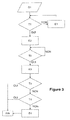
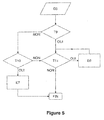
- the method of managing the mechanism for opening and closing the window 15 of the gate 14 may therefore be described by the flowcharts shown in FIGS. Figures 3 to 5 .
- the organization chart of the figure 3 represents the management method during an action D1 on the control 13 opening the gate.
- the method firstly checks whether the window 15 is in a position less than or equal to the limit position L (T1), if it is not the case the method comprises a step E1 which lowers the window to the position limit L. Once the condition (T1) on the limit position of the window is satisfied, the method comprises a step E2 for unlocking the postillion 14. Then, as soon as the gate is closed (T2), the method performs the locking gate in step E3. Finally if the girafon is closed (T3) and if the window is located in the limit position L (T4), the method performs a step E4 of closing the window. If one of the two preceding conditions T3 or T4 is not verified, the window remains in its position and this part of the glass management process relating to the control of the gate is terminated (END).
- the organization chart of the figure 4 represents the management process during opening D2 of the girafon.
- the method verifies whether the window 15 is in a position less than or equal to the limit position L (T6), and if this is not the case the comprises a step E5 which lowers the window to the limit position L.
- the condition (T6) on the limit position of the window is satisfied, as soon as the closure of the girafon is detected (T7), the method verifies, similarly to the organization chart of the figure 4 , if the gate is locked (T8) and if the window is located in the limit position L (T4), to perform a step E4 closing the window. If one of the two previous conditions T8 or T4 is not verified, the window remains in its position and this part of the window management process relating to the opening of the giraffe is complete (FIN).
- the organization chart of the figure 5 represents the management method during a request D3 closing the window 15 of the gate 14.
- the method verifies whether the girafon is open (T9) or if the gate is unlocked (T10) in which case, as long as the limit position L is not reached (T11), the method allows partial recovery E6 of the pane.
- the girafon is not open (T9) or if the gate is not unlocked (T10) the window is raised without restriction until the end of the request (FIN),
- This invention advantageously allows a giraffe to be associated with a gate equipped with a controlled opening window, while allowing the opening and closing of each member without encountering interference between the glass and the girafon through a management process and a simple giraffe mechanism.
Landscapes
- Engineering & Computer Science (AREA)
- Mechanical Engineering (AREA)
- Power-Operated Mechanisms For Wings (AREA)
- Window Of Vehicle (AREA)
Abstract
Description
- La présente invention concerne un dispositif d'ouverture et fermeture d'une vitre de véhicule automobile.
- L'invention concerne plus précisément un dispositif d'ouverture et fermeture d'une vitre de portillon arrière d'un véhicule automobile comprenant également un ouvrant de pavillon de type girafon. L'invention concerne aussi un procédé d'ouverture et fermeture d'une telle vitre.
- Certains véhicules automobiles, notamment des véhicules utilitaires ou de loisirs, présentent une ouverture ménagée dans la zone arrière du pavillon et pouvant être obturée par un ouvrant. Cet ouvrant est alors appelé girafon.
- Le document
FR2876959 - En plus d'un girafon, le véhicule peut comporter un portillon arrière comportant une vitre pouvant monter ou descendre dans ce portillon, est venant obturer l'accès arrière du véhicule entre le portillon et le girafon. Un tel véhicule est décrit dans le document
DE10028777 . Cependant la vitre de portillon associée au girafon nécessite une gestion d'ouverture et fermeture particulière afin de pouvoir ouvrir et fermer le girafon et/ou le portillon sans endommager la vitre qui, en position fermée, doit pouvoir être engagée dans un joint d'étanchéité du girafon afin d'éviter toute fuite vers l'intérieur du véhicule. - La présente invention a donc pour objet de fournir un dispositif d'ouverture et fermeture d'une vitre amélioré en proposant un procédé de gestion de l'ouverture et la fermeture de la vitre adapté à cette structure de véhicule.
- A cet effet l'invention propose un dispositif d'ouverture et fermeture d'une vitre d'un véhicule automobile comprenant un ouvrant de pavillon et un portillon arrière dans lequel est monté un mécanisme permettant de faire coulisser ladite vitre, ledit dispositif comprenant un premier élément de commande d'ouverture du portillon, un premier élément de détection de la position du girafon, un second élément de détection de position du portillon, au moins un second élément de commande d'ouverture de la vitre, les premiers et seconds éléments de commande et de détection étant reliés à un système de gestion apte à envoyer un signal d'ouverture ou de fermeture au mécanisme d'ouverture de la vitre.
- Selon d'autres caractéristiques de l'invention, le bord transversal arrière de l'ouvrant de pavillon peut comporter au moins un joint d'étanchéité formant un U ouvert sensiblement vers le bas et apte à recevoir le bord supérieure de la vitre en position fermée.
- Le mécanisme d'ouverture de l'ouvrant de pavillon peut être adapté à déplacer le bord transversal arrière de l'ouvrant de pavillon lors de l'ouverture de l'ouvrant selon une direction sensiblement verticale de manière à dégager le joint d'étanchéité de la vitre.
- L'invention concerne également un procédé de gestion du mécanisme d'ouverture ou fermeture d'un tel dispositif. Lorsque l'ouverture de l'ouvrant de pavillon est détectée, le procédé vérifie si la vitre est dans une position inférieure ou égale à une position limite, et dans le cas contraire le procédé comporte une étape d'abaissement de la vitre jusqu'à la position limite.
- Le procédé peut vérifier, lorsqu'une action sur la commande d'ouverture du portillon est détectée, si la vitre est dans une position inférieure ou égale à la position limite, dans le cas contraire, le procédé peut comporter une étape d'abaissement de la vitre jusqu'à la position limite, puis lorsque la condition sur la position limite de la vitre est satisfaite, le procédé peut comprendre une étape de déverrouillage du portillon.
- Le procédé, lorsque la fermeture de l'ouvrant de pavillon est détectée, peut vérifier si le portillon est verrouillé et si la vitre est située dans la position limite, si ces conditions sont vérifiées, le procédé peut comporter une étape de fermeture de la vitre.
- Le procédé, lorsque la fermeture du portillon est détectée, peut effectuer une étape de verrouillage du portillon puis, si la fermeture de l'ouvrant de pavillon est détectée et si la vitre est située dans la position limite, le procédé peut effectuer une étape de fermeture de la vitre.
- Selon une autre caractéristique de l'invention, le procédé, lorsqu'une demande de fermeture de la vitra est détectée, peut vérifier si le girafon est ouvert ou si le portillon est déverrouillé, puis si l'une des deux conditions est vérifiée, le procédé peut comporter une étape de remontée partielle de la vitre jusqu'à la position limite.
- D'autres caractéristiques et avantages de l'invention apparaîtront à la lecture de la description d'un exemple qui va maintenant en être fait en se référant aux dessins annexés, sur desquels :
- La
figure 1 est une vue arrière de véhicule comportant un girafon, un portillon et une vitre selon l'invention ; - La
figure 2 est une vue en coupe longitudinale du girafon et position fermé et semi ouverte, associé à la vitre de l'invention ; - Les
figures 3 à 5 sont des organigrammes représentant le procédé de gestion de l'ouverture et de la fermeture de la vitre de l'invention. - Dans la suite de la description, on définit par X, Y, Z les directions longitudinale, transversale et verticale du véhicule automobile. Sur les figures, la direction X est dirigée vers l'arrière du véhicule. Les termes avant et arrière se réfèrent respectivement à l'avant et l'arrière du véhicule.
- En référence aux
figures 1 et 2 , un véhicule automobile 10 comprend un pavillon 12 et une face arrière formée d'un portillon 14 associé à une vitre de postillon 15. - Dans cet exemple, le portillon arrière 14 est articulé sur un coté de la structure du véhicule de manière à pouvoir pivoter autour d'un axe latéral sensiblement vertical. Le portillon 14 comprend une commande d'ouverture 13 permettant de déverrouiller le portillon 14.
- La vitre 15 est montée coulissante dans ce portillon 14, guidée par un moyen de guidage 17 prolongeant verticalement le portillon 14 le long d'un bord latéral de la vitre 15. Le portillon peut également présenter deux moyens de guidage permettant de guider chaque bord latéral de la vitre 15.
- La vitre 15 est associée à un mécanisme d'ouverture et de fermeture électrique (non représente) situé dans le portillon 14, et pouvant être activé par au moins un élément de commande situé à l'intérieur du véhicule 10.
- A proximité immédiate du bord supérieur de la vitre de portillon 15, le pavillon est pourvu d'un ouvrant 16 qui obture une ouverture. Dans la position fermée représentée à la
figure 1 , l'ouvrant 16 s'étend dans la continuité du pavillon 12 au dessus de l'ouverture qu'il obture complètement. Le bord transversal arrière de l'ouvrant 16 comporte au moins un joint d'étanchéité 18 formant un U ouvert sensiblement vers le bas, et apte à recevoir le bord supérieure de la vitre en position fermée - Cet ouvrant 16, est monté en rotation sur deux chariots 19 coulissant principalement suivant un mouvement de translation, chacun dans un rail 20 solidaire de la face supérieure du pavillon 12. Chaque rail 20 s'étend dans la direction longitudinale du véhicule depuis le bord transversal avant de l'ouverture situé du côté avant du véhicule, sur une distance sensiblement identique à la dimension de l'ouvrant 16 dans la direction longitudinale.
- Les chariots 19 et les rails 20 forment ainsi des moyens de guidage en débattement principalement longitudinal de l'ouvrant aptes à le guider entre ses positions fermée et ouverte.
- L'ouvrant 16 est, d'autre part, articulé à l'extrémité d'une bielle 22, l'autre extrémité de la bielle 22 étant articulée à la structure du véhicule.
- Chaque bielle 22 est articulée à l'ouvrant et à la structure du véhicule de manière à ce que, dans la position fermée, les axes d'articulation de la bielle 22 soient disposés sensiblement dans un même plan horizontal. Les bielles 22 permettent ainsi un déplacement de l'ouvrant entre ses positions ouverte et fermée avec un débattement longitudinal et vertical.
- Grâce à ce mécanisme, l'ouverture de l'ouvrant 16 est réalisée de la manière suivante représentée à la
figure 2 . L'ouvrant est libéré de la partie arrière du véhicule 10. Le mouvement du girafon 16 suivant la cinématique définie par le mécanisme des bielles 22 et des chariots 19 décrit en premier lieu principalement un arc de cercle vers le haut puis vers l'avant du véhicule. Ce mécanisme permet avantageusement de dégager le joint d'étanchéité 18 en U de la vitra 15 en position fermée selon une direction sensiblement tangente à ladite vitre, avant que le girafon se déplace vers l'avant du véhicule, limitant ainsi les efforts exercés par le girafon sur la vitre. - La fermeture de l'ouvrant 16 est réalisée inversement à l'ouverture. Cependant, lorsque l'ouvrant arrive proche de sa position fermée, des plots de centrage (non représentés) permettent la mise en position de l'ouvrant par rapport au pavillon. Cependant si la vitre se situe en position haute, l'engagement de la vitre dans le joint s'effectue avant que l'ouvrant soit correctement centré. Ainsi, afin d'éviter l'endommagement de la vitre ou du joint pouvant être entrainé par un mauvais positionnement de l'ouvrant par rapport à la vitre, cette dernière est préférentiellement située dans une position limite L légèrement abaissée d'environ 3 centimètres par rapport à la position haute fermée de la vitre afin que l'ouvrant n'entre pas en contact avec la vitre, la fermeture de ladite vitre s'effectuant après la fermeture de l'ouvrant.
- A cet effet le véhicule est muni d'un contacteur électrique 24 associé à un système de gestion du mécanisme d'ouverture de la vitre. Le contacteur 24, par exemple du type poussoir, est situé sur la structure du véhicule, et coopère avec une portion de l'ouvrant 16. Ce contacteur permet de détecter l'ouverture de l'ouvrant et ainsi d'interdire la remontée de la vitre au-delà de la position limite L tant que l'ouvrant 16 de pavillon n'est pas refermé.
- Selon une autre caractéristique de l'invention, l'ouverture du portillon 14 ne peut être effectuée que lorsque ce dernier est déverrouillé. En effet, lorsque le girafon est fermé et que la vitre est remontée, cette dernière est engagée dans le joint du girafon et l'ouverture du portillon ne peut être effectuée. Ainsi lorsque l'utilisateur actionne la commande 13 d'ouverture du postillon 14, le système de gestion d'ouverture de la vitre abaisse cette dernière dans la position limite L puis autorise le déverrouillage du portillon. De plus, tant que le portillon est déverrouillé le système de gestion interdit la remontée de vitre au-delà de la position limite L.
- Selon une autre caractéristique de l'invention, lorsque le girafon 16 est refermé et que le postillon 14 est verrouillé (respectivement lorsque le portillon est refermé et que le girafon est en position fermé), si la vitre 15 se situe dans la position limite L, le système de gestion remonte automatiquement la vitre 15 en position fermée engageant ainsi la vitre dans le joint d'étanchéité 18 du girafon selon la direction sensiblement verticale de translation de la vitre adaptée à la forme du joint en U.
- Le procédé de gestion du mécanisme d'ouverture et fermeture de la vitre 15 du portillon 14 peut donc être décrit par les organigrammes représentés aux
figures 3 à 5 . - L'organigramme de la
figure 3 représente le procédé de gestion lors d'une action D1 sur la commande 13 d'ouverture du portillon. Le procédé vérifie dans un premier temps si la vitre 15 est dans une position inférieure ou égale à la position limite L (T1), si ce n'est pas le cas le procédé comporte une étape E1 qui abaisse la vitre jusqu'à la position limite L. Une fois que la condition (T1) sur la position limite de la vitre est satisfaite le procédé comprend une étape E2 de déverrouillage du postillon 14. Ensuite, dès la fermeture du portillon est détectée (T2), le procédé effectue le verrouillage du portillon à l'étape E3. Enfin si le girafon est fermé (T3) et si la vitre est située dans la position limite L (T4), le procédé effectue une étape E4 de fermeture de la vitre. Si une des deux conditions précédentes T3 ou T4 n'est pas vérifiée, la vitre reste dans sa position et cette partie du procédé de gestion de la vitre relative à la commande du portillon est terminée (FIN). - L'organigramme de la
figure 4 représente le procédé de gestion lors de l'ouverture D2 du girafon. Lorsque l'ouverture détectée (T5), notamment au moyen du contacteur 24, le procédé vérifie si la vitre 15 est dans une position inférieure ou égale à la position limite L (T6), et si ce n'est pas le cas le procédé comporte une étape E5 qui abaisse la vitre jusqu'à la position limite L. Une fois que la condition (T6) sur la position limite de la vitre est satisfaite, dès que la fermeture du girafon est détectée (T7), le procédé vérifie, similairement à l'organigramme de lafigure 4 , si le portillon est verrouillé (T8) et si la vitre est située dans la position limite L (T4), afin d'effectuer une étape E4 de fermeture de la vitre. Si une des deux conditions précédentes T8 ou T4 n'est pas vérifiée, la vitre reste dans sa position et cette partie du procédé de gestion de la vitre relative à l'ouverture du girafon est terminée (FIN). - L'organigramme de la
figure 5 représente le procédé de gestion lors d'une demande D3 de fermeture de la vitre 15 du portillon 14. Le procédé vérifie si le girafon est ouvert (T9) ou si le portillon est déverrouillé (T10) auquel cas, tant que la position limite L n'est pas atteinte (T11), le procédé autorise la remontée partielle E6 de la vitre. Par contre si le girafon n'est pas ouvert (T9) ou si le portillon n'est pas déverrouillé (T10) la vitre est remontée sans restriction jusqu'à la fin de la demande (FIN), - Cette invention permet avantageusement d'associer un girafon à un portillon équipé d'une vitre à ouverture commandé, tout en permettant l'ouverture et la fermeture de chaque organe sans rencontrer d'interférence entre la vitre et le girafon grâce à un procédé de gestion et un mécanisme de girafon simple.
Claims (8)
- Dispositif d'ouverture et fermeture d'une vitre (15) d'un véhicule automobile (10) comprenant un ouvrant (16) de pavillon (12) et un portillon arrière (14) dans lequel est monté un mécanisme permettant de faire coulisser ladite vitre, caractérisé en ce que le dispositif comprend un premier élément de commande (13) d'ouverture du portillon, un premier élément de détection (24) de la position du girafon, un second élément de détection de position du portillon, au moins un second élément de commande d'ouverture de la vitre, les premiers et seconds éléments de commande et de détection (13, 24) étant reliés à un système de gestion apte à envoyer un signal d'ouverture ou de fermeture au mécanisme d'ouverture de la vitre.
- Dispositif d'ouverture et de fermeture d'une vitre (15) selon la revendication précédente, caractérisé en ce que le bord transversal arrière de l'ouvrant de pavillon (16) comporte au moins un joint d'étanchéité (18) formant un U ouvert sensiblement vers le bas, apte à recevoir le bord supérieure de la vitre (15) en position fermée.
- Dispositif d'ouverture et de fermeture d'une vitre (15) selon la revendication précédente, caractérisé en ce que le mécanisme d'ouverture (19, 20, 22) de l'ouvrant de pavillon est adapté à déplacer le bord transversal arrière de l'ouvrant de pavillon (16) lors de l'ouverture de l'ouvrant selon une direction sensiblement verticale de manière à dégager le joint d'étanchéité (18) de la vitre (15).
- Procédé de gestion du mécanisme d'ouverture ou fermeture d'un dispositif selon une des revendications précédentes, caractérise en ce que, lorsque l'ouverture (D2) de l'ouvrant de pavillon est détectée (T5), le procédé vérifie (T6) si la vitre (15) est dans une position inférieure ou égale à une position limite (L), et dans le cas contraire le procédé comporte une étape (E5) d'abaissement de la vitre jusqu'à la position limite (L).
- Procédé de gestion selon la revendication 4, caractérisé en ce que, lorsqu'une action (D1) sur la commande (13) d'ouverture du portillon est détectée, le procédé vérifie (T1) si la vitre (15) est dans une position inférieure ou égale à la position limite (L), dans le cas contraire, le procédé comporte une étape (E1) d'abaissement de la vitre jusqu'à la position limite (L), puis lorsque la condition (T1) sur la position limite de la vitre est satisfaite, le procédé comprend une étape (E2) de déverrouillage du portillon (14).
- Procédé de gestion selon la revendication 5, caractérise en ce que lorsque la fermeture de l'ouvrant de pavillon est détectée (T7), le procédé vérifie si le portillon est verrouillé (T8) et si la vitre est située dans la position limite (L) (T4), si ces conditions (T8, T4) sont vérifiées, le procédé comporte une étape (E4) de fermeture de la vitre.
- Procédé de gestion selon une des revendications 5 ou 6, caractérisé en ce que lorsque la fermeture du portillon est détectée (T2), le procédé effectue une étape de verrouillage du portillon (E3), puis si la fermeture de l'ouvrant de pavillon est détectée (T3) et si la vitre est située dans la position limite (L) (T4), le procédé effectue une étape (E4) de fermeture de la vitre.
- Procédé de gestion selon une des revendications 5 à 7, caractérisé et ce que lorsqu'une demande (D3) de fermeture de la vitre (15) est détectée, le procédé vérifie si le girafon est ouvert (T9) ou si le portillon est déverrouillé (T10) puis si l'une des deux conditions (T9, T10) est vérifiée, le procédé comporte une étape de remontée partielle (E6) de la vitre tant que la position limite (L) n'est pas atteinte (T11).
Applications Claiming Priority (1)
| Application Number | Priority Date | Filing Date | Title |
|---|---|---|---|
| FR0856594A FR2936552A1 (fr) | 2008-09-30 | 2008-09-30 | Dispositif d'ouverture et de fermeture d'une vitre de vehicule automobile |
Publications (2)
| Publication Number | Publication Date |
|---|---|
| EP2168797A1 true EP2168797A1 (fr) | 2010-03-31 |
| EP2168797B1 EP2168797B1 (fr) | 2010-12-01 |
Family
ID=40560276
Family Applications (1)
| Application Number | Title | Priority Date | Filing Date |
|---|---|---|---|
| EP09305867A Active EP2168797B1 (fr) | 2008-09-30 | 2009-09-17 | Dispositif d'ouverture ou fermeture d'une vitre de véhicule automobile |
Country Status (4)
| Country | Link |
|---|---|
| EP (1) | EP2168797B1 (fr) |
| AT (1) | ATE490109T1 (fr) |
| DE (1) | DE602009000418D1 (fr) |
| FR (1) | FR2936552A1 (fr) |
Cited By (1)
| Publication number | Priority date | Publication date | Assignee | Title |
|---|---|---|---|---|
| CN102490572A (zh) * | 2011-11-21 | 2012-06-13 | 奇瑞汽车股份有限公司 | 尾门玻璃控制方法、装置和系统 |
Citations (7)
| Publication number | Priority date | Publication date | Assignee | Title |
|---|---|---|---|---|
| DE10028777A1 (de) | 2000-06-15 | 2002-01-03 | Webasto Vehicle Sys Int Gmbh | Fahrzeug mit einem umwandelbaren Heckaufbau |
| EP1234756A1 (fr) * | 2001-02-26 | 2002-08-28 | Peugeot Citroen Automobiles SA | Véhicule automobile de type break transformable |
| US20050222732A1 (en) * | 2004-03-31 | 2005-10-06 | Nissan Technical Center North America, Inc. | Tailgate ajar and security monitoring system |
| FR2876959A1 (fr) | 2004-10-22 | 2006-04-28 | Webasto Systemes Carrosserie S | Dispositif d'ouvrant pour vehicule automobile |
| DE102005021117A1 (de) * | 2005-05-06 | 2006-11-09 | Michael Reichert | Kraftfahrzeug |
| FR2893344A1 (fr) * | 2005-11-16 | 2007-05-18 | Peugeot Citroen Automobiles Sa | Gache retractable pour vitre ouvrante de volet arriere |
| US7219945B1 (en) * | 2005-10-26 | 2007-05-22 | Ford Global Technologies, Llc | Power lift gate for automotive vehicle |
-
2008
- 2008-09-30 FR FR0856594A patent/FR2936552A1/fr active Pending
-
2009
- 2009-09-17 DE DE602009000418T patent/DE602009000418D1/de active Active
- 2009-09-17 AT AT09305867T patent/ATE490109T1/de not_active IP Right Cessation
- 2009-09-17 EP EP09305867A patent/EP2168797B1/fr active Active
Patent Citations (7)
| Publication number | Priority date | Publication date | Assignee | Title |
|---|---|---|---|---|
| DE10028777A1 (de) | 2000-06-15 | 2002-01-03 | Webasto Vehicle Sys Int Gmbh | Fahrzeug mit einem umwandelbaren Heckaufbau |
| EP1234756A1 (fr) * | 2001-02-26 | 2002-08-28 | Peugeot Citroen Automobiles SA | Véhicule automobile de type break transformable |
| US20050222732A1 (en) * | 2004-03-31 | 2005-10-06 | Nissan Technical Center North America, Inc. | Tailgate ajar and security monitoring system |
| FR2876959A1 (fr) | 2004-10-22 | 2006-04-28 | Webasto Systemes Carrosserie S | Dispositif d'ouvrant pour vehicule automobile |
| DE102005021117A1 (de) * | 2005-05-06 | 2006-11-09 | Michael Reichert | Kraftfahrzeug |
| US7219945B1 (en) * | 2005-10-26 | 2007-05-22 | Ford Global Technologies, Llc | Power lift gate for automotive vehicle |
| FR2893344A1 (fr) * | 2005-11-16 | 2007-05-18 | Peugeot Citroen Automobiles Sa | Gache retractable pour vitre ouvrante de volet arriere |
Cited By (1)
| Publication number | Priority date | Publication date | Assignee | Title |
|---|---|---|---|---|
| CN102490572A (zh) * | 2011-11-21 | 2012-06-13 | 奇瑞汽车股份有限公司 | 尾门玻璃控制方法、装置和系统 |
Also Published As
| Publication number | Publication date |
|---|---|
| DE602009000418D1 (de) | 2011-01-13 |
| EP2168797B1 (fr) | 2010-12-01 |
| FR2936552A1 (fr) | 2010-04-02 |
| ATE490109T1 (de) | 2010-12-15 |
Similar Documents
| Publication | Publication Date | Title |
|---|---|---|
| EP2442993B1 (fr) | Dispositif d'obturation d'une baie menagee dans un element de structure comprenant des moyens de synchronisation, et vehicule automobile correspondant | |
| EP1916132B1 (fr) | Dispositif de verrouillage à poignée poussoir et levier pour panneau coulissant, dispositif d'obturation et véhicule automobile correspondants. | |
| FR2752777A1 (fr) | Capote pliante pour vehicules | |
| EP3350002B1 (fr) | Système d'ouverture de hayon à deux bielettes | |
| EP1939384B1 (fr) | Dispositif d'obturation d'une baie ménagée dans la carrosserie d'un véhicule à pion mobile formant pêne, et véhicule correspondant | |
| EP0312450A1 (fr) | Porte louvoyante pour train rapide | |
| FR2945241A1 (fr) | Vehicule comportant une porte deplacable par un dispositif de leve-vitre | |
| EP3830369B1 (fr) | Dispositif de guidage d'un ouvrant de vehicule | |
| EP1369276A1 (fr) | Dispositif formant volet de coffre arrière d'un véhicule automobile | |
| EP0524051B1 (fr) | Un toit ouvrant entrebâillant et coulissant à biellettes | |
| EP2168797B1 (fr) | Dispositif d'ouverture ou fermeture d'une vitre de véhicule automobile | |
| EP1065083B1 (fr) | Agencement pour l'ouverture d'un ouvrant transversal arrière de véhicule | |
| EP1597101B1 (fr) | Toit escamotable de vehicule | |
| FR2527256A2 (fr) | Dispositif d'ouverture a surface decouvrable, notamment toit ouvrant pour vehicule automobile | |
| FR2525158A1 (fr) | Toit levant et coulissant pour vehicules | |
| WO2010081952A1 (fr) | Vehicule automobile comprenant un toit ouvrant monte mobile sur le pavillon de ce vehicule | |
| EP3633127B1 (fr) | Agencement pour contrôler l'ouverture et/ou la fermeture d'un ouvrant coulissant de véhicule | |
| FR2699126A1 (fr) | Porte latérale de véhicule automobile et véhicule automobile équipé d'une telle porte. | |
| EP2089245B1 (fr) | Structure de hayon de vehicule automobile et vehicule automobile comportant une telle structure. | |
| FR2843606A1 (fr) | Porte pour vehicule automobile | |
| EP1765624B1 (fr) | Ouvrant de vehicule automobile, et vehicule pourvu d'un tel ouvrant | |
| FR2893074A1 (fr) | Porte de vehicule automobile a panneau vitre coulissant, et vehicule correspondant. | |
| FR2964078A1 (fr) | Vehicule automobile equipe d'un ensemble coulissant comportant un pavillon et deux portes laterales | |
| FR2525157A1 (fr) | Toit levant et coulissant pour vehicules | |
| WO2010037943A1 (fr) | Dispositif de verrouillage d'ouvrant pour vehicule automobile |
Legal Events
| Date | Code | Title | Description |
|---|---|---|---|
| PUAI | Public reference made under article 153(3) epc to a published international application that has entered the european phase |
Free format text: ORIGINAL CODE: 0009012 |
|
| AK | Designated contracting states |
Kind code of ref document: A1 Designated state(s): AT BE BG CH CY CZ DE DK EE ES FI FR GB GR HR HU IE IS IT LI LT LU LV MC MK MT NL NO PL PT RO SE SI SK SM TR |
|
| AX | Request for extension of the european patent |
Extension state: AL BA RS |
|
| GRAP | Despatch of communication of intention to grant a patent |
Free format text: ORIGINAL CODE: EPIDOSNIGR1 |
|
| 17P | Request for examination filed |
Effective date: 20100527 |
|
| GRAS | Grant fee paid |
Free format text: ORIGINAL CODE: EPIDOSNIGR3 |
|
| GRAA | (expected) grant |
Free format text: ORIGINAL CODE: 0009210 |
|
| AK | Designated contracting states |
Kind code of ref document: B1 Designated state(s): AT BE BG CH CY CZ DE DK EE ES FI FR GB GR HR HU IE IS IT LI LT LU LV MC MK MT NL NO PL PT RO SE SI SK SM TR |
|
| REG | Reference to a national code |
Ref country code: GB Ref legal event code: FG4D Free format text: NOT ENGLISH |
|
| REG | Reference to a national code |
Ref country code: CH Ref legal event code: EP |
|
| REG | Reference to a national code |
Ref country code: IE Ref legal event code: FG4D |
|
| REF | Corresponds to: |
Ref document number: 602009000418 Country of ref document: DE Date of ref document: 20110113 Kind code of ref document: P |
|
| REG | Reference to a national code |
Ref country code: NL Ref legal event code: VDEP Effective date: 20101201 |
|
| PG25 | Lapsed in a contracting state [announced via postgrant information from national office to epo] |
Ref country code: NO Free format text: LAPSE BECAUSE OF FAILURE TO SUBMIT A TRANSLATION OF THE DESCRIPTION OR TO PAY THE FEE WITHIN THE PRESCRIBED TIME-LIMIT Effective date: 20110301 Ref country code: LT Free format text: LAPSE BECAUSE OF FAILURE TO SUBMIT A TRANSLATION OF THE DESCRIPTION OR TO PAY THE FEE WITHIN THE PRESCRIBED TIME-LIMIT Effective date: 20101201 |
|
| LTIE | Lt: invalidation of european patent or patent extension |
Effective date: 20101201 |
|
| PG25 | Lapsed in a contracting state [announced via postgrant information from national office to epo] |
Ref country code: CY Free format text: LAPSE BECAUSE OF FAILURE TO SUBMIT A TRANSLATION OF THE DESCRIPTION OR TO PAY THE FEE WITHIN THE PRESCRIBED TIME-LIMIT Effective date: 20101201 Ref country code: HR Free format text: LAPSE BECAUSE OF FAILURE TO SUBMIT A TRANSLATION OF THE DESCRIPTION OR TO PAY THE FEE WITHIN THE PRESCRIBED TIME-LIMIT Effective date: 20101201 Ref country code: LV Free format text: LAPSE BECAUSE OF FAILURE TO SUBMIT A TRANSLATION OF THE DESCRIPTION OR TO PAY THE FEE WITHIN THE PRESCRIBED TIME-LIMIT Effective date: 20101201 Ref country code: SE Free format text: LAPSE BECAUSE OF FAILURE TO SUBMIT A TRANSLATION OF THE DESCRIPTION OR TO PAY THE FEE WITHIN THE PRESCRIBED TIME-LIMIT Effective date: 20101201 Ref country code: FI Free format text: LAPSE BECAUSE OF FAILURE TO SUBMIT A TRANSLATION OF THE DESCRIPTION OR TO PAY THE FEE WITHIN THE PRESCRIBED TIME-LIMIT Effective date: 20101201 Ref country code: BG Free format text: LAPSE BECAUSE OF FAILURE TO SUBMIT A TRANSLATION OF THE DESCRIPTION OR TO PAY THE FEE WITHIN THE PRESCRIBED TIME-LIMIT Effective date: 20110301 Ref country code: AT Free format text: LAPSE BECAUSE OF FAILURE TO SUBMIT A TRANSLATION OF THE DESCRIPTION OR TO PAY THE FEE WITHIN THE PRESCRIBED TIME-LIMIT Effective date: 20101201 Ref country code: NL Free format text: LAPSE BECAUSE OF FAILURE TO SUBMIT A TRANSLATION OF THE DESCRIPTION OR TO PAY THE FEE WITHIN THE PRESCRIBED TIME-LIMIT Effective date: 20101201 Ref country code: SI Free format text: LAPSE BECAUSE OF FAILURE TO SUBMIT A TRANSLATION OF THE DESCRIPTION OR TO PAY THE FEE WITHIN THE PRESCRIBED TIME-LIMIT Effective date: 20101201 |
|
| REG | Reference to a national code |
Ref country code: IE Ref legal event code: FD4D |
|
| PG25 | Lapsed in a contracting state [announced via postgrant information from national office to epo] |
Ref country code: GR Free format text: LAPSE BECAUSE OF FAILURE TO SUBMIT A TRANSLATION OF THE DESCRIPTION OR TO PAY THE FEE WITHIN THE PRESCRIBED TIME-LIMIT Effective date: 20110302 |
|
| PG25 | Lapsed in a contracting state [announced via postgrant information from national office to epo] |
Ref country code: PT Free format text: LAPSE BECAUSE OF FAILURE TO SUBMIT A TRANSLATION OF THE DESCRIPTION OR TO PAY THE FEE WITHIN THE PRESCRIBED TIME-LIMIT Effective date: 20110401 Ref country code: EE Free format text: LAPSE BECAUSE OF FAILURE TO SUBMIT A TRANSLATION OF THE DESCRIPTION OR TO PAY THE FEE WITHIN THE PRESCRIBED TIME-LIMIT Effective date: 20101201 Ref country code: IE Free format text: LAPSE BECAUSE OF FAILURE TO SUBMIT A TRANSLATION OF THE DESCRIPTION OR TO PAY THE FEE WITHIN THE PRESCRIBED TIME-LIMIT Effective date: 20101201 Ref country code: IS Free format text: LAPSE BECAUSE OF FAILURE TO SUBMIT A TRANSLATION OF THE DESCRIPTION OR TO PAY THE FEE WITHIN THE PRESCRIBED TIME-LIMIT Effective date: 20110401 Ref country code: ES Free format text: LAPSE BECAUSE OF FAILURE TO SUBMIT A TRANSLATION OF THE DESCRIPTION OR TO PAY THE FEE WITHIN THE PRESCRIBED TIME-LIMIT Effective date: 20110312 Ref country code: CZ Free format text: LAPSE BECAUSE OF FAILURE TO SUBMIT A TRANSLATION OF THE DESCRIPTION OR TO PAY THE FEE WITHIN THE PRESCRIBED TIME-LIMIT Effective date: 20101201 |
|
| PG25 | Lapsed in a contracting state [announced via postgrant information from national office to epo] |
Ref country code: SK Free format text: LAPSE BECAUSE OF FAILURE TO SUBMIT A TRANSLATION OF THE DESCRIPTION OR TO PAY THE FEE WITHIN THE PRESCRIBED TIME-LIMIT Effective date: 20101201 Ref country code: PL Free format text: LAPSE BECAUSE OF FAILURE TO SUBMIT A TRANSLATION OF THE DESCRIPTION OR TO PAY THE FEE WITHIN THE PRESCRIBED TIME-LIMIT Effective date: 20101201 Ref country code: RO Free format text: LAPSE BECAUSE OF FAILURE TO SUBMIT A TRANSLATION OF THE DESCRIPTION OR TO PAY THE FEE WITHIN THE PRESCRIBED TIME-LIMIT Effective date: 20101201 |
|
| PLBE | No opposition filed within time limit |
Free format text: ORIGINAL CODE: 0009261 |
|
| STAA | Information on the status of an ep patent application or granted ep patent |
Free format text: STATUS: NO OPPOSITION FILED WITHIN TIME LIMIT |
|
| PG25 | Lapsed in a contracting state [announced via postgrant information from national office to epo] |
Ref country code: DK Free format text: LAPSE BECAUSE OF FAILURE TO SUBMIT A TRANSLATION OF THE DESCRIPTION OR TO PAY THE FEE WITHIN THE PRESCRIBED TIME-LIMIT Effective date: 20101201 |
|
| 26N | No opposition filed |
Effective date: 20110902 |
|
| REG | Reference to a national code |
Ref country code: DE Ref legal event code: R097 Ref document number: 602009000418 Country of ref document: DE Effective date: 20110902 |
|
| BERE | Be: lapsed |
Owner name: RENAULT S.A.S. Effective date: 20110930 |
|
| PG25 | Lapsed in a contracting state [announced via postgrant information from national office to epo] |
Ref country code: MC Free format text: LAPSE BECAUSE OF NON-PAYMENT OF DUE FEES Effective date: 20110930 |
|
| PG25 | Lapsed in a contracting state [announced via postgrant information from national office to epo] |
Ref country code: BE Free format text: LAPSE BECAUSE OF NON-PAYMENT OF DUE FEES Effective date: 20110930 |
|
| PG25 | Lapsed in a contracting state [announced via postgrant information from national office to epo] |
Ref country code: MK Free format text: LAPSE BECAUSE OF FAILURE TO SUBMIT A TRANSLATION OF THE DESCRIPTION OR TO PAY THE FEE WITHIN THE PRESCRIBED TIME-LIMIT Effective date: 20101201 Ref country code: MT Free format text: LAPSE BECAUSE OF FAILURE TO SUBMIT A TRANSLATION OF THE DESCRIPTION OR TO PAY THE FEE WITHIN THE PRESCRIBED TIME-LIMIT Effective date: 20101201 |
|
| PG25 | Lapsed in a contracting state [announced via postgrant information from national office to epo] |
Ref country code: SM Free format text: LAPSE BECAUSE OF FAILURE TO SUBMIT A TRANSLATION OF THE DESCRIPTION OR TO PAY THE FEE WITHIN THE PRESCRIBED TIME-LIMIT Effective date: 20101201 |
|
| PG25 | Lapsed in a contracting state [announced via postgrant information from national office to epo] |
Ref country code: LU Free format text: LAPSE BECAUSE OF NON-PAYMENT OF DUE FEES Effective date: 20110917 |
|
| PG25 | Lapsed in a contracting state [announced via postgrant information from national office to epo] |
Ref country code: HU Free format text: LAPSE BECAUSE OF FAILURE TO SUBMIT A TRANSLATION OF THE DESCRIPTION OR TO PAY THE FEE WITHIN THE PRESCRIBED TIME-LIMIT Effective date: 20101201 |
|
| REG | Reference to a national code |
Ref country code: CH Ref legal event code: PL |
|
| PG25 | Lapsed in a contracting state [announced via postgrant information from national office to epo] |
Ref country code: CH Free format text: LAPSE BECAUSE OF NON-PAYMENT OF DUE FEES Effective date: 20130930 Ref country code: LI Free format text: LAPSE BECAUSE OF NON-PAYMENT OF DUE FEES Effective date: 20130930 |
|
| REG | Reference to a national code |
Ref country code: FR Ref legal event code: PLFP Year of fee payment: 7 |
|
| REG | Reference to a national code |
Ref country code: FR Ref legal event code: PLFP Year of fee payment: 8 |
|
| REG | Reference to a national code |
Ref country code: FR Ref legal event code: PLFP Year of fee payment: 9 |
|
| REG | Reference to a national code |
Ref country code: FR Ref legal event code: PLFP Year of fee payment: 10 |
|
| PGFP | Annual fee paid to national office [announced via postgrant information from national office to epo] |
Ref country code: TR Payment date: 20220916 Year of fee payment: 14 Ref country code: GB Payment date: 20220920 Year of fee payment: 14 Ref country code: DE Payment date: 20220920 Year of fee payment: 14 |
|
| PGFP | Annual fee paid to national office [announced via postgrant information from national office to epo] |
Ref country code: FR Payment date: 20220922 Year of fee payment: 14 |
|
| PGFP | Annual fee paid to national office [announced via postgrant information from national office to epo] |
Ref country code: IT Payment date: 20220926 Year of fee payment: 14 |
|
| REG | Reference to a national code |
Ref country code: DE Ref legal event code: R119 Ref document number: 602009000418 Country of ref document: DE |
|
| GBPC | Gb: european patent ceased through non-payment of renewal fee |
Effective date: 20230917 |
|
| PG25 | Lapsed in a contracting state [announced via postgrant information from national office to epo] |
Ref country code: GB Free format text: LAPSE BECAUSE OF NON-PAYMENT OF DUE FEES Effective date: 20230917 |
|
| PG25 | Lapsed in a contracting state [announced via postgrant information from national office to epo] |
Ref country code: GB Free format text: LAPSE BECAUSE OF NON-PAYMENT OF DUE FEES Effective date: 20230917 Ref country code: FR Free format text: LAPSE BECAUSE OF NON-PAYMENT OF DUE FEES Effective date: 20230930 Ref country code: DE Free format text: LAPSE BECAUSE OF NON-PAYMENT OF DUE FEES Effective date: 20240403 |
|
| PG25 | Lapsed in a contracting state [announced via postgrant information from national office to epo] |
Ref country code: IT Free format text: LAPSE BECAUSE OF NON-PAYMENT OF DUE FEES Effective date: 20230917 |
|
| PG25 | Lapsed in a contracting state [announced via postgrant information from national office to epo] |
Ref country code: IT Free format text: LAPSE BECAUSE OF NON-PAYMENT OF DUE FEES Effective date: 20230917 |