EP2159949A2 - Method and apparatus for handling HARQ process of semi-persistent scheduling - Google Patents
Method and apparatus for handling HARQ process of semi-persistent scheduling Download PDFInfo
- Publication number
- EP2159949A2 EP2159949A2 EP20090011003 EP09011003A EP2159949A2 EP 2159949 A2 EP2159949 A2 EP 2159949A2 EP 20090011003 EP20090011003 EP 20090011003 EP 09011003 A EP09011003 A EP 09011003A EP 2159949 A2 EP2159949 A2 EP 2159949A2
- Authority
- EP
- European Patent Office
- Prior art keywords
- harq process
- sps
- transmission
- ndi
- harq
- Prior art date
- Legal status (The legal status is an assumption and is not a legal conclusion. Google has not performed a legal analysis and makes no representation as to the accuracy of the status listed.)
- Granted
Links
Images




Classifications
-
- H—ELECTRICITY
- H04—ELECTRIC COMMUNICATION TECHNIQUE
- H04L—TRANSMISSION OF DIGITAL INFORMATION, e.g. TELEGRAPHIC COMMUNICATION
- H04L1/00—Arrangements for detecting or preventing errors in the information received
- H04L1/12—Arrangements for detecting or preventing errors in the information received by using return channel
- H04L1/16—Arrangements for detecting or preventing errors in the information received by using return channel in which the return channel carries supervisory signals, e.g. repetition request signals
- H04L1/18—Automatic repetition systems, e.g. Van Duuren systems
- H04L1/1867—Arrangements specially adapted for the transmitter end
- H04L1/1887—Scheduling and prioritising arrangements
-
- H—ELECTRICITY
- H04—ELECTRIC COMMUNICATION TECHNIQUE
- H04L—TRANSMISSION OF DIGITAL INFORMATION, e.g. TELEGRAPHIC COMMUNICATION
- H04L1/00—Arrangements for detecting or preventing errors in the information received
- H04L1/12—Arrangements for detecting or preventing errors in the information received by using return channel
- H04L1/16—Arrangements for detecting or preventing errors in the information received by using return channel in which the return channel carries supervisory signals, e.g. repetition request signals
- H04L1/18—Automatic repetition systems, e.g. Van Duuren systems
-
- H—ELECTRICITY
- H04—ELECTRIC COMMUNICATION TECHNIQUE
- H04L—TRANSMISSION OF DIGITAL INFORMATION, e.g. TELEGRAPHIC COMMUNICATION
- H04L1/00—Arrangements for detecting or preventing errors in the information received
- H04L1/12—Arrangements for detecting or preventing errors in the information received by using return channel
- H04L1/16—Arrangements for detecting or preventing errors in the information received by using return channel in which the return channel carries supervisory signals, e.g. repetition request signals
- H04L1/18—Automatic repetition systems, e.g. Van Duuren systems
- H04L1/1812—Hybrid protocols; Hybrid automatic repeat request [HARQ]
-
- H—ELECTRICITY
- H04—ELECTRIC COMMUNICATION TECHNIQUE
- H04L—TRANSMISSION OF DIGITAL INFORMATION, e.g. TELEGRAPHIC COMMUNICATION
- H04L1/00—Arrangements for detecting or preventing errors in the information received
- H04L1/12—Arrangements for detecting or preventing errors in the information received by using return channel
- H04L1/16—Arrangements for detecting or preventing errors in the information received by using return channel in which the return channel carries supervisory signals, e.g. repetition request signals
- H04L1/18—Automatic repetition systems, e.g. Van Duuren systems
- H04L1/1829—Arrangements specially adapted for the receiver end
- H04L1/1835—Buffer management
-
- H—ELECTRICITY
- H04—ELECTRIC COMMUNICATION TECHNIQUE
- H04W—WIRELESS COMMUNICATION NETWORKS
- H04W88/00—Devices specially adapted for wireless communication networks, e.g. terminals, base stations or access point devices
- H04W88/02—Terminal devices
Definitions
- the present invention relates to a method and apparatus of handling hybrid automatic repeat request (HARQ) operation for semi-persistent scheduling (SPS), and more particularly, to a method and apparatus of handling HARQ operation for SPS in a user equipment (UE) of a wireless communication system, so as to avoid unexpected data combination.
- HARQ hybrid automatic repeat request
- UE user equipment
- LTE system Long Term Evolution wireless communication system
- MAC Medium Access Control
- RLC Radio Link Control
- the LTE system has two scheduling methods: dynamic scheduling (DS) and semi-persistent scheduling (SPS).
- DS dynamic scheduling
- SPS semi-persistent scheduling
- the network dynamically allocates resources to UEs for data reception or transmission depending on traffic volume, quality of service (QoS) requirements of each UE.
- QoS quality of service
- SPS the network periodically allocates resource to UEs, in order to serve upper layer applications which generate semi-static size data periodically, e.g. Voice over Internet Protocol (VoIP) services, for reducing control information sent on a physical downlink control channel (PDCCH) and enhancing system scheduling performance.
- VoIP Voice over Internet Protocol
- PDCCH physical downlink control channel
- SPS provides persistent transmission resources to the UE, such that the UE can perform periodic data transmission without monitoring PDCCH and make sure each periodic transmission is a new transmission.
- the resources assigned by DS are addressed to a Cell Radio Network Temporary Identifier (C-RNTI) of the UE, while the resources assigned by SPS are addressed to an SPS C-RNTI of the UE.
- C-RNTI Cell Radio Network Temporary Identifier
- SPS C-RNTI is a UE specific identity assigned by Radio Resource Control (RRC) layer, and is manly used for activating or modifying SPS resources and for indicating SPS retransmissions.
- RRC Radio Resource Control
- a UE recognizes that the assigned resource is for a new transmission or a retransmission by HARQ Process ID and New Data Indicator (NDI) included in the PDCCH signaling. If the value of NDI is different from a previous NDI of the same HARQ process, the assigned resource is for a new transmission. Conversely, if the value of NDI is the same as the previous NDI of the same HARQ process, then the assigned resource is for a retransmission.
- NDI New Data Indicator
- NDI is used for indicating the UE the purpose of PDCCH signaling addressed to its SPS C-RNTI. If the value of NDI is 0, it means that the PDCCH signaling addressed to UE's SPS C-RNTI is used for activating or modifying SPS resources. Conversely, if the value of NDI is 1, then the PDCCH signaling addressed to SPS C-RNTI is used for allocating transmission recourse of an SPS retransmission.
- one or more specific HARQ process ID(s) reserved for SPS is configured by RRC signaling, but in uplink direction, the HARQ process ID(s) reserved for SPS is recognized after configuring start time and cycle length of an SPS period.
- DS is also allowed to use the HARQ process ID(s) reserved for SPS both in downlink and uplink direction.
- the value of NDI shall be 1.
- the UE receives a PDCCH signaling addressed to its C-RNTI, which indicates the UE to use some HARQ process, such as X to perform SPS retransmission, based on the above illustration, the value of NDI shall be 1.
- the UE receives a PDCCH signaling addressed to its C-RNTI, which indicates the UE to use the HARQ process X to transmit data as well.
- the UE compares the DS NDI with the previous NDI of the HARQ process X, i.e. the SPS NDI.
- the meaning of SPS NDI is different from that of DS NDI.
- comparing the two NDIs is meaningless, and may cause some unexpected data combination due to the comparison result.
- HARQ hybrid automatic repeat request
- SPS semi-persistent scheduling
- a method of handling a hybrid automatic repeat request (HARQ) process for semi-persistent scheduling (SPS) in a user equipment (UE) of a wireless communication system includes steps of configuring an SPS functionality, the SPS functionality utilizing at least one HARQ process; receiving a first new data indicator (NDI) addressed to an SPS cell radio network temporary identifier (SPS C-RNTI) of the UE for a first HARQ process of the at least one HARQ process; and considering a next transmission to be received by the first HARQ process as a first transmission of the first HARQ process when receiving a second NDI addressed to a C-RNTI of the UE for the first HARQ process.
- NDI new data indicator
- SPS C-RNTI SPS cell radio network temporary identifier
- a communications device of handling a hybrid automatic repeat request (HARQ) process for semi-persistent scheduling (SPS) in a user equipment (UE) of a wireless communication system includes a processor for executing a program, and a memory, coupled to the processor, for storing the program.
- HARQ hybrid automatic repeat request
- SPS semi-persistent scheduling
- the program includes steps of configuring an SPS functionality, the SPS functionality utilizing at least one HARQ process; receiving a first new data indicator (NDI) addressed to an SPS cell radio network temporary identifier (SPS C-RNTI) of the UE for a first HARQ process of the at least one HARQ process; and considering a next transmission to be received by the first HARQ process as a first transmission of the first HARQ process when receiving a second NDI addressed to a C-RNTI of the UE for the first HARQ process.
- NDI new data indicator
- SPS C-RNTI SPS cell radio network temporary identifier
- a method of handling a hybrid automatic repeat request (HARQ) process for semi-persistent scheduling (SPS) in a user equipment (UE) of a wireless communication system includes steps of configuring an SPS functionality, the SPS functionality utilizing at least one HARQ process; receiving a pre-assigned transmission by a first HARQ process of the at least one HARQ process according to configurations of the SPS functionality; and considering a next transmission to be received by the first HARQ process as a first transmission of the first HARQ process when receiving a new data indicator (NDI) addressed to a Cell Radio Network Temporary Identifier (C-RNTI) of the UE for the first HARQ process.
- NDI new data indicator
- C-RNTI Cell Radio Network Temporary Identifier
- a communications device of handling a hybrid automatic repeat request (HARQ) process for semi-persistent scheduling (SPS) in a user equipment (UE) of a wireless communication system includes a processor for executing a program, and a memory, coupled to the processor, for storing the program.
- HARQ hybrid automatic repeat request
- SPS semi-persistent scheduling
- the program includes steps of configuring an SPS functionality, the SPS functionality utilizing at least one HARQ process; receiving a pre-assigned transmission by a first HARQ process of the at least one HARQ process according to configurations of the SPS functionality; and considering a next transmission to be received by the first HARQ process as a first transmission of the first HARQ process when receiving a new data indicator (NDI) addressed to a Cell Radio Network Temporary Identifier (C-RNTI) of the UE for the first HARQ process.
- NDI new data indicator
- C-RNTI Cell Radio Network Temporary Identifier
- a method of handling a hybrid automatic repeat request (HARQ) process for semi-persistent scheduling (SPS) in a user equipment (UE) of a wireless communication system includes steps of configuring an SPS functionality, the SPS functionality utilizing at least one HARQ process; receiving a first New Data indicator (NDI) addressed to a cell radio network temporary identifier (C-RNTI) of the UE for a first HARQ process of the at least one HARQ process; and comparing the first NDI with a second NDI previously addressed to the C-RNTI for the first HARQ process to determine whether a transmission to be received by the first HARQ process is a new transmission; wherein the UE receives a third NDI addressed to an SPS C-RNTI of the UE for the first HARQ process or receives a pre-assigned transmission by the first HARQ process between reception of the first NDI and the second NDI.
- NDI New Data indicator
- C-RNTI cell radio network temporary identifier
- a communications device of handling a hybrid automatic repeat request (HARQ) process for semi-persistent scheduling (SPS) in a user equipment (UE) of a wireless communication system includes a processor for executing a program, and a memory, coupled to the processor, for storing the program.
- HARQ hybrid automatic repeat request
- SPS semi-persistent scheduling
- the program includes steps of configuring an SPS functionality, the SPS functionality utilizing at least one HARQ process; receiving a first New Data indicator (NDI) addressed to a cell radio network temporary identifier (C-RNTI) of the UE for a first HARQ process of the at least one HARQ process; and comparing the first NDI with a second NDI previously addressed to the C-RNTI for the first HARQ process to determine whether a transmission to be received by the first HARQ process is a new transmission; wherein the UE receives a third NDI addressed to an SPS C-RNTI of the UE for the first HARQ process or receives a pre-assigned transmission by the first HARQ process between reception of the first NDI and the second NDI.
- NDI New Data indicator
- C-RNTI cell radio network temporary identifier
- a method of handling a hybrid automatic repeat request (HARQ) process for semi-persistent scheduling (SPS) in a user equipment (UE) of a wireless communication system includes steps of configuring an SPS functionality, the SPS functionality utilizing at least one HARQ process; receiving a physical downlink control channel (PDCCH) signaling addressed to an SPS Cell Radio Network Temporary Identifier (SPS C-RNTI)of the UE, the PDCCH signaling indicating the UE to deactivate the SPS functionality; and flushing all HARQ buffers of the at least one HARQ process or considering all next transmission to be received by the at least one HARQ process as a first transmission.
- PDCCH physical downlink control channel
- SPS C-RNTI SPS Cell Radio Network Temporary Identifier
- a communications device of handling a hybrid automatic repeat request (HARQ) process for semi-persistent scheduling (SPS) in a user equipment (UE) of a wireless communication system includes a processor for executing a program, and a memory, coupled to the processor, for storing the program.
- HARQ hybrid automatic repeat request
- SPS semi-persistent scheduling
- the program includes steps of configuring an SPS functionality, the SPS functionality utilizing at least one HARQ process; receiving a physical downlink control channel (PDCCH) signaling addressed to an SPS Cell Radio Network Temporary Identifier (SPS C-RNTI)of the UE, the PDCCH signaling indicating the UE to deactivate the SPS functionality; and flushing all HARQ buffers of the at least one HARQ process or considering all next transmission to be received by the at least one HARQ process as a first transmission.
- PDCCH physical downlink control channel
- SPS C-RNTI SPS Cell Radio Network Temporary Identifier
- FIG.1 illustrates a schematic diagram of a wireless communications system 1000.
- the wireless communications system 1000 is preferred to be a Long Term Evolution (LTE) system, and is briefly composed of a network and a plurality of user equipments (UEs).
- LTE Long Term Evolution
- UEs user equipments
- the network and the UEs are simply utilized for illustrating the structure of the wireless communications system 1000.
- the network may comprise a plurality of base stations (Node Bs), radio network controllers and so on according to actual demands, and the UEs can be devices such as mobile phones, computer systems, etc.
- FIG.2 is a functional block diagram of a communications device 100 in a wireless communications system.
- the communications device 100 can be utilized for realizing the UEs in FIG.1 , and the wireless communications system is preferably the LTE system.
- FIG.2 only shows an input device 102, an output device 104, a control circuit 106, a central processing unit (CPU) 108, a memory 110, a program 112, and a transceiver 114 of the communications device 100.
- the control circuit 106 executes the program 112 in the memory 110 through the CPU 108, thereby controlling an operation of the communications device 100.
- the communications device 100 can receive signals input by a user through the input device 102, such as a keyboard, and can output images and sounds through the output device 104, such as a monitor or speakers.
- the transceiver 114 is used to receive and transmit wireless signals, delivering received signals to the control circuit 106, and outputting signals generated by the control circuit 106 wirelessly. From a perspective of a communications protocol framework, the transceiver 114 can be seen as a portion of Layer 1, and the control circuit 106 can be utilized to realize functions of Layer 2 and Layer 3.
- FIG.3 is a schematic diagram of the program 112 shown in FIG.2 .
- the program 112 includes an application layer 200, a Layer 3 202, and a Layer 2 206, and is coupled to a Layer 1 218.
- the Layer 3 202 is used for performing resource control.
- the Layer 2 is used for performing link control.
- the Layer 1 218 is used for performing physical connection.
- a Medium Access Control (MAC) entity 222 is located at the Layer 2 206, which can perform a plurality of hybrid automatic repeat request (HARQ) processes to receive packets and support a Semi-Persistent Scheduling (SPS) functionality.
- HARQ hybrid automatic repeat request
- SPS Semi-Persistent Scheduling
- RRC Radio Resource Control
- FIG.4 illustrates a schematic diagram of a process 40 according to an embodiment of the present invention.
- the process 40 is utilized for handling an HARQ process for SPS in a UE of a wireless communication system and can be compiled into the HARQ process handling program 220.
- the process 40 includes the following steps:
- the embodiment of the present invention first configures the SPS functionality, which utilizes at least one HARQ process. Then, the UE receives the first NDI addressed to its SPS C-RNTI for the first HARQ process of the at least one HARQ process. When a second NDI addressed to the UE's C-RNTI for the first HARQ process is received, the UE shall consider a next transmission to be received by the first HARQ process as a first transmission of the first HARQ process.
- the network configures the SPS functionality such as HARQ process ID(s) reserved for SPS by RRC signaling.
- the resources assigned by dynamic scheduling (DS) are addressed to UE's C-RNTI, while the resources assigned by SPS are addressed to UE's SPS C-RNTI.
- the NDI sent by SPS i.e. the NDI included in a PDCCH signaling addressed to UE's SPS C-RNTI is mainly used for the following two purposes: modification of SPS resources or indication of SPS retransmissions, which are well known by those skilled in the art and are not detailed herein.
- the UE when the UE sequentially receives the first NDI and the second NDI for the same HARQ process, which are included in a PDCCH signaling addressed to its SPS C-RNTI and C-RNTI, respectively, the UE according to the embodiment of the present invention considers the transmission to be received by the HARQ process as a first transmission of the HARQ process.
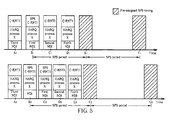
- FIG.5 is an exemplary illustration of the process 40.
- the first NDI addressed to SPS C-RNTI for an HARQ process x is received at a timing point B1
- timing points E1 and F1 are pre-assigned timing for SPS
- the second NDI addressed to C-RNTI for the HARQ process x is received at a timing point C1.
- the use of NDI in SPS is different from that in DS.
- the UE considers the transmission to be received by the HARQ process x at the timing point C1 as a first transmission of the HARQ process x.
- the UE even the UE receives a third NDI addressed to its C-RNTI for the HARQ process x before the timing point B1, such as at a timing point A1, the UE according to the embodiment of the present invention also considers the transmission to be received by the HARQ process x at the timing point C1 as a first transmission (i.e. new transmission) of the HARQ process x.
- the embodiment of the present invention can avoid unexpected data combination due to incorrect NDI comparison results.
- the UE compares the second NDI with the forth NDI to determine whether the transmission to be received by the HARQ process x at the timing point D1 is a new transmission.
- the transmission to be received by the HARQ process x is a retransmission; Otherwise, if the values of the second NDI and the forth NDI are toggled, the transmission to be received by the HARQ process x is a new transmission.
- the UE receives an NDI addressed to its SPS C-RNTI for the HARQ process X indicating SPS retransmission at a timing point B2.
- the first NDI addressed to SPS C-RNTI for the HARQ process x is received at a timing point C2
- timing points F2 and G2 are pre-assigned timing for SPS
- the second NDI addressed to C-RNTI for the HARQ process x is received at a timing point D2.
- the UE according to the embodiment of the present invention also considers the transmission to be received by the HARQ process x at the timing point D2 as a first transmission of the HARQ process x.
- the UE still considers the transmission to be received by the HARQ process x at the timing point D2 as a first transmission (i.e. new transmission) of the HARQ process x.
- the UE compares the second NDI with the forth NDI to determine whether the transmission to be received by the HARQ process x at the timing point E2 is a new transmission.
- FIG.6 illustrates a schematic diagram of a process 60 according to an embodiment of the present invention.
- the process 60 is utilized for handling an HARQ process for SPS in a UE of a wireless communication system and can be compiled into the HARQ process handling program 220.
- the process 60 includes the following steps:
- the embodiment of the present invention first configures the SPS functionality, which utilizes at least one HARQ process. Then, the UE receives the pre-assigned transmission by the first HARQ process of the at least one HARQ process according to the configurations of the SPS functionality. When the NDI addressed to UE's C-RNTI for the first HARQ process is received, the UE shall consider a next transmission to be received by the first HARQ process as a first transmission of the first HARQ process.
- FIG.7 is an exemplary illustration of the process 60.
- the pre-assigned SPS transmission is received by an HARQ process x according to the configurations of the SPS functionality at a timing point A3, and timing points C3 and F3 are pre-assigned timing reserved for SPS.
- the UE according to the embodiment of the present invention considers the transmission to be received by the HARQ process x at the timing point D3 as a first transmission of the HARQ process x.
- the UE still considers the transmission to be received by the HARQ process x at the timing point D3 as a first transmission (i.e. new transmission) of the HARQ process x.
- the UE compares the second NDI with the forth NDI to determine whether the transmission to be received by the HARQ process x at the timing point E3 is a new transmission.
- FIG.8 illustrates a schematic diagram of a process 80 according to an embodiment of the present invention.
- the process 80 is utilized for handling an HARQ process for SPS in a UE of a wireless communication system and can be compiled into the HARQ process handling program 220.
- the process 80 includes the following steps:
- the embodiment of the present invention first configures the SPS functionality, which utilizes at least one HARQ process. Then, the UE receives the first NDI addressed to its C-RNTI for the first HARQ process of the at least one HARQ process. Finally, the UE compares the first NDI with a second NDI previously addressed to the C-RNTI for the first HARQ process to determine whether a transmission to be received by the first HARQ process is a new transmission. It is noted that the UE receives a third NDI addressed to its SPS C-RNTI for the first HARQ process or receives a pre-assigned SPS transmission by the first HARQ process between reception of the first NDI and the second NDI.
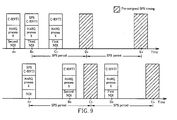
- FIG.9 is an exemplary illustration of the process 80.
- the third NDI addressed to UE's SPS C-RNTI for an HARQ process x is received at a timing point B4, and timing points D4 and E4 are pre-assigned timing reserved for SPS.
- the UE according to the embodiment of the present invention compares the first NDI with the second NDI previously addressed to its C-RNTI for the HARQ process x (e.g. at a timing point A4) to determine whether the transmission to be received by the HARQ process x is a new transmission.
- the transmission to be received by the HARQ process x is a retransmission; conversely, if the values of the first NDI and the second NDI are toggled, the transmission to be received by the HARQ process x is a new transmission.
- timing points C5 and E5 are pre-assigned timing reserved for SPS.
- the UE compares the first NDI with the second NDI previously addressed to its C-RNTI for the HARQ process x (e.g. at a timing point B5) to determine whether the transmission to be received by the HARQ process x is a new transmission.
- the transmission to be received by the HARQ process x is a retransmission; conversely, if the values of the first NDI and the second NDI are toggled, the transmission to be received by the HARQ process x is a new transmission.
- the embodiment of the present invention only compares the received NDI with the NDI previously addressed to its C-RNTI for the same HARQ process, to avoid unexpected data combination due to incorrect NDI comparison results.
- the UE shall consider the transmission to be received by the HARQ process x as a very first transmission.
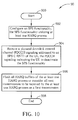
- FIG.10 illustrates a schematic diagram of a process 90 according to an embodiment of the present invention.
- the process 90 is utilized for handling an HARQ process for SPS in a UE of a wireless communication system and can be compiled into the HARQ process handling program 220.
- the process 90 includes the following steps:
- the embodiment of the present invention first configures the SPS functionality, which utilizes at least one HARQ process. Then, the UE receives PDCCH signaling addressed to its SPS C-RNTI for deactivating the SPS functionality. Accordingly, the UE flushes all HARQ buffers of the at least one HARQ process or considers all next transmissions to be received by the at least one HARQ process as a first transmission.
- the UE shall flushes all HARQ buffers of the HARQ processes reserved for SPS, or consider all next transmissions to be received by the reserved HARQ process as a first transmission, to avoid unexpected data combination due to incorrect NDI comparison.
- the embodiment of the present invention provide four possible solutions: (1) considering a downlink assignment addressed to UE's C-RNTI as a very first transmission of the HARQ process after reception of a downlink assignment addressed to UE's SPS C-RNTI; (2) considering a downlink assignment addressed to UE's C-RNTI as a very first transmission of the HARQ process after a pre-assigned SPS transmission; (3) only comparing the received NDI with the NDI previously addressed to UE's C-RNTI for the same HARQ process; and (4) flushing all HARQ buffers of the HARQ processes reserved for SPS, or considering all next transmissions to be received by the reserved HARQ process as a first transmission when the PDCCH signaling addressed to UE's SPS C-RNTI for deactivating the SPS functionality is received.
- the embodiment of the present invention can avoid
- the embodiment of the present invention provides a method of handling the HARQ operation for the SPS functionality, to avoid incorrect data combination and enhance system performance.
Landscapes
- Engineering & Computer Science (AREA)
- Computer Networks & Wireless Communication (AREA)
- Signal Processing (AREA)
- Mobile Radio Communication Systems (AREA)
- Detection And Prevention Of Errors In Transmission (AREA)
Abstract
Description
- The present invention relates to a method and apparatus of handling hybrid automatic repeat request (HARQ) operation for semi-persistent scheduling (SPS), and more particularly, to a method and apparatus of handling HARQ operation for SPS in a user equipment (UE) of a wireless communication system, so as to avoid unexpected data combination.
- Long Term Evolution wireless communication system (LTE system), an advanced high-speed wireless communication system established upon the 3G mobile telecommunication system, supports only packet-switched transmission, and tends to implement both Medium Access Control (MAC) layer and Radio Link Control (RLC) layer in one single communication site, such as in Node B (NB) alone rather than in NB and RNC (Radio Network Controller) respectively, so that the system structure becomes simple.
- The LTE system has two scheduling methods: dynamic scheduling (DS) and semi-persistent scheduling (SPS). For DS, the network dynamically allocates resources to UEs for data reception or transmission depending on traffic volume, quality of service (QoS) requirements of each UE. And for SPS, the network periodically allocates resource to UEs, in order to serve upper layer applications which generate semi-static size data periodically, e.g. Voice over Internet Protocol (VoIP) services, for reducing control information sent on a physical downlink control channel (PDCCH) and enhancing system scheduling performance. In other words, SPS provides persistent transmission resources to the UE, such that the UE can perform periodic data transmission without monitoring PDCCH and make sure each periodic transmission is a new transmission.
- The resources assigned by DS are addressed to a Cell Radio Network Temporary Identifier (C-RNTI) of the UE, while the resources assigned by SPS are addressed to an SPS C-RNTI of the UE. The SPS C-RNTI is a UE specific identity assigned by Radio Resource Control (RRC) layer, and is manly used for activating or modifying SPS resources and for indicating SPS retransmissions.
- For DS, a UE recognizes that the assigned resource is for a new transmission or a retransmission by HARQ Process ID and New Data Indicator (NDI) included in the PDCCH signaling. If the value of NDI is different from a previous NDI of the same HARQ process, the assigned resource is for a new transmission. Conversely, if the value of NDI is the same as the previous NDI of the same HARQ process, then the assigned resource is for a retransmission.
- However, the use of NDI in SPS is different from that in DS. For SPS, the value of NDI is used for indicating the UE the purpose of PDCCH signaling addressed to its SPS C-RNTI. If the value of NDI is 0, it means that the PDCCH signaling addressed to UE's SPS C-RNTI is used for activating or modifying SPS resources. Conversely, if the value of NDI is 1, then the PDCCH signaling addressed to SPS C-RNTI is used for allocating transmission recourse of an SPS retransmission.
- According to current specifications, in downlink direction, one or more specific HARQ process ID(s) reserved for SPS is configured by RRC signaling, but in uplink direction, the HARQ process ID(s) reserved for SPS is recognized after configuring start time and cycle length of an SPS period. However, DS is also allowed to use the HARQ process ID(s) reserved for SPS both in downlink and uplink direction. In this situation, when a UE sequentially receives two NDIs of a same HARQ process which are included in a PDCCH signaling addressed to SPS C-RNTI and C-RNTI, respectively, since the meaning of NDI field are different for DS and SPS, comparing the two NDIs is meaningless, and may cause some unexpected data combination due to the comparison result.
- For example, when the UE receives a PDCCH signaling addressed to its SPS C-RNTI, which indicates the UE to use some HARQ process, such as X to perform SPS retransmission, based on the above illustration, the value of NDI shall be 1. Next, the UE receives a PDCCH signaling addressed to its C-RNTI, which indicates the UE to use the HARQ process X to transmit data as well. In this case, the UE compares the DS NDI with the previous NDI of the HARQ process X, i.e. the SPS NDI. However, the meaning of SPS NDI is different from that of DS NDI. Thus, comparing the two NDIs is meaningless, and may cause some unexpected data combination due to the comparison result.
- It is therefore an objective of the present invention to provide a method and apparatus of handling a hybrid automatic repeat request (HARQ) process for semi-persistent scheduling (SPS) in a user equipment (UE) of a wireless communication system.
- According to the present invention, a method of handling a hybrid automatic repeat request (HARQ) process for semi-persistent scheduling (SPS) in a user equipment (UE) of a wireless communication system is disclosed. The method includes steps of configuring an SPS functionality, the SPS functionality utilizing at least one HARQ process; receiving a first new data indicator (NDI) addressed to an SPS cell radio network temporary identifier (SPS C-RNTI) of the UE for a first HARQ process of the at least one HARQ process; and considering a next transmission to be received by the first HARQ process as a first transmission of the first HARQ process when receiving a second NDI addressed to a C-RNTI of the UE for the first HARQ process.
- According to the present invention, a communications device of handling a hybrid automatic repeat request (HARQ) process for semi-persistent scheduling (SPS) in a user equipment (UE) of a wireless communication system is disclosed. The communications device includes a processor for executing a program, and a memory, coupled to the processor, for storing the program. The program includes steps of configuring an SPS functionality, the SPS functionality utilizing at least one HARQ process; receiving a first new data indicator (NDI) addressed to an SPS cell radio network temporary identifier (SPS C-RNTI) of the UE for a first HARQ process of the at least one HARQ process; and considering a next transmission to be received by the first HARQ process as a first transmission of the first HARQ process when receiving a second NDI addressed to a C-RNTI of the UE for the first HARQ process.
- According to the present invention, a method of handling a hybrid automatic repeat request (HARQ) process for semi-persistent scheduling (SPS) in a user equipment (UE) of a wireless communication system is disclosed. The method includes steps of configuring an SPS functionality, the SPS functionality utilizing at least one HARQ process; receiving a pre-assigned transmission by a first HARQ process of the at least one HARQ process according to configurations of the SPS functionality; and considering a next transmission to be received by the first HARQ process as a first transmission of the first HARQ process when receiving a new data indicator (NDI) addressed to a Cell Radio Network Temporary Identifier (C-RNTI) of the UE for the first HARQ process.
- According to the present invention, a communications device of handling a hybrid automatic repeat request (HARQ) process for semi-persistent scheduling (SPS) in a user equipment (UE) of a wireless communication system is disclosed. The communications device includes a processor for executing a program, and a memory, coupled to the processor, for storing the program. The program includes steps of configuring an SPS functionality, the SPS functionality utilizing at least one HARQ process; receiving a pre-assigned transmission by a first HARQ process of the at least one HARQ process according to configurations of the SPS functionality; and considering a next transmission to be received by the first HARQ process as a first transmission of the first HARQ process when receiving a new data indicator (NDI) addressed to a Cell Radio Network Temporary Identifier (C-RNTI) of the UE for the first HARQ process.
- According to the present invention, a method of handling a hybrid automatic repeat request (HARQ) process for semi-persistent scheduling (SPS) in a user equipment (UE) of a wireless communication system is disclosed. The method includes steps of configuring an SPS functionality, the SPS functionality utilizing at least one HARQ process; receiving a first New Data indicator (NDI) addressed to a cell radio network temporary identifier (C-RNTI) of the UE for a first HARQ process of the at least one HARQ process; and comparing the first NDI with a second NDI previously addressed to the C-RNTI for the first HARQ process to determine whether a transmission to be received by the first HARQ process is a new transmission; wherein the UE receives a third NDI addressed to an SPS C-RNTI of the UE for the first HARQ process or receives a pre-assigned transmission by the first HARQ process between reception of the first NDI and the second NDI.
- According to the present invention, a communications device of handling a hybrid automatic repeat request (HARQ) process for semi-persistent scheduling (SPS) in a user equipment (UE) of a wireless communication system is disclosed. The communications device includes a processor for executing a program, and a memory, coupled to the processor, for storing the program. The program includes steps of configuring an SPS functionality, the SPS functionality utilizing at least one HARQ process; receiving a first New Data indicator (NDI) addressed to a cell radio network temporary identifier (C-RNTI) of the UE for a first HARQ process of the at least one HARQ process; and comparing the first NDI with a second NDI previously addressed to the C-RNTI for the first HARQ process to determine whether a transmission to be received by the first HARQ process is a new transmission; wherein the UE receives a third NDI addressed to an SPS C-RNTI of the UE for the first HARQ process or receives a pre-assigned transmission by the first HARQ process between reception of the first NDI and the second NDI.
- According to the present invention, a method of handling a hybrid automatic repeat request (HARQ) process for semi-persistent scheduling (SPS) in a user equipment (UE) of a wireless communication system is disclosed. The method includes steps of configuring an SPS functionality, the SPS functionality utilizing at least one HARQ process; receiving a physical downlink control channel (PDCCH) signaling addressed to an SPS Cell Radio Network Temporary Identifier (SPS C-RNTI)of the UE, the PDCCH signaling indicating the UE to deactivate the SPS functionality; and flushing all HARQ buffers of the at least one HARQ process or considering all next transmission to be received by the at least one HARQ process as a first transmission.
- According to the present invention, a communications device of handling a hybrid automatic repeat request (HARQ) process for semi-persistent scheduling (SPS) in a user equipment (UE) of a wireless communication system is disclosed. The communications device includes a processor for executing a program, and a memory, coupled to the processor, for storing the program. The program includes steps of configuring an SPS functionality, the SPS functionality utilizing at least one HARQ process; receiving a physical downlink control channel (PDCCH) signaling addressed to an SPS Cell Radio Network Temporary Identifier (SPS C-RNTI)of the UE, the PDCCH signaling indicating the UE to deactivate the SPS functionality; and flushing all HARQ buffers of the at least one HARQ process or considering all next transmission to be received by the at least one HARQ process as a first transmission.
- These and other objectives of the present invention will no doubt become obvious to those of ordinary skill in the art after reading the following detailed description of the preferred embodiment that is illustrated in the various figures and drawings.
-
-
FIG.1 is a schematic diagram of a wireless communications system. -
FIG.2 is a function block diagram of a wireless communications device. -
FIG.3 is a diagram of program ofFIG2 . -
FIG.4 is a flowchart of a process according to an embodiment of the present invention. -
FIG.5 is an exemplary illustration of the process inFIG.4 . -
FIG.6 is a flowchart of a process according to an embodiment of the present invention. -
FIG.7 is an exemplary illustration of the process inFIG.6 . -
FIG.8 is a flowchart of a process according to an embodiment of the present invention. -
FIG.9 is an exemplary illustration of the process inFIG.8 . -
FIG. 10 is a flowchart of a process according to an embodiment of the present invention. - Please refer to
FIG.1 , which illustrates a schematic diagram of awireless communications system 1000. Thewireless communications system 1000 is preferred to be a Long Term Evolution (LTE) system, and is briefly composed of a network and a plurality of user equipments (UEs). InFIG.1 , the network and the UEs are simply utilized for illustrating the structure of thewireless communications system 1000. Practically, the network may comprise a plurality of base stations (Node Bs), radio network controllers and so on according to actual demands, and the UEs can be devices such as mobile phones, computer systems, etc. - Please refer to
FIG.2 , which is a functional block diagram of acommunications device 100 in a wireless communications system. Thecommunications device 100 can be utilized for realizing the UEs inFIG.1 , and the wireless communications system is preferably the LTE system. For the sake of brevity,FIG.2 only shows aninput device 102, anoutput device 104, acontrol circuit 106, a central processing unit (CPU) 108, amemory 110, aprogram 112, and atransceiver 114 of thecommunications device 100. In thecommunications device 100, thecontrol circuit 106 executes theprogram 112 in thememory 110 through theCPU 108, thereby controlling an operation of thecommunications device 100. Thecommunications device 100 can receive signals input by a user through theinput device 102, such as a keyboard, and can output images and sounds through theoutput device 104, such as a monitor or speakers. Thetransceiver 114 is used to receive and transmit wireless signals, delivering received signals to thecontrol circuit 106, and outputting signals generated by thecontrol circuit 106 wirelessly. From a perspective of a communications protocol framework, thetransceiver 114 can be seen as a portion ofLayer 1, and thecontrol circuit 106 can be utilized to realize functions ofLayer 2 andLayer 3. - Please continue to refer to
FIG.3. FIG.3 is a schematic diagram of theprogram 112 shown inFIG.2 . Theprogram 112 includes anapplication layer 200, aLayer 3 202, and aLayer 2 206, and is coupled to aLayer 1 218. TheLayer 3 202 is used for performing resource control. TheLayer 2 is used for performing link control. TheLayer 1 218 is used for performing physical connection. A Medium Access Control (MAC)entity 222 is located at theLayer 2 206, which can perform a plurality of hybrid automatic repeat request (HARQ) processes to receive packets and support a Semi-Persistent Scheduling (SPS) functionality. When theMAC entity 222 activates the SPS functionality according to a Radio Resource Control (RRC) command of theLayer 3 202, the embodiment of the present invention provides an HARQprocess handling program 220 in theprogram 112 for avoiding occurrence of unexpected data combination. - Please refer to
FIG.4 , which illustrates a schematic diagram of aprocess 40 according to an embodiment of the present invention. Theprocess 40 is utilized for handling an HARQ process for SPS in a UE of a wireless communication system and can be compiled into the HARQprocess handling program 220. Theprocess 40 includes the following steps: - Step 400: Start.
- Step 402: Configure an SPS functionality, the SPS functionality utilizing at least one HARQ process.
- Step 404: Receive a first new data indicator (NDI) addressed to an SPS cell radio network temporary identifier (SPS C-RNTI) of the UE for a first HARQ process of the at least one HARQ process.
- Step 406: Consider a next transmission to be received by the first HARQ process as a first transmission of the first HARQ process when receiving a second NDI addressed to a C-RNTI of the UE for the first HARQ process.
- Step 408: End.
- According to the
process 40, the embodiment of the present invention first configures the SPS functionality, which utilizes at least one HARQ process. Then, the UE receives the first NDI addressed to its SPS C-RNTI for the first HARQ process of the at least one HARQ process. When a second NDI addressed to the UE's C-RNTI for the first HARQ process is received, the UE shall consider a next transmission to be received by the first HARQ process as a first transmission of the first HARQ process. - As mentioned in the prior art, the network configures the SPS functionality such as HARQ process ID(s) reserved for SPS by RRC signaling. Besides, the resources assigned by dynamic scheduling (DS) are addressed to UE's C-RNTI, while the resources assigned by SPS are addressed to UE's SPS C-RNTI. The NDI sent by SPS, i.e. the NDI included in a PDCCH signaling addressed to UE's SPS C-RNTI is mainly used for the following two purposes: modification of SPS resources or indication of SPS retransmissions, which are well known by those skilled in the art and are not detailed herein.
- Therefore, when the UE sequentially receives the first NDI and the second NDI for the same HARQ process, which are included in a PDCCH signaling addressed to its SPS C-RNTI and C-RNTI, respectively, the UE according to the embodiment of the present invention considers the transmission to be received by the HARQ process as a first transmission of the HARQ process.
- For example, please refer to
FIG.5. FIG.5 is an exemplary illustration of theprocess 40. Assume that the first NDI addressed to SPS C-RNTI for an HARQ process x is received at a timing point B1, timing points E1 and F1 are pre-assigned timing for SPS, and the second NDI addressed to C-RNTI for the HARQ process x is received at a timing point C1. As mentioned above, the use of NDI in SPS is different from that in DS. Thus, the UE according to the embodiment of the present invention considers the transmission to be received by the HARQ process x at the timing point C1 as a first transmission of the HARQ process x. Besides, even the UE receives a third NDI addressed to its C-RNTI for the HARQ process x before the timing point B1, such as at a timing point A1, the UE according to the embodiment of the present invention also considers the transmission to be received by the HARQ process x at the timing point C1 as a first transmission (i.e. new transmission) of the HARQ process x. As a result, the embodiment of the present invention can avoid unexpected data combination due to incorrect NDI comparison results. - Please note that, if a forth NDI addressed to UE's C-RNTI for the HARQ process x is received at a timing point D1 after reception of the second NDI, since the second NDI and the forth NDI are both assigned by DS, the UE then compares the second NDI with the forth NDI to determine whether the transmission to be received by the HARQ process x at the timing point D1 is a new transmission. If the values of the second NDI and the forth NDI are the same, the transmission to be received by the HARQ process x is a retransmission; Otherwise, if the values of the second NDI and the forth NDI are toggled, the transmission to be received by the HARQ process x is a new transmission.
- Similarly, please further refer to
FIG.5 . Assume that the UE receives an NDI addressed to its SPS C-RNTI for the HARQ process X indicating SPS retransmission at a timing point B2. The first NDI addressed to SPS C-RNTI for the HARQ process x is received at a timing point C2, timing points F2 and G2 are pre-assigned timing for SPS, and the second NDI addressed to C-RNTI for the HARQ process x is received at a timing point D2. In this case, the UE according to the embodiment of the present invention also considers the transmission to be received by the HARQ process x at the timing point D2 as a first transmission of the HARQ process x. Besides, no matter whether the UE receives a third NDI addressed to its C-RNTI for the HARQ process x before the timing point B2, such as at a timing point A2, the UE according to the embodiment of the present invention still considers the transmission to be received by the HARQ process x at the timing point D2 as a first transmission (i.e. new transmission) of the HARQ process x. Note that, if a forth NDI addressed to UE's C-RNTI for the HARQ process x is received at a timing point E2 after reception of the second NDI, the UE then compares the second NDI with the forth NDI to determine whether the transmission to be received by the HARQ process x at the timing point E2 is a new transmission. - Please refer to
FIG.6 , which illustrates a schematic diagram of aprocess 60 according to an embodiment of the present invention. Theprocess 60 is utilized for handling an HARQ process for SPS in a UE of a wireless communication system and can be compiled into the HARQprocess handling program 220. Theprocess 60 includes the following steps: - Step 600: Start.
- Step 602: Configure an SPS functionality, the SPS functionality utilizing at least one HARQ process.
- Step 604: Receive a pre-assigned transmission by a first HARQ process of the at least one HARQ process according to configurations of the SPS functionality.
- Step 606: Consider a next transmission to be received by the first HARQ process as a first transmission of the first HARQ process when receiving an NDI addressed to a C-RNTI of the UE for the first HARQ process.
- Step 608: End.
- According to the
process 60, the embodiment of the present invention first configures the SPS functionality, which utilizes at least one HARQ process. Then, the UE receives the pre-assigned transmission by the first HARQ process of the at least one HARQ process according to the configurations of the SPS functionality. When the NDI addressed to UE's C-RNTI for the first HARQ process is received, the UE shall consider a next transmission to be received by the first HARQ process as a first transmission of the first HARQ process. - For example, please refer to
FIG.7. FIG.7 is an exemplary illustration of theprocess 60. Assume that the pre-assigned SPS transmission is received by an HARQ process x according to the configurations of the SPS functionality at a timing point A3, and timing points C3 and F3 are pre-assigned timing reserved for SPS. When the second NDI addressed to UE's C-RNTI for the HARQ process x is received at a timing point D3, the UE according to the embodiment of the present invention considers the transmission to be received by the HARQ process x at the timing point D3 as a first transmission of the HARQ process x. Besides, no matter whether the UE receives a third NDI addressed to its C-RNTI for the HARQ process x before the timing point C3, such as at a timing point B3, the UE according to the embodiment of the present invention still considers the transmission to be received by the HARQ process x at the timing point D3 as a first transmission (i.e. new transmission) of the HARQ process x. Note that, if a forth NDI addressed to UE's C-RNTI for the HARQ process x is received at a timing point E3 after reception of the second NDI, the UE then compares the second NDI with the forth NDI to determine whether the transmission to be received by the HARQ process x at the timing point E3 is a new transmission. - Please refer to
FIG.8 , which illustrates a schematic diagram of aprocess 80 according to an embodiment of the present invention. Theprocess 80 is utilized for handling an HARQ process for SPS in a UE of a wireless communication system and can be compiled into the HARQprocess handling program 220. Theprocess 80 includes the following steps: - Step 800: Start.
- Step 802: Configure an SPS functionality, the SPS functionality utilizing at least one HARQ process.
- Step 804: Receive a first NDI addressed to a C-RNTI of the UE for a first HARQ process of the at least one HARQ process.
- Step 806: Compare the first NDI with a second NDI previously addressed to the C-RNTI for the first HARQ process to determine whether a transmission to be received by the first HARQ process is a new transmission, wherein the UE receives a third NDI addressed to an SPS C-RNTI of the UE for the first HARQ process or receives a pre-assigned transmission by the first HARQ process between reception of the first NDI and the second NDI.
- Step 808: End.
- According to the
process 80, the embodiment of the present invention first configures the SPS functionality, which utilizes at least one HARQ process. Then, the UE receives the first NDI addressed to its C-RNTI for the first HARQ process of the at least one HARQ process. Finally, the UE compares the first NDI with a second NDI previously addressed to the C-RNTI for the first HARQ process to determine whether a transmission to be received by the first HARQ process is a new transmission. It is noted that the UE receives a third NDI addressed to its SPS C-RNTI for the first HARQ process or receives a pre-assigned SPS transmission by the first HARQ process between reception of the first NDI and the second NDI. - For example, please refer to
FIG.9. FIG.9 is an exemplary illustration of theprocess 80. Assume that the third NDI addressed to UE's SPS C-RNTI for an HARQ process x is received at a timing point B4, and timing points D4 and E4 are pre-assigned timing reserved for SPS. When the first NDI addressed to UE's C-RNTI for the HARQ process x is received at a timing point C4, the UE according to the embodiment of the present invention compares the first NDI with the second NDI previously addressed to its C-RNTI for the HARQ process x (e.g. at a timing point A4) to determine whether the transmission to be received by the HARQ process x is a new transmission. If the values of the first NDI and the second NDI are the same, the transmission to be received by the HARQ process x is a retransmission; conversely, if the values of the first NDI and the second NDI are toggled, the transmission to be received by the HARQ process x is a new transmission. - Similarly, please further refer to
FIG.9 . Assume that the pre-assigned SPS transmission is received by the HARQ process x according to the configurations of the SPS functionality at a timing point A5, and timing points C5 and E5 are pre-assigned timing reserved for SPS. When the first NDI addressed to UE's C-RNTI for the HARQ process x is received at a timing point D5, the UE according to the embodiment of the present invention compares the first NDI with the second NDI previously addressed to its C-RNTI for the HARQ process x (e.g. at a timing point B5) to determine whether the transmission to be received by the HARQ process x is a new transmission. If the values of the first NDI and the second NDI are the same, the transmission to be received by the HARQ process x is a retransmission; conversely, if the values of the first NDI and the second NDI are toggled, the transmission to be received by the HARQ process x is a new transmission. - That means, under a situation that the SPS functionality is activated, the embodiment of the present invention only compares the received NDI with the NDI previously addressed to its C-RNTI for the same HARQ process, to avoid unexpected data combination due to incorrect NDI comparison results.
- It is noted that, if there does not exist the second NDI addressed to UE's C-RNTI for the HARQ process x at the timing points A4 and B5, the UE shall consider the transmission to be received by the HARQ process x as a very first transmission.
- Please refer to
FIG.10 , which illustrates a schematic diagram of aprocess 90 according to an embodiment of the present invention. Theprocess 90 is utilized for handling an HARQ process for SPS in a UE of a wireless communication system and can be compiled into the HARQprocess handling program 220. Theprocess 90 includes the following steps: - Step 900: Start.
- Step 902: Configure an SPS functionality, the SPS functionality utilizing at least one HARQ process.
- Step 904: Receive a physical downlink control channel (PDCCH) signaling addressed to an SPS C-RNTI of the UE, the PDCCH signaling indicating the UE to deactivate the SPS functionality.
- Step 906: Flush all HARQ buffers of the at least one HARQ process or consider all next transmissions to be received by the at least one HARQ process as a first transmission.
- Step 808: End.
- According to the
process 90, the embodiment of the present invention first configures the SPS functionality, which utilizes at least one HARQ process. Then, the UE receives PDCCH signaling addressed to its SPS C-RNTI for deactivating the SPS functionality. Accordingly, the UE flushes all HARQ buffers of the at least one HARQ process or considers all next transmissions to be received by the at least one HARQ process as a first transmission. - Therefore, when the PDCCH signaling addressed to UE's SPS C-RNTI for deactivating the SPS functionality is received, the UE shall flushes all HARQ buffers of the HARQ processes reserved for SPS, or consider all next transmissions to be received by the reserved HARQ process as a first transmission, to avoid unexpected data combination due to incorrect NDI comparison.
- In short, since the meaning of SPS NDI is different from that of DS NDI, in order to avoid meaningless NDI compassion, the embodiment of the present invention provide four possible solutions: (1) considering a downlink assignment addressed to UE's C-RNTI as a very first transmission of the HARQ process after reception of a downlink assignment addressed to UE's SPS C-RNTI; (2) considering a downlink assignment addressed to UE's C-RNTI as a very first transmission of the HARQ process after a pre-assigned SPS transmission; (3) only comparing the received NDI with the NDI previously addressed to UE's C-RNTI for the same HARQ process; and (4) flushing all HARQ buffers of the HARQ processes reserved for SPS, or considering all next transmissions to be received by the reserved HARQ process as a first transmission when the PDCCH signaling addressed to UE's SPS C-RNTI for deactivating the SPS functionality is received. As a result, the embodiment of the present invention can avoid unexpected data combination due to incorrect NDI comparison results.
- As mentioned above, the embodiment of the present invention provides a method of handling the HARQ operation for the SPS functionality, to avoid incorrect data combination and enhance system performance.
- Those skilled in the art will readily observe that numerous modifications and alterations of the device and method may be made while retaining the teachings of the invention. Accordingly, the above disclosure should be construed as limited only by the metes and bounds of the appended claims.
Claims (16)
- A method of handling a hybrid automatic repeat request (HARQ) process for semi-persistent scheduling (SPS) in a user equipment (UE) of a wireless communication system, the method comprising:configuring an SPS functionality, the SPS functionality utilizing at least one HARQ process (402);receiving a first new data indicator (NDI) addressed to an SPS cell radio network temporary identifier (SPS C-RNTI) of the UE for a first HARQ process of the at least one HARQ process (404); andcharacterized by considering a next transmission to be received by the first HARQ process as a first transmission of the first HARQ process when receiving a second NDI addressed to a C-RNTI of the UE for the first HARQ process (406).
- The method of claim 1, characterized in that the first transmission of the first HARQ process means a new transmission.
- A communication device of handling a hybrid automatic repeat request (HARQ) process for semi-persistent scheduling (SPS) in a user equipment (UE) of a wireless communication system, the communication device comprising:a processor (108) for executing a program (112); anda memory (110) coupled to the processor (108) for storing the program (112); wherein the program (112) comprises:characterized by considering a next transmission to be received by the first HARQ process as a first transmission of the first HARQ process when receiving a second NDI addressed to a C-RNTI of the UE for the first HARQ process (406).configuring an SPS functionality, the SPS functionality utilizing at least one HARQ process (402);receiving a first new data indicator (NDI) addressed to an SPS cell radio network temporary identifier (SPS C-RNTI) of the UE for a first HARQ process of the at least one HARQ process (404); and
- The communication device of claim 3, characterized in that the first transmission of the first HARQ process means a new transmission.
- A method of handling a hybrid automatic repeat request (HARQ) process for semi-persistent scheduling (SPS) in a user equipment (UE) of a wireless communication system, the method comprising:configuring an SPS functionality, the SPS functionality utilizing at least one HARQ process (602);receiving a pre-assigned transmission by a first HARQ process of the at least one HARQ process according to configurations of the SPS functionality (604); andcharacterized by considering a next transmission to be received by the first HARQ process as a first transmission of the first HARQ process when receiving a new data indicator (NDI) addressed to a Cell Radio Network Temporary Identifier (C-RNTI) of the UE for the first HARQ process (606).
- The method of claim 5, characterized in that the first transmission of the first HARQ process means a new transmission.
- A communication device of handling a hybrid automatic repeat request (HARQ) process for semi-persistent scheduling (SPS) in a user equipment (UE) of a wireless communication system, the communication device comprising:a processor (108) for executing a program (112); anda memory (110) coupled to the processor (108) for storing the program (112); wherein the program (112) comprises:characterized by considering a next transmission to be received by the first HARQ process as a first transmission of the first HARQ Process when receiving a new data indicator (NDI) addressed to a Cell Radio Network Temporary Identifier (C-RNTI) of the UE for the first HARQ process (606).configuring an SPS functionality, the SPS functionality utilizing at least one HARQ process (602);receiving a pre-assigned transmission by a first HARQ process of the at least one HARQ process according to configurations of the SPS functionality (604); and
- The communication device of claim 7, characterized in that the first transmission of the first HARQ process means a new transmission.
- A method of handling a hybrid automatic repeat request (HARQ) process for semi-persistent scheduling (SPS) in a user equipment (UE) of a wireless communication system, the method comprising:configuring an SPS functionality, the SPS functionality utilizing at least one HARQ process (802);receiving a first New Data indicator (NDI) addressed to a cell radio network temporary identifier (C-RNTI) of the UE for a first HARQ process of the at least one HARQ process (804); andcomparing the first NDI with a second NDI previously addressed to the C-RNTI for the first HARQ process to determine whether a transmission to be received by the first HARQ process is a new transmission (806);characterized in that the UE receives a third NDI addressed to an SPS C-RNTI of the UE for the first HARQ process or receives a pre-assigned transmission by the first HARQ process between reception of the first NDI and the second NDI.
- The method of claim 9, characterized in that the step of comparing the first NDI with the second NDI previously addressed to the C-RNTI for the first HARQ process to determine whether the transmission to be received by the first HARQ process is a new transmission comprises:determining the transmission to be received by the first HARQ process is a new transmission when values of the first NDI and the second NDI are different; anddetermining the transmission to be received by the first HARQ process is a retransmission when the values of the first NDI and the second NDI are the same.
- A communication device of handling a hybrid automatic repeat request (HARQ) process for semi-persistent scheduling (SPS) in a user equipment (UE) of a wireless communication system, the communication device comprising:a processor (108) for executing a program (112); anda memory (110) coupled to the processor (108) for storing the program (112); wherein the program (112) comprises:characterized by the UE receives a third NDI addressed to an SPS C-RNTI of the UE for the first HARQ process or receives a pre-assigned transmission by the first HARQ process between reception of the first NDI and the second NDI.configuring an SPS functionality, the SPS functionality utilizing at least one HARQ process (802);receiving a first New Data indicator (NDI) addressed to a cell radio network temporary identifier (C-RNTI) of the UE for a first HARQ process of the at least one HARQ process (804); andcomparing the first NDI with a second NDI previously addressed to the C-RNTI for the first HARQ process to determine whether a transmission to be received by the first HARQ process is a new transmission (806);
- The communication device of claim 9, characterized in that the step of comparing the first NDI with the second NDI previously addressed to the C-RNTI for the first HARQ process to determine whether the transmission to be received by the first HARQ process is a new transmission comprises:determining the transmission to be received by the first HARQ process is a new transmission when values of the first NDI and the second NDI are different; anddetermining the transmission to be received by the first HARQ process is a retransmission when the values of the first NDI and the second NDI are the same.
- A method of handling a hybrid automatic repeat request (HARQ) process for semi-persistent scheduling (SPS) in a user equipment (UE) of a wireless communication system, the method characterized by comprising:configuring an SPS functionality, the SPS functionality utilizing at least one HARQ process (902);receiving a physical downlink control channel (PDCCH) signaling addressed to an SPS Cell Radio Network Temporary Identifier (SPS C-RNTI)of the UE, the PDCCH signaling indicating the UE to deactivate the SPS functionality (904); andcharacterized by flushing all HARQ buffers of the at least one HARQ process or considering all next transmission to be received by the at least one HARQ process as a first transmission (906).
- The method of claim 13, characterized in that the first transmission means a new transmission.
- A communication device of handling a hybrid automatic repeat request (HARQ) process for semi-persistent scheduling (SPS) in a user equipment (UE) of a wireless communication system, the communication device comprising:a processor (108) for executing a program (112); anda memory (110) coupled to the processor (108) for storing the program (112); wherein the program (112) comprises:characterized by flushing all HARQ buffers of the at least one HARQ process or considering all next transmission to be received by the at least one HARQ process as a first transmission (906).configuring an SPS functionality, the SPS functionality utilizing at least one HARQ process (902);receiving a physical downlink control channel (PDCCH) signaling addressed to an SPS Cell Radio Network Temporary Identifier (SPS C-RNTI)of the UE, the PDCCH signaling indicating the UE to deactivate the SPS functionality (904); and
- The communication device of claim 15, characterized in that the first transmission means a new transmission.
Applications Claiming Priority (1)
| Application Number | Priority Date | Filing Date | Title |
|---|---|---|---|
| US9206408P | 2008-08-27 | 2008-08-27 |
Publications (3)
| Publication Number | Publication Date |
|---|---|
| EP2159949A2 true EP2159949A2 (en) | 2010-03-03 |
| EP2159949A3 EP2159949A3 (en) | 2010-08-04 |
| EP2159949B1 EP2159949B1 (en) | 2017-12-20 |
Family
ID=41478573
Family Applications (1)
| Application Number | Title | Priority Date | Filing Date |
|---|---|---|---|
| EP09011003.2A Active EP2159949B1 (en) | 2008-08-27 | 2009-08-27 | Methods and apparatuses for handling HARQ process of semi-persistent scheduling |
Country Status (6)
| Country | Link |
|---|---|
| US (1) | US9979514B2 (en) |
| EP (1) | EP2159949B1 (en) |
| JP (2) | JP5154523B2 (en) |
| KR (1) | KR101110186B1 (en) |
| CN (1) | CN101662348B (en) |
| TW (1) | TWI399114B (en) |
Cited By (3)
| Publication number | Priority date | Publication date | Assignee | Title |
|---|---|---|---|---|
| US9532368B2 (en) | 2008-09-19 | 2016-12-27 | Telefonaktiebolaget Lm Ericsson (Publ) | Method and arrangement in a telecommunication system |
| CN109417791A (en) * | 2017-01-04 | 2019-03-01 | 惠州Tcl移动通信有限公司 | Semi-static scheduling method, base station and user equipment |
| US11979237B2 (en) * | 2019-05-02 | 2024-05-07 | Nokia Technologies Oy | Methods of packet combining for packet duplication |
Families Citing this family (16)
| Publication number | Priority date | Publication date | Assignee | Title |
|---|---|---|---|---|
| CN110087317B (en) | 2007-09-28 | 2021-01-05 | 无线创新信号信任公司 | WTRU, method performed by WTRU, method performed by base station, and apparatus |
| WO2009041785A2 (en) * | 2007-09-28 | 2009-04-02 | Lg Electronics Inc. | Method for detecting control information in wireless communication system |
| CN103347287B (en) | 2008-01-02 | 2017-03-01 | 交互数字专利控股公司 | WTRU and the method for the cell reselection being associated with WTRU |
| WO2009132203A1 (en) | 2008-04-25 | 2009-10-29 | Interdigital Patent Holdings, Inc. | Harq process utilization in multiple carrier wireless communications |
| US9271263B2 (en) * | 2008-06-20 | 2016-02-23 | Kyoung Seok Lee | Method of error recovery in transmitting and receiving voice service in packet based mobile communication systems |
| WO2010002130A2 (en) * | 2008-07-03 | 2010-01-07 | Lg Electronics Inc. | Method for processing ndi in random access procedure and a method for transmitting and receiving a signal using the same |
| KR20100080280A (en) | 2008-12-31 | 2010-07-08 | 삼성전자주식회사 | Method for controlling transmission in mobile telecommunication system using shared harq process |
| US9331717B2 (en) * | 2009-02-27 | 2016-05-03 | Blackberry Limited | Forward error correction decoding avoidance based on predicted code block reliability |
| US8423856B2 (en) * | 2010-03-26 | 2013-04-16 | Research In Motion Limited | Method and apparatus for semi-persistent scheduling activation detection |
| JP4823371B2 (en) * | 2010-03-30 | 2011-11-24 | シャープ株式会社 | Wireless communication system, mobile station apparatus, base station apparatus, wireless communication method, and integrated circuit |
| US8873483B2 (en) * | 2010-06-03 | 2014-10-28 | Htc Corporation | Method of handling semi-persistent scheduling cell radio network temporary identifier and related communication device |
| KR101224291B1 (en) * | 2010-09-11 | 2013-01-21 | 엘지전자 주식회사 | Apparatus and method for allocating a harq channel identifier in a wireless access system |
| WO2016033737A1 (en) | 2014-09-02 | 2016-03-10 | Panasonic Intellectual Property Corporation Of America | Wireless communication method and wireless communication device |
| ES2952241T3 (en) * | 2016-09-29 | 2023-10-30 | Samsung Electronics Co Ltd | Procedure and apparatus for uplink control signal transmission in a wireless cellular communication system |
| CN108988995B (en) * | 2017-06-02 | 2020-07-24 | 华为技术有限公司 | A method and device for data transmission |
| WO2023151094A1 (en) * | 2022-02-14 | 2023-08-17 | 北京小米移动软件有限公司 | Indication determination method and apparatus, information setting method and apparatus, communication apparatuses and storage mediums |
Family Cites Families (20)
| Publication number | Priority date | Publication date | Assignee | Title |
|---|---|---|---|---|
| KR100800807B1 (en) * | 2001-11-20 | 2008-02-01 | 삼성전자주식회사 | Method and apparatus for determining modulation scheme of retransmission in communication system supporting retransmission |
| CN1225860C (en) * | 2001-11-28 | 2005-11-02 | 华为技术有限公司 | Mixed automatic retransmitting method |
| US6798761B2 (en) | 2002-01-10 | 2004-09-28 | Harris Corporation | Method and device for establishing communication links and handling SP slot connection collisions in a communication system |
| KR20060056940A (en) | 2003-07-11 | 2006-05-25 | 코닌클리즈케 필립스 일렉트로닉스 엔.브이. | Data packet transmission method, data packet transmission system, base station, mobile subscriber station and computer program |
| DE60311574T2 (en) * | 2003-08-14 | 2007-11-15 | Matsushita Electric Industrial Co., Ltd., Kadoma | Time monitoring of packet re-transmissions during a soft handoff |
| ATE332061T1 (en) * | 2003-08-14 | 2006-07-15 | Matsushita Electric Industrial Co Ltd | SYNCHRONIZATION OF BASE STATIONS DURING SOFT HANDOVER |
| KR101403257B1 (en) | 2006-11-06 | 2014-06-02 | 삼성전자주식회사 | Apparatus and method for providing efficient packet service over internet protocol in mobile communication system |
| US7996744B2 (en) * | 2007-04-30 | 2011-08-09 | Nokia Corporation | Method and apparatus for providing a data retransmission scheme |
| USRE44203E1 (en) * | 2007-08-22 | 2013-05-07 | Lg Electronics Inc. | Method of allocating radio resources in a wireless communication system |
| CN101868933B (en) * | 2007-10-05 | 2014-06-04 | 诺基亚公司 | User specific load balancing |
| EP2587706B1 (en) * | 2007-10-23 | 2018-03-07 | Nokia Technologies Oy | Improved re-transmission capability in semi-persistent transmission |
| KR101531419B1 (en) * | 2008-02-01 | 2015-06-24 | 엘지전자 주식회사 | Operation Method of Uplink HARQ at Expiration of Time Synchronization Timer |
| US9281922B2 (en) * | 2008-03-20 | 2016-03-08 | Nokia Corporation | Data indicator for persistently allocated packets in a communications system |
| EP2112845A1 (en) * | 2008-04-25 | 2009-10-28 | Panasonic Corporation | Activation of semi-persistent resource allocations in a mobile communication network |
| EP2291019B1 (en) * | 2008-06-16 | 2016-09-07 | Nokia Technologies Oy | Method for harq process allocation of dl semi-persistent scheduling and corresponding system |
| WO2010002130A2 (en) * | 2008-07-03 | 2010-01-07 | Lg Electronics Inc. | Method for processing ndi in random access procedure and a method for transmitting and receiving a signal using the same |
| KR101481430B1 (en) * | 2008-08-12 | 2015-01-12 | 삼성전자주식회사 | A method for allocating resources of re-transmission in a wireless communication system and an apparatus thereof |
| US8359509B2 (en) * | 2008-08-18 | 2013-01-22 | Research In Motion Limited | System and method for determination of reserved hybrid automatic repeat request identifiers |
| EP2166804A1 (en) * | 2008-09-17 | 2010-03-24 | Panasonic Corporation | Deactivation of semi-persistent resource allocations in a mobile communication network |
| KR100956828B1 (en) * | 2008-11-13 | 2010-05-11 | 엘지전자 주식회사 | A method and apparatus for indicating deactivation of semi-persistent scheduling |
-
2009
- 2009-08-25 JP JP2009194388A patent/JP5154523B2/en active Active
- 2009-08-25 US US12/546,708 patent/US9979514B2/en active Active
- 2009-08-27 EP EP09011003.2A patent/EP2159949B1/en active Active
- 2009-08-27 TW TW098128788A patent/TWI399114B/en active
- 2009-08-27 CN CN2009101683226A patent/CN101662348B/en active Active
- 2009-08-27 KR KR1020090080052A patent/KR101110186B1/en active Active
-
2012
- 2012-06-21 JP JP2012139379A patent/JP5492944B2/en active Active
Non-Patent Citations (1)
| Title |
|---|
| None |
Cited By (7)
| Publication number | Priority date | Publication date | Assignee | Title |
|---|---|---|---|---|
| US9532368B2 (en) | 2008-09-19 | 2016-12-27 | Telefonaktiebolaget Lm Ericsson (Publ) | Method and arrangement in a telecommunication system |
| US9888486B2 (en) | 2008-09-19 | 2018-02-06 | Telefonaktiebolaget Lm Ericsson (Publ) | Method and arrangement in a telecommunication system |
| US10433321B2 (en) | 2008-09-19 | 2019-10-01 | Telefonaktiebolaget Lm Ericsson (Publ) | Method and arrangement in a telecommunication system |
| US11019638B2 (en) | 2008-09-19 | 2021-05-25 | Telefonaktiebolaget Lm Ericsson (Publ) | Method and arrangement in a telecommunication system |
| CN109417791A (en) * | 2017-01-04 | 2019-03-01 | 惠州Tcl移动通信有限公司 | Semi-static scheduling method, base station and user equipment |
| CN109417791B (en) * | 2017-01-04 | 2023-11-10 | 惠州Tcl移动通信有限公司 | Semi-static scheduling method, base station and user equipment |
| US11979237B2 (en) * | 2019-05-02 | 2024-05-07 | Nokia Technologies Oy | Methods of packet combining for packet duplication |
Also Published As
| Publication number | Publication date |
|---|---|
| US9979514B2 (en) | 2018-05-22 |
| JP2012178890A (en) | 2012-09-13 |
| CN101662348A (en) | 2010-03-03 |
| JP5492944B2 (en) | 2014-05-14 |
| JP5154523B2 (en) | 2013-02-27 |
| TW201014422A (en) | 2010-04-01 |
| EP2159949B1 (en) | 2017-12-20 |
| CN101662348B (en) | 2013-05-29 |
| KR101110186B1 (en) | 2012-02-17 |
| US20100058135A1 (en) | 2010-03-04 |
| TWI399114B (en) | 2013-06-11 |
| JP2010057179A (en) | 2010-03-11 |
| EP2159949A3 (en) | 2010-08-04 |
| KR20100025501A (en) | 2010-03-09 |
Similar Documents
| Publication | Publication Date | Title |
|---|---|---|
| US9979514B2 (en) | Method and apparatus for handling HARQ process of semi-persistent scheduling | |
| KR101087118B1 (en) | Method and apparatus for handling a timer to trigger a buffer status report | |
| CN113348718B (en) | Communication device, infrastructure equipment and method | |
| JP5171765B2 (en) | Method and apparatus for improving interaction between scheduling request procedure and random access procedure | |
| JP5497902B2 (en) | Method and apparatus for transmitting scheduling request signal in mobile communication system | |
| CN116647312B (en) | Terminal device, base station, and circuit and method for terminal device and base station | |
| JP6096926B2 (en) | Network node, wireless device, and method thereof for enabling and performing HARQ transmission in D2D communication between wireless devices in a wireless electrical communication network | |
| US8321740B2 (en) | Method and apparatus of handling TTI bundling | |
| CN102123021B (en) | Semi-persistent transmission resource processing method and communication device | |
| RU2617717C2 (en) | Apparatus and method for scheduling adaptive grant and polling service in broadband wireless access system | |
| CN113273290B (en) | Communications using preconfigured uplink resources | |
| RU2701991C1 (en) | Radio network node, wireless device and methods | |
| AU2008265136A1 (en) | Avoiding collisions between semi-persistent allocation and dynamic allocation in radio access networks | |
| JP2011030197A (en) | Method of scheduling request and communication device | |
| JP2022528317A (en) | Resource allocation method and devices, storage media and terminals | |
| CN107046719B (en) | Method, device and system for reducing transmission time delay of time division duplex | |
| CN101615985A (en) | Data processing method, device and system | |
| KR20140040015A (en) | A method and system for switching and synchronizing grant intervals in adaptive grant and polling service | |
| CN112154686B (en) | Method and apparatus for performing wireless communication | |
| WO2011097810A1 (en) | Method and apparatus for user terminal equipment accessing to network equipment |
Legal Events
| Date | Code | Title | Description |
|---|---|---|---|
| PUAI | Public reference made under article 153(3) epc to a published international application that has entered the european phase |
Free format text: ORIGINAL CODE: 0009012 |
|
| 17P | Request for examination filed |
Effective date: 20090827 |
|
| AK | Designated contracting states |
Kind code of ref document: A2 Designated state(s): AT BE BG CH CY CZ DE DK EE ES FI FR GB GR HR HU IE IS IT LI LT LU LV MC MK MT NL NO PL PT RO SE SI SK SM TR |
|
| AX | Request for extension of the european patent |
Extension state: AL BA RS |
|
| PUAL | Search report despatched |
Free format text: ORIGINAL CODE: 0009013 |
|
| AK | Designated contracting states |
Kind code of ref document: A3 Designated state(s): AT BE BG CH CY CZ DE DK EE ES FI FR GB GR HR HU IE IS IT LI LT LU LV MC MK MT NL NO PL PT RO SE SI SK SM TR |
|
| AX | Request for extension of the european patent |
Extension state: AL BA RS |
|
| 17Q | First examination report despatched |
Effective date: 20120711 |
|
| RAP1 | Party data changed (applicant data changed or rights of an application transferred) |
Owner name: INNOVATIVE SONIC LIMITED |
|
| GRAP | Despatch of communication of intention to grant a patent |
Free format text: ORIGINAL CODE: EPIDOSNIGR1 |
|
| RIC1 | Information provided on ipc code assigned before grant |
Ipc: H04L 1/18 20060101AFI20170612BHEP Ipc: H04W 88/02 20090101ALN20170612BHEP |
|
| INTG | Intention to grant announced |
Effective date: 20170630 |
|
| GRAS | Grant fee paid |
Free format text: ORIGINAL CODE: EPIDOSNIGR3 |
|
| GRAA | (expected) grant |
Free format text: ORIGINAL CODE: 0009210 |
|
| AK | Designated contracting states |
Kind code of ref document: B1 Designated state(s): AT BE BG CH CY CZ DE DK EE ES FI FR GB GR HR HU IE IS IT LI LT LU LV MC MK MT NL NO PL PT RO SE SI SK SM TR |
|
| REG | Reference to a national code |
Ref country code: GB Ref legal event code: FG4D |
|
| REG | Reference to a national code |
Ref country code: CH Ref legal event code: EP |
|
| REG | Reference to a national code |
Ref country code: IE Ref legal event code: FG4D |
|
| REG | Reference to a national code |
Ref country code: AT Ref legal event code: REF Ref document number: 957284 Country of ref document: AT Kind code of ref document: T Effective date: 20180115 |
|
| REG | Reference to a national code |
Ref country code: DE Ref legal event code: R096 Ref document number: 602009049942 Country of ref document: DE |
|
| REG | Reference to a national code |
Ref country code: NL Ref legal event code: MP Effective date: 20171220 |
|
| PG25 | Lapsed in a contracting state [announced via postgrant information from national office to epo] |
Ref country code: LT Free format text: LAPSE BECAUSE OF FAILURE TO SUBMIT A TRANSLATION OF THE DESCRIPTION OR TO PAY THE FEE WITHIN THE PRESCRIBED TIME-LIMIT Effective date: 20171220 Ref country code: NO Free format text: LAPSE BECAUSE OF FAILURE TO SUBMIT A TRANSLATION OF THE DESCRIPTION OR TO PAY THE FEE WITHIN THE PRESCRIBED TIME-LIMIT Effective date: 20180320 Ref country code: FI Free format text: LAPSE BECAUSE OF FAILURE TO SUBMIT A TRANSLATION OF THE DESCRIPTION OR TO PAY THE FEE WITHIN THE PRESCRIBED TIME-LIMIT Effective date: 20171220 Ref country code: SE Free format text: LAPSE BECAUSE OF FAILURE TO SUBMIT A TRANSLATION OF THE DESCRIPTION OR TO PAY THE FEE WITHIN THE PRESCRIBED TIME-LIMIT Effective date: 20171220 |
|
| REG | Reference to a national code |
Ref country code: LT Ref legal event code: MG4D |
|
| REG | Reference to a national code |
Ref country code: AT Ref legal event code: MK05 Ref document number: 957284 Country of ref document: AT Kind code of ref document: T Effective date: 20171220 |
|
| PG25 | Lapsed in a contracting state [announced via postgrant information from national office to epo] |
Ref country code: HR Free format text: LAPSE BECAUSE OF FAILURE TO SUBMIT A TRANSLATION OF THE DESCRIPTION OR TO PAY THE FEE WITHIN THE PRESCRIBED TIME-LIMIT Effective date: 20171220 Ref country code: GR Free format text: LAPSE BECAUSE OF FAILURE TO SUBMIT A TRANSLATION OF THE DESCRIPTION OR TO PAY THE FEE WITHIN THE PRESCRIBED TIME-LIMIT Effective date: 20180321 Ref country code: LV Free format text: LAPSE BECAUSE OF FAILURE TO SUBMIT A TRANSLATION OF THE DESCRIPTION OR TO PAY THE FEE WITHIN THE PRESCRIBED TIME-LIMIT Effective date: 20171220 Ref country code: BG Free format text: LAPSE BECAUSE OF FAILURE TO SUBMIT A TRANSLATION OF THE DESCRIPTION OR TO PAY THE FEE WITHIN THE PRESCRIBED TIME-LIMIT Effective date: 20180320 |
|
| PG25 | Lapsed in a contracting state [announced via postgrant information from national office to epo] |
Ref country code: NL Free format text: LAPSE BECAUSE OF FAILURE TO SUBMIT A TRANSLATION OF THE DESCRIPTION OR TO PAY THE FEE WITHIN THE PRESCRIBED TIME-LIMIT Effective date: 20171220 |
|
| PG25 | Lapsed in a contracting state [announced via postgrant information from national office to epo] |
Ref country code: CY Free format text: LAPSE BECAUSE OF FAILURE TO SUBMIT A TRANSLATION OF THE DESCRIPTION OR TO PAY THE FEE WITHIN THE PRESCRIBED TIME-LIMIT Effective date: 20171220 Ref country code: CZ Free format text: LAPSE BECAUSE OF FAILURE TO SUBMIT A TRANSLATION OF THE DESCRIPTION OR TO PAY THE FEE WITHIN THE PRESCRIBED TIME-LIMIT Effective date: 20171220 Ref country code: ES Free format text: LAPSE BECAUSE OF FAILURE TO SUBMIT A TRANSLATION OF THE DESCRIPTION OR TO PAY THE FEE WITHIN THE PRESCRIBED TIME-LIMIT Effective date: 20171220 Ref country code: SK Free format text: LAPSE BECAUSE OF FAILURE TO SUBMIT A TRANSLATION OF THE DESCRIPTION OR TO PAY THE FEE WITHIN THE PRESCRIBED TIME-LIMIT Effective date: 20171220 Ref country code: EE Free format text: LAPSE BECAUSE OF FAILURE TO SUBMIT A TRANSLATION OF THE DESCRIPTION OR TO PAY THE FEE WITHIN THE PRESCRIBED TIME-LIMIT Effective date: 20171220 |
|
| REG | Reference to a national code |
Ref country code: FR Ref legal event code: PLFP Year of fee payment: 10 |
|
| PG25 | Lapsed in a contracting state [announced via postgrant information from national office to epo] |
Ref country code: AT Free format text: LAPSE BECAUSE OF FAILURE TO SUBMIT A TRANSLATION OF THE DESCRIPTION OR TO PAY THE FEE WITHIN THE PRESCRIBED TIME-LIMIT Effective date: 20171220 Ref country code: PL Free format text: LAPSE BECAUSE OF FAILURE TO SUBMIT A TRANSLATION OF THE DESCRIPTION OR TO PAY THE FEE WITHIN THE PRESCRIBED TIME-LIMIT Effective date: 20171220 Ref country code: IS Free format text: LAPSE BECAUSE OF FAILURE TO SUBMIT A TRANSLATION OF THE DESCRIPTION OR TO PAY THE FEE WITHIN THE PRESCRIBED TIME-LIMIT Effective date: 20180420 Ref country code: RO Free format text: LAPSE BECAUSE OF FAILURE TO SUBMIT A TRANSLATION OF THE DESCRIPTION OR TO PAY THE FEE WITHIN THE PRESCRIBED TIME-LIMIT Effective date: 20171220 Ref country code: IT Free format text: LAPSE BECAUSE OF FAILURE TO SUBMIT A TRANSLATION OF THE DESCRIPTION OR TO PAY THE FEE WITHIN THE PRESCRIBED TIME-LIMIT Effective date: 20171220 Ref country code: SM Free format text: LAPSE BECAUSE OF FAILURE TO SUBMIT A TRANSLATION OF THE DESCRIPTION OR TO PAY THE FEE WITHIN THE PRESCRIBED TIME-LIMIT Effective date: 20171220 |
|
| REG | Reference to a national code |
Ref country code: DE Ref legal event code: R097 Ref document number: 602009049942 Country of ref document: DE |
|
| PLBE | No opposition filed within time limit |
Free format text: ORIGINAL CODE: 0009261 |
|
| STAA | Information on the status of an ep patent application or granted ep patent |
Free format text: STATUS: NO OPPOSITION FILED WITHIN TIME LIMIT |
|
| 26N | No opposition filed |
Effective date: 20180921 |
|
| PG25 | Lapsed in a contracting state [announced via postgrant information from national office to epo] |
Ref country code: DK Free format text: LAPSE BECAUSE OF FAILURE TO SUBMIT A TRANSLATION OF THE DESCRIPTION OR TO PAY THE FEE WITHIN THE PRESCRIBED TIME-LIMIT Effective date: 20171220 |
|
| PG25 | Lapsed in a contracting state [announced via postgrant information from national office to epo] |
Ref country code: SI Free format text: LAPSE BECAUSE OF FAILURE TO SUBMIT A TRANSLATION OF THE DESCRIPTION OR TO PAY THE FEE WITHIN THE PRESCRIBED TIME-LIMIT Effective date: 20171220 |
|
| PG25 | Lapsed in a contracting state [announced via postgrant information from national office to epo] |
Ref country code: MC Free format text: LAPSE BECAUSE OF FAILURE TO SUBMIT A TRANSLATION OF THE DESCRIPTION OR TO PAY THE FEE WITHIN THE PRESCRIBED TIME-LIMIT Effective date: 20171220 |
|
| REG | Reference to a national code |
Ref country code: CH Ref legal event code: PL |
|
| PG25 | Lapsed in a contracting state [announced via postgrant information from national office to epo] |
Ref country code: LU Free format text: LAPSE BECAUSE OF NON-PAYMENT OF DUE FEES Effective date: 20180827 Ref country code: LI Free format text: LAPSE BECAUSE OF NON-PAYMENT OF DUE FEES Effective date: 20180831 Ref country code: CH Free format text: LAPSE BECAUSE OF NON-PAYMENT OF DUE FEES Effective date: 20180831 |
|
| REG | Reference to a national code |
Ref country code: BE Ref legal event code: MM Effective date: 20180831 |
|
| PG25 | Lapsed in a contracting state [announced via postgrant information from national office to epo] |
Ref country code: BE Free format text: LAPSE BECAUSE OF NON-PAYMENT OF DUE FEES Effective date: 20180831 |
|
| PG25 | Lapsed in a contracting state [announced via postgrant information from national office to epo] |
Ref country code: MT Free format text: LAPSE BECAUSE OF NON-PAYMENT OF DUE FEES Effective date: 20180827 |
|
| PG25 | Lapsed in a contracting state [announced via postgrant information from national office to epo] |
Ref country code: TR Free format text: LAPSE BECAUSE OF FAILURE TO SUBMIT A TRANSLATION OF THE DESCRIPTION OR TO PAY THE FEE WITHIN THE PRESCRIBED TIME-LIMIT Effective date: 20171220 |
|
| PG25 | Lapsed in a contracting state [announced via postgrant information from national office to epo] |
Ref country code: HU Free format text: LAPSE BECAUSE OF FAILURE TO SUBMIT A TRANSLATION OF THE DESCRIPTION OR TO PAY THE FEE WITHIN THE PRESCRIBED TIME-LIMIT; INVALID AB INITIO Effective date: 20090827 Ref country code: PT Free format text: LAPSE BECAUSE OF FAILURE TO SUBMIT A TRANSLATION OF THE DESCRIPTION OR TO PAY THE FEE WITHIN THE PRESCRIBED TIME-LIMIT Effective date: 20171220 |
|
| PG25 | Lapsed in a contracting state [announced via postgrant information from national office to epo] |
Ref country code: MK Free format text: LAPSE BECAUSE OF NON-PAYMENT OF DUE FEES Effective date: 20171220 Ref country code: IE Free format text: LAPSE BECAUSE OF NON-PAYMENT OF DUE FEES Effective date: 20180827 |
|
| P01 | Opt-out of the competence of the unified patent court (upc) registered |
Effective date: 20230508 |
|
| PGFP | Annual fee paid to national office [announced via postgrant information from national office to epo] |
Ref country code: DE Payment date: 20250710 Year of fee payment: 17 |
|
| PGFP | Annual fee paid to national office [announced via postgrant information from national office to epo] |
Ref country code: GB Payment date: 20250710 Year of fee payment: 17 |
|
| PGFP | Annual fee paid to national office [announced via postgrant information from national office to epo] |
Ref country code: FR Payment date: 20250710 Year of fee payment: 17 |