EP2159232A1 - Olefin polymerization catalyst and preparation method and use thereof - Google Patents
Olefin polymerization catalyst and preparation method and use thereof Download PDFInfo
- Publication number
- EP2159232A1 EP2159232A1 EP08748499A EP08748499A EP2159232A1 EP 2159232 A1 EP2159232 A1 EP 2159232A1 EP 08748499 A EP08748499 A EP 08748499A EP 08748499 A EP08748499 A EP 08748499A EP 2159232 A1 EP2159232 A1 EP 2159232A1
- Authority
- EP
- European Patent Office
- Prior art keywords
- trifluoromethylsulfonyl
- imine
- benzene
- electron donor
- catalyst
- Prior art date
- Legal status (The legal status is an assumption and is not a legal conclusion. Google has not performed a legal analysis and makes no representation as to the accuracy of the status listed.)
- Granted
Links
Classifications
-
- C—CHEMISTRY; METALLURGY
- C08—ORGANIC MACROMOLECULAR COMPOUNDS; THEIR PREPARATION OR CHEMICAL WORKING-UP; COMPOSITIONS BASED THEREON
- C08F—MACROMOLECULAR COMPOUNDS OBTAINED BY REACTIONS ONLY INVOLVING CARBON-TO-CARBON UNSATURATED BONDS
- C08F110/00—Homopolymers of unsaturated aliphatic hydrocarbons having only one carbon-to-carbon double bond
- C08F110/04—Monomers containing three or four carbon atoms
- C08F110/06—Propene
Definitions
- the present invention relates to olefin polymerization catalyst, preparation method and use thereof in catalyzing olefin polymerization.
- USP 4,298,718 and USP 4,495,338 relate to use active magnesium halide as the support of Ziegler-Natta catalyst for the first time, in which the catalyst formed by reaction of the support and titanium tetrachloride shows high activity in propylene polymerization, but has poor steroselective. Subsequently, researchers are striving to improve the performance of the catalyst.
- GB 2,111,066 discloses a high isotacticity polypropylene can be obtained by adding an electron donor (alkoxyl silicon compound) into a solid titanium catalyst during olefin polymerization, which is formed by contacting a liquid hydrocarbon solution of the magnesium compound with the titanium compound in the liquid state and meanwhile adding another electron donor (eg. phthalate).
- EP 0361,494 discloses a solid catalyst comprising active magnesium halide, titanium compound having at least one Ti-halide bond supported thereon and organic di- or poly-ether, such as the catalyst obtained by using a 1, 3-diether as electron-donor compound. Under polymerization, such catalyst system can obtain high isotacticity polypropylene without adding external electron donor and having higher activity.
- CN1,143,651A further improves internal electron donor and/or external electron donor of such catalysts, in which 2-position carbon atoms of 1, 3-diether are used to form a special monocyclic or polycyclic structure with organic groups containing two or three unsaturated bonds, namely, cyclic polyene-1, 3-diether.
- the activity and steroselective of such catalysts have been improved.
- CN1,306,544 describes that succinate is used as the internal electron donor to prepare a catalyst, which shows higher activity and steroselective during catalyzing propylene polymerization and produces polypropylene with wider molecular weight distribution (MWD).
- MWD molecular weight distribution
- electron donor has various effects on activity and steroselective of the catalyst, and polymer performance, and has a crucial role to the tacticity of polypropylene. Therefore, the development of the polyolefin catalyst is to optimize the existing electron donors and develop novel electron donors. Most of the electron donors currently reported are compounds containing P, N and O, such as carboxylic ether, ether, organophosphorus, amine, silicon compound, etc, which belong to several main catagories of monoesters, diesters (including succinates, alcohol esters) and diethers, etc. It has been found during investigation that sulfonyl-containing compound used as the electron donor has special reactive performances with titanium compound and magnesium compound, and the resulting catalyst shows higher activity and steroselective during catalyzing olefin polymerization.
- the object of the present invention is to provide a solid catalyst for use in olefin polymerization, comprising (1) an active magnesium halide, (2) a titanium compound containing at least one Ti-halide bond supported thereon, and (3) an electron donor selected from the group consisting of one or more sulfonyl-containing compounds having the following formula.
- X is selected from the group consisting of the elements of (di-substituted) Group 14, (mono-substituted) Group 15, or Group 16, in which the substitutes are organic chain-, mono-cycle, multi-cycle or heteroatom-containing cyclic groups, or aliphatic linear groups;
- R 1 and R 2 can be identical or different, selecting from the group consisting of hydrogen atom, halogen, (substituted) alkyl, cycloalkyl, aryl, aralkyl or alkylaryl, or heteroatom-containing ring.
- a method for preparing such catalyst comprises reacting magnesium halide (1), or one precursor thereof with a titanium compound (2) and an electron donor compound (3), wherein the electron donor compound (3) is added before or during the reaction of magnesium halide with titanium compound or halogenated compound, and can be added for several times.
- the said catalyst contains sulfonyl-containing compounds of formula (I), wherein X can be selected from the group consisting of C(R 3 )(R 4 ), Si(R 3 )(R 4 ), Sn(R 3 )(R 4 ), Pb(R 3 )(R 4 ), N(R 5 ), P(R 6 ), As(R 6 ), O, S, Se or Te, wherein R 3 and R 4 can be identical or different, R 3 , R 4 , R 5 and R 6 can be selected from the group consisting of hydrogen atom, halogen, (substituted) alkyl, cycloalkyl, aryl, aralkyl or alkylaryl, alkyl alkenyl, alkenyl alkyl, alkyl alkynyl, heteroatom-containing ring or acyl, respectively; R 3 and R 4 also can constitute cycloalkyl or cycloalkenyl with C.
- X can be selected from the group consist
- the sulfonyl-containing compounds preferably are disulfonyl alkane, disulfonyl alkene, disulfonyl cyclic hydrocarbon, disulfonyl silane, disulfonyl cyclosilane, disulfonyl dihydroxy tin, disulfonyl dihydroxy lead, and heteroatom-containing derivatives thereof; disulfonyl imines, disulfonyl phosphinidenes, disulfonyl arsenious, and heteroatom-containing derivatives thereof; (substituted) sulfoacid anhydride, and sulfo- or seleno- derivatives thereof.
- Examples of the sulfonyl-containing compounds are as follows.
- the sulfonyl-containing compounds of the present invention preferably are:
- X in the formula (I) of the sulfonyl-containing compound, is NR 5 , both R 1 and R 2 are CF 3 , the sulfonyl-containing compounds of the present invention preferably are:
- N-phenyl-di(trifluoromethylsulfonyl) imine A) N-(2, 6-diisopropylphenyl)-di(trifluoromethylsulfonyl) imine (B) N-(4- methoxyphenyl)-di(trifluoromethylsulfonyl) imine (C) N-(3-chlorophenyl)-di(trifluoromethylsulfonyl) imine (D N-(2-fluorophenyl)-di(trifluoromethylsulfonyl) imine (E)
- the general synthetic methods for forming the sulfuryl imine compounds comprise the steps of:
- Dissolving organic amines and other alkaline substances in organic solvents cooling to low temperature to obtain a first mixture, adding sulfoacid anhydride by droplet to the first mixture under electromagnetic agitating, reacting for 1 to 3 hours, and elevating naturally to room temperature; after agitating for 1 to 24 hours at room temperature to obtain a second mixture, diluting, isolating, and drying organic phase of the second mixture, after filtering and isolating the said organic phase, drying in vacuum to obtain white crystals.
- the yield is about 50%.
- the sulfonyl-containing compound of the present invention when X in the formula (I) of the sulfonyl-containing compound is PR 6 , both R 1 and R 2 are CF 3 , preferably is phosphine-phenyl-trifluoromethylsulfonyl phosphine; when X in the formula (I) of the sulfonyl-containing compound is O, both R 1 and R 2 are CF 3 , is trifluoromethysufonic anhydride.
- the titanium compound (2) in the catalyst of the present invention is selected from the group consisting of titanium halide and titanium alcohol halide, preferably is titanium tetrachloride.
- the precursor of the active magnesium halide (1) is selected from the group consisting of RMgX, MgR 2 , MgCl 2 ⁇ mROH, Mg(OR) 2 , X n Mg(OR) 2-n or the mixture of magnesium halide and titanium alcohol, wherein m is 1 to 3, 0 ⁇ n ⁇ 2, X is halogen, and R is C 1 to C 20 hydrocarbonyl.
- Another object of the present invention is to provide two methods for preparing olefin polymerization solid catalyst.
- the first method for preparing the catalyst comprises the steps of:
- the active magnesium halide (1) in step (i) comprises solid particle support of magnesium halide alcoholate, such as MgCl 2 ⁇ X(n-BuOH) (wherein 0.1 ⁇ X ⁇ 2) disclosed in CN90109183.9 , of which the specific surface area is 1-20m 2 /g, and porosity is 1-2 cm 2 /g, and in which the support is consisted of solid particles having an average particle size of ⁇ m, and particle size distribution (D90/D10) is less than or equal to 7 (D90 and D10 are the diameters of the particles corresponding to 90% and 10% of a particle size cumulative distribution on a weight basis, respectively, from large to small).
- MgCl 2 ⁇ X(n-BuOH) wherein 0.1 ⁇ X ⁇ 2
- the support is consisted of solid particles having an average particle size of ⁇ m, and particle size distribution (D90/D10) is less than or equal to 7
- D90 and D10 are the diameters of the particles corresponding to 90% and 10% of a particle size cumulative distribution on
- the dispersant in step (i) is alkane having a boiling point of less than 150°C, such as hexane, heptane, etc.
- the nonionic surface active agent in step (ii) is selected from the group consisting of the surface active agents having a hydrophile-lipophile balance value (HLB) of 0-9, preferably 1-4, such as sorbitan trioleate.
- the organic liquid emulsifying medium in step (ii) is preferably selected from the group consisting of heavy hydrocarbons, such as paraffin oil having a viscocity of 0.1-1 Pa ⁇ s at 20°C.
- the precipitant in step (iii) is a silicon chloride derivative having a formula of SiClXR 4 - x (wherein 1 ⁇ X ⁇ 4, R is saturated hydrocarbon containing 1-4 carbon atoms), such as SiCl 4 .
- the organic solvent used to the titanium compound (2) in step (iv) is halogenated hydrocarbon, such as 1,2-dichloroethane.
- the organic solution of titanium compound (2) has a concentration of 0.1-10 mol/L, preferably 1M, and can be used to treat with the support for several times, in which at least one treating temperature is within -40 to 0 °C, preferably -30 to 0°C, another is within 70 to 100°C, preferably 80 to 90°C and the titanium compound has a total amount of 1-100 at the mole ratio of Ti/Mg, preferably 1-10.
- the electron donor in step (iv) is a sulfonyl-containing compound (3), such as trifluoromethysufonic anhydride, N-phenyl-di(trifluoromethylsulfonyl) imine; N-(2, 6-diisopropylphenyl)-di(trifluoromethylsulfonyl) imine; N-(4-methoxy phenyl)-di(trifluoromethylsulfonyl) imine; N-(3-chlorophenyl)-di(trifluoromethyl sulfonyl) imine; N-(2-fluorophenyl)-di(trifluoromethylsulfonyl) imine.
- the mole ratio of internal electron donor to Mg is 0.1-2, preferably 0.5-1.
- the sulfonyl-containing compound (3) can be added in one or more times directly or in the manner of solution.
- the second method for preparing the catalyst of the present invention comprises the steps of:
- the spherical magnesium chloride alcoholate in step (i) has a formula of Mg(OR 1 ) m X 2-m ⁇ n(R 2 OH), wherein n is an integer or fraction of 0 ⁇ n ⁇ 4, which is disclosed in CN1034736C .
- the spherical magnesium chloride alcoholate can be treated with titanium compound (2) for several times, in which at least one treating temperature is within -40 to 0°C, preferably -30 to 0°C, another is within 80 to 140°C, preferably 90 to 130°C, and the titanium compound has a total amount of 1-200 at the mole ratio of Ti/Mg, preferably 1-100.
- the electron donor in step (ii) is the same with the first method.
- Yet another object of the present invention is to provide a solid catalyst system for use in olefin polymerization, comprising the solid catalyst synthesized by the above two methods, cocatalyst and external electron donor, wherein the cocatalyst is alkyl aluminum compound having a formula of AlR n X (3-n) , in which R is alkyl, aralkyl, aryl containing 1-20 carbon atoms; X is halogen, and n is an integer within 0 ⁇ n ⁇ 3; trimethyl aluminum, triethyl aluminum, triisobutyl aluminium, trioctyl aluminium, monohydrogen diethyl aluminum, monohydrogen diisobutyl aluminum, aluminum diethyl monochloride (DEAC), diisobutyl aluminum monochloride and ethyl aluminium dichloride etc.
- the cocatalyst is alkyl aluminum compound having a formula of AlR n X (3-n) , in which R is alky
- the external electron donor is selected from the group consisting of siloxane compound having a formula of R n si(OR 1 ) 4-n , wherein R is C 1 -C 10 alkyl, cycloalkyl and aryl; R 1 is alkyl having 1-4 carbon atoms; and n is an integer within 0 ⁇ n ⁇ 3, such as phenyl trimethoxysilane (PTMS), phenyl triethoxysilane (PTES) and diphenyl dimethoxy silane (DPDMS), preferably phenyl triethoxysilane and diphenyl dimethoxy silane.
- PTMS phenyl trimethoxysilane
- PTES phenyl triethoxysilane
- DDMS diphenyl dimethoxy silane
- the mole ratio of titanium in the solid catalyst to aluminum in the cocatalyst is 1:1-1:2000, preferably 1:10-1:500; the mole ratio of external electron donor to solid catalyst is 1-100, preferably 1-50 at the mole ratio of Si/Ti.
- the polymerization process can be slurry method, bulk method or gas phase method with polymerization temperature of 20-100 °C, preferably 40-90 °C.
- the catalysts in the examples are operated with Schlenk instruments under the protection of high-purity nitrogen.
- the examples are as follows.
- anhydrous hexane 15g anhydrous MgCl 2 and 144mL anhydrous n-butanol were added to 250mL three-neck flask in sequence to make hexane evaporate, and then the temperature was decreased to ambient temperature (around 10°C) to obtain a homogeneous, colorless and transparent solution.
- the resulting MgCl 2 in n-butanol solution was added into 500mL three-neck flask containing 100mL paraffin oil and 0.32g sorbitan trioleate under agitating for 30 minutes at 1000 rpm to obtain a stable white emulsion.
- the temperature keep around 35°C, 26mL 5M SiCl 4 in hexane solution was dropped slowly over 40 minutes, and then heated to 50°C for one hours to obtain a first mixture.
- the first mixture was cooled, settled.
- the upper paraffin oil of the first mixture was filtered to obtain a second mixture.
- the second mixture was washed with about 100 mL anhydrous hexane for three times, drained to obtain 6.3g magnesium chloride alcoholate support.
- the second mixture was kept for 20 minutes after dripping 20mL 1M TiCl 4 -1,2-dichloroethane solution at -30°C, and then kept at 80°C for 1 hour.
- the upper clear solution of the second mixture was filtered.
- the second mixture was kept 80°C for 1 hour after dripping 20mL 1M TiCl 4 -1,2-dichloroethane solution.
- the second mixture was washed, dried, and drained to obtain 0.43g solid catalyst.
- the titanium has an amount of 2.28%.
- N-methoxyphenyl-di(trifluoromethyl sulfonyl) imine was used as the electron donor to obtain 0.65g solid catalyst, in which the titanium has an amount of 3.86%.
- the activity of the catalyst is 5518g polymer/g (Ti) h -1 , and the isotacticity is 93%.
- 1.2 g spherical catalyst having titanium amount of 2.81% is obtained by adding 1.5mmol N-m-chlorophenyl-di (trifluoromethylsulfonyl) imine as the internal electron donor.
- the bulk polymerization is 3L: in a stainless steel reaction boiler, 10.8mg solid catalyst, 2.5mL 1.0M triethyl aluminum, 2.5mL 0.1M diphenyl dimethoxy silane, are added under the hydrogen partial pressure of 0.2 MPa at a reaction temperature of 70 °C for 1 hour.
- the catalyst has an activity of 1.138 ⁇ 10 6 g polymer/g (Ti) h -1 , an isotacticity of 99%, and melt index of 3.11 g/10 min.
- the catalyst has an activity of 1.236 ⁇ 10 6 g polymer/g (Ti) h -1 , an isotacticity of 98%, and melt index of 18.41 g/10 min.
- the catalyst has an activity of 1.013 ⁇ 10 6 g polymer/g (Ti) h -1 , an isotacticity of 98% .
- 1.4g solid catalyst is obtained by adding 2.4 mL dioctylphthalate (DOP), 2g magnesium chloride alcoholate support.
- DOP dioctylphthalate
- the catalyst has an activity of 301g polymer/g (Ti) h -1 , an isotacticity of 72% .
- the catalyst has an activity of 58g polymer/g (Ti) h -1 , an isotacticity of 98%.
- the catalyst has an activity of 19g polymer/g (Ti) h -1 , an isotacticity of 97.6%.
- the solid catalyst of the present invention has extremely high activity in propylene polymerization.
- the catalyst in which N-m-chlorophenyl-di(trifluoro methylsulfonyl) imine is used as the internal electron donor and no external electron donor is used, has an activity of 31371g polymer/g (Ti) h -1 (50°C, 1hour, normal pressure slurry polymerization).
- Such catalyst has extremely high activity, therefore, the residual amounts of the catalyst and co-catalyst in the prepared polymer are reduced greatly, and various performances of the polymer product are much better.
- the catalyst is applied to the stereotactic polymerization of propylene, the polymer has higher isotacticity.
- the isotacticity of the polypropylene is 98%. If external electron donor compounds commonly used in the industry such as diphenyl dimethoxy silane, are used, the bulk polymerization has an activity as high as 50 kg polymer/g (catalyst) h -1 , a good hydrogen response, and isotacticity of up to 99%, and thereby strong industrial applicability can be achieved.
- the catalyst of the present invention has better copolymerization of propylene and ethylene than that of the traditional electron donor catalyst.
- the catalyst of the present invention is more suitable for producing copolymerization products of random, block and etc.
Landscapes
- Chemical & Material Sciences (AREA)
- Health & Medical Sciences (AREA)
- Chemical Kinetics & Catalysis (AREA)
- Medicinal Chemistry (AREA)
- Polymers & Plastics (AREA)
- Organic Chemistry (AREA)
- Transition And Organic Metals Composition Catalysts For Addition Polymerization (AREA)
Abstract
Description
- The present invention relates to olefin polymerization catalyst, preparation method and use thereof in catalyzing olefin polymerization.
- The development of high performance polyolefin resin depends on increasing improvement of the olefin polymerization catalyst.
USP 4,298,718 andUSP 4,495,338 relate to use active magnesium halide as the support of Ziegler-Natta catalyst for the first time, in which the catalyst formed by reaction of the support and titanium tetrachloride shows high activity in propylene polymerization, but has poor steroselective. Subsequently, researchers are striving to improve the performance of the catalyst.GB 2,111,066 EP 0361,494 discloses a solid catalyst comprising active magnesium halide, titanium compound having at least one Ti-halide bond supported thereon and organic di- or poly-ether, such as the catalyst obtained by using a 1, 3-diether as electron-donor compound. Under polymerization, such catalyst system can obtain high isotacticity polypropylene without adding external electron donor and having higher activity.CN1,143,651A further improves internal electron donor and/or external electron donor of such catalysts, in which 2-position carbon atoms of 1, 3-diether are used to form a special monocyclic or polycyclic structure with organic groups containing two or three unsaturated bonds, namely, cyclic polyene-1, 3-diether. The activity and steroselective of such catalysts have been improved.CN1,306,544 describes that succinate is used as the internal electron donor to prepare a catalyst, which shows higher activity and steroselective during catalyzing propylene polymerization and produces polypropylene with wider molecular weight distribution (MWD). - As stated in the above representative catalytic polymerization systems, electron donor has various effects on activity and steroselective of the catalyst, and polymer performance, and has a crucial role to the tacticity of polypropylene. Therefore, the development of the polyolefin catalyst is to optimize the existing electron donors and develop novel electron donors. Most of the electron donors currently reported are compounds containing P, N and O, such as carboxylic ether, ether, organophosphorus, amine, silicon compound, etc, which belong to several main catagories of monoesters, diesters (including succinates, alcohol esters) and diethers, etc. It has been found during investigation that sulfonyl-containing compound used as the electron donor has special reactive performances with titanium compound and magnesium compound, and the resulting catalyst shows higher activity and steroselective during catalyzing olefin polymerization.
- The object of the present invention is to provide a solid catalyst for use in olefin polymerization, comprising (1) an active magnesium halide, (2) a titanium compound containing at least one Ti-halide bond supported thereon, and (3) an electron donor selected from the group consisting of one or more sulfonyl-containing compounds having the following formula.

- Wherein X is selected from the group consisting of the elements of (di-substituted) Group 14, (mono-substituted) Group 15, or Group 16, in which the substitutes are organic chain-, mono-cycle, multi-cycle or heteroatom-containing cyclic groups, or aliphatic linear groups; R1 and R2 can be identical or different, selecting from the group consisting of hydrogen atom, halogen, (substituted) alkyl, cycloalkyl, aryl, aralkyl or alkylaryl, or heteroatom-containing ring. A method for preparing such catalyst comprises reacting magnesium halide (1), or one precursor thereof with a titanium compound (2) and an electron donor compound (3), wherein the electron donor compound (3) is added before or during the reaction of magnesium halide with titanium compound or halogenated compound, and can be added for several times.
- In particular, the said catalyst contains sulfonyl-containing compounds of formula (I), wherein X can be selected from the group consisting of C(R3)(R4), Si(R3)(R4), Sn(R3)(R4), Pb(R3)(R4), N(R5), P(R6), As(R6), O, S, Se or Te, wherein R3 and R4 can be identical or different, R3, R4, R5 and R6 can be selected from the group consisting of hydrogen atom, halogen, (substituted) alkyl, cycloalkyl, aryl, aralkyl or alkylaryl, alkyl alkenyl, alkenyl alkyl, alkyl alkynyl, heteroatom-containing ring or acyl, respectively; R3 and R4 also can constitute cycloalkyl or cycloalkenyl with C.
- The sulfonyl-containing compounds preferably are disulfonyl alkane, disulfonyl alkene, disulfonyl cyclic hydrocarbon, disulfonyl silane, disulfonyl cyclosilane, disulfonyl dihydroxy tin, disulfonyl dihydroxy lead, and heteroatom-containing derivatives thereof; disulfonyl imines, disulfonyl phosphinidenes, disulfonyl arsenious, and heteroatom-containing derivatives thereof; (substituted) sulfoacid anhydride, and sulfo- or seleno- derivatives thereof. Examples of the sulfonyl-containing compounds are as follows.
- When X, in the formula (I) of the sulfonyl-containing compound, is CR3R4, both R1 and R2 are CF3, the sulfonyl-containing compounds of the present invention preferably are:
- di(trifluoromethylsulfonyl) methane;
- [di(trifluoromethylsulfonyl) methyl] benzene;
- 1, 1-di(trifluoromethylsulfonyl)-ethane;
- [chloro-(trifluoromethylsulfonyl)- methylsulfonyl]-trifluro-methane;
- [bromo-(trifluoromethylsulfonyl)- methylsulfonyl]-trifluro-methane;
- dichloro-di- trifluoromethylsulfonyl-methane;
- dibromo-di-trifluoromethylsulfonyl-methane;
- chloro-bromo-di- trifluoromethylsulfonyl-methane;
- 2-[2, 2-di-(trifluoromethylsulfonyl)-vinyl]-1H-azole;
- 4-[2, 2-di-(trifluoromethylsulfonyl) vinyl]-morpholine;
- 2-[2, 2-di-(trifluoromethylsulfonyl)-vinyl]-1H-indole;
- trifluro-[methoxyl-(trifluoromethylsulfonyl)- methylsulfonyl]-methane;
- 1-chloro-1, 1-di(trifluoromethylsulfonyl)-ethane;
- 1-bromo-1, 1-di(trifluoromethylsulfonyl)-ethane;
- 4, 4-di-(trifluoromethylsulfonyl)-1-butene;
- 3, 3-di-(trifluoromethylsulfonyl)-1-propanol;
- 3, 1-di-(trifluoromethylsulfonyl)-pentane;
- 4-bromo-4, 4-di-(trifluoromethylsulfonyl)- 1-butene;
- 3-bromo-5-chloro-1, 1-di-(trifluoromethylsulfonyl)-pentane;
- 3-bromo-1, 1-di-(trifluoromethylsulfonyl)-nonane;
- [2, 2-di-(trifluoromethylsulfonyl)]-ethyl-benzene;
- 3-bromo-5, 5-di-(trifluoromethylsulfonyl)- pentanoic acid;
- 4, 1-di-(trifluoromethylsulfonyl)-propylene;
- 5, 2-di-(trifluoromethylsulfonyl)-vinyl amine;
- [2, 2-di-(trifluoromethylsulfonyl)-vinyl]-dimethyl-amine;
- [3, 3-di-(trifluoromethylsulfonyl)-allyl]-benzene;
- 1-[2, 2-di-(trifluoromethylsulfonyl)-vinyl]-naphthalene;
- 4-[2, 2-di-(trifluoromethylsulfonyl)-vinyl]-2-ethoxy-phenol;
- 1-[2, 2-di-(trifluoromethylsulfonyl)-vinyl]-4-nitro-benzene;
- (2, 2-di-trifluoromethylsulfonyl-vinyl-benzene;
- 7, 7-di-(trifluoromethylsulfonyl)-bicyclic[4, 1, 0]-heptane;
- 1-[di-(trifluoromethylsulfonyl)-methyl]-4-methyl-benzene;
- di-(trifluoromethylsulfonyl)-ketene;
- 1-[di-(trifluoromethylsulfonyl)-methylene]-pyrimidine;
- [di-(trifluoromethylsulfonyl)-methylene]-triphenyl-λ5-phosphorus;
- 1-[di-(trifluoromethylsulfonyl)-methyl]-4-fluoro-benzene;
- difluoro-di- trifluoromethylsulfonyl-methane;
- 6, 2-di- trifluoromethylsulfonyl-cyclopropane carboxylic acid ethyl ester;
- trifluoro-(fluoro- trifluoromethylsulfonyl-sulfonylmethyl)-methane;
- 1-(di- trifluoromethylsulfonyl-methyl)-2, 3, 4, 5, 6- pentafluorophenyl;
- {4-[2, 2-di-(trifluoromethylsulfonyl)-vinyl]-phenyl}-diethyl-amine;
- {4-[4, 4-di-(trifluoromethylsulfonyl)-butyl-1, 3-diethyl]-phenyl}-dimethyl-amine;
- 2-[2, 2-di-(trifluoromethylsulfonyl)-ethyl]- malonic acid;
- 2-[2, 2-di-(trifluoromethylsulfonyl)-ethyl]-3-oxo-ethyl butyrate;
- 2-[2, 2-di-(trifluoromethylsulfonyl)-ethyl]-2-bromo- diethyl malonate;
- 1, 1,3, 3-tetra-(trifluoromethylsulfonyl)-propane;
- 1, 1, 2, 2-tetra-(trifluoromethylsulfonyl)-ethane;
- trifluoro-[methoxyl-(trifluoromethylsulfonyl)-mesyl]-methane;
- [di-(trifluoromethylsulfonyl)-mesyl]- trifluoro-methane;
- di-(trifluoromethylsulfonyl)- vinyl ketone;
- 4, 2-di-(trifluoromethylsulfonyl)- ethyl malonate;
- [(dimethyl-λ4-sulfa-alkenyl)- (trifluoromethylsulfonyl)-mesyl]- trifluoro-methane;
- 4, 1-di-ethylsulfa-2, 2-di-(trifluoromethylsulfonyl)-ethylene;
- 1-[di-(trifluoromethylsulfonyl)-methyl]-4-iodo-benzene;
- 1-[di-(trifluoromethylsulfonyl)-methyl]-4-fluoro-benzene;
- N-[di-(trifluoromethylsulfonyl)-methylene]-N'-(4-nitro-benzene)-hydrazine;
- 5, 2-di-(isopropyl amine)-1, 1-(trifluoromethylsulfonyl)-ethylene;
- 1-(2, 2-di-trifluoromethylsulfonyl-cyclopropyl)-ketone;
- 1-(2, 2-di-trifluoromethylsulfonyl-vinyl)-4-methyl-benzene;
- 6, 2-di- trifluoromethylsulfonyl- cyclopropyl carboxylic acid ethyl ester;
- (1-p-tolyl-2, 2-di- trifluoromethylsulfonyl-ethyl)-dimethyl phosphate;
- 1-(di-trifluoromethylsulfonyl-mesyl)-4-chloro-benzene;
- (1-methyl-2, 2-di- trifluoromethylsulfonyl-vinyl)-phenyl-amine;
- 1-(di- trifluoromethylsulfonyl-methyl)-4-tetra-butyl-2, 3, 5, 6- tetrafluoro-benzene;
- 1-(di-trifluoromethylsulfonyl-methyl)-4-tetra-butyl-2, 3, 5, 6- tetrafluoro-biphenyl;
- trimethyl-(pentafluoro-di- trifluoromethylsulfonyl-methyl)-silane;
- fluoro-tri- trifluoromethylsulfonyl-methane;
- 1-(di- trifluoromethylsulfonyl-methyl)-2, 3, 5, 6-tetrafluoro-4- hexyloxy-benzene;
- When X, in the formula (I) of the sulfonyl-containing compound, is NR5, both R1 and R2 are CF3, the sulfonyl-containing compounds of the present invention preferably are:
- N-phenyl-di(trifluoromethylsulfonyl) imine (A);
- N-2, 6-diisopropylphenyl-di(trifluoromethylsulfonyl) imine(B);
- N-(4- methoxyphenyl)-di(trifluoromethylsulfonyl) imine(C);
- N-(3-chlorophenyl)- di(trifluoromethylsulfonyl) imine(D);
- N-(2-fluorophenyl)- di(trifluoromethylsulfonyl) imine(E);
- N-isobutyl- di(trifluoromethylsulfonyl) imine;
- N-(2-methoxyethyl)- di(trifluoromethylsulfonyl) imine;
- N-ethyl- di(trifluoromethylsulfonyl) imine;
- N-benzyl- di(trifluoromethylsulfonyl) imine;
- N-cyclohexyl- di(trifluoromethylsulfonyl) imine;
- N-(2- phenylethyl)- di(trifluoromethylsulfonyl) imine;
- N- thienyl-di(trifluoromethylsulfonyl) imine;
- N-cyclohexyl-di(trifluoromethylsulfonyl) imine;
- N-(2-m-phenyl)- di(trifluoromethylsulfonyl) imine;
- N-(3-fluorophenyl)-di(trifluoromethylsulfonyl) imine;
- N-(4-fluorophenyl)-di(trifluoromethylsulfonyl) imine;
- N-(3-methylphenyl)-di(trifluoromethylsulfonyl) imine;
- N-(4- methylphenyl)-di(trifluoromethylsulfonyl) imine;
- N-(4-carboxylphenyl)-di(trifluoromethylsulfonyl) imine;
- N-(3-carboxylphenyl)-di(trifluoromethylsulfonyl) imine;
- di(trifluoromethylsulfonyl) imine;
- N-fluoro-di(trifluoromethylsulfonyl) imine;
- N-(2-pyridine)-di(trifluoromethylsulfonyl) imine;
- N-(5-chloro-2-pyridyl)-di(trifluoromethylsulfonyl) imine;
- N-trimethylsilyl-di(trifluoromethylsulfonyl) imine;
- N-isopropyl-di(trifluoromethylsulfonyl) imine.
- The structure formulas of several sulfuryl amine compounds of the present invention are provided:


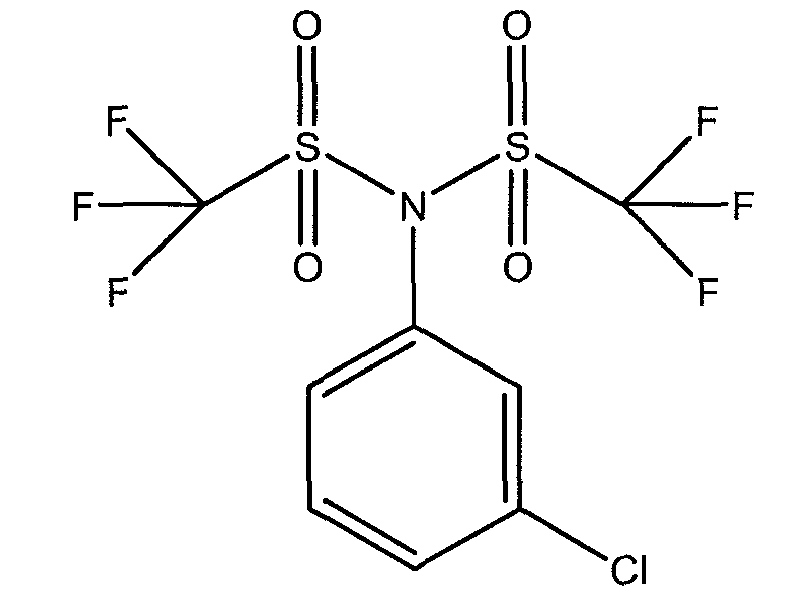

- The general synthetic methods for forming the sulfuryl imine compounds comprise the steps of:
- Dissolving organic amines and other alkaline substances in organic solvents, cooling to low temperature to obtain a first mixture, adding sulfoacid anhydride by droplet to the first mixture under electromagnetic agitating, reacting for 1 to 3 hours, and elevating naturally to room temperature; after agitating for 1 to 24 hours at room temperature to obtain a second mixture, diluting, isolating, and drying organic phase of the second mixture, after filtering and isolating the said organic phase, drying in vacuum to obtain white crystals. The yield is about 50%. The data of the following representative compounds are provided as follows by measuring H-NMR spectrograms with the solvent of CDCl3:
(A) N-phenyl-di(trifluoromethylsulfonyl) imine: 7.42 ppm multimodal 2H aryl group 7.57 ppm multimodal 3H aryl group (B) N-(2, 6-diisopropylphenyl)-di(trifluoromethylsulfonyl) imine: 1.26 ppm bimodal 12H CH3 7.29 ppm trimodal 2H aryl group 7.50 ppm multimodal 1H aryl group (C) N-(4-methoxyphenyl)-di(trifluoromethylsulfonyl) imine: 3.86 ppm trimodal 3H CH3 6.98 ppm multimodal 2H aryl group 7.30 ppm multimodal 2H aryl group (D) N-(3-chlorophenyl)- di(trifluoromethylsulfonyl) imine: 7.31 ppm bimodal 1H aryl group 7.41 ppm bimodal 1H aryl group 7.47 ppm bimodal 1H aryl group 7.57 ppm bimodal 1H aryl group (E) N-(2-fluorophenyl)-di(trifluoromethylsulfonyl) imine having main data for spectrogram of: 486.8 485.8 378.4 355.5 314.2 243.6 161.3 130.4 102.3 - The sulfonyl-containing compound of the present invention, when X in the formula (I) of the sulfonyl-containing compound is PR6, both R1 and R2 are CF3, preferably is phosphine-phenyl-trifluoromethylsulfonyl phosphine; when X in the formula (I) of the sulfonyl-containing compound is O, both R1 and R2 are CF3, is trifluoromethysufonic anhydride.
- The titanium compound (2) in the catalyst of the present invention is selected from the group consisting of titanium halide and titanium alcohol halide, preferably is titanium tetrachloride. The precursor of the active magnesium halide (1) is selected from the group consisting of RMgX, MgR2, MgCl2·mROH, Mg(OR)2, XnMg(OR)2-n or the mixture of magnesium halide and titanium alcohol, wherein m is 1 to 3, 0<n<2, X is halogen, and R is C1 to C20 hydrocarbonyl.
- Another object of the present invention is to provide two methods for preparing olefin polymerization solid catalyst. The first method for preparing the catalyst comprises the steps of:
- (i) dissolving or melting the active magnesium halide (1) formed by magnesium chloride precursor in the dispersant;
- (ii) adding nonionic surface active agent to emulsify the above active magnesium halide in the organic liquid emulsifying medium, and dispersing the active magnesium halide for 0.5 to 3 hours under mechanical agitating of 1000 to 3500 rpm;
- (iii) precipitating the active magnesium halide by adding precipitant, filtering and drying to obtain active magnesium halide solid particles;
- (iv) treating the active magnesium halide solid particles with alkyl aluminum for 0.5 to 3 hours at 40-80°C firstly, adding the electron donor (3) to obtain a first mixture, then treating the first mixture with the organic solution of titanium compound (2) for several times to obtain a second mixture, and filtering, washing and drying the second mixture to obtain a solid catalyst.
- In the first method, the active magnesium halide (1) in step (i) comprises solid particle support of magnesium halide alcoholate, such as MgCl2·X(n-BuOH) (wherein 0.1≤X≤2) disclosed in
CN90109183.9 , of which the specific surface area is 1-20m2/g, and porosity is 1-2 cm2/g, and in which the support is consisted of solid particles having an average particle size of µm, and particle size distribution (D90/D10) is less than or equal to 7 (D90 and D10 are the diameters of the particles corresponding to 90% and 10% of a particle size cumulative distribution on a weight basis, respectively, from large to small). The dispersant in step (i) is alkane having a boiling point of less than 150°C, such as hexane, heptane, etc. The nonionic surface active agent in step (ii) is selected from the group consisting of the surface active agents having a hydrophile-lipophile balance value (HLB) of 0-9, preferably 1-4, such as sorbitan trioleate. The organic liquid emulsifying medium in step (ii) is preferably selected from the group consisting of heavy hydrocarbons, such as paraffin oil having a viscocity of 0.1-1 Pa·s at 20°C. The precipitant in step (iii) is a silicon chloride derivative having a formula of SiClXR4 - x (wherein 1≤X≤4, R is saturated hydrocarbon containing 1-4 carbon atoms), such as SiCl4. The organic solvent used to the titanium compound (2) in step (iv) is halogenated hydrocarbon, such as 1,2-dichloroethane. The organic solution of titanium compound (2) has a concentration of 0.1-10 mol/L, preferably 1M, and can be used to treat with the support for several times, in which at least one treating temperature is within -40 to 0 °C, preferably -30 to 0°C, another is within 70 to 100°C, preferably 80 to 90°C and the titanium compound has a total amount of 1-100 at the mole ratio of Ti/Mg, preferably 1-10. The electron donor in step (iv) is a sulfonyl-containing compound (3), such as trifluoromethysufonic anhydride, N-phenyl-di(trifluoromethylsulfonyl) imine; N-(2, 6-diisopropylphenyl)-di(trifluoromethylsulfonyl) imine; N-(4-methoxy phenyl)-di(trifluoromethylsulfonyl) imine; N-(3-chlorophenyl)-di(trifluoromethyl sulfonyl) imine; N-(2-fluorophenyl)-di(trifluoromethylsulfonyl) imine. The mole ratio of internal electron donor to Mg is 0.1-2, preferably 0.5-1. The sulfonyl-containing compound (3) can be added in one or more times directly or in the manner of solution. - The second method for preparing the catalyst of the present invention comprises the steps of:
- (i) adding spherical magnesium chloride alcoholate particles to the solution of titanium tetrachloride and reacting for 0.1 to 3 hours at a temperature of-40 to 0°C to obtain a first mixture;
- (ii) elevating the temperature to 40 to 100°C gradually, adding internal electron donor to the first mixture and reacting for 0.5 to 3 hours to obtain a second mixture;
- (iii) adding titanium compound (2) to the second mixture at temperature of 80 to 140 °C, reacting for 0.5 to 3 hours to obtain resulting mixture and filtering the resulting mixture, optionally repeating this step for 1 to 3 times;
- (iv) washing and drying the resulting mixture to obtain a spherical solid catalyst.
- In the second method, the spherical magnesium chloride alcoholate in step (i) has a formula of Mg(OR1)mX2-m·n(R2OH), wherein n is an integer or fraction of 0<n<4, which is disclosed in
CN1034736C . The spherical magnesium chloride alcoholate can be treated with titanium compound (2) for several times, in which at least one treating temperature is within -40 to 0°C, preferably -30 to 0°C, another is within 80 to 140°C, preferably 90 to 130°C, and the titanium compound has a total amount of 1-200 at the mole ratio of Ti/Mg, preferably 1-100. The electron donor in step (ii) is the same with the first method. - Yet another object of the present invention is to provide a solid catalyst system for use in olefin polymerization, comprising the solid catalyst synthesized by the above two methods, cocatalyst and external electron donor, wherein the cocatalyst is alkyl aluminum compound having a formula of AlRnX(3-n), in which R is alkyl, aralkyl, aryl containing 1-20 carbon atoms; X is halogen, and n is an integer within 0≤n≤3; trimethyl aluminum, triethyl aluminum, triisobutyl aluminium, trioctyl aluminium, monohydrogen diethyl aluminum, monohydrogen diisobutyl aluminum, aluminum diethyl monochloride (DEAC), diisobutyl aluminum monochloride and ethyl aluminium dichloride etc. The external electron donor is selected from the group consisting of siloxane compound having a formula of Rnsi(OR1)4-n, wherein R is C1-C10 alkyl, cycloalkyl and aryl; R1 is alkyl having 1-4 carbon atoms; and n is an integer within 0≤n≤3, such as phenyl trimethoxysilane (PTMS), phenyl triethoxysilane (PTES) and diphenyl dimethoxy silane (DPDMS), preferably phenyl triethoxysilane and diphenyl dimethoxy silane.
- When the solid catalyst system provided by the present invention is used in olefin polymerization, the mole ratio of titanium in the solid catalyst to aluminum in the cocatalyst is 1:1-1:2000, preferably 1:10-1:500; the mole ratio of external electron donor to solid catalyst is 1-100, preferably 1-50 at the mole ratio of Si/Ti. The polymerization process can be slurry method, bulk method or gas phase method with polymerization temperature of 20-100 °C, preferably 40-90 °C.
- The present invention will be illustrated by the examples hereinafter, but not limited to those.
- The catalysts in the examples are operated with Schlenk instruments under the protection of high-purity nitrogen. The examples are as follows.
- 45mL anhydrous hexane, 15g anhydrous MgCl2 and 144mL anhydrous n-butanol were added to 250mL three-neck flask in sequence to make hexane evaporate, and then the temperature was decreased to ambient temperature (around 10°C) to obtain a homogeneous, colorless and transparent solution. The resulting MgCl2 in n-butanol solution was added into 500mL three-neck flask containing 100mL paraffin oil and 0.32g sorbitan trioleate under agitating for 30 minutes at 1000 rpm to obtain a stable white emulsion. The temperature keep around 35°C, 26mL 5M SiCl4 in hexane solution was dropped slowly over 40 minutes, and then heated to 50°C for one hours to obtain a first mixture. The first mixture was cooled, settled. The upper paraffin oil of the first mixture was filtered to obtain a second mixture. The second mixture was washed with about 100 mL anhydrous hexane for three times, drained to obtain 6.3g magnesium chloride alcoholate support.
- 1.3g solid alcoholate support and 30mL anhydrous heptane, and then 0.65 mL triethylaluminium were added to 250mL three-neck flask to obtain a first mixture. The first mixture was heated to 50°C for one hour. The first mixture was filtered, washed with heptaneto obtain a white solid. The obtained white solid was treated with 3.8mmol, 0.3M internal electron donor trifluoromethysufonic anhydride in heptane solution at 90°C for 2 hours to obtain a second mixture. The second mixture was filtered, washed with heptane. The second mixture was kept for 20 minutes after dripping 20mL 1M TiCl4-1,2-dichloroethane solution at -30°C, and then kept at 80°C for 1 hour. The upper clear solution of the second mixture was filtered. The second mixture was kept 80°C for 1 hour after dripping 20mL 1M TiCl4-1,2-dichloroethane solution. And then the second mixture was washed, dried, and drained to obtain 0.43g solid catalyst. The titanium has an amount of 2.28%.
- 250mL dry three-neck flask was replaced sufficiently with nitrogen, then replaced sufficiently with propylene under the pressure of the system slightly higher than 1.1013×10⁵ Pa. 100mL heptane was added into the flask, heated to around 50°C. A certain AlEt3 and the catalyst were added at a constant temperature with keeping the temperature for 1 hour. 100mL hydrochloric acid-ethanol solution (5% of hydrochloric acid) was used to make the reaction stop to obtain a polymer. The polymer was washed with anhydrous ethanol and dried in vacuum to obtain 6.27g polypropylene. The activity of the catalyst is 14929g polymer/g (Ti) h-1, the isotacticity is 92%, which is measured by extracting the polymer with boiling heptane for 6 hours.
- Similar to example 1, but difference in that N-methoxyphenyl-di(trifluoromethyl sulfonyl) imine was used as the electron donor to obtain 0.65g solid catalyst, in which the titanium has an amount of 3.86%. The activity of the catalyst is 5518g polymer/g (Ti) h-1, and the isotacticity is 93%.
- Similar to example 1, but difference in that N-phenyl-di(trifluoromethylsulfonyl) imine was used as the electron donor to obtain 0.49g solid catalyst, and the titanium has an amount of 3.95%. The activity of the catalyst is 11797g polymer/g (Ti) h-1, and the isotacticity is 90%.
- Similar to example 1, but difference in that N-(2,6-diisopropylphenyl)-di(trifluoro methylsulfonyl) imine was used as the electron donor to obtain 0.43g solid catalyst, and the titanium has an amount of 3.94%. The activity of the catalyst is 14645g polymer/g (Ti) h-1, and the isotacticity is 91%.
- Similar to example 1, but difference in that N-m-chlorophenyl-di(trifluoro methylsulfonyl) imine was used as the electron donor to obtain 0.51g solid catalyst, and the titanium content has an amount of 3.72%. The activity of the catalyst is 31371g polymer/g (Ti) h-1, and the isotacticity is 90%.
- Similar to example 2, but difference in that phenyl trimethoxysilane was used as the external electron donor during propylene polymerization. The activity of the catalyst is 2462g polymer/g (Ti) h-1, and the isotacticity is 98%.
- Similar to example 3, but difference in that phenyl trimethoxysilane was used as the external electron donor during propylene polymerization. The activity of the catalyst is 11494g polymer/g (Ti) h-1, and the isotacticity is 92%.
- Similar to example 4, but difference in that phenyl trimethoxysilane was used as the external electron donor during propylene polymerization. The activity of the catalyst is 3858g polymer/g (Ti) h-1, and the isotacticity is 97%.
- 2.0g spherical MgCl2·2.85C2H5OH support was slowly added to the reaction flask filled with 56 mL TiCl4 at -25°C, heated gradually to 80 °C. And then 2mmol internal electron donor of N-m-chlorophenyl-di(trifluoromethylsulfonyl) imine was added the flask. The temperature was kept for 30 minutes, and then heated to 130°C for reacting 2 hours to obtain a first mixture. The first mixture was filtered, in which 30 mL TiCl4 was added to react for 2 hours at 130 °C to obtain a second mixture. The second mixture was washed for 6 times with n-hexene, and dried in vacuum to obtain 1.1g catalyst, and the titanium has an amount of 2.93%.
- 250mL dry three-neck flask was replaced sufficiently with nitrogen, then replaced sufficiently with propylene under the pressure of the system slightly higher than 1.1013×10⁵ Pa. 100mL heptane was added into the flask, heated to around 50°C. A certain AlEt3 and the catalyst were added at a constant temperature with keeping the temperature for 1 hour. 100mL hydrochloric acid-ethanol solution (5% of hydrochloric acid) was used to make the reaction stop to obtain a polymer. The polymer was washed with anhydrous ethanol and dried in vacuum to obtain 6.27g polypropylene. The activity of the catalyst is 6143g polymer/g (Ti) h-1, and the isotacticity is 97%.
- Similar to example 9, but difference in that 1mmol N-m-chlorophenyl-di (trifluoromethylsulfonyl) imine was used as the electron donor to obtain 1.0g spherical catalyst, and the titanium has an amount of 3.29%. The activity of the catalyst is 10000g polymer/g (Ti) h-1, and the isotacticity is 94%.
- Similar to example 9, but difference in that 0.5mmol N-m-chlorophenyl-di (trifluoromethylsulfonyl) imine was used as the internal electron donor to obtain 1.1g spherical catalyst, and the titanium has an amount of 2.98%. The activity of the catalyst is 7114g polymer/g (Ti) h-1, and the isotacticity is 93%.
- Similar to example 9, but difference in that 1.5mmol N-m-chlorophenyl-di (trifluoromethylsulfonyl) imine was used as the internal electron donor to obtain 1.2g spherical catalyst, and the titanium has an amount of 2.57%. The activity of the catalyst is 5019g polymer/g (Ti) h-1, and the isotacticity is 96%.
- 1.2 g spherical catalyst having titanium amount of 2.81% is obtained by adding 1.5mmol N-m-chlorophenyl-di (trifluoromethylsulfonyl) imine as the internal electron donor. The bulk polymerization is 3L: in a stainless steel reaction boiler, 10.8mg solid catalyst, 2.5mL 1.0M triethyl aluminum, 2.5mL 0.1M diphenyl dimethoxy silane, are added under the hydrogen partial pressure of 0.2 MPa at a reaction temperature of 70 °C for 1 hour. The catalyst has an activity of 1.138×10⁶g polymer/g (Ti) h-1, an isotacticity of 99%, and melt index of 3.11 g/10 min.
- Similar to example 13, but difference in that the partial pressure of hydrogen is 1.0 MPa. The catalyst has an activity of 1.236×10⁶g polymer/g (Ti) h-1, an isotacticity of 98%, and melt index of 18.41 g/10 min.
- Similar to example 13, but difference in that N-methoxyphenyl-di (trifluoromethylsulfonyl) imine is used as the electron donor. The catalyst has an activity of 1.013×10⁶g polymer/g (Ti) h-1, an isotacticity of 98% .
- Similar to example 1, but difference in that 1.4g solid catalyst is obtained by adding 2.4 mL dioctylphthalate (DOP), 2g magnesium chloride alcoholate support. The catalyst has an activity of 301g polymer/g (Ti) h-1, an isotacticity of 72% .
- Similar to example 9, but difference in that 0.54mL dioctylphthalate (DOP) is added. The catalyst has an activity of 58g polymer/g (Ti) h-1, an isotacticity of 98%.
- Similar to comparative example 2, but difference in that polymerization method is bulk polymerization (similar to example 13). The catalyst has an activity of 19g polymer/g (Ti) h-1, an isotacticity of 97.6%.
- The solid catalyst of the present invention has extremely high activity in propylene polymerization. For example, the catalyst, in which N-m-chlorophenyl-di(trifluoro methylsulfonyl) imine is used as the internal electron donor and no external electron donor is used, has an activity of 31371g polymer/g (Ti) h-1 (50°C, 1hour, normal pressure slurry polymerization). Such catalyst has extremely high activity, therefore, the residual amounts of the catalyst and co-catalyst in the prepared polymer are reduced greatly, and various performances of the polymer product are much better. When the catalyst is applied to the stereotactic polymerization of propylene, the polymer has higher isotacticity. For example, when using the catalyst, in which N-methoxyphenyl-di(trifluoromethylsulfonyl) imine is used as the internal electron donor and phenyl trimethoxysilane as the external electron donor during normal pressure polymerization, the isotacticity of the polypropylene is 98%. If external electron donor compounds commonly used in the industry such as diphenyl dimethoxy silane, are used, the bulk polymerization has an activity as high as 50 kg polymer/g (catalyst) h-1, a good hydrogen response, and isotacticity of up to 99%, and thereby strong industrial applicability can be achieved. Another feature of the catalyst system of the present invention is that the catalyst of the present invention has better copolymerization of propylene and ethylene than that of the traditional electron donor catalyst. The catalyst of the present invention is more suitable for producing copolymerization products of random, block and etc.
Claims (12)
- An olefin polymerization catalyst, comprising (1) an active magnesium halide, (2) a titanium compound having at least one Ti-halide bond supported thereon, and (3) an electron donor selected from the group consisting of one or more sulfonyl-containing compounds having the following formula (I):

- The olefin polymerization catalyst of claim 1, wherein X, in the sulfonyl-containing compounds of formula (I), can be selected from the group consisting of C(R3)(R4), Si(R3)(R4), Sn(R3)(R4), Pb(R3)(R4), N(Rs), P(R6), As(R6), O, S, Se or Te, wherein R3 and R4 can be identical or different, R3, R4, R5 and R6 can be selected from the group consisting of hydrogen atom, halogen, (substituted) alkyl, cycloalkyl, aryl, aralkyl or alkylaryl, alkyl alkenyl, alkenyl alkyl, alkyl alkynyl, heteroatom-containing ring or acyl, respectively; R3 and R4 also can constitute cycloalkyl or cycloalkenyl with C.
- The olefin polymerization catalyst of claim 1, wherein sulfonyl-containing compounds are selected from the group consisting of disulfonyl alkane, disulfonyl alkene, disulfonyl cyclic hydrocarbon, disulfonyl silane, disulfonyl cyclosilane, disulfonyl dihydroxy tin, disulfonyl dihydroxy lead, and heteroatom-containing derivatives thereof; disulfonyl imines, disulfonyl phosphinidenes, disulfonyl arsenious, and heteroatom-containing derivatives thereof; (substituted) sulfoacid anhydride, and sulfo- or seleno- derivatives thereof.
- The olefin polymerization catalyst of claim 1, wherein sulfonyl-containing compounds are selected from the group consisting of di(trifluoromethylsulfonyl) methane;
[di(trifluoromethylsulfonyl) methyl] benzene;
1, 1-di(trifluoromethylsulfonyl)-ethane;
[chloro-(trifluoromethylsulfonyl)- methylsulfonyl]-trifluro-methane;
[bromo-(trifluoromethylsulfonyl)- methylsulfonyl]-trifluro-methane;
dichloro-di- trifluoromethylsulfonyl-methane;
dibromo-di-trifluoromethylsulfonyl-methane;
2-[2, 2-di-(trifluoromethylsulfonyl)-vinyl]-1H-azole;
4-[2, 2-di-(trifluoromethylsulfonyl) vinyl]-morpholine;
2-[2, 2-di-(trifluoromethylsulfonyl)-vinyl]-1H-indole;
trifluro-[methoxyl-(trifluoromethylsulfonyl)- methylsulfonyl]-methane;
1-chloro-1, 1-di(trifluoromethylsulfonyl)-ethane;
1-bromo-1, 1-di(trifluoromethylsulfonyl)-ethane;
4, 4-di-(trifluoromethylsulfonyl)-1-butene;
2, 3-di-(trifluoromethylsulfonyl)-1-propanol;
1, 1-di-(trifluoromethylsulfonyl)-pentane;
4-bromo-4, 4-di-(trifluoromethylsulfonyl)- 1-butene;
3-bromo-5-chloro-1, 1-di-(trifluoromethylsulfonyl)-pentane;
3-bromo-1, 1-di-(trifluoromethylsulfonyl)-nonane;
[2, 2-di-(trifluoromethylsulfonyl)]-ethyl-benzene;
3-bromo-5, 5-di-(trifluoromethylsulfonyl)- pentanoic acid;
1, 1-di-(trifluoromethylsulfonyl)-propylene;
2, 2-di-(trifluoromethylsulfonyl)-vinyl amine;
[2, 2-di-(trifluoromethylsulfonyl)-vinyl]-dimethyl-amine;
[3, 3-di-(trifluoromethylsulfonyl)-allyl]-benzene;
1-[2, 2-di-(trifluoromethylsulfonyl)-vinyl]-naphthalene;
4-[2, 2-di-(trifluoromethylsulfonyl)-vinyl]-2-ethoxy-phenol;
1-[2, 2-di-(trifluoromethylsulfonyl)-vinyl]-4-nitro-benzene;
(2, 2-di-trifluoromethylsulfonyl-vinyl-benzene;
7, 7-di-(trifluoromethylsulfonyl)-bicyclic[4, 1, 0]-heptane;
1-[di-(trifluoromethylsulfonyl)-methyl]-4-methyl-benzene;
di-(trifluoromethylsulfonyl)-ketene;
1-[di-(trifluoromethylsulfonyl)-methylene]-pyrimidine;
[di-(trifluoromethylsulfonyl)-methylene]-triphenyl-λ5-phosphorus;
1-[di-(trifluoromethylsulfonyl)-methyl]-4-fluoro-benzene;
difluoro-di- trifluoromethylsulfonyl-methane;
3, 2-di- trifluoromethylsulfonyl-cyclopropane carboxylic acid ethyl ester;
trifluoro-(fluoro- trifluoromethylsulfonyl-sulfonylmethyl)-methane;
1-(di- trifluoromethylsulfonyl-methyl)-2, 3, 4, 5, 6- pentafluorophenyl;
{4-[2, 2-di-(trifluoromethylsulfonyl)-vinyl]-phenyl}-diethyl-amine;
{4-[4, 4-di-(trifluoromethylsulfonyl)-butyl-1, 3-diethyl]-phenyl}-dimethyl-amine;
2-[2, 2-di-(trifluoromethylsulfonyl)-ethyl]-malonic acid;
2-[2, 2-di-(trifluoromethylsulfonyl)-ethyl]-3-oxo-ethyl butyrate;
2-[2, 2-di-(trifluoromethylsulfonyl)-ethyl]-2-bromo- diethyl malonate;
1, 1, 3, 3-tetra-(trifluoromethylsulfonyl)-propane;
1, 1, 2, 2-tetra-(trifluoromethylsulfonyl)-ethane;
trifluoro-[methoxyl-(trifluoromethylsulfonyl)-mesyl]-methane;
[di-(trifluoromethylsulfonyl)-mesyl]- trifluoro-methane;
di-(trifluoromethylsulfonyl)-vinyl ketone;
2, 2-di-(trifluoromethylsulfonyl)-ethyl malonate;
[(dimethyl-λ4-sulfa-alkenyl)-(trifluoromethylsulfonyl)-mesyl]- trifluoro-methane;
1, 1-di-ethylsulfa-2, 2-di-(trifluoromethylsulfonyl)-ethylene;
1-[di-(trifluoromethylsulfonyl)-methyl]-4-iodo-benzene;
1-[di-(trifluoromethylsulfonyl)-methyl]-4-fluoro-benzene;
N-[di-(trifluoromethylsulfonyl)-methylene]-N'-(4-nitro-benzene)-hydrazine;
2, 2-di-(isopropyl amine)-1, 1-(trifluoromethylsulfonyl)-ethylene;
1-(2, 2-di-trifluoromethylsulfonyl-cyclopropyl)-ketone;
1-(2, 2-di-trifluoromethylsulfonyl-vinyl)-4-methyl-benzene;
3, 2-di- trifluoromethylsulfonyl- cyclopropyl carboxylic acid ethyl ester;
(1-p-tolyl-2, 2-di- trifluoromethylsulfonyl-ethyl)-dimethyl phosphate;
1-(di-trifluoromethylsulfonyl-mesyl)-4-chloro-benzene;
(1-methyl-2, 2-di- trifluoromethylsulfonyl-vinyl)-phenyl-amine;
1-(di- trifluoromethylsulfonyl-methyl)-4-tetra-butyl-2, 3, 5, 6- tetrafluoro-benzene;
1-(di-trifluoromethylsulfonyl-methyl)-4-tetra-butyl-2, 3, 5, 6- tetrafluoro-biphenyl;
trimethyl-(pentafluoro-di- trifluoromethylsulfonyl-methyl)-silane;
fluoro-tri- trifluoromethylsulfonyl-methane;
1-(di- trifluoromethylsulfonyl-methyl)-2, 3, 5, 6-tetrafluoro-4- hexyloxy-benzene;
N-phenyl-di(trifluoromethylsulfonyl) imine;
N-2, 6-diisopropylphenyl-di(trifluoromethylsulfonyl) imine;
N-(4- methoxyphenyl)-di(trifluoromethylsulfonyl) imine;
N-(3-chlorophenyl)- di(trifluoromethylsulfonyl) imine;
N-(2-fluorophenyl)- di(trifluoromethylsulfonyl) imine;
N-isobutyl- di(trifluoromethylsulfonyl) imine;
N-(2-methoxyethyl)- di(trifluoromethylsulfonyl) imine;
N-ethyl- di(trifluoromethylsulfonyl) imine;
N-benzyl- di(trifluoromethylsulfonyl) imine;
N-cyclohexyl- di(trifluoromethylsulfonyl) imine;
N-(2- phenylethyl)- di(trifluoromethylsulfonyl) imine;
N- thienyl-di(trifluoromethylsulfonyl) imine;
N-cyclohexyl-di(trifluoromethylsulfonyl) imine;
N-(2-phenyl)- di(trifluoromethylsulfonyl) imine;
N-(4- fluorophenyl)- di(trifluoromethylsulfonyl) imine;
N-(3-methylphenyl)- di(trifluoromethylsulfonyl) imine;
N-(4- methylphenyl)- di(trifluoromethylsulfonyl) imine;
N-(4-carboxylphenyl)- di(trifluoromethylsulfonyl) imine;
N-(3-carboxylphenyl)- di(trifluoromethylsulfonyl) imine;
di(trifluoromethylsulfonyl) imine;
N-fluoro- di(trifluoromethylsulfonyl) imine;
N-(2-pyridine)- di(trifluoromethylsulfonyl) imine;
N-(5-chloro-2-pyridyl)- di(trifluoromethylsulfonyl) imine;
N-trimethylsilyl- di(trifluoromethylsulfonyl) imine;
N-isopropyl- di(trifluoromethylsulfonyl) imine;
phosphine-phenyl- di(trifluoromethylsulfonyl) phosphinidene;
trifluoromethysufonic anhydride. - The olefin polymerization catalyst of claim 1, wherein the titanium compound (2) is selected from the group consisting of titanium halide and titanium alcohol halide.
- The olefin polymerization catalyst of claim 1, wherein the titanium compound (2) is titanium tetrachloride.
- The olefin polymerization catalyst of claim 1, wherein the precursor of the active magnesium halide (1) is selected from the group consisting of RMgX, MgR2, MgCl2 •mROH, Mg(OR)2 XnMg(OR)2-n or the mixture of magnesium halide and titanium alcohol, wherein m is 1 to 3, 0<n<2, X is halogen, and R is C1 to C20 hydrocarbonyl.
- A method for preparing the olefin polymerization catalyst of claim 1, comprising the steps of:(i) dissolving or melting the active magnesium halide (1) formed by magnesium chloride precursor in the dispersant to obtain a solution;(ii) adding nonionic surface active agent to the solution to emulsify the above active magnesium halide in the organic liquid emulsifying medium, and dispersing the active magnesium halide for 0.5 to 3 hours under mechanical agitating of 1000 to 3500 rpm to obtain an emulsion;(iii) precipitating the active magnesium halide by adding precipitant to the emulsion, filtering and drying to obtain active magnesium halide solid particles;(iv) treating the active magnesium halide solid particles with alkyl aluminum for 0.5 to 3 hours at 40-80°C firstly, adding the electron donor (3) to obtain a first mixture, then treating the first mixture with the organic solution of titanium compound (2) for several times to obtain a second mixture, and filtering, washing and drying the second mixture to obtain a solid catalyst;wherein the dispersant is alkane having a boiling point less than 150°C;
the nonionic surface active agent has a hydrophile-lipophile balance value (HLB) of 0-9;
the organic liquid emulsifying medium is selected from the group consisting of heavy hydrocarbons;
the precipitant is a silicon chloride derivative having a formula of SiClXR4-x (in which 1 ≤X≤4, R is saturated hydrocarbon containing 1-4 carbon atoms);
the organic solvent used in the organic solution of titanium compound (2) is halogenated hydrocarbon;
the solution of titanium compound (2) has a concentration of 0.1-10 mol/L, and is used to treat with the support for several times, in which at least one treating temperature is within -40 to 0°C, another is within 70 to 100°C, and the titanium compound has a total amount of 1-100 at the mole ratio of Ti/Mg;
the mole ratio of electron donor to Mg is 0.1-2. - A method for preparing the olefin polymerization catalyst of claim 1, comprising the steps of:(i) adding spherical magnesium chloride alcoholate particles to the solution of titanium tetrachloride and reacting for 0.1 to 3 hours at a temperature of-40 to 0°C;(ii) elevating the temperature to 40 to 100°C gradually, adding internal electron donor and reacting for 0.5 to 3 hours;(iii) adding titanium compound (2) at a temperature of 80 to 140°C, reacting for 0.5 to 3 hours and filtering, and optionally repeating step (iii) for 1 to 3 times;(iv) washing and drying to obtain a spherical solid catalyst;wherein spherical magnesium chloride alcoholate and titanium compound (2) are reacted for several times, in which at least one reacting temperature is within -40 to 0 °C, another is within 80 to 140°C, and the titanium compound has a total amount of 1-200 at the mole ratio of Ti/Mg; the electron donor is the same with that in claim 8.
- Use of the olefin polymerization catalyst of claim 1 for catalyzing olefin polymerization with cocatalyst and external electron donor,
wherein the cocatalyst is alkyl aluminum compound having a formula of AlRnX(3-n), in which R is alkyl containing 1-20 carbon atoms, aralkyl, aryl; X is halogen, and n is an integer within 0≤n≤3;
the external electron donor is selected from the group consisting of siloxane compounds having a formula of RnSi(OR1)4-n, wherein R is C1-C10 alkyl, cycloalkyl and aryl; R1 is alkyl having 1-4 carbon atoms; and n is an integer within 0≤n≤3; the mole ratio of titanium to aluminum in the co-catalyst is 1:1-1:2000; the mole ratio of external electron donor to catalyst is 1-100 at the mole ratio of Ti/Mg. - The use of the olefin polymerization catalyst of claim 1, wherein the cocatalyst is trimethyl aluminum, triethyl aluminum, triisobutyl aluminium, trioctyl aluminium, monohydrogen diethyl aluminum, monohydrogen diisobutyl aluminum, aluminum diethyul monochloride, diisobutyl aluminum chloride or ethylaluminium dichloride.
- The use of the olefin polymerization catalyst of claim 1, wherein the external electron donor is phenyl trimethoxysilane, phenyl triethoxysilane or diphenyl dimethoxy silane.
Applications Claiming Priority (2)
| Application Number | Priority Date | Filing Date | Title |
|---|---|---|---|
| CN200710118854XA CN101323650B (en) | 2007-06-13 | 2007-06-13 | Olefin polymerization catalyst and preparation method and application thereof |
| PCT/CN2008/000943 WO2008151504A1 (en) | 2007-06-13 | 2008-05-15 | Olefin polymerization catalyst and preparation method and use thereof |
Publications (3)
| Publication Number | Publication Date |
|---|---|
| EP2159232A1 true EP2159232A1 (en) | 2010-03-03 |
| EP2159232A4 EP2159232A4 (en) | 2011-11-09 |
| EP2159232B1 EP2159232B1 (en) | 2012-11-21 |
Family
ID=40129221
Family Applications (1)
| Application Number | Title | Priority Date | Filing Date |
|---|---|---|---|
| EP08748499A Active EP2159232B1 (en) | 2007-06-13 | 2008-05-15 | Olefin polymerization catalyst and preparation method and use thereof |
Country Status (6)
| Country | Link |
|---|---|
| US (1) | US8404789B2 (en) |
| EP (1) | EP2159232B1 (en) |
| JP (1) | JP5587180B2 (en) |
| CN (1) | CN101323650B (en) |
| ES (1) | ES2400079T3 (en) |
| WO (1) | WO2008151504A1 (en) |
Cited By (2)
| Publication number | Priority date | Publication date | Assignee | Title |
|---|---|---|---|---|
| US11427660B2 (en) | 2016-08-17 | 2022-08-30 | Formosa Plastics Corporation, Usa | Organosilicon compounds as electron donors for olefin polymerization catalysts and methods of making and using same |
| WO2025049209A1 (en) | 2023-08-29 | 2025-03-06 | Formosa Plastics Corporation, U.S.A. | Method for preparing catalyst component for polymerization of polyolefin without the use of internal electron donors |
Families Citing this family (21)
| Publication number | Priority date | Publication date | Assignee | Title |
|---|---|---|---|---|
| CN101735346B (en) * | 2008-11-07 | 2012-05-30 | 中国石油天然气股份有限公司 | Catalyst for homopolymerization and copolymerization of propylene, preparation method and application thereof |
| CN101628950B (en) * | 2009-08-07 | 2011-08-03 | 中国石油天然气股份有限公司 | Polypropylene catalyst containing sulfonyl compound and its preparation method and application |
| CN101735354B (en) * | 2009-12-23 | 2011-09-07 | 中国石油天然气股份有限公司 | A kind of preparation method of in-situ polymerization β crystal polypropylene resin |
| CN101787088B (en) * | 2010-02-08 | 2013-03-27 | 南开大学 | Polymerization catalyst of internal electron donor prepared from phosphorus-substituted sulfonyl compound and preparation and application thereof |
| JP5696465B2 (en) | 2010-12-17 | 2015-04-08 | セントラル硝子株式会社 | Compound having bis (trifluoromethanesulfonyl) ethyl group, acid catalyst, and production method thereof |
| CN102746426A (en) * | 2011-04-22 | 2012-10-24 | 中国石油天然气股份有限公司 | A kind of olefin polymerization catalyst and its preparation and application |
| JP6167791B2 (en) | 2012-09-25 | 2017-07-26 | セントラル硝子株式会社 | Method for producing compound and salt containing bis (perfluoroalkylsulfonyl) methyl group, and solid electrolyte membrane using the same |
| KR102126599B1 (en) | 2012-11-08 | 2020-06-24 | 더블유.알. 그레이스 앤드 컴파니 -씨오엔엔. | Process of polymerization catalyst production with controlled catalyst properties and use of same in olefin polymerizations |
| CN102942642A (en) * | 2012-11-16 | 2013-02-27 | 南开大学 | Preparation method and application for heterogeneous olefin polymerization catalyst |
| JP5998948B2 (en) * | 2013-01-21 | 2016-09-28 | セントラル硝子株式会社 | Compound having bis (trifluoromethylsulfonyl) methyl group, process for producing the same, and use thereof as acid catalyst |
| CN103102434B (en) * | 2013-01-30 | 2015-01-21 | 中国石油天然气股份有限公司 | A kind of preparation method of olefin polymerization catalyst |
| CN103497127B (en) * | 2013-09-25 | 2015-01-21 | 浙江劲光化工有限公司 | Synthesis method of para-beta-hydroxyethylsulfonyl sulfate aniline |
| CN104974285B (en) * | 2014-04-14 | 2017-08-22 | 中国石油化工股份有限公司 | A kind of polypropylene catalyst method for preparing ingredients thereof and catalyst |
| CN104974286B (en) * | 2014-04-14 | 2017-08-22 | 中国石油化工股份有限公司 | Catalytic component and catalyst for propylene polymerization |
| CN104356259B (en) * | 2014-10-10 | 2017-06-13 | 中国石油天然气股份有限公司 | A kind of olefin polymerization catalyst and its combined catalyst |
| CN111892676A (en) * | 2019-05-06 | 2020-11-06 | 中国石油天然气股份有限公司 | Spherical nano catalyst and preparation method and application thereof |
| CN113621098B (en) * | 2020-05-09 | 2022-11-04 | 中国石油天然气股份有限公司 | Propylene polymerization catalyst, propylene polymerization catalyst system and its preparation and application |
| CN116410356B (en) * | 2021-12-30 | 2025-09-30 | 中国石油天然气股份有限公司 | Olefin polymerization catalyst, catalyst composition, preparation method and application thereof |
| CN116410219B (en) * | 2021-12-30 | 2026-04-14 | 中国石油天然气股份有限公司 | Silane compound, catalyst composition, preparation method and application thereof |
| CN116410355B (en) * | 2021-12-30 | 2026-04-07 | 中国石油天然气股份有限公司 | Silane compounds, catalyst compositions, their preparation methods and applications |
| CN117659234A (en) * | 2022-08-25 | 2024-03-08 | 中国石油天然气股份有限公司 | An alkoxy magnesium supported olefin polymerization catalyst component and an olefin polymerization catalyst containing the same and its application |
Family Cites Families (20)
| Publication number | Priority date | Publication date | Assignee | Title |
|---|---|---|---|---|
| DK133012C (en) | 1968-11-21 | 1976-08-09 | Montedison Spa | CATALYST FOR POLYMERIZATION OF ALKENES |
| YU35844B (en) | 1968-11-25 | 1981-08-31 | Montedison Spa | Process for obtaining catalysts for the polymerization of olefines |
| JPS5883006A (en) | 1981-11-13 | 1983-05-18 | Mitsui Petrochem Ind Ltd | Polymerization of olefin |
| JPH0723405B2 (en) * | 1985-03-19 | 1995-03-15 | 三菱油化株式会社 | Method for producing propylene polymer |
| JPH06104689B2 (en) | 1985-06-17 | 1994-12-21 | 三菱油化株式会社 | Process for producing catalyst component for α-olefin polymerization |
| IT1227258B (en) | 1988-09-30 | 1991-03-28 | Himont Inc | COMPONENTS AND CATALYSTS FOR THE POLYMERIZATION OF OLEFINE |
| CN1034736C (en) | 1994-04-08 | 1997-04-30 | 中国科学院化学研究所 | Olefinic polymeric carrier catalyst system and preparation method thereof |
| IL117114A (en) | 1995-02-21 | 2000-02-17 | Montell North America Inc | Components and catalysts for the polymerization ofolefins |
| WO2000055215A1 (en) | 1999-03-15 | 2000-09-21 | Basell Technology Company B.V. | Components and catalysts for the polymerization of olefins |
| JP2001011486A (en) | 1999-06-25 | 2001-01-16 | Ajinomoto Co Inc | Oily composition, skin external preparation and detergent composition |
| JP2001114816A (en) * | 1999-10-13 | 2001-04-24 | Japan Polychem Corp | Catalyst for polymerizing alpha-olefin and method for polymerizing alpha-olefin using the same |
| JP2001114810A (en) * | 1999-10-13 | 2001-04-24 | Japan Polychem Corp | Catalyst for polymerization of alpha-olefin and polymerization of alpha-olefin using the catalyst |
| CN1137155C (en) * | 1999-12-06 | 2004-02-04 | 中国石油化工集团公司 | Catalyst systems for the polymerization or copolymerization of olefins |
| US6465383B2 (en) * | 2000-01-12 | 2002-10-15 | Eastman Chemical Company | Procatalysts, catalyst systems, and use in olefin polymerization |
| CN1196719C (en) * | 2000-01-12 | 2005-04-13 | 伊斯曼化学公司 | Procatalysts comprising bidentate ligands, catalyst systems and their use in the polymerization of olefins |
| KR100421553B1 (en) * | 2000-12-27 | 2004-03-09 | 삼성아토피나주식회사 | A polymerization method of alpha-olefins |
| CN1491235A (en) * | 2001-02-17 | 2004-04-21 | 赛拉尼斯温特斯股份有限公司 | Transition metal compounds as catalyst components and their use in the production of polyolefins |
| JP2003119211A (en) | 2001-10-11 | 2003-04-23 | Mitsui Chemicals Inc | Catalyst for olefin polymerization and process for polymerizing olefin |
| CN1292007C (en) * | 2003-07-31 | 2006-12-27 | 中国石油化工股份有限公司 | Bi active component polyolefin catalyst, and its preparing method and use |
| US7030169B2 (en) * | 2003-09-26 | 2006-04-18 | 3M Innovative Properties Company | Arylsulfinate salts in initiator systems for polymeric reactions |
-
2007
- 2007-06-13 CN CN200710118854XA patent/CN101323650B/en active Active
-
2008
- 2008-05-15 WO PCT/CN2008/000943 patent/WO2008151504A1/en not_active Ceased
- 2008-05-15 ES ES08748499T patent/ES2400079T3/en active Active
- 2008-05-15 US US12/664,517 patent/US8404789B2/en active Active
- 2008-05-15 EP EP08748499A patent/EP2159232B1/en active Active
- 2008-05-15 JP JP2010511475A patent/JP5587180B2/en active Active
Cited By (2)
| Publication number | Priority date | Publication date | Assignee | Title |
|---|---|---|---|---|
| US11427660B2 (en) | 2016-08-17 | 2022-08-30 | Formosa Plastics Corporation, Usa | Organosilicon compounds as electron donors for olefin polymerization catalysts and methods of making and using same |
| WO2025049209A1 (en) | 2023-08-29 | 2025-03-06 | Formosa Plastics Corporation, U.S.A. | Method for preparing catalyst component for polymerization of polyolefin without the use of internal electron donors |
Also Published As
| Publication number | Publication date |
|---|---|
| EP2159232A4 (en) | 2011-11-09 |
| JP2010529268A (en) | 2010-08-26 |
| CN101323650A (en) | 2008-12-17 |
| US20100184930A1 (en) | 2010-07-22 |
| CN101323650B (en) | 2010-11-03 |
| US8404789B2 (en) | 2013-03-26 |
| EP2159232B1 (en) | 2012-11-21 |
| WO2008151504A1 (en) | 2008-12-18 |
| ES2400079T3 (en) | 2013-04-05 |
| JP5587180B2 (en) | 2014-09-10 |
Similar Documents
| Publication | Publication Date | Title |
|---|---|---|
| EP2159232B1 (en) | Olefin polymerization catalyst and preparation method and use thereof | |
| EP1088009B1 (en) | Components and catalysts for the polymerization of olefins | |
| EP1272533B1 (en) | Catalyst components for the polymerization of olefins | |
| EP1845113B1 (en) | Solid titanium catalyst component, catalyst for olefin polymerization, and process for producing olefin polymer | |
| EP1458767B1 (en) | Process for the preparation of catalyst components for the polymeriztion of olefins | |
| RU2489447C2 (en) | Self-limiting catalyst composition with bidentate internal donor | |
| CN1726080A (en) | Magnesium chloride-based adducts and catalyst components prepared therefrom | |
| WO1999011677A1 (en) | Components and catalysts for the polymerization of olefins | |
| KR20110080616A (en) | Process for producing solid catalyst for propylene polymerization | |
| CN119013319A (en) | Catalyst component for preparing high isotactic polypropylene polymer with wide molecular weight distribution | |
| FI101545B (en) | Catalyst containing trifluoropropyl-substituted silane compounds for the polymerization of alpha-olefins | |
| KR20190116578A (en) | Gas-phase process for the polymerization of propylene | |
| KR20050085800A (en) | Magnesium dichloride-based adducts and catalyst components obtained therefrom | |
| US9777084B2 (en) | Catalyst system for olefin polymerization and method for producing olefin polymer | |
| US20230091516A1 (en) | Olefin polymerization Ziegler-Natta catalyst components and process for the production of olefin polymers therewith | |
| JP2005531675A (en) | Catalyst system for olefin polymerization | |
| CN108084303A (en) | Catalyst Components for Olefin Polymerization | |
| KR20120002790A (en) | Process for preparing solid catalyst for propylene polymerization | |
| CN105859923A (en) | Olefin polymerization catalyst component and its preparation method, its catalyst | |
| CN102686614A (en) | Catalyst components for the polymerization of olefins and catalysts therefrom obtained |
Legal Events
| Date | Code | Title | Description |
|---|---|---|---|
| PUAI | Public reference made under article 153(3) epc to a published international application that has entered the european phase |
Free format text: ORIGINAL CODE: 0009012 |
|
| 17P | Request for examination filed |
Effective date: 20091210 |
|
| AK | Designated contracting states |
Kind code of ref document: A1 Designated state(s): AT BE BG CH CY CZ DE DK EE ES FI FR GB GR HR HU IE IS IT LI LT LU LV MC MT NL NO PL PT RO SE SI SK TR |
|
| AX | Request for extension of the european patent |
Extension state: AL BA MK RS |
|
| RIN1 | Information on inventor provided before grant (corrected) |
Inventor name: ZHANG, JIANYING Inventor name: YI, JIANJUN Inventor name: YIN, BAOZUO Inventor name: CUI, CHUNMING Inventor name: LANG, XIAOMEI Inventor name: LI, HUASHU Inventor name: WU, LINMEI |
|
| DAX | Request for extension of the european patent (deleted) | ||
| A4 | Supplementary search report drawn up and despatched |
Effective date: 20111007 |
|
| RIC1 | Information provided on ipc code assigned before grant |
Ipc: C08F 4/64 20060101AFI20110930BHEP Ipc: C08F 10/00 20060101ALI20110930BHEP |
|
| GRAP | Despatch of communication of intention to grant a patent |
Free format text: ORIGINAL CODE: EPIDOSNIGR1 |
|
| RIN1 | Information on inventor provided before grant (corrected) |
Inventor name: LI, HUASHU Inventor name: CUI, CHUNMING Inventor name: ZHANG, JIANYING Inventor name: YI, JIANJUN Inventor name: YIN, BAOZUO Inventor name: LANG, XIAOMEI Inventor name: WU, LINMEI |
|
| GRAS | Grant fee paid |
Free format text: ORIGINAL CODE: EPIDOSNIGR3 |
|
| GRAA | (expected) grant |
Free format text: ORIGINAL CODE: 0009210 |
|
| AK | Designated contracting states |
Kind code of ref document: B1 Designated state(s): AT BE BG CH CY CZ DE DK EE ES FI FR GB GR HR HU IE IS IT LI LT LU LV MC MT NL NO PL PT RO SE SI SK TR |
|
| REG | Reference to a national code |
Ref country code: GB Ref legal event code: FG4D |
|
| REG | Reference to a national code |
Ref country code: CH Ref legal event code: EP |
|
| REG | Reference to a national code |
Ref country code: AT Ref legal event code: REF Ref document number: 585051 Country of ref document: AT Kind code of ref document: T Effective date: 20121215 |
|
| REG | Reference to a national code |
Ref country code: IE Ref legal event code: FG4D |
|
| REG | Reference to a national code |
Ref country code: DE Ref legal event code: R096 Ref document number: 602008020256 Country of ref document: DE Effective date: 20130117 |
|
| REG | Reference to a national code |
Ref country code: NL Ref legal event code: T3 |
|
| REG | Reference to a national code |
Ref country code: ES Ref legal event code: FG2A Ref document number: 2400079 Country of ref document: ES Kind code of ref document: T3 Effective date: 20130405 |
|
| REG | Reference to a national code |
Ref country code: AT Ref legal event code: MK05 Ref document number: 585051 Country of ref document: AT Kind code of ref document: T Effective date: 20121121 |
|
| REG | Reference to a national code |
Ref country code: LT Ref legal event code: MG4D |
|
| PG25 | Lapsed in a contracting state [announced via postgrant information from national office to epo] |
Ref country code: SE Free format text: LAPSE BECAUSE OF FAILURE TO SUBMIT A TRANSLATION OF THE DESCRIPTION OR TO PAY THE FEE WITHIN THE PRESCRIBED TIME-LIMIT Effective date: 20121121 Ref country code: NO Free format text: LAPSE BECAUSE OF FAILURE TO SUBMIT A TRANSLATION OF THE DESCRIPTION OR TO PAY THE FEE WITHIN THE PRESCRIBED TIME-LIMIT Effective date: 20130221 Ref country code: FI Free format text: LAPSE BECAUSE OF FAILURE TO SUBMIT A TRANSLATION OF THE DESCRIPTION OR TO PAY THE FEE WITHIN THE PRESCRIBED TIME-LIMIT Effective date: 20121121 Ref country code: LT Free format text: LAPSE BECAUSE OF FAILURE TO SUBMIT A TRANSLATION OF THE DESCRIPTION OR TO PAY THE FEE WITHIN THE PRESCRIBED TIME-LIMIT Effective date: 20121121 |
|
| PG25 | Lapsed in a contracting state [announced via postgrant information from national office to epo] |
Ref country code: SI Free format text: LAPSE BECAUSE OF FAILURE TO SUBMIT A TRANSLATION OF THE DESCRIPTION OR TO PAY THE FEE WITHIN THE PRESCRIBED TIME-LIMIT Effective date: 20121121 Ref country code: PT Free format text: LAPSE BECAUSE OF FAILURE TO SUBMIT A TRANSLATION OF THE DESCRIPTION OR TO PAY THE FEE WITHIN THE PRESCRIBED TIME-LIMIT Effective date: 20130321 Ref country code: PL Free format text: LAPSE BECAUSE OF FAILURE TO SUBMIT A TRANSLATION OF THE DESCRIPTION OR TO PAY THE FEE WITHIN THE PRESCRIBED TIME-LIMIT Effective date: 20121121 Ref country code: LV Free format text: LAPSE BECAUSE OF FAILURE TO SUBMIT A TRANSLATION OF THE DESCRIPTION OR TO PAY THE FEE WITHIN THE PRESCRIBED TIME-LIMIT Effective date: 20121121 Ref country code: BE Free format text: LAPSE BECAUSE OF FAILURE TO SUBMIT A TRANSLATION OF THE DESCRIPTION OR TO PAY THE FEE WITHIN THE PRESCRIBED TIME-LIMIT Effective date: 20121121 Ref country code: GR Free format text: LAPSE BECAUSE OF FAILURE TO SUBMIT A TRANSLATION OF THE DESCRIPTION OR TO PAY THE FEE WITHIN THE PRESCRIBED TIME-LIMIT Effective date: 20130222 |
|
| PG25 | Lapsed in a contracting state [announced via postgrant information from national office to epo] |
Ref country code: AT Free format text: LAPSE BECAUSE OF FAILURE TO SUBMIT A TRANSLATION OF THE DESCRIPTION OR TO PAY THE FEE WITHIN THE PRESCRIBED TIME-LIMIT Effective date: 20121121 |
|
| PG25 | Lapsed in a contracting state [announced via postgrant information from national office to epo] |
Ref country code: BG Free format text: LAPSE BECAUSE OF FAILURE TO SUBMIT A TRANSLATION OF THE DESCRIPTION OR TO PAY THE FEE WITHIN THE PRESCRIBED TIME-LIMIT Effective date: 20130221 Ref country code: SK Free format text: LAPSE BECAUSE OF FAILURE TO SUBMIT A TRANSLATION OF THE DESCRIPTION OR TO PAY THE FEE WITHIN THE PRESCRIBED TIME-LIMIT Effective date: 20121121 Ref country code: EE Free format text: LAPSE BECAUSE OF FAILURE TO SUBMIT A TRANSLATION OF THE DESCRIPTION OR TO PAY THE FEE WITHIN THE PRESCRIBED TIME-LIMIT Effective date: 20121121 Ref country code: DK Free format text: LAPSE BECAUSE OF FAILURE TO SUBMIT A TRANSLATION OF THE DESCRIPTION OR TO PAY THE FEE WITHIN THE PRESCRIBED TIME-LIMIT Effective date: 20121121 Ref country code: CZ Free format text: LAPSE BECAUSE OF FAILURE TO SUBMIT A TRANSLATION OF THE DESCRIPTION OR TO PAY THE FEE WITHIN THE PRESCRIBED TIME-LIMIT Effective date: 20121121 |
|
| PG25 | Lapsed in a contracting state [announced via postgrant information from national office to epo] |
Ref country code: RO Free format text: LAPSE BECAUSE OF FAILURE TO SUBMIT A TRANSLATION OF THE DESCRIPTION OR TO PAY THE FEE WITHIN THE PRESCRIBED TIME-LIMIT Effective date: 20121121 |
|
| PLBE | No opposition filed within time limit |
Free format text: ORIGINAL CODE: 0009261 |
|
| STAA | Information on the status of an ep patent application or granted ep patent |
Free format text: STATUS: NO OPPOSITION FILED WITHIN TIME LIMIT |
|
| 26N | No opposition filed |
Effective date: 20130822 |
|
| REG | Reference to a national code |
Ref country code: DE Ref legal event code: R097 Ref document number: 602008020256 Country of ref document: DE Effective date: 20130822 |
|
| PG25 | Lapsed in a contracting state [announced via postgrant information from national office to epo] |
Ref country code: MC Free format text: LAPSE BECAUSE OF FAILURE TO SUBMIT A TRANSLATION OF THE DESCRIPTION OR TO PAY THE FEE WITHIN THE PRESCRIBED TIME-LIMIT Effective date: 20121121 |
|
| PG25 | Lapsed in a contracting state [announced via postgrant information from national office to epo] |
Ref country code: HR Free format text: LAPSE BECAUSE OF FAILURE TO SUBMIT A TRANSLATION OF THE DESCRIPTION OR TO PAY THE FEE WITHIN THE PRESCRIBED TIME-LIMIT Effective date: 20130731 |
|
| PG25 | Lapsed in a contracting state [announced via postgrant information from national office to epo] |
Ref country code: MT Free format text: LAPSE BECAUSE OF FAILURE TO SUBMIT A TRANSLATION OF THE DESCRIPTION OR TO PAY THE FEE WITHIN THE PRESCRIBED TIME-LIMIT Effective date: 20121121 |
|
| PG25 | Lapsed in a contracting state [announced via postgrant information from national office to epo] |
Ref country code: TR Free format text: LAPSE BECAUSE OF FAILURE TO SUBMIT A TRANSLATION OF THE DESCRIPTION OR TO PAY THE FEE WITHIN THE PRESCRIBED TIME-LIMIT Effective date: 20121121 Ref country code: CY Free format text: LAPSE BECAUSE OF FAILURE TO SUBMIT A TRANSLATION OF THE DESCRIPTION OR TO PAY THE FEE WITHIN THE PRESCRIBED TIME-LIMIT Effective date: 20121121 |
|
| PG25 | Lapsed in a contracting state [announced via postgrant information from national office to epo] |
Ref country code: LU Free format text: LAPSE BECAUSE OF NON-PAYMENT OF DUE FEES Effective date: 20130515 Ref country code: HU Free format text: LAPSE BECAUSE OF FAILURE TO SUBMIT A TRANSLATION OF THE DESCRIPTION OR TO PAY THE FEE WITHIN THE PRESCRIBED TIME-LIMIT; INVALID AB INITIO Effective date: 20080515 |
|
| REG | Reference to a national code |
Ref country code: FR Ref legal event code: PLFP Year of fee payment: 9 |
|
| PG25 | Lapsed in a contracting state [announced via postgrant information from national office to epo] |
Ref country code: IS Free format text: LAPSE BECAUSE OF FAILURE TO SUBMIT A TRANSLATION OF THE DESCRIPTION OR TO PAY THE FEE WITHIN THE PRESCRIBED TIME-LIMIT Effective date: 20121121 |
|
| REG | Reference to a national code |
Ref country code: FR Ref legal event code: PLFP Year of fee payment: 10 |
|
| REG | Reference to a national code |
Ref country code: FR Ref legal event code: PLFP Year of fee payment: 11 |
|
| REG | Reference to a national code |
Ref country code: DE Ref legal event code: R082 Ref document number: 602008020256 Country of ref document: DE Representative=s name: CBDL PATENTANWAELTE GBR, DE Ref country code: DE Ref legal event code: R082 Ref document number: 602008020256 Country of ref document: DE Representative=s name: CBDL PATENTANWAELTE EGBR, DE |
|
| PGFP | Annual fee paid to national office [announced via postgrant information from national office to epo] |
Ref country code: DE Payment date: 20250325 Year of fee payment: 18 |
|
| PGFP | Annual fee paid to national office [announced via postgrant information from national office to epo] |
Ref country code: ES Payment date: 20250603 Year of fee payment: 18 |
|
| PGFP | Annual fee paid to national office [announced via postgrant information from national office to epo] |
Ref country code: IT Payment date: 20250422 Year of fee payment: 18 |
|
| PGFP | Annual fee paid to national office [announced via postgrant information from national office to epo] |
Ref country code: CH Payment date: 20250601 Year of fee payment: 18 |
|
| PGFP | Annual fee paid to national office [announced via postgrant information from national office to epo] |
Ref country code: GB Payment date: 20260313 Year of fee payment: 19 |
|
| PGFP | Annual fee paid to national office [announced via postgrant information from national office to epo] |
Ref country code: IE Payment date: 20260310 Year of fee payment: 19 |
|
| PGFP | Annual fee paid to national office [announced via postgrant information from national office to epo] |
Ref country code: NL Payment date: 20260317 Year of fee payment: 19 |
|
| PGFP | Annual fee paid to national office [announced via postgrant information from national office to epo] |
Ref country code: FR Payment date: 20260309 Year of fee payment: 19 |