EP2157359B1 - Artificial light source generator - Google Patents
Artificial light source generator Download PDFInfo
- Publication number
- EP2157359B1 EP2157359B1 EP09166944.0A EP09166944A EP2157359B1 EP 2157359 B1 EP2157359 B1 EP 2157359B1 EP 09166944 A EP09166944 A EP 09166944A EP 2157359 B1 EP2157359 B1 EP 2157359B1
- Authority
- EP
- European Patent Office
- Prior art keywords
- lens
- lens array
- light source
- light beams
- lens units
- Prior art date
- Legal status (The legal status is an assumption and is not a legal conclusion. Google has not performed a legal analysis and makes no representation as to the accuracy of the status listed.)
- Active
Links
Images


Classifications
-
- F—MECHANICAL ENGINEERING; LIGHTING; HEATING; WEAPONS; BLASTING
- F21—LIGHTING
- F21V—FUNCTIONAL FEATURES OR DETAILS OF LIGHTING DEVICES OR SYSTEMS THEREOF; STRUCTURAL COMBINATIONS OF LIGHTING DEVICES WITH OTHER ARTICLES, NOT OTHERWISE PROVIDED FOR
- F21V9/00—Elements for modifying spectral properties, polarisation or intensity of the light emitted, e.g. filters
- F21V9/02—Elements for modifying spectral properties, polarisation or intensity of the light emitted, e.g. filters for simulating daylight
-
- F—MECHANICAL ENGINEERING; LIGHTING; HEATING; WEAPONS; BLASTING
- F21—LIGHTING
- F21S—NON-PORTABLE LIGHTING DEVICES; SYSTEMS THEREOF; VEHICLE LIGHTING DEVICES SPECIALLY ADAPTED FOR VEHICLE EXTERIORS
- F21S8/00—Lighting devices intended for fixed installation
- F21S8/006—Solar simulators, e.g. for testing photovoltaic panels
-
- F—MECHANICAL ENGINEERING; LIGHTING; HEATING; WEAPONS; BLASTING
- F21—LIGHTING
- F21V—FUNCTIONAL FEATURES OR DETAILS OF LIGHTING DEVICES OR SYSTEMS THEREOF; STRUCTURAL COMBINATIONS OF LIGHTING DEVICES WITH OTHER ARTICLES, NOT OTHERWISE PROVIDED FOR
- F21V5/00—Refractors for light sources
- F21V5/008—Combination of two or more successive refractors along an optical axis
Definitions
- the present invention relates to an artificial light source generator for simulating sunlight, and more particularly to an artificial light source generator capable of simulating natural light in a large area.
- a flash xenon lamp is used with a flash time of about tens of milliseconds each time, which covers a flash area of more than 1*1 square meter, and can meet the uniformity requirements by means of the profile design of lighting fixtures and lamps.
- the disadvantage of this method is that the flash time is too short, so it is difficult to obtain correct or sufficient voltage and current data. Further, light soaking or hot spot tests that require light irradiation for a long time cannot be performed in this testing method.
- FIG. 1 shows a schematic view of a projection plane in the second conventional testing method.
- a plurality of sets of continuum lamps (for example, 6 sets) is used for irradiation, so as to form six illumination regions 11 on a projection plane 10.
- the lamps may be tungsten lamps, metal-composite lamps, xenon lamps, or other light sources capable of emitting lights stably and achieving a required spectrum after being filtered by a filter mirror.
- the lamps are arranged adjacent to one another in a specific manner so that the illumination uniformity of the projection plane 10 meets certain requirements.
- a shading material for example, wire net is applied between the lamps and the projection plane 10, so as to reduce the light on a certain region to meet the illumination uniformity required for the whole projection plane 10.
- the disadvantage of this method is that the position and intensity of each lamp and the density of the wire net must be adjusted to achieve the required uniformity, which is rather difficult and labor-consuming. Generally, it takes about ten days to make one adjustment. Whenever the attenuation of a certain lamp differs from that of the other lamps, the adjustment must be made again. For example, if the lamp on the top left corner of the illumination region 11 is attenuated too fast, the illumination region 11 will be darker than the other illumination regions, and a readjustment will be needed. In addition, if the overall uniformity deteriorates due to the shift of a certain component, a readjustment will also be needed.
- US 5 418 583 A is directed to an optical illumination system which includes a radiation source, a condensor, a first lens array including a plurality of first lenses, and a second lens array including a plurality of second lenses.
- the first lens array converges partial luminous fluxes, the number of which is the same as the number of first lenses, onto the second lenses paired with the first lenses.
- the second lens array transmits each of the partial luminous fluxes to an object region to be illuminated in such a manner that the partial luminous fluxes are superimposed on each other at the object region. Configurations of the apertures of the second lenses are different from each other and the second lenses are arranged in close contact with each other with the effective region of the second lens array approximating the smallest possible circle.
- US 4 701 023 A discloses an optical arrangement which includes an integrator assembly having a field lens array made up of a plurality of field lenses arranged one next to the other.
- the angle at which the collimator mirror reflects the incident beam onto the test object causes a distortion error dependent on the radius of curvature of the collimator mirror. This error distorts the cross-section of the beam in the test plane.
- the distortion is compensated for by providing that the periphery of each lens is elliptical with the axes ratio of the ellipse chosen in accordance with the magnitude of the previously computed error of distortion.
- US 3 296 923 A discloses a light condensing system for uniformly illuminating a projection object, which includes a light source providing substantially collimated light energy; a first lenticular lens plate having a first multiplicity of lens elements; a second lenticular lens plate having a second multiplicity of lens elements corresponding to said first multiplicity, said lenticular lens plates being spaced apart and coaxially arranged so as to intercept light energy emitted from said source and produce an array of diverging light beams, one beam for each pair of corresponding lens elements; and lens means disposed between said lenticular lens plates and said projection object for collimating said light beams along converging principal axes so as to superimpose said light beams onto said object, thereby providing a uniform intensity, uniform angular spread illumination of said object.
- US 5 997 143 A discloses a lens plate integrator which includes first and second lens plates which transmit light from a light source on an optical path to a projection plane.
- Each lens plate includes corresponding first and second groups of lens elements; light from the first group of the second plate is focused on a projection face in the projection plane, while light from the second group of the second plate is focused in front of or behind the projection plane and only partially illuminates the projection face.
- US 4,550,979 discloses testing apparatus for testing satellites in a test container under conditions in outer-space, which includes an artificial light source having a high number of light sources emitting light beams that pass a radiation window, which seals the vacuum provided inside of the testing apparatus against the ambient atmosphere.
- the radiation window consists of two lens arrays of individual lenses.
- the lens arrays are disposed in parallel with each other and act as a condenser system of the artificial light source. The distance between the two lens arrays is different to that specified below.
- the individual lenses are mounted in a metal frame consisting of a plurality of intersecting webs, which support flanges of the individual lenses, but also act as a shading material to the incoming light beams. Thus, each of the lens arrays forms only a single region where individual lenses are gathered.
- an object of the present invention is to provide an enhanced artificial light source generator for simulating sunlight, which can be manufactured in a simple and cost efficient manner.
- An artificial light source generator includes at least one luminescent set and a projection plane.
- the luminescent set includes a light source, a parabolic mirror, a supporting seat, a first lens array, and a second lens array.
- the light source is used to generate light beams.
- the parabolic mirror has a focus, and the light source is disposed at the focus, so that the light beams generated by the light source are reflected or emitted in a parallel direction by the parabolic mirror.
- the supporting seat is used for supporting the light source.
- the first lens array has a plurality of first lens units, and each of the first lens units has a first focal distance.
- the second lens array has a plurality of second lens units, and the second lens array is parallel to the first lens array.
- the distance between the second lens array and the first lens array is 0.5 to 1.5 times the first focal distance.
- the projection plane is used for placing a module being tested.
- the projection plane is separated from the luminescent set at a suitable distance, so that the light beams passing through the first lens array and the second lens array are projected on the projection plane.
- the light beams passing through each of the second lens units cover the entire projection plane.
- the respective first lens units and the respective second lens units are divided into a plurality of regions where lenses are gathered, and the regions where the lenses are gathered are spaced apart by a shading material.
- the present invention has the following advantages.
- a non-uniformity performance of under 5% is achieved when a single luminescent set is used to project light beams on the projection plane, and more preferred overall illumination uniformity can be achieved when a plurality of luminescent sets is used to project light beams on the projection plane.
- the uniformity will not deteriorate due to an output attenuation of a certain luminescent set
- each luminescent set can adopt a different light source or filter mirror to produce light beams at different wavelengths, so as to generate a composite spectrum on the projection plane. If different luminance is required, a part of the luminescent sets can be shaded or turned off without affecting the illumination uniformity on the projection plane.
- FIGs. 2 and 3 show schematic views of an artificial light source generator and a luminescent set thereof according to a first embodiment of the present invention.
- the artificial light source generator 2 of the present invention can be used indoors to simulate sunlight, so as to test the solar cell products to obtain information about relevant product characteristics. However, it should be understood that the artificial light source generator 2 of the present invention can also be applied in other circumstances that requires uniform light beams.
- the artificial light source generator 2 includes at least one luminescent set 3 and a projection plane 21. As shown in FIG. 3 , the luminescent set 3 includes a light source 31, a parabolic mirror 32, a supporting seat 33, a first lens array 34, a second lens array 35, and a filter mirror 36.
- the light source 31 is used to generate light beams.
- the light source 31 is a xenon lamp having two terminal electrodes 311.
- the terminal electrodes 311 are connected to a power source, and the power source provides a voltage and a current required for turning on the light source 31.
- the parabolic mirror 32 has a focus, and the light source 31 is disposed at the focus, so that the light beams generated by the light source are reflected or emitted by the parabolic mirror 32 in a parallel direction.
- the parabolic mirror 32 is attached to a lamp shade.
- the supporting seat 33 is used to support the light source 31.
- the parabolic mirror 32 further includes an opening 321, and one end of the light source 31 passes through the opening 321 and is fastened on the supporting seat 33.
- the first lens array 34 has a plurality of first lens units 341, and each of the first lens units 341 has a first focal distance.
- the first lens units 341 may be separate and independent of each other or integrally formed.
- the second lens array 35 has a plurality of second lens units 351, and each of the second lens units 351 has a second focal distance.
- the second lens units 351 may be separate and independent of each other or integrally formed. It should be noted that the number of the lens arrays in the present invention is not limited to two and may also be three or more.
- the second focal distance is equal to the first focal distance
- the profile of the second lens units 351 is the same as that of the first lens units 341, and the positions of the second lens units 351 correspond to those of the first lens units 341.
- the second lens array 35 is parallel to the first lens array 34, and a distance d between the second lens array 35 and the first lens array 34 is 0.5 to 1.5 times the first focal distance. Preferably, the distance d between the second lens array 35 and the first lens array 34 is equal to the first focal distance.
- the projection plane 21 is used for placing a module being tested (for example, a solar cell module) (not shown).
- the projection plane 21 is separated from the luminescent set 3 at a suitable distance, so that the light beams passing through the first lens array 34 and the second lens array 35 are projected on the projection plane 21, and the light beams passing through each of the second lens units 351 cover the entire projection plane 21.
- FIG. 4 shows a schematic view of light paths of the second lens array in the artificial light source generator according to the present invention.
- the second lens unit 351 at an uppermost position and the second lens unit 352 at a lowermost position of the second lens array 35 are taken as an example below.
- the light beams pass through the second lens unit 352 at the lowermost position, the light beams are first concentrated to a focus thereof and then diverged outwards, as indicated by a first light path 41 and a second light path 42.
- the first light path 41 indicates a lower edge after the light beams pass through the focus
- the second light path 42 indicates an upper edge after the light beams pass through the focus.
- the distance between the focus and the second lens unit 352 is the second focal distance f, and the second lens unit 352 has a width W.
- the light beams pass through the second lens unit 351 at the uppermost position, the light beams are first concentrated to a focus thereof and then diverged outwards, as indicated by a third light path 43 and a fourth light path 44.
- the third light path 43 indicates an upper edge after the light beams pass through the focus
- the fourth light path 44 indicates a lower edge after the light beams pass through the focus.
- the focus of the second lens unit 351 at the uppermost position and the focus of the second lens unit 352 at the lowermost position are spaced apart at a distance L, and the distance L is slightly shorter than the width of the second lens array 35.
- the distance L falls between 150 mm and 500 mm, and the distance between a focus of the first lens unit at an uppermost position and a focus of the first lens unit at a lowermost position of the first lens array 34 also falls between 150 mm and 500 mm.
- the projection plane 21 is a region below the second light path 42 and above the fourth light path 44, and has a width of W'-L, that is, the light beams passing through each of the second lens units 351 will cover the entire projection plane 21. Therefore, the projection plane 21 has desirable illumination uniformity, and the shape of the projection plane 21 is the same as that of the second lens units 351.
- the distance between the projection plane 21 and the second lens array 35 is 50 to 300 times, preferably 100 to 150 times, the first focal distance. As shown in FIG. 2 , if the projection plane 21 moves towards the luminescent set 3, the area thereof is reduced, but the specific energy of the light beams is increased; if the projection plane 21 moves away from the luminescent set 3, the area thereof is enlarged, but the specific energy of the light beams is reduced.
- the luminescent set 3 further includes a filter mirror 36 disposed between the second lens array 35 and the projection plane 21.
- the filter mirror 36 is parallel to the second lens array 35, filters the light beams passing through the second lens array 35, and is capable of selectively letting the light beams within a specific required range of wavelengths pass through.
- an angle is formed between the filter mirror 36 and the second lens array 35, as shown in FIG. 5 , and the filter mirror 36 is used to reflect the light beams passing through the second lens array 35.
- the filter mirror 36 is a coating (coating layer) that is coated on one or all of the parabolic mirror 32, the first lens array 34, and the second lens array 35.
- FIGs. 6 to 8 show schematic views of a profile of the lens units according to the present invention.
- the first lens units 341 may be single-convex lenses or double-convex lenses
- the second lens units 351 may be single-convex lenses or double-convex lenses.
- the first lens units 341 and the second lens units 351 are spherical lenses. Seen from the front side, the profile of the first lens units 341 and the second lens units 351 is rectangular (as shown in FIG. 6 ) or hexagonal (as shown in FIG. 7 ).
- the first lens units 341 and the second lens units 351 may be divided into a plurality of regions (for example, four as shown in FIG.
- the first lens units 341 of the first lens array 34 are divided into four regions 342 where the lenses are gathered, and the regions 342 are spaced apart by a shading material 343.
- the shading material 343 is in a cross shape.
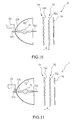
- FIGs. 9 to 11 show schematic views of an artificial light source generator and a first luminescent set and a second luminescent set thereof according to a second embodiment of the present invention.
- the artificial light source generator 5 includes a first luminescent set 6, a second luminescent set 7, and a projection plane 51.
- the first luminescent set 6 and the second luminescent set 7 are the same as the luminescent set 3 in the first embodiment, and an angle is formed between the first luminescent set 6 and the second luminescent set 7.
- the first luminescent set 6 may also be different from the second luminescent set 7, and the artificial light source generator 5 may include more than three luminescent sets.
- the first luminescent set 6 includes a first light source 61, a first parabolic mirror 62, a first supporting seat 63, a first lens array 64, a second lens array 65, and a first filter mirror 66.
- the first light source 61 is used to generate first light beams.
- the first light source 61 is a xenon lamp having two terminal electrodes 611.
- the terminal electrodes 611 are connected to a power source, and the power source provides a voltage and a current required for turning on the light source 61.
- the first parabolic mirror 62 has a focus, and the first light source 61 is disposed at the focus, so that the first light beams generated by the first light source 61 are emitted or reflected in a parallel direction by the first parabolic mirror 62.
- the first supporting seat 63 is for supporting the first light source 61.
- the first parabolic mirror 62 further includes a first opening 621, and one end of the first light source 61 passes through the first opening 621 and is fastened on the first supporting seat 63.
- the first lens array 64 has a plurality of first lens units 641, and each of the first lens units 641 has a first focal distance.
- the first lens units 641 may be separate and independent of each other or integrally formed.
- the second lens array 65 has a plurality of second lens units 651, and each of the second lens units 651 has a second focal distance.
- the second lens units 651 may be separate and independent of each other or integrally formed.
- the second focal distance is equal to the first focal distance.
- the profile of the second lens units 651 is the same as that of the first lens units 641, and the positions of the second lens units 651 correspond to those of the first lens units 641.
- the second lens array 65 is parallel to the first lens array 64, and a distance d between the second lens array 65 and the first lens array 64 is 0.5 to 1.5 times the first focal distance.
- the distance d between the second lens array 65 and the first lens array 64 is equal to the first focal distance.
- the first filter mirror 66 is disposed between the second lens array 65 and the projection plane 51.
- the first filter mirror 66 is parallel to the second lens array 65 and used filter the first light beams passing through the second lens array 65.
- the first filter mirror 66 is a coating (coating layer) that is coated on one or all of the first parabolic mirror 62, the first lens array 64, and the second lens array 65.
- the second luminescent set 7 includes a second light source 71, a second parabolic mirror 72, a second supporting seat 73, a third lens array 74, a fourth lens array 75, and a second filter mirror 76.
- the second light source 71 is used to generate second light beams.
- the second light source 71 is a xenon lamp having two terminal electrodes 711.
- the terminal electrodes 711 are connected to a power source, and the power source provides a voltage and a current required for turning on the second light source 71.
- the second parabolic mirror 72 has a focus, and the second light source 71 is disposed at the focus, so that the second light beams generated by the second light source 71 are emitted or reflecgted by the second parabolic mirror 72 in a parallel direction.
- the second supporting seat 73 is for supporting the second light source 71.
- the second parabolic mirror 72 further includes a second opening 721, and one end of the second light source 71 passes through the second opening 721 and is fastened on the second supporting seat 73.
- the third lens array 74 has a plurality of third lens units 741, and each of the third lens units 741 has a third focal distance.
- the third lens units 741 may be separate and independent of each other or formally integrally.
- the fourth lens array 75 has a plurality of fourth lens units 751, and each of the fourth lens units 751 has a fourth focal distance.
- the fourth lens units 751 may be separate and independent of each other or integrally formed.
- the fourth focal distance is equal to the third focal distance.
- the profile of the fourth lens units 751 is the same as that of the third lens units 741, and the positions of the fourth lens units 751 correspond to those of the third lens units 741.
- the fourth lens array 75 is parallel to the third lens array 74, and a distance d between the fourth lens array 75 and the third lens array 74 is 0.5 to 1.5 times the third focal distance.
- the distance d between the fourth lens array 75 and the third lens array 74 is equal to the third focal distance.
- the second filter mirror 76 is disposed between the fourth lens array 75 and the projection plane 51.
- the second filter mirror 76 is parallel to the fourth lens array 75 and used to filter the second light beams passing through the fourth lens array 75.
- the second filter mirror 76 is a coating (coating layer) that is coated on one or all of the second parabolic mirror 72, the third lens array 74, and the fourth lens array 75.
- the projection plane 51 is used for placing a module being tested (for example, a solar cell module) (not shown).
- the first luminescent set 6 and the second luminescent set 7 are separated from the projection plane 51 at a suitable distance, so that the first light beams passing through the first lens array 64 and the second lens array 65 (as shown in FIG. 10 ) are projected on the projection plane 51, and the second light beams passing through the third lens array 74 and the fourth lens array 75 (as shown in FIG. 11 ) are projected on the projection plane 51.
- the first light beams passing through each of the second lens units 651 cover the entire projection plane 51
- the second light beams passing through each of the fourth lens units 751 cover the entire projection plane 51.
- the light paths in this embodiment are described below.
- the first light beams pass through the second lens unit at a lowermost position of the second lens array 65, the first light beams are first concentrated to a focus thereof and then diverged outwards, as indicated by a first light path 81 and a second light path 82.
- the first light path 81 indicates a lower edge after the first light beams pass through the focus
- the second light path 82 indicates an upper edge after the first light beams pass through the focus.
- the first light beams pass through the second lens unit at an uppermost position of the second lens array 65
- the first light beams are first concentrated to a focus thereof and then diverged outwards, as indicated by a third light path 83 and a fourth light path 84.
- the third light path 83 indicates an upper edge after the first light beams pass through the focus
- the fourth light path 84 indicates a lower edge after the first light beams pass through the focus.
- the second light beams pass through the fourth lens unit at a lowermost position of the fourth lens array 75, the second light beams are first concentrated to a focus thereof and then diverged outwards, as indicated by a fifth light path 85 and a sixth light path 86.
- the fifth light path 85 indicates a lower edge after the second light beams pass through the focus
- the sixth light path 86 indicates an upper edge after the second light beams pass through the focus.
- the second light beams pass through the fourth lens unit at an uppermost position of the fourth lens array 75
- the second light beams are first concentrated to a focus thereof and then diverged outwards, as indicated by a seventh light path 87 and an eighth light path 88.
- the seventh light path 87 indicates an upper edge after the second light beams pass through the focus
- the eighth light path 88 indicates a lower edge after the second light beams pass through the focus.
- the second light path 82 and the sixth light path 86 intersect at a first crosspoint 91, the fourth light path 84 and the eighth light path 88 intersect at a second crosspoint 92, and the projection plane 51 is disposed between the first crosspoint 91 and the second crosspoint 92.
- the projection plane 51 has desirable illumination uniformity.
- the distance between the projection plane 51 and the second lens array 65 is 50 to 300 times, preferably 100 to 150 times, the first focal distance.
- the first lens units 641, the second lens units 651, the third lens units 741, and the fourth lens units 751 may be single-convex lenses or double-convex lenses. Preferably, these lens units are spherical lenses. Seen from the front side, the profile of the first lens units 641, the second lens units 651, the third lens units 741, and the fourth lens units 751 is rectangular or hexagonal. Alternatively, the first lens units 641, the second lens units 651, the third lens units 741, and the fourth lens units 751 may be divided into a plurality of regions where the lenses are gathered, and these regions are spaced apart by a shading material.
- the present invention has the following advantages.
- a nonuniformity performance of over 5% is achieved when a single luminescent set 3 is used to project light beams on the projection plane 21 (such as the artificial light source generator 2 in the first embodiment shown in FIG. 2 ), and more preferred overall illumination uniformity can be achieved when a plurality of luminescent sets 6 and 7 is used to project light beams on the projection plane 51 (such as the artificial light source generator 5 in the second embodiment shown in FIG. 9 ).
- the uniformity will not deteriorate due to an output attenuation of a certain luminescent set.
- each luminescent set can adopt a different light source or filter mirror to produce light beams at different wavelengths, so as to generate a composite spectrum on the projection plane. If different luminance is required, a part of the luminescent sets can be shaded or turned off without affecting the illumination uniformity on the projection plane.
Landscapes
- Engineering & Computer Science (AREA)
- General Engineering & Computer Science (AREA)
- Physics & Mathematics (AREA)
- Spectroscopy & Molecular Physics (AREA)
- Life Sciences & Earth Sciences (AREA)
- Sustainable Development (AREA)
- Non-Portable Lighting Devices Or Systems Thereof (AREA)
- Projection Apparatus (AREA)
Description
- The present invention relates to an artificial light source generator for simulating sunlight, and more particularly to an artificial light source generator capable of simulating natural light in a large area.
- As public awareness about environmental protection and energy conservation is on the rise, many efforts are being made to developed solar cell modules. However, one of the major challenges for development of solar cell module is testing after manufacturing. The intensity of natural light (sunlight) changes at different points of a day and is difficult to control artificially, so solar cell modules are generally not placed outdoors for testing. In conventional testing, an artificial light source is used indoors to simulate sunlight, so as to obtain relevant product characteristics of the solar cell modules.
- Two conventional testing methods are described below. In the first method, a flash xenon lamp is used with a flash time of about tens of milliseconds each time, which covers a flash area of more than 1*1 square meter, and can meet the uniformity requirements by means of the profile design of lighting fixtures and lamps. The disadvantage of this method is that the flash time is too short, so it is difficult to obtain correct or sufficient voltage and current data. Further, light soaking or hot spot tests that require light irradiation for a long time cannot be performed in this testing method.
-
FIG. 1 shows a schematic view of a projection plane in the second conventional testing method. A plurality of sets of continuum lamps (for example, 6 sets) is used for irradiation, so as to form sixillumination regions 11 on aprojection plane 10. The lamps may be tungsten lamps, metal-composite lamps, xenon lamps, or other light sources capable of emitting lights stably and achieving a required spectrum after being filtered by a filter mirror. The lamps are arranged adjacent to one another in a specific manner so that the illumination uniformity of theprojection plane 10 meets certain requirements. If necessary, a shading material (for example, wire net) is applied between the lamps and theprojection plane 10, so as to reduce the light on a certain region to meet the illumination uniformity required for thewhole projection plane 10. - The disadvantage of this method is that the position and intensity of each lamp and the density of the wire net must be adjusted to achieve the required uniformity, which is rather difficult and labor-consuming. Generally, it takes about ten days to make one adjustment. Whenever the attenuation of a certain lamp differs from that of the other lamps, the adjustment must be made again. For example, if the lamp on the top left corner of the
illumination region 11 is attenuated too fast, theillumination region 11 will be darker than the other illumination regions, and a readjustment will be needed. In addition, if the overall uniformity deteriorates due to the shift of a certain component, a readjustment will also be needed. - Therefore, it is necessary to provide an artificial light source generator to solve the above problems.
-
US 5 418 583 A is directed to an optical illumination system which includes a radiation source, a condensor, a first lens array including a plurality of first lenses, and a second lens array including a plurality of second lenses. The first lens array converges partial luminous fluxes, the number of which is the same as the number of first lenses, onto the second lenses paired with the first lenses. The second lens array transmits each of the partial luminous fluxes to an object region to be illuminated in such a manner that the partial luminous fluxes are superimposed on each other at the object region. Configurations of the apertures of the second lenses are different from each other and the second lenses are arranged in close contact with each other with the effective region of the second lens array approximating the smallest possible circle. -
US 4 701 023 A discloses an optical arrangement which includes an integrator assembly having a field lens array made up of a plurality of field lenses arranged one next to the other. With regard to sun simulators of the off-axis type, the angle at which the collimator mirror reflects the incident beam onto the test object causes a distortion error dependent on the radius of curvature of the collimator mirror. This error distorts the cross-section of the beam in the test plane. The distortion is compensated for by providing that the periphery of each lens is elliptical with the axes ratio of the ellipse chosen in accordance with the magnitude of the previously computed error of distortion. -
US 3 296 923 A discloses a light condensing system for uniformly illuminating a projection object, which includes a light source providing substantially collimated light energy; a first lenticular lens plate having a first multiplicity of lens elements; a second lenticular lens plate having a second multiplicity of lens elements corresponding to said first multiplicity, said lenticular lens plates being spaced apart and coaxially arranged so as to intercept light energy emitted from said source and produce an array of diverging light beams, one beam for each pair of corresponding lens elements; and lens means disposed between said lenticular lens plates and said projection object for collimating said light beams along converging principal axes so as to superimpose said light beams onto said object, thereby providing a uniform intensity, uniform angular spread illumination of said object. -
US 5 997 143 A discloses a lens plate integrator which includes first and second lens plates which transmit light from a light source on an optical path to a projection plane. Each lens plate includes corresponding first and second groups of lens elements; light from the first group of the second plate is focused on a projection face in the projection plane, while light from the second group of the second plate is focused in front of or behind the projection plane and only partially illuminates the projection face. -
US 4,550,979 discloses testing apparatus for testing satellites in a test container under conditions in outer-space, which includes an artificial light source having a high number of light sources emitting light beams that pass a radiation window, which seals the vacuum provided inside of the testing apparatus against the ambient atmosphere. The radiation window consists of two lens arrays of individual lenses. The lens arrays are disposed in parallel with each other and act as a condenser system of the artificial light source. The distance between the two lens arrays is different to that specified below. The individual lenses are mounted in a metal frame consisting of a plurality of intersecting webs, which support flanges of the individual lenses, but also act as a shading material to the incoming light beams. Thus, each of the lens arrays forms only a single region where individual lenses are gathered. - During the manufacturing process of a lens array, it is very difficult to fabricate a lens array with all first lens units or second lens units because of the large area of the array. Therefore, it is one object of the present invention is to provide an enhanced artificial light source generator for simulating sunlight, which can be manufactured in a simple and cost efficient manner.
- This problem is solved by an artificial light source generator for simulating sunlight according to claim 1. Further advantageous embodiments are the subject-matter of the dependent claims.
- An artificial light source generator according to the present invention includes at least one luminescent set and a projection plane. The luminescent set includes a light source, a parabolic mirror, a supporting seat, a first lens array, and a second lens array. The light source is used to generate light beams. The parabolic mirror has a focus, and the light source is disposed at the focus, so that the light beams generated by the light source are reflected or emitted in a parallel direction by the parabolic mirror. The supporting seat is used for supporting the light source. The first lens array has a plurality of first lens units, and each of the first lens units has a first focal distance. The second lens array has a plurality of second lens units, and the second lens array is parallel to the first lens array. The distance between the second lens array and the first lens array is 0.5 to 1.5 times the first focal distance. The projection plane is used for placing a module being tested. The projection plane is separated from the luminescent set at a suitable distance, so that the light beams passing through the first lens array and the second lens array are projected on the projection plane. The light beams passing through each of the second lens units cover the entire projection plane. According to the present invention the respective first lens units and the respective second lens units are divided into a plurality of regions where lenses are gathered, and the regions where the lenses are gathered are spaced apart by a shading material.
- The present invention has the following advantages. A non-uniformity performance of under 5% is achieved when a single luminescent set is used to project light beams on the projection plane, and more preferred overall illumination uniformity can be achieved when a plurality of luminescent sets is used to project light beams on the projection plane. Furthermore, the uniformity will not deteriorate due to an output attenuation of a certain luminescent set In addition, when a plurality of luminescent sets is employed for irradiation in an overlapping manner, each luminescent set can adopt a different light source or filter mirror to produce light beams at different wavelengths, so as to generate a composite spectrum on the projection plane. If different luminance is required, a part of the luminescent sets can be shaded or turned off without affecting the illumination uniformity on the projection plane.
-
-
FIG. 1 is a schematic view of a projection plane in a second conventional testing method; -
FIG. 2 is a schematic view of an artificial light source generator according to a first embodiment of the present invention; -
FIG. 3 is a schematic view of a luminescent set in the artificial light source generator according to the first embodiment of the present invention; -
FIG. 4 is a schematic view of light paths of a second lens array in the artificial light source generator according to the present invention; -
FIG. 5 is a schematic view of another implementation aspect of the artificial light source generator according to the first embodiment of the present invention, in which an angle is formed between the filter mirror and the second lens array; -
FIG. 6 shows a profile of the first lens units and the second lens units according to the first embodiment of the present invention, in which the profile is rectangular; -
FIG. 7 shows a profile of the first lens units and the second lens units according to the first embodiment of the present invention, in which the profile is hexagonal; -
FIG. 8 shows a profile of the first lens units and the second lens units according to the first embodiment of the present invention, in which the first lens units and the second lens units are divided into four regions where lenses are gathered; -
FIG. 9 is a schematic view of an artificial light source generator according to a second embodiment of the present invention; -
FIG. 10 is a schematic view of a first luminescent set in the artificial light source generator according to the second embodiment of the present invention; and -
FIG. 11 is a schematic view of a second luminescent set in the artificial light source generator according to the second embodiment of the present invention. -
FIGs. 2 and 3 show schematic views of an artificial light source generator and a luminescent set thereof according to a first embodiment of the present invention. The artificiallight source generator 2 of the present invention can be used indoors to simulate sunlight, so as to test the solar cell products to obtain information about relevant product characteristics. However, it should be understood that the artificiallight source generator 2 of the present invention can also be applied in other circumstances that requires uniform light beams. The artificiallight source generator 2 includes at least oneluminescent set 3 and aprojection plane 21. As shown inFIG. 3 , theluminescent set 3 includes alight source 31, aparabolic mirror 32, a supportingseat 33, afirst lens array 34, asecond lens array 35, and afilter mirror 36. - The
light source 31 is used to generate light beams. In this embodiment, thelight source 31 is a xenon lamp having twoterminal electrodes 311. Theterminal electrodes 311 are connected to a power source, and the power source provides a voltage and a current required for turning on thelight source 31. - The
parabolic mirror 32 has a focus, and thelight source 31 is disposed at the focus, so that the light beams generated by the light source are reflected or emitted by theparabolic mirror 32 in a parallel direction. Preferably, theparabolic mirror 32 is attached to a lamp shade. - The supporting
seat 33 is used to support thelight source 31. In this embodiment, theparabolic mirror 32 further includes anopening 321, and one end of thelight source 31 passes through theopening 321 and is fastened on the supportingseat 33. - The
first lens array 34 has a plurality offirst lens units 341, and each of thefirst lens units 341 has a first focal distance. Thefirst lens units 341 may be separate and independent of each other or integrally formed. Thesecond lens array 35 has a plurality ofsecond lens units 351, and each of thesecond lens units 351 has a second focal distance. Thesecond lens units 351 may be separate and independent of each other or integrally formed. It should be noted that the number of the lens arrays in the present invention is not limited to two and may also be three or more. - Preferably, the second focal distance is equal to the first focal distance, the profile of the
second lens units 351 is the same as that of thefirst lens units 341, and the positions of thesecond lens units 351 correspond to those of thefirst lens units 341. - The
second lens array 35 is parallel to thefirst lens array 34, and a distance d between thesecond lens array 35 and thefirst lens array 34 is 0.5 to 1.5 times the first focal distance. Preferably, the distance d between thesecond lens array 35 and thefirst lens array 34 is equal to the first focal distance. - The
projection plane 21 is used for placing a module being tested (for example, a solar cell module) (not shown). Theprojection plane 21 is separated from theluminescent set 3 at a suitable distance, so that the light beams passing through thefirst lens array 34 and thesecond lens array 35 are projected on theprojection plane 21, and the light beams passing through each of thesecond lens units 351 cover theentire projection plane 21. -
FIG. 4 shows a schematic view of light paths of the second lens array in the artificial light source generator according to the present invention. Thesecond lens unit 351 at an uppermost position and thesecond lens unit 352 at a lowermost position of thesecond lens array 35 are taken as an example below. When the light beams pass through thesecond lens unit 352 at the lowermost position, the light beams are first concentrated to a focus thereof and then diverged outwards, as indicated by afirst light path 41 and a secondlight path 42. Thefirst light path 41 indicates a lower edge after the light beams pass through the focus, and the secondlight path 42 indicates an upper edge after the light beams pass through the focus. The distance between the focus and thesecond lens unit 352 is the second focal distance f, and thesecond lens unit 352 has a width W. - Similarly, when the light beams pass through the
second lens unit 351 at the uppermost position, the light beams are first concentrated to a focus thereof and then diverged outwards, as indicated by a thirdlight path 43 and a fourthlight path 44. The thirdlight path 43 indicates an upper edge after the light beams pass through the focus, and the fourthlight path 44 indicates a lower edge after the light beams pass through the focus. The focus of thesecond lens unit 351 at the uppermost position and the focus of thesecond lens unit 352 at the lowermost position are spaced apart at a distance L, and the distance L is slightly shorter than the width of thesecond lens array 35. In a preferred embodiment, the distance L falls between 150 mm and 500 mm, and the distance between a focus of the first lens unit at an uppermost position and a focus of the first lens unit at a lowermost position of thefirst lens array 34 also falls between 150 mm and 500 mm. - In
FIG. 2 , theprojection plane 21 is separated from theluminescent set 3 at a distance f', a region on theprojection plane 21 where the light beams passing through thesecond lens unit 352 at the lowermost position are projected has a width W', and W:f=W':f'. In a preferred embodiment, the distance f' falls between 5 m and 20 m. Theprojection plane 21 is a region below the secondlight path 42 and above the fourthlight path 44, and has a width of W'-L, that is, the light beams passing through each of thesecond lens units 351 will cover theentire projection plane 21. Therefore, theprojection plane 21 has desirable illumination uniformity, and the shape of theprojection plane 21 is the same as that of thesecond lens units 351. Generally, the distance between theprojection plane 21 and thesecond lens array 35 is 50 to 300 times, preferably 100 to 150 times, the first focal distance. As shown inFIG. 2 , if theprojection plane 21 moves towards theluminescent set 3, the area thereof is reduced, but the specific energy of the light beams is increased; if theprojection plane 21 moves away from theluminescent set 3, the area thereof is enlarged, but the specific energy of the light beams is reduced. - With reference to
FIG. 3 again, preferably, theluminescent set 3 further includes afilter mirror 36 disposed between thesecond lens array 35 and theprojection plane 21. Thefilter mirror 36 is parallel to thesecond lens array 35, filters the light beams passing through thesecond lens array 35, and is capable of selectively letting the light beams within a specific required range of wavelengths pass through. In other applications, an angle is formed between thefilter mirror 36 and thesecond lens array 35, as shown inFIG. 5 , and thefilter mirror 36 is used to reflect the light beams passing through thesecond lens array 35. - In another preferred embodiment, the
filter mirror 36 is a coating (coating layer) that is coated on one or all of theparabolic mirror 32, thefirst lens array 34, and thesecond lens array 35. -
FIGs. 6 to 8 show schematic views of a profile of the lens units according to the present invention. In the present invention, thefirst lens units 341 may be single-convex lenses or double-convex lenses, and thesecond lens units 351 may be single-convex lenses or double-convex lenses. Preferably, thefirst lens units 341 and thesecond lens units 351 are spherical lenses. Seen from the front side, the profile of thefirst lens units 341 and thesecond lens units 351 is rectangular (as shown inFIG. 6 ) or hexagonal (as shown inFIG. 7 ). Alternatively, thefirst lens units 341 and thesecond lens units 351 may be divided into a plurality of regions (for example, four as shown inFIG. 8 ) where the lenses are gathered, and these regions are spaced apart by a shading material. As shown inFIG. 8 , thefirst lens units 341 of thefirst lens array 34 are divided into fourregions 342 where the lenses are gathered, and theregions 342 are spaced apart by ashading material 343. Theshading material 343 is in a cross shape. -
FIGs. 9 to 11 show schematic views of an artificial light source generator and a first luminescent set and a second luminescent set thereof according to a second embodiment of the present invention. The artificiallight source generator 5 includes a firstluminescent set 6, a secondluminescent set 7, and aprojection plane 51. In this embodiment, the firstluminescent set 6 and the secondluminescent set 7 are the same as theluminescent set 3 in the first embodiment, and an angle is formed between the firstluminescent set 6 and the secondluminescent set 7. It should be understood that the firstluminescent set 6 may also be different from the secondluminescent set 7, and the artificiallight source generator 5 may include more than three luminescent sets. - As shown in
FIG. 10 , the firstluminescent set 6 includes afirst light source 61, a firstparabolic mirror 62, a first supportingseat 63, afirst lens array 64, asecond lens array 65, and afirst filter mirror 66. Thefirst light source 61 is used to generate first light beams. In this embodiment, thefirst light source 61 is a xenon lamp having twoterminal electrodes 611. Theterminal electrodes 611 are connected to a power source, and the power source provides a voltage and a current required for turning on thelight source 61. - The first
parabolic mirror 62 has a focus, and thefirst light source 61 is disposed at the focus, so that the first light beams generated by thefirst light source 61 are emitted or reflected in a parallel direction by the firstparabolic mirror 62. The first supportingseat 63 is for supporting thefirst light source 61. In this embodiment, the firstparabolic mirror 62 further includes afirst opening 621, and one end of thefirst light source 61 passes through thefirst opening 621 and is fastened on the first supportingseat 63. - The
first lens array 64 has a plurality offirst lens units 641, and each of thefirst lens units 641 has a first focal distance. Thefirst lens units 641 may be separate and independent of each other or integrally formed. Thesecond lens array 65 has a plurality ofsecond lens units 651, and each of thesecond lens units 651 has a second focal distance. Thesecond lens units 651 may be separate and independent of each other or integrally formed. - Preferably, the second focal distance is equal to the first focal distance. The profile of the
second lens units 651 is the same as that of thefirst lens units 641, and the positions of thesecond lens units 651 correspond to those of thefirst lens units 641. Thesecond lens array 65 is parallel to thefirst lens array 64, and a distance d between thesecond lens array 65 and thefirst lens array 64 is 0.5 to 1.5 times the first focal distance. Preferably, the distance d between thesecond lens array 65 and thefirst lens array 64 is equal to the first focal distance. - The
first filter mirror 66 is disposed between thesecond lens array 65 and theprojection plane 51. Thefirst filter mirror 66 is parallel to thesecond lens array 65 and used filter the first light beams passing through thesecond lens array 65. In a preferred embodiment, thefirst filter mirror 66 is a coating (coating layer) that is coated on one or all of the firstparabolic mirror 62, thefirst lens array 64, and thesecond lens array 65. - In
FIG. 11 , the secondluminescent set 7 includes a secondlight source 71, a secondparabolic mirror 72, a second supporting seat 73, athird lens array 74, afourth lens array 75, and asecond filter mirror 76. The secondlight source 71 is used to generate second light beams. In this embodiment, the secondlight source 71 is a xenon lamp having twoterminal electrodes 711. Theterminal electrodes 711 are connected to a power source, and the power source provides a voltage and a current required for turning on the secondlight source 71. - The second
parabolic mirror 72 has a focus, and the secondlight source 71 is disposed at the focus, so that the second light beams generated by the secondlight source 71 are emitted or reflecgted by the secondparabolic mirror 72 in a parallel direction. The second supporting seat 73 is for supporting the secondlight source 71. In this embodiment, the secondparabolic mirror 72 further includes asecond opening 721, and one end of the secondlight source 71 passes through thesecond opening 721 and is fastened on the second supporting seat 73. - The
third lens array 74 has a plurality ofthird lens units 741, and each of thethird lens units 741 has a third focal distance. Thethird lens units 741 may be separate and independent of each other or formally integrally. Thefourth lens array 75 has a plurality offourth lens units 751, and each of thefourth lens units 751 has a fourth focal distance. Thefourth lens units 751 may be separate and independent of each other or integrally formed. - Preferably, the fourth focal distance is equal to the third focal distance. The profile of the
fourth lens units 751 is the same as that of thethird lens units 741, and the positions of thefourth lens units 751 correspond to those of thethird lens units 741. Thefourth lens array 75 is parallel to thethird lens array 74, and a distance d between thefourth lens array 75 and thethird lens array 74 is 0.5 to 1.5 times the third focal distance. Preferably, the distance d between thefourth lens array 75 and thethird lens array 74 is equal to the third focal distance. - The
second filter mirror 76 is disposed between thefourth lens array 75 and theprojection plane 51. Thesecond filter mirror 76 is parallel to thefourth lens array 75 and used to filter the second light beams passing through thefourth lens array 75. In a preferred embodiment, thesecond filter mirror 76 is a coating (coating layer) that is coated on one or all of the secondparabolic mirror 72, thethird lens array 74, and thefourth lens array 75. - With reference to
FIG. 9 again, theprojection plane 51 is used for placing a module being tested (for example, a solar cell module) (not shown). The firstluminescent set 6 and the secondluminescent set 7 are separated from theprojection plane 51 at a suitable distance, so that the first light beams passing through thefirst lens array 64 and the second lens array 65 (as shown inFIG. 10 ) are projected on theprojection plane 51, and the second light beams passing through thethird lens array 74 and the fourth lens array 75 (as shown inFIG. 11 ) are projected on theprojection plane 51. The first light beams passing through each of thesecond lens units 651 cover theentire projection plane 51, and the second light beams passing through each of thefourth lens units 751 cover theentire projection plane 51. - The light paths in this embodiment are described below. When the first light beams pass through the second lens unit at a lowermost position of the
second lens array 65, the first light beams are first concentrated to a focus thereof and then diverged outwards, as indicated by afirst light path 81 and a secondlight path 82. Thefirst light path 81 indicates a lower edge after the first light beams pass through the focus, and the secondlight path 82 indicates an upper edge after the first light beams pass through the focus. When the first light beams pass through the second lens unit at an uppermost position of thesecond lens array 65, the first light beams are first concentrated to a focus thereof and then diverged outwards, as indicated by a thirdlight path 83 and a fourthlight path 84. The thirdlight path 83 indicates an upper edge after the first light beams pass through the focus, and the fourthlight path 84 indicates a lower edge after the first light beams pass through the focus. - Similarly, when the second light beams pass through the fourth lens unit at a lowermost position of the
fourth lens array 75, the second light beams are first concentrated to a focus thereof and then diverged outwards, as indicated by a fifthlight path 85 and a sixthlight path 86. The fifthlight path 85 indicates a lower edge after the second light beams pass through the focus, and the sixthlight path 86 indicates an upper edge after the second light beams pass through the focus. When the second light beams pass through the fourth lens unit at an uppermost position of thefourth lens array 75, the second light beams are first concentrated to a focus thereof and then diverged outwards, as indicated by a seventhlight path 87 and an eighthlight path 88. The seventhlight path 87 indicates an upper edge after the second light beams pass through the focus, and the eighthlight path 88 indicates a lower edge after the second light beams pass through the focus. - The second
light path 82 and the sixthlight path 86 intersect at afirst crosspoint 91, the fourthlight path 84 and the eighthlight path 88 intersect at asecond crosspoint 92, and theprojection plane 51 is disposed between thefirst crosspoint 91 and thesecond crosspoint 92. Thus, the light beams passing through each of thesecond lens units 651 and each of thefourth lens units 751 cover theentire projection plane 51. Therefore, theprojection plane 51 has desirable illumination uniformity. Generally, the distance between theprojection plane 51 and thesecond lens array 65 is 50 to 300 times, preferably 100 to 150 times, the first focal distance. - In this embodiment, the
first lens units 641, thesecond lens units 651, thethird lens units 741, and thefourth lens units 751 may be single-convex lenses or double-convex lenses. Preferably, these lens units are spherical lenses. Seen from the front side, the profile of thefirst lens units 641, thesecond lens units 651, thethird lens units 741, and thefourth lens units 751 is rectangular or hexagonal. Alternatively, thefirst lens units 641, thesecond lens units 651, thethird lens units 741, and thefourth lens units 751 may be divided into a plurality of regions where the lenses are gathered, and these regions are spaced apart by a shading material. - The present invention has the following advantages. A nonuniformity performance of over 5% is achieved when a single
luminescent set 3 is used to project light beams on the projection plane 21 (such as the artificiallight source generator 2 in the first embodiment shown inFIG. 2 ), and more preferred overall illumination uniformity can be achieved when a plurality ofluminescent sets light source generator 5 in the second embodiment shown inFIG. 9 ). Furthermore, the uniformity will not deteriorate due to an output attenuation of a certain luminescent set. In addition, when a plurality of luminescent sets is employed for irradiation in an overlapping manner, each luminescent set can adopt a different light source or filter mirror to produce light beams at different wavelengths, so as to generate a composite spectrum on the projection plane. If different luminance is required, a part of the luminescent sets can be shaded or turned off without affecting the illumination uniformity on the projection plane. - While several embodiments of the present invention have been illustrated and described, various modifications and improvements can be made by those skilled in the art. The embodiments of the present invention are therefore described in an illustrative but not restrictive sense. It is intended that the present invention should not be limited to the particular forms as illustrated, and that all modifications which maintain the scope of the present invention are within the scope defined in the appended claims.
Claims (18)
- An artificial light source generator for simulating sunlight, comprising:at least one luminescent set (3; 6; 7), each comprising:a light source (31; 61; 71), for generating light beams;a parabolic mirror (32; 62; 72), having a focus, wherein the light source is disposed at the focus, so that the light beams generated by the light source are reflected or emitted in a parallel direction by the parabolic mirror;a supporting seat (33; 63; 73), for supporting the light source;a first lens array (34; 64; 74), having a plurality of first lens units (341; 641; 741), wherein each of the first lens units has a first focal distance; anda second lens array (35; 65; 75), having a plurality of second lens units (351; 651; 751), wherein the second lens array is parallel to the first lens array, and the distance between the second lens array and the first lens array is 0.5 to 1.5 times the first focal distance; anda projection plane (21; 51), for placing a module being tested, wherein the projection plane is separated from the respective luminescent set (3; 6; 7) at a suitable distance, so that the light beams passing through the first lens array and the second lens array are projected on the projection plane, and the light beams passing through each of the second lens units cover the entire projection plane.wherein the respective first lens units (341; 641; 741) and the respective second lens units (351; 651; 751) are divided into a plurality of regions where lenses are gathered, and the regions where the lenses are gathered are spaced apart by a shading material.
- The artificial light source generator according to Claim 1, wherein the light source (31; 61; 71) is a xenon lamp comprising two terminal electrodes.
- The artificial light source generator according to any of the preceding claims, wherein the respective parabolic mirror further comprises an opening (321; 621; 721), and one end of the associated light source passes through the opening and is fastened on the associated supporting seat (33; 63; 73).
- The artificial light source generator according to any of the preceding claims, wherein each of the second lens units has a second focal distance, the second focal distance is equal to the first focal distance, the profile of the second lens units (351; 651; 751) is the same as that of the first lens units (341; 641; 741), and the positions of the second lens units correspond to those of the first lens units.
- The artificial light source generator according to any of the preceding claims, wherein the first lens units (341; 641; 741) and/or the second lens units (351; 651; 751) are separate and independent of each other.
- The artificial light source generator according to any of claims 1 to 4, wherein the first lens units (341; 641; 741) and/or the second lens units (351; 651; 751) are integrally formed.
- The artificial light source generator according to any of the preceding claims, wherein the respective luminescent set (3; 6; 7) further comprises a filter mirror (36; 66; 76).
- The artificial light source generator according to Claim 8, wherein the respective filter mirror is parallel to the associated second lens array (35; 65; 75) and used to filter the light beams passing through the associated second lens array.
- The artificial light source generator according to Claim 7, wherein an angle is formed between the respective filter mirror and the associated second lens array (35; 65; 75), and the filter mirror is used to reflect the light beams passing through the associated second lens array.
- The artificial light source generator according to any of claims 7 to 9, wherein the respective filter mirror has a coating that is coated on the respective parabolic mirror (32; 62; 72) and/or the respective first lens array (34; 64; 74) and/or the respective second lens array (35; 65; 75).
- The artificial light source generator according to any of the preceding claims, wherein the distance between the respective second lens array (35; 65; 75) and the respective first lens array (34; 64; 74) is equal to the first focal distance.
- The artificial light source generator according to any of the preceding claims, wherein the distance between the respective projection plane (21; 51) and the associated second lens array (35; 65; 75) is 50 to 300 times the first focal distance.
- The artificial light source generator according to any of the preceding claims, wherein the respective first lens units (341; 641; 741) and/or the respective second lens units (351; 651; 751) are spherical lenses.
- The artificial light source generator according to any of the preceding claims, wherein the respective first lens units (341; 641; 741) and/or the respective second lens units (351; 651; 751) are single-convex lenses or double-convex lenses.
- The artificial light source generator according to any of the preceding claims, wherein the profile of the respective first lens units (341; 641; 741) and the respective second lens units (351; 651; 751) is rectangular or hexagonal.
- The artificial light source generator according to any of the preceding claims, wherein when the light beams pass through the respective second lens unit (35; 65; 75) at a lowermost position of the second lens array, the light beams are first concentrated to a focus thereof and then diverged outwards, a lower edge thereof is defined as a first light path (41; 81; 85), and an upper edge thereof is defined as a second light path (42; 82; 86); when the light beams pass through the respective second lens unit at an uppermost position of the second lens array, the light beams are first concentrated to a focus thereof and then diverged outwards, an upper edge thereof is defined as a third light path (43; 83; 87), and a lower edge thereof is defined as a fourth light path (44; 84; 88); and the respective projection plane (21; 51) is a region below the second light path and above the fourth light path.
- The artificial light source generator according to any of the preceding claims, having a first luminescent set (6) and a second luminescent set (7) of the same configuration, a first light source of said first luminescent set (6) generating first light beams and a second light source of said second luminescent set (7) generating second light beams;
wherein
said second luminescent set (7) forms an angle with the first luminescent set (6) and wherein:said projection plane (51) for placing a module being tested is separated from the first luminescent set (6) and the second luminescent set (7) at a suitable distance, so thatthe first light beams passing through the first lens array (64) and the second lens array (65) of the first luminescent set (6) are projected on the projection plane,the second light beams passing through the first lens array (74) and the second lens array (75) of the second luminescent set (7) are projected on the projection plane,the first light beams passing through each of the second lens units (651) of the second lens array (65) of the first luminescent set (6) cover the entire projection plane, andthe second light beams passing through each of the second lens units (751) of the second lens array (75) of the second luminescent set (7) cover the entire projection plane. - The artificial light source generator according to Claim 17, wherein
when the first light beams pass through the second lens unit (65) of the first luminescent set (6) at a lowermost position of the second lens array (651), the first light beams are first concentrated to a focus thereof and then diverged outwards, a lower edge thereof is defined as a first light path (81), and an upper edge thereof is defined as a second light path (82);
when the first light beams pass through the second lens unit (65) of the first luminescent set (6) at an uppermost position of the second lens array (651), the first light beams are first concentrated to a focus thereof and then diverged outwards, an upper edge thereof is defined as a third light path (83), and a lower edge thereof is defined as a fourth light path (84);
when the second light beams pass through the second lens unit (75) of the second luminescent set (7) at a lowermost position of the second lens array (751), the second light beams are first concentrated to a focus thereof and then diverged outwards, a lower edge thereof is defined as a fifth light path (85), and an upper edge thereof is defined as a sixth light path (86); and
when the second light beams pass through the second lens unit (75) of the second luminescent set (7) at an uppermost position of the second lens array (751), the second light beams are first concentrated to a focus thereof and then diverged outwards, an upper edge thereof is defined as a seventh light path (87), and a lower edge thereof is defined as an eighth light path (88);
the second light path (82) and the sixth light path (86) intersect at a first crosspoint;
the fourth light path (84) and the eighth light path (88) intersect at a second crosspoint; and
the projection plane (51) is disposed between the first crosspoint and the second crosspoint.
Applications Claiming Priority (1)
| Application Number | Priority Date | Filing Date | Title |
|---|---|---|---|
| TW097131925A TWI355520B (en) | 2008-08-21 | 2008-08-21 | Artificial light source generator |
Publications (3)
| Publication Number | Publication Date |
|---|---|
| EP2157359A2 EP2157359A2 (en) | 2010-02-24 |
| EP2157359A3 EP2157359A3 (en) | 2011-04-06 |
| EP2157359B1 true EP2157359B1 (en) | 2013-06-05 |
Family
ID=41278151
Family Applications (1)
| Application Number | Title | Priority Date | Filing Date |
|---|---|---|---|
| EP09166944.0A Active EP2157359B1 (en) | 2008-08-21 | 2009-07-31 | Artificial light source generator |
Country Status (4)
| Country | Link |
|---|---|
| US (1) | US8057068B2 (en) |
| EP (1) | EP2157359B1 (en) |
| ES (1) | ES2424714T3 (en) |
| TW (1) | TWI355520B (en) |
Families Citing this family (7)
| Publication number | Priority date | Publication date | Assignee | Title |
|---|---|---|---|---|
| TWI397708B (en) * | 2010-04-06 | 2013-06-01 | Ind Tech Res Inst | Solar cell measurement system and solar simulator |
| WO2014017262A1 (en) * | 2012-07-27 | 2014-01-30 | シャープ株式会社 | Illumination device |
| TWM445181U (en) * | 2012-09-13 | 2013-01-11 | All Real Technology Co Ltd | Photovoltaic simulation testing device |
| CN103267248A (en) * | 2013-06-03 | 2013-08-28 | 中国科学院长春光学精密机械与物理研究所 | Solar simulator device with off-axis angle of 29-45 degrees and for large-irradiation area environment test |
| CN104344237B (en) * | 2013-07-29 | 2016-12-28 | 深圳市宝泰光电科技有限公司 | The LED lamp that a kind of luminous efficiency is high |
| FR3013174B1 (en) * | 2013-11-14 | 2015-11-20 | Soitec Solar Gmbh | DEVICE FOR TESTING A CONCENTRATION PHOTOVOLTAIC MODULE |
| CN105090830A (en) * | 2015-08-19 | 2015-11-25 | 广州市浩洋电子有限公司 | Stage lighting system for improving uniformity of light spots |
Citations (1)
| Publication number | Priority date | Publication date | Assignee | Title |
|---|---|---|---|---|
| US4550979A (en) * | 1983-07-15 | 1985-11-05 | Carl-Zeiss-Stiftung | Testing apparatus including a vacuum-tight radiation window |
Family Cites Families (26)
| Publication number | Priority date | Publication date | Assignee | Title |
|---|---|---|---|---|
| US2183249A (en) * | 1937-11-06 | 1939-12-12 | Zeiss Ikon Ag | Illuminating device for projectors |
| US2236420A (en) * | 1938-02-21 | 1941-03-25 | Hartford Nat Bank & Trust Co | Illuminating device |
| US3296923A (en) * | 1965-01-04 | 1967-01-10 | Gen Electric | Lenticulated collimating condensing system |
| FR1462264A (en) * | 1965-08-26 | 1966-04-15 | Light source for colors obtained by additive process | |
| US3484599A (en) * | 1967-01-03 | 1969-12-16 | William D Little | Optical projection system |
| US3513306A (en) * | 1967-07-24 | 1970-05-19 | Trw Inc | Multimodular collimated light projection system |
| DE3437271A1 (en) * | 1984-10-11 | 1986-04-17 | Fa. Carl Zeiss, 7920 Heidenheim | SUN SIMULATOR |
| JP2973750B2 (en) * | 1992-03-31 | 1999-11-08 | 松下電器産業株式会社 | Illumination optical device and projection display device using the same |
| EP1261213A1 (en) * | 1993-03-16 | 2002-11-27 | Seiko Epson Corporation | Projection-type display apparatus |
| DE19624991A1 (en) * | 1996-06-22 | 1998-01-02 | Philips Patentverwaltung | Light projection arrangement with a lens plate integrator |
| US6101040A (en) * | 1997-03-28 | 2000-08-08 | Seiko Epson Corporation | Illumination optical system and projection-type display apparatus |
| WO1999019759A1 (en) * | 1997-10-09 | 1999-04-22 | Seiko Epson Corporation | Projection type display |
| JP2000162542A (en) * | 1998-11-30 | 2000-06-16 | Canon Inc | Light irradiation device and image projection device |
| JP3269494B2 (en) * | 1998-12-21 | 2002-03-25 | セイコーエプソン株式会社 | Lighting device and projection display device |
| US6552760B1 (en) * | 1999-02-18 | 2003-04-22 | Fujitsu Limited | Luminaire with improved light utilization efficiency |
| US6499863B2 (en) * | 1999-12-28 | 2002-12-31 | Texas Instruments Incorporated | Combining two lamps for use with a rod integrator projection system |
| JP2001201623A (en) * | 2000-01-20 | 2001-07-27 | Fujitsu General Ltd | Illumination light source device |
| JP2001222064A (en) * | 2000-02-08 | 2001-08-17 | Ibm Japan Ltd | Illumination control device, projector, and illumination control method |
| JP2001272726A (en) * | 2000-03-23 | 2001-10-05 | Sony Corp | Optical device and projection display device using the same |
| US6499844B2 (en) * | 2000-05-01 | 2002-12-31 | Koninklijke Philips Electronics N.V. | Projection device and integrator plate suitable for such a projection device |
| JP2003331617A (en) * | 2002-05-13 | 2003-11-21 | Stanley Electric Co Ltd | Vehicle lighting |
| CN2593234Y (en) | 2002-12-18 | 2003-12-17 | 上海华显数字影像技术有限公司 | LCOS liquid crystal panel lighting apparatus |
| US6877882B1 (en) * | 2003-03-12 | 2005-04-12 | Delta Electronics, Inc. | Illumination system for a projection system |
| JP4052282B2 (en) * | 2004-05-07 | 2008-02-27 | セイコーエプソン株式会社 | projector |
| US20050265027A1 (en) * | 2004-06-01 | 2005-12-01 | Wu Jeng-Yih | Light source module of projectors |
| WO2006066706A2 (en) * | 2004-12-22 | 2006-06-29 | Carl Zeiss Laser Optics Gmbh | Optical illumination system for creating a line beam |
-
2008
- 2008-08-21 TW TW097131925A patent/TWI355520B/en active
-
2009
- 2009-07-23 US US12/508,484 patent/US8057068B2/en active Active
- 2009-07-31 ES ES09166944T patent/ES2424714T3/en active Active
- 2009-07-31 EP EP09166944.0A patent/EP2157359B1/en active Active
Patent Citations (1)
| Publication number | Priority date | Publication date | Assignee | Title |
|---|---|---|---|---|
| US4550979A (en) * | 1983-07-15 | 1985-11-05 | Carl-Zeiss-Stiftung | Testing apparatus including a vacuum-tight radiation window |
Also Published As
| Publication number | Publication date |
|---|---|
| ES2424714T3 (en) | 2013-10-07 |
| TW201009403A (en) | 2010-03-01 |
| TWI355520B (en) | 2012-01-01 |
| EP2157359A3 (en) | 2011-04-06 |
| US8057068B2 (en) | 2011-11-15 |
| US20100046229A1 (en) | 2010-02-25 |
| EP2157359A2 (en) | 2010-02-24 |
Similar Documents
| Publication | Publication Date | Title |
|---|---|---|
| EP2157359B1 (en) | Artificial light source generator | |
| EP1139016B1 (en) | Infrared pulsed solar simulator | |
| TW200933777A (en) | Lighting device for testing photovoltaic panels | |
| TW201214505A (en) | Light generator systems and methods | |
| JP2007311085A (en) | Simulated solar irradiation device | |
| WO2012136572A1 (en) | Light source for testing a photovoltaic panel or cell | |
| CN111350994A (en) | Solar light source simulator | |
| CN104132303A (en) | LED solar simulator optical system | |
| CN106461736B (en) | For testing the device of light concentrating photovoltaic module | |
| CN209054481U (en) | Light source of solar energy simulator | |
| US3200253A (en) | System for obtaining parallel radiant energy rays of uniform illumination and uniform energy distribution | |
| US9410669B2 (en) | Multi-lamp solar simulator | |
| CN105841022B (en) | Solar light source xenon lamp simulation system | |
| CN101713494B (en) | Artificial light source generator | |
| US9859842B2 (en) | Device and method for testing a concentrated photovoltaic module | |
| CN114165748A (en) | Multi-section spectrum adjustable steady-state solar simulator | |
| CN214480478U (en) | A Spectroscopic Simulator on the Martian Surface | |
| JP3187343U (en) | Solar simulator | |
| US3501626A (en) | Radiation condenser devices | |
| CN113054909B (en) | A Mars surface spectral simulator | |
| TWI509191B (en) | Sun simulator | |
| US9689540B2 (en) | Optical modifications for changing power density of solar simulator systems | |
| RU2855878C9 (en) | Solar radiation simulator | |
| RU2855878C1 (en) | Solar radiation simulator | |
| CN102734664A (en) | Light-gathering type light source simulator |
Legal Events
| Date | Code | Title | Description |
|---|---|---|---|
| PUAI | Public reference made under article 153(3) epc to a published international application that has entered the european phase |
Free format text: ORIGINAL CODE: 0009012 |
|
| AK | Designated contracting states |
Kind code of ref document: A2 Designated state(s): AT BE BG CH CY CZ DE DK EE ES FI FR GB GR HR HU IE IS IT LI LT LU LV MC MK MT NL NO PL PT RO SE SI SK SM TR |
|
| AX | Request for extension of the european patent |
Extension state: AL BA RS |
|
| PUAL | Search report despatched |
Free format text: ORIGINAL CODE: 0009013 |
|
| AK | Designated contracting states |
Kind code of ref document: A3 Designated state(s): AT BE BG CH CY CZ DE DK EE ES FI FR GB GR HR HU IE IS IT LI LT LU LV MC MK MT NL NO PL PT RO SE SI SK SM TR |
|
| AX | Request for extension of the european patent |
Extension state: AL BA RS |
|
| 17P | Request for examination filed |
Effective date: 20110907 |
|
| 17Q | First examination report despatched |
Effective date: 20120516 |
|
| GRAP | Despatch of communication of intention to grant a patent |
Free format text: ORIGINAL CODE: EPIDOSNIGR1 |
|
| GRAS | Grant fee paid |
Free format text: ORIGINAL CODE: EPIDOSNIGR3 |
|
| GRAA | (expected) grant |
Free format text: ORIGINAL CODE: 0009210 |
|
| AK | Designated contracting states |
Kind code of ref document: B1 Designated state(s): AT BE BG CH CY CZ DE DK EE ES FI FR GB GR HR HU IE IS IT LI LT LU LV MC MK MT NL NO PL PT RO SE SI SK SM TR |
|
| REG | Reference to a national code |
Ref country code: GB Ref legal event code: FG4D |
|
| REG | Reference to a national code |
Ref country code: CH Ref legal event code: EP |
|
| REG | Reference to a national code |
Ref country code: AT Ref legal event code: REF Ref document number: 615873 Country of ref document: AT Kind code of ref document: T Effective date: 20130615 |
|
| REG | Reference to a national code |
Ref country code: IE Ref legal event code: FG4D |
|
| REG | Reference to a national code |
Ref country code: DE Ref legal event code: R096 Ref document number: 602009016191 Country of ref document: DE Effective date: 20130801 |
|
| REG | Reference to a national code |
Ref country code: NL Ref legal event code: T3 |
|
| REG | Reference to a national code |
Ref country code: ES Ref legal event code: FG2A Ref document number: 2424714 Country of ref document: ES Kind code of ref document: T3 Effective date: 20131007 |
|
| REG | Reference to a national code |
Ref country code: AT Ref legal event code: MK05 Ref document number: 615873 Country of ref document: AT Kind code of ref document: T Effective date: 20130605 |
|
| PG25 | Lapsed in a contracting state [announced via postgrant information from national office to epo] |
Ref country code: LT Free format text: LAPSE BECAUSE OF FAILURE TO SUBMIT A TRANSLATION OF THE DESCRIPTION OR TO PAY THE FEE WITHIN THE PRESCRIBED TIME-LIMIT Effective date: 20130605 Ref country code: SI Free format text: LAPSE BECAUSE OF FAILURE TO SUBMIT A TRANSLATION OF THE DESCRIPTION OR TO PAY THE FEE WITHIN THE PRESCRIBED TIME-LIMIT Effective date: 20130605 Ref country code: NO Free format text: LAPSE BECAUSE OF FAILURE TO SUBMIT A TRANSLATION OF THE DESCRIPTION OR TO PAY THE FEE WITHIN THE PRESCRIBED TIME-LIMIT Effective date: 20130905 Ref country code: SE Free format text: LAPSE BECAUSE OF FAILURE TO SUBMIT A TRANSLATION OF THE DESCRIPTION OR TO PAY THE FEE WITHIN THE PRESCRIBED TIME-LIMIT Effective date: 20130605 Ref country code: GR Free format text: LAPSE BECAUSE OF FAILURE TO SUBMIT A TRANSLATION OF THE DESCRIPTION OR TO PAY THE FEE WITHIN THE PRESCRIBED TIME-LIMIT Effective date: 20130906 Ref country code: FI Free format text: LAPSE BECAUSE OF FAILURE TO SUBMIT A TRANSLATION OF THE DESCRIPTION OR TO PAY THE FEE WITHIN THE PRESCRIBED TIME-LIMIT Effective date: 20130605 Ref country code: AT Free format text: LAPSE BECAUSE OF FAILURE TO SUBMIT A TRANSLATION OF THE DESCRIPTION OR TO PAY THE FEE WITHIN THE PRESCRIBED TIME-LIMIT Effective date: 20130605 |
|
| REG | Reference to a national code |
Ref country code: LT Ref legal event code: MG4D |
|
| PG25 | Lapsed in a contracting state [announced via postgrant information from national office to epo] |
Ref country code: HR Free format text: LAPSE BECAUSE OF FAILURE TO SUBMIT A TRANSLATION OF THE DESCRIPTION OR TO PAY THE FEE WITHIN THE PRESCRIBED TIME-LIMIT Effective date: 20130605 Ref country code: BG Free format text: LAPSE BECAUSE OF FAILURE TO SUBMIT A TRANSLATION OF THE DESCRIPTION OR TO PAY THE FEE WITHIN THE PRESCRIBED TIME-LIMIT Effective date: 20130905 Ref country code: PL Free format text: LAPSE BECAUSE OF FAILURE TO SUBMIT A TRANSLATION OF THE DESCRIPTION OR TO PAY THE FEE WITHIN THE PRESCRIBED TIME-LIMIT Effective date: 20130605 |
|
| PG25 | Lapsed in a contracting state [announced via postgrant information from national office to epo] |
Ref country code: LV Free format text: LAPSE BECAUSE OF FAILURE TO SUBMIT A TRANSLATION OF THE DESCRIPTION OR TO PAY THE FEE WITHIN THE PRESCRIBED TIME-LIMIT Effective date: 20130605 |
|
| PG25 | Lapsed in a contracting state [announced via postgrant information from national office to epo] |
Ref country code: CZ Free format text: LAPSE BECAUSE OF FAILURE TO SUBMIT A TRANSLATION OF THE DESCRIPTION OR TO PAY THE FEE WITHIN THE PRESCRIBED TIME-LIMIT Effective date: 20130605 Ref country code: IS Free format text: LAPSE BECAUSE OF FAILURE TO SUBMIT A TRANSLATION OF THE DESCRIPTION OR TO PAY THE FEE WITHIN THE PRESCRIBED TIME-LIMIT Effective date: 20131005 Ref country code: EE Free format text: LAPSE BECAUSE OF FAILURE TO SUBMIT A TRANSLATION OF THE DESCRIPTION OR TO PAY THE FEE WITHIN THE PRESCRIBED TIME-LIMIT Effective date: 20130605 Ref country code: PT Free format text: LAPSE BECAUSE OF FAILURE TO SUBMIT A TRANSLATION OF THE DESCRIPTION OR TO PAY THE FEE WITHIN THE PRESCRIBED TIME-LIMIT Effective date: 20131007 Ref country code: BE Free format text: LAPSE BECAUSE OF FAILURE TO SUBMIT A TRANSLATION OF THE DESCRIPTION OR TO PAY THE FEE WITHIN THE PRESCRIBED TIME-LIMIT Effective date: 20130605 Ref country code: SK Free format text: LAPSE BECAUSE OF FAILURE TO SUBMIT A TRANSLATION OF THE DESCRIPTION OR TO PAY THE FEE WITHIN THE PRESCRIBED TIME-LIMIT Effective date: 20130605 |
|
| PG25 | Lapsed in a contracting state [announced via postgrant information from national office to epo] |
Ref country code: RO Free format text: LAPSE BECAUSE OF FAILURE TO SUBMIT A TRANSLATION OF THE DESCRIPTION OR TO PAY THE FEE WITHIN THE PRESCRIBED TIME-LIMIT Effective date: 20130605 |
|
| REG | Reference to a national code |
Ref country code: CH Ref legal event code: PL |
|
| PG25 | Lapsed in a contracting state [announced via postgrant information from national office to epo] |
Ref country code: MC Free format text: LAPSE BECAUSE OF FAILURE TO SUBMIT A TRANSLATION OF THE DESCRIPTION OR TO PAY THE FEE WITHIN THE PRESCRIBED TIME-LIMIT Effective date: 20130605 |
|
| PLBE | No opposition filed within time limit |
Free format text: ORIGINAL CODE: 0009261 |
|
| STAA | Information on the status of an ep patent application or granted ep patent |
Free format text: STATUS: NO OPPOSITION FILED WITHIN TIME LIMIT |
|
| REG | Reference to a national code |
Ref country code: IE Ref legal event code: MM4A |
|
| REG | Reference to a national code |
Ref country code: FR Ref legal event code: ST Effective date: 20140331 |
|
| PG25 | Lapsed in a contracting state [announced via postgrant information from national office to epo] |
Ref country code: CH Free format text: LAPSE BECAUSE OF NON-PAYMENT OF DUE FEES Effective date: 20130731 Ref country code: LI Free format text: LAPSE BECAUSE OF NON-PAYMENT OF DUE FEES Effective date: 20130731 Ref country code: DK Free format text: LAPSE BECAUSE OF FAILURE TO SUBMIT A TRANSLATION OF THE DESCRIPTION OR TO PAY THE FEE WITHIN THE PRESCRIBED TIME-LIMIT Effective date: 20130605 |
|
| 26N | No opposition filed |
Effective date: 20140306 |
|
| PG25 | Lapsed in a contracting state [announced via postgrant information from national office to epo] |
Ref country code: FR Free format text: LAPSE BECAUSE OF NON-PAYMENT OF DUE FEES Effective date: 20130805 |
|
| REG | Reference to a national code |
Ref country code: DE Ref legal event code: R097 Ref document number: 602009016191 Country of ref document: DE Effective date: 20140306 |
|
| PG25 | Lapsed in a contracting state [announced via postgrant information from national office to epo] |
Ref country code: IE Free format text: LAPSE BECAUSE OF NON-PAYMENT OF DUE FEES Effective date: 20130731 |
|
| PG25 | Lapsed in a contracting state [announced via postgrant information from national office to epo] |
Ref country code: SM Free format text: LAPSE BECAUSE OF FAILURE TO SUBMIT A TRANSLATION OF THE DESCRIPTION OR TO PAY THE FEE WITHIN THE PRESCRIBED TIME-LIMIT Effective date: 20130605 |
|
| PG25 | Lapsed in a contracting state [announced via postgrant information from national office to epo] |
Ref country code: CY Free format text: LAPSE BECAUSE OF FAILURE TO SUBMIT A TRANSLATION OF THE DESCRIPTION OR TO PAY THE FEE WITHIN THE PRESCRIBED TIME-LIMIT Effective date: 20130605 Ref country code: MT Free format text: LAPSE BECAUSE OF FAILURE TO SUBMIT A TRANSLATION OF THE DESCRIPTION OR TO PAY THE FEE WITHIN THE PRESCRIBED TIME-LIMIT Effective date: 20130605 |
|
| PG25 | Lapsed in a contracting state [announced via postgrant information from national office to epo] |
Ref country code: HU Free format text: LAPSE BECAUSE OF FAILURE TO SUBMIT A TRANSLATION OF THE DESCRIPTION OR TO PAY THE FEE WITHIN THE PRESCRIBED TIME-LIMIT; INVALID AB INITIO Effective date: 20090731 Ref country code: LU Free format text: LAPSE BECAUSE OF NON-PAYMENT OF DUE FEES Effective date: 20130731 Ref country code: MK Free format text: LAPSE BECAUSE OF FAILURE TO SUBMIT A TRANSLATION OF THE DESCRIPTION OR TO PAY THE FEE WITHIN THE PRESCRIBED TIME-LIMIT Effective date: 20130605 |
|
| PGFP | Annual fee paid to national office [announced via postgrant information from national office to epo] |
Ref country code: SE Payment date: 20180821 Year of fee payment: 13 |
|
| PGFP | Annual fee paid to national office [announced via postgrant information from national office to epo] |
Ref country code: NL Payment date: 20200728 Year of fee payment: 12 |
|
| REG | Reference to a national code |
Ref country code: ES Ref legal event code: FD2A Effective date: 20201202 |
|
| PG25 | Lapsed in a contracting state [announced via postgrant information from national office to epo] |
Ref country code: ES Free format text: LAPSE BECAUSE OF NON-PAYMENT OF DUE FEES Effective date: 20190801 |
|
| REG | Reference to a national code |
Ref country code: NL Ref legal event code: MM Effective date: 20210801 |
|
| PG25 | Lapsed in a contracting state [announced via postgrant information from national office to epo] |
Ref country code: NL Free format text: LAPSE BECAUSE OF NON-PAYMENT OF DUE FEES Effective date: 20210801 |
|
| PG25 | Lapsed in a contracting state [announced via postgrant information from national office to epo] |
Ref country code: TR Free format text: LAPSE BECAUSE OF NON-PAYMENT OF DUE FEES Effective date: 20190731 |
|
| PGFP | Annual fee paid to national office [announced via postgrant information from national office to epo] |
Ref country code: DE Payment date: 20250729 Year of fee payment: 17 |
|
| PGFP | Annual fee paid to national office [announced via postgrant information from national office to epo] |
Ref country code: IT Payment date: 20250707 Year of fee payment: 17 |
|
| PGFP | Annual fee paid to national office [announced via postgrant information from national office to epo] |
Ref country code: GB Payment date: 20250704 Year of fee payment: 17 |