EP2149564B1 - Substituted pyrimidine ether compounds and their use - Google Patents
Substituted pyrimidine ether compounds and their use Download PDFInfo
- Publication number
- EP2149564B1 EP2149564B1 EP08748648.6A EP08748648A EP2149564B1 EP 2149564 B1 EP2149564 B1 EP 2149564B1 EP 08748648 A EP08748648 A EP 08748648A EP 2149564 B1 EP2149564 B1 EP 2149564B1
- Authority
- EP
- European Patent Office
- Prior art keywords
- compounds
- compound
- och
- ppm
- phenyl
- Prior art date
- Legal status (The legal status is an assumption and is not a legal conclusion. Google has not performed a legal analysis and makes no representation as to the accuracy of the status listed.)
- Not-in-force
Links
Classifications
-
- A—HUMAN NECESSITIES
- A01—AGRICULTURE; FORESTRY; ANIMAL HUSBANDRY; HUNTING; TRAPPING; FISHING
- A01N—PRESERVATION OF BODIES OF HUMANS OR ANIMALS OR PLANTS OR PARTS THEREOF; BIOCIDES, e.g. AS DISINFECTANTS, AS PESTICIDES OR AS HERBICIDES; PEST REPELLANTS OR ATTRACTANTS; PLANT GROWTH REGULATORS
- A01N43/00—Biocides, pest repellants or attractants, or plant growth regulators containing heterocyclic compounds
- A01N43/48—Biocides, pest repellants or attractants, or plant growth regulators containing heterocyclic compounds having rings with two nitrogen atoms as the only ring hetero atoms
- A01N43/54—1,3-Diazines; Hydrogenated 1,3-diazines
-
- A—HUMAN NECESSITIES
- A01—AGRICULTURE; FORESTRY; ANIMAL HUSBANDRY; HUNTING; TRAPPING; FISHING
- A01N—PRESERVATION OF BODIES OF HUMANS OR ANIMALS OR PLANTS OR PARTS THEREOF; BIOCIDES, e.g. AS DISINFECTANTS, AS PESTICIDES OR AS HERBICIDES; PEST REPELLANTS OR ATTRACTANTS; PLANT GROWTH REGULATORS
- A01N43/00—Biocides, pest repellants or attractants, or plant growth regulators containing heterocyclic compounds
- A01N43/48—Biocides, pest repellants or attractants, or plant growth regulators containing heterocyclic compounds having rings with two nitrogen atoms as the only ring hetero atoms
- A01N43/56—1,2-Diazoles; Hydrogenated 1,2-diazoles
-
- A—HUMAN NECESSITIES
- A01—AGRICULTURE; FORESTRY; ANIMAL HUSBANDRY; HUNTING; TRAPPING; FISHING
- A01N—PRESERVATION OF BODIES OF HUMANS OR ANIMALS OR PLANTS OR PARTS THEREOF; BIOCIDES, e.g. AS DISINFECTANTS, AS PESTICIDES OR AS HERBICIDES; PEST REPELLANTS OR ATTRACTANTS; PLANT GROWTH REGULATORS
- A01N43/00—Biocides, pest repellants or attractants, or plant growth regulators containing heterocyclic compounds
- A01N43/72—Biocides, pest repellants or attractants, or plant growth regulators containing heterocyclic compounds having rings with nitrogen atoms and oxygen or sulfur atoms as ring hetero atoms
- A01N43/74—Biocides, pest repellants or attractants, or plant growth regulators containing heterocyclic compounds having rings with nitrogen atoms and oxygen or sulfur atoms as ring hetero atoms five-membered rings with one nitrogen atom and either one oxygen atom or one sulfur atom in positions 1,3
- A01N43/78—1,3-Thiazoles; Hydrogenated 1,3-thiazoles
-
- A—HUMAN NECESSITIES
- A01—AGRICULTURE; FORESTRY; ANIMAL HUSBANDRY; HUNTING; TRAPPING; FISHING
- A01N—PRESERVATION OF BODIES OF HUMANS OR ANIMALS OR PLANTS OR PARTS THEREOF; BIOCIDES, e.g. AS DISINFECTANTS, AS PESTICIDES OR AS HERBICIDES; PEST REPELLANTS OR ATTRACTANTS; PLANT GROWTH REGULATORS
- A01N47/00—Biocides, pest repellants or attractants, or plant growth regulators containing organic compounds containing a carbon atom not being member of a ring and having no bond to a carbon or hydrogen atom, e.g. derivatives of carbonic acid
- A01N47/08—Biocides, pest repellants or attractants, or plant growth regulators containing organic compounds containing a carbon atom not being member of a ring and having no bond to a carbon or hydrogen atom, e.g. derivatives of carbonic acid the carbon atom having one or more single bonds to nitrogen atoms
- A01N47/10—Carbamic acid derivatives, i.e. containing the group —O—CO—N<; Thio analogues thereof
- A01N47/24—Carbamic acid derivatives, i.e. containing the group —O—CO—N<; Thio analogues thereof containing the groups, or; Thio analogues thereof
-
- C—CHEMISTRY; METALLURGY
- C07—ORGANIC CHEMISTRY
- C07D—HETEROCYCLIC COMPOUNDS
- C07D239/00—Heterocyclic compounds containing 1,3-diazine or hydrogenated 1,3-diazine rings
- C07D239/02—Heterocyclic compounds containing 1,3-diazine or hydrogenated 1,3-diazine rings not condensed with other rings
- C07D239/24—Heterocyclic compounds containing 1,3-diazine or hydrogenated 1,3-diazine rings not condensed with other rings having three or more double bonds between ring members or between ring members and non-ring members
- C07D239/28—Heterocyclic compounds containing 1,3-diazine or hydrogenated 1,3-diazine rings not condensed with other rings having three or more double bonds between ring members or between ring members and non-ring members with hetero atoms or with carbon atoms having three bonds to hetero atoms with at the most one bond to halogen, directly attached to ring carbon atoms
- C07D239/46—Two or more oxygen, sulphur or nitrogen atoms
- C07D239/47—One nitrogen atom and one oxygen or sulfur atom, e.g. cytosine
Definitions
- the invention relates to substituted pyrimidine ether compounds and use thereof, particularly as insecticide, acaricide or fungicide.
- Methoxyacrylate compounds are natural products and known with biological activity. Methoxyacrylate compounds with insecticidal and acaricidal activities were reported as follows: EP242081 , EP299694 , EP335519 , US2006235075 , etc. In addition, strobilurins containing pyrimidine moiety also show insecticidal, acaricidal and fungicidal activity:
- R 1 is selected from alkyl, cycloalkyl, haloalkyl, alkoxy, alkylthio, substituted or unsubstituted aryl.
- US-A-5 298 527 discloses compounds with insecticidal/fungicidal properties including compounds of the form:
- the aim of the present invention is to provide the substituted pyrimidine ether compounds with biological activity against all sorts of plant disease and insects at very low dosage and the compounds can be applied in agriculture to control disease and insects in plant.
- the present invention offers substituted pyrimidine ether compounds having general formula I as set out in claim 1.
- alkyl is to be understood as meaning straightchain or branched alkyl, such as methyl, ethyl, propyl, isopropyl or tert-butyl.
- the cycloalkyl is unsubstituted or optionally substituted cyclic alkyl, such as cyclopropyl, cyclopentyl or cyclohexyl.
- the substituted group is methyl or halogen.
- haloalkyl refers to straight or branched chain alkyl, in which hydrogen atoms may be all or partly substituted with halogen, such as chloromethyl, dichloromethyl, trichloromethyl, fluoromethyl, difluoromethyl, trifluoromethyl.
- the alkoxy refers to straight or branched chain alkyl, which is linked to the structure by oxygen atom.
- haloalkoxy refers to straight or branched chain alkoxy, in which hydrogen atoms may be all or partly substituted with halogen, such as chloromethoxy, dichloromethoxy, trichloromethoxy, fluoromethoxy, difluoromethoxy, trifluoromethoxy, chlorofluoromethoxy or trifluoroethoxy.
- halogen such as chloromethoxy, dichloromethoxy, trichloromethoxy, fluoromethoxy, difluoromethoxy, trifluoromethoxy, chlorofluoromethoxy or trifluoroethoxy.
- the compounds of the invention may form geometrical isomers (the different isomers are respectively expressed with Z and E). Z isomer and E isomer and their mixtures in any proportion are included in the invention.
- R 2 When R 2 is pyridinyl, it may be substituted with groups shown in Tables 1-3. When R 2 is phenyl, it may be substituted with groups shown in Table 4. When R 2 is benzyl, it may be substituted with groups shown in Table 5. When NR 1 R 2 join together to form a ring, the compounds may include groups as shown in Table 6.
- the groups in general formula I R 1 , R 3 , R 4 and X, are defined as above.
- the present invention also includes preparation of the compounds having formula I:
- L is leaving group, such as Cl or Br, other groups are as defined above.
- Intermediate of the general IV can be prepared according to known methods, refer to US4723034 and US5554578 .
- the reaction can be carried out in proper solvent, which may be selected from tetrahydrofuran, acetonitrile, toluene, xylene, benzene, DMF, DMSO, acetone or butanone and so on.
- proper solvent which may be selected from tetrahydrofuran, acetonitrile, toluene, xylene, benzene, DMF, DMSO, acetone or butanone and so on.
- the base mentioned above may be such as potassium hydroxide, sodium hydroxide, sodium carbonate, potassium carbonate, sodium bicarbonate, triethylamine, pyridine, sodium methoxide, sodium ethoxide, sodium hydride, potassium tert-butoxide or sodium tert-butoxide.
- the temperature is suitably from room temperature to boiling point of solvent, generally from 20 to 100°C.
- the reaction may be finished after 30 minutes to 20 hours, 1 hour to 10 hours in general.
- Suitable salts of formula I were obtained from the compounds of formula I with 2-aminopyrimidine group reacting with inorganic acids, for example hydrochloric or, phosphoric acid, with organic acids such as acetic acid, benzenesulfonic acid or oxalic acid.
- inorganic acids for example hydrochloric or, phosphoric acid
- organic acids such as acetic acid, benzenesulfonic acid or oxalic acid.
- Intermediates of the general formula III can be prepared by reaction of intermediates of the general formula II with ethyl 3-oxobutanoate or ethyl 4,4,4-trifluoro-3-oxobutanoate according to known methods, refer to GB1388402 , US4000138 , CH395385 .
- Intermediates of the general formula II can be bought or prepared according to known methods, refer to EP310550 , EP0655441 .
- the compounds having general formula I exert, with respect to the adults, larvae and eggs of mites and insects which are harmful in agricultures, a high acaricidal and insecticidal activity, while the compounds also exhibit preferably fungicidal activity.
- a further object of the present invention therefore relates to the use of the compounds having general formula I as acaricides, insecticides, and fungicides, both in agriculture and other fields.
- the compounds having general formula I are active against important species of tetranychidae (e.g. Tetranychus urticae, Tetranychus cinnabarinus, Panonychus ulmi and Panonychus citri), eriophyidae and tarsonemidae.
- some compound in present invention also exhibit good fungicidal activity, which can be used to control of fungal diseases such as rice, blast, tomato late blight, cucumber downy mildew, cucumber anthracnose, corn rust and wheat powdery mildew.
- the compounds having general formula I have a low toxicity with respect to many useful insects and mites, mammals, fish, birds, and have no phytotoxicity
- the quanlity of compounds can be varied m relation to various factors such as, the compound used, the crop to be preserved, the type of harmful organism, the degree of infestation, the climatic conditions, the method of application, the formulation adopted.
- Doses of compounds ranging from 10g to 5kg per hectare generally provide a sufficient control
- a further object of the present invention also relates to a method for controlling mites and/or insects and/or phytopathogenic fungi in crops of agrarian and horticultural interest and/or on domestic and breeding animals and/or environments frequented by human beings, by the application of the compounds having general formula I .
- the quantity of compounds to be applied varies from 10g to 5kg per hectare.
- compositions containing one or more compounds having general formula I For practical application in agriculture, it is usually remediail to use compositions containing one or more compounds having general formula I .
- a further object of the present invention therefore relates to acaricidal, insecticidal and fungicidal compositions containing compounds having general formula I as active principle and acceptable carrier in agriculture, the active component of the compositions is 0.5-90%.
- compositions can be used in the form of dry powders, wettable powders, emulsifiable concentrates, microemulsions, pastes, granulates, solutions, suspensions, etc.: the selection of the type of compositions depends on the specific application.
- compositions are prepared in the known way, for example by diluting or dissolving the active substance with a solvent medium and/or a solid diluent, optionally in the presence of surfactant
- Solid diluents, or carriers which can be used are, for example: silica, kaolin, bentonite, talc, diatomite, dolomite, calcium carbonate, magnesia, chalk, clays, synthetic silicates, attapulgite, sepiolite.
- Liquid diluents which can be used are, for example, besides water, aromatic organic solvents (xylols or mixtures of alkylbenzols, chlorobenzene, etc.), paraffins (petroleum fractions), alcohols (methanol, propanol, butanol, octanol, glycerin, etc.), esters (ethyl acetate, isobutyl acetate, etc.), ketones (cyclohexanone, acetone, acetophenone, isophorone, ethylamylketone, etc.), amides (N, N-dimethylformamide, N- methylpyrrolidone, etc.).
- aromatic organic solvents xylols or mixtures of alkylbenzols, chlorobenzene, etc.
- paraffins petroleum fractions
- alcohols methanol, propanol, butanol, octano
- Surfactant which can be used are salts of sodium, calcium, triethylamine or triethanolamine of alkylsulfonates, alkylarylsulfonates, polyethoxylated alkylphenols, polyethoxylated esters of sorbitol, ligninsulfonates, etc..
- compositions can also contain special additives for particular purposes, for example adhesive such as Arabic gum, polyvinyl alcohol, polyvinyl-pyrrolidone, etc..
- adhesive such as Arabic gum, polyvinyl alcohol, polyvinyl-pyrrolidone, etc.
- concentration of active principle in the above compositions can vary within a wide range depending on the active compound, the applications for which they are destined, the environmental conditions and the type of formulation adopted. In general the concentration of active principle ranges from 1 to 90%, preferably from 5 to 50%.
- compositions include other active principles compatible with the compounds having general formula I according to requirement, such as, for example, other acaricides/insecticides, fungicides, phytoregulators, antibiotics, herbicides, fertilizers.
- active principles compatible with the compounds having general formula I according to requirement, such as, for example, other acaricides/insecticides, fungicides, phytoregulators, antibiotics, herbicides, fertilizers.
- suspension concentrate the common active component in formula is 5% -35%.
- water the medium, the compound, dispersing agent, suspending agent and antifreeze agent are added to sanding machine for grinding to make suspension concentrate.
- the preparation of water emulsion the compound, solvent and emulsifier are mixed together, to make a homogeneous oil phase.
- the water is mixed with antifreeze, as a homogeneous water phase.
- the aqueous phase added to the oil phase or oil phase is added to the aqueous phase, forming a good dispersion of the water emulsion.
- the active component of emulsions is generally 5% -15% in this invention.
- the compounds of this invention are soluble in one or more of the mixed solvent, and then emulsifier is added to enhance dispersion effects in the water.
- the preparation of wettable powder the compound, surfactants and solid diluent are mixed well according to recipe requirements, after smashing through ultrafine pulverizer, that is the wettable powder products (for example, 10% -40%).
- the compounds of this invention can be mixed with solidpower to form the mixture, such as clay, inorganic silicates, carbonates, as well as wetting agents, adhesives and/or dispersant agent.
- the preparation of water dispersible granules the compound and powdered solid diluents, wetting agents and adhesives are mixed to smash, kneaded together with water and added to the granulation 10-100 mesh machine for granulation, then by drying and sieving (at the scope screen). Also, the compounds, dispersants, wetting agents, disintegrants and solid diluent are added sanding machine, grinded with water for medium to produce suspension and then spray-drying granulation, usually the preparation of content is 20% -30% granular products.
- Compound 1 thick oil. ⁇ (ppm): 2.20(3H, s), 3.71(3H, s), 3.77(3H, s), 5.33(2H, s), 6.52(1H, s), 7.11(1H, m), 7.20(1H, m), 7.39(4H, m), 7.45(2H, m), 7.59(1H, s), 7.60(2H, m).
- Compound 70 m.p. 85-88°C. ⁇ (ppm): 0.91(t, 3H), 1.40(m, 4H), 2.40(s, 3H), 2.53(t, 2H), 3.69 s, 3H), 3.75(s, 3H), 5.24(s, 2H), 7.01(m, 1H), 7.32(m, 5H), 7.58(m, 3H), 7.61(s, 1H).
- Compound 75 m.p. 137-139°C. ⁇ (ppm): 3.70(s, 3H), 3.78(s, 3H), 3.81(s, 3H), 5.29(s, 2H), 6.43(s, 1H), 6.90(m, 2H), 7.20(m, 2H), 7.35(m, 2H), 7.52(m, 2H), 7.58(s, 1H).
- Compound 80 m.p. 134-136°C. ⁇ (ppm): 3.68(s, 3H), 3.80(s, 3H), 5.35(s, 2H), 6.58(s, 1H), 7.22(m, 2H), 7.26(m, 1H), 7.37(m, 2H), 7.51(m, 1H), 7.58(s, 1H), 7.75(s, 1H), 8.42(d, 1H).
- Example 2 30% Compound 2 wettable powders Compound 2 30% Sodium dodecyl sulfate 2% Lignin sulfonate 3% Naphthalene sulfonic acid formaldehyde condensate 5% Precipitated calcium carbonate Make up to 100%
- Compound 2 and other components are fully mixed, after smashing through ultrafine pulverizer.
- suspension concentrate can be obtained, water suspension can be diluted from the concentration of any necessary dilution.
- Example 4 60% Compound 2 water dispersible granules
- Example 5 Determination of insecticidal and acaricidal activity
- the second instar larvae of armyworm( Spodoptera exigua), diamond backmoth ( Plutella xylostella ), green peach aphids ( Myzus persicae ) and mite ( Tetranychus cinnabarinus ) were used in biological test.
- the method was employed either spraying by airbrush.
- a test solution (0.5 ml) was sprayed at the pressure of 0.7 kg/cm 2 . Percent mortality was determined after 2-3 days.
- compounds, 1, 2, 5 and 12 showed 100% control of rice blast.
- Compounds 1, 2, 5 and 12 showed 100% control of tomato late blight.
- Compounds 1, 2, and 12 showed more than 50% control of cucumber grey mold.
- compounds 1, 2, 5, and 12 showed 100% control of cucumber downy mildew
- compounds 1, 2, 5, and 12 showed 100% control of cucumber anthracnose
- compounds 1, 2 and 5 showed more than 80% control of wheat powdery mildew.
- compounds 1, 5, and 12 showed 100% control of cucumber downy mildew
- compounds 1, 2, 5, and 12 showed 100% control of cucumber anthracnose
- Compounds 1, 5 and 12 showed 100% control of corn rust.
Landscapes
- Life Sciences & Earth Sciences (AREA)
- Wood Science & Technology (AREA)
- Chemical & Material Sciences (AREA)
- Plant Pathology (AREA)
- Health & Medical Sciences (AREA)
- Engineering & Computer Science (AREA)
- Dentistry (AREA)
- Pest Control & Pesticides (AREA)
- Zoology (AREA)
- General Health & Medical Sciences (AREA)
- Environmental Sciences (AREA)
- Agronomy & Crop Science (AREA)
- Organic Chemistry (AREA)
- Agricultural Chemicals And Associated Chemicals (AREA)
- Plural Heterocyclic Compounds (AREA)
- Pharmaceuticals Containing Other Organic And Inorganic Compounds (AREA)
Abstract
Description
- The invention relates to substituted pyrimidine ether compounds and use thereof, particularly as insecticide, acaricide or fungicide.
- Methoxyacrylate compounds are natural products and known with biological activity. Methoxyacrylate compounds with insecticidal and acaricidal activities were reported as follows:
EP242081 EP299694 EP335519 US2006235075 , etc. In addition, strobilurins containing pyrimidine moiety also show insecticidal, acaricidal and fungicidal activity: - The following compounds with insecticidal activity were known in patent
US5106852 :
- Wherein: R1 is selected from alkyl, cycloalkyl, haloalkyl, alkoxy, alkylthio, substituted or unsubstituted aryl.
- The following compound with fungicidal activity was disclosed in
US5378711 :
- The following compounds with acaricidal, fungicidal activity were known in patent
US5935965 :
- The following compounds with insecticidal, fungicidal activity were known in patent
US6114342 :
-
US-A-5 298 527 discloses compounds with insecticidal/fungicidal properties including compounds of the form:
- The compounds disclosed above were similar to this invention, but there are some obvious differences in structures.
- The aim of the present invention is to provide the substituted pyrimidine ether compounds with biological activity against all sorts of plant disease and insects at very low dosage and the compounds can be applied in agriculture to control disease and insects in plant.
- Detailed description of the invention is as follows:
- The present invention offers substituted pyrimidine ether compounds having general formula I as set out in claim 1.

- The following is the meaning of terms in the general formula I:
- Halogen or halo is fluorine, chlorine, bromine or iodine.
- The alkyl is to be understood as meaning straightchain or branched alkyl, such as methyl, ethyl, propyl, isopropyl or tert-butyl.
- The cycloalkyl is unsubstituted or optionally substituted cyclic alkyl, such as cyclopropyl, cyclopentyl or cyclohexyl. The substituted group is methyl or halogen.
- The haloalkyl refers to straight or branched chain alkyl, in which hydrogen atoms may be all or partly substituted with halogen, such as chloromethyl, dichloromethyl, trichloromethyl, fluoromethyl, difluoromethyl, trifluoromethyl.
- The alkoxy refers to straight or branched chain alkyl, which is linked to the structure by oxygen atom.
- The haloalkoxy refers to straight or branched chain alkoxy, in which hydrogen atoms may be all or partly substituted with halogen, such as chloromethoxy, dichloromethoxy, trichloromethoxy, fluoromethoxy, difluoromethoxy, trifluoromethoxy, chlorofluoromethoxy or trifluoroethoxy.
- Because of the C=C link to -OCH3, the compounds of the invention may form geometrical isomers (the different isomers are respectively expressed with Z and E). Z isomer and E isomer and their mixtures in any proportion are included in the invention.
- When R2 is pyridinyl, it may be substituted with groups shown in Tables 1-3. When R2 is phenyl, it may be substituted with groups shown in Table 4. When R2 is benzyl, it may be substituted with groups shown in Table 5. When NR1R2 join together to form a ring, the compounds may include groups as shown in Table 6. The groups in general formula I R1, R3, R4 and X, are defined as above.
- Q represents

TABLE 1 
R R R R R H 3-Br 6-OCH3 3-CH3-5-NO2 6-CH3-3,5-2Br 3-CH3 4-Br 5-OCH3 4-CH3-3-NO2 4-CH3 5-Br 3,5-2Cl 4-CH3-5-NO2 4-CH3-5-NO2-3-Br 5-CH3 6-Br 3,5-2Br 5-CH3-3-NO2 3-CN-4,6-2Cl 6-CH3 5-I 4-CH3-5-Br 6-CH3-4-NO2 3-CN-4-CH3-6-Cl 3-Cl 5-F 6-CH3-5-CN 6-CH3-5-NO2 3-CN-4-CF3-6-Cl 4-Cl 6-F 3,5,6-3Cl 3-NO2-5-Cl 4-CH3-5-CN-6-Cl 5-Cl 3-CN 3-NO2-5-Br 4-CF3-5-CN-6-Cl 6-Cl 4-CN 5-NO2-3-Br 3-CF3 5-CN 5-CH3-3-Br 4-CF3 6-CN 5-CF3-3-Cl 6-CH3-5-Br 5-CF3-3,6-2Cl 5-CF3 3-NO2 5-CN-3-Cl 3-CH3-5-Br 5-CF3-6-Cl 6-CF3 5-NO2 5-CH3-3-Cl 3-CF3-6-Cl 3-CN-6-Cl TABLE 2 
R R R R R H 2-OCH3 4-CH3-2-Cl 4-CF3-2,6-2C1 2-Cl 6-OCH3 5-CH3-2-Cl 4-CH3-2,6-2Cl 6-OCH3-2-Cl 6-Cl 6-CH3-2-Cl 2-Br 2,6-2Cl 2-OCH2CF3 6-Br 5,6-2Cl 4-CH3 2,5-2Cl 4-CF3 6-CF3 TABLE 3 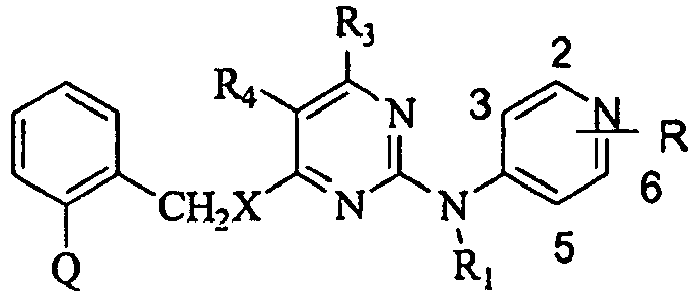
R R R R R H 3-Cl 2-OCH3 2,6-2Cl 2-OCH3-6-Cl 2-Cl 2-Br 2,6-2OCH3 6-OPh 2-NHCH3-6-Cl TABLE 4 
R R R R R R H 2-NO2 2,3-2F 2,3-2CH3 2-Cl-4-F 4-CH3-2-Br 2-F 3-NO2 2,4-2F 2,4-2CH3 2-Cl-4-Br 4-CH3-2-Cl 3-F 4-NO2 2,5-2F 2,5-2CH3 2-Cl-4-I 2,4,6-3CH3 4-F 2-SCF3 2,6-2F 2,6-2CH3 3-Cl-4-I 2,4,6-3C2H5 2-Cl 3-SCF3 3,4-2F 3,4-2CH3 4-Cl-2-Br 3-Cl 4-SCF3 3,5-2F 3,5-2CH3 3,4,5-3F 4-Cl 2-OC2H5 2,3-2Cl 2,3-2C2H5 2,3,4-3Cl 2-Br 3-OC2H5 2,4-2Cl 2,4-2C2H5 2,3,5-3Cl 3-Br 4-OC2H5 2,5-2Cl 2,5-2C2H5 2,3,6-3Cl 4-Br 2-COCH3 2,6-2Cl 2,6-2C2H5 2,4,5-3Cl 2-I 3-COCH3 3,4-2Cl 3,4-2C2H5 2,4,6-3Cl 3-I 4-COCH3 3,5-2Cl 3,5-2C2H5 3,4,5-3Cl 4-I 2-N(C2H5)2 2,3-2Br 2,3-2CF3 2,3,4-3Br 2-CH3 3-N(C2H5)2 2,4-2Br 2,4-2CF3 2,3,5-3Br 2-CH(CH3)2 3-CH3 4-N(C2H5)2 2,5-2Br 2,5-2CF3 2,3,6-3Br 3-CH(CH3)2 4-CH3 4-Ph 2,6-2Br 2,6-2CF3 2,4,5-3Br 4-CH(CH3)2 2-C2H5 2-OPh 3,4-2Br 3,4-2CF3 2,4,6-3Br 2-CF3-4-Cl 3-C2H5 3-OPh 3,5-2Br 3,5-2CF3 3,4,5-3Br 2-CF3-4-Br 4-C2H5 4-OPh 2,3-2CN 4-CH3-3-F 3-CF3-4-NO2 2-CF3 2,3-2OCH3 2,4-2CN 4-CH3-3-Cl 3-CF3-4-F 3-CF3 2,4-2OCH3 2,5-2CN 4-CH3-3-Br 3-CF3-4-Cl 4-CF3 2,5-2OCH3 2,6-2CN 2,4,6-3CF3 4-CF3-2-NO2 2-OCH3 2,6-2OCH3 3,4-2CN 2-CH3-3-F 4-CF3-2-Cl 3-OCH3 3,4-2OCH3 3,5-2CN 2-CH3-3-Cl 4-CF3-2-Br 4-OCH3 3,5-2OCH3 2-F-4-CI 2-CH3-4-F 2-CH3-5-NO2 2-F-4-Br 2-CH3-4-Cl 2-CH3-3-NO2 2-F-4-I 2-CH3-4-Br 2-F-5-Cl 2,3-2OCF3 2-CH3-5-F 2-OCF3 3-F-5-Cl 2,4-2OCF3 2-CH3-5-Cl 2-CH3-4-NO2 3-OCF3 4-F-3-Cl 2,5-2OCF3 2-CH3-5-Br 2-CH3-4-OCH3 4-OCF3 2,3-2NO2 4-F-6-Cl 2,6-2OCF3 2-CH3-6-Cl 2-CH3-6-C2H5 2-CN 2,4-2NO2 2,3,4-3F 3,4-2OCF3 3-CH3-2-Br 2-CH3-6-NO2 3-CN 2,5-2NO2 2,3,5-3F 3,5-2OCF3 3-CH3-4-Cl 2,4,6-3NO2 4-CN 2-OCHF2 2,6-2NO2 2,3,6-3F 3-CH3-4-Br 2,3-2Cl-4-Br 3-OCHF2 3,4-2NO2 2,4,5-3F 3-CH3-4-I 2,4-2F-6-Cl 4-OCHF2 3,5-2NO2 2,4,6-3F 2-CH3-4-I 2-NO2-4,6-2Br R R R R R 5-CF3-2-Cl 5-CF3-2-OCH3 4-CH3-2,6-2Br 2-NO2-4-F 5-CF3-2-Br 2-CF3-4-NO2 5-CH3-4-F-6-Cl 2-NO2-4-Cl 2-CN-3-F 2,4-2NO2-6-Cl 4-C(CH3)3-2-Cl 2-NO2-4-Br 2-CN-3-Cl 2,4-2NO2-6-Br 4-CF3-2-Cl-6-Br 5-CH3-2-OCH3-4-Cl 2-NO2-5-Cl 2-CN-4-NO2 2,3-2CH(CH3)2 3-NO2-4-Cl 2-CN-4-Cl 2,4-2CH(CH3)2 3-NO2-4-Br 2-CN-4-Br 2,5-2CH(CH3)2 2-CH3-4-NO2-6-Cl 4-NO2-2-Cl 4-CN-2-CF3 2,6-2CH(CH3)2 2,4,6-3CH(CH3)2 2-CH3-4-NO2-6-Br 5-NO2-2-Cl 4-CN-2-Cl 3,4-2CH(CH3)2 2,4,6-3C(CH3)3 2-CH3-6-NO2-4-Cl 5-NO2-2-Br 4-CN-2-NO2 3,5-2CH(CH3)2 2,3-2CH3-6-NO2 2-CH3-6-NO2-4-Br 2-OCH3-5-Cl 5-CH3-2-F 2-NO2-4-OCH3 2,4-2OCH3-5-Cl 2,5-2OCH3-4-NO2 4-OCH3-3-F 4-CH3-2-NO2 2-NO2-4-OC2H5 2,6-2CH3-4-C(CH3)3 4-OCH3-3-Cl 4-CH3-3-NO2 2,3-2C(CH3)3 4-CF3-2-NO2-5-Cl 3-NO2-4-F 5-CH3-2-CN 2,4-2C(CH3)3 4-CF3-2-NO2-6-Cl 2-OCF3-4-CN 5-NO2-2-F 2,5-2C(CH3)3 4,5-2CH3-2-NO2 4-CF3-2-NO2-6-Br 2-OCF3-4-Cl 2-CF3-4,6-2Cl 2,6-2C(CH3)3 2-NO2-4-F-5-Cl 2-OCF3-4-Br 2-CF3-4,6-2Br 3,4-2C(CH3)3 2-CN-4-NO2-6-Cl 2-F-4,6-2Br 3-CH3-2,6-2Cl 3,5-2C(CH3)3 2-CN-4-NO2-6-Br 4-OCF3-2-Cl 2-CH3-4,6-2Br 4-SO2NH2 4-OCF3-2-Br 2,4,6-3OCH3 4-NO2-2-OCH3 2,3,5,6-4F 3,4,5-3OCH3 2-CN-4,6-2Cl 2-CN-4,6-2Br 2,4,6-3OCF3 4-CN-2,6-2Cl 4-CF3-2,6-2Cl 5-NO2-2-OCH3 4-CF3-2,6-2Br 5-CH3-2-OCH3 2,3,4,5,6-5Cl 4-F-2,6-2Br 4-NO2-2,6-2Cl 2,3-(CH2CH2CH2-) 2,3-(OCF2O-) 2-F-3-Cl 2,4-2F-6-Cl 4-OCF3-2-NO2 2,3-(CH2CH2CH2CH2-) 2,3-(OCH2O-) 3-CH3-2-Cl 2-F-4-Cl-6-Br 6-NO2-2,3,4-3F 4-NO2-2,5-2Cl 3,4-(OCH2O-) 2,3,5,6-4F-4-CF3 4-NO2-2,6-2Br 4-F-3-Cl-2,6-2Br 3,4-(OCF2O-) 
TABLE 6 
-NR1R2 -NR1R2 -NR1R2 


TABLE 8 
R2 R2 R2 R2 R2 H (CH2)6CH3 CF3 COCH2Cl CH2CO2CH3 CH3 (CH2)7CH3 COCH2Br CH2CO2C2H5 C2H5 OCH3 COPh CH2C(CH3)2CH3 
OC2H5 COCH3 CH2CH2C(CH3)3 (CH2)2CH3 OC(CH3)3 COC2H5 CH(CH3)CH2CH3 CH(CH3)2 OCH2CF3 CO2CH3 CH2CH(CH3)2 (CH2)3CH3 CN CO2C2H5 CH2C(CH3)3 C(CH3)3 CH2CN SO2CH3 NHCH2CF3 (CH2)5CH3 CH2CH2CN SO2C2H5 NHPh-4-Cl NH2 N(CH3)2 NHPh CH(CH3)CH2CH(CH3)2 

NHCH2CN CONHCOPh NHCOCH2CN CONHCOPh-2-Cl 


CONHCOPh-2,6-2Cl CONHCOPh-2,6-2F - Compounds of the present invention include the following compounds in Table 7, but without being restricted thereby.
TABLE 7 
No. X R1 R2 R3 R4 1 O H Ph CH3 H 2 O H Ph CF3 H 3 O H Ph i-Pr H 4 O H Ph t-Bu H 5 O H Ph cyclopropyl H 6 O H Ph Cl H 7 O H Ph Br H 8 O H Ph OCH3 H 9 O H Ph OCH2CF3 H 10 O H Ph NO2 H 11 O H Ph CN H 12 O H Ph CH3 CH3 13 O H Ph CF3 CH3 14 O H Ph i-Pr CH3 15 O H Ph t-Bu CH3 16 O H Ph cyclopropyl CH3 17 O H Ph CH3 Cl 18 O H Ph CF3 Cl 19 O H Ph i-Pr Cl 20 O H Ph t-Bu Cl 21 O H Ph cyclopropyl Cl 22 O H Ph CH3 Br 23 O H Ph CF3 Br 24 O H Ph i-Pr Br 25 O H Ph t-Bu Br 26 O H Ph cyclopropyl Br 27 O H Ph CH3 OCH3 28 O H Ph CF3 OCH3 29 O H Ph i-Pr OCH3 30 O H Ph t-Bu OCH3 31 O H Ph cyclopropyl OCH3 32 0 H Ph CF3 NO2 33 O H Ph CF3 CN 34 O H Ph CF3 CH2Cl 35 O H Ph CF3 CH2CH2Cl 36 O H Ph CF3 OCH2CF3 37 S H Ph CH3 H 38 S H Ph CF3 H 39 S H Ph cyclopropyl H 40 S H Ph Cl H 41 S H Ph Br H 42 O H Ph OCH3 H 43 S H Ph OCH2CF3 H 44 S H Ph CH3 CH3 45 S H Ph CF3 CH3 46 S H Ph i-Pr CH3 47 S H Ph CH3 Cl 48 S H Ph CF3 Cl 49 S H Ph CF3 Br 50 S H Ph CH3 OCH3 51 S H Ph CF3 OCH3 52 S H Ph CF3 OCH2CF3 53 S H Ph CF3 CN 54 O H Ph-2-Cl CF3 H 55 O H Ph-2-CH3 CF3 H 56 O H Ph-2-F CF3 H 57 O H Ph-2-C2H5 CF3 H 58 O H Ph-2-CH(CH3)2 CF3 H 59 O H Ph-2-OCH3 CF3 H 60 O H Ph-2,3-(OCH2O-) CF3 H 61 O i-Pr Ph CH3 CH3 62 O i-Pr Ph CF3 H 63 O i-Pr Ph CF3 Cl 64 O i-Pr Ph CH3 OCH3 65 O i-Pr Ph CF3 OCH3 66 O H Ph-2-Cl CH3 Cl 67 O H Ph-2-CH3 CF3 H 68 O H Ph-3,5-2Cl CF3 H 69 O H Ph-2-CH3-3-Cl CF3 H 70 O H Ph CH3 (CH2)3CH3 71 O H Ph-4-CF3 CF3 H 72 O H Ph-2,6-2F CF3 H 73 O H Ph-2,6-2Cl CF3 H 74 O H Ph-3-Cl CF3 H 75 O H Ph-4-OCH3 CF3 H 76 O H Ph-4-F CF3 H 77 O H Ph-4-CH3 CF3 H 78 O H 2-chloro-pyridin-3-yl CF3 H 79 O H Ph-2,4-2CH3 CF3 H 80 O H Ph-2,3-2Cl CF3 H 81 O H Ph-2,5-2CH3 CF3 H 82 O H CH2Ph-2-Cl CF3 H 83 O H Ph-3,4-2CH3 CF3 H 84 O H Ph-2,4,5-3CH3 CF3 H 85 O H Ph-2-CH3-4-Cl CF3 H 86 O H CH2Ph CF3 H 87 O H Ph-4-Cl CH3 H 88 O H Ph-4-Cl CF3 H 89 O 
CF3 H 90 O 
CF3 H 91 O 
CF3 H 92 O 
CF3 H 93 O 
CF3 H - The present invention also includes preparation of the compounds having formula I:
- When Q is choosen from one of Q1, Q2, Q4, Q6-Q13, compounds having general formula I and their stereoisomers can be prepared by reaction of pyrimidine compounds containing hydroxy group having general formula III with halomethylbenzene having general formula IV at the present of base:

-
- The reaction can be carried out in proper solvent, which may be selected from tetrahydrofuran, acetonitrile, toluene, xylene, benzene, DMF, DMSO, acetone or butanone and so on.
- The base mentioned above may be such as potassium hydroxide, sodium hydroxide, sodium carbonate, potassium carbonate, sodium bicarbonate, triethylamine, pyridine, sodium methoxide, sodium ethoxide, sodium hydride, potassium tert-butoxide or sodium tert-butoxide.
- The temperature is suitably from room temperature to boiling point of solvent, generally from 20 to 100°C.
- The reaction may be finished after 30 minutes to 20 hours, 1 hour to 10 hours in general.
- Suitable salts of formula I were obtained from the compounds of formula I with 2-aminopyrimidine group reacting with inorganic acids, for example hydrochloric or, phosphoric acid, with organic acids such as acetic acid, benzenesulfonic acid or oxalic acid.
- Intermediates of the general formula III can be prepared by reaction of intermediates of the general formula II with ethyl 3-oxobutanoate or ethyl 4,4,4-trifluoro-3-oxobutanoate according to known methods, refer to
GB1388402 US4000138 ,CH395385 EP310550 EP0655441 . - Examples of intermediate III are listed in table 8:

TABLE 8 Intermediate III 
No. R1 R2 R3 R4 m.p. (°C) A1 H Ph CH3 H 258-260 A2 H Ph CF3 H 279-281 A3 H Ph CH3 CH3 282-284 A4 H Ph CH3 (CH2)3CH3 183-185 A5 H Ph cyclopropyl H 112-115 A6 H Ph-4-Cl CH3 H 251-253 A7 H Ph-4-Cl CF3 H 276-278 A8 H Ph-4-Cl CF3 Cl A9 H Ph-4-CF3 CF3 H 213-215 A10 H Ph-2,6-2F CF3 H 158-160 A11 H Ph-2,6-2Cl CF3 H 216-218 A12 H Ph-3-Cl CF3 H 196-198 A13 H Ph-4-OCH3 CF3 H 156-158 A14 H Ph-4-CH3 CF3 H 207-209 A15 H Ph-4-F CF3 H 204-206 A16 H 2-chloro-pyridin-3 -yl CF3 H >295 A17 H Ph-2-CH3 CF3 H 222-224 A18 H Ph-2-Cl CF3 H >290 A19 H Ph-2-CH3-3-Cl CF3 H 234-236 A20 H Ph-2,4-2CH3 CF3 H 230-232 A21 H Ph-2,3-2Cl CF3 H 264-266 A22 H Ph-3,5-2Cl CF3 H 287-288 A23 H Ph-2,5-2CH3 CF3 H 216-218 A24 H CH2Ph-2-Cl CF3 H 157-159 A25 H Ph-3,4-2CH3 CF3 H 136-137 A26 H Ph-2,4,5-3Cl CF3 H 260-262 A27 H Ph-2-CH3-4-Cl CF3 H 212-214 A28 H CH2Ph CF3 H 152-154 A29 
CF3 H 168-170 A30 
CF3 H 261-263 A31 
CF3 H 220-222 Intermediate No. 1H-NMR (300MHz, internal standard TMS, solvent CDCl3) A9 δ(ppm): 5.11(s, 1H), 642(s, 1H), 7.50(m, 1H), 7.65(m, 1H), 7.76(m, 1H), 7.91(m, 1H)(solvent DMSO). - The compounds having general formula I exert, with respect to the adults, larvae and eggs of mites and insects which are harmful in agricultures, a high acaricidal and insecticidal activity, while the compounds also exhibit preferably fungicidal activity.
- A further object of the present invention therefore relates to the use of the compounds having general formula I as acaricides, insecticides, and fungicides, both in agriculture and other fields. In particular, the compounds having general formula I are active against important species of tetranychidae (e.g. Tetranychus urticae, Tetranychus cinnabarinus, Panonychus ulmi and Panonychus citri), eriophyidae and tarsonemidae. Additionally, some compound in present invention also exhibit good fungicidal activity, which can be used to control of fungal diseases such as rice, blast, tomato late blight, cucumber downy mildew, cucumber anthracnose, corn rust and wheat powdery mildew.
- At the same time, the compounds having general formula I have a low toxicity with respect to many useful insects and mites, mammals, fish, birds, and have no phytotoxicity
- Thanks to their positive characteristics, they can be advantageously used in defending not only crops of agrarian and horticultural interest, but also domestic and breeding animals, as well as environments frequented by human beings, from harmful mites and insects
- For obtaining the desired effect, the quanlity of compounds can be varied m relation to various factors such as, the compound used, the crop to be preserved, the type of harmful organism, the degree of infestation, the climatic conditions, the method of application, the formulation adopted.
- Doses of compounds ranging from 10g to 5kg per hectare generally provide a sufficient control
- A further object of the present invention also relates to a method for controlling mites and/or insects and/or phytopathogenic fungi in crops of agrarian and horticultural interest and/or on domestic and breeding animals and/or environments frequented by human beings, by the application of the compounds having general formula I. In particular, the quantity of compounds to be applied varies from 10g to 5kg per hectare.
- For practical application in agriculture, it is usually beneficail to use compositions containing one or more compounds having general formula I.
- A further object of the present invention therefore relates to acaricidal, insecticidal and fungicidal compositions containing compounds having general formula I as active principle and acceptable carrier in agriculture, the active component of the compositions is 0.5-90%.
- Compositions can be used in the form of dry powders, wettable powders, emulsifiable concentrates, microemulsions, pastes, granulates, solutions, suspensions, etc.: the selection of the type of compositions depends on the specific application.
- The compositions are prepared in the known way, for example by diluting or dissolving the active substance with a solvent medium and/or a solid diluent, optionally in the presence of surfactant
- Solid diluents, or carriers which can be used are, for example: silica, kaolin, bentonite, talc, diatomite, dolomite, calcium carbonate, magnesia, chalk, clays, synthetic silicates, attapulgite, sepiolite.
- Liquid diluents which can be used are, for example, besides water, aromatic organic solvents (xylols or mixtures of alkylbenzols, chlorobenzene, etc.), paraffins (petroleum fractions), alcohols (methanol, propanol, butanol, octanol, glycerin, etc.), esters (ethyl acetate, isobutyl acetate, etc.), ketones (cyclohexanone, acetone, acetophenone, isophorone, ethylamylketone, etc.), amides (N, N-dimethylformamide, N- methylpyrrolidone, etc.).
- Surfactant which can be used are salts of sodium, calcium, triethylamine or triethanolamine of alkylsulfonates, alkylarylsulfonates, polyethoxylated alkylphenols, polyethoxylated esters of sorbitol, ligninsulfonates, etc..
- The compositions can also contain special additives for particular purposes, for example adhesive such as Arabic gum, polyvinyl alcohol, polyvinyl-pyrrolidone, etc..
- The concentration of active principle in the above compositions can vary within a wide range depending on the active compound, the applications for which they are destined, the environmental conditions and the type of formulation adopted. In general the concentration of active principle ranges from 1 to 90%, preferably from 5 to 50%.
- It is possible to add to the compositions, other active principles compatible with the compounds having general formula I according to requirement, such as, for example, other acaricides/insecticides, fungicides, phytoregulators, antibiotics, herbicides, fertilizers.
- Several formulations of preparation methods, for example as follows:
- The preparation of suspension concentrate: the common active component in formula is 5% -35%. With water as the medium, the compound, dispersing agent, suspending agent and antifreeze agent are added to sanding machine for grinding to make suspension concentrate.
- The preparation of water emulsion: the compound, solvent and emulsifier are mixed together, to make a homogeneous oil phase. The water is mixed with antifreeze, as a homogeneous water phase. In the high-speed stirring, the aqueous phase added to the oil phase or oil phase is added to the aqueous phase, forming a good dispersion of the water emulsion. The active component of emulsions is generally 5% -15% in this invention. For the production of concentrated emulsions, the compounds of this invention are soluble in one or more of the mixed solvent, and then emulsifier is added to enhance dispersion effects in the water.
- The preparation of wettable powder: the compound, surfactants and solid diluent are mixed well according to recipe requirements, after smashing through ultrafine pulverizer, that is the wettable powder products (for example, 10% -40%). For preparing the spraying wettable powder, the compounds of this invention can be mixed with solidpower to form the mixture, such as clay, inorganic silicates, carbonates, as well as wetting agents, adhesives and/or dispersant agent. ,
- The preparation of water dispersible granules: the compound and powdered solid diluents, wetting agents and adhesives are mixed to smash, kneaded together with water and added to the granulation 10-100 mesh machine for granulation, then by drying and sieving (at the scope screen). Also, the compounds, dispersants, wetting agents, disintegrants and solid diluent are added sanding machine, grinded with water for medium to produce suspension and then spray-drying granulation, usually the preparation of content is 20% -30% granular products.
- The folloing examples are illustrative of the present invention, but without being restricted thereby.
-

- 1.32 g of intermediate 3 (prepared accoriding to Bioorganic & Medicinal Chemistry Letters, 2004,14(17) : 4449-4452) was dissolved in 30 ml of butanone, 1.6 g potassium carbonate was added to the solution, which is stirred to no bubble, then 1.25 g intermediateIV-1 was added, heated to reflux, after 8 hours, the reaction was traced by Thin-Layer Chromatography, then the salt was removed by filtration, washed by ethyl acetate, the combined organic extacts were concentrated at reduced pressure. The crude product was purified through silica column (ethyl acetate/petroleum ether (boiling point range 60-90°C) = 1/5, as an eluent) and light yellow thick oil (compound 2) was obtained, which solidified to give 1.52 g product, m.p.106-109°C.
- 1H-NMR spectrum(300MHz, internal standard: TMS, solvent CDCl3) is as follows: δ(ppm): 3.70(s, 3H), 3.78(s, 3H), 5.33(s, 2H), 6.48(s, 1H), 7.07(m, 1H), 7.20(m, 1H), 7.34(m, 4H), 7.49(m, 2H), 7.58(s, 1H), 7.63(m, 2H).
- Other compounds were prepared similarly.
- Physical and chemical property and 1HNMR spectrum (1HNMR, 300MHz, internal standard:TMS, solvent CDCl3) of some compounds having the general formula I of this invention are as follows:
- Compound 1: thick oil. δ(ppm): 2.20(3H, s), 3.71(3H, s), 3.77(3H, s), 5.33(2H, s), 6.52(1H, s), 7.11(1H, m), 7.20(1H, m), 7.39(4H, m), 7.45(2H, m), 7.59(1H, s), 7.60(2H, m).
- Compound 5: m.p. 54-56°C. δ(ppm): 1.01(m, 2H), 1.15(m, 2H), 1.83(m, 1H), 3.65(s, 3H), 3.78(s, 3H), 5.27(s, 2H), 6.06(s, 1H), 7.01(m, 1H), 7.18(m, 1H), 7.33(m, 4H), 7.51(m, 1H), 7.57(m, 1H), 7.62(m, 2H).
- Compound 12: m.p. 136-138°C. δ(ppm): 2.05(s, 3H), 2.36(s, 3H), 3.68(s, 3H), 3.74(s, 3H), 5.32(s, 2H), 6.98(m, 1H), 7.20(m, 1H), 7.35(m, 4H), 7.58(m, 1H), 7.61(s, 1H), 7.63(m, 2H).
- Compound 18: thick oil. δ(ppm): 3.74(s, 3H), 3.84(s, 3H), 4.49(s, 2H), 7.13(m, 1H); 7.33(m, 5H), 7.54(m, 2H), 7.60(m, 1H), 7.71(m, 1H).
- Compound 44: m.p. 84-85°C. δ(ppm): 1.16(t, 6H), 3.58(q, 4H), 3.68(s, 3H), 3.80(s, 3H), 5.28(s, 2H), 6.21(s, 1H), 7.18(m, 1H), 7.34(m, 2H), 7.48(m, 1H), 7.57(s, 1H).
- Compound 66: m.p. 135-137°C. δ(ppm): 3.68(s, 3H), 3.77(s, 3H), 5.38(s, 2H), 6.48(s, 1H), 6.92(m, 1H), 7.01(m, 2H), 7.20(m, 1H), 7.37(m, 2H), 7.54(m, 2H), 7.94(s, 1H).
- Compound 67: m.p. 118.120°C. δ(ppm): 2.35(s, 3H), 3.66(s, 3H), 3.74(s, 3H), 5.26(s, 2H), 6.45(s, 1H), 7.08(m, 2H), 7.16(m,1H), 7.22(m, 2H), 7.34(m, 2H), 7.38(m, 1H), 7.54(s, 1H)).
- Compound 68: m.p. 147-149°C. δ(ppm): 3.75(s, 3H), 3.83(s, 3H), 5.25(s, 2H), 6.55(s, 1H), 7.01(s, 1H), 7.26(m, 1H), 7.34(m, 2H), 7.44(m, 2H), 7.63(s, 1H), 7.67(s,1H).
- Compound 69: m.p. 134-136°C. δ(ppm): 2.34(s, 3H), 3.68(s, 3H), 3.80(s, 3H), 5.35(s, 2H), 6.58(s, 1H), 7.22(m, 2H), 7.26(m, 1H), 7.37(m, 2H), 7.51(m, 1H), 7.58(s, 1H), 7.75(s, 1H), 8.42(d, 1H).
- Compound 70: m.p. 85-88°C.δ(ppm): 0.91(t, 3H), 1.40(m, 4H), 2.40(s, 3H), 2.53(t, 2H), 3.69 s, 3H), 3.75(s, 3H), 5.24(s, 2H), 7.01(m, 1H), 7.32(m, 5H), 7.58(m, 3H), 7.61(s, 1H).
- Compound 71: m.p. 149-151°C.δ(ppm): 3.74(s, 3H), 3.81(s, 3H), 5.35(s, 2H), 6.57(s, 1H), 7.21(m, 1H), 7.35(m, 2H), 7.48(m, 1H), 7.57(m, 2H), 7.62(s, 1H), 7.78(m, 2H).
- Compound 72: m.p. 146-149°C.δ(ppm): 3.67(s, 3H), 3.75(s, 3H), 5.16(s, 2H), 6.48(s, 1H), 6.71(m, 1H), 7.00(m, 2H), 7.18(m, 2H), 7.32(m, 2H), 7.54(s, 1H).
- Compound 73: m.p. 184-186°C.δ(ppm): 3.64(s, 3H), 3.70(s, 3H), 5.10(s, 2H), 6.46(s, 1H), 6.93(m, 1H), 7.25(m, 4H), 7.43(m, 2H), 7.53(s, 1H).
- Compound 74: m.p. 125-126°C.δ(ppm): 3.73(s, 3H), 3.81(s, 3H), 5.31(s, 2H), 6.52(s, 1H), 7.00(m, 1H), 7.20 (m, 2H), 7.35(m, 2H), 7.50(m, 2H), 7.61(s, 1H), 8.79(m, 1H).
- Compound 75: m.p. 137-139°C.δ(ppm): 3.70(s, 3H), 3.78(s, 3H), 3.81(s, 3H), 5.29(s, 2H), 6.43(s, 1H), 6.90(m, 2H), 7.20(m, 2H), 7.35(m, 2H), 7.52(m, 2H), 7.58(s, 1H).
- Compound 76: m.p. 136-138°C.δ(ppm): 3.72(s, 3H), 3.80(s, 3H), 5.30(s, 2H2), 6.49(s, 1H), 7.03(m, 2H), 7.20(m, 1H), 7.35(m, 2H), 7.47(m, 1H), 7.57(m, 2H), 7.60(s, 1H).
- Compound 77: m.p. 140-142°C.δ(ppm): 2.33(s, 3H), 3.70(s, 3H), 3.78(s, 3H), 5.31(s, 2H), 6.45(s, 1H), 7.14(m, 2H), 7.20(m, 1H), 7.35(m, 2H), 7.50(m, 3H), 7.58(s, 1H).
- Compound 78: m.p. 128-130°C.δ(ppm): 3.69(s, 3H), 3.81(s, 3H), 5.36(s, 2H), 6.61(s, 1H), 7.03(m, 2H), 7.20(m, 1H), 7.29(m, 1H), 7.38(m, 2H), 7.60(s, 1H), 7.67(s, 1H), 8.82(m, 1H).
- Compound 79: m.p. 126-127°C.δ(ppm): 2.29(s, 3H), 2.33(s, 3H), 3.66(s, 3H), 3.74(s, 3H), 5.23(s, 2H), 6.4 (s, 1H), 6.89(s, 1H), 7.05(m, 2H), 7.17(m, 1H), 7.33(m, 3H), 7.54(s, 1H), 7.70(d, 1H).
- Compound 80: m.p. 134-136°C.δ(ppm): 3.68(s, 3H), 3.80(s, 3H), 5.35(s, 2H), 6.58(s, 1H), 7.22(m, 2H), 7.26(m, 1H), 7.37(m, 2H), 7.51(m, 1H), 7.58(s, 1H), 7.75(s, 1H), 8.42(d, 1H).
- Compound 81: oil. δ(ppm): 2.29(s, 3H), 2.32(s, 3H), 3.64(s, 3H), 3.71 (s, 3H), 5.25(s, 2H), 6.43(s, 1H), 6.91(m, 2H), 7.13(m, 2H), 7.33(m, 2H), 7.53(s, 1H, CH), 7.72(s, 1H).
- Compound 82: m.p. 133-135°C.δ(ppm): 3.66(s, 3H), 3.77(s, 3H), 4.70(d, 2H), 5.26(s, 2H), 6.32(s, 1H), 7.20(m, 3H), 7.35(m, 5H), 7.57(s, 1H).
- Compound 83: m.p. 142-144°C.δ(ppm): 2.23(s, 3H), 2.25(s, 3H), 3.70(s, 3H), 3.78(s, 3H), 5.26(s, 2H), 6.44(s, 1H), 7.11(m, 1H), 7.20(m, 2H), 7.35(m, 2H), 7.40(m, 1H), 7.48(s, 1H), 7.53(s, 1H).
- Compound 84: thick oil. δ(ppm): 3.63(s, 3H), 3.72(s, 3H), 4.80(s, 2H), 6.37(s, 1H), 6.95(m, 2H), 7.06(m, 2H), 7.40(m, 1H), 7.49(m, 1H), 7.58(s, 1H). 3H), 3.76(s, 3H), 5.25(s, 2H),
- Compound 85: m.p. 138-140°C.δ(ppm): 2.31(s, 3H), 3.67(s, 3H), 3.76(s, 3H), 5.25(s, 2H), 6.48(s, 1H), 6.92(d, 1H), 7.20(m, 3H), 7.35(m, 2H), 7.40(m, 1H), 7.55(s, 1H), 7.82(d, 1H).
- Compound 86: m.p. 122-124°C.δ(ppm): 3.64(s, 3H), 3.75(s, 3H), 4.60(d, 2H), 5.22(s, 2H), 6.3.2(s, 1H), 7.19(m, 1H), 7.33(m, 7H, 7.42(m, 1H),7.58(s, 1H).
- Compound 87: thick oil. δ(ppm): 2.34(s, 3H), 3.70(s, 3H), 3.78(s, 3H), 5.27(s, 2H), 7.19(m, 1H,), 7.24(m, 2H), 7.34(m, 2H), 7.49(m, 1H), 7.55(m, 2H), 7.58(m, 1H).
- Compound 88: thick oil. δ(ppm): 3.72(s, 3H), 3.78(s, 3H), 5.31(s, 2H), 6.51(s, 1H), 7.19(m, 1H), 7.29(m, 2H), 7.35(m, 2H), 7.48(m, 1H), 7.57(m, 2H), 7.60(m, 1H).
- Compound 89: m.p. 93-95°C.δ(ppm): 1.59(m, 4H), 1.62(m, 2H), 3.68(s, 3H), 3.77(m, 4H), 3.84(s, 3H), 5.27(s, 2H), 6.17(s, 1H), 7.19(m, 1H), 7.34(m, 2H), 7.48(m, 1H), 7.56(s, 1H).
- Compound 90: m.p. 142-144°C.δ(ppm): 3.68(s, 3H), 3.75(m, 8H), 3.81(s, 3H), 5.28(s, 2H), 6.27(s, 1H), 7.19(m, 1H), 7.35(m, 2H), 7.46(m, 1H), 7.57(s, 1H).
- Compound 91: thick oil. δ(ppm): 1.25(d, 6H), 2.59(m, 2H), 3.60(m, 2H), 3.68(s, 3H), 3.80(s, 3H), 4.53(m, 2H), 5.28(s, 2H), 6.24(s, 1H), 7.19(m, 1H), 7.35(m, 2H), 7.49(m, 1H), 7.56(s, 1H).
- Example 2: 30% Compound 2 wettable powders
Compound 2 30% Sodium dodecyl sulfate 2% Lignin sulfonate 3% Naphthalene sulfonic acid formaldehyde condensate 5% Precipitated calcium carbonate Make up to 100% - Compound 2 and other components are fully mixed, after smashing through ultrafine pulverizer.
-
Compound 2 40% Glycol 10% Nonylphenols polyethylene glycol ether 6% Lignin sulfonate 10% Carboxymethyl cellulose 1% 37% formaldehyde aqueous solution 0.2% 75% of silicone oil water emulsion 0.8% Water make up to 100% - Fully mixing the compound 2 and other components, suspension concentrate can be obtained, water suspension can be diluted from the concentration of any necessary dilution.
-
Compound 2 60% Naphthalene sulfonate formaldehyde condensate 12% Sodium-N-methyl-N-oleyl taurate 8% Polyvinylpyrrolidone 2% Carboxymethyl cellulose 2% Kaolin make up to 100% - To mix the compound 2 and other components , after smashing, kneading together with water, added to the granulation 10-100 mesh machine for granulation, then by drying and sieving (at the scope screen).
- Determination of insecticidal and acaricidal activity of selected compounds were carried out by following procedure:
- Compounds were dissolved in mixed solvent (acetone: methanol=1:1), and diluted to required concentration with water containing 0.1% of Tween 80.
- The second instar larvae of armyworm(Spodoptera exigua), diamond backmoth (Plutella xylostella), green peach aphids (Myzus persicae) and mite (Tetranychus cinnabarinus) were used in biological test. The method was employed either spraying by airbrush. A test solution (0.5 ml) was sprayed at the pressure of 0.7 kg/cm2. Percent mortality was determined after 2-3 days.
- Part of test results:
- At 600 mg/L, compound 5, showed 100% control of diamond backmoth. Compounds 2, 5, 78, 79, 80 and 83 showed 100% control of mite.
- At 150 mg/L, compound 2 showed 100% control of mite.
- At 40 mg/L, compounds 78 and 80 showed 100% control of mite. Compound 83 showed more than 95% control of mite.
- At 5 mg/L, compounds 2, 78 and 80 showed more than 50% control of mite.
- At 10 mg/L, compound 2 showed 100% inhibition acivity on carmine spider mite eggs. At 5 mg/L, compound 2 showed 80% inhibition activity on carmine spider mite eggs..
- At 20 mg/L, compound 2 showed 100% control on nymph of carmine spider mite. At 10 mg/L, compound 2 showed 90% control on nymph of carmine spider mite.
- Determination of fungicidal activities against plant diseases of selected compounds were carried out by following procedure:
- Compounds were dissolved into DMSO to receive three solutions of 2000 mg/L, 667 mg/L and 222 mg/L for test. The solution for inhibition of fungal growth was added in 96 well polystyrene microtiter plates so that all wells receive 1 µl of DMSO solution of test compound, then 79 µl fungus conidial suspension were added into wells to receive the required concentration 25 mg/L, 8.3 mg/L and 2.8 mg/L respectively, which were placed into incubator. After 24 hours incubation, all plates were evaluated for inhibition percent of fungal growth.
- Compounds were disolved into acetone to receive stock solution. Deionized water containing 0.1% Tween 80 was added in the previous solution to receive 20 ml test solution. Plants are sprayed by using a turntable sprayer. After 24 hours, plants were innoculated with a conidial suspension. Plants were then transferred into a dew chamber [R.H. (relative humidity) >95%] for infection. After this treatment, plants were removed from the chamber to the greenhouse for normal maintaining, After the infection period, the plants were placed in the greenhouse. After 1 week, the plants were scored for disease control.
- At 25 mg/L, compounds, 1, 2, 5 and 12, showed 100% control of rice blast. Compounds 1, 2, 5 and 12 showed 100% control of tomato late blight. Compounds 1, 2, and 12 showed more than 50% control of cucumber grey mold.
- At 8.3 mg/L, compounds 1 and 2 showed 100% control of rice blast, Compounds 5 and 12 showed about 80% control of rice blast.
- At 2.8 mg/L, compounds 1 and 2 showed 100% control of rice blast, compound 12 showed about 80% control of rice blast.
- Part of test results in vivo:
- At 400 mg/L, compounds 1, 2, 5, and 12 showed 100% control of cucumber downy mildew, compounds 1, 2, 5, and 12 showed 100% control of cucumber anthracnose, compounds 1, 2 and 5 showed more than 80% control of wheat powdery mildew.
- At 25 mg/L, compounds 1, 5, and 12 showed 100% control of cucumber downy mildew, compounds 1, 2, 5, and 12 showed 100% control of cucumber anthracnose. Compounds 1, 5 and 12 showed 100% control of corn rust.
- At 6.25 mg/L, compound 5, showed more than 80% control of corn rust.
Claims (5)
- A substituted pyrimidine ether compound of general formula I:
 R1 is selected from H or C1-C4 alkyl:R2 is selected from phenyl, benzyl or pyridyl; each phenyl, benzyl and pyridyl optionally substituted with 1-3 substituents independently selected from the group consisting of halogen, NO2, CN, C1-C3alkyl, C1-C3haloalkyl, C1-C3alkoxy or C1-C3haloalkoxy;Or NR1R2 can join together to form morpholine, piperidine, pyrrolidine or piperazine;R3 and R4 may be the same or different, selected from H, Cl, Br, NO2, CN, C1-C4alkyl, C1-C4haloalkyl, C3-C6cycloalkyl, C1-C3alkoxy or C1-C3haloalkoxy;X is selected from O or S;Or a salt formed with hydrochloric, phosphoric, acetic, benzenesulfonic or oxalic acid.
 - The compound according to claim 1, wherein:R1 is selected from H or methyl;R2 is selected from phenyl or pyridyl; each phenyl and pyridyl optionally substituted with 1-3 substituents independently selected from the group consisting of halogen, CN, C1-C3alkyl, C1-C3haloalkyl, C1-C3alkoxy or C1-C3haloalkoxy;Or NR1R2 can join together to form morpholine, piperidine, pyrrolidine or piperazine;R3 is selected from H, Cl, Br, F, methyl, cyclopropyl or CF3;R4 is selected from H, Cl, Br, F, CH3 or CN;X is selected from O ;Or a said salt.
- The compound according to the claim 2, wherein:R1 is H;R2 is selected from phenyl or pyridyl; each phenyl and pyridyl optionally substituted with 1-3 substituents independently selected from the group consisting of Cl, F, CN, methyl, CF3, OCH3 or OCF3 ;Or NR1R2 can join together to form morpholine or piperidine;R3 is selected from methyl, cyclopropyl or CF3;R4 is selected from H, Cl or CH3;XisO.
- Use of a compound according to claim 1, as an insecticide, acaricide or fungicide.
- A composition for use as an insecticide, acaricide or fungicide containing a compound according to claim 1 as an active ingredient, wherein the weight percentage of the active ingredient in the composition is from 0.5-90%.
Applications Claiming Priority (2)
| Application Number | Priority Date | Filing Date | Title |
|---|---|---|---|
| CN2007100114341A CN101311170B (en) | 2007-05-25 | 2007-05-25 | Substituted pyrimidine ether compounds and their applications |
| PCT/CN2008/071042 WO2008145052A1 (en) | 2007-05-25 | 2008-05-22 | Substituted pyrimidine ether compounds and their use |
Publications (3)
| Publication Number | Publication Date |
|---|---|
| EP2149564A1 EP2149564A1 (en) | 2010-02-03 |
| EP2149564A4 EP2149564A4 (en) | 2011-10-19 |
| EP2149564B1 true EP2149564B1 (en) | 2013-12-25 |
Family
ID=40074579
Family Applications (1)
| Application Number | Title | Priority Date | Filing Date |
|---|---|---|---|
| EP08748648.6A Not-in-force EP2149564B1 (en) | 2007-05-25 | 2008-05-22 | Substituted pyrimidine ether compounds and their use |
Country Status (8)
| Country | Link |
|---|---|
| US (1) | US8383640B2 (en) |
| EP (1) | EP2149564B1 (en) |
| JP (1) | JP5183735B2 (en) |
| KR (1) | KR101138364B1 (en) |
| CN (2) | CN101311170B (en) |
| AU (1) | AU2008255459B2 (en) |
| BR (1) | BRPI0812303B1 (en) |
| WO (1) | WO2008145052A1 (en) |
Families Citing this family (14)
| Publication number | Priority date | Publication date | Assignee | Title |
|---|---|---|---|---|
| WO2009045985A1 (en) * | 2007-10-01 | 2009-04-09 | The University Of Chicago | Treatment of drug-induced nausea with opioid antagonists |
| CN101875639B (en) * | 2009-04-29 | 2012-07-25 | 中国中化股份有限公司 | Substituted pyrimidinyl ether compound and application thereof |
| CN101906075B (en) | 2009-06-05 | 2012-11-07 | 中国中化股份有限公司 | E-type phenyl acrylic acid ester compound containing substituted anilino pyrimidine group and applications thereof |
| CN102464622B (en) | 2010-11-19 | 2014-04-09 | 中国中化股份有限公司 | Substituted pyrimidine ammine compound and application thereof |
| EP2657229B1 (en) * | 2010-12-24 | 2016-03-30 | Nihon Nohyaku Co., Ltd. | Benzyloxypyrimidine derivative, agricultural/horticultural insecticide comprising said derivative and method for using the same |
| TWI566701B (en) | 2012-02-01 | 2017-01-21 | 日本農藥股份有限公司 | Arylalkyloxypyrimidine derivatives and agrohorticultural insecticides comprising said derivatives as active ingredients, and method of use thereof |
| CN102600164B (en) * | 2012-02-28 | 2014-04-02 | 郑州大学 | Application of pyrimidine ether compounds in preparing anti-tumor medicines |
| CN103387547B (en) * | 2012-05-10 | 2016-03-23 | 沈阳中化农药化工研发有限公司 | A kind of method preparing phonetic mite amine |
| CN103355314B (en) * | 2013-08-02 | 2015-04-08 | 陕西上格之路生物科学有限公司 | Acaricidal composition containing pyriminostrobin and etoxazole |
| CN104430410B (en) * | 2013-09-24 | 2017-07-21 | 沈阳中化农药化工研发有限公司 | The application of phonetic (pyrrole) the pyridine class compound of substitution |
| CN103563904B (en) * | 2013-11-11 | 2015-12-02 | 陕西农心作物科技有限公司 | A kind of miticide composition containing phonetic mite amine and tebufenpyrad |
| AR099795A1 (en) | 2014-03-20 | 2016-08-17 | Mitsui Chemicals Agro Inc | COMPOSITION OF CONTROL OF PLANT DISEASES AND METHOD TO CONTROL PLANT DISEASES BY APPLICATION |
| US10743535B2 (en) | 2017-08-18 | 2020-08-18 | H&K Solutions Llc | Insecticide for flight-capable pests |
| CN108314656B (en) | 2018-02-27 | 2020-10-27 | 浙江工业大学 | Unsaturated hydrocarbon pyrimidine sulfide compound and preparation method and application thereof |
Family Cites Families (22)
| Publication number | Priority date | Publication date | Assignee | Title |
|---|---|---|---|---|
| CH395385A (en) | 1961-01-23 | 1965-07-15 | Kraus Wilhelm Dr Jun | Process for the production of azo dyes |
| US4000138A (en) | 1966-03-31 | 1976-12-28 | Imperial Chemical Industries Limited | Organic compounds and compositions containing them |
| GB1388402A (en) | 1972-04-18 | 1975-03-26 | Ici Ltd | Phosphorous containing pyrimidine derivatives and pesticidal com- positions thereof |
| NZ213630A (en) * | 1984-10-19 | 1990-02-26 | Ici Plc | Acrylic acid derivatives and fungicidal compositions |
| DE3519280A1 (en) | 1985-05-30 | 1986-12-04 | Basf Ag, 6700 Ludwigshafen | STYLE DERIVATIVES AND FUNGICIDES THAT CONTAIN THESE COMPOUNDS |
| JPS6299305A (en) * | 1985-10-25 | 1987-05-08 | Kumiai Chem Ind Co Ltd | Fungicide for agriculture and horticulture |
| EP0391451A1 (en) | 1986-04-17 | 1990-10-10 | Imperial Chemical Industries Plc | Fungicides |
| EP0264348B1 (en) * | 1986-10-13 | 1993-12-15 | Ciba-Geigy Ag | Ureas |
| IL87020A (en) | 1987-07-11 | 1996-09-12 | Schering Agrochemicals Ltd | Acrylic acid derivatives and their use as pesticides |
| ES2054867T3 (en) | 1987-09-28 | 1994-08-16 | Ciba Geigy Ag | PESTICIDES AND PESTICIDES. |
| EP0335519A1 (en) | 1988-03-31 | 1989-10-04 | Imperial Chemical Industries Plc | Insecticides |
| US5194438A (en) * | 1988-07-15 | 1993-03-16 | Basf Aktiengesellschaft | α-arylacrylates substituted by a trifluoromethylpyrimidinyloxy radical, fungicidal compositions and methods |
| DE3835028A1 (en) | 1988-10-14 | 1990-04-19 | Basf Ag | OXIMETHER DERIVATIVES, METHOD FOR THE PRODUCTION THEREOF AND FUNGICIDES CONTAINING THEM |
| DE3923068A1 (en) * | 1989-07-13 | 1991-01-24 | Basf Ag | METHOD FOR CONTROLLING Pests BY SUBSTITUTED PYRIMIDINE |
| DE4029650A1 (en) * | 1990-09-19 | 1992-03-26 | Hoechst Ag | New 2-aryl:amino-pyrimidine derivs. - contg. alkynyl gp., useful as fungicides |
| DE4116090A1 (en) * | 1991-05-17 | 1992-11-19 | Basf Ag | (ALPHA) -PHENYLACRYLSAEUREDERIVATE, PROCESS FOR THEIR PREPARATION AND THEIR USE FOR THE CONTROL OF SCHAEDLINGEN AND DAMAGED MUSHROOMS |
| ES2171443T3 (en) | 1993-11-09 | 2002-09-16 | Syngenta Participations Ag | CRYSTALLINE MODIFICATION OF (4-CICLOPROPIL-6-METHYL-PYRIMIDIN-2-IL) -PHENYLAMINE, PROCEDURE FOR OBTAINING IT. |
| CN1100764C (en) * | 1994-11-17 | 2003-02-05 | 巴斯福股份公司 | 2[(2-Alkoxy-6-trifluoromethyl pyrimidine-4-yl)-oxymethylene]-phenyl-acetic acid derivatives, process and intermediate products for their production and their use |
| EP0873316B1 (en) * | 1995-12-14 | 2002-05-29 | Basf Aktiengesellschaft | 2-(o- pyrimidin-4-yl]methylenoxy)phenyl acetic acid derivatives and their use for controlling harmful fungi and animal pests |
| WO1999044969A1 (en) * | 1998-03-06 | 1999-09-10 | Nippon Soda Co., Ltd. | Methods for highly selectively o-alkylating amide compounds with the use of copper salts |
| ITMI20020814A1 (en) | 2002-04-17 | 2003-10-17 | Isagro Ricerca Srl | NEW ANALOGUES OF STROBILURINES AND THEIR USE AS ACARICIDES AND INSECTICIDES |
| KR100624238B1 (en) * | 2004-06-22 | 2006-09-19 | 한국화학연구원 | Pharmaceutical composition for the prevention and treatment of metabolic bone disease containing alpha-arylmethoxyacrylate derivative |
-
2007
- 2007-05-25 CN CN2007100114341A patent/CN101311170B/en not_active Expired - Fee Related
-
2008
- 2008-05-22 AU AU2008255459A patent/AU2008255459B2/en not_active Ceased
- 2008-05-22 CN CN2008800135162A patent/CN101668748B/en not_active Expired - Fee Related
- 2008-05-22 KR KR1020097026836A patent/KR101138364B1/en not_active Expired - Fee Related
- 2008-05-22 BR BRPI0812303A patent/BRPI0812303B1/en not_active IP Right Cessation
- 2008-05-22 US US12/597,173 patent/US8383640B2/en not_active Expired - Fee Related
- 2008-05-22 WO PCT/CN2008/071042 patent/WO2008145052A1/en not_active Ceased
- 2008-05-22 JP JP2010509664A patent/JP5183735B2/en not_active Expired - Fee Related
- 2008-05-22 EP EP08748648.6A patent/EP2149564B1/en not_active Not-in-force
Non-Patent Citations (1)
| Title |
|---|
| B.-S- CHAI ET AL.: "Design, synthesis and acaricidal activity of novel strobilurin derivatives containing pyrimidine moieties", PEST MANAG. SCI., vol. 66, no. 11, 2 August 2010 (2010-08-02), pages 1208 - 1214, DOI: 10.1002/ps.1997 * |
Also Published As
| Publication number | Publication date |
|---|---|
| WO2008145052A9 (en) | 2009-04-16 |
| CN101311170B (en) | 2010-09-15 |
| CN101668748A (en) | 2010-03-10 |
| KR20100017902A (en) | 2010-02-16 |
| CN101311170A (en) | 2008-11-26 |
| WO2008145052A1 (en) | 2008-12-04 |
| BRPI0812303B1 (en) | 2016-06-28 |
| EP2149564A1 (en) | 2010-02-03 |
| JP5183735B2 (en) | 2013-04-17 |
| BRPI0812303A2 (en) | 2014-11-25 |
| US8383640B2 (en) | 2013-02-26 |
| JP2010528062A (en) | 2010-08-19 |
| CN101668748B (en) | 2011-08-10 |
| AU2008255459B2 (en) | 2011-07-07 |
| US20100113490A1 (en) | 2010-05-06 |
| KR101138364B1 (en) | 2012-04-26 |
| EP2149564A4 (en) | 2011-10-19 |
| AU2008255459A1 (en) | 2008-12-04 |
Similar Documents
| Publication | Publication Date | Title |
|---|---|---|
| US8383640B2 (en) | Substituted pyrimidine ether compounds and use thereof | |
| US8222280B2 (en) | Ether compounds with nitrogen-containing 5-member heterocycle and uses thereof | |
| EP2439199B1 (en) | E-type phenyl acrylic ester compounds containing substituted anilino pyrimidine group and uses thereof | |
| CN100427481C (en) | A kind of aryl ether compound and its preparation and application | |
| JPH0381266A (en) | Pyrazoleamides and insecticide and acaricide containing same compound as active ingredient | |
| US11512057B2 (en) | Unsaturated hydrocarbon pyrimidine thioether compounds and preparation method and application thereof | |
| CN102336744B (en) | Substituted triazoline ether ketone class compound and application thereof as bactericide as well as insecticide and acaricide | |
| US8969332B2 (en) | Aryloxy dihalopropenyl ether compounds and uses thereof | |
| CN101875639A (en) | Substituted pyrimidine ether compounds and their applications | |
| CN102336743B (en) | Substituted triazolone ether compounds and their applications | |
| CN102336742A (en) | Substituted triazolinone ether compounds and application thereof | |
| CN102464592A (en) | Acylbenzylamine compounds and their applications | |
| US5981438A (en) | 1-phenyl-5-anilinotetrazoles | |
| JPH03176488A (en) | Acrylic acid ester and its preparation | |
| CN102827033B (en) | Compound containing o-dicyanoaniline and application thereof | |
| CN102827034B (en) | P-dicyanoaniline-containing compounds and applications thereof | |
| US9018218B2 (en) | Substituted pyrimidine ammonia compounds and uses thereof | |
| JP3074658B2 (en) | Aralkylaminopyrimidine derivatives, their preparation and pesticides | |
| CN101323592B (en) | Substituted phenyl pyrazole ether compounds and application thereof | |
| CN102464618A (en) | Pyrazole amides and their applications | |
| CN108976167B (en) | Substituted phenylhydrazine compound and application thereof | |
| US6867212B2 (en) | 6-(1-fluoroethyl)-5-iodo-4-aminopyrimidine compounds process for preparation of the same and pest controllers for agricultural and horticultural use | |
| JP2666099B2 (en) | 2-acylamino-2-thiazoline compound, production method thereof and pest control agent | |
| JPH07118242A (en) | Phenoxyalkylamine derivative, its manufacturing method and pest control agent for agriculture and horticulture |
Legal Events
| Date | Code | Title | Description |
|---|---|---|---|
| PUAI | Public reference made under article 153(3) epc to a published international application that has entered the european phase |
Free format text: ORIGINAL CODE: 0009012 |
|
| 17P | Request for examination filed |
Effective date: 20091113 |
|
| AK | Designated contracting states |
Kind code of ref document: A1 Designated state(s): AT BE BG CH CY CZ DE DK EE ES FI FR GB GR HR HU IE IS IT LI LT LU LV MC MT NL NO PL PT RO SE SI SK TR |
|
| AX | Request for extension of the european patent |
Extension state: AL BA MK RS |
|
| DAX | Request for extension of the european patent (deleted) | ||
| A4 | Supplementary search report drawn up and despatched |
Effective date: 20110919 |
|
| RIC1 | Information provided on ipc code assigned before grant |
Ipc: A01N 43/54 20060101ALI20110913BHEP Ipc: A01N 43/56 20060101ALI20110913BHEP Ipc: A01N 43/78 20060101ALI20110913BHEP Ipc: C07D 239/47 20060101AFI20110913BHEP Ipc: A01N 47/24 20060101ALI20110913BHEP |
|
| RIC1 | Information provided on ipc code assigned before grant |
Ipc: A01N 43/56 20060101ALI20111201BHEP Ipc: A01N 43/54 20060101ALI20111201BHEP Ipc: C07D 239/47 20060101AFI20111201BHEP Ipc: A01N 47/24 20060101ALI20111201BHEP Ipc: A01N 43/78 20060101ALI20111201BHEP |
|
| RIC1 | Information provided on ipc code assigned before grant |
Ipc: A01N 43/54 20060101ALI20120117BHEP Ipc: A01N 43/78 20060101ALI20120117BHEP Ipc: C07D 239/47 20060101AFI20120117BHEP Ipc: A01N 47/24 20060101ALI20120117BHEP Ipc: A01N 43/56 20060101ALI20120117BHEP |
|
| RIC1 | Information provided on ipc code assigned before grant |
Ipc: A01N 43/78 20060101ALI20120123BHEP Ipc: C07D 239/47 20060101AFI20120123BHEP Ipc: A01N 43/54 20060101ALI20120123BHEP Ipc: A01N 43/56 20060101ALI20120123BHEP Ipc: A01N 47/24 20060101ALI20120123BHEP |
|
| GRAP | Despatch of communication of intention to grant a patent |
Free format text: ORIGINAL CODE: EPIDOSNIGR1 |
|
| GRAP | Despatch of communication of intention to grant a patent |
Free format text: ORIGINAL CODE: EPIDOSNIGR1 |
|
| INTG | Intention to grant announced |
Effective date: 20130930 |
|
| GRAS | Grant fee paid |
Free format text: ORIGINAL CODE: EPIDOSNIGR3 |
|
| GRAA | (expected) grant |
Free format text: ORIGINAL CODE: 0009210 |
|
| AK | Designated contracting states |
Kind code of ref document: B1 Designated state(s): AT BE BG CH CY CZ DE DK EE ES FI FR GB GR HR HU IE IS IT LI LT LU LV MC MT NL NO PL PT RO SE SI SK TR |
|
| REG | Reference to a national code |
Ref country code: GB Ref legal event code: FG4D |
|
| REG | Reference to a national code |
Ref country code: CH Ref legal event code: EP |
|
| REG | Reference to a national code |
Ref country code: AT Ref legal event code: REF Ref document number: 646569 Country of ref document: AT Kind code of ref document: T Effective date: 20140115 |
|
| REG | Reference to a national code |
Ref country code: IE Ref legal event code: FG4D |
|
| REG | Reference to a national code |
Ref country code: DE Ref legal event code: R096 Ref document number: 602008029519 Country of ref document: DE Effective date: 20140213 |
|
| PG25 | Lapsed in a contracting state [announced via postgrant information from national office to epo] |
Ref country code: NO Free format text: LAPSE BECAUSE OF FAILURE TO SUBMIT A TRANSLATION OF THE DESCRIPTION OR TO PAY THE FEE WITHIN THE PRESCRIBED TIME-LIMIT Effective date: 20140325 Ref country code: HR Free format text: LAPSE BECAUSE OF FAILURE TO SUBMIT A TRANSLATION OF THE DESCRIPTION OR TO PAY THE FEE WITHIN THE PRESCRIBED TIME-LIMIT Effective date: 20131225 Ref country code: FI Free format text: LAPSE BECAUSE OF FAILURE TO SUBMIT A TRANSLATION OF THE DESCRIPTION OR TO PAY THE FEE WITHIN THE PRESCRIBED TIME-LIMIT Effective date: 20131225 Ref country code: SE Free format text: LAPSE BECAUSE OF FAILURE TO SUBMIT A TRANSLATION OF THE DESCRIPTION OR TO PAY THE FEE WITHIN THE PRESCRIBED TIME-LIMIT Effective date: 20131225 Ref country code: LT Free format text: LAPSE BECAUSE OF FAILURE TO SUBMIT A TRANSLATION OF THE DESCRIPTION OR TO PAY THE FEE WITHIN THE PRESCRIBED TIME-LIMIT Effective date: 20131225 |
|
| REG | Reference to a national code |
Ref country code: NL Ref legal event code: VDEP Effective date: 20131225 |
|
| REG | Reference to a national code |
Ref country code: AT Ref legal event code: MK05 Ref document number: 646569 Country of ref document: AT Kind code of ref document: T Effective date: 20131225 |
|
| REG | Reference to a national code |
Ref country code: LT Ref legal event code: MG4D |
|
| PG25 | Lapsed in a contracting state [announced via postgrant information from national office to epo] |
Ref country code: LV Free format text: LAPSE BECAUSE OF FAILURE TO SUBMIT A TRANSLATION OF THE DESCRIPTION OR TO PAY THE FEE WITHIN THE PRESCRIBED TIME-LIMIT Effective date: 20131225 |
|
| PG25 | Lapsed in a contracting state [announced via postgrant information from national office to epo] |
Ref country code: IS Free format text: LAPSE BECAUSE OF FAILURE TO SUBMIT A TRANSLATION OF THE DESCRIPTION OR TO PAY THE FEE WITHIN THE PRESCRIBED TIME-LIMIT Effective date: 20140425 Ref country code: EE Free format text: LAPSE BECAUSE OF FAILURE TO SUBMIT A TRANSLATION OF THE DESCRIPTION OR TO PAY THE FEE WITHIN THE PRESCRIBED TIME-LIMIT Effective date: 20131225 Ref country code: BE Free format text: LAPSE BECAUSE OF FAILURE TO SUBMIT A TRANSLATION OF THE DESCRIPTION OR TO PAY THE FEE WITHIN THE PRESCRIBED TIME-LIMIT Effective date: 20131225 |
|
| PG25 | Lapsed in a contracting state [announced via postgrant information from national office to epo] |
Ref country code: PT Free format text: LAPSE BECAUSE OF FAILURE TO SUBMIT A TRANSLATION OF THE DESCRIPTION OR TO PAY THE FEE WITHIN THE PRESCRIBED TIME-LIMIT Effective date: 20140428 Ref country code: ES Free format text: LAPSE BECAUSE OF FAILURE TO SUBMIT A TRANSLATION OF THE DESCRIPTION OR TO PAY THE FEE WITHIN THE PRESCRIBED TIME-LIMIT Effective date: 20131225 Ref country code: CY Free format text: LAPSE BECAUSE OF FAILURE TO SUBMIT A TRANSLATION OF THE DESCRIPTION OR TO PAY THE FEE WITHIN THE PRESCRIBED TIME-LIMIT Effective date: 20131225 Ref country code: SK Free format text: LAPSE BECAUSE OF FAILURE TO SUBMIT A TRANSLATION OF THE DESCRIPTION OR TO PAY THE FEE WITHIN THE PRESCRIBED TIME-LIMIT Effective date: 20131225 Ref country code: RO Free format text: LAPSE BECAUSE OF FAILURE TO SUBMIT A TRANSLATION OF THE DESCRIPTION OR TO PAY THE FEE WITHIN THE PRESCRIBED TIME-LIMIT Effective date: 20131225 Ref country code: CZ Free format text: LAPSE BECAUSE OF FAILURE TO SUBMIT A TRANSLATION OF THE DESCRIPTION OR TO PAY THE FEE WITHIN THE PRESCRIBED TIME-LIMIT Effective date: 20131225 Ref country code: AT Free format text: LAPSE BECAUSE OF FAILURE TO SUBMIT A TRANSLATION OF THE DESCRIPTION OR TO PAY THE FEE WITHIN THE PRESCRIBED TIME-LIMIT Effective date: 20131225 Ref country code: NL Free format text: LAPSE BECAUSE OF FAILURE TO SUBMIT A TRANSLATION OF THE DESCRIPTION OR TO PAY THE FEE WITHIN THE PRESCRIBED TIME-LIMIT Effective date: 20131225 Ref country code: PL Free format text: LAPSE BECAUSE OF FAILURE TO SUBMIT A TRANSLATION OF THE DESCRIPTION OR TO PAY THE FEE WITHIN THE PRESCRIBED TIME-LIMIT Effective date: 20131225 |
|
| REG | Reference to a national code |
Ref country code: DE Ref legal event code: R097 Ref document number: 602008029519 Country of ref document: DE |
|
| PG25 | Lapsed in a contracting state [announced via postgrant information from national office to epo] |
Ref country code: DK Free format text: LAPSE BECAUSE OF FAILURE TO SUBMIT A TRANSLATION OF THE DESCRIPTION OR TO PAY THE FEE WITHIN THE PRESCRIBED TIME-LIMIT Effective date: 20131225 |
|
| PLBE | No opposition filed within time limit |
Free format text: ORIGINAL CODE: 0009261 |
|
| STAA | Information on the status of an ep patent application or granted ep patent |
Free format text: STATUS: NO OPPOSITION FILED WITHIN TIME LIMIT |
|
| 26N | No opposition filed |
Effective date: 20140926 |
|
| PG25 | Lapsed in a contracting state [announced via postgrant information from national office to epo] |
Ref country code: LU Free format text: LAPSE BECAUSE OF FAILURE TO SUBMIT A TRANSLATION OF THE DESCRIPTION OR TO PAY THE FEE WITHIN THE PRESCRIBED TIME-LIMIT Effective date: 20140522 |
|
| REG | Reference to a national code |
Ref country code: CH Ref legal event code: PL |
|
| REG | Reference to a national code |
Ref country code: DE Ref legal event code: R097 Ref document number: 602008029519 Country of ref document: DE Effective date: 20140926 |
|
| PG25 | Lapsed in a contracting state [announced via postgrant information from national office to epo] |
Ref country code: MC Free format text: LAPSE BECAUSE OF FAILURE TO SUBMIT A TRANSLATION OF THE DESCRIPTION OR TO PAY THE FEE WITHIN THE PRESCRIBED TIME-LIMIT Effective date: 20131225 Ref country code: CH Free format text: LAPSE BECAUSE OF NON-PAYMENT OF DUE FEES Effective date: 20140531 Ref country code: LI Free format text: LAPSE BECAUSE OF NON-PAYMENT OF DUE FEES Effective date: 20140531 |
|
| REG | Reference to a national code |
Ref country code: IE Ref legal event code: MM4A |
|
| PG25 | Lapsed in a contracting state [announced via postgrant information from national office to epo] |
Ref country code: IE Free format text: LAPSE BECAUSE OF NON-PAYMENT OF DUE FEES Effective date: 20140522 |
|
| PG25 | Lapsed in a contracting state [announced via postgrant information from national office to epo] |
Ref country code: SI Free format text: LAPSE BECAUSE OF FAILURE TO SUBMIT A TRANSLATION OF THE DESCRIPTION OR TO PAY THE FEE WITHIN THE PRESCRIBED TIME-LIMIT Effective date: 20131225 |
|
| PG25 | Lapsed in a contracting state [announced via postgrant information from national office to epo] |
Ref country code: MT Free format text: LAPSE BECAUSE OF FAILURE TO SUBMIT A TRANSLATION OF THE DESCRIPTION OR TO PAY THE FEE WITHIN THE PRESCRIBED TIME-LIMIT Effective date: 20131225 |
|
| REG | Reference to a national code |
Ref country code: FR Ref legal event code: PLFP Year of fee payment: 9 |
|
| PG25 | Lapsed in a contracting state [announced via postgrant information from national office to epo] |
Ref country code: BG Free format text: LAPSE BECAUSE OF FAILURE TO SUBMIT A TRANSLATION OF THE DESCRIPTION OR TO PAY THE FEE WITHIN THE PRESCRIBED TIME-LIMIT Effective date: 20131225 |
|
| PG25 | Lapsed in a contracting state [announced via postgrant information from national office to epo] |
Ref country code: GR Free format text: LAPSE BECAUSE OF FAILURE TO SUBMIT A TRANSLATION OF THE DESCRIPTION OR TO PAY THE FEE WITHIN THE PRESCRIBED TIME-LIMIT Effective date: 20140326 Ref country code: IT Free format text: LAPSE BECAUSE OF FAILURE TO SUBMIT A TRANSLATION OF THE DESCRIPTION OR TO PAY THE FEE WITHIN THE PRESCRIBED TIME-LIMIT Effective date: 20131225 |
|
| PG25 | Lapsed in a contracting state [announced via postgrant information from national office to epo] |
Ref country code: TR Free format text: LAPSE BECAUSE OF FAILURE TO SUBMIT A TRANSLATION OF THE DESCRIPTION OR TO PAY THE FEE WITHIN THE PRESCRIBED TIME-LIMIT Effective date: 20131225 Ref country code: HU Free format text: LAPSE BECAUSE OF FAILURE TO SUBMIT A TRANSLATION OF THE DESCRIPTION OR TO PAY THE FEE WITHIN THE PRESCRIBED TIME-LIMIT; INVALID AB INITIO Effective date: 20080522 |
|
| REG | Reference to a national code |
Ref country code: FR Ref legal event code: PLFP Year of fee payment: 10 |
|
| REG | Reference to a national code |
Ref country code: DE Ref legal event code: R082 Ref document number: 602008029519 Country of ref document: DE Representative=s name: LEINWEBER & ZIMMERMANN PATENTANWALTS-PARTG MBB, DE Ref country code: DE Ref legal event code: R082 Ref document number: 602008029519 Country of ref document: DE Representative=s name: LEINWEBER & ZIMMERMANN, DE Ref country code: DE Ref legal event code: R081 Ref document number: 602008029519 Country of ref document: DE Owner name: SHENYANG SINOCHEM AGROCHEMICALS R & D CO., LTD, CN Free format text: FORMER OWNERS: SHENYANG RESEARCH INSTITUTE OF CHEMICAL INDUSTRY CO., LTD., SHENYANG LIAONING, CN; SINOCHEM CORPORATION, BEIJING, CN |
|
| REG | Reference to a national code |
Ref country code: GB Ref legal event code: 732E Free format text: REGISTERED BETWEEN 20171207 AND 20171213 |
|
| REG | Reference to a national code |
Ref country code: GB Ref legal event code: 732E Free format text: REGISTERED BETWEEN 20180118 AND 20180124 |
|
| REG | Reference to a national code |
Ref country code: FR Ref legal event code: TP Owner name: SHENYANG SINOCHEM AGROCHEMICALS R&D CO., LTD., CN Effective date: 20180215 |
|
| REG | Reference to a national code |
Ref country code: FR Ref legal event code: PLFP Year of fee payment: 11 |
|
| PGFP | Annual fee paid to national office [announced via postgrant information from national office to epo] |
Ref country code: GB Payment date: 20220518 Year of fee payment: 15 Ref country code: FR Payment date: 20220427 Year of fee payment: 15 Ref country code: DE Payment date: 20220427 Year of fee payment: 15 |
|
| REG | Reference to a national code |
Ref country code: DE Ref legal event code: R119 Ref document number: 602008029519 Country of ref document: DE |
|
| GBPC | Gb: european patent ceased through non-payment of renewal fee |
Effective date: 20230522 |
|
| PG25 | Lapsed in a contracting state [announced via postgrant information from national office to epo] |
Ref country code: DE Free format text: LAPSE BECAUSE OF NON-PAYMENT OF DUE FEES Effective date: 20231201 Ref country code: GB Free format text: LAPSE BECAUSE OF NON-PAYMENT OF DUE FEES Effective date: 20230522 |
|
| PG25 | Lapsed in a contracting state [announced via postgrant information from national office to epo] |
Ref country code: FR Free format text: LAPSE BECAUSE OF NON-PAYMENT OF DUE FEES Effective date: 20230531 |