EP2141154A1 - Oxazolidinone derivative having inhibitory activity on 11 -hydroxysteroid dehydrogenase type i - Google Patents
Oxazolidinone derivative having inhibitory activity on 11 -hydroxysteroid dehydrogenase type i Download PDFInfo
- Publication number
- EP2141154A1 EP2141154A1 EP08738977A EP08738977A EP2141154A1 EP 2141154 A1 EP2141154 A1 EP 2141154A1 EP 08738977 A EP08738977 A EP 08738977A EP 08738977 A EP08738977 A EP 08738977A EP 2141154 A1 EP2141154 A1 EP 2141154A1
- Authority
- EP
- European Patent Office
- Prior art keywords
- optionally substituted
- solvate
- pharmaceutically acceptable
- acceptable salt
- compound
- Prior art date
- Legal status (The legal status is an assumption and is not a legal conclusion. Google has not performed a legal analysis and makes no representation as to the accuracy of the status listed.)
- Withdrawn
Links
- 0 *C[C@](C*1C2CCCCCC2)OC1=O Chemical compound *C[C@](C*1C2CCCCCC2)OC1=O 0.000 description 2
- TZQJIFJGCBTLLT-HNNXBMFYSA-N CC(C)(C1)CC(C)(C)CC1N(C[C@@H](COc1ccc(C(F)(F)F)cn1)O1)C1=O Chemical compound CC(C)(C1)CC(C)(C)CC1N(C[C@@H](COc1ccc(C(F)(F)F)cn1)O1)C1=O TZQJIFJGCBTLLT-HNNXBMFYSA-N 0.000 description 1
- ABALEQUFXATPFK-HNNXBMFYSA-N O=C1O[C@H](COc2ccc(C(F)(F)F)cn2)CN1C1CCCCCCC1 Chemical compound O=C1O[C@H](COc2ccc(C(F)(F)F)cn2)CN1C1CCCCCCC1 ABALEQUFXATPFK-HNNXBMFYSA-N 0.000 description 1
Classifications
-
- C—CHEMISTRY; METALLURGY
- C07—ORGANIC CHEMISTRY
- C07D—HETEROCYCLIC COMPOUNDS
- C07D263/00—Heterocyclic compounds containing 1,3-oxazole or hydrogenated 1,3-oxazole rings
- C07D263/02—Heterocyclic compounds containing 1,3-oxazole or hydrogenated 1,3-oxazole rings not condensed with other rings
- C07D263/08—Heterocyclic compounds containing 1,3-oxazole or hydrogenated 1,3-oxazole rings not condensed with other rings having one double bond between ring members or between a ring member and a non-ring member
- C07D263/16—Heterocyclic compounds containing 1,3-oxazole or hydrogenated 1,3-oxazole rings not condensed with other rings having one double bond between ring members or between a ring member and a non-ring member with hetero atoms or with carbon atoms having three bonds to hetero atoms with at the most one bond to halogen, e.g. ester or nitrile radicals, directly attached to ring carbon atoms
- C07D263/18—Oxygen atoms
- C07D263/20—Oxygen atoms attached in position 2
-
- A—HUMAN NECESSITIES
- A61—MEDICAL OR VETERINARY SCIENCE; HYGIENE
- A61K—PREPARATIONS FOR MEDICAL, DENTAL OR TOILETRY PURPOSES
- A61K31/00—Medicinal preparations containing organic active ingredients
- A61K31/33—Heterocyclic compounds
- A61K31/395—Heterocyclic compounds having nitrogen as a ring hetero atom, e.g. guanethidine or rifamycins
- A61K31/41—Heterocyclic compounds having nitrogen as a ring hetero atom, e.g. guanethidine or rifamycins having five-membered rings with two or more ring hetero atoms, at least one of which being nitrogen, e.g. tetrazole
- A61K31/42—Oxazoles
- A61K31/421—1,3-Oxazoles, e.g. pemoline, trimethadione
-
- A—HUMAN NECESSITIES
- A61—MEDICAL OR VETERINARY SCIENCE; HYGIENE
- A61K—PREPARATIONS FOR MEDICAL, DENTAL OR TOILETRY PURPOSES
- A61K31/00—Medicinal preparations containing organic active ingredients
- A61K31/33—Heterocyclic compounds
- A61K31/395—Heterocyclic compounds having nitrogen as a ring hetero atom, e.g. guanethidine or rifamycins
- A61K31/41—Heterocyclic compounds having nitrogen as a ring hetero atom, e.g. guanethidine or rifamycins having five-membered rings with two or more ring hetero atoms, at least one of which being nitrogen, e.g. tetrazole
- A61K31/42—Oxazoles
- A61K31/422—Oxazoles not condensed and containing further heterocyclic rings
-
- A—HUMAN NECESSITIES
- A61—MEDICAL OR VETERINARY SCIENCE; HYGIENE
- A61K—PREPARATIONS FOR MEDICAL, DENTAL OR TOILETRY PURPOSES
- A61K31/00—Medicinal preparations containing organic active ingredients
- A61K31/33—Heterocyclic compounds
- A61K31/395—Heterocyclic compounds having nitrogen as a ring hetero atom, e.g. guanethidine or rifamycins
- A61K31/435—Heterocyclic compounds having nitrogen as a ring hetero atom, e.g. guanethidine or rifamycins having six-membered rings with one nitrogen as the only ring hetero atom
- A61K31/44—Non condensed pyridines; Hydrogenated derivatives thereof
- A61K31/4412—Non condensed pyridines; Hydrogenated derivatives thereof having oxo groups directly attached to the heterocyclic ring
-
- A—HUMAN NECESSITIES
- A61—MEDICAL OR VETERINARY SCIENCE; HYGIENE
- A61K—PREPARATIONS FOR MEDICAL, DENTAL OR TOILETRY PURPOSES
- A61K31/00—Medicinal preparations containing organic active ingredients
- A61K31/33—Heterocyclic compounds
- A61K31/395—Heterocyclic compounds having nitrogen as a ring hetero atom, e.g. guanethidine or rifamycins
- A61K31/435—Heterocyclic compounds having nitrogen as a ring hetero atom, e.g. guanethidine or rifamycins having six-membered rings with one nitrogen as the only ring hetero atom
- A61K31/44—Non condensed pyridines; Hydrogenated derivatives thereof
- A61K31/4427—Non condensed pyridines; Hydrogenated derivatives thereof containing further heterocyclic ring systems
- A61K31/4439—Non condensed pyridines; Hydrogenated derivatives thereof containing further heterocyclic ring systems containing a five-membered ring with nitrogen as a ring hetero atom, e.g. omeprazole
-
- A—HUMAN NECESSITIES
- A61—MEDICAL OR VETERINARY SCIENCE; HYGIENE
- A61K—PREPARATIONS FOR MEDICAL, DENTAL OR TOILETRY PURPOSES
- A61K31/00—Medicinal preparations containing organic active ingredients
- A61K31/33—Heterocyclic compounds
- A61K31/395—Heterocyclic compounds having nitrogen as a ring hetero atom, e.g. guanethidine or rifamycins
- A61K31/435—Heterocyclic compounds having nitrogen as a ring hetero atom, e.g. guanethidine or rifamycins having six-membered rings with one nitrogen as the only ring hetero atom
- A61K31/44—Non condensed pyridines; Hydrogenated derivatives thereof
- A61K31/445—Non condensed piperidines, e.g. piperocaine
- A61K31/4523—Non condensed piperidines, e.g. piperocaine containing further heterocyclic ring systems
- A61K31/454—Non condensed piperidines, e.g. piperocaine containing further heterocyclic ring systems containing a five-membered ring with nitrogen as a ring hetero atom, e.g. pimozide, domperidone
-
- A—HUMAN NECESSITIES
- A61—MEDICAL OR VETERINARY SCIENCE; HYGIENE
- A61K—PREPARATIONS FOR MEDICAL, DENTAL OR TOILETRY PURPOSES
- A61K31/00—Medicinal preparations containing organic active ingredients
- A61K31/33—Heterocyclic compounds
- A61K31/395—Heterocyclic compounds having nitrogen as a ring hetero atom, e.g. guanethidine or rifamycins
- A61K31/495—Heterocyclic compounds having nitrogen as a ring hetero atom, e.g. guanethidine or rifamycins having six-membered rings with two or more nitrogen atoms as the only ring heteroatoms, e.g. piperazine or tetrazines
- A61K31/496—Non-condensed piperazines containing further heterocyclic rings, e.g. rifampin, thiothixene or sparfloxacin
-
- A—HUMAN NECESSITIES
- A61—MEDICAL OR VETERINARY SCIENCE; HYGIENE
- A61K—PREPARATIONS FOR MEDICAL, DENTAL OR TOILETRY PURPOSES
- A61K31/00—Medicinal preparations containing organic active ingredients
- A61K31/33—Heterocyclic compounds
- A61K31/395—Heterocyclic compounds having nitrogen as a ring hetero atom, e.g. guanethidine or rifamycins
- A61K31/535—Heterocyclic compounds having nitrogen as a ring hetero atom, e.g. guanethidine or rifamycins having six-membered rings with at least one nitrogen and one oxygen as the ring hetero atoms, e.g. 1,2-oxazines
- A61K31/5375—1,4-Oxazines, e.g. morpholine
- A61K31/5377—1,4-Oxazines, e.g. morpholine not condensed and containing further heterocyclic rings, e.g. timolol
-
- A—HUMAN NECESSITIES
- A61—MEDICAL OR VETERINARY SCIENCE; HYGIENE
- A61P—SPECIFIC THERAPEUTIC ACTIVITY OF CHEMICAL COMPOUNDS OR MEDICINAL PREPARATIONS
- A61P3/00—Drugs for disorders of the metabolism
- A61P3/04—Anorexiants; Antiobesity agents
-
- A—HUMAN NECESSITIES
- A61—MEDICAL OR VETERINARY SCIENCE; HYGIENE
- A61P—SPECIFIC THERAPEUTIC ACTIVITY OF CHEMICAL COMPOUNDS OR MEDICINAL PREPARATIONS
- A61P3/00—Drugs for disorders of the metabolism
- A61P3/06—Antihyperlipidemics
-
- A—HUMAN NECESSITIES
- A61—MEDICAL OR VETERINARY SCIENCE; HYGIENE
- A61P—SPECIFIC THERAPEUTIC ACTIVITY OF CHEMICAL COMPOUNDS OR MEDICINAL PREPARATIONS
- A61P3/00—Drugs for disorders of the metabolism
- A61P3/08—Drugs for disorders of the metabolism for glucose homeostasis
- A61P3/10—Drugs for disorders of the metabolism for glucose homeostasis for hyperglycaemia, e.g. antidiabetics
-
- A—HUMAN NECESSITIES
- A61—MEDICAL OR VETERINARY SCIENCE; HYGIENE
- A61P—SPECIFIC THERAPEUTIC ACTIVITY OF CHEMICAL COMPOUNDS OR MEDICINAL PREPARATIONS
- A61P43/00—Drugs for specific purposes, not provided for in groups A61P1/00-A61P41/00
-
- A—HUMAN NECESSITIES
- A61—MEDICAL OR VETERINARY SCIENCE; HYGIENE
- A61P—SPECIFIC THERAPEUTIC ACTIVITY OF CHEMICAL COMPOUNDS OR MEDICINAL PREPARATIONS
- A61P9/00—Drugs for disorders of the cardiovascular system
- A61P9/10—Drugs for disorders of the cardiovascular system for treating ischaemic or atherosclerotic diseases, e.g. antianginal drugs, coronary vasodilators, drugs for myocardial infarction, retinopathy, cerebrovascula insufficiency, renal arteriosclerosis
-
- C—CHEMISTRY; METALLURGY
- C07—ORGANIC CHEMISTRY
- C07D—HETEROCYCLIC COMPOUNDS
- C07D413/00—Heterocyclic compounds containing two or more hetero rings, at least one ring having nitrogen and oxygen atoms as the only ring hetero atoms
- C07D413/02—Heterocyclic compounds containing two or more hetero rings, at least one ring having nitrogen and oxygen atoms as the only ring hetero atoms containing two hetero rings
- C07D413/12—Heterocyclic compounds containing two or more hetero rings, at least one ring having nitrogen and oxygen atoms as the only ring hetero atoms containing two hetero rings linked by a chain containing hetero atoms as chain links
Definitions
- the present invention relates to a pharmaceutically useful compound having inhibitory activity on 11 ⁇ -hydroxysteroid dehydrogenase type 1 (hereinafter, referred to as 11 ⁇ -HSD-1).
- 11 ⁇ -HSD-1 is an enzyme that converts 11 ⁇ -dehydrosteroid, which is inactive steroid, into an active steroid, and is considered to have great significance in biological basal metabolism (Non-patent document 1). Also, an 11 ⁇ -HSD-1 knockout mouse has resistance to hyperglycemia induced by obesity, stress and the like (Non-patent document 2). Also in human, a similar phenomenon was observed when carbenoxolone which is an 11 ⁇ -HSD-1 inhibitor was administered (Non-patent document 3). These facts suggest the possibility of a selective inhibitor of this enzyme as a therapeutic agent in insulin independent diabetes and obesity (Non-patent document 4).
- the present invention provides a useful 11 ⁇ -hydroxysteroid dehydrogenase type 1 inhibitor.
- the present invention provides:
- compositions comprising the present compound are very useful as medicaments, especially, as medicaments for treatment and/or prevention of hyperlipidemia, diabetes, obesity, arteriosclerosis, atherosclerosis, hyperglycemia, and/or syndrome X.
- the present compound selectively inhibits 11 ⁇ -hydroxysteroid dehydrogenase type 1, and is a compound having other utility as a medicament.
- the utility as a medicament includes excellent metabolic stability, a weak drug-metabolizing enzyme induction, a weak inhibition of drug metabolizing enzyme that metabolizes other drug, a high oral absorption, a low clearance, a long half-life period enough to exhibit drug efficacy and so on.
- Halogen includes fluorine, chlorine, bromine or iodine. Particularly, fluorine, chlorine and bromine are preferable.
- Alkyl means a C1 to C10 straight or branched alkyl group, and example includes methyl, ethyl, n-propyl, isopropyl, n-butyl, isobutyl, sec-butyl, tert-butyl, n-pentyl, isopentyl, neopentyl, n-hexyl, isohexyl, n-heptyl, n-octyl, n-nonyl, n-decyl or the like.
- Preferable is C1 to C6 or C1 to C4 alkyl, and example includes methyl, ethyl, n-propyl, isopropyl, n-butyl, isobutyl, sec-butyl, tert-butyl, n-pentyl, isopentyl, neopentyl, n-hexyl or isohexyl.
- Cycloalkyl means a C3 to C15 cyclic saturated hydrocarbon group, and example includes cyclopropyl, cyclobutyl, cyclopentyl, cyclohexyl, cycloheptyl, cyclooctyl, bridged cyclic hydrocarbon group, spiro hydrocarbon group or the like. Preferable is cyclopropyl, cyclobutyl, cyclopentyl, cyclohexyl or bridged cyclic hydrocarbon group.
- “Bridged cyclic hydrocarbon group” includes a group which is derived by excluding one hydrogen from a C5 to C8 aliphatic cycle which consists of two or more rings that share two or more atoms.
- Example includes bicyclo[2.1.0]pentyl, bicyclo[2.2.1]heptyl, bicyclo[2.2.2]octyl, bicyclo[3.2.1]octyl, tricyclo[2.2.1.0]heptyl or the like.
- Spiro hydrocarbon group includes a group which is derived by excluding one hydrogen from a cycle which consists of two hydrocarbon rings that share one carbon atom.
- Example includes spiro[3.4]octyl or the like.
- Aryl means a monocyclic aromatic hydrocarbon group (e.g.: phenyl) and a polycyclic aromatic hydrocarbon group (e.g.: 1-naphthyl, 2-naphthyl, 1-anthryl, 2-anthryl, 9-anthryl, 1-phenanthryl, 2-phenanthryl, 3-phenanthryl, 4-phenanthryl or 9-phenanthryl).
- phenyl or naphthyl (1-naphthyl or 2-naphthyl).
- Heteroaryl means a monocyclic aromatic heterocyclic group or a fused aromatic heterocyclic group.
- the monocyclic aromatic heterocyclic group means a group derived from a 5- to 8-membered aromatic ring which may contain 1 to 4 oxygen , sulfur and/or nitrogen atom(s) in the ring, and may have a bond at a substitutable arbitrary position.
- the fused aromatic heterocyclic group means a group in which a 5- to 8-membered aromatic ring optionally containing 1 to 4 of an oxygen atom, a sulfur atom and/or a nitrogen atom in the ring is fused with 1 to 4 of 5- to 8-membered aromatic carbocycle(s) or other 5- to 8-membered aromatic heterocycle(s), and which may have a bond at a substitutable arbitrary position.
- Example of the "heteroaryl” includes furyl (e.g.: 2-furyl or 3-furyl), thienyl (e.g.: 2-thienyl or 3-thienyl), pyrrolyl (e.g.: 1-pyrrolyl, 2-pyrrolyl or 3-pyrrolyl), imidazolyl (e.g.: 1-imidazolyl, 2-imidazolyl or 4-imidazolyl), pyrazolyl (e.g.: 1-pyrazolyl, 3-pyrazolyl or 4-pyrazolyl), triazolyl (e.g.: 1,2,4-triazole-1-yl, 1,2,4-triazole-3-yl or 1,2,4-triazole-4-yl), tetrazolyl (e.g.: 1-tetrazolyl, 2-tetrazolyl or 5-tetrazolyl), oxazolyl (e.g.: 2-oxazolyl, 4-oxazolyl or 5-ox
- Heterocycle means a nonaromatic heterocyclic group which may contain 1 to 4 oxygen, sulfur and/or nitrogen atom(s) in the ring, and may have a bond at a substitutable arbitrary position. Moreover, the nonaromatic heterocyclic group can be bridged with a C1 to C4 alkyl chain, or can be fused with cycloalkane (5- to 6-membered ring is preferable) or benzene ring. Heterocycle can be saturated or unsaturated as long as it is non-aromatic. Preferable is a 5- to 8-membered ring.
- Example includes 1-pyrrolinyl, 2-pyrrolinyl, 3-pyrrolinyl, 1-pyrrolidinyl, 2-pyrrolidinyl, 3-pyrrolidinyl, 1-imidazolinyl, 2-imidazolinyl, 4-imidazolinyl, 1-imidazolidinyl, 2-imidazolidinyl, 4-imidazolidinyl, 1-pyrazolinyl, 3-pyrazolinyl, 4-pyrazolinyl, 1-pyrazolidinyl, 3-pyrazolidinyl, 4-pyrazolidinyl, piperidino, 2-piperidinyl, 3-piperidinyl, 4-piperidinyl, 1-piperadinyl, 2-piperadinyl, 2-morpholinyl, 3-morpholinyl, morpholino, tetrahydropyranyl or the like.
- arylalkyl In “arylalkyl", “cycloalkylalkyl”, “heteroarylalkyl” and “heterocyclealkyl", the alkyl part substituted with “aryl”, “cycloalkyl”, “heteroaryl” or “heterocycle” means the above “alkyl”.
- the alkyl part of "alkylsulfonyloxy” means the above "alkyl”.
- alkylene e.
- substituent for “optionally substituted alkyl” it is the same as the substituent for an alkyl part of the above “optionally substituted arylalkyl”, “optionally substituted cycloalkylalkyl”, “optionally substituted heteroarylalkyl”, and “optionally substituted heterocyclealkyl”.
- Alkenyl means C2 to C8 straight or branched alkenyl having one or more double bond(s) in the above “alkyl”, and example includes vinyl, 1-propenyl, 2-propenyl, 1-butenyl, 2-butenyl, 3-butenyl, 1,3-butadienyl, 3-methyl 2-butenyl or the like.
- Alkynyl means C2 to C8 straight or branched alkynyl having one or more triple bond(s) in the above “alkyl”, and example includes ethynyl, propinyl, butynyl or the like.
- Cycloalkenyl means C3 to C7 cyclic unsaturated aliphatic hydrocarbon group, and example includes cyclopropenyl, cyclobutenyl, cyclopentenyl, cyclohexenyl, cycloheptenyl or the like. Preferable is cyclopropenyl, cyclobutenyl, cyclopentenyl or cyclohexenyl. Cycloalkenyl also includes bridged cyclic hydrocarbon group and spiro hydrocarbon group which have an unsaturated bond in the ring.
- alkyl part of "alkoxy” and “alkoxycarbonyl” means the above “alkyl”.
- alkenyl part of "alkenyloxy" means the above “alkenyl”.
- arylalkyl part of "arylalkyloxy" means the above “arylalkyl”.
- halogen part, the alkyl part, and the alkoxy part of "halogenated alkyl” and “halogenated alkoxy” are the same as the above “halogen", “alkyl", and “alkoxy”, respectively.
- Acylamino means alkylcarbonylamino or arylcarbonylamino.
- the alkyl part of “alkylcarbonylamino” is the same as the above “alkyl”.
- aryl part of "arylcarbonylamino” is the same as the above "aryl”.
- heteroarylalkyl particularly preferably, the following examples are included:
- R 1 is optionally substituted arylalkyl, optionally substituted cycloalkyl, optionally substituted cycloalkylalkyl, optionally substituted heteroaryl, optionally substituted heteroarylalkyl, optionally substituted heterocycle or optionally substituted heterocyclealkyl.
- R 1 is preferably optionally substituted cycloalkyl or optionally substituted arylalkyl. More preferably R 1 is optionally substituted cyclooctyl.
- R 1 as a substituent on a ring of "optionally substituted arylalkyl", “optionally substituted cycloalkyl”, “optionally substituted cycloalkylalkyl”, “optionally substituted heteroaryl”, “optionally substituted heteroarylalkyl”, “optionally substituted heterocycle” or “optionally substituted heterocyclealkyl”, preferable is alkyl, alkoxy, halogen, halogenated alkyl, halogenated alkoxy or hydroxy.
- R 1 as a substituent for an alkyl part of "optionally substituted arylalkyl", “optionally substituted cycloalkylalkyl”, “optionally substituted heteroarylalkyl” or “optionally substituted heterocyclealkyl”, preferable is alkyl, alkoxy, cycloalkyl, halogen, halogenated alkyl, halogenated alkoxy or hydroxy.
- R 2 is optionally substituted aryl, optionally substituted arylalkyl, optionally substituted cycloalkyl, optionally substituted cycloalkylalkyl, optionally substituted heteroaryl, optionally substituted heteroarylalkyl, optionally substituted heterocycle or optionally substituted heterocycle alkyl.
- R 2 is preferably optionally substituted aryl, optionally substituted arylalkyl or optionally substituted heteroaryl.
- R 2 as a substituent on a ring of "optionally substituted aryl", “optionally substituted arylalkyl”, “optionally substituted cycloalkyl”, “optionally substituted cycloalkylalkyl”, “optionally substituted heteroaryl”, “optionally substituted heteroarylalkyl”, “optionally substituted heterocycle” or “optionally substituted heterocyclealkyl”, preferable is halogenated alkyl, halogenated alkoxy, halogen, alkyl, alkoxy, hydroxy, heterocyclealkyl, heteroarylalkyl or alkylaminoalkyl.
- R 3 is hydrogen or optionally substituted alkyl.
- R 3 is preferably optionally substituted alkyl.
- R 4 and R 5 are each independently hydrogen, optionally substituted alkyl, halogen or hydroxy.
- R 4 and R 5 are preferably hydrogen.
- a pharmaceutically acceptable salt is preferable.
- the following salts can be included.
- a basic salt example includes alkali metal salt such as sodium salt or potassium salt; alkaline earth metal salt such as calcium salt or magnesium salt; ammonium salt; aliphatic amine salt such as trimethylamine salt, triethylamine salt, dicyclohexylamine salt, ethanolamine salt, diethanolamine salt, triethanolamine salt, procaine salt, meglumine salt, diethanolamine salt or ethylenediamine salt; aralkylamine salt such as N,N-dibenzylethylenediamine salt or benethamine salt; heterocyclic aromatic amine salt such as pyridine salt, picoline salt, quinoline salt, or isoquinoline salt; quaternary ammonium salt such as tetramethylammonium salt, tetraethylammonium salt, benzyltrimethylammonium salt, benzyltrie
- an acidic salt examples includes inorganic acid salt such as hydrochloride, sulfate, nitrate, phosphate, carbonate, hydrogencarbonate, or perchlorate; organic acid salt such as acetate, propionate, lactate, maleate, fumarate, tartrate, malate, citrate or ascorbate; sulfonate such as methanesulfonate, isethionate, benzenesulfonate or p-toluenesulfonate; acidic amino acid salt such as aspartate or glutamate or the like.
- inorganic acid salt such as hydrochloride, sulfate, nitrate, phosphate, carbonate, hydrogencarbonate, or perchlorate
- organic acid salt such as acetate, propionate, lactate, maleate, fumarate, tartrate, malate, citrate or ascorbate
- sulfonate such as methanesulfonate, isethionate, benz
- solvate means a solvate of a compound of the present invention or a pharmaceutically acceptable salt thereof, and example includes alcohol (e.g.: ethanol) solvate, hydrate or the like.
- alcohol e.g.: ethanol
- hydrate includes monohydrate, dihydrate or the like.
- a general method for producing the present compound is exemplified below. Also extraction, purification and the like may be conducted in a procedure executed in usual organic chemical experiment. (wherein each symbol in the above scheme has the same meaning as the above, and as to compound (II-1), a known compound can be used, or a compound derived from a known compound by a usual method can be used.
- Pro1 is a protecting group of an amino group
- Pro2 is a protecting group of a hydroxy group
- Hal is halogen
- L is a leaving group.
- a protecting group of an amino group example includes an alkyloxycarbonyl group, an aryloxycarbonyl group or the like.
- example includes a t-butyl group, a silyl group, an acyl group or the like.
- a leaving group example includes -OMs, -OTs, -OTf, -ONs or the like.
- Ms represents methanesulfonyl group
- Ts represents para-toluenesulfonyl group
- Tf' represents trifluoromethanesulfonyl group
- Ns represents ortho-nitrobenzenesulfonyl group.
- Step 1 is a process for preparing an oxazolidinone derivative represented by the Formula (II-2) which comprises reacting the compound represented by the Formula (II-1) with epoxide.
- a solvent examples includes N-dimethylformamide, dimethylsulfoxide, aromatic hydrocarbons (e.g., toluene, benzene, xylene or the like), saturated hydrocarbons (e.g., cyclohexane, hexane or the like), halogenated hydrocarbons (e.g., dichloromethane, chloroform, 1,2-dichloroethane or the like), ethers (e.g., tetrahydrofuran, diethylether, dioxane, 1,2-dimethoxyethane or the like), esters (e.g., methyl acetate, ethyl acetate or the like), ketones (e.g., acetone, methylethylketone or the
- example includes metal hydrides (e.g., sodium hydride or the like), metal hydroxides (e.g., sodium hydroxide, potassium hydroxide, lithium hydroxide, barium hydroxide or the like), metal carbonates (e.g., sodium carbonate, calcium carbonate, cesium carbonate or the like), metal alkoxides (e.g., sodium methoxide, sodium ethoxide, potassium t-butoxide or the like), sodium hydrogen carbonate, metal sodium, organic amines (e.g., triethylamine, diisopropylethylamine, DBU, 2,6-lutidine or the like), pyridine, alkyl lithiums (n-BuLi, sec-BuLi, tert-BuLi or the like) or the like.
- metal hydrides e.g., sodium hydride or the like
- metal hydroxides e.g., sodium hydroxide, potassium hydroxide, lithium hydroxide, barium hydroxide or the
- the reaction can be performed in a solvent of halogenated hydrocarbons (e.g., dichloromethane, chloroform or the like) or ethers (e.g., tetrahydrofuran, diethylether, dioxane or the like) with alkyl lithiums (n-BuLi, sec-BuLi or tert-BuLi) as a base.
- halogenated hydrocarbons e.g., dichloromethane, chloroform or the like
- ethers e.g., tetrahydrofuran, diethylether, dioxane or the like
- alkyl lithiums n-BuLi, sec-BuLi or tert-BuLi
- Step 2 is a process for preparing the compound represented by the Formula (I-1) which comprises reacting the compound represented by the Formula (II-2) with the compound represented by the Formula (R 2 -Hal) in the presence of a base.
- a solvent a solvent described in Step 1 can be used.
- ethers e.g., tetrahydrofuran, diethylether, dioxane, 1,2-dimethoxyethane or the like
- N-dimethylformamide can be used.
- a base a base described in Step 1 can be used.
- metal hydrides e.g., sodium hydride or the like
- the reaction can be performed at -20 to 30°C for 0.5 to 24 hours.
- Step 3 is a process for preparing the compound represented by the Formula (II-3) which comprises converting a hydroxy group in the compound represented by the Formula (II-2) into a leaving group.
- a solvent a solvent described in Step 1 can be used.
- ethers e.g., tetrahydrofuran, diethylether, dioxane, 1,2-dimethoxyethane or the like
- a base a base described in Step 1 can be used.
- organic amines e.g., triethylamine, diisopropylethylamine, DBU, 2,6-lutidine or the like
- pyridine a process for preparing the compound represented by the Formula (II-3) which comprises converting a hydroxy group in the compound represented by the Formula (II-2) into a leaving group.
- organic amines e.g., triethylamine, diisopropylethylamine, DBU, 2,6-lutidine or
- the reaction can be performed in the presence of mesyl chloride (MsCl), tosyl chloride (TsCl), trifluoromethanesulfonyl chloride (TfCl), trifluoromethanesulfonic anhydride (Tf 2 O), nosyl chloride (NsCl) or the like, at -20 to 30°C for 0.5 to 24 hours.
- MsCl mesyl chloride
- TsCl tosyl chloride
- TfCl trifluoromethanesulfonyl chloride
- Tf 2 O trifluoromethanesulfonic anhydride
- nosyl chloride NsCl
- Step 4 is a process for preparing the compound represented by the Formula (II-4) which comprises reacting the compound represented by the Formula (II-3) with the compound represented by the Formula (R 3 NH 2 ).
- a solvent a solvent described in Step 1 can be used.
- alcohols e.g., methanol, ethanol, t-butanol or the like
- the reaction can be performed at a temperature ranging from 30°C to the temperature at which a solvent being used is refluxed, for 0.5 to 24 hours.
- Step 5 is a process for preparing the compound represented by the Formula (I-2) from the compound represented by the Formula (II-4) by palladium coupling.
- a solvent a solvent described in Step 1 can be used.
- aromatic hydrocarbons e.g., toluene, benzene, xylene or the like
- a base a base described in Step 1 can be used.
- metal carbonates e.g., sodium carbonate, calcium carbonate, cesium carbonate or the like
- metal alkoxides e.g., sodium methoxide, sodium ethoxide, potassium t-butoxide or the like
- the reaction can be performed in the presence of palladium catalyst (e.g.: Pd(PPh 3 ) 4 , PdCl 2 , Pd(dba) 2 or the like) and phosphine ligand (e.g.: PPh 3 , BINAP or the like) at a temperature ranging from 50°C to the temperature at which a solvent being used is refluxed, for 0.5 to 24 hours.
- palladium catalyst e.g.: Pd(PPh 3 ) 4 , PdCl 2 , Pd(dba) 2 or the like
- phosphine ligand e.g.: PPh 3 , BINAP or the like
- Step 6 is a process for preparing the compound represented by the Formula (I-3) which comprises reacting the compound represented by the Formula (II-4) with the compound represented by the Formula (R 2 -Z-Hal).
- a solvent a solvent described in Step 1 can be used.
- ethers e.g., tetrahydrofuran, diethylether, dioxane, 1,2-dimethoxyethane or the like
- a base a base described in Step 1 can be used.
- organic amines e.g., triethylamine, diisopropylethylamine, DBU, 2,6-lutidine or the like
- the reaction can be performed at -20 to 30°C for 0.5 to 6 hours.
- the present compound has excellent inhibitory activity on 11 ⁇ -hydroxysteroid dehydrogenase type 1. Therefore, it can be used for treatment or prevention of a disease concerning 11 ⁇ -hydroxysteroid dehydrogenase type 1, especially, disease such as hyperlipidemia, diabetes, obesity, arteriosclerosis, atherosclerosis, hyperglycemia and/or syndrome X. It is particularly useful in treatment or prevention of diabetes.
- the compound used in the present invention can be administered orally or parenterally.
- the compound used in the present invention can be used in any dose form including normal formulations, for example, solid formulations such as a tablet, powder, granule, capsule or the like; aqueous formulations; oleaginous suspensions; or liquid formulations such as syrup or elixir.
- the compound used in the present invention can be used as an aqueous or oleaginous suspension for injection or nasal solution.
- a conventional excipient, binder, lubricant, aqueous solvent, oleaginous solvent, emulsifying agent, suspending agent, preservative, stabilizer and the like can be optionally used.
- a formulation of the compound used in the present invention can be produced by combining (e.g., mixing) a therapeutically effective amount of the compound used in the present invention with a pharmaceutically acceptable carrier or diluent.
- Formulation of the compound used in the present invention can be produced by a known method using a well-known easily available ingredient.
- a dosage of the compound used in the present invention differs depending on the administration route, age, body weight, condition and kind of disease of the patient, and is typically, about 0.05 mg to 3000 mg and preferably about 0.1 mg to 1000 mg per a day for adult person, in the case of oral administration, and can be administered in divided doses as necessary.
- about 0.01 mg to 1000 mg and preferably about 0.05 mg to 500 mg per a day for adult person can be administered. In administration, it can be used together with other therapeutic agents.
- a reaction was performed at room temperature for 2 hours, and fluorescence intensity (HTRF method) was measured.
- a corticosterone concentration was measured from a standard curve prepared using a known concentration of corticosterone for each assay. Taking a concentration of corticosterone generated in the absence of the inhibitor as a control value, 50% inhibition concentration (IC50 value) of the inhibitor against 11 ⁇ -HSD1 was calculated from an inhibition curve plotting inhibition rate against the control value at each concentration of the inhibitor.
- active ingredient means the present compound, its tautomer, prodrug thereof, pharmaceutically acceptable salt thereof, or hydrate thereof.
- a hard gelatin capsule is prepared by using the following ingredients: Dose (mg/capsule) Active ingredient 250 Starch (dry) 200 Magnesium stearate 10 Total 460 mg
- a tablet is prepared by using the following ingredients: Dose (mg/tablet) Active ingredient 250 Cellulose (microcrystal) 400 Silicon dioxide (fumed) 10 Stearic acid 5 Total 665 mg The ingredients are mixed, and compressed to form tables each weighing 665 mg.
- An aerosol solution containing the following ingredients is prepared: Weight Active ingredient 0.25 Ethanol 25.75 Propellant 22 (chlorodifluoromethane) 74.00 Total 100.00
- the active ingredient and ethanol are mixed, and the mixture is added to part of propellant 22, cooled to -30°C, and transferred to a packing machine. Then, a necessary amount is supplied to a stainless steel container, and diluted with the remaining propellant. A bubble unit is attached to the container.
- a tablet containing 60 mg of the active ingredient is prepared in the following manner: Active ingredient 60 mg Starch 45 mg Microcrystalline cellulose 35 mg Polyvinylpyrrolidone (10% solution in water) 4 mg Sodium carboxymethyl starch 4.5 mg Magnesium stearate 0.5 mg Talc 1 mg Total 150 mg
- the active ingredient, starch, and cellulose are passed through a No.45 mesh U.S. sieve and mixed thoroughly.
- An aqueous solution containing polyvinylpyrrolidone is mixed with obtained powder and then the mixture is passed through a No.14 mesh U.S. sieve.
- Granules obtained in this manner are dried at 50°C and passed through a No. 18 mesh U.S. sieve.
- the sodium carboxymethyl starch, magnesium stearate and talc that are passed through a No.60 mesh U.S. sieve in advance, are added to the granules, mixed, and then compressed by a tableting machine to obtain tablets each weighing 150 mg.
- a capsule containing 80 mg of the active ingredient is prepared in the following manner: Active ingredient 80 mg Starch 59 mg Microcrystalline cellulose 59 mg Magnesium stearate 2 mg Total 200 mg The active ingredient, starch, cellulose, and magnesium stearate are mixed, and passed through a No.45 mesh U.S. sieve, and filled into a hard gelatin capsule in 200 mg quantities.
- Suppository containing 225 mg of the active ingredient is prepared in the following manner: Active ingredient 225 mg Saturated fatty acid glyceride 2000 mg Total 2225 mg The active ingredient is passed through a No.60 mesh U.S. sieve, and suspended in saturated fatty acid glyceride that is melted by heating least necessarily in advance. Then, the resultant mixture is put into an apparent 2g mold, and cooled.
- a suspension containing 50 mg of the active ingredient is prepared in the following manner: Active ingredient 50 mg Sodium carboxymethyl cellulose 50 mg Syrup 1.25 mL Benzoic acid solution 0.10 mL Flavor q.v. Pigment q.v. Purified water to total 5 mL The active ingredient is passed through a No.45 mesh U.S. sieve, and mixed with sodium carboxymethyl cellulose and syrup to form a smooth paste. The benzoic acid solution and the flavor diluted with part of water are added, and stirred. Then a sufficient amount of water is added to achieve required volume.
- An intravenous formulation is prepared in the following manner: Active ingredient 100 mg Saturated fatty acid glyceride 1000 mL The solution of the above ingredients is intravenously administered to a patient usually at a speed of 1 mL per minute.
- the compounds according to the present invention show inhibitory activity on 11 ⁇ -hydroxysteroid dehydrogenase type 1. Therefore, the compounds according to the present invention are very useful as therapeutic agents for diabetes.
Landscapes
- Health & Medical Sciences (AREA)
- Chemical & Material Sciences (AREA)
- Animal Behavior & Ethology (AREA)
- Pharmacology & Pharmacy (AREA)
- Life Sciences & Earth Sciences (AREA)
- General Health & Medical Sciences (AREA)
- Public Health (AREA)
- Veterinary Medicine (AREA)
- Medicinal Chemistry (AREA)
- Organic Chemistry (AREA)
- Epidemiology (AREA)
- Bioinformatics & Cheminformatics (AREA)
- Engineering & Computer Science (AREA)
- Diabetes (AREA)
- Nuclear Medicine, Radiotherapy & Molecular Imaging (AREA)
- Chemical Kinetics & Catalysis (AREA)
- General Chemical & Material Sciences (AREA)
- Hematology (AREA)
- Obesity (AREA)
- Emergency Medicine (AREA)
- Child & Adolescent Psychology (AREA)
- Endocrinology (AREA)
- Urology & Nephrology (AREA)
- Vascular Medicine (AREA)
- Cardiology (AREA)
- Heart & Thoracic Surgery (AREA)
- Pharmaceuticals Containing Other Organic And Inorganic Compounds (AREA)
- Heterocyclic Carbon Compounds Containing A Hetero Ring Having Nitrogen And Oxygen As The Only Ring Hetero Atoms (AREA)
- Plural Heterocyclic Compounds (AREA)
Abstract
Disclosed is a compound which is useful as an 11β-hydroxysteroid dehydrogenase type 1 inhibitor.
A compound represented by the formula:
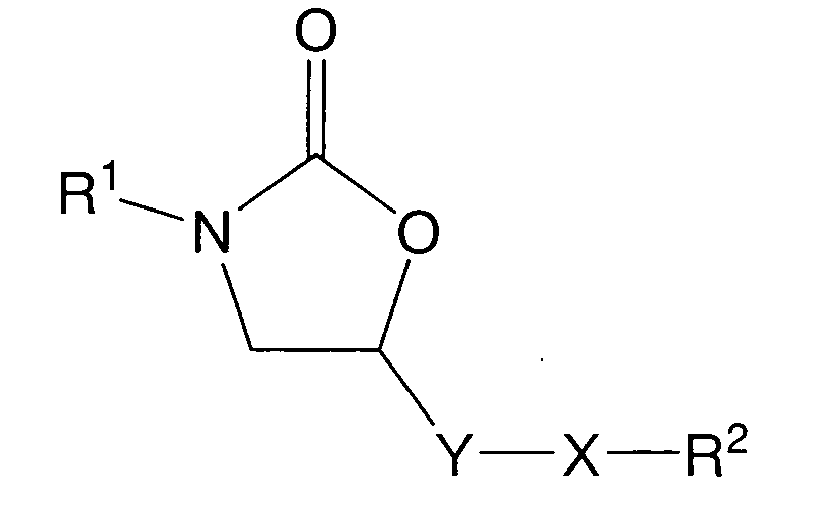
, its pharmaceutically acceptable salt, or a solvate thereof,
wherein R1 is optionally substituted cycloalkyl, optionally substituted cycloalkylalkyl, optionally substituted heterocycle or optionally substituted heterocyclealkyl,
X is -O-, -NR3-, -NR3 C(=O)- or -NR3 S(=O)2-,
R2 is optionally substituted aryl, optionally substituted arylalkyl, optionally substituted heteroaryl or optionally substituted heteroarylalkyl,
R3 is hydrogen or optionally substituted alkyl.
wherein R1 is optionally substituted cycloalkyl, optionally substituted cycloalkylalkyl, optionally substituted heterocycle or optionally substituted heterocyclealkyl,
X is -O-, -NR3-, -NR3 C(=O)- or -NR3 S(=O)2-,
R2 is optionally substituted aryl, optionally substituted arylalkyl, optionally substituted heteroaryl or optionally substituted heteroarylalkyl,
R3 is hydrogen or optionally substituted alkyl.
Description
- The present invention relates to a pharmaceutically useful compound having inhibitory activity on 11β-hydroxysteroid dehydrogenase type 1 (hereinafter, referred to as 11β-HSD-1).
- 11β-HSD-1 is an enzyme that converts 11β-dehydrosteroid, which is inactive steroid, into an active steroid, and is considered to have great significance in biological basal metabolism (Non-patent document 1). Also, an 11β-HSD-1 knockout mouse has resistance to hyperglycemia induced by obesity, stress and the like (Non-patent document 2). Also in human, a similar phenomenon was observed when carbenoxolone which is an 11β-HSD-1 inhibitor was administered (Non-patent document 3).
These facts suggest the possibility of a selective inhibitor of this enzyme as a therapeutic agent in insulin independent diabetes and obesity (Non-patent document 4). -
- Patent document 1 discloses a pyrano[2,3-d]pyrimidine derivative as a compound useful as a therapeutic agent for diabetes.
- Patent document 2 discloses a thiazolidine derivative as a compound useful as a therapeutic agent for diabetes.
- Patent document 3 discloses a derivative in which 3-position of oxazolidinone is substituted with arylalkyl as a compound useful as a herbicide.
- Non-patent document 5 and Patent document 11 disclose a derivative in which 3-position of oxazolidinone is substituted with arylalkyl, as a compound useful as a cholesterol-lowering agent.
- Patent document 4, Patent document 6 and Patent document 15 disclose a derivative in which 3-position of oxazolidinone is substituted with arylalkyl as a compound useful as a therapeutic agent for thromboembolism.
- Non-patent document 6 discloses a solid-phase synthesis method of a derivative in which 3-position of oxazolidinone is substituted with arylalkyl.
- Patent document 5 discloses a derivative in which 3-position of oxazolidinone is substituted with arylalkyl as a compound useful as a NMDA receptor antagonist.
- Patent document 7 discloses a derivative in which 3-position of oxazolidinone is substituted with arylalkyl as a method of producing oxazolidone.
- Patent documents 8, 9 and 10 disclose a derivative in which 3-position of oxazolidinone is substituted with arylalkyl as an intermediate of a compound useful as a therapeutic agent for diabetes.
- Non-patent document 7, Patent document 13, Patent document 14 and Patent document 18 disclose a derivative in which 3-position of oxazolidinone is substituted with arylalkyl as a compound useful for an antihypertensive.
- Patent document 12 discloses a derivative in which 3-position of oxazolidinone is substituted with arylalkyl as a compound useful for a cardiac stimulant.
- Non-patent document 8, Non-patent document 11, Non-patent document 12, Patent document 16 and Non-patent document 13 disclose a synthesis method of a derivative in which 3-position of oxazolidinone is substituted with cyclohexyl.
- Non-patent document 9 and Patent document 19 disclose a synthesis method of a derivative in which 3-position of oxazolidinone is substituted with arylalkyl.
- Non-patent document 10 discloses a derivative in which 3-position of oxazolidinone is substituted with arylalkyl as a compound useful as a therapeutic agent for angina pectoris.
- Patent document 17 discloses a derivative in which 3-position of oxazolidinone is substituted with arylalkyl as a compound useful as a therapeutic agent for hypotension.
- Patent document 20 and Non-patent document 14 disclose a derivative in which 3-position of oxazolidinone is substituted with arylalkyl and cyclohexyl as a compound useful as a muscle relaxant.
- Non-patent document 15 and Patent document 21 disclose a pyrrolidine-2-one derivative having 11β-HSD-1 inhibiting activity, but they fail to disclose an oxazolidinone derivative such as the present compound.
-
- [Non-patent document 1] Clin. Endocrinol, 1996, vol. 44, p. 493
- [Non-patent document 2] Proc. Nat. Acad. Sci. USA, 1997, vol. 94, p. 14924
- [Non-patent document 3] J. Clin. Endocrinol. Metab., 1995, vol.80, p.3155
- [Non-patent document 4] Lancet, 1997, vol. 349, p. 1210
- [Non-patent document 5] Archiv der Pharmazie, 2005, vol. 338, No. 4, p. 147
- [Non-patent document 6] Tetrahedron Letters, 2002, vol. 43, No. 46, 8327
- [Non-patent document 7] Journal of Chromatography, A, 1996, vol. 740, No. 1, p. 11
- [Non-patent document 8] Journal of Polymer Science, Part A, 1989, vol. 27, No. 6, p. 1843
- [Non-patent document 9] Tetrahedron, 1987, vol. 43, No. 11, p. 2505
- [Non-patent document 10] Journal of Medicinal Chemistry, 1986, vol. 29, No. 6, p. 1065
- [Non-patent document 11] Journal of Coatings Technology, 1983, vol. 55, No. 700, p. 49
- [Non-patent document 12] Macromolecules, 1981, vol. 14, No. 5, p.1434
- [Non-patent document 13] Chemische Berichte, 1960, vol. 93, p. 1975
- [Non-patent document 14] Journal of the American Chemical Society, 1960, vol. 82, p. 1166
- [Non-patent document 15] Bioorganic & Medicinal Chemistry Letters, 16(2006), p.5555 [Patent document 1]
WO06/124490 - [Patent document 2]
WO94/022857 - [Patent document 3]
WO06/090792 - [Patent document 4]
WO03/000256 - [Patent document 5]
WO02/072542 - [Patent document 6]
WO01/047919 - [Patent document 7]
JP2001-055383 - [Patent document 8]
JP11-035534 - [Patent document 9]
US5488064 - [Patent document 10]
US5606069 - [Patent document 11]
WO93/022298 - [Patent document 12]
JP05-148247 - [Patent document 13]
US4602093 - [Patent document 14]
EP64294 - [Patent document 15]
DD153682 - [Patent document 16]
US4066628 - [Patent document 17]
DE2606140 - [Patent document 18]
JP49-020768 - [Patent document 19]
GB938424 - [Patent document 20]
US3062828 - [Patent document 21]
WO2007118185 - The present invention provides a useful 11β-hydroxysteroid dehydrogenase type 1 inhibitor.
- The present invention provides:
- (1) A pharmaceutical composition having inhibitory activity on 11β-hydroxysteroid dehydrogenase type 1 comprising a compound represented by the Formula (I):

wherein R1 is optionally substituted arylalkyl, optionally substituted cycloalkyl, optionally substituted cycloalkylalkyl, optionally substituted heteroaryl, optionally substituted heteroarylalkyl, optionally substituted heterocycle or optionally substituted heterocyclealkyl,- X is -O-, -NR3 -, -NR3 C(=O)- or -NR3 S(=O)2
- R2 is optionally substituted aryl, optionally substituted arylalkyl, optionally substituted cycloalkyl, optionally substituted cycloalkylalkyl, optionally substituted heteroaryl, optionally substituted heteroarylalkyl, optionally substituted heterocycle or optionally substituted heterocyclealkyl,
- R3 is hydrogen or optionally substituted alkyl,
- Y is -(CR4R5)n-,
- R4 and R5 are each independently hydrogen, optionally substituted alkyl, halogen or hydroxy, and
- n is an integer of 1 to 6,
- provided that, when R1 is optionally substituted arylalkyl, and X is -O-, R2 is not optionally substituted pyrano[2,3-d]pyrimidinyl or aryl substituted with thiazolidinedione-5-yl methyl,
- (2) The pharmaceutical composition having inhibitory activity on 11β-hydroxysteroid dehydrogenase type 1 comprising the compound according to the above (1), its pharmaceutically acceptable salt, or a solvate thereof, wherein n is 1, and R4 and R5 are hydrogen,
- (3) The pharmaceutical composition having inhibitory activity on 11β-hydroxysterold dehydrogenase type 1 comprising the compound according to the above (2), its pharmaceutically acceptable salt, or a solvate thereof, wherein R1 is optionally substituted cycloalkyl, optionally substituted cycloalkylalkyl, optionally substituted heteroaryl, optionally substituted heteroarylalkyl, optionally substituted heterocycle or optionally substituted heterocyclealkyl,
- (4) A compound represented by the Formula (I):

wherein R1 is optionally substituted arylalkyl, optionally substituted cycloalkyl, optionally substituted cycloalkylalkyl, optionally substituted heteroaryl, optionally substituted heteroarylalkyl, optionally substituted heterocycle or optionally substituted heterocyclealkyl,- X is -O-, -NR3-, -NR3C(=O)- or -NR3 S(=O)2-,
- R2 is optionally substituted aryl, optionally substituted arylalkyl, optionally substituted cycloalkyl, optionally substituted cycloalkylalkyl, optionally substituted heteroaryl, optionally substituted heteroarylalkyl, optionally substituted heterocycle or optionally substituted heterocyclealkyl,
- R3 is hydrogen or optionally substituted alkyl,
- Y is -(CR4R5)n-,
- R4 and R5 are each independently hydrogen, optionally substituted alkyl, halogen or hydroxy, and
- n is an integer of 1 to 6,
- provided that, when R1 is optionally substituted arylalkyl, R2 is pyridyl substituted with trifluoromethyl group, optionally substituted cycloalkyl, optionally substituted cycloalkylalkyl, optionally substituted heteroarylalkyl, optionally substituted heterocycle or optionally substituted heterocyclealkyl, while when R1 is unsubstituted cyclohexyl and X is -O-, R2 is not optionally substituted phenyl or unsubstituted benzyl),
- (5) The compound according to the above (4), its pharmaceutically acceptable salt, or a solvate thereof, wherein n is 1, and R4 and R5 are hydrogen,
- (6) The compound according to the above (5), its pharmaceutically acceptable salt, or a solvate thereof, wherein R1 is optionally substituted cycloalkyl having 7 or more carbon atoms, optionally substituted cycloalkylalkyl, optionally substituted heteroaryl, optionally substituted heteroarylalkyl, optionally substituted heterocycle or optionally substituted heterocyclealkyl, and R2 is optionally substituted aryl, optionally substituted arylalkyl, optionally substituted cycloalkyl, optionally substituted cycloalkylalkyl, optionally substituted heteroaryl, optionally substituted heteroarylalkyl, optionally substituted heterocycle or optionally substituted heterocyclealkyl,
- (7) The compound according to the above (5), its pharmaceutically acceptable salt, or a solvate thereof, wherein R1 is optionally substituted arylalkyl or optionally substituted cycloalkyl, and R2 is optionally substituted aryl, optionally substituted arylalkyl or optionally substituted heteroaryl,
- (8) The compound according to any one of the above (5) to (7), its pharmaceutically acceptable salt, or a solvate thereof, wherein R1 is optionally substituted cycloalkyl,
- (9) The compound according to the above (8), its pharmaceutically acceptable salt, or a solvate thereof, wherein R1 is optionally substituted cyclooctyl,
- (10) The compound according to any one of the above (5) to (9), its pharmaceutically acceptable salt, or a solvate thereof, wherein R2 is optionally substituted aryl, optionally substituted arylalkyl or optionally substituted heteroaryl,
- (11) The compound according to any one of the above (5) to (10), its pharmaceutically acceptable salt, or a solvate thereof, wherein R3 is optionally substituted alkyl,
- (12) A pharmaceutical composition comprising the compound according to any one of the above (4) to (11), its pharmaceutically acceptable salt, or a solvate thereof,
- (13) The pharmaceutical composition according to the above (12), which is an 11β-hydroxysteroid dehydrogenase type 1 inhibitor.
- (14) The pharmaceutical composition according to any one of the above (1) to (3), (12) or (13), for treatment and/or prevention of diabetes,
- (15) A method for preventing or treating diabetes, comprising administering the compound according to any one of the above (1) to (11), its pharmaceutically acceptable salt, or a solvate thereof,
- (16) A use of the compound according to any one of the above (1) to (11), its pharmaceutically acceptable salt, or a solvate thereof for manufacturing a medicament of treatment and/or prevention of diabetes,
- (17) The compound according to any one of the above (1) to (11), its pharmaceutically acceptable salt, or a solvate thereof for treatment and/or prevention of diabetes.
- (18) A compound represented by the Formula (Ia):

wherein R1 is optionally substituted arylalkyl, optionally substituted cycloalkyl, optionally substituted cycloalkylalkyl, optionally substituted heteroaryl, optionally substituted heteroarylalkyl, optionally substituted heterocycle or optionally substituted heterocyclealkyl,- RX is hydroxy, alkylsulfonyloxy or a group represented by the Formula: -NHR3 (wherein R3 is hydrogen or optionally substituted alkyl).
- (19) The compound according to the above (18), its pharmaceutically acceptable salt, or a solvate thereof, wherein R1 is optionally substituted cycloalkyl having 7 or more carbon atoms, optionally substituted cycloalkylalkyl, optionally substituted heteroaryl, optionally substituted heteroarylalkyl, optionally substituted heterocycle or optionally substituted heterocyclealkyl.
- (20) A compound represented by the Formula:

wherein RX is hydroxy, alkylsulfonyloxy or a group represented by the Formula: -NHR3 (wherein R3 is hydrogen or optionally substituted alkyl). - (21) The compound according to the above (19) or (20), its pharmaceutically acceptable salt, or a solvate thereof, wherein RX is hydroxy.
- Since the present compound has inhibitory activity on 11β-hydroxysteroid dehydrogenase type 1, pharmaceutical compositions comprising the present compound are very useful as medicaments, especially, as medicaments for treatment and/or prevention of hyperlipidemia, diabetes, obesity, arteriosclerosis, atherosclerosis, hyperglycemia, and/or syndrome X. Moreover, the present compound selectively inhibits 11β-hydroxysteroid dehydrogenase type 1, and is a compound having other utility as a medicament. Here, the utility as a medicament includes excellent metabolic stability, a weak drug-metabolizing enzyme induction, a weak inhibition of drug metabolizing enzyme that metabolizes other drug, a high oral absorption, a low clearance, a long half-life period enough to exhibit drug efficacy and so on.
- In the following, meanings of terms used in the present specification will be explained. Each term has the same meaning when used alone or in combination with other term in this description.
"Halogen" includes fluorine, chlorine, bromine or iodine. Particularly, fluorine, chlorine and bromine are preferable. - "Alkyl" means a C1 to C10 straight or branched alkyl group, and example includes methyl, ethyl, n-propyl, isopropyl, n-butyl, isobutyl, sec-butyl, tert-butyl, n-pentyl, isopentyl, neopentyl, n-hexyl, isohexyl, n-heptyl, n-octyl, n-nonyl, n-decyl or the like. Preferable is C1 to C6 or C1 to C4 alkyl, and example includes methyl, ethyl, n-propyl, isopropyl, n-butyl, isobutyl, sec-butyl, tert-butyl, n-pentyl, isopentyl, neopentyl, n-hexyl or isohexyl.
- "Cycloalkyl" means a C3 to C15 cyclic saturated hydrocarbon group, and example includes cyclopropyl, cyclobutyl, cyclopentyl, cyclohexyl, cycloheptyl, cyclooctyl, bridged cyclic hydrocarbon group, spiro hydrocarbon group or the like. Preferable is cyclopropyl, cyclobutyl, cyclopentyl, cyclohexyl or bridged cyclic hydrocarbon group.
- "Bridged cyclic hydrocarbon group" includes a group which is derived by excluding one hydrogen from a C5 to C8 aliphatic cycle which consists of two or more rings that share two or more atoms. Example includes bicyclo[2.1.0]pentyl, bicyclo[2.2.1]heptyl, bicyclo[2.2.2]octyl, bicyclo[3.2.1]octyl, tricyclo[2.2.1.0]heptyl or the like.
- "Spiro hydrocarbon group" includes a group which is derived by excluding one hydrogen from a cycle which consists of two hydrocarbon rings that share one carbon atom. Example includes spiro[3.4]octyl or the like.
- "Aryl" means a monocyclic aromatic hydrocarbon group (e.g.: phenyl) and a polycyclic aromatic hydrocarbon group (e.g.: 1-naphthyl, 2-naphthyl, 1-anthryl, 2-anthryl, 9-anthryl, 1-phenanthryl, 2-phenanthryl, 3-phenanthryl, 4-phenanthryl or 9-phenanthryl). Preferable is phenyl or naphthyl (1-naphthyl or 2-naphthyl).
"Heteroaryl" means a monocyclic aromatic heterocyclic group or a fused aromatic heterocyclic group. The monocyclic aromatic heterocyclic group means a group derived from a 5- to 8-membered aromatic ring which may contain 1 to 4 oxygen , sulfur and/or nitrogen atom(s) in the ring, and may have a bond at a substitutable arbitrary position. The fused aromatic heterocyclic group means a group in which a 5- to 8-membered aromatic ring optionally containing 1 to 4 of an oxygen atom, a sulfur atom and/or a nitrogen atom in the ring is fused with 1 to 4 of 5- to 8-membered aromatic carbocycle(s) or other 5- to 8-membered aromatic heterocycle(s), and which may have a bond at a substitutable arbitrary position. - Example of the "heteroaryl" includes furyl (e.g.: 2-furyl or 3-furyl), thienyl (e.g.: 2-thienyl or 3-thienyl), pyrrolyl (e.g.: 1-pyrrolyl, 2-pyrrolyl or 3-pyrrolyl), imidazolyl (e.g.: 1-imidazolyl, 2-imidazolyl or 4-imidazolyl), pyrazolyl (e.g.: 1-pyrazolyl, 3-pyrazolyl or 4-pyrazolyl), triazolyl (e.g.: 1,2,4-triazole-1-yl, 1,2,4-triazole-3-yl or 1,2,4-triazole-4-yl), tetrazolyl (e.g.: 1-tetrazolyl, 2-tetrazolyl or 5-tetrazolyl), oxazolyl (e.g.: 2-oxazolyl, 4-oxazolyl or 5-oxazolyl), isoxazolyl (e.g.: 3-isoxazolyl, 4-isoxazolyl or 5-isoxazolyl), thiazolyl (e.g.: 2-thiazolyl, 4-thiazolyl or 5-thiazolyl), thiadiazolyl, isothiazolyl (e.g.: 3-isothiazolyl, 4-isothiazolyl or 5-isothiazolyl), pyridyl (e.g.: 2-pyridyl, 3-pyridyl or 4-pyridyl), pyridazinyl (e.g.: 3-pyridazinyl or 4-pyridazinyl), pyrimidinyl (e.g.: 2- pyrimidinyl, 4- pyrimidinyl or 5-pyrimidinyl), furazanyl (e.g.: 3- furazanyl), pyrazinyl (e.g.: 2-pyrazinyl), oxadiazolyl (e.g.: 1,3,4-oxadiazole-2-yl), benzofuryl (e.g.: 2-benzo[b]furyl, 3-benzo[b]furyl, 4-benzo[b]furyl, 5-benzo[b]furyl, 6-benzo[b]furyl or 7-benzo[b]furyl), benzothienyl (e.g.: 2-benzo[b]thienyl, 3-benzo[b]thienyl, 4-benzo[b]thienyl, 5-benzo[b]thienyl, 6-benzo[b]thienyl or 7-benzo[b]thienyl), benzimidazolyl (e.g.: 1-benzimidazolyl, 2-benzimidazolyl, 4-benzimidazolyl or 5-benzimidazolyl), dibenzofuryl, benzoxazolyl, quinoxalinyl (e.g.: 2-quinoxalinyl, 5-quinoxalinyl or 6-quinoxalinyl), cinnolinyl (e.g.: 3-cinnolinyl, 4-cinnolinyl, 5-cinnolinyl, 6-cinnolinyl, 7-cinnolinyl or 8-cinnolinyl), quinazolinyl (e.g.: 2-quinazolinyl, 4-quinazolinyl, 5-quinazolinyl, 6-quinazolinyl, 7-quinazolinyl or 8-quinazolinyl), quinolyl (e.g.: 2-quinolyl, 3-quinolyl, 4-quinolyl, 5-quinolyl, 6-quinolyl, 7-quinolyl or 8-quinolyl), phthalazinyl (e.g.: 1-phthalazinyl, 5-phthalazinyl or 6-phthalazinyl), isoquinolyl (e.g.: 1-isoquinolyl, 3-isoquinolyl, 4-isoquinolyl, 5-isoquinolyl, 6-isoquinolyl, 7-isoquinolyl or 8-isoquinolyl), puryl, pteridinyl (e.g.: 2-pteridinyl, 4-pteridinyl, 6-pteridinyl or 7-pteridinyl), carbazolyl, phenanthridinyl, acridinyl (e.g.: 1-acridinyl, 2-acridinyl, 3-acridinyl, 4-acridinyl or 9-acridinyl), indolyl (e.g.: 1-indolyl, 2-indolyl, 3-indolyl, 4-indolyl, 5-indolyl, 6-indolyl or 7-indolyl), isoindolyl, phenadinyl (e.g.: 1-phenadinyl or 2-phenadinyl), phenothiadinyl (e.g.: 1-phenothiadinyl, 2-phenothiadinyl, 3-phenothiadinyl or 4-phenothiadinyl) or the like.
- "Heterocycle" means a nonaromatic heterocyclic group which may contain 1 to 4 oxygen, sulfur and/or nitrogen atom(s) in the ring, and may have a bond at a substitutable arbitrary position. Moreover, the nonaromatic heterocyclic group can be bridged with a C1 to C4 alkyl chain, or can be fused with cycloalkane (5- to 6-membered ring is preferable) or benzene ring. Heterocycle can be saturated or unsaturated as long as it is non-aromatic. Preferable is a 5- to 8-membered ring. Example includes 1-pyrrolinyl, 2-pyrrolinyl, 3-pyrrolinyl, 1-pyrrolidinyl, 2-pyrrolidinyl, 3-pyrrolidinyl, 1-imidazolinyl, 2-imidazolinyl, 4-imidazolinyl, 1-imidazolidinyl, 2-imidazolidinyl, 4-imidazolidinyl, 1-pyrazolinyl, 3-pyrazolinyl, 4-pyrazolinyl, 1-pyrazolidinyl, 3-pyrazolidinyl, 4-pyrazolidinyl, piperidino, 2-piperidinyl, 3-piperidinyl, 4-piperidinyl, 1-piperadinyl, 2-piperadinyl, 2-morpholinyl, 3-morpholinyl, morpholino, tetrahydropyranyl or the like.
- In "arylalkyl", "cycloalkylalkyl", "heteroarylalkyl" and "heterocyclealkyl", the alkyl part substituted with "aryl", "cycloalkyl", "heteroaryl" or "heterocycle" means the above "alkyl".
"Aryl", "cycloalkyl", "heteroaryl" and "heterocycle" parts in "arylalkyl", "cycloalkylalkyl", "heteroarylalkyl" and "heterocyclealkyl" mean the above "aryl", "cycloalkyl", "heteroaryl" and "heterocycle", respectively.
The alkyl part of "alkylsulfonyloxy" means the above "alkyl". - As a substituent on ring in "optionally substituted aryl", "optionally substituted arylalkyl", "optionally substituted cycloalkyl", "optionally substituted cycloalkylalkyl", "optionally substituted heteroaryl", "optionally substituted heteroarylalkyl", "optionally substituted heterocycle", and "optionally substituted heterocyclealkyl", it is selected from the group consisting of, for example, hydroxy, carboxy, halogen, halogenated alkyl (e.g.: CF3, CH2 CFs or r CH2 CCl3), nitro, nitroso, cyano, alkyl (e.g.: methyl, ethyl, isopropyl or tert-butyl), alkenyl (e.g.: vinyl), alkynyl (e.g.: ethynyl), cycloalkyl (e.g.: cyclopropyl or adamantyl), cycloalkylalkyl (e.g.: cyclohexylmethyl or adamantylmethyl), cycloalkenyl (e.g.: cyclopropenyl), aryl (e.g.: phenyl or naphthyl), arylalkyl (e.g.: benzyl or phenethyl), heteroaryl (e.g.: pyridyl or furyl), heteroarylalkyl (e.g.: pyridylmethyl), heterocycle (e.g.: piperidyl), heterocycle alkyl (e.g.: morpholylmethyl), alkoxy (e.g.: methoxy, ethoxy, propoxy or butoxy), halogenated alkoxy (e.g.: OCF3), alkenyloxy (e.g.: vinyloxy or allyloxy), alkoxycarbonyl (e.g.: methoxycarbonyl, ethoxycarbonyl or tert-butoxycarbonyl), arylalkyloxy (e.g.: benzyloxy), amino (e.g.: alkylamino (e.g.: methylamino, ethylamino or dimethylamino), acylamino (e.g.: acetylamino or benzoylamino), arylalkylamino (e.g.: benzylamino or tritylamino), hydroxyamino, alkylaminoalkyl (e.g.: diethylaminomethyl), sulfamoyl and the like. It may be substituted with 1 to 4 such substituent(s).
- As a substituent for an alkyl part of "optionally substituted arylalkyl", "optionally substituted cycloalkylalkyl", "optionally substituted heteroarylalkyl", and "optionally substituted heterocyclealkyl", it is selected from the group consisting of, for example, hydroxy, alkyl (e.g.: methyl, ethyl, isopropyl or tert-butyl), alkoxy (e.g.: methoxy, ethoxy, propoxy or butoxy), halogen, halogenated alkyl (e.g.: CF3 , CH2 CF3 or CH2 CCl3), halogenated alkoxy (e.g.: OCF3), cycloalkyl (e.g.: cyclopropyl or adamantyl), alkylene (e.g.: -(CH2)2 -, -(CH2)3 -, -(CH2)4 - or -(CH2)5 -) and the like. It may be substituted with 1 to 4 such substituent(s).
- As a substituent for "optionally substituted alkyl", it is the same as the substituent for an alkyl part of the above "optionally substituted arylalkyl", "optionally substituted cycloalkylalkyl", "optionally substituted heteroarylalkyl", and "optionally substituted heterocyclealkyl".
- "Alkenyl" means C2 to C8 straight or branched alkenyl having one or more double bond(s) in the above "alkyl", and example includes vinyl, 1-propenyl, 2-propenyl, 1-butenyl, 2-butenyl, 3-butenyl, 1,3-butadienyl, 3-methyl 2-butenyl or the like.
- "Alkynyl" means C2 to C8 straight or branched alkynyl having one or more triple bond(s) in the above "alkyl", and example includes ethynyl, propinyl, butynyl or the like.
- "Cycloalkenyl" means C3 to C7 cyclic unsaturated aliphatic hydrocarbon group, and example includes cyclopropenyl, cyclobutenyl, cyclopentenyl, cyclohexenyl, cycloheptenyl or the like. Preferable is cyclopropenyl, cyclobutenyl, cyclopentenyl or cyclohexenyl. Cycloalkenyl also includes bridged cyclic hydrocarbon group and spiro hydrocarbon group which have an unsaturated bond in the ring.
- The alkyl part of "alkoxy" and "alkoxycarbonyl" means the above "alkyl".
- The alkenyl part of "alkenyloxy" means the above "alkenyl".
- The arylalkyl part of "arylalkyloxy" means the above "arylalkyl".
- The halogen part, the alkyl part, and the alkoxy part of "halogenated alkyl" and "halogenated alkoxy" are the same as the above "halogen", "alkyl", and "alkoxy", respectively.
"Acylamino" means alkylcarbonylamino or arylcarbonylamino.
The alkyl part of "alkylcarbonylamino" is the same as the above "alkyl".
The aryl part of "arylcarbonylamino" is the same as the above "aryl". - As the "optionally substituted arylalkyl", particularly preferably, the following examples are included:

- As the "optionally substituted cycloalkylalkyl", particularly preferably, the following examples are included:

- As the "heteroarylalkyl", particularly preferably, the following examples are included:

- As the "optionally substituted heterocyclealkyl", particularly preferably, the following examples are included:

- R1 is optionally substituted arylalkyl, optionally substituted cycloalkyl, optionally substituted cycloalkylalkyl, optionally substituted heteroaryl, optionally substituted heteroarylalkyl, optionally substituted heterocycle or optionally substituted heterocyclealkyl. R1 is preferably optionally substituted cycloalkyl or optionally substituted arylalkyl. More preferably R1 is optionally substituted cyclooctyl.
- In R1, as a substituent on a ring of "optionally substituted arylalkyl", "optionally substituted cycloalkyl", "optionally substituted cycloalkylalkyl", "optionally substituted heteroaryl", "optionally substituted heteroarylalkyl", "optionally substituted heterocycle" or "optionally substituted heterocyclealkyl", preferable is alkyl, alkoxy, halogen, halogenated alkyl, halogenated alkoxy or hydroxy.
- In R1, as a substituent for an alkyl part of "optionally substituted arylalkyl", "optionally substituted cycloalkylalkyl", "optionally substituted heteroarylalkyl" or "optionally substituted heterocyclealkyl", preferable is alkyl, alkoxy, cycloalkyl, halogen, halogenated alkyl, halogenated alkoxy or hydroxy.
- R2 is optionally substituted aryl, optionally substituted arylalkyl, optionally substituted cycloalkyl, optionally substituted cycloalkylalkyl, optionally substituted heteroaryl, optionally substituted heteroarylalkyl, optionally substituted heterocycle or optionally substituted heterocycle alkyl. R2 is preferably optionally substituted aryl, optionally substituted arylalkyl or optionally substituted heteroaryl.
- In R2, as a substituent on a ring of "optionally substituted aryl", "optionally substituted arylalkyl", "optionally substituted cycloalkyl", "optionally substituted cycloalkylalkyl", "optionally substituted heteroaryl", "optionally substituted heteroarylalkyl", "optionally substituted heterocycle" or "optionally substituted heterocyclealkyl", preferable is halogenated alkyl, halogenated alkoxy, halogen, alkyl, alkoxy, hydroxy, heterocyclealkyl, heteroarylalkyl or alkylaminoalkyl.
- R3 is hydrogen or optionally substituted alkyl. R3 is preferably optionally substituted alkyl. R4 and R5 are each independently hydrogen, optionally substituted alkyl, halogen or hydroxy. R4 and R5 are preferably hydrogen.
- n is an integer of 1 to 6. Especially, 1 is preferred.
- X is -O-, -NR3 -, -NR3 C(=O)- or -NR3 S(=O)2 -, and preferable is -O- or -NR3 S(=O)2 -.
- As a salt of the present compound, a pharmaceutically acceptable salt is preferable. As a pharmaceutically acceptable salt, the following salts can be included.
As a basic salt, example includes alkali metal salt such as sodium salt or potassium salt; alkaline earth metal salt such as calcium salt or magnesium salt; ammonium salt; aliphatic amine salt such as trimethylamine salt, triethylamine salt, dicyclohexylamine salt, ethanolamine salt, diethanolamine salt, triethanolamine salt, procaine salt, meglumine salt, diethanolamine salt or ethylenediamine salt; aralkylamine salt such as N,N-dibenzylethylenediamine salt or benethamine salt; heterocyclic aromatic amine salt such as pyridine salt, picoline salt, quinoline salt, or isoquinoline salt; quaternary ammonium salt such as tetramethylammonium salt, tetraethylammonium salt, benzyltrimethylammonium salt, benzyltriethylammonium salt, benzyltributylammonium salt, methyltrioctylammonium salt, or tetrabutylammonium salt; basic amino acid salt such as arginine salt or lysine salt or the like.
As an acidic salt, example includes inorganic acid salt such as hydrochloride, sulfate, nitrate, phosphate, carbonate, hydrogencarbonate, or perchlorate; organic acid salt such as acetate, propionate, lactate, maleate, fumarate, tartrate, malate, citrate or ascorbate; sulfonate such as methanesulfonate, isethionate, benzenesulfonate or p-toluenesulfonate; acidic amino acid salt such as aspartate or glutamate or the like. - The term "solvate" means a solvate of a compound of the present invention or a pharmaceutically acceptable salt thereof, and example includes alcohol (e.g.: ethanol) solvate, hydrate or the like. Example of hydrate includes monohydrate, dihydrate or the like.
- A general method for producing the present compound is exemplified below. Also extraction, purification and the like may be conducted in a procedure executed in usual organic chemical experiment.

- Step 1 is a process for preparing an oxazolidinone derivative represented by the Formula (II-2) which comprises reacting the compound represented by the Formula (II-1) with epoxide.
As a solvent, example includes N-dimethylformamide, dimethylsulfoxide, aromatic hydrocarbons (e.g., toluene, benzene, xylene or the like), saturated hydrocarbons (e.g., cyclohexane, hexane or the like), halogenated hydrocarbons (e.g., dichloromethane, chloroform, 1,2-dichloroethane or the like), ethers (e.g., tetrahydrofuran, diethylether, dioxane, 1,2-dimethoxyethane or the like), esters (e.g., methyl acetate, ethyl acetate or the like), ketones (e.g., acetone, methylethylketone or the like), nitriles (e.g., acetonitrile or the like), alcohols (e.g., methanol, ethanol, t-butanol or the like), water, a mixed solvent thereof or the like.
As a base, example includes metal hydrides (e.g., sodium hydride or the like), metal hydroxides (e.g., sodium hydroxide, potassium hydroxide, lithium hydroxide, barium hydroxide or the like), metal carbonates (e.g., sodium carbonate, calcium carbonate, cesium carbonate or the like), metal alkoxides (e.g., sodium methoxide, sodium ethoxide, potassium t-butoxide or the like), sodium hydrogen carbonate, metal sodium, organic amines (e.g., triethylamine, diisopropylethylamine, DBU, 2,6-lutidine or the like), pyridine, alkyl lithiums (n-BuLi, sec-BuLi, tert-BuLi or the like) or the like.
Preferably, the reaction can be performed in a solvent of halogenated hydrocarbons (e.g., dichloromethane, chloroform or the like) or ethers (e.g., tetrahydrofuran, diethylether, dioxane or the like) with alkyl lithiums (n-BuLi, sec-BuLi or tert-BuLi) as a base. The reaction can be performed at -78 to 30°C for 0.5 to 48 hours. - Step 2 is a process for preparing the compound represented by the Formula (I-1) which comprises reacting the compound represented by the Formula (II-2) with the compound represented by the Formula (R2 -Hal) in the presence of a base.
As a solvent, a solvent described in Step 1 can be used. Preferably, ethers (e.g., tetrahydrofuran, diethylether, dioxane, 1,2-dimethoxyethane or the like) or N-dimethylformamide can be used. As a base, a base described in Step 1 can be used. Preferably, metal hydrides (e.g., sodium hydride or the like) can be used.
The reaction can be performed at -20 to 30°C for 0.5 to 24 hours. - Step 3 is a process for preparing the compound represented by the Formula (II-3) which comprises converting a hydroxy group in the compound represented by the Formula (II-2) into a leaving group.
As a solvent, a solvent described in Step 1 can be used. Preferably, ethers (e.g., tetrahydrofuran, diethylether, dioxane, 1,2-dimethoxyethane or the like) can be used.
As a base, a base described in Step 1 can be used. Preferably, organic amines (e.g., triethylamine, diisopropylethylamine, DBU, 2,6-lutidine or the like) or pyridine can be used.
The reaction can be performed in the presence of mesyl chloride (MsCl), tosyl chloride (TsCl), trifluoromethanesulfonyl chloride (TfCl), trifluoromethanesulfonic anhydride (Tf2O), nosyl chloride (NsCl) or the like, at -20 to 30°C for 0.5 to 24 hours. - Step 4 is a process for preparing the compound represented by the Formula (II-4) which comprises reacting the compound represented by the Formula (II-3) with the compound represented by the Formula (R3NH2).
As a solvent, a solvent described in Step 1 can be used. Preferably, alcohols (e.g., methanol, ethanol, t-butanol or the like) can be used. The reaction can be performed at a temperature ranging from 30°C to the temperature at which a solvent being used is refluxed, for 0.5 to 24 hours. - Step 5 is a process for preparing the compound represented by the Formula (I-2) from the compound represented by the Formula (II-4) by palladium coupling.
As a solvent, a solvent described in Step 1 can be used. Preferably, aromatic hydrocarbons (e.g., toluene, benzene, xylene or the like) can be used.
As a base, a base described in Step 1 can be used. Preferably, metal carbonates (e.g., sodium carbonate, calcium carbonate, cesium carbonate or the like) or metal alkoxides (e.g., sodium methoxide, sodium ethoxide, potassium t-butoxide or the like) can be used. The reaction can be performed in the presence of palladium catalyst (e.g.: Pd(PPh3)4, PdCl2, Pd(dba)2 or the like) and phosphine ligand (e.g.: PPh3, BINAP or the like) at a temperature ranging from 50°C to the temperature at which a solvent being used is refluxed, for 0.5 to 24 hours. - Step 6 is a process for preparing the compound represented by the Formula (I-3) which comprises reacting the compound represented by the Formula (II-4) with the compound represented by the Formula (R2 -Z-Hal).
As a solvent, a solvent described in Step 1 can be used. Preferably, ethers (e.g., tetrahydrofuran, diethylether, dioxane, 1,2-dimethoxyethane or the like) can be used.
As a base, a base described in Step 1 can be used. Preferably, organic amines (e.g., triethylamine, diisopropylethylamine, DBU, 2,6-lutidine or the like) can be used. The reaction can be performed at -20 to 30°C for 0.5 to 6 hours. - Various substituents in the present compound can be introduced by referring to (1) Alan R.Katriszly et al., Comprehensive Heterocyclic Chemistry (2) Alan R.Katriszly et al., Comprehensive Heterocyclic Chemistry II (3) RODD ' S CHEMISTRY OF CARBON COMPOUNDS VOLUME IV HETEROCYCLIC COMPOUNDS or the like.
- The present compound has excellent inhibitory activity on 11β-hydroxysteroid dehydrogenase type 1. Therefore, it can be used for treatment or prevention of a disease concerning 11β-hydroxysteroid dehydrogenase type 1, especially, disease such as hyperlipidemia, diabetes, obesity, arteriosclerosis, atherosclerosis, hyperglycemia and/or syndrome X. It is particularly useful in treatment or prevention of diabetes.
- The compound used in the present invention can be administered orally or parenterally. In the case of oral administration, the compound used in the present invention can be used in any dose form including normal formulations, for example, solid formulations such as a tablet, powder, granule, capsule or the like; aqueous formulations; oleaginous suspensions; or liquid formulations such as syrup or elixir. In the case of parenteral administration, the compound used in the present invention can be used as an aqueous or oleaginous suspension for injection or nasal solution. In preparation of such formulations, a conventional excipient, binder, lubricant, aqueous solvent, oleaginous solvent, emulsifying agent, suspending agent, preservative, stabilizer and the like can be optionally used. Especially, using in a form of an oral formulation is preferred.
A formulation of the compound used in the present invention can be produced by combining (e.g., mixing) a therapeutically effective amount of the compound used in the present invention with a pharmaceutically acceptable carrier or diluent. Formulation of the compound used in the present invention can be produced by a known method using a well-known easily available ingredient.
A dosage of the compound used in the present invention differs depending on the administration route, age, body weight, condition and kind of disease of the patient, and is typically, about 0.05 mg to 3000 mg and preferably about 0.1 mg to 1000 mg per a day for adult person, in the case of oral administration, and can be administered in divided doses as necessary. In the case of parenteral administration, about 0.01 mg to 1000 mg and preferably about 0.05 mg to 500 mg per a day for adult person can be administered. In administration, it can be used together with other therapeutic agents. - In the following, the present invention will be described in more detail by way of examples which are not intended to limit the scope of the present invention.
-

- To a mixture of 3.7 mL (0.02594 mol) of benzyloxycarbonyl chloride (ZCl) and 15 mL of tetrahydrofuran were added 3g (0.02358 mol) of cyclooctylamine (Compound 1) and 3.6 mL (0.02594 mol) of triethylamine under ice cooling, and the reaction solution was stirred for 24 hours at room temperature. After extraction by adding water and ethyl acetate to the reaction solution, the organic layer was washed with saturated saline, and dried with sodium sulfate. After removing the solvent under reduced pressure, the residue was purified by silica gel column chromatography (n-hexane:ethyl acetate=5:1), to obtain 4.54 g (74%) (Compound 2) of a colorless liquid.
- To a mixture of 5.25 g (0.02009 mole) of Compound 2 and 52 mL of anhydrous tetrahydrofuran was added 13.3 mL (0.02109 mol) of n-butyl lithium (1.58 mol/L) dropwisely under argon atmosphere at -78°C, and the resulting mixture was stirred for 1 hour. To the resulting solution was added 2.98 mL (0.02109 mol) of (R) glycidyl butylate, and the reaction solution was stirred for 14 hours at room temperature. After extraction by adding water and ethyl acetate to the reaction solution, the organic layer was washed with saturated saline and dried with sodium sulfate. After removing the solvent under reduced pressure, the residue was purified by silica gel column chromatography (n-hexane:ethyl acetate = 1:3), to obtain 2.21 g (14%)(Compound 3) of a colorless liquid.
1H-NMR(CDCl3): δ(ppm) 1.43-1.82 (14H, m), 2.07 (1H, t, J=6.5Hz), 3.42 (1H, dd, J=8.5, 6.5Hz), 3.56 (1H, t, J=8.5Hz), 3.60-3.70 (1H, m), 3.82-3.98 (2H, m), 4.52-4.62 (1H, m).
The compounds shown below were synthesized in a similar manner. -

-

-

-

-

-

-

-

-

(Compound 1-4) 1H-NMR(CDCl3): δ(ppm) 1.48-1.80 (14H, m), 3.44 (1H, dd, J=8.5, 6.5Hz), 3.69 (1H, t, J=8.5Hz), 3.93-4.04 (1H, m), 4.52 (2H, d, J=5Hz), 4.80-4.90 (1H, m), 6.86 (1H, d, J=8.5, 2.5Hz), 7.80 (1H, dd, J=8.5, 2.5Hz), 8.42 (1H, d, J=2.5Hz).
The compounds shown below were synthesized in a similar manner. -

-

-

-

-

-

-

-

-
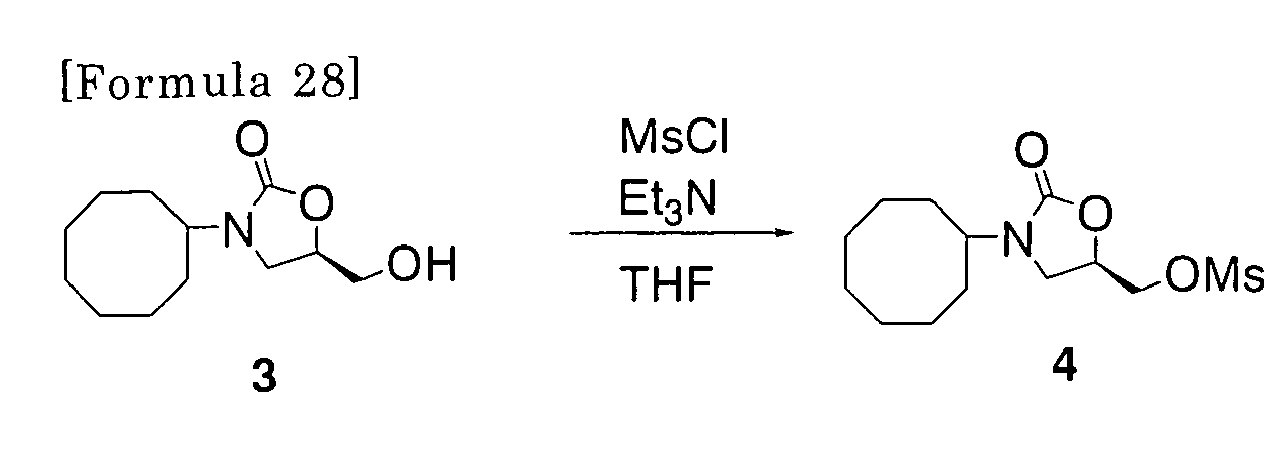
- To a mixture of 10.62 g (2.728 mmol) of Compound 3, 0.42 mL (3.001 mmol) of triethylamine and 3.1 mL of anhydrous tetrahydrofuran was added 0.23 mL (3.001 mmol) of methanesulfonyl chloride dropwisely under ice cooling, and the reaction solution was stirred for 15.5 hours at room temperature. After extraction by adding water and ethyl acetate to the reaction solution, the organic layer was washed with saturated saline and dried with sodium sulfate. After removing the solvent under reduced pressure, the residue was purified by silica gel column chromatography (n-hexane:ethyl acetate = 1:1), to obtain 0.80 g (96%)(Compound 4) of a colorless liquid.
H-NMR(CDCl3): δ(ppm) 1.45-1.80 (14H, m), 3.09 (3H, s), 3.42 (1H, dd, J=9, 6Hz), 3.67 (1H, t, J=9Hz), 3.88-4.00 (1H, m), 4.30 (1H, dd, J=11.5, 4.5Hz), 4.38 (1H, dd, J=11.5, 4.5Hz), 4.68-4.78 (1H, m).
Compounds shown below were synthesized in a similar manner. -

-

1H-NMR(CDCl3): δ(ppm) 1.40-1.80 (15H, m), 2.46 (3H, s), 2.79 (2H, d, J=6.5Hz), 3.28 (1H, dd, J=8.5, 6.5Hz), 3.57 (1H, t, J=8.5Hz), 3.88-4.00 (1H, m), 4.54-4.64 (1H, m).
The compounds shown below were synthesized in a similar manner. -
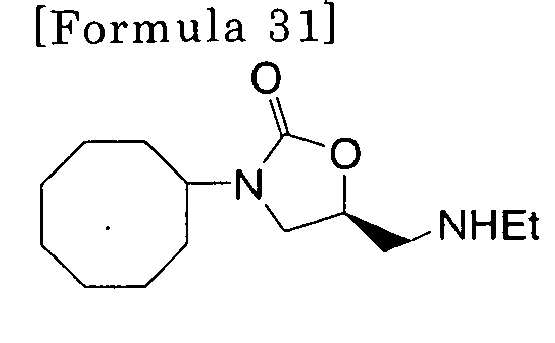
-

-

-

-
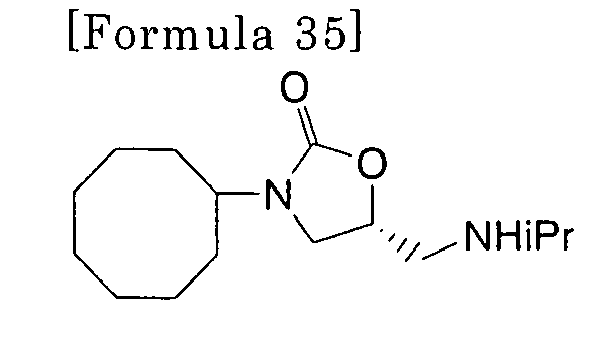
-

The compounds shown below were synthesized in a similar manner. -

-

1H-NMR(CDCl3): δ(ppm) 1.40-1.80 (14H, m), 3.13 (3H, s), 3.37 (1H, t, J=7.5Hz), 3.54 (1H, dd, J=14.5, 7Hz), 3.66 (1H, t, J=9Hz), 3.90-4.10 (2H, m), 4.75-4.90 (1H, m), 7.34-7.46 (5H, m).
The compounds shown below were synthesized in a similar manner. -

-

-

-

-

-

-

-

-

-

-

-
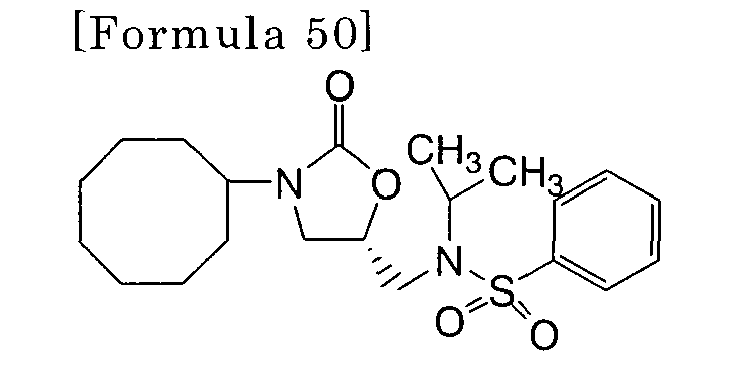
-

-

-

-

-

-

adding water and ethyl acetate to the reaction solution, the organic layer was adjusted to pH=3 by 2N-hydrochloric acid aqueous solution and extracted, and then the aqueous layer was adjusted to pH=9 by 2N-sodium hydroxide, and extracted with ethyl acetate. The organic layer was washed with saturated saline, and dried with sodium sulfate.
The solvent was removed under reduced pressure, to obtain 0.18 g (100%)(I-33) of a colorless liquid.
1H-NMR(CDCl3): δ(ppm) 1.12 (3H, t, J=7Hz), 1.40-1.80 (20H, m), 2.32-2.42 (4H, m), 3.16-3.37 (3H, m), 3.45-3.52 (1H, m), 3.52 (2H, s), 3.55-3.62 (2H, m), 3.86-3.98 (1H, m), 4.59-4.70 (1H, m), 7.49 (2H, d, J=8.5Hz), 7.72 (2H, d, J=8.5Hz).
The compounds shown below were synthesized in a similar manner. -

-

-

-

-

- After preincubating an inhibitor in a reaction solution consisting of 50 mM sodium phosphate buffer (pH 7.6), bovine serum albumin (1 mg/mL), NADPH (0.42 mg/mL), glucose-6-phosphate (1.26 mg/mL), glucose-6-phosphate dehydrogenase and an enzyme at room temperature for 30 minutes, cortisone (5 µM) which is a substrate was added (total amount 10µL). After reacting at 37°C for 2 hours, an XL-665-labeled cortisol solution (5 µL), and a Cryptate-labeled anti-cortisol antibody solution (5 µL) were added,'a reaction was performed at room temperature for 2 hours, and fluorescence intensity (HTRF method) was measured. A cortisol concentration was measured from a standard curve prepared using a known concentration of cortisol for each assay.
Taking a concentration of cortisol generated in the absence of the inhibitor as a control value, 50% inhibition concentration (IC50 value) of the inhibitor against 11β-HSD1 was calculated from an inhibition curve plotting inhibition rate against the control value at each concentration of an inhibitor. - After preincubating an inhibitor in a reaction solution consisting of 50 mM sodium phosphate buffer (pH 7.6), bovine serum albumin (1 mg/mL), NADPH (0.42 mg/mL), glucose-6-phosphate (1.26 mg/mL), glucose-6-phosphate dehydrogenase, and an enzyme at room temperature for 30 minutes, 11-dehydrocorticosterone (2 µM) which is a substrate was added (total amount 10 µL). After reacting at 37°C for 2 hours, an XL-665-labeled cortisol solution (5 µL), and a Cryptate-labeled anti-cortisol antibody solution (5 µL) were added, a reaction was performed at room temperature for 2 hours, and fluorescence intensity (HTRF method) was measured.
A corticosterone concentration was measured from a standard curve prepared using a known concentration of corticosterone for each assay.
Taking a concentration of corticosterone generated in the absence of the inhibitor as a control value, 50% inhibition concentration (IC50 value) of the inhibitor against 11β-HSD1 was calculated from an inhibition curve plotting inhibition rate against the control value at each concentration of the inhibitor. - Results of Test Examples 1 and 2 are shown below.
Compound I-21: human IC50=0.43 µM, mouse IC50=8.4µM - Material and method of oral absorption of 11β-HSD1 inhibitor against diabetes
- (1) Animal: male C57BL/6J Jcl mice at the age of 6 weeks were purchased from CLEA Japan, Inc., and used for the experiment at the age of 7 weeks after preliminary rearing for 1 week.
- (2) Rearing conditions: Mice are fed in the following environment: temperature 23±2°C, humidity 55±10%, in a cycle of 8:00 to 20:00 in light and 20:00 to 8:00 in dark. During preliminary rearing, and a test term, the mice were allowed to liberally intake solid feed (CE-2, CLEA Japan, Inc.) and sterilized tap water.
- (3) Identification of individual and cage: Individual number was written with oil ink on the tail of a mouse to achieve identification. A cage was attached with a label describing a name of a person in charge of the test, data of arrival, a strain, a sex, and a name of a supplier, and fed by 20 mice/cage during preliminary rearing. After start of the experiment, mice were fed in 3 mice/cage.
- (4) Setting of dose and grouping: The following groups were set according to dose amounts of oral administration and intravenous administration.
Oral administration 20 mg/kg (n=3)
Intravenous administration 5 mg/kg (n=3) - (5) Preparation of administration liquid: A preparation method is shown below. A suspension was prepared using 0.5% methylcellulose (1500cP) as a medium for oral administration. A solubilized solution was prepared using N,N-dimethylacetamide/polyethylene glycol 400(=1/2) as a medium for intravenous administration.
- (6) Administration method: As to oral administration, the dosing suspension was administered compulsorily into the stomach by means of an oral sonde at a rate of 10 mL/kg. As to intravenous administration, the dosing solution was administered into caudal vein at a rate of 2.5 mL/kg by means of a glass syringe.
- (7) End point: Blood was collected from heart by time-point blood sampling, and a drug concentration in plasma was measured by using HPLC or LC/MS/MS.
- (8) Statistical analysis: As to transition of a plasma concentration, an area under a plasma concentration-time curve (AUC) was calculated by using non-linear minimum program WinNonlin (registered trade name), and bioavailability was calculated from AUCs of the oral administration group and the intravenous administration group.
- The following Formulation Examples 1 to 8 are merely examples, and are not intended to limit the scope of the present invention. The term "active ingredient" means the present compound, its tautomer, prodrug thereof, pharmaceutically acceptable salt thereof, or hydrate thereof.
- A hard gelatin capsule is prepared by using the following ingredients:
Dose (mg/capsule) Active ingredient 250 Starch (dry) 200 Magnesium stearate 10 Total 460 mg - A tablet is prepared by using the following ingredients:
Dose (mg/tablet) Active ingredient 250 Cellulose (microcrystal) 400 Silicon dioxide (fumed) 10 Stearic acid 5 Total 665 mg - An aerosol solution containing the following ingredients is prepared:
Weight Active ingredient 0.25 Ethanol 25.75 Propellant 22 (chlorodifluoromethane) 74.00 Total 100.00 - A tablet containing 60 mg of the active ingredient is prepared in the following manner:
Active ingredient 60 mg Starch 45 mg Microcrystalline cellulose 35 mg Polyvinylpyrrolidone (10% solution in water) 4 mg Sodium carboxymethyl starch 4.5 mg Magnesium stearate 0.5 mg Talc 1 mg Total 150 mg - A capsule containing 80 mg of the active ingredient is prepared in the following manner:
Active ingredient 80 mg Starch 59 mg Microcrystalline cellulose 59 mg Magnesium stearate 2 mg Total 200 mg - Suppository containing 225 mg of the active ingredient is prepared in the following manner:
Active ingredient 225 mg Saturated fatty acid glyceride 2000 mg Total 2225 mg - A suspension containing 50 mg of the active ingredient is prepared in the following manner:
Active ingredient 50 mg Sodium carboxymethyl cellulose 50 mg Syrup 1.25 mL Benzoic acid solution 0.10 mL Flavor q.v. Pigment q.v. Purified water to total 5 mL - An intravenous formulation is prepared in the following manner:
Active ingredient 100 mg Saturated fatty acid glyceride 1000 mL - As is apparent from the above test examples, the compounds according to the present invention show inhibitory activity on 11β-hydroxysteroid dehydrogenase type 1. Therefore, the compounds according to the present invention are very useful as therapeutic agents for diabetes.
Claims (17)
- A pharmaceutical composition having inhibitory activity on 11β-hydroxysteroid dehydrogenase type 1 comprising a compound represented by the Formula (I):

wherein R1 is optionally substituted arylalkyl, optionally substituted cycloalkyl, optionally substituted cycloalkylalkyl, optionally substituted heteroaryl, optionally substituted heteroarylalkyl, optionally substituted heterocycle or optionally substituted heterocyclealkyl,X is -O-, -NR3-, -NR3 C(=O)- or -NR3 S(=O)2-,R2 is optionally substituted aryl, optionally substituted arylalkyl, optionally substituted cycloalkyl, optionally substituted cycloalkylalkyl, optionally substituted heteroaryl, optionally substituted heteroarylalkyl, optionally substituted heterocycle or optionally substituted heterocyclealkyl,R3 is hydrogen or optionally substituted alkyl,Y is -(CR4R5)n-,R4 and R5 are each independently hydrogen, optionally substituted alkyl, halogen or hydroxy, andn is an integer of 1 to 6,provided that, when R1 is optionally substituted arylalkyl and X is -O-, R2 is not optionally substituted pyrano[2,3-d] pyrimidinyl or aryl substituted with thiazolidinedione-5-yl methyl. - The pharmaceutical composition having inhibitory activity on 11β-hydroxysteroid dehydrogenase type 1 comprising the compound according to claim 1, its pharmaceutically acceptable salt, or a solvate thereof, wherein n is 1, and R4 and R5 are hydrogen.
- The pharmaceutical composition having inhibitory activity on 11β-hydroxysteroid dehydrogenase type 1 comprising the compound according to claim 2, its pharmaceutically acceptable salt, or a solvate thereof, wherein R1 is optionally substituted cycloalkyl, optionally substituted cycloalkylalkyl, optionally substituted heteroaryl, optionally substituted heteroarylalkyl, optionally substituted heterocycle or optionally substituted heterocyclealkyl.
- A compound represented by the Formula (I):

wherein R1 is optionally substituted arylalkyl, optionally substituted cycloalkyl, optionally substituted cycloalkylalkyl, optionally substituted heteroaryl, optionally substituted heteroarylalkyl, optionally substituted heterocycle or optionally substituted heterocyclealkyl,X is -O-, -NR3 -, -NR3 C(=O)- or -NR3 S(=O)2-,R2 is optionally substituted aryl, optionally substituted arylalkyl, optionally substituted cycloalkyl, optionally substituted cycloalkylalkyl, optionally substituted heteroaryl, optionally substituted heteroarylalkyl, optionally substituted heterocycle or optionally substituted heterocyclealkyl,R3 is hydrogen or optionally substituted alkyl,Y is -(CR4R5)n-,R4 and R5 are each independently hydrogen, optionally substituted alkyl, halogen or hydroxy, andn is an integer of 1 to 6,provided that, when R1 is optionally substituted arylalkyl, R2 is pyridyl substituted with trifluoromethyl group, optionally substituted cycloalkyl, optionally substituted cycloalkylalkyl, optionally substituted heteroarylalkyl, optionally substituted heterocycle or optionally substituted heterocyclealkyl, while when R1 is unsubstituted cyclohexyl and X is -O-, R2 is not optionally substituted phenyl or unsubstituted benzyl. - The compound according to claim 4, its pharmaceutically acceptable salt, or a solvate thereof, wherein n is 1, and R4 and R5 are hydrogen.
- The compound according to claim 5, its pharmaceutically acceptable salt, or a solvate thereof, wherein R1 is optionally substituted cycloalkyl having 7 or more carbon atoms, optionally substituted cycloalkylalkyl, optionally substituted heteroaryl, optionally substituted heteroarylalkyl, optionally substituted heterocycle or optionally substituted heterocyclealkyl, and R2 is optionally substituted aryl, optionally substituted arylalkyl, optionally substituted cycloalkyl, optionally substituted cycloalkylalkyl, optionally substituted heteroaryl, optionally substituted heteroarylalkyl, optionally substituted heterocycle or optionally substituted heterocyclealkyl.
- The compound according to claim 5, its pharmaceutically acceptable salt, or a solvate thereof, wherein R1 is optionally substituted arylalkyl or optionally substituted cycloalkyl, and R2 is optionally substituted aryl, optionally substituted arylalkyl or optionally substituted heteroaryl.
- The compound according to any one of claims 5 to 7, its pharmaceutically acceptable salt, or a solvate thereof, wherein R1 is optionally substituted cycloalkyl.
- The compound according to claim 8, its pharmaceutically acceptable salt, or a solvate thereof, wherein R1 is optionally substituted cyclooctyl.
- The compound according to any one of claims 5 to 9, its pharmaceutically acceptable salt, or a solvate thereof, wherein R2 is optionally substituted aryl, optionally substituted arylalkyl or optionally substituted heteroaryl.
- The compound according to any one of claims 5 to 10, its pharmaceutically acceptable salt, or a solvate thereof, wherein R3 is optionally substituted alkyl.
- A pharmaceutical composition comprising the compound according to any one of claims 4 to 11, its pharmaceutically acceptable salt, or a solvate thereof.
- The pharmaceutical composition according to claim 12, which is an 11β-hydroxysteroid dehydrogenase type 1 inhibitor.
- The pharmaceutical composition according to any one of claims 1 to 3, 12 or 13, for treatment and/or prevention of diabetes.
- A method for preventing or treating diabetes, comprising administering the compound according to any one of claims 1 to 11, its pharmaceutically acceptable salt, or a solvate thereof.
- A use of the compound according to any one of claims 1 to 11, its pharmaceutically acceptable salt, or a solvate thereof for manufacturing a medicament of treatment and/or prevention of diabetes.
- The compound according to any one of claims 1 to 11, its pharmaceutically acceptable salt, or a solvate thereof for treatment and/or prevention of diabetes.
Applications Claiming Priority (2)
| Application Number | Priority Date | Filing Date | Title |
|---|---|---|---|
| JP2007091023 | 2007-03-30 | ||
| PCT/JP2008/055827 WO2008120655A1 (en) | 2007-03-30 | 2008-03-27 | Oxazolidinone derivative having inhibitory activity on 11β-hydroxysteroid dehydrogenase type i |
Publications (2)
| Publication Number | Publication Date |
|---|---|
| EP2141154A1 true EP2141154A1 (en) | 2010-01-06 |
| EP2141154A4 EP2141154A4 (en) | 2011-06-01 |
Family
ID=39808237
Family Applications (1)
| Application Number | Title | Priority Date | Filing Date |
|---|---|---|---|
| EP08738977A Withdrawn EP2141154A4 (en) | 2007-03-30 | 2008-03-27 | OXAZOLIDINONE DERIVATIVE HAVING INHIBITORY ACTIVITY ON 11-HYDROXYSTEOID DEHYDROGENASE TYPE I |
Country Status (4)
| Country | Link |
|---|---|
| US (2) | US7998992B2 (en) |
| EP (1) | EP2141154A4 (en) |
| JP (1) | JPWO2008120655A1 (en) |
| WO (1) | WO2008120655A1 (en) |
Families Citing this family (14)
| Publication number | Priority date | Publication date | Assignee | Title |
|---|---|---|---|---|
| WO2007058346A1 (en) | 2005-11-21 | 2007-05-24 | Shionogi & Co., Ltd. | HETEROCYCLIC COMPOUND HAVING INHIBITORY ACTIVITY ON 11-β-HYDROXYSTEROID DEHYDROGENASE TYPE I |
| DK2163543T3 (en) | 2007-05-18 | 2015-04-27 | Shionogi & Co | Nitrogenholdigt heterocyklisk derivat med 11beta-hydroxysteroiddehydrogenase-type 1-inhibitorisk aktivitet |
| ES2411930T3 (en) * | 2008-02-20 | 2013-07-09 | Actelion Pharmaceuticals Ltd. | Azatricyclic antibiotic compounds |
| KR101294962B1 (en) | 2008-10-07 | 2013-08-12 | 액테리온 파마슈티칼 리미티드 | tricyclic oxazolidinone antibiotic compounds |
| WO2011107494A1 (en) | 2010-03-03 | 2011-09-09 | Sanofi | Novel aromatic glycoside derivatives, medicaments containing said compounds, and the use thereof |
| US8933024B2 (en) | 2010-06-18 | 2015-01-13 | Sanofi | Azolopyridin-3-one derivatives as inhibitors of lipases and phospholipases |
| US8530413B2 (en) | 2010-06-21 | 2013-09-10 | Sanofi | Heterocyclically substituted methoxyphenyl derivatives with an oxo group, processes for preparation thereof and use thereof as medicaments |
| TW201215387A (en) | 2010-07-05 | 2012-04-16 | Sanofi Aventis | Spirocyclically substituted 1,3-propane dioxide derivatives, processes for preparation thereof and use thereof as a medicament |
| TW201221505A (en) | 2010-07-05 | 2012-06-01 | Sanofi Sa | Aryloxyalkylene-substituted hydroxyphenylhexynoic acids, process for preparation thereof and use thereof as a medicament |
| TW201215388A (en) | 2010-07-05 | 2012-04-16 | Sanofi Sa | (2-aryloxyacetylamino)phenylpropionic acid derivatives, processes for preparation thereof and use thereof as medicaments |
| WO2013037390A1 (en) | 2011-09-12 | 2013-03-21 | Sanofi | 6-(4-hydroxy-phenyl)-3-styryl-1h-pyrazolo[3,4-b]pyridine-4-carboxylic acid amide derivatives as kinase inhibitors |
| WO2013045413A1 (en) | 2011-09-27 | 2013-04-04 | Sanofi | 6-(4-hydroxy-phenyl)-3-alkyl-1h-pyrazolo[3,4-b]pyridine-4-carboxylic acid amide derivatives as kinase inhibitors |
| EA029361B1 (en) | 2013-04-16 | 2018-03-30 | Идорсиа Фармасьютиклз Лтд | Antibacterial biaromatic derivatives |
| JP2022042358A (en) * | 2020-09-02 | 2022-03-14 | 日光ケミカルズ株式会社 | INHIBITOR ON ACTIVITY OF CORTISOL SYNTHASE 11β-HYDROXYSTEROID DEHYDROGENASE 1 |
Family Cites Families (41)
| Publication number | Priority date | Publication date | Assignee | Title |
|---|---|---|---|---|
| GB938424A (en) | 1958-12-09 | 1963-10-02 | American Cyanamid Co | Improvements in or relating to substituted oxazolidin-2-ones |
| US3062828A (en) * | 1962-02-27 | 1962-11-06 | Robins Co Inc A H | 5-(alkoxyphenoxymethyl)-2-oxazolidones |
| ZA71932B (en) | 1970-02-27 | 1971-10-27 | Ici Ltd | Organic compounds |
| JPS5249577B2 (en) | 1972-06-20 | 1977-12-17 | ||
| DE2606140A1 (en) | 1976-02-17 | 1977-08-25 | Boehringer Sohn Ingelheim | NEW DERIVATIVES OF 2-PHENYL-2-HYDROXYAETHYLAMINE |
| US4146638A (en) | 1976-02-17 | 1979-03-27 | Boehringer Ingelheim Gmbh | N-(3-phenoxy-2-hydroxy-propyl)-n-(2-phenyl-2-hydroxy-ethyl)-amines |
| US4066628A (en) | 1976-08-02 | 1978-01-03 | Mitsubishi Chemical Industries Ltd. | Oxazolidone catalyst |
| DD153682A1 (en) | 1978-10-19 | 1982-01-27 | Horst Bercher | PROCESS FOR PRODUCING NEW ALKANOLAMINE |
| US4473501A (en) | 1981-05-04 | 1984-09-25 | G. D. Searle & Co. | Dihydro azino isoquinolines |
| US4602093A (en) | 1984-02-08 | 1986-07-22 | Merck & Co., Inc. | Novel substituted imidazoles, their preparation and use |
| DE3406927A1 (en) | 1984-02-25 | 1985-08-29 | Hoechst Ag, 6230 Frankfurt | RADIATION-SENSITIVE MIXTURE BASED ON ACID-CLEARABLE COMPOUNDS |
| FR2601008B1 (en) * | 1986-07-03 | 1990-03-30 | Sanofi Sa | PROCESS FOR THE STEREOSPECIFIC SYNTHESIS OF INDOLE DERIVATIVES |
| JPH05148247A (en) | 1991-11-28 | 1993-06-15 | Otsuka Pharmaceut Co Ltd | Oxazolidine derivative |
| HU220601B1 (en) | 1992-04-30 | 2002-03-28 | Taiho Pharmaceutical Co. Ltd. | Phenoxyalkyloxazolidine derivatives, process for their preparation and pharmaceutical compositions containing them |
| AU668818B2 (en) * | 1993-04-07 | 1996-05-16 | Taiho Pharmaceutical Co., Ltd. | Thiazolidine derivative and pharmaceutical composition containing the same |
| US5480908A (en) | 1993-12-13 | 1996-01-02 | American Cyanamid Company | β3 -adrenergic agents benzodioxole dicarboxylates and their use in pharmaceutical compositions |
| US5488064A (en) | 1994-05-02 | 1996-01-30 | Bristol-Myers Squibb Company | Benzo 1,3 dioxole derivatives |
| ATE184005T1 (en) | 1995-06-02 | 1999-09-15 | Synthelabo | OXAZOLIDINONE DERIVATIVES, THEIR PREPARATION AND THEIR THERAPEUTIC USE |
| DE19601264A1 (en) | 1996-01-16 | 1997-07-17 | Bayer Ag | Pyrido-annellated thienyl and furanyl oxazolidinones |
| JPH1135534A (en) | 1997-07-17 | 1999-02-09 | Sawai Seiyaku Kk | Phenoxyacetic acid derivative |
| DE19730847A1 (en) * | 1997-07-18 | 1999-01-28 | Bayer Ag | Tricyclically substituted oxazolidinones |
| KR20010052615A (en) | 1998-06-05 | 2001-06-25 | 다비드 에 질레스 | Oxazolidinone derivatives, process for their preparation and pharmaceutical compositions containing them |
| JP3973304B2 (en) | 1998-10-29 | 2007-09-12 | 三井化学株式会社 | Method for producing 2-oxazolidone derivative |
| JP3740886B2 (en) | 1999-04-05 | 2006-02-01 | ダイソー株式会社 | Process for producing oxazolidin-2-ones |
| JP2001055383A (en) | 1999-08-19 | 2001-02-27 | Kyowa Hakko Kogyo Co Ltd | Process for producing oxazolidone compound |
| DE19962924A1 (en) | 1999-12-24 | 2001-07-05 | Bayer Ag | Substituted oxazolidinones and their use |
| WO2002072542A2 (en) | 2001-03-08 | 2002-09-19 | Emory University | Ph-dependent nmda receptor antagonists |
| MXPA02002749A (en) * | 2001-03-27 | 2002-10-28 | Warner Lambert Co | Cyclohexylamine derivatives as subtype selective n-methyl-d-aspartate antagonists. |
| DE10129725A1 (en) | 2001-06-20 | 2003-01-02 | Bayer Ag | Combination therapy of substituted oxazolidinones |
| EP1594865A2 (en) | 2003-02-07 | 2005-11-16 | Warner-Lambert Company LLC | Antibacterial agents |
| EP1594494A1 (en) | 2003-02-07 | 2005-11-16 | Warner-Lambert Company LLC | Oxazolidinone derivatives n-substituted by a bicyclic ring, for use as antibacterial agents |
| NZ551076A (en) * | 2004-05-07 | 2009-05-31 | Janssen Pharmaceutica Nv | Adamantyl pyrrolidin-2-one derivatives as 11-beta hydroxysteroid dehydrogenase inhibitors |
| CN101001836B (en) * | 2004-05-07 | 2010-12-22 | 詹森药业有限公司 | Pyrrolidin-2-one and piperidin-2-one derivatives as 11-beta hydroxysteroid dehydrogenase inhibitors |
| KR100890886B1 (en) | 2005-02-24 | 2009-03-31 | 니혼노야쿠가부시키가이샤 | Novel haloalkylsulfonanilide derivative, herbicide, and method of use thereof |
| US20090264650A1 (en) * | 2005-03-31 | 2009-10-22 | Nobuo Cho | Prophylactic/Therapeutic Agent for Diabetes |
| US7723342B2 (en) | 2005-05-17 | 2010-05-25 | Schering Corporation | Heterocycles as nicotinic acid receptor agonists for the treatment of dyslipidemia |
| US8952176B2 (en) | 2005-06-07 | 2015-02-10 | Shionogi & Co., Ltd. | Heterocyclic compound having type I 11 β hydroxysteroid dehydrogenase inhibitory activity |
| DE102005047558A1 (en) | 2005-10-04 | 2008-02-07 | Bayer Healthcare Ag | Combination therapy of substituted oxazolidinones for the prophylaxis and treatment of cerebral circulatory disorders |
| WO2007058346A1 (en) | 2005-11-21 | 2007-05-24 | Shionogi & Co., Ltd. | HETEROCYCLIC COMPOUND HAVING INHIBITORY ACTIVITY ON 11-β-HYDROXYSTEROID DEHYDROGENASE TYPE I |
| US8017638B2 (en) | 2006-03-30 | 2011-09-13 | Shionogi & Co., Ltd. | Isoxazole derivative and isothiazole derivative having inhibitory activity on 11β-hydroxysteroid dehydrogenase type 1 |
| US7435833B2 (en) | 2006-04-07 | 2008-10-14 | Abbott Laboratories | Inhibitors of the 11-beta-hydroxysteroid dehydrogenase Type 1 enzyme |
-
2008
- 2008-03-27 US US12/594,093 patent/US7998992B2/en not_active Expired - Fee Related
- 2008-03-27 JP JP2009507492A patent/JPWO2008120655A1/en active Pending
- 2008-03-27 WO PCT/JP2008/055827 patent/WO2008120655A1/en not_active Ceased
- 2008-03-27 EP EP08738977A patent/EP2141154A4/en not_active Withdrawn
-
2011
- 2011-06-30 US US13/173,819 patent/US20110294813A1/en not_active Abandoned
Non-Patent Citations (2)
| Title |
|---|
| RAGHUPATHI REDDY ANUMULA ET AL: "Synthesis of New Oxazolidinonyl/Oxazolidininyl Carbazole Derivatives for beta-Blocking Activity", HETEROCYCLIC COMMUNICATIONS, vol. 13, no. 15, 2007, pages 315-322, XP009147491, * |
| See also references of WO2008120655A1 * |
Also Published As
| Publication number | Publication date |
|---|---|
| US7998992B2 (en) | 2011-08-16 |
| EP2141154A4 (en) | 2011-06-01 |
| JPWO2008120655A1 (en) | 2010-07-15 |
| US20100113448A1 (en) | 2010-05-06 |
| WO2008120655A1 (en) | 2008-10-09 |
| US20110294813A1 (en) | 2011-12-01 |
Similar Documents
| Publication | Publication Date | Title |
|---|---|---|
| US7998992B2 (en) | Oxazolidinone derivative having inhibitory activity on 11β-hydroxysteroid dehydrogenase type 1 | |
| CA2689659C (en) | Nitrogen-containing heterocyclic derivative having 11.beta.-hydroxysteroid dehydrogenase type 1 inhibitory activity | |
| JP6163428B2 (en) | Polycyclic pyridone derivatives having integrase inhibitory activity | |
| JP5993985B2 (en) | Pyridone derivatives having integrase inhibitory activity | |
| EP3196201B1 (en) | Polycyclic pyridone derivative having integrase-inhibiting activity | |
| EP1790638B1 (en) | Carbamoylpyridone derivative having hiv integrase inhibitory activity | |
| JP4276280B2 (en) | Heterocyclic compounds having type I 11β hydroxysteroid dehydrogenase inhibitory activity | |
| JP5605844B2 (en) | Acetic acid amide derivatives having vascular endothelial lipase inhibitory activity | |
| US20100234363A1 (en) | Heterocyclic derivative having inhibitory activity on type-i 11 data-hydroxysteroid dehydrogenase | |
| WO2009133834A1 (en) | Keto-amide derivative having inhibitory activity on endothelial lipase | |
| WO2009123164A1 (en) | Heterocyclic derivative having inhibitory activity on endothelial lipase | |
| CA2965781A1 (en) | Heterocyclic derivative having ampk activating effect | |
| EP3450435A1 (en) | 5-substituted azabenzimidazole derivative having ampk activation action | |
| WO2012081563A1 (en) | Benzothiazole and azabenzothiazole derivative having endothelial lipase inhibitory activity | |
| FR2922209A1 (en) | 5,6-DIARYLES PYRIDINES SUBSTITUTED IN POSITION 2 AND 3, THEIR PREPARATION AND THEIR USE IN THERAPEUTICS. | |
| JP2024178473A (en) | Bicyclic nitrogen-containing heterocyclic derivatives having virus proliferation inhibitory activity and pharmaceutical compositions containing the same | |
| WO2012173099A1 (en) | Endothelial-lipase-inhibiting amino derivative | |
| JP2013014548A (en) | Acylsulfonamide derivative | |
| US7482339B2 (en) | 2-Naphthylimino-1,3-thiazine derivative | |
| AU2006309576B2 (en) | Ortho-substituted aniline derivative and antioxidant drug | |
| JPWO2006129609A1 (en) | 2-Naphthylimino-5,5-disubstituted-1,3-thiazine derivatives | |
| HK1140766B (en) | Nitrogen-containing heterocyclic derivative having 11 beta-hydroxysteroid dehydrogenase type i inhibitory activity | |
| WO2017094743A1 (en) | PHARMACEUTICAL COMPOSITION HAVING TYPE I 11β HYDROXYSTEROID DEHYDROGENASE INHIBITORY ACTIVITY | |
| JPWO2006080284A1 (en) | 2-substituted imino-1,3-oxazine derivatives |
Legal Events
| Date | Code | Title | Description |
|---|---|---|---|
| PUAI | Public reference made under article 153(3) epc to a published international application that has entered the european phase |
Free format text: ORIGINAL CODE: 0009012 |
|
| 17P | Request for examination filed |
Effective date: 20091009 |
|
| AK | Designated contracting states |
Kind code of ref document: A1 Designated state(s): AT BE BG CH CY CZ DE DK EE ES FI FR GB GR HR HU IE IS IT LI LT LU LV MC MT NL NO PL PT RO SE SI SK TR |
|
| DAX | Request for extension of the european patent (deleted) | ||
| A4 | Supplementary search report drawn up and despatched |
Effective date: 20110503 |
|
| 17Q | First examination report despatched |
Effective date: 20120201 |
|
| STAA | Information on the status of an ep patent application or granted ep patent |
Free format text: STATUS: THE APPLICATION IS DEEMED TO BE WITHDRAWN |
|
| 18D | Application deemed to be withdrawn |
Effective date: 20120612 |