EP2141134B1 - Versiegelungsschicht für Dekorschichten von Glas- oder Glaskeramik-Artikeln - Google Patents
Versiegelungsschicht für Dekorschichten von Glas- oder Glaskeramik-Artikeln Download PDFInfo
- Publication number
- EP2141134B1 EP2141134B1 EP09008738.8A EP09008738A EP2141134B1 EP 2141134 B1 EP2141134 B1 EP 2141134B1 EP 09008738 A EP09008738 A EP 09008738A EP 2141134 B1 EP2141134 B1 EP 2141134B1
- Authority
- EP
- European Patent Office
- Prior art keywords
- glass
- sealing layer
- layer
- decorative
- pigments
- Prior art date
- Legal status (The legal status is an assumption and is not a legal conclusion. Google has not performed a legal analysis and makes no representation as to the accuracy of the status listed.)
- Not-in-force
Links
- 238000007789 sealing Methods 0.000 title claims description 108
- 239000002241 glass-ceramic Substances 0.000 title claims description 61
- 239000011521 glass Substances 0.000 title claims description 49
- 239000000049 pigment Substances 0.000 claims description 95
- 239000000758 substrate Substances 0.000 claims description 47
- 239000000203 mixture Substances 0.000 claims description 43
- 239000002245 particle Substances 0.000 claims description 41
- 239000000945 filler Substances 0.000 claims description 29
- OKTJSMMVPCPJKN-UHFFFAOYSA-N Carbon Chemical compound [C] OKTJSMMVPCPJKN-UHFFFAOYSA-N 0.000 claims description 27
- 239000010439 graphite Substances 0.000 claims description 27
- 229910002804 graphite Inorganic materials 0.000 claims description 27
- 239000011230 binding agent Substances 0.000 claims description 26
- 239000000314 lubricant Substances 0.000 claims description 22
- 238000000034 method Methods 0.000 claims description 20
- 239000010445 mica Substances 0.000 claims description 15
- 229910052618 mica group Inorganic materials 0.000 claims description 15
- 150000004706 metal oxides Chemical class 0.000 claims description 12
- 229910044991 metal oxide Inorganic materials 0.000 claims description 11
- 229910052582 BN Inorganic materials 0.000 claims description 10
- PZNSFCLAULLKQX-UHFFFAOYSA-N Boron nitride Chemical compound N#B PZNSFCLAULLKQX-UHFFFAOYSA-N 0.000 claims description 10
- 238000010438 heat treatment Methods 0.000 claims description 9
- 229910003480 inorganic solid Inorganic materials 0.000 claims description 9
- 238000004519 manufacturing process Methods 0.000 claims description 9
- GWEVSGVZZGPLCZ-UHFFFAOYSA-N Titan oxide Chemical compound O=[Ti]=O GWEVSGVZZGPLCZ-UHFFFAOYSA-N 0.000 claims description 8
- 239000001023 inorganic pigment Substances 0.000 claims description 5
- 238000003980 solgel method Methods 0.000 claims description 5
- 238000007650 screen-printing Methods 0.000 claims description 3
- 239000010410 layer Substances 0.000 description 208
- 238000000576 coating method Methods 0.000 description 43
- 239000011248 coating agent Substances 0.000 description 36
- 208000012641 Pigmentation disease Diseases 0.000 description 18
- 230000019612 pigmentation Effects 0.000 description 18
- 230000000694 effects Effects 0.000 description 17
- 229910004298 SiO 2 Inorganic materials 0.000 description 14
- 239000007787 solid Substances 0.000 description 14
- 239000000853 adhesive Substances 0.000 description 13
- 230000001070 adhesive effect Effects 0.000 description 13
- 239000000565 sealant Substances 0.000 description 11
- 229910010413 TiO 2 Inorganic materials 0.000 description 10
- XLYOFNOQVPJJNP-UHFFFAOYSA-N water Substances O XLYOFNOQVPJJNP-UHFFFAOYSA-N 0.000 description 10
- 230000008569 process Effects 0.000 description 8
- 239000008279 sol Substances 0.000 description 8
- LFQSCWFLJHTTHZ-UHFFFAOYSA-N Ethanol Chemical compound CCO LFQSCWFLJHTTHZ-UHFFFAOYSA-N 0.000 description 7
- 229910006404 SnO 2 Inorganic materials 0.000 description 7
- 238000010411 cooking Methods 0.000 description 7
- 229910052751 metal Inorganic materials 0.000 description 7
- 239000002184 metal Substances 0.000 description 7
- 239000002904 solvent Substances 0.000 description 7
- 239000000126 substance Substances 0.000 description 7
- 238000012360 testing method Methods 0.000 description 7
- VYPSYNLAJGMNEJ-UHFFFAOYSA-N Silicium dioxide Chemical compound O=[Si]=O VYPSYNLAJGMNEJ-UHFFFAOYSA-N 0.000 description 5
- 239000002253 acid Substances 0.000 description 5
- 238000004040 coloring Methods 0.000 description 5
- 238000009472 formulation Methods 0.000 description 5
- XEEYBQQBJWHFJM-UHFFFAOYSA-N iron Substances [Fe] XEEYBQQBJWHFJM-UHFFFAOYSA-N 0.000 description 5
- 239000011148 porous material Substances 0.000 description 5
- UQSXHKLRYXJYBZ-UHFFFAOYSA-N Iron oxide Chemical compound [Fe]=O UQSXHKLRYXJYBZ-UHFFFAOYSA-N 0.000 description 4
- 230000008901 benefit Effects 0.000 description 4
- 238000002485 combustion reaction Methods 0.000 description 4
- 239000006185 dispersion Substances 0.000 description 4
- 239000012530 fluid Substances 0.000 description 4
- 229910021485 fumed silica Inorganic materials 0.000 description 4
- 239000004519 grease Substances 0.000 description 4
- 239000007788 liquid Substances 0.000 description 4
- 239000003921 oil Substances 0.000 description 4
- 238000007639 printing Methods 0.000 description 4
- VEXZGXHMUGYJMC-UHFFFAOYSA-N Hydrochloric acid Chemical compound Cl VEXZGXHMUGYJMC-UHFFFAOYSA-N 0.000 description 3
- QAOWNCQODCNURD-UHFFFAOYSA-N Sulfuric acid Chemical compound OS(O)(=O)=O QAOWNCQODCNURD-UHFFFAOYSA-N 0.000 description 3
- 238000005299 abrasion Methods 0.000 description 3
- 239000000654 additive Substances 0.000 description 3
- 239000000919 ceramic Substances 0.000 description 3
- 238000006243 chemical reaction Methods 0.000 description 3
- 230000001186 cumulative effect Effects 0.000 description 3
- 238000001035 drying Methods 0.000 description 3
- 238000002474 experimental method Methods 0.000 description 3
- 239000007789 gas Substances 0.000 description 3
- 230000007062 hydrolysis Effects 0.000 description 3
- 238000006460 hydrolysis reaction Methods 0.000 description 3
- 239000011159 matrix material Substances 0.000 description 3
- 230000001151 other effect Effects 0.000 description 3
- 239000003566 sealing material Substances 0.000 description 3
- 239000012798 spherical particle Substances 0.000 description 3
- NKLYMYLJOXIVFB-UHFFFAOYSA-N triethoxymethylsilane Chemical compound CCOC([SiH3])(OCC)OCC NKLYMYLJOXIVFB-UHFFFAOYSA-N 0.000 description 3
- RJDOZRNNYVAULJ-UHFFFAOYSA-L [O--].[O--].[O--].[O--].[O--].[O--].[O--].[O--].[O--].[O--].[F-].[F-].[Mg++].[Mg++].[Mg++].[Al+3].[Si+4].[Si+4].[Si+4].[K+] Chemical compound [O--].[O--].[O--].[O--].[O--].[O--].[O--].[O--].[O--].[O--].[F-].[F-].[Mg++].[Mg++].[Mg++].[Al+3].[Si+4].[Si+4].[Si+4].[K+] RJDOZRNNYVAULJ-UHFFFAOYSA-L 0.000 description 2
- 238000010521 absorption reaction Methods 0.000 description 2
- 230000000274 adsorptive effect Effects 0.000 description 2
- 239000011324 bead Substances 0.000 description 2
- 229910000428 cobalt oxide Inorganic materials 0.000 description 2
- IVMYJDGYRUAWML-UHFFFAOYSA-N cobalt(ii) oxide Chemical compound [Co]=O IVMYJDGYRUAWML-UHFFFAOYSA-N 0.000 description 2
- 239000000084 colloidal system Substances 0.000 description 2
- 239000003086 colorant Substances 0.000 description 2
- 238000009833 condensation Methods 0.000 description 2
- 230000005494 condensation Effects 0.000 description 2
- 239000000470 constituent Substances 0.000 description 2
- 238000011161 development Methods 0.000 description 2
- 230000018109 developmental process Effects 0.000 description 2
- 239000003779 heat-resistant material Substances 0.000 description 2
- 239000000463 material Substances 0.000 description 2
- 229910021645 metal ion Inorganic materials 0.000 description 2
- 238000002156 mixing Methods 0.000 description 2
- 150000002902 organometallic compounds Chemical class 0.000 description 2
- 238000010791 quenching Methods 0.000 description 2
- 230000000171 quenching effect Effects 0.000 description 2
- 239000005871 repellent Substances 0.000 description 2
- 150000004763 sulfides Chemical class 0.000 description 2
- XTQHKBHJIVJGKJ-UHFFFAOYSA-N sulfur monoxide Chemical class S=O XTQHKBHJIVJGKJ-UHFFFAOYSA-N 0.000 description 2
- 229910052815 sulfur oxide Inorganic materials 0.000 description 2
- 230000000007 visual effect Effects 0.000 description 2
- 241001136792 Alle Species 0.000 description 1
- OYPRJOBELJOOCE-UHFFFAOYSA-N Calcium Chemical compound [Ca] OYPRJOBELJOOCE-UHFFFAOYSA-N 0.000 description 1
- 101100229963 Drosophila melanogaster grau gene Proteins 0.000 description 1
- 229910000831 Steel Inorganic materials 0.000 description 1
- BOTDANWDWHJENH-UHFFFAOYSA-N Tetraethyl orthosilicate Chemical compound CCO[Si](OCC)(OCC)OCC BOTDANWDWHJENH-UHFFFAOYSA-N 0.000 description 1
- QCWXUUIWCKQGHC-UHFFFAOYSA-N Zirconium Chemical compound [Zr] QCWXUUIWCKQGHC-UHFFFAOYSA-N 0.000 description 1
- ULGYAEQHFNJYML-UHFFFAOYSA-N [AlH3].[Ca] Chemical compound [AlH3].[Ca] ULGYAEQHFNJYML-UHFFFAOYSA-N 0.000 description 1
- 239000002390 adhesive tape Substances 0.000 description 1
- 230000002411 adverse Effects 0.000 description 1
- 239000004411 aluminium Substances 0.000 description 1
- 229910052782 aluminium Inorganic materials 0.000 description 1
- XAGFODPZIPBFFR-UHFFFAOYSA-N aluminium Chemical compound [Al] XAGFODPZIPBFFR-UHFFFAOYSA-N 0.000 description 1
- 238000013459 approach Methods 0.000 description 1
- 230000004888 barrier function Effects 0.000 description 1
- 230000033228 biological regulation Effects 0.000 description 1
- 230000001680 brushing effect Effects 0.000 description 1
- 239000011575 calcium Substances 0.000 description 1
- 229910052791 calcium Inorganic materials 0.000 description 1
- 239000000969 carrier Substances 0.000 description 1
- 230000008859 change Effects 0.000 description 1
- 239000012459 cleaning agent Substances 0.000 description 1
- 239000008199 coating composition Substances 0.000 description 1
- 239000002131 composite material Substances 0.000 description 1
- 150000001875 compounds Chemical class 0.000 description 1
- 238000007906 compression Methods 0.000 description 1
- 230000006835 compression Effects 0.000 description 1
- 238000006482 condensation reaction Methods 0.000 description 1
- 239000004020 conductor Substances 0.000 description 1
- 238000000280 densification Methods 0.000 description 1
- 230000001419 dependent effect Effects 0.000 description 1
- 239000003599 detergent Substances 0.000 description 1
- 230000006866 deterioration Effects 0.000 description 1
- 238000007598 dipping method Methods 0.000 description 1
- 238000009826 distribution Methods 0.000 description 1
- 239000000975 dye Substances 0.000 description 1
- 230000002349 favourable effect Effects 0.000 description 1
- 238000010304 firing Methods 0.000 description 1
- 238000007496 glass forming Methods 0.000 description 1
- 238000009499 grossing Methods 0.000 description 1
- 238000000265 homogenisation Methods 0.000 description 1
- 230000001771 impaired effect Effects 0.000 description 1
- 229910052500 inorganic mineral Inorganic materials 0.000 description 1
- JEIPFZHSYJVQDO-UHFFFAOYSA-N iron(III) oxide Inorganic materials O=[Fe]O[Fe]=O JEIPFZHSYJVQDO-UHFFFAOYSA-N 0.000 description 1
- 238000002844 melting Methods 0.000 description 1
- 230000008018 melting Effects 0.000 description 1
- 150000002736 metal compounds Chemical class 0.000 description 1
- 239000005300 metallic glass Substances 0.000 description 1
- 125000002496 methyl group Chemical group [H]C([H])([H])* 0.000 description 1
- 239000011707 mineral Substances 0.000 description 1
- CWQXQMHSOZUFJS-UHFFFAOYSA-N molybdenum disulfide Chemical compound S=[Mo]=S CWQXQMHSOZUFJS-UHFFFAOYSA-N 0.000 description 1
- 229910052982 molybdenum disulfide Inorganic materials 0.000 description 1
- 238000002429 nitrogen sorption measurement Methods 0.000 description 1
- 229910052755 nonmetal Inorganic materials 0.000 description 1
- 238000010943 off-gassing Methods 0.000 description 1
- 230000003287 optical effect Effects 0.000 description 1
- 150000001282 organosilanes Chemical class 0.000 description 1
- 230000035515 penetration Effects 0.000 description 1
- 230000000485 pigmenting effect Effects 0.000 description 1
- 238000005498 polishing Methods 0.000 description 1
- 238000006068 polycondensation reaction Methods 0.000 description 1
- 230000008092 positive effect Effects 0.000 description 1
- 239000000843 powder Substances 0.000 description 1
- 238000002360 preparation method Methods 0.000 description 1
- 230000009467 reduction Effects 0.000 description 1
- 230000002940 repellent Effects 0.000 description 1
- 238000000518 rheometry Methods 0.000 description 1
- 230000005070 ripening Effects 0.000 description 1
- 238000007790 scraping Methods 0.000 description 1
- 238000006748 scratching Methods 0.000 description 1
- 230000002393 scratching effect Effects 0.000 description 1
- 150000004756 silanes Chemical class 0.000 description 1
- 229910052710 silicon Inorganic materials 0.000 description 1
- 239000010703 silicon Substances 0.000 description 1
- -1 silicon alkoxide Chemical class 0.000 description 1
- 239000000377 silicon dioxide Substances 0.000 description 1
- 239000002356 single layer Substances 0.000 description 1
- 238000001228 spectrum Methods 0.000 description 1
- 229910052596 spinel Inorganic materials 0.000 description 1
- 239000011029 spinel Substances 0.000 description 1
- 238000005507 spraying Methods 0.000 description 1
- 239000007858 starting material Substances 0.000 description 1
- 238000010025 steaming Methods 0.000 description 1
- 239000010959 steel Substances 0.000 description 1
- 238000003756 stirring Methods 0.000 description 1
- 239000001117 sulphuric acid Substances 0.000 description 1
- 238000005496 tempering Methods 0.000 description 1
- XOLBLPGZBRYERU-UHFFFAOYSA-N tin dioxide Chemical compound O=[Sn]=O XOLBLPGZBRYERU-UHFFFAOYSA-N 0.000 description 1
- 229910001887 tin oxide Inorganic materials 0.000 description 1
- 229910052726 zirconium Inorganic materials 0.000 description 1
Images
Classifications
-
- C—CHEMISTRY; METALLURGY
- C03—GLASS; MINERAL OR SLAG WOOL
- C03C—CHEMICAL COMPOSITION OF GLASSES, GLAZES OR VITREOUS ENAMELS; SURFACE TREATMENT OF GLASS; SURFACE TREATMENT OF FIBRES OR FILAMENTS MADE FROM GLASS, MINERALS OR SLAGS; JOINING GLASS TO GLASS OR OTHER MATERIALS
- C03C17/00—Surface treatment of glass, not in the form of fibres or filaments, by coating
- C03C17/006—Surface treatment of glass, not in the form of fibres or filaments, by coating with materials of composite character
- C03C17/007—Surface treatment of glass, not in the form of fibres or filaments, by coating with materials of composite character containing a dispersed phase, e.g. particles, fibres or flakes, in a continuous phase
-
- B—PERFORMING OPERATIONS; TRANSPORTING
- B44—DECORATIVE ARTS
- B44C—PRODUCING DECORATIVE EFFECTS; MOSAICS; TARSIA WORK; PAPERHANGING
- B44C3/00—Processes, not specifically provided for elsewhere, for producing ornamental structures
- B44C3/02—Superimposing layers
-
- C—CHEMISTRY; METALLURGY
- C03—GLASS; MINERAL OR SLAG WOOL
- C03C—CHEMICAL COMPOSITION OF GLASSES, GLAZES OR VITREOUS ENAMELS; SURFACE TREATMENT OF GLASS; SURFACE TREATMENT OF FIBRES OR FILAMENTS MADE FROM GLASS, MINERALS OR SLAGS; JOINING GLASS TO GLASS OR OTHER MATERIALS
- C03C1/00—Ingredients generally applicable to manufacture of glasses, glazes, or vitreous enamels
- C03C1/006—Ingredients generally applicable to manufacture of glasses, glazes, or vitreous enamels to produce glass through wet route
- C03C1/008—Ingredients generally applicable to manufacture of glasses, glazes, or vitreous enamels to produce glass through wet route for the production of films or coatings
-
- C—CHEMISTRY; METALLURGY
- C03—GLASS; MINERAL OR SLAG WOOL
- C03C—CHEMICAL COMPOSITION OF GLASSES, GLAZES OR VITREOUS ENAMELS; SURFACE TREATMENT OF GLASS; SURFACE TREATMENT OF FIBRES OR FILAMENTS MADE FROM GLASS, MINERALS OR SLAGS; JOINING GLASS TO GLASS OR OTHER MATERIALS
- C03C17/00—Surface treatment of glass, not in the form of fibres or filaments, by coating
- C03C17/006—Surface treatment of glass, not in the form of fibres or filaments, by coating with materials of composite character
- C03C17/008—Surface treatment of glass, not in the form of fibres or filaments, by coating with materials of composite character comprising a mixture of materials covered by two or more of the groups C03C17/02, C03C17/06, C03C17/22 and C03C17/28
-
- C—CHEMISTRY; METALLURGY
- C03—GLASS; MINERAL OR SLAG WOOL
- C03C—CHEMICAL COMPOSITION OF GLASSES, GLAZES OR VITREOUS ENAMELS; SURFACE TREATMENT OF GLASS; SURFACE TREATMENT OF FIBRES OR FILAMENTS MADE FROM GLASS, MINERALS OR SLAGS; JOINING GLASS TO GLASS OR OTHER MATERIALS
- C03C17/00—Surface treatment of glass, not in the form of fibres or filaments, by coating
- C03C17/006—Surface treatment of glass, not in the form of fibres or filaments, by coating with materials of composite character
- C03C17/008—Surface treatment of glass, not in the form of fibres or filaments, by coating with materials of composite character comprising a mixture of materials covered by two or more of the groups C03C17/02, C03C17/06, C03C17/22 and C03C17/28
- C03C17/009—Mixtures of organic and inorganic materials, e.g. ormosils and ormocers
-
- C—CHEMISTRY; METALLURGY
- C03—GLASS; MINERAL OR SLAG WOOL
- C03C—CHEMICAL COMPOSITION OF GLASSES, GLAZES OR VITREOUS ENAMELS; SURFACE TREATMENT OF GLASS; SURFACE TREATMENT OF FIBRES OR FILAMENTS MADE FROM GLASS, MINERALS OR SLAGS; JOINING GLASS TO GLASS OR OTHER MATERIALS
- C03C17/00—Surface treatment of glass, not in the form of fibres or filaments, by coating
- C03C17/34—Surface treatment of glass, not in the form of fibres or filaments, by coating with at least two coatings having different compositions
-
- C—CHEMISTRY; METALLURGY
- C03—GLASS; MINERAL OR SLAG WOOL
- C03C—CHEMICAL COMPOSITION OF GLASSES, GLAZES OR VITREOUS ENAMELS; SURFACE TREATMENT OF GLASS; SURFACE TREATMENT OF FIBRES OR FILAMENTS MADE FROM GLASS, MINERALS OR SLAGS; JOINING GLASS TO GLASS OR OTHER MATERIALS
- C03C2217/00—Coatings on glass
- C03C2217/40—Coatings comprising at least one inhomogeneous layer
- C03C2217/43—Coatings comprising at least one inhomogeneous layer consisting of a dispersed phase in a continuous phase
- C03C2217/46—Coatings comprising at least one inhomogeneous layer consisting of a dispersed phase in a continuous phase characterized by the dispersed phase
- C03C2217/48—Coatings comprising at least one inhomogeneous layer consisting of a dispersed phase in a continuous phase characterized by the dispersed phase having a specific function
- C03C2217/485—Pigments
-
- C—CHEMISTRY; METALLURGY
- C03—GLASS; MINERAL OR SLAG WOOL
- C03C—CHEMICAL COMPOSITION OF GLASSES, GLAZES OR VITREOUS ENAMELS; SURFACE TREATMENT OF GLASS; SURFACE TREATMENT OF FIBRES OR FILAMENTS MADE FROM GLASS, MINERALS OR SLAGS; JOINING GLASS TO GLASS OR OTHER MATERIALS
- C03C2217/00—Coatings on glass
- C03C2217/70—Properties of coatings
- C03C2217/72—Decorative coatings
-
- C—CHEMISTRY; METALLURGY
- C03—GLASS; MINERAL OR SLAG WOOL
- C03C—CHEMICAL COMPOSITION OF GLASSES, GLAZES OR VITREOUS ENAMELS; SURFACE TREATMENT OF GLASS; SURFACE TREATMENT OF FIBRES OR FILAMENTS MADE FROM GLASS, MINERALS OR SLAGS; JOINING GLASS TO GLASS OR OTHER MATERIALS
- C03C2217/00—Coatings on glass
- C03C2217/70—Properties of coatings
- C03C2217/78—Coatings specially designed to be durable, e.g. scratch-resistant
-
- C—CHEMISTRY; METALLURGY
- C03—GLASS; MINERAL OR SLAG WOOL
- C03C—CHEMICAL COMPOSITION OF GLASSES, GLAZES OR VITREOUS ENAMELS; SURFACE TREATMENT OF GLASS; SURFACE TREATMENT OF FIBRES OR FILAMENTS MADE FROM GLASS, MINERALS OR SLAGS; JOINING GLASS TO GLASS OR OTHER MATERIALS
- C03C2218/00—Methods for coating glass
- C03C2218/10—Deposition methods
- C03C2218/11—Deposition methods from solutions or suspensions
- C03C2218/113—Deposition methods from solutions or suspensions by sol-gel processes
-
- Y—GENERAL TAGGING OF NEW TECHNOLOGICAL DEVELOPMENTS; GENERAL TAGGING OF CROSS-SECTIONAL TECHNOLOGIES SPANNING OVER SEVERAL SECTIONS OF THE IPC; TECHNICAL SUBJECTS COVERED BY FORMER USPC CROSS-REFERENCE ART COLLECTIONS [XRACs] AND DIGESTS
- Y10—TECHNICAL SUBJECTS COVERED BY FORMER USPC
- Y10T—TECHNICAL SUBJECTS COVERED BY FORMER US CLASSIFICATION
- Y10T428/00—Stock material or miscellaneous articles
- Y10T428/24—Structurally defined web or sheet [e.g., overall dimension, etc.]
- Y10T428/24802—Discontinuous or differential coating, impregnation or bond [e.g., artwork, printing, retouched photograph, etc.]
- Y10T428/24851—Intermediate layer is discontinuous or differential
Definitions
- the invention relates to a sealing layer for decorative layers on glass or glass ceramic articles which are exposed to strong thermal and / or chemical and / or mechanical stresses and to a method for producing this sealing layer.
- Glass and especially glass-ceramic articles are often used in hot environments, e.g. used as a component of hobs.
- the decorative coatings used comprising a decorative and a sealing layer
- this results in high demands on the temperature resistance of the materials.
- other factors such as the adhesion and scratch resistance, as well as the impermeability to the passage of fluids and gases, which may occur during use of the article, as well as those that occur due to the system must be taken into account.
- Device components of the built-in electronics of a hob can at the bottom of the glass ceramic, ie for underside-coated cooking surfaces directly on the sealing layer, scraping or scratching.
- the coating produced must be tight to liquid and oil-containing substances, such as those found in food.
- certain substances to occur as a result of the system, which must not have an adverse effect on the coated glass or glass-ceramic article.
- This is intended, for example, gas-heated glass ceramic cooktops in which sulfur oxides, which are formed together with water in the gas combustion, converted to an acid that can attack both the substrate and decorative and sealing layer.
- Decorative coatings on glass and glass-ceramic e.g. for use as a bottom coating, with and without a sealing layer are known.
- a first colorant layer is applied directly to the transparent, non-volume colored glass / glass-ceramic article.
- This first layer usually has a certain adhesion and scratch resistance.
- the tightness against the passage of liquid or gaseous media is usually not sufficient in relation to the high requirements in the area of undersized cooktops. Therefore, a two-layer structure is often selected by still providing the decorative coating with a sealing layer.
- the functional glassy layers are made by hydrolysis and condensation, for example on the basis of a sol-gel process, prepared from hydrolyzable silanes, organosilanes and optional compounds of glass-forming elements, as well as molecularly disperse or nanoscale functional carriers.
- Coloring elements which are mentioned are temperature-resistant dyes and pigments, metal or non-metal oxides, coloring metal ions, metal or metal compound colloids and metal ions which react under reduction conditions to form metal colloids.
- the coating of a mixture of these components is applied to a substrate and thermally densified to a glassy layer.
- the amount of each added functional carrier depends on the desired functional properties of the coating to be produced, for example, the desired color intensity or opacity. With this method, crack-free coatings with high thermal, mechanical and chemical stability can be produced on metal, glass and ceramic surfaces.
- the EP 1218202 describes a process for the production of printed substrates in which a printing paste is applied imagewise to a substrate and compacted by heat treatment (preferably between 400 and 800 ° C).
- This method is suitable for the production of conductive printing pastes, in particular conductive screen printing pastes for printing substrates with conductive components such as conductor tracks.
- the printing paste comprises a matrix-forming condensate based on polyorganosiloxanes and one or more coloring, luminescent, conductive and / or catalytically active fillers obtained by the sol-gel process.
- any heat-resistant materials preferably ceramic, glass ceramic or glass, can be used.
- the amount of the coloring, luminescent and / or catalytically active filler depends on the desired functional properties of the coating, for example the desired color intensity; not mentioned criteria of adhesion, scratch resistance and in particular the tightness.
- the decorative layer is not provided with a sealing layer.
- the patent DE 10355160 refers to a transparent, non-colored glass / glass ceramic plate which is exposed to high thermal loads and which has an opaque colored, high-temperature stable coating in the form of an organic / inorganic network structure provided with coloring pigments.
- the inorganic network structure is preferably formed by a sol-gel layer into which color pigments and filler particles are introduced in a predetermined ratio.
- the mixing ratio pigment / sol is usually 1: 1 by weight; in well-covering pigments, the proportion can be reduced to 20 wt .-%.
- spinel-based pigments oxidic pigments and zirconium-based pigments, but also glitter pigments are mentioned as possible pigments.
- the resulting mixture is applied as a colored coating on the glass / glass ceramic plate and at thermal conditions that do not lead to a melting reaction between the colored layer and the coated surface, i. at comparatively low temperatures, baked.
- a grease and water impermeable outer sealing layer On the surface of the decorative layer produced is preferably applied a grease and water impermeable outer sealing layer.
- the layers produced by the process according to the invention should also at temperatures that occur during continuous operation of a cooking surface (eg 700 ° C for 10 h) still have sufficient adhesion of the layer on the substrate. Surprisingly, it has become In particular, the tightness of the two-layer structure of the decorative layer and the sealing layer is significantly dependent on the precise composition of the sealing layer.
- the DE 10355160 does not consider the relationship between the precise composition of the sealing layer and the "tightness" of the layer package comprising the decorative layer and the sealing layer. It is only explained in principle that a grease and water impermeable sealing layer can be applied.
- the invention is therefore the object of a sealing layer for decorative layers on glass or To provide glass-ceramic substrates that has good properties in terms of adhesion, on the one hand between the decorative layer and substrate and on the other hand between decorative and sealing layer, as well as a good seal against the passage of fluids and gases.
- the sealing layers according to the invention for decorative layers on glass or glass-ceramic substrates are produced by means of a sol-gel process, wherein at least fillers and inorganic pigments are mixed with the sol-gel.
- the sol-gel binder with the fillers and the pigments for the decorative layer is applied to at least one side of the glass or glass-ceramic substrate, dried and then baked.
- the sol-gel binder for the sealing layer is mixed in a second step with the fillers and the inorganic pigments and applied to the substrate with the cured decorative layer and then cured at elevated temperatures.
- the sealant layer produced can be translucent, partially transparent or opaque, or opaque.
- the inorganic decorative pigments used for the sealing layer comprise platelet-shaped pigment particles and inorganic, preferably non-oxidic, solid lubricants which are present in a ratio of the percentages by weight (% by weight of platelet-shaped pigments:% by weight).
- Solid lubricant particles in the range of 10: 1 to 1: 1, preferably 5: 1 to 1: 1 and more preferably 3: 1 to 1.5: 1 are added.
- the use of a solid lubricant, in particular in the above-mentioned weight percent ratio has proven to be very advantageous with respect to the imperviousness of the sealing layer to oily and aqueous fluids. Surprisingly, other composition ratios have significantly worse properties, not only with respect to the imperviousness of the sealant layer, but in particular also with respect to adhesive strength, which is a significant factor in coatings of the type described.
- a glass or glass ceramic article produced according to the method described above accordingly comprises a glass or glass ceramic substrate which is provided with a decorative coating on at least one side, wherein a decorative layer is partially or completely covered by a sealing layer.
- Both the decorating and sealing layers comprise a cured sol-gel binder consisting essentially of a metal oxide network.
- This metal oxide network is preferably an SiO 2 network, more preferably a glassy metal oxide network.
- the decorative coating contains, especially in the case of the lower-temperature cured sealing layer, organic radicals bound to the metal oxide network. These organic radicals lead to significantly improved water and grease-resistant properties of the layers produced.
- the sealing layer contains according to a preferred Development of the invention at least 5% more organic radicals, based on the number of organic radicals, as the decorative layer.
- a "good adhesion” layer is understood to mean that no release of the layer takes place in an adhesive tape test based on DIN 58196-6. Different preconditioned test samples are used (e.g., after stoving, after steaming, quenching, or the like). Alternatively, a Crockmeter test is carried out on the basis of DIN 58196-5, whereby again no detachment of the layer may occur. However, a slight polishing effect by local smoothing of the layer is permissible.
- a “good seal” is defined according to the materials acting on the following tests and refers to a single layer package comprising a decorative layer and a sealing layer.
- the tightness of the coating against aqueous and oily media and cleaning agents is defined by means of a drop test.
- One drop of the liquid to be tested is applied to the underside coating and allowed to act on media-specific for different periods of time. Water drops are wiped off after 30 seconds, oil drops after 24 hours and detergent drops after a few minutes. Subsequently, the glass / glass-ceramic article is passed from above through the substrate examined. The drop or shadow of the drop must not be visible. A penetration of the layer with the applied medium is inadmissible.
- the water drop test is carried out on samples with different preconditioning: as received, after tempering, after quenching, after exposure to water vapor, etc.
- the impermeability to adhesive is determined by applying an adhesive bead on the coating and cured there.
- various anneals of the thus prepared samples are carried out.
- the glass / glass-ceramic article is examined from above through the substrate.
- the adhesive bead or its shadow must not be visible.
- the tightness against sealing materials is carried out analogously, but without the step of curing. The sealing materials or a shadow resulting from the outgassing of the sealing materials must not be visible.
- compositions which are unsuitable for pigmenting the decorative layer have also provided excellent results in view of the above-described properties of the sealing layer.
- the decorative coating comprising a decorative and sealing layer may be applied to both the bottom and top of the glass or glass ceramic substrate; optionally also on both sides of the substrate. Both decorative and sealing layers can be applied over the entire surface.
- different regions of the substrate can also be provided with different decorative layers, so that e.g. the functional surfaces of the hobs of a cooking plate can be visually distinguished from the unheated areas.
- the sealing layers according to the invention may be formed both opaque, or opaque, as well as partially transparent or translucent. Thus, areas that should not be provided with a decorative layer can still be sealed, even without being opaque.
- the sealing layer can be applied, even in some areas, to save costs, if a full-surface seal is not required.
- Opaque sealing layers according to the invention are also suitable for veneering, e.g. a substructure that should not be visible to the end user.
- platelet-shaped pigments are used whose average length of the largest cross-section in a ratio of 10: 1 to 1: 3 is preferably 8: 1 to 1: 1, more preferably 6: 1 to 2: 1.
- This advantageous embodiment requires that the platelet-shaped pigments align substantially parallel to the surface of the substrate.
- the platelet-shaped pigments have the property that they "get caught together". The approximately parallel alignment with the surface of the substrate, together with the interlocking of the platelets, leads to a substantial increase in the sealing effect of the sealing layer.
- the pigmentation of the layer may also contain other pigments. However, a proportion of further pigments preferably does not exceed 15% of the total mass of the pigments.
- the aspect ratio of the platelet-shaped pigments is at least 5: 1 and their maximum cross-sectional length is on average between 2 and 120 microns, preferably between 10 and 60 microns.
- the above-mentioned order of magnitude of the inorganic platelet-shaped pigments is advantageously so chosen to substantially support the sealing effect of the sealant layer.
- the platelet-shaped pigments consist of mica platelets and / or borosilicate-based platelets and / or glass flakes, particularly preferably coated mica flakes and / or metal flakes and / or glass flakes.
- the platelet-shaped pigments may be differently coated to realize different appearances. However, it has been found that with the exception of a TiO 2 coating which can produce a brushed steel appearance, the differently coated platelets, eg platelets coated with Fe 2 O 3 , do not exceed 10% by weight of the total platelet-shaped pigments should make up. A higher proportion of differently coated platelets can lead to impaired coating properties, in particular with regard to the sealing and adhesive strength.
- inorganic solid lubricants preferably non-oxidic solid lubricants
- non-oxidic solid lubricants are understood to mean pigments which have a very low surface energy, which is similar to or less than that of graphite.
- Non-oxides are preferably used whose surface energy is at most 20% above the surface energy of graphite.
- a layered lattice structure such as a graphite-like structure
- a layered lattice structure has been found to be advantageous, i. a layered structure of the pigments, wherein individual layers are interconnected only with low binding forces, with the result that such pigments show a good lubricity.
- graphite is used as an inorganic solid lubricant.
- the particle size is understood to mean the largest diameter of the particles.
- the sealing layer has the same composition as the decorative layer.
- a single sol-gel binder with fillers and pigments can be prepared for this embodiment, which can then be used both for the production of the decorative layer and for the production of the sealing layer.
- graphite can be replaced, at least in part, by another solid lubricant.
- another solid lubricant boron nitride or sulfides with layer lattice structure, such as MoS 2 .
- boron nitride is used in addition to or instead of graphite as a solid lubricant, it is particularly advantageous if the particle sizes are between 1 and 100 .mu.m, preferably between 3 and 20 .mu.m, since as with graphite, the particle size of the added boron nitride has great influence on the adhesion and tightness the sealant layer in the finished glass or glass ceramic article. Too large particles have thereby bad adhesion strengths.
- the graphite content of pigmentation may be e.g. be significantly reduced or even completely omitted.
- Such a pigmentation is suitable, for example, if the conductivity of the coating should be as low as possible, e.g. to achieve sufficient switching safety with capacitive touch switches.
- another inorganic, preferably non-oxidic solid lubricant, or a mixture of various inorganic non-oxide solid lubricants, such as boron nitride can be used. Boron nitride has the advantage that it has only a very low electrical conductivity and thus is particularly suitable as a pigment for layers to be used in conjunction with capacitive touch switches.
- Both the decorative layer and the sealing layer are based on a cured sol-gel binder, which is prepared by hydrolysis and subsequent condensation of at least one organometallic compound, preferably a silicon alkoxide.
- organometallic compounds has the advantage that the sol-gel binder hardens to a metal oxide network, preferably to a SiO 2 network, are bound to the organic constituents.
- the organic radicals or constituents advantageously improve, for example, the water- and grease-repellent properties of the sealing layer. Especially good Experience has been obtained with the simultaneous use of tetraethoxysilane, triethoxymethylsilane.
- pigments, fillers and / or solvents and / or additives are added to the sol-gel binder.
- spherical particles can be added. Pyrogenic silica which forms small spherical particles and / or colloidally disperse SiO 2 particles may advantageously be added thereto. Spherical particles as fillers have the effect of aligning the platelet-shaped pigments predominantly parallel to the surface of the substrate, thus producing a slightly fumigated or brushed metal appearance. In addition, it is found that such decorative coatings are much more resistant, especially with regard to their abrasion and scratch resistance.
- filler content does not exceed 40% by weight of the mass of the platelet-shaped pigment (s) in the coating composition.
- fillers consisting of colloidally disperse SiO 2 particles and / or fumed silica are used, the proportion of which makes up at most 20% by weight of the mass of the platelet-shaped pigment (s).
- a mixture of both types of fillers, which may have different sizes, has proved to be particularly advantageous for the properties of the decorative layer and / or the substrate, such as its strength.
- the weight fraction of pigment and fillers in the decorative and / or sealing layer is higher than the weight fraction of the solidified and cured sol-gel binder.
- the proportion of sol-gel binder in the decorative and / or sealing layer produced is at most 40% by weight, preferably at most 30% by weight.
- the gel-like sol-gel binder is produced with at least partial volatilization of added solvent and / or solvent formed in the reaction.
- it may contain the alcohol and / or added alcohol as solvent during the hydrolysis.
- the volatilization of the solvent (s) should occur at least in part after application to the substrate.
- the mixture in general, it is possible to apply the mixture, at least comprising the sol, pigments and fillers by brushing, spraying or dipping onto the substrate.
- the mixture has a paste-like consistency, so that it as Screen printing paste can be used.
- the decorative layer both over the entire area and also over part of the area or laterally structured.
- the partial or laterally structured application has the advantage that a plurality of decorative layers with different composition and / or appearance and / or color can be combined to cause different optical impressions on different areas of the substrate, for example optically surrounding the at least one cooking surface from its surroundings withdraw.
- Another embodiment of the invention includes areas such as windows for sensors or displays that are not provided with a decorative layer.
- the condensation reaction of the sol gel is advantageously accelerated by drying at preferably 100 to 250 ° C. It forms a gel with a metal oxide network.
- water and / or alcohol splits off the gel-like sol-gel binder to form the solid metal oxide framework, in particular the SiO 2 or organically modified SiO 2 framework.
- the two process steps “drying” and “baking” are combined in one process, for example using a roller furnace.
- the decorative layer thus produced is covered with a sealing layer in order to optimize the layer properties, in particular with regard to the tightness against liquid and gaseous substances.
- a sealing layer in order to optimize the layer properties, in particular with regard to the tightness against liquid and gaseous substances.
- the applied sealing layer at temperatures of ⁇ 300 ° C. dried, on the one hand to achieve a curing of the sol-gel matrix, but on the other hand, not completely burn out the bonded to the sol-gel matrix organic radicals. These organic radicals ensure the good sealing effect of this layer, as they have a water and grease repellent effect.
- Such a barrier or sealing layer is particularly advantageous when the produced glass or glass ceramic article is heated by combustion. For example, this is the case with gas-heated glass ceramic cooktops. This raises the problem that sulfur oxides can also be formed during combustion. These, together with water, which is also formed during combustion, convert to acid, which in turn can attack the glass ceramic.
- the sealing layer according to the invention advantageously protects both the substrate and the decorative layer against this acid attack.
- the sealing layer may advantageously have the same composition as the decorative layer both with respect to the sol-gel matrix and the inorganic pigments.
- the processes can be simplified because the steps for the preparation of the sol-gel can be saved for the sealing layer. It can be the same sol-gel as for the Decorative layer can be used. This advantageously results in a time and cost savings.
- a further preferred embodiment provides that the decorative and sealing layers have different compositions; in particular, it may be favorable to select the graphite content or lubricant content of the sealing layer higher than the graphite content or lubricant content of the decorative layer.
- the reduced or absent conductivity of sealing layers with little or no graphite allows the use of such a glass or glass-ceramic article in the area of capacitive touches or touch switches, for example as the surface of a touchscreen.
- a glass-ceramic article according to the invention may be, for example, a glass-ceramic cooktop.
- the decorative coating is preferably arranged on the bottom of a glass ceramic hob. It has surprisingly been found that the decorative coating can even cover a heating zone of the hob, as it is sufficiently thermally conductive and temperature-resistant.
- sol-gel-based pigmented sealing layers cured according to the invention and cured at lower temperatures than the decorative layer are characterized by a lower porosity compared to similarly pigmented sol-gel-based decorative layers.
- Both decorative and sealing layers are in general microporous with average pore diameters determined by the BJH method based on the absorption of less than 2 nanometers, in particular less than 1.5 nanometers.
- the inner surface is determined by multi-point BET analysis with nitrogen sorption, values of less than 50 m 2 / gram can generally be measured for the sealing layer. Typical values of very good sealing layers are 10-40 m 2 / gram. In contrast, similar decorative layers typically show values of 200-300 m 2 / gram.
- the cumulative adsorptive pore volume measured by the BJH method is typically less than 0.08 cubic centimeters per gram for the sealant layers of the present invention.
- a sealant layer with very good sealing properties measured 0.048 cubic centimeters per gram.
- the cumulative adsorptive pore volume of a similar decorative layer is typically over 0.1 cubic centimeters per gram.
- a cumulative pore volume of 0.18 cubic centimeters per gram was measured on a well-adherent decorative layer with a pigmentation, as they also have the sealing layers according to the invention.
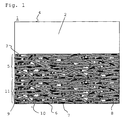
- Fig. 1 a schematic cross section through a glass or glass ceramic article 1 according to the invention with a decorative and a sealing layer is shown.
- the glass or glass-ceramic article 1 in this example comprises a glass or glass-ceramic substrate 2 with a bottom 3 and a top 4.
- the article 1 may in particular be a glass-ceramic cooktop.
- a decorative layer 5 having a pigment composition of the invention is applied on one of the pages 3 or 4.
- the decorative layer 5 is particularly preferably applied to the underside 4 of the cooktop in order to prevent wear of the layer during use.
- the sealing layer 11 according to the invention has the same composition as the decorative layer 5.
- decorative pigments 6, 7 and fillers 8 are mixed with a sol, and the resulting gel-like sol-gel binder is cured on the glass or glass-ceramic substrate 2 by baking.
- a decorative layer 5 forms with a microporous composite structure of large inner surface.
- the decorative pigments used according to the invention comprise platelet-shaped pigments 6 and graphite 7, which are present in a weight ratio in the range from 10: 1 (10 parts of platelet-shaped pigment particles to 1 part of solid lubricant) to 1: 1.
- Preferred platelet-shaped pigments are mica platelets and / or borosilicate-based platelets, particularly preferably coated mica platelets and / or borosilicate-based platelets and / or glass flakes and particularly preferably TiO 2 -coated coated mica platelets and / or coated borosilicate-based platelets and / or coated platelets Used glass flakes.
- the platelet-shaped pigments preferably have a cross section which is between 5 and 125 .mu.m, while the D90 value of the graphite is preferably in the range from 6 to 19 .mu.m.
- synthetic mica pigments can also be used as platelet-shaped pigments.
- the platelet-shaped mica pigments may be coated with cobalt oxide and iron oxide.
- filler particles 8 are also contained in the layer 5.
- the filler particles 8 and the decorative pigment particles 6, 7 are connected by a cured sol-gel binder 9 to a solid layer, wherein the weight fraction of pigment particles 6, 7 and filler particles 8 higher than the weight fraction of the solidified and cured sol Gel binder is 9.
- the proportion of sol-gel binder 9 at most 40 wt .-%, or even only at most 30 wt .-% of the total mass of the layer 5 shown by the high solids content or by the small proportion of sol Gel binder 9 remain pores 10 exist.
- the overall porous layer is comparatively flexible, so that differences in the coefficients of thermal expansion of substrate 2 and decorative layer 5 can be compensated.
- this mixture is allowed to mature for, for example, one hour, preferably with constant stirring.
- the pigments and optionally further fillers are preferred Fumed silica, weighed, added to the ripening mixture and dispersed.
- the fumed silica and / or the colloidal SiO 2 dispersion provide the spherical filler particles 8 for the finished decorative layer 5.
- the proportion of fillers is in each case less than 20 wt .-% of the mass of the platelet-shaped pigments 6, 7.
- the Weight fraction of filler particles 8 thereby preferably at most 10 wt .-% of the weight fraction of the pigment particles 6, 7.
- the sol converts to a metal oxide gel by volatilization of the alcohol and by polycondensation of the hydrolyzed TEOS and TEMS. This process is accelerated after application of the mixture to the substrate 2 by drying at temperatures between 100 and 250 ° C, so that solidifies the applied layer to form the gel.
- TEOS and / or TEMS used as starting materials a SiO 2 network is created, in particular an at least partially methyl substituted SiO 2 network.
- the subsequent baking of the dried layer at temperatures of preferably> 350 ° C. completes the reaction to the SiO 2 network and leads to a densification of the decorative layer 5 thus produced.
- the platelet-shaped pigment particles 6 are aligned predominantly parallel to the surface of the substrate. Under a predominantly parallel orientation is understood according to the invention that the angular distribution of the surface normal of the pigment particles 6 is not stochastic, but rather has a clear maximum in the direction of the surface normal of the substrate surface. This adjustment of the pigment particles is achieved particularly easily by the use of fillers 8 with spherical geometry.
- the regulation of the platelet-shaped pigment particles 6 has the advantage that the metallic effect is enhanced and the decorative layer 5 produced also has improved scratch and abrasion resistance.
- the decorative layer 5 is also covered with a sealing layer 11 according to the invention.
- the sealing layer 11 has the same composition as the decorative layer 5 and can thus also be produced by a similar method. This results in cost and time savings.
- a decorative layer with this pigmentation satisfies the requirements with regard to adhesive strength, impermeability and scratch resistance, which are imposed, for example, on a glass-ceramic cooktop.
- a platelet-shaped, TiO 2 and SnO 2 -reduced mica-based effect pigment having a particle size in the range of 10 to 60 micrometers and 6% by weight of another platelet-shaped mica-based, with TiO 2 , Fe 2 O 3 and SnO 2 -coated effect pigments having a particle size in the range of 5 to 25 microns combined with 24 weight percent highly crystalline graphite with a D90 value of 15 to 20 microns.
- This pigmentation can also be used to produce a decorative layer.
- the coating can be constructed with the same recipe for decorative and sealing layer.
- a second formulation for the pigmentation of a sealant layer according to the invention 63% by weight of a platelet-shaped, TiO 2 and SnO 2 -coated mica-based effect pigment having a particle size in the range from 10 to 60 micrometers and 5 Weight percent of another platelet-mica based TiO 2 , Fe 2 O 3 , SiO 2 and SnO 2 -coated effect pigment having a particle size in the range of 5 to 25 microns combined with 32 wt% highly crystalline graphite having a D90 value of 5 to 8 microns ,
- This pigmentation can also be used to produce a decorative layer.
- the coating can be constructed with the same recipe for decorative and sealing layer.
- a third formulation for the pigmentation of a sealant layer according to the invention 63% by weight of a platelet-shaped, cobalt oxide and iron oxide-coated synthetic mica-based effect pigment having a particle size in the range of 5 to 60 micrometers and 3 weight percent of another, platelet-shaped, mica-based, with TiO 2, Fe 2 O 3 , SiO 2 and SnO 2 -coated effect pigments having a particle size in the range of 10 to 120 micrometers combined with 32 weight percent highly crystalline graphite having a D90 value of 5 to 8 micrometers.
- This pigmentation can also be used to produce a decorative layer.
- the coating can be constructed with the same recipe for decorative and sealing layer.
- the three above embodiments may also be combined with each other, using one of the formulations for producing the decorative layer and the other formulation for producing the sealing layer.
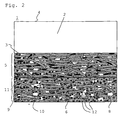
- Fig. 2 shows a schematic cross section through a glass or glass ceramic article 1 according to the invention, comprising a glass or glass ceramic substrate 2 with a decorative layer 5 and a sealing layer 11 according to the invention.
- Decorating and sealing layer 5, 11 are analogous to that for Fig. 1 described method.
- the sealing layer 11 may additionally generally also contain TiO 2 pigments of different particle size, the particle sizes advantageously being in a range between 50 and 350 nm. These additional pigments need not be platelet-shaped.
- a sealant layer 11 having such a pigment composition allows applications in areas where electrical conductivity of the layer is undesirable.
- An article with such a coating can be used, for example, in the field of touchscreens.
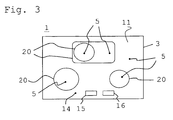
- Fig. 3 shows a plan view of a coated according to the invention glass ceramic article 1 in the form of a glass ceramic hob.
- the decorative layer 5 provided with a sealing layer 11 is located on the underside 3 of the glass ceramic hob 2.
- the hob 2 has a plurality of heating zones or hot areas 20, under which the heating elements (not shown) are arranged.
- the heating zones 20 may, for example, be delimited from the non-heatable surroundings 14 by decorative layers 5 of different gray coloration and / or appearance and / or composition. This may have an aesthetic function or even the heating zones 20 characterizing function.
- areas without decorative layer 15 and / or without sealing layer 16 can be recessed, so that these areas can be used, for example, as sensor fields and / or for a display.
- Decorative layer 5 and sealing layer 11 with the pigmentations according to the invention are not only sufficiently temperature-stable, but also able to conduct the heat generated by the heating elements sufficiently well for cooking on the hob. It has been found, in particular, that the decorative coating in the hot regions 20 does not change its visual appearance even after a long period of operation.
Landscapes
- Chemical & Material Sciences (AREA)
- Geochemistry & Mineralogy (AREA)
- Life Sciences & Earth Sciences (AREA)
- Engineering & Computer Science (AREA)
- Chemical Kinetics & Catalysis (AREA)
- General Chemical & Material Sciences (AREA)
- Materials Engineering (AREA)
- Organic Chemistry (AREA)
- Composite Materials (AREA)
- Dispersion Chemistry (AREA)
- Inorganic Chemistry (AREA)
- Surface Treatment Of Glass (AREA)
- Laminated Bodies (AREA)
- Glass Compositions (AREA)
Applications Claiming Priority (1)
| Application Number | Priority Date | Filing Date | Title |
|---|---|---|---|
| DE102008031426.9A DE102008031426B4 (de) | 2008-07-04 | 2008-07-04 | Verfahren zur Herstellung einer Versiegelungsschicht für Dekorschichten, Glas- oder Glaskeramik-Artikel und dessen Verwendung |
Publications (2)
| Publication Number | Publication Date |
|---|---|
| EP2141134A1 EP2141134A1 (de) | 2010-01-06 |
| EP2141134B1 true EP2141134B1 (de) | 2013-05-15 |
Family
ID=41057489
Family Applications (1)
| Application Number | Title | Priority Date | Filing Date |
|---|---|---|---|
| EP09008738.8A Not-in-force EP2141134B1 (de) | 2008-07-04 | 2009-07-03 | Versiegelungsschicht für Dekorschichten von Glas- oder Glaskeramik-Artikeln |
Country Status (6)
| Country | Link |
|---|---|
| US (1) | US20100028629A1 (OSRAM) |
| EP (1) | EP2141134B1 (OSRAM) |
| JP (1) | JP5078948B2 (OSRAM) |
| CN (1) | CN101618950B (OSRAM) |
| DE (1) | DE102008031426B4 (OSRAM) |
| ES (1) | ES2409219T3 (OSRAM) |
Families Citing this family (20)
| Publication number | Priority date | Publication date | Assignee | Title |
|---|---|---|---|---|
| WO2011090035A1 (ja) * | 2010-01-19 | 2011-07-28 | 旭硝子株式会社 | 撥水性基体およびその製造方法 |
| FR2960233B1 (fr) | 2010-05-19 | 2012-08-10 | Eurokera | Preparation d'un article en un verre ou en une vitroceramique avec revetement ameliore et ledit article |
| DE102010031866A1 (de) * | 2010-07-21 | 2012-01-26 | Schott Ag | Silikonbeschichtung als Versiegelungsschicht für eine Dekorbeschichtung |
| WO2013156617A1 (de) * | 2012-04-20 | 2013-10-24 | Schott Ag | Verbundmaterial mit dekorativer beschichtung sowie verfahren zu dessen herstellung |
| FR2992313B1 (fr) * | 2012-06-21 | 2014-11-07 | Eurokera | Article vitroceramique et procede de fabrication |
| FR2998651B1 (fr) * | 2012-11-26 | 2018-08-17 | Eurokera S.N.C. | Plaque de cuisson a fenetre et flasque, appareil de cuisson, et procede de fabrication de la plaque |
| DE102013112109A1 (de) * | 2013-11-04 | 2015-05-21 | Schott Ag | Substrat mit elektrisch leitfähiger Beschichtung sowie Verfahren zur Herstellung eines Substrates mit einer elektrisch leitfähigen Beschichtung |
| DE102015103518A1 (de) | 2015-03-10 | 2016-09-15 | Schott Ag | Verfahren zur Herstellung eines Glaskeramikelements mit strukturierter Beschichtung |
| DE102014118497B4 (de) | 2014-12-12 | 2017-06-29 | Schott Ag | Verfahren zur Herstellung eines Glaskeramikelements mit strukturierter Beschichtung, plattenförmig ausgebildetes Glaskeramikelement und Glaskeramik-Kochfeld |
| EP3031785B1 (de) | 2014-12-12 | 2018-10-17 | Schott AG | Verfahren zur herstellung eines glaskeramikelements mit strukturierter beschichtung |
| DE102015102743A1 (de) | 2015-02-26 | 2016-09-01 | Schott Ag | Beschichteter Glas- oder Glaskeramikartikel |
| DE102016103524A1 (de) | 2016-02-29 | 2017-08-31 | Schott Ag | Beschichteter Glas- oder Glaskeramikartikel |
| EP3210948B1 (de) | 2016-02-29 | 2019-12-04 | Schott Ag | Beschichteter glas- oder glaskeramikartikel |
| DE202016104800U1 (de) | 2016-08-31 | 2016-12-08 | Schott Ag | Beschichteter Glas- oder Glaskeramikartikel |
| DE102017118451A1 (de) | 2016-12-23 | 2018-06-28 | Schott Ag | Kochfeld mit Anzeigeeinrichtung |
| DE102017127624A1 (de) | 2017-11-22 | 2019-05-23 | Schott Ag | Beschichtetes Glas- oder Glaskeramik-Substrat, Beschichtung umfassend geschlossene Poren sowie Verfahren zur Beschichtung eines Substrats |
| EP3564197A1 (en) | 2018-05-04 | 2019-11-06 | Merck Patent GmbH | Ceramic colours |
| DE102022118562A1 (de) | 2022-07-25 | 2024-01-25 | Schott Ag | Glas- oder Glaskeramikplatte umfassend wenigstens eine auf einer Seite angeordnete Beschichtung sowie Verfahren zu deren Herstellung |
| DE102023107996A1 (de) | 2023-03-29 | 2024-10-02 | Schott Ag | Glasscheibe umfassend eine in wenigstens einem Bereich wenigstens einer Seite der Glasscheibe aufgetragene Beschichtung, Verbund umfassend eine solche sowie Paste zur Herstellung einer solchen Glasscheibe |
| CN117533102A (zh) * | 2023-10-20 | 2024-02-09 | 牛墨石墨烯应用科技有限公司 | 一种汽车车窗用石墨烯导热玻璃及其制备方法 |
Family Cites Families (15)
| Publication number | Priority date | Publication date | Assignee | Title |
|---|---|---|---|---|
| US4396514A (en) * | 1981-05-20 | 1983-08-02 | Randisi Sal A | Lubricating composition and method for making |
| US6492029B1 (en) * | 1991-01-25 | 2002-12-10 | Saint-Gobain Glass France | Method of enameling substrates comprised of glass materials; enamel composition used; and products obtained thereby |
| US5306759A (en) * | 1992-02-13 | 1994-04-26 | Japan Synthetic Rubber Co., Ltd. | Coating composition and process for manufacturing the same |
| DE4338360A1 (de) | 1993-11-10 | 1995-05-11 | Inst Neue Mat Gemein Gmbh | Verfahren zur Herstellung von funktionellen glasartigen Schichten |
| JPH10113290A (ja) * | 1996-10-11 | 1998-05-06 | Zojirushi Corp | 加熱調理器具 |
| DE19946712A1 (de) | 1999-09-29 | 2001-04-05 | Inst Neue Mat Gemein Gmbh | Verfahren und Zusammensetzungen zum Bedrucken von Substraten |
| DE20106167U1 (de) * | 2001-04-07 | 2001-06-21 | Schott Glas, 55122 Mainz | Kochfeld mit einer Glaskeramikplatte als Kochfläche |
| DE20108167U1 (de) * | 2001-05-15 | 2001-08-30 | Lehrberger, Andreas, 82377 Penzberg | Handbohrmaschine mit Höhenführung zum Bohren von senkrechten Löchern und senkrechten Verschrauben |
| DE10355160B4 (de) | 2003-11-26 | 2008-04-03 | Schott Ag | Beschichtete Glaskeramikplatte, Verfahren zu ihrer Herstellung und Kochfeld mit einer solchen Glaskeramikplatte |
| US7598210B2 (en) * | 2005-01-13 | 2009-10-06 | Advanced Lubrication Technology Inc. | High temperature lubricant composition |
| DE102005018246A1 (de) * | 2005-04-19 | 2006-10-26 | Schott Ag | Glas- oder Glaskeramik-Artikel mit dekorativer Beschichtung |
| JP4004529B1 (ja) * | 2006-07-05 | 2007-11-07 | 鳴海製陶株式会社 | 加熱調理器用ガラストッププレート |
| US20080102267A1 (en) * | 2006-09-27 | 2008-05-01 | The Sherwin-Williams Company | Metallic groundcoat coating composition |
| JP5197377B2 (ja) * | 2006-11-14 | 2013-05-15 | 旭化成ケミカルズ株式会社 | 金属顔料組成物 |
| EP2219624A2 (en) * | 2007-11-08 | 2010-08-25 | Glaxo Group Limited | Pharmaceutical formulations |
-
2008
- 2008-07-04 DE DE102008031426.9A patent/DE102008031426B4/de not_active Expired - Fee Related
-
2009
- 2009-07-03 JP JP2009158333A patent/JP5078948B2/ja not_active Expired - Fee Related
- 2009-07-03 EP EP09008738.8A patent/EP2141134B1/de not_active Not-in-force
- 2009-07-03 ES ES09008738T patent/ES2409219T3/es active Active
- 2009-07-06 US US12/459,644 patent/US20100028629A1/en not_active Abandoned
- 2009-07-06 CN CN200910149581.4A patent/CN101618950B/zh not_active Expired - Fee Related
Also Published As
| Publication number | Publication date |
|---|---|
| EP2141134A1 (de) | 2010-01-06 |
| US20100028629A1 (en) | 2010-02-04 |
| CN101618950B (zh) | 2014-08-06 |
| DE102008031426B4 (de) | 2014-07-31 |
| DE102008031426A1 (de) | 2010-01-07 |
| JP2010013347A (ja) | 2010-01-21 |
| ES2409219T3 (es) | 2013-06-25 |
| CN101618950A (zh) | 2010-01-06 |
| JP5078948B2 (ja) | 2012-11-21 |
Similar Documents
| Publication | Publication Date | Title |
|---|---|---|
| EP2141134B1 (de) | Versiegelungsschicht für Dekorschichten von Glas- oder Glaskeramik-Artikeln | |
| EP2141133B1 (de) | Dekorative Beschichtung von Glas- oder Glaskeramik-Artikeln | |
| EP1871719B1 (de) | Glas- oder glaskeramik-artikel mit dekorativer beschichtung | |
| DE102009004784B4 (de) | Verfahren zur Herstellung eines Glas- oder Glaskeramik- Artikels mit Dekorbeschichtung, Glas- oder Glaskeramik- Artikel und deren Verwendung | |
| EP2838861B1 (de) | Verbundmaterial mit dekorativer beschichtung sowie verfahren zu dessen herstellung | |
| EP2595933B1 (de) | Silikonbeschichtung als versiegelungsschicht für eine dekorbeschichtung | |
| EP2243752B1 (de) | Kratzfeste Silikonbeschichtung für Kochflächen aus Glas oder Glaskeramik | |
| EP2523916B1 (de) | Verbundmaterial und verfahren zu dessen herstellung | |
| EP2223900B1 (de) | Beschichtung für den Anzeigebereich von Glas- oder Glaskeramik-Scheiben, Verfahren zur Herstellung einer solchen Beschichtung und deren Verwendung | |
| DE10016485A1 (de) | Glas-, Keramik- und Metall-Substrate mit selbstreinigender Oberfläche, Verfahren zu deren Herstellung und deren Verwendung | |
| EP3713889A1 (de) | Beschichtetes glas- oder glaskeramik-substrat, beschichtung umfassend geschlossene poren sowie verfahren zur beschichtung eines substrats | |
| DE102009004783B4 (de) | Verfahren zur Herstellung einer glimmerreduzierten Versiegelungsschicht für Dekorschichten von Glas- oder Glaskeramik-Artikeln, mit diesem Verfahren hergestelltes Produkt sowie dessen Verwendung | |
| EP2859054B1 (de) | Sol-gel-farbe sowie verfahren zu deren herstellung | |
| WO2005063645A1 (de) | Substrate mit einer transparenten, spiegelnden metalloxid-teilbeschichtung, deren herstellung und anwendung | |
| DE102008012891A1 (de) | Glaskeramikartikel mit einer anorganischen lichtstreuenden Beschichtung, Verfahren zu seiner Herstellung und Beschichtungszusammensetzung | |
| DE102008040636B4 (de) | Glaskeramikplatte, deren betriebliche Unterseite mit einer Beschichtung versehen ist und Verfahren zum Aufbringen der Beschichtung | |
| EP4455102A1 (de) | Glasscheibe umfassend eine in wenigstens einem bereich wenigstens einer seite der glasscheibe aufgetragene beschichtung, verbund umfassend eine solche sowie paste zur herstellung einer solchen glasscheibe | |
| WO2018130534A1 (de) | Beschichtungsmaterial für selbstreinigende beschichtung und verfahren zur herstellung | |
| EP4613720A1 (de) | Scheibenförmiges glaselement sowie paste und verfahren zu dessen herstellung sowie dessen verwendung und hausgerät umfassend ein solches glaselement | |
| DE10164636A1 (de) | Mischung und Verfahren zur Erstellung einer Beschichtung |
Legal Events
| Date | Code | Title | Description |
|---|---|---|---|
| PUAI | Public reference made under article 153(3) epc to a published international application that has entered the european phase |
Free format text: ORIGINAL CODE: 0009012 |
|
| 17P | Request for examination filed |
Effective date: 20090721 |
|
| AK | Designated contracting states |
Kind code of ref document: A1 Designated state(s): AT BE BG CH CY CZ DE DK EE ES FI FR GB GR HR HU IE IS IT LI LT LU LV MC MK MT NL NO PL PT RO SE SI SK SM TR |
|
| 17Q | First examination report despatched |
Effective date: 20110929 |
|
| GRAP | Despatch of communication of intention to grant a patent |
Free format text: ORIGINAL CODE: EPIDOSNIGR1 |
|
| GRAS | Grant fee paid |
Free format text: ORIGINAL CODE: EPIDOSNIGR3 |
|
| GRAA | (expected) grant |
Free format text: ORIGINAL CODE: 0009210 |
|
| AK | Designated contracting states |
Kind code of ref document: B1 Designated state(s): AT BE BG CH CY CZ DE DK EE ES FI FR GB GR HR HU IE IS IT LI LT LU LV MC MK MT NL NO PL PT RO SE SI SK SM TR |
|
| REG | Reference to a national code |
Ref country code: GB Ref legal event code: FG4D Free format text: NOT ENGLISH Ref country code: CH Ref legal event code: EP |
|
| REG | Reference to a national code |
Ref country code: AT Ref legal event code: REF Ref document number: 612066 Country of ref document: AT Kind code of ref document: T Effective date: 20130615 |
|
| REG | Reference to a national code |
Ref country code: IE Ref legal event code: FG4D Free format text: LANGUAGE OF EP DOCUMENT: GERMAN |
|
| REG | Reference to a national code |
Ref country code: ES Ref legal event code: FG2A Ref document number: 2409219 Country of ref document: ES Kind code of ref document: T3 Effective date: 20130625 |
|
| REG | Reference to a national code |
Ref country code: DE Ref legal event code: R096 Ref document number: 502009007072 Country of ref document: DE Effective date: 20130711 |
|
| REG | Reference to a national code |
Ref country code: LT Ref legal event code: MG4D |
|
| REG | Reference to a national code |
Ref country code: NL Ref legal event code: VDEP Effective date: 20130515 |
|
| PG25 | Lapsed in a contracting state [announced via postgrant information from national office to epo] |
Ref country code: SE Free format text: LAPSE BECAUSE OF FAILURE TO SUBMIT A TRANSLATION OF THE DESCRIPTION OR TO PAY THE FEE WITHIN THE PRESCRIBED TIME-LIMIT Effective date: 20130515 Ref country code: SI Free format text: LAPSE BECAUSE OF FAILURE TO SUBMIT A TRANSLATION OF THE DESCRIPTION OR TO PAY THE FEE WITHIN THE PRESCRIBED TIME-LIMIT Effective date: 20130515 Ref country code: GR Free format text: LAPSE BECAUSE OF FAILURE TO SUBMIT A TRANSLATION OF THE DESCRIPTION OR TO PAY THE FEE WITHIN THE PRESCRIBED TIME-LIMIT Effective date: 20130816 Ref country code: FI Free format text: LAPSE BECAUSE OF FAILURE TO SUBMIT A TRANSLATION OF THE DESCRIPTION OR TO PAY THE FEE WITHIN THE PRESCRIBED TIME-LIMIT Effective date: 20130515 Ref country code: LT Free format text: LAPSE BECAUSE OF FAILURE TO SUBMIT A TRANSLATION OF THE DESCRIPTION OR TO PAY THE FEE WITHIN THE PRESCRIBED TIME-LIMIT Effective date: 20130515 Ref country code: IS Free format text: LAPSE BECAUSE OF FAILURE TO SUBMIT A TRANSLATION OF THE DESCRIPTION OR TO PAY THE FEE WITHIN THE PRESCRIBED TIME-LIMIT Effective date: 20130915 Ref country code: NO Free format text: LAPSE BECAUSE OF FAILURE TO SUBMIT A TRANSLATION OF THE DESCRIPTION OR TO PAY THE FEE WITHIN THE PRESCRIBED TIME-LIMIT Effective date: 20130815 Ref country code: PT Free format text: LAPSE BECAUSE OF FAILURE TO SUBMIT A TRANSLATION OF THE DESCRIPTION OR TO PAY THE FEE WITHIN THE PRESCRIBED TIME-LIMIT Effective date: 20130916 |
|
| PG25 | Lapsed in a contracting state [announced via postgrant information from national office to epo] |
Ref country code: HR Free format text: LAPSE BECAUSE OF FAILURE TO SUBMIT A TRANSLATION OF THE DESCRIPTION OR TO PAY THE FEE WITHIN THE PRESCRIBED TIME-LIMIT Effective date: 20130515 Ref country code: PL Free format text: LAPSE BECAUSE OF FAILURE TO SUBMIT A TRANSLATION OF THE DESCRIPTION OR TO PAY THE FEE WITHIN THE PRESCRIBED TIME-LIMIT Effective date: 20130515 Ref country code: BG Free format text: LAPSE BECAUSE OF FAILURE TO SUBMIT A TRANSLATION OF THE DESCRIPTION OR TO PAY THE FEE WITHIN THE PRESCRIBED TIME-LIMIT Effective date: 20130815 |
|
| PG25 | Lapsed in a contracting state [announced via postgrant information from national office to epo] |
Ref country code: LV Free format text: LAPSE BECAUSE OF FAILURE TO SUBMIT A TRANSLATION OF THE DESCRIPTION OR TO PAY THE FEE WITHIN THE PRESCRIBED TIME-LIMIT Effective date: 20130515 |
|
| BERE | Be: lapsed |
Owner name: SCHOTT A.G. Effective date: 20130731 |
|
| PG25 | Lapsed in a contracting state [announced via postgrant information from national office to epo] |
Ref country code: CZ Free format text: LAPSE BECAUSE OF FAILURE TO SUBMIT A TRANSLATION OF THE DESCRIPTION OR TO PAY THE FEE WITHIN THE PRESCRIBED TIME-LIMIT Effective date: 20130515 Ref country code: SK Free format text: LAPSE BECAUSE OF FAILURE TO SUBMIT A TRANSLATION OF THE DESCRIPTION OR TO PAY THE FEE WITHIN THE PRESCRIBED TIME-LIMIT Effective date: 20130515 Ref country code: EE Free format text: LAPSE BECAUSE OF FAILURE TO SUBMIT A TRANSLATION OF THE DESCRIPTION OR TO PAY THE FEE WITHIN THE PRESCRIBED TIME-LIMIT Effective date: 20130515 Ref country code: DK Free format text: LAPSE BECAUSE OF FAILURE TO SUBMIT A TRANSLATION OF THE DESCRIPTION OR TO PAY THE FEE WITHIN THE PRESCRIBED TIME-LIMIT Effective date: 20130515 |
|
| PG25 | Lapsed in a contracting state [announced via postgrant information from national office to epo] |
Ref country code: NL Free format text: LAPSE BECAUSE OF FAILURE TO SUBMIT A TRANSLATION OF THE DESCRIPTION OR TO PAY THE FEE WITHIN THE PRESCRIBED TIME-LIMIT Effective date: 20130515 Ref country code: MC Free format text: LAPSE BECAUSE OF FAILURE TO SUBMIT A TRANSLATION OF THE DESCRIPTION OR TO PAY THE FEE WITHIN THE PRESCRIBED TIME-LIMIT Effective date: 20130515 Ref country code: IT Free format text: LAPSE BECAUSE OF FAILURE TO SUBMIT A TRANSLATION OF THE DESCRIPTION OR TO PAY THE FEE WITHIN THE PRESCRIBED TIME-LIMIT Effective date: 20130515 Ref country code: RO Free format text: LAPSE BECAUSE OF FAILURE TO SUBMIT A TRANSLATION OF THE DESCRIPTION OR TO PAY THE FEE WITHIN THE PRESCRIBED TIME-LIMIT Effective date: 20130515 |
|
| REG | Reference to a national code |
Ref country code: CH Ref legal event code: PL |
|
| PLBE | No opposition filed within time limit |
Free format text: ORIGINAL CODE: 0009261 |
|
| STAA | Information on the status of an ep patent application or granted ep patent |
Free format text: STATUS: NO OPPOSITION FILED WITHIN TIME LIMIT |
|
| 26N | No opposition filed |
Effective date: 20140218 |
|
| GBPC | Gb: european patent ceased through non-payment of renewal fee |
Effective date: 20130815 |
|
| REG | Reference to a national code |
Ref country code: IE Ref legal event code: MM4A |
|
| PG25 | Lapsed in a contracting state [announced via postgrant information from national office to epo] |
Ref country code: BE Free format text: LAPSE BECAUSE OF NON-PAYMENT OF DUE FEES Effective date: 20130731 Ref country code: LI Free format text: LAPSE BECAUSE OF NON-PAYMENT OF DUE FEES Effective date: 20130731 Ref country code: CH Free format text: LAPSE BECAUSE OF NON-PAYMENT OF DUE FEES Effective date: 20130731 |
|
| REG | Reference to a national code |
Ref country code: DE Ref legal event code: R097 Ref document number: 502009007072 Country of ref document: DE Effective date: 20140218 |
|
| PG25 | Lapsed in a contracting state [announced via postgrant information from national office to epo] |
Ref country code: GB Free format text: LAPSE BECAUSE OF NON-PAYMENT OF DUE FEES Effective date: 20130815 Ref country code: IE Free format text: LAPSE BECAUSE OF NON-PAYMENT OF DUE FEES Effective date: 20130703 |
|
| PG25 | Lapsed in a contracting state [announced via postgrant information from national office to epo] |
Ref country code: SM Free format text: LAPSE BECAUSE OF FAILURE TO SUBMIT A TRANSLATION OF THE DESCRIPTION OR TO PAY THE FEE WITHIN THE PRESCRIBED TIME-LIMIT Effective date: 20130515 |
|
| PG25 | Lapsed in a contracting state [announced via postgrant information from national office to epo] |
Ref country code: MT Free format text: LAPSE BECAUSE OF FAILURE TO SUBMIT A TRANSLATION OF THE DESCRIPTION OR TO PAY THE FEE WITHIN THE PRESCRIBED TIME-LIMIT Effective date: 20130515 Ref country code: TR Free format text: LAPSE BECAUSE OF FAILURE TO SUBMIT A TRANSLATION OF THE DESCRIPTION OR TO PAY THE FEE WITHIN THE PRESCRIBED TIME-LIMIT Effective date: 20130515 Ref country code: CY Free format text: LAPSE BECAUSE OF FAILURE TO SUBMIT A TRANSLATION OF THE DESCRIPTION OR TO PAY THE FEE WITHIN THE PRESCRIBED TIME-LIMIT Effective date: 20130515 |
|
| PG25 | Lapsed in a contracting state [announced via postgrant information from national office to epo] |
Ref country code: MK Free format text: LAPSE BECAUSE OF FAILURE TO SUBMIT A TRANSLATION OF THE DESCRIPTION OR TO PAY THE FEE WITHIN THE PRESCRIBED TIME-LIMIT Effective date: 20130515 Ref country code: LU Free format text: LAPSE BECAUSE OF NON-PAYMENT OF DUE FEES Effective date: 20130703 Ref country code: HU Free format text: LAPSE BECAUSE OF FAILURE TO SUBMIT A TRANSLATION OF THE DESCRIPTION OR TO PAY THE FEE WITHIN THE PRESCRIBED TIME-LIMIT; INVALID AB INITIO Effective date: 20090703 |
|
| REG | Reference to a national code |
Ref country code: AT Ref legal event code: MM01 Ref document number: 612066 Country of ref document: AT Kind code of ref document: T Effective date: 20140703 |
|
| PG25 | Lapsed in a contracting state [announced via postgrant information from national office to epo] |
Ref country code: AT Free format text: LAPSE BECAUSE OF NON-PAYMENT OF DUE FEES Effective date: 20140703 |
|
| REG | Reference to a national code |
Ref country code: FR Ref legal event code: PLFP Year of fee payment: 8 |
|
| REG | Reference to a national code |
Ref country code: FR Ref legal event code: PLFP Year of fee payment: 9 |
|
| REG | Reference to a national code |
Ref country code: FR Ref legal event code: PLFP Year of fee payment: 10 |
|
| PGFP | Annual fee paid to national office [announced via postgrant information from national office to epo] |
Ref country code: DE Payment date: 20200721 Year of fee payment: 12 Ref country code: ES Payment date: 20200922 Year of fee payment: 12 Ref country code: FR Payment date: 20200723 Year of fee payment: 12 |
|
| REG | Reference to a national code |
Ref country code: DE Ref legal event code: R119 Ref document number: 502009007072 Country of ref document: DE |
|
| PG25 | Lapsed in a contracting state [announced via postgrant information from national office to epo] |
Ref country code: DE Free format text: LAPSE BECAUSE OF NON-PAYMENT OF DUE FEES Effective date: 20220201 |
|
| PG25 | Lapsed in a contracting state [announced via postgrant information from national office to epo] |
Ref country code: FR Free format text: LAPSE BECAUSE OF NON-PAYMENT OF DUE FEES Effective date: 20210731 |
|
| REG | Reference to a national code |
Ref country code: ES Ref legal event code: FD2A Effective date: 20220930 |
|
| PG25 | Lapsed in a contracting state [announced via postgrant information from national office to epo] |
Ref country code: ES Free format text: LAPSE BECAUSE OF NON-PAYMENT OF DUE FEES Effective date: 20210704 |