EP2139481B1 - 1-[(2'-substituted)-piperazin-1'-yl]-isoquinolines as norepinephrine transporter inhibitor therapeutics and positron emission tomography imaging agents - Google Patents
1-[(2'-substituted)-piperazin-1'-yl]-isoquinolines as norepinephrine transporter inhibitor therapeutics and positron emission tomography imaging agents Download PDFInfo
- Publication number
- EP2139481B1 EP2139481B1 EP08742199.6A EP08742199A EP2139481B1 EP 2139481 B1 EP2139481 B1 EP 2139481B1 EP 08742199 A EP08742199 A EP 08742199A EP 2139481 B1 EP2139481 B1 EP 2139481B1
- Authority
- EP
- European Patent Office
- Prior art keywords
- alkyl
- aryl
- halo
- substituted
- amino
- Prior art date
- Legal status (The legal status is an assumption and is not a legal conclusion. Google has not performed a legal analysis and makes no representation as to the accuracy of the status listed.)
- Ceased
Links
Images


Classifications
-
- C—CHEMISTRY; METALLURGY
- C07—ORGANIC CHEMISTRY
- C07D—HETEROCYCLIC COMPOUNDS
- C07D401/00—Heterocyclic compounds containing two or more hetero rings, having nitrogen atoms as the only ring hetero atoms, at least one ring being a six-membered ring with only one nitrogen atom
- C07D401/02—Heterocyclic compounds containing two or more hetero rings, having nitrogen atoms as the only ring hetero atoms, at least one ring being a six-membered ring with only one nitrogen atom containing two hetero rings
- C07D401/04—Heterocyclic compounds containing two or more hetero rings, having nitrogen atoms as the only ring hetero atoms, at least one ring being a six-membered ring with only one nitrogen atom containing two hetero rings directly linked by a ring-member-to-ring-member bond
-
- A—HUMAN NECESSITIES
- A61—MEDICAL OR VETERINARY SCIENCE; HYGIENE
- A61P—SPECIFIC THERAPEUTIC ACTIVITY OF CHEMICAL COMPOUNDS OR MEDICINAL PREPARATIONS
- A61P25/00—Drugs for disorders of the nervous system
-
- A—HUMAN NECESSITIES
- A61—MEDICAL OR VETERINARY SCIENCE; HYGIENE
- A61P—SPECIFIC THERAPEUTIC ACTIVITY OF CHEMICAL COMPOUNDS OR MEDICINAL PREPARATIONS
- A61P25/00—Drugs for disorders of the nervous system
- A61P25/22—Anxiolytics
-
- A—HUMAN NECESSITIES
- A61—MEDICAL OR VETERINARY SCIENCE; HYGIENE
- A61P—SPECIFIC THERAPEUTIC ACTIVITY OF CHEMICAL COMPOUNDS OR MEDICINAL PREPARATIONS
- A61P25/00—Drugs for disorders of the nervous system
- A61P25/24—Antidepressants
-
- A—HUMAN NECESSITIES
- A61—MEDICAL OR VETERINARY SCIENCE; HYGIENE
- A61P—SPECIFIC THERAPEUTIC ACTIVITY OF CHEMICAL COMPOUNDS OR MEDICINAL PREPARATIONS
- A61P25/00—Drugs for disorders of the nervous system
- A61P25/28—Drugs for disorders of the nervous system for treating neurodegenerative disorders of the central nervous system, e.g. nootropic agents, cognition enhancers, drugs for treating Alzheimer's disease or other forms of dementia
-
- A—HUMAN NECESSITIES
- A61—MEDICAL OR VETERINARY SCIENCE; HYGIENE
- A61P—SPECIFIC THERAPEUTIC ACTIVITY OF CHEMICAL COMPOUNDS OR MEDICINAL PREPARATIONS
- A61P25/00—Drugs for disorders of the nervous system
- A61P25/30—Drugs for disorders of the nervous system for treating abuse or dependence
Definitions
- NET norepinephrine transporter protein found within peripheral and central nervous system (CNS) tissues is responsible for the clearance of the endogenous neurotransmitter norepinephrine (NE) from the synaptic cleft after neuronal firing.
- CNS biomedical literature describes that NET inhibitor drugs and related agents that enhance NE synaptic concentrations are indicated with anti-anxiety, antidepressant, and improved cognitive qualities [Millan 2006].
- NET interacting inhibitor-based binding drugs and similar ligands have the ability to alter the perception of pain [Millan 2006] and influence the outcomes of attention deficit disorders, post traumatic stress disorder (PTSD), and related co-morbid psychiatric states through the modulation of NE neurotransmission within the CNS [Rommelfanger 2007, Bonish 2006, Stone 2005, Cannistraro 2003, Millan 2000].
- CNS NET inhibitor binding drugs examples include desipramine, ( S,S )-reboxetine, atomoxetine, and ( S )-duloxetine [Mandela 2006, Millan 2006, Hajos 2004, Zhou 2004, Bymaster 2002].
- the drugs are thought to promote some of their beneficial effects by modulating NE synaptic concentrations by blocking reuptake of NE at NET.
- Effective compositions of the drugs include salts; for example, with duloxetine as the hydrochloride (HCl) salt.
- the drugs are characterized with in vitro pharmacological NET inhibitor competitive binding affinities (K i value) in the moderate to low nanomomolar concentration range.
- NET inhibitor binding drugs and agents also possess cross binding interactions with other CNS target proteins; defining them with NET non-selective binding profiles.
- the other cross binding interactions includes the serotonin transporter (SERT) and the dopamine transporter (DAT) [Mandela 2006, Millan 2006] proteins.
- NET potent and selective agents include stereochemical forms of ligand nisoxetine [Tejani-Butt 1992], which when labeled with a radioactive atom such as tritium ([ 3 H]) are capable of the quantitative detection of NET in tissues [Smith 2006, Tejani-Butt 1992 & 1993].
- Pharmacologically potent and selective NET inhibitor agents which are appended with select positron emitting radionuclide atoms (e.g., carbon-11, fluorine-18, bromine-76, iodine-122, iodine-124, iodine-131) at select locations on the chemical structures, can serve as quantitative positron emission tomography (PET) imaging tracers for the NET target protein in live brain [Ding 2006 & 2005, Logan 2007 & 2005].
- PET positron emission tomography
- Examples include the NET PET imaging tracers ( S,S )-[ 11 C]MeNER and ( S,S )-[ 18 F]FMeNER which have chemical structures possessing two aromatic ring moieties joined by a heteroatom linkage [Ding 2006 & 2005, Seneca 2006, Schou 2004 & 2003].
- Examples of NET PET imaging tracers capable of detecting and quantifying NET protein density in a reproducible manner within discrete tissue regions (for example within brain) are limited [Logan 2007 & 2005, Ding 2006, Seneca 2006].
- NET inhibitor agents appended with other radionuclides for example, iodine-123 may serve as single photon emission computed tomography (SPECT) imaging agents [Tamagnan 2007].
- SPECT single photon emission computed tomography
- Structurally novel NET PET and SPECT imaging tracers that are defined as classes of compounds with demonstrated in vitro NET binding selectivity and potency, are useful for the detection and quantification of NET by in vivo and in vitro methods within the clinic and laboratory [Logan 2007 & 2005, Smith 2006, Tejani-Butt 1992 & 1993]. Since select CNS disorders and diseases are thought to be a result of abnormalities associated with NET or the NE system, then detection and quantification of NET in select tissues provides a method for diagnoses [Logan 2007 & 2005].
- NET PET tracer NET target protein occupancy of other non-radioactive NET inhibitor drugs and agents may be assessed.
- the analysis by quantitative imaging of competitive NET binding between a tracer and non-radioactive drug or agent provides an understanding of in vivo dynamic competitive NET binding and pharmacokinetic performance of agents within tissues (including brain) over time [Logan 2007, Ding 2006, Seneca 2006, Schou 2004 & 2003, Tamagnan 2007].
- JP 63227570 describes the use of piperazinyl isoquinoline derivatives as anti-inflammatories, analgesics or antiarrhythmics.
- US 3857944 discloses the use of piperazinyl isoquinoline derivatives in the treatment of myocardial shock.
- CH 438308 relates to the use of piperazinyl isoquinoline derivatives as antitussives.
- WO 2004/080170 describes the use of piperazinyl isoquinoline derivatives of general formula (I) for controlling/combating insects, arachnids or nematodes.
- WO 2007/005935 describes norepinephrine transporter inhibitors for the treatment of norepinephrine related disorders and as positron emission tomography imaging agents.
- the invention encompasses structurally novel 1-[(2'-substituted)-piperazin-1'-yl]-isoquinoline compounds that possess potent and selective binding affinity for the norpeinephrine transporter (NET) protein found in peripheral and central nervous system tissues.
- the compounds of the invention are with novel chemical structures distinct from other NET inhibitor binding drugs and agents.
- the compounds of the invention are characterized with pharmacologically potent binding at the NET in brain tissues, amongst others.
- the compounds of the invention can be used in the treatment or prophylaxis of diseases and disorders characterized by NET or NE abnormalities; where diseases and disorders, without limitation include anxiety, depression, attention deficit disorder, drug dependency, post traumatic stress disorder, and neurodegenerative disorders co-morbid with abnormalities of NET or NE.
- the invention encompasses radioactive tracer forms of the compounds, which have radioactive atoms bonded to carbon atoms of the compound structures.
- the tracers are used to quantitatively detect NET and NET distributions using in vivo and in vitro imaging methods.
- the imaging tracers detect and quantify NET densities within live and post-mortem tissues, including brain.
- the tissue imaging methods encompass positron emission tomography (PET), single photon emission computed tomography (SPECT) and autoradiography.
- the radiotracers of the invention can be administered to subjects in an amount suitable for in vivo imaging thereof, and to locate, diagnose identify evaluate detect and quantify NET in CNS diseases and disorders, without limitation including anxiety, depression, attention deficit disorder, drug dependency, post traumatic stress disorder, and neurodegenerative disorders co-morbid with abnormalities of NET or NE.
- the invention provides examples using the tracers with PET imaging methods for the quantitative detection of NET and NET distributions within live brain tissues of various subjects.
- the 1-[(2'-substituted)-piperazin-1'-yl]-isoquinoline general structure of the compounds and tracers of the invention is the following.
- the compounds and radiolabeled tracers of the invention include salts, compositions, and discrete configurational stereochemical constitutions (racemic mixtures or enantiomeric stereochemical forms) thereof.
- the invention provides examples of methods for syntheses of the compounds.
- the invention provides examples of methods for radiolabeling for the production of the tracers of the invention.
- FIG. 1 shows the in vivo PET imaging quantitative detection and distribution of NET within female rat subject brain tissues with tracer time-activity pharmacokinetic tissue curves afforded after dose administration of the radiotracer ( ⁇ )-[ 18 F]28, where the Y axis is injected tracer dose per cubic centimeter (% ID/cc) tissue values and the X axis is time in minutes; and as per the figure legend solid line curves and solid symbols are NET detection and distribution values acquired by dosing tracer alone (unblocked), whereas the dashed line curves and open symbol forms are time-activity tracer profiles that are afforded by dosing the subject with the known NET inhibitor agent ( ⁇ )-nisoxetine (2.0 mg/Kg dose, blocked); and where the curves are defined (figure legend) for brain tissues including LC as locus ceruleus (square symbol), TH as thalamus (circle symbol), CE as cerebellum (triangle up symbol), FrCTX as frontal cortex (triangle down symbol),
- FIG. 2 shows the in vivo PET imaging quantitative detection and distribution of the NET within tissues of a primate subject brain, male rhesus monkey, with tracer time-activity pharmacokinetic curves afforded after dose administration of the radiotracer ( S )-[ 18 F]28; where the Y axis is injected tracer dose per cubic centimeter (% ID/cc) tissue values and the X axis is time in minutes; and as per the figure legend solid line curves and solid symbols are NET detection and distribution values acquired by dosing tracer alone where the curves are defined (figure legend) for brain tissues including BSTM as brain stem (square symbol), TH as thalamus (circle symbol), CE as cerebellum (triangle up symbol), and FrCTX as frontal cortex (diamond symbol).
- BSTM brain stem
- TH thalamus
- CE cerebellum
- FrCTX as frontal cortex
- the invention encompasses structurally novel 1-[(2'-substituted)-piperazin-1'-yl]-isoquinoline compounds that possess potent and selective binding affinity for the norpeinephrine transporter (NET) target protein found in peripheral and central nervous system tissues.
- the compounds of the invention are with novel chemical structures distinct from other NET inhibitor binding drugs and agents.
- the compounds of the invention are found with pharmacologically potent binding at the NET in various tissues, including brain.
- the compounds of the invention can be used in the treatment or prophylaxis of diseases and disorder characterized by NET or NE abnormalities.
- the compounds of the invention can comprise one of the following structures, wherein, * independently denotes an R or S configuration or a racemic mixture; and wherein R 1 is selected from the group consisting of H, methyl, alkyl, and halo-alkyl; and wherein R 2 is selected from the group consisting of alkyl (straight chain or branched), O-alkyl, S-alkyl, aryl-alkyl-, halo-substituted-alkyl-, halo-substituted-alkenyl-, alkyl-oxy-alkyl ether-, halo-substituted-alkyl-oxy-alkyl ether-, aryl-oxy-alkyl ether-, O-aryl, S-aryl, amino, amino-alkyl, and amino-aryl; and wherein R 3 is independently selected from the group consisting of H, halogen, alkyl (straight chain or branched), O-alkyl, S-
- the invention encompasses radioactive tracer forms of the compounds, which have radioactive atoms bonded to them to facilitate in vivo and in vitro imaging detection and quantification methods.
- the tracer compounds of the invention can comprise one of the following structures, wherein, * independently denotes an R or S configuration or a racemic mixture; and wherein R 1 is selected from the group consisting of H, methyl, alkyl, halo-alkyl, 3 H, 18 F, and 11 C; and wherein R 2 is selected from the group consisting of alkyl (straight chain or branched), O-alkyl, S-alkyl, aryl-alkyl-, halo-substituted-alkyl-, halo-substituted-alkenyl-, alkyl-oxy-alkyl ether-, halo-substituted-alkyl-oxy-alkyl ether-, aryl-oxy-alkyl ether-, O-aryl, S-aryl, amino, amino-alkyl, amino-aryl, 3 H, 18 F, 75 Br, 76 Br, 123 I, 124 I, 125 I, 131 I, and
- the radioligands are imaging tracers that detect and quantify NET densities within live and post-mortem tissues, including brain.
- tissue means a part of a subject's or patient's body.
- the tissue imaging methods encompass positron emission tomography (PET), single photon emission computed tomography (SPECT) and autoradiography.
- PET positron emission tomography
- SPECT single photon emission computed tomography
- autoradiography positron emission tomography
- the radiotracers of the invention can be administered to subjects in an amount suitable for in vivo imaging thereof, and to locate, diagnose identify evaluate detect and quantify NET in CNS diseases and disorders, without limitation including anxiety, depression, attention deficit disorder, drug dependency, post traumatic stress disorder, and neurodegenerative disorders co-morbid with abnormalities of NET and/or NE.
- a unit dosage comprising a radiotracer of the invention may vary depending on subject or patient considerations. Such considerations include for example, age, condition, sex, extent of disease, contra
- the compounds of the invention may also be administered to a subject or patient with other therapeutic agents that may be useful in the treatment of a CNS disease, disorder, condition or malady characterized by anxiety, depression, attention deficit disorder, drug dependency, post traumatic stress disorder and neurodegenerative conditions co-morbid with abnormalities of NET and/or NE.
- a method is provided for administering an effective amount of one or more compounds of the invention to a subject suffering from or believed to be at risk of suffering from a disease or disorder characterized by NET or NE abnormalities.
- the method also comprises administering either sequentially or in combination with one or more compounds of the invention a conventional therapeutic measure protocol or agent that can potentially be effective for the treatment or prophylaxis of a NET or NE system disease or disorder.
- the compounds and radiotracers of the invention also include salts, compositions, and discrete configurational stereochemical constitutions (racemic mixtures or enantiomeric stereochemical forms) thereof.
- a pharmaceutically acceptable salt refers to an acid or base salt of a compound or radiotracer of the invention, which possesses the desired pharmacological activity and is neither biologically nor otherwise undesirable.
- Administration of a compound or radiotracer of the invention to a subject may be local or systemic and accomplished orally, intradermally, intramuscularly, subcutaneously, intravenously, intraaterially or intrathecally (by spinal fluid); or via powders, ointments, drops or as a buccal or nasal spray.
- a typical composition for administration can comprise a pharmaceutically acceptable carrier for the compound or radiotracer of the invention.
- Pharmceutically acceptable carrier include, without limitation, aqueous solutions, non-toxic excipients comprising salts, preservative or buffers, amongst others known within the art.
- a composition can also comprise a pharmaceutically acceptable carrier and compound or radiotracer of the invention.
- a composition of the invention can be administered to a subject by conventional techniques including, without limitation, by a bolus injection.
- the invention provides methods for syntheses of compounds and radiotracers of the invention.
- some starting material reagents for the syntheses are prepared by established procedures [Bedurftig 2006 & 2004, Naylor 1993] and use several procedures to join piperazine addends to isoquinoline fragments, including a lithium amide coupling methodology adapted from a procedure of Gilman [1945].
- the aqueous phase was extracted with CH 2 Cl 2 (4 x 20 mL) and the combined extracts were treated with di- tert -butyldicarbonate (0.257 g, 1.13 mmol) and stirred 10 minutes.
- the reaction was dried (K 2 CO 3 ) and the solvent evaporated to provide a crude N-Boc intermediate that was purified by column chromatography (silica gel, EtOAc:hexanes, 1:3) to provide a 0.72 g of a purified N-Boc intermediate that was immediately deprotected.
- the N-Boc intermediate was dissolved in 6 mL of THF cooled to 0 °C and treated with H 2 SO 4 (4 M, 6 mL) and additional H 2 SO 4 (18 M, 0.25 mL). After 10 min the reaction contents were poured into 10 mL of 3 M NaOH solution and further diluted with 25 mL of saturated NaHCO 3 . The aqueous mixture was extracted with CH 2 Cl 2 (4 x 15 mL) and the combined extracts were dried (K 2 CO 3 ) and concentrated to provide compound 2 as a pale oil (0.305 g, 82 % overall yield).
- the ( ⁇ )-phenylalanine methyl ester hydrochloride (1.32 g, 5 mmol) was then added in small portions. The final solution was stirred for 20 h at ambient temperature and then was washed with aqueous sodium carbonate (1 M, 100 mL), aqueous citric acid (1 M, 100 mL) and water (50 mL). The organic phase was dried (K 2 CO 3 ) and concentrated to afford the crude product. Column chromatography of the crude material (silica gel, EtOAc:hexanes, gradient 1:3 3:2) to provided 5 as a clear viscous oil (2.17 g, 102 %, solvent heavy).
- the aqueous portion was made basic (pH > 8) with 4N NaOH, diluted with saturated sodium bicarbonate solution and extracted with dichloromethane (4 x 10 mL). The combined organic portions were dried (K 2 CO 3 ), filtered, and the solvent removed under reduced pressure to afford a crude brown oil. Purification of the oil by chromatography (silica gel, elution with two solvent systems: first EtOAc:hexanes, 3:2, then MeOH:CH 2 Cl 2 , 3:17) provided compound 9 as a clear oil (0.004 g, 37 % yield).
- the aqueous phase of the mixture was extracted with Et 2 O (3 x 50 ml), the organic portions were combined, dried (K 2 CO 3 ), and concentrated in vacuo to give a tan oil.
- the oil was purified by column chromatography (silica gel, EtOAc:hexanes, 1:3) to give 11 as a clear oil (3.4 g, 82%).
- the oil was dissolved in ether (300 ml) and HCl gas was bubbled through the solution, giving a fine white precipitate.
- the solids were collected by filtration, washed with ether and dried in vacuo to afford the hydrochloride salt of 11 as a white powder (4.06 g, 79 % yield).
- the reaction was diluted with ether (10 mL), washed with saturated NaHCO 3 (2 x 25 mL) and brine (1 x 25 mL), dried (K 2 CO 3 ) and concentrated to give a crude material that was purified by column chromatography (silica gel, EtOAc:hexanes, 1:3). The crude material was not characterized and immediately subjected to 10 mL of 95 % ethanol to which was added HCl (6 M, 6 mL). The solution was stirred at ambient temperature for 30 min and the reaction was diluted with 100 mL of saturated NaHCO 3 .
- the aqueous phase of the mixture was extracted with CH 2 Cl 2 (4 x 20 mL) and the combined organic extracts were treated with di-tert-butyldicarbonate (0.316 g, 1.44 mmol) and stirred 10 minutes.
- the crude reaction solution was dried (K 2 CO 3 ) and then the solvent evaporated to provide a crude N-Boc intermediate that was partially purified by column chromatography (silica gel, EtOAc:hexanes, 1:3).
- the N-Boc intermediate was dissolved in 6 mL of THF and cooled to 0 °C. To the stirring solution was added H 2 SO 4 (4 M, 6 mL) and additional H 2 SO 4 (18 M, 0.25 mL).
- a salt composition of 14 was synthesized by dissolving 14 (0.023 g, 0.091 mmol) in dry ether (0.25 mL), and treating the solution with an aliquot of dry ether saturated with dry HCl gas. The resultant white precipitate was collected as the HCl salt of 14 (0.025 g, 92 % yield), which is considered a pharmaceutically acceptable salt.
- the aqueous portion was extracted with CH 2 Cl 2 (4 x 20 mL), the organic portions were combined, dried (K 2 CO 3 ), filtered, and the solvent was removed in vacuo to afford a crude oil.
- the oil was purified by chromatography (silica gel, eluted first with EtOAc:hexane, 3:2 then methanol:CH 2 Cl 2 , 3:17) to provide 20 as a clear colorless oil (0.005 g, 60 % yield).
- Scheme 5 synthesis may also employ the ( R )-enantiomer of starting material 21 [Naylor 1993] thereby affording the opposing enantiomer of the final product, for example (R)-14 .
- the ( R )-enantiomer of 24 (( R )-24) starting material was available by the method of Naylor [1993] utilizing L-serine.
- Starting material 25 was prepared according to literature methods [Robinson 1947].
- a solution of (R)-24 (0.120 g, 0.545 mmol) in dry DMF (1.5 mL) was treated with compound 25 , then heated at 130° C for 1.5 h, then 145° C 1 h, and finally at 150° C for 1.5 h.
- the solvent was removed under reduced pressure and the residue was purified by chromatography (silica gel, EtOAc:hexanes, gradient 1:20 to 3:17) to afford 26 as a yellow oil (0.034 g, 16 % yield).
- the Scheme 7 synthesis may also employ the ( S )-enantiomer of starting material 31 [Naylor 1993] thereby affording the opposing enantiomer of the final product, for example (R)-37 .
- the racemic mixture ( ⁇ )-37 is prepared in a similar way starting from D,L-serine [Naylor 1993].
- the Scheme 8 transformations serve as an example for high specific activity fluorine-18 ([ 18 F]) radiolabeling reactions to afford tracers of the invention.
- the Scheme 8 radiolabeling sequence is related to the chemical transformations described in Example VI.
- [ 18 F]Fluoride was produced with a Siemens RDS Eclipse cyclotron (Knoxville, TN) using 95% enriched [ 18 O]water (Marshall Isotopes, Tel Aviv, Israel).
- 4,7,13,16,21,24-hexaoxa-1,10-diazabicyclo[8.8.8]-hexacosane (K222) was purchased from Sigma-Aldrich (St. Louis).
- [ 18 F]fluoride was loaded onto a trap and release column, eluted in K222 (5 mg)/K 2 CO 3 (1 mg) in 95% ACN/5% water (v/v) (1 mL), dried under N 2 (g), dried by azeotropic distillation with ACN (3 x 1 mL) under N 2 (g), and dissolved in DMF (0.2 mL).
- Precursor ( ⁇ )-29 (1.4 mg) in DMF (50 ⁇ L) was added to [ 18 F]fluoride (840 mCi) in DMF.
- the reaction was conducted in a sealed reaction vessel under N 2 (g) with stirring, at 170° C for 50 min.
- the reaction solution containing ( ⁇ )-[ 18 F]30 was diluted in water (20 mL) and loaded on a Sep Pak light C18 cartridge in order to trap ( ⁇ )-[ 18 F]30 and elute unreacted [ 18 F]fluoride.
- the cartridge was washed in water (5 mL), and eluted in ethanol (2 mL) to recover ( ⁇ )-[ 18 F]30 .
- Mean decay corrected (DC) yield of the transformation of ( ⁇ )- 29 to crude ( ⁇ )-[ 18 F]30 was 17 %.
- Intermediate ( ⁇ )- [ 18 F]30 was hydrolyzed with 2 M HCl (1 mL) in ethanol ( ⁇ 2 mL). The solution was heated at 140° C under a stream of N2 (g) until the mixture was reduced in volume to approximately 0.5 mL. The resultant mixture was neutralized with 2 M sodium acetate (1.5 mL).
- the aqueous solution of ( ⁇ )-[ 18 F]28 was then formulated in water and sodium acetate, to a final concentration of 8 mCi/mL in 0.1 M sodium acetate, pH 7, calibrated for injection time into trial subjects.
- the radiosynthesis, purification, and dose formulation time was ⁇ 2.5 h.
- Analytical HPLC was performed with a Breeze HPLC system (Waters, Milford, MA) with a 4.6 x 250 mm Jupiter 2 C-18 column (Phenomenex, Torrance, CA), solvents A and B and gradient as above, at 1.5 mL per minute.
- Analytical HPLC was performed on small aliquots of formulated ( ⁇ )-[ 18 F]28 (2 ⁇ L) with and without addition of an [ 19 F] product standard (( ⁇ )-28), and detected by radioactivity and UV (254 nm). Analytical HPLC demonstrated co-elution of ( ⁇ )-[ 18 F]28 and the product standard ( ⁇ )-28 .
- the tracer ( S )-[ 18 F]28 was prepared according to Scheme 9, in an overall decay corrected radiochemical yield of 14.7 %, and specific activity of 1270 mCi/ ⁇ mol, over a radiosynthesis, purification, and dose formulation time of ⁇ 2.5 h. Tracer saline dose formulations were made as per the method described in Example VIII.
- K i values have been derived from IC 50 measures [Cheng 1973] with binding curves of 6-8 or more points of analog test drug concentrations from 1 x 10 -3 to 1 x 10 -12 M in competition with the known NET inhibitor drug agent [ 3 H]nisoxetine.
- compound ( ⁇ )-14 is considered to have potent NET selectivity (Table 1, Example X) relative to the potencies at the other sites as defined per Table 2.
- Table 2 CNS K i of Competition Nonspecific Assay Assay Target ( ⁇ )- 14 Radioligand Binding Incubation Method Protein (nM) (1 mM) Conditions Reference SERT a 1,798 [ 3 H]Citalopram Clomipramine 25° C, 1 h D'Amato 1987 DAT a 1,575 [ 3 H]B-CFT GBR-12,909 0° C, 2 h Owens 1997 ⁇ -Adrenergic a 2.4x10 5 [ 125 I]Iodopindalol Alprenolol 37°C, 1h Kalaria 1989 5-HT 1A b NB c [ 3 H]8-OH-DPAT 5-HT 30° C, 0.5 h Russo 2005 5-HT 2A b NB c [ 3 H]Ketanserin Mianserin 30° C, 0.5 h
- rodent (rat) quantitative in vivo PET imaging trials are presented employing the tracer ( ⁇ )-[ 18 F]28 of Example VIII.
- the in vivo PET imaging was performed in parallel with magnetic resonance (MR) and computed axial tomography (CAT) imaging methods, in which the latter two imaging methods afforded anatomical tissue information for co-registration to the acquired tracer quantitative PET data.
- MR magnetic resonance
- CAT computed axial tomography
- the co-registration of imaging data sets allows for the definitions of tissue regions of interest (ROIs) that possess various NET tissue densities (concentrations).
- Two rodent imaging trials (A-B) were performed employing two age-matched female Sprague-Dawley subjects.
- the PET data were acquired with a Siemens MicroPET II Focus 120 scanner ( ca. 1.5 mm spatial resolution) [Tai 2004, Yang 2004].
- Rodent subject tail vein tracer injection volumes were as described (Table 3) in saline followed by 0.3 mL saline flush.
- the co-administration injection of the NET inhibitor drug ( ⁇ )-nisoxetine used 0.5 mg ( ⁇ )-nisoxetine (2 mg/kg dose) in 0.1 mL saline followed by 0.2 mL saline into the subject's tail vein 15 minutes prior to tracer administration. Imaging was performed within a northermic (35 °C) multi-modal rodent imaging chamber under anesthesia (isoflurane 1.5-2.5 %).
- the dynamic microPET data with tracer ( ⁇ )-[ 18 F]28 were reconstructed as 37 frames (10 frames for 60 sec, 5 frames x 120 sec, 8 frames x 300 sec, 6 frames x 600 sec, 8 frames x 900 sec) over 4 h.
- Computed axial tomography (CAT) data were acquired with a Siemens MicroCAT II scanner in standard rat mode (80 kVp, 225 mA; 400 ms exposure, 194 steps x 194 degrees, 97 micron isotropic resolution).
- MR, microCAT and microPET files were processed with AMIDE open source software [Loening 2003], version 0.9.0.
- MR and CT images were oriented as defined by Paxinos [2007].
- Cranial landmarks of bregma and lambda were identified from the CT images.
- Consistent landmark structures were iteratively co-registered and template fit against the cranial structures of the trial A landmarks, and cross checked against cerebral soft tissues observed from the MR scan data. All PET scan data were decay time corrected, quantified with a phantom instrument calibration factor, and normalized by injected dose and dose specific activity (for example, divided by the specifc activity in units mCi/nMol) to enable comparisons across subjects.
- ROIs were drawn conservatively (well within the ROI volume size limits and locations) against their stereotaxic 3D locations [Paxinos 2007] and correlated with the MR tissue landmarks.
- the ROIs are defined in Table 4 as 3D coordinates x, y, z millimeters from bregma; LC as locus ceruleus, TH as thalamus, CE as cerebellum, FrCTX as frontal cortex, and OcCTX as occipital cortex.
- the analyzed ROI mean volume size (mm 3 ) and the mean number of voxels per ROI were calculated with AMIDE (Table 4).
- ROI PET scan statistics were exported to Excel and the graph of Figure 1 was generated using GraphPad Prism software.
- Table 4 ROIs Average Size (mm 3 ) Average Number Voxels Distances from bregma (mm) x y z LC 0.65 6 ⁇ 1.11 -9.90 6.98 TH 15.7 63 0.00 -2.52 6.19 CE 169.2 424 0.24 -12.66 3.55 FrCTX 54.2 160 0.00 3.99 3.51 OcCTX 16.66 72 0.00 -6.12 0.83
- the tracer time-activity curves of Figure 1 reveal the injected tracer penetrates brain, and at various times post injection discrete portions of the tracer dose (% ID/cc) tissue per ROI are observed. Tracer tissue activity pharmacokinetic curves are observed with tracer uptake, maximum and washout phases.
- the NET density rich locus coeruleus and thalamus are with the highest ( ⁇ )-[ 18 F]28 tracer activities (2-6 min post injection) indicative of NET interactions.
- Cerebellum, and frontal cortex are with intermediate tracer activity within the same time frame. Lower NET interaction tracer activity was found in occipital cortices.
- the quantitative ( ⁇ )[ 18 F]28 tracer profiles have specific ROI NET tracer binding activities; for locus ceruleus, thalamus, cerebellum, frontal cortex and occipital cortex regions. Further, the ( ⁇ )-[ 18 F]28 tracer NET detection distribution values generally agree with the relative NET distribution densities per ROI determined by autoradiography using the same species and another radiotracer agent [Tejani-Butt, 1993 & 1992]. Thus, NET is detected quantitatively in discrete cerebral ROIs with various known NET distributions across rat subject brain.
- radiotracers of the invention includes the in vivo performance for the quantitative detection of NET and NET tissue distribution profiles in live primate brain.
- imaging tracer (S)-[ 18 F]28 of Example IX has been evaluated in male Rhesus monkey ( Macaca mulatta, male, 8.53 kg, 7 years old) with quantitative positron emission tomography (PET) and magnetic resonance (MR) imaging scans across brain.
- PET imaging scans allowed the determinations of quantitative detection of NET distributions within cerebral tissue regions of interest (ROIs).
- the MR scans allowed the determinations of soft tissue ROIs that were co-registered with the three-dimensional (3D) brain tissue NET tracer activities determined with the dynamic PET imaging.
- Typical brain scan methods are as follows.
- the imaging subject (nor-thermic, 35°C) was placed under anesthesia, initially with saphenous catheter administration of 0.9 mL of 100 mg/mL ketamine, 0.9 mL of 0.4 mg/mL atropine, and followed by 1-1.5% isoflurane ventilation.
- MR scan data were acquired with a GE Signa LX (Miwaukee, WI) 1.5-Tesla magnet and quadrature head coil.
- a 3-axis MR scout scan was initially run to determine localization coordinates. The subject was positioned within the MR scanner head first in sternal recumbancy.
- a fiducial marker (vitamin E filled) on the left side of the subject's head was used to mark the MR scan head orientation for subsequent MR-PET scan co-registrations.
- the PET scan data were acquired with a Siemens MicroPET P4 Focus scanner that is characterized with ca. 1.8 mm 3 spatial resolution at center of the field of view [Tai et al. 2001].
- Administration of the tracer ( S )-[ 18 F]28 was by bolus injection via the saphenous catheter.
- the tracer dose was a 2 mL saline injection volume containing 8.57 mCi (37.75 nmol) of tracer ( S )-[ 18 F]28 with a determined specific activity of 227 mCi/ ⁇ mol.
- Dynamic PET scan data were acquired over a 1.5 h period post injection of tracer.
- the dynamic PET scan data were reconstructed with a maximum a priori (MAP) protocol with output as Concorde/microPET image files.
- the scan data reconstruction parameters were as follows: 0.8mm in-plane resolution, smoothing parameter of 0.1, MAPTR attenuation/scatter correction, and as either a single frame (1 frame for 5400s) or 27 frames (10 frames for 60 s, 5 frames for 120 s, 8 frames for 300 s, and 3 frames for 600 s) for a total of 90 minutes.
- the MR and microPET files were processed and co-registered with AMIDE open source software [Loening 2003].
- the co-registration of MR and PET data sets were as follows.
- the centers of the cerebral tissues of the anterior and posterior commissures were identified and used as key 3D brain tissue landmarks.
- MR images were oriented to place the vitamin E fiducial mark consistent with the axes in AMIDE and as per the Rhesus Monkey Brain in Stereotaxic Coordinates atlas [Paxinos 2000], and also the BrainInfo Macaca fascicularis line drawings/sectional slices of the online atlas http://braininfo.rprc.washington.edu and the BrainMaps.org Mucaca mulatta sectional slice online atlas http://brainmaps.org .
- the respective views and the tissue landmarks therein, the subject brain tissues were oriented in a sagittal perspective facing left, anterior and posterior commissure marks in the same horizontal plane, and the coronal and transverse views symmetrical about the brain medial line.
- the x, y, and z 3D coordinate origin was defined for the cerebral views as the center of the anterior commissure; as per the online atlases of the http://braininfo.rprc.washington.edu and http://brainmaps.org.
- the single frame reconstructed PET data was iteratively co-registered to the MR data.
- MR soft tissue landmarks were correlated with the PET scan landmarks (including: eyes, jaw-line, connective tissue, amongst others) affording discrete co-registered planes of recognized views.
- a transformation matrix that defined a center and rotational coordinates from the single frame PET data were made.
- the transformation matrix was applied to the dynamic (27 frame) PET data sets to obtain an identical co-registration as per the single frame data.
- the cerebral ROIs were drawn conservatively against their stereotaxic 3D locations ([Paxinos 2007], and also http://braininfo.rprc.washington.edu and http://brainmaps.org).
- the cerebral locations are defined in Table 5 (ROI x, y, z millimeters from anterior commissure).
- the ROIs are defined as BSTM as brain stem (including locus coeruleus, lateral tegemental nuclei, dorsal raphe nuclei, and pontine nuclei), CE as cerebellum, TH as thalamus (primarily, dorsolateral thalamic nuclei), and FrCTX as frontal cortices (including, somatosens and motor cortices).
- the analyzed ROI volume size (mm 3 ) and the number of voxels per ROI were calculated with AMIDE as per Table 5.
- the tracer time-activity curves of Figure 2 reveal the injected tracer penetrates brain, and at various times post injection discrete portions of the tracer dose (% ID/cc) tissue per ROI are observed. Tracer tissue activity pharmacokinetic curves are observed with tracer uptake, maximum and washout phases over the course of 1.5 h. Tracer tissue maxima occurred at between 10-20 min post injection.
- the NET density rich thalamus, frontal cortex and cerebellum regions are with the high ( S )- [ 18 F]28 tracer activities indicative of NET interactions. Tracer activity in the brainstem, which includes a number of brain structures, has higher NET detection tracer activities at later times.
- the quantitative ( S )-[ 18 F]28 tracer profiles have specific ROI NET tracer binding activities; for locus ceruleus, thalamus, cerebellum and frontal cortex regions. Further, the ( S )-[ 18 F]28 tracer NET detection distribution values generally agree with the relative NET distribution densities per ROI determined by autoradiography using the same subject species and another radiotracer agent [Smith 2006]. Thus, with the tracers of the invention NET is detected quantitatively in discrete cerebral ROIs with various known NET density distributions across primate brain.
- the tracers of the invention are observed with unique pharmacokinetic profiles for the quantitative detection of NET and NET distributions in brain regions of primate subjects, relative to other NET PET imaging tracers [Logan 2007 & 2005, Ding 2006 & 2005, Seneca 2006, Schou 2004 & 2003].
Landscapes
- Health & Medical Sciences (AREA)
- Chemical & Material Sciences (AREA)
- Organic Chemistry (AREA)
- Engineering & Computer Science (AREA)
- Bioinformatics & Cheminformatics (AREA)
- Biomedical Technology (AREA)
- Neurology (AREA)
- Neurosurgery (AREA)
- Medicinal Chemistry (AREA)
- General Health & Medical Sciences (AREA)
- Chemical Kinetics & Catalysis (AREA)
- Nuclear Medicine, Radiotherapy & Molecular Imaging (AREA)
- Pharmacology & Pharmacy (AREA)
- Life Sciences & Earth Sciences (AREA)
- Animal Behavior & Ethology (AREA)
- General Chemical & Material Sciences (AREA)
- Public Health (AREA)
- Veterinary Medicine (AREA)
- Psychiatry (AREA)
- Addiction (AREA)
- Pain & Pain Management (AREA)
- Hospice & Palliative Care (AREA)
- Medicines Containing Antibodies Or Antigens For Use As Internal Diagnostic Agents (AREA)
Description
- The norepinephrine transporter (NET) protein found within peripheral and central nervous system (CNS) tissues is responsible for the clearance of the endogenous neurotransmitter norepinephrine (NE) from the synaptic cleft after neuronal firing. Chemical agents that inhibit NE synaptic clearance (reuptake) by the NET by binding at the NET (inhibitor binding) serve to enhance NE synaptic concentrations. The CNS biomedical literature describes that NET inhibitor drugs and related agents that enhance NE synaptic concentrations are indicated with anti-anxiety, antidepressant, and improved cognitive qualities [Millan 2006]. Additionally, NET interacting inhibitor-based binding drugs and similar ligands, have the ability to alter the perception of pain [Millan 2006] and influence the outcomes of attention deficit disorders, post traumatic stress disorder (PTSD), and related co-morbid psychiatric states through the modulation of NE neurotransmission within the CNS [Rommelfanger 2007, Bonish 2006, Stone 2005, Cannistraro 2003, Millan 2000].
- Examples of CNS NET inhibitor binding drugs include desipramine, (S,S)-reboxetine, atomoxetine, and (S)-duloxetine [Mandela 2006, Millan 2006, Hajos 2004, Zhou 2004, Bymaster 2002]. The drugs are thought to promote some of their beneficial effects by modulating NE synaptic concentrations by blocking reuptake of NE at NET. Effective compositions of the drugs include salts; for example, with duloxetine as the hydrochloride (HCl) salt. The drugs are characterized with in vitro pharmacological NET inhibitor competitive binding affinities (Ki value) in the moderate to low nanomomolar concentration range. Many of the established NET inhibitor binding drugs and agents also possess cross binding interactions with other CNS target proteins; defining them with NET non-selective binding profiles. In particular, the other cross binding interactions includes the serotonin transporter (SERT) and the dopamine transporter (DAT) [Mandela 2006, Millan 2006] proteins.
- Drugs and ligands that are highly selective for and potent at NET are considered as potential CNS therapeutics [Millan 2006, Zhou 2004, Bymaster 2002] for certain NE-based psychiatric disorders and diseased states. Structurally novel NET inhibitor agents devoid of promiscuous CNS binding (e.g., SERT and/or DAT interactions, amongst other sites) are few. Examples of NET potent and selective agents include stereochemical forms of ligand nisoxetine [Tejani-Butt 1992], which when labeled with a radioactive atom such as tritium ([3H]) are capable of the quantitative detection of NET in tissues [Smith 2006, Tejani-Butt 1992 & 1993].
- Pharmacologically potent and selective NET inhibitor agents which are appended with select positron emitting radionuclide atoms (e.g., carbon-11, fluorine-18, bromine-76, iodine-122, iodine-124, iodine-131) at select locations on the chemical structures, can serve as quantitative positron emission tomography (PET) imaging tracers for the NET target protein in live brain [Ding 2006 & 2005, Logan 2007 & 2005]. Examples include the NET PET imaging tracers (S,S)-[11C]MeNER and (S,S)-[18F]FMeNER which have chemical structures possessing two aromatic ring moieties joined by a heteroatom linkage [Ding 2006 & 2005, Seneca 2006, Schou 2004 & 2003]. Examples of NET PET imaging tracers capable of detecting and quantifying NET protein density in a reproducible manner within discrete tissue regions (for example within brain) are limited [Logan 2007 & 2005, Ding 2006, Seneca 2006]. Similarly, NET inhibitor agents appended with other radionuclides (for example, iodine-123) may serve as single photon emission computed tomography (SPECT) imaging agents [Tamagnan 2007].
- Structurally novel NET PET and SPECT imaging tracers, that are defined as classes of compounds with demonstrated in vitro NET binding selectivity and potency, are useful for the detection and quantification of NET by in vivo and in vitro methods within the clinic and laboratory [Logan 2007 & 2005, Smith 2006, Tejani-Butt 1992 & 1993]. Since select CNS disorders and diseases are thought to be a result of abnormalities associated with NET or the NE system, then detection and quantification of NET in select tissues provides a method for diagnoses [Logan 2007 & 2005]. The detection of NET and the determination of altered tissue NET density (concentration) in regions of interest (ROIs) by in vivo PET imaging, and related in vitro tracer methods [Smith 2006, Tejani-Butt 1992 & 1993], can be indicative and diagnostic of select CNS diseases, disorders, and abnormalities resultant from NET or NE pathway dysregulations.
- For example, with brain tissues the detection and quantification of NET by dynamic tissue imaging methods provides a means for the diagnosis of select neuropathologies [Tejani-Butt 1992 & 1993, Logan 2007 & 2005, Ding 2006 & 2005] and mental health disorders, not limited to neurodegenerative conditions, anxiety, depression, attention deficit disorders, drug dependency, post traumatic stress disorder, among others [Rommelfanger 2007, Ding 2006 & 2005, Vieweg 2006, Klimek 1997, Ordway 1997]. Additionally, with a NET PET tracer NET target protein occupancy of other non-radioactive NET inhibitor drugs and agents [Logan 2007, Seneca 2006] may be assessed. For example, the analysis by quantitative imaging of competitive NET binding between a tracer and non-radioactive drug or agent provides an understanding of in vivo dynamic competitive NET binding and pharmacokinetic performance of agents within tissues (including brain) over time [Logan 2007, Ding 2006, Seneca 2006, Schou 2004 & 2003, Tamagnan 2007].
- The following documents relate to the use of piperazinyl isoquinoline derivatives as serotonin receptor antagonists in the treatment of serotonin related disorders, eg. anxiety, depression, post-traumatic stress and drug dependence:
US 6340759 B1 ,JP 2005 239578 WO 01/32626 EP 1724267 andWO 02/100822 -
JP 63227570 -
US 3857944 discloses the use of piperazinyl isoquinoline derivatives in the treatment of myocardial shock. -
CH 438308 -
WO 2004/080170 describes the use of piperazinyl isoquinoline derivatives of general formula (I) for controlling/combating insects, arachnids or nematodes. -
WO 2007/005935 describes norepinephrine transporter inhibitors for the treatment of norepinephrine related disorders and as positron emission tomography imaging agents. - The invention encompasses structurally novel 1-[(2'-substituted)-piperazin-1'-yl]-isoquinoline compounds that possess potent and selective binding affinity for the norpeinephrine transporter (NET) protein found in peripheral and central nervous system tissues. The compounds of the invention are with novel chemical structures distinct from other NET inhibitor binding drugs and agents. The compounds of the invention are characterized with pharmacologically potent binding at the NET in brain tissues, amongst others. The compounds possess high selectivity for the NET target protein relative to other competing drug protein binding sites in tissues. The compounds of the invention can be used in the treatment or prophylaxis of diseases and disorders characterized by NET or NE abnormalities; where diseases and disorders, without limitation include anxiety, depression, attention deficit disorder, drug dependency, post traumatic stress disorder, and neurodegenerative disorders co-morbid with abnormalities of NET or NE.
- The invention encompasses radioactive tracer forms of the compounds, which have radioactive atoms bonded to carbon atoms of the compound structures. The tracers are used to quantitatively detect NET and NET distributions using in vivo and in vitro imaging methods. The imaging tracers detect and quantify NET densities within live and post-mortem tissues, including brain. The tissue imaging methods encompass positron emission tomography (PET), single photon emission computed tomography (SPECT) and autoradiography. For live tissue imaging, preferably the radiotracers of the invention can be administered to subjects in an amount suitable for in vivo imaging thereof, and to locate, diagnose identify evaluate detect and quantify NET in CNS diseases and disorders, without limitation including anxiety, depression, attention deficit disorder, drug dependency, post traumatic stress disorder, and neurodegenerative disorders co-morbid with abnormalities of NET or NE. The invention provides examples using the tracers with PET imaging methods for the quantitative detection of NET and NET distributions within live brain tissues of various subjects.
- The 1-[(2'-substituted)-piperazin-1'-yl]-isoquinoline general structure of the compounds and tracers of the invention is the following.

- The compounds and radiolabeled tracers of the invention include salts, compositions, and discrete configurational stereochemical constitutions (racemic mixtures or enantiomeric stereochemical forms) thereof. The invention provides examples of methods for syntheses of the compounds. The invention provides examples of methods for radiolabeling for the production of the tracers of the invention.
-
FIG. 1 shows the in vivo PET imaging quantitative detection and distribution of NET within female rat subject brain tissues with tracer time-activity pharmacokinetic tissue curves afforded after dose administration of the radiotracer (±)-[18F]28, where the Y axis is injected tracer dose per cubic centimeter (% ID/cc) tissue values and the X axis is time in minutes; and as per the figure legend solid line curves and solid symbols are NET detection and distribution values acquired by dosing tracer alone (unblocked), whereas the dashed line curves and open symbol forms are time-activity tracer profiles that are afforded by dosing the subject with the known NET inhibitor agent (±)-nisoxetine (2.0 mg/Kg dose, blocked); and where the curves are defined (figure legend) for brain tissues including LC as locus ceruleus (square symbol), TH as thalamus (circle symbol), CE as cerebellum (triangle up symbol), FrCTX as frontal cortex (triangle down symbol), and OcCTX as occipital cortex (diamond). -
FIG. 2 shows the in vivo PET imaging quantitative detection and distribution of the NET within tissues of a primate subject brain, male rhesus monkey, with tracer time-activity pharmacokinetic curves afforded after dose administration of the radiotracer (S)-[18F]28; where the Y axis is injected tracer dose per cubic centimeter (% ID/cc) tissue values and the X axis is time in minutes; and as per the figure legend solid line curves and solid symbols are NET detection and distribution values acquired by dosing tracer alone where the curves are defined (figure legend) for brain tissues including BSTM as brain stem (square symbol), TH as thalamus (circle symbol), CE as cerebellum (triangle up symbol), and FrCTX as frontal cortex (diamond symbol). - The invention encompasses structurally novel 1-[(2'-substituted)-piperazin-1'-yl]-isoquinoline compounds that possess potent and selective binding affinity for the norpeinephrine transporter (NET) target protein found in peripheral and central nervous system tissues. The compounds of the invention are with novel chemical structures distinct from other NET inhibitor binding drugs and agents. The compounds of the invention are found with pharmacologically potent binding at the NET in various tissues, including brain. The compounds possess high selectivity for the NET protein relative to other competing drug binding sites in tissues. The compounds of the invention can be used in the treatment or prophylaxis of diseases and disorder characterized by NET or NE abnormalities.
- The compounds of the invention can comprise one of the following structures,

- The invention encompasses radioactive tracer forms of the compounds, which have radioactive atoms bonded to them to facilitate in vivo and in vitro imaging detection and quantification methods. The chemical attachment of positron emitting atoms, and similar radionuclides, to certain forms of the agents and at select regiochemical locations affords radioligands (tracers).
- The tracer compounds of the invention can comprise one of the following structures,

- The radioligands are imaging tracers that detect and quantify NET densities within live and post-mortem tissues, including brain. The term "tissue" means a part of a subject's or patient's body. The tissue imaging methods encompass positron emission tomography (PET), single photon emission computed tomography (SPECT) and autoradiography. For live tissue imaging, preferably the radiotracers of the invention can be administered to subjects in an amount suitable for in vivo imaging thereof, and to locate, diagnose identify evaluate detect and quantify NET in CNS diseases and disorders, without limitation including anxiety, depression, attention deficit disorder, drug dependency, post traumatic stress disorder, and neurodegenerative disorders co-morbid with abnormalities of NET and/or NE. Generally, a unit dosage comprising a radiotracer of the invention may vary depending on subject or patient considerations. Such considerations include for example, age, condition, sex, extent of disease, contraindications, or concomitant therapies.
- The compounds of the invention may also be administered to a subject or patient with other therapeutic agents that may be useful in the treatment of a CNS disease, disorder, condition or malady characterized by anxiety, depression, attention deficit disorder, drug dependency, post traumatic stress disorder and neurodegenerative conditions co-morbid with abnormalities of NET and/or NE. A method is provided for administering an effective amount of one or more compounds of the invention to a subject suffering from or believed to be at risk of suffering from a disease or disorder characterized by NET or NE abnormalities. The method also comprises administering either sequentially or in combination with one or more compounds of the invention a conventional therapeutic measure protocol or agent that can potentially be effective for the treatment or prophylaxis of a NET or NE system disease or disorder.
- The compounds and radiotracers of the invention also include salts, compositions, and discrete configurational stereochemical constitutions (racemic mixtures or enantiomeric stereochemical forms) thereof. A pharmaceutically acceptable salt refers to an acid or base salt of a compound or radiotracer of the invention, which possesses the desired pharmacological activity and is neither biologically nor otherwise undesirable.
- Administration of a compound or radiotracer of the invention to a subject may be local or systemic and accomplished orally, intradermally, intramuscularly, subcutaneously, intravenously, intraaterially or intrathecally (by spinal fluid); or via powders, ointments, drops or as a buccal or nasal spray. A typical composition for administration can comprise a pharmaceutically acceptable carrier for the compound or radiotracer of the invention. Pharmceutically acceptable carrier include, without limitation, aqueous solutions, non-toxic excipients comprising salts, preservative or buffers, amongst others known within the art.
- In one embodiment, a composition can also comprise a pharmaceutically acceptable carrier and compound or radiotracer of the invention. A composition of the invention can be administered to a subject by conventional techniques including, without limitation, by a bolus injection.
- The invention provides methods for syntheses of compounds and radiotracers of the invention. Within some embodiments, some starting material reagents for the syntheses are prepared by established procedures [Bedurftig 2006 & 2004, Naylor 1993] and use several procedures to join piperazine addends to isoquinoline fragments, including a lithium amide coupling methodology adapted from a procedure of Gilman [1945].
-

- To a 0 °C solution of triphenylmethyl-piperazine 1 [Gerdes 2000] (0.508 g, 1.67 mmol) in dry ether (20 mL) under argon was added (dropwise) n-butyllithium (2.3 M in hexane, 1.5 mmol). After stirring for 20 min, a solution of 1-chloro isoquinoline (0.186 g, 1.13 mmol) in ether (5 mL) was added (drop-wise) and the solution allowed to stir for 20 min at 0 °C then at ambient temperature for 1 h. The reaction was diluted with ether (10 mL), washed with saturated NaHCO3 (25 mL) and brine (15 mL), the organic portion was dried (K2CO3) and concentrated to give the crude material that was partially purified by column chromatography (silica gel, EtOAc:hexanes, 1:3) to provide a the coupled product that was not characterized and immediately subjected to trityl group deprotection. To a suspension of coupled product intermediate in 20 mL of 95 % ethanol was added HCl (6 M, 6 mL). The homogenous solution was stirred at ambient temperature for 30 min and the reaction contents were transferred to a separation funnel and diluted with 100 mL of saturated NaHCO3. The aqueous phase was extracted with CH2Cl2 (4 x 20 mL) and the combined extracts were treated with di-tert-butyldicarbonate (0.257 g, 1.13 mmol) and stirred 10 minutes. The reaction was dried (K2CO3) and the solvent evaporated to provide a crude N-Boc intermediate that was purified by column chromatography (silica gel, EtOAc:hexanes, 1:3) to provide a 0.72 g of a purified N-Boc intermediate that was immediately deprotected. The N-Boc intermediate was dissolved in 6 mL of THF cooled to 0 °C and treated with H2SO4 (4 M, 6 mL) and additional H2SO4 (18 M, 0.25 mL). After 10 min the reaction contents were poured into 10 mL of 3 M NaOH solution and further diluted with 25 mL of saturated NaHCO3. The aqueous mixture was extracted with CH2Cl2 (4 x 15 mL) and the combined extracts were dried (K2CO3) and concentrated to provide compound 2 as a pale oil (0.305 g, 82 % overall yield). 1H NMR (400 MHz, CDCl3): δ 1.05 (d, J = 6.2 Hz, 3H), 2.32 (bs, 1H), 2.85 (m, 1H), 3.05 - 3.22 (m, 3H), 3.29 (m, 1H), 3.40 - 3.48 (m, 1H), 3.85 (m, 1H) 7.31 (d, J = 5.9 Hz, 1H), 7.53 (t, J = 7.7 Hz, 1H), 7.63 (t, J = 7.6 Hz, 1H), 7.77 (d, J = 8.2 Hz, 1H), 8.25 - 8.65 (m, 2H). HRMS Calcd. for [C14H17N3 + H+]: 228.1501. Found 228.1502.
-

- To a stirring suspension of 1-[3-(dimethylamino)propyl]-3-ethylcarbodiimide hydrochloride (1.15 g, 6 mmol) in reagent grade CH2Cl2 (20 mL) was added a solution of pentafluorophenol (1.5g, 8.1 mmol) in CH2Cl2 (10 mL) followed by a solution of N-Boc-N-Benzyl glycine 3 [Naylor 1993] (1.32 g, 5.0 mmol) in CH2Cl2 (20 mL). The solution was stirred at ambient temperature for 1 h then triethylamine (2.5 mL, 18 mmol) was added with additional CH2Cl2 (10 mL). The (±)-phenylalanine methyl ester hydrochloride (1.32 g, 5 mmol) was then added in small portions. The final solution was stirred for 20 h at ambient temperature and then was washed with aqueous sodium carbonate (1 M, 100 mL), aqueous citric acid (1 M, 100 mL) and water (50 mL). The organic phase was dried (K2CO3) and concentrated to afford the crude product. Column chromatography of the crude material (silica gel, EtOAc:hexanes, gradient 1:3 3:2) to provided 5 as a clear viscous oil (2.17 g, 102 %, solvent heavy). 1H NMR (400 MHz, CDCl3): δ 1.45 (s, 9H), 2.99 - 3.16 (bm, 2H), 3.72 (s, 3H), 3.79 (bd, J = 16.1 Hz, overlapped with bm, 2H), 4.30 - 4.50 (bm, 2H), 4.85 (m, 1H), 6.27 (bs, 0.3H), 6.63 (bs, 0.3H), 7.05 - 7.11 (bm, 2H), 7.17 - 7.34 (m, 8H); 13C NMR (100 MHz, CDCl3): δ 28.2, 37.8, 50.2, 51.2 (v. broad), 52.3, 52.8 (broad), 81.1, 127.1, 127.6, 128.1 (broad), 128.6, 129.1, 135.6, 136.9, 155.3 (broad), 168.9 (broad), 171.5.
- To a 0 °C solution of dipeptide 5 (2.18 g, 5.11 mmol) in methanol (30 mL) was slowly added excess thionyl chloride (1.9 mL). The solution stirred at ambient temperature for 2.5 h. The solvent was evaporated and the residue was triturated with ∼30 mL of ether, producing a white solid that was collected by filtration. The solid was dissolved in methanol (40 mL) and treated with ammonium hydroxide (29 %, 10 mL) and then stirred for 18 h followed by concentration. The solid residue was partitioned between saturated NaHCO3 (40 mL), water (20 mL) and CHCl3:isopropyl alcohol, 4:1 (40 mL). The organic phase was separated and the aqueous phase extracted with CHCl3:isopropyl alcohol, 4:1 (3 x 40 mL). The combined organic phases were dried (K2CO3) and concentrated to afford 6 as a white solid (1.382 g, 92 % yield). 1H NMR (400 MHz, CDCl3): δ 2.99 (d, part of AB pattern, J = 17.6 Hz, 1H), 3.17 (m, AB pattern, 2H), 3.52 (d, part of AB pattern, J = 17.6 Hz, 1H), 4.35 (m, 1H), 4.48 (m, AB pattern, J = 14.7 Hz, 1H), 6.39 (bs, NH, 1H), 7.13 - 7.35 (m, 10H, overlapped with CDCl3); 13C NMR (100 MHz, CDCl3): δ 40.5, 48.2, 49.6, 56.4, 127.4, 128.1, 128.59, 128.63, 128.8, 130.0, 134.65, 134.68, 165.2, 166.3.
- To a 0 °C suspension of dione 6 (1.38 g, 4.7 mmol) in dry THF (120 mL) was added LiAlH4 (0.713 g, 18.8 mmol) in two portions. The mixture was maintained on ice for 15 min, then the reaction was heated at reflux for 2.5 h. The solution was cooled and stirred for an additional 19 h then the excess LiAlH4 was quenched by the careful, sequential addition of 0.7 mL water, 1.3 mL 4 M NaOH and 0.7 mL water. The solids that formed will filtered (Celite) and the filtrate concentrated to provide 7 as a pale colored solid (1.29 g, 103 %, with THF) that slowly formed from an oil. 1H NMR (400 MHz, CDCl3): δ 1.93 (m, triplet shape, 1H), 2.11 (td, J = 2.9, 11.0 Hz, 1H, overlapped with bs, NH, 1H), 2.58 (dd, 8.8, 13.2 Hz, 1H), 2.70 - 2.77 (m, 2H), 2.79 - 2.87 (m, 2H), 2.92 (dt, J = 2.3, 11.7 Hz, 1H), 3.02 (m, 1H), 3.51 (dd, AB pattern, J = 12.8 Hz, 2H), 7.18 - 7.33 (m, 10H); 13C NMR (100 MHz, CDCl3): δ 40.7, 45.6, 53.3, 56.2, 59.6, 63.3, 126.3, 127.0, 128.1, 128.4, 129.2, 137.9, 138.5. HRMS Calcd. for [C18H22N2 + H+]: 267.1861. Found 267.1869.
- Compound 7 (0.067 g, 0.252 mmol) in dry diethyl ether (5 mL) was cooled (0° C) and then treated with n-butyl lithium (0.252 mmol). The resultant solution was stirred for 20 minutes, then 1-chloroisoquinoline (0.027g, 0.168 mmol) dissolved in dry diethyl ether (∼ 2 mL) added, The mixture was allowed to stir at 0°C for 20 min and gradually warmed to room temperature and stirred for 16 h. The reaction was quenched with 5 mL sat. sodium bicarbonate solution, diluted with ether (30 mL) transferred to a separation funnel and the organic portion was washed with brine. The organic portion was dried (K2CO3) and the solvent evaporated to give a yellow crude oil. Purification of the oil by chromatography (silica gel, EtOAc:hexanes, 3:17) afforded coupled product 8 as a clear oil (0.016 g, 24 % yield) which was used directly in the following reaction. HRMS Calcd. for [C27H27N3 + H+]: 394.2283. Found 394.2244.
- Compound 8 (0.014 g, 0.036 mmol) was dissolved in dry 1,2-dichloroethane (2 mL). To the solution was added 1-chloroethyl chloroformate (0.01 ml, 0.093 mmol) in a drop-wise fashion and then the reaction mixture was refluxed for 3 hours. The reaction was allowed to cool overnight and the volatiles were removed in vacuo. The residue was treated with methanol (∼ 5 mL) and heated at reflux for 1 h. The methanol was removed under reduced pressure and the residue was dissolved in 1N HCl (5 mL) and washed with diethyl ether (20 mL). The aqueous portion was made basic (pH > 8) with 4N NaOH, diluted with saturated sodium bicarbonate solution and extracted with dichloromethane (4 x 10 mL). The combined organic portions were dried (K2CO3), filtered, and the solvent removed under reduced pressure to afford a crude brown oil. Purification of the oil by chromatography (silica gel, elution with two solvent systems: first EtOAc:hexanes, 3:2, then MeOH:CH2Cl2, 3:17) provided compound 9 as a clear oil (0.004 g, 37 % yield). 1H NMR (400 MHz, CDCl3): δ 2.43 (br s, 1H), 2.79-2.94 (m, 2H), 2.94-3.05 (m, 1H), 3.05-3.26 (m, 3H), 3.26-3.40 (m 1H), 3.45-3.64 (m, 1H), 4.08 (m, 1H), 7.01 (m, 2H), 7.06-7.20 (m, 3H), 7.28 (d, J = 5.9 Hz, 1H0, 7.49 (t, J = 7.7 Hz, 1H), 7.61 (t, J = 7.7 Hz, 1H), 7.76 (d, J = 8.1 Hz, 1H), 8.21 (d, J = 5.9 Hz, 1H). HRMS Calcd. for [C20H21N3 + H+]: 304.1814. Found 304.1433.
-
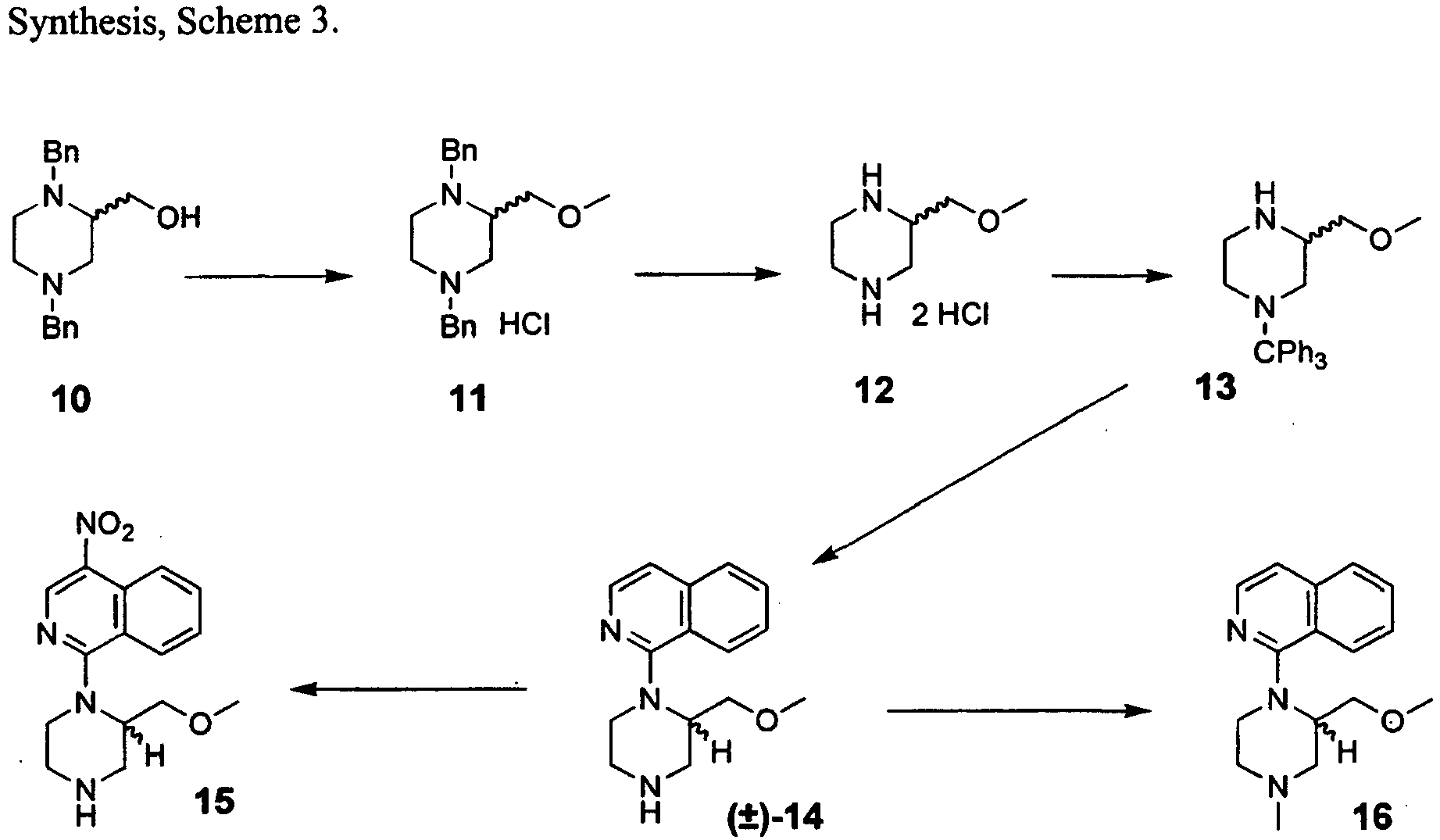
- Compound 10 [Rondeau 1997] (3.97 g, 13.4 mmol) was dissolved in dry DMF (40 mL) and cooled to 0° C. To the solution was added NaH (0.96 g, 40.2 mmol) to give a turbid white suspension, which was stirred for 20 min. Iodomethane (2.29 g, 16.1 mmol) was added to the suspension solution. The reaction was allowed to stir at 0° C for 20 min, then at room temperature for 3 hours. The reaction was quenched by the addition of water (50 mL). The aqueous phase of the mixture was extracted with Et2O (3 x 50 ml), the organic portions were combined, dried (K2CO3), and concentrated in vacuo to give a tan oil. The oil was purified by column chromatography (silica gel, EtOAc:hexanes, 1:3) to give 11 as a clear oil (3.4 g, 82%). The oil was dissolved in ether (300 ml) and HCl gas was bubbled through the solution, giving a fine white precipitate. The solids were collected by filtration, washed with ether and dried in vacuo to afford the hydrochloride salt of 11 as a white powder (4.06 g, 79 % yield). Free base: 1H NMR (400 MHz, CDCl3): δ 2.28 (m, 3H), 2.61 (dd, 1H), 2.77 (m, 3H), 3.35 (s, 3H), 3.54 (d, 3H), 3.62 (d, 1H), 3.64 (d, 1H), 7.25-7.5 (m, 10H). HRMS Calcd. for [C20H26N2O + H+]: 311.2123. Found 311.1894.
- Compound 11 (4.06 g, 10.6 mmol) was dissolved in methanol (100 ml). To the stirred solution was added 5% palladium on carbon (0.61 g) and the flask was sealed with a septum. A hydrogen balloon was attached and the gas was bubbled through the solution while stirring vigorously. The reaction was stirred for 2 hours. The reaction mixture was filtered over a pad of celite rinsing with MeOH, this was concentrated in vacuo to give 12 as a white solid (2.14 g, 98 % yield), which was used directly in the next reaction. HRMS Calcd. for [C6H16Cl2N2O + H+]: 203.0718. Found 203.1653.
- Compound 12 (2.14 g, 10.5 mmol) was dissolved in dry CH2Cl2 (60 ml), in the presence of dry triethylamine (5.9 ml, 42.3 mmol). The solution was cooled (0° C) and triphenylmethyl chloride (2.94 g, 10.6 mmol) in dry CH2Cl2 (10 ml) was added drop-wise. Once the addition was complete the reaction was warmed to room temperature and stirred for for 16 h. The reaction mixture was washed with saturated NaHCO3 (75 mL), water (75 mL), and brine (75 mL). The organic portion was dried (K2CO3) and concentrated in vacuo to give 13 as an amorphous foam (3.96 g, 99 % yield). 1H NMR (400 MHz, CDCl3): δ 1.3 (m, 3H), 1.9 (s, 3H), 3.0 (m, 3H), 3.2 (m, 1H), 3.3 (s, 3H), 7.16 (m, 4H), 7.27 (m, 7H), 7.49 (m, 4H).
- To a 0 °C solution of compound 13 (0.545 g, 1.46 mmol) in dry ether (20 mL) under argon was added (drop-wise) n-butyllithium (2.3 M in hexane, 1.46 mmol) producing a slightly colored turbid solution. After stirring for 20 min, a solution of 1-chloroisoquinoline (0.160 g, 0.97 mmol) in ether (5 mL) was added (drop-wise) and the solution allowed to stir for 20 min at 0 °C then at ambient temperature for 14 h. The reaction was diluted with ether (10 mL), washed with saturated NaHCO3 (2 x 25 mL) and brine (1 x 25 mL), dried (K2CO3) and concentrated to give a crude material that was purified by column chromatography (silica gel, EtOAc:hexanes, 1:3). The crude material was not characterized and immediately subjected to 10 mL of 95 % ethanol to which was added HCl (6 M, 6 mL). The solution was stirred at ambient temperature for 30 min and the reaction was diluted with 100 mL of saturated NaHCO3. The aqueous phase of the mixture was extracted with CH2Cl2 (4 x 20 mL) and the combined organic extracts were treated with di-tert-butyldicarbonate (0.316 g, 1.44 mmol) and stirred 10 minutes. The crude reaction solution was dried (K2CO3) and then the solvent evaporated to provide a crude N-Boc intermediate that was partially purified by column chromatography (silica gel, EtOAc:hexanes, 1:3). The N-Boc intermediate was dissolved in 6 mL of THF and cooled to 0 °C. To the stirring solution was added H2SO4 (4 M, 6 mL) and additional H2SO4 (18 M, 0.25 mL). After 10 min the reaction contents were poured into 10 mL of 3 M NaOH solution and further diluted with 25 mL of saturated NaHCO3. The aqueous mixture was extracted with CH2Cl2 (4 x 15 mL) and the combined extracts were dried (K2CO3) and concentrated to provide 14 as a pale oil (0.1058 g, 42 % overall yield). 1H NMR (400 MHz, CDCl3): δ 2.34 (bs, 1H), 3.01 - 3.13 (m, 3H), 3.15 (s, 3H), 3.26 - 3.33 (m, 2H), 3.42 - 3.54 (m, 2H), 3.67 (dd, J = 7.7, 9.4 Hz, 1H), 3.99 (m, 1H) 7.24 (d, J = 5.8 Hz, 1H), 7.47 (m, 1H), 7.57 (m, 1H), 7.72 (d, J = 8.1 Hz, 1H), 8.12 - 8.16 (m, 2H); 13C NMR (100 MHz, CDCl3): 46.0, 47.1, 48.3, 57.3, 58.8, 70.4, 116.0, 122.3, 125.5, 126.1, 126.9, 129.6, 138.2, 140.5, 161.2. HRMS Calcd. for [C15H19N3O + H+]: 258.1606. Found 258.1407.
- The formation of a salt composition of 14 was synthesized by dissolving 14 (0.023 g, 0.091 mmol) in dry ether (0.25 mL), and treating the solution with an aliquot of dry ether saturated with dry HCl gas. The resultant white precipitate was collected as the HCl salt of 14 (0.025 g, 92 % yield), which is considered a pharmaceutically acceptable salt.
- Compound 14 (0.020 g, 0.078 mmol) was dissolved in H2SO4 (0.25 mL) and cooled to 0° C. A solution of potassium nitrate (0.0083 g, 0.082 mmol) dissolved in H2SO4 (0.25 mL) was added to the cooled reaction solution. The reaction mixture was stirred (0° C) for 40 min then ice was added. The mixture made basic (pH = 9) with 4 N NaOH, diluted with saturated NaHCO3 (2 mL), and extracted with CH2Cl2 (4 x 30 mL). The organic portions were combined, dried (K2CO3), filtered and the solvent was removed under reduced pressure to afford 0.018 g of a crude orange oil. Purification of the oil by chromatography (silica gel, MeOH:CH2Cl2, 1:20) provided
compound 15 as a yellow-orange oil (0.008 g, 32 % yield). 1H NMR (400 MHz, CDCl3): δ 1.73 (br s, 1H), 2.94-3.22 (m, 3H), 3.27 (s, 3H), 3.61-3.73 (m, 2H), 3.74-3.91 (m, 2H), 3.94-4/03 (m, 1H), 4.64 (m, 1H), 7.54 (t, J = 7.7 Hz, 1H), 7.79 (t, J = 8.1 Hz, 1H), 8.07 (d, J = 8.1 Hz, 1H), 8.81 (d, J = 8.1 Hz, 1H), 9.06 (s, 1H). - Compound 14 (0.034 g, 0.132 mmol) was dissolved in MeOH (1.5 mL). To the solution was added 10 % palladium on charcoal (0.010 g) followed by 0.1 mL of formalin. The mixture was stirred at room temperature, flushed with hydrogen gas, and stirred 14 h over 1 atm of H2 gas. The solution was filtered (Celite) and the solvent was removed under reduced pressure to provide compound 16 as a pale yellow oil 0.034 g, 96 % yield). 1H NMR (400 MHz, CDCl3): δ 2.34 (s, 3H), 2.40-2.49 (m, 1H), 2.60-2.68 (m, 1H), 2.74-2.84 (m, 2H), 3.15 (s, 3H), 3.39-3.62 (m, 3H), 3.69 (m, 1H), 4.12 (m, 1H), 7.20-7.29 (m, 1H), 7.47 (t, J = 7.7 Hz, 1H), 7.58 (t, J = 7.3 Hz, 1H), 7.72 (d, J = 8.1 Hz, 1H), 8.09-8.17 (m, 2H); 13C NMR (100 MHz, CDCl3):
δ 46.6, 47.0, 55.3, 56.4, 57.5, 58.9, 70.8, 115.8, 122.2, 125.6, 126.1, 127.0, 129.6, 138 .2,140.5, 161.0. HRMS Calcd. for [C16H21N3O + H+]: 272.1763. Found 272.1686. -

- A solution of compound 13 (1.00 g, 2.685 mmol) in dry ether (15 mL) was cooled to 0° C and then n-butyllithium (2.685 mmol) was added. The mixture was stirred for 20 min at 0° C and then 1,3-dichloroisoquinoline (0.354 g, 1.79 mmol) in dry ether (∼ 2 mL) was added to the mixture. The reaction was allowed to warm to room temperture, stirred for 14 h, and then quenched with saturated NaHCO3 (5 mL). The mixture was diluted with ether, transferred to a separation funnel and washed with brine. The organic portion wash dried (K2CO3), filtered and solvent removed in vacuo to provide a crude yellow foam. Purification of the foam by chromatography (silica gel, EtOAc:hexanes, 1:4) afforded 0.909 g of the intermediate coupled material, which was used directly in the next transformation. The coupled material was dissolved in 20 mL of THF and treated with 6 N HCl (10 mL). The mixture was stirred at room temperature for 20 min then the solvent was removed under reduced pressure. The residue was dissolved in 1 N HCl, washed with ether (2 x 20 mL), then made basic (pH > 8) with 4 N NaOH additional with dilution with NaHCO3 and extracted with CH2Cl2 (3 x 70 mL). The organic portions were combined, dried (K2CO3), filtered and the solvent was removed in vacuo to provide 17 as a tan oil (0.326 g, 63 % yield). 1H NMR (400 MHz, CDCl3): δ 3.39 (s, 3H), 3.41-3.62 (m, 3H), 3.75-3.89 (m, 3H), 3.89-4.01 (m, 1H), 4.01-4.10 (m, 1H), 4.32 (m, 1H), 7.34 (s, 1H), 7.50 (t, J = 7.3 Hz, 1H), 7.62 (t, J = 7.7 Hz, 1H), 7.68 (d, J = 8.1 Hz, 1H), 7.98 (d, J = 8.1 Hz, 1H); 13C NMR (100 MHz, CDCl3): 45.3, 46.3, 47.2, 57.0, 59.3, 70.9, 114.2, 120.4, 125.8, 126.3, 126.6, 130.7, 140.3, 143.3, 160.9. HRMS Calcd. for [C15H18ClN3O + H+]: 292.7839. Found 292.1222.
- A solution of compound 17 in CH2Cl2 (2 mL) was treated with benzyl bromide (0.06 mL, 0.491 mmol) and the reaction mixture was stirred at room temperature for 12 h. The solvent was removed under reduced pressure and the resulting residue was purified by chromatography(silica gel, EtOAc:hexanes, 1:4) to provide 18 as a clear oil (0.138 g, 81 % yield). 1H NMR (400 MHz, CDCl3): δ 2.39-2.52 (m, 1H), 2.53-2.63 (m, 1H), 2.77-2.92 (m, 2H), 3.18 (s, 3H), 3.45-3.72 (m, 5H), 3.73-3.81 (m, 1H), 4.22 (br s, 1H), 7.21 (s, 1H), 7.22-7.38 (m, 5H), 7.41 (t, J = 7.3 Hz, 1H), 7.56 (t, J = 7.3 Hz, 1H), 7.63 (d, J = 8.1 Hz, 1H), 8.1 (d, J = 8.1 Hz, 1H). HRMS Calcd. for [C22H24ClN3O + H+]: 382.1686. Found 382.1362.
- A solution of compound 18 (0.129 g, 0.338 mmol) in dry DMF (∼5 mL) was treated with sodium methoxide (0.182 g, 3.38 mmol) as one portion. The mixture was allowed to stir overnight at 150 ° C. An additional 500 mol percent of sodium methoxide and 0.05 g of anhydrous K2CO3 were added and the mixture was heated for another 2 h. The mixture was cooled and the solvent removed under reduced pressure. The resulting residue was dissolved in CH2Cl2 and filtered, then dried (K2CO3), filtered and solvent removed under reduced pressure to afford a crude oil. The oil was purified by chromatography (silica gel, EtOAc:hexanes, gradient 1:20 to 3:17) to afford 19 as a clear colorless oil (0.013 g, 10 % yield). 1H NMR (400 MHz, CDCl3): δ 1.61 (br s, 1H), 2.45-2.55 (m, 1H), 2.57-2.65 (m, 1H), 2.75-2.89 (m, 2H), 3.20 (s, 3H), 3.48-3.69 (m, 5H), 3.76-3.83 (m, 1H), 3.94 (s, 3H), 4.21 (m, 1H), 6.53 (s, 1H), 7.18-7.29 (m, 1H), 7.29-7.40 (m, 5H), 7.45 (t, J = 7.3 Hz, 1H), 7.59 (d, J = 8.8 Hz, 1H), 8.02 (d, J = 8.1 Hz, 1H). HRMS Calcd. for [C23H27N3O2 + H+]: 378.4873. Found 378.2154.
- A solution of compound 19 (0.011 g, 0.029 mmol) in dry methanol (10 mL) within a Parr pressure flask was treated with 10 % palladium on charcoal (0.050 g). The pressure flask was shaken under 55 psi of H2 gas for 6 h. The solution was filtered through a pad of Celite and the solvent was removed under reduce pressure. The crude residue was dissolved in 1 N HCl (10 mL), washed with CH2Cl2 (2 x 10 mL), then made basic (pH >8) with 4 N NaOH, and diluted with saturated NaHCO3. The aqueous portion was extracted with CH2Cl2 (4 x 20 mL), the organic portions were combined, dried (K2CO3), filtered, and the solvent was removed in vacuo to afford a crude oil. The oil was purified by chromatography (silica gel, eluted first with EtOAc:hexane, 3:2 then methanol:CH2Cl2, 3:17) to provide 20 as a clear colorless oil (0.005 g, 60 % yield). 1H NMR (400 MHz, CDCl3): δ 1.85 (br s, 1H), 3.06-3.20 (m, 3H), 3.25 (s, 3H), 3.26-3.35 (m, 1H), 3.44-3.52 (m, 1H), 3.52-3.62 (m, 2H), 3.80 (m, 1H), 3.95 (s, 3H), 4.11 (m, 1H), 6.56 (s, 1H), 7.21-7.29 (m, 1H), 7.47 (t, J = 7.7 Hz, 1H), 7.61 (d, J = 8.1 Hz, 1H), 8.00 (d, J = 8.8 Hz, 1H). HRMS Calcd. for [C16H21N3O2 + H+]: 288.1746. Found 288.1568.
-

- To a 0 °C solution of the alcohol 21 [Naylor 1993] (0.567 g, 2.75 mmol) in formic acid (88%, 8 mL) was added (drop-wise) acetic anhydride (2.33 mL, 24.7 mmol). The reaction was stirred for 30 min at 0 °C then warmed to ambient temperature. After 1 h the reaction was diluted with ice, placed back in an ice bath and made basic with 4 N NaOH (~50 mL). The aqueous mixture was further diluted with saturated NaHCO3 (30 mL) and extracted with CH2Cl2 (4 x 20 mL). The combined extracts were dried (K2CO3) and concentrated to give an orange-brown oil that was purified by column chromatography (silica gel, MeOH:CHCl3, gradient 1:199 to 1:49) to afford 22 as a pale colored oil (0.521g, 67 % yield). 1H NMR (400 MHz, CDCl3): δ 2.05 (td, J = 3.7, 11.7 Hz, 0.5H), 2.13 (td, J = 3.7, 11.7 Hz, 0.5H), 2.28 (dd, J = 4.0, 11.7 Hz, 1H), 2.87 (m, 1H), 2.90 - 3.02 (m, 1H), 3.12 (td, J = 4.0, 12.8 Hz, 0.5H), 3.41 - 3.59 (m, 3.5H), 3.64 - 3.75 (m, 1H), 3.85 (m, 0.5H), 3.97 (dd, J = 5.5, 11.4 Hz, 0.5H), 4.08 (dd, J = 7.3, 11.4 Hz, 0.5H), 4.20 (bd, 0.5H), 4.38 (m, 0.5H), 7.25 - 7.36 (m, 5H), 8.06 (s, 0.5H), 8.08 (s, 0.5H); 13C NMR (100 MHz, CDCl3): δ 37.3, 43.9, 49.1, 52.1, 52.9, 54.36, 54.44, 55.5, 62.7, 62.8, 63.6, 65.2, 127.5, 127.6, 128.4, 128.5, 128.8, 128.9, 136.8, 137.2, 161.8, 161.9;


- To a 0 °C solution of alcohol 22 (0.502 g, 2.14 mmol) in dry DMF (20 mL) was added NaH (95%, 0.154 g, 6.43 mmol) in one portion. After stirring 5 min, iodomethane (0.319g, 2.25 mmol) was added (drop-wise) and the mixture stirred for 20 min at 0° C then at ambient temperature for 1.5 h. The excess NaH was destroyed by the careful addition of water and the solution was diluted with 40 mL each of water and saturated NaHCO3. The aqueous mixture was extracted with ether (2 x 40 mL) and ethyl acetate (2 x 40 mL). The combined extracts were washed with brine (50 mL), dried (K2CO3) and concentrated to give a brown oil that was purified by column chromatography (silica gel, MeOH:CHCl3, gradient 1:199 to 1:49) to afford 23 as a pale colored oil (0.360 g, 69 % yield). 1H NMR (400 MHz, CDCl3): δ 2.00 - 2.12 (m, 1.3H), 2.18 (dd, J = 3.7, 11.7 Hz, 0.7H), 2.80 - 2.92 (m, 2H), 2.93 - 3.02 (m, 1H), 3.29 - 3.38 (m, 3H), 3.41 - 3.76 (m, 5H), 4.16 (bd, 0.7H), 4.60 (m, 0.3H), 7.25 - 7.35 (m, 5H), 8.04 (s, 0.7H), 8.07 (s, 0.3H); 13C NMR (100 MHz, CDCl3): δ 36.7, 42.7, 47.0, 52.3, 53.2, 53.7, 54.1, 58.8, 59.0, 62.5, 62.6, 69.5, 70.6, 127.2, 128.3, 128.7, 137.7, 161.3, 161.9. HRMS Calcd. for [C14H20N2O2 + H+] 249.1603. Found 249.1598.

- A solution of the protected methylether 23 (0.320 g, 1.29 mmol) in THF (3 mL) and 4 M H2SO4 (9 mL) was heated at 55°C for 5 h. After cooling, the reaction contents were poured into 20 mL of cold (-10°C) 4 M NaOH and diluted with 20 mL of saturated NaHCO3. The mixture was extracted with CH2Cl2 (4 x 15 mL) and the combined extracts dried (K2CO3) and concentrated to provide 24 as a pale oily solid (0.274 g, 96 % yield). This product was of adequate purity for the subsequent transformations. 1H NMR (400 MHz, CDCl3): δ 1.85 (t, J= 10.3 Hz, 1H), 2.11 (td, J = 3.3, 11.0 Hz, 1H), 2.35 (bs, 1H, NH), 2.74 (m, 2H, triplet shape), 2.90 (m, 1H, td shape), 2.96 - 3.06 (m, 2H), 3.25 - 3.36 (m, 5H, OCH 3 singlet present at 3.33), 3.50 (m, AB pattern, J= 13.2 Hz, 2H), 7.22 - 7.33 (m, 5H); 13C NMR (100 MHz, CDCl3): δ 45.2, 53.8, 54.4, 55.9, 59.0, 63.4, 75.1, 126.9, 128.1, 129.1; 138.0. HRMS Calcd. for [C13H20N2O + H+] 221.1654. Found 221.1654.

- To a 0 °C solution of compound 24 (0.065 g, 0.295 mmol) in dry ether (10 mL) under argon was added (drop-wise) n-butyllithium (0.295 mmol) producing a slightly colored turbid solution. After stirring for 10 min, a solution of 1-chloroisoquinoline (0.032 g, 0.197 mmol) in ether (5 mL) was added (drop-wise) and the solution allowed to stir for 1 h at 0 °C then at ambient temperature for 14 h. The reaction was quenched with saturated NaHCO3, diluted with ether and washed with saturated NaHCO3 and then with brine. The organic portion was dried (K2CO3), filtered and concentrated to give a crude gold oil that was purified by column chromatography (silica gel, EtOAc:hexanes, 3:17). The acquired benzyl protected intermediate (HRMS Calcd. for [C22H25N3O + H+] 348.2076. Found 221.1654) was immediately used in the next transformation. The benzyl protected coupled intermediate (0.015 g, 0.043 mmol) was dissolved in dry 1,2-dichloroethane (1 mL). To the solution was added 1-chloroethyl chloroformate (0.01 mL, 0.093 mmol, neat) in a drop-wise fashion and then the reaction mixture was refluxed for 5 h. The mixture was cooled overnight and the volatiles were removed under reduced pressure. The residue was treated with methanol (~ 5 mL) and heated at reflux for 1 h. The methanol was removed under reduced pressure and the residue was dissolved in 1N HCl (2 mL) and washed with ether (15 mL). The aqueous portion was made basic (pH > 8) with 4N NaOH, diluted with saturated NaHCO3 solution and extracted with CH2Cl2 (3 x 10 mL). The combined organic portions were dried (K2CO3), filtered, and the solvent removed under reduced pressure to afford (S)-14 as a clear oil (0.004 g, 36 % yield). HRMS Calcd. for [C15H19N3O + H+]: 258.1606. Found 258.1557. The 1H NMR was identical to compound (±)-14 of Example III.
- In a similar way, the Scheme 5 synthesis may also employ the (R)-enantiomer of starting material 21 [Naylor 1993] thereby affording the opposing enantiomer of the final product, for example (R)-14.
-

- The (R)-enantiomer of 24 ((R)-24) starting material was available by the method of Naylor [1993] utilizing L-serine. Starting material 25 was prepared according to literature methods [Robinson 1947]. A solution of (R)-24 (0.120 g, 0.545 mmol) in dry DMF (1.5 mL) was treated with compound 25, then heated at 130° C for 1.5 h, then 145° C 1 h, and finally at 150° C for 1.5 h. The solvent was removed under reduced pressure and the residue was purified by chromatography (silica gel, EtOAc:hexanes, gradient 1:20 to 3:17) to afford 26 as a yellow oil (0.034 g, 16 % yield). 1H NMR (400 MHz, CDCl3): δ 1.66 (br s, 1H), 2.43-2.62 (m 2H), 2.79-2.91 (m, 2H), 3.14 (s, 3H), 3.46-3.75 (m 6H), 4.08 (m, 1H), 7.23-7.38 (m, 5H), 7.52 (t, J = 8.1 Hz, 1H), 7.93 (d,J= 5.9 Hz, 1H), 8.30 (d, J = 5.9 Hz, 1H), 8.38 (d, J = 8.8 Hz, 1H), 8.50 (d; J = 8.8 Hz, 1H); 13C NMR (100 MHz, CDCl3): δ 53.0, 54.0, 58.9, 59.0, 62.3, 70.8, 109.8, 122.6, 124.0, 127.1, 127.6, 128.3, 128.9, 131.1, 132.8, 138.2, 144.2, 145.4, 161.6. HRMS Calcd. for [C22H24N4O3 + H+]: 393.1927. Found 393.0805.
- A solution of compound 26 (0.025 g, 0.064 mmol) in dry DMF (1 mL) was treated with dry tetramethylammonium fluoride (0.089 g, 0.957 mmol). The mixture was heated at 140° C for 1 h, and then at 150-155° C for 1.5 h. The mixture was cooled, diluted with CH2Cl2 (100 mL), filtered and the solvent was removed under reduced pressure. The resultant residue was purified by chromatography (silica gel, EtOAc:hexanes, 3:17) to afford compound 27 as a pale blue oil (0.010 g, 43 % yield). 1H NMR (400 MHz, CDCl3): δ 1.61 (br s, 1H), 2.45-2.56 (m, 1H), 2.56-2.66 (m, 1H), 2.85 (br d, J = 11.0 Hz, 1H), 3.14 (s, 3H), 3.43-3.67 (m, 5H), 3.67-3.76 (m, 1H), 4.14 (m, 1H), 7.20-7.29 (m, 1H), 7.29-7.42 (m, 5H), 7.44 (d, J = 5.9 Hz, 1H), 7.90 (d, J = 8.8 Hz, 1H), 8.18 (d, J = 5.9 Hz, 1H). HRMS Calcd. for [C22H24N3O + H+]: 366.1982. Found 366.1617.
- A solution of compound 27 (0.010 g, 0.0274 mmol) in 1,2-dichloroethane (10 mL) was treated with 1-chloroethyl chloroformate (0.006 mL, 0.0548 mmol) at 25° C and stirred for 5 min. The reaction mixture was heated to reflux and stirred for 2 h, then allowed to cool to room temperature and stirred for 14 h. The solvent was removed under reduced pressure and the residue was diluted with MeOH (10 mL). The solution was heated at reflux for 2 h, then cooled and the solvent was removed in vacuo. The resulting residue was dissolved in 1 N HCl (2 mL), washed with CH2Cl2 (2 mL), then the aqueous portion was made basic (pH = 9) with 4 N NaOH and diluted with saturated NaHCO3 (15 mL). The aqueous mixture was extracted with CH2Cl2 (4 x 10 mL), the organic portions were combined, dried (K2CO3), filtered and the solvent was removed under reduced pressure to afford compound 28 as a pale blue oil (0.0044 g, 59 % yield). 1H NMR (400 MHz, CDCl3): δ 1.68 (br s, 1H), 3.03-3.15 (m, 3H), 3.17 (s, 1H), 3.26-3.32 (m, 1H), 3.35 (dt, J = 1.5, 3.7 Hz, 1H), 3.46-3.56 (m, 2H), 3.70 (m, 1H), 4.02 (m, 1H), 7.23-7.30 (m, 1H), 7.41 (m, 1H), 7.47 (d, J = 5.9 Hz, 1H), 7.92 (d, J = 8.1 Hz, 1H), 8.21 (d, J = 5.9Hz, 1H). HRMS Calcd. for [C15H18FN3O + H+]: 276.1512. Found 276.1268.
- A solution of compound 26 (0.013 g, 0.033 mmol) in 1,2-dichloroethane (3 mL) was treated with 1-chloroethyl chloroformate (0.02 mL, 0.166 mmol). The mixture was stirred at 25° C for 5 min then heated at reflux for 4 h followed by room temperature for 14 h. The solvent was removed under reduced pressure and the residue was dissolved in methanol (~ 5 mL) and the mixture was heated at reflux for 2 h. The solvent was removed in vacuo to afford a crude residue. The residue was dissolved in CH2Cl2 (3 mL) and treated with di-tert-butyldicarbonate (0.011 g, 0.050 mmol) and the reaction mixture was stirred at 25° C for 14 h. The solvent was removed under reduced pressure and the yellow crude material was purified by chromatography (silica gel, EtOAc:hexanes, gradient 1:20 to 1:4) to afford compound 29 as a yellow oil (0.008 g, 60 % yield). 1H NMR (400 MHz, CDCl3): δ 1.49 (s, 9H), 3.21 (br s, 3H), 3.29-3.61 (br m, 6H), 3.91-4.17 (br m, 3H), 7.57 (t, J = 8.1 Hz, 1H), 7.98 (d, J = 6.7 Hz, 1H), 8.31 (d, J = 5.9 Hz, 1H), 8.40 (d, J = 8.1 Hz, 1H), 8.50 (br s, 1H). HRMS Calcd. for [C20H26N4O5 + H+]: 403.4522. Found 403.2345.
- Compound 29 (0.031 g, 0.077 mmol) was dissolved in dry DMF and dry tetramethylammonium fluoride (0.100 g, 1.07 mmol) was added to the solution. The reaction vessel was lowered into a 130° C heating bath. The heating bath was allowed to climb to 160° C over 2 h, then the reaction was terminated by cooling and then dilution with CH2Cl2 (75 mL). The solution was filtered and the solvent removed under reduced pressure to provide a crude oil. Purification of the crude material by chromatography (silica gel, EtOAc:hexanes, 1:5.7) provided
compound 30 as a clear oil (0.010 g, 35 % yield). 1H NMR (400 MHz, CDCl3): δ 1.49 (s, 9H), 2.93-3.06 (m, 1H), 3.21 (br s, 1H), 3.24-3.38 (m, 1H) 3.44 (s, 3H), 3.45-3.59 (m, 2H), 3.94-4.04 (m, 1H), 4.06 (m, 1H), 7.25-7.31 (m, 1H), 7.37-7.47 (m, 1H), 7.49 (t, J = 7.3 Hz, 1H), 7.85-7.98 (m, 1H), 8.19 (dd, J = 5.9, 5.9 Hz, 1H). HRMS Calcd. for [C20H26FN3O3 + H+]: 376.2036. Found 376.0355. - Compound 30 (0.003 g, 0.008 mmol) was treated with conc. H2SO4 (0.5 mL). The mixture was heated at 50° C for 20 min then cooled to room temperature and ice was added. The resultant solution was made basic (pH = 10) with 4 N NaOH, diluted with saturated NaHCO3 (2 mL), and extracted with CH2Cl2 (4 x 20 mL). The organic portions were combined, dried (K2CO3), filtered and the solvent removed in vacuo to afford 28 as a clear oil (0.002 g, 73 % yield). The spectroscopic analyses of the product were identical to those acquired from the transformation of 27 to 28.
-

- To a 0 °C suspension of compound 31 [Naylor 1993] (0.913 g, 3.90 mmol) in dry CH2Cl2 (40 mL) under argon was added dihydropyran (1.64 g, 19.5 mmol) followed by p-toluenesulfonic acid monohydrate (0.025 g, 0.13 mmol). After 30 minutes the reaction was poured into an aqueous mixture of 30 mL each of saturated NaHCO3, brine and water. The organic phase was separated and the aqueous phase extracted with CH2Cl2 (3 x 15 mL). The combined organic extracts were dried (K2CO3) and concentrated giving ~ 2 g of crude material. The crude material was dissolved in 20 mL CH2Cl2 and 4 g of silica gel was added. The mixture was concentrated and the residue was chromatographed (silica gel, MeOH:CH2Cl2, gradient 1:39 to 1:19) to provide compound 32 as a white solid (1.153 g, 93 % yield). 1H NMR (400 MHz, CDCl3): δ 1.40 - 1.70 (m, 6H), 3.50 (m, 1H), 3.69 - 3.77 (m, 2H), 3.79 - 3.85 (m, 1H), 3.92 (s, 0.6H), 3.96 (s, 0.4H), 4.05 (dd, J = 2.9, 9.9 Hz, 0.4H), 4.12 (dd, J = 5.5, 10.3 Hz, 0.6H), 4.23 (m, 1H), 4.33 (d, J = 14.7 Hz, 0.4H), 4.38 (d, J = 14.7 Hz, 0.6H), 4.62 (m, 1H), 4.83 (d, J = 14.7 Hz, 0.6H), 4.90 (d, J = 14.7 Hz, 0.4H), 6.41 (bs, 0.4H, NH), 6.52 (bs, 0.6H, NH), 7.24 - 7.36 (m, 5H); 13C NMR (100 MHz, CDCl3): δ 18.9, 19.0, 25.1, 30.1, 30.2, 49.2, 49.3, 49.7, 49.8, 55.9, 62.0, 62.1, 69.5, 69.8, 98.9, 99.1, 128.1, 128.2, 128.5, 128.8, 128.9, 135.0, 164.4, 164.6, 166.0, 166.3. HRMS Calcd. for [C17H22N2O4 + H+]: 319.1658. Found 319.1649.
- To a 0 °C suspension of compound 32 (1.153 g, 3.62 mmol) in dry THF (60 mL) on ice was added LiAlH4 (0.566 g, 14.89 mmol). The mixture was then heated at reflux for 2 h. The solution was cooled, stirred 1 h then the excess LiAlH4 was quenched by the sequential addition of 0.6 mL water, 1.2 mL 4 M NaOH solution and 0.6 mL water. The solids that formed will filtered (Celite) and the filtrate concentrated to give 33 as a pale colored oil (1.076 g, 99 % yield). 1H NMR (400 MHz, CDCl3): δ 1.44 -1.62 (m, 4H), 1.64 -1.74 (m, 1H), 1.74 - 1.94 (m, 2H), 2.08 - 2.17 (m, 1H), 2.35 (bs, 1H, NH), 2.71 - 2.79 (m, 2H), 2.87 - 2.95 (m, 1H), 2.95 - 3.08 (m, 2H), 3.26 (m, 0.5H), 3.36 (dd, J = 4.0, 9.9 Hz, 0.5H), 3.45 - 3.52 (m, 3H), 3.61- 3.73 (m, 1H), 3.78 - 3.86 (m, 1H), 4.56 (m, 1H); 13C NMR (100 MHz, CDCl3): δ 19.4, 19.5, 25.3, 30.5, 45.1, 53.4, 53.5, 54.5, 54.7, 55.7, 62.2, 62.4, 63.3, 69.5, 69.9, 98.8, 99.5, 127.0, 128.2, 129.1, 137.9.
- Compound 33 (0. 300 g, 0.001 mol) in dry ether (15 mL) was cooled to 0° C and treated with n-butyllithium (0.0011 mol). The mixture was stirred at 0° C for 15 min then a solution of 1-chloroisoquinoline (0.168 g, 0.001 mol) in ether (5 mL) was added. The reaction mixture was brought to room temperature and stirred for 14 h. The reaction was quenched with saturated NH4Cl (10 mL) and extracted with EtOAc (3 x 50 mL). The organic extracts were combined, washed with water (30 mL) then dried (K2CO3). The solution was filtered and the solvent removed under reduced pressure to provide a crude oil. Purification of the crude material chromatography (silica gel, EtOAc:hexane, 1:3) afforded 0.198 g (43 %) of the coupled intermediate which was used directly in the next reaction. The intermediate (0.198 g, 0.5 mmol) was dissolved in methanol (15 mL) and treated with concentrated HCl (0.1 mL). The mixture was stirred at room temperature for 3 h, then the solvent removed under reduced pressure. The residue was suspended in EtOAc (30 mL) and then treated with added saturated NaHCO3 (20 mL). The organic portion was collected, dried (K2CO3), filtered and concentrated to provide the alcohol 34 as a pale yellow oil (0.216 g, 94 % yield). 1H NMR (400 MHz, CDCl3): δ 2.62 (m, 2H), 2.85 (m, 2H), 3.50-3.78 (m, 5 H), 4.10 (m, 1H), 4.36 (m, 1H), 6.32 (br s, 0.5 H, OH), 7.21 (d, J = 5.9 Hz, 1H), 7.22-7.40 (m, 5H), 7.49 (t, J = 7.6 Hz, 1H), 7.61 (t, J = 7.7 Hz, 1H), 7.74 (d, J = 8.1 Hz, 1H), 8.02 (d, J = 5.9Hz, 1H), 8.06 (d, J = 8.0 Hz, 1H).
- To a 0 °C solution of the alcohol 34 (0.158 g, 0.474 mmol) in dry DMF (15 mL) was added sodium hydride (0.043 g, 1.42 mmol). The turbid solution was stirred 15 min then allyl bromide (0.086 g, 0.711 mmol) was added. The reaction was stirred 10 min at 0 °C then warmed to ambient temperature and stirred for 14 h. The excess hydride was destroyed by the careful addition of 8 mL of saturated NaHCO3 solution and the mixture diluted further with 8 mL of water. This aqueous mixture was extracted with ether (4 x 15 mL) and the combined extracts were washed with brine (2 x 10 mL), dried (K2CO3) and concentrated to give the crude product that was purified by column chromatography (silica gel, EtOAc:Hexanes, 1:4) to provide 35 as a pale yellow oil (0.10 g, 56 % yield). 1H NMR (400 MHz, CDCl3): δ 2.53 (td, J = 12.5, 3.4 Hz, 1H), 2.66 (dd, J = 3.3, 12.6 Hz, 1H), 2.90 (br m, 2H), 3.42-3.55 (m, 3H), 3.59-3.70 (m, 3H), 3.72-3.86 (m, 3H), 4.17 (br s, 1H), 4.99-5.07 (m, 2H), 5.61-5.572 (m, 1H), 7.21 (d, J = 5.9 Hz, 1H), 7.22-7.41 (m, 5H), 7.46 (t, J = 7.6 Hz, 1H), 7.57 (t, J = 7.8 Hz, 1H), 7.72 (d, J = 7.7 Hz, 1H), 8.14 (m, 2H).
- To a 0 °C solution of compound 35 (0.060 g, 0.161 mmol) in dry THF (15 mL) was added 9-BBN (0.5 M in THF, 0.433 mmol). Following the addition, the reaction was heated to 60°C and maintained for 1 h. The contents were cooled to 0 °C and 2.5 mL of 1 M NaOH was added (drop-wise) followed by an equal volume of 30% H2O2. After stirring ~10 min the THF was evaporated and the residue partitioned between CH2Cl2 and saturated NaHCO3 (25 mL each). The organic phase was separated and the aqueous phase extracted with CH2Cl2 (3 x 15 mL). The combined organic extracts were dried (K2CO3) and concentrated to give the crude material that was purified by column chromatography (silica gel, EtOAc:hexanes, gradient 1:9 to 3:2) to afford the corresponding alcohol as an oil (0.062 g, 98 % yield) which was used directly in the next reaction. To a -78°C solution of the intermediate alcohol (0.062 g, 0.158 mmol) in dry CH2Cl2 (10 mL) was added diethylaminosulfur trifluoride (0.033 g, 0.206 mmol). The reaction mixture was allowed to stir and warm to ambient temperature over 16 h. The reaction mixture was diluted with CH2Cl2 (5 mL) and saturated NaHCO3 solution (10 mL). The organic phase was separated and the aqueous phase extracted with CH2Cl2 (2 x 10 mL). The organic extracts were combined, dried (K2CO3), and concentrated to give the crude product that was purified by column chromatography (silica gel, EtOAc:hexanes, 1:4) to provide 36 as a pale oil (0.050 g, 80 % yield). 1H NMR (400 MHz, CDCl3): δ 1.64 (dp, J F-H = 25.6 Hz, FCH2CH2- J H-H = 6.2 Hz, 2H), 2.52 (td, J = 12.5, 3.4 Hz, 1H), 2.63 (dd, J = 12.6, 3.3 Hz, 1H), 2.81-293 (m, 2H), 3.23-3.36 (m, 2H), 3.42-3.51 (m, 2H), 3.57-3.74 (m, 4H), 4.09-4.20 (m, 2H), 4.22-4.31 (m, 1H), 7.21 (d, J = 5.7 Hz, 1H), 7.22-7.39 (m, 5H), 7.47 (t, J = 7.7 Hz, 1H), 7.58 (t, J = 7.6 Hz, 1H), 7.72 (d, J = 7.7 Hz, 1H), 8.15 (m, 2H).
- To a 0 °C solution of fluoride 36 (0.098 g, 0.249 mmol) in dry 1,2-dichloroethane (10 mL) was added 1-chloroethyl chloroformate (0.142 g, 0.994 mmol). After stirring 5 min, the reaction was heated at reflux for 2 h, cooled, then stirred at ambient temperature for 14 h. The volatile components were evaporated and the residue was dissolved in methanol (10 mL) and heated at 60°C for 1.5 h. The solvent was evaporated to dryness and the residue partitioned between CH2Cl2 and saturated NaHCO3 (10 mL each). The organic phase was separated and the aqueous phase was extracted with three additional portions of CH2Cl2. The combined organic extracts were dried (K2CO3) and concentrated to give the crude product that was immediately purified by column chromatography (silica gel, two step elution; EtOAc:Hexanes, 4:1 then MeOH:CH2Cl2 gradient 1:39 - 1:9) to provide 37 as a pale colored oil (0.030 g, 96 % yield). 1H NMR (400 MHz, CDCl3): δ 1.685 (dp, J F-H = 25.1 Hz, FCH2CH2- J H-H = 6.0 Hz, 2H), 3.41-3.62 (m, 8H), 3.65-3.80 (m, 3H), 3.84 (m, 1H), 4.14 (br m, 1H), 4.42 (dt, J F-H = 47.2 Hz, FCH2, J H-H = 5.9 Hz, 2H), 7.30 (d, J = 5.9 Hz, 1H), 7.52 (t, J = 7.7 Hz, 1H), 7.62 (t, J = 7.6 Hz, 1H), 8.08 (d, J = 8.2 Hz, 1H), 8.14 (m, J= 5.9 Hz, 1H); 13C NMR (100 MHz, CDCl3): δ 30.8 (d, J C-F = 19 Hz, FCH2CH2-), 43.2, 44.2, 45.6, 55.1, 67.3, 69.5, 81.6 (d, J C-F = 163 Hz, FCH2-), 117.4, 122.4, 125.1, 126.9, 127.7, 130.3, 138.4, 140.7, 160.0. HRMS Calcd. for [C17H22FN3O + H+]: 304.1825. Found 304.1819.
- To evaluate stereochemical integrity of 37 the Mosher's amide was prepared [Hoye 1996]. A solution of 37 (0.020 g, 0.066 mmol), triethylamine (0.1 mL) in dry CH2Cl2 (10 mL) was treated with (R)-(+)-α-methoxy-α-trifluoromethylphenylacetic acid chloride (0.017 g, 0.067 mmol). The reaction mixture was stirred at room temperature for 14 h, then CH2Cl2 (5 mL) and saturated NaHCO3 (15 mL) were added to the mixture. The organic portion was separated, dried (K2CO3), filtered, and the solvent was removed under reduced pressure to provide a crude residue. Purification of the residue by chromatography (silica gel, EtOAc:hexane, 1:4) provided the (2'S, 4'R)-diastereomeric amide 38 as a pale yellow oil (0.025 g, 73 % yield). HRMS Calcd. for [C27H29F4N3O3 + H+]: 520.2223. Found 520.1860. 13C NMR (100 MHz, CDCl3): δ 30.7 (d, J C-F = 19.1 Hz, FCH2CH2-), 42.3, 43.8, 45.7, 47.0, 56.2, 57.0, 57.1, 66.4, 67.0, 68.8, 81.1 (d, J C-F = 163 Hz, FCH2-), 117.0, 122.4, 122.9, 125.3, 126.7, 126.8, 127.3, 128.6, 128.7, 129.6, 130.2, 134.1, 138.4, 140.7, 160.6, 165.0. Analysis of the 1H NMR spectrum of 38 (400 MHz, CDCl3) revealed the consistent stereochemical quality of 38 indicated by the methoxyl group chemical shift resonance found at δ 3.73.
- In a similar way, the Scheme 7 synthesis may also employ the (S)-enantiomer of starting material 31 [Naylor 1993] thereby affording the opposing enantiomer of the final product, for example (R)-37. The racemic mixture (±)-37 is prepared in a similar way starting from D,L-serine [Naylor 1993].
-
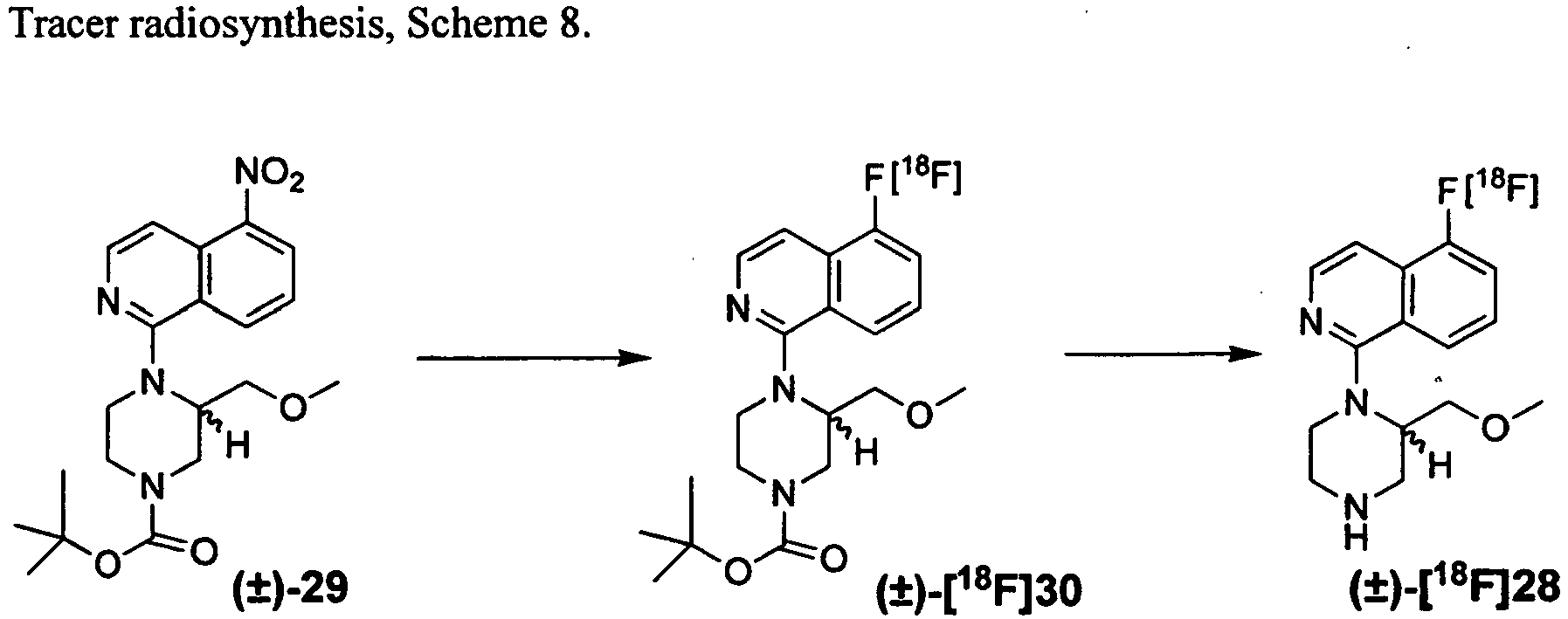
- The Scheme 8 transformations serve as an example for high specific activity fluorine-18 ([18F]) radiolabeling reactions to afford tracers of the invention. The Scheme 8 radiolabeling sequence is related to the chemical transformations described in Example VI. [18F]Fluoride was produced with a Siemens RDS Eclipse cyclotron (Knoxville, TN) using 95% enriched [18O]water (Marshall Isotopes, Tel Aviv, Israel). 4,7,13,16,21,24-hexaoxa-1,10-diazabicyclo[8.8.8]-hexacosane (K222) was purchased from Sigma-Aldrich (St. Louis). Extra dry acetonitrile (ACN) and dimethyl formamide (DMF) were purchased from Acros Organics (Geel, Belgium). All other chemicals were reagent grade or better. Sep-Pak® Light C 18 cartridges (Waters, Milford, MA), and [18F]fluoride Trap and Release cartridges (ORTG, Oakdale, TN) were used for solid phase extractions (SPE). [18F]fluoride was loaded onto a trap and release column, eluted in K222 (5 mg)/K2CO3 (1 mg) in 95% ACN/5% water (v/v) (1 mL), dried under N2 (g), dried by azeotropic distillation with ACN (3 x 1 mL) under N2 (g), and dissolved in DMF (0.2 mL). Precursor (±)-29 (1.4 mg) in DMF (50 µL) was added to [18F]fluoride (840 mCi) in DMF. The reaction was conducted in a sealed reaction vessel under N2 (g) with stirring, at 170° C for 50 min. The reaction solution containing (±)-[18F]30 was diluted in water (20 mL) and loaded on a Sep Pak light C18 cartridge in order to trap (±)-[18F]30 and elute unreacted [18F]fluoride. The cartridge was washed in water (5 mL), and eluted in ethanol (2 mL) to recover (±)-[18F]30. Mean decay corrected (DC) yield of the transformation of (±)-29 to crude (±)-[18F]30 was 17 %. Intermediate (±)- [18F]30 was hydrolyzed with 2 M HCl (1 mL) in ethanol (~ 2 mL). The solution was heated at 140° C under a stream of N2 (g) until the mixture was reduced in volume to approximately 0.5 mL. The resultant mixture was neutralized with 2 M sodium acetate (1.5 mL).
- Semi-preparative HPLC was performed on the neutralized solution, using a GP50 HPLC system (Dionex, Sunnyvale, CA) UV and radioactivity detectors, with a 10 mm x 250 mm Jupiter 3 C-18 column (Phenomenex, Torrance, CA) eluted in solvent A, 0.1 % trifluoroacetic acid (aq) and solvent B, 0.01 % trifluoroacetic acid in 90% ACN /10% water (v/v), with a gradient of 10% B to 90% B in 30 minutes at 3 mL per minute. The major radioactive peak containing (±)-[18F]28 was collected (tR 13.5 min). The decay corrected yield of (±)-[18F]30 to (±)-[18F]28 was 57 %.
- Product (±)-[18F]28 in ACN/water HPLC eluent (~1 mL) was diluted in water (20 mL) and loaded and trapped on a Sep Pak light C 18 cartridge. The cartridge was washed in water (5 mL) to remove remaining ACN, and eluted in ethanol (~ 2 mL) to recover (±)-[18F]28. Water (0.2 mL) was added to (±)-[18F]28 in ethanol, and the solution was heated at 140 °C under a stream of N2 (g) until reduced in volume to approximately 0.1 mL. The aqueous solution of (±)-[18F]28 was then formulated in water and sodium acetate, to a final concentration of 8 mCi/mL in 0.1 M sodium acetate, pH 7, calibrated for injection time into trial subjects. The radiosynthesis, purification, and dose formulation time was ~ 2.5 h.
- Analytical HPLC was performed with a Breeze HPLC system (Waters, Milford, MA) with a 4.6 x 250 mm Jupiter 2 C-18 column (Phenomenex, Torrance, CA), solvents A and B and gradient as above, at 1.5 mL per minute. Analytical HPLC was performed on small aliquots of formulated (±)-[18F]28 (2 µL) with and without addition of an [19F] product standard ((±)-28), and detected by radioactivity and UV (254 nm). Analytical HPLC demonstrated co-elution of (±)-[18F]28 and the product standard (±)-28. To determine specific activity, a standard curve was constructed using the areas under the analytical HPLC 254 nm peak of (±)-28 product standard (0.000327 µmol and 0.00383 µmol). Product (±)-[18F]28 was allowed to decay for a day, then aliquots equivalent to 1.2 to 2.6 mCi of formulated radiopharmaceutical were evaluated by analytical HPLC. The areas under the peak for (±)-[18F]28 were interpolated against the standard curve to determine the mass of (±)-[18F]28, from which specific activity was calculated. For example, the specific activity of tracer (±)-[18F]28 at the time of injection was calculated as 730 mCi/µmol.
-
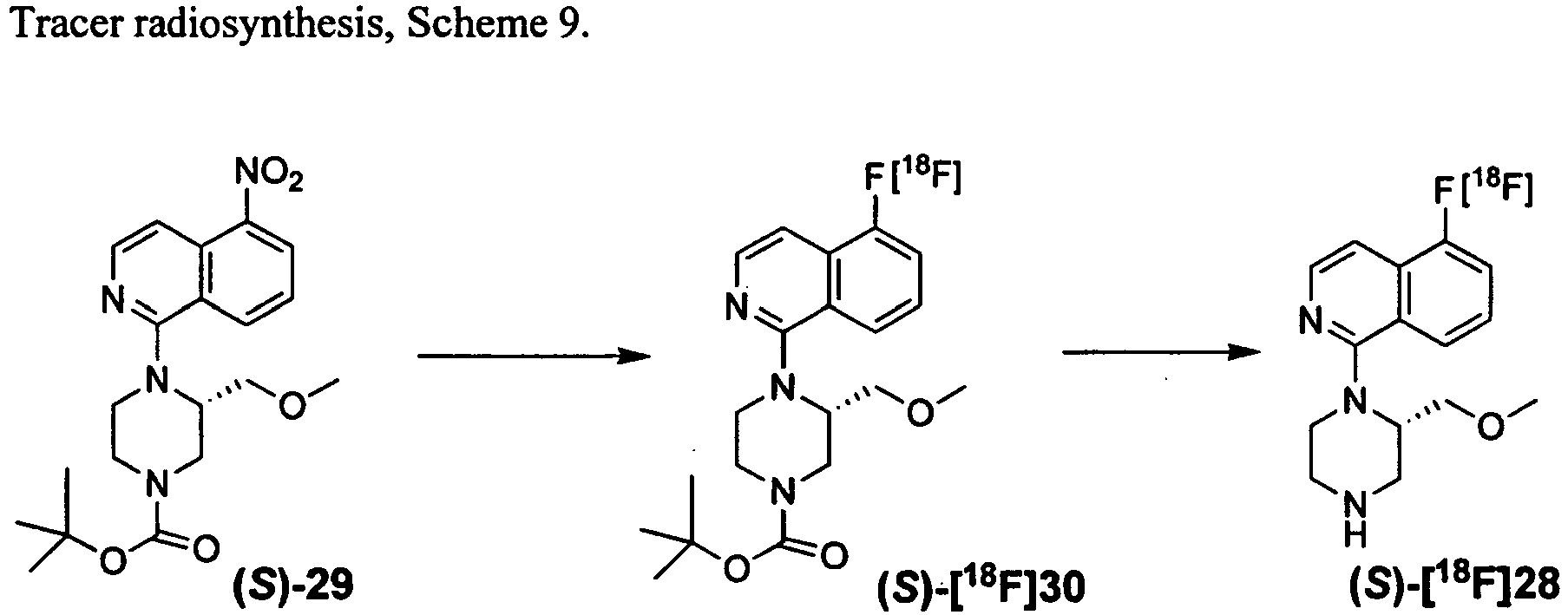
- Using a method analogous to that described in Example VIII, the tracer (S)-[18F]28 was prepared according to Scheme 9, in an overall decay corrected radiochemical yield of 14.7 %, and specific activity of 1270 mCi/µmol, over a radiosynthesis, purification, and dose formulation time of ~ 2.5 h. Tracer saline dose formulations were made as per the method described in Example VIII.
- The pharmacological inhibitory binding potency of the molecules of the invention for the NET protein have been measured as Ki determinations employing a modified competition assay protocol similar to an established method described in the literature [Raisman 1982, Tejani-Butt 1992, Owens 1997]. In essence, the molecules of the invention Ki values have been derived from IC50 measures [Cheng 1973] with binding curves of 6-8 or more points of analog test drug concentrations from 1 x 10⁻³ to 1 x 10-12 M in competition with the known NET inhibitor drug agent [3H]nisoxetine. The protocol employed partially purified rat brain cortical homogenates, [3H]nisoxetine, incubated 0° C, 4 h; with nonspecific binding determined with added 1 microM of desipramine (DMI) and desipramine as the parallel positive control. Examples of the molecules of the invention that have been evaluated with the NET pharmacological assay are shown in Chart 1. The respective NET potencies reported as competitive binding Ki values are summarized in Table 1, with desipramine as an established inhibitor drug binding standard measure. The molecules of the invention are found with competitive binding potencies at NET and are considered NET binding inhibitor agents.

Table 1 Compound NET K i (nM) DMI (standard) 0.71 9 16.2 (±)-14 4.14 17 14.2 (S)-37 6.71 (±)-37 71.5 - An example to demonstrate the pharmacological selectivity of the molecules of the invention for the NET protein relative to other competitive binding sites within the CNS is provided with compound (±)-14. The evaluation of the competitive binding affinities (Ki values) of (±)-14 for the serotonin and dopamine transporter proteins (SERT and DAT, respectively), the beta-adrenergic receptor, and also serotonin 1a and 2a receptors has been made. The competitive binding profiles of (±)-14 at these other CNS sites are summarized in Table 2, where the assay conditions are defined. The data reveal that compound (±)-14 does not have appreciable specific binding at other CNS binding sites that have been tested. Thus, compound (±)-14 is considered to have potent NET selectivity (Table 1, Example X) relative to the potencies at the other sites as defined per Table 2.
Table 2 CNS Ki of Competition Nonspecific Assay Assay Target (±)-14 Radioligand Binding Incubation Method Protein (nM) (1 mM) Conditions Reference SERTa 1,798 [3H]Citalopram Clomipramine 25° C, 1 h D'Amato 1987 DATa 1,575 [3H]B-CFT GBR-12,909 0° C, 2 h Owens 1997 β-Adrenergica 2.4x10⁵ [125I]Iodopindalol Alprenolol 37°C, 1h Kalaria 1989 5-HT1A b NBc [3H]8-OH-DPAT 5- HT 30° C, 0.5 h Russo 2005 5-HT2A b NBc [3H] Ketanserin Mianserin 30° C, 0.5 h Russo 2005 a Partially purified rat protein.
b Partially purified human protein expressed in Chinese hamster ovary (CHO) cells.
c NB = no binding: no appreciable specific binding observed between concentrations 1 x 10⁻⁵ to 1 x 10-12 M. - As an example of the tracers of the invention, rodent (rat) quantitative in vivo PET imaging trials are presented employing the tracer (±)-[18F]28 of Example VIII. The in vivo PET imaging was performed in parallel with magnetic resonance (MR) and computed axial tomography (CAT) imaging methods, in which the latter two imaging methods afforded anatomical tissue information for co-registration to the acquired tracer quantitative PET data. The co-registration of imaging data sets allows for the definitions of tissue regions of interest (ROIs) that possess various NET tissue densities (concentrations). Two rodent imaging trials (A-B) were performed employing two age-matched female Sprague-Dawley subjects. The age of the subjects were nearly identical to those described in the most recent rat (Sprague-Dawley, amongst others) stereotaxic brain atlas [Paxinos 2007] providing high confidence levels for identification and definition of explicit brain cerebral fine structures as regions of interest (ROIs) for quantitative analysis, and as a function of three-dimensional (3D) co-registration of cerebral soft tissue identification by MR scan analysis and landmark anatomical features from CAT data. Details of the two subject (A and B) imaging tracer trial are summarized in Table 3.
Table 3 Trial Rat Subject Age (days) Rat Subject Weight (g) Tracer Form Tracer Specific Activity (mCi/µmol) Tracer Dose (mCi) Dose Volume (mL) (±)-Nisoxetine Co-administration (2 mg/Kg dose) A 90 247 (±)-[18F]28 440 1.70 0.65 None B 84 249 (±)-[18F]28 820 1.96 0.26 0.5 mg - The PET data were acquired with a Siemens MicroPET II Focus 120 scanner (ca. 1.5 mm spatial resolution) [Tai 2004, Yang 2004]. Rodent subject tail vein tracer injection volumes were as described (Table 3) in saline followed by 0.3 mL saline flush. The co-administration injection of the NET inhibitor drug (±)-nisoxetine used 0.5 mg (±)-nisoxetine (2 mg/kg dose) in 0.1 mL saline followed by 0.2 mL saline into the subject's
tail vein 15 minutes prior to tracer administration. Imaging was performed within a northermic (35 °C) multi-modal rodent imaging chamber under anesthesia (isoflurane 1.5-2.5 %). The dynamic microPET data with tracer (±)-[18F]28 were reconstructed as 37 frames (10 frames for 60 sec, 5 frames x 120 sec, 8 frames x 300 sec, 6 frames x 600 sec, 8 frames x 900 sec) over 4 h. Magnetic resonace (MR) data were acquired with a Bruker Biospin 7-Tesla magnet multi-slice 2D FLASH (T2*-weighted gradient recall echo, TR = 1528.3 msec, TE = 7 msec, 256 x 256 x 50 voxels, 16 µm3 resolution). Computed axial tomography (CAT) data were acquired with a Siemens MicroCAT II scanner in standard rat mode (80 kVp, 225 mA; 400 ms exposure, 194 steps x 194 degrees, 97 micron isotropic resolution). - MR, microCAT and microPET files were processed with AMIDE open source software [Loening 2003], version 0.9.0. MR and CT images were oriented as defined by Paxinos [2007]. Cranial landmarks of bregma and lambda were identified from the CT images. The X, Y, Z coordinates of imaging views were centered as bregma = origin of trial A. Consistent landmark structures were iteratively co-registered and template fit against the cranial structures of the trial A landmarks, and cross checked against cerebral soft tissues observed from the MR scan data. All PET scan data were decay time corrected, quantified with a phantom instrument calibration factor, and normalized by injected dose and dose specific activity (for example, divided by the specifc activity in units mCi/nMol) to enable comparisons across subjects.
- Each PET data set was iteratively co-registered to respective CT skull data and fine adjustments were made using the experiment A microPET data as a template. ROIs were drawn conservatively (well within the ROI volume size limits and locations) against their stereotaxic 3D locations [Paxinos 2007] and correlated with the MR tissue landmarks. The ROIs are defined in Table 4 as 3D coordinates x, y, z millimeters from bregma; LC as locus ceruleus, TH as thalamus, CE as cerebellum, FrCTX as frontal cortex, and OcCTX as occipital cortex. The analyzed ROI mean volume size (mm3) and the mean number of voxels per ROI were calculated with AMIDE (Table 4). ROI PET scan statistics were exported to Excel and the graph of
Figure 1 was generated using GraphPad Prism software.Table 4 ROIs Average Size (mm3) Average Number Voxels Distances from bregma (mm) x y z LC 0.65 6 ±1.11 -9.90 6.98 TH 15.7 63 0.00 -2.52 6.19 CE 169.2 424 0.24 -12.66 3.55 FrCTX 54.2 160 0.00 3.99 3.51 OcCTX 16.66 72 0.00 -6.12 0.83 - Known ROI NET tracer detection and binding distributions derived from autoradiographic studies carried out by others [Tejani-Butt 1992, Smith 2006] were used to compare relative cerebral ROI NET binding distributions from the rodent PET scan imaging studies. The relative comparisons of NET binding densities between the ROIs are particularly meaningful when extrapolated to the rodent PET scan data. The performance of tracer (±)-[18F]28 alone (baseline scan, unblocked) and challenged (in the presence of (±)-nisoxetine, 2.0 mg/Kg; blocked) in key regions of interest over time is shown in graphically below in
Figure 1 . - The tracer time-activity curves of
Figure 1 reveal the injected tracer penetrates brain, and at various times post injection discrete portions of the tracer dose (% ID/cc) tissue per ROI are observed. Tracer tissue activity pharmacokinetic curves are observed with tracer uptake, maximum and washout phases. The NET density rich locus coeruleus and thalamus are with the highest (±)-[18F]28 tracer activities (2-6 min post injection) indicative of NET interactions. Cerebellum, and frontal cortex are with intermediate tracer activity within the same time frame. Lower NET interaction tracer activity was found in occipital cortices. The quantitative (±)[18F]28 tracer profiles have specific ROI NET tracer binding activities; for locus ceruleus, thalamus, cerebellum, frontal cortex and occipital cortex regions. Further, the (±)-[18F]28 tracer NET detection distribution values generally agree with the relative NET distribution densities per ROI determined by autoradiography using the same species and another radiotracer agent [Tejani-Butt, 1993 & 1992]. Thus, NET is detected quantitatively in discrete cerebral ROIs with various known NET distributions across rat subject brain. - The
Figure 1 (±)-nisoxetine co-administration study (2 mg/Kg dose, blocking) reveals a significant reduction (2-5 % ID/cc) for all ROI tracer (±)-[18F]28 NET interaction activities. The co-administration of the known NET inhibitor (±)-nisoxetine affords significantly reduced (±)-[18F]28 tracer interactions at the NET. These observations provide evidence that (±)-[18F]28 interacting with NET in a specific way. - Another example of the radiotracers of the invention includes the in vivo performance for the quantitative detection of NET and NET tissue distribution profiles in live primate brain. For example, imaging tracer (S)-[18F]28 of Example IX has been evaluated in male Rhesus monkey (Macaca mulatta, male, 8.53 kg, 7 years old) with quantitative positron emission tomography (PET) and magnetic resonance (MR) imaging scans across brain. The PET imaging scans allowed the determinations of quantitative detection of NET distributions within cerebral tissue regions of interest (ROIs). The MR scans allowed the determinations of soft tissue ROIs that were co-registered with the three-dimensional (3D) brain tissue NET tracer activities determined with the dynamic PET imaging. Typical brain scan methods are as follows.
- The imaging subject (nor-thermic, 35°C) was placed under anesthesia, initially with saphenous catheter administration of 0.9 mL of 100 mg/mL ketamine, 0.9 mL of 0.4 mg/mL atropine, and followed by 1-1.5% isoflurane ventilation. MR scan data were acquired with a GE Signa LX (Miwaukee, WI) 1.5-Tesla magnet and quadrature head coil. A 3-axis MR scout scan was initially run to determine localization coordinates. The subject was positioned within the MR scanner head first in sternal recumbancy. MR cerebral scan images were acquired using a T1-weighted 3D SPGR sequence with the following parameters: TR = 22 msec, TE = 7.9 msec, FA = 30 degrees, RBw = 15.63 kHz, 4 averages, 256 x 256 matrix, 84 x 1 mm slices, 16 cm field of view, and 625 µm in-plane resolution). A fiducial marker (vitamin E filled) on the left side of the subject's head was used to mark the MR scan head orientation for subsequent MR-PET scan co-registrations.
- The PET scan data were acquired with a Siemens MicroPET P4 Focus scanner that is characterized with ca. 1.8 mm3 spatial resolution at center of the field of view [Tai et al. 2001]. Administration of the tracer (S)-[18F]28 was by bolus injection via the saphenous catheter. The tracer dose was a 2 mL saline injection volume containing 8.57 mCi (37.75 nmol) of tracer (S)-[18F]28 with a determined specific activity of 227 mCi/µmol. Dynamic PET scan data were acquired over a 1.5 h period post injection of tracer. The dynamic PET scan data were reconstructed with a maximum a priori (MAP) protocol with output as Concorde/microPET image files. The scan data reconstruction parameters were as follows: 0.8mm in-plane resolution, smoothing parameter of 0.1, MAPTR attenuation/scatter correction, and as either a single frame (1 frame for 5400s) or 27 frames (10 frames for 60 s, 5 frames for 120 s, 8 frames for 300 s, and 3 frames for 600 s) for a total of 90 minutes.
- The MR and microPET files were processed and co-registered with AMIDE open source software [Loening 2003]. The co-registration of MR and PET data sets were as follows. The centers of the cerebral tissues of the anterior and posterior commissures were identified and used as key 3D brain tissue landmarks. MR images were oriented to place the vitamin E fiducial mark consistent with the axes in AMIDE and as per the Rhesus Monkey Brain in Stereotaxic Coordinates atlas [Paxinos 2000], and also the BrainInfo Macaca fascicularis line drawings/sectional slices of the online atlas http://braininfo.rprc.washington.edu and the BrainMaps.org Mucaca mulatta sectional slice online atlas http://brainmaps.org. Using these atlases, the respective views and the tissue landmarks therein, the subject brain tissues were oriented in a sagittal perspective facing left, anterior and posterior commissure marks in the same horizontal plane, and the coronal and transverse views symmetrical about the brain medial line.
- The x, y, and z 3D coordinate origin was defined for the cerebral views as the center of the anterior commissure; as per the online atlases of the http://braininfo.rprc.washington.edu and http://brainmaps.org. The single frame reconstructed PET data was iteratively co-registered to the MR data. For example, MR soft tissue landmarks were correlated with the PET scan landmarks (including: eyes, jaw-line, connective tissue, amongst others) affording discrete co-registered planes of recognized views. After co-registration, a transformation matrix that defined a center and rotational coordinates from the single frame PET data were made. The transformation matrix was applied to the dynamic (27 frame) PET data sets to obtain an identical co-registration as per the single frame data.
- The cerebral ROIs were drawn conservatively against their stereotaxic 3D locations ([Paxinos 2007], and also http://braininfo.rprc.washington.edu and http://brainmaps.org). The cerebral locations are defined in Table 5 (ROI x, y, z millimeters from anterior commissure). The ROIs are defined as BSTM as brain stem (including locus coeruleus, lateral tegemental nuclei, dorsal raphe nuclei, and pontine nuclei), CE as cerebellum, TH as thalamus (primarily, dorsolateral thalamic nuclei), and FrCTX as frontal cortices (including, somatosens and motor cortices). The analyzed ROI volume size (mm3) and the number of voxels per ROI were calculated with AMIDE as per Table 5.
- All dynamic PET data were decay and time corrected. The corrected scan data were subsequently normalized by the following protocol: 1) multiplication by the instrument calibration factor determined by phantom PET scan, 2) division by tracer injected dose (mCi), and 3) division by tracer specific activity. The graphical image analyses employed an NIH rainbow table with max-min global thresholds set to 25 to 2 percent of %ID/cc. PET data reconstructions afforded 1.2 mm3 voxel (pixel volumes) size for the frame data sets. ROI PET scan statistics were exported to Excel and the graph of
Figure 2 was generated using GraphPad Prism software.Table 5 ROI Values Distances from Anterior Commissure (mm) ROI Size (mm3) Voxel Numbers x y z BSTM 221 283 0.00 17.28 -8.53 CE 3888 3866 0.00 31.38 -9.64 TH 133 190 ±6.84 10.67 2.02 FrCTX 2599 2888 0.00 1.33 19.12 - The tracer time-activity curves of
Figure 2 reveal the injected tracer penetrates brain, and at various times post injection discrete portions of the tracer dose (% ID/cc) tissue per ROI are observed. Tracer tissue activity pharmacokinetic curves are observed with tracer uptake, maximum and washout phases over the course of 1.5 h. Tracer tissue maxima occurred at between 10-20 min post injection. The NET density rich thalamus, frontal cortex and cerebellum regions are with the high (S)-[18F]28 tracer activities indicative of NET interactions. Tracer activity in the brainstem, which includes a number of brain structures, has higher NET detection tracer activities at later times. The quantitative (S)-[18F]28 tracer profiles have specific ROI NET tracer binding activities; for locus ceruleus, thalamus, cerebellum and frontal cortex regions. Further, the (S)-[18F]28 tracer NET detection distribution values generally agree with the relative NET distribution densities per ROI determined by autoradiography using the same subject species and another radiotracer agent [Smith 2006]. Thus, with the tracers of the invention NET is detected quantitatively in discrete cerebral ROIs with various known NET density distributions across primate brain. The tracers of the invention are observed with unique pharmacokinetic profiles for the quantitative detection of NET and NET distributions in brain regions of primate subjects, relative to other NET PET imaging tracers [Logan 2007 & 2005, Ding 2006 & 2005, Seneca 2006, Schou 2004 & 2003].
Claims (13)
- A compound that binds at the norepinephrine transport protein having the following structure:

- A pharmaceutical composition comprising a compound according to claim 1, and at least one pharmaceutically acceptable carrier.
- A compound according to claim 1 or composition according to claim 2, for the treatment of a disorder characterised by norepinephrine or norepinephrine transporter protein abnormalities, wherein the disorder is selected from the group consisting of neurodegeneration, anxiety, depression, attention deficit, drug dependency and post traumatic stress disorders and diseases.
- A radiotracer to detect and quantify norepinephrine transporter protein having the following structure:

- A pharmaceutical composition comprising a radiotracer according to claim 4, and at least one pharmaceutically acceptable carrier.
- A method for in vivo imaging comprising the steps of administering to a subject an effective amount of a radiotracer according to claim 4 or claim 5, and detecting the radiotracer, wherein the radiotracer is associated with the norepinephrine transporter protein.
- A method according to claim 6, further comprising the steps of imaging said subject to detect the distribution of norepinephrine transporter protein.
- A method according to claim 6, wherein said subject is suffering from or believed to be at risk of suffering from norepinephrine transporter protein or norepinephrine abnormalities.
- A method according to claim 6, wherein said subject is suffering from or believed to be at risk of suffering from norepinephrine transporter protein or norepinephrine abnormalities, and wherein said radiotracer is detected by imaging said subject, said method further comprising the steps of administering to said subject a therapeutic agent; administering to said subject an effective amount of said radiotracer; imaging said subject; and comparing the extent of norepinephrine transporter protein or norepinephrine abnormalities in said subject before and after administering the therapeutic agent.
- A method according to claim 6, wherein imaging of said subject is performed by an imaging modality selected from the group consisting of positron emission tomography, single photon emission computed tomography and combinations thereof.
- A method for tissue imaging comprising the steps of contacting a tissue that contains norepinephrine transporter protein with a radiotracer according to claim 4 or claim 5 and detecting the radiotracer.
- A method according to claim 11, wherein said radiotracer detected in vitro.
- A method according to claim 11, wherein said radiotracer detected ex vivo.
Applications Claiming Priority (2)
| Application Number | Priority Date | Filing Date | Title |
|---|---|---|---|
| US91928107P | 2007-03-21 | 2007-03-21 | |
| PCT/US2008/003792 WO2008115593A1 (en) | 2007-03-21 | 2008-03-21 | 1-[(2'-substituted)-piperazin-1'-yl]-isoquinolines as norepinephrine transporter inhibitor therapeutics and positron emission tomography imaging agents |
Publications (2)
| Publication Number | Publication Date |
|---|---|
| EP2139481A1 EP2139481A1 (en) | 2010-01-06 |
| EP2139481B1 true EP2139481B1 (en) | 2013-08-21 |
Family
ID=39415387
Family Applications (1)
| Application Number | Title | Priority Date | Filing Date |
|---|---|---|---|
| EP08742199.6A Ceased EP2139481B1 (en) | 2007-03-21 | 2008-03-21 | 1-[(2'-substituted)-piperazin-1'-yl]-isoquinolines as norepinephrine transporter inhibitor therapeutics and positron emission tomography imaging agents |
Country Status (3)
| Country | Link |
|---|---|
| US (1) | US7887784B2 (en) |
| EP (1) | EP2139481B1 (en) |
| WO (1) | WO2008115593A1 (en) |
Families Citing this family (7)
| Publication number | Priority date | Publication date | Assignee | Title |
|---|---|---|---|---|
| KR101077423B1 (en) * | 2006-08-17 | 2011-10-26 | 에프. 호프만-라 로슈 아게 | Arylpiperazine derivatives and uses thereof |
| EP2474523B1 (en) | 2006-12-26 | 2020-04-08 | Lantheus Medical Imaging, Inc. | Ligands for imaging cardiac innervation |
| MX343721B (en) | 2010-05-11 | 2016-11-17 | Lantheus Medical Imaging Inc | Compositions, methods and systems for the synthesis and use of imaging agents. |
| US9550000B2 (en) | 2011-09-09 | 2017-01-24 | Lantheus Medical Imaging, Inc. | Compositions, methods, and systems for the synthesis and use of imaging agents |
| BR112014009039A2 (en) * | 2011-11-16 | 2017-05-09 | Koninklijke Philips Nv | imaging workstation; method for imaging the brain; and software that carries non-transient computer readable media |
| US9254111B2 (en) | 2012-11-27 | 2016-02-09 | General Electric Company | PET acquisition scheduling based on MR scout images |
| CN106699692A (en) * | 2015-11-12 | 2017-05-24 | 上海医药工业研究院 | Piperazinyl urea derivative as well as preparation method and application thereof |
Family Cites Families (13)
| Publication number | Priority date | Publication date | Assignee | Title |
|---|---|---|---|---|
| CH438308A (en) | 1963-02-21 | 1967-06-30 | Ciba Geigy | Process for the preparation of new isoquinoline compounds |
| US3857944A (en) | 1972-04-21 | 1974-12-31 | Sandoz Ag | 1-piperazinoisoquinolines as inotropic agents |
| HU178522B (en) * | 1979-04-11 | 1982-05-28 | Egyt Gyogyszervegyeszeti Gyar | Process for producing amino-isoquinoline derivatives |
| JPS63227570A (en) | 1987-03-13 | 1988-09-21 | Ss Pharmaceut Co Ltd | Isoquinoline derivative |
| WO1998039301A1 (en) * | 1997-03-04 | 1998-09-11 | Neurogen Corporation | 1-(isoquinolin-1-yl)-4-(1-phenylmethyl)piperazines; dopamine receptor subtype specific ligands |
| DE69839887D1 (en) | 1997-10-02 | 2008-09-25 | Eisai R&D Man Co Ltd | CONDENSED PYRIDINE DERIVATIVES |
| AU1028601A (en) | 1999-11-05 | 2001-05-14 | Smithkline Beecham Plc | Isoquinoline and quinazoline derivatives having a combined 5ht1a, 5ht1b and 5ht1d receptor activity |
| KR100889718B1 (en) | 2001-06-11 | 2009-03-23 | 바이오비트럼 에이비(피유비엘) | Substituted sulfonamide compounds, their use as agents for treating CNS disorders, obesity and type II diabetes |
| EP1603395A2 (en) | 2003-03-10 | 2005-12-14 | Basf Aktiengesellschaft | Amino substituted benzo(hetero)cyclic derivatives |
| JP4596792B2 (en) | 2004-02-24 | 2010-12-15 | あすか製薬株式会社 | Drugs having both 5-HT1A agonistic action and 5-HT3 antagonistic action |
| WO2005082887A1 (en) * | 2004-02-26 | 2005-09-09 | Aska Pharmaceutical Co., Ltd. | Pyrimidine derivative |
| WO2006090272A1 (en) * | 2005-02-22 | 2006-08-31 | Warner-Lambert Company Llc | Isoquinoline [1,8]naphthyridin-2-ones and related compounds for treatment of schizophrenia |
| WO2007005935A2 (en) | 2005-07-06 | 2007-01-11 | Molecular Neuroimaging, Llc | Norepinephrine transporter radiotracers and methods of syntheses thereof |
-
2008
- 2008-03-21 EP EP08742199.6A patent/EP2139481B1/en not_active Ceased
- 2008-03-21 WO PCT/US2008/003792 patent/WO2008115593A1/en not_active Ceased
- 2008-03-21 US US12/077,898 patent/US7887784B2/en active Active
Also Published As
| Publication number | Publication date |
|---|---|
| US20080267870A1 (en) | 2008-10-30 |
| WO2008115593A1 (en) | 2008-09-25 |
| EP2139481A1 (en) | 2010-01-06 |
| US7887784B2 (en) | 2011-02-15 |
Similar Documents
| Publication | Publication Date | Title |
|---|---|---|
| AU2012304359B2 (en) | Compositions, methods, and systems for the synthesis and use of imaging agents | |
| CA2438032C (en) | Benzothiazole derivative compounds, compositions and uses | |
| US7887784B2 (en) | 1-[(2′-substituted)-piperazin-1′ -yl]-isoquinolines as norepinephrine transporter inhibitor therapeutics and positron emission tomography imaging agents | |
| CN103002924A (en) | Compositions, methods and systems for synthesizing and using contrast agents | |
| JP2011513306A (en) | Contrast agents for applications involving perfusion imaging | |
| Giboureau et al. | PET radioligands for the vesicular acetylcholine transporter (VAChT) | |
| US6241964B1 (en) | F-18 radiolabeled neurokinin-1 receptor antagonists | |
| US6939966B2 (en) | Radiolabeled neuropeptide Y Y5 receptor antagonists | |
| US9724435B2 (en) | Highly selective sigma receptor ligands and radioligands as probes in nociceptive processing and the pathphysiological study of memory deficits and cognitive disorders | |
| JP5384487B2 (en) | New method | |
| WO2013173746A2 (en) | Use of fluorinated derivatives of 4-aminopyridine in therapeutics and medical imaging | |
| WO2013014274A1 (en) | 5ht1a antagonist useful for in vivo imaging | |
| US20260027242A1 (en) | Pet radioligands for imaging glutaminyl cyclase activity | |
| CA2499825C (en) | Radiolabeled neurokinin-1 receptor antagonists | |
| JP2009541262A (en) | Radiolabeled ligand of glycine 1 transporter | |
| EP3102204B1 (en) | Highly selective sigma 1 receptor ligands and radioligands as probes in nociceptive processing and the pathophysiological study of memory deficits and cognitive disorders | |
| Kassiou | Nicolas Giboureą", Ian Mat Som", Aurélie Boucher-Arnold", Denis Guilloteau" and | |
| Class et al. | Patent application title: HIGHLY SELECTIVE SIGMA RECEPTOR LIGANDS AND RADIOLIGANDS AS PROBES IN NOCICEPTIVE PROCESSING AND THE PATHPHYSIOLOGICAL STUDY OF MEMORY DEFICITS AND COGNITIVE DISORDERS Inventors: Christopher R. Mccurdy (Oxford, MS, US) Christophe Mesangeau (Hellemmes, FR) Frederick T. Chin (Sunnyvale, CA, US) Michelle L. James (Menlo Park, CA, US) Bin Shen (Mountain View, CA, US) Sanjiv Gambhir (Portola Valley, CA, US) Sandip Biswal (Stanford, CA, US) Deepak Behera (Fremont, CA, US) | |
| HK40016928A (en) | Compositions, methods, and systems for the synthesis and use of imaging agents | |
| HK1200030B (en) | Compositions, methods, and systems for the synthesis and use of imaging agents | |
| KR20000051066A (en) | Flumazenil derivative having n2s2ligand and preparation thereof |
Legal Events
| Date | Code | Title | Description |
|---|---|---|---|
| PUAI | Public reference made under article 153(3) epc to a published international application that has entered the european phase |
Free format text: ORIGINAL CODE: 0009012 |
|
| 17P | Request for examination filed |
Effective date: 20091012 |
|
| AK | Designated contracting states |
Kind code of ref document: A1 Designated state(s): AT BE BG CH CY CZ DE DK EE ES FI FR GB GR HR HU IE IS IT LI LT LU LV MC MT NL NO PL PT RO SE SI SK TR |
|
| DAX | Request for extension of the european patent (deleted) | ||
| 17Q | First examination report despatched |
Effective date: 20100623 |
|
| GRAP | Despatch of communication of intention to grant a patent |
Free format text: ORIGINAL CODE: EPIDOSNIGR1 |
|
| INTG | Intention to grant announced |
Effective date: 20130328 |
|
| GRAS | Grant fee paid |
Free format text: ORIGINAL CODE: EPIDOSNIGR3 |
|
| GRAA | (expected) grant |
Free format text: ORIGINAL CODE: 0009210 |
|
| AK | Designated contracting states |
Kind code of ref document: B1 Designated state(s): AT BE BG CH CY CZ DE DK EE ES FI FR GB GR HR HU IE IS IT LI LT LU LV MC MT NL NO PL PT RO SE SI SK TR |
|
| REG | Reference to a national code |
Ref country code: GB Ref legal event code: FG4D |
|
| REG | Reference to a national code |
Ref country code: CH Ref legal event code: EP |
|
| REG | Reference to a national code |
Ref country code: AT Ref legal event code: REF Ref document number: 627632 Country of ref document: AT Kind code of ref document: T Effective date: 20130915 |
|
| REG | Reference to a national code |
Ref country code: IE Ref legal event code: FG4D |
|
| REG | Reference to a national code |
Ref country code: DE Ref legal event code: R096 Ref document number: 602008026980 Country of ref document: DE Effective date: 20131017 |
|
| REG | Reference to a national code |
Ref country code: AT Ref legal event code: MK05 Ref document number: 627632 Country of ref document: AT Kind code of ref document: T Effective date: 20130821 Ref country code: NL Ref legal event code: VDEP Effective date: 20130821 |
|
| REG | Reference to a national code |
Ref country code: LT Ref legal event code: MG4D |
|
| PG25 | Lapsed in a contracting state [announced via postgrant information from national office to epo] |
Ref country code: IS Free format text: LAPSE BECAUSE OF FAILURE TO SUBMIT A TRANSLATION OF THE DESCRIPTION OR TO PAY THE FEE WITHIN THE PRESCRIBED TIME-LIMIT Effective date: 20131221 Ref country code: CY Free format text: LAPSE BECAUSE OF FAILURE TO SUBMIT A TRANSLATION OF THE DESCRIPTION OR TO PAY THE FEE WITHIN THE PRESCRIBED TIME-LIMIT Effective date: 20130814 Ref country code: SE Free format text: LAPSE BECAUSE OF FAILURE TO SUBMIT A TRANSLATION OF THE DESCRIPTION OR TO PAY THE FEE WITHIN THE PRESCRIBED TIME-LIMIT Effective date: 20130821 Ref country code: AT Free format text: LAPSE BECAUSE OF FAILURE TO SUBMIT A TRANSLATION OF THE DESCRIPTION OR TO PAY THE FEE WITHIN THE PRESCRIBED TIME-LIMIT Effective date: 20130821 Ref country code: LT Free format text: LAPSE BECAUSE OF FAILURE TO SUBMIT A TRANSLATION OF THE DESCRIPTION OR TO PAY THE FEE WITHIN THE PRESCRIBED TIME-LIMIT Effective date: 20130821 Ref country code: HR Free format text: LAPSE BECAUSE OF FAILURE TO SUBMIT A TRANSLATION OF THE DESCRIPTION OR TO PAY THE FEE WITHIN THE PRESCRIBED TIME-LIMIT Effective date: 20130821 Ref country code: PT Free format text: LAPSE BECAUSE OF FAILURE TO SUBMIT A TRANSLATION OF THE DESCRIPTION OR TO PAY THE FEE WITHIN THE PRESCRIBED TIME-LIMIT Effective date: 20131223 Ref country code: NO Free format text: LAPSE BECAUSE OF FAILURE TO SUBMIT A TRANSLATION OF THE DESCRIPTION OR TO PAY THE FEE WITHIN THE PRESCRIBED TIME-LIMIT Effective date: 20131121 |
|
| PG25 | Lapsed in a contracting state [announced via postgrant information from national office to epo] |
Ref country code: BE Free format text: LAPSE BECAUSE OF FAILURE TO SUBMIT A TRANSLATION OF THE DESCRIPTION OR TO PAY THE FEE WITHIN THE PRESCRIBED TIME-LIMIT Effective date: 20130821 Ref country code: FI Free format text: LAPSE BECAUSE OF FAILURE TO SUBMIT A TRANSLATION OF THE DESCRIPTION OR TO PAY THE FEE WITHIN THE PRESCRIBED TIME-LIMIT Effective date: 20130821 Ref country code: GR Free format text: LAPSE BECAUSE OF FAILURE TO SUBMIT A TRANSLATION OF THE DESCRIPTION OR TO PAY THE FEE WITHIN THE PRESCRIBED TIME-LIMIT Effective date: 20131122 Ref country code: LV Free format text: LAPSE BECAUSE OF FAILURE TO SUBMIT A TRANSLATION OF THE DESCRIPTION OR TO PAY THE FEE WITHIN THE PRESCRIBED TIME-LIMIT Effective date: 20130821 Ref country code: PL Free format text: LAPSE BECAUSE OF FAILURE TO SUBMIT A TRANSLATION OF THE DESCRIPTION OR TO PAY THE FEE WITHIN THE PRESCRIBED TIME-LIMIT Effective date: 20130821 Ref country code: SI Free format text: LAPSE BECAUSE OF FAILURE TO SUBMIT A TRANSLATION OF THE DESCRIPTION OR TO PAY THE FEE WITHIN THE PRESCRIBED TIME-LIMIT Effective date: 20130821 |
|
| PG25 | Lapsed in a contracting state [announced via postgrant information from national office to epo] |
Ref country code: CY Free format text: LAPSE BECAUSE OF FAILURE TO SUBMIT A TRANSLATION OF THE DESCRIPTION OR TO PAY THE FEE WITHIN THE PRESCRIBED TIME-LIMIT Effective date: 20130821 |
|
| PG25 | Lapsed in a contracting state [announced via postgrant information from national office to epo] |
Ref country code: EE Free format text: LAPSE BECAUSE OF FAILURE TO SUBMIT A TRANSLATION OF THE DESCRIPTION OR TO PAY THE FEE WITHIN THE PRESCRIBED TIME-LIMIT Effective date: 20130821 Ref country code: CZ Free format text: LAPSE BECAUSE OF FAILURE TO SUBMIT A TRANSLATION OF THE DESCRIPTION OR TO PAY THE FEE WITHIN THE PRESCRIBED TIME-LIMIT Effective date: 20130821 Ref country code: SK Free format text: LAPSE BECAUSE OF FAILURE TO SUBMIT A TRANSLATION OF THE DESCRIPTION OR TO PAY THE FEE WITHIN THE PRESCRIBED TIME-LIMIT Effective date: 20130821 Ref country code: RO Free format text: LAPSE BECAUSE OF FAILURE TO SUBMIT A TRANSLATION OF THE DESCRIPTION OR TO PAY THE FEE WITHIN THE PRESCRIBED TIME-LIMIT Effective date: 20130821 Ref country code: DK Free format text: LAPSE BECAUSE OF FAILURE TO SUBMIT A TRANSLATION OF THE DESCRIPTION OR TO PAY THE FEE WITHIN THE PRESCRIBED TIME-LIMIT Effective date: 20130821 Ref country code: NL Free format text: LAPSE BECAUSE OF FAILURE TO SUBMIT A TRANSLATION OF THE DESCRIPTION OR TO PAY THE FEE WITHIN THE PRESCRIBED TIME-LIMIT Effective date: 20130821 |
|
| PG25 | Lapsed in a contracting state [announced via postgrant information from national office to epo] |
Ref country code: ES Free format text: LAPSE BECAUSE OF FAILURE TO SUBMIT A TRANSLATION OF THE DESCRIPTION OR TO PAY THE FEE WITHIN THE PRESCRIBED TIME-LIMIT Effective date: 20130821 Ref country code: IT Free format text: LAPSE BECAUSE OF FAILURE TO SUBMIT A TRANSLATION OF THE DESCRIPTION OR TO PAY THE FEE WITHIN THE PRESCRIBED TIME-LIMIT Effective date: 20130821 |
|
| PLBE | No opposition filed within time limit |
Free format text: ORIGINAL CODE: 0009261 |
|
| STAA | Information on the status of an ep patent application or granted ep patent |
Free format text: STATUS: NO OPPOSITION FILED WITHIN TIME LIMIT |
|
| 26N | No opposition filed |
Effective date: 20140522 |
|
| REG | Reference to a national code |
Ref country code: DE Ref legal event code: R097 Ref document number: 602008026980 Country of ref document: DE Effective date: 20140522 |
|
| PG25 | Lapsed in a contracting state [announced via postgrant information from national office to epo] |
Ref country code: LU Free format text: LAPSE BECAUSE OF FAILURE TO SUBMIT A TRANSLATION OF THE DESCRIPTION OR TO PAY THE FEE WITHIN THE PRESCRIBED TIME-LIMIT Effective date: 20140321 |
|
| REG | Reference to a national code |
Ref country code: CH Ref legal event code: PL |
|
| PG25 | Lapsed in a contracting state [announced via postgrant information from national office to epo] |
Ref country code: LI Free format text: LAPSE BECAUSE OF NON-PAYMENT OF DUE FEES Effective date: 20140331 Ref country code: IE Free format text: LAPSE BECAUSE OF NON-PAYMENT OF DUE FEES Effective date: 20140321 Ref country code: CH Free format text: LAPSE BECAUSE OF NON-PAYMENT OF DUE FEES Effective date: 20140331 |
|
| PG25 | Lapsed in a contracting state [announced via postgrant information from national office to epo] |
Ref country code: MT Free format text: LAPSE BECAUSE OF FAILURE TO SUBMIT A TRANSLATION OF THE DESCRIPTION OR TO PAY THE FEE WITHIN THE PRESCRIBED TIME-LIMIT Effective date: 20130821 |
|
| REG | Reference to a national code |
Ref country code: FR Ref legal event code: PLFP Year of fee payment: 9 |
|
| PG25 | Lapsed in a contracting state [announced via postgrant information from national office to epo] |
Ref country code: MC Free format text: LAPSE BECAUSE OF FAILURE TO SUBMIT A TRANSLATION OF THE DESCRIPTION OR TO PAY THE FEE WITHIN THE PRESCRIBED TIME-LIMIT Effective date: 20130821 Ref country code: BG Free format text: LAPSE BECAUSE OF FAILURE TO SUBMIT A TRANSLATION OF THE DESCRIPTION OR TO PAY THE FEE WITHIN THE PRESCRIBED TIME-LIMIT Effective date: 20130821 |
|
| PG25 | Lapsed in a contracting state [announced via postgrant information from national office to epo] |
Ref country code: HU Free format text: LAPSE BECAUSE OF FAILURE TO SUBMIT A TRANSLATION OF THE DESCRIPTION OR TO PAY THE FEE WITHIN THE PRESCRIBED TIME-LIMIT; INVALID AB INITIO Effective date: 20080321 Ref country code: TR Free format text: LAPSE BECAUSE OF FAILURE TO SUBMIT A TRANSLATION OF THE DESCRIPTION OR TO PAY THE FEE WITHIN THE PRESCRIBED TIME-LIMIT Effective date: 20130821 |
|
| REG | Reference to a national code |
Ref country code: FR Ref legal event code: PLFP Year of fee payment: 10 |
|
| PGFP | Annual fee paid to national office [announced via postgrant information from national office to epo] |
Ref country code: FR Payment date: 20170327 Year of fee payment: 10 Ref country code: DE Payment date: 20170321 Year of fee payment: 10 |
|
| PGFP | Annual fee paid to national office [announced via postgrant information from national office to epo] |
Ref country code: GB Payment date: 20170322 Year of fee payment: 10 |
|
| REG | Reference to a national code |
Ref country code: DE Ref legal event code: R119 Ref document number: 602008026980 Country of ref document: DE |
|
| GBPC | Gb: european patent ceased through non-payment of renewal fee |
Effective date: 20180321 |
|
| PG25 | Lapsed in a contracting state [announced via postgrant information from national office to epo] |
Ref country code: DE Free format text: LAPSE BECAUSE OF NON-PAYMENT OF DUE FEES Effective date: 20181002 |
|
| PG25 | Lapsed in a contracting state [announced via postgrant information from national office to epo] |
Ref country code: GB Free format text: LAPSE BECAUSE OF NON-PAYMENT OF DUE FEES Effective date: 20180321 |
|
| PG25 | Lapsed in a contracting state [announced via postgrant information from national office to epo] |
Ref country code: FR Free format text: LAPSE BECAUSE OF NON-PAYMENT OF DUE FEES Effective date: 20180331 |
|
| P01 | Opt-out of the competence of the unified patent court (upc) registered |
Effective date: 20230601 |