EP2139389B1 - Procédé pour filtrer des artefacts de stimulation du cerveau profond - Google Patents
Procédé pour filtrer des artefacts de stimulation du cerveau profond Download PDFInfo
- Publication number
- EP2139389B1 EP2139389B1 EP08736546.6A EP08736546A EP2139389B1 EP 2139389 B1 EP2139389 B1 EP 2139389B1 EP 08736546 A EP08736546 A EP 08736546A EP 2139389 B1 EP2139389 B1 EP 2139389B1
- Authority
- EP
- European Patent Office
- Prior art keywords
- signal
- stimulation
- limit cycle
- artefact
- self
- Prior art date
- Legal status (The legal status is an assumption and is not a legal conclusion. Google has not performed a legal analysis and makes no representation as to the accuracy of the status listed.)
- Not-in-force
Links
- XDTMQSROBMDMFD-UHFFFAOYSA-N C1CCCCC1 Chemical compound C1CCCCC1 XDTMQSROBMDMFD-UHFFFAOYSA-N 0.000 description 1
Images





Classifications
-
- A—HUMAN NECESSITIES
- A61—MEDICAL OR VETERINARY SCIENCE; HYGIENE
- A61B—DIAGNOSIS; SURGERY; IDENTIFICATION
- A61B5/00—Measuring for diagnostic purposes; Identification of persons
- A61B5/72—Signal processing specially adapted for physiological signals or for diagnostic purposes
- A61B5/7235—Details of waveform analysis
- A61B5/7239—Details of waveform analysis using differentiation including higher order derivatives
-
- A—HUMAN NECESSITIES
- A61—MEDICAL OR VETERINARY SCIENCE; HYGIENE
- A61B—DIAGNOSIS; SURGERY; IDENTIFICATION
- A61B5/00—Measuring for diagnostic purposes; Identification of persons
- A61B5/24—Detecting, measuring or recording bioelectric or biomagnetic signals of the body or parts thereof
- A61B5/25—Bioelectric electrodes therefor
- A61B5/279—Bioelectric electrodes therefor specially adapted for particular uses
- A61B5/291—Bioelectric electrodes therefor specially adapted for particular uses for electroencephalography [EEG]
- A61B5/293—Invasive
-
- A—HUMAN NECESSITIES
- A61—MEDICAL OR VETERINARY SCIENCE; HYGIENE
- A61N—ELECTROTHERAPY; MAGNETOTHERAPY; RADIATION THERAPY; ULTRASOUND THERAPY
- A61N1/00—Electrotherapy; Circuits therefor
- A61N1/18—Applying electric currents by contact electrodes
- A61N1/32—Applying electric currents by contact electrodes alternating or intermittent currents
- A61N1/36—Applying electric currents by contact electrodes alternating or intermittent currents for stimulation
- A61N1/3605—Implantable neurostimulators for stimulating central or peripheral nerve system
- A61N1/3606—Implantable neurostimulators for stimulating central or peripheral nerve system adapted for a particular treatment
- A61N1/36082—Cognitive or psychiatric applications, e.g. dementia or Alzheimer's disease
Definitions
- the present invention pertains to processing of brain signals, and, more particularly, to a method and a computer readable medium for processing brain signals representing multiple signals.
- DBS Deep Brain Stimulation
- electrical impulses of stimulation are delivered to a target zone in the brain of a patient.
- a resulting problem of DBS is that the neuronal activity (reported by neuronal action potentials AKA spikes) of the patient can not be measured during the stimulation period. Large stimulus artefacts hamper spike detection leading to problems in analyzing single cell activity during stimulation.
- the artefacts of stimulation have common waveform but are not identical due to sampling errors and irregularities of stimulus production.
- the Artefact to Signal Ratio (ASR) - which is the ratio of mean of amplitudes of artefacts of stimulation to the averaged amplitude of spikes of neuronal activity observed before stimulation - is comprised in the range of 5-20.
- This method is based on making an artefact template via averaging a set of peri-stimulus segments, according to the following general protocol.
- the signal After template subtraction, the signal still contains artefact residuals 1.5-2 times greater than spikes. Size of the residuals in the time domain was about 0.8s. These windows were removed from the signal before further analysis. Therefore, this part (about 11% of record time) is not longer available for spike sorting or any further analysis. Such a cut-off can significantly corrupt spike trains obtained from analyzed record.
- the present invention is defined in claims 1 and 9, and aims at providing an improved method of removing stimulation artefacts. Preferred embodiments are defined in the dependent claims.
- the device comprises a glass-coated platinum-iridium microelectrode or similar 100 and inserted in a structure of the cerebral hemisphere of a brain 105 for single (or multiple) unit recording.
- the microelectrode is inserted in the internal pallidum or any other nucleus or cortex or white matter.
- a stimulating electrode 110 (which could be another microelectrode or a chronic macroelectrode) is implanted within a cerebral structure (such as the subthalamic nucleus, for instance).
- the contacts of the electrode 110 are connected to a programmable pulse generator 115, generally called a stimulator. None of the above implantation steps form part of the invention.
- the signal 120 has been recorded by the electrode 100 using an electrophysiological acquisition system 122 including an amplifier 125, an A/D conversion unit 130, associated to a filter 135 for example. This produces the said filtered signal 120.
- the device includes an analysis unit 138 to analyse said filtered signal 120.
- the analysis unit 138 which is a computer program, i.e. an algorithm (usually installed and executed in a computer or included as a module in the acquisition system 122) produces the signal 140 where the artefact of stimulation has been removed from signal 120.
- the method for filtering the signal of neuronal activity during high frequency deep brain stimulation (HF-DBS) to remove the stimulus artefact from the observed signal comprises the step 200 of recording the observed signal 120.
- HF-DBS high frequency deep brain stimulation
- the first, second and third derivatives of the observed signal are calculated, using one of the methods, including convolutions, in particular Gaussian convolution to approximate the observed signal trajectories in phase space.
- the derivatives serve to present signal trajectory in the phase space.
- the Gaussian convolution is calculated for a characteristic frequency comprised between 3 and 4 kHz, and preferentially for a characteristic frequency equal to 3.52 kHz.
- the observed signal is supposed to be the sum of the electrophysiological signal, the stimulation signal (artefacts induced by the signal of stimulation) and background noise.
- the signal of stimulation is assumed to be a solution of an ordinary differential equation describing a self-oscillating system with stable limit cycle.
- the observed signal and its derivatives are sliced into segments, each segment corresponding to a period of stimulation. Furthermore, the center of each time segment is near to the highest of signal peaks in the observed signal.
- N selected periods of stimulation are collected to a training set, said training set comprising at least 1000 artefacts of simulation and at step 225 the limit cycle of the self-oscillating system is estimated.
- the limit cycle of the self-oscillating system is estimated by using the element from training set that provides the maximum of probability density in the neighbourhood. Any other consistent statistics using the elements of the training set can be applied also.
- the self-oscillating system with stable limit cycle is a self-oscillating system of forth order.
- each artefact of the observed signal is synchronized with the estimated limit cycle, and at a step 235, the estimated limit cycle is subtracted from each artefact in phase space according to the synchronization.
- step 240 all segments are collected in order to obtain whole filtered signal, and at a step 245 the results are presented in time domain (signal 140).
- the perturbation function F() bounded by a small value, is a random process with zero mean and small in the comparison to the period of stable oscillations correlation time: B(F( ⁇ , t), F( ⁇ , t+ ⁇ t)) ⁇ 0 if ⁇ t > ⁇ t corr , ⁇ t corr ⁇ ⁇ T.
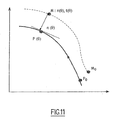
- Any trajectory can be described by variables n( ⁇ ) and t( ⁇ ) ( Figure 11 ) where n ( ⁇ ) is a vector of normal deviation defined by M( ⁇ ) and its orthogonal projection P( ⁇ ) on the limit cycle.
- the second variable t( ⁇ ) is a time movement along the trajectory from the initial point M( 0 ) to the analyzed point M( ⁇ ) .
- the limit trajectory is defined by n ( ⁇ ) ⁇ 0 and t( ⁇ ) ⁇ , where 0 is a vector with all components equal to 0.
- ⁇ ( ⁇ ) be the phase deviation
- ⁇ ( ⁇ ) t ( ⁇ ) - ⁇ .
- N( ⁇ ) and ⁇ ( ⁇ ) are the functions of the parameters.
- N( ⁇ ) and ⁇ ( ⁇ ) are the functions of the parameters.
- Eq. 2 the model of nonlinear oscillations with perturbations
- Limit cycle is described as x 0 ( ⁇ ) , 0 ⁇ ⁇ T , phase running from 0 to T .
- x i t( ⁇ )
- 0 ⁇ T phase running from 0 to T .
- General population X ⁇ x i (t( ⁇ )) , 0 ⁇ T ⁇ is formed by cycles and corresponds to the realizations of the artefacts of stimulation.
- the limit trajectory x 0 ( ⁇ ) , 0 ⁇ ⁇ ⁇ T corresponds to an ideal "undisturbed artefact of stimulation".
- the mean trajectory converges to the limit cycle x 0 ( ⁇ ) in linear approximation if the number of averaged trajectories increases infinitely ( Gudzenko, L.I., Statistical method for self-oscillating system characteristics detection, Izvestiia Vuzov Radiophysics, vol. 5, pp. 573-587, 1962 ).
- n i ( ⁇ ) and ⁇ i ( ⁇ ) are characterized by an asymptotically Gaussian distribution for any ⁇ in case of uncorrelated noise F()( Gudzenko, L.I., Statistical method for self-oscillating system characteristics detection, Izvestiia Vuzov Radiophysics, vol. 5, pp. 573-587, 1962 ).
- the implemented algorithm has following steps:
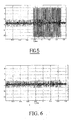
- Figures 3 to 6 Several records from the operating room were used to test the algorithm. Original and filtered signals are shown at the Figures 3 to 6 .
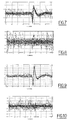
- Figures 7 to 10 display signal sliced into sets of stimulation-period windows before and after filtering. The figures demonstrate the shape of the original artefacts and residuals left after full processing. Also we can see the spikes of neurons.
- ASR Artefact Spike Ratio
- NSR Noise Spike Ratio
- nonlinear oscillation model allows reducing 2-5 times the standard deviation of the residual of artefact of stimulation in comparison with standard model with additive noise and provides much better results of filtering then presented in previous research.
- the test intends to reveal what happens to spike trains and spikes themselves in the presence of stimuli and cleaning procedures.
- Spike trains obtained from an original signal of neuronal activity X Single-Neuron (t) before mixing with artefacts and after full processing were compared.
- a simple threshold filter was used for spike trains extraction.
- the percentages of spikes found at their correct positions in the processed signal were measured.
- the summation of signals with coefficient K changes the spike-noise ratio.
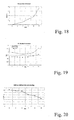
- the graphs of errors of spike detection depending on ASR and corresponding SNR are depicted in the Fig. 18 and 20.
- Figure 19 represents variances of two first principal components of spikes depending on ASR. We can see that spikes rest practically intact up to ASR about 10-12.
- the recordings described above were used to test the algorithm on real data.
- the signals are characterized by ASR ⁇ [1.3, 14], ANR ⁇ [3, 160] and SNR ⁇ [1.4, 5.1].
- Examples of original and filtered signals are shown in Figures 3 to 6 .
- Figures 7 to 10 displays the signal sliced into sets of stimulation-period windows, before and after filtering. The figure demonstrates the shape of the original artefacts and of the residuals left after full processing. One can see also the neuronal spikes.
- the phase portraits in 3D of appropriate artefact set are depicted in the Figures 12 and 13 .
- ASR PhaseSpace and ASR Time are the ASR after processing in phase space and in time domain.
- An advantage of phase space filtering augments with increasing of initial ASR of the signal.
- ASR PhaseSpace /ASR Time 2.87 on average for real data set
- ASR PhaseSpace /ASR Time 2.81 on average for the synthetic data set if ASR>4.
Landscapes
- Health & Medical Sciences (AREA)
- Life Sciences & Earth Sciences (AREA)
- Engineering & Computer Science (AREA)
- Surgery (AREA)
- General Health & Medical Sciences (AREA)
- Biophysics (AREA)
- Biomedical Technology (AREA)
- Heart & Thoracic Surgery (AREA)
- Medical Informatics (AREA)
- Molecular Biology (AREA)
- Physics & Mathematics (AREA)
- Animal Behavior & Ethology (AREA)
- Pathology (AREA)
- Public Health (AREA)
- Veterinary Medicine (AREA)
- Artificial Intelligence (AREA)
- Computer Vision & Pattern Recognition (AREA)
- Physiology (AREA)
- Psychiatry (AREA)
- Signal Processing (AREA)
- Measurement And Recording Of Electrical Phenomena And Electrical Characteristics Of The Living Body (AREA)
- Electrotherapy Devices (AREA)
- Measuring And Recording Apparatus For Diagnosis (AREA)
Claims (9)
- Procédé pour filtrer un signal d'activité neuronale pendant une stimulation cérébrale profonde (DBS) à haute fréquence pour retirer des artéfacts de stimulus du signal observé, comprenant les étapes :i) d'approximation des trajectoires du signal observé dans un espace de phase, le signal observé étant considéré comme une somme d'un signal électrophysiologique, d'un bruit de fond et des artéfacts de stimulation induits par un signal de stimulation, dans lequel le signal de stimulation est supposé être une solution d'une équation différentielle ordinaire comprenant un système auto-oscillant avec un cycle limite stable,ii) de découpage du signal observé et de ses dérivées en segments, chaque segment correspondant à une période de stimulation,iii) de collecte de N périodes sélectionnées de stimulation pour un ensemble d'apprentissage,iv) d'estimation du cycle limite du système auto-oscillant en utilisant l'ensemble d'apprentissage,v) de synchronisation de chaque artéfact du signal observé avec le cycle limite estimé,vi) de soustraction du cycle limite estimé de chaque artéfact dans un espace de phase conformément à la synchronisation,vii) de collecte de tous les segments afin d'obtenir un signal filtré entier,viii) de présentation du signal filtré dans le domaine temporel.
- Procédé selon la revendication 1, dans lequel les trajectoires du signal dans un espace de phase sont approchées en calculant un signal lissé et une approximation des dérivées du signal en utilisant une convolution gaussienne.
- Procédé selon l'une quelconque des revendications 1 et 2, dans lequel, le centre de chaque segment temporel est proche du pic le plus élevé parmi les pics de signal dans le signal observé.
- Procédé selon l'une quelconque des revendications 1 à 3, dans lequel les segments sont sélectionnés de manière aléatoire.
- Procédé selon l'une quelconque des revendications 1 à 4, dans lequel le cycle limite du système auto-oscillant est estimé en utilisant l'élément de l'ensemble d'apprentissage qui fournit le maximum de densité de probabilité dans le voisinage.
- Procédé selon l'une quelconque des revendications 1 à 5, dans lequel le système auto-oscillant avec un cycle limite stable est un système auto-oscillant du quatrième degré.
- Procédé selon la revendication 2, dans lequel la convolution gaussienne est calculée pour une fréquence caractéristique entre 3 et 4 kHz pour une fréquence d'échantillonnage de 48 kHz.
- Procédé selon la revendication 7, dans lequel la fréquence caractéristique est égale à 3,52 kHz.
- Support pouvant être lu par un ordinateur comprenant des instructions qui amènent un ordinateur à effectuer les étapes du procédé selon l'une quelconque des revendications 1 à 8.
Priority Applications (1)
| Application Number | Priority Date | Filing Date | Title |
|---|---|---|---|
| EP08736546.6A EP2139389B1 (fr) | 2007-04-26 | 2008-04-24 | Procédé pour filtrer des artefacts de stimulation du cerveau profond |
Applications Claiming Priority (3)
| Application Number | Priority Date | Filing Date | Title |
|---|---|---|---|
| EP07300991A EP1985230A1 (fr) | 2007-04-26 | 2007-04-26 | Procédé pour le filtrage d'artefacts de la stimulation cérébrale profonde |
| PCT/EP2008/055012 WO2008132136A1 (fr) | 2007-04-26 | 2008-04-24 | Procédé pour filtrer des artefacts de stimulation du cerveau profond |
| EP08736546.6A EP2139389B1 (fr) | 2007-04-26 | 2008-04-24 | Procédé pour filtrer des artefacts de stimulation du cerveau profond |
Publications (2)
| Publication Number | Publication Date |
|---|---|
| EP2139389A1 EP2139389A1 (fr) | 2010-01-06 |
| EP2139389B1 true EP2139389B1 (fr) | 2013-12-11 |
Family
ID=38442565
Family Applications (2)
| Application Number | Title | Priority Date | Filing Date |
|---|---|---|---|
| EP07300991A Ceased EP1985230A1 (fr) | 2007-04-26 | 2007-04-26 | Procédé pour le filtrage d'artefacts de la stimulation cérébrale profonde |
| EP08736546.6A Not-in-force EP2139389B1 (fr) | 2007-04-26 | 2008-04-24 | Procédé pour filtrer des artefacts de stimulation du cerveau profond |
Family Applications Before (1)
| Application Number | Title | Priority Date | Filing Date |
|---|---|---|---|
| EP07300991A Ceased EP1985230A1 (fr) | 2007-04-26 | 2007-04-26 | Procédé pour le filtrage d'artefacts de la stimulation cérébrale profonde |
Country Status (4)
| Country | Link |
|---|---|
| US (1) | US8620420B2 (fr) |
| EP (2) | EP1985230A1 (fr) |
| JP (1) | JP5282081B2 (fr) |
| WO (1) | WO2008132136A1 (fr) |
Families Citing this family (8)
| Publication number | Priority date | Publication date | Assignee | Title |
|---|---|---|---|---|
| US8099170B2 (en) | 2010-03-19 | 2012-01-17 | Medtronic, Inc. | Electrical stimulation based on phase response mapping |
| US8447406B2 (en) | 2010-06-29 | 2013-05-21 | Medtronic, Inc. | Medical method and device for monitoring a neural brain network |
| KR101325368B1 (ko) | 2012-04-24 | 2013-11-08 | 연세대학교 원주산학협력단 | 뇌신경신호반응 기반의 폐루프형 뇌 전기자극 장치 |
| US10039507B2 (en) | 2012-09-19 | 2018-08-07 | The Regents Of The University Of Michigan | Advanced intraoperative neural targeting system and method |
| KR101490966B1 (ko) | 2013-05-10 | 2015-02-11 | 한국과학기술원 | 뇌신경 신호 측정 장치 및 측정 방법 |
| US9498628B2 (en) | 2014-11-21 | 2016-11-22 | Medtronic, Inc. | Electrode selection for electrical stimulation therapy |
| US10264988B2 (en) | 2016-02-23 | 2019-04-23 | The Charles Stark Draper Laboratory, Inc. | Apparatus and method for recording neural signals in the presence of artifacts |
| CN113693605B (zh) * | 2021-09-03 | 2022-07-26 | 复旦大学 | 一种神经信号实时去除刺激伪迹的方法、装置及介质 |
Family Cites Families (7)
| Publication number | Priority date | Publication date | Assignee | Title |
|---|---|---|---|---|
| US7242984B2 (en) * | 1998-08-05 | 2007-07-10 | Neurovista Corporation | Apparatus and method for closed-loop intracranial stimulation for optimal control of neurological disease |
| US6529774B1 (en) * | 2000-11-09 | 2003-03-04 | Neuropace, Inc. | Extradural leads, neurostimulator assemblies, and processes of using them for somatosensory and brain stimulation |
| US7706871B2 (en) * | 2003-05-06 | 2010-04-27 | Nellcor Puritan Bennett Llc | System and method of prediction of response to neurological treatment using the electroencephalogram |
| US7346382B2 (en) | 2004-07-07 | 2008-03-18 | The Cleveland Clinic Foundation | Brain stimulation models, systems, devices, and methods |
| JP4173131B2 (ja) | 2004-11-29 | 2008-10-29 | 沖電気工業株式会社 | 通信制御装置、通信制御方法、ノード及び通信システム |
| US7957793B2 (en) * | 2004-12-22 | 2011-06-07 | Wisconsin Alumni Research Foundation | Methods for identifying neuronal spikes |
| US8788044B2 (en) * | 2005-01-21 | 2014-07-22 | Michael Sasha John | Systems and methods for tissue stimulation in medical treatment |
-
2007
- 2007-04-26 EP EP07300991A patent/EP1985230A1/fr not_active Ceased
-
2008
- 2008-04-24 US US12/597,196 patent/US8620420B2/en not_active Expired - Fee Related
- 2008-04-24 EP EP08736546.6A patent/EP2139389B1/fr not_active Not-in-force
- 2008-04-24 JP JP2010504691A patent/JP5282081B2/ja not_active Expired - Fee Related
- 2008-04-24 WO PCT/EP2008/055012 patent/WO2008132136A1/fr not_active Ceased
Non-Patent Citations (1)
| Title |
|---|
| TETYANA I. AKSENOVA ET AL: "An unsupervised automatic method for sorting neuronal spike waveforms in awake and freely moving animals", METHODS, vol. 30, no. 2, 1 June 2003 (2003-06-01), pages 178 - 187, XP055051073, ISSN: 1046-2023, DOI: 10.1016/S1046-2023(03)00079-3 * |
Also Published As
| Publication number | Publication date |
|---|---|
| JP5282081B2 (ja) | 2013-09-04 |
| EP1985230A1 (fr) | 2008-10-29 |
| JP2010524612A (ja) | 2010-07-22 |
| WO2008132136A1 (fr) | 2008-11-06 |
| US20100185257A1 (en) | 2010-07-22 |
| EP2139389A1 (fr) | 2010-01-06 |
| US8620420B2 (en) | 2013-12-31 |
Similar Documents
| Publication | Publication Date | Title |
|---|---|---|
| Rutishauser et al. | Online detection and sorting of extracellularly recorded action potentials in human medial temporal lobe recordings, in vivo | |
| US8620420B2 (en) | Method for filtering out artefacts of deep brain stimulation | |
| Mammone et al. | Automatic artifact rejection from multichannel scalp EEG by wavelet ICA | |
| Kumar et al. | Removal of ocular artifacts in the EEG through wavelet transform without using an EOG reference channel | |
| US7974698B2 (en) | Method and apparatus for desynchronization of neural brain activity | |
| Valderrama et al. | An automatic algorithm for blink-artifact suppression based on iterative template matching: Application to single channel recording of cortical auditory evoked potentials | |
| Kierkels et al. | A model-based objective evaluation of eye movement correction in EEG recordings | |
| Ortiz-Rosario et al. | Wavelet methodology to improve single unit isolation in primary motor cortex cells | |
| CA2598449A1 (fr) | Systeme et methode de prevision de la reponse a un traitement neurologique utilisant un electroencephalogramme | |
| CN117064409B (zh) | 经颅直流电干预刺激效果实时评估方法、装置及终端 | |
| CN114041806A (zh) | 一种自适应滤波的tms诱发电位提取装置 | |
| Wang et al. | Comparison of electrical microstimulation artifact removal methods for high-channel-count prostheses | |
| Betta et al. | Detection and removal of ocular artifacts from EEG signals for an automated REM sleep analysis | |
| Hoffmann et al. | Detection and removal of stimulation artifacts in electroencephalogram recordings | |
| Gourévitch et al. | A new and fast characterization of multiple encoding properties of auditory neurons | |
| De Silva et al. | Limitations in the rapid extraction of evoked potentials using parametric modeling | |
| Coelli et al. | Characterization of Microelectrode Recordings for the Subthalamic Nucleus identification in Parkinson’s disease | |
| Andres et al. | Finite dimensional structure of the GPI discharge in patients with Parkinson's disease | |
| Hesse et al. | Tracking and detection of epileptiform activity in multichannel ictal EEG using signal subspace correlation of seizure source scalp topographies | |
| Jurczynski et al. | Separating Local and Propagated Contributors to the Behnke-fried Microelectrode Recordings. | |
| Kim et al. | Enhancing ERP component detection by estimating ERP latency variability using hidden process model | |
| Erickson et al. | Iterative covariance-based removal of time-synchronous artifacts: application to gastrointestinal electrical recordings | |
| Slovenko et al. | Identification of Neurophysiological Markers of Interoceptive Signal Processing Using Event-Related Potentials | |
| US20240032849A1 (en) | Method and system for ssep (somatosensory evoked potentials) with monitorable baseline waveform determination | |
| Michmizos et al. | Can we infer subthalamic nucleus spike trains from intranuclear local field potentials? |
Legal Events
| Date | Code | Title | Description |
|---|---|---|---|
| PUAI | Public reference made under article 153(3) epc to a published international application that has entered the european phase |
Free format text: ORIGINAL CODE: 0009012 |
|
| 17P | Request for examination filed |
Effective date: 20091103 |
|
| AK | Designated contracting states |
Kind code of ref document: A1 Designated state(s): AT BE BG CH CY CZ DE DK EE ES FI FR GB GR HR HU IE IS IT LI LT LU LV MC MT NL NO PL PT RO SE SI SK TR |
|
| DAX | Request for extension of the european patent (deleted) | ||
| RIC1 | Information provided on ipc code assigned before grant |
Ipc: A61B 5/04 20060101AFI20130128BHEP Ipc: A61B 5/0478 20060101ALN20130128BHEP Ipc: A61N 1/36 20060101ALN20130128BHEP |
|
| GRAP | Despatch of communication of intention to grant a patent |
Free format text: ORIGINAL CODE: EPIDOSNIGR1 |
|
| INTG | Intention to grant announced |
Effective date: 20130626 |
|
| GRAS | Grant fee paid |
Free format text: ORIGINAL CODE: EPIDOSNIGR3 |
|
| GRAA | (expected) grant |
Free format text: ORIGINAL CODE: 0009210 |
|
| AK | Designated contracting states |
Kind code of ref document: B1 Designated state(s): AT BE BG CH CY CZ DE DK EE ES FI FR GB GR HR HU IE IS IT LI LT LU LV MC MT NL NO PL PT RO SE SI SK TR |
|
| REG | Reference to a national code |
Ref country code: GB Ref legal event code: FG4D |
|
| REG | Reference to a national code |
Ref country code: CH Ref legal event code: EP |
|
| REG | Reference to a national code |
Ref country code: AT Ref legal event code: REF Ref document number: 644029 Country of ref document: AT Kind code of ref document: T Effective date: 20140115 |
|
| REG | Reference to a national code |
Ref country code: IE Ref legal event code: FG4D |
|
| REG | Reference to a national code |
Ref country code: DE Ref legal event code: R096 Ref document number: 602008029246 Country of ref document: DE Effective date: 20140206 |
|
| REG | Reference to a national code |
Ref country code: NL Ref legal event code: VDEP Effective date: 20131211 |
|
| REG | Reference to a national code |
Ref country code: AT Ref legal event code: MK05 Ref document number: 644029 Country of ref document: AT Kind code of ref document: T Effective date: 20131211 |
|
| PG25 | Lapsed in a contracting state [announced via postgrant information from national office to epo] |
Ref country code: FI Free format text: LAPSE BECAUSE OF FAILURE TO SUBMIT A TRANSLATION OF THE DESCRIPTION OR TO PAY THE FEE WITHIN THE PRESCRIBED TIME-LIMIT Effective date: 20131211 Ref country code: NL Free format text: LAPSE BECAUSE OF FAILURE TO SUBMIT A TRANSLATION OF THE DESCRIPTION OR TO PAY THE FEE WITHIN THE PRESCRIBED TIME-LIMIT Effective date: 20131211 Ref country code: NO Free format text: LAPSE BECAUSE OF FAILURE TO SUBMIT A TRANSLATION OF THE DESCRIPTION OR TO PAY THE FEE WITHIN THE PRESCRIBED TIME-LIMIT Effective date: 20140311 Ref country code: HR Free format text: LAPSE BECAUSE OF FAILURE TO SUBMIT A TRANSLATION OF THE DESCRIPTION OR TO PAY THE FEE WITHIN THE PRESCRIBED TIME-LIMIT Effective date: 20131211 Ref country code: LT Free format text: LAPSE BECAUSE OF FAILURE TO SUBMIT A TRANSLATION OF THE DESCRIPTION OR TO PAY THE FEE WITHIN THE PRESCRIBED TIME-LIMIT Effective date: 20131211 Ref country code: SE Free format text: LAPSE BECAUSE OF FAILURE TO SUBMIT A TRANSLATION OF THE DESCRIPTION OR TO PAY THE FEE WITHIN THE PRESCRIBED TIME-LIMIT Effective date: 20131211 |
|
| REG | Reference to a national code |
Ref country code: LT Ref legal event code: MG4D |
|
| PG25 | Lapsed in a contracting state [announced via postgrant information from national office to epo] |
Ref country code: LV Free format text: LAPSE BECAUSE OF FAILURE TO SUBMIT A TRANSLATION OF THE DESCRIPTION OR TO PAY THE FEE WITHIN THE PRESCRIBED TIME-LIMIT Effective date: 20131211 Ref country code: CY Free format text: LAPSE BECAUSE OF FAILURE TO SUBMIT A TRANSLATION OF THE DESCRIPTION OR TO PAY THE FEE WITHIN THE PRESCRIBED TIME-LIMIT Effective date: 20131211 Ref country code: AT Free format text: LAPSE BECAUSE OF FAILURE TO SUBMIT A TRANSLATION OF THE DESCRIPTION OR TO PAY THE FEE WITHIN THE PRESCRIBED TIME-LIMIT Effective date: 20131211 |
|
| PG25 | Lapsed in a contracting state [announced via postgrant information from national office to epo] |
Ref country code: EE Free format text: LAPSE BECAUSE OF FAILURE TO SUBMIT A TRANSLATION OF THE DESCRIPTION OR TO PAY THE FEE WITHIN THE PRESCRIBED TIME-LIMIT Effective date: 20131211 Ref country code: IS Free format text: LAPSE BECAUSE OF FAILURE TO SUBMIT A TRANSLATION OF THE DESCRIPTION OR TO PAY THE FEE WITHIN THE PRESCRIBED TIME-LIMIT Effective date: 20140411 Ref country code: BE Free format text: LAPSE BECAUSE OF FAILURE TO SUBMIT A TRANSLATION OF THE DESCRIPTION OR TO PAY THE FEE WITHIN THE PRESCRIBED TIME-LIMIT Effective date: 20131211 |
|
| PG25 | Lapsed in a contracting state [announced via postgrant information from national office to epo] |
Ref country code: SK Free format text: LAPSE BECAUSE OF FAILURE TO SUBMIT A TRANSLATION OF THE DESCRIPTION OR TO PAY THE FEE WITHIN THE PRESCRIBED TIME-LIMIT Effective date: 20131211 Ref country code: CZ Free format text: LAPSE BECAUSE OF FAILURE TO SUBMIT A TRANSLATION OF THE DESCRIPTION OR TO PAY THE FEE WITHIN THE PRESCRIBED TIME-LIMIT Effective date: 20131211 Ref country code: RO Free format text: LAPSE BECAUSE OF FAILURE TO SUBMIT A TRANSLATION OF THE DESCRIPTION OR TO PAY THE FEE WITHIN THE PRESCRIBED TIME-LIMIT Effective date: 20131211 Ref country code: PL Free format text: LAPSE BECAUSE OF FAILURE TO SUBMIT A TRANSLATION OF THE DESCRIPTION OR TO PAY THE FEE WITHIN THE PRESCRIBED TIME-LIMIT Effective date: 20131211 Ref country code: PT Free format text: LAPSE BECAUSE OF FAILURE TO SUBMIT A TRANSLATION OF THE DESCRIPTION OR TO PAY THE FEE WITHIN THE PRESCRIBED TIME-LIMIT Effective date: 20140411 Ref country code: ES Free format text: LAPSE BECAUSE OF FAILURE TO SUBMIT A TRANSLATION OF THE DESCRIPTION OR TO PAY THE FEE WITHIN THE PRESCRIBED TIME-LIMIT Effective date: 20131211 |
|
| REG | Reference to a national code |
Ref country code: DE Ref legal event code: R097 Ref document number: 602008029246 Country of ref document: DE |
|
| PLBE | No opposition filed within time limit |
Free format text: ORIGINAL CODE: 0009261 |
|
| STAA | Information on the status of an ep patent application or granted ep patent |
Free format text: STATUS: NO OPPOSITION FILED WITHIN TIME LIMIT |
|
| PG25 | Lapsed in a contracting state [announced via postgrant information from national office to epo] |
Ref country code: DK Free format text: LAPSE BECAUSE OF FAILURE TO SUBMIT A TRANSLATION OF THE DESCRIPTION OR TO PAY THE FEE WITHIN THE PRESCRIBED TIME-LIMIT Effective date: 20131211 |
|
| 26N | No opposition filed |
Effective date: 20140912 |
|
| PG25 | Lapsed in a contracting state [announced via postgrant information from national office to epo] |
Ref country code: LU Free format text: LAPSE BECAUSE OF FAILURE TO SUBMIT A TRANSLATION OF THE DESCRIPTION OR TO PAY THE FEE WITHIN THE PRESCRIBED TIME-LIMIT Effective date: 20140424 Ref country code: MC Free format text: LAPSE BECAUSE OF FAILURE TO SUBMIT A TRANSLATION OF THE DESCRIPTION OR TO PAY THE FEE WITHIN THE PRESCRIBED TIME-LIMIT Effective date: 20131211 |
|
| REG | Reference to a national code |
Ref country code: CH Ref legal event code: PL |
|
| REG | Reference to a national code |
Ref country code: DE Ref legal event code: R097 Ref document number: 602008029246 Country of ref document: DE Effective date: 20140912 |
|
| REG | Reference to a national code |
Ref country code: IE Ref legal event code: MM4A |
|
| PG25 | Lapsed in a contracting state [announced via postgrant information from national office to epo] |
Ref country code: LI Free format text: LAPSE BECAUSE OF NON-PAYMENT OF DUE FEES Effective date: 20140430 Ref country code: CH Free format text: LAPSE BECAUSE OF NON-PAYMENT OF DUE FEES Effective date: 20140430 |
|
| PG25 | Lapsed in a contracting state [announced via postgrant information from national office to epo] |
Ref country code: SI Free format text: LAPSE BECAUSE OF FAILURE TO SUBMIT A TRANSLATION OF THE DESCRIPTION OR TO PAY THE FEE WITHIN THE PRESCRIBED TIME-LIMIT Effective date: 20131211 |
|
| PG25 | Lapsed in a contracting state [announced via postgrant information from national office to epo] |
Ref country code: IE Free format text: LAPSE BECAUSE OF NON-PAYMENT OF DUE FEES Effective date: 20140424 |
|
| REG | Reference to a national code |
Ref country code: DE Ref legal event code: R082 Ref document number: 602008029246 Country of ref document: DE Representative=s name: HOEGER, STELLRECHT & PARTNER PATENTANWAELTE MB, DE |
|
| PG25 | Lapsed in a contracting state [announced via postgrant information from national office to epo] |
Ref country code: MT Free format text: LAPSE BECAUSE OF FAILURE TO SUBMIT A TRANSLATION OF THE DESCRIPTION OR TO PAY THE FEE WITHIN THE PRESCRIBED TIME-LIMIT Effective date: 20131211 |
|
| REG | Reference to a national code |
Ref country code: FR Ref legal event code: PLFP Year of fee payment: 9 |
|
| PG25 | Lapsed in a contracting state [announced via postgrant information from national office to epo] |
Ref country code: BG Free format text: LAPSE BECAUSE OF FAILURE TO SUBMIT A TRANSLATION OF THE DESCRIPTION OR TO PAY THE FEE WITHIN THE PRESCRIBED TIME-LIMIT Effective date: 20131211 |
|
| PG25 | Lapsed in a contracting state [announced via postgrant information from national office to epo] |
Ref country code: IT Free format text: LAPSE BECAUSE OF FAILURE TO SUBMIT A TRANSLATION OF THE DESCRIPTION OR TO PAY THE FEE WITHIN THE PRESCRIBED TIME-LIMIT Effective date: 20131211 Ref country code: GR Free format text: LAPSE BECAUSE OF FAILURE TO SUBMIT A TRANSLATION OF THE DESCRIPTION OR TO PAY THE FEE WITHIN THE PRESCRIBED TIME-LIMIT Effective date: 20140312 |
|
| PG25 | Lapsed in a contracting state [announced via postgrant information from national office to epo] |
Ref country code: TR Free format text: LAPSE BECAUSE OF FAILURE TO SUBMIT A TRANSLATION OF THE DESCRIPTION OR TO PAY THE FEE WITHIN THE PRESCRIBED TIME-LIMIT Effective date: 20131211 Ref country code: HU Free format text: LAPSE BECAUSE OF FAILURE TO SUBMIT A TRANSLATION OF THE DESCRIPTION OR TO PAY THE FEE WITHIN THE PRESCRIBED TIME-LIMIT; INVALID AB INITIO Effective date: 20080424 |
|
| REG | Reference to a national code |
Ref country code: FR Ref legal event code: PLFP Year of fee payment: 10 |
|
| REG | Reference to a national code |
Ref country code: FR Ref legal event code: PLFP Year of fee payment: 11 |
|
| REG | Reference to a national code |
Ref country code: DE Ref legal event code: R082 Ref document number: 602008029246 Country of ref document: DE Representative=s name: HOEGER, STELLRECHT & PARTNER PATENTANWAELTE MB, DE |
|
| REG | Reference to a national code |
Ref country code: DE Ref legal event code: R079 Ref document number: 602008029246 Country of ref document: DE Free format text: PREVIOUS MAIN CLASS: A61B0005040000 Ipc: A61B0005240000 |
|
| PGFP | Annual fee paid to national office [announced via postgrant information from national office to epo] |
Ref country code: FR Payment date: 20230424 Year of fee payment: 16 Ref country code: DE Payment date: 20230418 Year of fee payment: 16 |
|
| PGFP | Annual fee paid to national office [announced via postgrant information from national office to epo] |
Ref country code: GB Payment date: 20230421 Year of fee payment: 16 |
|
| REG | Reference to a national code |
Ref country code: DE Ref legal event code: R119 Ref document number: 602008029246 Country of ref document: DE |
|
| GBPC | Gb: european patent ceased through non-payment of renewal fee |
Effective date: 20240424 |
|
| PG25 | Lapsed in a contracting state [announced via postgrant information from national office to epo] |
Ref country code: DE Free format text: LAPSE BECAUSE OF NON-PAYMENT OF DUE FEES Effective date: 20241105 |
|
| PG25 | Lapsed in a contracting state [announced via postgrant information from national office to epo] |
Ref country code: GB Free format text: LAPSE BECAUSE OF NON-PAYMENT OF DUE FEES Effective date: 20240424 |
|
| PG25 | Lapsed in a contracting state [announced via postgrant information from national office to epo] |
Ref country code: FR Free format text: LAPSE BECAUSE OF NON-PAYMENT OF DUE FEES Effective date: 20240430 |
|
| PG25 | Lapsed in a contracting state [announced via postgrant information from national office to epo] |
Ref country code: GB Free format text: LAPSE BECAUSE OF NON-PAYMENT OF DUE FEES Effective date: 20240424 Ref country code: FR Free format text: LAPSE BECAUSE OF NON-PAYMENT OF DUE FEES Effective date: 20240430 Ref country code: DE Free format text: LAPSE BECAUSE OF NON-PAYMENT OF DUE FEES Effective date: 20241105 |