EP2139148B1 - Dispositif et procédé de modulation à décalage de phase pour des systèmes de communication sans fil utilisant un codage d'espace-temps - Google Patents
Dispositif et procédé de modulation à décalage de phase pour des systèmes de communication sans fil utilisant un codage d'espace-temps Download PDFInfo
- Publication number
- EP2139148B1 EP2139148B1 EP08158802A EP08158802A EP2139148B1 EP 2139148 B1 EP2139148 B1 EP 2139148B1 EP 08158802 A EP08158802 A EP 08158802A EP 08158802 A EP08158802 A EP 08158802A EP 2139148 B1 EP2139148 B1 EP 2139148B1
- Authority
- EP
- European Patent Office
- Prior art keywords
- symbol
- symbols
- phase
- output signal
- symbol set
- Prior art date
- Legal status (The legal status is an assumption and is not a legal conclusion. Google has not performed a legal analysis and makes no representation as to the accuracy of the status listed.)
- Active
Links
Images

Classifications
-
- H—ELECTRICITY
- H04—ELECTRIC COMMUNICATION TECHNIQUE
- H04L—TRANSMISSION OF DIGITAL INFORMATION, e.g. TELEGRAPHIC COMMUNICATION
- H04L1/00—Arrangements for detecting or preventing errors in the information received
- H04L1/02—Arrangements for detecting or preventing errors in the information received by diversity reception
- H04L1/06—Arrangements for detecting or preventing errors in the information received by diversity reception using space diversity
- H04L1/0618—Space-time coding
- H04L1/0637—Properties of the code
- H04L1/0668—Orthogonal systems, e.g. using Alamouti codes
-
- H—ELECTRICITY
- H04—ELECTRIC COMMUNICATION TECHNIQUE
- H04L—TRANSMISSION OF DIGITAL INFORMATION, e.g. TELEGRAPHIC COMMUNICATION
- H04L27/00—Modulated-carrier systems
- H04L27/32—Carrier systems characterised by combinations of two or more of the types covered by groups H04L27/02, H04L27/10, H04L27/18 or H04L27/26
- H04L27/34—Amplitude- and phase-modulated carrier systems, e.g. quadrature-amplitude modulated carrier systems
Definitions
- the present disclosure relates generally to a manner by which to reduce the dynamic range of a radio-frequency (RF) signal transmitted in digital wireless communications systems equipped with multiple antennas. More particularly, the present disclosure relates to an apparatus, and an associated method, by which to apply modulated digital symbols to a space-time block encoder in a multiple-antenna transmission system.
- RF radio-frequency
- Wireless communication systems are amongst the communication systems that have made use of advancements in digital communication technologies.
- a cellular communication system for instance, is exemplary of a wireless communication system. While the early generation of wireless communication systems generally utilized analog communication techniques and provided for only limited data communication capabilities, newer-generation, wireless communication systems are exclusively using digital technologies, and increasingly provide for data-intensive communication services.
- noise, interference, signal distortions due to the limited channel bandwidth and nonlinearity, time-variant multi-path propagation condition, and other impairments experienced during propagation alter the signal such that the data recovered in the receiver may differ with the corresponding data that are transmitted. This may generate errors in the recovery of the informational content of the data. And, if the impairment is too significant, the communications fail.
- One promising technology in wireless communications under multi-path propagation conditions comprises the use of multiple transmit antennas and multiple receive antennas, to provide spatial diversity of propagation.
- the digital symbols, carrying the information of data after modulation are often encoded with space-time coding techniques before they are converted to RF signal for transmission.
- space-time block coding is one example of space-time coding techniques, for the purpose of improving the error rate performance.
- the data which are in the form of binary bits and may have been encoded with other coding operations including error-correction coding, are digitally modulated (or equivalently, mapped) into digital symbols.
- these digital symbols are selected, in general, from a constellation of complex values.
- MPSK M-ary Phase Shift Keying
- MQAM M-ary Quaduature Amplitude Modulation
- each symbol takes a complex value from the constellation consisting of M points evenly distributed on a circle of unit radius.
- MQAM where M is a power of four, each symbol takes a complex value from the constellation consisting of M points evenly distributed on the grid lines of a square area with equal distance. Block by block, these symbols are then applied to a space-time block encoder. Then, the encoded symbols, after passing through pulse-shaping filters to limit the signal bandwidth, are converted to analog signals by A/D converter and then up-converted to RF signals, and then, are properly distributed to the multiple antennas for transmission.
- Rotated STBS has been studied and reported by Su, et al., "Signal Constellations for Quasi-Orthogonal Space-Time Block Codes with Full Diversity," IEEE Transactions on Information Theory, vol. 50, no.10, 1 October 2004, pp. 2331-2347, XPO11119308 IEEE, US ISSN: 0018-9448 . Additional studies in this area may be found at: Dung et al., "Optimal Rotations For Quasi-Orthogonal STBS with Two-Dimensional Constellations," Global Telecommunications Conference-Globecom '05, vol.4, 28 November 2005-2 December 2005, pp.
- Alamouti coding is the simplest one applicable to a wireless communication system equipped with two transmit antennas and one or more receive antennas. With each code block of Alamouti code, the information carried by two symbols is transmitted in two time slots, and thus the coding rate is one. Another important virtue of Alamouti coding is that the optimum decoding in the receiver can be easily implemented with a simple linear detector.
- the encoder accepts two input symbols, and generates two sets of output symbols for transmission in two time slots, respectively, two output symbols per set for each time slot. The two output symbols transmitted in the first time slot, one from each antenna, are the same as the two input symbols.
- the two output symbols transmitted in the second time slot, one from each antenna are the symbols formed by complex-conjugating the two input symbols, and then reversing the sign of one of the conjugated symbols. Moreover, after being up-converted to the RF (Radio Frequency) band, these output symbols are applied to the two transmit antennas in a manner such that each of the two input symbols, transmitted in the first time slot, and their conjugations, transmitted in the second time slot, are always transmitted from two different antennas. This is to say, for each code block, the information content carried by each symbol is transmitted twice using two time slots, once in the form of the symbol itself from one antenna, once in the form of its conjugation from another antenna.
- RF Radio Frequency
- the output symbols of the Alamouti encoder Prior to being applied to transmit antennas, the output symbols of the Alamouti encoder are converted to analog signals and up-converted to form RF signals, and then the RF signals are amplified by power amplifiers (PA).
- PA power amplifiers
- a power amplifier is only able to amplify a signal within a limited dynamic range without, or with limited, non-linear distortion. Otherwise, if the signal amplitude varies in a dynamic range wider than the limit that the PA can handle, serious non-linear distortion results in the amplified signal. In general, the wider the signal dynamic range that a PA can handle without distortion, the more expensive the PA is. If a manner could be provided that utilizes a signal of reduced dynamic range, a less expensive PA, operable over a reduced dynamic range could instead be utilized.
- Figure 1 illustrates a functional block diagram of a communication system that includes an embodiment of the present disclosure.
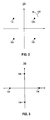
- Figure 2 illustrates a representation of an exemplary constellation whose symbols are utilized during operation of an exemplary implementation of an embodiment of the present disclosure.
- Figure 3 illustrates a representation, similar to that shown in Figure 2 , but of a constellation having symbols phase-rotated relative to those shown in Figure 2 .
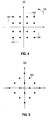
- Figure 4 illustrates a representation of another exemplary constellation whose symbols are utilized during operation of an exemplary implementation of the present disclosure.
- Figure 5 illustrates a representation, similar to that shown in Figure 4 , but of a constellation having symbols phase-rotated relative to those shown in Figure 4 .
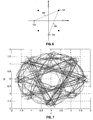
- Figure 6 illustrates representations of possible signal transitions with Alamouti coding when using a pair of signal constellations, offset form one another, as shown with respect to the constellation sets shown in Figures 2 and 3 , under bandwidth unlimited condition.
- Figure 7 illustrates a representation of exemplary trajectories of the signal with Alamouti coding and using a pair of signal constellations, offset form one another, as shown with respect to the constellation sets shown in Figures 2 and 3 , with bandwidth-limited pulse shaping.
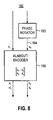
- Figure 8 illustrates a flow diagram representative of the method of operation of an embodiment of the present disclosure.
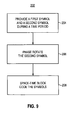
- Figure 9 illustrates a method flow diagram representative of the method of operation of an embodiment of the present disclosure.
- the present disclosure advantageously provides an apparatus, and an associated methodology, by which to reduce the dynamic range of the radio-frequency (RF) signal transmitted in digital wireless communications systems equipped with multiple antennas.
- RF radio-frequency
- the resultant RF signal is formed that is of reduced dynamic range.
- Circuit elements such as the transmitter power amplifiers, that operate upon the signals of coded symbols correspondingly need only to be of reduced dynamic range.
- a power amplifier that is required merely to exhibit characteristics that attain the reduced dynamic range, is more economically implemented than a power amplifier that is required to exhibit a larger dynamic range.
- non-linear distortion in the resultant signals is lessened as the reduced dynamic range of the signals input to the power amplifier are less likely to be beyond the linear operational range of the power amplifier.
- the data that is to be communicated is mapped to symbols by digital modulation.
- Serially-provided symbols are converted, such as by way of a serial to parallel converter, into symbols provided on parallel application paths. For instance, a single, serial sequence of input symbols is converted into a pair of symbol sequences provided upon parallel paths.
- the data symbols, applied on the parallel paths are provided to an Alamouti encoder.
- the symbols applied to the encoder are taken from different constellation sets, such as constellation sets that are phase-offset from one another. By offsetting the phases of the constellation sets, viz., the symbols of each code block thereof, provided to the encoder on the separate lines never belong to the same constellation.
- the encoder operates to encode the input symbols in a manner to provide spatial diversity gain.
- the Alamouti coding is applicable to the systems equipped with two transmit antennas and one or more receive antennas.
- the coding of an input pair of symbols forms a (2 ⁇ 2) code matrix of two rows and two columns.
- the first column consists of the pair of the input symbols.
- the second column consists of the complex conjugated version of the first column with a row exchange.
- the sign of one of the two conjugated symbols is reversed.
- the symbols on the first row will be transmitted by the first transmit antenna, and the symbols on the second row will be transmitted by the second transmit antenna.
- the symbols on the same row but different columns are transmitted successively in the order of columns.
- a phase rotator is provided with input symbols applied on one of the parallel lines onto which the input symbols are applied.
- the phase rotator rotates the phase of the input symbols applied thereto by a pre-determined amount.
- the symbols, once phase-rotated are of symbols of a constellation set that differs from the constellation set of the symbols on the other parallel application path. Phase-offset modulation is provided thereby.
- the received signal when received at a receive station, is provided to an Alamouti detector that makes decisions on the transmitted symbols based on the received signals, and provides, on a set of decoded symbol paths, the decoded symbols.
- a phase de-rotator is utilized to de-rotate the decoded symbol values applied on one of the paths which has been phase rotated in the transmitter with the same rotation amount.
- the decoded symbols provided by the phase de-rotator are provided to a parallel to serial converter along with symbol values provided on other paths.
- the parallel-to-serial converter forms a single serial sequence of symbols that forms the recovered symbol sequence.
- the recovered symbol sequence is then de-mapped into the recovered sequence of bits.
- phase rotation between the two symbol constellations in the transmitter and the de-rotation operation in the receiver does not affect the diversity provided by the space-time block coding, does not change the signal power spectrum, and does not change other system performance, while the resultant signal dynamic range is reduced, as shown below.
- an apparatus and associated method for a communication station that communicates symbols.
- a symbol provider is configured to provide symbols block by block. Two symbols are provided for each block.
- An encoder is adapted to encode these symbols block by block according to the Alamouti coding rule.
- an exemplary communication system shown generally at 10, provides for communications between a set of communication stations.
- the communication system is shown to include a communication station 12 and a communication station 14.
- the following description shall describe exemplary implementation in which the communication system 10 forms a cellular radio communication system.
- the communication station 12 is, in the exemplary implementation, representative of a cellular mobile station
- the communication station 14 is representative of a network station, such as a Base Transceiver Station (BTS).
- BTS Base Transceiver Station
- the receive part of the communication station 14 is also representative of the receive part of a mobile station
- the transmit part of the communication station 12 is also representative of the transmit part of the network station.
- the communication system is representative of any of various Multiple Input, Multiple Output (MIMO) communication systems having multiple system inputs and multiple system outputs and adopting space-time block coding.
- MIMO Multiple Input, Multiple Output
- the exemplary system shows a two-input, two-output scheme
- the disclosure set forth herein is more generally applicable to a system having any number of outputs which uses Alamouti coding as a part or multiple parts.
- the communication stations 12 and 14 are functionally represented, implemented in any desired manner, including algorithms executable by processing circuitry, hardware elements, or combinations thereof. And, the functions carried out by the various elements need not be co-located at a single entity and, in various implementations, are distributed across more than one physical entity.
- the data that is communicated by the communication station 12 is sourced at a data source 22.
- the data comprises, for instance, voice data, multimedia data, textual data, or any other data amenable for communication pursuant to operation of the communication system.
- the data here comprises binary data, formatted in a desired manner, such as in frames or packets of data, and may have been coded with any binary coding schemes, including but not limited to, the error-correcting coding.
- a serial stream of binary bits is provided, here indicated by way of the line 24 to a modulator 28.
- the modulator operates to use the bits of the data that are applied thereto and to form modulated symbols representative of the data bits.
- the symbols are also generated on a serial path 30 that here is provided to a serial to parallel converter (S/P), e.g.
- S/P serial to parallel converter
- the converter 32 converts the serial sequence of symbols into parallel sequences on the paths 36 and 38.
- the exemplary implementation forms a single-to-dual converter that forms two streams of symbols on the lines 36 and 38. (In other implementations for more general cases with more than two transmit antennas, other numbers of symbol streams are formed.)
- the path 38 extends to a phase rotator 42 while the path 36 extends directly to an encoder 46.
- the phase rotator 42 operates to rotate the phase of each symbol applied thereto on the path 38.
- phase-rotated symbols are provided on the path 44 to the encoder 46.
- the amount of phase rotation introduced by the phase rotator 42 upon the symbols applied thereto is a predetermined amount, such that the two constellations do not share any symbol points.
- a predetermined amount such that the two constellations do not share any symbol points.
- the MPSK modulation it can be, but not limited to, ⁇ / M radians.
- the QAM modulation it can be, but is not limited to, ⁇ /4 radians.
- the converter 32 and rotator 42 thereby comprise a symbol provider that provide symbols on the lines 36 and 44 that are of separate, i.e., first and second symbol sets.
- the encoder 46 forms an Alamouti encoder that operates to encode the symbols provided thereto on the lines 36 and 44. Each pair of symbols applied to the encoder is defined to form an input symbol matrix for a code block. And, the encoder generates a code matrix comprising coded representations of the input symbols.
- the coding comprises generating a 2x2 (i.e. a two row and two column) symbol matrix for every two input symbols in the form of a 2x1 (i.e. a two row and one column) symbol matrix, by taking the 2x1 input symbol matrix as the first column, and its complex conjugate with a row exchange as the second column. Moreover, the sign of either the first or the second conjugated value in the second column then is reversed. In this way the two columns of the generated 2x2 matrix are orthogonal mathematically.
- Coded symbols of the separate rows are provided on separate paths, here the paths 48 and 49, respectively.
- the coded symbols of the two columns are provided sequentially in the order of the columns.
- the paths 48 and 49 are extended to the separate pulse-shaping filters 50 and 52, respectively, to confine the signal bandwidth.
- These pulse-shaping filters may be implemented by, but not limited to, the well-known square-root raised cosine filters.
- the outputs from the two filters are provided on the lines 54 and 56 to up converters 58 and 60. Up-converted outputs are provided on the lines 62 and 64 to power amplifiers 66 and 68. And, the amplified outputs are provided to separate antennas 72 and 74.
- the symbols corresponding to the signals transmitted from each of the antennas 72 and 74 alternately belong to the two different constellations with a phase offset to each another, and therefore the transition from one symbol to the next symbol from time to time does not pass the zero.
- Circuit elements in the transmit chain that operate upon the coded symbols, such as power amplifier, and related, elements (not shown in Figure 1 ) correspondingly are able to be operated at the reduced dynamic range, permitting circuit elements to be selected that exhibit operating characteristics over the lesser dynamic range. Cost savings result. And, the signal dynamic ranges are less likely to be beyond the linear operational range of the power amplifier. Less non-linear distortion in the resultant, amplified signals occurs.
- the communication station 14 includes a set of antennas, here two antennas 76 and 78 are assumed as shown that receive signal energy and convert the received signal energy into electrical form. It should be known that this disclosure is applicable regardless of the number of receive antennas.
- RF Radio Frequency
- operations are performed by the elements 80 and 82 that extend, by way of the lines 84 and 86 to down converters 88 and 90 and upon the received signal , and the baseband representations of the received signal are provided by way of the lines 92 and 94 to the Alamouti detector 96.
- the detector 96 performs the normal operation of the linear detector for Alamouti decoding.
- a set of decoded symbols are provided on separate paths, here the paths 98 and 100.
- the path 100 extends directly to a parallel to serial converter 104 while the path 98 extends to a phase de-rotator 106.
- the phase de-rotator operates to de-rotate in phase each decoded symbol provided thereto.
- the de-rotated symbols are provided by way of the line 108 to the parallel to serial converter 104.
- the parallel to serial converter a dual-to-serial converter in the exemplary implementation, generates a serial sequence of symbols on the line 114.
- the line 114 extends to a demodulator 116 that de-maps the symbols to provide the recovered binary bits thereafter to a data sink 118.
- FIG. 2 a representation shown generally at 122, illustrates a constellation of 4QAM, which consists of four constellation points, i.e., symbols 124.
- the constellation set shown in Figure 2 is exemplary of a constellation set from which symbols are selected to represent binary bits. That is to say, for instance, the modulator 28 shown in Figure 1 maps every two binary bits to form a symbol, in one implementation, represented by one of the four points 124 of the constellation set shown in Figure 2 .
- Modulated symbols formed on the paths 36 and 38 of the communication station 12 shown in Figure 1 are of values of the symbols 124.
- the arrow 126 shown in Figure 2 is representative of exemplary rotation of the constellation 122, as shall be noted with respect to the description of Figure 3 below.
- Figure 3 illustrates a representation 132 that illustrates another constellation set of 4QAM which also consists of four constellation points, that is, symbols 134.
- the symbols 134 correspond to the symbols 124 shown in Figure 2 but are offset by a 45° phase rotation.
- the symbols 134 are representative, for instance, of symbols of values formed on the path 44 by the phase rotator 42 of the communication station 12 shown in Figure 1 .
- Comparison of the representations 122 and 132 of Figures 2 and 3 illustrate a 45° offset there between.
- the 45° offset of the constellations permits the dynamic range of signals provided to the power amplifiers 66 and 68 of the communication station 12 shown in Figure 1 to be of reduced dynamic ranges due to the symbols alternately taken from the different constellations with the phase offset applied thereto in sequence.
- Figure 4 illustrates a representation 142 that illustrates a constellation of a 16-QAM (Quadrature Amplitude Modulation) symbol set.
- 16 symbols 144 form the constellation.
- the arrow 146 is representative of exemplary rotation of the constellation 142.
- Figure 5 illustrates a representation 152 of another 16-QAM constellation having symbols 154.
- the constellation is rotated by 45° relative to the constellation shown in the representation 142 of Figure 4 .
- the symbols 144 of the representation 142 are exemplary, for instance, of symbols into which input binary bits are mapped by the modulator 28 shown in Figure 1 and of symbols that are generated on the paths 36 and 38, also shown in Figure 1 .
- the symbols 154 of the representation 152 are exemplary, for instance, of the values of phase-rotated symbols formed on the path 44 by the phase rotator of the communication station 12 shown in Figure 1 .
- Figure 6 illustrates a representation of exemplary symbol-value transitions using 4QAM modulation scheme, such as that shown with respect to Figures 2-3 implemented at the apparatus 34 shown in Figure 1 .
- the symbols 124 and 134 are again shown.
- the transitions 164 and 166 represent two possible transitions of symbol values between adjacent symbols on each of the lines 48 and 49 shown in Figure 1 . Without the phase offset, the possible transitions between successive symbols might pass the zero. However, through use of the symbols alternately belonging to different constellations with phase offset each other the transition never passes the zero. This greatly reduces the dynamic ranges of the signals thereafter, including those applied to the power amplifiers.
- Figure 7 illustrates a representation shown at the line 54 of Fig. 1 representative of exemplary trajectories obtained through simulation of an Alamouti code signal modulated with 4QAM in which the constellation phase offset is utilized.
- the simulation utilizes a square-root raised cosine filter, of a roll-off equal to 0.5, for the pulse-shaping filter 50 shown in Fig. 1 .
- An analysis of the representation indicates that the probability for the signal magnitude is close to zero is much lower than otherwise if the constellation phase offset is not applied.
- Figure 8 illustrates a method flow diagram, shown generally at 182, representative of the method of operation of an embodiment of the present disclosure.
- the method facilitates communication of symbols by a wireless communication station that communicates symbols.
- FIG. 8 shows exemplary implementation of a method of an embodiment of the present disclosure.
- two streams of input symbols come from the lines 190 and 192. These two streams of symbols may be provided by a serial-to-parallel converter to split from a common symbol source, or initially generated by two separate resources.
- the symbol stream on the line 192 is phase rotated at 193 and a symbol stream is formed on the line 194.
- the lines 190 and 194 apply symbol streams to the encoder 195 and the encoded symbol streams are formed on the lines 196 and 198.
- Figure 9 illustrates a method flow diagram, shown generally at 202, representative of the method of operation of an embodiment of the present invention.
- the method facilitates communication of data symbols by a communication station that communicates data symbols.
- a first symbol and a second symbol are provided during at least a first symbol time period.
- the first symbol is of a first symbol set
- the second symbol is of a second symbol set.
- the second symbol is phase-rotated.
- the first symbol and the second symbol are space-time block coded.
- the symbols that are to be communicated are space-time coded with Alamouti coding, and the resultant coded symbols are of a reduced dynamic range.
Landscapes
- Engineering & Computer Science (AREA)
- Computer Networks & Wireless Communication (AREA)
- Signal Processing (AREA)
- Radio Transmission System (AREA)
- Digital Transmission Methods That Use Modulated Carrier Waves (AREA)
Claims (13)
- Appareil pour une station de communication sans fil qui communique des symboles, ledit appareil comprenant :un fournisseur (22, 28, 32) de symboles configuré pour fournir un premier symbole et un deuxième symbole durant au moins une première durée de symbole, le premier symbole provenant d'un premier ensemble de symboles et le deuxième symbole provenant d'un deuxième ensemble de symboles ;un dispositif (42) de rotation de phase configuré pour effectuer une rotation de phase des symboles du deuxième ensemble de symboles par rapport aux symboles du premier ensemble de symboles ;un codeur (46) adapté pour recevoir le premier symbole et le deuxième symbole ayant subi la rotation de phase fournis par ledit fournisseur de symboles et ledit dispositif de rotation de phase, ledit codeur configuré pour effectuer un codage spatio-temporel en bloc du premier symbole et du deuxième symbole pour fournir un premier signal de sortie (48) et un deuxième signal de sortie (49), ledit premier signal de sortie comprenant ledit premier symbole et un conjugué complexe négatif dudit deuxième symbole ayant subi la rotation de phase, et ledit deuxième signal de sortie comprenant ledit deuxième symbole ayant subi la rotation de phase et un complexe conjugué dudit premier symbole ; et caractérisé parun premier amplificateur de puissance (66) qui accepte ledit premier signal de sortie et un deuxième amplificateur de puissance (68) qui accepte ledit deuxième signal de sortie, chacun desdits premier amplificateur de puissance et deuxième amplificateur de puissance est adapté pour avoir une gamme dynamique inférieure à celle des amplificateurs de puissance acceptant des signaux sans rotation de phase.
- Appareil de la revendication 1, dans lequel le premier ensemble de symboles comprend un ensemble de symboles de modulation par déplacement de phase M-valente, dite MPSK.
- Appareil de la revendication 1, dans lequel le premier ensemble de symboles comprend un ensemble de symboles de modulation d'amplitude en quadrature de phase, dite QAM, M-valente.
- Appareil de la revendication 3, dans lequel le deuxième ensemble de symboles est décalé par rapport au premier ensemble de symboles par nn/M radians où n est un entier et n est un entier impair lorsqu'un schéma de modulation MPSK est utilisé.
- Appareil de la revendication 3, dans lequel le deuxième ensemble de symboles est décalé par rapport au premier ensemble de symboles par π/4 radians lorsqu'un schéma de modulation MQAM est utilisé.
- Appareil de la revendication 1, dans lequel la station de communication comprend une station de communication à diversité de transmission ayant une première antenne de transmission (72) et une deuxième antenne de transmission (74) et où lesdits premier et deuxième amplificateurs de puissance (66, 68) sont configurés pour fournir des représentations de codage spatio-temporel en bloc des premier et deuxième symboles, respectivement, aux première et deuxième antennes de transmission.
- Appareil de la revendication 1, dans lequel ledit codeur est un codeur d'Alamouti.
- Appareil de la revendication 1, dans lequel la station de communication comprend une première antenne de transmission (72) et une deuxième antenne de transmission (74), où des symboles de données appliqués à la première antenne sont alternativement du premier ensemble de symboles et du deuxième ensemble de symboles, et où des symboles de données appliqués à la deuxième antenne de transmission sont alternativement du premier ensemble de symboles et du deuxième ensemble de symboles.
- Appareil de la revendication 1, dans lequel ledit fournisseur de symboles est configuré pour fournir une série successive de premiers symboles et une série successive de deuxièmes symboles pendant des durées successives.
- Appareil selon la revendication 1 comprenant en outre des premier et deuxième filtres (50, 52) en racine carrée de cosinus surélevé, agencés pour recevoir lesdits premier et deuxième signaux de sortie, respectivement, ayant un facteur d'affaiblissement égal à 0,5, et couplés auxdits premier et deuxième amplificateurs de puissance, respectivement.
- Procédé de communication de symboles par une station de communication qui communique des symboles, le procédé comprenant le fait :de fournir (22, 28, 32) un premier symbole et un deuxième symbole durant au moins une première durée de symbole, le premier symbole d'un premier ensemble de symboles et le deuxième symbole d'un deuxième ensemble de symboles ;d'effectuer une rotation de phase (42) des symboles du deuxième ensemble de symboles par rapport aux symboles du premier ensemble de symboles ; etd'effectuer un codage spatio-temporel en bloc (46) du premier symbole et du deuxième symbole ayant subi la rotation de phase pour fournir un premier signal de sortie (48) et un deuxième signal de sortie (49), ledit premier signal de sortie comprenant ledit premier symbole et un conjugué complexe négatif dudit deuxième symbole ayant subi la rotation de phase, et ledit deuxième signal de sortie comprenant ledit deuxième symbole ayant subi la rotation de phase et un complexe conjugué dudit premier symbole ; etd'amplifier la puissance desdits premier et deuxième signaux de sortie avec un premier amplificateur de puissance (66) à faible gamme dynamique qui accepte ledit premier signal de sortie et un deuxième amplificateur (68) de puissance à faible gamme dynamique qui accepte ledit deuxième signal de sortie, chacun desdits premier amplificateur de puissance et deuxième amplificateur de puissance est adapté pour avoir une gamme dynamique inférieure à celle des amplificateurs de puissance acceptant des signaux sans rotation de phase.
- Procédé de la revendication 11, dans lequel ledit codage spatio-temporel en bloc comprend un codage utilisant une technique de codage d'Alamouti.
- Procédé selon la revendication 11 comprenant en outre le fait de filtrer lesdits premier et deuxième signaux de sortie avec des premier et deuxième filtres en racine carrée de cosinus surélevé (50, 52), chacun desdits premier et deuxième filtres en racine carrée de cosinus surélevé ayant un facteur d'affaiblissement égal à 0,5.
Priority Applications (3)
| Application Number | Priority Date | Filing Date | Title |
|---|---|---|---|
| AT08158802T ATE545230T1 (de) | 2008-06-23 | 2008-06-23 | Vorrichtung und verfahren zur phasenverschiebungsmodulation in drahtlosen, raum-zeit-kodierung verwendenden kommunikationssystemen |
| EP08158802A EP2139148B9 (fr) | 2008-06-23 | 2008-06-23 | Dispositif et procédé de modulation à décalage de phase pour des systèmes de communication sans fil utilisant un codage d'espace-temps |
| CA2670227A CA2670227C (fr) | 2008-06-23 | 2009-06-23 | Appareil et methode connexe de modulation en decalage de phase pour systemes de communication sans fil a codage espace-temps |
Applications Claiming Priority (1)
| Application Number | Priority Date | Filing Date | Title |
|---|---|---|---|
| EP08158802A EP2139148B9 (fr) | 2008-06-23 | 2008-06-23 | Dispositif et procédé de modulation à décalage de phase pour des systèmes de communication sans fil utilisant un codage d'espace-temps |
Publications (3)
| Publication Number | Publication Date |
|---|---|
| EP2139148A1 EP2139148A1 (fr) | 2009-12-30 |
| EP2139148B1 true EP2139148B1 (fr) | 2012-02-08 |
| EP2139148B9 EP2139148B9 (fr) | 2012-04-25 |
Family
ID=40122414
Family Applications (1)
| Application Number | Title | Priority Date | Filing Date |
|---|---|---|---|
| EP08158802A Active EP2139148B9 (fr) | 2008-06-23 | 2008-06-23 | Dispositif et procédé de modulation à décalage de phase pour des systèmes de communication sans fil utilisant un codage d'espace-temps |
Country Status (3)
| Country | Link |
|---|---|
| EP (1) | EP2139148B9 (fr) |
| AT (1) | ATE545230T1 (fr) |
| CA (1) | CA2670227C (fr) |
Families Citing this family (4)
| Publication number | Priority date | Publication date | Assignee | Title |
|---|---|---|---|---|
| GB2557208A (en) * | 2016-11-30 | 2018-06-20 | Univ Of Kwazulu Natal Ip And Technology Tansfer Office | Communication method, apparatus and system |
| WO2018207281A1 (fr) * | 2017-05-10 | 2018-11-15 | 三菱電機株式会社 | Dispositif de transmission, dispositif de station de base et système de communication sans fil |
| WO2020144828A1 (fr) * | 2019-01-10 | 2020-07-16 | 三菱電機株式会社 | Dispositif de transmission, dispositif de réception, système de communication et procédé de communication |
| US11271681B2 (en) | 2020-03-20 | 2022-03-08 | ANDRO Computational Solutions, LLC | Rate-2 complex space-time block codes for 3×3 and 4×4 MIMO systems |
Family Cites Families (2)
| Publication number | Priority date | Publication date | Assignee | Title |
|---|---|---|---|---|
| US7184488B2 (en) | 2002-03-15 | 2007-02-27 | Lucent Technologies Inc. | Quasi-orthogonal space-time codes |
| KR100640349B1 (ko) | 2003-01-02 | 2006-10-30 | 삼성전자주식회사 | 3개의 송신 안테나들을 가지는 무선통신 시스템을 위한송수신 장치 |
-
2008
- 2008-06-23 AT AT08158802T patent/ATE545230T1/de active
- 2008-06-23 EP EP08158802A patent/EP2139148B9/fr active Active
-
2009
- 2009-06-23 CA CA2670227A patent/CA2670227C/fr active Active
Also Published As
| Publication number | Publication date |
|---|---|
| ATE545230T1 (de) | 2012-02-15 |
| CA2670227A1 (fr) | 2009-12-23 |
| EP2139148B9 (fr) | 2012-04-25 |
| CA2670227C (fr) | 2013-09-10 |
| EP2139148A1 (fr) | 2009-12-30 |
Similar Documents
| Publication | Publication Date | Title |
|---|---|---|
| EP1594245B1 (fr) | Dispositif et procédé de codage/décodage d'un code de blocs spatio-temporels dans un système de communication mobile utilisant un schéma à entrées et à sorties multiples | |
| US6542556B1 (en) | Space-time code for multiple antenna transmission | |
| EP1608081B1 (fr) | Dispositif et procédé pour le codage/décodage espace-fréquence dans un système de communication | |
| US6614861B1 (en) | Method and apparatus for higher dimensional modulation | |
| EP1990964A1 (fr) | Méthode pour réduire le rapport entre puissance de crête et puissance moyenne d' un signal multiporteuse | |
| WO2006049426A1 (fr) | Appareil et procede permettant d'emettre et de recevoir des donnees au moyen de codage de bloc espace-temps | |
| US8644407B2 (en) | Apparatus, and associated method of phase-offset modulation, for space-time coded wireless communication systems | |
| CN101027867B (zh) | 多发射天线上的高速率、高分集发射 | |
| EP2139148B1 (fr) | Dispositif et procédé de modulation à décalage de phase pour des systèmes de communication sans fil utilisant un codage d'espace-temps | |
| EP1610487A2 (fr) | Appareil et procédé de codage de blocs spatio-temporels à pleine diversité et plein débit pour un nombre pair d'antennes de transmission | |
| WO2019073029A1 (fr) | Procédé et dispositif de codage et de modulation adaptatifs | |
| US20050089110A1 (en) | Method and apparatus for efficient bandwidth communication | |
| US20050185730A1 (en) | Asymmetrical multiple stream wireless communication using STBC | |
| US7801237B2 (en) | Apparatus and method of space time frequency block code | |
| US7519126B2 (en) | Space-time block-coding (STBC) with multiple streams in orhogonal frequency division mulitplexing (OFDM) for wireless local area networks (WLAN) and error metrics for soft decision with channel information | |
| US8223874B2 (en) | Full diversity high-rate coded transmit beamforming techniques using partial-algebraic precoding, and associated near-optimal low-complexity receivers | |
| US20060039495A1 (en) | Apparatus and method for space-time block coding for increasing coding gain | |
| US20070058756A1 (en) | Reduced complexity soft output demapping | |
| Adeyemo et al. | Offset Phase Shift Keying Modulation in Multiple-Input Multiple-Output Spatial Multiplexing | |
| KR100715510B1 (ko) | 낮은 복잡도를 갖는 디코딩 방법, 그 디코딩 장치 및 수신장치 | |
| Zajic et al. | Continuous phase modulated space-time codes | |
| WO2011115473A2 (fr) | Système d'émetteur et de récepteur à modulation de signal multidimensionnel concaténé et procédé associé | |
| Din et al. | A review on modulation techniques in multiband-orthogonal frequency division multiplexing in ultra-wideband channel | |
| WO2009035306A2 (fr) | Appareil et procédé permettant de communiquer à l'aide d'une séquence de type golay | |
| Drotár et al. | Reduction of nonlinear distortion in multi-antenna wimax systems |
Legal Events
| Date | Code | Title | Description |
|---|---|---|---|
| PUAI | Public reference made under article 153(3) epc to a published international application that has entered the european phase |
Free format text: ORIGINAL CODE: 0009012 |
|
| 17P | Request for examination filed |
Effective date: 20080624 |
|
| AK | Designated contracting states |
Kind code of ref document: A1 Designated state(s): AT BE BG CH CY CZ DE DK EE ES FI FR GB GR HR HU IE IS IT LI LT LU LV MC MT NL NO PL PT RO SE SI SK TR |
|
| AX | Request for extension of the european patent |
Extension state: AL BA MK RS |
|
| AKX | Designation fees paid |
Designated state(s): AT BE BG CH CY CZ DE DK EE ES FI FR GB GR HR HU IE IS IT LI LT LU LV MC MT NL NO PL PT RO SE SI SK TR |
|
| 17Q | First examination report despatched |
Effective date: 20110314 |
|
| GRAP | Despatch of communication of intention to grant a patent |
Free format text: ORIGINAL CODE: EPIDOSNIGR1 |
|
| RTI1 | Title (correction) |
Free format text: APPARATUS AND METHOD FOR PHASE-OFFSET MODULATION IN WIRELESS COMMUNICATION SYSTEMS USING SPACE-TIME CODING. |
|
| RTI1 | Title (correction) |
Free format text: APPARATUS AND METHOD FOR PHASE-OFFSET MODULATION IN WIRELESS COMMUNICATION SYSTEMS USING SPACE-TIME CODING |
|
| GRAS | Grant fee paid |
Free format text: ORIGINAL CODE: EPIDOSNIGR3 |
|
| GRAA | (expected) grant |
Free format text: ORIGINAL CODE: 0009210 |
|
| AK | Designated contracting states |
Kind code of ref document: B1 Designated state(s): AT BE BG CH CY CZ DE DK EE ES FI FR GB GR HR HU IE IS IT LI LT LU LV MC MT NL NO PL PT RO SE SI SK TR |
|
| REG | Reference to a national code |
Ref country code: GB Ref legal event code: FG4D |
|
| REG | Reference to a national code |
Ref country code: AT Ref legal event code: REF Ref document number: 545230 Country of ref document: AT Kind code of ref document: T Effective date: 20120215 Ref country code: CH Ref legal event code: EP |
|
| REG | Reference to a national code |
Ref country code: DE Ref legal event code: R096 Ref document number: 602008013202 Country of ref document: DE Effective date: 20120412 |
|
| REG | Reference to a national code |
Ref country code: NL Ref legal event code: VDEP Effective date: 20120208 |
|
| LTIE | Lt: invalidation of european patent or patent extension |
Effective date: 20120208 |
|
| PG25 | Lapsed in a contracting state [announced via postgrant information from national office to epo] |
Ref country code: HR Free format text: LAPSE BECAUSE OF FAILURE TO SUBMIT A TRANSLATION OF THE DESCRIPTION OR TO PAY THE FEE WITHIN THE PRESCRIBED TIME-LIMIT Effective date: 20120208 Ref country code: NL Free format text: LAPSE BECAUSE OF FAILURE TO SUBMIT A TRANSLATION OF THE DESCRIPTION OR TO PAY THE FEE WITHIN THE PRESCRIBED TIME-LIMIT Effective date: 20120208 Ref country code: IS Free format text: LAPSE BECAUSE OF FAILURE TO SUBMIT A TRANSLATION OF THE DESCRIPTION OR TO PAY THE FEE WITHIN THE PRESCRIBED TIME-LIMIT Effective date: 20120608 Ref country code: LT Free format text: LAPSE BECAUSE OF FAILURE TO SUBMIT A TRANSLATION OF THE DESCRIPTION OR TO PAY THE FEE WITHIN THE PRESCRIBED TIME-LIMIT Effective date: 20120208 Ref country code: NO Free format text: LAPSE BECAUSE OF FAILURE TO SUBMIT A TRANSLATION OF THE DESCRIPTION OR TO PAY THE FEE WITHIN THE PRESCRIBED TIME-LIMIT Effective date: 20120508 |
|
| PG25 | Lapsed in a contracting state [announced via postgrant information from national office to epo] |
Ref country code: GR Free format text: LAPSE BECAUSE OF FAILURE TO SUBMIT A TRANSLATION OF THE DESCRIPTION OR TO PAY THE FEE WITHIN THE PRESCRIBED TIME-LIMIT Effective date: 20120509 Ref country code: BE Free format text: LAPSE BECAUSE OF FAILURE TO SUBMIT A TRANSLATION OF THE DESCRIPTION OR TO PAY THE FEE WITHIN THE PRESCRIBED TIME-LIMIT Effective date: 20120208 Ref country code: PL Free format text: LAPSE BECAUSE OF FAILURE TO SUBMIT A TRANSLATION OF THE DESCRIPTION OR TO PAY THE FEE WITHIN THE PRESCRIBED TIME-LIMIT Effective date: 20120208 Ref country code: LV Free format text: LAPSE BECAUSE OF FAILURE TO SUBMIT A TRANSLATION OF THE DESCRIPTION OR TO PAY THE FEE WITHIN THE PRESCRIBED TIME-LIMIT Effective date: 20120208 Ref country code: PT Free format text: LAPSE BECAUSE OF FAILURE TO SUBMIT A TRANSLATION OF THE DESCRIPTION OR TO PAY THE FEE WITHIN THE PRESCRIBED TIME-LIMIT Effective date: 20120608 Ref country code: FI Free format text: LAPSE BECAUSE OF FAILURE TO SUBMIT A TRANSLATION OF THE DESCRIPTION OR TO PAY THE FEE WITHIN THE PRESCRIBED TIME-LIMIT Effective date: 20120208 |
|
| PG25 | Lapsed in a contracting state [announced via postgrant information from national office to epo] |
Ref country code: CY Free format text: LAPSE BECAUSE OF FAILURE TO SUBMIT A TRANSLATION OF THE DESCRIPTION OR TO PAY THE FEE WITHIN THE PRESCRIBED TIME-LIMIT Effective date: 20120208 |
|
| PG25 | Lapsed in a contracting state [announced via postgrant information from national office to epo] |
Ref country code: SE Free format text: LAPSE BECAUSE OF FAILURE TO SUBMIT A TRANSLATION OF THE DESCRIPTION OR TO PAY THE FEE WITHIN THE PRESCRIBED TIME-LIMIT Effective date: 20120208 Ref country code: SI Free format text: LAPSE BECAUSE OF FAILURE TO SUBMIT A TRANSLATION OF THE DESCRIPTION OR TO PAY THE FEE WITHIN THE PRESCRIBED TIME-LIMIT Effective date: 20120208 Ref country code: EE Free format text: LAPSE BECAUSE OF FAILURE TO SUBMIT A TRANSLATION OF THE DESCRIPTION OR TO PAY THE FEE WITHIN THE PRESCRIBED TIME-LIMIT Effective date: 20120208 Ref country code: CZ Free format text: LAPSE BECAUSE OF FAILURE TO SUBMIT A TRANSLATION OF THE DESCRIPTION OR TO PAY THE FEE WITHIN THE PRESCRIBED TIME-LIMIT Effective date: 20120208 Ref country code: RO Free format text: LAPSE BECAUSE OF FAILURE TO SUBMIT A TRANSLATION OF THE DESCRIPTION OR TO PAY THE FEE WITHIN THE PRESCRIBED TIME-LIMIT Effective date: 20120208 Ref country code: DK Free format text: LAPSE BECAUSE OF FAILURE TO SUBMIT A TRANSLATION OF THE DESCRIPTION OR TO PAY THE FEE WITHIN THE PRESCRIBED TIME-LIMIT Effective date: 20120208 |
|
| REG | Reference to a national code |
Ref country code: AT Ref legal event code: MK05 Ref document number: 545230 Country of ref document: AT Kind code of ref document: T Effective date: 20120208 |
|
| PG25 | Lapsed in a contracting state [announced via postgrant information from national office to epo] |
Ref country code: IT Free format text: LAPSE BECAUSE OF FAILURE TO SUBMIT A TRANSLATION OF THE DESCRIPTION OR TO PAY THE FEE WITHIN THE PRESCRIBED TIME-LIMIT Effective date: 20120208 Ref country code: SK Free format text: LAPSE BECAUSE OF FAILURE TO SUBMIT A TRANSLATION OF THE DESCRIPTION OR TO PAY THE FEE WITHIN THE PRESCRIBED TIME-LIMIT Effective date: 20120208 |
|
| PLBE | No opposition filed within time limit |
Free format text: ORIGINAL CODE: 0009261 |
|
| STAA | Information on the status of an ep patent application or granted ep patent |
Free format text: STATUS: NO OPPOSITION FILED WITHIN TIME LIMIT |
|
| 26N | No opposition filed |
Effective date: 20121109 |
|
| PG25 | Lapsed in a contracting state [announced via postgrant information from national office to epo] |
Ref country code: MC Free format text: LAPSE BECAUSE OF NON-PAYMENT OF DUE FEES Effective date: 20120630 Ref country code: AT Free format text: LAPSE BECAUSE OF FAILURE TO SUBMIT A TRANSLATION OF THE DESCRIPTION OR TO PAY THE FEE WITHIN THE PRESCRIBED TIME-LIMIT Effective date: 20120208 |
|
| REG | Reference to a national code |
Ref country code: CH Ref legal event code: PL |
|
| REG | Reference to a national code |
Ref country code: CH Ref legal event code: PL |
|
| REG | Reference to a national code |
Ref country code: DE Ref legal event code: R097 Ref document number: 602008013202 Country of ref document: DE Effective date: 20121109 |
|
| REG | Reference to a national code |
Ref country code: IE Ref legal event code: MM4A |
|
| PG25 | Lapsed in a contracting state [announced via postgrant information from national office to epo] |
Ref country code: ES Free format text: LAPSE BECAUSE OF FAILURE TO SUBMIT A TRANSLATION OF THE DESCRIPTION OR TO PAY THE FEE WITHIN THE PRESCRIBED TIME-LIMIT Effective date: 20120519 Ref country code: CH Free format text: LAPSE BECAUSE OF NON-PAYMENT OF DUE FEES Effective date: 20120630 Ref country code: IE Free format text: LAPSE BECAUSE OF NON-PAYMENT OF DUE FEES Effective date: 20120623 Ref country code: LI Free format text: LAPSE BECAUSE OF NON-PAYMENT OF DUE FEES Effective date: 20120630 |
|
| PG25 | Lapsed in a contracting state [announced via postgrant information from national office to epo] |
Ref country code: BG Free format text: LAPSE BECAUSE OF FAILURE TO SUBMIT A TRANSLATION OF THE DESCRIPTION OR TO PAY THE FEE WITHIN THE PRESCRIBED TIME-LIMIT Effective date: 20120508 Ref country code: MT Free format text: LAPSE BECAUSE OF FAILURE TO SUBMIT A TRANSLATION OF THE DESCRIPTION OR TO PAY THE FEE WITHIN THE PRESCRIBED TIME-LIMIT Effective date: 20120208 |
|
| PG25 | Lapsed in a contracting state [announced via postgrant information from national office to epo] |
Ref country code: TR Free format text: LAPSE BECAUSE OF FAILURE TO SUBMIT A TRANSLATION OF THE DESCRIPTION OR TO PAY THE FEE WITHIN THE PRESCRIBED TIME-LIMIT Effective date: 20120208 |
|
| PG25 | Lapsed in a contracting state [announced via postgrant information from national office to epo] |
Ref country code: LU Free format text: LAPSE BECAUSE OF NON-PAYMENT OF DUE FEES Effective date: 20120623 |
|
| PG25 | Lapsed in a contracting state [announced via postgrant information from national office to epo] |
Ref country code: HU Free format text: LAPSE BECAUSE OF FAILURE TO SUBMIT A TRANSLATION OF THE DESCRIPTION OR TO PAY THE FEE WITHIN THE PRESCRIBED TIME-LIMIT Effective date: 20080623 |
|
| REG | Reference to a national code |
Ref country code: DE Ref legal event code: R082 Ref document number: 602008013202 Country of ref document: DE Representative=s name: MERH-IP MATIAS ERNY REICHL HOFFMANN, DE |
|
| REG | Reference to a national code |
Ref country code: DE Ref legal event code: R081 Ref document number: 602008013202 Country of ref document: DE Owner name: BLACKBERRY LIMITED, WATERLOO, CA Free format text: FORMER OWNER: RESEARCH IN MOTION LIMITED, WATERLOO, ONTARIO, CA Effective date: 20140926 Ref country code: DE Ref legal event code: R082 Ref document number: 602008013202 Country of ref document: DE Representative=s name: MERH-IP MATIAS ERNY REICHL HOFFMANN, DE Effective date: 20140926 Ref country code: DE Ref legal event code: R082 Ref document number: 602008013202 Country of ref document: DE Representative=s name: MERH-IP MATIAS ERNY REICHL HOFFMANN PATENTANWA, DE Effective date: 20140926 |
|
| REG | Reference to a national code |
Ref country code: FR Ref legal event code: PLFP Year of fee payment: 9 |
|
| REG | Reference to a national code |
Ref country code: FR Ref legal event code: PLFP Year of fee payment: 10 |
|
| REG | Reference to a national code |
Ref country code: FR Ref legal event code: PLFP Year of fee payment: 11 |
|
| REG | Reference to a national code |
Ref country code: DE Ref legal event code: R082 Ref document number: 602008013202 Country of ref document: DE Ref country code: DE Ref legal event code: R081 Ref document number: 602008013202 Country of ref document: DE Owner name: MALIKIE INNOVATIONS LTD., IE Free format text: FORMER OWNER: BLACKBERRY LIMITED, WATERLOO, ONTARIO, CA |
|
| PGFP | Annual fee paid to national office [announced via postgrant information from national office to epo] |
Ref country code: DE Payment date: 20250626 Year of fee payment: 18 |
|
| PGFP | Annual fee paid to national office [announced via postgrant information from national office to epo] |
Ref country code: GB Payment date: 20250618 Year of fee payment: 18 |
|
| PGFP | Annual fee paid to national office [announced via postgrant information from national office to epo] |
Ref country code: FR Payment date: 20250624 Year of fee payment: 18 |