EP2138996A2 - Vorrichtung und Verfahren zur Tonverarbeitung - Google Patents
Vorrichtung und Verfahren zur Tonverarbeitung Download PDFInfo
- Publication number
- EP2138996A2 EP2138996A2 EP09163450A EP09163450A EP2138996A2 EP 2138996 A2 EP2138996 A2 EP 2138996A2 EP 09163450 A EP09163450 A EP 09163450A EP 09163450 A EP09163450 A EP 09163450A EP 2138996 A2 EP2138996 A2 EP 2138996A2
- Authority
- EP
- European Patent Office
- Prior art keywords
- sound
- section
- dissonance
- spectra
- frequency
- Prior art date
- Legal status (The legal status is an assumption and is not a legal conclusion. Google has not performed a legal analysis and makes no representation as to the accuracy of the status listed.)
- Granted
Links
- 238000012545 processing Methods 0.000 title claims description 81
- 238000000034 method Methods 0.000 title claims description 12
- 238000001228 spectrum Methods 0.000 claims abstract description 62
- 238000004364 calculation method Methods 0.000 claims abstract description 56
- 230000003595 spectral effect Effects 0.000 claims description 86
- 238000009826 distribution Methods 0.000 claims description 70
- 238000012937 correction Methods 0.000 claims description 37
- 238000003672 processing method Methods 0.000 claims 1
- 239000011295 pitch Substances 0.000 description 31
- 238000010586 diagram Methods 0.000 description 22
- 238000011156 evaluation Methods 0.000 description 18
- 238000013139 quantization Methods 0.000 description 13
- BATBOVZTQBLKIL-UHFFFAOYSA-N [1-(5,8-dihydroxy-1,4-dioxonaphthalen-2-yl)-4-methylpent-3-enyl] 3-methylbut-2-enoate Chemical compound C1=CC(O)=C2C(=O)C(C(OC(=O)C=C(C)C)CC=C(C)C)=CC(=O)C2=C1O BATBOVZTQBLKIL-UHFFFAOYSA-N 0.000 description 12
- 238000012986 modification Methods 0.000 description 9
- 230000004048 modification Effects 0.000 description 9
- 238000010276 construction Methods 0.000 description 8
- 238000012935 Averaging Methods 0.000 description 3
- 238000013459 approach Methods 0.000 description 3
- 238000006243 chemical reaction Methods 0.000 description 3
- 239000000203 mixture Substances 0.000 description 2
- 238000004891 communication Methods 0.000 description 1
- 230000012447 hatching Effects 0.000 description 1
- 238000011144 upstream manufacturing Methods 0.000 description 1
Images




Classifications
-
- G—PHYSICS
- G10—MUSICAL INSTRUMENTS; ACOUSTICS
- G10H—ELECTROPHONIC MUSICAL INSTRUMENTS; INSTRUMENTS IN WHICH THE TONES ARE GENERATED BY ELECTROMECHANICAL MEANS OR ELECTRONIC GENERATORS, OR IN WHICH THE TONES ARE SYNTHESISED FROM A DATA STORE
- G10H1/00—Details of electrophonic musical instruments
- G10H1/0008—Associated control or indicating means
-
- G—PHYSICS
- G10—MUSICAL INSTRUMENTS; ACOUSTICS
- G10H—ELECTROPHONIC MUSICAL INSTRUMENTS; INSTRUMENTS IN WHICH THE TONES ARE GENERATED BY ELECTROMECHANICAL MEANS OR ELECTRONIC GENERATORS, OR IN WHICH THE TONES ARE SYNTHESISED FROM A DATA STORE
- G10H1/00—Details of electrophonic musical instruments
- G10H1/36—Accompaniment arrangements
- G10H1/38—Chord
- G10H1/383—Chord detection and/or recognition, e.g. for correction, or automatic bass generation
-
- G—PHYSICS
- G10—MUSICAL INSTRUMENTS; ACOUSTICS
- G10H—ELECTROPHONIC MUSICAL INSTRUMENTS; INSTRUMENTS IN WHICH THE TONES ARE GENERATED BY ELECTROMECHANICAL MEANS OR ELECTRONIC GENERATORS, OR IN WHICH THE TONES ARE SYNTHESISED FROM A DATA STORE
- G10H2210/00—Aspects or methods of musical processing having intrinsic musical character, i.e. involving musical theory or musical parameters or relying on musical knowledge, as applied in electrophonic musical tools or instruments
- G10H2210/031—Musical analysis, i.e. isolation, extraction or identification of musical elements or musical parameters from a raw acoustic signal or from an encoded audio signal
- G10H2210/066—Musical analysis, i.e. isolation, extraction or identification of musical elements or musical parameters from a raw acoustic signal or from an encoded audio signal for pitch analysis as part of wider processing for musical purposes, e.g. transcription, musical performance evaluation; Pitch recognition, e.g. in polyphonic sounds; Estimation or use of missing fundamental
-
- G—PHYSICS
- G10—MUSICAL INSTRUMENTS; ACOUSTICS
- G10H—ELECTROPHONIC MUSICAL INSTRUMENTS; INSTRUMENTS IN WHICH THE TONES ARE GENERATED BY ELECTROMECHANICAL MEANS OR ELECTRONIC GENERATORS, OR IN WHICH THE TONES ARE SYNTHESISED FROM A DATA STORE
- G10H2210/00—Aspects or methods of musical processing having intrinsic musical character, i.e. involving musical theory or musical parameters or relying on musical knowledge, as applied in electrophonic musical tools or instruments
- G10H2210/571—Chords; Chord sequences
- G10H2210/601—Chord diminished
-
- G—PHYSICS
- G10—MUSICAL INSTRUMENTS; ACOUSTICS
- G10H—ELECTROPHONIC MUSICAL INSTRUMENTS; INSTRUMENTS IN WHICH THE TONES ARE GENERATED BY ELECTROMECHANICAL MEANS OR ELECTRONIC GENERATORS, OR IN WHICH THE TONES ARE SYNTHESISED FROM A DATA STORE
- G10H2250/00—Aspects of algorithms or signal processing methods without intrinsic musical character, yet specifically adapted for or used in electrophonic musical processing
- G10H2250/025—Envelope processing of music signals in, e.g. time domain, transform domain or cepstrum domain
- G10H2250/031—Spectrum envelope processing
Definitions
- the present invention relates to a technique for evaluating a degree of consonance or dissonance between a plurality of sounds.
- Patent Literature 1 Japanese Patent Application Laid-open Publication No. 2007-316416
- Patent Literature 2 International Publication WO 2006/079813
- Patent Literature 1 and Patent Literature 2 where it is necessary to detect the pitches (fundamental frequencies) of the singing sound and the model sound in order to evaluate a degree of difference between the singing sound and the model sound, there would arise the problem that, if the singing sound and the model sound greatly differ from each other in pitch, a degree of consonance or dissonance between the two sounds can not be evaluated appropriately.
- the foregoing have discussed the prior art problem involved in evaluating singing sounds, a similar problem would arise when evaluating other sounds than singing sounds, such as tones performed by musical instruments.
- the present invention provides an improved sound processing apparatus, which comprises: a mask generation section that generates an evaluating mask indicative of a degree of dissonance with a first sound per each frequency along a frequency axis, by setting, for each of a plurality of peaks in spectra of the first sound, a dissonance function indicative of relationship between a frequency difference from the peak and a degree of dissonance with a component of the peak; and an index calculation section that collates spectra of a second sound with the evaluating mask to thereby calculate a consonance index value indicative of a degree of consonance or dissonance between the first sound and the second sound.
- sound is used herein to refer to any of desired sounds, including not only a voice uttered by a person but also a tone performed by a musical instrument, operating sound of a machine, etc.
- the evaluating mask generated by setting a dissonance function for each of a plurality of peaks in spectra of the first sound, is used for calculation of a consonance index value indicative of a degree of consonance or dissonance between the first sound and the second sound.
- the present invention can eliminate the need for detecting the fundamental frequencies of the first and second sounds.
- the present invention can evaluate, with high accuracy, a degree of consonance or dissonance between the first and second sounds, regardless of the fundamental frequencies of the first and second sounds.
- the spectra of the first sound are supplied as a spectral trajectory comprising a time-series arrangement of spectra
- the mask generation section generates a time-series trajectory of the evaluating masks
- the spectra of the second sound are supplied as a spectral trajectory comprising a time-series arrangement of spectra
- the index calculation section collates the spectral trajectory of the second sound with the trajectory of the evaluating masks. Because the spectral trajectory of the second sound is collated with the trajectory of the evaluating masks, the present invention can evaluate degrees of consonance or dissonance between the first and second sounds in view of changes over time of the first and second sounds.
- the sound processing apparatus of the present invention further comprises: a correlation calculation section that calculates a correlation value between the spectra of the first sound and the spectra of the second sound; and a shift processing section that shifts the spectra of the second sound, in a direction of the frequency axis, by a given frequency difference such that the correlation value calculated by the correlation calculation section becomes maximum.
- the index calculation section collates the spectra of the second sound, having been processed by the shift processing section, with the evaluating mask.
- the present invention can evaluate, with high accuracy, a degree of consonance or dissonance between the first and second sounds, for example, even where the first and second sounds differ from each other in pitch range.
- the correlation calculation section includes: a band processing section that generates a band intensity distribution of the first sound indicative of a spectral intensity of each predetermined unit band of the first sound and generates a band intensity distribution of the second sound indicative of a spectral intensity of each predetermined unit band of the second sound; and an arithmetic operation processing section that calculates, per each frequency difference corresponding to the unit band, a correlation value between the band intensity distribution of the first sound and the band intensity distribution of the second sound.
- the correlation value calculation processing can be simplified as compared to a case where, for example, a correlation value between the frequency spectra of the first and second sounds is calculated.
- the correlation calculation section further includes a first correction value calculation section that calculates, for each of the frequency differences between the first sound and the second sound, a first correction value corresponding to a sum of the intensities in a portion of the band intensity distribution of the first sound that does not overlap with the band intensity distribution of the second sound; a second correction value calculation section that calculates, for each of the frequency differences between the first sound and the second sound, a second correction value corresponding to a sum of the intensities in a portion of the band intensity distribution of the second sound that does not overlap with the band intensity distribution of the first sound; and a correction section that, for each of the frequency differences, subtracts the first and second correction values from the correlation value calculated by the arithmetic operation processing section and thereby corrects the correlation value.
- the aforementioned arrangements of the present invention can avoid the inconvenience that the correlation value increases despite high intensities in a portion of the band intensity distribution of one of the first and second sounds that does not overlap with the band intensity distribution of the other sound, and thus, the present invention allows the pitches of the first and second sounds to highly coincide with each other.
- the mask generation section when a plurality of the dissonance functions overlap each other on the frequency axis, the mask generation section generates the evaluating mask by selecting a maximum value of the degrees of dissonance at the frequency in the plurality of the dissonance functions.
- the present invention can generate an evaluating mask having degrees of dissonance of the individual peaks properly set therein.
- the mask generation section generates the evaluating mask by adding or subtracting a predetermined value to or from the degree of dissonance of the dissonance function set on the frequency axis. Because the degree of dissonance in the evaluating mask can be appropriately adjusted through the addition or subtraction of the predetermined value, the present invention can generate an evaluating mask suited for collation with the spectra of the second sound.
- the index calculation section includes: an intensity identification section that identifies a maximum value of amplitudes of the peaks in the spectra of the second sound; a collation section that multiplies, for each of the frequencies, each of the amplitude of the spectral trajectory of the second sound and each numerical value of the evaluating mask, to thereby output a product for each of the frequencies; and an index determination section that determines a consonance index value by dividing a maximum value of the products, outputted by the collation section, by the maximum amplitude value identified by the intensity identification section.
- the present invention can calculate an appropriate consonance index value while effectively reducing influence of amplitude levels of the spectra of the second sound,.
- the index calculation section calculates the consonance index value for each of a plurality of cases where the spectra of the second sound have been shifted by different shift amounts in the direction of the frequency axis
- the sound processing apparatus of the invention further comprises a tone pitch adjustment section that changes a tone pitch of the second sound by a given shift amount such that the degree of consonance indicated by the consonance index value becomes maximum (or the degree of dissonance becomes minimum). Because the tone pitch of the second sound is adjusted by a shift amount corresponding to the consonance index value, the present invention can generate a second sound highly consonant with the first sound.
- the index calculation section collates each of a plurality of the second sounds with the evaluating mask, to thereby calculate a consonance index value for each of the second sounds. Because a consonance index value is calculated individually for each of the second sounds, the present invention can select, from among the plurality of the second sounds, a sound having a high degree of consonance or dissonance with the first sound.
- the aforementioned sound processing apparatus of the present invention may also be constructed and implemented as a computer-implemented method.
- the present invention may be implemented by hardware (electronic circuitry), such as a DSP (Digital Signal processor) dedicated to the inventive sound processing, as well as by cooperation between a general-purpose arithmetic operation processing device, such as a CPU (Central processing Unit) and a software program.
- the processor used in the present invention may comprise a dedicated processor with dedicated logic built in hardware, not to mention a computer or other general-purpose type processor capable of running a desired software program.
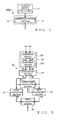
- Fig. 1 is a block diagram of a first embodiment of a sound processing apparatus of the present invention.
- the sound processing apparatus 100A is implemented by a computer comprising an arithmetic operation processing device 12 and a storage device 14.
- the arithmetic operation processing device 12 performs a particular function (sound evaluation section 20) by executing a program.
- the storage device 14 stores therein programs to be executed by the arithmetic operation processing device 12, and data to be used by the arithmetic operation processing device 12.
- the storage device 14 stores therein a plurality of sounds V (VA, VB).
- Each of the voices is stored in the storage device 14 in the form of digital data indicative of a waveform of the time domain.
- Each of the sounds V is a singing sound or performance tone of a musical instrument in a characteristic portion (e.g., two to four measures) of a music piece.
- sounds V having a harmonic structure are suited for processing by the sound processing apparatus 100A.
- the arithmetic operation processing device 12 functions as a sound evaluation section 20.
- the sound evaluation section 20 calculates an index value of consonance D between one of the sounds VA (hereinafter referred to as “target sound VA ”) and another one of the sounds VB (hereinafter referred to as “evaluated sound VB") stored in the storage device 14.
- the index value of consonance (hereinafter referred to as “consonance index value”) D is a numerical value indicative of a degree of dissonance, with the target sound VA, of the evaluated sound VB which a human listener auditorily perceives when that the target sound VA and evaluated sound VB are reproduced in parallel or in succession. There is a tendency that the greater the consonance index value D of the evaluated sound VB.
- the consonance index value D calculated by the sound evaluation section 20 is output, for example, from a display device or sounding device as an image or sound. User can recognize a degree of dissonance between the target sound VA and the evaluated sound VB by knowing the consonance index value D.
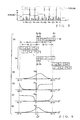
- Fig. 2 is a block diagram of the sound evaluation section 20.
- the sound evaluation section 20 comprises a frequency analysis section 22, a quantization section 24, a mask generation section 30, a correlation calculation section 40, a shift processing section 50, and an index calculation section 60.
- the individual components of the sound evaluation section 20 may be provided distributively on a plurality of integrated circuits or may be implemented by an electronic circuit (DSP) dedicated to the inventive sound processing.
- DSP electronic circuit
- Fig. 3 is a conceptual diagram explanatory of behavior of the frequency analysis section 22 and quantization section 24.
- the frequency analysis section 22 of Fig. 2 calculates frequency spectra Q (i.e., frequency spectra QA of the target sound VA and frequency spectra QB of the evaluated sound VB) for each of a plurality of frames FR obtained by dividing the sounds (target sound VA and evaluated sound VB) on the time axis.
- the frequency analysis section 22 includes a conversion section 221 and an adjustment section 223.
- the conversion section 221 calculates frequency spectra qA of the target sound VA and frequency spectra qB of the evaluated sound VB for each of the time-axial frames FR, preferably using the short-time Fourier transform that utilizes a Hanning window.
- the adjustment section 223 adjusts amplitudes of the frequency spectra qA and frequency spectra qB to thereby generate the frequency spectra QA and frequency spectra QB.
- the adjustment section 223 calculates the frequency spectra QA by adjusting the amplitudes of the frequency spectra qA in such a manner that amplitude values converted into logarithmic values are distributed over the entirety of a predetermined range (e.g., - 2.0dB to +2.0dB).
- the frequency spectra QB of the evaluated sound VB are calculated from the frequency spectra qB in a similar manner (i.e., through similar amplitude adjustment) to the frequency spectra QA of the target sound VA.
- the quantization section 24 of Fig. 2 generates spectral trajectories R (RA and RB) by quantizing the frequency spectra QA and QB in terms of both the time axis and the frequency axis.
- the spectral trajectory RA is calculated from the frequency spectra QA of the target sound VA
- the spectral trajectory RB are calculated from the frequency spectra QB of the target sound VB,
- the quantization section 24 divides the frequency spectra Q, represented in cents, into bands Bq, each having a predetermined width (e.g., 10 cents), on the frequency axis and identifies, for each band Bq where a peak p of the frequency spectra Q is present, a frequency f0 and amplitude a0 of the peak p. Further, for each band Bq where a plurality of peaks p are present, the quantization section 24 identifies a frequency f0 and amplitude a0 of, for example, only the peak p having the greatest amplitude a0.
- a predetermined width e.g. 10 cents
- the quantization section 24 calculates a frequency f0 and amplitude a0 of peaks p per each unit portion TU comprising Nt (Nt represents a number, such as twenty) frames FR. More specifically, the frequency fp is a numerical value obtained by averaging the frequencies f0 of the peaks p of the Nt frames within the unit portion TU, and the amplitude ap is a numerical value obtained by averaging the amplitudes a0 of the peaks p of the Nt frames within the unit portion TU.
- the spectral trajectory RA of the target sound VA comprises a plurality of sets of the frequencies fp and amplitudes ap calculated for the Nt frequency spectra QA within the unit portion TU
- the spectral trajectory RB of the evaluated sound VB comprises a plurality of sets of the frequencies fp and amplitudes ap calculated for the plurality of frequency spectra QB within the unit portion TU.
- the spectral trajectory RA of the target sound VA and the spectral trajectory RB of the evaluated sound VB are generated per each unit portion TU in a time-serial manner.
- the mask generation section 30 of Fig. 2 generates an evaluating mask M from the spectral trajectory RA of the target sound VA.
- Such an evaluating mask M is generated for each of the spectral trajectories RA of the target sound VA sequentially generated by the quantization section 24, i.e. generated for each of the unit portions TU.
- the evaluating mask M is a train of numerical values (function) defining degrees of dissonance Dmask(f) with the target sound VA along the frequency axis ("frequency f").
- the degree of dissonance Dmask(f) indicates a degree of dissonance between the target sound VA and a sound of the frequency f in question.
- the evaluated sound VB contains a lot of components of high degrees of dissonance Dmask(f) in the evaluating mask M, then it is evaluated as a sound dissonant with the target sound VA.
- the evaluating mask M may be generated for each predetermined plurality of the unit portions rather than for each one of the unit portions.
- Fig. 5 is a block diagram of the mask generation section 30, which includes a function setting section 32 and first, second and third adjustment sections 34, 36 and 38.
- the function setting section 32 as shown in (A) of Fig. 4 , sets a dissonance function Fd for each of a plurality of peaks p (frequencies fp and amplitudes ap) in the spectral trajectory RA of the target sound VA.
- ) that defines a degree of dissonance w(d) between a component of a peak p in the spectral trajectory RA of the target sound VA and a sound having a frequency difference d(cent) from the frequency fp of the peak p. More specifically, the degree of dissonance w(d) is defined as follows: w d ⁇ a p ⁇ 1 2 ⁇ cos log 10 d ⁇ 2 ⁇ ⁇ + 1 2 30 ⁇ d ⁇ 300 0 otherwise
- (A) of Fig. 6 is a graph of the dissonance function Fd defined by mathematical expression (1) above.
- the degree of dissonance w(d) varies nonlinearly, in accordance with the frequency difference d, within a range from 30 cents to 300 cents so that it becomes the maximum when the frequency difference d is 100 cents.
- a component having a greater peak amplitude ap presents a greater degree of dissonance with another sound as perceived by a human listener.
- the degree of dissonance w(d) set for the peak p takes a value corresponding (proportional) to the amplitude ap of the peak p.
- 0).
- the dissonance functions Fd should not be limited such the function as shown in Fig.
- the dissonance functions Fd may be any type of such a function that the function has the greater peak amplitude ap at a point of the frequency difference d of 100 cents and down slopes descending from the peak amplitude ap toward an amplitude 0 (zero) at both sides of the point of the frequency difference d of 100 cents. In such a case, it is preferable to set the dissonance functions Fd so that the amplitude of the down slopes reaches to 0 (zero) at the frequency fp or a frequency adjacent to the frequency fp.
- the dissonance functions Fd set for some adjoining peaks p may overlap with each other on the frequency axis.
- the first adjustment section 34 of Fig. 5 selects, as a degree of dissonance D0(f), the maximum value of degrees of dissonance w(d), at each frequency f on the frequency axis.
- a degree of dissonance w(d) of the dissonance function Fd is selected as the degree of dissonance D0(f)
- the maximum value of a plurality of degrees of dissonance w(d) at the frequency f is selected as the degree of dissonance D0(f).
- the degree of dissonance D0(f) calculated through the aforementioned arithmetic operations sometimes may not become zero at the frequency fp of the peak q of the target sound VA.
- components of sounds which have a same or common frequency f naturally become consonant with each other, i.e. present a zero degree of dissonance D0(f).
- the second adjustment section 36 of Fig. 5 subtracts the amplitude ap from the degree of dissonance D0(fp) at the frequency fp, as shown in (C) of Fig. 4 .
- the third adjustment section 38 establishes an evaluating mask M by setting all degrees of dissonance D0(f) below zero at zero, as shown in (E) of Fig. 4 .
- the maximum value Dmax of the degree of dissonance Dmask(f) calculated by mathematical expression (2) above takes the predetermined value k.
- the evaluating mask M is generated in accordance with the aforementioned procedure, and thus, in a case where the evaluated sound VB contains a lot of components of frequencies f having high degrees of dissonance Dmask(f) defined in the evaluating mask M, the evaluated sound VB has a high possibility of being dissonant with the target sound VA.
- the index calculation section 60 of Fig. 2 calculates an index value of consonance (i.e., consonance index value) D between the target sound VA and the evaluated sound VB by collating between the evaluating mask M created from the target sound VA and the evaluated sound VB.
- the correlation calculation section 40 and shift processing section 50 of Fig. 2 shift the spectral trajectory RB of the evaluated sound VB along the frequency axis so as to coincide with the pitch range of the target sound VA. Specific behavior of the correlation calculation section 40 and shift processing section 50 will be described below.
- the correlation calculation section 40 of Fig. 2 calculates a correlation value (cross-correlation value) C between the spectral trajectory RA of the target sound VA and spectral trajectory RB of the evaluated sound VB generated by the quantization section 24.
- the correlation calculation section 40 includes a band processing section 42, an arithmetic operation processing section 44, a first correction value calculation section 461, a second correction value calculation section 462, and a correction section 48.
- the band processing section 42 generates band intensity distributions S (SA and SB) from the spectral trajectories R (RA and RB) generated by the quantization section 24 per each of the unit portions TU. Namely, the band intensity distribution SA is generated from the spectral trajectory RA, while the band intensity distribution SB is generated from the spectral trajectory RB.
- the intensity distributions S are a train of numerical values where an intensity x is set per each of Nf (Nf is a natural number) bands (hereinafter referred to as "unit bands") BU obtained by dividing the spectral trajectories R (RA and RB).
- Nf is a natural number bands
- Each of the unit bands BU is set, for example, at a band width equal to one octave (1,200 cents).
- the intensity x of each of the unit bands BU is set at a numerical value corresponding to amplitudes ap of components of the unit band BU in the spectral trajectories R.
- the band intensity distribution SA is a train of numerical values where the maximum values of the amplitudes ap within the individual unit band widths BU in the spectral trajectory RA of the target sound VA are arranged as the intensities x of a plurality of the unit band widths BU
- the intensity distribution SB is a train of numerical values where the maximum values of the amplitudes ap within the individual unit band widths BU in the spectral trajectory RB of the evaluated sound VB are arranged as the intensities x of a plurality of the unit band widths BU.
- average values of the amplitudes ap within the individual unit band widths BU may be arranged as the intensities x of the intensity distributions S.
- the arithmetic operation processing section 44 of Fig. 7 calculates a correlation value C0 between the band intensity distribution SA and the band intensity distribution SB generated by the band processing section 42. More specifically, the arithmetic operation processing section 44 calculates a correlation value C0 of a portion where the band intensity distribution SA and the band intensity distribution SB overlap each other on the frequency axis, while shifting the two intensity distributions SA and SB along the frequency axis so that a frequency difference ⁇ f between the intensity distributions SA and SB changes. As shown in (A) of Fig. 9 , the frequency difference ⁇ f is sequentially changed, one unit band BU at a time, within a range from one position where only one unit band BU at one end (right end in (A) of Fig.
- the correlation value C0 is calculated only for overlapping portions between the band intensity distribution SA and the band intensity distribution SB, the correlation value C0 calculated by the arithmetic operation processing section 44 may sometimes take a great value even where respective conspicuous components (components of great amplitudes within bands) of the band intensity distribution SA and band intensity distribution SB are present in portions of the band intensity distribution SA and the band intensity distribution SB that do not overlap with each other at the frequency difference ⁇ f in question.
- respective conspicuous components of the band intensity distribution SA and the band intensity distribution SB are present in non-overlapping portions between the distributions SA and SB as noted above, these band intensity distributions SA and SB should be evaluated as having a low correlation as a whole.
- the correction section 48 in the instant embodiment corrects the correlation value C0, calculated by the arithmetic operation processing section 44, in accordance with intensities in the non-overlapping portions between the band intensity distributions SA and SB. More specifically, the correction section 48 lowers the correlation value C0 calculated by the arithmetic operation processing section 44 for the frequency difference ⁇ f at which the components in the non-overlapping portions between the band intensity distributions SA and SB become conspicuous.
- the following paragraphs describe a specific example manner in which the correlation value C0 is corrected.
- the first correction value calculation section 461 of Fig. 7 calculates, for each frequency difference ⁇ f, a correction value A 1 to be used for correction of the correlation value C0 by the correction section 48.
- (C) of Fig. 9 shows a specific example of relationship between the correction value A 1 and the frequency difference ⁇ f.
- the correction value A 1 increases as the amplitude in a portion of the band intensity distribution SA not overlapping with the band intensity distribution SB increases. As shown in Fig.
- the second correction value calculation section 462 of Fig. 7 calculates, for each frequency difference ⁇ f, a correction value A2 to be used for correction of the correlation value C0.
- (D) of Fig. 9 shows relationship between the correction value A2 and the frequency difference ⁇ f.
- the correction value A2 increases as the amplitude in a portion of the band intensity distribution SB not overlapping with the band intensity distribution SA increases. As shown in Fig.
- the correction section 48 calculates a corrected correlation value C by subtracting the correction values A1 and A2 from the correlation value C0 per each frequency difference ⁇ f.
- (E) of Fig. 9 shows a specific example of relationship between the corrected correlation value C and the frequency difference ⁇ f.
- the correlation value C becomes maximum. Namely, if there is a correlation only between respective small-intensity (x) portions of the band intensity distribution SA and the band intensity distribution SB, it is difficult for the correlation value C to become maximum. For example, if the pitch range of the evaluated sound VB is one octave higher than that of the target sound VA, the correlation value C becomes maximum at a point where the frequency difference ⁇ f is "1".
- the shift processing section 50 of Fig. 2 shifts the spectral trajectory RB in the frequency axis direction so that the pitch range of the evaluated sound VB conforms with the pitch range of the target sound VA; the shifting of the spectral trajectory RB is executed individually for each of the unit portions TU. Namely, the shift processing section 50 shifts the spectral trajectory RB of each of the unit portions TU in the frequency axis direction by a shift amount ⁇ F corresponding to the correlation value C calculated by the correlation calculation section 40 for the unit portions TU. As shown in (E) of Fig. 9 , the shift amount ⁇ F corresponds to the frequency difference ⁇ f at which the correlation value C becomes maximum. (A) of Fig. 11 shows a time series of shift amounts ⁇ F determined by the shift processing section 50 for the individual unit portions TU.
- FIG. 11 is a schematic diagram showing a time series of the spectral trajectories RB having been processed by the shift processing section 50. Because the frequency difference ⁇ f changes on a per-unit-band (BU) basis, the spectral trajectories RB are shifted in a positive or negative direction of the frequency axis by an amount equal to the bandwidth of the unit band BU (i.e., one octave) at a time.
- BU per-unit-band
- the spectral trajectories RB are shifted in the positive direction of the frequency axis by an amount equal to one unit band BU (i.e., 1,200 cents equal to one octave), or if the shift amount ⁇ F is "-2", the spectral trajectories RB are shifted in the negative direction of the frequency axis by an amount equal to two unit bands BU (i.e., 2,400 cents equal to two octaves).
- each portion i.e., portion indicated by hatching in (B) of Fig.
- each portion where there is no longer any data due to the spectral trajectory shift i.e., upstream portion in the shifting direction of the spectral trajectories RB
- data z indicating that there is no peak p (i.e., amplitude ap is zero).
- the index calculation section 60 of Fig. 2 calculates a consonance index value D between the target sound VA and the evaluated sound VB by collating the spectral trajectories RB, having been processed by the shift processing section 50, with the evaluating mask M created by the mask generation section 30.
- the index calculation section 60 includes an intensity identification section 62, a collation section 64 and an index determination section 66.
- the intensity identification section 62 identifies the maximum value Amax of the amplitudes ap of the peaks p from among the spectral trajectories RB (before or after the processing by the shift processing section 50) of all of the unit portions TU (i.e., Nt unit portions TU) of the evaluated sound VB.
- the collation between the spectral trajectory RB and the evaluating mask M i.e., calculation of the index value d per each band Bq) is performed for every one of the Nt unit portions TU of the evaluated sound VB.
- the consonance index value D is normalized to a value having a reduced dependence on the tone volume of the evaluated sound VB, by dividing the maximum value dmax of the index values d by the maximum value Amax of the amplitudes ap of the spectral trajectories RB.
- the greater the degree of dissonance Dmask(fp) at the frequency fp of a peak p of a great amplitude ap in the spectral trajectories RB the greater value the consonance index value D takes.
- an evaluated VB having a great consonance index value D can be evaluated to be a sound V difficult to be musically consonant with the target sound VA.
- a consonance index value D between the target sound VA and the evaluated sound VB is calculated using the evaluating mask M having a dissonance function Fd set for each of a plurality of peaks p in the spectral trajectory RA of the target sound VA.
- the instant embodiment can eliminate the need for detecting the fundamental frequencies of the target sound VA and evaluated sound VB.
- the instant embodiment can evaluate, with high accuracy, a degree of dissonance (or consonance) between the target sound VA and the evaluated sound VB even in the case where the target sound VA and the evaluated sound VB differ from each other in fundamental frequency or where a component of the fundamental frequency is missing from the target sound VA or from the evaluated sound VB.
- the instant embodiment can evaluate, with high accuracy, a degree of dissonance (or consonance) between the target sound VA and the evaluated sound VB even in the case where the target sound VA and the evaluated sound VB differ from each other in pitch range (e.g., where the target sound VA and the evaluated sound VB are performed on different musical instruments).
- the pitch range of the target sound VA and the pitch range of the target sound VB can be caused to approach each other with high accuracy regardless of bands of the spectral trajectories RA and RB where there exist respective conspicuous components
- Fig. 14 is a block diagram of the second embodiment of the sound processing apparatus 100B of the present invention.
- the arithmetic operation processing device 12 functions as the sound evaluation section 20 and a tone pitch adjustment section 70.
- the sound evaluation section 20 in the second embodiment is generally similar to the sound evaluation section 20 in the first embodiment ( Fig. 2 ), except that the index calculation section 60 in the second embodiment calculates a consonance index value D when each spectral trajectory RB, having been subjected to the process by the shift processing section 50, has been shifted on the frequency axis by a shift amount ⁇ P relative to the evaluating mask M, by performing the process of Fig. 13 per each of a plurality of changes of the shift amount ⁇ P, i.e.
- the sound evaluation section 20 calculates 120 (one hundred and twenty) consonance index values D for the one evaluated sound VB, by sequentially changing the shift amount ⁇ P over the range of the band width of one unit band BU (i.e., 1,200 cents), a predetermined amount equal to the band Bq (i.e., 10 cents) at a time. Then, the sound evaluation section 20 identifies a shift amount ⁇ P of the spectral trajectories RB with which the plurality of (i.e., one hundred and twenty) consonance index values D become minimum (i.e., the evaluated sound VB becomes most consonant with the target sound VA).
- the tone pitch adjustment section 70 of Fig. 14 changes or adjusts the tone pitch of the evaluated sound VB by the shift amount ⁇ P with which the consonance index values D become minimum.
- the tone pitch adjustment may be performed in any suitable conventionally-known technique.
- the tone pitch of the evaluated sound VB is adjusted in such a way that the consonance index values D calculated by the sound evaluation section 20 become minimum, it is possible to generate an evaluated sound VB that is auditorily consonant with the target sound VA to a sufficient degree.
- Such an evaluated sound VB having been adjusted by the tone pitch adjustment section 70 can be suitably used, for example, for mixing or connection with a target sound VA or for composition of a new music piece.
- the second embodiment of the sound processing apparatus 100B has been described as shifting the spectral trajectories RB by the shift amount ⁇ P, it may be constructed to calculate a plurality of consonance index values D by sequentially shifting the evaluating masks M on the frequency axis with the spectral trajectories RB fixed.
- Fig. 15 is a block diagram of a third embodiment of the sound processing apparatus 100C of the present invention.
- a plurality of evaluated sounds VB which present waveforms of different sounds, are stored in the storage device 14.
- the sound evaluation section 20 in the third embodiment calculates consonant index values D individually for each of the plurality of evaluated sounds VB in generally the same manner as in the above-described first embodiment.
- the sound evaluation section 20 selects an evaluated sound VB of which the calculated consonant index values D are minimal (i.e., which is most consonant with a target sound VA) from among the plurality of evaluated sounds VB stored in the storage device 14. Namely, in the third embodiment, it is possible to extract, from among the plurality of evaluated sounds VB, an evaluated sound VB sufficiently auditorily consonant with the target sound VA.
- Such an evaluated sound VB identified by the sound evaluation section 20 can be suitably used, for example, for mixing or connection with the target sound VA or for composition of a new music piece.
- the third embodiment of the present invention has been described above as selecting one evaluated sound VB, it may be constructed to select a plurality of evaluated sounds VB ranked high in descending order of the consonant index values D (and use these selected evaluated sounds for mixing or connection with the target sound VA). Further, the arrangements of the second embodiment may be applied to the third embodiment. For example, regarding one of the plurality of evaluated sounds VB, stored in the storage device 14, for which the consonance index values D become minimum, a shift amount ⁇ P with which the consonant index values D become minimum with respect to the target sound VA may be determined in generally the same manner as in the second embodiment so that the tone pitch adjustment section 70 changes the tone pitches of the evaluated sounds VB by the shift amount ⁇ P.
- each of the embodiments has been described above as constructed to calculate spectral trajectories R (RA and RB) at the time of the calculation of the consonant index values D, it is also advantageous to calculate and store, in the storage device 14, spectral trajectories R of individual sounds V (target and evaluated sounds VA and VB) in advance.
- spectral trajectories R of a plurality of sounds V target and evaluated sounds VA and VB
- spectral trajectories R calculated by an external apparatus are supplied to the arithmetic operation processing device 12 via a communication network or via a portable storage or recording medium; in this case, the frequency analysis section 22 and quantization section 24 are omitted from the sound evaluation section 20.
- index calculation section 60 calculates a consonance index value D may be modified as appropriate.
- index calculation section 60 calculates a consonance index value D by the collation section 64 by averaging index values d, calculated per each spectral trajectory RB, over Nt unit portions TU.
- the present invention may advantageously employ a modified construction where a consonance index value D is calculated through collation between the spectral trajectory RB of the evaluated sound VB and the evaluating mask M, and relationship between results of the collation between the spectral trajectory RB and the evaluating mask M and calculated consonance index values D may be defined in any desired form or manner.
- the consonance index value D is defined as an index indicative of a degree of either consonance or dissonance between the target and evaluated sounds VA and VB, and relationship between increase/decrease of the degree of consonance or dissonance and increase/decrease of the degree of the consonance index value D may be defined in any desired form or manner.
- the correlation calculation section 40 and shift processing section 50 are dispensed with.
- the present invention may be constructed to calculate a correlation value C between a spectral trajectory RA (or spectral spectra QA, qA of a target sound VA and a spectral trajectory RB (or spectral spectra QB, qB of a target sound VB.
- each of the embodiments has been described above as constructed to use spectral trajectories A (RA and RB), having been quantized by the quantization section 24, there may be employed a modified construction where frequency spectra q (qA and qB) calculated by the conversion section 221 are used in place of the spectral trajectories R (RA and RB) (namely, where the adjustment section 223 and quantization section 24 are omitted), or a modified construction where frequency spectra Q (QA and QB) having been adjusted by the adjustment section 223) are used in place of the spectral trajectories R (RA and RB) (namely, where the quantization section 24 is omitted).
Landscapes
- Physics & Mathematics (AREA)
- Engineering & Computer Science (AREA)
- Acoustics & Sound (AREA)
- Multimedia (AREA)
- Auxiliary Devices For Music (AREA)
- Measurement Of Mechanical Vibrations Or Ultrasonic Waves (AREA)
- Electrophonic Musical Instruments (AREA)
Applications Claiming Priority (1)
| Application Number | Priority Date | Filing Date | Title |
|---|---|---|---|
| JP2008164057A JP5141397B2 (ja) | 2008-06-24 | 2008-06-24 | 音声処理装置およびプログラム |
Publications (3)
| Publication Number | Publication Date |
|---|---|
| EP2138996A2 true EP2138996A2 (de) | 2009-12-30 |
| EP2138996A3 EP2138996A3 (de) | 2010-05-19 |
| EP2138996B1 EP2138996B1 (de) | 2013-03-20 |
Family
ID=41165259
Family Applications (1)
| Application Number | Title | Priority Date | Filing Date |
|---|---|---|---|
| EP09163450A Not-in-force EP2138996B1 (de) | 2008-06-24 | 2009-06-23 | Vorrichtung und Verfahren zur Tonverarbeitung |
Country Status (3)
| Country | Link |
|---|---|
| US (1) | US8269091B2 (de) |
| EP (1) | EP2138996B1 (de) |
| JP (1) | JP5141397B2 (de) |
Families Citing this family (9)
| Publication number | Priority date | Publication date | Assignee | Title |
|---|---|---|---|---|
| US8682653B2 (en) * | 2009-12-15 | 2014-03-25 | Smule, Inc. | World stage for pitch-corrected vocal performances |
| JP5716558B2 (ja) * | 2011-06-14 | 2015-05-13 | ヤマハ株式会社 | マスキング解析装置,マスカー音選択装置,マスキング装置およびプログラム |
| JP5549651B2 (ja) * | 2011-07-29 | 2014-07-16 | ブラザー工業株式会社 | 歌詞出力データ修正装置,及びプログラム |
| JP5782972B2 (ja) * | 2011-09-30 | 2015-09-24 | ブラザー工業株式会社 | 情報処理システム,プログラム |
| US20140000438A1 (en) * | 2012-07-02 | 2014-01-02 | eScoreMusic, Inc. | Systems and methods for music display, collaboration and annotation |
| JP5793131B2 (ja) * | 2012-11-02 | 2015-10-14 | 株式会社Nttドコモ | 無線基地局、ユーザ端末、無線通信システム及び無線通信方法 |
| US12483851B2 (en) * | 2013-09-05 | 2025-11-25 | Dm-Dsp, Llc | Automatic level-dependent pitch correction of digital audio |
| US11132983B2 (en) | 2014-08-20 | 2021-09-28 | Steven Heckenlively | Music yielder with conformance to requisites |
| US11915714B2 (en) * | 2021-12-21 | 2024-02-27 | Adobe Inc. | Neural pitch-shifting and time-stretching |
Citations (3)
| Publication number | Priority date | Publication date | Assignee | Title |
|---|---|---|---|---|
| US5504270A (en) | 1994-08-29 | 1996-04-02 | Sethares; William A. | Method and apparatus for dissonance modification of audio signals |
| WO2006079813A1 (en) | 2005-01-27 | 2006-08-03 | Synchro Arts Limited | Methods and apparatus for use in sound modification |
| JP2007316416A (ja) | 2006-05-26 | 2007-12-06 | Casio Comput Co Ltd | カラオケ装置およびカラオケ処理プログラム |
Family Cites Families (1)
| Publication number | Priority date | Publication date | Assignee | Title |
|---|---|---|---|---|
| US6910035B2 (en) * | 2000-07-06 | 2005-06-21 | Microsoft Corporation | System and methods for providing automatic classification of media entities according to consonance properties |
-
2008
- 2008-06-24 JP JP2008164057A patent/JP5141397B2/ja not_active Expired - Fee Related
-
2009
- 2009-06-18 US US12/456,553 patent/US8269091B2/en not_active Expired - Fee Related
- 2009-06-23 EP EP09163450A patent/EP2138996B1/de not_active Not-in-force
Patent Citations (3)
| Publication number | Priority date | Publication date | Assignee | Title |
|---|---|---|---|---|
| US5504270A (en) | 1994-08-29 | 1996-04-02 | Sethares; William A. | Method and apparatus for dissonance modification of audio signals |
| WO2006079813A1 (en) | 2005-01-27 | 2006-08-03 | Synchro Arts Limited | Methods and apparatus for use in sound modification |
| JP2007316416A (ja) | 2006-05-26 | 2007-12-06 | Casio Comput Co Ltd | カラオケ装置およびカラオケ処理プログラム |
Also Published As
| Publication number | Publication date |
|---|---|
| EP2138996B1 (de) | 2013-03-20 |
| JP5141397B2 (ja) | 2013-02-13 |
| EP2138996A3 (de) | 2010-05-19 |
| US20090316915A1 (en) | 2009-12-24 |
| US8269091B2 (en) | 2012-09-18 |
| JP2010008448A (ja) | 2010-01-14 |
Similar Documents
| Publication | Publication Date | Title |
|---|---|---|
| EP2138996B1 (de) | Vorrichtung und Verfahren zur Tonverarbeitung | |
| US8168877B1 (en) | Musical harmony generation from polyphonic audio signals | |
| EP2747074B1 (de) | Dynamisch angepasste Tonhöhenkorrektur basierend auf Audioeingabe | |
| US8853516B2 (en) | Audio analysis apparatus | |
| US9953663B2 (en) | Method of and apparatus for evaluating quality of a degraded speech signal | |
| EP2595145A1 (de) | Verfahren und Vorrichtung zur Untersuchung der Verständlichkeit eines verrauschten Sprachsignals | |
| JP2008250008A (ja) | 楽音処理装置およびプログラム | |
| Herbst | Performance evaluation of subharmonic-to-harmonic ratio (SHR) computation | |
| Schoonderwaldt | The violinist’s sound palette: Spectral centroid, pitch flattening and anomalous low frequencies | |
| US8073688B2 (en) | Voice processing apparatus and program | |
| WO2020024003A1 (en) | Apparatus and computer implemented methods for detecting, transcribing and augmenting the percussive and/or musical content of recorded audio. | |
| US8492639B2 (en) | Audio processing apparatus and method | |
| JP6011039B2 (ja) | 音声合成装置および音声合成方法 | |
| Lee et al. | Discrimination of musical instrument tones resynthesized with piecewise-linear approximated harmonic amplitude envelopes | |
| Kraft et al. | Improved PVSOLA time-stretching and pitch-shifting for polyphonic audio | |
| McDermott et al. | Inharmonic speech: A tool for the study of speech perception and separation | |
| US12609095B2 (en) | Time signature determination device, method, and recording medium | |
| Bernini et al. | Consonance of complex tones with harmonics of different intensity | |
| Stolzenburg | A Periodicity-based Theory for Harmony Perception and Scales. | |
| Szeto et al. | Source separation and analysis of piano music signals using instrument-specific sinusoidal model | |
| Cookson | The acoustic and psychoacoustic characteristics of barbershop singing | |
| MIŚKIEWICZ et al. | Perceived roughness of two simultaneous harmonic complex tones | |
| KR100624439B1 (ko) | 유/무성음 합성방법 | |
| KR101211059B1 (ko) | 보컬 멜로디 강화 장치 및 방법 | |
| JP4489058B2 (ja) | 和音判定方法および装置 |
Legal Events
| Date | Code | Title | Description |
|---|---|---|---|
| PUAI | Public reference made under article 153(3) epc to a published international application that has entered the european phase |
Free format text: ORIGINAL CODE: 0009012 |
|
| AK | Designated contracting states |
Kind code of ref document: A2 Designated state(s): AT BE BG CH CY CZ DE DK EE ES FI FR GB GR HR HU IE IS IT LI LT LU LV MC MK MT NL NO PL PT RO SE SI SK TR |
|
| PUAL | Search report despatched |
Free format text: ORIGINAL CODE: 0009013 |
|
| AK | Designated contracting states |
Kind code of ref document: A3 Designated state(s): AT BE BG CH CY CZ DE DK EE ES FI FR GB GR HR HU IE IS IT LI LT LU LV MC MK MT NL NO PL PT RO SE SI SK TR |
|
| AX | Request for extension of the european patent |
Extension state: AL BA RS |
|
| 17P | Request for examination filed |
Effective date: 20101111 |
|
| 17Q | First examination report despatched |
Effective date: 20101129 |
|
| APBK | Appeal reference recorded |
Free format text: ORIGINAL CODE: EPIDOSNREFNE |
|
| APBN | Date of receipt of notice of appeal recorded |
Free format text: ORIGINAL CODE: EPIDOSNNOA2E |
|
| APBR | Date of receipt of statement of grounds of appeal recorded |
Free format text: ORIGINAL CODE: EPIDOSNNOA3E |
|
| APBV | Interlocutory revision of appeal recorded |
Free format text: ORIGINAL CODE: EPIDOSNIRAPE |
|
| GRAP | Despatch of communication of intention to grant a patent |
Free format text: ORIGINAL CODE: EPIDOSNIGR1 |
|
| GRAS | Grant fee paid |
Free format text: ORIGINAL CODE: EPIDOSNIGR3 |
|
| GRAA | (expected) grant |
Free format text: ORIGINAL CODE: 0009210 |
|
| AK | Designated contracting states |
Kind code of ref document: B1 Designated state(s): AT BE BG CH CY CZ DE DK EE ES FI FR GB GR HR HU IE IS IT LI LT LU LV MC MK MT NL NO PL PT RO SE SI SK TR |
|
| REG | Reference to a national code |
Ref country code: GB Ref legal event code: FG4D |
|
| REG | Reference to a national code |
Ref country code: CH Ref legal event code: EP |
|
| REG | Reference to a national code |
Ref country code: IE Ref legal event code: FG4D |
|
| REG | Reference to a national code |
Ref country code: AT Ref legal event code: REF Ref document number: 602494 Country of ref document: AT Kind code of ref document: T Effective date: 20130415 |
|
| REG | Reference to a national code |
Ref country code: DE Ref legal event code: R096 Ref document number: 602009014088 Country of ref document: DE Effective date: 20130516 |
|
| PG25 | Lapsed in a contracting state [announced via postgrant information from national office to epo] |
Ref country code: NO Free format text: LAPSE BECAUSE OF FAILURE TO SUBMIT A TRANSLATION OF THE DESCRIPTION OR TO PAY THE FEE WITHIN THE PRESCRIBED TIME-LIMIT Effective date: 20130620 Ref country code: BG Free format text: LAPSE BECAUSE OF FAILURE TO SUBMIT A TRANSLATION OF THE DESCRIPTION OR TO PAY THE FEE WITHIN THE PRESCRIBED TIME-LIMIT Effective date: 20130620 Ref country code: SE Free format text: LAPSE BECAUSE OF FAILURE TO SUBMIT A TRANSLATION OF THE DESCRIPTION OR TO PAY THE FEE WITHIN THE PRESCRIBED TIME-LIMIT Effective date: 20130320 Ref country code: ES Free format text: LAPSE BECAUSE OF FAILURE TO SUBMIT A TRANSLATION OF THE DESCRIPTION OR TO PAY THE FEE WITHIN THE PRESCRIBED TIME-LIMIT Effective date: 20130701 Ref country code: LT Free format text: LAPSE BECAUSE OF FAILURE TO SUBMIT A TRANSLATION OF THE DESCRIPTION OR TO PAY THE FEE WITHIN THE PRESCRIBED TIME-LIMIT Effective date: 20130320 |
|
| REG | Reference to a national code |
Ref country code: AT Ref legal event code: MK05 Ref document number: 602494 Country of ref document: AT Kind code of ref document: T Effective date: 20130320 |
|
| REG | Reference to a national code |
Ref country code: LT Ref legal event code: MG4D |
|
| PG25 | Lapsed in a contracting state [announced via postgrant information from national office to epo] |
Ref country code: LV Free format text: LAPSE BECAUSE OF FAILURE TO SUBMIT A TRANSLATION OF THE DESCRIPTION OR TO PAY THE FEE WITHIN THE PRESCRIBED TIME-LIMIT Effective date: 20130320 Ref country code: SI Free format text: LAPSE BECAUSE OF FAILURE TO SUBMIT A TRANSLATION OF THE DESCRIPTION OR TO PAY THE FEE WITHIN THE PRESCRIBED TIME-LIMIT Effective date: 20130320 Ref country code: GR Free format text: LAPSE BECAUSE OF FAILURE TO SUBMIT A TRANSLATION OF THE DESCRIPTION OR TO PAY THE FEE WITHIN THE PRESCRIBED TIME-LIMIT Effective date: 20130621 Ref country code: FI Free format text: LAPSE BECAUSE OF FAILURE TO SUBMIT A TRANSLATION OF THE DESCRIPTION OR TO PAY THE FEE WITHIN THE PRESCRIBED TIME-LIMIT Effective date: 20130320 |
|
| REG | Reference to a national code |
Ref country code: NL Ref legal event code: VDEP Effective date: 20130320 |
|
| PG25 | Lapsed in a contracting state [announced via postgrant information from national office to epo] |
Ref country code: BE Free format text: LAPSE BECAUSE OF FAILURE TO SUBMIT A TRANSLATION OF THE DESCRIPTION OR TO PAY THE FEE WITHIN THE PRESCRIBED TIME-LIMIT Effective date: 20130320 Ref country code: HR Free format text: LAPSE BECAUSE OF FAILURE TO SUBMIT A TRANSLATION OF THE DESCRIPTION OR TO PAY THE FEE WITHIN THE PRESCRIBED TIME-LIMIT Effective date: 20130320 |
|
| PG25 | Lapsed in a contracting state [announced via postgrant information from national office to epo] |
Ref country code: SK Free format text: LAPSE BECAUSE OF FAILURE TO SUBMIT A TRANSLATION OF THE DESCRIPTION OR TO PAY THE FEE WITHIN THE PRESCRIBED TIME-LIMIT Effective date: 20130320 Ref country code: EE Free format text: LAPSE BECAUSE OF FAILURE TO SUBMIT A TRANSLATION OF THE DESCRIPTION OR TO PAY THE FEE WITHIN THE PRESCRIBED TIME-LIMIT Effective date: 20130320 Ref country code: NL Free format text: LAPSE BECAUSE OF FAILURE TO SUBMIT A TRANSLATION OF THE DESCRIPTION OR TO PAY THE FEE WITHIN THE PRESCRIBED TIME-LIMIT Effective date: 20130320 Ref country code: PT Free format text: LAPSE BECAUSE OF FAILURE TO SUBMIT A TRANSLATION OF THE DESCRIPTION OR TO PAY THE FEE WITHIN THE PRESCRIBED TIME-LIMIT Effective date: 20130722 Ref country code: IS Free format text: LAPSE BECAUSE OF FAILURE TO SUBMIT A TRANSLATION OF THE DESCRIPTION OR TO PAY THE FEE WITHIN THE PRESCRIBED TIME-LIMIT Effective date: 20130720 Ref country code: RO Free format text: LAPSE BECAUSE OF FAILURE TO SUBMIT A TRANSLATION OF THE DESCRIPTION OR TO PAY THE FEE WITHIN THE PRESCRIBED TIME-LIMIT Effective date: 20130320 Ref country code: AT Free format text: LAPSE BECAUSE OF FAILURE TO SUBMIT A TRANSLATION OF THE DESCRIPTION OR TO PAY THE FEE WITHIN THE PRESCRIBED TIME-LIMIT Effective date: 20130320 Ref country code: CZ Free format text: LAPSE BECAUSE OF FAILURE TO SUBMIT A TRANSLATION OF THE DESCRIPTION OR TO PAY THE FEE WITHIN THE PRESCRIBED TIME-LIMIT Effective date: 20130320 |
|
| PG25 | Lapsed in a contracting state [announced via postgrant information from national office to epo] |
Ref country code: PL Free format text: LAPSE BECAUSE OF FAILURE TO SUBMIT A TRANSLATION OF THE DESCRIPTION OR TO PAY THE FEE WITHIN THE PRESCRIBED TIME-LIMIT Effective date: 20130320 Ref country code: CY Free format text: LAPSE BECAUSE OF FAILURE TO SUBMIT A TRANSLATION OF THE DESCRIPTION OR TO PAY THE FEE WITHIN THE PRESCRIBED TIME-LIMIT Effective date: 20130320 |
|
| PLBE | No opposition filed within time limit |
Free format text: ORIGINAL CODE: 0009261 |
|
| STAA | Information on the status of an ep patent application or granted ep patent |
Free format text: STATUS: NO OPPOSITION FILED WITHIN TIME LIMIT |
|
| PG25 | Lapsed in a contracting state [announced via postgrant information from national office to epo] |
Ref country code: DK Free format text: LAPSE BECAUSE OF FAILURE TO SUBMIT A TRANSLATION OF THE DESCRIPTION OR TO PAY THE FEE WITHIN THE PRESCRIBED TIME-LIMIT Effective date: 20130320 Ref country code: MC Free format text: LAPSE BECAUSE OF FAILURE TO SUBMIT A TRANSLATION OF THE DESCRIPTION OR TO PAY THE FEE WITHIN THE PRESCRIBED TIME-LIMIT Effective date: 20130320 |
|
| REG | Reference to a national code |
Ref country code: CH Ref legal event code: PL |
|
| 26N | No opposition filed |
Effective date: 20140102 |
|
| PG25 | Lapsed in a contracting state [announced via postgrant information from national office to epo] |
Ref country code: IT Free format text: LAPSE BECAUSE OF FAILURE TO SUBMIT A TRANSLATION OF THE DESCRIPTION OR TO PAY THE FEE WITHIN THE PRESCRIBED TIME-LIMIT Effective date: 20130320 |
|
| REG | Reference to a national code |
Ref country code: IE Ref legal event code: MM4A |
|
| REG | Reference to a national code |
Ref country code: FR Ref legal event code: ST Effective date: 20140228 |
|
| REG | Reference to a national code |
Ref country code: DE Ref legal event code: R097 Ref document number: 602009014088 Country of ref document: DE Effective date: 20140102 |
|
| PG25 | Lapsed in a contracting state [announced via postgrant information from national office to epo] |
Ref country code: LI Free format text: LAPSE BECAUSE OF NON-PAYMENT OF DUE FEES Effective date: 20130630 Ref country code: IE Free format text: LAPSE BECAUSE OF NON-PAYMENT OF DUE FEES Effective date: 20130623 Ref country code: CH Free format text: LAPSE BECAUSE OF NON-PAYMENT OF DUE FEES Effective date: 20130630 |
|
| PG25 | Lapsed in a contracting state [announced via postgrant information from national office to epo] |
Ref country code: FR Free format text: LAPSE BECAUSE OF NON-PAYMENT OF DUE FEES Effective date: 20130701 |
|
| PG25 | Lapsed in a contracting state [announced via postgrant information from national office to epo] |
Ref country code: MT Free format text: LAPSE BECAUSE OF FAILURE TO SUBMIT A TRANSLATION OF THE DESCRIPTION OR TO PAY THE FEE WITHIN THE PRESCRIBED TIME-LIMIT Effective date: 20130320 |
|
| PG25 | Lapsed in a contracting state [announced via postgrant information from national office to epo] |
Ref country code: TR Free format text: LAPSE BECAUSE OF FAILURE TO SUBMIT A TRANSLATION OF THE DESCRIPTION OR TO PAY THE FEE WITHIN THE PRESCRIBED TIME-LIMIT Effective date: 20130320 |
|
| PG25 | Lapsed in a contracting state [announced via postgrant information from national office to epo] |
Ref country code: HU Free format text: LAPSE BECAUSE OF FAILURE TO SUBMIT A TRANSLATION OF THE DESCRIPTION OR TO PAY THE FEE WITHIN THE PRESCRIBED TIME-LIMIT; INVALID AB INITIO Effective date: 20090623 Ref country code: MK Free format text: LAPSE BECAUSE OF FAILURE TO SUBMIT A TRANSLATION OF THE DESCRIPTION OR TO PAY THE FEE WITHIN THE PRESCRIBED TIME-LIMIT Effective date: 20130320 Ref country code: LU Free format text: LAPSE BECAUSE OF NON-PAYMENT OF DUE FEES Effective date: 20130623 |
|
| PGFP | Annual fee paid to national office [announced via postgrant information from national office to epo] |
Ref country code: GB Payment date: 20170621 Year of fee payment: 9 |
|
| PGFP | Annual fee paid to national office [announced via postgrant information from national office to epo] |
Ref country code: DE Payment date: 20170621 Year of fee payment: 9 |
|
| REG | Reference to a national code |
Ref country code: DE Ref legal event code: R119 Ref document number: 602009014088 Country of ref document: DE |
|
| GBPC | Gb: european patent ceased through non-payment of renewal fee |
Effective date: 20180623 |
|
| PG25 | Lapsed in a contracting state [announced via postgrant information from national office to epo] |
Ref country code: DE Free format text: LAPSE BECAUSE OF NON-PAYMENT OF DUE FEES Effective date: 20190101 Ref country code: GB Free format text: LAPSE BECAUSE OF NON-PAYMENT OF DUE FEES Effective date: 20180623 |