EP2136460A2 - Photovoltaic circuit - Google Patents
Photovoltaic circuit Download PDFInfo
- Publication number
- EP2136460A2 EP2136460A2 EP09162608A EP09162608A EP2136460A2 EP 2136460 A2 EP2136460 A2 EP 2136460A2 EP 09162608 A EP09162608 A EP 09162608A EP 09162608 A EP09162608 A EP 09162608A EP 2136460 A2 EP2136460 A2 EP 2136460A2
- Authority
- EP
- European Patent Office
- Prior art keywords
- module
- capacitor
- switch element
- positive terminal
- inductor
- Prior art date
- Legal status (The legal status is an assumption and is not a legal conclusion. Google has not performed a legal analysis and makes no representation as to the accuracy of the status listed.)
- Granted
Links
Images





Classifications
-
- H—ELECTRICITY
- H02—GENERATION; CONVERSION OR DISTRIBUTION OF ELECTRIC POWER
- H02M—APPARATUS FOR CONVERSION BETWEEN AC AND AC, BETWEEN AC AND DC, OR BETWEEN DC AND DC, AND FOR USE WITH MAINS OR SIMILAR POWER SUPPLY SYSTEMS; CONVERSION OF DC OR AC INPUT POWER INTO SURGE OUTPUT POWER; CONTROL OR REGULATION THEREOF
- H02M3/00—Conversion of DC power input into DC power output
- H02M3/02—Conversion of DC power input into DC power output without intermediate conversion into AC
- H02M3/04—Conversion of DC power input into DC power output without intermediate conversion into AC by static converters
- H02M3/10—Conversion of DC power input into DC power output without intermediate conversion into AC by static converters using discharge tubes with control electrode or semiconductor devices with control electrode
- H02M3/145—Conversion of DC power input into DC power output without intermediate conversion into AC by static converters using discharge tubes with control electrode or semiconductor devices with control electrode using devices of a triode or transistor type requiring continuous application of a control signal
- H02M3/155—Conversion of DC power input into DC power output without intermediate conversion into AC by static converters using discharge tubes with control electrode or semiconductor devices with control electrode using devices of a triode or transistor type requiring continuous application of a control signal using semiconductor devices only
-
- H—ELECTRICITY
- H02—GENERATION; CONVERSION OR DISTRIBUTION OF ELECTRIC POWER
- H02M—APPARATUS FOR CONVERSION BETWEEN AC AND AC, BETWEEN AC AND DC, OR BETWEEN DC AND DC, AND FOR USE WITH MAINS OR SIMILAR POWER SUPPLY SYSTEMS; CONVERSION OF DC OR AC INPUT POWER INTO SURGE OUTPUT POWER; CONTROL OR REGULATION THEREOF
- H02M3/00—Conversion of DC power input into DC power output
- H02M3/02—Conversion of DC power input into DC power output without intermediate conversion into AC
- H02M3/04—Conversion of DC power input into DC power output without intermediate conversion into AC by static converters
- H02M3/10—Conversion of DC power input into DC power output without intermediate conversion into AC by static converters using discharge tubes with control electrode or semiconductor devices with control electrode
- H02M3/145—Conversion of DC power input into DC power output without intermediate conversion into AC by static converters using discharge tubes with control electrode or semiconductor devices with control electrode using devices of a triode or transistor type requiring continuous application of a control signal
- H02M3/155—Conversion of DC power input into DC power output without intermediate conversion into AC by static converters using discharge tubes with control electrode or semiconductor devices with control electrode using devices of a triode or transistor type requiring continuous application of a control signal using semiconductor devices only
- H02M3/156—Conversion of DC power input into DC power output without intermediate conversion into AC by static converters using discharge tubes with control electrode or semiconductor devices with control electrode using devices of a triode or transistor type requiring continuous application of a control signal using semiconductor devices only with automatic control of output voltage or current, e.g. switching regulators
- H02M3/157—Conversion of DC power input into DC power output without intermediate conversion into AC by static converters using discharge tubes with control electrode or semiconductor devices with control electrode using devices of a triode or transistor type requiring continuous application of a control signal using semiconductor devices only with automatic control of output voltage or current, e.g. switching regulators with digital control
-
- H—ELECTRICITY
- H02—GENERATION; CONVERSION OR DISTRIBUTION OF ELECTRIC POWER
- H02J—ELECTRIC POWER NETWORKS; CIRCUIT ARRANGEMENTS OR SYSTEMS FOR SUPPLYING OR DISTRIBUTING ELECTRIC POWER; SYSTEMS FOR STORING ELECTRIC ENERGY
- H02J7/00—Circuit arrangements for charging or discharging batteries or for supplying loads from batteries
- H02J7/34—Parallel operation in networks using both storage and other DC sources, e.g. providing buffering
- H02J7/35—Parallel operation in networks using both storage and other DC sources, e.g. providing buffering with light sensitive cells
-
- H—ELECTRICITY
- H02—GENERATION; CONVERSION OR DISTRIBUTION OF ELECTRIC POWER
- H02J—ELECTRIC POWER NETWORKS; CIRCUIT ARRANGEMENTS OR SYSTEMS FOR SUPPLYING OR DISTRIBUTING ELECTRIC POWER; SYSTEMS FOR STORING ELECTRIC ENERGY
- H02J7/00—Circuit arrangements for charging or discharging batteries or for supplying loads from batteries
- H02J7/60—Circuit arrangements for charging or discharging batteries or for supplying loads from batteries including safety or protection arrangements
- H02J7/62—Circuit arrangements for charging or discharging batteries or for supplying loads from batteries including safety or protection arrangements against overcurrent
-
- H—ELECTRICITY
- H02—GENERATION; CONVERSION OR DISTRIBUTION OF ELECTRIC POWER
- H02M—APPARATUS FOR CONVERSION BETWEEN AC AND AC, BETWEEN AC AND DC, OR BETWEEN DC AND DC, AND FOR USE WITH MAINS OR SIMILAR POWER SUPPLY SYSTEMS; CONVERSION OF DC OR AC INPUT POWER INTO SURGE OUTPUT POWER; CONTROL OR REGULATION THEREOF
- H02M3/00—Conversion of DC power input into DC power output
- H02M3/02—Conversion of DC power input into DC power output without intermediate conversion into AC
- H02M3/04—Conversion of DC power input into DC power output without intermediate conversion into AC by static converters
- H02M3/10—Conversion of DC power input into DC power output without intermediate conversion into AC by static converters using discharge tubes with control electrode or semiconductor devices with control electrode
- H02M3/145—Conversion of DC power input into DC power output without intermediate conversion into AC by static converters using discharge tubes with control electrode or semiconductor devices with control electrode using devices of a triode or transistor type requiring continuous application of a control signal
- H02M3/155—Conversion of DC power input into DC power output without intermediate conversion into AC by static converters using discharge tubes with control electrode or semiconductor devices with control electrode using devices of a triode or transistor type requiring continuous application of a control signal using semiconductor devices only
- H02M3/156—Conversion of DC power input into DC power output without intermediate conversion into AC by static converters using discharge tubes with control electrode or semiconductor devices with control electrode using devices of a triode or transistor type requiring continuous application of a control signal using semiconductor devices only with automatic control of output voltage or current, e.g. switching regulators
- H02M3/158—Conversion of DC power input into DC power output without intermediate conversion into AC by static converters using discharge tubes with control electrode or semiconductor devices with control electrode using devices of a triode or transistor type requiring continuous application of a control signal using semiconductor devices only with automatic control of output voltage or current, e.g. switching regulators including plural semiconductor devices as final control devices for a single load
- H02M3/1584—Conversion of DC power input into DC power output without intermediate conversion into AC by static converters using discharge tubes with control electrode or semiconductor devices with control electrode using devices of a triode or transistor type requiring continuous application of a control signal using semiconductor devices only with automatic control of output voltage or current, e.g. switching regulators including plural semiconductor devices as final control devices for a single load with a plurality of power processing stages connected in parallel
-
- Y—GENERAL TAGGING OF NEW TECHNOLOGICAL DEVELOPMENTS; GENERAL TAGGING OF CROSS-SECTIONAL TECHNOLOGIES SPANNING OVER SEVERAL SECTIONS OF THE IPC; TECHNICAL SUBJECTS COVERED BY FORMER USPC CROSS-REFERENCE ART COLLECTIONS [XRACs] AND DIGESTS
- Y02—TECHNOLOGIES OR APPLICATIONS FOR MITIGATION OR ADAPTATION AGAINST CLIMATE CHANGE
- Y02E—REDUCTION OF GREENHOUSE GAS [GHG] EMISSIONS, RELATED TO ENERGY GENERATION, TRANSMISSION OR DISTRIBUTION
- Y02E10/00—Energy generation through renewable energy sources
- Y02E10/50—Photovoltaic [PV] energy
- Y02E10/56—Power conversion systems, e.g. maximum power point trackers
-
- Y—GENERAL TAGGING OF NEW TECHNOLOGICAL DEVELOPMENTS; GENERAL TAGGING OF CROSS-SECTIONAL TECHNOLOGIES SPANNING OVER SEVERAL SECTIONS OF THE IPC; TECHNICAL SUBJECTS COVERED BY FORMER USPC CROSS-REFERENCE ART COLLECTIONS [XRACs] AND DIGESTS
- Y10—TECHNICAL SUBJECTS COVERED BY FORMER USPC
- Y10S—TECHNICAL SUBJECTS COVERED BY FORMER USPC CROSS-REFERENCE ART COLLECTIONS [XRACs] AND DIGESTS
- Y10S136/00—Batteries: thermoelectric and photoelectric
- Y10S136/291—Applications
-
- Y—GENERAL TAGGING OF NEW TECHNOLOGICAL DEVELOPMENTS; GENERAL TAGGING OF CROSS-SECTIONAL TECHNOLOGIES SPANNING OVER SEVERAL SECTIONS OF THE IPC; TECHNICAL SUBJECTS COVERED BY FORMER USPC CROSS-REFERENCE ART COLLECTIONS [XRACs] AND DIGESTS
- Y10—TECHNICAL SUBJECTS COVERED BY FORMER USPC
- Y10S—TECHNICAL SUBJECTS COVERED BY FORMER USPC CROSS-REFERENCE ART COLLECTIONS [XRACs] AND DIGESTS
- Y10S323/00—Electricity: power supply or regulation systems
- Y10S323/906—Solar cell systems
Definitions
- the present invention relates to a photovoltaic circuit. More specifically, the present invention relates to a photovoltaic circuit capable of outputting a current in an interlaced way.
- a solar photovoltaic circuit utilizes a photovoltaic transformation module to transform the solar energy into an electric current and store the electric energy in a tank module (usually a battery).
- a tank module usually a battery
- the photovoltaic circuit usually just connect the photovoltaic panel directly to the tank module through a switching device. It is not good at the solar energy efficiency and charging efficiency.
- One objective of the present invention is to provide a photovoltaic circuit for supplying an output current and charging the tank module.
- the photovoltaic circuit is connected to a tank module to supply the output current to the tank module.
- the photovoltaic circuit comprises a photovoltaic transformation module, a first process module, a plurality of second process modules and a control module.
- the photovoltaic transformation module is configured to receive an optical energy and transform the optical energy into a current.
- the first process module is connected to the photovoltaic transformation module and the tank module in series, and configured to generate a first divided current in response to the current and modulate the first divided current to generate a first modulation current.
- the second process modules are connected to the first process module in parallel, and the first process module and the second process modules connected in parallel are connected to the photovoltaic transformation module and the tank module in series.
- the second process modules are configured to generate a plurality of second divided currents in response to the current and modulate the second divided currents to generate a plurality of second modulation currents.
- the control module is connected to the first process module and the second process modules.
- the control module is configured to generate a control signal to the process modules in response to the first divided current, the first modulation current and a last output current, so that the process modules output the modulation currents as the output current supplied to the tank module in an interlaced way.
- Another objective of the present invention is to provide a photovoltaic circuit for supplying an output current.
- the photovoltaic circuit is connected to a tank module to supply the output current to the tank module.
- the photovoltaic circuit comprises a plurality of photovoltaic transformation modules, a first process module, a plurality of second process modules and a control module. Each of the photovoltaic transformation modules is configured to receive an optical energy and transform the optical energy into a current.
- the photovoltaic transformation modules consist of a first photovoltaic transformation module and a plurality of second photovoltaic transformation modules.
- the first process module is connected to the first photovoltaic transformation module of the photovoltaic transformation modules and the tank module in series, and is configured to generate a first modulation current by modulating the current of the first photovoltaic transformation module.
- the second process modules are connected to the first process module in parallel and correspond to the second photovoltaic transformation modules in one-to-one way. Each of the second process modules connected in parallel is connected to the corresponding second photovoltaic transformation module and the tank module in series. The second process modules are configured to modulate the currents to generate a plurality of second modulation currents.
- the control module is connected to the first process module and the second process modules, and is configured to generate a control signal to the process modules in response to the current of the first photovoltaic transformation module, the first modulation current and a last output current so that the process modules output the modulation currents as the output current supplied to the tank module in an interlaced way.
- Yet another objective of the present invention is to provide a photovoltaic circuit for supplying an output current.
- the photovoltaic circuit is coupled to a tank module and a photovoltaic transformation module.
- the photovoltaic transformation module is configured to receive an optical energy and transform the optical energy into a current.
- the photovoltaic circuit is configured to receive and modulate the current as the output current to be supplied to the tank module.
- the tank module generates a tank status signal.
- the photovoltaic circuit comprises a first process module and a first control module.
- the first process module is coupled to the photovoltaic transformation module and the tank module, and is configured to process the current to generate a first modulation current.
- the first control module is connected to the first process module and the tank module, and is configured to generate a charge protection signal in response to the tank status signal of the tank module so that the first process module outputs the first modulation current as the output current supplied to the tank module in response to the charge protection signal.
- Yet a further objective of the present invention is to provide a photovoltaic circuit for supplying an output current.
- the photovoltaic circuit is coupled to a tank module and a plurality of photovoltaic transformation modules. E ach of the photovoltaic transformation modules is configured to receive an optical energy and transform the optical energy into a current.
- the photovoltaic circuit is configured to receive and modulate the current as the output current supplied to the tank module.
- the photovoltaic transformation modules consist of a first photovoltaic transformation module and a plurality of second photovoltaic transformation modules.
- the photovoltaic circuit comprises a first process module, a plurality of second process modules and a first control module.
- the first process module is connected to the first photovoltaic transformation module of the photovoltaic transformation modules and the tank module in series, and is configured to generate a first modulation current by processing the current of the first photovoltaic transformation module.
- the second process modules are connected to the first process module in parallel and correspond to the second photovoltaic transformation modules in one-to-one way. E ach of the second process modules connected in parallel is connected to the corresponding second photovoltaic transformation module and the tank module in series.
- the second process modules are configured to process the currents to generate a plurality of second modulation currents.
- the first control module is connected to the first process module, the second process modules the tank module, and is configured to generate a charge protection signal in response to a tank status signal of the tank module so that the process modules output the modulation currents as the output current supplied to the tank module in response to the charge protection signal.
- the control module of the present invention is implemented by a hardware circuit without need of additional program codes programmed by a software engineer. Moreover, the process modules of the present invention are connected in parallel to reduce power of the current, thus preventing damage of the control modules due to a too large current power.
- FIG. 1 is a schematic view of a photovoltaic circuit 1.
- the photovoltaic circuit 1 is coupled to a tank module 2 and a photovoltaic transformation module 11.
- the photovoltaic transformation module 11 is configured to receive an optical energy and transform the optical energy into a current.
- the photovoltaic circuit 1 is configured to receive and modulate the current into an output current 10 to be supplied to the tank module 2.
- the photovoltaic circuit 1 comprises a first process module 12, a plurality of second process modules (i.e., a second process module 13 and a second process module 14 in this preferred embodiment) and a first control module 15. It should be noted that, the number of the second process modules is not intended to limit the present invention; and in other embodiments, another number of the second process modules may be used.
- the first process module 12 which is coupled between the photovoltaic transformation module 11 and the tank module 2, is configured to generate a first divided current at a juncture 12a in response to the current and modulate the first divided current to generate a first modulation current at the juncture 12b.
- the second process module 13 and the second process module 14 are connected to the first process module 12 in parallel.
- the second process module 13, the second process module 14 and the first process module 12 connected in parallel are connected to the photovoltaic transformation module 11 and the tank module 2 in series.
- the second process modules 13, 14 are configured to generate two second divided currents at junctures 13a, 14a respectively in response to the current and modulate the second divided currents to generate two second modulation currents at junctures 13b, 14b respectively.
- the first control module 15 is connected to the first process module 12 and the second process modules 13, 14.
- the first control module 15 is configured to generate a control signal 150 to the process modules (i.e., the first process module 12 and the second process modules 13, 14 ) in response to the first divided current, the first modulation current and a last output current 124 at the juncture 12c so that, in an interlaced way, the process modules output the modulation currents as the output current 10 to be supplied to the tank module 2. That is, the tank module 2 uses the juncture 12c as an energy input terminal to receive the output current 10.
- the first process module 12 comprises a first capacitor 12d, a second capacitor 12e, a first inductor 12f, a first switch element 12g, and a first direction element 12h.
- the first capacitor 12d has a positive terminal
- the first switch element 12g has a source and a gate
- the first direction element 12h has a positive terminal and a negative terminal.
- the first capacitor 12d is connected to the photovoltaic transformation module 11, the first switch element 12g, the second capacitor 12e, and the tank module 2 in parallel.
- the first inductor 12f is connected to the positive terminal of the first capacitor 12d and the source of the first switch element 12g.
- the positive terminal of the first direction element 12h is connected to the source of the first switch element 12g, and the negative terminal of the first direction element 12h is connected to the positive terminal of the first capacitor 12d.
- the first control module 15 is further connected to the gate of the first switch element 12g of the first process module 12, so that the first switch element 12g operates to control output of the first modulation current in response to the control signal 150.
- the first capacitor 12d and the second capacitor 12e may be omitted upon practical conditions in other embodiments, not affecting operations and functions of the photovoltaic circuit 1; this will be readily appreciated by those skilled in the art and thus will not be described again herein.
- the first control module 15 is further connected to the juncture 12a of the photovoltaic transformation module 11, the positive terminal of the first capacitor 12d and the first inductor 12f to receive the first divided current 120.
- the first control module 15 is further connected to the juncture 12b of the first inductor 12f, the source of the first switch element 12g and the positive terminal of the first direction element 12h to receive the first modulation current 122.
- the first control module 15 is further connected to the juncture 12c of the negative terminal of the first direction element 12h, the second capacitor 12e and the tank module 2 to receive the last output current 124.
- the second process module 13 comprises a third capacitor 13c, a second inductor 13d, a second switch element 13e and a second direction element 13f.
- the third capacitor 13c has a positive terminal
- the second switch element 13e has a source and a gate
- the second direction element 13f has a positive terminal and a negative terminal.
- the third capacitor 13c is connected to the photovoltaic transformation module 11, the second switch element 13e and the tank module 2 in parallel.
- the second inductor 13d is connected to the positive terminal of the third capacitor 13c and the source of the second switch element 13e.
- the positive terminal of the second direction element 13f is connected to the source of the second switch element 13e, and the negative terminal of the second direction element 13f is connected to the positive terminal of the third capacitor 13c .
- the first control module 15 is coupled to the gate of the second switch element 13e of the second process module 13 so that the second switch element 13e of the second process module 13 operates to control output of the second modulation current in response to the control signal.
- the third capacitor 13c may be omitted upon practical conditions in other embodiments, not affecting operations and functions of the photovoltaic circuit 1; this will be readily appreciated by those skilled in the art and thus will not be described again herein.
- the second process module 14 comprises a third capacitor 14c, a second inductor 14d, a second switch element 14e and a second direction element 14f.
- the third capacitor 14c has a positive terminal
- the second switch element 14e has a source and a gate
- the second direction element 14f has a positive terminal and a negative terminal.
- Elements of the second process module 14 are connected in the same way as those of the second process module 13, and thus no redundant description will be made herein.
- the third capacitor 14c may be omitted upon practical conditions in other embodiments, not affecting operations and functions of the photovoltaic circuit 1; this will be readily appreciated by those skilled in the art and thus will not be described again herein.
- this structure of the photovoltaic circuit 1 may be viewed as a low-side buck structure in this field.
- the present invention may also be implemented as a high-side buck structure, a high-side buck-boost structure or a low-side buck-boost structure; this will be readily appreciated by those skilled in the art upon reviewing the above embodiment, and thus will not be further described herein.
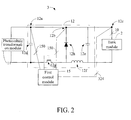
- FIG. 2 is a schematic partial view of a photovoltaic circuit 3. Only differences between the photovoltaic circuit 3 and the photovoltaic circuit 1 will be described, and identical portions of which are omitted herein.
- the first process module 12 comprises a first capacitor 12d, a second capacitor 12e, a first inductor 12f, a first switch element 12g and a first direction element 12h.
- the first capacitor 12d has a negative terminal
- the first switch element 12g has a source, a gate and a drain
- the first direction element 12h has a positive terminal.
- the first capacitor 12d is connected to the photovoltaic transformation module 11, the first direction element 12h, the second capacitor 12e and the tank module 2 in parallel.
- the source of the first switch element 12g is connected to the negative terminal of the first capacitor 12d, the drain of the first switch element 12g is connected to the positive terminal of the first direction element 12h and the first inductor 12f.
- the first inductor 12f is connected to the second capacitor 12e and the tank module 2.
- the first control module 15 is further connected to the gate of the first switch element 12g of the first process module 12 so that the first switch element 12g operates to control output of the first modulation current in response to the control signal 150.
- the first control module 15 is further connected to the juncture 12a of the photovoltaic translation module 11 and a positive terminal of the first capacitor 12d to receive the first divided current 320.
- the first control module 15 is further connected to the juncture 12b of the first inductor 12f, the drain of the first switch element 12g and the positive terminal of the first direction element 12h to receive the first modulation current 322.
- the first control module 15 is further connected to the juncture 12c of the second capacitor 12e and the tank module 2 to receive a last output current 324.
- FIG. 3 is a schematic partial view of a photovoltaic circuit 4.
- FIG. 3 is a schematic partial view of a photovoltaic circuit 4.
- the photovoltaic circuit 4 and the photovoltaic circuit 1 will be described, and identical portions of the photovoltaic circuit 4 and the photovoltaic circuit 1 is omitted herein.
- the photovoltaic circuit 4 differs from the photovoltaic circuit 1 in the second process modules 13, 14.
- the second process module 13 comprises a third capacitor 13c, a second inductor 13d, a second switch element 13e, a second direction element 13f and a second control module 13g.
- the third capacitor 13c has a positive terminal
- the second switch element 13e has a source and a gate
- the second direction element 13f has a positive terminal and a negative terminal.
- the third capacitor 13c is connected to the photovoltaic transformation module 11, the second switch element 13e, and the tank module 2 in parallel.
- the second inductor 13d is connected to the positive terminal of the third capacitor 13c and the source of the second switch element 13e.
- the positive terminal of the second direction element 13f is connected to the source of the second switch element 13e and the negative terminal of the second direction element 13f is connected to the positive terminal of the third capacitor 13c.
- the second control module 13g is connected to the gate of the second switch element 13e.
- the first control module 15 is connected to the second control module 13g so that the second control module 13g enables the second switch element 13e of the second process module 13 to operate to control output of the second modulation current in response to the control signal 150.
- the second control module 13g is further configured to generate the second modulation current according to the second divided current at the juncture 13a and a last output current 424 at a juncture 13h.
- the second control module 13g is further connected to a juncture of the photovoltaic transformation module 11, the positive terminal of the third capacitor 13c and the first inductor 12f to receive the second divided current.
- the second control module 13g is further connected to the negative terminal of the second direction element 13f to receive the last output current 424.
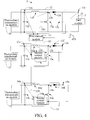
- FIG. 4 is a schematic view of a photovoltaic circuit 4.
- FIG. 4 is a schematic view of a photovoltaic circuit 4.
- the photovoltaic circuit 5 differs from the photovoltaic circuit 4 in that the first process module 12 is connected to the first photovoltaic transformation module 50, and the second processing modules 13, 14 are connected to the second photovoltaic transformation modules 51, 52 respectively.
- the functions will be readily appreciated by those skilled in the art and thus will not be further described herein.
- FIG. 5 is a schematic view of a photovoltaic circuit 6.
- the photovoltaic circuit 6 is coupled to a tank module 2 and a photovoltaic transformation module 11.
- the photovoltaic transformation module 11 is configured to receive an optical energy and transform the optical energy into a current.
- the photovoltaic circuit 6 is configured to receive and modulate the current into an output current 60 to be supplied to the tank module 2.
- the photovoltaic circuit 6 comprises a first process module 63, a plurality of second process modules (i.e., a second process module 65 and a second process module 67 in this preferred embodiment) and a first control module 15. It should be emphasized that, the number of the second process modules is not intended to limit scope of the present invention, and in other embodiments, another number of the second process modules may be used.
- the first process module 12 which is coupled to the photovoltaic transformation module 11 and the tank module 2, is configured to generate a first divided current 630 at a juncture 63a in response to the current and modulate the first divided current 630 to generate a first modulation current 632 at a juncture 63b.
- the second process module 65 and the second process module 67 are connected to the first process module 63 in parallel.
- the second process module 65, the second process module 67 and the first process module 63 connected in parallel are connected to the photovoltaic transformation module 11 and the tank module 2 in series.
- the second process modules 65, 67 are configured to generate two second divided currents at junctures 65a, 67a respectively in response to the current, and modulate the second divided currents to generate two second modulation currents at junctures 65b, 67b respectively.
- the first control module 15 is connected to the first process module 63 and the second process modules 65, 67.
- the control module 15 is configured to generate a control signal 150 to the process modules (i.e., the first process module 63 and the second process modules 65, 67 ) in response to the first divided current 630, the first modulation current 632, a last output current 634 at the juncture 63c and a maximum power point tracking (MPPT) way so that, in an interlaced way, the process modules output the modulation currents as the output current 60 to be supplied to the tank module 2.
- MPPT maximum power point tracking
- the first process module 63 comprises a first capacitor 63f, a second capacitor 63e, a first inductor 63i, a second inductor 63g, a first switch element 63d, and a first direction element 63h.
- the first capacitor 63f has a positive terminal and a negative terminal
- the second capacitor 63e has a positive terminal
- the first switch element 63d has a source, a drain and a gate
- the first direction element 63h a positive terminal.
- the first switch element 63d is connected to the photovoltaic transformation module 11, the first inductor 63i, the second capacitor 63e, and the tank module in parallel.
- the first inductor 63i is connected to the photovoltaic transformation module 11 and the source of the first switch element 63d.
- the positive terminal of the first capacitor 63f is connected to the first inductor 63i and the source of the first switch element 63d.
- the negative terminal of the first capacitor 63f is connected to the second inductor 63g and the positive terminal of the first direction element 63h.
- the positive terminal of the first direction element 63h is connected to the second inductor 63g and the negative terminal of the first direction element 63h is connected to the positive terminal of the second capacitor 63e.
- the first control module 15 is further connected to the gate of the first switch element 63d of the first process module 63 so that the first switch element 63d operates to control output of the first modulation current in response to the control signal 150.
- the first capacitor 63f and the second capacitor 63e may be omitted upon practical conditions in other embodiments, not affecting operations and functions of the photovoltaic circuit 6; this will be readily appreciated by those skilled in the art and thus will not be described again herein.
- the first control module 15 is further connected to a juncture 63a of the photovoltaic transformation module 11, the positive terminal of the first capacitor 63f and the source of the first switch element 13d to receive the first divided current 630.
- the first control module 15 is further connected to a juncture 63b of a negative terminal of the first capacitor 63f, the second inductor 63g and the positive terminal of the first direction element 63h to receive the first modulation current 632.
- the first control module 15 is further connected to a juncture 63c of the second capacitor 63e, the first direction element 63h and the tank module 2 to receive the last output current 634.
- the second process module 65 comprises a third capacitor 65f, a fourth capacitor 65e, a third inductor 65i, a fourth inductor 65g, a second switch element 65d and a second direction element 65h.
- the third capacitor 65f has a positive terminal and a negative terminal
- the fourth capacitor 65e has a positive terminal
- the second switch element 65d has a source, a gate and a drain
- the second direction element 65h has a positive terminal.
- the second switch element 65d is connected to the photovoltaic transformation module 11, the fourth inductor 65g, the fourth capacitor 65e and the tank module 2 in parallel.
- the third inductor 65i is connected to the photovoltaic transformation module 11 and the second switch element 65d.
- the positive terminal of the third capacitor 65f is connected to the third inductor 65i and the source of the second direction element 65d.
- the negative terminal of the third capacitor 65f is connected to the fourth inductor 65g and the positive terminal of the second direction element 65h.
- the positive terminal of the second direction element 65h is further connected to the fourth inductor 65g.
- the negative terminal of the second direction element 65h is connected to the positive terminal of the fourth capacitor 65e.
- the first control module 15 is further connected to the gate of the second switch element 65d of the second process module 65 so that the second switch element 65d operates to control output of the second modulation current in response to the control signal 150.
- the junctures 65c and 63c may be viewed as a single juncture, and the third capacitor 65f and the fourth capacitor 65e may be omitted upon practical conditions in other embodiments, not affecting operations and functions of the photovoltaic circuit 6; this will be readily appreciated by those skilled in the art and thus will not be described again herein.
- the second process module 67 comprises a third capacitor 67f, a fourth capacitor 67e, a third inductor 67i, a fourth inductor 67g, a second switch element 67d and a second direction element 67h.
- the third capacitor 67f has a positive terminal and a negative terminal
- the fourth capacitor 67e has a positive terminal
- the second switch element 67d has a source, a gate and a drain
- the second direction element 67h has a positive terminal.
- Elements of the second process module 67 are connected in the same way as those of the second process module 65, and thus no redundant description will be made herein.
- the junctures 67c and 63c may be viewed as a single juncture, and the third capacitor 67f and the fourth capacitor 67e may be omitted upon practical conditions in other embodiments, not affecting operations and functions of the photovoltaic circuit 6; this will be readily appreciated by those skilled in the art and thus will not be described again herein.
- FIG. 6 is a schematic view of a photovoltaic circuit 7.
- the photovoltaic circuit 7 is coupled to a tank module 2 and a photovoltaic transformation module 11.
- the photovoltaic transformation module 11 is configured to receive an optical energy and transform the optical energy into a current.
- the photovoltaic circuit 7 is configured to receive and modulate the current into an output current 10 to be supplied to the tank module 2.
- the photovoltaic circuit 7 comprises a first process module 12, a plurality of second process modules (i.e., a second process module 13 and a second process module 14 in this preferred embodiment) and a first control module 15.
- the photovoltaic circuit 7 differs from the photovoltaic circuit 1 in that, the first control module 15 outputs the output current 10 to the tank module 2 in a maximum power point tracking (MPPT) way, which is detailed as follows.
- the first control module 15 detects a tank status signal 20 generated by the tank module 2 and generates a charge protection signal in response to the tank status signal 20 so that, in response to the charge protection signal, the process modules output the first modulation current as the output current 10 to be supplied to the tank module 2.
- the tank module 2 generates the tank status signal 20 in response to a terminal voltage or a terminal voltage variation rate of an energy input terminal, i.e., the juncture 12c.
- magnitude of the output current 10 can be modulated by the first control module 15 according to the tank status and the MPPT way.
- the first control module 15 is configured to detect a tank status of the tank module 2, e.g, detecting whether the tank module 2 is getting close to a fully charged status in the charging course, and generate the charge protection signal according to the tank status of the tank module 2 so that the magnitude of the output current 10 can be modulated in response to the charge protection signal and the MPPT way.
- the charge protection signal may be an adjustable periodic pulse charging switch signal. Then the original switching signal for switching the switch element generated according to the PMMT way is multiplied with the periodic pulse charging switching signal. In other words, upon how the tank status signal 20 is generated, a duty of the periodic pulse charging switching signal may be generated in response to the terminal voltage or the terminal voltage variation rate of the tank module 2.
- the charge protection signal may be a pulse signal with an adjustable duty, and the first control module 15 controls and averages the magnitude of the output current 10 by modulating the duty of the pulse signal.
- the terminal voltage and the duty described above have characteristics that, when the closer the tank module 2 is getting to the full charged status, the terminal voltage is higher and the terminal voltage rising rate of the tank module 2 will rise more quickly.
- the first control module 15 may control the switch elements in the process modules by modulating the duty of the periodic pulse charging switching signal according to the value of the terminal voltage or the voltage rising rate of the tank module 2, so as to obtain a pulse charging effect.
- the duty of the periodic pulse charging switching signal By modulating the duty of the periodic pulse charging switching signal, the average magnitude of the charging current can be controlled. Additionally, the duty becomes lower when the terminal voltage of the tank module 2 goes higher or the voltage rising rate goes lower, which helps to shorten the charging duration and prolong the service life of the tank module 2.
- FIG. 7 is a schematic view of a photovoltaic circuit 8.
- FIG. 7 is a schematic view of a photovoltaic circuit 8.
- the photovoltaic circuit 8 differs from the photovoltaic circuit 3 in that, the first control module 15 is configured to detect a tank status of the tank module 2 and generate a charge protection signal in response to the tank status signal 20 so that, in response to the charge protection signal, the process modules output modulation currents as the output current 10 to be supplied to the tank module 2.
- the first control module 15 is configured to detect a tank status of the tank module 2 and generate a charge protection signal in response to the tank status signal 20 so that, in response to the charge protection signal, the process modules output modulation currents as the output current 10 to be supplied to the tank module 2.
- FIG. 8 is a schematic view of a photovoltaic circuit 9.
- FIG. 8 is a schematic view of a photovoltaic circuit 9.
- the photovoltaic circuit 9 differs from the photovoltaic circuit 4 in that, the first control module 15 is configured to detect a tank status of the tank module 2 and generate a charge protection signal in response to the tank status signal 20 so that, in response to the charge protection signal, the process modules output modulation currents as the output current 10 to be supplied to the tank module 2.
- the first control module 15 is configured to detect a tank status of the tank module 2 and generate a charge protection signal in response to the tank status signal 20 so that, in response to the charge protection signal, the process modules output modulation currents as the output current 10 to be supplied to the tank module 2.
- FIG. 9 is a schematic view of a photovoltaic circuit 10.
- FIG. 9 is a schematic view of a photovoltaic circuit 10.
- the photovoltaic circuit 10 differs from the photovoltaic circuit 5 in that, the first control module 15 is configured to detect a tank status of the tank module 2 and generate a charge protection signal in response to the tank status signal 20 so that, in response to the charge protection signal, the process modules output modulation currents as the output current 10 to be supplied to the tank module 2.
- the first control module 15 is configured to detect a tank status of the tank module 2 and generate a charge protection signal in response to the tank status signal 20 so that, in response to the charge protection signal, the process modules output modulation currents as the output current 10 to be supplied to the tank module 2.
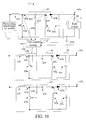
- FIG. 10 is a schematic view of a photovoltaic circuit 11.
- FIG. 10 is a schematic view of a photovoltaic circuit 11.
- the photovoltaic circuit 11 differs from the photovoltaic circuit 6 in that, the first control module 15 is configured to detect a tank status of the tank module 2 and generate a charge protection signal in response to the tank status signal 20 so that, in response to the charge protection signal, the process modules output modulation currents as the output current 60 to be supplied to the tank module 2.
- the first control module 15 is configured to detect a tank status of the tank module 2 and generate a charge protection signal in response to the tank status signal 20 so that, in response to the charge protection signal, the process modules output modulation currents as the output current 60 to be supplied to the tank module 2.
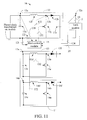
- FIG. 11 is a schematic view of a photovoltaic circuit 16.
- FIG. 11 is a schematic view of a photovoltaic circuit 16.
- the photovoltaic circuit 16 differs from the photovoltaic circuit 7 in that, the first process module 12 further comprises a resister 12j.
- the resister 12j has a first terminal and a second terminal.
- the first switch element 12g further has a drain
- the first capacitor 12e further has a negative terminal.
- the first terminal of the resister 12j is connected to the drain of the first switch element 12g, the negative terminal of the first capacitor 12e, the tank module 2.
- the second terminal of the resister 12j is coupled to the photovoltaic transformation module 11 and the first control module 15 so that the first control module 15 further generates a control signal 152 in response to a current 12i on the second terminal of the resister 12j.
- the control module 15 can know the exact strength of the current, which is generated by the photovoltaic transformation module 11, according to the current 12i on the second terminal of the resister 12j.
- the first control module 15 can determine the number about the switch elements, which are need to be opened/closed, according to the current 12i. Then, the first control module 15 generates the control signal 152 to open/close the switch elements which are needed to be opened/closed.
- FIG. 12 is a schematic view of a photovoltaic circuit 17.
- FIG. 12 is a schematic view of a photovoltaic circuit 17.
- the photovoltaic circuit 17 and the photovoltaic circuit 7 of the previous embodiment will be described, and identical portions of the photovoltaic circuit 17 and the photovoltaic circuit 7 are omitted herein.
- the photovoltaic circuit 17 differs from the photovoltaic circuit 7 in that, the first control module 15 is coupled to the source of the first switch element 12g, so as to generate a control signal 154 in response to a voltage 12k on the source of the first switch element 12g.
- the control module 15 can know the strength of the current, which is generated by the photovoltaic transformation module 11, according to the voltage 12k on the source of the first switch element 12g. Comparing with the photovoltaic circuit 12, the loss of the power in the photovoltaic circuit 17 can be reduced effectively because it know the strength of the current generated by the photovoltaic transformation module 11 without the resister 12j.
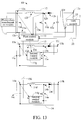
- FIG. 13 is a schematic view of a photovoltaic circuit 18.
- FIG. 13 is a schematic view of a photovoltaic circuit 18.
- the photovoltaic circuit 18 differs from the photovoltaic circuit 9 in that, the first process module 12 further comprises a resister 12m.
- the resister 12m has a first terminal and a second terminal.
- the first switch element 12g further has a drain
- the first capacitor 12e further has a negative terminal.
- the first terminal of the resister 12m is connected to the drain of the first switch element 12g, the negative terminal of the first capacitor 12e, the tank module 2.
- the second terminal of the resister 12m is coupled to the photovoltaic transformation module 11 and the first control module 15 so that the first control module 15 further generates a control signal 156 in response to a current 12n on the second terminal of the resister 12m.
- the control module 15 can know the exact strength of the current, which is generated by the photovoltaic transformation module 11, according to the current 12n on the second terminal of the resister 12m.
- the first control module 15 can determine the number about the switch elements, which are need to be opened/closed, according to the current 12n . Then, the first control module 15 generates the control signal 154 to open/close the switch elements which are needed to be opened/closed.
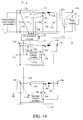
- FIG. 14 is a schematic view of a photovoltaic circuit 19.
- FIG. 14 is a schematic view of a photovoltaic circuit 19.
- the photovoltaic circuit 19 differs from the photovoltaic circuit 9 in that, the first control module 15 is coupled to the source of the first switch element 12g, so as to generate a control signal 158 in response to a voltage 12o on the source of the first switch element 12g.
- the control module 15 can know the strength of the current, which is generated by the photovoltaic transformation module 11, according to the voltage 12o on the source of the first switch element 12g. Comparing with the photovoltaic circuit 18, the loss of the power in the photovoltaic circuit 19 can be reduced effectively because it know the strength of the current generated by the photovoltaic transformation module 11 without the resister 12m.
- each of the control modules of the present invention is implemented by a hardware circuit without need of additional program codes programmed by a software engineer.
- the process modules of the present invention are connected in parallel to reduce power of the current, thus preventing damage of the control modules due to a too large current.
Landscapes
- Engineering & Computer Science (AREA)
- Power Engineering (AREA)
- Control Of Electrical Variables (AREA)
- Photovoltaic Devices (AREA)
- Dc-Dc Converters (AREA)
- Charge And Discharge Circuits For Batteries Or The Like (AREA)
Abstract
Description
- This application claims the benefit of priority based on Taiwan Patent Application No.
097122838 filed on June 19, 2008 - Not applicable.
- The present invention relates to a photovoltaic circuit. More specifically, the present invention relates to a photovoltaic circuit capable of outputting a current in an interlaced way.
- In recent years, forced by high price of crude oil and the Kyoto Protocol which imposes a restriction on the global emission of greenhouse gases, almost all nations around the world begin to attach great importance to various new energy sources and alternative energy sources. This has led to booming development of the solar energy industry, and as one of the important bases of hi-tech industries.
- The most well-known sector in the solar energy industry is the solar cell sector (termed as a solar photovoltaic circuit hereinafter). A solar photovoltaic circuit utilizes a photovoltaic transformation module to transform the solar energy into an electric current and store the electric energy in a tank module (usually a battery). However, the photovoltaic circuit usually just connect the photovoltaic panel directly to the tank module through a switching device. It is not good at the solar energy efficiency and charging efficiency.
- In view of these problems, efforts still have to be made in the art to provide a solution that can effectively drain the maxima power from the photovoltaic panels and charging the tank module.
- One objective of the present invention is to provide a photovoltaic circuit for supplying an output current and charging the tank module. The photovoltaic circuit is connected to a tank module to supply the output current to the tank module. The photovoltaic circuit comprises a photovoltaic transformation module, a first process module, a plurality of second process modules and a control module. The photovoltaic transformation module is configured to receive an optical energy and transform the optical energy into a current. The first process module is connected to the photovoltaic transformation module and the tank module in series, and configured to generate a first divided current in response to the current and modulate the first divided current to generate a first modulation current. The second process modules are connected to the first process module in parallel, and the first process module and the second process modules connected in parallel are connected to the photovoltaic transformation module and the tank module in series. The second process modules are configured to generate a plurality of second divided currents in response to the current and modulate the second divided currents to generate a plurality of second modulation currents. The control module is connected to the first process module and the second process modules. The control module is configured to generate a control signal to the process modules in response to the first divided current, the first modulation current and a last output current, so that the process modules output the modulation currents as the output current supplied to the tank module in an interlaced way.
- Another objective of the present invention is to provide a photovoltaic circuit for supplying an output current. The photovoltaic circuit is connected to a tank module to supply the output current to the tank module. The photovoltaic circuit comprises a plurality of photovoltaic transformation modules, a first process module, a plurality of second process modules and a control module. Each of the photovoltaic transformation modules is configured to receive an optical energy and transform the optical energy into a current. The photovoltaic transformation modules consist of a first photovoltaic transformation module and a plurality of second photovoltaic transformation modules. The first process module is connected to the first photovoltaic transformation module of the photovoltaic transformation modules and the tank module in series, and is configured to generate a first modulation current by modulating the current of the first photovoltaic transformation module. The second process modules are connected to the first process module in parallel and correspond to the second photovoltaic transformation modules in one-to-one way. Each of the second process modules connected in parallel is connected to the corresponding second photovoltaic transformation module and the tank module in series. The second process modules are configured to modulate the currents to generate a plurality of second modulation currents. The control module is connected to the first process module and the second process modules, and is configured to generate a control signal to the process modules in response to the current of the first photovoltaic transformation module, the first modulation current and a last output current so that the process modules output the modulation currents as the output current supplied to the tank module in an interlaced way.
- Yet another objective of the present invention is to provide a photovoltaic circuit for supplying an output current. The photovoltaic circuit is coupled to a tank module and a photovoltaic transformation module. The photovoltaic transformation module is configured to receive an optical energy and transform the optical energy into a current. The photovoltaic circuit is configured to receive and modulate the current as the output current to be supplied to the tank module. The tank module generates a tank status signal. The photovoltaic circuit comprises a first process module and a first control module. The first process module is coupled to the photovoltaic transformation module and the tank module, and is configured to process the current to generate a first modulation current. The first control module is connected to the first process module and the tank module, and is configured to generate a charge protection signal in response to the tank status signal of the tank module so that the first process module outputs the first modulation current as the output current supplied to the tank module in response to the charge protection signal.
- Yet a further objective of the present invention is to provide a photovoltaic circuit for supplying an output current. The photovoltaic circuit is coupled to a tank module and a plurality of photovoltaic transformation modules. E ach of the photovoltaic transformation modules is configured to receive an optical energy and transform the optical energy into a current. The photovoltaic circuit is configured to receive and modulate the current as the output current supplied to the tank module.
- The photovoltaic transformation modules consist of a first photovoltaic transformation module and a plurality of second photovoltaic transformation modules. The photovoltaic circuit comprises a first process module, a plurality of second process modules and a first control module. The first process module is connected to the first photovoltaic transformation module of the photovoltaic transformation modules and the tank module in series, and is configured to generate a first modulation current by processing the current of the first photovoltaic transformation module. The second process modules are connected to the first process module in parallel and correspond to the second photovoltaic transformation modules in one-to-one way. E ach of the second process modules connected in parallel is connected to the corresponding second photovoltaic transformation module and the tank module in series. The second process modules are configured to process the currents to generate a plurality of second modulation currents. The first control module is connected to the first process module, the second process modules the tank module, and is configured to generate a charge protection signal in response to a tank status signal of the tank module so that the process modules output the modulation currents as the output current supplied to the tank module in response to the charge protection signal.
- The control module of the present invention is implemented by a hardware circuit without need of additional program codes programmed by a software engineer. Moreover, the process modules of the present invention are connected in parallel to reduce power of the current, thus preventing damage of the control modules due to a too large current power.
- The detailed technology and preferred embodiments implemented for the subject invention are described in the following paragraphs accompanying the appended drawings for people skilled in this field to well appreciate the features of the claimed invention.
-
-
FIG. 1 is a schematic view of a first embodiment of the present invention; -
FIG. 2 is a schematic partial view of another example of the first embodiment of the present invention; -
FIG. 3 is a schematic view of yet another example of the first embodiment of the present invention; -
FIG. 4 is a schematic view of a second embodiment of the present invention; -
FIG. 5 is a schematic view of a third embodiment of the present invention; -
FIG. 6 is a schematic view of a fourth embodiment of the present invention; -
FIG. 7 is a schematic view of a fifth embodiment of the present invention; -
FIG. 8 is a schematic view of a sixth embodiment of the present invention; -
FIG. 9 is a schematic view of a seventh embodiment of the present invention; -
FIG. 10 is a schematic view of an eighth embodiment of the present invention; -
FIG. 11 is a schematic view of a ninth embodiment of the present invention; -
FIG. 12 is a schematic view of a tenth embodiment of the present invention; -
FIG. 13 is a schematic view of an eleventh embodiment of the present invention; and -
FIG. 14 is a schematic view of a twelfth embodiment of the present invention. - A first embodiment of the present invention is illustrated in
FIG. 1 , which is a schematic view of aphotovoltaic circuit 1. Thephotovoltaic circuit 1 is coupled to atank module 2 and aphotovoltaic transformation module 11. Thephotovoltaic transformation module 11 is configured to receive an optical energy and transform the optical energy into a current. Thephotovoltaic circuit 1 is configured to receive and modulate the current into an output current 10 to be supplied to thetank module 2. Thephotovoltaic circuit 1 comprises afirst process module 12, a plurality of second process modules (i.e., asecond process module 13 and asecond process module 14 in this preferred embodiment) and afirst control module 15. It should be noted that, the number of the second process modules is not intended to limit the present invention; and in other embodiments, another number of the second process modules may be used. - The
first process module 12, which is coupled between thephotovoltaic transformation module 11 and thetank module 2, is configured to generate a first divided current at ajuncture 12a in response to the current and modulate the first divided current to generate a first modulation current at thejuncture 12b. - The
second process module 13 and thesecond process module 14 are connected to thefirst process module 12 in parallel. Thesecond process module 13, thesecond process module 14 and thefirst process module 12 connected in parallel are connected to thephotovoltaic transformation module 11 and thetank module 2 in series. Thesecond process modules junctures junctures - The
first control module 15 is connected to thefirst process module 12 and thesecond process modules first control module 15 is configured to generate acontrol signal 150 to the process modules (i.e., thefirst process module 12 and thesecond process modules 13, 14) in response to the first divided current, the first modulation current and alast output current 124 at thejuncture 12c so that, in an interlaced way, the process modules output the modulation currents as the output current 10 to be supplied to thetank module 2. That is, thetank module 2 uses thejuncture 12c as an energy input terminal to receive the output current 10. - Particularly, the
first process module 12 comprises afirst capacitor 12d, asecond capacitor 12e, afirst inductor 12f, afirst switch element 12g, and afirst direction element 12h. Thefirst capacitor 12d has a positive terminal, thefirst switch element 12g has a source and a gate, and thefirst direction element 12h has a positive terminal and a negative terminal. Thefirst capacitor 12d is connected to thephotovoltaic transformation module 11, thefirst switch element 12g, thesecond capacitor 12e, and thetank module 2 in parallel. Thefirst inductor 12f is connected to the positive terminal of thefirst capacitor 12d and the source of thefirst switch element 12g. The positive terminal of thefirst direction element 12h is connected to the source of thefirst switch element 12g, and the negative terminal of thefirst direction element 12h is connected to the positive terminal of thefirst capacitor 12d. Thefirst control module 15 is further connected to the gate of thefirst switch element 12g of thefirst process module 12, so that thefirst switch element 12g operates to control output of the first modulation current in response to thecontrol signal 150. It should be noted that, thefirst capacitor 12d and thesecond capacitor 12e may be omitted upon practical conditions in other embodiments, not affecting operations and functions of thephotovoltaic circuit 1; this will be readily appreciated by those skilled in the art and thus will not be described again herein. - Additionally, the
first control module 15 is further connected to thejuncture 12a of thephotovoltaic transformation module 11, the positive terminal of thefirst capacitor 12d and thefirst inductor 12f to receive the first divided current 120. Thefirst control module 15 is further connected to thejuncture 12b of thefirst inductor 12f, the source of thefirst switch element 12g and the positive terminal of thefirst direction element 12h to receive thefirst modulation current 122. Thefirst control module 15 is further connected to thejuncture 12c of the negative terminal of thefirst direction element 12h, thesecond capacitor 12e and thetank module 2 to receive thelast output current 124. - Next, a structure of the
second process module 13 will be described. Thesecond process module 13 comprises athird capacitor 13c, asecond inductor 13d, asecond switch element 13e and asecond direction element 13f. Thethird capacitor 13c has a positive terminal, thesecond switch element 13e has a source and a gate, and thesecond direction element 13f has a positive terminal and a negative terminal. Thethird capacitor 13c is connected to thephotovoltaic transformation module 11, thesecond switch element 13e and thetank module 2 in parallel. Thesecond inductor 13d is connected to the positive terminal of thethird capacitor 13c and the source of thesecond switch element 13e. The positive terminal of thesecond direction element 13f is connected to the source of thesecond switch element 13e, and the negative terminal of thesecond direction element 13f is connected to the positive terminal of thethird capacitor 13c. Thefirst control module 15 is coupled to the gate of thesecond switch element 13e of thesecond process module 13 so that thesecond switch element 13e of thesecond process module 13 operates to control output of the second modulation current in response to the control signal. It should be noted that, thethird capacitor 13c may be omitted upon practical conditions in other embodiments, not affecting operations and functions of thephotovoltaic circuit 1; this will be readily appreciated by those skilled in the art and thus will not be described again herein. - Additionally, the
second process module 14 comprises athird capacitor 14c, asecond inductor 14d, asecond switch element 14e and asecond direction element 14f. Thethird capacitor 14c has a positive terminal, thesecond switch element 14e has a source and a gate, and thesecond direction element 14f has a positive terminal and a negative terminal. Elements of thesecond process module 14 are connected in the same way as those of thesecond process module 13, and thus no redundant description will be made herein. It should be noted that, thethird capacitor 14c may be omitted upon practical conditions in other embodiments, not affecting operations and functions of thephotovoltaic circuit 1; this will be readily appreciated by those skilled in the art and thus will not be described again herein. - It should be noted that, this structure of the
photovoltaic circuit 1 may be viewed as a low-side buck structure in this field. However, the present invention may also be implemented as a high-side buck structure, a high-side buck-boost structure or a low-side buck-boost structure; this will be readily appreciated by those skilled in the art upon reviewing the above embodiment, and thus will not be further described herein. - Another example of this embodiment is illustrated in
FIG. 2 , which is a schematic partial view of aphotovoltaic circuit 3. Only differences between thephotovoltaic circuit 3 and thephotovoltaic circuit 1 will be described, and identical portions of which are omitted herein. - Differences between the
photovoltaic circuit 3 and thephotovoltaic circuit 1 is in the connection of elements of thefirst process module 12. Thefirst process module 12 comprises afirst capacitor 12d, asecond capacitor 12e, afirst inductor 12f, afirst switch element 12g and afirst direction element 12h. Thefirst capacitor 12d has a negative terminal, thefirst switch element 12g has a source, a gate and a drain, and thefirst direction element 12h has a positive terminal. - The
first capacitor 12d is connected to thephotovoltaic transformation module 11, thefirst direction element 12h, thesecond capacitor 12e and thetank module 2 in parallel. The source of thefirst switch element 12g is connected to the negative terminal of thefirst capacitor 12d, the drain of thefirst switch element 12g is connected to the positive terminal of thefirst direction element 12h and thefirst inductor 12f. Thefirst inductor 12f is connected to thesecond capacitor 12e and thetank module 2. Thefirst control module 15 is further connected to the gate of thefirst switch element 12g of thefirst process module 12 so that thefirst switch element 12g operates to control output of the first modulation current in response to thecontrol signal 150. - Additionally, the
first control module 15 is further connected to thejuncture 12a of thephotovoltaic translation module 11 and a positive terminal of thefirst capacitor 12d to receive the first divided current 320. Thefirst control module 15 is further connected to thejuncture 12b of thefirst inductor 12f, the drain of thefirst switch element 12g and the positive terminal of thefirst direction element 12h to receive thefirst modulation current 322. Thefirst control module 15 is further connected to thejuncture 12c of thesecond capacitor 12e and thetank module 2 to receive alast output current 324. - Yet another example of this embodiment is illustrated in
FIG. 3 , which is a schematic partial view of aphotovoltaic circuit 4. Hereinafter, only differences between thephotovoltaic circuit 4 and thephotovoltaic circuit 1 will be described, and identical portions of thephotovoltaic circuit 4 and thephotovoltaic circuit 1 is omitted herein. - The
photovoltaic circuit 4 differs from thephotovoltaic circuit 1 in thesecond process modules second process module 13 comprises athird capacitor 13c, asecond inductor 13d, asecond switch element 13e, asecond direction element 13f and asecond control module 13g. Thethird capacitor 13c has a positive terminal, thesecond switch element 13e has a source and a gate, and thesecond direction element 13f has a positive terminal and a negative terminal. Thethird capacitor 13c is connected to thephotovoltaic transformation module 11, thesecond switch element 13e, and thetank module 2 in parallel. Thesecond inductor 13d is connected to the positive terminal of thethird capacitor 13c and the source of thesecond switch element 13e. The positive terminal of thesecond direction element 13f is connected to the source of thesecond switch element 13e and the negative terminal of thesecond direction element 13f is connected to the positive terminal of thethird capacitor 13c. Thesecond control module 13g is connected to the gate of thesecond switch element 13e. Thefirst control module 15 is connected to thesecond control module 13g so that thesecond control module 13g enables thesecond switch element 13e of thesecond process module 13 to operate to control output of the second modulation current in response to thecontrol signal 150. - Particularly, the
second control module 13g is further configured to generate the second modulation current according to the second divided current at thejuncture 13a and alast output current 424 at ajuncture 13h. Thesecond control module 13g is further connected to a juncture of thephotovoltaic transformation module 11, the positive terminal of thethird capacitor 13c and thefirst inductor 12f to receive the second divided current. Thesecond control module 13g is further connected to the negative terminal of thesecond direction element 13f to receive thelast output current 424. - A second embodiment of the present invention is illustrated in
FIG. 4 , which is a schematic view of aphotovoltaic circuit 4. Hereinafter, only differences between thephotovoltaic circuit 5 and thephotovoltaic circuit 4 will be described, and identical portions of thephotovoltaic circuit 5 and thephotovoltaic circuit 4 are omitted herein. - The
photovoltaic circuit 5 differs from thephotovoltaic circuit 4 in that thefirst process module 12 is connected to the firstphotovoltaic transformation module 50, and thesecond processing modules photovoltaic transformation modules - A third embodiment of the present invention is illustrated in
FIG. 5 , which is a schematic view of aphotovoltaic circuit 6. Thephotovoltaic circuit 6 is coupled to atank module 2 and aphotovoltaic transformation module 11. Thephotovoltaic transformation module 11 is configured to receive an optical energy and transform the optical energy into a current. Thephotovoltaic circuit 6 is configured to receive and modulate the current into an output current 60 to be supplied to thetank module 2. Thephotovoltaic circuit 6 comprises afirst process module 63, a plurality of second process modules (i.e., asecond process module 65 and asecond process module 67 in this preferred embodiment) and afirst control module 15. It should be emphasized that, the number of the second process modules is not intended to limit scope of the present invention, and in other embodiments, another number of the second process modules may be used. - The
first process module 12, which is coupled to thephotovoltaic transformation module 11 and thetank module 2, is configured to generate a first divided current 630 at ajuncture 63a in response to the current and modulate the first divided current 630 to generate a first modulation current 632 at ajuncture 63b. - The
second process module 65 and thesecond process module 67 are connected to thefirst process module 63 in parallel. Thesecond process module 65, thesecond process module 67 and thefirst process module 63 connected in parallel are connected to thephotovoltaic transformation module 11 and thetank module 2 in series. Thesecond process modules junctures junctures - The
first control module 15 is connected to thefirst process module 63 and thesecond process modules control module 15 is configured to generate acontrol signal 150 to the process modules (i.e., thefirst process module 63 and thesecond process modules 65, 67) in response to the first divided current 630, the first modulation current 632, alast output current 634 at thejuncture 63c and a maximum power point tracking (MPPT) way so that, in an interlaced way, the process modules output the modulation currents as the output current 60 to be supplied to thetank module 2. - Particularly, the
first process module 63 comprises afirst capacitor 63f, asecond capacitor 63e, afirst inductor 63i, asecond inductor 63g, afirst switch element 63d, and afirst direction element 63h. Thefirst capacitor 63f has a positive terminal and a negative terminal, thesecond capacitor 63e has a positive terminal, thefirst switch element 63d has a source, a drain and a gate, and thefirst direction element 63h a positive terminal. Thefirst switch element 63d is connected to thephotovoltaic transformation module 11, thefirst inductor 63i, thesecond capacitor 63e, and the tank module in parallel. Thefirst inductor 63i is connected to thephotovoltaic transformation module 11 and the source of thefirst switch element 63d. The positive terminal of thefirst capacitor 63f is connected to thefirst inductor 63i and the source of thefirst switch element 63d. The negative terminal of thefirst capacitor 63f is connected to thesecond inductor 63g and the positive terminal of thefirst direction element 63h. The positive terminal of thefirst direction element 63h is connected to thesecond inductor 63g and the negative terminal of thefirst direction element 63h is connected to the positive terminal of thesecond capacitor 63e. Thefirst control module 15 is further connected to the gate of thefirst switch element 63d of thefirst process module 63 so that thefirst switch element 63d operates to control output of the first modulation current in response to thecontrol signal 150. It should be noted that, thefirst capacitor 63f and thesecond capacitor 63e may be omitted upon practical conditions in other embodiments, not affecting operations and functions of thephotovoltaic circuit 6; this will be readily appreciated by those skilled in the art and thus will not be described again herein. - Additionally, the
first control module 15 is further connected to ajuncture 63a of thephotovoltaic transformation module 11, the positive terminal of thefirst capacitor 63f and the source of thefirst switch element 13d to receive the first divided current 630. Thefirst control module 15 is further connected to ajuncture 63b of a negative terminal of thefirst capacitor 63f, thesecond inductor 63g and the positive terminal of thefirst direction element 63h to receive thefirst modulation current 632. Thefirst control module 15 is further connected to ajuncture 63c of thesecond capacitor 63e, thefirst direction element 63h and thetank module 2 to receive thelast output current 634. - Next, a structure of the
second process module 65 will be described. Thesecond process module 65 comprises athird capacitor 65f, afourth capacitor 65e, athird inductor 65i, afourth inductor 65g, asecond switch element 65d and asecond direction element 65h. Thethird capacitor 65f has a positive terminal and a negative terminal, thefourth capacitor 65e has a positive terminal, thesecond switch element 65d has a source, a gate and a drain, and thesecond direction element 65h has a positive terminal. - The
second switch element 65d is connected to thephotovoltaic transformation module 11, thefourth inductor 65g, thefourth capacitor 65e and thetank module 2 in parallel. Thethird inductor 65i is connected to thephotovoltaic transformation module 11 and thesecond switch element 65d. The positive terminal of thethird capacitor 65f is connected to thethird inductor 65i and the source of thesecond direction element 65d. The negative terminal of thethird capacitor 65f is connected to thefourth inductor 65g and the positive terminal of thesecond direction element 65h. The positive terminal of thesecond direction element 65h is further connected to thefourth inductor 65g. The negative terminal of thesecond direction element 65h is connected to the positive terminal of thefourth capacitor 65e. Thefirst control module 15 is further connected to the gate of thesecond switch element 65d of thesecond process module 65 so that thesecond switch element 65d operates to control output of the second modulation current in response to thecontrol signal 150. It should be noted that, thejunctures third capacitor 65f and thefourth capacitor 65e may be omitted upon practical conditions in other embodiments, not affecting operations and functions of thephotovoltaic circuit 6; this will be readily appreciated by those skilled in the art and thus will not be described again herein. - Additionally, the
second process module 67 comprises athird capacitor 67f, afourth capacitor 67e, athird inductor 67i, afourth inductor 67g, asecond switch element 67d and asecond direction element 67h. Thethird capacitor 67f has a positive terminal and a negative terminal, thefourth capacitor 67e has a positive terminal, thesecond switch element 67d has a source, a gate and a drain, and thesecond direction element 67h has a positive terminal. Elements of thesecond process module 67 are connected in the same way as those of thesecond process module 65, and thus no redundant description will be made herein. It should be noted that, thejunctures third capacitor 67f and thefourth capacitor 67e may be omitted upon practical conditions in other embodiments, not affecting operations and functions of thephotovoltaic circuit 6; this will be readily appreciated by those skilled in the art and thus will not be described again herein. - A fourth embodiment of the present invention is illustrated in
FIG. 6 , which is a schematic view of aphotovoltaic circuit 7. Thephotovoltaic circuit 7 is coupled to atank module 2 and aphotovoltaic transformation module 11. Thephotovoltaic transformation module 11 is configured to receive an optical energy and transform the optical energy into a current. Thephotovoltaic circuit 7 is configured to receive and modulate the current into an output current 10 to be supplied to thetank module 2. Thephotovoltaic circuit 7 comprises afirst process module 12, a plurality of second process modules (i.e., asecond process module 13 and asecond process module 14 in this preferred embodiment) and afirst control module 15. Hereinafter, only differences between thephotovoltaic circuit 7 and thephotovoltaic circuit 1 of the previous embodiment will be described, and the identical portions of thephotovoltaic circuit 7 and thephotovoltaic circuit 1 are omitted herein. - The
photovoltaic circuit 7 differs from thephotovoltaic circuit 1 in that, thefirst control module 15 outputs the output current 10 to thetank module 2 in a maximum power point tracking (MPPT) way, which is detailed as follows. Thefirst control module 15 detects atank status signal 20 generated by thetank module 2 and generates a charge protection signal in response to thetank status signal 20 so that, in response to the charge protection signal, the process modules output the first modulation current as the output current 10 to be supplied to thetank module 2. Specifically, thetank module 2 generates thetank status signal 20 in response to a terminal voltage or a terminal voltage variation rate of an energy input terminal, i.e., thejuncture 12c. - Thus, magnitude of the output current 10 can be modulated by the
first control module 15 according to the tank status and the MPPT way. - Particularly, the
first control module 15 is configured to detect a tank status of thetank module 2, e.g, detecting whether thetank module 2 is getting close to a fully charged status in the charging course, and generate the charge protection signal according to the tank status of thetank module 2 so that the magnitude of the output current 10 can be modulated in response to the charge protection signal and the MPPT way. For example, the charge protection signal may be an adjustable periodic pulse charging switch signal. Then the original switching signal for switching the switch element generated according to the PMMT way is multiplied with the periodic pulse charging switching signal. In other words, upon how thetank status signal 20 is generated, a duty of the periodic pulse charging switching signal may be generated in response to the terminal voltage or the terminal voltage variation rate of thetank module 2. Also, the charge protection signal may be a pulse signal with an adjustable duty, and thefirst control module 15 controls and averages the magnitude of the output current 10 by modulating the duty of the pulse signal. - It should be noted that, the terminal voltage and the duty described above have characteristics that, when the closer the
tank module 2 is getting to the full charged status, the terminal voltage is higher and the terminal voltage rising rate of thetank module 2 will rise more quickly. Hence, thefirst control module 15 may control the switch elements in the process modules by modulating the duty of the periodic pulse charging switching signal according to the value of the terminal voltage or the voltage rising rate of thetank module 2, so as to obtain a pulse charging effect. By modulating the duty of the periodic pulse charging switching signal, the average magnitude of the charging current can be controlled. Additionally, the duty becomes lower when the terminal voltage of thetank module 2 goes higher or the voltage rising rate goes lower, which helps to shorten the charging duration and prolong the service life of thetank module 2. - A fifth embodiment of the present invention is illustrated in
FIG. 7 , which is a schematic view of aphotovoltaic circuit 8. Hereinafter, only differences between thephotovoltaic circuit 8 and thephotovoltaic circuit 3 of the previous embodiment will be described, and identical portions of thephotovoltaic circuit 8 and thephotovoltaic circuit 3 are omitted herein. - The
photovoltaic circuit 8 differs from thephotovoltaic circuit 3 in that, thefirst control module 15 is configured to detect a tank status of thetank module 2 and generate a charge protection signal in response to thetank status signal 20 so that, in response to the charge protection signal, the process modules output modulation currents as the output current 10 to be supplied to thetank module 2. This will be readily appreciated upon reviewing the fourth embodiment, and thus will not be further described herein. - A sixth embodiment of the present invention is illustrated in
FIG. 8 , which is a schematic view of aphotovoltaic circuit 9. Hereinafter, only differences between thephotovoltaic circuit 9 and thephotovoltaic circuit 4 of the previous embodiment will be described, and identical portions of thephotovoltaic circuit 9 and thephotovoltaic circuit 4 are omitted herein. - The
photovoltaic circuit 9 differs from thephotovoltaic circuit 4 in that, thefirst control module 15 is configured to detect a tank status of thetank module 2 and generate a charge protection signal in response to thetank status signal 20 so that, in response to the charge protection signal, the process modules output modulation currents as the output current 10 to be supplied to thetank module 2. This will be readily appreciated upon reviewing the fourth embodiment, and thus will not be further described herein. - A seventh embodiment of the present invention is illustrated in
FIG. 9 , which is a schematic view of aphotovoltaic circuit 10. Hereinafter, only differences between thephotovoltaic circuit 10 and thephotovoltaic circuit 5 of the previous embodiment will be described, and identical portions of thephotovoltaic circuit 10 and thephotovoltaic circuit 5 are omitted herein. - The
photovoltaic circuit 10 differs from thephotovoltaic circuit 5 in that, thefirst control module 15 is configured to detect a tank status of thetank module 2 and generate a charge protection signal in response to thetank status signal 20 so that, in response to the charge protection signal, the process modules output modulation currents as the output current 10 to be supplied to thetank module 2. This will be readily appreciated upon reviewing the fourth embodiment, and thus will not be further described herein. - An eighth embodiment of the present invention is illustrated in
FIG. 10 , which is a schematic view of aphotovoltaic circuit 11. Hereinafter, only differences between thephotovoltaic circuit 11 and thephotovoltaic circuit 6 of the previous embodiment will be described, and identical portions of thephotovoltaic circuit 11 and thephotovoltaic circuit 6 are omitted herein. - The
photovoltaic circuit 11 differs from thephotovoltaic circuit 6 in that, thefirst control module 15 is configured to detect a tank status of thetank module 2 and generate a charge protection signal in response to thetank status signal 20 so that, in response to the charge protection signal, the process modules output modulation currents as the output current 60 to be supplied to thetank module 2. This will be readily appreciated upon reviewing the fourth embodiment, and thus will not be further described herein. - A ninth embodiment of the present invention is illustrated in
FIG. 11 , which is a schematic view of aphotovoltaic circuit 16. Hereinafter, only differences between thephotovoltaic circuit 16 and thephotovoltaic circuit 7 of the previous embodiment will be described, and identical portions of thephotovoltaic circuit 16 and thephotovoltaic circuit 7 are omitted herein. - The
photovoltaic circuit 16 differs from thephotovoltaic circuit 7 in that, thefirst process module 12 further comprises aresister 12j. Theresister 12j has a first terminal and a second terminal. Thefirst switch element 12g further has a drain, thefirst capacitor 12e further has a negative terminal. The first terminal of the resister 12j is connected to the drain of thefirst switch element 12g, the negative terminal of thefirst capacitor 12e, thetank module 2. Furthermore, the second terminal of the resister 12j is coupled to thephotovoltaic transformation module 11 and thefirst control module 15 so that thefirst control module 15 further generates acontrol signal 152 in response to a current 12i on the second terminal of the resister 12j. - Specifically, in
photovoltaic circuit 16, thecontrol module 15 can know the exact strength of the current, which is generated by thephotovoltaic transformation module 11, according to the current 12i on the second terminal of the resister 12j. Thefirst control module 15 can determine the number about the switch elements, which are need to be opened/closed, according to the current 12i. Then, thefirst control module 15 generates thecontrol signal 152 to open/close the switch elements which are needed to be opened/closed. - A tenth embodiment of the present invention is illustrated in
FIG. 12 , which is a schematic view of aphotovoltaic circuit 17. Hereinafter, only differences between thephotovoltaic circuit 17 and thephotovoltaic circuit 7 of the previous embodiment will be described, and identical portions of thephotovoltaic circuit 17 and thephotovoltaic circuit 7 are omitted herein. - The
photovoltaic circuit 17 differs from thephotovoltaic circuit 7 in that, thefirst control module 15 is coupled to the source of thefirst switch element 12g, so as to generate acontrol signal 154 in response to avoltage 12k on the source of thefirst switch element 12g. Specifically, inphotovoltaic circuit 12, thecontrol module 15 can know the strength of the current, which is generated by thephotovoltaic transformation module 11, according to thevoltage 12k on the source of thefirst switch element 12g. Comparing with thephotovoltaic circuit 12, the loss of the power in thephotovoltaic circuit 17 can be reduced effectively because it know the strength of the current generated by thephotovoltaic transformation module 11 without theresister 12j. - An eleventh embodiment of the present invention is illustrated in
FIG. 13 , which is a schematic view of aphotovoltaic circuit 18. Hereinafter, only differences between thephotovoltaic circuit 18 and thephotovoltaic circuit 9 of the previous embodiment will be described, and identical portions of thephotovoltaic circuit 18 and thephotovoltaic circuit 9 are omitted herein. - The
photovoltaic circuit 18 differs from thephotovoltaic circuit 9 in that, thefirst process module 12 further comprises a resister 12m. The resister 12m has a first terminal and a second terminal. Thefirst switch element 12g further has a drain, thefirst capacitor 12e further has a negative terminal. The first terminal of the resister 12m is connected to the drain of thefirst switch element 12g, the negative terminal of thefirst capacitor 12e, thetank module 2. Furthermore, the second terminal of the resister 12m is coupled to thephotovoltaic transformation module 11 and thefirst control module 15 so that thefirst control module 15 further generates acontrol signal 156 in response to a current 12n on the second terminal of the resister 12m. - Specifically, in
photovoltaic circuit 18, thecontrol module 15 can know the exact strength of the current, which is generated by thephotovoltaic transformation module 11, according to the current 12n on the second terminal of the resister 12m. Thefirst control module 15 can determine the number about the switch elements, which are need to be opened/closed, according to the current 12n. Then, thefirst control module 15 generates thecontrol signal 154 to open/close the switch elements which are needed to be opened/closed. - A twelfth embodiment of the present invention is illustrated in
FIG. 14 , which is a schematic view of aphotovoltaic circuit 19. Hereinafter, only differences between thephotovoltaic circuit 19 and thephotovoltaic circuit 9 of the previous embodiment will be described, and identical portions of thephotovoltaic circuit 19 and thephotovoltaic circuit 9 are omitted herein. - The
photovoltaic circuit 19 differs from thephotovoltaic circuit 9 in that, thefirst control module 15 is coupled to the source of thefirst switch element 12g, so as to generate acontrol signal 158 in response to a voltage 12o on the source of thefirst switch element 12g. Specifically, inphotovoltaic circuit 19, thecontrol module 15 can know the strength of the current, which is generated by thephotovoltaic transformation module 11, according to the voltage 12o on the source of thefirst switch element 12g. Comparing with thephotovoltaic circuit 18, the loss of the power in thephotovoltaic circuit 19 can be reduced effectively because it know the strength of the current generated by thephotovoltaic transformation module 11 without the resister 12m. - In summary, each of the control modules of the present invention is implemented by a hardware circuit without need of additional program codes programmed by a software engineer. Moreover, the process modules of the present invention are connected in parallel to reduce power of the current, thus preventing damage of the control modules due to a too large current.
- The above disclosure is related to the detailed technical contents and inventive features thereof. People skilled in this field may proceed with a variety of modifications and replacements based on the disclosures and suggestions of the invention as described without departing from the characteristics thereof. Nevertheless, although such modifications and replacements are not fully disclosed in the above descriptions, they have substantially been covered in the following claims as appended.
Claims (16)
- A photovoltaic circuit for supplying an output current, the photovoltaic circuit being coupled to a tank module and a photovoltaic transformation module, the photovoltaic transformation module being configured to receive an optical energy and transform the optical energy into a current, the photovoltaic circuit being configured to receive and modulate the current as the output current supplied to the tank module, the tank module generating a tank status signal, the photovoltaic circuit comprising:a first process module, being coupled to the tank module and the photovoltaic transformation module, and configured to process the current to generate a first modulation current; anda first control module, being connected to the first process module and the tank module, configured to generate a charge protection signal in response to the tank status signal of the tank module so that the first process module outputs the first modulation current as the output current supplied to the tank module in response to the charge protection signal.
- The photovoltaic circuit as claimed in claim 1, further comprising a plurality of second process modules connected to the first process module in parallel, wherein the charge protection signal is an impulse signal having an modulated duty, the first control module controls and averages magnitude of the output current by modulating the modulated duty, the first process module and the second process modules connected in parallel is coupled to the photovoltaic transformation module and the tank module, the second process modules is configured to process the current to generate a plurality of second modulation currents, the first control module is connected to the second process modules so that the second process modules output the second modulation currents as the output current supplied to the tank module in response to the charge protection signal.
- The photovoltaic circuit as claimed in claim 2, wherein:the first process module is configured to generate a first divided current in response to the current and modulate the first divided current to generate the first modulation current;the second process modules are configured to generate a plurality of second divided currents in response to the current and modulate the second modulation currents to generate the second modulation; andthe first control module is configured to generate a control signal to the process modules in response to the first divided current, the first modulation current, a last output current, the charge protection signal, and an MPPT way so that the process modules output the modulation currents as the output current supplied to the tank module in a interlaced way.
- The photovoltaic circuit as claimed in claim 3, wherein the first process module comprises a first capacitor, a second capacitor, a first inductor, a first switch element and a first direction element, each of the second process modules comprises a third capacitor, a second inductor, a second switch element and a second direction element, the first capacitor has a positive terminal, the first switch element has a source and a gate, the first direction element has a positive terminal and a negative terminal, the third capacitor has a positive terminal, the second switch element has a source and a gate, the second direction element has a positive terminal and a negative terminal, the first control module is coupled to the source of the first switch element to generate the control signal in response to a voltage on the source of the first switch element, the first capacitor is connected to the photovoltaic transformation module, the first switch element, the second capacitor, and the tank module in parallel, the first inductor is connected to the positive terminal of the first capacitor and the source of the first switch element, the positive terminal of the first direction element is connected to the source of the first switch element, the negative terminal of the first direction element is connected to the positive terminal of the first capacitor, the first control module is further connected to the gate of the first switch element of the first process module so that the first switch element operates to control output of the first modulation current in response to the control signal, the third capacitor is connected to the photovoltaic transformation module, the second switch element, and the tank module in parallel, the second inductor is connected to the positive terminal of the third capacitor and the source of the second switch element, the positive terminal of the second direction element is connected to the source of the second switch element, the negative terminal of the second direction element is connected to the positive terminal of the third capacitor, the first control module is coupled to the gate of the second switch element of each of the second process modules so that the second switch element of each of the second process module operates to control output of the second modulation current in response to the control signal.
- The photovoltaic circuit as claimed in claim 3, wherein the first process module comprises a first capacitor, a second capacitor, a first inductor, a first switch element and a first direction element, each of the second process modules comprises a third capacitor, a second inductor, a second switch element, a second direction element and a second control module, the first capacitor has a positive terminal, the first switch element has a source and a gate, the first direction element has a positive terminal and a negative terminal, the third capacitor has a positive terminal, the second switch element has a source and a gate, the second direction element has a positive terminal and a negative terminal, the first control module is coupled to the source of the first switch element to generate the control signal in response to a voltage on the source of the first switch element, the first capacitor is connected to the photovoltaic transformation module, the first switch element, the second capacitor, and the tank module in parallel, the first inductor is connected to the positive terminal of the first capacitor and the source of the first switch element, the positive terminal of the first direction element is connected to the source of the first switch element, the negative terminal of the first direction element is connected to the positive terminal of the first capacitor, the first control module is further connected to the gate of the first switch element of the first process module so that the first switch element operates to control output of the first modulation current in response to the control signal, the third capacitor is connected to the photovoltaic transformation module, the second switch element, and the tank module in parallel, the second inductor is connected to the positive terminal of the third capacitor and the source of the second switch element, the positive terminal of the second direction element is connected to the source of the second switch element, the negative terminal of the second direction element is connected to the positive terminal of the third capacitor, the second control module is connected to the gate of the second switch element, the first control module is connected to each of the control modules so that each of the second control modules enable the second switch element of the second process module to operate to control output of the second modulation current in response to the control signal.
- The photovoltaic circuit as claimed in claim 2, wherein the first process module comprises:a first capacitor, having a negative terminal;a second capacitor;a first inductor;a first switch element, having a source, a drain, and a gate; anda first direction element, having a positive terminal;wherein the first capacitor is connected to the photovoltaic transformation module, the first direction element, the second capacitor and the tank module in parallel, the source of the first switch is connected to the negative terminal of the first capacitor, the drain of the first switch element is connected to the positive terminal of the first direction element and the first inductor, the first inductor is connected to the second capacitor and the tank module, the first control module is further connected to the gate of the first switch element of the first process module so that the first switch element operates to control output of the first modulation current in response to the control signal.
- The photovoltaic circuit as claimed in claim 2, wherein the first process module comprises a first capacitor, a second capacitor, a first inductor, a second inductor, a first switch element and a first direction element, the first capacitor has a positive terminal and a negative terminal, each of the second process modules comprises a third capacitor, a fourth capacitor, a third inductor, a fourth inductor, a second switch element and a second direction element, the second capacitor has a positive terminal, the first switch element has a source, a drain and a gate, the first direction element has a positive terminal, the third capacitor has a positive terminal and a negative terminal, the fourth capacitor has a positive terminal, the second switch element has a source, a drain and a gate, the second direction element has a positive terminal, the first switch element is connected to the photovoltaic transformation module, the second inductor, the second capacitor, and the tank module in parallel, the first inductor is connected to the photovoltaic transformation module and the source of the first switch element, the positive terminal of the first capacitor is connected to the first inductor and the source of the first switch element, the negative terminal of the first capacitor is connected to the second inductor and the positive terminal of the first direction element, the positive terminal of the first direction element is further connected to the second inductor, the negative terminal of the first direction element is connected to the positive terminal of the second capacitor, the first control module is further connected to the gate of the first switch element of the first process module so that the first switch element operates to control output of the first modulation current in response to the control signal, the second switch element is connected to the photovoltaic transformation module, the fourth inductor, the fourth capacitor, and the tank module in parallel, the third inductor is connected to the photovoltaic transformation module and the source of the second switch element, the positive terminal of the third capacitor is connected to the third inductor and the source of the second switch element, the negative terminal of the third capacitor is connected to the fourth inductor and the positive terminal of the second direction element, the positive terminal of the second direction element is further connected to the fourth inductor, the negative terminal of the second direction element is connected to the positive terminal of the fourth capacitor, and the first control module is further connected to the gate of the second switch element of the second process module so that the second switch element operates to control output of the second modulation current in response to the control signal.
- The photovoltaic circuit as claimed in claim 1, wherein the tank module comprises an energy input terminal and generates the tank status signal in response to a terminal voltage of the energy input terminal.
- The photovoltaic circuit as claimed in claim 1, wherein the tank module comprises an energy input terminal and generates the tank status signal in response to a terminal voltage variation rate of the energy input terminal.
- A photovoltaic circuit for supplying an output current, the photovoltaic circuit being coupled to a tank module and a plurality of photovoltaic transformation modules, each of the photovoltaic transformation modules being configured to receive an optical energy and transform the optical energy into a current, the photovoltaic circuit being configured to receive and modulate the current as the output current supplied to the tank module, the photovoltaic transformation modules consisting of a first photovoltaic transformation module and a plurality of second photovoltaic transformation modules, the photovoltaic circuit comprising:a first process module, being connected to the first photovoltaic transformation module of the photovoltaic transformation modules and the tank module in series, and configured to generate a first modulation current by processing the current of the first photovoltaic transformation module;a plurality of second process modules, being connected to the first process module in parallel and corresponding to the second photovoltaic transformation modules one by one, each of the second process modules connected in parallel being connected to the corresponding second photovoltaic transformation module and the tank module in series, the second process modules being configured to modulate the currents to generate a plurality of second modulation currents; anda first control module, being connected to the first process module, the second process modules, the tank module, and being configured to generate a charge protection signal in response to a tank status signal of the tank module so that the process modules output the modulation currents as the output current supplied to the tank module in response to the charge protection signal.
- The photovoltaic circuit as claimed in claim 10, wherein the charge protection signal is an impulse signal having an modulated duty, the first control module controls and averages magnitude of the output current by modulating the modulated duty, the first control module is configured to generate a control signal to the process modules in response to the current of the first photovoltaic transformation module, the first modulation current, a last output current, the charge protection signal, and an MPPT way so that the process modules output the modulation currents as the output current supplied to the tank module in a interlaced way.
- The photovoltaic circuit as claimed in claim 11, wherein the first process module comprises a first capacitor, a second capacitor, a first inductor, a first switch element, a first direction element and a first direction element, each of the second process modules comprises a third capacitor, a second inductor, a second switch element, a second direction element and a second control module, the first capacitor has a positive terminal, the first switch element has a source and a gate, the first direction element has a positive terminal and a negative terminal, the third capacitor has a positive terminal, the second switch element has a source and a gate, the second direction element has a positive terminal and a negative terminal, the first control module is coupled to the source of the first switch element to generate the control signal in response to a voltage on the source of the first switch element, the first capacitor is connected to the first photovoltaic transformation module, the first switch element, the second capacitor, and the tank module in parallel, the first inductor is connected to the positive terminal of the first capacitor and the source of the first switch element, the positive terminal of the first direction element is connected to the source of the first switch element, the negative terminal of the first direction element is connected to the positive terminal of the first capacitor, the first control module is further connected to the gate of the first switch element of the first process module so that the first switch element operates to control output of the first modulation current in response to the control signal, the third capacitor is connected to the corresponding second photovoltaic transformation module, the second switch element, and the tank module in parallel, the second inductor is connected to the positive terminal of the third capacitor and the source of the second switch element, the positive terminal of the second direction element is connected to the source of the second switch element, the negative terminal of the second direction element is connected to the positive terminal of the third capacitor, the second control module is connected to the gate of the second switch element, the first control module is connected to each of the second control modules so that each of the second control modules enable the second switch element of the second process module to operate to control output of the second modulation current in response to the control signal.
- The photovoltaic circuit as claimed in claim 10, wherein the first process module comprises:a first capacitor, having a negative terminal;a second capacitor;a first inductor;a first switch element, having a source, a drain, and a gate; anda first direction element, having a positive terminal;wherein the first capacitor is connected to the first photovoltaic transformation module, the first direction element, the second capacitor and the tank module in parallel, the source of the first switch is connected to the negative terminal of the first capacitor, the drain of the first switch element is connected to the positive terminal of the first direction element and the first inductor, the first inductor is connected to the second capacitor and the tank module, the first control module is further connected to the gate of the first switch element of the first process module so that the first switch element operates to control output of the first modulation current in response to the control signal.
- The photovoltaic circuit as claimed in claim 10, wherein the first process module comprises a first capacitor, a second capacitor, a first inductor, a second inductor, a first switch element and a first direction element, each of the second process modules comprises a third capacitor, a fourth capacitor, a third inductor, a fourth inductor, a second switch element and a second direction element, the first switch element is connected to the photovoltaic transformation module, the second inductor, the second capacitor, and the tank module in parallel, the first inductor is connected to the photovoltaic transformation module and the source of the first switch element, the positive terminal of the first capacitor is connected to the first inductor and the source of the first switch element, the negative terminal of the first capacitor is connected to the second inductor and the positive terminal of the first direction element, the positive terminal of the first direction element is further connected to the second inductor, the negative terminal of the first direction element is connected to the positive terminal of the second capacitor, the first control module is further connected to the gate of the first switch element of the first process module so that the first switch element operates to control output of the first modulation current in response to the control signal, the second switch element is connected to the photovoltaic transformation module, the fourth inductor, the fourth capacitor, and the tank module in parallel, the third inductor is connected to the photovoltaic transformation module and the source of the second switch element, the positive terminal of the third capacitor is connected to the third inductor and the source of the second switch element, the negative terminal of the third capacitor is connected to the fourth inductor and the positive terminal of the second direction element, the positive terminal of the second direction element is further connected to the fourth inductor, the negative terminal of the second direction element is connected to the positive terminal of the fourth capacitor, and the first control module is further connected to the gate of the second switch element of the second process module so that the second switch element operates to control output of the second modulation current in response to the control signal.
- The photovoltaic circuit as claimed in claim 10, wherein the tank module comprises an energy input terminal and generates the tank status signal in response to a terminal voltage of the energy input terminal.
- The photovoltaic circuit as claimed in claim 10, wherein the tank module comprises an energy input terminal and generates the tank status signal in response to a terminal voltage variation rate of the energy input terminal.
Applications Claiming Priority (1)
| Application Number | Priority Date | Filing Date | Title |
|---|---|---|---|
| TW097122838A TWI388103B (en) | 2008-06-19 | 2008-06-19 | Light power circuit |
Publications (3)
| Publication Number | Publication Date |
|---|---|
| EP2136460A2 true EP2136460A2 (en) | 2009-12-23 |
| EP2136460A3 EP2136460A3 (en) | 2012-10-10 |
| EP2136460B1 EP2136460B1 (en) | 2019-10-09 |
Family
ID=41117010
Family Applications (1)
| Application Number | Title | Priority Date | Filing Date |
|---|---|---|---|
| EP09162608.5A Active EP2136460B1 (en) | 2008-06-19 | 2009-06-12 | Photovoltaic circuit |
Country Status (6)
| Country | Link |
|---|---|
| US (1) | US8193757B2 (en) |
| EP (1) | EP2136460B1 (en) |
| JP (1) | JP5322792B2 (en) |
| KR (1) | KR101034141B1 (en) |
| ES (1) | ES2753818T3 (en) |
| TW (1) | TWI388103B (en) |
Cited By (1)
| Publication number | Priority date | Publication date | Assignee | Title |
|---|---|---|---|---|
| US9257892B2 (en) | 2010-09-20 | 2016-02-09 | Danmarks Tekniske Universitet | Method and device for current driven electric energy conversion |
Families Citing this family (7)
| Publication number | Priority date | Publication date | Assignee | Title |
|---|---|---|---|---|
| EP2431832B1 (en) * | 2010-09-21 | 2013-05-15 | ABB Research Ltd | Method and arrangement for tracking the maximum power point of a photovoltaic module |
| US8674620B2 (en) * | 2010-11-30 | 2014-03-18 | Infineon Technologies Ag | Multi channel LED driver |
| TWI559645B (en) * | 2013-02-20 | 2016-11-21 | Good Will Instr Co Ltd | Power conversion system with power supply and electronic load |
| CN104143955B (en) * | 2013-08-27 | 2017-03-29 | 慈溪市源顺光电科技有限公司 | A kind of Intelligent self-balancing photovoltaic series connection battery component |
| KR101640468B1 (en) * | 2013-12-20 | 2016-07-18 | 전자부품연구원 | Converter for hybrid generation system |
| CN104883120B (en) * | 2015-01-12 | 2016-06-08 | 深圳硕日新能源科技有限公司 | A kind of can the photovoltaic charged control circuit of MPPT of two-way charging |
| CN105790351A (en) * | 2016-03-14 | 2016-07-20 | 上海历挚机电设备有限公司 | Novel photovoltaic material |
Family Cites Families (26)
| Publication number | Priority date | Publication date | Assignee | Title |
|---|---|---|---|---|
| JPS5295945A (en) * | 1976-02-09 | 1977-08-12 | Seiko Epson Corp | Electronic desk computer with solar battery |
| JPH03203529A (en) * | 1989-12-27 | 1991-09-05 | Kyocera Corp | Charge control system for solar generating unit |
| JPH03203530A (en) * | 1989-12-27 | 1991-09-05 | Kyocera Corp | Charge control system for solar generator unit |
| US5327071A (en) * | 1991-11-05 | 1994-07-05 | The United States Of America As Represented By The Administrator Of The National Aeronautics & Space Administration | Microprocessor control of multiple peak power tracking DC/DC converters for use with solar cell arrays |
| JPH0578152U (en) * | 1992-03-13 | 1993-10-22 | 日本精機株式会社 | Charging circuit |
| JP3002934B2 (en) | 1993-05-18 | 2000-01-24 | シャープ株式会社 | Solar cell power system control circuit |
| JPH07163064A (en) * | 1993-12-06 | 1995-06-23 | Canon Inc | Solar cell power supply |
| JP3517708B2 (en) * | 1994-03-09 | 2004-04-12 | キヤノン株式会社 | Power supply using solar cells |
| JP3267054B2 (en) * | 1994-06-13 | 2002-03-18 | トヨタ自動車株式会社 | Power storage device for solar power |
| JPH08251832A (en) * | 1995-03-06 | 1996-09-27 | Omron Corp | Charging method and charging device using solar cell |
| KR100257628B1 (en) | 1995-06-20 | 2000-06-01 | 타가와 마사루 | Solar cell |
| JP3019248B2 (en) * | 1995-11-17 | 2000-03-13 | 重雄 山本 | Portable power supply with battery charger |
| JPH10304585A (en) * | 1997-04-25 | 1998-11-13 | Tdk Corp | Charging apparatus |
| JPH11103538A (en) * | 1997-09-27 | 1999-04-13 | My Way Giken Kk | Optical power generating system |
| JP2001078363A (en) | 1999-09-02 | 2001-03-23 | Nissin Electric Co Ltd | Photovoltaic power generator |
| JP2002112459A (en) * | 2000-09-29 | 2002-04-12 | Canon Inc | Solar cell module and power generator |
| JP4108313B2 (en) * | 2001-10-30 | 2008-06-25 | Necエンジニアリング株式会社 | Solar cell power generation system |
| US6650085B2 (en) * | 2001-11-16 | 2003-11-18 | Icp Global Technologies, Inc. | Modular solar battery charger |
| US20060174939A1 (en) * | 2004-12-29 | 2006-08-10 | Isg Technologies Llc | Efficiency booster circuit and technique for maximizing power point tracking |
| US7193872B2 (en) * | 2005-01-28 | 2007-03-20 | Kasemsan Siri | Solar array inverter with maximum power tracking |
| DE102005030907B4 (en) * | 2005-06-30 | 2012-01-12 | Pairan Gmbh | Solar generator system, multi-rank inverter for solar generator systems and method for checking the insulation resistance of the solar generator strings |
| JP4662862B2 (en) * | 2006-02-15 | 2011-03-30 | Necエンジニアリング株式会社 | Capacitor charging circuit using solar cells |
| JP4461114B2 (en) * | 2006-03-30 | 2010-05-12 | 株式会社東芝 | Battery assembly system, battery assembly charging method and rechargeable vacuum cleaner |
| US7479774B2 (en) * | 2006-04-07 | 2009-01-20 | Yuan Ze University | High-performance solar photovoltaic (PV) energy conversion system |
| US7514900B2 (en) * | 2006-10-06 | 2009-04-07 | Apple Inc. | Portable devices having multiple power interfaces |
| US7834580B2 (en) * | 2007-07-27 | 2010-11-16 | American Power Conversion Corporation | Solar powered apparatus |
-
2008
- 2008-06-19 TW TW097122838A patent/TWI388103B/en active
-
2009
- 2009-04-20 US US12/426,338 patent/US8193757B2/en active Active
- 2009-06-10 KR KR1020090051278A patent/KR101034141B1/en active Active
- 2009-06-12 ES ES09162608T patent/ES2753818T3/en active Active
- 2009-06-12 EP EP09162608.5A patent/EP2136460B1/en active Active
- 2009-06-16 JP JP2009143272A patent/JP5322792B2/en active Active
Cited By (1)
| Publication number | Priority date | Publication date | Assignee | Title |
|---|---|---|---|---|
| US9257892B2 (en) | 2010-09-20 | 2016-02-09 | Danmarks Tekniske Universitet | Method and device for current driven electric energy conversion |
Also Published As
| Publication number | Publication date |
|---|---|
| US20090315507A1 (en) | 2009-12-24 |
| EP2136460B1 (en) | 2019-10-09 |
| JP2010004042A (en) | 2010-01-07 |
| EP2136460A3 (en) | 2012-10-10 |
| TWI388103B (en) | 2013-03-01 |
| TW201001863A (en) | 2010-01-01 |
| JP5322792B2 (en) | 2013-10-23 |
| ES2753818T3 (en) | 2020-04-14 |
| KR101034141B1 (en) | 2011-05-13 |
| US8193757B2 (en) | 2012-06-05 |
| KR20090132504A (en) | 2009-12-30 |
Similar Documents
| Publication | Publication Date | Title |
|---|---|---|
| EP2136460B1 (en) | Photovoltaic circuit | |
| AU2021290491B9 (en) | Control method for photovoltaic rapid switching-off system, and application apparatus and system therefor | |
| US8965589B2 (en) | Circuit and method for maximum power point tracking of solar panel | |
| CN101728843B (en) | Automatic starting circuit and uninterruptible power supply with automatic starting circuit | |
| CN114223132B (en) | Electric energy reverse irrigation control method, converter and photovoltaic power generation system | |
| CN102522066A (en) | Differential driving circuit and driving system for powering a light source | |
| JP2016508709A (en) | DC-AC conversion method | |
| JP2015027210A (en) | Parallel-type power supply | |
| JP2013161139A (en) | Power supply system and power supply device | |
| EP2680428A2 (en) | Multi-level converter, and inverter having the same and solar power supply apparatus having the same | |
| KR102514251B1 (en) | Power generation units and systems that track peak power | |
| CN105917543A (en) | Power generation system for power generation device harnessing natural energy, and DC power supply combination device having reverse-current blocking device and no power loss used in said power generation system | |
| CN105656307A (en) | Charge pump circuit and grid turn-on voltage generating circuit | |
| US20230318434A1 (en) | Conversion circuit, conversion circuit precharge control method, and photovoltaic system | |
| JPWO2006033142A1 (en) | Photovoltaic power generation system and its boosting unit | |
| CN102857094A (en) | Boost task switching method and system based on hysteresis control | |
| US12224707B2 (en) | Photovoltaic system and maximum input power determining method | |
| EP4131712A1 (en) | Charging system, method and device for controlling charging system, and electronic device | |
| CN221550809U (en) | Three-level buck converter fault detection device | |
| CN208209589U (en) | MPPT solar street lamp controller | |
| CN101651352B (en) | Light energy power circuit | |
| CN216751214U (en) | Direct current output system | |
| US12500514B2 (en) | System and methods for using a MEMS switch as an ideal diode | |
| JP2015154517A (en) | PV power conditioner | |
| US20250105782A1 (en) | Solar power system |
Legal Events
| Date | Code | Title | Description |
|---|---|---|---|
| PUAI | Public reference made under article 153(3) epc to a published international application that has entered the european phase |
Free format text: ORIGINAL CODE: 0009012 |
|
| 17P | Request for examination filed |
Effective date: 20090612 |
|
| AK | Designated contracting states |
Kind code of ref document: A2 Designated state(s): AT BE BG CH CY CZ DE DK EE ES FI FR GB GR HR HU IE IS IT LI LT LU LV MC MK MT NL NO PL PT RO SE SI SK TR |
|
| RIN1 | Information on inventor provided before grant (corrected) |
Inventor name: SHIH, FU-YANG Inventor name: CHEN, YAOW-MING |
|
| PUAL | Search report despatched |
Free format text: ORIGINAL CODE: 0009013 |
|
| AK | Designated contracting states |
Kind code of ref document: A3 Designated state(s): AT BE BG CH CY CZ DE DK EE ES FI FR GB GR HR HU IE IS IT LI LT LU LV MC MK MT NL NO PL PT RO SE SI SK TR |
|
| RIC1 | Information provided on ipc code assigned before grant |
Ipc: H02J 7/00 20060101ALI20120905BHEP Ipc: H02M 3/137 20060101AFI20120905BHEP |
|
| STAA | Information on the status of an ep patent application or granted ep patent |
Free format text: STATUS: EXAMINATION IS IN PROGRESS |
|
| 17Q | First examination report despatched |
Effective date: 20180123 |
|
| GRAP | Despatch of communication of intention to grant a patent |
Free format text: ORIGINAL CODE: EPIDOSNIGR1 |
|
| STAA | Information on the status of an ep patent application or granted ep patent |
Free format text: STATUS: GRANT OF PATENT IS INTENDED |
|
| INTG | Intention to grant announced |
Effective date: 20190508 |
|
| GRAS | Grant fee paid |
Free format text: ORIGINAL CODE: EPIDOSNIGR3 |
|
| GRAA | (expected) grant |
Free format text: ORIGINAL CODE: 0009210 |
|
| STAA | Information on the status of an ep patent application or granted ep patent |
Free format text: STATUS: THE PATENT HAS BEEN GRANTED |
|
| AK | Designated contracting states |
Kind code of ref document: B1 Designated state(s): AT BE BG CH CY CZ DE DK EE ES FI FR GB GR HR HU IE IS IT LI LT LU LV MC MK MT NL NO PL PT RO SE SI SK TR |
|
| REG | Reference to a national code |
Ref country code: GB Ref legal event code: FG4D |
|
| REG | Reference to a national code |
Ref country code: CH Ref legal event code: EP |
|
| REG | Reference to a national code |
Ref country code: DE Ref legal event code: R096 Ref document number: 602009060058 Country of ref document: DE |
|
| REG | Reference to a national code |
Ref country code: IE Ref legal event code: FG4D |
|
| REG | Reference to a national code |
Ref country code: AT Ref legal event code: REF Ref document number: 1189983 Country of ref document: AT Kind code of ref document: T Effective date: 20191115 |
|
| REG | Reference to a national code |
Ref country code: NL Ref legal event code: MP Effective date: 20191009 |
|
| REG | Reference to a national code |
Ref country code: LT Ref legal event code: MG4D |
|
| REG | Reference to a national code |
Ref country code: ES Ref legal event code: FG2A Ref document number: 2753818 Country of ref document: ES Kind code of ref document: T3 Effective date: 20200414 |
|
| REG | Reference to a national code |
Ref country code: AT Ref legal event code: MK05 Ref document number: 1189983 Country of ref document: AT Kind code of ref document: T Effective date: 20191009 |
|
| PG25 | Lapsed in a contracting state [announced via postgrant information from national office to epo] |
Ref country code: FI Free format text: LAPSE BECAUSE OF FAILURE TO SUBMIT A TRANSLATION OF THE DESCRIPTION OR TO PAY THE FEE WITHIN THE PRESCRIBED TIME-LIMIT Effective date: 20191009 Ref country code: BG Free format text: LAPSE BECAUSE OF FAILURE TO SUBMIT A TRANSLATION OF THE DESCRIPTION OR TO PAY THE FEE WITHIN THE PRESCRIBED TIME-LIMIT Effective date: 20200109 Ref country code: PL Free format text: LAPSE BECAUSE OF FAILURE TO SUBMIT A TRANSLATION OF THE DESCRIPTION OR TO PAY THE FEE WITHIN THE PRESCRIBED TIME-LIMIT Effective date: 20191009 Ref country code: LT Free format text: LAPSE BECAUSE OF FAILURE TO SUBMIT A TRANSLATION OF THE DESCRIPTION OR TO PAY THE FEE WITHIN THE PRESCRIBED TIME-LIMIT Effective date: 20191009 Ref country code: NO Free format text: LAPSE BECAUSE OF FAILURE TO SUBMIT A TRANSLATION OF THE DESCRIPTION OR TO PAY THE FEE WITHIN THE PRESCRIBED TIME-LIMIT Effective date: 20200109 Ref country code: LV Free format text: LAPSE BECAUSE OF FAILURE TO SUBMIT A TRANSLATION OF THE DESCRIPTION OR TO PAY THE FEE WITHIN THE PRESCRIBED TIME-LIMIT Effective date: 20191009 Ref country code: SE Free format text: LAPSE BECAUSE OF FAILURE TO SUBMIT A TRANSLATION OF THE DESCRIPTION OR TO PAY THE FEE WITHIN THE PRESCRIBED TIME-LIMIT Effective date: 20191009 Ref country code: NL Free format text: LAPSE BECAUSE OF FAILURE TO SUBMIT A TRANSLATION OF THE DESCRIPTION OR TO PAY THE FEE WITHIN THE PRESCRIBED TIME-LIMIT Effective date: 20191009 Ref country code: PT Free format text: LAPSE BECAUSE OF FAILURE TO SUBMIT A TRANSLATION OF THE DESCRIPTION OR TO PAY THE FEE WITHIN THE PRESCRIBED TIME-LIMIT Effective date: 20200210 Ref country code: GR Free format text: LAPSE BECAUSE OF FAILURE TO SUBMIT A TRANSLATION OF THE DESCRIPTION OR TO PAY THE FEE WITHIN THE PRESCRIBED TIME-LIMIT Effective date: 20200110 Ref country code: AT Free format text: LAPSE BECAUSE OF FAILURE TO SUBMIT A TRANSLATION OF THE DESCRIPTION OR TO PAY THE FEE WITHIN THE PRESCRIBED TIME-LIMIT Effective date: 20191009 |
|
| PG25 | Lapsed in a contracting state [announced via postgrant information from national office to epo] |
Ref country code: IS Free format text: LAPSE BECAUSE OF FAILURE TO SUBMIT A TRANSLATION OF THE DESCRIPTION OR TO PAY THE FEE WITHIN THE PRESCRIBED TIME-LIMIT Effective date: 20200224 Ref country code: HR Free format text: LAPSE BECAUSE OF FAILURE TO SUBMIT A TRANSLATION OF THE DESCRIPTION OR TO PAY THE FEE WITHIN THE PRESCRIBED TIME-LIMIT Effective date: 20191009 |
|
| REG | Reference to a national code |
Ref country code: DE Ref legal event code: R097 Ref document number: 602009060058 Country of ref document: DE |
|
| PG2D | Information on lapse in contracting state deleted |
Ref country code: IS |
|
| PG25 | Lapsed in a contracting state [announced via postgrant information from national office to epo] |
Ref country code: EE Free format text: LAPSE BECAUSE OF FAILURE TO SUBMIT A TRANSLATION OF THE DESCRIPTION OR TO PAY THE FEE WITHIN THE PRESCRIBED TIME-LIMIT Effective date: 20191009 Ref country code: DK Free format text: LAPSE BECAUSE OF FAILURE TO SUBMIT A TRANSLATION OF THE DESCRIPTION OR TO PAY THE FEE WITHIN THE PRESCRIBED TIME-LIMIT Effective date: 20191009 Ref country code: RO Free format text: LAPSE BECAUSE OF FAILURE TO SUBMIT A TRANSLATION OF THE DESCRIPTION OR TO PAY THE FEE WITHIN THE PRESCRIBED TIME-LIMIT Effective date: 20191009 Ref country code: CZ Free format text: LAPSE BECAUSE OF FAILURE TO SUBMIT A TRANSLATION OF THE DESCRIPTION OR TO PAY THE FEE WITHIN THE PRESCRIBED TIME-LIMIT Effective date: 20191009 Ref country code: IS Free format text: LAPSE BECAUSE OF FAILURE TO SUBMIT A TRANSLATION OF THE DESCRIPTION OR TO PAY THE FEE WITHIN THE PRESCRIBED TIME-LIMIT Effective date: 20200209 |
|
| PLBE | No opposition filed within time limit |
Free format text: ORIGINAL CODE: 0009261 |
|
| STAA | Information on the status of an ep patent application or granted ep patent |
Free format text: STATUS: NO OPPOSITION FILED WITHIN TIME LIMIT |
|
| PG25 | Lapsed in a contracting state [announced via postgrant information from national office to epo] |
Ref country code: SK Free format text: LAPSE BECAUSE OF FAILURE TO SUBMIT A TRANSLATION OF THE DESCRIPTION OR TO PAY THE FEE WITHIN THE PRESCRIBED TIME-LIMIT Effective date: 20191009 |
|
| 26N | No opposition filed |
Effective date: 20200710 |
|
| PG25 | Lapsed in a contracting state [announced via postgrant information from national office to epo] |
Ref country code: SI Free format text: LAPSE BECAUSE OF FAILURE TO SUBMIT A TRANSLATION OF THE DESCRIPTION OR TO PAY THE FEE WITHIN THE PRESCRIBED TIME-LIMIT Effective date: 20191009 |
|
| PG25 | Lapsed in a contracting state [announced via postgrant information from national office to epo] |
Ref country code: MC Free format text: LAPSE BECAUSE OF FAILURE TO SUBMIT A TRANSLATION OF THE DESCRIPTION OR TO PAY THE FEE WITHIN THE PRESCRIBED TIME-LIMIT Effective date: 20191009 |
|
| REG | Reference to a national code |
Ref country code: CH Ref legal event code: PL |
|
| PG25 | Lapsed in a contracting state [announced via postgrant information from national office to epo] |
Ref country code: LU Free format text: LAPSE BECAUSE OF NON-PAYMENT OF DUE FEES Effective date: 20200612 |
|
| REG | Reference to a national code |
Ref country code: BE Ref legal event code: MM Effective date: 20200630 |
|
| PG25 | Lapsed in a contracting state [announced via postgrant information from national office to epo] |
Ref country code: CH Free format text: LAPSE BECAUSE OF NON-PAYMENT OF DUE FEES Effective date: 20200630 Ref country code: LI Free format text: LAPSE BECAUSE OF NON-PAYMENT OF DUE FEES Effective date: 20200630 Ref country code: IE Free format text: LAPSE BECAUSE OF NON-PAYMENT OF DUE FEES Effective date: 20200612 |
|
| PG25 | Lapsed in a contracting state [announced via postgrant information from national office to epo] |
Ref country code: BE Free format text: LAPSE BECAUSE OF NON-PAYMENT OF DUE FEES Effective date: 20200630 |
|
| PG25 | Lapsed in a contracting state [announced via postgrant information from national office to epo] |
Ref country code: TR Free format text: LAPSE BECAUSE OF FAILURE TO SUBMIT A TRANSLATION OF THE DESCRIPTION OR TO PAY THE FEE WITHIN THE PRESCRIBED TIME-LIMIT Effective date: 20191009 Ref country code: MT Free format text: LAPSE BECAUSE OF FAILURE TO SUBMIT A TRANSLATION OF THE DESCRIPTION OR TO PAY THE FEE WITHIN THE PRESCRIBED TIME-LIMIT Effective date: 20191009 Ref country code: CY Free format text: LAPSE BECAUSE OF FAILURE TO SUBMIT A TRANSLATION OF THE DESCRIPTION OR TO PAY THE FEE WITHIN THE PRESCRIBED TIME-LIMIT Effective date: 20191009 |
|
| PG25 | Lapsed in a contracting state [announced via postgrant information from national office to epo] |
Ref country code: MK Free format text: LAPSE BECAUSE OF FAILURE TO SUBMIT A TRANSLATION OF THE DESCRIPTION OR TO PAY THE FEE WITHIN THE PRESCRIBED TIME-LIMIT Effective date: 20191009 |
|
| PGFP | Annual fee paid to national office [announced via postgrant information from national office to epo] |
Ref country code: DE Payment date: 20250416 Year of fee payment: 17 |
|
| PGFP | Annual fee paid to national office [announced via postgrant information from national office to epo] |
Ref country code: GB Payment date: 20250425 Year of fee payment: 17 |
|
| PGFP | Annual fee paid to national office [announced via postgrant information from national office to epo] |
Ref country code: IT Payment date: 20250522 Year of fee payment: 17 |
|
| PGFP | Annual fee paid to national office [announced via postgrant information from national office to epo] |
Ref country code: FR Payment date: 20250409 Year of fee payment: 17 |
|
| PGFP | Annual fee paid to national office [announced via postgrant information from national office to epo] |
Ref country code: ES Payment date: 20250703 Year of fee payment: 17 |